Αρχική Blog Σελίδα 1267

Ο επικεφαλής της FSB λέει πως η Ουκρανία είναι άμεσα αναμιγμένη στην επίθεση σε αίθουσα συναυλιών της Μόσχας

0

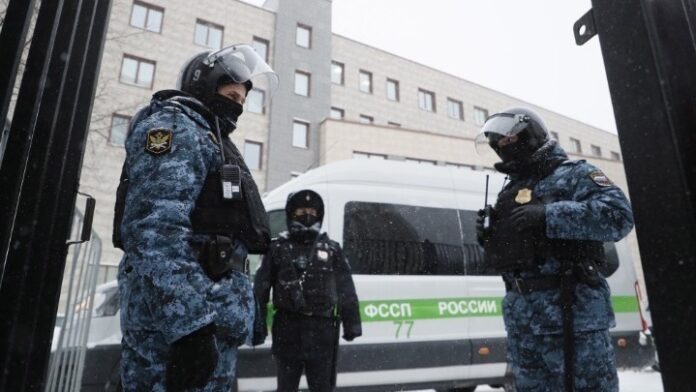
Η ουκρανική στρατιωτική υπηρεσία πληροφοριών ήταν άμεσα αναμιγμένη στη φονική επίθεση σε αίθουσα συναυλιών κοντά στη Μόσχα κατά την οποία σκοτώθηκαν περισσότεροι από 140 άνθρωποι, δήλωσε ο επικεφαλής της ρωσικής Ομοσπονδιακής Υπηρεσίας Ασφαλείας (FSB) Αλεξάντρ Μπόρτνικοφ, όπως μετέδωσε σήμερα το πρακτορείο ειδήσεων TASS.

Η Ρωσία είχε ήδη διατυπώσει και προηγουμένως τέτοιους ισχυρισμούς, σημειώνει το Ρόιτερς, προσθέτοντας ότι ο Μπόρτνικοφ δεν έδωσε στοιχεία για να στηρίξει τον ισχυρισμό του.

«Η έρευνα συνεχίζεται, όμως μπορούμε ήδη να πούμε με ασφάλεια ότι η ουκρανική στρατιωτική υπηρεσία πληροφοριών είναι άμεσα αναμιγμένη σ’ αυτή την επίθεση», δήλωσε ο Μπόρτνικοφ, σύμφωνα με το ρωσικό κρατικό πρακτορείο ειδήσεων.

Ο ίδιος κατηγόρησε επίσης τη στρατιωτική συμμαχία του ΝΑΤΟ ότι διευκόλυνε τη μεταφορά «μισθοφόρων και μαχητών διεθνών τρομοκρατικών οργανώσεων από τη Μέση Ανατολή, τη Βόρεια Αφρική και το Αφγανιστάν» στην Ουκρανία ώστε να μπορέσουν να πολεμήσουν εκεί εναντίον των ρωσικών δυνάμεων.

Η οργάνωση Ισλαμικό Κράτος ανέλαβε την ευθύνη για τη σφαγή στην αίθουσα συναυλιών το Μάρτιο και αμερικανοί αξιωματούχοι είπαν ότι έχουν πληροφορίες που δείχνουν ότι πραγματοποιήθηκε από τον αφγανικό κλάδο του δικτύου, το Ισλαμικό Κράτος του Χορασάν. Η Ουκρανία έχει επανειλημμένα αρνηθεί πως είχε οποιαδήποτε σχέση με την επίθεση.

Ο Μπόρτνικοφ δήλωσε, σύμφωνα με το TASS, ότι το Ισλαμικό Κράτος του Χορασάν διαδραμάτισε ρόλο στο συντονισμό των ενεργειών των δραστών και ότι η ουκρανική στρατιωτική υπηρεσία πληροφοριών είχε επίσης άμεσο ρόλο.

ΑΠΕ-ΜΠΕ

Γεώργιος Πρεβελάκης-Οι ευρωεκλογές ως γεωπολιτικό διακύβευμα

0

Τα κλασικά ευρωπαϊκά γεωπολιτικά διακυβεύματα διατρέχουν τις αναμετρήσεις των δύο Παγκοσμίων και του Ψυχρού Πολέμου.

Οι Ηνωμένες Πολιτείες ταλαντεύονται ανάμεσα στην απομονωτική τους παράδοση και την εμπλοκή στα ευρασιατικά διακυβεύματα. Οι ευρωπαϊκές ηγεσίες παλαιόθεν αδυνατούν να χαράξουν ενιαία πολιτική ως προς την άμυνα και την εξωτερική πολιτική – διαφωνούν και για την Ουκρανία. Η κακοφωνία της Δύσης δεν είναι απλώς ένα σύμπτωμα της συνεχώς καταγγελλόμενης ασθενούς ηγεσίας· υπάρχει κάτι βαθύτερο – ανομολόγητη προς το παρόν πρόκληση για το επόμενο Ευρωκοινοβούλιο. Πίσω από τα γεγονότα και τις πρόσφατες πρωτοβουλίες, πολεμικές ή άλλες, υποβόσκει ένα ερώτημα το οποίο είχαν απωθήσει από τη συλλογική μνήμη αρχικά η διχοτόμηση της Ευρώπης κατά τον Ψυχρό Πόλεμο και, κατόπιν, η αμερικανική υπερ-ηγεμονία.

Μέσα στον κόσμο που αλλάζει κλίμακα, τα ευρωπαϊκά έθνη είναι βέβαια πολύ μικρά για να αντέξουν στον γεωπολιτικό ανταγωνισμό δυνάμεων όπως οι Ηνωμένες Πολιτείες, η Κίνα, αύριο η Ινδία. Το ερώτημα είναι προς τα πού πρέπει να προσανατολιστεί ο υφιστάμενος ευρωπαϊκός οικονομικός «γίγας», καθώς συνειδητοποιεί την ανάγκη να συνδυάσει την οικονομική με τη γεωπολιτική ισχύ. Θα κοιτάξει έσωθεν, για να καταστεί μια ηπειρωτική δύναμη· ή θα διατηρήσει τις θαλασσινές παραδόσεις οι οποίες, στο παρελθόν, εξασφάλισαν παγκόσμια υπεροχή; Θα επικρατήσει η Ευρώπη-ήπειρος, προσανατολισμένη βαρυκεντρικά στο σύνολο των γαιών, ή η Ευρώπη-αρχιπέλαγος, με πόλους ανάμεσα στη Μεσόγειο και τον Ατλαντικό, ανοικτή στην Αφρική; Θα δοθεί έμφαση στη συνεκτική ηπειρωτική μάζα ή στις χερσονήσους και τους κόλπους, στην αλληλοδιείσδυση γης και θάλασσας; Θα προχωρήσει η Ευρώπη με τις ηπειρωτικές αξίες του συγκεντρωτισμού και της ιεραρχίας ή με τις θαλασσινές της δημοκρατίας και της ελευθερίας; Πώς θα ερμηνεύσει τα σημερινά «ξύλινα τείχη»;

Ακολουθώντας τις αναλύσεις του Halford Mackinder, οι αγγλοσαξονικές δυνάμεις, παλαιότερα η Αγγλία, κατόπιν οι Ηνωμένες Πολιτείες, έδρασαν αποφασιστικά για να αποτρέψουν την «ηπειροποίηση» την οποία προωθούσε άλλοτε το Βερολίνο, άλλοτε η Μόσχα, κάποτε και από κοινού – όπως στο Ράπαλο ή με το σύμφωνο Ρίμπεντροπ-Μολότοφ. Ωστόσο με τον, όχι πάντοτε ανιδιοτελή, παρεμβατισμό δημιούργησαν δυσαρέσκειες οι οποίες εκφράζονται στην υπόκωφη διεκδίκηση της ευρωπαϊκής αυτονομίας. Επομένως, «Ευρώπη-ήπειρος» ώστε να απαλλαγούν οι Ευρωπαίοι από την αμερικανική υποτέλεια;

Η Ρωσία τροφοδοτεί αδιαλλείπτως αυτή τη ρητορική. Η προπαγάνδα της επαναλαμβάνει ad nauseum ότι η αμερικανική οικονομία επωφελείται από τον πόλεμο στην Ουκρανία, τις συνέπειες του οποίου υφίστανται οι Ευρωπαίοι. Καραδοκεί να αξιοποιήσει την αναβίωση ενός γεωπολιτικού οράματος το οποίο, κατά τη μεταπολεμική περίοδο, διατύπωσε ως «Ευρώπη από τον Ατλαντικό ώς τα Ουράλια» ο στρατηγός Ντε Γκωλ και ως «Κοινό Ευρωπαϊκό Οίκο» ο Μιχαήλ Γκορμπατσόφ.

Κάθε ευρωπαϊκή χώρα τοποθετείται διαφορετικά. Αλλη στάση έχει η Γερμανία, με την παράδοση της Ostpolitik και τις ισχυρές οικονομικές συμπληρωματικότητες με τον ρωσικό χώρο· άλλη η Πολωνία και οι Βαλτικές Χώρες, με τις τραυματικές εμπειρίες από τη διαχρονική ρωσογερμανική σύμπλευση. Η πρωτοβουλία για τις «τρεις θάλασσες», τέσσερις μετά την πρόσφατη προσχώρηση της Ελλάδας, αποκαλύπτει την ανησυχία των χωρών αυτών. Αποσκοπεί σε έναν οικονομικό και γεωπολιτικό άξονα Βορρά-Νότου, κατά μήκος του ευρωπαϊκού ισθμού. Επιδιώκει να αμβλύνει την οικονομική και γεωπολιτική επίδραση από τους κυκλοφοριακούς και ενεργειακούς άξονες τους οποίους κληροδότησε η εξάρτηση της Ανατολικής Ευρώπης από τη Σοβιετική Ενωση· επίσης, να ανοίξει την Ανατολική Ευρώπη στη θαλάσσια κυκλοφορία.

Τα κλασικά ευρωπαϊκά γεωπολιτικά διακυβεύματα διατρέχουν τις αναμετρήσεις των δύο Παγκοσμίων και του Ψυχρού Πολέμου. Αναβιώνουν σήμερα, καθώς ανασχηματίζεται ο παγκόσμιος γεωπολιτικός χάρτης. Η λήξη, ούτως ή άλλως, του ρωσοουκρανικού πολέμου και η αναπόφευκτη επαναομαλοποίηση των ευρωρωσικών σχέσεων θα επαναφέρει διλήμματα, μέχρι πρότινος «ξεπερασμένα».

Στο ερώτημα ήπειρος ή αρχιπέλαγος, τα ελληνικά συμφέροντα συμπλέουν καταλυτικά με την «αρχιπελαγική», θαλασσινή Ευρώπη. Οι έλληνες ευρωβουλευτές θα κληθούν να την υπερασπιστούν. Η συνεισφορά τους οφείλει να καταστεί περισσότερο γεωπολιτική από πριν. Οι αποφάσεις της επόμενης πενταετίας θα ξεπεράσουν, ως μακροπρόθεσμη επίδραση στα ζωτικά εθνικά συμφέροντα, τα «πακέτα Ντελόρ» και την αντιμετώπιση των οικονομικών θεμάτων.

* Ο κ. Γιώργος Πρεβελάκης είναι ομότιμος καθηγητής Γεωγραφίας και Γεωπολιτικής, Πανεπιστήμιο της Σορβόννης (Paris 1), και Distinguished Visiting Professor, Hellenic American University.

Οι ευρωεκλογές ως γεωπολιτικό διακύβευμα

Βομβαρδισμοί και οδομαχίες στη Γάζα – Σήμερα αναμένεται απόφαση του Διεθνούς Δικαστηρίου της Χάγης για το αίτημα κατάπαυσης του πυρός

0

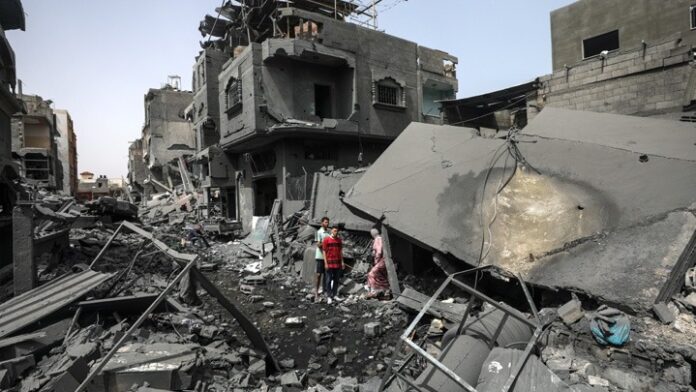
Ο ισραηλινός στρατός συνεχίζει σήμερα να βομβαρδίζει τη Λωρίδα της Γάζας, την ώρα που το Διεθνές Δικαστήριο (ΔΔ) της Χάγης, το κορυφαίο δικαστικό όργανο του ΟΗΕ, αναμένεται να αποφανθεί για το αίτημα να σταματήσει η στρατιωτική επιχείρηση στον παλαιστινιακό θύλακο, ερειπωμένο έπειτα από επτά και πλέον μήνες πολέμου.

Διαβάστε επίσης: Ο Νετανιάχου προσκλήθηκε να απευθύνει «σύντομα» ομιλία στο Κογκρέσο των ΗΠΑ

Παγκόσμια Τράπεζα: Η Παλαιστινιακή Αρχή στα πρόθυρα ασφυξίας

Νωρίτερα αυτή την εβδομάδα, ο εισαγγελέας του Διεθνούς Ποινικού Δικαστηρίου (ΔΠΔ), ο Καρίμ Χαν, ζήτησε να εκδοθούν εντάλματα σύλληψης ισραηλινών ηγετών, συμπεριλαμβανομένου του πρωθυπουργού Μπενιαμίν Νετανιάχου, και κορυφαίων στελεχών της Χαμάς, συμπεριλαμβανομένου του ηγέτη της στη Λωρίδα της Γάζας, του Γιαχία Σινουάρ.

Εν μέσω πολεμικής μετά την ανακοίνωση αυτή, ο Μπενιαμίν Νετανιάχου προσκλήθηκε να απευθύνει ομιλία «σύντομα» στο αμερικανικό Κογκρέσο, ανακοίνωσε χθες το βράδυ ο Ρεπουμπλικάνος πρόεδρος της Βουλής των Αντιπροσώπων, ο Μάικ Τζόνσον.

Ο Δημοκρατικός πρόεδρος Τζο Μπάιντεν αντέδρασε εξάλλου κατακεραυνώνοντας την ανακοίνωση του εισαγγελέα Χαν.

«Είμαι ευτυχής που θα σας ανακοινώσω» πως «σύντομα θα υποδεχθούμε τον πρωθυπουργό Νετανιάχου στο Καπιτώλιο, στο πλαίσιο συνεδρίασης της ολομέλειας του Κογκρέσου», ανέφερε ο «speaker» (πρόεδρος) της Βουλής των Αντιπροσώπων Τζόνσον κατά τη διάρκεια εκδήλωσης στην ισραηλινή πρεσβεία στην Ουάσιγκτον.

Εντός της ημέρας, το ΔΔ αναμένεται να ανακοινώσει την απόφασή του για το αίτημα της Νότιας Αφρικής -που κατηγορεί το Ισραήλ ότι διαπράττει «γενοκτονία» στη Λωρίδα της Γάζας- να διατάξει να κηρυχθεί «αμέσως» κατάπαυση του πυρός στον παλαιστινιακό θύλακο.

Παρότι οι αποφάσεις του δικαστηρίου, με έδρα τη Χάγη, που καλείται να επιλύει διαφορές μεταξύ χωρών, είναι στη θεωρία νομικά δεσμευτικές, δεν έχει κανέναν τρόπο να προχωρήσει στην επιβολή της εφαρμογής τους.

Εκρήξεις

Ο πόλεμος αυτός ξέσπασε την 7η Οκτωβρίου, όταν ο στρατιωτικός βραχίονας της Χαμάς εξαπέλυσε με ορμητήριο τη Λωρίδα της Γάζας έφοδο άνευ προηγουμένου σε νότιους τομείς της ισραηλινής επικράτειας, με αποτέλεσμα να χάσουν τη ζωή τους πάνω από 1.170 άνθρωποι, στην πλειονότητά τους άμαχοι, σύμφωνα με καταμέτρηση του Γαλλικού Πρακτορείου βασισμένη σε επίσημα ισραηλινά δεδομένα.

Από τους 252 ανθρώπους που απήχθησαν κατά τη διάρκεια της επίθεσης κι οδηγήθηκαν στον θύλακο, 124 πιστεύεται πως παραμένουν όμηροι στα χέρια της Χαμάς, ωστόσο τουλάχιστον 37 θεωρείται πως είναι νεκροί, σύμφωνα με όσα έχει ανακοινώσει ο ισραηλινός στρατός.

Σε αντίποινα, οι ένοπλες δυνάμεις εξαπέλυσαν ευρείας κλίμακας, καταστροφικές στρατιωτικές επιχειρήσεις στη Λωρίδα της Γάζας, με διακηρυγμένο στόχο τον αφανισμό της Χαμάς, κινήματος το οποίο χαρακτηρίζεται τρομοκρατική οργάνωση από το Ισραήλ, την Ευρωπαϊκή Ένωση και τις ΗΠΑ.

Τουλάχιστον 35.800 Παλαιστίνιοι, στη μεγάλη πλειονότητά τους άμαχοι, έχουν χάσει τη ζωή τους μέχρι τώρα στις ισραηλινές επιχειρήσεις, σύμφωνα με δεδομένα του υπουργείου Υγείας στη Λωρίδα της Γάζας, όπου κυβερνά η Χαμάς από το 2007.

Η Πολιτική Προστασία στην πόλη της Γάζας (βόρεια) ανέφερε χθες Πέμπτη πως δυο αεροπορικοί βομβαρδισμοί στοίχισαν τη ζωή σε τουλάχιστον 26 ανθρώπους, ανάμεσά τους 15 παιδιά. Τα δεκαέξι από τα θύματα σκοτώθηκαν σε πλήγμα στο σπίτι τους, τα υπόλοιπα δέκα σε βομβαρδισμούς τζαμιού και σχολείου.

Μαίνονταν παράλληλα οδομαχίες στην Τζαμπάλια (βόρεια) ανάμεσα στους ένοπλους βραχίονες της Χαμάς και του Παλαιστινιακού Ισλαμικού Τζιχάντ και στοιχεία του ισραηλινού στρατού. «Το μοναδικό που ακούμε είναι εκρήξεις και πυρά» στον καταυλισμό προσφύγων, είπε ο Μαχμούντ αλ Σαρίφ, Παλαιστίνιος 31 ετών.

Τις πρώτες πρωινές ώρες σήμερα οι αεροπορικοί βομβαρδισμοί συνεχίζονταν στη Λωρίδα της Γάζας, με πηγές σε νοσοκομεία να κάνουν λόγο για πολλούς τραυματίες στη Ντέιρ αλ Μπάλα (κεντρικά).

«Προσοχή και ακρίβεια»

«Διεξάγεται πόλεμος εναντίον των νοσοκομείων της Λωρίδας της Γάζας», δήλωσε στο Γαλλικό Πρακτορείο ο Δρ. Χαλίλ Αλ Νταρκάν, εκπρόσωπος του νοσοκομείου των μαρτύρων του Αλ Ακσά στη Ντέιρ Αλ Μπάλα, προειδοποιώντας πως η δομή υγείας αυτή ενδέχεται να αναστείλει τη λειτουργία της εξαιτίας έλλειψης καυσίμων.

Αφότου ξεκίνησαν χερσαίες επιχειρήσεις στις αρχές Μαΐου σε τομείς της Ράφας και καταλήφθηκε η παλαιστινιακή πλευρά του σημείου διέλευσης στα σύνορα με την Αίγυπτο, ο ΟΗΕ διαπιστώνει πλήρη παράλυση των παραδόσεων καυσίμων, που είναι απόλυτα απαραίτητα για να τροφοδοτούνται οι γεννήτριες των νοσοκομείων και τα οχήματα με τα οποία διανέμεται ανθρωπιστική βοήθεια.

Όσο για το άλλο κρίσιμο σημείο εισόδου εμπορευμάτων, το Κερέμ Σαλόμ, «προς το παρόν δίνεται προτεραιότητα στον ιδιωτικό τομέα» και όχι στον ΟΗΕ, δήλωσε στο Γαλλικό Πρακτορείο ο Φιλίπ Λαζαρινί, ο επικεφαλής του Γραφείου Αρωγής και Έργων των Ηνωμένων Εθνών για τους Παλαιστίνιους Πρόσφυγες στην Εγγύς Ανατολή (UNRWA).

Ο ισραηλινός στρατός άρχισε χερσαίες επιχειρήσεις στη Ράφα την 7η Μαΐου, με διακηρυγμένο στόχο να εξολοθρεύσει τα τελευταία, κατ’ αυτόν, τάγματα της Χαμάς και να διασώσει ομήρους, αψηφώντας τις διεθνείς προειδοποιήσεις για τους αμάχους. Συνέπεια: 800.000 άνθρωποι εγκατέλειψαν την πόλη, σύμφωνα με τον ΟΗΕ.

«Δεν κάνουμε εκκωφαντική (εισβολή) στη Ράφα, επιχειρούμε με προσοχή και ακρίβεια», διαβεβαίωσε χθες ο αντιναύαρχος Ντανιέλ Χαγκαρί, εκπρόσωπος των ισραηλινών ενόπλων δυνάμεων.

Περιμένοντας τον διευθυντή της CIA

Παράλληλα με τη δικαστική δραστηριότητα στη Χάγη και τις εχθροπραξίες στη Γάζα, το Ισραήλ βρέθηκε αντιμέτωπο την Τετάρτη με ήττα σε διπλωματικό επίπεδο, την απόφαση της Ισπανίας, της Ιρλανδίας και της Νορβηγίας να αναγνωρίσουν κράτος της Παλαιστίνης.

Χθες Πέμπτη ο διευθυντής του ισραηλινού υπουργείου Εξωτερικών Ιακώβ Μπλίτσταϊν προειδοποίησε κατά τη διάρκεια συνάντησης με τους πρεσβευτές των τριών χωρών πως η απόφαση των κυβερνήσεων θα έχει «σοβαρές συνέπειες» και υποστήριξε επίσης πως κάνει «πιο δύσκολη» τη σύναψη «συμφωνίας για την απελευθέρωση των ομήρων».

Έπειτα από τη μετάδοση βίντεο στο οποίο εικονίζονται νεοσύλλεκτες που απήχθησαν απο μαχητές της Χαμάς την 7η Οκτωβρίου, η ισραηλινή κυβέρνηση έδωσε πάντως διαταγή στους ισραηλινούς διαπραγματευτές να «επιστρέψουν στο τραπέζι των διαπραγματεύσεων για να εξασφαλίσουν την επιστροφή των ομήρων», σύμφωνα με ανώτερο αξιωματούχο.

Στις αρχές Μαΐου, οι έμμεσες διαπραγματεύσεις Ισραήλ/Χαμάς με τη μεσολάβηση του Κατάρ, της Αιγύπτου και των ΗΠΑ δεν επέτρεψαν να κλειστεί συμφωνία κατάπαυσης του πυρός και απελευθέρωσης ισραηλινών ομήρων στη Λωρίδα της Γάζας και παλαιστινίων φυλακισμένων στο Ισραήλ.

Σύμφωνα με ρεπορτάζ που δημοσίευσε ο αμερικανικός ειδησεογραφικός ιστότοπος Axios, ο διευθυντής της CIA, ο Γουίλιαμ Μπερνς, αναμένεται να ταξιδέψει «τις προσεχείς ημέρες» στην Ευρώπη για συνομιλίες με τον επικεφαλής της Μοσάντ, της ισραηλινής υπηρεσίας πληροφοριών, και τον πρωθυπουργό του Κατάρ, στο πλαίσιο προσπάθειας να ξαναρχίσουν οι έμμεσες διαπραγματεύσεις.

Ωστόσο, επικαλούμενο «υψηλά ιστάμενη πηγή», το μέσο ενημέρωσης Αλ Καχέρα, που θεωρείται πως έχει δεσμούς με την αιγυπτιακή υπηρεσία πληροφοριών, μετέδωσε πως «ισραηλινή θέση εξακολουθεί να μην ευνοεί» το κλείσιμο συμφωνίας «κατάπαυσης του πυρός και απελευθέρωσης των ομήρων».

ΦΩΤΟ ΑΡΧΕΙΟΥ

ΑΠΕ-ΜΠΕ

Στη δημοσιότητα το πρώτο πόρισμα για το ελικόπτερο του Ραϊσί – «Δεν βρέθηκαν σφαίρες»

0

Το προκαταρκτικό πόρισμα καταδεικνύει ότι το ελικόπτερο τυλίχθηκε στις φλόγες μόνο μετά τη συντριβή του στην πλαγιά

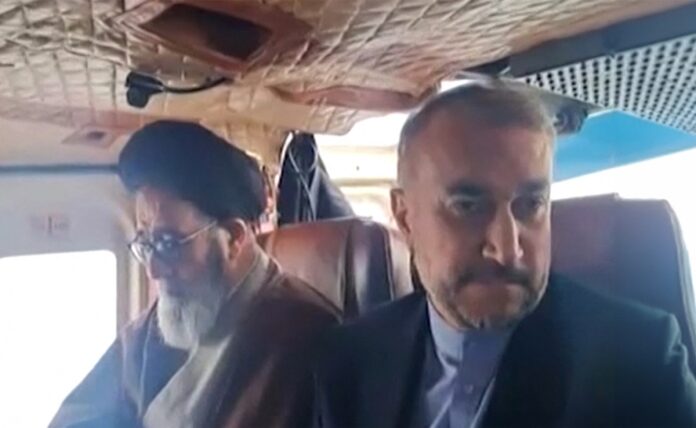
Δεν βρέθηκαν ίχνη από σφαίρες στο κύτος του ελικοπτέρου του εκλιπόντος Ιρανού προέδρου Εμπραχίμ Ραΐσι, το οποίο συνετρίβη νωρίτερα αυτή την εβδομάδα, σύμφωνα με ανακοίνωση του Γενικού Επιτελείου των Ενόπλων Δυνάμεων του Ιράν.

«Δεν βρέθηκαν ίχνη από σφαίρες ή παρόμοια αντικείμενα στο κύτος του ελικοπτέρου που συνετρίβη» ανέφερε το τηλεοπτικό κανάλι IRIB στην ανακοίνωση.

Το Γενικό Επιτελείο των Ενόπλων Δυνάμεων της Ισλαμικής Δημοκρατίας του Ιράν δήλωσε ότι δημοσιεύει τα προκαταρκτικά πορίσματα της έρευνας για το μοιραίο δυστύχημα που στοίχισε τη ζωή στον πρόεδρο και όπως τονίζει «μπορεί να ειπωθεί με βεβαιότητα ότι δεν υπήρχαν σφαίρες».


Η έκθεση επανέλαβε επίσης ότι τα συντρίμμια βρέθηκαν με τη χρήση ιρανικών μη επανδρωμένων αεροσκαφών, απορρίπτοντας τον ισχυρισμό της Άγκυρας ότι το τουρκικό μη επανδρωμένο αεροσκάφος Akinci εντόπισε τα συντρίμμια.

Το φέρετρο του Ραϊσί μεταφέρθηκε αεροπορικώς στη Μασχάντ, στο βορειοανατολικό Ιράν, αφού μια νεκρική πομπή πραγματοποιήθηκε προς τιμήν του σήμερα το πρωί στην ανατολική πόλη Μπιρζάντ, όπου χιλιάδες άνθρωποι είχαν βγει στους δρόμους για να του αποτίσουν ύστατο φόρο τιμής.

Τιμητική φρουρά στεκόταν προσοχή την ώρα που το αεροπλάνο με το φέρετρο του Ραϊσί προσγειωνόταν στη Μασχάντ, τη γενέτειρά του, όπου θα αναπαυθεί στο μαυσωλείο του Ιμάμη Ρεζά με το χρυσό τρούλο, τον πιο ιερό τόπο του ισλάμ στο Ιράν, τον οποίο τιμούν οι σιίτες μουσουλμάνοι ως το κοιμητήριο όπου αναπαύεται ο ιμάμης του 9ου αιώνα Αλί αλ-Ρεζά.

Ο Ραϊσί, 63 ετών, θεωρούνταν ευρέως υποψήφιος για τη διαδοχή του 85χρονου Ανώτατου Ηγέτη Αλί Χαμενεΐ. Ο Μοχαμάντ Μοχμπέρ, ο οποίος ήταν πρώτος αντιπρόεδρος, έχει αναλάβει καθήκοντα προσωρινού προέδρου μέχρι τις εκλογές που θα διεξαχθούν στις 28 Ιουνίου.

Οκτώ επιβάτες και μέλη του πληρώματος έχασαν τη ζωή τους όταν το ελικόπτερο συνετρίβη σε ορεινή περιοχή κοντά στα σύνορα με το Αζερμπαϊτζάν.

Πηγή: protothema.gr

ΝΕΟ ΦΩΣ ΣΤΗΝ ΟΜΙΛΙΑ ΡΑΜΑ ΣΤΗΝ ΑΘΗΝΑ …

11
 του Παναγιώτη Μπάρκα

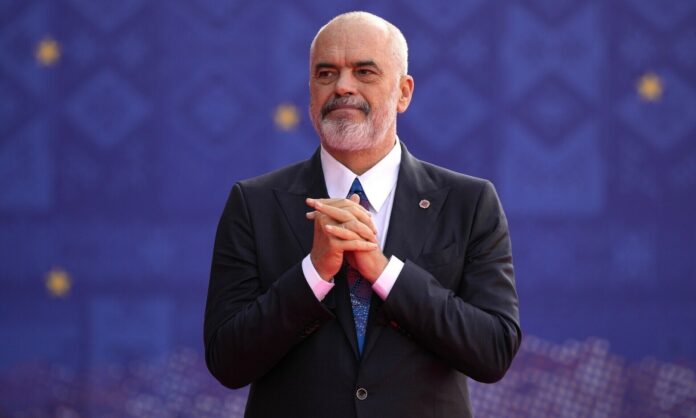
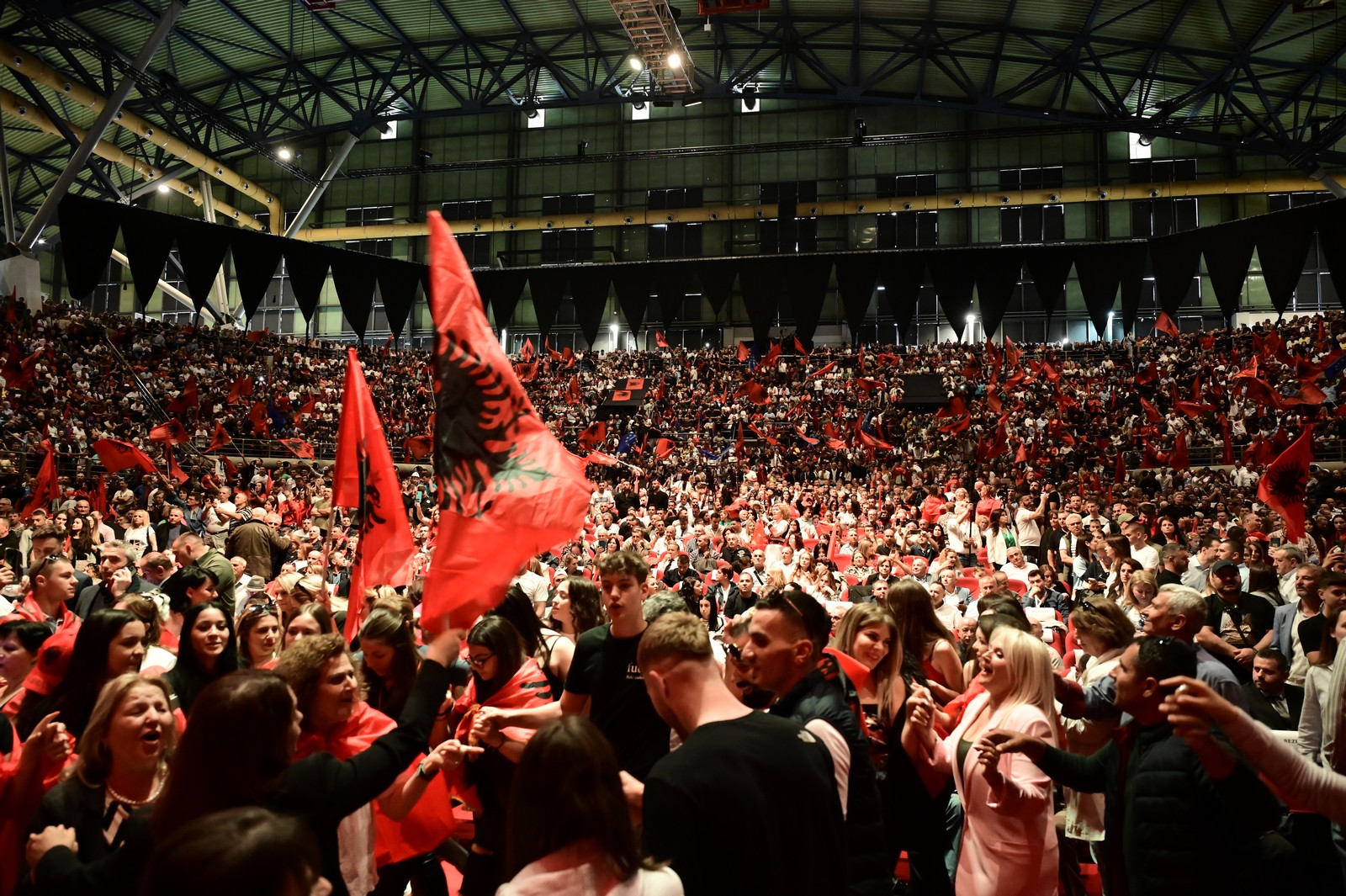
Υπάρχουν μια σειρά από εξελίξεις που επιβεβαιώνουν ότι η επίσκεψη του Έντι Ράμα στην Αθήνα και η ομιλία του στο Γαλάτσι, ούτε αυθόρμητη ήταν, ούτε προεκλογικό χαρακτήρα είχε. Περισσότερο αφορούσε τη ανακοίνωση εθνικής στρατηγικής που για πολλές δεκαετίες υπόφωσκε.

Αναφορικά με την Ελλάδα αρκεί η διατύπωση περί «Αλβανών της Ελλάδας», οι οποίοι, για τα Τίρανα, αποτελούν συνέχεια, των Αρβανιτών, οι διαστρωματώσεις Αλβανών στην υπηρεσία της Οθωμανικής Αυτοκρατορίας στον ελληνικό χώρο και οι σημερινοί μετανάστες. Πάντα σύμφωνα με τα Τίρανα, πρόκειται για Αλβανούς στους οποίους «η Ελλάδα ανήκει ισότιμα με τους Έλληνες». Που «έχουν προσφέρει ισάξια με τους Έλληνες στον αρχαίο ελληνικό πολιτισμό» και αποτελούν «τους πραγματικούς σημερινούς κληρονόμους» του. Άρα, συμπερασματικά «τους ανήκει» το δικαίωμα «διεκδίκησης καθεστώτος εθνοτικής κοινότητας στην Ελλάδα, αποκαλούμενη «Αλβανοί της Ελλάδας», όπως οι Έλληνες της Αλβανίας.

ΝΕΕΣ ΣΥΝΙΣΤΩΣΕΣ ΣΤΟΝ ΑΛΒΑΝΙΚΟ ΑΝΘΕΛΛΗΝΙΣΜΟ.

Επιβεβαίωση των ανωτέρων αποτελεί πρώτα η νέα έξαρση στα Τίρανα του αλβανικού εθνικισμού ως ανθελληνισμού, με δύο βασικά χαρακτηριστικά.
  • Την ανάδειξη ως Αλβανών (ούτε καν ως Αρβανιτών) των Ελληνοαρβανιτών που πολέμησαν για την Ελευθερία της Ελλάδας, κατά των Τουρκοαλβανών στο πλευρό της Οθωμανικής Αυτοκρατορίας. (Αιχμή του δόρατος έγινε η Μπουμπουλίνα).
  • Το δεύτερο σκέλος αφορά την διαχρονική αποδόμηση του Ελληνικού λαού, στη σύνθεση του οποίου, κατά τους αλβανικούς ισχυρισμούς, το 40% φέρει αλβανικό αίμα, ενώ το ελληνικό αγγίζει μόλις το 20 τοις εκατό.
Οι ισχυρισμοί διεκδικούν αλβανική ανωτερότητα παντού, καταλογίζουν διαχρονική εχθρική συμπεριφορά της Ελλάδας κατά των Αλβανών και θέλουν να επιβάλουν στην Ελλάδα την ανάπτυξη σχέσεων καλής γειτονίας με αλβανικούς όρους.

Η ΔΗΛΩΣΗ ΒΟΥΛΙΝ

Ένα δεύτερο στοιχείο αποτελεί η αλβανική αντίδραση με κορυφαίο τον Πρωθυπουργό Ράμα, στη δήλωση του Σέρβου αντιπροέδρου της κυβέρνησης Βουλίν, ότι μετά και την ομιλία Ράμα στην Αθήνα και την συμπεριφορά «σπρώξε πιο κάτω τον τενεκέ» από μέρος της Αθήνας, μόνο η Σερβία μπορεί να σταματήσει την ιδέα της Μεγάλης Αλβανίας. Τόσο σοβαρά έλαβαν τα Τίρανα υπόψη την δήλωση αυτή που κάλεσαν εσπευσμένα στο Υπουργείο Εξωτερικών για εξηγήσεις τον Σέρβο Πρέσβη στα Τίρανα.

Ο ΡΟΛΟΣ ΤΗΣ ΤΟΥΡΚΙΑΣ

Αναλυτές στα αλβανικά κανάλια δηλώνουν πλέον και ανοιχτά ότι σωτήριος στις βλέψεις κυρίως της Ελλάδας κατά της Αλβανίας είναι ο ρόλος της Τουρκίας, ο οποίος, σημειώνουν, απόχτησε συγκεκριμένη δομή κυρίως μετά την υπογραφή των γνωστών πολλαπλών συμφωνιών μεταξύ Άγκυρας και Τιράνων, τον Φλεβάρη του 2024. Αναφέρουν μάλιστα ότι αν δεν ήταν η Τουρκία η Βόρειος Ήπειρος θα είχε φύγει από καιρό στην Ελλάδα. Στο ίδιο πλαίσιο καταβάλλονται προσπάθειες να αναδειχθεί η Ελλάδα χώρα με σοβαρά προβλήματα με τους γείτονες (Σκόπια, Τίρανα, Άγκυρα) για να δημιουργηθεί η εικόνα ότι η Ελλάδα έχει το πρόβλημα.

ΑΛΒΑΝΟ-ΒΟΥΛΓΑΡΙΚΟΣ ΔΑΚΤΥΛΟΣ ΣΤΙΣ ΕΞΕΛΙΞΕΙΣ ΣΤΗ «ΒΟΡΕΙΑ ΜΑΚΕΔΟΝΙΑ»

Επίσης, θεωρούν προσχεδιασμένες τις πρόσφατες εξελίξεις στη «Βόρεια Μακεδονία», δίδοντας δημοσιότητα σε μια συνεργασία μεταξύ Πρίστινας και Σόφιας με ορίζοντα τη διάλυση της «Βόρειας Μακεδονίας» απ΄όπου θα ωφεληθούν οι Βούλγαροι και οι Αλβανοί, αφήνοντας την Ελλάδα στην εχθρότητά της με τα Σκόπια με αιχμή του δόρατος την ονομασία.

(Το 1991, με την ιδιότητα του Βουλευτή και ενώ γνωρίζαμε την μεταφορά όπλων μέσω Δυρραχίου προς τους Αλβανούς των Σκοπίων και του Κοσσυφοπεδίου, είχα προτείνει στην ελληνική πλευρά την ίδια ιδέα, αλλά μεταξύ Ελλάδας και Αλβανών. Σχεδόν με αποκήρυξαν …!)

ΣΤΗΝ ΑΘΗΝΑ Η ΤΑΧΤΙΚΗ «ΣΠΡΩΞΕ ΤΟΝ ΤΕΝΕΚΕ ΠΙΟ ΚΑΤΩ!»
Στην Αθήνα αρέσκονται ή να βάζουν το θέμα κάτω από το χαλί, ή να σπρώξουν τον τενεκέ πιο κάτω. Δείχνουν ότι για μια ακόμα φόρα είναι απροετοίμαστοι για τις εξελίξεις σε τόσο σοβαρά εθνικά θέματα στην ίδια την αυλή μας. (Όπως μετά την κατάρρευση του κομμουνιστικού καθεστώτος το 1991 και μέχρι σήμερα). Διακατέχονται από το σύμπλεγμα ανωτερότητας, κουνώντας απειλητικά το δάχτυλο σε Τίρανα και Σκόπια ότι ο δρόμος τους προς Ευρωπαϊκή Ένωση περνάει από την Αθήνα… (Δεν βλέπουν ότι χαράσσονται εντελώς άλλες προοπτικές, που δεν προϋποθέτουν την Ε.Ε. Ούτε το γεγονός ότι η συγκεκριμένη θέση της Αθήνας αφήνει αδιάφορη τη Δύση, ειδικά στο πλαίσιο των ευρύτερων γεωπολιτικών εξελίξεων). Ενώ με την Τουρκία «συνομιλούμε μέχρι να βρεθούν τα χέρια για την καυτή πατάτα).
Δυστυχώς από την άλλη, οι γνωστοί πλέον κύκλοι και εντός της Ελληνικής κυβέρνησης, αγνοούν τις εξελίξεις αυτές σε σχέση με τα Τίρανα, ή τις αξιοποιούν, για να μπελεριοποιήσουν την εθνική πολιτική της Ελλάδας προς την Αλβανία. Μάλιστα, στα Τίρανα σχολιάζουν ότι ακροδεξιοί στο κυβερνών κόμμα, που διεκδικούν και τη διαδοχή στη Ν. Δημοκρατία, έχουν καταφέρει να στριμώξουν τον Μητσοτάκη ώστε να χειριστεί τις ελληνοαλβανικές σχέσεις στην οπτική της υπόθεσης Μπελέρη. (Εντούτοις, σημειώνουν ότι η υπόθεση Μπελέρη για τα Τίρανα θεωρείται λήξασα και αποτελεί πλέον εσωτερικό θέμα της Ελλάδας και της ελληνικής κυβέρνησης).

Η ΑΣΤΟΧΙΑ ΤΗΣ ΑΠΑΝΤΗΣΗΣ ΜΠΑΚΟΓΙΑΝΝΗ ΣΤΗΝ ΟΜΙΛΙΑ ΡΑΜΑ

Επίσης, η ελληνική υπεροψία κάνει εντελώς άτοπη, άστοχη και παραπλανητική την απάντηση Μπακογιάννη στην ομιλία Ράμα για «τους Αλβανούς της Ελλάδας» ότι η Αθήνα έχει περισσότερη επιρροή από τον Ράμα στους «Αλβανούς της Ελλάδας»
(Παρεπιπτόντως, η Μπακογιάννη κρίνεται στα Τίρανα ως «η πραγματική πρωθυπουργός» στην Ελλάδα, οι παππούδες της οποίας όμως, ισχυρίζονται αυτοαποκαλούμενοι ιστορικοί, έχουν βαμμένα τα χέρια με αλβανικό αίμα.)
Η Μπακογιάννη ίσως να μη θέλει να δει τις διαστρωματώσεις και μεταξύ των Αλβανών μεταναστών στην Ελλάδα. Ίσως αυτές τις διαστρωματώσεις να τις βάζει κάτω από το χαλί των συνετών Αλβανών μεταναστών στην Ελλάδα, που ασφαλώς αποτελούν την πλειοψηφία. Όπως μπερδεύει τις καλές σχέσεις και ένταξη στην ελληνική κοινωνία των Αλβανών μεταναστών, (έργο κυρίως του ελληνικού λαού) με την κυβερνητική, ή κομματική επιρροή στους Αλβανούς μετανάστες.

Η ΥΠΟΤΥΠΩΔΗΣ ΑΝΤΙΜΕΤΩΠΙΣΗ ΤΟΥ ΘΕΜΑΤΟΣ ΣΤΟ ΕΣΩΤΕΡΙΚΟ ΤΗΣ ΑΛΒΑΝΙΑΣ.

Ασφαλώς, την μεγάλη και αφόρητη πίεση από την αλβανική ανθελληνική εκστρατεία δέχεται ο Ελληνισμός της Αλβανίας, οι απλοί Έλληνες. Πίεση δέχονται οι διαμένοντες Έλληνες στην Αλβανία και από Ελλάδα, εφόσον τα συγκεκριμένα συμφέροντα τους υπαγορεύουν να αντιμετωπίσουν τους Αλβανούς εχθρικά. (Κάτι αδιανόητο). Συνεπώς, οι Έλληνες αναγκάζονται να βρουν καταφύγιο στην απώθηση του Ελληνισμού.

ΤΟ ΔΙΠΛΩΜΑΤΙΚΟ ΣΩΜΑ.

Στην Αλβανία, η στάση του διπλωματικού σώματος είναι προσβλητική και παθητική. Από την μια έχει επιδοθεί στην απλή καταγραφή των όσων συμβαίνουν στην ανθελληνική εκστρατεία, μάλιστα αποφεύγοντας στα δελτία τύπου την πραγματική ανθελληνική επιθετικότητα. Ίσως το κάνει για να μη ανησυχήσουν την Αθήνα. Ή για να δικαιολογήσουν την παθητική τους στάση (δεν συμβαίνει τίποτε!) και κατ επέκταση να μη ανοίξουν δουλειά στον εαυτόν τους.
Από την άλλη δεν καταβάλλεται καμιά προσπάθεια, (ή είναι αναποτελεσματική), για να ακουστεί η αλήθεια έστω και ως άλλη άποψη.

Στο σκεπτικό αυτό η πρεσβεία στα Τίρανα, είτε φανερά είτε ύπουλα (διπλωματικά) παραγκωνίζει, περιθωριοποιεί, αδιαφορεί και διώκει και όσους Έλληνες προσπαθούν να πράξουν το εθνικό χρέος.

Στο σκεπτικό αυτό η πρεσβεία στα Τίρανα, είτε φανερά είτε ύπουλα (διπλωματικά) παραγκωνίζει, περιθωριοποιεί, αδιαφορεί και διώκει και όσους Έλληνες προσπαθούν να πράξουν το εθνικό χρέος.

Κινείται με την αρχή ότι δεν «είναι καλά παιδιά» δλδ δεν γλείφονται. Ή δεν ανήκουν στην παράταξη υπό την κηδεμονία εκπροσώπων της Πρεσβείας, ή και άλλων παραπλήσιων φορέων. Υπάρχουν μάλιστα πληροφορίες, που λένε ότι τέτοιοι αξιοπρεπείς Έλληνες κακο-χαρακτηρίζονται στην Αθήνα με τη εθνική σφραγίδα της ελληνικής αντιπροσωπείας. Στην επιφάνεια έρχεται το «ελληνόμετρο», που όπως πάντα το Δ.Σ έχει τον δικό του σημαντικό ρόλο. Ξανά λοιπόν πάλη των τάξεων. Στην προκειμένη περίπτωση με σημείο αναφοράς τα εθνικά. (Υπερβαίνει και την ταχτική να τα βάλουμε κάτω από το χαλί)
Στην πραγματικότητα η στάση αυτή των διπλωματικών αρχών έχει θέσει στο περιθώριο την εκπροσώπηση της Ελλάδας στην Αλβανία και υποβάλλει σε αδιαφορία, διάσπαση και διάκριση τους Έλληνες.

Η Σερβική Δημοκρατία της Βοσνίας καταθέτει σχέδιο για ειρηνική απόσχιση από την Βοσνία-Ερζεγοβίνη

0

Το ανακοίνωσε ο πρόεδρος της σερβικής οντότητας

Εξελίξεις που μπορεί να δρομολογήσουν καταιγισμό εξελίξεων στην Βαλκανική ξεκίνησαν καθώς η Σερβική Δημοκρατία της Βοσνίας δήλωσε σήμερα δια του προέδρου της ότι θα προτείνει ειρηνική απόσχιση.

Όπως δήλωσε ο Πρόεδρος της Δημοκρατίας της Σέρπσκα, Μίλοραντ Ντόντικ:

«Τις επόμενες 30 ημέρες θα προταθεί συμφωνία για ειρηνικό χωρισμό. Σήμερα, ξεκινάμε με μια επίσημη απόφαση να επιδιώξουμε έναν ειρηνικό χωρισμό. Θα προτείνουμε πρώτα να αποσαφηνιστούν οι πολιτικές αρμοδιότητες σε σχέση με τις οντότητες και να διατηρηθεί το τρέχον μοντέλο οικονομικής λειτουργίας. Μέσα στα επόμενα χρόνια, θα προσαρμόσουμε αυτό το μοντέλο για να υποστηρίξουμε τον ειρηνικό χωρισμό».

Αυτό ήρθε μετά την υπερψήφιση σήμερα στην Ολομέλεια του ΟΗΕ Ψηφίσματος για τον ορισμό της 11ης Ιουλίου ως Παγκόσμιας Ημέρας Μνήμης και Τιμής της Γενοκτονίας της Σρεμπρένιτσα.


Η Βοσνία-Ερζεγοβίνη όπως έχει δημιουργηθεί μετά την διάλυση της Γιουγκοσλαβίας έχει διπλό νομοθετικό σώμα και μια τριμελή προεδρία που συνίσταται από ένα μέλος από κάθε μία από τις τρεις μεγάλες εθνότητες.

Ωστόσο, η εξουσία της κεντρικής κυβέρνησης είναι εξαιρετικά περιορισμένη, καθώς η χώρα είναι σε μεγάλο βαθμό αποκεντρωμένη.

Αποτελείται από δύο αυτόνομες οντότητες—την Ομοσπονδία της Βοσνίας-Ερζεγοβίνης και τη Δημοκρατία της Σέρπσκα (Σέρβων Βοσνίας) —και μια τρίτη μονάδα, την Περιοχή του Μπρτσκο, η οποία διοικείται από τη δική της τοπική κυβέρνηση.

https://www.pronews.gr/kosmos/valkania/i-serviki-dimokratia-tis-vosnias-katathetei-sxedio-gia-eiriniki-aposxisi-apo-tin-vosnia-erzegovini/

Βόρεια Μακεδονία: Η Σιλιάνοφσκα… ακάθεκτη, ευχαρίστησε τον Πάπα για τη συνάντηση «εκ μέρους των Μακεδόνων»

4

Η Γκορντάνα Σιλιάνοφσκα επιμένει στην προκλητική της στάση καθώς εξακολουθεί σε δημόσιους διαλόγους να μην αποκαλεί την Βόρεια Μακεδονία με την συνταγματική της ονομασίας.

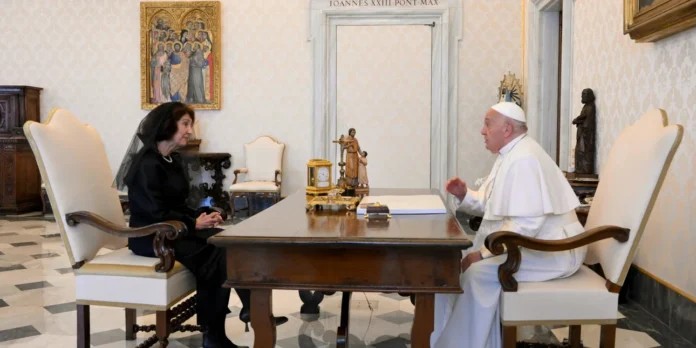
Η πρόεδρος της γειτονικής χώρας συναντήθηκε με τον Πάπα Φραγκίσκο στο Βατικανό και στην ανάρτησή της, τον ευχαρίστησε «εκ μέρους όλων των Μακεδόνων πολιτών» για τη σταθερή υποστήριξή του στην ευρωπαϊκή προοπτική των Δυτικών Βαλκανίων».

Μήνυμα ΗΠΑ σε Σιλιάνοφσκα για το «Μακεδονία»: Τηρήστε τη Συμφωνία των Πρεσπών
«Ηταν τιμή μου να συναντήσω τον Ποντίφικα σήμερα. Ευχαριστώ τον Αγιότατο για την αποφασιστικότητά του να επιδιώξει την ειρήνη στον κόσμο και να συνηγορεί υπέρ των φτωχών του κόσμου. Εκ μέρους όλων των Μακεδόνων, τον ευχαρίστησα για τη στήριξή του στην ευρωπαϊκή ολοκλήρωση των Δυτικών Βαλκανίων»

/www.iefimerida.gr/kosmos/i-silianofska-eyharistise-ton-papa-ek-meroys-ton-makedonon”>Βόρεια Μακεδονία: Η Σιλιάνοφσκα… ακάθεκτη, ευχαρίστησε τον Πάπα για τη συνάντηση «εκ μέρους των Μακεδόνων» – iefimerida.gr</a></p>

Μεγάλη αρχαιολογική ανακάλυψη: «Η πανοπλία των Μυκηναίων Ελλήνων ήταν ένα εξαιρετικό τεχνολογικό επίτευγμα»

0

«Όχι μόνο επέτρεπε όλες τις απαραίτητες κινήσεις του Μυκηναίου μαχητή αλλά και τον προστάτευε από τα εχθρικά χτυπήματα»

Μία εντυπωσιακή ανακάλυψη έκανε το πανεπιστήμιο Θεσσαλίας, πραγματοποιώντας λεπτομερή και εξειδικευμένη μελέτη και έρευνα κατά την οποίαν εκπαιδευμένοι Έλληνες Πεζοναύτες φόρεσαν ένα πιστό αντίγραφο ολόσωμης χάλκινης πανοπλίας, ηλικίας 3.500 ετών, δημιούργημα των Μυκηναίων Ελλήνων, ακολουθώντας ένα απαιτητικό πρωτόκολλο προσομοίωσης μάχης.

Σύμφωνα με τα αποτελέσματα της έρευνας η πανοπλία κρίθηκε άκρως επιχειρησιακή, λειτουργική και αποδοτική σε πραγματικές συνθήκες μάχης και χαρακτηρίζεται ως ένα εντυπωσιακό τεχνολογικό επίτευγμα της εποχής της.

Η μελέτη δημοσιεύθηκε πρόσφατα σε έγκυρο διεθνές επιστημονικό περιοδικό.

Τα αποτελέσματα έδειξαν ότι η εν λόγω πανοπλία θα μπορούσε να χρησιμοποιηθεί στο πεδίο της μάχης, και δεν ήταν απλά μία τελετουργική αμφίεση, όπως είχε αρχικά διατυπωθεί.

«Το καλύτερα διατηρημένο και σχεδόν πλήρες δείγμα ολόσωμης πανοπλίας της μυκηναϊκής εποχής που αποτελείται από πλάκες σφυρήλατου χαλκού και χρονολογείται από τον 15ο αιώνα π.Χ., βρέθηκε στο χωριό Δενδρά της Αργολίδας από Σουηδούς και Έλληνες αρχαιολόγους τον Μάιο του 1960.

Όμως, από την ημέρα της ανακάλυψής της το ερώτημα που απασχόλησε τους ειδικούς ήταν: χρησιμοποιείτο μόνο για τελετουργικούς σκοπούς ή προορίζονταν και ως ένα αποτελεσματικό πολεμικό όργανο;

Η μέχρι τώρα η έλλειψη μίας τεκμηριωμένης απάντησης περιόρισε την πλήρη κατανόηση των συνθηκών που επικρατούσαν στις πολεμικές συγκρούσεις της εποχής, οι οποίες και καθόρισαν τους κοινωνικούς μετασχηματισμούς του προϊστορικού κόσμου» τονίζει στο Αθηναϊκό –Μακεδονικό Πρακτορείο Ειδήσεων ο καθηγητής Αρχαιολογίας του πανεπιστήμιου Birmingham της Αγγλίας και μέλος της ερευνητικής ομάδας Dr Ken Wardle.

Η πανοπλία χρησιμοποιήθηκε από τους αρχαίους Έλληνες τον 15ο αιώνα π.Χ.

Ο ομότιμος καθηγητής και εμπνευστής της συγκεκριμένης μελέτης Δρ Γιάννης Κουτεντάκης συνέχισε τονίζοντας επίσης στο ΑΠΕ-ΜΠΕ, ότι «προκειμένου να απαντηθεί το ως άνω ερώτημα χρειάστηκε η καινοτόμος συνεργασία δύο φαινομενικά άσχετων μεταξύ τους επιστημών, της αρχαιολογίας και της αθλητικής φυσιολογίας, ώστε να αξιολογηθούν επακριβώς τα φορτία που προκαλεί η πανοπλία στα σώματα και τις βιολογικές λειτουργίες των εθελοντών.

Τα αποτελέσματα ανατρέπουν την μέχρι τώρα αντίληψη, που ήθελε την εν λόγω πανοπλία να ήταν απλά μία τελετουργική αμφίεση, κυρίως λόγω της υποτιθέμενης δυσκίνητης κατασκευής, φωτίζοντας έτσι μία σημαντική πτυχή της Εποχής του Χαλκού στην Ελλάδα και την Ανατολική Μεσόγειο γενικότερα.

Επιπλέον, τα ευρήματα δείχνουν τις δυνατότητες που έχουν οι συνεργασίες διαφορετικών επιστημών. Εύχομαι η νέα ειδικότητα που δημιουργήθηκε, αυτή της «αρχαιοφυσιολογίας» να αποτελέσει το όχημα για νέες μελέτες στο μέλλον».

Ο καθηγητής Δρ Αντρέας Φλουρής, ο οποίος ηγήθηκε της όλης προσπάθειας εξηγεί:

«Η πανοπλία-αντίγραφο που χρησιμοποιήθηκε στη μελέτη μας είχε τις ίδιες διαστάσεις και παρόμοιο βάρος με την πρωτότυπη.

Οι εθελοντές μας ακολούθησαν αυστηρά ένα “Ομηρικό διαιτολόγιο” 4.500 περίπου θερμίδων, το οποίο βασίστηκε σε σχετικές περιγραφές της Ιλιάδας.

Κατά τη διάρκεια ενός πρωτοκόλλου μάχης 11 ωρών, που και αυτό σχεδιάστηκε ακολουθώντας σχετικές περιγραφές της Ιλιάδας, μετρήσαμε την ενεργειακή δαπάνη καθώς και τις επιβαρύνσεις που δέχονταν τα σώματα των εθελοντών σε θερμοκρασίες 30-36 βαθμών Κελσίου, που ήταν τυπικές για την καλοκαιρινή περίοδο στον ελλαδικό χώρο κατά το τέλος της Εποχής του Χαλκού.

Μετρήσαμε δηλαδή καρδιακούς σφυγμούς, ενεργειακή κατανάλωση, θερμοκρασία πυρήνα σώματος, απώλεια υγρών, μυϊκή λειτουργία, καθώς και αιματολογικούς δείκτες».

Ο Σταύρος Πετμεζάς και ο Παναγιώτης Ασίμογλου, μέλη της επιστημονικής ομάδας, επισημαίνουν στο ΑΠΕ-ΜΠΕ, ότι «σε καμία περίπτωση δεν διαπιστώθηκε δυσλειτουργία της πανοπλίας αναφορικά με τις κινήσεις των εθελοντών, ή υπερβολικές επιβαρύνσεις στο σώμα τους.

Έτσι, 60 και πλέον χρόνια μετά την ανακάλυψή της στο χωριό Δενδρά της Αργολίδας, θα μπορούσαμε να πούμε με βεβαιότητα ότι η συγκεκριμένη πανοπλία όχι μόνο επέτρεπε όλες τις απαραίτητες κινήσεις του Μυκηναίου μαχητή, αλλά και τον προστάτευε από τα εχθρικά χτυπήματα».

«Η τεχνολογία που ανέπτυξαν οι Μυκηναίοι στην κατασκευή μίας αποτελεσματικής στη μάχη πανοπλίας εξηγεί, έστω εν μέρη, την έντονη παρουσία τους στην ανατολική Μεσόγειο.

Μόνο μία ισχυρή στρατιωτική δύναμη όπως αυτή των Μυκηναίων θα μπορούσε, για παράδειγμα, να εναντιωθεί στους Χετταίους (οι οποίοι κατά το δεύτερο μισό της 2ης χιλιετίας π.Χ. κυριαρχούσαν από την Μ. Ασία μέχρι τη Μεσοποταμία) και να κερδίσει τον σεβασμό τους, όπως φαίνεται από τα αρχεία των τελευταίων» είπε ο καθηγητής Αρχαιολογίας Dr Ken Wardle.

Τέλος, να σημειωθεί ότι «τα αποτελέσματα της μελέτης μας αποδυναμώνουν τη θεωρία που θέλει τις αναφορές σε χάλκινες πανοπλίες που υπάρχουν στην Ιλιάδα να είναι μεταγενέστερες προσθήκες, και ενισχύει την άποψη ότι η σχετική τεχνολογία υπήρχε ήδη πολύ πριν από τον Τρωικό πόλεμο», καταλήγει ο καθηγητής Αρχαιολογίας.

*Οι συγγραφείς ευχαριστούν τον Στρατηγό ε.α. και Επίτιμο Αρχηγό ΓΕΣ κ. Αλκιβιάδη Στεφανή, τον Αντιστράτηγο ε.α. και Επίτιμο Δ/τη Γ’ Σώματος Στρατού κ. Δημήτριο Μπίκο, τον Αντιστράτηγο ε.α. και Επίτιμο Διοικητή 98 ΑΔΤΕ κ. Δημήτριο Τσιπίδη, καθώς και όλους τους εθελοντές του 505ου Τάγματος Πεζοναυτών, για την αμέριστη υποστήριξή τους στην ολοκλήρωση της μελέτης.

Η μελέτη αφιερώνεται στο μέλος της ερευνητικής ομάδας Diana Wardle που δεν πρόλαβε να τη δει στη δημοσιευμένη της μορφή.

Ούτε να ακούσουν στην κυβέρνηση για καταγγελία της Συμφωνίας των Πρεσπών – Π.Μαρινάκης: «Είναι εθνικά συμφέρουσα»

2

Μ.Βορίδης: «Θα εκτεθεί η χώρα εάν υπάρχει καταγγελία»

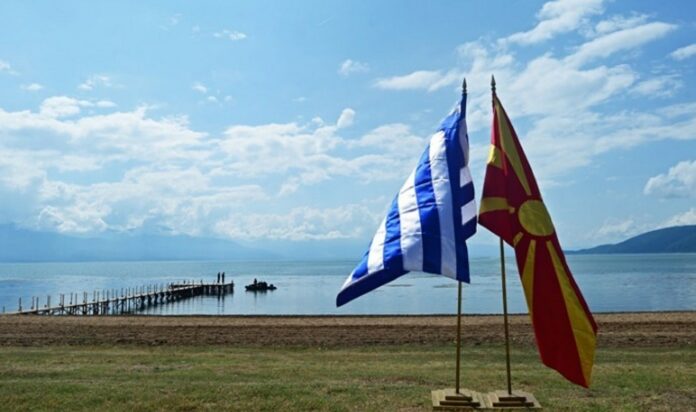
Ως “πυροτέχνημα” φαίνεται ότι ήταν η δήλωση του Α.Γεωργιάδη ότι: «εάν τα Σκόπια συνεχίσουν να την παραβιάζουν τότε η κυβέρνηση είναι απολύτως υποχρεωμένη να την καταγγείλει», καθώς ούτε να ακούσουν δεν θέλουν στην κυβέρνηση για καταγγελία της  με τον κυβερνητικό εκπρόσωπο να λέει ότι «είναι εθνικά συμφέρουσα η Συμφωνία των Πρεσπών», παρά το ότι συνεχίζουν οι πολιτικοί στα Σκόπια να μιλούν για «Μακεδονία» όπου βρεθούν και όπου σταθούν.

Συγκεκριμένα, ο Παύλος Μαρινάκης, είπε ότι η συμφωνία των Πρεσπών θα πρέπει να τηρηθεί, «από εκεί και πέρα όμως, η άλλη πλευρά δεν τηρεί, ούτε τα βασικά».

Αναλυτικά, σε ερώτηση  ο κυβερνητικός εκπρόσωπος ανέφερε ότι «έχουμε πει πάρα πολλές φορές ότι εμείς  ήμασταν αντίθετοι στην κακή συμφωνία των Πρεσπών, για αυτό και την καταψηφίσαμε. Όμως, όπως είχε πει ο πρωθυπουργός εάν ψηφιστεί θα πρέπει να εφαρμοστεί. Και αυτό θεωρούμε ότι πρέπει να γίνει από τη στιγμή που έχει ψηφιστεί και έχει κυρωθεί. Από εκεί και πέρα όμως, η άλλη πλευρά δεν τηρεί, ούτε τα βασικά».

Για τις απόψεις περί καταγγελίας της συμφωνίας, όπως είπε ο Άδωνης Γεωργιάδης, ο Παύλος Μαρινάκης ανέφερε ότι «δεν έχουμε φτάσει στο σημείο για αυτό που με ρωτήσατε, αλλά στην παρούσα φάση δεν πρόκειται να υποχωρήσουμε καθόλου από αυτή τη στάση (τήρησης της συμφωνίας), γιατί θεωρούμε ότι είναι η εθνικά συμφέρουσα»

Βορίδης: Θα εκτεθεί η χώρα εάν υπάρχει καταγγελία

Υπενθυμίζεται, ότι ο Μάκης Βορίδης σε συνέντευξή του στο Action24, άσκησε δριμεία κριτική σε αυτούς που εκ δεξιών, μιλάνε για καταγγελία της συμφωνίας, τώρα που η γειτονική χώρα προχωράει σε παραβιάσεις. Χαρακτηριστικά, ανέφερε για την εκ δεξιών κριτική, ότι «άρα να πάρω εγώ το βάρος της καταγγελίας στη διεθνή κοινότητα. Αυτοί κάνουν την παραβίαση, και εγώ έρχομαι τώρα και τους λέω, όχι τηρήστε αυτά που έχουμε πει, και μου λένε οι άλλοι, όχι μπουρλότο να το βάλω εγώ. Άρα εγώ να είμαι εκτεθειμένος στη διεθνή κοινότητα».

Γεωργιάδης: Εάν συνεχιστούν οι παραβιάσεις από την Βόρεια Μακεδονία, να καταγγελθεί η Συμφωνία

Σε αντίθετη κατεύθυνση είχε κινηθεί ο Άδωνης Γεωργιάδης, ο οποίος σε συνέντευξή του είπε ότι «η κυβέρνηση εάν η Βόρεια Μακεδονία συνεχίσει να παραβιάζει τη συμφωνία των Πρεσπών είναι απολύτως υποχρεωμένη να την καταγγείλει, είναι αδύνατο να μη το κάνει».

Μάλιστα, επεσήμανε ότι «η τήρηση της συμφωνίας σημαίνει και τήρηση του άρθρου 19. Η τήρηση της συμφωνίας δεν σημαίνει τη μη καταγγελία της. Η καταγγελία της είναι στη συμφωνία, εάν τα μέρη την παραβιάζουν. Το ξαναλέω, η τήρηση της συμφωνίας προϋποθέτει την καταγγελία της, εάν ένα μέρος τη παραβιάζει».

https://www.pronews.gr/elliniki-politiki/oute-na-akousoun-stin-kyvernisi-gia-kataggelia-tis-symfonias-ton-prespon-p-marinakis-einai-ethnika-symferousa/

Rethinking U.S. Africa Policy Amid Changing Geopolitical Realities

0
Since 2020, Africa has seen more political unrest, violent extremism, and democratic reversals than any other region in the world. A wave of coups has washed across the Sahel and West Africa, leaving authoritarians in power in numerous countries. In addition, the continent has served as a stage for the escalating great-power competition between China, Russia, and the United States. U.S. engagement with Africa has long been deprioritized in Washington, with successive administrations devoting scant attention and resources to advancing democracy and resolving conflicts. Thus far, the Biden administration has maintained this pattern, which reflects the persistent tension between an interests-based and values-based U.S. foreign policy. Nevertheless, there are a few actions the United States can take to reinvigorate democracy and stabilize the region, such as emphasizing development and diplomacy over military responses and stepping up cooperation with allies and partners to reduce the influence of China and Russia.

Ongoing instability in the Sahel — involving worsening insurgent violence, deepening great-power competition, and frequent coups — is exposing weaknesses in U.S. Africa policy.1 In fact, nearly four years into what U.N. Secretary-General António Guterres called an “epidemic” of coups,2 the United States and its closest Western allies and regional partners still lack a coherent and coordinated strategy to defend democracy in Africa without sacrificing security interests and geopolitical influence. Whether and how to engage with post-coup regimes in Africa exemplifies the enduring friction between a values-based and an interests-based U.S. foreign policy.

Widespread democratic backsliding could have long-term and lasting geopolitical and security implications for the region and for the United States and its allies, who are quickly losing their influence on the continent. Historically, strategic priorities elsewhere have drawn Washington’s attention away from Africa, resulting in minimal engagement with the region. As such, U.S. Africa strategy has not received the attention and resources needed to manage deteriorating political and security developments on the continent. America’s current Africa policy is being overtaken by events and is ill suited to adequately address the coup pandemic. Years of counter-terrorism work on the continent are going by the wayside, along with strategic partnerships and relationships built over decades of evolving engagement, due to the coup pandemic and new state leaders being less willing to host Western counter-terrorism forces.

In this article, we outline what we see as the main challenge for U.S. Africa policy today — which we call the Africa policy trilemma, or the difficulty of simultaneously promoting democracy, combatting violent extremism, and engaging in great-power competition. This trilemma echoes Cold War dilemmas, but with counter-terrorism supplanting combatting local communist forces. We argue that Washington must learn from its mistakes during the Cold War, particularly the tendency to separate democracy promotion from security interests and sacrifice the former in the name of the latter. In an era of great-power competition with authoritarian rivals, the United States should bolster efforts to promote democracy and economic prosperity. Prioritizing more diplomacy and development could help to prevent the growing militarization of U.S. Africa policy seen in recent years.

This article proceeds in three sections. First, we review recent governance, security, and geopolitical developments across Africa. The second section examines the history of U.S. Africa policy and engagement related to democracy promotion, counter-terrorism, and great-power competition. We conclude with a number of policy recommendations the United States could adopt to reinvigorate Africa policy to better enable democratization in the future.

Democratic Decline in Africa

Africa has suffered more democratic decline than any other region of the world since 2020.

For a time, Africa appeared poised to become a showpiece for freedom’s “inevitable” worldwide progression after the Cold War.3 In the first two decades after the Cold War, many African countries caught the third wave of democracy.4 From 1975 to 2014, the number of African countries democratizing exceeded those autocratizing, with the peak wave of democratization occurring in the early to mid-1990s.5 As a result, the share of African states that are “closed autocracies” (the least democratic regime type, according to the Regimes of the World classification) fell from over 60 percent in 1988 to 11 percent by 2007. By contrast, whereas fewer than 4 percent of African countries could claim to be democracies in 1988, nearly 40 percent could by 2016.6

In recent years, however, an autocratic counter-wave has washed over Africa. According to the Sweden-based V-Dem project, democracy has suffered more in Africa than any other world region since 2020. The share of autocratizing countries in Africa rose from less than 5 percent in 2008 to over 30 percent in 2020, while the share of democratizing countries fell from 20 percent in 2014 to only 7 percent by 2020. Since 2020, there has been a marked decline of electoral democracies and a re-emergence of “closed autocracies,” with the latter now ruling one-fifth of African states.7 By 2023, half of the continent’s population lived under autocratic rule according to Freedom House, a Washington, DC–based nonprofit group, while only 7 percent lived in “free” countries.8

Democracy faces challenges across the continent, but the areas that have slid the most toward autocracy in recent years are northern Africa, the Sahel, and, to a lesser extent, western Africa. In 2023, the west and the south were the most democratic regions in Africa, with average electoral democracy scores around 0.5 on a scale of 0 to 1 (with 1 being the most democratic). By contrast, average electoral democracy scores were only 0.34 in central-east Africa, 0.29 in the Sahel, and 0.28 in northern Africa.9

Between 2013 and 2023, electoral democracy scores increased in 17 of Africa’s 54 countries but declined in 37 countries. The biggest democratic declines over this decade were in Burkina Faso, which saw its electoral democracy score fall by 0.4, followed by Libya (-0.35), Tunisia (-0.29), Mauritius (-0.27), Niger (-0.24), and Comoros (-0.23). Coups in 2022 caused the declines in Burkina Faso, as did a July 2023 coup for Niger. Libya has been mired in civil war since the Arab Spring. Tunisia, the only democratic success story to emerge from the Arab Spring, saw those gains reversed since President Kais Saied’s takeover in 2021.10 Flawed elections and corruption have characterized the more gradual democratic backsliding in Mauritius and Comoros.11

Despite the rash of coups, support for democracy among the public remains high but has weakened.

The triggers for what Nigerian President Bola Tinubu called “autocratic contagion” in the Sahel and west Africa have been coups, which have made a comeback in Africa since 2020 after years of decline.12 According to the Colpus dataset, nine successful military coups have struck Africa since 2020.13 Of these, three toppled democratic governments — in Mali (2020), Burkina Faso (2022), and Niger (2023). Two coups were designed to ensure the survival of autocratic rule and block democratization — in Chad (2021) and Sudan (2021). Another two coups ousted autocrats — an aspiring autocrat in Guinea (2021) and an established one in Gabon (2023) — only to install new authoritarian regimes. Two more reflected splits among coup factions — in Mali (2021) and Burkina Faso (2022). There have been an additional five coup attempts in the region since 2020, including one in April 2023 that brought Sudan’s rival coup factions to civil war.14

Since 2020, virtually all coups have taken place within a so-called coup belt across the Sahel and west Africa. The August 2023 coup in Gabon was the lone exception (see figure 1). As The Economist recently noted, “You can now walk across nearly the widest part of Africa, from the Atlantic to the Red Sea, passing only through countries that have suffered coups in the past three years. But it would be unwise — you might well be kidnapped.”15

Figure 1: Geographic distribution of coups in Africa in 2020–23


Despite the rash of coups, support for democracy among the public remains high but has weakened.16 According to Afrobarometer, an independent research network based in Ghana, nearly 70 percent of survey respondents across 34 African countries preferred democracy to any other system of government. Large majorities in most countries also still reject military and one-party rule across the continent — only in Burkina Faso do most respondents favor military rule.17 Yet support for democracy has dropped in some countries. For example, between 2014–15 and 2021–22, support for democracy fell by 36 percent in Mali, 26 percent in Burkina Faso, 21 percent in South Africa, and 15 percent in Guinea.18 Meanwhile, perceptions of corruption by elected officials and rising armed conflict have led opposition to military rule to soften in the region,19 especially among youth. In 2021–22, only 38 percent of Africans said they were satisfied with the way democracy works in their country, down from 46 percent in 2014–15.20

Popular support for transparent elections remains strong across Africa. Three-quarters of respondents to Afrobarometer’s 2021–23 survey believed elections were the best method for choosing state leaders. However, support for elections has fallen in some places over the past decade such as Tunisia and Burkina Faso. At present, only Lesotho lacks a solid majority that supports elections.21 National elections occurred in three African countries in the first four months of 2024 and are scheduled to occur in 11 more African countries over the rest of the year.22

Meanwhile, none of Africa’s new military juntas appear willing to relinquish power any time soon. In September 2023, for example, Mali’s junta postponed the transitional presidential election scheduled for February 2024 due to unexplained “technical reasons” and also refused to hold legislative elections.23 Soon after, Ibrahim Traoré, the junta leader in Burkina Faso, said that holding elections in 2024 was “not a priority” and that they would not be held until the security situation in the country had improved.24 As of May 2024, neither junta has committed to a timeframe for new presidential elections.25 Only in Chad did the authorities promise elections for 2024, but only after shepherding a new constitution allowing de facto President Mahamat Idriss Déby, who came to power through a military junta, to stand in those elections.26

Rising Violent Extremism and Islamist Terrorism

The 2020s have also witnessed rising violent extremism and Islamist terrorism in Africa.

Political instability in the region is contributing to an already poor security situation. Half of all intra-state armed conflicts worldwide took place in Africa (26 of 52) in 2022.27 Two-fifths of the top 50 countries ranked in the Armed Conflict Location and Event Data 2024 Conflict Severity Index are in Africa,28 with the Sahel, Sudan, and the Democratic Republic of the Congo among the top ten conflicts appearing on the associated 2024 “conflict watchlist.”29 Overall, armed conflict violence has greatly increased in Africa since 2020, with fatalities more than quadrupling, from fewer than 25,000 to well over 100,000 across the continent in 2022. Armed conflict deaths in Africa now exceed levels last seen in the late 1990s and early 2000s during the height of the Second Congo War, which was the deadliest civil war since 1945.30

Four of Africa’s five deadliest ongoing armed conflicts — those with over 1,000 fatalities in 2022 — involved insurgencies by Islamist violent extremist organizations, namely the al-Qaeda–aligned Jamaat Nusrat al-Islam wal-Muslimin in Mali and Burkina Faso, the Islamic State in Nigeria, and al-Shabaab in Somalia.31 While most civil wars in Africa in the 1990s involved ethno-linguistic cleavages, the last two decades have seen a rise of religiously framed civil war.32

The rising African death toll from 2020 to 2022 was due mainly to the outbreak of civil war in Ethiopia in 2020 and, since 2022, to insurgencies in Burkina Faso, Mali, and elsewhere.33 Armed conflicts involving groups associated with the Islamic State have spread across the region, emerging in Niger (2015), Nigeria (2015), Chad (2017), Burkina Faso (2019), the Democratic Republic of the Congo (2019), Mozambique (2019), Mali (2022), and Uganda (2022).34

Instances of organized political violence in Africa have increased the most in recent years in Africa’s post-2020 “coup belt”: the Sahel. The number of political violence events in this region has risen from only a few hundred a year prior to 2012 to around 2,000 per year from 2013 to 2018, then increased steeply since 2019 to nearly 12,000 in the most recent 12 months to March 2024. Though central/eastern Africa also has seen major increases in political violence since 2012, only the Sahel has continued to see rising violence into 2024, according to the Armed Conflict Location and Event Data conflict index.35 As a result, the epicenter of global terrorism “has now conclusively shifted out of the Middle East and into the Central Sahel region,” according to the Global Terrorism Index. Sub-Saharan Africa accounted for 47 percent of global terrorism deaths in 2023, more than South Asia, the Middle East, and North Africa combined. Five of the 10 countries most affected by terrorism in 2023 are in Africa: Burkina Faso (first place), Mali (third), Somalia (seventh), Nigeria (eighth), and Niger (tenth).36

Although American policymakers had hoped to avoid the same fate as France, in part by “playing nice” and cooperating with the juntas, this strategy appears to have largely failed by this spring.

The three most terrorism-afflicted countries in the Sahel — Mali, Burkina Faso, and Niger — have also suffered coups since 2020. In each case, observers have argued that the incumbent government’s inability to successfully tame their terrorism problem and safeguard national security was at least a contributing if not a driving factor in each coup.37 In all three countries, the newly installed juntas promised to prioritize restoring domestic security and order. Despite these promises, insurgencies in the Sahel have worsened following coups. Across the central Sahel, conflict fatalities from political violence increased 38 percent in 2023, and civilian fatalities grew 18 percent in 2022. More than 8,000 people were killed in Burkina Faso last year. In Niger, Islamic State Sahel Province forces have stepped up attacks since the coup in July 2023.38 In January 2024, Mali’s junta withdrew from a peace agreement with separatists, which has spurred widespread violent attacks on civilians by government forces and Russia’s Wagner group.39

The case of Sudan is even more instructive of the vicious cycle of coups, autocratization, and civil war. In 2019, a mass uprising by pro-democracy forces managed to trigger a military coup ousting Sudan’s long-time dictator Omar Bashir. Hopes ran high for a democratic transition after continuing protests led the coupmakers to agree to a new constitution and transition timetable.40 A military coup in October 2021 blocked the promised transition to a civilian-led government. Subsequent infighting among security force elites for power within the military junta led to a failed coup attempt by the paramilitary Rapid Support Forces against the Sudanese Armed Forces last April, which sparked a devastating civil war leading to at least 13,000 fatalities.41

As Africa has become a more important front in America’s so-called global war on terror, governments in the region have sought greater security assistance from external powers. Initially, many turned to the United Nations, France, and the United States. The United States expanded its military presence and sought cooperative security partnerships in Africa. For example, in 2019, U.S. Air Base 201 in Niger, the drone base in Agadez that the United States built to the tune of $110 million, and Camp Baledogle, a Soviet-era air base the United States refurbished to support operations against al-Shabaab, both became operational to support regional counter-terrorism operations.42

Recent political developments in the Sahel, enabled by coups and great-power competition, threaten U.S. counter-terrorism interests. Africa’s new military juntas have sought to reduce their dependence on Western democracies and have sought counter-insurgency assistance and patronage from non-democratic actors like Russia’s Wagner Group, recently rebranded as the Africa Corps, which is now directed by a Russian military intelligence unit.43 The latter has increasingly been relied upon to counter insurgency in Mali as French and U.N. peacekeeping forces have been forced to withdraw from the region.44 Although American policymakers had hoped to avoid the same fate as France, in part by “playing nice” and cooperating with the juntas, this strategy appears to have largely failed by this spring. In March 2024, the junta in Niamey publicly revoked the military cooperation agreement with the United States and ordered U.S. troops to leave. After negotiations to stay failed, the Biden administration agreed to the request.45 By May 2024, even before U.S. troops had pulled out, Russian troops moved into U.S. Air Base 101 in Niamey.46 In April, the United States was also forced to withdraw dozens of troops based in N’Djamena, which had deployed to Chad since 2021 as part of a U.S. special operations task force.47 U.S. Africa Command head Gen. Michael Langley warned that the loss of U.S. bases in the region will “degrade our ability to do active watching and warning, including for homeland defense.”48

Intensifying Great-Power Competition

Africa has become a major site of great-power competition. U.S. efforts to promote democracy and enhance security in Africa are complicated by rising regional great-power competition with China and Russia.49 This global competition pits liberal against authoritarian states with differing visions of international order.50 After the Cold War, linkage to and leverage of the democratic West were associated with greater advances for democracy, whereas weak Western leverage opened the door to “competitive authoritarianism” and democratic backsliding across the developing world.51 Now Africa’s new juntas and would-be strongmen are seeking to rely on autocratic major power patrons for regime security. Russia and China, in turn, have an interest in making the world and region “safe for autocracy.”52

Russia and China have cultivated friends and influence on the continent as part of a broader geopolitical struggle with the United States over power and influence in the developing world.53 Indeed, Africa may be a testing ground for the resilience of the liberal international order. For example, Gen. Laura Richardson, the commander of U.S. Southern Command, believes that rising competition with Russia and China in Africa may be a harbinger of things to come in the Western Hemisphere in the next five to seven years.54

The influence of powerful Western states is now contested or in decline across much of Africa. During the Cold War, France and the United Kingdom had predominant economic and military influence in their former colonies on the continent. However, China’s exploding economic and diplomatic engagement in Africa in recent decades has enabled its influence on the continent to grow rapidly, in many cases now exceeding that of the former European colonial powers or the United States.55 For example, China surpassed the United States as Africa’s largest trade partner in 2008. China’s $300 billion in trade with Africa in 2023 was four times the U.S.-Africa trade. Similarly, French and U.S. outward investment in Africa dwarfed China’s until 2017, but since then China has become the largest source of investment on the African continent.56 As a result, China has more leverage to potentially subvert democracy or prop up autocrats in Africa.57

The influence of France — America’s closest external partner on the continent in recent decades — in Francophone Africa is now in freefall. France’s condemnation of coups led to diplomatic fallouts with the new juntas in Burkina Faso, Mali, and Niger. These three countries created the Alliance of Sahel States, a mutual defense pact, in September 2023.58 In August 2022, the last of several thousand French troops withdrew from Mali, marking the end of Operation Barkhane, a decade-long counter-insurgency campaign.59 In February 2023, France withdrew its troops from Burkina Faso.60 On Sept. 27, 2023, two months after Niger’s coup, France agreed to withdraw its ambassador and 1,500 troops.61 France has been forced to shift the base of its counter-insurgency operations in Africa to Chad.62 In December 2023, Mali and Niger revoked tax cooperation treaties with France.63 In April, Burkina Faso expelled French diplomats.64

Russia has capitalized on anti-French sentiment and French withdrawals in the Sahel.65 The new Sahel alliance — Africa’s new “holy alliance” — is poised to become “a vehicle for Russian influence in the heart of Africa.”66 Russia’s Africa policy has emphasized military engagement, drawing from its historical role as one of the largest arms suppliers to Africa. Since 2018, Russia has also deployed private military contractors to 31 African countries.67 The most prominent of these is the Wagner Group, which moved into the Central African Republic in 2018 and expanded its presence across Africa in subsequent years.68 In return for a “regime survival package,” the Wagner Group — recently rebranded the Africa Corps or Expeditionary Corps — is seeking access to strategically important natural resources such as timber, gold, uranium, and lithium.69 In May 2023, only months after expelling French troops, Burkina Faso’s military leaders hailed Russia as a strategic ally.70 Last December, Russia re-opened its embassy in Burkina Faso, which was shuttered in 1992.71 Moscow also struck a new military cooperation deal with Niger. In April 2024, 100 instructors from the Africa Corps arrived in Niger.72 Africa Corps personnel reportedly hope to take over the U.S. base in Agadez, which U.S. troops must now vacate.73

The rise of Russian and Chinese influence and decline of democracy in the region over the last decade are mutually reinforcing.

Unlike Russia, China has focused on economic engagement in Africa — like it has elsewhere — and funding infrastructure development through its Belt and Road Initiative. China’s investment and aid without attaching conditions such as political and economic reforms — unlike some powerful Western countries — have attracted many African leaders who have come to resent what is perceived as Western meddling in internal affairs.74 Beijing may also have greater ambitions for military engagement and security cooperation on the continent.75 China opened its first overseas military base in Djibouti in 2017 and seeks another base in west Africa on the Atlantic coast.76 China has deployed private security contractors in 15 African states since 2018.77 China has been ambivalent toward the coup trend in Africa and has sought to reinforce its existing influence.78 In response to the 2017 coup that ousted Zimbabwean President Robert Mugabe, for example, Chinese President Xi Jinping backed Emmerson Mnangagwa, invited him to Beijing for a state visit in April 2018, and increased investment in Zimbabwe.79 China also seeks to promote its norms and values through professional military education in Africa.80

The rise of Russian and Chinese influence and decline of democracy in the region over the last decade are mutually reinforcing.81 The number of disinformation campaigns in the region quadrupled from 2022 to 2023, with foreign state sponsors led by Russia and China responsible for most. Russia alone has sponsored disinformation to undermine democracy in 19 African states, more often than not with the Wagner Group directly involved. For example, Russian networks “helped prime and promote” the coups in Mali, Burkina Faso, and Niger, whose new military juntas have in turn also become major sponsors of disinformation in west Africa.82 China’s propaganda in Africa likewise perpetuates anti-U.S. and anti-democratic narratives.83

Assessing the Evolution of U.S. Africa Policy

Historically, American engagement with Africa has been episodic because Africa has never been seen as strategically important.84 The U.S. State Department only established a separate regional bureau for Africa in 1958.85 During the first half of the Cold War, U.S. Africa policy was one of minimal economic and military engagement aimed at avoiding major commitments in the region.86 In the latter Cold War from the mid-1970s, Africa received relatively more attention from U.S. policymakers (but not necessarily more resources) as U.S.-Soviet struggles for political influence intensified across the Global South. North Africa, and Egypt in particular, garnered the highest priority as they were seen as more relevant to the more strategically important Middle East.87 For example, after the Camp David Accords in 1979, Egypt became a top recipient of U.S. foreign aid. Egypt’s special status is also reflected in the fact that it is the only African state included under the U.S. Central Command theater covering the greater Middle East since the 1980s. By contrast, U.S. attention and commitments in sub-Saharan Africa have always lagged behind. Only six U.S. presidents since World War II have ever made official state visits to sub-Saharan Africa, the first being Jimmy Carter in 1978 and the last being Barack Obama in 2015.88

Throughout the Cold War, as in other regions, U.S. Africa policy focused on great-power competition — namely, containing Soviet and communist influence. Fear of Soviet encroachment animated American interventions in Africa.89 For example, after the Soviets and Cubans backed left-wing forces in the Angolan civil war, Washington backed right-wing National Union for the Total Independence of Angola rebels.90 Likewise, after the Soviet Union backed Ethiopia in the Ogaden War in 1977–78, the United States seized the opportunity to gain Somalia as an ally. In exchange for access to military bases, the United States gave aid to President Siad Barre and turned a blind eye to the dictator’s human rights abuses.91 America’s security interests in Africa were limited, with Libya’s state sponsorship of terrorism a nuisance. Democracy promotion was never a central U.S. objective in Africa during the Cold War.92

With the collapse of the Soviet Union and end of the Cold War great-power competition, the United States pursued constructive but modest efforts at democracy promotion and conflict resolution in Africa, with mixed success in the 1990s. U.S. diplomacy played a supporting role in the peaceful end of apartheid in South Africa.93 Though the Clinton administration created the U.S. Agency for International Development’s Office of Transition Initiatives in 1994 with a mission to support peace and democracy in Angola and elsewhere,94 a shrinking U.S. foreign aid budget meant only modest investment in democracy aid.95 Meanwhile, humanitarian interventions were marked by failure in Somalia and inaction in Rwanda, leading the United States to stand on the sidelines of Africa’s civil wars.96 In 1998, to signal U.S. commitment, President Bill Clinton became the first U.S. president since Carter to visit sub-Saharan Africa.97 Clinton’s signature regional economic policy, the African Growth and Opportunity Act, has expanded duty-free access to the United States from Africa since 2000.98

After the Sept. 11, 2001 terrorist attacks, U.S. Africa policy increasingly focused on counter-terrorism with Africa a theater of the global war on terror. In 2002, the United States gained its first and only permanent military base in Africa, Camp Lemonnier in Djibouti. In 2007, building on existing regional counter-terror programs,99 the United States created Africa Command, the first new geographic combatant command since standing up Central Command in the 1980s.100 The Bush administration also more than tripled U.S. economic aid to sub-Saharan Africa from $2.25 billion in 2001 to $7.6 billion by 2008. Support for aid increases was based in part on the notion that underdevelopment increased the risk of state collapse and the emergence of Islamic extremist groups such as al-Shabaab. Bush also argued that increased humanitarian aid for Africa was a moral imperative.101 Much of the new aid commitments were for the President’s Emergency Plan for AIDS Relief program and a new Millennium Challenge Account to reward poor countries with good governance.102 Unlike during the Cold War, when most aid went to North Africa, the biggest foreign aid increases were in sub-Saharan Africa and the Sahel. Still, largely preoccupied with the U.S.-led wars in Iraq and Afghanistan, the Bush administration did little to directly intervene in Africa’s conflicts, including in Darfur and the Democratic Republic of the Congo, instead preferring to let U.N. peacekeepers take the lead.

Many observers hoped the inauguration of America’s first black president would signal a new era of U.S.-Africa relations.103 However, the Obama years were characterized by plateaued levels of aid and attention to the region as the administration sought to address fiscal pressures while making Asia a strategic priority for the United States.104 Despite this, the Bush-era trend of growing U.S. military presence in Africa continued, as reflected in the growing numbers of troops and advisors, status of forces agreements, and temporary bases.105 Yet little progress was made in countering violent extremism as deepening military engagement in Africa was not matched by investments in diplomacy, development, or democracy promotion.106

Biden sought to give a new tone to Africa policy, replacing Trump’s transactional “America First” diplomacy with the promise of “mutually respectful relations.”

In 2017 and 2018, after a period of continuity in Africa policy punctuated by a few diplomatic blunders, great-power competition with China and Russia became more central to the Trump administration’s Africa strategy.107 In December 2018, National Security Advisor John Bolton unveiled “Prosper Africa,” a new initiative aimed at competing with the perceived growing Chinese and Russian influence in the region.108 The plan promised to double flagging U.S.-Africa trade and investment and compete with Chinese Belt and Road Initiative investments.109 In 2019, the U.S. International Development Finance Cooperation was established to drive private investment in the developing world, especially Africa.110 But without adequate funding, the reality never matched the ambitious rhetoric of “Prosper Africa.”111 By the end of his term, Trump tried to limit Washington’s footprint on the continent, both economically and militarily. He “pared back efforts to fight jihadis in Cameroon, Niger, and Nigeria” and in December 2020 ordered U.S. troops to withdraw from Somalia.112 As a result, by 2021, official U.S. troop levels in Africa — which had peaked at just over 5,000 in 2017 — had fallen to pre-9/11 era levels of closer to 1,200–1,300 troops in 2019 and 2020.  

Upon coming to office, the Biden administration did not prioritize Africa, though in a 2020 Foreign Affairs article, Biden said that “we need to do more to integrate our friends in Latin America and Africa into the broader network of democracies and to seize opportunities for cooperation in those regions.”113 Biden sought to give a new tone to Africa policy, replacing Trump’s transactional “America First” diplomacy with the promise of “mutually respectful relations.” To that end, Biden lifted Trump’s Muslim travel ban, which affected many African countries.114 In May 2022, at the request of the Pentagon, Biden reversed Trump’s December 2020 order and authorized hundreds of special operations forces to redeploy to Somalia.115 In December 2022, Biden convened the U.S.-Africa Leaders Summit in Washington, where he announced more humanitarian aid for the region116 and several new initiatives, including a “21st Partnership for African Security” and “African Democratic and Political Transitions” initiative.117 The summit’s agenda has framed Biden’s Africa policy ever since. Late in 2022, the Biden administration named Ambassador Johnnie Carson as a new special presidential representative for U.S.-Africa Leaders Summit implementation.118 Nevertheless, there has been no major increase in overall U.S. foreign aid to Africa in the Biden years.119

The Need for Actionable U.S. Policy

The Biden administration still lacks a coherent and robust strategy for promoting democracy, countering violent extremism, and competing with China and Russia in Africa.

In August 2022, the Biden administration published the “U.S. Strategy Toward Sub-Saharan Africa.”120 It identified four objectives of U.S. strategy in the region: foster openness and open societies, deliver democratic and security dividends, advance pandemic recovery and economic opportunity, and support conservation, climate adaptation, and energy transition. Rhetorically, the strategy calls “continuity” in Africa policy as insufficient. It claims to “reframe the region’s importance to U.S. national security interests.” One reason for Africa’s heightened importance is China and Russia’s use of the region “to challenge the rules-based international order.” In addition, the strategy notes growing economic interests, with the African Continental Free Trade Area set to make Africa one of the largest free trade areas in the world (and make Africa the fifth largest economy in the world). We agree with much of the strategy’s rhetoric. The question, of course, is how to translate such lofty principles into actionable policy.

In a September 2023 speech at the U.N. General Assembly, Biden spoke about the need to defend democracy around the world, especially in west Africa. The United States, Biden said, stands “with the African Union and ECOWAS [the Economic Community of West African States] and other regional bodies to support constitutional rule. We will not retreat from the values that make us strong. We will defend democracy.”121 This echoed the 2022 National Security Strategy’s emphasis on “democratic competition,” or efforts to defend democracy and help democracies demonstrate the superiority of the democratic way of life over autocratic alternatives.122

In practice, the Biden administration’s expressed commitment to democratic values in Africa has been in tension with interests-based foreign policy goals, including countering violent extremism. For example, in September 2023, Washington struck a short-lived deal with Niger’s new military junta — which, last July, toppled Mohamed Bazoum’s democratically elected government123 — to resume operations from the U.S. drone base at Agadez.124 Though failure to quickly declare and oppose anti-democratic coups undermines U.S. credentials as a reliable patron of democracy,125 the United States hesitated triggering cuts in military aid and training critical to countering terror in the Sahel, so Washington did not acknowledge a coup had taken place in Niger until October 2023.126 The gap between Biden’s rhetoric and initial U.S. reaction to Niger’s coup reflects an enduring perceived trade-off that the United States faces in confronting democratic backsliding in the region. The developments in Niger also indicate that Washington’s current approach is not working. In March 2024, Niamey revoked the status of forces agreement with the United States and ordered American troops to leave, potentially creating a vacuum Russia and China want to fill.

Beyond Niger, U.S. Africa policy now faces a trilemma of promoting democracy and combatting terrorism while simultaneously competing with authoritarian rivals for geopolitical influence. Washington aspires to do all three efforts well but can effectively only do two things at any given time. As geopolitical competition intensifies, the United States faces resistance that it last encountered during the Cold War, when it also had an uneven track record of defending democracy. We now see a reinvigorated Cold War–era debate over whether Washington should practice double standards for illiberal regimes in Africa that may share security or geopolitical interests with the United States.127 During the Cold War, this meant tolerating right-wing dictatorships whose collapse might empower communists. At present, the concern is similar, as not tolerating friendly dictatorships might undermine U.S. security interests or empower anti-American forces.

But without a roadmap or clear set of principles, U.S. policymakers are reacting ad hoc to each coup.

Biden’s 2022 Africa strategy says relatively little about how to promote democracy or deter and reverse coups in the region. On the one hand, it says that the United States will condemn coups (historically, it has not) and incorporate human rights abuses by security forces into bilateral talks. The strategy also says the United States will use both positive inducements and punitive measures such as sanctions. But without a roadmap or clear set of principles, U.S. policymakers are reacting ad hoc to each coup. The result is hesitation, paralysis, and inconsistency — the United States has only “called a coup a coup” half of the time since 2009.128 For example, although coup leaders from Sudan, Mali, Burkina Faso, and Guinea were denied invitations to attend the U.S.-Africa Leaders Summit in December 2022, Mahamat Déby, who seized power in Chad in April 2021, was invited.

Revitalizing and Recalibrating U.S. Policy

U.S. Africa policy needs to be revitalized and recalibrated to respond to the spreading post-2020 coup pandemic head on because doing so makes the region safer for democracy and more stable — regardless of who occupies the Oval Office.

Washington should at long last shed the habit of giving Africa short shrift in terms of attention and resources. Wars in Ukraine and Gaza understandably occupy much policymaker attention. But the United States should not ignore the fate of democracy or security developments in Africa. In a world of transnational security threats, African insecurity also threatens U.S. security interests. Terrorist threats to American citizens have often emanated from Africa, from the time Osama bin Laden set up al-Qaeda’s operations in Sudan in 1992 (until 1996)129 to the 1998 twin embassy bombings that killed a dozen Americans (and 200 Africans) to today, when al-Qaeda and Islamic State–linked groups are spread throughout the continent and kill or kidnap Americans for ransom.130 In 2020, al-Shabaab attacked a Kenyan military base, killing a U.S. servicemember and two U.S. government contractors.131 Even more alarming is the arrest of an al-Shabaab member taking flight lessons in the Philippines who was, according to the Department of Justice, “conspiring to hijack aircraft in order to conduct a 9/11-style attack in the United States” — illustrating there is a transnational threat from at least one group on the continent.132

The United States also cannot sit idly by while an onslaught of coups in Africa chips away at democratization, generates chaos and instability, and creates new opportunities for unrest that America’s rivals have shown they know how to exploit. For example, terrorist attacks rose 30 percent in the aftermath of the 2021 coup in Mali, after the new government turned to Wagner for security assistance and ordered the French and the U.N. to leave the country, greatly limiting Washington’s ability to provide support.133 One observer claims that Wagner’s presence in Mali “has strengthened and energized jihadi groups, providing them with not only a recruitment tool, but a much more favorable operating environment in Mali.”134 This development could happen in other places where Russia’s presence and influence are on the rise.

The Biden administration says that Africa is a priority, but its actions suggest otherwise. While the United States has not lost all of its influence in Africa, failing to truly prioritize the region to compete with Russia and China could risk undermining U.S. values and interests. To compete effectively will require sustained engagement, more fiscal resources, and a rebalanced Africa strategy that reduces the yawning gap between rhetorical commitment to democracy and America’s tepid response to coups.

There are no easy or quick solutions to the Africa policy trilemma, but hard choices need to be made and priorities set and clarified.135 The reality of the last four years suggests a more assertive and deliberate strategy is needed in countries where the United States is still welcome. In short, the United States should find more ways to demonstrate to its African partners, and the African people, that Washington is a dependable democratic advocate and preferred security partner. Here are four policy ideas to that end.

First, prioritize engaging friendly African partners and democracies, especially in the littorals.

The United States should focus on increasing engagement with the littoral countries of Benin, Togo, Cote d’Ivoire, and Ghana as well as Cameroon and Nigeria. Many of the littoral nations in west Africa have seen attacks by Jamaat Nusrat al-Islam wa al-Muslimeen and the Islamic State in the Greater Sahara in their northern regions — with Cote d’Ivoire being the site of a major al-Qaeda in the Islamic Maghreb attack in 2016.136 Historically, the United States has had good relationships with these countries, and they are probably open to increased military cooperation. In fact, Washington is presently exploring options for drone basing in the littorals.137 At the same time, Russia is trying to deepen its military ties in this region with countries that are still friendly to Washington;138 Washington needs to prioritize and expedite engaging with these nations to maintain its relevancy as a security partner and defender of democracy in the region.

Cameroon and Nigeria have been fighting violent extremist organizations for close to two decades. Security cooperation between the United States and Nigeria came to a head in 2014 over concerns about human rights abuses. However, with its huge population, large economy, and plentiful natural resources, Nigeria’s importance on the continent is apparent.139 Washington should continue to improve these relationships.140 Moscow is currently in talks with Abuja about how to deepen bilateral cooperation.141 But all of these countries are still open to U.S. engagement, and Washington can prove to its regional partners that it is still serious about providing security assistance and intensifying engagement. In short, Washington should try to contain democratic backsliding and Russian and Chinese influence from expanding farther beyond the Sahel into the littorals and neighboring countries.

Second, rebalance the “3Ds” of democracy, defense, and diplomacy. Maintain investment in defense cooperation while increasing investment in development and democracy in the region.

While Washington claims to take a comprehensive approach to Africa, balancing development, diplomacy, and defense,142 the tripod of the “three Ds” is out of balance. America’s Africa policy is too passive and lacks sufficient investment in development and diplomacy. There remain clear benefits to continued defense cooperation across Africa,143 including supporting diplomatic efforts to deepen Washington’s relationships on the ground. Defense cooperation should remain an important part of U.S. strategy on the continent. However, now more than ever, Washington needs to expand diplomatic and development tools of statecraft to better curb the coup pandemic, nudge military juntas to quickly restore democratic rule, improve partnerships, and protect African and U.S. interests. A heightened focus on development, investment,144 trade, education, strengthening democratic institutions, and supporting free and fair elections should accompany existing military engagement. Where to focus these efforts? Start in countries under threat by violent extremist organizations — which have yet to turn to Russia for support.

On the diplomatic front, one sensible place to start would be for the U.S. president to visit Africa — as Biden promised but failed to do in 2023.145 The bare minimum next step should be to fill remaining vacancies in the State Department’s key ambassadorial posts. Biden’s nominee for ambassador to the African Union, Stephanie S. Sullivan, has not been confirmed despite being nominated nearly two years ago.146 The special envoy for the Sahel position is also vacant, and filling it should be a priority. The United States has recently named Tom Perriello as a new special envoy for Sudan.147 Yet Washington still lacks a high-level regional point person for strengthening democratic institutions.148 Without a coordinated regional diplomatic effort being run out of the State Department with the full public support of the White House, America’s anti-coup diplomacy has been hampered. A higher-level special envoy focused on rolling back recent coups and preventing future coups by strengthening democracy and weakening the tolerance for coups is needed. The envoy should be empowered to engage in regional shuttle diplomacy and give the United States a more central role coordinating regional anti-coup diplomacy with regional partners, embassies, and regional international organizations such as the Economic Community of West African States and the African Union.

While these are worthy aid initiatives, they should be better funded to seriously compete with Russia and China.

Regarding economic statecraft, growing fiscal constraints and polarization in the U.S. Congress make a large-scale development initiative for Africa akin to the Marshall Plan politically if not fiscally infeasible in the near term.149 Biden’s 2024 budget included about $8 billion for Africa, roughly the same as over the past decade.150 What could be politically possible are more moderate increases in aid given more strategically to promote democratic development and counter Russian and Chinese influence, both multilaterally with select partners and bilaterally by scaling up funding for the Millennium Challenge Corporation and the State Department’s Human Rights Democracy Fund for Africa.151 In August 2023, as part of the supplemental appropriations request for Ukraine aid, the Biden administration asked for $200 million for a “Countering Russian Malign Actors in Africa Fund” to bolster aid in countries vulnerable to Russian influence. Just this spring, that request was pared back to only $25 million in Biden’s fiscal year 2025 budget proposal. Biden’s request also includes $400 million for a “Countering the People’s Republic of China Influence Fund” and funds for a Partnership for Global Infrastructure and Investment, echoing Trump’s “Prosper Africa” to compete with China’s Belt and Road Initiative.152 While these are worthy aid initiatives, they should be better funded to seriously compete with Russia and China.

Third, develop a playbook for consistently navigating coup responses.

The primary tools used to counter recent coups — limited Economic Community of West African States sanctions and suspended African Union memberships — are not working.153 In January 2024, Burkina Faso, Mali, and Niger all announced they were leaving the Economic Community of West African States.154 With the recent decline of anti-coup norms,155 coup plotters today recognize “the West is no longer the only game in town.”156 They see a more permissive environment to make coups stick. Given the presence of other external patrons, U.S. sanctions alone probably will not work. The only way to change coup makers’ cost-benefit calculus short of military intervention is to invest in more active diplomacy and economic assistance tied to democratic progress.

A new U.S. approach should focus on creating positive incentives for military juntas to quickly return to democratic rule. In the immediate wake of a coup, the United States needs to quickly declare it, not ignore it. Prior research has shown that the credible threat of strong international responses can make coups rarer and pressure post-coup military juntas to restore civilian rule quickly.157 Greater flexibility in response is needed to reduce incentives for rhetorical hedging by U.S. policymakers. A more flexible coup response policy would, depending on facts on the ground, proscribe some but not all forms of aid and cooperation (such as democracy aid).158

In the medium term, credible offers of greater economic or military aid for restoring democratic rule quickly could help incentivize coup leaders to establish transitional governments sooner. Democratic donors must coordinate so that such aid offers that are conditional on democratic progress are still attractive despite competing offers of aid from Russia and China. To ensure the United States and its allies are not training the next generation of coup leaders,159 military engagement must shift “away from the delivery of tactical weapons and towards a ‘governance-first’ policy that leads with support for institution building aimed at fostering civilian control and responsible use.”160

Long term, America’s goal should be to offer credible commitments to carrots for democratization, which at the same time do not drive coup regimes to seek support from Russia or China. Rather than just a strategy of containment, Washington should consider a Kennedy-style “alliance for progress.” After the Cuban revolution, the United States sought to neutralize the appeal of communist revolution by bolstering non-communist states with more development aid.161 We propose a similar non-militarized strategy to counter autocracy in Africa today.

Fourth, coordinate more closely with Western allies and regional partners.

Washington should do more with its close Western partners on the continent, including coordinating funding aid and investment packages to counter Russia and China. Since 2013, Washington has worked closely with Paris in the Sahel to provide transport, aerial refueling, and intelligence.162 Washington should coordinate more with France so future agreements enable continued work toward shared geopolitical and security objectives — at least in the countries that have not rejected France and could benefit from additional assistance like the littorals, Cameroon, and Nigeria. Washington should also seek to cooperate with the United Kingdom and other close Western allies who share an interest in regional stability and countering authoritarian regimes and could be cajoled to take a deeper interest in the continent. For example, Britain has slashed aid to Africa in recent years.163 The United States should advocate such cuts be reversed as part of a concerted effort to restore Western linkage and leverage. Washington can work with European allies to bypass hostile juntas and support African civil society.164

Conclusion

Amidst the ongoing coup pandemic and shifting geopolitical landscape, U.S. Africa policy needs a paradigm shift to center democratic competition and more consistently and better support democracies. The United States should find new ways of demonstrating to its African partners, and the African people, that Washington is a dependable and preferred partner. Rather than sacrifice democracy in the name of other strategic interests, as the United States was prone to do during the Cold War, Washington now needs to commit to the defense of democracy as the default means of competing with authoritarian major power rivals across the Global South and Africa.

John Chin is an assistant teaching professor of political science in the Carnegie Mellon Institute for Strategy and Technology at Carnegie Mellon University. He is the lead author of an Historical Dictionary of Modern Coups D’état (2022), which was named one of the “Best Historical Materials” published in 2022–23 by the American Library Association.

Haleigh Bartos is an associate professor of the practice in the Carnegie Mellon Institute for Strategy and Technology at Carnegie Mellon University. She previously spent well over a decade in various positions and organizations supporting U.S. policymakers. She teaches courses on policy writing, national security, and terrorism in sub-Saharan Africa at Carnegie Mellon University.

The views in this article are those of the authors and do not represent those of the U.S. government.

Acknowledgements: The authors would like to thank Rick Landgraf and two anonymous reviewers for their very helpful comments on earlier versions of this article.

Image: USAFRICOM (CC BY 2.0 DEED)

Endnotes

1Haleigh Bartos and John Chin, “Biden’s Africa Policy Trilemma,” The Duck of Minerva (blog), October 12, 2023, https://www.duckofminerva.com/2023/10/bidens-africa-policy-trilemma.html.

2Michelle Nichols, “‘An Epidemic’ of Coups, U.N. Chief Laments, Urging Security Council to Act,” Reuters, October 26, 2021, https://www.reuters.com/world/an-epidemic-coups-un-chief-laments-urging-security-council-act-2021-10-26/.

3See the discourse following Francis Fukuyama, “The End of History?” The National Interest 16 (Summer 1989).

4During the Cold War, Africa vied with the Middle East as the least democratic region in the world, according to the Varieties of Democracy (V-Dem) electoral democracy index. The mean electoral democracy score in Africa doubled from .2 in 1989 to over .43 by 2018 (on a 0–1 scale). For more on global democracy trends using V-Dem data, see Carl Henrik Knutsen and Svend-Erik Skaaning, “The Ups and Downs of Democracy, 1789–2018,” in Why Democracies Develop and Decline, ed. Michael Coppedge et al. (Cambridge: Cambridge University Press, 2022), 29–54. Most African states became “electoral autocracies” initially, not democracies. Even where authoritarian regimes survived on the continent, many were forced to make liberalizing concessions, such as shaking up cabinets to incorporate opposition party members. See Josef Woldense and Alex Kroeger, “Elite Change without Regime Change: Authoritarian Persistence in Africa and the End of the Cold War,” American Political Science Review, 2023, 1–17.

5For more background on the ERT definitions and data on episodes of democratization and autocratization, see Seraphine F. Maerz et al., “Episodes of Regime Transformation,” Journal of Peace Research (July 2023): 1–18.

6For more background on the RoW definitions and data on regime types, see Anna Lührmann, Marcus Tannenberg, and Staffan I. Lindberg, “Regimes of the World (RoW): Opening New Avenues for the Comparative Study of Political Regimes,” Politics and Governance 6, no. 1 (2018): 60–77.

7Part of the explanation for accelerated backsliding since 2020 is that the COVID-19 pandemic gave some African regimes cover to increase repression and target political opposition. Donald Grasse et al., “Opportunistic Repression: Civilian Targeting by the State in Response to COVID-19,” International Security 46, no. 2 (2021): 130–65.

8By contrast, Freedom House rates 17 percent of African countries as “free.” Why? With a few exceptions such as South Africa and Ghana, many of the most democratic states in the region are microstates such as Cape Verde, Seychelles, and São Tomé and Príncipe. Yana Gorokhovskaia and Cathryn Grothe, “Freedom in the World 2024: Regional Trends and Threats to Freedom,” Freedom House, February 29, 2024, https://freedomhouse.org/report/freedom-world/2024/mounting-damage-flawed-elections-and-armed-conflict/regional-trends.

9Michael Coppedge et al., “V-Dem Country-Year Dataset V14” (Varieties of Democracy [V-Dem] Project, 2024), https://doi.org/10.23696/mcwt-fr58.

10Hicham Bou Nassif, “Why the Military Abandoned Democracy,” Journal of Democracy 33, no. 1 (2022): 27–39.

11Louis Amédée Darga and Suhaylah Peeraullee, “Can Mauritians Save a Democracy in Trouble?” Washington Post, July 23, 2021, https://www.washingtonpost.com/politics/2021/06/25/can-mauritians-save-democracy-trouble/; Adam Valavanis, “Authoritarianism in Comoros Is Resurgent,” Council on Foreign Relations (blog), October 31, 2018, https://www.cfr.org/blog/authoritarianism-comoros-resurgent.

12For Tinubu’s remarks, see Nellie Peyton et al., “Reactions to Gabon Military Coup,” Reuters, August 31, 2023, https://www.reuters.com/world/africa/reactions-gabon-army-officers-announcing-coup-2023-08-30/. On the narrative of the decline and comeback of African coups, see John Frank Clark, “The Decline of the African Military Coup,” Journal of Democracy 18, no. 3 (2007): 141–55; Dave Lawler, “Coups Are Becoming a Thing of the Past,” Axios, January 31, 2019, https://www.axios.com/coups-are-becoming-a-thing-of-the-past-df39d484-cfc2-4eb3-b85f-94e3d15d238c.html; Dave Lawler, “Coups Are Making a Comeback,” Axios, January 30, 2022, https://www.axios.com/coup-attemps-countries-around-world-e14f76d2-16b1-43da-8411-6f8fc07cec84.html.

13Colpus classifies the military takeover in Myanmar in February 2022 as a self-coup. For more on the conceptualization and measurement of coups (and the distinction with self-coups), see John J. Chin, David B. Carter, and Joseph G. Wright, “The Varieties of Coups D’état: Introducing the Colpus Dataset,” International Studies Quarterly 65, no. 4 (2021): 1040–51. For updated Colpus data, see https://www.johnjchin.com/colpus/. For narratives of these coups and discussion of coup causes, see John J. Chin, “Coups d’Etat in the Covid-19 Era,” Brown Journal of World Affairs 28 (2021): 161; John J. Chin and Jessica Kirkpatrick, “African Coups D’etat in the Covid-19 Era: A Current History,” Frontiers in Political Science 5 (2023): 1–19, https://doi.org/10.3389/fpos.2023.1077945.

14“Country Hub: Sudan,” ACLED, accessed October 17, 2023, https://acleddata.com/africa/horn-of-africa/sudan/.

15“Why Africans Are Losing Faith in Democracy,” The Economist, October 5, 2023, https://www.economist.com/leaders/2023/10/05/why-africans-are-losing-faith-in-democracy.

16E. Gyimah-Boadi, Carolyn Logan, and Josephine Sanny, “Africans’ Durable Demand for Democracy,” Journal of Democracy 32, no. 3 (2021): 136–51.

17“PP85: Africans Want More Democracy, but Their Leaders Still Aren’t Listening,” Afrobarometer, January 19, 2023, https://www.afrobarometer.org/publication/pp85-africans-want-more-democracy-but-their-leaders-still-arent-listening/.

18Josephine Sanny, “Afrobarometer Data Show Worrying Trends for Democracy in Africa, Prof. Gyimah-Boadi Warns,” Afrobarometer (blog), June 16, 2023, https://www.afrobarometer.org/articles/afrobarometer-data-show-worrying-trends-for-democracy-in-africa-prof-gyimah-boadi-warns/.

19Daniel Tuki, “What Does the Population in Niger Think about a Military Government?” Democratization, 2024, 1–26.

20“Democracy in Crisis: Africa’s Long-Standing Democracies under Pressure, Afrobarometer CEO Warns,” Afrobarometer, April 13, 2023, https://www.afrobarometer.org/articles/democracy-in-crisis-africas-long-standing-democracies-under-pressure-afrobarometer-ceo-warns/.

21Hervé Akinocho, “AD761: As Africans Enter Busy Political Year, Scepticism Marks Weakening Support for Elections,” Afrobarometer Dispatch (blog), February 1, 2024, https://www.afrobarometer.org/publication/ad761-as-africans-enter-busy-political-year-scepticism-marks-weakening-support-for-elections/.

22Elections recently took place in Togo, Senegal, and Comoros. Between May 2024 and December 2024, elections are scheduled in nine sub-Saharan African countries (South Africa, Madagascar, Chad, Guinea Bissau, Rwanda, Mozambique, Namibia, Ghana, South Sudan) and two North African countries (Mauritania, Algeria). “Global Elections Calendar,” National Democratic Institute, accessed May 8, 2024, https://www.ndi.org/elections-calendar.

23News Wires, “Mali Junta Delays February Presidential Election for ‘Technical Reasons,’” France 24, September 25, 2023, https://www.france24.com/en/africa/20230925-mali-junta-delays-february-presidential-election-for-technical-reasons.

24Sofia Christensen, “Burkina Faso Junta Leader Says No Elections until the Country Safe for Voting,” Reuters, September 29, 2023, https://www.reuters.com/world/africa/burkina-faso-junta-leader-says-no-elections-until-country-safe-voting-2023-09-29/.

25Fadima Kontao, “Mali Political Parties Request Elections after Junta Shuns Transition Promise,” Reuters, April 1, 2024, https://www.reuters.com/world/africa/mali-political-parties-request-elections-after-junta-shuns-transition-promise-2024-04-01/.

26Mahamat Ramadane, “Chad to Hold Presidential Election in May-June,” Reuters, February 27, 2024, https://www.reuters.com/world/africa/chad-hold-presidential-election-may-june-2024-02-27/.

27Africa accounted for 18 of 41 internal armed conflicts in 2022 that caused at least 1,000 battle deaths, per the UCDP/PRIO Armed Conflict Dataset version 23.1, at https://ucdp.uu.se/downloads/index.html#armedconflict.

28This index lists Nigeria and Sudan in the top ten with “Extreme” conflict. “High” conflict levels are reported in eight African states (the Democratic Republic of the Congo, Mali, Burkina Faso, Kenya, Ethiopia, Cameroon, and Somalia). “ACLED Conflict Index,” ACLED, January 2024, https://acleddata.com/conflict-index/.

29“Conflict Watchlist 2024,” ACLED (blog), accessed April 3, 2024, https://acleddata.com/conflict-watchlist-2024/.

30Some regional armed conflict trends can be visualized at https://ucdp.uu.se/downloads/charts/. For more on “Africa’s World War” in the 1990s and 2000s, see Gérard Prunier, Africa’s World War: Congo, the Rwandan Genocide, and the Making of a Continental Catastrophe (Oxford: Oxford University Press, 2008).

31The other African civil war involves the Tigray People’s Liberation Front and Gambella Liberation Front in Ethiopia. Summaries on the history of each of these conflicts to 2022 can be found by searching https://ucdp.uu.se/.

32Monica Duffy Toft, “Getting Religion Right in Civil Wars,” Journal of Conflict Resolution 65, no. 9 (2021): 1607–34.

33Among civil wars on the continent in 2022, only the insurgency by the Islamic State in Nigeria saw fatalities drop in 2022. This conflict de-escalation was a unique situation driven in part by the weakening of Boko Haram after the death of their leader Abubakr Shekau in May 2021, which in turn meant fewer clashes with the Islamic State’s West Africa Province for territorial control. Shawn Davies, Therése Pettersson, and Magnus Öberg, “Organized Violence 1989–2022, and the Return of Conflict between States,” Journal of Peace Research 60, no. 4 (2023): 693–94.

34Davies, Pettersson, and Öberg, “Organized Violence 1989–2022,” 694, 703–4.

35Clionadh Raleigh et al., “Introducing ACLED: An Armed Conflict Location and Event Dataset,” Journal of Peace Research 47, no. 5 (2010): 651–60. Updated ACLED data is available at https://acleddata.com/curated-data-files/.

36Institute for Economics and Peace, “Global Terrorism Index 2024,” Vision of Humanity, 2024, https://www.visionofhumanity.org/maps/global-terrorism-index/.

37Chin and Kirkpatrick, “African Coups D’etat in the Covid-19 Era: A Current History.”

38“Conflict Watchlist 2024 | The Sahel: A Deadly New Era in the Decades-Long Conflict,” ACLED (blog), January 17, 2024, https://acleddata.com/conflict-watchlist-2024/sahel/.

39Héni Nsaibia, “Fact Sheet: Attacks on Civilians Spike in Mali as Security Deteriorates Across the Sahel,” ACLED (blog), September 21, 2023, https://acleddata.com/2023/09/21/fact-sheet-attacks-on-civilians-spike-in-mali-as-security-deteriorates-across-the-sahel/.

40Sharan Grewal, “Why Sudan Succeeded Where Algeria Failed,” Journal of Democracy 32, no. 4 (2021): 102–14.

41Andrea Carboni, “Conflict Watchlist 2024 | Sudan: Setting the Stage for a Long War,” ACLED (blog), January 17, 2024, https://acleddata.com/conflict-watchlist-2024/sudan/.

42Kyle Rempfer, “New in 2019: Two New U.S. Air Bases in Africa Nearing Completion,” Air Force Times, January 4, 2019, https://www.airforcetimes.com/news/your-air-force/2019/01/03/new-in-2019-two-new-us-airbases-in-africa-nearing-completion/; Stephen Losey, “This Obscure, Costly Air Base Is the New Front in the Battle against Violent Extremism,” Air Force Times, November 14, 2019, https://www.airforcetimes.com/news/your-air-force/2019/11/14/this-obscure-costly-air-base-is-the-new-front-in-the-battle-against-violent-extremism/.

43Joshua Hammer, “What Is Wagner Doing in Africa?” The Atlantic (blog), May 3, 2024, https://www.theatlantic.com/international/archive/2024/05/wagner-africa-russia-mercenary/678258/.

44Baba Ahmed, “U.N. Peacekeepers in Mali Withdraw from Two Bases in the North as Fighting Intensifies,” AP News, October 17, 2023, https://apnews.com/article/mali-united-nations-peacekeepers-kidal-insecurity-tuareg-b9cb52aa5baa87f83d2f76822f7df731.

45Eric Schmitt, “U.S. Military to Withdraw Troops From Niger,” New York Times, April 19, 2024, https://www.nytimes.com/2024/04/19/us/politics/us-niger-military-withdrawal.html.

46Phil Stewart and Idrees Ali, “Russian Troops Enter Base Housing U.S. Military in Niger, U.S. Official Says,” Reuters, May 3, 2024, https://www.reuters.com/world/africa/russian-troops-enter-base-housing-us-military-niger-us-official-says-2024-05-02/.

47Natasha Bertrand, “U.S. Withdraws Troops from Base in Chad Following Government Demand,” CNN, May 1, 2024, https://www.cnn.com/2024/05/01/politics/us-withdraws-troops-chad/index.html.

48Liam Karr, “Africa File Special Edition: Niger Cuts the United States for Russia and Iran,” Critical Threats (blog), March 21, 2024, https://www.criticalthreats.org/analysis/africa-file-special-edition-niger-cuts-the-united-states-for-russia-and-iran.

49Marta Kepe et al., Great-Power Competition and Conflict in Africa (Santa Monica, CA: RAND Corp., 2023); Joe Bruhl, “America Ignores Africa at Its Own Peril,” War on the Rocks, June 14, 2022, https://warontherocks.com/2022/06/america-ignores-africa-at-its-own-peril/.

50Great power competition is a rising theme in recent U.S. national security strategies. John J. Chin, Kiron Skinner, and Clay Yoo, “Understanding National Security Strategies Through Time,” Texas National Security Review 6, no. 4 (2023): 103–24.

51Steven Levitsky and Lucan A. Way, Competitive Authoritarianism: Hybrid Regimes after the Cold War (Cambridge: Cambridge University Press, 2010). After the Cold War, Western democracies could more credibly condition foreign aid to African countries on democratic reform. Thad Dunning, “Conditioning the Effects of Aid: Cold War Politics, Donor Credibility, and Democracy in Africa,” International Organization 58, no. 2 (2004): 409–23.

52On autocratic patrons as “black knights,” see Mark Chou, “Have the Black Knights Arisen? China’s and Russia’s Support of Autocratic Regimes,” Democratization 24, no. 1 (2017): 175–84. On China and Russia’s interest in autocracy promotion more broadly, see, e.g., “Authoritarian Internationalism,” in John M. Owen IV, The Ecology of Nations: American Democracy in a Fragile World Order (New Haven, CT: Yale University Press, 2023), 201–27; Michael Beckley and Hal Brands, “China’s Threat to Global Democracy,” Journal of Democracy 34, no. 1 (2023): 65–79.

53Dawn C. Murphy, China’s Rise in the Global South: The Middle East, Africa, and Beijing’s Alternative World Order (Stanford, CA: Stanford University Press, 2022); Aaron Friedberg, “A World of Blocs?” War on the Rocks, July 25, 2023, https://warontherocks.com/2023/07/a-world-of-blocs/. Dawn C. Murphy, China’s Rise in the Global South: The Middle East, Africa, and Beijing’s Alternative World Order (Stanford University Press, 2022).We focus on Russia and China, though smaller non-democratic powers such as Iran, Venezuela, and the United Arab Emirates also seek to increase their influence in Africa. See Michaela Millender, “IntelBrief: Iran Extends Its Influence in Africa,” The Soufan Center (blog), April 1, 2024, https://thesoufancenter.org/intelbrief-2024-april-1/; Scott B. MacDonald, “Venezuela’s Africa Gambit,” The National Interest, February 8, 2024, https://nationalinterest.org/feature/venezuela%E2%80%99s-africa-gambit-209207; “Gulf Countries Are Becoming Major Players in Africa,” The Economist, March 13, 2024, https://www.economist.com/middle-east-and-africa/2024/03/13/gulf-countries-are-becoming-major-players-in-africa.

54Remarks at Carnegie Mellon University, September 28, 2023.

55See the Formal Bilateral Influence Capacity (FBIC) index, which aggregates measures of “bandwidth” and “dependence” related to bilateral trade, aid, arms transfers, military alliances, level of diplomatic representation, and international organization memberships. Jonathan D. Moyer et al., “Power and Influence in a Globalized World,” Atlantic Council, February 20, 2018, 1, https://www.atlanticcouncil.org/in-depth-research-reports/report/power-and-influence-in-a-globalized-world/; Jonathan D. Moyer et al., “China-U.S. Competition: Measuring Global Influence,” Atlantic Council and Frederick S. Pardee Center for International Futures at the University of Denver’s Josef Korbel School of International Studies, 2021. Data available at https://korbel.du.edu/fbic. Report available at https://www.atlanticcouncil.org/wp-content/uploads/2021/06/China-US-Competition-Report-2021.pdf.

56The trade and investment data come from the International Monetary Fund, namely the Direction of Trade Statistics database and the Coordinated Direct Investment Survey. Available at https://www.imf.org/en/Data.

57Some recent literature refers to these anti-democratic policies as “sharp power,” distinct from more benign “soft power.” Glenn Tiffert and Oliver McPherson-Smith, “China’s Sharp Power in Africa: A Handbook for Building National Resilience,” Hoover Institution, March 2022, https://www.hoover.org/research/chinas-sharp-power-africa-handbook-building-national-resilience; Melissa Aten and John K. Glenn, “After Wagner: Russia’s Export of Kleptocracy to Africa,” Power 3.0: Understanding Modern Authoritarian Influence (blog), September 5, 2023, https://www.power3point0.org/2023/09/05/after-wagner-russias-export-of-kleptocracy-to-africa/.

58Tiemoko Diallo and Bate Felix, “Mali, Niger, and Burkina Faso Sign Sahel Security Pact,” Reuters, September 16, 2023, https://www.reuters.com/world/africa/mali-niger-burkina-faso-sign-sahel-security-pact-2023-09-16/.

59Elian Peltier and Ruth Maclean, “French Soldiers Quit Mali After 9 Years, Billions Spent and Many Lives Lost,” New York Times, August 15, 2022, https://www.nytimes.com/2022/08/15/world/africa/mali-france-military-operation.html.

60Thiam Ndiaga, “Burkina Faso Marks Official End of French Military Operations on Its Soil,” Reuters, February 20, 2023, https://www.reuters.com/world/africa/burkina-faso-marks-official-end-french-military-operations-its-soil-2023-02-19/.

61Abdel-Kader Mazou, Boureima Balima, and Hereward Holland, “French Troops Begin Withdrawal from Niger,” Reuters, October 11, 2023, https://www.reuters.com/world/africa/french-troops-begin-withdrawal-niger-2023-10-10/; Chinedu Asadu, “France’s Withdrawal from Niger Could Jeopardize Counterterrorism Operations in the Sahel,” AP News, September 27, 2023, https://apnews.com/article/niger-sahel-france-us-coup-counterterrorism-ce19912950c6641e0281d8a10741a8de.

62AFP, “French Troops to Stay in Chad: Macron Envoy,” The Defense Post, March 8, 2024, https://www.thedefensepost.com/2024/03/08/french-troops-stay-chad/.

63Tiemoko Diallo and Nellie Peyton, “Mali and Niger Revoke Tax Cooperation Treaties with France,” Reuters, December 5, 2023, https://www.reuters.com/world/africa/mali-niger-revoke-tax-cooperation-treaties-with-france-2023-12-05/.

64Thomas Naadi, “Burkina Faso’s pro-Russia Junta Expels French Diplomats,” BBC News, April 18, 2024, https://www.bbc.com/news/world-africa-68846771.

65Raphael Parens, “The Wagner Group’s Playbook in Africa: Mali,” Foreign Policy Research Institute, March 18, 2022, https://www.fpri.org/article/2022/03/the-wagner-groups-playbook-in-africa-mali/.

66Michaela Millender, “IntelBrief: A New Treaty Among African Juntas Amid Deteriorating Security,” The Soufan Center (blog), September 20, 2023, https://thesoufancenter.org/intelbrief-2023-september-20/.

67Cortney Weinbaum et al., “Mapping Chinese and Russian Military and Security Exports to Africa,” RAND, 2022.

68John Lechner, “To Counter Russia in Africa, America Should Rethink Its Own Role,” War on the Rocks, May 20, 2021, https://warontherocks.com/2021/05/to-counter-russia-in-africa-america-should-rethink-its-own-role/.

69Joe Inwood and Jake Tacchi, “Wagner in Africa: How the Russian Mercenary Group Has Rebranded,” BBC News, February 20, 2024, https://www.bbc.com/news/world-africa-68322230.

70Thiam Nidiaga, Alessandra Prentice, and Stephen Coates, “Burkina Faso Interim Leader Hails Russia as a Strategic Ally,” Reuters, May 4, 2023, https://www.reuters.com/world/burkina-faso-interim-leader-hails-russia-strategic-ally-2023-05-05/.

71“Russia Reopens Embassy in Burkina Faso,” BBC News, December 28, 2023, https://www.bbc.com/news/world-africa-67833215.

72Chris Ewokor and Katherine Armstrong, “Russian Troops Arrive in Niger as Military Agreement Begins,” BBC News, April 12, 2024, https://www.bbc.com/news/world-africa-68796359.

73Karr, “Africa File Special Edition.”

74Toyin Falola and Raphael Chijioke Njoku, United States and Africa Relations, 1400s to the Present (New Haven, CT: Yale University Press, 2020), 266–67. See chapter 6 for more background on deepening Sino-African engagement.

75Ilaria Carrozza and Nicholas J. Marsh, “Great Power Competition and China’s Security Assistance to Africa: Arms, Training, and Influence,” Journal of Global Security Studies 7, no. 4 (2022): ogac027.

76Eric A. Miller, “More Chinese Military Bases in Africa: A Question of When, Not If,” Foreign Policy, August 16, 2022, https://foreignpolicy.com/2022/08/16/china-military-bases-africa-navy-pla-geopolitics-strategy/; David Vergun, “General Says China Is Seeking a Naval Base in West Africa,” DOD News, March 17, 2022, https://www.defense.gov/News/News-Stories/Article/Article/2969935/general-says-china-is-seeking-a-naval-base-in-west-africa/. Others have reported on Chinese overtures for a base in Namibia. See Craig Singleton, “Mapping the Expansion of China’s Global Military Footprint,” Foundation for Defense of Democracies, September 2, 2023, https://www.fdd.org/plaexpansion/. Half a dozen ports with Chinese investment in West Africa—including two majority Chinese-owned ports in Nigeria and Cameroon—can physically support a naval base. Zongyuan Zoe Liu, “Tracking China’s Control of Overseas Ports,” Council on Foreign Relations (blog), November 6, 2023, https://www.cfr.org/tracker/china-overseas-ports.

77Weinbaum et al., “Mapping Chinese and Russian Military and Security Exports to Africa.”

78Jonathan Holslag, “China and the Coups: Coping with Political Instability in Africa,” African Affairs 110, no. 440 (2011): 367–86; Frédéric Lemaitre, “China Remains Cautious after Coups in Africa,” Le Monde, September 1, 2023, https://www.lemonde.fr/en/international/article/2023/09/01/china-remains-cautious-after-coups-in-africa_6119409_4.html; Jevans Nyabiage, “African Coups Make Life Difficult for China’s Belt and Road Projects,” South China Morning Post, October 1, 2023, https://www.scmp.com/news/china/diplomacy/article/3235443/coups-threaten-african-stability-china-struggles-make-headway-belt-and-road-interests.

79Falola and Njoku, United States and Africa Relations, 270.

80Paul Nantulya, “Chinese Professional Military Education for Africa: Key Influence and Strategy,” United States Institute of Peace, July 2023, https://www.usip.org/publications/2023/07/chinese-professional-military-education-africa-key-influence-and-strategy.

81Authoritarian influence and democracy trends in the region are negatively correlated. Half (27) of Africa’s 54 states saw rising Russian and Chinese influence (per FBIC index, see footnote 67) and declining democracy (per V-Dem) since 2012. By contrast, only five African states saw Russian/Chinese influence fall and democracy improve.

82“Mapping a Surge of Disinformation in Africa,” Africa Center for Strategic Studies (blog), March 13, 2024, https://africacenter.org/spotlight/mapping-a-surge-of-disinformation-in-africa/.

83Joshua Eisenman, “China’s Media Propaganda in Africa: A Strategic Assessment,” United States Institute of Peace, March 16, 2023, https://www.usip.org/publications/2023/03/chinas-media-propaganda-africa-strategic-assessment; Sarah Cook, “Countering Beijing’s Media Manipulation,” in Defending Democracy in an Age of Sharp Power, ed. William J. Dobson, Tarek Masoud, and Christopher Walker (Baltimore: Johns Hopkins University Press, 2023), 167–84.

84Our historical overview of U.S. Africa policy in this section is by necessity selective. For a chronological history, see Herman J. Cohen, U.S. Policy Toward Africa: Eight Decades of Realpolitik (Boulder, CO: Lynne Rienner Publishers, 2019).

85Before 1958, the Africa desk was housed in the Near Eastern Affairs bureau. Falola and Njoku, United States and Africa Relations, 213–14.

86After independence, the United States urged post-colonial states to maintain close ties with former European colonial powers. Donald Rothchild, “The U.S. Foreign Policy Trajectory on Africa,” SAIS Review 21, no. 1 (2001): 180–81.

87This regional prioritization within Africa is reflected organizationally across many U.S. agencies. At the State Department, for example, North Africa policy (e.g., the Egypt desk) is still run out of the Bureau of Near Eastern Affairs, leaving the Bureau of African Affairs to focus on policy toward the Sahel and sub-Saharan Africa.

88Jimmy Carter visited Nigeria and Liberia in April 1978. Each post–Cold War president from George H.W. Bush to Barack Obama visited Africa, but Donald Trump never did. George H.W. Bush visited Somalia in late 1992. Bill Clinton visited nine African countries (Ghana, Uganda, South Africa, Rwanda, Botswana, Senegal, Morocco, Nigeria, and Tanzania) in March–April 1998 and revisited Nigeria and Tanzania in August 2000. George W. Bush visited five African countries in July 2003 (South Africa, Senegal, Botswana, Uganda, and Nigeria) and in February 2008 (Benin, Tanzania, Rwanda, Ghana, and Liberia). Barack Obama visited Africa four times, more than any prior U.S. president. Obama visited Ghana in February 2008, four African countries in June-July 2013 (Senegal, South Africa, Tanzania, and Senegal), South Africa again in September 2013, and Kenya and Ethiopia in July 2015. Most U.S. presidents from Richard Nixon to Obama have visited Egypt at least once (G.H.W. Bush and Trump being the exceptions). Dwight Eisenhower visited Tunisia and Morocco in December 1959. Clinton (and several former U.S. presidents) visited Morocco in 1999 for King Hussein’s funeral. “Travels Abroad of the President,” U.S. Department of State, Office of the Historian, accessed October 18, 2023, https://history.state.gov/departmenthistory/travels/president.

89Rothchild, “The U.S. Foreign Policy Trajectory on Africa,” 181.

90In 1985, Congress repealed the Clark amendment (Joe Biden gave one of thirty-four dissenting Senate votes), paving the way for the Reagan administration to provide covert aid to UNITA. Jeremy Scahill, “1985: U.S. Support for UNITA Rebels in Angola,” The Intercept, April 27, 2021, https://theintercept.com/2021/04/27/biden-unita-rebels-angola/.

91Dipo Faloyin, Africa Is Not a Country: Notes on a Bright Continent (New York: W.W. Norton & Company, 2022), 121–24.

92If anything, the United States was not above covertly backing coups and assassinations of leftist African leaders, including pan-Africanist gadflies such as Patrice Lumumba and Kwame Nkrumah. Stuart A. Reid, The Lumumba Plot: The Secret History of the CIA and a Cold War Assassination (New York: Knopf Doubleday, 2023); “Four More Ways the CIA Has Meddled in Africa,” BBC News, May 16, 2016, https://www.bbc.com/news/world-africa-36303327. The United States often tacitly supported white minority rule in Rhodesia and South Africa. For criticism of the Nixon-Kissinger policy of acceptance of apartheid from a former Kissinger aide and Clinton’s first Secretary of State, see Anthony Lake, The Tar Baby Option: American Policy Toward Southern Rhodesia (New York: Columbia University Press, 1976).

93Princeton N. Lyman, Partner to History: The U.S. Role in South Africa’s Transition to Democracy (Washington, DC: U.S. Institute of Peace, 2002).

94Marian L. Lawson, “USAID’s Office of Transition Initiatives After 15 Years: Issues for Congress,” Congressional Research Service, May 27, 2009, https://www.everycrsreport.com/reports/R40600.html.

95Many aid recipients in Africa also continued to receive aid despite democratic backsliding. Rothchild, “The U.S. Foreign Policy Trajectory on Africa,” 194–95, 199–202.

96In 1993, 18 U.S. troops were killed in an urban assault in Mogadishu, the infamous “Black Hawk Down” event.

97Clinton avoided visiting democratic laggards of Nigeria, Gabon, and Angola. Chris Alden, “From Neglect to ‘Virtual Engagement’: The United States and Its New Paradigm for Africa,” African Affairs 99, no. 396 (2000): 365.

98“African Growth and Opportunity Act (AGOA),” United States Trade Representative, accessed October 18, 2023, http://ustr.gov/issue-areas/trade-development/preference-programs/african-growth-and-opportunity-act-agoa.

99The Pan Sahel Initiative, a State Department–funded program, sought to combat security and criminal threats across the Sahel. In 2005, such efforts were enhanced by the Pentagon’s Operation Enduring Freedom–Trans Sahara and the State Department’s Trans-Saharan Counter-Terrorism Initiative. Nicolas van de Walle, “U.S. Policy Towards Africa: The Bush Legacy and the Obama Administration,” African Affairs 109, no. 434 (2010): 7–8.

100“United States Africa Command,” October 17, 2023, https://www.africom.mil/.

101David Greene, Amy Isackson, and Danny Hajek, “George W. Bush Calls Foreign Aid a Moral and Security Imperative,” NPR, April 13, 2017, https://www.npr.org/2017/04/13/523615019/president-george-w-bush-foreign-aid-in-u-s-national-security-and-moral-interest.

102van de Walle, “US Policy Towards Africa,” 8. PEPFAR was a major success, saving as many as 25 million lives globally, many in Africa. “The United States President’s Emergency Plan for AIDS Relief,” United States Department of State, accessed April 3, 2024, https://www.state.gov/pepfar/.

103Falola and Njoku, United States and Africa Relations, chapter 14.

104Nicolas van de Walle, “Obama and Africa: Lots of Hope, Not Much Change,” Foreign Affairs 94, no. 5 (October 2015): 54–61.

105The Pentagon’s annual Base Structure Report omits the new “lily pads” in Africa, as they typically have a smaller U.S. personnel footprint and, at least in theory, the troops deployed there are on temporary rotation. The exact number of these sites is unclear. David Vine identified twenty-seven U.S. base sites in Africa as of 2020. See David Vine, The United States of War: A Global History of America’s Endless Conflicts, from Columbus to the Islamic State, vol. 48 (Berkeley: University of California Press, 2021). Nick Turse, “Pentagon’s Own Map of U.S. Bases in Africa Contradicts Its Claim of ‘Light’ Footprint,” The Intercept, February 27, 2020, https://theintercept.com/2020/02/27/africa-us-military-bases-africom/; Nick Turse, “Pentagon Misled Congress About U.S. Bases in Africa,” The Intercept, September 8, 2023, https://theintercept.com/2023/09/08/africa-air-base-us-military/; Wesley Morgan, “Behind the Secret U.S. War in Africa,” Politico, July 2, 2018, https://www.politico.com/story/2018/07/02/secret-war-africa-pentagon-664005.

106Elizabeth Shackelford, Ethan Kessler, and Emma Sanderson, “Less Is More: A New Strategy for U.S. Security Assistance to Africa,” Chicago Council on Global Affairs, August 21, 2023, https://globalaffairs.org/research/report/less-more-new-strategy-us-security-assistance-africa.

107In this period, no assistant secretary of state was confirmed. Many ambassadorships in Africa were vacant. Acting officers continued existing programs. Nicholas Westcott, “The Trump Administration’s Africa Policy,” African Affairs 118, no. 473 (2019): 737–49; John Campbell, “Trump’s Africa Policy Is Better Than It Looks,” Council on Foreign Relations (blog), April 6, 2020, https://www.cfr.org/in-brief/trumps-africa-policy-better-it-looks. President Trump caused a diplomatic firestorm in Africa when in January 2018 he told congressional leaders in a closed session that the United States should be wary of immigration from “shithole countries” such as Haiti and Africa. Trump’s signature travel ban, which was extended and expanded in January 2020, also alienated many Africans. Trump proposed cuts to the U.S. foreign aid budget for Africa each year through 2020, but Congress mostly maintained prior levels of funding of about $7.5 billion for Africa. Robbie Gramer, “African Ambassadors to Convene in Wake of Trump’s ‘Shithole’ Outburst,” Foreign Policy, January 12, 2018, https://foreignpolicy.com/2018/01/12/african-ambassadors-to-meet-in-wake-of-trumps-shithole-outburst-african-union-immigration-oval-office-controversy-state-department-diplomacy/; Zachariah Mampilly and Jason Stearns, “A New Direction for U.S. Foreign Policy in Africa,” Dissent 67, no. 4 (2020): 107–17.

108“Remarks by National Security Advisor Ambassador John R. Bolton on the Trump Administration’s New Africa Strategy,” The White House, December 13, 2018, https://trumpwhitehouse.archives.gov/briefings-statements/remarks-national-security-advisor-ambassador-john-r-bolton-trump-administrations-new-africa-strategy/.

109Bolton presented the Belt and Road Initiative as a predatory grab for natural resources and influence. Francis Owusu and Padraig Carmody, “Trump’s Legacy in Africa and What to Expect from Biden,” The Conversation, November 25, 2020, http://theconversation.com/trumps-legacy-in-africa-and-what-to-expect-from-biden-150293.

110Daniel Kliman, “Leverage the New U.S. International Development Finance Corporation to Compete with China,” The Hill, November 16, 2018, https://thehill.com/opinion/international/416904-leverage-us-international-development-finance-corporation-compete-with-china/.

111Owusu and Carmody, “Trump’s Legacy in Africa and What to Expect from Biden.”

112Marcus Hicks, Kyle Atwell, and Dan Collini, “Great-Power Competition Is Coming to Africa,” Foreign Affairs, March 4, 2021, https://www.foreignaffairs.com/articles/africa/2021-03-04/great-power-competition-coming-africa; “Trump Orders Withdrawal of U.S. Troops from Somalia,” BBC News, December 5, 2020, https://www.bbc.com/news/world-us-canada-55196130.

113Biden mentions Africa only twice in this article. In the other reference, Biden claims pride in Obama administration efforts to contain the Ebola pandemic in west Africa. See Joseph R. Biden, Jr, “Why America Must Lead Again,” Foreign Affairs 99, no. 2 (2020): 73.

114Christian von Soest, “The End of Apathy: The New Africa Policy under Joe Biden,” GIGA Focus Africa, no. 2 (2021), https://www.giga-hamburg.de/en/publications/giga-focus/the-end-of-apathy-the-new-africa-policy-under-joe-biden.

115Charlie Savage and Eric Schmitt, “Biden Approves Plan to Redeploy Several Hundred Ground Forces Into Somalia,” New York Times, May 16, 2022, https://www.nytimes.com/2022/05/16/us/politics/biden-military-somalia.html.

116The White House, “FACT SHEET: U.S.-Africa Partnership to Promote Food Security and Resilient Food Systems,” The White House, December 15, 2022, https://www.whitehouse.gov/briefing-room/statements-releases/2022/12/15/fact-sheet-u-s-africa-partnership-to-promote-food-security-and-resilient-food-systems/.

117The White House, “FACT SHEET: U.S.-Africa Partnership in Promoting Peace, Security, and Democratic Governance,” The White House, December 15, 2022, https://www.whitehouse.gov/briefing-room/statements-releases/2022/12/15/fact-sheet-u-s-africa-partnership-in-promoting-peace-security-and-democratic-governance/.

118The White House, “Statement: Special Presidential Representative for U.S.-Africa Leaders Summit Implementation,” The White House, December 15, 2022, https://www.whitehouse.gov/briefing-room/statements-releases/2022/12/15/statement-special-presidential-representative-for-u-s-africa-leaders-summit-implementation/.

119Alexis Arieff, Lauren Ploch Blanchard, and Nicolas Cook, “U.S. Assistance for Sub-Saharan Africa: An Overview,” Congressional Research Service, November 7, 2023.

120The White House, “U.S. Strategy Toward Sub-Saharan Africa,” August 2022, https://www.whitehouse.gov/wp-content/uploads/2022/08/U.S.-Strategy-Toward-Sub-Saharan-Africa-FINAL.pdf.

121“Remarks by President Biden Before the 78th Session of the United Nations General Assembly,” The White House, September 19, 2023, https://www.whitehouse.gov/briefing-room/speeches-remarks/2023/09/19/remarks-by-president-biden-before-the-78th-session-of-the-united-nations-general-assembly-new-york-ny/.

122Trump’s national security strategy also centered on great power competition but did not emphasize democracy defense as a way to compete. Chin, Skinner, and Yoo, “Understanding National Security Strategies Through Time.”

123U.S. Secretary of State Antony Blinken hailed Bazoum’s government as “a model of resilience, a model of democracy, a model of cooperation” when he visited Niamey in March 2023. Dalatou Mamane and Krista Larson, “U.S. Secretary of State Blinken Visits Niger on Africa Tour,” AP News, March 16, 2023, https://apnews.com/article/niger-antony-blinken-us-secretary-state-mohamed-bazoum-jihadis-islamic-extremists-cb35b9b2c543fae94c093e332b556146.

124Al Jazeera and Reuters, “U.S. Military Resumes Drone, Crewed Aircraft Operations in Post-Coup Niger,” Al Jazeera, September 14, 2023, https://www.aljazeera.com/news/2023/9/14/us-military-resumes-drone-crewed-aircraft-operations-in-post-coup-niger.

125Austin S. Matthews, “Fixing U.S. Policy Toward Foreign Military Coups,” Lawfare (blog), July 23, 2023, https://www.lawfaremedia.org/article/fixing-u.s.-policy-toward-foreign-military-coups.

126Eric Schmitt, “U.S. Declares the Military Takeover in Niger a Coup,” New York Times, October 10, 2023, https://www.nytimes.com/2023/10/10/us/politics/niger-coup-biden-declaration.html; Jim Garamone, “U.S. Shifting Forces Inside Niger, Pentagon Official Says,” DOD News, September 7, 2023, https://www.defense.gov/News/News-Stories/Article/Article/3519412/us-shifting-forces-inside-niger-pentagon-official-says/.

127Dalibor Roháč, “Dictatorships and Double Standards Redux,” American Purpose (blog), May 10, 2022, https://www.americanpurpose.com/articles/dictatorships-and-double-standards-redux/; Jeane Kirkpatrick, “Dictatorships and Double Standards,” Commentary Magazine, November 1, 1979, https://www.commentary.org/articles/jeane-kirkpatrick/dictatorships-double-standards/.

128Matthews, “Fixing U.S. Policy Toward Foreign Military Coups.”

129“Osama Bin Laden: A Chronology of His Political Life,” PBS FRONTLINE, September 2001, http://www.pbs.org/wgbh/pages/frontline/shows/binladen/etc/cron.html.

130Rukmini Callimachi, “Paying Ransoms, Europe Bankrolls Qaeda Terror,” New York Times, July 29, 2014, https://www.nytimes.com/2014/07/30/world/africa/ransoming-citizens-europe-becomes-al-qaedas-patron.html.

131Ryan Browne and Michael Callahan, “Kenya Terror Attack: Three Americans Killed by Al-Shabaab,” CNN, January 6, 2020, https://www.cnn.com/2020/01/05/politics/us-service-member-civilian-defense-contractors-killed-kenya/index.html.

132Office of Public Affairs, U.S. Department of Justice, “Kenyan National Indicted for Conspiring to Hijack Aircraft on Behalf of the Al Qaeda–Affiliated Terrorist Organization Al Shabaab,” December 16, 2020, https://www.justice.gov/opa/pr/kenyan-national-indicted-conspiring-hijack-aircraft-behalf-al-qaeda-affiliated-terrorist.

133News Wires, “U.S. Blames Russia’s Wagner Group for Worsening Security in Mali,” France 24, October 27, 2022, https://www.france24.com/en/africa/20221027-us-accuses-russia-s-wagner-group-of-worsening-security-situation-in-mali.

134Wassim Nasr, “How the Wagner Group Is Aggravating the Jihadi Threat in the Sahel,” CTC Sentinel 15, no. 11 (December 2022): 21–30.

135In part, the new Sahel Alliance between Burkina Faso, Mali, and Niger makes navigating the trilemma in the Sahel easier as they have foresworn Western cooperation and cozied up to America’s authoritarian competitors.

136Steven Bernard and Aanu Adeoye, “The Islamist Insurgents Threatening West Africa,” Financial Times, January 21, 2024, https://www.ft.com/content/f9c0ca66-8c32-4906-9e22-f2d3fc0e8c67; “Keeping Jihadists Out of Northern Côte d’Ivoire,” International Crisis Group, August 11, 2023, https://www.crisisgroup.org/africa/west-africa/cote-divoire/b192-keeping-jihadists-out-northern-cote-divoire.

137Michael M. Phillips, “U.S. Seeks Drone Bases in Coastal West Africa to Stem Islamist Advance,” Wall Street Journal, January 4, 2024, https://www.wsj.com/world/africa/u-s-seeks-drone-bases-in-coastal-west-africa-to-stem-islamist-advance-21282861.

138Liam Karr, “Africa File, February 29, 2024: Russia Eyes Gulf of Guinea, JNIM Massacres Civilians in Burkina Faso,” Critical Threats (blog), February 29, 2024, https://www.criticalthreats.org/analysis/africa-file-february-29-2024-russia-eyes-gulf-of-guinea-jnim-massacres-civilians-in-burkina-faso; John Campbell, “Nigeria and Russia Sign Military Cooperation Agreement,” Council on Foreign Relations (blog), August 31, 2021, https://www.cfr.org/blog/nigeria-and-russia-sign-military-cooperation-agreement.

139Sani Tukur, “Nigeria Cancels U.S. Military Training as Relations between Both Nations Worsen,” Premium Times, December 1, 2014, https://www.premiumtimesng.com/news/headlines/172178-nigeria-cancels-u-s-military-training-relations-nations-worsen.html.

140Rachel Yeboah Boakye, Chris Kwaja, and Matthew Edds-Reitman, “To Help Stabilize West Africa, Bolster a Key Partner: Nigeria,” United States Institute of Peace (blog), April 15, 2024, https://www.usip.org/publications/2024/04/help-stabilize-west-africa-bolster-key-partner-nigeria.

141Kester Kenn Klomegah, “Russia and Nigeria: Turning a New Page in Their Relationship?” Modern Diplomacy (blog), March 9, 2024, https://moderndiplomacy.eu/2024/03/09/russia-and-nigeria-turning-a-new-page-in-their-relationship/.

142David Vergun, “U.S. Uses Holistic Approach in Africa Relations, General Says,” DOD News, March 2, 2023, https://www.defense.gov/News/News-Stories/Article/Article/3316721/us-uses-holistic-approach-in-africa-relations-general-says/.

143Increasing domestic military capabilities enables recipient countries to manage internal security, deploy in support of external military operations that address regional instability, and contribute to UN peacekeeping operations. For example, Kenya recently offered to lead a peacekeeping mission to Haiti—a mission that previously had no takers. Haleigh Bartos, John Chin, and Tyler Ashner, “Haiti: A Best-Case Scenario,” War on the Rocks, April 30, 2024, https://warontherocks.com/2024/04/haiti-a-best-case-scenario/.

144Zainab Usman, “How America Can Foster an African Boom,” Foreign Affairs, August 11, 2022, https://www.foreignaffairs.com/africa/how-america-can-foster-african-boom.

145Whitney Schneidman and Gracelin Baskaran, “Will Biden Visit Africa This Year?” Brookings (blog), September 22, 2023, https://www.brookings.edu/articles/will-biden-visit-africa-this-year/.

146As of May 3, 2024, five ambassadorial posts were still vacant, including those for the African Union, Eswatini, Libya, Mauritania, and Sudan. On May 2, 2024, seven ambassadorial nominees (to Burkina Faso, Burundi, Djibouti, Liberia, Nigeria, Somalia, and Zimbabwe) were confirmed after long delays. “Tracker: Current U.S. Ambassadors,” American Foreign Service Association, May 3, 2024, https://afsa.org/list-ambassadorial-appointments.

147Daphne Psaledakis, “U.S. Names New Special Envoy to Sudan in Push to End War,” Reuters, February 26, 2024, https://www.reuters.com/world/africa/us-names-new-special-envoy-sudan-push-end-war-2024-02-26/.

148“Office of the Special Envoy for the Sahel Region of Africa,” United States Department of State, accessed October 19, 2023, https://www.state.gov/bureaus-offices/under-secretary-for-political-affairs/bureau-of-african-affairs/office-of-the-special-envoy-for-the-sahel-region-of-africa/; “Michael Hammer: Special Envoy for the Horn of Africa,” United States Department of State (blog), accessed October 19, 2023, https://www.state.gov/biographies/michael-hammer/.

149Ilhan Omar, “We Need a Marshall Plan for Africa,” The Guardian, October 21, 2022, https://www.theguardian.com/commentisfree/2022/oct/21/we-need-a-marshall-plan-for-africa.

150Adva Saldinger, “Biden’s $6.8T Budget Proposal Would Boost U.S. Foreign Aid. Here’s How,” Devex (blog), March 10, 2023, https://www.devex.com/news/sponsored/biden-s-6-8t-budget-proposal-would-boost-us-foreign-aid-here-s-how-105081; Adva Saldinger, “Budget Constraints Limit Foreign Affairs Funding in Biden Proposal,” Devex (blog), March 12, 2024, https://www.devex.com/news/sponsored/budget-constraints-limit-foreign-affairs-funding-in-biden-proposal-107228.

151Several prominent scholarly reviews suggest that U.S. democracy aid may have a modest positive effect on democratization in recipients, even while other types of foreign aid do not. Steven E. Finkel, Aníbal Pérez-Liñán, and Mitchell A. Seligson, “The Effects of U.S. Foreign Assistance on Democracy Building, 1990–2003,” World Politics 59, no. 3 (2007): 404–39; James M. Scott and Carie A. Steele, “Sponsoring Democracy: The United States and Democracy Aid to the Developing World, 1988–2001,” International Studies Quarterly 55, no. 1 (2011): 47–69. Critical for promoting democracy is democratic conditionality. This might be imposed ex-post or ex-ante, as is the case with MCC compacts. Unlike traditional USAID or State Department funding, MCC uses objective scorecards to direct aid to governments with minimum democratic credentials. It can also terminate or suspend compacts after coups, as in Madagascar in 2009, Mali in 2012, Burkina Faso in 2022, and Niger in September 2023. “Where We Work,” Millennium Challenge Corporation, accessed October 21, 2023, https://www.mcc.gov/where-we-work.

152“The President’s Fiscal Year (FY) 2025 Budget Request,” U.S. Agency for International Development, March 25, 2024, https://www.usaid.gov/cj; “FACT SHEET: The President’s Budget Confronts Global Challenges and Defends Democracy,” The White House, March 11, 2024, https://www.whitehouse.gov/omb/briefing-room/2024/03/11/fact-sheet-the-presidents-budget-confronts-global-challenges-and-defends-democracy/.

153Bate Felix and Anait Miridzhanian, “What Sanctions Have Been Imposed on Niger since the Coup?” Reuters, August 8, 2023, https://www.reuters.com/world/africa/what-sanctions-have-been-imposed-niger-since-coup-2023-08-08/; AfricaNews and AFP, “African Union Reaffirms Suspension of Burkina Faso, Mali, Guinea, and Sudan,” Africanews, February 20, 2023, https://www.africanews.com/2023/02/20/african-union-reaffirms-suspension-of-burkina-faso-mali-guinea-and-sudan/.

154Nnamdi Obasi, “What Turmoil in ECOWAS Means for Nigeria and Regional Stability,” International Crisis Group, March 29, 2024, https://www.crisisgroup.org/africa/west-africa/nigeria-sahel/what-turmoil-ecowas-means-nigeria-and-regional-stability.

155Oisín Tansey, “The Fading of the Anti-Coup Norm,” Journal of Democracy 28, no. 1 (2017): 144–56.

156Howard LaFranchi, “In African ‘Coup Belt,’ Western Values Must Now Compete,” Christian Science Monitor, September 1, 2023, https://www.csmonitor.com/USA/Foreign-Policy/2023/0901/In-African-coup-belt-Western-values-must-now-compete.

157Nikolay Marinov and Hein Goemans, “Coups and Democracy,” British Journal of Political Science 44, no. 4 (2014): 799–825; Clayton Thyne et al., “Even Generals Need Friends: How Domestic and International Reactions to Coups Influence Regime Survival,” Journal of Conflict Resolution 62, no. 7 (2018): 1406–32.

158Comfort Ero and Murithi Mutiga, “The Crisis of African Democracy: Coups Are a Symptom—Not the Cause—of Political Dysfunction,” Foreign Affairs 103 (2024): 120–34.

159Lorne Cook, “EU Grapples with Its African Army Training Dilemma as Another Coup Rocks the Continent,” AP International, August 31, 2023, https://thehill.com/homenews/ap/ap-international/ap-eu-examines-its-training-of-african-armies-as-another-coup-rocks-the-continent/; Matthew Kroenig and Emma Ashford, “Does U.S. Military Training Embolden Coup Plotters in Africa?” Foreign Policy (blog), August 4, 2023, https://foreignpolicy.com/2023/08/04/niger-coup-military-training-africa/.

160Alexander Noyes, “The Case for a Governance-First U.S. Security Policy in the Sahel,” The RAND Blog (blog), June 8, 2023, https://www.rand.org/blog/2023/06/the-case-for-a-governance-first-us-security-policy.html.

161Jeffrey Taffet, Foreign Aid as Foreign Policy: The Alliance for Progress in Latin America (New York: Routledge, 2012).

162Brian Finucane, “Still at War: The United States in the Sahel,” Just Security (blog), April 7, 2022, https://www.justsecurity.org/81028/still-at-war-the-united-states-in-the-sahel/.

163Zainab Usman and Jonathan Glennie, “Sign of the Times: How the United Kingdom’s Integrated Review Affects Relations with Africa,” Carnegie Endowment for International Peace (blog), February 22, 2022, https://carnegieendowment.org/research/2022/02/sign-of-the-times-how-the-united-kingdoms-integrated-review-affects-relations-with-africa?lang=en; James Landale, “UK Foreign Aid Cuts: Thousands Will Die as a Result, Says Report,” BBC News, August 2, 2023, https://www.bbc.com/news/uk-politics-66378364.

164Malte Lierl, “Siding with Societies: How Europe Can Reposition Itself in the Sahel,” GIGA Focus Africa, no. 5 (November 2023), https://doi.org/10.57671/gfaf-23052.

TEXAS NATIONAL SECURITY REVIEW

Προϊστορικά μαγειρέματα με πλιγούρι Μεσημεριανής Τούμπας σε φουρνάκι Εποχής του Χαλκού

0

Μία προϊστορική κουζίνα θα στηθεί την επόμενη Πέμπτη στα γρασίδια της Φιλοσοφικής Σχολής, στο campus του ΑΠΘ. Σε ένα φουρνάκι της Εποχής του Χαλκού η καθηγήτρια Προϊστορικής Αρχαιολογίας του ΑΠΘ Τάνια Βαλαμώτη θα μαγειρέψει φαγητά από την προϊστορική Ελλάδα, χρησιμοποιώντας φυτικά συστατικά και ακολουθώντας αρχαίες συνταγές. Συνδαιτυμόνες στο υπαίθριο τραπέζι που θα περιλαμβάνει, μεταξύ άλλων, πλιγούρι Μεσημεριανής Τούμπας και φάβα από Λαθούρι, θα είναι φοιτητές από άλλες χώρες, οι οποίοι βρίσκονται στην Ελλάδα στο πλαίσιο προγραμμάτων Erasmus σε τμήματα του ΑΠΘ και μέσα από τις μυρωδιές και τις γεύσεις θα ανακαλύψουν στοιχεία της πολιτισμικής ταυτότητας των προϊστορικών ανθρώπων.

Πρόκειται για μία από τις συνολικά έξι δράσεις- ανοιχτές εκδηλώσεις, υπό τον τίτλο «Ανοίγοντας νέους δρόμους, συνομιλώντας με την κοινωνία», που διοργανώνει το Τμήμα Ιστορίας- Αρχαιολογίας του ΑΠΘ την εβδομάδα από 27 έως 31 Μαΐου 2023, με σκοπό να ενισχύσει την εξωστρέφειά του και να προβάλλει την πλούσια ερευνητική του δραστηριότητα.

«Υπάρχουν πολλές πρωτοποριακές ιδέες και καινοτόμες δράσεις που υλοποιούν συνάδελφοι στο Τμήμα μας. Μέσα από τις εκδηλώσεις αυτές επιδιώκουμε να ενισχύσουμε την επαφή μας με την κοινωνία, να δείξουμε ότι ένα δημόσιο πανεπιστήμιο και ένα τμήμα όπως το δικό μας παράγει επιστημονικό αποτέλεσμα επ’ ωφελεία του κοινωνικού συνόλου, όπως είναι υποχρεωμένο να κάνει, κάτι που, όμως, αν δεν επικοινωνείται, ο κόσμος δεν το γνωρίζει», δήλωσε στο ΑΠΕ-ΜΠΕ ο πρόεδρος του Τμήματος Ιάκωβος Μιχαηλίδης, εξηγώντας ότι ειδικά για τη δράση «Μαγειρεύοντας με φυτικά συστατικά στην προϊστορική Ελλάδα», επιλέχθηκε να συμμετάσχουν οι φοιτητές Erasmus όλων των τμημάτων του ΑΠΘ, ώστε η εικόνα αυτή του ελληνικού δημόσιου πανεπιστημίου να ταξιδέψει στο εξωτερικό και «να αναδείξουμε και τις εντυπωσιακές διεθνείς συνεργασίες στο πλαίσιο ερευνητικών προγραμμάτων».

Πλιγούρι Μεσημεριανής Τούμπας και φάβα από Λαθούρι

Στις 12.30 το μεσημέρι της Πέμπτης, σε ένα φουρνάκι φτιαγμένο από πηλό και άχυρο -ακριβές αντίγραφο μαγειρικής κατασκευής της εποχής του Χαλκού, που έφερε στο φως η ανασκαφή στον Προϊστορικό Οικισμό του Αρχοντικού Γιαννιτσών-, χρησιμοποιώντας για προσάναμμα κλαδιά από ρίκια και βελανιδιά, η κ. Βαλαμώτη θα αρχίσει να προετοιμάζει το γεύμα.

«Θέλουμε να μυήσουμε τα παιδιά στην προϊστορική κουζίνα, να συνειδητοποιήσουν οι φοιτητές που βρίσκονται εδώ μέσω Erasmus ότι τα φαγητά που δοκιμάζουν κατά την παραμονή τους στη Θεσσαλονίκη, μπορεί να τρώγονταν και κατά τα προϊστορικά χρόνια», δήλωσε στο ΑΠΕ-ΜΠΕ η κ. Βαλαμώτη, σημειώνοντας ότι «θα είναι εντυπωσιακό να διαπιστώσουν πόσο μικρή ποσότητα καύσιμης ύλης χρειάζεται για να μαγειρευτεί ένα φαγητό στο φουρνάκι αυτό, όπου μισό κιλό πλιγούρι ετοιμάζεται σε 20 λεπτά».

«Στο ΑΠΘ, στον τομέα αρχαιολογίας, ασχολούμαστε εδώ και 20 χρόνια με προϊστορικά φυτικά συστατικά διατροφής, διεξάγουμε πρωτογενή έρευνα και μέσα από τις ανασκαφές προκύπτει καινούριο υλικό, έχοντας φέρει στο φως π.χ. το πιο παλιό κρασί της Ευρώπης, κατάλοιπα από το πλιγούρι Μεσημεριανής Τούμπας στον Τρίλοφο, ενδείξεις παραγωγής μπύρας στο τέλος 3ης χιλιετίας στο Αρχοντικό Γιαννιτσών», επισήμανε η κ. Βαλαμώτη.

Σε ό,τι αφορά τη φάβα από λαθούρι, που επίσης θα περιλαμβάνεται στο μεσημεριανό μενού, η καθηγήτρια εξήγησε ότι «το λαθούρι καλλιεργείται από την αρχή της νεολιθικής εποχής στην Ελλάδα και πιθανολογείται η συμβολή του στην προϊστορική γεωργία του Αιγαίου, είναι ένα είδος που φέρνουν στην καλλιέργεια οι κάτοικοι του Αιγαίου».

Ο λόγος που το λαθούρι καταναλώνεται με τη μορφή φάβας είναι ότι η φλούδα του είναι τοξική αν καταναλωθεί σε μεγάλη ποσότητα. Σήμερα τα λαθούρι καλλιεργείται στην Κέρκυρα και σε άλλα νησιά του Ιονίου, στις Κυκλάδες και ιδιαίτερα στην Αμοργό, ενώ η φάβα Σαντορίνης παρασκευάζεται από ένα είδος λαθουριού, το Lathyrus clymenum, που καλλιεργείται ειδικά στη Σαντορίνη και μάλιστα στον φάκελλο που κατατέθηκε για την κατοχύρωση της ως προϊόν υπό το καθεστώς προστατευόμενης ονομασίας προέλευσης (ΠΟΠ) περιελήφθησαν αρχαιοβοτανικά δεδομένα.

«Είναι ένα παράδειγμα για το πώς συνδέεται η προϊστορία με το σήμερα, με συνδετικό κρίκο τους σπόρους, που πέρασαν από γενιά σε γενιά», επισήμανε η κ. Βαλαμώτη, υπογραμμίζοντας ότι ένας ακόμη στόχος της δράσης στο ΑΠΘ είναι να διαδοθεί το μήνυμα ότι «αυτούς τους σπόρους, που έθρεψαν γενιές και γενιές ανθρώπων στον πλανήτη, πρέπει να τους διαφυλάξουμε, να δώσουμε τη δέουσα σημασία, ώστε να διατηρήσουμε τις τοπικές ποικιλίες».

«Ανοίγοντας νέους δρόμους, συνομιλώντας με την κοινωνία»

Οι δράσεις του προγράμματος «Ανοίγοντας νέους δρόμους, συνομιλώντας με την κοινωνία» ξεκινούν τη Δευτέρα 27 Μαΐου με την παρουσίαση των προγραμμάτων μεταπτυχιακών σπουδών του Τμήματος Ιστορίας και Αρχαιολογίας, στις 12.30 στο υπόγειο του νέου κτιρίου της Φιλοσοφικής Σχολής του ΑΠΘ. Την Τρίτη 28 Μαΐου και ώρες 11.30-13.00 οι καθηγητές Γιώργος Αντωνίου και Γιώργος Αγγελόπουλος οργανώνουν εντός του πανεπιστημιακού campus, ιστορικό περίπατο-περιήγηση στην ιστορία του ΑΠΘ, σε συνδυασμό με την ανάπτυξη των κτιριακών υποδομών του, έως τις αρχές της δεκαετίας του 1950. Ξεκινώντας από τη μετατροπή της Οθωμανικής Σχολής «Ιδαδιέ» στο βασικό κτίριο του νέου πανεπιστημίου, μας «ξεναγούν» στα κατεστραμμένα εβραϊκά νεκροταφεία, στα πανεπιστημιακά κτίρια που κατασκευάστηκαν, αλλά πλέον δεν υπάρχουν (φοιτητική λέσχη και αναγνωστήριο) κάνοντας αναφορές στα πολιτικά προτάγματα που οδήγησαν στη δημιουργία συγκεκριμένων υποδομών σε συγκεκριμένες περιόδους. Την Τετάρτη 29/5 στις 12 θα γίνει διαδικτυακή συζήτηση με αποφοίτους του τμήματος, και την Πέμπτη 30/5, πριν την εκδήλωση μαγειρικής στα γρασίδια της φιλοσοφικής, στο αμφιθέατρο Μουσείου Εκμαγείων, στις 11 το πρωί θα γίνει εκδήλωση με τίτλο «(Un)safe: Σεξουαλική παρενόχληση στο Πανεπιστήμιο», ενώ η εβδομάδα εκδηλώσεων θα ολοκληρωθεί την Παρασκευή 31/5 με διαδικτυακή συζήτηση με κοινωνικούς εταίρους του τμήματος.

Σμαρώ Αβραμίδου

Η ιστορία τριών νησίδων: Πάσπαργος Χίου, Άγιος Νικόλαος Σάμου και Λιος Λέσβου

0


του Δημητρίου-Μερκουρίου Κόντη*

Όλοι μας γνωρίζουμε την ιστορία της Ίμβρου και της Τενέδου, των δύο ελληνικών νησιών που απελευθερώθηκαν από το ελληνικό ναυτικό στον Πρώτο Βαλκανικό Πόλεμο και επιστράφηκαν στην Τουρκία με τη Συνθήκη της Λωζάννης (ΣτΛ). Υπάρχουν όμως και μικρότερες νήσοι στο Αιγαίο που ακολούθησαν την ίδια πορεία. Μία από αυτές είναι η νήσος Πάσπαργος Χίου, η περίπτωση της οποίας αναφέρεται στο πρόσφατο βιβλίο «Νομικά Παράδοξα» του νομικού και διεθνολόγου κ. Θεόδωρου Κατσούφρου.

Η ερμηνεία που έχουν δώσει οι εκάστοτε ελληνικές κυβερνήσεις για τις Συνθήκες Λωζάννης και Παρισίων είναι πως ό,τι βρίσκεται πέραν των 3 μιλίων από τις ασιατικές ακτές ανήκει στην Ελλάδα. Αυτό όμως δεν συνεπάγεται και το αντίστροφο: Υπάρχουν περιπτώσεις νήσων που βρίσκονται εντός του ορίου των 3 μιλίων, οι οποίες σήμερα ανήκουν νομίμως στην Ελλάδα. Μάλιστα η Τουρκία δεν έχει εκφράσει καμία αντίρρηση για το γεγονός αυτό. Βάσει της ΣτΛ (Άρθρα 6.2 και 12), για να αποκατασταθεί (restituer είναι ο νομικός όρος που αναφέρεται στην απόφαση της Χάγης του 1956 αναφορικά με την «υπόθεση των Φάρων της Οθωμανικής Αυτοκρατορίας») μια νήσος στην Τουρκία θα πρέπει επίσης να βρίσκεται εντός των τουρκικών χωρικών υδάτων (στις 6 Αυγούστου του 1924 που η ΣτΛ τέθηκε σε ισχύ και όχι σήμερα που η Τουρκία από το 1964 έχει προβεί σε επέκταση στα 6 ν.μ. στο Αιγαίο).

Παρεμπιπτόντως ο ίδιος κανόνας είχε προβλεφθεί και στη Συνθήκη των Σεβρών (Άρθρα 30 και 84) και θα είχε ενδιαφέρον να γνωρίζαμε πώς θα είχε εφαρμοστεί ως προς τις νησίδες, που βρίσκονται εντός 3 μιλίων από τις «ασιατικές ακτές» της Σμύρνης, η οποία θα είχε προσαρτηθεί μελλοντικά στην Ελλάδα, αν το αποτέλεσμα του δημοψηφίσματος, που προέβλεπε η Συνθήκη των Σεβρών ήταν θετικό. Τελικά, ίσως η πρόθεση των Συμμάχων στις Συνθήκες Σεβρών και Λωζάννης να ήταν η ηττημένη του Α’ΠΠ Οθωμανική Αυτοκρατορία να μην αποστερηθεί την εδαφική της κυριαρχία στη ζώνη των 3 μιλίων, που ταυτόχρονα αποτελούσε την εθιμική ζώνη των χωρικών της υδάτων, σε αντίθεση με τις αποφάσεις του 1913-14. Η απάντηση για τις επιδιώξεις των Συμμάχων μπορεί να δοθεί μόνο μέσα από την ιστορική έρευνα των διπλωματικών εγγράφων της περιόδου της Συνδιάσκεψης των Παρισίων 1919-20.

Χαρακτηριστικό παράδειγμα είναι η βραχονησίδα Βαρελούδι Σάμου ή Βελανιδιά, που βρίσκεται στο Στενό της Μυκάλης απέναντι από την παραλία της Ψιλής Άμμου της Σάμου. Στο σημείο αυτό η απόσταση της Σάμου από τις απέναντι τουρκικές ακτές είναι λιγότερη από 1.5 μίλι. Στην συγκεκριμένη περίπτωση ήδη από την εποχή της ΣτΛ τα ελληνικά χωρικά ύδατα «τράκαραν» με τα τουρκικά. Ο αναδυόμενος εθιμικός κανόνας, που μελλοντικά θα ενσωματωνόταν στο ΔτΘ ήταν ο κανόνας της μέσης γραμμής. Ως προς το ζήτημα της κυριαρχίας, ο απλός κανόνας ήταν ότι, αν η νήσος βρισκόταν πιο κοντά στις ελληνικές ακτές, αποδιδόταν στην Ελλάδα, σε αντίθετη περίπτωση αποδιδόταν στην Τουρκία.

Έτσι η βραχονησίδα Βαρελούδι Σάμου παρέμεινε σε ελληνική κυριαρχία σύμφωνα με τις διατάξεις της ΣτΛ ενώ η νήσος του Αγίου Νικολάου (όπως ονοματίζεται στον επισυναπτόμενο χάρτη του Στενού Σάμου ή αλλιώς Νάρθηξ, ή Παναγία), που κείται μερικές εκατοντάδες μέτρα νοτιότερα πέρασε (νομίμως) σε τουρκικά χέρια και μετονομάστηκε σε Bayrak Adasi, που κυριολεκτικά μεταφράζεται σε «νησί της σημαίας.» Μάλιστα ο αστικός μύθος αναφέρει πως οι Τούρκοι επέλεξαν το συγκεκριμένο όνομα για να μας πικάρουν, καθώς «σήκωσαν μπαϊράκι» στην ελληνική αυτή νησίδα, που όπως μαζί με όλα τα νησιά του Αιγαίου Αρχιπελάγους είχαν χάσει κατόπιν συμφωνίας με τις Δυνάμεις με την λήξη του Πρώτου Βαλκανικού Πολέμου.

Στην ίδια περίπτωση ανήκει και η νησίδα Πάσπαργος (πιθανώς παράφραση της ιταλικής λέξης Passaggio από την εποχή της κατοχής της Χίου από τους Γενοβέζους κατά το 1346-1566) , η οποία βρίσκεται περίπου στο μέσον των Στενών της Χίου και είναι σχεδόν στο μέγεθος των Ιμίων. Η νησίδα αυτή είναι γνωστή στους νομικούς του Διεθνούς Δικαίου για την περίπτωση του φάρου, που αρχικά είχε ανεγερθεί το 1863 από την γαλλική εταιρία Collas & Michel, η οποία από το 1860 είχε αναλάβει την κατασκευή και διαχείριση όλων των φάρων της Οθωμανικής Αυτοκρατορίας. Με την απελευθέρωση της Χίου στα τέλη του 1912, η νησίδα πέρασε σε de facto ελληνική κατοχή. Η Ελλάδα ασκούσε τα κυριαρχικά της δικαιώματα στην Πάσπαργο και στον λευκό πέτρινο φάρο της νήσου από το 1915, όταν ζήτησε να της παραδοθεί ο έλεγχος του φάρου από την γαλλική εταιρία. Τον Οκτώβριο του 1916 ο φάρος καταστράφηκε από τουρκικό πυροβολικό που έβαλε από τα παράλια του Τσεσμέ. Με εντολή της κυβέρνησης Βενιζέλου ανακατασκευάστηκε το 1919 με έξοδα του ελληνικού κράτους. Παρατηρούμε πως η Ελλάδα ασκούσε κανονικά κυριαρχικά δικαιώματα στην Πάσπαργο και μάλιστα σύμφωνα με την απόφαση της Χάγης του 1956 είχε αποκτήσει και την de jure κυριαρχία με την Απόφαση των Έξι Δυνάμεων του 1914, την οποία όμως έχασε όταν τέθηκε σε ισχύ η ΣτΛ.

Η νησίδα βρίσκεται εντός 3 μιλίων από τις ασιατικές ακτές αλλά την δεκαετία του 20 με τα περιορισμένα τεχνικά μέσα της εποχής δεν ήταν ξεκάθαρο αν ήταν εντός των ελληνικών ή των τουρκικών χωρικών υδάτων. Με την σημερινή τεχνολογία μπορούμε εύκολα να διαπιστώσουμε με τις δορυφορικές εικόνες πως η Πάσπαργος απέχει χονδρικά 2,3 μίλια από τις ακτές τις Χίου και 2,1 μίλια από τις ασιατικές ακτές. Η μεγαλύτερη γειτονική νήσος στα ανατολικά της Πασπάργου ονομαζόταν Παναγιά. Πέρασε και αυτή με την ΣτΛ στην Τουρκία και μετονομάστηκε σε «νησί του Βοσπόρου» [τουρκικά:Boğaz Adasi].

Η επιστροφή της Πασπάργου στην Τουρκία έγινε τον Ιανουάριο του 1928 (μαζί με μια δεύτερη απροσδιόριστη στις πηγές ακατοίκητη νησίδα, που ίσως να είναι τελικά η γειτονική Παναγιά) και πέρασε στα ψιλά γράμματα των εφημερίδων της εποχής. Χαρακτηριστικό είναι το μονόστηλο από την εφημερίδα «Εμπρός» της ίδιας περιόδου. Παρατηρούμε πως το πολιτικό γραφείο του ελληνικού υπουργείου των Εξωτερικών διευκρινίζει ότι η επιστροφή της νήσου στην Τουρκία είναι σύννομη με την ΣτΛ  και βασίζεται στον απλό κανόνα της εγγύτητας που αναφέραμε προηγουμένως. Σύμφωνα με το περιοδικό “Foreign Affairs” της ίδιας περιόδου οι δύο ακατοίκητες νησίδες επιστράφηκαν στην Τουρκία σύμφωνα με την ΣτΛ και επειδή βρίσκονταν εντός των τουρκικών χωρικών υδάτων. Η Πάσπαργος μετονομάστηκε από τους Τούρκους σε Fener Adasi, που στην κυριολεξία σημαίνει «το νησί του φάρου.» Σημαντικό είναι να διασταυρωθεί αν όντως δόθηκαν εγγυήσεις από την Τουρκία για τη μη οχύρωση της Πασπάργου, όπως επίσης και να αναζητηθούν όλες οι λεπτομέρειες της συμφωνίας με τους Τούρκους στο Διπλωματικό και Ιστορικό Αρχείο του υπουργείου των Εξωτερικών. Σε κάθε περίπτωση η Ελλάδα σεβάστηκε το Διεθνές Δίκαιο και τον κανόνα των 3 μιλίων τη δεκαετία του 1920, όπως επίσης και η Τουρκία. Όπως χαρακτηριστικά αναφέρει ο κ. Κατσούφρος, η περίπτωση της Πασπάργου αποδεικνύει ότι στο παρελθόν η Τουρκία έχει αναγνωρίσει ρητώς ότι η κυριαρχία στο Αιγαίο προσδιορίζεται βάσει του κανόνα των 3 μιλίων της ΣτΛ.

Σήμερα η τουρκική κυβέρνηση διεκδικεί νησιά και βραχονησίδες στη μέση του Αιγαίου, ενώ μετά το 1964 έχει εντάξει νησίδες πέραν των 3 μιλίων από τις ασιατικές ακτές στα χωρικά της ύδατα, ασκώντας κυριαρχικά δικαιώματα πάνω σε αυτές. Στους παρακάτω χάρτες διακρίνονται η νησίδα Λιος και η παρακείμενη βραχονησίδα Δασκαλειό στα ανατολικά της Λέσβου που, ενώ βρίσκονται καθαρά εκτός της ζώνης των 3 μιλίων (ακόμα και αν η ζώνη υπολογιστεί με ναυτικά μίλια), η Τουρκία τις έχει οικειοποιηθεί διότι σήμερα βρίσκονται εντός των «νέων από το 1964» χωρικών της υδάτων εύρους 6 ν.μ. Την περίπτωση της Λιος, που είναι και η πιο ξεκάθαρη, ανέδειξε ο καθηγητής Συρίγος το 2018 με άρθρο του στην Καθημερινή, ενώ σήμερα η Λιος έχει μετονομαστεί σε Ilyosta (Güneş) Adasi, δηλαδή στο «νησί του ηλίου», αποδίδοντας το ελληνικό όνομα του νησιού στα τουρκικά. Έτσι γεννάται το ερώτημα αν η Ελλάδα αποδέχεται το νέο εδαφικό καθεστώς στο Αιγαίο, που προέκυψε από την επέκταση των χωρικών υδάτων στα 6 ν.μ., για τον οποίο έχει εκφραστεί και η Χάγη το 1999 (Υπόθεση Ερυθραίας-Υεμένης) με βάση την ΣτΛ, αλλά για την Ερυθρά Θάλασσα και όχι για το Αιγαίο. Έγκριτοι έλληνες νομικοί συμπεριλαμβανομένου και του κ. Κατσούφρου θεωρούν πως η Τουρκία δεν μπορεί να επωφεληθεί από την απόφαση της Χάγης, ενώ τούρκοι νομικοί και ορισμένοι ξένοι καθηγητές του Δικαίου της Θάλασσας έχουν εκφράσει αντίθετη άποψη. Το ελληνικό υπουργείο των Εξωτερικών έχει επισημάνει το πρόβλημα στους χάρτες που εκπόνησε το 2022 με στόχο να απεικονίσει με «παραστατικό και αδιάψευστο τρόπο, τις τουρκικές παράνομες, μονομερείς ενέργειες και αιτιάσεις.» Όμως η παραπάνω δήλωση έρχεται σε αντίθεση με τη θέση πως «Τα θαλάσσια σύνορα μεταξύ Ελλάδος και Τουρκίας είναι σαφώς οριοθετημένα» και πως η μόνη μας διαφορά με την Τουρκία είναι η οριοθέτηση υφαλοκρηπίδας-ΑΟΖ.

Στον πρώτο χάρτη η πορτοκαλί ζώνη απεικονίζει τα όρια των 3 μιλίων σύμφωνα με το άρθρο 12 της ΣτΛ. Στη δεύτερη απεικονίζει τα τουρκικά χωρικά ύδατα, όπως ισχύουν σήμερα στο Αιγαίο. Εντός του κόκκινου πλαισίου βρίσκονται οι νησίδες Λιος και Δασκαλειό. [Οι χάρτες αποτελούν λεπτομέρειες από τους χάρτες του ΥΠ.ΕΞ. του 2022].

Στο καίριο ερώτημα, αν η ζώνη των 3 μιλίων του Άρθρου 12 θα πρέπει να υπολογίζεται με απλά ή ναυτικά μίλια, μια απάντηση δίνεται έμμεσα από το ιταλικο-τουρκικό Procès-verbal του Δεκεμβρίου του 1932. Η νησίδα Topan (επίσης αναφέρεται ως Zucca ή Τσούκα) βρίσκεται οριακά 3 ναυτικά μίλια (ίσως και εκτός του ορίου) από τις ασιατικές ακτές στα νοτιοανατολικά των Ιμίων. Αν είχαν χρησιμοποιηθεί απλά μίλια, η νησίδα θα έπρεπε να είχε αποδοθεί στην Ιταλία, καθώς απέχει σε ευθεία γραμμή περίπου 3,54 μίλια από τις ασιατικές ακτές. Στον παρακάτω χάρτη η κόκκινη γραμμή μας δείχνει τα θαλάσσια σύνορα σύμφωνα με το Procès-verbal του 1932, η πορτοκαλί κουκίδα είναι η νησίδα Topan, ενώ ακριβώς στα ΒΔ της βρίσκονται τα Ίμια. Παρενθετικά το ναυτικό μίλι είναι μια μαθηματική έννοια, που χρησιμοποιήθηκε κατά κόρον τον 19ο αιώνα και απλά το 1929 στο Μονακό τυποποιήθηκε στα 1.852 μέτρα.

Σύμφωνα με πρόσφατες δηλώσεις του καθηγητή Συρίγου, στο Αιγαίο υπάρχουν 9.500 νησιά λαμβάνοντας υπόψη τη νομική έννοια του νησιού, από τα οποία περίπου 400 ανήκουν στην Τουρκία και τα υπόλοιπα 9.100 ανήκουν στην Ελλάδα. Στα 400 αυτά νησιά, που αποκατέστησε στην Τουρκία η ΣτΛ ανήκει η περίπτωση της Πασπάργου που διευθετήθηκε οριστικά το 1928. Η τελευταία διευθέτηση για την κυριαρχία των νησίδων του Αιγαίου συνομολογήθηκε το 1932 με την υπογραφή της ιταλο-τουρκικής συνθήκης, όπου έγινε ο ταυτόχρονος καθορισμός του εδαφικού καθεστώτος με την χάραξη των χωρικών υδάτων. Με τη συνθήκη αυτή νησίδες όπως το «Ψωμί Μεγίστης», παρόλο που βρίσκονται εντός 3 μιλίων από τις ασιατικές ακτές αποδόθηκαν στην Ιταλία καθώς συμπεριλήφθηκαν στα ιταλικά χωρικά ύδατα. Βάση για τον προσδιορισμό της κυριαρχίας αποτέλεσε και πάλι η ΣτΛ.

Τη δεκαετία του 1970, ο τότε υπουργός των Εξωτερικών της Τουρκίας Τσαγκλαγιανγκίλ είχε αναφερθεί στα 3.054 νησιά του Αιγαίου, τα οποία και έδιναν το μεγάλο πλεονέκτημα στην Ελλάδα έναντι της Τουρκίας στο ζήτημα της οριοθέτησης της υφαλοκρηπίδας. Εκείνη την εποχή οι Τούρκοι θεωρούσαν, σε αντίθεση με σήμερα, πως η μεγάλη πλειονότητα των νησιών του Αιγαίου ανήκε στην Ελλάδα. Για αυτό και το 1975-76 πίεζαν τον Κωσταντίνο Καραμανλή, με την ανοχή των ΗΠΑ, ώστε να συναινέσει στο να βρεθεί μια πολιτική και όχι νομική λύση-διευθέτηση για το Αιγαίο. Με την καταμέτρηση που αναφέρει ο καθηγητής Συρίγος, βάσει των δυνατοτήτων της σημερινής τεχνολογίας, ο αριθμός των νησιών του Αιγαίου προσεγγίζει πλέον τις 9.500, πάντα με την στενή νομική έννοια του Δικαίου της Θάλασσας. Από τη στιγμή που κάθε νησί δικαιούται 6 ν.μ. Αιγιαλίτιδας Ζώνης (δυνητικά 12 ν.μ.) και 18 ν.μ. Συνορεύουσας Ζώνης καταλαβαίνουμε ότι, όποιος έχει στην κυριαρχία του τις αναρίθμητες νησίδες που βρίσκονται διάσπαρτες στο Αιγαίο αυτοδικαίως, ipso jure, αποκτά και την κυριαρχία του Αρχιπελάγους.  Ίσως αυτή η πρόσφατη ανακάλυψη να έχει αναγάγει το ζήτημα των «γκρίζων ζωνών» στην κορυφή της ατζέντας των ελληνοτουρκικών από πλευράς Τουρκίας, καθώς και στο ότι η κυβέρνηση Ερντογάν δεν έχει εκφραστεί επίσημα στο αν η Τουρκία διεκδικεί 152 ή 3.000 νησιά, όπως είχε δηλώσει η πρωθυπουργός της Τουρκίας Τανσού Τσιλέρ κατά την κρίση των Ιμίων.

*Ο Δημήτριος-Μερκούριος Κόντης είναι ιστορικός ερευνητής. Αναλυτικά για τον κανόνα των 3 μιλίων της ΣτΛ μπορείτε να διαβάσετε στο άρθρο «The modified 3-mile Lausanne Rule: Α case study for isles and rocks in the Aegean from satellite imagery.»

https://www.academia.edu/118681806/The_modified_3_mile_Lausanne_Rule_%CE%91_case_study_for_isles_and_rocks_in_the_Aegean_from_satellite_imagery