Αρχική Blog Σελίδα 3008

Μια ματιά στην προεδρία του Ντόναλντ Τραμπ

0

ANDY MANATOS, MIKE MANATOS*

Πώς θα ήταν αν μπορούσαμε να ρίξουμε μια ματιά στο μυαλό του Ντόναλντ Τραμπ; Ας χρησιμοποιήσουμε το μυστικό που έμαθε η οικογένειά μας στα 80 χρόνια που συνεργάζεται με Αμερικανούς προέδρους και από τα δύο κόμματα. Ας ρίξουμε μια ματιά στον προσωπάρχη του Λευκού Οίκου. Το έχουμε δει πολλές φορές. Εάν ο προσωπάρχης είναι ικανός, το ίδιο ικανός είναι και ο πολιτικός. Οι ηγέτες της χώρας μας τείνουν να προσλαμβάνουν τους «εαυτούς» τους ως προσωπάρχες.

Το χαρακτηριστικό αυτό ήταν ιδιαίτερα ορατό στην περίπτωση του Χ. Ρ. Χάλντεμαν στην προεδρία Νίξον καθώς και στον πολύ συμπαθή Αντριου Καρντ στην προεδρία Μπους. Υπάρχουν, βέβαια, και περιπτώσεις που ξεφεύγουν από τον κανόνα. Ο Ρόναλντ Ρέιγκαν, για παράδειγμα, είχε τον γραμματέα Τζέιμς Μπέικερ αλλά και τον ιδιαιτέρως συμπαθή γερουσιαστή Χάουαρντ Μπέικερ. Ο Μπαράκ Ομπάμα είχε τον τολμηρό Ραμ Εμάνουελ και τον ευπαρουσίαστο Ντένις Μακντόνα.

Τι μας λέει, λοιπόν, η επιλογή του προέδρου Τραμπ για τον προσωπάρχη του Λευκού Οίκου, Ράινς Πρίμπους; Η τεράστια επιτυχία του Πρίμπους στην Ουάσιγκτον ως προεδρεύοντος της Εθνικής Επιτροπής των Ρεπουμπλικανών (RNC) ήταν αποτέλεσμα μιας συμβατικής προσέγγισης, πράγμα που δείχνει ότι ίσως ο Τραμπ ακολουθήσει μια πιο παγκοσμίως αποδεκτή πολιτική από ό,τι στην εκστρατεία του. Εάν ο Μιτ Ρόμνεϊ ή ο Τζεμπ Μπους ήταν οι νικητές και είχαν προσλάβει τον Πρίμπους, κάτι τέτοιο θα χαρακτηριζόταν ως η «απόλυτη παγίδα».

Οσοι ανησυχούν για την προεδρία Τραμπ θα χαρούν να μάθουν για τη βαθιά ανθρώπινη αξιοπρέπεια του Πρίμπους. Πριν να ξεκινήσει την ημέρα του συμβουλεύεται τα τρία βιβλία που βρίσκονται δίπλα στο γραφείο του: την εθνική πλατφόρμα του κόμματός του, τη Βίβλο και ως ελληνορθόδοξος τη Θεία Λειτουργία. Ο Αρχιεπίσκοπος Αμερικής ήταν ο πιο υψηλόβαθμος στη θρησκευτική ιεραρχία που είχε το κουράγιο να ανταποκριθεί στο κάλεσμα του Μάρτιν Λούθερ Κινγκ κατά τη διάρκεια της πορείας στη Σέλμα της Αλαμπάμας. Στη διάρκεια του Β΄ Παγκοσμίου Πολέμου, η Ελληνορθόδοξη Εκκλησία στην Ελλάδα εξέφρασε με πάθος τον αποτροπιασμό της για το Ολοκαύτωμα ενώ η χώρα τελούσε υπό τη ναζιστική κατοχή.

Ως προεδρεύων, ο Πρίμπους ώθησε το RNC προς τη νέα εποχή. Επέκτεινε δραματικά το ενδιαφέρον για το κόμμα στις μειονότητες, στις γυναίκες και στη νεολαία, ενώ ταυτόχρονα αύξησε εντυπωσιακά τις ομολογουμένως ισχνές μέχρι τότε χορηγίες. Ακολουθώντας συμβατικές πολιτικές στρατηγικές, σύστησε στο κόμμα την υψηλή τεχνολογία μέσα από τη δημιουργία γραφείου στη Σίλικον Βάλεϊ. Πολλές πτυχές της ηγεσίας του ξεπέρασαν σε επιτυχία αυτές προηγούμενων ηγετών στην ίδια θέση οι οποίοι συνέχισαν στην Ουάσιγκτον όπως ο ηγέτης της πλειοψηφίας στη Γερουσία, Μπομπ Ντόουλ αλλά και ο πρώην πρόεδρος Τζορτζ Μπους ο πρεσβύτερος.

Υπάρχει ακόμη ένα ιδιαίτερο χαρακτηριστικό στον Πρίμπους το οποίο έλειπε από την πολιτική σκηνή της Ουάσιγκτον. Είναι το χαρακτηριστικό που διευκόλυνε τον Ντόουλ, τον πρεσβύτερο Μπους και το σύνολο των Δημοκρατικών ώστε να καταφέρουν να διαχειριστούν εξαιρετικά την Ουάσιγκτον. Ο παλιός φίλος του Πρίμπους από το Ουισκόνσιν, Πολ Ράιαν, τόνισε αυτό το χαρακτηριστικό στη διάρκεια της έναρξης του 115ου συνεδρίου. «Αν έπρεπε να συνοψίσω την προσέγγισή μου αυτή θα ήταν: “Συμφωνία όποτε αυτό είναι εφικτό, αλλά σε κάθε περίπτωση μόνο σεβασμός”». Μήπως η συγκεκριμένη επιλογή του Τραμπ, σε αντίθεση με τις εντυπώσεις που άφησε η εκστρατεία του, δείχνει ότι στην πολιτική ο σεβασμός προς τον αντίπαλο είναι αναγκαίος για την πρόοδο;

Βλέποντας κάποιον με τέτοιο βαθμό ακεραιότητας, προοπτική και αποτελεσματικότητα να έρχεται στην Ουάσιγκτον, μας ώθησε να γράψουμε περισσότερα από όσα γνωρίζουμε τόσα χρόνια για τον Πρίμπους. Η καταγωγή του μάλλον τον έχει ευλογήσει με το ελληνικό φιλότιμο αλλά και τη γερμανική αποτελεσματικότητα. Η ικανότητά του να χειρίζεται την τοξικότητα της δύναμης που πηγάζει από την Ουάσιγκτον, μας αφήνει λίγα περιθώρια αμφισβήτησης για το ότι ο ίδιος θα δράσει σε περίπτωση που η νέα κυβέρνηση ακολουθήσει επικίνδυνους δρόμους.

Καθώς η χώρα μας συνεχίζει να στροβιλίζεται σε μια ιδιαιτέρως επικίνδυνη και ιστορική περίοδο, εκατομμύρια Αμερικανών αλλά και ακόμη περισσότεροι σε όλο τον κόσμο αναρωτιούνται για έναν πρόεδρο για τον οποίο γνωρίζουμε ελάχιστα. Ισως ο Τραμπ να έχει ακολουθήσει την ίδια πορεία με τους προκατόχους του και να προσέλαβε τον εαυτό του για προσωπάρχη. Ισως πάλι ο Τραμπ να έχει και ο ίδιος κάποια από τα χαρακτηριστικά του Πρίμπους. Ο χρόνος θα δείξει.

*Για περίπου το ένα τρίτο της αμερικανικής Ιστορίας, τουλάχιστον ένας Manatos έχει συνεργαστεί με τους Αμερικανούς ηγέτες κατέχοντας θέσεις στον δημόσιο και τον ιδιωτικό τομέα της δημόσιας διοίκησης, ξεκινώντας από τον πατέρα του Andy, Mike, το 1936 και φτάνοντας στο σήμερα με τους Andy και Mike στη Manatos & Manatos.

“Καθημερινή”

Αμεση ανάλυση: Τέλος εποχής

1

ΑΛΕΞΗΣ ΠΑΠΑΧΕΛΑΣ

Ηταν μία θυμωμένη ομιλία που απευθυνόταν σε θυμωμένους πολίτες. Ηταν και μία προεκλογική ομιλία που θα μπορούσε άνετα να είχε εκφωνηθεί τον περασμένο Νοέμβριο. Ο Ντόναλντ Τραμπ δεν προσπάθησε να ενώσει την βαθιά διχασμένη Αμερική. Το μήνυμα ήταν πολύ σαφές, θα έλεγε κανείς πως ήταν το κήρυγμα ενός πατριωτικού λαϊκισμού που ακούσαμε πριν από λίγο.

«Η Αμερική πρώτα», ήταν η φράση που ακούστηκε περισσότερο. Πρακτικά αυτό σημαίνει ότι ο υπόλοιπος πλανήτης θα έχει απέναντί του μία εσωστρεφή, προστατευτική Αμερική. Οι επιπτώσεις θα είναι μεγάλες και ραγδαίες.

Την ίδια στιγμή δόθηκε το σύνθημα για έναν ανοικτό πόλεμο στο ακραίο Ισλάμ. Και χωρίς αμφιβολία η προειδοποίηση σε παραδοσιακούς συμμάχους ότι τα πράγματα θα αλλάξουν.

Εντυπωσιακή ήταν όμως και η απουσία κάθε προσπάθειας να ενώσει τον αμερικανικό λαό και να τείνει το χέρι στην άλλη πλευρά του πολιτικού συστήματος. Ακόμη και ο Τζωρτζ Μπους ο νεότερος είχε απευθυνθεί στο Αλ Γκορ, τον άνθρωπο με τον οποίο είχε μία εξαιρετικά σκληρή αντιπαράθεση.

Ο νέος Πρόεδρος των ΗΠΑ δεν φαίνεται να μοιάζει με κανέναν προκάτοχό του, ούτε με τον Ρόναλντ Ρέηγκαν με τον οποίο πολλοί τον παρομοιάζουν. Ζούμε σε έναν απρόβλεπτο και σκοτεινό κόσμο.

Ζούμε όμως και ένα τέλος εποχής, του κόσμου όπως τον γνωρίζαμε μετά τον Β’ Παγκόσμιο Πόλεμο. Η ομιλία του Τραμπ δεν άφησε καμία αμφιβολία γι’ αυτό.

“Καθημερινή”

Η τέχνη της ηγεσίας σε περιόδους κρίσης: Ο “σωτήρας”, οι όροι, οι αξίες και οι δράσεις

0

Security agents ask journalists to leave the room at the beginning of the EU Foreign affairs Council in Brussels, Belgium, 16 January 2017. The meeting covers a review of the main themes on the European agenda in the first semester of 2017. EPA, OLIVIER HOSLET JANUARY 18, 2017

Tου Χρήστου Ιακώβου * Το 609 μ.χ. ο έξαρχος Ηράκλειος απέπλευσε με ισχυρές στρατιωτικές δυνάμεις από την Καρχηδόνα με προορισμό την Κωνσταντινούπολη για να ανατρέψει τον σφετεριστή και επικίνδυνο αυτοκράτορα Φωκά. Οι χρονικογράφοι της εποχής περιγράφουν το Φωκά ως άσχημο στην όψη και ακόμη χειρότερο στη διοίκηση. Κτηνώδης, αδίστακτος και ανίκανος, επέτρεψε στους εχθρούς να διεισδύσουν στην αυτοκρατορία και εισήγαγε απηνείς διωγμούς και μεθόδους ανελέητων βασανισμών εναντίον των πολικών του αντιπάλων, όπως η τύφλωση και ο ακρωτηριασμός.

Κατά τη διαδρομή προς την Κωνσταντινούπολη, ο Ηράκλειος γινόταν δεκτός με έξαλλους πανηγυρισμούς από τα ενθουσιώδη πλήθη, στο πρόσωπο του οποίου οι υπήκοοι της αυτοκρατορίας έβλεπαν το λυτρωτή και γενικά οτιδήποτε αντιπροσώπευε το νέο εναντίον του τυραννικού παλαιού. Τελικώς, εισήλθε στην Πόλη θριαμβευτής, με ευρεία υποστήριξη και χωρίς μάχη, συλλαμβάνοντας το Φωκά. Τότε διεξήχθη ένας μνημειώδης διάλογος μεταξύ των δύο.

Ο Ηράκλειος με τη μεγαλοπρέπεια και την αυτοπεποίθηση του νικητή ρωτά το Φωκά: «Ούτως άθλιε την πολιτείαν διώκησας;» (Αυτός λοιπόν, άθλιε, είναι ο τρόπος με τον οποίο διοίκησες την αυτοκρατορία;) για να του απαντήσει ο Φωκάς με κυνική απάθεια: «Συ κάλλιον έχεις διοικήσαι;» (Γιατί: Μήπως εσύ θα την κυβερνήσεις καλύτερα).

Η απάντηση αιφνιδίασε τον Ηράκλειο και θα παραμείνει για πάντα βαθιά χαραγμένη στην μνήμη του για να την ανακαλεί κάθε φορά που θα ευρίσκετο έμπροσθεν επωδύνων διλημμάτων, επί των οποίων θα έπρεπε να λάβει κρίσιμες αποφάσεις.

Ο Ηράκλειος έμεινε στην ιστορία ως ένας από τους πιο σημαντικούς αυτοκράτορες του Βυζαντίου. Αν αναλογιστεί κανείς τη δεινή θέση στην οποία ευρίσκετο η αυτοκρατορία στις αρχές του 7ου αιώνος, εύκολα μπορεί να καταλάβει ότι ο καταλυτικός ρόλος που έπαιξε τόσο στο στρατιωτικό τομέα όσο και στην διοικητική μεταρρύθμιση, ανέκοψε την πορεία εξαφάνισης της Βυζαντινής Αυτοκρατορίας και εξασφάλισε την επιβίωσή της για τους επομένους αιώνες. Το διαχρονικό συμπέρασμα από αυτό το ιστορικό γεγονός είναι ότι η νίκη για τον έλεγχο της εξουσίας, σε περίοδο κρίσης, δεν είναι το τέλος της ιστορίας, αλλά ένα τακτικό πλεονέκτημα που παρέχει η εξέλιξη της ιστορίας σε έναn ηγέτη για να αποδείξει την αξία του στο χώρο και το χρόνο.

Η νίκη ενός πολιτικού εναντίον οποιουδήποτε εσωτερικού αντιπάλου είναι ένα δώρο της ιστορίας προκειμένου να αναμετρηθεί μαζί της. Η επιτυχία ή αποτυχία είναι η έκβαση της αντιπαράθεσης με την ιστορική πραγματικότητα και η πρόκληση για ένα ηγέτη σε περίοδο κρίσης είναι να αλλάξει την πραγματικότητα με μια νέα. Άλλωστε γι’ αυτό έρχεται στην εξουσία, για να φέρει το νέο σε αντικατάσταση του παλαιού.

Σε ένα δημοκρατικό καθεστώς, ο ηγέτης δεν διοικεί απλώς γραφειοκρατικά ούτε επικαλείται την τραγικότητα του παρόντος και την ανικανότητα των προηγουμένων ως άλλοθι και προδιαγραφή της δικής του πολιτικής. Με αυτό τον τρόπο μένει ακίνητος και μοιραία υποχωρεί, και στην ιστορία όποιος έμεινε ακίνητος, έχασε. Ο ηγέτης αναζητεί εναλλακτικές επιλογές, αφυπνίζοντας δυνάμεις οι οποίες ληθαργούν. Κατανοεί τη κρισιμότητα της ιστορικής στιγμής και αρπάζει την ευκαιρία. Και ευκαιρία είθισται να είναι μία κρίση.

Μέσα σε αυτό το πλαίσιο, οι κρίσεις καθίστανται σημεία ανάταξης. Συνεπώς, ο ηγέτης όταν κερδίζει τις εκλογές πρέπει να ξέρει ότι πλέον θα πρέπει να αντιμετωπίσει την πραγματικότητα με άλλους όρους. Θα πρέπει να ξέρει ότι δεν μπορεί να αποφύγει την κρίση αλλά να είναι έτοιμος να τη διαχειριστεί. Με άλλα λόγια η κρίση δεν είναι μόνο ευκαιρία αλλά ταυτοχρόνως και απειλή.

Μπορεί ένας ηγέτης στην αντιπολίτευση να οικοδομήσει μία εικόνα που τον καθιστά γοητευτικό, δημοφιλή και κοσμαγάπητο, ο οποίος έχει εμπνεύσει το εκλογικό σώμα με την πίστη ότι διαθέτει υπερφυσικές ή τουλάχιστον εξαιρετικές ικανότητες και ιδιότητες. Δεν είναι όμως οι όποιες πραγματικές ή κατασκευασμένες ιδιότητες που θεμελιώνουν το χαρισματικό ηγέτη και την τέχνη της ηγεσίας σε περίοδο κρίσης.

Η ηγεσία δεν είναι ιδιότητα αλλά σχέση με την κοινωνία. Δηλαδή, άλλο τα προσωπικά «χαρίσματα» του ηγέτη με την κοινή σημασία του όρου και άλλο το χάρισμα με την ειδική σημασία της πίστης που έχει μία κοινωνία προς τον ηγέτη της και η οποία αποτελεί προϊόν της σχέσης των δύο σε περίοδο κρίσης.

Η πίστη χρειάζεται κάποια απόδειξη για να εδραιωθεί.  Γι’ αυτό όσο δημοφιλής και «θαυματοποιός» μπορεί να θεωρείται ένας ηγέτης στην προσπάθεια του να ανέλθει στην εξουσία, αν κατά τη διαχείριση της κρίσης η επιτυχία διαφεύγει επί μακρόν, αν φανεί ότι οι «θαυματουργικές» ιδιότητες ήταν φενάκη ή προώρως εξατμίστηκαν, τότε σταδιακώς  και βαθμιαίως η πίστη κλονίζεται και ο ηγέτης περιπίπτει στην ανυποληψία, και η γηθοσύνη της εκλογικής νίκης μετατρέπεται σε λαϊκό στύγος, σεσαλαγμένο από τις φρούδες ελπίδες.

Έτσι διαχρονικώς, όσο και να επανεξετάστηκε διεθνώς το οργανωτικό μοντέλο διακυβέρνησης, σε περιόδους κρίσης, όποιος θέλει να ευρίσκεται «εντός της πολιτικής», όποιος θέλει δηλαδή να γίνει «σωτήρας» της κοινωνίας, θα πρέπει πρωτίστως να το προσδιορίσει με ποιους όρους, ποιες αξίες και ιδιαίτερα με ποια δράση. Θα πρέπει να ξέρει να συνδυάσει την πολιτική ισχύ με δύο καθοριστικής σημασίας έννοιες για την καλλιέργεια της σχέσης με την κοινωνία, την ηθική και το γόητρο. Η εμπορευματοποίηση της ηγετικής θέσης και η μετατροπή των δημοσίων αξιωμάτων σε αυτοσκοπό αποτελούν το θανάσιμο εχθρό του ηγέτη σε περίοδο κρίσης.

Διευθυντής του Κυπριακού Κέντρου Μελετών

Πηγή: Η τέχνη της ηγεσίας σε περιόδους κρίσης: Ο “σωτήρας”, οι όροι, οι αξίες και οι δράσεις https://mignatiou.com/2017/01/i-techni-tis-igesias-se-periodous-krisis-o-sotiras-i-ori-i-axies-ke-i-drasis/

Trumping Capitalism?

0

 Project Syndicate

Donald Trump’s presidency is a symptom of an interregnum between economic orders – a period that will result in a new balance between state and market. While his administration’s economic policies are unlikely to provide the right answer, they may at least show the world what not to do.


LONDON – Donald Trump’s inauguration as the 45th president of the United States is widely seen as the beginning of the end of the post-1945 capitalist order that became globally dominant after the Cold War’s end. But is it possible that Trumpism is actually the end of the beginning? Could Trump’s victory mark the end of a period of post-crisis confusion, when the economic model that failed in 2008 was finally recognized as irretrievably broken, and the start of a new phase of global capitalism, when a new approach to economic management gradually evolves?

If history is any guide, the near-collapse of the global financial system in 2008 was always likely to be reflected – after a lag of five years or so – in challenges to existing political institutions and prevailing economic ideology. As I have recently explained – and described in greater detail in my 2010 book Capitalism 4.0– this was the sequence of events that followed previous systemic crises of global capitalism: liberal imperialism followed the 1840s revolutions; Keynesianism followed the Great Depression of the 1930s; and Thatcher-Reagan market fundamentalism followed the Great Inflation of the 1970s. Could Trumpism – understood as a lagged response to the 2008 crisis – herald the emergence of a new capitalist regime?

This question can be divided into three parts: Can Trump’s economic policies work? Will his administration’s economic program be politically sustainable? And what impact might Trumpism have on economic thinking and attitudes to capitalism around the world?

Trickle-Down Redux

On the first of these issues, a few Project Syndicate commentators see some grounds for hope, but most are deeply pessimistic, a stance epitomized by Nobel laureate Joseph Stiglitz. “There really is no silver lining to the cloud that now hangs over the US and the world,” he argues. “The only way Trump will square his promises of higher infrastructure and defense spending with large tax cuts and deficit reduction is a heavy dose of what used to be called voodoo economics.” For Stiglitz, Trump represents a re-enactment of the Reagan era’s socially regressive trickle-down economics, but with the addition of two further lethal ingredients – a trade war with China and a loss of access to health care for millions.

The political consequences, Stiglitz believes, will be disastrous. Experience shows that this trickle-down “story does not end well for Trump’s angry, displaced Rust Belt voters,” who will be tempted to seek even more aggressively for scapegoats once they realize how profoundly Trump has betrayed their interests.

Simon Johnson of MIT Sloan and the Peterson Institute for International Economics reaches a similar conclusion. Trump’s economic-policy priorities are reflected in his proposed cabinet, which represents a dramatic shift to outright “oligarchy: direct control of the state by people with substantial private economic power,” says Johnson. “Trump seems determined to lower income taxes for high-income Americans, as well as to reduce capital-gains tax (mostly paid by the well-off) and nearly eliminate corporate taxes (again, disproportionately benefiting the richest).”

Focusing on the politics of the new administration’s plans, Johnson, a former International Monetary Fund chief economist, notes that Trump leads “a coalition of businesspeople who wrongly believe that protectionism is a good way to help the economy” and “market fundamentalists” who are determined to cut taxes. To consolidate this coalition, the market fundamentalists are embracing protectionism, justifying Trump’s proposed import tariffs as a way to pay for slashing corporate taxes. Tariffs, however, are equivalent to increasing the sales tax. Thus, the result will be to “deflect attention from the essentials of their policy: lower taxes for the oligarchs,” paid for by “higher taxes – not to mention significant losses of high-paying jobs” (as a result of protectionism) – “for almost everyone else.”

Unlike Johnson, Harvard University’s Martin Feldstein, who served as Chairman of President Ronald Reagan’s Council of Economic Advisers, welcomes the prospect of a reduction in top marginal tax rates. President Barack Obama’s policies, Feldstein argues, continued an unhealthy “shift in the tax burden to those with the highest income levels” since the Reagan era.

But while Feldstein favors broadening the tax base away from the richest Americans in a “revenue-neutral way,” he is skeptical about Trump’s signature promises of higher wages, more “middle class” jobs, and stronger economic growth. The “economy has essentially reached full employment, with the unemployment rate at 4.9% in October,” he notes. The tighter labor market has in turn caused consumer prices to “rise 2.2% over the past year, up from 1.9% a year earlier,” while “production workers’ wages rose 2.4%.” Given real wage growth and rising inflation, he sees “no reason to seek an increase in aggregate demand at this time.”

Strange Hopes

As Feldstein’s skepticism demonstrates, Project Syndicate commentators’ views of Trumponomics do not fall neatly along ideological lines. Indeed, the Harvard development economist Dani Rodrik, certainly no market fundamentalist, finds reason for hope in Trump’s opposition to “free trade” deals laden with provisions that have nothing to do with trade. As he puts it, “Adam Smith and David Ricardo would turn over in their graves if they read the Trans-Pacific Partnership,” with the special preferences it offers specific industries and vested interests, and other newer trade agreements that Trump has denounced. All of them “incorporate rules on intellectual property, capital flows, and investment protections that are mainly designed to generate and preserve profits for financial institutions and multinational enterprises at the expense of other legitimate policy goals.”

Thus, while Rodrik deplores Trump’s demagogic politics and his “nonsensical” claims about many of his policies, he hopes that Trump’s election will arrest a trend of hyper-globalization that has been moving faster than can be economically justified. “Economists have long known that market failures – including poorly functioning labor markets, credit market imperfections, knowledge or environmental externalities, and monopolies – can interfere with reaping gains from trade,” he points out. And yet they “have consistently minimized” globalization’s capacity to “deepen societal cleavages, exacerbate distributional problems, and undermine domestic social bargains” – all outcomes that “directly affected communities in the United States.”

The Keynesian economic historian Robert Skidelsky sees other positive features in Trump’s policy ideas – and even in his economic philosophy. “Trump’s protectionism harks back to an older American tradition of a high-wage, job-rich manufacturing [economy that] has foundered with globalization,” Skidelsky says, and even “Trump’s isolationism is a populist way of saying that the US needs to withdraw from commitments which it has neither the power nor the will to honor.”

Most important of all, says Skidelsky, Trump’s proposal of an “$800 billion-$1 trillion program of infrastructure investment,” a “massive corporate-tax cut,” and “a pledge to maintain welfare entitlements” adds up to “a modern form of Keynesian fiscal policy.” As such, Trumpism amounts to a “head-on challenge to the neoliberal obsession with deficits and debt reduction, and to reliance on quantitative easing as the sole – and now exhausted – demand-management tool.”

By reopening debate on such previously taboo issues, Skidelsky concludes, “Trumpism could be a solution to the crisis of liberalism, not a portent of its disintegration.” If so, “liberals should not turn away in disgust and despair, but rather engage with Trumpism’s positive potential.” Trump’s “proposals need to be interrogated and refined,” according to Skidelsky, “not dismissed as ignorant ravings.”

In a similar vein, Kenneth Rogoff cautions against letting disapproval of Trump’s politics overwhelm economic judgment. Trump’s fiscal stimulus and emphasis on deregulation will boost demand in the classic Keynesian manner and are already making some business leaders “ecstatic.” While deregulation will not necessarily “improve the average American’s wellbeing,” and his tax proposals will “disproportionately benefit the rich,” they could make the US economy “move significantly faster, at least for a while.” That’s why “it’s wise to remember that you don’t have to be a nice guy to get the economy going,” Rogoff concludes. “In many ways, Germany was as successful as America at using stimulus to lift the economy out of the Great Depression.”

In my own initial reaction to Trump’s victory, I identified five possible economic benefits that could partly offset the obvious risks of higher interest rates, trade wars, an over-valued dollar, and the regressive distributional effects justifiably criticized by Stiglitz, Johnson, and Rogoff. The most important are the promise of a strong Keynesian growth stimulus, an easing of over-zealous financial regulations that locked many households out of mortgage markets, and some sensible tax reforms, particularly those aimed at encouraging profit repatriation by US companies and broadening the tax base.

Born to Lose

Trump’s success or failure as President may depend less on the evolution of macroeconomic variables such as growth, employment, wages, and tax rates than on the underlying socioeconomic forces that powered his campaign. In considering such forces, some Project Syndicate commentators focus on income inequality, while others emphasize cultural and demographic factors. But all conclude that, as a political program, Trumpism is unlikely to be a viable creation.

If widening inequality and declining middle-class incomes were the main causes of America’s populist revolt, Trumpism will ultimately aggravate, not ameliorate, these grievances. “Real (inflation-adjusted) wages at the bottom of the income distribution are roughly where they were 60 years ago,” Stiglitz noted shortly before the election. “So it is no surprise that Trump finds a large, receptive audience when he says the state of the economy is rotten.”

And yet, for two generations, Stiglitz continues, Democrats and Republicans alike insisted that “trade and financial liberalization” – the key reforms underpinning globalization – “would ensure prosperity for all.” Little wonder, then, that voters “whose standard of living has stagnated or declined” concluded that “America’s political leaders either didn’t know what they were talking about or were lying (or both).”

The dilemma for Trump, Stiglitz maintains, is that while he clearly benefited from “the widespread anger stemming from that loss of trust in government,” his policies will not assuage it. “Surely, another dose of trickle-down economics of the kind he promises, with tax cuts aimed almost entirely at rich Americans and corporations, would produce results no better than the last time they were tried.”

Robert Johnson, President of the Institute for New Economic Thinking, offers another reason why Trump voters aggrieved by widening inequalities of wealth and power are in for a rude awakening. It was no accident, Johnson observes, that during the party primaries, only Trump and Senator Bernie Sanders on the Democratic side “set their sights squarely on what mattered most to voters: a political economy in which elected officials strongly promoted a broad-based prosperity that included them.”

The other candidates, “constrained by a system that makes it extremely difficult to fund a credible political campaign without catering slavishly to the wealthiest sliver of American society,” simply couldn’t go there. “That system invited rebellion,” Johnson argues, “and Trump and Sanders – by self-financing and grassroots fundraising, respectively – were ideally positioned to lead one.”

Now Trump “will need to devise remedies to the social, economic, and political problems that he has described,” Johnson continues. “But to do that, he will have to work within the same ‘rigged’ system that he ran against, and he will have to craft policies that are actually feasible and will have a positive effect on Americans’ lives.” And, because Trump’s fiscal expansion will “again disproportionately benefit the wealthy, without trickling down to the rest of Americans,” disillusionment will set in.

But what if income inequality is not the main reason why swaths of middle-class voters rejected traditional party politics and turned to Trump? What if, as Michael Sandel, the Harvard political philosopher, argues, voters’ “grievances are about social esteem, not only about wages and jobs”?

Edmund Phelps, another Nobel laureate economist, cites data supporting Sandel’s hypothesis. “In fact, since 1970, aggregate labor compensation (wages plus fringe benefits) has grown only a little more slowly than aggregate profits have,” Phelps notes, while “average wage growth at the bottom of the income scale has not slowed relative to the ‘middle class.’” On the other hand, “the average hourly compensation of private-sector workers (production and non-supervisory employees) has grown far more slowly than that of everyone else.” Middle-income white, working-class men in non-supervisory production jobs have suffered the biggest losses.

These are also the workers who have dropped out of the labor force most rapidly, and are most likely to succumb to poor health, suicide, and drug dependence. “These men,” as Phelps puts it, “have lost the opportunity to do meaningful work, and to feel a sense of agency; and they have been deprived of a space where they can prosper, by gaining the satisfaction of succeeding at something, and grow in a self-fulfilling vocation.”

This is, of course, precisely the demographic group that secured Trump’s victory in the battleground industrial states of Iowa, Michigan, Ohio, Pennsylvania, and Wisconsin. Phelps believes that economic opportunities for manual workers in such regions can be restored only if productivity growth is boosted in manufacturing industries by “opening up competition, not just cutting back regulations.” He notes, however, that Trump’s policies of trade protectionism, political “bullying” to preserve existing employment, and tax cuts geared to large corporations are more likely to stifle innovation than to promote it.

The French economist Jean Pisani-Ferry reaches a similar conclusion from a different perspective. Noting that “the past suddenly seems to have much more appeal than the future,” not just in the US, but also in Britain, France, and many other advanced and emerging countries, Pisani-Ferry proposes four explanations: weak economic growth, widening income inequality, technological change that eliminates manual employment, plus a fourth, less familiar factor:

The new inequality has a politically salient spatial dimension. Educated, professionally successful people increasingly marry and live close to one another, mostly in large, prosperous metropolitan areas. Those left out also marry and live close to one another, mostly in depressed areas or small towns. [As a result], US counties won by Trump account for just 36% of GDP, whereas those won by Hillary Clinton account for 64%. Massive spatial inequality creates large communities of people with no future, where the prevailing aspiration can only be to turn back the clock.

In the face of these multifaceted socioeconomic problems, Pisani-Ferry believes that “a sensible agenda must simultaneously address its macroeconomic, educational, distributional, and spatial dimensions.” There is no evidence that Trump’s policy proposals can achieve anything of this kind. On the contrary, whereas Skidelsky cites Trump’s promise not to cut welfare entitlements, congressional Republicans are intent on doing just that. With Trump’s support and encouragement, they have already begun dismantling Obama’s signature health-care reform, the Affordable Care Act, with nothing to replace it – a move that the Congressional Budget Office recently estimated will cause the number of uninsured to rise by 18 million in the first year alone.

Capitalism 4.1?

All of this leads, finally, to the question of how Trump’s presidency is likely to shape global economic thinking and the future of capitalism. Phelps offers a grim prognosis. “American innovation first began declining or narrowing as far back as the late 1960s,” he notes, owing to “a corporatist ideology that permeated all levels of government.” True, “Silicon Valley created new industries and improved the pace of innovation for a short time”; but now “it, too, has run up against diminishing returns.”

Phelps sees the solution in a restoration of the “individualist ideology upon which capitalism thrives” and a revival of America’s “innovative spirit – the love of imagining, exploring, experimenting and creating.” But this, he believes, is not Trump’s agenda. Trump “has rarely mentioned innovation,” Phelps observes, “and his team is considering a dangerous approach that could actually undermine it”: an increase in government intervention, curbs on trade and competition, and “an expansion of corporatist policy the likes of which have not been seen since the fascist German and Italian economies of the 1930s.” But any policy serving to “protect incumbents and block newcomers” will most likely “drive a silver spike into the heart of the innovation process.”

I am more optimistic about the outlook, at least in the very long term. As I wrote last March: “Capitalism is an evolutionary system that responds to crises by radically transforming both economic relations and political institutions. The message of today’s populist revolts is that politicians must tear up their pre-crisis rulebooks and encourage a revolution in economic thinking.”

Trump represents a comprehensive rejection of the economic thinking that has dominated the world for a generation. Shaping the new economic thinking will be the most important challenge for both economists and politicians in the years ahead. In my view, the defining feature of each successive transformation of global capitalism has been a shift in the boundary between economics and politics, and between faith in market forces and reliance on government intervention.

Yoon Young-kwan, a former South Korean foreign minister, makes a similar point. “We are at an interregnum,” Yoon writes. “Populism, nationalism, and xenophobia float on the surface of a larger sea change: a fundamental shift worldwide in the relationship between the state and the market.” Reconciling these two domains of activity “is the central concern of political economy today, just as it was for Adam Smith in the eighteenth century, Friedrich List and Karl Marx in the nineteenth century, and John Maynard Keynes and Friedrich von Hayek in their long debate on the topic through the middle decades of the twentieth century.”

And, indeed, Trump is merely the most acute symptom of a global phenomenon. “Social and political discontent,” Yoon rightly notes, “will continue to bubble up around the world until we return the state-market relationship to a healthy equilibrium.”

The Trump presidency, like anti-establishment upheavals in Europe and elsewhere, will force the entire world to start asking fundamental questions about how the relationship between markets and governments in the next phase of global capitalism should evolve. Under Trump, US economic policies in the next four years are very unlikely to provide the right answer; but his administration may at least show the world what not to do.


Η αντίσταση στην ευρω-κατοχή

2

(Με αφορμή μια αποκαλυπτική δημοσκόπηση)

 Του Νίκου Ιγγλέση  http://greekattack.wordpress.com  

  Το 2002 η Ελλάδα παρέδωσε τη νομισματική κυριαρχία της στην Ευρωπαϊκή Κεντρική Τράπεζα (ΕΚΤ) και μετέτρεψε το 75% του τότε Δημόσιου Χρέους της, από δραχμές που ήταν, σε ευρώ. Έτσι το σύνολο του χρέους έγινε χρέος σε συνάλλαγμα, αφού η χώρα μας δεν έχει το δικαίωμα να εκδίδει ευρώ. Από τότε οι τόκοι και τα χρεολύσια του Δημόσιου Χρέους πληρώνονται υποχρεωτικά από νέα δάνεια που δεν αποπληρώνουν, αλλά ανακυκλώνουν αενάως το χρέος.

Οκτώ χρόνια μετά, το 2010, η Ελλάδα χρεοκόπησε, αφού δεν μπορούσε να δανείζεται από τις «αγορές», με βιώσιμο επιτόκιο, και μπήκε στα Μνημόνια, δηλαδή στο «αναμορφωτήριο», του διεθνούς χρηματοπιστωτικού κεφαλαίου. Οι δανειστές ανέλαβαν τη διακυβέρνηση της χώρας, οι εγχώριες κυβερνήσεις έγιναν μαριονέτες τους, η εθνική κυριαρχία απωλέσθη και η Ελλάδα έγινε αποικία.

Μεταρρυθμίσεις, μεσοπρόθεσμα προγράμματα, προαπαιτούμενα και αξιολογήσεις τέθηκαν στην ημερήσια διάταξη. Η οικονομία συρρικνώθηκε δραματικά (χάθηκε το 26% της εγχώριας παραγωγής),  η κοινωνία διαλύθηκε, η ανεργία έλαβε εφιαλτικές διαστάσεις (περισσότερο από το ένα τέταρτο του εργατικού δυναμικού είναι άνεργο ή υποπασχολείται), εκατοντάδες χιλιάδες μορφωμένοι Έλληνες μετανάστευσαν

και η δημόσια, καθώς και η ιδιωτική περιουσία λαφυραγωγούνται. Όλα αυτά έγιναν στο όνομα του ενιαίου νομίσματος και του ευρω-χρέους.

Η προπαγάνδα

Παράλληλα μια ολοκληρωτική προπαγάνδα – γκεμπελικής υφής – εξαπολήθηκε εναντίον των Ελλήνων για να μετασχηματιστεί όχι μόνο η οικονομική συμπεριφορά τους αλλά και ο τρόπος που σκέπτονται, που αξιολογούν, που κατανοούν την κοινωνία και τον κόσμο, προκειμένου να διαμορφωθεί ο «μνημονιακός ιδιότυπος» του νεοφιλελεύθερου – παγκοσμιοποιημένου ραγιά. Καμιά εναλλακτική λύση δεν είναι εφικτή μας λένε οι επικυρίαρχοι δανειστές και οι εγχώριοι συνεργάτες τους. Το ευρώ είναι μονόδρομος. Οι αντίθετες φωνές πρέπει να διαστρεβλωθούν, να συκοφαντηθούν και αναγκαστικά να σιωπήσουν. Το ρόλο αυτό ανέλαβαν όλα σχεδόν τα μεγάλα μέσα ενημέρωσης.

Η δημοσκόπηση

Παρ’ όλα αυτά οι πολίτες, ενστικτωδώς οι περισσότεροι, δεν πείθονται, αμφισβητούν και αντιστέκονται. Σύμφωνα με τα στοιχεία πρόσφατης δημοσκόπησης (Δεκέμβριος 2016) της εταιρείας ALCO που έγινε για το μηνιαίο περιοδικό Point Zero και δημοσιεύθηκε στο τεύχος Ιανουαρίου 2017,  η πλειοψηφία των Ελλήνων αντιλαμβάνεται ότι το ευρώ αποτελεί τη βασική αιτία για τα σημερινά δεινά τους και την καταστροφή της χώρας. Ένα ποσοστό 53% θεωρεί ότι η ένταξη της Ελλάδας στην Ευρωζώνη και η αντικατάσταση της δραχμής από το ευρώ ήταν μια λανθασμένη απόφαση. Μόνο το 38% θεωρεί ότι επρόκειτο για σωστή απόφαση, ενώ το 9% δεν εξέφρασε άποψη.

Στο ερώτημα αν τα πράγματα θα ήταν σήμερα καλύτερα για την οικονομία αν η Ελλάδα είχε παραμείνει στη δραχμή, το 50% απαντά “καλύτερα”, το 27% “χειρότερα”, ενώ το 12% λέει ότι θα ήταν “ίδια”. Είναι φανερό ότι η «γοητεία» του ευρώ έχει ξεφτίσει στη συνείδηση των πολιτών.

Τέλος, στο ερώτημα αν προσωπικά θα θέλατε η Ελλάδα να συνεχίσει με το ευρώ ή με δικό της νόμισμα, η εικόνα διαφοροποιείται. Ένα ποσοστό 53% απαντά με το ευρώ, το 33% με δικό της νόμισμα, ενώ το 14% δεν εκφράζει άποψη. Η πλειοψηφία, που έχει αρνητική άποψη για την ένταξη στην Ευρωζώνη, μετατρέπεται σε πλειοψηφία υπέρ της παραμονής σ’ αυτήν λόγω του φόβου που έχει καλλιεργήσει η προπαγάνδα ότι επιστροφή στη δραχμή συνεπάγεται μεγάλη υποτίμηση του νέου εθνικού νομίσματος, αχαλίνωτο πληθωρισμό, ελλείψεις και δελτίο σε βασικά αγαθά (τρόφιμα, καύσιμα, φάρμακα κ.ά) καθώς και απώλεια των καταθέσεων.

Η εναλλακτική λύση

Τίποτα απ’ όλα αυτά δε χρειάζεται να συμβεί. Η έξοδος από την Ευρωζώνη με βάση ένα εθνικό σχέδιο θα γίνει με ισοτιμία ένα προς ένα (ένα ευρώ προς μία Νέα Δραχμή). Αμέσως μετά, αυτή η ισοτιμία θα «κλειδώσει», δηλαδή θα μείνει σταθερή και η δραχμή δε θα μπορεί να δεχτεί υποτιμητικές – κερδοσκοπικές επιθέσεις. Με τον τρόπο αυτό η μεταβίβαση θα γίνει ομαλά, δε θα υπάρξουν αυξήσεις στις τιμές των εισαγόμενων προϊόντων και άρα δε θα υπάρξει πληθωρισμός. Ελλείψεις και δελτίο στα εισαγόμενα αγαθά δε θα υπάρξουν γιατί το Ισοζύγιο Εξωτερικών Συναλλαγών έχει, λόγω της εσωτερικής υποτίμησης, ισοσκελιστεί. Η Ελλάδα, δηλαδή, από τις εξαγωγές προϊόντων που κάνει, από τον τουρισμό και τη ναυτιλία εισπράττει όλο το απαραίτητο συνάλλαγμα για να πληρώνει τις εισαγωγές που κάνει σήμερα. Τέλος οι καταθέσεις θα καλύπτονται με «ρήτρα ευρώ» και, λόγω της ισοτιμίας ένα προς ένα,  θα διατηρήσουν τη σημερινή αγοραστική αξία τους.

Για το εφικτό ενός τέτοιου σχεδίου η συζήτηση και ενημέρωση του ελληνικού λαού απαγορεύεται. Παράλληλα τεράστια ευθύνη έχουν οι πολιτικές ηγεσίες κομμάτων και οργανώσεων που αντιστέκονται στην ευρω-κατοχή, οι οποίες μέχρι σήμερα δεν έχουν παρουσιάσει ένα κοινό εναλλακτικό σχέδιο για τη σωτηρία της χώρας.

Ο διχασμός των κομμάτων

Ιδιαίτερο ενδιαφέρον παρουσιάζει κι’ ένα άλλο στοιχείο της δημοσκόπησης που προσδιορίζει ποιά πολιτικά κόμματα ψήφισαν, στις τελευταίες εκλογές, όσοι τάσσονται υπέρ της επιστροφής στο εθνικό νόμισμα. Από τους ψηφοφόρους του ΣΥΡΙΖΑ το 41% υποστηρίζει την επιστροφή στη δραχμή και το 48% την παραμονή στο ευρώ. Ουσιαστικά ο ΣΥΡΙΖΑ  είναι ένα διχασμένο κόμμα. Το 41% που τάσσεται υπέρ του εθνικού νομίσματος αντιπροσωπεύει το 14,5% όσων ψήφισαν στις τελευταίες εκλογές, δηλαδή, περίπου 790.000 πολίτες. Από τους ψηφοφόρους της ΝΔ ένα 16% επιλέγει την έξοδο από το ευρώ. Το ποσοστό αυτό αντιπροσωπεύει το 4,5% όσων προσήλθαν στις κάλπες, δηλαδή, περίπου 244.000 πολίτες. Αλήθεια πόσο βέβαιη μπορεί να είναι η ΝΔ ότι θα διατηρήσει εγκλωβισμένους αυτούς τους ψηφοφόρους που αντιτίθενται στον ιδεολογικό-πολιτικό πυρήνα της πολιτικής της;  Στα άλλα κόμματα τα ποσοστά των ψηφοφόρων τους υπέρ της επιστροφής στο εθνικό νόμισμα είναι: ΚΚΕ 56%, Χρυσή Αυγή 49%, ΑΝΕΛ 28%, Ένωση Κεντρώων 28%, Το Ποτάμι 16% και ΠΑΣΟΚ 14%. Το αίτημα για απεγκλωβισμό της χώρας από το ξένο νόμισμα και αποκτάσταση της νομισματικής κυριαρχίας διαπερνά, σε μικρότερο ή μεγαλύτερο βαθμό, όλα τα κόμματα της σημερινής Βουλής. Γι’ αυτό απαιτείται η δημιουργία ενός εθνικοαπελευθερωτικού μετώπου που θα συσπειρώσει προοδευτικά την πλειοψηφία του ελληνικού λαού πέρα από τις υπάρχουσες κομματικές ταμπέλες – Δεξιά, Κέντρο, Αριστερά – με στόχο την απαλλαγή της χώρας από τα δεσμά των δανειστών και την αποκατάσταση της εθνικής κυριαρχίας.

Ο γράφων δεν εμπιστεύεται την εγκυρότητα των δημοσκοπήσεων. Το δημοψήφισμα στην Ελλάδα, τον Ιούλιο του 2015, το δημοψήφισμα στη Μεγάλη  Βρετανία για το Brexit και οι προεδρικές εκλογές στις ΗΠΑ έδειξαν ότι οι εταιρείες δημοσκοπήσεων είναι «συστημικές», δηλαδή, υπερτιμούν τις καθεστωτικές πολιτικές δυνάμεις και υποτιμούν τα υπόγεια ρεύματα της κοινωνίας. Αυτό συμβαίνει είτε γιατί οι δημοσκοπικές εταιρείες έχουν εκλεκτικές συμπάθειες προς τις συντηρητικές δυνάμεις της παγκοσμιοποίησης, είτε γιατί δε διαθέτουν τα κατάλληλα εργαλεία ανίχνευσης μιας πολύπλοκης κοινωνικής πραγματικότητας, είτε γιατί οι πολίτες, σε μεγάλο ποσοστό, αποκρύπτουν την άποψή τους, όταν αυτή δε θεωρείται πολιτικά ορθή (politically correct). Γι’ αυτό το λόγο το ποσοστό του 33% υπέρ της επιστροφής στο εθνικό νόμισμα μπορεί να είναι πολύ υψηλότερο.

Θυμίζουμε ότι σε πανευρωπαϊκή δημοσκόπηση της εταιρείας ORB (θυγατρικής της Gallop) που έγινε ένα χρόνο πριν και δημοσιοποιήθηκε από το πρακτορείο Reuters στις 7-1-16 το ποσοστό των Ελλήνων που επιθυμούσε την έξοδο από το ευρώ ανήρχετο σε 44%. Με μια ενημέρωση των πολιτών για τον τρόπο μετάβασης και τα πλεονεκτήματα που προσφέρει το εθνικό νόμισμα στην οικονομική ανασυγκρότηση της χώρας το ποσοστό αυτό μπορεί να γίνει, πολύ σύντομα,  πλειοψηφικό.

Ο Νίκος Ιγγλέσης είναι δημοσιογράφος και  συγγραφέας του βιβλιου «Η Επανάσταση του Grexit – Το Σχέδιο», εκδόσεις Α.Α.Λιβάνη, καθώς και του Δοκιμίου «Το νόμισμα και τα φετίχ του» που έχει αναρτηθεί στο http://greekattack.wordpress.com

Το άρθρο αυτό δημοσιεύθηκε στο περιοδικό «ΕΠΙΚΑΙΡΑ» στις  20-1-2017

America’s Russian Problem

0

by

Photo by thierry hermann

Russian-American relations over the past several years have taken on some of the most familiar aspects of the Cold War.  The conventional wisdom is extremely one-side, concluding that Russian President Vladimir Putin is entirely responsible for the setback as a result of his actions in Georgia, Crimea, Ukraine and Syria, and that the Russian leadership is not trustworthy on any diplomatic or political level.  This is a simplistic view.

Before there can be any progress in resolving the considerable differences between Moscow and Washington, it is paramount that the U.S. contribution to the imbroglio is recognized.  Since the collapse of the Soviet Union twenty-five years ago, a brace of American presidents (Bill Clinton, George W. Bush, and Barack Obama) have taken advantage of Russia’s considerable geopolitical weakness.  Clinton was the first to do so with the expansion of the North Atlantic Treaty Organization, which marked a betrayal of U.S. commitments not to do so.

In conversations with Mikhail Gorbachev and Eduard Shevardnadze, President George H.W. Bush and Secretary of State James Baker emphasized that, if the Soviets pulled nearly 400,000 military forces out of East Germany, the United States would not “leapfrog” over East Germany to assert itself in Eastern Europe.  The expansion of NATO was not only strategically flawed, but from the Kremlin’s point of view it was a repudiation of those verbal guarantees.

Clinton expanded NATO by admitting former members of the Warsaw Pact, but George W. Bush went further by bringing in former Soviet republics, the three Baltic nations of Estonia, Latvia, and Lithuania. The Bush administration was even flirting with membership for Georgia and Ukraine, until German Chancellor Angela Merkel convinced President Bush that such a move would violate a “red line” that Putin had clearly established.  Washington’s manipulation of Georgia had a great deal to do with the short war fought between Russia and Georgia in the summer of 2008.

Bush’s abrogation of the Anti-Ballistic Missile Treaty, which served as the cornerstone of strategic deterrence and the arms control relationship between Russia and the United States, was another example of the United States taking unnecessary advantage of Moscow’s geostrategic weakness.  The ABM Treaty was abrogated in order to clear the way for a nationwide missile defense in California and Alaska as well as the deployment of a regional missile defense in Eastern Europe, which the Obama administration unwisely strengthened.  The fact that the Bush and Obama administrations explained that the regional missile defense was needed against a possible attack from Iran made no sense, particularly in the wake of the Iranian nuclear accord that Russia fully supported.

Putin’s claims of U.S. interference in the parliamentary elections in Russia in 2011 as well as in the political upheaval in Ukraine in 2013-2014 are too easy dismissed in the United States, particularly in the mainstream media.  Putin supported NATO’s actions in Libya in 2011 because he had “guarantees” that military intervention was needed to prevent a humanitarian nightmare and was not intended to promote regime change.  Secretary of State Hillary Clinton’s self-aggrandizing claim that “we came, we saw, and he died” in referring to Moammar Qaddafi put the lie to U.S. importuning.

The Obama administration promised a “reset” in relations with Russia but there was no effort to institutionalize bilateral relations and, in a visit to Poland in 2011, President Obama announced the first steps in basing U.S. fighter aircraft in Poland, one more “leapfrog” measure.  Obama also unnecessarily personalized the confrontation with Putin, and allowed Secretary of Defense Ashton Carter to stop high-level discussions between the Department of Defense and the Russian Defense Ministry.

President-elect Donald Trump now has an opportunity to move Russian-American relations off of dead center.  He cannot ignore areas of controversy, including the unconscionable cyber intrusions in U.S. political websites as well as Russian aggression in Ukraine and Syria.  At the same time, there are many issues of mutual interest that require diplomatic and political coordination, including strategic disarmament, nuclear proliferation, and international terrorism.  Russian-American cooperation on the Iran nuclear agreement could be replicated elsewhere.  Any cooperative arrangement dealing with the North Korea nuclear program would be facilitated by having Washington and Moscow on the same page.

There are already indications that Putin is willing to work with the United States on issues dealing with the Middle East, including Syria, as well as in Central Europe, where Russian and American military moves have created tensions in the European theatre.  Russian Foreign Ministry spokesman have even referred to the need for a “reset” with NATO, particularly the need for normal relations.  Any “reset” would require a sophisticated diplomatic intervention, and we will soon learn if a new and inexperienced national security team in Washington is up to the task.

Melvin A. Goodman is a senior fellow at the Center for International Policy and a professor of government at Johns Hopkins University.  A former CIA analyst, Goodman is the author of “Failure of Intelligence: The Decline and Fall of the CIA,” “National Insecurity: The Cost of American Militarism,” and the forthcoming “The Path to Dissent: A Whistleblower at CIA” (City Lights Publishers, 2015).  Goodman is the national security columnist for counterpunch.org.

America’s Russian Problem

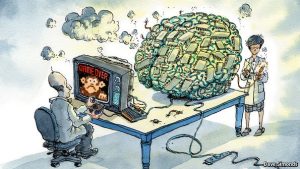
Through a glass, darklyTesting the methods of neuroscience on computer chips suggests they are wanting

0

THE ECONOMIST.

A cautionary tale about the promises of modern brain science

But a paper just published in PLOS Computational Biology questions whether more information is the same thing as more understanding. It does so by way of neuroscience’s favourite analogy: comparing the brain to a computer. Like brains, computers process information by shuffling electricity around complicated circuits. Unlike the workings of brains, though, those of computers are understood on every level.

Eric Jonas of the University of California, Berkeley, and Konrad Kording of Northwestern University, in Chicago, who both have backgrounds in neuroscience and electronic engineering, reasoned that a computer was therefore a good way to test the analytical toolkit used by modern neuroscience. Their idea was to see whether applying those techniques to a microprocessor produced information that matched what they already knew to be true about how the chip works.

Their test subject was the MOS Technology 6502, first produced in 1975 and famous for powering, among other things, early Atari, Apple and Commodore computers. With just 3,510 transistors, the 6502 is simple enough for enthusiasts to have created a simulation that can model the electrical state of every transistor, and the voltage on every one of the thousands of wires connecting those transistors to each other, as the virtual chip runs a particular program. That simulation produces about 1.5 gigabytes of data a second—a large amount, but well within the capabilities of the algorithms currently employed to probe the mysteries of biological brains.

The chips are down

One common tactic in brain science is to compare damaged brains with healthy ones. If damage to part of the brain causes predictable changes in behaviour, then researchers can infer what that part of the brain does. In rats, for instance, damaging the hippocampuses—two small, banana-shaped structures buried towards the bottom of the brain—reliably interferes with the creatures’ ability to recognise objects.

When applied to the chip, though, that method turned up some interesting false positives. The researchers found, for instance, that disabling one particular group of transistors prevented the chip from running the boot-up sequence of “Donkey Kong”—the Nintendo game that introduced Mario the plumber to the world—while preserving its ability to run other games. But it would be a mistake, Dr Jonas points out, to conclude that those transistors were thus uniquely responsible for “Donkey Kong”. The truth is more subtle. They are instead part of a circuit which implements a much more basic computing function that is crucial for loading one piece of software, but not some others.

 Another neuroscientific approach is to look for correlations between the activity of groups of nerve cells and a particular behaviour. Applied to the chip, the researchers’ algorithms found five transistors whose activity was strongly correlated with the brightness of the most recently displayed pixel on the screen. Again, though, that seemingly significant finding was mostly an illusion. Drs Jonas and Kording know that these transistors are not directly involved in drawing pictures on the screen. (In the Atari, that was the job of an entirely different chip, the Television Interface Adaptor.) They are only involved in the trivial sense that they are used by some part of the program which is ultimately deciding what goes on the screen.

The researchers also analysed the chip’s wiring diagram, something biologists would call its connectome. Feeding this into analytical algorithms yielded lots of superficially impressive data that hinted at the presence of some of the structures which the researchers knew were present within the chip. On closer inspection, though, little of it turned out to be useful. The patterns were a mishmash of unrelated structures that were as misleading as they were illuminating. This fits with the frustrating experience of real neuroscience. Researchers have had a complete connectome of a tiny worm, Caenorhabditis elegans, which has just 302 nerve cells, since 1986. Yet they understand much less about how the creature’s “brain” works than they do about computer chips with millions of times as many components.

The essential problem, says Dr Jonas, is that the neuroscience techniques failed to find many chip structures that the researchers knew were there, and which are vital for comprehending what is actually going on in it. Chips are made from transistors, which are tiny electronic switches. These are organised into logic gates, which implement simple logical operations. Those gates, in turn, are organised into structures such as adders (which do exactly what their name suggests). An arithmetic logic unit might contain several adders. And so on.

But inferring the existence of such high-level structures—working out exactly how the mess of electrical currents within the chip gives rise to a cartoon ape throwing barrels at a plumber—is difficult. That is not a problem unique to neuroscience. Dr Jonas draws a comparison with the Human Genome Project, the heroic effort to sequence a complete human genome that finished in 2003. The hope was that this would provide insights into everything from cancer to ageing. But it has proved much more difficult than expected to extract those sorts of revelations from what is, ultimately, just a long string of text written in the four letters of the genetic code.

Things were not entirely hopeless. The researchers’ algorithms did, for instance, detect the master clock signal, which co-ordinates the operations of different parts of the chip. And some neuroscientists have criticised the paper, arguing that the analogy between chips and brains is not so close that techniques for analysing one should automatically work on the other.

Gaël Varoquaux, a machine-learning specialist at the Institute for Research in Computer Science and Automation, in France, says that the 6502 in particular is about as different from a brain as it could be. Such primitive chips process information sequentially. Brains (and modern microprocessors) juggle many computations at once. And he points out that, for all its limitations, neuroscience has made real progress. The ins-and-outs of parts of the visual system, for instance, such as how it categorises features like lines and shapes, are reasonably well understood.

Dr Jonas acknowledges both points. “I don’t want to claim that neuroscience has accomplished nothing!” he says. Instead, he goes back to the analogy with the Human Genome Project. The data it generated, and the reams of extra information churned out by modern, far more capable gene-sequencers, have certainly been useful. But hype-fuelled hopes of an immediate leap in understanding were dashed. Obtaining data is one thing. Working out what they are saying is another.

http://www.economist.com/news/science-and-technology/21714978-cautionary-tale-about-promises-modern-brain-science-testing-methods?cid1=cust/ednew/n/bl/n/20170119n/owned/n/n/nwl/n/n/EU/8643534/n

Πολύπλοκα συστήματα και η κληρονομιά του Ιλία Πριγκοζίν.

478

Τα πολύπλοκα συστήματα και η κληρονομιά που άφησε ο Ιλία Πριγκοζίν είναι το θέμα της εκπομπής “Τομές στην Επικαιρότητα” σήμερα Πέμπτη 19 Ιανουαρίου 2017.

Ο Ιλία Πριγκοζίν γεννήθηκε στις 25 Ιανουαρίου 1917 στη Μόσχα και πέθανε στις 28 Μαίου 2003 στις Βρυξέλλες. Φέτος, συμπληρώνονται 100 χρόνια απο τη γέννησή του και η Σχολή Θετικών Επιστημών του Αριστοτελείου Πανεπιστημίου Θεσσαλονίκης πραγματοποιεί την ίδια ημέρα (25 Ιανουαρίου) ημερίδα αφιερωμένη στο έργο του.

Η εκπομπή αρχίζει στις 9μμ και τελειώνει στις 10μμ. Επαναλαμβάνεται το Σάββατο απο τις 5μμ-6μμ.

Προσκεκλημένοι της εκπομπής είναι:

–Χαρίτων Σάρλ Χιδίρογλου, κοσμήτορας της Σχολής Θετικών Επιστημών του ΑΠΘ.

–Ιωάννης Αντωνίου, καθηγητής Μαθηματικών ΑΠΘ

–Σπύρος Παυλίδης, καθηγητής Γεωλογίας ΑΠΘ.

Το σήμα της TV-100 μεταδίδεται:

Μέσω της Digea στην Κεντρική Μακεδονία

Απο την OTE TV οπουδήποτε

Διαδικτυακά απο τη διεύθυνση:

www.anixneuseis.gr

και

www.fm100.gr

Top 3 Economic Surprises for 2017

0

By George Friedman

We have been slaving away at our 2017 forecast for over two months now, and we are excited to share it with the world. Only subscribers to Geopolitical Futures can access the full 24- page document, but we wanted to take a step back and pick out the three most important economic surprises that await the world in the year ahead, for a select group outside our current membership. Obviously, we want you to consider subscribing to our service if you haven’t already, but we also feel a responsibility to share some of our most important forecasts more broadly because of how critical we expect these developments to be.

You will note that these forecasts run counter to most mainstream expectations. That does not bother us in the slightest. We have become accustomed to being called all sorts of names when our predictions first appear… and then watching the surprise of doubters when the predictions come true. The media has become an echo chamber that amplifies unhelpful assertions of global groupthink. GPF aims to be the voice heard over the echo, and in 2017, that voice is calling you to think about the possible ramifications of three key developments: a contraction of exports in Germany, the beginning of a long-term decline in the Russian economy, and an increase in unemployment rates in China.

Germany

The global crisis of exporters is about to shift into higher gear. The world got here via the 2008 financial crisis, an unwanted gift that seems to keep on giving. Events in 2008 resulted in decreased demand for Chinese exports in Europe and the United States. This posed a severe problem for China, undermining Chinese profit margins but also curtailing Chinese imports (especially industrial commodities). Countries that were dependent on the export of these commodities saw their profits begin to shrink. Growth remained stagnant in Europe and moderate, at best, in the U.S., creating a cycle whose effects have played out throughout the global economy.

Four major countries were most vulnerable to this vicious circle: China, Germany, Russia and Saudi Arabia. Together, those countries make up more than one-fifth of the world’s GDP. China, Russia and Saudi Arabia have already shown disturbing signs of this crisis manifesting in their national economies, which has led to political instability and economic volatility. Germany has conspicuously avoided the worst effects of the crisis thus far. But this will not continue in 2017. Next year, the global exporters’ crisis will visit Germany—the world’s fourth-largest economy, Europe’s largest economy, and the third-largest exporter in the G-20 – in earnest.

German exports in 2016 have been lower than projected. According to Destatis (based on the latest statistics available), German exports grew by only 0.8 percent in 2016, compared to 2015. The Deutsche Bundesbank admits that prospects for German exports have become “less favorable,” but it still expects German exports to grow moderately in 2017 and 2018.

We beg to differ. Europe will continue to see anemic growth rates, and other major problems face the European Union besides struggles in the German economy, which will weigh down growth. The U.S. economy will grow moderately at best, and by the end of 2017, it may approach a cyclical recession. Germany was able to compensate for reduced Chinese demand for German exports by increasing trade with the U.S. and the United Kingdom. Chinese demand will continue to decrease, and the U.S. and U.K. won’t be able to pick up the slack for German exports forever. German banks are already showing signs of strain, and we expect investment and employment in the industrial sector to slow down in 2017. Because 47 percent of Germany’s GDP comes from exports, this will amount to nothing less than a crisis for Germany, with negative economic and political implications for other European countries. For more about those implications, you’ll have to read the full report, but suffice it to say that the key economic event in Europe will be Berlin’s exports coming home to roost.

Russia

It is no secret that Russia has been struggling mightily since the collapse of global oil prices that began in August 2014. In 2008, oil alone accounted for 18 percent of the Russian economy, and the average price was $91.48 a barrel. Russia thought it was being responsible when it planned its government budgets with oil prices at $82 a barrel, but it didn’t expect prices to drop as precipitously as they have. The average oil price in 2016 is $43 a barrel. The ruble has hit alltime lows against the dollar, inflation in Russia at one point in 2015 was over 16 percent, and the International Monetary Fund (IMF) estimates Russia’s GDP will contract 1.2 percent in 2016. The graphic below shows how dire the situation is by identifying all the regions in Russia that operated at a budget deficit in the first half of 2016.

Curiously to us, however, the world seems to think that Russia has already hit rock bottom and that a recovery will slope upward from here. A July 2016 IMF report on Russia stated: “Growth is expected to resume in 2017 and reach 1 percent, as domestic demand slowly recovers on the back of easing financial conditions and pent up demand.” The IMF obviously doesn’t know what rock bottom looks like in Russia. As oil prices go, so goes the Russian economy, and we have no reason to believe oil prices are going to increase much in 2017. A recent compromise reached by OPEC was more like staunching a bleeding wound than curing the underlying problem of global oversupply. On top of this, Russia is continuing to spend large amounts of money on military modernization while cutting social spending by as much as 10 percent across the board.

Whatever the exact numbers for Russia’s GDP, they are ultimately of little importance – we expect contraction, but even if there is some growth, 2017 will be an extremely difficult year for the Russian economy and, therefore, the Russian people. We have already observed some disturbing signals that this economic problem is beginning to manifest in social and political unrest, and we expect to see much more of that in the year ahead. In our forecast through 2040, we describe how we believe that by that time, the Russian Federation will have ceased to operate as a federation. The best-case scenario will resemble a loose confederation, and the worst could involve the genuine secession of various regions. 2017 is not the year Russia will fall, but it will be the year that the contours of the abyss ahead become clear. The long Russian winter is coming, and in hindsight, 2017 will be viewed as a significant turning point in Russia’s history. All of this will have important ramifications on Russia’s place in the world, which is detailed in our full forecast.

China

Last, and certainly not least, is China. 2016 turned out to be the year the world realized that what GPF founder George Friedman has been saying about China for years really was true: China’s preternatural growth rates could not be sustained forever. Eventually, the Chinese growth miracle would come to an end, and China would face a choice – the imposition of a dictatorship or a collapse into the regionalism that has defined much of Chinese history. The dictatorship of President Xi Jinping has been advancing for some time, and 2017 will be the year that Xi eliminates the last of his rivals and solidifies his control over the political system. This will be necessary because as China’s underlying economic problems continue to mount, unemployment will begin to rear its head, and that is an extremely dangerous problem for the stability of China’s political system. Top 3 Economic Surprises for 2017 6

Consider this: The official unemployment rate in China has ranged from 4–4.3 percent for the last 14 years. That statement alone should be unnerving. Such a steady unemployment rate would be anomalous even for a very stable economy. The National Bureau of Economic Research estimates unemployment in China is around 11 percent, and based on our research as well as anecdotal evidence, we believe unemployment in China is already significantly higher than that. In 2016, China announced that it would seek to lay off five to six million state workers over the next two to three years in an attempt to solve industrial overcapacity. It is highly irregular for China to announce such job cuts publicly, but it reflects how untenable the current situation is for many Chinese companies, which have seen profits decline as demand for their goods has generally fallen since 2008.

A number of potential problems face the Chinese economy in 2017, including a looming housing bubble, the devaluation of the yuan and rising debt. But the most serious of these is unemployment. China has always valued social stability over bottom lines on balance sheets, and that is because China is such a large and unwieldy place to govern. The problem is China’s economy has reached the limits of its high-growth, low-wage economic model, and it is now trying to transition toward a consumer economy. Making such a change for any economy is difficult, and for one that is as diverse as China’s and that has grown at such a fast rate, it will be even harder. China is trying to find a balance between making those reforms and pumping money into growth strategies that keep people employed, but the seams have begun to fray.

As with Russia, we don’t expect 2017 to challenge the rule of the government. But we do expect Xi’s crackdowns on potential opposition to increase in intensity, and this will be as a result of serious stresses on the Chinese economy, chief among them a concealed but no less real increase in those without jobs in China. How this will be reflected in Chinese foreign policy and in the U.S.- China relationship in the wake of Donald Trump’s election in the U.S. is all addressed at length in our full forecast.

What This Means Geopolitically

Many people think geopolitics is just a fancy word for “international relations” or “foreign policy.” But that’s not the kind of geopolitics we do at Geopolitical Futures. We understand geopolitics to be the intersection between geography and power. Power, in turn, comes in three main forms: military, economic and political. Our forecasts look at all of these components and how they work with and against each other in shaping the future of the world. No one component is necessarily more important than the other – it’s the context that gives global events meaning. Above, we summarized our three most important economic forecasts for the year. But as important as these three forecasts are, without geopolitics, you are missing the full picture. The ramifications of these developments, along with the rest of our geopolitical predictions for 2017, are contained in the 2017 forecast. If this summary has piqued your interest, we encourage you to check it out and consider subscribing

http://www.mauldineconomics.com/download/gpf-top-3-economic-surprises-for-2017

Anxious European Leaders Seek an Early Audience With Trump

0

WASHINGTON — European leaders, anxious over Donald Trump’s unpredictability and kind words for the Kremlin, are scrambling to get face time with the new American president before he can meet with Russian President Vladimir Putin, whose provocations have set the continent on edge.

One leader has raised with Trump the prospect of a U.S.-European Union summit early this year, and the head of NATO — the powerful military alliance Trump has deemed “obsolete” — is angling for an in-person meeting ahead of Putin as well. British Prime Minister Theresa May is working to arrange a meeting in Washington soon after Friday’s inauguration.

For European leaders, a meeting with a new American president is always a sought-after — and usually easy-to-obtain — invitation. But Trump has repeatedly defied precedent, making them deeply uncertain about their standing once he takes office. Throughout his campaign and in recent interviews, Trump has challenged the viability of the EU and NATO, while praising Putin and staking out positions more in line with Moscow than Brussels.

“There are efforts on the side of the Europeans to arrange a meeting with Trump as quickly as possible,” Norbert Roettgen, the head of the German Parliament’s foreign committee and a member of Chancellor Angela Merkel’s party, told The Associated Press.

 In fact, eager to stage an early show of Trans-Atlantic solidarity, Donald Tusk — the former Polish prime minister who heads the EU’s Council of member state governments— invited Trump to meet with the EU early in his administration, according to a European Union official. But a senior Trump adviser essentially rebuffed the offer, telling the AP this week that such a gathering would not be a priority for the incoming president, who wants to focus on meetings with individual countries, not the 28-nation bloc.

Trump backs Britain’s exit from the European Union, casting the populist, anti-establishment movement as a precursor to his own victory. In a recent joint interview with two European newspapers, Trump said of the EU, “I don’t think it matters much for the United States.”

Such rhetoric alone was enough to set off alarm bells in Europe. And Trump’s praise for Putin and promise of closer ties to Moscow have deepened the uncertainty.

Trump has raised the prospect of dropping U.S. sanctions on Moscow and has appeared indifferent to Russia’s annexation of territory from Ukraine. The hacking of his opponents during the U.S. election, and Trump’s dismissal of the CIA’s warnings about Russia’s involvement, added a dose of spy drama.

Trump’s sentiments mark a dramatic shift in Republican views of Europe, just a generation after George H.W. Bush famously greeted the collapse of the Iron Curtain by calling for a “Europe whole and free.”

Trump’s top national security adviser has been in close contact with the Russian ambassador to the U.S., conversations that have involved setting up a phone call between the Putin and the president-elect, transition officials have said.

But Trump currently has no plans to meet with Putin, according to the senior adviser, who insisted on anonymity in order to discuss the transition team’s internal planning. Aides vehemently denied a recent report in The Sunday Times of London that Trump’s first foreign trip would be a summit with Putin in Reykjavik, Iceland, the site of a Cold War meeting between President Ronald Reagan and Soviet leader Mikhail Gorbachev.

Still, Europe’s leaders are eager to ensure they have Trump’s ear before Putin does. NATO Secretary General Jens Stoltenberg is hoping to meet with Trump quickly, perhaps in Washington, according to a NATO official. And even if Trump rejects a U.S.-EU summit, European officials are said to have discussed the prospect of a smaller meeting with the U.S. president and the heads of the continent’s most powerful countries, including Merkel.

Eight of the past 10 presidents have made their official first trip abroad to either Canada or Mexico.

But a Putin meeting wouldn’t be without precedent. When Bill Clinton made his maiden trip to Vancouver in 1993, it was primarily for a summit with Russian President Boris Yeltsin.

Aides have signaled that one of Trump’s first foreign leader meetings at the White House will be with May, who became prime minister following Britain’s vote to leave the EU. The president-elect’s team is also working on early invitations to Washington for the leaders of Mexico and Canada, according to the Trump adviser.

Barring other arrangements, Trump and Putin’s first meeting of the year might not come until July when the Group of 20 leaders gather in Hamburg, Germany — though Trump has yet to say whether he plans to attend international summits.

If he does, some European leaders could get an audience with him in May at a planned NATO summit and a gathering of the more elite Group of Seven in Italy. Russia had been a member of that group, but the U.S. and Europe ousted Putin after the annexation of Crimea from Ukraine.

One of the first tests of Trump’s loyalties may well be whether he seeks to bring Russia back into that fold.

“If we start to equate democracies and non-democracies, allies and adversaries, this is setting a very dangerous precedent,” said Heather Conley, director of the Europe program at the Center for Strategic and International Studies. She said that if Trump were to reach out to Putin ahead of the Europeans upon taking office, “it would be a real cautionary note” for long-standing U.S. allies.

___

Grieshaber reported from Berlin. AP writer Frank Jordans in Berlin and Raf Casert and Lorne Cook in Brussels contributed to this report.

Cyprus peace deal nudges closer as hurdles still to overcome

0

A man prays in the Selimiye mosque, until the 16th century known as the Cathedral of St Sophia, or Agia Sofia, in the Turkish Cypriots breakaway area at northern divided capital of Nicosia, Cyprus, Tuesday, Jan. 17, 2017. Experts from the United Nations, Cyprus’ Greek and Turkish Cypriot communities as well as from the island’s three ‘guarantors’ Britain, Greece and Turkey will meet in a Swiss resort for three days starting on Wednesday to pinpoint the key differences between the sides on the make-up of post reunification security arrangements. (Petros Karadjias/Associated Press)
January 18 at 8:01 AM

NICOSIA, Cyprus — Diplomats are meeting Wednesday in the Swiss resort of Mont Pelerin, charged with figuring out if the differences are bridgeable in a deal to reunify ethnically split Cyprus.

The report they produce over three days will determine whether the Cypriot leaders and the foreign ministers of Greece, Turkey and Britain will reconvene in Geneva to thrash out a security agreement that will likely pave the way to an overall reunification accord. A complex web of interlocking interests has scuttled previous rounds of talks that have trudged on in successive failures since the island was split in 1974.

Here’s the state of play as talks get underway:

WHERE WE’RE AT:

 After 20 months, Greek Cypriot President Nicos Anastasiades and Turkish Cypriot leader Mustafa Akinci have sketched out the basic framework of a deal reunifying the island as a federation that they feel can earn the backing of the majority of both communities in separate votes. If all goes well, the referendums could happen by mid-year. The two men have made much progress on how to share power in a federation, as well as on the economy and how the federation will function as a member of the European Union.

What remains are issues that lie at the heart of Cyprus’ division — highly emotive issues that play on the deepest fears of both Greek and Turkish Cypriots.

___

MAPPING TERRITORY

Both sides have submitted maps delineating the territory they believe their respective federal zones should control. The difference is a single percentage point — the Turkish Cypriots want 29.2 percent of Cyprus’ land mass — down from the more than 36 percent they now control — while the Greek Cypriots have proposed 28.2 percent.

Although it seems like a small difference, neither side is happy.

Greek Cypriots want what was previously densely populated territory to be returned under their control in order to allow at least 90,000 Greek Cypriots displaced from the 1974 invasion to reclaim lost homes and property relatively quickly. They say the more people who reclaim homes, the less costly a peace deal in terms of compensation for those who cannot get their property back, and the more support for the deal.

 Conversely, Turkish Cypriots want to limit the number of people now living in Greek Cypriot-owned homes who have to relocate.
___

MY TURN, YOUR TURN

The two sides also remain stuck on the concept of a rotating presidency.

The Turkish Cypriots insist the future federation’s presidency should alternate between the Greek and Turkish communities to ensure reunified Cyprus would be a genuine partnership.

Greek Cypriots oppose the idea, arguing that according executive parity to the minority Turkish Cypriots would warp democratic principles. Some of the more suspicious Greek Cypriots see a rotating presidency as Turkey running the country by proxy.

Officials said the two sides didn’t even take up the issue last week because the two sides are so far apart.

___

GUARANTORS, SECURITY, MILITARY INTERVENTIONS

Cyprus’ 1960 constitution accorded Britain, Greece and Turkey the right to underwrite the security of the island. Turkey invoked its intervention rights from its status as a guarantor to justify its 1974 invasion following a coup aiming to unite Cyprus with Greece. It still keeps more than 35,000 troops in the breakaway north that don’t answer to Turkish Cypriot civilian authority.

Greek Cypriots are deeply concerned about the military might, especially as Turkey descends into deeper authoritarianism. They insist no non-EU country should station troops on the island or have the right to intervene militarily. Anastasiades has proposed the deployment of an international police force.

On the other hand, the minority Turkish Cypriots see Turkish troops as their sole insurance against possible hostilities. Akinci has said this can come under review after a number of years when fear and mistrust melts away.

___

Pan Pylas in Davos, Switzerland, and Cinar Kiper in Istanbul contributed to this report.

Copyright 2017 The Associated Press. All rights reserved.

https://www.washingtonpost.com/world/europe/cyprus-peace-deal-nudges-closer-as-hurdles-still-to-overcome/2017/01/18/44703784-dd7e-11e6-8902-610fe486791c_story.html?utm_term=.891a995f6d76

Turkish-Russian thaw to galvanize Black Sea region

0

YUNUS PAKSOY@yunuspaksoy ISTANBUL Published January 18, 2017

As the BSEC approaches its 25th anniversary, Turkey took over the rotating presidency on Jan. 1. Deputy Foreign Minister Ahmet Yıldız yesterday presented Turkey’s agenda for the next six months. With its intra-organization trade volume at TL 710 billion ($187 billion), the BSEC could benefit Turkey to a great extent.

Turkey and Russia stand out among the member states. Having improved relations following a downed Russian jet crisis in November 2015, Ankara and the Kremlin have been showing signs of strong collaboration both in diplomacy and the area of the economy.

Drawing attention to the recent rapprochement between Turkey and Russia, Yıldız said that the cooperation of the two countries in several areas will definitely benefit the BSEC. “Our relations will affect the organization positively. After a short period of tense relations, the relations are where they are supposed to be right now,” the deputy foreign minister said.During its term, Turkey will support the ongoing efforts to establish a Regional Trade Facilitation Strategy for the BSEC region.

President Recep Tayyip Erdoğan and Russian President Vladimir Putin have already reiterated that the normalization of Turkish-Russian ties will further continue. Regarding the issue, the deputy foreign minister said that the ties could be further bettered with a high level cooperation meeting in the near future.

While economic trade relations remain strong between Turkey and Russia, sanctions on over 80 companies have been recently lifted.

Restrictions were initially lifted for 30 companies operating in Russia, and now, the number of firms for which restrictions have been removed subsequently reached 50 and 80, an official told Daily Sabah, pointing out that the ban on five of 18 agricultural products by Russia was lifted and that an opening could be made in this field.

Turkey argues that the Turkish-Russian thaw could galvanize the BSEC. While there are intra-organizational conflicts, the BSEC needs more dialogue and collaboration. In addition, the Turkish chairmanship will support enhancing collaboration in the field of tourism in the Black Sea region.

Recently, Foreign Minister Mevlüt Çavuşoğlu co-penned an op-ed article for Daily Sabah. In the article, Çavuşoğlu said: “Today, the wider Black Sea region faces a number of political, economic and security challenges. These interrelated problems can only be effectively addressed through increased interaction, enhanced coordination, constructive dialogue and focused and result-oriented cooperation.”

The BSEC will hold a summit in June in Istanbul to celebrate the 25th anniversary of the organization.

Ankara has had several disputes with the European Union for a while. Furthermore, President Erdoğan suggested that Turkey could end its full membership bid. While Turkish-EU relations turned sour, the BSEC surfaced as an alternative.

The BSEC spans over 20 million square kilometers and has a population of 330 million people in its 12 member countries. For the time being, the BSEC is not as preferable as the EU in terms of its economic size, but has succeeded in developing an effective structure similar to the EU model for about 25 years since its establishment.

While it remains a question whether Turkish-Russian efforts will be enough to bring new life into the BSEC or whether the organization could prove to be an alternative for Turkey, the organization offers a glimpse of what could be more cooperation and success in the Black Sea region.

http://www.dailysabah.com/economy/2017/01/18/turkish-russian-thaw-to-galvanize-black-sea-region