Αρχική Blog Σελίδα 3009

Why is the South China Sea so important to the U.S.?

0

By Leszek Buszynski, Australian National University   |   Jan. 18, 2017 at 11:30 AM

 
 Graphic courtesy of Stratfor
 Donald Trump‘s nominee for Secretary of State Rex Tillerson made some surprising remarks about China and the South China Sea during his recent Senate confirmation hearings. He said the United States should “send China a clear signal that, first, the island-building stops, and second, your access to those islands also is not going to be allowed.”

His comments created a furor in the international media as it seems the United States might resort to force by blockading the Chinese-occupied features in the South China Sea.

James Mattis, Trump’s defense secretary nominee, was more circumspect in his remarks to the Senate Armed Services Committee. He identified defense of so-called “international waters” as the “bottom line” for the United States, suggesting the United States would defend freedom of navigation in the South China Sea without challenging the Chinese presence there.

Mattis’ comments were in line with U.S. policy toward the South China Sea, while Tillerson’s remarks were not. But why is the South China Sea so important to the United States anyway?

The Chinese regularly castigate the Americans for “meddling” in the area and have difficulty understanding why the United States takes a stand on the issue. In their view, the United States is making trouble for China and preventing its rise as a great power. The Chinese want to see the Americans abandon the South China Sea and withdraw from the western Pacific.

Some commentators in the United States and elsewhere agree. They argue that this would allow America to forge an accommodation with China, which would remove the prospect of conflict between the world’s two largest economies and bring peace and stability.

Others have called for a G-2 or a U.S.-China accord that would settle global problems. They claim that the United States is already overstretched and should return to the “offshore” position that it had before the Korean war broke out in 1950. Why let the South China Sea get in the way of this possible accommodation?

Chinese regional presence

The South China Sea has become important to the United States because of China’s challenge to the liberal rules-based order that America has promoted since the Pacific war. The post-war regional order was based on the American presence, which set the stage for impressive economic growth and regional prosperity without the threat of war or conflict.

It ensured that maritime disputes and territorial claims would be resolved through negotiation and not military power. And it served as the basis for the development of trade and regional economic relations from which all countries in the region benefited.

America’s concern with the South China Sea is a result of China’s effort to secure control over the maritime territory and the resources it contains. China insists on “indisputable sovereignty” over the area but a number of other claimants – Vietnam, Brunei, Malaysia and the Philippines – have the law on their side.

All have exclusive economic zones in the South China Sea, which is their right under U.N. Convention of the Law of the Sea and which the Chinese dismiss. To clarify the matter, the Philippines appealed to an tribunal convened under UNCLOS to rule on the situation.

In July 2016, the tribunal issued its judgment and upheld the rights of the ASEAN claimants to their EEZs, noting that the Chinese claim had no legal basis. China, however, has ignored legality in this dispute and is prepared to back its claim with military power. If it does not recognize the rules, the regional order that the United States has been promoting breaks up.

China has militarized the Spratly Islands by engaging in reclamation projects in the South China Sea. The Chinese have been dredging sand from the ocean floor and extending the size of seven reefs they have occupied.

They have constructed three airfields there, two are 3,000 meters in length, one is 2,600 meters. These airfields can support military aircraft, including bombers and large transport aircraft. With this military presence, China would be able to control the South China Sea. And its strengthened position has geopolitical consequences for the United States.

The way ahead

The South China Sea has become an important area for the implementation of China’s naval strategy, including blockading Taiwan, and power projection into the Indian and Pacific Oceans. It also has some of the busiest shipping lanes in the world.

The Chinese often say that they respect freedom of navigation but can they be trusted? The Japanese think not. During a territorial dispute with Japan in 2010, the Chinese banned the supply of rare earths, which were necessary for Japan’s electronics industry, to the country.

The Chinese could block Japanese trade, which would need to be diverted elsewhere at considerable cost. Indeed, control of the South China Sea would allow China to interfere with Japanese and South Korean trade conducted through the area.

For America, then, the future of the current regional order and the security of its allies – Japan and South Korea – is at stake. To maintain its geopolitical position in the western Pacific, the United States is obliged to defend the regional alliance system, and reassure local powers who are concerned about China’s intentions.

Leaving the South China Sea to the Chinese would undermine that alliance system and America’s presence in the western Pacific. China would become the dominant power in the area and regional countries would gravitate towards it.

In October 2015, the Obama Administration responded to China’s actions by launching “freedom of navigation” naval patrols in the South China Sea, sending a clear signal that America would not be chased out of the area.

By all indications, the Trump administration is likely to be more aggressive in resisting China in the South China Sea and more forceful about preventing the erosion of America’s position in the region.

Trump has already broken with diplomatic convention by speaking with Taiwanese President Tsai Ing-wen over the phone. More can be expected to demonstrate a new American assertiveness.

One possibility is the formation of an American South China Sea naval squadron that would maintain a regular presence in the region to show the Chinese that they cannot dominate the area. The Trump administration might also strengthen security ties with Japan and attempt to orchestrate the creation of a coalition of powers bringing together Australia, India, as well as Japan, to stand up to China.

The ConversationLeszek Buszynski is a visiting fellow at Australian National University.

This article was originally published on The Conversation. Read the original article.
http://www.upi.com/Top_News/Voices/2017/01/18/Why-is-the-South-China-Sea-so-important-to-the-US/5761484751063/

The end of the pageview era? 

0

Many journalists are all too familiar with the rinse-and-repeat routine of content distribution: Wrap up edits, create a search-friendly headline, publish, and promote the sh** out of it on social media.

There has been major pushback recently against this relentless strive for traffic, which bolsters ad revenue. The publishing platform Medium announced last week that it would move away from an ad-based business model. In a new post fortifying Medium’s decision, Sean Blanda writes that “The methods used to fund modern journalism simultaneously undermine trust in the news outlets.”

While we normally think about editorial as independent from business, Blanda shows that they are systemically related. Respected news sources have been forced by necessity into hosting sponsored content—undermining credibility. And the most important journalism, Blanda writes, is not financially viable. The Mother Jones investigation on private prisons, for example, cost roughly $350,000 and brought in $5,000 in ad revenue.

The New York Times, too, reaffirmed its commitment to a subscription-based model in its new 2020 report: “Our ambitions are grand: to prove that there is a digital model for original, time-consuming, boots-on-the-ground, expert reporting that the world needs.” The Times’ ad revenue dipped below consumer revenue just before 2012.

The Times believes that it can continue to grow subscriptions by providing journalism that is unavailable elsewhere, rather than smaller, “incremental” stories: “We are not trying to win a pageviews arms race. We believe that the more sound business strategy for The Times is to provide journalism so strong that several million people around the world are willing to pay for it.”

Will this mean the end to the era of pageviews as the dominant metric? It can’t come soon enough…

  • Facebook is going to stop paying publishers for live videos—a reminder of how much power the platform wields in controlling revenue streams. (Recode)
  • Ever wonder about “those creepy web ads that learn your preferences and follow you around”? Floodwatch is a new tool that collects and aggregates information on them. (Nieman Lab)
  • Reason for hope: In 2015, CJR spoke to then-Chartbeat CEO Tony Haile, who created the company to think creatively about web readership metrics and move away from clicks and toward attention. (CJR)
  • CJR Editors

Τι χωρίζει Ελλάδα και Αλβανία

1

Τετάρτη 18 Ιανουαρίου 2017, 09:46

 Οι διπλωματικές διαφορές των δύο χωρών, τα αδιέξοδα και οι πιθανές λύσεις.

Αλβανία και Ελλάδα μοιράζονται 282 χλμ συνόρων, κοινές σελίδες στα βιβλία της ιστορίας, αρκετές όμοιες λέξεις, έθιμα ακόμη και ονόματα. Η ιστορική διαδρομή στη σχέση των δύο λαών, «ξαδέρφια» για κάποιους, «εχθροί» για άλλους, είναι πλούσια σε αντιθέσεις. Για τα δύο γειτονικά έθνη των Βαλκανίων, συνεργασία κι εντάσεις, συνενόηση και προκαταλήψεις, φιλία και καχυποψία, είναι εκφάνσεις που εναλλάσσονται μεταξύ τους σε βάθος χρόνου, συνθέτοντας μια αντιφατική εικόνα, γεμάτη ίντριγκα και ενδιαφέρον για τους μελετητές.

Στο πεδίο της πολιτικής και της διπλωματίας η σχέση των δύο κρατών περιλαμβάνει πραγματικά επεισοδια ή διαφορές οπως επίσης και μύθους που συχνά τροφοδοτούνται από τα αδηφάγα για εθνικές προκλήσεις media και από τις δύο πλευρές.

Ας δούμε όμως ένα ένα τα ανοιχτά ζητήματα που απασχολούν την εξωτερική πολιτική Ελλάδας και Αλβανίας, ξεκινώντας από την υποψηφιότητα της γείτονος για ένταξη στη Ευρωπαϊκή Ένωση.

Ένταξη Αλβανίας στην Ε.Ε.

Τον Ιούνη του 2014 χορηγείται στην Αλβανία το επίσημο καθεστώς υποψήφιου μέλους της Ε.Ε. Αυτό που πρέπει να τονιστεί αρχκά, είναι ότι για τα Τίρανα, η ενταξη στην Ευρώπη αποτελεί χωρίς υπερβολή απόλυτη εθνική προτεραιότητα, καθώς σύσσωμο το πολιτικό και κομματικό φάσμα της χώρας είναι προσανατολισμένο στο συγκεκριμένο στόχο.

Τον στόχο αυτό υποστηρίζει σταθερά και η Ελλάδα, εφόσον είναι προς το συμφέρον της η ενσωμάτωση της γειτονικής χώρας στην Ευρώπη με την προαπαιτούμενη συμμόρφωση σε ενα ευρύ πλαίσιο κανόνων. Ταυτόχρονα όμως η Αθήνα διατηρεί δικαίωμα βέτο και άρα και τη δυνατότητα να μπλοκάρει την ένταξη της Αλβανίας.

Στα Τίρανα προφανώς αυτό το έχουν πάντα υπόψη, οπότε η αλβανική ηγεσία ωθούμενη απο ορθολογικά και όχι εθνικιστικά κίνητρα, είναι αναγκασμένη να μην διακινδυνέυσει τον εθνικό της στόχο για ελληνο-αλβανικές διαφορές μικρότερης βαρύτητας.
Προκύπτει συνεπώς, ότι ελληνική πλέυρα διαθέτει ενα σημαντικό εργαλείο πίεσης, για το οποίο θα πρέπει να βρει τη χρυση τομή στη χρήση του, ώστε να μη γίνει ουτε μέσο εκβιασμού αλλά όυτε και να το παραδόσει εν λευκώ.

Ένα ζήτημα στο οποίο η Ελλάδα υπενθύμίζει στην Αλβανία – άλλοτε έμμεσα και αλλοτε ρητά – ότι η ενταξιακή της πορεία περνά από το ελληνικό βέτο, είναι ο σεβασμός της ελληνικής μειονότητας.

Ελληνική μειονότητα

Στη Χιμάρα, μια πόλη στη Βόρεια Ήπειρο που ιστορικά κατοικείται από Έλληνες ομογενείς (και όχι μόνο) και συχνά αποτελεί πηγή εντάσεων, το προηγούμενο διάστημα προκλήθηκε διπλωματικό επεισόδιο ανάμεσα στις δυο χώρες, όταν οι αλβανικές αρχές επιχείρησαν να κατεδαφίσουν 19 κτίρια ιδιοκτησίας Ελλήνων ομογενών. Οι αρχές επικαλούνται το νόμο περί αυθαιρεσίας και τη γενικευμένη πολεοδομική ανάπλαση σε όλη τη χώρα, ενώ οι ντόπιοι θεωρούν ότι γίνεται επιλεκτική εφαρμογή του νόμου με απώτερο στόχο την υφαρπαγή της περιουσίας τους. Άμεση ήταν η παρέμβαση του υπουργείου εξωτερικών της Ελλάδας, που προειδοποίησε ευθέως την Αλβανία οτι με τέτοιες ενέργειες διακινδυνεύει τον ευρωπαικό της προσανατολισμό, με αποτέλεσμα τελικά οι κατεδαφίσεις να αναβληθούν επ’ αόριστον.

Η ελληνική εθνική μειονότητα (ΕΕΜ), που είναι η πολυπληθέστερη στην Αλβανία, σύμφωνα με το αλβανικό κράτος αριθμεί 60.000 – 70.000, ενώ σύμφωνα με το ελληνικό 200.000 – 400.000 κατοίκους. Τα κύρια ζητούμενα της ΕΕΜ αφορούν την εκπαίδευση και τη χρήση της ελληνικής γλώσσας στα σχολεία και τη δημόσια ζωή, τη συμμετοχή μελών της στις δημόσιες υπηρεσίες και την προστασία των περιουσιακών της δικαιωμάτων.

Τα Τίρανα επίσημα τονίζουν ότι τα δικαιώματα της μειονότητας γίνονται απόλυτα σεβαστά ενώ ανεπίσημα θεωρούν ότι μέσω αυτής η Αθήνα επιχειρεί να παρεμβαίνει στα εσωτερικά της. Η Ελλάδα από τη πλερά της συνδέει ρητώς την ενταξη της Αλβανίας στην Ε.Ε. με το σεβασμό των μειονοτικών δικαιωμάτων. Ας έχουμε υπόψη ωστόσο, ότι γενικότερα στις διεθνείς σχέσεις, οι εθνικές μειονότητες συχνά χρησιμοποιούνται εργαλειακά από τη διπλωματία για πολιτικά οφέλη.

Θαλάσσια σύνορα , ρόλος Τουρκίας (;)

Στο βόρειο Ιόνιο, τα τελευταία χρόνια, οι δύο χώρες διεξάγουν έρευνες με σημαντικές πιθανότητες εντοπισμού υποθαλάσσιων κοιτασμάτων πετρελαίου και φυσικού αερίου.

Τον Απρίλη του 2009, οι δύο πρωθυπουργοί, Κωνσταντίνος Καραμανλής και Σαλί Μπερίσα καταλήγουν σε συμφωνία που υπογράφεται επίσημα μεταξύ των δύο κρατών, η οποία οριοθετεί την ελληνό-αλβανική υφαλοκριπίδα και τις θαλάσσιες ζώνες στο βόρειο Ιόνιο. Η αντιπολίτευση στην Αλβανία υπό τον Εντι Ράμα, αμφισβητεί τη συμφωνία και το 2014 ένα χρόνο μετά την εκλογή του τελευταίου ως πρωθυπουργός, ακυρώνεται από το Συνταγματικό Δικαστήριο της Αλβανίας ως ασύμφορη διαδικαστικά και ουσιωδώς με το αλβανικό Σύνταγμα και το διεθνές Δίκαιο της Θάλασσας.

Η εξέλιξη αυτή όπως ήταν φυσικό, δυναμιτίζει τις σχέσεις των δύο χωρών, ενώ τροφοδοτεί τους εθνικιστικούς κύκλους με αφορμές για διασπορά θεωριών συνωμοσίας. Στην Ελλάδα μάλιστα κυκλοφορεί το σενάριο ότι πίσω από την ακύρωση της συμφωνίας υπάρχει τουρκικός δάκτυλος, βασιζόμενο κυρίως σε τρία στοιχεία: (α) τη δήλωση-υπονοούμενο του Σαλί Μπερίσα ότι η συμφωνία κατέπεσε έπειτα από παρεμβολή «τρίτου παράγοντα», (β)την προσωπική φιλία του Ράμα με τον Ερντογάν και (γ) την πρόσφατη αναβάθμιση των αλβανο-τουρκικών σχέσεων.

Η αλβανική κυβέρνηση αρνείται κατηγορηματικά το συγκεκριμένο σενάριο, που είναι γεγονός ότι δεν επαληθεύεται από κάποια πειστική απόδειξη. Κι επειδή οι Διεθνείς Σχέσεις δεν είναι ποτέ μια μονόπλευρη υπόθεση, αξιόπιστες πηγές εντός Αλβανίας αμφισβητούν ακόμη και τη φαινομενική βελτίωση των διμερών σχέσεων Τιράνων-Άγκυρας. Ένα παράδειγμα, είναι ότι στο πιεστικό αίτημα του Τούρκου προέδρου για κλείσιμο γκιουλενικών σχολείων και ιδρυμάτων στην αλβανική επικράτεια, η κυβέρνηση του Ράμα δεν έχει ανταποκριθεί. Εξάλλου, όπως επισημάνθηκε προηγουμένως, από το 1991 κι έπειτα, η πυξίδα στη γεωστρατηγική της Αλβανίας δείχνει σαφώς προς τη Δύση (ΗΠΑ, Ε.Ε.), κάτι που αποτελεί πυλώνα της εξωτερικής της πολιτικής.

Το ζήτημα που είναι πιθανότερο να παρεμβαίνει και να υποδαυλίζει η Τουρκία είναι το τσάμικο μέσω του μικρού ακροδεξιού κόμματος PDIU.

Τσάμηδες

Οι Τσάμηδες διεκδικούν από την Ελλάδα να τους αναγνωρίσει τα δικαιώματα ιδιοκτησίας και να παραδεχτεί την εθνοκάθαρση της κοινοτητας τους. Ιστορικά οι Τσάμηδες ήταν μια αλβανόφωνη και μουσουλμανική κοινότητα που κατοικούσε στη σημερινή Θεσπρωτία.

Με τη λήξη της γερμανικής κατοχής, ο ΕΔΕΣ και το ελληνικό κράτος εκδιώξε βίαια και μαζικά τους Τσάμηδες από την ελληνική επικράτεια λόγω της δωσίλογης δράσης και συνεργασίας των τελευταίαων με τους Ιταλούς και Γερμανούς κατακτητές. Τις δύο δεκαετίες που προηγήθηκαν του 2ου Παγκοσμίου Πολέμου, η μεινονότητα των Τσαμηδων είχε υποστεί συστηματική καταπίεση απο το ελληνικό κράτος και ειδικότερα από τη μεταξική δικτατορία. Στην ιστορική προσέγγιση του θέματος, παραδοσιακά και οι δύο πλευρές ακολουθούν την τακτική της «μισής αλήθειας», αυτής που ευθυγραμμίζεται καλύτερα με την εθνική αφήγηση.

Πίσω στο σήμερα, εντός Αλβανίας το ζήτημα προωθείται κυρίως από το κόμμα των Τσάμηδων, το συγκυβερνών PDIU. Οι Τσάμηδες επειδή δεν έχουν στα χέρια τους επίσημους τίτλους ιδιοκτησίας, απαιτούν με επιτακτικό τρόπο από το αλβανικό κράτος να διευθετήσει το θέμα τους. Η τακτική της Αθήνας, ως προς το τσάμικο, απορρίπτει την ύπαρξη του ζητήματος ως «non issue», προκείμενου να αποτρέψει εξ αρχής να μπει στη διμερή ατζέντα διαλόγου σχετική διεκδίκηση. Η τακτική της Αλβανίας αποσκοπεί στο «όσα περισσότερα ζητήσω, τόσο περισσότερα θα πάρω» αλλά και ιδανικά στη δημιουργία ενός διπλωματικού αντίβαρου στις διεκδικήσεις της ελληνικής μεινότητας.

Εκτίμηση του γράφοντος είναι ότι η επίκληση στο τσάμικο από την αλβανική κυβέρνηση, παρά την έντονη δραστηριότητα και προβολή του PDIU, έχει πρωτίστως εσωτερική πολιτική σκοπιμότητα ενόψει μάλιστα και των επερχόμενων εκλογών το καλοκαίρι.

Κόσοβο, Νόμος περί εμπόλεμου

Η Ελλάδα μαζί με την Κυπρο, την Ισπανία, τη Ρουμανία και τη Σλοβακία είναι οι μόνες χώρες της Ε.Ε. που δεν εχουν αναγνωρίσει το Κόσοβο ως ανεξάρτητο κράτος. Παρόλαυτά, η Αθήνα υποστηρίζει τη συμμετοχή του νεοσύστατου κράτους σε διεθνείς οργανισμούς, ενώ παράλληλα προωθούνται και οικονομικές σχέσεις με την Πρίστινα. Η αρνηση της Ελλάδας να αναγνωρίσει το Κόσσοβο αποδίδεται στην παραδοσιακή φιλία της με τη Σερβία, ωστόσο αρκετοί αναλύτες θεωρούν πολύ πιθανή τη στροφή της ελληνικής διπλωματίας στο συγκεκριμένο ζήτημα. Αναμφίβολα η αναγνώριση του Κοσόβου, για την Ελλάδα συνιστά ένα ισχυρό χαρτί στις διαπραγματεύσεις με την Αλβανία, συνεπώς η Αθήνα πρέπει να θεσει σε προτεραιότητα το δικό της συμφέρον και δευτερεύοντως της προσδοκίες της Σερβίας. Εξάλλου η Σερβία παρά τη διαχρονική θερμή ελληνική υποστηριξη, αναγνώρισε τα Σκόπια ως Μακεδονία.

Αναφορικά με το Νόμο περι εμπόλεμου μεταξύ των δύο χώρων, προκειται για ένα ζήτημα πρωτίστως γραφειοκρατικό με έντονη ωστόσο συμβολική διάσταση για τους Αλβανούς. Προκειται για ένα βασιλικό διάταγμα του 1940, το οποίο αφαιρέθηκε από την κυβέρνηση του Α. Παπανδρέου το 1987, αλλά τα Τίρανα ζητούν να καταργηθεί με ψήφισμα της ελληνικής Βουλής ώστε να λάβει ισχύ Νόμου.

Επιπλέον, μεταξυ των δύο γειτόνων -σε δέυτερο πλάνο- υπάρχουν κι άλλες εκκρεμότητες, όπως είναι το αίτημα της Αθήνας για την ανέγερση πολεμικών νεκροταφείων στην Αλβανία για την ταφή των νεκρών του ελληνο-ιταλικού πολέμου, η διδασκαλία των Αλβανών μεταναστών στην Ελλαδα της μητρικης τους γλώσσας, και η ορθή αναγραφή των τοπονυμίων.

Συμπερασματικά, οι διπλωματικές διαφορές Αλβανίας-Ελλάδας, που επι του παρόντος είναι σε τροχία επίλυσης, μοιάζουν περισσότερο με ένα μεγάλο παζάρι, όπου η κάθε πλευρά προσφέρει και ζητάει ανταλλάγματα, μια κατάσταση που προσδίδει de facto θετικό πρόσημο στις διμερείς σχέσεις των δύο χωρών.

Στις διεθνεις σχέσεις οι διενέξεις, αργά η γρήγορα, μοιραία καταλήγουν στη ζυγαριά του ρεαλισμού και του ωφελιμισμού. Χωρίς να αποκλείονται οι εξαιρέσεις στην ιστορία, τα πάθη, οι υπερβολές, τα ρητορικα πυροτεχνήματα φυσιολογικά υποχωρούν, για να επικρατήσει τελικά ο ορθολογισμός ή …ο κυνισμός, με γνώμονα το μεγαλύτερο δυνατό όφελος ή το «μικρότερο κακό» για την κάθε πλευρά.

Με όποιους όρους κι αν περιγράφεται το διαπραγματευτικό στάτους απο τους θεσμικούς φορείς «συμφωνία πακέτο», «πολιτική μικρών βημάτων», κ.α., το κύριο ζητούμενο είναι να καμφθεί εκατέρωθεν η καχυποψια που διαχρονικά χαρακτηρίζει τις σχέσεις των δυο κρατών.

Θωμάς Ρούτσης

Πηγή: foreign-politics.com/himara.gr

The Historical Task of the Left in the Present Period

2

Michael Walzer ▪ January 2, 2017

Senator Bernie Sanders and National Nurses United President RoseAnn DeMoro at a People’s Rally for social and economic justice, Washington, D.C., November 18, 2016 (Lorie Shaull / Flickr)

Nothing like the title of this article has ever appeared in Dissent. It is a line frequently used by Joseph Stalin, and according to all the transcripts of his speeches, it was always followed by “Prolonged Applause.” But this seems the right historical moment to take it back. It originally was the beginning of the sentence that came in response to the question: “What ought to be done?”

So, in the aftermath of Donald Trump’s victory, when populist nationalism and brutal xenophobia threaten the liberal order in Europe, when democracy is on the defensive everywhere (and social democracy more so), when immigrants and minorities are at risk in every European country and now in the United States too, when neoliberal economics is dominant and the working class is pinched more severely than it has been since World War Two—what is the historical task of the left?

I have friends who are ready to put their bodies between the police and the first immigrant they try to arrest. All of us are planning to register as Muslims if there ever is a Muslim registry. One city after another is declaring itself a safe haven for the undocumented. Some liberals and leftists are wearing safety pins—and others are calling this much too small a gesture. But right now all this is gestural. It is important to imagine ways to resist the far-right momentum of a Trump government. But nothing that I have read about “resistance” points to a serious political strategy. Some good and not-so-good tactical suggestions have appeared online, but they don’t answer the “historical task” question.

I don’t think the question is easy; nor do I have an overall strategy to offer. But there are three historical tasks that we should be thinking about.
1) We need a sharp leftist analysis and critique of what is going on. The 836 accounts of why Hilary Clinton lost the election don’t count as the needed analysis. For one thing, center-left parties everywhere are in the same kind of trouble, so the particularities of Hilary’s loss are chiefly of local interest. They are not entirely unimportant: the interference of the FBI in an American election, the extreme naiveté of the Democrats about Russian hacking, and the rapid spread and apparent effectiveness of fake news should serve as lessons for leftists everywhere. But we need to attend to material, political, and psychological factors at work internationally.

We already have some excellent analyses and critiques of neoliberal economics, and these have been followed more recently by strong journalistic accounts of the harms done by austerity policies to the most vulnerable people. But we still need a better understanding of the political and psychological responses to those harms. Neoliberalism is no longer just an economic doctrine. It is the ideology of a triumphant capitalism. What is “new” is the extent of the triumph; we’ve been surprised by that, and our intellectual response has been slow. We’ve also been slow to recognize the dangers of populism—think of British Labour before the Brexit vote or of American liberals and leftists before November 8.

Populist nationalism is not the same thing as neoliberalism; it may even challenge some neoliberal orthodoxies. But the two are nonetheless closely related. Populism today is a politics made possible by austerity and neglect—by the indifference to men and women in trouble that neoliberalism has fostered. Populist demagogues claim to uplift those people, but since they do nothing to alter the power relations of the neoliberal economy or its colonized states, there is no genuine uplift. Populism can, however, be frighteningly effective in degrading the supposed enemies of the people, the scapegoated “others”: immigrants and minorities.

All this needs to be, as they say in the academy, “theorized.” But the current theoretical debate about the relative importance of identity politics and class struggle isn’t terribly helpful. There is nothing like the classic “working class,” neglected by Democratic politicians, waiting to be mobilized. The people we need to reach are a radically mixed group. They are economically mixed: they include unemployed men and women, old people without adequate pensions, part-time workers, rust belt workers with new jobs that pay much less than they once earned, workers without union protection and with few benefits, and the rural poor—all of them frighteningly vulnerable, watching anxiously for the next downturn. And they are mixed in their identities: black and white, Hispanic and Asian, men and women, gay and straight. These people could form what Charles Mills (in the Fall 2015 issue of Dissent) called “a transracial coalition of the disadvantaged.” But first they must come to see that their difficulties are not theirs alone. Think of them as a class in formation—or, in the old language, a class in itself but not yet for itself. How can we advance the formation? That is the question we should be debating.
2) Theory is hard, but the practical political work of the next few years is all too obvious; it is the defensive version of standard left activism. We have to defend what’s left of the gains of post–Second World War social democracy. The right-wing attack is extraordinarily ambitious: against immigrants, unions, public schools, health care, welfare generally, and the still inadequate constraints on environmental damage. In resisting these attacks we obviously need to join any coalition that offers some chance of success. But we also need to muster a specifically left defense of what was, however incomplete, a specifically left achievement. Our reasons for defending the existing health care system, for example, should also be arguments for its radical improvement. The defense of public education requires also an expanded account of the public and of the meaning of democratic citizenship.

We should promote a militancy all our own, identifiable as leftist, social democratic, or socialist in form and content. Think of this as the continuation of Bernie Sanders’s primary campaign—though we cannot depend on the energy and unexpected charisma of one old man. We need bench strength, which we haven’t had in a long time: many Bernies or, even better, many Michael Harringtons, Norman Thomases, Dorothy Days, and Eugene Debses. In any case, we need men and women speaking the language of the left at meetings, rallies, demonstrations, and marches.

Though I hope defense isn’t our permanent posture, there are advantages in defensive politics (as in defensive warfare). We are defending values that are more widely held than our numbers suggest. We have strong positions from which to fight, and when we fight for the nearby public school, or the teachers’ union, or the immigrant family down the block, or for city air that we can breathe, we will find allies. And some of these allies, in the course of the battle, will come to recognize themselves as leftists. In recent decades, social democratic and welfarist politics has been called boring; the defense of social democracy against a ferocious assault won’t be boring at all.
3) But fighting from the left isn’t all we have to do. The dangers we face today are not dangers only to the achievements of the left—to the welfare state and the multicultural society. Constitutional democracy is also at risk. I can’t say how great the risk is; talk about “fascism” seems reckless to me right now. But we are facing a moment of the sort that William Butler Yeats described in a famous poem:

Things fall apart; the center cannot hold;
Mere anarchy is loosed upon the world,
The blood-dimmed tide is loosed…

One of the historical tasks of the left in the present period is to help hold the center.

Some of our comrades won’t find this congenial work. I have friends who had to hold their noses to vote for Hilary Clinton—and a few who couldn’t stand the “stink” and refused to vote for her. But I also have a wiser friend who explained why he found the vote easy. Don’t think, he said, of your own scruples; think of the welfare of the most vulnerable people in the country. And then vote, gladly, for the candidate who minimizes their vulnerability. That maxim should guide our politics today. What the most vulnerable people need right now is the protection afforded by a strong constitutionalism. The defense of civil liberties and civil rights in the name of the constitution—this is a centrist politics. So whatever else we do, we have to work with other Americans to rebuild what Arthur Schlesinger years ago called the “vital center.”

Are there other Americans to work with? The “responsible” Republicans who, some of us thought, would hold the center by rejecting Trump turned out to be few in number—and those few not exactly courageous. But I still believe that there are men and women, liberal and conservative, ready to defend the constitution when it is directly attacked, as it will be. We may need to buck them up—and then stand with them.

More than this: we should work closely with anyone who believes in civil discourse, who respects the truth, and who is ready to live with political and religious disagreement. Does she defend the social hierarchy? Does he think that free enterprise is the be-all and end-all of economic life? Are they more ready than we are to use force abroad? Those are arguments we need to have and should not give up, but we still have to join with people like these wherever we find them—so that the center holds.

In fact, of course, the survival of a vital center is also the precondition of an active left. Never think that “the blood-dimmed tide” is a threat only to immigrants and minorities. It is a threat to all of us: dissidents of every sort, union organizers, left intellectuals, feminists, peaceniks, men and women of conscience, students discovering Marx, teachers who don’t like standardized tests, and journalists who write about the misdeeds of the rich and powerful. We all need constitutional protection; we all need a center that holds. We have to stand in the center and on the left at the same time. That may be complicated, but it is our historical task.


Michael Walzer is editor emeritus of Dissent.

https://www.dissentmagazine.org/online_articles/historical-task-of-left-present-period-trump

Milton Friedman, Betsy DeVos, and the Privatization of Public Education

0

Joanne Barkan ▪ January 17, 2017

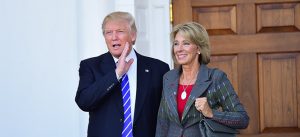
Donald Trump meets with Betsy Devos in Bedminster, New Jersey, November 19, 2016 (a katz / Shutterstock)

Milton Friedman, patron saint of the free market, died in 2006, but his ideas about public education live on in the thought and deeds of Betsy DeVos, likely the next U.S. Secretary of Education. The two are ideological soulmates—a fact that justifiably panics supporters of public education.

In a 1955 essay called “The Role of Government in Education,” Friedman laid out his plan for K-12 schooling, which boils down to this: taxpayer funded but privately run. The government would provide each child, through parents or guardians, funds in the form of a voucher to pay for what the government considers the mrinimum adequate education. Parents and guardians would then choose what education services to purchase on the free market. For Friedman the choices included private for-profit schools, private nonprofit schools, religious schools, and “some even” run by the government. Today Betsy DeVos and other free-market education reformers add home schooling and private online schooling to the mix. They also support privately run charter schools, financed directly by the government, not by student voucher money.

It’s a wealth of privatized choices meant to squeeze out, as much as possible, the least appealing alternative for free-market ed reformers: neighborhood public schools.

Taxpayer funded but privately run is how “privatization” of the public sector works in the United States. In countries where the government owns major companies or industries—for example, Aeroflot in Russia or the UK’s National Health Service—privatization means selling off enterprises to new owners in the private sector. In the United States, the government hands over control to private entities, but the taxpayers keep on paying. The most familiar U.S. example is the privatization of federal prisons.

In 1996 Milton Friedman and his wife Rose (also an economist) launched the Friedman Foundation for Educational Choice as “the nation’s only organization solely dedicated to promoting their concept of educational choice.” “Choice” is the ed-reform movement’s euphemism for privatization. All the tools used to create choice—vouchers, charter schools, tax credits for private school tuition, tax credits for individuals and businesses that create private school scholarships, “education savings accounts” (usually government-funded debit cards used for various private-school expenses, not just tuition)—siphon tax dollars out of the public school system and into private hands. DeVos has worked with and donated to the Friedman Foundation, recently renamed EdChoice.* Their visions for the future of K-12 education coincide.

Born in 1958 into what would soon become an extremely wealthy family, DeVos grew up as a member of the Christian Reformed Church in North America, attended a Christian high school and college, and married the multibillionaire heir to the Amway fortune, Dick DeVos. Active in the Michigan Republican Party since her college years, her political resumé includes state party chairwoman, Republican national committeewoman for Michigan, and finance chairperson for the National Republican Senatorial Committee.

Hard-line conservative politics and rigorous Christian faith run through the extended DeVos family. Members often coordinate their political contributions. Together they’ve given about $14 million at the federal and state levels in the last two years. The family has long partnered with Charles and David Koch on political funding projects.

For almost twenty-five years, Betsy Devos has arguably been the most dogged political operative in the movement to privatize public education. Under the banner of choice, she founded, funded, and/or led a mind-numbing list of organizations: the American Federation of Children, Alliance for School Choice, Foundation for Excellence in Education (Jeb Bush’s operation), All Children Matter, American Education Reform Council, Children First America, Education Freedom Fund, and Great Lakes Education Project. As secretary of education, DeVos will be indefatigable.

And iron-willed. One recent vignette captures the DeVos working method: In an effort to shape up Detroit’s scandalously under-regulated, poorly performing charter schools and rectify a shortage of school places in the city’s neediest neighborhoods, a coalition including some charter school advocates, business and labor representatives, Republicans, and Democrats proposed a nonpartisan oversight body to be called the Detroit Education Commission (DEC). With Republican Governor Rick Snyder’s endorsement, the Republican-controlled state senate approved the DEC in March 2016 as part of a Detroit emergency funding bill. When the Republican-controlled House took up the bill in May, the charter school lobby (generously funded by the DeVos family) launched a massive offensive to quash the DEC. Oversight, they argued, only adds another unnecessary level of bureaucracy. The House Republicans acquiesced on May 5. When the bill returned to the Senate for reconciliation, the question remained: would the Senate gut its own bill by killing the DEC? Under threats from major donors, the Republicans caved on June 8. While the senate was still considering the bill, DeVos money began pouring in. In the fifty-six days between June 2 and July 28, nine DeVos family members contributed a total of $1.45 million to Michigan Republican Party organizations and candidates.

“[A] filthy, moneyed kiss to the charter school industry at the expense of the kids who’ve been victimized by those schools’ unaccountable inconsistency,” concluded an editor at the Detroit Free Press in September.

Denunciations like this have rolled off Betsy DeVos’s back for decades. As she wrote in the Capitol Hill newspaper Roll Call in 1997, “I have decided . . . to stop taking offense at the suggestion that we are buying influence. Now I simply concede the point. They are right. We do expect some things in return.”

From her federal perch, DeVos will no doubt aim to expand privatization, especially vouchers, which are the most powerful tool. But how to do it requires some finesse, since the federal government has a relatively small role in K-12 education policy. State governments overwhelmingly determine how schools operate, sometimes overruling the wishes of local districts. To get the states to implement new policies, the federal government has just one effective tool—money.

A useful model for DeVos comes from the outgoing ed-reformer-in-chief, Barack Obama. He allocated $4.3 billion from the 2009 “stimulus package” to Secretary of Education Arne Duncan, who used it to create the controversial Race to the Top program. More than thirty states competed for RTTT grants by committing to a detailed list of K-12 reforms—reforms that often required changing state laws. In exchange for money, resource-strapped states agreed to evaluate teachers, at least in part, according to student scores on standardized tests; raise or eliminate any caps on the number of charter schools; and “turn around” low-achieving schools by turning them into charters, replacing the teachers and principals, or closing them. Many states found that implementing the reforms cost more than they received in grant money. Much worse, the reforms undermined public school teachers, robbed many neighborhoods of their most stable institution, and introduced into the public system less accountable, often poorly performing schools and financial malfeasance by private operators. But the free-market ed reformers were thrilled. By opening the way for rapid charter school expansion, the Obama administration made the nation’s first significant progress toward privatization.

DeVos has the opportunity to achieve the same kind of breakthrough for vouchers. Many Americans oppose vouchers, knowing that they transfer taxpayer money to private and religious schools to the detriment of the public system. But DeVos doesn’t need to convince the public; she needs to convince state legislators and governors. Right now, Republicans control thirty-three governorships and both chambers of the legislatures in thirty-two states. They will be her greatest asset. Moreover, DeVos’s job will be easier today than it would have been six or seven years ago because ed reformers have made headway in substituting the appealing word “choice” for vouchers and privatization. “All parents should be able to chose the school that’s best for their children” is a winning platform. Equally good is “Why shouldn’t low-income parents have a choice of schools just the way wealthier parents do?” In January 2016, DeVos’s American Federation for Children released the results of a poll that affirmed the ed reformers’ choice of language: among likely voters, 70 percent supported the concept of school choice, whereas only 53 percent supported “school vouchers.”

Free-market ed reformers deny or dismiss the inevitable outcome of vouchers: an even more unequal K-12 system than we have today. Middle-class parents will add as much money as they can to their vouchers in order to get their kids into the best possible schools. The wealthy will spend whatever it takes to create an elite strata of schools that insure their kids’ advantages. Lower-middle-class families will scour the system for decent schools they can afford; they’ll find that the more decent the school, the higher the demand for it, and the higher the price. And the poor? They will go to “government schools”—a term that market ed reformers have long used to describe what everyone else calls public schools.

Precise advice for DeVos on how to open the way for further privatization comes from Andy Smarick, president of the Maryland State Board of Education and resident fellow at the free-market stronghold, the American Enterprise Institute. (DeVos family members are major donors to AEI, and Betsy sits on the board of trustees.) In a December 2016 AEI report, Smarick counsels the new administration to model its approach on the federal Charter Schools Program (CSP), created by the Clinton administration in 1994. Clinton, like other neoliberal-leaning Democrats, embraced market-based ed reform early on. The CSP makes three-year grants available to states on a competitive basis for the purpose of opening or expanding charter schools according to each state’s existing laws. Thus the program subsidizes charter expansion without micromanaging policy. According to Smarick, more than 60 percent of all charter schools that have opened received CSP money. In 2016 the CSP received a $333 million appropriation through the federal government’s ongoing Elementary and Secondary Education Act.

For strategically thinking privatizers, the beauty of the CSP is that it avoids the curse of federal overreach. Relatively small, out of the national limelight, it has steadily increased the scope of charter schools without producing much of a backlash. Tip-toe through this process, Smarick advises, because “some school choice antagonists are especially opposed to private school choice; they would vigorously fight any supportive federal efforts.” Note the use of “private school choice.” The phrase includes the various tax-credit schemes and “education savings accounts” as well as vouchers. It also allows Smarick to avoid the offending v-word.

Betsy DeVos hasn’t done much tip-toeing in her career, and it’s certainly not the style of her boss-to-be. On September 8, Trump renewed his pledge to redirect $20 billion in federal funds to state-run block grants for subsidizing school choice for low-income children. He didn’t say which budget items would be cut to come up with this immense sum. Trump made his speech at the Cleveland Arts and Social Sciences Academy, a for-profit charter school that received failing grades in key categories in its most recently published report from the Ohio Department of Education: F in achievement indicators met; F in annual measureable objectives; and a 23.3 percent chronic absenteeism rate. Trump began his remarks by thanking Ron Packard, the CEO of the school’s parent company and former CEO of the notoriously shoddy online for-profit education company, K12 Inc. Packard also works with the right-wing American Legislative Education Council (ALEC). No one explained why Trump or his team chose this site for an education policy speech. Perhaps Packard was the draw. No matter. Trump and DeVos have the wind at their backs for K-12 privatization.

When did Americans stop talking about public K-12 education as the keystone of a strong democracy, as the incubator for citizenship, shared values, and social cohesion in a diverse nation, as the only educational institution obligated to serve every child who appears on the doorstep? Conservatives don’t bear sole responsibility for changing the conversation. The Clinton and Obama administrations reduced K-12 education to little more than the required stepping stone to a college degree that leads to successful competition in the global economy. That’s a meager sales pitch, making it all too easy for K-12 schooling to be chopped up into products sold on the market.

The only counterweight to “choice” is excellent public schools, and so the only way to save public education (which is largely very good in the United States) is to improve it where it needs improvement. Hundreds of thousands of public school teachers and administrators commit themselves to the task everyday. The job also belongs to everyone who sees the need to rebuild American democracy. In the face of privatization, we are all stakeholders in the public good that is public education. 


Joanne Barkan has been writing about the privatization of public education and the relationship of “big philanthropy,” democracy, and education reform for the last six years. Her articles have appeared in the Guardian, Washington Post, Chronicle of Philanthropy, Nonprofit Quarterly, Jacobin, HistPhil, and Philanthropy News Digest as well as Dissent. Barkan’s other Dissent articles can be found here.

* On July 29, 2016, the Friedman Foundation changed its name to EdChoice to honor Milton and Rose’s “desire to separate their last name from their enduring vision.” The Friedmans certainly understood that Milton’s controversial reputation might limit the foundation’s influence. An anodyne moniker like EdChoice will blend in unobtrusively with the scores, if not hundreds, of other ed-reform organizations with similar names.

https://www.dissentmagazine.org/online_articles/betsy-devos-milton-friedman-public-education-privatization

Η γεωπολιτική το 2017 σε τέσσερις χάρτες

0

  • Η γεωπολιτική το 2017 σε τέσσερις χάρτες

Των George Friedman και Jacob l. Shapiro – 

Διεθνείς σχέσεις και γεωπολιτική δεν είναι έννοιες συνώνυμες… τουλάχιστον όχι με τον τρόπο που τις καταλαβαίνουμε εμείς στο Geopolitical Futures. «Διεθνείς σχέσεις» είναι μια περιγραφική φράση που περικλείει όλους τους τρόπους που οι χώρες συμπεριφέρονται η μια προς την άλλη. «Γεωπολιτική» είναι η υπόθεση ότι όλες οι διεθνείς σχέσεις βασίζονται στην αλληλεπίδραση ανάμεσα στη γεωγραφία και την ισχύ.

Το δικό μας στίγμα της γεωπολιτικής πηγαίνει ένα βήμα παραπέρα και υποστηρίζει ότι μια βαθιά κατανόηση της γεωγραφίας και της ισχύος μας δίνει τη δυνατότητα να κάνουμε δύο πράγματα. Καταρχάς, μας βοηθά να κατανοήσουμε τις δυνάμεις που θα διαμορφώσουν τη διεθνή πολιτική και πώς θα το πράξουν. Δεύτερον, μας δίνει τη δυνατότητα να προσδιορίσουμε τι είναι σημαντικό και τι δεν είναι.

Αυτό κάνει τους χάρτες ένα εξαιρετικά ενδιαφέρον μέρος της δουλειάς μας. Το γράψιμο μπορεί να είναι ένα ιδανικό μέσο για την εξήγηση της ισχύος, αλλά ακόμη και ο καλύτερος συγγραφέας περιορίζεται από τη γλώσσα, όταν πρόκειται για την περιγραφή της γεωγραφίας. Έτσι, αυτή την εβδομάδα έχουμε αποφασίσει να παρουσιάσουμε μερικούς από τους καλύτερους χάρτες που η ομάδα γραφικών μας (TJ Lensing και Jay Dowd) έκανε το 2016. Όχι μόνο επειδή αυτοί οι τέσσερις χάρτες είναι ψυχροί (αν και είναι), αλλά επειδή πιστεύουμε ότι συντελούν πολύ στην κατανόηση των θεμελίων των σημαντικότερων γεωπολιτικών εξελίξεων του 2017.

Χάρτης 1: Οικονομική εξασθένηση της Ρωσίας

Ο χάρτης αυτός απεικονίζει τρεις βασικές πτυχές της Ρωσίας που είναι ζωτικής σημασίας για την κατανόηση της χώρας το 2017. Η πρώτη είναι το συχνά παραβλεπόμενο γεγονός ότι η Ρωσία είναι μια ομοσπονδία. Η Ρωσία έχει μια ισχυρή εθνική κουλτούρα, αλλά είναι επίσης μια απίστευτα μεγάλης ποικιλίας πολιτική οντότητα η οποία απαιτεί μια ισχυρή κεντρική κυβέρνηση. Αντίθετα από τους περισσότερους χάρτες της Ρωσίας, αυτός χωρίζει τη χώρα με βάση τις συνιστώσες περιοχές. Υπάρχουν 85 τέτοιες περιοχές – 87 αν μετρήσουμε την Κριμαία και τη Σεβαστούπολη. Δεν έχουν όλες το ίδιο καθεστώς· μερικές είναι περιοχές, ενώ άλλες είναι αυτόνομες περιφέρειες, πόλεις και δημοκρατίες.

Η δεύτερη πτυχή είναι ότι υπάρχει μια μεγάλη οικονομική πολυμορφία σε αυτή την τεράστια Ρωσική Ομοσπονδία. Ο χάρτης το δείχνει αυτό προσδιορίζοντας περιφερειακά δημοσιονομικά πλεονάσματα και ελλείμματα σε όλη τη χώρα. Δύο περιοχές έχουν τόσο μεγάλα πλεονάσματα που σπάνε την κλίμακα: η πόλη της Μόσχας και η Σαχαλίνη. Πενήντα δύο περιφέρειες (ή το 60% των περιφερειακών προϋπολογισμών της Ρωσίας) είναι στο κόκκινο. Η Κεντρική Περιφέρεια, η οποία περιλαμβάνει τη Μόσχα, συνεισφέρει πάνω από το 20% στο ρωσικό ΑΕΠ, ενώ η Σαχαλίνη και μερικές άλλες περιοχές είναι ευλογημένες με πλεονάσματα παραγωγής πετρελαίου της Ρωσίας.

Η τρίτη πτυχή προκύπτει από το συνδυασμό των λογικών συμπερασμάτων των δύο πρώτων παρατηρήσεων. Η Ρωσία είναι τεράστια, και ένα μεγάλο μέρος της χώρας βρίσκεται σε δύσκολη οικονομική κατάσταση. Ακόμα κι αν το πετρέλαιο παραμένει περίπου στα 55 δολάρια το βαρέλι για ολόκληρο το 2017, η τιμή δεν είναι αρκετά υψηλή για να λύσει τα προβλήματα των πολλών περιοχών της χώρας που αγωνίζονται. Ο Ρώσος πρόεδρος Βλαντίμιρ Πούτιν κυβερνά αυταρχικά. Αυτό γίνεται εν μέρει διότι κυβερνά μια δυσκίνητη χώρα. Χρειάζεται όλη τη δύναμη που μπορεί για να αναδιανείμει τον πλούτο, έτσι ώστε η ύπαιθρος να μην οδηγείται σε εξέγερση.

Η Ρωσία έχει γίνει πρωτοσέλιδο αυτήν τη στιγμή, λόγω της Ουκρανίας, της Συρίας, και των ισχυρισμών για hacking. Αλλά η γεωπολιτική θέση της Ρωσίας περιγράφεται καλύτερα με τη μελέτη του παραπάνω χάρτη.

Χάρτης 2: Το κλουβί της Κίνας

Χάρτες που μετατοπίζουν την προοπτική μπορεί να είναι αποπροσανατολιστικοί, αλλά πρέπει να γίνουν. Ο τρόπος που σκεφτόμαστε, συνηθίζει να βλέπει τον κόσμο με μια άποψη ώστε η διαφορετική να ξενίζει. Ο χάρτης παραπάνω επιχειρεί να το κάνει αυτό με την εξέταση του Ειρηνικού από την οπτική του Πεκίνου.

Οι κινήσεις της Κίνας στην Θάλασσα της Νότιας Κίνας έχουν προσελκύσει την προσοχή. Στην ακρόαση της 12ης Ιανουαρίου από το Κογκρέσο, ο υποψήφιος υπουργός Άμυνας των ΗΠΑ Τζέιμς Μάτις προσδιόρισε την κινεζική επιθετικότητα ως έναν από τους σημαντικότερους λόγους που πιστεύει ότι η παγκόσμια τάξη είναι υπό μεγαλύτερη πίεση από τον Β΄ Παγκόσμιο Πόλεμο. Αλλά πιστεύουμε ότι η κινεζική απειλή έχει υπερεκτιμηθεί. Ο χάρτης αυτός εξηγεί γιατί.

Η πρόσβαση της Κίνας στον Ειρηνικό περιορίζεται από δύο εμπόδια. Το πρώτο είναι η αλυσίδα μικρών νησιών στα νότια και ανατολικά της Θάλασσας της Κίνας. Όταν βλέπουμε αυτόν το χάρτη, το κίνητρο της Κίνας στην διεκδίκηση ελέγχου σε αυτά τα μεγάλα βράχια και μικρά εμπόδια γίνεται σαφές. Εάν η Κίνα δεν μπορέσει να ελέγξει αυτά τα νησιά, μπορούν να χρησιμοποιηθούν εναντίον της σε μια στρατιωτική σύγκρουση. (Αν υπήρχε αλυσίδα μικρών νησιών στα ανοικτά των ακτών των ΗΠΑ στον Ειρηνικό, η στρατηγική του Ατλαντικού, για τις ΗΠΑ, ενδέχεται να έμοιαζε με της Κίνας.)

Το δεύτερο εμπόδιο είναι ότι η Κίνα είναι περιτριγυρισμένη από συμμάχους των Αμερικανών. Μερικοί, όπως η Ιαπωνία (και σε μικρότερο βαθμό η Νότια Κορέα και η Ταϊβάν) έχουν σημαντικές στρατιωτικές δυνάμεις για να υπερασπιστούν τους εαυτούς τους από την κινεζική παραβίαση. Η Ταϊβάν είναι ένα σημαντικό κίνητρο που στοχεύει ακριβώς στην νοτιοανατολική ακτή της Κίνας. Εκείνοι που δεν έχουν επαρκή στρατιωτική άμυνα, όπως οι Φιλιππίνες, έχουν σταθερές εγγυήσεις για την ασφάλεια από τις ΗΠΑ. Η Κίνα βρίσκεται σήμερα σε μειονεκτική θέση από πλευράς γεωγραφίας στα ύδατα ανοικτά των ακτών της.

Ο χάρτης αυτός, όμως, δεν αποκαλύπτει ένα κρίσιμο τρίτο κομμάτι αυτού του παζλ: το Ναυτικό των ΗΠΑ υπερτερεί του κινεζικού Ναυτικού σχεδόν από κάθε άποψη, παρά την εντυπωσιακή και συνεχιζόμενη προσπάθεια της Κίνας να αυξήσει τις δυνατότητές της. Αλλά κοιτάζοντας αυτόν το χάρτη, μπορούμε να δούμε γιατί η Κίνα θέλει να κάνει θόρυβο στα παράκτια νερά της και πώς η Κίνα περιορίζεται από ένα τόξο των συμμάχων της Αμερικής. Μπορούμε επίσης να δούμε γιατί ένας από τους κύριους στόχους της Κίνας θα είναι να προσπαθήσει να δελεάσει κάθε σύμμαχο της Αμερικής για να αλλάξει πλευρά. Συνεπώς, κινήσεις της Κίνας σχετικά με τις Φιλιππίνες απαιτούν στενή παρακολούθηση το 2017.

Χάρτης 3: Επαναχαράσσοντας τη Μέση Ανατολή

Έχει γίνει κλισέ να επισημαίνουμε ότι τα σημερινά πολιτικά σύνορα της Μέσης Ανατολής σχεδιάστηκαν μετά τον Α΄ Παγκόσμιο Πόλεμο από αποικιακές δυνάμεις όπως το Ηνωμένο Βασίλειο και η Γαλλία, και ότι οι πόλεμοι και οι εξεγέρσεις της περιοχής τα τελευταία χρόνια καθιστούν αυτά τα τεχνητά σύνορα άνευ αντικειμένου. Αυτό που δεν είναι κλισέ είναι η ενίσχυση αυτής της ανάλυσης. Έχουμε σχεδιάσει έναν νέο χάρτη της Μέσης Ανατολής με βάση το ποιος ελέγχει τι στο έδαφος, σε αντίθεση με τα επίσημα όρια που αναγνωρίζονται από διεθνείς οργανισμούς, όπως τα Ηνωμένα Έθνη.

Ο χάρτης παραπάνω αποκαλύπτει πώς είναι η Μέση Ανατολή τώρα. Πολλοί θα αντιταχθούν σε ορισμένα από τα σύνορα για πολιτικούς σκοπούς, αλλά αυτός ο χάρτης δεν επιχειρεί να κάνει μια πολιτική δήλωση. Μάλλον είναι μια προσπάθεια να δείξει ποιος κατέχει την εξουσία σε ποιο μέρος της Μέσης Ανατολής.

Από αυτήν την άποψη η Συρία, το Ιράκ, η Υεμένη και η Λιβύη δεν υπάρχουν πια. Στις τοποθεσίες τους υπάρχουν μικρότερα αντιμαχόμενα κρατίδια με βάση την εθνοτική, εθνική και θρησκευτική ταυτότητα. Άλλα σύνορα (όπως εκείνα του Λιβάνου και του Ισραήλ) αναδιατυπώνονται, επίσης, ώστε να αντικατοπτρίζουν την πραγματική δυναμική ισχύος. Εδώ ένας πολιτικά μη ορθός αλλά ακριβής χάρτης είναι πιο χρήσιμος από ό,τι ένας μη ακριβής αλλά πολιτικά ορθός.

Εξίσου σημαντική με την επαναχάραξη των συνόρων των χωρών που δεν είναι πλέον ενωμένες οντότητες, είναι η επισήμανση των χωρών των οποίων τα σύνορα δεν απαιτούν επανασχεδιασμό. Στις χώρες αυτές περιλαμβάνονται τρεις από τις τέσσερις μεγάλες δυνάμεις της περιοχής: η Τουρκία, το Ιράν και η Σαουδική Αραβία. Τα σύνορα της άλλης μεγάλης δύναμης, του Ισραήλ, είναι μόνο ελαφρώς τροποποιημένα. (Η Αίγυπτος είναι μια οικονομική περίπτωση και δεν χαρακτηρίζεται ως σημαντική δύναμη, παρόλο που έχει αναμφισβήτητα την πιο συνεκτική εθνική κουλτούρα στον αραβικό κόσμο.)

Η Μέση Ανατολή ορίζεται από δύο βασικές δυναμικές: των πολέμων που μαίνονται στην καρδιά του αραβικού κόσμου και της ισορροπίας δυνάμεων μεταξύ των χωρών που περιβάλλουν αυτή τη σύγκρουση.

Χάρτης 4: Φανταζόμενοι το Brexit 2017

Αναλύοντας αυτόν το χάρτη, πρέπει να αρχίσουμε με μια επισήμανση: Είναι, πρώτα απ’ όλα, ένα αναλυτικό εργαλείο και μέσο σκέψης για το μέλλον της Ευρώπης. Είναι σαφές ότι δεν είναι μια πρόβλεψη για το πώς τα σύνορα της Ευρώπης θα μοιάζουν στο μέλλον.

Ο χάρτης προσδιορίζει τομείς στην Ευρώπη με ισχυρές εθνικιστικές τάσεις. Αυτές οι περιοχές με ενεργά αυτονομιστικά κινήματα δεν είναι με πλάγια γράμματα. Οι περιοχές με πλάγιους χαρακτήρες είναι εκείνες που απαιτούν αυξημένη αυτονομία, αλλά όχι ανεξαρτησία. Σε πολλές από αυτές τις περιοχές, αποσχιστικά κινήματα μπορεί να ευνοούνται από μια μειοψηφία του πληθυσμού. Το θέμα εδώ δεν είναι το μέγεθός τους, αλλά μάλλον ότι σε όλες αυτές τις περιοχές υπάρχει κάποιος βαθμός εθνικής συνείδησης που είναι παράφωνος με τα σημερινά σύνορα των εθνών-κρατών της Ευρώπης.

Η Ευρωπαϊκή Ένωση είναι ένας ελλειμματικός θεσμός, διότι τα μέλη της δεν μπορούν να αποφασίσουν τι θα ήθελαν να είναι. Η ΕΕ δεν είναι αρκετά μια κυρίαρχη οντότητα, αλλά θέλει περισσότερη εξουσία από ό,τι μια συμφωνία ελεύθερου εμπορίου. Τα ευρωπαϊκά έθνη-κράτη παραχώρησαν μέρος της κυριαρχίας τους στις Βρυξέλλες – αλλά όχι όλη. Έτσι, όταν προέκυψαν σοβαρά ζητήματα (όπως η χρηματοπιστωτική κρίση του 2008 ή η εισροή προσφύγων από τη Συρία και αλλού, τα κράτη μέλη της ΕΕ επέστρεψαν στην επίλυση των προβλημάτων τους με τον τρόπο που το έκαναν πριν από την ΕΕ. Αντί να είναι «ένας για όλους και όλοι για έναν», ήταν στη λογική «καθένας με τα δικά του, αλλά πρέπει να αγοράζεις τα γερμανικά προϊόντα».

Το Brexit κλόνισε τα θεμέλια της ΕΕ το 2016. Οι εκλογές στη Γαλλία και τη Γερμανία και η εσωτερική αστάθεια στην Ιταλία θα ταρακουνήσουν αυτά τα θεμέλια το 2017. Αλλά το Brexit, επίσης, άνοιξε τις πόρτες σε ένα βαθύτερο ερώτημα: Πώς θα ορίζεται η εθνική αυτοδιάθεση στον 21ο αιώνα; Δεν είναι όλα τα έθνη-κράτη της Ευρώπης σε σταθερό έδαφος. Οι πιο σημαντικές συνέπειες του Brexit μπορεί να καταλήξουν να είναι ο αντίκτυπος για το πολιτικό μέλλον του Ηνωμένου Βασιλείου. Και στην Ισπανία, η Καταλονία υποστηρίζει, ήδη, ότι θα πραγματοποιήσει δημοψήφισμα για την ανεξαρτησία της το τρέχον έτος.

Οι Βρυξέλλες, εν τω μεταξύ, συνεχίζουν να προσπαθούν να μιλήσουν με μία φωνή. Ο χάρτης αυτός δείχνει ακριβώς πόσο δύσκολο είναι – όχι μόνο για την ΕΕ, αλλά και για ορισμένα από τα έθνη-κράτη της Ευρώπης.

Συμπέρασμα
Το λέει και η παροιμία ότι μια εικόνα αξίζει όσο χίλιες λέξεις. Οι χάρτες αξίζουν πολύ περισσότερα. Η προοπτική μας για τον κόσμο έχει τις ρίζες της σε μια αντικειμενική και αμερόληπτη προσέγγιση στην εξέταση της γεωγραφίας και της δύναμης. Χάρτες όπως αυτοί είναι θεμελιώδη συστατικά για την οικοδόμηση αυτής της προοπτικής. Αυτοί οι τέσσερις χάρτες είναι ιδιαίτερα χρήσιμοι στον τρόπο σκέψης σχετικά με τις γεωπολιτικές δυνάμεις που θα διαμορφώσουν τον κόσμο κατά το επόμενο έτος.

  • Δημοσιεύτηκε στο mauldineconomics.com./pontos-news.gr
  • Μετάφραση: Παντελής Σαββίδης.

EU ‘Not Happy With Russia and Turkey’ Playing Key Role in Syria

0

 © Sputnik/ Alexey Vitvitsky

POLITICS 11:01 17.01.2017(updated 11:03 17.01.2017) Get short URL273528294 The European Union plans to hold a conference on the future of Syria in spring 2017, which is expected to focus on the political transition in and donors’ assistance to the war-torn country. Political analyst and former Turkish MP Dr. Oya Akgonenc Mugisuddin told Sputnik that Brussels is unhappy with Russia and Turkey’s achievements in Syria. “They say that a potential donors’ conference on Syria could be on the agenda. This is clearly a positive initiative. However, European nations should stop sending weapons to various armed groups in Syria and then genuinely focus on providing humanitarian aid to the country,” he said. Dr. Oya Akgonenc Mugisuddin was commenting on Monday’s meeting of the Foreign Affairs Council (FAC). Following the summit, EU High Representative of the European Union for Foreign Affairs and Security Policy Federica Mogherini announced that the EU and the United Nations will hold a conference in the coming months. ​The political analyst pointed to the timing of the meeting, tying it to recent developments in Syria, which have seen Moscow and Anakra broker a nationwide ceasefire. Many hope that this step will pave the way for a peace process in the country devastated by nearly six years of war. “Russia and Turkey are currently the key stakeholders when it comes to the Syrian conflict. The European Union is not happy about it. This is why they have held their meetings,” he said. Dr. Oya Akgonenc Mugisuddin mentioned that it remained unclear what the EU was doing for Syria at the moment. “We have seen the European Union adjust its stance on Syria. EU member states were very active during the early years of the Syrian conflict. They have become less active when it became obvious that their policies towards Syria were flawed,” he observed. The political analyst further said that the European Union does not care about Syrians.

© SPUTNIK/ MAKSIM BLINOV Russia’s Deal With Turkey on Flights Over Syria is More Than Meets the Eye “Instead we have seen the rise of Islamophobic and xenophobic sentiments in Europe, although many of the Syrian refugees are Christians. We have seen … refugees denied basic medical assistance. Europe does not care about the fate of the Syrians. Europeans don’t view them as people in need of help, but rather as enemies [affecting their livelihood]. In these circumstances one cannot count on comprehensive assistance from Brussels,” he suggested.

Read more: https://sputniknews.com/politics/201701171049665912-eu-russia-turkey-syria/

The Syriza Wave: Surging and Crashing with the Greek Left

0

by

$22.10–$95.00

Utterly corrupt corporate and government elites bankrupted Greece twice over. First, by profligate deficit spending benefitting only themselves; second, by agreeing to an IMF “bailout” of the Greek economy, devastating ordinary Greek citizens who were already enduring government-induced poverty, unemployment, and hunger. Finally, in response to dire “austerity” measures, the people of Greece stood up, electing, from their own historic roots of resistance, Syriza—the Coalition of the Radical Left. For those who caught the Syriza wave, there was, writes Helena Sheehan, a minute of “precarious hope.”

A seasoned activist and participant-observer, Helena Sheehan adroitly places us at the center of the whirlwind beginnings of Syriza, its jubilant victory at the polls, and finally at Syriza’s surrender to the very austerity measures it once vowed to annihilate. Along the way, she takes time to meet many Greeks in tavernas, on the street, and in government offices, engage in debates, and compare Greece to her own economically blighted country, Ireland. Beginning as a strong Syriza supporter, Sheehan sees Syriza transformed from a horizon of hope to a vortex of despair. But out of the dust of defeat, she draws questions radiating optimism. Just how did what was possibly the most intelligent, effective instrument of the Greek left self-destruct? And what are the consequences for the Greek people, for the international left, for all of us driven to work for a better world? The Syriza Wave is a page-turning blend of political reportage, personal reflection, and astute analysis.

Deeply grounded in philosophy and Marxist theory, Sheehan shows in plain language that the leadership of SYRIZA proved vacuous in theory and opportunist in practice. Her intellectual and political honesty will be a benchmark in the debate in the coming years.

—Costas Lapavitsas, Professor of Economics at University of London, and Syriza MP from January to August 2015

Helena Sheehan brings the dramatic rollercoaster of Syriza’s growth, election and capitulation to vivid life. Simultaneously participant and observer, ‘insider’ in left politics and ‘outsider’ in Greece, she is uniquely positioned to put this drama in the essential context of rising movements elsewhere in Europe. The Syriza Wave captures the sentiment of those of us on the European left politically and emotionally invested in the struggles of the Greek people, holding the belief that the wall of authoritarian neo-liberalism could be breached at its weakest point, our hope for victory and the crushing reality of defeat. It is a unique and valuable contribution for all those seeking to learn lessons from the crashing Syriza wave.

—Paul Murphy TD, Member of Irish Parliament (Anti-Austerity Alliance)

Engaging both head and heart, Helena Sheehan has opened a window on one of the most extraordinary political stories of our time: the stellar rise to power of Greece’s radical left party and its rapid and devastating fall from grace…. Such is Sheehan’s narrative skill—coupled with her direct participation in so many of the key moments—that you feel you are actually there, in the square, the conference hall, the occupation. The essential debates are explored and recounted, and diverse political views are brought to bear. Sheehan has her own perspective, but she engages across the left, with respect and warmth, situating these developments in a wider context, both historically and geographically. Crucially, Sheehan frames the questions to challenge the movement in going forward: how to advance the left within an ever more powerful global capitalism. This is essential reading and highly recommended.

—Kate Hudson, author, The New European Left, General Secretary of CND, National Secretary of Left Unity

For those of us who lived and followed the Greek political and economic crisis since 2008, Helena Sheehan’s book represents a much needed and also much dreaded revisiting of the events that led to the rise and subsequent capitulation of Syriza. Reliving the moments of hope and the moment of crushing defeat, the book constitutes both a personal reflection and a serious political attempt to find ways of understanding this history of the present, to reflect on its gains and losses, and crucially to find ways to survive in the post-2015 Greek political landscape.

—Eugenia Siapera, author, Understanding New Media, Lecturer in Social Media, Dublin City University and Aristotle University Thessaloniki

Helena Sheehan is Professor Emerita at Dublin City University, where she taught history of ideas and media studies. She is also the author of several books, including Marxism and the Philosophy of Science: A Critical History and Irish Television Drama: A Society and Its Stories, as well as magazine articles on politics, culture, and philosophy.

http://monthlyreview.org/product/syriza_wave/?utm_source=MR+Email+List&utm_campaign=6a39db33e7-EMAIL_CAMPAIGN_2016_11_28&utm_medium=email&utm_term=0_4f879628ac-6a39db33e7-295720093

Τι θα κάνουν οι ΗΠΑ με την Τουρκία και τους Κούρδους;

0

siria_-_usa_-_turchia_-_guerra_credits_asianews.it_

  • (Φωτ.: asianews.it)

Καθώς η μέρα που θα ορκιστεί ο νέος Αμερικανός πρόεδρος πλησιάζει (20 Ιανουαρίου), οι σημαντικότεροι υπουργοί του περνούν από τη Γερουσία και καταθέτουν τις απόψεις τους για την πολιτική που θα ακολουθήσουν. Ο νέος Αμερικανός υπουργός Άμυνας Τζέιμς Μάτις εξήρε το ρόλο των αμερικανικών μυστικών υπηρεσιών, με τις οποίες το αφεντικό του Λευκού Οίκου δεν φάνηκε να τα πηγαίνει καλά εξαιτίας των εκτιμήσεών τους στο θέμα του ρωσικού επηρεασμού των εκλογών.

Η πραγματικότητα της διοίκησης φαίνεται να είναι πολύ διαφορετική από τον πολιτικό λόγο της διεκδίκησης της εξουσίας.

Θα περάσει αρκετός χρόνος για να αποσαφηνιστεί πλήρως η πολιτική που θα ακολουθήσει η διοίκηση Τραμπ, αλλά φαίνεται πως η νέα αμερικανική κυβέρνηση έχει μεγαλύτερη συνείδηση των επισημάνσεων που έκανε στο πολύ ενδιαφέρον άρθρο του ο στρατηγικός αναλυτής Ζμπίγκνιου Μπρεζίνσκι, το οποίο αναδημοσιεύτηκε στις στήλες του pontos-news.gr.

Υπάρχει, στις ΗΠΑ, μια αυξανόμενη συνειδητοποίηση ότι η Αμερική είναι η ισχυρότερη δύναμη στον κόσμο αλλά δεν μπορεί πια μόνη της να διευθετήσει τις παγκόσμιες υποθέσεις. Κατά τον Μπρεζίνσκι καλό είναι να μπορέσει να συνεργαστεί με τη Ρωσία και την Κίνα, αλλά αν αυτό είναι δύσκολο, θα πρέπει να συνεργαστεί με μια από τις δύο δυνάμεις. Ο Τραμπ φαίνεται να προτιμά τη Ρωσία.

Τι λέει ο νέος ΥΠΕΞ
Το ενδιαφέρον, τώρα, εστιάζεται στην κατάθεση του νέου Αμερικανού υπουργού Εξωτερικών Ρεξ Τίλερσον (αφεντικού μέχρι προσφάτως της Exxon Mobile), και σε ό,τι μας αφορά, στις απόψεις του σχετικά με τις εξελίξεις στην περιοχή μας.

Σύμφωνα με δημοσίευμα της τουρκικής Daily Sabah, o Ερντογάν περιμένει από τη νέα διοίκηση Τραμπ να αλλάξει πολιτική απέναντι στους Κούρδους.

Ο Τίλερσον,  στην κατάθεσή του, κατηγόρησε την εξωτερική πολιτική της κυβέρνησης Ομπάμα λέγοντας πως  «οι ΗΠΑ πρέπει να επανεκτιμήσουν τη σχέση τους με την Τουρκία, ιδιαιτέρως στη Συρία και στη Μέση Ανατολή γενικά».

«Το πρώτο βήμα που πρέπει να κάνουμε είναι να ασχοληθούμε και πάλι με τους παραδοσιακούς μας συμμάχους και φίλους στην περιοχή, είπε ο Τίλερσον. Πρέπει να υποστηρίξουμε την ηγετική παρουσία μας και ένα σχέδιο. Η Ρωσία, η Τουρκία και το Ιράν υπαγορεύουν τους όρους της Συρίας, απουσιάζει η συμμετοχή μας», απάντησε ο Τίλερσον σε ερώτηση που του υποβλήθηκε.


Ο νέος Αμερικανός ΥΠΕΞ, Ρεξ Τίλερσον

«Πρέπει να ασχοληθούμε και πάλι με τον πρόεδρο Ερντογάν· η Τουρκία είναι μια μακροχρόνια σύμμαχος του ΝΑΤΟ. Λόγω της απουσίας της ηγετικής παρουσίας των ΗΠΑ, ο Ερντογάν αντιμετώπισε αρκετά νευρικά την κατάσταση. Στράφηκε προς τον επόμενο διαθέσιμο σύμμαχο, τη Ρωσία. Για να καταστεί σαφές σ’ αυτόν, αυτή δεν είναι μια βιώσιμη συμμαχία. Η βιώσιμη συμμαχία είναι με τις ΗΠΑ» πρόσθεσε ο Τίλερσον, σύμφωνα με το δημοσίευμα της Daily Sabah.

Κατά τον διευθυντή του Ιδρύματος Πολιτικών, Κοινωνικών και Οικονομικών Ερευνών της Άγκυρας  Μπουρχανετίν Ντουράν, «στη διεθνή πτυχή o Τραμπ θα επιδιώξει να αποκαταστήσει τις σχέσεις με τους ιστορικούς  συμμάχους των ΗΠΑ – την Τουρκία, τη Σαουδική Αραβία και το Ισραήλ. Θα αποκαταστήσει επίσης δεσμούς με τη Ρωσία, αλλά  οι σχέσεις με το Ιράν δεν θα είναι τόσο καλές όσο κατά την περίοδο του Ομπάμα. Πώς αυτό θα επηρεάσει τις παγκόσμιες εξισώσεις και το ρόλο των ΗΠΑ στην περιοχή είναι κάτι που πρέπει να περιμένουμε να δούμε».

Πιστεύει επίσης πως θα ανοίξει μια νέα σελίδα στις σχέσεις των δύο χωρών (Τουρκίας-ΗΠΑ), δοθέντος του ρητορικού τόνου που χρησιμοποιήθηκε από τον Τραμπ προς τον Ερντογάν.

«Ο Τραμπ θα εκτιμήσει τις προσπάθειες της Τουρκίας κατά του DAESH ειδικότερα. Αυτό θα επηρεάσει επίσης την προσέγγιση του Τραμπ προς την οργάνωση του Γκιουλέν και το YPG» (Μονάδες Προστασίας του Λαού – κουρδική οργάνωση στη Συρία),  δήλωσε ο Ντουράν. Το θέμα είναι, σε μια τέτοια περίπτωση, να δούμε πως θα αντιδράσει η Ρωσία. Η οποία κάλεσε τις ΗΠΑ στην Αστάνα (πρωτεύουσα του Καζακστάν, όπου θα συζητηθεί το μέλλον της Συρίας), αλλά επιχειρεί να βάλει στο τραπέζι των συνομιλιών και τους Κούρδους.

Η κουρδική οντότητα δεν είναι εύκολο να εξαλειφθεί από το συριακό μέτωπο, όχι μόνο διότι είναι δύσκολο επιχειρησιακά, αλλά και διότι η ανάδυσή της εξυπηρετεί τα αμερικανικά –και ισραηλινά– συμφέροντα.

Οι Αμερικανοί θα θελήσουν να φέρουν σε μια νέα επαφή τους Κούρδους με τους Τούρκους για να επαναληφθούν οι συνομιλίες που είχαν αρχίσει και σταμάτησαν μεταξύ των δύο πλευρών, και αυτό δεν θα πρέπει να θεωρείται αδύνατον αν ο Ερντογάν καταφέρει, όπως δείχνουν τα πράγματα, να περάσει από το δημοψήφισμα τις συνταγματικές αλλαγές που επιδιώκει.

Τέλος, χαρακτηριστικός του κλίματος που διαμορφώνεται είναι ο διάλογος που αναπτύχθηκε με αφορμή ένα tweet της SDF (Syrian Defence Forces) το οποίο προώθησε η US CENTCOM και σύμφωνα με το οποίο η SDF, την οποία υποστηρίζουν στρατιωτικά οι ΗΠΑ, δεν έχει καμία σχέση με την τρομοκρατική οργάνωση PKK.

Η δράση της CENTCOM είχε επικριθεί σκληρά από την Τουρκία, καθώς η Άγκυρα υποστηρίζει ότι η τρομοκρατική ομάδα YPG είναι η κυρίαρχη δύναμη που οδηγεί το SDF.

Ο εκπρόσωπος της τουρκικής προεδρίας Ιμπραΐμ Καλίν την Πέμπτη έγραψε στο twitter: «Είναι αυτό ένα αστείο, ή @CENTCOM έχει χάσει τις αισθήσεις της; Πιστεύει κάποιος ότι θα γίνει πιστευτό;

Οι ΗΠΑ πρέπει να σταματήσουν να προσπαθούν να νομιμοποιήσουν μια τρομοκρατική ομάδα.

«@CENTCOM Αυτός ο λογαριασμός πρέπει να χακαρίστηκε από το ΡΚΚ. Πιστεύω ότι το CENTCOM ξέρει καλύτερα από το WP και δεν θα προσπαθήσει να νομιμοποιήσει το ΡΚΚ», τουιτάρισε επίσης ο πρεσβευτής της Τουρκίας στις Ηνωμένες Πολιτείες, Σερντάρ Κιλίτς.


(Φωτ.: AFP / Angus Mackinnon)

Τέλος, ο υπουργός εξωτερικών της Τουρκίας  Τσαβούσογλου ζήτησε να ανοίξει μια νέα σελίδα στις σχέσεις ΗΠΑ-Τουρκίας, βασισμένη στην αλληλεγγύη, τη συνοχή και την εμπιστοσύνη.

«Για να αποκατασταθεί η εμπιστοσύνη μεταξύ των εταίρων, είναι καλό για τις ΗΠΑ να αρχίσουν με την Τουρκία, η οποία βρίσκεται στην πρώτη γραμμή σε σχέση με όλες τις απειλές. Είναι δυστυχώς αλήθεια ότι οι διμερείς σχέσεις Τουρκίας-ΗΠΑ βρίσκονται υπό σοβαρή πίεση», δήλωσε ο Τσαβούσογλου σε ένα άρθρο που έγραψε για την εφημερίδα Washington Post.

Παντελής Σαββίδης

pontos-news.gr

Why Putin Would Want the Cyprus Talks to Fail

0

1200x-1By  JAN 16, 2017

 What has been billed as the last chance for Greek and Turkish Cypriots to reunite the island nation appears to be tantalizingly within reach — but it might not get there without a nod from Russia.


Cyprus has been divided since 1974, when Turkey invaded to prevent the island from being swallowed up by Greece and set up an unrecognized state in Northern Cyprus. Now, Greece, Turkey and the U.K., which has bases in Cyprus, are the guarantor states of a military status quo. Along with the leaders of the two Cypriot states, United Nations Secretary General Antonio Guterres and European Commission President Jean-Claude Juncker took part in the talks in Geneva this week. After breaking down on Thursday, the talks are scheduled to pick up next week at a lower level.

Russia offered to attend but it wasn’t invited; there’s no formal reason for that. Yet there are plenty of informal ones for Moscow’s interest in the Cyprus process. Though Russia has officially voiced support for a settlement, the final deal — depending on which way it sways — could hurt its many interests in the region.

About 40,000 Russians live on the island, which has a population of 800,000. They own real estate and businesses in both the Greek-run and Turkish-run areas. Thanks to its history as an offshore haven for post-Soviet money, tiny Cyprus is officially the biggest source of foreign direct investment in Russia. According to the Russian central bank, in the second quarter of 2016 (the latest for which data are available), it accounted for $2.8 billion in investment, more than twice as much as the next country. They are also a major source of tourist revenue for Cyprus. According to the Cyprus government, 525,000 Russians visited the island in 2015; only Britain provides more tourists.

 In short, Cyprus is an important place for Russia and Russians. But reunification would only benefit Moscow under certain conditions.

Russia seeks to weaken and divide the North Atlantic Treaty Organization, but a settlement could strengthen it by resolving a longstanding conflict between Greece and Turkey — members both. It could also mean an end to Russia’s military foothold in the region, gained in 2015 when Cyprus opened its ports to Russian warships taking part in anti-piracy and anti-terrorist operations. The U.K. has criticized the move. Russia hasn’t used the official agreement to help its military action in Syria, but it appears to have used Cyprus ports to smuggle jet fuel to Syria despite an EU ban.

President Vladimir Putin is also seeking to forge an energy partnership with Turkey’s President Recep Tayyip Erdogan to sell gas to southern Europe, but reunification threatens to clear the way for a competing one. Big natural gas discoveries in the eastern Mediterranean and a warming of relations between Israel and Turkey made the construction of a pipeline carrying Israeli gas to Turkey a possibility — though the Greek government of Cyprus has linked the pipeline to reunification.

All of these interests have naturally created suspicions about Russia’s role in the unification process. The local press has reported that the Russian ambassador, Stanislav Osadchiy, recently attended an anti-unification political gathering and was applauded by its participants. After that, the Cypriot foreign ministry reportedly demanded an explanation.

A Politico report suggested that Russia may meddle quietly to undermine the deal. It certainly has enough influence on the island and enough contacts with Cypriot officials and politicians to do that. More likely, however, Russia is merely signaling — as it has often done in recent years — that it will need to be consulted for a successful result to be achieved.

The success of the Geneva talks, which the UN envoy on Cyprus has called “the moment of truth,” hinges on the resolution of tangled property issues — but at this point, that’s not what’s holding up the deal. Greek Cypriots are against any special security guarantees for the reunited island, which will be an EU member. Turkey, however, insists on its guarantor status. On Friday, Erdogan said Turkish troops would remain on the island “forever.”

A complete breakdown of the talks would be fine with Putin. It would preserve and perhaps deepen the Greek-Turkish rift within NATO, stave off gas pipeline projects in the eastern Mediterranean, allow Russia to keep Cyprus as the EU playground for its business and a neutral but friendly port of call for its ships.

If reunification does finally take place, Russia will need to know how its interests will be protected. What it clearly doesn’t want is for NATO to be strengthened and for Cyprus to join it — a possibility after unification. If Moscow is not satisfied, it could undermine the deal both inside Cyprus and in the UN.

  1. A major financial crisis in 2013, which stranded billions of that money in failed and bailed-in Cyprus banks, was only a temporary glitch: Russians have continued using the island’s financial and corporate infrastructure.
  2. This consideration may have driven the Russian decision in 2004 to veto a United Nations resolution on unification, pushed by the U.S. and the U.K. Greek Cypriots voted against the plan proposed in the resolution soon afterwards, so the Russian move didn’t wreck the deal, but it showed Russia’s desire for a seat at the table.

This column does not necessarily reflect the opinion of the editorial board or Bloomberg LP and its owners.

To contact the author of this story:
Leonid Bershidsky at [email protected]

To contact the editor responsible for this story:
Mike Nizza at [email protected]

https://www.bloomberg.com/view/articles/2017-01-16/why-putin-would-want-the-cyprus-talks-to-fail

The Geopolitics of 2017 in 4 Maps

0

Map_1_20170116_TWIGBY GEORGE FRIEDMAN AND JACOB L. SHAPIRO

JANUARY 16, 2017

International relations and geopolitics are not synonymous… at least, not the way we understand them at Geopolitical Futures. “International relations” is a descriptive phrase that encompasses all the ways countries behave toward one another. “Geopolitics” is the supposition that all international relationships are based on the interaction between geography and power.

Our brand of geopolitics takes this a step further and asserts that a deep understanding of geography and power enables you to do two things. First, it helps you comprehend the forces that will shape international politics and how they will do so. Second, it allows you to identify what is important and what isn’t.

This makes maps an extremely important part of our work. Writing can be an ideal medium for explaining power, but even the best writer is limited by language when it comes to describing geography. So this week, we have decided to showcase some of the best maps our graphics team (TJ Lensing and Jay Dowd) made in 2016… not just because these four maps are cool (though they are), but because we think they go a long way in explaining the foundations of what will be the most important geopolitical developments of 2017.

Map 1: Russia’s Economic Weakness


Click to enlarge

This map illustrates three key aspects of Russia that are crucial to understanding the country in 2017. First is the oft-overlooked fact that Russia is a federation. Russia has a strong national culture, but it is also an incredibly diverse political entity that requires a strong central government. Unlike most maps of Russia, this one divides the country by its constitutive regions. There are 85 of these regions… 87 if you count Crimea and Sevastopol. Not all have the same status—some are regions, while others are autonomous regions, cities, and republics.

The second aspect is that there is a great deal of economic diversity in this vast Russian Federation. The map shows this by identifying regional budget surpluses and deficits throughout the country. Two regions have such large surpluses that they break the scale: the City of Moscow and Sakhalin. Fifty-two regions (or 60% of Russia’s regional budgets) are in the red. The Central District, which includes Moscow, makes up more than 20% of Russia’s GDP, while Sakhalin and a few other regions that are blessed with surpluses produce Russia’s oil.

The third aspect follows from combining the logical conclusions of the first two observations. Russia is vast, and much of the country is in a difficult economic situation. Even if oil stays around $55 a barrel for all of 2017, that won’t be high enough to solve the problems of the many struggling parts of the country. Russian President Vladimir Putin rules as an authoritarian. This is, in part, because he governs an unwieldy country. He needs all the power he can get to redistribute wealth so that the countryside isn’t driven to revolt.

Russia is making headlines right now because of Ukraine, Syria, and alleged hacking. But the geopolitical position of Russia is better described by studying the map above.

Map 2: China’s Cage


Click to enlarge

Maps that shift perspective can be disorienting, but they are meant to be. Our minds get so used to seeing the world in one way that a different view can feel alien. But that is even more reason to push through the discomfort. The map above attempts to do that by looking at the Pacific from Beijing’s perspective.

China’s moves in the South China Sea have received a great deal of attention. In a Jan. 12 confirmation hearing with Congress, nominee for US Secretary of Defense James Mattish identified Chinese aggressiveness as one of the major reasons he believes the world order is under its biggest assault since World War II. But we believe the Chinese threat is overstated. This map helps explain why.

China’s access to the Pacific is limited by two obstacles. The first is the small island chains in the South and East China Seas. When we look at this map, China’s motive in asserting control over these large rocks and molehills becomes clear. If China cannot control these islands and shoals, they can be used against China in a military conflict. (If there were small island chains off the US coast in the Pacific or the Atlantic, US strategy might look like China’s.)

The second obstacle is that China is surrounded by American allies. Some such as Japan (and to a lesser extent South Korea and Taiwan) have significant military forces to defend themselves from Chinese encroachment. Taiwan sticks out as a major spur aimed squarely at China’s southeast coast. Those that don’t have sufficient military defenses, like the Philippines, have firm US security guarantees. China is currently at a serious geographic disadvantage in the waters off its coast.

This map, though, does not reveal a critical third piece of this puzzle—the US Navy outclasses the Chinese navy in almost every regard, despite impressive and continuing Chinese efforts to increase capabilities. But looking at this map, you can see why China wants to make noise in its coastal waters and how China is limited by an arc of American allies. You can also see why one of China’s major goals will be to attempt to entice any American allies to switch sides. Consequently, China’s moves regarding the Philippines require close observation in 2017.

Map 3: Redrawing the Middle East


Click to enlarge

It has become cliché to point out that the Middle East’s current political borders were drawn after World War I by colonial powers like the United Kingdom and France, and that the region’s wars and insurrections in recent years are making these artificial boundaries obsolete. What isn’t cliché is doubling down on that analysis. We’ve drawn a new map of the Middle East based on who controls what territory, as opposed to the official boundaries recognized by international organizations like the United Nations.

The map above reveals what the Middle East really looks like right now. Many will object to some of the boundaries for political purposes, but this map is explicitly not trying to make a political statement. Rather, it is an attempt to show who holds power over what geography in the Middle East.

From this point of view, Syria, Iraq, Yemen, and Libya don’t exist anymore. In their places are smaller warring statelets based on ethnic, national, and sectarian identities. Other borders (like those of Lebanon and Israel) are also redrawn to reflect actual power dynamics. Here, a politically incorrect but accurate map is more useful than an inaccurate but politically correct one.

Just as important as redrawing the borders of countries that no longer function as unified entities is noting which countries’ borders do not require redrawing. These countries include three of the region’s four major powers: Turkey, Iran, and Saudi Arabia. The borders of the other major power, Israel, are only slightly modified. (Egypt is an economic basket case and does not qualify as a major power, even though it has arguably the most cohesive national culture in the Arab world.)

The Middle East is defined by two key dynamics: the wars raging in the heart of the Arab world and the balance of power between the countries that surround this conflict.

Map 4: Imagining 2017’s Brexit


Click to enlarge

Analyzing this map must begin with a disclaimer: This is, first and foremost, an analytical tool and a means of thinking about Europe’s future. It is explicitly not a prediction of what Europe’s borders will look like in the future.

The map identifies areas in Europe with strong nationalist tendencies. Those regions with active separatist movements are not italicized. The italicized regions are those demanding increased autonomy but not independence. In many of these regions, secessionist movements may be favored by a minority of the population. The point here is not their size, but rather that in all these regions, there is some degree of national consciousness that is dissonant with the current boundaries of Europe’s nation-states.

The European Union is a flawed institution because its members could never decide what they wanted it to be. The EU is not quite a sovereign entity, but it claims more authority than a free trade agreement. European nation-states gave up some of their sovereignty to Brussels… but not all of it. So when serious issues arose (such as the 2008 financial crisis or the influx of Syrian and other refugees), EU member states went back to solving problems the way they did before the EU. Instead of “one for all and all for one,” it was “to each their own, but you still have to buy German products.”

Brexit shook the foundations of the EU in 2016. Elections in France and Germany and domestic instability in Italy will shake those foundations in 2017. But Brexit also opened the doors to a deeper question: How will national self-determination be defined in the 21st century? Not all of Europe’s nation-states are on stable ground. The most important consequences of Brexit may end up being its impact on the political future of the United Kingdom. And in Spain, Catalonia already claims it will hold an independence referendum this year.

Brussels, meanwhile, keeps trying to speak with one voice. This map communicates just how hard that is… not just for the EU, but also for some of Europe’s nation-states.

Conclusion

The saying goes that a picture is worth a thousand words. Maps are worth many more. Our perspective on the world is rooted in an objective and unbiased approach to examining geography and power. Maps like these are foundational components for building that perspective. These four maps are especially helpful in thinking about the geopolitical forces that will shape the world in the year ahead.

And finally…

Over the last couple of weeks, we’ve shared some sneak peeks of our 24-page forecast, The World in 2017. If you’ve enjoyed these snapshots, you can now download your free copy of a special report that further illuminates the year ahead. The report, Top 3 Economic Surprises for 2017, contains information on what the future holds for three geopolitically important countries. Simply click here to get your free copy.

Plus, for a limited time only, you can get the full 2017 forecast and one full year of access to everything Geopolitical Futures publishes for just $99… that’s a 60% discount. You’ll gain access to our online library of long- and short-range forecasts, daily reality checks, watch lists, deep dives, weekly graphics, and more, all for less than $2 per week. Find out more about this special offer here.

George Friedman
George Friedman

Το κυλώνειον άγος και ο Σεΐχ-ουλ-ισλάμης

3

ΑΓΓΕΛΟΣ Μ. ΣΥΡΙΓΟΣ*

parthenon-thumb-large

Ιούλιος 2016: Τμήματα του τουρκικού στρατού προσπάθησαν να καταλάβουν με πραξικόπημα την εξουσία. Η λανθασμένη ώρα του πραξικοπήματος, οι βεβιασμένες κινήσεις, η σθεναρή στάση Ερντογάν, η αντίσταση που προέβαλαν άλλες μονάδες του Στρατού και η Αστυνομία και η μεγάλη αντίδραση του τουρκικού λαού που βγήκε στους δρόμους, οδήγησαν σε κατάρρευση του πραξικοπήματος σε λίγες ώρες. Το πρωί της επόμενης ημέρας οκτώ στρατιωτικοί, που φαίνεται ότι συμμετείχαν με κάποιον τρόπο στο πραξικόπημα, κατέφυγαν στην Ελλάδα ως ικέτες.

636 π.Χ.: Ο Αθηναίος ολυμπιονίκης Κύλων θέλησε να γίνει τύραννος με πραξικόπημα. Παρερμηνεύοντας έναν χρησμό του μαντείου των Δελφών κινήθηκε σε λανθασμένη χρονική στιγμή και «κατέλαβε την ακρόπολιν ως επί τυραννίδι». Οι Αθηναίοι αντέδρασαν. Φύγανε από τα χωράφια τους κινούμενοι κατά των πραξικοπηματιών, στρατοπέδευσαν γύρω από την Ακρόπολη και άρχισαν να την πολιορκούν: «Οι δε Αθηναίοι αισθόμενοι εβοήθησάν τε πανδημεί εκ των αγρών επ’ αυτούς και προσκαθεζόμενοι επολιόρκουν». Το πραξικόπημα είχε πρακτικώς αποτύχει.

Ο Κύλων με τους οπαδούς του απομονώθηκαν στην Ακρόπολη χωρίς εφόδια και νερό: «Οι δε μετά του Κύλωνος πολιορκούμενοι φλαύρως είχον σίτου τε και ύδατος απορία». Οταν η πείνα τούς ζόρισε για τα καλά και άρχισαν να έχουν τους πρώτους νεκρούς, κάθισαν στον βωμό της Θεάς Αθηνάς ως ικέτες: «Ως επιέζοντο και τινες και απέθνησκον υπό του λιμού, καθίζουσιν επί τον βωμόν ικέται τον εν τη ακροπόλει». Στην αρχαία Ελλάδα η ικεσία ήταν ιερή πράξη. Ο ικέτης, ακόμη και αυτός που είχε τελέσει ανθρωποκτονία, εξαγνιζόταν με την προσφυγή του σε βωμό ή άγαλμα Θεού και ήταν απαραβίαστο πρόσωπο. Κατόπιν της ικεσίας οι άρχοντες των Αθηνών είπαν στους πολιορκούμενους ότι θα τους δίκαζαν, χωρίς όμως να τους επιβάλλουν θανατική ποινή: «Υπεγγύους πλην θανάτου». Την ώρα, όμως, που οι ικέτες απομακρύνονταν από το βωμό, άρχισαν να τους σκοτώνουν.

Μερικοί προσέτρεξαν σε άλλους βωμούς θεοτήτων αλλά και αυτούς τους δολοφόνησαν: «Καθεζομένους δέ τινας και επί των σεμνών θεών τοις βωμοίς εν τη παρόδω απεχρήσαντο». Η παραβίαση του ιερού θεσμού του ικέτη προκάλεσε τον αποτροπιασμό και έμεινε γνωστή στην ιστορία ως το «κυλώνειο άγος» (οι σκελετοί των «ογδόντα δεσμωτών» που βρέθηκαν προσφάτως στο Κέντρο Πολιτισμού Νιάρχος στο Φάληρο σχετίζονται μάλλον με το πραξικόπημα του Κύλωνα).
Σεπτέμβριος 1922. Μεταξύ αυτών που κατέφθαναν στην Ελλάδα μετά τη Μικρασιατική Καταστροφή, βρίσκονταν και κάποιοι οθωμανοί. Επρόκειτο για αντιπάλους του Κεμάλ που φοβούνταν για τη ζωή τους. Η πιο μεγάλη ομάδα ανάμεσά τους ήσαν οι Κιρκάσιοι, που ανέρχονταν σε κάποιες χιλιάδες. Οι ηγέτες τους περιελήφθησαν το 1923 στην ομάδα των «εκατόν πενήντα» προσώπων που ρητώς εξαιρέθηκαν κατά τη χορήγηση αμνηστίας που έδωσε η τουρκική κυβέρνηση στη Λωζάννη. Στην Ελλάδα βρίσκονταν και άλλοι από την ομάδα των «εκατόν πενήντα», όπως ο Μουσταφά Σαμπρή Εφέντη, ο τελευταίος μέγας μουφτής της Οθωμανικής Αυτοκρατορίας, που έφερε τον τίτλο του Σεΐχ-ουλ-ισλάμη – του «γέροντος του Ισλάμ».

Το 1930, ξεκίνησε η ελληνοτουρκική προσέγγιση. Η Ελλάδα δεν μπορούσε πλέον να φιλοξενεί όσους από τους «εκατόν πενήντα» παρέμεναν σε ελληνικό έδαφος. Παρά, όμως, το εξαιρετικό επίπεδο στις σχέσεις των δύο χωρών, δεν τους έστειλε στην Τουρκία όπου τους περίμενε είτε θάνατος είτε μακροχρόνια φυλάκιση. Τους απέλασε σε άλλες χώρες όπως στη Συρία και στην Αίγυπτο.

Η ιστορία με τον Σεΐχ-ουλ-ισλάμη και τους ηγέτες των Κιρκασίων αναφέρεται διότι η Ελλάδα παραδοσιακά είναι μία χώρα στην οποία προσφεύγουν Τούρκοι αντικαθεστωτικοί. Το ίδιο είχε συμβεί μαζικά και με την επιβολή της δικτατορίας του Εβρέν το 1980. Η έλευση στην Ελλάδα των οκτώ Τούρκων στρατιωτικών μετά το πραξικόπημα του Ιουλίου ήταν ένα ατυχές γεγονός, που καλό θα ήταν να μην είχε συμβεί. Αφενός μεν οι ελληνοτουρκικές σχέσεις είναι ήδη εξαιρετικά βεβαρυμένες με πλειάδα σοβαρών θεμάτων. Αφετέρου το θέμα των «οκτώ» δημιουργεί περιττή ένταση σε μία εποχή που υπάρχουν πολλά προβλήματα. Από την ώρα όμως που ζήτησαν άσυλο, τα κριτήρια καθορίζονται από τη νομική παράδοση της Ευρώπης. Είναι προφανές ότι εάν οι αιτούντες άσυλο/ικέτες παραδοθούν στην Τουρκία κινδυνεύουν σοβαρά να υποστούν βασανιστήρια, όπως συνέβη με χιλιάδες άλλους διωκόμενους για το πραξικόπημα. Είναι επίσης βέβαιον ότι θα έχουν εξευτελιστική μεταχείριση.

Καταλήγει ο Θουκυδίδης για τους άρχοντες που διέταξαν τη σφαγή των οπαδών του Κύλωνα το 636 π.Χ.: «Και από τούτου εναγείς (δηλ. ανόσιοι) και αλιτήριοι (δηλ. αμαρτωλοί) της θεού εκείνοί τε εκαλούντο».

* Ο κ. Αγγελος Μ. Συρίγος είναι αναπληρωτής καθηγητής Διεθνούς Δικαίου και Εξωτερικής Πολιτικής στο Πάντειο Πανεπιστήμιο.

“Καθημερινή”