Αρχική Blog Σελίδα 2580

Τι περιλαμβάνει η πρόταση της Γαλλίας για τη διεύρυνση

0

 Το Βήμα

Αγγελος Αθανασόπουλος Αλ.

«Το Βήμα» παρουσιάζει το γαλλικό non-paper για τη νέα μεθοδολογία που προτείνει ο Εμανουέλ Μακρόν μετά το βέτο σε Βόρεια Μακεδονία και Αλβανία – Προβλέπονται επτά στάδια και δυνατότητα αναστροφής της πορείας ένταξης.

Μία νέα μεθοδολογία για τη διεύρυνση, η οποία θα στηρίζεται στις τέσσερις αρχές της σταδιακής σύνδεσης (gradual association), των αυστηρών όρων (stringent conditions), των απτών οφελών (tangible benefits) και της αναστρεψιμότητας (reversibility) πρότεινε πριν από λίγες ημέρες η Γαλλία με 5σέλιδο non-paper το οποίο κυκλοφόρησε προς τα υπόλοιπα κράτη – μέλη της Ευρωπαϊκής Ένωσης (ΕΕ). Η γαλλική πρόταση έρχεται λίγες εβδομάδες μετά την άρνηση του Παρισιού (κυρίως) να συναινέσει στη χορήγηση ημερομηνίας έναρξης ενταξιακών διαπραγματεύσεων στη Βόρεια Μακεδονία και στην Αλβανία. Πρέπει ωστόσο να επισημανθεί ότι το γαλλικό έγγραφο αναφέρεται μόνο στις έξι χώρες των Δυτικών Βαλκανίων (Αλβανία, Βοσνία – Ερζεγοβίνη, Βόρεια Μακεδονία, Σερβία, Κόσοβο και Μαυροβούνιο), χωρίς να κάνει την παραμικρή αναφορά στην επίσης υποψήφια προς ένταξη (έστω τυπικά) Τουρκία, που προφανώς συνιστά μία ιδιαίτερη περίπτωση.

Σύμφωνα με το κείμενο της γαλλικής πρότασης, που τιτλοφορείται «Μεταρρυθμίζοντας τη Διαδικασία Προσχώρησης στην ΕΕ» και βρίσκεται στη διάθεση του «Βήματος», «ο πολιτικός, οικονομικός και κοινωνικός μετασχηματισμός που απαιτείται για τη μελλοντική ένταξη στην Ευρωπαϊκή Ένωση εξακολουθεί να είναι πολύ αργός και τα απτά οφέλη για τους πολίτες των υποψηφίων χωρών παραμένουν ανεπαρκή». Η γαλλική πλευρά ζητεί από την Επιτροπή να προχωρήσει στη διαμόρφωση προτάσεων επί της νέας μεθόδου για τη διεύρυνση μέχρι τον Ιανουάριο του 2020 και πριν από τη δημοσιοποίηση του επόμενου Πακέτου για τη Διεύρυνση, ώστε η νέα μεθοδολογία να αντανακλάται στο Διαπραγματευτικό Πλαίσιο κάθε υποψήφιας χώρας πριν από την ουσιαστική έναρξη των ενταξιακών συνομιλιών. Ο στόχος παραμένει η πλήρης ένταξη, αλλά ο δρόμος προς αυτόν θα πρέπει να είναι αυστηρότερος.

Η Γαλλία αιτείται να αλλάξει το σημερινό σύστημα του παράλληλου ανοίγματος ενταξιακών κεφαλαίων που έχουν την ίδια θεματική και να δημιουργηθεί μία νέα διαδικασία σταδίων με βάση συνεκτικούς πυλώνες πολιτικής. Σύμφωνα με το παράρτημα που επισυνάπτεται στο non-paper, προτείνεται μία διαδικασία 7 σταδίων. Κάθε ένα από αυτά τα στάδια θα συνδέεται με συμμετοχή σε συγκεκριμένες πολιτικές της ΕΕ ή και σε θεσμούς όπως το Eurojust, καθώς και με την πρόσβαση στα κονδύλια που σχετίζονται με κάθε μία από αυτές τις πολιτικές (ή ακόμη και με πρόσβαση στα διαρθρωτικά κονδύλια), εφόσον εκπληρώνονται με επιτυχία τα κριτήρια που έχουν τεθεί. Πάντως, το σπουδαιότερο νέο στοιχείο συνίσταται στην πρόβλεψη για αναστροφή της ενταξιακής διαδικασίας σε περίπτωση μη εκπλήρωσης των προβλεπομένων κριτηρίων.

Το πρώτο στάδιο, στο οποίο ο ίδιος ο Εμανουέλ Μακρόν έχει δώσει ιδιαίτερη έμφαση, αφορά στο κράτος δικαίου, στα θεμελιώδη δικαιώματα, στη δικαιοσύνη και στην ασφάλεια. Η εκπλήρωση των προϋποθέσεων και κριτηρίων που σχετίζονται με αυτό θα παρακολουθείται στενά ακόμη και όταν μία χώρα θα έχει προχωρήσει στα επόμενα στάδια. Το δεύτερο στάδιο περιλαμβάνει την εκπαίδευση, την έρευνα και το διάστημα, τη νεολαία, τον πολιτισμό, τον αθλητισμό, το περιβάλλον, τις μεταφορές, τις τηλεπικοινωνίες και την ενέργεια. Το τρίτο στάδιο περιέχει την απασχόληση, την κοινωνική πολιτική, την υγεία, την προστασία του καταναλωτή και την ανταγωνιστικότητα. Το τέταρτο στάδιο εστιάζει στην οικονομική και χρηματοπιστωτική πολιτικό, το πέμπτο αφορά την εσωτερική αγορά, τη γεωργία και την αλιεία και το έκτο στις εξωτερικές υποθέσεις και στην αμυντική πολιτική. Υπάρχει κι ένα έβδομο στάδιο που τιτλοφορείται «Λοιπά Θέματα».

Παράλληλα, το Παρίσι αναφέρεται στην ανάγκη για ενεργότερη εμπλοκή των κρατών – μελών στη μελέτη των ετήσιων ελέγχων της Κομισιόν, από τη στιγμή

μάλιστα που θα προβλέπεται η σταδιακή σύνδεση των υποψηφίων χωρών με τομεακές πολιτικές της Ένωσης. Προτείνει επίσης τον καλύτερο συντονισμό της Διαδικασίας του Βερολίνου με τις Συνόδους ΕΕ – Δυτικών Βαλκανίων καθώς και την ανάγκη να υπάρχει μία ετήσια Σύνοδος του Ευρωπαϊκού Συμβουλίου στην οποία θα λαμβάνουν μέρος οι αρχηγοί κρατών και κυβερνήσεων των υποψηφίων χωρών.

Τα συμβόλαια έρευνας και εξόρυξης υδρογονανθράκων στην Αν. Μεσόγειο

0
Πώς αποτυπώνεται η γεωπολιτική ισχύς των κρατών έναντι των μεγάλων ενεργειακών εταιρειών
Γενική άποψη του διυλιστηρίου πετρελαίου Ras Tanura και του τερματικού μεταφοράς πετρελαίου της Saudi Aramco, στην Σαουδική Αραβία, στις 21 Μαΐου 2018. REUTERS/Ahmed Jadallah/File Photo.
Περίληψη:

Η έρευνα, εξόρυξη και εκμετάλλευση των υδρογονανθράκων μιας χώρας, αποτελεί στρατηγική και μακροχρόνια πολιτική επιλογή εκ μέρους μιας κυβέρνησης και ως εκ τούτου είναι (ή, τουλάχιστον, πρέπει να είναι) μέρος της γενικότερης οικονομικής και αναπτυξιακής στρατηγικής της με τρεις κεντρικούς στόχους, την εμπέδωση της κυριαρχίας και της άσκησης των κυριαρχικών δικαιωμάτων επί των κοιτασμάτων, την οικονομική ανάπτυξη προς όφελος του λαού, και την προστασία του περιβάλλοντος.

Οι υδρογονάνθρακες αποτελούν δημόσιο αγαθό και η κυβέρνηση της χώρας στην οποία βρίσκονται, έχει τα πλήρη και αποκλειστικά δικαιώματα νομής, κατοχής, κυριότητας και εκμετάλλευσής τους. Το πιο ιδιαίτερο χαρακτηριστικό του τομέα των υδρογονανθράκων είναι ότι η έρευνα, η εξόρυξη και η εκμετάλλευσή τους γίνονται ακριβώς στο σημείο όπου βρίσκονται οι υδρογονάνθρακες, είτε στο υπέδαφος είτε στον βυθό. Σύμφωνα με την διεθνή πρακτική, οι χώρες που δεν έχουν την οικονομική δυνατότητα ή την τεχνογνωσία (ή και τα δύο) για να αναπτύξουν μόνες τους τις πλουτοπαραγωγικές πηγές του υπεδάφους ή/ και του βυθού τους, υπογράφουν συμβάσεις με ξένες εταιρείες ή κοινοπραξίες, στις οποίες εκχωρούν τα δικαιώματα έρευνας, εκμετάλλευσης και, ενδεχομένως, πώλησης των υδρογονανθράκων, είτε κατόπιν διμερών διαπραγματεύσεων είτε ακολουθώντας την διαδικασία των ανοικτών διεθνών διαγωνισμών.

17112019-1.jpg

Γενική άποψη του διυλιστηρίου πετρελαίου Ras Tanura και του τερματικού μεταφοράς πετρελαίου της Saudi Aramco, στην Σαουδική Αραβία, στις 21 Μαΐου 2018. REUTERS/Ahmed Jadallah/File Photo
————————————————————–

Στην διεθνή πρακτική υφίστανται δύο μέθοδοι σύναψης συμβολαίων έρευνας και εξόρυξης υδρογονανθράκων: α) με διμερή διαπραγμάτευση και β) με διεθνή διαγωνισμό. Στην πρώτη περίπτωση, είτε η ξένη εταιρεία προσεγγίζει την κυβέρνηση της φιλοξενούσας χώρας, με σκοπό κατ’ αρχήν την αγορά των σεισμικών/γεωφυσικών δεδομένων και στην συνέχεια την επίτευξη ενός επωφελούς για την ίδια συμβολαίου, είτε, κατά δεύτερο λόγο, η κυβέρνηση «διαφημίζει» τα κοιτάσματά της και προσκαλεί, συνήθως μέσω παρουσιάσεων και συμμετοχής σε διεθνή fora, τις ξένες εταιρείες να επενδύσουν στην έρευνα και εξόρυξη των υδρογονανθράκων της χώρας. Η συγκεκριμένη διαδικασία δεν είναι από την αρχή δημόσια, δηλαδή δεν έχει προκηρυχθεί ανοικτός διαγωνισμός, ενώ τα συμβόλαια, που συνάπτονται με αυτή τη διαδικασία δεν υπόκεινται σε δημοσιότητα. Συνήθως, χορηγείται μια παραχώρηση (concession) από πλευράς κυβέρνησης και σε αντάλλαγμα η εταιρεία πληρώνει στην κυβέρνηση μερίσματα (royalties), δηλαδή ένα ποσό υπό τύπου δικαιώματος επί της εκμετάλλευσης των κοιτασμάτων, καθώς και bonus άμα τη υπογραφή των συμβολαίων, τα οποία αποτελούν στην ουσία καθαρά έσοδα στον κρατικό προϋπολογισμό.

Στην δεύτερη περίπτωση, όταν η κυβέρνηση της φιλοξενούσας χώρας έχει προκηρύξει ανοικτό διαγωνισμό, οι εταιρείες που θα συμμετέχουν σε αυτόν οφείλουν να πληρούν τους όρους και τις προϋποθέσεις του διαγωνισμού, οι οποίοι περιλαμβάνονται στην εσωτερική νομοθεσία περί έρευνας και εξόρυξης υδρογονανθράκων της φιλοξενούσας χώρας. Ο σχετικός διαγωνισμός δημοσιεύεται στην επίσημη εφημερίδα της κυβέρνησης, καθώς και (όταν πρόκειται για κράτη-μέλη της ΕΕ) στην επίσημη εφημερίδα της ΕΕ, στο αντίστοιχο φύλλο, και περιλαμβάνει αυστηρά χρονοδιαγράμματα για την υποβολή της πρώτης αίτησης και στην συνέχεια των αναλυτικών φακέλων με τις προσφορές των εταιρειών. Το συμβόλαιο απονέμεται στην εταιρεία που θα πληροί όλα τα απαιτούμενα κριτήρια και θα πλειοδοτήσει στον διαγωνισμό, υπό συνθήκες ανταγωνισμού και με τη διαδικασία της υποβολής των σφραγισμένων φακέλων.

Η έρευνα, εξόρυξη και εκμετάλλευση των υδρογονανθράκων μιας χώρας, (upstream), αποτελεί στρατηγική και μακροχρόνια πολιτική επιλογή εκ μέρους μιας κυβέρνησης και ως εκ τούτου είναι -ή τουλάχιστον πρέπει να είναι- μέρος της γενικότερης οικονομικής και αναπτυξιακής στρατηγικής της με τρεις κεντρικούς στόχους, την εμπέδωση της κυριαρχίας και της άσκησης των κυριαρχικών δικαιωμάτων επί των κοιτασμάτων, την οικονομική ανάπτυξη προς όφελος του λαού, και την προστασία του περιβάλλοντος. Οι τρεις αυτοί στόχοι εξυπηρετούνται με την θεσμοθέτηση μιας ολοκληρωμένης ενεργειακής πολιτικής, η οποία θα πρέπει να περιλαμβάνει το κατάλληλο νομικό και φορολογικό πλαίσιο για την ανάπτυξη όλου του φάσματος των ενεργειακών δραστηριοτήτων και τον τύπο του συμβολαίου, σύμφωνα με το οποίο θα υπογράφονται οι συμβάσεις με τις ξένες εταιρείες.

Ιδιαίτερη σημασία αποδίδεται από τις ξένες ενεργειακές πολυεθνικές στην ύπαρξη ενός ολοκληρωμένου και εμπεδωμένου ειδικού φορολογικού συστήματος, που θα ισχύει αποκλειστικά για τον ενεργειακό τομέα και το οποίο θα είναι σταθερό σε βάθος χρόνου, ούτως ώστε να μειώνεται, κατά το δυνατόν, το επενδυτικό ρίσκο και να προστατεύονται τα οικονομικά συμφέροντά τους σε μακροχρόνια προοπτική.

Οι όροι και το περιεχόμενο της κάθε σύμβασης διαφέρουν. Γενικά, παρατηρείται το φαινόμενο, οι πρώτες εταιρείες που ξεκινούν έρευνα και εξόρυξη σε μια τρίτη χώρα να εξασφαλίζουν ευνοϊκότερους όρους στα πρώτα συμβόλαια που υπογράφει η κυβέρνηση της χώρας, σε σύγκριση με τις εταιρείες που έπονται. Το γεγονός αυτό οφείλεται, από πλευράς κυβέρνησης, αφενός στην έλλειψη εμπειρίας σε ό,τι αφορά τον συγκεκριμένο τύπο συμβάσεων, αφετέρου στην αγωνιώδη προσπάθεια να προσελκύσει όσο το δυνατόν περισσότερους ξένους επενδυτές. Προϊόντος του χρόνου και μετά την σύναψη των πρώτων συμβάσεων, παρατηρείται ενίοτε μια σκλήρυνση της στάσης της κυβέρνησης έναντι των επενδυτών, η οποία εκφράζεται συνήθως με αλλαγές στο φορολογικό σύστημα και την συνακόλουθη επιβολή νέων φόρων στις επενδύτριες εταιρείες ή την διεκδίκηση μεγαλύτερου μέρους από την κύρια παραγωγή.

Η ερευνητική ιστορία των κοιτασμάτων της Βόρειας Θάλασσας αποτελεί το καλύτερο παράδειγμα, καθώς το δεύτερο πλέον κύμα επενδυτών εξασφάλισε [στις κυβερνήσεις] αληθινά ευνοϊκούς όρους στις συμβάσεις παραχώρησης, γιατί η έρευνα και εξόρυξη είχαν πια προχωρήσει και είχαν αρχίσει να εισρέουν στα κρατικά ταμεία τα πρώτα καθαρά έσοδα (profit oil) από την παραγωγή και πώληση του πετρελαίου.

Ιστορικά, έχουν υπάρξει αρκετά παραδείγματα χωρών, που έχουν προσπαθήσει να ανακτήσουν τον έλεγχο των κοιτασμάτων, μετά την υπογραφή των πρώτων συμβάσεων, όπως οι Πράξεις Αναγκαστικής Απαλλοτρίωσης του Ιράν (1951 Β53) και του Μεξικό (1938), πράξεις σταδιακής απαλλοτρίωσης μέσω φορολογικών αυξήσεων και υποχρεωτικών επιστροφών γης στην Βενεζουέλα, καθώς και σημαντικές τροποποιήσεις των συμβολαίων από πλευράς Σαουδικής Αραβίας. Η ιστορία της Saudi Aramco είναι πολύ ενδιαφέρουσα και αφορά στην διαδικασία επαναδιαπραγμάτευσης των συμβολαίων της. Την εταιρεία κατείχαν τέσσερις αμερικανικές εταιρείες, οι οποίες είχαν επιτύχει παραχωρήσεις από τον βασιλιά της Σαουδικής Αραβίας. Το 1948, η Σαουδική Αραβία αποφάσισε ότι το μερίδιό της δεν ήταν αρκετό, με αποτέλεσμα να ξεκινήσουν διαπραγματεύσεις με τις πολυεθνικές. Τελικά, οι Σαουδάραβες πέτυχαν επαναπροσδιορισμό των όρων του συμβολαίου σε ποσοστό 50%- 50%. Επιπλέον, το Βασίλειο της Σαουδικής Αραβίας αποκτούσε δύο μέλη στο Διοικητικό Συμβούλιο της Saudi Aramco. Μετά την ίδρυση του OPEC, το 1960, κατοχυρώθηκε θεσμικά η συμμετοχή της φιλοξενούσας χώρας στο Διοικητικό Συμβούλιο της εταιρείας ή της κοινοπραξίας που είχε αναλάβει την έρευνα και εκμετάλλευση των κοιτασμάτων με ποσοστό τουλάχιστον 25%. Αρχικά, η Σαουδική Αραβία έλαβε αυτό το ποσοστό, ωστόσο, προϊόντος του χρόνου και των γεωπολιτικών εξελίξεων στη Μέση Ανατολή, σήμερα είναι ο μοναδικός και απόλυτος μέτοχος στην Saudi Aramco.

Στη διεθνή πρακτική, οι εταιρείες χρησιμοποιούν συνήθως τέσσερις συμβατικούς τύπους για την έρευνα, εξόρυξη και εκμετάλλευση του πετρελαίου και του φυσικού αερίου σε τρίτες χώρες:

– Την σύμβαση παροχής υπηρεσιών (service contract),
– Την παραχώρηση ή αδειοδότηση (concession or licence),
– Τη μικτή επιχείρηση (joint venture) και
– Την σύμβαση καταμερισμού της παραγωγής (production sharing agreement, PSA).

Αυτοί οι τύποι συμβολαίων επιδιώκουν να συμφιλιώσουν δύο εξ αρχής αντικρουόμενα συμφέροντα: Εκείνα της χώρας που έχει τα κοιτάσματα αλλά αδυνατεί να τα αναπτύξει και να τα εκμεταλλευτεί οικονομικά από μόνη της, και εκείνα της ξένης εταιρείας που πραγματοποιεί, εξ ορισμού, πανάκριβες επενδύσεις στα κοιτάσματα της ξένης χώρας και αποσκοπεί στον όσο δυνατόν μεγαλύτερο προσπορισμό κέρδους από την εκμετάλλευσή τους.

Τα συμβόλαια, που έχουν κατά κάποιο τρόπο «καθιερωθεί» ως ο πλέον προτιμητέος συμβατικός τύπος έρευνας και εξόρυξης υδρογονανθράκων -τόσο από τις κυβερνήσεις όσο και από τις ξένες εταιρείες- είναι τα συμβόλαια καταμερισμού της παραγωγής (production sharing agreement, PSAs).

Από το 1966 μέχρι σήμερα έχουν υπογραφεί εκατοντάδες συμβόλαια PSAs σε πολλές πλουτοπαραγωγικές περιοχές του πλανήτη. Οι χώρες με τα περισσότερα συμβόλαια, σύμφωνα με τα διαθέσιμα στατιστικά στοιχεία, είναι οι: Ινδονησία, Γουατεμάλα, Αζερμπαϊτζάν, Υεμένη, Αίγυπτος, Λιβύη, Νιγηρία και Περού. Τα διαθέσιμα στοιχεία για τα PSAs προέρχονται από τις σχετικές ανακοινώσεις των κυβερνήσεων και των εταιρειών που τα υπογράφουν, καθώς και από διεθνείς συμβουλευτικές εταιρείες και νομικά γραφεία. Σε λίγες περιπτώσεις το κείμενο ενός PSA έχει δοθεί στην δημοσιότητα, και πάλι όχι στο σύνολό του. Η επίσημη αιτιολόγηση για το απόρρητο των συμβολαίων αφορά στο περιεχόμενο των πληροφοριών, καθώς περιλαμβάνουν τους εμπορικούς όρους της συμφωνίας και τα ειδικά ωφελήματα (bonus) για τις εταιρείες και για την κυβέρνηση, όταν η παραγωγή θα έχει φτάσει σε κάποιο επίπεδο. Επίσης, περιλαμβάνουν γεωλογικές μελέτες και σεισμικές έρευνες, οι οποίες αποτελούν απόρρητες πληροφορίες εθνικής σημασίας.

Κατά την δεκαετία του ’90 παρατηρήθηκε μεγάλη αύξηση υπογραφών συμβολαίων PSAs, καθώς αρκετές χώρες, μετά την διάλυση της Σοβιετικής Ένωσης ανεξαρτητοποιήθηκαν και αποφάσισαν να «ανοίξουν» τα πλούσια κοιτάσματά τους στις ξένες επενδύσεις. Οι χώρες οι οποίες ουσιαστικά «υιοθέτησαν» αυτόν τον τύπο συμβολαίου είναι οι χώρες της Κασπίας και ιδιαίτερα το Αζερμπαϊτζάν και το Καζακστάν. Το πρώτο PSA, που υπεγράφη στην Κασπία ήταν το επονομαζόμενο «Συμβόλαιο του Αιώνα», το 1994, μεταξύ της κυβέρνησης του Αζερμπαϊτζάν και της διεθνούς κοινοπραξίας AIOC (Azerbaijan International Oil Company), στην οποία συμμετείχαν μεγάλες διεθνείς ενεργειακές εταιρείες, ενώ διαχειρίστρια του υπό ανάπτυξη πετρελαϊκού συμπλέγματος Azeri- Chirag- Guneshli (ACG), ανέλαβε η βρετανική ΒΡ. Το Αζερμπαϊτζάν, μέχρι σήμερα, έχει υπογράψει εν συνόλω 34 PSAs με ξένες εταιρείες για την εκμετάλλευση των χερσαίων και υποθαλάσσιων κοιτασμάτων του. Με την είσοδο των χωρών της Κασπίας στο καθεστώς των PSAs, παρατηρήθηκαν και σταδιακές αλλαγές στο περιεχόμενο των συμβολαίων, καθώς αυξήθηκε ο διεθνής ανταγωνισμός των μεγάλων ενεργειακών εταιρειών που πραγματοποιούν επενδύσεις σε παγκόσμιο επίπεδο, και, άρα, τα συμβόλαια έπρεπε να γίνουν πιο «ελκυστικά» για τις ξένες εταιρείες, ειδικά στην Κασπία όπου το κόστος εξόρυξης είναι αρκετά πιο υψηλό, λόγω της δύσκολης μορφολογίας του βυθού και της υψηλής σεισμικότητας σε σχέση με τις χώρες του Βόρειας Αφρικής και του Κόλπου. Έτσι, άρχισαν να δίδονται πιο ευνοϊκοί όροι στις κοινοπραξίες από τις κυβερνήσεις των χωρών, όπως μεγαλύτερο ποσοστό στα καθαρά έσοδα- profit oil και μεγαλύτερα ωφελήματα- bonus.

Δύο βασικά χαρακτηριστικά ξεχωρίζουν το PSA από τους άλλους συμβατικούς τύπους έρευνας και εξόρυξης: Το πρώτο αφορά στην ξένη εταιρεία, με την έννοια ότι αυτή παρέχει όλες τις τεχνικές και χρηματοοικονομικές υπηρεσίες που υποστηρίζουν τις εργασίες έρευνας και εξόρυξης, άρα φέρει και όλο τον επιχειρηματικό κίνδυνο σε περίπτωση μη ανεύρεσης αξιόλογων και εμπορεύσιμων αποθεμάτων. Το δεύτερο αφορά στην κυβέρνηση της φιλοξενούσας χώρας, η οποία διατηρεί όλα τα κυριαρχικά δικαιώματα επί των κοιτασμάτων, καθώς και επί των συναφών υποδομών. Επίσης, η κυβέρνηση δε φέρει κανένα κίνδυνο, ούτε πραγματοποιεί κανενός είδους άμεση επένδυση, όμως έχει συμμετοχή στα κέρδη, με ποσοστό, το οποίο προκαθορίζεται και αναγράφεται στο PSA. Η πράξη, ωστόσο, έχει δείξει ότι τα κυριαρχικά δικαιώματα της κυβέρνησης περιορίζονται σημαντικά από τους όρους που επιβάλουν οι ξένοι επενδυτές στο συμβόλαιο, όπως είναι π.χ. η αναλυτική και λεπτομερής ενημέρωση της κυβέρνησης για την πορεία των εργασιών, η οποία γίνεται στην πράξη όποτε και όπως επιθυμεί η ξένη κοινοπραξία, ή μοιράζεται με την κυβέρνηση τις πληροφορίες που εκείνη θεωρεί σκόπιμο να μοιραστεί.

Ένα σημαντικό στοιχείο, το οποίο επιδιώκουν οι ξένες εταιρείες να αναγράφεται ρητά στο κείμενο του συμβολαίου, είναι οι ρήτρες σταθερότητας (stabilization clauses), με τις οποίες απαγορεύεται η εφαρμογή μελλοντικών νόμων και διατάξεων, ιδιαιτέρως φορολογικών, που θα ψηφιστούν μετά την υπογραφή και την έναρξη ισχύος του PSA. Επί παραδείγματι, κατά την διάρκεια της ισχύος ενός PSA συμβαίνει να προκηρυχθούν εθνικές εκλογές και να αλλάξει η κυβέρνηση της φιλοξενούσας χώρας. Η επόμενη κυβέρνηση ενδέχεται να ψηφίσει νέους νόμους, πιθανόν πιο αυστηρούς, σε ό, τι αφορά τη φορολογία των ξένων επιχειρήσεων που επενδύουν στην χώρα. Μια τέτοια εξέλιξη αποτελεί περίπτωση υψηλού κινδύνου (high risk) για την ξένη κοινοπραξία, γι’ αυτό και πριν την λήψη της τελικής απόφασης για την πραγματοποίηση ή μη της επένδυσης, αναλύεται ενδελεχώς η εν γένει εσωτερική πολιτική κατάσταση της φιλοξενούσας χώρας (risk assessment analysis).

Η εξαίρεση ενός PSA από τέτοια μελλοντική νομοθεσία καθίσταται εφικτή όταν περιλαμβάνεται στο κείμενο η ρήτρα σταθερότητας και εφόσον ισχύουν σωρευτικά οι παρακάτω δύο προϋποθέσεις: α) Το PSA πρέπει να ενδύεται την περιβολή του νόμου του κράτους, έχοντας επικυρωθεί από το Εθνικό Κοινοβούλιο της φιλοξενούσας χώρας και ενίοτε περιβάλλεται και με αυξημένη τυπική ισχύ έναντι επόμενου νόμου, πλην του συντάγματος της χώρας. Έτσι, σε περίπτωση σύγκρουσης των διατάξεων του PSA και ενός επόμενου νόμου, το PSA έχει προτεραιότητα, παρά την γενική αρχή ότι ο νέος νόμος αναιρεί τον προηγούμενο και β) Το PSA πρέπει να περιλαμβάνει ρητά την ρήτρα ότι σε περίπτωση αύξησης της φορολογίας, αυτή θα πληρωθεί από την κρατική εταιρεία και όχι από την ξένη κοινοπραξία. Αν λάβει κανείς υπόψη ότι ένα PSA διαρκεί από 25 έως και 40 χρόνια, γιατί αυτός είναι ο συνήθης κύκλος ζωής ενός κοιτάσματος, αντιλαμβάνεται ότι πρόκειται για τον πλέον ισχυρό διεθνή τύπο συμβολαίου, καθώς υπέρκειται οιασδήποτε μελλοντικής εθνικής νομοθεσίας σε βάθος χρόνου και άρα αποτελεί την καλύτερη εξασφάλιση για τα επενδυτικά και τα οικονομικά συμφέροντα των ξένων εταιρειών έναντι των κυβερνήσεων.

Για τους λόγους αυτούς, είθισται τα συμβόλαια τύπου PSA να εφαρμόζονται κυρίως στις «αναπτυσσόμενες» οικονομίες, όπου οι διεθνείς ενεργειακές εταιρείες μπορούν πιο άνετα να επιβάλουν τους οικονομικούς όρους, που επιθυμούν, και όχι τόσο στα κράτη-μέλη της ΕΕ. Οι ΗΠΑ και ο Καναδάς, επίσης δεν εφαρμόζουν καθόλου αυτόν τον συμβατικό τύπο και προτιμούν τις συμβάσεις παραχώρησης (tax-royalty system), όπου διενεργείται διαπραγμάτευση επί ίσοις όροις και η κυβέρνηση λαμβάνει συγκεκριμένα οικονομικά ανταλλάγματα και όχι πληρωμή σε είδος, δηλαδή με μέρος της παραγωγής πετρελαίου.

Οι χώρες της Ανατολικής Μεσογείου έχουν μακρά παράδοση στην εφαρμογή του συμβατικού τύπου του PSA στην έρευνα και εξόρυξη των υδρογονανθράκων, ειδικά η Αίγυπτος, όπου δραστηριοποιούνται μερικές από τις μεγαλύτερες ενεργειακές εταιρείες, όπως η ΕΝΙ, η ΒΡ και η Royal Dutch Shell. Από το 1973, όλες οι παραχωρήσεις, που έχουν δοθεί για έρευνα και εξόρυξη σε ξένες ενεργειακές εταιρείες, λειτουργούν υπό καθεστώς καταμερισμού της παραγωγής. Όταν, στα μέσα της δεκαετίας 80, ξεκίνησαν οι ερευνητικές δραστηριότητες στον τομέα του φυσικού αερίου, τα συμβόλαια προσαρμόστηκαν ούτως ώστε να εξυπηρετούν καλύτερα τα συμφέροντα των ξένων εταιρειών. Μέχρι τότε, οι ξένες εταιρείες δεν είχαν το δικαίωμα μεριδίου από την παραγωγή του φυσικού αερίου από ένα κοίτασμα, εκτός αν αυτό εξαγόταν με τη μορφή LNG. Ο περιορισμός αυτός καταργήθηκε, προκειμένου να συμπεριληφθούν όλες οι μορφές φυσικού αερίου στην φόρμουλα καταμερισμού της παραγωγής μεταξύ κυβέρνησης και ξένων εταιρειών.

Εξ αρχής, η Αίγυπτος εφάρμοσε την περιβολή κάθε συμβολαίου PSA με τη μορφή νόμου του κράτους, χωρίς ωστόσο αυξημένη τυπική ισχύ, ακολουθώντας την διαδικασία ψήφισης και κύρωσης από την Βουλή. Το γεγονός αυτό έδωσε και εξακολουθεί να αποτελεί μεγάλο κίνητρο στις ξένες εταιρείες να επενδύουν στην Αίγυπτο, γιατί τους εξασφαλίζει ένα σταθερό νομικό πλαίσιο για την υλοποίηση των επενδύσεών τους, καθώς τα PSAs υπέρκεινται προηγούμενης νομοθεσίας. Παρά το γεγονός ότι τα τελευταία χρόνια η Βόρεια Αφρική πέρασε μεγάλες γεωπολιτικές ανακατατάξεις, με διατάραξη της περιφερειακής ασφάλειας λόγω της Αραβικής Άνοιξης, οι επιπτώσεις στην ενεργειακή βιομηχανία της Αιγύπτου υπήρξαν περιορισμένες, με εξαίρεση την περίοδο διακυβέρνησης Morsi, όταν οι Ισλαμιστές κατέλαβαν την εξουσία στην χώρα.

Το γενικό χαρακτηριστικό των κοιτασμάτων της Ανατολικής Μεσογείου και συνακόλουθα το βασικό πρόβλημα για τις ξένες εταιρείες επικεντρώνεται στα μεγάλα υποθαλάσσια κοιτάσματα, τα οποία βρίσκονται σε μεγάλα βάθη και απαιτείται αυξημένο κόστος εξόρυξης (deepwater drilling) και χρήση της πλέον εξελιγμένης τεχνολογίας υποθαλασσίων εξορύξεων. Τέτοια περίπτωση είναι το πρόσφατα ανακαλυφθέν κοίτασμα Zhor, όπως και τα υποθαλάσσια ελληνικά τεμάχια «Νότια Κρήτη» και «Νοτιο-Δυτική Κρήτη». Σύμφωνα με τον μηχανισμό του PSA, μέρος της πρώτης παραγωγής καταβάλλεται στην ξένη εταιρεία, προκειμένου να καλύψει τις αρχικές δαπάνες (cost oil). Όταν πρόκειται για υποθαλάσσιο κοίτασμα και η γεώτρηση γίνεται σε μεγάλα βάθη και συναντά υψηλές πιέσεις και θερμοκρασίες, χαρακτηριστικά τα οποία μεταφράζονται σε δαπάνες εκατομμυρίων δολαρίων εκ μέρους της εταιρείας, τότε η καταβολή του cost oil είναι δυνατόν να αγγίξει ποσοστό 70-80% ούτως ώστε η ξένη εταιρεία να μπορέσει να έχει μια αποδεκτή επιστροφή της αρχικής επένδυσής της. Στην Αίγυπτο, παραδοσιακά, το ποσοστό ανάκτησης του cost oil δεν ξεπερνά το 40%. Αν η κυβέρνηση αποδεχόταν ένα ποσοστό της τάξης του 70%, τότε η εταιρεία θα ελάμβανε μεγαλύτερο μέρος της παραγωγής και από την ίδια την κυβέρνηση, κάτι το οποίο δε γίνεται σε καμία περίπτωση αποδεκτό. Επιπλέον, έχουν παρατηρηθεί προβλήματα και καθυστερήσεις εκ μέρους των κρατικών συμβαλλόμενων εταιρειών της Αιγύπτου, EGAS και EGPC, στην έγκριση και καταβολή των αρχικών δαπανών στις ξένες εταιρείες, με αποτέλεσμα οι τελευταίες στο τέλος να μη λαμβάνουν το συνολικό οφειλόμενο ποσό.

Προκειμένου να αντιμετωπίσει τα θέματα αυτά αλλά και να ανταποκριθεί στα αιτήματα των ευρωπαϊκών εταιρειών, όπως π.χ. της ΕΝΙ, οι οποίες έχουν αναλάβει τα νέας γενιάς κοιτάσματα της Αιγύπτου (Zhor, Noor) η αιγυπτιακή κυβέρνηση τα τελευταία χρόνια επιδεικνύει μεγαλύτερη ευελιξία και χορηγεί μεγαλύτερα ποσοστά του cost oil και του profit oil στις ξένες εταιρείες, με σκοπό να μην θέσει σε κίνδυνο τις επενδύσεις τους και να προωθήσει όσο το δυνατόν ταχύτερα την παραγωγή φυσικού αερίου στα εγχώρια κοιτάσματα.

Σε ό,τι αφορά την Κύπρο, ως κράτος-μέλος της ΕΕ έχει προσαρμόσει την ενεργειακή της νομοθεσία στο κοινοτικό κεκτημένο και συγκεκριμένα ο Ν. 4 (Ι) 2007 για τους υδρογονάνθρακες έχει ενσωματώσει στην εσωτερική κυπριακή νομοθεσία την Οδηγία 94/22 του Ευρωπαϊκού Συμβουλίου, που αφορά στους όρους και τις προϋποθέσεις έρευνας, εξόρυξης και παραγωγής υδρογονανθράκων. Σε γενικές γραμμές, ο μηχανισμός λειτουργίας του συμβατικού τύπου του PSA εφαρμόζεται στο σύνολό του από όλες τις μεγάλες εταιρείες, που συμβάλλονται με την Κυπριακή Δημοκρατία, με μια ουσιώδη παρέκκλιση: Κάθε συμβόλαιο που υπογράφεται, επικυρώνεται μόνο από το Υπουργικό Συμβούλιο και όχι από την κυπριακή Βουλή, και ως εκ τούτου αποτελεί ιδιωτικό και όχι δημόσιο έγγραφο, χωρίς την περιβολή νόμου του κράτους και βέβαια χωρίς αυξημένη τυπική ισχύ έναντι της κυπριακής νομοθεσίας, κάτι το οποίο θα ήταν αντίθετο στην κοινοτική νομοθεσία. Ως εκ τούτου, σε ό,τι αφορά τα θέματα φορολογίας, ισχύουν οι νόμοι σχετικά με τους εταιρικούς φόρους και τον ΦΠΑ που επιβάλλεται σε επιχειρήσεις της Κυπριακής Δημοκρατίας, χωρίς να ισχύει κάτι ξεχωριστό για τα εν λόγω συμβόλαια.

Γενικά, στην γεωπολιτικά δύσκολη και ευαίσθητη περιοχή της Ανατολικής Μεσογείου, ο συμβατικός τύπος του καταμερισμού της παραγωγής είναι ο πλέον διαδεδομένος, γιατί καταφέρνει να συνδυάζει τα οφέλη των κυβερνήσεων με τα επιδιωκόμενα κέρδη των ξένων επενδυτριών εταιρειών κατά βέλτιστο τρόπο, ενώ το περιεχόμενο των συμβολαίων μπορεί να παραλλάσσεται ανάλογα με την περίπτωση του κάθε κοιτάσματος, τα οικονομικά δεδομένα της κάθε χώρας και την διεθνή συγκυρία. Αποτελεί δε την καλύτερη εξασφάλιση σε μακροχρόνια προοπτική των συμφερόντων και των δύο συμβαλλομένων μερών σε μια θαλάσσια περιοχή με πολλές αμφισβητήσεις και εντάσεις.

Copyright © 2019 by the Council on Foreign Relations, Inc.
All rights reserved.

Μπορείτε να ακολουθείτε το «Foreign Affairs, The Hellenic Edition» στο TWITTER στην διεύθυνση www.twitter.com/foreigngr αλλά και στο FACEBOOK, στην διεύθυνση www.facebook.com/ForeignAffairs.gr και στο linkedin στην διεύθυνση https://www.linkedin.com/company/foreign-affairs-the-hellenic-edition

Μεγάλα λάθη του Τραμπ στη διαμάχη με την Κίνα

0

H Ουάσιγκτον δεν έχει εκμεταλλευτεί το όπλο των ισχυρών συμμαχιών στην κόντρα με το Πεκίνο. Οι προβλέψεις για κινεζική κυριαρχία στην παγκόσμια οικονομία και το παράδειγμα της Ε.Σ.Σ.Δ. Τα τρία συγκριτικά πλεονεκτήματα των ΗΠΑ.

«Είναι εύκολο να κερδίσεις έναν αγώνα όταν είσαι ο μόνος που γνωρίζει ότι έχει αρχίσει. Η Κίνα είναι συνεπώς καθ’ οδόν για να αντικαταστήσει τις ΗΠΑ ως παγκόσμιος ηγεμόνας, δημιουργώντας ως αποτέλεσμα έναν διαφορετικό κόσμο. Αλλά δεν χρειάζεται να έρθουν έτσι τα πράγματα».

Η ανησυχητική αυτή εκτίμηση προέρχεται από τον Μάικλ Πίλσμπερι του Hudson Institute.

Ο κ. Πίλσμπερι είναι ένας από τους πιο επιδραστικούς Αμερικανούς διανοητές όσον αφορά τις σχέσεις ΗΠΑ-Κίνας. Το βιβλίο είναι κάτι παραπάνω από ένα κάλεσμα να αναγνωριστεί η πραγματικότητα: είναι ένα κάλεσμα στα όπλα. Ένα από τα βασικά επιχειρήματα του κ. Πίλσμπερι είναι αναμφίβολα σωστό: Η άνοδος της Κίνας είναι το μεγάλο πολιτικό συμβάν της εποχής μας. Είναι κρίσιμο η αντίδραση να είναι σωστή. Είναι εύκολο να κάνει κάποιος λάθος. Σήμερα, φοβάμαι, η αντίδραση των ΗΠΑ είναι επικίνδυνα λανθασμένη.

Το σημείο εκκίνησης πρέπει να είναι ότι ανεξάρτητα από το αν η Κίνα έχει ένα σχέδιο για να κυριαρχήσει στην παγκόσμια οικονομία ως το 2049 (η 100ετης επέτειος από τη δημιουργία της Λαϊκής Δημοκρατίας), αυτό είναι ένα πιθανό, αλλά όχι αναπόφευκτο αποτέλεσμα.

Aν οι υπόλοιπες μεταβλητές παραμείνουν οι ίδιες, ο πληθυσμός είναι καθοριστικής σημασίας για το μέγεθος μιας οικονομίας. Οι ΗΠΑ είναι η πιο ισχυρή χώρα υψηλού εισοδήματος γιατί έχει τον μεγαλύτερο πληθυσμό, με διαφορά. Αλλά ο πληθυσμός της Κίνας είναι σε σχέση με αυτόν των ΗΠΑ, όσο είναι αυτός της τελευταίας σε σχέση με της Γερμανίας.

Κανείς δεν μπορεί σήμερα να φανταστεί έναν κόσμο στον οποίο η οικονομία της Γερμανίας είναι συγκρίσιμη σε μέγεθος με αυτή των ΗΠΑ. Ομοίως, γιατί θα έπρεπε να φανταστούμε ότι η οικονομία των ΗΠΑ θα παραμείνει για πάντα συγκρίσιμη με αυτήν της Κίνας;

Μπορεί να υπάρξει μόνο μια απάντηση στο ερώτημα αυτό. Το κατά κεφαλήν εισόδημα των ΗΠΑ θα παραμείνει πολύ υψηλότερο από αυτό της Κίνας, σε μόνιμη βάση. Σε τιμές αγορές, το κατά κεφαλήν ΑΕΠ της Κίνας το 2018 ήταν μόλις 15% του αντίστοιχου των ΗΠΑ. Αυτό είναι πολύ κοντά σε εκείνο της Τουρκίας (και είναι μόλις 72ο στον κόσμο). Φανταστείτε, ωστόσο, ότι η Κίνα επιτυγχάνει στο μέλλον το κατά κεφαλήν ΑΕΠ της Ισπανίας. Η οικονομία της τότε θα ήταν διπλάσια σε μέγεθος από αυτή των ΗΠΑ, σε τιμές αγοράς (και περίπου τρεις φορές μεγαλύτερη με όρους αγοραστικής δύναμης).

Είναι πιθανό κατά τις επόμενες τρεις δεκαετίες το κατά κεφαλήν ΑΕΠ της Κίνας να έχει πλησιάσει αυτό των ΗΠΑ, όσο το έχει πλησιάσει σήμερα αυτό της Ισπανίας; Φυσικά και είναι. Αμφιβάλει κανείς ότι ο κινεζικός λαός είναι ικανός για αυτό; Αλλά αυτό που είναι πιθανό δεν είναι αναπόφευκτο. Είναι πιθανό, αντίθετα, ότι θα μνημονεύουν τον Σι Τζινπίνγκ ως τον Λεονίντ Μπρέζνιεφ της Κίνας.

Ο Μπρέζνιεφ απέκλεισε κάθε οικονομική και πολιτική μεταρρύθμιση στη Σοβιετική Ένωση από το 1964 ως και τον θάνατό του το 1982. Προέκρινε την κομμουνιστική ορθοδοξία και την κομματική πειθαρχία. Το αποτέλεσμα αποδείχθηκε καταστροφικό για την Ε.Σ.Σ.Δ. Ο συντηρητισμός του ήταν άμεσα υπεύθυνος για την επακόλουθη κατάρρευση.

Είναι πιθανό η επαναφορά της κομματικής πειθαρχίας από τον κ. Σι και ο ρόλος του κράτους στην οικονομική ζωή θα έχουν παρόμοιες συνέπειες και για την Κίνα. Αλλά ότι είναι πιθανό δεν είναι και αναπόφευκτο. Η Κίνα έχει επίσης και μια ακμαία οικονομία της αγοράς και μια επιμελή γραφειοκρατία. Μπορεί να αποφύγει την παγίδα αυτή. Εν ολίγοις, αυτό το οποίο βλέπει με τρόμο ο κ. Πλίσμπερι μπορεί να μην είναι μόνο πιθανό, αλλά και φυσικό.

Τι μπορεί να κάνουν οι ΗΠΑ για να το σταματήσουν, πέρα από πόλεμο; Η απάντηση είναι: όχι πολλά. Ναι, θα μπορούσε να περιορίσει τις εισαγωγές από την Κίνα και να προσπαθήσει να διακόψει τις μεταφορές τεχνολογίας. Τέτοιες κινήσεις θα έπλητταν την εξέλιξη της Κίνας, αλλά δύσκολα θα τη διέκοπταν. Μόνο οι κινεζικές γκάφες, που είναι πάντα πιθανές, θα μπορούσαν να κάνουν κάτι τέτοιο.

Δεν είναι μια κραυγή για ηττοπάθεια, αλλά για τον ρεαλισμό τον οποίο ζητάει ο κ. Πίλσμπερι. Η Κίνα είναι πιθανό να γίνει η μεγαλύτερη οικονομική δύναμη στον κόσμο γιατί είναι πολυπληθής και ανταγωνιστική. Αλλά ακόμα και αν οι ΗΠΑ δεν παραμείνουν η μεγαλύτερη οικονομία τις επόμενες δεκαετίες, θα διατηρήσουν τρία σημαντικά πλεονεκτήματα: μια ευνομούμενη δημοκρατία, μια ελεύθερη οικονομία της αγοράς και οικονομικά ισχυρούς συμμάχους. Τούτες είναι πηγές θαυμασμού, δυναμισμού και ισχύος, αντίστοιχα.

Δυστυχώς, οι ΗΠΑ τις έχουν πετάξει όλες τους στα σκουπίδια. Ο κ. Τραμπ φαίνεται να μην γνωρίζει τι είναι η φιλελεύθερη δημοκρατία. Η αμερικανική οικονομία κινείται σταδιακά προς τον καπιταλισμό των ραντιέρηδων. Έχει γίνει επίσης αναξιόπιστος και ακόμα και απροκάλυπτα εχθρικός σύμμαχος. Ρωτήστε για αυτό τους Γερμανούς.

To τελευταίο ίσως να είναι και η μεγαλύτερη γκάφα από όλες. Για τη στρατιωτική της ισχύ, οι ΗΠΑ δεν έχουν παρά να βασίζονται μόνο στον εαυτό τους. Αλλά όσον αφορά την οικονομική πολιτική ή τα ανθρώπινα δικαιώματα, δεν ισχύει το ίδιο. Οι σύμμαχοι των ΗΠΑ προσθέτουν πολύ μεγάλο ειδικό βάρος (σε αντίθεση με τη Ρωσία, τον μοναδικό σύμμαχο της Κίνας).

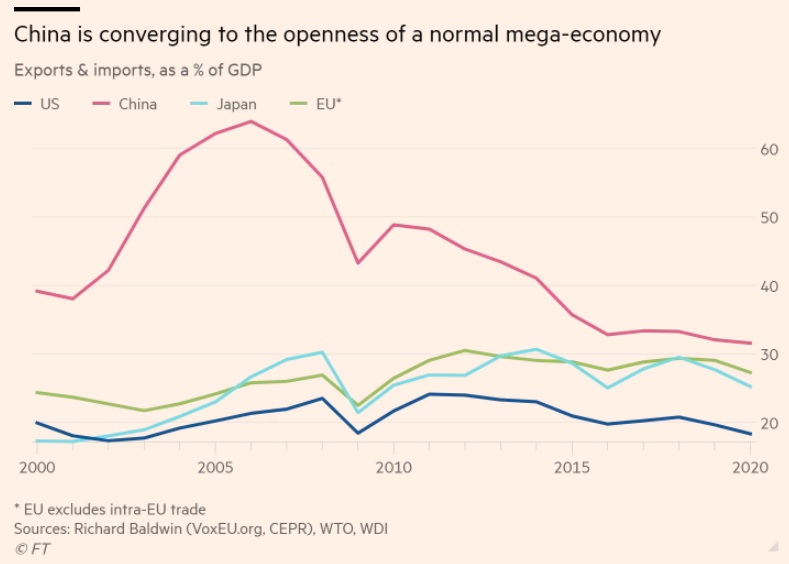
Ας πάρουμε το παράδειγμα του εμπορίου: οι εξαγωγές της Κίνας σε στενούς συμμάχους των ΗΠΑ υπερβαίνουν κατά πολύ αυτές προς τις ΗΠΑ.

Πολλοί από τους συγκεκριμένους συμμάχους μοιράζονται επίσης τις ανησυχίες των ΗΠΑ για την πρόσβαση στις αγορές, την ανεπαρκή προστασία της πνευματικής ιδιοκτησίας και την απαίτηση της Κίνας να αντιμετωπίζεται ως αναπτυσσόμενη χώρα.

Αλλά οι ΗΠΑ έχουν απαρνηθεί το ειδικό βάρος που θα τους προσέδιδαν οι σύμμαχοί τους. Αν είχε επιχειρήσει να διαπραγματευτεί με την Κίνα εντός του Παγκόσμιου Οργανισμού Εμπορίου για τα ζητήματα αυτά, μαζί με τους συμμάχους της, θα απολάμβανε μεγαλύτερο ειδικό βάρος και θα είχε ηθικό πλεονέκτημα.

Δεν είναι, φυσικά, αρκετό για τις ΗΠΑ να εκτιμήσουν τους πόρους που έχουν. Πρέπει να γνωρίζουν και τι να τους κάνουν. Αυτό δεν είναι να μετατραπεί σε εχθρό της νόμιμης επιθυμίας του κινεζικού λαού για μια καλύτερη ζωή. Ακόμα λιγότερο να ονειρεύεται την ανατροπή του πολιτικού συστήματος της Κίνας. Τέτοιοι στόχοι δεν είναι ούτε εύλογοι, ούτε εφικτοί. Πρέπει αντίθετα να υπερασπιστεί μια ανοιχτή και δυναμική παγκόσμια οικονομία, οι οποία θα βασίζεται σε κανόνες της αγοράς, θα προστατεύει την ελευθερία του λόγου και θα αντιταχθεί στην παραβίαση των ανθρωπίνων δικαιωμάτων στην ίδια την Κίνα. Αλλά πρέπει επίσης και να αναγνωρίσει ότι, για να επιτύχει η ανθρωπότητα κάποια πρόοδο και να διατηρήσει την ειρήνη και τα παγκόσμια αγαθά, απαιτείται μεγάλος βαθμός συνεργασίας μεταξύ των υπερδυνάμεων.

Οι ΗΠΑ και οι σύμμαχοί τους πρέπει να συγκρουστούν, να ανταγωνιστούν και να συνεργαστούν σε διάφορους τομείς με την Κίνα. Σήμερα, αυτό φαίνεται απίθανο. Αντίθετα, βλέπουμε μια παραπαίουσα συμμαχία και μια τεταμένη σχέση ανάμεσα στις ΗΠΑ και την Κίνα. Τίποτα από όλα αυτά δεν προμηνύει κάτι καλό για το μέλλον της ανθρωπότητας.

Να θυμάστε: θα μπορούσε να ήταν πολύ καλύτερα.

© The Financial Times Limited 2019. All rights reserved.
FT and Financial Times are trademarks of the Financial Times Ltd.
Not to be redistributed, copied or modified in any way.
Euro2day.gr is solely responsible for providing this translation and the Financial Times Limited does not accept any liability for the accuracy or quality of the translation

Capitalism(s), Alone

0

By Branko Milanovíc

One economic system dominates the world. But there’s more than one kind of capitalism.

Liberal meritocratic capitalism can be best understood by contrasting its distinguishing features with those of nineteenth-century classical capitalism and with social-democratic capitalism, as it existed between approximately the end of the World War II and the early 1980s in Western Europe and North America. We are dealing here with “ideal-typical” features of the systems and ignoring details that varied among countries and across time. But in the following sections, where I focus on liberal meritocratic capitalism alone, I discuss these features in detail for a country that can be taken as prototypical, namely the United States.

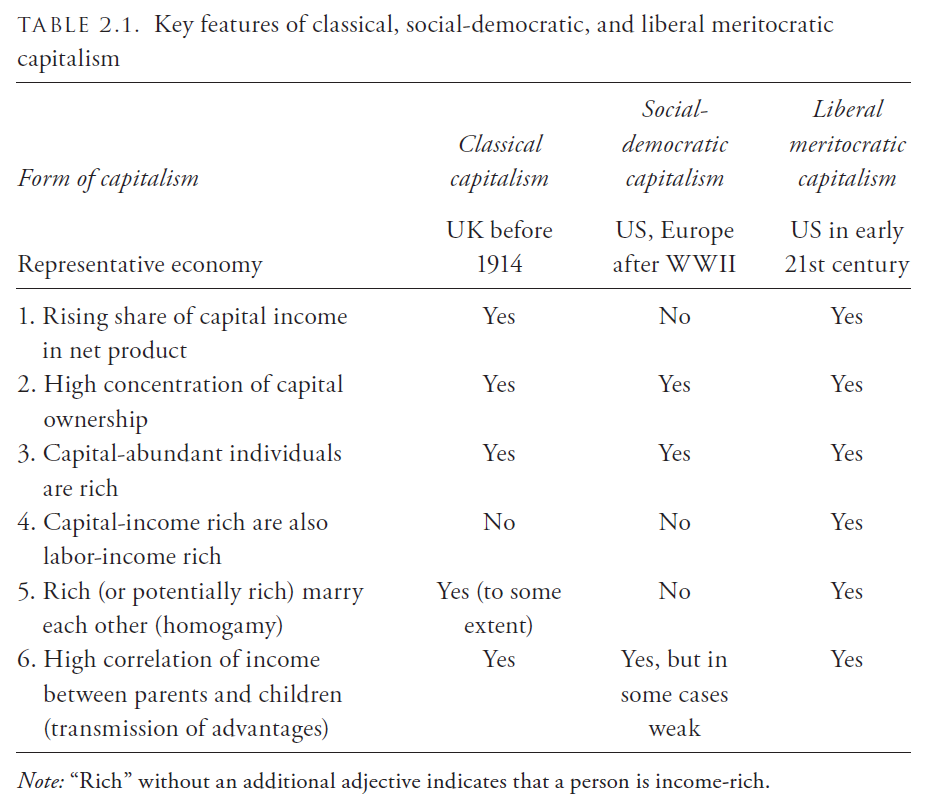
Table 2.1 summarizes the differences between the three historical types of capitalism through which Western economies have passed. For simplicity, I take the United Kingdom before 1914 as representative of classical capitalism, Western Europe and the United States from the end of World War II through the early 1980s as representative of social-democratic capitalism, and the twenty-first- century United States as representative of liberal meritocratic capitalism. Note that because the two key features that differentiate liberal from meritocratic capitalism, taxation of inheritance and broadly available public education, have weakened in the United States over the past thirty years, the country may have shifted toward a model of capitalism that is more “meritocratic” and less “liberal.” However, since I am using the United States as an example of all rich capitalist countries, I think it is still acceptable to speak of liberal meritocratic capitalism as a single model.

We start with the key characteristic of every capitalist system—the division of net income between the two factors of production: owners of capital (owners of property more generally) and workers. This division need not coincide with two distinct classes of individuals. It will do so only when one class of individuals receives income only from capital, and a different class receives income only from labor. As we shall see, whether or not these classes overlap is what distinguishes different types of capitalism.

Data on the division of total net income between capital and labor is murky for the period before 1914, since the first estimates for the United Kingdom, which were made by the economist Arthur Bowley, were not done until 1920. Based on this work, it has been argued that the income shares of capital and labor are more or less constant—a trend that came to be called Bowley’s Law. Data produced by Thomas Piketty (2014, 200– 201) for the United Kingdom and France have cast severe doubt on that conclusion, even for the past. For the United Kingdom in the period 1770– 2010, Piketty found that the share of capital oscillated between 20 and 40 percent of national income. In France, between 1820 and 2010, it varied even more widely: from less than 15 percent in the 1940s to more than 45 percent in the 1860s. The percentages became more stable after World War II, however, reinforcing belief in Bowley’s Law. Paul Samuelson, for example, in his influential Economics, included Bowley’s Law among the six basic trends of economic development in advanced countries (although he did allow for some “edging upward of labor’s share”) (Samuelson 1976, 740). However, since the late twentieth century, the share of capital income in total income has been rising. While this tendency has been quite strong in the United States, it has also been documented in most developed countries, as well as developing countries, although the data for the latter must be taken with a strong dose of caution (Karabarbounis and Neiman 2013).

A rising share of capital income in total income implies that capital and capitalists are becoming more important than labor and workers—and thus acquiring more economic and political power. This trend occurred in both classical and liberal meritocratic capitalism, but not in the social-democratic variety (Table 2.1). A rising share of capital in total income also affects interpersonal income distribution because typically, (1) people who draw a large share of income from capital are rich, and (2) capital income is concentrated in relatively few hands. These two factors result almost automatically in greater income inequality between individuals.

To see why both (1) and (2) are indispensable for the automatic translation of higher capital share into greater interpersonal inequality, make the following mental experiment: assume that the share of capital in net income goes up, but that every individual receives the same proportion of income from capital and labor as every other individual. A rising aggregate share of capital income will increase every individual income in the same proportion, and inequality will not change. (Measures of inequality are relative.) In other words, if we do not have a high positive correlation between being “capital-abundant” (that is, deriving a large percentage of one’s income from capital) and being rich, a rising aggregate share of capital does not lead to higher interpersonal inequality. Note that in this example there are still rich and poor people, but there is no correlation between the percentage of income that a person draws from capital and that person’s position in the overall income distribution.

Now, imagine a situation where poor people draw a higher proportion of their income from capital than rich people do. As before, let the overall share of capital in net income increase. But this time, the rising share of capital will reduce income inequality because it will increase proportionately more the incomes of the people at the low end of the income distribution.

But neither of these two mental exercises reflects what is happening in reality in capitalist societies: rather, there is a strong positive association between being capital-abundant and being rich. The richer a person is, the more likely they are to have a high share of their income coming from capital. This has been the case in all types of capitalism (see Table 2.1, rows 2 and 3). This particular characteristic—that capital-abundant people are also rich—may be taken as an immutable characteristic of capitalism, at least in the forms that we have experienced it so far.

The next feature to consider is the link between being well-off in terms of capital (that is, being capital-income- rich within the distribution of capital incomes) and being well-off in terms of earnings (that is, being labor-income- rich within the distribution of labor incomes). One might think that people who are capital-abundant rich are unlikely to be rich in terms of their labor income. But this is not the case at all. A simple example with two groups of people, the “poor” and the “rich,” makes this clear. The poor have overall low income, and most of their income comes from labor; the rich are the opposite. Consider situation 1: The poor have 4 units of income from labor and 1 unit of income from capital; the rich have 4 units of income from labor and 16 units from capital. Here the capital abundant are indeed rich, but the amount of their labor income is the same as that of the poor. Now consider situation 2: Everything stays the same as in situation 1 except that the labor income of the rich increases to 8 units. They are still capital abundant, since they receive a larger share of their total income from capital (16 out of 24 units = 2/3) than the poor do, but now they are also labor-rich (8 units versus only 4 for the poor).

Situation 2 is when the capital-abundant individuals are not only rich but also relatively well off in terms of labor income. Everything else being the same, situation 2 is more unequal than situation 1. This is indeed one of the important differences between, on the one hand, classical and social-democratic capitalisms, and on the other, liberal meritocratic capitalism (see Table 2.1, row 4). The perception and reality of classical capitalism was that capitalists (what I call here capital-abundant individuals) were all very rich but typically did not receive much income from labor; in the extreme case, they received no income from labor at all. It is no accident that Thorstein Veblen labeled them the “leisure class.” Correspondingly, laborers received no income from capital at all. Their income came entirely from labor.  In this case there was a perfect division of society into capitalists and workers, with both sides receiving zero income from the other factor of production. (If we add landlords, who received 100 percent of their income from land, we have the tripartite classification of classes introduced by Adam Smith.) Inequality was high in such fragmented societies because capitalists tended to have lots of capital, and the return on capital was (often) high, but inequality was not compounded by these same individuals also having high labor incomes.

The situation is different in liberal meritocratic capitalism, as found in the United States today. People who are capital-rich now tend also to be labor-rich (or to put it in more contemporary terms, they tend to be individuals with high “human capital”). Whereas the people at the top of the income distribution under classical capitalism were financiers, rentiers, and owners of large industrial holdings (who are not hired by anyone and hence have no labor income), today a significant percentage of the people at the top are highly paid managers, web designers, physicians, investment bankers, and other elite professionals. These people are wage workers who need to work in order to draw their large salaries. But these same people, whether through inheritance or because they have saved enough money through their working lives, also possess large financial assets and draw a significant amount of income from them.

The rising share of labor income in the top 1 percent (or even more select groups, like the top 0.1 percent) has been well documented by Thomas Piketty, in Capital in the Twenty-First Century (2014), and other authors. What is important to realize here is that the presence of high labor income at the top of the income distribution, if associated with high capital income received by the same individuals, deepens inequality. This is a peculiarity of liberal meritocratic capitalism, something that has never before been seen to this extent.

16 November 2019

Excerpted from CAPITALISM, ALONE: THE FUTURE OF THE SYSTEM THAT RULES THE WORLD by Branko Milanovic, published by Harvard University Press. Copyright © 2019 by the President and Fellows of Harvard College. Used by permission. All rights reserved.

Ο Ερντογάν μετά τον Λευκό Οίκο – Η επόμενη σκηνή στην ΑΟΖ

1

slpress.gr

Θόδωρος Καρυώτης

Προχθές ο Ερντογάν προέβη, για μια άλλη φορά, σε νέες αλλά αναμενόμενες προκλητικές δηλώσεις, πριν αναχωρήσει για τις ΗΠΑ λέγοντας: «Οι Ευρωπαίοι ξεχνάτε ότι είμαστε εγγυητές στην Ανατολική Μεσόγειο και έχουμε δικαιώματα στην ΑΟΖ. Τα δικαιώματά μας πηγάζουν από το διεθνές δίκαιο. Στην ΑΟΖ μας έχουμε δικαιώματα, όμως ήρθαν χώρες χωρίς δικαιώματα και κάνουν έρευνες. Σε περιοχές εκτός της ΑΟΖ τους. Όταν εμείς κάνουμε έρευνες μιλούν για κυρώσεις. Και το 1959 μας απειλούσατε και το 1963 μας απειλούσατε».

Το σημείο που προξενεί μεγάλη εντύπωση, αλλά πέρασε απαρατήρητο στην Αθήνα, ήταν όταν ανέφερε ότι «στην ΑΟΖ μας έχουμε δικαιώματα». Οι Τούρκοι από το 1982 μέχρι σήμερα ομιλούν συνεχώς για την υφαλοκρηπίδα της Τουρκίας, την υφαλοκρηπίδα του ψευδοκράτους, την υφαλοκρηπίδα της Ελλάδας και την υφαλοκρηπίδα της Κύπρου.

Ακόμα και όταν αναφέρονται στη “Γαλάζια Πατρίδα” μιλούν για υφαλοκρηπίδα και όχι για ΑΟΖ. Ουσιαστικά είναι η δεύτερη φορά που μνημονεύουν την ΑΟΖ. Η πρώτη ήταν όταν, πριν ένα χρόνο, ανέφεραν ότι σχεδιάζουν την οριοθέτηση της ΑΟΖ ανάμεσα στην Τουρκία και στην Λιβύη.

Η νέα ελληνική κυβέρνηση του Κυριάκου Μητσοτάκη έχει πολλά προβλήματα να λύσει μέσα σε ένα σύντομο χρονικό διάστημα και, δυστυχώς, αδυνατεί να προβεί σε θαρραλέες κινήσεις για να προλάβει τις πρωτοβουλίες του Ερντογάν. Ο παρακάτω χάρτης, δείχνει τα όρια της τουρκικής ΑΟΖ στο Αιγαίο, στην Ανατολική Μεσόγειο και στην Μαύρη Θάλασσα.

Η ΑΟΖ της Τουρκίας. Ο χάρτης αυτός αποτελεί τον μεγάλο εφιάλτη της Τουρκίας. (Πηγή: Global Maritimes Boundaries Database, General Dynamics, Hendon, Virginia, USA).

Στα τέλη του 1986 η Τουρκία υιοθέτησε ΑΟΖ στη Μαύρη Θάλασσα και κατέληξε σε συμφωνία με την τότε Σοβιετική Ένωση για τις επικαλυπτόμενες περιοχές χρησιμοποιώντας τη μέθοδο της “μέσης γραμμής”, που τόσο πολύ αντιπαθεί. Αργότερα, η Τουρκία άρχισε συνομιλίες με τη Βουλγαρία και τη Ρουμανία, που κατέληξαν σε συμφωνίες παρόμοιες με εκείνη που είχε συνάψει με τους Σοβιετικούς. Ουδέποτε, βέβαια, η Τουρκία πρότεινε στην Ελλάδα και σε άλλα γειτονικά κράτη να πράξουν το ίδιο στη Μεσόγειο.

Έτσι, η Μαύρη Θάλασσα, που αποτελεί “κλειστή ή ημίκλειστη θάλασσα”, όπως και η Μεσόγειος, έχει εντελώς μοιρασθεί από τα παράκτια κράτη της μέσω της οριοθέτησης της ΑΟΖ και όχι της υφαλοκρηπίδας. Αυτό αποτελεί τον πιο λανθασμένο χειρισμό της Τουρκίας, διότι δέχθηκε να οριοθετήσει την ΑΟΖ της στη Μαύρη Θάλασσα με τη μέθοδο της μέσης γραμμής, που πολέμησε τόσο πολύ στην UNCLOS. Πώς λοιπόν μπορεί η Τουρκία να αρνείται την οριοθέτηση της ΑΟΖ με την Ελλάδα, βάσει της μέσης γραμμής, όταν ήδη υπάρχει το προηγούμενο της Μαύρης Θάλασσας;

Το τουρκικό μυστικό για ΑΟΖ

Η σημασία της αλιείας ήταν το μεγάλο μυστικό της Τουρκίας. Η Τουρκία πολέμησε κυρίως το θέμα της ΑΟΖ και των νησιών όλα τα εννιά χρόνια της Τρίτης Διάσκεψης του ΟΗΕ για το Δίκαιο της Θάλασσας, γιατί γνώριζε ότι τα άρθρα της ΑΟΖ που ρυθμίζουν διεξοδικά τα θέματα της αλιείας ευνοούσαν τα νησιά του Αιγαίου Αρχιπελάγους. Εδώ, βέβαια, επικρατεί κάποια σύγχυση στην Ελλάδα διότι πολλοί, δικαιολογημένα, ερωτούν: «Είναι σε όλους γνωστόν ότι η ποσότητα και η ποιότητα του αλιεύματος στο Αιγαίο δεν είναι σημαντική. Άρα γιατί η Τουρκία δεν θέλει την δημιουργία της ελληνικής ΑΟΖ;»

Μια ελληνική ΑΟΖ στο Αιγαίο δεν θα επιτρέπει στους Τούρκους ψαράδες να ψαρεύουν στην δική μας θάλασσα και θα αποτελεί ένα ψυχολογικό βάρος, που δεν θα μπορέσει να ανεχθεί ο τουρκικός λαός. Πρέπει να επισημάνουμε εδώ ότι ο κύριος λόγος δημιουργίας της ΑΟΖ δεν ήταν άλλος από την προσπάθεια των αναπτυσσόμενων κρατών να προστατεύσουν την αλιεία τους.

Ήταν καλό σημάδι το ότι τα περισσότερα κράτη κατανόησαν νωρίς την αξία της ΑΟΖ και άρχισαν γρήγορα να την ανακηρύσσουν μετά το 1982. Ήταν επίσης σημαντικό ότι τα τρία μεγάλα παράκτια κράτη, οι ΗΠΑ, η τότε Σοβιετική Ένωση και η Κίνα, ανακήρυξαν γρήγορα ΑΟΖ, διότι γνώριζαν ότι αυτή θα έπαιζε έναν σημαντικό ρόλο για την προστασία της αλιείας τους και για την εξόρυξη υδρογονανθράκων.

Η στάση των ΗΠΑ

Το κύριο πρόβλημα της Ελλάδας στην ελληνοτουρκική διένεξη είναι ξεκάθαρα η στάση των ΗΠΑ, που δεν έχει αλλάξει καθόλου τα τελευταία 30 χρόνια. Οι Αμερικανοί, από την εποχή του Ανδρέα Παπανδρέου μέχρι τον Κυριάκο Μητσοτάκη, παίζουν το ίδιο βιολί, προτρέποντας τις ελληνικές κυβερνήσεις να μην προχωρήσουν σε μια μονομερή ανακήρυξη ΑΟΖ, χωρίς να συμφωνήσουν πρώτα με την Τουρκία.

Βέβαια, την ίδια στιγμή η Αμερικανοί αγνοούν ότι η ανακήρυξη ΑΟΖ είναι, πάντα, μια μονομερής πράξη, όπως ακριβώς έπραξαν και οι ίδιοι το 1983. Απόδειξη ότι τίποτε δεν έχει αλλάξει στις σχέσεις μας, είναι ο επόμενος χάρτης που δείχνει ότι οι ΗΠΑ δεν επιθυμούν τον αγωγό EastMed που θα περνάει από την Ελλάδα με κατεύθυνση την Δυτική Ευρώπη,

Αμερικανικός χάρτης αγωγών προς την Τουρκία Πηγή: U.S. Department of Energy, Bureau of Energy Resources, Washington, D.C.

Όπως έγραψε ο Κώστας Βενιζέλος σε αυτή την ιστοσελίδα: «Στον χάρτη παρουσιάζονται διάφορες διαδρομές για την εξαγωγή του φυσικού αερίου. Μια από αυτές είναι εκείνη που ξεκινά από το κοίτασμα ‘Αφροδίτη’ στην κυπριακή ΑΟΖ και κατευθύνεται μέσω κυπριακού εδάφους στα νότια παράλια της Τουρκίας. Επίσης, ένας αγωγός ξεκινά από τα κοιτάσματα του Λεβιάθαν στο Ισραήλ διασχίζει την κυπριακή ΑΟΖ και καταλήγει στην Αλεξανδρέττα». Εκείνο πάντως που προκαλεί αλγεινή εντύπωση είναι ότι αυτός ο αμερικανικός χάρτης δείχνει την παράνομη ΑΟΖ της Τουρκίας, όπως προβάλλεται από τον προπαγανδιστικό μηχανισμό του τουρκικού υπουργείου Εξωτερικών.

Η ώρα μεγάλων αποφάσεων για Μητσοτάκη

Η ΑΟΖ αποτελεί πλέον αναμφισβήτητα μέρος του εθιμικού διεθνούς δικαίου από τότε που η UNCLOS τέθηκε σε ισχύ στις 16 Νοεμβρίου 1994 και κανένα κράτος ή ομάδα κρατών δεν έχει το δικαίωμα να ισχυρισθεί ότι κάποιο παράκτιο κράτος δεν μπορεί να ανακηρύξει την δική του ΑΟΖ. Αν και πότε ένα παράκτιο κράτος ανακηρύξει τη δική του ΑΟΖ ανήκει εντελώς στη δική του δικαιοδοσία. Αξίζει εδώ να επισημάνουμε τα λόγια του Βενιαμίν Καρακωστάνογλου από το άρθρο του “ΑΟΖ ή Υφαλοκρηπίδα; – Ένα ανόητο δίλημμα“:

«Έτσι, με την ΑΟΖ:
• Θα υπερτριπλασιαστεί (494.605 τετρ. χλμ. θαλάσσιος χώρος) ο εθνικός μας χώρος.
• Θα διασφαλισθούν σοβαρότατοι (καθ’ όλες τις ενδείξεις) ενεργειακοί πόροι (πετρέλαιο, φυσικό αέριο).
• Θα ελεγχθούν οι παραδοσιακές θάλασσες, όπου έδρασε επί χιλιετίες ο Ελληνισμός.
• Θα αυξηθεί η ασφάλεια και η συνοχή του ηπειρωτικού με τον νησιωτικό μας χώρο και θα αποσαφηνιστούν τα θαλάσσια σύνορα της Ελλάδος».

Ήρθε, επομένως, η ώρα που η ελληνική κυβέρνηση πρέπει να προβεί, άμεσα, σε δυο οριοθετήσεις της ΑΟΖ της για να προλάβει την οριοθέτηση ΑΟΖ ανάμεσα στην Τουρκία και την Λιβύη. Αυτές δεν είναι άλλες από τις οριοθετήσεις πρώτα με την Αίγυπτο και μετά με την Κύπρο. Οι γεωγραφικές συντεταγμένες αυτών των οριοθετήσεων υφίστανται επί πολλά χρόνια.

Πρέπει εδώ να τονίσουμε ότι το κλειδί για την οριοθέτηση ανάμεσα στην Κύπρο και την Ελλάδα είναι η νήσος Στρογγύλη. Με βάση την αρχή της ίσης απόστασης (μέθοδος μέσης γραμμής) προκύπτουν θαλάσσια σύνορα Ελλάδας-Κύπρου μήκους 24 ν.μ. Χωρίς την επίδραση της Στρογγύλης, δεν έχουμε κοινά σύνορα ΑΟΖ με την Κύπρο, όπως επίσης περιορίζονται τα σύνορα Ελλάδος-Αιγύπτου και προκύπτουν σύνορα Τουρκίας-Αιγύπτου, μία πολύ αρνητική προοπτική από γεωστρατηγικής άποψης για την Ελλάδα και την Κύπρο.

Συνέχεια   slpress.gr

ΤΟ ΕΠΙΚΙΝΔΥΝΟ ΑΔΙΕΞΟΔΟ.  

1

του ΠΑΝΤΕΛΗ ΣΑΒΒΙΔΗ

Στη ζωή των κοινωνιών υπάρχουν, μικρές, ή μεγάλες, περίοδοι συνέχειας.
Οι κοινωνίες αποδέχονται, ή επιβάλλεται σ αυτές, ένα σύστημα αξιών με το οποίο ζουν μέχρι που το σύστημα αυτό δεν μπορεί να ρυθμίσει τις σχέσεις τους.
Στην ελληνική κοινωνία, επιβλήθηκε ένα αξιακό σύστημα, μετά τον Εμφύλιο, απο τους νικητές της διαμάχης.
Αυτό το σύστημα έφθασε στα όριά του τη δεκαετία του ’60 και προκειμένου να διατηρηθεί, οδηγήθηκε στη δικτατορία του’67.
Τα αξιακά συστήματα, όμως, μπορεί να επιβάλλονται με την ιδεολογία, όχι, όμως, με την ωμή βία. Πρέπει να γίνονται αποδεκτά απο τις κοινωνίες και να λειτουργούν αποτελεσματικά για τις ανάγκες τους.
Η αμφισβήτησή τους, γίνεται, συνήθως, με εκρήξεις. Είναι οι λεγόμενες τομές στη συνέχεια.
Το Πολυτεχνείο του οποίου την 46η επέτειο τιμούμε σήμερα, αποτελεί μαι τέτοια τομή. Δεν έριξε τη δικτατορία αλλά είναι τομή.
Η δικτατορία έπεσε απο το πραξικόπημα κατά του Μακαρίου και την τουρκική εισβολή αλλά το Πολυτεχνείο εκδήλωσε την αντίδραση του ελληνικού λαού στην δικτατορία η οποία, δικτατορία, εξέφραζε κατά ακραίο και απροκάλυπτο τρόπο την μετεμφυλιακή εξουσία στη χώρα.
Απο αυτήν την άποψη το Πολυτεχνείο αποτελεί τομή στη νεότερη ελληνική συνέχεια.
Στην ιστορική εξέλιξη μπορεί η τομή να είναι μικρή αλλά στην εξέλιξη των ιδεών υπήρξε σημαντική.
Η ελληνική κοινωνία ζητούσε κάτι άλλο. Ενδεχομένως, να μην είχε συνείδηση του τι ήθελε αλλά δεν ήθελε αυτό που βίωνε.
Και έτσι, ήρθε η μεταπολίτευση, η οποία επέβαλε το δικό της αξιακό σύστημα. Ένα σύστημα το οποίο σταδιακά κατέρρευσε με σημείο τομής την Ελλάδα των μνημονίων.
Μετά τα μνημόνια η χώρα αναζητά μια νέα σύνθεση. Τι είναι και που πηγαίνει.
Η Ελλάδα ή δεν επηρεάστηκε απο τις αλλαγές που συνέβησαν στις άλλες ευρωπαϊκές χώρες μεσούσης της δικτατορίας, ή επηρεάστηκε καθυστερημένα και εξ αντανακλάσεως.
Όταν η Ελλάδα είχε δικτατορία, στην Ευρώπη συνέβη ο Μάης του ’68. Ο Μάης αποτέλεσε τομή στην ευρωπαϊκή εξέλιξη, όπως, αργότερα το Πολυτεχνείο στην Ελλάδα. Το περιεχόμενο, όμως, των εξεγέρσεων ήταν διαφορετικό διότι και οι κοινωνίες είχαν διαφορετικά χαρακτηριστικά και ανάγκες. Η ελληνική κοινωνία ενσωμάτωσε σταδιακά το ιδεολογικό περιεχόμενο του Μάη ’68.
Οι εξεγέρσεις που αποτελούν τομές, δεν έχουν διάρκεια και συνέχεια. Αφήνουν το στίγμα τους και υποχωρούν.
Η επόμενη μεγάλη τομή, μετά το Μάη, στην Ευρώπη και το Πολυτεχνείο στην Ελλάδα ήταν το 1989 όταν κατέρρευσαν τα καθεστώτα του Ανατολικού Συνασπισμού.
Αναδύθηκαν νέες ανάγκες, σε σημείο που ο περίφημος Φουκουγιάμα να μιλήσει για το τέλος της ιστορίας, με την επικράτηση του φιλελευθερισμού.
Ο Φουκουγιάμα, όμως, όπως και άλλοι αμερικανοί διανοητές, έχουν αλλάξει γνώμη. Μπορεί απο το 1989 ως σήμερα να επικράτησε ο πολιτικός -και οικονομικός- φιλελευθερισμός αλλά, τώρα, και αυτός βρίσκεται σε αδιέξοδο.
Η επανάσταση που συνέβη, και απειλεί το παλιό σύστημα, η τομή που λέγαμε, είναι στην τεχνολογία. Η τεχνολογία, φέρνει τους ανθρώπους πιο κοντά και διαμορφώνει πολυπολιτισμικές κοινωνίες πολύ πιο εύκολα απο ό,τι άλλες ιστορικές περίοδοι.
Και το ερώτημα, τώρα, που ζητά επιτακτικά απάντηση είναι: έρχεται ο πολυπολιτισμός σε αντίθεση με τις φιλελεύθερες αξίες (ανθρώπινα και ατομικά δικαιώματα, κράτος δικαίου κλπ);
Πως μπορεί να υπάρξει ο πολυπολιτισμός με το πολιτικό σύστημα που γνωρίσαμε; Πως μπορεί να ενταχθούν στο φιλελεύθερο πολιτικό σύστημα άνθρωποι διαφορετικών ταυτοτήτων που φέρουν μαζί τους τις δικές τους αντιλήψεις και μάχονται μέχρι θανάτου γι αυτές;
Η αντίληψη περί μιας παγκόσμιας διακυβέρνησης με τους ανθρώπους να έχουν την ιδιότητα του παγκόσμιου πολίτη δεν μπόρεσε, ευτυχώς, να επικρατήσει.
Και το ερώτημα, σήμερα, που οδηγεί σε μια νέα εξέγερση (τομή που λέγαμε) είναι: ποιό θα είναι το νέο διακύβευμα στις κοινωνίες όπως έχουν διαμορφωθεί και ποια η επόμενη ημέρα που θα ξημερώσει;
Σ αυτό το ερώτημα δεν υπάρχει προς το παρόν, απάντηση.
Και αυτό είναι το σημερινό, επικίνδυνο, αδιέξοδο.

Με τον Τραμπ αναφανδόν υπέρ του Ερντογάν να παγώσουν πρωτοβουλίες για Αιγαίο και Κύπρο

0

Του ΜΙΧΑΛΗ ΙΓΝΑΤΙΟΥ Hellas Journal

File Photo: Ο Ρετζέπ Ταγίπ Ερντογάν (Α) και ο Ντόναλντ Τραμπ (Δ) πριν την αναχώρηση του πρώτου από τον Λευκό Οίκο. Photo via Τουρκική

NOVEMBER 17, 2019

Και η Ελλάδα και η Κύπρος βρίσκονται ενώπιον μίας πολύ δυσάρεστης κατάστασης. Ο πρόεδρος των Ηνωμένων Πολιτειών, Ντόναλντ Τραμπ έχει ταχθεί αναφανδόν υπέρ της κατοχικής δύναμης, της Τουρκίας, και του ισλαμιστή ηγέτη της, Ταγίπ Ερντογάν. Και του δικαιολογεί τα πάντα. Πολλοί άνθρωποι στην Αμερική προσπάθησαν να αναλύσουν το «φαινόμενο» και στην πλειοψηφία τους έχουν καταλήξει στο συμπέρασμα ότι τα συμφέροντα που καθοδηγούν την πολιτική του κ. Τραμπ έναντι της Τουρκίας, είναι προσωπικά. Άρα, δεν εξυπηρετούνται αναγκαστικά τα συμφέροντα των Ηνωμένων Πολιτειών.

Δεν πρόκειται για μία υπόθεση ή εικασία. Μίλησε ένας εκ των πλέον στενών συνεργατών του Αμερικανού προέδρου, ο μέχρι πρότινος σύμβουλος Εθνικής Ασφάλειας, Τζον Μπόλτον. Δεν πρόκειται για κάτι που το έχουν φανταστεί οι αντίπαλοι του κ. Τραμπ. Είναι η θέση του ανθρώπου που γνώριζε μέχρι πρόσφατα -ίσως να συνεχίζει να γνωρίζει και τώρα- τα πάντα μέσα στο Λευκό Οίκο, αλλά και ότι αφορά την εξωτερική και αμυντική πολιτική της υπερδύναμης. Ήταν ο αρμόδιος για την εθνική ασφάλεια.

Σύμφωνα, λοιπόν, με το τηλεοπτικό δίκτυο NBC: Ο Μπόλτον δήλωσε σε μία συγκέντρωση των μεγαλύτερων πελατών της Morgan Stanley ότι ήταν πιο απογοητευμένος με τον Τραμπ για το χειρισμό του στα θέματα που αφορούν την Τουρκία. Σημειώνοντας την ευρεία δικομματική υποστήριξη στο Κογκρέσο για τις κυρώσεις εναντίον της Τουρκίας μετά την αγορά από τον Ερντογάν του ρωσικού συστήματος S-400, o Μπόλτον δήλωσε ότι η αντίσταση του Τράμπ προς την κίνηση (σ.σ.: των κυρώσεων) ήταν παράλογη.

Ο Μπόλτον δήλωσε ότι πιστεύει ότι υπάρχει μια προσωπική ή επιχειρηματική σχέση που υπαγορεύει τη θέση του κ. Τραμπ για την Τουρκία, επειδή κανένας από τους συμβούλους του δεν είναι ευθυγραμμισμένος μαζί του για το θέμα. Με δεδομένα τα παραπάνω, πιστεύω ότι η Ελλάδα και η Κύπρος, αλλά και άλλες χώρες στην περιοχή, βρίσκονται σε μία δύσκολη κατάσταση σε ότι αφορά τα προβλήματα που δημιουργεί η Τουρκία.

Με βάση όσα ακούσαμε στη συνέντευξη Τύπου του κ. Τραμπ και του Ερντογάν, την Τετάρτη, ο Αμερικανός Πρόεδρος είναι έτοιμος να υπερασπιστεί τον Τούρκο ομόλογό του για όλα τα θέματα. Είτε αφορούν τους Κούρδους, τους πιο πολύτιμους συμμάχους της Αμερικής, είτε αφορούν -μπορώ να υποθέσω- και άλλα ζητήματα, άρα και την Ελλάδα και την Κύπρο. Για να μην παρεξηγηθώ, στο σημείο αυτό -και για δεοντολογικούς λόγους- θα ήθελα να αναφέρω τα αυτονόητα: ότι οι Αμερικανοί διπλωμάτες στην Ελλάδα και την Κύπρο κάνουν τα αδύνατα δυνατά για να ενημερώνουν σωστά τους προϊσταμένους τους στην Ουάσιγκτον, και τονίζουν πάντα τη βοήθεια που προσφέρει η Αθήνα και η Λευκωσία στην Αμερική σε στρατηγικό επίπεδο, όπως και το γεγονός ότι είναι δύο χώρες, οι οποίες δεν δημιουργούν προβλήματα στις ΗΠΑ και στη Δύση γενικότερα, αντίθετα βοηθούν στην επίλυσή τους.

Στο τέλος-τέλος, δεν ευθύνονται οι διπλωμάτες για τις αποφάσεις του προέδρου της Αμερικής ή του υπουργού των Εξωτερικών. Ιδιαίτερα, στην περίπτωση του κ. Τραμπ, και εάν όντως τα προσωπικά του συμφέροντα υπερισχύουν των στρατηγικών της χώρας που κυβερνά. Και έχει σημασία να το επαναλάβω: ότι η καταγγελία δεν γίνεται από ένα Κούρδο, Αρμένιο η Έλληνα. Αλλά από τον πρώην σύμβουλο Εθνικής Ασφάλειας του Λευκού Οίκου.

Από την άλλη, το δημοσίευμα της εφημερίδας New York Times, για τους γαμπρούς του κ. Τραμπ και του Ερντογάν, καταγράφει μία σαθρή και διεφθαρμένη πραγματικότητα. Πως είναι δυνατόν η μεγαλύτερη Δημοκρατία στον κόσμο, όπως αρέσκονται οι φίλοι μας οι Αμερικανοί να ονομάζουν τη χώρα τους, να ανέχεται αυτά τα φαινόμενα; Και πως θα αντιδρούν απ’ εδώ και πέρα οι άλλες χώρες, όταν η Ουάσιγκτον τις εγκαλεί για τα θέματα διαφθοράς;

Δυστυχώς, με βάση τον κ. Μπόλτον και τους New York Times, η (πολιτική) διαφθορά είναι μέσα στο Λευκό Οίκο. Και η διαφθορά αυτή επηρεάζει αποφάσεις στα θέματα εξωτερικής πολιτικής. Τι μπορούν να πράξουν η Αθήνα και η Λευκωσία ενώπιον αυτής τη δυσάρεστης κατάστασης;

Κατ’ αρχάς οι σχέσεις σαν σχέσεις δεν έχουν επηρεαστεί. Αντίθετα ενδυναμώνονται, διότι οι Αμερικανοί διπλωμάτες συνεχίζουν την προσπάθεια για τη δημιουργία και στρατηγικών σχέσεων. Με την Ελλάδα τα πράγματα πάνε ακόμα καλύτερα, ιδιαίτερα στον στρατιωτικό τομέα. Αύριο Δευτέρα, ο υπουργός Εξωτερικών της Κύπρου, Νίκος Χριστοδουλίδης θα έρθει στην Ουάσιγκτον και θα συναντήσει τον Αμερικανό ομόλογό του, Μάικ Πομπέο. Είναι μία καλή και θετική εξέλιξη και θα έχει την ευκαιρία να προχωρήσει μαζί του τον στρατηγικό διάλογο, αλλά και να ακούσει από πρώτο χέρι τις αμερικανικές θέσεις έναντι των προβλημάτων που δημιουργεί η Τουρκία στην ανατολική Μεσόγειο.

Κατά τη γνώμη μου, η Αμερική δεν «μπερδεύει» και δεν εξαρτά πια από την Τουρκία τις σχέσεις της με την Ελλάδα και την Κύπρο. Είναι δύο ξεχωριστά πράγματα, και στο θέμα αυτό η Ουάσιγκτον άκουσε τους διπλωμάτες της στην Αθήνα και τη Λευκωσία. Το πρόβλημα θα δημιουργηθεί στην περίπτωση κατά την οποία ένα θέμα, που αφορά τις τρεις χώρες φτάσει ενώπιον του Ντόναλντ Τραμπ. Δεν πρέπει να έχουμε αμφιβολία τι θα αποφασίσει. Με βάση όσα έγιναν την Τετάρτη στο Λευκό Οίκο, εγώ είμαι βέβαιος πως θα υποστηρίξει τις τουρκικές θέσεις. Δυστυχώς.

Πρόκειται για μία πραγματικότητα, που οι αξιόλογοι διπλωμάτες της Αμερικής δεν μπορούν να αλλάξουν. Διότι είμαι βέβαιος πως γνωρίζουν ότι αυτό που συμβαίνει μεταξύ του κ. Τραμπ και του Ερντογάν είναι άδικο για τους λαούς της περιοχής. Υποστηρίζει ένα διεστραμμένο ισλαμοεθνικιστή ταραξία, που έχει βάψει τα χέρια του με αίμα. Αυτή η πραγματικότητα έχει επίδραση και στην Αμερική.

Ο αντιαμερικανισμός, που είχε μειωθεί σε μονοψήφια νούμερα, έχει μία άνοδο σε πολλές χώρες της περιοχής μας, και όχι μόνο.

Υπό αυτά τα δεδομένα: Η Αθήνα πρέπει να αποφύγει κάθε συζήτηση για τις παράνομες απαιτήσεις της Τουρκίας στο Αιγαίο και τη Θράκη, και Η Κύπρος πρέπει να αποφύγει διαπραγματεύσεις που θα οδηγήσουν σε φιλοτουρκική λύση. Διότι αυτή που συζητείται είναι καθόλα φιλοτουρκική. Μέχρι τις επόμενες εκλογές στην Αμερική, τα θέματα αυτά δεν πρέπει να τα αγγίξει κανένας… Πρέπει να «παγώσουν».

ΣΗΜΕΙΩΣΗ: Μα τι στο καλό γίνεται με το κτίριο του Γενικού Προξενείου και της Μόνιμης Αντιπροσωπείας της Κύπρου στον ΟΗΕ; Ναι μεν το έκλεισε η αρμόδια υγειονομική υπηρεσία της Νέας Υόρκης. Αλλά πρέπει η Κυπριακή Δημοκρατία να πληρώνει 45 χιλιάδες το μήνα ενοίκιο, στο γάμο του Καραγκιόζη;

ΥΣΤΕΡΟΓΡΑΦΟ: Στην Κύπρο έχουν βρει ένα φοβερό τρόπο να προσπερνούν τα θέματα διαφθοράς. Εντάξει, σου λένε, έγινε… Ας το ξεχάσουμε τώρα. Φρικτός ο τρόπος αντιμετώπισης και του θέματος των χρυσών διαβατηρίων, που πωλούσε και σε απατεώνες η Λευκωσία. Φρικτός και ο τρόπος αντιμετώπισης του άλλου θέματος, του ξεπλύματος χρήματος για τους ολιγάρχες. Ο Γενικός Εισαγγελέας δεν έχει λόγο;

Πηγή: Με τον Τραμπ αναφανδόν υπέρ του Ερντογάν να παγώσουν πρωτοβουλίες για Αιγαίο και Κύπρο https://hellasjournal.com/2019/11/me-ton-tramp-anafandon-yper-toy-erntogan-na-pagosoyn-protovoylies-gia-aigaio-kai-kypro/

How a CIA analyst, alarmed by Trump’s shadow foreign policy, triggered an impeachment inquiry

0

THE WASHINGTON POST

National Security

By

Greg Miller,

Greg Jaffe and

Paul Sonne

November 16, 2019 at 7:00 a.m. EST

The lights are often on late into the evening at CIA headquarters, where a team of elite analysts works on classified reports that influence how the country responds to global crises.

In early August, one of those analysts was staying after hours on a project with even higher stakes. For two weeks, he pored over notes of alarming conversations with White House officials, reviewed details from interagency memos on the U.S. relationship with Ukraine and scanned public statements by President Trump.

He wove this material into a nine-page memo outlining evidence that Trump had abused the powers of his office to try to coerce Ukraine into helping him get reelected. Then, on Aug. 12, the analyst hit “send.”

His decision to report what he had learned to the U.S. intelligence community’s inspector general has transformed the political landscape of the United States, triggering a rapidly moving impeachment inquiry that now imperils Trump’s presidency.

Over the past three months, the allegations made in that document have been overwhelmingly substantiated — by the sworn testimony of administration officials, the inadvertent admissions of Trump’s acting chief of staff and, most important, the president’s own words, as captured on a record of his July 25 call with the leader of Ukraine.

As the impeachment inquiry entered a new phase of public hearings on Wednesday, the outlines of the case have been thoroughly established: the president, his personal lawyer Rudolph W. Giuliani and two diplomats are alleged to have collaborated to pressure Ukraine to pursue investigations to bolster Trump’s conspiracy theories about the 2016 election and damage the prospects of a potential opponent in next year’s election, former vice president Joe Biden.

Trump cites corruption in Kyiv and European stinginess to justify actions on Ukraine. Neither rationale withstands close scrutiny.

To advance this hidden agenda, Trump and his allies orchestrated the ouster of a U.S. ambassador, the withholding of an Oval Office meeting from Ukraine’s new president and the suspension of hundreds of millions of dollars in U.S. aid.

But beyond that familiar fact pattern, the revelations reflect a country inpolitical crisis.

The United States has embarked on an impeachment proceeding against a president for only the fourth time in its history. The voluminous testimony so far has revealed a government at war with itself over how to respond to Trump’s frequent conflation of the country’s interests with his own. After casting itself as a force against corruption, condemning politically driven prosecutions in other countries, the United States now appears to have sought to coerce such actions from a partner nation.

It is not clear whether any of this would have come to light were it not for the actions of a relatively junior CIA employee, who is now the target of almost daily attacks by Trump and right-wing efforts to make his identity widely public.

Dozens of senior officials — including the national security adviser, the secretary of state and the acting White House chief of staff — were either aware of or involved in the Ukraine scheme and failed to expose or stop it. More than a half-dozen lower-ranking officials made futile attempts to intervene.

Ultimately, it came down to a lone analyst, in a cubicle miles from the White House, drafting an unprecedented document in the detached manner he had learned in his CIA training.

“In the course of my official duties,” he wrote, “I have received information from multiple U.S. government officials that the President of the United States is using the power of his office to solicit interference from a foreign country in the 2020 U.S. election.”

This article is based on interviews with dozens of U.S. and Ukrainian officials, the whistleblower report, the White House call record and thousands of pages of impeachment hearing transcripts. Many officials and others spoke on the condition of anonymity, citing the sensitivity of the issue and fear of retaliation.

The CIA declined to comment on all matters related to the whistleblower, including whether he is employed at the agency. The whistleblower’s lawyers also declined to comment.

‘The center of our investigation’

Attempts to discredit the whistleblower have depicted him as driven by ideology or political grievance, secretly determined to unseat the president. The inspector general did note “an arguable political bias” on the part of the whistleblower but found his complaint “credible.”

Current and former officials familiar with the analyst’s actions said that he was daunted by the implications of his decision, both for the country and his career, and that he never contemplated becoming a whistleblower until learning about the nature of Trump’s July 25 call with Ukrainian President Volodymyr Zelensky.

The rough transcript of that call, which was released by the White House after the analyst’s concerns became public, shows Trump opening with congratulations on Ukraine’s recent parliamentary elections and then transitioning swiftly into applying pressure.

“I would like you to do us a favor though,” Trump says, urging Zelensky to order investigations into a baseless claim that Kyiv is hiding computer equipment that would supposedly prove it was Ukraine, and not Russia, that hacked the Democratic National Committee’s network in 2016; and into a Ukrainian energy company, Burisma Holdings, that had employed Biden’s son Hunter to serve on its board of directors for up to $100,000 a month.

In their 30-minute conversation, there was no mention of the two nations’ shared goals of repelling Russian aggression, no expression of broader concern about corruption, no reference to Ukraine’s desire for a closer relationship with the West.

The call is at the heart of the impeachment inquiry in the House of Representatives, rising above all other allegations or evidence in significance, according to senior officials involved in the probe.

“The call itself shows what we believe to be a misuse of power of the office of the presidency for personal gain,” said a senior Democratic official. “It quickly became the center of our investigation.”

Still, the official said, “We wanted to expand outward before and after the call. What was the impetus? Why was Trump asking about these investigations? Who was involved and who knew about it?”

The timing of Trump’s attempt to pressure Zelensky made it all the more extraordinary. One day earlier, former special counsel Robert S. Mueller III had, in halting testimony before Congress, essentially ended any prospect that Trump would face impeachment for his campaign’s ties to Russia in 2016 or alleged efforts to obstruct the investigation into election interference that followed.

The Russia “cloud” that Trump has so frequently railed against had finally been lifted. And yet, within hours, he was exposing himself to new allegations of collusion, this time not with Russia, but with neighboring Ukraine.

On the call, however, Trump makes clear that he sees the two threats to his presidency as inextricably linked, and his attempt to pressure Ukraine appears driven by his refusal to accept the reality of Moscow’s interference and the stain he believes that left on his surprising win.

Midway through the call, Trump appears to gloat about the collapse of the Russia investigation. “That whole nonsense ended with a very poor performance by a man named Robert Mueller, an incompetent performance,” Trump said. “But they say a lot of it started with Ukraine.”

The ‘irregular’ channel

Trump’s personal lawyer, Rudolph W. Giuliani, second from left, meets with Petro Poroshenko, second from right, then the president of Ukraine, and other officials in Kyiv on Nov. 21, 2017. (Myhaylo Palinchak/UNIAN)

Several witnesses in the impeachment inquiry have said that Trump bears significant hostility toward Ukraine, stemming in part from the country’s role in exposing the financial corruption of his 2016 campaign chairman, Paul Manafort.

Trump began airing conspiratorial claims about Ukraine as early as April 2017. That month, he made a baseless allegation he has since repeated frequently: that Democratic Party officials had refused to let computers hacked by Russia be examined by the FBI and instead “brought in another company that I hear is Ukraine-based.”

The president, who derided Russia allegations against him as a “hoax,” was advancing one of his own.

The “blame Ukraine” idea gained additional traction after Trump hired Giuliani as his lawyer. The former New York mayor began scavenging the factionalized and often conspiratorial world of Kyiv politics for material that might be used to construct an alternate scenario of what happened in 2016 and help blunt the Mueller probe.

Early this year, as the Russia investigation neared its conclusion, Giuliani began meeting with Ukrainian officials, including the country’s top prosecutor, Yuri Lutsenko, who were eager to gain an ally in the White House.

In the ensuing months, Giuliani appears to have functioned as a conduit for specious claims that made their way to Trump and right-wing media outlets. Among them were allegations that the U.S. ambassador in Kyiv was actively undermining Trump’s agenda and that Biden had used his power as vice president to derail a Ukraine corruption investigation into the company that had hired his son.

The allegations had important qualities in common: They were distortions, if not outright fabrications, and they were easier to spread than to disprove.

Kurt Volker, right, the special envoy to Ukraine, and Marie Yovanovitch, the U.S. ambassador to Ukraine, meet with members of Ukraine’s parliament on Jan. 25, 2018. (U.S. Embassy in Ukraine)

Giuliani’s activities became a source of concern to wary officials at the White House and the State Department in the early months of 2019, worries that intensified in May when U.S. Ambassador Marie Yovanovitch was forced out of her position in Kyiv over baseless allegations against her and Giuliani seized on her ouster to declare that he would be pushing a new agenda in the U.S. relationship with Ukraine.

In a May interview with the New York Times, Giuliani declared that he would be traveling to Ukraine for meetings aimed at advancing investigations that “will be very, very helpful to my client.” He added: “We’re not meddling in an election, we’re meddling in an investigation.” Giuliani later scrapped the trip, telling Fox News that he wasn’t going because Zelensky was surrounded by enemies of the U.S. president — a statement that unnerved Zelensky’s team in Kyiv and sent them scrambling for advice about what to do.

Giuliani’s brazenness also caused confusion and alarm in the White House. Fiona Hill, who until July served as Trump’s top adviser on Russia and Ukraine, found herself tuning in to television coverage in a search for answers about Giuliani’s activities that she couldn’t get at work.

“I would have to go home in the evening and try to look on the news to see what Giuliani was doing,” Hill testified, “because people were constantly saying to me: ‘My God, have you seen what Giuliani is saying now?’ ”

National security adviser John Bolton also took to turning up the volume on the television set in his office whenever Giuliani appeared on-screen, an effort to get a sense of what the president’s personal lawyer was planting in Trump’s ear in their off-the-books conversations on Trump’s personal cellphone.

The ouster of Yovanovitch and the private calls between Trump and Giuliani marked the activation of a rogue front in the relationship with Ukraine that was at odds with established policy.

By month’s end, the division would crack open further as Giuliani acquired reinforcements.

In May, Trump blocked a plan to send Vice President Pence to Zelensky’s inauguration and instead dispatched a delegation that included Energy Secretary Rick Perry, U.S. special envoy Kurt Volker and Gordon Sondland, a Trump megadonor with no diplomatic experience who had been named ambassador to the European Union.

)

On May 23, the trio, who dubbed themselves “the three amigos,” met with Trump in the Oval Office, eager to share their favorable impression of Zelensky as an anti-corruption reformer. “He didn’t want to hear about it,” Sondland said of Trump.

Instead, Trump railed that the Ukrainians were “horrible, corrupt people” and ordered the three men to “talk to Rudy.”

Trump’s grievances were so ingrained and irrational that the three officials decided, according to the testimony of Sondland and Volker, that they had no choice but to do as the president directed and hope that Giuliani could help them broker a meeting between Trump and Zelensky that might reset the American president’s views.

The three convinced themselves that they were serving the interests of Ukraine and the United States, even as they were drawn into a furtive scheme that Democrats say appeared to have elements of bribery: There would be no Oval Office meeting for Zelensky until he committed to Trump-specified, politically motivated investigations.

With a White House visit a distant goal, Sondland and Volker set their sights on an intermediate objective — a Trump-Zelensky phone call. As they pursued that, Hill and others at the White House chafed at the emergence of a new, seemingly unauthorized diplomatic channel.

On June 18, Hill had what she described as a “blow up” with Sondland after she challenged him to explain why the E.U. ambassador was meddling in the affairs of a country that is not part of his portfolio.

“Who has put you in charge of it?” Hill asked, according to her testimony. Sondland shot back: “The president.”

At the same time, a new obstacle for the three amigos emerged in Kyiv: William B. Taylor Jr., a veteran diplomat, had arrived as acting ambassador, armed with what he thought were rock-solid assurances that there would be no diminution in U.S. support for Ukraine.

Fiona Hill, a former top Russia adviser on the National Security Council, leaves the Capitol following closed-door testimony on Nov. 2. (Jahi Chikwendiu/The Washington Post)William B. Taylor Jr., acting ambassador to Ukraine, arrives on Capitol Hill to provide closed-door testimony on Oct. 22. (Matt McClain/The Washington Post)

But within weeks of his arrival, Taylor also began to sense the presence of what he would later call an “irregular” U.S.-Ukraine channel. On June 27, Sondland told Taylor by phone that hopes for a Trump-Zelensky meeting hinged on the Ukrainian leader making it clear that he did not stand in the way of “investigations.”

A day later, as Taylor, Sondland, Volker and Perry spoke by phone to prepare for a conference call with Zelensky, Sondland ordered State Department support staff off the line, saying he “wanted to make sure no one was transcribing” what they were about to say.

Volker then said he planned to meet with Zelensky in Toronto on July 2 to secure his commitment to “get to the bottom of things,” a cryptic reference that Taylor sensed was tied to the hidden agendas of Giuliani and Trump. Sondland told Volker to ask that Zelensky use the words “no stone unturned.”

Two weeks later, the irregular and regular channels collided in spectacular fashion in the White House. On July 10, two of Zelensky’s top advisers, Oleksandr Danylyuk and Andriy Yermak, were escorted into the West Wing for a meeting with Bolton.

Danylyuk, Ukraine’s national security adviser, had been coached by Sondland to press Bolton for a date for Zelensky and Trump to meet. But that advice proved misguided. Bolton was at that point against a meeting, in part because of concerns about Giuliani’s influence and Trump’s motives.

As Bolton resisted being pinned down, Sondland tried to intercede, telling the Ukrainians that an agreement was already in place and that Ukraine needed to commit to unspecified “investigations,” according to Hill, who witnessed the event.

Bolton, who had previously told subordinates that he worried Giuliani was a “hand grenade,” suddenly “stiffened and ended the meeting,” Hill testified.

Sondland, seemingly unperturbed, instructed the Ukrainians to follow him into a meeting room in the West Wing basement.

Bolton dispatched Hill to follow the group. When she reported back that Sondland had gone even further in the follow-up session by specifically mentioning Burisma, Bolton ordered her to report what she had heard to John Eisenberg, the National Security Council’s senior lawyer.

“Tell Eisenberg that I am not part of this drug deal that Sondland and Mulvaney are cooking up,” he told her, referring to acting White House chief of staff Mick Mulvaney, whom Sondland had depicted as an ally of his efforts on Ukraine.

Lt. Col. Alexander Vindman, a senior Ukraine specialist on Bolton’s staff, witnessed both meetings and also sought out Eisenberg. Vindman testified that it was in those sessions that he realized that Trump was using a White House meeting as leverage on investigations with Zelensky.

If Zelensky were to do as Trump asked and launch such probes, Vindman testified, it would damage Ukraine’s standing, weaken its ability to fight off Russian aggression and “this would all undermine U.S. national security.”

At the same time as the volatile meetings in the West Wing, Zelensky’s team was learning that even a phone call with Trump might have a price. Zelensky’s chief of staff was warned through backchannel communications that Giuliani, who was growing frustrated with a perceived lack of access and cooperation from Kyiv, would oppose even a call with Trump, according to Taylor and a person familiar with the message.

Eight days after the White House meeting, Taylor learned about a troubling new aspect of the effort to pressure Ukraine. In a July 18 video conference call with National Security Council officials, the acting ambassador “sat in astonishment” as an aide representing the Office of Management and Budget informed the others that $391 million in security aid to Ukraine was being put on hold. She offered no explanation, except to say that the order had “come from the president.”

“In an instant, I realized that one of the key pillars of our strong support for Ukraine was threatened,” Taylor testified. “The irregular policy channel was running contrary to the goals of long-standing U.S. policy.”

It was seven days before the Trump-Zelensky call.

On a collision course

Trump talks to reporters this month before leaving the White House for a campaign event in Georgia. (Bill O’Leary/The Washington Post)

When Trump was elected, there was wishful thinking in Washington that his unconventional behavior as a candidate would be curbed by the responsibilities of the office — that he would gradually absorb the wisdom of foreign policy experts and welcome the advice of Cabinet officials.

The Ukraine story shows the extent to which the opposite has happened: Trump has outlasted virtually all of those who fought to check his impulses, including former defense secretary Jim Mattis and former chief of staff John F. Kelly. Their absence has bolstered his ability to bend institutions to his will.

When the White House operator patched Trump through to Zelensky on the morning of July 25, it was despite attempts by Bolton to head off a call he worried would be a “disaster.” Bolton had sought to coach Trump earlier that morning, only to learn later that Sondland had secretly arranged a follow-up conversation and gotten the final word.

The amigos had also coached Zelensky before the conversation, with Volker telling a top adviser to the Ukrainian president hours earlier that Zelensky should specifically pledge that he will “get to the bottom of what happened” in 2016.

Trump, who rarely arrives at his office before 11 a.m., was still in the residence when he got on the line. Several floors below, a handful of national security officials were following protocol and monitoring the conversation from the Situation Room.

The key impeachment question: What did Trump want from Ukraine — and what exactly did he do?

Notably missing were Bolton, Pence and Hill, who had left her White House job days earlier. The only high-ranking official on the line was Secretary of State Mike Pompeo — a fact he concealed for a week after the record of the call was disclosed.

Almost immediately, Vindman noticed an edge in the president’s voice, his misplaced grievances about Ukraine coming through. He brought up U.S. aid and said the country’s generosity was not reciprocated. He disparaged Yovanovitch, saying: “She’s going to go through some things.”

He leaned on Zelensky to hunt for the supposedly missing Democratic computer equipment, even though his top advisers had been warning him for years that the claim was baseless. Trump zeroed in on the former vice president and urged Zelensky to coordinate with Giuliani and U.S. Attorney General William P. Barr.

“Biden went around bragging that he stopped the prosecution,” Trump said, mischaracterizing Biden’s statements and intentions. “So if you can look into it. . . . It sounds horrible to me.”

The call ended at 9:33 a.m. Over the next 24 hours, a climate of fear and suspicion descended on the White House, as Vindman and others who had either listened to the call or learned about it indirectly raised alarms with lawyers and senior officials, including Bolton, as well as with peers from the State Department and the CIA.

Though neither side grasped it at the time, the regular and irregular channels were now on a collision course — each taking steps that ensured the inevitability of an impeachment inquiry. Neither side appears to have had any clue that the trigger would be a CIA analyst, who kept his plans secret to all but a trusted few.

The warnings from Vindman and others failed to prompt any kind of mobilization in the senior ranks of the White House, such as an emergency meeting of National Security Council officials or a direct intervention with the president. Instead, officials sought to contain the fallout from the call, even as Trump’s allies escalated their pressure campaign in Ukraine.

Eisenberg, the top National Security Council lawyer, responded by moving to restrict access to the transcript of the call, which was placed on a computer system normally reserved for highly classified intelligence programs. It took weeks for the administration to enlist Justice Department officials to review the call record, an exercise that narrowly concluded that there were no campaign finance crimes in a call that included references to Barr.

In Kyiv, the reaction to the call was mixed. Zelensky seemed pleased that the conversation had occurred as scheduled and that his relationship with Trump might finally move forward, according to an official in the room with Ukraine’s leader. But others were either confused or concerned about the content and the failure to agree upon a date for a face-to-face meeting.

Some on Zelensky’s team worried that Trump would send a tweet claiming a commitment from Ukraine to investigate Biden and the 2016 election, dragging the country into American politics.

A nightmare scenario

Zelensky and Vice President Pence, right, attend a World War II commemoration in Warsaw on Sept. 1. (Alexey Vitvitsky/Sputnik/AP)

In the ensuing days, the pressure campaign only intensified.

On July 26, Trump spoke by phone with Sondland, who was in Kyiv, and asked whether Zelensky would “do the investigation” he had raised in their conversation the previous day, according to the testimony of a U.S. Embassy staffer in Kyiv, David Holmes, who witnessed the Trump-Sondland call.

Sondland had met with Zelensky earlier in the day and had called Trump to provide an update.

Sondland replied: “He’s gonna do it,” adding that Zelensky will “do anything you ask him to,” Holmes testified. Holmes said that he asked Sondland about Trump’s views toward Ukraine and that the ambassador told him that Trump did not “give a s— about Ukraine.”

The disclosure provides new evidence of Trump’s direct hand in the Ukraine matter. The conversation was overheard by U.S. Embassy officials accompanying Sondland. It may also have been monitored by Russian intelligence. Sondland had called Trump by cellphone from a restaurant. Russian spy services have substantial surveillance capabilities in Kyiv.

On Aug. 2, Giuliani traveled to Madrid to meet with Yermak. Giuliani wanted Zelensky to issue a public statement confirming that the Ukrainian government would undertake the investigations. Sondland and Volker spent much of that month trading text messages with Yermak over the preferred language, making it clear that the statement was now a prerequisite to an Oval Office meeting.

The gesture had outsize importance to Zelensky, who regarded a White House meeting as the clearest way to send a signal of U.S.-Ukraine solidarity to Moscow, which is still waging a proxy war in Ukraine’s eastern territory that has claimed 13,000 lives.

Members of Zelensky’s inner circle say they didn’t learn until the end of August about the suspension of U.S. aid meant to help Ukrainian ­forces, when it was revealed in a Politico story. One Ukrainian official said it appeared earlier in internal Ukrainian government reports that may not have reached Zelensky.

The disclosure created a new rupture in the relationship on the eve of what was supposed to be the first encounter between Trump and Zelensky at a gathering of world leaders on Sept. 1 in Warsaw. The prospect of that meeting evaporated when a hurricane bearing down on Florida prompted Trump to send Pence to the event, a World War II commemoration, in his stead.

Pence was either woefully unprepared or unwilling to provide straight answers to anxious Ukrainian officials. At a large, formal meeting, Zelensky immediately pressed the vice president about the frozen aid. Pence professed not to know the cause of the holdup, speaking vaguely about corruption concerns and promising to raise the issue with Trump.

The Ukrainians were flummoxed by Pence’s evasion. “You’re the only country providing us military assistance,” one of Zelensky’s aides told him. “You’re punishing us.”

Sondland, who had also traveled to Poland, used a side conversation in a hotel with one of Zelensky’s advisers to fill in the blanks. He laid out the transaction in the starkest terms to date: To get the funding and a White House meeting, Zelensky had to commit publicly to investigating Burisma in an interview with CNN that would be seen in the United States.

When word of this encounter made its way back to Taylor, the acting ambassador was outraged. That same day, Sept. 1, Taylor confronted Sondland via text: “Are we now saying that security assistance and Wh meeting are conditioned on investigations?”

Sondland refused to answer in writing, saying: “Call me.”

The development led to skirmishes between Taylor and Sondland. A week later, Taylor threatened to resign over what he warned would be a “nightmare” scenario. “The nightmare is they give the interview and don’t get the assistance,” Taylor said by text, voicing concern that Trump would betray Zelensky even if he announced Burisma investigations. “The Russians love it. (And I quit.)”

The next day, Sept. 9, Taylor texted Sondland after another tense call. “As I said on the phone, I think it’s crazy to withhold security assistance for help with a political campaign.”

Sondland didn’t reply until the following day. That evening, he called the White House and was patched through to Trump. The next morning, he delivered a scripted reply to the wary ambassador.

“Bill, I believe you are incorrect about President Trump’s intentions,” Sondland wrote. “The president has been crystal clear no quid pro quo’s of any kind.”

Crazy and frightening

The news media prepares to interview House Intelligence Committee Chairman Adam B. Schiff (D-Calif.) in September. (Melina Mara/The Washington Post)

Two days later, on Sept. 11, the White House removed the ban on aid to Ukraine, capitulating to rising pressure from Congress, the Pentagon and the State Department after the existence of the whistleblower report was known. The restoration of the flow of money was seen by Sondland, Taylor and others as a sign that the crisis had abated.

They were oblivious to events unfolding in Washington that would expose the Ukraine scheme. The “regular” channel, as Taylor called it, was about to reassert itself.

The day after Trump’s conversation with Zelensky, the CIA analyst spoke by phone with a highly agitated official at the White House. The official was “shaken by what had transpired and seemed keen to inform a trusted colleague,” the analyst noted in a memo he wrote to record the conversation.

The White House official described the Trump call as “crazy,” “frightening” and “completely lacking in substance related to national security.” The official said he had already raised the matter with White House lawyers, convinced that Trump had “clearly committed a criminal act.”

The analyst does not identify the official in his July 26 memo, which was obtained by congressional investigators in the impeachment inquiry. But Vindman, in his testimony, disclosed that he had spoken to officials outside the White House within days of the Trump-Zelensky call.

The analyst appears to have concluded almost immediately that he was obligated to act but seemed unsure about how.

His first step was to approach an official in the office of the CIA general counsel to raise concerns about the Trump call, according to people familiar with the whistleblower’s actions.

Days later, the analyst learned that the CIA’s top lawyer, Courtney Simmons Elwood, had notified the White House and became concerned that the matter would be stifled. He then sought out an official on the House Intelligence Committee, conveying his concern only in the broadest terms before the official urged him to say no more and consult a lawyer.

The analyst next turned to a friend who is an attorney and an expert on national security law. The two chatted briefly at a coffee shop before the lawyer, recognizing the magnitude of the matter, also stopped the analyst before any details were broached.

The friend referred the analyst to another attorney, Andrew Bakaj, who had more expertise on whistleblower procedure and law. After parting ways, the friend pulled out his iPhone and deleted a calendar item he had created for their meeting that included the whistleblower’s name.

The analyst had served on the National Security Council during the Trump administration and had been in the presence of the president. After returning to the CIA, his job required him to continue to participate in National Security Council meetings.

His White House contacts became conduits of concern about Trump’s behavior toward Ukraine, though the analyst appears not to have told any of those officials — on the advice of Bakaj — about his plan to submit an official whistleblower complaint to the U.S. intelligence community inspector general.

The report he submitted reveals aspects of how he went about assembling this file. Though triggered by the July 25 call, he made clear that it drew on information that had been shared with him “over the past four months” from “more than half a dozen U.S. officials.”

The file was heavily focused on what Trump had said to Zelensky in their half-hour conversation, but it also contained details about what had happened in the aftermath, including the move to “lock down” the call record and follow-up efforts by Sondland and Volker to help Zelensky “navigate” Trump’s demands.

It described Giuliani’s meetings with Ukrainian prosecutors seen by the U.S. government as corrupt and seeking to settle scores with their perceived adversaries. It outlined the smear campaign to oust Yovanovitch and his own discovery in mid-July — long before officials in Kyiv knew — that U.S. aid to Ukraine had been suspended.

When the report was submitted on Aug. 12, it triggered a constitutional clash. White House officials fought for weeks to block the acting director of national intelligence from turning the complaint over to relevant committees in Congress, as required by law.

But the administration relented under mounting pressure, including demands by House Intelligence Committee Chairman Adam B. Schiff (D-Calif.) and press reports including a Sept. 18 story in The Washington Post revealing that the focus of the complaint was a call that Trump had with a foreign leader.

On Sept. 25, the administration released the rough transcript of the call in a futile attempt to head off the formation of a House impeachment inquiry. Then, on Sept. 26, the administration declassified the whistleblower complaint itself.

House Speaker Nancy Pelosi (D-Calif.) and Schiff hold a news conference on Capitol Hill on Oct. 2. (Sarah Silbiger/For The Washington Post)

None of its core contentions has been substantially discredited in the seven weeks since, though Trump has continued to insist that his conversation with Zelensky was “perfect” and that the public should “read the transcript.”

His former advisers have characterized the call more harshly and voiced concern that Trump’s political machinations represent an assault on American values that has eroded the country’s standing and played into Russia’s hands. In her testimony last month, Hill delivered an impassioned warning that the United States’ faltering resistance to conspiracy theories and corruption represents a self-inflicted crisis and renders the country vulnerable to its enemies.

“The Russians, you know, can’t basically exploit cleavages if there are not cleavages,” she said. “The Russians can’t exploit corruption if there’s not corruption. They can’t exploit alternative narratives if those alternative narratives are not out there and getting credence. What the Russians do is they exploit things that already exist.”

Trump has waged a campaign to impugn the motives of the whistleblower, attacking him more than 50 times on Twitter and demanding that his identity be exposed.

Congressional allies and right-wing media sites have attempted to follow suit. Only minutes after the first public impeachment hearing got underway Wednesday — with Taylor and George Kent, a deputy assistant secretary at the State Department overseeing European and Eurasian affairs, as witnesses — Republican lawmakers sought to halt the proceedings and force the whistleblower to appear.

But the events he set in motion, and the evidence now driving them, have moved beyond the complaint he submitted three months ago. The CIA has taken security measures to protect the analyst, who has continued to work at agency headquarters on Russia and Ukraine issues.

Journalists on Wednesday prepare to cover the testimony of William B. Taylor Jr., the acting ambassador to Ukraine, and George Kent, deputy assistant secretary of state responsible for Ukraine. (Bonnie Jo Mount/The Washington Post)

Sonne reported from Kyiv. Julie Tate and David L. Stern in Kyiv contributed to this report.



Τι έγινε στη συνάντηση Τραμπ-Ερντογάν

0
15 Νοέμβριος 2019, 14:15

Ο πρόεδρος της Τουρκικής Δημοκρατίας Ρετζέπ Ταγίπ Ερντογάν πραγματοποίησε το πιο σύντομο ταξίδι του στην πρωτεύουσα των Ηνωμένων Πολιτειών. Ενώ τα προηγούμενα ταξίδια του διαρκούσαν από τρεις μέχρι πέντε ημέρες, τη φορά αυτήν η επίσκεψη δεν ξεπέρασε τις 30 ώρες, ενδεικτικό της κατάστασης που επικρατεί στις ΗΠΑ για τον Ερντογάν.

Ενδεικτικό του κλίματος στο οποίο πραγματοποιήθηκε η συνάντηση είναι το γεγονός ότι έγινε την πρώτη μέρα που άρχισε στο Κογκρέσο η διαδικασία έκπτωσης του Τραμπ από το αξίωμά του.

Όσον αφορά την ουσία των θεμάτων που απασχόλησαν τους δύο ηγέτες, σε γενικές γραμμές μπορούμε να πούμε ότι τα προβλήματα που απασχολούν τις δύο πλευρές δεν λύθηκαν.

Το ζήτημα των S-400
Ο Τραμπ έκανε ορισμένες φαινομενικά «ελκυστικές» προτάσεις στον Ερντογάν, για να αλλάξει την απόφασή του για τους ρωσικούς πυραύλους S-400. Για παράδειγμα, έφερε στο τραπέζι το θέμα της ανάπτυξης των εμπορικών σχέσεων των δύο χωρών και το στόχο των 100 δισ. δολαρίων, μια ιδέα που κινείται σε θεωρητική βάση και δεν έχει κάτι το «χειροπιαστό», που το χρειάζεται επειγόντως ο Ερντογάν στην κατάσταση που βρίσκεται σήμερα η οικονομία της Τουρκίας, από την πορεία της οποίας θα εξαρτηθεί η επανεκλογή του το 2023.

Πάντως χρήσιμο είναι να αναφερθεί ότι από πλευράς Ερντογάν δεν έγινε καμία αναφορά στο «πάγωμα» των S-400, μπροστά στη δήλωση του Λευκού Οίκου για το πακέτο-ευχή των εμπορικών συναλλαγών ύψους 100 δισ. δολαρίων.

Απλά ο Τραμπ ήταν αυτός που ανέφερε ότι οι δύο ηγέτες έδωσαν εντολή στους υπουργούς Εξωτερικών να αρχίσουν διαδικασίες για την εξεύρεση λύσης στο θέμα των ρωσικών πυραύλων, κάτι που ούτως ή άλλως γίνεται εδώ και καιρώ μεταξύ Αμερικανών και Τούρκων αξιωματούχων, χωρίς αποτέλεσμα μέχρι σήμερα, αφού η Τουρκία παραμένει αμετακίνητη στις θέσεις της.

Το Κουρδικό
Ο Ερντογάν προσπάθησε να δείξει στον Τραμπ και σε πέντε γερουσιαστές που ήταν παρόντες ένα προπαγανδιστικό ντοκιμαντέρ το οποίο έδειχνε ότι οι Δυνάμεις Προστασίας του Λαού (YPG) –που αποτελούν τον βασικό κορμό και τη ραχοκοκαλιά των Δημοκρατικών Δυνάμεων της Συρίας, που συνεχίζει να στηρίζει ο Τραμπ πολιτικά αλλά και οικονομικά, μέσω των εσόδων των πετρελαιοπηγών της Συρίας–, είναι αναπόσπαστο κομμάτι του ΡΚΚ, που είναι αναγνωρισμένη τρομοκρατική οργάνωση από τις ΗΠΑ.

Εκεί ο Ερντογάν δεν φαίνεται να πέτυχε κάτι, αφού ο Τραμπ είπε ότι οι ΗΠΑ θα συνεχίσουν να προστατεύουν τις πετρελαιοπηγές στη Συρία, που σημαίνει ότι θα συνεχίσει να υποστηρίζει τους Κούρδους του YPG.

Το ζήτημα της Halkbank
Για τον Ερντογάν το κύριο ζήτημα δεν ήταν ούτε το Κουρδικό και η στήριξη που δίνουν οι ΗΠΑ στις Δημοκρατικές Δυνάμεις της Συρίας ούτε τα αεροσκάφη πέμπτης γενιάς F-35, από τα οποία έχει αποκλειστεί η Τουρκία λόγω των S-400. Αυτό που απασχολεί τον Ερντογάν εδώ και περίπου έναν μήνα, που κατέβηκε από το «ράφι» από τον Εισαγγελέα της Νέας Υόρκης, είναι η δίκη της τράπεζας Halkbank, που ξεκίνησε τις 22 Οκτωβρίου και είναι σε εξέλιξη. Η υπόθεση αφορά την «Παραβίαση κυρώσεων που επέβαλαν οι ΗΠΑ στο Ιράν» και στο 45 σελίδων κατηγορητήριο που προετοίμασε η Εισαγγελία Νοτίου Τομέα της Νέας Υόρκης, έχουν απαγγελθεί έξι διαφορετικές κατηγορίες εναντίον της τράπεζας, για «απάτη» και για «ξέπλυμα βρώμικου χρήματος».

Δημοσιεύματα φέρουν τις αμερικανικές Αρχές να επιβάλλουν στην τουρκική τράπεζα πρόστιμο που ίσως ξεπεράσει τα 10 δισ. δολάρια. Αυτό σημαίνει ότι η τράπεζα Halkbank, μέσα από την οποία ο Ερντογάν κάνει και τις δουλειές της οικογένειας και του κύκλου του, θα καταρρεύσει, ενώ θα δεχτεί μεγάλο πλήγμα ο τραπεζικός τομέας και άρα η ίδια η τουρκική οικονομία.

Αν και η δημοτικότητα του Ερντογάν έχει ανέβει μετά την πρόσφατη εισβολή στη Συρία, όλοι στην Τουρκία συμφωνούν ότι η επανεκλογή του το 2023 θα εξαρτηθεί από την κατάσταση της οικονομίας. Και επειδή τα αστείρευτα κεφάλαια του Κατάρ το τελευταίο διάστημα δεν ρέουν προς την Τουρκία και η τουρκική οικονομία παλεύει να κρατηθεί όρθια και να καταγράψει θετικούς ρυθμούς ανάπτυξης, ένα κτύπημα μέσω της Halkbank θα επιδεινώσει την κατάστασή της σε τέτοιο βαθμό που θα επηρεάσει την επανεκλογή Ερντογάν. Να ληφθεί δε υπ’ όψιν ότι ενώ με την επιχείρηση «Πηγή αίματος» οι κινήσεις των Νταβούτογλου και Μπαμπατζάν είχαν σχεδόν παγώσει, τώρα αρχίζουν να… ξεπαγώνουν και έχουν πυκνώσει οι επαφές και διεργασίες για τη δημιουργία δύο κομμάτων που θα στελεχωθούν με μέλη του Κόμματος Δικαιοσύνης και Ανάπτυξης, από το οποίο θα αφαιρέσουν ψηφοφόρους που μπορεί να ξεπεράσουν συνολικά και το 10% της εκλογικής του δύναμης.

Για το θέμα της Halkbank λοιπόν δεν γράφτηκε και δεν ακούστηκε τίποτα, εκτός κι αν έγινε κάτι πίσω από κλειστές πόρτες και δεν έχει διαρρεύσει τίποτε σχετικό.

Γενοκτονία των Αρμενίων
Εδώ ο Ερντογάν πέτυχε όντως κάτι χειροπιαστό. Ο γερουσιαστής Λίντσεϊ Γκράχαμ, μετά τη συνάντηση με τον Ερντογάν –ήταν ένας από τους πέντε γερουσιαστές που συμμετείχαν στη συνάντηση στο Λευκό Οίκο– ανακοίνωσε ότι μπλοκάρει την συζήτηση του ψηφίσματος στη Γερουσία των ΗΠΑ.

Αυτό για να δούμε όλοι εμείς που ασχολούμαστε με το θέμα της διεθνοποίησης της Γενοκτονίας των Ελλήνων της Ανατολίας, ότι τελικά ακόμα και ένα ψήφισμα που εγκρίθηκε σχεδόν ομόφωνα από Δημοκρατικούς και Ρεπουμπλικανούς, μπλοκάρεται από έναν γερουσιαστή για να διευκολυνθούν οι χειρισμοί του Αμερικανού προέδρου στο θέμα των πετρελαιοπηγών της Συρίας και στο Κουρδικό!

Συμπέρασμα
Οι διαφωνίες και τα προβλήματα που απασχολούν τις δύο χώρες σε στρατηγικό επίπεδο δεν λύθηκαν στην επίσκεψη του Ερντογάν στην Ουάσινγκτον. Αυτό που επικράτησε τελικά στην αμερικανική πρωτεύουσα, και κυρίως στους ισχυρούς άνδρες του Τραμπ στη Γερουσία, ήταν να γίνουν ορισμένα βήματα, με πρώτο το μπλοκάρισμα του ψηφίσματος για τη Γενοκτονία των Αρμενίων, για να αφήσουν τις πόρτες ανοιχτές και να μην σπρώξουν κι άλλο την Τουρκία προς τη Ρωσία.

Με άλλα λόγια, το «σίριαλ» στις αμερικανοτουρκικές σχέσεις θα συνεχιστεί, όπως μάλλον θα συνεχιστεί και η ταλάντωση της Άγκυρας μεταξύ Ουάσινγκτον και Μόσχας. Αυτό που ονομάσαμε στο βιβλίο μας Το εκκρεμές της Τουρκίας, θα συνεχίσει την ταλάντωση.

pontos-news.gr

ΤΟ ΓΙΑΤΙ ΤΗΣ ΕΚΔΗΛΩΣΗΣ ΤΟΥ ΣΥΛΛΟΓΟΥ ΑΠΟΦΟΙΤΩΝ ΑΠΘ

2

Ο Σύλλογος Αποφοίτων Αριστοτελείου Πανεπιστημίου Θεσσαλονίκης οργανώνει εκδήλωση την ημέρα του Πολυτεχνείου, Κυριακή 17 Νοεμβρίου, από τις 14.30-16.30 στο Αμφιθέατρο του Κεντρικού Κτιρίου της Πολυτεχνικής Σχολής.
Η εκδήλωση τελεί υπο την αιγίδα της Πρυτανείας του ΑΠΘ και της Κοσμητείας της Πολυτεχνικής Σχολής.
Θα θέλαμε να εκφράσουμε, δημοσίως, την ικανοποίησή μας για την απόφαση των Πανεπιστημιακών αρχών του ΑΠΘ να κρατήσουν ανοικτό το Πανεπιστήμιο την ημέρα εξέγερσης του ελληνικού λαού, με την πρωτοπορία της νεολαίας του, κατά της δικτατορίας.
Ακόμη και αν η κυπριακή τραγωδία είναι που σηματοδότησε το τέλος του δικτατορικού καθεστώτος, η εξέγερση του Πολυτεχνείου αποτέλεσε την αρχή της πτώσης του.
Οι αγώνες των Ελλήνων κάθε τάξης και απόχρωσης κατά του δικτατορικού καθεστώτος, οι αγώνες όσων βασανίστηκαν και η μνήμη των νεκρών, τιμώνται, μόνο όταν τα πανεπιστήμια είναι ανοικτά και οι φοιτητές, οι νέοι και το σύνολο της κοινωνίας έχει τη δυνατότητα να προσέλθει στους τόπους που σηματοδότησαν τον αγώνα τους.
Οι φοιτητικές καταλήψεις τις ημέρες αυτές, αποτελούν έναν συμβολισμό που παραπέμπει στο ιστορικό γεγονός αλλά και στην αποφασιστικότητα της νεολαίας να διεκδικήσει την ύπαρξή της.
Στην εκδήλωση θα επιχειρηθεί μια προσέγγιση του Πολυτεχνείου και της αντίδρασης κατά της δικτατορίας με τη χρονική απόσταση των 46 χρόνων.
Πέραν της τιμής, αναζητούμε το στίγμα μιας νέας κοινωνίας που αναδύεται από τα ερείπια της κρίσης που ταλάνισε τη χώρα. Και το στίγμα αυτό θα διαμορφωθεί μέσα από έναν ανοικτό και σε βάθος διάλογο. Όλων με όλους.
Ας ξεκινήσουμε απο τους τόπους που αποτέλεσαν το άνοιγμα της μεταπολιτευτικής αυλαίας. Η οποία έκλεισε.
Με αυτές τις σκέψεις ο Σύλλογος Αποφοίτων ΑΠΘ προσέρχεται στην εκδήλωση της Κυριακής.

Παντελής Σαββίδης
Πρόεδρος του Συλλόγου Αποφοίτων ΑΠΘ

Nord Stream 2 The Cold War Returns to Germany

0
SPIEGEL ON LINE  

Shortly before its completion, the United States aims to torpedo the Nord Stream 2 pipeline project that would carry natural gas from Russia to Germany. Berlin is caught between the fronts in a global conflict over energy.

Paul Langrock/ DER SPIEGEL

Construction manager Klaus Haussmann intends to retire five months from now. “And this time, he says, “I mean it.” It will be his third try.

Haussmann is 71 years old, but he doesn’t show his age as he marches briskly into his container office wearing his work jacket and a safety helmet. On two occasions, he allowed himself to be lured out of retirement to return to the construction site. The engineer is needed here in the small town of Lubmin in the eastern German state of Mecklenburg-Western Pomerania. It’s where the Russian natural gas pipeline Nord Stream 2 reaches the German Baltic Sea coast, 1,230 kilometers (764 miles) away from its origin. No other person has as much experience with projects like this as he does.

Haussmann pauses in front of a map affixed to a container wall showing the German natural gas network. He’s been involved in a number of facilities, he says while tracing his finger along the pipeline routes on the map, including the construction of power plants, compressor stations and industrial buildings. The site manager now wants to bring to completion his final, his biggest job: the landfall facility for Nord Stream 2.

“Everything is pretty much ready,” he says, adding that the gas could soon start flowing — that is, unless international politics get in the way. And that, of course, is the alarming scenario currently occupying governments in Berlin, Kiev, Warsaw, Moscow and Washington. Indeed, the United States Senate may soon move to impose sanctions and stop the project, just months before its planned completion. The draft bill has long since been written.

If passed, it would specifically target companies and workers who use special ships to lay pipe at depths of 100 feet (about 30 meters) or more for Russian gas exporters. The Americans are threatening to freeze bank accounts of, and deny entry into the U.S. to, “corporate officers” working on the project. The sanctions would be disastrous for companies that are heavily dependent on U.S. business in places like the Gulf of Mexico, for example.

Numerous Hitches

The owners of the ships have already indicated they would not hesitate for a single moment to cease work on the pipeline if the Americans follow through with their threat. The development would be a fiasco for Russia. Globally, there are only five of these specialized ships and it would be close to impossible to find any kind of replacement. The North Stream 2 project would be dead.

Already, the project has been running into hurdles in recent months. The Danes took an extended period of time to decide whether to grant permission for the pipeline to run through their territorial waters southeast of the island of Bornholm. That permission finally came two weeks ago.

The Danish section is the only one still missing, only 294 kilometers of pipeline (147 kilometers per side-by-side line) before the pipeline is completed. Work on the final stretch has already begun. The question now is whether the Russians will complete the connection before the Americans have the chance to scupper the megaproject as it approaches the final few kilometers of construction.

The steel pipe, each 12-meter long section weighing 24 tons and encased in 11 centimeters of concrete, is welded together aboard the pipelay vessel Solitaire before being lowered to the bottom of the Baltic Sea. The giant vessel, 300-meters long, with 70,000 horsepower, can install about 3 kilometers of pipe per day.

The stakeholders behind Nord Stream 2 — Russia’s Gazprom along with five European energy companies, including Germany’s Wintershall and Uniper — are pushing the project full speed ahead. They want to get the nearly 200,000 remaining sections installed before Washington pulls the trigger on sanctions.

The clash between the U.S. and Russia over Nord Stream 2 is reminiscent of the Cold War between 1945 and 1989, with the two superpowers constantly threatening to escalate the conflict by means of military force — Soviet SS-20 nuclear missiles pitted against American Pershing II missiles. This time around, the Americans and Russians have taken a more subtle approach to the conflict, adopting economic weapons instead. They’re vying for dominance in the global energy markets through ploys, bluffs and mutual intimidation. But as with the Cold War, the epicenter of the standoff is in Germany, Europe’s energy hub. No other place sees such a clash of economic and geopolitical interests.

Germany Caught Between the U.S. and Russia

The Americans are looking for new markets for the liquefied natural gas they produce, gas that is cooled down to minus 162 degrees Celsius and shipped around the world, including to Europe. A competitor that supplies the Continent reliably and cheaply with energy via pipeline is, of course, a nuisance for Washington.

In his desire to break the Russian hold on the European market, U.S. President Donald Trump has directed his anger at Moscow’s best customer, Germany. And he has taken his cue — both in logic and rhetoric — straight from the Cold War playbook. “We’re protecting Germany from Russia, and Russia is getting billions and billions of dollars in money from Germany,” Trump said in June. He argues the pipeline makes Berlin “a hostage of Russia.”

The Russians, meanwhile, hope to further expand their energy export business, which is the country’s most important source of hard currency. Once it opens, the plan calls for Nord Stream 2 to transport approximately 55 billion cubic meters of natural gas each year to Europe, about as much as the Russians are currently pumping through the first Nord Stream pipeline, which went online in 2011. Together, the pipelines will replace most of the capacity that has thus far been transported overland through Ukraine.

That, of course, is not a coincidence. Russian President Vladimir Putin wants to use the Baltic Sea route to circumvent Ukraine, a move that has the potential to weaken the country. With Russia having provided support to military separatists in eastern Ukraine for close to six years now, a weak Ukraine is very much in Moscow’s interests. Furthermore, abandoning the overland route through Ukraine would allow Russia to save billions in transit fees that Moscow grudgingly pays to Kiev.

And the Germans? Chancellor Angela Merkel, who distances herself publicly from Putin, supports the Baltic Sea project despite opposition within her party, the center-right Christian Democratic Union. She takes a sober economic view of the pipeline as an additional way of guaranteeing the security of Germany’s energy supplies.

Because natural gas produces lower greenhouse gas emissions than coal or oil when burned, it is likely to play a growing role in Germany’s energy mix in the coming decade, as a bridge to the age of renewable energies. And Russia is Germany’s most important supplier of natural gas, ahead of both Norway and the Netherlands.

And supplies from the Netherlands are likely to drop to almost nothing soon. Following a number of recent earthquakes in the region, the Dutch have decided to stop extracting natural gas from their most important production area starting as early as 2022. A similar debate is also emerging in Britain. Meanwhile, German gas reserves are running low. In 2018, they provided only 7 percent of the country’s overall natural gas supplies. Only 10 years ago, that share was still at 15 percent.

The Düsseldorf-based gas company Uniper has warned that a serious shortfall is looming. The company says that Europe as a whole could be facing a shortfall of 100 to 300 billion cubic meters of natural gas per year in the coming decade. That would mean there will be a need for further sources of natural gas that go beyond what even the pipelines can deliver. At present, there are 24 terminals in European ports where liquified natural gas (LNG) can be unloaded, but not a single one is located in Germany.

Uniper, though, has plans to build a facility in the German port city of Wilhelmshaven near Bremen. The terminal, which is to be partly funded by the German government, is scheduled to go into operation in 2022. In part, Berlin sees the terminal as a gesture of goodwill to Washington.

With LNG from America and pipeline gas from Russia, the chancellor appears to be hedging her bets by soliciting energy imports from numerous sources. The question is whether that will go far enough to placate the American president. His preference would be to strong arm the German government into taking sides, putting Merkel in the position of having to choose between Russia or the United States.

The New Superpower in the Global Gas Business

Cove Point is located about 90 minutes from Washington D.C. by car. Here, on Chesapeake Bay, one can begin to understand the U.S. president’s vision for the future of European natural gas supplies. Right on the coast, surrounded by picturesque villages and beaches, is a strictly guarded industrial complex — an LNG loading terminal.

It was built to handle even the giant ships of the Q-Max class, which are up to 345-meters long and have a loading capacity of up to 266,000 cubic meters. That quantity is sufficient to heat more than 40,000 apartments for an entire year.

The terminal was originally intended for processing natural gas imports from Algeria. But then, the fracking revolution broke out. The controversial extraction method — which entails the injection of liquids at high pressure into rock in order to extract the gas it holds — almost instantly transformed the U.S. into an energy superpower.

An Importer Becomes a Major Exporter

It also resulted in Cove Point’s shift from an import to an export terminal. According to terminal operator Dominion Energy, 85 ships have been loaded for export at the facility since April 2018.

The gas arrives here via an interstate pipeline system that connects various parts of North America. It generally takes about a day to transfer a full load of fuel onto a ship. Thus far, exports have primarily headed for India and Japan. “We would be delighted to supply Europe as well,” says Dominion executive Paul Ruppert. Given its location on the Atlantic, Ruppert says his terminal is “ideally located” for shipping their commercial customers’ gas to Europe.

In addition to the facility at Cove Point, LNG terminals are currently being built in several American ports. These tanker connections have transformed LNG into a globally tradable commodity, the fastest growing fossil energy source.

An abundance of supply on the global market last summer also led to a drop in prices in Europe, and LNG was able to compete well with pipeline gas that is typically cheaper. The U.S. wants to dominate the business and establish itself as the world’s largest exporter of LNG.

This background is essential for understanding why the U.S. has been so assertive toward Russia on the energy front. But it doesn’t make Richard Burt’s job any easier.

Not a ‘Single Ally in Washington’

Burt, 72, sits on the eighth floor of an office building located barely 500 meters (about 1,600 feet) from the White House. In the 1980s, he served as the U.S. ambassador to West Germany in Bonn. Today, he works as a lobbyist in Washington, representing the companies that are behind Nord Stream 2. “Unfortunately, this project doesn’t have a single ally in Washington,” he says. “One could even say: It’s an orphan.”

DER SPIEGEL

Criticism is indeed coming from all sides, and not just the president. The phalanx of pipeline opponents is represented in both houses of Congress and both political parties. Among the Republicans, it is the hawks who generally regard Russia as a rival on the world stage that needs to be contained. Among Democrats, it’s all those members of Congress who want to get back at Putin for his interference in the 2016 U.S. presidential election.

“A lot of people here in Washington see things too black and white,” says Burt. “They think Europe will be supplied with either Russian gas or LNG, but there is enough demand for both.”

In the Senate, Democrat Jeanne Shaheen and Republican Ted Cruz are mobilizing against Nord Stream 2. Shaheen argues that “the United States cannot stand idly by while the Kremlin builds this Trojan horse.” At the end of July, the Senate Committee on Foreign Affairs voted 20 to 2 in favor of the “European Energy Security and Diversification Act of 2019.” The only thing left is for the bill to be put to a vote before it can go into force.

It’s possible the Senate could even use a congressional trick to expedite the process. The sanctions law could simply be added as an amendment to a larger bill, such as the law outlining the budget of the U.S. armed forces. The Democrats and the Republicans are currently negotiating that budget and it is expected to be adopted by Christmas. Additionally, Trump could move to impose sanctions on his own at any time.

Fears of Sanctions

The threat, in other words, is quite real — and it is one felt acutely on the other side of the Atlantic by Matthias Warnig. “There are still considerable risks that could jeopardize completion,” he says.

Warnig, the CEO of Nord Stream, is sitting in the corner of a hotel café in Berlin having breakfast. Jam drips on his shoe and he wipes it off with a napkin. These days, he’s spending a lot of time in the German capital, where he meets regularly with politicians, consultants and lawyers to help save the project. It keeps him awake at night.

Such admissions sound a bit strange coming from a 64-year-old man who has seen a lot in his life. Before the Berlin Wall came down, he worked as a spy for the East German secret police, the Stasi, under the alias “Economist.” After the collapse of communism, he was an investment banker in St. Petersburg, where he became friends with Vladimir Putin. He later joined the board of the Russian energy group Rosneft and held various positions at Gazprom.

He was able to push through the first Nord Stream pipeline for the Kremlin against heavy opposition, particularly from Poland and Ukraine. Today, however, he describes the situation as being “far more difficult.” Now that the U.S. has captured the global market, he says, it is willing to assert its interests “with brute force.”

Warnig has a Plan B in place for the eventuality that sanctions disrupt progress on the project. If necessary, he says, pipe sections could be laid without the special ships. Segments could be welded on land, transported to sea and installed by divers. To be on the safe side, Warnig has set up warehouses throughout Europe storing pipes, spare parts and equipment so that installation of the pipeline could continue. But it would mean that completion would be delayed by several months — a delay the Russians can ill afford. The current contract for natural gas trans-shipment through Ukraine expires on Dec. 31 — meaning the Ukrainians’ negotiating position strengthens with each day the Baltic Sea project is delayed, particularly given Russia’s obligation to continue supplying its customers in Western Europe.

With the help of mediation by the European Commission, the Russians and Ukrainians have been trying to reach a deal since the summer of 2018. As the two sides came closer to an agreement in September, Richard Grenell, the U.S. ambassador to Germany, immediately traveled to Kiev. The American diplomat has repeatedly threatened German companies with sanctions to prevent the pipeline’s construction.

Russian sources claim that he advised the Ukrainian government at the time to allow the negotiations to collapse, allegedly telling them the U.S. was planning to impose sanctions, which would improve the Ukrainians’ negotiating position significantly. When contacted for comment, Grenell confirmed his visit to Ukraine but described everything else as “complete fake news.” He says he only visited the country to support the U.S. campaign to decriminalize homosexuality. On Twitter, however, the U.S. Embassy in Kiev also posted a photo of Grenell together with a Ukrainian natural gas executive.

Champions of the pipeline say the American ploy is unmistakable. Rainer Seele, head of the Austrian energy company OMV, which holds a stake in Nord Stream 2, says the U.S. has built up “massive pressure” to prevent the pipeline and thus eliminate a competitor. “We can’t bow to this pressure in Germany and Europe,” he says.

Washington lobbyist Burt also advocates a tougher stance. “The Germans are a little bit weak here,” he says. Burt argues they ought to be countering the Americans more directly. “If you are going to deny us the pipeline,” he suggests they say, “then we are not going to build the LNG terminals and we won’t buy gas from the U.S.” The lobbyist’s advice: “Sometimes you have to play it hard or you get kicked around.”

Driving a Wedge Through Europe

And Europe? The EU is seeking to establish its own position, but it is also, by default, becoming the pawn of intransigent competitors. “Germany and the EU are in danger of getting tangled up between Russia and the U.S.,” says Kirsten Westphal, an energy analyst at the German Institute for International and Security Affairs (SWP) in Berlin. She says the Baltic Sea pipeline is driving a wedge through Europe.

Five years ago, Europe was still united on the issue, with EU member states agreeing on a common energy policy at the time in response to Moscow’s military intervention in Crimea. The goal was to reduce dependence on Russian gas, expand alternative sources and establish an internal market for gas.

The EU had LNG terminals built and pipelines more closely networked. The discussion had been of an “energy union” — at least until Chancellor Merkel withdrew from that coalition, instead throwing her weight behind the Russians’ Baltic Sea pipeline. It was a move that angered many allies.

But it’s possible that the escalation of the pipeline conflict will accelerate a process that will bring the Europeans closer together again. If the U.S. actually does move to impose sanctions on companies working for Russian energy firms, the knock-on effects could extend far beyond the construction of Nord Stream 2. The mere discussion of this eventuality is already disrupting operations at the PCK oil refinery in Schwedt, located in the eastern German state of Brandenburg.

Each day, the plant produces enough fuel for about 250,000 cars, 60,000 trucks or 50 airplanes. Berlin, the state of Brandenburg and large parts of eastern Germany are heavily dependent on oil products from Schwedt. The refinery is majority owned by the Russian company Rosneft, which poses a problem for some German and American companies. Out of fear of punishment, they are insisting on ending cooperation with the facility, even though the Americans haven’t even imposed any sanctions yet.

German banks, for example, have announced they will not be able to extend their credit lines for Rosneft in Germany, citing the looming sanctions. For the same reason, Siemens does not intend to take over any new service contracts. PCK suppliers in the U.S., meanwhile, have begun insisting on being paid immediately for their services. When contacted by DER SPIEGEL for statements, the companies declined to comment.

  • The article you are reading originally appeared in German in issue 46/2019 (November 9th, 2019) of DER SPIEGEL.

  • SPIEGEL ON LINE 

Macron Plays Fox in the EU Hen House

0

SPIEGEL

French President Emmanuel Macron has a grand foreign policy vision for Europe and he has been energetically pushing it forward. In the process, though, he has angered Germany and other European Union allies.

French President Emmanuel Macron

With a microphone in his right hand, his left shoved casually into his pocket, French President Emmanuel Macron was standing on the stage inside a former slaughterhouse in Paris, turning from side to side to address his entire audience. And it was quite an audience. United Nations Secretary-General António Guterres was there, as was future European Commission President Ursula von der Leyen, German Foreign Minister Heiko Maas, the president of the Democratic Republic of the Congo and other leading politicians.

Macron spoke for 22 minutes about hegemony and colonialism, about World War I and the fall of the Berlin Wall. In closing, he quoted the recently deceased Hungarian philosopher Ágnes Heller, who said, in Macron’s telling, that more than ever, a certain amount of heroism is needed to provide answers to the present. Looking away in cowardice, remaining stuck in old habits and doing nothing, Macron continued, is not an option for all those who have been handed a political mandate by the electorate.

The message Macron was trying to send by quoting the Hungarian intellectual was relatively clear. I, Emmanuel Macron, he seemed to be saying, did nothing more in my widely criticized interview with the Economist than take a fresh look at our crisis-ridden present and draw my own conclusions. Part of that exercise was casting doubt on NATO’s functionality and on the readiness of the Germans to work toward establishing a strong, sovereign Europe.

Rarely has an interview triggered as much consternation in Europe as Macron’s sit-down with the Economist, which hit the newsstands last Thursday. In the piece, the French president posited that NATO has suffered from “brain death,” questioned whether NATO’s Article Five is still functional and warned of a possibly apocalyptic future for Europe.

‘This Isn’t It’

Allegedly, say sources in Paris, the French Foreign Ministry was only informed of the content of Macron’s interview with the Economist 48 hours before it was published. Berlin, meanwhile, was blindsided. Ahead of Macron’s famous 2017 speech at the Sorbonne, where he laid out far-reaching proposals for the EU’s future, German Chancellor Angela Merkel had received an advance copy. But on this occasion, she was caught unawares.

“You always have to ask how trust develops,” said one German diplomat. “This isn’t it.”

Still, the German government very much shares Macron’s doubts about the effectiveness of the trans-Atlantic alliance. But calling Article Five into question, NATO’s foundational article that requires all alliance members to help out if one member is attacked, is something one would tend to expect more from someone like U.S. President Donald Trump.

Foreign Minister Heiko Maas is concerned that the current NATO discussion could end up dividing Europe. Eastern Europeans, in particular, feel as though the French president is completely ignoring their concerns. “In addition, they all, of course, assume that his comments were coordinated with us, which was not the case,” Maas says. He went on to say that the upcoming 70th anniversary celebrations for NATO, set to take place in early December in London, must now be extremely well-prepared.

In Brussels, too, understanding for Macron’s comments is limited, though that’s not necessarily due to his analysis, which is shared by many in the EU capital. “Emmanuel Macron is right about 95 percent of what he said,” says Luxembourg Foreign Minister Jean Asselborn. “But the existence of NATO as a military alliance is not up for debate.”

Macron has no fear of taboos. The path that ended with his installment in Élysée Palace in May 2017 ran counter to all the rules of French politics. For the first time since 1958, the French elected a president who did not belong to one of the established political parties. Macron found success precisely because he didn’t conform to existing structures, and that remains his key political achievement to this day.

A Man of Convictions

It also explains why he saw fit to act like the fox in Europe’s henhouse without informing his German partners first. He is hoping that the shock value of his comments will set change in motion, and that someone else will clean up after him. Macron, the ambitious elite-school product, is also a gambler. And a man of convictions.

That became apparent as early as 2017, when he challenged the EU to awake out of its stagnant slumber. Since then, he has been waiting in vain for an adequate response from Berlin to his many proposals for the reform of the EU. Last week, Macron transformed that 2017 wakeup call into a shrill alarm, in part out of his firmly held conviction that there is very little time remaining to save the EU.

Inside the German Foreign Ministry — led, as it is, by the Social Democrat Maas — is where one can find the most understanding for Macron’s impatience, given the prevailing feeling there that the chancellor never really provided an adequate response to the French president’s reform proposals. Nevertheless, there is a widespread feeling inside the ministry that Macron’s decision to go solo is rather un-European.

“I think it is legitimate to launch such discussions,” Maas says, “even if I might not agree with his choice of words. But in the German-French relationship, we need to aim for unity when it comes to our strategic approach so that no lasting damage is done.”

Over in the Chancellery, there is frustration at the fact that the German government is consistently depicted as being hesitant while it’s always Macron with the bold ideas. “We have moved significantly on a number of issues, and then we read that the German position on the eurozone is untenable,” says one government adviser. “Thanks a ton.”

Essentially, there is something of a paradox in the current German-French relationship. On the one hand, the two countries have made great strides in a number of areas over the last two-and-a-half years. In summer 2017, they agreed on the development of a joint fighter jet and proposed a joint European defense fund. In the next five years, the European Stability Mechanism, the permanent euro backstop fund, is to be financed to the tune of more than 55 billion euros. And German Finance Minister Olaf Scholz just recently presented his plans for an EU-wide deposit insurance scheme.

Determination, Energy and Fearlessness

On the other hand, though, Berlin and Paris have proven unable to sell joint projects as successes.

Another aspect of the paradox is the fact that Macron is still quite well-liked by the Germans. His determination, energy and fearlessness continue to impress politicians in Berlin. At the same time, though, the German government has never been able to muster the courage to throw its weight behind Macron’s EU vision. And now, after more than two years of waiting, the constant stream of Macron’s solo initiative has led German diplomats — not normally known for public displays of emotion — to lose their composure. They see 2019 as a year in which Macron has stood in the way on many issues and isolated himself with his demands.

A NATO exercise in Latvia in February

VALDA KALNINA/EPA-EFE/REX

A NATO exercise in Latvia in February

The Franco-German discord began in early February, when France suddenly and without warning joined the side of those opposed to the construction of the natural gas pipeline Nord Stream 2. German negotiators were taken by surprise and France’s flip-flop meant that there was suddenly an EU majority in favor of new natural gas rules that would have made it more difficult to complete the project. It would also have handed the European Commission the opportunity to place new hurdles in the way of the controversial project. A compromise was only found at the last minute.

Mistrust between Paris and Berlin then grew at the end of February when it came to the question as to how the EU should position itself in the trade tiff with U.S. President Donald Trump. Whereas Berlin was eager to give European Trade Commissioner Cecilia Malmstrom a negotiating mandate to ward off looming tariffs on automobile imports from Europe, Paris was in no hurry at all. With European Parliament elections on the horizon, the French were keen to avoid giving the impression that a trade conflict with the U.S. could also involve agricultural products and negatively affect French farmers.

French diplomats in Brussels are open about the fact that differences between Berlin and Paris are growing more frequent. Berlin officials, by contrast, insist that the frontlines now run between Paris and the rest of the EU. That has also been easy to see when it comes to Brexit. In recent months, Macron has repeatedly failed in his demand that Britain not be granted a deferral or, if unavoidable, merely a short delay. Most recently, the French had virtually no allies left on the issue.

A ‘Historic Mistake’

Macron was similarly isolated at the EU summit in mid-October, when he blocked the beginning of accession negotiations with North Macedonia by making use of his veto. Outgoing Commission President Jean-Claude Juncker referred to it as a “historic mistake” that could endanger the Balkan country’s stability. Merkel likewise said pointedly that the EU had to “remain reliable.”

Insiders say that it only became clear how Macron would vote on the issue just one day before EU heads of state and government gathered for the summit. When Chancellery staff inquire at the Élysée as to why they aren’t always kept informed, they sometimes receive answers that they have thus far only associated with the Trump administration in Washington: Élysée staff, they hear, only has limited influence over the president.

In August, Macron initiated a new approach to Russia without consulting at all with his allies. Just a few days ahead of the G-7 summit in Biarritz, a group that Russia was expelled from after the annexation of the Crimea, Macron invited Russian President Vladimir Putin to southern France for talks.

Not speaking with Russia would be a major mistake, Macron said immediately before the consultations. Russia, he said, is part of Europe and it cannot and should not be ignored, adding that he believed in the power of geography and European history. Even then, it was growing clear that Macron was thinking about a new security concept for Europe.

For Macron, a strong Europe is one that self-confidently seeks dialogue with the large and mid-sized powers the world over. The more we do to ensure that Russia becomes a power within Europe, Macron said at the time, the better. Shortly after the summit, Macron sent French Foreign Minister Jean-Yves Le Drian and Defense Minister Florence Parly to Moscow. After years of radio silence, the two spoke with their Russian counterparts of a possible French-Russian security cooperation. Both the Chancellery and the Foreign Ministry in Berlin learned of the talks from the newspaper. Even in Paris, observers have begun bemoaning the lack of diplomatic build-up ahead of the president’s numerous foreign policy activities.

There are many who argue that the French president’s extremely active foreign policy is motivated by domestic considerations. Macron needs visible accomplishments ahead of municipal elections approaching in March. Otherwise, his party — which is not deeply rooted in small towns or in the countryside — could be facing a defeat. The protests that have been announced for the end of the year — the Dec. 5 strike by the rail operator SNCF and the Paris Metro in addition to the expected resistance to the government’s pension reform plan — have the potential of placing even more pressure on Macron’s shoulders.

Those Who Fight

Ultimately, though, Macron is likely just doing what he said he was committed to doing from the very beginning: Pursuing an active, self-confident approach to European policy with the aim of positioning the old Continent as a new geopolitical player.

That includes his trip to China two weeks ago, on which he demonstratively brought along German business leaders, German Education Minister Anja Karliczek and a European commissioner. Macron would like to see relations with China to be “Sino-European” from now on. And even if he did a bit of marketing for French products at the China International Import Expo in Shanghai, the Chinese very much saw their guest as an envoy of Europe. On the final day of his visit in Beijing, when the treaty between the EU and China to protect various European food products from counterfeiting was signed, both the Chinese flag and the EU flag were on display in the Great Hall of the People. That, too, was rather unusual for a bilateral visit.

For Macron, it is not a contradiction to put NATO through a kind of stress test in the name of his Europe policy. As the French president likely sees it, Europe cannot be strong and sovereign without a reliable and independent security policy.

The French state secretary for Europe, Amélie de Montchalin, has been involved in several discussions in recent days. It fell to her to soothe alarmed Eastern Europeans and to explain the comments her president had made. “The timing of the interview was not randomly chosen,” she says. “The new European Commission will soon start work and the NATO summit in London is approaching in just over two weeks. We find ourselves at a moment when such questions must be asked.”

Being a good team player has never been among his top priorities. Perhaps he has simply read a bit too much Victor Hugo: “Ceux qui vivent sont ceux qui luttent,” he wrote. “Those who live are those who fight.”

SPIEGEL