Αρχική Blog Σελίδα 2482

106 χρόνια μετά το πρωτόκολλο της Κέρκυρας, το Βορειοηπειρωτικό ακόμη εκκρεμεί

0

Συμπληρώθηκαν 106 χρόνια από την υπογραφή του Πρωτοκόλλου της Κέρκυρας και ακόμη το Βορειοηπειρωτικό ζήτημα εκκρεμεί, όταν τα άλλα δύο ζητήματα είχαν αίσιο τέλος. Το Αυστριακό λύθηκε το 1955 με την ουδετερότητα της και το Γερμανικό το 1991 με την ένωση των δύο Γερμανιών.

Γράφει ο Αντιστράτηγος (ε.α.) Αντώνης Βασιλείου*

Το Πρωτόκολλο υπογράφηκε στην Κέρκυρα στις 17 Μαΐου 1914, ανάμεσα στηνΑλβανική κυβέρνηση, την οποία εκπροσωπούσε ο πρίγκιπας Wied (Vidi I) και του Γεωργίου Χρηστάκης – Ζωγράφος, προέδρου της «Αυτόνομης Δημοκρατίας της Βορείου Ηπείρου». Με την συνυπογραφή αυτή, τερματίστηκαν οι ένοπλες συγκρούσεις ανάμεσα στην Αλβανική χωροφυλακή και τους Ιερούς Λόχους της Β/Η και παραχωρήθηκε αριθμός δικαιωμάτων και προνομίων στον Ελληνικό τοπικό πληθυσμό της Βορείου Ηπείρου.

Οι Πρέσβεις των Μεγάλων Δυνάμεων ανήγγειλαν στην Ελλάδα ότι οι κυβερνήσεις των εγκρίνουν το Πρωτόκολλο και η Αλβανική κυβέρνηση αποδέχτηκε την συμφωνία και απέδωσε το επίσημο έγγραφο του πρωτοκόλλου στις 23 Ιουνίου 1914 στην αυτόνομη κυβέρνηση της Βορείου Ηπείρου.

Η περιοχή της Βορείου Ηπείρου απέκτησε επίσημα την αυτονομία της υπό την αιγίδα του πρίγκηπα Vidi Ι της Αλβανίας, με δικαιώματα μεταξύ των οποίων :

  • Στρατολόγηση αυτοχθόνων στην χωροφυλακή.
  • Απαγόρευση παραμονής στρατιωτικών μονάδων αποτελούμενων από μη ντόπιους στην περιοχή, παρά μόνο σε περίπτωση πολέμου ή επανάστασης.
  • Διδασκαλία της ελληνικής γλώσσας στα σχολεία, αν και στις τρεις πρώτες τάξεις η αλβανική θα διδάσκονταν παράλληλα με την ελληνική.
  • Θρησκευτική διδασκαλία μόνο στα ελληνικά.

Ο Ελευθέριος Βενιζέλος παρακίνησε τον Ζωγράφο να επικυρώσει όσο το δυνατόν ταχύτερα τους όρους του Πρωτοκόλλου χωρίς να προβάλει επιπλέον αξιώσεις. Η κυβέρνηση της Β/Η από την πλευρά της αξίωνε να εγκριθούν και να εγγυηθούν για το Πρωτόκολλο οι Μεγάλες Δυνάμεις. Τελικά την 1η Ιουνίου 1914 το επικύρωσαν με εξαίρεση τους εκπρόσωπους της Χειμάρρας, οι οποίοι επέμεναν υπέρ της ένωσης με την Ελλάδα με το σύνθημα «Ένωσις ή θάνατος». Λίγες μέρες αργότερα η Αλβανική κυβέρνηση αποδέχτηκε οριστικά την συμφωνία και απέδωσε το επίσημο έγγραφο του πρωτοκόλλου στις 23 Ιουνίου 1914 στην αυτόνομη κυβέρνηση.

Όμως, πριν τεθεί σε εφαρμογή, κηρύχθηκε ο Α΄ Παγκόσμιος Πόλεμος (Αύγουστος 1914) και παρόλο που το Πρωτόκολλο δεν αναιρέθηκε ποτέ από κάποια μεταγενέστερη συνθήκη, μετά τον Α’ Παγκόσμιο Πόλεμο και μέχρι σήμερα ουδέποτε εφαρμόστηκε.

Στις 17 Δεκεμβρίου 1913 είχε υπογραφεί το Πρωτόκολλο της Φλωρεντίας από τις Μεγάλες Δυνάμεις και πιο συγκεκριμένα την Αγγλία, τη Γαλλία, την Αυστρία, τη Γερμανία, την Ιταλία και τη Ρωσία βασιζόμενες αποκλειστικά στο κριτήριο της γλώσσας όσον αφορά στα σύνορα της νεοσύστατης Αλβανίας. Έτσι υπό τις πιέσεις της Ιταλίας και της Αυστρίας, παραχωρήθηκαν στην Αλβανία, το Αργυρόκαστρο, το Δέλβινο, η Κορυτσά, το Λεσκοβίκι και η Πρεμετή.

Στις 14 Οκτωβρίου 1914 οι Μεγάλες Δυνάμεις ζήτησαν από την Ελλάδα να ανακαταλάβει την Β/Η και στην περίπτωση συμμετοχής της Ελλάδας σε Παγκόσμιο Πόλεμο με το μέρος τους τότε η ενσωμάτωση της Βορείου Ηπείρου στην Ελλάδα θα ήταν πλέον οριστική. Η Ελλάδα εισήλθε στον Α΄ Παγκόσμιο Πόλεμο τον Ιούνιο του 1917 χωρίς να εκμεταλλευτεί την υπόσχεση των Μεγάλων Δυνάμεων για ανακατάληψη της Β/Η.

Στον Δεύτερο Παγκόσμιο Πόλεμο και συγκεκριμένα κατά τον Ελληνοϊταλικό πόλεμο (1940-41), η Ελλάδα απελευθέρωσε τη Β/Η, πλην όμωςη γερμανική κατοχή που επακολούθησε, ματαίωσε την ενσωμάτωση της στη μητέρα Ελλάδα. Πάλι μπροστά μας οι φίλοι μας οι Γερμανοί!!!!!.

Όταν στις 17 Μαΐου 1914 υπογραφόταν το «Πρωτόκολλο της Κέρκυρας», που επικύρωνε τον Αυτονομιακό Αγώνα των Ηπειρωτών της Β/Η, κανείς δεν μπορούσε να φανταστεί ότι αυτό το ανελεύθερο καθεστώς της Αλβανίας θα έφθανε και θα ξεπερνούσε τα εκατό χρόνια.

Οι Χειμαρριώτες που δεν αναγνώρισαν το «Πρωτόκολλο της Κέρκυρας» και στη συνέχεια το 1946 αρνήθηκαν να αναγνωρίσουν το κομμουνιστικό καθεστώς του Ενβέρ Χότζα, τιμωρήθηκαν με την «στέρηση» της ελληνικής εθνικότητας τους. Τελικά όχι μόνοι οι Χειμαρριώτες, αλλά και όλοι οι Ηπειρώτες της Β/Η έχασαν τα πάντα, κυρίως δε την ορθόδοξη χριστιανική πίστη τους, όταν τον Νοέμβριο 1967 η Αλβανία ανακηρύχθηκε επίσημα ως το πρώτο άθεο κράτος στον κόσμο.

Με τις φοιτητικές κινητοποιήσεις τέλος του 1990 και το άνοιγμα των συνόρων αρχές του 1992, κατέρρευσε το κομμουνιστικό καθεστώς και γκρεμίστηκαν τα ηλεκτροφόρα συρματοπλέγματα, που έζωναν την Χώρα, πλην όμως οι συνθήκες εντός της χώρας μέχρι και σήμερα ελάχιστα έχουν βελτιωθεί. Από τη μια μεριά υπάρχει ο μισελληνισμός των Αλβανών, που προβαίνουν σε συχνές εκδηλώσεις κατατρομοκρατήσεως και ενέργειες κατά των περιουσιών των Ηπειρωτών της Β/Η, ενώ απ’ την άλλη μεριά βλέπουμε την απόλυτη αδιαφορία της Ελληνικής Πολιτείας για την οριστική προστασία της. Αν δε είχε γίνει ο τιτάνιος αγώνας του Μητροπολίτου Δρυϊνουπόλεως, Πωγωνιανής και Κονίτσης κυρού Σεβαστιανού, το Βορειοηπειρωτικό ζήτημα θα ήταν θαμμένο στα χρονοντούλαπα της ιστορίας και ενδεχομένως να είχε ξεχαστεί.

Παρά του ότι το Πρωτόκολλο της Κέρκυρας και τα δικαιώματα της Ελληνικής Εθνικής Μειονότητας ουδέποτε εφαρμόστηκαν από το αλβανικό καθεστώς και παρά της μη εισέτι άρσης της εμπολέμου καταστάσεως Ελλάδος – Αλβανίας, η Ελληνική κυβέρνηση το 1992 άνοιξε τα σύνορα με τη γείτονα χώρα και έτσι στήριξε την οικονομία της και εμμέσως την επιβίωση του αυταρχικού καθεστώτος της Αλβανίας.

Το Βορειοηπειρωτικό ζήτημα παραμένει εκκρεμές στο συμβούλιο των υπουργών των Εξωτερικών των τεσσάρων νικητριών Δυνάμεων (ΗΠΑ, τ. Σοβιετικής ‘Ένωσης, Βρετανίας και Γαλλίας). Όπως είναι γνωστό στο Παρίσι το 1946 πραγματοποιήθηκε η Διάσκεψη των τεσσάρων νικητριών Δυνάμεων. Στο συμβούλιο των υπουργών των Εξωτερικών και πάλι δεν ικανοποιήθηκε το αίτημα της Ελλάδος και η Βόρειος Ήπειρος παρέμεινε στην αλβανική επικράτεια. Δεν υπάρχει καμιά άλλη μεταπολεμική διεθνής πράξη που να κατοχυρώνει νομικά το γεγονός ότι η Βόρειος Ήπειρος παραμένει τμήμα της Αλβανίας.

H μεθοριακή γραμμή μεταξύ Ελλάδος και Αλβανίας υφίσταται μόνο de facto και όχι de jure και τo Βορειοηπειρωτικό ζήτημα εξακολουθεί να παραμένει ανοικτό ηθικά και νομικά.

Η Αλβανία ενώ επιδιώκει την είσοδο της στην οικογένεια της Ευρωπαϊκής Ένωσης, δεν σέβεται την υπογραφή της όχι μόνο στο πρωτόκολλο της Κέρκυρας, αλλά και στην συμφωνία για την ΑΟΖ το 2009, ενώ η Ελλάδα αδικαιολόγητα αφήνει να διολισθαίνει το θέμα στη λήθη, ενεργώντας μάλιστα μονόπλευρα υπέρ της Αλβανίας. Χτυπητό παράδειγμα ο ΥΠΕΞ της Ελλάδος το 2014 ο οποίος διαβεβαίωνε χωρίς προαπαιτούμενα τον Έντι Ράμα, ότι η απόκτηση του καθεστώτος υποψήφιας χώρας για την Αλβανία, κατά τη διάρκεια της Ελληνικής Προεδρίας της ΕΕ, αποτελεί βασική προτεραιότητα της προεδρίας.

Η οριστική επίλυση του Βορειοηπειρωτικού ζητήματος θέλει ηγεσία με Αρετή και Τόλμη όχι μόνο στην Ελλάδα αλλά και στους Ηπειρώτες της Β/Η, η οποία δυστυχώς δεν υπήρξε ούτε υπάρχει στον απαιτούμενο βαθμό.

* Ο Αντώνης Βασιλείου είναι Αντιστράτηγος (εα), Διπλωματούχος Πολιτικός Μηχανικός, MSc Επιχειρησιακός Ερευνητής, τ. Σύμβουλος ΟΑΣΕ επί Συμβατικών Εξοπλισμών και τ. Μελετητής των Συστημάτων Διοικήσεως και Ελέγχου Πληροφοριών του ΝΑΤΟ.

Himara.gr

Why We Left the Right

0
 A group of ex-conservatives explores how they were drawn to the left, and where they think we’re headed now.

dissentmagazine.org

Larry Elder, an influential conservative talk radio host known as the “Sage of South Central,” in 2016 in Inglewood, California. (Todd Williamson/WireImage)

When we began putting together an issue on the future of the right, it seemed like those who had conservative pasts might be a source of insight. As an ex-conservative who grew up in Trump Country, a topic I’ve written about for Dissent (“Leaving Conservatism Behind,” Summer 2016), I know my biography has figured into my own understanding of this moment. So I spoke with three others with similar backgrounds—Sarah Jones, Maximillian Alvarez, and Daniel Steinmetz-Jenkins—about how we got here and where we think we’re headed, drawing on the experiences we had growing up in conservative, religious households. —Matthew Sitman

Matthew Sitman: I want to start by asking how your experiences as former conservatives have shaped your understanding of the last few years, particularly the rise of Donald Trump.

Maximillian Alvarez: There are two things I’d focus on. One is darker, the other a little more hopeful.

We’re having this conversation in the middle of the primaries, and like many other people on the left I’ve been watching the Democratic establishment lose its mind over Bernie Sanders. And I have to admit, I’ve been getting quite a high off the schadenfreude of it all. It reminds me of how as a conservative growing up in Southern California, a place that also bred ghouls like [Senior Advisor to the President] Stephen Miller, I bought into this proto-Trumpian ethos of trolling as the ultimate political good: “owning the libs” as the guiding principle of my politics, which is in effect a kind of gross political nihilism. I remember the high I got from offending the progressive sensibilities of my classmates, teachers, even members of my family. I also remember how vapid and empty it felt in the long run. The only way to sustain that kind of high is to keep trolling people. And those of us on the left today need to be very careful not to fall into the trap of trolling for its own sake.

On the lighter side, growing up conservative gave me an appreciation for political organizing and politics in general. I remember what it was like to leave the right and find a home on the left. I remember the material conditions, the cultural conditions, and especially the interpersonal conditions that had to be in place for me to change—the ways that people treated me, the ways we approached each other. And that very much inflects the way I approach politics today.

Sarah Jones: Coming from a very conservative Christian background, from a very conservative rural place, I wasn’t totally shocked that Trump won in 2016. Growing up that way didn’t bestow prophetic powers on me. I still thought Clinton was probably going to eke it out in the end. But I wasn’t shocked. And I especially wasn’t shocked that white evangelicals ended up mostly voting for Trump. He embodies a lot of tendencies that I saw in evangelicalism while I was growing up, including an implicit strain of white nationalism. Evangelicals are used to making excuses for people in power, so the fact that Trump had been married multiple times, the fact that he’d had affairs, the fact that he spoke crudely of women wasn’t necessarily going to stop them from supporting him. What mattered were the things he said and the things that he stood for. Pro-life tendencies in white evangelicalism often disguise fears of demographic replacement. Trump played on those fears brilliantly.

The joy in “owning the libs” that Max talked about was also a factor. Pundits who said the crudeness of Trump’s language would be a turn-off for born-again believers really underestimated the degree to which evangelicals—with some important exemptions—were used to speaking of the enemy in really cruel terms if they felt that was merited. You heard it most often when the topic of discussion was LGBTQ people. The terms that people would use were just heinous. The way they would talk about women who had abortions was dehumanizing. The evangelicals that were part of my circles would say that what I now see as cruelty was just the truth; God’s facts don’t care about your feelings.

Another thing I’ve been thinking about was the tendency in the 1990s for evangelicals to link God with the free market, which led to the idea that if you were following God, he would reward you. They wouldn’t necessarily say, “I believe in the prosperity gospel.” In my world, that was viewed as more of a Pentecostal thing. But there wasn’t much of a difference in the belief systems. And the result is a movement that tends to worship power and worship prosperity, which amounts to worshipping capitalism.

These tendencies in the Christian right create an opportunity for the left to have an impact that liberalism can’t. Income inequality in the United States hit a fifty-year high last year. If that keeps up, the Christian right’s subservience to profit-making is going to be as unsustainable as its dehumanizing beliefs about LGBTQ people. That was certainly a big part of why I was drawn to the left.

Daniel Steinmetz-Jenkins: I was at UC–Berkeley the night Trump was elected. I’ll never forget the pandemonium that broke out on campus. I had two or three roommates that entered a state of shock. I was scheduled to give a talk the next day, and it was canceled. If I recall correctly, the counseling centers at Berkeley were overbooked for weeks.

I grew up in the panhandle of Florida, with a lot of people who would go on to be Trump supporters. I was raised in a charismatic Pentecostal context. Everyone in my family voted for Trump, including my mom, who married a black man. (My father is black, my mother is white.) So backing Trump wasn’t just about race. The church that I went to was nondenominational and multi-ethnic—like many charismatic churches since the 1970s. In fact, there were a remarkable number of interracial marriages that came out of this movement.

All of this put me in a strange position. My friends at Berkeley were terrified. Books from people like Timothy Snyder were warning about a return of fascism. But the people I grew up with in the panhandle still seemed very nice to me. I had long ago rejected their politics, but I never thought of them in the terms that centrists or liberals now did. I had to do some soul-searching about how I was raised and whether I should have seen something like this coming. And I suppose it shouldn’t have been that surprising. I take Sarah’s point about the importance of white nationalism, but I also think about people like my Mom, who just voted for Trump because she’s pro-life, and she’s not going to compromise on that.

I was being told by many of my academic colleagues that people I love and cared about a lot were racists, and I knew that not all of them were. And I also knew that since the financial crisis, a lot of the churches in the panhandle had shut down.

My identity as someone on the left became much more refined. I already knew what conservatives stood for, and I had left that world. But Trump’s election made me feel that there was a real disconnect between mainstream liberalism and what’s going on in wide swathes of the country. And that disconnect has been a crucial part of the emergence of a real left in this country.

Sitman: Speaking for myself, the move from right to left helped clarify why I had never entirely embraced mainstream liberalism. Now I have better reasons for rejecting that style of politics, I hope—but there’s always been some part of me that recoiled against it. Jumping off from that point, I’d like to ask you all to talk more about what prompted your move to the left.

Jones: Gender is the first thing that I can remember having a profound disagreement with my church about. My parents were attending an independent fundamentalist Baptist church when I was born, and then moved to a nondenominational but essentially Southern Baptist congregation when I was older. It didn’t make any sense to me that I couldn’t preach or that I couldn’t teach men or that there was so much attention paid to everything that I put on my body. My brother didn’t get the same lectures. And I felt dehumanized by it.

As I grew older, the next challenge had more to do with economics. My family is not wealthy, and I come from a part of southwestern Virginia that is also mostly not wealthy. But there are pockets with doctors, lawyers, and so on. My church was a little unusual for the area, because the congregation had a lot of those people who were fairly well off. I came from one of the poorest families in the church, and we were made to feel that very keenly, especially by other kids. We needed charity from other members of the church because we couldn’t afford our medical bills. When we got new clothes, they were hand-me-downs from other people in the church. At the same time, my brother and I were really ostracized. We were seen as weirdos, and money had a lot to do with that.

It was an alienating experience, and it made me start to ask a bunch of other questions. My family was tithing 10 percent of our meager income every week. God wasn’t blessing us, and I couldn’t understand why. Nearly everyone in my community was very religious. People went to church two or three times a week. And yet the area was full of people who were really struggling. So why had God turned his back on southwestern Virginia?

When I was in my early twenties, I attended a conservative Christian college. I opposed the war in Iraq, which did not make me popular on campus. I moved quickly through what I would call a flirtation with liberalism and became a socialist feminist. I think my politics are still formed by an instinctive reaction against liberalism. I was raised to have conviction, and I am appalled by a lack of conviction. And I often see that in liberalism, even though I’m not always sure I’m being fair. A lot of liberal politics just seems performative. Back in my church days, we would have called it carnal Christianity.

Growing up, I felt like I was embroiled in a spiritual conflict with liberalism for the soul of the world. That probably helped me get on board with the idea of class warfare, because I wanted something more substantive than what liberalism could provide. Looking back at my childhood, the spiritual warfare stuff almost looks like a distraction. It was a way of not asking about class.

Sitman: That idea of spiritual warfare is also a way of reducing political problems to spiritual ones. If you’re poor, it’s because you don’t have a strong work ethic or you spend your money on booze and drugs. Among some of my family members, that’s still the reason for their resistance to universal programs like Medicare for All. It feels like people who aren’t playing by the rules are getting something they don’t deserve. But you’re right, it’s a great way to ratchet up a sense of conflict and persecution, without ever having to push for structural change.

Alvarez: Even though we grew up with different religious backgrounds—I was a Catholic in Southern California—I think there’s a lot of connective tissue here. Both sides of my family, the white side and the Mexican side, were deeply Catholic. Catholicism gave me the coordinates to define myself as an individual: what I could do, what impact I could have on the world, how far I could go in life, and what my purpose was. Everything was part of a heavenly system that I could not know or challenge. Now that I’m on the left, I tend to see the world as containing good people who are trapped in a bad system. But when I was a conservative, it was flipped. I saw a more or less good system that was under siege from bad people.

Growing up in Southern California, one of the biggest ideological influences was talk radio, because you’re sitting in the car most of the damn time. My parents listened to Laura Schlessinger, Rush Limbaugh, Dennis Prager. A really big influence for me was the black conservative Larry Elder, known as the “Sage of South Central.” He was peddling a Bill Cosby–esque, personal responsibility–focused, pull-your-damn-pants-up kind of conservatism. He acknowledged that there were barriers to us being treated as equals, but he said we had to focus on what we could do better. That was the belief that I internalized listening to people like Elder for so many hours and days and years of my young life.

This connects to what Daniel was talking about. My dad is a Mexican immigrant, grew up dirt poor, and is now driving for Uber. He voted for Trump. I know he’s not a racist. People like my dad have very complex reasons for supporting Trump. My family lost everything in the recession, including the house that I grew up in. We watched the recovery pass us by. And my dad was looking at all this with the worldview of a Catholic who spent his free time listening to people like Elder. He took it as a deeply personal failure that we lost everything in the recession. So did my mom. I think all of us did to some extent. Our immediate reaction was to blame ourselves as opposed to blaming the system. We turned our anger inward.

This bled into other realms, too. When we lost our house, we also lost our church. My parents were too ashamed to go, and eventually we just moved farther away. In the absence of that sort of community, the things that Trump was saying and the release that he was providing for people—the victims he was speaking to and the villains he was pointing to—provided a supplement for that lost community. We wanted somebody to tell us we weren’t the losers we thought we were.

I think that explains a lot about my own political conversion. The material process of my family losing everything, of getting spat out of college into a recession, of working twelve-hour days at factories and warehouses as a temp while the world seemed to be crumbling around us—that was the signal moment. My dad had worked in real estate, and my mom worked as a bank teller. They did not work in union jobs, they did not have a sense of worker community in their careers. But when my dad was driving Uber, he started to talk with the people he was driving who were his age, who were going to their second or third jobs, who had also lost their houses. He was talking to other immigrants about everything they had lost and all the dreams that had evaporated. We started to realize that we weren’t alone in this, that it wasn’t just our fault that a global recession had happened. And that paved the way for me to figure out where our anger should be directed.

Steinmetz-Jenkins: It’s interesting that we have more in common than having once been involved with conservative religious groups. It seems like we all came from trying socioeconomic conditions. I was raised primarily by my mom, and she had two other children. I didn’t know any liberals, and I wasn’t much of a reader. I was much more into sports. But when I was seventeen, through my church, I went on a missionary trip to Guyana and saw abject poverty for the first time. I recognized that whatever my church was offering the people there wasn’t enough. That’s when I recognized that the spiritual can only go so far. Those people needed more than just prayers.

The Iraq War was crucial, too. Growing up in a military town and going to a church where 95 percent of the people had something to do with the military, I still could never understand why we were over there. That was probably the main political reason I turned against the Republican Party. I was attending a Bible college, but I eventually ended up at Reed College, which was the polar opposite of everything I’d experienced in my entire life. I later found out that the admissions committee was reluctant to accept me, because they didn’t think I would be able to fit in.

I had been told my whole life that the world was dangerous. At my first college, I wasn’t allowed to be with women alone. I couldn’t watch television. No movies, no music, ten o’clock curfew. At Reed, the world no longer seemed bad to me.

Sitman: As someone who grew up a fundamentalist Baptist, I can identify with that.

Jones: I can, too.

Sitman: I wonder how all of you view the future, because it seems like the two main trajectories before us are either something like multiracial social democracy or white-nationalist authoritarianism. We’ll have to pick one or the other. Maybe I’m wrong, and liberal centrism is more durable than I think. But given our shared backgrounds—and without pretending to be the left’s working-class Trump whisperers—I wonder what you all think the future might hold.

Jones: I’ve only just come around to the idea there’s going to be a future at all. I spent so much time growing up assuming that I was going to get raptured. Now I have to think about the long run. If he wins in 2020, I see Trump being very good in the short term for white evangelicals, and by short term I mean probably over the next couple decades or so. Not just because of anything Trump has gotten through Congress or passed by executive order, but through stacking the judiciary with conservative judges. But in the long term this could backfire for white evangelicalism. Young adults are leaving both mainline Christian Protestant traditions and more conservative evangelical traditions. Some of the earliest research identified political differences as one of the key reasons for this trend. On the other hand, there’s a real risk in looking at those numbers and thinking, “Okay, so it’s going to be lousy for a while, but eventually these people will become less influential.” We could be left with a smaller minority who are even more aggressive and who view themselves as even more of a persecuted remnant than they already do. And I worry about what that could mean.

The left isn’t always good at recognizing the threat posed by people like [Missouri Senator] Josh Hawley, who can sound as though they’re allies from time to time when they talk about antitrust or Silicon Valley. These people are not your friends. Just because Tucker Carlson or Marco Rubio criticize capitalism from time to time does not mean that they’re allies in any meaningful sense. So, I would not say that I’m particularly optimistic. Maybe I’m still a creature of my background, where I don’t have much optimism about the future.

But leftists do think long term. You are working toward something the way that some Christians work toward creating communities that more closely resemble the Kingdom of God on earth. It’s not always something that you expect to see in your lifetime. You understand that if the work is ever completed, it will be completed long after you’re gone. So, whatever fears I might have when I think about what things will be like decades from now, I feel an obligation to keep up the fight and trust that, maybe someday, long after I’m gone, the world will be a better place than it was when I was born.

Alvarez: To build off what Sarah was saying, I think that we need to be prepared for “populism” to be the new terrain upon which the battle between left and right is going to be fought. We need to be vigilant about not letting grifters from the “populist right” provide a Trumpian off-ramp, because the right-wing approach to populist politics is fascism. We need to recognize fascism as an always-looming threat, and we have to approach democracy as a never-complete reality. We have to fight for democracy every day. Conservatism speaks to a real need to feel a sense of place in a system, to feel that someone out there—whether it be God or our priest—recognizes our worth. To counteract that, we need a left-wing politics that provides working-class people with a sense of belonging and dignity and value. We can’t put all our hopes in decisions that are made by some legislative body. That can be part of it, but we also need tenant unions, worker co-ops, and other institutions that let us shape our world. They show that we don’t have to accept just being part of a system that nobody can control.

Steinmetz-Jenkins: I agree that there will be a real left social democratic movement and that a Trumpist right is here to stay around for a long time. I’m inclined to follow Thomas Piketty’s argument in Capital and Ideology that the center-left and the center-right will unite as a front against these two groups. We all have to brace ourselves for that.


Matthew Sitman is associate editor of Commonweal and a frequent contributor to Dissent. He is co-host of the podcast Know Your Enemy, sponsored by Dissent.

Sarah Jones is a staff writer for New York Magazine, where she covers national politics and social inequality.

Maximillian Alvarez is a writer and editor based in Baltimore and the host of Working People, “a podcast by, for, and about the working class today” (in partnership with In These Times). His work has been featured in venues like the Nation, the Baffler, Current Affairs, the New Republic, Boston Review, and more.

Daniel Steinmetz-Jenkins is the managing editor of Modern Intellectual History and a postdoctoral fellow in the history department at Dartmouth College. He is writing a book, Religion and Human Rights in a Populist Age, forthcoming from Yale University Press.

Εμφύλιος στην Αυτοκρατορία – Νετανιάχου κατά Σόρος, Τραμπ κατά λογικής!

1
Του Δημήτρη Κωνσταντακόπουλου

Η εκλογή του Ντόναλντ Τραμπ ως Προέδρου των ΗΠΑ, το 2016, οδήγησε στον παροξυσμό ενός άνευ προηγουμένου «εμφύλιου πολέμου», μέσα στο ίδιο το παγκόσμιο κατεστημένο, εμφυλίου που είχε αρχίσει πολύ νωρίτερα, αλλά πήρε εκρηκτικές διαστάσεις μετά την εκλογή του Τραμπ. Ενός εμφυλίου ανάμεσα στους «νεοφιλελεύθερους παγκοσμιοποιητές» αφενός, τους νεοσυντηρητικούς, «νεο-εθνικιστές» και «νεο-ολοκληρωτικούς» αφετέρου στο ίδιο το κέντρο της δυτικής εξουσίας.

Πρόκειται για τη σφοδρή σύγκρουση δύο «γραμμών», δύο «τάσεων» στο εσωτερικό του δυτικού (και ισραηλινού) κατεστημένου, των οικονομικών, πολιτικών, στρατιωτικών και τεχνολογικών ελίτ που κυβερνούν, ή θέλουν τουλάχιστον να κυβερνήσουν όλο τον πλανήτη. Είναι μια σύγκρουση που διεξάγεται, όπως όλα δείχνουν, και στο ίδιο το εσωτερικό της «Αυτοκρατορίας του Χρήματος», της αυτοκρατορίας δηλαδή του παγκόσμιου χρηματιστικού κεφαλαίου και μιας φούχτας πολυεθνικών που, σε μεγάλο βαθμό, διοικεί τον κόσμο μας.

Εκδηλώσεις αυτού του «εμφυλίου» είναι οι κατά καιρούς επιθέσεις Τραμπ, Σαλβίνι και Όρμπαν κατά της Γαλλίας, της Γερμανίας και της ΕΕ, η σύγκρουση του αμερικανικού βαθέος κράτους (ένοπλες δυνάμεις και μυστικές υπηρεσίες) με τους νεοσυντηρητικούς  συμβούλους του Τραμπ (Πομπέο, Μπόλτον, Ναβάρο) και τον Νετανιάχου, για το αν πρέπει να γίνει ο πόλεμος κατά του Ιράν, η σύγκρουση Γκάντζ και Νετανιάχου στο Ισραήλ, η σύγκρουση του Facebook και του συνόλου των «παγκοσμιοποιητικών» ελίτ με τον Μπολσονάρου, η άνοδος του (εξτρεμιστή και υποστηριζόμενου από Μπάνον και Νετανιάχου) Μόντι στην Ινδία, η σύγκρουση Μακρόν και Λεπέν, στις γαλλικές εκλογές του 2017, μεταξύ πολλών άλλων.

Είχε προηγηθεί ο ακήρυκτος, αλλά πολύ υπαρκτός οκταετής «πόλεμος» Ομπάμα-Νετανιάχου, αναφορικά με το αν πρέπει να γίνει αμερικανική εισβολή στη Συρία και πόλεμος με το Ιράν, αλλά και η σύγκρουση της Ουάσιγκτον με τη Γερμανία και τη Γαλλία για την εισβολή στο Ιράκ ήδη από το 2003.

Η σύγκρουση Τραμπ-Μπάιντεν στις αμερικανικές προεδρικές εκλογές του ερχόμενου Νοεμβρίου είναι το επόμενο μεγάλο ραντεβού των δύο συγκρουόμενων τάσεων του συστήματος στη μεταξύ τους αναμέτρηση. Μέχρι τότε όμως είναι αρκετά πιθανό να έχουμε πολύ σοβαρές εξελίξεις σε διάφορα διεθνή μέτωπα, και προπάντων στο μέτωπο της (ακραία επικίνδυνης για όλο τον πλανήτη) αντιπαράθεσης των ΗΠΑ με την Κίνα και των ΗΠΑ και του Ισραήλ με το Ιράν και τους συμμάχους του (Άσαντ και Χεζμπολά).

Κανονικά, ο Μπάιντεν, εκπρόσωπος των παλαιών και διεφθαρμένων αμερικανικών ελίτ, χωρίς τίποτα καινούριο να πει και χωρίς καμιά λάμψη να εκπέμψει, πολύ δύσκολα θα μπορέσει στις εκλογές να συγκεντρώσει πίσω του τους «αντι-συστημικούς» ψηφοφόρους του Σάντερς, κάτι απαραίτητο για να μπορέσει να νικήσει τον Τραμπ.

Εντούτοις, η παραληρηματική συμπεριφορά του Αμερικανού προέδρου, ενός επικίνδυνου και ασυνάρτητου ατόμου που θα έπρεπε να είναι κανονικά κλεισμένος σε άσυλο, αντί να διοικεί υπερδύναμη, και μάλιστα σε συνθήκες πανδημίας, ενδέχεται να του στοιχίσει την επανεκλογή. Μερικοί στην Αμερική συγκρίνουν τώρα τον Τραμπ με τον Καλιγούλα, στην πραγματικότητα όμως μοιάζει περισσότερο με το άλογο που ο Ρωμαίος Αυτοκράτωρ ήθελε να στέψει Ανθύπατο. Το ότι αυτό το πρόσωπο παραμένει αρκετά δημοφιλές στη χώρα του, αλλά και διεθνώς, είναι η σοβαρότερη ένδειξη για το βάθος της κρίσης του ανθρώπινου πολιτισμού στις μέρες μας.

Νετανιάχου κατά Σόρος και Τραμπ κατά λογικής

Ποιες είναι όμως οι δύο αυτές «τάσεις», οι δύο «παρατάξεις» που συγκρούονται στους κόλπους του ίδιου του παγκόσμιου κατεστημένου;

Από τη μια έχουμε τις κλασικές, νεοφιλελεύθερες, παγκοσμιοποιητικές ελίτ (Ομπάμα, Μπάιντεν, Μέρκελ, Μακρόν), «θεωρητικούς» τύπου Φουκουγιάμα («Τέλος της Ιστορίας») και Σόρος («Ανοιχτή Κοινωνία»).

Από την άλλη έχουμε Νεοσυντηρητικούς, «Νεοεθνικιστές» και «Νέο-ολοκληρωτικούς» (Πομπέο, Τίελ, Μπάνον, Νετανιάχου, Μπολσονάρου, Μόντι), θεωρητικούς τύπου Οντέτ Γινόν («τέρμα ο ανθρωπισμός»), που θαυμάζουν και θέλουν να μιμηθούν τη γερμανική γεωπολιτική του Χαουζχόφερ, οργανωτές του «πολέμου (κατά) των πολιτισμών» όπως ο πολύς Σάμιουελ Χάντινγκτον.

Αμφότερα τα στρατόπεδα συμφωνούν επί της κεντρικής, θεμελιώδους στρατηγικής επιδίωξης, της παγίωσης δηλαδή της κυριαρχίας του Χρηματιστικού Κεφαλαίου, της «Αυτοκρατορίας του Χρήματος» και του δυτικού Καπιταλισμού σε όλο τον πλανήτη. Διαφωνούν όμως βαθιά ως προς τις μεθόδους, τις ιδεολογίες, τα μέσα, τις στρατηγικές και τις τακτικές που πρέπει να χρησιμοποιηθούν για αυτή την επιδίωξη.

Οι «παγκοσμιοποιητές» επιδιώκουν να αφομοιώσουν έθνη, κράτη και ισχυρά ταυτοτικά στοιχεία του παρελθόντος (θρησκείες, ιδεολογίες, ακόμα και το φύλο) σε ένα μεταμοντέρνο πολυεθνικό ποτ πουρί, με έναν ψευδο-ορθολογικό Homo Economicus στο κέντρο του, χωρίς ηθική ή ιδεολογική σπονδυλική στήλη. Στηρίζονται κυρίως σε πολιτικές και οικονομικές μεθόδους επιβολής, δευτερευόντως μόνο σε στρατιωτικές. Βασίζονται περισσότερο στην αφομοιωτική ισχύ και ακτινοβολία του δυτικού καπιταλιστικού παραδείγματος, της «ευτυχούς παγκοσμιοποίησης» όπως την ονόμαζαν οι εκσυγχρονιστές θεωρητικοί στη Γαλλία της δεκαετίας του 1990.

Μόνο που το όνειρο έχει ξεθωριάσει ή και αποδεικνύεται εφιάλτης. Οι δυτικές κοινωνίες αποβιομηχανοποιήθηκαν, φορτώθηκαν ένα τεράστιο χρέος και βρέθηκαν σε μια σπείρα διαρκούς λιτότητας που καταστρέφει το μεταπολεμικό κράτος πρόνοιας. Η ΕΕ μπήκε σε σοβαρή κρίση νομιμοποίησης ήδη με το γαλλικό δημοψήφισμα του 2005 και ολόκληρος ο δυτικός καπιταλισμός με την κρίση του 2008.

Καταστρέφοντας παραδειγματικά την Ελλάδα με τη βοήθεια του ΔΝΤ (άρα και των ΗΠΑ) και για λογαριασμό των διεθνών Τραπεζών, η γραφειοκρατία των Βρυξελλών και οι ελίτ του Βερολίνου διασπάθισαν, χωρίς να το αντιληφθούν καν, όλο σχεδόν το πολιτικό κεφάλαιο που συσσώρευσαν επί δεκαετίες Γερμανία και ΕΕ στη γηραιά ήπειρο και το πιο εντυπωσιακό αποτέλεσμα της δράσης τους ήρθε με το Brexit.

Εκτός της Δύσης, η αλαζονική προσδοκία των νικητών του Ψυχρού Πολέμου ότι «πέθανε» ο ρωσικός εθνισμός (και μαζί του και η ανάμνηση των σοβιετικών επιτευγμάτων) διαψεύστηκε παταγωδώς. Παταγωδώς επίσης διαψεύστηκε και η ελπίδα ότι το κινεζικό καθεστώς θα υπονομευθεί από το ξένο κεφάλαιο οδηγώντας σε μια κινεζική «περεστρόικα». Το Πεκίνο χρησιμοποίησε την παγκοσμιοποίηση, χωρίς να αφομοιωθεί από αυτή και έχει βάλει τώρα υποψηφιότητα να γίνει η ισχυρότερη οικονομική και τεχνολογική δύναμη του πλανήτη, ανεξέλεγκτη μάλιστα από τα κέντρα της χρηματοπιστωτικής παγκοσμιοποίησης, δηλαδή από την δυτική «Αυτοκρατορία του Χρήματος».

Σήμερα, η Κίνα είναι ο μεγαλύτερος επενδυτής παραγωγικού κεφαλαίου παγκοσμίως, οι ΗΠΑ και το ΝΑΤΟ οι μεγαλύτεροι εξαγωγείς κυρώσεων, πολεμικών απειλών και πολεμικών επεμβάσεων παγκοσμίως.

Με άλλα λόγια έχουμε τη σοβαρότερη εσωτερική αμφισβήτηση του δυτικού καπιταλισμού μετά το 1968. Αλλά έχουμε, ταυτόχρονα, και τη σοβαρότερη αμφισβήτηση, μετά το 1917, της ηγεμονίας που διατηρεί ο δυτικός καπιταλισμός στον πλανήτη τα τελευταία πεντακόσια χρόνια.

Ο δυτικός καπιταλισμός δεν δουλεύει, απέτυχε, είναι περίπου το συμπέρασμα όχι κάποιου μαρξίζοντος αναλυτή, αλλά της εγκυρότερης επιθεώρησης διεθνούς πολιτικής του αμερικανικού κατεστημένου, του Foreign Affairs, στο τεύχος Ιανουαρίου – Φεβρουαρίου του τρέχοντος έτους.

Φυγή στον Πόλεμο και στον Ολοκληρωτισμό

Αντιμέτωπο με μια τόσο βαθιά, δομική κρίση, το ίδιο το σύστημα παράγει, όπως έκανε και στο μεσοπόλεμο,  την εναλλακτική του, τους Νεοσυντηρητικούς, Νεοεθνικιστές, Νέο-ολοκληρωτικούς, την Alt-Right. Διευκολύνεται σε αυτό και από την αμηχανία των main stream εκπροσώπων του συστήματος, αλλά και από την αποτυχία έως τώρα της εξ αριστερών αμφισβήτησης (ΣΥΡΙΖΑ και Ποδέμος, Μελανσόν, Κόρμπιν, Σάντερς, Κίτρινα Γιλέκα) που δεν κατάφερε να εμφανίσει  μια αξιόπιστη εναλλακτική και, στην ελληνική περίπτωση, οδήγησε μάλιστα σε άκρως ταπεινωτική συνθηκολόγηση, με μεγάλες επιπτώσεις στο παγκόσμιο κύρος της αριστεράς.

Το «κόλπο» είναι να χρησιμοποιήσουν τη δυσφορία από την ελαττωματική λειτουργία μιας όλο και πιο ολιγαρχικής δημοκρατίας, για να καταργήσουν τελείως κάθε δημοκρατία, μια ιδέα που αρέσει πολύ στον Τίελ, μέλος της διεύθυνσης της Bilderberg και από τους ελάχιστους επιχειρηματίες της Silicon Valley που  υποστήριξαν τον Τραμπ και που συνεργάστηκε με τον Μπάνον για τη διαμόρφωση των στρατηγικών ιδεών του. Άλλωστε και ο ίδιος ο Σάμιουελ Χάντινγκτον υποστήριξε εδώ και πολλές δεκαετίες πως η δημοκρατία είναι ασυμβίβαστη με τα κλιματικά όρια της ανάπτυξης, ενώ ο Γινόν υποστηρίζει από το 1982 ότι δεν χρεοκόπησε μόνο ο σοσιαλισμός, αλλά και ο ίδιος ο ανθρωπισμός.

Το «κόλπο» είναι επίσης, όπως και στον μεσοπόλεμο, να χρησιμοποιηθούν τα τεράστια αποθέματα βαρβαρότητας του Homo Sapiens (ιδίως υπό τη μορφή του μέσου Αμερικανού, Γερμανού, Ισραηλινού) για να διοχετευθεί/εκτονωθεί η δυσφορία από το σύστημα εναντίον των «εξωτερικών εχθρών», του Ισλάμ, των Κινέζων, των Ορθοδόξων, των Αφρικανών, και των Ευρωπαίων ακόμα, σύμφωνα με μια έμμεση πλην σαφή και αυστηρή ιεράρχηση των εθνοθρησκευτικών ομάδων από τον θεωρητικό του πολέμου των πολιτισμών Σάμιουελ Χάντινγκτον.

Αυτή η πτέρυγα δεν πιστεύει στο ξεπέρασμα των εθνών και των εθνικισμών, αντίθετα, θέλει να τους χρησιμοποιήσει για να θεμελιώσει την κυριαρχία του Καπιταλισμού, της Δύσης και του Ισραήλ στη σύγκρουση των Εθνών (οι στρατηγικές του Διαίρει και Βασίλευε και του Χάους). Θεωρεί επικίνδυνες ουτοπίες τα καντιανά σλόγκαν της «Διαρκούς Ειρήνης». Αφήστε μας να κάνουμε τη δουλειά του Άρη, για να ζείτε εσείς στον κόσμο της Αφροδίτης, έλεγαν οι Περλ και Βούλφοβιτς στους Ευρωπαίους επικριτές της εισβολής στο Ιράκ. Ο Διαρκής Πόλεμος είναι το ιδεώδες αυτής της ομάδας και αυτόν έχει εξαπολύσει όσο και όπου μπορεί (πόλεμος κατά των φτωχών τάξεων και των φτωχών εθνών, πόλεμος ή απειλή πολέμου κατά του Ισλάμ, της Κίνας, της Ρωσίας, κατά του πολιτισμού, κατά του νοήματος και κατά της Φύσης).

Παρόλο που και τα δύο αντιμαχόμενα στρατόπεδα είναι εγγενώς ολοκληρωτικά, αφού επιδιώκουν την παγκόσμιο κυριαρχία, το δεύτερο είναι πιο ρητό και σαφές στην αποκήρυξη του ανθρωπιστικού προτάγματος που συνυπάρχει ανταγωνιστικά με την λογική του καπιταλισμού στη Δύση εδώ και πεντακόσια χρόνια, από την εποχή δηλαδή της Αναγέννησης και δώθε. Με την αντίθεσή του όμως προς οποιοδήποτε μέτρο περιορισμού της κλιματικής αλλαγής κάνει και ένα βήμα προς τον παραλογισμό που δεν το έκανε ούτε ο Χίτλερ.

Στην πραγματικότητα πρόκειται για μια sui generis επανάληψη του εγχειρήματος των Γερμανών Εθνικοσοσιαλιστών, που χρησιμοποίησαν τη δυσφορία που προκαλεί το ίδιο το σύστημα για να ανέβουν στην εξουσία, βάζοντας, την πολιτική ισχύ που απέκτησαν εκφράζοντας αυτή τη δυσφορία, στην υπηρεσία τελικά του συστήματος που την προκάλεσε, αποτρέποντας την ανατροπή του και διοχετεύοντας την συσσωρευμένη οργή σε εξωτερικούς πολέμους.

Μάλιστα, μοιάζουν να επαναλαμβάνουν και το παιχνίδι του Χίτλερ με τον Στάλιν, παριστάνοντας τον φίλο της Μόσχας και ελπίζοντας ίσως να τη «στρατολογήσουν» στη σύγκρουση με την Κίνα. Περάσαμε πολλά χρόνια συζητώντας αν ο Τραμπ είναι πράκτορας των Ρώσων. Εμείς δεν είμαστε αυτής της ερμηνευτικής σχολής, της «πρακτορολογίας» δηλαδή. Αν όμως κάποιος θέλει να θέσει το ζήτημα με τέτοιους όρους, δικαιούται να θέσει και το ερώτημα μήπως ο Τραμπ είναι «διπλός πράκτορας», μήπως δηλαδή η αποστολή του είναι να πείσει τη Μόσχα ότι είναι φίλος της. Δεδομένης εξάλλου της πολιτικής του απέναντι στο Ισραήλ και τον Νετανιάχου, θα μπορούσε κάποιος εξίσου δικαιολογημένα να αναρωτηθεί μήπως δεν είναι παρά δικός τους πράκτορας.

Το σίγουρο είναι ότι οι στρατιωτικές δυνατότητες της Ρωσίας καθιστούν τελείως πολύ αποφασιστικής σημασίας τη θέση της στη διαμάχη ΗΠΑ και Κίνας.

Ένας κόσμος πιο επικίνδυνος από ποτέ

To εξαιρετικά δυσάρεστο είναι ότι, ενώ στο μεσοπόλεμο, τέτοιες νέο-ολοκληρωτικές τάσεις εμφανίστηκαν σε σημαντικά, πλην δευτερεύοντα κέντρα του συστήματος, όπως η Γερμανία, τώρα εμφανίζονται στο ίδιο το κέντρο του, στις Ηνωμένες Πολιτείες.

Το ακόμα πιο δυσάρεστο και εξαιρετικά επικίνδυνο είναι ότι η ανθρωπότητα, σε μια εποχή που διαθέτει πλέον τεχνολογίες και παραγωγικές δυνάμεις ικανές να καταστρέψουν για πάντα τη ζωή στον πλανήτη, εξακολουθεί να παίζει άτοπα και άσκοπα παιχνίδια κυριαρχίας που εδράζονται στο βάρβαρο, προϊστορικό παρελθόν της.

Είναι αλήθεια ότι φαίνεται τελείως ουτοπική μια ελπίδα πολύ γρήγορης και ριζικής αναμόρφωσης του κοινωνικοοικονομικού και διεθνούς συστήματος, αλλά και του όλου πολιτισμού μας, που προϋποθέτει τη μαζική και συνειδητή κινητοποίηση εκατομμυρίων και εκατομμυρίων ανθρώπων.

Ακόμα πιο ανεδαφική, εντελώς παράλογη για την ακρίβεια, φαίνεται όμως και η ελπίδα ότι μπορεί να επιβιώσει η ανθρωπότητα υπό την παρούσα μορφή οργάνωσης και πολιτισμού της, πάνω από μερικές δεκαετίες.

zougla.gr

Αυθαίρετες  καθαιρέσεις Κούρδων Δημάρχων και νέες φυλακίσεις δημοσιογράφων από τον Ερντογάν

0

Του Αλκη Καλλιαντζίδη, Οικονομολόγου, [email protected], www.kalkis.eu

Αυτό βγαίνει από το ρεπορτάζ της έγκριτης ανταποκρίτριας στην Κωνσταντινούπολη, Marie Jégo, στον ηλεκτρονικό Le Monde, που δημοσιεύθηκε στις 16-5-2020, με τίτλο : «Στην Τουρκία, νέες συλλήψεις Κούρδων δημάρχων στα Νοτιοανατολικά» (En Turquie, nouvelles arrestations de maires kurdes dans le Sud-Est). «Οι εκλεγμένοι Δήμαρχοι  αντικαθίστανται από διαχειριστές-επιτρόπους που διορίζονται από την Άγκυρα». Όπως είχε κάνει δηλαδή το 1967 η ελληνική χούντα όταν κατέλαβε την εξουσία και ξήλωσε τους αιρετούς Δημάρχους από τη θέση τους. Αυτή είναι η τουρκική «δημοκρατία» που χαρακτηρίζει εμφαντικά ως δικτάτορα τον Χαφτάρ !

Δεν πρόκειται φυσικά για κάτι νέο. Στις 16-4-2020 είχα γράψει, για πολλοστή φορά, στις Ανιχνεύσεις κάτι σχετικό με αφορμή την πανδημία του κορωνοϊού : Εδώ

Για να δούμε λοιπόν σήμερα ποια είναι η νέα «δημοκρατική» σοδειά του καθεστώτος Ερντογάν, όπως την περιγράφει η Marie Jégo. Οι τουρκικές αρχές διέταξαν, την Παρασκευή 15 Μαΐου 2020, τη σύλληψη 4 δημάρχων που εκλέχθηκαν υπό τη σημαία του φιλοκουρδικού Λαϊκού Δημοκρατικού Κόμματος (HDP) για τους φερόμενους δεσμούς τους με τους αντάρτες του Εργατικού Κόμματος του Κουρδιστάν (το PKK).


Πρόκειται για την Berivan Helen Isık (αριστερά) και την Peymandara Turhan (δεξιά), συν-δημάρχησες  του Siirt, μιας πόλης στα νοτιοανατολικά της Τουρκίας με Κουρδική πλειοψηφία. Συνελήφθησαν στο σπίτι τους, με εντολή της δίωξης, και καθαιρέθηκαν, όπως και οι δήμαρχοι Baran Akgül (αριστερά) και Ramazan Sarsilmaz (δεξιά), από τις περιοχές του Kurtalan και Baykan, στην ίδια επαρχία. Στην πόλη του Idgir και στην επαρχία Mus, έχουν απολυθεί 4 άλλοι δήμαρχοι. Όλοι αντικαταστάθηκαν με συνοπτικές διαδικασίες από διαχειριστές-επιτρόπους που διορίστηκαν από την κυβέρνηση. Το ότι τους εξέλεξαν πρόσφατα οι εκλογείς έχει πολύ μικρή σημασία για την «δημοκρατία» του Σουλτάνου.

Είναι ένα ακόμα σκληρό χτύπημα για το HDP, το δεύτερο μεγαλύτερο κόμμα της αντιπολίτευσης της Τουρκίας, που εκπροσωπείται στο κοινοβούλιο, του οποίου οι τάξεις έχουν αραιώσει από την αδιάκοπη καταστολή εναντίον των ακτιβιστών του, των στελεχών και των αιρετών αξιωματούχων του. Μετά την κατάρρευση, το καλοκαίρι του 2015, της ειρηνευτικής διαδικασίας μεταξύ του ΡΚΚ και της Άγκυρας, η κυβέρνηση συνέχισε να επιτίθεται στο φιλο-κουρδικό κόμμα. Στις δημοτικές εκλογές της άνοιξης του 2019, το HDP κέρδισε 65 δήμους στα ανατολικά και νοτιοανατολικά της Τουρκίας. Έκτοτε, 45 δήμαρχοι του HDP έχουν καθαιρεθεί και αντικατασταθεί από διορισμένους διαχειριστές-επιτρόπους, 21 είναι επί του παρόντος στη φυλακή με την κατηγορία της «τρομοκρατίας», σύμφωνα με τα στοιχεία της Marie Jégo. Επτά βουλευτές του κόμματος, συμπεριλαμβανομένου και του χαρισματικού ηγέτη, Selahattin Demirtas, είναι επίσης στις φυλακές. Ήταν υπό την ώθηση αυτού του πρώην αντιπάλου του Ερντογάν στις προεδρικές εκλογές του 2014 που το κόμμα κέρδισε τη δημοτικότητά του, έως ότου εισέλθει στο Κοινοβούλιο, σε λίγους μήνες μετά τη δημιουργία του, κάτι το πρωτοφανές στην ιστορία της Τουρκίας.

Αυθαίρετες καθαιρέσεις Δημάρχων

Η καλή επίδοσή του στις βουλευτικές εκλογές του Ιουνίου 2015 (με 13% των ψήφων, ή με 80 βουλευτές) έπληξε το AKP, το κόμμα του Ερντογάν, με αποτέλεσμα να χάσει την κοινοβουλευτική του πλειοψηφία. Στις επαναληπτικές βουλευτικές εκλογές που ακολούθησαν από την κυβέρνηση τον Νοέμβριο του 2015, το HDP επιβεβαίωσε την κατάταξή του ως το δεύτερο κόμμα της αντιπολίτευσης, με 59 βουλευτές. Συνεχίζει δε να έχει 52 μέλη του κοινοβουλίου, αλλά η κυβέρνηση κάνει ό,τι μπορεί για να το αποδυναμώσει, κατηγορώντας το τακτικά ότι συνεργάζεται με τους αντάρτες του ΡΚΚ, κάτι που το κόμμα αρνείται.

Η σύλληψη των δημοκρατικά εκλεγμένων φιλόκουρδων δημάρχων  «σημαίνει  απόρριψη της δημοκρατίας», δήλωσε ο συμπρόεδρός του Mithat Sancar την περασμένη Παρασκευή. «Όπως πάντα, αυτές οι νέες συλλήψεις δεν είναι αποτέλεσμα δικαστικής απόφασης αλλά διοικητικής απόφασης του Υπουργού Εσωτερικών», υπογράμμισε το HDP σε δελτίο τύπου του. Οι αυθαίρετες καθαιρέσεις τροφοδοτούν τη δυσαρέσκεια του κουρδικού πληθυσμού στην ανατολική και νοτιοανατολική Τουρκία, δυσαρεστημένου διότι καταπατείται το εκλογικό του δικαίωμα. Αφού, μόλις καθαιρεθούν, οι αιρετοί αντικαθίστανται στα γρήγορα από διαχειριστές-επιτρόπους που «πέφτουν με αλεξίπτωτα» μετά από απόφαση της Άγκυρας, χωρίς κανένα ζήτημα διοργάνωσης νέων τοπικών εκλογών. Στη διαδικασία αυτή, τα δημοτικά κτίρια των οικείων δήμων μετατρέπονται σε εδραιωμένα στρατόπεδα, με πολλά προστατευτικά εμπόδια και ισχυρή αστυνομική παρουσία. Στις 23 Μαρτίου 2020 στο Batman, μια πόλη στα νοτιοανατολικά, η πρώτη απόφαση του πληρεξούσιου του Ερντογάν να αντικαταστήσει τον δήμαρχο ήταν να αφαιρέσει το κουρδικό περιεχόμενο από τον ιστότοπο του δήμου. Η κυβέρνηση του «δημοκράτη» δεν χαρίζει τίποτα στις κουρδικές περιοχές όπου το παραμικρό τιμωρείται. Αυτή η αμείλικτη σκληρότητα καταγγέλλεται τακτικά από τους υπερασπιστές των ανθρωπίνων δικαιωμάτων.

Ο Nacho Sanchez Amor π.χ., εισηγητής του Ευρωκοινοβουλίου για την Τουρκία, κάλεσε την Παρασκευή 15-5-2020 τις τουρκικές αρχές να σταματήσουν την καθαίρεση αιρετών αξιωματούχων χωρίς δικαστική απόφαση. «Τουλάχιστον, τα δημοτικά συμβούλια θα πρέπει να μπορούν να διορίζουν έναν προσωρινό δήμαρχο μεταξύ των εκλεγμένων μελών τους», έγραψε στο λογαριασμό του στο Twitter. Σιγά να μην ιδρώσει το αφτί του Ερντογάν. Πολιτικά εξασθενημένη από την απώλεια πολλών δήμων – συμπεριλαμβανομένης της Κωνσταντινούπολης και της Άγκυρας – που πέρασαν στα χέρια της κεμαλιστικής αντιπολίτευσης, αντιμέτωπη με μια προοπτική οικονομικής ύφεσης λόγω του κορωνοϊού, η κυβέρνηση βρίσκεται στα σχοινιά. Τέτοια θα σκέφτεται ; Σκληρό συνάλλαγμα ψάχνει και δεν βρίσκει. Οι άνθρωποι δεν είναι όλοι ανόητοι, σαν πολλούς συμπατριώτες μας που σπεύδουν να κάνουν τα ψώνια ή τον τουρισμό τους με το σκληρό ευρώ τους σε μια χώρα σαν την Τουρκία η οποία μας απειλεί μέρα-νύχτα. Ο μαζοχισμός θα έπρεπε να έχει τα όριά του.

Όμως τα «προνόμια» του ανελέητου κυνηγητού δεν το έχουν μόνο οι Κούρδοι Δήμαρχοι. Τους ακολουθούν, αν δεν προηγούνται, κι οι δημοσιογράφοι. Πράγματι, η κούρδισα δημοσιογράφος και ακτιβίστρια Nurcan Baysal συνελήφθη και ανακρίθηκε από έναν εισαγγελέα στις 30 Μαρτίου 2020 επειδή επικαλέστηκε τον κίνδυνο εξάπλωσης του ιού στις φυλακές. Την επομένη, ξεκίνησε μια έρευνα εναντίον του δημοσιογράφου Rusen Takva, κατηγορούμενου «για δημιουργία πανικού και φόβου στον  πληθυσμό» για  τις δηλώσεις του σχετικά με τον κοροναϊό στην περιοχή.

Κύριε Ερντογάν πείτε αλεύρι. Ο φίλος σας κ. Βίκτορ Ορμπάν σας γυρεύει στα ουγγρικά κοινωνικά δίκτυα.

http://www.anixneuseis.gr/o-%ce%b1%ce%bd%cf%84%ce%b9%ce%b4%ce%b7%ce%bc%ce%bf%ce%ba%cf%81%ce%b1%cf%84%ce%b9%ce%ba%cf%8c%cf%82-%ce%b9%cf%8c%cf%82-%ce%b2%ce%af%ce%ba%cf%84%ce%bf%cf%81-%ce%bf%cf%81%ce%bc%cf%80%ce%ac%ce%bd/


Τρόποι βίωσης της “τουρκικότητας” στη γείτονα φίλη χώρα.

2

Νικόλαου Γ. Ιντζεσίλογλου*

Το πως βιώνουν την τουρκική υπηκοότητά τους και την “τουρκικότητά” τους διάφοροι Τούρκοι υπήκοοι έχει μεγάλη ποικιλία και διαβαθμίσεις. Θα αναφερθώ σε συγκεκριμένα εμπειρικά παραδείγματα (αποφεύγοντας να αναφέρω ονόματα και μη καταδεικνύοντας τον ακριβή τόπο, χωριό ή πόλη, όπου ζουν τα συγκεκριμένα πρόσωπα), από τα οποία μπορούν να προκύψουν γενικότερες κατηγοριοποιήσεις. Φυσικά υπάρχουν ακόμη και σήμερα οι Ρωμιοί Τούρκοι υπήκοοι, όπου και σ’ αυτούς υπάρχουν διαβαθμίσεις στον τρόπο με τον οποίο βιώνουν την “τουρκικότητα”. Υπάρχουν και οι Κούρδοι. Δεν αναφέρομαι όμως ούτε στους επισήμως αναγνωρισμένους Ρωμιούς κι ούτε στους Κούρδους.

Αναφέρομαι στις εξής περιπτώσεις:

Συνάντησα σε μια κωμόπολη στην Καππαδοκία έναν Τούρκο γηγενή Καππαδόκη, ο οποίος με ενθουσιασμό, συγκίνηση και δάκρυα στα μάτια, μου πρόσφερε το βιβλίο του, που ο ίδιος είχε γράψει σε τουρκική γλώσσα, με τίτλο “Biz istemedik” (“Εμείς δεν το θελήσαμε”) και με περιεχόμενο, που αναφερόταν στην αποχώρηση των Χριστιανών από την Καππαδοκία, λόγω της ανταλλαγής των πληθυσμών του 1923-1924.

Συνάντησα έναν άλλο γηγενή Καππαδόκη, του οποίου οι πρόγονοι ήταν Χριστιανοί ανταλλάξιμοι, αλλά όταν έφτασαν στη Μερσίνα (είναι η παραθαλάσσια πόλη στη νότια Τουρκία, απέναντι από την Κύπρο, από όπου οι ανταλλαγέντες Χριστιανοί επιβιβάστηκαν σε πλοία με προορισμό την Ελλάδα) και είδαν τον χαμό που γινόταν, επέστρεψαν στον τόπο καταγωγής τους (στην Καππαδοκία) λέγοντας: “Εμείς θα μείνουμε στον τόπο μας, που είναι δικός μας τόπος και κανείς δεν δικαιούται να μας διώξει από αυτόν. Κι ό,τι θέλει ο Θεός να γίνει, ας γίνει”. Σήμερα λένε: “Εμείς αλλάξαμε, αλλά ξέρουμε ποιοί είμαστε”.

Συνάντησα, σε διάφορες περιοχές της Τουρκίας, γηγενείς οικογένειες Τούρκων υπηκόων με κρυφά εικονοστάσια στα σπίτια τους, και πολύ μεγάλη αγάπη και φροντίδα για τους Έλληνες επισκέπτες.

Συνάντησα σε ένα μέρος στην Καππαδοκία έναν Τούρκο υπήκοο, του οποίου οι πρόγονοι είχαν έλθει ως ανταλλαγέντες από τη δυτική Μακεδονία, και ο οποίος, δημόσια και ενώπιον πλήθους συγχωριανών του, μου είπε, μεταξύ άλλων, και με στεντόρια τη φωνή ότι οι πρόγονοί του δεν γνώριζαν την τουρκική γλώσσα και ότι ο Κεμάλ δεν τους αγαπούσε, και ότι είχε σκοπό να τους στείλει στα τουρκο-ιρανικά σύνορα, αλλά “δεν πρόλαβε να πραγματοποιήσει το σκοπό του, γιατί ευτυχώς πέθανε”.

Συνάντησα πολλούς Τούρκους υπηκόους, οι οποίοι κατάγονται από χώρες των Βαλκανίων και ήλθαν (είτε οι ίδιοι είτε οι γονείς τους) στην Τουρκία είτε λόγω διώξεων και καταπίεσης από τα κομμουνιστικά καθεστώτα (κυρίως από τη Βουλγαρία) είτε κατά τη διάρκεια του εμφυλίου πολέμου που συνόδευσε τη διάλυση της Γιουγκοσλαβίας (κυρίως από τη Βοσνία). Αυτοί χωρίζονται σε δύο κατηγορίες. Οι πιο μορφωμένοι (πανεπιστημιακοί) προσπαθούν να υποστηρίξουν την άποψη ότι οι απώτεροι πρόγονοί τους κατάγονται από την Καππαδοκία (και την Καραμανία γενικότερα) και ότι μετοίκησαν στα Βαλκάνια κατά τη διάρκεια της Οθωμανικής Αυτοκρατορίας. Οι λιγότερο μορφωμένοι σίγουρα, αλλά και μερικοί μορφωμένοι, ως ένα βαθμό, επιχαίρουν κάθε φορά που διαπιστώνονται όσα μη γνήσια τουρκικής προέλευσης στοιχεία έχει είτε η τουρκική γλώσσα (π.χ. όταν μαθαίνουν ότι η λέξη “Ανατολία” παράγεται από την ελληνική λέξη “Ανατολή”, που σημαίνει τον τόπο από όπου ανέρχεται ο ήλιος, κι όχι από την τουρκική λέξη “anadolu”, όπως τους λένε, και που σημαίνει τον τόπο που είναι γεμάτος μητέρες) είτε η ιστορία των περιοχών όπου σήμερα βρίσκεται η Τουρκία. Μου δίνουν, επίσης, την εντύπωση ότι χαίρονται όταν αισθάνονται ότι όχι μόνο αυτοί οι ίδιοι (ως πρόσφυγες) είναι πρόσφατοι κάτοικοι του τόπου της νέας εγκατάστασής τους, αλλά και πολλοί άλλοι, που εμφανίζονται ως οι μόνιμοι (ανέκαθεν) κάτοικοι.

Συνάντησα πολλούς Τούρκους πανεπιστημιακούς, που ανεξάρτητα από τον τόπο της καταγωγής τους, λατρεύουν την Ελλάδα, για την ελευθερία, τη δημοκρατία και τον ευρωπαϊκό της προσανατολισμό, και περνούν τις καλοκαιρινές τους διακοπές στα ελληνικά νησιά, για να αναπνεύσουν, μεταξύ άλλων, ελεύθερα την ελληνική κουλτούρα.

Τέλος, υπενθυμίζω ότι στις τελευταίες δημοτικές εκλογές, ο Πρόεδρος Ερντογάν      κατηγορήθηκε από τους πολιτικούς του αντιπάλους ότι έχει ποντιακή ελληνική καταγωγή και ότι για τον λόγο τούτο δεν διεκδικεί με τρόπο δυναμικό και αποτελεσματικό τα 18 νησιά και βραχονησίδες του Αιγαίου Πελάγους (που διεκδικεί η Τουρκία) και ότι απλά κοροϊδεύει τον τουρκικό λαό με λεκτικούς και ρητορικούς λεονταρισμούς. Στην κατηγορία αυτή ο Πρόεδρος Ερντογάν απάντησε από το μπαλκόνι σε μια μαζική λαϊκή προεκλογική συγκέντρωση λέγοντας: «Για κοιτάξτε ποιοι με κατηγορούν. Ο …..(τάδε) και ο … (δείνα) και ο…(άλλος), οι οποίοι έχουν δημοσιεύσει άρθρα γεμάτα θαυμασμό για τη Βυζαντινή Αυτοκρατορία.». Και με το χέρι του κράδαινε φωτοτυπίες των εν λόγω άρθρων.

Και ο νοών νοείτω!

*Ο κ. Νικόλαος Ιντζεσίλογλου είναι Ομότιμος Καθηγητής ΑΠΘ
τέως Κοσμήτορας της Σχολής ΝΟΠΕ του ΑΠΘ
Επίτιμος δικηγόρος του ΔΣΘ


El Diego: the Two Lives of Maradona

0


counterpunch.org

Still from “Diego Maradona.”

22 June 1986.  A world cup quarter-final is about to play out in the Estadio Azteca stadium at the heart of Mexico City.   Under the billowing blue skies and the streaming sunlight the pitch is shadowless and pastel green. The teams line up.  The English in white.  The Argentinians in blue.  As the Argentine anthem plays, the camera moves across the team, before lingering momentarily on the solemn, stormy features of the captain – a small, squat man, a head shorter than his teammates, his dark, handsome features shadowed with determination.  Diego. Armando. Maradona.  Despite the blue, open vistas of the sky and the high sun, there is a tension in the air, a foreboding; these last, lingering moments before the whistle is blown feel more like a prelude to war than a football match. For there is a context to this game, it has a past.

Four years earlier Argentina had made the move to occupy the Malvinas/Falkland Islands which, up until that point, had been one of the lingering bastions of the vanishing British Empire.  In an attempt to drum up popular support for a government which was flagging against a backdrop of economic stagnation and social decay, the British Prime Minister Margaret Thatcher launched a war in order to reclaim the islands and galvanize the more noxious instincts of national chauvinism and patriotic fury on the part of an otherwise weary population.  It was a war which was fought for the cameras, a depressing spectacle played out not because the Falklands were a significant economic interest to the UK but because of the political capital sought by interested parties and the need of a leader to bask in the irradiating and toxic colours of the imperial flag.

The Argentine forces were rapidly decimated by the more muscular British army and the rather sordid conflict achieved its ends; that is, it provoked an upswing in reaction among those flag-waving elements in the British population whose frustration, pettiness and lack is always compensated for by the thought of ‘the great nation’ and the destruction of lives in lands faraway.  Nevertheless, to the majority of people around the world, the war appeared very much as it was; the exercise of belligerent, arbitrary power on the part of a strong state against a much weaker one – over a territory it had no business with in the first place.

And this was why the game between England and Argentina felt like something more than a simple football match, was freighted with broader meaning and significance.  As Maradona himself revealed, the shadow of the Falklands conflict was cast across the game: ‘Although we had said before the game that football had nothing to do with the Malvinas war, we knew they had killed a lot of Argentine boys there, killed them like little birds’.  For the Argentines, and their charismatic and volatile captain, a win here would mean ‘revenge’.

From the start the game was riven with these ramifications; even the players themselves – their physical shape and form – seemed to carry them.  The English players were bigger, physically more dominant, able to impose themselves in and through crushing clashes and brutal tackles, whereas the Argentines were more mercurial – fleet-of-foot they remained just beyond the orbit of the English players, relying on quick, slipping passes to keep themselves out of trouble.  Perhaps the Argentines had the better of it in the first half, but the rugged and dogged English defence consistently thwarted their attempts on goal; if the Argentines played with nomadic grace and creativity, the British defence had all the solidity of a Roman legion, moving forward in a single, organised, imperial bloc, refusing to yield ground.

The deadlock was broken in the sixth minute of the second half in what became one of the most infamous moments in footballing history.  Making a deft, stuttering run, unravelling the English defence, Maradona made a pass which was interrupted by the English player Steve Hodge, but he lost control of the ball, sending it high and allowing Maradona to continue his run.  At this point the goal keeper Peter Shilton runs out from goal, to meet Maradona and punch the ball away.  Shilton is some 8 inches taller than the pint-sized Argentine, but Maradona leaps, and at the last moment twists his body, reaching the ball with his left hand and sending it over Shilton and into the goal.  The handball is not recognised by either the linesmen or the referee, and much to the chagrin of the English players the goal is allowed to stand.  When asked about his sly ruse, the Argentine infamously claimed it was ‘the hand of God.’

The level of vitriol Maradona received for ‘scoring’ this goal in the English press was perhaps unprecedented and demonstrated the rabid irrationality of unchecked, untapped patriotism.  Yes, Maradona had quite clearly cheated.  But such moments are ubiquitous in football tournaments.  Was it so different from when, say, in the 1966 World Cup the English player Nobby Stiles had taken the legs out from under the French player Jacques Simon in a brutal and hobbling manoeuvre which opened up the way for the English to score their second goal against the French – in a tournament they, the English, would go on to win?  Of course, while this incident is all but forgotten, the bile and venom toward Maradona in the UK sustains even to the present day.

Take the English defender Terry Butcher for example  – a stupid slab of a man who comforts himself during the lonely twilight of his later years by putting his dull, plodding brain to work, engineering a series of banal, violent fantasies in which he is able to use ‘the fist of Terry Butcher’ in order to exact revenge on the diminutive author of the ‘hand of God’, thus restoring the honour to Albion which was stolen by the Evil Argentine on that fateful day (the same day when all the ravens went flapping from the Tower, while on some desolate, wind-swept moor an anguished moan could be heard from the cadaver of Alfred as the venerable and ancient King of England turned in his grave).   In the words of the sports journalist Brian Reade commenting on the ridiculous ire of the block-headed English defender: ‘Never has a Little Englander looked so little.’

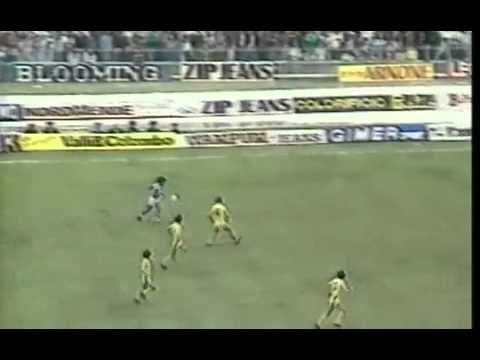
What was Maradona’s attitude to the furore?  He remained unflappable but when pressed for a comment he eventually reflected that scoring that goal felt like ‘picking the pocket of an Englishman’.  In this phrase, everything is captured; the powerful and pompous English gent who is fleeced by the devious wiles of a quick-thinking street urchin; here we have the perfect metaphor for both the stakes and the players in that infamous 1986 footballing clash and its controversial goal; but only moments later, subterfuge was transformed into sublimity, as Diego Maradona…struck again.  The English, perhaps still disorientated from the illegal goal, lose the ball behind their own half-way line and Maradona manages to pick it up.  He is, of course, surrounded by English players, nevertheless it is from this point when he begins his run.  The great sports commentator, Byron Butler described what happened next live and in real time, his voice, tense and urgent, becoming ever more ominous, gradually building to its crescendo as Maradona weaves his way toward the English goal: ‘Maradona, turns like a little eel, he comes away from trouble, little squat man … comes inside Butcher, leaves him for dead, outside Fenwick, leaves him for dead, and puts the ball away … and that is why Maradona is the greatest player in the world’.

Watching that hypnotic goal, along with the gravelly gravitas of Butler’s commentary, never fails to give me shivers.  I think it is because it is one of those transcendent moments in sport; all the implications – the political and cultural tensions which are being played out, the roar of the crowd, the sense that this encounter has pulled in millions upon millions across the globe – all of these worlds and experiences are suddenly distilled and condensed into ten seconds of pristine physical movement – the motion of a small, plucky figure, spiriting the ball across the bright terrain of green, and as the English players come crashing in, Maradona pivots and turns, and there is such free-flowing grace in his movements that they might as well have been pre-ordained; there is an inevitability in his run, and beyond all else, it is a moment of transcendental beauty.

Like Muhammad Ali, flitting and floating around the ring, Maradona is an athlete whose tremendous skill, in its peak moments, crosses over into the aesthetic with consequences both beautiful and sublime.  The goal is quite simply breath-taking and most commentators concur that it is the greatest of all time.  In the words of Byron Butler once again, ‘the first goal should never have been allowed, but Maradona has put a seal on his greatness. He’s left his thumbprint on this world cup. He scored a goal that England just couldn’t cope with, they couldn’t face up to, it was beyond their ability…it’s England 0, Diego Maradona 2.’

Those two goals – the handball and its sublime successor – are also instructive because they seem to hint at the type of duality which characterised Maradona’s existence more broadly.   The first, illustrates a type of plebeian cunning and bravado; sneaky, wily, audacious, with more than a hint of corruption.  The second speaks to the sense of creativity and imagination which arises from the underclass and the spirit of the streets.  For Maradona was born to the most extreme forms of poverty; he grew up in Fiorito, a poverty-stricken slum on the outskirts of Buenos Aires, home to a neighbourhood of people who were, by virtue of their geography, quite literally the outsiders.  As a child Maradona lived in a three roomed shack with a wire gate, a small patch of dirty earth and then the house itself.  He slept in a room which measured ‘no more than two metres square’ with his seven other siblings and when it rained ‘we walked around dodging the leaks; you got wetter inside than out. Forget a sink, we didn’t even have running water.’

When skimming through Maradona’s autobiography you get a vivid sense of this debilitating poverty, but you also get a strong sense of how his footballing abilities and his future self were shaped by it. He didn’t have the money to visit the local gym because, well…there was no money and there was no gym, and yet the lack of running water provided him with a fitness programme which would help develop his upper body strength: ‘That’s how I started weight training.   We would use empty twenty-litre cans of oil to fetch water from the only tap in the street, so my mum could wash, cook, everything’.

There was little to do in the neighbourhood; poverty ensured the local children’s options were limited – there was football, of course, and kite flying sometimes, but beyond that the children were pretty much left to their own devices.  And sometimes there wasn’t even the funds to stretch to a decent ball. For this reason, a young Maradona, already obsessed with the game, was compelled to improvise: ‘Everything I did, every step I took, was because of the ball.  If La Tota [his mother] sent me on an errand I would take with me anything that resembled a ball: it could be an orange, or scrumpled-up paper, or clothes.  And I would go up the steps on to the bridge that crossed the railway, hopping on one foot, the right one, and taking whatever it was on the left, tac, tac, tac…That’s how I walked to school as well.’

Again, that strange negation, that dialectical reversal, by which Maradona’s abilities were enhanced by his lack, his deprivation; his creative powers flowing into the gaps and absences which a poverty-stricken childhood entailed.  It is one thing to learn while using a brand new football, it is quite another to do so using an orange – which is that much harder to control and demands that much more skill.   When you see Maradona, in his prime, warming up before an important game, he does things with the ball – flicks and tricks – which are so astonishing they would not be out of keeping in a circus performance; and in the same moment, watching the adult Maradona do this against the glorious backdrop of a great national stadium and in full view of crowds of hundreds of thousands, you can still catch, in faint outline, the ghost of the boy which once was – a solitary child who took solace and joy from kicking an orange across the dilapidated streets of the barrio, totally engrossed in his game.

If poverty shaped the character of the footballer Maradona would become, it marked him politically too. His parents were working class to the core; lives conducted with stoic dignity, shaped by relentless labour and a fierce devotion to the lives of their children, along with an ingrained sense of community – a love of the barrio and its colourful raffish character, and the sights and the sounds of the streets and rivers and land:

I understood my old man, he was breaking his back to enable us to eat and study, and that’s what he wanted, for me to study…[He] was a boat man, he worked for Don Lupo, a man who owned some animals, mostly cows.  My dad would carry them over to the islands of the Paraná Delta to graze.  His life was on the river and he knew all its secrets. He still knows them.  He had a lot of things he liked there, things we still share today: fishing, asados or barbecues, and football…No one will ever make a tastier asado than my old man…But when La Tota called for him, he set off for Buenos Aires to get a job, and he got one. Job is a loose description, he worked in the Tritumol mill pounding cattle bones from four in the morning to three in the afternoon.

Along with the fortitude, there are moments of heartbreak.  Maradona, one of eight siblings, describes how for many years he believed his mother suffered from chronic stomach pain especially in the evenings when the family sat down together for dinner.  It was only when he reached the age of thirteen that he came to understand the truth: ‘She never had a stomach ache, she just wanted us to eat. Every time the food would come out, she would say “my stomach hurts”…It was because there was not enough to go round. That is why I love my old lady so much.’   It was from this brave and sometimes tragic example of his parents that Maradona derived his most essential motivation, the need for struggle: ‘I have happy memories of my childhood, although if I had to define Fiorito with just one word, it would be “struggle”.  In Fiorito, if it was possible to eat, people ate, and if it wasn’t, they didn’t.’

This was the struggle of the underclass more broadly, the struggle which extreme poverty inculcates, and its corollary – quite naturally – was one of anger; the anger which develops against suffering and exploitation – the anger which expresses one’s protest at human beings living in less than human conditions.  Maradona describes such anger with the colourful Argentine street-slang of his childhood, he calls it ‘bronca’, and for him this word expresses both the rage of the oppressed and the sense of solidarity and resoluteness such a feeling calls forth: ‘What nobody has understood, ever, was that our strength, our togetherness, was born from just that, from our bronca…the bronca we felt from having had to fight against everything. That’s how it had to be.’

Of course, Maradona was soon to traverse the distance from the most threadbare poverty to the most immense forms of wealth.  His phenomenal capacities were more and more manifest from an early age, and it wasn’t long before he was a feature of the local team Los Cebollitas (albeit that he sneaked onto the team at twelve years old, three years younger than his teammates).  Within a short time he was travelling across South America, playing in international tournaments, even appearing on local TV programmes exhibiting his skills with the ball.

A call from a premier division side swiftly followed; six days shy of his sixteenth birthday the young Maradona found himself playing his first match for Argentinos Juniors where he would go on to score 115 goals in 167 appearances, a particularly astonishing statistic for a youthful, untested player whose preferred position was mid-fielder rather than striker.   His precocious performances in Latin America eventually set the stage for a lucrative offer from Barcelona – one of the wealthiest and most prestigious teams in the world and one Maradona would join in late 1982.  By this point he had achieved what was one of his paramount ambitions; he had bought his parents a wonderful house to live in and had finally been able to ask ‘my old man for a very big favour; I pleaded with him to stop working. He was fifty, he had done enough for us. Now it was my turn.’

There is no doubt that the young Maradona had his head turned by the vastness of the money and fame his life had come into.  In the years to come he would cheat prolifically on his wife, he would father a love-child who he would shamefully refuse to acknowledge for many years, he would become addicted to cocaine and sex with prostitutes, and thoroughly seduced by the luxury and corruption of an existence which brought him into close contact with some unsavoury figures, including several heads of organised crime.

The sheer scope of the change in his circumstances, occurring at such a formative period of his life is almost unimaginable; the cataclysmic effects it had were such that they seemed to split him asunder, and from such a separation emerged two distinct personalities.  On the one hand there was ‘Diego’, the person the footballer had been – the thoughtful, brooding and introverted boy from the barrio, ardently determined to give his parents and his siblings a better life. On the other, there was ‘Maradona’, the brash, bold, creative genius who enjoyed the adulation of the world, and carried on his shoulders the hopes and dreams of an entire nation – the person ‘Diego’ was destined to become.  As his long-time fitness coach Fernando Signorini would have it, ‘[There was] the insecure kid and the character he came up with. With Diego, I would go to the end of the world. But with Maradona, I wouldn’t take a step.’

The ‘Maradona’ persona was no doubts formed as a result of the money, the fame and the bloated luxury, but it was also, perhaps, the only mechanism by which a fraught and fallible teenager might generate the kind of energy and confidence to meet the expectations and hopes of the millions of people who had come to believe in him.  Who more and more came to see him as a symbol of redemption and hope.  Maradona’s ultimate tragedy lies in the fact that the one persona would eventually come to eclipse the other – ‘Maradona’ would come to dominate ‘Diego’.   And yet, the boy from the barrio was never entirely vanquished.  It is true that Maradona secured fame on a global scale when he went to Barcelona – which was an incredibly wealthy and prestigious club – but despite the numerous exhibitions of his footballing brilliance, he never really seemed at home there.  The sheer physical change was unnerving – the European players were heavier, would run harder, were more ruthless and aggressive in terms of mounting physical pressure – ‘I found the transition from technique to fury very hard’.

But it wasn’t simply that.  Barcelona the club was saturated with money in a way in which the previous clubs Maradona had played for simply hadn’t been.  The joy and fluency of the game was increasingly subordinated to the relentless micromanagement of bureaucrats and managers whose ever expanding wealth and property portfolios depended on their ability to regard the football team as an industrial unit whose productivity needed to be maximised; whose public image needed always to be varnished through the obsequious and greasy appeals to an ever present media.  In the figure of José Luis Núñez – a man who had no connection to the club before his promotion to its president and was hitherto known only as a property entrepreneur – in José Luis Núñez the supremacy of the cash mandate was personified: ‘He was such a publicity seeker. He would do anything to appear in the media.  When we lost he would come weeping into the dressing room to offer us more money as if playing better or worse depended on the cash’.

Everything in Maradona’s being gravitated against such a social type; the sense he had inherited from the backbreaking labour endured by his mother and father back in Fiorito – the sense that the true source of life in any society comes from the people underneath who create the means by which everyone else lives: ‘There’s something very perverse going on with many football directors.  They’re not grateful: we the players give them power, we give them fame…while they are just the money-men. Núñez may have become famous for being the president of Barcelona but ‘Núñez y Navarro’ is his bread and butter: that’s the construction company he owns with his wife…That’s what most of them are like.’

There is something indelibly childlike about Maradona.  He weeps copiously with joy and disappointment alike.  He cries in the solitary confinement of a changing room toilet or he sheds his tears in front of millions.  He can be incredibly stubborn, spoilt and self-centred like a child, and at the same time he has in himself the beautiful simplicity of a child’s generosity (despite his great wealth, he has over the years found himself drained of funds, and this is often, one feels, due to the guileless faith he places in those who have extended him friendship, even if their motivations are less than pure).

But the most childlike aspect of all lies in his inability to shield his feelings; he wears his emotions on his sleeve.  When a particularly savvy reporter asks Maradona a loaded question, he will get drawn in, he will spill his guts whether in sympathy or outrage.   And for this reason Diego Maradona, the greatest player of all time, was always unable to ‘play’ a different type of game – for he would articulate spontaneously his unease or his antipathy toward a figure like Núñez, and more generally the forms of moneyed, institutional power such a figure represents.   In response ‘[Núñez] would organise press campaigns against me because he had a huge influence at a particular newspaper…he wouldn’t let me speak…I spoke out anyway.’

At one point the acrimony became so intense, Maradona’s desire to leave the club so powerful – that Núñez used bureaucratic means in order to confiscate Maradona’s passport.   Maradona’s time at Barcelona was capped off, most horrifically, by an incident during a game against Athletic de Bilbao, when he was the victim of one of the most ugly, senseless and deliberate tackles perpetrated by a long forgotten player called Antoni Goikoetxea – a tackle which was really just a veiled form of assault.   As the Basque player slid feet first into Maradona from behind, the latter ‘felt the impact, heard the sound, like a piece of wood cracking.’  As they stretchered off Maradona, he spoke choked words, in the midst of weeping ‘I’m broken, I’m broken’, the young virtuoso said.  People assume that Diego Maradona’s cocaine addiction came from the wealth and the fame and a developing sense of decadence, and I wouldn’t want to deny these factors, but I think it’s important to acknowledge as well that it began in his time with Barcelona and the tribulations he underwent there.

Despite the severity of his injury Maradona was able to recover and finally escape Spain.  But the team he now signed a contract with came as a surprise to both fans and pundits.  Maradona travelled to Italy in order to join the Serie A team Napoli.   But although, technically, Napoli were in the topflight league, they were nevertheless a low draw.  In their whole history, they had only ever won two cups.  They’d never won the championship.   For the past few years they had been fighting relegation, coming within just one point of slipping down into the lower leagues.    When Maradona joined them in 1984 he was already regarded as one of the best players in the world.  Why would he make what appeared to be such an odd career move?

Part of it was the fact that his finances had been, to use a euphemism, ‘mismanaged’, and despite his stratospheric success he already carried heavy debts.  Napoli were one of the first to offer him a way out and a new beginning, and they fought for Maradona in a way which some of the more elite clubs didn’t deign to do. But it wasn’t simply down to the practical details.  From the very beginning Maradona felt a strong spiritual affinity with the club and the city.  When the President of Junventus, Giampero Boniperti, had derided Maradona’s abilities, arguing that someone ‘with a physique like mine wouldn’t get anywhere’, Maradona responded by saying ‘Football is so beautiful, so unlike everything else, that it finds a way to fit everyone in. Even dwarves like me’.  Of course, the levelling effect Maradona was describing was about more than one’s physical template.   It was about the way in which football provided a gateway to joy and belonging for even the most downtrodden and disadvantaged of people.

One of Maradona’s fondest recollections comes from 1981 when he arrived with Boca to play a friendly in Africa against the Ivory Coast: ‘a crowd of locals stepped over the machete wielding police, and hung round my neck saying to me: Diego, Diego! They moved me, they really moved me.  Afterwards when we were having lunch at the hotel about twenty fans came up to me, and one said “Pelusa”. He said “Pelusa” to me! A little black kid in the Ivory Coast knew my childhood nickname.’  Maradona is both touched and humbled, this is one of the many anecdotes which registers his strong anti-racist credentials, but one can’t help but feel that such political sensibilities were in some way preordained.   After all, Maradona himself, because of his poverty and ‘moreno’ skin tone was often regarded in explicitly racial terms during his childhood in Argentina, was classified as in some way being ‘black’ for both derogatory and affectionate purposes. In the 2019 documentary about his life a commentator describes how Maradona was seen as a ‘shitty little black kid from the slums’ while at the same time Maradona himself talks with pride of being ‘a cabecita negra (a little black head), descended from poor Italian and Guarani stock, a laborer from the lowest reaches of society.’

We see here the intimate connection between race, poverty and exploitation, and this is most significant in understanding Maradona’s deep-felt connection with Napoli.  While the heads of the bigger clubs had remained aloof, Napoli’s bid for Maradona was a result of the fans themselves who went on hunger strike in order to demonstrate their determination to acquire the brilliant Argentine, an expression of people’s power which would further endear the club to the player.   It bears remembering that the first team Maradona had ever played with in a professional capacity –  las Cebollitas – had started off dirt poor, founded in the barrio by a group of friends who had socialist and anarchist principles and originally called the team the ‘Martyrs of Chicago’, after the anarchists who had been killed and imprisoned following the Haymarket Riots in Chicago in 1886.  It had a strong following amongst the poor and was rooted in the traditions of the working class which supported it.

And this was also true with Napoli.  Napoli as a club was a good deal poorer than the clubs to the North, but even more significantly, the city itself – like the southern region of Italy more broadly – had since the unification of the country in 1861 assumed an almost colony-like status within the context of the national framework; the South as a whole was very much reduced to an agricultural backwater which would provide the glittering, cosmopolitan North with the raw materials for its industrial project.  This geopolitical power disparity cultivated over almost a century and a half was rationalised in terms of a corresponding and corrosive anti-worker ideology which had obscenely racist overtones.  When, for example, the Napoli team travelled North to play Juventus, the Juve fans would often chant: ‘the Neapolitans are coming, sick with cholera, victims of the earthquake, you never washed with soap, Napoli shit, Napoli cholera, You are the shame of the whole of Italy.’  The racist undertone is apparent – the Neapolitans are dirty, diseased and so on.  When they played Inter Milan the racist chants against the Neapolitans would reach a sinister, fascist-like crescendo: ‘wash them, wash them, wash them with fire!’

Maradona intuited all this very swiftly; with the life experience of his own background, he understood exactly what it meant to be a despised outsider, to be exiled by virtue of your poverty and to be demeaned in and through the most toxic and sometimes racialist categories: ‘The Neapolitans were the Africans of Italy…I felt I represented a part of Italy which counted for nothing’.    For Maradona, playing for Napoli was always going to be imbued with great symbolism; a victory for them against the Northern clubs was simultaneously a victory for the working classes and the oppressed, a blow dealt against racism and a peon to the creativity and colour of the barrio.  Maradona recalls travelling to Turin in 1986 to play a big match against Juventus: ‘We were 1-0 down and when we equalised the stadium exploded, everyone was celebrating, going mad…We scored a second, and again there were huge celebrations. Then the third, and it went even crazier.  Then I realised: the stadium was full of workers, southerners the lot of them!  Napoli, Napoli! They were screaming. Amazing. We had truly become the club of the working class, of the poor.’

On a global scale people nearly always tend to remember the image of Maradona in the blue and white stripped Argentine strip, holding up the golden World Cup trophy, borne aloft on the shoulders of his teammates against the backdrop of hundreds of thousands of roaring spectators under that glorious blue-billowing sky.  What was remarkable about Argentina’s victory in ‘86 was that they simply weren’t the best team.  West Germany, France, Brazil, Italy, and yes, perhaps even England…all had a better all-round roster of players, all had a claim to be a stronger overall side, and yet, somehow, Argentina managed to triumph.  And that was very much down to Maradona.  But in a certain way his achievement with Napoli was even greater.  With Maradona at the helm, Napoli would win their first ever Serie A league championship in 1986-87, the Coppa Italia Cup in 1987 and the UEFA Super Cup in 1990.  Maradona brought them from being a ‘glorified second-division team’ into the elite category of one of the world’s best with a stockpile of sparkling silverware.

Maradona was able to accomplish this due to his unsurpassable talent on the pitch; he was the lead goal scorer in the 1987-88 season with 15 goals and eventually became the most prolific goal scorer the club had ever had up until that point.  The simple statistics, of course, don’t do him justice. He did things on the pitch that nobody had ever seen before, he seemed to subvert the very laws of motion.  The goal Maradona scores against Hellas Verona, for instance, when the ball is floated down to him from half way across the pitch, bouncing once, and he repositions himself to volley it from some thirty yards away, a smooth trajectory which spirals across space before finding the goal.   There is a casualness and fluidity to the strike which is just a work of art.

Or the curving, curling, freakish free kick he scores against Juventus which has all the instantaneous precision of a ballistic missile.  Or any number of the cheeky, joyful lobs which send goalkeepers scuttling backwards, tripping over their own feet to no avail.  Or those devious, staccato-like runs which send players one way and then the next before slipping the ball through someone’s legs, and making his escape in the aftermath of that staggering, bewildered defender.  But it was not only about the sublime beauty of unsurpassable skill.  It was also about a sublime footballing intelligence; Maradona’s ability to see the team in its totality, to intuit to a fault its fissures and weaknesses, to know exactly where the adjustments had to be made – and to have the ‘cojones’ to demand that the managers and directors make them: ‘I confronted the club president, Carrado Ferlaino, and said: ‘Buy me three or four players…Get me Renica of Sampdoria, who comes on as a 3, a defender, and in fact is a fucking first class libero.’ And that’s how we started building the team up.’

Most of all, Maradona’s ability to bring the Napoli team together came from the fact that Maradona himself had grown up in an atmosphere of poverty and exclusion; his was the ‘bronca’ which came from hardship – the intransigence of the rebel, along with the elusiveness of the underdog who owns nothing, can count on nothing, except for his wits and wiles.  In Naples he breathed the air of the oppressed, in that city Maradona recognised the raffish colour and character of the favela and of people who had nothing but would give everything on a wing and a prayer. In Napoli he felt his own nature – colourful and gregarious, rebellious and crafty – reflected back to him, and for their part, the Neapolitans sensed in Maradona a kindred spirit, someone who was of the street – someone who sang their songs, and dreamed their dreams – someone who could channel their creative aspirations, raising a bedraggled, despised city from the shadows and bathing its people in the glow of a luminous, rainbow hope.  In the words of Ed Vulliamy, the sports journalist who chronicled the life of the footballer in the city at the time, ‘Maradona and Naples shared a common heartbeat and soul’ – and it was this strange and wonderful synergy, as much as Maradona’s magical footballing prowess, which galvanized the strength and temper of the team and helped set the basis for an almost miraculous ascent.

Perhaps because of its despair, perhaps because of the city’s poverty and neglect – religious life in Naples had taken on a uniquely fervent and occult character; the streets, buildings and churches bustling with a plethora of plaster saints and strange, colourful reliquaries, while underneath – a rich byzantine world of crypt and catacomb opens up, replete with the tombs of generations of believers and the flickering shadows of their ghosts.  In the early-afternoon in light-flooded plazas, people read tarot cards on stalls, shops burst at the seams chock-full of religious icons with marble or ebony dolls stooped in prayer or raised on the cross. This has always been a city whose broader Christian vision of suffering and redemption was infused with a medieval sense of magic and the miraculous – and in Maradona these elements achieved perfect synthesis; his preternatural ability with the ball, his capacity to anticipate his opponents, before outflanking them, seemed like an act of divination – a feat of magic in its own right.  And what, ultimately, did this almost divine-like ability herald – other than the redemption of a whole society in and through the one individual blessed with almost Christ-like significance?

It was perhaps inevitable, therefore, that the adulation of Maradona would take on a religious hue; the footballer’s image appeared on murals on the dilapidated walls of poverty-stricken neighbourhoods, his rich dark eyes shining with the solemnity of the saint – and whenever he left his house to go to a restaurant or a shop within minutes the whole place was flooded with thousands of people desperate to reach out, to get an autograph, to touch him.  In one incident, a nurse stole the sample of a blood test Maradona had given – the pilfered vial ended up in the church of San Genarro as an actual relic of the goal-scoring saint.  Alongside Jesus and the apostles, many Neapolitans reserved a place for a picture of Maradona on their mantelpiece.

But such expectation, such adulation, could be stultifying and, ultimately, corrupting. There were darker influences at work in the city too.  The Camorra, the Naples mafia, took an interest in Maradona very early on, and it was an interest which Maradona repaid.  For Maradona tended to look at these shadowy figures in a rather naive and romanticised way; he saw them as rebels against society rather than the sinister parasites they tended to be, but at the same time they offered the young footballer something genuine and important.  They had the ways and means of giving Maradona what he craved; that is, time away from the crowds which had come to smother him.  The Camorra could isolate a nightclub or a bar, giving Maradona the kind of privacy and relief from the fans that he might not otherwise find.

And there were the more gaudy, glitzy offerings too.  A Rolex here.  A sports car there.  For a young man who had come from absolute poverty such luxury trinkets held a hypnotising allure.  Swiftly and easily, the Mafia absorbed Maradona into its subterranean world of exclusive restaurants and late night parties.  What did they require in return?  Only that Maradona would now and again appear at the opening event of one of their new business ventures, snapping the ribbon, creating the requisite level of publicity, marking their money with his mystical aura.   And along with the – well we might as well call them what they were – the bribes, the Camorra also provided Maradona with call girls and they fed his developing cocaine addiction, so that – whether he was aware of it or not – before long the young footballing genius had cultivated an intense dependence on them.

An ancient proverb has it that those the gods wish to destroy, they first make great.  The stunning victories the virtuoso achieved captaining Napoli were neatly elided into the late nights, the cocaine addiction, the call girls and the cars.  The lifestyle and the links with the mob would take their toll on his health, and also his character.  ‘El Diego’, the boy from the barrio – the boy whose most ardent dream was to one day provide a house for his impoverished parents to live in which had hot running water – was now increasingly shunted to the side in favour of the brash, self-serving superstar who was known to the world as ‘Maradona’.  Maradona was swaggering, confrontational, overbearing and an adept liar.  In perhaps the most sordid of his deceptions he refused to acknowledge the paternity of a son – the result of an affair with one of his sister’s friends Cristiana Sinagra.  Maradona denied outright the claim of Sinagra and allowed the implication to linger that she was an underhanded individual with dubious and dishonest motives.  To say the least, the Italian press didn’t treat her kindly.

But his illicit, drug-fuelled lifestyle also made its claim on Maradona’s footballing durability.  It is a testament to his genius that he was able to perform to the level he did while remaining a cocaine addict.  But the Maradona who entered the 1990 World Cup was simply not the same as the one who appeared in the ‘86 tournament.  Was he the best player in the world at that point?   Perhaps, perhaps not.   He still had moments of brilliance, but he no longer shone; he was no longer…hypnotic in the way of his earlier incarnation, and his contributions came from quick, clever touches rather than the blistering magnetic runs which would see him leave the opposition in tatters.

Players like Jürgen Klinsmann, Paul Gascoine, Salvatore Schillaci, Claudio Caniggia, and Maradona’s historic rival of old, Lothar Matthaus, all had a better claim to player of the tournament in that World Cup.  Argentina’s path to the final was lacklustre.  They sensationally lost to Cameroon in the early stages.  They took an offensive battering from Brazil in a game which, ultimately, they were lucky to come through.   What you can say about Maradona’s sometimes brilliant but patchy performance was that he never lost his talent for brinkmanship, to adjust the tactics and strategy of a lesser team in order to overcome a greater one; and most of all, he never lost his ability to bring the players together, to inspire in them the sense that they were underdogs fighting for a higher ideal, to coax from them every effort and sublimity.  But when Argentina lost in the final to West Germany one can only concede that the result was a just one, the better team had won.

There was another significant event in that World Cup which would ultimately determine the trajectory of Maradona’s career.  The semi-final match of Argentina vs Italy.   The game itself was played in Napoli.  In the run up to the encounter Maradona notoriously proclaimed that ‘Naples is not Italy’ in a bid to persuade Napoli fans to go over to Argentina when the clash took place.  Of course, Maradona had an important point; Italian nationalism had been the political product of the North as it secured its economic grip on the rest of the country in and through a newly created national framework; but at the same time it was an obviously self-interested ploy on Maradona’s part which was more than a little sly.

In the event, it created terrible press for Maradona in Italy more broadly, while within Naples itself fights broke out between those who wanted to follow Maradona and those who refused to relinquish their support for the motherland.  Perhaps the mood amongst the Napoli fans was best expressed on the day of the Argentina-Italy match, when the Italian crowds unfurled a large banner which read; ‘We love you Maradona, but Italy is our country’.  In the game itself, Italy looked the stronger throughout, scoring early and having the run of the ball, but a late goal from Caniggia ensured that Argentina remained competitive.  The game eventually went to penalties and Argentina were able to sneak the victory through the back door, the way they had in that tournament several times before.

The Argentine victory was the moment when the deep and intimate connection between Maradona and the city was torn asunder.  Almost overnight, Maradona became a figure of hate.  He was depicted as the villain who had, through the divisions he had sown, cost Italy the cup which was rightfully theirs – for the tournament had taken place on home soil and they were, by most bookmakers’ odds, the clear favourites.  Perhaps more significantly the ‘largesse’ he had enjoyed from the Italian state suddenly dried up and life in Italy ‘stopped being a paradise and became a hell. The first sign we were at war came just two days after the semi-final against Italy. My brother Lalo…was stopped by the police for speeding. He told them he didn’t have his papers on him…They came back to the concentración but with the wrong attitude…and all hell broke loose.’

In the next couple of years Maradona swiftly lost the support of his ‘friends’ in the Camorra.  Perhaps most importantly the Napoli authorities which had for so long turned a blind eye to his drug taking and use of prostitutes now had him in their sites.  In 1991 he tested positive for drugs after the match between Napoli and Bari.  Most decisively of all, Maradona was wiretapped; a recorded conversation in which he tried to procure prostitutes from his underworld contacts, and eventually he was charged with supplying those same women with cocaine.  To borrow Dickens’ most famous opening line, for Maradona, Napoli represented the best of times and the worst of times.  He had first arrived at the city to be greeted by tens of thousands of fans.  But when he finally left in 1991, he left ragged and in tears, and very much alone.

What happened in the years following?  Generally speaking it makes for a depressing read.  Maradona spiralled into further drug addiction, infamously being kicked out of his last World Cup in 1994 having once again tested positive for illegal substances.   He put on weight, his body becoming shapeless, worn and shuffling.  He played his final testimonial game in Buenos Aires in 2001, a game in which those who once considered him the most deadly of threats now regarded him only with pity: ‘The opposing players indulged him, stepping aside as he lumbered by. He scored two goals that day, both penalties against René Higuita, the former goalkeeper for the Colombian national team, who obliged his old friend by jumping out of the way.’

As the possibilities of playing football eventually dwindled to nowt, the drugs and the listlessness gradually consumed him; for the power which had once redeemed his existence, was now beyond his grasp.   In early middle-age, Maradona became obese and his drug addiction grew so extreme that the danger to his life became an acute one.  The image of him on a TV show, vastly overweight and immobile, sobbing before the host in a kind of befuddled terror is a harrowing one.  But it wasn’t all bad. There were some high points too. In 2007 he finally managed to shake his dependence on cocaine. In 2010 he became the manager of the national team taking them as far as the quarter finals in the World Cup. And in 2016, after so many years, he managed to do the right thing and acknowledge his paternity of the son he’d had by Cristiana Sinagra.

And yet, as the years went by, the affairs and the fast living left their irreparable toll.  More paternity suits arose, more illicitly fathered children. His childhood sweetheart Claudia Villafañe – the woman who had shared the hardship and poverty of Diego’s early days and the person to in some sense moor him to a more grounded and authentic existence – eventually separated from him, and the acrimony increased as both parties accused one another of stealing money.  In the process Maradona found himself alienated from his daughters.  He married again to Rocio Oliva – a woman thirty years his junior, but again this marriage collapsed, after a series of rows which culminated in an alleged assault by Maradona on his partner.

Despite all the fame and wealth – one receives the impression of a man entering his later years lost in space, untethered from the modes of being which had formed him.  Perhaps the tragedy of his life lies in the fact of his quite stratospheric success; that the rise of ‘Maradona’ was always going to precipitate the loss of ‘Diego’.  He had achieved a great deal but at the cost of straying far from everything that had once informed who he was.  And yet, this process was set into motion by the tragic demands of poverty itself and the desperate need to help his loved ones escape it.  ‘Maradona’ was the vehicle by which such a thing could be achieved, ‘Maradona’ was the creation of someone whose childhood had been curtailed and whose life had come to bear the hopes and responsibilities of first his own family, and then a whole generation: in the words of his younger sister, one of the few people to remember the boy that once was, the child of the favela: ‘my brother… At the age of 15 he stopped having a life, and became someone else’.  For Diego, such was the price of fame.

More articles by:

Tony McKenna’s journalism has been featured by Al Jazeera, The Huffington Post, ABC Australia, New Internationalist, The Progressive, New Statesman and New Humanist. His books include Art, Literature and Culture from a Marxist Perspective (Macmillan), The Dictator, the Revolution, the Machine: A Political Account of Joseph Stalin (Sussex Academic Press) a novel, The Dying Light (New Haven Publishing) and Toward Forever: Radical Refletions on History and Art  (Zero Books).

counterpunch.org

TΑ ΟΡΙΑ ΤΟΥ ΨΗΦΙΑΚΟΥ

0

ΑΡΙΑΔΝΗ ΧΑΤΖΗΓΙΩΡΓΗ

Τα μάτια κουράστηκαν από τις οθόνες. Ο φορητός υπολογιστής για τις βιντεοδιασκέψεις, το κινητό για τα μαθήματα στο βάιμπερ, η εκπαιδευτική τηλεόραση με πολύ καλά βιντεομαθήματα νωρίς το πρωί. Το κεφάλι έγινε καζάνι. Ντιν ντιν, βάιμπερ ξανά. Ντιν ντιν, τρέχα να απαντήσεις, μη νομίζουν ότι δεν διαβάζεις και λουφάρεις.

Το κεφάλι πονάει. Λύνει τις ασκήσεις, τις φωτογραφίζει, τις στέλνει, έρχονται σε λίγο φωτογραφημένες οι απαντήσεις. Μετά έρχονται απορίες από συμμαθητές και μαμάδες. Μετά τίποτα, κάποιος που κάτι ξέχασε να ρωτήσει. Φτάνει. Δεν θέλει άλλο κινητό, δεν θέλει να της αγοράσω φορητό δικό της.

Η δασκάλα ξοδεύει όλη τη μέρα να ετοιμάζει, να στέλνει, να διορθώνει και να απαντάει στην κάθε επίμονη μητέρα. Η σύνδεση κολλάει, το ουέμπεξ σε πετάει στα καλά καθούμενα έξω, μιλάς αλλά δεν ακούγεται, κάποιοι έχουν πρόβλημα, άλλοι όχι, κάποιοι δεν έχουν καν υπολογιστή.

Μιλούν τα εικονίδια σαν τους κουφούς, φωνάζοντας πολύ και πιάνοντας το νόημα μέσες-άκρες. Η δασκάλα επαναλαμβάνει αργά με έντονες κινήσεις των χεριών. Ο μαθηματικός είναι άγριος και από την οθόνη μοιάζει ακόμα χειρότερος.

Ντιν ντιν, φωτογραφίες από χειροτεχνήματα στο βάιμπερ. Αυτά δεν έχουν σχέση κι όμως τα στέλνουν. Ανοίγεις όλα τα μηνύματα γιατί μπορεί μέσα να είναι κάποια ανακοίνωση σοβαρή. Κάτι που έχασες, το έστειλαν χτες στο φέισμπουκ.

Όλη μέρα ανάμεσα στις οθόνες. Ντιν ντιν. Στις έντεκα το βράδυ κλείνουν όλα. Επιτέλους γαλήνη. Ολόκληρη μέρα σε εγρήγορση για μια επικοινωνία μετ’ εμποδίων.

Στο φυσικό κόσμο θα τέλειωνε σε λίγα λεπτά, στον ψηφιακό τραβάει σαν μαστίχα. Είχε και τα καλά του ο εγκλεισμός. Έδειξε πόσο λιγότερο μαγική είναι η τηλε-εκπαίδευση και τα συνοδευτικά της. Κάτι λίγα μπορεί, μια λύση ανάγκης, επιεικώς.

Το μαγικό ραβδί δεν κρύβεται στα καταστήματα ηλεκτρονικών. Δεν θέλουν άλλα γκάτζετ για δώρο επιστροφής. Την τάξη λαχταράνε και τη σχέση, το κύμα που συνεπαίρνει το μυαλό τους, άλλοτε καλά, άλλοτε άσκημα. Στην τάξη είναι η μαγεία. Και σε μια στίβα βιβλία, που διαλέγει το πιτσιρίκι επιμελώς με το σαββατιάτικο χαρτζηλίκι.


Η Ντοβίλ του γερμανικού Συνταγματικού Δικαστηρίου

1

του Ευάγγελου Βενιζέλου

Το πραγματικό αντικείμενο της απόφασης του Γερμανικού Ομοσπονδιακού  Συνταγματικού  Δικαστηρίου (ΓΟΣΔ)  της  5ης Μαΐου είναι  η οικονομική διακυβέρνηση της Ευρωζώνης ή μάλλον το μεγάλο στοίχημα της ευρωπαϊκής αλληλεγγύης και της ευρωπαϊκής ολοκλήρωσης και μάλιστα  εν μέσω πανδημίας.

Η απόφαση θέτει πολύ σοβαρά ζητήματα για την έννομη τάξη της Ευρωπαϊκής Ένωσης, για την υπεροχή και την αποτελεσματική εφαρμογή του Δικαίου της ΕΕ, για τη σχέση του Δικαίου της ΕΕ με τα Συντάγματα των κρατών μελών. Αλλά τα χρηματοοικονομικά προβλήματα που θέτει είναι ακόμα σημαντικότερα. Tο αντικείμενό της είναι το πρόγραμμα ποσοτικής χαλάρωσης, το PSPP, το περιβόητο QE της Ευρωπαϊκής Κεντρικής Τράπεζας, το οποίο εφαρμόζεται από το 2015.  Όμως έμμεσα η απόφαση αφορά και το νέο πρόγραμμα ποσοτικής χαλάρωσης, το Pandemic  Emergency Purchase  Program. Και, βεβαίως, όλη τη συζήτηση για την ενωσιακή αλληλεγγύη, το Ταμείο Ανάκαμψης, τα Ευρωομόλογα. Αυτά όλα ενδιαφέρουν ιδιαιτέρως την Ελλάδα, η οποία έχει λειτουργήσει ως μοχλός πίεσης και ως εργαστήριο προκειμένου να φτάσουμε στους νέους θεσμούς οικονομικής διακυβέρνησης αλλά και στην ποσοτική χαλάρωση.

Το ΓΟΣΔ θεωρεί ότι η ΕΚΤ, για την ακρίβεια το Ευρωπαϊκό Σύστημα Κεντρικών Τραπεζών που έχει την αποκλειστική αρμοδιότητα να ασκεί τη νομισματική πολιτική στην Ευρωζώνη, έχει εισχωρήσει βαθιά στο πεδίο της οικονομικής πολιτικής που είναι κυριαρχική αρμοδιότητα των κρατών μελών και επηρεάζει τα πάντα: Τα  επιτόκια, τις αποδόσεις των καταθέσεων, τις τιμές μετόχων και ακινήτων, το χαρτοφυλάκιο των εμπορικών τραπεζών, την αντοχή των κεντρικών τραπεζών, τους όρους χρηματοδότησης των κρατών μελών που είναι ίδιοι, ανεξάρτητα από τα οικονομικά και δημοσιονομικά δεδομένα κάθε κράτους μέλους.  Αυτό όλο – λέει το ΓΟΣΔ –  δεν το έχει εξετάσει  η ΕΚΤ  με βάση την αρχή της Αναλογικότητας. Δεν  έχει τεκμηριώσει ότι ασκεί τη νομισματική πολιτική με τρόπο πρόσφορο και αναγκαίο και επηρεάζει μόνο στο βαθμό αυτό την οικονομική πολιτική.

Αυτό συνεπώς που λέει το ΓΟΣΔ, είναι ότι η ποσοτική χαλάρωση, η οποία οργανώνεται ως δευτερογενής αγορά κρατικών κυρίως αλλά και εταιρικών ομολόγων, δεν είναι μία πραγματική αλλά  μια  εικονική δευτερογενής αγορά. Είναι βέβαιο ότι τα ομόλογα και οι άλλοι τίτλοι χρέους που εκδίδουν τα κράτη μέλη θα αγοραστούν δευτερογενώς από το Ευρωπαϊκό Σύστημα Κεντρικών Τραπεζών. Αυτό διαρκεί από το 2015 έως τώρα, έχει δημιουργήσει έναν τεράστιο όγκο αγοράς ομολόγων που έχει φτάσει στα 2,5 τρισ. ευρώ, έχουν γεμίσει με κρατικά ομόλογα  τα χαρτοφυλάκια των κεντρικών τραπεζών, μεταξύ αυτών και της Bundesbank, ενώ δεν υπάρχει στρατηγική εξόδου τους  από το πρόγραμμα.

Το ζήτημα λοιπόν που κατά βάθος θέτει το ΓΟΣΔ είναι  μήπως όλο  αυτό  βρίσκεται πολύ κοντά στην απαγορευμένη νομισματική χρηματοδότηση ( άρθρο 123 ΣΛΕΕ )  αλλά  και στα προγράμματα που προσφέρει ο ΕΜΣ  για τη στήριξη κρατών μελών , αλλά με αιρεσιμότητα ( conditionality ), δηλαδή με μνημόνιο.

Για εμένα, που έχω ζήσει τα θέματα αυτά μία πολύ δύσκολη περίοδο ως υπουργός  Οικονομικών, δεν υπάρχει καμία αμφιβολία ότι η Ευρωπαϊκή Κεντρική Τράπεζα έκανε και κάνει αυτό που πρέπει για να υποστηριχθεί η ευρωπαϊκή οικονομία. Η ΕΚΤ δεν κάνει τίποτε άλλο από αυτό που κάνουν όλες οι κεντρικές τράπεζες, ανταγωνιστικών προς την ΕΕ, μεγάλων οικονομιών, όπως η Fed. Μόνον που, δυστυχώς, η Ευρωπαϊκή Ένωση έχει επιβάλλει στον εαυτό της μη ορθολογικούς καταναγκασμούς.

Όλα αυτά ξεκινούν από το γεγονός ότι έχουμε Νομισματική Ένωση χωρίς να έχουμε Οικονομική Ένωση. Αυτό δημιουργεί μία  αέναη τριβή σε σχέση με την κατανομή των αρμοδιοτήτων, διότι η νομισματική πολιτική ασκείται από την ΕΚΤ, ενώ η οικονομική  και η δημοσιονομική πολιτική από τα κράτη μέλη τα οποία διεκδικούν την κυριαρχία τους.

Αυτό που  λέει το ΓΟΣΔ είναι μια τοποθέτηση  αντίστοιχη  με αυτή  που ακούσαμε εν μέσω ελληνικής κρίσης, το φθινόπωρο του 2010, από  την περιβόητη κοινή δήλωση της Ντοβίλ – την κοινή δήλωση Μέρκελ – Σαρκοζί τότε – ότι δεν είναι λογικό όλα τα κράτη μέλη της Ευρωζώνης να έχουν ίδια σχεδόν επιτόκια στις αγορές κεφαλαίου, πρέπει να υπάρχουν διαφοροποιήσεις στα επιτόκια ανάλογα με τα διαρθρωτικά χαρακτηριστικά και τις επιδόσεις κάθε οικονομίας.

Με νομικούς όρους το ΓΟΣΔ λέει ότι η ΕΚΤ δεν εξήγησε τεκμηριωμένα μέχρι ποιου σημείου μπορεί, δια της νομισματικής πολιτικής, να παράγει αποτελέσματα οικονομικής πολιτικής και άρα κινήθηκε ultra vires, υπερέβη τη δικαιοδοσία της. Το Δικαστήριο της Ευρωπαϊκής Ένωσης, με τη σειρά του, δεν άσκησε βαθύ έλεγχο σε ένα όργανο ( όπως η ΕΚΤ ) που είναι ανεξάρτητο και χωρίς δημοκρατική νομιμοποίηση  και άρα η λογοδοσία του πρέπει να γίνεται σε πολύ μεγάλο βαθμό ενώπιον του ΔΕΕ το οποίο παραβίασε έτσι μία γενική αρχή του Δικαίου της Ένωσης, μια κοινή συνταγματική παράδοση στην Ευρώπη, να ασκείται εντατικός έλεγχος συνταγματικότητας σε τέτοιες περιπτώσεις. Κάνοντας συνεπώς το ΔΕΕ έναν οριακό απλώς έλεγχο, λέγοντας δηλαδή ότι δεν υπάρχει «πρόδηλη» παραβίαση των Συνθηκών από την ΕΚΤ, εξέπεσε από τη δικαιοδοσία του. Άρα και αυτό κινείται  ultra vires, όχι επειδή  υπερέβη τη δικαιοδοσία του, αλλά επειδή δεν την άσκησε. Ultra vires από κάτω, διά παραλείψεως. Η παράδοση όμως που κυριαρχεί στην Ευρώπη ως προς τον δικαστικό έλεγχο περίπλοκων «τεχνικών» θεμάτων νομισματικής πολιτικής είναι μάλλον αντίστροφη, ο δικαστικός αυτοπεριορισμός και όχι ο δικαστικός ακτιβισμός .

Το  ΓΟΣΔ καλεί τώρα την  ΕΚΤ και  να παρουσιάσει  πρόσθετη  αιτιολογία εντός τριών μηνών, υπό την πίεση της Γερμανικής Κυβέρνησης και της Γερμανικής Βουλής, αλλά και της Bundesbank, η οποία κατέχει το 26% του κεφαλαίου της ΕΚΤ. Επιπλέον η  Bundesbank καλείται να ετοιμάσει και μία στρατηγική εξόδου από το PSPP, να αρχίσει να «ξεφορτώνεται» ομόλογα που έχει «φορτωθεί» και είναι κυρίως γερμανικά ! Κατά το Γερμανικό Συνταγματικό Δικαστήριο,  αυτά που  έλεγε η ΕΚΤ το 2015 έχουν μία λογική, αλλά τώρα είμαστε στο 2020, το QE εφαρμόζεται πολλά χρόνια,  οι όγκοι είναι πλέον  τεράστιοι και στην πραγματικότητα τα κράτη εκδίδουν ομόλογα με τη βεβαιότητα ότι θα τα αγοράσει το Ευρωπαϊκό Σύστημα Κεντρικών Τραπεζών. Δεν υπάρχει πραγματική απόσταση μεταξύ πρωτογενούς και δευτερογενούς αγοράς, δεν υπάρχει black out period, έχουν αγοραστεί πολλά  ομόλογα με αρνητικές αποδόσεις, τα ομόλογα διακρατούνται μέχρι τη λήξη. Οι απαντήσεις υπάρχουν, το ερώτημα είναι πώς και προς ποιον θα δοθούν.

Η απόφαση δεν παράγει άμεσα πρακτικά αποτελέσματα, αλλά η συνέχεια θα εξαρτηθεί από το πώς θα φερθεί η Bundesbank μέσα στην ΕΚΤ και το Ευρωπαϊκό Σύστημα Κεντρικών Τραπεζών. Κατά τη γνώμη μου έχει διαμορφωθεί μία παγίδα: Πώς πρέπει  να αντιδράσει  η ΕΚΤ, η Ευρωπαϊκή Επιτροπή αλλά και το Συμβούλιο; Θα κινηθεί η  διαδικασία επί παραβάσει κατά της Γερμανίας, πότε πρέπει  να γίνει αυτό και τι αποτελέσματα μπορεί να έχει; Απολύτως συναφές είναι το ερώτημά αν – με δεδομένο ότι η ευρωπαϊκή ολοκλήρωση είναι μία διαρκής διακρατική διαπραγμάτευση – ενισχύεται η θέση της Γερμανικής Κυβέρνησης με την απόφαση αυτή ή αποδυναμώνεται; Μήπως τώρα μπορεί η Γερμανική Κυβέρνηση, επικαλούμενη το Συνταγματικό της Δικαστήριο και τα προβλήματα εσωτερικής συνταγματικής ταυτότητας που αυτό θέτει, να γίνει πιο άκαμπτη, πιο πιεστική; Μήπως, ναι μεν θα   διασωθεί το τρέχον QE , αλλά θα  τεθούν νέοι όροι στο Pandemic Emergency Purchase Programme στο οποίο μετέχει και η Ελλάδα; Μήπως αυτό επηρεάσει τον τρόπο λειτουργίας του ESM, που εκδίδει δικά του ομόλογα και τα κράτη μέλη λειτουργούν ως εγγυητές; Μήπως αυτό επηρεάσει τη λειτουργία της Ευρωπαϊκής Αναπτυξιακής Τράπεζας, η οποία επίσης θα μετάσχει στο μεγάλο πρόγραμμα βοήθειας προς τις μικρομεσαίες επιχειρήσεις; Μήπως αυτό ενταφιάσει οριστικά όλη τη συζήτηση για το κοινό χρέος και την αμοιβαιοποίηση του χρέους; Δημιουργείται ένα  σκηνικό, το οποίο έχει διαστάσεις οι οποίες δεν αντιμετωπίζονται με απλά θεσμικά επιχειρήματα. Έχει μπει μία νάρκη στα θεμέλια, τα θεσμικά και τα νομισματικά, της ΕΕ  και πρέπει να δούμε αν αυτή η νάρκη μπορεί να απασφαλισθεί εξαρχής, ώστε  να μη  υφέρπει  δηλητηριάζοντας τη λειτουργία και την προοπτική της Ένωσης.

“Τα Νέα”


Τι είναι το «boogaloo»; Πώς οι διαδικτυακές κλήσεις για μια βίαιη εξέγερση γίνονται mainstream

1

Brandy Zadrozny 19 Φεβρουαρίου 2020

nbcnews.com

Το κίνημα επιδιώκει έναν δεύτερο εμφύλιο πόλεμο με στόχο φιλελεύθερους πολιτικούς  και την επιβολή του νόμου.

Ένα αντικυβερνητικό κίνημα που υποστηρίζει μια βίαιη εξέγερση στοχεύει φιλελεύθερους πολιτικούς αντιπάλους και την επιβολή του νόμου έχει μετακινηθεί από τα περιθώρια του Διαδικτύου και έγινε mainstream  ανέβηκε στα μέσα κοινωνικής δικτύωσης τους τελευταίους μήνες, σύμφωνα με μια ομάδα ερευνητών που παρακολουθεί ομάδες μίσους.

Το κίνημα, το οποίο λέει ότι θέλει έναν δεύτερο εμφύλιο πόλεμο που διοργανώνεται γύρω από τον όρο “boogaloo”, περιλαμβάνει ομάδες σε κύριες διαδικτυακές πλατφόρμες όπως το Facebook, το Instagram, το Twitter και το Reddit, καθώς και ιστότοπους ,περιλαμβανομένου του 4chan, σύμφωνα με έκθεση που κυκλοφόρησε την Τρίτη 18 Φεβρουαρίου 2020 το βράδυ. από το Network Contagion Research Institute (NCRI), ένα ανεξάρτητο μη κερδοσκοπικό δίκτυο επιστημόνων και μηχανικών που παρακολουθεί και αναφέρει παραπληροφόρηση και ρητορική μίσους στα κοινωνικά μέσα.

Ενώ οι εκκλήσεις για οργανωμένη και στοχευμένη βία με τη μορφή ενός νέου εμφυλίου πολέμου είχαν προηγουμένως κυκλοφορήσει μεταξύ ορισμένων ομάδων μίσους, η εμφάνιση του όρου «boogaloo» φάνηκε να είναι ένα νέο και διακριτό κίνημα. Οι ερευνητές του NCRI που ανέλυσαν περισσότερες από 100 εκατομμύρια δημοσιεύσεις και σχόλια στα μέσα κοινωνικής δικτύωσης διαπίστωσαν ότι μέσω της χρήσης μιμιδίων – μέσω αστείων, συνήθως με τη μορφή εικόνων – οι εξτρεμιστές έχουν ωθήσει μηνύματα κατά της κυβέρνησης και κατά του νόμου σε πλατφόρμες κοινωνικών μέσων. Έχουν επίσης οργανώσει διαδικτυακές κοινότητες με δεκάδες χιλιάδες μέλη, μερικά από τα οποία έχουν συγκεντρωθεί σε εκδηλώσεις του πραγματικού κόσμου.

Η έκθεση “αντιπροσωπεύει μια πρωτοποριακή μελέτη όσον αφορά την ικανότητα εντοπισμού σμηνών στον κυβερνοχώρο και viral εξεγέρσεων σε σχεδόν πραγματικό χρόνο καθώς αναπτύσσονται σε καθαρή θέα”, έγραψε στο πρόλογο της έκθεσης ο John Farmer, πρώην γενικός εισαγγελέας του Νιου Τζέρσεϋ, διευθυντής του Miller Center for Community Protection and Resilience στο Rutgers University.

Η έκθεση έρχεται καθώς αξιωματούχοι επιβολής του νόμου των ΗΠΑ και ερευνητές σε διάφορα επίπεδα έχουν εκδώσει προειδοποιήσεις σχετικά με την αυξανόμενη απειλή που θέτουν οι εγχώριοι εξτρεμιστές, οι οποίοι παρακινούνται από περιθωριακές ιδεολογίες και θεωρίες συνωμοσίας.

Ο διευθυντής του NCRI Joel Finkelstein, ερευνητής του προγράμματος James Madison στο Πανεπιστήμιο του Πρίνστον, δήλωσε ότι η έκθεση είχε σταλεί σε μέλη του Κογκρέσου και στα τμήματα Άμυνας, Εσωτερικής Ασφάλειας και Δικαιοσύνης, μεταξύ άλλων.

Ο Πολ Γκόλντενμπεργκ, μέλος του Γνωμοδοτικού Συμβουλίου Εσωτερικής Ασφάλειας, δήλωσε ότι η έκθεση ήταν «έκκληση αφύπνισης». “Όταν έχετε ανθρώπους που μιλάνε και σχεδιάζουν καταστολή και βία κατά μειονοτήτων, αστυνομίας και δημόσιων αξιωματούχων, πρέπει να λάβουμε σοβαρά υπόψη τα λόγια τους”, δήλωσε ο Γκόλντενμπεργκ, που είναι επίσης διευθύνων σύμβουλος της εταιρείας συμβούλων ασφαλείας Cardinal Point Strategies.

Ο Γκόλντενμπεργκ είπε ότι η έκθεση «έγινε viral» στις αρχές επιβολής του νόμου και των πληροφοριών από την περιορισμένη κυκλοφορία της την περασμένη εβδομάδα. Οι άνθρωποι το διαβάζουν και το διανέμουν “ευρέως”, είπε.

Το τρέχον κίνημα boogaloo παρατηρήθηκε για πρώτη φορά από ερευνητές του εξτρεμισμού το 2019, όταν περιθωριοποιημένες ομάδες απο διεκδικητές του δικαιώματος οπλισμού και κινήματα πολιτοφυλακής ως τους υπέρμαχους των λευκών άρχισαν να αναφέρονται σε έναν επικείμενο εμφύλιο πόλεμο χρησιμοποιώντας τη λέξη “boogaloo”, μια αστεία αναφορά στο “Breakin ‘2: Electric Boogaloo” , “μια ταινία του 1984 για το breakdancing.

Ο όρος χρησιμοποιείται για να περιγράψει μια εξέγερση εναντίον μιας φαινομενικά τυραννικής ή αριστερής κυβέρνησης, συχνά ως απάντηση σε μια απειλή διαδεδομένης κατάσχεσης όπλων. Για πολλούς, η λέξη “boogaloo” – ανόητη – χρησιμοποιείται αστεία ή ειρωνικά, αλλά για άλλους, τα μιμίδια boogaloo μοιράζονται μαζί με βίαιο κείμενο και εικόνες, φαινομενικά να πυροδοτούν μια ενδεχόμενη αντιπαράθεση.

Τους τελευταίους τρεις μήνες, η συζήτηση που σχετίζεται με το boogaloo αναπτύχθηκε ραγδαία, σύμφωνα με τους ερευνητές, οι οποίοι διαπίστωσαν ότι η χρήση του όρου έχει αυξηθεί σχεδόν κατά 50% σε πλατφόρμες όπως το Reddit και το Twitter τους τελευταίους μήνες. Αυξημένη έκθεση, προειδοποιούν οι ερευνητές, ενέχει τον κίνδυνο της κατήχησης.

Οι εξτρεμιστές Boogaloo έχουν χρησιμοποιήσει τα μέσα κοινωνικής δικτύωσης για “στρατηγική, να διανείμουν σε κοινή χρήση οδηγίες για εκρηκτικά και τρισδιάστατα τυπωμένα πυροβόλα όπλα, διανομή παράνομων τροποποιήσεων πυροβόλων όπλων και σιφώνιο χρηστών σε κρυπτογραφημένους πίνακες ανταλλαγής μηνυμάτων μαζικά”, σύμφωνα με την έκθεση NCRI. Η έκθεση σημειώνει επίσης τον τρόπο δημιουργίας εσόδων από την έννοια του boogaloo, εμπορευμάτων που διαφημίζονται μέσω διαφημίσεων Facebook και Instagram, και διατίθενται στο εμπόριο σε τρέχοντα και πρώην μέλη του στρατού. Στο Facebook και το Instagram, οι ερευνητές επεσήμαναν αρκετές δημόσιες ομάδες και λογαριασμούς boogaloo με δεκάδες χιλιάδες μέλη και οπαδούς.

Ένας εκπρόσωπος του Facebook δήλωσε μέσω ηλεκτρονικού ταχυδρομείου ότι η εταιρεία παρακολούθησε ομάδες που καλούν σε βία. “Μελετήσαμε τις τάσεις γύρω από αυτό και σχετικούς όρους στο Facebook και το Instagram”, δήλωσε ο εκπρόσωπος. “Δεν επιτρέπεται η ομιλία να χρησιμοποιείται για την υποκίνηση μίσους ή βίας και θα καταργήσουμε οποιοδήποτε περιεχόμενο παραβιάζει τις πολιτικές μας. Θα συνεχίσουμε να το παρακολουθούμε σε όλη την πλατφόρμα μας.”

Από τότε που η NCRI δημιούργησε την έκθεση την περασμένη εβδομάδα, η συμμετοχή σε πολλές ομάδες boogaloo στο Facebook έχει σχεδόν διπλασιαστεί, σύμφωνα με μια ανάλυση του NBC News. Δύο από τις πιο δημοφιλείς ομάδες boogaloo του Facebook, που διέθεταν περίπου 20.000 ακόλουθους κατά την ίδια περίοδο, δεν είναι πλέον διαθέσιμες αυτήν την εβδομάδα.

Μοιάζει πολύ με το συμβολισμό ΟΚ του χεριού που επέλεξαν λευκοί εθνικιστές που αργότερα αρνήθηκαν την ένωση, η ασάφεια του όρου «boogaloo» λειτουργεί για να καλύψει την εξτρεμιστική οργάνωση.

“Όπως ένας ιός που κρύβεται από το ανοσοποιητικό σύστημα, η χρήση κωμικο- μιμιδιακής γλώσσας επιτρέπει στο δίκτυο να οργανώνει τη βία κρυφά πίσω από έναν αντικατοπτρισμό εσωτερικών αστείων και εύλογης άρνησης”, αναφέρει η έκθεση.

Ο όρος “boogaloo” έχει επίσης φανεί στον πραγματικό ακτιβισμό. Κατά την ετήσια Ημέρα Λόμπι της Βιρτζίνια του Ρίτσμοντ τον Ιανουάριο, μια ομάδα διαδηλωτών που πήγαν με το όνομα Patriot Wave φορούσαν τα μπαλώματα Pepe the Frog με το “Boogaloo Boys”. Ένας άντρας έφερε μια πινακίδα που έγραφε, “Έχω ένα όνειρο για ένα Boogaloo.”

Η συγκέντρωση πραγματοποιήθηκε την ημέρα του Martin Luther King Jr.

Το NCRI μπόρεσε να εντοπίσει την προέλευση της χρήσης του όρου “boogaloo” στον πίνακα μηνυμάτων που εστιάζει στην πολιτική της 4chan, όπου ξεκινούν συχνά τα ρατσιστικά και τα μιμίδια μίσους. Το “Boogaloo” συσχετίστηκε συχνά με αποκαλυπτικούς και ρατσιστικούς όρους όπως “racewar” και “dotr”, μια φανταστική λευκή δύναμη που φαντάζεται μια εποχή που θα δολοφονηθούν οι “προδότες φυλών”.

Η αναφορά παρακολούθησε συνομιλίες  στο διαδίκτυο για ένα επικείμενο boogaloo. Η ανάλυση εντόπισε μια αποκορύφωση κατά τη διάρκεια μιας διαμάχης τον Νοέμβριο στην πολιτεία της Νέας Υόρκης μεταξύ ενός βετεράνου του στρατού και της αστυνομίας για μια εσωτερική διαμάχη. Ο βετεράνος, Alex Booth, την χαρακτήρισε αδιέξοδο στον λογαριασμό του στο Instagram, “Whisky Warrior 556”, ισχυριζόμενος στους οπαδούς ότι τα όπλα του είχαν κατασχεθεί. Το περιστατικό έκανε το μιμίδιο boogaloo να γίνει viral και  ο Booth κέρδισε πάνω από 100.000 οπαδούς.

Η δεύτερη κορυφή του μιμιδίου boogaloo εμφανίστηκε γύρω από την καταγγελία κατά του Προέδρου Donald Trump, σύμφωνα με την έκθεση.

Νέα δεδομένα στην «εξίσωση» Τουρκία

0

του Σάββα Καλεντερίδη

Στην Τουρκία συμβαίνει την περίοδο αυτή κάτι που συνέβαινε στις ΗΠΑ πριν από μερικές δεκαετίες. Τότε που οι βιομηχανίες όπλων αποτελούσαν σημαντική συνιστώσα της οικονομίας της υπερδύναμης, και θεωρούνταν υπεύθυνες για μερικούς από τους πολέμους που διεξήγαγαν οι ΗΠΑ σε διάφορα σημεία του κόσμου.

Φυσικά ο κάθε πόλεμος εξυπηρετούσε και κάποιον στρατηγικό στόχο και συμφέροντα των ΗΠΑ, όμως η άποψη ότι οι βιομηχανίες όπλων ενίσχυαν την πολιτική των πολέμων, αφενός για να δοκιμάζουν τα νέα όπλα και αφετέρου για να αυξάνουν τις πωλήσεις τους, δεν ήταν εκτός λογικής και πραγματικότητας.

Από τότε που οι εταιρείες υψηλής τεχνολογίας για προϊόντα που δεν έχουν σχέση με την αμυντική βιομηχανία, κατέλαβαν σημαντικό μέρος στην οικονομία των ΗΠΑ, ο ρόλος των βιομηχανιών όπλων, έχασε την… αίγλη που είχε τις προηγούμενες δεκαετίες. Και αυτό, αντικατοπτρίζεται σε έναν βαθμό και στην εξωτερική πολιτική των ΗΠΑ.

Για παράδειγμα, η επεμβάσεις σε ξένες χώρες δεν γίνονται με στρατιωτικά πραξικοπήματα, αλλά με τις λεγόμενες «έγχρωμες επαναστάσεις», που στηρίζονται στη χρήση υψηλής τεχνολογίας.

Αυτό που έγινε τις προηγούμενες δεκαετίες στις ΗΠΑ, παρατηρείται σήμερα στην Τουρκία.

Το εμπάργκο που επέβαλαν οι ΗΠΑ στην Τουρκία, μετά την εισβολή στην Κύπρο το 1974, με πρωτοβουλία της ελληνικής ομογένειας, δημιούργησε ένα τραύμα στο στρατιωτικό κατεστημένο της Άγκυρας, το οποίο αποφάσισε να υιοθετήσει στρατηγική ανάπτυξης εθνικής αμυντικής βιομηχανίας.

Μετά από τέσσερις δεκαετίες η Τουρκία έκανε αρκετά βήματα, με αποτέλεσμα σήμερα να έχει αποκτήσει μια αμυντική βιομηχανία που ικανοποιεί σε βαθμό άνω του 55% τις ανάγκες των τουρκικών ενόπλων δυνάμεων (ΤΕΔ), ενώ κάνει και εξαγωγές (2019 εξαγωγές αξίας 1,36 δισεκατομμυρίων δολαρίων).

Το πρόβλημα για την Κύπρο, την Ελλάδα και την ευρύτερη περιοχή, είναι ότι η αμυντική βιομηχανία της Τουρκίας δεν μπορεί να σταθεί στα πόδια της με τόσο λίγες εξαγωγές. Άρα, ο μεγάλος «πελάτης» είναι το τουρκικό κράτος, οι ΤΕΔ, η στρατοχωροφυλακή και η αστυνομία.

Μια ιδιαιτερότητα.

Τα τελευταία χρόνια ο ίδιος ο Ερντογάν έβαλε στο «παιχνίδι» της αμυντικής βιομηχανίας και τον λεγόμενο ιδιωτικό τομέα. Δηλαδή, τον γαμπρό του και άλλους κομματικούς φίλους, οι οποίοι απέκτησαν εκ του ασφαλούς και εκ του μηδενός βιομηχανίες παραγωγής αμυντικού υλικού, εξασφαλίζοντας μερίδιο από την αγορά, με κύριο πελάτη το κράτος που είναι και καλοπληρωτής.

Γιατί αποτελεί πρόβλημα αυτό για την περιοχή.

Γιατί αυτή η κάστα πολιτικών και επιχειρηματιών που έχει δραστηριοποιηθεί στο «παιχνίδι με τα όπλα», τρέφεται με τους πολέμους.

Δεν θα πρέπει δε να θεωρηθεί υπερβολή η άποψη ότι πίσω από την εμπλοκή της Τουρκίας στους πολέμους στη Συρία, την Υεμένη και τη Λιβύη, κρύβονται τα μέλη αυτής της «κάστας του πολέμου», χωρίς να σημαίνει ότι δεν υπάρχει και το στρατηγικό σχέδιο της Τουρκίας, στο οποίο εντάσσεται και αποκτά εσωτερική πολιτική νομιμοποίηση η εμπλοκή της Τουρκίας σ’ αυτούς.

Θεωρώ ότι στην ανάλυσή μας, από τούδε και στο εξής, θα πρέπει να βάλουμε και αυτόν τον παράγοντα, αφού όσο περισσότερα μέτωπα ανοίγει ο Ερντογάν, τόσο περισσότερα δολάρια μπαίνουν στις τσέπες της οικογένειας και της «κάστας του πολέμου».

Στο θέμα θα επανέλθουμε, όμως πρέπει να σημειώσουμε ότι αυτή η κατάσταση έχει ενισχύσει τα πιο συντηρητικά και σοβινιστικά στοιχεία του τουρκικού κράτους και του τουρκικού πολιτικού κατεστημένου.

Αυτό το κατεστημένο ώθησε την Τουρκία στο βάλτο της Συρίας, αυτό το κατεστημένο την έσυρε στην περιπέτεια της Λιβύης, στην υπογραφή της καταστροφικής για την Ελλάδα τουρκολυβικής συμφωνίας, στην υιοθέτηση του δόγματος της Γαλάζιας Πατρίδας και της ευθείας διεκδίκησης ακόμα και της Κρήτης, αυτό το κατεστημένο επιτίθεται στον Οικουμενικό Πατριάρχη, με γελοίες κατηγορίες, που όμως τον στοχοποιούν.

Και μια που μιλήσαμε για τον Οικουμενικό Πατριάρχη, η Ελλάδα και η ελλαδική κοινωνία θα πρέπει να δείξει τον δέοντα σεβασμό στον αρχαιότερο θεσμό της ανθρωπότητας αλλά και στο πρόσωπο που τον υπηρετεί με πίστη και αφοσίωση, από το 1991, κάτω από εξαιρετικά δύσκολες συνθήκες.

Η επίθεση στο πρόσωπο του Οικουμενικού Πατριάρχη από τα σοβινιστικά ρατσιστικά κέντρα του τουρκικού κράτους, που δεν χόρτασαν αίμα με τις γενοκτονίες των Ελλήνων, Αρμενίων, Ασσυρίων και Κούρδων αλεβιτών του Ντερσίμ, δεν είναι εσωτερικό θέμα της Τουρκίας.

Είναι ένα διεθνές ζήτημα, το οποίο οφείλει η ελληνική κυβέρνηση να θέσει και να θέτει συνεχώς σε όλα τα διεθνή φόρα, γιατί αυτό επιβάλλει η ίδια η ιστορία.

Όσο για εκείνους που εκ του ασφαλούς δεν χάνουν την ευκαιρία να ξιφουλκούν εναντίον του Οικουμενικού Πατριάρχη, ως άνθρωπος που έχω ζήσει στην Τουρκία, θα ήθελα να τους διαβεβαιώσω ότι δεν θα άντεχαν ούτε 24 ώρες να ζήσουν κάτω από τέτοιες συνθήκες, και να υπηρετήσουν ταυτόχρονα με συνέπεια το υψηλότερο βάθρο της Ορθοδοξίας.

pontos-news.

The U.S. Must Beat China at its Own Game in South China Sea

0

National Interest

May 13, 2020 Topic: Security Region: Asia Tags: ChinaSouth China SeaSalami-slicingMilitaryDiplomacy

To date, diplomacy has not worked to roll back China’s actions in the South China Sea, nor will it so long as China believes its salami-slicing works. Perhaps, then, to be effective and to signal support for allies and protect freedom of navigation, it is time for Washington to join Beijing for a salami-themed picnic.

by Michael Rubin

Mike Pompeo’s greatest legacy as Secretary of State may be as the first chief diplomat to stand up systematically to Chinese propaganda, Beijing’s underhandedness, the communist regime’s rampant theft of hundreds of billions of dollars’ worth of international property, and the country’s general flouting of international norms. Previous administrations may have had an occasional tough word for China, but few sustained them or moved beyond the rhetoric. China’s economic might, trade importance, and military potency gave prior administrations pause. All knew something needed to be done but, like those American officials who place hopes in Iranian reformists never mind that such a gamble has never paid off, they placed all their bets on the idea that China’s political moderation would follow its economic liberalization. They believed China would embrace the post-World War II liberal order rather than seek to defeat it.

Obfuscation about the origins of the COVID-19 crisis is a symptom of Chinese political culture, but it was a reactive response to a crisis rather than proactive strategy to foment one. The same cannot be said about China’s actions in the South China Sea where it is increasingly engaged in an unprecedented grab of maritime territory. If President Xi Jinping successfully fulfills his ambition to transform low-tide elevations and rocks into islands and claim not only a 12 nautical mile territorial sea around each one, but also a 200 nautical mile exclusive economic zone, the total territory China now seeks to control puts it on par with European powers’ nineteenth-century imperial grabs.

The historical and legal basis of the People’s Republic of China’s claims to the South China Sea are fantastical with no basis in history, international law, or geology. China roots its claims in the so-called “Nine-Dash Line” which first appeared on maps only in 1947; Chinese maps from centuries past, however, show no such claims. While Chinese officials also back Beijing’s claims by arguing that the areas included within the Nine-Dash Line were traditional Chinese fishing grounds, this argument is meaningless as Vietnamese, Filipinos, and Malaysian fishermen also plied the same waters historically.

Some diplomats bend over backwards to accommodate the narratives of those sitting across the table. History, however, is not so flexible. As part of the 1898 Treaty of Paris ending the Spanish-American War, Spain sold the Philippines to the United States for $20 million. Both Madrid and Washington considered Mischief Reef and Scarborough Shoal—the former occupied by China and the latter administered by it despite a Permanent Court of Arbitration ruling against Beijing–to be Filipino territory. Likewise, when the Philippines gained their full independence on July 4, 1946, they assumed control over both the Scarborough Shoal and Mischief Reef. Simply put—and as the arbitration ruling concluded—China has no valid legal or historic claims to either.

The same story continues across the South China Sea. The Center for Strategic and International Studies’ invaluable Asia Maritime Transparency Initiative publishes and analyzes open-source satellite imagery of the islands, rocks, and low-tide elevations which dot the South China Sea and show visually China’s ‘salami-slicing’ strategy of slowly transforming reefs and rocks into artificial islands and building military bases, anti-aircraft batteries, and surveillance stations on them.

While Pompeo’s willingness to take on Chinese propaganda is welcome, it is questionable whether winning in the court of public opinion will be enough to alter Chinese behavior. Diplomacy has value, but can only provide a solution when both sides approach it for the same purposes. For too long, however, China’s Ministry of Foreign Affairs has approached diplomacy as an asymmetric warfare strategy with which to tie opponents’ hands together while they advance their military position.

The United States sees the South China Sea as international waters and refuses to recognize the basin’s reefs and low-tide elevations as islands deserving of exclusive economic zones. Perhaps, however, it is time to make an exception.

China’s claims that the rocks, shoals, and reefs it illegally occupies are islands are discernably false. One feature in the South China Sea, however, does meet the criteria to be an island. While its claim is disputed by China, Vietnam, and the Philippines, Taiwan possesses Itu Aba (Taiping Island), the largest land feature in the Spratley chain. Taiwan has long claimed that Itu Aba is an island deserving of its own exclusive economic zone although, in 2016, an arbitration panel convened at the Philippines’ request found that Itu Aba was merely a rock deserving only of 12 nautical mile territorial waters. The ruling itself, however, was flawed. One of the major features of an island is that it possesses fresh water to sustain life. Residents on Itu Aba trap rainwater and so they do access enough freshwater and can support a meaningful economy. The 2016 ruling’s logic was likely convoluted and discarded precedent.

To beat China at its own game and better protect freedom of navigation, Secretary of State Mike Pompeo should recognize both Itu Aba’s status as an island and Taiwan’s claim it. Many detractors will suggest that China would point to such a move to justify its own island claims, but Beijing is doing so anyway. The difference between any potential U.S. recognition of Taiwan’s claim to Itu Aba and the various reefs and artificial islands that China now possesses is that Itu Aba has geology on its side. To recognize Itu Aba as an island is not to bless land reclamation on China-occupied features, but rather is simply to end neutrality on the matter which is counterproductive to a major U.S. ally.

U.S. officials might begin by visiting Itu Aba during tours of the region. Consider that a slice of salami: China will not risk war because a deputy assistant secretary of Defense spent an afternoon touring its airport, nature reserve, airport, or hospital. China often uses scientific missions to provide cover to its own military engineers. A second slice of salami would be the dispatch of parallel-group of American geologists, engineers, and marine biologists to the island. Perhaps Itu Aba could host an office of the American Institute of Taiwan to host them. A third slice would be the provision of radar and surface-to-air missiles to help defend the island from regional predators, something with which the aforementioned engineers might help. Ultimately, Taipei and Washington might celebrate their long history of strategic relations by scheduling port calls on the island. After all, Xi’s actions helped catapult COVID-19 from a localized outbreak into a global pandemic. Travel is difficult, but Itu Aba’s isolation makes it a perfect and safe rest-and-relaxation destination for the U.S. military.

To date, diplomacy has not worked to roll back China’s actions in the South China Sea, nor will it so long as China believes its salami-slicing works. Perhaps, then, to be effective and to signal support for allies and protect freedom of navigation, it is time for Washington to join Beijing for a salami-themed picnic.

Michael Rubin is a resident scholar at the American Enterprise Institute (AEI). You can follow him on Twitter: @mrubin1971.

Image: Reuters.

National Interest

O αντιδημοκρατικός ιός  Βίκτορ Ορμπάν χτύπησε : 2 Ούγγροι συνελήφθησαν γιατί του έκαναν κριτική στο facebook

0

Του Αλκη Καλλιαντζίδη, Οικονομολόγου, [email protected]  www.kalkis.eu

Σε άρθρο μου στις Ανιχνεύσεις στις 22-4-2020 είχα αναφερθεί στο κάλεσμα που έκανε το κίνημα  Civico Europa ,

δείτε το εδώ  αναφορικά «με την καταπολέμηση δύο ιών ταυτόχρονα και με την ίδια αποφασιστικότητα : τον Covid-19, ο οποίος επιτίθεται στο σώμα μας, αλλά και μια άλλη σοβαρή λοίμωξη (Βίκτορ Ορμπάν) που επηρεάζει τα ιδανικά μας και τις δημοκρατίες μας».

Δεν πέρασε ούτε ένας μήνας για να αποδειχθεί περίτρανα το πόσο δημοκρατικτόνος είναι ο ιός του πρωθυπουργού της Ουγγαρίας. Πράγματι αυτό αποκαλύπτει το ρεπορτάζ του Jean–Baptiste Chastand, ανταποκριτή στη Βιέννη του ηλεκτρονικού Le Monde στις 15-5-2020 με τίτλο : «Δύο Ούγγροι συνελήφθησαν γιατί έκαναν κριτική στο Βίκτορ Ορμπάν στο Facebook» (Deux Hongrois arrêtés pour avoir critiqué Viktor Orban sur Facebook), κατά τα πρότυπα του «illibéralisme» των φίλων του στην εξουσία Πούτιν και Ερντογάν. «Οι δύο άνδρες συνελήφθησαν βάσει του νόμου περί έκτακτης ανάγκης ο οποίος δίνει απεριόριστες εξουσίες στην κυβέρνηση», συνοψίζει το ίδιο ρεπορτάζ.

Με  δυο μέρες διαφορά, η ίδια περιπέτεια συνέβη στον Andras Kusinszki, 64 ετών, και στον Janos Csoka–Szucs, 54 ετών, δύο ανώνυμων Ούγγρων διαφωνούντων, που τόλμησαν να ασκήσουν κριτική στην πολιτική του Viktor Orban στο Facebook. Περίπου στις 6 το πρωϊ, η αστυνομία έφτασε στο σπίτι τους για να τους συλλάβει, να κατασχέσει τον εξοπλισμό του υπολογιστή τους και να κινήσει μια διαδικασία δίωξης «για διάδοση ανησυχητικών πληροφοριών» με σκοπό να υπονομευθεί η δράση της κυβέρνησης στον αγώνα κατά της επιδημίας. Το αδίκημα τιμωρείται με ποινή φυλάκισης πέντε ετών σύμφωνα με τον νόμο έκτακτης ανάγκης, ο οποίος ψηφίστηκε στις 30 Μαρτίου 2020 και που παρέχει απεριόριστες εξουσίες στον εθνικιστή πρωθυπουργό.

«Έφτασαν στο σπίτι μου την Τρίτη [12 Μαΐου] με ένα ένταλμα έρευνας, ρωτώντας με, αν παραδέχομαι ότι έγραψα μια ανάρτηση στο Facebook στις 28 Απριλίου», δήλωσε ο Andras Kusinszki, ο οποίος κατοικεί στην περιοχή Szerencs, στη βόρεια Ουγγαρία. Το παραδέχθηκα και  με πήγαν στο αστυνομικό τμήμα». Στην ανάρτησή του, αυτός ο χαλαρός συνταξιούχος είχε επικρίνει την πολιτική από-εγκλεισμού στην Ουγγαρία. «Ο αγαπητός μας ηγέτης, ο οποίος δεν έχει ποτέ άδικο, δεν ψεύδεται ποτέ, προέβλεψε ότι η κορύφωση της επιδημίας θα γινόταν στις 3 Μαΐου. Και ότι, από τις 4 Μαΐου, θα μπορούσε να σταματήσει τους περιορισμούς μετακίνησης. Αγαπητέ δικτάτορα (…), μην στέλνετε χιλιάδες άτομα στο θάνατο», ανέφερε αυτή η ανάρτηση, που την έκαναν like μόνο 11 φορές, πριν από τη σύλληψή του, αναφέρει το ρεπορτάζ.

Εμφανώς ενοχλημένοι

Σύμφωνα με τη συνήθη πρακτική της, η ουγγρική αστυνομία βιντεοσκόπησε ολόκληρη τη σύλληψη και την έρευνα και δημοσίευσε το σχετικό βίντεο στο YouTube. Σε ένα δελτίο τύπου, επέκρινε τον συνταξιούχο για τον ισχυρισμό του ότι «οι ηγέτες της χώρας είχαν προγραμματίσει σκόπιμα την άρση των περιορισμών των μετακινήσεων, όταν ο κορωναϊός έφτασε στο αποκορύφωμά του». «Η αστυνομία παρακολουθεί συνεχώς το Διαδίκτυο και, στις πιο σοβαρές περιπτώσεις, κινεί την ποινική διαδικασία», ανέφερε το δελτίο τύπου. Προφανώς για να εκφοβίσει τους Ούγγρους. Ωστόσο, μετά από μερικές ώρες κράτησης στην αστυνομία, ο κ. Kusinszki αφέθηκε ελεύθερος και η εισαγγελία ανακοίνωσε ότι θα σταματήσει τη δίωξη, επειδή «για να λάβει χώρα το έγκλημα, ο δράστης θα πρέπει να έχει αποκαλύψει ψευδείς πληροφορίες στο κοινό. Αλλά, η δημοσίευση στο Facebook δεν περιείχε  κανένα ψεύδος»!

Αυτό δεν εμπόδισε την ουγγρική αστυνομία να κάνει το ίδιο την επόμενη μέρα, την Τετάρτη 13 Μαΐου 2020, στον Janos Csoka–Szucs. Αυτός ο άλλος υποστηρικτής της αντιπολίτευσης διαμένει  στη Gyula, στην άλλη πλευρά της Ουγγαρίας. Είχε μοιραστεί μια ανάρτηση στο Facebook ενός βουλευτή της αντιπολίτευσης που επέκρινε την απόφαση του Ορμπάν να απελευθερώσει επειγόντως 30.000 νοσοκομειακά κρεβάτια για να φιλοξενήσει τους ασθενείς Covid-19. Μια αδικαιολόγητη απόφαση δεδομένου του χαμηλού αριθμού λοιμώξεων στη χώρα και η οποία οδήγησε χιλιάδες ασθενείς, μερικές φορές σε σοβαρή κατάσταση, να εκδιωχθούν από τα νοσοκομεία. «Στην Gyula, εκκενώθηκαν 1.170 κρεβάτια», έγραψε ο Csoka–Szucs στο Facebook.

«Αυτή είναι μια αληθινή πληροφορία, έκανα λάθος μόλις κατά δύο κρεβάτια», λέει αυτός ο γεωπόνος. «Η αστυνομία με πήγε στο αστυνομικό τμήμα και με ρώτησε αν ήμουν μέλος της αντιπολίτευσης. Ήταν εμφανώς ενοχλημένοι». Αφέθηκε κι αυτός ελεύθερος μετά από λίγες ώρες, αλλά η εισαγγελία δεν έχει πει ακόμη εάν αποφάσισε να του ασκήσει δίωξη. «Ακόμα δεν κατάφερα να ανακτήσω τον υπολογιστή και το τηλέφωνό μου», παραπονέθηκε ο Csoka–Szucs, διαβεβαιώνοντας ότι είχε την «ίδια εντύπωση όπως όταν συνελήφθη υπό τον κομμουνισμό επειδή εξέφρασε τη γνώμη του». Το αδίκημα της «διάδοσης ανησυχητικών ειδήσεων» υπήρχε ήδη από τότε.

Σύμφωνα με την ουγγρική αστυνομία, 87 ποινικές διαδικασίες δρομολογήθηκαν από την έναρξη της κατάστασης έκτακτης ανάγκης και 16 άτομα έχουν τεθεί υπό κράτηση. «Είναι πολύ ανησυχητικό. Δεν έχουμε δει κάτι τέτοιο από τη δεκαετία του 1980», καταγγέλλει η Marta Pardavi, πρόεδρος της Ουγγρικής Επιτροπής Ελσίνκι για τα Ανθρώπινα Δικαιώματα, μια ΜΚΟ που ήταν ήδη παρούσα στην Ουγγαρία και επί κομμουνισμού. Αν και ο Orban και οι κολλητοί του έχουν πάρει τον έλεγχο πολλών δημόσιων και ιδιωτικών μέσων ενημέρωσης τα τελευταία χρόνια, η ελευθερία της ατομικής έκφρασης παρέμενε μέχρι τώρα εξασφαλισμένη στην Ουγγαρία. «Αυτές οι συλλήψεις στέλνουν ένα πολύ σαφές μήνυμα: η ουγγρική αστυνομία παρακολουθεί τα μέσα κοινωνικής δικτύωσης και μπορεί να συλλαμβάνει ανθρώπους επειδή είπαν τη γνώμη τους», δήλωσε η Marta Pardavi. Ερωτηθείς για αυτές τις συλλήψεις την Πέμπτη 14 Μαΐου, ο Gergely Gyulas, υπουργός παρά τω πρωθυπουργώ  Orban, απλώς εκτίμησε ότι η Ουγγαρία «είναι ένα κράτος δικαίου» και ότι «εάν οι αρχές έκαναν λάθη, θα τα διορθώσουν».

Η Ουγγαρία λοιπόν και πάλι δακτυλοδεικτούμενη  από την Ευρώπη για αντιδημοκρατικές πρακτικές.

Δεν λέω, καλά είναι «τα κοινοβουλευτικά κουκιά» του Orban για το Ευρωπαϊκό Λαϊκό Κόμμα. Όμως η λοίμωξη Ορμπάν επηρεάζει τα ιδανικά μας και τις δημοκρατίες μας. Το έγραψε εγκαίρως το  κίνημα  Civico Europa και το αποδεικνύουν τα παραπάνω αστυνομικά στοιχεία.