Αρχική Blog Σελίδα 1709

ΤΑ ΣΥΝΤΡΙΜΙΑ ΤΟΥ ΤΡΕΝΟΥ ΤΗΣ ΛΙΤΟΤΗΤΑΣ

3


Του James K. Galbraith

Αν το ανθρώπινο σφάλμα είναι υπεύθυνο για τη φονική σύγκρουση των τρένων στην Ελλάδα, στις 28 Φεβρουαρίου, η τελική ευθύνη βαρύνει αυτούς που συνέλαβαν, υπερασπίστηκαν και προώθησαν τα οικονομικά δόγματα που στήριξαν τις πολιτικές λιτότητας που επιβλήθηκαν σε αυτή τη χώρα στη δεκαετία του 2010. Χωρίς αυτές τις πολιτικές, αυτή η τραγωδία δεν θα είχε ποτέ συμβεί.

Ξαφνικά, η άγρια καταστροφή της Ελλάδας που προβλέφθηκε το 2015 ΕΔΩ (και πιο πριν) είναι ξανά στις ειδήσεις, εξαιτίας μιας τρομερής τραγωδίας σε ένα από τα μικρότερα σιδηροδρομικά δίκτυα της Ευρώπης. Στις 28 Φεβρουαρίου, ένα επιβατικό τρένο συγκρούστηκε με μια εμπορική αμαξοστοιχία που ταξίδευε ανάποδα στην ίδια γραμμή με αποτέλεσμα την εξαϋλωση του ελαφρύτερου, επιβατικού τραίνου.

Σύμφωνα με τον Guardian, “τα τραίνα έμοιαζαν να ταξιδεύουν σε αυτό που φαίνεται ένα καλοδιατηρημένο τμήμα της κύριας ηλεκτρικής γραμμής» theguardian.com. Σταματήστε μια στιγμή και αφήστε τον παραλογισμό αυτής της φράσης να μπει στο μυαλό σας. Μιλάμε για μια μετωπική σύγκρουση. Ασφαλώς δεν έφταιγε η τροχιά. Μήπως τότε ήταν το «τραγικό ανθρώπινο σφάλμα», όπως έσπευσε να πει ο ‘Ελληνας πρωθυπουργός Κυριάκος Μητσοτάκης .bbc.com; Ο σταθμάρχης στη Λάρισα συνελήφθη και αντιμετωπίζει μια μεγάλη ποινή φυλάκισης.

Πόσο βολικό είναι να έχεις κάποιον να κατηγορήσεις. Ποιος ήταν ο σταθμάρχης; Ο δημοσιογράφος Δημήτρης Κωνσταντακόπουλος γράφει defenddemocracy.pressότι o σταθμάρχης ήταν ένας «άνθρωπος 60 χρόνων με περιορισμένη εμπειρία, μόνος του σε μια θέση μεγάλης ευθύνης». Οι New York Times προσθέτουνnytimes.com, ότι είχε μόνο έξη μήνες εκπαίδευση.

Μα γιατί ανακατευόντουσαν  άνθρωποι σε αυτή την υπόθεση; Προφανώς γιατί δεν είχαν εγκατασταθεί αυτόματα nytimes.com συστήματα που να εμποδίσουν τα δύο τρένα από του να πηγαίνουν τον ένα προς το άλλο στην ίδια γραμμή.

Γιατί δεν είχαν εγκατασταθεί; Ασφαλώς τέτοια πράγματα είναι ακριβά. Αυξάνουν το κόστος χωρίς να συμβάλουν στα κέρδη. Για να εξασφαλιστεί ότι τέτοια συστήματα είναι στη θέση τους, το αποφασιστικό χέρι των ρυθμιστικών αρχών πρέπει να επικρατήσει του κριτηρίου του κέρδους.

Ακόμα χειρότερα. Όπως αναφέρει ο Κωνσταντακόπουλος, σύμφωνα με έναν προηγούμενο διευθυντή της ΤΡΑΙΝΟΣΕ, «το τελευταίο σύστημα τηλεδιοίκησης απενεργοποιήθηκε το 2020». Από τότε ο διευθυντής σταμάτησε να ταξιδεύει με τραίνο.

Κι ακόμα χειρότερα. ‘Όπως σημειώνουν οι New York Times «οι σιδηροδρομικοί λένε ότι τα φώτα κυκλοφορίας ήταν πάντα κόκκινα λόγω ετών τεχνικών προβλημάτων. Οι εργαζόμενοι είχαν μείνει να ειδοποιεί ο ένας τον άλλο με walkie-talkie»nytimes.com. Και ο πρόεδρος της ένωσης των μηχανοδηγών είπε στο BBC: «Δεν λειτουργούν ούτε οι δείκτες, ούτε τα φώτα, ούτε ο ηλεκτρονικός έλεγχος κυκλοφορίας».

Η ΤΡΑΙΝΟΣΕ, ο διαχειριστής των ελληνικών σιδηροδρόμων, αγοράστηκε το 2017 από την ιταλική Ferrovie dello Stato reuters.com.  Αφού ήταν ο μόνος συμμετέχων στο διαγωνισμό greekreporter.com μπορούμε να υποθέσουμε ότι την πήρε σε μια εξαιρετικά καλή τιμή.   Οι «πειρατές» (privateers) – συγνώμη οι ιδιωτικοποιητές (privatizers) ήθελα να πω  – έκαναν αυτό που απαιτούσε το κίνητρο του κέρδους: περιόρισαν τα κόστη αμελώντας να εγκαταστήσουν εξοπλισμό ασφαλείας αλλά επίσης και απομακρύνοντας προσωπικό. (Σημ. Μετ. Πρόκειται για λογοπαίγνιο του συγγραφέα με τις δύο αγγλικές λέξεις privateers privatizers).

Σήμερα υπάρχουν μόνο 800 απασχολούμενοι από 6.000 που ήταν το 2010 και αυτό παρόλο που προβλέπεται να εργάζονται 2.800. Το να έχεις πολλαπλά μάτια στους σιδηροδρόμους είναι άχρηστο – το 99,9% του χρόνου.

Υπήρχε λοιπόν ανθρώπινο σφάλμα. Ποιοί όμως το έκαναν; Ανήκει η ευθύνη αποκλειστικά στον σταθμάρχη ή βαρύνει και την ΤΡΑΙΝΟΣΕ που έκτοτε μετονομάστηκε σε Hellenic Train;

Προφανώς ο σταθμάρχης είναι ένας αποδιοπομπαίος τράγος. Κι αφού η διεύθυνση της Hellenic Train έκανε ακριβώς αυτό που της ζητούσαν να κάνει δύσκολα μπορεί να κατηγορηθεί ότι έκανε σφάλμα.

Και με τον Μητσοτάκη τι γίνεται; Η κυβέρνησή του είχε ρυθμιστική εξουσία που απέτυχε να ασκήσει. Το Υπουργείο Μεταφορών και Υποδομών είχε την ευθύνη να αναβαθμίσει το δίκτυο αλλά δεν το έπραξε. Αλλά κι αυτό επίσης δεν ήταν σφάλμα. Η μη άσκηση της ρύθμισης ήταν επίσης στην υπηρεσία του κινήτρου κέρδους μιας ιδιωτικής εταιρείας. ‘Οσο για την αποτυχία της αναβάθμισης ήταν στην υπηρεσία του προγράμματος λιτότητας της κυβέρνησης.

Κι o Αλέξης Τσίπρας, που υπέγραψε το 2015 τους όρους της παράδοσης της Ελλάδας στους πιστωτές της; Και αυτό δεν ήταν λάθος. ‘Ηταν το αποτέλεσμα προδοσίας, κακής πίστης και force majeure (ανωτέρας βίας).

Και τι πρέπει να πούμε για αυτούς που επέβαλαν τους όρους της λιτότητας, της απορρύθμισης και της ιδιωτικοποίησης στους ‘Ελληνες; Για το Διεθνές Νομισματικό Ταμείο, την Ευρωπαϊκή Κεντρική Τράπεζα και την Ευρωπαϊκή Επιτροπή – τη διαβόητη τρόικα – που πήρε τον ουσιαστικό έλεγχο της διακυβέρνησης της Ελλάδας το 2010 και πάλι το 2015 και συνεχίζει να διευθύνει το παιχνίδι (run the show) μέχρι και σήμερα. Ούτε αυτοί έκαναν λάθος. Απλώς εφάρμοσαν τα οικονομικά δόγματα που έκαναν συνταγές πολιτικής οι οικονομολόγοι στην υπηρεσία των πιστωτών. Η δική τους ήταν η δικαιοσύνη των νικητών και εφαρμόστηκε ακριβώς όπως είχε σχεδιαστεί να εφαρμοστεί.

Το ανθρώπινο σφάλμα είναι αλλού. Είναι σε αυτούς που σχεδίασαν, υπεράσπισαν και προώθησαν τα οικονομικά δόγματα που ρήμαξαν την Ελλάδα και όσους από μας πήγαμε μαζί τους. ‘Οσους το κάναμε αυτό ανόητα, αλλά και με αυτοπεποίθηση, αυτάρεσκα αποδεχόμενοι ότι τα οικονομικά της ελεύθερης αγοράς είναι η μόνη επιλογή («δεν υπάρχει εναλλακτική»), ότι η ρύθμιση είναι ένα βάρους που μπορούμε να αποφύγουμε και ότι η ιδιωτική ιδιοκτησία είναι πάντα καλύτερα από τη δημόσια. Αυτοί που βρίσκονταν σε θέσεις εξουσίας ήταν καθησυχαστικοί – όταν δεν ήταν ενθουσιώδεις – καθώς αυτά τα δόγματα επικρατούσαν στην Ελλάδα και στον κόσμο.

Ergo omnes in culpa (‘Ολοι φταίνε).

*Ο Τζέιμς Γκαλμπρέιθ, γιός του μεγάλου οικονομολόγου του 20ού αιώνα Τζέιμς Γκαλμπρέιθ, είναι από τους γνωστότερους διεθνώς Κεϋνσιανούς οικονομολόγους.  Είναι επικεφαλής της ‘Εδρας για τις Σχέσεις Κυβέρνησης και Επιχειρήσεων στο Πανεπιστήμιο του Τέξας στο ‘Οστιν, ενώ έχει εργασθεί για την Επιτροπή του Αμερικανικού Κογκρέσου για τις τράπεζες και έχει διατελέσει εκτελεστικός Διευθυντής της Μεικτής Οικονομικής Επιτροπής του Κογκρέσου. Μεταξύ 1993 και 1997 υπήρξε ο κύριος τεχνικός σύμβουλος για μακροοικονομικά ζητήματα της κινεζικής Κρατικής Επιτροπής Σχεδιασμού. Είναι ο συγγραφέας του «Inequality: What Everyone Needs to Know» (Oxford University Press, 2016) και του «Welcome to the Poisoned Chalice: The Destruction of Greece and the Future of Europe» (Yale University Press, 2016). Το άρθρο του δημοσιεύτηκε στο Project Syndicate (project-syndicate.org).


Γ. Ρωμανός: Πενήντα χρόνια Μεταπολίτευση αίματος και θανάτου. Από την Τρομοκρατία στο έγκλημα των τρένων

7

Γιώργος Ρωμανός

Συγγραφέας Αναλυτής, Ιστορικός Ερευνητής

Το εθνικό έγκλημα των τρένων, 28/2/2023, δεν είναι μεμονωμένο «ανθρώπινο λάθος», όπως προσπάθησε να το υποβαθμίσει ο πρωθυπουργός Κυρ. Μητσοτάκης. Δεν είναι τυχαίο γεγονός, αλλά ένα ακόμη εθνικό έγκλημα στο πλαίσιο των εγκλημάτων της Μεταπολίτευσης. Μια 50χρονη περίοδος αντι-Δημοκρατίας, Εθνομηδενισμού, διάλυσης, αίματος και θανάτου, η πιο αιματηρή της νεότερης ελληνικής ιστορίας, ενώ στη χώρα μας, επισήμως τουλάχιστον, δεν υπήρχε/υπάρχει «Εμφύλιος Πόλεμος». Συνένοχοι στο μεγάλο θανατικό οι ψηφοφόροι/πελάτες των κομμάτων του Ενιαίου Κυβερνητισμού[1] , ΝΔ-ΠΑΣΟΚ-Αριστερά, που ανέχτηκαν ή ενθάρρυναν την Τρομοκρατία και το Κράτος Βίας και διάλυσης.

Η αιματοβαμμένη πορεία της Μεταπολίτευση ξεκινά σχεδόν με την έναρξή της, 1975, με πολιτική τρομοκρατία και δολοφονίες, από την Επαναστατική Οργάνωση 17 Νοέμβρη, –«Μαρξιστική Αντιιμπεριαλιστική» στις «Προκηρύξεις» της. Τις δολοφονίες επικροτούσαν πολιτικοί σχηματισμοί, οργανώσεις, ακόμη και κόμματα εντός ή εκτός Βουλής. Ένα πολυπληθές τμήμα αφιονισμένων ψηφοφόρων/πελατών ζούσε το «όνειρο μιας υπερ-κομμουνιστικής ολοκλήρωσης», μέσω της «νέας ΟΠΛΑ», τασσόμενο φανατικά υπέρ των δολοφονιών και της «‘‘επανάστασης’’ που θα ολοκληρωνόταν». Επί 27 χρόνια (27 ολόκληρα χρόνια!!!) οι κυβερνήσεις Καραμανλή–Παπανδρέου, απόλυτα διαβρωμένες και σε θέματα Εθνικής Ασφάλειας, παρακολουθούσαν παθητικά το αίμα να ρέει, ενώ παράλληλα διέλυαν το κράτος και υπονόμευαν την Δημοκρατία.

Το κλίμα αλλάζει –χωρίς αποτέλεσμα– μετά τη δολοφονία Μπακογιάννη, 26/9/1989, καθώς τα υπόλοιπα θύματα προφανώς «δεν είχαν ψυχή». Η 17 Νοέμβρη τερματίζει τυχαία την δράση της, το 2002, μετά από 23 δολοφονίες επιφανών Ελλήνων, διπλωματών, οικονομικών παραγόντων, πολιτών, στρατιωτικών, αστυνομικών και ξένων στρατιωτικών. Παράλληλα διέπραττε βομβιστικές επιθέσεις, αρπαγές οπλισμού, επιθέσεις σε αστυνομικά τμήματα και ληστείες τραπεζών.

Στη Μεταπολίτευση έδρασε πλήθος τρομοκρατικών οργανώσεων. Ενδεικτικά:

Ο «ΕΛΑ», από 29/4/1975. Η «Επαναστατική Οργάνωση Οχτώβρης ’80», που ανέλαβε την ευθύνη για τον ολοσχερή εμπρησμό, 19/12/1980, των πολυκαταστημάτων «Μινιόν» και «Κατράντζος Σπορ», στο κέντρο της Αθήνας. Σε εμπρησμό οφείλεται και η ολοσχερής καταστροφή από μολότοφ, 10/1/1991, του υπερκαταστήματος «Κ. Μαρούσης», Πανεπιστημίου-Θεμιστοκλέους.

Η «Επαναστατική Μαχόμενη Αριστερά» (EMA) – «1η Μάη», 1985. Το 1989 η «1η Μάη» αναλαμβάνει την ευθύνη για τη δολοφονία του αντεισαγγελέα Αρείου Πάγου, Παναγιώτη Βενάρδου. Το 1990 η «1η Μάη» ενώνεται με τον «ΕΛΑ». Σε ένα από τα «τυφλά» χτυπήματά τους, 1994, με βόμβα σε λεωφορείο της αστυνομίας, δολοφονείται ο αστυνομικός υποδιευθυντής Απόστολος Βέλλιος.

Η «Αντικρατική Πάλη», σχετίζεται με τις δολοφονίες Εισαγγελέως Γ. Θεοφανόπουλου, 1/4/1985, και των συνοδών χρηματαποστολής: Γ. Πανταζόπουλου και Μ. Τσιμπούρη. Η «Επαναστατική Αλληλεγγύη», σχετιζόμενη με την δολοφονία του ψυχιάτρου των φυλακών Κορυδαλλού Μάριου Μαράτου, 19/2/90. Οι «Επαναστατικοί Πυρήνες» στους οποίους αποδίδεται η δολοφονία της υπαλλήλου Ασφαλιστικής Εταιρείας, Βιργινίας Κωνσταντίνου και ο τραυματισμός 30χρονου συνάδελφού της.

Ο «Επαναστατικός Αγώνας», 2003–2017. Οι «Πυρήνες της Φωτιάς» (2008–σήμερα) συνδέονται με την δολοφονία, 19/8/2012, του Δημήτρη Μίχα, 53χρονου οδηγού ταξί που προσπάθησε να σταματήσει τους δράστες ληστείας τράπεζας. Η «Σέχτα των Επαναστατών» (2009–σήμερα), η οποία φέρεται να έχει αναλάβει την ευθύνη για τη δολοφονία του δημοσιογράφου Σωκράτη Γκιόλια, 19/7/2010.

Στις 18/9/2013 ο Γ. Ρουπακιάς, στέλεχος της «Χρυσής Αυγής», την οποία επέτρεψε να συγκροτηθεί σε κόμμα ο Άρειος Πάγος του Κράτους της Μεταπολίτευσης, δολοφόνησε τον μουσικό Παύλο Φύσσα. Οι «Μαχόμενες Λαϊκές Επαναστατικές Δυνάμεις» φέρονται ότι την 1η/11/2013, δολοφόνησαν τα μέλη της Χρυσής Αυγής Γ. Φουντούλη και Μ. Καπελώνη, με τους δράστες να παραμένουν άγνωστοι, ασύλληπτοι και επικηρυγμένοι. Το κουβάρι των συγκοινωνούντων οργανώσεων της Τρομοκρατίας είναι μεγάλο, πυκνό και πλήθος αδικημάτων παραμένουν ανεξιχνίαστα.

Το μεταπολιτευτικό σύστημα ολιγαρχικής εξουσία δημιούργησε και τους όρους/οργανώσεις «Αντιεξουσιαστικός Χώρος» και «Γνωστοί Άγνωστοι». Έτσι, στις 5 Μαΐου, 2010, οι «Γνωστοί Άγνωστοι» προκαλούν με μολότοφ τον ολοσχερή εμπρησμό της τράπεζας Marfin, δολοφονούν 3 αθώους, εκ των οποίων μία έγκυος 4 μηνών και τραυματίζουν 21 ανθρώπους.

Ο «Πόλεμος πόλεων» της Μεταπολίτευσης συνεχίζεται επί 50 χρόνια αίματος και βίας, χωρίς να έχει γραφτεί ακόμη το τέλος του και εναλλάσσεται με τους νεκρούς που προκαλεί συνεχώς το Κράτος διάλυσης.

[1] https://romanosg.blogspot.com/2023/03/50.html


ΜΕ ΑΦΟΡΜΗ ΠΑΡΑΤΗΡΗΣΗ ΣΕ ΠΡΩΘΥΠΟΥΡΓΟ

4
Αν και στο ιστολόγιο anixneuseis.gr ασχολούμαστε, κυρίως, με τις διεθνείς και γεωπολιτικές εξελίξεις επιλέξαμε σήμερα μια είδηση που λέει πως βρετανός αστυνομικός έκανε παρατήρηση στον πρωθυπουργό της χώρας Σούνακ επειδή αυτός και η σύζυγός του έκαναν περίπατο σε έναν χώρο όπου δεν επιτρέπεται η κυκλοφορία σκύλων χωρίς λουρί.
Πριν μερικές εβδομάδες ο ίδιος πρωθυπουργός, ο κ. Σούνακ, καθόταν στο πίσω κάθισμα αυτοκινήτου χωρίς ζώνη ασφαλείας και βρετανός αστυνομικός δεν του έκανε, απλώς, παρατήρηση. Του επέβαλε και πρόστιμο
Η είδηση αποτελεί αφορμή για προβληματισμό.
Η κριτική που η ελληνική ανατολική οπτική κάνει στη δύση είναι, ακριβώς, η μηχανική και αυτόματη λειτουργία των θεσμών ανεξαρτήτως προσώπων.
Ενώ επρόκειτο για τον πρωθυπουγό της χώρας η Μητροπολιτική Αστυνομία ανέφερε: «Είναι εις γνώση μας ένα βίντεο που δείχνει έναν σκύλο να κυκλοφορεί χωρίς λουρί από τους ιδιοκτήτες του Χάιντ Παρκ. Ένας αστυνομικός, ο οποίος ήταν παρών εκείνη την ώρα, μίλησε σε μια γυναίκα και της υπενθύμισε τους κανόνες. Το λουρί τοποθετήθηκε εκ νέου στο σκύλο. Δεν υπήρξε περαιτέρω εμπλοκή της αστυνομίας». Τόσο ξερά. Σαν να επρόκειτο για τον οποιονδήποτε βρετανό πολίτη.
Η εγχώρια φιλοανατολική αντίληψη λέει πως το πρόσωπο ταυτίζεται με τον θεσμό και του δίνει μια προσωπική λειτουργία. Οι θεσμοί δεν λειτουργούν ανεξαρτήτως προσώπων.
Τα πρόσωπα δίνουν τα χαρακτηριστικά τους στους θεσμούς. Και αυτό θεωρείται λογικό, φιλοσοφημένο και αποδεκτό.
Είναι δύο διαφορετικές αντιλήψεις για την λειτουργία του κράτους.
Δεν μπόρεσα ως σήμερα να πάρω θέση στο τι επιθυμώ. Είμαι κάπου στη μέση. Οι θεσμοί να λειτουργούν με μια ανεξάρτητη δυναμική και τα πρόσωπα να προσθέτουν τα χαρίσματά τους. Αν, όμως, προσθέτουν τις αδυναμίες τους;
Κλασικό αρνητικό ελληνικό παράδειγμα είναι η προσβολή της δικαιοσύνης απο τον κ. Μητσοτάκη. Υπαγόρευσε, δημοσίως, στον εισαγγελέα του Αρείου Πάγου τι να κάνει σε σχέση με την ανάκριση για την Τραγωδία των Τεμπών.
Σε δυτική χώρα θα ασκείτο δίωξη στον κ. Μητσοτάκη. Στην Ελλάδα χειροκροτήθηκε.
Παντελής Σαββίδης

Η ΕΚΤΡΩΣΗ ΣΤΟ ΣΥΝΤΑΓΜΑ: Όταν ο Διαφωτισμός δείχνει τον αυταρχισμό του!

0


της Chantal Delsol*, συγγραφέα  LE FIGARO

H Γαλλία προτίθεται να περιληφθεί στο Σύνταγμά της το δικαίωμα στην έκτρωση, μετά την κατάργησή του από το Ανώτατο Δικαστήριο των ΗΠΑ…

Ενώ το σχολείο και το νοσοκομείο, αυτοί οι δύο πυλώνες της κοινής μας ζωής, βρίσκονται, και οι δύο, σε κατάσταση εγκεφαλικού θανάτου και θα απαιτούσαν επειγόντως ριζικές μεταρρυθμίσεις, ο Πρόεδρος Μακρόν, αντ’ αυτού, ασχολείται ενεργά με την κατοχύρωση του δικαιώματος άμβλωσης στο Σύνταγμα.

Πόσο αυτές οι λεγόμενες κοινωνικές μεταρρυθμίσεις αποτελούν ιδανικές προφάσεις! Δεν κοστίζουν δεκάρα, τις χειροκροτούν η Αγορά και ο Δήμος και φέρνουν εφήμερη δόξα στους πρωταγωνιστές τους, πεπεισμένοι πλέον ότι καθήλωσαν τους δράκους της Αντίδρασης. Θα ακούσουμε πανηγυρικούς ιστορικού θριάμβου – αν και είναι πλήθη οι αναλφάβητοι έφηβοί μας και οι νοσοκομειακές κλίνες σπανίζουν – τουλάχιστον θα έχουμε συντρίψει τον Απαίσιο**. Είναι όλα τόσο γαλλικά.

Μπορούμε να πούμε ότι αυτή η απόφαση είναι δικαιολογημένος πόλεμος στον ατέρμονο αγώνα που δίνει η νεωτερικότητα ενάντια στην παλαιότερη χριστιανική ηθική. Ορισμένα πρόσφατα γεγονότα οδήγησαν σε αυτήν την απόφαση. Εκμεταλλευόμενες την αποκεντρωμένη νομοθεσία των ομοσπονδιακών χωρών, αμερικανικές Πολιτείες επανεξετάζουν την νομιμοποίηση των αμβλώσεων. Αντιλαμβανόμαστε, λοιπόν, με έκπληξη – και οι  προοδευτικοί κύκλοι με τρόμο – ότι ο τροχός της ιστορίας δεν είναι απαραίτητα οδοντωτός: συμβαίνει να θέλουν οι λαοί να «γυρίσουν πίσω». Αλλά, το δικαίωμα στην άμβλωση θεωρείται ουσιαστική κατάκτηση της μετανεωτερικότητας. Προκειμένου να αποφευχθεί η απειλή των αμερικανικών ανατροπών, η μόνη λύση είναι να κατοχυρωθεί αυτό το δικαίωμα στο Σύνταγμα. Ακόμα κι αν, φυσικά, δεν υπάρχει τέτοια απειλή στη Γαλλία. Πρώτον επειδή η Γαλλία είναι μια συγκεντρωτική χώρα, όπου μια περιοχή δεν μπορεί να θεσπίσει το δικό της δίκαιο, και επειδή οι αντίπαλοι στην άμβλωση δεν αντιπροσωπεύουν, σε αντίθεση με την αμερικανική κοινωνία, παρά μόνο ένα ελάχιστο ποσοστό.

Κατά βάθος, οι δυτικοί μεταμοντερνιστές διακατέχονται από μεγάλο φόβο οπισθοδρόμησης, έναν εφιάλτη επιστροφής του θριάμβου της αντίδρασης. Η ατμόσφαιρα αποπνέει «καμία ελευθερία στους εχθρούς της ελευθερίας». Δεν πρέπει, ωστόσο, να πιστεύουμε ότι οι νόμοι πρέπει πάντα να πηγαίνουν προς την κατεύθυνση της μεγαλύτερης ελευθερίας. Αρκεί να καταλάβουμε ότι είναι οι μεταμοντέρνοι προοδευτικοί, και μόνο αυτοί, που διατάσσουν τα «πήγαινε έλα» ελευθερίας – εφησυχασμός για την παιδεραστία τη δεκαετία του 1970, ποινικοποίηση της παιδεραστίας σήμερα. Μας εντυπωσιάζει η διαπίστωση ότι η ελευθερία της σκέψης είναι τόσο δύσκολα αποδεκτή στην Ευρώπη. Υπάρχει μεγαλύτερη ποικιλομορφία απόψεων μεταξύ των αμερικανικών Πολιτειών από όση επιτρέπεται μεταξύ των ευρωπαϊκών χωρών.

Πέρα από τις περιστάσεις, τι σημαίνει αυτή η συνταγματοποίηση; Ουσιαστικά, ότι η συζήτηση έχει κλείσει. Εληξε το θέμα. Δεν συζητάμε πλέον αυτό το θέμα, δεν ανεχόμαστε πλέον τη συζήτηση. Είναι μια απόφαση μισαλλοδοξίας.

Chantal Delsol: Για την φιλόσοφο, η ελευθερία της σκέψης είναι τόσο δύσκολα αποδεκτή σήμερα στην Ευρώπη.

Και αυτή η κατάσταση ξεφεύγει από το γαλλικό πλαίσιο. Η Ουγγαρία του Όρμπαν μισείται και υβρίζεται συνεχώς για τους συντηρητικούς νόμους της, ειδικά αυτούς που προστατεύουν την οικογένεια, και η Πολωνία έχει την ίδια μοίρα επειδή απαγορεύει τις αμβλώσεις. Στην Αμερική, δεν είμαστε αναγκασμένοι να ακολουθήσουμε την αγνή σκέψη του θείου Σαμ από όλες τις απόψεις, αλλά στην Ευρώπη, πρέπει να σκεφτόμαστε ακριβώς όπως οι Βρυξέλλες, επειδή θεωρούμαστε «κακή πάπια», που πάντα απειλείται με απώλεια των δικαιωμάτων της. Με άλλα λόγια, η θεσμική Ευρώπη είναι, ως προς τις απόψεις, πιο συγκεντρωτική από μια ομοσπονδιακή χώρα.

Από πού προκύπτει λοιπόν ότι η Ευρώπη έχει γίνει (πρέπει να πούμε, υπό τη μεγάλη ώθηση της Γαλλίας) αυτό το προπύργιο της μισαλλοδοξίας; Γιατί δεν έχουμε την ελευθερία να αμφισβητήσουμε ορισμένες ρήτρες ή προϋποθέσεις άμβλωσης; Γιατί δεν έχουμε το δικαίωμα να σκεφτόμαστε και να λέμε ότι η ιατρική διακοπή της εγκυμοσύνης, που εκτείνεται έως και τους εννέα μήνες, μπορεί λοιπόν να θεωρείται βρεφοκτονία; Είναι εγκληματικό να πιστεύουμε, και να λέμε, ότι η αξιοπρέπεια ενός ήδη σχηματισμένου εμβρύου προηγείται της ατομικής βούλησης της μητέρας του; Ότι η αξιοπρέπεια ενός ανθρώπου δεν είναι εξωτερική υπόθεση, εξαρτώμενη μόνο από την προσοχή που είμαστε διατεθειμένοι να του δώσουμε, αλλά μια εσωτερική οντότητα, ανεξάρτητη από τις περιστάσεις; Δεν είναι ένα ζήτημα που μπορεί να συζητηθεί, να μιλήσουμε για αυτό, ακόμα κι αν η επικρατούσα άποψη δεν είναι υπέρ του; Η σύγκρουση γύρω από αυτά τα κοινωνικά ζητήματα είναι τόσο βίαιη, τα διακυβεύματα είναι τόσο ουσιώδη, που κανείς δεν πέτυχε από αυτή την άποψη μια πολιτική ισορροπίας και σύνεσης. Σε μια χώρα όπως η Πολωνία, όπου έχει εκλεγεί μια κυβέρνηση κατά των αμβλώσεων, ο ριζοσπαστικός χαρακτήρας των ληφθέντων μέτρων τα καθιστά, τουλάχιστον κατά τη γνώμη μου, ανυπεράσπιστα. Ταλαντωνόμαστε από τη μια υπερβολή στην άλλη. Και αυτό γιατί πρόκειται για πολιτισμικό πόλεμο. Το θύμα του οποίου αποδεικνύεται ότι είναι η ελευθερία της σκέψης. Είναι πόλεμος πολιτισμού, γι’ αυτό. Στο πλαίσιο του οποίου αποδεικνύεται ότι θυσιάζεται η ελευθερία της σκέψης.

Η ανεκτικότητα, όπως περιγράφεται από τον Locke και άλλους, δεν βασιζόταν μόνο στην αβεβαιότητα απέναντι στην αλήθεια αλλά, και και ίσως κυρίως, στην εξύμνηση του «προσώπου» στο οποίο πρέπει να αναγνωρίσουμε τη συνείδησή του και τη λογικής του. Δεν βρίσκουμε αυτό το μεγαλείο της ανεκτικότητας σε διαφορετικούς πολιτισμούς εκτός από τον δικό μας. Σήμερα όμως, η ιδέα βρίσκεται σε σοβαρό κίνδυνο. Η δυτική φιλοσοφία θα έπρεπε να επανεξετάσει το καθεστώς της ανοχής. Πρέπει να πιστέψουμε ότι, όπως λένε οι κληρονόμοι της Ιεράς Εξέτασης, «υπάρχουν οίκοι γι’ αυτήν»; Οι ίδιοι οι πρωταγωνιστές του Διαφωτισμού, που είχαν γίνει φανατικοί του Διαφωτισμού, απαρνήθηκαν την εφαρμογή της ανεκτικότητας στο όνομα «καμία ελευθερία στους εχθρούς της ελευθερίας», και έτσι έγιναν οι ίδιοι εχθροί της ελευθερίας***. Μόνο η Αμερική παραμένει μέχρι σήμερα ικανή να αφήνει τους αντιπάλους να μιλήσουν, να τους δίνει μια θέση στη δημόσια συζήτηση και να τους επιτρέπει να θεσπίσουν τους νόμους τους εάν πλειοψηφίσουν. Όσο για τη Γαλλία, χώρα του Ροβεσπιέρου και σήμερα τόσο ροβεσπιερινή, στηρίζεται στην ηθική στάση (δηλαδή την απάτη): διακηρύσσοντας ελευθερία και ανεκτικότητα για δεκαετίες και στερώντας την ελευθερία από τους αντιπάλους του.

*Chantal Delsol (γεν. 1947) είναι Γαλλίδα,φιλόσοφος, συγγραφέας και καθηγήτρια Πανεπιστημίου. Εγραψε, μεταξύ άλλων, Οι δυο Ευρώπες, Ο λαϊκισμός και οι βλάκες της Ιστορίες, Το μίσος του κόσμου: Ολοκληρωτισμοί και Μετανεωτερικότητα, Το τέλος της Χριστιανωσύνης (1921)…

** Τσιτάτο του Βολταίρου για τον Χριστιανισμό.

***Σχετικά βλ. Ανιχνεύσεις, ΔΙΑΦΩΤΙΣΜΟΣ: Οι Εγκυκλοπαιδιστές, εισηγητές του Ολοκληρωτισμού;

Μετάφραση: Ευάγγελος Δ. Νιάνιος

Πηγή: https://www.lefigaro.fr/vox/societe/chantal-delsol-l-ivg-dans-la-constitution-ou-le-triomphe-de-la-posture-morale-20230312

Κ. Λάμπος: Λευτεριά στο υδρογόνο

0

(Να απελευθερώσουμε τον ελευθερωτή της ανθρωπότητας)

Γράφει ο Κώστας Λάμπος

«Μπορεί να ανήκετε σ’ εκείνους τους ανθρώπους που νομίζουν ότι η ενέργεια του υδρογόνου είναι μια φαντασίωση κάποιων μελλοντολόγων ή κάποιων άλλων συγγραφέων επιστημονικής φαντασίας. Ή, στην καλύτερη περίπτωση, μπορεί να την θεωρείτε ως μια πολλά υποσχόμενη μελλοντική τεχνολογία που, αν κάποτε εφαρμοστεί, αυτό θα γίνει στο μακρινό μέλλον. Εάν όντως σκέφτεστε μ’ αυτόν τον τρόπο, ξανασκεφτείτε το σοβαρά. Φανταστείτε έναν κόσμο στον οποίο η ανθρωπότητα κέρδισε την ελευθερία της από το πετρέλαιο.[…] Μπορούμε να χτίσουμε αυτόν τον κόσμο μέσα σε δέκα χρόνια με την υπάρχουσα τεχνολογία […] Φανταστείτε έναν κόσμο στον οποίο η ανθρωπότητα αποφάσισε να ξεπεράσει την ενεργειακή και την κλιματική κρίση που απειλεί την ύπαρξή της. Μπορούμε να χτίσουμε αυτόν τον κόσμο σήμερα με συνειδητές επιλογές και πολιτική βούληση».

Jerry Brown, Rinaldo Brutoco και James Cusumano, Freedom From, Mid-East Oil, Edition of World Business Academy, 2007.

Η Φύση τσιγκουνεύτηκε τα ορυκτά καύσιμα και τα τοποθέτησε σε ελάχιστες μεριές του πλανήτη με αποτέλεσμα η ενέργεια που παράγεται από αυτά να ελέγχεται από λίγους και αυτοί οι λίγοι εκμεταλλεύτηκαν το προνόμιο σε βάρος της ίδιας της Φύσης, της υπόλοιπης ανθρωπότητας, σε βάρος του ανθρώπινου πολιτισμού και σε βάρος του ίδιου του πλανήτη. Λογικό ήταν αυτή η ανισοκατανομή των ορυκτών καυσίμων να προκαλέσει κοινωνικές, οικονομικές, περιφερειακές και εθνικές ανισότητες, παίρνουν την μορφή συγκρούσεων μεταξύ των ισχυρών ενεργειακών παικτών, οι οποίες καταλήγουν σε παγκόσμιους, αλλά και σε δι’ αντιπροσώπων και ενδιάμεσων αχυρανθρώπων καταστροφικούς πολέμους για την εξασφάλιση της παγκόσμιας ηγεμονίας μεταξύ Ενωμένων Πολιτειών Αμερικής από την μια μεριά και Κίνας και Ρωσίας από την άλλη, με την Ευρώπη σε ρόλο αμερικάνικης ενδοχώρας.

Όπως είναι γνωστό δεν υπάρχει μεγαλύτερος εφιάλτης για τις ΗΠΑ από την ενεργειακή συνεργασία μεταξύ της Ευρώπης και της Ρωσίας. Γι’ αυτό ο βασικός στόχος της αμερικανικής γεωστρατηγικής πολιτικής είναι ο ενεργειακός αποκλεισμός της Ευρώπης από την Ρωσία και η τροφοδότησή της με πανάκριβο και κακής ποιότητας αμερικάνικο σχιστολιθικό πετρέλαιο και φυσικό αέριο. Για να συμβεί αυτό χρειάστηκε η ΝΑΤΟϊκή περικύκλωση της Ρωσίας, με σκοπό την αποδυνάμωσή της και την αποτροπή δημιουργίας μιας ισχυρής συμμαχίας στην Ευρασία, που θα προέκυπτε από μια ενεργειακή συνεργασία της Ευρώπης με τη Ρωσία. Μόνο έτσι μπορούμε να κατανοήσουμε τα όσα συμβαίνουν σήμερα στην Ουκρανία, αλλά και στην αμερικανική προτεκτορατοποίηση της Ευρωπαϊκής Ένωσης και στον πλανήτη γενικά.

Απέναντι σε αυτές τις εξελίξεις οι δυνάμεις της εργασίας, της επιστήμης και του πολιτισμού, δηλαδή η εργαζόμενη ανθρωπότητα, αντιμετωπίζοντας την ενεργειακή εχθρότητα των πετρελαιοπαραγωγών και του κεφαλαίου που ελέγχει τη ροή των περιορισμένων μέχρι σπάνιων, πανάκριβων και σε οξύτατο βαθμό ρυπογόνων ορυκτών καυσίμων, αναζητούν διαχρονικά εναλλακτικές λύσεις του ενεργειακού προβλήματος. Οι σύγχρονες επιστήμες και τεχνολογίες κατάφεραν να δημιουργήσουν τις προϋποθέσεις για την παραγωγή ενέργειας από πηγή που είναι παντού και στον καθένα καταναλωτή ηλεκτρικής ενέργειας διαθέσιμη.

Πρόκειται για το υδρογόνο[1], για το οποίο το κεφάλαιο, οι πολιτικοί υπάλληλοί του, ακόμη και το πανεπιστημιακό κατεστημένο και τα ΜΜΕ σιωπούσαν, γεγονός που έδωσε στην ληστρική ιδιωτική επιχειρηματικότητα τον αναγκαίο χρόνο να προβεί σ’ εκείνες τις ενέργειες που θα έπιαναν την απληροφόρητη κοινωνία στον ύπνο, ώστε όταν ξυπνήσει να βρεθεί χειροπόδαρα δεμένη, για να είναι δύσκολο να διεκδικήσει για λογαριασμό της το δικαίωμα να παράγει η ίδια την αναγκαία, για την ατομική, οικογενειακή και κοινωνική ευημερία, ενέργεια σε επίπεδο καταναλωτή. Σήμερα είναι τεχνικά εφικτό ο καθένας να παράγει όση καθαρή και φθηνή ηλεκτρική ενέργεια χρειάζεται για την ευημερία του, αλλά το κεφάλαιο προσπαθεί να τον εμποδίσει για να του πουλάει ενέργεια από τα δικά του δίκτυα. Το υδρογόνο είναι η προίκα της Φύσης προς την ανθρωπότητα και όχι προς το απάνθρωπο και καταστροφικό κεφάλαιο.

*

Το κεφάλαιο κάνει σαν να ανακάλυψε ξαφνικά, στον 21ο αιώνα, το υδρογόνο και όχι επειδή τα σπάνια, πανάκριβα και ρυπογόνα ορυκτά καύσιμα που γέννησαν τον καπιταλιστικό τρόπο παραγωγής, φθίνουν ραγδαία και επικίνδυνα και σηματοδοτούν το τέλος του καπιταλισμού. Έτσι πανικόβλητο, το κεφάλαιο, στρέφεται για να σωθεί προς το υδρογόνο, που μέχρι τώρα το συκοφαντούσε ακόμα και στις αίθουσες των πανεπιστημίων[2], ενώ ταυτόχρονα χρηματοδοτούσε την έρευνα για το υδρογόνο ως πρώτη ύλη παραγωγής ηλεκτρικής ενέργειας. Αυτή η αντίφαση ήταν συνειδητή, γιατί έπρεπε η κοινωνία να μείνει απληροφόρητη για τις κοινωνικά απελευθερωτικές ιδιότητες του υδρογόνου, επειδή το υδρογόνο μπορεί να αχρηστέψει τα ορυκτά καύσιμα, τα συγκεντρωτικά ενεργειακά συστήματα και τα συγκεντρωτικά συστήματα εξουσίας που είναι ταυτισμένα και να αποκεντρώσει την παραγωγή ηλεκτρικής ενέργειας σε επίπεδο καταναλωτή, γεγονός που διαμορφώνει τους όρους για μια άλλη, διαχρονικά ζητούμενη, μορφή κοινωνικής οργάνωσης και για έναν νέο ουμανιστικό, ειρηνικό πολιτισμό, τον πολιτισμό της ενεργειακής και της κοινωνικής ισότητας.

Το υδρογόνο είναι η πιο άφθονη χημική ουσία στο σύμπαν, του οποίου αποτελεί το 75% της συνολικής βαρυονικής μάζας, δεν απαντάται ελεύθερο στη Φύση, αλλά βρίσκεται παντού στη μορφή χιλιάδων χημικών ενώσεων και ιδιαίτερα στο νερό, με αποτέλεσμα να μπορεί ο κάθε καταναλωτής ηλεκτρικής ενέργειας να παράγει την δική του άφθονη, φθηνή, ασφαλή και καθαρή ηλεκτρική ενέργεια και να μην εξαρτάται από κάποιο συγκεντρωτικό ενεργειακό σύστημα που στηρίζεται στα ορυκτά καύσιμα και δημιουργεί καταστροφικό ενεργειακό ανταγωνισμό, ενεργειακή φτώχεια, ενεργειακή ανισότητα και του προσφέρει πανάκριβη και ρυπογόνα ηλεκτρική ενέργεια, την οποία δυστυχώς τα οικονομικά αδύναμα τμήματα της κοινωνίας να μην μπορούν να την προμηθευτούν.

Ο πιο απλός, ασφαλής και οικονομικός τρόπος παραγωγής απεριόριστης, ασφαλούς και φθηνής ηλεκτρικής ενέργειας είναι η απελευθέρωση του υδρογόνου με την ηλεκτρόλυση του νερού, με την βοήθεια αποθηκευμένης σε μπαταρίες ηλεκτρικής ενέργειας που παράγεται από Ανανεώσιμες Πηγές Ενέργειας και κύρια από ηλιακά πάνελ και ανεμογεννήτριες, που ο καθένας μπορεί να έχει στην σκεπή του σπιτιού του. Το, με αυτόν τον τρόπο, παραγόμενο υδρογόνο μπορεί να αποθηκεύεται σε ανθεκτικές δεξαμενές από ανθρακονήματα και αντίστοιχα να καταναλώνεται ως καύσιμο, μέσω της κυψέλης καύσιμου υδρογόνου και να παράγεται ηλεκτρική ενέργεια για κίνηση οχημάτων, για οικιακή χρήση, για παραγωγικές δραστηριότητες τόσο σε επίπεδο νοικοκυριού, όσο και σε επίπεδο συλλογικών δραστηριοτήτων, Συνεταιρισμών, Δήμων και κράτους με αποτέλεσμα την ενεργειακή ανεξαρτησία τους.

Αυτή η ενεργειακή ανεξαρτησία που προσφέρει η υδρογονοενέργεια ανοίγει καινούργιους ορίζοντες στα άτομα, στα νοικοκυριά και στις κοινωνίες και τους προσφέρει ανεξάντλητες δυνατότητες να οργανώσουν την οικονομική τους δραστηριότητα στη βάση της προσφοράς τους ανάλογα με τις εκάστοτε δυνατότητές τους και των απολαβών ανάλογα με τις εκάστοτε ανάγκες τους, στα πλαίσια μια αυτοδιευθυνόμενης κοινωνίας των ίσων. Ο κάθε καλοπροαίρετος άνθρωπος που αντιλαμβάνεται την σημασία της ενέργειας στην εξέλιξη της ανθρωπότητας και του πολιτισμού της και συνεπώς και την σημασία της οιονεί ελεύθερης υδρογονοενέργειας, κατανοεί πως το μοντέλο της αυταρχικά και κάθετα/ιεραρχικά οργάνωσης της κοινωνίας, όπου οι λίγοι που ελέγχουν την ροή της ενέργειας εξουσιάζουν και οι πολλοί καταναλωτές εξουσιάζονται επειδή δεν ελέγχουν την παραγωγή της ενέργειας, τώρα που όλοι μπορούν να είναι ταυτόχρονα καταναλωτές και παραγωγοί ενέργειας το μοντέλο οργάνωσης της κοινωνίας μπορεί και πρέπει να αλλάξει. Κι’ αυτό επειδή η υδρογονοενέργεια καθιστά εφικτή την κοινωνική αυτοδιαχείριση της οικονομίας, η οποία δεν χρειάζεται να χειραγωγείται από τους λίγους με σκοπό την παραγωγή κέρδους, αλλά μπορεί να υποτάσσεται στο συμφέρον του κοινωνικού συνόλου και να παράγει στη βάση του οικονομικοκοινωνικού ορθολογισμού όσα υλικά και άυλα αγαθά είναι αναγκαία για την ευημερία όλων, αλλά και το επιπλέον αναγκαίο κοινωνικό πλεόνασμα για την ομαλή πρόοδο της εκάστοτε κοινωνίας και συνολικά της ανθρωπότητας. Η υδρογονοενέργεια μαζί με όλες τις άλλες επιστημονικές και τεχνολογικές κατακτήσεις της ανθρωπότητας και προφανώς υπό τον κοινωνικό έλεγχο, οδηγεί αναπόφευκτα σε μια νέα εποχή της ιστορίας της ανθρωπότητας.

Ο κεφαλαιοκρατικός τρόπος παραγωγής που γεννήθηκε, μεγάλωσε και παρακμάζει με την ενέργεια από τα ορυκτά καύσιμα, αντιλαμβάνεται πως ένα κοινωνικοποιημένο, αποκεντρωμένο και μη ελεγχόμενο υδρογονοενεργειακό σύστημα σηματοδοτεί το ιστορικό τέλος του και μπροστά σε αυτό το ενδεχόμενο επιδιώκει να επιβιώσει εμποδίζοντας, αφενός, τα άτομα, τα νοικοκυριά και την κοινωνία από την οικειοποίηση και αξιοποίηση για λογαριασμό τους του υδρογόνου και να εξασφαλίσει, αφετέρου, για τον εαυτό του τον έλεγχο του υδρογόνου, πράγμα που μπορεί να συμβεί με την αυθαίρετη και ερήμην της κοινωνίας θέσπιση νόμων που αποξενώνουν άτομα, νοικοκυριά και κοινωνία από το υδρογόνο.

Αυτό το ζήτημα ζωής και θανάτου του καπιταλισμού το ανάλαβε ο σκληρός πυρήνας του αμερικανικού ηγεμονικού κεφαλαίου, ο οποίος ενεργοποίησε τον Παγκόσμιο Οργανισμό Εμπορίου (ΠΟΕ) με σκοπό να δεσμεύσει το νερό, χαρακτηρίζοντάς το από ελεύθερο αγαθό σε εμπόρευμα[3]. Να σημειωθεί πως ο ΠΟΕ, σύμφωνα με την GREENPEACE, κι’ όχι μόνο, ‘εξυπηρετεί τα ισχυρά οικονομικά λόμπι, δεν λειτουργεί με δημοκρατικές διαδικασίες και δεν χαρακτηρίζεται από διαφάνεια’ Στη συνέχεια έδωσε, δια της ηγεμονικής διπλωματίας και των μηχανισμών της ιμπεριαλιστικής εξάρτησης, εντολή στις χώρες του λεγόμενου ‘δυτικού κόσμου’ να θεσπίσουν νόμους ελέγχου του νερού. Κάπως έτσι φτάσαμε στην οδηγία 2000/60/ΕΚ/23.10.2000, η οποία υιοθετήθηκε από όλα τα κράτη/μέλη της Ευρωπαϊκής Ένωσης που δημοσιεύτηκε στην Επίσημη Εφημερίδα των Ευρωπαϊκών Κοινοτήτων , Βρυξέλλες, 21.12.2000, σ. L327/1.

Η Ελλάδα με τον Νόμο 1139/2003, Περί προστασίας και διαχείρισης των υδάτων και την εναρμόνιση με την Οδηγία 2000/60/ΕΚ, που συμπληρώθηκε από την Κοινή Υπουργική Απόφαση 43504/05/12/2005, ΦΕΚ 1784/2012.2005, αντέγραψε και έστησε τους περιορισμούς, τους όρους και τους ασφυκτικούς μηχανισμούς με τους οποίους αποξενώνεται η κοινωνία από το νερό της θάλασσας, των λιμνών, των ρεμάτων, των ποταμιών, των πηγών, των πηγαδιών, ακόμα και από αυτό το νερό της βροχής. Ενδεικτικά παραθέτω μερικά αποσπάσματα για του λόγου το αληθές:

  • «Θεσπίζεται Εθνικό Δίκτυο παρακολούθησης επιφανειακών και υπόγειων υδάτων» (Άρθρο 2.2 του του Νόμου 3199/2003). «το οποίο συντονίζεται από την Ειδική Γραμματεία Υδάτων του υπουργείου Περιβάλλοντος». Άρθρα 2 και 3 της ΚΥΑ 140384/09.09.2011.
  • «Είναι υποχρεωτική η απόκτηση άδειας χρήσης του νερού και εκτέλεσης έργων αξιοποίησής του, από κάθε νομικό ή φυσικό πρόσωπο», Άρθρο 11.1, του Νόμου 3199/2003.
  • «Οι άδειες εκδίδονται Από τον Γενικό Γραμματέα της Οικείας Περιφέρειας. Με Κοινή Απόφαση των υπουργών Περιβάλλοντος, Χωροταξίας και Δημοσίων Έργων, Γεωργίας, Ανάπτυξης, Εσωτερικών, Δημόσιας Διοίκησης και Αποκέντρωσης και Οικονομίας και Οικονομικών καθορίζονται οι κατηγορίες των αδειών, η ειδικότερη διαδικασία έκδοσής τους και κάθε σχετικό θέμα», Άρθρο 11.1 και 11.2, του Νόμου 3199/2003.
  • «Στους παραβάτες των όρων και των περιορισμών που καθορίζονται στις άδειες επιβάλλεται, ως διοικητική κύρωση πρόστιμο από 200 μέχρι 600.000 Ευρώ, ανεξάρτητα από την ποινική και αστική ευθύνη, ή τις διοικητικές κυρώσεις που προβλέπονται από άλλες διατάξεις», Άρθρο 13.1του Νόμου 3199/2003.

Ταυτόχρονα η Παγκόσμια Τράπεζα και το Διεθνές Νομισματικό Ταμείο μας ενημερώνουν ότι χρηματοδοτούν ήδη επιλεκτικά ανά τον κόσμο προγράμματα ιδιωτικοποίησης πηγών, υπόγειων και επιφανειακών υδάτων γιατί εκτιμούν ότι «η συμμετοχή του ιδιωτικού τομέα συμβάλλει στη βελτίωση της διανομής της ηλεκτρικής ενέργειας και του νερού».

Μεγάλα οικονομικά συγκροτήματα δεσμεύουν για τον εαυτό τους το νερό ως πηγή υδρογονοενέργειας κατοχυρώνοντας αποκλειστικά δικαιώματα και εξασφαλίζοντας προνομιακά διάφορες ευρεσιτεχνίες (licensees) που εμποδίζουν κάθε ενδιαφερόμενο να προβεί στην ίδια χρήση του νερού. Το μεγαλύτερο διαχρονικό έγκλημα σε βάρος της ανθρωπότητας και του πολιτισμού της, συντελέστηκε, με την βίαιη εμφάνιση του δικαιώματος της ατομικής ιδιοκτησίας[4] πάνω στον άνθρωπο, στη γη και στα μέσα παραγωγής, ακυρώνοντας έτσι το εθιμικό δίκαιο της κοινοκτημοσύνης και της κοινωνικής αυτοδιαχείρισης εκατοντάδων χιλιάδων ή και εκατομμυρίων ετών, που δεν εξασφάλισαν μόνο την επιβίωση, αλλά και την εξέλιξη προς τον πολιτισμό του ανθρώπινου είδους, ανοίγοντας τον δρόμο προς την κοινωνική ανισότητα και τον άγονο ανταγωνισμό που οδήγησαν, με την αγαστή συνεργασία των εκάστοτε θρησκειών και εξουσιών[5], στην σημερινή παρακμή, που εξουσιάζει με την δύναμη των άδικων νόμων και των μηχανισμών καταστολής, λεηλατώντας τις ζωές μας και τον ίδιο τον πλανήτη.

Μετά από όλα αυτά γίνεται φανερό ότι το υδρογόνο τελεί υπό την ομηρία του μεγάλου παγκοσμιοποιημένου ηγεμονικού κεφαλαίου[6], ομηρία η οποία αποκλείει την κοινωνία από την χρήση του νερού για την παραγωγή ηλεκτρικής ενέργειας. Ταυτόχρονα όμως το κεφάλαιο προσπαθεί μέσω της σύντηξης μορίου του υδρογόνου να παράξει τεράστιες ποσότητες ηλεκτρικής ενέργειας, που θα του επιτρέπουν να στήσει ένα νέο συγκεντρωτικό ενεργειακό σύστημα που θα πουλάει ηλεκτρική ενέργεια στους καταναλωτές, με σκοπό να αποφύγει την πίεση της κοινωνίας που θα αντιμετώπιζε αν χρησιμοποιούσε το νερό για την παραγωγή ηλεκτρικής ενέργειας. Προς το παρόν όμως αυτή η εκδοχή καθυστερεί επειδή η πειραματική διαδικασία δεν έχει φτάσει ακόμα στο στάδιο της μαζικής βιομηχανικής παραγωγής υδρογονοενέργειας από την σύντηξη του υδρογόνου, εξέλιξη την οποία πολλοί ειδικοί αμφισβητούν.

Είναι ακριβώς τώρα η ιστορική στιγμή που οι δυνάμεις της εργασίας, της επιστήμης και του πολιτισμού, δηλαδή η εργαζόμενη κοινωνία μπορούν και πρέπει να παρέμβουν αποφασιστικά για να ματαιώσουν τα σχέδια του κεφαλαίου για την μονοπώληση της υδρογονοενέργειας και να κατοχυρώσουν με την δική τους δυναμική την κοινωνικοποίηση των απανταχού υδάτων και το δικαίωμα του κάθε καταναλωτή ενέργειας να μπορεί να παράγει όση ηλεκτρική ενέργεια μπορεί με το ελεύθερο νερό, που υπάρχει στο περιβάλλον του συνδυάζοντας την συνεργασία των ΑΠΕ για την απεριόριστη παραγωγή φθηνής, ασφαλούς και καθαρής ηλεκτρικής ενέργειας που συνεπάγεται την ενεργειακή απελευθέρωση των ατόμων, των νοικοκυριών και της κοινωνίας από την κεφαλαιοκρατική ενεργειακή υποδούλωση[7].

Οι σύγχρονες επιστήμες και η σύγχρονη τεχνολογία έχουν ήδη, εδώ και δεκαετίες, κατασκευάσει αυτοκίνητο που ‘καίει νερό’[8], (δείτε σχετικά https://www.youtube.com/watch?v=WpvxBfEWH_k, ), που ‘με ένα ποτήρι νερό διανύσει απόσταση 50 χιλιομέτρων’[9], πράγμα που σημαίνει ότι έχει ολοκληρωθεί το τεχνολογικό πακέτο παραγωγής, από τον κάθε καταναλωτή ενέργειας, της δικής του υδρογονοενέργειας. Στο μεταξύ κάμποσα Τεχνικά Λύκεια και τα Πολυτεχνεία Πάτρας, Αθήνας και Θεσσαλονίκης έχουν κατασκευάσει αυτοκίνητα, βέσπες, drone και αεροπλάνα που κινούνται με υδρογόνο. Αλλά το επίσημο κράτος και η λεγόμενη ιδιωτική επιχειρηματικότητα σφυρίζουν αδιάφορα επειδή η πετρελαιοκρατία αρνείται πεισματικά την πρόοδο της ανθρωπότητας.

Αυτό το πακέτο αποτελείται:

  • Από το τμήμα ηλεκτρόλυσης του νερού που συμπεριλαμβάνει ένα δοχείο νερού που θα υποστεί ηλεκτρόλυση για να παραχθεί υδρογόνο και από μια μπαταρία αποθηκευμένης φθηνής ηλεκτρικής ενέργειας, που έχει παραχθεί από διάφορες Ανανεώσιμες Πηγές Ενέργειας και κύρια από ηλιακά πάνελ και ανεμογεννήτριες, που θα χρησιμοποιηθεί για την ηλεκτρόλυση και
  • Από το τμήμα της κυψέλης καύσης υδρογόνου, το οποίο καιόμενο παράγει ηλεκτρικό ρεύμα κίνησης του αυτοκινήτου, θερμότητα και καθαρό νερό που σε αυτή την περίπτωση εκλύονται στο περιβάλλον, ενώ σε άλλες περιπτώσεις σταθερής παραγωγής ηλεκτρικής ενέργειας τόσο η θερμότητα, όσο και το καθαρό νερό μπορούν να αξιοποιηθούν οικονομικά.

Αυτά τα δύο συστήματα συνδυαζόμενα σε ένα, κινούν ήδη χιλιάδες αυτοκίνητα απεριόριστης αυτονομίας, χωρίς την ανάγκη να εξαρτώνται από δίκτυα ανεφοδιασμού, παράγουν ενέργεια, η οποία στέλνει διαστημόπλοια στο διάστημα και κινεί βιομηχανίες που παράγουν διάφορα προϊόντα. Όσον αφορά το τεχνολογικό πακέτο παραγωγής υδρογονοενέργειας για τις ανάγκες του νοικοκυριού, προφανώς πρόκειται για ένα σύστημα ανάλογο της εγκατάστασης συστήματος, (δεξαμενή πετρελαίου, καυστήρας, κυκλοφορητής) θέρμανσης με πετρέλαιο μιας κατοικίας ή μιας πολυκατοικίας, ή μιας αντίστοιχης εγκατάστασης κεντρικής ή αυτόνομης θέρμανσης με φυσικό αέριο, το κόστος της οποίας προφανώς εξαρτάται από την έκταση εφαρμογής αυτού του τρόπου παραγωγής ηλεκτρικής ενέργειας. Παρόμοιες εφαρμογές στο παρελθόν πάντως δείχνουν πως στην περίπτωση πλατιάς εφαρμογής το κόστος θα είναι εφάμιλλο ή και μικρότερο, της εγκατάστασης θέρμανσης με ορυκτά καύσιμα, με προοπτική απόσβεσης σε 3-4 χρόνια, πράγμα που σημαίνει ότι εφεξής η παραγόμενη ηλεκτρική ενέργεια θα εγγίζει το μηδέν.

Διάφορες βιομηχανίες τροποποιούν, για λόγους ανταγωνισμού, αυτό το τεχνολογικό πακέτο, αφαιρώντας το πρώτο τμήμα που παράγει το καύσιμο υδρογόνο και κατασκευάζουν αυτοκίνητα που κινούνται ανατροφοδοτούμενα μέσω σχετικών δικτύων ανά 100 ή 200 χιλιόμετρα, είτε με ρεύμα κίνησης που παράγεται από υδρογόνο, είτε με ατόφιο υδρογόνο και ανάλογα αποκαλούνται ηλεκτρικά αυτοκίνητα είτε αυτοκίνητα υδρογόνου. Αν το ηλεκτρικό ρεύμα ή το υδρογόνο που πωλείται μέσω δικτύων παράγεται από ηλεκτρόλυση του νερού με φθηνό ρεύμα από ΑΠΕ, τότε μιλάμε για ‘πράσινο υδρογόνο’, ενώ αν η παραγωγή υδρογόνου γίνεται με ρεύμα που παράγεται από την καύση άνθρακα ή λιγνίτη τότε μιλάμε για το ‘καφέ υδρογόνο‘, αν όμως η παραγωγή υδρογόνου γίνεται με ρεύμα από τη χρήση φυσικού αερίου και έκκληση των παραγόμενων ρύπων στο περιβάλλον τότε μιλάμε για το ‘γκρι υδρογόνο‘, ενώ αν η παραγωγή υδρογόνου γίνεται με ρεύμα από τη χρήση φυσικού αερίου αλλά με παράλληλη αποθήκευση των ρύπων υπογείως τότε μιλάμε για το ‘μπλε υδρογόνο‘. Είναι προφανές πως ανάλογη με τον τρόπο παραγωγής του ρεύματος και του υδρογόνου είναι και η τιμή πώλησης στον καταναλωτή τους μέσω των πολυδάπανων δικτύων.

Το καλύτερο για το περιβάλλον και το φθηνότερο ρεύμα για τον καταναλωτή είναι αυτό που παράγει, σε απεριόριστες ποσότητες, μόνος του με ηλεκτρόλυση του νερού, η οποία γίνεται με αποθηκευμένο σε μπαταρίες φθηνό ρεύμα που το παράγει ο ίδιος με ένα ηλιακό πάνελ ή/και με μια μικρή ανεμογεννήτρια στην σκεπή του σπιτιού του, και την καύση του παραγόμενου υδρογόνου με την, ενσωματωμένη στο πακέτο, κυψέλη καύσης υδρογόνου.

Όμως η άφθονη, καθαρή και σχεδόν μηδενικού κόστους υδρογονοενέργεια δεν θα λύσει, δια της ενεργειακής ανεξαρτησίας και ισότητας, μόνο το πρόβλημα των κοινωνικών ανισοτήτων και της παγκόσμιας πείνας, αλλά θα καταργήσει τους λεγόμενους γεωπολιτικούς πολέμους για τον έλεγχο των πηγών ενέργειας, θα αχρηστέψει τους ανταγωνισμούς για την παγκόσμια ηγεμονία και θα επιτρέψει την θετική διαχείριση της κλιματικής κρίσης με προοπτική την αποκατάσταση της ομαλής λειτουργίας όλων των φυσικών συστημάτων και την εξυγίανση της γήινης Βιόσφαιρας, γεγονός που θα καταστήσει τον πλανήτη ικανό να θρέψει όλους τους ενοίκους του, στα πλαίσια της Άμεσης Δημοκρατίας και του Αταξικού Οικουμενικού Ουμανιστικού Πολιτισμού[10].

Όλα αυτά δεν είναι ουτοπίες, αλλά υπαρκτές πραγματικότητες που αν ανοίξουμε τα μάτια μας θα τις δούμε και αν απλώσουμε τα χέρια μας θα τις αγγίξουμε και συνειδητοποιώντας τες θα τις αποσπάσουμε από εκείνες τις δυνάμεις της οπισθοδρόμησης που θέλουν να κρατούν εμάς και την υδρογονοενέργεια ομήρους για να λεηλατούν τις ζωές μας και τον πλανήτη, το κοινό μας σπίτι και την μοναδική κοινή μας πατρίδα.

Εμπρός, λοιπόν, να καταργήσουμε τώρα τα συγκεντρωτικά ενεργειακά δίκτυα των ορυκτών καυσίμων με τις μηχανές εσωτερικής καύσης που παράγουν CO2 που σκοτώνει ζωές και το φυσικό περιβάλλον και να απελευθερώσουμε την υδρογονοενέργεια από το αρπακτικό μονοπωλιακό κεφάλαιο, προϋπόθεση αναγκαία και ικανή για να απελευθερώσουμε τον εαυτό μας, τις κοινωνίες μας και τον πολιτισμό μας από την καπιταλιστική βαρβαρότητα, για να χτίσουμε όλοι μαζί και αλληλέγγυα έναν καλύτερο κόσμο, τον κόσμο και τον πολιτισμό της ενεργειακής ισότητας, συνθήκη ικανή και αναγκαία για την θεμελίωση του πολιτισμού της κοινωνικής ισότητας.

Δάσος, Χαϊδάρι 13.03.2023

[1] Για μια διεξοδική και σε βάθος ανάλυση, βλέπε: Rifkin Jeremy, Η οικονομία του υδρογόνου. Η δημιουργία του παγκόσμιου ενεργειακού ιστού και η αναδιανομή της εξουσίας στη Γη. Η επόμενη μεγάλη οικονομική επανάσταση, ΛΙΒΑΝΗΣ, Αθήνα 2003, σελ. 67 κ. επ.

[2] Βλέπε: Λάμπος Κώστας, Ποιος φοβάται το υδρογόνο; Η επανάσταση του υδρογόνου, η ελεύθερη ενέργεια και η απελευθέρωση της ανθρωπότητας από τα ορυκτά καύσιμα και από την καπιταλιστική βαρβαρότητα, ΝΗΣΙΔΕΣ, Θεσσαλονίκη 2013, σελ.33 κ. επ.

[3] Βλέπε: Λάμπος Κώστας, Να απελευθερώσουμε το νερό, τον ‘Προμηθέα Δεσμώτη του 21ου αιώνα’, http://epithesh.blogspot.gr/2013/08/21.html»html,

[4] Βλέπε: Λάμπος Κώστας, Η γέννηση και ο θάνατος της ατομικής ιδιοκτησίας. Η ατομική ιδιοκτησία ως μήτρα βίας, εξουσίας, ανισότητας, εγκληματικότητας, σκοταδισμού και ανηθικότητας, ΚΟΥΚΚΙΔΑ, Αθήνα 2017, σελ. 31 κ. επ.

[5] Βλέπε, Λάμπος Κώστας, Θεός και Κεφάλαιο. Δοκίμιο για τη σχέση μεταξύ θρησκείας και εξουσίας, ΚΟΥΚΚΙΔΑ, Αθήνα 2006, 2η έκδοση, σελ. 29 κ. επ.

[6] Βλέπε: Λάμπος Κώστας, Αμερικανισμός και παγκοσμιοποίηση. Οικονομία του Φόβου και της Παρακμής, ΠΑΠΑΖΗΣΗΣ, Αθήνα 2009, σελ. 21 κ. επ.

[7] Βλέπε: Λάμπος Κώστας, Ενέργεια και εξουσία, http://www.anixneuseis.gr

[8] Αυτοκίνητο που καίει νερό. Η παγκόσμια ελίτ το εμποδίζει. Ο Stanley Meyer καταφερε αυτο το επιτευμα το 1985 και μετα τον δηλητηρίασαν, https://www.youtube.com/watch?v=WpvxBfEWH_k,

[9] Λάγιος Γιώργος, «Κατασκευάζουμε αυτοκίνητο που ‘καίει’ νερό’», ΤΑ ΝΕΑ, 20 Μαρτίου 2009, ο οποίος έκτοτε σιωπά, προφανώς γιατί δεν βρίσκει χρηματοδότες. Στο μεταξύ συναντήθηκε με τον Μπιλ Γκέιτς σε κάποια από τις επισκέψεις του στην Αθήνα, για να του παρουσιάσει την εφεύρεσή του.

[10] Βλέπε: Λάμπος Κώστας, Άμεση Δημοκρατία και Αταξική Κοινωνία. Η Μεγάλη Πορεία της ανθρωπότητας προς την κοινωνική ισότητα και τον Ουμανισμό, ΝΗΣΙΔΕΣ, Θεσσαλονίκη 2012, σελ. 21 κ. επ.

Κ. Κυριακόπουλος: Είναι εφικτή η ανάταξη της πατρίδας και του Ελληνισμού;;;

13

Η μεταπολίτευση ιστορικά έχει χρεοκοπήσει. Η υποτιθέμενη αποκατάσταση της Δημοκρατίας, δεν αποτέλεσε το σημείο καμπής για την οριστική εγκατάλειψη του φαύλου μετεμφυλιακού καθεστώτος που οικοδομήθηκε στην πατρίδα μας, καρπός του οποίου υπήρξε μεταξύ άλλων ΚΑΙ η Δικτατορία αλλά ΚΑΙ οι εθνικές τραγωδίες που ακολούθησαν…

του Κ. ΚΥΡΙΑΚΟΠΟΥΛΟΥ

Το πολιτικό προσωπικό που έσπευσε να καπηλευτεί την προσδοκία των πολιτών για περισσότερη Ελευθερία, για ουσιαστική Δημοκρατία, αλλά και για μια συνολικά καλύτερη ζωή, ασέλγησε με τρόπο αδίστακτο στις αυταπάτες τους αλλά και στην πολιτική ανοχή που επέδειξαν, προσβλέποντας στις καλύτερες ημέρες που τελικά δεν ήρθαν ποτέ. Έτσι…

  • Η μετεμφυλιακή φαυλότητα διατηρήθηκε και επικαιροποιήθηκε…
  • Οι ευκαιρίες για την συγκρότηση ενός σύγχρονου και σοβαρού κράτους, εκφυλίστηκαν σε επικοινωνιακά τερτίπια πάνω στα οποία δομήθηκαν οι πολιτικές καριέρες της νέας γενιάς των πρόθυμων πολιτικών διαχειριστών…

Και φυσικά, κάθε φορά που οι περιστάσεις απαιτούν να κάνουμε ταμείο σ αυτήν την χώρα, αυτό που καταγράφεται σταθερά είναι ελλείμματα. Ελλείμματα μέχρι να σβήσει ο Ήλιος.

Ελλείμματα τα οποία δεν είναι μονάχα δημοσιονομικά. Επεκτείνονται και αφορούν στα κρίσιμα δημοκρατικά διακυβεύματα που συρρικνώνονται σταθερά, στην σταθερά απαξιωνόμενη Εθνική μας κουλτούρα ως συνέπεια επιλογών που αναγορεύουν σε αρετή και προτέρημα την Εθνική αμορφωσιά, στην ανυπαρξία ολοκληρωμένης Εθνικής στρατηγικής σε ένα περιβάλλον εξαιρετικά σύνθετων προκλήσεων και απειλών, στο μηδενικό περιφερειακό όραμα, στην φαιδρότητα της πολιτικής διαχείρισης, στην ανυπαρξία αναπτυξιακής φιλοδοξίας  στον προκλητικό τρόπο με τον οποίο ασκείται πολιτική διοίκηση και φυσικά ελλείμματα κυριαρχίας, σε ξηρά, θάλασσα και αέρα.

Ελλείμματα τα οποία χαρακτηρίζουν δυστυχώς, ακόμη και τον τρόπο της πολιτικής σκέψης των νεοελλήνων, αφού στο περιβάλλον του δικομματικού πολιτικού εκφυλισμού το οποίο έχει καταστεί κυρίαρχο, οι πολιτικές συγκρίσεις γίνονται πάντα μεταξύ δυο ανεπαρκών και αποτυχημένων, στην λογική της επιλογής του μικρότερου κακού και όχι με βάση υψηλά Εθνικά οράματα και υποδειγματικά διεθνή στάνταρντς.

Δεν θα ήταν υπερβολή, εάν παραλληλίζαμε την σημερινή Ελλάδα, με την Ελλάδα της περιόδου της διακυβέρνησης Τρικούπη, κατά την οποία τα οράματα και οι προσδοκίες της εποχής, κατέρρευσαν υπό το βάρος της χρεοκοπίας, της διαχειριστικής αναποτελεσματικότητας του κράτους και της γραφειοκρατίας των καρεκλοκένταυρων που συντηρεί και αναπαράγει η πελατειακή λογική. Και μετά ήρθε ο πόλεμος… Ένας πόλεμος που έφερε την ήττα και την καταστροφή.

Στην σύγχρονη Ελλάδα βέβαια, οι Εθνικές ήττες συντελούνται χωρίς πόλεμο (προς το παρόν) αφού υπάρχουν πολιτικοί πρόθυμοι να συνθηκολογήσουν, άλλοτε με τις υπογραφές της ντροπής κάτω από κατάπτυστα κείμενα και άλλοτε με την συστηματική και διαρκή παραίτησή τους από την υποχρέωση να πράξουν τα αυτονόητα, για την υπεράσπιση των Δικαίων αυτού του τόπου. Η πτάνα η Ιστορία όμως, πήρε χαμπάρι ότι πηdιόμαστε και αποφάσισε να βγάλει στο κλαρί την μνήμη μας, επαναλαμβάνοντας τα τερτίπια της, αυτήν την φορά ως τραγική και εξαιρετικά επικίνδυνη φάρσα.

Έτσι… Μπορεί η πατρίδα μας αυτήν την στιγμή να μην στενάζει υπό το καθεστώς του «αλάθητου» βασιλιά Γεωργίου εκείνης της εποχής των αρχών του περασμένου αιώνα, η ιστορία όμως φρόντισε να μας κατσικωθεί ένας νέο-πρίγκηπας ή επί το λαϊκότερον ένας «Μεσσίας» που καμαρώνει για το δικό του αλάθητο κι ας έχει διαλύσει τα πάντα με τις επιλογές του.

Το φοβερό και πολύνεκρο δυστύχημα στα Τέμπη, επιβεβαίωσε την συσσωρευμένη γύμνια μιας χώρας που φαίνεται ότι συνεχίζει να υπάρχει επειδή ίσως την αγαπά ο Θεός. Η έκρηξη της οργής και η προσωρινή αφύπνιση των πολιτών από τον πολιτικό λήθαργο δεκαετιών, συνέβαλε τα μέγιστα ώστε να κατανοήσουν οι πάντες πως τα δισεκατομμύρια που δαπανήθηκαν από τα πολιτικά σαπρόφυτα που διαχειρίζονται την ζωή μας, ΔΕΝ έπιασαν τόπο. ΔΕΝ αντιμετώπισαν ούτε τα στοιχειώδη, ούτε τα αυτονόητα για τα οποία δεν θα έπρεπε να συζητάμε καν εν έτει 2023.

Η Ελληνική κοινωνία συνεχίζει να βγαίνει στους δρόμους οργισμένη, ενδεχομένως κυριευμένη ακόμη και από ενοχές, για όλα όσα θα έπρεπε να την έχουν απασχολήσει εδώ και αρκετά χρόνια αλλά τα προσπέρασε, ωστόσο η κυρίαρχη πολιτική της συμπεριφορά παραμένει κατά τεκμήριο αμυντική.

Ζητάει – και σωστά – την σοβαρή λογοδοσία ή ακόμη και την παραίτηση της κυβέρνησης στο χέρι της οποίας έκατσε ο «Μουτζούρης», αλλά δεν καταδεικνύει την ετοιμότητά της να στοιχηθεί και να στηρίξει μια ολοκληρωμένη πολιτική πρόταση ικανή να φέρει την πολιτική ανατροπή και να βάλει την Ελλάδα σε μια άλλη πορεία.

Είναι προφανές ότι αυτή η πολιτική πρόταση επί της ουσίας ΔΕΝ έχει διατυπωθεί. Και είναι προφανέστερο όλων, ότι στον τόπο μας και κυρίως στα μυαλά των ανθρώπων, δεν έχει οριοθετηθεί η πολιτική ηγεσία εκείνη που είναι ικανή και αποφασισμένη να την υλοποιήσει.

Το 2023 δεν είναι 1908…

Κι ας είναι τόσο τραγικά όμοια, η κρατούσα κατάσταση στην χώρα. Η δυναμική που διαχέεται μέσα στην κοινωνία, δεν έχει καμία σχέση με την δυναμική εκείνης της εποχής των μάχιμων πολιτών, που έδιναν τον δικό τους αγώνα για να κρατήσουν όρθια την πατρίδα τους. Και φυσικά η παρακαταθήκη των επιτελών εκείνης της εποχής, που ήσαν αποφασισμένοι να αναλάβουν πρωτοβουλίες και να απαιτήσουν τα αυτονόητα, δεν έχει καμία απολύτως σχέση με τον ωχαδερφισμό και την ευθυνοφοβία του σήμερα, που ο καθένας «κοιτάζει την δουλειά του» και «δεν πάει να καίγεται ο κόσμος» στο επόμενο οικοδομικό τετράγωνο.

Είναι λοιπόν φανερό, ότι η δυναμική που δημιούργησε το «Κίνημα στο Γουδί» τις όμορφες αλλά εξαιρετικά δύσκολες ημέρες του 1908, δεν θα προκύψει και πάλι ως δώρο του Θεού σε μια κοινωνία συμβιβασμένων και αναποφάσιστων, επειδή απλώς ξαναζούμε την κατάντια της ιστορίας μας, ως φάρσα στην συγκεκριμένη ιστορική εποχή. Αυτήν την δυναμική, θα πρέπει να την δημιουργήσουμε, τηρουμένων φυσικά των αναλογιών και των αυτονόητων ιδιαιτεροτήτων. Να την δημιουργήσουμε πρωτίστως ως πολιτικό ρεύμα μέσα στην κοινωνία, ικανό να βγάλει στην επιφάνεια και κυρίως να αναθέσει πολιτικό ρόλο σε μια σειρά από αξιόλογους ανθρώπους (προφανώς διαθέτουμε και ονόματα αλλά δεν είναι της ώρας να γίνει συγκεκριμένη αναφορά) που δεν συμπεριλαμβάνονται στις εφεδρείες του πολιτικού συστήματος, ακριβώς επειδή διαθέτουν αντίληψη… Ιστορική γνώση… Πολιτική άποψη… Στρατηγική σκέψη… Αποφασιστικότητα… Και φυσικά πλεόνασμα εκτίμησης στην συνείδηση των πολιτών αλλά και ικανότητα να εμπνεύσουν και να συνεγείρουν τους πολίτες.

Το “Κίνημα στο Γουδί” το αγκάλιασε ο λαός, επέβαλε πολιτικές και ανατροπές που είχε ανάγκη ο τόπος και μετά αυτοδιαλύθηκε στα εξ ών συνετέθη, αφήνοντας πίσω του μια Ελλάδα πιο ισχυρή και μια κοινωνία περισσότερο χειραφετημένη…

Ας τολμήσουμε λοιπόν να ξανακοιτάξουμε απροκατάληπτα τα γεγονότα του 1908 – 1910 και τότε είναι βέβαιο ότι θα κατανοήσουμε πως η διαλεκτική σχέση ανάμεσα στην μαχόμενη κοινωνία και στις ηγετικές προσωπικότητες που θα μπορούσε να αναδείξει η κάθε ιστορική εποχή, είναι προϋπόθεση για πολιτικές ανατροπές και αυτήν την διαλεκτική σχέση μπορούμε και πρέπει να την ξαναχτίζουμε, αν θέλουμε να ανακοπεί η πορεία προς την καταστροφή και να ανοίξει διάπλατα μια νέα σελίδα για τον τόπο.

Το 1908, κάποιοι απλώς το τόλμησαν… Το 2023, όλοι εμείς θα πρέπει να σταματήσουμε να φοβόμαστε να πούμε τα πράγματα με το όνομά τους…

The Age of American Naval Dominance Is Over

0

Story by Jerry Hendrix • Monday 
The Atlantic

Photo-illustrations by Oliver Munday

This article was featured in One Story to Read Today, a newsletter in which our editors recommend a single must-read from The Atlantic, Monday through Friday.  

Very few americans—or, for that matter, very few people on the planet—can remember a time when freedom of the seas was in question. But for most of human history, there was no such guarantee. Pirates, predatory states, and the fleets of great powers did as they pleased. The current reality, which dates only to the end of World War II, makes possible the commercial shipping that handles more than 80 percent of all global trade by volume—oil and natural gas, grain and raw ores, manufactured goods of every kind. Because freedom of the seas, in our lifetime, has seemed like a default condition, it is easy to think of it—if we think of it at all—as akin to Earth’s rotation or the force of gravity: as just the way things are, rather than as a man-made construct that needs to be maintained and enforced.

But what if the safe transit of ships could no longer be assumed? What if the oceans were no longer free?

Every now and again, Americans are suddenly reminded of how much they depend on the uninterrupted movement of ships around the world for their lifestyle, their livelihood, even their life. In 2021, the grounding of the container ship Ever Given blocked the Suez Canal, forcing vessels shuttling between Asia and Europe to divert around Africa, delaying their passage and driving up costs. A few months later, largely because of disruptions caused by the coronavirus pandemic, more than 100 container ships were stacked up outside the California Ports of Long Beach and Los Angeles, snarling supply chains throughout the country.

These events were temporary, if expensive. Imagine, though, a more permanent breakdown. A humiliated Russia could declare a large portion of the Arctic Ocean to be its own territorial waters, twisting the United Nations Convention on the Law of the Sea to support its claim. Russia would then allow its allies access to this route while denying it to those who dared to oppose its wishes. Neither the U.S. Navy, which has not built an Arctic-rated surface warship since the 1950s, nor any other NATO nation is currently equipped to resist such a gambit.

Or maybe the first to move would be Xi Jinping, shoring up his domestic standing by attempting to seize Taiwan and using China’s anti-ship ballistic missiles and other weapons to keep Western navies at bay. An emboldened China might then seek to cement its claim over large portions of the East China Sea and the entirety of the South China Sea as territorial waters. It could impose large tariffs and transfer fees on the bulk carriers that transit the region. Local officials might demand bribes to speed their passage.

Once one nation decided to act in this manner, others would follow, claiming enlarged territorial waters of their own, and extracting what they could from the commerce that flows through them. The edges and interstices of this patchwork of competing claims would provide openings for piracy and lawlessness.

The great container ships and tankers of today would disappear, replaced by smaller, faster cargo vessels capable of moving rare and valuable goods past pirates and corrupt officials. The cruise-ship business, which drives many tourist economies, would falter in the face of potential hijackings. A single such incident might create a cascade of failure throughout the entire industry. Once-busy sea lanes would lose their traffic. For lack of activity and maintenance, passages such as the Panama and Suez Canals might silt up. Natural choke points such as the straits of Gibraltar, Hormuz, Malacca, and Sunda could return to their historic roles as havens for predators. The free seas that now surround us, as essential as the air we breathe, would be no more.

If oceanic trade declines, markets would turn inward, perhaps setting off a second Great Depression. Nations would be reduced to living off their own natural resources, or those they could buy—or take—from their immediate neighbors. The world’s oceans, for 70 years assumed to be a global commons, would become a no-man’s-land. This is the state of affairs that, without a moment’s thought, we have invited.

Everywhere I look, I observe sea power manifesting itself—unacknowledged—in American life. When I drive past a Walmart, a BJ’s Wholesale Club, a Lowe’s, or a Home Depot, in my mind I see the container ships moving products from where they can be produced at a low price in bulk form to markets where they can be sold at a higher price to consumers. Our economy and security rely on the sea—a fact so fundamental that it should be at the center of our approach to the world.

It is time for the United States to think and act, once again, like a seapower state. As the naval historian Andrew Lambert has explained, a seapower state understands that its wealth and its might principally derive from seaborne trade, and it uses instruments of sea power to promote and protect its interests. To the degree possible, a seapower state seeks to avoid direct participation in land wars, large or small. There have been only a few true seapower nations in history—notably Great Britain, the Dutch Republic, Venice, and Carthage.

I grew up on a dairy farm in Indiana and spent 26 years on active duty in the Navy, deploying in support of combat operations in the Middle East and Yugoslavia, both at sea and in the air. I did postgraduate work at several universities and served as a strategist and an adviser to senior officials in the Pentagon. Yet I have always remained, in terms of interests and outlook, a son of the Midwest. In my writings I have sought to underscore sea power’s importance and the reliance of our economy on the sea.

Despite my experience, I was never able to convince my mother. She spent the last years of her working life at the Walmart in my hometown, first at the checkout counter and then in accounting. My mother followed the news and was sharply curious about the world; we were close, and spoke often. She was glad that I was in the Navy, but not because she saw my work as essential to her own life. “If you like Walmart,” I often told her, “then you ought to love the U.S. Navy. It’s the Navy that makes Walmart possible.” But to her, as a mother, my naval service mostly meant that, unlike friends and cousins who deployed with the Army or Marine Corps to Iraq or Afghanistan, I probably wasn’t going to be shot at. Her perspective is consistent with a phenomenon that the strategist Seth Cropsey has called seablindness.

Today, it is difficult to appreciate the scale or speed of the transformation wrought after World War II. The war destroyed or left destitute all of the world powers opposed to the concept of a mare liberum—a “free sea”—first enunciated by the Dutch philosopher Hugo Grotius in 1609. The United States and Great Britain, the two traditional proponents of a free sea, had emerged not only triumphant but also in a position of overwhelming naval dominance. Their navies were together larger than all of the other navies of the world combined. A free sea was no longer an idea. It was now a reality.

In this secure environment, trade flourished. The globalizing economy, which allowed easier and cheaper access to food, energy, labor, and commodities of every kind, grew from nearly $8 trillion in 1940 to more than $100 trillion 75 years later, adjusted for inflation. With prosperity, other improvements followed. During roughly this same period, from the war to the present, the share of the world’s population in extreme poverty, getting by on less than $1.90 a day, dropped from more than 60 percent to about 10 percent. Global literacy doubled, to more than 85 percent. Global life expectancy in 1950 was 46 years. By 2019, it had risen to 73 years.

All of this has depended on freedom of the seas, which in turn has depended on sea power wielded by nations—led by the United States—that believe in such freedom.

But the very success of this project now threatens its future. Seablindness has become endemic.

The United States is no longer investing in the instruments of sea power as it once did. America’s commercial shipbuilding industry began losing its share of the global market in the 1960s to countries with lower labor costs, and to those that had rebuilt their industrial capacity after the war. The drop in American shipbuilding accelerated after President Ronald Reagan took office, in 1981. The administration, in a nod to free-market principles, began to shrink government subsidies that had supported the industry. That was a choice; it might have gone the other way. Aircraft manufacturers in the United States, citing national-security concerns, successfully lobbied for continued, and even increased, subsidies for their industry in the decades that followed—and got them.

It is never to a nation’s advantage to depend on others for crucial links in its supply chain. But that is where we are. In 1977, American shipbuilders produced more than 1 million gross tons of merchant ships. By 2005, that number had fallen to 300,000. Today, most commercial ships built in the United States are constructed for government customers such as the Maritime Administration or for private entities that are required to ship their goods between U.S. ports in U.S.-flagged vessels, under the provisions of the 1920 Jones Act.

The U.S. Navy, too, has been shrinking. After the Second World War, the Navy scrapped many of its ships and sent many more into a ready-reserve “mothball” fleet. For the next two decades, the active naval fleet hovered at about 1,000 ships. But beginning in 1969, the total began to fall. By 1971, the fleet had been reduced to 750 ships. Ten years later, it was down to 521. Reagan, who had campaigned in 1980 on a promise to rebuild the Navy to 600 ships, nearly did so under the able leadership of his secretary of the Navy, John Lehman. During Reagan’s eight years in office, the size of the Navy’s fleet climbed to just over 590 ships.

Then the Cold War ended. The administrations of Presidents George H. W. Bush and Bill Clinton slashed troops, ships, aircraft, and shore-based infrastructure. During the Obama administration, the Navy’s battle force bottomed out at 271 ships. Meanwhile, both China and Russia, in different ways, began to develop systems that would challenge the U.S.-led regime of global free trade on the high seas.

Russia began to invest in highly sophisticated nuclear-powered submarines with the intention of being able to disrupt the oceanic link between NATO nations in Europe and North America. China, which for a time enjoyed double-digit GDP growth, expanded both its commercial and naval shipbuilding capacities. It tripled the size of the People’s Liberation Army-Navy and invested in long-range sensors and missiles that could allow it to interdict commercial and military ships more than 1,000 miles from its shores. Both Russia and China also sought to extend territorial claims into international waters, the aim being to control the free passage of shipping near their shores and in their perceived spheres of influence. In short: Autocratic powers are trying to close the global commons.

Today the United States is financially constrained by debt, and psychologically burdened by recent military conflicts—for the most part, land-based actions in Iraq and Afghanistan fought primarily by a large standing army operating far from home—that turned into costly quagmires. We can no longer afford to be both a continentalist power and an oceanic power. But we can still exert influence, and at the same time avoid getting caught up in the affairs of other nations. Our strategic future lies at sea.

Americans used to know this. The United States began its life purposefully as a seapower: The Constitution explicitly directed Congress “to provide and maintain a Navy.” In contrast, the same article of the Constitution instructed the legislature “to raise and support Armies,” but stipulated that no appropriation for the army “shall be for a longer Term than two Years.” The Founders had an aversion to large standing armies.

George Washington pushed through the Naval Act of 1794, funding the Navy’s original six frigates. (One of these was the famous USS Constitution, “Old Ironsides,” which remains in active commission to this day.) In his final address to the American people, Washington advocated for a navalist foreign policy, warning against “attachments and entanglements” with foreign powers that might draw the young nation into continental European wars. The strategy he advised instead was to protect American trade on the high seas, and advance America’s interests through temporary agreements, not permanent alliances. This seapower approach to the world became the sine qua non of early American foreign policy.

In time, conditions changed. The U.S. was preoccupied by sectional conflict and by conquest of the continent. It turned inward, becoming a continental power. But by the end of the 19th century, that era had come to a close.

In 1890, a U.S. Navy captain named Alfred Thayer Mahan published an article in The Atlantic titled “The United States Looking Outward.” Mahan argued that, with the closing of the frontier, the United States had in essence become an island nation looking eastward and westward across oceans. The nation’s energies should therefore be focused externally: on the seas, on maritime trade, and on a larger role in the world.

Mahan sought to end the long-standing policy of protectionism for American industries, because they had become strong enough to compete in the global market. By extension, Mahan also sought a larger merchant fleet to carry goods from American factories to foreign lands, and for a larger Navy to protect that merchant fleet. In a few thousand words, Mahan made a coherent strategic argument that the United States should once again become a true seapower.

Mahan’s vision was profoundly influential. Politicians such as Theodore Roosevelt and Henry Cabot Lodge advocated for larger merchant and naval fleets (and for a canal through Central America). Mahan, Roosevelt, and Lodge believed that sea power was the catalyst for national power, and they wanted the United States to become the preeminent nation of the 20th century. The swift expansion of the Navy, particularly in battleships and cruisers, paralleled the growing fleets of other global powers. Leaders in Britain, Germany, France, and Italy had also read Mahan, and they wanted to protect commercial access to their overseas empires. The resulting arms race at sea helped destabilize the balance of power in the years leading up to the First World War.

This is not the place to relate every development in the evolution of America’s naval capability, much less that of other nations. Suffice to say that, by the 1930s, new technologies were transforming the seas. Aircraft, aircraft carriers, amphibious assault craft, and submarines had all been developed into more effective weapons. During the Second World War, the oceans once again became battlefields. The fighting proceeded in a way Mahan himself had never envisioned, as fleets faced off against ships they could not even see, launching waves of aircraft against each other. In the end, the war was won not by bullets or torpedoes but by the American maritime industrial base. The United States began the war with 790 ships in its battle force; when the war ended, it had more than 6,700.

Alfred Thayer Mahan (Photo-illustration by Oliver Munday. Source: HUM Images / Universal Images Group / Getty.)

Alfred Thayer Mahan (Photo-illustration by Oliver Munday. Source: HUM Images / Universal Images Group / Getty.)© Provided by The Atlantic

No nation could come close to challenging the American fleet, commercial or naval, on the high seas after the war. So great was its advantage that, for decades, no one even tried to match it. In concert with allies, the United States created an international system based on free and unhindered trade. It was the culmination of the Mahanist Age.

For the first time in history, open access to the seas was assumed—and so people naturally gave little thought to its importance and challenges.

A new seapower strategy involves more than adding ships to the Navy. A new strategy must start with the economy.

For 40 years, we have watched domestic industries and blue-collar jobs leave the country. Now we find ourselves locked in a new great-power competition, primarily with a rising China but also with a diminishing and unstable Russia. We will need heavy industry in order to prevail. The United States cannot simply rely on the manufacturing base of other countries, even friendly ones, for its national-security needs.

In 1993, Deputy Secretary of Defense William Perry invited the executives of leading defense contractors to a dinner in Washington—a meal that would enter national-security lore as the “Last Supper.” Perry spelled out projected cuts in defense spending. His message was clear: If the American defense industrial base was going to survive, then mergers would be required. Soon after, the Northrop Corporation acquired the Grumman Corporation to form Northrop Grumman. The Lockheed Corporation and Martin Marietta became Lockheed Martin. A few years later, Boeing combined with McDonnell Douglas, itself the product of a previous merger. Among the shipbuilders, General Dynamics, which manufactures submarines through its Electric Boat subsidiary, bought Bath Iron Works, a naval shipyard, and the National Steel and Shipbuilding Company.

These mergers preserved the defense industries, but at a price: a dramatic reduction in our overall industrial capacity. During World War II, the United States could claim more than 50 graving docks—heavy-industrial locations where ships are assembled—that were greater than 150 meters in length, each one able to build merchant craft and naval warships. Today, the U.S. has 23 graving docks, only a dozen of which are certified to work on Navy ships.

The United States will need to implement a seapower industrial policy that meets its national-security needs: building steel plants and microchip foundries, developing hypersonic glide bodies and autonomous unmanned undersea vehicles. We will need to foster new start-ups using targeted tax laws, the Defense Production Act, and perhaps even a “Ships Act” akin to the recent CHIPS Act, which seeks to bring back the crucial semiconductor industry.

We also need to tell the companies we once encouraged to merge that it’s time for them to spin off key industrial subsidiaries in order to encourage competition and resilience—and we need to reward them for following through. In 2011, for example, the aerospace giant Northrop Grumman spun off its shipbuilding holdings to form Huntington Ingalls, in Newport News, Virginia, and Pascagoula, Mississippi. Adding more such spin-offs would not only increase the nation’s industrial depth but also encourage the growth of parts suppliers for heavy industries, companies that have endured three decades of consolidation or extinction.

Shipbuilding, in particular, is a jobs multiplier. For every job created in a shipyard, five jobs, on average, are created at downstream suppliers—well-paid blue-collar jobs in the mining, manufacturing, and energy sectors.

Most of the civilian merchant ships, container ships, ore carriers, and supertankers that dock in American ports are built overseas and fly foreign flags. We have ignored the linkage between the ability to build commercial ships and the ability to build Navy ships—one reason the latter cost twice as much as they did in 1989. The lack of civilian ships under our own flag makes us vulnerable. Today we remember the recent backlog of container ships in the Ports of Los Angeles and Long Beach, but tomorrow we could face the shock of no container ships arriving at all should China prohibit its large fleet from visiting U.S. ports. Today we’re proud to ship liquefied natural gas to our allies in Europe, but tomorrow we might not be able to export that energy to our friends, because we don’t own the ships that would carry it. We need to bring back civilian shipbuilding as a matter of national security.

To revive our merchant-shipbuilding base, we will need to offer government subsidies on a par with those provided to European and Asian shipbuilders. Subsidies have flowed to commercial aviation since the establishment of commercial airlines in the 1920s; Elon Musk’s SpaceX would not be enjoying its present success were it not for strong initial support from the U.S. government. Shipbuilding is no less vital.

Reindustrialization, in particular the restoration of merchant-shipbuilding capacity and export-oriented industries, will support the emergence of a new, more technologically advanced Navy. The cost of building Navy ships could be coaxed downward by increasing competition, expanding the number of downstream suppliers, and recruiting new shipyard workers to the industry.

Wherever American trade goes, the flag traditionally follows—usually in the form of the Navy. But the new Navy must not look like the old Navy. If it does, we will have made a strategic mistake. As rival powers develop ships and missiles that target our aircraft carriers and other large surface vessels, we should make greater investments in advanced submarines equipped with the latest in long-range maneuvering hypersonic missiles. We should pursue a future in which our submarines cannot be found and our hypersonic missiles cannot be defeated.

The Navy, however, is not just a wartime force. It has a peacetime mission unique among the military services: showing the flag and defending American interests by means of a consistent and credible forward presence. Commanders have identified 18 maritime regions of the world that require the near-continuous deployment of American ships to demonstrate our resolve. During the Cold War, the Navy maintained approximately 150 ships at sea on any given day. As the size of the fleet has fallen—to its present 293—the Navy has struggled to keep even 100 ships at sea at all times. The service’s admirals recently suggested a goal of having 75 ships “mission capable” at any given moment. Right now the fleet has about 20 ships going through training workups and only about 40 actively deployed under regional combatant commanders. This has created vacuums in vital areas such as the Arctic Ocean and the Black Sea, which our enemies have been eager to fill.

The chief of naval operations recently called for a fleet of some 500 ships. He quickly pointed out that this would include about 50 new guided-missile frigates—small surface vessels able to operate closely with allies and partners—as well as 150 unmanned surface and subsurface platforms that would revolutionize the way wartime naval operations are conducted. The frigates are being assembled on the shores of Lake Michigan. The construction of the unmanned ships, owing to their nontraditional designs and smaller sizes, could be dispersed to smaller shipyards, including yards on the Gulf Coast, along the Mississippi and Ohio Rivers, and on the Great Lakes, where ships and submarines were built for the Navy during World War II. These types of ships, combined with advanced submarines, will allow us to exert influence and project power with equal vigor.

Across the 50 years of my life, I have watched the importance of the oceans and the idea of freedom of the seas largely fade from national awareness. The next great military challenge we face will likely come from a confrontation on the sea. Great powers, especially nuclear-equipped great powers, dare not attack one another directly. Instead, they will confront one another in the commons: cyberspace, outer space, and, most crucially, at sea. The oceans would be battlefields again, and we, and the world, are simply not ready for that.

Some voices, of course, will argue that America’s interests, diffuse and global, might best be served by expanding our commitments of land forces to places like Eastern Europe, the Middle East, and South Korea as demonstrations of American resolve, and that air and naval forces should be diminished to pay for such commitments. Others—those in the “divest to invest” school—believe in the promise of future technology, arguing that more traditional warfare platforms and missions should be phased out to fund their newer and more efficient missiles or cybersystems. The first approach continues a path of unnecessary entanglements. The second proceeds along a path of promise without proof.

A seapower-focused national-security strategy would give new advantages to the United States. It would not too subtly encourage allies and partners in Eurasia to increase investment in land forces and to work more closely together. If they build more tanks and fully staff their armies, the United States could guarantee transoceanic supply lines from the Western Hemisphere. The 70-year practice of stationing our land forces in allied countries, using Americans as trip wires and offering allies a convenient excuse not to spend on their own defense, should come to an end.

A seapower strategy, pursued deliberately, would put America back on course for global leadership. We must shun entanglements in other nations’ land wars—resisting the urge to solve every problem—and seek instead to project influence from the sea. We must re-create an industrialized, middle-class America that builds and exports manufactured goods that can be carried on U.S.-built ships to the global market.

We knew all this in the age of Alfred Thayer Mahan. The Chinese are showing us that they know it now. The United States needs to relearn the lessons of strategy, geography, and history. We must look outward across the oceans, and find our place upon them, again.

This article appears in the April 2023 print edition with the headline “America’s Future Is at Sea.”

The Atlantic

Has Turkey Defected to Russia and China? | Opinion

0

Story by Gordon G. Chang • Yesterday 12:30 PM  

Newsweek

Turkey, under intense pressure from both the United States and the European Union, this month “abruptly” began to block the transit of sanctioned goods to Russia. This welcome development follows reports that Brian Nelson, the U.S. Treasury’s top sanctions official, met with Turkish counterparts last month in Ankara and Istanbul.

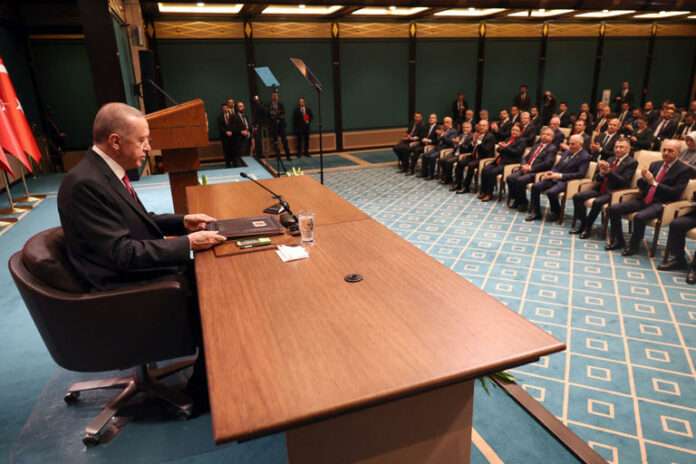
Turkish President Recep Tayyip Erdogan signs a decree announcing that general national elections will he held on May 14, at the Presidential Complex or Kulliye in Ankara on March 10, 2023. - Turkish President Recep Tayyip Erdogan on March 10, 2023, banned music from his campaign stops and vowed to heal the earthquake-stricken nation's wounds as he formally set the next election for May 14.

Turkish President Recep Tayyip Erdogan signs a decree announcing that general national elections will he held on May 14, at the Presidential Complex or Kulliye in Ankara on March 10, 2023. – Turkish President Recep Tayyip Erdogan on March 10, 2023, banned music from his campaign stops and vowed to heal the earthquake-stricken nation’s wounds as he formally set the next election for May 14.© Adem ALTAN / AFP/Getty Images 

Previously, Turkey had aided the Russian war effort by allowing Moscow to use it as a conduit for the flow of goods. Turkish companies had even sold, in violation of U.S. sanctions, products to Russian companies.

There is, unfortunately, no good news on a more consequential front. Ankara is still blocking the admission of Finland and Sweden to NATO. Both Scandinavian countries, long neutral, applied for membership soon after Russia’s invasion of Ukraine last February.

At a meeting last week at NATO headquarters in Brussels, representatives of the two candidates for membership met with Turkish officials for the first time since November. No agreement was reached and there were, according to Politico, no signs of progress although there was a consensus on holding further meetings.

Turkey has been an obstacle from the beginning. At the heart of the dispute—at least ostensibly—is Turkey’s insistence that the two countries stop harboring groups Ankara considers terrorists. At a NATO meeting in late June of last year, the three countries signed the “Trilateral Memorandum,” which listed actions the two membership candidates would take to meet Turkey’s concerns. For its part, Ankara agreed to support Finland’s and Sweden’s membership in the alliance.

“After the celebration of NATO unity in Madrid, it didn’t take long for cracks to appear,” noted Theresa Fallon, director of the Brussels-based Center for Russia Europe Asia Studies, to Newsweek. “Before the Swedish and Finnish defense ministers had touched down on their respective runways, they had received word that the Turkish government was still an obstacle.”

Turkey, Fallon points out, keeps raising new objections. “Ankara,” she reports, “demanded over 70 extraditions from Stockholm after Turkey originally agreed to support Sweden’s bid for NATO membership.”

“It is unclear exactly what Turkey seeks,” writes Politico. “There is speculation within the alliance that the drawn-out process is in part due to President Recep Tayyip Erdogan’s domestic political considerations.”

All eyes are now on Turkey’s May 14 general election. Erdogan faces stiff opposition, and many think he would lose in a fair contest, especially because of discontent over botched relief efforts after last month’s devastating 7.8 magnitude earthquake in the southern and central parts of the country.

As a practical matter, there will be no progress on the enlargement of NATO until the vote. As Gregory Copley, president of the International Strategic Studies Association, tells Newsweek, “Erdogan is desperately attempting to show that he is the decisive figure in NATO, not only to gain leverage in the other NATO states but also to show his domestic audience that he is a world leader.”

There is, therefore, little anyone can do to speed up Finn and Swedish membership before May 14.

There are bigger problems, however. Copley adds that “Erdogan now has very little ability to resist Moscow and Beijing.”

China has been continually supplying needed infrastructure and other investment, effectively bailing out Erdogan, who like other autocrats has consistently mismanaged his economy.

Turkey’s president also needs Moscow. As the New York Times reported in December, “Turkey has deepened its energy ties to Russia” with imports of crude oil, diesel fuel, and coal. “Russian oil is increasingly being routed through Turkey,” the paper notes. Erdogan will not stop bedeviling his NATO partners as long as he relies on Vladimir Putin‘s energy lifeline.

So what can be done? Jonathan Bass of InfraGolbal Partners, an energy consultant working for Turkish parties, tells Newsweek that Ankara’s Black Sea gas fields should start production this year but the country also needs a gas pipeline from Israel. Israeli Prime Minister Benjamin Netanyahu is now considering whether to greenlight the project. Anything Washington can do to lessen Ankara’s dependence on Russian energy will ultimately help woo Erdogan away from Putin.

Since the beginning of the war last year, Erdogan has been generally successful in performing his “delicate balancing act” with Russia and China on one side and NATO and Ukraine on the other. There are signs, however, that his maneuvering, which has greatly aided Putin, is “increasingly untenable.”

It’s about time for Washington to apply even more pressure to force Erdogan to choose. The Turkish president can be persuaded. He was, for instance, forced to drop plans to deploy an S-400 surface-to-air missile system that he received from Russia’s Rosoboronexport in 2019—the missiles and associated equipment are now in storage in Turkey—and was pressured into not buying a second batch of S-400s.

Erdogan remains, at best, a difficult friend. And perhaps an untrustworthy one. Senator Chris Van Hollen (D-Md.) echoed the views of many when he said in early February that Turkey is an “unfaithful ally.”

“Loyalty runs both ways,” Bass says, referring to decades of a troubled relationship, including the EU‘s rejection of Turkey’s membership. “Perhaps the West has not been faithful to Turkey.”

Perhaps, but something has to change.

Gordon G. Chang is the author of The Coming Collapse of China. Follow him on Twitter @GordonGChang.

The views expressed in this article are the writer’s own.

Newsweek

World War-3: How US-Led Alliances, QUAD, CHIP-4 & AUKUS, Are Sowing The Seeds Of Another Global Conflict

0

At National Defense Academy (NDA), we were taught finer details of the military strategy used by warring nations to achieve victory during the two world wars. The most striking feature was that both world wars resulted from the desire to establish regional and global supremacy only by ‘white people.’

Asian and African nations were sucked into the melee because most nations were ruled by ‘whites.’ The mention of Australia rarely featured except that it was used as a colony for rehabilitating ‘exceptional British citizens,’ who were selected by the British judiciary.

Numerous causes, viz militarism, ultra-nationalism, and even the assassination of prominent figures, catalyzed the war. However, in the case of both world wars, a common denominator was the formation of alliances/treaties between a group of nations aimed at opposing/containing the influence of another nation/group of countries.

One of the most famous treaties was the Treaty of Versailles, signed to end the First World War in 1919. Many historians have opined that the Treaty was not a peace treaty.

Instead, it was the root cause of the Second World War. The Treaty imposed severe restrictions on Germany to the extent that Germans felt humiliated, leading to the birth of Nazi culture and the rise of Hitler. The rest is history.

The Second World War ended due to the most inhuman act committed by the USA in deciding to drop the atomic bomb on Japanese cities on August 6 and 9, 1945. The USA, then a component of the Allied power, resorted to the most indiscreet military action in the history of humanity to test the effects of the ultimate weapon of mass destruction as a technology demonstrator.

Why did the USA bomb Japan nearly 3000 km from the US mainland? Why did the USA not decide to bomb Germany, the leader of the Axis powers? Was the ‘color of the skin’ a factor determining between Japan and Germany?

Post-Second World War Scenario

Post-Second World War, three important international events took place. These were the creation of the United Nations and the birth of the two most prominent military alliances, the North Atlantic Treaty Organization and the Warsaw Pact. Seventy-five years later UN exists sans any beneficial influence in international affairs.

NATO is ‘brain dead’ as claimed by outgoing German Chancellor Angela Merkel, and Warsaw Pact has been extinguished after the disintegration of the Soviet Union.

Numerous new treaties and alliances have taken birth all over the globe, mainly for the region’s economic development by way of increased trading and sharing surplus resources with friendly neighbors.

Recent Alliances

Three alliances of relatively recent origin are essentially military alliances aimed at containing increasing Chinese influence. These are QUAD (USA, Japan, Australia, and India as members), AUKUS (Australia, United Kingdom, and USA as members), and CHIP 4 (Japan, Korea, Taiwan, and USA).

The USA was the driving force for all these three alliances. The US needed India to rejuvenate the nearly ‘extinct and dead’ QUAD, but the USA conveniently overlooked India while forming CHIP 4 alliance.

QUAD was dormant for over a decade, with Japan and Australia no longer interested/disinterested in being a part of QUAD. The gradual increase in the intensity of the trade war between the USA and China, which reached a crescendo during the last few months of Trump’s presidency, forced the USA to convince Japan and Australia to come on board and actively participate in QUAD activities along with India.

A stark reality has dawned on military strategists worldwide: China cannot be contained unless India is part of the alliance. India’s unique position on the globe is India’s strength. USA’s stated policy of alliances has been governed/continues to be governed by the paradox “if you are not with us, you are against us.”

So far, Australia’s stand on nuclear proliferation has been that of containment. However, the sudden and overnight change in Australia’s decision to acquire nuclear-powered submarines from the USA is a matter of surprise and concern.

Canceling the deal with France is a financial issue with little or no strategic significance. France’s violent and volatile reaction to the deal’s cancellation has evaporated in thin air in due course. The USA has already applied the ‘balm’ by deciding to buy French Barracuda submarines and ‘donate’ them to Vietnam.

However, Australia did not have to join a new military alliance to purchase US nuclear submarines. In that context, Australia surprised the whole world by joining AUKUS. In doing so, it has invited not only the wrath of China but also its ‘trusted friend and ally’ France. The formation of AUKUS has sown the seeds of the Third World War, which may be inadvertent.

Double Standards

Little digression at this stage is essential to highlight the ‘white skin’ mentality concerning economic issues. The angst of France against Australia and the USA emanates from the loss of nearly USD 100 Billion in contracts for manufacturing 12 diesel-electric submarines.

In a deft move, the USA snatched the contract from France by promising to supply nuclear-powered submarines to Australia. France has retaliated violently in diplomatic parlance by recalling its ambassadors from Australia and USA.

The duplicitous behavior of France would be quite evident if we examined the reaction of France to a few international issues of global concern. Did China’s recent actions of crushing freedom in Hong Kong and declaring the South China Sea as Chinese territory result in France recalling its ambassador from China?

No. Did the Russian invasion of Ukraine ruffle diplomatic feathers in France during the early stage of the war? No. Hence prudent behavior of France indicates the fragility of relations of ‘white-skinned’ nations.

Would France have reacted similarly to forming AUKUS if the submarine contract had not been snatched away, and France, too, would have been part of AUKUS?

Joe Biden’s decision has angered France and the entire European Union. What, however, is surprising is that the USA has termed AUKUS as a strategic Indo-Pacific alliance without India being a part of AUKUS. A look at the globe will prove the point if a triangle is drawn joining Australia, UK, and USA.

China’s Role/Reaction

As expected, China has reacted violently, at least in diplomatic parlance. One of the statements made by a Chinese Foreign Ministry representative reads: “If Australia dares to provoke China more blatantly because of that, or even find fault militarily, China will punish it with no mercy. Thus Australian troops are also most likely to be the first batch of western soldiers to waste their lives in the South China Sea.”

The core issue of ownership of the South China Sea (SCS) merits a look into. It was in 1940 that a Chinese geographer printed a map of the South China Sea with a U-shaped line called the ‘Nine Dash Line.’ If the line’s authenticity is accepted, China owns nearly 90% of the South China Sea. Coupled with provisions of the United Nations Convention on the Law of the Sea (UNCLOS) and newly created artificial islands in SCS, which China calls its sovereign territory, the entire SCS becomes Chinese territory.

There was hardly any opposition to Chinese claims in SCS in the past 70-odd years (1940-2010). SCS issue became ‘news’ only after the Permanent Court of Arbitration (PCA) delivered the judgment in favor of the Philippines a few years back. The Chinese activity in creating artificial islands is known to have commenced more than a decade ago.

No country ever highlighted Freedom of Navigation Operations (FONOPS)-related issues in SCS and Chinese opposition to the transit. Only in the last few years (particularly after the COVID-19 outbreak in December 2019) have Australia, the USA, and other ‘White Skinned’ nations raised the bogey of Chinese sovereignty in SCS. Vietnam, Philippines, Brunei, Malaysia, and Taiwan have disputes with China over the Chinese claim of SCS.

But even these nations did not raise the issue of the Nine Dash line with the same intensity as in the past few years. The issue came into prominence when in 2009, China included a map marking the Nine Dash line and documents submitted to the UN during a dispute with Vietnam. The primary reason for the dispute relates to the ownership of the Paracel and Spratly islands.

Originally Nine Dash line was the Eleven Dash line conceived by Chinese geographer Yang, who named each reef/rock and called it SCS. Time Magazine published a feature on SCS in 1947. However, in 1952, the Eleven Dash line became the Nine Dash line when Chairman Mao-Tse-Tung (now Mao Zedong) accepted that the Gulf of Tonkin belonged to Vietnam.

However, the U-shape of the Nine Dash line remained. Each Dash represents the median line between islands in SCS and large landmasses around it. The current flashpoints, in addition to turmoil in SCS, which might instead act as a catalyst to envelop the entire globe into the Third World War, are listed below:

File Image: USS West Virginia Submarine: Via US CENTCOM

Global Flashpoints

  • Russia-Ukraine standoff:  Russia-USA and NATO standoff is the most explosive issue currently. Russia has already announced the use of nukes if military support to Ukraine by USA-led NATO nations continues. The final nail in the coffin will be Ukraine’s admission into the NATO fold. Despite the verbal assurance of the USA that NATO will not move eastward, membership of Finland and Sweden is under active consideration but for the objection of Turkey and Hungary.
  • Iran-Israel conflict over Iran’s nuclear capability: Fresh discussions on reviving the Joint Comprehensive Plan of Action (JCPOA) are underway. Irrespective of the outcome, Israel will no longer wait and take appropriate action to prevent Iran from producing weapon-grade Uranium. Iran will retaliate, resulting in US assistance to Israel, thus expanding the spectrum of war.
  • Chinese threat to Taiwan: Repeated incursion in Taiwanese territory by large formations of PLAAF fighters/bombers is not only for the show of force but also for collecting Signals Intelligence (SIGINT) for a possible strike. Taiwan Air Force strike elements are spread over four bases. An airborne assault by China to neutralize these four air bases cannot be ruled out in conjunction with an amphibious assault on western shores.
  • Belligerent attitude of North Korea: Continuous testing of various SSMs (incl ICBM class) is a concern. North Korea is poised to carry out the seventh nuclear test anytime. China continues to support North Korea.
  • Russian and US military presence in the Middle East: The Middle East is still burning. US forces are still in Syria. Evacuation from Afghanistan and Iraq was due to public pressure within the USA.

India’s Role In QUAD

India’s active participation in QUAD merits a look into it. QUAD is a military alliance with three other nations who have consistently opposed India’s stand on two vital issues: Jammu and Kashmir and India going nuclear. The duplicitous approach of Australia is most prominent in this regard.

QUAD/File Image

The US is the only nation to have used weapons of mass destruction. Japanese opposition to the nuclear option is understandable, being the only country to have suffered destruction from a nuclear weapon. The Indo-Pacific term has become the most talked about strategic issue.

Geography enables India to not only protect its interest in the Indian Ocean but also control the traffic through the most critical waterway on the globe. A threat, if any, will develop from ports in Pakistan. Four important Pakistani ports, Jiwani, Gwadar, Pasni, and Ormara, will pose a danger if Pakistan allows the Navies of Indian adversaries to operate.

However, all four ports are within the IAF range and can be neutralized. The USA attempts to use the ‘Indian Shoulder’ to contain China. Indeed our decision-makers are aware of this stark reality.

We will never know who was responsible for the airliner crash in which Dr. Homi Bhabha traveled! White Skin nations do not give a damn before launching a missile on an airliner, be it a KAL OO7 by Russia or an Iranian Airliner by the USA during the Gulf War.

India and China can, instead, will resolve their differences amicably shortly because mutual animosity will be detrimental to both nations. The Galwan Valley standoff must be viewed as a blessing in disguise. It enabled India to flex its muscles to protect its territorial integrity.

China has received the message. China and India must reconcile their differences from a position of strength. Any attempt to prove precedence over each other will be counterproductive. India must remain clear of ‘white skin’ (read US and EU) intent to corner China by placing India in front as a QUAD member.

Unlike the First and Second World Wars, which were essentially fought for regional/global supremacy by ‘White Skins,’ the Third World War might be fought based on maintaining the supremacy of color of skin.

The formation of AUKUS and the supply of nuclear submarines by the USA to Australia are among the most terrible strategic decisions – it has also sown the seeds of the Third World War.

The Russia-Ukraine war has now turned into Russia vs. NATO and the USA. The G-20 Foreign Ministers meeting in Delhi on March 3 and 4 was significant for multiple reasons.

US Secretary of state Anthony Blinken declared that there would be consequences if China supported Russia militarily. China invariably reacts adversely to such counseling (read warning/threat), as it did when the USA gave China the nuke threat during the Korean war.

World is slowly but surely heading towards a possible global conflict.

  • Gp Cpt TP Srivastava (Retd) is an ex-NDA who flew MiG-21 and 29. He is a qualified flying instructor. He commanded the MiG-21 squadron. He is a directing staff at DSSC Wellington and chief instructor at the College of Air Warfare. VIEWS PERSONAL OF THE AUTHOR
  • Follow EurAsian Times on Google News

eurasiantimes.com

Iran-Saudi deal: China’s growing clout in the Middle East

0
William Yang in Taipei 

The recent Saudi-Iran deal is a major triumph for Chinese diplomacy, but Beijing may find the Middle East to be a tricky region to operate in, say experts.

After China successfully brokered a deal last week to restore relations between Iran and Saudi Arabia, Beijing appears set to take on a larger role in the Middle East and potentially challenge US dominance in the oil-rich region.

Under the agreement reached in the Chinese capital on Friday, Riyadh and Tehran agreed to reopen their embassies and exchange ambassadors after seven years of severed diplomatic ties and tensions.

The rivalry between Iran and Saudi Arabia, respectively the leading Shiite and Sunni Muslim powers in the Middle East, has dominated regional politics in recent years, affecting not only the two nations but also others with both sides backing rival camps in proxy wars from Yemen to Syria and elsewhere.

Beijing described the result as a “major outcome” achieved through “concerted efforts” by the three countries, emphasizing that China “pursues no selfish interest whatsoever in the Middle East.”

“China has no intention to and will not seek to fill the so-called vacuum or put up exclusive blocs,” Beijing said in a statement on Saturday, adding: “China will be a promoter of security and stability, partner for development and prosperity, and supporter of the Middle East’s development through solidarity.”

Tricky region for Chinese diplomacy

The deal is a major triumph for Chinese diplomacy, said Camille Lons, a research associate at the International Institute for Strategic Studies.

It also marks a shift in Beijing’s strategy as “until now, it had refused to get entangled in regional disputes, and smartly benefited from the US-led security umbrella while doing business with the entire region,” she noted.

“But by getting more involved in politics, China takes the risk of exposing its own limits.”

What are Saudi Arabia and Iran hoping to gain?

Ian Chong, an expert on China’s foreign policy at the National University of Singapore (NUS), shared a similar view.

He pointed out that Beijing may find the Middle East to be a tricky region to operate in.

“There are lots of complicated interests and tensions so how brokering this deal between Iran and Saudi Arabia will play out remains to be seen,” he told DW.

A long presence in the Middle East

China has cultivated strong economic and political ties with both Riyadh and Tehran in recent years. Saudi Arabia is China’s largest oil supplier, with trade between the two countries amounting to $87 billion (€81 billion)  in 2021.

Commerce between Iran and China, meanwhile, was worth more than $16 billion in the same year, with Tehran depending on the Asian giant for as much as 30% of its foreign trade.

China has also pledged to invest $400 billion in Iran over 25 years.

Chinese President Xi Jinping traveled to Saudi Arabia in December for a state visit, and Iranian President Ebrahim Raisi visited Beijing in February.

Chong from NUS said that by facilitating this deal, Beijing is signaling that it is now not just a leading economic player but is also willing to get involved in politics in the Middle East, a region which is the primary source of China’s energy imports.

Tuvia Gering, an expert on China-Middle East relations at the Diane and Guilford Glazer Center at the Institute for National Security Studies in Israel (INSS), said Beijing hopes to carve out a bigger role for itself because the region has become “strategically important” to it.

“It’s not just for energy security, but on this wider gamut of areas,” Gering told DW, pointing to Chinese investments in regional infrastructure as part of its massive multibillion-dollar Belt and Road Initiative.

The Saudi-Iran deal comes at a time when many countries in the region perceive the US as winding down its engagement there.

This doesn’t mean Beijing could replace Washington in the Middle East, said Gering.

“China said it doesn’t want to be dragged into regional conflicts, and I don’t think that wish has changed even though recent developments may have given Beijing a bit more appetite to become more active,” he underlined, adding that China still needs to gain the region’s trust before it can become a reliable partner. “China is still a new actor and these things take a long time.”

Saudi Prince: ‘Historic phase’ in China relations

Is US influence waning?

The US, meanwhile, welcomed China’s efforts to help end the war in Yemen and deescalate tensions in the Middle East, but rejected the notion that it was stepping back from the region.

It also stressed that the agreement was two years in the making.

“This is not about China. We support any effort to deescalate tensions in the region. We think that’s in our interests, and it’s something that we worked on through our own effective combination of deterrence and diplomacy,” said White House national security spokesperson John Kirby.

John Calabrese, director of the Middle East-Asia Project at the Middle East Institute, said Beijing’s role in brokering the deal doesn’t fundamentally alter Washington’s position.

In his view, Beijing’s main goal in the region is still “maintaining its economic interests and expanding its economic equities.”

“This requires regional stability to the extent that the US is still equipped to do so,” he said, adding that de-escalation between Tehran and Riyadh is in the interest of the Middle East, China and the US.

And despite US-Saudi tensions over an array of issues — ranging from human rights violations to Riyadh’s continued participation in a pandemic-era oil pact with Russia — Saudi Arabia remains one of Washington’s staunchest security partners in the region.

Lons from IISS said the agreement shows that Gulf states like Saudi Arabia are willing to diversify their security and strategic partnerships so that they do not rely entirely on the US.

She described these countries’ approach as “pragmatic” and warned against overestimating Beijing’s importance to the region.

“When it comes to hard security guarantees, they are fully aware that the US remains their key partner.”

Edited by: Srinivas Mazumdaru

DW

Funding for Ukraine is far from unchecked charity

0
AP Photo/Carolyn Kaster

Ukrainian President Volodymyr Zelensky addresses a joint meeting of Congress on Capitol Hill on Dec. 21, 2022.

That a large sum of U.S. funding supports Ukraine’s defense against Russian aggression is well understood. What few people know is that the Pentagon, State Department, and the U.S. Agency for International Development (USAID) have teamed up to create a comprehensive monitoring process to ensure that funding is used effectively and transparently. The process appears to be working.

On March 1, House Foreign Affairs Committee Chairman Michael McCaul (R-Texas) summed up what he saw on an official oversight trip that took him to Poland and Ukraine: “To date, no significant acts of fraud or misuse involving U.S. assistance have occurred.” Rep. Lisa McClain (R-Mich.) of the House Armed Services Committee reached a similar conclusion after her own visit to the front. She said, “[When you] actually see the inventory of weapons that we are sending and just how they are getting from Point A to Point B and how we’re tracking them … that, I can assure you, raised my level of confidence. There is a saying, ‘One look is worth 1,000 reports.’”

Storch described several elements of the oversight mission that ensure due diligence: approximately 20 ongoing and planned audits; a criminal investigative service unit detecting and preventing fraud; forward deployment of personnel into the region to oversee assistance before weapons cross into Ukraine; and identification of potential oversight obstacles.

Storch and his colleagues regularly report back to lawmakers and executive branch leaders. Armed Services Committee Chairman Rep. Mike Rogers (R-Ala.) explained that lawmakers receive monthly classified briefings from the department, in addition to congressionally mandated written reports.

The risk of arms being diverted by Ukrainians was raised by members. Storch explained that based on a combination of inventory reviews, access to tracking data, and in-person site visits by personnel from the Office of Defense Cooperation at the embassy in Kyiv, U.S. officials have seen “no signs of diversion or that the Ukrainians are not following procedures.” The only contentious exchange on the issue occurred when a reported claim of weapons diversion raised by a member during questioning turned out to be sourced to an uncorroborated article published by Global Times, a Chinese Communist Party mouthpiece known for peddling disinformation.

Storch also noted at the hearing the importance of working across federal departments given that assistance for Ukraine includes non-defense spending. To that end, the inspectors general from the Defense Department, State Department and USAID formed an interagency working group that, as of January, was running 64 ongoing and planned oversight projects and had completed 14 others. These projects cover a range of activities, including end-use monitoring of weapons, audits of contracts, and safeguards for direct funding assistance for the Ukrainian government.

Even with these measures in place, key congressional leaders are not complacent. McCaul and his upper chamber counterpart, Senate Foreign Relations Committee ranking member Sen. Jim Risch (R-Idaho), have pressed the case on oversight of funding that is delivered through non-U.S. government actors such as aid organizations and international financial institutions. A December 2022 letter to the Government Accountability Office from the two lead Republicans overseeing the State Department and USAID outlined requests for information and sharp questions meant to generate greater transparency.

The lead Republican on the Senate Armed Services Committee, Sen. Roger Wicker (R-Miss.), has written that “40 percent of U.S. aid for Ukraine, or about $44 billion, is being spent here at home on our defense industrial base and readiness.” Far from being foreign aid handouts, this funding is a critical investment in an overlooked aspect of U.S. national defense and the workers and innovation that support it. And the broader package is far from charity: It is helping a partner to defend its sovereign territory and cripple a key American adversary’s military without putting Americans in combat.

None of this is to say the administration has been immune from critique for its Ukraine policy.

The oversight process itself also has room to grow. The inspectors general for Defense, State and USAID are making the case for having a greater, regular presence inside Ukraine for auditing purposes given the difficulties of evaluating programs remotely. Reps. Jason Crown (D-Colo.) and Mike Waltz (R-Fla.), both stalwart defenders of support for Ukraine, recently encouraged the administration to enable just that.

Sooner or later, Congress will have its say. On Feb. 28, Assistant Secretary of Defense Celeste Wallander told House appropriators that the administration could not rule out asking Congress for supplemental Ukraine funding in the coming months before the end of the fiscal year. That is, existing funds meant to last through September 2023 may be spent more quickly than anticipated. Congress then would need to act to sustain key Ukraine-related assistance programs.

Maseh Zarif, a national security and foreign affairs policy professional, is director of congressional relations for FDD Action, a nonprofit, nonpartisan organization that advocates for effective policies to promote U.S. national security. Follow him on Twitter @masehz.

thehill.com

Σεραφείμ Μηχιώτης: ΜQ9-Reaper ΤΩΝ ΗΠΑ ΣΤΗΝ 110ΠΜ: ΕΚΤΟΣ ΚΙ ΑΝ ΚΑΠΟΙΟΙ ΑΝΗΣΥΧΟΥΝ ΠΡΙΝ ΑΠΟ ΕΜΑΣ ΓΙΑ ΜΑΣ

0


του Σεραφείμ Μηχιώτη

Αντιγράφω από το «Militaire” το πονηρό-εισαγγελικό ερώτημα: Οι Ρώσοι «έριξαν» ένα αμερικανικό μη επανδρωμένο αεροσκάφος MQ-9 Reaper στη Μαύρη Θάλασσα. Το ερώτημα που μας ενδιαφέρει άμεσα είναι ένα: από που είχε απογειωθεί το MQ-9 Reaper; Μας ενδιαφέρει, γιατί δεν αποκλείεται το Reaper που έριξαν οι Ρώσοι να είναι ένα από αυτά που επιχειρούν από το αεροδρόμιο της Λάρισας! Πρόσφατα τα είχε επισκεφθεί ο πρωθυπουργός Κυριάκος Μητσοτάκης. Mετά την πυραυλική επίθεση σε υπόγειο στρατηγείο των ΗΠΑ στη Δυτική Ουκρανία, αυτό είναι το 2ο περιστατικό στο οποίο οι Ρωσικές ΕΔ στοχεύουν ειδικά τους Αμερικανούς…

Εν αγνοία προφανώς του σχεδίου πτήσης στην αποστολή του συγκεκριμένου μη επανδρωμένου Αμερικανικού αεροσκάφους, το «Militaire» αρκείται σε ένα αθώο ( ; ) ερώτημα, προφανώς γιά να υπαινιχθεί ότι το MQ-9 Reaper, εφ’ όσον απογειώθηκε από την 110ΠΜ της Λάρισας, όπως περιορίζεται να ερωτά, εάν μετείχε σε δυνάμει επιθετική αποστολή εναντίον της Ρωσίας στον πόλεμο της Ουκρανίας, εν γνώσει της χώρας μας, που υποτίθεται καθίσταται και αυτή άμεσα εμπόλεμη σε επιχειρήσεις κατά του Πούτιν, υποκείμενη συνεπώς και στον κίνδυνο αντιποίνων της Μόσχας.

Πολύ «προχωρημένος» ο μιλιταίρε συλλογισμός του «Militaire», που δείχνει να αγνοεί, ή ενδεχομένως να γνωρίζει και σκοπίμως αποσιωπά, ότι, όπου παρέχονται τέτοιες ευκολίες, εν προκειμένω στις ΗΠΑ, όπως από τη Λάρισα γιά τα MQ-9 Reaper, η φιλοξενούσα χώρα, βάσει υφισταμένων ΜΟUs’,  δεν περιμένει από τη χώρα στην οποία παρέχει τις ευκολίες αναλυτικές πληροφορίες γιά τα πώς και πού και γιά ποιόν σκοπό επιχειρούν τα αδειοδοτούμενα μέσα, ή από τη Σούδα κ.ο.κ, δηλαδή αναλυτική, πλήρη και εις βάθος ενημέρωση.

Εκτός κι αν ανησυχούν, μήπως θα μπορούσε γιά τη Ρωσία να στοχεύσει τη…Λάρισα με βλήματα ταχύτητας δεκαπλάσιας του ήχου, όπως έκαναν στην Ουκρανία, το φοβούνται και θέλουν να μάς προστατεύσουν. Λιγότερη σοβαρότητα, ίσως, ακόμη κι αν το αντιπολιτευτικό μένος προέχει!»

‘Αλλωστε, όπως προκύπτει από την κοινή επιχειρησιακή γνώση τέτοιων θεμάτων, τέτοιες αποστολές μη επανδρωμένων αεροσκαφών σκοπό έχουν την συλλογή πληροφοριών και επιτήρηση περιοχών και δεν προβλέπουν διόλου επιθετική δράση, που, σε τέτοια τελευταία περίπτωση, θα απαιτούσε άμεση και ταχεία απομάκρυνση από την περιοχή των επιχειρήσεων, από ένα μέσο που έχει ταυτότητα πλεύσης που δεν υπερβαίνει τα 150 μίλια.

Τουλάχιστον ας είναι πιό προσεκτικοί, όσοι ανησυχούν πριν από εμάς, γιά εμάς!

Σεραφείμ Χ. Μηχιώτης