Αρχική Blog Σελίδα 3001

Senate confirms Rex Tillerson as secretary of state in 56-to-43 vote  

0
February 1 at 3:23 PM

Trump’s Transition: Who is Rex Tillerson?

President-elect Donald Trump has picked Rex Tillerson as his nominee for secretary of state. Here’s what you need to know about Tillerson. (Thomas Johnson, Victoria Walker, Danielle Kunitz/The Washington Post)

Rex Tillerson won confirmation Wednesday to become secretary of state, placing a longtime oil company executive at the helm of what President Trump has promised will be an “America first” foreign policy.

The final vote was 56 to 43, with four members of the Democratic caucus in favor of confirmation: Sens. Heidi Heitkamp (D-N.D.), Angus King (I-Maine), Joe Manchin III (D-W.Va.) and Mark R. Warner (D-Va.).

Later Wednesday, Tillerson was sworn in by Vice President Pence at the White House, and congratulated by Trump.
“It’s time to bring a clear-eyed focus to foreign policy, to take a fresh look at the world around us, and to seek new solutions grounded through very ancient truths,” Trump said.

Interim Democratic National Committee chairwoman Donna Brazile castigated the choice of a businessman with close ties to Russia, especially given U.S. intelligence findings that Russia meddled in and attempted to influence the presidential election.

“Multiple intelligence agencies still have ongoing investigations looking into the major unanswered questions surrounding the extent of the relationship between Russia and the Trump campaign,” Brazile said. “Now, a man whose most prominent foreign policy accolade is the Russian Order of Friendship, awarded to him by Vladimir Putin himself, has been put in charge of American foreign policy.”

Human rights groups, environmental organizations and other interest groups also decried the choice, but Republicans celebrated.

“We need a secretary of state who can restore America’s global leadership in the world and effectively advocate for our interests,” said Sen. Shelley Moore Capito (R-W.Va.). “Given his broad experience, I’m confident that Rex Tillerson is the right person to serve as our nation’s top diplomat and was pleased to vote for his confirmation today.”

The recently retired ExxonMobil chief executive takes office amid a Trump administration debut marked by big swings away from the national security and foreign policies in place under the Obama administration. The State Department he now heads has a central role in refugee resettlement and other immigration and travel-related policies that are at issue in a White House order suspending the admission of refugees and restricting entry for citizens from several majority-Muslim nations.

One of his chief outside backers, former defense secretary Robert M. Gates, said Sunday that the immigration order is likely to make Tillerson’s job as chief diplomat harder. Gates, a Republican who recommended Tillerson to Trump as a dark-horse candidate, is among a long bipartisan list of foreign-policy experts who have argued that actions that appear to target Muslims play into the hands of extremists who claim that the United States is at war with Islam.

Tillerson’s confirmation was not in doubt, despite Democratic opposition. The vote followed announcements of support from three Republicans who had earlier expressed reservations about his nomination.

The Senate Foreign Relations Committee had approved Tillerson along party lines, a show of Republican unity that masked discomfort among some conservatives over Trump’s approach to Russia and human rights issues.

Sen. Marco Rubio (R-Fla.), who had questioned Tillerson more aggressively than many Democrats during a contentious day-long Jan. 11 confirmation hearing, had said last week that he would back Tillerson despite lingering doubts on human rights and other grounds.

“Given the uncertainty that exists both at home and abroad about the direction of our foreign policy, it would be against our national interests to have this confirmation unnecessarily delayed or embroiled in controversy,” Rubio said in a lengthy statement posted on Facebook. “Therefore, despite my reservations, I will support Mr. Tillerson’s nomination in committee and in the full Senate.”

Rubio noted that he remains troubled that Tillerson refused to say that Putin, the Russian president, had committed war crimes. Democrats pointed to Tillerson’s years-long relationship with Putin, his answers on climate change and other positions in voting against him.

Republican opposition was melting away even before Rubio’s announcement. Sens. John McCain (R-Ariz.) and Lindsey O. Graham (R-S.C.) had announced their support for Tillerson before the committee voted. Like Rubio, McCain and Graham had voiced worries about Tillerson’s ties to Russia.

Manchin said he based his support in part on having known Tillerson from their shared involvement with the Boy Scouts of America. “Rex Tillerson’s extensive career will bring a unique perspective to the State Department, and I believe he will provide wise counsel and objective advice to the president on our nation’s foreign policy,” Manchin said in a statement announcing his intention to vote in favor.

Manchin also praised Tillerson’s decision to divest all of his ExxonMobil stock and recuse himself at least temporarily from any State Department action involving the company.

The 64-year-old Texan has no prior government experience and no formal background in foreign policy or diplomacy. His admirers, however, say he has a vast knowledge of world affairs and geopolitics born of years of international energy exploration and production.

Tillerson set out a mostly mainstream Republican vision of foreign policy at his confirmation hearing and assured senators he would not be overly friendly with Russia or Middle Eastern nations where his company, the world’s largest oil firm, has done business. He has said little about his personal goals for diplomacy, and it is not clear whether he will have a signature issue as his predecessors have, such as John F. Kerry with climate change or Hillary Clinton, who focused on helping women and girls.

The department he heads was in unusual turmoil before the executive order was announced Friday. A large number of senior Foreign Service officers resigned or were nudged out of top positions last week, signaling an intent by the Trump administration to install many new faces. There are vacancies at the top of major department offices, including those responsible for the Middle East and Europe.

Gates, who served as defense secretary under Presidents George W. Bush and Barack Obama and as director of the CIA under President George H.W. Bush, said he expects a number of countries will have a “negative reaction” to Trump’s order. He said the order, paired with Obama’s drawdown of troops in Iraq and Afghanistan and Trump’s “America first” platform, could signal that the United States is backing away from global commitments.

“I would say that the actions and the rhetoric of the new president simply continue that drumbeat of giving the impression around the world that the United States is pulling back,” Gates said Sunday on ABC’s “This Week.” “This creates, whether we want it or not, a vacuum, and that vacuum will not be filled by benign forces. ”

Among the top issues the new secretary of state faces is the civil war and terrorist threat in Syria, which Trump has vowed to tackle immediately and more forcefully than Obama. The future of economic sanctions on Russia will also arise quickly and could be contentious. Tillerson was vague during his hearing about whether he supports the extension of international economic penalties imposed after Russia annexed Crimea and gave support to insurgents in Ukraine’s eastern provinces.

Tillerson was also somewhat vague about climate change, an issue he oversaw as ExxonMobil gradually shifted its position over the past decade. He told senators he believes “the risk of climate change does exist, and the consequences could be serious enough that action should be taken.” But he avoided blaming human activity directly or exclusively and said the ability to predict the effect is “very limited.”

Tillerson was a late addition to the roster of candidates Trump auditioned for what is often considered the most important Cabinet post, and Trump did not know him personally.

Trump chose Tillerson after passing over Republican Mitt Romney, a former presidential nominee who had been highly critical of Trump during the campaign. Tillerson was also recommended by former secretary of state Condoleezza Rice, like Gates a prominent Republican who had worked closely with the oil executive.

In naming Tillerson, Trump called him an “embodiment of the American Dream” and cited the oil executive’s “tenacity, broad experience and deep understanding of geopolitics.”

Sean Sullivan and Kelsey Snell contributed to this report.

https://www.washingtonpost.com/news/post-politics/wp/2017/02/01/senate-confirms-rex-tillerson-to-become-secretary-of-state/?pushid=breaking-news_1485978983&tid=notifi_push_breaking-news&utm_term=.066e4f8e2010

Turkey and Greece Trade Jabs in Island Dispute

0
Photo

 
Supporters of the Greek far-right Golden Dawn party during a commemoration of the 21st anniversary of the dispute over the islands known as Imia in Greece and Kardak in Turkey. CreditMichalis Karagiannis/Reuters

ISTANBUL — Turkey and Greece have reignited a decades-old disagreement over the sovereignty of a pair of uninhabited Aegean Islands, in a spat that analysts say risks aggravating other diplomatic disputes between the two countries.

The Greek defense minister, Panos Kammenos, flew over the two disputed islands on Wednesday, the Greek government said, in a pointed response to a visit three days earlier to nearby waters by the commander of the Turkish armed forces, Hulusi Akar.

The exchange is the most public disagreement over the tiny islands’ sovereignty since 1996, when soldiers from both countries landed on them before American-led mediation persuaded both sides to leave the area.

Turkey disputes Greece’s claim that the islands — known as Imia in Greece and Kardak in Turkey — entered Greek ownership in 1947, after first being assigned to Italy in 1923 following the fall of the Ottoman Empire.

Analysts said that Turkey’s recent incursions were a response to the decision by the Greek Supreme Court last week to block the extradition of eight Turkish airmen accused of participating in the failed attempt last July to oust the Turkish government. They also warned that the dispute risked complicating negotiations over the reunification of Cyprus.

Turkey has itself said the case could derail a migration pact between Greece and Turkey that has helped to stem the flow of migrants between Turkey and Europe significantly.

Sinan Ulgen, a Turkey scholar at Carnegie Europe, said he did not believe the dispute would spiral into military conflict.

“But there certainly may be other consequences, because it comes at a very inopportune time for the Cyprus talks, for instance,” Mr. Ulgen said by telephone.

A spokesman for the Turkish Foreign Ministry said he was unavailable for comment, while the Turkish presidency did not respond to enquiries.

A spokesman for the Greek Foreign Ministry declined to link the escalation over the islands to last week’s court decision, but said his government had no ability to deport the airmen against the wishes of the Greek judiciary.

“From the very first moment, the Greek government condemned the July coup,” the spokesman said by telephone. “We said the people who participated in the coup are not welcome in our country, but of course the Greek government is different to the independent Greek judiciary.”

Turkey has already sent a second request for the airmen’s extradition, suggesting that the dispute has room to grow, said Soner Cagaptay, who heads Turkey research at the Washington Institute, a policy research organization.

“If Greece rejects the second request, then Erdogan will escalate further, and this could include the Cyprus talks, the migration pact and military escalation along the Aegean,” Mr. Cagaptay said, referring to the president of Turkey, Recep Tayyip Erdogan.

“Turkey’s toolbox is full of items that are almost infinite in nature,” Mr. Cagaptay added.

EU Leader Identifies Russia, China, Trump as Threats

0

February 01, 2017 11:56 AM

  • VOA News

FILE – European Council President Donald Tusk briefs the media in Brussels, Belgium.

European Union President Donald Tusk says China, Russia and the U.S. administration of President Donald Trump are among the top external threats facing the bloc.

His remarks came in a letter to 27 EU leaders before a summit Friday in Malta.

“Particularly the change in Washington puts the European Union in a difficult situation; with the new administration seeming to put into question the last 70 years of American foreign policy,” Tusk said.

Trump has insisted on policies that put the United States first, and has questioned whether NATO members are contributing their fair share to the alliance.

Tusk laid out a defense of the European Union, saying it has never faced more dangerous challenges and needs “courage, determination and political solidarity.”

He said the European Union must stand up for its dignity in talks with the United States, Russia, China or Turkey, and must not give in to populist arguments and xenophobic sentiments that go against European integration.

“It must be made crystal clear that the disintegration of the European Union will not lead to the restoration of some mythical, full sovereignty of its member states, but to their real and factual dependence on the great superpowers: the United States, Russia and China. Only together can we be fully independent,” Tusk wrote.

With Trump calling for renegotiated trade deals, Tusk advocated for the European Union to protect its citizens and businesses and remember “that free trade means fair trade.”

He ended the letter by saying the bloc cannot give in to those who want to “weaken or invalidate” the bond between the United States and the European Union.

Tusk wrote, “We should remind our American friends of their own motto: ‘United we stand, divided we fall.”

The U.N. human rights office criticized Trump’s travel restrictions Wednesday, calling the executive order a “breach of Washington’s human rights obligations.

In a statement signed by several U.N. human rights officials, the organization said the presidential directive was “deeply troubling” and could lead to further violence against people fleeing war zones.

“The U.S. recent policy on immigration also risks people being returned, without proper individual assessments and asylum procedures, to places in which they risk being subjected to torture and other cruel, inhuman or degrading treatment, in direct contravention of international humanitarian and human rights laws which uphold the principle of non-refoulement,” the statement said.

The U.N. officials said the United States has a responsibility to accept refugees because the country is involved in conflicts that are forcing refugees to flee their homes in Iraq and Syria.

A top Vatican official also expressed concern over Trump’s executive order Wednesday and called on Americans to “integrate those who arrive, who come into our society, into our culture.”

“We are builders of bridges, far less of walls, and all Christians should emphatically reaffirm this message,” Monsignor Angelo Becciu, told the Catholic TV channel TV2000.

http://www.voanews.com/a/eu-leader-identifies-russia-china-trump-as-threats/3701324.html

Jared and Ivanka turned down a free dinner on date night. Could they have taken it?

0

By Helena Andrews-Dyer February 1 at 12:55 PM

On Monday, at the same time her father, President Trump, fired the acting attorney general of the United States, Ivanka Trump and her husband, White House senior adviser Jared Kushner, were having a low-key dinner at an Italian restaurant a mile from 1600 Pennsylvania Avenue.

For the most part, the young couple enjoyed a completely ho hum meal at the sleek new RPM Italian where main courses range from $14 to $61. Other diners stole quick glances at the pair and their Secret Service retinue, but no one interrupted the couple’s evening out.

Everything seemed to be running smoothly until the bill came. According to two people sitting directly adjacent to the pair, minutes after Trump and Kushner received the check, an employee of the restaurant swooped in to “handle it” Olivia Pope-style. RPM is owned in part by Bill Rancic, winner of the first season of “The Apprentice” in 2004, and his wife, TV host Giuliana Rancic.

“He walks out and says, ‘Oh no no no. This is on us,’” recalled Mary Mallampalli, a management consultant who was having dinner with friends, fresh from protesting outside the Supreme Court.

Federal employees are not allowed to accept gifts, including meals, that are worth more than $20, according to the Standards of Ethical Conduct for Employees of the Executive Branch. And Kushner, a former real estate developer who was named to his official White House role three weeks ago and who does not take a salary, was adamant about playing by the rules.

“Jared said right then and there, ‘I am not allowed to accept this, I’m a government employee,’” Mallampalli said.

An RPM spokeswoman told us that Kushner “paid 100 percent for their bill.” But that spokeswoman could not confirm whether the couple had been offered to dine gratis.

“It sounds like they handled the situation as best they could,” said attorney Jan Baran, who served on George H.W. Bush’s ethics commission. “It’s no fun being a lightning rod in Washington.”

Baran also pointed out that even if they couple had eaten for free, it would have been more of a political faux pas than an clear ethics violation. The Standard of Ethical Conduct does make an exception for “gifts based on a personal relationship,” defined as gifts given because of a family relationship or personal friendship and not motivated by the federal employee’s position.

So on Monday the couple showed up, they ate and the bill was paid. Done and done. Seems like a cut-and-dried case. But the mere mention of a comped meal “left a sour taste” according to another diner at Mallampalli’s table. Welcome to the new Washington social scene where not even date night can escape divisiveness. A lesson the Trump-Kushners may have learned after less than two weeks in town.

For example, on Saturday, the always Instagrammable couple were called to task on social media after Ivanka Trump posted a photo of her and her husband decked out in black tie for the Alfalfa Club dinner, an annual ballroom boozefest for 1-percenters. The scheduling of the post was less than ideal, critics said, as thousands were protesting her father’s ban on immigrants at airports around the country at the time.

Democrats are in real danger of overplaying their hand right now

0

By Aaron Blake February 1 at 7:30 AM

The partisan fight over the Supreme Court is underway

 President Trump on Feb. 1 endorsed the option for the Republican leadership in the Senate to change rules if necessary to confirm his Supreme Court nominee. (Bastien Inzaurralde, Alice Li/The Washington Post)

President Trump’s first 12 days in office have been marked by controversy, division (even among Republicans) and uncertainty.

His nomination of Neil Gorsuch to the Supreme Court on Tuesday night was the antithesis of all that. In the 49-year-old Gorsuch, Trump picked a man who by all previous standards checks the boxes of a Supreme Court nominee and would be tough for Democrats to block. (I emphasize by all previous standards, for reasons we’ll get to.)

And yet, Democrats are girding for perhaps their biggest fight yet — one that has no guarantee of measurable success and plenty of downside. Put plainly: Democrats don’t have much of a hand in Washington right now, and going hard at Gorsuch risks overplaying it.

The problem Democrats have is twofold: 1) They are incensed that Republicans managed to avoid even holding hearings for President Obama’s nominee for the same seat, Merrick Garland, last year, and 2) They have a base just itching for a fight with Trump.

Gorsuch presents a fight on perhaps the grandest stage possible — over the future of the Supreme Court for decades to come. Given Democrats’ righteous indignation and their base’s virulent anti-Trumpism, the emotional and immediate temptation has to be to dig in and not give an inch.

Outside groups are already applying such pressure. Moments before Trump made Gorsuch’s pick official, the liberal group CREDO Action sent an email assuring that “Democrats who don’t fight will face the wrath of their constituents” — a veiled threat of primary challenges, perhaps.

“Democrats cannot allow the confirmation of a Supreme Court justice picked by a racist, fascist, sexual predator who lost the majority vote by almost three million votes,” CREDO political director Murshed Zaheed said.

And here are Michael Moore’s thoughts:

Senate Dems, let’s be very clear: You will filibuster & block this SC nom or we will find a true progressive and primary u in next election.

These pretty well sums up how the Democratic base feels, and that base is emboldened after having its voice registered in the form of Bernie Sanders in the 2016 Democratic primaries. The base is also emboldened by Hillary Clinton’s popular-vote win. And Senate Democrats have responded by putting up roadblocks on Trump’s Cabinet nominees and signaling a possible filibuster of Gorsuch.

But the emotional and immediate temptation isn’t always the more prudent political one.

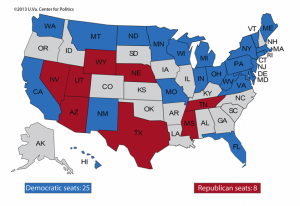
Speaking more practically, Democrats are in the Senate minority and don’t have an obvious and immediate path back. Trump is unpopular, and midterms are historically good to the opposition party, yes. But to win back the Senate in 2018, they’ll have to defend seats in 10 states that Trump won in 2016 and also will have to win three seats out of only eight pickup opportunities — with only two of them presenting obvious targets.

Look at this map:

Basically, they have to hold everything (including North Dakota, Indiana and Missouri) and also win in a state like Texas, Nebraska or Tennessee. That’s hugely difficult, no matter how unpopular Trump is 21 months from now.

Why is that important? Well, if Democrats block Gorsuch’s nomination, there is the very real possibility that Republicans will do what then-Democratic Senate Majority Leader Harry M. Reid (D-Nev.) started back in 2013 and continue to dismantle the filibuster — which for now is Democrats’ only real vestige of power in Washington. Getting rid of the filibuster is known as the “nuclear option.”

Reid invoked the nuclear option for non-Supreme Court nominations when he viewed Republicans as unduly blocking Democratic nominees, but it remains in place for other votes, including for Gorsuch. And there is a real possibility that if Democrats block a box-checker such as Gorsuch, they’ll tempt Republicans to do away with the filibuster.

Trump has already urged the GOP to do just that. He was asked last week by Sean Hannity whether he would support invoking it if Democrats block his nominee. “I would,” Trump responded twice.

A few important caveats here: First, there remains the question of whether the GOP — with just 52 senators in its majority — would actually have the votes to go nuclear; it’s not an easy decision to undo such long-standing rules. Second is that the filibuster may be doomed in the long run anyway, given the increasingly partisan, win-at-all-costs environment in Washington. And third is that Republicans going nuclear could backfire more than Reid’s did, given the stakes of a Supreme Court nomination and given that Republicans decried Reid’s resorting to the nuclear option. Some Democrats argue it’s the GOP that could overreach.

“It is both what the base demands and a real strategy,” said longtime Democratic aide Scott Mulhauser, adding: “Beyond the policy, political and rhetorical rationale, Senate Democrats force [Senate Majority Leader Mitch] McConnell and the Republicans into a box: either upend years of tradition on Court picks to ram through the Justice they want, or lose and be forced into a second or even third option.”

Former Bill Clinton counsel Ronald A. Klain also argued that invoking the nuclear option could also affect Justice Anthony M. Kennedy’s decision on whether to retire — which, unlike replacing the conservative late Justice Antonin Scalia (which is what Gorsuch would be doing), could really shift the balance of the nation’s highest court:

For Senate Republicans, keeping the prospect of a Kennedy resignation in mind would counsel resisting the temptation to end the right to filibuster Supreme Court nominations. Eliminating any power of the minority to stop the most extreme possible nominee would probably be a red flag to Kennedy — an indication that the way was clear for a balance-shifting nominee who rejected Kennedy’s views and moved the court in a radical new direction.

Beyond that, Democrats may simply feel that there is a new paradigm in Washington, with Trump having thrown many or most of the political norms out the window and that his presidency is such a unique threat that everything must be attempted to stop him.

“There’s also the that-was-then-and-this-is-now argument,” former top Reid aide Jim Manley said. “Given the threat I think Trump poses to the core values that this country holds dearly, I think many of those Democrats are going to have to think pretty hard about that.”

But others think the threat of a filibuster has been too easily telegraphed and mishandled. One Democratic operative who spoke on the condition of anonymity to comment candidly said it made “zero sense” for Democrats to have telegraphed a filibuster of Gorsuch before he was even named.

“Even if you think you’re going to do it, it is disappointing that they were so eager to play to the base and be the first name in the national fundraising email, because it played right into Trump’s hands of casting Democrats as the obstructionists,” the operative said. “It was a selfish move — about promoting themselves with the base at the expense of our positioning in the fight.”

That same temptation will loom large as we now move into Gorsuch’s confirmation process. The question is whether they can resist the pressure to do what their anti-Trump base demands and play this one right, in the name of fighting for another day — or another four years.

President Trump announced his Supreme Court nominee

Immigration Chaos

0

 By George Friedman Feb. 1, 2017

As long as illegal immigration is permitted, the foundations of American culture
are at risk.

Last week, President Donald Trump temporarily blocked both “immigrants and nonimmigrants”
from seven predominantly Muslim countries from entering the United States. From the beginning
of his presidential campaign
he has spoken at various times and in a variety of ways of taking a
step like this. Having done it, the action created uproar in part because it was done without
adequate preparation, and in larger part, because it was done at all. The mutual recriminations
over this particular act are of little consequence. What is important is to try to understand why
the immigration issue is so sensitive. The uproar over Trump’s action is merely one of many to
come, which also will be of little consequence.
Trump has pointed to two very different patterns. One is immigration to the U.S. by Muslims. The
other is
illegal Mexican immigration. Both resonated with Trump’s supporters. It is interesting to
consider other immigration patterns that have not become an issue. One is immigration to the
U.S. from India. The other is immigration from China and other parts of Asia. Both have been
massive movements since about 1970, and both have had substantial social consequences.

Protesters gather at the Los Angeles International Airport’s Tom Bradley Terminal to demonstrate against President Donald

Trump’s executive order effectively banning citizens from seven Muslim majority countries. KONRAD FIEDLER/AFP/Getty Images
Indian migration to the U.S. has been one of the most successful in American history in that it
has been among the least disruptive, has generated minimal hostility and has been
extraordinarily successful economically. Today,
Indian-Americans are the wealthiest single
ethnic group in the United States. They are hardly invisible, as they are present in all professions
and as corporate executives.
Chinese and East Asian immigration is more complex.
Chinese immigrants began coming to the
U.S. in the mid-19th century. They came as laborers supplied by Chinese contractors and were
crucial in building American railroads alongside – and in competition with – Irish immigrants. The
Chinese were exploited and brutalized and didn’t get citizenship. But after the 1970s, their story
matched the Indians’ – the Chinese were not quite as wealthy, but they did well.
About 3.7 million people of Indian descent live in the U.S., many of them second-generation
immigrants. About 4 million people of Chinese descent live in the U.S., with somewhat more
complex backgrounds. There also are 3.3 million Muslims and 35.8 million people of Mexican

descent, including an estimated 5.2 million of the 11 million who are in the U.S. illegally,
according to Pew Research Center.
If there was a strain of intense, anti-immigrant or racist sentiment in the United States, it would
be directed against Indians and Chinese just as much as Muslims and Mexicans. There would
also be a persistent strain from previous Irish immigration in the 19th century, and of Italians,
Jews and other Eastern and Southern Europeans who flooded into the United States between
1880 and 1920. To the extent that racism exists against any of these groups, the antiimmigration fervor is marginal; century-old immigrant cohorts have become mainstream. They
are not the ones marginalized – their detractors are.
It is the example of the Chinese and the Indians that blows up the theory that Americans have
an overarching anti-immigrant sensibility that Trump is tapping into. It also raises serious doubts
that Trump is anti-immigrant. I have searched and may have missed it, but I didn’t find that
Trump made anti-Chinese or anti-Indian statements, as opposed to anti-Muslim and anti-Mexican
statements. If it were classic anti-immigrant sentiment, the rage would be against Indian
immigrants who have emerged as a powerful and wealthy ethnic group in a startlingly short
time. But there is minimally detectable hostility toward them, which means that the immigration
situation in the United States is far more complex than it seems.
The issue is not whether Trump and his followers are generally anti-immigrant. The question is
why they are so hostile toward Muslims, who roughly total the same number as the Chinese and
Indians, and to Mexicans, who vastly outnumber these groups. I wish the explanation were more
complex, but it is actually quite simple in both cases.
The United States has been at war with Muslim groups since Sept. 11, 2001. When the U.S. has
gone to war with foreign powers, there has been a surge of hostility toward immigrants from
that foreign power’s country. During World War I, German immigrants in the United States who
still spoke German came under suspicion and were pressured to adopt English. During World
War II, Germans who had maintained close and cordial ties to Germany prior to the war were
harassed, and in some cases, arrested under suspicion of espionage and subversion. Japanese
citizens of the United States were arrested and sent to detention camps out of fear that they
might be conducting espionage or sabotage for the Japanese. During the Cold War, post-war
émigrés from Soviet satellite nations were distrusted by the FBI, which feared they were sent by
the Soviets as spies and saboteurs.
When there is war, there is suspicion of the enemy. When there is suspicion of the enemy, there
is fear that émigrés might be in the United States on false pretenses. Historically, émigrés have
been caught in the middle to some extent because their loyalty is questioned. In war, there is
rage as the casualties mount, particularly if sabotage and terrorism are carried out in the
homeland. This is hardly new or difficult to understand. If those of us old enough to recall the
terror after 9/11 will do so, we can remember the fear and uncertainty not only about what

comes next, but also whether the next terror team already was present in the United States.
After 15 years of war and many Americans dead, this has congealed into a framework of distrust
that may well go beyond the rational. The detention of the entire Japanese community was not
rational. Nor was it something that cannot be understood. It is hard to calibrate what you ought
to be afraid of in war, but you know that something dreadful might happen. Are all Muslims
warriors against the United States? No. Do you know who is or isn’t? Also no. Wars, therefore,
create fears. There is nothing new in the American fear of Muslims in the context of war.
The Mexican situation is different. There was a war, but it was long ago, and fear of war is not
the driving issue. Rather, the driving issue is illegal Mexican immigration. There is a great deal of
homage paid to the rule of law. Congress passed a law specifying the mechanics of legal
migration. Some 5 million Mexicans broke the law. Whether this has harmed the U.S. economy
or not, the indifference to enforcing the law by people who are normally most insistent on the
rule of law has created a sense of hypocrisy. At the same time that the middle and lower-middle
classes feel as though their interests are being ignored, the presentation of illegal aliens as
“undocumented immigrants” reveals a linguistic maneuver. The “illegals” are transformed into
the merely “undocumented,” implying a minor bureaucratic foul-up.
The anger is not only directed at the Mexicans. It is part of the rage against those living in the
bubble, who present themselves as humanitarians, but who will encounter the illegal aliens, if at
all, as their servants. And rightly or wrongly, some suspect that open support for breaking the
law is designed to bring cheap labor to support the lifestyles of the wealthy at the expense of
the declining middle class. The fact that the well-to-do tend to be defenders of illegal aliens
while also demanding the rule of law increases suspicions.
There is a somewhat deeper layer. As long as illegal immigration is permitted, the foundations of
American culture are at risk. It is not simply immigration, but the illegality that is frightening,
because it not only can’t be controlled, but also the law is under attack by those who claim to
uphold it. The fear that a person’s livelihood is being undermined and his cultural foundation is
being overwhelmed creates deep fear of the intentions of the more powerful.
The issue appears to have little to do with NAFTA and other economic concerns. The U.S. and
China have equally intense economic issues, but there is minimal tension over Chinese
immigration. The economic and immigration issues seem only tenuously connected.
It is rare that an issue of such emotional impact as Muslims during a war with Muslims, or
immigration in violation of the law, would not cause tension. As we saw with President Franklin
D. Roosevelt and the Japanese, things that are obvious to those living decades later are not
obvious at the time. Indeed, it is a failure of imagination to be unable to empathize with the fear
felt after Pearl Harbor. In our time, the failure to empathize comes from those who feel immune
to illegal immigration or the 15-year war. It is part of the growing fragmentation of American
society that different classes and regions should experience these things so differently, and that

each side has so little understanding of the other.
It is the president’s job to bridge the gap. But regardless of his wishes, the president is trapped
by the upwelling of feeling on questions of immigration by Muslims at a time of war, or the
refusal of government at all levels to enforce the law. But what is not true is that this represents
a generalized hostility to immigrants or even racism. If it did, the Indian and the Chinese
immigration in recent generations would have encountered a very different greeting. This issue
is about two groups. The response may well be extreme and clumsy. But after many years of
ignoring the anxiety that both issues generated, or dismissing it as racism, it inevitably ratchets
out of control. In fact, neither issue is mysterious, unprecedented or subject to cautious
management, given the passions on all sides.


Why Terrorism?

0

Terrorism is a specific strategy that’s employed to advance the strategic goals of the groups which use it. Here’s why.

BY ELLIOT FRIEDLAND Wed, February 1, 2017

Illustrative picture. (Photo: © Clarion Project)

Terrorism is often thought of as a plan to kill as many people as possible, lashing out in blind fury against anyone who does not share the extremist beliefs of the terrorist organization. But it isn’t. It’s a strategy of carefully-deployed violence that seeks to advance the goals of the terrorist organizations which choose that path.

Here are four reasons why terrorism has become the tactic of choice for Islamist groups which choose violence.

1.- Defeating America Militarily is Almost Impossible

“I lead the strongest military that the world has ever known. And I will never hesitate to protect my country or our allies, unilaterally and by force where necessary” – Former US President Barack Obama, 2015

America’s military budget is larger than that of the next seven countries combined. In 2015, America spent $598 billion on defense spending, compared to $567 billion for China, Saudi Arabia, Russia, the United Kingdom, India, France and Japan (the next seven countries in descending order of expenditure) combined. This is not including discretionary spending, veterans’ benefits and a host of other costs. Out of those countries, five are allies.

On the battlefield itself, American soldiers go to war equipped like no other army. They have reconnaissance in the air, support teams that can call in airstrikes or artillery support, body armor, night vision, sophisticated communications systems etc. They can use as much ammunition as they want. Their training enables set-piece maneuvers to carry out a variety of operations with minimal casualties and maximum efficiency in defeating the enemy. In the most recent raid in Yemen, US soldiers killed 14 Al-Qaeda fighters for the loss of one man. This is not even counting America’s very large nuclear arsenal.

Faced with this enemy, terrorist groups can never hope to win knockout victories on the battlefield. Even in the far-fetched scenario of total conventional war between all the Muslim countries together against the United States and its allies, they would most likely lose and lose hard.

Terrorism provides a way to strike back without having to take on that military might directly.


2.-Terrorism Is Much, Much Cheaper Than Waging War

In 2016, the Department of Defense estimated the cost of operations in Iraq at $11 million per day. A single hellfire missile costs $110,000, while the Predator drones which fire them cost just over $4 million each. For America, going to war is extremely expensive.

Comparatively, a terrorist attack can be extremely cheap. Larger-scale operations such as the 9/11 attack cost a lot more, of course, but terrorist groups have largely abandoned those in favor of small-scale attacks that anyone can carry out.

For example, the Nice truck attack, which killed 84 people in an attack against a crowd gathered on the promenade for Bastille Day, costs very little. The terrorist just had an ammunition magazine, a fake pistol, a dummy grenade, a replica Kalashnikov rifle, and a replica M16 rifle. The total combined cost of that attack pales in comparison to even one airstrike.

ISIS openly brags about this in its propaganda. It talks about how America and its allies are being bled economically by having to pay eye-watering sums to fight cheap terrorist attacks. Western countries are almost universally suffering sovereign debt crises at the same time. America alone is over $19 trillion in debt, and taxpayers are feeling the pinch. Combined with an economy that is recovering from the 2008 recession slower than expected, the middle classes are increasingly opposed to expensive anti-terrorism measures as they see the cost to their own pockets.

Terrorism is a way of waging economic warfare against the West.


3.-Modern Media Magnifies the Impact

With the ubiquity of camera-phones, live-streamed footage, recordings and images from the scenes of terrorist attacks are a feature of every major attack. To take just one example, the Berlin truck attack was recorded by a dashcam mounted on a nearby car, to provide footage of the truck speeding into the Christmas market. This amplifies the trauma experienced by the target population.

Research conducted by the National Center for Post Traumatic Stress Disorder (PTSD), concluded that “Those who watch more media coverage are also at higher risk for PTSD and associated problems.” Terror groups have multiple goals in stressing the target population. Firstly, they wish to inflict a sense of helplessness that governments are powerless to stop the attacks, unless they give in to the demands of the terrorists. Terrorists also aim to divide societies, as different factions compete to come up with solutions. We see in Europe and America increased division and hatred between different political groups, with different solutions to the problem of terrorism.

They also have the goal of gaining media attention for their cause. After every attack, news about the terrorists and their goals dominates the headlines, bringing the focus of the world onto who the terrorists are and what they want. This allows them airtime to spread their views. If people are not able to see clearly that the ideology driving the terrorism must be uprooted at the source, they may be inclined to listen to the terrorists’ propaganda.

Terror attacks dominate the headlines allowing the group to get its message out, and magnify differences within the target population creating discord, fear and tension, thus furthering the group’s goals.


4.-An Anti-Muslim Backlash Could Force Muslims to Choose Extremism

ISIS regularly speaks in its propaganda about “eliminating the gray zone” and forcing everyone in the world to choose a side.

Attacks against Muslims, such as the one which just took place in Quebec in which six worshippers were gunned down, are welcomed by ISIS. They aim to isolate Muslims from their broader communities and thus turn to more extreme groups for protection. This is what terrorist groups like ISIS want to happen, and it is to the credit of the Muslim communities of America and Europe that so far no such thing has occurred.

Terrorism seeks to polarize and cause fear, so that in their panic people run to groups that promise only security, because that kind of tribalism and conflict empowers Islamists to achieve their goals further.

https://www.clarionproject.org/analysis/why-terrorism

Αποψη: Η σατανική συμμαχία Τραμπ-Πούτιν και η νέα μοιρασιά του κόσμου

1
ΟΙ ΔΥΟ ΜΥΘΟΙ ΠΟΥ ΚΑΤΑΡΡΙΦΘΗΚΑΝ

Σε δύο προβλέψεις που καταρρίφθηκαν αναφέρεται με άρθρο του στην ισπανική εφημερίδα El Pais ο Σάντος Χουλιά, Ισπανός ιστορικός. Και κάνει τον απολογισμό.

Γράφει συγκεκριμένα ο Χουλιά:

Πόσο μακριά ακούγονται κι ας διατυπώθηκαν μόλις χθες οι προβλέψεις εκείνων των πολιτικών και κοινωνικών επιστημόνων, όταν έσβηνε ο 20ός αιώνας, για το τέλος του εθνικού κράτους και την επικείμενη αντικατάστασή του από μετα- και υπερ-εθνικά πολιτικά συστήματα!

Δύο ήταν τα βασικά προγνωστικά αυτής της επιστημονικής λεγεώνας. Πρώτον, ότι το εθνικό κράτος θα κατέρρεε μπροστά στην παγκοσμιοποίηση. Δεύτερον, ότι η αντιπροσωπευτική δημοκρατία θα αποκτούσε οικουμενικό χαρακτήρα μετά την πτώση του τείχους του Βερολίνου και το τέλος της σοβιετοκομμουνιστικής δικτατορίας. Αντί γι’ αυτά, βλέπουμε τις δύο μεγάλες δυνάμεις που μοιράστηκαν τον κόσμο μετά τον Β’ Παγκόσμιο Πόλεμο να συγκροτούν σήμερα μια σατανική συμμαχία για να κάνουν μια νέα μοιρασιά, κτίζοντας τείχη στα σύνορά τους.

Το ότι η μεγάλη συμμαχία του μέλλοντος θα έχει επικεφαλής το δίδυμο Πούτιν-Τραμπ, με την Κίνα να υπερασπίζεται το ελεύθερο εμπόριο, είναι κάτι που ούτε οι πιο ριζοσπάστες αντικαπιταλιστές δεν θα μπορούσαν να φανταστούν. Θα χρειαζόμασταν έναν Λένιν, ειδικό σε άλλου τύπου προβλέψεις, για να μας εξηγήσει ποιο στάδιο της εξέλιξης του καπιταλισμού είναι αυτό στο οποίο εισερχόμαστε με υπερηχητική ταχύτητα.

Μια δεύτερη απόδειξη ότι το εθνικό κράτος κάθε άλλο παρά καταρρέει είναι η μανία που έχει καταλάβει όλο τον κόσμο να οικοδομήσει ο καθένας το δικό του κράτος. Ή, στην περίπτωση της Ευρωπαϊκής Ένωσης που επρόκειτο να είναι ένα υπερεθνικό πολιτικό σύστημα, το πάθος με το οποίο τόσοι ή μάλλον τόσες πολιτικοί έχουν βαλθεί να μετατρέψουν αυτό το όνειρο σε εφιάλτη. Η Τερέζα Μέι στο άλλοτε Ηνωμένο Βασίλειο και η Μαρίν Λεπέν στην άλλοτε πατρίδα όλων των πατρίδων, πολύ εθνικίστριες, πολύ πατριώτισσες, είναι πεισμένες ότι η Ευρωπαϊκή Ένωση δεν είναι τίποτα άλλο από ένα οικοδόμημα που πρέπει να γκρεμιστεί.

Όσο για τον οικουμενικό χαρακτήρα της αντιπροσωπευτικής δημοκρατίας, διαψεύδεται κι αυτός. Το τρίτο κύμα του εκδημοκρατισμού, που σύμφωνα με τον Χάντινγκτον σάρωνε τον κόσμο στο τελευταίο τέταρτο του 20ού αιώνα, πέθανε στις παραλίες του 21ου αιώνα. Η ευφορία με την οποία το Journal of Democracy ανήγγελλε τον Ιανουάριο του 2000 ότι οι αντιπροσωπευτικές δημοκρατίες ξεπέρασαν τις 100, έναντι μόλις 36 το 1974, και ότι κατόπιν αυτού ο Τοκβίλ είχε νικήσει τον Μαρξ τώρα είμαστε όλοι τοκβιλιστές, έγραψαν μετατράπηκε μέσα σε μια πενταετία σε αβεβαιότητα: αρκετές από τις ανακηρυχθείσες νέες δημοκρατίας αποδείχθηκε ότι ήταν ανελεύθερες, αφού συνδύαζαν τις εκλογές με δραστικές μειώσεις των ατομικών δικαιωμάτων. Κι έτσι αποδείχθηκε ότι η πραγματοποίηση εκλογών δεν συνιστά πάντα απόδειξη της ύπαρξης της δημοκρατίας αφού η τελευταία προϋποθέτει τη διάκριση και την ισορροπία των εξουσιών.

Φαίνεται τελικά πως το περίφημο τρίλημμα του Ντάνι Ρόντρικ ότι πρέπει να διαλέξουμε δύο από τα τρία: δημοκρατία, εθνικό κράτος, παγκοσμιοποίηση είναι κάτι παραπάνω από ένα κλισέ για τις αίθουσες διδασκαλίας των αγγλόφωνων πανεπιστημίων. Και ότι πρέπει πράγματι να κάνουμε αυτή την περίφημη επιλογή. Αυτό που δεν περιέλαβε ο Ρόντρικ στο τρίλημμά του είναι ότι η επιλογή του εθνικού κράτους στη σημερινή εποχή προϋποθέτει ένα ΟΧΙ στην παγκοσμιοποίηση και ταυτόχρονα ένα ΟΧΙ στη δημοκρατία. Για να το πούμε διαφορετικά: όπως συνέβη και τη δεκαετία του ’30, η άνοδος των εθνικισμών οδηγεί στο τέλος της αντιπροσωπευτικής δημοκρατίας ως μορφής του εθνικού κράτους και στο τέλος της ελεύθερης αγοράς ως μορφής της καπιταλιστικής οικονομίας.

Σε τελευταία ανάλυση, ο Χίτλερ και ο Μουσολίνι ήταν αυτό που αποκαλούμε σήμερα εκλεγμένοι μονάρχες. Κι αυτό που έκαναν στα κράτη τους ήταν να τα μετατρέψουν από φιλελεύθερες δημοκρατίες συστήματα που τους έφεραν στην εξουσία σε προστατευτικές μοναρχίες. Ενώ οι Βρετανοί υποστήριζαν μέχρι την τελευταία στιγμή ότι είναι δυνατές οι συμφωνίες μαζί τους για τις σφαίρες επιρροής, ότι είναι δυνατός ο «κατευνασμός» τους.

Ο Πούτιν και ο Τραμπ δεν είναι Χίτλερ και Μουσολίνι, σύμφωνοι (αν και η Τερέζα Μέι έχει κάτι από Τσάμπερλεν). Ούτε η Ρωσία και οι ΗΠΑ είναι σήμερα αυτό που ήταν η Γερμανία και η Ιταλία τις δεκαετίες του ’20 και του ’30. Αυτό δεν σημαίνει όμως ότι το κύμα που οδήγησε δύο φορές την ανθρωπότητα στην καταστροφή των δύο μεγάλων πολέμων δεν είναι ανάλογο με το κύμα που έφερε στην εξουσία αυτούς τους δύο εκλεγμένους μονάρχες. Το κύμα αυτό έχει όνομα: λέγεται εθνικισμός, και κανείς δεν μπόρεσε να προβλέψει την τρομερή καταστροφική του δύναμη ως τη στιγμή που τέθηκε σε κίνηση.

Πηγή: El Pais/iefimerida.gr

The National Security Daily Brief from Foreign Policy

0

Wednesday, February 1, 2017

By Paul McLeary with Adam Rawnsley

Bannon’s world. For someone who ran a media company — and hosted a radio show — before become President Trump’s top advisor, there’s been an air of mystery surrounding Steve Bannon. The USA Today went back and listened to dozens of recordings of the show he hosted for the conspiracy-minded, ultra-right wing Breitbart media company, and found that much of what he said in 2015 and early 2016 has since been parroted by POTUS.

Earlier this week, Trump made Bannon a member of his National Security Council, taking the highly unusual step of installing a political adviser in the middle of his national security team.

In one episode, Bannon said, “you have an expansionist Islam and you have an expansionist China. Right? They are motivated. They’re arrogant. They’re on the march. And they think the Judeo-Christian West is on the retreat” He went on to predict a war between the U.S. and China within the next decade.

He also predicted “a major shooting war in the Middle East” in the coming years. “To be brutally frank, I mean Christianity is dying in Europe, and Islam is on the rise,” he said in January 2016. “Some of these situations may get a little unpleasant,” Bannon said. “But you know what, we’re in a war.”

Keep an eye on Yemen. Some Pentagon officials are looking at Yemen as a place where the Trump administration might allow the military more room for action than the Obama administration, according to the Washington Post’s Thomas Gibbons-Neff and Missy Ryan.

After the weekend’s Navy SEAL raid on an al Qaeda camp that killed over a dozen fighters — along with the 8 year-old daughter of deceased American cleric Anwar ­al-Awlaki, who was killed in 2011 in a U.S. drone strike – along with Chief Petty Officer William “Ryan” Owens, defense officials see more action coming. “We expect an easier approval cycle [for operations] under this administration,” one defense official told the Post. Another former officials with experience in Yemen said that more U.S. troops on the ground in Yemen was “overdue.”

Military clears itself of wrongdoing. Remember back to late 2015, when a group of civilian intelligence analysts at the U.S. Central Command charged that their bosses were tweaking their work to make it look like the war against ISIS in Iraq was going better than facts on the ground warranted? This might surprise you, but a Pentagon investigation due out Wednesday finds little evidence to support those charges. Buzzfeed’s Nancy Youssef first reported the results of the investigation, saying one of the analysts called the report a “whitewash.”

Asking too much of Mattis? Expectations for new Defense Secretary James Mattis are high — with allies and domestic observers expecting him to act as a bulwark against an inexperienced White House’s desire to move fast.

“Mattis is the canary in the coal mine,” signaling the mood of the Trump administration, one foreign official told the Wall Street Journal’s Gordon Lubold and Julian Barnes. That’s a lot to ask of any cabinet member, and let’s not forget that Mattis has bosses: national security advisor Michael Flynn and President Trump, to whom he’s accountable, and whose policies he’s tasked with carrying out.

But the SecDef is wheels up for Asia on Wednesday, stopping off in Japan and South Korea on the first overseas trip of any member of the Trump administration. While there, Mattis will address the North Korean threat, China’s moves in the South China Sea, and calm jittery allies unsure over Trump’s campaign pledges to pull U.S. troops out of overseas bases in the region. Later this month, Mattis will head to an international summit in Germany, where he’ll again be asked to be the leading face for the future of U.S. foreign policy.

Tell us how you really feel. A senior career diplomat “delivered a soaring and thinly-veiled critique of President Donald Trump’s foreign policy in a farewell address Tuesday that pleaded with colleagues to stay in their positions and uphold America’s longstanding policies of openness and liberty,: FP’s John Hudson reports from Foggy Bottom.

“We still owe something to America,” said Tom Countryman, the outgoing under secretary of state for arms control, at a private goodbye party at the State Department. “A policy without professionals is by definition an amateur policy. You have to help make the choices that bring this country forward.”

You down with FSB? A top cybersecurity specialist and his deputy in Russia’s intelligence service, the FSB, are reportedly being accused by the Kremlin of “breaking their oath” by working with America’s Central Intelligence Agency, FP’s Emily Tamkin tells us. “Sergei Mikhailov, allegedly detained at a board meeting last December, and his deputy, Dmitry Dokuchaev, were arrested by the Kremlin on Jan. 27 for treason and illegal hacking. Then, on Tuesday, Russian news agency Interfax, after hearing from unidentified sources, reported that they, along with Ruslan Stoyanov, the head of cybercrime investigations at Kaspersky Labs, and a fourth, as yet unnamed person, are suspected of passing along secret information to the CIA — or of passing it to someone who passed it to the CIA.”

The more you know. Russian defense ministry has just launched a Arabic language version, and is unveiling a Chinese site next month, according to Kremlin-funded Sputnik.

Welcome to SitRep. Send any tips, thoughts or national security events to [email protected] or via Twitter: @paulmcleary or @arawnsley.

Philippines

Philippine President Rodrigo Duterte is making good on his promises to warm relations with China in contrast to the recent tensions between the two countries over disputed territory in the South China Sea. Reuters reports that Duterte said he’s asking China to pitch in to help with the Philippines’s piracy problem in the Sulu Sea. Duterte says he’d be “glad” if Chinese coast guard vessels patrolled the waters, where Islamist militants have kidnapped sailors and held them for ransom. Duterte has argued for a pivot to Russia and China and away from the U.S. following criticism from American officials over his policy of encouraging the vigilante murders of drug addicts.

Ukraine

Russian-backed rebels in Ukraine are increasing their use of heavy artillery, shelling population centers in territory held by the Ukrainian government and raising the question of what, if anything, President Trump intends to do about it. The Washington Post reports that ten people have died in the fighting already, but all eyes are on the Trump administration to see what its policy will be towards the conflict. During the 2016 presidential campaign, Trump expressed support for Russia’s annexation of Crimea and skepticism that the Russian troops involved in the operation were actually Russian.

The UN Security Council expressed “grave concern” on Tuesday over the fighting. “The members of the Security Council expressed their full support of sovereignty and territorial integrity of Ukraine,” the Security Council — which includes Russia, and Ukraine on a rotating basis — said in statement. “The members of the Security Council called for an immediate return to a ceasefire regime.”

Syria

President Trump’s policy towards Syria and the anti-Islamic State fight is becoming somewhat clearer following claims from U.S.-backed rebels that they had been provided armored vehicles by Washington. The predominantly Kurdish SDF has been among the most effective American allies against the Islamic State but U.S. support for it has come at the cost of mounting irritation from Turkey, which considers the Kurdish groups that compose the SDF to be terrorists. SDF spokesman Talal Sello called the shipment of the vehicles the marker of “a new phase” in the U.S.-SDF relationship, noting that the Obama administration had been less willing to supply the group with more than light weapons.

Drones

The New York Times got a hold of some of the Islamic State’s internal documents on its drone program. The terrorist group has been using commercial and purpose-built drones to drop small explosive like grenades on Iraqi forces trying to clear out the city of Mosul. According to the documents, the Islamic State has standardized checklists for drone missions as well as documentation showing the various commercial components used to build and equip the devices. A spokesman for the U.S.-led anti-Islamic State coalition told the times that the terrorist group’s drones have killed about a dozen people and injured 50 so far.

Psyop

One of the Defense Department’s flagship counter-messaging programs against the Islamic State is bogged down by incompetence and dubious impact, according to an AP investigation. The program, called WebOps, is supposed to use Arabic-speaking personnel to dissuade potential recruits to the Islamic State and counter their message. But the wire service found allegations that WebOps personnel often have weak grasps of Islam and the Arabic language, have awarded contracts based on nepotism, and provided their own misleading assessments about the impact of WebOps on Islamist militants online.

Business of defense

When the Obama administration greenlit the sale of fighter jets to Gulf countries, it let Kuwait and Qatar’s purchases move forward but held back the sale of F-16s to Bahrain until it improved its human rights record. Now, Defense News reports, it looks like the fine print about human rights is no more and the sale will go through unimpeded. Sen. Bob Corker (R-TN) says he thinks the Trump administration will approve the $2.8 billion sale without any restrictions.

Book deals

In a move that will surprise few, a Navy SEAL is writing a book. Robert O’Neill, a member of the Navy’s elite SEAL Team 6 and the man that, by some accounts, pulled the trigger on the shot that killed Osama Bin Laden, will be publishing a memoir in April about his life with the special operations unit. Matt Bissonnette, a fellow Team 6 alumni and participant in the Bin Laden raid, also published a memoir that touched on the famous raid only to find himself in legal trouble failing to clear it through pre-publication review. O’Neill’s book, by contrast, has been vetted through the pre-publication review process already.

Photo Credit: Mark Wilson/Getty Images

Σοβαρότητα

5

Τα μεγάλα λάθη στα Ιμια είχαν να κάνουν με την τήρηση των διαδικασιών και το πώς λειτούργησαν τα βασικά κέντρα αποφάσεων. Επαναλαμβάνονται. Την Κυριακή είχαμε ένα μείζον επεισόδιο. Κανένα συντονιστικό κέντρο δεν ανέλαβε να συντονίσει τις εμπλεκόμενες υπηρεσίες, που δεν είναι μόνο στρατιωτικές. Στο Μαξίμου δεν λειτουργεί τέτοιο κέντρο και το ΚΥΣΕΑ δεν συνεκλήθη. Ας ελπίσουμε ότι θα επικρατήσει σύνεση στην άλλη πλευρά και θα αποφευχθεί ένα νέο σοβαρό επεισόδιο. Χρειάζεται όμως μεγαλύτερη σοβαρότητα και θεσμικότητα στην Αθήνα για να μην ξαναζήσουμε τα ίδια.

“Καθημερινή”

Κοιτάζοντας προς την Γερμανία

0

Τι μπορεί και τι δεν μπορεί να κάνει το Βερολίνο για την φιλελεύθερη τάξη

Περίληψη:

Η ελπίδα πολλών αγχωμένων Ευρωπαίων και Αμερικανών, ανήσυχων για την τύχη της φιλελεύθερης τάξης και την διατλαντική σχέση, είναι ότι η Γερμανία θα πάρει την θέση των Ηνωμένων Πολιτειών ως ηγέτης της φιλελεύθερης τάξης. Αλλά αυτό είναι ευσεβής πόθος. Η Γερμανία δεν μπορεί να αντικαταστήσει τις ΗΠΑ ως φιλελεύθερη ηγέτις του κόσμου για τον απλό λόγο ότι δεν είναι τέτοια.

Ο STEFAN FRÖHLICH είναι ανώτερος συνεργάτης στην Transatlantic Academy και καθηγητής Διεθνούς Πολιτικής στο Πανεπιστήμιο Erlangen-Nürnberg.

Με τον πρόεδρο των ΗΠΑ, Donald Trump, αποφασισμένο να τραβήξει τις Ηνωμένες Πολιτείες έξω από την παγκόσμια ηγεσία και με το Ηνωμένο Βασίλειο βυθισμένο σε μια μπερδεμένη αναχώρηση από την Ευρωπαϊκή Ένωση, η Γερμανία έχει αναδειχθεί ως η κεντρική οικονομική και πολιτική δύναμη στην Ευρώπη. Από την πολυ-επαινεμένη ομιλία του προέδρου της Γερμανίας, Joachim Gauck, στην Διάσκεψη Ασφαλείας του Μονάχου [1] το 2014 – «Ας μην κάνουμε τα στραβά μάτια», δήλωσε τόνισε με έμφαση, «να μην αποφύγουμε τις απειλές, αλλά αντ’ αυτού να σταθούμε ακλόνητοι»- η χώρα έχει δείξει την δέσμευσή της να διασφαλίσει την δική της ασφάλεια και της ηπείρου. Συμφώνησε να αυξήσει σταδιακά τις αμυντικές δαπάνες της ώστε να επιτύχει τον ΝΑΤΟϊκό στόχο του 2% επί του ΑΕΠ για την δημιουργία ενός αξιόπιστου ευρωπαϊκού συστήματος άμυνας. Πήρε μια μονομερή απόφαση στις αρχές του 2015, να στείλει τον Bundeswehr σε μια εκπαιδευτική αποστολή στο βόρειο τμήμα του Ιράκ και να ενταχθεί στην στρατιωτική εκστρατεία εναντίον του Ισλαμικού Κράτους (επίσης γνωστού ως ISIS) [2] αφότου η Γαλλία επικαλέστηκε την αμοιβαία αμυντική ρήτρα της Συνθήκης της Λισαβόνας της ΕΕ μετά τις τρομοκρατικές επιθέσεις στο Παρίσι τον Νοέμβριο του 2015. Το Βερολίνο συνέχισε να βοηθά στην διαχείριση της κρίσης στη νότια περιφέρεια της Ευρώπης, στην Συρία και το Ιράκ, αναδεικνυόμενο σε έναν αξιόπιστο εταίρο της Ουάσιγκτον σε μια εποχή που οι Ηνωμένες Πολιτείες είχαν κάνει σημαντικές περικοπές υπό τον πρώην πρόεδρο Μπαράκ Ομπάμα.

Η ελπίδα πολλών αγχωμένων Ευρωπαίων και Αμερικανών [3], ανήσυχων για την τύχη της φιλελεύθερης τάξης και την διατλαντική σχέση, είναι ότι η Γερμανία θα πάρει την θέση των Ηνωμένων Πολιτειών ως ηγέτης της φιλελεύθερης τάξης. Αλλά αυτό είναι ευσεβής πόθος.

Η Γερμανία έχει ήδη κατακλυστεί από κρίσεις εγχωρίως και στα σύνορά της. Και δεν μπορεί να αντικαταστήσει τις ΗΠΑ ως φιλελεύθερη ηγέτις του κόσμου για τον απλό λόγο ότι δεν είναι τέτοια. Το 2015, είχε έναν αμυντικό προϋπολογισμό που ήταν το ένα εικοστό του μεγέθους των Ηνωμένων Πολιτειών, σύμφωνα με το Διεθνές Ινστιτούτο Στρατηγικών Μελετών. Δεν είναι πυρηνική δύναμη και έχει συγκριτικά μικρότερες φιλοδοξίες να προσφέρει για το κοινό καλό στην παγκόσμια σκηνή από όσο οι Ηνωμένες Πολιτείες.

Αλλά ούτε το Βερολίνο εφησυχάζει [4], και υπάρχουν πολλά που μπορεί και είναι διατεθειμένο να κάνει για να εξασφαλίσει ότι η Ευρώπη παραμένει ενωμένη, ιδιαίτερα σχετικά με την άμυνα. Για πρώτη φορά μετά την επανένωση, η Γερμανία έχει ετοιμαστεί να αυξήσει τον αμυντικό προϋπολογισμό της, μια αύξηση 8% από το 2016. Και επίσης κινείται για την προώθηση της αμυντικής συνεργασίας της ΕΕ. Στην πραγματικότητα, ακόμα κι αν η Γερμανία είναι απίθανο να αναλάβει την ευρωπαϊκή άμυνα αντί για τις Ηνωμένες Πολιτείες, αυτή και οι συνεργάτες της μπορούν να βρουν πολλές ευκαιρίες στις απειλές Trump ώστε να ξεπεράσουν τις δικές τους πολιτικές κακουχίες.

ΔΙΠΛΗ ΠΡΟΣΕΓΓΙΣΗ

Σε κοινή συνέντευξη Τύπου με τον Trump την περασμένη εβδομάδα, η Βρετανίδα πρωθυπουργός Theresa May δήλωσε ότι ο ηγέτης των ΗΠΑ ήταν «100% υποστηρικτικός του ΝΑΤΟ». Αλλά εάν οι λέξεις της [προεκλογικής] εκστρατείας του Trump αντανακλούν την σκοπούμενη πολιτική του ως πρόεδρος, η υποστήριξη των ΗΠΑ προς το ΝΑΤΟ θα συρρικνωθεί και η υποστήριξη προς την Ρωσία θα καλλιεργηθεί. Από τη μια πλευρά, αυτό θα δώσει στην Ρωσία την ευκαιρία να εδραιωθεί στην Ανατολική Ευρώπη και θα σημαίνει το πιθανό τέλος της ένταξης στην ΕΕ και το ΝΑΤΟ για την Ουκρανία και άλλες πιθανές υποψήφιες χώρες. Αλλά από την άλλη πλευρά, η Ρωσία δεν έχει καμία πρόθεση να προκαλέσει ένα μέλος του ΝΑΤΟ να επικαλεσθεί το άρθρο 5 (την διάταξη περί της συλλογικής άμυνας του ΝΑΤΟ), με δεδομένο τον τρόπο που η κρίση στην Ουκρανία αναζωογόνησε την οργάνωση το 2014. Η Μόσχα δεν έχει τα οικονομικά ή στρατιωτικά μέσα για την καταπολέμηση του ΝΑΤΟ, πράγμα που σημαίνει ότι κύρια ανησυχία της Γερμανίας θα είναι η χρήση από την Μόσχα του πιο αποδοτικού υβριδικού πολέμου στην άμεση γειτονιά της.

Η πιθανή αντίδραση του Βερολίνου, λοιπόν, θα είναι να συνεχιστεί η διττή προσέγγιση του να είναι και σκληρό και εξυπηρετικό ως προς την Μόσχα. Όσον αφορά το πρώτο, το Βερολίνο έχει δείξει μεγάλη προθυμία να πείσει τους Ευρωπαίους εταίρους του να διατηρήσουν τις κυρώσεις τους για την Ρωσία, ή ακόμα και να τις επεκτείνουν, δεδομένων των επιδρομών της Μόσχας στην Συρία, ακόμη και αν η νέα διοίκηση των ΗΠΑ διακόψει τις δικές της. Όσον αφορά το τελευταίο, το Βερολίνο θα πρέπει σταδιακά να εγκαταλείψει την επέκταση της Ευρωπαϊκής Ένωσης προς τα ανατολικά και να αποδεχθεί, με όρους de facto, τις ρωσικές σφαίρες επιρροής στην Κεντρική Ασία, τον Καύκασο, και, πιο πρόσφατα, στην Ουκρανία. Το ΝΑΤΟ θα μπορούσε επίσης να προσπαθήσει να διευθετήσει τα ρωσικά συμφέροντα, παραιτούμενο από την διεύρυνση, και (ίσως) από την κατασκευή του συστήματος αντιπυραυλικής άμυνας στην Ρουμανία και την Πολωνία, κάτι που έχει προγραμματιστεί για το 2018. Υπάρχουν ισχυρά τμήματα του γερμανικού κομματικού συστήματος που θα ήταν πρόθυμα να υποστηρίξουν αυτά τα βήματα. Πιστεύουν ότι η ευρωπαϊκή αντιπυραυλική άμυνα είναι στενά συνδεδεμένη με τις μελλοντικές συνομιλίες για τους εξοπλισμούς με την Ρωσία, οι οποίες έχουν καθυστερήσει τα τελευταία χρόνια, καθώς οι δύο πλευρές επιδιώκουν προγράμματα εκσυγχρονισμού των πυρηνικών τους όπλων.

Αλλά τέτοιες συμφωνίες πρέπει να περιλαμβάνουν ένα σαφές μήνυμα προς την Μόσχα ότι η ύφεση [στις σχέσεις] δεν σημαίνει αδυναμία, σε περίπτωση που η Ρωσία έχει μπει στον πειρασμό να κλιμακώσει τις εντάσεις στην Ανατολική Ευρώπη για να δοκιμάσει τα όρια της νέας κυβέρνησης των ΗΠΑ. Ως εκ τούτου, οι Ευρωπαίοι, με το Βερολίνο και το Παρίσι να αναλαμβάνουν την ηγεσία, θα πρέπει να χτίσουν στα ήδη υπάρχοντα σχέδια για μια μόνιμη και πιο αποτελεσματική στρατιωτική δύναμη της ΕΕ και να αναπτύξουν ένα σχέδιο έκτακτης ανάγκης για τις χώρες της Βαλτικής και της Ανατολικής Ευρώπης. Αυτό πρέπει να περιλαμβάνει, τουλάχιστον, μια σοβαρή δέσμευση συνεισφοράς στο ΝΑΤΟ στο 2% του ΑΕΠ τους. Θα πρέπει επίσης να περιλαμβάνει υποστήριξη του Βερολίνου στο σχέδιο της Ευρωπαϊκής Επιτροπής να απομακρύνει όλες τις περιττές δομές και μονάδες της ευρωπαϊκής άμυνας. Περίπου το 80% των αμυντικών προμηθειών γίνονται σε καθαρά εθνικό επίπεδο, κάτι που οδηγεί σε δαπανηρές επικαλύψεις στρατιωτικών δυνατοτήτων (κατ’ εκτίμηση από 27 δισεκατομμύρια δολάρια μέχρι 107 δισεκατομμύρια ετησίως, σύμφωνα με την Ευρωπαϊκή Επιτροπή). Και θα πρέπει να περιλαμβάνει στρατηγικές επενδύσεις σε μη επανδρωμένα αεροσκάφη, από αέρος ανεφοδιασμό, δορυφορικές επικοινωνίες και ασφάλεια στον κυβερνοχώρο, που μέχρι τώρα η Ουάσιγκτον αναγκαζόταν να παρέχει σχεδόν σε κάθε ευρωπαϊκή στρατιωτική επιχείρηση, ακόμη και στην Λιβύη, όπου η Γαλλία και το Ηνωμένο Βασίλειο πήραν την ηγεσία στο πλαίσιο του ΝΑΤΟ. Το Βερολίνο υπήρξε επίσης ένας από τους βασικούς υποστηρικτές της ανάπτυξης κοινού πολιτικο-στρατιωτικού σχεδιασμού για την διαχείριση κρίσεων και την οικοδόμηση ενός στρατιωτικού αρχηγείου της ΕΕ προετοιμασμένου για απειλές όπως αυτές στην Λιβύη και να συντονίζει κοινές πολιτικο-στρατιωτικές επιχειρήσεις. Τέλος, οι συνεχιζόμενες προσπάθειες του Βερολίνου να συμβάλει στην αποτρεπτική δύναμη του ΝΑΤΟ στις χώρες της Βαλτικής και την Πολωνία -ένα βήμα που είναι περισσότερο από συμβολικό, δεδομένου ότι θα βάλει τους Γερμανούς στρατιώτες στην πρώτη γραμμή σε μια ένοπλη σύγκρουση- μέχρι στιγμής έχουν αντιμετωπιστεί με σκεπτικισμό, αλλά ίσως τώρα να εκτιμηθούν στην Ευρώπη, δεδομένης της ανάγκης για μεγαλύτερη συνεργασία πάνω στην άμυνα.

ΙΣΧΥΡΟΤΕΡΕΣ ΣΥΝΕΡΓΑΣΙΕΣ

Αλλά η Γερμανία δεν μπορεί να προχωρήσει χωρίς την γαλλική συνεργασία. Μαζί, θα πρέπει να πάρουν το προβάδισμα στο να κάνουν την Κοινή Πολιτική Ασφάλειας και Άμυνας της Ευρώπης πιο λειτουργική. Το Βερολίνο μπορεί να εξετάσει τις προτάσεις του Παρισιού να εξαιρεθούν οι αμυντικές δαπάνες από τους υπολογισμούς του ελλείμματος, κάτι που θα επιτρέψει περισσότερες δαπάνες χωρίς να καταπατηθούν οι περιορισμοί του ελλείμματος που προβλέπει το Σύμφωνο Σταθερότητας και Ανάπτυξης της ΕΕ [5], και να δημιουργηθεί ένα ευρωπαϊκό Αμυντικό Ταμείο που θα επιτρέψει στους Ευρωπαίους εταίρους να ενοποιήσουν σχετικές επενδύσεις.

Αν και η ενίσχυση των ευρωπαϊκών δυνατοτήτων πυρηνικής αποτροπής φαίνεται ρεαλιστική, είναι πιθανό ότι η Γαλλία θα μπορούσε να εξετάσει το ενδεχόμενο πιο σοβαρά αφότου το Ηνωμένο Βασίλειο φύγει από την ΕΕ. Τα γαλλικά και τα βρετανικά πυρηνικά όπλα ήταν τμήμα της ευρωπαϊκής στρατηγικής αποτροπής από την εποχή της ΝΑΤΟϊκής Διακήρυξης της Οττάβα το 1974, στην οποία οι δύο πυρηνικές δυνάμεις εξέφρασαν την προθυμία τους να συμβάλλουν «στην συνολική ενίσχυση της αποτρεπτικής ικανότητας της Συμμαχίας». Δεδομένου ότι η Γερμανία έχει συμφωνήσει να μην αναπτύξει και να μην αποκτήσει πυρηνικά όπλα στο πλαίσιο της Συνθήκης Μη Διασποράς και της Συνθήκης Δύο συν Τέσσερα (Two Plus Four Treaty), είναι πιθανό ότι θα ήταν πρόθυμη να πληρώσει για την γαλλική δύναμη κρούσης και να κάνει ό, τι είναι δυνατόν για να κρατήσει το Ηνωμένο Βασίλειο να περιλαμβάνεται σε οποιαδήποτε σχέδια για ευρωπαϊκή πυρηνική αναχαίτιση.

Η ενίσχυση όλων αυτών των στοιχείων εξυπηρετεί δύο στόχους για τους Γερμανούς και τους Ευρωπαίους: Να πείσουν την Ουάσιγκτον να διατηρήσει το ΝΑΤΟ με το να εντείνουν την δική τους συμβολή στην συλλογική άμυνα, και να προβάλουν ισχύ στην γειτονιά τους, ιδιαίτερα εάν οι Ηνωμένες Πολιτείες αποτραβηχτούν από την Μέση Ανατολή [6]. Στην πραγματικότητα, βασικό επιχείρημα της Γερμανίας για την εισαγωγή κοινών δομών στην ΕΕ είναι ότι η Ευρώπη πρέπει να διαδραματίσει μεγαλύτερο ρόλο στην σταθεροποίηση της Μέσης Ανατολής και της αφρικανικής ηπείρου -αμφότερες ζωτικής σημασίας για την αντιμετώπιση της τρομοκρατίας και την επίλυση της κρίσης των προσφύγων.

Δεδομένου ότι η Γερμανία είναι σήμερα πιο πρόθυμη να ασκήσει στρατιωτική ηγεσία από ποτέ άλλοτε, και υπό την προϋπόθεση ότι θα λάβει στήριξη από τους μεγαλύτερους Ευρωπαίους εταίρους της, υπάρχει μεγάλη πιθανότητα ότι το σημερινό πολιτικό κλίμα μπορεί να φέρει τους Ευρωπαίους πιο κοντά, ιδίως την Γαλλία και την Γερμανία (και ίσως ακόμη και το αναχωρούν Ηνωμένο Βασίλειο). Η Ευρώπη δεν θα καταρρεύσει από τις αμφιβολίες σχετικά με το μέλλον των εγγυήσεων ασφάλειας των ΗΠΑ, και η Γερμανία θα αντιμετωπίσει την πρόκληση για να το βεβαιώσει αυτό.

Copyright © 2017 by the Council on Foreign Relations, Inc.
All rights reserved.

Στα αγγλικά: https://www.foreignaffairs.com/articles/germany/2017-01-29/looking-germany

Σύνδεσμοι:
[1] http://www.bundespraesident.de/SharedDocs/Reden/EN/JoachimGauck/Reden/20…
[2] http://www.nbcnews.com/storyline/isis-terror/germany-support-military-ca…
[3] https://www.nytimes.com/2016/11/13/world/europe/germany-merkel-trump-ele…
[4] http://foreignpolicy.com/2016/12/13/merkel-and-whose-army-germany-milita…
[5] https://ec.europa.eu/info/node/4287/
[6] http://carnegieendowment.org/2016/12/05/donald-trump-s-middle-east-promi…

Μπορείτε να ακολουθείτε το «Foreign Affairs, The Hellenic Edition» στο TWITTER στην διεύθυνση www.twitter.com/foreigngr αλλά και στο FACEBOOK, στην διεύθυνση www.facebook.com/ForeignAffairs.gr και στο linkedin στην διεύθυνση https://www.linkedin.com/company/foreign-affairs-the-hellenic-edition

US Sends Military Supplies To Syrian Alliance In First Under Trump Admin

0
written by tyler durden tuesday january 31, 2017

Confirming that the US role in the Syrian conflict is likely to expand in the coming months, Reuters reported that the U.S.-led coalition against Islamic State has supplied its Syrian allies with armored vehicles for the first time, expanding support since U.S. President Donald Trump came to office.

The armored vehicles and troop carriers had arrived four or five days ago, said Talal Silo, spokesman for the Syrian Democratic Forces (SDF) alliance, which includes the Kurdish YPG militia.

Though the number was small, he said, “this is evidence that there are signs of new support”. “Previously we didn’t get support in this form, we would get light weapons and ammunition,” he said.

“There are signs of full support from the new American leadership – more than before – for our forces,” he said.

As a reminder, yesterday the Syrian government lashed out at the Trump proposal for an implementation of “safe zones” in Syria. It remains to be seen how Assad, whose health has been put in question recently, will respond to this clearest indication yet that the Trump admin plans to maintain its involvement in the Syrian proxy war.

Reprinted with permission from ZeroHedge.