Αρχική Blog Σελίδα 2995

It’s Not Greece The Eurozone Needs To Worry About, It’s Italy Defaulting That Would Be The Problem

0

Tim Worstall CONTRIBUTOR FORBES

Opinions expressed by Forbes Contributors are their own.

Protesting Greek firefighters occupy the yard of the Ministry of Administrative Reform in Athens, during their protest on February 8, 2017. (Credit: Louisa Gouliamaki/AFP/Getty Images)

Yes, Greece is once again stuck in the mire of wondering how it can possibly pay its debts. There’re repayments that have to be made this summer and Greece just doesn’t have the cash–thus it’s dependent upon further loans from the eurozone in order to be able to meet those payments. There are arguments about the terms on which Greece will get those further disbursements and, well, we’ve all been here before. We’ve been doing this 5 and 6 years now already. But the truth is that disastrous as this all is for the Greek economy, the poverty it imposes upon the Greek people not being a great idea either, this is really all a sideshow. The Greek economy just isn’t large enough, the amount owed not big enough, for it to all be any more than an annoyance to the other European economies. It’s Italy which is the problem, Europe just isn’t rich enough in toto to be able to cope with the same happening there.

And yet something similar might well happen in Italy:

Greece’s left-wing Prime Minister Alexis Tsipras is weighing his options as negotiations with the country’s international creditors heat up and the clock is ticking on a round of crucial elections in Europe.

There are always elections somewhere in Europe which is why so much is decided upon political, not economic, grounds. This year it’s France and Germany, which is more important than usual as they are the two largely keeping the system together at present:

The future of Greece in the euro zone is once again in doubt as creditors and Athens cannot agree on debt relief for the troubled economy.

The outspoken German Finance Minister Wolfgang Schauble told the German broadcaster ARD that in order to cut its debt, Greece would have to leave the euro zone.

Similar calls were made across the largest euro economy, where elections will be held after the summer. The German pro-business party FDP (Free Democratic Party) also said Thursday that Greece should leave the euro zone and then receive debt relief.

The FDP aren’t in fact pro-business, they’re pro-market liberals like myself. But put that aside–even the IMF is insisting that there must be debt relief. However, as I say, Greece is a sideshow. If it did default then it would be painful, no doubt about it, there would be € 100 billion or more of taxpayers’ money that would disappear into the aether. This money is already lost of course, we’re just waiting for that loss to be recognised. But in the context of the eurozone economy this is a boring and slightly painful problem, not some existential disaster. Call it 1% of eurozone GDP, and that coming off the capital account so to be spread over a number of years. Both boring and painful but no more than that.

The real problem is Italy:

Mario Draghi, the European Central Bank’s president, promised in summer 2012 to do whatever it took to save the euro, but the debt burdens of Italy and Greece have become progressively worse amid the stagnation of their economies.

Italy’s debt as a share of its economic output has risen to 133 percent from 123 percent during that period. In Greece, debt has increased to an expected 183 percent of the country’s total economy from 159 percent.

These figures highlight a harsh economic reality: Just as an individual will struggle to pay off a punishing credit card bill if her salary stays flat or falls, a country cannot reduce its debt pile without expanding its economy.

http://www.forbes.com/sites/timworstall/2017/02/09/its-not-greece-the-eurozone-needs-to-worry-about-its-italy-defaulting-that-would-be-the-problem/#47ac65b47491

Russia the Main Coordinator’: US-Turkey Relations Could Mend With Putin’s Help

0

Sputnik

While US President Donald Trump has affirmed the US’ relationship with Turkey will continue under his administration, deep disjunctures between the pair remain. However, a Middle East politics expert has told Sputnik that Russia will be pivotal in reconciling them, and uniting the two countries in the fight against Daesh (also known as ISIL).

Following a phone call with his Turkish counterpart, Recep Tayyip Erdogan, President Trump issued a statement hailing Turkey as “a strategic partner and NATO ally,” and confirmed Central Intelligence Agency (CIA) Director Mike Pompeo would visit Turkey on February 9 to discuss security issues. However, beneath the boilerplate spin and diplomatic pledge lurk severe divisions between the two countries.

A sizeable rift burst open between the pair over the course of 2016, expanding evermore as the year progressed.

Perhaps most significantly, elements of the Turkish military attempted to overthrow Erdogan in July 2016 — and high-ranking government officials laid the blame on the doorstep of Obama;s White House.

They said his administration’s refusal to extradite Turkish cleric Fethullah Gulen, believed by many in Turkey to be the driving force behind the scuppered overthrow, amounted to complicity — if not active participation in his destabilization efforts.

US based cleric Fethullah Gulen at his home in Saylorsburg, Pennsylvania
© REUTERS/ CHARLES MOSTOLLER
US based cleric Fethullah Gulen at his home in Saylorsburg, Pennsylvania

In response, Erdogan quickly moved to forge a new alliance with Russia, raising Turkey/US tensions to such levels, commentators suggested it could spell the end for NATO.Another point of divergence for the two countries is ongoing US support for the YPG and PKK, Kurdish fighters battling Islamist groups in Syria.

While Washington considers the Kurdish forces vital in the war on Daesh, Ankara categorizes the groups as terrorists, due to their affiliation with outlawed Kurd rebel organizations in Turkey.

A Kurdish fighter from the People's Protection Units (YPG) carries his weapons as he walks along a street in the northeastern city of Hasaka, Syria, August 21, 2016.
© REUTERS/ RODI SAID
A Kurdish fighter from the People’s Protection Units (YPG) carries his weapons as he walks along a street in the northeastern city of Hasaka, Syria, August 21, 2016.

President Trump has distanced himself from his predecessor in a variety of policy areas, and outright scrapped the Obama administration’s military plans. Could the new President also mend fences with Turkey, and will that necessitate changing position in these areas?

For Professor Huseyin Bagci, International Relations Department Chair at Middle East Technical University, the outlook remains patchy — although he believes both sides’ interest in fighting Daesh could well mean they forget their differences. Moreover, Russian President Vladimir Putin will be crucial in unifying all sides.

“Both sides have not stepped down from their original positions — Turkey regards the YPG fighting in Syria as a terrorist organization, the US views them as furthering American interests locally. Behind both their stances is the same principle — terrorism must be fought. In Turkey’s case, it’s ethnic, the US’ religious. So this disagreement will continue. However, Turkey needs American support to fight Daesh, and has promised to work together to fight them. Around 820 people were arrested for having connections to Daesh in Turkey on February 6,” Professor Bagci told Sputnik.

The Obama White House was also rubbed the wrong way by the rapprochement between Syria and Turkey, which resolved grievances over Operation Euphrates Shield; the former viewed the actions as incursive, while the latter claimed them to be purely defensive. Professor Bagci is clear that President Putin was fundamental to brokering this concord.

“Russia has been the main coordinator in this — both sides trust Russia. This makes certain that Russia’s presence in the region will continue, and the fight against radical terrorism will be successful. Currently, for the first time in history, Turkish and Russian air forces are striking Daesh together — a unique development in both countries’ international relations,” the professor concluded.

https://sputniknews.com/middleeast/201702081050464898-turkey-us-cia-russia/

Erdoğan fails to deter Trump from arming Kurds in ISIL fight

0
Turkish President Recep Tayyip Erdoğan, in a phone call on Tuesday, attempted to persuade US President Donald Trump to abandon a proposal backed by the US military to arm Kurdish fighters for an assault on Raqqa, the self-proclaimed capital of the Islamic State in Iraq and the Levant (ISIL), saying that such a move would damage Turkey’s military efforts as well as the strained relations between the two countries.

The Washington Post reported on the call on Wednesday and said that according to Turkish and American officials, Trump was “noncommittal,” saying that “additional consultations were needed on the Kurdish question.”

“President Donald J. Trump today spoke by phone with President Recep Tayyip Erdoğan of Turkey about the close, long-standing relationship between the United States and Turkey and their shared commitment to combating terrorism in all its forms. President Trump reiterated U.S. support to Turkey as a strategic partner and NATO ally, and welcomed Turkey’s contributions to the counter-ISIS (or ISIL) campaign,” the White House readout said on Tuesday night.

While Turkey considers the Kurdish Democratic Union Party (PYD) and its armed wing the People’s Protection Units (YPG) as extensions of the terrorist Kurdistan Workers’ Party (PKK) and designates them as terrorist groups, Washington backs the YPG militia in the fight against ISIL, which has drawn strong criticism from Ankara.

On various occasions last year, Turkish Foreign Minister Mevlüt Çavuşoğlu, Prime Minister Binali Yıldırım and President Erdoğan all said the US had supported terrorists against Turkey by arming groups such as the YPG.

Washington rejected the Turkish allegations and said the US is supporting the Syrian Democratic Forces, mainly consisting of YPG militia, in its fight against ISIL.

By

TM

Αλήθειες και ψέματα στην οικονομία

0

Χάσαμε τον μπούσουλα στην οικονομία. Που βρίσκεται η αλήθεια, που το ψέμα και που ο ψυχολογικός πόλεμος;

Και, εν τέλει, μπορούμε να σωθούμε και τι πρέπει να κάνουμε;

Αυτά τα ερωτήματα θα διερευνήσει η εκπομπή “Τομές στην Επικαιρότητα” της Δημοτικής Τηλεόρασης Θεσσαλονίκης TV-100 την Πέμπτη 9 Φεβρουαρίου την οποία παρουσιάζει ο Παντελής Σαββίδης.

Η εκπομπή αρχίζει στις 9μμ και τελειώνει στις 10μμ. Επαναλαμβάνεται το Σάββατο απο τις 5μμ-6μμ

ΠΡΟΣΚΕΚΛΗΜΕΝΟΙ ΤΗΣ ΕΚΠΟΜΠΗΣ

–Νίκος Βαρσακέλλης, καθηγητής Οικονομίας στο ΑΠΘ, Αντιπρύτανης.

–Ιωάννης Χατζηδημητρίου, καθηγητής οικονομίας στο Πανεπιστήμιο Μακεδονίας, π. Πρύτανης

–Νίκος Φιλίππου, Επιχειρηματίας.


Το σήμα της TV-100 μεταδίδεται:

Μέσω της Digea στην Κεντρική Μακεδονία

Απο την OTE TV οπουδήποτε

Διαδικτυακά απο τη διεύθυνση:

www.anixneuseis.gr

και

www.fm100.gr


‘Macedonia not a country – sorry’: Skopje furious after US Congressman suggests partitioning

0

The Skopje fortress, one of the city landmarks, is seen during the sunset in Skopje © Ognen Teofilovski / Reuters


The Ministry of Foreign Affairs of Macedonia has expressed its outrage to the US State Department after Republican Congressman Dana Rohrabacher suggested it was not a country, and should be partitioned by neighbors such as Kosovo and Bulgaria.

According to Rohrabacher, the creation of Macedonia itself was a failed project, and the atmosphere is ripe for a fresh redrawing of the borders.

“My inclination is Macedonia is not a country. I’m sorry – it’s not a country,” the California congressman told Albanian TV channel Vizion Plus.

“There is such a division in their country they will never be able to live together in the future. For this reason, Kosovars and Albanians from Macedonia should be part of Kosovo and the rest of Macedonia should be part of Bulgaria or any other country to which they believe they are related,” he was cited as saying by Bulgarian news wire BGNES in a translation from Albanian.

“The idea is to keep Macedonia alive because someone 30 years ago decided it is a configuration that should come out of the dismantling of Yugoslavia,” Rohrabacher continued.

Republican U.S. Representative Dana Rohrabacher © Maxim Shemetov

But the congressman did not stop there. Asked if US President Donald Trump would be in favor of a partition, Rohrabacher said he has “influence on US policy makers now,” given his position on the House Committee on Foreign Affairs. “We will have hearings in the coming months,” he was cited by Albanian English news source Ocnal as saying.

On the issue of border redrawing, Rohrabacher said this would ideally be carried out with peace for the Balkans in mind.

The congressman also added that he is not afraid of Russian influence in the Balkan region.

These words led to a swift response from Skopje, whose foreign ministry took the issue up with Washington.

“His expressed views,” the statement reads, “generated immense anxiety regarding Macedonia and the region. They inflame nationalist rhetoric in the neighboring regions, taking us back into the past. We believe that the US State Department will adequately remove any doubt about the stated positions and will affirm its policy towards Macedonia and the Balkans.”

Rohrabacher currently chairs the Subcommittee on Europe, Eurasia, and Emerging Threats, and has served in the House of Representatives since 1989. During this time, he has had similar ideas. In 2012, he pitched a resolution for the self-determination of the Aziri people living inside Iran, suggesting to VOA Azerbaijani in an interview that the ethnic grouping should have the right not to be part of a state governed by “monstrous religious fanatics.”

Rohrabacher suggested in January to the Washington Post he would be visiting Moscow with a delegation “within a month” of Donald Trump’s inauguration as president. The plans are not yet confirmed and would first have to be approved by Representative Ed Royce (R-California), the chairman of the House Committee on Foreign Affairs, who takes a hardline approach to Russia.

Rohrabacher, who has been called a part of the GOP’s “lunatic fringe” by Senator John McCain (R-Arizona), has been vocal on constructive dialogue with Russia, earning him much ire with his Republican cohorts.

www.rt.com

Another showdown looming with creditors

0
February 2nd 2017
Three things are conspiring to lead Greece towards another conflict with euro zone creditors and another potential debt payments crisis. First, the government is finding it politically almost impossible to push through the reforms required to complete the second review of the bail-out programme. Second, some key euro zone governments facing populist insurgents at the polls are disinclined to make any concessions to Greece. Third, the long-running feud between euro zone institutions and the IMF over how to deal with Greece is coming to a head. In line with our long-standing forecast, we expect the government’s political travails to mount in the coming months, and the risk of another early election is rising. We continue to forecast that Greece will leave the euro zone by the end of our medium-term forecast period.

Greece’s euro zone creditors are insisting on completion of all reforms under the second programme review and on formal IMF participation in the bail-out programme before they release further funds to Greece. On January 30th Klaus Regling, the head of the European Stability Mechanism (ESM, an inter-governmental assistance fund for countries in the euro zone), the body responsible for loan disbursements to Greece under the third economic adjustment programme, said that Greece must complete the second programme review and the IMF must formally support the programme before the ESM would release further loan tranches. On January 31st the German Ministry of Finance made almost exactly the same points in a public statement.

A euro zone chorus

The euro zone statements came days after the leaking of the IMF’s latest report on Greece, which warns that the growth of Greece’s public debt will “become explosive” after 2022 and could climb to the equivalent of 275% of GDP by 2060 (from 180% now). Last year the IMF published a report that said that Greece’s debt was “highly unsustainable” and presented a rather bleak growth outlook even under a best-case reform scenario. An ESM working paper in May 2016 suggested that Greece’s public debt could fall to 105% by 2060, assuming that it implements the bail-out programme in full. However, other projections suggested that the debt would be higher.

The IMF is not officially participating in the current programme, but the ESM and Germany are now effectively insisting that the Fund’s financial and technical participation is a sine qua non for the continuation of the programme. The IMF board is meeting on February 6th to discuss the institution’s role in the bail-out programme. Given the stark conclusions reached in its recent reports, the board might find it hard to justify participating formally in the programme.

The euro zone and the IMF have been at loggerheads over how to deal with Greece since the government of Alexis Tsipras, the prime minister, signed up for a third bail-out programme in August 2015. The IMF has held back from officially supporting the programme, arguing that a medium-term annual primary surplus target of 3.5% is unrealistic. The Fund argues that the government will have to undertake far more stringent austerity measures than are envisaged in the current bail-out programme to meet the primary surplus targets set by the euro zone. Assuming that the targets will not be achieved and sustained over the medium term, the IMF argues that substantive debt restructuring is necessary to make the debt sustainable. On occasion, and despite attempts to keep their differences private, disagreement has burst into the open. For the euro zone generally, and for Germany in particular, debt restructuring in the form of a write-down is a political no-no.

Populist pressures

Greece will need a new loan tranche in the third quarter, when it is due to make substantial debt payments. It needs to pay a little more than €6bn to private-sector and official creditors in July 2017. In the meantime, the country’s lenders have no incentive to go easy on Greece, especially in the context of forthcoming elections in the Netherlands, France and Germany, where mainstream politicians and parties are under strong pressure from insurgent populist parties. It is likely that, in the cause of being seen to be tough on Greece, the country’s creditors will insist that the government must implement all programme measures. Several euro zone parliaments, notably in Finland, Germany and the Netherlands, are obliged to vote on each loan disbursement to Greece; and the IMF’s involvement in the programme has even become a legal requirement.

Meanwhile, in Greece, the second review is considerably behind schedule. The first review was finalised in October 2016, a year after the original deadline, and the second was slow to get under way. A deadline of January has already slipped to February and there is no end in sight. Only about a third of the targets have been fulfilled, according to the finance ministry, and another third are supposed to be completed in the coming weeks. The final third will be completed once an overall agreement has been reached.

Syriza dilemmas

The two sides have yet to agree on measures to meet the 2018 budget primary surplus target of 3.5% of GDP. The creditors say that measures worth €700m must be agreed; the government insists that labour market reforms and energy sector liberalisation will bring in €550m. The government continues to balk also at the creditors’ insistence that budget primary surplus targets equivalent to 3.5% of GDP be maintained from 2018 onwards, indefinitely. It is also protesting about the IMF’s insistence on the need for additional precautionary measures in case of a failure to meet fiscal targets.

However, despite all the noise about the primary surplus, labour reform is much more likely to prove a deal-breaker for Syriza Unifying Social Front (Syriza). Its complaints about a so-called automatic fiscal stabiliser mechanism could be a decoy intended to divert attention from the labour market reforms it is being asked to adopt. This may become a red line that some Syriza militants are not prepared to cross. There is much disquiet within the party at the measures the government is expected to implement. As Syriza’s ratings plummet, some may begin to wonder whether the best course might be to try to save the party by bringing down the government on a point of principle.

We do not expect the second review to be finalised in February, ahead of elections in the Netherlands in March, and it may well drag on for months. Further delay and uncertainty about Greece’s ability to meet its payments schedule in July will have a negative effect on the real economy and on the banking sector, which is already suffering a further haemorrhage of deposits in early 2017, despite the capital controls regime.

A decision by the IMF board not to participate formally in the bail-out programme will not necessarily lead to its cessation. Euro zone leaders have shown on many occasions a great facility for finding a way round apparently insoluble problems. However, such a decision would inevitably raise further doubts about the viability of the bail-out programme, which we have said from the start will prove almost impossible to implement and which is unlikely in any case to deliver growth. We are not inclined to change our forecast that Greece will leave the euro zone by the end of our 2017‑21 forecast period.

http://country.eiu.com/article.aspx?articleid=1665081950&mkt_tok=eyJpIjoiTlRJNVpEZzNOV0ZsTTJWaiIsInQiOiI2REdEWVhVSUFROVNuRExXeEZyUTJjTWRrYjhPakNCTURmbFwvNUJqU0hRWVd6ajlRK3lYMXY4bDN4RGFUQ25IVWVqWGwrXC8xb0N2NFpGMjR4NkJDNHhwOXhZc0hPOUVoSVA3dzZMaFhOamFpcHdMYlZsQ1JlZUVOVDBnN0tyM05rIn0%3D

Η Γενεύη και η Κύπρος, 1974 – 2017

1

Η Γενεύη, ευρωπαϊκή έδρα του Οργανισμού Ηνωμένων Εθνών, έχει συνδεθεί με δραματικές ώρες της διπλωματικής ιστορίας του Κυπριακού. Στις 25 Ιουλίου 1974 μετά την πρώτη φάση της τουρκικής εισβολής στην Κύπρο, την απόβαση τουρκικών στρατευμάτων στο Πέντε Μίλι και την κατάληψη της Κερύνειας (22 Ιουλίου 1974) άρχισαν στη Γενεύη συνομιλίες για το Κυπριακό. Στην τριμερή διάσκεψη, που φιλοξενήθηκε στο «Μέγαρο (ή Παλάτι) των Εθνών”, μετείχαν οι υπουργοί Εξωτερικών Βρετανίας, Ελλάδας και Τουρκίας, Τζ. Κάλαχαν, Γ. Μαύρος και Τ. Γκιουνές. Είχε μεσολαβήσει στις 24 Ιουλίου, στον απόηχο της τουρκικής εισβολής και του προηγηθέντος στρατιωτικού πραξικοπήματος εναντίον της κυβέρνησης Μακαρίου (15 Ιουλίου), εκπορευθέντος από το ελληνικό Πεντάγωνο, η πτώση της δικτατορίας και η άφιξη στην Αθήνα του Κωνσταντίνου Καραμανλή, που ορκίστηκε πρωθυπουργός και σχημάτισε κυβέρνηση εθνικής ενότητας. Στις 30 Ιουλίου οι συνομιλίες της Γενεύης κατέληξαν σε συμφωνία, που επιβεβαίωνε την αρχική κατάπαυση του πυρός (22 Ιουλίου), όριζε τη μη επέκταση των ζωνών που κατείχαν οι δύο αντίπαλοι και την αποφυγή κάθε νεότερης στρατιωτικής ενέργειας και τη δημιουργία «ζώνης ασφαλείας” υπό τον έλεγχο των Ηνωμένων Εθνών. Τέλος συμφωνήθηκε η έναρξη νέου γύρου συνομιλιών, στις 8 Αυγούστου, και πάλι στη Γενεύη, με τη συμμετοχή και των Ελληνοκυπρίων και Τουρκοκυπρίων, για την αποκατάσταση της ειρήνης και «την επανεγκαθίδρυσιν συνταγματικής κυβερνήσεως εις την Κύπρον”.

Στην πράξη, υπογραμμίζοντας εμφατικά την αδυναμία τόσο του ΟΗΕ όσο και των δύο άλλων «εγγυητριών δυνάμεων” (Βρετανίας και Ελλάδας) να επιβάλουν τα συμφωνηθέντα στη Γενεύη και παρά την κατάπαυση του πυρός, ο τουρκικός στρατός συνέχισε την προέλασή του με αποκορύφωμα την κατάληψη ύστερα από φονικές μάχες των μεγάλων κωμοπόλεων της επαρχίας Κερύνειας, Λαπήθου και Καραβά.

Παρά την κραυγαλέα τουρκική παρασπονδία στις 8 – 14 Αυγούστου πραγματοποιήθηκε η δεύτερη φάση της διάσκεψης της Γενεύης, την ίδια ώρα (9 Αυγούστου) που στις Ηνωμένες Πολιτείες ο πρόεδρος Νίξον υπέβαλε την παραίτησή του εξαιτίας του σκανδάλου Γουότεργκεϊτ. Της ελληνοκυπριακής αντιπροσωπείας ηγούταν ο προεδρεύων της Κυπριακής Δημοκρατίας Γλαύκος Κληρίδης (ανέλαβε τη διακυβέρνηση μετά την κατάρρευση της κυβέρνησης Σαμψών, που επέβαλε το πραξικόπημα της 15ης Ιουλίου) και της τουρκοκυπριακής ο Ραούφ Ντενκτάς. Οι συνομιλίες τελικά οδηγήθηκαν σε αδιέξοδο εξαιτίας της τουρκικής προκλητικής αδιαλλαξίας. Ο τούρκος υπουργός Εξωτερικών Γκιουνές απαίτησε να δοθεί στους Τουρκοκύπριους και στον έλεγχο των τουρκικών στρατιωτικών δυνάμεων ποσοστό 34% του κυπριακού εδάφους με τη μορφή καντονίων. Μάλιστα ζήτησε να δοθεί απάντηση στην εξωφρενική του απαίτηση μέσα σε 36 ώρες. Το τουρκικό τελεσίγραφο αρνήθηκαν, όπως ήταν αναμενόμενο, η Ελλάδα και η Κύπρος, ενώ αξίζει να σημειωθεί ότι η τουρκική στάση εξόργισε και το βρετανό υπουργό Εξωτερικών Τζ. Κάλαχαν, ο οποίος σε μία πρωτοφανή για τη βρετανική στάση στο Κυπριακό αντίδραση προέβη σε σκληρές δηλώσεις εναντίον της Τουρκίας. Όπως τόνισε, «μία συμφωνία με την δύναμιν των όπλων είναι απλώς ένα κομμάτι χαρτί. Τώρα η νήσος είναι αιχμάλωτος των τουρκικών στρατευμάτων. Προσέξατε όμως μήπως τα τουρκικά στρατεύματα μεταβληθούν εις αιχμαλώτους της νήσου”. Στην Κύπρο τις επόμενες ώρες, και ενώ είχε αρχίσει η δεύτερη φάση της τουρκικής εισβολής, μεγαλύτερη αίσθηση στον άμαχο πληθυσμό προκάλεσαν, όπως και στιγμιαία αισιοδοξία για την ελλαδική συμπαράσταση, που έμελλε να διαψευστεί άμεσα και τραγικά, οι δηλώσεις του έλληνα υπουργού Εξωτερικών Γεώργιου Μαύρου, ο οποίος χαρακτήρισε ατιμωτικές τις τουρκικές προτάσεις, σπεύδοντας να προσθέσει ότι «η Ελλάς προτιμά τον πόλεμον από την ατίμωσιν”… Υπερβολικές δηλώσεις, που αποδείχθηκαν κούφια λόγια.

Η τουρκική μαξιμαλιστική στάση ήταν προσχεδιασμένη, αφού αμέσως μετά την κατάρρευση των συνομιλιών της Γενεύης οι τουρκικές στρατιωτικές δυνάμεις, ενισχυμένες στο μεταξύ σε άνδρες, οπλισμό και πολεμικά μέσα, εξαπέλυσαν το δεύτερο γύρο της τουρκικής εισβολής (14 – 16 Αυγούστου). Τα τουρκικά στρατεύματα ολοκλήρωσαν την κατάληψη της οροσειράς του Πενταδακτύλου και προέλασαν με τεθωρακισμένα στην πεδιάδα της Μεσαορίας, εγκλωβίζοντας χιλιάδες Έλληνες στην περιοχή της Καρπασίας. Κατάφεραν εύκολα, παρά την απεγνωσμένη άμυνα μεμονωμένων ελληνικών τμημάτων, να φτάσουν και να εισέλθουν στην Αμμόχωστο, που είχε εγκαταλειφθεί μέσα σε συνθήκες πανικού τόσο από την Εθνική Φρουρά όσο και από τους κατοίκους της. Στα δυτικά κατελήφθησαν η Μόρφου και χωριά της περιοχής Ανατολικής Τηλλυρίας. Στη Λευκωσία η ηρωική άμυνα της ΕΛΔΥΚ και μονάδων της Εθνικής Φρουράς έσωσε την τιμή των ελληνικών όπλων αλλά και την κυπριακή πρωτεύουσα. Το πέρας της τουρκικής εισβολής είχε ως αποτέλεσμα την κατάληψη και την κατοχή από τότε του 37% του εδάφους της Κυπριακής Δημοκρατίας. Ήταν από στρατιωτική άποψη η κορύφωση των εγκληματικών λαθών και παραλείψεων που προκάλεσε το πραξικόπημα μιας ομάδας επίορκων ελλήνων αξιωματικών, που ηγούνταν της ελληνικής δικτατορίας, οι οποίοι αποδείχθηκαν ανίκανοι να προστατεύσουν την εδαφική ακεραιότητα της Κυπριακής Δημοκρατίας. Η Ελλάδα στη μεταβατική περίοδο για την αποκατάσταση της δημοκρατίας δεν μπόρεσε και πάλι να συμπαρασταθεί στην αμυνόμενη Κύπρο ούτε να εκπληρώσει τις υποχρεώσεις της «εγγυήτριας δύναμης”. Μόνη αντίδραση για την τιμή των όπλων και τις εντυπώσεις ήταν η ανακοίνωση της αποχώρησης από το στρατιωτικό σκέλος του ΝΑΤΟ (14 Αυγούστου). Αντίστοιχα ούτε η άλλη «εγγυήτρια δύναμη”, η Βρετανία, παρά τις σκληρές δηλώσεις του Κάλαχαν στη Γενεύη είχε τη διάθεση να αναλάβει στρατιωτική δράση, για να ανακόψει την τουρκική προέλαση στην Κύπρο.

Πιο σημαντική πρώιμη εξέλιξη μετά την τουρκική εισβολή στις διπλωματικές διεργασίες για το Κυπριακό ήταν οι δύο συναντήσεις του αρχιεπισκόπου Μακαρίου με τον τουρκοκύπριο ηγέτη Ραούφ Ντενκτάς, που κατέληξαν στη «συμφωνία κορυφής” ή «υψηλού επιπέδου” (Βιέννη, 12 Φεβρουαρίου 1977), όπου καταγράφηκαν οι τέσσερις βασικοί άξονες επίλυσης του προβλήματος, με πιο σημαντικό την οδυνηρή αποδοχή από την ελληνοκυπριακή πλευρά του ομοσπονδιακού συστήματος διακυβέρνησης. Ήταν το αποτέλεσμα της έντονης αμερικανικής ανάμειξης στο Κυπριακό, που προέκυπτε και από την ανάγκη να προβληθεί μία εικόνα «διαλλακτικότητας” της Τουρκίας, ώστε να πειστεί το Κογκρέσο των ΗΠΑ να άρει το εμπάργκο πώλησης όπλων προς την κατοχική δύναμη, που είχε επιβληθεί τον Οκτώβριο του 1974 μετά την τουρκική εισβολή στην Κύπρο. Ακολούθησε σειρά άλλων παρεμβάσεων και σχεδίων, με πρώτο το «αμερικανοβρετανοκαναδικό σχέδιο” του 1978 και μία νέα μακρά σειρά «διακοινοτικών συνομιλιών” (έχουν αρχίσει από το 1968). Το Νοέμβριο του 1983 ο Ντενκτάς ανακήρυξε τα κατεχόμενα ως «Τουρκική Δημοκρατία της Βόρειας Κύπρου”, ενέργεια που παρά τη διεθνή κατακραυγή έσπευσε να επιβραβεύσει η Τουρκία με την άμεση αναγνώριση του ψευδοκράτους.

Στα χρόνια που μεσολάβησαν από τότε και παρά τη διάθεση για «εξεύρεση μιας δίκαιης και βιώσιμης λύσης” στο Κυπριακό, όπως επιβάλλει και σειρά ψηφισμάτων του Συμβουλίου Ασφαλείας του ΟΗΕ, αυτή δεν έχει βρεθεί. Αντίθετα η μετριοπαθής στάση και οι συνεχείς υποχωρήσεις των περισσότερων κυβερνήσεων της Κυπριακής Δημοκρατίας, αποτέλεσμα πολλές φορές αφόρητων πιέσεων του αμερικανικού παράγοντα στον αδύναμο των συνομιλιών και του ζητήματος, αντιμετωπίζουν τις διαρκείς και αυξανόμενες τουρκικές απαιτήσεις: Με πρώτη την απαίτηση του Ντενκτάς για «ισοτιμία των δύο κοινοτήτων” ή «πολιτική ισότητα”, όπως εξελίχθηκε στο μεταξύ, σειρά υπερβολικών τουρκικών αξιώσεων τίθενται συνεχώς στο τραπέζι με πιο πρόσφατες την «εκ περιτροπής προεδρία”, την παραμονή μεγάλου αριθμού παράνομων εποίκων και εσχάτως την παραμονή των τουρκικών στρατευμάτων και των «εγγυήσεων”. Παράλληλα κύριος στόχος της τουρκικής στρατηγικής παραμένουν ειδικά επί Ερντογάν και μετά την ένταξη της Κύπρου στην Ευρωπαϊκή Ένωση η υποβάθμιση και η υπόσκαψη της Κυπριακής Δημοκρατίας.

Με αυτήν την προϊστορία, με τη σημερινή κατάσταση στην Τουρκία, την ακατάσχετη επιθετική εθνικιστική ρητορική του Ερντογάν και την αδυναμία του Μουσταφά Ακιντζί να αρθρώσει δικό του πολιτικό λόγο, η πληθώρα των εκκρεμούντων ζωτικών πτυχών, που μετατέθηκαν άλυτες διά της «εποικοδομητικής ασάφειας” στο μέλλον, δεν βλέπω το λόγο οι πολίτες στην Κύπρο, οι πρώτοι και πιο ειλικρινείς υποστηρικτές της λύσης του Κυπριακού, να είναι αισιόδοξοι με τη «νέα Γενεύη”. Αντίθετα υπάρχουν πολλοί λόγοι, για να είμαστε ανήσυχοι…

* Ο δρ. Πέτρος Παπαπολυβίου είναι αναπληρωτής καθηγητής Σύγχρονης Ελληνικής Ιστορίας στο τμήμα Ιστορίας και Αρχαιολογίας του Πανεπιστημίου Κύπρου.

Το άρθρο πρωτοδημοσιεύτηκε σε σχετικό αφιέρωμα της εφημερίδας «Μακεδονία της Κυριακής» στις 22 Ιανουαρίου 2017.

Ο ζωγραφικός πίνακας που πλαισιώνει τη σελίδα είναι έργο του κύπριου Ανδρέα Χαραλαμπίδη.

πηγή κειμένου: Aντίφωνο

The man who declared the ‘end of history’ fears for democracy’s future

0

By Ishaan Tharoor February 9 at 1:00 AM THE WASHINGTON POST

Francis Fukuyama, an acclaimed American political philosopher, entered the global imagination at the end of the Cold War when he prophesied the “end of history” — a belief that, after the fall of communism, free-market liberal democracy had won out and would become the world’s “final form of human government.” Now, at a moment when liberal democracy seems to be in crisis across the West, Fukuyama, too, wonders about its future.

“Twenty five years ago, I didn’t have a sense or a theory about how democracies can go backward,” said Fukuyama in a phone interview. “And I think they clearly can.”

Fukuyama’s initial argument (which I’ve greatly over-simplified) framed the international zeitgeist for the past two decades. Globalization was the vehicle by which liberalism would spread across the globe. The rule of law and institutions would supplant power politics and tribal divisions. Supranational bodies like the European Union seemed to embody those ideals.

But if the havoc of the Great Recession and the growing clout of authoritarian states like China and Russia hadn’t already upset the story, Brexit and the election of President Trump last year certainly did.

Now the backlash of right-wing nationalism on both sides of the Atlantic is in full swing. This week, French far-right leader Marine Le Pen announced her candidacy for president with a scathing attack on the liberal status quo. “Our leaders chose globalization, which they wanted to be a happy thing. It turned out to be a horrible thing,” Le Pen thundered.

Fukuyama recognizes the crisis. “Globalization really does seem to produce these internal tensions within democracies that these institutions have some trouble reconciling,” he said. Combined with grievances over immigration and multiculturalism, it created room for the “demagogic populism” that catapulted Trump into the White House. That has Fukuyama deeply concerned.

“I have honestly never encountered anyone in political life who I thought had a less suitable personality to be president,” Fukuyama said of the new president. “Trump is so thin-skinned and insecure that he takes any kind of criticism or attack personally and then hits back.”

My daughter Ivanka has been treated so unfairly by @Nordstrom. She is a great person — always pushing me to do the right thing! Terrible!

 Fukuyama, like many other observers, worries about “a slow erosion of institutions” and a weakening of democratic norms under a president who seems willing to question the legitimacy of anything that may stand in his way — whether it’s the judiciary, his political opponents or the mainstream media.

But the problem isn’t just Trump and the polarization he stokes, argues Fukuyama. What the scholar finds “most troubling” on the American political scene is the extent to which the Republican Party has gerrymandered districts and established what amounts to de facto one-party rule in parts of the country.

“If you’ve tilted the playing field in the electoral system that it doesn’t allow you to boot parties out of power, then you’ve got a real problem,” said Fukuyama. “The Republicans have been at this for quite a while already and it’s going to accelerate in these four years.”

“When democracies start turning on themselves and undermining their own legitimacy, then you’re in much more serious trouble,” he said.

International institutions don’t seem to be faring any better. Fukuyama thinks the European Union is “definitely unraveling” due to a series of overlapping mistakes. The creation of the eurozone “was a disaster” and the continued inability to develop a collective policy on immigration has deepened discontent. Moreover, said Fukuyama, “there really was never any investment in building a shared sense of European identity.”

But while the West is lurching through a period of profound uncertainty, Fukuyama calls for patience, not panic.

“We don’t know how it’s all going to play out,” he said. The tide of right-wing nationalism may ebb if the results of major elections this year go against the Le Pens of the world. Fukuyama wonders whether Trump will eventually face a backlash from within his own party, particularly if he cozies up to an autocrat like Russian President Vladimir Putin.

“The Austrian election was actually interesting,” he said, referring to a presidential vote in which a far-right candidate narrowly lost last year. “It was as if people in Europe said, ‘Well, we don’t want be like these crude Americans and elect an idiot like Donald Trump.'”

These are the statistics that best underline the idiocy of our current president’s economic policies. https://twitter.com/Wu_Tang_Finance/status/826423853362581508 …

The turbulence of the moment doesn’t have to be read as a rebuttal of his original thesis. The “end of history” was always more about ideas than events. For that reason, Fukuyama’s most vehement critics over the years were not right-wing nationalists but thinkers on the left who reject the dogma of free markets. Fukuyama himself always left the door open for future uncertainty and crisis.

“Perhaps this very prospect of centuries of boredom at the end of history,” he wrote more than two decades ago, “will serve to get history started once again.”

Trump stresses ‘close’ relationship with Turkey in first call with Erdogan

0
Turkey: The biggest issue for the next US president? 00:44

Story highlights

  • Official readout emphasized both country’s commitment to fighting ISIS and terrorism
  • But many areas of ongoing tension between Turkey and the US were left unmentioned
 (CNN)President Donald Trump reiterated US support for Turkey as a “close, long-standing” partner, during a phone call with Turkish President Recep Tayyip Erdogan on Tuesday.
It was the two leaders’ first conversation since Trump took office in January.
Trump welcomed Turkey’s efforts in the battle against ISIS, according to a White House readout of the conversation, and spoke of both countries’ commitment to fighting terrorism “in all its forms.”
Turkish President Erdogan (L) spoke to US President Trump on Tuesday for the first time since Trump's inauguration.

The conversation lasted 45 minutes, local media reported.
But areas of ongoing tension were notably absent from the readout, including the latter’s extradition request for exiled cleric Fethullah Gulen and US support for Kurdish groups in Syria.
“Unpleasant issues that aren’t mentioned include the future of Syria, who leads it, US relations with Iran, and all these are important in terms of the future of Turkey-US relations,” Research Fellow at Sydney’s Lowy Institute Rodger Shanahan said.
“They’re trying to highlight the issues of common interest, which aren’t that many, which is why they mention the Islamic State.”

Turkey-US relations cool

The relationship between Turkey and the US has grown increasingly complicated since a foiled coup in Turkey in July 2016. In response to the coup, Erdogan cracked down on the military and judiciary.
Turkey welcomes more refugees

 Turkey welcomes more refugees 01:33
Erdogan demanded the US hand over Gulen, whom he blamed for the coup attempt, but the Obama administration asked for proof of his involvement.
Trump praised the Turkish leader’s handling of the coup in a July interview with the New York Times.
“I give him great credit for being able to turn that around,” he said.
The Trump administration’s controversial travel ban, enacted in January 2017, has become another point of difference between the two countries.
Turkey’s Deputy Prime Minister Mehmet Simsek posted on his official Twitter on January 29 that refugees were welcome in Turkey.
“We’d happily welcome global talent not allowed back into #USA,” he wrote.

Safe zones

But Trump will need close relations with Turkey if he is going to enact one of his campaign promises to create “safe zones” in the war-ravaged country of Syria.
The Trump administration has yet to detail exactly what the safe zones will entail but, given Turkey’s close proximity and military involvement, the US President will need their help.
“Trump’s safe zone plan relies on Turkish cooperation and Trump has said unequivocally there will be safe zones,” Shanahan said.
“There’s a potential political win-win in this and Erdogan would know that it’s a bone he could throw Trump for better relations at a relatively minimal cost.”
The two leaders are expected to meet face-to-face at the European summit of NATO leaders in May, which Trump attend despite his previous criticism of the security pact.
http://edition.cnn.com/2017/02/08/politics/trump-erdogan-call/

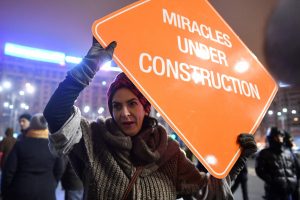
From Romania, an encouraging sign for democracy  

0
 THE WASHINGTON POST
Thousands of people took to the streets in Bucharest, Romania, to protest the lifting of an anti-corruption law. (Daniel Mihailescu/Agence France-Presse via Getty Images)
February 7

AT A time when democracy is eroding in several nations in Central and Eastern Europe, an encouraging countermovement has suddenly erupted in Romania, a formerly Communist nation of 20 million on the Black Sea. For the past week, huge demonstrations by hundreds of thousands of people have rocked the capital, Bucharest, and other major cities in what has been widely described as the largest political mobilization since the collapse of the Communist regime in 1989. The rallying point has been simple, direct and, given the country’s history, inspiring: a demand that the government not relax anti-corruption laws.

Romanian governments have been permeated with graft at least since the days of dictator Nicolae Ceausescu, but after joining the European Union in 2007 the nation’s political elite came under mounting pressure from Brussels to reform. The eventual result was the establishment of the independent National Anticorruption Directorate, which has been prosecuting cases at the rate of more than 1,000 a year — including those of senior political figures.

After handily winning a low-turnout election in December, the ruling Social Democratic Party perceived an opening to reverse the cleanup process. It first proposed a law that would pardon anyone serving less than five years for certain crimes — a measure that seemingly could apply to the party’s de facto leader, Liviu Dragnea, who received a two-year suspended sentence for electoral fraud. Then came a bolder stroke: On Jan. 31, the party issued a late-night emergency decree decriminalizing some forms of corruption if the amount of money involved was less than 200,000 Romanian lei, or about $48,000. That would get Mr. Dragnea off the hook on another corruption charge on which he faces trial, and allow him to become prime minister. It would also allow the government to resume the practice of buying the support of mayors and other local politicians across the country with handouts of cash.

 The bet that an apathetic populace would swallow this brazen maneuver proved badly misguided. Romanians almost immediately took to the streets, stirred by civil society groups, the Romanian Orthodox Church and the country’s independent elected president, who denounced the decree. By last weekend the crowds, though peaceful, had swelled to such proportions that the cabinet under Prime Minister Sorin Grindeanu voted to rescind the measure. But demonstrators still returned to the streets on Sunday and Monday, seeking the resignation of ministers.

The government appeared likely to survive after President Klaus Iohannis told Parliament on Tuesday that new elections were not called for, though a cabinet reshuffle may be necessary. The Social Democrats could still seek to gut the anti-corruption law through parliamentary action. But that would risk enraging an already aroused populace. Romanians have demonstrated that democratic values have taken root in the country over the past two decades, with the help of European allies and the United States. That’s an achievement that doesn’t benefit only their nation: It makes Europe more stable and more safe. The Trump administration should consider such progress before proposing to trash the European Union.

https://www.washingtonpost.com/opinions/global-opinions/from-romania-an-encouraging-sign-for-democracy/2017/02/07/45950c6a-ed60-11e6-9973-c5efb7ccfb0d_story.html?utm_term=.0fad8e5222a7

Trump Plays Cat and Mouse with Iran

0

by

Photo by Ninian Reid | CC BY 2.0

Why is the Trump administration threatening Iran?

On February 1, National Security Adviser Michael Flynn announced that the administration was “putting Iran on notice” after it tested a ballistic missile which the US sees as a violation of Iran’s treaty obligations. Flynn’s frigid tone made it clear that the administration is considering the use of military force. But why?

Under current UN resolutions (Resolution 2231), Iran is forbidden “to undertake any activity related to ballistic missiles designed to be capable of delivering nuclear weapons.” Read that over again. Iran is not forbidden from testing ‘all ballistic missiles’ just missiles that are ‘capable of delivering nuclear weapons.’ The resolution could not be clearer. There’s no gray area here, none at all. Flynn is just fudging the resolution’s meaning, so he can rattle a saber. But, why?  And why are other members of the administration, including the president himself,  making equally belligerent remarks? In a tweet last week, Trump  said, “I won’t be as ‘kind’ to Iran as Obama” which was followed by a speech by US Defense Secretary James Mattis who called Iran “the single biggest state sponsor of terrorism in the world.”

What’s going on? Why the full court press against Iran?   And how are these threats consistent with Trump’s campaign promise to avoid pointless confrontations abroad? Here’s an excerpt from a speech Trump delivered in Cincinnati on December 1:

“We will pursue a new foreign policy that finally learns from the mistakes of the past…We will stop looking to topple regimes and overthrow governments…. Our goal is stability not chaos …In our dealings with other countries, we will seek shared interests wherever possible and pursue a new era of peace, understanding, and good will.”

Where is the “peace, understanding, and good will” towards Iran? There doesn’t seem to be any. This is the same incendiary rhetoric we’re heard from every US administration dating  back to the Iranian Revolution in 1979. But, why?

Isn’t the problem the same as it was with Iraq, Libya, Syria and every other country the US has either toppled or tried to topple in the last 65 years?

Of course it is. Washington abhors any country that conducts its own independent foreign policy or resists US attempts to install its own puppet government. With Iran, the problems run even deeper since Iran sits on a vast ocean of oil and natural gas to which the western oil giants feel they are entitled. They think the oil is theirs and they expect Washington to help them expropriate it.

Washington wants to return Iran to the glory days of the Shah, an era in which the USG had a trusted ally in Tehran who would follow its directives, crush the domestic opposition, and preserve the privatization-model of oil production. It’s worth noting that the Shah was installed in a CIA coup that triggered a nearly 40-year reign of terror for which the US is entirely responsible.  Here’s a short except from The Harvard Crimson that will help readers to understand the horror Washington unleashed on the Iranian people to achieve its foreign policy objectives:

“The Shah systematically dismantled the judicial system of Iran and the country’s guarantees of personal and social liberties. …. Nearly every source of creative, artistic and intellectual endeavor in our culture was suppressed.

The SAVAK conducted most of the torture, under the friendly guidance of the CIA which set up SAVAK in 1957 and taught them how to interrogate suspects. Amnesty International reports methods of torture that included “whipping and beating, electric shocks, extraction of teeth and nails, boiling water pumped into the rectum, heavy weights hung on the testicles, tying the prisoner to a metal table heated to a white heat, inserting a broken bottle into the anus, and rape.”…

The Shah greatly expanded the military and turned it against his own people. With newfound oil wealth the Shah bought $2C million of U.S. arms. The U.S. military trained Iranian officers. Despite claims that a strong army was needed to prevent external aggression, its real purpose became clear when the army murdered more than 50,000 Iranians fighting the Shah.” …. The number of students tortured, lost or murdered is unknown.” (“Life Under the Shah“, The Harvard Crimson)

This is America’s legacy in Iran:  “Whipping, beating, electric shocks, extraction of teeth, boiling water pumped into the rectum, and rape.” This is how the exceptional nation exported democracy to Iran.

The US has never tried to make amends for the suffering or death it inflicted on the Iranian people, nor have its crimes ever been prosecuted at an international tribunal, nor has there ever been any talk of monetary reparations.  Instead, the US has done everything in its power to further isolate and punish Iran for resisting Washington’s savage intrusion into their affairs. For many years, Washington has justified its cruelty by claiming that Tehran was developing nuclear weapons that would endanger the region and the world. As it happens, there’s no evidence that Iran ever had nuclear weapons program, it’s all a hoax concocted by the political class and their allies in the media. Here’s a quote that sums up the “Iran nukes” fable in one short paragraph:

“It is essential to recognize that Iran does not currently have a nuclear weapons program, nor does it possess a nuclear weapon. On February 26, James Clapper, the director of national intelligence, told the Senate Armed Services Committee that Ayatollah Khomenei, the supreme leader of Iran, ended his country’s nuclear weapons program in 2003 and “as far as we know, he’s not made the decision to go for a nuclear weapon.” This repeats the “high-confidence” judgement of the U.S. Intelligence Community (IC) that was first made in November 2007.”

(Micah Zenko, “Putting Iran’s Nuclear Program in Context”, Council on Foreign Relations)

There it is in one, short clip: No nukes, no nuclear weapons program, no diversion of nuclear fuel, and no sinister nuclear project aimed at blowing up Israel and establishing a region-wide Islamic Republic.  It’s all 100 percent bunkum conjured up by the same group of journalists who produced the mobile weapons labs, the yellowcake uranium, the aluminum tubes, curveball and the myriad other lies that preceded the invasion of Iraq.

But if Iran is not building nukes and is actually complying with the terms of the Joint Comprehensive Plan Of Action (aka– The Iran Nuclear Agreement) then why all the fiery rhetoric and saber rattling?  Is Trump seriously considering an attack on a country that poses no recognizable threat to the United States or its allies in the region?

Many people seem to think so, but I am not at all convinced.

Keep in mind, that a war with Iran would not be a cakewalk, it will be a bloody and protracted affair that would require significant military resources and tens of thousands of  American troops on the ground. US warplanes would not be able to selectively bomb designated targets without provoking asymmetrical retaliatory attacks on US military bases, oil platforms and strategic allies in the region.

Iranian special forces would be deployed to locations beyond their borders where they would wreak havoc while plunging the Middle East into a broader regional war. The transport of oil through the Straits of Hormuz would be blocked indefinitely which would send gas prices skyrocketing while global equities went off a cliff.

More important, Washington would have no allies in the conflict excluding a few of the corrupt Gulf monarchies whose military value is negligible at best. The traditional European allies would abandon the US in order to maintain their ever-dwindling political base which is fed up with American adventurism.  The war in Iraq, followed by the Wall Street-generated global financial crash, followed by the flood of refugees fleeing US conflicts in Syria, Libya and beyond, have made it impossible for EU leaders to support another bloody US-led fiasco in the Middle East. Washington would have to go it alone which would, in turn, strengthen the position of  rising rightwing politicians in the EU that want to sever relations with the US and develop an more Euro-centric foreign policy.

The end of the Atlantic Alliance would mark the end of imperial America and the collapse of the current global order. If Washington were to lose its ability to persuade or coerce the vassal states to follow its edicts, it would be cut off from its greatest source of geopolitical power. An attack on Iran would precipitate a speedy unraveling of the global system the US has painstakingly stitched together over a seventy year period.  US dominance would progressively erode while foreign governments would ditch the dollar leaving Washington to face a future of pariah-like isolation and grinding poverty.

In my opinion, an attack on Iran would trigger a series of events that would greatly accelerate US economic decline while exacerbating tensions between allies that would lead to the inevitable breakup of the Atlantic Alliance and the end of the dollar’s dominant role as the world’s reserve currency. Is Trump really willing to risk all that in order to punish Iran or is something else going on below the radar?

In order to understand what Trump is doing, we need to clarify a few details regarding the Iranian nuclear deal or JCPOA. In very broad terms, the Iranian leadership accepted the strictest nuclear inspections regime in history (overseen by the IAEA) in exchange for the lifting of economic sanctions. (which, by the way, were imposed without any hard evidence that Iran was developing nuclear weapons) Donald Trump believes that this is the worst deal in history when, in fact, Iran was being unfairly punished for crimes it never committed.

The question is: Why would Trump oppose an agreement that clearly eliminates any chance for Iran to cheat and secretly build a nuclear weapon?

The obvious answer is that the hawks in his administration want to (eventually) topple Iran’s government which requires that they weaken the regime as much as possible through economic sanctions. This is how Washington typically conducts its regime change operations; economic strangulation usually precedes the coup d’ etat followed by the installing of a US puppet. Wash, rinse, and repeat.

But here’s the rub: The administration cannot unilaterally terminate the JCPOA because it’s a multi-lateral agreement endorsed by the UN Security Council. As one analyst said, If Trump rejects the deal “the international sanctions regime that incentivized Iran to negotiate would unravel…. Russia and China, for instance, won’t continue sanctions on Iran because the GOP says they should. If this were to happen, Iran would receive sanctions relief without having any constraints on its nuclear program.” Besides, If Trump walks away from the JCPOA, then “the next round of negotiations will be the US sitting at a table for one.”

So even though Trump doesn’t like the deal, he’s stuck with it, because if he bails out, the allies are not going to support him. Here’s a little more background that helps to explain things:

“Some opponents of the deal advocate for threatening the international community: You can either do business with Iran or business with the United States. But this threat lacks credibility. As Treasury Secretary Jacob Lew explained in a New York Times Op-ed, 40% of American exports go to the European Union, China, Japan, India, and Korea. By threatening to exclude these countries from our banking system, the U.S. would be placing a significant portion of its own economy at risk. Moreover, the major importers of Iranian oil (China, India, Japan, South Korea, Taiwan, and Turkey) also account for one-fifth of U.S. exported goods and own 47% of foreign-held American treasuries. Even threatening to terminate this economic connectivity could have negative ramifications for both the US economy and the economies of our allies.

Our negotiating partners will not maintain sanctions that hurt their economies simply because the U.S. Congress insists they do so. Threatening our allies with economic warfare is a ludicrous approach, especially when compared to the practical and widely supported alternative of implementing the agreement….”(“Iran Nuclear Deal: Debunking the Myths“, The Center for Arms Control and Non Proliferation)

What does it all mean?

It means that coercion and arm-twisting aren’t going to work this time. The agreement is written in a way that make it nearly impossible for the administration to achieve its objectives, which is to return to a bygone era when the US could inflict excruciating economic punishment on Iran without anyone uttering a word of protest. Those days are gone.

But if that’s the case, then why have Trump and his lieutenants stepped up the hectoring, the demonization and the saber rattling? What’s that all about?

That’s where it gets interesting. The Trump team has settled on a strategy of cat and mouse, which means they’re trying to beat Iran by tricking them into making a mistake that will give the US the advantage. In other words, Trump does not want a shooting war with Iran,  he simply wants Iran’s leaders to overreact to Washington’s bullying by abandoning JCPOA. That’s the goal. The fact that the administration can’t unilaterally reject the nukes deal, doesn’t mean that Iran can’t be duped into doing it for them. And, if Iran takes the bait and withdraws from the agreement, then Trump will have the allies on his side for another painful round of economic sanctions. That’s what Trump wants.

So the best thing Iran can do is nothing. They need to continue to stay the course, shrug off the provocations, and keep up their end of the deal. That’s it; just hang tight and stay cool.

Unfortunately, that’s easier said than done.

MIKE WHITNEY lives in Washington state. He is a contributor to Hopeless: Barack Obama and the Politics of Illusion (AK Press). Hopeless is also available in a Kindle edition. He can be reached at [email protected].

Trump Plays Cat and Mouse with Iran

Supreme Court nominee Gorsuch says Trump’s attacks on judiciary are ‘demoralizing’

0

THE WASHINGTON POST

Court nominee Judge Neil Gorsuch (Michael Reynolds/EPA)

February 8 at 7:45 PM

President Trump’s escalating attacks on the federal judiciary drew denunciation Wednesday from his Supreme Court nominee, Neil Gorsuch, who told a senator that the criticism was “disheartening” and “demoralizing” to independent federal courts.

Sen. Richard Blumenthal (D-Conn.) said Gorsuch made the comments during their private meeting Wednesday, and the account was confirmed by Ron Bonjean, a member of the group guiding the judge through his confirmation process.

Trump on Wednesday morning declared that an appeals court’s hearing Tuesday night regarding his controversial immigration executive order was “disgraceful” and that judges were more concerned about politics than following the law.

The remarks followed earlier tweets from Trump disparaging “the so-called judge” who issued a nationwide stop to his plan and saying the ruling “put our country in such peril. If something happens blame him and court system.”

Blumenthal said Gorsuch, whom Trump nominated to the Supreme Court just over a week ago, agreed with him that the president’s language was out of line.

Meet Neil Gorsuch, Trump’s pick for the Supreme Court

President Trump has tapped Neil Gorsuch to fill the late Antonin Scalia’s seat on the Supreme Court. The Post’s Robert Barnes tells you what you need to know. (Peter Stevenson, Gillian Brockell/The Washington Post)

“I told him how abhorrent Donald Trump’s invective and insults are towards the judiciary. And he said to me that he found them ‘disheartening’ and ‘demoralizing’ — his words,” Blumenthal said in an interview.

Gorsuch “stated very emotionally and strongly his belief in his fellow judges’ integrity and the principle of judicial independence,” he added. “And I made clear to him that that belief requires him to be stronger and more explicit, more public in his views.”

The contretemps added another layer to the roiling nature of Trump’s young presidency. Some historians wondered whether Supreme Court nominees had ever separated themselves in such a way from the president who nominated them; others tried to recall whether a president had ever given a nominee reason to do so.

Less than three weeks after taking the oath of office, Trump already has a legal dispute that seems likely to arrive soon at the Supreme Court. His comments about the judiciary seem far beyond the more veiled criticism presidents usually lob at the branch, and Democrats have pointed to those comments in arguing for a close examination of Gorsuch, who has served for 10 years on the U.S. Court of Appeals for the 10th Circuit.

Within hours of Blumenthal’s revelation of Gorsuch’s remarks, there were questions about how Trump, famously thin-skinned about criticism, would receive his nominee’s words. There was a competing theory that they were a calculated attempt by Gorsuch to assert his independence.

Carrie Severino, chief counsel and policy director of the Judicial Crisis Network, a group promoting Gorsuch’s nomination, said the judge’s remarks simply confirmed what those close to Gorsuch already knew.

 “He’s always been a person independent of the president, and it was shown by his statement,” she said.

Those on the left, meanwhile, said Gorsuch would need to do more than that.

“Is Gorsuch distancing himself from Trump? As we say on the Internet: LOL,” Drew Courtney of People for the American Way said in a statement. “To be clear: Donald Trump’s pattern of attacks on federal judges is more than demoralizing — it’s a threat to the separation of powers and our constitutional system, and it’s hard to imagine a more tepid response than to call them ‘disheartening.’ ”

“Given the president’s comments, that’s a very milquetoast response,” said Matt House, a spokesman for Senate Minority Leader Charles E. Schumer (D-N.Y.). “Anyone can be disheartened, but the judge has refused to condemn the comments privately or publicly.”

Trump has been on a days-long crusade against the judicial branch since U.S. District Judge James L. Robart of Seattle halted the administration’s executive order temporarily halting the U.S. refu­gee program and barring entry to the United States from seven predominantly Muslim countries. A three-judge panel of the U.S. Court of Appeals for the 9th Circuit is deliberating whether Trump’s executive order should be allowed to stand.

Speaking Wednesday at the Major Cities Chiefs Association Winter Conference in Washington, Trump said he listened to the oral arguments at the appeals court and was disappointed at what he heard.

“I don’t ever want to call a court biased, so I won’t call it biased,” Trump told the group. “But courts seem to be so political, and it would be so great for our justice system if they would be able to read a statement and do what’s right.”

Trump said the arguments were “disgraceful” because his executive order “can’t be written any plainer or better and for us to be going through this” — he paused to mention that a judge in Boston had ruled that the order could stand.

Trump said the courts were standing in the way of what he was elected to do and that even “a bad student in high school” would support his policies.

“We want security,” he said. “One of the reasons I was elected was because of law and order and security. It’s one of the reasons I was elected. . . . And they’re taking away our weapons, one by one. That’s what they’re doing. And you know it and I know it.”

The panel of 9th Circuit judges questioned whether the administration had any evidence of increased risk that would warrant the new restrictions and whether the restrictions violated the law and the Constitution’s protections against religious discrimination.

Trump’s comments were the latest escalation in a worsening dispute between the executive branch and the judiciary that the president has personally carried out on social media and in public remarks. While it is not new for a president to disagree with the actions of another branch of government, Trump’s crusade against the federal judiciary comes before the legal process has fully played out and is unusual for its threatening tone and use of personal invective.

White House press secretary Sean Spicer said Wednesday that the president is expressing his frustration with a process that he believes should be subject to common sense.

“He respects the judiciary,” Spicer said. “It’s hard for him and for a lot of people to understand how something so clear in the law can be so misinterpreted.”

He added that Trump, who has a long history of punching back against his opponents both political and personal, is also speaking directly to his supporters, who are looking for him to aggressively deliver on his campaign promises.

“He likes to talk to his supporters, to be blunt,” Spicer added. “Part of it is that people wonder — who helped elect him — what is he doing to enact his agenda.”

Trump’s handling of the incident recalled his attacks during the presidential campaign on an American judge of Mexican descent, Gonzalo Curiel, who Trump claimed could not fairly adjudicate a fraud case against now-defunct Trump University because of his ethnic heritage.

“In Trump’s world, there’s a precedent where he believes a judge of Mexican heritage can’t fairly judge his case,” said longtime Republican strategist Rick Wilson, a frequent Trump critic. “It’s part of the overall pattern of the Trump White House: They want to always be on the attack. It’s not enough to say their ideas are wrong, their policies are wrong. You’ve got to nuke them.”

A coalition of Democratic members of the House introduced a resolution criticizing Trump’s attacks, and Laura Brill, a California lawyer and former clerk to Justice Ruth Bader Ginsburg, sent the administration’s top lawyers a letter on behalf of nearly 150 lawyers who practice in the federal courts denouncing Trump’s comments.

“Lawyers across the political spectrum believe that the president’s personal attacks on individual judges and on the judicial branch are improper and destructive,” Brill said in a statement. “Because judges face ethical constraints in their ability to respond directly, the letter calls on the president to retract and end such personal attacks.”

Not everyone was deeply offended by Trump’s words. Paul G. Cassell, a University of Utah law professor who served as a federal district judge from 2002 to 2007 and was nominated by President George W. Bush, said he believes Trump “stepped over the line” in his criticism of Robart.

“But I would characterize it as a misdemeanor traffic ticket, not a felony,” Cassell said. “Judges have thick-enough skins that they are used to being criticized. We live in a time in which strong language seems to be the order of the day.”

“The president certainly has a right to criticize the court,” Cassell said.

He said he thought then-President Barack Obama went further in his 2010 State of the Union criticism of the Supreme Court, which had just decided the Citizens United v. Federal Election Commission case. Cassell said Obama used “more elegant language,” but also contends that Obama’s analysis of the case was off-base.

Besides, he added, “The president can tweet all he wants, but the final decision will be made by the judiciary.”