Αρχική Blog Σελίδα 2990

Flynn, Russia and the World of Conspiracy Thinking

0

by

Photo by Chairman of the Joint Chiefs of Staff |

Former National Security Advisor Michael Flynn has a well deserved reputation for conspiracy thinking. Presumably he will assume that the U.S. intelligence community, including the Central Intelligence Agency, the Federal Bureau of Investigation, and the former director of National Intelligence, conducted a campaign to force his removal from the Trump administration.  Ironically, the Kremlin, which has lived historically in a world of conspiracy thinking, will view the ouster of Flynn as part of a campaign by the U.S. establishment to prevent any improvement in Russian-American relations.

In this conspiratorial realm, it’s important to acknowledge at the outset that Flynn was probably the least qualified and the most questionable individual in the 70-year history of the National Security Council to be selected as the president’s sherpa for national security policy.  His behavior during the presidential campaign was thoroughly unprofessional and a source of embarrassment to the military establishment and the Republican Party.  His retirement from the military several years ago was engineered by the White House and the Joint Chiefs of Staff because of his failed stewardship at the Defense Intelligence Agency.  He had a reputation at DIA as a polemicist, and many of his pronouncements there were derided as “Flynn facts” because they had no basis in actual fact.

Flynn’s lies to Vice President Pence made it inevitable that he would be forced to resign. Donald Trump was already impatient with Flynn because the general, who was poorly grounded in geopolitical and geoeconomic affairs, couldn’t tell the president the international implications of a strong vs. a weak dollar on the global economy.   The fact that Flynn was unaware or unconcerned that his conversations with the Russian ambassador in Washington would be recorded by the FBI and the National Security Agency was not exactly a feather in his cap as a long-term intelligence professional.  And the fact that he claimed not to remember his discussions with the Russian ambassador is not a recommendation for any high-level position in the decision making community, let alone the advisor closest to the president on foreign policy.  The unusual elevation of Steve Bannon to the NSC two weeks ago suggested that the president wanted his own source for Flynn’s maneuvers and machinations within the key decision making body for national security policy.

The Kremlin will have its own way to decipher these bizarre and chaotic developments within a new administration that appears clueless in conceptualizing and conducting foreign policy.  In the past, Soviet leaders have interpreted major events in U.S. history from the standpoint of implications for Moscow’s relations with the United States.  The assassination of John F. Kennedy was interpreted as an effort to silence a president who had spoken in favor of detente with the Soviet Union and had just concluded the Partial Test Ban Treaty.  The impeachment of Richard Nixon was seen as an effort to stop the progress in arms control and disarmament.  The initial tough-mindedness of the George H.W. Bush administration was viewed as an attempt to reverse the gains between Mikhail Gorbachev and Ronald Reagan in the late 1980s.

Ironically, Gorbachev and Foreign Minister Eduard Shevardnadze had their own problems with the Soviet establishment in the 1980s when they worked assiduously to improve relations with the United States, including the acceptance of various arms control measures on Washington’s terms and the unilateral withdrawal of Soviet forces from Central Europe and various areas in the Third World.  The “new thinking” of Gorbachev and Shevardnadze was a challenge to old thinking within the Politburo, and Russian leaders will conclude that the U.S. establishment has challenged Donald Trump and Michael Flynn for their interest in reversing the decline in Russian-American relations.  Flynn deceived the Vice President and the mainstream media, but it is unlikely that his talks with the Russian ambassador had not been discussed with president-elect Trump.

We may never know if Trump and Flynn were actually seeking a grand bargain with Russia and Vladimir Putin, but it certainly appears that the Russian leader wants to reverse the deterioration in bilateral relations. Putin presumably is not willing to go as far as Gorbachev and Shevardnadze regarding mutually beneficial agreements, but he certainly wants to reverse the downward spiral. Irony will reign again if it develops that the removal of Flynn leads to a further decline in Russian-American relations.

Melvin A. Goodman is a senior fellow at the Center for International Policy and a professor of government at Johns Hopkins University.  A former CIA analyst, Goodman is the author of “Failure of Intelligence: The Decline and Fall of the CIA,” “National Insecurity: The Cost of American Militarism,” and the forthcoming “The Path to Dissent: A Whistleblower at CIA” (City Lights Publishers, 2015).  Goodman is the national security columnist for counterpunch.org.

Flynn, Russia and the World of Conspiracy Thinking

Priebus, Bannon trash reports of division

0

BY JONATHAN EASLEY –


In a joint phone call with The Hill on Wednesday, White House chief of staff Reince Priebus and chief strategist Stephen Bannon furiously pushed back at reports of division, saying there is no friction between them.Trump aides are particularly angry with a story published Tuesday by the conservative outlet Bannon once ran, Breitbart News, in which anonymous sources blamed Priebus for tumult at the White House and suggested that the chief of staff’s job was in immediate jeopardy.

But Bannon and Priebus insisted that they’re working closely and amicably together and that reports to the contrary are false.

“Reince is doing an amazing job,” Bannon told The Hill. “We are executing on President Trump’s agenda in record time. That’s because Reince is getting the job done.”

“It is a privilege to come to work on behalf of President Trump to serve the American people,” added Priebus. “We are a completely united team dedicated to enacting his bold agenda to bring back jobs and keep this country safe.”

 Until recently, the White House had been slow to respond to the continuous drip of leaks that have led to the media narrative that Bannon and Priebus represent rival wings within the White House.Allies of both men told The Hill on Wednesday that the press is being played by low-level staffers or former campaign hands, now White House outsiders, who have no idea about the working relationship between the two or the internal dynamics.

And they insist that the Breitbart story is totally false, the creation of rogue outsiders hell-bent on Priebus’s destruction.

“I am a believer in Reince and the President continues to be well served by his leadership,” Jared Kushner, Trump’s son-in-law and a senior adviser to the president, said in a separate statement.

In a joint statement announcing the hiring of Bannon and Priebus last November, Trump said the two would work together as “equal partners.”

Bannon has since rocketed into public consciousness, with the administration’s opponents warning about his outsized influence over Trump and media outlets portraying him as the person pulling the strings — often at Priebus’s expense.

The perception of an internal battle for influence has been heightened by leaks, reported by countless news outlets, purported to have come from the White House or Trump’s inner circle.

The White House has begun taking a more aggressive posture aimed at beating back those reports, insisting that the leaks are coming from individuals with no actual knowledge of the White House’s inner workings.

“Reince has done an excellent job,” said Trump spokeswoman Hope Hicks. “He works tirelessly to carry out the president’s agenda and the entire staff is grateful for his dedication and leadership.”

Much of the perceived tension between Bannon and Priebus stems from their diametrically opposed backgrounds.

As the former Breitbart News executive, Bannon oversaw a publication that relished in targeting GOP establishment figures like Priebus and Speaker Paul Ryan (R-Wis.) and challenging traditional Republican orthodoxy.

Priebus, the former Republican National Committee chairman, has long been seen as a voice for establishment Republicans and a calming force in Trump’s administration.

That makes Priebus a target for some longtime Trump allies, who see him as an interloper who can’t be trusted. Those who think Priebus was never a true believer now say he’s using his power to freeze out some of Trump’s oldest allies.

“The White House has become an RNC cabal, all RNC people top to bottom,” said one GOP operative with knowledge of Trump’s operations. “Almost all the campaign people are banished to agencies. None are in the White House. There is an undercurrent of distrust and anger at the agency level that is palpable. They hate Reince Priebus and his lackeys because he screwed these people. He’s very cunning. He’s really something else.”

Those tensions exploded into the open this week when Matthew Boyle, Breitbart’s Washington political editor, ran a story based on unnamed sources “close to the president” blaming Priebus for everything from national security adviser Michael Flynn’s resignation to the slow pace of Trump’s Cabinet confirmations in the Senate.

Many assumed the story ran with the blessing of Bannon and represented the latest salvo in his ongoing struggle with Priebus.

“It’s obvious what’s happening. Bannon’s trying to run him out,” one GOP lawmaker told The Hill on Wednesday.

“I think Bannon’s knives are out for Priebus, but Trump set this up on purpose so they would compete,” the lawmaker said.

However, Bannon says he did not know the story would run and was angry that his old publication had attacked his colleague at a critical juncture for the administration.

Still, Priebus’s critics sense that he is vulnerable in the wake of the most chaotic stretch yet for the young administration. They’re increasingly airing their grievances with the chief of staff.

Longtime Trump confidante and conservative provocateur Roger Stone has blamed Priebus for Flynn’s ouster, declaring it a “Pearl Harbor” attack on Trump allies and demanding that he be the next to go.

And Newsmax founder Chris Ruddy, another longtime friend of Trump’s, went on CNN over the weekend to say Priebus is in over his head, before walking his remarks back.

“He’s supposed to be the guy making the trains run on time and he’s not doing it,” said one source with knowledge of the inner workings at the White House.

“There are so many things that are not being done right now because he’s not doing his job and that’s why you’re starting to see people speak up about how they think and hope he’ll be gone soon,” said another GOP source with ties to the White House and conservative business leaders.

It’s not entirely clear, however, if anyone with real influence with Trump is behind the criticism of Priebus or the effort to sink him.

Priebus’s critics have become more vocal since Flynn resigned. Flynn was a fierce Trump loyalist and a longtime supporter, and some of his backers would like to see an establishment figure knocked off now that they’ve lost one of their own.

That frustrates allies of Bannon and Priebus, who have gone out of their way to show they have a healthy working relationship.

“You can’t govern by trading one head for another,” a Bannon friend said.

White House officials claim that the daily barrage of reports about infighting actually helps to unite the staff.

“Everyone here has each others back, and the more people try to feed that rumor mill, the stronger the bonds get,” one official told The Hill.

Establishment Republicans are hopeful that Priebus succeeds, viewing him as a key ally in the White House.

“Priebus is the only one in that orbit who understands how things work operationally,” said a former Republican administration aide. “And he’s proven that he knows how to run an operation. Say what you want about the election, the RNC was run pretty well.”

—Scott Wong and Amie Parnes contributed

http://thehill.com/homenews/administration/319791-priebus-bannon-trash-reports-of-division

Defense Secretary Mattis issues new ultimatum to NATO allies on defense spending

0

By Dan Lamothe and Michael Birnbaum February 15  THE WASHINGTON POST

Mattis says that NATO is a ‘fundamental bedrock’ of transatlantic ties

U.S. Defense Secretary Jim Mattis says the NATO military alliance is central to ties between America and Europe and remains of importance to the United States. (Reuters)

BRUSSELS — Defense Secretary Jim Mattis issued an ultimatum Wednesday to allies in the North Atlantic Treaty Organization, warning that if they do not boost their defense spending to goals set by the alliance, the United States may alter its relationship with them.

“I owe it to you all to give you clarity on the political reality in the United States and to state the fair demand from my country’s people in concrete terms,” Mattis said. “America will meet its responsibilities, but if your nations do not want to see America moderate its commitment to the alliance, each of your capitals needs to show its support for our common defense.”

The statements came during a closed-doors meeting with defense ministers from other NATO countries and were provided to reporters traveling with the defense secretary to Brussels. It marks an escalation in Washington’s long-running frustration that many NATO countries do not spend at least 2 percent of their gross domestic product as they have pledged. President Trump often made that point during his upstart run for the White House, at various times calling the alliance “obsolete” while grousing that its 28 members need to pay “their fair share.”

Mattis, a retired Marine general, recalled Wednesday that when he was NATO’s supreme allied commander of transformation from November 2007 to September 2009, he watched as then-Defense Secretary Robert Gates warned NATO nations that Congress and the American people “would lose their patience for carrying a disproportionate burden” of the defense of allies.

That impatience, Mattis said, is now a “governmental reality.”

“No longer can the American taxpayer carry a disproportionate share of the defense of Western values,” Mattis said. “Americans cannot care more for your children’s security than you do. Disregard for military readiness demonstrates a lack of respect for ourselves, for the alliance and for the freedoms we inherited, which are now clearly threatened.”

Currently, just five of NATO’s 28 countries spend at least 2 percent on defense: the United Kingdom, Estonia, Poland, Greece and the United States. Major members of the alliance that do not include France (1.78 percent), Turkey (1.56), Germany (1.19), Italy (1.11) and Canada (.99), according to NATO figures. Others have pledged to do so but not until 2024.

Mattis said Washington needs the help of other nations already spending 2 percent to urge the others to do so. Those already with a plan to boost spending must accelerate it, and countries without one must establish one soon, he said.

The remarks come as NATO nations confront how to handle Russia following its 2014 annexation of Ukraine’s Crimean Peninsula and U.S. intelligence assessments that Russia hacked Democratic Party officials during the presidential campaign last year. Retired Lt. Gen. Michael Flynn, resigned under pressure Monday night as Trump’s national security adviser after revelations that he misled Vice President Pence about secret communications with Sergey Kislyak, the Russian ambassador to the United States, regarding sanctions imposed by the Obama administration in response to the alleged hacking.

“Fellow ministers, when the Cold War ended, we all had hopes,” Mattis said. “The year 2014 awakened us to a new reality: Russia used force to alter the borders of one of its sovereign neighbors, and on Turkey’s border [the Islamic State] emerged and introduced a ruthless breed of terror, intent on seizing territory and establishing a caliphate. While these events have unfolded before our eyes, some in this alliance have looked away in denial of what was happening.”

NATO Secretary General Jens Stoltenberg sought to downplay any suggestion that Mattis’s message constituted a threat, saying that the United States was simply pressing its allies to live up to their own commitments.

“This is not the U.S. telling Europe to increase defense spending,” Stoltenberg said at a news conference after the tough meeting. “This is 28 allies, heads of state, that all were sitting around the same table in 2014, and looking into each other’s eyes and agreeing that we shall increase defense spending.

“I welcome all pressure, all support to make sure that happens,” Stoltenberg said, adding that Lithuania and Romania have pledged to reach 2 percent soon.

Others in the room when Mattis spoke saw his message differently.

“If you pardon my French, we got the message. Pay up or be” pushed, one European diplomat said, using a more vulgar term for what the United States might do to its allies. “If you take him literally, then the message is indeed that there’s no unconditional guarantee of security any more,” the diplomat said, speaking on condition of anonymity to speak openly about the reaction.

But not every leader felt that the message was a major departure from longtime U.S. policy to ratchet up its allies’ defense spending.

“It’s nothing new, to be honest,” Dutch Defense Minister Jeanine Hennis-Plasschaert said in an interview. “Mattis asked for milestones, so all of us will go home and work on them.”

Public opinion in the Netherlands – which currently spends 1.17 percent of its annual economic output on defense – is in favor of spending increases, she said.

“Public support has increased because it’s a rough world out there and people have noticed,” she said. “Europe and also the Netherlands for way too long were accustomed to peace and American leadership.”

Mattis’s ultimatum could have the largest effect for Germany. If it were to meet the 2 percent bar, it would boost its defense spending to about $75 billion per year, resulting in a military larger than Britain’s. That would be a profound shift for a country that has long had a pacifist tradition that held it back from embracing a global defense presence as great as its economic might.

Mattis’s demands were echoed by British Defense Secretary Michael Fallon, who met head-to-head with the U.S. defense chief before the main NATO conclave. Fallon said that Britain — which spends the second-largest amount on defense in the alliance — is proposing that countries that spend less than NATO guidelines commit to an annual defense budget increase.

“An annual increase would at least demonstrate good faith,” Fallon told a small group of reporters in Brussels. Fallon said that Mattis had underlined a “100 percent commitment” to NATO.

Britain has generally tried to ally itself with the Trump administration as London negotiates an exit from the European Union. But British leaders have urged Trump to maintain his military commitment to NATO and to Europe.

https://www.washingtonpost.com/news/checkpoint/wp/2017/02/15/mattis-trumps-defense-secretary-issues-ultimatum-to-nato-allies-on-defense-spending/?utm_term=.3326a6328cfd&wpisrc=nl_check&wpmm=1

Five reasons the Greek debt crisis is back

0

No more appetite for austerity: Greek farmers piled up cabbages in Athens in protest against further belt-tightening (AFP Photo/ARIS MESSINIS)

 Alex PIGMAN February 15, 2017

Brussels (AFP) – After Brexit stole the limelight last year, the spectre of Grexit is back.

Greece, the eurozone and IMF are in a three-way Mexican stand-off over a review of the country’s 86 billion bailout agreed in July 2015, its third since 2010.

Time is now running out once again before Greece faces a possible default on its debt that threatens renewed turmoil in the eurozone.

Here are five reasons the crisis has flared up:

– The IMF –

At the heart of latest flare-up is the International Monetary Fund, the world economy’s anti-crisis firefighter that played a central role in the first two financial rescues of Greece.

But the fund, led by the tenacious Frenchwoman Christine Lagarde, never formally joined the third bailout alongside the eurozone and there is increasing talk it may now choose to walk away.

The IMF disagrees with the eurozone on two key issues: economic targets and debt.

On the economic targets, the IMF says those demanded by the Europeans of Greece are unrealistic.

The eurozone insists that Greece can deliver a primary balance, or budget surplus before debt repayments, of 3.5 percent of GDP over several years.

The IMF has said only 1.5 percent is feasible, saying that 3.5 percent requires too much austerity.

The IMF also insists that Greece’s debt pile is “explosive” and requires significant debt relief.

– Germany –

The IMF’s refusal to budge is putting Germany in a weak spot.

Germany leads the eurozone’s fiscal hardliners in refusing the deep debt relief demanded by the IMF.

But at the same time Berlin and other hardliners such as the Netherlands have made their participation in the rescue of Greece conditional on the full involvement of the IMF.

Berlin has serious doubts that the EU alone can keep a hard line against Greece on delivering reforms without the discipline of the IMF, which firmly holds to the demands of its bailouts.

If the fund should walk away, German Chancellor Angela Merkel and Finance Minister Wolfgang Schaeuble would be left in an extremely tight position just months ahead of elections set for September in which the anti-EU Alternative for Germany is expected to make big inroads.

– Greece –

Greece faces a debt repayment bill of 7.0 billion euros in mid-July that it cannot afford without unblocking more funds from the bailout.

For nearly two years debt-wracked Greece has delivered on reforms and budget commitments, winning plaudits in a significant change from the fractious days of early 2015.

But the latest tranche of bailout cash money is blocked until Greece passes the current review, which Germany and the Netherlands refuse to allow without the IMF as a full member.

As a solution to the deadlock, the IMF has demanded that Greece deliver more austerity reforms, even though it is dubious of the budget targets set by the Europeans.

The Tsipras government firmly rejects this on principle and also because of its razor-thin majority in Greek parliament that would likely fail to survive a new round of austerity.

– Elections in Europe –

Unofficially, a meeting of eurozone ministers on February 20 is the deadline to reach an agreement, but a deal looks increasingly unlikely with Athens, the IMF and the Europeans still wide apart.

After that date, Europe enters a busy election schedule starting in the Netherlands on March 15. Jeroen Dijsselbloem, the Eurogroup chief and Dutch finance Minister, faces a very uncertain re-election.

The Dutch vote is followed by French elections in the spring and German elections in September.

Amid the campaigning, a noisy return of the debt crisis would make a solution difficult. The idea of offering more help for Greece is unpopular with many Europeans.

– Trump? –

The unknown intentions of the Trump administration hover in the background. The United States is the biggest voting bloc on the IMF’s executive board and for now, the US seat remains vacant.

Throughout the Obama years, the US cautiously backed IMF participation in the Greece saga, but whether that remains the case under the unpredictable Trump is not known.

Last week, in a rare case of making its internal affairs public, the IMF said that opinions on its board regarding Greece were divided. Only the Europeans defended a more positive assessment of the Greek economy.

https://www.yahoo.com/news/five-reasons-greek-debt-crisis-back-110330646.html?soc_src=mail&soc_trk=ma

Technocracy, Liberal Democracy and the Division of Our Time The idea that expertise ought to guide our political life is at odds with the principle of national self-determination.

0

By George Friedman Feb. 15, 2017

I spent last weekend in the United Arab Emirates at a conference on the future of governance. While there, I was struck by the two principles that underlay this conference and its ilk. The participants’ core belief was that human government can be improved, and the means for improving it is social engineering. If we all turn our minds to governance, we can find solutions to the problems. The idea that human government is a permanent thing that reached its perfection in Athens and Jerusalem was not part of the participants’ ideology. What was most striking is that sitting within sight of the Gulf – Arab or Persian depending on the viewpoint – in a place of ancient civilizations, the theme was how to engineer the political future.

Less alien, but not less striking, is the manner in which this concept has taken hold in Euro-American civilization. That civilization grew out of the Enlightenment, and its political foundation was the idea of republicanism, an idea that rests on the right of national self-determination. The idea that the nation is the foundation of a moral political life was self-evident to the American and French revolutions and their heirs. The individual and his nation were intimately bound. And the right of a nation’s people to govern themselves was central to the nation.

There was, of course, another part of the Enlightenment, the idea that reason ought to be used to improve all things, including government, and the idea that those who had mastered the subject at hand were to be respected and listened to. So an aeronautical engineer (always on my mind when I am at 36,000 feet) should design planes. Experts in governance should design governments.

Supreme Court Rules On Government's Brexit Appeal

A man carries a European Union flag outside the Supreme Court in Parliament Square, on Jan. 24, 2017 in London, England. Leon Neal/Getty Images

The idea that expertise ought to guide our political life is at odds with the principle of national self-determination. Expertise means experts, and experts are defined as knowing more than the rest of us. If government ought to rest on expertise, then experts should govern. If government should rest on the consent of the governed, then the premise is that all of us, by virtue of being citizens of a nation, are qualified to determine how the nation ought to be governed.

There is a blended version of this. The people should govern by selecting representatives, then those representatives ought to select experts to work on the details. It seems to me that this is one of those solutions that appears readily soluble but isn’t. In selecting a president or prime minister, the people are both imbuing him with power and holding him accountable. The idea of expertise is that governance is so complicated it requires experts to manage it. Very quickly the ability of the elected representative to determine the direction of the nation, or of the possibility of national self-determination, dissolves.

This is not the result of a conspiracy of the experts. The people’s expectation of what the state can do for them has surged, and with it the complexity of the process. Citizens cannot manage the complexity, and elected officials cannot oversee the complexity. By default, the republican system has moved from a relationship between the people and their representatives to one between the people, their representatives and the managers. This process has been underway for a long time, since European states created a permanent civil service to do the bidding of their political masters. And since that time, the civil servants have increasingly managed the system – and managed their political masters.

Over time, the technocrats, who are the experts, developed ambitions and ideology. The ambition was to be free of the meddling hand of politicians and the ignorant whims of the people, and to be free, in the words of the United States Constitution, to build “a more perfect union” without being constrained by the inexpert help of the citizens or government. There was political ambition in this of course, but there was also logic. If history is the unfolding of reason, then those most trained in the application of reason must be allowed to rule. But the truth also was that the creation of a defense plan or a health care system requires expertise that citizens and representatives lack.

At the same time, there was an ideology at work as well, and it was most visible in the European Union. If the goal is to constantly improve governance, then a broader vision than the nation-state is needed. The problems that have to be solved can’t be solved within the narrow confines of a single nation-state. The nation stands in the way of improvement. Just as the people are incapable of understanding the technical complexity of the matter at hand, national boundaries are unable to contain the solution.

In going to meetings – and these happen continually and globally – attendees are experts in all areas. They genuinely know many vital things. But in thinking of global problems, they tend to think of national boundaries as impediments to solutions and national self-determination as being of value, as long as nations understand that there is a problem, that they are unlikely to solve it or even understand it, and they are prepared to cede authority to the experts, the technocrats.

In Europe, which was the laboratory for this, there was an attempt to solve the problem. National self-determination was guaranteed, but a complex political process with uncertain authority and little deference to the people governed. Behind it a relatively small but powerful group of technocrats designed and redesigned the details of European life.

It was a reasonable arrangement as long as it worked. The problem with technocracy is that its claim to authority is expertise, and the proof of expertise is success. If the technocracy is seen as a failure, then the technocrats’ right to manage the systems is destroyed. But the problem then is that given the complexity of what has been created, even a failed technocracy can argue that it may not have done well, but it can understand the failure better than anyone else. And more likely, the claim will be made that it did not fail, but the remnants of nations, governments and uneducated people selecting these governments caused it to fail.

There are two questions facing us. First, does the nation still constitute the framework of human life, and is representative democracy competent in managing the state? Second, is the theory of social and political expertise a myth? Are the technocrats competent to manage the complexity that the state has become?

This has become the fundamental issue of our time. From the technocrats’ point of view, the idea that the nation should be the primary interest of the state is anachronistic and dangerous. Nationalist movements threaten the ability of experts to govern. From the standpoint of increasing numbers of voters, technocracy usurps the power vested in the people without being able to manage the system successfully.

This has also created a social divide. The Euro-American educational system is constructed on the idea that management is at the center of success. The management of a government, a business, a hospital or a charity depends on expertise. For their social position, members of the managerial class of Euro-American society depend on the idea that they are indispensable to society. They have an obligation to manage well, and they have a right to rewards for good management. As such, this class manages everything from hedge funds to schools and shares in common this sense of social obligation and rights.

That class excluded from the managerial class is increasingly unprepared to concede that the technocrats of the managerial class have earned their benefits. 2008 was important for many reasons, but chief among them, it raised the question of whether the claims of expertise and beneficial social consequences was simply a cover for avarice. Indeed, the argument against technocrats everywhere is that they lack the expertise they claim to have, and their real end is to skew wealth in their favor.

This argument goes along with the argument that the technocrats, rather than increasing their modesty, are increasing their claim to authority and working to eliminate the right to national self-determination. That right derives from the moral equality of all people, and claims that the right to control government derives from a citizen’s human rights and interests. It does not rest on an expertise that technocracy claims but doesn’t clearly have or use for the common good.

One class is appalled by the rise of nationalism. The other is terrified that in stripping away the nation-state, they will be left helpless. This is not a frivolous argument. It rests directly at the heart of the Enlightenment and of the Euro-American search for representative democracy and expertise. On one side, the complexity of governance is beyond all our ability to grasp. It must have technocrats. On the other, that complexity may be a threat to liberal democracy as first conceived.

This question is at the heart of many of our divisions, and is being discussed daily even when people don’t realize they are discussing it. Technocrats are struggling with how to perfect the world. Citizens are struggling with how not to lose control over their lives. It is not just that they live different lives. It is that they live in different moral universes.

http://geopoliticalfutures-2632125.hs-sites.com/friedmans-weekly-technocracy-liberal-democracy-and-the-division-of-our-time?ecid=ACsprvshcRYfJ2MJEsnu5QDIYGLxX7z4Dd0BNydR7jcR2SomYUPTTuFGURBj1zttamZf4_jkkrTc&utm_campaign=Friedman%27s+Weekly&utm_source=hs_email&utm_medium=email&utm_content=42645724&_hsenc=p2ANqtz-_29xlthjOjcsQ_0oZ9jO4WDbmibs9YW2ugLVS3oTvJ0OSi1ga2igKKTJEoVUTg8ZAUQ6HnQidbm44_EVHyyf0nGjG5HQ&_hsmi=42645724

Islamic State Faces Key Threat IS is fighting for strategic territory and the result will indicate the group’s conventional strength.

0

By Cheyenne Ligon  Feb. 15, 2017

On Feb. 13, Islamic State militants recaptured five villages approximately 20 miles west of Raqqa near the Tabqa Dam. The villages were held by the largely Kurdish Syrian Democratic Forces (SDF). The Islamic State is currently facing simultaneous attacks on multiple fronts across Syria, but the battle for this territory is the most significant for the security of IS-held territory. Losing control of the Tabqa Dam and the nearby highway, which links Raqqa and IS forces to the west in the Aleppo theater, would constitute a direct threat to Raqqa and other core IS holdings. In many recent engagements, IS has either dug in for a siege or retreated and regrouped. The territory being fought over in this area, however, is more strategically important to IS. If our model is correct, we should see a military response from the Islamic State aimed at driving the SDF back from the Tabqa Dam and its surrounding areas. The result of the battle for this territory will be an important indicator of IS’ conventional strength and has a significant impact on our forecast.

GettyImages-634921740.jpg

Opposition fighters backing Turkish troops drive past stones blocking a road in the village of Hazwan on the outskirts of the Syrian town of al-Bab as they advance towards the town, which is the last stronghold of the Islamic State group in Syria’s Aleppo’s province on February 12, 2017. RAFAT AHMAD/AFP/Getty Images

The five villages retaken by the Islamic State – Bayoud, al-Kabirah, al-Widyan, Turkiyah and al-Suwaidiya – were originally taken by the SDF in early January as part of the second phase of Operation Wrath of the Euphrates. The second phase was aimed at retaking the countryside in western Raqqa, and lasted from Dec. 10 to Feb. 4. Approximately 180 villages were retaken by the SDF during this period, amounting to over 270 square miles of territory. For the SDF, taking the Tabqa Dam was the primary objective of the offensive. After reaching the villages surrounding the dam on Jan. 7, the SDF and IS clashed for over two weeks. IS used heavy machine guns and mortars against SDF fighters and the villages changed hands multiple times. When the SDF reached the dam on Jan. 23, the Islamic State responded by opening the dam’s turbines to raise the Euphrates River’s water level, forcing the SDF to retreat from surrounding villages. By Jan. 26, however, the SDF had fully retaken the dam and surrounding areas from Islamic State militants stationed there. When the SDF rerouted their fighters and resources to the city’s eastern countryside, they left the areas SDF had just taken from IS as targets for an opportunistic IS counterattack.

syria-raqqa-area.jpg

(click to enlarge)

In December 2015, Geopolitical Futures published an in-depth study of IS’ strategic position in Syria. That study identified four distinct vulnerabilities that could be used to attack the Islamic State’s heartland. One of the attack vectors the report identified was an assault on Raqqa directly from the north, which is the current approach the SDF are taking. The SDF are trying to accomplish two things. By taking the area around the Tabqa Dam, the SDF aim to cut off IS’ supply lines for fighters and weapons to the west. The SDF could also use the dam to flood Raqqa or interfere with the water supply that allows the caliphate to survive in the middle of an otherwise inhospitable desert. By crossing over the river by the dam and taking control of al-Thawra, which can be used to cut the main highway, the SDF would be in a strong position to either start a siege or begin preparations for a direct assault on Raqqa. The SDF are also sending forces to eastern Raqqa. The goal of this force will be to cut the main roads linking Raqqa to Deir al-Zour and to surround Raqqa in preparation for an assault on the city. One of IS’ key strengths has been its ability to move fighters, weapons and supplies at will across its holdings and the desert. If this strength is negated or significantly curtailed, it would cut IS holdings off from each other. In the past, the territory IS has retreated from or lost has not threatened its core territory. The SDF, however, are now starting to approach ground that poses an existential threat to IS territorial holdings in Syria, and if IS has significant fighting strength left, it will resist these encroachments.

This raises the question of both sides’ current fighting capabilities. According to estimates from the Syrian Observatory for Human Rights, the SDF number somewhere around 40,000 to 50,000 in Syria, which accounts for losses in battles and new recruits gleaned from liberating IS-controlled territory. However, it is unclear how many of these fighters are taking part in Operation Wrath of the Euphrates and defending the newly retaken territory and the Tabqa Dam in western Raqqa. The number of IS fighters remains difficult to ascertain. If the various daily reports of IS casualties are true, it would indicate IS is a far larger force than anyone predicted. IS’ numbers immediately after its emergence were underestimated. Now, the figures are likely inflated. Based on analysis of multiple sources, we estimated at the end of 2015 that IS had roughly 50,000 fighters in Syria, though the accuracy of that figure was uncertain. Taking into account attrition and the other theaters in which IS fighters are active, estimates for the number of fighters in Raqqa might range from 10,000 to 25,000. Raqqa is only about a fifth the size of Mosul, but it is still a city of about 200,000 people. IS has had sufficient time to prepare defenses in Raqqa’s urban environment – even if the SDF concentrated all their forces on Raqqa, which would mean risking counterattack in other key areas, they would not be able to take Raqqa in a direct assault.

syria.jpg

(click to enlarge)

It has always been difficult to figure out the number of fighters IS can field; inference has had to be relied on more often than concrete evidence. The fact that IS remains active in al-Bab, west of Raqqa, and in Palmyra, east of Homs, suggests IS remains strong enough to fight on multiple fronts. Consider the fact that al-Bab is not of critical importance to IS core territories and that IS has been facing Turkish-backed Syrian rebels, as well as Russian and U.S. airstrikes on its positions. Despite months of fighting, IS has held onto much of the city and its surroundings. IS may think of its fighters in al-Bab as necessary to keep its enemies distracted, or IS may simply judge that it has enough fighters to continue the fight for the region. The situation in Palmyra is similar. It is relatively far away from Raqqa and offers a difficult attack approach on IS’ capital. But the Syrian army’s withdrawal from Palmyra to oust the rebels from Aleppo presented IS with a target of opportunity, which it seized. If Raqqa and the strategic areas around it were in danger of imminent loss, it is unlikely IS would be maintaining the level of forces it would need in these two other theaters to defend its position or to carry out attacks.

The current battle unfolding between the SDF and IS in western Raqqa is significant. It represents an instance in which IS’ core territory is being threatened by an enemy force. GPF’s model sees IS as remaining a capable fighting force. If this is the case, and if IS wants to maintain control over territory, the IS counterattack and seizure of the five villages near the Tabqa Dam should be the opening salvo of a larger defensive operation. The size of this operation and its success or failure will be an important indicator of IS strength and will serve as an important test of GPF’s model. If IS is unable to defend this territory, GPF will need to conduct an internal reassessment of IS’ military strength.

http://info.geopoliticalfutures.com/reality-check-islamic-state-faces-key-threat?ecid=ACsprvvWpbhH2mpDpkTmaFt8aD5l-IfHH1JRRz0C_DmQ3tyTfadxY5zhQitlvi3kzR-DTOCjqkVb&utm_campaign=Reality+Check&utm_source=hs_email&utm_medium=email&utm_content=42649069&_hsenc=p2ANqtz-8_rYYiFa4ArAMPmiIyF7-ssCk2YAvCedPH6b2RUP8EAkZKP-wIkSg0w1ew06mlrh4_Xn776ScetLsGtWc9pNFhu4riaA&_hsmi=42649069

Γιατί η παραίτηση Φλιν δείχνει τις πραγματικές προθέσεις των ΗΠΑ για Ρωσία και Μέση Ανατολή

0
  • Ο απόστρατος στρατηγός Μάικλ Φλιν (φωτ.: EPA)

Ο μέχρι χθες σύμβουλος Εθνικής Ασφάλειας του προέδρου Τραμπ, ο πολυσυζητημένος απόστρατος στρατηγός Μάικλ Φλιν, παραιτήθηκε και η παραίτησή του έγινε, αμέσως, αποδεκτή. Παραιτήθηκε, διότι ανησυχούσε πώς ο Τραμπ θα τον εκδίωκε με κακό τρόπο από τη θέση του.

Πρόκειται για τον απόστρατο στρατηγό που έκανε λόμπινγκ υπέρ της Τουρκίας στις ΗΠΑ.

Ο Μάικλ Φλιν διετέλεσε υψηλόβαθμο στέλεχος των μυστικών υπηρεσιών του αμερικανικού στρατού στο Αφγανιστάν και στο Ιράκ, και αναλυτές στις ΗΠΑ θεωρούν αφελή την εκδοχή ότι παραιτήθηκε επειδή υπεκλάπησαν οι συνομιλίες που είχε με Ρώσους αξιωματούχους στην Ουάσιγκτον. Άλλωστε είναι από τα πρόσωπα που γνωρίζουν καλύτερα από όλους αυτές τις πρακτικές. Ήξερε καλά ότι η συνομιλία του καταγράφεται, όπως και κάθε συνομιλία στην Ουάσιγκτον με Ρώσους αξιωματούχους. Κάτι άλλο συμβαίνει με την παραίτησή του. Το τι ακριβώς, επιχειρεί να μας το εξηγήσει ο γνωστός Αμερικανός γεωπολιτικός αναλυτής Τζορτζ Φρίντμαν.

Από το κείμενό προκύπτει ότι η εξωτερική πολιτική των ΗΠΑ απέναντι στη Ρωσία, κυρίως, και τη Μέση Ανατολή αρχίζει να διαμορφώνει μερικά σαφή χαρακτηριστικά. Όπως σημειώνει, ο Μάικλ Φλιν θεωρούσε πως μοναδικός αντίπαλος των ΗΠΑ είναι οι ισλαμιστές. Σε αντίθεση με το δίδυμο Μάτις και Τίλερσον, υπουργών Άμυνας και Εξωτερικών αντίστοιχα, που θεωρούν κύριο αντίπαλο και τη Ρωσία. Μετά την απομάκρυνση του συμβούλου Εθνικής Ασφάλειας, η δική τους πολιτική είναι αυτή που αναμένεται να επικρατήσει.

Ακολουθεί το άρθρο του Τζορτζ Φρίντμαν, το οποίο δημοσιεύθηκε στο geopoliticalfutures.com:

Λείπει κάτι [σ.σ. στην υπόθεση Φλιν]. Δεν το κάνω για να υπερασπιστώ τον Φλιν. Απλώς, κάτι λείπει. Υπάρχουν δύο πράγματα που δεν είναι κατανοητά. Το πρώτο είναι ότι Φλιν ήταν ένας αξιωματούχος των μυστικών υπηρεσιών στο Αφγανιστάν και το Ιράκ, και σε ένα σημείο ήταν ο επικεφαλής της DIA (Υπηρεσία Πληροφοριών Άμυνας).

O Φλιν γνωρίζει από Μυστικές Υπηρεσίες. Είναι παρατραβηγμένο να πιστεύουμε ότι ο Φλιν θα μπορούσε να βρεθεί σε θέση να εκβιάζεται από τους Ρώσους. Με κανέναν τρόπο δεν πίστευε ότι τα τηλεφωνήματα που είχε με τους εκπροσώπους της Ρωσίας ή κάποιας άλλης κυβέρνησης δεν παρακολουθούνταν. Υπάρχει κάτι το μυστηριώδες σε αυτό, ακόμα δεν έχει διευκρινιστεί τι ακριβώς συνέβη.

Ο δεύτερος λόγος είναι ότι το να μιλήσεις με το Ρώσο πρέσβη από μόνο του δεν είναι λόγος απόλυσης ή παραίτησης.

Σύμφωνα με το νόμο Logan, που χρονολογείται από το 1979, είναι παράνομο για κάποιον που δεν συμμετέχει στην κυβέρνηση των ΗΠΑ να διεξάγει διαπραγματεύσεις για θέματα εξωτερικής πολιτικής με μια ξένη δύναμη για λογαριασμό των Ηνωμένων Πολιτειών. Ωστόσο, κανείς δεν έχει ποτέ διωχθεί βάσει του νόμου Logan. Με ή χωρίς το συγκεκριμένο νόμο, ιδιώτες συνεχώς συνομιλούν με ξένους αξιωματούχους. Συχνά, η συζήτηση έχει κάποια ουσία που θα μπορούσε να μεταφερθεί σε έναν κυβερνητικό αξιωματούχο. Θα μπορούσε να είναι ένα πήγαινε-έλα μη εξουσιοδοτημένων προσώπων, αλλά, ουσιαστικά να διαπραγματεύονται.

Το θέμα εδώ, όπως δημοσιοποιήθηκε, δεν είναι κατ’ ανάγκη ότι ο Φλιν είχε επαφή με το Ρώσο πρεσβευτή. Είναι ότι δεν παρουσίασε με ακρίβεια το περιεχόμενο της συνομιλίας τους.

Σκεφτείτε το εξής:  Όποιος παίρνει τη θέση του Συμβούλου Εθνικής Ασφαλείας γνωρίζει πολλούς επισήμους ξένων πρεσβειών. Το απαιτεί η δουλειά του. Πριν από τις εκλογές είναι απλά ένας ιδιώτης, ελεύθερος όπως οποιοσδήποτε άλλος να μιλήσει με ξένους αξιωματούχους εντός των ορίων του νόμου Logan, ο οποίος ποτέ δεν επιβάλλεται, και ευρέως παραβιάζεται.

Μετά τις εκλογές ο εκλεγμένος πρόεδρος δεν είναι ακόμη πρόεδρος και δεν μπορεί να μιλήσει εκ μέρους της κυβέρνησης των ΗΠΑ, ούτε μπορεί να ανακοινώσει τους κυβερνητικούς αξιωματούχους. Αλλά υπάρχει μια διαφορά μεταξύ του να διαπραγματεύεσαι για λογαριασμό της κυβέρνησης, και του να ανοίγεις διαύλους με ξένες χώρες, εν αναμονή του να γίνεις μέλος της κυβέρνησης. Η ιδέα ότι δεν θα πρέπει να υπάρχει καμιά απολύτως επαφή θα σήμαινε ότι ο νέος πρόεδρος θα μπορούσε να αρχίσει από το μηδέν παρά να συνεχίσει μια ήδη υπάρχουσα κατάσταση πραγμάτων.

Νέα ήττα για τον Τραμπ – Δικαστήριο μπλόκαρε το διάταγμά του
(Φωτ.: EPA / Justin Lane)

Υπάρχει ένα διάσημο αλλά όχι πλήρως επιβεβαιωμένο παράδειγμα. Το 1980, κατά τη διάρκεια της κρίσης των ομήρων στο Ιράν, οι εκπρόσωποι του Ρόναλντ Ρίγκαν έκαναν επαφή με την ιρανική κυβέρνηση για να συζητήσουν το χρονοδιάγραμμα της απελευθέρωσής τους.

Επαφές υποτίθεται ότι έγιναν πριν και μετά τις εκλογές εκείνου του έτους. Αυτό που αποκαλύφθηκε σε αυτές τις συζητήσεις αμφισβητείται αλλά είναι σχεδόν βέβαιο ότι οι συνομιλίες συνέβησαν. Εκτός από αυτό, θα ήταν συγκλονιστικό για μια εισερχόμενη ομάδα να μην έχει άτυπες συζητήσεις με τους συμμάχους και τους κύριους αντιπάλους. Θα πρέπει να γίνει κατανοητό, βέβαια, ότι οι συνομιλητές δεν γίνονται εκ μέρους της κυβέρνησης των ΗΠΑ και διεξάγονται χωρίς δεσμεύσεις.

Ως εκ τούτου, θα περίμενα ο σύμβουλος Εθνικής Ασφάλειας να έχει συνομιλίες από τη στιγμή που ο διορισμός του ανακοινώθηκε, και να δώσει κάποια ένδειξη για την κατεύθυνση προς την οποία η νέα κυβέρνηση θα μπορούσε να πάει. Σύμμαχοι όπως το Ηνωμένο Βασίλειο και ο Καναδάς θα περίμεναν να έχουν μια αίσθηση της σκέψης του εκλεγέντος προέδρου.

Η περίπτωση Φλιν είναι, προφανώς, διαφορετική, κυρίως γιατί ο Τραμπ απέσυρε την υποστήριξή του από αυτόν. Αυτό δεν είναι το στυλ του προέδρου.

Ο λόγος γι’ αυτήν την προεδρική συμπεριφορά είναι το μέρος που μου λείπει και το πράγμα που το καθιστά περισσότερο από ένα μικρό σκάνδαλο της Ουάσιγκτον. Ό,τι και να έκανε ο Φλιν φαίνεται ότι οι ενέργειές του πήγαν πολύ πέρα από τους κανόνες.

Ο Φλιν είχε τηλεφωνικές συνομιλίες με τον Ρώσο πρέσβη. Είναι πιθανό ότι οι κυρώσεις συζητήθηκαν. Σε οποιαδήποτε συζήτηση με έναν σύμβουλο Εθνικής Ασφάλειας των ΗΠΑ το θέμα αυτό θα το έθετε ως θέμα συζήτησης ο Ρώσος πρέσβης. Οι δυο τους τάχα είχαν αρκετές τηλεφωνικές συνομιλίες την ίδια ημέρα, γεγονός που καθιστά την υπόθεση κάπως πιο άβολη, απλώς και μόνο επειδή ο λόγος του να έχεις περισσότερες από μία συνομιλίες ήταν, και για τις δύο πλευρές, για να συμβουλευτούν τους ανώτερους τους. Και αυτό οδηγεί σε κάτι ουσιαστικό, πέρα από το να ανοίγεις, απλώς, πόρτες. Αλλά και αυτό δεν είναι αρκετό για να προκαλέσει αυτού του είδους την κρίση. Όπως και με τους ανθρώπους του Ρίγκαν, η ουσία είναι, μερικές φορές, το να συζητάς.

Στην προσπάθεια να καταλάβουμε τι έχει συμβεί, θα πρέπει να εξετάσουμε κυρίως πού εστίαζε ο Φλιν.

Ο Φλιν ήταν επικεφαλής της Στρατιωτικής Υπηρεσίας Πληροφοριών στο Αφγανιστάν. Στην DIA, και σε ένα βιβλίο που εξέδωσε, εξέφραζε τις ανησυχίες του.

Ο Ντόναλντ ανέφερε ότι βασικός στόχος της εξωτερικής πολιτικής ήταν να συντρίψει το Ισλαμικό Κράτος. Ήταν επίσης σαφές ότι αυτό θα μπορούσε να επιτευχθεί μόνο μέσω ενός συνασπισμού, και ο Φλιν υποστήριζε ότι η ρωσική συμμετοχή στον πόλεμο κατά του ΙΚ θα είναι ευεργετική. Οι Ρώσοι έχουν τα δικά τους προβλήματα με τους τζιχαντιστές, έτσι, στο μυαλό του Φλιν υπήρχε ένας διχασμός. Προκύπτει, λοιπόν, ότι το ελάχιστο που θα ζητούσε η Ρωσία για να συμμετάσχει στον πόλεμο ήταν η άρση των κυρώσεων και κατά πάσα πιθανότητα παραχωρήσεις στην Ουκρανία.

Η Τουρκία δεν ζητά συγγνώμη, ο Πούτιν δεν συναντά τον Ερντογάν
(Φωτ.: EPA / Yoan Valat)

Όταν ο Φλιν επισκέφθηκε τη Μόσχα και συναντήθηκε με τον Βλαντιμίρ Πούτιν πριν από δύο χρόνια είναι πιθανό ότι ως απλός πολίτης εξέφρασε αυτές τις απόψεις. Ο Φλιν δεν υπήρχε λόγος να δωροδοκηθεί από τους Ρώσους, όπως πιστεύουν ορισμένοι αναλυτές. Μια αμερικανο-ρωσική συμμαχία που εργάζεται μαζί για να συντρίψει το ΙΚ, και ίσως ακόμη και τους Ταλιμπάν, είχε ήδη διαμορφωθεί στο μυαλό του.

Είδε τους πολέμους κατά των ισλαμιστών ως τη μεγαλύτερη πρόκληση για τις Ηνωμένες Πολιτείες, και ήξερε ότι οι ΗΠΑ χρειάζονται βοήθεια. Θεωρούσε μικρό το τίμημα της άρσης των κυρώσεων και, ακόμη, μερικές παραχωρήσεις για την Ουκρανία.

Η διοίκηση Τραμπ είναι χωρισμένη στα δύο. Ο υπουργός Άμυνας Μάτις και ο υπουργός Εξωτερικών Τίλερσον υποστηρίζουν τη συνέχιση των κυρώσεων, μάλιστα, ο Μάτις θεωρεί τη Ρωσία ως βασικό αντίπαλο.

Με άλλα λόγια, δύο διαφορετικές εξωτερικές πολιτικές εκπέμπονται από την κυβέρνηση Τραμπ. Η μια συνεχίζει τη στρατηγική του Μπαράκ Ομπάμα, που θεωρεί ότι υπάρχουν δύο κύριοι αντίπαλοι, και η άλλη, η πολιτική του Φλιν, του ενός κύριου αντιπάλου, που είναι το ισλάμ.

Αναμφίβολα, ο Φλιν διέρρεε αυτό στη Μόσχα χρόνια πριν. Όταν διορίστηκε σύμβουλος Εθνικής Ασφάλειας, η συζήτηση άρχισε στα σοβαρά. Το πρόβλημα δεν ήταν ότι αγοράστηκε από τους Ρώσους, αλλά μάλλον ότι στην επιμονή του για την αντιμετώπιση του ΙΚ δεν κατάφερε να γνωστοποιήσει στη δική του ομάδα το τι ακριβώς συζητούσε με τους Ρώσους.

Αυτό είναι πολύ πιο πιθανό από το ότι έχει κάνει κάποιο μυστικό διακανονισμό με τη Μόσχα, γιατί αν τον έκανε οι Ρώσοι δεν θα τον άφηναν να προβεί σε πολλαπλές τηλεφωνικές κλήσεις σε μία μέρα. Ήταν πολύ πολύτιμος για να τον κάψουν.

Ρεξ Τίλερσον: Ο νέος ΥΠΕΞ των ΗΠΑ έχει στενές σχέσεις με τον Πούτιν
Ο υπουργός Εξωτερικών των ΗΠΑ Ρεξ Τίλερσον (φωτ.: EPA / Sergei Ilnitsky)

Η εικασία μου είναι ότι νόμιζε ότι είχε το πράσινο φως για το θέμα αυτό, ή απλά να σκέφτηκε ότι ως σύμβουλος Εθνικής Ασφάλειας η δουλειά του ήταν να κάνει στρατηγική. Όταν ο Μάτις και ο Τίλερσον το πήραν χαμπάρι –διότι όλες οι κλήσεις προς Ρώσους αξιωματούχους στην Ουάσιγκτον υποκλέπτονται–, τον μπλόκαραν.

Το πραγματικό πρόβλημα δεν είναι ότι μίλησε με τους Ρώσους ή επισκέφτηκε τη Μόσχα. Δεν υπήρξε καμία μυστική συμφωνία. Αντίθετα, το πρόβλημα ήταν ότι προσπάθησε να εκτελέσει μια ριζική αλλαγή στη στρατηγική, που ερχόταν σε αντίθεση με τους ανώτερους αξιωματούχους. Όταν άκουσαν το τι είχε κάνει ο Φλιν, έγιναν «βαλλιστικοί πύραυλοι».

Για να το θέσω αλλιώς, ο Τραμπ κλείνει μια προσπάθεια του Φλιν να φέρει τους Ρώσους στον πόλεμο κατά του Ισλαμικού Κράτους. Και ο Πούτιν δεν κατάφερε να αποφύγει τις κυρώσεις.

Σχόλια-Μετάφραση: Παντελής Σαββίδης.

pontos-news.gr

Η παραίτηση Φλιν απειλεί ευθέως τον Τραμπ

0

O απόστρατος στρατηγός μπορεί να κρατάει το κλειδί για τις σχέσεις του Τραμπ με τη Ρωσία. Ποια είναι τα τρία σοβαρά ερωτήματα που εγείρει η παραίτηση του. Χάος απειλεί την εξωτερική πολιτική των ΗΠΑ.

Ο Ντόναλντ Τραμπ έχει κάνει τον κόσμο να συνηθίσει την ιδέα της πολιτικής της μετά-αλήθειας. Αλλά μια εξωτερική πολιτική της μετά-αλήθειας φαίνεται να είναι κάτι εντελώς διαφορετικό.
Ο Μάικλ Φλιν, ένας απόστρατος στρατηγός και νέος σύμβουλος εθνικής ασφάλειας του προέδρου των ΗΠΑ, αναγκάστηκε να παραιτηθεί μόλις τρεις εβδομάδες μετά την ανάληψη των καθηκόντων του, εν μέσω αποκαλύψεων ότι παραπλάνησε το Λευκό Οίκο για το περιεχόμενο των συνομιλιών του με τον Ρώσο πρέσβη στην Ουάσιγκτον.

Η παραίτηση Φλίν εγείρει (τουλάχιστον) τρία σοβαρά ερωτήματα. Πρώτον, πόσο καιρό μπορεί να κρατήσει το χάος στο Λευκό Οίκο; Δεύτερον, σημαίνει η παραίτηση Φλιν πως το κατεστημένο της εξωτερικής πολιτικής στην Ουάσιγκτον ετοιμάζεται να ανακτήσει τον έλεγχο της ατζέντας Τραμπ; Τρίτον, είναι ο ίδιος ο Ντόναλντ Τραμπ πιο ευάλωτος να παρασυρθεί στη δίνη του σκανδάλου Φλιν;

Όσον αφορά το ερώτημα για το χάος, πρέπει να σημειωθεί πως δεν υπάρχει προηγούμενο να εξωθείται τόσο γρήγορα σε παραίτηση ένας σύμβουλος εθνικής ασφάλειας. Η παραίτηση Φλιν ήρθε λίγες ημέρες μετά το φιάσκο με το «εκτελεστικό διάταγμα» της κυβέρνησης Τραμπ για τους πρόσφυγες και τους μετανάστες, το οποίο ακυρώθηκε από τα δικαστήρια την περασμένη εβδομάδα.

Για την ώρα, η εξωτερική πολιτική των ΗΠΑ είναι ακέφαλη και βυθισμένη στο χάος. Είναι το προσωπικό του Συμβουλίου Εθνικής Ασφάλειας που ενημερώνει τον πρόεδρο για συναντήσεις με ξένους ηγέτες και για διεθνείς κρίσης.

Η ισραηλινή κυβέρνηση εργαζόταν στενά με τον κ. Φλιν, ενόψει της επίσκεψης του Ισραηλινού πρωθυπουργού Μπένγιαμιν Νετανιάχου στην Ουάσιγκτον αυτήν την εβδομάδα. Αλλά η ομάδα του Λευκού Οίκου μόλις καρατομήθηκε. Θεωρείται σχεδόν βέβαιο πως ο αναπληρωτής του κ. Φλιν, ο Κ. Τ. Μακφάρλαντ, θα τον ακολουθήσει στην έξοδο, όπως και ότι άλλες επιλογές του κ. Φλιν θα εγκαταλείψουν τις θέσεις τους στο Συμβούλιο Εθνικής Ασφάλειας. Θα χρειαστεί αρκετές εβδομάδες για να ανασυγκροτηθεί η υπηρεσία.

Το πρόβλημα διογκώνεται από μια ανάλογη κατάσταση χάους στο υπουργείο Εξωτερικών. Ο Ρεξ Τίλερσον εγκρίθηκε πρόσφατα ως υπουργός Εξωτερικών, αλλά δεν έχει ακόμα αναπληρωτή. Και δεν έχει περάσει καιρός από τότε που έφυγαν μαζικά τα υψηλόβαθμα στελέχη του υπουργείου.

Εν τω μεταξύ, ο κόσμος συνεχίζει να γυρίζει.

Ορισμένοι από το κατεστημένο της αμερικάνικης εξωτερικής πολιτικής μπορεί να βλέπουν ευκαιρίες στην υφιστάμενη κατάσταση. Ο κ. Φλιν ήταν μια ιδιόρρυθμη φιγούρα – για να το θέσουμε με ευγενικό τρόπο – και είχε απολυθεί από την προηγούμενη δουλειά του ως επικεφαλής της υπηρεσίας πληροφοριών του Πενταγώνου για την αλλόκοτη συμπεριφορά του. Τώρα είναι πιθανό να καλύψουν τις κενές θέσεις που αφήνει η αποχώρηση Φλιν πιο έμπειρες και αξιοσέβαστες προσωπικότητες, όπως ο στρατηγός Ντέιβιντ Πετρέους.

Αλλά δεν θα ήταν ρεαλιστικό να περιμένει κανείς ότι η κυβέρνηση Τραμπ θα επιστρέψει σε μια πλήρως συμβατική προσέγγιση στην εξωτερική πολιτική. Άλλωστε, ο ίδιος ο κ. Τραμπ παραμένει ο ανώτατος διοικητής (και τιτιβιστής).

Θα μισήσει την εικόνα του χάους που κληρονόμησε από την υπόθεση Φλιν. Αλλά υπάρχει πραγματικός κίνδυνος τα απόνερα να απειλήσουν τον ίδιο τον πρόεδρο. Οι υπηρεσίες πληροφοριών των ΗΠΑ έχουν ήδη αποφανθεί πως η Ρωσία παρενέβη ενεργά στις αμερικάνικες προεδρικές εκλογές για να βοηθήσει την καμπάνια του Τραμπ.

Ο νέος πρόεδρος έχει αντιμετωπίσει σοκαριστικές, αν και αναπόδεικτες, κατηγορίες για όσα έκανε στη Μόσχα και για τις σχέσεις του με το Κρεμλίνο του Βλαντιμίρ Πούτιν. Οπότε είναι σημαντικό που ο κ. Φλιν αναγκάστηκε να αποχωρήσει για αυτό το συγκεκριμένο θέμα, την κατηγορία ότι ήταν πιο κοντά από ότι θα έπρεπε στην Ρωσία.

Ο κ. Φλιν έχει υποστηρίξει πως έγινε ο αποδιοπομπαίος τράγος για γενικότερα σφάλματα. Αν τις επόμενες εβδομάδες αφήσει να εννοηθεί πως όλες του οι επαφές με τους Ρώσους είχαν την έγκριση του κ. Τραμπ, τα στοιχεία θα οδηγήσουν κατευθείαν στο Οβάλ Γραφείο.

Όσοι παρακολουθούν στενά τις πολιτικές εξελίξεις στις ΗΠΑ μπορεί να παρατηρήσουν επίσης το ρόλο που έπαιξαν στο σκάνδαλο Φλιν τα ρεπορτάζ της Ουάσιγκτον Ποστ, της ίδιας εφημερίδας που είχε παίξει καθοριστικό ρόλο στην παραίτηση του προέδρου Νίξον το 1974.

Οι διαδεδομένες εκτιμήσεις για μια πιθανή αποπομπή του κ. Τραμπ είναι πρόωρες. Το ρεπουμπλικανικό κόμμα ελέγχει και τα δύο σώματα του Κογκρέσου και θα ήταν εξαιρετικά απρόθυμο να κινηθεί κατά ενός Ρεπουμπλικανού πρόεδρου. Αλλά δεν υπάρχει αμφιβολία πως ο κ. Τραμπ έχει πραγματοποιήσει ένα εντυπωσιακά κακό ξεκίνημα.

http://www.euro2day.gr/ftcom/ftcom_gr/article-ft-gr/1517781/h-paraithsh-flin-apeilei-eythaios-ton-tramp.html

Η ευρωζώνη και ο εφιάλτης της «τέλειας καταιγίδας»

0

Τα πολιτικά ρίσκα έχουν αυξήσει τα οικονομικά ρίσκα. Οι «αναποδιές» στις προσπάθειες να «κοπούν» οι δεσμοί τραπεζών με κυβερνήσεις, τα μηνύματα από τα ομόλογα και το ναυάγιο του bail in. Οι αδύναμοι κρίκοι και η Ελλάδα.

Καθώς οι Ευρωπαίοι πολιτικοί κοιτάζουν τις αναταράξεις που έρχονται το 2017, παρακολουθούν την αγορά ομολόγων της ευρωζώνης με αυξανόμενη ανησυχία. Το ξεπούλημα των κρατικών ομολόγων, όπως είναι η τάση παγκοσμίως, αυξάνει το άγχος στις ήδη ευάλωτες οικονομίες του μπλοκ, ιδιαίτερα αυτών της Νότιας Ευρώπης.Οι φόβοι των αξιωματούχων επιδεινώνονται λόγω του ανομοιογενούς ρυθμού του ξεπουλήματος, καθώς τα ομόλογα ορισμένων χωρών-μελών πωλούνται ταχύτερα σε σχέση με άλλων χωρών. Οι διαφορές στις αποδόσεις μεταξύ των ιταλικών και των γερμανικών ομολόγων, για παράδειγμα, έχουν αγγίξει επίπεδα που έχει να δει η αγορά από το 2012, όταν η κρίση κρατικού χρέους έφερε τη νομισματική ένωση κοντά στην κατάρρευση.

Η κρίση χρέους εξέθεσε τον «βρόχο της καταστροφής» που δημιούργησαν οι τάσεις των ευρωπαϊκών τραπεζών να διακρατούν το χρέος του κράτους στο οποίο ανήκουν. Θεωρητικά, ο φαύλος κύκλος θα μπορούσε να ξεκινήσει όταν οι αγορές χάσουν την εμπιστοσύνη τους στην ικανότητα μιας κυβέρνησης να αποπληρώσει τα χρέη της, επισπεύδοντας το ξεπούλημα των ομολόγων της.

Η πτώση που προκύπτει στις τιμές των ομολόγων πλήττει στη συνέχεια τους ισολογισμούς των τραπεζών που εξακολουθούν να κατέχουν τέτοια ομόλογα, καθιστώντας τες πιο πιθανό να χρειαστούν διάσωση από τις κυβερνήσεις τους. Αυτό, με τη σειρά του, θα μπορούσε να διαβρώσει ακόμα περισσότερο την επενδυτική εμπιστοσύνη, οδηγώντας σε επιπλέον sell-off, που πλήττει ακόμα περισσότερο τις τράπεζες. Παρά τον κίνδυνο που ενέχουν οι πρακτικές των τραπεζών, ωστόσο, οι αρμόδιες ρυθμιστικές αρχές της ευρωζώνης δεν έχουν βρει ακόμα τρόπο για να «κόψουν» τον βρόχο.
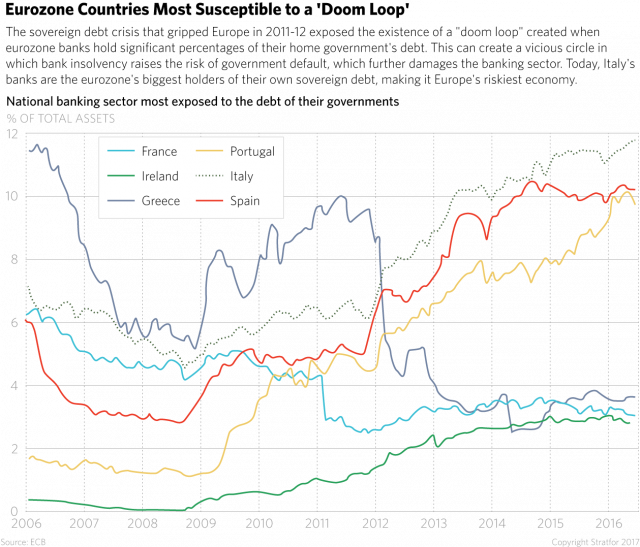
Από τα μέσα του 2016, οι αυξανόμενες προσδοκίες για επιστροφή του πληθωρισμού έχουν οδηγήσει τους επενδυτές σε ξεπούλημα των ομολόγων τους, ιδιαίτερα λόγω των προεδρικών εκλογών στις ΗΠΑ. (Ο υψηλότερος πληθωρισμός μειώνει την ελκυστικότητα των ομολόγων για τους επενδυτές, και στις αγορές ομολόγων καταγράφεται έντονο sell-off τους τελευταίους μήνες).

Οι προσδοκίες αυτές έχουν ήδη υλοποιηθεί στην ευρωζώνη, όπου ο ετήσιος πληθωρισμός αυξήθηκε από το 0,2% τον Ιούλιο του 2016 στο 1,8% τον Ιανουάριο του 2017. Αυτό έχει ενθαρρύνει την Ευρωπαϊκή Κεντρική Τράπεζα να περιορίσει το πρόγραμμα αγοράς ομολόγων της, το οποίο χρησιμοποιεί για να τονώσει τον πληθωρισμό, από τα 80 δισ. ευρώ στα 60 δισ. ευρώ τον μήνα. Με την ΕΚΤ να παρέχει λιγότερη στήριξη στις τιμές των ομολόγων, οι αποδόσεις (που κινούνται αντιστρόφως ανάλογα των τιμών) έχουν αυξηθεί.

Από μόνο του, αυτό θα προκαλούσε προβλήματα για τη νομισματική ένωση, καθώς θα αύξανε την πίεση στις χρεωμένες χώρες, όπως η Ιταλία, που με τη σειρά τους θα έρχονταν αντιμέτωπες με υψηλότερες πληρωμές χρέους.

Όμως το αυξανόμενο πολιτικό ρίσκο σε χώρες όπως η Γαλλία, η Ιταλία και η Γερμανία έχει μεγεθύνει τις επιπτώσεις του sell-off, καθώς το χάσμα στις αποδόσεις ομολόγων μεταξύ των χωρών της ευρωπεριφέρειας και της Γερμανίας -το χρέος της οποίας θεωρείται βάση λόγω της ασφάλειάς του- έχει διευρυνθεί. Αυτό δείχνει πως οι φόβοι της αγοράς για διάλυση της ευρωζώνης εντείνονται. Αν η νομισματική ένωση καταρρεύσει, τότε οι επενδυτές θα προτιμούσαν να κρατούν γερμανικό χρέος, για παράδειγμα, αντί για χρέος που εκδίδουν η Ελλάδα ή η Ιταλία.

Σοβαρές πολιτικές ανησυχίες

Φέτος είναι προγραμματισμένο να διενεργηθούν εκλογές στην Ολλανδία, τη Γαλλία και τη Γερμανία. Όμως οι ανησυχίες για τα εκλογικά αποτελέσματα είναι ιδιαίτερα μεγάλες σε ό,τι αφορά στις προεδρικές εκλογές στη Γαλλία (σε δύο γύρους, τον Απρίλιο και τον Μάιο), όπου εξακολουθεί να υπάρχει πιθανότητα να κερδίσει η υποψήφια των εθνικιστών Μαρίν Λε Πεν, η οποία έχει υποσχεθεί να βγάλει τη Γαλλία από την ευρωζώνη όσο το δυνατόν συντομότερα.

Αν και το εκλογικό σύστημα της Γαλλίας έχει σχεδιαστεί εν μέρει ώστε να μην κυβερνούν ακραία κόμματα όπως το Εθνικό Μέτωπο της Λε Πεν, ωστόσο όλοι οι άλλοι υποψήφιοι για την προεδρία έχουν αδυναμίες που θα μπορούσαν να αποδειχθούν μοιραίες στις εκστρατείες τους. Ως εκ τούτου, η ήττα της δεν είναι προκαθορισμένο αποτέλεσμα.

Στην Ιταλία, εν τω μεταξύ, η εύθραυστη κυβέρνηση και η εμβάθυνση της διαίρεσης εντός του κυβερνώντος Δημοκρατικού Κόμματος έχουν αυξήσει τις πιθανότητες προκήρυξης εκλογών κάποια στιγμή φέτος. Το αποτέλεσμα θα μπορούσε άνετα να φέρει μια νέα κυβέρνηση, η οποία θα επηρεάζεται σε μεγάλο βαθμό από το Κίνημα των Πέντε Αστέρων ή τη Λίγκα του Βορρά, κόμματα που θέλουν η Ιταλία να φύγει από την ευρωζώνη.

Αν οι ευρωσκεπτικιστικές δυνάμεις καταφέρουν να αποκτήσουν πρόσβαση στην εξουσία σε οποιαδήποτε από τις δύο αυτές χώρες, δεν θα ήταν απαραίτητο να κερδίσουν σε δημοψήφισμα για την παραμονή της ευρωζώνης για να βλάψουν τη νομισματική ένωση. Ακόμα και η πράξη του προγραμματισμού δημοψηφίσματος στη Γαλλία ή την Ιταλία θα μπορούσε να επισπεύσει μια κρίση που θα ταρακουνούσε τα θεμέλια της νομισματικής ένωσης.

Η ελληνική περίπτωση

Η Ελλάδα αποτελεί μια ακόμα πηγή ανησυχίας για τους ηγέτες της ευρωζώνης, που δεν θέλουν το πρόγραμμα διάσωσης της Αθήνας να εκκρεμεί ως θέμα στις εκλογές. Έχοντας μεγάλες αποπληρωμές χρέους τον Ιούλιο, η Ελλάδα αντιμετωπίζει πιέσεις να κλείσει την αξιολόγηση του προγράμματος, κάτι που θα πρέπει να κάνει για να λάβει τα κεφάλαια που χρειάζεται για να κάνει τις προαναφερθείσες πληρωμές. Για να μην επηρεάσει τα εκλογικά αποτελέσματα η κατάσταση της Ελλάδας, το ιδανικό θα ήταν η αξιολόγηση να ολοκληρωθεί στις 20 Φεβρουαρίου, στη συνεδρίαση του Eurogroup.

Η Ελλάδα έχει αρκετά χρήματα μέχρι τον Ιούλιο, όμως αν το θέμα δεν λυθεί μέχρι τότε, η κυβέρνηση της χώρας θα πρέπει να διαπραγματευτεί ένα ολοκαίνουριο πρόγραμμα διάσωσης. Αυτό θα προκαλούσε νέα κρίση στην Ελλάδα, όπως αυτήν που απασχόλησε την ευρωζώνη το 2015, που ενέχει τον κίνδυνο εξόδου της Ελλάδας από την ευρωζώνη.

Δεν «σπάει» ο φαύλος κύκλος

Την ίδια ώρα, τα οικονομικά ρίσκα παραμένουν, ιδιαίτερα στην Ιταλία. Η τρίτη μεγαλύτερη οικονομία της ευρωζώνης έχει το δεύτερο μεγαλύτερο χρέος ως ποσοστό του ΑΕΠ (132,4% του ΑΕΠ), ενώ ο τραπεζικός της κλάδος -που επιβαρύνεται με «κόκκινα» δάνεια ύψους 276 δισ. ευρώ- σχοινοβατεί στο χείλος της κρίσης. Στα προβλήματά της προστίθεται και το γεγονός πως η Ιταλία είναι το πιο ευάλωτο μέλος της ευρωζώνης στο «βρόχο της καταστροφής»: οι ιταλικές τράπεζες είναι οι μεγαλύτεροι κάτοχοι ιταλικών κρατικών ομολόγων, που αντιστοιχεί σε σχεδόν 12% του συνολικού ενεργητικού του τραπεζικού κλάδου.
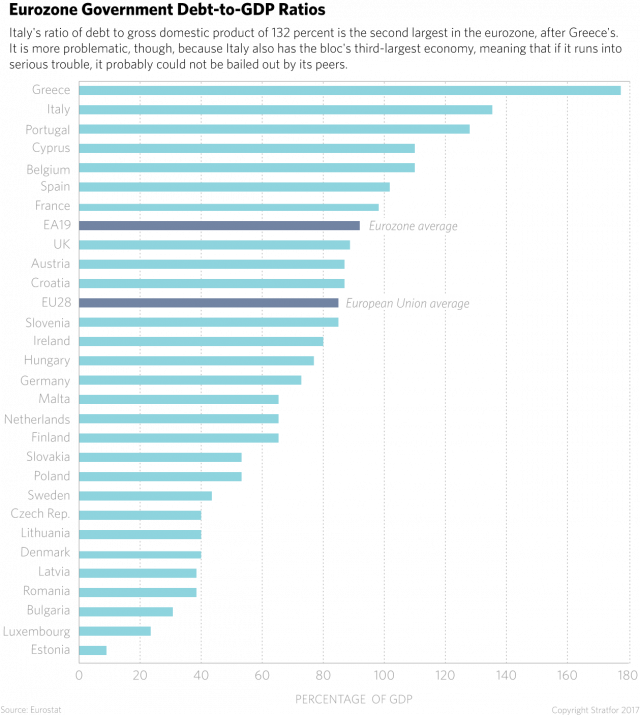
Από τότε που ο «βρόχος της καταστροφής» τον οποίον πυροδότησε η ελληνική κρίση κόντεψε να οδηγήσει στην κατάρρευση της ευρωζώνης, οι αρχές έχουν προσπαθήσει (αλλά αποτύχει) να σπάσουν τους δεσμούς που ενώνουν τις τράπεζες με τις κυβερνήσεις τους. Η γερμανική πρόταση για περιορισμό του ποσού του κρατικού χρέους της χώρας τους που θα μπορούν να διακρατούν οι τράπεζες, έχει δεχθεί πυρά από την Ιταλία και την Ισπανία, αφού η εφαρμογή της θα προκαλούσε τεράστια προβλήματα στην οικονομία τους.

Η Ιταλία και το bail-in

Ένα άλλο μέτρο που προωθούσε η Γερμανία αφορούσε στη δημιουργία κανόνων «bail-in», που υιοθετήθηκαν στην αρχή του 2016. Υπό τους κανόνες αυτούς, οι ιδιώτες ομολογιούχοι των τραπεζών θα απορροφούν πρώτοι τις απώλειες -χάνοντας ουσιαστικά την επένδυσή τους-, προτού μπορέσει να χρησιμοποιηθεί κρατικό χρήμα για τη διάσωση.

Η πρώτη μεγάλη δοκιμή των κανόνων αυτών ήρθε τον Δεκέμβριο, όταν η Banca Monte dei Paschi di Siena -η τρίτη μεγαλύτερη τράπεζα της Ιταλίας- αντιμετώπισε σοβαρά προβλήματα και χρειάστηκε διάσωση. Όμως πολλοί από τους ομολογιούχους της τράπεζας ήταν ανύποπτοι πολίτες στους οποίους είχαν πωληθεί τα ομόλογα ως ένα ασφαλές «όχημα» αποταμίευσης. Αν αναγκάζονταν να υποστούν ζημίες με το bail-in, θα προκαλούνταν μεγάλη πολιτική αντίδραση, ενισχύοντας το «χέρι» των ευρωσκεπτικιστικών κομμάτων όπως το Κίνημα των Πέντε Αστέρων.

Η λύση της ιταλικής κυβέρνησης για να προστατευθεί από τις πολιτικές επιπτώσεις περιελάμβανε δύο «ταχυδακτυλουργικά»: Πρώτον, χρησιμοποίησε ένα σχεδόν ξεπερασμένο stress test από τα μέσα του 2016 για να δικαιολογήσει μια πιο ευνοϊκή μορφή ανακεφαλαιοποίησης. Στη συνέχεια, έχοντας τη δικαιολογία πως οι ομολογιούχοι παραπλανήθηκαν για τη φύση της επένδυσής τους, τους αποζημίωσε.

Η τακτική της Ρώμης έσωσε την τράπεζα, για την ώρα τουλάχιστον, και απέτρεψε μια μεγάλη λαϊκή κατακραυγή. Η Ευρωπαϊκή Επιτροπή, που αναμφίβολα επίσης ανησυχούσε για τις επιπτώσεις της ενίσχυσης των ευρωσκεπτικιστικών κομμάτων, ενέκρινε το σχέδιο. Ωστόσο, η κατάσταση δεν έχει επιλυθεί τελείως: οι ευρωπαϊκές αρχές πρέπει ακόμα να εγκρίνουν το επιχειρηματικό σχέδιο της τράπεζας, προτού προχωρήσει η διάσωση. Επιπλέον, οι κανόνες του bail-in φαίνεται να έχουν καταρρεύσει στο πρώτο εμπόδιο που αντιμετώπισαν, ενώ ο πιθανός «βρόχος της καταστροφής» τραπεζών-κυβερνήσεων παραμένει ανέπαφος.

Η Ευρώπη διερευνά νέες λύσεις

Η υπάρχουσα επιδιόρθωση του «βρόχου της καταστροφής» φαίνεται να μην πετυχαίνει τον στόχο της, όμως οι ευρωπαϊκές αρχές δεν έχουν σταματήσει να ψάχνουν για τρόπους να τη διορθώσουν. Τον Ιανουάριο, η Ευρωπαϊκή Τραπεζική Αρχή πρότεινε τη δημιουργία μιας πανευρωπαϊκής “bad bank” που θα μπορούσε να αγοράσει μη εξυπηρετούμενα δάνεια από τις τράπεζες της ΕΕ, για να τα βγάλει από τους ισολογισμούς των τραπεζών, βελτιώνοντας έτσι την ευρωστία του κλάδου. Η “bad bank” στη συνέχεια θα πωλούσε τα δάνεια αυτά σε επενδυτές. Αν έπρεπε να υποστεί απώλεια σε οποιαδήποτε συναλλαγή της, θα μπορούσε θεωρητικά να ζητήσει αποζημίωση από την αρχική τράπεζα, ώστε οι αρχικοί υποστηρικτές του σχεδίου να μη χάσουν χρήματα.

Μια άλλη ιδέα που «έπεσε» για πρώτη φορά στο «τραπέζι» τον Οκτώβριο του 2011 είναι η δημιουργία ευρωπαϊκών «ασφαλών» ομολόγων, ή ESBies. Το σχέδιο αυτό προβλέπει πως μια οντότητα (ιδιωτική ή δημόσια) θα αγοράζει τα ομόλογα όλων των χωρών της ευρωζώνης και θα δημιουργήσει δύο pools: ένα pool οικονομιών υψηλότερου κινδύνου και ένα άλλο για τις πιο ασφαλείς οικονομίες.

Στη συνέχεια θα εξέδιδε ομόλογα που θα αντιπροσώπευαν το pool του χρέους υψηλότερου κινδύνου (που αρχικά ονομάζεται ευρωπαϊκά junior ομόλογα, ή EJBies, και περιλαμβάνει χρέος χωρών όπως η Ελλάδα και η Πορτογαλία) και άλλα που θα αντιπροσώπευαν το pool του πιο ασφαλούς χρέους (με ομόλογα από χώρες όπως η Γερμανία και η Ολλανδία).

Αυτή η ομαδοποίηση θα μπορούσε να καταστήσει δυσκολότερο για τους επενδυτές να επιλέξουν μία χώρα να εγκαταλείψουν σε περίπτωση κρίσης, ενώ θα δημιουργούσε επίσης ένα μεγαλύτερο pool πραγματικά ασφαλών τίτλων στους οποίους θα μπορούσαν να βασιστούν οι επενδυτές. Τον Σεπτέμβριο, το Ευρωπαϊκό Συμβούλιο Συστημικού Ρίσκου, επικεφαλής του οποίου είναι ο πρόεδρος της ΕΚΤ Μάριο Ντράγκι, δημιούργησε ομάδα εργασίας για να διερευνήσει την ιδέα αυτή, και η Ευρωπαϊκή Επιτροπή αναμένεται να εκδώσει λευκή βίβλο για το θέμα αυτό τον Μάρτιο.

Δυστυχώς για τους αρχιτέκτονες του σχεδίου, η Γερμανία -η χώρα με τη μεγαλύτερη επιρροή στην ευρωζώνη- έχει αντιρρήσεις και για τις δύο ιδέες. Ο γερμανικός λαός τάσσεται σθεναρά κατά οποιασδήποτε πρότασης που μπορεί να περιλαμβάνει την επιδότηση του χρεωμένου Νότου με χρήματα από δικούς του φόρους.

Τα τελευταία χρόνια, η Γερμανία έχει κάνει βήματα ώστε να προστατευθεί από την πιθανή διάλυση της ευρωζώνης. Όταν η ΕΚΤ ξεκίνησε το πρόγραμμα αγοράς ομολόγων τον Ιανουάριο του 2015, για παράδειγμα, η Γερμανία τελικά ενέδωσε σε μια πολιτική με την οποία διαφωνούσε, υπό τον όρο ότι τα ομόλογα θα συνέχιζαν να μοιράζονται μεταξύ των κεντρικών τραπεζών των χωρών-μελών και όχι να συγκεντρώνονται κεντρικά, καθιστώντας τη συμφωνία πιο σαφή στην περίπτωση μελλοντικού «διαζυγίου».

Επίσης, τα στοιχεία από την Τράπεζα Διεθνών Διακανονισμών έχουν δείξει πως οι Γερμανικές τράπεζες έχουν σταματήσει να δανείζουν σε εταιρείες με έδρα άλλες χώρες της ευρωζώνης τα τελευταία χρόνια, προτιμώντας να κρατούν το χρήμα τους στη Γερμανία -άλλο ένα βήμα πιο μακριά από την ενοποίηση και την αμοιβαιοποίηση των υποχρεώσεων εντός του μπλοκ. Άρα, όποια ιδέα φαίνεται να περιλαμβάνει ομαδοποίηση του ρίσκου πιθανότατα θα απορριφθεί άμεσα στη Γερμανία, ιδιαίτερα σε μια εκλογική χρονιά.

Θα «βγάλει» τη χρονιά η ευρωζώνη;

Η ευρωζώνη έχει μπει σε μια δύσκολη χρονιά και ορισμένοι επενδυτές δείχνουν όλο και μεγαλύτερη αμφιβολία για την ικανότητά της να επιβιώσει. Αν η Ευρώπη μπορέσει επιτυχώς να ξεπεράσει τα πολιτικά εμπόδια που έχει μπροστά της, η αβεβαιότητα στην αγορά θα «ξεθωριάσει» γρήγορα, και θα επιστρέψει χρήμα στις αγορές ομολόγων της. Ακόμα, όμως, και αν συμβεί αυτό, τα οικονομικά ρίσκα (που επιδεινώνονται από πολιτικούς παράγοντες στην Ευρώπη) θα συνεχίσουν να τροφοδοτούν τους φόβους για το μέλλον της νομισματικής ένωσης.

Οι αποδόσεις των ευρωπαϊκών ομολόγων αυξάνονται, με ώθηση από τις παγκόσμιες προσδοκίες για πληθωρισμό και από τη σταδιακή σύσφιξη της νομισματικής πολιτικής της ΕΚΤ, που σημαίνει ότι το κόστος αποπληρωμής χρεών επίσης θα αυξηθεί. Αν συνεχίσει να γίνεται αυτό σταδιακά, τότε οι αποδόσεις των ομολόγων είναι απίθανο να φτάσουν σε άβολα επίπεδα κατά τη διάρκεια του 2017. Επειδή, όμως, ο «βρόχος της καταστροφής» μεταξύ των τραπεζών και των κυβερνήσεων παραμένει ανέπαφος, και επειδή ο ιταλικός τραπεζικός κλάδος εξακολουθεί να είναι εξαιρετικά εύθραυστος, η Ιταλία θα είναι ιδιαίτερα επιρρεπής στην κρίση. Και οι αυξήσεις στις αποπληρωμές χρέους, όσο σταδιακά και αν γίνουν, απλώς θα μεγαλώσουν αυτή την ευπάθεια.


Άννα Φαλτάιτς[email protected]

The Missing Pieces in the Flynn Story

0

President Trump may have thought the departure of his national security adviser, Michael Flynn, would end the controversy over his administration’s involvement with Russia, but the damning revelations keep coming. The whole fiasco underscores the dysfunction and dishonesty of his White House and how ill prepared it is to protect the nation.

It’s unlikely that Mr. Flynn would have been pushed out absent a revelation on Monday by The Washington Post: that the Justice Department told the White House in January that Mr. Flynn had misled senior officials about a phone call with the Russian ambassador. Justice told the White House that, contrary to his claims, Mr. Flynn had discussed American sanctions against Russia with the ambassador. The discrepancy between what Mr. Flynn had said publicly and what the Russians (and American intelligence officials) knew made Mr. Flynn vulnerable to Russian blackmail. But the White House evidently didn’t feel the need to act on that danger as long as it was concealed from the public.

On Tuesday, the White House admitted that Mr. Trump was told more than two weeks ago about Mr. Flynn’s deception, even though the president told reporters on Friday that he was unaware of a news report to that effect. Mr. Flynn, a hothead and an ideologue, was not fit to be national security adviser in the first place. That Mr. Trump clung to such a compromised person in such a sensitive position is at best an abysmal failure of judgment. As late as Monday, Mr. Flynn was in security briefings and had access to the president.

In his resignation letter, Mr. Flynn said he had given senior officials “incomplete information” about the phone call. F.B.I. agents interviewed Mr. Flynn days after the inauguration on that same subject, The Times reported on Tuesday. That means he could be exposed to a felony charge if he lied to them as well. The Times also reported Tuesday that current and former American officials said other Trump associates and campaign officials had had repeated contacts with senior Russian intelligence officials in the year before the election.

Of course, Republicans pilloried Hillary Clinton for nearly two years for using a private email server, a bad decision, but one that didn’t endanger the nation. And they conducted eight futile investigations into Mrs. Clinton’s role as secretary of state during the 2012 Benghazi attack.

Sally Yates, the acting attorney general, judged an intercepted call “highly significant” and “potentially illegal” under the Logan Act, which bars private citizens from interfering in diplomatic disputes with other countries. When word of the Flynn-Kislyak call leaked on Jan. 12, a Trump official denied that sanctions were discussed. The White House spokesman, Sean Spicer, gave a similar answer on Jan. 13, as did Vice President Mike Pence on Jan. 15. After Mr. Trump’s inauguration, Mr. Spicer said on Jan. 23 that Mr. Flynn again assured him that sanctions had not been discussed. Shortly afterward, Ms. Yates, with agreement from James Comey, the F.B.I. director, informed Donald McGahn, the White House counsel, about what really happened.

There are many unanswered questions. Did anyone in the White House authorize Mr. Flynn’s contacts? Why has Mr. Trump not condemned him for discussing sanctions with the Russians when he was not yet in office?

All of this puts more pressure on Congress to act. Although some top Republican senators have pledged to deepen their investigation of Russian involvement in the election, the party’s response over all has been irresponsible. “I think that situation has taken care of itself,” Jason Chaffetz, chairman of the House Oversight Committee, said on Tuesday about Mr. Flynn. Devin Nunes, chairman of the House Intelligence Committee, was equally dismissive: “It just seems like there’s a lot of nothing there.” Then there was Senator Rand Paul, who put partisanship ahead of national security by declaring “it makes no sense” for Republicans to investigate Republicans.

Now the same Republicans seem intent on helping Mr. Trump hide the truth by refusing to investigate Russia’s hacking and other attempts to influence the 2016 election, as well as Mr. Trump’s connections to Russia and affinity for President Vladimir Putin.

Mr. Trump has no more urgent task now than putting in place an experienced national security adviser who is beyond reproach. With the world in turmoil, his three-week-old administration is consumed by a self-inflicted crisis, marked by a pattern of recurrent lying and incompetence, and perhaps worse.

5 Questions Raised by Michael Flynn’s Abrupt Departure

0

Carolyn Kaster / APDAVID A. GRAHAM Who in the White House knew that the national security adviser had misled Mike Pence, and when? Who will replace him? And what will be the next bombshell?

An abrupt resignation, like Michael Flynn’s announcement Monday night that he would leave his post as national security adviser, is a beginning masquerading as a conclusion. His departure resolves one straightforward question—Can Flynn survive, having admittedly misled the vice president and the American people?—but raises a host of more important, and more complex, questions. In most cases, it’s far too early to guess what the answers might be, but here’s a rundown of some of the most pressing mysteries Tuesday.


On a mechanical level, the question of who becomes the president’s top aide on security now is an important, urgent one. Not only has Flynn resigned, but his deputy, K.T. McFarland, is expected to leave the White House too, The New York Times reported. (McFarland, whose main credential was her frequent media commentary, would have been a surprising pick to be elevated.) Retired Lieutenant General Keith Kellogg, who had been serving as chief of staff of the National Security Council, has been named as Flynn’s interim replacement, and is reportedly a candidate for the permanent job. Other candidates include David Petraeus, the retired general and former CIA director, who interviewed for other positions in the administration, and retired Vice Admiral Robert Harward, who was Defense Secretary James Mattis’s deputy when Mattis led U.S. Central Command. Petraeus would be an interesting pick, since he is a veteran of the Obama administration but was forced to step down and later convicted for sharing classified information with his mistress-biographer.

What did the White House know, who knew it, and when did they know it?

It’s clear that Flynn was not forthcoming with Vice President Mike Pence, as he acknowledged in his resignation letter: “Unfortunately, because of the fast pace of events, I inadvertently briefed the Vice President Elect and others with incomplete information regarding my phone calls with the Russian Ambassador.” The question is how long that was clear. The Washington Post broke the story that Flynn had discussed sanctions with the Russian ambassador to the U.S. prior to inauguration, contrary to his statements. But the Post now reports that then-Acting Attorney General Sally Yates informed the White House counsel, Don McGahn, in January that Flynn was not telling the whole truth about his phone calls, warning that he was vulnerable to Russian blackmail. She also discussed it with FBI Director James Comey, who was initially resistant to informing the White House but later came around, the Post says. (Yates, an Obama appointee, was later fired for announcing the Justice Department would not carry out Trump’s executive order on immigration.)

McGahn has not commented on the report, but if it’s true, that means a high-ranking White House staffer was aware of Flynn’s duplicity long before the public learned of it, late last week. Who, then, did McGahn inform? Did Chief of Staff Reince Priebus know? How about presidential aides Steve Bannon, Jared Kushner, and Kellyanne Conway? Did Trump know? (When asked on Friday, Trump claimed to be unaware of the Post report in which Flynn admitted he may have misled Pence.) Did Pence? If not, why did McGahn not see fit to inform them? If so, what actions did the others take? As late as Monday afternoon, top Trump aides were saying that Flynn had Trump’s full confidence, and hours later, he was out.

 Why was Flynn finally pushed, and who goes next?
Much analysis of the White House has adopted the lens of two competing teams—an establishment squad, centered around Priebus, and an insurgent platoon, led by Bannon. Flynn was close to Bannon, but Politico and the Times report that Bannon wanted to fire Flynn as early as Friday, and eventually asked for his resignation. (Bannon’s old outlet, Breitbart, however, blames “establishment forces” for Flynn’s ouster.) The president, meanwhile, was happy to wait and see if Flynn could survive, reports Phil Rucker of The Washington Post. One interesting takeaway is that it was the Bannon team that pushed out one of its own when he became a liability. It’s also somewhat surprising that even when it became clear that Flynn has misled Pence, and allowed him to mislead the American people, he had a chance to survive—a sign of Trump’s reluctance to fire aides, and a curious statement about Pence’s position in the scheme of things.

It’s highly unusual for a high-level official to leave an administration so quickly, within just three weeks. (Sometimes appointees are forced to withdraw before taking their jobs, but effectively never is one installed and then pushed out as rapidly as Flynn.) Last week, I suggested that the Trump administration had begun to look a little like a reality-TV show—Survivor: West Wing. If so, Flynn was the first to fall, but of course there’s always the next round of elimination. So who will be the next to leave the chaotic White House, and will be part of the post-Flynn shakeup, or for different reasons?

 Is the FBI still investigating the Trump administration’s ties to Russia?
Once it became clear that Flynn had discussed sanctions with Russian officials, there was speculation that he might have violated the Logan Act, which bars unauthorized citizens from negotiating U.S. policy. But the prospect of a Logan Act prosecution was always highly remote—the bigger story is about the nature of Trump administration contacts with the Russians more generally, and whether Russia interfered with the presidential election to help Trump and hurt Hillary Clinton.

It’s known that the FBI has been investigating these ties: CNN reported in January that the bureau was looking into Flynn’s calls. The Post reports that this was part of a broader investigation. So, is that investigation still ongoing? What else is it considering, and when might the contents become public? And why was Director Comey, who was so quick to publicize developments in the FBI investigation of Hillary Clinton’s private email server, reportedly so reluctant to confront the White House about Flynn’s dissembling? The Army is also, according to the Times, investigating whether Flynn received money from the Russian government for a 2015 trip, which could break the law.

How will the rest of the Republican Party respond?

Between the FBI and Army investigations, it’s clear that there are important unanswered questions about Flynn’s dealings. Yet the Trump administration’s line, somewhat implausibly, is that the “real story” is not the president’s top security aide misleading the vice president and the American people, but instead the leaks that have fed the story—the news about Yates’s call to McGahn, the fact that the FBI was investigating Flynn’s calls, the sources who said Flynn was lying. Breitbart has also taken this line.

 How will other members of the president’s party react, though? So far, many of them seem unwilling to get anywhere near the story. Representative Jason Chaffetz, who leads the House Oversight Committee, suggested Tuesday that with Flynn’s resignation, the story was coming to an end. On Monday, Representative Devin Nunes, who leads the House Intelligence Committee, staunchly defended Flynn and said there was no need for him to resign. On Tuesday, Nunes said that his committee would not investigate Trump and Flynn’s conversation, citing executive privilege, but said he wanted the FBI to explain the leak of transcripts of Flynn’s calls. On the Senate side, where GOP members have been more eager to investigate Russian interference in the election, Senator Roy Blunt called for a committee to examine Trump’s ties with Russia “exhaustively” and to question Flynn. It might not be wrong that the intelligence community was out to get Flynn, argues Eli Lake, who points to Flynn’s rocky relationship with spies over time. But whether Republicans in Congress are more interested in Flynn’s dubious dealings with Russia or with the question of leaks that pushed him out will say a lot about their priorities, and whether they are willing to stand up to the White House.
https://www.theatlantic.com/politics/archive/2017/02/5-questions-raised-by-michael-flynns-abrupt-departure/516606/

Flynn departure erupts into a full-blown crisis for the Trump White House

0

THE WASHINGTON POST

February 14 at 9:10 PM
President Trump’s ouster of national security adviser Michael T. Flynn, and the circumstances leading up to it, have quickly become a major crisis for the fledgling administration, forcing the White House on the defensive and precipitating the first significant breach in relations between Trump and an increasingly restive Republican Congress.Even as the White House described Trump’s “immediate, decisive” action in demanding ­Flynn’s resignation late Monday as the end of an unfortunate episode, senior GOP lawmakers were buckling under growing pressure to investigate it.Senate Majority Leader Mitch McConnell (R-Ky.) said Tuesday that it was “highly likely” that the events leading to Flynn’s departure would be added to a broader probe into Russian meddling in the U.S. presidential election. Intercepts showed that Flynn discussed U.S. sanctions in a phone call with the Russian ambassador — a conversation topic that Flynn first denied and then later said he could not recall.

McConnell’s comments followed White House revelations that Trump was aware “for weeks” that Flynn had misled Vice President Pence and others about the content of his late-December talks with Russian Ambassador Sergey Kislyak.

White House counsel Donald F. McGahn told Trump in a briefing late last month that Flynn, despite his claims to the contrary, had discussed U.S. sanctions imposed on Russia by the Obama administration in late December, press secretary Sean Spicer said Tuesday. That briefing, he said, came “immediately” after Sally Q. Yates, then the acting attorney general, informed McGahn on Jan. 26 about discrepancies between intercepts of Kislyak’s phone calls and public statements by Pence and others that there had been no discussion of sanctions.

The resignation of national security adviser Michael Flynn comes on the heels of reports that he discussed U.S. sanctions with the Russian ambassador while a civilian, before President Trump took office. (Jason Aldag/The Washington Post)

Trump brought in senior strategist Stephen K. Bannon and White House Chief of Staff Reince Priebus to join the discussion with McGahn, according to two officials familiar with the conversations who spoke on the condition of anonymity because they were not authorized to speak publicly.

McGahn then conferred with Yates again the following day, Jan. 27, to try to glean more information, these two officials said. Within the White House, the matter was viewed skeptically, and Trump, Bannon, Priebus and McGahn for several days remained among the few people briefed, they said.

 Over the next two weeks, the officials said, Flynn was asked multiple times about what exactly he had said. He brushed aside the suggestion that he had spoken about sanctions with the ambassador — denials that kept him afloat within the White House even as he was being actively evaluated, they said.

It was not until a Washington Post report last Thursday, in which Flynn was quoted as saying that he had no “recollection” of discussing sanctions but couldn’t be sure that he hadn’t, that the downward slide culminating in Monday’s forced resignation began, several administration officials said.

“We’ve been reviewing and evaluating this issue with respect to General Flynn on a daily basis for a few weeks, trying to ascertain the truth,” Spicer said at the daily White House press briefing. He emphasized that an internal White House inquiry had concluded that nothing Flynn discussed with the Russian was illegal but that he had “broken trust” with Trump by not telling the truth about the talks.

When asked whether Trump told Flynn to talk to Kislyak about sanctions, Spicer responded: “No, absolutely not.”

Asked why Trump had waited nearly three weeks to act after what Spicer called a “heads-up” from the Justice Department, he said that once the question of legality was settled, “then it became a phase of determining whether or not [Flynn’s] action on this and a whole host of other issues undermined” Trump’s trust. He declined to specify the “other issues.”

 Senate Majority Leader Mitch McConnell (R-Ky.) told members of the media that the Senate Intelligence Committee will likely include former national security adviser Michael Flynn’s contact with Russian officials as part of a probe into Russian interference in the 2016 election, on Feb. 14 at the Capitol. (The Washington Post)

In an interview conducted early Monday and published Tuesday by the Daily Caller, Flynn said that he did not specifically discuss sanctions with Kislyak but rather President Barack Obama’s simultaneous expulsion of 35 Russian diplomats. He said he told the ambassador that “we’ll review everything” following Trump’s inauguration.

Current and former U.S. officials have said, however, that much of the conversation was about sanctions and that Flynn suggested that Moscow not respond in kind to the expulsions — advice that Russian President Vladi­mir Putin took in declining to take retaliatory action.

Although Trump has not publicly mentioned his view of the sanctions, Spicer said that the president “has made it very clear he expects the Russian government to de-escalate violence in the Ukraine and return Crimea,” even as he hopes to cooperate with Putin on terrorism.

Asked Tuesday on a flight to Brussels about Flynn’s ouster, Defense Secretary Jim Mattis said it “has no impact” on his job. “It doesn’t change my message at all, and who is on the president’s staff is who I will work with,” he said.

Mattis was on his way to a meeting of NATO defense ministers, who were expected to discuss their significant concerns about Russian aggression. During his confirmation hearing, Mattis placed Russia first among threats to U.S. security.

Officials inside the National Security Council described low morale and concern about the future. The “worthless” message at a five-minute staff meeting Tuesday morning, one official said, was: “Keep working hard. Don’t leave.”

For those who knew and liked Flynn, another official said, “it’s sad. He’s a good man, and I hate to see this.”

Various accounts of the Flynn saga offered by White House officials in recent days have added to confusion about how the administration viewed Flynn’s actions, who knew what and when they knew it.

News accounts about a Flynn-Kislyak conversation in late December — the day before Obama announced new sanctions related to Russian election interference — first surfaced in a David Ignatius column in The Post on Jan. 12. Asked the next day whether they had talked about the sanctions in light of Trump’s campaign and post-election pledges to better relations with Russia, White House officials said the subject had not been discussed.

Three days later, Pence told CBS’s “Face the Nation” that Flynn had assured him personally that there was no conversation about sanctions. Spicer offered similar assurances in a subsequent White House briefing.

On Jan. 24 or 25, based on discrepancies between comments by Pence and Spicer and what they knew from regular intercepts of Kislyak’s calls, FBI agents interviewed Flynn. Details of that interview, first reported Tuesday by the New York Times, are unknown but they could expose Flynn to possible charges if he denied that he had discussed sanctions with Kislyak. That interview was followed by the Justice notice to McGahn, who immediately informed Trump and others, officials said.

After Trump ordered McGahn to review the matter, Spicer said, he quickly concluded that the president’s “instinctive” conclusion that the discussions were not illegal was correct. But some in the White House who had long distrusted Flynn began to contemplate his departure. CIA Director Mike Pompeo and Keith Kellogg, the National Security Council chief of staff, began attending intelligence briefings with Flynn.

“The president was sort of like: Until this matter is sorted out, I want buttressing,” said the senior official, one of several who discussed the sensitive matter on the condition of anonymity. “The idea was . . . if the president decides to pull the trigger, we need to make sure that we have some options.”

Flynn was eventually made aware of the White House investigation, which led to alarm among senior Trump aides when he initially told The Post, in a Feb. 8 interview, that there had been no discussion about sanctions. He revised his remarks to the paper the next day, saying through a spokesman that “while he had no recollection of discussing sanctions, he couldn’t be certain that the topic never came up.”

The two accounts were published by The Post on the evening of Feb. 9.

“His story remained the same until that night,” Spicer told reporters in his office Tuesday evening. “There was a story in The Post where there’s a White House official that says that he could not recall. . . . Whatever that quote was is what matters. . . . His story remained the same until that night.”

Pence spokesman Marc Lotter told reporters that the vice president first became aware of the “incomplete information” Spicer had provided him by reading the same newspaper account.

Flynn was then questioned by McGahn, Pence and Priebus, who the official said was so frustrated that his tone became more that of a litigator than a colleague.

Asked Friday aboard Air Force One about the Post reporting that Flynn allegedly had not told the truth about the calls, Trump said he was not familiar with it.

“I don’t know about that. I haven’t seen it. What report is that? I haven’t seen that. I’ll look into that,” Trump told reporters on the plane.

Spicer said Tuesday that Trump was responding only to a question about the Post report and was not speaking about the overall issue of Flynn’s contact with the Russian ambassador and his discussion of sanctions.

After discussing the situation throughout the weekend at Trump’s Florida resort, a final decision was made Monday night by Trump, along with Priebus and senior advisers Bannon and Jared Kushner, to tell Flynn to resign, officials said.

That is a notably different version of events than the one offered Monday night, when administration officials characterized Flynn’s departure as voluntary. One senior White House official said Monday that Trump had not fired Flynn but that he had made the decision to resign on his own because of “the cumulative effect” of damaging news coverage.

Robert Costa, Dan Lamothe, Ellen Nakashima and Ashley Parker contributed to this report.