Αρχική Blog Σελίδα 2975

CHP report: 4,811 academics dismissed from 112 Turkish universities by gov’t decrees

0

As Turkish government continues its purge in Turkish universities to cleanse critics, 4,811 academics were dismissed from 112 universities across the country through decrees issued during the state of emergency a failed coup in last summer, a report by main opposition Republican People’s Party (CHP) said.

According to a report by CHP deputy chairs Selin Sayek Böke and Zeynep Altıok, 15 universities out of 191 in Turkey was closed by government decrees issued during the state of emergency which was declared after the failed coup attempt on July 15, 2016.

The report, titled as “Dismissed academicians, deserted Universities” and presented to CHP chairman Kemal Kılıçdaroğlu before official release, said that ruling Justice and Development Party (AKP) imposed pressure on dissent academicians and free thought which is against its ideology.

Turkey survived a military coup attempt on July 15 which killed over 240 people and wounded more than a thousand others. Immediately after the putsch, AKP government along with President Recep Tayyip Erdoğan pinned the blame on the Gülen movement despite the lack of any evidence to that effect.

Although the Gülen movement strongly denies having any role in the putsch, the government accuses it of having masterminded the foiled coup. Fethullah Gülen, who inspired the movement, called for an international investigation into the coup attempt, but President Erdoğan — calling the coup attempt “a gift from God” — and the government initiated a widespread purge aimed at cleansing sympathizers of the movement from within state institutions, dehumanizing its popular figures and putting them in custody.

Over 135,000 people, including thousands within the military, have been purged due to their real or alleged connection to the Gülen movement since the coup attempt, according to a statement by the labor minister on Jan. 10.

As of March 23, 94,982 people were being held without charge, with an additional 47,128 in pre-trial detention due to their alleged links to the movement. A total of 7,317 academics were purged as well as 4,272 judges and prosecutors, who were dismissed due to alleged involvement in the July 15 coup attempt.

By

TM

Palestinians and the Balfour Declaration at 100: Resisting the Past

0

EXECUTIVE SUMMARY: On the 100th anniversary of the Balfour Declaration, the Palestinians have launched a campaign calling for an official British apology and compensation. This effort illustrates the ways in which honor, internationalization, symbolism, and playing on Western guilt shape the Palestinian culture of denial, which impedes progress towards either a stable Palestinian state or peace with Israel.

A striking aspect of Palestinian culture is its resistance to the realities of the past.

On September 22, 2016, Palestinian Authority (PA) president Mahmoud Abbas addressed the UN. He said, “100 years have passed since the notorious Balfour Declaration, by which Britain gave, without any right, authority or consent from anyone, the land of Palestine to another people.” He went on to demand an apology from Britain. Abbas has had previously threatened to sue London for damages resulting from the declaration and the creation of Israel.

This storm against the past was also on display at a recent conference at University College London that brought together British Islamists and revisionist Israelis to demand that the British government apologize for the Balfour Declaration, with the ultimate aim of exposing “the illegality of the state of Israel while giving practical steps in campaigning towards an end to the Israeli occupation of Palestine.”

What do such efforts tell us about Palestinian culture and the prospects for peace?

The Balfour Declaration is a singular datum for Israelis and Palestinians alike. After lengthy negotiations between the British government and the Zionist movement, Arthur Balfour, the British Foreign Secretary, issued his famous statement on November 2, 1917. Balfour’s letter to Zionist leader Lord Rothschild, in which he stated that the Cabinet viewed “with favour the establishment in Palestine of a national home for the Jewish people,” was only one of a series of British wartime communications regarding the fate of the Levant. The correspondence between the British High Commissioner for Egypt, Sir Henry McMahon, and Hussein Ibn Ali, Sharif of Mecca, and the secret Anglo-French agreement between Sir Mark Sykes and Charles Georges-Picot were no less consequential in the shaping of the contemporary Middle East.

It took the Arabs some time to voice their opposition to the Declaration. The British report on the 1921 Palestine riots noted that “The Mayor of Tulkarem talks about the Balfour Declaration, and, whether he has or has not a clearer notion of its import than other people, he certainly expresses his opinion about it very definitely.” Palestinian objections to Balfour are neatly captured by historian Bayan al-Hut: “This is a promise that was made by someone who had no right to give it to those who had no right to receive it.”

The British establishment itself was divided and began to respond negatively to Zionism and Balfour in the early 1920s. This reflected the fusion of the establishment’s traditional anti-Semitism with its growing realization that the League of Nations’ mandate for the implementation of the Balfour Declaration was an impossible encumbrance on an empire bled white and financially exhausted by war. This attitude was a pronounced undercurrent throughout the Mandate years. According to Palestinian historian Walid Khalidi, one British official, Acting District Commissioner for the Galilee Blenkinsopp, used to circulate a “refutation” of the Balfour Declaration to his colleagues every year on November 2.

In the past, Palestinians have cast the Mandate as the illegitimate exercise of British imperialism, where, as al-Hut put it, “One people grant[ed] a second people what belong[ed] to a third people.” Nowadays, the opposition to the Balfour Declaration describes it as the beginning of “settler-colonialism.”

This innovation neatly saddles Britain’s carefully cultivated sense of post-imperial guilt with responsibility for “Israeli crimes,” including “complicity” in the supposed “cultural repression” of the Palestinians. At the same time, the approach promises to redeem the long-standing Palestinian sense of besmirched honor at having failed to “resist” Zionism.

But the current effort against Balfour also illustrates other standard Palestinian responses. For one thing, it unironically emphasizes Palestinian powerlessness and Arab weakness in both the past and the present. “Resistance” against the British Empire and the Zionists, both non-violent and violent, failed – and therefore, consistent with historical Palestinian practice, the issue must be internationalized.

The irony, however, is that Balfour’s wholly legal commitment, ratified by the League of Nations in 1920, is assailed much the same way the 1947 UN Palestine partition recommendation was condemned: as illegitimate and unfair. For Palestinians, internationalization must produce the result they want, despite the historical record of its rarely doing so.

There are other traditional elements in the campaign against the Balfour Declaration, not least the mistaking of symbolism for practical action. Presumably an apology would achieve a partial restoration of Palestinian national honor and comprise another step towards the complete eradication of Israel. However, despite vague talk from Palestinian activists demanding “compensation for Balfour” – which would be set against competing claims for compensation by Jewish refugees from Arab countries – it is difficult to see what direct value an apology would have in helping to establish a Palestinian state.

Demands for apologies and compensation have changed little since the UN’s Economic Survey Mission reported on a visit to Gaza in 1949: “In one of the camps, the refugees staged quite a demonstration. A large sign had been printed in English on which were the following, numbered as indicated: 1. Send us back home. 2. Compensate us. 3. Maintain us until we are refreshed. Just what they had in mind by ‘refreshed’ I leave to your imagination.”

The current Palestinian leadership’s sense of timing, and commitment to symbolism, deserves comment. Whereas from the 1960s onward Yasser Arafat navigated the Palestinian movement through the shifting currents of Third Worldism and the Cold War, today that skill is nowhere evident. Protests over the Balfour Declaration anniversary are emerging just as the Arab state system finds itself at its lowest ebb. Syria, Yemen, and Libya are effectively no more, Iraq is divided between an Iranian rump, a shrinking ISIS entity, and an independent Kurdistan (in all but name), and Lebanon is a Shiite-dominated shell. The Palestinian Authority is a pseudo-state that exists only thanks to foreign aid and Israeli security assistance.

The tone of the Balfour Declaration protests – “What is happening in Palestine is the biggest social injustice of our time,” as a conference organizer put it – is therefore not simply a lament for an era when Palestinians were ostensibly at the center of Arab and Muslims politics, but resistance to empirical reality.

The Balfour apology campaign is thus another element in the Palestinian wars against inconvenient historical facts that must be denied, attacked, rewritten, or otherwise assailed, rather than debated, conceded, or shared. This approach accounts for such extraordinary Palestinian claims as Arafat’s denial that there was ever a Jewish Temple in Jerusalem; Saeb Erekat’s statement that the Palestinians are descendants of Epipaleolithic inhabitants, and thus the “real” indigenous population of the land; and the more consequential insistence that Jews are only adherents to a religion and not members of a nation.

Here “resistance” elides into stubborn fabulism. Reality must be made to conform on the basis of both religious ideology and fantastical invented elements. Palestinian examples must be set into broader contexts, from religious claims regarding perfidious and cursed Jews to plaintive historical claims regarding the Muslim discovery of America, the invention of flight, and, more darkly, Zionist attack sharks or the “conspiracy to destroy Islam.”

These concepts – redeeming fallen honor, perpetual victimhood, international responsibility, and achieving through guilt what politics and force of arms cannot – are cultural ideas, transmitted endlessly by Palestinian leaders and through their educational system and media. But they are also reflected in Palestinian politics. At every turn, negotiations get to a stage and then stop because compromise would preclude full “restoration” of what never was. Fighting century-old events and hoping to produce another outcome is consistent with this pattern. It is unlikely to build either a stable Palestinian society or peace with Israel.

By

Alex Joffe is an archaeologist and historian. He is a Shillman-Ginsburg Fellow at the Middle East Forum.

BESA Center Perspectives Papers are published through the generosity of the Greg Rosshandler Family

Το ’21 και το μέλλον του ελληνισμού

11

ΤΟΥ ΠΑΝΤΕΛΗ ΣΑΒΒΙΔΗ.

Η αυγή των εθνικιστικών κινημάτων, τον 18ο αιώνα, και κυρίως η Γαλλική Επανάσταση (1789), αλλά νωρίτερα και ο Διαφωτισμός σε επίπεδο ιδεών, βοήθησαν στην ενεργοποίηση της ελληνικής εθνικής συνείδησης που οδήγησε στην Επανάσταση του 1821, τη δημιουργία ελληνικού εθνικού κράτους και την προσπάθειά του, ακόμη και σήμερα, να αποκτήσει γερά θεμέλια.

Μια προσπάθεια που συντελείται εδώ και 196 χρόνια με θριάμβους αλλά και βαριές ήττες. Μια σύγχρονη ελληνική τραγωδία, έννοια σύμφυτη με την πορεία αυτού του λαού, βρίσκεται ακόμη σε εξέλιξη.

Άλλωστε, το δραματουργικό αυτό είδος μεγαλούργησε στα χώματα αυτά από τον ίδιο λαό.

Ο κύκλος των εθνικών κρατών, που σήμερα αμφισβητούνται ως βασική μονάδα οργάνωσης της διεθνούς κοινωνίας, τείνει να κλείσει – με το ελληνικό κράτος να έχει αφήσει εκτός κορμού σημαντικά τμήματα του ελληνισμού, και με σαφή αδυναμία να τα υποστηρίξει.

Η ελληνική Επανάσταση ήταν η πρώτη που συντελέστηκε στα Βαλκάνια, διότι συνέτρεξαν οι προϋποθέσεις για να εκδηλωθεί. Ατυχείς στιγμές, που εν πολλοίς οφείλονται σε διαχρονικά ελαττώματα όπως η φιλονικία, οδήγησαν σε τραγωδίες και την έναρξη μιας παρατεταμένης περιόδου συρρίκνωσης και παρακμής. Ο ελληνικός λαός αυτά τα 196 χρόνια πορεύθηκε από τη δόξα στον όλεθρο. Γνώρισε στιγμές μεγαλείου αλλά και ταπεινωτικής ήττας. Είχε την τύχη να βρίσκονται επικεφαλής του μεγάλοι ηγέτες διεθνούς διαμετρήματος αλλά και ολίγιστοι καταχραστές της πολιτικής εξουσίας.

Διέτρεξε μια εντυπωσιακή καμπύλη, και σήμερα βρίσκεται σε μια κρίσιμη καμπή με άδηλο το μέλλον του, και με μια ηγεσία στο σύνολό της ελαχίστων δυνατοτήτων σε σχέση με τις απαιτήσεις των καιρών.

Η Επανάσταση συντελέστηκε διότι βοήθησαν οι αντικειμενικές και οι υποκειμενικές συνθήκες. Οι υποκειμενικές ήταν ο διακαής πόθος των υπόδουλων Ελλήνων να αποκτήσουν την ελευθερία τους. Ο κατακτητής, όμως, ήταν παρών και ήταν ισχυρός. Βοήθησαν, όμως, οι εξελίξεις. Η παρέμβαση των ισχυρών χωρών της Ευρώπης στο εξωτερικό εμπόριο της Οθωμανικής Αυτοκρατορίας ήταν καταλύτης για το σχηματισμό ενός ελληνικού εμπορικού κόσμου. Η Γαλλική επανάσταση και ο Διαφωτισμός επηρέασαν τον προβληματισμό του.

Η μονολιθική στήριξη στο ομόδοξο ξανθό γένος αμφισβητήθηκε. Ο Δυτικός προσανατολισμός γεννήθηκε πριν από τη δημιουργία του εθνικού κράτους. Οι πόλεμοι του Ναπολέοντα ανέτρεψαν τους συσχετισμούς δυνάμεων στην Ανατολική Μεσόγειο. Η ελληνική ναυτιλία δεν ανήκε σε εμπόλεμη χώρα. Έτσι της δόθηκε η δυνατότητα ευέλικτων κινήσεων. Μια μορφή αστικής τάξης, αναγκαίας για την Επανάσταση, διαμορφώθηκε.

Η συνεργασία με τον παροικιακό ελληνισμό ήταν αναγκαία. Την χρειάζονταν και τα δύο τμήματα της αστικής τάξης: Εσωτερικής και παροικιακής. Συμπορεύονταν για το καινούριο. Ο όλος ελληνισμός έψαχνε ένα ελεύθερο ανεξάρτητο ελληνικό αστικό κράτος, κατά τα γαλλικά πρότυπα. Το πέτυχε, ως έναν βαθμό.

Το τέλος του 18ου αιώνα θα το σφραγίσει η κίνηση του Ρήγα. Κατά τον ιστορικό Βασίλη Κρεμμυδά, ήταν ο απόηχος, το τέλος της αυτονομίας του παροικιακού ελληνισμού.

Αυτό που ζήτησε ο Ρήγας δεν θα συγκινήσει τον υπόδουλο ελληνισμό. Ανήκε στην εποχή των Αυτοκρατοριών, όχι των εθνικών κρατών. Μπαίνουμε στην εποχή της έγερσης των εθνικισμών. Όχι των θρησκευτικών διαχωρισμών.

Την πρώτη δεκαετία του 19ου αιώνα κορυφώνονται οι νέες οικονομικές δραστηριότητες των υπόδουλων, επέρχεται η εθνική συνειδητοποίηση και αρχίζει να προβάλλει η ανάγκη ύπαρξης ενός ελληνικού εθνικού κράτους. Η κύρια αντίθεση ανάμεσα σε κατακτητή και κατακτημένο τα τελευταία προεπαναστατικά χρόνια δεν ήταν η πίστη, λέει ο Κρεμμυδάς, και μάλλον έχει δίκαιο. Ήταν το έθνος. Από θρησκευτική, η αντίθεση έγινε εθνική.

Η επανάσταση οργανώθηκε από τη Φιλική Εταιρεία. Αυτή διατύπωσε το αίτημα: ανεξάρτητο, ελληνικό, μοντέρνο –δηλαδή αστικό–, κράτος. Η επιτυχία ήταν πλήρης. Το ανεξάρτητο ελληνικό κράτος ιδρύθηκε. Για να είναι και μοντέρνο, με αντιπροσωπευτική διακυβέρνηση δηλαδή, θα χρειαστεί και η Επανάσταση της 3ης Σεπτεμβρίου 1843, ύστερα από δεκαετή απολυταρχική ξένη διακυβέρνηση.

Ο κύκλος ήταν μακρύς και επώδυνος. Σήμερα, 25η Μαρτίου 2017, ένα νέο μόρφωμα στο οποίο ακούμπησε και ο ελληνισμός, και το οποίο δημιουργήθηκε εδώ και 60 χρόνια, η Ευρωπαϊκή Ένωση, αναζητά και αυτή το μέλλον της. Όπως και η ελληνική κοινωνία αναζητά την πυξίδα που έχασε.

Δεν είναι καθόλου σίγουρο, καθόλου ασφαλές και καθόλου προβλέψιμο το μέλλον. Βρισκόμαστε στον πυρήνα μιας παγκόσμιας χαοτικής αναταραχής. Μια νέα Ελλάδα θα αναδυθεί, αλλά η μορφή της είναι ακόμη αδιαμόρφωτη.

Σε τέσσερα χρόνια, θα έχουν περάσει 200 έτη από την Επανάσταση του ’21. Και σε έξι, 100 χρόνια που ο Οθωμανός κατακτητής μετεξελίχθηκε σε εθνικό τουρκικό κράτος, υποτίθεται δημοκρατικό. Κατ’ επίφασιν.

Οι ιδεολογικές και θρησκευτικές διεργασίες οδηγούν τη μεν Τουρκία σε μια προσπάθεια επαναφοράς του νεοοθωμανικού οράματος, τη δε Ελλάδα σε μια επίμονη ευρωπαϊκή πορεία. Εκεί όπου δεν ήθελε να ενταχθεί, λίγο πριν από την Άλωση. Διλήμματα εκείνης της εποχής, της προ Αλώσεως, κάπως εκσυγχρονισμένα, υπάρχουν και σήμερα.

Οι ελίτ και των δύο χωρών έχουν συνειδητοποιήσει πως το εθνικό κράτος έχει διαγράψει τον κύκλο του. Και αναζητούν να προσαρμοσθούν στο νέο. Με μια ουσιώδη διαφορά. Η μεν Τουρκία, διάδοχος των Οθωμανών, με την τακτική που γνώριζε και εφάρμοζε πάντοτε: τη βία. Η δε Ελλάδα, ειρηνικά.

Ορισμένοι αναλυτές υποστηρίζουν πως το μέλλον είναι εδώ. Με την έννοια πως το ζούμε. Αλλά, μάλλον δεν διαγιγνώσκουν σωστά. Η εποχή που διανύουμε είναι από τις κρίσιμες εκείνες μεταβατικές περιόδους που επηρεάζουν καταλυτικά τις εξελίξεις. Δεν έχουμε βιώσει, ακόμη, τίποτε από όσα έρχονται.

Δεν είναι καθόλου σίγουρο πως το έχουν συνειδητοποιήσει όσοι διαχειρίζονται τις τύχες μας.

Αν οι Έλληνες, ως λαός, κατόρθωσαν να επιβιώσουν από την αρχαία εποχή ως σήμερα, είναι διότι μπορούν και προσαρμόζονται. Από τις αρχαίες πόλεις στο Μακεδονικό Βασίλειο, τα βασίλεια των διαδόχων του Αλεξάνδρου, την πολιτιστική επιρροή στον ρωμαϊκό κόσμο, τη Βυζαντινή Αυτοκρατορία, την υποδούλωση και το ελληνικό εθνικό κράτος.

Θα τα καταφέρουν και τώρα. Κουβαλώντας και την παράδοσή τους, την οποία, σε κρίσιμες στιγμές, αναζητά η ανθρωπότητα. Είναι η παρακαταθήκη των προγόνων τους.

pontos-news.gr

Ασκήσεις ισορροπίας στον παγκόσμιο χάρτη: Τα γεωπολιτικά παίγνια του Βλ. Πούτιν

0

Το γεωπολιτικό παίγνιο της Μόσχας εμπλέκει ΗΠΑ, Κίνα και Ινδία. EPA, GEOFF CADDICK MARCH 25, 2017

Tου Ζαχαρία Μίχα

Τις κλασικές θεωρίες της γεωπολιτικής έχει ξεσηκώσει η ρωσική ηγεσία, κατανοώντας προφανώς, ότι εάν πετύχει η στρατηγική συνεργασία με την Κίνα και κατορθώσει έστω σε ένα βαθμό να εμπλέξει σε θετική κατεύθυνση τα συμφέροντα της Ινδίας, τότε θα κυριαρχήσουν από κοινού στην «παγκόσμια νήσο» (world island) και συνεπακόλουθα στην υφήλιο!

Τα πράγματα όμως είναι εξαιρετικά πιο πολύπλοκα στο γεωστρατηγικό παίγνιο των ημερών μας… Δυο σύνοδοι που βρίσκονται στην ατζέντα στο προσεχές διάστημα έχουν ιδιαίτερη σημασία για τη ρωσική εξωτερική πολιτική.

Η μία είναι η ετήσια σύνοδος Ρωσίας-Ινδίας τον Ιούνιο, ενώ θα έχει προηγηθεί η σύνοδος που αφορά στο σχέδιο «μια ζώνη, ένας δρόμος» (OBOR: One Belt, One Road), το φιλόδοξο σχέδιο της Κίνας για τη συνένωση των συμφερόντων χωρών που θα δημιουργήσουν έναν εμπορικό και ταυτόχρονα στρατηγικό «διάδρομο».

Η ρωσική διπλωματία δείχνει να αντιμετωπίζει τα δυο αυτά σχέδια ως συμπληρωματικά, με τελικό στόχο να διαθέτει τη δική της «εναλλακτική λύση», σε περίπτωση που οι Ηνωμένες Πολιτείες δεν ενδιαφερθούν για τη συνεργασία με τη Μόσχα που ζητά επί της ουσίας συνδιαχείριση των ζητημάτων της υφηλίου, χωρίς βέβαια να παρακάμπτει το Πεκίνο, καθώς αυτό θα ήταν απλώς αδύνατο.

Η Ρωσία επιχειρεί να σταθεροποιήσει τις σχέσεις της με την Ινδία, αν και πρόκειται για μια χώρα που δεν επιθυμεί απόλυτη ταύτιση είτε με τη Ρωσία είτε με τις ΗΠΑ, ενώ η Κίνα αποτελεί την κύρια απειλή για την εθνική της ασφάλεια.

Κατά συνέπεια, η ρωσική «στρατηγική σύλληψη» για να μειώσει την απόσταση ανάμεσα στο Νέο Δελχί και το Πεκίνο, είναι εξ ορισμού μια πολύ δύσκολη προσπάθεια. Η Ρωσία δεν έχει καν την πολυτέλεια να εγκαταλείψει μια από τις δυο δυνάμεις, την Ινδία ή την Κίνα και είναι «καταδικασμένη» να επιδιώκει τη βελτίωση των σχέσεων και με τις δυο.

Στην προσπάθεια εξισορρόπησης των σχέσεων, αλλά και διατύπωσης μιας έμμεσης απειλής στην Ινδία – και χειρονομία στο Πεκίνο που είναι ο στρατηγικός σύμμαχος του Ισλαμαμπάντ – η οποία αναπτύσσει ταχύτατα τις σχέσεις της και με τις ΗΠΑ, οι σχέσεις της Ρωσίας με το Πακιστάν έδειξαν κάποια κινητικότητα τα τελευταία χρόνια, με τη Μόσχα να προμηθεύει μικρό αριθμό επιθετικών ελικοπτέρων τις πακιστανικές ένοπλες δυνάμεις και να έχει ανοίξει διαύλους στρατηγικού διαλόγου.

Ωστόσο, θα πρέπει κανείς να παρατηρήσει, ότι η μεγάλη παρουσία ρωσικών κύριων οπλικών συστημάτων στο ινδικό οπλοστάσιο στρέφεται εναντίον των κινεζικών συμφερόντων στον τομέα της εθνικής ασφάλειας, κάτι που όμως ισχύει και από την αντίθετη κατεύθυνση.

Οι Κινέζοι εντάσσουν στο οπλοστάσιό τους τα κορυφαία σε υπηρεσία ρωσικά μαχητικά αεροσκάφη Sukhoi Su-35 – αν και σε πολύ μικρό αριθμό, μία μοίρα 24 μαχητικών – και τα συστήματα αντιαεροπορικής και αντιβαλλιστικής άμυνας τύπου S-400 Triumf, τα οποία μάλιστα θα παραλάβουν νωρίτερα από τους Ινδούς, που επίσης έχουν εκδηλώσει ενδιαφέρον να προμηθευτούν.

Η Ρωσία με την Ινδία έχουν θέσει ως στόχο να πετύχουν ετήσιες εμπορικές ανταλλαγές ύψους 30 δισεκατομμυρίων δολαρίων μέχρι το 2025, ένα «όραμα» των ηγετών των δυο χωρών, Βλαντιμίρ Πούτιν και Ναρέντρα Μόντι, στο πλαίσιο του εορτασμού της 70ης επετείου διπλωματικών σχέσεων.

Από την άλλη, όποιος θεωρεί ότι η σχέση της Μόσχας με το Πεκίνο είναι απαλλαγμένη από προβλήματα, είτε αγνοεί είτε εθελοτυφλεί. Και οι δυο πλευρές είναι παραδοσιακά και ιστορικά καχύποπτες για τις προθέσεις της άλλης για πλειάδα λόγων.

Στα πιο πρόσφατα, οι αναλύσεις διεθνώς επικέντρωσαν στο προηγούμενο της προσέγγισης της Κίνας το 1974 από το αμερικανικό δίδυμο Νίξον-Κίσιντζερ τη δεκαετία του 1970, με στόχο την ανάσχεση της ΕΣΣΔ, θέτοντας το ερώτημα εάν τώρα θα επιχειρηθεί το αντίστροφο από τις ΗΠΑ, λόγω των διαφημιζόμενων καλών σχέσεων και της ρητορικής του «κύκλου Τραμπ» με τη ρωσική ηγετική ομάδα.

Η Κίνα, σε μια ενέργεια που καλύφθηκε ελάχιστα από τα φώτα της δημοσιότητας προχώρησε σε μια ενέργεια που θα ήταν ασφαλές να υποτεθεί, ότι δεν εκτιμήθηκε ιδιαίτερα στη Μόσχα και αντιθέτως προκάλεσε εκνευρισμό και προβληματισμό.

Σε μια περίοδο κατά την οποία ο Κινέζος υπουργός Εξωτερικών, Ουάνγκ Γι, δήλωνε ότι η Κίνα έχει πλήρη εμπιστοσύνη στις σχέσεις της με τη Ρωσία, οι οποίες δεν έχουν επηρεασθεί από εξωτερικούς παράγοντες, και η χώρα του προτίθεται να ενισχύσει τη διμερή στρατηγική συνεργασία, προσθέτοντας ότι οι διμερείς σχέσεις, στην παρούσα φάση, διανύουν την καλύτερη στιγμή στην Ιστορία τους με βάση πάντα τα αμοιβαία συμφέροντα, ξεκινούσε στενή συνεργασία με την Ουκρανία στον διαστημικό τομέα.

Συγκεκριμένα, η κινεζική Ακαδημία Τεχνολογίας Εκτοξεύσεων (China Academy of Launch Vehicle Technology) ανακοίνωσε τη συνεργασία της με ουκρανικές εταιρίες για την από κοινού ανάπτυξη νέας γενιάς αεροεκτοξευόμενων (από αεροσκάφη) ρουκετών για την αντικατάσταση προβληματικών δορυφόρων.

Όπως δημοσίευσε η China Daily, οι ρουκέτες αυτές θα μπορούν να μεταφέρουν στο διάστημα φορτίο 200 κιλών. Η εκτόξευση θα γίνεται από εξειδικευμένα στην αποστολή μεταφορικά αεροσκάφη με βάση το Y-20 (τα συγκεκριμένα αεροσκάφη παραδόθηκαν τον περασμένο Ιούλιο στην κινεζική Αεροπορία). Οι Κινέζοι φέρονται να έχουν ήδη αναπτύξει ένα τέτοιο σύστημα που δύναται να μεταφέρει φορτίο 100 κιλών στο διάστημα και να το θέτει σε χαμηλή τροχιά. Παρόμοιο πρόγραμμα έχουν σε εξέλιξη μόνο οι Ηνωμένες Πολιτείες, σύμφωνα πάντα με το κινεζικό δημοσίευμα.

Επίσης, υπενθυμίζεται ότι οι Κινέζοι, στις 30 Αυγούστου του 2016 υπέγραψαν συμφωνία διά της Aviation Industry Corporation of China (AICC) με την ουκρανική Antonov Corporation, για την επανέναρξη παραγωγής του μεγαλύτερου αεροσκάφους στον κόσμο, του AN-225, που έχει 84 μέτρα μήκος και πτερυγικό εκπέτασμα μεγαλύτερο των 88 μέτρων, το οποίο μπορεί να μεταφέρει 250 τόνους φορτίου.

Το πρόγραμμα είχε σταματήσει μετά τη δραματική επιδείνωση των σχέσεων ανάμεσα στη Ρωσία και την Ουκρανία, με τους Κινέζους να αρπάζουν την ευκαιρία, κάτι που θα ήταν αδιανόητο να μην έχει ενοχλήσει τη ρωσική ηγεσία, δεδομένου του ψυχροπολεμικού κλίματος στις σχέσεις με την Ουκρανία και όσα διακυβεύονται στην ανατολική Ουκρανία και την χερσόνησο της Κριμαίας, σε στρατηγικό επίπεδο για τη Μόσχα.

Σε κάθε περίπτωση, δείχνει να συνιστά μια ενέργεια από αυτές που οι δυο πλευρές χρησιμοποιούν για να «προειδοποιήσουν» την άλλη, όμως ακόμα κι αν πετυχαίνει τον στόχο της, παράλληλα ενισχύει την υφιστάμενη καχυποψία και θέτει περιορισμούς στη δυνατότητα πραγματοποίησης «αλμάτων» στη στρατηγική συνεργασία.

Πλέον, για να επιστρέψουμε στο «τρίγωνο» Μόσχας, Νέου Δελχί και Πεκίνου, η Ρωσία σήμερα καλεί για μια ειλικρινή συζήτηση. Κάπου εκεί υποκρύπτεται η ανησυχία της Μόσχας για τις κινεζικές πρωτοβουλίες, αφού τα στρατηγικά συμφέροντα των δυο δυνάμεων στην περιοχή της κεντρικής Ασίας -τουλάχιστον- είναι αποκλίνοντα. Όπως αναφέρει το ρωσικό Sputnik, η Κίνα εκμεταλλεύθηκε την κατάρρευση της συμφωνίας TPP (Trans-Pacific Partnership), καθώς αυτό έδωσε νέα δυναμική στο δικό της σχέδιο, το OBOR, για τη συνένωση της ασιατικής ηπείρου, υπό τη δική της όμως ηγεμονία και κατεύθυνση.

Αυτό η Ρωσία δεν θα το επέτρεπε να συμβεί και αυτονόητα κινείται για την εξασφάλιση των συμφερόντων της, προσπαθώντας να εντάξει στον κινεζικό σχεδιασμό τον κάθετο άξονα που ενώνει τη Ρωσική Ομοσπονδία με την Ινδία.

Στόχος είναι, σύμφωνα με τα λόγια Ινδού αναλυτή που μίλησε στο Sputnik, «μια πιο εποικοδομητική και έξυπνη εμπλοκή» από κινεζικής πλευράς, λόγια στα οποία προκύπτει η έκδηλη ανησυχία για τις κινεζικές ενέργειες.

Κατά συνέπεια, δύο είναι τα τελικά συμπεράσματα:

Το πρώτο, ότι τις Ρωσία και Ινδία ανησυχούν σφόδρα τα κινεζικά σχέδια, κάτι που θεωρητικά τις φέρνει πιο κοντά, χωρίς αυτό να αποκλείει και την προσθήκη των ΗΠΑ, όταν κάποια στιγμή εξευρεθούν νέες ισορροπίες στο «σύστημα» στην Ουάσιγκτον.

Το δεύτερο, ότι ο περίφημος «άξονας» Ρωσίας-Κίνας θα πρέπει να θεωρείται κάθε άλλο παρά δεδομένος. Πέραν του «ιστορικού βάρους» το οποίο πολλοί λησμονούν στις αναφορές τους στο θέμα, είναι μια δυναμική διαδικασία που υπαγορεύεται από τη σημερινή διεθνή πραγματικότητα και επιδιώκει να ορθωθεί ως τείχος στα στρατηγικά σχέδια των Ηνωμένων Πολιτειών με στόχο τη διατήρηση της πλανητικής πρωτοκαθεδρίας.

Οι εξελίξεις όμως διεθνώς, κινούνται με χαοτικό τρόπο. Ίσως και αυτό να είναι καλύτερο, εάν το ζήτημα προσεγγιστεί από «φιλοσοφική» πλευρά.

Δηλαδή, το ότι οι συμμετέχοντες στο παίγνιο, έχουν συνεχώς τη δυνατότητα σε τακτικό επίπεδο να επηρεάσουν ο ένας τις υπόλοιπες διπλωματικές σχέσεις του άλλου, επιδιώκοντας να «ρυθμίσουν» τη στρατηγική του συμπεριφορά.

Την ίδια στιγμή, Μόσχα και Πεκίνο δείχνουν αμφότερες πως κατά βάθος θα επιθυμούσαν να έχουν εξασφαλίσει τη συμμαχία της Ουάσιγκτον, ώστε να υποβιβάσουν ο ένας τον άλλον, de facto σε μια άτυπη τρίτη θέση στην «παγκόσμια ιεραρχία», χωρίς όμως να αποκλείουν αλλήλους από μια διαδικασία στρατηγικής συνεννόησης… Μπορεί αυτό που συμβαίνει να μοιάζει με μια ισορροπία τρόμου, όμως ας αναλογιστούμε ότι αν έλειπε αυτό το «χαοτικό στοιχείο» από την εξίσωση και θεωρητικά υπήρχαν δύο «στρατόπεδα» αφοσιωμένα το ένα στο άλλο, ο πειρασμός στρατιωτικού ξεκαθαρίσματος της υπόθεσης θα ήταν μεγάλος και δυνητικά καταστροφικός.

Ο Ζαχαρίας Μίχας είναι Διευθυντής Μελετών στο Ινστιτούτο Αναλύσεων Ασφάλειας και Άμυνας (IAAA/ISDA)

Πηγή: Ασκήσεις ισορροπίας στον παγκόσμιο χάρτη: Τα γεωπολιτικά παίγνια του Βλ. Πούτιν http://mignatiou.com/2017/03/askisis-isorropias-ston-pagkosmio-charti-geopolitika-pegnia-moschas-me-kina-ipa-india/


Flynn discussed how to ‘whisk’ away cleric wanted by Turkey: report

0

BY MEGAN R. WILSON –

Michael Flynn, President Trump’s former national security adviser, reportedly discussed ways to take a man wanted by the Turkish government out of the United States without going through the legal extradition process, according to The Wall Street Journal.

The conversation, which took place during the presidential race while Flynn was serving as an unpaid adviser to Trump, centered around Turkish cleric Fethullah Gulen.

The Turkish government has long wanted to take custody of Gulen, 75, who has been exiled in Pennsylvania since 1999.

Among other things, Turkey blames him for orchestrating the deadly and unsuccessful military coup against Turkish President Recep Tayyip Erdogan last year. The country has pressed the U.S. for his extradition.The Journal report cites former CIA Director James Woolsey, who attended the meeting with Flynn and high-level Turkish officials, and others with details on what happened. Woolsey and the sources said the ideas that were discussed for dealing with Gulen were hypothetical.

However, one plan was “a covert step in the dead of night to whisk this guy away,” Woolsey told the Journal. He said he had walked into the middle of the conversation and reportedly “found the topic startling and the actions being discussed possibly illegal.”

A spokesman for Flynn on Friday pushed back on the accusation and the Wall Street Journal report.

“The claim made by Mr. Woolsey that General Flynn, or anyone else in attendance, discussed physical removal of Mr. Gulen from the United States during a meeting with Turkish officials in New York is false. No such discussion occurred. Nor did Mr. Woolsey ever inform General Flynn that he had any concerns whatsoever regarding the meeting, either before he chose to attend, or afterwards,” Price Floyd said in an emailed statement to The Hill.

Earlier this month, Flynn filed paperwork with the Justice Departmentretroactively disclosing work he did last year that may have benefited the government of Turkey.

From August through mid-November, the Flynn Intel Group received $530,000 from a Dutch consulting firm run by a Turkish businessman, according to the disclosure forms. Flynn shut down his firm in November.

The filings, signed by Flynn himself, say the three-month contract included conducting “investigative research” and retaining “an experienced filming and production crew in order to develop a short film piece on the results of its investigation, and a public affairs firm to utilize for public affairs as needed.”

The documentary, which focused on Gulen, was reportedly never finished or distributed.

On Sept. 19, Flynn’s firm met with a “group of government officials from Turkey for the purpose of understanding better the political climate in Turkey at the time, as background for the project.”

It was on that day that Flynn made the suggestion to take Gulen to Turkey from the United States, the Journal article says. One of the officials in the meeting was Erdogan’s son-in-law, disclosure forms reveal.

In November, Flynn penned an op-ed article in The Hill that called Gulen a “radical Islamist” who “portrays himself as a moderate.” Justice Department forms say the op-ed came from the research he did for the consulting firm.

Flynn was fired from his White House post last month for allegedly misleading Vice President Pence and other senior officials about his communications with Russia’s ambassador to the U.S. after the presidential election.

Flynn also made contradictory statements to FBI investigators about whether he discussed sanctions with the Russian envoy, according to The Washington Post.

http://thehill.com/homenews/administration/325698-flynn-discussed-how-to-whisk-away-cleric-wanted-by-turkey-report


Ο νεαρός ΟΝΝΕΔίτης και η κ. Αναγνωστοπούλου

1

«Απαντώντας» στον κ. Ντάισεμπλουμ, με αφορμή τις γελοίες δηλώσεις του περί χρημάτων και κατανάλωσής τους με τις γυναίκες στο νότο, ένδειξη του πολιτικού βάθους της σκέψης των στελεχών της Ε.Ε., η πρώην υπουργός, και, μάλιστα παιδείας, κ. Σία Αναγνωστοπούλου, αυτοσαρκάστηκε ως «πουτάνα».
Το απαράδεκτο γεγονός θεωρήθηκε ως απολύτως φυσιολογικό από μια πολιτική παράταξη, τη δική της, βαθιά υποκριτική, αλλά και από το σύνολο του πολιτικού φάσματος. Κανείς δεν αντέδρασε. Επίσης, υποκριτικό. Θα μπορούσε, μάλιστα, να θεωρηθεί και δείγμα προοδευτικότητας.

Γιατί είναι απαράδεκτο το γεγονός; Διότι σε μια αθλιότητα δεν απαντάς με μια άλλη, και, μάλιστα, όταν έχεις διατελέσει αναπληρωτής υπουργός παιδείας.  Υπάρχει, γενικώς, ένας κατήφορος στη δημόσια έκφραση τον οποίο, αν αφήσουμε να συνεχίζεται δεν θα βρει τέλος. Το αποτέλεσμα θα είναι η ακόμη μεγαλύτερη εκτράχυνση του βίου μας.

Πολλοί είναι αυτοί που οφείλουν να σταματήσουν αυτόν τον κατήφορο. Τα δημόσια πρόσωπα και, μάλιστα, όταν έχουν διατελέσει σε υψηλές θέσεις στο υπουργείο παιδείας, ανήκουν στην πρώτη γραμμή αυτής της προσπάθειας.

Η κ. Αναγνωστοπούλου, διέπραξε μεγάλο λάθος.

Αυτό, βεβαίως, δεν δικαιολογεί τον τρόπο που σχολίασε το δικό της σχόλιο ο διευθυντής της ΟΝΝΕΔ Θεσσαλονίκης. Κατακριτέο και το δικό του σχόλιο.

Αλλά, εδώ αρχίζει και ξεδιπλώνεται το μέγεθος της πολιτικής υποκρισίας και ο προπαγανδιστικός μηχανισμός του Συρίζα και, γενικώς, μιας παρακμιακής αριστεράς.

Δεν σχολιάστηκε καθόλου η κ. Αναγωστοπούλου, ενώ υπήρξε μια ακραία, φασιστικού τύπου, επίθεση στο νεαρό ΟΝΝΕΔίτη.

Και τα δύο σχόλια είναι απαράδεκτα. Αλλά, προς τι αυτή η σιωπή και αποδοχή του εντελώς απαράδεκτου, επίσης, σχολίου της κ. Αναγνωστοπούλου;

Με την ευκαιρία, αξίζει να θιγείκαι ένα άλλο ζήτημα. Προχθές, ένας νεαρός, επίσης, ποδοσφαιριστής του ΠΑΟΚ, πέτυχε ένα γκόλ και θεώρησε καλό να το πανηγυρίσει δείχνοντας στους φιλάθλους τα γεννητικά του όργανα.

Το ακόμη χειρότερο είναι πως όταν τον ρώτησαν αν ζητά συγνώμη για την ενέργειά του αυτή, είπε όχι. Θεωρεί, δηλαδή, ο νεαρός πως το να δείχνεις τα γεννητικά σου όργανα δημοσίως, είναι η κορυφαία εκδήλωση ενός «πολιτιστικού»  γεγονότος.

Δυστυχώς, και οι ποδοσφαιριστές, με τη στάση και τη συμπεριφορά τους, περνούν μηνύματα στη γενιά που μεγαλώνει. Και αυτά τα μηνύματα είναι ό,τι χειρότερο μπορεί να φανταστεί κανείς.

Αλλά, όταν μια πρώην υπουργός, ακαδημαϊκός και στέλεχος πολιτικού κόμματος υπογράφει, έστω αυτοσαρκαζόμενη, ως «πουτάνα», θα μπορούσε να ζητήσει κανείς το λόγο από έναν 20χρονο, συνήθως, αγράμματο ποδοσφαιριστή;

Υπάρχει και μια άλλη διάσταση στην δημόσια αυτή ελληνική πολιτική κωμωδία.

Ο αρχηγός της ΝΔ που τρέμει μόλις ο Συριζα του επισυνάπτει κάτι. Αυτό δεν είναι ηγεσία. Πρόλαβαν  να διαβάσουν οι σημερινοί πολιτικοί ηγέτες  κανένα βιβλίο για το  πως συμπεριφέρθηκαν και διοίκησαν στο παρελθόν, ηγέτες που άφησαν το όνομά τους στην ιστορία;

Δυστυχώς, τρέμουμε στην ιδέα του ποιοι μας κυβερνούν και φιλοδοξούν να μας κυβερνήσουν.


How Aristotle Created the Computer

0

Source: The Atlantic.

The philosophers he influenced set the stage for the technological revolution that remade our world.

The history of computers is often told as a history of objects, from the abacus to the Babbage engine up through the code-breaking machines of World War II. In fact, it is better understood as a history of ideas, mainly ideas that emerged from mathematical logic, an obscure and cult-like discipline that first developed in the 19th century. Mathematical logic was pioneered by philosopher-mathematicians, most notably George Boole and Gottlob Frege, who were themselves inspired by Leibniz’s dream of a universal “concept language,” and the ancient logical system of Aristotle.

Mathematical logic was initially considered a hopelessly abstract subject with no conceivable applications. As one computer scientist commented: “If, in 1901, a talented and sympathetic outsider had been called upon to survey the sciences and name the branch which would be least fruitful in [the] century ahead, his choice might well have settled upon mathematical logic.” And yet, it would provide the foundation for a field that would have more impact on the modern world than any other.

The evolution of computer science from mathematical logic culminated in the 1930s, with two landmark papers: Claude Shannon’s “A Symbolic Analysis of Switching and Relay Circuits,” and Alan Turing’s “On Computable Numbers, With an Application to the Entscheidungsproblem.” In the history of computer science, Shannon and Turing are towering figures, but the importance of the philosophers and logicians who preceded them is frequently overlooked.

A well-known history of computer science describes Shannon’s paper as “possibly the most important, and also the most noted, master’s thesis of the century.” Shannon wrote it as an electrical engineering student at MIT. His adviser, Vannevar Bush, built a prototype computer known as the Differential Analyzer that could rapidly calculate differential equations. The device was mostly mechanical, with subsystems controlled by electrical relays, which were organized in an ad hoc manner as there was not yet a systematic theory underlying circuit design. Shannon’s thesis topic came about when Bush recommended he try to discover such a theory.

Shannon’s paper is in many ways a typical electrical-engineering paper, filled with equations and diagrams of electrical circuits. What is unusual is that the primary reference was a 90-year-old work of mathematical philosophy, George Boole’s The Laws of Thought.

 Today, boole’s name is well known to computer scientists (many programming languages have a basic data type called a Boolean), but in 1938 he was rarely read outside of philosophy departments. Shannon himself encountered Boole’s work in an undergraduate philosophy class. “It just happened that no one else was familiar with both fields at the same time,” he commented later.
Boole is often described as a mathematician, but he saw himself as a philosopher, following in the footsteps of Aristotle. The Laws of Thought begins with a description of his goals, to investigate the fundamental laws of the operation of the human mind:

The design of the following treatise is to investigate the fundamental laws of those operations of the mind by which reasoning is performed; to give expression to them in the symbolical language of a Calculus, and upon this foundation to establish the science of Logic … and, finally, to collect … some probable intimations concerning the nature and constitution of the human mind.

He then pays tribute to Aristotle, the inventor of logic, and the primary influence on his own work:

In its ancient and scholastic form, indeed, the subject of Logic stands almost exclusively associated with the great name of Aristotle. As it was presented to ancient Greece in the partly technical, partly metaphysical disquisitions of The Organon, such, with scarcely any essential change, it has continued to the present day.

Trying to improve on the logical work of Aristotle was an intellectually daring move. Aristotle’s logic, presented in his six-part book The Organon, occupied a central place in the scholarly canon for more than 2,000 years. It was widely believed that Aristotle had written almost all there was to say on the topic. The great philosopher Immanuel Kant commented that, since Aristotle, logic had been “unable to take a single step forward, and therefore seems to all appearance to be finished and complete.”

Aristotle’s central observation was that arguments were valid or not based on their logical structure, independent of the non-logical words involved. The most famous argument schema he discussed is known as the syllogism:

  • All men are mortal.
  • Socrates is a man.
  • Therefore, Socrates is mortal.

You can replace “Socrates” with any other object, and “mortal” with any other predicate, and the argument remains valid. The validity of the argument is determined solely by the logical structure. The logical words — “all,” “is,” are,” and “therefore” — are doing all the work.

Aristotle also defined a set of basic axioms from which he derived the rest of his logical system:

  • An object is what it is (Law of Identity)
  • No statement can be both true and false (Law of Non-contradiction)
  • Every statement is either true or false (Law of the Excluded Middle)

These axioms weren’t meant to describe how people actually think (that would be the realm of psychology), but how an idealized, perfectly rational person ought to think.

Aristotle’s axiomatic method influenced an even more famous book, Euclid’s Elements, which is estimated to be second only to the Bible in the number of editions printed.

A fragment of the Elements (Wikimedia Commons)

Although ostensibly about geometry, the Elements became a standard textbook for teaching rigorous deductive reasoning. (Abraham Lincoln once said that he learned sound legal argumentation from studying Euclid.) In Euclid’s system, geometric ideas were represented as spatial diagrams. Geometry continued to be practiced this way until René Descartes, in the 1630s, showed that geometry could instead be represented as formulas. His Discourse on Method was the first mathematics text in the West to popularize what is now standard algebraic notation — x, y, z for variables, a, b, c for known quantities, and so on.

Descartes’s algebra allowed mathematicians to move beyond spatial intuitions to manipulate symbols using precisely defined formal rules. This shifted the dominant mode of mathematics from diagrams to formulas, leading to, among other things, the development of calculus, invented roughly 30 years after Descartes by, independently, Isaac Newton and Gottfried Leibniz.

Boole’s goal was to do for Aristotelean logic what Descartes had done for Euclidean geometry: free it from the limits of human intuition by giving it a precise algebraic notation. To give a simple example, when Aristotle wrote:

All men are mortal.

Boole replaced the words “men” and “mortal” with variables, and the logical words “all” and “are” with arithmetical operators:

x = x * y

Which could be interpreted as “Everything in the set x is also in the set y.”

The Laws of Thought created a new scholarly field—mathematical logic—which in the following years became one of the most active areas of research for mathematicians and philosophers. Bertrand Russell called the Laws of Thought “the work in which pure mathematics was discovered.”

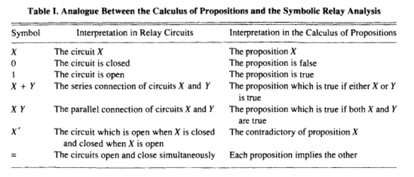
Shannon’s insight was that Boole’s system could be mapped directly onto electrical circuits. At the time, electrical circuits had no systematic theory governing their design. Shannon realized that the right theory would be “exactly analogous to the calculus of propositions used in the symbolic study of logic.”

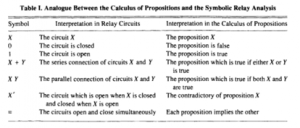
He showed the correspondence between electrical circuits and Boolean operations in a simple chart:

https://cdn-images-1.medium.com/max/800/0*K9_VBhOT_82AKdAL.Shannon’s mapping from electrical circuits to symbolic logic (University of Virginia)
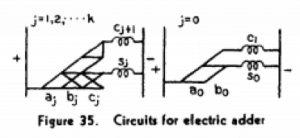
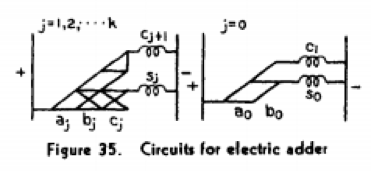
This correspondence allowed computer scientists to import decades of work in logic and mathematics by Boole and subsequent logicians. In the second half of his paper, Shannon showed how Boolean logic could be used to create a circuit for adding two binary digits.

https://cdn-images-1.medium.com/max/800/0*OUD0N1RzLXZK8nLj.Shannon’s adder circuit (University of Virginia)

By stringing these adder circuits together, arbitrarily complex arithmetical operations could be constructed. These circuits would become the basic building blocks of what are now known as arithmetical logic units, a key component in modern computers.

Another way to characterize Shannon’s achievement is that he was first to distinguish between the logical and the physical layer of computers. (This distinction has become so fundamental to computer science that it might seem surprising to modern readers how insightful it was at the time—a reminder of the adage that “the philosophy of one century is the common sense of the next.”)

Since Shannon’s paper, a vast amount of progress has been made on the physical layer of computers, including the invention of the transistor in 1947 by William Shockley and his colleagues at Bell Labs. Transistors are dramatically improved versions of Shannon’s electrical relays — the best known way to physically encode Boolean operations. Over the next 70 years, the semiconductor industry packed more and more transistors into smaller spaces. A 2016 iPhone has about 3.3 billion transistors, each one a “relay switch” like those pictured in Shannon’s diagrams.

While Shannon showed how to map logic onto the physical world, Turing showed how to design computers in the language of mathematical logic. When Turing wrote his paper, in 1936, he was trying to solve “the decision problem,” first identified by the mathematician David Hilbert, who asked whether there was an algorithm that could determine whether an arbitrary mathematical statement is true or false. In contrast to Shannon’s paper, Turing’s paper is highly technical. Its primary historical significance lies not in its answer to the decision problem,  but in the template for computer design it provided along the way.

Turing was working in a tradition stretching back to Gottfried Leibniz, the philosophical giant who developed calculus independently of Newton. Among Leibniz’s many contributions to modern thought, one of the most intriguing was the idea of a new language he called the “universal characteristic” that, he imagined, could represent all possible mathematical and scientific knowledge. Inspired in part by the 13th-century religious philosopher Ramon Llull, Leibniz postulated that the language would be ideographic like Egyptian hieroglyphics, except characters would correspond to “atomic” concepts of math and science. He argued this language would give humankind an “instrument” that could enhance human reason “to a far greater extent than optical instruments” like the microscope and telescope.

He also imagined a machine that could process the language, which he called the calculus ratiocinator.

If controversies were to arise, there would be no more need of disputation between two philosophers than between two accountants. For it would suffice to take their pencils in their hands, and say to each other: Calculemus—Let us calculate.

Leibniz didn’t get the opportunity to develop his universal language or the corresponding machine (although he did invent a relatively simple calculating machine, the stepped reckoner). The first credible attempt to realize Leibniz’s dream came in 1879, when the German philosopher Gottlob Frege published his landmark logic treatise Begriffsschrift. Inspired by Boole’s attempt to improve Aristotle’s logic, Frege developed a much more advanced logical system. The logic taught in philosophy and computer-science classes today—first-order or predicate logic—is only a slight modification of Frege’s system.

Frege is generally considered one of the most important philosophers of the 19th century. Among other things, he is credited with catalyzing what noted philosopher Richard Rorty called the “linguistic turn” in philosophy. As Enlightenment philosophy was obsessed with questions of knowledge, philosophy after Frege became obsessed with questions of language. His disciples included two of the most important philosophers of the 20th century—Bertrand Russell and Ludwig Wittgenstein.

The major innovation of Frege’s logic is that it much more accurately represented the logical structure of ordinary language. Among other things, Frege was the first to use quantifiers (“for every,” “there exists”) and to separate objects from predicates. He was also the first to develop what today are fundamental concepts in computer science like recursive functions and variables with scope and binding.

Frege’s formal language — what he called his “concept-script” — is made up of meaningless symbols that are manipulated by well-defined rules. The language is only given meaning by an interpretation, which is specified separately (this distinction would later come to be called syntax versus semantics). This turned logic into what the eminent computer scientists Allan Newell and Herbert Simon called “the symbol game,” “played with meaningless tokens according to certain purely syntactic rules.”

All meaning had been purged. One had a mechanical system about which various things could be proved. Thus progress was first made by walking away from all that seemed relevant to meaning and human symbols.

As Bertrand Russell famously quipped: “Mathematics may be defined as the subject in which we never know what we are talking about, nor whether what we are saying is true.”

An unexpected consequence of Frege’s work was the discovery of weaknesses in the foundations of mathematics. For example, Euclid’s Elements — considered the gold standard of logical rigor for thousands of years — turned out to be full of logical mistakes. Because Euclid used ordinary words like “line” and “point,” he — and centuries of readers — deceived themselves into making assumptions about sentences that contained those words. To give one relatively simple example, in ordinary usage, the word “line” implies that if you are given three distinct points on a line, one point must be between the other two. But when you define “line” using formal logic, it turns out “between-ness” also needs to be defined—something Euclid overlooked. Formal logic makes gaps like this easy to spot.

This realization created a crisis in the foundation of mathematics. If the Elements — the bible of mathematics — contained logical mistakes, what other fields of mathematics did too? What about sciences like physics that were built on top of mathematics?

The good news is that the same logical methods used to uncover these errors could also be used to correct them. Mathematicians started rebuilding the foundations of mathematics from the bottom up. In 1889, Giuseppe Peano developed axioms for arithmetic, and in 1899, David Hilbert did the same for geometry. Hilbert also outlined a program to formalize the remainder of mathematics, with specific requirements that any such attempt should satisfy, including:

  • Completeness: There should be a proof that all true mathematical statements can be proved in the formal system.
  • Decidability: There should be an algorithm for deciding the truth or falsity of any mathematical statement. (This is the “Entscheidungsproblem” or “decision problem” referenced in Turing’s paper.)

Rebuilding mathematics in a way that satisfied these requirements became known as Hilbert’s program. Up through the 1930s, this was the focus of a core group of logicians including Hilbert, Russell, Kurt Gödel, John Von Neumann, Alonzo Church, and, of course, Alan Turing.

“In science, novelty emerges only with difficulty.”

Hilbert’s program proceeded on at least two fronts. On the first front, logicians created logical systems that tried to prove Hilbert’s requirements either satisfiable or not.

On the second front, mathematicians used logical concepts to rebuild classical mathematics. For example, Peano’s system for arithmetic starts with a simple function called the successor function which increases any number by one. He uses the successor function to recursively define addition, uses addition to recursively define multiplication, and so on, until all the operations of number theory are defined. He then uses those definitions, along with formal logic, to prove theorems about arithmetic.

The historian Thomas Kuhn once observed that “in science, novelty emerges only with difficulty.” Logic in the era of Hilbert’s program was a tumultuous process of creation and destruction. One logician would build up an elaborate system and another would tear it down.

The favored tool of destruction was the construction of self-referential, paradoxical statements that showed the axioms from which they were derived to be inconsistent. A simple form of this  “liar’s paradox” is the sentence:

This sentence is false.

If it is true then it is false, and if it is false then it is true, leading to an endless loop of self-contradiction.

Russell made the first notable use of the liar’s paradox in mathematical logic. He showed that Frege’s system allowed self-contradicting sets to be derived:

Let R be the set of all sets that are not members of themselves. If R is not a member of itself, then its definition dictates that it must contain itself, and if it contains itself, then it contradicts its own definition as the set of all sets that are not members of themselves.

This became known as Russell’s paradox and was seen as a serious flaw in Frege’s achievement. (Frege himself was shocked by this discovery. He replied to Russell: “Your discovery of the contradiction caused me the greatest surprise and, I would almost say, consternation, since it has shaken the basis on which I intended to build my arithmetic.”)

Russell and his colleague Alfred North Whitehead put forth the most ambitious attempt to complete Hilbert’s program with the Principia Mathematica, published in three volumes between 1910 and 1913. The Principia’s method was so detailed that it took over 300 pages to get to the proof that 1+1=2.

Russell and Whitehead tried to resolve Frege’s paradox by introducing what they called type theory. The idea was to partition formal languages into multiple levels or types. Each level could make reference to levels below, but not to their own or higher levels. This resolved self-referential paradoxes by, in effect, banning self-reference. (This solution was not popular with logicians, but it did influence computer science — most modern computer languages have features inspired by type theory.)

Self-referential paradoxes ultimately showed that Hilbert’s program could never be successful. The first blow came in 1931, when Gödel published his now famous incompleteness theorem, which proved that any consistent logical system powerful enough to encompass arithmetic must also contain statements that are true but cannot be proven to be true. (Gödel’s incompleteness theorem is one of the few logical results that has been broadly popularized, thanks to books like Gödel, Escher, Bach and The Emperor’s New Mind).

The final blow came when Turing and Alonzo Church independently proved that no algorithm could exist that determined whether an arbitrary mathematical statement was true or false. (Church did this by inventing an entirely different system called the lambda calculus, which would later inspire computer languages like Lisp.) The answer to the decision problem was negative.

Turing’s key insight came in the first section of his famous 1936 paper, “On Computable Numbers, With an Application to the Entscheidungsproblem.” In order to rigorously formulate the decision problem (the “Entscheidungsproblem”), Turing first created a mathematical model of what it means to be a computer (today, machines that fit this model are known as “universal Turing machines”). As the logician Martin Davis describes it:

Turing knew that an algorithm is typically specified by a list of rules that a person can follow in a precise mechanical manner, like a recipe in a cookbook. He was able to show that such a person could be limited to a few extremely simple basic actions without changing the final outcome of the computation.

Then, by proving that no machine performing only those basic actions could determine whether or not a given proposed conclusion follows from given premises using Frege’s rules, he was able to conclude that no algorithm for the Entscheidungsproblem exists.

As a byproduct, he found a mathematical model of an all-purpose computing machine.

Next, Turing showed how a program could be stored inside a computer alongside the data upon which it operates. In today’s vocabulary, we’d say that he invented the “stored-program” architecture that underlies most modern computers:

Before Turing, the general supposition was that in dealing with such machines the three categories — machine, program, and data — were entirely separate entities. The machine was a physical object; today we would call it hardware. The program was the plan for doing a computation, perhaps embodied in punched cards or connections of cables in a plugboard. Finally, the data was the numerical input. Turing’s universal machine showed that the distinctness of these three categories is an illusion.

This was the first rigorous demonstration that any computing logic that could be encoded in hardware could also be encoded in software. The architecture Turing described was later dubbed the “Von Neumann architecture” — but modern historians generally agree it came from Turing, as, apparently, did Von Neumann himself.

Although, on a technical level, Hilbert’s program was a failure, the efforts along the way demonstrated that large swaths of mathematics could be constructed from logic. And after Shannon and Turing’s insights—showing the connections between electronics, logic and computing—it was now possible to export this new conceptual machinery over to computer design.

During World War II, this theoretical work was put into practice, when government labs conscripted a number of elite logicians. Von Neumann joined the atomic bomb project at Los Alamos, where he worked on computer design to support physics research. In 1945, he wrote the specification of the EDVAC—the first stored-program, logic-based computer—which is generally considered the definitive source guide for modern computer design.

Turing joined a secret unit at Bletchley Park, northwest of London, where he helped design computers that were instrumental in breaking German codes. His most enduring contribution to practical computer design was his specification of the ACE, or Automatic Computing Engine.

As the first computers to be based on Boolean logic and stored-program architectures, the ACE and the EDVAC were similar in many ways. But they also had interesting differences, some of which foreshadowed modern debates in computer design. Von Neumann’s favored designs were similar to modern CISC (“complex”) processors, baking rich functionality into hardware. Turing’s design was more like modern RISC (“reduced”) processors, minimizing hardware complexity and pushing more work to software.

Von Neumann thought computer programming would be a tedious, clerical job. Turing, by contrast, said computer programming “should be very fascinating. There need be no real danger of it ever becoming a drudge, for any processes that are quite mechanical may be turned over to the machine itself.”

Since the 1940s, computer programming has become significantly more sophisticated. One thing that hasn’t changed is that it still primarily consists of programmers specifying rules for computers to follow. In philosophical terms, we’d say that computer programming has followed in the tradition of deductive logic, the branch of logic discussed above, which deals with the manipulation of symbols according to formal rules.

In the past decade or so, programming has started to change with the growing popularity of machine learning, which involves creating frameworks for machines to learn via statistical inference. This has brought programming closer to the other main branch of logic, inductive logic, which deals with inferring rules from specific instances.

Today’s most promising machine learning techniques use neural networks, which were first invented in 1940s by Warren McCulloch and Walter Pitts, whose idea was to develop a calculus for neurons that could, like Boolean logic, be used to construct computer circuits. Neural networks remained esoteric until decades later when they were combined with statistical techniques, which allowed them to improve as they were fed more data. Recently, as computers have become increasingly adept at handling large data sets, these techniques have produced remarkable results. Programming in the future will likely mean exposing neural networks to the world and letting them learn.

This would be a fitting second act to the story of computers. Logic began as a way to understand the laws of thought. It then helped create machines that could reason according to the rules of deductive logic. Today, deductive and inductive logic are being combined to create machines that both reason and learn. What began, in Boole’s words, with an investigation “concerning the nature and constitution of the human mind,” could result in the creation of new minds—artificial minds—that might someday match or even exceed our own.


Ο Φιγιόν υπενθύμισε στους Γάλλους την αυτοκτονία του Πιέρ Μπερεγκοβουά

0

Του ‘Αλκη Καλλιαντζίδη, Οικονομολόγου

[email protected]

www.kalkis.eu

Χθες βράδυ σε μια προεκλογική εκπομπή του γαλλικού καναλιού France 2 καλεσμένος και ανακρινόμενος από δημοσιογράφους  ήταν ο υποψήφιος, και πρώην πρωθυπουργός, ο Φρανσουά Φιγιόν.

Για άλλη μια φορά ο εν λόγω υποψήφιος, που ήταν το μεγάλο φαβορί για την εκλογή του στην προεδρία της γαλλικής δημοκρατίας πριν ξεσπάσει η επαναλαμβανόμενη καταιγίδα του Penelope gate, δεν μπόρεσε να αποφύγει τις καυστικές ερωτήσεις των δημοσιογράφων γι’αυτό το προεκλογικό σίριαλ δίχως τελειωμό. Εν τούτοις ο υποψήφιος καίγεται να μιλήσει στους Γάλλους για το προτεινόμενο πρόγραμμά του που θεωρεί ότι είναι το αρτιότερο μεταξύ όλων των υποψηφίων.

Σε κάποια στιγμή της εκπομπής ο Φρανσουά Φιγιόν παραπονέθηκε στους δημοσιογράφους ότι τα μέσα μαζικής ενημέρωσης στραπατσάρισαν την εικόνα του κάτι που τον έκανε να θυμηθεί την περίπτωση της αυτοκτονίας του πρώην σοσιαλιστή πρωθυπουργού Πιερ Μπερεγκοβουά, όταν αυτός κατηγορήθηκε ότι αγόρασε το διαμέρισμά του με δανεικά του φίλου του, παρόλο ότι τα επέστρεψε.

Φυσικά αυτή του η δημόσια θύμηση θεωρήθηκε από παρούσα δημοσιογράφο ως ένας πολιτικός εκβιασμός προς τους Γάλλους εκλογείς στη λογική ότι «αν συνεχίσετε να με χτυπάτε, μπορεί και να αυτοκτονήσω όπως ο Πιερ Μπερεγκοβουά» ! Κάτι που προκάλεσε την σφοδρότατη επίθεση της δημοσιογράφου εναντίον του Φιγιόν, η οποια τον ρώτησε : μήπως θέλετε να σας λυπηθούμε ; Και γιατί φοράτε τα πανάκριβα κοστούμια που σας δώρισε ο τάδε φίλος σας δικηγόρος ;

Η απάντησή του ; «Ήταν λάθος μου, ζητώ συγγνώμη και σε κάθε περίπτωση του τα επέστρεψα»! Συνέχισε δε το κρεσέντο του αδικημένου από τα ΜΜΕ, επιτιθέμενος στον Φρανσουά Ολλάντ, λέγοντας ότι υπάρχει «ένα σκοτεινό γραφείο» στο προεδρικό μέγαρο το οποίο κάνει διαρροές στον τύπο εναντίον του.

Φαίνεται ότι το γαρ πολύ της θλίψεως γεννά παραφροσύνη και μάλλον εκλογική ήττα…


Can Europe be saved?

0

Europe at 60 The Economist

If it is to survive, the European Union must become a lot more flexible

The threats are both external and internal. Internally, the flaws that became glaringly evident in the euro crisis have yet to be fixed. Prolonged economic pain has contributed to a plunge in support for the EU. Populist, anti-European parties are attacking the EU’s very existence—not least in France, where Marine Le Pen is doing uncomfortably well in the presidential campaign, even if the National Front leader is unlikely to win in May. The most dramatic result of the anti-EU backlash so far is Brexit. Britain’s prime minister, Theresa May, will not be in Rome for the birthday party; on May 29th she plans to invoke Article 50 of the EU treaty to start the Brexit process. Negotiations over Britain’s departure will consume much time and energy for the next two years; losing such a big member is also a huge blow to the club’s influence and credibility.

The great British break-off

There has recently been a flurry of interest in the notion of a “multi-speed” Europe. But what most EU leaders mean by the term is that core members should be able to pursue common policies in areas like defence, fiscal or welfare policy; it implies that all countries are moving towards the same destination. A broader, “multi-tier” Europe would find a place for non-members as well. The continent consists of 48 countries and 750m people, not just the 28 countries and 510m people in the union, still less the 19 and 340m in the euro.

The core of Europe will be those countries that share the single currency. To solve the euro’s ills, they need more integration and shared institutions—from a proper banking union to a common debt instrument. The next tier would comprise a looser group than now of EU members that are not ready to accept the sacrifice of sovereignty needed to join the euro, which some will not do for many years, and may never.

Beyond that a multi-tier Europe should accommodate widely differing countries. That means a changed mindset more than changed treaties: in the language of Eurocrats, accepting a menu that is à la carte, not prix fixe. This is anathema in Brussels, where the idea that you can pick and choose the bits of the EU that you like is frowned upon, but it is what Europeans increasingly want. Countries like Norway or Switzerland may wish to be closely bound to the European single market. Others such as Britain may not be ready to accept the single market’s rules, but still wish to trade as freely as possible with the EU. They might seek a bigger role in other areas such as defence and security. And places like Turkey, the western Balkans, Ukraine and Georgia might prefer a similar associated status instead of today’s unsatisfactory situation, where they are told they are eligible to be full members but know they will never be allowed to join.

To work, a multi-tier Europe should be pragmatic about the rules that each tier entails. Those in the outer group might not accept fully free movement of people, for instance, but that is no reason to wall off their access to the EU’s single market. Nor should there be a stigma of second-class status for those outside the core: after all, they include Denmark and Sweden, two of Europe’s most successful countries. Ways should be found for countries with military or diplomatic clout (eg, post-Brexit Britain) to join in foreign and defence policies.

For the European project to survive another 60 years, the key is flexibility, in both directions. Just as Britain is leaving the EU, another country might one day leave the euro. Any such step will be hard to manage. But if the union cannot embrace differentiation, it faces the risk of disintegration instead.

http://www.economist.com/news/leaders/21719462-if-it-survive-european-union-must-become-lot-more-flexible-can-europe-be-saved

Exit strategyLeaving the euro would be devilishly difficult

0

Creaking at 60:  It would not, however, be impossible.

ONE BIG QUESTION has lurked throughout the euro crisis: should one or more members quit? The most obvious candidate is Greece, the country where the trouble began. It never met the criteria for joining, but its deficit and debt figures were misrepresented. And the crisis has inflicted agonies on the Greeks. Pierre Moscovici, the EU’s economic- and monetary-affairs commissioner, notes that Greece’s GDP per person has fallen by 45% since late 2009 and unemployment is nearly 50%. This is the worst performance ever by any advanced country.

Now a further row looms, over funds needed for Greece’s third bail-out this summer. The IMF reckons that Greece will never repay its debts, which currently amount to 180% of GDP and rising. Yet euro-zone creditors refuse to accept any debt relief, preferring variants of “extend and pretend” to avoid owning up to fiscal transfers. Meanwhile Greece’s government rejects more austerity, just as Greek voters did in a referendum in July 2015, only for it to be forced on them all the same. Even so, Greeks do not want to leave the euro—perhaps because for them it has become like Alcatraz: a prison that keeps people in mainly by making escape too risky. If an orderly procedure for leaving the euro were available, a Greek departure might become more attractive.

Officials say it cannot be done. Yet at least twice in 2012, and again in 2015, the German finance ministry spoke in favour of it. The technicalities of returning to the drachma could surely be managed. Existing euro notes might continue to be used, perhaps overstamped, as in the Czech-Slovak currency split in 1993; in any case, ever more payments are made electronically or by card. Most Greek banks would go bust, but stringent capital controls could be imposed, just as they were during the banking crisis in Cyprus in 2013. The ECB could provide the Bank of Greece with plenty of liquidity. The Greek economy, especially the tourist industry, would quickly reap large benefits from a substantial devaluation.

It was two other considerations that tipped the scales against Grexit. The first was the threat of contagion. If Greece left, the myth that there is no way out of the euro would be instantly exploded, bringing the single currency closer to a fixed exchange-rate regime. The markets might fret that Portugal or even Italy could follow, presaging the currency’s eventual collapse. Yet Greece accounts for only 2% of the EU’s total GDP, so if the EU fears that the departure of such an economic tiddler could destroy the euro, it has alarmingly low confidence in its own creation. Besides, institutional changes have provided the euro with far stronger defences than it had before.

The second objection is the potential cost of Grexit, not only in support for Greece’s banks and people but through “TARGET” balances at the ECB. These reflect inflows and outflows of euros in national banking systems, which usually attract little attention. But the numbers have recently risen, a sign of renewed market nerves. Greece and Italy at the end of January had negative balances of over €70bn and over €360bn respectively, whereas Germany had a positive one of almost €800bn, its all-time high (see chart). Were a country to leave or the euro to break up, these balances would probably crystallise into genuine (and surely unpayable) claims.

Some economists have suggested that Germany, not Greece, should temporarily leave the euro, and rejoin later at a higher rate. The argument is that the underlying causes of the euro’s problems are Germany’s strong competitiveness and its huge current-account surplus. Yet a German exit seems politically implausible: the issue for markets is Greece’s membership, not Germany’s. Political or economic events could restart talk about Grexit at any time. It would be prudent to prepare for the worst—and seek to minimise the collateral damage.

Russia Moves to Supplant U.S. Role

0

By Genevieve Casagrande

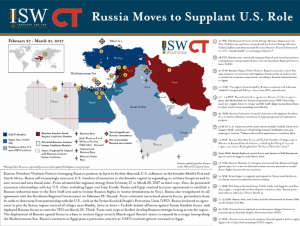
Russian President Vladimir Putin is leveraging Russia’s position in Syria to further diminish U.S. influence in the broader Middle East and North Africa. Russia will increasingly constrain U.S. freedom of maneuver in the broader region by expanding its military footprint and its anti-access and area denial zone. Putin advanced his regional strategy from February 27 to March 20, 2017 in three ways. First, he promoted economic relationships with key U.S. allies, including Egypt and Iraqi Kurds. Russia and Egypt reached tentative agreements to establish a Russian industrial zone in the Suez Gulf area and to resume Russian flights to tourist destinations in Sinai. Russia also renegotiated its oil agreement with the Kurdistan Regional Government on February 28. Second, Putin cultivated ties to local security forces, particularly those he seeks to draw away from partnership with the U.S., such as the Syrian Kurdish People’s Protection Units (YPG). Russia brokered an agreement to give the Syrian regime control of villages near Manbij, Syria to deter a Turkish-backed offensive against Syrian Kurdish forces, and deployed Russian forces to train the YPG on March 20. Third, Putin took steps to further develop Russian strategic basing across the region. The deployment of Russian special forces to a base in western Egypt in early March signals Russia’s intent to expand its strategic basing along the Mediterranean Sea. Russia’s overtures to Egypt pose a particular concern as NATO conducts greater outreach to Egypt.

The Institute for the Study of War (ISW) produced this map with the Critical Threats Project (CTP). The graphic is part of an intensive multi-month exercise to frame, design, and evaluate potential courses of action that the United States could pursue to destroy the Islamic State in Iraq and al Sham (ISIS) and al Qaeda in Syria. The ISW-CTP team recently released “America’s Way Ahead in Syria,” which details the flaws in the current U.S. approach in Iraq and Syria and proposes the first phase of a strategic reset in the Middle East.

Posted by Institute for the Study of War

Η διαχείριση των προσφύγων και μεταναστών αποτελεί δημόσιο αγαθό και όχι θέμα εκβιασμού!!!

0

του Δημήτρη Τσαϊλά, Υπολοιάρχου ΠΝ ε.α.

Αν και είναι δύσκολο να επιτευχθεί, μια συνολική κοινή ευρωπαϊκή προσέγγιση στην κρίση των προσφύγων αυτή φαίνεται απαραίτητη, ιδιαίτερα τώρα που η Τουρκία εκβιάζει με τη μη τήρηση της συμφωνίας. Ο έλεγχος των συνόρων, η ασφάλεια και η εναρμονισμένη διαχείριση των προσφύγων είναι προφανή δημόσια αγαθά τόσο για την Ελλάδα ως πύλη εισόδου παράνομων μεταναστών όσο και για την περιοχή της ΕΕ. Είναι εντελώς απίθανο οι εθνικοί παράγοντες να ενεργούν ανεξάρτητα και να προσφέρουν αυτά τα δημόσια αγαθά αποτελεσματικά. Οι διαφορές μεταξύ των ευρωπαϊκών χωρών όσον αφορά τις πολιτικές τους για την υποδοχή και ένταξη των προσφύγων το αποδεικνύει αυτό περίτρανα.

Σε μια κοινή ευρωπαϊκή προσέγγιση, οι χώρες της ΕΕ αποφάσισαν τουλάχιστον στα χαρτιά, να μοιραστούν τα βάρη του μεταναστευτικού προβλήματος. Αυτός είναι προφανώς ένας πολύ δύσκολος στόχος και δεν πρόκειται να τον επιτύχουμε στο σύνολό του στην παρούσα φάση της ευρωπαϊκής μας ολοκλήρωσης. Ωστόσο, παραλείποντας την παραδοχή της στήριξης αυτών των δημοσίων αγαθών, θα αποδυναμωθεί η κοινωνική συνοχή και η γενική πολιτική συναίνεση πίσω από το ευρωπαϊκό εγχείρημα. Αυτό είναι και ο κύριος λόγος που πρέπει να επιδιωχθούν περαιτέρω προσπάθειες για να μοιραστεί το βάρος των εισροών των προσφύγων μεταξύ των χωρών της ΕΕ.
Οι βασικές προϋποθέσεις πρέπει να είναι:
• Η επαρκής συναίνεση για την αναθεώρηση του κανονισμού του Δουβλίνου,
• Η συναίνεση σχετικά με τη μετεγκατάσταση των προσφύγων σε όλη την ΕΕ,
• Η επαρκής οικονομική υποστήριξη στις χώρες πρώτης εισόδου, για την ενίσχυση τόσο των πολιτικών υποδοχής όσο και την ένταξή τους.
Η διασφάλιση της μακροπρόθεσμης χρηματοδότησης είναι ζωτικής σημασίας ιδιαίτερα για τις χώρες που αντιμετωπίζουν οικονομικά προβλήματα, όπως είναι η Ελλάδα. Με βάση το παράδειγμα του Ευρωπαϊκού Κοινωνικού Ταμείου, ένα Ευρωπαϊκό Ταμείο Ένταξης θα μπορούσε να δημιουργηθεί με επαρκή κεφάλαια για την προώθηση της πλήρους ενσωμάτωσης των ατόμων και των οικογενειών που γίνονται δεκτοί ως πρόσφυγες από τα κράτη μέλη της ΕΕ. Επίσης οι πολιτικές ένταξης θα πρέπει να λαμβάνουν υπόψη τα χαρακτηριστικά των προσφύγων όσον αφορά τις δεξιότητες, την εκπαίδευση και τα γενικότερα πολιτιστικά χαρακτηριστικά, γιατί αυτοί οι παράγοντες επηρεάζουν επίσης το κόστος των πολιτικών ένταξης. Τέλος, δεν υπάρχει αμφιβολία ότι οι δυσκολίες στην αντιμετώπιση της κρίσης των προσφύγων έχουν να κάνουν περισσότερο με την πολιτική και ιδεολογική αντίσταση παρά με τους πόρους. Υπάρχει ήδη μια δημόσια αντίσταση στη μετανάστευση, εντός και εκτός της ΕΕ, και λιγότερη προθυμία να αποδεχθούμε περαιτέρω ροές των μεταναστών, οι οποίοι έχουν διαφορετικά πολιτισμικά χαρακτηριστικά από τους ντόπιους πολίτες. Αυτό ασκεί πίεση στις κυβερνήσεις, ιδίως σε χώρες όπου υπάρχει ήδη πολύ μικρή αποδοχή της μετανάστευσης. Υπάρχει μάλλον περιορισμένο περιθώριο ελιγμών στον τομέα αυτό. Αντί να προσπαθούν να μεταφέρουν τους πρόσφυγες σε αυτές τις χώρες, είναι μάλλον πιο ρεαλιστικό να ζητηθεί αποζημίωση από τις χώρες που δεν θέλουν πρόσφυγες.