Αρχική Blog Σελίδα 2949

Δύο χρόνια από τη φρίκη

4

Του Θανάση Χειμωνά Τετάρτη 28 Ιουνίου 2017 Σχόλιο στο liberal.gr

Το καλοκαίρι με ΣΥΡΙΖΑ είναι εποχή επετείων. Του πρώτου Παραιτηθείτε για το οποίο έγραψα πριν λίγες μέρες, του περήφανου δημοψηφίσματος στις 5 Ιούλη (sic), του τρίτου μνημονίου που ψηφίστηκε στη ζούλα παραμονές δεκαπενταύγουστου… Εχθές λοιπόν είχαμε ξανά γενέθλια: Συμπληρώσαμε δυο χρόνια από την προκήρυξη του περήφανου δημοψηφίσματος για το οποίο μόλις μίλησα.

Ωσάν εψές θυμάμαι εκείνο το βράδυ… Τα έπινα με φιλική παρέα σε ένα μπαρ στο Κουκάκι όταν ξαφνικά άρχισαν να μου έρχονται ειδοποιήσεις στο κινητό. Άνοιξα το Facebook να δω τι συμβαίνει και διαπίστωσα πως διάφοροι περίεργοι με τάγκαραν για να τους πω την άποψή μου για το δημοψήφισμα.

«Το ποιο;» αναρωτήθηκα.

Λίγη ώρα αργότερα επέστρεφα σπίτι. Ήταν δύο και τα ξημερώματα αλλά εκατοντάδες συμπατριώτες μας συνωστίζονταν μπροστά στα ΑΤΜ για να σηκώσουν όσα χρήματα μπορούσαν. Μια εικόνα καταστροφής, πρωτόγνωρη για τους τυχερούς σαν και μένα που ανήκουν στη γενιά της Μεταπολίτευσης και δώθε.

Το τι ακολούθησε το γνωρίζουμε όλοι. Οι τράπεζες έκλεισαν. Η χώρα κόπηκε στα δύο, λουσμένη από μια αδιανόητη ρητορική μίσους της, αλήστου μνήμης, «αντιμνημονιακής» πλευράς. Το μόνο θετικό στοιχείο αυτής της ιστορίας υπήρξαν οι μεγαλειώδεις συγκεντρώσεις των Μένουμε Ευρώπη που όμως δεν άρκεσαν για να αποφευχθεί το σαρωτικό 61% του «Όχι». Ένα «Όχι» που ωστόσο μετατράπηκε σε «Μάλιστα αφέντη» με συνοπτικές διαδικασίες.

Η πιο έντονη ανάμνηση πάντως ήταν εκείνο το φριχτό συναίσθημα του τρόμου. Η χώρα –έστω και για ελάχιστες μέρες- να βαδίζει ολοταχώς προς την ολοκληρωτική καταστροφή της με την πλειοψηφία του λαού της να πανηγυρίζει ξέφρενα. Παράνοια.

Δύο χρόνια συμπληρώθηκαν εχθές λοιπόν. Σε οποιαδήποτε χώρα του κόσμου ο πρωθυπουργός-εμπνευστής αυτού του τερατουργήματος, ο άνθρωπος που υποσχέθηκε άσπρο και πραγματοποίησε κατάμαυρο, που πυροδότησε έναν άτυπο εμφύλιο και που αγνόησε επιδεικτικά τη λαϊκή ετυμηγορία, την οποία ο ίδιος απαίτησε, θα βρισκόταν στην καλύτερη σπίτι του στη χειρότερη (;) φυλακή. Στην Ελλαδάρα του 2017 όμως ο Αλέξης Τσίπρας όχι μόνο εξακολουθεί να είναι πρωθυπουργός αλλά έχει και φανατικούς υποστηρικτές. Και έτσι θα πάμε μέχρι το επόμενο δημοψήφισμα. Μέχρι την επόμενη καταστροφή.

liberal.gr

Η αναβίωση του γαλλογερμανικού άξονα

0
NOAH BARKIN / REUTERS

Τον περασμένο Ιανουάριο, όταν οι πιθανότητες να κερδίσει τις γαλλικές προεδρικές εκλογές θεωρούνταν μικρές, ο Εμανουέλ Μακρόν πήγε στο Βερολίνο και εξέφρασε τις απόψεις του για όσα πρέπει να κάνει η Ευρώπη ώστε να ανανεωθεί. «Οπως είχε πει ο Ζακ Ντελόρ, για την Eυρώπη χρειαζόμαστε ένα όραμα και ένα κατσαβίδι», δήλωσε ο Εμανουέλ Mακρόν σε ομιλία του στο Humboldt University, κάνοντας αναφορά στον πρώην πρόεδρο της Ευρωπαϊκής Επιτροπής. «Δυστυχώς, στην παρούσα φάση, έχουμε πολλά κατσαβίδια αλλά ακόμη δεν διαθέτουμε όραμα».

Τώρα, περίπου δύο μήνες μετά τη νίκη του στις προεδρικές εκλογές της Γαλλίας, ο κ. Μακρόν συμπληρώνει το κενό χαράσσοντας ένα μονοπάτι για την Ευρώπη και φέρνοντας κυρίως κοντά του τη Γερμανία. Αυτό είναι το βασικό συμπέρασμα που προκύπτει από τη συνάντηση των ηγετών της Ε.Ε την περασμένη εβδομάδα, στη διάρκεια της οποίας ο κ. Μακρόν και η Γερμανίδα καγκελάριος Αγκελα Μέρκελ στάθηκαν ο ένας δίπλα στον άλλον και έστειλαν ένα μήνυμα απόλυτης ενότητας στο πλαίσιο της συνέντευξης Τύπου. Υστερα από μία δεκαετία συζητήσεων και διαρκών αναβολών, ίσως είναι νωρίς να θεωρήσουμε ότι ο γαλλογερμανικός άξονας αναβιώνει και λειτουργεί και πάλι πλήρως.

Ο κ. Μακρόν έρχεται και πάλι αντιμέτωπος με νέα πρόκληση που αφορά το σχέδιό του για την αναμόρφωση της οικονομίας της Γαλλίας. Μόνο όταν επιτύχει, θα θέσει τέλος στην από κοινού δυσπιστία που είχε καλλιεργηθεί ανάμεσα στο Παρίσι και στο Βερολίνο και η οποία εμπόδισε τα προηγούμενα έτη τη συνεργασία μεταξύ των δύο χωρών. Από την πλευρά της, η κ. Μέρκελ θα πρέπει να κερδίσει για τέταρτη φορά τις εκλογές τον Σεπτέμβριο. Εάν δεν τα καταφέρει, ίσως να δυσκολευτεί να πείσει τους Συντηρητικούς συμμάχους της να συνεργαστούν με τον κεντρώο κ. Μακρόν. Ωστόσο, τις τελευταίες εβδομάδες, με αποκορύφωμα την από κοινού συνάντησή τους στις Βρυξέλλες την Παρασκευή, διαγράφονται δύο από τα βασικά ερωτήματα τα οποία παρουσιάστηκαν έπειτα από τη νίκη του κ. Μακρόν τον προηγούμενο μήνα: εάν δηλαδή θα κατορθώσει να διατηρήσει τη δυναμική που τον οδήγησε στο Ελιζέ και, επίσης, εάν η κ. Μέρκελ θα είναι προετοιμασμένη να «αγκαλιάσει» τις ιδέες του όσον φορά την Ευρώπη. Καθώς η Ευρώπη την προηγούμενη δεκαετία αντιμετώπιζε τη μια κρίση μετά την άλλη, η Μέρκελ προχωρούσε περισσότερο σε σταδιακές ρυθμίσεις που αφορούν τις ευρωπαϊκές δομές, σφίγγοντας τις βίδες με το κατσαβίδι παρά σχεδιάζοντας νέα εμπνευσμένα οράματα. Τώρα που η Ευρώπη έχει ξεπεράσει την περίοδο της έντονης κρίσης, ο 39χρονος κ. Μακρόν, ύστερα από την ισχυρή παρουσία του κόμματός του στις βουλευτικές εκλογές, είναι έτοιμος να πάρει την κατάσταση στα χέρια του.

Στις Βρυξέλλες, ο ίδιος ξεκαθάρισε ότι δεν θα διστάσει να έρθει αντιμέτωπος με την Πολωνία και την Ουγγαρία σε περίπτωση που οι δεξιές κυβερνήσεις των δύο χωρών δεν σεβαστούν τις ευρωπαϊκές δημοκρατικές αξίες. Υποσχέθηκε επίσης να απαντήσει με τον ίδιο τρόπο εάν χώρες όπως η Κίνα και οι ΗΠΑ δεν σεβαστούν το δίκαιο εμπόριο. Επίσης, πίεσε τους ομολόγους του να υιοθετήσουν μια πιο φιλόδοξη προσέγγιση σχετικά με τη συνεργασία των χωρών της Ε.Ε. στον τομέα της άμυνας.

Σε όλα αυτά τα θέματα, η προσέγγιση της κ. Μέρκελ στο παρελθόν ήταν πολύ πιο συντηρητική, ωστόσο στις Βρυξέλλες ήταν εμφανής η πλήρης στήριξη που παρείχε στον Εμανουέλ Μακρόν.

“Καθημερινή”

Economics in Transition

0
16 

Andrew Lo, Adaptive Markets: Financial Evolution at the Speed of Thought, Princeton University Press
Richard Bookstaber, The End of Theory: Financial Crises, the Failure of Economics, and the Sweep of Human Interaction, Princeton University Press
Roderick Floud, Santhi Hejeebu, and David Mitch, eds., Humanism Challenges Materialism in Economics and Economic History, University of Chicago Press

MANCHESTER – There seems to be no end to the tide of books criticizing economics, and – as I am an economist – it must make me something of a masochist that I keep reading them. The exercise is all the more wearisome as the criticisms are both repetitive and increasingly misdirected.

The Year Ahead 2017 Cover Image

Not that everything about the state of economics is fine; far from it. But only if today’s critics of economics pay more attention to what economists are actually doing will they be able to make a meaningful contribution to assessing the state of the discipline.

A Royal Doubt

Ten years on from the financial crisis of 2007-2008, two of the most recent books criticizing economics and economists start with the question posed by Queen Elizabeth II on a 2008 visit to the London School of Economics: “Why did nobody see it coming?” (Indeed, almost all the recent examples of this literary genre start the same way.) The essays edited by Roderick Floud et al, Humanism Challenges Materialism, and Richard Bookstaber’s The End of Theory use Queen Elizabeth’s royal puzzlement to insinuate that the entire subject of economics is fundamentally flawed: “If economists couldn’t predict the biggest financial crisis in decades, what are they good for?”

It’s a fair question, if posed as a challenge to the small minority of economists who try to forecast macroeconomic outcomes (like growth and inflation) and financial markets. Even so, a decade after the crisis, it might cross a critic’s mind to wonder if anything has changed.

It has. Adaptive Markets, by MIT’s Andrew Lo, gives a superb and fascinating account of thinking on the frontier of economics about financial markets; what’s more, Lo demonstrates exactly the kind of approach rooted in biology and psychology that Richard Bookstaber, who manages risk for the University of California’s $100 billion portfolio, advocates in the final part of The End of Theory, and exactly the kind of humanism and clarity celebrated in Humanism Challenges Materialism, a set of essays about the renowned economic historian Deirdre McCloskey.

Lo (a classmate of mine in graduate school) is a particularly gifted economist, but many others are doing work far removed from the version of the subject – prevalent in the 1980s – so often attacked by critics. Yes, economics needs to change, but it is changing – and has been since some time before the financial crisis.

To be fair, the introduction to Humanism Challenges Materialism acknowledges this: “Economics has taken on a much more behavioral turn,” the editors point out, and “something deeper is stirring.” The essays offer a range of perspectives on the work of McCloskey, long a dissident in economics for her insistence on the importance of values and norms in economic development, and on the role of rhetoric in economics itself.

Humanism Challenges Materialism in Economics and Economic HistoryMcCloskey mocks what she calls “Max U” economics, which reduces individual humans to nothing more than maximizers of utility or profit – and cloaks the aridness of this approach in mathematics and spurious tests of statistical significance. At the same time, as the essay by her former pupil Steven Landsburg points out, McCloskey is a rigorous Chicago-trained economist whose laser-like logic can cut through woolly reasoning just as easily when it is expressed in stylish prose.

In their sympathetic chapter, Peter Boettke and Virgil Henry Storr claim McCloskey as an Austrian School economist because of her appreciation for markets as social institutions, embodying human interactions, rather than as abstract mechanisms fully knowable from algebraic models. Their point – that many economists ignore the fact that markets are a social phenomenon – is reasonable, though it seems worth pointing out that many economists who are not so blind do not label themselves as “Austrians.” Spend any time doing anti-trust work, for example, or working on design mechanisms for something like a spectrum auction, and you cannot fail to appreciate the human and social dimensions of markets.

Less appreciatively, Stephen Engelmann argues in his essay that, despite her (correct) awareness of the way economics uses rhetoric to disguise the importance of ethics and culture, McCloskey is as much a “neoliberal” as any Chicago fundamentalist. Indeed, Engelmann defines as neoliberal anyone who insists on economics or any social science as a practical rather than a theoretical (and hence ideological) discipline.

This of course makes all economists, from Paul Krugman to Eugene Fama, neoliberals, so it is hardly surprising that economists have no patience for the discourse of neoliberalism. Rather like Freudians who interpret any resistance to their perspective as a Freudian reaction in itself, political theorists like Engelmann see any resistance to their analytical framework as a manifestation of neoliberalism.

Within economics, interest in history and the role of culture and institutions has been growing for the past 20 or 30 years. It is now positively fashionable terrain. After years of being regarded as a maverick, McCloskey’s standing is high, and her monumental The Bourgeois Era trilogy is generally acclaimed. Yes, many economists still think of institutions too abstractly – as a black box rather than a social reality – and economic history certainly must be restored to undergraduate and graduate curricula. But there has been a huge shift away from the reductionism of an older generation.

History Ignored

It is a shift to which Bookstaber has paid little attention. His critique is partly valid, at least as applied to macroeconomics and finance. Macroeconomic models in wide use before the 2008 crisis excluded financial institutions and relied on the fiction of “representative agents.” This is changing all too slowly. The field is full of normative terminology, about “optimal” outcomes, for instance, without ever analyzing the implied value judgments. Mainstream macroeconomists are unwilling to admit there is little hard science in what they do – a stance that, in the name of promoting economics in public opinion, has undermined the profession’s credibility.

Bookstaber is also right to point out that much macroeconomic modeling ignores the fact that economic time series are non-ergodic (a technical way of saying that their characteristic behavior can be completely different in different contexts or periods). History matters. While economists are well aware of this in theory (the possibility of structural change in the economy is usually labeled the “Lucas Critique”), the dirty realism of forecasting means that it is largely ignored in practice (although practice in this regard is improving).

The End of Theory: Financial Crises, the Failure of Economics, and the Sweep of Human InteractionBut The End of Theory goes on to charge that economics has ignored behavioral psychology. In fact, behavioral economics is one of the most popular areas of the discipline now, among academics and students alike. Bookstaber also asserts that economists ignore the reality of complexity theory, network theory, and agent-based modeling. While these latter areas are not mainstream, not least because most established researchers have never learned the research techniques needed to apply these conceptual frameworks, they, too, are increasingly popular among younger academics.

Bookstaber himself is a practitioner of agent-based modeling as applied to financial markets, and his description of this approach in the latter part of his book is its most interesting section. Agent-based modeling involves computer simulations of economies made up of many individual “agents” behaving according to different specified rules or “heuristics.” The model is given a set of starting values, and in each time period the many individual agents react to their new environment.

Thus, this approach places history and social influence at the core of its analysis. Such models do not produce forecasts of the kind central banks or investors use, but they do allow for realistic stories. In agent-based models, in contrast to the traditional kind, financial crises can happen.

The Mind of the Market

Andrew Lo’s Adaptive Markets is a masterly synthesis of the traditional, rationality-based approach and new approaches based on psychology and neuroscience, evolutionary theory, and techniques such as computer simulations and artificial intelligence.

One of the most effective points made by advocates of Fama’s now-notorious Efficient Markets Hypothesis is that it is in fact difficult to beat the market; profit-making opportunities are swiftly arbitraged away. And, indeed, Lo argues that when financial markets are stable enough for long enough, the rationality-based model is appropriate. But the moment there is any instability, human fear, greed, culture, behavioral norms, storytelling, and imagination kick in. The environment determines the way market participants behave.

As the title hints, Adaptive Markets sets economic behavior firmly in the context of the human sciences. Lo insists that economic theory must be consistent with evolutionary biology and neuroscience.

Lo agrees with many critics of economics that the discipline became trapped by physics envy in the second half of the twentieth century. Economists such as Herbert Simon, who suggested that humans “satisfice,” or follow rules of thumb which normally work out fine (what would now be termed heuristics), lost out to Paul Samuelson, whose clean, abstract, elegant mathematics shaped the mainstream of economics for a couple of generations.

Perhaps future critics will single out “biology envy” as a trap, as well. In fact, what Lo advocates is a back-to-the-future turn. He points out that there has been great mutual influence between economists (Malthus, Marx, Veblen) and biologists (Darwin, Fisher, Haldane) in the past.

The test of the adaptive markets approach, though, must be how it helps to predict, avert, or respond to financial crises. McCloskey would surely approve of Lo’s answer: the approach helps tell different stories. And the stories themselves will help shape behavior.

Financial markets need to be viewed – by investors and regulators alike – as an ecosystem. The lesson from biology is that systems require feedback loops in order to regulate themselves. Some researchers have lighted on economic examples: countercyclical fiscal policy is one; the new “macroprudential” tools, such as capital requirements that vary over the course of the business cycle, is another. Lo urges regulators to think of these feedback loops – literally – systematically, and proposes using network theory to map the whole of the financial regulatory system. Not surprisingly, the outcome of this exercise for the United States is not reassuring.

Lo has been advocating an evolutionary approach since 1986; in the book, he recalls a mid-1980s workshop at which he was savaged by fellow economists wedded to efficient market theory. Other evolutionary economists – as well as other mavericks who are now gaining a more respectful hearing – have also spent a long time in virtual exile within the profession. Yet their approach, along with other new tools and cross-disciplinary insights, is becoming increasingly widespread.

Redefining Mainstream Economics

Behavioral psychology, complexity theory, agent-based modeling and the like, along with historical narratives, an emphasis on institutions, methods such as randomized control trials and now big data and AI, are by no means a coherent new mainstream. It takes time to change curricula, and institutional inertia makes new approaches too risky and difficult for young economists seeking academic jobs and promotions.

Practicing economists outside universities do not keep up with the research frontier – although even here, useful tools such as behavioral economics, complexity theory, market design, and network theory are making significant inroads. Still, the economics taught in university departments, practiced in financial firms, and applied by policymakers remains heavily reliant on old-fashioned reductionist rational-choice models.

One might wish for faster change, for colleagues to turn away from their statistical packages and read more economic history, and for policymakers to appreciate that they are acting within a time warp. But the long era of hegemony for mainstream neoclassical economics is over. McCloskey’s emphasis on ideas and values, as explored in Humanism Challenges Materialism, and the agent-based modeling advocated in Bookstaber’s The End of Theory, are attracting growing interest in economics, along with a range of other approaches and techniques.

Lo’s Adaptive Markets moreover, is a splendid example of the types of insights this healthy intellectual ferment can produce. Perhaps it will all be distilled into a new mainstream. In the meantime, critics of economics should drop their fixation with the past and maybe even cautiously welcome the uncertainty of the discipline’s future.

Diane Coyle is Professor of Economics at the University of Manchester and co-director of Policy@Manchester.

Lies That Capitalists Tell Us

0

Photo by Anders Sandberg | CC BY 2.0

While idiotic supporters of our two-party system wring their hands over the sensationalist nonsense reported by the mainstream media, we thought it might be worth touching on the most dangerous lie of all-time: capitalism. It’s an all-encompassing delusion, including: the myth of continual technological progress, the mendacious assumptions of endless economic growth, the lie that constant bombardments of media and consumer goods make us happy,  and the omissions of our involvement in the exploitation of the planet and the resources of distant, poorer nations, among other things.

We’ve taken the time to hash out some of the most pernicious mendacities we’ve come across in our (relatively) young lives, in the workplace, in our private lives, and in the media. ***

Please share these counter-arguments far and wide, in order to educate your fellow citizens, and, if necessary, to provide the intellectual beat-downs needed when arguing with pro-capitalists. So without further ado, here is our list of the most devious “Lies that Capitalists Tell Us”:

1) Wealth will “trickle down”

It’s hard to believe an economic policy that conjures images of urination could be wrong, but the idea is as bankrupt as the lower classes who have been subjected to the trickling. Less than ten people now have the financial wealth equivalent to half the planet, and the trickling seems a lot more like a mad cash-grab by the (morally bankrupt) elites. Rather than trickle down, the 1% and their lackeys have hoovered up the majority of new wealth created since the 2008 crash. After 40 years of stagnant wages in the US the people feel more shit on than trickled upon.

It’s not a mistake that the elite reap most of the profits: the capitalist system is designed this way, it always has been, and will be, until we the people find the courage to tear it down and replace it with something better.

2) I took all the risks

It can be argued the average employee takes far more risks in any job than the average person who starts a business with employees. The reason being is that the person starting a business usually has far more wealth, where most Americans can’t afford a 500 dollar emergency. Meaning if they lose a job or go without work for any stretch it means some tough decisions have to be made. A person with even a failing business cannot be fired, but the employee can be fired for almost any reason imaginable, they are operating without a net at all times.

The capitalist uses all sorts of public infrastructure to get his/her company off the ground. From everything to the roads to get you to your job, colleges, public utilities, tax breaks, electricity, etc. Even the internet itself was created from public research. Yet still, elite business owners still have the audacity, and are so full of hubris, that they believe in the hyper-individualist, macho, rugged-cowboy/pioneer façade they affect.

3) I could pay you more if there were less government regulations

Many capitalists argue that layers of government bureaucracy prevent them from paying their employees a fairer, living wage. This is a huge whopper, as our regulations (like no child labor, a minimum wage, disability and worker’s compensation, basic environmental impact studies, etc) actually provide safety against the worst type of exploitation of workers and destruction of the land by corporations. Without these minimum regulations, an age of even more outright neo-feudalism would occur, where employees could be layed-off and rehired ad-infinitum, based on downward market wage forces, at the wishes of ever-more capricious owners, management, and CEOs.

4) If you work hard, one day you can be rich like us (We live in a meritocracy)

America is not a meritocracy, and no one should think it is. There exists no tie to the intelligence of work done or the amount of it that guarantees success. Rather to be rich depends more on either being born into it, or being exceptionally good at exploiting others so one may take the bulk of the proceeds for themselves. This is the magic formula for wealth in this ever so “exceptional” land – exploit, exploit, exploit.

Inheritance & exploitation is how the rich get rich. To understand the exploitation aspect takes some understanding of how the rich function. Next to none of the super rich become that way solely by meritocracy. Their income is created through complex webs of utilizing leverage usually to extract some form of passive income. They are the rentier class or con artists, or both.

You only have to look at what the rich are dabbling in. Like Robert Mercer for instance, who made his money via “a hedge fund that makes its money by using algorithms to model and trade on the financial markets.” . Skimming money off corrupt financial markets hardly seems like a worthwhile activity that contributes anything to humanity, it’s a hustle.

Or take Bill Gates, who did some programming for a few years, poorly, and became rich by landing a series of deals with IBM initially, and then by passively making money off the share values of Microsoft. The late Steve Jobs may have been one of the more hands-on billionaires, but even he required thousands of enslaved asian hands to extract the kind profits Apple was able to make.

Casino magnate Sheldon Adelson almost certainly has organized crime links, as if owning a casino wasn’t enough of a con to begin with.

Rich DeVos became a billionaire by running a pyramid scheme most are familiar with called Amway.

The Walton family, owners of Wal-Mart, pays a median wage of 10 bucks an hour (far below a living wage), they strong arm vendors, and also rely on products made with working conditions that resemble old world slavery, while having more wealth than the bottom 40% of Americans.

There’s just no way to make that kind of money without having a major market advantage and then profiteering off it. Lie, cajole, coerce, manipulate, bribe, rig, and hustle. These are the tools of the rich.

No one is worth this kind of money and everyone needs each other’s help to function, but in the minds of the rich they consider themselves the primary cogs in the machine worthy of their money for doing not much else than holding leverage over others and exploiting it.

5) This is as good as it gets (there is no alternative, TINA)

Through a process of gaslighting and double bind coercion the choices we are fed are propagandized via controlled media outlets owned and operated by elites. We are told our choices must be between the democrats or republicans, attacking the Middle East or face constant terrorism, unfettered capitalism or state run communism. We are given binary choices that lack all nuance, and nuance is the enemy of all those who seek to control and exploit. They feed us a tautology of simpleton narratives which unfortunately do exactly what they hoped, keep people dumb and biting on their red herrings.

Capitalists make it seems as if there is no alternative because they hoard all the money, have all the hired guns, and pay off teams of servile lawyers, judges, and lobbyists to write and enforce their anti-life laws. Capitalists demand “law and order” whenever their servant classes get too restless. In general, the most hardened, dogmatic capitalists exhibit bewilderment and/or disgust at genuine human emotions like joy, creativity, spontaneity, and love. Many capitalists have an unconscious death wish, and want to drag the rest of us and the mother Earth down with them.

Capitalists have stolen all the farmlands, hold all the patents to technology, and don’t pay enough to mass amounts of citizens to get out of the rat race and get back to the land, to live off of. The screws are turned a little tighter every year. If we are not done in by massive natural disasters or an economic collapse, expect a revolution to occur, hopefully a non-violent one.

6) We give back to the community

Corporations set out to create non-profits as a public relations move. They cause the problems and then put small band-aids on the gaping wounds they have directly contributed to and use the charity as a source of plausible deniability to obscure the fact that they are exactly what we think they are: greedy.

Handing out bread-crumbs after you’ve despoiled, desecrated, and bulldozed millions of hectares of valuable habitat is not fooling anyone. The elite one-percenters are the enemies of humankind and the biosphere itself.

7) The system (and economic theory) is rational and takes into account social and environmental costs

People tend to think someone somewhere is regulating things to keep us safe. They look around and see sophisticated technology, gleaming towers in the sky, and what they believe to be is a complex intelligent world. But in truth no one is running the show. The world functions as a mad cash grab driven by neo-liberal ideology. Our leaders are driven by power, fame, and money, and exhibit strong psychopathic, sociopathic, and narcissistic traits.

The problems of modern industrial capitalism and its impact on the world is clear – our exploitation of the resources, people, and other species are a direct result of our consumer based infinite growth model. Just a few of the problems we face are species extinction, climate change, ocean acidification, and a toxic carcinogen filled trash dump of a planet that reached population overshoot decades ago.

If the system was rational, we would begin planning to lower birth rates to decrease the world’s population, and voluntarily provide education, decent, dignified jobs, as well as birth control and contraception to women worldwide.

We live by money values, and think in money terminology. When we discuss healthcare the topic arises about how to pay for it before nearly anything else. The priority isn’t on saving lives but how to pay for things. Yes, how will we pay for healthcare when banks can create money on a computer through the magic of fractional reserve banking, which they often use to bail out their crony friends. The money isn’t real but the implications of restricting it from the populace are. Money is created out of thin air by the magic of the Federal Reserve, yet we have all heard our bosses, and the pricks in Washington complaining that “we don’t have enough money for that” when it comes to healthcare, improving schools, and humanitarian relief for the poorest parts of the world.

Again, if the system was rational, world poverty would be solved within a few short years. Money destined for weapons and “defense” could be used domestically as well as abroad to Africa, South Asia, and Latin America, and there is more than enough money (75 trillion is the annual world GDP, approximately 15 trillion in the US alone) to pay for a good home, clothing, and food for every family worldwide, with an all-renewable powered energy grid.

8) The future will be better

When Trump’s slogan make America great again was on the lips of every alt-right fascist, most of us stopped to ask, when was it great? The truth is that politicians have been promising something better since the inception of this country and better has never arrived.

There is always another expensive war to fight and another financial meltdown occurring on average every eight years. Wait, you might say, what about those sweet post-WWII growth years brought about by the New Deal? The sad truth is those years were only materially beneficial to white, middle-class men, who were highly sexist, racist, and complicit in incubating today’s consumer-driven Empty Society.

The post-WWII era was an aberration in our history and the result of having more jobs available than people, but as the country rapidly exploited its natural resources and reached the limits of linear growth while the population exploded the leverage that allowed people to have higher wages receded. Even though efficiency increased enormously, the people lost leverage to demand higher wages.

Without leverage held by the people capitalism will return to its status quo goal – exploit, and that’s just what it did. In the US, corporations grew richer and the people grew poorer starting from the mid 1970s to the present.

9) It’s Just Business

Employees devote years of their lives to companies and when they are let go they are told it’s nothing personal, it’s just business. This is how all bad news is delivered even when personal, it’s says we are cold-hearted organizations that adhere to a bottom line first and human needs second. So know when they say “it’s just business” what they are saying is understand we are sharks, and acting like a shark is just what we do.

This is also the logic behind defending war crimes and similar atrocities. Nations like the US claim they have a “responsibility to protect” civilians from terrorists. Then, when American bombs kill civilians (or their proxies use US-made weapons), they are referred to as “collateral damage”.

10) Financial markets & debt are necessary

The health of the entire economy is too often gauged by the stock markets. But the reality about financial markets is they are extraneous gambling machines designed to place downward pressure on companies to post good numbers to elevate share prices. These financial markets funnel capital to a smaller and smaller number of multinational corporations every year, and perpetuate non-linear economic growth (and therefore more pollutants, CO2, pesticides, strip mining, razing of forests) that is killing the planet.

Debt is the most fundamental lie in our economy. Money is only supposed to be a tool to move goods efficiently around a market, but for money itself to be a wealth engine is a Ponzi scheme. And we all know how that ends.

*** For a wider taste of our oeuvre, visit Reason Bowl Radio to watch Jason expose the Trump administration for the sorry sacks of shit that they are and discuss current events, as well as Jason and Bill’s commentary and ramblings about topics such as psychedelics, the nature of consciousness, and reflections on how to effect social change.

Lies That Capitalists Tell Us

The Munich agreement of 1938 (unfair to the Czechs and dishonorable for the UK), East Timor and Cyprus

0
P/J 9

By George K. Papadopoulos

It is indeed a considerable shame that prime movers on the international scene dealing with the Cyprus problem, who should know better, totally ignore the lessons of Munich and East Timor.

Winston Churchill called World War II “the unnecessary war”, and he insisted that the sell-out of Czechoslovakia by France and Great Britain in Munich as one such moment, even late, where war could have been stopped in its tracks.

Briefly stated, what happened in Munich in September 1938 was the betrayal by the Western democracies, and formal allies of the Czechoslovak Republic, of this very alliance, by bowing to Hitler’s ultimatum that the Czech territory inhabited by Sudeten Germans in the North-west part of Czechoslovakia be ceded to Nazi Germany, within a month’s time. What was then mislabeled by British PM Neville Chamberlain as “peace with honor” and “peace in our time”, was to last less than six months, as in that time Hitler moved to occupy all of remaining Czechoslovakia, in order to “protect” her.

In the preceding years the leader of the Sudeten Germans Konrad Henlein, was in very close contact with the Nazi leadership in Berlin, and under orders never to appear satisfied with any concessions the Czechoslovak Government would offer to the German minority. Rather he was to think of new demands, all the time! Self-determination for the Sudeten Germans had been one of the Nazi demands, which several in the western democracies looked kindly upon!

The end of the war found the Sudeten Germans extremely disliked, to say the least, by the citizens of Czechoslovakia, so much so that it was decided at the Postdam Conference (1945) that over 3 million Sudeten Germans were to be expelled to Germany and the territory ceded to Germany during the Munich agreement would revert back to Czechoslovakia. Several edicts issued by Czechoslovak President Benes sped up the process.

The descendants of the expelled Sudeten Germans have time and again been pressing for a return to their ancestral lands, yet the previous CzechoslovakRepublic as well as the current Czech Republic has been adamant in her refusal. President Havel actually held up the revision of the Lisbon Treaty of the European Union to ensure that there were no provisions which under any pretext would allow a return of the descendants of the Sudeten Germans back into the lands of their ancestors.

When on successive official state visits to Czechoslovakia in September 1990, French President François Mitterand and British PM Margaret Thatcher expressed their regret at their countries push for the Munich agreement, which delivered Czechoslovakia to the Nazis, despite the defense treaties of these two western democracies with the Czechoslovak Republic (there was also a defense treaty of Czechoslovakia with the Soviet Union, but it was so phrased that help from that quarter would come only if France and the U.K. upheld their obligations first). Telford Taylor, late professor of law at Columbia University and Chief US prosecutor at the Nuremberg trials, in his book “Munich, the price for peace” is quite revealing of PM Chamberlain’s sorry and pitiful performance at the time, who called the UK-treaty-bound Czechoslovakia “a far away land about which we know nothing”! If one is to briefly dwell on the opinions offered within the British Cabinet of PM Chamberlain during those fateful days of September 1938, one is truly appalled by the snobbism towards every foreigner by the PM (Chamberlain called Hitler “the commonest little dog he had ever met”), and utmost contempt for decency and human values, shown by many cabinet members. Telford Taylor in his book on Munich, offers us numerous examples of this contemptuous regard for decency that prevailed in the British cabinet meetings. Lord Maugham, Lord President of the Council, supported the PM by claiming that no vital British interest was at state. The first of the only two voices in the cabinet against appeasement towards Hitler came form Duff Cooper, First Lord of the Admiralty, who claimed in response that “the main interest of this country has been to prevent any one power from obtaining undue predominance in Europe; but we were now faced with the most formidable power that had ever dominated Europe, and resistance to that power was quite obviously a British interest”. Subsequently, Thomas Inskip, Minister of Coordination of Defense, replied that the UK would not be fighting for Czeckoslovakia but to “check Herr Hitler”, the result being changes in Europe that “would be satisfactory to no one except Moscow and the Boslsheviks [note: how about the unfortunate Czechs?]”. Next, Lord Zetland (Secretary of State for India and Burma) pointed out that the lesson of self-determination in the Sudetenland would not be lost in India, but then concurred with Inskip that war would benefit “those who controlled the destinies of Russia”.

In agreement with the PM’s policy was Malcom McDonald (Colonial Secretary) who asked for “reasonable conditions”, while Samuel Hoare (Home Secretary) asked for a quid pro quo from Hitler! The most adamant opposition to the PM’s plans in the cabinet came from the Lord Privy Seal, Earl “Buck” De La War, who while not disclaiming a plebiscite for self-determination in general, declared that an immediate one in Sudetenland, that would obviously take place due to Nazi threats, as “unfair to the Czechs and dishonourable to ourselves”. He added the obvious, i.e. that a less than honourable peace soon would result in war; his statements would prove prophetic in less than a year’s time! Even more stunning were the attempts by Lord Halifax, Foreign Secretary, to amplify on what Lord Maugham had claimed, i.e. that no vital British interest was at stake: he claimed that an attack on Czechoslovakia was not the same thing as an attack on the Isle of Wright [note: one then wonders at the value of British signatures on defense and guarantee treaties]. Further, that war against Nazi Germany in defense of Czechoslovakia would be “defensive”, i.e. in order to prevent a greater war from breaking out, rejecting altogether the power of deterrence in order to defend treaties and thus the peace. The Foreign Minister also took care to warn the cabinet against appearing to have made up their mind, as the French PM and members of his cabinet were to arrive soon for consulations!! All in all, all sorts of pretexts were found to sell Czechoslovakia down the river; six months later, when Hitler moved to occupy all of Czechoslovakia the PM was to proclaim in the cabinet that the spirit of the Munich agreement had been violated by Germany; the attack on Poland, and World War II would come less than a year after the Munich agreement.

The relationship of the Turkish Cypriot (TC) leadership to Turkey from the 1950s onward, can hardly be regarded as any different from that of the leader of the Sudeten Deutsch, Konrad Henlein, to his Nazi bosses. Indeed the legendary TC leader Rauf Denktash who was actively involved in his community’s affairs from the 1950s until just a decade ago, stated bluntly as far back as 1957 “that even if no TC existed Turkey would have to invent them”, a statement that is quite revealing of the intentions of both himself and Turkey, and recently repeated by Turkish FM Davutoglu. One can easily get a sense of this mindset from the book of Martin Packard, a British Naval Officer who served on the field in Cyprus during 1964, as head of the tripartite patrols aimed at active re-engagement between Greek Cypriots (GCs) and TCs. Decades later, it was admitted by a former head of Turkey’s intelligence services, ret. General Sabri Yirmibesoglu, that in order to psyche up the TCs against the GCs “we even burnt down a mosque [in Cyprus]”. This action of course goes hand-in-glove with several acts of provocation by the Turkish state throughout the 20th century, such as the pogrom against the Greek Community of Istanbul in 1955, on the staged pretext of a bombing of the Turkish Consulate in Thessaloniki (and presumed birthplace of Kemal Attaturk). Since 1974, and under a flimsy pretext of “restoring constitutional order” Turkey initiated a bloody military invasion of Cyprus that in a month’s time has left about 5000 dead (ca. 1% of the country’s population), over 1500 missing, and some 200,000 Greek Cypriots (GCs) as refugees in their own land fleeing from the massacres of the invading Turkish Army; the latter came to occupy ca. 40 % of the island, roughly the part closest to Turkey. At the same time, and with some cunning help from the British, all TCs in parts of the island not controlled by the Turkish Army were flown to Turkey through the British Military Bases in Cyprus, and then back to the part of Cyprus occupied by the Turkish Army, six months after the invasion, in February 1975.

In this way, the T/C population, previously scattered all over the island, was now gathered in the north part of it, under the illegal occupation of the Turkish Army… Turkey has put under its occupation the richest part of Cyprus (most industrialized, most fertile, with the most tourist infrastructure, in short the part responsible for over 70 % of Cyprus’s GDP), and managed to run it aground in the ensuing 39 years: a sizeable part of the TCs left, in no small measure due to the policy of free migration from Turkey (“one Turk leaves another enters” has been the motto) in gross violation of all international laws (no acts of war can be sanctioned, neither the derivatives of such acts such as forced migration, ethnic cleansing, emigration etc). The TCs have been reduced to a minority of ca. 90,000 persons in the occupied part of Cyprus, with over 200,000 illegal settlers from Turkey, above and beyond the 40,000 troops from the Turkish Army of occupation. The chief industries are mafia-style casinos, illegal in Turkey under the Islamic government, constituting the major source of revenue in a region under the total control of the Turkish Army! It is no surprise that there were massive demonstrations by TCs in the last 3 years asking that the Turkish Army of occupation and the illegal settlers to go back to Turkey!

The demonstrators caused the extreme anger of PM Erdogan, who in essence replied that Turkey has been footing the bill for the upkeep of the TCs, so they better tow his line, (or else leave Cyprus, which would suit Turkey even better!). To those not in the know, suffice it to say that all T/Cs, anywhere in the world, are entitled to passports of The Republic of Cyprus and can enjoy all the benefits of EU citizens (except that an army of occupation is governing every bit of their lives …). Turkey still refuses to recognize the official government of the Republic of Cyprus (recognized by the UN and all other governments in the world!), a decision that has cost it an EU-Council level decision to freeze at least 8 EU accession chapters. Erdogan’s intransigence was made plain again on his recent visit to Poland, where he declared that no such thing as The Republic of Cyprus exists. Why otherwise strict UN and EU officials choose to reward such hard-headed intransigence and gross violation of ordinary diplomatic decencies is beyond comprehension. Another repulsive development in occupied Cyprus has been the immeasurable loss of cultural treasures from that part of the island, due to illegal excavations of archeological sites, outright thefts from churches etc. It has been decided long time ago by the European Courts that Turkey in general and the Turkish Army of occupation in particular, are responsible for everything that takes place in occupied Cyprus; hence these illegal excavations and thefts could not take place without Turkey’s complicity, if not outright encouragement. Desecration of churches and cemeteries (Armenian, Catholic, Greek Orthodox and Jewish) has taken place repeatedly. Recently, a sizeable collection of over 150 pieces of illegally-seized cultural treasures were flown back to Cyprus, after the decision last March of the Munich Appellate Court to restore these pieces, found in possession of a Turkish art trader in Munich (!), to their rightful owner, i.e.

The Republic of Cyprus.

How is that for the “dialogue of civilizations” that PM Erdogan is promoting, to say nothing of Turkey’s rightfully adamant policy of demanding return of cultural treasures stolen from her land! Double standard is the rule of the day for Erdogan. In this context, and despite several UN resolutions calling on Turkey to withdraw her troops from Cyprus, there is hardly any movement from anywhere to pressure Turkey to do the obvious; worse yet, hardly do we hear an expression of regret from anyone that two NATO allies were allowed, one to stage a coup and the other to follow with an invasion of an independent country, under flimsy pretexts. President Clinton in his visit to Greece in 1999 expressed his regret that the US had supported the military junta of Athens in the years 1967-74, yet he had no words of regret for the junta’s last action which was the coup in Cyprus that set the stage for the bloody Turkish invasion! The only expression of regret from a US official at the developments in Cyprus came from Richard Holbrook, who when interviewed on Greek state TV in 1995 stated that “The US did some shameful things in the 60’s and the 70’s in the Eastern Mediterranean, and that’s all I am going to say about it”, a statement which was not at the spur of the moment, as he would again characterize US actions over Cyprus as “shameful”, two years later. In a different corner of the world, that of East Timor in South East Asia another bloody invasion took place in December of 1975 by the Indonesian Army, again under the flimsy pretext of restoring order. While the world also condemned this action, the Indonesian Army felt free to exercise bloody control over the local population (exclusively Catholic and hardly welcoming uninvited invaders), with estimates of over 100,000 deaths.

The continued protests of a world-wide movement for Free East Timor finally took hold in 1999 (after the death of Indonesian President Suharto), and the UN was able to eventually practice what it preached, i.e. oversee a free plebiscite in which the East Timorese overwhelmingly voted for independence, that meant withdrawal of all Indonesian occupation troops. The parallels between Czechoslovakia of 1938 and Cyprus are overwhelming, as are those between Cyprus and East Timor. After the Munich agreement of 1938 the English writer TS Elliot wrote that “civilization suffered”. Indeed, it received an even more lasting blow, as this agreement was the springboard for Hitler to launch his attack on Poland a year later and start the Second World War, with over 50 million dead. While the illegal occupation of Cyprus for nearly 40 years may not portend an impending Armageddon, it is no less a very grim reminder that a great injustice has been committed on the people of Cyprus, but without any apologies offered by the chief culprits, and hardly a desire to make up for such injustices; just as with Czechoslovakia from 1938 to 1945, and East Timor from 1975 to 1999, albeit without the resolution of the conflict. While Germany and Indonesia have come to terms with their recent past and have demonstrated genuine signs of regret and remorse over wrongdoing, the same can hardly be said of Turkey. The least that the people of Cyprus can expect from officials dealing with the Cyprus problem, such as EU enlargement commissioner Stefan Fule (a native of the Czech Republic) and UN Secreatry General’s representative to Cyprus, Alexander Downer (a former Australian FM), as well as the countries involved is to see the obvious and not forget the lessons of Munich and of East Timor. After all, any solution has to be fair for the indigenous Cypriots and honourable for the UN, the EU, as well as individual countries claiming to have “an interest” in Cyprus. George K. Papadopoulos, Ph.D., is professor of Biophysics and Biochemistry at the Epirus Institute of Technology, in Arta, Greece. The views expressed here are exclusively his own. This article is dedicated to all those who have defended the independence of the Republic of Cyprus, and to the memory of the late US Senator Wayne Morse (D-Oregon), a champion of international law. Notes: Telford Taylor, Munich: the price of peace. Vintage Books. New York, 1980. Even after 33 years this remains the definitive study of the matter, by the late Chief US Prosecutor in the Nuremberg Trials, and later professor of law at Columbia University. The cabinet seesion in question is described on pages 749-751. Matthew Jardine, East Timor: Genocide in Paradise (The Real Story Series), Odonian Press; 2 Sub edition, 2002. Perry Anderson, The Divisions of Cyprus. London Review of Books, 24 April 2008. Fanoula Argyrou, Bloody Truth. Movement for Freedom and Justice for Cyprus. Nicosia, 2009 (in Greek and English). Thomas D. Boyatt, “Why Kissinger was Wrong”. In The US and Cyprus: Double Standards and the Rule of Law, ed. Eugene T. Rossides and Van Coufoudakis, 323-325. Washington, D.C.: The American Hellenic Institute Foundation, 2002. Winston L.S. Churchill. The history of the Second World War. Mariner Books, London, 1986. Van Coufoudakis, Cyprus—A Contemporary Problem in Historical Perspective.Minneapolis: Minnesota Mediterranean and East European Monographs-University of Minnesota, 2007. Van Coufoudakis, The Republic of Cyprus at 50. A paper presented at the conference on the Fifty Year Anniversary of the Republic of Cyprus in Washington, DC, on October 4, 2010 sponsored by American Hellenic Institute Foundation. Dilek Guven, “Nationalism, social changes and minorities: the events against Turkey’s non_Moslems, 6/7 September, 1955”. Estia Bookshop, Athens, 2006. (in Greek). An expansion of the author’s doctoral dissertation in German. Christopher Hitchens, Hostage to History: Cyprus from the Ottomans to Kissinger. Verso, London, 1997. Robert Holland, Britain and the Revolt in Cyprus, 1954-1959. OxfordUniversity Press, Oxford, 1999. Michael Jansen, War and Cultural Heritage: Cyprus after the 1974 Turkish Invasion. MinnesotaMediterranean and East European Monographs, no. 14. Minneapolis: University of Minnesota, Modern Greek Studies, 2005. Robert Keeley, The Colonels’ Coup and the American Embassy: A Diplomat’s View of the Breakdown of Democracy in Cold War Greece. PennState Press, 2010.  Stanley Kyriakides, Cyprus-Constitutionalism and Crisis Government. Philadelphia: University of Pennsylvania Press, 1968. William Mallinson, Cyprus: a modern history. I B Tauris & Co Ltd; Revised edition edition, London, 2008. William Mallinson, Partition Through Foreign Aggression: The Case of Turkey in Cyprus. MinnesotaMediterranean and East European Monographs no. 20. Minneapolis: University of Minnesota, Modern Greek Studies, 2010. Anna Marangou, script on films: https://www.youtube.com/watch?v=RchNmZRz8go, and, https://www.youtube.com/watch?v=xp7FHYPUKVg. Lobby for Cyprus, Turkey’s assault on the Hellenic heritage of Cyprus. https://www.youtube.com/watch?v=u7TAc8kY4BI&list=PL904B03DBA2EF11E0&index=10. All three films provide ample detail on the destruction of cultural heritage in the occupied part of Cyprus. Brendan O’Malley and Ian Craig. The Cyprus Conspiracy: America, Espionage and the Turkish Invasion. I.B. Tauris, London, 2001. Martin Packard, Getting it wrong: excerpts from a Cyprus diary. Author House, London, 2008. The story of the events in Cyprus during the first six months of 1964 as told by the British officer leading the tripartite peace patrols: which foreign powers persistently wanted the partition of the island, as far back as then. Stella Soulioti, Fettered Independence: Cyprus: 1878–1964. 2 vols. Minnesota Mediterranean and East European Monographs, no. 16. Minneapolis: University of Minnesota, Modern Greek Studies, 2006. Spyros Vryonis, Jr. The Mechanism of Catastrophe:  The Turkish Pogrom of September 6 – 7, 1955, and the Destruction of the Greek Community of Istanbul. Greekworks.com, New   York, 2005. Lefkios Zafeiriou, Kwstas Nikoalidis, Miltos Miltiadous, Marianna Mamidou, Van Coufoudakis. A loss of a  civilisation: the destruction of cultural heritage in occupied Cyprus. Government of the Republic of Cyprus Public Information Office, Nicosia, 2012. In several European languages. http://www.todayszaman.com/tz-web/news-222544-100-retired-general-confesses-to-burning-mosque-to-fire-up-public.html http://ahiworld.org/media-center/press-releases/2001/486-ahi-statement-on-the-27th-anniversary-of-turkeys-invasion-of-cyprus.html, reports on statement made by Richard Holbrook regarding Cyprus.

Πηγή: The Munich agreement of 1938 (unfair to the Czechs and dishonorable for the UK), East Timor and Cyprus http://mignatiou.com/2013/12/the-munich-agreement-of-1938-unfair-to-the-czechs-and-dishonorable-for-the-uk-east-timor-and-cyprus/

«Πολυκομματική κι όχι ηγεμονική η σύνθεση της γαλλικής Εθνοσυνέλευσης»

0

Του ‘Αλκη Καλλιαντζίδη Οικονομολόγου [email protected]  www.kalkis.eu

Γράφαμε σε προηγούμενο άρθρο μας http://www.anixneuseis.gr/?p=169958 ότι οι Γάλλοι απέφυγαν την απολυτότητα της ηγεμονίας του Emmanouel Macron, διαψεύδοντας έτσι τις τελευταίες δημοσκοπήσεις που προέβλεπαν πάνω από τις 400 έδρες (σε σύνολο 577) για την κοινοβουλευτική του πλειοψηφία (308 έδρες τελικά όλες δικές του). Συν μια σημερινή προσχώρηση του πρώην Πρωθυπουργού Emmanuel Vals ο οποίος δήλωσε στο κανάλι RTL ότι εγκαταλείπει το σοσιαλιστικό κόμμα και ότι θα δώσει ψήφο εμπιστοσύνης στην κυβέρνηση.

Ο Εμμανουέλ Βάλς.

Περιέργως πως, ο αριθμός των δυνητικών κοινοβουλευτικών ομάδων, που θα γνωστοποιηθεί σήμερα στην γαλλική εθνοσυνέλευση για την εκλογή Προέδρου της, θα μπορούσε να σπάσει ένα ρεκόρ, αφού θα ανέλθει μάλλον σε 8 συν τους Λεπενιστές. Σε αυτό συνέβαλαν τόσο η σοφή ψήφος των Γάλλων στον 2ο γύρο των βουλευτικών εκλογών ενάντια στην ηγεμονία Μακρόν αλλά και ο διεμβολισμός που κατάφερε να κάνει ο τελευταίος στα αντίπαλα κόμματα.

Πράγματι, σύμφωνα με τα στοιχεία της εφημερίδας Le Figaro στις 25 Ιουνίου, οκτώ κοινοβουλευτικές ομάδες θα μπορούσαν να συγκροτηθούν σήμερα στο γαλλικό Ημι-κύκλειο, ως ακολούθως :

  • Οι κομμουνιστές με 15 έδρες.
  • Η Ανυπότακτη Γαλλία του Jean-Luc Mélenchon (που δεν κατόρθωσε να έχει υπό την προεδρία του τους κομμουνιστές συμμάχους στις προεδρικές εκλογές) με μόλις 17 έδρες (αν και έλαβε σχεδόν 20% σε αυτές).
  • Οι σοσιαλιστές με μόλις 31 με 32 έδρες.
  • Οι προοδευτικοί, που βρίσκονται υπό συγκρότηση, με 20 περίπου έδρες οι οποίοι προέρχονται από διάφορους αριστερούς, ριζοσπάστες και πρώην οικολόγους.
  • Η Δημοκρατία Εμπρός με 308 έδρες.
  • Το Δημοκρατικό Κίνημα (MoDem) με 42 έδρες.
  • Οι Εποικοδομητικοί, με 40 περίπου έδρες, που αποσκίρτησαν από το κόμμα των Ρεπουμπλικάνων του Φιγιόν και δεν θέλουν να κάνουν μια στείρα αντιπολίτευση, αλλά να ψηφίζουν τις κυβερνητικές μεταρρυθμίσεις που είναι σύμφωνες με τα πιστεύω τους.
  • Οι Ρεπουμπλικάνοι με περίπου 90 έδρες με ιστορικούς βουλευτές τους που μάλλον θα ακολουθήσουν μια σκληρή αντιπολίτευση.
  • Και το Εθνικό Μέτωπο της Marine Le Pin με μόνο 8 έδρες (αν και πέρασε στον 2ο γύρο των προεδρικών εκλογών), δηλαδή κάτω από 15 έδρες που είναι απαραίτητες μίνιμουμ για τον σχηματισμό μιας κοινοβουλευτικής ομάδας, χάνοντας έτσι τα οικονομικά και μη προνόμια που έχει μια κανονική κοινοβουλευτική ομάδα.

Από την παραπάνω σύνθεση της γαλλικής πολυκομματικής Εθνοσυνέλευσης προκύπτει μια άνετη κοινοβουλευτική πλειοψηφία του νεόδμητου κόμματος του Μακρόν η «Δημοκρατία Εμπρός» με 308 έδρες, στις οποίες θα προσθέταμε τις 42 έδρες του MoDem, την 1 έδρα του Emmanuel Vals και των δυνητικά 40 εδρών των «Εποικοδομητικών». Οι Σοσιαλιστές δήλωσαν στις 24 Ιουνίου στο Εθνικό τους Συμβούλιο ότι τοποθετούνται στην αντιπολίτευση με το σύνθημα «ούτε με τον Μακρόν, ούτε με τον Μελανσόν».


Το ανεξάρτητο Κουρδιστάν και ο Ερντογάν

1

του Σάββα Καλεντερίδη.

Σε προηγούμενο άρθρο μας αναφέραμε ότι ο Μεσούτ Μπαρζανί, πρόεδρος της Αυτόνομης Κουρδικής Διοίκησης (ΑΚΔ), στο Ιράκ, ανακοίνωσε ότι στις 25 Σεπτεμβρίου 2017 θα διεξαχθεί δημοψήφισμα, με το ερώτημα της Ανεξαρτησίας. Δηλαδή, θα ερωτηθούν οι πολίτες της ΑΚΔ αν επιθυμούν η πατρίδα τους να είναι ανεξάρτητη ή να συνεχίσει με το υφιστάμενο καθεστώς, ως μια αυτόνομη περιοχή, στα όρια της επικράτειας του Ιράκ.

Πληροφορούμεθα ότι για να λάβει τη συγκεκριμένη απόφαση ο ηγέτης του αυτόνομου Νότιου Κουρδιστάν, όπως ονομάζουν οι Κούρδοι την ΑΚΔ, διαβουλεύθηκε και συμφώνησε με τα τρία μεγάλα κόμματα, Δημοκρατικό Κόμμα (KDP), Πατριωτική Ένωση του Κουρδιστάν (YNK) και Γκοράν (που σημαίνει Αλλαγή), ενώ ενημέρωσε σχετικά και την κυβέρνηση της Βαγδάτης. Στη συνέχεια, και αφού εκφράστηκαν αντιρρήσεις από διάφορες πλευρές, ακόμα και κεκαλυμμένες απειλές, όπως για παράδειγμα από την Άγκυρα, ο Μπαρζανί επανήλθε και δήλωσε ότι δεν υπάρχει περίπτωση να αναβληθεί το δημοψήφισμα, ενώ τόνισε ότι κύριο μέλημα –και θα καταβάλει ο ίδιος κάθε προσπάθεια γι’ αυτό– είναι η ανεξαρτησία να γίνει και ταυτόχρονα να διατηρηθούν σχέσεις φιλίας, συνεργασίας και καλής γειτονίας με την κυβέρνηση της Βαγδάτης και το Ιράκ.

Είναι προφανές ότι ο Μπαρζανί δεν διαβουλεύτηκε μόνο με τα κόμματα της ΑΚΔ και τη Βαγδάτη, και ότι ασφαλώς τουλάχιστον σφυγμομέτρησε τις αντιδράσεις της Ουάσινγκτον και της Μόσχας.

Και για να αποφασίσει να ανακηρύξει την 25η Σεπτεμβρίου ως ημέρα του δημοψηφίσματος, μπορούμε να συμπεράνουμε ότι δεν έπεσε σε τοίχο. Μάλιστα, αν λάβουμε υπ’ όψιν ότι μόλις λίγες μέρες πριν από τη σχετική ανακοίνωση πληροφορηθήκαμε ότι η ΑΚΔ υπέγραψε ένα μεγάλο συμβόλαιο παραχώρησης κοιτασμάτων πετρελαίου στην Ροσνιέφτ, τότε αντιλαμβανόμαστε ότι οι όποιες αντιρρήσεις της Μόσχας μετριάστηκαν με την υπογραφή του συγκεκριμένου συμβολαίου.

Σημειώνουμε ότι η απόφαση του Μεσούτ Μπαρζανί να κινηθεί προς την κατεύθυνση της ανεξαρτησίας του Κουρδιστάν προκάλεσε μεγάλη και σοβαρή ανησυχία στην Άγκυρα, η οποία, σημειωτέον, μέχρι τώρα διατηρούσε στενές (μέχρι παρεξηγήσεως μάλιστα) σχέσεις με τον Κούρδο ηγέτη και την οικογένειά του.

Η Άγκυρα γνωρίζει καλύτερα από τον καθένα, και σίγουρα καλύτερα από τους Έλληνες αναλυτές, ότι η ανεξαρτησία του Νότιου Κουρδιστάν και η δημιουργία μιας αυτόνομης κουρδικής κρατικής δομής που λειτουργεί ντε φάκτο από το 2011, στο Δυτικό Κουρδιστάν, όπως αποκαλούν οι Κούρδοι τη Βόρεια Συρία, δημιουργούν μια δυναμική που μπορεί να συμπαρασύρει και να πυροδοτήσει ανάλογες εξελίξεις και στο Βόρειο Κουρδιστάν, όπως αποκαλούν οι Κούρδοι τη ΝΑ Τουρκία.

Τη δυναμική αυτή δε, είναι δυνατόν να την ενισχύσει η συμμαχία των ΗΠΑ με τους Κούρδους της Συρίας, που κατά τα φαινόμενα δεν θα σταματήσει με την απελευθέρωση της Ράκας, αλλά θα συνεχιστεί για πολλά-πολλά χρόνια. Δεν εξοπλίζουν ένα στρατό 60.000 ανδρών και γυναικών οι Αμερικανοί έτσι για πλάκα, ούτε κατασκευάζουν πέντε αεροπορικές βάσεις στη Βόρεια Συρία, σε περιοχές που ελέγχουν οι Κούρδοι, ούτε φυσικά θα ζητήσουν πίσω τα όπλα από τους Κούρδους μετά τη Ράκα, όπως διαβεβαιώνουν τους Τούρκους. Αυτές οι διαβεβαιώσεις είναι σαν να γράφονται πάνω σε μια πλάκα πάγου. Και όταν αυτή λιώσει, δεδομένου ότι στην περιοχή οι θερμοκρασίες είναι υψηλές, καταλαβαίνετε…

Το θέμα λοιπόν είναι πώς θα διαχειριστεί η Τουρκία αυτό το ενδεχόμενο τα επόμενα χρόνια.

Το τείχος των 800 χλμ που έχτισε, μπορεί να αναχαιτίσει τις προαναφερθείσες εξελίξεις; Ασφαλώς όχι.

Η εκτίμησή μας είναι ότι αργά ή γρήγορα ο Ερντογάν –ή ο διάδοχός του– θα αναγκαστεί να αναγνωρίσει αντίστοιχα δικαιώματα αυτονομίας στους «δικούς» του Κούρδους. Το θέμα είναι κάτω από ποιες συνθήκες θα το πράξει. Οι Ιρακινοί βλέπουμε ότι είναι πολιτισμένοι και ότι είναι σε εξέλιξη ένας διάλογος που όντως μπορεί να καταλήξει σε ένα όχι μόνο βελούδινο, αλλά και φιλικό διαζύγιο. Ο Ερντογάν, μέσα στον ίλιγγο της παντοδυναμίας και το βέρτιγκο του νεοοθωμανισμού, προτιμά τη σύγκρουση και με τους Κούρδους, ακόμα και με τις ΗΠΑ. Και αυτό είναι προφανές ότι δεν θα του βγει σε καλό. Στο τέλος θα αντιληφθεί κι αυτός ότι η ιστορία είναι αμείλικτη.

Οι Τούρκοι θα πληρώσουν για τα εγκλήματά τους εναντίον των λαών της Ανατολής.

Μόνιμος στόχος της νατοϊκής συμμαχίας παραμένει η κατάργηση της Κυπριακής Δημοκρατίας

0

Του Στέφανου Κωνσταντινίδη

Φωτογραφία EPA, ANA-MPE JUNE 27, 2017

Η κατάργηση της Κυπριακής Δημοκρατίας ήταν και παραμένει ο μόνιμος στόχος του ΝΑΤΟ και των Αμερικανών από την εποχή του σχεδίου Άτσεσον το 1964. Όσοι μελετούν την κυπριακή ιστορία το ξέρουν αυτό. Η προσπάθεια αυτή άρχισε ακόμη νωρίτερα, την επαύριον της τουρκανταρσίας, με την περιβόητη πενταμερή διάσκεψη που έγινε στις 15.1.1964 στο Λάνκαστερ Χάουζ του Λονδίνου, με βρετανική πρωτοβουλία. Βλέπετε με πενταμερή ξεκίνησαν τότε την προσπάθεια οι Νατοϊκοί και με πενταμερή θα προσπαθήσουν να την αποτελειώσουν στο Κραν Μοντάνα της Ελβετίας.

Τα χρόνια περνούν αλλά οι μεθοδεύσεις, οι στόχοι και οι συμβολισμοί παραμένουν οι ίδιοι. Το 1964 στη διάσκεψη του Λονδίνου έλαβαν μέρος οι τρεις Εγγυήτριες Δυνάμεις και εκπρόσωποι των δύο Κοινοτήτων της Κύπρου. Το ίδιο ακριβώς θα συμβεί και την ερχόμενη εβδομάδα στην Ελβετία. Κι ας έχουμε χορτάσει από διακηρύξεις όλα αυτά τα χρόνια να ζητάμε διεθνή διάσκεψη.

Την ώρα των αποφάσεων αρχίζουν οι κυβιστήσεις, ή επί το λαϊκότερον οι κωλοτούμπες, και όλα ξεχνιούνται! Κατά τη Διάσκεψη του Λονδίνου, στις 31.1.1964, υποβλήθηκε για συζήτηση Αμερικανο-βρετανικό σχέδιο το οποίο απέβλεπε στην ουσιαστική κατάλυση της Κυπριακής Δημοκρατίας. Προβλεπόταν η εγκατάσταση Νατοϊκών στρατευμάτων στο νησί και η ουσιαστική διακυβέρνηση της Κύπρου θα γινόταν από μια διακυβερνητική επιτροπή στο Λονδίνο, που θα την αποτελούσαν οι εγγυήτριες δυνάμεις και άλλες νατοϊκές χώρες που θα έστελναν στρατεύματα στην Κύπρο.

Τα λέει ο ίδιος ο Γλαύκος Κληρίδης αυτά, που μετείχε της τότε κυπριακής αντιπροσωπείας, στα απομνημονεύματα του. Η Κυπριακή Δημοκρατία αντιστάθηκε και ανέτρεψε τους Αμερικανο-νατοϊκούς και Βρετανο-τουρκικούς σχεδιασμούς. Αντ΄αυτού πέτυχε το ψήφισμα 186 που εγκρίθηκε ομόφωνα στις 4/3/1964, από το Συμβούλιο Ασφαλείας και που εξασφάλιζε την διεθνή υπόσταση και αναγνώριση του νόμιμου κράτους και αντί των Νατοϊκών στρατευμάτων έστελνε στην Κύπρο Διεθνή Ειρηνευτική Δύναμη. Σήμερα η νέα πενταμερής στην Ελβετία επανέρχεται επί τω έργω της κατάργησης του νόμιμου και διεθνώς αναγνωρισμένου κράτους με προεξάρχοντες όπως πάντα τους ίδιους: ΝΑΤΟ, Αμερικανούς, Βρετανούς και Τούρκους. Η διαφορά από τότε είναι πως στην Κύπρο αυξήθηκαν οι υποστηρικτές της Νατοϊκής λύσης, ακόμη και σε πολιτικούς χώρους που κανείς δεν θα μπορούσε να το διανοηθεί τότε, όση καλπάζουσα φαντασία και να διέθετε.

Βλέπετε, σήμερα το παλιό σύνθημα «Νατο, CIA, προδοσία», πετάχτηκε στον σκουπιδοτενεκέ της Ιστορίας! Και η αμερικανική Πρεσβεία στην Λευκωσία δεν είναι πια άβατο για τους «προοδευτικούς» μας. Τις πιο έντονες πιέσεις το 1964 άσκησε ο αμερικάνικος παράγοντας μέσω του υφυπουργού Εξωτερικών των ΗΠΑ, του διαβόητου Τζορτζ Μπολ που επισκέφτηκε για τον σκοπό αυτό και την Λευκωσία, την ίδια ώρα που η Άγκυρα απειλούσε με επέμβαση.

Ήταν η πρώτη απόπειρα κατάλυσης της Κυπριακής Δημοκρατίας, για να ικανοποιηθεί η Τουρκία η οποία τη θεωρούσε από τότε ως «εκλιπούσα». Η Κυπριακή Δημοκρατία διασώθηκε τότε, επιβίωσε ενός εγκληματικού πραξικοπήματος και της τουρκικής εισβολής, εντάχθηκε στην Ευρωπαϊκή Ένωση με όλα τα εδάφη της, επιβίωσε της εγκληματικής οικονομικής καταστροφής, και τώρα μας ζητάνε παράδοση με τους όρους μιας Νατοϊκής λύσης που προωθούν Βρετανοί και Αμερικανοί και που θα μετατρέψει το νησί σε προτεκτοράτο της Άγκυρας με την υψηλή ΝΑΤΟ-αμερικανο-βρετανική εποπτεία. Διότι αυτό μεθοδεύεται στο Κραν Μοντάνα της Ελβετίας.

Στο περιβόητο έγγραφο Άϊντα που κυκλοφόρησε, αναφέρεται ότι η συνθήκη της δημιουργίας του νέου κυπριακού κρατικού μορφώματος που θα προκύψει από τις συνομιλίες, θα υπογραφεί από τις Εγγυήτριες Δυνάμεις και το νέο μόρφωμα «Ενωμένη Κύπρος»! Δηλαδή η Κυπριακή Δημοκρατία θεωρείται ήδη εκλιπούσα! Η δε Συνθήκη Εγγυήσεων δεν καταργείται! Μεθοδεύεται νέα που θα την αντικαταστήσει!

Στο Κραν Μοντάνα της Ελβετίας μας ζητάνε να δεχτούμε τη διάλυση του νόμιμου διεθνώς αναγνωρισμένου κράτους για να το αντικαταστήσουμε με ένα φυλετικά δομημένο μόρφωμα, με ξένη επικυριαρχία. Αν οι Κύπριοι θέλουν να επιβιώσουν- και λέγοντας Κυπρίους περιλαμβάνω και τους Τουρκοκύπριους και όλους τους πολίτες της Κυπριακής Δημοκρατίας-ας έχουν ανοικτά τα μάτια τους, τα μάτια της ψυχής τους. Διαφορετικά θα μετατραπούν σε υποχείρια του νεο-οθωμανικού και ισλαμοφασιστικού καθεστώτος της Άγκυρας με σκοτεινό το μέλλον. Με βοσνιοποίηση ή και παλαιστινοποίηση του τόπου.

Υστερόγραφο: Υπάρχει ακόμη λογική; Οι οπαδοί της όποιας λύσης έχουν ξεφύγει από κάθε όριο λογικής. Είναι δυνατόν να δικαιολογούν τον εποικισμό λέγοντας ότι κάποτε ήμασταν όλοι έποικοι σε αυτό το νησί; Και τι να πει κανείς όταν θεωρούν αμάρτημα να διεκδικεί κανείς λύση χωρίς τουρκικό στρατό στην Κύπρο και χωρίς εγγυήσεις, για να μη χαλάσει το κλίμα των συνομιλιών, να μη δυσαρεστηθεί η Άγκυρα και ο Ακιντζί!

Να δεκτούμε λοιπόν λύση με τα τουρκικά στρατεύματα και τις εγγυήσεις της Τουρκίας! Ούτε και ενοχλούνται αν το καθεστώς που θα αναλάβει την προστασία μας έριξε στη φυλακή χιλιάδες δικούς του πολίτες, δεκάδες δημοσιογράφους, βουλευτές, ανθρώπους των γραμμάτων και απλούς πολίτες. Το ίδιο καθεστώς που ισοπέδωσε τις πόλεις και τα χωριά των Κούρδων και που τους δολοφονεί καθημερινά!

Πανεπιστημιακός, διευθυντής του Κέντρου Ελληνικών Ερευνών Καναδά-ΚΕΕΚ και μέχρι πρόσφατα επιστημονικός συνεργάτης του ΕΔΙΑΜΜΕ στο Πανεπιστήμιο Κρήτης.

Πηγή: Μόνιμος στόχος της νατοϊκής συμμαχίας παραμένει η κατάργηση της Κυπριακής Δημοκρατίας http://mignatiou.com/2017/06/monimos-stochos-tis-natoikis-simmachias-parameni-i-katargisi-tis-kipriakis-dimokratias/

Όχι στη λύση-θάνατο στην Κύπρο

1
Παναγιώτης Μπαλακτάρης*  26/6/17
Η Κύπρος είναι ακρωτηριασμένη. Το 40% περίπου της εδαφικής της επικράτειας τελεί υπό παράνομη κατοχή, ως αποτέλεσμα της παράνομης εισβολής του 1974. «Επιχείρηση Ειρήνη» έχουν ονομάσει οι Τούρκοι τους Αττίλες 1 και 2 εκείνου του μαύρου θέρους. Ο ευφημισμός στο απόγειό του. Χιλιάδες νεκροί Έλληνες στρατιώτες, 1.619 Έλληνες αγνοούμενοι, εκατοντάδες χιλιάδες προσφυγοποιημένοι πολίτες, ήταν τα προϊόντα της «Επιχείρησης Ειρήνης». Οι ωμότητες και οι βιαιότητες του τουρκικού στρατού κατοχής χαράχθηκαν στα βιβλία των διεθνών εγκλημάτων, όσο και να μην επιθυμούν ισχυροί παράγοντες να αναφέρεται.
Με παρόμοιο επιθετικό τρόπο, πλέον, επιχειρείται να εξαφανισθεί η Κυπριακή Δημοκρατία, ως έχει, και να αντικατασταθεί από ένα άμορφο κρατικό μόρφωμα. Από ένα κράτος «Φρανκενστάιν», το οποίο θα υπακούει στα κελεύσματα των εντολέων του. Δεν θα έχει τη δυνατότητα να ενδιαφέρεται για τους δικούς του πολίτες. Θα υφίσταται μόνο και μόνο για να εξυπηρετεί αλλότρια συμφέροντα και σίγουρα όχι κυπριακά (είτε ελληνοκυπριακά, είτε τουρκοκυπριακά). Θα μετατραπεί σε μια «μαύρη κρατική τρύπα». Σε ένα κράτος που δεν θα έχει αφετηρία δική του ούτε και προορισμό. Σε ένα «δι-κράτος»! Κράτος, δηλαδή, εντός του οποίου οι πολιτικές εξουσίες θα τραβούν διαφορετικό δρόμο, διπλό, αφού θα ασκούνται εκ παραλλήλου∙ και από τους Έλληνες, αλλά και από την τουρκική μειονότητα. Και προφανώς τα συμφέροντα των Ελλήνων και των εποίκων δεν ταυτίζονται. Οι Έλληνες θέλουν πίσω τις κρατικές τους δομές, την ειρήνη, την ασφάλεια και την ελευθερία τους. Θέλουν επίσης τα σπίτια τους, την εξιλέωση μέσω της γνώσης τί συνέβη στους αγνοουμένους τους και θέλουν και το χώμα τους. Αυτό το ίδιο χώμα που νοσταλγούν από το ’74, όταν οι κατευθυνόμενες ορδές ξεχύνονταν διψώντας για αίμα.  Οι έποικοι – δυστυχισμένοι άνθρωποι οι περισσότεροι, διότι γνωρίζουν ότι είναι αναλώσιμα πιόνια σε ξένη παρτίδα – έχουν μάθει να ενδιαφέρονται για το καλό της Τουρκίας. Της «μητέρας πατρίδας» που τούς εξόρισε, τοποθετώντας τους στην Κύπρο εν είδει πασάλου που καθορίζει τα όρια στα χωράφια. Ένα κράτος, εν ολίγοις, που δεν θα είναι βιώσιμο. Που οι διαμάχες και οι αντεγκλήσεις θα είναι καθημερινό φαινόμενο και που θα χρειαστεί μετά από χρόνια μια νέα Συνθήκη Εγγυήσεων. Όλα αυτά είναι γνωστά σε όσους σχεδιάζουν, διότι απαιτούν απλή γνώση της Ιστορίας και ούτε καν οξυδέρκεια ή «παρακινδυνευμένες εκτιμήσεις για το μέλλον»… Όπως και στο παρελθόν δημιουργήθηκαν ζητήματα που άγγιξαν υψηλά επίπεδα κλιμάκωσης, έτσι και στο μέλλον, η λύση που προωθείται, όπως προωθείται, θα προκαλέσει πόλωση και σοβαρές τριβές.
Συχνά λησμονείται πως η Κυπριακή Δημοκρατία είναι μια ευρωπαϊκή χώρα, ευρισκόμενη μάλιστα στον σκληρό πυρήνα της Ευρώπης, στην Ευρωζώνη. Όλα τα παραπάνω συμβαίνουν επί ευρωπαϊκού εδάφους. Το Κοινό Έγγραφο για τις Εγγυήσεις και την Ασφάλεια αφορά σε χώρα μέλος της Ευρωπαϊκής Ένωσης. Οι ενέργειες του απεσταλμένου του ΟΗΕ, κ. Άιντα, αφορούν ευρωπαϊκή χώρα. Οι πρωτοβουλίες του Βρετανού πρεσβευτή κ. Κιτ  δεν αφορούν τη χώρα του, η οποία αποκολλήθηκε από την ΕΕ, αλλά την ΕΕ. Έδαφος της ΕΕ. Τα ανθρώπινα δικαιώματα που είναι κατοχυρωμένα παγκοσμίως δεν είναι δυνατόν να πλήττονται θανάσιμα, στο βωμό της «μιας όποιας λύσης».
Ναι, οι Έλληνες της Κύπρου θέλουν τη λύση του Κυπριακού περισσότερο από οποιονδήποτε καλοθελητή. Αλλά όχι μια «λύση» που θα βάζει ταφόπλακα στο δικαίωμά τους για ελευθερία. Κι αυτό το δικαίωμα πρέπει να το διαφυλάσσει κυρίως ο ΟΗΕ.

*Ο Παναγιώτης Μπαλακτάρης είναι δικηγόρος και εκ των εμπνευστών και εθελοντών του ανεξάρτητου πολιτικού κινήματος δέλτα
 
Μάθε για το δέλτα και γίνε υποστηρικτής ΕΔΩ 

Greece: A Drug-Smuggling Case with Global Implications

0
  • If even the partial information that Efthimios (Makis) Yiannousakis revealed during the interviews is true, the upper echelons of Greek society have good reason to want to silence him.
  • The true culprit, however, is the “deep state” and its links to Iran, through the drug trade. It is an open secret by now that heroin revenues are used by Middle East regimes to fund terrorist and other questionable organizations, such as ISIS, Hezbollah, Hamas and the Muslim Brotherhood. The case of the Noor 1 illustrates one of the ways that both the drugs themselves and terrorist operations are exported to Europe.
  • The possible direct and indirect involvement of figures at the highest levels of Greek society makes it nearly impossible for the government alone to get to the bottom of the case, and protect key witnesses from bodily harm. It needs help now, preferably from the U.S. Justice Department and security agencies. The complete dismantling of the drug-terrorism circuit is not only a pressing issue for Greece. It is an international security imperative.

New details surrounding a three-year-old drug-smuggling case in Greece are causing a political storm that could have global implications.

In June 2014, the Greek Coast Guard uncovered and seized 986 kilograms of heroin stashed in a warehouse in a suburb of Athens, and another 1,133 kilograms in two other locations, claiming that the more than two tons of drugs — valued at $30 million — had been smuggled on a tanker, the “Noor 1,” from the “territorial waters between Oman and Pakistan.”

As was reported by Gatestone last December, the heroin, which was to be distributed throughout Europe — in addition to 18 tons of oil also smuggled on the Noor 1 — originated in Iran. Two years later, in August 2016, a criminal court in Piraeus sentenced five of the defendants, two Greeks and three foreign nationals, to life imprisonment. Among these was the (now former) owner of the Noor 1, Efthimios (Makis) Yiannousakis.

The Noor 1 case, and particularly Yiannousakis’s role in it, has hit the headlines again, due to a leaked recording of a telephone conversation he had with Greek Defense Minister Panos Kammenos. In the conversation, Kammenos allegedly asked Yiannousakis to turn state witness against a certain businessman connected to the heroin smuggling, in exchange for amnesty.

After coming under fire from members of the opposition, Kammenos claimed that it was Yiannousakis who had requested — through journalist Makis Triantafyllopoulos — judicial protection in exchange for testimony. “As it was my duty to do, I immediately informed the prosecutor and the responsible minister,” Kammenos said.

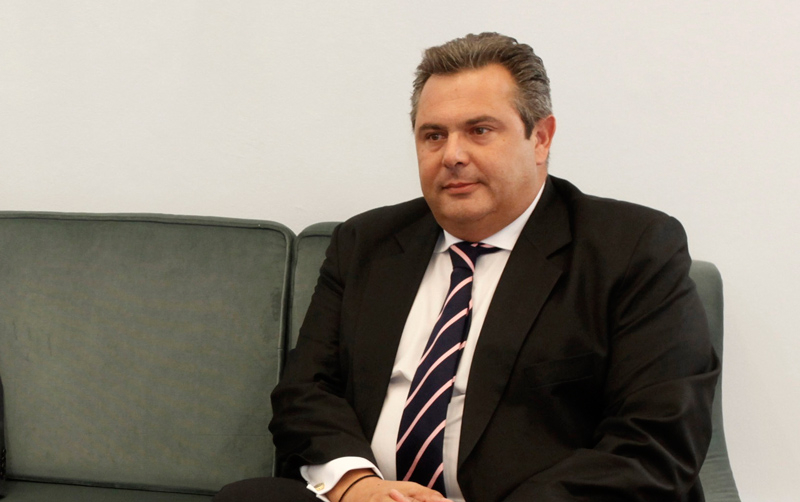
Greek Defense Minister Panos Kammenos. (Photo by Yorgos Karahalis-POOL/Getty Images)

According to Triantafyllopoulos, who has been covering the case from the outset and has interviewed Yiannousakis extensively, Yiannousakis fears that the information he is willing to reveal puts him at risk. He has appealed for American protection for him and his family, so that he can speak freely about all aspects of the case.

Yiannousakis’ apprehension is well-founded. Since the smuggling case emerged, several witnesses were murdered or have died of “unknown causes”. In addition, the judge presiding over the trial received a bomb in a package sent to his home. The explosive, which was filled with razor blades and screws and placed inside a hollowed-out book, was detonated by bomb squad agents before it had a chance to kill its recipient — a day after the prosecutor recommended life sentences for the five main suspects.

Furthermore, between the first and second telephone interviews he gave to Triantafyllopoulos, Yiannousakis was transferred from a correctional facility to a closed prison, which he believes is a move by the authorities — a web of political, financial and media elites implicated in the affair — to put psychological pressure on him to keep his mouth shut. If even the partial information that he revealed during the interviews is true, the upper echelons of Greek society have good reason to want to silence him.

What he indicated was that the amount of heroin transferred to the Noor 1 from an Iranian ship was far greater than that which was seized by the Greek Coast Guard. He claimed that it was not 2.1 tons, but rather 3 tons that were found, and that the extra 900 kilograms were taken by Vangelis Marinakis — a powerful businessman, shipowner, member of the Piraeus city council and owner of the football (soccer) clubs Olympiacos in Greece and Nottingham Forest in Britain — who sold it to a network of Serbian drug dealers. He also accused Marinakis of being involved in illegal oil-trafficking in the Persian Gulf.

These allegations, if accurate, are particularly startling, given Marinakis’s newfound control over much of the media in Greece, and extensive ties to the foreign media. He recently purchased the Lambrakis Press Group (DOL) and a 22.1% stake of the private Greek network MEGA TV. According to Triantafyllopoulos, this is only the tip of the iceberg where Marinakis’s media holdings are concerned.

Marinakis denies the allegations; he says that they were concocted by the government to counter the loss of control over the media. Yet, there is no denying what is behind Marinakis’ desire to buy newspapers, radio stations and television networks, all of which have been losing money and are in serious debt. In other words, it is not for immediate financial gain that he has spent tens of millions of euros on bad investments, but rather for long-term political and economic influence at home and abroad. Clearly, his strategy is working: he is considered today one of the most powerful men in Greece.

The complexities of this case have become the source of a fierce confrontation between the government, headed by Prime Minister Alexis Tsipras and President Kyriakos Mitsotakis, and the opposition New Democracy Party, headed by Kyriakos Mitsotakis. Each blames the other for ties to the Noor 1 protagonists and culpability in the case. The true culprit, however, is the “deep state” and its links to Iran through the drug trade. It is an open secret by now that heroin revenues are used by Middle East regimes to fund terrorist organizations, such as ISIS, Hezbollah, Hamas and the Muslim Brotherhood. The case of the Noor 1 illustrates one of the ways that both the drugs themselves and terrorist operations are exported to Europe.

Ironically, Greece, a country in poverty and beholden to Germany and the European Union to keep it afloat, appears manipulated from within by malevolent forces posing as legitimate members of the elite.

The possible direct and indirect involvement of figures at the highest levels of Greek society makes it nearly impossible for the government alone to get to the bottom of the case, and protect key witnesses from bodily harm. It needs help now, preferably from the U.S. Justice Department and security agencies. The complete dismantling of the drug-terrorism circuit is not only a pressing issue for Greece. It is an international security imperative.


by Maria Polizoidou

Maria Polizoidou, a reporter, broadcast journalist, and consultant on international and foreign affairs, is based in Greece.

https://www.gatestoneinstitute.org/10577/greece-drug-smuggling

© 2017 Gatestone Institute. All rights reserved. The articles printed here do not necessarily reflect the views of the Editors or of Gatestone Institute. No part of the Gatestone website or any of its contents may be reproduced, copied or modified, without the prior written consent of Gatestone Institute
.

Kurdistan: From Referendum to the Road to Independence

0

EXECUTIVE SUMMARY: On September 25, a referendum will be held on the future of the Kurdistan region of Iraq. The vote will decide whether autonomous Kurdistan should disengage from Iraq and become an independent state or remain within the Iraqi state. The referendum will be the Iraqi Kurds’ first concrete step towards the realization of the more than century-long dream of an independent Kurdish state.

After WWI, the victorious powers promised independence for the Kurds. This did not materialize, however, mainly due to the opposition of Mustafa Kemal Ataturk, the founder of modern Turkey.

Since then, the Kurds have suffered persecution and oppression in the countries where they reside: Iraq, Iran, Syria, and Turkey. The Kurds now constitute the largest national group in the world without a state to call their own.

Since the fall of Saddam Hussein in 2003, the Kurds have enjoyed a broad autonomy that has rekindled their aspiration for independence. This aspiration gained great momentum due to the considerable assistance provided by the Peshmerga, the Kurdish military militia, to the war effort against ISIS, without which the Iraqi army would not have succeeded in liberating the Mosul area from the Islamist terrorist organization. But there is a certain irony to the Iraqi victories in Kurdistan: they led to a mini-crisis between the Baghdad government and the Kurdistan Regional Government (KRG) over the revival of Kurdish national aspirations.

On this subject, it seems there has been no change in the position of the current Iraqi government in relation to that of its predecessors. According to the central government and Iraqi public figures who oppose Kurdish independence, the Kurds – like Assyrians, Yazidis, and Turkmens – are an inseparable part of Iraqi society who must not disengage from the Iraqi motherland.

Moreover, harsh disputes exist between the KRG and the Iraqi government over oil ownership in Kurdistan and the reimbursement of funds demanded by the government for the sale of that oil. Unexpected support on this matter was recently received from Saudi Arabia, which sought to take revenge on Ankara for its support of Qatar.

As for Israel, while there is a thunderous official silence on the subject, there is no doubt that Jerusalem would support an independent Kurdish state. About three years ago, Prime Minister Netanyahu declared Israel’s support for the establishment of such a state in the part of Iraq where Kurdish autonomy is today. “We must support the Kurds’ aspirations for independence; they deserve it,” Netanyahu declared in a speech at the Institute for National Security Studies in Tel Aviv.

This statement received a harsh response from Nuri al-Maliki, former prime minister of Iraq (2006-14), who repeatedly told the media pejoratively that Kurdistan would be a “second Israel.” When Israeli reporters arrived in Iraq to cover the war on ISIS, Maliki did not hide his anger. Many other Iraqi leaders besides Maliki accuse the president of the Kurdish autonomous region, Massoud Barzani, of collaborating with Israel, thereby hinting at the military assistance given by Israel in the 1960s and 1970s to the Kurds under the leadership of Mustafa Barzani (Massoud’s father) in their war against the central government.

Few countries support a referendum and the granting of independence to the Kurdish people in their state. The Kurdish region, which has no sea outlet and is surrounded by enemies, shares a border with Iraq, Iran, Syria, and Turkey. These countries, especially Iran and Turkey, all strongly oppose the establishment of a Kurdish state. They fear, like Maliki, that Kurdistan – which has managed to build a friendly island of calm and stability in an area surrounded by enemies and war – will indeed become that distasteful thing, a “second Israel.” This expression has been used extensively in recent years whenever the issue of Kurdistan’s independence has made headlines.

It is entirely possible that the Iranians and the Turks will try to derail the referendum and divide the Kurdish factions.

For its part, Israel has an economic and security interest in supporting a Kurdish state. In view of the profusion of jihadist militias in Syria and Iraq, Jerusalem must be involved in developments in Kurdistan. It would be in Israel’s interest for the IDF to train and instruct Peshmerga soldiers in any future Kurdish state. One could go further – it might be sensible to build an air force base in Kurdistan for the state’s protection. Moreover, the independent Kurdish state may well allow the restitution of its former Jewish population, driven from Iraq for its plundered property, thus setting an important precedent for future Arab-Israeli peace agreements.

Beyond these vital interests, the people of Israel greatly sympathize with the just struggle of the Kurds. There are many commonalities between the Kurdish people and the Jewish people, both of whom have suffered continuous long-term persecution and are scattered throughout the world.

Iran, Turkey, and the Arab states will never support the independence of Kurdistan. The Kurds must lose no time after the referendum in declaring their disengagement from Iraq and the establishment of the independent state of Kurdistan.

In all probability, the state of Kurdistan will be an island of stability that is respectful of human rights. It will therefore differ substantially from the countries surrounding it. The Trump administration should support the referendum and the independence of the Kurdistan region and its disengagement from Iraq, since this development is of interest to the entire region.

The Kurdish people must have a state of their own, and the sooner the better. The international community should support the independence of Kurdistan, not only the establishment of a Palestinian state. Self-determination and independence should be the prerogative of all peoples, not a principle selectively applied.

By

Dr. Edy Cohen is author of the book The Holocaust in the Eyes of Mahmoud Abbas (Hebrew).

BESA Center Perspectives Papers are published through the generosity of the Greg Rosshandler Family

Pay for Gazan Electricity? Clarifying the “Israeli Interest”

0

EXECUTIVE SUMMARY: The electricity crisis in Gaza offers an opportunity for the Israeli government to promote security objectives. It must keep Gaza stable and maintain the separation between the West Bank-based Palestinian Authority and Hamas. The time has come to put an end to the extortion the enemy practices.

This summer marks ten years since Hamas took over Gaza.

The Gaza Strip’s predicament was already seen as irresolvable in the years following the War of Independence. On October 28, 1956, Prime Minister David Ben-Gurion outlined the Sinai Campaign to the government. When Minister Mordechai Bentov wanted to know the purpose of the campaign, Ben-Gurion replied: “Regarding the Gaza Strip, I fear that it is a heavy burden for us; if I believed in miracles I would pray that it would sink into the sea. But the fedayeen bases must be destroyed so that the border residents can live a normal life” (The Renewed State of Israel, 527 [Hebrew]).

The complexity of the situation in Gaza came to the fore last week in the electricity crisis. The well-reasoned approach to the problem of Defense Minister Avigdor Lieberman reveals that complexity. While his demand that the Strip be demilitarized as a condition for its rehabilitation appears straightforward and justified, the sheer absurdity of the situation was reflected in his accompanying question: why shouldn’t the Hamas government pay for the electricity? They collect taxes from the population; they can foot the bill. Lieberman rightly emphasized that Hamas funnels most of its resources into a military buildup while foisting the civilian population’s distress on Israel and the international community. This is certainly true, but addressing it directly runs the risk that the already complex situation will spiral out of control.

Prime Minister Benjamin Netanyahu declared that this is an internal conflict between the Palestinian Authority, with Mahmoud Abbas at the helm, and Hamas, and that Israel should not allow itself be forced to take responsibility for the humanitarian distress caused by that conflict. He also stressed that Israel has no interest in seeing the situation deteriorate into war. Gen. (res.) Amos Gilad, who has a deep knowledge of the reality, explained that Hamas, as a political and military entity, is in no way a partner for negotiations or any sort of compromise. The group’s new “Document of General Principles and Policies,” which it published last month, reemphasized its unwavering commitment to the path of resistance: “Palestine symbolizes the resistance that shall continue until liberation is accomplished, until the return is fulfilled … Hamas rejects any alternative to the full and complete liberation of Palestine, from the river to the sea.” If that’s the case, why should Israel pay for their electricity? How can one offer to build them a seaport?

Strength in Division

There are other aspects, hidden from view, that point to practical recommendations of a different kind.

Israel’s disengagement from Gaza in the summer of 2005, and the Hamas takeover in the summer of 2007, caused a split between the Palestinian Authority in the West Bank and the Hamas regime in the Strip. Although it is better for the official state of Israel not to take an open stance on this division, in many ways it constitutes an Israeli interest that is worth maintaining.

Col. (res.) Jacques Neriah, who was Prime Minister Yitzhak Rabin’s adviser on the Oslo process, spoke of the anxiety that gripped Rabin when he saw what the Palestinian demand for “safe passage” between Gaza and Mount Hebron really meant. The links between these two entities were weak even before they emerged divided from the War of Independence. Reconnecting them would likely endanger the IDF’s control of the West Bank.

With Gaza having become saturated with weapons over the past ten years, renewing traffic between Gaza and Hebron would enable weapons and extensive operational know-how to infiltrate the West Bank, probably necessitating a change in the IDF’s modes of activity. For example, if the IDF now enjoys full operational flexibility in light vehicles, without tanks, both in the West Bank’s refugee camps and in the heart of its Palestinian towns, it is because the Palestinians of the West Bank do not have advanced weapons. It is the West Bank’s isolation that prevents the emergence of armor-piercing weapons such as RPGs and sophisticated roadside charges. That isolation must be maintained.

On the strategic level as well, the division between Gaza and the West Bank is an Israeli interest. The reason Israel’s position has deteriorated from the Rabin framework, which envisaged a Palestinian state mainly restricted to Areas A and B, to the Clinton Parameters, which demanded a sovereign Palestinian state along with an almost complete Israeli withdrawal to the 1967 borders, is the Palestinian power of extortion, which feeds on Israeli anxiety over the demographic threat.

Gaza’s separation from the Palestinian Authority, coupled with its de facto emergence as a sovereign state, has greatly diminished this power of extortion. Now that a Hamas state exists in Gaza as a separate sovereign entity, Israel can, without trepidation, offer the Palestinians a choice between two alternatives: either apply the full potential of the PA’s control of the West Bank territories it has held since January 1996, as Rabin proposed to them, or combine with Israel into a single state.

The Potential Threat Has Grown

Meanwhile, since the Palestinian system became bifurcated, it has pursued a dual strategy: the Hamas component is mainly responsible for resistance, while the governmental component in Ramallah takes the diplomatic tack. Israel’s interest is to impede the network of covert links between these two components.

When, for example, Israel thwarted the Marmara convoy, it actually served an American interest of strengthening Abbas and weakening Hamas. Indeed, when in the aftermath of Operation Protective Edge objections were raised to the idea of helping to construct a Gaza seaport, the dominant assumption was that it is not desirable to bolster Hamas, as doing so would undermine Abbas. The time has come to recognize that Israel’s tacit interest is actually the opposite.

If so, the issue of paying for electricity and of the overall humanitarian situation in Gaza emerges in a different light. In this context, Israel has two interests: first, to maintain stability in Gaza; and second, to maintain the separation, even to the point of tacitly cultivating Hamas in Gaza as a sovereign entity.

It appears that the potential security threat that is developing in Gaza will grow. Although helping build a Gaza seaport will not soften Hamas’s attitudes towards Israel, it can generate momentum that in many regards will serve Israel’s interests. It is recommended that Israel, as a regional power, pursue an approach that better serves its full range of interests, both overt and covert.

This article was first published in Israel Hayom on June 16, 2017.

Gen. (res.) Gershon Hacohen is a senior research fellow at the Begin-Sadat Center for Strategic Studies. He served in the IDF for forty-two years. He commanded troops in battles with Egypt and Syria. He was formerly a corps commander and commander of the IDF Military Colleges.

BESA Center Perspectives Paper