Αρχική Blog Σελίδα 2917

The Pope, Peace and Islamic Fundamentalists

0
  • Islamist terrorists in Egypt bombed Coptic churches and killed dozens of innocent people on Palm Sunday, and Saudi Arabia, which finances and hosts the Muslim World League (MWL), is the global purveyor of extremist Wahhabism. More importantly, it sends a signal to persecuted Christians and moderate Muslims that they really have nowhere to turn. In his attempt at appeasing Muslims, then, the Pope is actually emboldening the “arsonists,” not the “firefighters.”
  • Perhaps the Pope is unaware of the nature of the MWL and Al-Azhar. If so, here is a brief description of each…
  • “MWL has a long history of ties to, and financial support for, Islamic extremists, terrorist operatives, and terrorist organizations including Hamas, the Abu Sayyaf Group, al-Ittihaad al-Islami, the Moro Islamic Liberation Front, Jemaat-al-Islamiyya, and al Qaeda…. MWL has often provided a platform for hateful, inflammatory rhetoric directed against Jews and the state of Israel.” — Discover the Networks.
  • “Any Muslim can kill an apostate and eat him, as well kill infidel warriors even if they are young or female and they can also be eaten, because they are not granted any protection..” — Al-Azhar book for high school students; 2015 investigative report conducted by the Egyptian newspaper El-Youn el-Sabi.

After a visit to the Vatican on September 20, a delegation of the Muslim World League (MWL), an international NGO based in, and funded by, Saudi Arabia, lauded Pope Francis for his past statements rejecting the link between Islam and violence. During their “historic meeting,” MWL Secretary-General Muhammad Abdul-Kareem Al-Issa and the Pope exchanged gifts and reportedly vowed to enhance cooperation “in all areas to achieve common goals, notably the spread of peace and harmony.”

The next day, the Pontifical Council for Interreligious Dialogue and the WML held an “informal meeting… during which it was repeated that:

  • Religion and violence are incompatible;
  • Religions have moral resources capable of contributing to fraternity and peace;
  • The phenomenon of fundamentalism, particularly when violent, is troubling and joint efforts are required to counter it, and
  • Situations exist where freedom of conscience and of religion are not entirely respected and protected, so there is an urgent need to remedy this, renewing ‘religious discourse’ and reviewing school books.”

The two groups then agreed to establish a joint permanent committee “in the near future” to address these issues.

Similar sentiments were expressed by the leaders of Cairo’s al-Azhar University — the world’s leading Islamic center of learning for Sunni Muslims — at its International Peace Conference in April, after Pope Francis delivered an address for which the audience awarded him much applause. According to an account in the National Catholic Register, “Probably to avoid offending its Muslim members, who consider Jesus only a prophet, [Pope Francis] seemed to deliberately omit any explicit mention of the Lord’s name, preferring to focus more generally on ‘God’ and the ‘Absolute.'”

The report went on to summarize “key points” of the Pontiff’s speech, among them:

“Despite the need for the Absolute, we must reject any ‘absolutizing’ that would justify violence which is the ‘negation of every authentic religious expression.'”

“Religion is not meant to only unmask evil but promote peace, perhaps today ‘more than ever,’ but without ‘giving in to forms of facile syncretism’ [and instead] ‘praying for one another.'”

“It is of little or no use to raise our voices and run about to find weapons for our protection: what is needed today are peacemakers, not fomenters of conflict; firefighters and not arsonists; preachers of reconciliation and not instigators of destruction.”

Thanking the Pope for his “defense of Islam against the accusation of violence and terrorism,” the Grand Imam of Al-Azhar, Sheikh Ahmed Muhammad al-Tayyib, said in his speech that humanity ought to “stress the value of peace, justice, equality and human rights regardless of religion, color, race, or language.” He added:

“We need to liberate the image of religions from false concepts, misunderstandings, malpractices, and false religiosity attached to them. These evils bestir conflicts, spread hate, and instigate violence… [W]e should not hold religion accountable for the crimes of any small group of followers.”

The twin messages at each occasion — Al-Azhar in Cairo and the Vatican in Rome — were the same: that religion is the vessel through which peace is achieved, and that Islam is no more violent than Christianity.

This is not merely ironic, as less than three weeks earlier in Egypt, Islamist terrorists bombed Coptic churches and killed dozens of innocent people on Palm Sunday, and Saudi Arabia, which finances and bases the MWL, is the global purveyor of extremist Wahhabism. More importantly, it sends a signal to persecuted Christians and moderate Muslims that they really have nowhere to turn.

As appropriate as it is for the head of the Catholic Church to hail peace and coexistence while railing against intolerance, it is worse than meaningless if he does so while forging ties with the types of extremists he claims to be denouncing. In his attempt at appeasing Muslims, then, the Pope is actually emboldening the “arsonists,” not the “firefighters”.
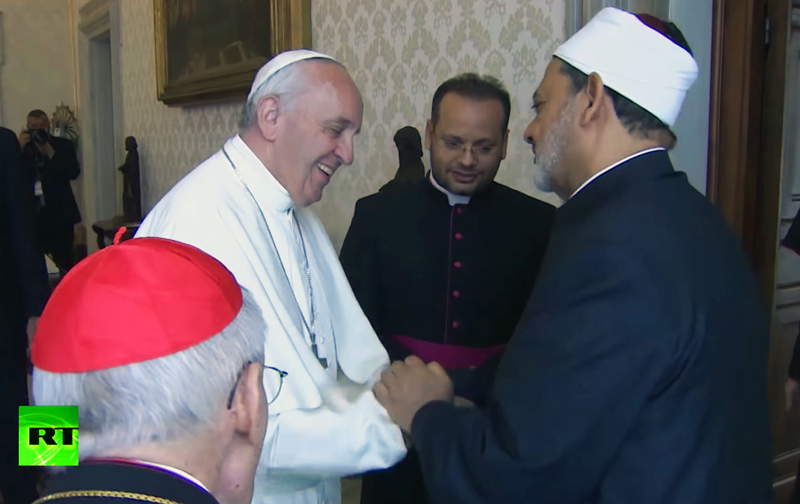
Pope Francis speaks with Sheik Ahmed el-Tayyib, Grand Imam of Cairo’s al-Azhar University, at the Vatican on May 23, 2016. (Image source: RT video screenshot)

Perhaps the Pope is unaware of the nature of the MWL and Al-Azhar. If so, here is a brief description of each:

The Muslim World League, founded in 1962 and based in Mecca, describes itself as follows:

“The Muslim World League is an international non-governmental Islamic organization based in the Holy City of Makkah. Its goal is to clarify the true message of Islam. It is engaged in propagating the religion of Islam, elucidating its principles and tenets, refuting suspicious and false allegations made against the religion. The League also strives to persuade people to abide by the commandments of their Lord, and to keep away from prohibited deeds. …The League, which employs all means that are not at variance with the Sharia (Islamic law) to further its aims, is well known for rejecting all acts of violence and promoting dialogue with the people of other cultures. … those in charge of MWL seek to establish a brand of Islam that adheres to the precepts of God (Allah) and the tradition of the Prophet Mohammad.”

According to the David Horowitz Freedom Center’s website, Discover the Networks:

“MWL has a long history of ties to, and financial support for, Islamic extremists, terrorist operatives, and terrorist organizations including Hamas, the Abu Sayyaf Group, al-Ittihaad al-Islami, the Moro Islamic Liberation Front, Jemaat-al-Islamiyya, and al Qaeda…. MWL has often provided a platform for hateful, inflammatory rhetoric directed against Jews and the state of Israel.”

Al-Azhar, too, is a virtual training camp for extremism, according to a report in the American Thinker. In a recent article, author Cynthia Farahat — a fellow at the Middle East Forum — writes that it “is where many of the world’s most brutal terrorists received their formal religious training.”

This, she says, “is to be expected, given the nature of the material taught there [and the fact that it has been] unofficially controlled by the Muslim Brotherhood for decades.” She provides many examples of the Islamic center’s curriculum and teachings — revealed in a 2015 investigative report conducted by the Egyptian newspaper El-Youn el-Sabi — among them a book for high school students that promotes cannibalism. “Any Muslim can kill an apostate and eat him, as well kill infidel warriors even if they are young or female and they can also be eaten, because they are not granted any protection,” is one passage in the book.

The Egyptian report also quotes the same book as stating:

“To preserve one’s self from the evil of an infidel, any Muslim can gouge their eyes out, or mutilate their hands and legs, or sever one arm and one leg.”

Another book teaches:

“Any Muslim is allowed to kill a fornicator, a warrior, or a [Muslim] who misses prayer, even without permission of the [ruling] Imam.”

Farahat then lists a number of the “world’s most brutal Islamists [who] either worked for or graduated from al-Azhar.” For example, Boko Haram’s leader, Abubakar Shekau, is a graduate, and the first leader of al-Qaeda, the late Abdulla Azzam, studied there, as did Abu Osama al-Masri, the likely mastermind of the Russian plane crash over the Sinai in 2015. Osama Bin Laden’s mentor, Omar Abdel Rahman (the “Blind Sheikh”), a leader of the international arm of al-Qaeda, was a scholar at the institution.

Al-Azhar is so closely associated with fundamentalism and violence, she explains, that public figures and academics in Egypt have called on the government of President Abdel Fattah el Sisi to designate Al-Azhar a terrorist organization.

If Pope Francis wishes to create and join interfaith coalitions against dangerous fundamentalism, he should cease giving his blessing to Muslim groups that perpetrate political Islam in its most destructive form.

A.Z. Mohamed is a Muslim born and raised in the Middle East.

© 2017 Gatestone Institute. All rights reserved. The articles printed here do not necessarily reflect the views of the Editors or of Gatestone Institute. No part of the Gatestone website or any of its contents may be reproduced, copied or modified, without the prior written consent of Gatestone Institute.

The Rise of the New McCarthyism

0
By Robert Parry  

Special Report: As the New McCarthyism takes hold in America, the neocon Washington Post makes Russia the villain in virtually every bad thing that happens, with U.S. dissidents treated as “fellow-travelers,” writes Robert Parry.

Make no mistake about it: the United States has entered an era of a New McCarthyism that blames nearly every political problem on Russia and has begun targeting American citizens who don’t go along with this New Cold War propaganda.

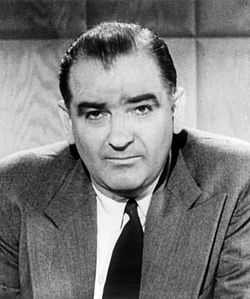
Sen. Joseph McCarthy, R-Wisconsin, who led the “Red Scare” hearings of the 1950s.

A difference, however, from the McCarthyism of the 1950s is that this New McCarthyism has enlisted Democrats, liberals and even progressives in the cause because of their disgust with President Trump; the 1950s version was driven by Republicans and the Right with much of the Left on the receiving end, maligned by the likes of Sen. Joe McCarthy as “un-American” and as Communism’s “fellow travelers.”

The real winners in this New McCarthyism appear to be the neoconservatives who have leveraged the Democratic/liberal hatred of Trump to draw much of the Left into the political hysteria that sees the controversy over alleged Russian political “meddling” as an opportunity to “get Trump.”

Already, the neocons and their allies have exploited the anti-Russian frenzy to extract tens of millions of dollars more from the taxpayers for programs to “combat Russian propaganda,” i.e., funding of non-governmental organizations and “scholars” who target dissident Americans for challenging the justifications for this New Cold War.

The Washington Post, which for years has served as the flagship for neocon propaganda, is again charting the new course for America, much as it did in rallying U.S. public backing for the 2003 invasion of Iraq and in building sympathy for abortive “regime change” projects aimed at Syria and Iran. The Post has begun blaming almost every unpleasant development in the world on Russia! Russia! Russia!

For instance, a Post editorial on Tuesday shifted the blame for the anemic victory of German Chancellor Angela Merkel and the surprising strength of the far-right Alternative for Germany (AfD) from Merkel’s austerity policies, which have caused hardship for much of the working class, or from her open door for Mideast refugees, which has destabilized some working-class neighborhoods, to – you guessed it – Russia!

The evidence, as usual, is vague and self-interested, but sure to be swallowed by many Democrats and liberals, who hate Russia because they blame it for Trump, and by lots of Republicans and conservatives, who have a residual hatred for Russia left over from the Old Cold War.

The Post cited the Atlantic Council’s Digital Forensic Research Lab, which has been pushing much of the hysteria about alleged Russian activities on the Internet. The Atlantic Council essentially is NATO’s think tank and is financed with money from the U.S. government, Gulf oil states, military contractors, global financial institutions and many other sources which stand to gain directly or indirectly from the expanding U.S. military budget and NATO interventions.

Blaming Russia

In this New Cold War, the Russians get blamed for not only disrupting some neocon “regime change” projects, such as the proxy war in Syria, but also political developments in the West, such as Donald Trump’s election and AfD’s rise in Germany.

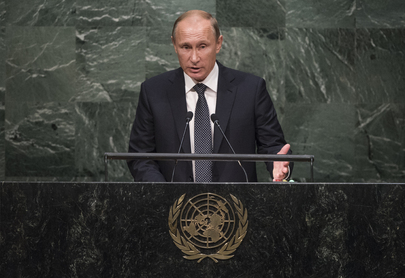
Russian President Vladimir Putin addresses UN General Assembly on Sept. 28, 2015. (UN Photo)

The Atlantic Council’s digital lab claimed, according to the Post editorial, that “In the final hours of the [German] campaign, online supporters of the AfD began warning their base of possible election fraud, and the online alarms were ‘driven by anonymous troll accounts and boosted by a Russian-language bot-net.’”

Of course, the Post evinces no evidence tying any of this to the Russian government or to President Vladimir Putin. It is the nature of McCarthyism that actual evidence is not required, just heavy breathing and dark suspicions. For those of us who operate Web sites, “trolls” – some volunteers and some professionals – have become a common annoyance and they represent many political outlooks, not just Russian.

Plus, it is standard procedure these days for campaigns to issue last-minute alarms to their supporters about possible election fraud to raise doubts about the results should the outcome be disappointing.

The U.S. government has engaged in precisely this strategy around the world, having pro-U.S. parties not only complain about election fraud but to take to the streets in violent protests to impugn the legitimacy of election outcomes. That U.S. strategy has been applied to places such as Ukraine (the Orange Revolution in 2004); Iran (the Green Revolution in 2009); Russia (the Snow Revolution in 2011); and many other locations.

Pre-election alerts also have become a feature in U.S. elections, even in 2016 when both Donald Trump and Hillary Clinton raised questions about the legitimacy of the balloting, albeit for different reasons.

Yet, instead of seeing the AfD maneuver as a typical ploy by a relatively minor party – and the German election outcome as an understandable reflection of voter discontent and weariness over Merkel’s three terms as Chancellor – the Atlantic Council and the Post see Russians under every bed and particularly Putin.

Loving to Hate Putin

In the world of neocon propaganda, Putin has become the great bête noire, since he has frustrated a variety of neocon schemes. He helped head off a major U.S. military strike against Syria in 2013; he aided President Obama in achieving the Iran nuclear agreement in 2014-15; Putin opposed and – to a degree – frustrated the neocon-supported coup in Ukraine in 2014; and he ultimately supplied the air power that defeated neocon-backed “rebel” forces in Syria in 2015-17.

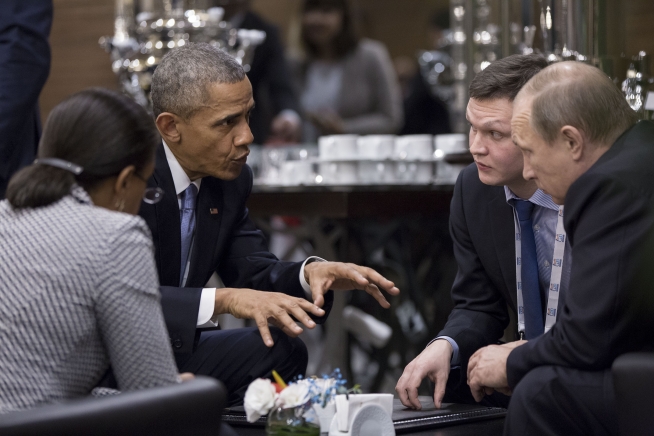
President Barack Obama meets with President Vladimir Putin of Russia on the sidelines of the G20 Summit at Regnum Carya Resort in Antalya, Turkey, Sunday, Nov. 15, 2015. National Security Advisor Susan E. Rice listens at left. (Official White House Photo by Pete Souza)

So, the Post and the neocons want Putin gone – and they have used gauzy allegations about “Russian meddling” in the U.S. and other elections as the new propaganda theme to justify destabilizing Russia with economic sanctions and, if possible, engineering another “regime change” project in Moscow.

None of this is even secret. Carl Gershman, the neocon president of the U.S.-government-funded National Endowment for Democracy, publicly proclaimed the goalof ousting Putin in an op-ed in The Washington Post, writing: “The United States has the power to contain and defeat this danger. The issue is whether we can summon the will to do so.”

But the way neocon propaganda works is that the U.S. and its allies are always the victims of some nefarious enemy who must be thwarted to protect all that is good in the world. In other words, even as NED and other U.S.-funded operations take aim at Putin and Russia, Russia and Putin must be transformed into the aggressors.

“Mr. Putin would like nothing better than to generate doubts, fog, cracks and uncertainty around the German pillar of Europe,” the Post editorial said. “He relishes infiltrating chaos and mischief into open societies. In this case, supporting the far-right AfD is extraordinarily cynical, given how many millions of Russians died to defeat the fascists seven decades ago.”

Not to belabor the point but there is no credible evidence that Putin did any of this. There is a claim by the virulently anti-Russian Atlantic Council that some “anonymous troll accounts” promoted some AfD complaint about possible voter fraud and that it was picked up by “a Russian-language bot-net.” Even if that is true – and the Atlantic Council is far from an objective source – where is the link to Putin?

Not everything that happens in Russia, a nation of 144 million people, is ordered by Putin. But the Post would have you believe that it is. It is the centerpiece of this neocon conspiracy theory.

Silencing Dissent

Similarly, any American who questions this propaganda immediately is dismissed as a “Kremlin stooge” or a “Russian propagandist,” another ugly campaign spearheaded by the Post and the neocons. Again, no evidence is required, just some analysis that what you’re saying somehow parallels something Putin has said.

The Washington Post building in downtown Washington, D.C. (Photo credit: Washington Post)

On Tuesday, in what amounted to a companion piece for the editorial, a Post articleagain pushed the unproven suspicions about “Russian operatives” buying $100,000 in Facebook ads from 2015 into 2017 to supposedly influence U.S. politics. Once again, no evidence required.

In the article, the Post also reminds its readers that Moscow has a history of focusing on social inequities in the U.S., which gets us back to the comparisons between the Old McCarthyism and the new.

Yes, it’s true that the Soviet Union denounced America’s racial segregation and cited that ugly feature of U.S. society in expressing solidarity with the American civil rights movement and national liberation struggles in Africa. It’s also true that American Communists collaborated with the domestic civil rights movement to promote racial integration.

That was a key reason why J. Edgar Hoover’s FBI targeted Martin Luther King Jr. and other African-American leaders – because of their association with known or suspected Communists. (Similarly, the Reagan administration resisted support for Nelson Mandela because his African National Congress accepted Communist support in its battle against South Africa’s Apartheid white-supremacist regime.)

Interestingly, one of the arguments from liberal national Democrats in opposing segregation in the 1960s was that the repression of American blacks undercut U.S. diplomatic efforts to develop allies in Africa. In other words, Soviet and Communist criticism of America’s segregation actually helped bring about the demise of that offensive system.

Yet, King’s association with alleged Communists remained a talking point of die-hard segregationists even after his assassination when they opposed creating a national holiday in his honor in the 1980s.

These parallels between the Old McCarthyism and the New McCarthyism are implicitly acknowledged in the Post’s news article on Tuesday, which cites Putin’s criticism of police killings of unarmed American blacks as evidence that he is meddling in U.S. politics.

“Since taking office, Putin has on occasion sought to spotlight racial tensions in the United States as a means of shaping perceptions of American society,” the article states. “Putin injected himself in 2014 into the race debate after protests broke out in Ferguson, Mo., over the fatal shooting of Michael Brown, an African American, by a white police officer.

“‘Do you believe that everything is perfect now from the point of view of democracy in the United States?’ Putin told CBS’s ’60 Minutes’ program. ‘If everything was perfect, there wouldn’t be the problem of Ferguson. There would be no abuse by the police. But our task is to see all these problems and respond properly.’”

The Post’s speculative point seems to be that Putin’s response included having “Russian operatives” buy some ads on Facebook to exploit these racial tensions, but there is no evidence to support that conspiracy theory.

However, as this anti-Russia hysteria spreads, we may soon see Americans who also protest the police killing of unarmed black men denounced as “Putin’s fellow-travelers,” much as King and other civil rights leaders were smeared as “Communist dupes.”

Ignoring Reality

So, instead of Democrats and Chancellor Merkel looking in the mirror and seeing the real reasons why many white working-class voters are turning toward “populist” and “extremist” alternatives, they can simply blame Putin and continue a crackdown on Internet-based dissent as the work of “Russian operatives.”

German Chancellor Angela Merkel with her hands in the characteristic Merkel-Raute position. (Photo from Wikipedia)

Already, under the guise of combating “Russian propaganda” and “fake news,” Google, Facebook and other tech giants have begun introducing algorithms to hunt down and marginalize news that challenges official U.S. government narratives on hot-button issues such as Ukraine and Syria. Again, no evidence is required, just the fact that Putin may have said something similar.

As Democrats, liberals and even some progressives join in this Russia-gate hysteria – driven by their hatred of Donald Trump and his supposedly “fascistic” tendencies – they might want to consider whom they’ve climbed into bed with and what these neocons have in mind for the future.

Arguably, if fascism or totalitarianism comes to the United States, it is more likely to arrive in the guise of “protecting democracy” from Russia or another foreign adversary than from a reality-TV clown like Donald Trump.

The New McCarthyism with its Orwellian-style algorithms might seem like a clever way to neutralize (or maybe even help oust) Trump, but – long after Trump is gone – a structure for letting the neocons and the mainstream media monopolize American political debate might be a far greater threat to both democracy and peace.

Investigative reporter Robert Parry broke many of the Iran-Contra stories for The Associated Press and Newsweek in the 1980s. You can buy his latest book, America’s Stolen Narrative, either in print here or as an e-book (from Amazon and barnesandnoble.com).

The Rise of the New McCarthyism

How Syria’s Victory Reshapes Mideast

0

By Alastair Crooke  

 The failure of the U.S.-Israeli-Saudi “regime change” project in Syria changes the future of the Mideast, possibly ushering in an era of greater secularism and tolerance, writes ex-British diplomat Alastair Crooke.

Plainly, Syria’s success – notwithstanding the caution of President Bashar al-Assad in saying that signs of success are not success itself – in resisting, against the odds, all attempts to fell the state suggest that a tipping point in the geopolitics of the region has occurred.

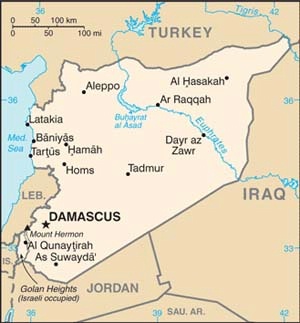
Map of Syria.

We have written before how the Syria outcome dwarfs that of Israel’s 2006 war against Hezbollah, significant though the result of that war was, too.

Both events taken together have brought America’s unipolar moment in the Middle East to an end (though not globally, since the U.S. still retains its necklace of military bases across the region). The successes have corroded badly the reputation of the Gulf States and have discredited fired-up Sunni jihadism as a “go-to” political tool for Saudi Arabia and its Western backers.

But, aside from the geopolitics, the Syria outcome has created a physical connectivity and contiguity that has not existed for some years: the border between Iraq and Iran is open; the border between Syria and Iraq is opening; and the border between Lebanon and Syria, too, is open. This constitutes a critical mass both of land, resources and population of real weight.

The region will listen intently to what these victors will have to say about their future vision for the region – and for Islam. In particular, how Syria articulates the lessons for Middle Eastern societies in light of its war experience will have a profound import.

This discussion has barely begun in Syria, and has not reached a conclusion – and may not, for some time; but we can speculate a little.

At present, talk is divided between Levantism, which is based in the idea of cultural diversity, such as has existed – alongside periodic acute tensions – in Lebanon and Syria, and Arab nationalism. The framework for both concepts being understood to be a non-assertive secularism within a state structure, encompassing equality before the law.

Arab nationalism looks toward a wide Arab cultural unity, rooted primarily in the Arabic language. Levantism essentially was an Ottoman inheritance. Then (in Ottoman times), there was no “Syria” (in the sense of a nation–state), but viliyat (Ottoman provinces), which were more like city-states that were permitted a large quota of self-administration and discretion for diverse societies and sects to live in their own cultural and spiritual ways, including the right to speak their individual languages. (Syrian diversity historically represented the legacy of many foreign occupations, with each leaving behind something of their DNA, their cultures and religion).

Colonial Strategies

Under the subsequent French colonial rule, the colonizers first created separate mini-statelets of these Syrian minorities, but when that policy failed, they reversed into forced unification of Syria’s diverse parts (apart from Lebanon), through a stratagem of imposing the French language instead of Arabic; French law instead of the Ottoman law and mores; and of promoting Christianity in order to undercut Islam. Inevitably, this created the pushback that gave Syria its characteristic suspicion of foreign intervention and its determination to recover a vision of what it was to be Syrian. (The French “regime-changed” Damascus in 1920, 1925, 1926, and 1945, and imposed martial law during most of the pauses in between the coups).

French diplomat Francois George-Picot, who along with British colonial officer Mark Sykes drew lines across a Middle East map of the Ottoman Empire after World War I, carving out states with boundaries that are nearly the same as they are today.

But the nationalism, which the French repression had provoked into life, pulled in two different directions: the Muslim Brotherhood, the major Islamic movement, wanted to grasp Syria as a Sunni Islamic state, while, in contrast, the more Westernized urban élites wanted to “take” Syria – as not exactly a separate nation-state – but more a part of the whole Arab world, and to be domestically organized as a unified, secular, and at least partly Westernized state.

As Patrick Seale noted in The Struggle for Syria: “Above all, [for the secular nationalists], disunity had to be overcome. Their answer was to try to bridge the gaps between rich and poor through a modified version of socialism, and between Muslims and minorities through a modified concept of Islam. Islam, in their view, needed to be considered politically not as a religion but as a manifestation of the Arab nation.

“Thus, the society they wished to create, they proclaimed, should be modern (with, among other things, equality for women), secular (with faith relegated to personal affairs), and defined by a culture of ‘Arabism’ overriding the traditional concepts of ethnicity.”

In short, what they sought was the very antithesis of the objectives of the already strong and growing Muslim Brotherhood. And by 1973, in an attempt to square the circle between conservative, assertive Sunnism and the nationalist “soft” Islam, the fatwa (by a Shi’i cleric) asserting Hafez al-Assad to be Shi’i Muslim (rather than heretic as Sunnis viewed all Alawites to be), exploded the situation. (The French brokered constitution required that the head of state be “Muslim”).

A Cycle of Violence  

The Muslim Brotherhood was beside itself in anger at the designation of then President Hafez Assad as Muslim, and thus began a cycle of bloody violence with organized terrorist attacks on the government, and on al-Assad’s inner circle – and retaliatory attacks by the government – which, in effect, is only now coming to a conclusion with the defeat of militant, jihadi Sunnism’s attempt to seize the state and to oust the “heretic” Alawite.

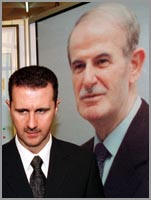
Syrian President Bashar al-Assad before a poster of his late father, Hafez Assad.

The outcome of this iconic struggle has profound regional implications (even if we cannot, now, see how the deliberations about the vision for the future of the Levant will finally conclude).

We can say, firstly, Islamism generally is the major loser in the struggle for the Levant. Both in Syria and Iraq, ordinary Levantine Sunnis have been sickened by intolerant, puritan Islam. This orientation of Islam (Wahhabism) that demanded (on pain of death) a linear singularity of meaning to Islam, which asserts its “truth” from the certainty conveyed from a mechanical, procedural, approach to validating selected “sayings” of the Prophet Mohammad (known as “scientific” Salafism), has failed.

Armed jihadism has failed to leverage this linear singularity as the “idea” with which to crush the polyvalent Levantine model and replace it with a rigid, monovalent literalism. Just to be clear, it is not just the non-Muslims and the minority Sunni and Shi’i sects who have had enough of it: Sunni Syrians and Iraqis, more generally, have too (especially after the experience of Raqa’a and Mosul).

The public reaction to the Wahhabi interventions in both nations is likely to push Sunni Islam firstly to embrace polyvalence in Islam more tightly (even to the extent, possibly, of looking to Iran and its “mode of being” as a possible model); and secondly, to embrace further the Arab secular “way,” too. In short, one “fallout” may be a more secular style of Islam, in contrast to the Muslim Brotherhood’s emphasis on external, visible, exclusionary, identity politics.

But, if the Syrian and Iraqi nationalist Islamic impulse is over, what of the other “double aspect” to Syria — its legacy of Levantine diversity and polyvalence versus the secular nationalist perspective that diversity constitutes a primary cause of national weakness. And which sees its primary task as that of integrating the population into a single political and social structure.

Israel’s New Scheme

Well, much in this latter respect will hang on Washington: the French colonists leveraged the Syrian minorities against the Syrian majority (in the French interest). And now America seems intent – with Israel pushing hard from behind – to leverage the Kurds against the Syrian State (in the interest of limiting the extent of Iranian presence within Syria, and even to try to break the contiguity between Iraq and Syria).

President Donald Trump and Israeli Prime Minister Benjamin Netanyahu talk together prior to President Trump’s address, May 23, 2017, at the Israel Museum in Jerusalem. (Official White House Photo by Shealah Craighead)

That latter prospect seems unlikely. The U.S.-Israeli Kurdish “project” in Syria may fail, as Kurds (much less concentrated in northeastern Syria than they are in northern Iraq), conclude that it would be better and wiser to come to terms with Moscow (and therefore find some modus vivendi with Damascus), rather than trusting to the constancy of American promises of autonomy – amid the almost universal regional hostility to this high-risk independence project. Ultimately, it must be obvious to the Kurds that it is Russia (and Iran) that represent the incoming tide into the northern tier states.

The Syrian Kurds never were in the Masoud Barzani camp and long have had working relations with the Syrian army and Russian forces (versus ISIS), during the conflict. It seems, in any event, that the U.S. main focus is shifting away from Syria to Iraq, as the locus in which they hope to push back against Iran. Again, the prospects there for the U.S. to achieve this aim are poor (Iran is well dug in) – and if mishandled, the Kurdish independence “project” easily could spin into violence and region-wide instability.

Barzani’s leadership is not secure (the Turks are livid at his double-cross of pretending that the referendum was only to strengthen his negotiating hand with Baghdad). And the risk of wider conflict, were Barzani to be removed from power, would be contingent on who ultimately succeeded to the leadership.

In sum, the U.S.-Israeli Kurdish “project” seems – paradoxically – more likely forcefully to strengthen the nationalist impulse across the Levant, Turkey and Iran and to make it more assertive – but not in the old way: there is no going back to the status quo ante in Syria. The processes of de-escalation and reconciliation facilitated by Russia – in and of themselves – will change fundamentally the politics of Syria.

A Shift Toward Diversity

If in the past, politics was top-down, it will now be bottom-up. This is where we see something of a synthesis taking place between Levantism and nationalism. The needs of local politics, in all its diversity, will be much more the future drivers of politics. One can see already that this shift to bottom-up politics is already becoming apparent in Iraq, too. (Again, it has been accelerated by the war against the extreme jihadism of ISIS, but now may become further energized by Kurdish claims to disputed Iraqi territories.)

A Russian orchestra performs a concert at Palmyra’s ancient Roman theater on May 5, 2016, after Syrian troops, backed by Russian air power, reclaimed the ancient city from the Islamic State. (Image from RT’s live-streaming of the event)

In some respects, the “ground” in Iraq – the mobilization of the people against these reactionary armed movements – is running ahead of, and away from the Iraqi political leadership, be it political or religious. The unrest may grow, and the government – any government – will have to bend to pressures from their base.

The Western leveraging of minorities against the state – now the Kurds – has already had a major geostrategic impact: that of bringing Turkey, Syria, Iraq and Iran into close political and military alliance in order to stop this “Kurdish project” from materializing and dissolving the outlines of major states, precisely at their most sensitive juncture.

Essentially, this represents another case where the interests of Israel do not coincide with those of Europe or America. The pursuit of this “Kurdish project” is empowering an alliance – including a major NATO state – that will be explicitly hostile to these American aims (though this does not imply any increase of hostility to the Kurds as a people – though that too may result). The alienation of these states would hardly seem to be in the Western interest, but nonetheless, this is what is occurring.

And finally, the “fallout” from the Syria conflict has prompted the northern tier states to “Look East” – as President Assad recently instructed his diplomats so to do. For Iran it may be primarily to China (as well as to Russia), but for Syria, it is more likely to be Russia in a predominantly cultural way, with China seeing Syria as an “important node” in its Belt & Road Initiative.

This represents a historic shift in the Middle East. Western officials may imagine that they have a hold over Syria by holding reconstruction funding hostage to having their way with Syria’s future: if this is so, they will as wrong about this as they have been on almost everything pertaining to Syria.

Alastair Crooke is a former British diplomat who was a senior figure in British intelligence and in European Union diplomacy. He is the founder and director of the Conflicts Forum.

How Syria’s Victory Reshapes Mideast

Robert Mueller Subpoenas an Associate of the Man Who Hired Michael Flynn as a Lobbyist

0

The special counsel wanted to question a Turkish businessman with interests in Turkey, Russia and the U.S. — and ties to people with criminal records.

The special prosecutor investigating Russia’s interference in the 2016 presidential election has subpoenaed an associate of Gen. Michael Flynn’s Turkish lobbying client. The subpoena, a copy of which was obtained by ProPublica, ordered Sezgin Baran Korkmaz to testify before a grand jury in Washington on Sept. 22.

“The grand jury is conducting an investigation of possible violations of federal criminal laws involving the Foreign Agents Registration Act, among other offenses,” a letter accompanying the subpoena stated. The letter is signed by Robert Mueller and Zainab Ahmad, a senior assistant special counsel who specializes in prosecuting terrorism. Korkmaz did not respond to requests for comment.

Michael Flynn, then national security adviser, in Washington, D.C., on Feb. 10(Mario Tama/Getty Images)

There are no indications of direct links between Korkmaz and Flynn, who briefly served as Donald Trump’s national security adviser. But Korkmaz, 39, is a close ally of Ekim Alptekin, the 40-year-old Turkish businessman who hired Flynn to lobby for Turkish interests shortly before the election. Korkmaz, a Turkish national, said in a radio interview in May that he started as a dishwasher at age 13 and is now bringing hundreds of millions of dollars from the U.S. to Turkey. His company invests in a range of industries in Turkey, the Middle East, the U.S. and Russia, and he has invested in several projects that involve people accused or convicted of crimes.

It’s not clear why prosecutors wanted Korkmaz to testify. But one possible explanation is his connection to Alptekin. Investigators are interested in the ultimate source of the money that Alptekin’s company paid to Flynn’s firm, according to a person familiar with the probe. (Representatives for Alptekin, Flynn and Mueller all declined to comment.)

Korkmaz and Alptekin are involved in a trade group together and have overlapping business interests. Korkmaz’s company, SBK Holding, is a member of the Turkey-U.S. Business Council, which is chaired by Alptekin. SBK was one of two platinum sponsors of the council’s conference in May 2017 at the Trump hotel in Washington. Both Alptekin and Korkmaz gave keynote speeches at the conference. In his remarks, Korkmaz credited Alptekin for helping him succeed in business. “Where I am now is due to the support of Mr. Ekim,” he said in Turkish.

The two men both attended a meeting at the Harvard Club in Manhattan in September 2016, according to a pro-government newspaper columnist who was present. That meeting occurred during the same week in which Flynn met with two Turkish ministers, also in New York, a gathering arranged by Alptekin. At that meeting, they discussed potential plans for the U.S. to hand over Fetullah Gulen, a controversial cleric and opponent of Turkey’s president who lives in Pennsylvania, to Turkey, the Wall Street Journal reported.

Alptekin defended his work with Flynn in his speech at the business council in May. “As many of you have read in the media, I hired the Flynn Intel Group in 2016 before the election with a mandate to help me understand where the Turkish-American relationship is and where it’s going and what the obstacles to the relationship are,” Alptekin said. “My aim was to commission independent research and to establish objective facts” to help businesses understand what he views as the threat from Gulen, whom Turkish President Recep Tayyip Erdogan suspects of trying to topple him.

Turkish businessman Ekim Alptekin gives opening remarks during a conference on U.S.-Turkey relations in Washington, D.C., in May. (Mark Wilson/Getty Images)

The discovery of the lobbying deal with Alptekin, which ultimately generated about $450,000 for Flynn’s firm, helped put Flynn in legal jeopardy because he didn’t initially report his work as a foreign agent to the Justice Department.

As for Korkmaz, his business interests are diverse. SBK has “major investments” in the Russian energy sector, a September 2016 announcement by a Turkish government agency said. The company’s website shows operations in Russia but doesn’t specify what they are.

The company backed a bid, which was ultimately unsuccessful, for a high-profile infrastructure project in Russia several years ago. In 2014, SBK pursued a major project that was a top priority for President Vladimir Putin at the time. After annexing Crimea, Putin wanted a bridge built over the Kerch Strait to connect Crimea to Russia. SBK signed an agreement to supply $850 million in financing to build the bridge. But the deal went to a company led by Putin’s childhood best friend.

Some of Korkmaz’s colleagues and investing partners have come under scrutiny — or worse — by criminal authorities. The U.S. sister company of Korkmaz’s operation, known as SBK Holdings USA, is led by Levon Termendzhyan, a Russian fuel trader with a long rap sheet, according to court records. Termendzhyan has been charged with, but found not guilty of, tax fraud and armed assault. He was convicted of battery in 2013.

In an ongoing lawsuit in California Superior Court in Los Angeles, a former SBK Holdings USA employee claimed in a sworn declaration this year that he was told by two people interviewed by Department of Homeland Security investigators that the agents are probing Termendzhyan for money laundering, tax evasion and stolen petroleum. SBK Holdings USA’s lawyer called those accusations “irrelevant and preposterous” in a court filing. (The lawyer declined to comment for this article.) SBK Holdings USA accuses the former employee of embezzling, which he denies.

Since 2013, Korkmaz’s SBK has managed $500 million of investments in Turkey from another of Termendzhyan’s companies and from a third American company called Washakie Renewable Energy. The latter is part of a conglomerate controlled by the Kingston Group, a fundamentalist Mormon clan.

In 2011, Utah’s then-attorney general called the Kingstons an “organized crime family.” Washakie paid a $3 million fine in 2015 to settle allegations that its biofuels plant collected federal subsidies while failing to produce. In February 2016, federal agents with the Internal Revenue Service, Environmental Protection Agency and Department of Homeland Security raided some of the family’s company offices. The investigation has not resulted in any charges.

In a radio interview, Korkmaz said he convinced the Kingstons to invest in Turkey, and Alptekin is on the board of a Kingston entity that invests in Turkey. Kingston Group did not respond to requests for comment.

Robert Mueller Subpoenas an Associate of the Man Who Hired Michael Flynn as a Lobbyist

Russian Gas Deliveries to Turkey Soar in September

0

Putin’s ultimate goal seems to be to win over Turkey from the West’s sphere of influence

By Ben Aris   Sep 29, 2017

Russian President Vladimir Putin and Turkish President Recep Tayyip Erdogan

Russo-Turkish relations are back in rude health – almost. And nowhere is that clearer than in Russian gas deliveries to Turkey. They have soared in the past month.

Gazprom will set a record for natural gas deliveries to Turkey this year with deliveries having already surged 48 percent in September from a year earlier, Gazprom CEO Alexei Miller told reporters on Sept. 28.

“We are happy that deliveries of gas to Turkey are growing this year. Comparing the period from Jan. 1 to date with the like period of 2016, supplies to the Turkish market rose 24.3 percent,” Miller was cited by the state-run news agency TASS as saying. “It means Gazprom will probably set an all-time high record of gas supplies to the market of Turkey as of 2017 year-end.”

“Speaking about September, the winter season is coming soon. Gas deliveries to Turkey surged 48 percent in September 2017 against September of last year. This evidences once again how TurkStream [the natural gas pipeline designed to link Russia with Turkey via a route under the Black Sea] is a project that is feasible and strongly sought for,” Miller added.

Putin in Ankara

Miller’s statement came as President Vladimir Putin was in Ankara to meetwith his Turkish counterpart Recep Tayyip Erdogan. The visit marked the fifth face-to-face meeting between the two leaders this year with the rapprochement between Turkey and Russia seemingly in full swing now that the countries have put the shooting down of a Russian fighter-bomber by the Turkish military in late 2015 behind them.

Russia recently sold Turkey its most advanced anti-missile S-400 system to the consternation of NATO and Washington. Turkey has been a NATO member since the 1950s and is supposed to only buy systems that are compatible with NATO hardware, which the S-400 is not. It is the second arms deal Putin has cut with a NATO member, having signed off on a deal to upgrade Bulgaria’s MiGs earlier the same month.

However, it was notable that Putin and Erdogan did not refer to the deal during their press conference after their Ankara talks. Last week, while Erdogan was in New York for the UN General Assembly and a meeting with Donald Trump, U.S. media reports indicated that the transaction could be held in breach of Congress’ latest sanctions against Moscow.

Erdogan has been forced to turn to Russia given the deterioration of his relations with the European Union. During recent German elections German Chancellor Angela Merkel explicitly said that she is calling for a formal end to Turkey’s EU accession bid.

Closer ties with Moscow also make sense in light of a referendum held in Iraq this week calling for the creation of a Kurdish homeland – something Erdogan finds anathema.

But the relations are not perfect. One of the main items on the agenda for the two leaders, who spent two hours talking, was when Turkey can restart its exports of tomatoes to Russia. This is a huge business as Russia produces almost no tomatoes of its own, but Russians love the fruit. The tomato ban is among the last of the sanctions Russia imposed after Turkey shot down the Russian fighter.

However, on the more important gas imports Russia has dramatically changed its tone.

Precarious energy relations

As bne IntelliNews reported in March last year, Russia launched a gas war with Turkey after it unilaterally — and in violation of its contractual delivery obligations — cut supplies by 20 percent overnight, during the nadir of the incident with the plane.

Turkey has precarious energy relations with Russia as it has no gas storage facilities of its own and relies entirely on Moscow to manage the supply of gas used in power stations. The Turks essentially ring the Russians and ask them to send more or less gas as demand fluctuates.

While executives at Gazprom Export — the export wing of state gas behemoth Gazprom — told bne IntelliNews that the decision in 2016 to cut supplies was likely to push Turkey to actively seek alternative energy sources and so damage Russia’s business in the long-term, they also said the order to do so “came from upstairs,” meaning they had no choice but to go ahead.

Now the gas business is booming and everyone seems to have put the fracas behind them. At the same time Russia is actively working on the construction of the TurkStream gas pipeline that runs along a southern route from Russia’s gas fields to reach Turkey and customers in western Europe, despite the fact that Ankara has yet to ratify the construction deal. And more recently Russia’s Rosneft said it is exploring the possibility of building a 30bn cubic metre (bcm) pipeline that would from 2020 deliver natural gas supplies from the Iraqi Kurdistan region to Turkey.

Putin’s ultimate goal seems to be to winkle Turkey out of the West’s orbit and bring it into his own sphere of influence. If this is the case then he is registering considerable success.

https://themoscowtimes.com/articles/russian-gas-deliveries-to-turkey-soar-in-september-59124

Putin, Erdogan emerge all smiles from Ankara meeting

0
RUSSIA / MIDEAST
ARTICLE SUMMARY
As Turkey becomes more alienated from the West, Moscow is filling the gap by extending its friendship — and more — to Ankara.
 Days before the meeting this week between Russian President Vladimir Putin and Turkish President Recep Tayyip Erdogan in Ankara, the press in both countries was busy discussing the potential issues on the agenda: Syria, the Iraqi Kurdistan independence referendum, Turkey’s purchase of Russia’s S-400 defense system and — last, but very important to Turkey — Russia’s embargo on Turkish tomatoes.

Kremlin spokesman Dmitry Peskov only added to the speculation by saying the day before the meeting that the visit had “solely pragmatic goals.”

On Sept. 28, Putin arrived in Ankara for his second visit to Turkey since the two countries began normalizing relations last year after Turkish forces downed a Russian jet in November 2015. From the airport, Putin headed to a working dinner with Erdogan that lasted almost two hours. Afterward, the talks continued in an expanded format. Putin was accompanied by a delegation including Foreign Minister Sergey Lavrov, Energy Minister Alexander Novak, Chief of General Staff Gen. Valery Gerasimov, special envoy on Syria Alexander Lavrentyev, Gazprom Chairman Alexey Miller and Alexey Likhachev, the director general of Rosatom State Atomic Energy Corp.

A glance at the list of participants gives a sense of why the Russians came to Ankara.

The key issues discussed were the Syrian civil war and the aftermath of the Iraqi Kurdistan independence referendum, both of great importance for the two countries. For Turkey, with its significant Kurdish population and decades of attacks by the separatist Kurdistan Workers Party, the referendum is certainly a sore point. During a press conference that day, Erdogan called the vote “illegitimate” and said authorities in northern Iraq made a big mistake. “No one has a right to throw our region into the fire,” he added.

Since the Russians have been more ambiguous on the issue, Erdogan was likely keen to hear the Russian leader’s opinion. However, it’s still not clear how much Putin revealed.

Erdogan said at the joint press conference, “We have discussed regional issues including Iraq and Syria. We both agree on [maintaining] the territorial integrity of Iraq and Syria.”

For Russia, the Syrian settlement is more of a priority at the moment. In January, Moscow initiated negotiations in Astana, Kazakhstan, to find a peaceful solution to the protracted Syrian civil war. Remarkably, the Astana process has not only made some progress in the Syrian conflict, but also brought together Iran and Turkey, which have totally different positions on Syrian President Bashar al-Assad.

In May, the Syrian cease-fire guarantors — Russia, Iran and Turkey — signed a memorandum to set up four de-escalation zones in Syria. During his recent visit, Putin said Moscow and Ankara will deepen coordination on ending the six-year conflict.

“The de facto conditions for ending the fratricidal war in Syria, the final destruction of terrorists and Syrians’ return to a normal life have been created,” Russia’s leader stated. Erdogan said Turkey and Russia had confirmed their determination to maintain “joint will and close cooperation” to find a political solution in Syria.

In addition to the regional agenda, the two parties addressed bilateral economic ties. They both said they are satisfied with this year’s boost in bilateral trade.

“While last year we observed a drop of 32%, over the course of seven months of this year the increase amounts to 31.5%. So we restored the losses and in the remaining time of this year will have a surplus,” Putin said.

At the press conference, Russian and Turkish leaders predictably mentioned the importance of two major projects — the Turkish Stream gas pipeline and the Akkuyu nuclear power plant. Putin noted, “We have scrutinized details of [these two] strategic projects.” He added that Moscow hopes Turkey’s first nuclear reactor, which Russia helped build, will be launched “within a short time frame.”

One sensitive issue that has plagued the countries’ bilateral trade since Jan. 1, 2016 — the Russian import ban on Turkish tomatoes — has apparently been fixed as well. The ban was part of the anti-Turkish sanctions Moscow imposed following the jet crisis, and thus far hadn’t been part of the normalization process by which most of the sanctions were lifted.

“The limitation on tomatoes is being removed,” Turkish Economy Minister Nihat Zeybekci told reporters after the talks. “We have confirmation from the Russian head of state, but we will wait until we make the first shipment to be sure.”

Earlier in September, Moscow had said it might resume tomato imports from Turkey in small amounts during the winter season, when local producers are unable to fully cover Russia’s domestic needs. Both Putin and Erdogan also agreed to continue lifting trade and investment barriers to their respective businesses.

The two leaders did not mention what was expected to be one of the most important issues on the bilateral agenda: delivery of the S-400 missile defense system. Earlier this month, Erdogan announced that Turkey had signed a deal to buy the S-400s, despite the criticism and concerns of some of Turkey’s NATO allies. He said that a deposit had been already paid. Though neither leader mentioned the deal this time, Russia’s state news agency Tass reported Sept. 28 that delivery of the systems could begin in two years.

The Russian media paid a lot of attention to the Putin-Erdogan meeting. State-run Rossiya 24 even prepared a special documentary about the modern history of Russian-Turkish relations, emphasizing their “strategic nature” and focusing on the positive aspects. The movie, aired shortly after the Putin-Erdogan press conference was broadcast live, showed the construction of the Akkuyu nuclear power plant, mentioned the great contribution of Turkish business (especially construction companies) to Russia’s economy and interviewed happy Turkish expats who consider Russia their homeland. Controversial topics such as Syria and the Russian stance on the Kurdish issue were omitted.

At the same time, the Russians paid special attention to Turkey’s relations with other players, namely NATO, the United States and Germany. Two weeks before Putin’s visit to Ankara, a panel of experts on the current state of bilateral relations was convened by Istanbul-based TRT World and the Moscow-based Center for Modern Turkish Studies. The message of the event was that amid US and European Union sanctions against Russia and the anti-Turkish stances of some Western countries, Turkey and Russia are getting closer and are likely to continue deepening their cooperation.

One of the speakers was Dmitry Savelyev, who coordinates the Russian-Turkish Inter-Parliamentary Friendship Group in the Russian parliament. During the discussion, he said Russia views Turkey as a key partner in the East.

“While Americans ignore Turkey, we respect the Turkish position,” Savelyev said. He also said Turkey is very welcome to join the Eurasian Economic Union — an alternative to Ankara’s withered hope of attaining EU membership.

Found in:KURDISTAN REGION, TURKISH INTERVENTION IN SYRIA, TURKISH-RUSSIAN RELATIONS, RUSSIAN INFLUENCE IN SYRIA, RUSSIA-TURKEY RELATIONS, RECEP TAYYIP ERDOGAN, VLADIMIR PUTIN

Yekaterina Chulkovskaya is a Russian journalist writing on the Middle East, as well as politics and social issues in Russia’s Muslim regions. She is a columnist for Russian Forbes, a freelance writer for the online newspaper Meduza and a former editor for Turkish edition of Russia Beyond the Hеadlines. She holds a master’s degree in international relations from Moscow State Institute of International Relations (MGIMO-University).


Read more: http://www.al-monitor.com/pulse/originals/2017/09/erdogan-putin-turkey-russia-meeting-kurdistan.html#ixzz4uDnq4mC6

Catalan Nationalism Means More European Division

0

An accident of history is suddenly top of mind for modern Europe.

Students wear Esteladas (Catalan separatist flag) during a demonstration in favor of the banned October 1st independence referendum in Barcelona, Spain. The graffiti on the wall reads, “We will vote!
An accident of history is suddenly top of mind for modern Europe.
Catalans speak their own language. They are richer than their fellow citizens in the rest of Spain, and thus contribute more to the national budget than they receive back. They carry unhappy memories of domination by centralizing governments in Madrid. The Franco dictatorship of 1939-1975 harshly suppressed their culture, identity, and political and civil liberties. It’s a pure accident of history that Catalonia ended up inside the Kingdom of Spain at all. Portugal successfully broke away in the 1640s. Had the Thirty Years War, the War of Spanish Succession, or the Napoleonic wars taken a slightly different turn, Catalonia might well have followed.

All this may seem long ago and far away to the American reader. But it’s all suddenly very top of mind for modern Europe. The Catalan regional government has invited its population to vote Sunday in a referendum on independence. The referendum has been declaredillegal by the Spanish Constitutional Court, because it violates the terms of the 1978 constitution that proclaimed Spanish unity “indissoluble.” The central government has reacted roughly to the referendum project, raiding local government offices, impounding ballots, and arresting local officials. “Stop this escalation of radicalism and disobedience,” the Spanish prime minister commanded in a televised statement on September 17th.  Unsurprisingly, those words failed to calm the situation. The streets of Barcelona have filled with protesters. Only about 40 percent of Catalans favored independence as of midsummer, but feelings are running hotter now.

Prime Minister Mariano Rajoy visited Washington, D.C. on September 26th. At a joint press conference, President Trump deplored the secession vote.

I think the people of Catalonia have been talking about this for a long time.  But I bet you if you had accurate numbers and accurate polling, you’d find that they love their country, they love Spain, and they wouldn’t leave.  So I’m just for united Spain.

I speak as the President of the United States, as somebody that has great respect for your President, and also has really great respect for your country.  I really think the people of Catalonia would stay with Spain.  I think it would be foolish not to.  Because you’re talking about staying with a truly great, beautiful, and very historic country.

(The formal title of the prime minister of Spain is “president of the government,” hence Trump’s reference to him as “your president.”)

Trump’s words are unlikely to cut into separatist sympathy in Catalonia. A Pew survey found that 92 percent of Spaniards have no confidence in him, his worst rating in any European country surveyed. Yet Trump was—for once—speaking on behalf of the United States in a way that America’s friends in Spain need to hear.

Perhaps a better way to understand the issues at stake is to take note of which international actors support the independence referendum: Julian Assange and Russian propaganda outfits, to the extent that those are different things. The main effort of Sputnik’s Spanish-language Russian propaganda has been to shade its reporting to suggest easy entry into the European Union for an independent Catalonia.

Catalan nationalism has historically had a left-of-center flavor, unlike other Russian-favored secessionist movements in Europe. But the Russian interest seems, as usual, less about ideology and more about creating chaos, not only for Spain, but within the European Union. Carving up an economy of more than a trillion euros (and apportioning a public debt very nearly equally as large) will generate endless problems for Catalans and whatever remains of Spain.

The American interest has historically been just the opposite: continuity, stability, and the preservation of established institutions. Pre-presidential Trump departed from this norm, with his sympathy for British exit from the European Union. Presidential Trump has at least been furnished with better talking points.

But not for the first time, Americans and the world face the cost of a president who commands so little respect on the world stage, atop an administration already nearly as dysfunctional as Putin could wish. There is no U.S. ambassador to Spain, among other indicators of the breakdown of foreign policy function.

Very possibly, America and the West will get lucky. The Madrid authorities will behave less provocatively; the Catalans will vote “no”—or better yet, not show up to vote at all. (Only 40 percent of Catalans showed up for the last independence vote, in 2014, making irrelevant the 80 percent “yes” outcome.) But how long can luck hold? The harms from a U.S. presidency concerned only for the president’s own personal interests are accumulating and accelerating, month by month, week by week.

https://www.theatlantic.com/international/archive/2017/09/trump-spain-catalonia-referendum-independence/541572/

The Quiet Islamic Conquest of Spain

0
  • “Evicted five centuries ago by crusading Christians, the Arabs are back in Spain, using their oil dollars to buy land that was seized from their ancestors by the sword”. — James M. Markham, The New York Times, 1981.
  • The Madrid daily ABC wrote that 800 mosques in Spain are out of control. The Spanish daily La Razon charged that Gulf donors, such as Qatar, were a source of Spain’s Islamization. The Saudis also launched a new Spanish television channel, Córdoba TV, as did Iran.
  • They dream of, and work to, regain the “lost Caliphate” of Spain. Some Islamists do it with bombs and car-ramming attacks. Others, more surreptitiously, do it with money and dawa, Islamic propaganda. The second way may be even more effective than the first.

The ceremony in 2003 was announced with bombastic headlines: “After a wait of more than 500 years, Spanish Muslims, have finally succeeded in building a mosque of their own in the shadow of the Alhambra, once the symbol of Islamic power in Europe”. A troupe from al Jazeera was sent to follow the event: a muezzin climbed to the minaret of the Great Mosque of Granada to call the faithful to prayer for the first time in five centuries.

From Osama bin Laden to the self-proclaimed Caliph, Abu Bakr Al Baghdadi, all the leaders of the global jihad — including the terror cell that killed 17 people in Barcelona — have mentioned Spain among the lands to be conquered by Islam. There is, however, not only jihad. There is also “the quiet conquest“, as it has been dubbed by the French magazine, Valeurs Actuelles. The quiet conquest is a sinuous attempt to re-Islamize Spain through cultural centers, mega-mosques, proselytizing, conversions and financial investments. This pacific attempt to elicit submission has been underway for some time and has been backed by a flow of money from countries such as Qatar and Saudi Arabia. According to a former commander of British forces in Iraq, General Jonathan Shaw, these two countries in particular have ignited a “time bomb” by funding the global spread of radical Islam.

The New York Times first detailed in 1981 that, “evicted five centuries ago by crusading Christians, the Arabs are back in Spain, using their oil dollars to buy land that was seized from their ancestors by the sword”. Spain back then did not even recognize the State of Israel, and the Spanish monarchy regularly visited Saudi Prince Fahd while he was relaxing in the south of Spain. After that, it was Kuwait’s turn: “During the late 1980’s, when Spain was booming, Kuwait came shopping for corporations and investments”.

Since then, the Arab monarchies have targeted Spain with huge investments. Some emblematic buildings in Madrid and Barcelona, ​​not to mention the Costa del Sol, are now owned by Arab investment groups, from the Santiago Bernabeu stadium in Madrid to the W Hotel in Barcelona. In Marbella, just a few meters away from the King Fahd Mosque, there is the Alanda Hotel, which offers halal food and services to meet the demands of the Muslim clients. In 2011, the International Petroleum Investment Company, controlled by the Emirate of Abu Dhabi, purchasedCepsa, the second-largest Spanish company in the oil sector.

Last January, Spain’s King Felipe VI visited Saudi Arabia and announced that Spain would boost economic, trade and investment relations with the Islamic kingdom. Before that, in 2012, Saudi Aramco awarded Spanish companies projects worth $700 million. Spain and Qatar are now discussing the formation a $1 billion joint investment fund that would help the Gulf state invest in Latin America. The Arab Emirates’ media called Spain “a hotspot for investment from the Arab world”. After Qatar, it was the Oman’s turn to invest in the Spanish market: Oman just agreed to invest up to $120 million in a uranium mine in Spain, to be used for Omani nuclear energy plants.

Demographically, Muslims are witnessing a shocking population increase in Spain. In 1990, Muslims in the country numbered 100,000. By 2010, the number had increased to 1.5 million. In 2017, the number was nearly two million. It is a growth of 1,900% in 27 years.

Today there are 1,400 mosques in Spain. According to the Observatory of Religious Pluralism in Spain (an initiative of the Ministry of Justice), “this figure represents 21% of all places of worship for all religions present in Spain”.

The most prolific funder of mosques in Spain is Saudi Arabia. In 1985, using only its own money, the Saudi kingdom opened the Islamic Cultural Center in Madrid, Europe’s largest mosque, followed by the Islamic Center of Malaga, which the Saudis financed with 22 million euros (today the ​​Madrid area has 112 mosques and Islamic cultural centers). As Gatestone’s Soeren Kern detailed, the Saudis have built mosques everywhere, from Marbella to Fuengirola.

Islamic rogue regimes, such as Iran, have also been able to infiltrate Spanish political parties. According to an investigation, Tehran gave money to Podemos, the leftist party which emerged as a new contender in the Spanish political arena.

The Madrid daily ABC wrote that 800 mosques in Spain are out of control. The Spanish daily La Razon charged that Gulf donors, such as Qatar, were a source of Spain’s Islamization. The Saudis also launched a new Spanish television channel, Córdoba TV, as did Iran.

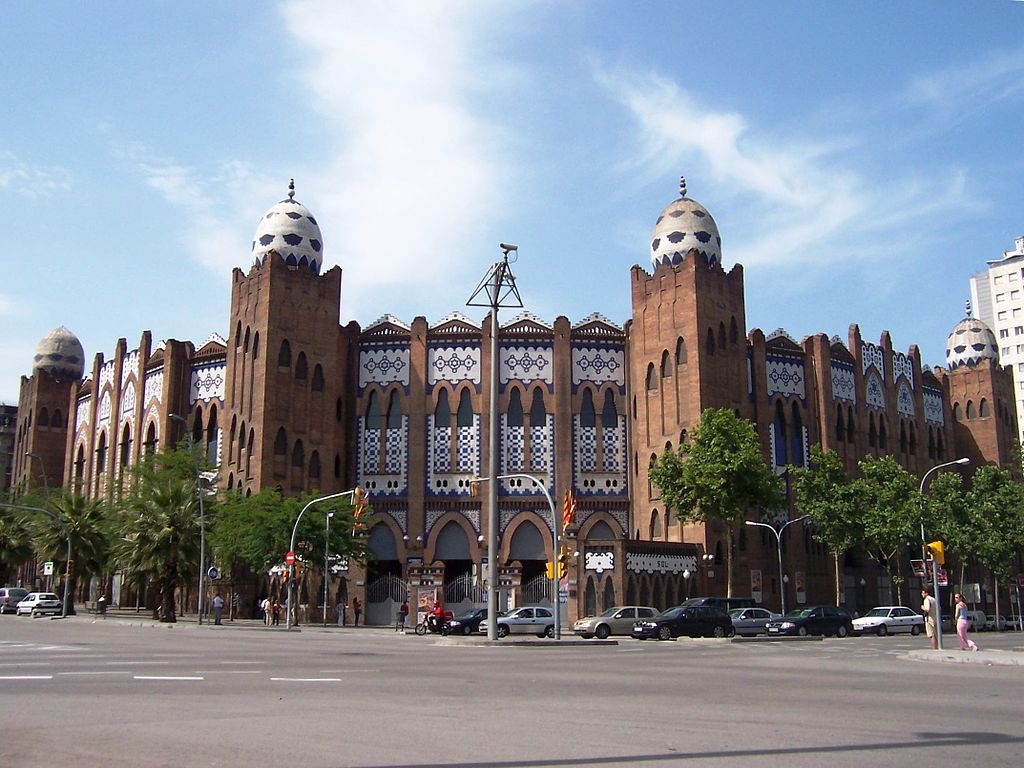
The details of this religious proliferation are detailed The Spain of Allah, a book by Ignacio Cembrero. While the number of Catholic churches in Spain has not undergone much variation for many years, Muslim mosques have been growing at a rate of 20% percent annually. Qatar’s Sheikh Tamim bin Hamad al Thani has also offered to buy La Monumental Arena in Barcelona to turn it into Europe’s biggest mosque. The United Arab Emirates funded the construction of the Great Mosque of Granada.

Qatar’s Sheikh Tamim bin Hamad al Thani has offered to buy La Monumental Arena in Barcelona, with its nearly 20,000 seats, to turn it into Europe’s biggest mosque. (Image source: Sergi Larripa/Wikimedia Commons)

They dream of, and work to, regain the “lost Caliphate” of Spain. Some Islamists do it with bombs and car-ramming attacks. Others, more surreptitiously, do it with money and dawa, Islamic propaganda. The second way may be even more effective than the first.

Giulio Meotti, Cultural Editor for Il Foglio, is an Italian journalist and author.

© 2017 Gatestone Institute. All rights reserved.

The US Economy is Failing

0

 Do the Wall Street Journal’s editorial page editors read their own newspaper?

The frontpage headline story for the Labor Day weekend was “Low Wage Growth Challenges Fed.” Despite an alleged 4.4% unemployment rate, which is full employment, there is no real growth in wages. The front page story pointed out correctly that an economy alleged to be expanding at full employment, but absent any wage growth or inflation, is “a puzzle that complicates Federal Reserve policy decisions.”

On the editorial page itself, under “letters to the editor,” Professor Tony Lima of California State University points out what I have stressed for years: “The labor-force participation rate remains at historic lows. Much of the decrease is in the 18-34 age group, while participation rates have increased for those 55 and older.”  Professor Lima points out that more evidence that the American worker is not in good shape comes from the rising number of Americans who can only find part-time work, which leaves them with truncated incomes and no fringe benefits, such as healh care.

Positioned right next to this factual letter is the lead editorial written by someone who read neither the front page story or the professor’s letter.

The lead editorial declares: “The biggest labor story this Labor Day is the trouble that employers are having finding workers across the country.” The Journal’s editorial page editors believe the solution to the alleged labor shortage is Senator Ron Johnson’s (R.Wis.) bill to permit the states to give 500,000 work visas to foreigners.

In my day as a Wall Street Journal editor and columnist, questions would have been asked that would have nixed the editorial.  For example, how is there a labor shortage when there is no upward pressure on wages?  In tight labor markets wages are bid up as employers compete for workers.

For example, how is the labor market tight when the labor force participation rate is at historical lows.  When jobs are available, the participation rate rises as people enter the work force to take the jobs.

I have reported on a number of occasions that according to Federal Reserve studies, more Americans in the 24-34 age group live at home with parents than independently, and that it is those 55 and older who are taking the part time jobs.  Why is this?  The answer is that part time jobs do not pay enough to support an independent existence, and the Federal Reserve’s decade long zero interest rate policy forces retirees to enter the work force as their retirement savings produce no income.  It is not only the manufacturing jobs of the middle class blue collar workers that have been given to foreigners in order to cut labor costs and thus maximize payouts to executives and shareholders, but also tradable professional skill jobs such as software engineering, design, accounting, and IT—jobs that Americans expected to get in order to pay off their student loans.

The Wall Street Journal editorial asserts that the young are not in the work force because they are on drugs, or on disability, or because of their poor education. However, all over the country there are college graduates with good educations who cannot find jobs because the jobs have been offshored. To worsen the crisis, a Republican Senator from Wisconsin wants to bring in more foreigners on work permits to drive US wages down lower so that no American can survive on the wage, and the Wall Street Journal editorial page editors endorse this travesty!

The foreigners on work visas are paid one-third less than the going US wage. They live together in groups in cramped quarters. They have no employee rights.  They are exploited in order to raise executive bonuses and shareholder capital gains. I have exposed this scheme at length in my book, The Failure of Laissez Faire Capitalism (Clarity Press, 2013).

When Trump said he was going to bring the jobs home, he resonated, but, of course, he will not be permitted to bring them home, any more than he has been permitted to normalize relations with Russia.

In America Government is not in the hands of its people.  Government is in the hands of a ruling oligarchy.  Oligarchic rule prevails regardless of electoral outcomes. The American people are entering a world of slavery more severe than anything that previously existed. Without jobs, dependent on their masters for trickle-down benefits that are always subject to being cut, and without voice or representation, Americans, except for the One Percent, are becoming the most enslaved people in history.

Americans carry on by accumulating debt and becoming debt slaves. Many can only make the minimum payment on their credit card and thus accumulate debt.  The Federal Reserve’s policy has exploded the prices of financial assets. The result is that the bulk of the population lacks discretionary income, and those with financial assets are wealthy until values adjust to reality.

As an economist I cannot identify in history any economy whose affairs have been so badly managed and prospects so severely damaged as the economy of the United States of America.  In the short/intermediate run policies that damage the prospects for the American work force benefit what is called the One Percent as jobs offshoring reduces corporate costs and financialization transfers remaining discretionary income in interest and fees to the financial sector.  But as consumer discretionary incomes disappear and debt burdens rise, aggregate demand falters, and there is nothing left to drive the economy.

What we are witnessing in the United States is the first country to reverse the development process and to go backward by giving up industry, manufacturing, and tradable professional skill jobs.  The labor force is becoming Third World with lowly paid domestic service jobs taking the place of high-productivity, high-value added jobs.

The initial response was to put wives and mothers into the work force, but now even many two-earner families experience stagnant or falling material living standards. New university graduates are faced with substantial debts without jobs capable of producing sufficient income to pay off the debts.

Now the US is on a course of travelling backward at a faster rate. Robots are to take over more and more jobs, displacing more people.  Robots don’t buy houses, furniture, appliances, cars, clothes, food, entertainment, medical services, etc.  Unless Robots pay payroll taxes, the financing for Social Security and Medicare will collapse.  And it goes on down from there.  Consumer spending simply dries up, so who purcheses the goods and services supplied by robots?

To find such important considerations absent in public debate suggests that the United States will continue on the country’s de-industrialization, de-manufacturing trajectory.

More articles by:

Paul Craig Roberts is a former Assistant Secretary of the US Treasury and Associate Editor of the Wall Street Journal. Roberts’ How the Economy Was Lost is now available from CounterPunch in electronic format. His latest book is The Neoconservative Threat to World Order.

The US Economy is Failing

Exploring the Mysteries of Islamic Intolerance

0

Would a true Islamic state respect universal human rights? Pakistani-British Anglican Bishop Michael Nazi-Ali would like to believe so – but history has cautioned him otherwise. His presentation “Freedom and a Culture of Intolerance: Will Religious Minorities Survive in the Middle East?” at the Washington, D.C. Heritage Foundation grimly determined that there is precious little evidence of tolerance in the global Islamic faith.

To begin his foray into the exploration of Islamic prejudice, Nazir-Ali explained how much a recent visit to northern Iraq opened his eyes to the pervasiveness of religious intolerance. The “radically disordered society” of Iraq is home to political parties that represent only the sectarian interests of the country’s ethnic and religious groups. In the bishop’s opinion, to continue on as a unitary state, Iraq must seek the “confederal future” of its Shiite and Sunni Arab and Kurdish regions.

Interestingly, the only Iraqi entity Nazir-Ali could name that was at all well organized was the nearly independent Kurdish Regional Government, which has continually expressed a commitment to secular governance. The KRG has even embraced many Christians and other refugees fleeing the Islamic State’s fearsome jihad in western Iraq, even though such expats could upset the KRG’s ethnic balance. Nazir-Ali even advocated direct aid to the KRG’s Peshmerga militia, one of the few effective units in the fight against ISIS – although he admitted that the group is definitely out-gunned.

Nazir-Ali said that he was encouraged to see how much hope generous aid from Christians worldwide gave to the KRG refugees. Despite the overcrowding in the furnished containers that often house these expats, he said that the people’s morale is still high – better than any he has seen in other refugee camps around the world. But the conditions could certainly be better, and he begged for additional assistance in the form of education for the young people and micro-enterprise for the adults. “Indefinite idleness cannot be good for people,” he pointed out. Some of the Christian refugees he interviewed – particularly those who had lost their homes to their Muslim neighbors in Mosul – said that they desired above all to leave the country. Yet others desperately wish to return to their Iraq homes – provided that a transitional international force can protect them.

Iraq exemplified for Nazir-Ali the grim fact that the Middle East is not a fairytale land with heroes and villains, angels and monsters. Instead, its people are put in the impossible position of having to face several different types of monsters and literally pick their poison. “And sometimes it is better to leave a monster alone,” he said, postulating that the Islamic State is worse even than Bashir Assad’s Syrian dictatorship – one that had provided a tradeoff between personal freedom and political suppression directed against the Muslim Brotherhood. His prediction was that stabilizing Syria – where ISIS grew out of “unnecessary disorder” – will require negotiations with the feared Assad.

But the conflict with Islam is not confined to the Middle East. Nazir-Ali quoted Pakistani-British Muslim Member of Parliament Rehman Chishti’s estimate that 80 percent of global religious minority persecution takes place in Muslim-majority locales. Some in Islam’s modern revival look to the faith’s seventh-century founding with not just nostalgia, “but for a political program with a backward-looking attitude,” the bishop said. This orthodox adherence to the Islamic law demands “great suspicion of any diversity, including non-recognition of certain kinds of Muslims” such as the Iraqi Shiites and Sufis, whose shrines the Islamic State destroys along with churches. Yet Christianity remains the prime target for Islamic militancy because as he put it, “Christianity and Islam are now the two great missionary faiths of our day.”

Despite Western claims, Nazir-Ali argued that there was never actually an Arab Spring. The wave of demonstrations and protests the rest of the world calls the Arab Spring was merely the Islamists’ “seeing a tumultuous moment that they could seize” and attempting to establish a democratic tyranny of the majority in places like Egypt.

Islamic intolerance extends to Nazir-Ali’s native Pakistan, where a blasphemy law formed a “dead hand on free speech, and complemented a teaching of hate in the textbooks.” Despite the leverage given by British-Pakistan aid, British diplomats have agreed to discuss these matters in private, with only Pakistani officials.

It is also seen in neighboring Afghanistan, where Western billions that were spent over the course of several years to create a stable society did not prevent a 2006 apostasy death sentence for Christian convert Abdul Rahman (who was later given asylum by Italy). “We have tried our best,” a progressive Afghan told Nazir-Ali, while noting the 2004 Afghan constitution’s reference to the United Nations Universal Declaration of Human Rights. “But no can trump the sharia,” he added, with another constitutional reference.

Nazir-Ali questioned the oft-touted hypothesis that Islam was caused by social and economic factors and pointed out that well-educated, oil-rich Gulf State citizens as well as the uneducated and unemployed find allure in Islamic militancy. Muslims could begin their political journeys with organizations like the MB or the South Asian Tablighi Jamaat, whose past professions of nonviolence he surprisingly accepted, but could then (in what the bishop called a “phenomenon of mutation”) easily move on to something much more violent.

Considering such ideologies and with a nod to his United Kingdom home, Nazir-Ali stressed that the British “must get beyond the multicultural discourse. The British people no longer [know] who they are.” Unable to assimilate Muslims and other immigrants, the British historically turned to governmental social programs that did not encourage a view of a common citizenship and segregated communities that extremists infiltrated over time.

Nazir-Ali brought his presentation to a close by verbally questioning why Islam’s historic heartland lacks religious tolerance, since documents such as the liberation edict of ancient Persian Emperor Cyrus or the Roman Empire’s 313 Edict of Milan point to the concept as previously fairly common in the region. He said that Muslims often tell him that they want an Islamic state, but Nazir-Ali responds by asking, “Will it be like the first Islamic state?”

The Constitution of Medina under Islam’s founding prophet Muhammad claimed an equality between Jews and Muslims. Yet Nazir-Ali conceded that this “constitution” is actually little more than a tribal alliance that eventually ended in the destruction of Medina’s Jewish community in conflict with the Muslims. So that one glimmer of hope for Jewish/Muslim coexistence still remains but a flicker in Islam’s past.

Source: Philos Project/https://demokratiki-kypros.org/2017/09/28/exploring-the-mysteries-of-islamic-intolerance/#more-3742


Δημοψήφισμα στην Καταλονία: θα συνεχίσουμε να βλέπουμε Μπαρτσελόνα- Ρεάλ;

4

του ΠΑΝΤΕΛΗ ΣΑΒΒΙΔΗ

Μηνύματα στην Ευρώπη – Θα αποχαιρετήσουν οι Καταλανοί τους Ισπανούς;

  • (Φωτ.: EPA / Toni Albir)

Με διαφορά μιας εβδομάδας, στις αντίθετες πλευρές της Μεσογείου διεξάγονται δύο αποσχιστικά δημοψηφίσματα που δεν ανησυχούν, για τις επιπτώσεις τους, μόνο τους κατοίκους των χωρών όπου διεξάγονται, αλλά ολόκληρο τον κόσμο. Οι Κούρδοι του Ιράκ έθεσαν την προηγούμενη Δευτέρα τις βάσεις για την ανεξαρτησία τους, και οι Καταλανοί της Ισπανίας προσέρχονται την Κυριακή 1 Οκτωβρίου στις κάλπες για τον ίδιο λόγο.

Μια αποσχιστική διάθεση είναι ευρύτατα διαδεδομένη, και αυτό είναι λογικό σε έναν κόσμο που αναδιαμορφώνεται (Μέση Ανατολή) ή σε έναν κόσμο που διέρχεται βαθιά οικονομική και πολιτισμική κρίση, όπως η Ευρώπη.

Οι τουρκικές κατά κύριο λόγο απειλές κατά των Κούρδων θα αποδειχθούν άσφαιρες προϊόντος του χρόνου, διότι τα συμφέροντα των χωρών που σήμερα συνασπίζονται (Τουρκία, Ιράκ, Ιράν) είναι αντιτιθέμενα. Οι Καταλανοί δεν θα αποσχιστούν μεθαύριο Δευτέρα από την Ισπανία, αλλά μεταξύ αυτών και της ισπανικής πρωτεύουσας, με ό,τι αυτή σηματοδοτεί, έχει επέλθει τόσο βαθύ ρήγμα που είναι αδύνατον να γεφυρωθεί. Έφθασαν στο σημείο που δεν έχει επιστροφή.


(Φωτ.: EPA / Quique Garcia)

Η διαδικασία για το δημοψήφισμα, και κυρίως ο ακραία βίαιος τρόπος που αντέδρασε ο Ισπανός πρωθυπουργός Μαριάνο Ραχόι, έχουν πολώσει τα πράγματα. Άνθρωποι στην Καταλονία που μέχρι πριν από τις συλλήψεις και τα διοικητικά μέτρα που έλαβε η κεντρική κυβέρνηση ήταν κατά της ανεξαρτησίας, φαίνονται στις δημοσκοπήσεις διατεθειμένοι να ψηφίσουν υπέρ του «Ναι». Ήθελαν να τους αναγνωριστεί το δικαίωμα να ψηφίσουν. Ο Ραχόι προσπαθεί να τους το στερήσει και οι πολίτες αντιδρούν.

Ενώ τέσσερις στους πέντε Καταλανούς πιστεύουν ότι έχουν δικαίωμα αυτοδιάθεσης, διαιρούνται στο θέμα της έγκρισης της διάθεσής τους από τη Μαδρίτη. Θέλουν, δηλαδή, το διαζύγιο –αν υπάρξει– να είναι συναινετικό.

Πρόσφατες δημοσκοπήσεις δείχνουν ότι περίπου το 41% των Καταλανών επιθυμούν σήμερα την ανεξαρτησία, σε σύγκριση με το 48% το καλοκαίρι του περασμένου έτους. Υπάρχει μια σαφής πτώση του ποσοστού, και οφείλεται στην αβεβαιότητα για το εάν ένα ανεξάρτητο καταλανικό κράτος θα γίνει, αυτόματα, μέλος της Ευρωπαϊκής Ένωσης.

Αυτοί οι αριθμοί είναι υψηλοί. Η επιθυμία για ανεξαρτησία για αρκετό καιρό ανερχόταν στο 30%. Για περισσότερο από τρεις δεκαετίες μετά το θάνατο του Φράνκο, οι περισσότεροι Καταλανοί φαίνονταν να προτιμούν περιορισμένη αυτονομία και μια σειρά προσεκτικών οικονομικών διαπραγματεύσεων με το ισπανικό κράτος, αλλά όχι πλήρη ανεξαρτησία.

Η κοινή γνώμη άρχισε να μετακινείται γύρω στο 2010, όταν το συνταγματικό δικαστήριο της Ισπανίας απέρριψε κατηγορηματικά ένα νέο καθεστώς αυτονομίας που υιοθέτησε το κοινοβούλιο της Καταλονίας τέσσερα χρόνια νωρίτερα και ενέκρινε το ισπανικό Κοινοβούλιο. Το νέο καθεστώς θεωρούσε τους Καταλανούς ως έθνος (nation) ενώ το ισχύον τους χαρακτηρίζει ως «εθνικότητα» (nationality). Για πολλούς Καταλανούς η απόφαση του δικαστηρίου το 2010 ήταν ένα χαστούκι, επιβεβαιώνοντας την άρνηση της Ισπανίας να σεβαστεί πλήρως τη γλώσσα και την ιστορία τους.


(Φωτ.: EPA / Andreu Dalmau)

Η αίσθηση της διαφορετικότητας είναι έντονη στους Καταλανούς. Η ολοένα αυξανόμενη επιθυμία για ανεξαρτησία είναι διαδεδομένη στα ποικίλα τμήματα του καταλανικού πληθυσμού, συμπεριλαμβανομένων πολλών νέων που ποτέ δεν ταυτίζονται με την Ισπανία.

Η ταυτότητα των Καταλανών έχει επί μακρόν σηματοδοτηθεί από την αλληλεγγύη και την πάλη εναντίον ενός κατασταλτικού κεντρικού κράτους που χρονολογείται από τον ισπανικό εμφύλιο πόλεμο και πέρα από αυτόν. Ακόμη και σήμερα η καταλανική κοινωνία συνεχίζει να στρέφεται γύρω από τα συνεργατικά και συνεταιριστικά προγράμματα, τα οποία γεννιούνται συχνά από αναγκαιότητα.

Η πρωτεύουσα της Καταλονίας, Βαρκελώνη, αποτέλεσε σταθμό στον ισπανικό εμφύλιο. Το 1938, μετά τις επιτυχίες του στρατηγού Φρανθίσκο Φράνκο, η δημοκρατική κυβέρνηση αποτραβιέται στη Βαρκελώνη την οποία εγκαταλείπει τον επόμενο χρόνο, λίγο πριν από την κατάληψη της πόλης. Τον Δεκέμβριο του 1978 εγκρίνεται, με δημοψήφισμα, σχέδιο που προβλέπει ευρεία αυτονομία της Καταλονίας και της χώρας των Βάσκων.

Οι Καταλανοί δεν ήταν ικανοποιημένοι με την αυτονομία που τους παραχωρήθηκε.

Βρέθηκα στη Βαρκελώνη εννέα χρόνια μετά την έγκριση του Συντάγματος, το 1987, απεσταλμένος της εφημερίδας Θεσσαλονίκη για να καλύψω την 3η Biennale Νέων Καλλιτεχνών. Το κλίμα δυσαρέσκειας προς την κεντρική ισπανική κυβέρνηση ήταν έντονο. Όταν εμφανίστηκαν στους δημοσιογράφους οι τοπικές Αρχές για την καθιερωμένη συνέντευξη Τύπου, άρχισαν να μιλούν στα καταλανικά. Σε ερώτηση αν θα υπήρχε μετάφραση, η απάντηση ήταν: θα υπάρξει στα ισπανικά.


(Φωτ.: EPA / Clara Margais)

Πολλοί θεωρούν ότι δεν πρόκειται για κλασικό τύπο εθνικισμού. Οι Καταλανοί, λένε, έχουν ξεπεράσει το θέμα του εθνικισμού. Πρόκειται για την αναζήτηση ενός καλύτερου μέλλοντος το οποίο θεωρούν, κυρίως οι νέοι, ότι δεν μπορεί να τους το παράσχει η Ισπανία.

Η Ισπανία διαθέτει 17 αυτόνομες κοινότητες και έχει πληθυσμό 45 εκατομμυρίων. Η Καταλονία αντιπροσωπεύει περίπου το 16% του πληθυσμού της χώρας και παράγει το ⅕ του ΑΕΠ της Ισπανίας.

Η κρίση του 2008 κατέστησε τους Καταλανούς πιο ευαίσθητους στο γεγονός ότι η περιφέρειά τους, η πλουσιότερη της Ισπανίας, συμβάλλει με δυσανάλογα μεγαλύτερο ποσοστό στην οικονομία της Ισπανίας από τα οφέλη που έχει. Και αυτό δεν συμβαίνει μόνο στην Ισπανία. Είναι ένα πρόβλημα σε πολλά συγκεντρωτικά έθνη-κράτη. Το άκουσα πολλές φορές στην Κωνσταντινούπολη η οποία θρέφει, όπως λένε αξιωματούχοι της, την Τουρκία, και δεν απολαμβάνει όσα της πρέπουν. Κάτι ανάλογο συμβαίνει και με τον ιταλικό Βορρά ή με περιοχές της Γαλλίας που θεωρούν ότι το Παρίσι τις απομυζά.

Αυτήν την πραγματικότητα στην Ισπανία την διαχειρίστηκε λανθασμένα ο Ραχόι. Επέδειξε δυσανάλογη δύναμη και έλαβε κατασταλτικά μέτρα που οδήγησαν στο αντίθετο από το επιθυμητό αποτέλεσμα. Η επίδειξη δύναμης δεν θα σταματήσει το κίνημα ανεξαρτησίας, αντίθετα μια μεγάλη πλειοψηφία των Καταλανών έχουν σταματήσει να φοβούνται.


(Φωτ.: EPA / Chema Moya)

Ο Ραχόι –λένε οι επικριτές του– πρέπει να γνωρίζει ότι η έννοια της Ισπανίας που επιθυμεί να διατηρήσει με τις απαγορεύσεις, τα πρόστιμα, τις συλλήψεις και τους κεντρικούς ελέγχους, δεν μπορεί να γίνει αποδεκτή. Αν η κυβέρνηση στη Μαδρίτη συνεχίσει να επιβεβαιώνει την εξουσία της με στόχο την «ταπείνωση των καταλανικών θεσμών, οι συνέπειες για το ισπανικό κράτος μπορεί να είναι καταστροφικές».

Μόλις η Καταλονία ανακοίνωσε το δημοψήφισμα στις αρχές Σεπτεμβρίου, η Μαδρίτη προσέφυγε αμέσως ενώπιον του Συνταγματικού Δικαστηρίου

Το ισπανικό σύνταγμα του 1978 παρέχει στην περιοχή περιορισμένη αυτονομία, συμπεριλαμβανομένου του δικαιώματος να έχει δικό της Κοινοβούλιο, γλώσσα και αστυνομία, αλλά στο σύνταγμα αναφέρεται χαρακτηριστικά ότι η Ισπανία είναι «αδιαίρετη».

Ο πρόεδρος της Καταλονίας Κάρλες Πουτζδεμόν και άλλοι ηγέτες της περιφέρειας έχουν δηλώσει την πρόθεσή τους να προχωρήσουν στο δημοψήφισμα την 1 Οκτωβρίου ούτως ή άλλως. Ο Ραχόι επέβαλε πρόστιμα, φυλάκισε, έλεγξε τις τράπεζες και κάθε θεσμό που μπορεί να έχει σχέση με το δημοψήφισμα, κατάσχεσε ψηφοδέλτια και άλλα πολλά. Ουσιαστικά, ανακάλεσε την αυτονομία της Καταλονίας. Παρέκαμψε το Κοινοβούλιο και προσέφυγε στο Συνταγματικό Δικαστήριο.


Ο Κάρλες Πουτζδεμόν στο κέντρο (φωτ.: EPA / Andreu Dalmau)

Για πολλούς η παράκαμψη του Κοινοβουλίου και η εξάρτηση από ένα πολιτικοποιημένο δικαστικό σύστημα καταδεικνύουν τη διάβρωση της ισπανικής δημοκρατίας. Δεν είναι λίγοι και όσοι θεωρούν πως οι ενέργειές του έχουν αναβιώσει το φάντασμα του δικτατορικού παρελθόντος. Ένας από τους ηγέτες της αντιπολίτευσης, ο Αλμπέρτο Γκαρθόν, ηγέτης της Ενωμένης Αριστεράς, συνασπισμού που περιλαμβάνει το Ισπανικό Κομμουνιστικό Κόμμα, χαρακτήρισε τα μέτρα της κεντρικής κυβέρνησης «χαρακτηριστικό της δικτατορίας των φρανκιστών», και τόνισε πως ο Ραχόι είναι δειλός γιατί κρύβεται πίσω από το νόμο, αντί να πάρει πολιτική θέση.

Ο τρόπος που αντέδρασε ο Ραχόι έχει προκαλέσει πράξεις αλληλεγγύης προς τους Καταλανούς σε ολόκληρη τη χώρα. Το Μπιλμπάο και το Σαν Σεμπαστιάν, στη Χώρα των Βάσκων, έχουν προβεί σε διαμαρτυρίες το τελευταίο δεκαπενθήμερο για την υποστήριξη του καταλανικού δημοψηφίσματος. Ο βασκικός όμιλος Gure Esko Dago («Στα χέρια μας»), ο οποίος διοργάνωσε τις διαδηλώσεις στο Μπιλμπάο, κάλεσε μια μεγάλη διαδήλωση για τις 30 Σεπτεμβρίου, μία μέρα πριν από την προγραμματισμένη ψηφοφορία στην Καταλονία. Αλλά προκλήθηκαν αντιδράσεις και από την άλλη πλευρά.

Στη Σαραγόσα Ισπανοί εθνικιστές βγήκαν στους δρόμους για να ζητήσουν να εκτελεστούν οι Καταλανοί «προδότες».

Η ψηφοφορία θα γίνει, αλλά αυτό που έχει προετοιμαστεί μέχρι στιγμής δεν ικανοποιεί τους όρους δημοψηφίσματος. Δεν εκπληρώνει τις ελάχιστες απαιτήσεις ασφάλειας και νομικής σαφήνειας, θεωρούν πολιτικοί αναλυτές. Ενώ τα δεξιά μέσα ενημέρωσης έχουν επικαλεσθεί το «κράτος δικαίου», η «νομική σαφήνεια» ήταν η λέξη-κλειδί για τους κριτικούς του δημοψηφίσματος από τα αριστερά.


(Φωτ.: EPA / Toni Albir)

Εν τω μεταξύ, στην υπόλοιπη Ισπανία το καταλανικό ζήτημα αποδεικνύει ότι ένα πολιτικά δύσκολο παζλ μπορεί να προκαλέσει ρήγματα αγεφύρωτα – ειδικά για την Αριστερά. Το Σοσιαλιστικό Κόμμα της Ισπανίας (PSOE) επικρίνει την αδιαλλαξία της κεντρικής κυβέρνησης την ίδια στιγμή που δεν αμφισβήτησε, ακόμα, την πολιτική της για την Καταλονία. Το Σοσιαλιστικό Κόμμα, στην πραγματικότητα, κατέληξε σε συμφωνία με το κυβερνών κόμμα του Ραχόι και ένα άλλο δεξιό κόμμα κατά της ανεξαρτησίας, για να διατηρήσει ένα ενιαίο μέτωπο κατά του δημοψηφίσματος.

Τα αδέλφια του ΣΥΡΙΖΑ, οι Podemos, που ιδρύθηκαν πριν από τρία χρόνια σε μια πλατφόρμα αντιλιτότητας, αγωνίζονται να διαχειριστούν βαθιές εσωτερικές διαφωνίες σχετικά με το καταλανικό ζήτημα. Ο καταλανικός κλάδος τους έχει έρθει σε ρήξη με την ηγεσία της Μαδρίτης επί της επίσημης γραμμής του κόμματος: στήριξη του δικαιώματος της αυτοδιάθεσης της Καταλονίας, αλλά μόνο μέσω ενός νομίμως εγκεκριμένου, δεσμευτικού δημοψηφίσματος. Η δήμαρχος της Βαρκελώνης Άντα Κολάου, της οποίας ο συνασπισμός περιλαμβάνει τους Podemos, υποστηρίζει το δημοψήφισμα αλλά όχι την ανεξαρτησία,. Έχει πει ότι σκοπεύει να ψηφίσει, αλλά θεωρεί το δημοψήφισμα περισσότερο ως πράξη δημοκρατικής κινητοποίησης παρά ως επίσημη ψηφοφορία.


Ο βουλευτής των Podemos Ντιέγκο Καναμέρο (φωτ.: EPA / Mariscal)

Από την αντίθετη πλευρά του φάσματος, η πόλωση επέτρεψε στα δεξιά κόμματα να σταθεροποιήσουν τη δύναμή τους σε μια εποχή που η Αριστερά σε όλη την Ισπανία έχει αποκτήσει δύναμη.

Για το ΡΡ, το οποίο κυβερνά χωρίς κοινοβουλευτική πλειοψηφία, η αυξανόμενη σύγκρουση με την Καταλονία προσφέρει μια ευπρόσδεκτη απόσπαση της προσοχής από μια σειρά αμείλικτων σκανδάλων διαφθοράς. Το δημοψήφισμα βοηθά επίσης να αποσπαστεί η προσοχή από το γεγονός ότι το ισπανικό οικονομικό success story που προβλήθηκε, όπως και στην Ελλάδα, ως μεγάλη επιτυχία, απέτυχε να βελτιώσει τη ζωή των περισσότερων Ισπανών.

Το πρόβλημα ξεπερνά τα ισπανικά σύνορα. Οι Βρυξέλλες θα πρέπει επίσης να ανησυχούν.

Η «καταλανική πρόκληση» εγείρει ευρύτερα ερωτήματα για το μέλλον της Ευρωπαϊκής Ένωσης. Εξάλλου, μια επιτυχημένη καταλανική προσπάθεια ανεξαρτησίας μπορεί να εμπνεύσει άλλες ευρωπαϊκές περιφέρειες· όχι μόνο τη Σκωτία ή τη Χώρα των Βάσκων της Ισπανίας, αλλά τη Βρετάνη, τη Λομβαρδία κτλ.

Και για τους ποδοσφαιρόφιλους ανά τoν κόσμο, όπως δείχνουν τα παραπάνω και η συνεχιζόμενη σύγκρουση για το δημοψήφισμα, η υποστήριξη της Ρεάλ ή της Μπαρτσελόνα δεν περιορίζεται στο γήπεδο. Έχει ευρύτερες αναφορές.

pontos-news.gr

Κουρδιστάν: η επόμενη ημέρα

0

του Σάββα Καλεντερίδη

Δεν υπάρχει καμία αμφιβολία ότι τα όσα συμβαίνουν στον ιστορικό χώρο της Μεσοποταμίας, όπως ονόμασαν οι Έλληνες την περιοχή που περικλείεται από το ρου του Τίγρη και του Ευφράτη, και συγκεκριμένα στο Ιράκ, τη Συρία και την Τουρκία, που κατέχουν τμήματα της Μεσοποταμίας, είναι οι πιο σημαντικές εξελίξεις από τότε που ορίστηκαν τα σύνορα στην περιοχή μετά τον Α΄ Παγκόσμιο Πόλεμο, τη Συνθήκη της Λοζάνης (1923) και της Συνθήκη της Άγκυρας (1926). Εκείνη την περίοδο που καθορίζονταν τα κράτη και τα σύνορά τους, δυο έθνη έμειναν στο περιθώριο, το αρμενικό και το κουρδικό.

Οι Αρμένιοι «εκκαθαρίστηκαν» από την Ανατολία με τη Γενοκτονία, ενώ οι Κούρδοι καταδικάστηκαν να μείνουν στην ουσία υπόδουλοι σε τέσσερα κράτη: το Ιράν, το Ιράκ, τη Συρία και την Τουρκία.

Τα κράτη αυτά, παρότι πολυεθνικά, αυτά τα εκατό χρόνια λειτούργησαν ως εθνικά κράτη, ακολουθώντας πολιτικές αφομοίωσης και πολιτιστικής γενοκτονίας στους Κούρδους, ενώ στο Ιράκ έγινε και φυσική γενοκτονία, με τη δολοφονία δεκάδων χιλιάδων ανθρώπων μετά από επίθεση με χημικά, στην περιοχή της Χαλέπτσε (1988).

Το καθεστώς που ορίστηκε πριν από έναν αιώνα, και τα σύνορα της περιοχής, αρχίζουν να τίθενται εν αμφιβόλω μετά την εισβολή του Σαντάμ Χουσεΐν στο Κουβέιτ, το 1990 και την επακολουθήσασα επιχείρηση «Καταιγίδα της ερήμου», με την οποία μπήκε ο πρώτος θεμέλιος λίθος για τη δημιουργία ενός αυτόνομου κουρδικού κράτους στο Β. Ιράκ – Νότιο Κουρδιστάν, το οποίο αναγνωρίστηκε επίσημα με το Σύνταγμα του 2005. Μετά από δώδεκα χρόνια συνύπαρξης Κούρδων και Αράβων, σιιτών και σουνιτών, ο πρόεδρος της Αυτόνομης Διοίκησης του Κουρδιστάν, Μεσούτ Μπαρζανί, αποφάσισε να προχωρήσει σε δημοψήφισμα για την ανεξαρτησία του Κουρδιστάν, παραθέτοντας ένα προς ένα τα προβλήματα και τις αδικίες που υπέστησαν οι Κούρδοι αυτά τα χρόνια από την κυβέρνηση της Βαγδάτης, η οποία συνέχισε τα λάθη του περελθόντος και δεν τους αναγνώρισε ως συνιδιοκτήτες του κράτους, αλλά ως υποτακτικούς της σιιτικής πλειοψηφίας.

Μπορεί κανείς να εκφράσει την άποψή του και να ασκήσει κριτική στον Μπαρζανί για την απόφασή του αυτή, πάντως πρέπει να σημειώσουμε ότι δεν του άφησαν και πολλά περιθώρια οι κυβερνώντες στη Βαγδάτη για άλλες επιλογές.

Όπως διαμορφώθηκε η κατάσταση, για τον Μπαρζανί ήταν η στιγμή που έπρεπε να πει «ή τώρα ή ποτέ!».

Τελικά το δημοψήφισμα έγινε με απόλυτη τάξη και χωρίς κανένα παρατράγουδο, παρά τις απίστευτες πιέσεις και απειλές πολέμου που δέχτηκε από το Ιράκ, το Ιράν και την Τουρκία, και τις πιέσεις για αναβολή από τις μεγάλες δυνάμεις, με πρώτες τις ΗΠΑ και την Αγγλία.

Οι πολίτες, που συμμετείχαν σε ποσοστό 72%, αποφάσισαν σε ποσοστό 93% ότι επιθυμούν την ανεξαρτησία, παρότι ήταν γνωστό σε όλους ότι είναι εξαιρετικά πιθανό να κληθούν να πληρώσουν σοβαρό τίμημα για την απόφασή τους αυτή. Ίσα-ίσα, όπως μας πληροφορούν παράγοντες και απλοί πολίτες από την περιοχή, οι απειλές συσπείρωσαν τον κόσμο, ο οποίος φαίνεται αποφασισμμένος να αντισταθεί και να αντιμετωπίσει τα σκληρά μέτρα ή ακόμα και την ένοπλη επέμβαση της Βαγδάτης, της Άγκυρας και της Τεχεράνης.

Όσον αφορά τα τιμωρητικά μέτρα που συζητούνται από το «τρίγωνο του διαβόλου» –όπως αποκαλούν οι Κούρδοι την Τουρκία, το Ιράν και το Ιράκ–, αυτά σε πρώτη φάση αφορούν σταδιακό οικονομικό και εμπορικό αποκλεισμό, με στόχο τον οικονομικό στραγγαλισμό του Κουρδιστάν και τη δημιουργία κύματος λαϊκής δυσαρέσκειας εναντίον του Μπαρζανί, για να μην προχωρήσει στα επόμενα βήματα που είναι η ανακήρυξη της ανεξαρτησίας, οι αναγνωρίσεις από διάφορα κράτη και η κατάθεση αιτήματος στον ΟΗΕ για να γίνει πλήρες μέλος.

Αν αποφασίσουν αυτές οι χώρες να εφαρμόσουν αποκλεισμό, τότε δεν υπάρχει άλλος δρόμος επικοινωνίας με τον έξω κόσμο παρά μόνο το άνοιγμα των συνόρων με τη Ροζάβα, την ντε φάτο αυτοδιοικούμενη περιοχή της Βόρειας Συρίας.

Συνέχεια στο Pontos- News