Αρχική Blog Σελίδα 2830

Θα είναι η Συρία η πηγή για τον Γ’ Παγκόσμιο Πόλεμο; Ο ύπουλος ρόλος της Τουρκίας…

0

Του ΜΙΧΑΛΗ ΙΓΝΑΤΙΟΥ Hellas Journal

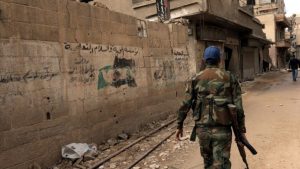
Syrian soldiers walk around at a street in Zamalka town, Eastern Ghouta, in the countryside of Damascus, Syria, 08 April 2018. The city was recently recaptured by the Syrian government during a military offensive that was launched more than a month ago against rebels. EPA, YOUSSEF BADAWI

APRIL 9, 2018 89

Η κατάσταση δεν είναι ρευστή και επικίνδυνη μόνο στη γειτονιά της Ελλάδας και της Κύπρου. Είναι το ίδιο ρευστή και επικίνδυνη σε όλο τον κόσμο, ειδικά στις περιοχές για τις οποίες ερίζουν (και προσπαθούν να ορίσουν) οι μεγάλες δυνάμεις.

Χωρίς αμφιβολία η Τουρκία είναι μία ενοχλητική δύναμη, που ελέγχεται από τον πιο αυταρχικό ηγέτη των χωρών της περιοχής. Οι απειλές του εναντίον του Αιγαίου και της κυπριακής ΑΟΖ είναι πραγματικές. Ας μην γελιόμαστε, διότι αν δεν προετοιμαστούμε για όλα τα ενδεχόμενα και κυρίως για να αμυνθούμε, μπορεί και να κλάψουμε.

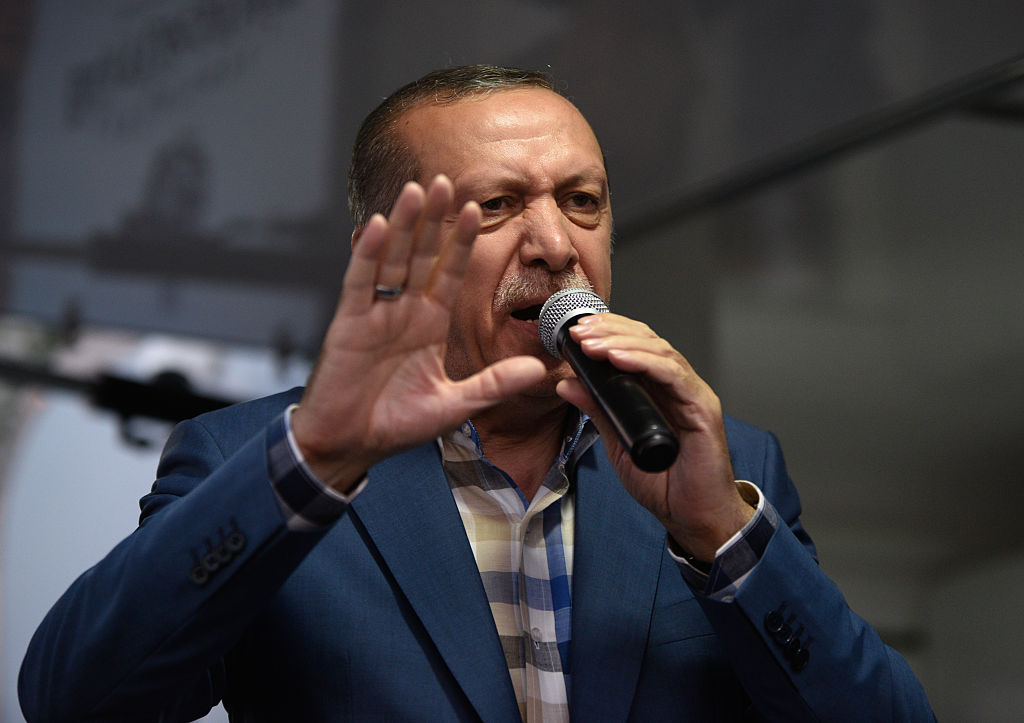
Ο Ταγίπ Ερντογάν βρίσκεται σε μόνιμη κατάσταση αμόκ, αν και εσχάτως επανήλθαν οι πληροφορίες ότι είναι βαριά ασθενής. Ακόμα και αν συμβαίνει αυτό, αν δηλαδή ο Ερντογάν όντως είναι άρρωστος, δεν πρέπει να μας καθησυχάζει. Διότι έχει δημιουργήσει στρατό αξιωματούχων που σκέφτονται όπως και ο ίδιος. Ακραία ισλαμιστικά, αλλά και αντι-χριστιανικά.

Διότι στο ταραγμένο του μυαλό δεν μας αντιμετωπίζει ως Έλληνες, αλλά ως άπιστους και αξίζει κανείς να μελετήσει με τις ώρες, για να το εμπεδώσει, το εξαιρετικό κείμενο του καθηγητή Μάριου Ευρυβιάδη που δημοσιεύθηκε στην Hellas Journal.

Ο κ. Ερντογάν είναι και ένας παράγοντας που επηρεάζει και τη Συρία. Ενώ είναι πιστός σύμμαχος της Ρωσίας και του Ιράν, που στηρίζουν ως να μην υπάρχει …αύριο τον πρόεδρο Άσαντ, η Τουρκία βρίσκεται απέναντί του.

Αυτή η διχογνωμία μπορεί να απειλήσει τη συμμαχία του με τη Μόσχα και την Τεχεράνη. Την ίδια στιγμή, η Συρία μπορεί να αποδειχθεί η αφορμή για ένα νέο γενικευμένο πόλεμο στην περιοχή της Μέσης Ανατολής.

Διαβάζω τα κείμενα πολλών αναλυτών, που ομιλούν ακόμα και για την πιθανότητα έναρξης του Γ’ Παγκοσμίου Πολέμου, όπου αντίπαλοι και όχι «σύμμαχοι» θα είναι η Αμερική του Ντόναλντ Τραμπ και η Ρωσία του Βλαντιμίρ Πούτιν, δύο ανθρώπων και πολιτικών με ισχυρή προσωπικότητα, που δεν τους αρέσει να χάνουν.

Η χθεσινή νέα επίθεση με χημικά, είτε διέπραξε το έγκλημα η κυβέρνηση της Συρίας είτε οι αντίπαλοί της, είναι ένας ισχυρός λόγος για να «μιλήσουν» τα όπλα των υπερδυνάμεων.

Ο Πρόεδρος Τραμπ πιστεύει ότι την ευθύνη έχει ο Άσαντ και ο προστάτης του, ο Βλ. Πούτιν. Αντίθετα, η Συρία και η Ρωσία, αλλά και η Τεχεράνη, η οποία και αυτή στηρίζει στρατιωτικά το καθεστώς του Άσαντ κατηγόρησαν τους αντιπάλους του.

Ειδικά το υπουργείο Εξωτερικών του Ιράν αναφέρθηκε σε μία νέα «συνωμοσία» εναντίον της συριακής κυβέρνησης: «Τέτοιου είδους καταγγελίες και κατηγορίες από τους Αμερικανούς και ορισμένες δυτικές χώρες αποτελούν ένδειξη μιας νέας συνωμοσίας εναντίον της κυβέρνησης και του συριακού λαού και ένα πρόσχημα για την ανάληψη στρατιωτικής δράσης, που σίγουρα θα περιπλέξει περαιτέρω την κατάσταση στη χώρα και την ευρύτερη περιοχή», σημειώνεται στην ανακοίνωση του υπουργείου Εξωτερικών του Ιράν.

Οι επόμενες ημέρες θα είναι κρίσιμες. Ήδη χθες, μία άγνωστη -μέχρι στιγμής- χώρα εξαπέλυσε επίθεση εναντίον της Συρίας με πυραύλους που προκάλεσαν πολλούς θανάτους και τραυματισμούς όπως μετέδωσαν τα κρατικά συριακά ΜΜΕ.

Οι Αμερικανοί διέψευσαν ότι βρίσκονται πίσω από τις επιθέσεις, οπότε ο άλλος πιθανός «ένοχος», εφόσον η επίθεση δεν είναι “fake news”, είναι το Ισραήλ.

Δεν μπορεί να είναι η Τουρκία διότι θα θέσει σε μεγάλο κίνδυνο τη συμμαχία της με τη Ρωσία και το Ιράν, δύο χώρες που έχει μεγάλη ανάγκη αυτή τη στιγμή.

Όποιοι και αν είναι αυτοί που κρύβονται πίσω από την πυραυλική επίθεση, όποιοι και αν έριξαν τα χημικά όπλα στους αμάχους, ένα πράγμα έχει σημασία: ότι μπορεί να άναψαν το φυτίλι ενός γενικευμένου πολέμου, στον οποίο θα λάβουν μέρος πρώην και νυν φίλοι και σύμμαχοι, και όπου η Τουρκία -εκτός της Συρίας- θα μπορούσε να βρεθεί στο επίκεντρο. Ένα είναι σίγουρο, που ίσως συνετίσει τις αντιμαχόμενες πλευρές: Το ξεκαθάρισμα των λογαριασμών θα είναι αιματηρό και θα προκαλέσει μεγάλες καταστροφές…

Πηγή: Θα είναι η Συρία η πηγή για τον Γ’ Παγκόσμιο Πόλεμο; Ο ύπουλος ρόλος της Τουρκίας… http://hellasjournal.com/2018/04/tha-ine-i-syria-i-pigi-gia-ton-g-pagkosmio-polemo-o-ypoulos-rolos-tis-tourkias/
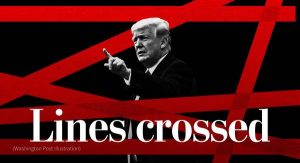

Trump’s real Syria policy is hypocrisy

0

BY ISHAAN THAROOR The Washington Post
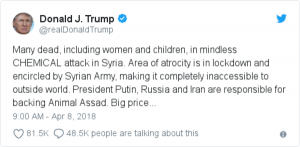
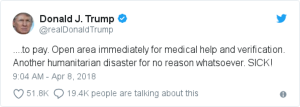
After a week of signaling an imminent exit from the Syrian conflict, President Trump mixed his messages once more with a furious set of tweets Sunday. Responding to reports of another potential chemical weapons strike carried out by the Syrian regime, Trump decried the “mindless CHEMICAL attack in Syria” and pinned the blame on President Bashar al-Assad and his Russian and Iranian patrons.

“Big price to pay,” Trump warned. But it was unclear what that price is and who might pay it — other than Syria’s brutalized civilian population, that is.

According to my colleagues, at least 40 people, including children, were killed Saturday evening in East Ghouta, a rebel-held enclave enduring a protracted government siege. First responders noted a “chlorine-like odor” after the attack, and patients showed symptoms such as respiratory ailments and foaming at the mouth.


The Syrian government rejected the allegations and, as usual, blamed Islamist rebels. Russian authorities also rebuffed international criticism of the Assad regime and warned against military intervention into Syria on “fabricated pretexts.” A Foreign Ministry statement suggested the reports were rebel inventions “designed to shield the terrorists and the implacable radical opposition, who reject a political settlement.”

That’s not a view shared in Washington or European capitals. “It’s a quite serious problem. We’ve seen the photos of that attack,” Thomas Bossert, Trump’s homeland security adviser, said to ABC News. “This is one of those issues on which every nation, all peoples, have all agreed and have agreed since World War II this is an unacceptable practice.”

Monday happens to mark the first day on the job for Trump’s new national security adviser, John Bolton, an outspoken proponent of unilateral American action around the world. Bolton was scheduled to chair a meeting on Syria, and Bossert suggested that all options “were on the table.”

In the late hours of Sunday, reports on Syrian state television claimed that an airbase near the city of Homs was targeted by a series of missiles, but it was unclear who was behind the bombardment and the Pentagon denied that it was involved in any airstrikes.

Such an attack would be a repeat of what Trump did last year after an alleged Syrian regime chemical-weapons strike in Idlib province. He ordered U.S. Navy ships to pound a Syrian government airfield with 59 Tomahawk missiles, then memorably shared the news over dessert with Chinese President Xi Jinping, who was visiting Trump at his Florida resort.

But if that punishment was meant to send a message to Assad, its effect has long since worn off — and Washington hawks are clamoring for more. They urged Trump over the weekend to reconsider his desire to withdraw American ground forces from Syria, a move they argue surrenders American leverage as the Assad regime looks to consolidate its position. The latest regime attack, Frederic Hof of the Atlantic Council said in an emailed statement, was a “challenge” to Trump’s “credibility.”

On Sunday, Sen. Lindsey O. Graham (R-S.C.), a frequent cheerleader of military interventions abroad, said that the Syrian regime and its allies “see us and our resolve breaking, they see our determination to stay in Syria waning . . . but President Trump can reset the table here.” Graham urged Trump to “follow through” on his bellicose tweets.

Trump, though, has shown little interest in owning the end game in Syria. He balks at the cost of the American war effort in the Middle East and Central Asia and cares chiefly about fighting the Islamic State. He also shares his predecessor’s wariness of getting too entangled in a push toward regime change.

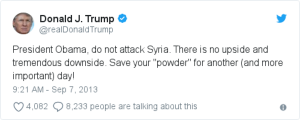
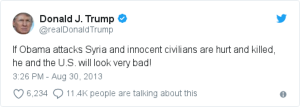
Soon after Trump’s Sunday-morning Twitter salvo, many commentators pointed to his criticism from four years ago, when the Obama administration contemplated how to punish Assad for a chemical-weapons attack. The use of the illicit weapons crossed Obama’s declared “red line,” but Trump was doggedly opposed to any U.S. airstrikes on the regime. He also expressed concern for civilians they could put at risk.


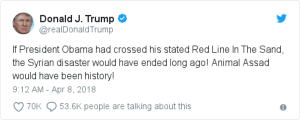
Of course, Trump is entitled to change his opinion over time. But on Sunday, he again tried to focus the blame on his predecessor, whom he now accused of not being tough enough on the Assad regime — in other words, for following Trump’s own advice at the time.


“Only Trump can criticize Obama for giving Assad a green light to commit atrocities in Syria while giving Assad a green light to commit atrocities in Syria,” tweeted Post columnist Josh Rogin. “The height of hypocrisy.”

There’s another important dimension to Trump’s hypocrisy. Trump may fret over the horrors unleashed by Assad, but he has been unable to muster much compassion for thousands of Syrian refugees his administration moved to block from entering the United States. While he feared for innocent civilians getting “hurt and killed” four years ago, he has presided over an escalating air war around the world. The resulting civilian death toll is unconfirmed, but it likely runs in the hundreds, if not thousands.

Trump is not so bothered by this sort of suffering anymore. My colleague Greg Jaffe reported over the weekend on a CIA briefing Trump attended on his first full day in office, during which the new president watched footage of a drone strike on a suspected Islamist militant target. U.S. authorities had chosen to wait for the fighter to walk away from a building that housed his family; Trump was confused that the CIA chose to spare the lives of the Islamist militant’s family.

This apparent cruelty now seems coupled with indifference. Targeted airstrikes may briefly chasten the Assad regime, but they can’t change the broader facts on the ground. Russia, Iran and Turkey have seized the initiative and are haggling over Syria’s political future while Trump seeks to pummel the Islamist militants and then disengage as quickly as possible.

Experts on counterterrorism stress that building economic growth and political inclusion in these war-torn societies is the real solution toward preventing future destabilizing — and miserable — insurgencies. Trump’s disinterest, they say, may have real costs.

“If we remain in Syria, that will at least indicate that we are interested in what is happening in the country,” Emile Nakhleh, a former senior CIA officer, wrote for the Cipher Brief. “But our military involvement is not sufficient. We can continue to kill ISIS fighters and reduce their territory, but if we are not engaged diplomatically, then it is unlikely there will be any sort of breakthrough regardless of our military involvement.”


Green shoots of recovery but little relief for Greeks

0

For many in Greece there has been no recovery, particularly among the once healthy middle class

Giorgos Kyriazis in his shop in Athens. Courtsey: Marcos Andronicou

In Athens and across the eurozone, there is a cautious sense of optimism over an economic disaster that very nearly broke not just a nation but the European Union.

Nine years after Greece was first plunged into crisis, the country is anticipating a record tourist season this year, giving hope that recovery is finally on the way.

News that Aegean Airlines last week signed a $5 billion deal with Airbus for 42 new aircraft marked only the third fleet expansion by the nation’s largest carrier in almost two decades. Nationwide unemployment is dropping, from 27.9 per cent at the peak of the crisis in 2013 to 20.9 per cent today – although that is still more than twice the EU average.

Athens also appears to be limping away from EU bailout dependency.

Last month, its treasury received a further €5.7bn of a €6.7bn loan from eurozone funds, which the radical-left Syriza government claims sets the stage for Greece to officially leave the bailout programme in August. Also last month, Sir Suma Chakrabati, president of the European Bank of Restructuring and Development, added his voice to a chorus of support for a Greek exit from the programme.

Yet for many in Greece there has been no recovery, particularly among the once-healthy middle class. An old Greek maxim that small business is the cornerstone of the economy has been tested to the hilt. In a country still blighted by corruption and a bloated public sector, the small private businesses have not been given the opportunity to rebuild.

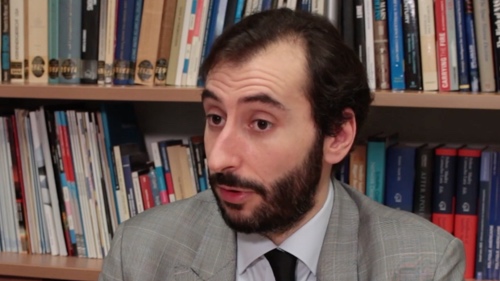
Dr Yianni Malliaris, 42, sits in a well-aired Athens office, the shutters open and the faint soundtrack of the street three floors down drifting in.

The clinical psychiatrist left a post at King’s College in London at the height of the crisis to return to Greece.

He wanted to set up a small psychiatric practice and start a family.

He has no doubts about how important small businesses like his are to the wider economy.

“It’s the least corrupt part, it’s the least burdensome part of the Greek economy and it’s the most hardworking part of the Greek economy.

“To survive as a small-business owner in Greece, or a freelancer in Greece, you have to work twice as hard as people in the UK. Many people do two or three jobs at the same time. All they get is taxes and a bad reputation and nothing else,” he says.

Between 2009 and 2013, an estimated 392,000 small and medium-sized enterprises closed down.

And their troubles have continued, despite Greece’s alleged recovery.

It is the small business owners the cash-stripped government has gone after the hardest, levying tax after tax to raise cash for the public purse.

As Nick Malkoutzis, editor of the Macropolis economic blog, says: “The middle class has taken much of the burden during the crisis, and has been deeply affected by tax increases, wage cuts and unemployment, and the process of reversing this is a very important part of the Greek recovery.”

New taxes hit the middle class especially hard. Reforms to national insurance have turned it into a means-tested system with no ceiling, effectively rendering it a secondary income tax, and businesses have to pay their income tax up front every second year, leaving cash flows heavily depleted.

Dr Malliaris estimates he spends 40 per cent of his time organising his tax affairs. “If you don’t do that, you’ll go out of business.

“Direct and indirect taxes amount to about 80 per cent … but that’s not based on real income, it’s based on income you don’t have, which is even worse.”

Often, small business throughout Greece will offer two different prices for their services – one with a receipt, the other without.

A transaction without a receipt cannot be taxed.

“They don’t do it to profit, they do it to survive. You can’t survive with 80 per cent tax,” says Dr Malliaris.

Small business owners like Dr Malliaris and other freelancers have been the collateral damage in an increasingly heavy tax regime on Greece’s middle class. “In the UK, I was always focused on my work and doing well for my patients. Here, I turn into some kind of crazy business person trying to survive. I have to learn economics, logistics, accounting. You have to understand the rationality of the system, which I could really do without.

“I add to that worry time, which we shouldn’t actually have. The worry time is an important aspect; it’s becoming the most harmful thing.”

Although highly specialised and able to attract clients from around the world, there is little incentive for Dr Malliaris to expand his practice.

He would have to pay almost 50 per cent national insurance on the salaries of any further employees – it would cost him €1,500 to pay someone a monthly salary of €1,000.

Instead, he buys in extra services and makes use of zero-hour contracts to keep his taxable income as low as possible. It’s not just heavy taxation that has stunted recovery.

As the crisis unfolded, hundreds of thousands of educated Greeks left the country and, despite signs of economic growth, there are few indicators these people are returning, says Mr Malkoutzis.

“Greece has also seen a significant brain drain. The children from middle class families, where there has been an investment from these households in educating them and giving them useful skills and knowledge, have been lost to a great degree. We’ve had hundreds of thousands of educated young Greeks leave, and now there is a lack of skills in a number of areas in the economy, because until now the jobs simply weren’t there.

“If they don’t feel that they have a future here, then there is a big gap in terms of the human resources Greece can draw on in order to fuel the recovery,” he says.

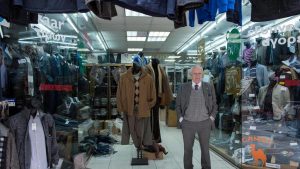
The heavy taxation has also had the effect of sucking money out of people’s pockets. Nikos Kyriazis, 46, runs a family clothing chain with his father Giorgos.

Giorgos confidently roams the street outside the shop front, pulling in customers and improvising deals to get potential buyers through the door.

In 2005, they had seven outlets across Athens. Now, they have just two. Giorgos manages one, Nikos the other.

“The taxes have taken all the money out of the market,” says Nikos. Business is less than 50 per cent of what it was when they opened before the crash in 2005, and if there is a recovery going on at the minute, they are seeing nothing off it. “We tasted a slight recovery at the end of 2014. We had some encouraging signs there would be a comeback. But elections in 2015 and all the rounds of austerity have killed that. Now, things are as bad as they have ever been,” says Nikos.

“The majority of Greeks are middle class, low income, they used to buy from my store. Now, they don’t have anything to spend.

“In Greece, we say ‘at least I still have my health’ – that’s more important now than ever”.

Unlike other eurozone countries bailed out at the peak of the crisis, Greece will be offered some form of debt relief by its creditors.

“It’s only natural that with such a concession coming from the European side, they want to be sure that Athens complies with certain commitments and fiscal parameters,” says Mr Malkoutzis. That is to say, even after the bailout programme ends, Greece is still going to have to acquiesce to eurozone demands.

Pension cuts worth another 1 per cent of GDP are yet to come, and the income tax threshold is to be lowered from €8,500 to €5,500, substantially widening the tax base. There will also be challenging demands for economic growth – 3.5 per cent of GDP every year until 2022.

Further rises in income tax and national insurance are not out of the question, either.

“Given the huge hit Greek taxpayers have taken over the last eight years, we are going to need many more years before they start to feel they are back anywhere near where they were before the crisis began,” says Mr Malkoutzis.

There are also fears regarding exactly what happens when Greece finishes the bailout programme and European oversight is reduced.

Dr Malliaris fears a culture of corruption might drag Greece back to the abyss again.

“In many ways, having Europe overseeing what was happening here and fixing problems has been a good thing for Greece,” says Dr Malliaris.

“If we lose that, the ones who have access to the government, the ones who have access to the public money, they will continue doing what they knew best: to serve their own self-interests and not look after the interests of the economy or the Greek state. So I hope for the best, but I don’t think we should be left unregulated”.

https://www.thenational.ae/business/economy/green-shoots-of-recovery-but-little-relief-for-greeks-1.719760

“Terrorism” Turkish Style

0

The Future of Greek-Israeli Relations

0

By April 8, 2018 

BESA Center Perspectives Paper No. 788, April 8, 2018

EXECUTIVE SUMMARY: In July 2010, then Greek Prime Minister George Papandreou visited Jerusalem and met his Israeli counterpart Benjamin Netanyahu. A few weeks later Netanyahu traveled to Athens and held discussions with Papandreou. The long-term significance of those visits could not be acknowledged at that time. But almost eight years later, it is now clear that those talks were a catalyst for the rapprochement that has occurred between two countries that have had a difficult relationship for decades. Greece and Israel are growing ever closer by establishing a strategic partnership and exploring ways to further deepen it.

The deterioration of relations between Israel and Turkey that began at the end of 2008 led the Israeli leadership to look for alternative alliances in the Eastern Mediterranean. A rapprochement with Greece, traditionally at odds with Turkey, made theoretical sense but was practically difficult due to the Greek sympathy with the Arabs and the Palestinian cause. Careful diplomacy was thus required.

While some discussions on the matter began in Athens in the spring of 2009, the turning point occurred in 2010. Prime Ministers George Papandreou and Benjamin Netanyahu opened a new chapter in the bilateral relationship by meeting in Moscow in February of that year. Two important visits soon followed: one by Papandreou to Jerusalem in July and one by Netanyahu to Athens in August.

As a matter of principle, Papandreou was in favor of a multidimensional Greek foreign policy, and he was interested in the security and economic benefits that could accrue from a rapprochement with Israel. More importantly, Greece counted on Israel’s support during a particularly tough and unpredictable period for its national economy. This support was played out in both Europe and the US on several occasions.

In June 2011, for instance, The Jerusalem Post reported that Netanyahu had used his reputation as a leader with a good grasp of economic matters to encourage Israel’s friends to be supportive of the Greek efforts. When Papandreou resigned at the end of October 2011, Netanyahu did not change his approach. Hosting Prime Minister Antonis Samaras two years later, he encouraged Israeli investors and businesspeople to go to and invest in Greece.

Military cooperation has been also remarkable since the ice was broken. Between 2010 and 2012, no fewer than 13 joint Greek-Israeli military exercises were conducted. According to a paper published by the Hudson Institute, bilateral cooperation in the zone between Israel and Crete (a distance of about 1,400 km) has allowed Israeli pilots to engage in bombing drills and the aerial refueling needed to cover a distance equal to that separating the country from Iran’s Natanz nuclear enrichment facility. Further to this, Reuters informs us that Israel has trained in Greece against the Russian S-300 anti-aircraft system.

Greek-Israeli relations have improved further during the administration of the leftist SYRIZA party. Despite the stance of its leader and current premier Alexis Tsipras while in opposition, he has proven to be a real friend of Israel. Ambassador Arye Mekel calls this “impressive and surprising”. Not only is the Greek PM interested in closely cooperating with Israel but he sometimes supports Israeli positions at the EU. In November 2016, Greece defied an EU order on labelling settlement goods. Tsipras is also showing sensitivity in the fight against anti-Semitism, which remains a problem in Greece.

Eight years after the initial rapprochement between Greece and Israel, the bilateral partnership is stronger than ever. Israeli companies are interested in participating in the Greek privatization program, and military exercises – also under the NATO aegis – are multiplying. The January 2018 visit of Israeli President Reuven Rivlin to Athens and Thessaloniki was another indication of the excellent status of the bilateral relationship.

The Greek main opposition, the conservative New Democracy party, is ahead in all opinion polls, and it will certainly continue the pro-Israel path of previous governments if it wins the next election. George Koumoutsakos, the head of New Democracy’s international affairs department, paid an official visit to Israel in mid-March 2018 and said that Greek-Israeli relations “could acquire strategic depth in favor of economic progress, stability and peace in the region of the Eastern Mediterranean.” The head of the party’s defense affairs department, Vassilis Kikilias, also visited Israel a few days after Koumoutsakos in another sign of continuity.

Energy developments in the Eastern Mediterranean are only helping the bilateral partnership. Companies are the first to tangibly benefit. In December 2017, for example, Israel Chemicals (ICL Group) signed a contract with the Greek Energean company for the latter to supply up to 13 BCM of natural gas to the former at a total consideration of $1.9 billion over a 15-year period. For their part, the governments of Greece, Israel, and Cyprus are frequently convening trilateral summits for the purpose of finding areas of collaboration around prior and forthcoming natural gas discoveries in the Eastern Mediterranean. In spite of the high cost, the construction of the EastMed pipeline to transfer energy resources from the Levantine Basin to Europe remains the only viable solution that can enhance regional security in a turbulent neighborhood.

The rapprochement between Greece and Israel initially aroused some skepticism as to its likely duration in view of the unprecedented nature of the initiative, stereotypes from the past, and possible counter-maneuvering by Ankara. In 2018 the landscape is much clearer. Mutual suspicions are disappearing and Greece is becoming a reliable ally of Israel, while Turkey is manifesting its Islamist, neo-Ottoman aspirations on all fronts. The creation of a geopolitical bloc among Greece, Israel, and Cyprus is no longer a utopia and is supported by the US. The sky might be the limit for Greece and Israel, as President Rivlin recently argued. The younger generation of Greeks and Israelis is prepared to accept and even serve this goal.

View PDF

Dr George N. Tzogopoulos is a BESA Research Associate, Lecturer at the Democritus University of Thrace, and Visiting Lecturer at the European Institute of Nice.

BESA Center Perspectives Papers are published through the generosity of the Greg Rosshandler Family.

Dr. George N. Tzogopoulos
Dr. George N. Tzogopoulos (Ph.D. Loughborough University) specializes in media and international relations as well as Chinese affairs. Email: [email protected]

Ali Wentworth and George Stephanopoulos’s New York Apartment

0

Ali Wentworth recounts how she and George Stephanopoulos relocated to New York in a flash–aided by their close friend and favorite designer, Michael S. Smith.

 · March 2012 Issue 

Ali Wentworth and George Stephanopoulos's New York Apartment 
COPYRIGHT ©2012 THE CONDÉ NAST PUBLICATIONS. ALL RIGHTS RESERVED.

High-gloss wallpaper by Elizabeth Dow provides a colorful contrast to the foyer’s floor tiles, which are part of Smith’s collection for Ann Sacks; the chandelier and the striped upholstery fabric are by Jasper, the drawing at left is by Lucian Freud, and the pagoda étagère is by Bardeaux Mobilier.

Ali Wentworth and George Stephanopoulos's New York Apartment 
Photo: Scott Frances

The living room features a skirted sofa and armchairs, all by O. Henry House, upholstered in fabrics by Cowtan & Tout and Jasper, respectively; the Regency mirror and the mahogany bookcase were bought at auction, the settee is a Swedish antique, and the cocktail table and the curtain fabric are both by Jasper.

Ali Wentworth and George Stephanopoulos's New York Apartment
COPYRIGHT ©2012 THE CONDÉ NAST PUBLICATIONS. ALL RIGHTS RESERVED.

A pair of hand-painted gouache panels are displayed above a velvet-covered sectional sofa in a corner of the living room; the antique Bibikabad carpet was acquired at auction.

Ali Wentworth and George Stephanopoulos's New York Apartment 
COPYRIGHT ©2012 THE CONDÉ NAST PUBLICATIONS. ALL RIGHTS RESERVED.

A Regency twin-pedestal dining table is grouped with a George III sideboard and ladder-back chairs, all of mahogany; the chairs are upholstered in a Jasper leather.

Ali Wentworth and George Stephanopoulos's New York Apartment 
COPYRIGHT ©2012 THE CONDÉ NAST PUBLICATIONS. ALL RIGHTS RESERVED.

Charlie, left, and Daisy on chairs by David Iatesta in the breakfast area; the hanging lantern is by Vaughan.

Ali Wentworth and George Stephanopoulos's New York Apartment 
COPYRIGHT ©2012 THE CONDÉ NAST PUBLICATIONS. ALL RIGHTS RESERVED.

The kitchen’s cooktop and hood are by Wolf.

COPYRIGHT ©2012 THE CONDÉ NAST PUBLICATIONS. ALL RIGHTS RESERVED.

The library’s mirror and ottoman are by English Georgian, and the sofa and armchair are by O. Henry House.

Ali Wentworth and George Stephanopoulos's New York Apartment 
COPYRIGHT ©2012 THE CONDÉ NAST PUBLICATIONS. ALL RIGHTS RESERVED.

A library window affords a view of Central Park; the Emmy was awarded to Stephanopoulos for his role in ABC’s coverage of the 2009 inauguration.

Ali Wentworth and George Stephanopoulos's New York Apartment 
COPYRIGHT ©2012 THE CONDÉ NAST PUBLICATIONS. ALL RIGHTS RESERVED.

Hand-painted chinoiserie wallpaper by Gracie forms a backdrop to the master suite’s Italian neoclassical bed, which is dressed in Nancy Koltes linens.

https://www.architecturaldigest.com/gallery/ali-wentworth-george-stephanopoulos-apartment-slideshow/all?mbid=nl_04082018PM_Weekly&CNDID=39885322&spMailingID=13268206&spUserID=MTMzMTM1NzM3MjI2S0&spJobID=1380546144&spReportId=MTM4MDU0NjE0NAS2

Διαμελισμό της Συρίας Με Στόχο το Γκολάν και Πετρέλαιο Επιδιώκουν ΗΠΑ και Ισραήλ

0

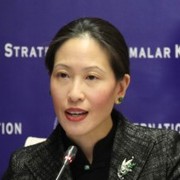
CHRISTINA LIN ,Asia Times, APRIL 4, 2018

[Η αρθρογράφος , Νοτιο-Κορεατικής καταγωγής Δρ. Χριστίνα Λιν, είναι συνεργάτης του Κέντρου για τις Διατλαντικές Σχέσεις του  αμερικανικού Πανεπιστημίου Johns Hopkins, ειδικευόμενη στις σχέσεις Κίνας-Μέσης Ανατολής/Μεσογείου και Σύμβουλος Ερευνών.  Το βιογραφικό της, με ανώτατες σπουδές στις ΗΠΑ, η διασύνδεσή της με αμερικανικές « δεξαμενές σκέψης» και η κατακλείδα του άρθρου συνιστούν τους τίτλους αναγνωσιμότητάς του, για την διάγνωση προθέσεων.]

Παρουσίαση :Μιχαήλ Στυλιανού                                                                         

Ο Πρόεδρος Ντόναλντ Τραμπ, ύστερα από την περικοπή κονδυλίου δαπανών 200 εκατομμυρίων για την ανοικοδόμηση της κατεστραμμένης από τον πόλεμο Συρίας, δήλωσε προ δεκαημέρου ότι οι ΗΠΑ θέλουν να αποχωρήσουν από την Συρία «σύντομα».

Φυσικά αυτό το δίδυμο ανακοινώσεων σήμανε συναγερμό στο αμερικανικό στράτευμα, στα ελεγχόμενα από το μεγάλο κεφάλαιο ΜΜΕ και  στις κατεστημένες «δεξαμενές σκέψης», όπως επίσης και  σε συμμάχους που θέλουν να διατηρήσει η Ουάσιγκτον την στρατιωτική παρουσία της στην Συρία και στην Μέση Ανατολή.

«Πιστεύουμε ότι αμερικανικά στρατεύματα θα πρέπει να παραμείνουν, τουλάχιστον μεσοπρόθεσμα αν όχι μακροπρόθεσμα» δήλωσε ο Διάδοχος της Σαουδικής Αραβίας, που θέλει να χρησιμοποιήσει την αμερικανικήν στρατιωτικήν ισχύ για να αντιμετωπίσει το Ιράν στον συναγωνισμό τους για περιφερειακή ηγεμονία. Το Ισραήλ και Ευρωπαίοι σύμμαχοι των ΗΠΑ εκφράζουν την ίδια επιθυμία.

Ωστόσο ο Τραμπ θέλει από τις χώρες της περιφέρειας, όπως η Σαουδική Αραβία, να διαδραματίσουν μεγαλύτερο ρόλο και να επωμισθούν μεγαλύτερο μέρος της δαπάνης για την Συρία. Και από τις ευρωπαϊκές χώρες θέλει να κάνουν περισσότερα, αφού οι εκπατριζόμενοι Σύροι καταλήγουν ως πρόσφυγες στην Ευρώπη. Πολλοί Σύροι που διαφεύγουν από τους Τζιχαντιστές, καταφεύγουν επίσης και στις γειτονικές χώρες, Λίβανο, Ιράκ, Αίγυπτο και Τουρκία. Όταν η Σαουδική Αραβία. Το Κατάρ, τα Ενωμένα Αραβικά Εμιράτα και άλλα πλούσια κράτη του Περσικού Κόλπου θορυβούν υπέρ της αλλαγής καθεστώτος (στην Συρία) και αύξηση της στρατιωτικής κλιμάκωσης, διερωτάται κανείς πόσους πρόσφυγες έχουν δεχτεί στο έδαφός τους.

Κανέναν, σύμφωνα με τον κ. Κένεθ Ροθ, διευθυντή της ΜΚΟ Παρατηρητήριο Ανθρωπίνων Δικαιωμάτων.

Ακόμη χειρότερο, η Σαουδική Αραβία δημιουργεί η ίδια χιλιάδες προσφύγων, βομβαρδίζοντας την Υεμένη, σε μιαν επιχείρηση που έχει ήδη σκοτώσει περισσότερους από 10.000 αμάχους και τραυματίσει άλλους 40.000, (μεταξύ των οποίων και 135 σε έναν γάμο),κυρίως γυναίκες και παιδιά.

Υπάρχουν πράγματι διάφοροι σοβαροί λόγοι για να θέλει ο Τραμπ την αμερικανική στρατιωτική αποχώρηση από την Συρία: Ένα αμερικανικό κρατικό χρέος-βόμβα  21 Τρισεκατομμυρίων, οι κίνδυνοι που αντιμετωπίζει το αμερικανικό δολάριο -ένα χαρτονόμισμα που στηρίζεται μόνο στην εμπιστοσύνη της κυβέρνησης και όχι σε αντίκρισμα χρυσού ή αργύρου- οι καταρρέουσες υποδομές στο εσωτερικό των ΗΠΑ, που απαιτούν γενικήν αποκατάσταση, τα 5 Τρισεκατομμύρια δολάρια που ξοδεύτηκαν στους πολέμους μόνο του Ιράκ και του Αφγανιστάν, οι πάνω από 40.000 βετεράνοι αυτών των πολέμων για την αλλαγή καθεστώτος, που περιφέρονται άστεγοι  σε όλη τη χώρα, με πολλούς να καταλήγουν σε αυτοκτονία μετά από μακρά αναμονή για θεραπεία, η υπόσχεση του Τραμπ να ξανακάνει μεγάλη την Αμερική –όχι την Συρία, η άλλες χώρες της Μέσης Ανατολής. Τότε γιατί Στρατιωτικό και Πολιτικο-Οικονομικό Κατεστημένο ανάγκασαν τον Τραμπ να πάρει πίσω αυτή την δήλωση για αποχώρηση από την Συρία;

Όπως αποκάλυψε ο Josh Rogin  στην Washington Post  είναι για να πάρουν το πετρέλαιο.

Για το πετρέλαιο

Τα υπό αμερικανική κατοχή εδάφη στα βόρειο-ανατολικά,  περιλαμβάνουν το ένα τρίτο της συριακής επικράτειας με πηγές πετρελαίου που προ του πολέμου απέδιδαν το 90% της συνολικής εθνικής παραγωγής. Ωστόσο, σύμφωνα με ορισμένους Σύρους αναλυτές, οι πρόσοδοι από το πετρέλαιο είναι περιορισμένες και ανεπαρκείς για την κάλυψη των αναγκών και της τοπικής διοίκησης. Συμβαίνει όμως η Συρία να έχει μια μεγαλύτερη προίκα, κρυμμένη αλλού –στα Υψώματα του Γκολάν.

Όπως αναφέρθηκε ήδη από τον Νοέμβριο 2015 στους Asia Times, η εταιρεία Afek Oil and Gas, παράρτημα της αμερικανικής Genie Energy, ανακάλυψε μια πετρελαϊκή χρυσοπηγή στα Υψώματα του Γκολάν, «με δυνατότητες απόδοσης δισεκατομμυρίων δολαρίων».  Η GenieEnergy, που καυχάται για ένα συμβούλιο γεμάτο από πρώην μέλη αμερικανικών κυβερνήσεων, πέτυχε να εξασφαλίσει άδειες εξερεύνησης, παρά την αντίθεση τοπικών και περιβαλλοντικών οργανώσεων που ανησυχούν για την μόλυνση της υπαίθρου του Γκολάν και της Θάλασσας της Γαλιλαίας, πιο κάτω. Τα μεγαλύτερα όμως προβλήματα  αφορούν στο θέμα της κυριαρχίας. Το Ισραήλ προσάρτησε  μέγα μέρος του Γκολάν το 1981, το οποίο ωστόσο θεωρείται διεθνώς ως παράνομα κατεχόμενο  συριακό έδαφος. Η ισραηλινή ηγεσία είχε προηγουμένως προσφερθεί να  αποσυρθεί από το Γκολάν, που καταλήφθηκε το 1967, σε αντάλλαγμα μιας διεξοδικής συνθήκης ειρήνης με την Συρία. Αλλά από την έναρξη της αποσύνθεσης της Συρίας το 2011, καταβάλλονται προσπάθειες αναγνώρισης ως νόμιμης της ισραηλινής κατοχής των 1.200 τετραγωνικών χιλιομέτρων στα Υψώματα του Γκολάν.

Πράγματι το Ισραήλ έχει ενισχύσει την άμυνα του Γκολάν. Τον περασμένο Ιούνιο, όταν ένα βλήμα όλμου έπεσε στο Γκολάν, η ισραηλινή αεροπορία βομβάρδισε τις θέσεις του συριακού στρατού στο χωριό Σαμαντάνιε  αλ Σαρκίγια  στην επαρχία  Κιουνέϊτρα. Τον Φεβρουάριο, μετά την συντριβή  ενός  ισραηλινού F-16 στο έδαφος της Συρίας, οι Ισραηλινοί βομβάρδισαν την μισή αεράμυνα της Συρίας , από αέρος και -με πυραύλους- από τα Υψώματα του Γκολάν. Το Ισραήλ επίσης υποστηρίζει  ανταρτικές ομάδες  σαν ανάχωμα απώθησης των κυβερνητικών δυνάμεων της Συρίας.

 Προς  Διαμελισμό της Συρίας

Η διατήρηση  των αμερικανικών στρατιωτικών δυνάμεων στη Συρία και ο διαμελισμός της χώρας σε  σφαίρες επιρροής, όπως στην Κίνα του 19ου Αιώνα, θα διευκόλυνε την προσάρτηση του Γκολάν από το Ισραήλ και θα εξασφάλιζε στις Ισραηλο-αμερικανικές εταιρείες την εκμετάλλευση των κοιτασμάτων πετρελαίου.

Στην περίπτωση της Συρίας, στην κατανομή των σφαιρών επιρροής, στις ΗΠΑ θα ανήκε το βόρειο-ανατολικό τμήμα, στην Τουρκία το βόρειο-δυτικό, στο Ιράν η παράκτια περιοχή και μεγάλα τμήματα της συριακής ερήμου και στο Ισραήλ και στην Ιορδανία το νότιο-δυτικό, σύμφωνα με το σχέδιο διαμελισμού  που κατέστρωσε η  αμερικανική RAND Corporation και δημοσίευσε πρώτη η γερμανική εφημερίδα Deutsche Wirtschafts Nachrichten.

Αξιοσημείωτο είναι ότι στο αμερικανικό αυτό σχέδιο η περιοχή του Μανμπίζ βρίσκεται στην τουρκική σφαίρα επιρροής. Αυτό δε προκαλεί ασάφεια  εάν οι Αμερικανοί θα συνεχίσουν να υποστηρίζουν τους εκεί Κούρδους, καθώς ο στρατός του Ερντογάν και οι δυνάμεις κρούσεως των Τζιχαντιστών συνεχίζουν την προώθησή τους για την κατάληψη εδαφών δυτικά του Ευφράτη.

Και παρά τις διακηρύξεις της συριακής κυβέρνησης ότι θα ανακτήσει όλα τα χαμένα εδάφη, από την σημερινή οπτική γωνία αυτό δεν φαίνεται πολύ πιθανό. Όπως στην περίπτωση της Κίνας, μπορεί να απαιτηθεί άλλος ένας αιώνας.

Christina Lin

Dr. Christina Lin is a Nonresident Fellow at the Center for Transatlantic Relations at SAIS-Johns Hopkins University specializing in China-Middle East/Mediterranean relations, and a research consultant for Jane’s Chemical, Biological, Radiological, and Nuclear Intelligence Centre at IHS Markit.

atimes.com/infognomon.gr

Ο πραγματικός κίνδυνος του εμπορικού πολέμου

0

PAUL KRUGMAN/THE NEW YORK TIMES

Με τον δεύτερο γύρο δασμών ανάμεσα σε Ουάσιγκτον και Πεκίνο, οι αγορές υποχώρησαν για μία ακόμη φορά. Και το ερώτημά μου είναι γιατί τόση πτώση. Θα μπορούσε κανείς να απαντήσει πως ο Τραμπ και ο Ναβάρο αποδεικνύουν πως είναι πράγματι τόσο ανεύθυνοι όσο φαίνονται και οι αγορές το παρατηρούν. Ομως, οι εκτιμήσεις για το κόστος ενός εμπορικού πολέμου δεν μιλούν για μείωση του ΑΕΠ κατά 10% ούτε καν για μείωση κατά 5%. Το κόστος του προστατευτισμού δεν είναι μεν ευτελές αλλά δεν είναι ούτε καταστρεπτικό. Υπάρχει, πάντως, κάποιος λόγος που οι αγορές υποχώρησαν αρκετά. Ενας εμπορικός πόλεμος που θα οδηγούσε την αμερικανική οικονομία εκτός παγκοσμιοποίησης, θα υπαγόρευε μια ανακατανομή των πόρων και των κεφαλαίων. Ενας εμπορικός πόλεμος θα αφαιρούσε την αξία πολλών περιουσιακών στοιχείων και θα τα αχρήστευε πλήρως.

Οι δασμοί δεν είναι ο παράγοντας που μπορεί να προκαλέσει κάτι σαν μεγάλη ύφεση. Το πρόβλημα με τον προστατευτισμό είναι πως σε αναγκάζει να διακόψεις πράγματα που κάνεις καλά και να στραφείς σε πράγματα που δεν κάνεις καλά. Οι Αμερικανοί εργαζόμενοι μπορούν ασφαλώς να ράψουν πιτζάμες αντί να τις εισάγουν από το Μπανγκλαντές. Η παραγωγικότητά μας, όμως, είναι πολύ μεγαλύτερη σε άλλα πράγματα. Γι’ αυτό είναι προς όφελος όλων των χωρών να επικεντρώνονται σε αυτό που κάνουν καλύτερα. Ενας εμπορικός πόλεμος αυξάνει τεχνητά το κόστος και ακυρώνει την παραγωγική εξειδίκευση, αναγκάζοντας τους πάντες να είναι λιγότερο αποτελεσματικοί. Από το 1990 και μετά, οι αμερικανικές επιχειρήσεις έχουν βασιστεί στην παγκοσμιοποίηση. Ο υπολογιστής μου σχεδιάστηκε στην Καλιφόρνια, συναρμολογήθηκε στην Κίνα και πολλά από τα εξαρτήματά του ήρθαν από τη Νότια Κορέα ή την Ιαπωνία. Η Apple θα μπορούσε να τον έχει κατασκευάσει εξ ολοκλήρου στη Βόρεια Αμερική και πιθανώς να το έκανε για να αποφύγει δασμούς 30%.

Τα εργοστάσια, όμως, που θα χρειάζονταν για την παραγωγή του στις ΗΠΑ δεν υπάρχουν (ακόμη). Εκείνα που υπάρχουν έγιναν για να εξυπηρετήσουν την παραγωγή με όρους παγκοσμιοποίησης και πολλά από αυτά θα έμεναν στο περιθώριο και χωρίς καμία αξία αν οι δασμοί έσπαγαν την αλυσίδα της παραγωγής. Εν ολίγοις, θα αχρηστεύονταν. Και βέβαια ένας εμπορικός πόλεμος δεν θα αχρηστεύσει μόνον τα εργοστάσια. Πολλοί άνθρωποι θα μείνουν χωρίς αντικείμενο. Το θέμα δεν είναι ότι η ραγδαία ανάπτυξη έκανε την Αμερική φτωχότερη αλλά ότι οι ραγδαίες μεταβολές στη γεωγραφική κατανομή της παραγωγής άφησαν εκτός εργασίας μεγάλο αριθμό εργαζομένων, προκαλώντας δυστυχία και πλήττοντας ολόκληρες κοινότητες. Ειρωνεία της τύχης είναι πως αν προσπαθούσαμε να αλλάξουμε την κατάσταση με ένα πλήγμα κατά της Κίνας, το αποτέλεσμα θα ήταν και πάλι το ίδιο.

“Καθημερινή”

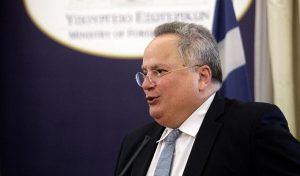
Κοτζιάς: Η Τουρκία δεν μπορεί να ονειρεύεται αλλαγή στα ευρωπαϊκά σύνορα

2

(Φωτ.: ΑΠΕ-ΜΠΕ / Αλέξανδρος Μπελτές)

Ο Νίκος Κοτζιάς καλεί την Τουρκία να αντιληφθεί ότι η φιλική διάθεση και οι απαντήσεις «με διπλωματικά μέσα σε προκλήσεις ακόμα και στρατιωτικές, δεν πρέπει να εκλαμβάνονται ως αδυναμία. Είναι συμπεριφορά ευθύνης. Αυτό δείχνει δύναμη χαρακτήρα και δυνατοτήτων». Αυτό τόνισε, μεταξύ άλλων, ο υπουργός Εξωτερικών σε συνέντευξή του στο περιοδικό Der Spiegel με τίτλο «Η Τουρκία αρέσκεται να παίζει με τη φωτιά».

«Εμείς είμαστε διαφορετικός παίκτης στο διεθνές σύστημα. Η χώρα μου θα υπερασπιστεί τα δικαιώματά της με τρόπο διαφορετικό» διαμήνυσε.

Ο Νίκος Κοτζιάς ξεκαθάρισε ότι «εμείς δεν πρόκειται να πάμε ποτέ σε ένα τραπέζι διαπραγμάτευσης με τους δικούς της όρους» και «καλό είναι να το καταλάβει» η Τουρκία, επισημαίνοντας παράλληλα ότι «δεν πρέπει εμείς να δημιουργούμε ατμόσφαιρα που να την διευκολύνει να βγάζει την εσωτερική της νευρικότητα πάνω μας» και να μπαίνουμε στο «τουρκικό παιχνίδι» και «τον τρόπο που κάνει πολιτική» με εντάσεις, επισημαίνοντας:

«Ο δικός μας πολιτισμός είναι πιο ορθολογικός και δίκαιος. Δεν πρέπει να παρασυρόμαστε σε ένα “chicken game”».

«Αυτή δεν είναι συμπεριφορά μεταξύ συμμάχων του ΝΑΤΟ, δεν είναι καλό αυτό, γιατί θα χαθούν και δικοί τους στρατιωτικοί, όπως συνέβαινε κατά καιρούς» τόνισε Νίκος Κοτζιάς σχετικά με τη σύλληψη των δύο Ελλήνων στρατιωτικών από την Τουρκία. Παράλληλα, ανέφερε ότι στο γραφείο του έχει «έγγραφα για εκατοντάδες ανάλογες περιπτώσεις, ακόμα και πρακτικά παράδοσης, που εμείς τους επιστρέψαμε, χωρίς τέτοια κλιμάκωση». Στη συνέχεια ξεκαθάρισε ότι πρόκειται για δύο διαφορετικά πράγματα σε σχέση με τους 8: «Εμείς τους 8 δεν τους συλλάβαμε. Οι 8 ζήτησαν άσυλο από την Ελλάδα. Οι δικοί μας στρατιωτικοί δεν ζητούν άσυλο στην Τουρκία. Συνελήφθησαν παρά τη θέλησή τους».

Παράλληλα απέκλεισε κάθε εικασία περί προετοιμασίας για πιθανό πόλεμο με την Τουρκία, τονίζοντας ότι «δεν υπάρχει εναλλακτική από την ειρήνη και την ειρηνική συνύπαρξη» και τα υπάρχοντα προβλήματα «πρέπει να λύνονται διπλωματικά, ειρηνικά, με βάση το διεθνές δίκαιο». Ερωτηθείς σχετικά με τους εξοπλισμούς επισήμανε ότι «με βάση τις οικονομικές μας δυνατότητες θωρακίζουμε την άμυνά μας. Έχουμε καλό προσωπικό. Και υλικό. Τα έξι γερμανικά υποβρύχια είναι τρομερό όπλο στις θάλασσες. Η Τουρκία επενδύει σε μεγάλα project, όπως η παραγγελία αεροπλανοφόρου, όμως η Ελλάδα έχει 2.000 νησιά».

Σε περίοδο νευρικότητας ο Ερντογάν
Αναφορικά με τον Τούρκο πρόεδρο Ρετζέπ Ταγίπ Ερντογάν, ο υπουργός Εξωτερικών εξέφρασε την άποψη ότι «βρίσκεται σε περίοδο μεγάλης νευρικότητας. Τον απασχολούν πολύ τα ενεργειακά και πως θα διεκδικήσει, ακόμα και παρανόμως, δικαιώματα της Τουρκίας πάνω στον ενεργειακό πλούτο της Μεσογείου». Παράλληλα εκτίμησε ότι «θέλει να κάνει τις χώρες στον περίγυρο της Τουρκίας περιφερειακές και να ηγεμονεύει στην περιοχή», αναφέρει πως «φαίνεται ότι θέλει “εκτουρκισμό της Ευρώπης”, με αυταρχικότητα, σκληρότητα, σε σχέση με συμμάχους: Όταν συλλαμβάνει πχ Αμερικανό πάστορα, Γερμανούς δημοσιογράφους, Έλληνες στρατιωτικούς. Όλα αυτά δεν συνάδουν σε μία χώρα με ευρωπαϊκή κουλτούρα. Είναι δικό του θέμα να αποφασίσει».

Ερωτηθείς σχετικά με επιθυμίες για αλλαγή συνόρων από την πλευρά της Τουρκίας, ο Νίκος Κοτζιάς σημείωσε ότι ο Ερντογάν «προς το παρόν δεν έχει δείξει τέτοια διάθεση» ούτε «μπορεί να ονειρεύεται ότι μπορεί να αλλάξει τα ευρωπαϊκά σύνορα. Υπάρχει το διεθνές δίκαιο». Υπογράμμισε δε ότι ως προς τη «διάθεση παρενόχλησης της χώρας, δημιουργίας επεισοδίων, αμφισβήτησης της κυριαρχίας της δικής μας και κατά συνέπεια της ΕΕ σε σειρά από θαλάσσιες περιοχές και χώρους», «ξέρει ότι με την Ελλάδα δεν έχει να κάνει με το Ιράκ ή τη Συρία, αλλά με ένα συγκροτημένο κράτος, με μεγαλύτερες ικανότητες και δυνατότητες».

Απαντώντας σε ερώτηση σχετικά με τη συμπεριφορά του υπουργού Άμυνας Πάνου Καμμένου ο Νίκος Κοτζιάς υποστήριξε ότι τα υπουργεία Εξωτερικών και Άμυνας έχουν διαφορετικά μέσα και τρόπο συμπεριφοράς εξηγώντας επίσης ότι ίδιος είναι «οπαδός της νηφάλιας και ψύχραιμης αντιμετώπισης των προβλημάτων» και αντιδρά όταν είναι χρήσιμο για τη χώρα, όχι όταν προκαλείται.

Τέλος ο υπουργός Εξωτερικών ερωτηθείς αν θα μπορούσε να ακολουθηθεί και με την Τουρκία μία ανάλογη προσέγγιση επίλυσης των θεμάτων όπως με την πΓΔΜ για το ονοματολογικό απάντησε: «Τρία χρόνια προσπαθούμε. Έγιναν βήματα. Αλλά η Τουρκία έχει αλλάξει συμπεριφορά μετά το αποτυχημένο πραξικόπημα. Πάλι θα προσπαθήσουμε, αλλά να το καταλάβουν ότι το κάνουμε από ευθύνη και όχι αδυναμία. Οι διαφορές με τα Σκόπια είναι προβλήματα ιστορικού χαρακτήρα, ταυτότητας, κληρονομίας και πολιτισμού. Τα ζητήματα αυτά είναι ευαίσθητα. Μπορούν όμως να λυθούν με τόλμη όπως κάνουμε τώρα. Ενώ με την Τουρκία έχουμε προβλήματα γεωστρατηγικά και γεωπολιτικών διεκδικήσεων. Η Τουρκία διεκδικεί χώρο, όχι κληρονομιά. Ελπίζω θα “συνέλθει” και θα μετρήσει καλύτερα και το μπόι και το συμφέρον της».

pontos-news.gr

«Ποιος θα κερδίσει στην σιδηροδρομική αναταραχή ; Ο Μακρόν ή οι εκπρόσωποι του μαζικού κινήματος ;»

2

Του Αλκη Καλλιαντζίδη  Οικονομολόγου [email protected]  www.kalkis.eu

Από τις 22 Μαρτίου 2018, 50 χρόνια δηλαδή μετά την φοιτητική εξέγερση του θρυλικού γαλλικού Μάη του 1968, επέλεξε συμβολικά το αυτοαποκαλούμενο μαζικό κίνημα της Γαλλίας για να δώσει τη 2η φάση της Μάχης των Μαχών ενάντια στις μεταρρυθμίσεις του Emmanuel Macron. Υπενθυμίζω ότι οι απεργοί είχαν χάσει την 1η φάση του αγώνα τους το περασμένο φθινόπωρο, καθομολογία του Jean-Luc Mélenchon, αρχηγού της «Ανυπότακτης Γαλλίας», ο οποίος απέτυχε να καπελώσει τότε τα διαιρημένα συνδικάτα και την γαλλική αντιπολίτευση που διαφωνούσαν με τις εν λόγω μεταρρυθμίσεις. Οι κινητοποιήσεις τότε δεν είχαν μεγάλη μαζικότητα και ψηφίστηκε με συντριπτική πλειοψηφία η αλλαγή του Κώδικα Εργασίας και μια σειρά πολλών άλλων μεταβολών οι οποίες προωθούνται με φρενήρεις ρυθμούς, που οι εκπρόσωποι του μαζικού κινήματος αδυνατούν να  παρακολουθήσουν και  που αυτές οι μεταβολές έχουν ήδη προσδώσει διεθνώς στη Γαλλία την εικόνα μιας χώρας ελκυστικής πλέον στις εξωγενείς και ενδογενείς επενδύσεις. Όμως οι πολύ διαφορετικές μεταρρυθμίσεις που δρομολόγησε η κυβέρνηση την μια μετά την άλλη, την εκθέτουν πλέον σε ταυτόχρονες αμφισβητήσεις πολλών κλάδων κι έτσι κινδυνεύει να χάσει το μεταρρυθμιστικό της στοίχημα.

Οι αντίπαλοι του Μακρόν, συσπειρωμένοι τώρα πλέον γύρω από τους σιδηροδρομικούς, τους δημοσίους υπαλλήλους (προβλέπεται μείωσή τους κατά 120.000), τους οδοκαθαριστές (κίνημα για να

επιτύχουν τη δημιουργία μιας «εθνικής δημόσιας υπηρεσίας»), τους εργαζόμενους στην ενέργεια (ρεύματος και αερίου), τους φύλακες των φυλακών και το προσωπικό των γηροκομείων, τους  φοιτητές των γαλλικών πανεπιστημίων (ενάντια στον νόμο Προσανατολισμού και επιτυχίας των φοιτητών, και «υπεράσπιση του Δημοσίου»), τους υπαλλήλους της Air France (που ζητούν μισθολογική αύξηση 6%), τους καταληψίες της περιοχής Notre-Dame-des-Landes και τους υπαλλήλους του Carrefour αποφάσισαν να δώσουν την Μάχη των Μαχών για να ακυρώσουν τις ευρύτερες μεταρρυθμίσεις του Γάλλου προέδρου. Αιχμή του δόρατος και καταλύτης η


τριμηνιαία κυλιόμενη απεργία στους γαλλικούς σιδηροδρόμους SNCF οι οποίοι εξυπηρετούν καθημερινά 4,5 με 5 εκατομμύρια επιβάτες. Είναι όμως καταχρεωμένοι με  54,5 δις ευρώ (ποσό που αντιστοιχεί σε  2 μονάδες του γαλλικού ΑΕΠ και που είναι υψηλότερο και από τον ετήσιο μεγαλύτερο προϋπολογισμό της Εθνικής Παιδείας), στοιχίζουν στον Γάλλο φορολογούμενο 14 δις περίπου το χρόνο για τη λειτουργία τους, απασχολούν 150.000 περίπου προσωπικό (από τις 303.000 σιδηροδρομικούς το 1970 σε 150.000 σήμερα, η αναλογία είναι 0.56 εργαζόμενος για 1 συνταξιούχο) το οποίο έχει ένα «ειδικό εργασιακό στάτους» που ο Ανδρέας Παπανδρέου, αν ζούσε, μάλλον θα αποκαλούσε «το ρετιρέ». Αφού είναι μόνιμο, έχει εξασφαλισμένη την μισθολογική του εξέλιξη (μέσος μισθός σιδηροδρομικού 3.090 ευρώ μεικτά, όταν ο μέσος γαλλικός μισθός ανέρχεται σε 2.912 ευρώ), έχει δωρεάν εισιτήρια για την οικογένεια, δικαιούται να βγαίνει στη σύνταξη από ηλικίας 52 έως 57 ετών (παραμένει πολύ κάτω από το ελάχιστο των 62 ετών που ισχύει στον ιδιωτικό τομέα), ανάλογα με την ειδικότητα, και με υπολογισμό της σύνταξης στο 75% επί του εισπραττόμενου μισθού του των τελευταίων 6 μηνών της καριέρας του (στον ιδιωτικό τομέα η σύνταξη υπολογίζεται με βάση τα 25 καλύτερα χρόνια του εργαζόμενου)!

Απλά οι 260.000 συνταξιούχοι σιδηροδρομικοί της Γαλλίας το 2017, ζωή να έχουν,  για να εισπράττουν την όχι ευκαταφρόνητη σύνταξή τους (το 2016, η μέση σύνταξη που καταβαλλόταν στους σιδηροδρομικούς ήταν 24.759 ευρώ ετησίως ή 2.063 ευρώ το μήνα, όταν η μέση σύνταξη στη Γαλλία ήταν 1.376 ευρώ το 2015, σύμφωνα με το Υπουργείο Αλληλεγγύης και Υγείας), θα πρέπει να τσοντάρει ετησίως ο Γάλλος φορολογούμενος στο ευγενές Ταμείο τους 3,3 δις ευρώ (μόνο το 2016 το ποσό αυτό καλύφθηκε από το κράτος), όταν το ίδιο πληρώνει μόνο το 39% της σύνταξής τους. Οι σιδηροδρομικοί καταβάλουν ποσοστό εισφορών 8,2% επί του μισθού τους, όταν στον ιδιωτικό τομέα, το μέσο ποσοστό εισφορών είναι περίπου 11% και στους δημόσιους υπαλλήλους είναι 10,56% του μισθού τους, σύμφωνα με τα στοιχεία του Jean-Gabriel Fernandez στον ηλεκτρονικό LE MONDE στις 16-3-2018.

Αν τα παραπάνω στοιχεία σας θυμίζουν κάτι για τους εν Ελλάδι προνομιούχους προ Μνημονίων που μας χαντάκωσαν, δεν φταίω εγώ. Κάπως έτσι όμως χρεοκοπούν οι οικονομίες, παρέχοντας μεγαλύτερες συντάξεις σε αυτούς που κατέβαλαν μικρότερες ατομικές ασφαλιστικές εισφορές και μάλιστα για μικρότερο χρονικό διάστημα επαγγελματικού βίου, όπως οι Γάλλοι σιδηροδρομικοί οι οποίοι δεν είναι μόνοι τους. Υπάρχουν κι άλλα 10 ειδικά ασφαλιστικά καθεστώτα.

Αυτό λοιπόν το «ειδικό καθεστώς», που κατακτήθηκε από το 1909, προηγήθηκε ακόμη και της ίδρυσης των γαλλικών σιδηροδρόμων SNCF! Τι θέλει να κάνει η κυβέρνηση Μακρόν με το σχετικό νομοσχέδιο που φέρνει για ψήφιση την προσεχή εβδομάδα ; Να θέσει τέρμα στις νέες προσλήψεις με «το status» των υφισταμένων μονίμων υπαλλήλων. Με άλλα λόγια, οι μελλοντικοί σιδηροδρομικοί (κι όχι οι νυν) δεν θα βρίσκονται υπό το τρέχον καθεστώς των σιδηροδρομικών εργαζομένων. Επίσης, να ανοίξουν οι γαλλικοί σιδηρόδρομοι στην ελεύθερο ανταγωνισμό κάτι που έχει γίνει ήδη και σε άλλες κοινοτικές χώρες (Αγγλία, Γερμανία, Ιταλία π.χ.) και η SNCF να πάρει τη μορφή της κρατικής Ανώνυμης Εταιρείας.

Ήταν μία ακόμη από τις υποσχέσεις της προεκλογικής εκστρατείας του Emmanuel Macron, η οποία δεν κρύβει τη φιλοδοξία του να καταργήσει το συνταξιοδοτικό καθεστώς των σιδηροδρομικών, το οποίο περιέγραψε ως «άδικο» το περασμένο καλοκαίρι κατά τη διάρκεια συνάντησης που είχε με σιδηροδρομικούς. «Ελπίζω ότι θα μπορέσουμε να έχουμε το πρώτο εξάμηνο του 2018 ένα νόμο πλαίσιο που θα κάνει την αρχή αυτής της μεταρρύθμισης. Όσοι βρίσκονται 5 χρόνια πριν τη συνταξιοδότησή τους δεν θα επηρεαστούν. Οι άλλοι έχουν δικαιώματα που αποκτήθηκαν σε ένα καθεστώς και από εκείνη την ημέρα μεταβαίνουν σε ένα ενιαίο καθεστώς, όπου ένα εισφερόμενο ευρώ δημιουργεί τα ίδια δικαιώματα».

Δεν είναι η πρώτη φορά που μια γαλλική κυβέρνηση προσπαθεί να αντιστρέψει τα προνόμια που απολαμβάνουν οι συνταξιούχοι της SNCF. Το 2008, μια μεταρρύθμιση των ειδικών καθεστώτων υπό την ηγεσία της κυβέρνησης του Νικολά Σαρκοζί είχε ήδη αρχίσει, δίχως να ολοκληρωθεί. Το 2011, μια νέα μεταρρύθμιση επηρέασε τις συντάξεις των σιδηροδρομικών και αύξησε την ηλικία συνταξιοδότησης κατά 2 έτη. Η νέα μεταρρύθμιση της SNCF θα μπορούσε να επιταχύνει τη σύγκλιση προς το γενικό συνταξιοδοτικό σύστημα. Την μεταρρύθμιση αυτή φαίνεται να επιθυμεί η πλειονότητα της γαλλικής κοινωνίας η οποία αντιτίθεται στις κυλιόμενες διήμερες απεργίες που βρίσκονται σε εξέλιξη.

Αυτό δείχνει σχετική δημοσκόπηση της εταιρείας Odoxa που έγινε την περασμένη Τετάρτη και Πέμπτη για λογαριασμό της εφημερίδας Le Figaro στην οποία αναφέρθηκε η δημοσιογράφος Mathilde Siraud στις 6-4-2018. Σύμφωνα με τη δημοσκόπηση το 58% των ερωτηθέντων πιστεύει ότι «δεν είναι δικαιολογημένη» η κινητοποίηση των σιδηροδρομικών, ενώ το 42% την κρίνουν «δικαιολογημένη». Το 56% των ερωτηθέντων υποστηρίζει την προτεινόμενη μεταρρύθμιση της κυβέρνησης. Το 59% προβλέπει μια σκλήρυνση του απεργιακού κύματος η οποία θα μπορούσε «να οδηγήσει τη Γαλλία σε μια πλήρη παράλυση, όπως τον Δεκέμβριο του 1995», διαπιστώνει ο Gaël Sliman, πρόεδρος της Odoxa. Η ανάλυση που έκανε  παράλληλα η εταιρεία συμβούλων Dentsu Consulting επί των κοινωνικών δικτύων έδειξε ότι 190.000 μηνύματα, με τίτλο «Υποστηρίζω την απεργία των σιδηροδρομικών», είναι ανησυχητικά για την κυβέρνηση του Μακρόν. Οι εν λόγω υποστηρικτές δεν εκφράζουν τη διατήρηση του «ειδικού καθεστώτος» των σιδηροδρομικών, αλλά την υποστήριξη του δημόσιου τομέα. Δεν θέλουν γενικά μεταρρυθμίσεις.

Μια άλλη δημοσκόπηση που διεξήγαγε η εταιρεία Ifop για την εφημερίδα Journal du Dimanche στις 5 και 6 Απριλίου δείχνει ότι μια μεγάλη πλειοψηφία των Γάλλων επιθυμεί η κυβέρνηση να πάει μέχρι το τέρμα τη μεταρρύθμιση των σιδηροδρόμων SNCF, όπως την εξήγγειλε, δίχως να υποχωρήσει στις απεργίες. Η άποψη αυτή σημείωσε ένα άλμα 11 ποσοστιαίων μονάδων σε σχέση με ανάλογο ερώτημα  στις 30 και 31 Μαρτίου 2018. Πράγματι από 51% που ήταν ανέβηκε στο 62% των ερωτηθέντων. Μόνο το 38% των ερωτηθέντων δεν συμφωνεί με αυτήν την άποψη, σημειώνοντας πτώση 10 μονάδων μέσα σε λίγες μέρες, όπως αναφέρουν στις 8-4-2018 ο Le Monde.fr και το Γαλλικό Πρακτορείο Ειδήσεων (AFP).

Προσωπική εκτίμηση :

Έχω τη γνώμη ότι οι πιο συσπειρωμένοι πλέον συνδικαλιστές θα δώσουν τη μάχη των πολλαπλών και παράλληλων απεργιών στη λογική «του τώρα ή ποτέ» για να μην ανατραπούν τα κεκτημένα του ευρύτερου γαλλικού δημόσιου τομέα, με αιχμή του δόρατος τους σιδηροδρόμους και την Air France. Νομίζω ότι θα επιχειρήσουν να το πάνε μέχρι τα «μπάνια του γαλλικού λαού» με την ελπίδα «ενός νέου Μάη του 2018».

Ο Μακρόν από την άλλη πλευρά, αν κάνει πίσω, λόγω πιθανής γενικευμένης απεργίας διαρκείας, θα τινάξει στον αέρα το όλο μεταρρυθμιστικό του σχέδιο σε λιγότερο από έναν χρόνο από την ανάληψη της προεδρίας του. Κάτι που δεν το νομίζω. Ιδιαίτερα αν η πλειοψηφία της γαλλικής κοινωνίας και ιδιαίτερα των τουριστικών επιχειρήσεων συνεχίσουν να είναι στο πλευρό του. Ήδη υπάρχουν πάρα πολλές ακυρώσεις αφίξεων αλλοδαπών τουριστών μέχρι τα τέλη Ιουνίου στον 1ο τουριστικό προορισμό του κόσμου, την Γαλλία.

Ο Άλκης Καλλιαντζίδης είναι Οικονομολόγος.

.


Vidéo. N. Mazzucchi. La cyberconflictualité dans le monde, analyse géopolitique et stratégique

0

Directeur, P. Verluise

Par Estelle MENARD, Fabien HERBERT, Nicolas MAZZUCCHI , Pierre VERLUISE, le 4 avril 2018

Nicolas Mazzucchi est chargé de recherche à la Fondation pour la recherche stratégique (FRS), co-auteur de Gagner les cyberconflits (Paris, Economica, 2015). Propos recueillis par Pierre Verluise, Docteur en géopolitique, Fondateur du Diploweb.com. Images, son et montage : Fabien Herbert. Résumé Estelle Ménard.

Voici les clés pour comprendre la cyberconflictualité, une réalité importante du monde d’aujourd’hui, et plus encore de demain. Chargé de recherche à la Fondation pour la recherche stratégique (FRS), Nicolas Mazzucchi répond aux questions de Pierre Verluise, Fondateur du Diploweb.com (7 minutes)

QUESTIONS

. Quelles sont les idées fausses sur les cyberconflits ? 
. Quel est le terme le plus adéquat : cyberguerres ou cyberconflits ? 
. Quels sont les éléments importants à connaître sur le cyberespace ? 
. Que pensent « les fondateurs de l’Internet » de l’utilisation du cyber ? 
. Quels sont les temps forts à suivre dans le domaine du cyber ? 
. L’UE va-t-elle imposer de nouvelles réglementations financières aux géants américains de l’Internet ?

Cette vidéo peut facilement être diffusée en classe ou en amphi pour illustrer un cours ou un débat.

Résumé par Estelle Ménard pour Diploweb.com

Avant même l’apparition du cyberespace, Marshall McLuhan envisageait déjà – c’était en 1960 – qu’un media global – son fameux « village planétaire » – serait source de terreur et de conflit. Toutefois, les termes aujourd’hui très répandus de « cyberguerre » et de « cyberterrorisme » ne rendent pas comptent de cette conflictualité du cyberespace. Il existe bien sûr une conflictualité, mais celle-ci ne doit pas être fantasmée, à l’image de la théorie du « cyberarmaggedon » rendue célèbre au début des années 1980. En effet, une « cyberguerre » ou un « cyberterrorisme » signifierait qu’une guerre ou qu’un attentat seraient menés de bout en bout dans le cyberespace. Or il s’agirait plutôt de voir le cyberespace comme un territoire qui permet la conflictualité entre les États et les armées, et qui est utilisé dans les conflits militaires conventionnels. Les groupes terroristes utilisent quant à eux le cyberespace pour le recrutement et la propagande. Ainsi, le terme « cyberconflictualité » est plus approprié que « cyberguerre » puisqu’il rend compte de la conflictualité entre acteurs tout en ne franchissant pas le seuil juridique de la guerre comme on l’entend traditionnellement.

Vidéo. N. Mazzucchi. La cyberconflictualité dans le monde, analyse géopolitique et stratégique
Nicolas Mazzucchi
Nicolas Mazzucchi est chargé de recherche à la Fondation pour la recherche stratégique (FRS), co-auteur de “Gagner les cyberconflits”, Paris, Economica, 2015

Le cyberespace est protéiforme. Il est technique, avec son architecture complexe (câbles, serveurs, routeurs, logiciels, protocoles) mais aussi humain. Si les doctrines militaires européenne et américaine ont tendance à privilégier l’aspect technique,la Russie, elle, se concentre beaucoup sur l’aspect humain et informationnel. Or, il est primordial de prendre en compte les deux parties constituantes du cyberespace pour comprendre son fonctionnement. C’est en effet un espace Clausewitzien où les représentations ont une grande influence.

Depuis 2015, l’Union européenne (UE) porte une attention très particulière au cyberespace. C’est un territoire stratégique, économique et informationnel qu’il est devenu essentiel de structurer. Elle a longtemps compté sur la bonne volonté des États les plus compétents en cybersécurité et cyberdéfense, comme l’Allemagne et la France, pour contrebalancer la faiblesse de ceux qui n’ont pas les moyens ou la volonté d’investir dans ces domaines. Toutefois, des inégalités se creusent et rendent l’Union européenne vulnérable. Aussi l’UE tente-t-elle d’harmoniser la politique du cyberespace à tous ses États membres. Pour ce faire, elle souhaite transformer l’Agence européenne de la sécurité des réseaux (ENISA) en agence de cybersécurité européenne. Elle a également créé un règlement général sur la protection des données, ce qui ne fait pas l’affaire de tous, notamment de la France, de l’Allemagne et plusieurs acteurs privés qui souhaiteraient conserver leurs compétences. Enfin, l’UE cherche à renforcer la cohésion fiscale en augmentant sa capacité à faire payer les grandes entreprises de la donnée, les GAFA (Google, Amazon, Facebook, Apple). Elle doit ainsi s’opposer à la résistance d’États comme l’Irlande ou Malte qui ont justement choisi d’avoir des politiques fiscales souples pour attirer ces entreprises américaines.

Copyright pour le résumé Avril 2018-Ménard/Diploweb.com

Five Maps and Charts That Tell the Story of 2018

0
 

By Jacob L. Shapiro Geopolitical Futures

Last year, we wrote an article titled “The Geopolitics of 2017 in Four Maps.” The premise was simple: We picked out four of the best maps our graphic designers (TJ Lensing, Jay Dowd, and Mandy Walsh) had made in the past year. We selected the maps based not only on how awesome they were, but also on how closely they linked to our predictions for the year ahead. As it turned out, that article was one of our most popular in 2017.

With a similar concept in mind, here is some of our best graphic design work from the past year, with an explanation of why each graphic is crucial for understanding the geopolitical forces to watch in the year ahead.


Map 1: The Coming Conflict Between China and Japan


2017 was not kind to certain aspects of our East Asia forecast. (Here is our report card on last year’s forecasts.) We expected the US to launch a pre-emptive strike against North Korea’s nuclear program. The strike never materialized, in large measure because of objections by South Korea, which is unwilling to sacrifice Seoul to keep the US out of range of Kim Jong Un’s missiles.

We don’t expect that to change in 2018. There will be no repeat of the Korean War. At most, the US will launch a limited tactical strike to slow North Korea’s progress toward a deliverable, long-range nuclear weapon. In other words, the world is going to get used to the idea of a nuclear North Korea. That takes the focus in the region away from the back-and-forth threats between Kim and US President Donald Trump and places it firmly on the Sino-Japanese relationship.

Theirs is a relationship that has remained steady for many decades, and with good reason. After all, China and Japan have many economic interests in common. But a nuclear North Korea changes the game. It would signal to Japan that a US security guarantee is perhaps not worth what it once was—and that means Japan will become more aggressive in pursuing its own interests. It would signal to China that the US is all bark and no bite, and that Trump is a paper tiger.

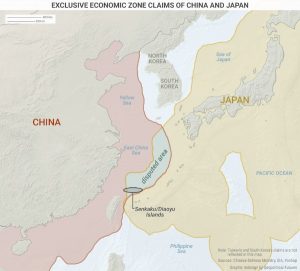
In 2017, Xi Jinping became the newest dictator in China, and Shinzo Abe pulled off a stunning electoral comeback in Japan, cementing his mandate for years to come. They are two powerful leaders of two powerful countries with a history of mutual mistrust and a hunch that the US is too self-absorbed to throw its weight around in the region the way it used to. That means China and Japan will begin competing with each other directly—on the Korean Peninsula, in Southeast Asia, and as shown above, in areas that both claim for themselves.


Map 2: Persia Rises


The Middle East in 2017 was all about the war against the Islamic State. It created strange bedfellows. Russia coordinated its military activities with the United States. The cooperation between Turkey and Iran, historical rivals, was unprecedented. The Arab states put aside their differences and their disdain for the Bashar Assad regime and devoted their resources to the Islamic State’s defeat.

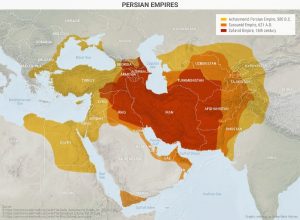
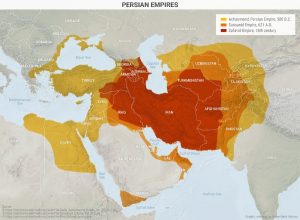
As it turned out, the war was successful. IS no longer holds meaningful territory in the Middle East—just a few isolated pockets in Syria and Iraq. The victor of this war was Iran, which is poised to be the most consequential actor in the region in 2018. As the map shows, Iran has at various times been powerful enough to dominate the Middle East. The Islamic State’s defeat is Iran’s best chance to realize its regional ambitions.

Everything is set up well for Iran. Its influence over its old nemesis Iraq has become quite strong. The preservation of the Assad regime means the preservation of one of Iran’s most powerful allies. The end of the war against IS means Hezbollah can retreat from the battlefield and get back to ruling Lebanon… and causing problems for Israel. And all of this means Iran’s dream of projecting power out to the Mediterranean is within its grasp.

We don’t expect Iran to complete its objectives. First of all, Iran’s geography makes power projection difficult, even with significant allies in the region. But second and more important, Turkey is stronger than Iran. However, Turkey is not yet ready to assert that strength. That means 2018 will belong to Iran. It must make its moves now if it is to press its advantage successfully. In the long term, a new Persian empire will fail to materialize. But in 2018, Iran’s pursuit of empire will define Middle Eastern affairs.


Chart 3: Oil’s Glass Ceiling


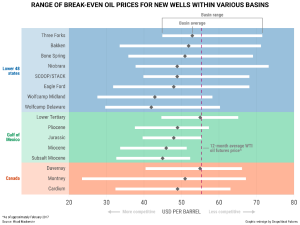
This chart shows the range of break-even oil prices for new wells in the US Lower 48, the Gulf of Mexico, and Canada. For many of these wells, the break-even point has dipped well below $60 a barrel. And that means 2018 is going to be another year of oil prices that are too low to solve the fundamental problems of Iran, Saudi Arabia, and Russia in particular.

At the time of writing, oil prices have actually spiked to near $70. There are a host of reasons for this: cold weather, political uncertainty, and an unexpectedly large decline in US crude stocks. The thing to keep in mind is that even with many OPEC nations respecting crude production cuts, supply will outweigh demand in 2018.

For Iran, that means less money to spend on its adventurism abroad. For Saudi Arabia, it means more political upheaval as the young, new crown prince attempts to do what no Saudi ruler before him has been able to do: make Saudi Arabia more than an artificial state held together by oil profits. For Russia, it means a choice between cutting social spending, cutting defense spending, or running its economy into the ground (none of which are particularly savory options from Moscow’s point of view).

Absent a major event that knocks out one of the main crude producers—and we don’t see such an event happening in 2018—we expect oil prices to remain around the $60 range, perhaps even slightly lower. We can’t predict the exact price, but we can predict continued problems for oil-dependent states as well as record-high levels of US production.


Map 4: Shuffling Deck Chairs on Europe


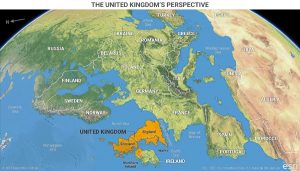
Perspective maps are my favorite kind of map that we make. Even the subtlest change in perspective can completely alter the way you view a situation. This map of Europe from the United Kingdom’s perspective is a case in point. It also happens to highlight some of the issues we expect to dominate European affairs in the year ahead.

The UK is going to leave the European Union in 2019. 2018 will feature a great deal of political melodrama as negotiations between the EU and UK occupy headlines. But the headlines will not capture the issues of real importance. What matters is not whether there will be a UK-EU trade deal. We expect there will be simply because the EU (i.e., Germany) trades a lot with the UK, and the UK in turn trades a lot with the EU. It is in neither side’s interests to fail to reach an agreement.

But the UK’s exit means London’s foreign policy toward Europe must now revert to a prior form. We’ve already seen the beginnings of this process with the recently signed Polish-UK defense treaty. What’s the goal for the UK? To ensure that no country on the European continent becomes strong enough to project power across the English Channel.

Another intriguing element of this map is that at its center are two countries whose relationship more than any other will define EU affairs in 2018: Poland and Germany. Poland is fed up with Germany’s disproportionate influence in the EU and is nervous about what losing the UK, a counterbalancing force to Germany within the bloc, will mean. The EU will be tested in several areas, and separatism won’t go away, but the Polish-German disagreement on the EU’s future will be the most important issue to watch.


Chart 5: NAFTA’s Resilience


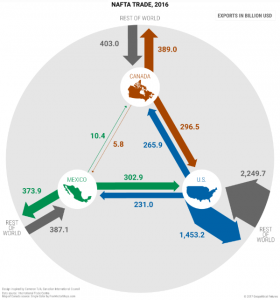
NAFTA negotiations are heating up so much that even Canada is becoming a tough negotiator. Jokes aside, one of GPF’s major forecasts for 2018 is that NAFTA will remain in place, despite whatever threats are bandied about or whatever letters of intent Trump signs. This chart goes a long way toward explaining why.

The only way we know to analyze highly politicized debates like the one surrounding NAFTA is to tune out the rhetoric. Interests take precedence over words and politics. And the interests here—for all three countries—require that NAFTA stay in place. The chart shows very clearly why this is the case for Canada and Mexico—trade with the US is an overwhelmingly important part of their economies.

But the chart doesn’t quite say everything about the US angle. US trade with NAFTA partners is large, but it doesn’t come close to US trade volumes with the rest of the world. We can’t forget, though, that the US is made up of 50 states, and two of the most influential of those states—California and Texas—are deeply invested in NAFTA’s continued existence. And California and Texas are by no means the only states whose economies rely on trade with NAFTA partners.

As with the Brexit-EU negotiations, expect a good deal of political soap opera performances around NAFTA, especially on the question of whether Trump will try to take the US out of the trade pact unilaterally (a step that is as likely to lead to years of domestic litigation as it is to an actual US exit). Expect also that at the end of the day, NAFTA will remain in place, no matter how badly the three sides insult each other.

These are some of GPF’s best maps and charts of 2017, and each sheds light on what the important stories will be in 2018. China and Japan will compete for power in Asia. Iran will try to reshape the Middle East to suit its interests. Oil prices will remain too low for Iran’s, Saudi Arabia’s, and Russia’s liking. Poland and Germany will square off over who gets to make the rules in Brussels, while the UK will go back to being an outsider, working to balance powers on the Continent. And NAFTA, for all the political drama to come, will remain in place. It should be an interesting year.