Αρχική Blog Σελίδα 2661

Μια πορεία προς πόλεμο με το Ιράν

0
Πώς η κλιμάκωση από την Ουάσινγκτον θα μπορούσε να οδηγήσει σε ακούσια καταστροφή
Οι Φρουροί της Επανάστασης του Ιράν εκτοξεύουν πυραύλους κατά την διάρκεια πολεμικών ασκήσεων κοντά στην ιερή πόλη Qom, τον Νοέμβριο του 2006. FARS NEWS / REUTERS.
Περίληψη:

Από την ημέρα που ανέλαβε το αξίωμά του ο Τραμπ, πολλοί φοβήθηκαν ότι η παρορμητική συμπεριφορά του, η μεγαλόστομη ρητορική του, η αδυναμία του να σκεφτεί εμπροσθοβαρώς, η έλλειψη σεβασμού για την διαδικασία πολιτικής, και η αποφασιστικότητά του να «κερδίσει», θα μπορούσαν να οδηγήσουν σε πόλεμο. Τώρα οι πιθανότητες έχουν αυξηθεί.

Ο PHILIP H. GORDON είναι ανώτερος συνεργάτης στην έδρα Mary and David Boies για την Εξωτερική Πολιτική των ΗΠΑ στο Council on Foreign Relations. Διετέλεσε Ειδικός Βοηθός του Προέδρου και Συντονιστής του Λευκού Οίκου για τη Μέση Ανατολή, την Βόρεια Αφρική και την περιοχή του Κόλπου από το 2013 έως το 2015.

Όταν ο πρόεδρος Ντόναλντ Τραμπ απέσυρε τις Ηνωμένες Πολιτείες από την πυρηνική συμφωνία με το Ιράν τον περασμένο Μάιο, πολλοί επικριτές ισχυρίστηκαν [1] ότι ρίσκαρε να ξεκινήσει μια αλυσίδα γεγονότων που θα μπορούσε να οδηγήσει σε πόλεμο. Η πυρηνική συμφωνία δεν ήταν τέλεια, αναγνώρισαν οι υποστηρικτές της συμφωνίας, αλλά εάν οι Ηνωμένες Πολιτείες αποχωρούσαν ορμητικά και η συμφωνία κατέρρεε, το Ιράν θα μπορούσε να επαναλάβει το πρόγραμμά του για πυρηνικό εμπλουτισμό, και για να το σταματήσουν, οι Ηνωμένες Πολιτείες δεν θα είχαν άλλη επιλογή παρά να χρησιμοποιήσουν βία. Αυτό με την σειρά του θα μπορούσε να προκαλέσει μια ευρύτερη ανάφλεξη. Αλλά αξιωματούχοι της διοίκησης και άλλοι αντίπαλοι της συμφωνίας απέρριψαν [2] τέτοιου είδους ανησυχίες -ακόμη και όταν επέμειναν ότι απούσης της συμφωνίας, ο καλύτερος τρόπος για να μπλοκαριστεί το πυρηνικό πρόγραμμα του Ιράν ήταν με την «αξιόπιστη στρατιωτική επιλογή» [3].

21052019-1.jpg

Οι Φρουροί της Επανάστασης του Ιράν εκτοξεύουν πυραύλους κατά την διάρκεια πολεμικών ασκήσεων κοντά στην ιερή πόλη Qom, τον Νοέμβριο του 2006. FARS NEWS / REUTERS
——————————————————————–

Τώρα ο αναπόφευκτος κύκλος κλιμάκωσης φαίνεται να είναι σε εξέλιξη. Στο πλαίσιο της εκστρατείας της «μέγιστης πίεσης», μόνο τον προηγούμενο μήνα, οι Ηνωμένες Πολιτείες όρισαν το Σώμα των Φρουρών της Ισλαμικής Επανάστασης (Islamic Revolutionary Guards Corps, IRGC) ως τρομοκρατική οργάνωση˙ τερμάτισαν τις απαλλαγές που επέτρεπαν σε μικρό αριθμό χωρών να αγοράζουν ιρανικό πετρέλαιο παρά τις κυρώσεις των ΗΠΑ˙ ανακοίνωσαν [4] πρόσθετες κυρώσεις που αποσκοπούσαν στην επιδείνωση της οικονομίας της χώρας˙ και μέχρι που έστειλαν μια επιθετική ομάδα αεροπλανοφόρου και βομβαρδιστικά Β-52 στην περιοχή για να στείλουν «ένα σαφές και αδιαμφισβήτητο μήνυμα» [5] στο ιρανικό καθεστώς να μην προκαλέσει τις Ηνωμένες Πολιτείες.

Προφανώς, το Ιράν ανταποκρίθηκε όχι με το να υποταχθεί στα αιτήματα των ΗΠΑ (πόσω μάλλον να καταρρεύσει) αλλά με μια δική του εκστρατεία πίεσης. Στις 8 Μαΐου, ο Ιρανός πρόεδρος Χασάν Ρουχανί ανακοίνωσε [6] ότι το Ιράν θα αναστείλει την συμμόρφωσή του σε τμήματα της πυρηνικής συμφωνίας και θα αποσυρθεί εξ ολοκλήρου εάν η Ευρώπη δεν βρει τρόπο να αποφέρει οικονομικά οφέλη στο Ιράν εντός 60 ημερών -κάτι σχεδόν αδύνατο να επιτευχθεί. Τέσσερις μέρες αργότερα, τέσσερα σαουδαραβικά πετρελαιοφόρα στα ανοικτά των ακτών των Ηνωμένων Αραβικών Εμιράτων υπέστησαν σαμποτάζ με εκρηκτικά και δυο μέρες μετά από αυτό, drones συνετρίβησαν σε εγκαταστάσεις πετρελαίου στην Σαουδική Αραβία, προκαλώντας εκρήξεις και κλείνοντας έναν αγωγό. Δεν αποδείχθηκε κανένας ιρανικός ρόλος σε αυτά τα γεγονότα, αλλά το IRGC έχει καταφύγει σε παρόμοιες ασύμμετρες και μη ανιχνεύσιμες επιθέσεις στο παρελθόν –γι’ αυτόν ακριβώς τον λόγο αξιωματούχοι του στρατού των ΗΠΑ και των μυστικών υπηρεσιών [7] είχαν προειδοποιήσει ότι τέτοια αντίποινα ήταν πιθανά.

Η κυβέρνηση Trump ανταποκρίθηκε τώρα στην απάντηση του Ιράν με την διαρροή πληροφοριών ότι το Ιράν προετοιμάζει πιθανές πυραυλικές επιθέσεις εναντίον αμερικανικών συμφερόντων και προειδοποίησε δημόσια το Ιράν για ενδεχόμενη στρατιωτική δράση. Η Ουάσινγκτον έφτασε ακόμη και στο σημείο να εκκενώσει το προσωπικό της πρεσβείας των ΗΠΑ στην Βαγδάτη και να αναφέρει ότι οι Ηνωμένες Πολιτείες προετοιμάζουν σχέδια έκτακτης ανάγκης για να στείλουν μέχρι και 120.000 στρατιωτικούς στην περιοχή. Ο ίδιος ο Trump περιέγραψε αναφορές για τις στρατιωτικές προετοιμασίες ως «ψεύτικα νέα», αλλά επίσης δήλωσε ότι θα αναπτύξει [8] «κολασμένα περισσότερους στρατιώτες από αυτό» αν χρειαστεί, και ότι το Ιράν θα «υποφέρει πολύ» [9] αν επιτεθεί σε Αμερικανούς. Από την πλευρά του, ο υπουργός Εξωτερικών, Μάικ Πομπέο, προειδοποίησε [10] ότι «εάν αμερικανικά συμφέροντα υποστούν επίθεση, σίγουρα θα απαντήσουμε με τον κατάλληλο τρόπο». Στις 16 Μαΐου, μια ευθυγραμμισμένη με το κράτος εφημερίδα στην Σαουδική Αραβία, η οποία είναι στενός σύμμαχος της διοίκησης του Τραμπ, έκανε έκκληση [9] για «χειρουργικά χτυπήματα» εναντίον του Ιράν, ενώ ένας υποστηρικτής του Trump και περιστασιακός σύμβουλος εξωτερικής πολιτικής, ο γερουσιαστής του Άρκανσο, Tom Cotton, προέβλεψε [11] με σιγουριά ότι οι Ηνωμένες Πολιτείες θα μπορούσαν να κερδίσουν έναν πόλεμο με το Ιράν με δύο μόνο χτυπήματα: «Το πρώτο χτύπημα και το τελευταίο χτύπημα».

Η αποφυγή περαιτέρω κλιμάκωσης θα είναι δύσκολη, δεδομένης της αποφασιστικότητας των δύο πλευρών να μην υποχωρήσουν. Μια νέα διαπραγμάτευση πυρηνικής ενέργειας, την οποία ισχυρίζεται ότι θέλει ο Trump, θα ήταν ένας τρόπος να αποφευχθεί μια σύγκρουση. Αλλά το Ιράν δεν είναι πιθανό να εισέλθει σε συνομιλίες με μια διοίκηση την οποία δεν εμπιστεύεται, και ακόμα λιγότερο πιθανό να συμφωνήσει με το είδος της ευρείας συμφωνίας που λέει ο Trump ότι είναι απαραίτητη: Μια συμφωνία που θα απαγορεύει τον εμπλουτισμό, θα διαρκεί για πάντα, θα επιτρέπει ακόμα πιο επιθετικές επιθεωρήσεις από όσο η παλαιά συμφωνία, θα βάζει όρια στους βαλλιστικούς πυραύλους και θα περιορίζει την περιφερειακή συμπεριφορά του Ιράν. Μετά, υπάρχει το σενάριο στο οποίο το Ιράν απλώς κάθεται και ελπίζει ότι ο πρόεδρος Trump θα αποχωρήσει από το αξίωμα το 2020. Αλλά δεκαοκτώ μήνες είναι μακρύς χρόνος για να είναι υποφερτή η οικονομική πίεση που ασκείται στο Ιράν˙ και εν πάση περιπτώσει, το Ιράν φαίνεται να έχει κλείσει την πόρτα σε αυτή την επιλογή, με το να απειλήσει να παραβιάσει την πυρηνική συμφωνία αν δεν λάβει ταχεία οικονομική ανακούφιση.

Την περαιτέρω κλιμάκωση, από την άλλη πλευρά, είναι αρκετά εύκολο να την φανταστούμε: Εάν το Ιράν εγκαταλείψει πλήρως την συμφωνία, επεκτείνει το πυρηνικό του πρόγραμμα έστω και σταδιακά, ή υποστηρίξει άμεσες ή πληρεξούσιες επιθέσεις σε αμερικανικά στρατεύματα, οι Ηνωμένες Πολιτείες θα αντιμετωπίσουν μόνο δύο επιλογές –μια ταπεινωτική αποκλιμάκωση ή την χρήση στρατιωτικής βίας.

ΟΛΑ ΠΟΛΥ ΠΡΟΒΛΕΨΙΜΑ

Το ότι η προσέγγιση της διοίκησης του Τραμπ στο Ιράν θα μπορούσε να οδηγήσει τις Ηνωμένες Πολιτείες σε μια ακούσια σύγκρουση δεν θα πρέπει να αποτελεί έκπληξη για κανέναν. Πράγματι, από την ημέρα που ανέλαβε το αξίωμά του ο Τραμπ, πολλοί φοβήθηκαν ότι η παρορμητική συμπεριφορά του, η μεγαλόστομη ρητορική του, η αδυναμία του να σκεφτεί εμπροσθοβαρώς, η έλλειψη σεβασμού για την διαδικασία πολιτικής, και η αποφασιστικότητά του να «κερδίσει» θα μπορούσαν να οδηγήσουν σε πόλεμο. Σε ένα δοκίμιο την άνοιξη του 2017 [12] σε αυτό το περιοδικό («Το όραμα ενός Trump σε πόλεμο», [12]), εξέφρασα ανησυχίες για τις πιθανότητές του να σκοντάψει σε μια σύγκρουση με το Ιράν, την Κίνα ή την Βόρεια Κορέα. Έγραψα το δοκίμιο με τη μορφή μιας φανταστικής ματιάς πίσω σε γεγονότα που δεν είχαν συμβεί, αλλά θα μπορούσαν, εάν ο Trump προσπαθούσε να μπλοφάρει στην πορεία του για «καλύτερες συμφωνίες» μέσω αντιπαράθεσης και κλιμάκωσης και χωρίς να εκτιμήσει ρεαλιστικά τι θα ήταν εφικτό ή πώς θα μπορούσαν να αντιδράσουν δυνητικά οι αντίπαλοι.

Δύο χρόνια αργότερα, τα καλά νέα είναι ότι κανένας από αυτούς τους πολέμους δεν συνέβη. Αλλά τα κακά νέα είναι ότι ο Trump συνεχίζει να επιδεικνύει τα χαρακτηριστικά που κατέστησαν τέτοιες εξελίξεις εύλογες εξ’ αρχής. Αν μη τι άλλο, φαίνεται πιο έτοιμος από ποτέ να σπάσει τους κανόνες και να ανταγωνιστεί συμμάχους και αντιπάλους ομοίως. Επιπλέον, οι σύμβουλοι που τον περιβάλλουν τώρα είναι λιγότερο πρόθυμοι και ικανοί από τους προκατόχους τους να περιορίσουν τις πιο προκλητικές τάσεις του -όταν δεν είναι πραγματικά αποφασισμένοι να ενθαρρύνουν αυτές τις τάσεις για τους δικούς τους σκοπούς. Το Ιράν είναι μακράν το πιο επικίνδυνο ενδεχόμενο βραχυπρόθεσμα, αλλά δεν είναι το μοναδικό μέρος όπου ο Τραμπ θα μπορούσε να σκοντάψει σε έναν πόλεμο από ατύχημα.

Ο Trump φαίνεται να έχει βάλει τον εαυτό του στην γωνία με την Κίνα με τον ίδιο τρόπο που έκανε και με το Ιράν: Με το να επιβάλλει μονομερείς κυρώσεις, να μην «διαβάζει» καλά τους αντιπάλους του, και να παραπλανά τον αμερικανικό λαό για τα κόστη, τους κινδύνους και τις συνέπειες της προσέγγισής του. Οι δασμοί που είχε επιβάλει αρχικά σε αξίας 50 δισεκατομμυρίων δολαρίων εισαγωγές από την Κίνα υποτίθεται ότι έπρεπε να παράγουν μια «καλύτερη συμφωνία», αλλά αντ’ αυτού -και χωρίς έκπληξη- προκάλεσαν κινεζικούς αντίστοιχους δασμούς. Οι Ηνωμένες Πολιτείες απάντησαν αυξάνοντας το ποσοστό των δασμών και προετοιμάζοντας την επέκτασή τους για να καλύψουν το σύνολο των εξαγωγών της Κίνας προς τις Ηνωμένες Πολιτείες αξίας 540 δισ. δολαρίων. Ακόμα και καθώς αυξάνεται το κόστος για τους Αμερικανούς αγρότες, τους παραγωγούς και τους καταναλωτές, ο Trump τώρα πιθανολογεί [13] ότι θα είναι καλύτερα από πολιτική άποψη εάν συνεχίσει να αντιτίθεται την Κίνα τουλάχιστον μέχρι τις εκλογές του 2020.

Μια εμπορική συμφωνία με την Κίνα είναι, φυσικά, ακόμη δυνατή, όπως μια νέα πυρηνικής συμφωνία με το Ιράν. Αλλά η περαιτέρω κλιμάκωση είναι επίσης μια πραγματική δυνατότητα, όπως είναι και μια επικίνδυνη εξάπλωση από τον οικονομικό τομέα στον πολιτικό. Πράγματι, στο μυθιστορηματικό σενάριό μου φαντάστηκα ότι της διολίσθησης προς την στρατιωτική σύγκρουση θα είχε προηγηθεί ένας «εμπορικός πόλεμος που κλιμακώθηκε πέρα από αυτό που είχαν προβλέψει και οι δύο πλευρές», και μια ακραία εθνικιστική Κίνα που θα αρνείται την συνεργασία των Ηνωμένων Πολιτειών στην Βόρεια Κορέα και θα τις προκαλεί στην Θάλασσα της Νότιας Κίνας. Τα κρατικά μέσα ενημέρωσης της Κίνας αποκαλούν τώρα τις Ηνωμένες Πολιτείες ως «τελείως ψευτοπαλλήκαρο», «χάρτινο τίγρη» και «αποικιοκράτη». Τουλάχιστον ένας εξέχων Κινέζος μελετητής πρότεινε [14] ότι το Πεκίνο να χτυπήσει τις «αγχωμένες και αλαζονικές» Ηνωμένες Πολιτείες απαγορεύοντας τις σπάνιες γαίες στις οποίες βασίζεται η αμερικανική βιομηχανία και πωλώντας αμερικανικά κρατικά ομόλογα, κινήσεις που θα έχουν καταστροφικές επιπτώσεις στην οικονομία των ΗΠΑ. Ο Trump φαίνεται ότι δεν κατάφερε να προβλέψει ότι και άλλες χώρες έχουν επίσης εγχώρια πολιτική -για να μην αναφέρουμε τη μόχλευση που [μπορούν να] χρησιμοποιούν εναντίον των Ηνωμένων Πολιτειών.

Η προσέγγιση του Trump στην Βόρειο Κορέα άρχισε με μεγαλαυχίες, προσβολές και απειλές, αποφέροντας το 2018 μια εκπληκτική προσέγγιση˙ ο Trump μέχρι που ισχυρίστηκε [15] ότι ο ίδιος και ο δικτάτορας Kim Jong Un «ερωτεύτηκαν». Αυτό το φλερτ προς τον Κιμ ήταν μια ευπρόσδεκτη εναλλακτική λύση σε έναν πιθανό πυρηνικό πόλεμο, αλλά ο Trump θα μπορούσε εύκολα να επανέλθει στην εχθρότητα, δεδομένης της τάσης του να στρέφεται ξαφνικά και βάναυσα [εναντίον] οποιουδήποτε πιστεύει ότι τον έχει ενοχλήσει. Οι πρόσφατες δοκιμές της Βόρειας Κορέας [16] ενός «νέου τύπου τακτικής καθοδήγησης όπλου», η επανάληψη των δοκιμών πυραύλων μικρής εμβέλειας, και η κατάσχεση από τις ΗΠΑ [17] ενός βορειοκορεατικού λαθρεμπορικού πλοίου που η Πιονγκγιάνγκ απαιτεί να της επιστραφεί, είναι όλα πρόσφατα υπενθυμητικά ότι οι σχέσεις θα μπορούσαν να επιδεινωθούν γρήγορα εάν η αγάπη του Trump για τον Κιμ αποδειχθεί χωρίς ανταπόκριση.

Και τώρα μπορούμε να προσθέσουμε την Βενεζουέλα στον κατάλογο των χωρών για τις οποίες οι λανθασμένες εκτιμήσεις των ΗΠΑ θα μπορούσαν να οδηγήσουν σε θανατηφόρες συγκρούσεις. Ο Trump έριξε με τόλμη την υποστήριξή του στην αντιπολίτευση της Βενεζουέλας και κάλεσε για αλλαγή καθεστώτος, σίγουρος ότι η πίεση των ΗΠΑ θα μπορούσε να απομακρύνει το διεφθαρμένο καθεστώς του Νικολάς Μαδούρο. Φαίνεται ότι δεν κατάφερε να προβλέψει ότι ο Maduro θα χρησιμοποιήσει βία για να προσκολληθεί στην εξουσία και ότι θα το κάνει με ρωσική, κινεζική και κουβανική υποστήριξη. Τώρα, ο Trump βρίσκεται παγιδευμένος μεταξύ της αποδοχής μιας ενοχλητικής αποτυχίας ή της κλιμάκωσης με έναν τρόπο που θα μπορούσε να περιλαμβάνει την στρατιωτική παρέμβαση των ΗΠΑ, μια «επιλογή» [18] που δεν έχει αποκλείσει.

ΚΑΙ ΜΕΤΑ;

Με όλη την δημόσια συζήτηση για το ενδεχόμενο σύγκρουσης με το Ιράν, ο Trump φαίνεται να αναζητά μια διέξοδο. Είπε την περασμένη εβδομάδα [19] ότι «θα ήθελε να δει [τους ηγέτες του Ιράν] να μου τηλεφωνήσουν», και σύμφωνα με πληροφορίες είπε στο Πεντάγωνο [20] ότι δεν θέλει να πάει σε πόλεμο. Οι συνεχείς προσεγγίσεις του στον Κινέζο ηγέτη, Xi Jinping, και τον Kim Jong Un, παρά το ότι τον αψηφούν, δείχνει επίσης ότι ίσως να καταλαβαίνει καλά τους κινδύνους κλιμάκωσης. Ίσως ο Trump έχει, τελικά, οραματιστεί ένα μέλλον που περιλαμβάνει ακούσια στρατιωτική σύγκρουση των ΗΠΑ και δεν του αρέσει αυτό που βλέπει.

Ωστόσο, λιγότερο καθησυχαστικό είναι ότι η γενική προσέγγιση της διοίκησης του Trump σε αυτά τα ζητήματα -και η προσωπική προσέγγιση του προέδρου στην επίτευξη συμφωνιών- δεν έχει αλλάξει, και υπάρχει κίνδυνος να καταλήξει σε καταστροφική αποτυχία. Το μοτίβο μοιάζει να είναι τέτοιο όπου ελπίζει ότι οι απειλές, οι κυρώσεις και οι εκβιασμοί θα αναγκάσουν έναν αντίπαλο να παραδεχτεί ή να αποδεχθεί μια «καταπληκτική συμφωνία»˙ μετά, έχοντας αποτύχει να προβλέψουν τα πραγματικά αποτελέσματα μιας τέτοιας τακτικής, οι Ηνωμένες Πολιτείες βρίσκονται στην γωνία χωρίς προφανή διέξοδο. Σε μια φαινομενική προσπάθεια να εξουδετερωθούν οι φόβοι για πόλεμο με το Ιράν, ένας ανώτερος αξιωματούχος των ΗΠΑ δήλωσε [21] στην εφημερίδα The Washington Post αυτή την εβδομάδα, ότι «επειδή εφαρμόζουμε επίπεδα πίεσης που δεν έχουν ιστορικό προηγούμενο, νομίζω ότι μπορούμε να περιμένουμε το Ιράν να αυξήσουν τις απειλές του και να αυξήσει την κακόβουλη συμπεριφορά του». Το ότι μια τέτοια αντίδραση από το Ιράν μπορεί να είναι εύλογη δεν το καθιστά καθησυχαστικό.

Επιπλέον, ενώ ο Trump μπορεί να μην θέλει πόλεμο, δεν περιβάλλεται πλέον από συμβούλους που μπορούν να τον βοηθήσουν να τον αποφύγει. Ο πρώην υπουργός Άμυνας, James Mattis, κάποιος που είχε δει τον πόλεμο από κοντά, ήταν μια φωνή συγκράτησης, αλλά τώρα έχει φύγει ήδη έξι μήνες, και ο διάδοχός του δεν έχει ούτε το ανάστημα ούτε προφανώς την βούληση να αμφισβητήσει τον Trump. Οι δύο πλησιέστεροι σύμβουλοι εξωτερικής πολιτικής του Προέδρου είναι τώρα ο υπουργός Εξωτερικών, Mike Pompeo –ένα υπερ-γεράκι για το Ιράν που φαίνεται να λέει στον Trump μόνο αυτά που θέλει να ακούσει- και ο Σύμβουλος Εθνικής Ασφάλειας, John Bolton, ο οποίος έχει υπερασπιστεί εδώ και καιρό ακριβώς το ίδιο είδος του πολέμου που ο Trump προφανώς προσπαθεί να αποφύγει. Ο Μπόλτον υποστήριξε ότι ο μόνος τρόπος για να σταματήσει το πυρηνικό πρόγραμμα του Ιράν είναι να βομβαρδιστεί [22] και συνηγόρησε για την υποστήριξη ομάδων ιρανικής εθνοτικής και εσωτερικής αντίστασης, προκειμένου να επιταχυνθεί η αλλαγή καθεστώτος. Ζήτησε επίσης οι Ηνωμένες Πολιτείες να επανεξετάσουν [23] την πολιτική της «μιας Κίνας» και να «δουν πώς ανταποκρίνεται μια όλο και περισσότερο πολεμοχαρής Κίνα»˙ αρνήθηκε να αποκλείσει την χρήση των [στρατιωτικών] δυνάμεων των ΗΠΑ στην Βενεζουέλα ενώ επέμεινε [24] ότι το Δόγμα Monroe είναι «ζωντανό και καλά»˙ και έγραψε [25] ότι «είναι απόλυτα θεμιτό οι Ηνωμένες Πολιτείες να ανταποκριθούν στην σημερινή ‘αναγκαιότητα’ που θέτουν τα πυρηνικά όπλα της Βόρειας Κορέας με το να χτυπήσουν πρώτες».

Το 2017, όταν φανταζόμουν διάφορους τρόπους με τους οποίους οι Ηνωμένες Πολιτείες μπορεί να βρεθούν σε μια σύγκρουση, είδα κάποια πράγματα σωστά και κάποια πράγματα λάθος. Αυτό που σίγουρα δεν κατάφερα να προβλέψω ήταν ότι δύο χρόνια αργότερα, θα βασιζόμασταν στα ένστικτα του Donald Trump για να μας κρατήσουν εκτός πολέμου.

Copyright © 2019 by the Council on Foreign Relations, Inc.
All rights reserved.

Στα αγγλικά: https://www.foreignaffairs.com/articles/iran/2019-05-20/path-war-iran

Σύνδεσμοι:
[1] https://www.theatlantic.com/international/archive/2018/05/iran-deal-trum…
[2] https://www.washingtonpost.com/opinions/a-false-dichotomy/2015/07/23/c0f…
[3] https://warontherocks.com/2015/09/this-iran-deal-or-war-misadventures-in…
[4] https://www.reuters.com/article/us-usa-iran-sanctions/trump-slaps-new-us…
[5] https://www.whitehouse.gov/briefings-statements/statement-national-secur…
[6] https://www.washingtonpost.com/world/iran-to-take-steps-to-reduce-its-co…
[7] https://www.washingtonpost.com/world/national-security/defense-intellige…
[8] https://www.nbcnews.com/politics/national-security/trump-disputes-report…
[9] https://www.bloomberg.com/news/articles/2019-05-13/trump-says-iran-will-…
[10] https://www.washingtonpost.com/world/europe/pompeo-set-to-meet-putin-wit…
[11] https://thehill.com/homenews/senate/443725-cotton-us-could-win-war-with-…
[12] https://www.foreignaffairs.gr/author/philip-gordon
[13] https://www.washingtonpost.com/politics/i-dont-see-him-crying-uncle-trum…
[14] http://www.globaltimes.cn/content/1150061.shtml
[15] https://www.cnn.com/videos/politics/2018/09/30/trump-kim-jong-un-fell-in…
[16] http://time.com/5572851/north-korea-test-fires-new-tactical-guided-weapo…
[17] https://www.nytimes.com/2019/05/09/us/politics/wise-honest-north-korea-s…
[18] https://www.reuters.com/article/us-venezuela-politics/trump-says-u-s-mil…
[19] https://www.cnn.com/2019/05/11/politics/trump-call-bolton-threat/index.html
[20] https://www.nytimes.com/2019/05/16/world/middleeast/iran-war-donald-trum…
[21] https://www.washingtonpost.com/opinions/global-opinions/the-trump-admini…
[22] https://www.nytimes.com/2015/03/26/opinion/to-stop-irans-bomb-bomb-iran….
[23] https://www.wsj.com/articles/revisit-the-one-china-policy-1484611627
[24] https://www.newyorker.com/magazine/2019/05/06/john-bolton-on-the-warpath
[25] https://www.wsj.com/articles/the-legal-case-for-striking-north-korea-fir…

Μπορείτε να ακολουθείτε το «Foreign Affairs, The Hellenic Edition» στο TWITTER στην διεύθυνση www.twitter.com/foreigngr αλλά και στο FACEBOOK, στην διεύθυνση www.facebook.com/ForeignAffairs.gr και στο linkedin στην διεύθυνση https://www.linkedin.com/company/foreign-affairs-the-hellenic-edition
Η μεγάλη απάτη στον ΟΗΕ με τη «Συμφωνία των Πρεσπών». (Γ΄ Μέρος)

1

Γιώργος Ρωμανός

  1. Η καταληκτική πράξη αυτής της πολύχρονης διεθνούς απάτης έγινε στις 12 και 14 Φεβρουαρίου 2019

Στις 12 Φεβρουαρίου 2019 εστάλη στον γ.γ. του ΟΗΕ η κοινή (στο ίδιο χαρτί!), επιστολή Ελλάδος-Σκοπίων, με τα δύο εθνόσημα δίπλα δίπλα, και από κάτω τις υπογραφές της Μονίμου αντιπροσώπου της Ελλάδος στον ΟΗΕ και της προσωρινής αντιπροσώπου των Σκοπίων. Ας προσεχθεί το «της προσωρινής!». Δηλαδή η μεγαλύτερη πράξη νομιμοποίησης μιας χώρας στον ΟΗΕ υπογράφηκε όχι από τον Πρόεδρο της Σκοπιανής Δημοκρατίας, ούτε την Κυβέρνηση, αλλά από μία προσωρινή (!) αντιπρόσωπο η οποία υπογράφει για λογαριασμό της Μόνιμης αντιπροσωπίας μιας άγνωστης στον ΟΗΕ χώρας με το όνομα «Βόρειας Μακεδονίας» το οποίο μέχρι εκείνη τη στιγμή ΔΕΝ έχει αναγνωριστεί από τον διεθνή οργανισμό. Κι όμως ο γ.γ. του ΟΗΕ όλα αυτά τα θεώρησε νόμιμα!

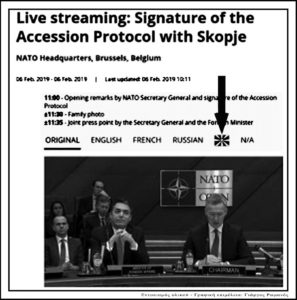
Επί αυτού του ζητήματος, δηλαδή του πώς θα ονομάζεται μία χώρα της οποίας το όνομα ΔΕΝ έχει αναγνωριστεί από το Συμβούλιο Ασφαλείας του ΟΗΕ, το ΝΑΤΟ ήταν πιο «προσεκτικό»…, όπως φαίνεται στην εικόνα που ακολουθεί.

Φωτογραφικό στιγμιότυπο (6/2/2019, ώρα 11.00) από την τελετή υπογραφής του Πρωτοκόλλου εισδοχής των Σκοπίων στο ΝΑΤΟ. Επάνω δεξιά με βέλος σημειώνεται ότι στη θέση της γλώσσας (ή εθνότητας;) μπήκε η Σκοπιανή σημαία. Έχει σημασία ότι δεν αναφέρεται ούτε γλώσσα ούτε εθνότητα στον πίνακα αυτού του διεθνούς οργανισμού.


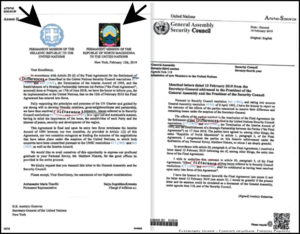
Ας επανέλθουμε στην επιστολή των δύο αντιπροσώπων η οποία εστάλη στον ΟΗΕ στις 12/2/2019, και την επιστολή-απάντηση του γ.γ. Αντ. Γκουτέρες στις 14/2/2018.

Τα πρωτότυπα έγγραφα στον ΟΗΕ. Αριστερά με ημερομηνία 12/2/2019, το κοινό Ελλάδος – Σκοπίων, και δεξιά με ημερομηνία 14/2/2019, το σχετικό έγγραφο του γ.γ. Αντ. Γκουτέρες. Υπογραμμίζεται ότι στην διπλή επιστολή Ελλάδος – Σκοπίων αναγνωρίζεται η ΜΙΑ διαφορά μεταξύ των δύο χωρών. Αντίθετα στο διπλανό έγγραφο του γ,γ. ΟΗΕ, αλλού γίνεται λόγος για διαφορά και αλλού για διαφορές.


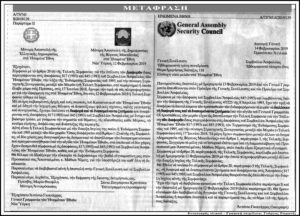
Τα δύο ίδια, ως άνω, έγραφα σε μετάφραση, όπου τόσο στο αγγλικό κείμενο όσο και στο ελληνικό εύκολα αποδεικνύεται ένα αχαρακτήριστο και απολύτως παράνομο παιχνίδι με τις λέξεις. Φαίνεται καθαρά πως ενώ οι δύο χώρες γράφουν και μιλούν περί ΜΙΑΣ διαφοράς, ο γ.γ. αλλού γράφει για «την [Μία!] επίλυση της διαφοράς» και πιο κάτω γράφει «των Διαφορών», δηλαδή πληθυντικός -οι πολλές διαφορές- οι οποίες δήθεν περιγράφονται στις αποφάσεις του Συμβουλίου Ασφαλείας, πράγμα απολύτως ψευδές. Η σκόπιμη παραπλάνηση είναι φανερή, όπως και η καταπάτηση των διεθνών αρχών Αληθείας, Καλής Πίστης και Σαφήνειας. Οι παρανομίες δεν έχουν τέλος!


Και σε αυτή την κατά συρροή παρανομία παραβιάζονται ξανά όλες οι θεμελιώδεις αρχές του διεθνούς Δικαίου που αναφέρουμε από την αρχή αυτής της μελέτης.

Στην συγκεκριμένη περίπτωση η Ελλάδα, ως χώρα μέλος του ΟΗΕ, χρησιμοποιήθηκε με το εθνόσημό της στο ίδιο χαρτί για να μεταφέρει κυριολεκτικά το άχθος των Σκοπίων, ώστε να γίνει δεκτό το παράνομο έγγραφο αυτής της χώρας στον ΟΗΕ. Γιατί δεν υπήρχε χώρα «Βόρεια Μακεδονία» αναγνωρισμένη από τον ΟΗΕ, όπως δεν υπήρχε εκεί ούτε η «Συμφωνία των Πρεσπών» με την υπογραφή του Προέδρου των Σκοπίων, Ιβανόφ.

Όμως οι κατάφωρες αυτές παραβιάσεις της διεθνούς νομιμότητας απαιτούσαν και διεθνή συμπαιγνία των ίδιων των μελών του Συμβουλίου Ασφαλείας προκειμένου να γίνει δεκτό το εν λόγω έγγραφο, της 12ης Φεβρουαρίου, 2019.

Εδώ πρέπει να θυμηθούμε τις κατ’ επανάληψη δημόσιες δηλώσεις Ρώσων επισήμων με πρώτο τον ΥΠΕΞ κ. Λαβρόφ, στις 6/12/2018. Επίσης το έντονο και με βαριές εκφράσεις Ρωσο-αμερικανικό διπλωματικό επεισόδιο, στις 18/12/2018, οπότε έγιναν εκ μέρους της Ρωσίας επιλέξει οι εξής καταγγελίες: «άκυρο δημοψήφισμα στα Σκόπια», «βρώμικους χειρισμούς, εξαγορά και εκβιασμούς βουλευτών».[..] «χυδαίο χρηματισμό» […] «εκβιαστική επιβολή συνταγματικών αλλαγών», λόγω άμεσης παρέμβασης τού στα Σκόπια Αμερικανού πρέσβη. Ο ΥΠΕΞ της Ρωσίας τότε επικαλέσθηκε την Απόφαση του Συμβουλίου Ασφαλείας με κωδικό: 845/18-06-1993, παράγραφος 3, και έκανε λόγο για «αυστηρό έλεγχο της νομιμότητας της διαδικασίας». Η σχετική ανακοίνωση έλεγε τα εξής: «Θεωρούμε αυτό που συνέβη ως σαφή παραβίαση όλων των κανόνων, τόσο από πλευράς δικαίου όσο και από άποψη ηθικής…».

Στις 8/2/2019, σε συνέντευξή του στο ρωσικό πρακτορείο Tass[1] ο πρέσβης στα Σκόπια, Σεργκέι Μπαζντνίκιν, δήλωσε: «η ‘‘Συμφωνία των Πρεσπών’’ έχει τελειώσει με μια σοβαρή παραβίαση του εσωτερικού και διεθνούς δικαίου, δηλαδή εκτός του νομικού πλαισίου». Και συμπλήρωσε: «Ξεκινάμε από το γεγονός, ότι το ψήφισμα 845 του Συμβουλίου Ασφαλείας των Ηνωμένων Εθνών, του 1993, περιέχει απευθείας αίτημα προς τον Γενικό Γραμματέα του ΟΗΕ να υποβάλλει έκθεση στο Συμβούλιο σχετικά με το θέμα της ονομασίας της FYROM.»

Έτσι αναρωτιόμαστε: α. Γιατί η Ρωσία ΑΠΟΔΕΧΕΤΑΙ σήμερα τις πολλαπλές και κατάφωρες παρανομίες που η ίδια κατήγγειλε; β. Γιατί δεν υπεβλήθη μέχρι τώρα στο Συμβούλιο Ασφαλείας αυτή η τόσο κρίσιμη έκθεση την οποία ΕΠΙΒΑΛΛΕΙ η απόφαση 845 (1993);

Τα γεγονότα απαντούν εν μέρει, αφού συνέβησαν στον ΟΗΕ μία σειρά παρανομίες μετά την αποδοχή της εν λόγω παράνομης επιστολής Ελλάδος–Σκοπίων, οι οποίες έχουν ως εξής:

  1. Η κοινή επιστολή των δύο επιτετραμμένων Ελλάδος–Σκοπίων βαφτίστηκε σαν δήθεν «έγγραφο της γενικής Συνελεύσεως του Συμβουλίου Ασφαλείας» με σκοπό να μην εισαχθεί η «Συμφωνία των Πρεσπών» ούτε προς συζήτηση ούτε καν προς έλεγχο νομιμότητας, όπως επιβάλλει η διεθνής τάξη και η διεθνής νομολογία.
  2. Παραβιάστηκε το ψήφισμα 817 του ΟΗΕ το οποίο σχετιζόταν άμεσα με όσα ήδη αναφέρθηκαν για τον Μ. Νίμιτς ο οποίος, επαναλαμβάνουμε, ΔΕΝ είχε εξουσιοδότηση πέραν του ΟΝΟΜΑΤΟΣ και δεν είχε δικαίωμα να προκρίνει και να δεχθεί τα ζητήματα του δήθεν «μακεδονικού» έθνους και της ψευτο-μακεδονικής γλώσσας.
  3. Ο γ.γ. στην αρχή της επιστολής του, της 14/2/2018, ΔΕΝ αναφέρεται όπως έχει υποχρέωση στην απόφαση 817 (1993) του ΟΗΕ αλλά μόνο στην απόφαση 845 (1993) για να προστατεύσει νομικά τον εαυτό του. Ενώ αυτές οι αποφάσεις αναφέρονται ρητά και οι δύο μαζί, αχώριστες, στον τίτλο της «Συμφωνίας των Πρεσπών». Δηλαδή, εδώ ο γ.γ. αφαιρεί σκόπιμα από το δικό του σκεπτικό μία από τις δύο σημαντικές αυτές αποφάσεις. Πρέπει ο αναγνώστης της επιστολής του να φτάσει στην μέση του κειμένου της για να δει ότι ο γ.γ. αλλάζοντας… εστίαση αφήγησης παραβλέπει την ουσία και τον υποχρεωτικό τύπο του πράγματος, μιλάει για «τις προσπάθειες», (προσοχή προσπάθειες!) που έκαναν τα δύο μέρη, για την «τελική Συμφωνία, κλπ.» χωρίς ο ίδιος να παίρνει θέση. Και, αμέσως μετά αναφέρει (πλαγίως, δηλαδή) την απόφαση 817 (1993). Κουτοπονηριές με το Συντακτικό και την τέχνη της αφήγησης, οι οποίες ωστόσο συνιστούν το αδίκημα της παραπλάνησης σε κορυφαίο έγγραφο του ΟΗΕ.

Μάλιστα, όλα αυτά έγιναν, ενώ στο επίσημο κείμενο του Συμβουλίου Ασφαλείας της απόφασης 817, ορίζεται ρητά ότι ΜΙΑ διαφορά υπάρχει μεταξύ Ελλάδος–Σκοπίων και αφορά ΜΟΝΟ το ΟΝΟΜΑ. Ειδικά στην παράγραφο 3 του ίδιου Σκεπτικού, του Συμβουλίου Ασφαλείας, και στην παράγραφο 1.3 του Διατακτικού τής ίδιας απόφασης υπάρχει τέσσερις (4) φορές αναφορά σε ΜΙΑ «διαφορά» –στον ενικό αριθμό! –, δηλαδή σε αυτήν του Ονόματος. Αντιθέτως δεν υπάρχει καμία αναφορά σε άλλα ζητήματα, όπως Ταυτότητας και Γλώσσας τα οποία προσετέθησαν παράνομα στην «Συμφωνία Πρεσπών» με ευθύνη και του Μ. Νίμιτς. Ωστόσο και ο γ.γ., Αντ. Γκουτέρες, παρανόμησε και ο ίδιος γραπτώς στην δική του επιστολή (14/2/2019) στην οποία πότε κάνει λόγο για ΜΙΑ διαφορά και πότε για πολλές!

Έτσι, και εδώ έχουμε ακόμη μία κατάφωρη παραβίαση των προαναφερθέντων διεθνών αρχών δικαίου, περί «Αληθείας», «Καλής Πίστης», κ.λπ. Όπως έχουμε και επίσημη επαλήθευση του ότι ο Μ. Νίμιτς είχε απολύτως περιορισμένη εντολή ΜΟΝΟ για το όνομα την οποία και παραβίαζε επί 25 χρόνια.

Κλείνοντας αναφέρουμε, ότι θα αρκεστούμε μόνο σε αυτά τα λίγα κραυγαλέα παραδείγματα παραβιάσεων του Διεθνούς Δικαίου και της Διεθνούς εννόμου τάξεως. Σκοπίμως δεν θα αποκαλύψουμε ένα προς ένα τόσο τα παραβιαζόμενα άρθρα της Σύμβασης της Βιέννης, 1969, ούτε τους πολλούς επιμέρους λόγους και το κατά περίπτωση νομικό σκεπτικό βάσει διεθνών δεδομένων.

Η επίμονη, πολύμηνη, και ογκώδης εργασία μας έχει ολοκληρωθεί και θα χαριστεί στην πρώτη κυβέρνηση που θα σηκώσει ψηλά τη σημαία της ΑΚΥΡΩΣΗΣ, και θα δεσμευτεί πειστικά (μετά από κατάλληλο έλεγχο), ότι θα κάνει τα εξής: α. θα προσφύγει διεθνώς κατά της «Συμφωνίας των Πρεσπών» και των παράνομων διαδικασιών στον ΟΗΕ και αλλού, και β. θα επαναφέρει τη «Συμφωνία» στην βουλή των Ελλήνων προς ακύρωση, μετά από ή χωρίς δημοψήφισμα.

Η διμερής-διακρατική αυτή «Συμφωνία» ως εμπεριέχουσα τερατώδη στοιχεία αναλήθειας, και διεθνούς απάτης είναι νομικά άκυρη. Αυτή την απεχθή πολιτικά και εθνικά πράξη ο ελληνισμός την προσέθεσε ήδη στη σειρά των μεγάλων εθνικών καταστροφών, όπως της Μικρασιατικής καταστροφής, του Εμφύλιου 1944-1949, και της Τραγωδίας της Κύπρου, το 1974. Όμως διαφέρει από όλες τις προηγούμενες καταστροφές γιατί για πρώτη φορά στην ιστορία μας θίγεται βάναυσα ο πυρήνα της ελληνικής εθνικής μας υπόστασης και ταυτότητας, όπως δεν εθίγει ποτέ άλλοτε. Κι αυτό γιατί για πρώτη φορά στην παγκόσμια ιστορία δημιουργείται ένα πλαστό κράτος, έθνος, και γλώσσα, (το Σκοπιανό) με κλεμμένα υλικά τα οποία ανήκουν αποκλειστικά και μόνο στην Ελλάδα και τον πολιτισμό της η οποία πλέον απειλείται άμεσα.

Μία επόμενη κυβέρνηση μπορεί και οφείλει να ακυρώσει την «Συμφωνία» με τον ίδιο ακριβώς τρόπο που αυτή κυρώθηκε. Είναι καθαρά ζήτημα πολιτικής βούλησης και αίσθησης καθήκοντος προς την Πατρίδα. Σε περίπτωση που κάτι τέτοιο δεν γίνει από την επόμενη κυβέρνηση οι Έλληνες πολίτες, οι Σύλλογοι και οι Παμμακεδονικές Ενώσεις θα αναζητήσουν το δίκιο τους προσφεύγοντες στην ελληνική και διεθνή Δικαιοσύνη. Υπενθυμίζεται ότι ο εισαγγελέας Αθηνών αποδέχτηκε κατ’ αρχάς την μήνυση της Παμμακεδονικής Ελλάδος, που έγινε το 2018, με πρόεδρο τον Γεώργιο Τάτσιο, και την απέστειλε στη βουλή. Σημειώνουμε ότι το έγκλημα της εσχάτης προδοσίας δεν παραγράφεται. Άρα είναι ζήτημα χρόνου και τρόπου εφαρμογής του νόμου στο να επανέλθουν κάποιοι στο ίδιο αντικείμενο.

Σε κάθε περίπτωση η διμερής «Συμφωνία των Πρεσπών» είναι δυνατόν να καταστεί ανενεργής με ακυρώσεις άρθρο προς άρθρο, βήμα προς βήμα, όταν θα αρχίσουν να εισάγονται στην βουλή οι νόμοι εφαρμογή της. Εναντίον αυτών των νόμων έχουν το δικαίωμα να προσφύγουν όλοι οι Έλληνες πολίτες οι οποίοι έχουν έννομο συμφέρον. Ακόμη κι αν απαιτηθεί χρόνος και ο πολιτικός και νομικός αγώνας αναδειχθεί μακρός και επίμονος, το δίκιο είναι με το μέρος της μεγάλης πλειοψηφίας του ελληνικού λαού.

Σήμερα, δίνουμε στη δημοσιότητα όλα αυτά τα κρίσιμα και χρήσιμα στοιχεία από τα οποία οι Έλληνες μπορούν να πάρουν κουράγιο και με όπλο τη γνώση να διεκδικήσουν το αδιαμφισβήτητο δίκιο τους.

Εξαρτάται από όλους εμάς και από τους επιγόνους μας να φέρνουμε την αλήθεια στην επιφάνεια, και να κρατήσουμε ζωντανή στη μνήμη του λαού μας την απόλυτη ελληνικότητα της Μακεδονίας.

Η Μακεδονία είναι η ψυχή της Ελλάδος. Και η ψυχή μας δεν ξεπουλιέται, δεν παραδίδεται.

[1]https://www.pentapostagma.gr/2019/02/%ce%b7-%cf%81%cf%89%cf%83%ce%af%ce%b1-%cf%80%ce%ac%ce%b5%ce%b9-%cf%84%ce%bf-%cf%8c%ce%bd%ce%bf%ce%bc%ce%b1-%cf%84%cf%89%ce%bd-%cf%83%ce%ba%ce%bf%cf%80%ce%af%cf%89%ce%bd-%cf%83%cf%84%ce%bf-%cf%83%ce%b1.html


Με αφορμή τις μπογιές στη βουλή.

6

Με την ανοχή που δείχνει η ελληνική πολιτεία σε φαινόμενα βίας και καταστροφής δημόσιας περιουσίας ή προσβολής θεσμών, υπάρχουν τρείς, τουλάχιστον, σοβαροί κίνδυνοι:

-Ο ένας είναι να αγανακτήσει η ελληνική κοινωνία και να ανεχθεί, αν δεν επιδιώξει, ένα αυταρχικό και αστυνομικό κράτος.

-Ο δεύτερος είναι να συνηθίσει η κοινωνία στην ολοένα και αυξανόμενη βία. Να πάθει, δηλαδή, ένα είδος μιθριδατισμού απέναντι στη βία. Και. τότε, η αφαίρεση ανθρώπινης ζωής θα καταστεί πλημμέλημα.

-Ο τρίτος είναι να διαταραχθούν οι διεθνείς σχέσεις της χώρας με τις επιθέσεις σε ξένες πρεσβείες.

Γι αυτό φαινόμενα όπως ο Ρουβίκωνας ή, οι … “αντιεξουσιαστές” ή, οι… “αναρχικοί” της πλάκας, είναι ολοκληρωτικής αντιλήψεως και συμπεριφοράς.

Η άσκηση βίας δεν μπορεί να έχει καμιά σχέση με τη δημοκρατία, απο όποια πλευρά και αν την αντιμετωπίζει κανείς.

Οι οργανώσεις αυτές δεν παίζουν το παιχνίδι ολοκληρωτικών κομμάτων και αντιλήψεων. Είναι ολοκληρωτικές και έκφραση του ολοκληρωτισμού.

Γι αυτό είναι τραγικό λάθος της κυβέρνησης να αναζητά αριστερό άλλοθι στην ανοχή που επιδεικνύει στη δράση τους.

Ένα δημοκρατικό πολίτευμα πρέπει να δείχνει επιείκεια όταν χρειάζεται και  οι νόμοι της ελληνικής πολιτείας προβλέπουν σχετικά.

Δεν μπορεί, όμως, να εκβιάζεται.

Η εικόνα που παρουσιάζει η χώρα είναι εικόνα διάλυσης. Καθένας κάνει ό,τι θέλει.

Προσπάθησαν πολύ οι Έλληνες, από τη λήξη του Εμφυλίου μέχρι σήμερα, να διευρύνουν τα όρια της δημοκρατίας τους.

Τα υπονομεύουν, όμως, ολοκληρωτικής φύσεως δυνάμεις σαν και αυτές που δρουν καθημερινά με την κυβερνητική ανοχή.

Το αστυνομικό κράτος δεν αποτελεί λύση αλλά ενέργειες σαν και αυτές των, δήθεν, αντιπάλων του, ανοίγουν το δρόμο για την εμφάνιση και εδραίωσή του.

Η τακτική του χώρου στον οποίο ανήκει και ο Ρουβίκωνας είναι οι προκλήσεις που θα δημιουργήσουν τις προϋποθέσεις ενός σκληρού καθεστώτος με αστυνομικά χαρακτηριστικά. Διότι πιστεύουν πως σε τέτοιο περιβάλλον μπορούν να δράσουν. Είναι η γνωστή αριστερίστικη τακτική. Καταδικαστέα από την ιστορία.

Αν η κυβέρνηση θέλει να σεβαστεί την εμπιστοσύνη που της έδειξαν οι πολίτες, θα επιδιώξει διακομματική αντιμετώπιση του προβλήματος.

Με τη δημοκρατία δεν παίζουν.


The US’s Middle East Strategy Might Be Fraying

0

By May 21, 2019 BESA CENTER

BESA Center Perspectives Paper No. 1,178, May 21, 2019

EXECUTIVE SUMMARY: Egypt’s withdrawal from the formation of an “Arab NATO” against Iran is a warning that both Israel and the US need to urgently rethink their strategy regarding the Middle East. Putting all its Arab World eggs in the Saudi basket could prove to be one of the more unsound decisions in the annals of American diplomatic history, and one that could profoundly affect Israel if it backfires.    

Several weeks ago, Cairo discreetly notified Riyadh and Washington that it was suspending its participation in MESA (Middle East Strategic Alliance), the US-Saudi initiative to establish an Arab NATO to counter Iran. This means the idea of an Arab NATO has died in the very early stages of its gestation, since Egypt has by far the biggest, and one of the best equipped, armies in the Arab world – the only once with any capability of being an effective counterweight to Iran.

Although neither Cairo nor Riyadh nor Washington has officially confirmed the reports about this that have appeared in the Egyptian and western media, they provide an insight into current Egyptian thinking. The reports and commentaries in the Egyptian press are particularly illuminating, as they would never have seen the light of day without approval at the highest levels.

Articles published by various Egyptian columnists provide differing explanations as to why President Sisi has taken this decision.

One is that Sisi wanted to make clear his displeasure with what he believes the American peace initiative will contain. While this may be a contributing factor, it is at most a marginal reason.

There are three more likely reasons why Sisi has chosen to bail out of MESA.

One is his lack of confidence in both Crown Prince Muhammad bin Salman (MBS) and President Trump. Various reports quote Egyptian sources as having doubts about Trump’s chances of being reelected. Concerns are being voiced that a new Democratic administration would scrap the project and return to the Obama era’s policy of appeasing Iran. Egypt is also uneasy about MBS, the kingdom’s de facto ruler, whom Sisi and his advisors seem to regard as a loose cannon. They are also put off by Trump’s unpredictability, a trait most Arab leaders abhor. Sisi and the Egyptian defense establishment regard both men as prone to unsound, even reckless decisions. Sisi mistrusts Trump, who talks like an adventurist interventionist but acts like an isolationist. The bottom line is that Sisi and the senior Egyptian leadership fear that remaining in MESA is more risk than reward for Egypt.

The second reason is that Egypt, unlike the Saudis and their UAE allies, does not regard Iran as an existential threat. The High Command sees no reason to risk totally alienating Tehran for a nebulous initiative whose fate is irretrievably linked to leaders of whom Egypt is wary. They fear that Trump and MBS might make rash decisions that could lead to war, in which case Egypt would end up paying the highest price.

Egypt regards Ethiopia and Sudan, which control the upper parts of the Nile, as its prime national security concerns. Both countries harbor ambitious plans to build large hydroelectric stations on their parts of the river. Egypt regards anything to do with the Nile as of vital national interest, which, given its dependence on the Nile and its annual seasonal flooding, is hardly surprising. Cairo has repeatedly made clear that any such construction done without its approval would be a casus belli. Egypt needs to ensure its army can project sufficient deterrence to prevent its having to fight a war to prevent either country from embarking on a unilateral dam construction on the Nile. Incurring major losses in an unplanned and unnecessary war with Iran does not serve this purpose.

The third reason is Gaza, which is ruled by Hamas, defined by its covenant as “one of the wings of the Muslim Brotherhood in Palestine.” Sisi has ruthlessly persecuted the Brotherhood in Egypt, and in a perfect world would probably love to eject it from its Gaza fief. Sisi knows, however, that he does not live in such a world. Egypt, despite its dependence on Saudi largesse, has continued to maintain its ties with Qatar, which is under Saudi blockade over its unwillingness to toe the Saudi line regarding Iran. Qatar’s leader, Sheikh Tamim bin Hamad at-Thani, opposes Riyadh’s bellicosity toward Tehran, with which he has maintained diplomatic and trade relations. Under his leadership, Qatar is also supportive of the Muslim Brotherhood. He maintains close ties with Turkish President Erdoğan and its Islamist AK Party, and of course Hamas.

Sheikh Tamim is one of the key “go-to guys” when the situation in Gaza gets out of hand. Qatar has provided the cash that keeps Hamas solvent, and therefore at least somewhat restrained, ever since the PA imposed sanctions on what it regards as the rogue government of a breakaway territory. In return, Hamas listens to Qatar, which does not want it to help the ISIS-affiliated factions involved in an armed insurrection against Egyptian forces in northern Sinai.

Egypt’s military is having a hard enough time coping with the insurgency as it is. The last thing it needs is for Hamas to be given a green light to cooperate with ISIS forces in Sinai. Staying in MESA could strain Egypt’s relations with Qatar, which would not be in its interest as Cairo prefers to adopt a more balanced, less partisan position. It will remain a Saudi ally, but within limits.

Over the past decade, ever since Benjamin Netanyahu returned to power, Israel has also been gradually placing more and more chips on its still covert but growing alliance with Saudi Arabia. Egypt’s decision to pull out of MESA should give it cause to reconsider. Without Egypt, MESA has zero viability unless it is to include either US forces or Israeli ones. Given the constraints any Arab government, even one as autocratic as Saudi Arabia, faces regarding overt cooperation with Israel so long as there is not even a hint of some kind of deal with the Palestinians, the chances of winning the lottery seem infinitely higher than those of MESA’s including the IDF in advance of such a deal.

Given that Egypt, the Arab world’s biggest and militarily most powerful state and its traditional leader, has clearly indicated its lack of confidence in the Saudi leadership, Israel should urgently reexamine its strategy in this regard. It may be sound domestic politics but could prove to be a very risky strategy, especially if the White House has a new Democratic resident as of January 2021.

View PDF

Jonathan Ariel is a South African native who served as an intelligence officer with the ANC and subsequently worked with Mandela. In Israel he was News Editor of Makor Rishon, Editor-in-Chief of Ma’ariv International, and Editor-in-Chief of Jerusalem Online’s English-language website Channel 2 News. 

https://besacenter.org/perspectives-papers/us-middle-east-strategy-fraying/

Rising TensionsTrump’s Iran Escalation Poses a Threat for Germany

0
SPIEGEL ONLINE  

The U.S. under Donald Trump is exacerbating tensions with Iran, leading many to fear war may be just around the corner. Any military conflict would have dire consequences for Europe, but the Americans remain undeterred. By DER SPIEGEL Staff

abaca press/ ddp

When German Foreign Minister Heiko Maas entered the meeting room of the center-left Social Democratic Party’s (SPD) parliamentary group in the German parliament building in Berlin on Tuesday afternoon, he was met with expectant eyes. The news had just emerged that Maas had received a call from United States Secretary of State Mike Pompeo. A sparsely worded press release from the German Foreign Ministey noted that the secretary of state had expressed his “regret” that he needed to cancel his trip to Berlin at the last minute.

Other SPD lawmakers would also have liked to find out more about the background behind the cancellation, given that it came at a delicate moment. The news out of the Middle East this week has been alarming. An American aircraft carrier was on its way to the Persian Gulf, and every indication suggested that Pompeo’s aircraft was also heading somewhere in the crisis region.

But Foreign Minister Maas said nothing. Instead, he left the meeting after half an hour. To the SPD lawmakers, the minister’s silence seemed like a symbol of the helplessness and the lack of direction in German foreign policy.

Unpredictable Consequences

There was, after all, plenty for him to explain. The U.S. secretary of state was on his way to Baghdad with the goal of bringing the Iraqi regime on board with the Washington’s strategy against Iran. The Americans are currently escalating the conflict with Tehran — with unpredictable consequences for their allies in Europe. In Berlin political circles, worries are growing about the potential threat of war.

  • The article you are reading originally appeared in German in issue 20/2019 (May 10th, 2019) of DER SPIEGEL. 

Experienced diplomats are reminded of the period in the run-up to the U.S.-led invasion of Iraq in 2003. And sources within the German government believe the threat of war is greater than it has been at any point in recent decades.

“We’re seeing increasing confrontation everywhere in the region,” said Volker Perthes, the head of the German Institute for International and Security Affairs (SWP). He believes there’s “a dangerous concurrence of conflicts and too many actors who are willing to take risks and are not speaking with each other.”

A Powder Keg

Jürgen Tritten, a veteran member of the German parliament with the Green Party who is also a member of the Foreign Affairs Committee, said he sees a “huge danger of escalation” in the region. “The U.S. appears to be looking for a pretext to escalate the conflict with Iran,” he argued. “The claim that Iran is planning an attack against U.S. troops in Iraq smacks of a Tonkin incident,” he added, referring to a minor confrontation that became the pretext under which the U.S. intensified its role in the Vietnam War.

Washington is trying to bring Iran to its knees using a mixture of economic warfare and military threats. And whether or not the U.S. is pursuing a goal of regime change seems almost beside the point. Because anyone who puts a fuse into a powder keg and says, “Let’s just see what happens,” is already risking a war.

The U.S. has already slapped tough sanctions on the regime in Tehran, and it is demonstratively ramping up militarily in the Persian Gulf. After intelligence services warned of potential Iranian attacks against U.S. soldiers, Trump deployed a battle group led by the aircraft carrier Abraham Lincoln as well as a bomber squadron toward Iranian territorial waters in the Persian Gulf.

In response, Iranian revolutionary leader Ali Khamenei, has reportedly placed the Iranian forces on higher alert. In a speech on May 1, he described Washington’s actions as “total war.” At no point since the end of the Iran-Iraq War in 1988 has the threat of war been greater.

The U.S.’ actions are doubly dangerous. The tensions with Iran could, intentionally or not, expand into a military conflict. And it wouldn’t be any less dangerous if the hawks in Washington succeeded in destabilizing Iran and the country fell into civil war. Iran has over 80 million inhabitants, a population about four times the size of Syria’s before the civil war.

It’s little surprise, then, that Trump’s confrontational Middle Eastern policy has exacerbated the tensions between the U.S. and its European allies, because, unlike the situation in Venezuela, Europe would be directly affected. The continent’s very security is at stake.

The consequences of a war would primarily affect Europe. Sources within the German government claim that the Americans have been told repeatedly that their policies pose a much greater danger to Europe than the U.S. But those efforts have been in vain.

Europeans Blame the U.S.

The Americans believe the Europeans, especially the Germans, have been an impediment to their strategy of maximum pressure. Trump’s government doesn’t see Merkel’s government as an ally, but rather as an obstructionist that too often insists on dialogue in the Middle East, has too close a relationship to Tehran and undermines the sanctions and torpedoes Washington’s policies against Iran.

A war in the Middle East may not be on Trump’s agenda. During his campaign, he promised that under his leadership, the U.S. would end the “destructive cycle of intervention and chaos” and thus stop “racing to topple foreign regimes that we know nothing about, that we shouldn’t be involved in.” But the president and John Bolton, his national security adviser, both agree that the threats against Iran should intensified.

Meanwhile, the Europeans blame Washington for the escalation in the Middle East. “Washington is exacerbating regional tensions with its policy of applying maximum pressure on Iran,” said Niels Annen, a high-ranking official at the German Foreign Ministry. “Trump’s Middle East policy is highly dangerous,” said Luxembourg Foreign Minister Jean Asselborn. “Trump is breaking international agreements with Iran. And in the Israeli-Palestinian conflict, the U.S. president is effectively making a two-state solution impossible.”

Leaders in Berlin and Brussels believe that Iran is reacting with restraint to pressure and provocation from the U.S. One year after Washington withdrew from the nuclear deal with Iran and imposed severe sanctions on the country, Tehran announced this week it would violate the treaty — in a very limited manner.

Iran’s announcement that it would no longer abide by the limit for the storage of enriched uranium and heavy water is, in the view of the German government, not immediately relevant, given that these limits won’t be reached until autumn at the earliest. The hope being that a political solution can be found by then.

“Iran’s announcement alone is not a violation of the agreement,” said Helga Schmid, the secretary-general of the European External Action Service (EEAS) in Brussels, the EU’s diplomatic arm. “We will adhere to our commitments, as long as Iran does the same.”

In two weeks, a new report from the International Atomic Energy Agency is expected to be released. The agency regularly monitors whether Iran is abiding by the agreement. In Brussels, leaders are expecting that the report, like the past 14, will be positive.

And this, despite the fact that U.S. sanctions are now hitting the Islamic Republic at their full impact. The country’s economic growth has collapsed. This year, its GDP is expected to shrink by 6 percent. Inflation is at nearly 40 percent, discontent within the population is growing and the humanitarian situation is worsening.

The complete oil embargo Pompeo announced in late April, which prohibits all countries from purchasing it from Iran, will, according to U.S. State Department estimates, cost Iran 50 billion dollars per year, or 40 percent of its annual government income. Although the Iranians are expecting that China will continue to buy a limited amount of oil, and that they will also be able to sell some petroleum on the “gray market” through Iraq and Turkey, estimates suggest that exports will fall from 2.5 million barrels per day to a maximum of 700,000.

Pact in Danger

Tehran is also disappointed in the European signatories to the nuclear agreement. After the U.S. pulled out of it one year ago, Germany, France and the United Kingdom assured the Iranians they would do everything in their power to save the agreement. Trade was to be a central instrument. In order to bypass U.S. sanctions and sidestep the American financial system, Germany, France and the U.K. would set up a special purpose vehicle called Instex to serve as a kind of trading platform that could be used to offset imports and exports to Iran against each other, keeping the money in the individual countries rather than relying on transfers.

In practice, however, not a single transaction has taken place. The establishment of the vehicle has been delayed. Instex’s managers are particularly concerned about how to ensure that the transactions don’t run afoul of U.S. sanctions.

With the help of the consulting company Ernst & Young, the Europeans are looking for experts who can review every Iranian company to exclude the risk of them having any connections to the Revolutionary Guard. Because if it turns out that the Europeans potentially conducted business with the Revolutionary Guard, which is considered a terrorist organization by the U.S., it would be just what the Trump administration was waiting for.

Even if that possibility is successfully excluded, members of the German government doubt that Instex’s trade volume will be sufficient to decisively change the economic situation in Iran.

In the meantime, Iran has issued the Europeans an ultimatum of 60 days to offset the effects of the sanctions. If that doesn’t happen, Iran could restart enriching uranium or withdraw itself from the nuclear deal. Then it might not be too long before Tehran acquires the nuclear bomb — or the U.S. attacks militarily.

Heavy-Handed Policies

The confrontation with Tehran is only part of the heavy-handed policies the U.S. is imposing on the Middle East. Trump has split the region into two categories: allies and enemies. In the president’s head, there’s no room for gray areas. The U.S.’ allies include Israel and the Saudi royal family as well as the rest of the Gulf States. The biggest enemy is Iran.

The Americans are hoping to get Iran to the negotiating table with their harsh policies. They want Iran to abandon its nuclear program in the long term, limit its missile program and cease providing support to Shiite militias like Hezbollah.

But Iran also has allies across the region, with Iran-allied militias in Iraq, Syria, Lebanon and Yemen. Tehran is blaming the growing tensions on three “B’s:” Israeli Prime Minister Benjamin Netanyahu, Saudi Crown Prince Mohammed bin Salman and Trump’s National Security Adviser John Bolton.

One American measure in particular has increased the danger of an accidental military escalation: On April 8, Washington declared the Iranian Revolutionary Guard as a terrorist organization. In retaliation, the parliament in Tehran passed a law declaring Centcom — the U.S. central command in charge of the Middle East — as a terrorist body. Now, at least in theory, American and Iranian troops, are obliged to take action against each other wherever they might encounter each other in the region.

Berlin is also on a collision course with Washington over the Middle East’s second major crisis zone. The Trump administration is set to present its plan for resolving the Israeli-Palestinian conflict in June. The plan is to wait until after Ramadan and the formation of a new Israeli government. After that, though, Trump wants to introduce to the world his “vision” for settling one of the century’s greatest conflicts, as his son-in-law Jared Kushner, one of the architects of the policy, recently announced.

No concrete action has been taken so far, but the fear is that the U.S. will move away from the idea of the two-state solution, which the international community has viewed as the only way forward for decades. “The vision that we’ll lay out is going to represent a significant change from the model that’s been used,” Secretary of State Pompeo told CNN in an interview last month.

Abandoning America’s Mediator Role

Words like those are the source of concern for the government in Berlin. Chancellor Merkel and Foreign Minister Maas are ready to give the plan a careful read, and they are receptive to creative ideas for resolving the conflict. But if the American plan were to weaken the Palestinians’ right to self-determination as a nation or recognize territories occupied by Israel without regard to international law, Germany would not be able to back it.

Since taking office, Trump has abandoned America’s role as a mediator and has unilaterally taken the side of the Israeli government. He closed the Palestinian diplomatic mission in Washington and eliminated U.S. funding for the United Nations Relief and Works Agency for Palestinians (UNRWA). He moved the U.S. Embassy to Jerusalem and recognized Israeli control of the Golan Heights, which it annexed from Syria in 1981, in the middle of the Israeli parliamentary election campaign.

At the end of March, Christoph Heusgen, Merkel’s former foreign-policy adviser and now Germany’s Permanent Representative to the United Nations, demonstrated how the tone toward the U.S. might be ratcheted up. At a meeting of the UN Security Council, he accused the Americans of “violating international law.”

“We appeal for respect for international law, but not as a goal in and of itself,” said Heusgen. “We believe that international law is the best way to protect civilians and allow them to live in peace and security.”

Rolf Mützenich, the deputy parliamentary group leader for the SPD, remarked, “As with the nuclear agreement with Iran, the Americans have yet to explain to us what the better alternative to the two-state solution would be.” In Brussels, EU officials also want to preserve the two-state solution. “We don’t see a better solution for the Middle East conflict in the EU than the two-state solution,” said EEAS official Schmid.

‘We’re Sitting on a Rope’

Mützenich is calling on the German government to take the lead among the countries pushing for a UN Security Council resolution requiring strict compliance with international law in the Middle East. “The U.S. must then decide whether to veto a resolution like that,” said Mützenich.

Europe is basically watching helplessly as tempers flare between Washington and Tehran. “We are sitting on a rope, with the Americans pulling at one end and the Iranians at the other, and the rope is getting thinner and thinner,” said one EU diplomat.

German foreign policy is essentially limited to appeals to the Iranians. No one in Berlin believes that Germany’s allies in Washington can be persuaded to shift course. Germany at the moment considers the theocracy in Tehran to be more reasonable and rational than the country’s own allies in Washington.

That hasn’t gone unnoticed by the Americans, either. But in Trump’s crude view of foreign policy, Germany plays the part of the bad guy anyway. Merkel has gained a reputation among the president’s close staffers as a nerve-wracking moralizer who gives tediously long lectures. Which takes us back to Pompeo. Baghdad was, as mentioned earlier in this article, more important to the secretary of state than Berlin. Pompeo, on the other hand, had no trouble attending two other appointments in Europe — Finland on Monday and the U.K. on Wednesday.

That says a lot about ties between Berlin and Washington in these days. More than a year after taking office, Pompeo still hasn’t paid a visit to Berlin.

Bolton also hasn’t seen any reason to visit Germany. And a good seven weeks have passed since Chancellor Merkel’s last phone call with Trump.

Germany currently has little to report to the White House. Instead, other Europeans are getting their chance. The same day that Pompeo cancelled his Berlin visit, the White House sent out an announcement about a high-ranking visit from Europe: Hungarian prime minister and right-wing populist Viktor Orbán is expected in Washington next week. Trump has said he wants to talk to Orbán about deepening American-Hungarian relations.

Pompeo apparently wants to reschedule his visit for next week, but officials in Berlin are still awaiting confirmation from Washington.

By Christiane Hoffmann, Peter Müller, Christoph Scheuermann, Fidelius Schmid and Christoph Schult

https://www.spiegel.de/international/world/u-s-policy-in-middle-east-leaves-germany-nervous-and-helpless-a-1266777.html

Strache’s DefenseThe Right-Wing Ideology Exposed

0
spiegel online  (Photo by Andreas Gebert/Getty Images)

An Austrian far-right politician got caught red-handed. Or was he? Not in his worldview, as became clear during his resignation speech. The right-wing worldview holds that if you’re fighting a vast and dangerous enemy, anything goes.

© Bernhard Riedmann/ DER SPIEGEL

A Commentary by 

A campaign poster featuring Heinz-Christian Strache

Andreas Gebert/ Getty Images

A campaign poster featuring Heinz-Christian Strache

After the entire world watched as he tried to lay the groundwork for installing a Hungary-esque media landscape in his country with Russian help, he complained in his Saturday press conference of a campaign “from abroad.”

In an attempt to completely distort the situation, he expressed outrage about the hidden cameras that filmed him — without addressing the obvious: That the video would have been of no interest at all if he hadn’t spoken so clearly about his plans for reshaping Austria. The only source for the ignominy is he, himself. He built the boat, and he sank in it.

And yet, his entire statement of resignation was an attempt to share responsibility and assign blame to others.

He named some of them by name, such as the Israeli political consultant Tal Silberstein and the German satirist Jan Böhmermann. Mostly, though, he relied on innuendo. He spoke of networks and groups to ensure that it all sounded sufficiently ominous — a horizon full of storm clouds in which all those who still supported him could see whatever they wanted.

The entire power of the extreme right depends heavily on such projections. A reason must be identified for why the system must be destroyed – and it is simply much easier to do so when playing the role of the victim.

Only after one can prove — by pointing to a hostile power — that the paths hitherto relied on for resolving conflict and finding compromise are unfair and threatening can there be the kind of extralegal state of emergency that justifies the most extreme of measures. Establishing the threat of a covert, omnipotent threat is the best way to mobilize such energies and mitigate scruples.

Following World War I in Germany, this function was fulfilled by the so-called Dolchstosslegende, or stab-in-the-back myth, the idea being that Germany would have won the war if the soldiers hadn’t been betrayed by the leftist press, leftist politicians and Jews back home. For decades afterward, the right wing in Germany saw the Jews, the Communists and the Social Democrats as the agents of what they believed was an underestimated threat. That ultimately gave birth to the irrational hatred that fueled the most enormous crime in the history of humanity: the Holocaust.

Times have changed, as have the political movements. But the strategies used to justify radical positions remain extremely similar.

They do not depend on the exchange of reason and argument; they do not rely on open discourse. Rather, they depend solely on the mechanics of power. And once you get rid of critical journalists, according to this mechanical worldview, you are also freed of criticism. The threat, though, never dissipates. Furthermore, the fact that the right wing has had success at the polls and has been voted into government in many European countries is, according to this logic, by no means proof of the fairness of the system. Just as the failure of right-wing plans, such as Brexit, is no proof of their unsuitability. Everything is linked to larger, hidden powers that must be reacted to. It’s not about shaping a political plan and choosing between political visions. Rather, it is about protection and imperative.

In the video, Strache speaks of the idealism of the political donors who support him — people who “don’t want Austria to be Islamisized.” More than that: “They don’t want their children and grandchildren to be destroyed.” But the reference to a need for protecting children, and the parallel need of protecting women from foreign sex criminals, is not meant as a concrete political goal that could then be solved with a policy of more police or other measures. Rather, it is merely a reference to a threat facing humanity itself and the ongoing battle that leaves the right wing with little choice.

Right-Wing Inferiority Fantasy

That’s why the factually incorrect theory of the “great replacement” — the idea that Europe’s white, Christian population is intentionally being gradually replaced with Arabs and sub-Saharan Africans — espoused by the French right-wing intellectual Renaud Camus is so effective: It places the majority in the position of the minority. And every single dark-skinned person strolling through Paris, every döner kebab bistro and every mosque then becomes proof of this invented invasion. But there is an additional component as well: Every incumbent politician is an accomplice, part of an alleged elite that is gathered in backrooms hammering out deals like the UN’s Global Compact for Migration as part of the effort to replace the current population with Africans. The resulting scenario could hardly be more perfect: The presumed alliance of all people living in Africa with all of those who bear political responsibility in Europe results in the classic, right-wing inferiority fantasy.

This idea, albeit in slightly watered-down form, has long since become part of parliamentary debates in Europe. Alice Weidel, floor leader for the right-wing Alternative for Germany party in the German parliament, for example, warned in a speech marking the anniversary of the country’s constitution that the ongoing migration crisis would “result in the long-lasting and dramatic transformation of the sovereign and of the people.” The subtext is clear: How is it possible to speak of a fair system when even the state itself is being modified by the migrant-tolerant elite?

Such a standpoint leaves those who hold it with no choice. The self-described minority is faced with such dominant powers and constraints that conforming to the conventional practice of politics and obeying the rules seems naïve, if not traitorous. And that is why no proof is needed for such ideas. Indeed, the entire process of seeking truth in an open society is seen as a secret pillar of evil powers. The media, in this reading, are just the covert agent of their owners or some other power. There are, in fact, no people, only powers.

And that can all be heard in Strache’s efforts to defend himself. He said he allowed himself to get carried away and make imprudent comments because the young woman was so attractive. He said he had consumed alcohol and wanted to impress her as a teenager would. He said that Johann Gudenus (his right-hand man who translated for him in the video and set up the meeting in the first place) had been approached by the decoy shortly after the death of his father. Strache, in short, sought to excuse himself by pointing to all-too-human failings: He sought to place the focus on seduction, inebriation and grief — rather than on radical political plans. Here the well-meaning, weak men who are worried about the threats facing their children and grandchildren. There the cold mechanisms of foreign powers, a carefully planned political attack.

Liberation from Freedom

In this worldview, larger powers are facing off and all individuals can do is choose which side they are on. It is the same worldview promulgated by Islamists. They too wallow in a cult of victimhood, reject the political process and see ideology as the only path to power. That is why both reject the idea of open society. And even as they speak of each other, they focus their destructive energies on the liberal republic. That is their primary target.

It would seem that some people can only handle the world if they look at it through such a narrow perspective. And that is the advantage of such ideologies: Radical ideas liberate us from freedom.

https://www.spiegel.de/international/europe/austria-strache-defense-lays-bare-the-right-wing-ideology-opinion-a-1268329.html

Eternal PoisonVietnam’s Ongoing Fight Against Agent Orange

0
Bat, Nguyet, Thanh, Thi and Thi’s kids

SPIEGEL ONLINE

Hundreds of thousands of Vietnamese suffer from gene mutations resulting from the Americans’ use of Agent Orange during the war. Birth defects are still a regular occurrence. Now, 44 years later, the U.S. has suddenly pledged more aid.

© Christian O. Bruch/ laif

By   and Hai Thanh (Photos)

Nguyen Van Bat with his wife, two daughters and two grandchildren

HAI THANH/ SPIEGEL ONLINE

Nguyen Van Bat with his wife, two daughters and two grandchildren

Once the war came to an end, former Vietcong fighter Nguyen Van Bat fathered four children. Three of them suffer from memory loss, as does he. The fourth, Nguyen Thanh, spends most of her time in bed staring into nothingness.

The aid they receive from the state is minimal, even now that both granddaughters are also suffering from memory loss, the result of a genetic defect that is, according to official certification, most probably the result of Agent Orange. The U.S. deployed more than 45 million liters (12 million gallons) of the dioxin-based defoliant in Vietnam between January 1962 and January 1971, in addition to 27 million liters of other herbicides. Much of it was sprayed onto the forests of the southeastern part of the country near the Cambodian border where Nguyen Van Bat was once stationed.

DER SPIEGEL

Named after the color of the labels on the barrels, the U.S. used the herbicide to thin out the jungle that provided the Vietcong guerillas with protection and nourishment. Dioxin seeped into the soil and groundwater, and from there into food — and continues to cause genetic defects today.

Those who were exposed to Agent Orange are three times as likely to give birth to handicapped children, with deformities potentially continuing for six to 12 generations.

And being born with a disability in Vietnam often translates into a life of poverty. The government in Hanoi provides only very low benefits, if any at all, and until recently, the U.S. government hardly contributed anything to the 3 million Vietnamese victims.

But now, 44 years after the end of the war, that is about to change. The U.S. is interested in partnering with Vietnam against the rising global power of China and has offered Hanoi new political concessions.

One of those is the cleanup of the Bien Hoa air base, a former storage site for Agent Orange and a place with dioxin values of up to 1,000-times higher than internationally accepted norms. The plan calls for the base to be dioxin-free in 10 years. In addition, the U.S. plans to boost benefits paid to Vietnamese victims of the chemical.

“The fact that two former foes are now partnering on such a complex task is nothing short of historic,” said U.S. Ambassador to Vietnam Daniel Kritenbrink at a late-April press conference announcing the cooperation.

But some of those affected by the toxin have a different view.

Nguyen Kien in his Moon MN 089 preparing for the upcoming race.

HAI THANH/ SPIEGEL ONLINE

Nguyen Kien in his Moon MN 089 preparing for the upcoming race.

In the stadium of Bien Hoa, just a few kilometers from Nguyen Van Bat’s bungalow, Nguyen Kien, 39, fastens his contorted legs into the specially designed harness of his wheelchair. With long, powerful arm thrusts, his muscular upper-body bent low over his knees, he drives his Moon MN 089 forward, his eyes focused on his lane and his mind focused on his ultimate goal: the regional championships in the city of Can Tho on the banks of the Mekong River. The prize money would provide a significant boost to the paltry benefits he receives.

So far, Nguyen Kien’s 100-meter personal best is 18 seconds. Some of his opponents can do it in 17.5, but they also have better wheelchairs, he says, with extra-narrow wheels and less friction. And those chairs are up to 10 times more expensive than his Moon 089. But he hopes to beat them anyway.

Nguyen Kien is used to being at a disadvantage and pushing through anyway. His entire life has been like that — an uneven competition.

Each month, he receives the equivalent of 57 euros ($64) in disability benefits from the Vietnamese government, around a third of the average salary in the country. In addition, he earns a bit of extra money by selling lottery tickets, but has been unable to find a better job. His disability is one important reason why he never went to school and is unable to read.

Nguyen Kien had an operation to straighten his legs when he was a boy, but it was unsuccessful.

HAI THANH/ SPIEGEL ONLINE

Nguyen Kien had an operation to straighten his legs when he was a boy, but it was unsuccessful.

Nguyen Kien’s thighs are covered with scars, the leftovers from an unsuccessful operation in 1982. When he was three years old, doctors tried to straighten out his legs, but they failed — and the gentle, frail boy with the crooked torso and twisted legs remained disabled, becoming a significant financial burden for his mother Vú and his veteran father Mai.

In 1984 — Nguyen Kien was five years old at the time – the U.S. researcher Richard Albanese of the Air Force School of Aerospace Medicine made a far-reaching discovery, finding that American Vietnam War veterans who had been exposed to Agent Orange were far more likely to give birth to children with disabilities. His superiors initially refused to release the report and it was only made public shortly before Nguyen Kien’s ninth birthday as a result of pressure from the U.S. Congress.

Yet it would take more than a decade, until 1996, before the U.S. government would recognize spinal cord defects as a direct consequence of exposure to Agent Orange. And even then, only American veterans and their families received benefits. The Vietnamese Association of Victims of Agent Orange (VAVA) sued the chemical’s producers Dow Chemical and Monsanto, but a court dismissed the lawsuit, ruling that Agent Orange had not been a banned toxin at the time of the Vietnam War.

Photos from Nguyen Kien's album showing previous races and memories.

HAI THANH/ SPIEGEL ONLINE

Photos from Nguyen Kien’s album showing previous races and memories.

In 2003, Nguyen Kien won two silver medals at major competitions along with several million dong in prize money. Photographs from the time depict Nguyen Kien, his face radiant, being presented with his medal as he raises his arms in triumph — a young man who, in a race that didn’t even last 20 seconds, gave himself something that the state had long denied him: the opportunity for a better life.

Since 2005, he has received a bonus of 120 euros a month from the Vietnamese Culture Ministry for his sporting achievements. And every now and then, he still wins a bit of prize money in minor races.

Three months ago, Nguyen Kien married a seamstress from Ho Chi Minh City whom he met at a sporting event. They would love to have children, but he’s not sure if he wants to take the risk.

In 2014, the last year for which there are official statistics, the Vietnamese state paid disability benefits to around 286,000 war veterans and their descendants, with the average payout being the equivalent of $67 (60 euros) per month. The 465,000 Agent Orange victims who were not part of the war effort and their oft-handicapped children don’t even get that much.

They tend to be dependent on sporadic aid payment from organizations like the Red Cross or VAVA and often live in dire poverty. It is still frequently the case that deformed babies are deposited in the courtyards of specialized orphanages because parents can’t afford to care for them.

Parents of children that live with only slight disabilities, on the other hand, often take a different strategy: They try to hide their children’s disabilities.

Nguyen Van Bat with his daughter Thi.

HAI THANH/ SPIEGEL ONLINE

Nguyen Van Bat with his daughter Thi.

In the family of former Vietcong fighter Nguyen Van Bat, only he and his severely disabled daughter receive state benefits. The other three daughters work in a factory where it’s not as obvious that they frequently forget things. Nguyen Van Bat hopes that ultimately, other men will end up caring for his daughters, but thus far, only the oldest — the one least affected by disabilities — has married.

She and her husband have two children. And it was a difficult blow for the family when the girls also developed signs of the same kind of brain damage as that suffered by their mother and grandfather.

Nguyen Van Bat’s granddaughters are lying on the bed next to their severely disabled aunt and are watching videos on an old smartphone. When his other daughters are at the factory and his wife Vú is selling vegetables at the market, Nguyen Van Bat is often alone with the three of them. He cooks for them, plays with his grandchildren and feeds and washes his listless daughter.

Nguyen Van Bat's second daughter Nguyen Le Thanh is severely disabled as a result of her father's exposure to Agent Orange.

HAI THANH/ SPIEGEL ONLINE

Nguyen Van Bat’s second daughter Nguyen Le Thanh is severely disabled as a result of her father’s exposure to Agent Orange.

Everyone in the family has to make their contribution, says Nguyen Van Bat. When asked whether he feels left in the lurch by the state, he dodges the question: “A soldier always endures his fate,” is all he says.

The veteran doesn’t believe that his family will see much at all. But he is happy that the contamination at Bien Hoa will be removed and that no more families will be made to suffer the disabilities that have plagued his own — even if his own great-grandchildren may ultimately suffer from the same brain damage as he does.

This piece is part of the Global Societies series. The project runs for three years and is funded by the Bill & Melinda Gates Foundation.
The Global Societies series involves reporters reporting from Asia, Africa, Latin America and Europe about injustices in a globalized world, societal challenges and sustainable development. The features, analyses, photo essays, videos and podcasts will be appearing in the Global Societies section of SPIEGEL International. The project is initially planned to run for three years and receives financial support from the Bill & Melinda Gates Foundation.
https://www.spiegel.de/international/globalsocieties/vietnam-s-ongoing-fight-against-agent-orange-a-1268396.html

L’Europa ora abbia il coraggio di cambiare

0

Non ci saranno le rivoluzioni annunciate dai sovranisti. L’Unione del dopo urne sarà chiamata a riconoscere le inquietudini dei suoi popoli

disegno di Beppe Giacobbedisegno di Beppe Giacobbe
shadow

Al primo quesito rispondono unanimemente i sondaggi, e anche la storia. L’Europa sopravvivrà come sempre ha fatto nei momenti più difficili della sua esistenza, e non soltanto resterà a galla ma imparerà a nuotare meglio. Non ci saranno le rivoluzioni annunciate dai sovranisti nostrani e di altri Paesi, non si verificherà il rovesciamento totale dei rapporti di forza malgrado la presenza, nel centrista Partito popolare, di un moderno cavallo di Troia chiamato Orbán. Piuttosto, l’Europa disegnata dalle urne sarà chiamata a soddisfare una condizione politica che non prevede ulteriori ritardi: quella di riconoscere le inquietudini dei suoi popoli senza scambiare lo scampato pericolo elettorale per una autorizzazione alla continuità. Deve capire velocemente, l’Europa del giorno dopo, che i nuovi antieuropeisti cavalcano fenomeni sociali autentici, che accanto alle strumentalizzazioni della propaganda esistono davvero le classi medie impoverite dalla globalizzazione.

Deve capire che sono effettivamente cresciute la paura della povertà e quella della prossima rivoluzione tecnologica, che le economie balbettanti non creano abbastanza lavoro e che ampi settori sociali reclamano protezione e sicurezza forse senza accorgersi che hanno già il migliore welfare del mondo.

Chiuse le urne e affidati gli incarichi, l’Europa per salvarsi dovrà lanciare alle sue genti quei segnali che negli ultimi anni sono mancati. Si deve collaborare di più tra Stati della Ue e governi terzi per un ragionevole e non violento contenimento dei flussi migratori, sfidando quella propaganda che tace, per esempio in Italia, sul fatto che sono proprio i sovranisti di Visegrad e i loro amici a rifiutare la redistribuzione dell’accoglienza. Va ricreata la fiducia nell’Europa rispondendo alle attese dei gruppi sociali sfavoriti con nuove volontà politiche che dovranno puntare al completamento dell’Unione bancaria con la garanzia sui depositi, oppure, nella migliore delle ipotesi, a un fondo europeo anti-disoccupazione. Sempre che la Germania superi il suo timore di «pagare per gli altri», si dirà giustamente. Ma una Europa forte e con più consenso non è forse indispensabile a Berlino, ora che Trump l’ha messa nel mirino come e forse più di Putin?

Se a tutto questo si giungerà, e soltanto una Europa che si sente con le spalle al muro può riuscirci, torneranno buone le già approvate diverse velocità di integrazione, la moltiplicazione dei voti a maggioranza e la riduzione dei diritti di veto, le riforme necessarie per aumentare la difesa comune da nuove crisi economiche globali. Servirà coraggio. Ma se coraggio ci sarà la critica estremista perderà gran parte delle sue ragioni, e scoprirà, come sta già accadendo, che pensare a un internazionalismo sovranista è una contraddizione in termini. Un futuro può esserci, per costoro, soltanto fuori dall’Europa o senza Europa. Il che dovrebbe far riflettere sulle loro intenzioni, o fatali punti di arrivo.

Così come dovrebbe essere facile riflettere sull’assunto di quei seguaci di Steve Bannon che dichiarano storicamente inutile l’Europa di oggi paragonata a quella, finalmente pacifica, dell’immediato dopoguerra. Nessuno intende sottovalutare la pace, che è una conquista dell’Europa. Ma è anche vero che le dimensioni europee facilitano prosperità economica e commerci, sono indispensabili nella tecnologia, e preziose nella ricerca. E c’è dell’altro, anche se a Bannon non piacerà. L’ordine mondiale è in trasformazione proprio sulla spinta dell’intelligenza artificiale e della competizione commerciale. Usa, Cina e Russia (per il suo arsenale nucleare) non andranno d’accordo tra loro ma domineranno gli altri. L’Europa con le sue Nazioni riuscirà a conservare uno spazio e una voce? Non è sicuro, soprattutto se Donald Trump sarà rieletto. Ma vale la pena di provarci, necessariamente insieme.

E l’Italia? L’Italia di oggi è un Paese cruciale che si è auto-isolato, un Paese dove i politici di governo credono di attirare il consenso elettorale annunciando la crescita del deficit e del debito pubblico, un Paese dove la tattica è tutto e la strategia non esiste. Ma attenzione, perché se le speranze di cui sopra troveranno riscontri anche parziali nell’Europa di domani, se i giocatori sulla scacchiera europea si renderanno ben conto di essere impegnati in una partita per la vita, non ci saranno più rendite di posizione per i «Paesi fondatori» . Non basterà più essere membri dell’Eurogruppo. I compromessi con chi non sta alle regole si faranno rarissimi, perché nessuno vorrà essere considerato un affossatore dell’Unione per favorire gli italiani. E potrà accadere, andando avanti di questo passo, che nessuno compri più il nostro debito. Che una economia forte e commerci intensi non bastino a bilanciare il provocatorio disordine delle finanze pubbliche. Tanto più in un Paese, a quel punto tutti lo ricorderebbero, che ha processi decisionali difficili da decrittare, che rispetta le corporazioni e ha una giustizia troppo lenta, che ha livelli inquietanti di evasione fiscale e scolastica, di corruzione e di malavita organizzata, e che non ha politica estera ora che non serve più delegare alle istanze multilaterali.

L’elenco, benché incompleto, è forse troppo severo e in alcuni passaggi non riguarda soltanto noi. Ma contiene anch’esso una speranza: che i governanti del dopo-elezioni pensino di più alle pericolose debolezze nazionali e di meno a una propaganda che galoppa verso il precipizio.

[email protected]

https://www.corriere.it/opinioni/19_maggio_20/europa-ora-abbia-coraggio-cambiare-1704ba78-7b2d-11e9-9a27-9779fe3a7026.shtml

The New German Anti-Semitism

0

FEATURE The New York Times

For the nation’s estimated 200,000 Jews, new forms of old hatreds are stoking fear.

Solomon Michalski at home in Berlin.CreditCreditJoakim Eskildsen/Institute, for The New York Times

By James Angelos

One of Wenzel Michalski’s early recollections of growing up in southern Germany in the 1970s was of his father, Franz, giving him some advice: “Don’t tell anyone that you’re Jewish.” Franz and his mother and his little brother had survived the Holocaust by traveling across swaths of Eastern and Central Europe to hide from the Gestapo, and after the war, his experiences back in Germany suggested that, though the Nazis had been defeated, the anti-Semitism that was intrinsic to their ideology had not. This became clear to Franz when his teachers in Berlin cast stealthily malicious glances at him when Jewish characters — such as Shylock in “The Merchant of Venice” — came up in literature. “Eh, Michalski, this exactly pertains to you,” he recalls one teacher telling him through a clenched smile. Many years later, when he worked as an animal-feed trader in Hamburg, he didn’t tell friends that he was Jewish and held his tongue when he heard them make anti-Semitic comments. And so Franz told his son Wenzel that things would go easier for him if he remained quiet about being Jewish. “The moment you say it, things will become very awkward.”

As a teenager, Wenzel defied his father’s advice and told a close friend. That friend quickly told his mother, and the next time Wenzel saw her, she reacted quite strongly, hugging him and kissing his face: “Wenzel! Oh, my Wenzel!” Now a stocky, bearded 56-year-old, Wenzel recalled the moment to me on a recent Saturday afternoon. He raised the pitch of his voice as he continued to mimic her: “You people! You are the most intelligent! The most sensitive! You are the best pianists in the world! And the best poets!” In his normal voice again, he added, “Then I understood what my father meant.”

Wenzel Michalski is now the director of Human Rights Watch for Germany. He and his wife, Gemma, an outgoing British expat, live in a cavernous apartment building in the west of Berlin. In their kitchen, Gemma told me that after arriving in Germany in 1989, she often got a strangely defensive reaction when she told people she was Jewish; they would tell her they didn’t feel responsible for the Holocaust or would defend their grandparents as not having perpetrated it. And so, to avoid conversations like these, she, too, stayed quiet about being Jewish

Gemma and Wenzel Michalski, Solomon’s parents, at their home in Berlin.CreditJoakim Eskildsen/Institute, for The New York Times

Recently, the Michalskis’ youngest son became the third generation of the family to learn that telling people he is Jewish could cause problems. The boy — whose parents asked that he be called by one of his middle names, Solomon, to protect his privacy — had attended a Jewish primary school in Berlin. But he didn’t want to stay in such a homogeneous school for good, so just before he turned 14, he transferred to a public school that was representative of Germany’s new diversity — a place, as Gemma described it, where he “could have friends with names like Hassan and Ahmed.”

“I’m Jewish,” Solomon said.

“Everyone was shocked, especially the teachers,” Solomon later told me about this moment. After class, a teacher told Solomon that he was “very brave.” Solomon was perplexed. As Gemma explained: “He didn’t know that you’re not meant to tell anyone.”

The following day, Solomon brought brownies to school for his birthday. He was giving them out during lunch when the boy he had hoped would be his best friend informed him that there were a lot of Muslim students at the school who used the word “Jew” as an insult. Solomon wondered whether his friend included himself in this category, and so after school, he asked for clarification. The boy put his arm around Solomon’s shoulders and told him that, though he was a “real babo” — Kurdish slang for “boss” — they couldn’t be friends, because Jews and Muslims could not be friends. The classmate then rattled off a series of anti-Semitic comments, according to Solomon: that Jews were murderers, only interested in money.

Over the next few months, Solomon was bullied in an increasingly aggressive fashion. One day, he returned home with a large bruise from a punch on the back. On another occasion, Solomon was walking home and stopped into a bakery. When he emerged, he found one of his tormentors pointing what looked like a handgun at him. Solomon’s heart raced. The boy pulled the trigger. Click. The gun turned out to be a fake. But it gave Solomon the scare of his life.

When Solomon first told his parents about the bullying, they resolved to turn it into a teaching moment. They arranged to have Wenzel’s father visit the school to share his story about escaping the Gestapo. But the bullying worsened, Gemma told me, and they felt the school did not do nearly enough to confront the problem. The Michalskis went public with their story in 2017, sharing it with media outlets in order to spark what they viewed as a much-needed discussion about anti-Semitism in German schools. Since then, dozens of cases of anti-Semitic bullying in schools have come to light, including one case last year at the German-American school where my own son attends first grade, in which, according to local news reports, students tormented a ninth grader, for months, chanting things like “Off to Auschwitz in a freight train.” Under criticism for its handling of the case, the administration released a statement saying it regretted the school’s initial response but was taking action and having “intensive talks” with the educational staff.

The principal of Solomon’s school, in an interview with the German newspaper Die Welt, also said his school had made a concerted effort to resolve the problem. When the reporter asked him if the bullying illustrated the “unreflective behavior of pubescent youths” or “rooted anti-Semitism,” the principal paused to say this was a “very dangerous” question but then answered: “It’s very possible that anti-Semitism is the motive. But we can’t look inside the heads of these students.” (When asked for comment, a representative for the Berlin Senate Department for Education, Youth and Families, which oversees Berlin’s public schools, said it had put into place anti-discrimination measures such as training courses and workshops for students and faculty.)

For the Michalskis, all this was evidence that German society never truly reckoned with anti-Semitism after the war. Germany had restored synagogues and built memorials to the victims of the Holocaust, Wenzel said: “So for a lot of mainstream, middle-class people, that means: ‘We’ve done it. We dealt with anti-Semitism.’ But nobody really dealt with it within the families. The big, the hard, the painful questions were never asked.” In Wenzel’s view, the Muslim students who tormented his child were acting in an environment that was already suffused with native anti-Semitism. “A lot of conservative politicians now say, ‘Oh, the Muslims are importing their anti-Semitism to our wonderful, anti-anti-Semitic culture,’ ” he said. “That’s bull. They’re trying to politicize this.”

Jewish life in Germany was never fully extinguished. After the Nazi genocide of six million Jews, some 20,000 Jewish displaced persons from Eastern Europe ended up settling permanently in West Germany, joining an unknown number of the roughly 15,000 surviving German Jews who still remained in the country after the war. The new German political class rejected, in speeches and in the law, the rabid anti-Semitism that had been foundational to Nazism — measures considered not only to be morally imperative but necessary to re-establish German legitimacy on the international stage. This change, however, did not necessarily reflect an immediate conversion in longstanding anti-Semitic attitudes on the ground. In the decades that followed, a desire among many Germans to deflect or repress guilt for the Holocaust led to a new form of antipathy toward Jews — a phenomenon that came to be known as “secondary anti-Semitism,” in which Germans resent Jews for reminding them of their guilt, reversing the victim and perpetrator roles. “It seems the Germans will never forgive us Auschwitz,” Hilde Walter, a German-Jewish journalist, was quoted as saying in 1968.

Holocaust commemoration in West Germany increasingly became an affair of the state and civic groups, giving rise to a prevailingerinnerungskultur, or “culture of remembrance,” that today is most prominently illustrated by the Memorial to the Murdered Jews of Europe, a funereal 4.7-acre site near the Brandenburg Gate in Berlin, inaugurated in 2005. But even as Germany’s remembrance culture has been held up as an international model of how to confront the horrors of the past, it has not been universally supported at home. According to a 2015 Anti-Defamation League survey, 51 percent of Germans believe that it is “probably true” that “Jews still talk too much about what happened to them in the Holocaust”; 30 percent agreed with the statement “People hate Jews because of the way Jews behave.”

The reactionary, far-right Alternative for Germany, or A.f.D., entered the German Parliament for the first time in 2017 — becoming the third-largest party — with an anti-immigration, anti-Islam platform, while politicians in the party also railed against Germany’s remembrance culture. A.f.D. politicians have often relativized Nazi crimes to counteract what some of them call a national “guilt cult.” In a speech last June, one of the party’s leaders, Alexander Gauland, referred to the Nazi period as “only a bird poop in over 1,000 years of successful German history.”

[Read more about Germany’s New Right.]

Now some 200,000 Jews live in Germany, a nation of 82 million people, and many are increasingly fearful. In a 2018 European Union survey of European Jews, 85 percent of respondents in Germany characterized anti-Semitism as a “very big” or “fairly big” problem; 89 percent said the problem has become worse in the last five years. Overall reported anti-Semitic crimes in Germany increased by nearly 20 percent last year to 1,799, while violent anti-Semitic crimes rose by about 86 percent, to 69. Police statistics attribute 89 percent of all anti-Semitic crimes to right-wing extremists, but Jewish community leaders dispute that statistic, and many German Jews perceive the nature of the threat to be far more varied. Slightly more than half of Germany’s Jewish respondents to the E.U. survey said they have directly experienced anti-Semitic harassment within the last five years, and of those, the plurality, 41 percent, perceived the perpetrator of the most serious incident to be “someone with a Muslim extremist view.”

Image

The Neukölln district of Berlin, near the Fraenkelufer Synagogue, is also home to large numbers of Turkish and Arab immigrants.CreditJoakim Eskildsen/Institute, for The New York Times

The exact nature of the anti-Semitic threat — and indeed, whether it rises to the level of an existential threat at all — is intensely debated within Germany’s Jewish community. Many see the greatest peril as coming from an emboldened extreme right that is hostile to both Muslims and Jews, as the recent shootings by white supremacists in synagogues in Pittsburgh and Poway, Calif., and mosques in Christchurch, New Zealand, horrifically illustrated. Multiple surveys suggest that anti-Muslim attitudes in Germany and other European countries are more widespread than anti-Semitism. At the same time, a number of surveys show that Muslims in Germany and other European countries are more likely to hold anti-Semitic views than the overall population. The 2015 Anti-Defamation League survey, for instance, found that 56 percent of Muslims in Germany harbored anti-Semitic attitudes, compared with 16 percent for the overall population. Conservative Jews see the political left as unwilling to name this problem out of reluctance to further marginalize an already marginalized group or because of leftist anti-Zionism. The far right, anti-Islam A.f.D. — the very political party that, for its relativizing of Nazi crimes, many Jews find most noxious — has sought to exploit these divisions and now portrays itself as a defender of Germany’s Jews against what it depicts as the Muslim threat.

An incident that garnered considerable attention and highlights some of the complexities of this new dynamic occurred on a Berlin street in April 2018, when a 19-year-old Syrian of Palestinian descent took off his belt and flogged a young Israeli man named Adam Armoush, who was wearing a yarmulke. The attacker yelled “Yehudi!” — Arabic for “Jew.” Armoush recorded the attack with his phone for “the world to see how terrible it is these days as a Jew to go through Berlin streets,” as he later put it in a television interview. Schuster advised Jews in cities against openly wearing yarmulkes outside. Almost lost in the uproar was Armoush’s bizarre admission that he was not Jewish but rather an Israeli Arab. He said he received the yarmulke from a friend along with a caveat that it was not safe to wear outside. Armoush said he initially debated this. “I was saying that it’s really safe,” he said. “I wanted to prove it. But it ended like that.”

Many Muslims criticize the notion of “Muslim anti-Semitism” as wrongly suggesting that hatred of Jews is intrinsic to their faith. Muhammad Sameer Murtaza, a German scholar of Islam who has written extensively on anti-Semitism, argues that European anti-Semitism was exported to the Middle East in the 19th century and was only “Islamized” starting in the late 1930s, a process later catalyzed by the Arab-Israeli conflict. Anti-Semitism is indeed a mainly European invention with a proven capacity to mutate. Often intertwined with economic and social resentments, demonization of Jews was long part of Christian tradition, and, with the growth of European nationalism in the 19th century, it took on delusive notions of race. Now as a worldwide resurgence of racist tribalism fuels a rebellion against the liberal democratic order, Germany’s renewed confrontation with anti-Semitism will say much not just about the fate of its unnerved Jewish communities but also about the endurance of any nation’s capacity to build a tolerant, pluralistic society resistant to the temptations of ethnonationalism.

Sigmount Königsberg, the Anti-Semitism Commissioner for the Jewish Community of Berlin.CreditJoakim Eskildsen/Institute, for The New York Times

The early signs are mixed. Sigmount Königsberg is the anti-Semitism commissioner for Berlin’s Jewish Community, the organization that oversees synagogues and other aspects of local Jewish life. At a cafe next to the domed New Synagogue, which was spared destruction during the pogroms of November 1938, Königsberg, an affable 58-year-old, told me his mother had been liberated from the Bergen-Belsen concentration camp and had intended to move to Paris. Instead, she became stranded in the German border town of Saarbrücken, and she soon met Königsberg’s father, also a Holocaust survivor. Like other Jewish families, they were ambivalent about remaining in Germany. Königsberg employed an often-used metaphor to describe this unsettledness: Until the 1980s, he said, German Jews “sat on a packed suitcase.” After East and West Germany reunified, many Jews feared a nationalist revival. Despite a wave of racist attacks on immigrants, that revival did not seem to materialize. In fact, the European Union, which was created to temper those impulses, was ascendant. Jews felt more secure, Königsberg told me: “We unpacked the suitcase and stored it in the cellar.”

Now, he believed, that sense of security has eroded. People aren’t heading for the exits yet, he said, but they are starting to think, Where did I put that suitcase?

On a cool, overcast day in late 2017, Yorai Feinberg, an Israeli citizen, then 36, was standing in front of the Israeli restaurant he owns in central Berlin, bundled up in a down coat and smoking a cigarette, when a middle-aged German man stopped on the sidewalk and declared, “You people are crazy.”

“Why?” Feinberg asked, as a friend filmed the encounter on a mobile phone.

“Very simple,” said the man. “Because you’ve warred against the Palestinians for 70 years.”

“Oh, so this is a left-wing story,” Feinberg said.

“I’m not a leftist,” the man said, leaning in toward Feinberg. “You’re leading a war. And you want to install yourselves here.” The man became increasingly belligerent. “Get out of here!” he went on. “This is my homeland. And you have no homeland.”

Feinberg asked him to back off.

“You’ll get your reckoning in 10 years. In 10 years you won’t be living,” the man said. He then added: “What do you want here after ’45?”

It seemed like a rhetorical question, but Feinberg, taking a drag of his cigarette, ventured an answer. “With so many people like you, that’s a very good question.”

Image

Yorai Feinberg outside his restaurant in Berlin.CreditJoakim Eskildsen/Institute, for The New York Times

Feinberg spotted a passing police car and ran to get help. “No one will protect you,” the man taunted. Then, looking directly at the camera as if addressing Jews everywhere, he added: “All of you go back to your stupid gas chambers. Nobody wants you.” The man had no known connections to any extremist groups, Feinberg later told me. People had considered him to be a regular guy.

A video of the affair went viral on social media. “This heinous attack demonstrates once again that anti-Semitism has arrived in the middle of society and is now articulated openly and bluntly,” Schuster said. In December, a year after the incident, the Anti-Semitism Research and Information Center, or RIAS, a German organization that has been documenting anti-Semitic incidents in Berlin since it was founded in 2015, chose Feinberg’s restaurant to announce an initiative to more actively gather information from other parts of the country.

On the day of the event, Feinberg sat underneath a series of paintings of the Star of David before a score of reporters. “It has not been the easiest year of my life,” he said. Since the incident, he had received a torrent of anti-Semitic messages. One person using the name Greta texted him a poem called “Emancipation,” written in the 19th century by August Heinrich Hoffmann von Fallersleben, who also wrote the words used today in the German national anthem. Addressed “To Israel,” the lesser-known work reads, “You rob from underneath our feet, our German fatherland.” On Facebook, someone named Mahmoud commented, “The reckoning will come, just like the German in the video said.”

After Feinberg spoke, the head of RIAS, Benjamin Steinitz, said that the organization had documented well over 3,000 anti-Semitic incidents since it was founded. One reporter asked Steinitz who was perpetrating the physical attacks: “Are they totally normal citizens? Or are they right- wing extremists?” Steinitz said that from descriptions provided by victims, there appeared to be a difference between big cities and rural areas. In metropolises, perpetrators often came from an “Islamist milieu or a milieu that is based on a left-wing, anti-Israel ideology.” In rural areas and small cities, he added, “it is clearly different.”

A RIAS report released in April illustrated the complexity of the problem. When researchers looked at all reported anti-Semitic incidents — including threats, harassment and targeted vandalism — in Berlin in 2018, they were unable to determine the ideological motivation in nearly half the cases. They could attribute 18 percent of the incidents to right-wing extremists, making it the largest known group, but with such a large proportion of missing information, the numbers were hardly conclusive about which views predominated. The political motivations of violent attackers were even harder to parse. Of 46 reported anti-Semitic attacks in Berlin in 2018, RIAS could identify the ideological motivation of the perpetrators in just 19 cases. Five attacks were carried out by people espousing a “left-wing anti-imperialist” view; five attacks were classified as “conspiracy-ideological” in nature; four were classified as “Israel-hostile”; two as “Islamist”; two others as “right-wing extremist”; one attack was attributed to a “political middle” worldview.

After the event, as guests nibbled on falafel and hummus, Felix Klein took a seat at a corner table. A 51-year-old career diplomat in rimless glasses, Klein is Germany’s first federal Commissioner for Jewish Life in Germany and the Fight Against Anti-Semitism, a lengthy job title for a position that was created just last year. He told me at the event that a feeling of urgency to create the position set in after pro-Palestinian protesters, angered over President Donald Trump’s decision to recognize Jerusalem as Israel’s capital, burned Israeli flags at demonstrations in Berlin in December 2017. The incidents embarrassed the German government and Chancellor Angela Merkel, who, early in her tenure, declared Israel’s security to be a German staatsräson, or “reason of state.”

Klein listed several things the German government should be doing at the federal and state levels to fight anti-Semitism; chief among them was training teachers and the police simply to recognize it. He also said school books should include more lessons about Jewish contributions to Germany. “We only started to talk about Jews when the Nazi period came up in our history lesson,” he said. “We didn’t speak about Jewish life before that, and we didn’t speak about Jewish life after.”

The rise of anti-Semitic acts, Klein told me, was not just a matter of rising hate but a rising willingness to express it. This was because of social media, he said, as well as the A.f.D. and its “brutalization” of the political discourse. There are also the challenges that are caused by anti-Semitism from Muslims, he said, though, he added, according to criminal statistics, this was not the main problem.

Felix Klein, Commissioner for Jewish Life in Germany and the Fight Against Anti-Semitism, at the Ministry of the Interior in Berlin.CreditJoakim Eskildsen/Institute, for The New York Times

Klein was citing the federal statistic that attributed a vast majority of anti-Semitic crimes in Germany to right-wing extremists, the one that many Jewish community leaders disputed. I asked Klein if he thought the statistic was reliable. He acknowledged that, in fact, the methodology was flawed: When it was unclear who the perpetrators were, they were automatically classified as right-wing extremists. “I’ve already started the discussion within the government to change that,” he said.

He added that the existing statistics should not be used as a pretext “to avoid a discussion regarding anti-Semitism from Muslims.” I asked him if there was any fear that such a conversation would raise tensions between minority groups instead of protecting them. “I think there is a fear,” he said. “This is why I think the right strategy is to denounce any form of anti-Semitism, regardless of the numbers. I don’t want to start a discussion about which one is more problematic or more dangerous than the other.”

He leaned in to underscore this point. “You should not start this discussion, because then you start using one political group against the other. We should not do that.”

German anti-Semites are clearly drawn to the A.f.D. One 2018 survey conducted by the Allensbach Institute, a respected polling organization, found that 55 percent of A.f.D. supporters believe that Jews have “too much influence on the world,” far more than the 22 percent average for the overall population. The A.f.D. does not, however, agitate directly against Jews like the far-right parties of old. Its politicians traffic in more insidious forms of secondary anti-Semitism. In a 2017 speech in Dresden, Björn Höcke, the head of the party in the eastern German state of Thuringia, lamented the existence of the Holocaust memorial near the Brandenburg Gate — a “monument of shame,” as he referred to it — and called for a “180 degree turn” in Germany’s “politics of memory.” To deny the Holocaust is illegal in Germany, a country with legal restrictions on hate speech. But to suggest that it be forgotten is a circuitous way of reaching the same end.

Yet since the A.f.D.’s entry into Parliament in 2017, its politicians have increasingly presented the party as steadfastly pro-Jewish and pro-Israel. After the attack on the Israeli wearing a yarmulke in Berlin, Jörg Meuthen, a leading A.f.D. politician, tweeted that Germany had become a “world champion of importing Muslim anti-Semitism.” Recently, an A.f.D. parliamentarian, Beatrix von Storch, accused Germany’s United Nations ambassador of “relativizing” and “trivializing” the threat Israel faces from Hamas. The A.f.D. is not alone in the effort. In France, the far-right National Front — recently renamed National Rally — was founded by Jean-Marie Le Pen, who has been convicted of Holocaust denial. It now portrays itself as the protector of Jews fearful of Muslim immigration. In 2014, Marine Le Pen, Jean-Marie’s daughter and successor as party leader, called National Front the “best shield” to protect Jews against “the one true enemy, Islamic fundamentalism.”

Last year, two-dozen Jewish A.f.D. supporters founded a group called “Jews in the A.f.D.,” or J.A.f.D., asserting, in a “statement of principles,” that it is the only party willing to “thematize Muslim hatred of Jews without trivializing it.” In response, the Central Council of Jews in Germany and 41 other Jewish organizations released a joint statement condemning the A.f.D. as racist and anti-Semitic and warned Jews not to fall for its “apparent concern” for their safety. “We won’t allow ourselves to be instrumentalized by the A.f.D.,” the statement read. “No, the A.f.D. is a danger to Jewish life in Germany.”

On a Sunday afternoon last October, J.A.f.D. held its inaugural event in a gymnasium on the outskirts of the Hessian city of Wiesbaden. A J.A.f.D. supporter in the crowd of attendees, who wore a yarmulke and a Star of David necklace that dangled outside his shirt next to an A.f.D. pin, told me, in a strong Russian accent, that he had emigrated from Moscow in the early 1990s. As reporters gathered around him, he rattled off a series of claims often recited at far-right political gatherings: Muslim immigrants come from an “absolutely alien” culture. They would “bring Shariah law” and “rape” to Germany. When a reporter from the Frankfurter Allgemeine Zeitung tried to get his name, the man refused to give it. He didn’t trust the lügenpresse — “the lying press” — he said, using a phrase that, long preceding “fake news,” had been deployed by propagandists in Nazi Germany to spread conspiracy theories about newspapers controlled by “world Jewry.”

A monument to Jewish victims of the Holocaust outside the Old Jewish Cemetery in Berlin.CreditJoakim Eskildsen/Institute, for The New York Times

Another reporter approached the anonymous J.A.f.D. supporter and said he was from RT, the Russian state-backed news network. “RT I trust!” said the supporter happily as he broke off to chat with the reporter in Russian. It was not surprising to see RT interested in the story; it makes a special effort to show and to sow social division in the West as part of the Russian government’s influence campaign. But there was also a more specific Russian angle. After the fall of the Berlin Wall, Germany admitted, along with a few million ethnic German “resettlers” from the former Soviet Union, some 200,000 Russian-speaking Jews and their family members. The vast majority of Germany’s Jewish population today has roots in the former Soviet Union. The A.f.D. has tried to win the support of immigrants from former Soviet states — who in Germany have tended to vote conservative — believing them more likely to be receptive to the party’s politics, including support for closer ties to the Russian government. Indeed, in some voting areas with large numbers of immigrants from the former Soviet Union, the A.f.D. has performed disproportionately well. Several members of J.A.f.D. had roots in the former Soviet Union; the chairwoman is a doctor born in Uzbekistan.

J.A.f.D. board members took their seats in a row on a stage as party politicians and functionaries applauded. Before the event, there was much discussion about the Jewish credentials of one J.A.f.D. member not on the stage who had identified himself on Facebook as a “follower of Jesus Christ.” A reporter asked how the group defined Jewishness. One J.A.f.D. board member, a goateed student of German literature named Artur Abramovych, interjected with a reflection that neatly inverted the historical suffering of European Jewry along the axis of ethnonationalism. Abramovych defined Jews as an “ethno-cultural community.” In contemporary Germany and Europe, he went on, “the appreciation for the importance of ethno-cultural community had mostly been lost.” Rightist parties, however, wanted to revive this sense of community, and Jews, he suggested, intrinsically understand this because of their own sense of tribal belonging. “This is the reason that there’s a certain affinity of Jewry to the right-wing parties of Europe.”

Another reporter asked the board members how they viewed the call for a “180-degree turn” in Germany’s politics of memory. “We are not excited about such statements,” responded Bernhard Krauskopf, a retired mechanical engineer who, earlier in the day, said more than 50 members of his family had been murdered in Nazi death camps. He went on to criticize the Social Democratic Party for its “180-degree turn in practice against Jewish Israelis,” for failing to support Israel. The next affront, he added, was the “180-degree turn against Jewish Germans” by the political establishment. “They say, ‘We are so against anti-Semitism,’ ” Krauskopf said, modulating his voice to connote spurious compassion. “And then,” he added in his own ardent cadence, “they import a population group that consists of at least — at least! — 60 percent inveterate Jew haters!”

It was unclear whether this messaging would gain much traction with Jews in Germany beyond the confines of the gymnasium. Josef Schuster, the head of the Central Council of Jews in Germany, told me the number of Jewish A.f.D. supporters is “very small.” But experience in France suggests a modest level of support would not be far-fetched. In 2012, the National Front leader Marine Le Pen was backed by 13.5 percent of Jewish voters, according to the French polling company IFOP, as reported by France 24. Even so, at stake for these parties is not the relatively small number of Jewish votes but rather an appearance of legitimacy and ideological distance from past fascist movements. The J.A.f.D. allows the A.f.D. to reject as absurd accusations that they are Nazis or traffic in Nazi ideology. During the J.A.f.D. event, a series of non-Jewish A.f.D. politicians addressed attendees, and one of them, a member of Parliament named Petr Bystron, professed delight: “I’m looking forward to the wondrous leaps that will be required to depict you, the Jews in the A.f.D., as Nazis.”

The Fraenkelufer Synagogue sits on Berlin’s Landwehr Canal, a snaking, several-mile-long waterway that meets the city’s major river, the Spree, on each end. In September 1945, according to a Chicago Sun reporter, the canal still stank of decayed corpses when 400 Jewish survivors and about 30 American Jewish soldiers gathered for the first postwar synagogue service in Berlin. The main neo-Classical sanctuary that had once stood at the site sat in ruins, but a Jewish-American lieutenant stationed in Berlin named Harry Nowalsky, who could see the synagogue from his bedroom window, had made it a personal mission to restore a smaller, still-intact sanctuary in time for Rosh Hashana, the Jewish New Year. On the cool holiday evening, the congregants, as one reporter wrote, “sang songs of Israel with tear-stained faces.” Today, the trendy and gentrifying neighborhoods near the synagogue — Kreuzberg and Neukölln — are home to a large number of Turkish and Arab immigrants, and for this reason, are considered “no-go areas” among some Jews who live elsewhere, though most of the synagogue’s congregants don’t see it that way.
The Fraenkelufer Synagogue in Berlin.CreditJoakim Eskildsen/Institute, for The New York Times

One Monday morning last year, a 39-year-old local congregant named Shlomit Tripp welcomed a class of fourth graders to the synagogue. Tripp, who wore a tie-dyed headband and carried with her a redheaded puppet she calls Shlomo, runs a Jewish puppet theater. She sometimes gives presentations about Judaism to non-Jewish schoolchildren at the synagogue in order “to open our doors,” she told me, “and to show that we are not a mysterious club you can come up with conspiracy theories about.” Such openness is all the more important because Fraenkelufer Synagogue, like others around Germany, resembles something of a fortress: with an iron fence, security cameras, bulletproof glass covering the stained-glass windows and an incessant police presence on the street in front. Synagogues in Germany have been under police protection since around 1969, when Marxist militants tried to bomb a Jewish community center in West Berlin. The following year, a still-unsolved arson attack on a home for Jewish seniors in Munich left seven people dead. Congregants told me they understand the need for the precautions but also lamented the impossibility of natural exchanges with the outside community.

The children put on yarmulkes available for guests and sat in benches facing the ark. Tripp began with a question:

“Where do Jews actually come from?”

“Israel?” one child said.

“Canaan?” another said.

“Where do you think I come from?” Tripp said.

There was a moment of silence before one girl volunteered: “Germany?”

“Correct!” Tripp said. “I was born here in Berlin. Like a lot of you.”

She then showed the children a blue-striped learner’s tallit, a prayer shawl, and, draping it around her shoulders, imitated a man proudly strutting into the sanctuary on the Sabbath. “I’m a Jew. I’m a Jew. I’m a Jew,” she said in a deep voice, eliciting giggles from the children. She tucked herself into the tallit, wrapping it around her head to show how it’s used in deep prayer. “It’s a bit like a meditation,” she said. “So you can feel really close to God.” The children then came up one at a time and Tripp advised them to think of something “really, really nice” as she folded the tallit over each child for a silent moment. Tripp later told me that, during this part of the talk, she imagines a bell — “ding!” — signifying one less anti-Semite for each child that passes.

After the children left, Tripp told me she has never experienced anti-Semitism from the visiting kids or from her Muslim neighbors and considered fears of Muslim anti-Semitism to be exaggerated. “I don’t want to be naïve,” she added. “Sure there’s a problem. But it’s not like you have to pack your bags and move to Israel.”

Fraenkelufer Synagogue would not exist today without immigration. After the war, Jews from Eastern Europe formed a small congregation. After 1989, Jews from the former Soviet Union joined, but by the turn of the millennium, the congregation had dwindled. That began to change several years ago, with the immigration of young Jews from around the world to the neighborhood, including some of the thousands of Israelis who have migrated to Berlin in recent years — many of whom lean to the political left and are troubled by Israel’s rightward political shift.

Among the newcomers to the synagogue are Nina and Dekel Peretz. Dekel, a full-bearded historian and tour guide who arrived in Berlin in 2002 after serving in the Israeli military, told me that his mother was “totally shocked” about the move. “I grew up in this ‘You don’t go to Germany’ mind-set,’ ” he said. To illustrate this, he told me a story about a childhood family road trip through Europe that involved crossing German territory. The family intended to traverse the country without stopping, but somewhere in the Black Forest, young Dekel had to pee. On the side of the road, he got a stinging nettle rash. He deemed this karmic punishment for stopping. His wife Nina’s family, it turns out, is from the Black Forest. “I didn’t know any Jews or anything about Judaism, except the stuff you read in history class,” she told me. After meeting Dekel, she converted to Judaism and now sits on the synagogue’s board. At the time we first sat down to talk, she was eight months pregnant with their first child.

Dekel and Nina Peretz with their daughter at their home in Berlin.CreditJoakim Eskildsen/Institute, for The New York Times

Dekel pointed out that Israelis who live in Germany are often criticized by Israeli right-wing politicians who, as he put it, find fault with Israelis who choose the “easy diasporic life” over the “building up of a strong Jewish state.” At the same time, Israeli politicians, including Prime Minister Benjamin Netanyahu, have urged European Jews to escape the threat of growing anti-Semitism in Europe by coming “home” to Israel. In January, Netanyahu emphasized the threat to European Jews posed by “the combination of Islamic anti-Semitism and the anti-Semitism of the extreme left,” even as Israel’s Diaspora Affairs Ministry warned that, in 2018, it was the far-right threat that had become the most perilous to Jews in the United States and Europe.

Dekel told me that he envisioned Fraenkelufer Synagogue as a kind of sanctuary from many of these ideas: a community that isn’t defined by fear of anti-Semitism or an orientation toward Israel, but by a local brand of German Judaism. “The question is, What do we want to create for our children?” Dekel said. “We are not sitting on a packed suitcase. We are here to stay.”

In July, Nina gave birth to a girl, Ronja Sarah. On a Shabbat morning a few weeks later, the couple brought her to the synagogue for a baby-naming ceremony. Afterward, the congregation gathered at tables for the Kiddush, a post-service reception. People drank wine and vodka and ate dishes of herring and salmon. The mood was jovial. Nina’s father held the baby as Dekel stood to say a few words about his grandmother Sarah, who inspired the baby’s middle name. Sarah had survived a labor camp in Romania and eventually settled in Tel Aviv with Dekel’s grandfather, a Moroccan Jew. Sarah stuck to her Ashkenazi ways, Dekel told the congregation. She watched German television shows and cooked borscht. After Dekel moved to Berlin, he said, she was the first in the family to accept it. “She liked being able to speak German with me,” Dekel said. “And I think she would have been happy to know that a little girl named Sarah was born in Berlin.”

Nina Peretz and her daughter at the Fraenkelufer Synagogue.CreditJoakim Eskildsen/Institute, for The New York Times

One evening last summer, three generations of the Michalski family — Wenzel and Gemma, Wenzel’s father, Franz, and his mother, Petra, as well as Solomon’s siblings — sat in a row at an English-language theater in Berlin to watch Solomon, now 16 and enrolled in a new private school, perform in a play inspired by his experience with anti-Semitic bullying.

The play began with a scene in a classroom where an assignment was written on the board: “Tribalism Divides Communities — Elucidate.” The teenagers portrayed two tribes, the Whoozis and the Whatzits, who, because of ancient rivalries, fight. Eventually, everyone falls to the floor and perishes in a final battle. But then everyone slowly rises.

“So that’s it?” one tribe member said. “Everyone dies in the end?”

“That sucks,” another said.

“Yes, but it’s realistic,” another said.

Solomon had the last line.

“Well, I don’t know about the rest of you, but I’m not leaving until we get this right.”

After the play, Gemma told me that she didn’t hold grudges against the kids who bullied her son. “I didn’t give up on those kids,” she said. “The school gave up on those kids.” The attitude from many of the teachers, she said, was: “You can’t talk to them; they’re just Muslims.” This revealed a troubling unwillingness to stand up for, as she put it, “life in a liberal, tolerant democracy for everyone, beyond racism.”

I asked Solomon if he had thought much about anti-Semitism before the bullying episodes. He told me about a trip he took with his grandparents just before the bullying began. They visited the places in Poland, the Czech Republic and eastern Germany where his grandfather had hidden from the Gestapo. “That really opened my mind,” he told me. “I knew about my grandpa’s experiences, but I just, you know, felt really proud to be Jewish after that trip. Then after this whole thing happened, it makes me even more proud to be Jewish. I wouldn’t say I feel more religious. But it’s just the identity, the ethnic background of being Jewish and walking in Berlin as a Jewish boy.” His mother later told me that she found it sad that her son had formed a stronger sense of tribal identity based on the experience of mistreatment. She had not wanted him to forge his identity in fear. “I wanted him to be free,” she said.

Solomon told me that he was happy at his new school. He had made new friends of diverse backgrounds, and they had formed a band called the Minorities. Still, he added, he did not feel free to express his newfound Jewish identity in public. He had wanted to wear a Star of David necklace, he told me, but he and his parents had decided that this was not a good idea. The necklace could be exposed if someone were to pull his shirt back. “The thing is,” he said, “it’s still really dangerous. I mean, it’s not like, ‘O.K., everything is fine now.’ ”

James Angelos is a contributing writer based in Berlin. He last wrote about the German New Right.
https://www.nytimes.com/2019/05/21/magazine/anti-semitism-germany.html?action=click&module=Top%20Stories&pgtype=Homepage

Renewing Europe

0
 

European citizens need to learn from the Brexit impasse and apply those lessons ahead of and after the European Parliament election in May. That means embracing reforms that advance the three goals that lie at the heart of the European project.

PARIS – Never, since World War II, has Europe been as essential. Yet never has Europe been in so much danger. Brexit stands as the symbol of that. It symbolises the crisis of Europe, which has failed to respond to its peoples’ needs for protection from the major shocks of the modern world. It also symbolises the European trap. That trap is not one of being part of the European Union. The trap is in the lie and the irresponsibility that can destroy it. 

Who told the British people the truth about their post-Brexit future? Who spoke to them about losing access to the European market? Who mentioned the risks to peace in Ireland of restoring the former border? Nationalist retrenchment offers nothing; it is rejection without an alternative. And this trap threatens the whole of Europe: the anger mongers, backed by fake news, promise anything and everything.

We have to stand firm, proud and lucid, in the face of this manipulation and say first of all what today’s united Europe is. It is a historic success: the reconciliation of a devastated continent in an unprecedented project of peace, prosperity and freedom. We should never forget that. And this project continues to protect us today. What country can act on its own in the face of aggressive strategies by the major powers? Who can claim to be sovereign, on their own, in the face of the digital giants?

How would we resist the crises of financial capitalism without the euro, which is a force for the entire European Union? Europe is also those thousands of projects daily that have changed the face of our regions: the school refurbished, the road built, and the long-awaited arrival of high-speed Internet access. This struggle is a daily commitment, because Europe, like peace, can never be taken for granted. I tirelessly pursue it in the name of France to take Europe forward and defend its model. We have shown that what we were told was unattainable, the creation of a European defence capability and the protection of social rights, was in fact possible.

Yet we need to do more and sooner, because there is the other trap: the trap of the status quo and resignation. Faced with the major crises in the world, citizens so often ask us, “Where is Europe? What is Europe doing?” It has become a soulless market in their eyes.

Yet Europe is not just a market. It is a project. A market is useful, but it should not detract from the need for borders that protect and values that unite. The nationalists are misguided when they claim to defend our identity by withdrawing from Europe, because it is the European civilisation that unites, frees and protects us. But those who would change nothing are also misguided, because they deny the fears felt by our peoples, the doubts that undermine our democracies. We are at a pivotal moment for our continent, a moment when together we need to politically and culturally reinvent the shape of our civilisation in a changing world. It is the moment for European renewal. Hence, resisting the temptation of isolation and divisions, I propose we build this renewal together around three ambitions: freedom, protection and progress.

The European model is based on the freedom of man and the diversity of opinions and creation. Our first freedom is democratic freedom: the freedom to choose our leaders as foreign powers seek to influence our vote at each election. I propose creating a European Agency for the Protection of Democracies, which will provide each member state with European experts to protect their election processes against cyber-attacks and manipulation. In this same spirit of independence, we should also ban the funding of European political parties by foreign powers. We should have European rules banish all incitements to hate and violence from the Internet, since respect for the individual is the bedrock of our civilisation of dignity.

Protect Our Continent

Founded on internal reconciliation, the EU has forgotten to look at the realities of the world. Yet no community can create a sense of belonging if it does not have bounds that it protects. The boundary is freedom in security. We therefore need to rethink the Schengen area: all those who want to be part of it should comply with obligations of responsibility (stringent border controls) and solidarity (one asylum policy with the same acceptance and refusal rules). We will need a common border force and a European asylum office, strict control obligations and European solidarity to which each country will contribute under the authority of a European Council for Internal Security. On the issue of migration, I believe in a Europe that protects both its values and its borders.

The same standards should apply to defence. Substantial progress has been made in the last two years, but we need to set a clear course: a treaty on defence and security should define our fundamental obligations in association with NATO and our European allies: increased defence spending, a truly operational mutual defence clause, and the European Security Council with the United Kingdom on board to prepare our collective decisions.

Our borders also need to guarantee fair competition. What power in the world would accept continued trade with those who respect none of their rules? We cannot suffer in silence. We need to reform our competition policy and reshape our trade policy with penalties or a ban in Europe on businesses that compromise our strategic interests and fundamental values such as environmental standards, data protection and fair payment of taxes; and the adoption of European preference in strategic industries and our public procurement, as our American and Chinese competitors do.

Recover the Spirit of Progress

Europe is not a second-rank power. Europe in its entirety is a vanguard: it has always defined the standards of progress. In this, it needs to drive forward a project of convergence rather than competition: Europe, where social security was created, needs to introduce a social shield for all workers, east to west and north to south, guaranteeing the same pay in the same workplace, and a minimum European wage appropriate to each country and discussed collectively every year.

Getting back on track with progress also concerns spearheading the ecological cause. Will we be able to look our children in the eye if we do not also clear our climate debt? The EU needs to set its target – zero carbon by 2050 and pesticides halved by 2025 – and adapt its policies accordingly with such measures as a European Climate Bank to finance the ecological transition, a European food safety force to improve our food controls and, to counter the lobby threat, independent scientific assessment of substances hazardous to the environment and health. This imperative needs to guide all our action: from the European Central Bank to the European Commission, from the European budget to the Investment Plan for Europe.  All our institutions need to have the climate as their mandate.

Progress and freedom are about being able to live from your work: Europe needs to look ahead to create jobs. This is why it needs not only to regulate the global digital giants by putting in place European supervision of the major platforms (prompt penalties for unfair competition, transparent algorithms, etc.), but also to finance innovation by giving the new European Innovation Council a budget on a par with the United States in order to spearhead new technological breakthroughs such as artificial intelligence.

A world-oriented Europe needs to look towards Africa, with which we should enter into a covenant for the future, taking the same road and ambitiously and non-defensively supporting African development with such measures as investment, academic partnerships and education for girls.

Freedom, protection and progress. We need to build European renewal on these pillars. We cannot let nationalists without solutions exploit the people’s anger. We cannot sleepwalk through a diminished Europe. We cannot become ensconced in business as usual and wishful thinking. European humanism demands action. And everywhere, the people are standing up to be part of that change.

So, by the end of the year, let’s set up, with the representatives of the European institutions and the member states, a Conference for Europe in order to propose all the changes our political project needs, with an open mind, even to amending the treaties. This conference will need to engage with citizens’ panels and hear academics, business and labour representatives, and religious and spiritual leaders. It will define a roadmap for the EU that translates these key priorities into concrete actions. There will be disagreement, but is it better to have a static Europe or a Europe that advances, sometimes at different paces, and that is open to all?

In this Europe, the peoples will really take back control of their future. In this Europe, the United Kingdom, I am sure, will find its true place.

The Brexit impasse is a lesson for us all. We need to escape this trap and make the upcoming European Parliament elections and our project meaningful. It is for Europe’s citizens to decide whether Europe and the values of progress that it embodies are to be more than just a passing episode in history. This is the choice I propose: to chart together the road to European renewal.

In Defense of Europe

0
 

Faced with growing geopolitical challenges from Russia, China, and the United States, Europe must take its future into its own hands by defending its interests and values. Otherwise, the European Union and its member states will become others’ prey in the new global (dis)order.

BRUSSELS – The geopolitical chessboard is back. Following a post-1989 interlude in which the direction of history seemed to tilt toward a peaceful liberal international order, we now witness mounting great-power competition, quests for hegemony, and quasi-imperial expansion.

Russia is brazenly breaking international law and asserting its regional influence. China is engaging in strategic competition across the board and promoting an alternative international model. And the United States has chosen to defend its interests with unilateral action and pressure.

Faced with this violent geopolitical awakening, Europe must take its future into its own hands. If we do not stand up to voice and defend our interests and values, the European Union and its member states will become others’ prey in the new global (dis)order. The time has come for Europeans collectively to build their sovereignty in all areas where they want to be actors, rather than spectators: foreign policy and defense, economy and trade, digital technology, and environmental sustainability.

Under the leadership of European Council President Donald Tusk and European Commission President Jean-Claude Juncker, the EU has taken significant steps in this regard. We have sharpened our trade policy in response to the prospect of trade wars, and made our economy less vulnerable to foreign takeovers of strategic assets. In addition, we have invested in resilience to protect critical networks and infrastructure against cyber attacks.

Perhaps most surprisingly, we have taken big strides in pooling our defense efforts. Once a taboo, defense has become a political priority for the Commission. The €13 billion ($14.6 billion) European Defense Fund, for example, will break new ground in joint planning and the procurement of common equipment.

But Europe can, and must, do more in this area. Outsourcing Europe’s security is no longer an option. And although increased expenditures will make us stronger, they are not enough on their own. Europe needs a plan – a political compass – and our citizens expect one, too.

The EU’s Global Strategy – spearheaded by Federica Mogherini, the EU High Representative for Foreign Affairs and Security Policy and Vice President of the Commission – set a new collective level of ambition for external European action back in 2016. But now, with other global powers racing ahead, and cross-border threats, from Riga to Nicosia, becoming increasingly common, this strategy needs to be updated and translated into foreign policy and defense planning.

The time is therefore ripe for a Strategic Defense Review, consisting of  the joint assessment of the core threats Europe will face between now and 2030; strategic guidance about common priorities for the EU and its member states; and the translation of this into joint equipment and institutional structures.

While reaffirming NATO’s core role in collective defense, this Strategic Defense Review must develop Europe’s capabilities and enhance our readiness for common external action. We need unified capabilities to face new asymmetric challenges such as terrorism; cybercrime; disinformation campaigns; and chemical, biological, radiological, and nuclear threats. Cyber, in particular, is an area where our civil and military capacities must be scaled up to match future challenges. In addition, such a review should provide guidance to the European defense industry as a core component of our security.

To sustain these efforts and deliver on a renewed level of ambition, we must also build our Foreign Policy and Defense Union. EU institutions and member states form one team. The aim is not to erode the sovereignty of member states, but rather to make all – and each – of us stronger.

A common foreign and defense policy takes advantage of the diversity of intelligence services, armed forces, equipment, and combat experience, together with the different regional outlooks – toward Africa, the Middle East, the Western Balkans, and Europe’s Eastern flank – bequeathed to them by history and geography.

Within this framework, willing and capable member states should also act as ambassadors or lead countries in different areas. This would permit flexibility and consistency in regional formats or initiatives, and would also enable member states to use their influence to support both national and European interests.

In parallel, defense should be properly institutionalized at the EU level: a Defense Council to provide a platform for coordination among defense ministers, an Operations Headquarters to plan and conduct the EU’s Common Security and Defense Policy, a responsive and efficient chain of command, and a full-fledged defense academy.

These practical steps will help foster a common European strategic culture and make European defense an operational reality. They will also better equip the EU to engage with strategic partners – first and foremost the United Kingdom, which will remain a key ally and strong partner after it leaves the bloc.

For too long, however, internal matters such as Brexit have monopolized European leaders’ agenda at the expense of pressing security challenges. Stability in Africa, the peace process in Syria, the crisis in Libya, the Western Balkans, the Eastern Neighborhood, and the Arctic also deserve more of our attention, in addition to our capacity to engage with strategic partners.

Common security challenges should be on the European Council’s agenda every three or six months. Through regular, structured discussions, leaders would address strategic trends and define a common course of action, using the EU’s full foreign-policy toolbox.

At the same time, the EU must wield its foreign-policy tools – diplomacy, trade, development aid, and defense – in a more coherent manner. To meet the coming challenges of a world in which Africa and Asia will play an ever-larger role, Europe must break out of its silos and align its external instruments. In March, for example, Tusk initiated a discussion among EU leaders about the EU-China relationship. This should be a top priority for the coming years.

But the key to a successful foreign policy is the power to back it up. Europe still wields significant soft power, but we remain a hard-power minnow. The return of great-power politics means this imbalance is no longer sustainable. Europe needs a second leg to stand on – and our citizens expect a union that protects, that is more capable, and that is sovereign. We can achieve this only if member states and EU institutions join forces.

«Εικονικοί βοηθοί, λουκούλλεια δείπνα και τώρα μεγάλα συμβόλαια στους ρώσους ολιγάρχες και σουίτες ινστρουχτόρων, αυτή είναι η ηθική των ακροδεξιών κηνσόρων του αντισυστημισμού»

2

Του Αλκη Καλλιαντζίδη, Οικονομολόγου, [email protected]  www.kalkis.eu
Οι ειδήσεις του περασμένου Σαββατοκύριακου για το πραγματικό ποιόν, κι όχι το παραπλανητικό, της αυστριακής και γαλλικής ακροδεξιάς ήταν οι εξής :

α) Όλοι είδαμε στις οθόνες μας ή στα κοινωνικά δίκτυα το νούμερο ένα της αυστριακής ακροδεξιάς, και τέως αντικαγκελαρίου, Heinz–Christian Strache, να διαπραγματεύεται με νεαρή ρωσίδα εκπρόσωπο ρώσου Ολιγάρχη την παροχή μεγάλων συμβολαίων ανάθεσης έργων στην Αυστρία μετά την κατάκτηση της εξουσίας, με αντάλλαγμα την εξαγορά αυστριακών μέσων μαζικής ενημέρωσης από τον Ολιγάρχη που θα προωθούν επικοινωνιακά τον αυστριακό πολιτικάντη στην αυστριακή κοινή γνώμη.
β)  Ο δημοσιογράφος, François Clemenceau, της ηλεκτρονικής έκδοσης της εφημερίδας le Journal de dimanche, έγραψε στις 18-5-2019 μεταξύ πολλών άλλων στο δημοσίευμά του («Steve Bannon : Marine Le Pen finira par gagner-Η Λεπέν θα κερδίσει στο τέλος»), ότι : «ο Steve Bannon, ο αρχιτέκτονας της νίκης του Donald Trump, τέθηκε στην υπηρεσία της Marine Le Pen για να κερδίσει τις ευρωεκλογές. Πιστεύει ότι το μέλλον μιας λαϊκιστικής και αντιδραστικής Ευρώπης παίζεται πρώτα στη Γαλλία». Για τον γράφοντα αυτό δεν αποτελεί την τόσο μεγάλη είδηση, δεδομένου ότι ο εν λόγω ακροδεξιός ινστρούχτορας έχει εγκατασταθεί στην Ευρώπη εδώ και πολύ καιρό, μετά από την εκπαραθύρωση που έφαγε από τον Trump , και προωθεί διεξοδικά την κάθε εθνικιστική και αντιευρωπαϊκή πολιτική δύναμη, με στόχο τη διάλυση της Ευρωπαϊκής Ένωσης.  Η είδηση για τον γράφοντα είναι ότι τον εν λόγω κύριο τον φιλοξενεί η Le Pen, που υποτίθεται ότι μάχεται τις γαλλικές και ευρωπαϊκές Ελίτ προς όφελος των φτωχών ευρωπαίων, σε μία από τις πιο όμορφες σουίτες του διάσημου παρισινού ξενοδοχείου Bristol που κοστίζει 8.000 ευρώ τη διανυκτέρευση ! «Δηλαδή 6 φορές τον καθαρό μισθό ενός Γάλλου που εισπράττει τον κατώτατο μισθό» (1.180 ευρώ), όπως γράφει ο François Clemenceau. Φυσικά ελάχιστοι από τους σημερινούς δυνητικούς ψηφοφόρους (οι παραπλανημένοι δηλαδή) της Le Pen το γνωρίζουν αυτό το σκάνδαλο. Κι ας στράφηκε πρόσφατα προς αυτούς που της δάνεισαν εντόκως πάνω από 2.000.000 ευρώ από τον γλίσχρο οβολό τους για να χρηματοδοτήσει την προεκλογική της καμπάνια, αφού τα Ταμεία της είναι μονίμως άδεια λόγω κακοδιαχείρισης, δικαστικών εκκρεμοτήτων και έλλειψη εμπιστοσύνης από το τραπεζικό σύστημα προς το κόμμα της.
 Θυμίζω στους αναγνώστες μου την είδηση που είχαν δώσει στην ηλεκτρονική έκδοση της εφημερίδας LE MONDE στις 31-5-2018 οι δημοσιογράφοι της Jean-Pierre Stroobants και ο Jean-Baptiste Chastand που ανέφερε : ο Συν-πρόεδρος Marcel de Graaff της Ομάδας «Ευρώπη των Εθνών και Ελευθεριών» δήλωσε ότι «προσβάλλεται» από πρακτικές «πλουτισμού εκ μέρους της γαλλικής αντιπροσωπείας». Και τούτο διότι τα πολυτελή δείπνα του Εθνικού Μετώπου (νυν Εθνικός Συναγερμός) στο Ευρωκοινοβούλιο εξοργίζουν τον εν λόγω ολλανδό σύμμαχό του.Το Εθνικό Μέτωπο έχει σίγουρα ένα πρόβλημα χρηστής διαχείρισης με τα ευρωπαϊκά κονδύλια και είναι υπόδικο. Μετά το σκάνδαλο των 17 «εικονικών βοηθών των ευρωβουλευτών του» (βλέπε σχετικό άρθρο μου στις Ανιχνεύσεις στις 18-12-2017 http://www.anixneuseis.gr/?p=180959), τότε κατηγορείτο για λουκούλλεια  γεύματα και φιάλες σαμπάνιας που χρηματοδοτούνταν από το Ευρωκοινοβούλιο στο Στρασβούργο, δηλαδή από εμάς τους ευρωπαίους φορολογουμένους, και που δημιουργούσαν μια δηλητηριώδη ατμόσφαιρα στην ευρωομάδα που συγκροτήθηκε γύρω από το κόμμα της Marine Le Pen.

Το ιστορικό

Την Τρίτη 29 Μαΐου 2018, ο ολλανδός συν-πρόεδρος της «Ευρώπης των Εθνών και Ελευθεριών» (ENL), Marcel de Graaff, επέκρινε έντονα τα μεγαλεία των γάλλων συμμάχων του, που αποκαλύφθηκαν λίγες ώρες νωρίτερα από τον ιστότοπο Politico. Εξ ονόματος του «Κόμματος για την Ελευθερία» του Geert Wilders (PVV), ο ευρωβουλευτής δήλωσε ότι «προσβάλλεται» από πρακτικές «πλουτισμού από τη γαλλική αντιπροσωπεία» και διαβεβαίωσε ότι «αποστασιοποιείται τελείως».
13.558 ευρώ για ένα δείπνο Χριστουγέννων

Όσον αφορά τα ολλανδικά ήθη, οι λεπτομέρειες του διενεργηθέντος ελέγχου των δαπανών της εν λόγω ευρω-ομάδας είναι συντριπτικές. Γεύμα των 449 ευρώ το άτομο στο εστιατόριο L’Ambroisie τριών αστέρων, Place des Vosges στο Παρίσι. 401 ευρώ το άτομο στο εστιατόριο Le doyen. Χριστουγεννιάτικο δείπνο κόστους 13.558 ευρώ για 140 άτομα. Αστρονομικοί λογαριασμοί σαμπάνιας–μέχρι και 81,67 ευρώ τη φιάλη.

Όλες αυτές οι δαπάνες έχουν ελεγχθεί λεπτομερώς από τη διοίκηση του Ευρωκοινοβουλίου, η οποία από την άνοιξη του 2017ελέγχει τις δαπάνες της Ευρωομάδας ENL για το έτος 2016. Η εν λόγω ακροδεξιά Ομάδα δημιουργήθηκε το 2015 και περιλαμβάνει, εκτός από το Εθνικό Μέτωπο και το ολλανδικό Κόμμα για την Ελευθερία (PVV), Ιταλούς ευρωβουλευτές από τη Λέγκα του Matteo Salvini(νυν υπουργού) ή αυστριακούς ευρωβουλευτές του Κόμματος της Ελευθερίας. Ως ευρωομάδα εισέπραξε δημόσιες επιχορηγήσεις ύψους 3,2 εκατομμυρίων ευρώ το 2016 για να μας υπηρετήσει αντισυστημικά ! Μπράβο βρε. Όσοι από εμάς δεν ανήκουμε στις ευρωπαϊκές Ελίτ, μπορούμε να κοιμόμαστε ήσυχοι για την χρηστή διαχείριση των φόρων μας από την «ακροδεξιά διεθνή».
Το Προεδρείο του Ευρωκοινοβουλίου αποφάσισε να δώσει μια τελευταία ευκαιρία στους εκπροσώπους της εν λόγω Ευρωομάδας να αιτιολογήσουν, προτού της ζητήσει «την επιστροφή των ποσών που αντιστοιχούν στις μη επιλέξιμες δαπάνες», τουτέστιν 477 780 ευρώ! Ενώ οι περισσότερες από τις ανωμαλίες αφορούν παραλείψεις αναφορικά με τις διαδικασίες υποβολής προσφορών, 50.612 ευρώ προέρχονται από «παραβίαση της χρηστής δημοσιονομικής διαχείρισης». Εν ολίγοις: υπερβολικές δαπάνες ή υπερβολική χλιδή κατά τη διοίκηση του Ευρωκοινοβουλίου.

Ένα μικρό μέρος των σχετικών εξόδων καταλογίζεται στον Ολλανδό ευρωβουλευτή Auke Zijlstra, αλλά η μεγάλη μερίδα αφορούν τους ευρωβουλευτές του Εθνικού Μετώπου. Ξεκινώντας από τον Nicolas Bay, αντιπρόεδρο του Εθνικού Μετώπου και συν-προέδρου της εν λόγω ακροδεξιάς ευρω-ομάδας, ο οποίος πλήρωσε τα διογκωμένα τιμολόγια εστιατορίων για λογαριασμό της Marine Le Pen και του ηγέτη της Λέγκας Matteo Salvini, σύμφωνα με την εφημερίδα Le Canard enchaîné της 30ης Μαΐου . «Δεν υπήρχε ούτε ο Salvini ούτε η Le Pen σε αυτά τα δείπνα», αντιλέγει με έμφαση ο κ. Bay στην εφημερίδα Le Monde, ο οποίος αναφέρεται σε «γεύματα εμπιστευτικού χαρακτήρα στον τομέα της βιομηχανίας και της διπλωματίας» για να δικαιολογήσει τη διατήρηση μυστικών των ονομάτων των καλεσμένων. Όσον αφορά τις φιάλες της σαμπάνιας, «διανεμήθηκαν στο ευρύ κοινό στο πλαίσιο συνεδριάσεων», γεγονός που τον εμποδίζει να παράσχει τον κατάλογο των αποδεκτών τους που του ζήτησε το Ευρωπαϊκό Κοινοβούλιο!«Έχουμε θεσπίσει έναν δημοσιονομικό κανονισμό το 2017 μέσα στην ευρω-ομάδα που δεν θα επιτρέψει πλέον [αυτού του είδους τις δαπάνες]», υπόσχεται ο αιρετός, παραδεχόμενος έμμεσα τα τετελεσμένα παρατράγουδα. Οι εντάσεις με τους ολλανδούς συμμάχους είχαν ήδη εμφανιστεί στο περιθώριο της υπόθεσης των «εικονικών κοινοβουλευτικών βοηθών» του Εθνικού Μετώπου οι οποίοι στην πραγματικότητα δούλευαν στο Παρίσι  για το κόμμα. Όμως, στην ομάδα του Εθνικού Μετώπου, οι Ολλανδοί επικριτές αντιμετωπίζονται με το να τους θεωρούν ως έχοντες πολιτισμικές διαφορές! Ως «περίεργους τύπους» δηλαδή.
Ο ολλανδικός Τύπος υπενθύμισε ότι τον Μάρτιο ο Geert Wilders λάνσαρε το σύνθημα «Σταματήστε αυτήν την μπάντα!», αντιδρώντας σε μια πληροφορία σχετική με το αυξανόμενο κόστος του Ευρωπαϊκού Κοινοβουλίου. Αυτός που έχει εξειδικευθεί στο να καταγγέλλει τον μισθό  των ευρωβουλευτών βλέπει τώρα την ευρωομάδα στην οποία ανήκει το κόμμα του να αμφισβητείται για υπερβολικές δαπάνες, τον ειρωνεύθηκε η καθημερινή ολλανδική εφημερίδα De Volkskrant.

Συμπερασματικά : Δεν θα ισχυριζόμουν ότι τα κόμματα των άλλων ευρω-ομάδων είναι καλά και άγια. Σίγουρα δεν είναι για αυτό κι έχουν τεράστια πτώση στα μάτια της ευρωπαϊκής κοινής γνώμης που σίγουρα θα καταγραφεί στις ευρωεκλογές της Κυριακής 26 Μάιου 2019. Και καλά να πάθουν. Η κοινή γνώμη που διαθέτει ήδη πικρή πείρα δεν είναι ευφυές να πέφτει θύμα του ακροδεξιού δήθεν «αντισυστημισμού» που «αγωνίζεται για τα ευρωπαϊκά λαϊκά συμφέροντα» με γεύματα των 449 ευρώ το άτομο (μια ελληνική σύνταξη δηλαδή), με σαμπάνιες των 81,67 ευρώ τη φιάλη, με «εικονικούς βοηθούς ευρωβουλευτών» (φαντάσματα), με φιλοξενίες ινστρουχτόρων σε πολυτελή ξενοδοχεία των 8.000 ευρώ τη διανυκτέρευση, με υποσχέσεις σε Ρώσους Ολιγάρχες μεγάλων συμβολαίων.

Εμείς δε οι έλληνες διαθέτουμε την υπερ-τετράχρονη πικρή πείρα των ακρο δεξιο αριστερών δήθεν ανατροπέων των Ελίτ που τόσο σαγηνεύτηκαν από τα καλά της εξουσίας τους και ομολόγησαν κυνικά ότι ήταν φυσικό να αναπαύονται δωρεάν στα κότερα του εφοπλιστικού κεφαλαίου, καπνίζοντας επαναστατικά τα διάσημα κουβανέζικα πούρα.