The UN Convention on the Law of the Sea (UNCLOS), more than any other implement of international law, has underpinned the orderly delimitation and governance of the world’s oceans. Despite its status as an unparalleled accomplishment of diplomacy and international law, the treaty is not exhaustive or without ambiguities. One outstanding issue in delimitation arbitration is the relationship between the exclusive economic zone and continental shelf – specifically whether one state’s EEZ rights can overlap with another state’s continental shelf rights. What deserves greater attention is how recent court maritime boundary delimitations derided by some observers as legislation from the bench in fact follow the black letter of the law more closely than state practice or previous court decisions.
Geological continental shelves are underwater plateaus of sediment from the adjacent continent that generally terminate in a sharp slope leading to the deep sea. The legal continental shelf, first articulated in U.S. President Harry Truman’s 1946 Proclamation on the Continental Shelf, claims the resources, particularly hydrocarbons, of the continental shelf for the coastal state as a “natural prolongation” of the state’s landward territory. UNCLOS recognizes continental shelf rights over resources on the seabed and subsoil, including both deposits in the subsoil and creatures that live on the seabed. Legal continental shelves can either run to the “outer edge of the continental margin” or “to a distance of 200 nautical miles” from baselines if the continental shelf is shorter than 200 n.m. (the 350 n.m. limit is a general rule with various caveats). Article 83 clarifies that when states have adjacent or opposing coasts, shelf delimitation should be guided by the pursuit of an equitable solution.
UNCLOS also establishes a related legal zone – the exclusive economic zone. The EEZ can only extend up to 200 nautical miles from shore. In the EEZ, the coastal state enjoys exclusive rights over resources found in the water column, particularly fish, and in the underlying seabed and subsoil. As with continental shelves, where states’ EEZ claims overlap, the delimitation should be guided by the principle of equity. The coastal state also has exclusive jurisdiction over artificial platforms, including those used for oil extraction, in its EEZ.
This language yields two ambiguities. First, in the section of the Convention dealing with the shelf, do shelf rights based on distance or natural prolongation take precedence when the distances involved are less than 200 nautical miles? Second, when the area to be delimited is less than 200 nautical miles from one or both states, can EEZ and continental shelf rights be separated, since EEZs also address access and rights to the shelf’s resources?
Equidistance’s Reign
Historically, distance has taken precedence over natural prolongation and states and courts have simply delimited the continental shelf along with the EEZ, making moot the question of whether shelf and water column rights can be allocated to different states.
The ICJ issued the landmark ruling on shelf delimitation in the 1985 Malta v. Libya, in which it ruled that a delimitation based on equidistance was equitable. Libya and Malta’s coasts faced one another and were separated by less than 400 nautical miles. Libya maintained that the seafloor’s geomorphology entitled it to a portion of the continental shelf on Malta’s side of the equidistance line. The Malta Trench is a discontinuity in the continental shelf lying between Malta and the equidistant line. Since shelf rights stemmed from the principle of natural prolongation and the Malta Trench represented a break in natural prolongation for both the Maltese and Libyan coasts, Libya argued that the continental shelf boundary should run along the Trench. The ICJ, however, ruled against Libya and established a shelf boundary based on equidistance, not geomorphology. In doing so, the Court set a precedent that equity meant equidistance, not shelf delimitation based on morphology.
As states claimed EEZs, the delimitation of which has also been guided by an equidistance-as-equity principle, comprehensive EEZ-shelf borders have become the norm when within 200 n.m. of two states. A single delimitation for the EEZ and continental shelf is rooted in state practice, rather than treaty law. In a separate but related tradition, today’s court delimitations for the EEZ and continental shelf follow a three-step procedure. First, the court draws a provisional, comprehensive equidistance line between the relevant coasts. Second, the court checks for factors calling for a shift. And finally, the court checks for a disproportion between the lengths of each state’s relevant coastlines and the areas of relevant ocean allocated to each state. The result, historically, has been a single maritime boundary covering both the EEZ and continental shelf.
The Bay of Bengal’s Grey Area
In 2012, the International Tribunal on the Law of the Sea (ITLOS), the specialized court established by UNCLOS, shocked observers by appearing to repudiate the precedent of a comprehensive boundary. In Bangladesh v. Myanmar, both parties claimed that the other party lacked shelf rights beyond 200 n.m. Bangladesh argued that the shelf underlying the Bay of Bengal is a natural prolongation of Bangladesh, but not Myanmar, and thus Bangladesh should have all shelf rights beyond 200 n.m. Myanmar argued that equidistance-based delimitation within 200 n.m. would cut Bangladesh’s rights off short of the 200 n.m. mark and thus prevent Bangladesh from having a shelf entitlement beyond 200 n.m.
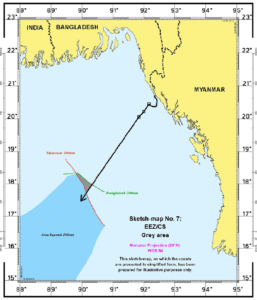
The court struck a compromise between these two claims. If the court had applied the logic of a single boundary based on equidistance, Bangladesh’s rights would have terminated short of 200 nautical miles. But Bangladesh’s natural prolongation argument ran contrary to the established legal (if not geological) definition of natural prolongation. Instead, the court adjusted the comprehensive boundary line, both within and beyond 200 n.m. It replaced the equidistance line with a geodetic angle bisector that preserved Bangladesh’s access to the continental shelf beyond 200 n.m. In the map below, Bangladesh has rights to the left of the solid black line, while Myanmar has rights to the right of the line.

Court adjustments to equidistance lines are commonplace, but the result here – to connect Bangladesh to a continental shelf beyond 200 n.m. – was unprecedented.1 As a result, in one area the court’s adjusted line was over 200 n.m. from Bangladesh’s basepoints but within 200 n.m. of Myanmar’s. In this “grey area” Bangladesh could not claim an EEZ, but Myanmar’s claim was unopposed.
To preserve Bangladesh’s access to its “outer” continental shelf, the court thus ruled that Bangladesh would have shelf rights in the “grey area” while Myanmar would have all other EEZ rights. The grey area reappeared in the ICJ’s subsequent Bangladesh v. India (2014) ruling, for the same reason. (Collectively, Bangladesh v. Myanmar and Bangladesh v. India are referred to as the Bay of Bengal cases.) In both Bay of Bengal cases, the court refrained from providing a rigorously explicit justification for this unprecedented move. Observers were fairly critical of the decision, with noted international lawyer W. Michael Reisman characterizing the rulings as legislation from the bench that overturned longstanding precedent.
The grey area established in the Bay of Bengal cases can create governance headaches for two reasons, which would be present anywhere State A has shelf rights while State B has EEZ-based water column rights. First, while State A has the right to any oil in the subsoil, State B has jurisdiction over the permitting and operation of any artificial platforms State A or a concessionaire would construct to extract the oil. Second, State A would have a right to the “creatures of the shelf” who live on the seabed, while State B would have rights to all other living creatures in the water column. This could create harms for either party, if say, fishermen from State B employ trawling methods that capture, kill, or disrupt the creatures of the shelf to which State A has rights.
The Grey Area is Proper
Despite these growing pains and contra critics, the “grey area” is actually the correct if inconvenient interpretation of UNCLOS. The text of the convention in fact permits what the court did and ITLOS in particular is guided by treaty law. Instead of overturning the precedent cemented by state practice, the Bay of Bengal cases establish a new precedent for a different subset of cases.
Consider two important differences between past precedent and the Bay of Bengal cases that make them substantially different. First, state-negotiated delimitations are not strictly bound by the Convention. When states cannot agree on a delimitation treaty, however, and refer the dispute to ITLOS, the relevant treaty law becomes far more important. Second, Malta v. Libya and other precedent-setting cases (such as Romania v. Ukraine) involved only areas within 200 n.m. of both parties, whereas the Bay of Bengal’s grey areas involved a potential “outer continental shelf” entitlement. Together, these differences make the Bay of Bengal cases significantly different to Malta, and thus the courts’ decisions are not the repudiation of precedent they sometimes are portrayed as.
More importantly, the text provides a clear justification of the courts’ separation of the water column from the seabed, even if the courts themselves did not explicitly make any argument defending their unprecedented ruling. Article 56.3 UNCLOS provides that the EEZ rights regarding the seabed set out in Part V “shall be exercised in accordance with Part VI [Articles 76-85].” Following Article 56.3’s directive to reference Part VI leads to a clear and rational basis for the court’s decision in the Bay of Bengal cases. Article 77 clarifies that continental shelf rights exist automatically, and thus logically exist prior to EEZ rights, which must be claimed. Furthermore, Article 78.1 explicitly states that the rights of a coastal state over the continental shelf (N.B., not the “outer continental shelf” – the Convention contains no mention of the “outer continental shelf”) do not affect the legal status of superjacent water columns or air. This clause applies to the EEZ as much as it does to the high seas. Taken together, this reasoning indicates that, under a strict interpretation of UNCLOS, the court’s function in a delimitation involving both the EEZ and the continental shelf is to identify first pre-existing continental shelf rights (including those beyond 200 n.m.) and delimit based on equity and thereafter construct and delimit EEZ rights.
Conclusion
Where does this leave the courts and future delimitation? The ship has long since sailed on delimitations within 200 n.m. of both states in a dispute. Much as with flags of convenience, state practice and custom have overtaken the convention’s black-letter language when delimiting EEZ and continental shelf rights within 200 n.m. While the court can determine continental shelf rights within 200 n.m. without prejudicing its subsequent award of the water column, it is too much to expect that it will embrace this reasoning in all future cases. Nevertheless, the court should utilize the logic above to justify the grey area where appropriate to compensate geographically disadvantaged states and ensure access to shelf resources beyond 200 n.m. A cursory analysis of outstanding boundary disputes indicates that the Bay of Bengal precedent may be of use on the Pakistan-India and Nigeria-Togo-Benin border.
Finally, the grey area itself ought not to be feared. The challenges of overlapping shelf and water column rights is not an issue of rule of law versus governance, but rather one of rule of law versus rule of habit. Instead of complaining about inconvenience, the Bay of Bengal case is not only a triumph for written law on the international stage but also an opportunity for states to cooperate. Prodded along by their economic self-interest, as they were when drafting the Convention itself, states sharing a grey area should find innovative ways of managing resources at a time when multilateral management of the seas is more important than ever.
Cornell Overfield is an Associate Research Analyst at CNA Corporation, a nonprofit research and analysis organization located in Arlington, VA. The views and opinions in this article are his own and do not necessarily represent the position of CNA.
Endnotes
1. Outer continental shelf entitlements are usually caught in a circular trap, where the specialized body designed to verify their existence cannot verify if the entitlement is subject to dispute, but the courts will not resolve the dispute as long as the body has not verified the OCS’ existence.
Featured Image: Emblem of the International Tribunal of the Law of the Sea (ITLOS) at its headquarters in Hamburg, Germany. (Tom Vierus/Livingdreams.tv)


 του Άλκη Καλλιαντζίδη, Οικονομολόγου.
 «ιστορική», λόγω της εξαιρετικής διάρκειας και των δυσκολιών της. Οι Ευρωπαίοι αρχηγοί κρατών και κυβερνήσεων συμφώνησαν τελικά την Τρίτη 21 Ιουλίου 2020, για το σχέδιο ανάκαμψης που θα τους βοηθήσει να αντιμετωπίσουν τις καταστροφικές συνέπειες της πανδημίας Covid-19. Αντιμέτωποι με την έκταση των ζημιών που προκλήθηκαν από τον ιό, ο οποίος σκότωσε περισσότερους από 200.000 ανθρώπους στην Γηραιά Ήπειρο και βύθισε την ευρωπαϊκή οικονομία σε μια άνευ προηγουμένου ύφεση, οι 27 υιοθέτησαν έναν πρωτόγνωρο Μηχανισμό, ο οποίος σκιαγραφεί τα περιγράμματα μιας πιο ομοσπονδιακής, πιο αλληλέγγυας και πιο ολοκληρωμένης Ευρώπης.
 αξιολόγησης κι αυτό της εξασφαλίζει πολύ ελκυστικούς όρους χρηματοδότησης) θα χρεωθεί στο όνομα όλων των κρατών-μελών. Τα αρμόδια όργανα της κοινότητας έχουν συνάψει δάνεια, αλλά οι έξοδοί τους στις αγορές ήταν πάντα περιορισμένες. Πράγματι, οι Συνθήκες υποχρεώνουν την Ένωση να υποβάλει έναν ισοσκελισμένο προϋπολογισμό. Τούτου λεχθέντος, εάν το επιθυμούν οι 27, και αν το εγκρίνουν τα κοινοβούλιά τους, η Επιτροπή μπορεί να αποφύγει αυτόν τον κανόνα και επομένως να αποκτήσει μια συγκεκριμένη δημοσιονομική αυτονομία.
 οδηγήσει την Ευρώπη να κάνει ένα νέο βήμα προς μια Ένωση αναδιανομής πλούτου, η αρχή της οποίας είχε από καιρό απορριφθεί από τη Γερμανία. Πράγματι, από τα 750 δισεκατομμύρια ευρώ που θα διατεθούν στο σχέδιο ανάκαμψης, τα 360 δισεκατομμύρια θα ληφθούν δανεικά για τα κράτη-μέλη που το επιθυμούν – δηλαδή θα βρεθεί ένας τρόπος να χρεωθούν με καλύτερους όρους, παρά να καταφύγουν μόνα τους στις αγορές χρήματος. Αλλά θα πρέπει να αποπληρώσουν αυτά τα ποσά. Και τα υπόλοιπα 390 δισεκατομμύρια θα τους αναδιανεμηθούν έως το 2023, με τη μορφή επιδοτήσεων, οι οποίες αυτές θα αποπληρωθούν από τους 27.
 Οικονομίας, Bruno Le Maire. Αυτό το ποσό θα της επιτρέψει να χρηματοδοτήσει εν μέρει το δικό της σχέδιο ανάκαμψης των 100 δισεκατομμυρίων που θα παρουσιαστεί στις “24 Αυγούστου”, σύμφωνα με τον Le Maire. Η Ισπανία θα δικαιούται περίπου 60 δισεκατομμύρια και η Ιταλία σε περίπου 70 δισεκατομμύρια. Η ελληνική κυβέρνηση ανακοίνωσε ότι για την Ελλάδα έχουν προβλεφτεί από όλες τις κοινοτικές πηγές συνολικά 70 με 72 δις ευρώ.
 συμπεριλαμβανομένης και της Γερμανίας – που δεν θέλουν αυτά τα χρήματα να κατασπαταληθούν, προβλέπεται ότι οι ωφελούμενες χώρες του σχεδίου θα παρουσιάσουν πρώτα ένα πρόγραμμα μεταρρυθμίσεων και επενδύσεων έως το 2023. Η Ελλάδα έχει ανακοινώσει ήδη ότι το δικό της πρόγραμμα το εκπονεί η ομάδα του νομπελίστα οικονομολόγου 2010 Χριστόφορου Πισσαρίδη. Αυτό πρέπει να είναι συμβατό με τις προτεραιότητες της Ένωσης (δηλαδή κλιματική και ψηφιακή μετάβαση) και να προβλέπει διαρθρωτικές μεταρρυθμίσεις. Πρέπει επίσης να επικυρωθεί από την Επιτροπή, καθώς και από τα κράτη μέλη, με ειδική πλειοψηφία 55% των ψήφων των κρατών-μελών.
 τίποτα δεν βρίσκεται σε εξέλιξη. Πολλές χώρες, ξεκινώντας από τη Γερμανία, δεν θέλουν να
 προχωρήσουν πολύ περισσότερο σε αυτήν τη λογική. Ως εκ τούτου, αναμένεται ότι η Επιτροπή θα επεξεργαστεί δύο υποθέσεις :






 Αλέξανδρος Δρίβας

 Δρ. Βενιαμίν Καρακωστάνογλου (*)
 πορείας της γειτονικής χώρας στην Ευρωπαϊκή Ένωση (επί της Γερμανικής Προεδρίας, μάλλον τον Σεπτέμβριο) για να υπάρξει νέα κινητικότητα. Οι εκλογές της 15.07.2020 παρήγαγαν το αναμενόμενο αποτέλεσμα, δηλαδή την μικρής έκτασης νίκη του SDSM του Ζόραν Ζάεφ απέναντι στο VMRO του Μίτσκοσκι, ενώ οι Αλβανοί της χώρας (DUI του Αλί Αχμέτι κ.λπ.) ήδη προβάλλουν το αίτημα για ορισμό Αλβανού Πρωθυπουργού, για να στηρίξουν εκ νέου Κυβέρνηση συνεργασίας όπως συμβαίνει τα αρκετά τελευταία χρόνια. Η χώρα έχει ενταχθεί στο ΝΑΤΟ, ενώ η εφαρμογή και η ερμηνεία της διμερούς Συμφωνίας με τη Βουλγαρία, χωλαίνει και προκαλεί έντονες οξύνσεις στα θέματα της εθνότητας και της γλώσσας των Σκοπίων («Μακεδονική»).
 Ίσως, επιπλέον κάποιοι στη Κυβέρνηση, να θεώρησαν ότι το κρατικό όνομα «Βόρεια Μακεδονία», είναι αρκετή αντιπαροχή των Σκοπίων για την εκχώρηση σ’ αυτά από την Ελλάδα του εθνοτικού ονόματος και της ιθαγένειας «Μακεδόνες» και της γλώσσας «Μακεδονική»!
 γειτόνων της, που δυστυχώς, από το γεωπολιτικό ως και το πολιτιστικό επίπεδο, παραμένουν ως σήμερα. Αυτό όμως δεν μας δίνει την πολυτέλεια να «κλείνουμε» όπως-όπως ένα θέμα ή περισσότερα (π.χ. Σκόπια) για να διαχειριστούμε και να αντιμετωπίσουμε ένα άλλο (π.χ. Τουρκία)!
 Ταυτόχρονα, ο σημερινός Έλληνας Πρωθυπουργός, μιλώντας στη Θεσσαλονίκη προεκλογικά, είχε τονίσει ότι θα είναι ιδιαίτερα αυστηρός κατά την διαδικασία ένταξης των Σκοπίων στην Ευρωπαϊκή Ένωση. Τόσο για την εκπλήρωση των προϋποθέσεων ένταξης (άνοιγμα και κλείσιμο των κεφαλαίων του Ευρωπαϊκού κεκτημένου), όσο και για την πιστή εφαρμογή των δεσμεύσεων των Σκοπίων από τη Συμφωνία της Πρέσπας.
 της Κυβέρνησης της Νέας Δημοκρατίας απέναντί της σήμερα. Ας δούμε όμως τι θα έπρεπε να κάνει η Κυβέρνηση του Κυριάκου Μητσοτάκη, κατά τη γνώμη μας:
 Η Ελλάδα βέβαια τηρεί τις διεθνείς συμβατικές υποχρεώσεις της και έχει ασπίδα της το Διεθνές Δίκαιο! Δυστυχώς όμως η διεθνής πραγματικότητα αναδεικνύει τα άνισα κριτήρια εφαρμογής των διεθνών κανόνων από τους Διεθνείς Οργανισμούς και τις Μεγάλες δυνάμεις, στη βάση των συμφερόντων τους αλλά και της ισχύος των Κρατών.
 όπου τέθηκε ως πρόσθετος όρος για την ένταξή της, η επίλυση συνοριακών διαφορών και άλλων συναφών θεμάτων με τους γείτονές της (βλ. Ελλάδα) ή αλλιώς η προσφυγή για επίλυση στο Διεθνές Δικαστήριο μέχρι το 2004, μπορεί να τεθεί πρόσθετο κριτήριο ένταξης για τα Σκόπια, η καλή γειτονία με την Ελλάδα, μέσω της αναμόρφωσης της ψευδώνυμης ιδεολογίας του «Μακεδονισμού» που εφαρμόζουν μεθοδικά από το 1944 και ιδίως από το 1991. Ένός «Μακεδονισμού» που ενισχύεται και πριμοδοτείται αντί να θεραπεύεται, από την Συμφωνία της Πρέσπας! Μια Συμφωνία που μόνο προσχηματικά και επιφανειακά εφαρμόζεται από τους γείτονες, που την παραβιάζουν ποικιλοτρόπως και δηλώνουν παντοιοτρόπως ότι είναι οι μόνοι «Μακεδόνες» και ζούν στη μόνη ¨Μακεδονία»!
 Όλων εκείνων των αγνών Ελλήνων Πατριωτών που βγήκαν αυθόρμητα και μαζικά στους δρόμους και τις πλατείες όλης της χώρας για να διατρανώσουν ότι «η Μακεδονία είναι μία και είναι Ελληνική». Κάτι τέτοιο είχε να συμβεί δεκαετίες! Αυτός ο λαός σήμερα νιώθει προδομένος, απογοητευμένος, πικραμένος! Το θέμα είναι «στα αζήτητα», η Πρέσπα προκάλεσε ηττοπάθεια στο πιο πατριωτικό ίσως κομμάτι, υπεράνω ιδεολογίας, του λαού μας…