Αρχική Blog Σελίδα 2445

Erdogan Has a New Mosque and the Turks Will Pay for It

0

haaretz.com

Zvi Bar’el

By turning Hagia Sophia back into a mosque, Erdogan trades historical Turkish attempts to bridge East and West for unclear personal gains, and with little regard for his voters’ already empty pockets.

Turkish President Recep Tayyip Erdogan’s decision to declare that the Hagia Sophia Museum in Istanbul is once again a mosque has roused an international ruckus.

Pundits, researchers and historians see this as a significant step in the direction of the Islamification of Turkey. The pope has expressed “deep sadness.” Turkish commentator Selim Koru’s opinion piece in The New Yok Times is entitled “Turkey’s Islamist Dream Finally Becomes a Reality.” And an editorial on the opposition website Ahval, published on July 11, made the case clearly: “The current alliance ruling Turkey under the banner of a ‘Turco-Islamic Synthesis’ is determined to drive a wedge between the country and the rest of the civilized world… the case of the Hagia Sophia tells us that an era is over, and that the Islamists have nearly won their historic battle to conquer Turkey.”

As expected, Erdogan is not impressed. “The revival of Hagia Sophia presages the liberation of the Al-Aqsa Mosque,” he proclaimed in a festive speech on the occasion of the rededication of the mosque. “Its revival is the voice of the footsteps of Muslims all over the world when they are enthused. The revival of Hagia Sophia is the flame of hope for all the oppressed, the exploited and the downtrodden in the world together with the Muslims. The resurrection of Hagia Sophia is an expression of the fact that we, as a Turkish nation, as Muslims and as human beings have a new message for the world.”

Islamification is a catchy and understandable slogan, especially when it comes to Erdogan. However, the splendid Christian church that became a mosque during the Ottoman period, then a museum and is now reborn as a mosque, has been a piece in the political game as much as a sacred religious site. In 1935, when Mustafa Kemal Ataturk made the Hagia Sophia Mosque a museum, to international enthusiasm and great anger among the Islamic movements in Turkey, he explained that “it would be logical to make Hagia Sophia a museum open to visitors from all nations and all religions instead of it being a place that belongs to one religion and one group.” Ataturk made no bones about his opinion of Islam when he said’ “Islam in the society and in the Islamic politics was responsible for the failure of modernization … Unity of religions is not essential for creating a nation … A nation is shaped by people who share a rich historic heritage and a serious aspiration to live together and preserve that shared heritage.”

It is easy to contrast Ataturk with Erdogan, and depict the current president as wanting to Islamify a state that in its very constitution is still defined as secular and democratic. However, the museum, which to the new Turkey symbolized a turn towards the West, did not stop the Islamic narrative even back in the 1950s. With the rise of the Democratic Party to power in 1950, the political atmosphere changed. Hoping to better its relationship with Europe and the United States for diplomatic and economic reasons, the new regime targeted the leftist and Communist movements, hoping to show determination in fighting anything that could be perceived as a partner of the Soviet Union. Religious movements were an integral part of the that effort, and enjoyed massive support from the government. Even then, there was talk of bringing religion back into Hagia Sophia.

Thirty years later, the status of the museum also changed. The military government that took over after the 1980 coup took the Cultural Properties and Museums Authority away from the Education Ministry, and incorporated it into the Ministry of Culture and Tourism. From a symbol of a unifying cultural heritage as Ataturk had envisioned it, the museum became an important source of income form tourism.

A decade after that, the museum was once again endowed with a new political role. In the wake of the first Gulf War and the European Union’s refusal to admit Turkey to its ranks, the Turkish administration sought ways to shape its image as a regional power that the West should want to attract. The strategy was to position Turkey as a bridge between East and West, and Hagia Sophia began to star along with the Blue Mosque (the Sultan Ahmet Mosque) in documents displaying the Istanbul skyline as a national logo.

This was still the case until recently. The merchandising for Turkey’s unsuccessful 2020 Olympic Games bid, for example, featured Hagia Sophia as a represention of secularism and the West, and the Blue Mosque, as a symbol for Islam and the East; beneath, the slogan read “Bridge Together.” But even then, this harmonious show window encountered objections from Turkish nationalists and Islamists, who never quit demanding the restoration of the museum’s past religious glory.

Muslims offer their evening prayers outside Hagia Sophia, Istanbul, following the decision to turn it back into a mosque, Friday, July 10, 2020.

Muslims offer their evening prayers outside Hagia Sophia, Istanbul, following the decision to turn it back into a mosque, Friday, July 10, 2020. AP Photo/Emrah Gurel

So why now?

The movement has existed for a while. In 2014, a whopping 40,000 worshippers held a mass prayer service at Hagia Sophia, calling for re-establishing its status as a mosque. Before that, in 2012, Salih Turan, the chairman of an Anatolian youth association, claimed he had collected 15 million signatures on a petition with the same demand. Erdogan’s response, as prime minister, was fascinating: “We have the Blue Mosque, right next to Hagia Sophia. Let Hagia Sophia be – go fill the Blue Mosque.” In fact, Muslims were able to worship in Hagia Sophia even when it was a museum, as, under public pressure, the authorities turned part of it into a mosque back in the 1980s.

So what prompted Erdogan to take this step at this particular time? Some think he might be attempting to boost his electoral chances, although the next elections are not until 2023. Others suggest it is an attempt to obscure the failures of his economic plan, and the endless entanglement in Syria. Or, this might just be him trying, once again, to depict himself as the leader of the Islamic world, a kind of modern sultan or caliph, casting shade on the status of Saudi Arabia and challenging the Christian world.

Erdogan has promised Russian President Vladimir Putin that the decision will not affect the freedom to visit the mosque, or threaten the splendid Christian elements that adorn it. The decorations will be covered during worship and revealed again upon the completion of the prayers. It is clear, however, both from Putin’s query and Erdogan’s answer that Hagia Sophia is henceforth a Muslim Turkish property owned by the ruler.

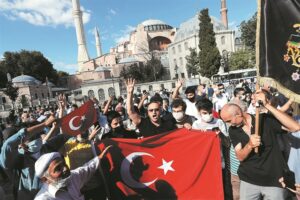
People, draped in Turkish flags, chant slogans, outside Hagia Sophia, Istanbul, following the decision to turn it back into a mosque, July 10, 2020.

People, draped in Turkish flags, chant slogans, outside Hagia Sophia, Istanbul, following the decision to turn it back into a mosque, July 10, 2020. AP Photo/Emrah Gurel

This comes as a cost, and not just for maintenance, restoration and preservation. The holder of the concession to sell tickets is the Swiss company SICPA, owned and managed by Philippe Amon, a Swiss citizen from a Jewish family whose father founded the company in the 1920s. The company is not only secretive (it does not publish its financial records), it is also world-famous for having invented the security ink used to print currency bills, securities and documents that require a unique signature. It is estimated to hold about 85 percent of the world security ink market. Amon himself is also a philanthropist who sits on the board of the World’s Jewish Museum project in Tel Aviv and many other Jewish institutions. Despite many objections in Turkey to granting the concession to a “Jewish” company, in 2018 SICPA won the franchise for seven years for about $3.9 billion.

Upon the transfer of control of the mosque to the Religious Affairs Ministry, the company is expected to demand compensation for the expected loss of income. The government of Turkey will also forgo about 400 million Turkish lira (more than $58.3 million) annually from share of the ticket sales it was promised.

“At a time when Turkish citizens are facing economic difficulties that are worsening day by day, their tax monies are being directed to astronomical compensation payments and huge projects,” charged lawmaker Filiz Kerestecioglu of the pro-Kurdish HDP party. She expressed serious concern with regard to the funding of the renovation of the mosque. Hagia Sophia is on the list of World Heritage Sites, and as such enjoys funding from the United nations and other international organizations for maintenance and renovation. Since UNESCO denounced the fact that Erdogan’s decision was taken without prior consultation, the concern is that this support will cease.

When it comes to the ruler, money is no matter

Apparently, Erdogan does not see funding for the reinstated mosque, or even for the routine management of Turkey, as a problem. This week, Turkish journalist Burak Tuygan published a long and detailed article about the transformation Erdogan and his party have undergone during 18 years of their rule, turning from the hope of the hopeless into the party of decadence. Tuygan tells of the luxury cars, the large private homes, the bathrooms with gold-plated faucets in the offices of top party people, which have become the norm and a status symbol. Mehmet Salih Sarac, leader of the youth branch of Erdogan’s Justice and Development Party (AKP) in the city of Sanliurfa, near the Syrian border, faced backlash earlier this month after he was filmed in his jacuzzi, telling poor people not to bother him. Sarac resigned after the video found its way to social media, and claimed that the clip was intended for distribution only to a private group.

Tuygan also mentions the yachts owned by Erdogan’s sons that came to light in the Panama Papers leaks, the list of demands presented by his daughter Sümeyye Erdogan for her luxurious homes in western Turkey, and of course did not forget the purse owned by Erdogan’s wife Emine, a Hermes Birkin bag worth an estimated $50,000, along with a brooch valued at $15,000.

Another member of the inner circle is YouTube influencer Busra Nur Calar, who created outrage after she threw an extravagant baby shower. Her husband is Deputy Health Minister Ahmet Amin Soylemez, whose father, Ugur Suleyman, was killed in the Israel Defense Forces attack on the Mavi Marmara ship during the May 2010 Gaza flotilla. The list goes on. It includes Ayse Buharali, a founder of the AKP who won government tenders for bids amounting to about $200,000, and Erdogan’s media manager, Fahrettin Altun, who leased a plot of land overlooking the Bosporus Straits for $40 a month. Several hundred websites that reported the story were closed down as a result.

“The oppressed and downtrodden Muslims” whose voice a revived Hagia Sophia is supposed to carry, as Erdogan said, blatantly does not include the top layer of the AKP, his family members and his cronies. The president, sitting in his huge palace behind a special presidential guard wearing traditional uniform, has forgotten his difficult childhood and the millions of his voters who came from the distressed classes. Despite this, as it is too in Israel, which he has marked out as an enemy and a terrorist state, the same downtrodden folk continue to vote for their distant ruler and see him as the savior of the nation. Ostentatious corruption, it turns out, is a mark of honor and a symbol of success.

The Sultan is dead, long live “Başyüce” Erdogan Sultan!

0

opendemocracy.net

Erdogan’s desire to install a presidential system in Turkey has been inspired by Kisakurek’s ‘Basyuce’ concept as the  representative of the Sunni majority.

lead lead

Poet and Islamist ideologue, Necip Fazıl Kısakürek. Wikicommons/ Berildeman. Some rights reserved.Sultanism is on the rise. Beyond Turkey, the election of Trump in the US, the resilience of Putinism in Russia, all point out the emergence of highly personalized regimes of a certain type. What distinguishes sultanism from other forms of authoritarian regimes is its unrestrained personal rule beyond ideological constrains and rational legal forms, leading to the gradual removal of checks and balances in the system. Even though sultanism is traditionally more common under authoritarian regimes, features of neo-sultanism can nowadays also exist in so-called `democratic and societies of transition’.

Max Weber developed the concept of sultanism primarily based on unbounded personal discretion. Weber understood sultanism as an oriental form of despotism, deriving the term from the Ottoman state. But his study of the Ottoman Empire as a sultanistic regime appears to have been less meticulous than his inquiries into China, and India. In fact, the Ottoman state was a highly sophisticated construct, with its separate palace, military, and religious hierarchies, and its millet system for management of non-Muslim religious communities. In this sense reducing the entire Ottoman system and history to mere unrestrained personal rule could be seriously misleading, not least because there were serious attempts and movements to limit the powers of the Sultan from 1876 onwards.

The kind of sultanism we are currently witnessing reflects a more universal form: all sultanisms have some common features but some are more pronounced. Not long ago Chehabi and Linz argued that sultanism arises when traditional domination develops an administration and a military force which are purely personal instruments, primarily based on the discretion of the ruler. They accept that the term can be interpreted as having an `Orientalist’ subtext with Islamic connotations. What I would like to call ‘neo-sultanism’, on the other hand derives its legitimacy from popular support leading to elected dictatorships. These are not necessarily hereditary regimes but may portray strong features of patrimonialism.

Here I will limit my arguments to the Turkish context under Erdogan’s increasingly autocratic rule. Erdogan’ has been called “islamo-fascist, neo-facist, neo-Ottomanist” etc. but I would like to contend that these terms are not particularly helpful in making sense of the rise and consolidation of Erdogan’s regime. Although aware of the ideological ambiguities surrounding the term, neo-sultanism, I will deliberately  risk deploying it, since there is a need for a serious debate to understand the shaping forces of the new presidential regime  in Turkey.

Erdogan’s neo-sultanism

Although claiming to be above and beyond ideologies, Erdogan’s neo-sultanism has been influenced by a cluster of ideologies that represent a continuity in the strong state tradition in Turkish history. His highly personalised authoritarian rule is rooted in and inspired by a combination of hegemonic ideological traits that can be located in the events leading to the emergence of modern Turkey.

Successive governments since 1970s, under the leadership of right-wing party leaders such as Turkes, Demirel and Ozal also strongly favoured presidentialism above parliamentarianism. It is not surprising for instance that Erdogan secured the support of the veteran nationalist party head, Bahceli, as an ally in the referendum for a `Turkish style’, that is, a presidential system, doing away with checks and balances and concentrating power in the office of the presidency. The ideological traditions of Islamism, nationalism, conservatism and neo-liberalism, have always existed in modern Turkey’s history along discernible lines and movements in different combinations and articulations, particularly after the1950s which witnessed the first peaceful transfer of political power in Turkish history. This is not to suggest that the Republican Party (the CHP, in power in a one-party state until 1946) was not guilty of this ‘one nation sovereignty’ logic. But parliamentary sovereignty, at least in rhetoric, was more appealing to its leading cadres. Erdogan has been much more successful in fusing statism, nationalism and religious conservativism, combined with market fundamentalism in comparison with his right wing successors.

Historical block and ideological continuity

Erdogan sits on the tip of an iceberg that represents a historical power block originating from the late Ottoman period.  It is repeatedly argued that the political pendulum in Turkey swings between Kemalist secularism and religious conservatism. According to this binary view, Turkish society is divided along secular conservative religious camps. This false dichotomy is simplistic. And like all false dichotomies it leads to false conclusions. In fact Kemalism, in the true sense of the Kemalist ideology, has not been in power in Turkey since the end of the Republican People’s Party’s one-party regime in 1950.

The coming to power of the conservative Democrat Party in 1950 elections marked a clear transition from utopian republicanism to a national conservative regime with authoritarian inclinations. Even the Turkish armed forces gradually abandoned a pure Kemalist ideology but not their role as protector of state and sovereignty. Their attempt in 1960 to reintroduce Kemalism failed, confronted by the same conservative nationalist Islamist power block. By the 1980s, the armed forces had become much more defensive and apologetic about the credentials of Kemalism and regarded the CHP as yet another failed political party on a par with the Islamic and conservative parties. It seems the Turkish military was well-aligned with the exigencies of neo-liberalism and identity politics in Turkey in leaving the orthodoxy of Kemalism behind.

I would like to make a bold claim here: in Turkey the state has indeed been the sole power since its inception, with its claims to hegemonic legitimacy justified by the protection accorded by conservative, nationalist and Islamist parties alike to the core component of the state – the Turkish and Sunni Muslim nation. The problem has consisted in who speaks for and controls the state, and protects the state against ‘the others’ of Turkish Sunni core identity rather than protecting its citizens, regardless of their religious affiliations and ethnic background, against the state. Raison d’etat, ‘devletin bekasi’ has always been the prevailing ideology. Historically, the Gulenist movement has been an integral part of this historical ideological block. The recent spat between Gulenists and Erdogan was an internal fight within the same hegemonic block over the ownership of the state and its institutions. The nature of this conflict was not strictly about ideological differences, but a power struggle over the hegemony of the state and its use of force.

It is often claimed that Erdogan is a neo-Ottomanist. But this label is not accurate as the history and the political system of the Ottoman Empire was highly chequered and complex. In fact, Erdogan’s neo-sultanism has been inspired by one particular sultan, namely, Sultan Abdulhamid who is Erdogan’s favourite. Abdulhamid, known as the Red Sultan( 1876-1909), attempted to revive Pan-Islamism and the status of Khalif as a last resort to holding the Empire together. Abdulhamid is also known in Kemalist discourse as a despotic sultan who suspended both the first short-lived Constitution and the Ottoman Parliament in 1878 after seizing absolute power.

Erdoğan also admires the Islamist-conservative poet and political ideologue Necip Fazıl Kısakürek (1904-1983) and often recites his poems in public. Kisakurek is a favoured poet and writer in nationalist and conservative Islamic circles. He was also an advocate for the introduction of a totalitarian Islamist regime inspired by the Turkish-Islamist synthesis in Turkey, to be ruled by a supreme leader he called “Başyüce” (The Head Exalted One). Erdogan’s desire to install a presidential system in Turkey has been inspired by Kisakurek’s ‘Basyuce’ concept as the representative of the Sunni majority. His understanding of national will is not the peoples of Turkey but of that predominant Turkish Sunni majority. (See Necip Fazil Kisakurek, İdeolocya Örgüsü, “Plait of Ideology,” first published in 1963.)

Moreover, the fashionable distinction between the elitist, westernized so-called “white Turks” and the allegedly “real” and “authentic” nation composed of so-called “black Turks,” as produced and widely disseminated by the AKP in pro-government think tanks and media, also appealing to some liberal circles in Turkey and abroad, stems from Kısakürek’s oeuvre. Erdogan attacks western educated “white Turks” at every opportunity, while presenting himself as the saviour of the marginalized religious conservative masses by the Republic, “black Turks”, the “resented and the downtrodden” (mazlum).

Erdogan is the most powerful leader for more than a decade in Turkey, yet he manages to emerge from every crisis as the martyr of history, accusing internal and external forces of working against him, including leaders of foreign countries, financial institutions and international media. This is a siege mentality that often seems to work in his favour.

‘Retrodevelopmentalism’ as false Ottomanism

The Ottomanization of public space has been another feature of Erdogan’s neo-sultanist drive. Erdogan has often announced ‘crazy projects’ that have included grandiose schemes for bridges, a canal to parallel the Bosphorous, cavernous shopping centres and prestige projects such as the, mega mosque on one of Istanbul’s beauty spots, Camlica Hill, ostensibly the biggest airport in Europe and so on. These projects are often named after ‘great’ Ottoman Sultans and figures.

Reviving the Ottoman Barracks in Taksim Square was no random choice as the rebellion against Sultan Abdulhamid started there. Like the Ottoman Sultans, Erdogan wants to be remembered as the great architect to rebuild and recreate in the image of the Ottoman Empire. As Ufuk Adak puts it, the imposition of a ‘Disney Park narrative of Ottoman history’ on the traditional structure and skyline of Istanbul has led to an overly simplified and callous recreation of the past.

The Ottoman state was the owner of all land in terms of a trusteeship which was not alienable. As sociologist Caglar has argued, unlike the Ottomans Erdoğan thinks of public land as his property to alienate, develop and sell as he wishes. Public space will be privatised in the best neoliberal manner. All this has been justified within a ‘retro developmentalist discourse’

It is crucial to understand the spatial dimension of Erdogan’s neo-Sultanistic hegemony.  He was a two-term mayor of Istanbul in the 1990s where he served his political apprenticeship. Space acts as an integral element of Erdogan’s hegemony. The transformation of public space reflects the outcome of the uneven capitalist development in the lopsided crony-capitalist-led urbanization, where the size of mega-building projects, flashy shopping centres next to deprived regions and poor neighbourhoods, act simultaneously as the signs of development and aspiration. Erdogan’s hegemony heavily relies on the production of everyday geopolitics in urban space. In this sense the reproduction of the space itself tends to restructure society.

Permanent state of emergency as the new norm 

In Turkey, Erdogan is sole sovereign in defining ‘the exception’. Erdogan’s neo-sultanistic regime has established a permanent state of emergency. It was the political theorist Carl Schmitt in his examination of conditions in the democratic German Weimar Republic who first touched on the notion of a state of exception. Schmitt essentially conceived of constitutionality as something “decided” by sovereign power which could also decide the “exceptions” to it. Through its justification of infinite detention and the surveillance of citizens, law is appealed to in order to effectively create “spaces of exception” within democratic societies devoid of law. Erdogan’s constitutionally mandated “exception” now becomes a rule which abrogates both constitutionality and the rule of law over the democratic order and institutions.

It is no accident that Erdogan put the extension of a state of emergency at the top of his government’s agenda the day after claiming victory in a contested and apparently rigged referendum on a new constitution that dramatically extends his powers. Even before the referendum, Erdogan ruled with decrees side-lining the Parliament. So far, the decrees have allowed Erdogan to jail more than 40,000 people accused of plotting a failed coup, to fire or suspend more than 140,000 additional people, including academics, to shut down about 1,500 civil groups, repossess universities, arrest at least 120 journalists, and close more than 150 news media outlets.

Conclusion

Erdogan is the new sultan of Turkey. As a result of the referendum he has acquired extraordinary powers unprecedented in Turkish history since the times of Ataturk.

However, the legitimacy of his regime is not without question. He won the referendum by a very narrow majority. The referendum took place under the state of emergency and undemocratic conditions. The outcome of the referendum was not particularly favourable to Erdogan. Erdogan seems moreover to have lost his urban support base, including the neighbourhoods of Istanbul that carried him to where he is now.

He has managed to codify his de facto powers by the symbolic approval of `the people’ in whose name he will exercise sovereignty. The fact remains that a highly divided, polarized and personalized regime in Turkey has become difficult to sustain. Official laws and rules are now subservient to a whole range of informal laws centred on family, religious affiliations, ethnicity and personal allegiance to Erdogan. The all-powerful Erdogan is now Turkey’s new Sultan, Turkey’s Basyuce.

In Erdogan’s new sultanate, the distinction between regime and state is blurred and the institutions are hollowed out. Consequently, the constitutional façade and the futile referendum do not mean much. In Erdogan’s new sultanate, official laws and rules co-exist with and are often subservient to a whole range of other “informal” laws centred on his family, religious affiliations, business interests or simply personal allegiance to Erdogan. Erdogan’s sultanate is characterized by corruption, patrimonialism and buttressed by an increasingly subservient army and party. His personality cult may lead to dynasticism. Having lost much of his initial social support and strong base, he now has to rely on fear, rewards and nepotistic networks. He will be sustained by ‘kleptocratic’ relationships and rule with a constitutional façade lacking institutional structures.

Erdogan’s extremely personalized ‘sultanistic’ regime, is in reality fragile, ineffective, and potentially unstable. Its institutions could, as a result of an inability to cope with a sudden economic downturn, produce his downfall. Sultanistic regimes do not last long. As the legitimation of the regime is solely based on his highly and extremely personalized power, should this figure be overthrown or die, the sultanistic regime collapses. Fascist regimes organize their society strictly according to their ideology: in neo-sultanictic regimes society is organized according to the whims of the sultan, ideology is deployed only when it serves their personal interests and supreme authority lies above the state and its institutions.

opendemocracy.net

Erbakan, Kısakürek, and the Mainstreaming of Extremism in Turkey

0
Hudson Institute Necmettin Erbakan lors d’un meeting dans les années 1980 en Turquie. (Photo by Ergun CAGATAY/Gamma-Rapho via Getty Images)

Svante E. Cornell

Turkey continues to function as a member of NATO and nominally aspires to European Union membership, but for all practical purposes, it is positioning itself in opposition to the West. The Turkish leadership’s rhetoric is increasingly similar to that of America’s adversaries and is only rarely that of a partner and ally. What accounts for the gap between Turkey and the West? How deep is it? Though there is a great deal of writing on Erdoğan and Turkish political Islam, we have only scratched the surface of the ideological baggage of Turkey’s current elites. This article proposes to dig deeper to discern the key elements of this baggage and the extent to which Turkish policies today are a reflection of this. It links the rise of Tayyip Erdoğan to his predecessor as leader of Turkish Islamism, Necmettin Erbakan, and the more uncompromising Islamist ideologue, Necip Fazıl Kısakürek. The article concludes that a generation of Turkish Islamists and nationalists has been strongly influenced by a worldview that is deeply anti-Western and anti-Semitic, is based on a warped and highly conspiratorial approach to world affairs, and is increasingly widespread in Turkish society.

In December 2017, U.S. national security advisor General H. R. McMaster singled out Turkey and Qatar as prime sources of funding for extremist Islamist ideology globally.1 Roughly at the time of McMaster’s pronouncement, his point was unwittingly reinforced by a key mouthpiece of Turkish president Recep Tayyip Erdoğan, the editor of the Islamist daily Yeni Şafak, Ibrahim Karagül: “Turkey is emerging as a new power center opposing the United States, the world’s strongest power … the matter is no longer about Jerusalem or about Turkey and Israel. It is a showdown between the United States and Turkey.”2 Karagül went on to claim that America’s aim was to occupy Islam’s holy sites, Mecca and Medina.

Either of these pronouncement would have been utterly unthinkable little more than a decade ago. Today, they only raise eyebrows. Indeed, there is a growing consensus that Turkey, aside from becoming increasingly authoritarian, is moving away from the Euro-Atlantic sphere mentally and ideologically. This, most observers realize, has important implications for the regional security of both Europe and the Middle East, not to speak of American interests.

But how deep is this shift, and what lies at its basis? There is more debate regarding these critical questions. A skeptic could observe that President Erdoğan appears to use ideology instrumentally. Indeed, over the past few years his rhetoric, and evolving regime constellation, have cultivated Turkish nationalism as much as Islamism. Further, optimists maintain that Turkish society has developed rapidly in the past two decades, and that its economic strides will counterbalance the danger of radicalization. A parallel argument would hold that the problem is largely the abrasive personality of the Turkish president. Post-Erdoğan, thus, Turkey may revert to the mean and return to its position as a reliable ally.

There is merit to these arguments. In particular, the excessive focus in the West on Erdoğan’s person does hinder deeper analysis of the intricacies of behind-the-scenes Turkish regime politics and masks the very real weaknesses of his position. And there is no question that if Erdoğan is an ideologue, he is a very pragmatic one: His government at first relied on the followers of self-exiled preacher Fethullah Gülen to reduce Turkey’s military and right-wing nationalist establishment to size. But when his relationship with the Gülenists turned sour, he promptly struck up an alliance with those very ultra-nationalist elements and turned against the Kurdish groups he had long cultivated while maximizing Turkish nationalist support.

Still, the ideological underpinnings of Turkish policies are undeniable. Education reforms implemented since 2012 strongly enhanced religious content in the public education system and were accompanied by a boom in religious schools, in many cases involving the forced conversion of secular public schools to religious schools.3 A gigantic and activist state directorate for religious affairs has been built to promote Sunni Islam.4 Simultaneously, especially following the 2011 Arab uprisings, Turkey’s foreign policy was increasingly motivated by a Sunni Islamist agenda.5 The Turkish leadership has also showed a worrisome penchant for conspiracy theories. Following the 2013 Gezi Park riots, government representatives famously blamed the “interest rate lobby” for orchestrating the unrest, and statements that clearly pass the threshold of anti-Semitism have become frequent.

This article will argue that Turkey’s slide in the direction of Islamist ideology is real and goes beyond the personality of Tayyip Erdoğan. To illustrate this point, it will study the ideological worldview of the current Turkish political elite and focus on two key sources. One is the worldview of Necmettin Erbakan, Erdoğan’s predecessor as leader of Turkey’s Islamist movement, which was laid out in a posthumously published memoir. The second is the heritage of the Islamist poet Necip Fazıl Kısakürek, a reference point not just for Erdoğan but for a generation of both Islamist and nationalist elites in Turkey. Their once fringe ideas, far from being arcane, have increasingly become mainstream.

A Rare Window into the Worldview of Turkish Islamism

Necmettin Erbakan is recognized as the founder of Turkish political Islam, and was the leader of the dominant Islamist movement, Milli Görüş (National View). His 2011 funeral was attended by a who’s who of the global Islamist movement, including Hamas leader Khaled Meshaal and the Muslim Brotherhood’s former spiritual guide, Mohamed Mahdi Akef.6 Tunisian Islamist leader Rashid al-Ghannouchi noted that “in the Arab world in my generation, when people talked about the Islamic movement, they talked about Erbakan … it is comparable to the way they talked about Hassan al-Banna and Sayyid Qutb.”7 Erbakan’s political career spanned five decades; he became Turkey’s first Islamist prime minister but was deposed within a year by the military in what has been termed the 1997 “post-modern” coup. Though he was banned from politics from 1998 onward, he continued to exert considerable influence on Turkish political Islam.

The title of Erbakan’s posthumously published memoir, Davam, is Turkish for “my cause.” The word dava, from the Arabic dawa, could mean either cause or proselytism. This remarkable book begins with a chapter on “creation and humans,” followed by “our Islamic dava” and “the forces that run the world.” Subsequent chapters discuss Islamic union, Cyprus, industrialization, and culture. But it is the first three chapters that provide the most significant window into the nature of the Turkish Islamist movement. They show that Erbakan’s worldview differed strongly from traditional Turkish Islam and that it exhibits important influences from the modern Middle East, particularly from Muslim Brotherhood ideology. While Erbakan’s anti-Western thinking appears strongly inspired by Qutb’s ideas, he also exhibits an obsession with conspiracy theories and most notably, shares the Islamized anti-Semitism of European origin to which Qutb subscribed.

The Influence of Arab Islam

Erbakan’s opening chapter constitutes a passionate argument for Islam as an all-encompassing guide to individual and social conduct. Given that he was a card-carrying Islamist, this may not come as a surprise. But the book begins by asserting that “there is no source of justice or truth aside from Islam” and that “reason without Islam cannot, on its own, know the absolute truths, and cannot tell good from evil.” Erbakan goes on to explain that the clashes between philosophers and the battles between ideologies are all a result of the neglect of this fundamental truth, and asserts that nothing good can come from any science or technology that does not take its inspiration from the Qur’an. To any reader familiar with Islamic theology, this perspective indicates an understanding of Islam more reminiscent of Middle Eastern Islamic traditions than the Turkish mainstream: it derives from Ash’ari rather than Maturidi theology, and from Shafi’i and Hanbali rather than Hanafi jurisprudence.

A clarification may be in order. In the eighth to tenth centuries, a highly rationalist theology known as Mu’tazila flourished in Iraq, heavily influenced by Hellenistic philosophy. It was gradually reduced to obscurity by the three chief theological schools that exist today.8 The literalist Athari school, which gave rise to modern-day Salafi and Wahhabi doctrines and is prominent among the followers of the Hanbali school of jurisprudence, rejects the very notion of theology itself, finding it an unnecessary and harmful exercise. While it has received a boost in recent decades through Saudi and Gulf support, it has traditionally languished in the shadows of the established Ash’ari and Maturidi schools of theology. These two ideologies both opposed the Mu’tazilite effort to relegate revelation to secondary status. They have many commonalities, and the main difference between them concerns the role of human reason. The Maturidi school accepts the notion that human reason can discern good from evil without the aid of divine revelation. The Ash’ari school, agreeing with the Athari and Hanbali literalists, vehemently rejects that notion.9 In subsequent centuries, the Ash’ari school became dominant in the largely Shafi’i and Maliki lands of the Middle East and is present in all four schools of jurisprudence. The Maturidi tradition grew strong in areas dominated by the Hanafi madhab. Thus, not every Hanafi is necessarily Maturidi, but in practice, every Maturidi is Hanafi.10

The Ottoman Empire was the center of the Hanafi-Maturidi tradition, which remains the dominant theological school in Turkish Islam, as it does in Central Asia and the Balkans. Against this background, Erbakan’s assertions are significant because they suggest a fundamental departure from traditional Turkish Islam and an embrace of theological thinking from the Middle East. As we will see, this is not the only example. This complicates the oft-stated notion of Turkish Islamism as “neo-Ottoman.” It certainly is built on Ottoman nostalgia and an urge to restore the greatness of the past, allegedly built on Islam. But ideologically, it constitutes a rupture with Ottoman tradition, and its roots lie elsewhere.

Two key ideological inspirations of Turkish Islamism are responsible for this deviation: the Naqshbandi-Khalidi order and the Muslim Brotherhood. As M. K. Kaya and I detailed in a study in Current Trends in Islamist Ideology, the Naqshbandiyya’s Khalidi branch was the locus of Turkish political Islam’s formation: it was only with the explicit permission of Erbakan’s Naqshbandi shaykh that he launched a career in politics.11 The nineteenth-century founder of the Khalidi branch, Khalid-i Baghdadi, stood out for his emphasis on sharia law. As his Turkish biographer summarizes, he was “itikaden Eş’ari, fıkhi yönden Şafii, meşrep açısından Nakşibendî-Müceddidi”—Ash’ari by creed, Shafi’i by jurisprudence, and Naqshbandi-Mujaddidi by spiritual way.12 Thus, the shaykhs he empowered and who went on to establish the Khalidi branch as the most influential religious order in present-day Turkey were, from the outset, trained in the Ash’ari and Shafi’i tradition. They brought this with them to Turkey, where the Naqshbandi became increasingly influential in the nineteenth-century Ottoman bureaucracy, following the suppression of the Bektashi order. While the predominant Hanafi-Maturidi school did exert influence on many Khalidi disciples in the bureaucracy, their rise nevertheless opened Ottoman Islam to influences from the Middle East.

A second, subsequent source of influence that would confirm this worldview is Muslim Brotherhood ideology. Erbakan writes that Islam is the salvation of all mankind and therefore, every human being, whether Muslim or not, must accept Muhammad’s leadership.13 In this, one cannot ignore the inspiration Erbakan drew from Sayyid Qutb, the key ideologue of the Muslim Brotherhood, who argued in his seminal work, Ma’alim fi al-Tariq (Milestones), that “for human life, there is only one true system, and that is Islam.”14 As we will see, this is far from the only area where Qutb influenced Erbakan.

Erbakan’s View of the West

The way Erbakan saw the Western world was, needless to say, typical of Islamist thinkers and highly negative. He allowed that in comparison to the socialist bloc, the West had managed to build a society with higher production and therefore greater material well-being. But in the end, the West is not so different from the East: both rely on materialistic principles, and human conscience has been lost. Worse, women are forced to work on the same level as men and thus, responsibilities are being forced upon women that conflict with their nature. As a result, Western women are by definition unhappy—unlike in Islamic society, where materialism and spirituality exist side by side. Muslims, in contrast to people in the materialist and selfish West, do not forget their modesty and charity once they acquire material wealth. Quite to the contrary, they constantly strive to help others. And most importantly, women are given tasks in accordance with their nature, to maintain the home and family while men earn the family’s living. In this, Erbakan channels Qutb’s veneration of the homemaker in Al-‘Adalah al-ijtima’yya fil-Islam (Social Justice in Islam).15

Erbakan’s disdain for the West goes deeper, and illustrates the question many Muslims ask: if Islam is so superior to other religions, why then is the Muslim world so backward?16 Erbakan’s answer is simple: because all that the West has, it took from the Muslims. At least 60 to 70 percent of human knowledge, he alleges, was produced by Muslims, but “arrogant and imitator” Western scholars fail to admit that much of what they produced builds on what they took from Muslims. The European languages were so poor that it took Westerners until the seventeenth century to understand the knowledge taken from Muslims in the fourteenth century. As a result, Erbakan argues, Muslims are awed by the knowledge in Western books they read, unaware that “those principles were taken by reading books written by Muslims.” In the process, Erbakan commits glaring errors: he claims “a Muslim” (Jamshid al-Kashi) rather than the Greeks first calculated the number pi accurately, but neglects to mention the many Asian and European scholars, before and after al-Kashi, had perfected this calculation. He claims Muslims discovered the decimal system, but omits reference to Chinese discoveries centuries earlier. And finally, he relates the apocryphal story of how Columbus calmed a near-mutiny on his ship by telling his crew that he knew from Muslim scholars’ books that there is land in the West, and “Muslim scholars never lie.”17

Two things stand out in Erbakan’s analysis of the West. First, he exhibits either ignorance or deception concerning the history of science and ideas and the role played by Western societies in their development. Second, it is notable that when discussing other civilizations, he defines them by their ethnic identity—Indians and Chinese, not Hindus, Buddhists, or Confucians—yet when speaking of Arab, Persian, or Turkish historical figures, he systematically defines them by their religious identity, as Muslims, rather than their ethnic or national origin. In other words, he applies different standards to different peoples.

The Central Role of Anti-Semitism

Erbakan’s chapter on “the forces that govern the world” is more remarkable and chilling than his anti-Western diatribes. Events do not happen by chance, Erbakan argues: “It is necessary to see there is a force that wants to ensure its hegemony and enslave, subordinate, and exploit all humans.”18 That makes it imperative to understand the methods used by this force. Who is this force? The answer: the Jews. All Jews blindly follow the orders given in the Torah, Erbakan asserts. But what is the Torah? Only five of its thirty-nine books were given to Moses, and the others were written over subsequent centuries by men. Therefore, it is not the unadulterated word of God—it has been manipulated and has lost its religious nature.. Zionism and the belief in a superior race, which Erbakan believes comes from the Torah, cannot be attributed to a prophet, nor can what he terms the “sexual perversity” found there. Therefore, it follows, Judaism is not really a religion. Jews do not worship God but themselves, and strive only to protect their race’s superiority. Judaism is an ideology created by rabbis based on racial arrogance, and then decorated to look like a religion. The atheism of the Jews is shown by Genesis 32:28, which proves that the Jews see themselves above God, since Jacob “struggled with God and won.” Since Jacob was told his name would henceforth be Israel, the name of the State of Israel is a symbol of being against God.

In fact, Erbakan argues, the Jews have made control over the world a central element of their ideology. The Talmud broadened the Torah’s edicts on world hegemony and explained Jews’ racial superiority. The Torah announced that a Jewish land would be created in Canaan and would be the center of a world kingdom. The Jews harbor a deep hatred for all other peoples, which has led to their orchestrating countless massacres and instigating multiple wars. Over time, their wish to control the world became a belief in its own right: world hegemony became their religion. As a result, in the past 400 years, the Jews exploited the riches of America, Europe, and Asia. They created world capitalism, which made them astronomically wealthy. Gradually, they came to control the politics of all countries. To accomplish this, they took over all media and news agencies, as well as think tanks. In sum, Erbakan writes, they created a “secret world state” and now manage the world.

The secrets of the Jews are found in kabbalism—of which freemasonry is a product—and only three kabbalists in Jerusalem know all the secrets of the conspiracy. This group is selected from among the Sanhedrin, a seventy-member council of rabbis, under which a “sworn council” of seventy is tasked with implementing the requirements of those who rule the world. To control the world, Erbakan claims, the Zionists created a number of organizations. These include formal ones such as the United Nations, but equally important are the informal groupings, particularly the Bilderberg Group, “created by a group of Jews in 1954” to “plan world politics and economics for Zionist profit.”19 To advance the Zionist aim of a world union under Jewish control, the Bilderberg Group created the European Union, as well as the Trilateral Commission. To run America’s foreign policy, Zionists created the Council on Foreign Relations (CFR), run by thirty-seven permanent members, of which ten are Jews and the remainder Freemasons. The CFR controls the “showpiece” State Department.

How do the Zionists control the world economy? Their means, asserts Erbakan, include driving countries into economic crises and then lending their governments money at exorbitant interest rates. Most of the decolonization movement in the third world was for show: colonies became independent states, but the new rulers were Freemasons who further entrenched the dependence and colonization of their countries. For Zionists, Erbakan argues, dividing and breaking up other countries and forcing them into war with one another is not just politics, “it is a belief.” For, Erbakan says, the Torah and kabbalah both note that Jews are the superior race; other races developed from monkeys to serve the Bani Israel (children of Israel). Further, “those who control the world” take 9 percent of the value of all flight tickets through the International Air Transport Association, insure all world shipping through Lloyds of London, and charge 1 to 5 percent commissions on all banking transactions.

As proof of this conspiracy, Erbakan cites the great seal of the United States on the one-dollar bill: “Annuit coeptis” really declares the victory of the Zionist project, and “novus ordo seclorum” announces the Zionist world order. Lest anyone think the date 1776 has anything to do with the Declaration of Independence, Erbakan knows better: it refers to the creation that year, by Zionist leader Adam Weishaupt, of the first lodge of the Order of the Illuminati.

The first step in Jewish world domination is for Jews in the Diaspora to gather in Palestine, and then to form Greater Israel between the Nile and the Euphrates. Then, Zionists will rebuild the Temple of Solomon on the site of the Al-Aqsa mosque in the belief that the Messiah will arrive. For Israel’s security, therefore, there can be no independent Turkey. Erbakan relates Theodor Herzl’s approach to Sultan Abdülhamit to buy land in Palestine, a staple of Turkish Islamist—and extreme nationalist— conspiracy theories. When this request was rejected, Erbakan claims, the Zionists at the first Zionist Congress in 1897 decided to overthrow Abdülhamit, dissolve the Ottoman Empire, and within a hundred years, dissolve Islam itself. To implement the plan, the Zionists created the Committee for Union and Progress, which completed the first task in 1909, sending Abdülhamit into exile. Then, Zionists forced the empire into the First World War, bringing about its dissolution with the Treaty of Sèvres, which was “fundamentally a project of Greater Israel.” While the Turkish war of independence reversed their plans, the 1923 Treaty of Lausanne was introduced in order to create a state where the Turks would be alienated from their religion and all their institutions taken over by world Zionism. Thus, from that point onward, “collaborators” in Turkey have tried to join the EU to remove Turkey from its own identity. Every force Turkey confronts—nay, every force in the world— is controlled by world Zionism and bent on the destruction of Turkey as a state, nation, and community.

If this account of the “real” politics of the world were not so dangerous, one would credit Erbakan for managing to fit so many diverse conspiracy theories together in one seemingly coherent scheme. Erbakan manages to bring in traditional nineteenth-century conspiracy theories focusing on the purported role of Jews and secret societies, as well as modern conspiracies better known as the “New World Order.” Subsequently, he broadened his reach even further, naming the Rotary and Lions Clubs as the lowest levels of the world conspiracy.20 In other words, Erbakan hardly found a conspiracy theory he did not like—and gave them voice in the many television interviews he gave in the later years of his life.21 In these, he often appeared with his hands full of internet printouts, pictures of the great seal, or newspaper clippings that he claimed prove his points, while he methodically and calmly explained the elements of the “Secret World State.”

The Muse: Necip Fazıl Kısakürek

Born in 1903, Necip Fazıl Kısakürek was the ideological inspiration for a generation of Turkish Islamists and right-wing nationalists. Kısakürek was not primarily a politician but a prolific poet and writer, who built a coherent ideological structure for Turkish Islamism called Büyük Doğu, or “Great Orient.” As we will see, his intellectual legacy was broader and deeper than Erbakan’s.

Kısakürek was born into an upper-class Istanbul family in 1904 and attended several elite schools, which made him fluent in French and led him to spend a year at the Sorbonne in 1924-25. His Islamist and nationalist tendencies were already developing, but Kısakürek led a troubled personal life until 1934, when he met the Naqshbandi shaykh Abdulhakim Arvasi, who immediately exerted an enormous influence on him. Arvasi led him to be initiated into the Naqshbandi order, which remained a key guiding light for him until his death. Kısakürek was a prolific writer, publishing dozens of books as well as the influential Büyük Doğu periodical, which was published intermittently between 1943 and 1978. None of Kısakürek’s books has been translated into English, though Burhanettin Duran’s 2001 doctoral dissertation provides an excellent summary of his life and work.22

Kısakürek’s ideology was based on a rejection of the modernizing revolutions—from the 1839 Tanzimat and the 1876 Meşrutiyet to the 1923 proclamation of the republic. Instead, he advocated an Islamic revolution, leading to a society based on sharia law. While the emphasis on sharia might seem odd for a Sufi, it is fully coherent from the point of view of the Naqshbandi order, which has always sought to remain in the Sunni Orthodox mainstream and views the mystical elements of Sufism as a second story on top of sharia. Indeed, as Thierry Zarcone has demonstrated, the twentieth-century Naqshbandi thinkers of Turkey accorded growing attention to the eleventh-century theologian Al-Ghazali and sixteenth-century Naqshbandi shaykh Ahmad Sirhindi because of their efforts to reconcile Sufism and Orthodox Sunnism. Indeed, as Zarcone puts it, these theologians are “at the core of this movement, which tends to approximate as much as possible, to the point of conflating, Sufism and Sharia.”23 However, Kısakürek was dismissive of modern Islamist thinkers, from Muhammad Abduh to Sayyid Qutb and Abul A’la Mawdudi, because they rejected the medieval ulema and were anti-Sufi, and thus they refused to appreciate the hidden, inner meaning of Islam.24

Kısakürek, however, particularly admired the medieval theologian Al-Ghazali.25 From Al-Ghazali, Kısakürek drew not only the marriage of Sufism and Orthodoxy, but an understanding of Islam that determined every aspect of political, social, and individual life, leading him to compose a manual of social and individual rules.26 Indeed, just as Lenin concluded that there was no private life for a Communist, Kısakürek believed the same about Muslims.27 The ideology he developed was clearly totalitarian in spirit.

Kısakürek, like most modern Turkish Islamists, was heavily influenced by Western, and particularly fascist, political thought, which he adapted to Islam. Thus, he saw the Islamic revolution—which would take place in Turkey and spread to the rest of the Muslim world—as the culmination of the French, Bolshevik, and fascist revolutions and believed that liberalism, socialism, and fascism would find a balance in the Islamic system, a “synthesis of their thesis and antithesis.”28 The Islamic system would be a deliverance not just to Muslims, but to all of mankind. As a totality, Islam would correct all wrongs and answer all questions. Kısakürek, thus, was fundamentally anti-Western, as he aspired to have the Islamic revolution form a counterbalance to the West’s “material and spiritual imperialism.” But he was astute enough to understand the weak position of the Muslim world and therefore argued that Islam must take what is good from the West, such as technology, but not the bad, particularly its lack of spiritualism. Importantly, he argued in favor of maintaining good relations with the West until such time as the Islamic revolution had matured and the Muslim world was able to stand up to the West.29

The Islamic revolution, in Kısakürek’s view, would enable the full reversal of Kemalism. When the state was guided by Islam, it would employ state institutions, law, and education as vehicles of revolution to create a new, pious youth.

Kısakürek developed a very detailed political ideology. As Tunç Aybak has summarized it, he advocated the “introduction of a totalitarian Islamist regime inspired by the Turkish-Islamist synthesis.”30 This included a depiction of an ideal state, which he termed the Başyücelik, meaning the “rule of the most exalted.” Kısakürek rejected the very principle of democracy, namely that the people were the source of government. To him, without doubt, God was the source. Thus, Kısakürek spoke of a government whose slogan would be hakimiyet hakkındır, power belongs to God, a clear statement of opposition to Atatürk’s motto, egemenlik kayıtsız şartsız milletindir, meaning sovereignty belongs unconditionally to the people. In Kısakürek’s system of government, the country would be led by the most exalted leader, the Başyüce, the most perfect man, who is elected by the members of the Başyücelik Divanı, the “Council of the most exalted.” This leader would embody the will of the people—milli irade—and concentrate executive, legislative, and judicial power in himself. His decrees, as long as they were in accordance with sharia, would be considered the extension of divine law. Only if the 101 exalted members of the council were irreparably split would there be recourse to the people’s will through elections. Of course, in this state, Turkey would have been homogenized into a religiously Sunni and ethnically Turkish nation, with minorities forced to assimilate or leave. In other words, the “people” as seen by Kısakürek was exclusively the Sunni Turkish majority.31

Kısakürek’s only attempt at entering politics directly did not succeed. In 1951 he created the Büyük Doğu Party, which did not survive long. After a brief stint in jail, he struck up a relationship with Democrat Party (DP) leader Adnan Menderes, from whom he accepted covert payments.32 He urged Menderes to destroy the Republican People’s Party (CHP), something Menderes resisted (though in the late 1950s, he did take steps to marginalize the opposition). Kısakürek was convinced this failure to destroy the CHP is what led Menderes to be hanged. He then supported the DP’s successor, the Justice Party, in the 1960s, and shifted his allegiance to the first overtly Islamist party, the National Salvation Party, when Erbakan created it toward the end of the decade. But this did not last long: Kısakürek was a rigid ideologue, and Erbakan a shrewd politician. When Erbakan had the opportunity to form a coalition with the CHP under Bülent Ecevit’s leadership in 1974, he jumped at it, and became deputy prime minister. Kısakürek, like many Turkish Islamists, was enraged that an Islamist party would even consider cooperating with the godless party of Atatürk. He denounced Erbakan as a traitor to the cause and shifted his support to Alparslan Türkeş’s Nationalist Movement Party (MHP). In so doing, he was also able to extract concessions. Türkeş, in part in order to receive Kısakürek’s endorsement, publicly declared in 1977 the MHP’s commitment to a Turkish nationalism wedded to Islam.33

Not surprisingly, Kısakürek’s worldview was as warped as Erbakan’s. If at all possible, it was colored by anti-Semitism to an even greater extent, though his conspiracy theories were not quite as lurid as Erbakan’s. It was also considerably more racist. As Gareth Jenkins observes, racist and virulently anti-Semitic ideas “were not peripheral to Kısakürek’s worldview but were at its core.”34 Indeed, among the long list of “orders of the Başyüce” that Kısakürek helpfully proposed in his Ideolocya Örgüsü, the magnum opus which in rough translation is entitled “web of ideology,” there is a specific section on expulsion. It states very clearly that the first groups that need to be expelled from Turkey are the Jews and the Dönme—the latter being descendants of followers of the seventeenth-century false messiah Sabbatai Zvi, who converted to Islam in 1666. The Dönme, while nominally Muslim, have maintained a distinct community since then. While Kısakürek argued for the expulsion of other non-Muslim communities such as Greeks and Armenians, these groups were offered the chance to become assimilated to a Turkish and Muslim identity. Even if they did not, they would be compensated for expropriation of their assets when exiled. Not so the Jews and Dönme. According to Kısakürek, Jews had an innate identity that was unchangeable, and thus they could never become real Turks and Muslims. Proof of this fact was the Dönme community, which in spite of its conversion to Islam centuries ago, refused to assimilate. In Kısakürek’s words, they had “shown for centuries that they will not be of us.”35 Therefore, all their assets were to be expropriated, and they would be handed only enough money to survive for a year upon their exile. When this ethnic cleansing was complete, Turkey would be clean and “shine like a diamond.”36

Kısakürek’s hatred of Jews was conditioned by his conviction that the Jews and Dönme, together with Freemasons, had conspired to overthrow the Ottoman Empire. In a much more detailed way than Erbakan, Kısakürek explained that the Meşrutiyet reforms of 1877-1909 were the work of a cabal of Jews, Masons, and Dönme aiming to destroy Islam. The righteous sultan Abdülhamit worked diligently to defend the empire, Islam, and Turkishness against this cabal and the Western imperialism it represented, and that is why he became its victim. In other words, the Young Turk Revolution was a plot by Jewish-led forces against the empire. Especially after Abdülhamit rejected the Jews’ offer to pay all the empire’s foreign debt in exchange for a slice of Palestine, the Jews put in place the Committee for Union and Progress to overthrow him and realize their plan. Then, when the empire collapsed, the Jews orchestrated the “fake” liberation of Turkey from the Western powers on the condition that the nation and state be separated from Islam. Hence the revolution of Atatürk, and the Arab world’s division into dozens of states that the Jews could easily control and pit against each other.37

This fixation with Jews is not limited to Kısakürek’s Ideolocya Örgüsü. The subject colors his treatment of Abdülhamit, Ulu Hakan, and occupies a chapter in his 1973 book Türkiye Manzarası and an entire volume symptomatically entitled Yahudilik – Masonluk – Dönmelik, “Judaism, Freemasonry, and the Dönme.” In all these texts, two things are clear: Kısakürek, on one hand, has a very specific Turkish context for his hatred, namely the conspiracy theory concerning the Ottoman Empire’s collapse. Simultaneously, his anti-Semitism is inspired by European conspiracy theories. Thus, Kısakürek blames the Jews for the French Revolution, the emergence of capitalism, and the creation of Communism. On repeated occasions he published The Protocols of the Elders of Zion—in appendices to his books, including Yahudilik, and through serialized commentary in Büyük Doğu. Similarly, he republished Henry Ford’s The International Jew with his commentary and praised both works effusively. As Sean Singer has remarked, “for all his claims about the absolute division between East and West, Necip Fazil’s works, and his anti-Semitism, bear the imprint of European influence.”38

Conspiracy Theories and Anti-Semitism in Turkish Islamism

The worldviews described above could be easily dismissed as delusional rants by an ageing politician and a marginal ideologue. But that would be a mistake, for two reasons. First, these theories are not marginal in Turkish society, and second, their premise is far from innocent. As Daniel Pipes showed in his study of conspiracy theories in the Middle East, The Hidden Hand, far from being relegated to the fringe, “conspiracism constitutes one of the region’s most distinctive political features.”39 As Pipes put it, “however wrong-headed they may be, these views have great consequence … analyzing the region without taking the hidden hand into account is comparable to studying the American economy without Wall Street or Soviet Politics without Marxism-Leninism.”40 Writing in 1996, Pipes argued that “conspiracism has little real impact on the mainstream of public life in Turkey,” but he did include examples from Turkey in his appendix, “with an eye to the future.”41 While his analysis was correct at the time, that future has arrived with a vengeance and contributed to making Turkey increasingly Middle Eastern.

The conspiratorial worldview of Erbakan and Kısakürek was marginal as late as the mid-1990s, but it has now become mainstream and enjoys state support. Turkey’s Islamist circles are deeply permeated by conspiracy thinking, but variations of such conspiracy theories are not limited to the Islamists. On the left and on the right, among nationalists and Kemalists, similar conspiracy theories abound, whether or not they include the Jews in a prominent role. Many Kemalists believe that the West, particularly America, seeks to destroy Turkey—and that Western and U.S. support for Erdoğan and “moderate Islam” in Turkey is a vehicle to achieve that goal.42 As they found themselves out of power, they began to spin even more lurid tales, even accusing Erdoğan and Gül of being crypto-Jews in the service of the same Zionist world conspiracy. Yet as Marc Baer has shown, these secularists have merely borrowed conspiracy theories created by the Turkish Islamists and extreme right—sometimes acknowledging earlier Islamists as their source—and reversed the roles.43

Some of these books have become huge bestsellers, which is worrying in its own right. But what is different about Erbakan’s worldview is that his work is not the rant of a conspiracist journalist, but a political leader—a leader who created and inspired the movement that led to creation of Turkey’s dominant party, in which Turkey’s current leaders got their political education. In Kısakürek’s case it is, as we will see, the worldview of a person still seen as an intellectual reference point for Turkey’s entire ruling elite. Importantly, delusional conspiracy theories focusing on anti-Semitic tales are not an occasional feature of their ideology. They are a central tenet, a pillar of both Milli Görüş and Büyük Doğu thought, from which their social, political, and economic agendas and perspectives on the West cannot be separated. Furthermore, this central tenet leads all domestic enemies of political Islam to be defined as collaborators with Zionism, and therefore as traitors to the nation. Thus, the works of Erbakan and Kısakürek provide a window into exactly how radical and extreme the environment of Turkish political Islam is—and how its followers’ worldview is distorted by wild conspiracy theories.44

As both Bassam Tibi and Marc Baer have shown, this form of anti-Semitism is not based on traditional Islamic antipathy to Jews, but draws distinctly on European nineteenth-century racist thought: the Jews are immutable and evil, and “carry essential biological traits that can never be altered.”45 Indeed, these ideas were introduced into Turkey in the late Ottoman period in part by British diplomats, who had theorized that the Young Turk Revolution was the work of Jewish Freemasons from Salonika.46

Tibi defines this as genocidal anti-Semitism, distinct from the traditional Jew-hatred in the Muslim world.47 As he argues, European anti-Semitism was exported to the Muslim world in the early twentieth century, with Nazi propaganda during the Second World War playing a crucial role—a fact decisively demonstrated by Mattias Küntzel.48 While it was taken up eagerly by Arab nationalists, it was internalized by Islamists, who in turn give “antisemitism a religious imprint and aim to make it look like an authentic part of traditional Islam, not an import from the West.”49

From Mas-Kom-Ya to the “Interest Lobby”

The discussion above has illustrated the worldview of arguably the two most influential figures of Turkish political Islam in the past fifty years. Yet this does not, in and of itself, say much about the Justice and Development Party (AKP), or the political thought of Turkey’s dominant political figure, Recep Tayyip Erdoğan. Indeed, the AKP was formed very much as a break with the past, with the political tradition that Erbakan represented. Yet while the AKP’s founders broke with Erbakan, they never repudiated his vile conspiracist worldview, and even more symptomatically, they never broke with Kısakürek, whom Erdoğan and virtually the entire AKP leadership continue to glorify to this day.

Erbakan was a controversial leader of Turkish political Islam. Already in the mid-1970s his harsh leadership style led non-Naqshbandi orders to leave the party, and by 1977 he was challenged for the party leadership by Korkut Özal, brother of future president Turgut Özal. (Incidentally, Erdoğan sided with Korkut Özal in this struggle.)50 As a result, Turkish Islamism was divided: large sections of Islamist circles supported other parties of the right rather than Erbakan’s, which prevented political Islam from reaching its true potential. Further, the tensions between Erbakan and Erdoğan are well-known: Erbakan was suspicious of Erdoğan, and may even have prevented him from gaining a seat in parliament in 1991.51 Thus, while Erbakan’s ideology was representative of the Turkish Islamist movement as a whole, there was no direct mentorship relationship between the two men. There is no indication that Erbakan was particularly fond of Erdoğan; if anything, he considered him a threat to his control over the party. Erdoğan, of course, went out of his way to placate Erbakan, going so far as to name his son Necmettin Bilal after Erbakan.52

Erdoğan’s main inspiration is not Erbakan, but Kısakürek. He confirmed this in a 2002 interview with the Economist’s Turkey correspondent, who asked which world figure had influenced and inspired him. The response was unequivocal: “Necip Fazıl Kısakürek.”53 Nor was he alone: former president Abdullah Gül similarly identified Kısakürek as “the most important intellectual who had a major impact on my worldview.”54 In fact, the nineteen-year-old Gül wrote an admiring letter to Kısakürek, explaining that he was at his service “under any conditions.”55 Much later, Gül told a friendly British biographer that later in life, he was “somewhat embarrassed by some of Fazıl’s ideas.”56

Erdoğan, however, appears to feel no such embarrassment. In fact, he frequently appears at events in Kısakürek’s honor. In 2013, at an event organized by the Union of Commodity Exchanges of Turkey, Erdoğan related how he “had read [Kısakürek’s] works, got to know him, and found the opportunity to walk in his footsteps.”57 In 2014, Erdoğan gave the keynote speech introducing an award given in Kısakürek’s honor by the pro-government newspaper Star. He recounted that during his university years, an event involving recital of the “Master’s” poetry was going to be held. There were two finalists, Erdoğan and another youth. Kısakürek rapidly dismissed the first youth but approved of Erdoğan’s reading. “This was a beginning,” added Erdoğan; “we went to many places with the Master. And in this context I got to know him closely.”58 Indeed, at a 1975 “National Youth Evening” organized by the Islamist student organization Millî Türk Talebe Birliği (National Turkish Student Organization, MTTB), Kısakürek recited his poem to Turkish Youth, “Gençliğe Hitabe,” then reportedly called Erdoğan to the stage.59 Speaking at an event in Konya in 2013, Deputy Prime Minister Beşir Atalay emphasized that “starting with President Abdullah Gül and Prime Minister Recep Tayyip Erdoğan, the entire cadre that runs the country, including a large majority of the cabinet, were influenced by Master Necip Fazıl.”60 And when Erdogan in late 2017 warned that relocating the U.S. embassy in Israel to Jerusalem would lead to Muslims losing Mecca and Medina, the occasion was yet another event honoring the memory of the Master.61

Indeed, the career of the young Erdoğan illustrates the degree to which he had internalized Erbakan and Kısakürek’s worldview. In 1974, Erdoğan helped direct, and also starred in, a play called Mas-Kom-Ya—short for “Mason, Komünist, Yahudi,” or “Freemason, Communist, Jew.” The young Islamist’s interest in theater stems from the chaos in 1970s Turkey, which was plagued by violence between leftist and rightist groups. The Islamists of Erbakan’s National Salvation Party decided not to get involved in the street fights, instead focusing on developing the Islamist presence on Turkey’s cultural scene. As French journalist Pierre Boisson’s fascinating research shows, a small team in the party’s Istanbul youth wing found an older play called Kırmızı Pençe, written by Mustafa Bayburtlu in 1969. They began to adapt the play to Turkey’s contemporary situation, which included strengthening its anti-Zionist narrative.62

The action takes place in a factory somewhere in Turkey, where Ayhan bey, the factory boss, is warned by pious Muslims of the growing Communist threat. As an enlightened person who sent his son to Europe to study, he ignores their pleas. When his son Orhan—played by Erdoğan—returns from Europe, he ridicules Islam and tradition, complains of the smell in the streets and the backwardness of the people, and boasts of his debauchery in Europe. His grandmother points an accusatory finger at Ayhan bey, saying she had urged him to send Orhan to study the Qur’an in childhood, but he had not listened. In the final scene, the workers occupy the factory in the name of the Socialist revolution. Ayhan bey finds out that the instigator of the revolt is a young Jew who had adopted a Muslim name, Memed, and tries in vain to berate the workers for being tricked by this degenerate. His friends lament how the Jews are behind every evil in the world, and would “burn the world to cook an egg.” In a final turn of events, the workers are themselves arrested by Communist, presumably Soviet, soldiers who break into the room led by Memed the Jew. Memed cruelly announces that he has fooled everyone, that the Communist revolution has been completed. Everyone is now a slave of the Communist regime, will be forced to work, and will be given just enough food to survive. Before being taken away, the workers turn on Memed, asking, “Do you not have a shred of Turkishness or faith in your body?”63

This play was no marginal affair. When it was screened by the MTTB in Istanbul in 1976, over two thousand people attended the premiere. It was staged twenty to thirty times in Istanbul and kept drawing full houses in cities and towns across the country for the next two years, as Erdoğan and his friends toured by bus on weekends. In 1977, the play was staged in the Ankara Palace, with Deputy Prime Minister Necmettin Erbakan in the audience, along with other Islamist dignitaries. Erdoğan’s co-actor Atila Aydıner, presently mayor of the Istanbul municipality of Bayrampaşa, reported that Erdoğan was even more brilliant than usual that night—and that Erbakan took note of the young man.64

That Erdoğan and his friends were young firebrands is, at least to Turkey watchers, no surprise. But many have assumed that as they grew older, they changed or evolved. Indeed, this “evolution” is the key foundational myth that made the AKP acceptable to centrist domestic audiences and to Europeans and Americans.65 But there is much more evidence to suggest that the core worldview and values of Turkey’s leaders have remained the same, even though they have proven able to repress them when needed. Indeed, their more controversial statements and actions of late are indicative of the extent to which they continue to be inspired by the Islamist ideology of their youth, and in particular by Kısakürek’s ideas.

First and foremost, as some Turkish commentators have concluded, Kısakürek appears to be the main inspiration for the presidential system Erdoğan won approval for in the 2017 referendum.66 It is easy to see the parallels between the exalted position of Erdoğan and Kısakürek’s utopian Başyüce. Like the Başyüce, Erdoğan rules without checks and balances, initiates legislation, and seeks to dispense justice unilaterally. Of course, Turkey today is not a full Başyücelik—there is a parliament, though it is increasingly reduced to rubber-stamping Erdoğan’s initiatives. There are courts, though increasingly, they, too, are solidly under the executive’s control. Moreover, just like the Başyüce, Erdoğan finds it appropriate to take an interest in the private affairs of his subjects, dispensing advice on the role of women in society, how many children they should have, and the appropriateness of various cultural genres. While still prime minister, Erdoğan famously stated that “I am the prime minister of this country. Everything is my business.”67

When faced with corruption allegations against his government and family in late 2013 as a result of the raids by prosecutors aligned with Fethullah Gülen, Erdoğan responded by mobilizing his followers through large demonstrations under the banner Millî Irade, or “national will.” Not coincidentally, this was the very same term used by Kısakürek for the popular consultation mechanism envisaged in the Başyücelik form of government.68 Another inspiration lies in Kısakürek’s notion of sovereignty: hakimiyet hakkındır, or “sovereignty belongs to God.” In a notorious 1994 speech that can still be viewed online, a young Erdoğan can be seen telling a large crowd that Atatürk’s notion that sovereignty belongs to the people is a “huge lie.” Erdoğan purposefully uses Atatürk’s concept of egemenlik kayıtsız şartsız milletindir (sovereignty belongs unconditionally to the people), changing it to egemenlik kayıtsız şartsız Allah’ındır (sovereignty belongs unconditionally to Allah)..”69

The list could go on. As Fatih Yaşlı has observed, during deliberations for the 2012 reforms that began to re-Islamize the education system, Erdoğan spoke about “raising pious generations,” using language that borrowed heavily from Gençliğe Hitabe, Kısakürek’s poem to Turkey’s youth, mentioned above.70 Some have drawn a parallel between Kısakürek’s hatred for the CHP and Erdoğan’s frequently voiced grievances against the single-party regime’s deeds—noting his focus on the same matters that most preoccupied Kısakürek.71 Finally, a trace of Kısakürek’s thinking can be seen even in Erdoğan’s approach toward minorities. On one hand, Erdoğan strongly emphasizes his ethnic Turkish heritage, disregarding the well-known fact that much of his family hails from Georgia. He has reacted viscerally to allegations that he is anything except Turkish by heritage, channeling Kısakürek’s racism, which is less visible in Erbakan’s more pan-Islamic thinking.72 Even in Erdoğan’s much-lauded approach to the Kurdish issue, Kısakürek’s inspiration does not seem too far-fetched: while Kısakürek advocated the ethnic cleansing of Armenians and other smaller minorities, he was more conciliatory toward the Kurds. Because they are Sunni Muslims, Kısakürek envisaged them remaining in the country, on condition that they assimilated under the Muslim and Turkish umbrella. Indeed, Erdoğan’s own Kurdish “opening” similarly appeared to assume that he could focus on the Kurds’ Sunni Muslim identity, and that given the greater emphasis on this religious identity under his rule, the ethnic question would somehow go away.

The negative attitude of Turkey’s rulers toward Israel and Jews is by now well established. At times, Erdoğan has toned down his vitriol for reasons of political expedience. This was the case in the early years of the AKP, when Erdoğan needed American and European support; it has been the case again following what can best be termed a cease-fire with Israel after the 2016 coup attempt.

The AKP’s hostility to Israel was visible early on, not least in its opening to Hamas at the expense of relations with Fatah. Erdoğan’s reaction to the 2008 Gaza war and sponsorship of the 2010 “Ship to Gaza” flotilla were part and parcel of this attitude. In January 2009, Erdoğan stated that “there is a world media under the control of Israel,” a statement he repeated when the Economist endorsed the opposition in the 2011 elections.73 The anti-Semitic conspiracy mentality went into overdrive following the 2013 Gezi protests, when Erdoğan blamed an unspecified “interest rate lobby” for instigating the riots. His close associates, Ankara mayor Melih Gökçek and Deputy Prime Minister Beşir Atalay, did not bother with coded language, openly blaming the Jewish Diaspora.74 In 2014, following the mining accident in Soma, Erdoğan screamed an anti-Semitic slur at a protestor, calling him an “Israeli sperm.”75

In a December 2014 speech, he spoke of a “higher intellect,” a “mastermind” behind events that had afflicted Turkey in the past eighteen months, urging his audience to research the nature of this mastermind for themselves, but adding, “you know who it is.”76 Three months later, a pro-government television station broadcast a feature-length documentary that began with Erdoğan’s words, filling in the blanks: for 3,500 years, it alleged, the Jews had sought to gain hegemony over the world.77 In February 2015, he told a crowd that Judaism is demeaning to women and that the Torah had been doctored.78 The list could go on. In May 2017, after winning the constitutional referendum and after the tenuous mending of Turkey-Israel relations, Erdoğan gave a speech that decried Israel’s “racist” policies and urged hundreds of thousands of Muslims to visit Jerusalem and “support our brothers there.”79 When President Trump announced America’s recognition of Jerusalem as Israel’s capital, Erdoğan furiously declared Israel a terrorist state—at a ceremony commemorating Kısakürek. Outdoing himself, Erdoğan then declared that “if Jerusalem goes, we will lose Medina. If Medina goes, we will lose Mecca. If Mecca goes, we will lose the Kaaba!”80

This should come as no surprise: there is a straight line linking Erdoğan’s 1976 role in Mas-Kom-Ya with the thinly veiled allegations of Jewish responsibility for the Gezi riots in 2013 and frequent outbursts against Jews and Israel. As the prime expert on Turkish anti-Semitism, Rifat Bali, concludes:

President Erdoğan claims to have given up the ideology of Milli Görüş and to have changed. But the fact that he continues to use anti-Semitics stereotypes shows that reality is entirely different, and shows that the negative stereotypes that he learnt during years reading and listening to them have decisively marked his mentality.81

Looking Ahead: Implications for Turkey and America

This article has aimed to provide a more detailed analysis of the formative elements in the worldview of Turkey’s current leadership. It has shown that Erdoğan and his entourage are deeply immersed in the mindset of Turkish Islamism, as exemplified by Necmettin Erbakan and Necip Fazıl Kısakürek. Crucially, the problem is not limited to Erdoğan: conspiracy theories that used to be relegated to the margins of Turkish political debate have now become mainstream, encompassing groups from secularist Kemalists to nationalists and Islamists.82

What does this mean for Turkey’s future? The answer depends on the degree to which the Islamist movement is able to impose its worldview on the rest of society. Stated differently, it depends on the degree to which Turkish society accepts or rejects this worldview, now backed by the institutions of the state and pliant media.

On one hand, we can expect a gradual acceleration of existing tendencies toward the Islamization of society. In other words, Erdoğan is unlikely to be satisfied by the results of the referendum that strengthened his presidential powers. His further ambitions may not be visible yet and are likely to remain in the background until he is presumably re-elected president in June 2018 and the presidential system is implemented. Then, it is likely that he will seek to further monopolize executive control over the legislative and judiciary branches and to marginalize the parliament and courts.

A key battleground will be the Islamization of education. In coming years, if Erdoğan gets his way, the government will continue to expand Imam-Hatip schools—religious schools originally intended to provide trained imams for mosques, but which grew into an alternative school track—and to Islamize the curriculum in secular schools.83 If the AKP stays in power for another decade, it may well preside over a major shift in the worldview of the next generation of Turks. Thus, even if Erdoğan’s presidency is cut short, considerable damage has been done. The thinking that inspired Erbakan and Kısakürek is spreading to significant portions of Turkey’s new elites. Practically all political forces advance conspiracy theories with abandon to tar their enemies, without considering the damage done to the Turkish public’s worldview. This is a reality that all future Turkish leaders will have to deal with—as will Turkey’s partners abroad. In foreign policy, the situation described in this article complicates the already stretched notion of Turkey as a reliable ally of the United States, simply because its leadership’s worldview and interests differ so markedly from those of America. Most obviously, it has already become clear that Turkey’s leadership viewed Sunni jihadism as a minor threat in Syria and Iraq, far less harmful than either Kurdish nationalism or the Assad regime.

But on the other hand, there are signs that the enthusiasm of Islamization’s proponents may be declining and resistance against it mounting. The last several years have seen both a stagnation of Turkish economic growth and a civil war within the Islamist movement, pitting supporters of President Erdoğan and the Pennsylvania-based preacher Fethullah Gülen against each other. This confrontation, in which the traditional state establishment sided roundly with Erdoğan, culminated in the failed military coup of July 2016 and continues to traumatize Turkey. Anecdotal evidence suggests that Islamists have lost some of their swagger as a result of these developments, while traditional establishment forces have been able to reassert themselves, especially within state institutions. Indeed, over time, Erdoğan himself has shifted his rhetoric in a nationalist direction, speaking of defending Turkey against foreign threats real or imagined, to broaden his base to supporters of the nationalist MHP.

Furthermore, Erdoğan’s emphasis on one-man rule, along with the growth of corruption within the government, has led to unease within the broader Islamic movement itself. Ahead of the June 2018 early election, it is significant that the Saadet Party, representing Orthodox Islamists, joined the broad opposition coalition led by the secularist CHP.

There is no question that Kısakürek’s and Erbakan’s ideas have now entered the mainstream. It is, however, far from certain that they will become hegemonic. Turkey is therefore at a turning point, and the policies adopted by the United States and its European allies will play an important role in determining the outcome. So far, these policies have remained primarily in the realm of economic and security relations. But as this article has shown, the realm of ideas is of crucial importance and is one where the West’s track record is poor indeed. Going forward, it will be crucial to remedy this lacuna if the battle for Turkey’s soul is not to be lost.

Svante E. Cornell is the Director of the Central Asia-Caucasus Institute & Silk Road Studies Program at the American Foreign Policy Council/Institute for Security and Development Policy, and publisher of the Turkey Analyst (www.turkeyanalyst.org).


 1 Joyce Karam, “US National Security Adviser: Qatar and Turkey are New Sponsors of Radical Ideology,” National, December 13, 2017, https://www.thenational.ae/world/the-americas/us-national-security-adviser-qatar-and-turkey-are-new-sponsors-of-radical-ideology-1.683989 ↝
 2 “Karagül: Kudüs’ten sonra hedefleri Mekke ve Medine,” Fars News Agency, December 16, 2017, http://tr.farsnews.com/world/news/13960925001114. (Author’s translation.) ↝
 3 Svante E. Cornell, “Headed East: Turkey’s Education System,” Turkish Policy Quarterly 17, no. 1 (2018); Svante E. Cornell, “The Islamization of Turkey: Erdoğan’s Education Reforms,” Turkey Analyst, September 2, 2015, https://www.turkeyanalyst.org/publications/turkey-analyst-articles/item/437 ↝
 4 Svante E. Cornell, “The Rise of Diyanet: The Politicization of Turkey’s Directorate of Religious Affairs,” Turkey Analyst, October 9, 2015, https://www.turkeyanalyst.org/publications/turkey-analyst-articles/item/463 ↝
 5 Eric S. Edelman et al., The Roots of Turkish Conduct: Understanding the Evolution of Turkish Foreign Policy in the Middle East (Washington: Bipartisan Policy Center, 2013), http://silkroadstudies.org/publications/silkroad-papers-and-monographs/item/13055 ↝
 6 “Global Muslim Brotherhood Leadership Gathers at Erbakan Funeral,” Global Muslim Brotherhood Daily Watch, March 20, 2011, http://www.globalmbwatch.com/2011/03/20/global-muslim-brotherhood-leadership-gathers-at-erbakan-funeral/ ↝
 7 “Tunisian Islamist Leader Embraces Turkey, Praises Erbakan,” Hürriyet Daily News, March 3, 2011 ↝
 8 See, e.g., Robert R. Reilly, The Closing of the Muslim Mind (Wilmington, DE: Intercollegiate Studies Institute, 2011) ↝
 9 Meric Pessagno, “Intellectual and Religious Assent: The View of Abu Mansur al-Maturidi,” The Muslim World 69, no. 1 (1979): 18-27 ↝
 10 Mehmet Kalaycı, “Maturidi-Hanefi Aidiyetin Osmanlı’daki Izdüşümleri” [Projections of Maturidite-Hanafite identity on the Ottomans], Cumhuriyet Ilahyat Dergisi 20, no. 2 (2016): 9-72 ↝
 11 Svante E. Cornell and M. K. Kaya, “The Naqshbandi-Khalidi Order and Political Islam in Turkey,” Current Trends in Islamist Ideology 19 (2015), https://www.hudson.org/research/11601-the-naqshbandi-khalidi-order-and-political-islam-in-turkey ↝
 12 Aburrahman Memiş, Mevlânâ Halîd-I Bağdadi (Istanbul: Kaynak Yayınları, 2011) ↝
 13 Necmettin Erbakan, Davam: Ne Yaptıysam Allah Rızası için Yaptım, Ankara: Milli Görüş Vakfı, 2011, p. 48 ↝
 14 Sayyid Qutb, Milestones (New Delhi: Islamic Book Services, 2002), p. 117 ↝
 15 Sayyid Qutb, Social Justice in Islam, trans. John B. Hardie (New York: Octagon Books, 1970), pp. 49-53 ↝
 16 Daniel Pipes, The Hidden Hand: Middle East Fears of Conspiracy (New York: St. Martin-Griffin, 1998), pp. 289-305 ↝
 17 Erbakan, Davam, pp. 59-69 ↝
 18 Erbakan, Davam, p. 73 ↝
 19 Erbakan again makes telling errors. He correctly attributes the founding of Bilderberg to Jozef Retinger but terms Retinger both a “Jewish cleric” and a grand master of Swedish freemasonry. But far from being Jewish, Retinger in his youth contemplated becoming a Catholic priest; and Swedish freemasonry, unlike most other Masonic orders, requires members to be Christian, making Erbakan’s claims incongruent. Moreover, he claims the “Jewish” Rockefeller family finances the Bilderberg group—but the Rockefeller family was of typical WASP descent, and patriarch John D. Rockefeller, Sr., was a devout Baptist in his late life ↝
 20 “Erbakan: Iyi Çocuklar ama Politikaları Yanlış,” T24, December 3, 2010, http://t24.com.tr/haber/erbakan-iyi-cocuklar-ama-politikalari-yanlis,114567 ↝
 21 See, for example, “Necmettin Erbakan – Gizli Dünya Devleti YENİ,” ATV, October 17, 2016, https://www.youtube.com/watch?v=3ZcaclRIjtI ↝
 22 Burhanettin Duran, “Transformation of Islamist Political Thought in Turkey from the Empire to the Early Republic (1908-1960): Necip Fazıl Kısakürek’s Political Ideas” (PhD dissertation, Bilkent University, January 2001), http://www.thesis.bilkent.edu.tr/0001603.pdf ↝
 23 Thierry Zarcone, “Les Nakşibendi et la République Turque: De la Persécution au Repositionnement Théologique, Politique et Social (1925-1991),” Turcica: Revue d’Études Turques 24 (1992): 141 ↝
 24 Duran, Transformation, p. 260 ↝
 25 Necip Fazıl Kısakürek, O ve Ben (Istanbul: Büyük Doğu, 1974), pp. 123-124 ↝
 26 Necip Fazıl Kısakürek, Iman ve Islam Atlası (Istanbul: Büyük Doğu, 1981) ↝
 27 Duran, Transformation, p. 262 ↝
 28 Necip Fazıl Kısakürek, Ideolocya Örgüsü (1968; 22nd reprint, Istanbul: Büyük Doğu, 2016), p. 209 ↝
 29 Ibid., p. 212 ↝
 30 Tunç Aybak, “The Sultan is Dead, Long Live ‘Başyüce’ Erdogan Sultan!,” Open Democracy, May 31, 2017, https://www.opendemocracy.net/tun-aybak/sultan-is-dead-long-live-ba-y-ce-erdogan-sultan ↝
 31 Kısakürek, Ideolocya Örgüsü, pp. 285-388 ↝
 32 Abdullah Kuloğlu, “Necip Fazıl Kısakürek: ‘Menderes’ten niçin para aldım” [Necip Fazıl Kısakürek: Why I took money from Menderes], Timetürk, January 3, 2013, http://www.timeturk.com/tr/2013/01/03/necip-fazil-kisakurek-uzerinden-ne-yapilmak-isteniyor.html ↝
 33 Duran, Transformation, p. 312 ↝
 34 Gareth Jenkins, “Review of Gerald MacLean, Abdullah Gül and the Making of the New Turkey,” International Journal of Turkish Studies 21, no. 1/2 (2015) ↝
 35 Kısakürek, Ideolocya Örgüsü, p. 335 ↝
 36 Ibid. ↝
 37 Ibid., pp. 473-474 ↝
 38 Sean R. Singer, “Erdogan’s Muse: The School of Necip Fazil Kısakürek,” World Affairs 176, no. 4 (November/December 2013): 84 ↝
 39 Pipes, Hidden Hand, p. 2 ↝
 40 Ibid. ↝
 41 Ibid., p. 385 ↝
 42 Zeyno Baran, “Patriot Games” National Interest 83 (Spring 2006): 134-138 ↝
 43 For an excellent overview, see Marc David Baer, “An Enemy Old and New: The Dönme, Anti-Semitism, and Conspiracy Theories in the Ottoman Empire and Turkish Republic,” The Jewish Quarterly Review 103, no. 4 (Fall 2013): 523-555 ↝
 44 Sabri Sayari, “Turkey’s Islamist Challenge,” Middle East Quarterly 3, no. 3 (September 1996): 35-43, http://www.meforum.org/314/turkeys-islamist-challenge ↝
 45 Baer, “An Enemy Old and New,” p. 527 ↝
 46 Christoph Herzog, “Beobachtungen zu Verschwörungstheorien in der Türkei,” in Lale Behzadi et. al., eds., Bamberger Orientstudien 1, Bamberg: Univeristy of Bamberg Press, 2014, p. 429 ↝
 47 Bassam Tibi, Islamism and Islam (Yale University Press, 2012), p. 57 ↝
 48 Matthias Küntzel, Jihad and Jew-Hatred: Islamism, Nazism, and the Roots of 9/11 (New York: Telos Press, 2009) ↝
 49 Tibi, Islamism and Islam, p. 57 ↝
 50 Jean-François Pérouse and Nicolas Cheviron, Erdoğan: Le Nouveau Père de la Turquie? (Paris: Éditions François Bourin, 2016) ↝
 51 Ibid. ↝
 52 Ibid. ↝
 53 As related by Economist correspondent Amberin Zaman. See “Necip Fazıl Kısakürek, ‘İslam İnkılabı’ ve AKP,” Politez, January 8, 2013, http://www.politez.com/detail/endiseli-/716/necip-fazil-kisakurek-islam-inkilabi-ve-akp#.WTvdIOuGPIU ↝
 54 Gerald MacLean, Abdullah Gul and the Making of Modern Turkey (London: Oneworld Publications, 2014) ↝
 55 “Abdullah Gül’ün Necip Fazıl’a Mektbu,” Sabah, August 15, 2011, https://www.sabah.com.tr/kultur-sanat/2011/08/15/abdullah-gulun-necip-fazila-mektup ↝
 56 MacLean, Abdullah Gul ↝
 57 “Başbakan Erdoğan’dan Necip Fazıl Kısakürek Şiiri” [Necip Fazıl Kısakürek’s poetry from Prime Minister Erdoğan], Haberler.com, September 24, 2013, https://www.haberler.com/basbakan-erdogan-dan-necip-fazil-kisakurek-siiri-5102326-haberi/ ↝
 58 “Erdoğan, hiç bilinmeyen Necip Fazıl anısını anlattı,” Ihlas Haber Ajansı, November 2, 2014, http://www.iha.com.tr/yazdir-406422-haber.html ↝
 59 “Erdoğan, Necip Fazıl’la yaşadığı o anıyı anlattı,” Ihlas Haber Ajansı, November 2, 2014, http://www.iha.com.tr/webtv-erdogan-necip-fazilla-yasadigi-o-aniyi-anlatti-2067/ ↝
 60 “Necip Fazıl’ın takdir ettiği genç Erdoğan’dır,” Haber 7, May 20, 2013, http://www.haber7.com.tr/print/1028689 ↝
 61 “’Kudüs giderse Kabe’yi de kaybederiz’,” Yeni Şafak, December 15, 2017, https://www.yenisafak.com/gundem/kudus-giderse-kabeyi-de-kaybederiz-2937355 ↝
 62 Pierre Boisson, “Maçons, Communistes, Juifs? Quand Erdoğan était comédien,” Nouvel Observateur, February 13, 2014, http://tempsreel.nouvelobs.com/rue89/rue89-monde/20140213.RUE1914/macons-communistes-juifs-quand-erdogan-etait-comedien.html ↝
 63 Mustafa Bayburtlu, Kızıl Pençe (Çorum: Toker Matbaası, 1969). An adequate summary of the play can be found at soL Haber Portalı, “Arşivden bulup çıkardık, Erdoğan’ın yıllar önce oynadığı piyesin metni,” January 4, 2016, http://haber.sol.org.tr/turkiye/bakin-hitler-meraki-nereden-geliyor-arsivden-bulup-cikardik-erdoganin-yillar-once-oynadigi ↝
 64 Boisson, “Maçons, Communistes, Juifs?” ↝
 65 Eric Edelman et al., Turkey Transformed: The Origins and Evolution of Authoritarianism and Islamization under the AKP (Washington: Bipartisan Policy Center), pp. 29-35 ↝
 66 Fatih Yaşlı, “Başkanlık yetmez, başyücelik devletine geçelim,” soL Haber Portalı, June 26, 2012, http://haber.sol.org.tr/yazarlar/fatih-yasli/baskanlik-yetmez-basyucelik-devletine-gecelim-56259; Murat Sevinç, “Kilavuzu Necip Fazıl Olanlar ve Başyücelik Devleti,” (The ones that have Necip Fazıl as reference and the Başyüe state) Diken, December 8, 2015; (http://www.diken.com.tr/kilavuzu-necip-fazil-olanlar-ve-basyucelik-devleti/); Murat Özbank, “Erdoğan’ın hükümetten isteyip de alamadığı şey ‘Başyücelik’ olabilir mi? [Is the Başyücelik what Erdoğan wants but cannot get from the government?], T24, April 11, 2015, http://t24.com.tr/haber/erdoganin-hukumetten-isteyip-de-alamadigi-sey-basyucelik-olabilir-mi,293252 ↝
 67 Mehmet Yılmaz, “Her şeyden sorumlu olmak mı, her şeye karışmak mı?,” Hürriyet, May 31, 2012 ↝
 68 Kısakürek, Ideolocya Örgüsü, pp. 288-91 ↝
 69 Erdogan purposefully uses Atatürk’s concept of egemenlik kayıtsız şartsız milletindir, changing it to egemenlik kayıtsız şartsız Allah’ındır. He uses the term “Allah” rather than the synonymous “Hakk,” but the meaning is identical. Nazlı Ilılcak, “Erdoğan hedef tahtası,” Yeni Şafak, August 2, 2001, http://www.yenisafak.com/yazarlar/detayscroll/53756?n=1. For the video, see “Egemenlik Kayıtsız Şartsız Allah’ındır!,” June 14, 2014, https://www.youtube.com/watch?v=JiPh0WmdUXs ↝
 70 Fatih Yaşlı, “Başkanlık yetmez.” ↝
 71 Özgür Mumcu, “Necip Fazıl Kısakürek’in ‘islami başkanlık sistemi’ istediğini unutmayın,” Diken, October 15, 2014, http://www.diken.com.tr/ozgur-mumcu-necip-fazil-kisakurekin-islami-baskanlik-sistemi-istedigini-unutmayin/. Only two references to this appear in English-language-media: Alan Makovsky, “Erdogan’s Proposal for an Empowered Presidency,” Center for American Progress, March 22, 2017, https://www.americanprogress.org/issues/security/reports/2017/03/22/428908/erdogans-proposal-empowered-presidency/, and Tunç Aybak, “The Sultan is Dead.” ↝
 72 “Bana Gürcü, affredersin çok daha çirkin şeylerle Ermeni diyenler oldu,” Diken, August 6, 2014, http://www.diken.com.tr/afedersin-cok-daha-cirkin-seylerle-ermeni-diyen-oldu/ ↝
 73 “Erdoğan: Israil’in pervasızlığı diğer ülkelerin umursamazlığı,” Ihlas Haber Ajansi, January 16, 2009, http://www.iha.com.tr/haber-erdogan-israilin-pervasizligi-diger-ulkelerin-umursamazligi-51439/; “Turkish PM Denies Anti-Semitism, Says ‘Jewish-Backed Media’ Spread False Info on Gaza,” Ha’aretz, January 13, 2009; and “Turkey’s Leaders Livid over Economist Article,” Reuters, June 6, 2011 ↝
 74 Tulin Daloglu, “Atalay Claims Jewish Diaspora was Behind Gezi Park Protests,” Al-Monitor, July 3, 2013, http://www.al-monitor.com/pulse/originals/2013/07/turkey-protests-gezi-jewish-diaspora-conspiracy.html; “Erdoğan Hints Israel ‘Delighted’ by Wave of Unrest,” Times of Israel, June 13, 2013; Zach Pontz, “Erdoğan Associate Blames American ‘Jewish Lobby’ for Turkey Protests,” Algemeiner, June 18, 2013, http://www.algemeiner.com/2013/06/18/erdogan-associate-blames-american-jewish-lobbyfor-turkey-protests/; “Kod adı Istanbul isyanı,” Yeni Şafak, June 16, 2013 ↝
 75 “Angry Erdogan Calls Protestor ‘Israeli Sperm,’” World Jewish Congress, May 16, 2014, http://www.worldjewishcongress.org/en/news/angry-erdogan-calls-protestor-israeli-sperm ↝
 76 “Erdoğan: Üst Akıl Kim Diye Soruyorlar,” Yirmi Dört Haber, December 12, 2014, http://www.yirmidorthaber.com/politika/erdogan-ust-akil-kim-diye-soruyorlar/haber-979951 ↝
 77 Mustafa Akyol, “Unraveling the AKP’s ‘Mastermind’ Conspiracy Theory,” Al-Monitor, March 19, 2015 ↝
 78 Oda TV, “Rafael Sadi yazdı: Erdoğan Tevrat’ı tahrif etti,” February 7, 2015, http://odatv.com/erdogan-tevrati-tahrif-etti-0702151200.html ↝
 79 “Erdogan Continues Row with Israel over Jerusalem and Its ‘Judaization,’” Newsweek, May 9, 2017, http://www.newsweek.com/erdogan-continues-israel-row-over-jerusalem-says-working-prevent-its-605756 ↝
 80 Svante E. Cornell, “Erdoğan’s Turkey: The Role of a Little Known Islamist Poet,” BreakingDefense, January 2, 2018, http://silkroadstudies.org/publications/joint-center-publications/item/13269 ↝
 81 Rifat Bali, “Verschwörungstheorien, Antisemitismus und die türkischen Juden in der heutigen Türkei,” KIgA Berlin, 2016, p. 20, http://www.rifatbali.com/images/stories/commitment_without.pdf. See also Rifat Bali, “The Banalization of Hate: Antisemitism in Contemporary Turkey,” in Resurgent Antisemitism: Global Perspectives, ed. Alvin H. Rosenfield (Bloomington: Indiana University Press, 2013) ↝
 82 Baer, “An Enemy Old and New”; Herzog, “Beobachtungen zu Verschwörungstheorien.” ↝
 83 Cornell, “Headed East.” ↝

Η «τζιχάντ» του Ερντογάν

0

Πώς η κίνηση του τούρκου προέδρου στην Αγία Σοφία συνδέεται με το σχέδιό του να εδραιώσει τον ηγετικό ρόλο του ανάμεσα στις μουσουλμανικές χώρες, ποντάροντας στην αμφισβήτηση της ΕΕ και του ΝΑΤΟ

Δεν υπάρχει η παραμικρή αμφιβολία ότι η πρόσφατη απόφαση του τουρκικού Συμβουλίου Επικρατείας να μετατρέψει την εμβληματική Αγία Σοφία σε μουσουλμανικό τέμενος (τζαμί) – απόφαση την οποία άμεσα επικύρωσε με διάταγμά του στις 10 Ιουλίου ο Ρετζέπ Ταγίπ Ερντογάν – επιβάρυνε σφόδρα το κλίμα στις διμερείς σχέσεις Αθηνών – Αγκυρας. Το ζήτημα αγγίζει το θυμικό της πλειοψηφίας των Ελλήνων και το συναισθηματικό φορτίο της κίνησης του τούρκου προέδρου είναι βαρύ. Συνιστά επίσης ένα θέμα που καμία ελληνική κυβέρνηση δεν μπορεί να παραγνωρίσει και να μη συνυπολογίσει στους σχεδιασμούς της, ακόμη και αν τα περιθώρια ανατροπής της απόφασης είναι πολύ περιορισμένα ή αν οι διεθνείς αντιδράσεις υπήρξαν μάλλον αναιμικές.

Θα μπορούσε κανείς να ασκήσει επίσης κριτική στην Αθήνα διότι τα σημάδια για το πού όδευε η κατάσταση είχαν εδώ και αρκετά χρόνια γίνει εμφανή. Ηδη από το 2013 ο τότε αντιπρόεδρος της κυβέρνησης και εκ των ιδρυτικών στελεχών του Κόμματος Δικαιοσύνης και Ανάπτυξης (ΑΚΡ) Μπουλέντ Αρίντς είχε μιλήσει για τη «θλιμμένη Αγία Σοφία», ενώ στον τουρκικό Τύπο είχαν κυκλοφορήσει (το 2014) σενάρια περί μετατροπής του μουσείου σε τζαμί και παράλληλη επαναλειτουργία της Θεολογικής Σχολής της Χάλκης. Το εν λόγω σενάριο επανέφερε πριν από λίγες ημέρες στο ιστολόγιό του ο γνωστός δημοσιογράφος Μουράτ Γετκίν.


Οι κρυφές παράμετροι πίσω από την απόφαση

Η εσωτερική πολιτική και η οικονομική κατάσταση θεωρούνται οι βασικοί λόγοι που οδήγησαν τον τούρκο ηγέτη στην απόφαση για την Αγια-Σοφιά. Η ήττα στις δημοτικές εκλογές του 2019, η δύσκολη οικονομική κατάσταση σε συνδυασμό με την πανδημία, αλλά και η ανάδυση νέων κομματικών σχηματισμών από πρώην στελέχη του ΑΚΡ (Αλί Μπαμπατζάν και Αχμέτ Νταβούτογλου) διαμορφώνουν το συγκεκριμένο πλαίσιο. Αυτό είναι όμως μόνο το πρώτο επίπεδο ανάλυσης της επιλογής Ερντογάν για την Αγια-Σοφιά. Η επίμονη αναφορά τόσο του ίδιου του τούρκου προέδρου όσο και των συμβούλων και υπουργών του στο «κυρίαρχο δικαίωμα» της Αγκυρας να προχωρήσει στη μετατροπή του μουσείου σε τζαμί πρέπει συνδυαστεί με δύο παραμέτρους που εκφεύγουν την προσοχή. Η πρώτη είναι η άποψη που μοιάζει να κυριαρχεί σε κύκλους εξουσίας στην Αγκυρα ότι η Δύση βρίσκεται σε υποχώρηση και άλλες δυνάμεις, όπως η Κίνα ή η Ρωσία, θα διαδραματίσουν διευρυμένο ρόλο – άρα η Τουρκία πρέπει να καλλιεργήσει σχέσεις μαζί τους. Η δεύτερη είναι η σαφής επιδίωξη του Ρετζέπ Ταγίπ Ερντογάν να αναδειχθεί σε βασικό πόλο του μουσουλμανικού κόσμου και να διεκδικήσει, μέσω αυτού, θέση στη διεθνή τράπεζα ισχύος.

«Η κίνηση στρέφεται εναντίον της ούμα»

Τον Ιούλιο του 2019, σχολιάζοντας για πρώτη φορά δημοσίως την παραίτηση του Αλί Μπαμπατζάν από το ΑΚΡ εν μέσω φημών για τη δημιουργία νέου κόμματος, ο κ. Ερντογάν δήλωσε ότι η κίνηση αυτή στρέφεται εναντίον της «ummah» (ούμα) – δηλαδή της κοινότητας του μουσουλμανικού κόσμου. Ηταν μια πρωτοφανής αναφορά που προφανώς εστιαζόταν, σε ένα πρώτο επίπεδο, εντός της Τουρκίας – σε μια προσπάθεια αποτροπής διάσπασης της εκλογικής βάσης του ΑΚΡ -, αλλά, αν ιδωθεί υπό ευρύτερο φακό, αντανακλά τις επιδιώξεις του τούρκου προέδρου για τον εαυτό του σε διεθνές επίπεδο. Αλλωστε, ο Ερντογάν προωθεί την ιδέα της ενότητας των απανταχού μουσουλμάνων και της πολιτισμικής αποκατάστασης της «ούμα» μέσα από αφηγήματα όπως ο «ηθικός ακτιβισμός» ή με συνθήματα όπως το «ο κόσμος είναι μεγαλύτερος από τους Πέντε», το οποίο υποδηλώνει ότι η Τουρκία δεν θεωρεί ότι οι δυνάμεις που διαμορφώνουν τις διεθνείς εξελίξεις πρέπει να περιορίζονται στα πέντε μόνιμα μέλη του Συμβουλίου Ασφαλείας των Ηνωμένων Εθνών (Ηνωμένες Πολιτείες, Ρωσία, Κίνα, Γαλλία και Ηνωμένο Βασίλειο).

«Η Δύση βρίσκεται σε παρακμή»

«Μετά την πανδημία, η εκτίμηση που υπάρχει στους κυβερνητικούς κύκλους είναι ότι ο κόσμος δεν θα είναι ποτέ πια ο ίδιος» λέει στο «Βήμα» η Σεζίν Ονέ, δημοσιογράφος στην ιστοσελίδα Duvar, που έχει αναδειχθεί σε ένα από τα λίγα μέσα ενημέρωσης που αμφισβητούν την κυβερνητική γραμμή στην Τουρκία. «Η ίδια γραμμή σκέψης επιμένει ότι η Δύση βρίσκεται σε παρακμή και εστιάζει ιδιαίτερα στην κατάσταση της Ευρωπαϊκής Ενωσης (ΕΕ) καθώς ορισμένοι αμφισβητούν ακόμη και την επιβίωσή της» προσθέτει. Ορισμένες δημοσκοπήσεις, όπως αυτή του ινστιτούτου MetroPOLL, δείχνουν ότι το 44% των ερωτηθέντων εκτιμά ότι η απόφαση για την Αγία Σοφία ελήφθη για τον αποπροσανατολισμό από την οικονομική κρίση, ενώ το ίδιο ποσοστό θεωρεί ότι το μνημείο θα έπρεπε να διατηρηθεί ως μουσείο. Ωστόσο, οι απόψεις αυτές μάλλον δεν θα λειτουργούσαν αποτρεπτικά ούτως ή άλλως. Η κυρία Ονέ πιστεύει ότι η υπόθεση της Αγίας Σοφίας υπερβαίνει τις ισλαμικές πολιτικές του κ. Ερντογάν και εντάσσεται σε μια «πολιτική αντιπαράθεσης με τη Δύση».

Είναι οι δύο όψεις του ίδιου νομίσματος;

Πόσο διαφορετικές και διακριτές είναι όμως αυτές οι δύο πολιτικές, δηλαδή της απόπειρας ανάδειξης της Τουρκίας σε ηγέτιδα δύναμη του μουσουλμανικού κόσμου και της αντιδυτικής στάσης που ακολουθεί σε πολλά ζητήματα η Αγκυρα, αμφισβητώντας πυλώνες της Δύσης όπως η ΕΕ, το ΝΑΤΟ, αλλά και οι Ηνωμένες Πολιτείες; Μήπως πρόκειται για τις δύο όψεις του ίδιου νομίσματος; Είναι ο Ερντογάν ένας άτεγκτος ιδεολόγος ή ένας πραγματιστής που εργαλειοποιεί στοιχεία της ισλαμικής θεωρίας για να επιτύχει τους στόχους του; Αναμφίβολα, το εθνικιστικό συστατικό είναι έντονο μέσα στο σημερινό τουρκικό πολιτικό μείγμα, ιδιαίτερα μετά το αποτυχημένο πραξικόπημα του 2016. Αλλωστε, ο ισλαμισμός και ο εθνικισμός μοιράζονται στη σημερινή Τουρκία ένα κοινό στοιχείο: τον αντιδυτικισμό.

Ο μεγαλοϊδεατισμός, η Αραβική Ανοιξη και }η διπλωματία των τεμένων

Πώς όμως έχει επηρεάσει η ιδεολογία του Ερντογάν την πραγματική πολιτική του; Είναι ξεκάθαρο ότι ο Ρετζέπ Ταγίπ Ερντογάν ακολουθεί σήμερα μια μεγαλοϊδεατική πολιτική με εμφανές ισλαμικό ιδεολογικό υπόβαθρο. Ο αντιδυτικισμός είναι εμφανής και συνδυάζεται με ένα αφήγημα ανάδειξης των παραδοσιακών αξιών του Ισλάμ, όπως η αδελφότητα και η καλοσύνη, το οποίο ο τούρκος ηγέτης προέβαλε και κατά τη διάρκεια της κρίσης του Μεταναστευτικού. Αλλωστε, πολύ συχνά επαναφέρει έναντι της ΕΕ και της Ελλάδας ειδικότερα την άποψη ότι, ενώ η Τουρκία φιλοξενεί τόσα εκατομμύρια μετανάστες και πρόσφυγες στο έδαφός της, εκείνες απλά θέλουν να τους… ξεφορτωθούν στην Τουρκία. Με αυτόν τον τρόπο δικαιολογεί και τις στρατιωτικές του επιχειρήσεις στη Βόρεια Συρία.

Ο εκδημοκρατισμός και η αντιπαράθεση
Σε αυτό το αφήγημα η Κωνσταντινούπολη καταλαμβάνει κομβική θέση. Ο Ερντογάν διεκδικεί για τον εαυτό του τη θέση του ηγέτη του ισλαμικού κόσμου και για τον λόγο αυτόν «προωθεί» τον εκδημοκρατισμό στα αραβικά σουνιτικά κράτη και υποστήριξε την Αραβική Ανοιξη. Ο όρος «εκδημοκρατισμός» όμως περιλαμβάνει π.χ. την επικράτηση κινημάτων όπως οι Αδελφοί Μουσουλμάνοι, γεγονός που εξηγεί τη σφοδρή αντιπαράθεσή του με χώρες όπως η Αίγυπτος και τα Ηνωμένα Αραβικά Εμιράτα (ΗΑΕ) καθώς και η Σαουδική Αραβία. Σήμερα, η Κωνσταντινούπολη είναι η πόλη-καταφύγιο των αράβων σουνιτών αντιφρονούντων από χώρες όπως η Αίγυπτος (όλη η ηγεσία των Αδελφών Μουσουλμάνων βρίσκεται στην πόλη), η Υεμένη, η Παλαιστίνη, το Κουβέιτ, το Σουδάν, το Ιράκ, η Συρία, η Τυνησία. Στην Κωνσταντινούπολη εδρεύουν επίσης ιδρύματα, ινστιτούτα, δεξαμενές σκέψεις και μέσα ενημέρωσης που συνδέονται, άμεσα ή έμμεσα, με τους Αδελφούς Μουσουλμάνους.
Δεν είναι φυσικά όλα τόσο απλά. Οπως σημειώνει μιλώντας στο «Βήμα» ο Γιαβούζ Μπαϊντάρ, ο διευθυντής της γνωστής ειδησεογραφικής ιστοσελίδας Ahval, «υπάρχουν όντως ορισμένες μουσουλμανικές χώρες που αποδέχονται την τουρκική ηγεσία. Ωστόσο, χώρες όπως το Μαρόκο και η Αλγερία, στην περιοχή του Μαγκρέμπ, δεν τη δέχονται. Είναι τουλάχιστον καχύποπτες έναντι του Ερντογάν, τον οποίο ταυτίζουν με τους Αδελφούς Μουσουλμάνους». Αυτές θα πρέπει να προστεθούν σε συντηρητικά σουνιτικά κράτη όπως η τριάδα Αίγυπτος – ΗΑΕ – Σαουδική Αραβία. «Από την άλλη πλευρά», προσθέτει, «χώρες όπως το Κατάρ, η Μαλαισία, το Αζερμπαϊτζάν, η Σομαλία, το Πακιστάν και το Μπανγκλαντές βλέπουν πολύ πιο θετικά την Τουρκία, αν και οι κοινωνίες των χωρών αυτών εμφανίζονται διχασμένες».

Τα δύο μεγάλα επικοινωνιακά όπλα
Ο κ. Ερντογάν έχει αξιοποιήσει δύο «όπλα» για την προβολή του αφηγήματός του. Το πρώτο είναι η δράση της Τουρκίας στον Οργανισμό Ισλαμικής Διάσκεψης (OIC) όπου ήλεγχε για 10 χρόνια τη Γενική Γραμματεία (2004-2014) και για τρία χρόνια την προεδρία (2016-2019), μέσα από την οποία επεδίωξε «να τροχίσει» τον ηγετικό ρόλο της Σαουδικής Αραβίας. Σε αυτό το πλαίσιο, η Τουρκία κινείται με τη βοήθεια της Μαλαισίας, του Κατάρ, αλλά και του σιιτικού Ιράν – με τις τέσσερις χώρες να πρωταγωνιστούν στη Σύνοδο της Κουάλα Λουμπούρ τον Δεκέμβριο του 2019, που, παρά τις δημόσιες δηλώσεις, λειτουργεί ανταγωνιστικά στον OIC. Το δεύτερο όπλο είναι η γνωστή Διεύθυνση Θρησκευτικών Υποθέσεων (Diyanet). Με προϋπολογισμό που ανέρχεται σε περίπου 1,5 δισεκατομμύριο ευρώ και προσωπικό άνω των 100.000 υπαλλήλων, η Diyanet δεν είναι απλά υπεύθυνη για τις εσωτερικές θρησκευτικές υποθέσεις και την ολοένα αυξανόμενη προσπάθεια για ενίσχυση της θρησκευτικής εκπαίδευσης, αλλά επεκτείνει συνεχώς την επιρροή της στο εξωτερικό με δράση σε περισσότερες από 100 χώρες και με αιχμή του δόρατος τη «διπλωματία των τεμενών», δηλαδή την κατασκευή τζαμιών σε πολλά κράτη.

Οι τρεις άνδρες που διαμόρφωσαν τη σκέψη του

Αν ήθελε κάποιος να εντοπίσει τα τρία πρόσωπα που διαμόρφωσαν την ιδεολογική και πολιτική σκέψη του Ρετζέπ Ταγίπ Ερντογάν, θα κατέληγε πιθανότατα στα ακόλουθα: Νετζίπ Φαζίλ Κιζακιουρέκ, Μεχμέτ Ζαχίντ Κοτκού, Νετζμετίν Ερμπακάν. Είναι λογικό ότι ιδιαίτερα ο πρώτος είναι μάλλον άγνωστος στο ελληνικό κοινό, αλλά η επιρροή του στη σκέψη του τούρκου προέδρου περιγράφεται άριστα στη μελέτη του Σβάντε Κορνέλ (Svante E. Cornell) με τίτλο «Erbakan, Kisakurek and the Mainstreaming of Extremism in Turkey», η οποία έχει δημοσιευτεί από το Hudson Institute. Η εν λόγω μελέτη, που δεν είναι η μοναδική, καταγράφει μια δαιδαλώδη αλληλουχία εντός των διαφόρων σχολών σκέψης του ισλαμισμού και των ταγμάτων του.
Γεννηθείς το 1903, ο Κιζακιουρέκ έχει υπάρξει πηγή ιδεολογικής έμπνευσης για μια ολόκληρη γενιά τούρκων ισλαμιστών αλλά και ακραίων εθνικιστών. Δεν ήταν αρχικά πολιτικός, αλλά ποιητής και συγγραφέας, γόνος μεγαλοαστικής οικογένειας της Κωνσταντινούπολης, ο οποίος μάλιστα σπούδασε στη Σορβόννη. Στα μέσα της δεκαετίας του 1930 μυήθηκε στις διδαχές του τάγματος των Νακσιμπεντί (που ιδρύθηκε τον 14ο αιώνα από τον Μπαχά ου Ντιν Νακσμπάντ Μπουχαρί και διακρίνεται για τον βαθύ αντιδυτικισμό του, αλλά και για το έντονο ενδιαφέρον του για την πολιτική).

Με αναφορές και στον φασισμό
Σύμφωνα με τον Κορνέλ, ο Κιζακιουρέκ επηρεάστηκε από τον φασισμό και επεδίωξε να προσαρμόσει τα στοιχεία του στο Ισλάμ. Πίστευε σε μια ισλαμική επανάσταση που θα ανέτρεπε τον κεμαλισμό, αλλά την ίδια στιγμή παραδεχόταν την αδύναμη θέση των μουσουλμάνων και την ανάγκη να απορροφήσουν θετικά στοιχεία από τη Δύση, όπως η πρόοδος στην τεχνολογία. Την ίδια στιγμή, ανέπτυξε μια αναλυτική πολιτική ιδεολογία ενός μάλλον ολοκληρωτικού ισλαμικού καθεστώτος, την οποία έχει περιγράψει πολύ καλά με δοκίμιό του στο OpenDemocracy o Τουντς Αϊμπάκ το 2017. Ουσιαστικά, ο Κιζακιουρέκ απορρίπτει το δημοκρατικό πολίτευμα λέγοντας ότι η πηγή της κυβέρνησης είναι ο Θεός, όχι ο λαός. Σε αυτό το μοντέλο, η διακυβέρνηση θα ασκείται από τον πλέον προβεβλημένο ηγέτη, ο οποίος περιγράφεται με τον όρο «Basyuce» και ο οποίος θα συγκεντρώνει στο πρόσωπό του την εκτελεστική, τη νομοθετική και τη δικαστική εξουσία, ενώ τα διατάγματά του θα αποτελούν προέκταση του θεϊκού δικαίου. Το δε άρθρο του Αϊμπάκ, ο οποίος είναι καθηγητής στο Πανεπιστήμιο του Middlesex στο Ηνωμένο Βασίλειο, έφερε τον χαρακτηριστικό τίτλο «The Sultan is dead, long live “Basyuce” Erdogan Sultan!».
Ο Κιζακιουρέκ συνεργάστηκε με τον Αντνάν Μεντερές, αλλά αργότερα, τη δεκαετία του 1960, προσέγγισε τον Νετζμετίν Ερμπακάν και το Κόμμα Εθνικής Σωτηρίας. Ωστόσο ο Ερμπακάν, που το 1996 έγινε ο πρώτος πρωθυπουργός της Τουρκίας προτού οι Ενοπλες Δυνάμεις τον ανατρέψουν έναν χρόνο αργότερα, το 1997, δεν δίστασε το 1974 να συμμετάσχει στην κυβέρνηση του Μπουλέντ Ετζεβίτ – κάτι που προφανώς εξόργισε τον Κιζακιουρέκ. Οι δύο άνδρες είχαν φυσικά πολλά κοινά στοιχεία, όπως π.χ. ο έντονος αντισημιτισμός.

Ο ιδρυτής του πολιτικού Ισλάμ
Παράλληλα, δεν πρέπει να λησμονείται η παράλληλη επίδραση του Ερμπακάν επί της προσωπικότητας του κ. Ερντογάν. Ο Ερμπακάν θεωρείται ο ιδρυτής του τουρκικού πολιτικού Ισλάμ και υπήρξε ο επικεφαλής του κυρίαρχου ισλαμικού κινήματος Milli Gorus (Εθνικοθρησκευτική Αποψη/Θέαση), από τους κόλπους του οποίου προέκυψε το Κόμμα Εθνικής Σωτηρίας. Ενα ιδιαίτερο χαρακτηριστικό της σκέψης του Ερμπακάν ήταν οι επιρροές του από τη σύγχρονη Μέση Ανατολή και κυρίως από τους Αδελφούς Μουσουλμάνους, που συνδυάζονται με τον αντιδυτικισμό και τις θεωρίες συνωμοσίας. Επίσης, κλειδί για την κατανόηση της σκέψης του Ερμπακάν είναι η επιρροή του ισλαμικού τάγματος των Νακσιμπεντί/Καλίντια, για το οποίο έχουν γράψει αναλυτικά στο βιβλίου τους με τίτλο «Το τρένο του μεγάλου εκσυγχρονισμού» οι Ευάγγελος Αρεταίος και Γιώργος Αγγελετόπουλος. Οπως προαναφέρθηκε, οι θέσεις των Νακσιμπεντί επηρέασαν σφόδρα και τον Κιζακιουρέκ. Το τάγμα των Καλίντια αποτελεί παρακλάδι του τάγματος των Νακσιμπεντί και ιδρύθηκε το 19ο αιώνα από τον σεΐχη Καλίντ ι Μπαγκντάντι, κουρδικής καταγωγής από το Βόρειο Ιράκ. Σταδιακά, κυριάρχησε στην περιοχή της σύγχρονης Τουρκίας.

«Φαγητό, ρούχο και ένα… Mazda»
Στο τάγμα αυτό ανήκε και ο σεϊχης Μεχμέτ Ζαχίντ Κοτκού. Κατά πολλούς, αυτός υπήρξε ο πνευματικός πατέρας του Ερμπακάν, καθώς επίσης και του Τουργκούτ Οζάλ, του εμπνευστή της φιλελευθεροποίησης της τουρκικής οικονομίας μετά το πραξικόπημα του 1980, ο οποίος διετέλεσε πρωθυπουργός και Πρόεδρος της Δημοκρατίας. Ο Κοτκού έμεινε στην ιστορία από το περίφημο σύνθημα «ό,τι χρειάζεται ο άνθρωπος είναι ένα κομμάτι φαγητό, ένα κομμάτι ρούχο και ένα Mazda». Το μήνυμα είναι σαφές: χωρίς οικονομική και τεχνολογική ανάπτυξη, το πολιτικό Ισλάμ δεν μπορεί να αποκαθηλώσει τον κεμαλισμό και να διασφαλίσει ανεξαρτησία από τη Δύση. Ο Κοτκού, που στα τέλη της δεκαετίας του 1950 έγινε ιμάμης στο τέμενος Ισκεντέρπασα στην περιοχή Φατίχ της Κωνσταντινούπολης, επηρέασε και τον Ερντογάν, καθώς και άλλα κορυφαία στελέχη του ΑΚΡ.

Τα σύμβολα της νέας εισβολής

0

της Ευμορφίας Δημητρακοπούλου.

Το 1453 ο Aeneas Silvius Bartholomeus (Πίος Β΄) έγραφε στον Πάπα Κάλλιστο Γ΄: «Ποιος αμφιβάλει ότι οι Τούρκοι θα εξαπολύσουν την οργή τους στις εκκλησίες του Θεού; Θρηνώ ότι ο πιο σημαντικός ναός στον κόσμο η Αγία Σοφία θα καταστραφεί ή θα βεβηλωθεί». 567 χρόνια μετά, με την μετατροπή της Αγιά Σοφιάς σε τζαμί διεθνείς οργανισμοί και κυβερνήσεις ψιθυρίζουν κάτι περί «συμβόλου συνύπαρξης πολιτισμών», που ακούγονται γελοία. Τα σχέδια του Ερντογάν για την Αγιά Σοφιά ήταν γνωστά. Δοκίμαζε αντιδράσεις. Το 2012, μετέτρεψε σε τζαμί την Αγία Σοφία της Νίκαιας, όπου το 325 δημιουργήθηκε το χριστιανικό δόγμα. Την ίδια μοίρα είχε ένα χρόνο αργότερα η Αγία Σοφία στην Τραπεζούντα. Τον Οκτώβριο του 2019 ακολούθησε η Μονή του Σωτήρος (μουσείο Καριγιέ). Ουδείς διαμαρτυρήθηκε.  Συνέχισε αποκοιμίζοντας αφελείς και προθύμους έως ότου γίνει πανίσχυρος. Η Ελλάδα το επέτρεψε, καθοδηγούμενη από φιλότουρκους Γερμανούς και γερμανόφιλους Έλληνες. Συναντήσεις μυστικές και δρομολογημένες εκχωρήσεις αναβιώνουν τον εφιάλτη της συμφωνίας του Μονάχου.

Με πάνω από 3.000 τζαμιά στην Κωνσταντινούπολη ποιος ο λόγος για ακόμη ένα; Για τον Ερντογάν και τους ισλαμιστές, η Αγία Σοφία είναι σύμβολο της υποταγής του Χριστιανισμού στο Ισλάμ. Το ίδιο έπραξαν στα κατεχόμενα στην Κύπρο. Είναι σύμβολο της κατάκτησης και οι μουσουλμάνοι αλαλάζουν εμφορούμενοι από ρατσιστικό μίσος. (https://www.avlaremoz.com/2020/07/10/ayasofyacamii-uzerinden-antisemit-mesajlar-serdar-korucu/) Ενώ η Τουρκία μετατρέπει το παλαιότερο και σημαντικότερο μνημείο για τον χριστιανικό κόσμο σε τζαμί, η σιωπή της Δύσης είναι εκκωφαντική. Ένα  μουρμουρητό υποταγής της στο Ισλάμ. Σφετεριζόμενοι την Αγία Σοφία- σαν να λέμε ότι οι ναζί μετέτρεψαν την Ακρόπολη σε ναό του Wotan- οι υπερασπιστές του Ισλάμ προσπαθούν να σβήσουν το ελληνικό και χριστιανικό παρελθόν της περιοχής. Αδυνατούν να καταλάβουν ότι κόβοντας τις ρίζες ενός άλλου δένδρου δεν θα αποκτήσουν δικές τους, ούτε θα διαιωνιστούν.

Η διαδικασία της άλωσης μπαίνει σε νέα φάση. Αντικατοπτρίζει την εξάπλωση του Ισλάμ δια της βίας, μια μουσουλμανική νίκη επί των «απίστων». Η Αγία Σοφία, η Κωνσταντινούπολη, ολόκληρη η Μικρασιατική χερσόνησος δεν είναι ιδιοκτησία της Τουρκίας, αλλά προϊόν εισβολής. Η τουρκική ελίτ κατέχεται από το σύνδρομο του εισβολέα. Γνωρίζει την ασυνέχεια στον χρόνο του προ και μετά. Γι’αυτό καταστρέφει τα ίχνη του δημιουργού και ιδιοκτήτη. Γι’ αυτό η ηγεσία δεν χρησιμοποιεί τον όρο εισβολή και περιέργως κάθε χρόνο γιορτάζει ότι άρπαξε την μεγαλύτερη πόλη με το σπαθί. Προβάλει τον όρο κατάκτηση, προκειμένου μελλοντικά να υφαρπάξει και να νομιμοποιήσει ως ιδιοκτησία της ότι δεν της ανήκει σε Αιγαίο, Κύπρο και Μεσόγειο.

O φυλετισμός και ο εθνικισμός (kavmiyetçilik – milliyetçilik) ενώνονται υπό την σημαία της ισλαμικής κοινότητας (Ümmetçilik), η οποία με εμπροσθοφυλακή τους αδελφούς μουσουλμάνους ετοιμάζει μια νέα εκστρατεία. Ο Ερντογάν στα βήματα του ISIS απευθύνεται στο σύνολο του Ισλαμικού κόσμου. Στην κίτς φιέστα της 29ης Μαΐου, μίλησε για το μέλλον: «Εύχομαι ο Θεός να δώσει στο έθνος πολλές ακόμη ευτυχείς κατακτήσεις». Γεννάται το ερώτημα: ποιες μη τουρκικές χώρες ελπίζει να κατακτήσει; Τα όνειρα του αγγίζουν τα όρια του Χαλιφάτου των Ομεϋαδών: το Μαχρέμπ, την Ιβηρική, τη νοτιοανατολική Ευρώπη, γιατί όχι τον ιταλικό νότο έως την Υπερωξιανή. Εκείνοι που ταΐζουν το θηρίο θα το βρουν μπροστά τους.

Ευμορφία Δημητρακοπούλου


«Με την μετατροπή του ναού της Αγίας Σοφίας, ο Ερντογάν ολοκληρώνει τη δημιουργία μιας Τουρκίας του χεριού του»

0

Επιμέλεια: Άλκης Καλλιαντζίδης, Οικονομολόγος.

Ανοιχτή Επιστολή,18-7-2020, στον ηλεκτρονικό Le Monde της Τουρκάλας Ece Temelkuran

Στις 4 Νοεμβρίου 2016 συνέβη ένα απολύτως συναρπαστικό γεγονός : ο ήχος ταξίδεψε στο χώρο και στο χρόνο. Μέσα στις εγκαταστάσεις του πανεπιστημίου του Στάνφορντ (στην Καλιφόρνια), η διάσημη χορωδία Cappella Romana πραγματοποίησε μια συναυλία με τίτλο «Η εκ νέου εφευρεθείσα Αγία Σοφία» ( Hagia Sophia Reinvented), https://www.youtube.com/watch?v=xHDv0XO74ic)

, όπου οι θεατές μπόρεσαν να ακούσουν βυζαντινούς ψαλμούς ακριβώς όπως αντηχούσαν μέσα στην Αγία Σοφία στον Μεσαίωνα. Οι φωνές της χορωδίας φιλτραρίστηκαν μέσω ενός αλγορίθμου που αναπτύχθηκε από το Κέντρο Επιστήμης Υπολογιστών Μουσικής και Ακουστικής Έρευνας (CCRMA) στο Στάφορντ. Οι επιστήμονες είχαν πάει στην Αγία Σοφία, όπου είχαν κάνει πολλές ηχογραφήσεις για να καταλάβουν τι έκανε την ακουστική του κτηρίου τόσο μοναδική, και στη συνέχεια προσπάθησαν να εφαρμόσουν την ίδια ακουστική διαδικασία στη μουσική της χορωδίας. Αλλά την ημέρα της συναυλίας, η Κωνσταντινούπολη, η πόλη της Αγίας Σοφίας, βυθίστηκε σε έναν τόσο σοβινιστικό κακόηχο που αυτοί οι ωραίοι ήχοι δεν μπορούσαν παρά να μην ακούγονται.

24 Ιουλίου, μια συμβολική ημερομηνία

Πέρασαν μόλις μερικοί μήνες από την απόπειρα πραξικοπήματος της 15ης Ιουλίου 2016 και, εν μέσω του θορύβου του, πολλοί έφυγαν από τη χώρα σιωπηλά. Κατάλαβαν ότι στο εξής θα ακούγονταν στην Κωνσταντινούπολη μόνον οι φωνές της χυδαιότητας και της βίας. Όταν, μέσα στη νύχτα της απόπειρας πραξικοπήματος, ήχησε  από 90.000 τζαμιά το  «sela» – δηλαδή μια προσευχή που συνήθως απαγγέλλεται μετά από ένα θάνατο –  δεν υπήρχε πλέον καμία αμφιβολία για αυτούς ότι η Τουρκία που γνώρισαν δεν θα ήταν πια η ίδια.

Η Αγία Σοφία θα ανοίξει επίσημα τις πόρτες της ως τζαμί στις 24 Ιουλίου 1923, την ημέρα υπογραφής της Συνθήκης της Λωζάννης [μεταξύ της Τουρκικής Δημοκρατίας και των νικητών του πρώτου Παγκοσμίου Πολέμου]. Στη διεθνή πολιτική ιστορία, αυτή η συνθήκη θεωρείται ως το ιδρυτικό έγγραφο της Δημοκρατίας της Τουρκίας εντός των σημερινών συνόρων της. Έτσι, για εκείνους που για μεγάλο χρονικό διάστημα ενοχλούνταν από  την κοσμικότητα και για εκείνους που εξακολουθούν να λυπούνται για τα χαμένα εδάφη, η επιλογή αυτής της επετειακής ημερομηνίας για την μετατροπή της Αγίας Σοφίας σε τζαμί είναι ένα ισχυρό σημάδι. Αλλά σε περίπτωση που αυτός ο περίπλοκος συμβολισμός σας έχει διαφύγει, μπορείτε να βασιστείτε στο καθεστώς του Ερντογάν και των υποστηρικτών του για να σας το υπενθυμίσουν. Οι κραυγές των Ερντογανιστών  βουλευτών που ωρύονταν «Allah akbar ! » εντός ενός υποτιθέμενου κοσμικού Κοινοβουλίου και οι δηλώσεις των φανατικών οπαδών του καθεστώτος, όπως : «ο άνθρωπος από πέτρα λιώνει» – δηλαδή μια αναφορά στα αγάλματα του Ατατούρκ [Μουσταφά Κεμάλ, ιδρυτή της σύγχρονης και δημοκρατικής Τουρκίας, 1881- 1938] – δείχνουν, εάν υπήρχε ακόμη ανάγκη, ότι ο Ερντογάν τελειώνει τη δημιουργία μιας Τουρκίας του χεριού του.

Μια στρατηγική που λειτουργεί άψογα

Όποιος ξέρει λίγο τη διεθνή πολιτική και την Τουρκία, γνωρίζει ότι η Αγία Σοφία ήταν πάντα η αγαπημένη πολιτική εκτροπή του Ερντογάν. Τη στιγμή που όλοι ασχολούνται με το ζήτημα του μουσείου που ξαναγίνεται τζαμί, τα μεγάλα προβλήματα γίνονται αόρατα. Και ο σχετικός  κατάλογος είναι μακρύς : οι γεωτρήσεις πετρελαίου και φυσικού αερίου στη Μεσόγειο, τα προβλήματα που δημιουργεί αυτό με την Ελλάδα. ο νόμος για τους δικηγόρους, ο οποίος θα καταστρέψει μόνιμα ένα ήδη σοβαρά κατεστραμμένο δικαστικό σύστημα, η παράνομη κράτηση πολλών πολιτικών κρατουμένων, συμπεριλαμβανομένων και των επώνυμων κρατουμένων, για να μην αναφέρουμε τη μαζική οικονομική κρίση. Μέχρι στιγμής, η στρατηγική εκτροπής αναφορικά με τον καθεδρικό ναό φαίνεται να λειτουργεί άψογα, τόσο από πλευράς διεθνούς όσο και εσωτερικής πολιτικής. Όταν ο ενθουσιασμός και η ένταση υποχωρήσουν, δεν υπάρχει αμφιβολία ότι ο Ερντογάν θα καταφύγει σε μια άλλη θεαματική εκτροπή.

Για όσους γνωρίζουν την αριστουργηματική  του τέχνη εκτροπής από τα δυσάρεστα, αυτά τα καμώματα έχουν καταντήσει κουραστικά. Εν πάση περιπτώσει, προς το παρόν, όλοι οι πιστοί του ασχολούνται με το κυνήγι μαγισσών εναντίον εκείνων που προσπαθούν να θυμηθούν ότι η κυριαρχία μιας χώρας δεν δικαιολογεί την αρπαγή μιας κοινής κληρονομιάς της ανθρωπότητας, όπως είναι η Αγία Σοφία. Οι ειδικοί του καθεστώτος έχουν φτάσει στο σημείο να λένε ότι πρόκειται για ένα σημαντικό βήμα πριν από την απελευθέρωση του τζαμιού Al–Aqsa στην Ιερουσαλήμ. Οι ισλαμιστικές πολιτικές φιλοδοξίες, τις οποίες οι υποστηρικτές του Ερντογάν αποκαλούν «η αιτία», δεν έχουν όρια. Και ο ενισχυμένος θόρυβος αυτής της αιτίας καλύπτει όλες τις λεπτές φωνές, αυτές που αντηχούσαν στην Αγία Σοφία, αλλά και παντού αλλού.

Περίπου την ίδια περίοδο που παρουσιάστηκε η συναυλία της Αγίας Σοφίας στο Στάφορντ, έφυγα από τη χώρα μου. Από τότε, παλεύω με τη λέξη «εξορία». Μια βαριά λέξη, που κολλάει στο όνομά μου κάθε φορά που οι άνθρωποι προσπαθούν να περιγράψουν την τρέχουσα κατάστασή μου. Προσπαθώ να εξηγήσω ότι η χώρα ενός συγγραφέα είναι η γλώσσα και ότι όταν τα λόγια του καταπνίγονται από τον θόρυβο της χυδαιότητας, έχει το δικαίωμα να επιλέξει ένα μέρος όπου η φινέτσα εξακολουθεί να υπάρχει. Κάθε χώρα, όπου οι εύθραυστες λέξεις της ομορφιάς μπορούν να διευρυνθούν, είναι ή μπορεί να είναι, η πατρίδα ενός αφηγητή. Το να φωνάζεις πιο δυνατά, για να ακουστείς,  είναι μια άλλη γλώσσα που δεν μπορώ να μιλήσω. Και, δυστυχώς, είναι η μόνη γλώσσα που επιτρέπεται στη χώρα μου αυτήν την ώρα.

Από μακριά μπορώ να παρατηρήσω τις έντονες κραυγές της νίκης που επικρατούν από τους υποστηρικτές του καθεστώτος. Αυτές δεν έχουν κανέναν ενδοιασμό σχετικά με την ενίσχυση της δυσαρέσκειας τους, όταν δηλώνουν ότι «η Κωνσταντινούπολη ανακτήθηκε τελεσίδικα και πλήρως». Το βλέμμα τους είναι γεμάτο εκδίκηση, περνούν το χρόνο τους παρακολουθώντας και εντοπίζοντας οποιαδήποτε ανυπότακτη φωνή που δεν επαναλαμβάνει ταυτόχρονα τις λέξεις που κραυγάζουν. Ισχυρίζονται το μονοπώλιο επί της στοιχειωμένης ηχούς της Αγίας Σοφίας. Αλλά ο αλγόριθμος συντονισμού, αυτή η απίστευτη αριθμητική ήχου, δεν ανήκει παρά μόνο στο χρόνο. Και ο χρόνος είναι θέμα υπομονής. Μπορούμε να περιμένουμε πολύ καιρό για όσους δεν ξέρουν άλλη γλώσσα παρά μόνο τις κραυγές,  καταλήγοντας να χάσουν τη φωνή τους, αλλά τώρα ξέρω ότι ο ήχος μπορεί να ταξιδέψει στο χρόνο. Έτσι, με τα λόγια μου, αναμένω.

Ελεύθερη μετάφραση από τα γαλλικά και επεξεργασία κειμένου από τον Αλκη Καλλιαντζίδη

Η Ece Temelkuran, γεννήθηκε  στις 22 Ιουλίου 1973 στη Σμύρνη. Ήταν χρονογράφος της Milliyet από το 2000 έως το 2009, του Habertürk από το 2009 έως τον Ιανουάριο του 2012, και παρουσιάστρια  στο Habertürk TV το 2010 και το 2011. Πηγή : Wikipédia.

Το τελευταίο της βιβλίο, «Πώς να οδηγήσεις μια χώρα στην καταστροφή της : από τον λαϊκισμό έως τη δικτατορία», εκδόθηκε από τις εκδόσεις Stock (το 2019).


“Θάψτα, αλλοιώς θα σε σκίσουμε”.

3

Ο εικονιζόμενος είναι ο Βασίλης Ματθαιόπουλος, πρώην αρχηγός της πυροσβεστικής υπηρεσίας ο οποίος απείλησε τον Δημήτρη Λιότσο, αξιωματικό της Πυροσβεστικής που ανέλαβε τη σύνταξη πορίσματος για το Μάτι. Να θάψει όσα εντόπισε ως ευθύνες γιατί θα τον σκίσουν.
Τα φέρνει στο φώς η έγκυρη “Καθημερινή”. Μάλιστα με ηχητικό ντοκουμέντο της συνομιλίας τους.
Κατ αρχάς, αυτός είναι ο τρόπος που λειτουργεί το αθηναϊκό κρατίδιο απο της συστάσεώς του.Επικεφαλής υπηρεσιών άνθρωποι που, συνήθως, δεν αξίζουν για τη θέση για να υπακούουν χωρίς αντιστάσεις στους ανωτέρους τους ακόμη και όταν τους ζητούν να παρανομήσουν.
Δυστυχώς, αυτή η αντίληψη έχει εισχωρήσει και στη δικαιοσύνη. Το δημοσίευμα αφήνει αιχμές για το ρόλο της εισαγγελέως του Αρείου Πάγου. Η τοποθέτησή της επικεφαλής του Ανωτάτου Δικαστηρίου εξέπληξε τους συναδέλφους της. Φάνηκε, όμως, χρήσιμη στην εξουσία του Συριζα.
Ο Ματθαιόπουλος ζητά απο τον υφισταμενό του να απαλλάξει και τον ίδιο. Που σημαίνει ότι είχε ευθύνες. Κάτι που δείχνει και τις επαγγελματικές του ικανότητες. Ως αρχηγός, όμως, που θα καλύψει τις ευθύνες των πολιτικών προϊσταμένων του είναι άψογος.
Έχοντας υπόψη του πως λειτουργεί, το “Σύστημα” έχει ποινικοποιήσει την καταγραφή μιας συνομιλίας. Το βρώμικο παρασκήνιο, όμως, ήρθε στο φως απο μια τέτοια καταγραφή.
Αυτός είναι ο πολιτικός μας κόσμος, αυτό και το σύστημα που μας διοικεί. Η υπόθεση αυτή είναι μια απο τις πολλές που συμβαίνουν και δεν βλέπουν το φως της δημοσιότητας.
Το συμπέρασμα είναι πως η υπόθεση πρέπει να φθάσει ως το τέλος. Να αποκαλυφθούν οι πολιτικές και άλλες ευθύνες και οι υπεύθυνοι να βρεθούν πίσω απο τα κάγκελα της φυλακής. Και να εξαφανιστούν απο το πολιτικό προσκήνιο.
Αλλά πέραν των ποινικών πρέπει να αποδοθούν και πολιτικές ευθύνες. Κάποιοι λειτουργούν έτσι πολιτικά και αναπαράγουν ένα σάπιο σύστημα.
ΥΓ. Το τελευταίο διάστημα έχουν έρθει στο φως της δημοσιότητας υποθέσεις παρανομιών δημοσίων προσώπων. Αν δεν κινηθούν οι αρμόδιες δικαστικές αρχές θα κινητοποιηθεί η Κοινωνία των Πολιτών. Τίποτε δεν θα καλυφθεί, τίποτε δεν θα παραμείνει ατιμώρητο.

Η νέα πολιορκία της Βιέννης

1

του ΠΑΝΤΕΛΗ ΣΑΒΒΙΔΗ

Με αφορμή την απόφαση για μετατροπή της Αγίας Σοφίας σε τζαμί βγήκαν στην επιφάνεια όλες οι όχι και τόσο καλά κρυμμένες μύχιες διαθέσεις των δυνάμεων που έχουν ενδιαφέρον και συμφέρον στον άλλοτε χώρο της Βυζαντινής Αυτοκρατορίας.

Ουσιαστικά αναπαρήχθη το κλίμα μετά το Σχίσμα και μετά την Άλωση της Πόλης από τους Λατίνους. Μέχρι την Άλωση του 1453.

Οι Τούρκοι αισθάνθηκαν ότι κατήγαγαν μια ακόμη περήφανη νίκη και οι ελληνικές εφημερίδες μιλούσαν για τη «δεύτερη Άλωση» χωρίς να μετρήσουν την πρώτη, την Άλωση του 1204 που ήταν αυτή που κατέστρεψε και αποδυνάμωσε την Πόλη. Μετά το 1204 αυτό που απέμεινε ήταν ένα μικρό ελληνικό κράτος του οποίου η τύχη ήταν προδιαγεγραμμένη. Κάτι, λίγο-πολύ, ανάλογο με το σημερινό ελλαδικό κράτος. Αν θεωρήσουμε και την ενέργεια του Ερντογάν ως μια ακόμη Άλωση, είναι η τρίτη. Ο Ερντογάν στέφθηκε παγκόσμιος ηγέτης των μουσουλμάνων. Αυτός είναι και ο στόχος του. Ο ίδιος ο παγκόσμιος ηγέτης και η χώρα του μια από τις μεγάλες, όχι τις περιφερειακές δυνάμεις.

Οι Ρώσοι σήμερα (τότε ο ρόλος τους ήταν διαφορετικός) περιορίστηκαν σε μερικά τυπικά λόγια. Ουσιαστικά παρακάλεσαν τον Ερντογάν να σεβαστεί το μνημείο ως πολιτιστική κληρονομιά. Ο Πούτιν και η Ρωσία διαβλέπουν στην τουρκική ενέργεια μια ευκαιρία να κάνουν ένα ακόμη βήμα στην πολιτική της Τρίτης Ρώμης. Και να ηγηθούν του ορθόδοξου κόσμου.

Η ευρωπαϊκή Δύση το ίδιο υποκριτική και ύπουλη, όπως και τότε. Μερικά λόγια συμπάθειας, αλλά στην ουσία ευκαιρία για υποκατάσταση της Ελλάδας και ουσιαστική εξάλειψή της από την περιοχή. Όποιος περιμένει βοήθεια από την ευρωπαϊκή Δύση θα αναμένει όπως και τα χρόνια της Άλωσης. Βοήθεια δεν θα έρθει, παρά μόνο με την πλήρη υποταγή.

Οι Ηνωμένες Πολιτείες έδειξαν την αφέλειά τους. Είναι αυτές που θα χάσουν περισσότερα αν περιθωριοποιηθεί η Ελλάδα, το Πατριαρχείο και αν απωλέσει τη δύναμη ή αργότερα και τη θέση του ο Πατριάρχης.

Και, βεβαίως, οι ταγοί του μικροελλαδισμού με την χαρακτηριστική πολιτική της αθηναϊκής ιδεολογίας, την πολιτική της μικρής πλην εντίμου Ελλάδος καταδίκασαν τη χώρα και το λαό της σε ένα είδος κομπάρσου.

Από την λατινική Άλωση φαίνονταν οι εξελίξεις στην περιοχή. Αλλά και η αδήριτη ανάγκη να καταστεί ισχυρός πόλος ο ελληνισμός. Πλην ελαχίστων εξαιρέσεων, οι πάντες αδιαφόρησαν γι’ αυτόν τον απολύτως αναγκαίο για την ελληνική επιβίωση στόχο. Κυρίως μετά την αποκαλούμενη μεταπολίτευση.

Και τώρα η πολιτική ηγεσία είναι μικρού βεληνεκούς και η κυρίαρχη ιδεολογία η αρπαχτή.

Με αυτές τις σταθερές δεν συγκροτείται σοβαρή χώρα που να επιδιώκει ρόλο στην περιοχή για να μπορέσει να κρατήσει ό,τι τουλάχιστον της ανήκει σήμερα. Οι κίνδυνοι είναι εμφανείς και εδώ συνεχίζει να έχει την δυνατή ισχύ του ο στίχος του ποιητή «δεν είναι εύκολες οι θύραις».

Η ιστορία παρέχει παραδείγματα του πώς παρακμάζουν και καταρρέουν τα κράτη και τι πρέπει να κάνουν οι ηγέτες για να κρατήσουν ζωντανές τις πολιτειακές υποστάσεις που διοικούν. Αλλά την ιστορία πρέπει να τη γνωρίζουν οι ηγεσίες. Πιστεύετε πως οι ελλαδικές ηγεσίες έχουν εξάγει τα συμπεράσματά τους από τα διδάγματα της ιστορίας; Ή περιορίστηκαν στην ικανοποίηση των λαϊκών ενστίκτων αδιαφορώντας για τις συνέπειες;

Οι βυζαντινές ηγεσίες μετά την λατινική Άλωση έδωσαν τα πάντα στη Δύση. Με την ελπίδα κάποιας βοήθειας. Η βοήθεια όχι μόνο δεν ήρθε, αλλά οι τότε δυτικές δυνάμεις συνεργάστηκαν και υποτάχθηκαν στους Τούρκους.

Δεν υπήρξε ουσιαστική μεταβολή στον ευρασιατικό χώρο εδώ και 600 χρόνια για να αλλάξουν τα πολιτισμικά δεδομένα.

Η Δύση χαρακτηρίζεται από το ίδιο πνεύμα, την ίδια φιλοσοφία και τα ίδια μεταφυσικά χαρακτηριστικά, όπως και τότε. Η Τουρκία, μετά από ένα σύντομο διάλειμμα, αναβιώνει τα οθωμανικά χαρακτηριστικά. Δεν είναι μόνο ο Ερντογάν που το κάνει. Είναι τάση ολόκληρης της κοινωνίας της. Και ο ελληνισμός έχει εκείνα τα χαρακτηριστικά που όπως και τότε τον καθιστούν γέφυρα Ανατολής-Δύσης.

Αυτή την σύγκλιση Δύσης και Ανατολής σηματοδοτεί η Αγία Σοφία. Αυτό δεν θέλουν ο Ερντογάν και η ηγετική ομάδα της Τουρκίας. Αυτό δεν πρόκειται να υποστηρίξει η Δύση, παρά μόνο στα λόγια. Ο Πάπας έχασε τον ύπνο του και εκεί τελείωσε η παράσταση. Αυτή η ενότητα ράγισε με την μετατροπή της Αγίας Σοφίας. Και όποιος πιστεύει τα λόγια και τις υποσχέσεις του Ερντογάν για σεβασμό του μνημείου είναι το λιγότερο ευκολόπιστος.

Μετά την Άλωση της Πόλης οι Τούρκοι έφθασαν μέχρι τις πύλες της Βιέννης. Εκεί και βαθύτερα θα φθάσουν και σήμερα αν εκλείψουν η Ελλάδα και ο ελληνισμός. Γι’ αυτό, αν χάσει η Ελλάδα στην κλιμακούμενη σύγκρουση με την Τουρκία, θα χάσει η Ευρώπη, και η Δύση γενικότερα. Τα ίδια λάθη επαναλαμβάνονται απ’ όλους για την αναπαραγωγή των στερεοτύπων τους.

Όπως εξήγησε σε ένα άρθρο του ο ιδεολογικός εκφραστής του Ερντογάν Ιμπραχίμ Καραγκιούλ, διευθυντής της ερντογανικής εφημερίδας Yeni Şafak, η απόφαση για μετατροπή της Αγίας Σοφίας σε τζαμί στέλνει το μήνυμα της απεξάρτησης της Τουρκίας από την επιρροή της Δύσης. Η Τουρκία θα δρα από δω και πέρα ανεξάρτητα από επιρροές, για το συμφέρον της και μόνο. Κατά τον Καραγκιούλ, τα βήματα του Ερντογάν και οι αποφάσεις του είναι ρηξικέλευθες αλλά προσεκτικά υπολογισμένες.

Η Τουρκία έχει εξασφαλίσει την ανοχή της Δύσης, όμως η ανοχή αυτή θα υπονομεύσει την ίδια την υπόσταση της Δύσης.

Αν δεν ρίξουν οι ισχυρές δυτικές δυνάμεις την Τουρκία στην Παγίδα του Θουκυδίδη τώρα, αύριο θα έρθει η σειρά τους.

Ο Καραγκιούλ λέει ρητά πως στόχος του Ερντογάν δεν είναι να καταστεί η Τουρκία περιφερειακή δύναμη, αλλά μία απ’ τις δέκα μεγάλες δυνάμεις της νέας ισορροπίας που διαμορφώνεται.

Τώρα είναι η ώρα να ανακοπεί η τουρκική φιλοδοξία. Αύριο θα είναι αργά. Και η αχίλλειος πτέρνα της Τουρκίας είναι η οικονομία της.

Δεν ζητάει κανείς ούτε πολέμους ούτε εξοπλισμούς. Αλλά κυρώσεις που θα ταρακουνήσουν την αλαζονεία του Ερντογάν.

Πολύ φοβάμαι πως ούτε και αυτές θα επιβληθούν. Το αποτέλεσμα; Μια νέα πολιορκία της Βιέννης.

Turkey will be the death of NATO – its recent clash with fellow member France off the coast of Libya is an early symptom

0

Scott Ritter
Scott Ritter

is a former US Marine Corps intelligence officer. He served in the Soviet Union as an inspector implementing the INF Treaty, in General Schwarzkopf’s staff during the Gulf War, and from 1991-1998 as a UN weapons inspector. Follow him on Twitter @RealScottRitter

Turkey will be the death of NATO – its recent clash with fellow member France off the coast of Libya is an early symptom
When two countries who are supposed to be military allies fall out and almost get themselves into a shooting match, you know there’s going to be trouble ahead. The problem for NATO is, this time, it may prove terminal.

For a story that involves high seas skullduggery, clandestine gun-running, a punch up between people who are supposed to be friends, and an incident that could be fatal for the world’s biggest military alliance, this one started mundanely enough.

Back on June 7, 2020, a Tanzanian-flagged cargo ship, the Cirkin, quietly departed a Turkish port and set sail toward the Libyan port of Misurata.

No one is absolutely certain what its 5,800 tons of cargo was, but it’s safe to say it probably wasn’t carpets.

No, that wouldn’t require the three Turkish warships who escorted the Cirkin on its four-day, 1,000 nautical mile journey. It was almost certainly carrying military equipment for the Libyan army under the command of the Government of National Accord (GNA), in contravention of the UN-imposed arms embargo.

Things started to go wrong three days later, when a Greek helicopter, operating from a Greek frigate, the Spetsai, approached the ship and requested permission to land a boarding party for the purpose of inspecting it. The Spetsai and its helicopter were operating as part of Operation Irini, an effort in the Mediterranean undertaken by the European Council to enforce a UN arms embargo on Libya. Cirkin’s Turkish escorts rejected the request.

The Spetsai withdrew and monitored the Cirkin from a distance. Shortly afterwards, the cargo ship turned off its transponder.

A French frigate, the Courbet, operating as part of Operation Sea Guardian, a NATO maritime security operation, was then informed by NATO that the Cirkin was possibly carrying arms in violation of the UN embargo.

After the Cirkin failed to identify itself to the Courbet, and refused to divulge its final destination, the Courbet sought to board the vessel. At this point, one of the Turkish frigates illuminated the Courbet three separate times with its fire control radar, an indication it was intending to engage its weapons systems.

The Courbet withdrew, and the next day the Cirkin arrived in Misrata, where it discharged its cargo.

J’accuse

France has condemned the Turkish actions and filed an official complaint with NATO; a subsequent investigation by NATO was deemed to be “inconclusive,” although the details remain classified. For its part, Turkey has demanded an apology from France. In response, France has withdrawn its forces from Operation Sea Guardian, and demanded that NATO take seriously the task of enforcing the UN arms embargo on Libya, an act that would put it at conflict with Turkey, a NATO member.

This is where the incident becomes murky – it appears that Operation Sea Guardian lacked any NATO mandate to operate in support of Operation Irini, and that the decision to interdict the Cirkin was taken unilaterally by France, void of any NATO authority.

In the days following the June 10 incident, the European Union appealed to NATO to authorize ships assigned to Operation Sea Guardian to operate in direct support of Operation Irini’s Libyan embargo enforcement mission. However, such authorization would require the unanimous consent of all of NATO’s members, making any such authorization impossible given Turkey’s inevitable veto.

www.rt.com

Economist: Τελειώνουν τα πετροδολάρια στον αραβικό κόσμο

0

euro2day.gr/economist

Η πτώση της τιμής του πετρελαίου, λόγω κορωνοϊού και η στροφή του πλανήτη σε καθαρότερες μορφές ενέργειας. Η αναζήτηση νέων πηγών εσόδων και γιατί τίθεται σε κίνδυνο η σχέση του αραβικού κόσμου με τις ΗΠΑ.

Οι προϋπολογισμοί τους δεν «βγαίνουν» πια. Η Αλγερία χρειάζεται η τιμή του Brent να αυξηθεί στα 157 δολάρια το βαρέλι και το Ομάν στα 87 δολάρια. Καμία αραβική πετρελαιοπαραγωγός χώρα, με εξαίρεση το μικροσκοπικό Κατάρ, δεν μπορεί να ισορροπήσει του προϋπολογισμό της με τις τρέχουσες τιμές, που είναι γύρω στα 40 δολάρια, γράφει ο Economist.

Έτσι, ορισμένες χώρες παίρνουν δραστικά μέτρα. Τον Μάιο η κυβέρνηση της Αλγερίας είπε πως θα μειώσει τις δαπάνες στο μισό. Ο νέος πρωθυπουργός του Ιράκ θέλει να περικόψει τους κρατικούς μισθούς. Το Ομάν δυσκολεύεται να δανειστεί μετά την υποβάθμιση του αξιόχρεού της σε “junk” από τους οίκους αξιολόγησης, ενώ το έλλειμμα του Κουβέϊτ θα μπορούσε να αγγίξει το 40% του ΑΕΠ, το υψηλότερο επίπεδο στον κόσμο.

Η Covid-19 γκρέμισε την τιμή του πετρελαίου σε ιστορικά χαμηλά, καθώς ο κόσμος σταμάτησε τις μετακινήσεις προκειμένου να περιορίσει την εξάπλωση του ιού. Καθώς ξαναξεκινά η εμπορική δραστηριότητα, η τιμή του πετρελαίου έχει αυξηθεί λίγο, αλλά μπορεί να χρειαστούν πολλά χρόνια ακόμα για να υπάρξει κορύφωση της ζήτησης.

Όμως, οι οικονομίες ανά τον κόσμο απομακρύνονται από τα ορυκτά καύσιμα. Η υπερπροσφορά και ο αυξανόμενος ανταγωνισμός από τις πιο «καθαρές» πηγές ενέργειας σημαίνουν πως το πετρέλαιο μπορεί να παραμείνει φθηνό για το προβλέψιμο μέλλον. Η πρόσφατη αναταραχή στις αγορές δεν είναι μα απόκλιση, αλλά μια ματιά στο μέλλον. Ο κόσμος έχει εισέλθει σε μια εποχή χαμηλών τιμών, και καμία περιοχή του κόσμου δεν θα επηρεαστεί τόσο όσο η Μέση Ανατολή και Βόρεια Αφρική.

Οι Άραβες ηγέτες γνώριζαν πως οι πετρελαϊκές τιμές δεν θα έμεναν στα ύψη για πάντα. Πριν από τέσσερα χρόνια, ο de facto ηγέτης της Σαουδικής Αραβίας, Μοχάμεντ Μπιν Σαλμάν, δημιούργησε ένα σχέδιο ονόματι «Όραμα 2030» που στόχο είχε να απεξαρτήσει την οικονομία του Βασιλείου από το πετρέλαιο. Όμως, όπως σχολιάζει σύμβουλος του πρίγκιπα Μοχάμεντ, «το 2030 έχει γίνει 2020». Τα πετρελαϊκά έσοδα στη Μέση Ανατολή και Βόρεια Αφρική, που παράγει το περισσότερο πετρέλαιο από οποιαδήποτε άλλη περιοχή, μειώθηκαν από τα πάνω από 1 τρισ. δολάρια το 2012 στα 575 δισ. δολάρια το 2019, σύμφωνα με το ΔΝΤ.

Φέτος οι Αραβικές χώρες αναμένεται να βγάλουν περίπου 300 δισ. δολάρια από την πώληση πετρελαίου, ποσό που δεν είναι αρκετό για να καλύψει τις δαπάνες τους. Από τον Μάρτιο, έχουν προβεί σε περικοπές, σε επιβολή ή αύξηση φόρων και σε δανεισμό. Πολλές από αυτές «καίνε» χρήματα από τα αποθεματικά που προορίζονταν για να χρηματοδοτήσουν μεταρρυθμίσεις.

Πρόβλημα θα αντιμετωπίσουν, όμως, και οι χώρες που δεν παράγουν πετρέλαιο και οι οποίες βασίζονται στους πετρελαιοπαραγωγούς γείτονές τους για να βρουν δουλειά οι πολίτες τους, σύμφωνα με τον Economist. Σε ορισμένες χώρες, η αξία των εμβασμάτων ξεπερνά το 10% του ΑΕΠ. Το εμπόριο, ο τουρισμός και οι επενδύσεις έχουν μοιράσει κατά κάποιον τρόπο τον πλούτο. Ωστόσο, σε σχέση με άλλες περιοχές, η Μέση Ανατολή εξακολουθεί να έχει ένα από τα υψηλότερα ποσοστά ανεργίας των νέων παγκοσμίως. Το πετρέλαιο έχει χρηματοδοτήσει μη παραγωγικές οικονομίες, έχει ενισχύσει ανήθικα καθεστώτα και έχει φέρει ανεπιθύμητες ξένες παρεμβάσεις. Άρα, το τέλος της εποχής αυτής δεν χρειάζεται να είναι καταστροφικό, εάν ωθήσει μεταρρυθμίσεις που θα δημιουργήσουν πιο δυναμικές οικονομίες και αντιπροσωπευτικές κυβερνήσεις.

Οπωσδήποτε θα υπάρξουν αντιδράσεις, γράφει ο Economist. Ξεκινώντας με τους πιο εύπορους πετρελαιοπαραγωγούς της περιοχής, που μπορούν να αντέξουν βραχυπρόθεσμα τις χαμηλές τιμές. Το Κατάρ και τα Ηνωμένα Αραβικά Εμιράτα έχουν τεράστια κρατικά επενδυτικά ταμεία. Η Σαουδική Αραβία, η μεγαλύτερη οικονομία της περιοχής, έχει αποθέματα ξένου συναλλάγματος ύψους 444 δισ. δολαρίων, αρκετά για να καλυφθούν οι δαπάνες δυο ετών.

Όλοι όμως έχουν πληγεί σκληρά από την πανδημία, καθώς και από τις χαμηλές πετρελαϊκές τιμές. Και για καιρό ξόδευαν υπερβολικά μεγάλα ποσά. Τον Φεβρουάριο, πριν ξεσπάσει ο κορωνοϊός στον Κόλπο, το ΔΝΤ προέβλεπε πως οι χώρες του Συμβουλίου Συνεργασίας του Κόλπου –Μπαχρέιν, Κουβέιτ, Ομάν, Κατάρ, Σαουδική Αραβία και ΗΑΕ- θα εξαντλήσουν τα αποθέματα ύψους 2 τρισ. δολαρίων που διαθέτουν μέχρι το 2034. Έκτοτε, η Σαουδική Αραβία έχει ξοδέψει τουλάχιστον 45 δισ. δολάρια από τα μετρητά της. Αν συνεχίσει με αυτόν τον ρυθμό για άλλους έξι μήνες, θα δημιουργήσει πρόβλημα στη σύνδεση του ριάλ με το δολάριο. Η υποτίμηση θα πλήξει τα πραγματικά εισοδήματα, σε μια χώρα που εισάγει σχεδόν τα πάντα. Οι αξιωματούχοι ανησυχούν για πρωτοφανή κρίση.

Σε μια προσπάθεια να ισορροπήσει τα βιβλία της, η Σαουδική Αραβία ανέστειλε το επίδομα κόστους διαβίωσης για τους κρατικούς υπαλλήλους, αύξησε τις τιμές του πετρελαίου και τριπλασίασε τον φόρο πωλήσεων. Και πάλι, όμως, το έλλειμμα του προϋπολογισμού θα μπορούσε να ξεπεράσει τα 110 δισ. δολάρια φέτος (16% του ΑΕΠ). Μπορεί να υπάρξουν και άλλοι φόροι, ίσως σε επιχειρήσεις, σε εισοδήματα και σε ακίνητα. Αλλά η αύξηση των φόρων κινδυνεύει να πιέσει ακόμα περισσότερο το εμπόριο, το οποίο περιορίστηκε προκειμένου να περιοριστεί ο κορωνοϊός. Το Βασίλειο ήλπιζε πως μια αύξηση του θρησκευτικού τουρισμού και του τουρισμού αναψυχής θα αντιστάθμιζε εν μέρει την πτώση στα πετρελαϊκά έσοδα, όμως, λόγω κορωνοϊού, αυτό τώρα μοιάζει με φαντασίωση. Υπό συζήτηση βρίσκεται επίσης και το ενδεχόμενο ιδιωτικοποιήσεων, όμως αυτή τη στιγμή οι επενδυτές φαίνεται πως τείνουν περισσότεροι να αποσύρουν τα χρήματά τους από την περιοχή.

Εν τω μεταξύ, όπως σημειώνει ο Economist, η λαϊκή οργή αυξάνεται. Οι Σαουδάραβες γκρινιάζουν για τους νέους φόρους, τους οποίους επωμίζονται κυρίως οι φτωχοί. Στο Ιράκ, αξιωματούχοι εξοργισμένοι με τις περικοπές στους μισθούς τους, στηρίζουν το κίνημα διαμαρτυρίας που στόχο έχει να ανατρέψει ολόκληρο το πολιτικό σύστημα. Στην Αλγερία, όπου το κατά κεφαλήν εισόδημα έχει μειωθεί από τα 5.600 δολάρια το 2012 σε λιγότερο από 4.000 δολάρια σήμερα, οι διαδηλωτές ξαναβγαίνουν στους δρόμους. Οι ηγεμόνες της περιοχής δεν μπορούν πλέον να αγοράσουν την πίστη του λαού.

Πρόβλημα θα αντιμετωπίσουν και οι επιχειρήσεις. Οι πετρελαιοπαραγωγικές χώρες αποτελούν μεγάλες αγορές για άλλες αραβικές χώρες. Το 2018 έπαιρναν το 21% των εξαγωγών τους από την Αίγυπτο, το 32% από την Ιορδανία και το 38% από τον Λίβανο. Οι επιχειρήσεις μπορούν να προσπαθήσουν βεβαίως να βρουν άλλους εμπορικούς εταίρους. Η Αίγυπτος ήδη εξάγει περισσότερο στην Ιταλία και στην Τουρκία απ’ ότι σε οποιαδήποτε αραβική χώρα. Αλλά τα πράγματα που πουλά εκεί –πετρελαϊκά προϊόντα, μέταλλα και χημικά- τείνουν να δημιουργούν λιγότερες θέσεις εργασίας για τους Αιγύπτιους. Οι χώρες της περιοχής αγοράζουν περισσότερα προϊόντα εργασιακής έντασης –όπως υφάσματα, αγροτικά και καταναλωτικά προϊόντα.

Πρόβλημα όμως θα έχει και η τουριστική βιομηχανία, καθώς θα υπάρχουν λιγότεροι εύποροι τουρίστες. Στον Λίβανο, οι επισκέπτες από τρεις μόλις χώρες –το Κουβέιτ, τη Σαουδική Αραβία και τα ΗΑΕ- αντιπροσωπεύουν σχεδόν το ένα τρίτο των συνολικών τουριστικών εσόδων. Οι περισσότεροι επισκέπτες στην Αίγυπτο έρχονται από την Ευρώπη, όμως οι τουρίστες από τον Κόλπο μένουν περισσότερο διάστημα και ξοδεύουν περισσότερα σε εστιατόρια, καφέ και mall. Οι χώρες αυτές μπορούν να κοιτάξουν αλλού για έσοδα, όμως δύσκολα θα μπορέσουν να αντικαταστήσουν τους εύπορους τουρίστες της γειτονιάς τους.

Και καθώς η Μέση Ανατολή θα αρχίσει να είναι λιγότερο κεντρικής σημασίας για τις παγκόσμιες ενεργειακές προμήθειες, θα αρχίσει να έχει μικρότερη σημασία για τις ΗΠΑ. Η Ρωσία μπορεί να καλύψει το κενό σε ορισμένες περιοχές, αλλά τα περιφερειακά της συμφέροντα είναι στενά, όπως για παράδειγμα η αποφασιστικότητά της να διατηρήσει το μεσογειακό της λιμάνι στην Ταρτούς της Συρίας. Ούτε επιθυμεί, και πιθανότατα ούτε μπορεί, να επεκτείνει μια ομπρέλα ασφαλείας σε όλη την Αραβική χερσόνησο. Η Κίνα έχει προσπαθήσει να μην εμπλακεί στα πολιτικά της περιοχής, επιδιώκοντας μόνο οικονομικά οφέλη, όπως κατασκευαστικά συμβόλαια στην Αλγερία, λιμενικά έργα στην Αίγυπτο κ.ά.

Όμως,  καθώς τα αραβικά κράτη θα γίνονται φτωχότερα, η φύση της σχέσης τους με την Κίνα μπορεί να αλλάξει. Αυτό ήδη συμβαίνει στο Ιράν, όπου οι αμερικανικές κυρώσεις έχουν καταπνίξει τα πετρελαϊκά έσοδα. Οι αξιωματούχοι συζητούν μια μακροπρόθεσμη επενδυτική συμφωνία στο πλαίσιο της οποίας κινεζικές εταιρείες θα μπορούσαν να αναπτύξουν λιμάνια, τηλεπικοινωνίες κλπ. Χαρακτηρίζεται ως «στρατηγική συνεργασία», αλλά οι επικριτές ανησυχούν πως έτσι μπορεί η Κίνα να αποκτήσει τον έλεγχο των υποδομών που χτίζει, όπως έχει συμβεί σε ορισμένες χρεωμένες χώρες της Ασίας και της Αφρικής.

Η πτώση των πετρελαϊκών εσόδων θα μπορούσε να επιβάλλει αυτό το μοντέλο στα αραβικά κράτη, και ενδεχομένως να περιπλέξει ό,τι απομένει από τις σχέσεις τους με την Αμερική, τονίζει ο Economist.

euro2day.gr/economist

Η Βουλγαρία στο δρόμο του ευρώ εν μέσω κοινωνικής αναταραχής ενάντια στη διαφθορά

3

του Άλκη Καλλιαντζίδη, Οικονομολόγου.

Μαζί με την Κροατία προσχώρησαν στον Ευρωπαϊκό Μηχανισμό Συναλλαγματικών Ισοτιμιών την Παρασκευή 10 Ιουλίου 2020.

Αυτό μας λέει η είδηση της δημοσιογράφου Marie Charrel στις 13-7-2020 στον ηλεκτρονικό Le Monde με τίτλο : «Η Βουλγαρία και η Κροατία κάνουν ένα ακόμη βήμα προς το ευρώ» (La Bulgarie et la Croatie font un pas de plus vers l’euro).

Ο γράφων θυμίζει στους αναγνώστες του, για να μην ξεχνιούνται, ότι ενώ οι έλληνες ευρωθάφτες επεδίωξαν το 2015 να μας βγάλουν από το «καταστροφικό» ευρώ, κάποιοι άλλοι ετοιμάζονται για να ενταχθούν σε αυτό «θυσιάζοντας» το βουλγαρικό λέβα (αριστερά) και το κροατικό kuna (δεξιά). Γιατί άραγε ; Μήπως είναι αυτόχειρες ή μήπως αναζητούν τη νομισματική σταθερότητα, εν μέσω μιας παγκόσμιας συναλλαγματικής αστάθειας η οποία κονιορτοποιεί τα γλίσχρα διαθέσιμα εισοδήματα των λαϊκών μαζών ; Π.χ. της Αργεντινής, του Λιβάνου, της Συρίας, της Τουρκίας,…

Στην καρδιά της οικονομικής κρίσης που συνδέεται με την πανδημία Covid-19, κατά την οποία δοκιμάστηκε και πάλι η ευρωπαϊκή αλληλεγγύη, δόθηκε  ένα ισχυρό πολιτικό μήνυμα την Παρασκευή 10 Ιουλίου 2020. Η Βουλγαρία και η Κροατία εντάχθηκαν στον Ευρωπαϊκό Μηχανισμό Συναλλαγματικών Ισοτιμιών, γνωστό ως ΜΣΙ II – δηλαδή τον προθάλαμο του ευρώ, όπως ανακοίνωσε η Ευρωπαϊκή Κεντρική Τράπεζα (ΕΚΤ). «Αυτό επιβεβαιώνει τη συνεχιζόμενη ελκυστικότητα του ενιαίου νομίσματος», δήλωσε σε ανακοίνωσή της η πρόεδρος της Επιτροπής Ursula von der Leyen. «Σε περιόδους κρίσης, αυτό στέλνει ένα μήνυμα εμπιστοσύνης στο ευρώ, όταν η Βουλγαρία και η Κροατία θα είναι οι επόμενες χώρες που θα ενταχθούν» στο ευρώ, δήλωσε ο Επίτροπος Οικονομικών Paolo Gentiloni. Παρά ταύτα, οι δύο χώρες θα πρέπει να περιμένουν τουλάχιστον δύο χρόνια μέσα σε αυτόν τον Μηχανισμό, κατά τα οποία τα νομίσματά τους θα πρέπει να παραμείνουν σταθερά, εντός ενός εύρους διακύμανσης, έναντι του ευρώ. Θα πρέπει επίσης να τηρήσουν μια σειρά κριτηρίων που επιτρέπουν στις οικονομίες τους να συγκλίνουν σιγά-σιγά με την οικονομία της ευρωζώνης, ιδίως αναφορικά με τον έλεγχο του πληθωρισμού, με τα επιτόκια, με τα δημόσια οικονομικά και της ανεξαρτησίας της κεντρικής τους Τράπεζας. Τέλος, οι τράπεζές τους θα εποπτεύονται από την ΕΚΤ από τον Οκτώβριο του 2020 και στο εξής.

Σημαντικές προκλήσεις

Ενώ η Κροατία δεν έκρυψε ποτέ την επιθυμία της να υιοθετήσει το ευρώ από την ένταξή της στην Ευρωπαϊκή Ένωση το 2013, ο πρωθυπουργός της Βουλγαρίας Μπόικο Μπορίσοφ ήταν απρόθυμος πριν από λίγους μήνες. Η κρίση της υγείας και η δυνατότητα να επωφεληθεί από τα τείχη προστασίας της νομισματικής ένωσης έχουν προφανώς εξαλείψει τους δισταγμούς του. «Η ενσωμάτωση στον Μηχανισμό  ΜΣΙ II δεν σημαίνει ότι η διαδρομή προς το ενιαίο νόμισμα βρίσκεται στον αυτόματο πιλότο. Οι προκλήσεις για αυτές τις χώρες εξακολουθούν να είναι σημαντικές», επιβεβαιώνουν οι Valentin Tataru και Trieu Pham, οικονομολόγοι της ING, σε ένα σημείωμα που δημοσιεύθηκε στις 10 Ιουλίου 2020. Πρώτον, επειδή ο δρόμος προς τη σύγκλιση εξακολουθεί να είναι μακρύς: το επίπεδο του πλούτου ανά κάτοικο της Βουλγαρίας, το φτωχότερο από τα κράτη μέλη, είναι μόνο το 53% του πλούτου του ευρωπαϊκού μέσου όρου, σύμφωνα με τη Eurostat, και του πλούτου της Κροατία, 65%. Δεύτερον, η Σόφια αγωνίζεται να εκπληρώσει ορισμένα από τα κριτήρια, όπως : η σταθερότητα των τιμών, ενώ το δημόσιο χρέος της Κροατίας αναμένεται να υπερβεί το 80% του ακαθάριστου εγχώριου προϊόντος (ΑΕΠ) της φέτος, δηλαδή μακριά από το όριο του 60% που απαιτείται θεωρητικά από τον εν λόγω Μηχανισμό. «Εκτός αυτού, όπως συμβαίνει συχνά στην Ευρώπη, η απόφαση ένταξής τους στο ευρώ θα είναι αναπόφευκτα πολιτική, και πιθανότατα θα ληφθούν υπόψη και άλλες πτυχές,  όπως :  το κράτος δικαίου και η σταθερότητα των θεσμών», καταλήγουν οι οικονομολόγοι της ING. Δύο προβληματικά σημεία στη Βουλγαρία, που συχνά επισημαίνονται για την αναποτελεσματικότητά της στην καταπολέμηση της διαφθοράς. Κατά διαβολική σύμπτωση : την ημέρα της ανακοίνωσης της ΕΚΤ για την προσχώρηση στον ΜΣΙ II, χιλιάδες διαδηλωτές διαδήλωσαν στους δρόμους της Σόφιας για να διαμαρτυρηθούν ενάντια στην έλλειψη ανεξαρτησίας της βουλγαρικής δικαιοσύνης και την διαφθορά των βουλγαρικών αρχών. Διαδηλώσεις που συνεχίζονται έκτοτε κάθε μέρα (στη Σόφια, στο Μπουργκάς και αλλού), και δεν λένε να κοπάσουν. Ζητούν δε την παραίτηση του Μπορίσοφ. Χαρακτηριστικά τα παρακάτω δυο σχετικά δημοσιεύματα :

«Στη Βουλγαρία, η ανάσα της εξέγερσης» (En Bulgarie, le souffle de la rebellion), του Jean-Baptiste François, στην ηλεκτρονική La Croix, 15-7-2020. «Αντιμέτωποι με τον πολλαπλασιασμό των σκανδάλων που συνδέονται με τη διαφθορά, χιλιάδες Βούλγαροι διαμαρτύρονται επί μια εβδομάδα στη Σόφια, απαιτώντας την αποχώρηση του συντηρητικού πρωθυπουργού Μπόϋκο Μπορίσοφ», συνόψισε ο δημοσιογράφος.

« Ένας πόλεμος της παραλίας στη Βουλγαρία για να καταγγελθεί η διαφθορά» (Une guerre de plage en Bulgarie pour dénoncer la corruption), του  Jean–Baptiste Chastand, στον ηλεκτρονικό Le Monde, 13-7-2020. «Διαδηλωτές εμποδίστηκαν και πάλι να διαμαρτυρηθούν κατά της αρπαγής δεκάδων μέτρων από βότσαλα από τον Ahmed Dogan, πρώην ηγέτη του τουρκικού μειονοτικού κόμματος», συνόψισε ο δημοσιογράφος.

https://youtu.be/aGR6hga3I7oΈνας άνεμος εξέγερσης φυσάει στη Σόφια εδώ και 10 μέρες. Την τελευταία εβδομάδα,  5.000 με 10.000 διαδηλωτές φώναζαν «μαφία» και «παραίτηση» καθημερινά έξω από την έδρα της  κυβέρνησης του Μπορίσοφ. Η κατάσταση έχει έναν αέρα déjà-vu για τον 61χρονο ηγέτη, έναν πρώην συνταγματάρχη πυροσβέστη που πέρασε σε ιδιωτικές υπηρεσίες ασφαλείας, μετά την πτώση του κομμουνισμού. Η λαϊκή κατακραυγή τον οδήγησε ήδη να αποχωρήσει από το αξίωμα το 2013, μετά από διαδηλώσεις τότε κατά του «κόστους διαβίωσης». Αυτό δεν τον εμπόδισε να επιστρέψει στην εξουσία λίγους μήνες αργότερα.

Η Νέα γενιά Βουλγάρων

Ο λαϊκός θυμός επιστρέφει αυτή τη φορά σε ένα πλαίσιο σκανδάλων που επισημαίνουν την πολιτική εγγύτητα με τους οικονομικούς κύκλους των ολιγαρχών. «Μια νέα γενιά αναδύεται σταδιακά, με διαφορετική ερμηνεία. Δεν αναφέρεται πλέον στο κομμουνιστικό / αντικομουνιστικό χάσμα της δεκαετίας του 1990, αλλά στις ιδέες της δικαιοσύνης και της δημοκρατίας με την επωνυμία της αντι-μαφίας », εξηγεί η Σβετλάνα Ντιμίτροβα, ειδική σε μετα-σοσιαλιστικές μεταμορφώσεις, καθηγήτρια στο Καθολικό πανεπιστήμιο της γαλλικής Λίλλης.

Η τρέχουσα κατακραυγή πυροδοτήθηκε από μια καμπάνια στα ΜΜΕ του Χρίστο Ιβάνοφ (αριστερά), 46 ετών, αρχηγού του κόμματος κατά της διαφθοράς «Δημοκρατική Βουλγαρία», μη εκλεγμένο στο κοινοβούλιο. Στις 7 Ιουλίου 2020, αυτός ο πρώην υπουργός Δικαιοσύνης του Μπορίσοφ, που έκανε ζωντανή μετάδοση από το Facebook, προσπάθησε να αποβιβαστεί με βάρκα σε μια δημόσια παραλία στη Μαύρη Θάλασσα και να τοποθετήσει εκεί μια βουλγαρική σημαία. Την παραλία την καταπάτησε για τις ανάγκες της βίλας του ο Ahmed Dogan. Χωροθετημένη στον κόλπο του Μπουργκάς, η παραλία βρίσκεται κάτω από τα παράθυρα του ολοκαίνουργιου παλατιού του Αχμέτ Ντογκάν, 66 ετών, ενός ευημερούντος πρώην ηγέτη του «Κινήματος για τα Δικαιώματα και τις Ελευθερίες» (MDL), ένα κόμμα της τουρκικής μειονότητας και που κατηγορείται από πολλούς ακτιβιστές ότι έχει βάλει χέρι σε ολόκληρα τμήματα της βουλγαρικής οικονομίας και του Κράτους. Επίσημα, όπως και σε όλες τις παραλίες της Βουλγαρίας, η πρόσβασή της έχει αποκλειστεί από αυτές τις επιβλητικές κατασκευές με αμφίβολη νομιμότητα. «Το σπίτι επίσημα δεν έχει καν το δικαίωμα να κατοικηθεί ακόμη», καταγγέλλει ο Hristo Ivanov. Σύμφωνα με τον ίδιο, «η εν λόγω κατοικία είναι το σύμβολο του τρόπου με τον οποίο τα θεσμικά όργανα κλείνουν τα μάτια στη διαφθορά». Εκεί τον υποδέχτηκαν μπράβοι οπλισμένοι που τον πέταξαν στο νερό μπροστά από τις κάμερες και αργότερα αποκαλύφθηκε ότι ήταν μέλη της υπηρεσίας προστασίας υψηλών προσωπικοτήτων. «Ενώ δεν έχει κανένα πολιτικό αξίωμα από το 2013, ο Ντογκάν προστατεύθηκε από μια Κρατική υπηρεσία που συμπεριφέρεται όπως οι μαφιόζοι», κατήγγειλε ο Ιβάνοφ. «Η δράση του ήρθε για να δείξει τι σημαίνει να ιδιοποιείσαι τη χώρα», δήλωσε η Σβετλάνα Ντιμίτροβα. «Ο πλουτισμός εκείνων που επωφελήθηκαν από την αποκρατικοποίηση, μετά τον κομμουνισμό, άφησε μια επίγευση τρομερής αδικίας, αλλά είναι πολύ δύσκολο να αμφισβητηθεί η νομιμότητά του».

Πρέπει να εφευρεθεί  μια πολιτική εναλλακτική λύση

Δεκατρία χρόνια μετά την ένταξή της στην Ευρωπαϊκή Ένωση, η Βουλγαρία παραμένει η χώρα που πλήττεται περισσότερο από τη διαφθορά, σύμφωνα με την ταξινόμηση της Transparency International. Έρευνα για απάτες σε ευρωπαϊκά κονδύλια, αμφισβητήσιμες συναλλαγές για ακίνητα από τα οποία επωφελήθηκαν όσοι ήταν κολλητοί της πλειοψηφίας, παραίτηση τον Ιανουάριο 2020 του υπουργού Περιβάλλοντος που κατηγορήθηκε για την εκμετάλλευση αποβλήτων … Οι καταχρήσεις έχουν πολλαπλασιαστεί τους τελευταίους μήνες. Βλέπε σχετικό άρθρο μου στις Ανιχνεύσεις στις 10-8-2019 :ΕΔΩ

Μια έρευνα που πραγματοποιήθηκε από την εισαγγελία, πριν από λίγες ημέρες, στα γραφεία δύο συμβούλων του σοσιαλιστή προέδρου Ρουμέν Ράντεφ έβαλε φωτιά στα τόπια. Το Σάββατο 11 Ιουλίου 2020, ο  πρόεδρος  κάλεσε την κυβέρνηση του Borissov να παραιτηθεί, κατηγορώντας τον για «μαφιόζικη κατάχρηση», αφού οι διαδηλωτές εμποδίστηκαν να διαμαρτυρηθούν ενάντια στην  αρπαγή  λίγων δεκάδων μέτρων παραλίας  από έναν από τους πιο ισχυρούς πολιτικούς και τους πιο ταραχοποιούς χαρακτήρες της δημόσιας ζωής σε αυτήν τη χώρα των 7 εκατομμυρίων κατοίκων. Σε ένα πλαίσιο πολύ τεταμένης πολιτικής συνύπαρξης, ο πρόεδρος Roumen Radev πήρε δηλαδή το μέρος των διαδηλωτών, κατηγορώντας τον  Μπορίσοφ ότι θέλει να προστατεύσει τον Ντόγκαν, του οποίου το κόμμα υποστηρίζει την πλειοψηφία του. «Ο θυμός είναι βαθύς, συσσωρευμένος επί χρόνια και δεν μπορεί να κατασταλεί με φόβο και δύναμη», δήλωσε  ο πρόεδρος, ζητώντας την παραίτησή του, καθώς και εκείνη του γενικού εισαγγελέα. Η αριστερά υποστηρίζοντας τον λαϊκό στασιασμό κατέθεσε πρόταση μομφής κατά της κυβέρνησης που θα εξεταστεί και μάλλον θα απορριφθεί την επόμενη εβδομάδα. Ωστόσο, οι σοσιαλιστές – κληρονόμοι του Κομμουνιστικού Κόμματος – αντιμετώπισαν επίσης πίεση από τους διαδηλωτές κατά τη διάρκεια των δύο περασμάτων τους από την εξουσία μετά το 1989. «Οι διαδηλωτές έχουν στο στόμα το σύνθημα {παραίτηση}, αλλά δεν καταφέρνουν να διατυπώσουν μια πολιτική πρόταση με συγκεκριμένα αιτήματα», λέει η Svetlana Dimitrova. Για τους διαδηλωτές, ο χρόνος πιέζει.

Ο Μπορίσοφ όμως, ο οποίος έχει ισχυρή υποστήριξη στις μικρές πόλεις, ετοιμάζεται να επανεκλεγεί την επόμενη άνοιξη. Πριν από 10 ημέρες, οι δημοσκοπήσεις του έδιναν 10 πόντους προβάδισμα από τους αντιπάλους του. Αν και έχει ήδη αποδυναμωθεί από τη δημοσίευση κλεμμένων φωτογραφιών τον Ιούνιο του 2020 που τον δείχνουν να κοιμάται δίπλα σε ένα όπλο, με γεμάτο το κομοδίνο από δέσμες χαρτονομισμάτων των 500 ευρώ και μικρές ράβδους χρυσού (που όλοι είδαμε στους τηλεοπτικούς μας δέκτες) ο Μπορίσοφ, ο οποίος κυβερνά σχεδόν συνεχώς από το 2009, αρνήθηκε να παραιτηθεί, δηλώνοντας : «Παραμένουμε επειδή η ζημιά θα είναι πολύ μεγαλύτερη, αν έρθουν στην εξουσία». Προειδοποίησε μάλιστα και για «αιματοχυσία». Υπενθύμισε δε ότι οι βουλευτικές εκλογές έχουν προγραμματιστεί για το 2021. «Έχουμε μπροστά μας φοβερούς μήνες : λόγω του κορανιού, αναμένεται πτώση κατά 10% του ΑΕΠ, και τα εισοδήματα θα μειωθούν», πρόσθεσε.

La remise en cause du statut de la basilique Sainte-Sophie par le président turc est une tentative d’instrumentalisation et de corruption de l’Histoire

0

lalibre.be

Opinions

Contribution externe

Publié le – Mis à jour le 

Cette tentative du président Erdogan ne doit duper personne. Une opinion signée par un collectif de chercheurs, journalistes, scientifiques, artistes… Retrouvez la liste complète des signataires au bas de l’article.

La remise en cause du statut de la basilique Sainte-Sophie par le président turc est une tentative d’instrumentalisation et de corruption de l’Histoire

© AFP

La décision de Recep Tayyip Erdogan de remettre en cause le statut de la basilique Sainte-Sophie (Aya Sofia) adopté en 1934 est l’expression d’une nouvelle fuite en avant du président turc, engagé dans un processus revivaliste très dangereux car porteur de postures idéologiques falsificatrices, et de provocations successives qui exacerbent les tensions émotionnelles au lieu de les apaiser.

Cette décision intervient dans un contexte tant régional qu’international extrêmement tendu. Elle s’inscrit dans le sillage d’une politique aventuriste dont les liaisons dangereuses avec les mouvements et groupes terroristes, notamment ceux désignés nommément par l’Onu, ne sont plus à démontrer. Faut-il rappeler que, au moment même où ces organisations criminelles et barbares, Daech en tête, profanaient les sépultures sacrées et détruisaient les lieux de culte musulmans et chrétiens en Syrie et en Irak, elles protégeaient le mausolée de Suleyman Shah en territoire syrien, dont le président turc avait fait l’un des symboles d’un nouvel expansionnisme mystificateur.

Instrumentalisation

Nous observons par ailleurs que cette tentative d’instrumentalisation et de corruption de l’Histoire fait écho à une démarche similaire à Jérusalem et en Palestine. Dans cette région du monde, les blessures de l’Histoire sont à peine apaisées. La manipulation des mémoires collectives est une arme de destruction massive. Elle réveillera de nouveaux démons destructeurs, tant au sein de la société turque que dans l’ensemble des pays du Proche-Orient, et bien au-delà. Elle porte atteinte à la diversité même de cette société dont la richesse vient de ses multiples héritages, et dont elle aggravera les fractures.

Elle alimentera l’imposture du choc des religions, des civilisations et des cultures et dénaturera plus encore l’image de l’islam, qui a tant souffert des amalgames depuis l’invention de Daech et l’exploitation de ses crimes. Elle risquera également de libérer des sentiments chauvins, sectaires et violents un peu partout dans le monde et notamment dans les sociétés composites. De la diversité comme facteur de richesse elle fera un outil de fragmentation, d’appauvrissement et de repliement xénophobe et morbide. Par son acte inacceptable, Recep Tayyip Erdogan porte une responsabilité énorme dans un processus déjà enclenché qui viendra alimenter les passions et les haines. L’argument selon lequel cette décision relève d’une liberté interne souveraine est irrecevable, venant de la part d’un personnage et de ses gouvernements qui, de la Syrie à l’Irak en passant par la Libye et Chypre, violent sans aucun scrupule la souveraineté des États voisins ainsi que les principes les plus élémentaires du droit international.

Chantage permanent

Par une politique de fait accompli, dont on a vu les effets ailleurs, il fait outrage aux conventions internationales et notamment aux principes de l’Unesco. De symbole civilisationnel appartenant au Patrimoine de l’humanité, il fait d’Aya Sofia, basilique de la Sainte-Sagesse, un instrument généralisé de discorde qui viole la tradition musulmane.

L’Union Européenne, ses États et ses peuples doivent reconnaître que la complaisance coupable, qui perdure, à l’égard du chantage permanent pratiqué par le président turc a ouvert les vannes à tous ses débordements. Nous appelons l’Union et ses États à se ressaisir. Il n’est nullement dans l’intérêt de l’UE et de ses peuples, engagés dans un projet d’association inédit et difficile, de cautionner une démarche dont les effets risquent de se répercuter avec brutalité dans les sociétés de l’Union.

Nous appelons tous les États membres de la “communauté internationale” représentée par l’Onu à rappeler fermement Monsieur Recep Tayyip Erdogan à ses obligations, au respect de la Charte de l’Onu, et en premier lieu au respect de la souveraineté des États, des frontières et des peuples et de leurs mémoires communes. Nous appelons l’ensemble des peuples ayant le souci de protéger leur mémoire historique afin d’ajouter un chapitre au grand livre de la mémoire humaine à agir afin d’empêcher une altération grave de ce dernier.

Dans cet esprit, rendre la basilique de la Sagesse au Patrimoine de l’humanité est un acte essentiel.

Pour signer la pétition: [email protected]

Chapô de la rédaction

Liste complète des signataires :