Αρχική Blog Σελίδα 2328

Οι ηγέτες πουλάνε ελπίδα για την πανδημία ,αλλά οι «Αθλιοι» επιστρέφουν δύο αιώνες μετά

0

Του Μιχάλη Ψύλου

«Η υπομονή για την καγκελάριο εξαντλείται»! Ο τίτλος είναι από την εφημερίδα Die Welt, που δεν μπορεί φυσικά να χαρακτηριστεί αντιπολιτευόμενη . Απλά απηχεί την κοινή γνώμη. Γιατί ,όπως γράφει ο αρχισυντάκτης της εφημερίδας, Ουλφ Πότσχαρντ , «ο τρόπος επιστροφής σε μια πιο φυσιολογική ζωή εξαρτάται σε μεγάλο βαθμό από την καγκελάριο Άνγκελα Μέρκελ. Αλλά σκοντάφτει. Μετά από περισσότερο από ένα χρόνο κρίσης και κατάσταση έκτακτης ανάγκης, ακόμη απαιτούνται πρακτικές αποφάσεις – διαφορετικά δεν διακυβεύεται μόνο η ελευθερία των πολιτών ,αλλά η επιβίωσή τους».

Και αυτό δεν ισχύει φυσικά μόνο στη Γερμανία. Αλλά και σε όλες τις χώρες -δορυφόρους της στην Ευρώπη ,που ακολουθούν τη συνταγή Μέρκελ για όλο και πιο αυστηρά περιοριστικά μέτρα για την αντιμετώπιση του κορονοϊού και των μεταλλάξεών του. «Με την συνδρομή των Ιππέων της Αποκάλυψης, με τη μορφή απαισιόδοξων επιστημόνων ,που κάνουν τους ανθρώπους να φοβούνται όλο και περισσότερο», γράφει πικρόχολα ο Γερμανός δημοσιογράφος.

Ολοι οι πολίτες στήριξαν από την αρχή τα μέτρα με υποδειγματικό τρόπο, με προσωπική ευθύνη και υπακοή. Αλλά η εμπιστοσύνη των πολιτών προς τις αρχές καταρρέει . Γιατί βλέπουν την ίδια ώρα τα εμβόλια να είναι ακόμη …δείγματα, τα Μέσα μαζικής μεταφοράς υπερπλήρη γιατί δεν αγοράστηκαν πρόσθετα, οι ΜΕΘ να έχουν τελειώσει, οι έλεγχοι στους χώρους εργασίας ανύπαρκτοι. Σε ότι δηλαδή την ευθύνη έχει το κράτος, υπάρχει παταγώδης αποτυχία! «Από την αρχή της πανδημίας, η κυβέρνηση Καγκελαρία γνωρίζει μια συνταγή πάνω απ` όλα: όλοι θα μείνουμε στο σπίτι όσο το δυνατόν περισσότερο. Αλλά χρειαζόμαστε ένα διαφανές σχέδιο ανοίγματος που να προσφέρει προσανατολισμό και να δημιουργεί προβλεψιμότητα» λέει πολύ σωστά ο ηγέτης των Ελευθέρων Δημοκρατών (FDP),Κρίστιαν Λίντνερ, σε άρθρο του στο περιοδικό Der Spiegel. Αντί για αυτό «μας κρατάνε κλειδωμένους επί μήνες και οι περιορισμοί που ανακοινώθηκαν ως κυματοθραύστης, τείνουν να γίνουν μόνιμοι».

«Ενας χειμώνας που δεν τελειώνει ποτέ»

Και φυσικά η κοινωνική και οικονομική καταστροφή ,που προκαλείται από αυτήν τη στρατηγική είναι τεράστια. Οι πολίτες έχουν εξαντληθεί – είτε πρόκειται για γονείς, για παιδιά και νέους, αυτοαπασχολούμενους, επιχειρηματίες ή εργαζόμενους. Οποιαδήποτε στρατηγική είναι όμως καλή μόνο όταν υποστηρίζεται από τους ανθρώπους στη χώρα. Γι` αυτό απαιτείται επειγόντως επανεξέταση στη διαχείριση της πανδημίας και μια νέα στρατηγική για την αντιμετώπιση της κρίσης. «Και να μην εκμεταλλεύονται οι πολιτικοί την εξουσία τους για να δικαιολογήσουν την ίδια πολιτική με νέα γλώσσα» σημειώνει ο Λίντνερ.

Δεν είναι τυχαίο ότι οι Χριστιανοδημοκράτες της Αγκελα Μέρκελ βλέπουν τα ποσοστά τους να έχουν υποχωρήσει σήμερα στα χαμηλότερα επίπεδα από τον Μάρτιο του 2020 και την έναρξη της πανδημίας. «Σε ένα χρόνο ουδείς θα μιλάει για κρούσματα ,αλλά μόνο για τους νεκρούς» που άφησε πίσω η πανδημία και η κακή διαχείριση της κρίσης, όπως λέει ο δήμαρχος του Ροστόκ, Κλάους Ρίε Μάντσεν , που ηγείται μια πόλης με παραδειγματική επιτυχία στους εμβολιασμούς «Από τα μέσα Δεκεμβρίου στο Ρόστοκ είχαμε μια μακρά λίστα γιατρών, νοσοκόμων και εθελοντών που οργανώθηκαν σε 40 κινητές ομάδες για να εμβολιάσουμε όλον τον πληθυσμό , ακόμη και τους πιο ηλικιωμένους στα σπίτια τους» λέει ο δήμαρχος, περιγράφοντας απλές λύσεις που εφάρμοσε στην πόλη από την αρχή της πανδημίας. Αντίθετα , αυτό που έγινε σχεδόν στην υπόλοιπη Ευρώπη με τους εμβολιασμούς ήταν σαν να «είχαμε ένα σχεδόν αφόρτιστο smartphone χωρίς καλώδιο φόρτισης», γράφει εύστοχα ο Κρίστιαν Μπάνγκελ στην Die Zeit. «Οι αξιωματούχοι εμφανίζονται στις τηλεοράσεις με κόκκινα μάτια για να ανακοινώσουν περίπλοκα σχέδια αντιμετώπισης της πανδημίας, αλλά αυτό που κάνουν είναι να επεκτείνουν την κατάσταση έκτακτης ανάγκης. Και αν ο αριθμός των λοιμώξεων συνεχίσει να αυξάνεται, είναι πολύ πιθανό να μιλάμε για έναν χειμώνα που δεν τελειώνει ποτέ. Το δίλημμα παραμένει: Μπορεί η πολιτική πραγματικά να δημιουργήσει ελπίδα μόνο ανακοινώνοντας βήμα προς βήμα σχέδια χαλάρωσης των μέτρων που θα καταστούν άνευ αντικειμένου ούτως ή άλλως όταν κάποια νέα μετάλλαξη θα καταστρέψει όλες τις προσπάθειες;» διερωτάται ο πολυβραβευμένος Γερμανός δημοσιογράφος.

Υπό «εποπτεία» η Ούρσουλα

Προς το παρόν , οι επικρίσεις για τους χειρισμούς της Κομισιόν και ειδικά της προέδρου Ούρσουλα φον ντερ Λάιεν στο θέμα των εμβολίων, παίρνουν διαστάσεις χιονοστιβάδας. Όπως γράφει η Tagesschau, το Ευρωπαϊκό Κοινοβούλιο συγκρότησε επιτροπή «εποπτείας » της φον ντερ Λάιεν. “Αφού υπήρξε αυξανόμενη κριτική για τη διαχείριση των εμβολίων από την Επιτροπή της ΕΕ και ιδιαίτερα για την Πρόεδρο φον ντερ Λάιεν ,ιδρύθηκε τώρα μια ομάδα επαφών του Ευρωπαϊκού Κοινοβουλίου”, δήλωσε ο πρόεδρος της αρμόδιας επιτροπής του ευρωκοινοβουλίου, Μπερντ Λάνγκε. «Έχω την εντύπωση ότι υπάρχουν πολλές αναπάντητες ερωτήσεις σχετικά με την προμήθεια εμβολίων και το περιεχόμενο των συμβάσεων με τους έξι κατασκευαστές εμβολίων» προσθέτει.

«Υπάρχει πρόβλημα εμπιστοσύνης στην ΕΕ» γράφει η Tagesschau και όχι άδικα. «Η Αυστρία και η Δανία συγκροτούν συμμαχία για εμβολιασμούς με το Ισραήλ επειδή δεν θέλουν να βασίζονται στη στρατηγική των Βρυξελλών. Η Πολωνία ,η Σλοβακία και άλλες χώρες της ΕΕ παραγγέλνουν εμβόλια στην Κίνα και τη Ρωσία. Αυτά είναι άσχημα νέα για την Ευρωπαϊκή Επιτροπή» σημειώνει η γερμανική εφημερίδα και προσθέτει: «Πρόκειται για μια σαφή δήλωση μη εμπιστοσύνης στις Βρυξέλλες. Η ΕΕ δεν μπορεί να το κάνει, πρέπει να πάρουμε την κατάσταση στα χέρια μας – αυτό είναι το μήνυμα που στέλνουν η Αυστρία και η Δανία». Ηδη, ο κεντροδεξιός καγκελάριος της Αυστρίας Σεμπάστιαν Κουρτς και η Δανή ,σοσιαλδημοκράτισσα συνάδελφός του, Μέτε Φρέντρικσεν ανακοίνωσαν ότι θα συνεργαστούν με το Ισραήλ για την έρευνα και την παραγωγή νέων εμβολίων και σήμερα μεταβαίνουν στην Ιερουσαλήμ. «Πρέπει να προετοιμαστούμε για περαιτέρω μεταλλάξεις και δεν θα πρέπει πλέον να εξαρτόμαστε μόνο από την ΕΕ για την παραγωγή εμβολίων δεύτερης γενιάς» τόνισε ο Κουρτς”.

Οι «Αθλιοι» επιστρέφουν δύο αιώνες μετά

Οι πολιτικοί προσπαθούν βέβαια να πείσουν τους πολίτες ότι το κακό θα περάσει. Ότι είναι θέμα χρόνου πριν νικηθεί ο ιός. Αναμφίβολα με την πρόοδο των εμβολιασμών θα ζήσουμε «την τελευταία άνοιξη αυτής της πανδημίας» όπως λέει ο Γερμανός επιδημιολόγος Λόταρ Βίλερ ,επικεφαλής του περίφημου Ινστιτούτου «Robert Koch». Ο ιός μπορεί να μην εξαφανιστεί, αλλά πιθανότατα θα είναι πολύ λιγότερο επικίνδυνο σε λίγους μήνες. Οι περιορισμοί πιθανότατα θα εξαφανιστούν σιγά-σιγά και η ζωή που γνωρίζαμε , πιθανότατα θα είναι δυνατή και πάλι εφέτος. Και μετά τι; Ποιες θα είναι οι ψυχολογικές, οικονομικές και κοινωνικές συνέπειες από το παρατεταμένο και πολλές φορές παράλογο lock down ;

«Από τον πανώλη στην εποχή του Ιουστινιανού το 541 ως τον Μαύρο Θάνατο το 1348-1353 και την Ισπανική Γρίπη του 1918, η ιστορία είναι γεμάτη πανδημίες που είχαν μακροχρόνιες κοινωνικές επιπτώσεις» προειδοποιούν οι οικονομολόγοι του ΔΝΤ, Φίλιπ Μπάρετ, Σοφία Τσεν και Ναν Λί σε μελέτη που δημοσίευσαν πριν λίγες ημέρες. «Αυτός είναι ένας από τους μεγάλους φόβους που εγείρει η πανδημία: μετά τον Covid-19 και την οικονομική κρίση, οι ανισότητες είναι πιθανό να διευρυνθούν επικίνδυνα. Οι αισιόδοξοι θέλουν να πιστεύουν ότι μόλις τεθεί υπό έλεγχο ο ιός, η επιστροφή στην ανάπτυξη θα συμβάλει στη μείωση των ανισοτήτων που έχουν επιδεινωθεί τους τελευταίους μήνες. Ισως. Αλλά τα μαθήματα του παρελθόντος απαιτούν προσοχή. Η πανδημία μπορεί να αποκαλύψει ή να επιδεινώσει τα προϋπάρχοντα κενά στην κοινωνία, όπως τα ανεπαρκή δίκτυα κοινωνικής ασφάλειας, την έλλειψη εμπιστοσύνης στους θεσμούς ή η αντίληψη μιας ανίκανης ή διεφθαρμένης κυβέρνησης» τονίζουν οι τρεις οικονομολόγοι του ΔΝΤ . Προειδοποιούν μάλιστα ότι «η κοινωνική αναταραχή εμφανίζεται λίγο αργότερα, καθώς οι επιδημίες επιταχύνουν τις πολιτικές και κοινωνικές κρίσεις» .

Ο μεγάλος Βίκτορ Ουγκό στους «Αθλίους» του αυτό περιέγραψε με θαυμαστό τρόπο: Το 1832, η πανδημία χολέρας που έπληξε το Παρίσι, σκότωσε σε λίγους μόνο μήνες 20.000 από τους 650.000 κατοίκους της πόλης. Οι περισσότεροι θάνατοι σημειώθηκαν στην καρδιά της πόλης, όπου ζούσαν πολλοί φτωχοί εργάτες. Οι πλούσιοι κατηγόρησαν τους φτωχούς για τη διάδοση της ασθένειας. Οι φτωχοί πίστευαν ότι είχαν δηλητηριαστεί και οδηγήθηκαν στα οδοφράγματα ,στους δρόμους του Παρισιού. «Οι ιστορικοί- γράφει η Le Monde-εξήγησαν ότι η αλληλεπίδραση της επιδημίας με την φτώχεια και την καταπίεση ήταν η κύρια αιτία των οδοφραγμάτων του Παρισιού του 1832,αλλά και των αλυσιδωτών εξεγέρσεων που ακολούθησαν»…

Και όπως γράφει ο Ουγκό , «οι Άθλιοι γράφτηκαν για όλα τα έθνη. Δεν ξέρω αν θα διαβαστούν απ’ όλους, όμως εγώ για όλους τούς έγραψα… Σταμάτησε τότε στη μέση η επανάσταση. Μισή πρόοδος. Δεν ολοκληρώθηκε ως δίκαιο. Μα ο λόγος δεν ξέρει από ημίμετρα, όπως ο ήλιος δεν ξέρει το κερί»….

Δημοκρατία

Περιμένοντας ενημέρωση.

6
Υπάρχει μια σοβαρή είδηση η οποία όχι μόνο δεν πέρασε στα ψιλά των ΜΜΕ αλλά ούτε καν αναφέρθηκε. Όπως προκύπτει από ενημέρωση της Αιγυπτιακής Προεδρίας, ο Έλληνας πρωθυπουργός επικοινώνησε, χθες, με τον Αιγύπτιο πρόεδρο. Προφανώς, αντικείμενο της συνομιλίας τους θα ήταν και ο ελιγμός της Αιγύπτου να αρχίσει συνομιλίες με την Τουρκία για οριοθέτηση ΑΟΖ σε μια περιοχή που διεκδικεί η Ελλάδα.
Πριν το Μέγαρο Μαξίμου, και στις περιπτώσεις που το αφορούν και το Υπουργείο Εξωτερικών, αρχίσει τις διαρροές σε φιλικά πρόσωπα, ας εκδώσει μια ανακοίνωση να μάθουμε τι ακριβώς συζητήθηκε.
Το κράτος δεν είναι ιδιοκτησία κανενός και οι εκάστοτε κυβερνήσεις διαχειρίζονται τις υποθέσεις του.
Δεν περιποιεί τιμή στη δημοκρατία να μαθαίνουμε ειδήσεις τέτοιας σημασίας από καθεστώτα όπως της Αιγύπτου και της Τουρκίας.

Η Κίνα ετοιμάζει πενταετές σχέδιο απεξάρτησης από τη Δύση

0

Η Κίνα ετοιμάζει πενταετές σχέδιο απεξάρτησης από τη Δύση

Για την πολιτική τάξη των ΗΠΑ ένας από τους μεγαλύτερους γεωπολιτικούς κινδύνους των επόμενων δεκαετιών είναι η δυνατότητα της Κίνας να ελέγχει την υψηλή τεχνολογία αιχμής. Από την πλευρά του, όμως, το Πεκίνο τρέφει φόβους πως η Ουάσιγκτον θα ανακόψει την άνοδο της χώρας. Ως εκ τούτου, η κινεζική ηγεσία έχει εκπονήσει σχέδια με τα οποία ευελπιστεί να διασφαλίσει μεγαλύτερη αυτάρκεια και τα οποία θα παρουσιάσει μέσα στην εβδομάδα ο Κινέζος πρόεδρος, Σι Τζινπίνγκ. Στο πλαίσιο του ετήσιου συνεδρίου του Κογκρέσου που αρχίζει την Παρασκευή, τα ανώτερα στελέχη της κινεζικής ηγεσίας αναμένεται να εγκρίνουν το πενταετές πρόγραμμα για την απεξάρτηση της Κίνας από τη Δύση σε ό,τι αφορά στρατηγικής σημασίας εξαρτήματα, όπως τους μικροεπεξεργαστές για υπολογιστές. Παράλληλα, αναμένεται να εγκρίνουν ένα εκτεταμένο πρόγραμμα επενδύσεων σε νέες τεχνολογίες όπως τα οχήματα που κινούνται με υδρογόνο και ο τομέας της βιοτεχνολογίας. Ενδεχομένως, θα δημοσιοποιηθούν λεπτομέρειες ενός μακροπρόθεσμου σχεδίου για την ανάπτυξη 30 τεχνολογιών στρατηγικής σημασίας, που αυτή τη στιγμή δεν παράγει η Κίνα, όπως ο εξοπλισμός μικροεπεξεργαστών, λειτουργικά συστήματα κινητών τηλεφώνων και λογισμικό σχεδιασμού αεροσκαφών. Το Πεκίνο πρόκειται εν ολίγοις να επιστρατεύσει πολλά τρισ. δολάρια με στόχο την ανάδειξη της χώρας στη μεγαλύτερη οικονομία του κόσμου που θα εκτοπίσει τις ΗΠΑ από την πρώτη θέση μέσα σε αυτήν τη δεκαετία και την επίτευξη του πλέον φιλόδοξου στόχου που έχει θέσει ο κ. Σι: τον μετασχηματισμό της Κίνας σε υπερδύναμη.

«Το σημαντικότερο όλων είναι η κλίμακα αυτού του φιλόδοξου σχεδίου, καθώς είναι μεγαλύτερο από οτιδήποτε έχουν ώς τώρα προωθήσει οι ΗΠΑ, η Ιαπωνία ή η Νότια Κορέα», σχολιάζει ο Μπάρι Νότον, καθηγητής στο Πανεπιστήμιο της Καλιφόρνιας στο Σαν Ντιέγκο, και από τους μεγαλύτερους ερευνητές στον κόσμο σε θέματα σχετικά με την οικονομία της Κίνας. Οπως υπογραμμίζει ο ίδιος, «η φιλοδοξία του Πεκίνου είναι να οδηγήσει την κινεζική οικονομία μέσα από την πύλη της τεχνολογικής επανάστασης». Ο ανταγωνισμός ανάμεσα στις ΗΠΑ και στην Κίνα για την ανάπτυξη των πλέον εξελιγμένων τεχνολογιών δυναμιτίζει τις διμερείς σχέσεις έπειτα από δεκαετίες ενσωμάτωσης της κινεζικής οικονομίας στο παγκόσμιο σύστημα και μιας αλληλεξάρτησης των δύο οικονομιών που οδήγησε σε άνοδο του βιοτικού επιπέδου ανά τον κόσμο. Τώρα οι δύο χώρες θέλουν να απεξαρτηθούν η μία από την άλλη και στοχεύουν στην αυτάρκειά τους σε στρατηγικούς τομείς. Αιτία είναι η καχυποψία που επικρατεί εκατέρωθεν, καθώς κάθε πλευρά εκφράζει φόβους πως η άλλη θέλει να ανατρέψει το πολιτικό σύστημα της άλλης.

Για τον Κινέζο πρόεδρο διακυβεύονται περισσότερα από τη βελτίωση του βιοτικού επιπέδου του 1,4 δισ. Κινέζων την οποία επικαλείται βέβαια η κινεζική ηγεσία για να δικαιολογήσει τον αυταρχισμό της, καθώς ουσιαστικά απαγορεύει οποιαδήποτε αντιπολίτευση. Ο Κινέζος πρόεδρος θέλει παράλληλα να δείξει πως το κόμμα που ηγείται της Κίνας μπορεί να κατευθύνει επιτυχώς την οικονομία της χώρας και ιδιαιτέρως μετά τις προσπάθειες της κυβέρνησης Ντόναλντ Τραμπ να υπονομεύσει την κινεζική ηγεσία και να καταστρέψει κινεζικές επιχειρήσεις με διεθνή ισχυρή παρουσία όπως ο κολοσσός του εξοπλισμού τηλεπικοινωνιών Huawei και η βιομηχανία μικροεπεξεργαστών SMI.

Το Πεκίνο εμφανίζεται με ενισχυμένη εμπιστοσύνη στο πολιτικό σύστημα της χώρας που επέτυχε να αντιμετωπίσει την πανδημία, μολονότι απέφυγε να ενημερώσει σωστά άλλες χώρες, με αποτέλεσμα να μην αποτραπεί η διάδοσή της στον υπόλοιπο πλανήτη. Οι οικονομολόγοι προβλέπουν πως η κινεζική οικονομία θα σημειώσει ανάπτυξη 8,3% φέτος, ενώ η αντίστοιχη πρόβλεψη για τις ΗΠΑ είναι 4,1%. Σχολιάζοντας σχετικά ο Κινέζος πρόεδρος δήλωσε πέρυσι πως «η πανδημία έδειξε για μία ακόμη φορά την υπεροχή του σοσιαλιστικού συστήματος με κινεζικά χαρακτηριστικά».

Την ίδια στιγμή, πάντως, η Ουάσιγκτον αναζητεί συμμάχους που θα βοηθήσουν την υπερδύναμη να περιορίσει τις φιλοδοξίες του Κινέζου προέδρου, αφενός, εμποδίζοντας την πρόσβαση της Κίνας σε στρατηγικής σημασίας τεχνολογίες και αφετέρου, αναπτύσσοντας εναλλακτικές πηγές αγαθών και πρώτων υλών στρατηγικής σημασίας.

Την περασμένη εβδομάδα ο Αμερικανός πρόεδρος, Τζο Μπάιντεν, ανακοίνωσε ότι η κυβέρνησή του αναθεωρεί την εφοδιαστική αλυσίδα σε ένα ευρύτατο φάσμα προϊόντων και πρώτων υλών στρατηγικής σημασίας στο πλαίσιο του ανταγωνισμού προς την Κίνα. Ανάμεσα στα είδη για τα οποία θα αναζητηθούν άλλες πηγές και εναλλακτικοί πόροι ανήκουν οι ημιαγωγοί, τα φάρμακα, οι σπάνιες γαίες και οι μπαταρίες υψηλής τεχνολογίας. Η αναθεώρηση αποτελεί μέρος ενός ευρύτερου προγράμματος που προβλέπει δαπάνες ύψους 2 τρισ. δολαρίων σε έργα υποδομής.  Ενδεικτική των προθέσεων της κυβέρνησης Μπάιντεν ήταν η δήλωση του νέου προέδρου των ΗΠΑ μετά την πρώτη του τηλεφωνική επικοινωνία με τον Κινέζο ομόλογό του: «Αν δεν κινηθούμε, θα φάνε το φαγητό μας».

Διεθνείς επενδυτές παρακολουθούν πάντα προσεκτικά τα τεκταινόμενα στο συνέδριο του κινεζικού Κογκρέσου. Το Πεκίνο έχει ήδη αποδείξει πως μπορεί ευκολότατα και ταχύτατα να κινήσει δισ. δολάρια για να ελέγξει την εφοδιαστική αλυσίδα νέων τεχνολογιών όπως η ηλιακή ενέργεια και τα ηλεκτροκίνητα οχήματα. Παράλληλα, όμως, έχει τη δυνατότητα να ελέγξει ταχύτατα και τον ιδιωτικό τομέα όταν εκτιμήσει ότι αυξάνονται οι κίνδυνοι, όπως απέδειξε παρεμβαίνοντας κυριολεκτικά την τελευταία στιγμή και αποτρέποντας την αρχική δημόσια εγγραφή του ομίλου Ant, θυγατρικής της Alibaba του δισεκατομμυριούχου Τζακ Μα.

“Καθημερινή”

Oι ΗΠΑ έχουν γίνει μια σοσιαλδημοκρατική χώρα

0

του Janan Ganesh (*)

Η πανδημία έχει οδηγήσει τα εθνικά στερεότυπα σε άτακτη υποχώρηση. Στη Γαλλία, τη χώρα της λογικής, οι αρνητές του εμβολίου οργιάζουν. Οι φιλελεύθεροι Βρετανοί έχουν παραδοθεί σε μια καραντίνα μοναδικής σκληρότητας. Οι ρυθμοί εμβολιασμού στη Γερμανία δεν έχουν καμιά σχέση με τη θρυλική αποτελεσματικότητα της χώρας. Από όλες τις εκπλήξεις, όμως, η μεγαλύτερη είναι η δίψα της αμερικανικής κοινωνίας για το κράτος.

Για μια φορά, η μικρή διαφορά με την οποία ψηφίστηκε το περασμένο Σάββατο το Σχέδιο Ανάκαμψης από τη Βουλή των Αντιπροσώπων δεν δείχνει μια διχασμένη χώρα. To γεγονός ότι μια μεγάλη πλειοψηφία των Αμερικανών και των δύο κομμάτων συμφωνεί για έναν νόμο είναι ήδη περίεργο. Το ότι αυτός ο νόμος προβλέπει μια δημόσια δαπάνη 1,9 τρισεκατομμυρίων δολαρίων είναι ακόμη πιο περίεργο. Πολλοί αναρωτιούνται για τη σοφία μιας τόσο μεγάλης γενναιοδωρίας, εκτός από την κοινή γνώμη.

Αυτό που προκαλεί ικανοποίηση δεν είναι μόνο το ύψος της δαπάνης, αλλά και οι επιμέρους προβλέψεις, όπως η αύξηση του κατώτατου μισθού. Πολλοί Ρεπουμπλικανοί αποκαλούν το πακέτο «Δούρειο Ιππο» για μια αριστερή αλλαγή. Αλλά τι σημασία έχει αν συμφωνούν με αυτήν την αλλαγή οι ψηφοφόροι;

Η πανδημία έχει αποκρυσταλλώσει μια σκέψη που μέχρι πρόσφατα ήταν αποσπασματική. Κάποια στιγμή σε αυτόν τον αιώνα, οι Ηνωμένες Πολιτείες έγιναν μια μετριοπαθώς σοσιαλδημοκρατική χώρα, από την άποψη του κοινωνικού τους κράτους. Οι Αμερικανοί δεν είναι βέβαια Δανοί. Η μείωση των ανισοτήτων δεν περιλαμβάνεται στα πρώτα τους μελήματα. Παρόλο όμως που το 40% ψηφίζουν το Ρεπουμπλικανικό Κόμμα, δεν έχουν κληρονομήσει τις σκληρές του απόψεις. Οι Ηνωμένες Πολιτείες δεν είναι πλέον τόσο διαφορετικές ιδεολογικά από τον υπόλοιπο πλούσιο κόσμο.

Η τελευταία φορά που υπήρξε μια τέτοια επέμβαση στην οικονομία ήταν το 2008. Αλλά τότε η επιδοκιμασία των μέτρων που ελήφθησαν δεν ήταν τόσο μεγάλη. Αντιθέτως, το Tea Party τα έβαζε με την κυβέρνηση. Τώρα, η διαφορά στάσης εξηγείται από το γεγονός ότι υπάρχουν μόνο θύματα, όχι ένοχοι. Κι αν οι οικονομολόγοι διερωτώνται μήπως το ποσό της δαπάνης είναι υπερβολικά μεγάλο, το ερώτημα που κυριαρχεί στην κοινή γνώμη είναι μήπως ο πρόεδρος Μπάιντεν θα μπορούσε να είναι πιο τολμηρός.

Οι ΗΠΑ δεν έγιναν ξαφνικά μια σοσιαλδημοκρατία. Στα μάτια των νέων, αυτό έχει ξεκινήσει εδώ και καιρό. Αν το Obamacare ήταν μη δημοφιλές το 2010, έγινε απαραίτητο πριν τελειώσει η δεκαετία. Αυτό που έκανε ο τελευταίος χρόνος ήταν να συγκεντρώσει τις τάσεις των τελευταίων δεκαετιών. Το αποτέλεσμα είναι οι ΗΠΑ να μοιάζουν πλέον ως προς τη χρήση του κράτους τους με μια μέση χώρα του ΟΟΣΑ.

Οι χώρες δικαιούνται μια όχι και τόσο ακριβή εικόνα για τον εαυτό τους. «Χωρίς μύθο δεν υπάρχει έθνος» έλεγε ο Γκορ Βιντάλ. Τα πολιτικά κόμματα πρέπει όμως να είναι πιο διορατικά από τους πολίτες. Για πολλές δεκαετίες, οι Ρεπουμπλικανοί συντηρούσαν την εικόνα μιας Αμερικής ξεχωριστής ως προς τον οικονομικό της ατομισμό. Ποτέ δεν ήταν ακριβές αυτό. Τώρα μοιάζει με παρωδία.

Ο μύθος μιας χώρας που ντρέπεται για την κεντρική της κυβέρνηση καταρρέει μαζί με τον αμερικανικό εξαιρετισμό.

(*) O Τζάναν Γκάνες είναι αρθρογράφος των Financial Times

(Πηγή: Financial Times)

ΤΟ ΙΡΑΝ ΚΑΙ Η ΠΟΛΙΤΙΚΗ ΤΟΥ

0

Η πληροφόρηση που έχουμε για το Ιράν είναι ελλιπής. Η διαδικτυακή τηλεόραση Anixnefseis web tv θα επιχειρήσει την Κυριακή μια, κατά το δυνατόν, σε βάθος προσέγγιση του Ιράν. Για να δούμε ποιός είναι και τι θέλει ο… “δαίμονας”, όπως το αποκαλούν οι δυτικοί. Στην προσπάθεια αυτή θα μας βοηθήσουν: Η Πωλίνα Ανίφτου, η οποία ασχολείται με το Ιράν για πάνω από 7 χρόνια. Σπούδασε Νομικά στην Αθήνα και δικηγορεί στην Κύπρο. Ασχολήθηκε στο διδακτορικό της με την ταυτότητα του Ιράν, τον σιϊσμό σαν θρησκεία και την επίδραση της αρχαίας Περσίας. Και αναμένει να αρχίσω από το Σεπτέμβριο μεταδιδακτορικό στην κορανολογία. Που είναι σημαντικό κομμάτι στην εξωτερική πολιτική του Ιράν. Θα μας βοηθήσει, επίσης, η καλή δημοσιογράφος Λαμπρινή Θωμά, η οποία εργάζεται στο press project. Θα είναι μαζί μας, επίσης, ο Δρ. Πυρηνικής Φυσικής και πρώην Επιθεωρητής της Διεθνούς Επιτροπής Ατομικής Ενέργειας Παντελής Οικονόμου. Τέλος, στην εκπομπή θα συμμετάσχει και ο Αλέξης, Λεκάκης, Κερκυραίος, Υποψήφιος Διδάκτωρ ιρανικής εξωτερικής πολιτικής

Το Φάντασμα της ΑΟΖ πλανάται απειλητικά στην Θάλασσά μας: Το τραγικό λάθος της Ελλάδας…

0

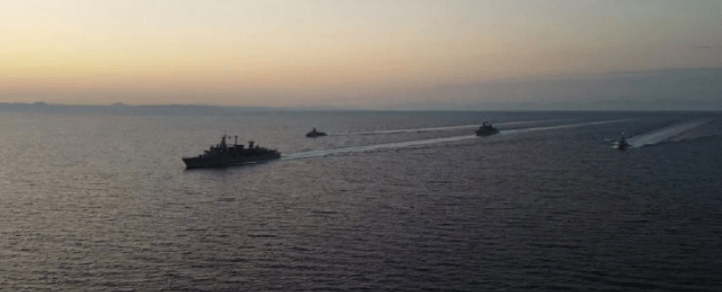
FILE PHOTO: Μια από τις Ελληνικές πολεμικές αρμάδες που βρίσκονταν εν πλω απέναντι ακριβώς από το Oruc Reis, ανάμεσα από τη Ρόδο και το σύμπλεγμα του Καστελοριζου. Πηγή: Hellas Journal


Του ΘΕΟΔΩΡΟΥ ΚΑΡΥΩΤΗ 

Η ερώτηση είναι πολύ κρίσιμη και σημαντική: Γιατί ο Πρόεδρος Αλ Σίσι αποφάσισε τώρα να παραχωρήσει οικόπεδα για εκμετάλλευση στην Ανατολική Μεσόγειο εκθέτοντας τον φίλο του Έλληνα πρωθυπουργό Κυριάκο Μητσοτάκη;

Αλλά ας ξεκινήσουμε από την αρχή αυτής της ιστορίας, που μας ταλαιπωρεί για χρόνια. Η οριοθέτηση της ΑΟΖ μας με την Αίγυπτο ξεκίνησε στραβά από την αρχή, όταν η ελληνική κυβέρνηση του Κώστα Καραμανλή αποφάσισε να αρχίσει συζητήσεις με την κυβέρνηση της Αιγύπτου, που ακολουθούσε μια απόλυτα φιλοτουρκική πολιτική, το 2009.

Η Ελλάδα έκανε ένα τραγικό λάθος διότι άρχισε τις συνομιλίες της με την Αίγυπτο χωρίς να αποσπάσει κάποια ρητή και σαφή διαβεβαίωση από αυτήν ότι θα δοθούν πλήρη δικαιώματα στο Καστελόριζο και στην Στρογγύλη.

  • Η Ελλάδα δέχθηκε  ένα χαστούκι από τους Αιγυπτίους όταν αυτοί ενημέρωσαν την ελληνική πλευρά ότι θα αρχίσουν συνομιλίες για οριοθέτηση θαλάσσιων ζωνών με τη Τουρκία, παρότι η Αίγυπτος δεν διαθέτει θαλάσσια σύνορα με τη Τουρκία!
  • Η Αίγυπτος θα μπορούσε να διαθέτει θαλάσσια σύνορα με τη Τουρκία, μόνο αν δεν αναγνωρισθούν τα δικαιώματα του Καστελόριζου και της Στρογγύλης.

Έτσι, η Αίγυπτος ενημέρωσε την ελληνική πλευρά ότι θα διεξήγαγε συνομιλίες μαζί της στο Κάιρο στις 20 Ιουνίου του 2009 και αμέσως μετά, στις 22 Ιουνίου 2009, με τη τουρκική πλευρά! Η τότε Υπουργός Εξωτερικών της Ελλάδας, Ντόρα Μπακογιάννη, αντί να προβεί σε έντονη διαμαρτυρία για αυτή την αιγυπτιακή πρωτοβουλία, που παραβιάζει ξεκάθαρα το Δίκαιο της Θάλασσας, μετέβη στη συνάντηση στις 20 Ιουνίου γνωρίζοντας ότι δυο μέρες αργότερα Αιγύπτιοι και Τούρκοι θα κάθονταν στο ίδιο τραπέζι.

Για ένα μεγάλο χρονικό διάστημα, ο Κύπριος εμπειρογνώμονας, σε θέματα ΑΟΖ και υδρογονανθράκων, Σόλων Κασίνης επαναλάμβανε μονότονα ότι «Η Ελλάδα πρέπει να προχωρήσει τάχιστα στην οριοθέτηση της Αποκλειστικής Οικονομικής Ζώνης της με την Αίγυπτο». Εκείνο, όμως, που ελάχιστοι γνωρίζουν είναι ότι, παλαιότερα, κάθε φορά που διεξάγονταν συζητήσεις για την οριοθέτηση της ΑΟΖ ανάμεσα στην Ελλάδα και την Αίγυπτο, οι Αιγύπτιοι αντιπρότειναν στην ελληνική αντιπροσωπεία «Κάντε εσείς πρώτα οριοθέτηση ΑΟΖ με την Κύπρο και μετά εμείς θα ακολουθήσουμε.»

Για πρώτη φορά η Ελλάδα ασχολήθηκε με την κυπριακή ΑΟΖ το 2003, όταν η τότε κυβέρνηση του ΠΑΣΟΚ ζήτησε από την Κύπρο να μη προχωρήσει σε πλήρη οριοθέτηση με την Αίγυπτο, γιατί έτσι θα φανούν τα δικαιώματα του συμπλέγματος του Καστελόριζου. Συγκεκριμένα, ο Πρωθυπουργός Κώστας Σημίτης ζήτησε από την κυβέρνηση Κληρίδη να οριοθετήσει την ΑΟΖ της με την Αίγυπτο 14 ν.μ. πριν την σωστή οριοθέτηση, ώστε να μη φανεί η  πλήρης επήρεια του συμπλέγματος του Καστελόριζου και δημιουργηθεί έτσι πρόβλημα με την Τουρκία!

Συγκεκριμένα η ελληνική κυβέρνηση διεμήνυσε στον τότε Υπουργό της Κύπρου Νίκο Ρολάνδη  τα ακόλουθα:

“Εάν δεχθούμε την ελλαδική θέση ότι το Καστελόριζο έχει πλήρη επήρεια στην οριοθέτηση της υφαλοκρηπίδας τότε η μέση γραμμή θα είναι εδώ. Εάν δεχθούμε την τουρκική θέση ότι το Καστελόριζο δεν έχει επήρεια, τότε η γραμμή είναι αλλού. Για αποφυγή των προβλημάτων αυτών προτρέπουμε την κυπριακή πλευρά όπως διορθωθούν οι συντεταγμένες και τα σύνορα δυτικά να σταματήσουν μέχρι 14 ν.μ. πιο μέσα από εκεί που έχουν συμφωνηθεί ούτως ώστε να αποφευχθούν οι οποιεσδήποτε επιπλοκές με γείτονες χώρες.» ***

Ο χάρτης που ακολουθεί δείχνει το πρόβλημα αυτής  της οριοθέτησης. Στο οικόπεδο 4 της κυπριακής ΑΟΖ κείται στα αριστερά του ένα τρίγωνο που θα έπρεπε να είναι μέρος του οικοπέδου 4, αλλά η οριοθέτηση των δυο κρατών (Κύπρου-Αιγύπτου) αγνόησε αυτό το τρίγωνο γιατί θα έδειχνε, ξεκάθαρα, ότι τα 14 χιλιόμετρα που δεν μετρήθηκαν δίνουν δικαιώματα ΑΟΖ στο σύμπλεγμα του Καστελόριζου και η Ελλάδα θα διέθετε έτσι θαλάσσια σύνορα με την Κύπρο και δεν θα είχε η Τουρκία με την Αίγυπτο. Αυτό τον χάρτη ο υπεύθυνος της κυπριακής ΑΟΖ, Σόλων Κασίνης, το χαρακτήρισε «χάρτη της ντροπής». Η άρνηση της ελληνικής κυβέρνησης να οριοθετήσει την δική της ΑΟΖ με αυτή της Κύπρου υπήρξε μία πράξη μεγάλης απερισκεψίας

ΧΑΡΤΗΣ ΑΟΖ ΚΥΠΡΙΑΚΗΣ ΔΗΜΟΚΡΑΤΙΑΣ

ΠΗΓΗ: ΥΠΟΥΡΓΕΙΟ ΕΝΕΡΓΕΙΑΣ ΚΥΠΡΙΑΚΗΣ ΔΗΜΟΚΡΑΤΙΑΣ

Πρέπει εδώ να τονίσουμε ότι το κλειδί για την οριοθέτηση ανάμεσα στην Κύπρο και την Ελλάδα είναι η νήσος Στρογγύλη.  Με βάση την αρχή της ίσης απόστασης (μέθοδος μέσης γραμμής) προκύπτουν θαλάσσια σύνορα Ελλάδας-Κύπρου μήκους 24 ν.μ. Χωρίς την επίδραση της Στρογγύλης, δεν έχουμε κοινά σύνορα ΑΟΖ με την Κύπρο όπως επίσης περιορίζονται τα σύνορα Ελλάδος- Αιγύπτου και προκύπτουν σύνορα Τουρκίας Αιγύπτου,  μια πολύ αρνητική εξέλιξη  από γεωστρατηγικής άποψης για την Ελλάδα και την Κύπρο.

Οι πονηροί Τούρκοι έδιναν, πάντα, μεγαλύτερη ΑΟΖ στην  Αίγυπτο από ό,τι η Ελλάδα όπως φαίνεται από τον επόμενο χάρτη.

ΠΡΟΤΕΙΝΟΜΕΝΟΣ ΧΑΡΤΗΣ ΤΟΥΡΚΙΑΣ ΠΡΟΣ ΑΙΓΥΠΤΟ

Πηγή:  https://www.reddit.com/r/Egypt/comments/hd64uk/egyptian_eez_with_turkish_proposal_vs_greek/

Οι Τούρκοι, όπως δείχνει ο επόμενος χάρτης, δεν κάνουν μόνο δώρο στην Αίγυπτο αλλά στο Ισραήλ και στο Λίβανο, δύο κράτη που, ξεκάθαρα, δεν έχουν θαλάσσια σύνορα με την Τουρκία.

ΧΑΡΤΗΣ ΔΩΡΩΝ ΤΟΥΡΚΙΑΣ ΠΡΟΣ ΑΙΓΥΠΤΟ, ΙΣΡΑΗΛ ΚΑΙ ΛΙΒΑΝΟ

Πηγή: https://www.in.gr/2020/09/20/world/tourkiko-doloma-stin-aigypto-tin-aoz-alla-rigma-einai-vathy/

Όπως αναφέρει η τουρκική εφημερίδα Hurriyet και αναδημοσιεύει η Milliyet, η Τουρκία προσφέρει στην Αίγυπτο θαλάσσια περιοχή, που είναι τρεις φορές η έκταση της Κύπρου, για να την δελεάσει να υπογράψουν συμφωνία ΑΟΖ.

  • Το δημοσίευμα υπενθυμίζει ότι από 3 ημέρες ο Τούρκος υπουργός Εξωτερικών, Μεβλούτ Τσαβούσογλου, στη συνέντευξή του στο CNNTürk, είχε πει ότι «δεν είναι ότι δεν υπάρχουν διαπραγματεύσεις με την Αίγυπτο. Υπάρχουν συνομιλίες σε επίπεδο μυστικών υπηρεσιών. Είπαμε στην Αίγυπτο, ‘μπορούμε να υπογράψουμε μια συμφωνία όπως αυτή με τη Λιβύη’».

Ο Λεόντιος Πορτοκαλάκης, ένας από τους  αφανείς ήρωες στον αγώνα της πατρίδας μας για έρευνες υδρογονανθράκων στην ξηρά και στην θάλασσα, που από πολύ νωρίς ανέδειξε την αξία της ΑΟΖ, έγραψε για τα νέα θαλασσοτεμάχια της Αιγύπτου:

« ….. φαίνεται ότι στην υποομάδα των εννέα θαλασσοτεμαχίων (εκ των 24), αυτά ορίζονται σε θέσεις οι οποίες, χωρίς να θίγουν την μεταξύ μας οριοθέτηση της ΑΟΖ, εν τούτοις δημιουργούν μεγάλα ερωτήματα, δεδομένου ότι επεκτείνονται και πέραν των ορίων της συμφωνίας μας, δηλαδή δυτικά του 26ου μεσημβρινού και ανατολικά του 28ου.»

ΧΑΡΤΗΣ ΝΕΩΝ ΟΙΚΟΠΕΔΩΝ ΑΙΓΥΠΤΟΥ

Πηγή: https://slpress.gr/ethnika/poy-i-aigyptos-katapataei-dynamei-elliniki-aoz/

Το Κάιρο, αναμφίβολα, με αυτή την πράξη του δημιουργεί νέα δεδομένα. Κατ’ αρχάς, θεωρεί ότι η μερική οριοθέτηση ΑΟΖ με την Ελλάδα είναι η οριστική οριοθέτηση και δείχνει, επίσης ξεκάθαρα, ότι διαθέτει θαλάσσια σύνορα με την Τουρκία, σύμφωνα με την προκήρυξη του πρώτου διεθνούς γύρου προσφορών από την αιγυπτιακή κυβέρνηση για την εκμετάλλευση υδρογονανθράκων στην Ανατολική Μεσόγειο.

Η ενέργεια αυτή δημιουργεί ακόμα ένα πολύ σοβαρό ζήτημα, διότι αμφισβητεί ότι η Ελλάδα έχει θαλάσσια σύνορα με την Κύπρο.

*** Απομαγνητοφώνηση τηλεοπτικής συνέντευξης του Νίκου Ρολάνδη σε κυπριακή τηλεόραση, 11 Ιουλίου 2011. Προκαλεί πάντως εντύπωση ότι ο Νίκος Ρολάνδης αποφάσισε να μιλήσει για το θέμα με καθυστέρηση 8 ετών.

Hellas Journal

What the internet looks like: Underwater cables in the Middle East

0

Modern communications rely on submarine fibre-optic cables which carry more than 95 percent of all voice and data transmissions. The Middle East and North Africa region is central to this network

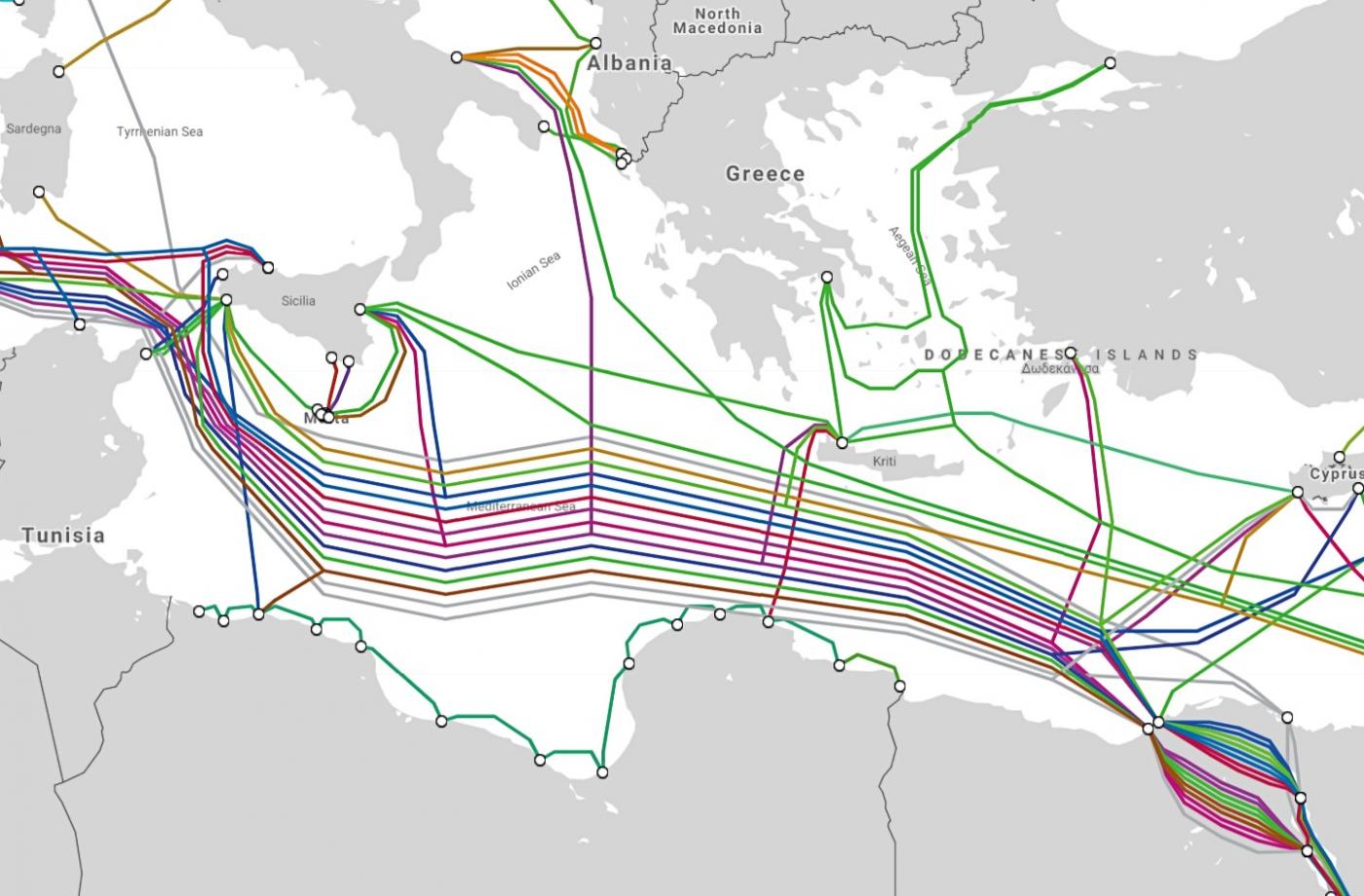
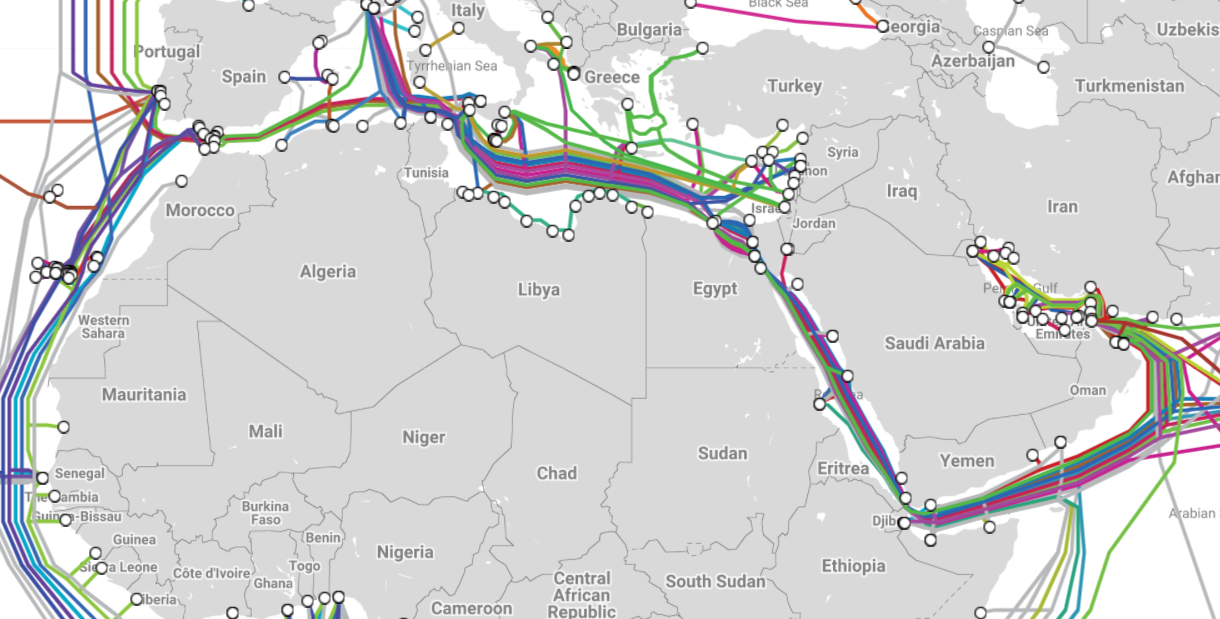
The Middle East and North Africa region has been a hub for shipping and commerce routes between Europe, Asia and Africa for centuries. Now it is data and communications that flows through its busy waters. Each of the lines on this map is not a trade route but a fibre-optic cable, carrying billions of pieces of data each second. Each dot is not a port but a landing site, where the cables connect to a country and link it and its people to the wider global network (TeleGeography/Google Maps).

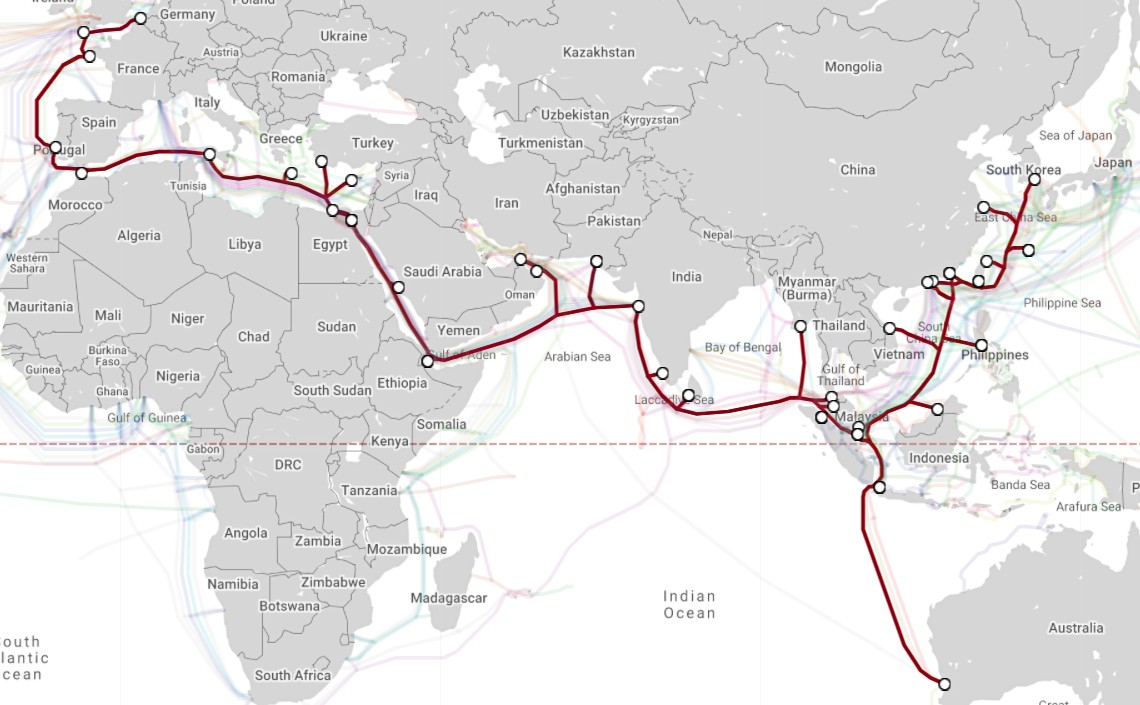
SeaMe We-3, the world’s longest cable at 39,000km, links north-western Europe with Australia and South Korea via the Middle East and South Asia. It became fully operational in September 1999 and is owned by an international alliance of more than 50 telecom companies (TeleGeography/Google Maps).

France and Algeria are linked by several cables, most notably the 1,300km Med Cable Network, which is operated by Orascom Telecom. Opened in October 2005, it runs for 1,300km and links landing points at Marseille with those on the coast of Algiers , Oran and Annaba (TeleGeography/Google Maps).

The coast of Libya is dotted with 14 landing points. The main cable, the Libyan Fiber Optic Network, opened in 1999 and runs for 1,640 km from Zuwara in the east through to Derna in the east. The much shorter Tobrok-Emasaed Cable System links El-Quawef, close to the Egyptian border, with the rest of the network. Libya’s main link to the wider global infrastructure is through Tripoli, part of the 15,000-km Europe India Gateway network (TeleGeography/Google Maps).

Not all cable systems run end-to-end: in the eastern Mediterranean, the 7,000-km circuitous MedNautilus Submarine System links Israel, Italy and Cyprus as well as regional rivals Greece and Turkey. It opened in 2001 and is operated by Telecom Italia Sparkle (TeleGeography/Google Maps).

BERYTAR, at only 135km long, is a collaboration between the Syrian Telecommunications Establishment and the Lebanese Ministry of Telecommunications. Opened in 1997, it runs along the coast of Syria and Lebanon, from Tartous in the north to Saida in the south. Tripoli is also part of the 12,000 km trans-continental IMEWE network, while Tartous links up to Alexandria in Egypt, one of the world’s major cable hubs (TeleGeography/Google Maps).

The breakaway Turkish Republic of Northern Cyprus, which is recognised only by Ankara, is connected to Turkey through two cables: Turcyos-1 runs for 110km between landing points at Girne and Mersin; and Turcyos-2 extends for 215km between Iskele and Samandag. The Republic of Cyprus, a European Union member state, has two landing points which directly link to 11 cables, from the local 800km POSEIDON, which runs along Cyprus’s southern coast, to the 39,000km-long SeaMeWe-3, which runs from western Europe to the Far East and Australia.

Up to 30 percent of the global population’s internet connectivity goes through Egypt due to its geographical position as a gateway between Europe and North America on one side and Asia on the other. It has 10 cable landing stations on its Mediterranean and Red Sea coastlines, with 15 cables crossing its land (TeleGeography/Google Maps).

The cables from Egypt then run south down the Red Sea, with landing points in Sudan, Saudi Arabia and Yemen among others (note how Eritrea has no landing points). The cables then bottleneck between Djibouti and Yemen, which each have landing points before heading due east towards Asia and, after the Horn of Africa, southern Africa (TeleGeography/Google Maps).

Not every territory in the Middle East and North Africa has landing points to enable fast internet access. The Western Sahara (above left) is bypassed by half-a-dozen cables off its coastline, while the nearby Canary Islands, part of Spain, have 18 landing points. Gaza (right) is also without landing points, the closest of which are further up the coast in the Israeli cities of Tel Aviv and Haifa (TeleGeography/Google Maps).
A network of two systems – the GBICS and the MENA – run for 5,270km, from Kuwait City in the west with Mumbai in the east. Countries which are part of the network include regional rivals Iran, Saudi Arabia, Qatar and the UAE. The network also links up the many islands in the region – the 380km Kuwait-Iran network has landing points serving the Iranian oil terminals of Khark Island and Soroosh Platform (TeleGeography/Google Maps).

For more information, please see TeleGeography’s Submarine Cable Map.

https://www.middleeasteye.net/news/underwater-cables-internet-middle-east

IRGC Quds Force set up a shop in Turkey’s capital to recruit militants including al-Qaeda aspirants

0

Abdullah Bozkurt/Stockholm

A convicted militant who has been working for the Islamic Revolutionary Guard Corps (IRGC) Quds Force set up a cell in the Turkish capital to radicalize young people, a classified intelligence report obtained by Nordic Monitor has revealed.

Hakkı Selçuk Şanlı, a Turkish national who served prison time for helping set up the Quds Force network in the 1990s under the orders of then-IRGC general Nasir Takipur, was put to use again by his handlers after keeping a low profile for years. As part of one of his assignments from Iran’s notorious intelligence service, he was directed to open a shop in Turkey’s capital of Ankara, registered in his son’s name, in order to recruit new assets on behalf of the Quds Force.

Şanlı was arrested on May 13, 2000 and was sentenced to 12 years, six months in prison for involvement in terrorist plots targeting Turkish and US interests. But he was freed in 2004 when the government of then-Prime Minister and now President Recep Tayyip Erdoğan pushed an amnesty bill through Parliament, reducing sentences for some convicts.

The police in Ankara were alerted to Şanlı’s new scheme when a woman named Elife Ravanoğlu complained about what she described as a coffeehouse that she said her son Mustafa Özcan Ravanoğlu had been frequenting for some time where he was being brainwashed with radical ideology propagandized by clerics from Iran.

The record of a complaint filed by a mother whose son was lured to a propaganda house in Ankara that was run for the Quds Force by the family member of a convicted terrorist:

“People from Iran are spreading Shia propaganda [in this shop], and my son is among those who frequents the place. They say they were converted to Shiites and that they will now kill Sunnis,” she told the police on the phone on September 21, 2012. She added that university students and high school seniors were lured to the place and asked the police to either get it under control or shut it down.

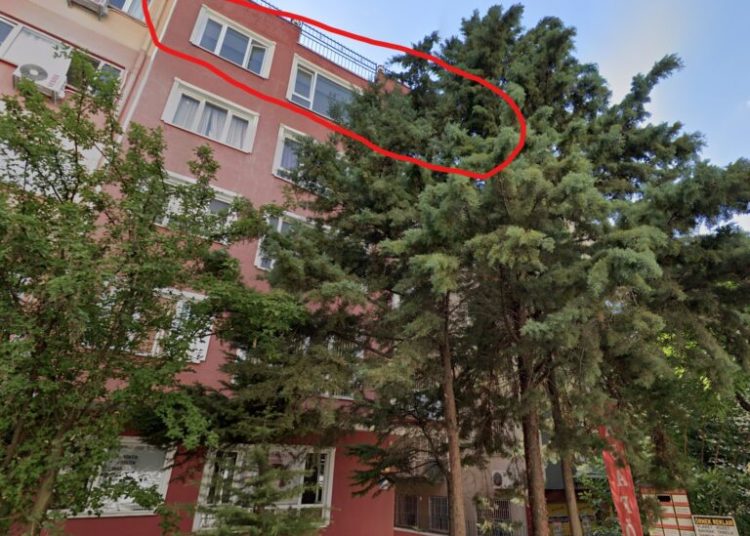
The record of the complaint was then referred to the police counterterrorism bureau, which investigated the claims and prepared a preliminary report based on initial findings on September 26, 2012. The venue, the Mekan Kitap Evi, listed a bookstore that also functioned as a coffeehouse, was located on the top floor of a commercial building at an address listed as İnkılap Sokak No:26/ll, not far from a number of government buildings and the Turkish Parliament.

It was registered under the name of Şanlı’s son, Yusuf Şanlı, with the Çankaya district municipality.

The report noted that the bookstore was full of books on Shiite ideology and posters of Iranian clerics. A registry was set up for visitors to borrow books free of charge. The only registered employee for the place of business was Şanlı’s wife, Şükran. Although the business hours were listed as 07:00-20:00, it was open until the late hours and at times until morning.

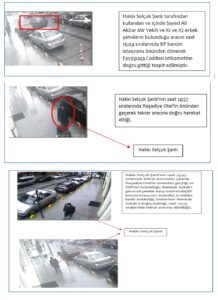
Surveillance photographs of Hakkı Selçuk Şanlı as he and IRGC Quds Force general Sayyed Ali Mir Vakili visited the headquarters of al-Qaeda-linked Turkish charity group IHH in Istanbul on December 10, 2012.

The police also interviewed Yusuf, who described himself as a “political Islamist” who worked with a group called Genç Birikimler (Youth Depository). He admitted that radicals, even those affiliated with al-Qaeda, went to the bookstore, and that Shiite propaganda might have been spread by some visitors.

Police interviewed municipal officials, local residents and business owners in the area and concluded that the place was not known, confirming that it was not actually open to the public but rather served as a safe space for special visitors. When the police went to the bookstore for an inspection, there were no Iranian visitors. But they verified that many Iranians actually stayed in nearby hotels.

The police concluded in its assessment that the allegations made by the complainant appeared to have checked out. It further referred the case to a special section in the counterterrorism department that was monitoring radical religious groups in Turkey.

Preliminary report filed by the police on a propaganda site maintained in the Turkish capital by the Quds Force: 

While police were looking into allegations about Şanlı in Ankara, a prosecutor in Istanbul had already listed him as a suspect and was investigating him as part of a confidential probe into IRGC Quds Force cells. He was red-flagged in the case, which was launched in 2011, and dozens of Iranian nationals including diplomats were put under surveillance and their phones wiretapped. Police investigators found that Şanlı was secretly meeting IRGC general Sayed Ali Akber Mir Vakili and running operations under the general’s orders.

The police managed to plant a listening device on Şanlı’s car after securing a warrant from a judge just before he met with Mir Vakili on June 18, 2013. The IRGC general, who was not aware that the car was bugged, told Şanlı how Hakan Fidan, the head of Turkey’s National Intelligence Organization (MIT) and a long-time Iranian asset, leaked confidential information about the conversation in the Turkish Cabinet. The transcript of the wiretap was included in the Quds Force terrorism case.


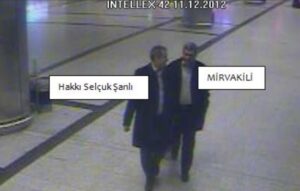
Airport security video footage that shows the meeting of Hakkı Selçuk Şanlı with his Iranian Quds Force handler Sayyed Ali Mir Vakili.

The investigation also showed how Şanlı worked with Levent Balkan, a former executive of Turkey’s state lender Halkbank, in assembling a team and setting up a clandestine scheme to launder money for the IRGC. Turkish investigators recorded the meetings of Balkan, Şanlı and Mir Vakili as the three discussed the scheme to move funds through Turkey. Balkan was also indicted in September 2017 by US federal prosecutors for participating in a major conspiracy to violate US sanctions on Iran.

The IRGC Quds Force case in Turkey never went to trial because the Erdoğan government hushed it up in February 2014 after learning about the probe, which clearly incriminated senior government officials. The investigating prosecutor was sacked before he had a chance to secure detention warrants for the suspects and file an indictment. Şanlı escaped from the long arm of the justice thanks to the intervention of Erdoğan, who apparently protected pro-Iranian assets and helped IRGC Quds Force handlers escape from Turkey.

2001 Indictment of Hakkı Selçuk Şanlı explains how he was recruited by the IRGC Quds Force in the 1980s and involved in terror plots: 

Şanlı’s rap sheet as detailed in a September 2001 indictment filed by prosecutor Hamza Keleş shows that he was first recruited in 1984 by a group known as Tevhid, a pro-Iran outfit set up by Iranian intelligence in Turkey. The group, clustered around Iranian propaganda magazine Tevhid, aimed to establish an Islamic regime similar to that in Iran. In 1986 the Quds Force used some members of the group for purposes of espionage and transporting explosives. Şanlı was a key operative who traveled between Turkey and Iran many times, trained by the Quds Force and involved in a series of terror plots.

In one incident his Iranian handler, Quds Force general Nasir Takipur (or Takizade), was sought after explosives smuggled into Turkey from Syria were seized by the police in the border province of Hatay. Şanlı helped Takipur evade the police and provided shelter for him in Istanbul.

In a statement to the police, Şanlı admitted that the Quds Force sought his help in 1988 to plant explosives at the Saudi American Bank, located in Istanbul’s Harbiye neighborhood. The plan was executed under orders from Takipur on March 10, 1988, and a bomb planted next to the bank caused damage to the surroundings but no causalities.

IRGC Quds Force set up a shop in Turkey’s capital to recruit militants including al-Qaeda aspirants

Turkish intelligence coordinated the scramble of F-16 fighters during coup attempt

0

Abdullah Bozkurt/Stockholm

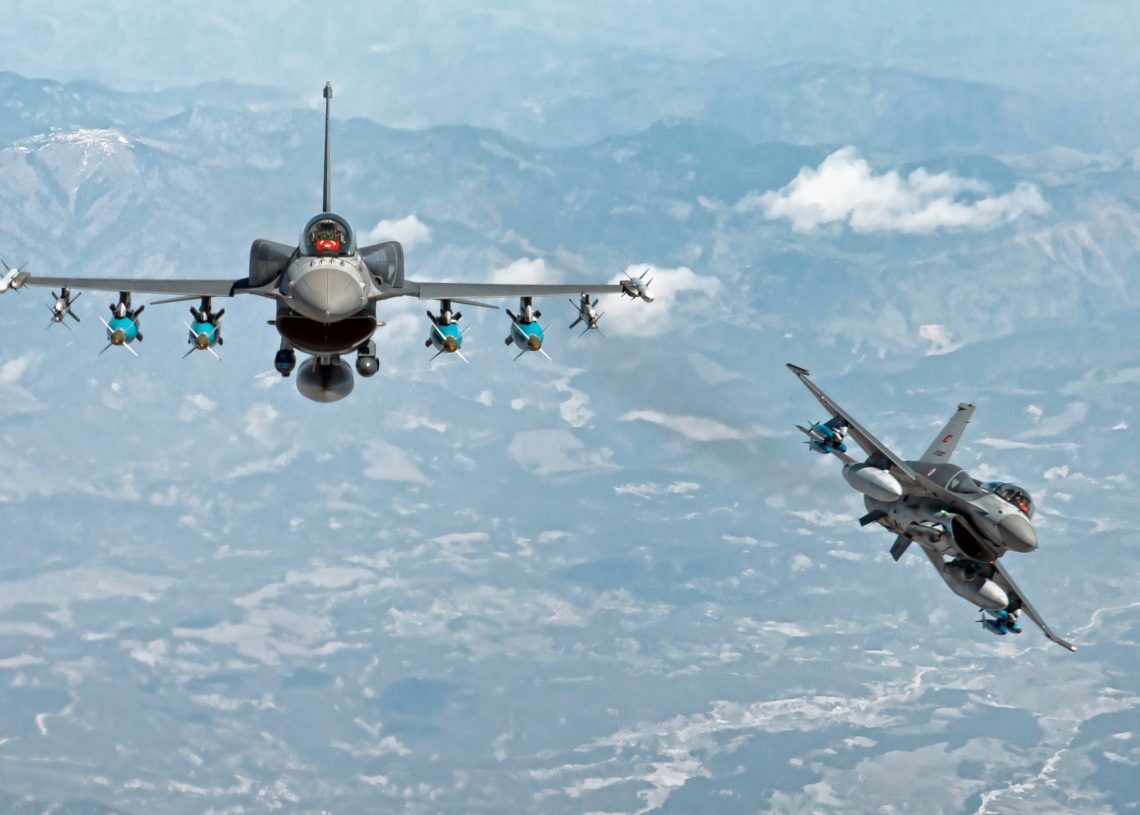
Turkish intelligence agency MIT worked with a lieutenant colonel in the air force to direct warplanes to buzz the capital city of Ankara in 2016 in order to bolster the perception that a false flag was a real coup attempt by the Turkish Armed Forces (TSK).

According to statements delivered in court by several senior military officers, MIT agent Korkut Gül coordinated the activity in the tower at Akıncı Air Base manned by Lt. Col. Nihat Altıntop, airfield operations commander.

Maj. Adnan Arıkan testified at the Ankara 17th High Criminal Court on January 14, 2019 that “on the night of July 15, Lieutenant Colonel Nihat Altıntop, who was the commander of airfield operations at Akıncı Air Base and was in the flight tower, said that starting from 22:30 hours onwards, he had been speaking to MIT agent Korkut Gül and sharing information with him.”

He added that at the time even the authorities did not have a full grasp of the events unfolding during the night. “You can see how it was a distortion to describe the events of July 15 as a coup attempt when it was an operation to deceive the Turkish nation,” Arıkan said.

Maj. Adnan Arıkan’s testimony on MIT’s involvement in the false flag coup bid: 

Arıkan also revealed that a team of MIT agents had visited Akıncı Air Base in May 2016, two months before the coup attempt, describing the visit as unprecedented and aimed at scouting the base for the false flag event. The base command initially rejected MIT’s request to visit the base, explaining that the base was busy with some 100 pilots who were in training at the time. The MIT agents could have paid a visit to other air bases that were less busy in Ankara or other cities, but MIT’S insistence on visiting Akıncı was found quite strange, Arıkan said.

In the end Air Force Commander Gen. Abidin Ünal, a close confidant of President Recep Tayyip Erdoğan, with whom he met secretly outside the chain of command several times, allowed the visit, overruling the base command, and MIT sent a team of 70 agents to look around and scout the base. “What benefits did such a large delegation get from this trip? What were the duties of the people in this delegation and what were their activities on July 15, 2016? “ Arıkan asked.

“The MIT delegation toured almost every place on the base including the flight tower and locations where the 141st, 142nd and 143rd squadrons were deployed, maintenance hangars and ammunition depots. From a military point of view, this was really a reconnaissance. Those who understand a little bit about intelligence, those who know a little bit about the principles of unconventional warfare understand the purpose of this activity very well,” Arıkan explained.

Another testimony revealing MIT’s plot to frame the July 15 events as a coup bid came from Staff Col. Bilal Akyüz of the Land Forces Command, who told the court how a MIT agent asked Altıntop to delete the record from his phone after the two had talked.

“Your Honor, [Altıntop] said a friend of his at MIT, Korkut Gül, asked him to delete his number and to never mention his [the MIT agent’s] name. However when pressed [during his deposition] he had to name him because he could not explain it otherwise,” Akyüz testified at the Ankara 17th High Criminal Court on April 19, 2019. He questioned why Altıntop did not call his commanding officer at the Joint Operations Command in Eskisehir.

Staff Col. Bilal Akyüz’s testimony on MIT:

The most damning testimony on MIT’s complicity in the coup was delivered in court on September 6, 2017 by Lt. Col. Hakan Karakuş.

“Acting on the instructions he received from Korkut Gül [the MIT agent], Altıntop instructed his team to let everything run its course and told his staff, ‘Don’t worry, I’ m your witness, you’ll be fine, just let everything proceed’,” Karakuş, who was with him in the tower, told the court. “As always, he was the man in charge in the tower, controlled the approach [of aircraft] that night, instructing the planes to land and take off, and to continue on their flight missions,” he added.

Altıntop, an air traffic officer, was in charge of the Akıncı airfield, alleged to be the the center of the failed putsch on July 15, 2016 and ran the operations of fighter jets from the base tower with his team. He was responsible for all the planes and helicopters that took off from and landed at the base, Karakuş said. Yet he was never charged or indicted over the July 15 events but was listed as a witness whose testimony helped the government purge and imprison dozens of officers.

In his own testimony Altıntop admitted he had contacted the MIT agent at 22:30 hours on the night of July 15, bypassing the chain of command and deciding to not inform his commanding officers about the activity at the base. He said he updated the MIT agent on the developments at the base, suggesting that the two had talked earlier. The second call was made at 23:10, before Karakuş’s arrival at the tower.

Lt. Col.Hakan Karakuş’s testimony on MIT’s involvement in the coup events: 

“There was no effort [by Altıntop] to prevent [the planes from taking off] during the night,” Karakuş recalled, adding that the colonel deliberately escalated the events at the base and ordered his team to follow his lead.

The government dumped everything on Karakuş, making him a fall guy.

Karakuş thought he had been preparing pilots for a counterterrorism operation on July 15 as he had done many times in the past and had no idea that Turkish intelligence was planning a false flag coup to create a pretext for a mass purge of the Turkish military. The then-head of the military, Hulusi Akar, and several key officers in the army plotted to orchestrate a limited military mobilization to create a perception that a real coup attempt was under way on July 15.

At around 23:00 hours he was ordered by his commander to go to the airfield tower as flight control officer (Uçuş Kontrol Amiri, UKA) which means he was to check the weather, make sure emergency procedures were in place and advise on traffic safety procedures. He had no responsibility for the landing and takeoff of aircraft or for their route while in the air.

“[They say] Hakan Karakuş directed planes from the tower, controlled them and so on. All these allegations are lies. It is easy for them to pin this on me because my name was mentioned a lot in the media. This is the function of the tower, not the duty of the UKA officer,” Karakuş said.

Screenshots of the phone call history from the mobile used by Lt. Col. Nihat Altıntop, who coordinated the flights from the tower by communicating with a MIT agent:

The F-16s that took off first from the base returned in short order, surprising Karakuş, who said a counterterrorism air operation usually takes around four hours with refueling by tanker planes mid-air. He thought either the mission had been cancelled or that there were no tanker planes in the air. Around that time, Turkish TV started broadcasting footage from a bridge in Istanbul where a group of solders cut off one-way traffic and news reports that planes were flying over Ankara. Karakuş recalled that tension and stress were on the rise in the tower, with one noncommissioned officer protesting and wanting to quit. “I was surprised when Altıntop started shouting and ordering everybody to focus on their jobs and continue as if nothing had happened,” he said.

In court Karakuş also revealed the content of the conversation he had with Altıntop on the balcony of the tower. “I was shocked to hear him say that he was expecting these events, coordinating with a MIT agent whom he referred to as his friend, acting on his [the MIT agent’s] orders,” Karakuş recalled. Altıntop also said during the conversation that there would be an operation at the base in the morning, that many would be killed or punished and that the end of the road for some was near. He threatened Karakuş with consequences if he did not work with him.

In response to allegations that he had been working with MIT, Altıntop claimed in court on September 26, 2018 that he and the MIT agent had known each other through their wives for 15 years. He tried to explain why he had immediately called his friend at MIT as opposed to his superiors in the chain of command. He also tried to justify it by claiming that his behavior was a similar to a citizen placing a call to the emergency 155 line. The defense also asked Altıntop why he did not call the prosecutor’s office, police or gendarmerie as opposed to MIT. Altıntop replied that he did not think about calling them.

Nihat Altıntop denied placing an early call to a MIT agent before the coup events took place although the screenshots from his phone showed the placing of such a call: 

Asked why he did not use his key to turn off the runway lights to prevent takeoffs, Altıntop claimed that turning off the lights would not have had an impact on flights. The cross-examination revealed that Altıntop was actually ordered to go home at 20:20 but disobeyed his commanding officer and went to the base. Asked by Karakuş why he defied a direct order, Altıntop claimed the order was not a ban to entry to the base.

Altıntop also admitted that he used two mobile phones that night including one that he bought only two days before the coup attempt. Screenshots of the call history from one of his cell phones submitted to the prosecutor’s office during his deposition showed that Altıntop first called the MIT agent at 20:20 hours. However, in his statement to the prosecutor and testimony in court, he claimed that he first called the agent at 22:30. Asked about the discrepancy and whether he entered the base upon orders from MIT, Altıntop denied the 20:20 call and said MIT did not order him to go to the base.

In his second statement, Lt. Col. Nihat Altıntop admitted that MIT asked him to delete the records of phone conversations from his phone:

Much incriminating evidence emerged during the coup trials that showed how the Turkish intelligence agency was involved in orchestrating the July 15 events as a false flag under orders from President Erdoğan in order for the Islamist government to launch a massive purge of the Turkish military. Nether the intelligence chief Hakan Fidan, who denied any prior knowledge of the coup attempt, nor defense chief Akar appeared in court for cross-examination despite repeated motions by the defense to have them summoned to attend the hearings.

Nearly two-thirds of all generals and admirals and almost all staff officers were purged and/or jailed on dubious charges with no evidence to support the allegations, and the vacancies were filled by Islamists, nationalists and neo-nationalists.

Turkish intelligence coordinated the scramble of F-16 fighters during coup attempt

Ο αδέσμευτος πειρασμός

0

του Pierre Haski (*)

Το 1955, στο Μπαντούνγκ της Ινδονησίας, ενώ μαινόταν ο Ψυχρός Πόλεμος, οι ηγέτες 29 πολύ διαφορετικών μεταξύ τους χωρών – από τον Κινέζο Τσου Ενλάι μέχρι τον Αιγύπτιο Γκαμάλ Αμπντέλ Νάσερ – έθεσαν τις βάσεις του Κινήματος των Αδεσμεύτων. Αρνήθηκαν δηλαδή να ευθυγραμμιστούν με μια από τις δύο υπερδυνάμεις της εποχής, τις ΗΠΑ και την ΕΣΣΔ.

Το «πνεύμα του Μπαντούνγκ» αναβιώνει άραγε στην Ευρώπη, μπροστά στη σινοαμερικανική αντιπαράθεση που συνεχίζεται; Η σύγκριση είναι ασφαλώς υπερβολική, καθώς η Ευρώπη ανήκει σε μεγάλο βαθμό στην Ατλαντική Συμμαχία της οποίας ηγούνται οι ΗΠΑ, και κατά συνέπεια δεν τίθεται ζήτημα ίσων αποστάσεων στην αντιπαράθεση αυτή. Σίγουρα όμως υπάρχει μια αμηχανία, αν όχι δυσφορία, στις ευρωαμερικανικές σχέσεις. Μια απόσταση δηλαδή ανάμεσα στην ικανοποίηση από την απομάκρυνση του Τραμπ και στην αμφιβολία για τη θέση της Ευρώπης στον καινούργιο κόσμο. Μια επιφύλαξη, τόσο στο Παρίσι όσο και στο Βερολίνο, για το «America is back» που επαναλαμβάνει ο Τζο Μπάιντεν εδώ κι ένα μήνα.

Ο φόβος, συγκεκριμένα, είναι μήπως βρεθεί η Ευρώπη μπροστά σε μια Αμερική με τα παλιά ηγεμονικά αντανακλαστικά, που επιπλέον θα είναι απορροφημένη από την κινεζική της εμμονή. Το είπε ο Εμανουέλ Μακρόν στις 19 Φεβρουαρίου στην ομιλία του στη Διάσκεψη του Μονάχου για την ασφάλεια, υπενθυμίζοντας ότι ο «Αξονας» της Αμερικής προς την Ασία, που αποφασίστηκε από την κυβέρνηση Ομπάμα, την απομάκρυνε από την Ευρώπη. Σε συνέντευξή του στους Financial Times, ο γάλλος πρόεδρος έκανε ένα βήμα παραπάνω, αμφισβητώντας την ίδια τη χρησιμότητα του ΝΑΤΟ.

Πιο προσεκτική, η καγκελάριος Μέρκελ καθιστά σαφή τη διαφοροποίησή της ως προς τις σχέσεις με την Κίνα και τη Ρωσία, εκείνη, που προώθησε την αμφιλεγόμενη συμφωνία για τις ευρωπαϊκές επενδύσεις στην Κίνα, εκείνη, που επιμένει, παρά την υπόθεση Ναβάλνι, να ολοκληρωθεί ο αγωγός NordStream2 που συνδέει τη Ρωσία με τη Γερμανία.

Η δυσκολία με αυτή τη στάση «σύμμαχος-αλλά-ανεξάρτητος» είναι ότι πρέπει να έχεις τα μέσα να τη συντηρήσεις. Το τελευταίο τεστ είναι η λεγόμενη «στρατηγική αυτονομία» της Ευρώπης. Οι 27 έχουν κάνει βήματα σε αυτή την κατεύθυνση, αλλά βρίσκονται ακόμη μακριά από τον στόχο. Και μένει να φανεί αν η παρουσία στην Ουάσινγκτον ενός προέδρου που είναι έτοιμος να επανενεργοποιήσει την «αμερικανική ομπρέλα» θα αλλάξει τα δεδομένα.

Υπάρχει ένα αισιόδοξο σενάριο που θέλει την Ευρώπη πιο «αυτόνομη» δίπλα σε μια Αμερική «που έχει επιστρέψει», χωρίς τις δύο δυνάμεις να είναι πλήρως ευθυγραμμισμένες. Το σενάριο αυτό προϋποθέτει μια σημαντική προσπάθεια των Ευρωπαίων και την αποδοχή από την Ουάσινγκτον μιας συμμαχίας μεταξύ ίσων. Οι δύο αυτές προϋποθέσεις δεν ισχύουν ακόμη. Υπάρχει λοιπόν ο κίνδυνος να ξαναπαίξει η Γαλλία τον ιστορικό ρόλο του μοναχικού ταραξία σε μια επανενεργοποιημένη Ατλαντική Συμμαχία. Και αυτό θα αποτελέσει μια χαμένη ευκαιρία.

(*) O Πιερ Ασκί είναι αρθρογράφος του περιοδικού L’ Obs

(Πηγή: L’ Obs)

The Price of a Positive EU-Turkey Agenda

0

The past eighteen months have witnessed a worsening of Turkey’s relations with European countries—as if EU leaders didn’t know it.

The list of foreign policy divergences between Ankara and European capitals is long. They include the deployment of missile systems that are adversarial toward NATO, gas research operations in the Eastern Mediterranean under a military escort, and war operations in Azerbaijan, Libya, and Syria—not to mention a new posture on a settlement for the divided island of Cyprus. At the same time, Turkey’s rule-of-law architecture is being consistently degraded with the usual dose of conspiracy-based accusations against European countries and the United States.

Against this background, the March 25–26 European Council meeting of EU heads of state and government is supposed to look in detail at the union’s relationship with Turkey. Many leaders are hoping for a positive agenda. Others are arguing for more sanctions.

Ankara is striving to dodge punitive measures and fill the agenda with reforms that are palatable to the Europeans. Yet, domestic developments in Turkey keep pointing in the opposite direction. At this point in time, the odds are that only a limited agreement will be politically feasible for both sides.

There is no doubt that EU governments want a calmer, more predictable relationship with Ankara, be it for economic reasons (in the case of Germany, Italy, or Spain) or for fear of a new wave of refugees (see Bulgaria, Germany, Greece, and Hungary). In Ankara and Istanbul, many, like the business association TÜSİAD, realize that a hostile relationship with Turkey’s main trading and investment partner is untenable in the face of a dire economic situation, a severe drop in foreign direct investment, and an exodus from Turkey of some major European investors.

Indeed, for all the talk about a “New Turkey” and its increased military might, the hard reality is that the country is already largely integrated into Europe’s industrial and financial fabric. Turkey has few—if any—alternatives to dealing with Europe. And it certainly has no interest in a permanently hostile relationship.

Within these parameters, the issue is how to develop a positive EU-Turkey agenda, and what the price to pay will be on both sides.

This week, the Turkish leadership is due to announce political and economic reforms, but no specifics are available as yet. Europeans have heard such promises before, but what is at stake is the credibility of such pledges, especially in the realm of the rule of law, since Turkey’s list of democratic failures is long and growing by the day.

A fully autocratic system of government is now firmly in place. Work is under way to twist the country’s electoral law to preserve the current ruling alliance between the Justice and Development Party (AKP) and the Nationalist Movement Party (MHP). The Kurdish leader Selahattin Demirtaş has been in jail since 2016. His party, the Peoples’ Democratic Party (HDP), is threatened with closure.

Then there’s the assault on academic freedom and institutions. Students at Istanbul’s Boğaziçi University have been called “terrorists” for protesting against a politically appointed rector. The LGBT community has been demonized and its members accused of being foreign agents. Absurdly, the respected philanthropist Osman Kavala is charged with plotting against the state, while his cultural organization, Anadolü Kültür, is also threatened with being shut down. Kavala’s wife, Ayşe Buğra Kavala, an internationally renowned academic, is accused of being a foreign agent.

To top it off, when several Western governments and global civil society organizations commented on the events at the university, the Turkish foreign ministry issued a statement in the form of a “warning” that “no one should exceed their limits and interfere in Turkey’s internal affairs.” So much for a positive agenda with the EU.

Ankara’s goal in dealing with Europe is clearly to limit the future agenda with the EU to trade, economic matters, and refugee arrangements. Simply put, the survival of Turkey’s autocratic system of government now in place—and of the Islamist-nationalist coalition in power—rests on thwarting the remaining democratic features of Turkey’s electoral process and the functioning of society. A further deterioration is in the cards.

The EU’s perception of the situation is naturally the opposite of Turkey’s: any agreement of substance with Ankara will need to be accompanied by a measurable return to the rule of law and a confident relationship in the military domain. This is the attitude not only of politicians in the European Parliament and many national parliaments but also, increasingly, of business circles. How can the EU adopt further sanctions on Russia over the imprisonment of opposition leader Alexei Navalny, or on Belarus or Myanmar, and look the other way when it comes to Turkey? How can European businesses invest hundreds of millions of euros in the years to come if Turkey’s judiciary remains so politicized?

In the short term, the common ground for Turkey and the EU is likely to be limited to further help for Syrian refugees in Turkey and, if the underlying conditions are right, initial discussions on upgrading the EU-Turkey Customs Union.

Yet, for domestic political reasons, Ankara will want another concession—for example, a special invitation for Turkish President Recep Tayyip Erdoğan to attend a European Council meeting or some sort of summit on the Mediterranean. This will raise the difficult question of giving a blessing to Turkey’s autocratic leanings at a time when the country blatantly disregards and mocks Europe’s fundamental values.

With so many unresolved disputes with Ankara’s leadership and after a humiliating visit to Moscow in February by the EU’s foreign policy chief, Josep Borrell, EU leaders would be well advised to shelve summitry with Turkey for the time being. Instead, they should work hard and quietly on resolving the main contentious issues. Good luck to them!

Marc Pierini
Pierini is a visiting scholar at Carnegie Europe, where his research focuses on developments in the Middle East and Turkey from a European perspective.

Greece worries as Egypt acts in line with Turkish EEZ in EastMed

0

BY DAILY SABAH

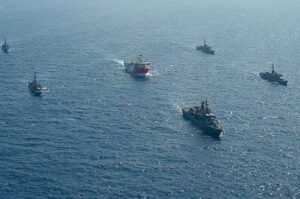
The Turkish seismic research vessel Oruc Reis (C) is escorted by Turkish naval ships in the Mediterranean Sea, off Antalya on Aug. 10, 2020. (AFP Photo)

Greek media reported that Egypt’s announcement of holding a tender for hydrocarbon exploration in the Eastern Mediterranean by recognizing the exclusive economic zone (EEZ) demarcated by Turkey could be a sign of a possible agreement between Ankara and Cairo on the issue.

Greek daily Kathimerini said over the weekend that in the eastern zone of the tender map, Egypt has paid attention to the continental shelf notified by Turkey to the United Nations after the agreement between Turkey and Libya in November 2019. The newspaper said that Cairo’s move could be interpreted as its reservation to get involved in the controversy about the Turkish-Greek continental shelf in the region, especially around Cyprus.

Kathimerini also said that even though this move would not refer to an immediate reconciliation, Cairo left an open door to Ankara for future talks by implementing such a move.

The Turkey-Libya deal on maritime delimitation has provided a legal framework to prevent any fait accompli by regional states. Accordingly, the attempts by the Greek government to appropriate huge parts of Libya’s continental shelf, since a political crisis hit the North African country in 2011, have been averted.

The agreement also confirmed that Turkey and Libya are maritime neighbors. The delimitation starts from Fethiye-Marmaris-Kaş on Turkey’s southwestern coast and extends to the Derna-Tobruk-Bordia coastline of Libya.

In response, Egypt and Greece signed an agreement in August 2020, designating an EEZ in the Eastern Mediterranean between the two countries,

According to the U.N. Convention on the Law of the Sea, while a country is able to stretch its territorial waters only 12 nautical miles out to sea, when it comes to the EEZ, where it has the rights to fishing, mining and drilling, the area can extend for an additional 200 miles. However, if the maritime distance between the two countries is less than 424 miles, a bilateral deal is needed to determine a mutually agreed dividing line of their respective EEZs.

Greece, on the other hand, claims that the islands also have their EEZs, and with this claim, it reduces Turkey’s zone remarkably.

Another Greek news portal, The Indicator, said that Egypt is close to making an agreement with Turkey in the Eastern Mediterranean by disregarding Greek interests.

It said that the areas of one tender zone in Egypt’s plan have been determined by Turkey’s claims, not according to the agreement with Greece.

The relations between Turkey and Egypt deteriorated after Gen. Abdel-Fattah el-Sissi toppled the country’s first democratically elected president, Mohammed Morsi, in a coup after only a year in office.

Ankara has maintained its position that a democratically elected president cannot be deposed by a military coup and thus, has voiced its criticism of el-Sissi and his backers, including the West and some of Ankara’s rivals in the Gulf region. The Egyptian government, on the other hand, said that the issue is the country’s internal affairs and urged to not intervene. The dispute led the bilateral relations to remain deadlocked for many years.

Recently, however, signals of a possible reconciliation have come from both countries, particularly due to the changing dynamics in the Eastern Mediterranean and the Turkey-Greece crisis over the region’s energy resources.

Turkish President Recep Tayyip Erdoğan and Foreign Minister Mevlüt Çavuşoğlu have both confirmed that intelligence units on both sides have recently met.

Although there are varying estimates, most figures suggest that the Eastern Mediterranean region has over 70 trillion cubic feet of natural gas or approximately 1.5% of the total natural gas reserves in the world.

Most of this natural gas is found in the fields of Glaucus, Aphrodite and Calypso, which are licensed by the Greek Cypriot administration. Other areas with intense natural gas in the region are Israel’s Leviathan and Egypt’s Zohr.

dailysabah.com