Τι θα συζητήσουν οι ηγέτες στη Σύνοδο του Βίλνιους – Τα τρία πρώτα ολοκληρωμένα περιφερειακά σχέδια της Συμμαχίας και το αγκάθι του προϋπολογισμού.
Σε μια κρίσιμη στιγμή για την ευρωπαϊκή ασφάλεια λόγω του πολέμου στην Ουκρανία, οι σύμμαχοι του ΝΑΤΟ δίνουν το ετήσιο ραντεβού τους στο Βίλνιους της Λιθουανίας σήμερα και αύριο, 11 και 12 Ιουλίου, με πολλές φιλοδοξίες και αναπάντητο το ερώτημα εάν θα μπορέσουν να ανταποκριθούν σε αυτές. Μια συνάντηση κορυφής στην «πιο δραματική αλλαγή… από την πτώση του Τείχους του Βερολίνου», όπως αναφέρει στον «Economist» ο Μάθιου βαν Βάγκενεν, αμερικανός στρατηγός στο Ανώτατο Στρατηγείο Συμμαχικών Δυνάμεων στην Ευρώπη.
Στόχος είναι να εγκρίνουν τα τρία πρώτα ολοκληρωμένα περιφερειακά σχέδια της συμμαχίας τα οποία εξηγούν τι πρέπει να κάνει κάθε χώρα για την άμυνα και την αποτροπή σε όλους τους τομείς: ξηρά, θάλασσα, αέρα, κυβερνοχώρο και Διάστημα. Πρόκειται για σχέδια που βρίσκονται εδώ και μερικά χρόνια στα σκαριά καθώς οι μέχρι πρότινος στόχοι της συμμαχίας θεωρούνται ανεπαρκείς για να ανταποκριθούν στις εξελισσόμενες απειλές για την ασφάλεια. Ενα σχέδιο θα καλύπτει την Αρκτική (High North) και τον Ατλαντικό, με επικεφαλής την Κοινή Διοίκηση Δυνάμεων στο Νόρφολκ των ΗΠΑ. Ενα δεύτερο, υπό το στρατηγείο Μπρούνσουμ στην Ολλανδία, θα αναφέρεται στη Βαλτική και τις Αλπεις. Το τρίτο θα καλύπτει τη νοτιοανατολική πτέρυγα της Συμμαχίας, συμπεριλαμβανομένων της Μεσογείου και της Μαύρης Θάλασσας, υπό τη διοίκηση της Νάπολι στην Ιταλία.
Για την ένταξη της Ουκρανίας
Στα καίρια ζητήματα, οι σύμμαχοι θα κληθούν επί της ουσίας να εφαρμόσουν όσα είχαν από κοινού αποφασίσει στην περυσινή τους συνάντηση στη Μαδρίτη, δηλαδή τη νέα στρατηγική αντίληψη που χαρακτηρίζει τη Ρωσία ως την πιο σημαντική και άμεση απειλή. Πρακτικά αυτό σηματοδοτεί περαιτέρω ενίσχυση της παρουσίας του ΝΑΤΟ στην Ανατολική Ευρώπη όπως και συνέχιση της υποστήριξης της Ουκρανίας για όσο χρειαστεί. Το δυσκολότερο ζήτημα είναι τι θα γίνει με την ένταξη της εμπόλεμης χώρας στο ΝΑΤΟ.
Μολονότι το Κίεβο υπέβαλε επίσημα αίτηση για ένταξη πέρυσι, όλα τα μέρη παραδέχονται ότι δεν πρόκειται να ενταχθεί στη Συμμαχία προτού τελειώσει ο πόλεμος. Αυτό το αντιλαμβάνεται η ουκρανική πλευρά, όπως φάνηκε από τις δηλώσεις του ουκρανού προέδρου Βολοντίμιρ Ζελένσκι την περασμένη εβδομάδα, ο οποίος φρόντισε ωστόσο να υπογραμμίσει ότι «πρέπει να διασφαλίσουμε πως μετά τον πόλεμο θα γίνουμε μέλος του ΝΑΤΟ». Ως εκ τούτου, «η Ουκρανία θα αναζητήσει συμμάχους για να στείλει ένα ισχυρό μήνυμα στη σύνοδο κορυφής ότι η υποψηφιότητά της για ένταξη βρίσκεται στα σκαριά» επισημαίνει το αμερικανικό Κέντρο Στρατηγικών και Διεθνών Σπουδών (CSIS). Μένει να φανεί αν ο Ζελένσκι θα παραστεί στο Βίλνιους.
Ενα θέμα που αναμένεται πάντως να θέσει η Τουρκία είναι η αλλαγή του ονόματος των Στενών των Δαρδανελίων. Σύμφωνα με πληροφορίες, η Αγκυρα επιθυμεί το κείμενο να αναφέρεται στις κρίσιμες πλωτές οδούς που συνδέουν τη Μαύρη Θάλασσα με το Αιγαίο ως «Τουρκικά Στενά» και όχι ως «Στενά» όπως αναφέρει η Σύμβαση του Μοντρέ του 1936, η οποία ρυθμίζει τη θαλάσσια κυκλοφορία των στενών του Βοσπόρου που συνδέουν τη Μαύρη Θάλασσα με τη Θάλασσα του Μαρμαρά, η οποία με τη σειρά της συνδέεται μέσω των Δαρδανελίων με το Αιγαίο και τη Μεσόγειο. Αναλυτές τονίζουν επ’ αυτού ότι η χρήση του όρου «Τουρκικά Στενά» θα μπορούσε να έχει νομικές επιπτώσεις που θα έδιναν στην Τουρκία μεγαλύτερο έλεγχο στα στενά από ό,τι έχει υπό τη συνθήκη του Μοντρέ, με τρόπο που θα μπορούσε να υπονομεύσει τα δυτικά συμφέροντα.
Οι επενδύσεις στην άμυνα
Επιπροσθέτως, οι σύμμαχοι θα θέσουν επί τάπητος την ανάγκη για μεγαλύτερες επενδύσεις στην άμυνα των κρατών-μελών αλλά και την ανάγκη υπέρβασης του ορίου του 2% του ΑΕΠ για τις αμυντικές τους δαπάνες, ζήτημα που επηρεάζει άμεσα τον βαθμό στον οποίο τα σχέδια του ΝΑΤΟ θα μπορούν να υλοποιηθούν και να είναι αποτελεσματικά. Τον παραπάνω στόχο ξεπερνούν μόνο επτά χώρες, κυρίως αυτές που βρίσκονται κατά μήκος των ανατολικών συνόρων του ΝΑΤΟ, δηλαδή Εσθονία, Λετονία και Λιθουανία αλλά και ΗΠΑ, Ελλάδα, Ηνωμένο Βασίλειο και φυσικά Πολωνία, η οποία κατέχει την πρωτιά στις αμυντικές δαπάνες ξεπερνώντας το 4%. Ο γενικός γραμματέας Γενς Στόλτενμπεργκ προέτρεψε τους συμμάχους να υιοθετήσουν το 2% ως κατώτατο και όχι ως ανώτατο όριο, όμως οι προσδοκίες δεν είναι υψηλές και μάλλον έχει σχεδόν προεξοφληθεί ότι δεν πρόκειται να γίνουν και πολλά.
Το νεότερο μέλος και οι υπόλοιποι υποψήφιοι
ΦΙΝΛΑΝΔΙΑ
Eντάχθηκε στο ΝΑΤΟ τον περασµένο Απρίλιο. Αν και παρέµενε ουδέτερη λόγω των πολύπλοκων σχέσεων µε τη Ρωσία, µε την οποία συνορεύει, µετά τη ρωσική εισβολή στην Ουκρανία πραγµατοποίησε τη γρηγορότερη ενταξιακή διαδικασία στην ιστορία της Συµµαχίας.
ΣΟΥΗΔΙΑ
Κατέθεσε αίτημα για ένταξη μαζί με τη Φινλανδία, αλλά μέχρι τώρα αντιμετώπιζε το βέτο της Αγκυρας.
ΙΡΛΑΝΔΙΑ
Παραμένει εκτός ΝΑΤΟ, παρά το πρόσφατο συνέδριο που διοργάνωσε η κυβέρνηση για να επανεξετάσει την πολιτική στρατιωτικής ουδετερότητας της χώρας. Το συνέδριο ξεσήκωσε αντινατοϊκές διαδηλώσεις αλλά και επικρίσεις για την «υποκρισία» της ιρλανδικής ουδετερότητας.
ΟΥΚΡΑΝΙΑ
Στη σύνοδο κορυφής του ΝΑΤΟ στο Βουκουρέστι το 2008 δόθηκε η ασαφής υπόσχεση στο Κίεβο ότι θα ενταχθεί κάποτε. Η ασάφεια αυτή θεωρείται ότι οδήγησε στη ρωσική εισβολή στην Κριμαία το 2014.
ΓΕΩΡΓΙΑ
Ελαβε ασαφή υπόσχεση για ένταξη, χωρίς χρονοδιάγραμμα και οδικό χάρτη, στο Βουκουρέστι το 2008 και τέσσερις μήνες αργότερα ρωσικές δυνάμεις εισέβαλαν και υποστήριξαν αυτονομιστές στις γεωργιανές επαρχίες της Νότιας Οσετίας και της Αμπχαζίας.
Η ατζέντα
• Εγκριση νέων αµυντικών σχεδίων
• Αμυνα και αποτροπή σε ξηρά, θάλασσα, αέρα, κυβερνοχώρο και Διάστηµα
• Σχέδιο για Αρκτική και Ατλαντικό
• Σχέδιο για Βαλτική και Αλπεις
• Σχέδιο για Μεσόγειο και Μαύρη Θάλασσα
• Οδικός χάρτης για Ουκρανία
• Δεσμεύσεις για αύξηση αµυντικών δαπανών
Η ταυτότητα της Συνόδου
Ποιος συµµετέχει:
Οι αρχηγοί των 31 κρατών-µελών
Πού διεξάγεται η Σύνοδος:
Στο Βίλνιους της Λιθουανίας
Πότε γίνεται:
11-12 Ιουλίου 2023
Γιατί διεξάγεται η Σύνοδος:
Για την αντιµετώπιση των προκλήσεων και την περαιτέρω ενίσχυση της αποτροπής και της άµυνας του ΝΑΤΟ
Ο Γενικός Γραμματέας του ΝΑΤΟ Γενς Στόλτενμπεργκ ανακοίνωσε, λίγες ώρες πριν από τη Σύνοδο Κορυφής του ΝΑΤΟ στο Βίλνιους, ότι είχε επιτέλους κάνει το αδύνατο: έπεισε τον Πρόεδρο της Τουρκίας Ρετζέπ Ταγίπ Ερντογάν να άρει το βέτο του για την ένταξη της Σουηδίας στο ΝΑΤΟ, γράφει το αμερικανικό μέσο «19fortyfive».
Η ομάδα του Προέδρου Μπάιντεν, που εργάζεται επιμελώς στο παρασκήνιο, μπορεί να θέλει να μοιραστεί τον υποτιθέμενο θρίαμβο του Στόλτενμπεργκ.
Δεν πρέπει.
Είναι καταστροφή!
Αυτό που οι αξιωματούχοι του ΝΑΤΟ χαρακτηρίζουν ως διπλωματικό αριστούργημα είναι στην πραγματικότητα μια καταστροφή!
Αφήστε στην άκρη τον εξευτελισμό της Σουηδίας από την Τουρκία και τη διάβρωση, κατ’ εντολήν του Ερντογάν, της ελευθερίας του λόγου και της δημοκρατίας σε αυτή τη χώρα. Και αφήστε στην άκρη την υποκρισία του να αντιμετωπίζουμε τους Κούρδους στη Σουηδία ως τρομοκράτες όταν οι υποστηρικτές του Ισλαμικού Κράτους στην Τουρκία όχι μόνο περιφέρονται ελεύθεροι, αλλά και κατοικούν στη διοίκηση του Ερντογάν και στις υπηρεσίες πληροφοριών της Τουρκίας.
Μάλλον, το πρόβλημα φαίνεται να είναι ένα νέο quid pro quo (σημ. ‘αντάλλαγμα για κάτι’)
Όχι μόνο η Τουρκία αναμένει τώρα την άρση των περισσότερων κυρώσεων που σχετίζονται με την άμυνα , αλλά Τούρκος αξιωματούχος είπε επίσης ότι η Τουρκία αναμένει τώρα από την Ευρώπη να παρακολουθήσει γρήγορα τη μακρά ετοιμοθάνατη διαδικασία ένταξής της στην Ευρωπαϊκή Ένωση.
Με άλλα λόγια, η Τουρκία χρησιμοποίησε την παρουσία της εντός του ΝΑΤΟ για να παραλύσει τον θεσμό και να επωφεληθεί από το de facto βέτο της.
Για να άρει αυτό το βέτο, ο Στόλτενμπεργκ και ο Σύμβουλος Εθνικής Ασφάλειας Τζέικ Σάλιβαν θέλουν τώρα να εξουσιοδοτήσουν την Τουρκία να παραλύσει την Ευρωπαϊκή Ένωση και να διαβρώσει εκ των έσω τον δημοκρατικό της προσανατολισμό.
Δεν είναι μυστικό, για παράδειγμα, ότι η Γερμανία υποχωρεί συχνά στον τουρκικό εκβιασμό επειδή φοβάται όχι μόνο ότι ο Ερντογάν θα εξαπολύσει τις πύλες των προσφύγων στην καρδιά της Ευρώπης, αλλά και επειδή οι Γερμανοί αξιωματικοί πληροφοριών πιστεύουν ότι ο Ερντογάν ελέγχει πυρήνες τρομοκρατίας μεταξύ της τουρκικής διασποράς στην καρδιά της Γερμανίας.
Ούτε το πρόβλημα είναι μόνο τα τρομοκρατικά κελιά. Πριν από λιγότερο από μία εβδομάδα, ο Ντεβλέτ Μπαχτσελί, ο κύριος εταίρος του Ερντογάν στον συνασπισμό, δήλωσε : «Ο Αλλάχ είναι ένας και ο στρατός του είναι τουρκικός».
Η πραγματικότητα είναι ότι η συμφωνία του Στόλτενμπεργκ καθυστερεί την εμφάνιση του προβλήματος, αλλά δεν αποτρέπει την Τουρκία από το να επαναλάβει τη συμπεριφορά της σε μελλοντικές αποστολές του ΝΑΤΟ
Εάν ο Ερντογάν απομακρυνθεί από το πόκερ υψηλού πονταρίσματος με νέες παραχωρήσεις και τσιτάτα για να δείξει στο κοινό του, ο Στόλτενμπεργκ εγγυάται ότι κάθε μελλοντική σημαντική απόφαση του ΝΑΤΟ θα είναι μια ευκαιρία για τουρκικούς εκβιασμούς.
Ωστόσο, η τραγωδία είναι μεγαλύτερη. Η Κατοχή της Κύπρου;
Η Ουκρανία δεν είναι η μόνη ευρωπαϊκή χώρα που αντιμετωπίζει σήμερα ξένη κατοχή. Για σχεδόν μισό αιώνα, η Τουρκία έχει καταλάβει το ένα τρίτο της Κύπρου, μια χώρα που, για σχεδόν τρεις δεκαετίες, είναι μέλος της Ευρωπαϊκής Ένωσης.
Ο Στόλτενμπεργκ και ο Σάλιβαν φαίνονται ουσιαστικά τώρα πρόθυμοι να ανταλλάξουν μια ζωντανή δημοκρατία με μια δράση που είναι περισσότερο συμβολική παρά ουσιαστική. Άλλωστε, το ΝΑΤΟ χάνει ελάχιστα εάν η Σουηδία παραμείνει εκτός, αλλά ενεργεί σε στενό συντονισμό μέχρι τον θάνατο του Ερντογάν.
Η Κύπρος δεν πρέπει να είναι θύμα της πεποίθησης των Ευρωπαίων και Αμερικανών αξιωματούχων ότι η πολιτική ικανότητα απαιτεί θυσίες.
Αποτελεί ολοένα και περισσότερο βασικό αμερικανικό εταίρο ασφαλείας στην Ανατολική Μεσόγειο και η σημασία της αυξάνεται. Μία Κύπρος σήμερα αξίζει πιθανώς πέντε Σουηδίες, ανεξάρτητα από το μικρό ακόμη μέγεθος του στρατού του νησιωτικού έθνους.
Οι ηγέτες του ΝΑΤΟ μπορεί να χτυπήσουν στην πλάτη ο ένας τον άλλον στο Βίλνιους, αλλά σύντομα θα απογοητευτούν στη διάρκεια της ημέρας.
Το να δοθεί στην Τουρκία οποιοσδήποτε δρόμος για την ένταξη στην Ευρωπαϊκή Ένωση χωρίς τον τερματισμό της κατοχής και την αλλαγή της πολιτικής κουλτούρας αποτελεί προηγούμενο κατευνασμού και ενδυνάμωση ενός θεμελιωδώς αντιευρωπαϊκού καθεστώτος για το οποίο η Ευρώπη, το ΝΑΤΟ και οι Ηνωμένες Πολιτείες θα πληρώσουν πολύ υψηλότερα τίμημα από ό,τι φαντάζονται.
While far from the official last step for Sweden’s NATO membership, the transmission of Sweden’s Accession Protocol to the Turkish Grand National Assembly all but removes any doubt that the northern European nation will become the alliance’s 32nd member.
VILNIUS and WASHINGTON — Less than a day after Sweden’s hopes for joining NATO appeared on thin ice, Turkish president Recep Tayyip Erdogan has agreed to allow Stockholm’s alliance membership request to move forward, NATO chief Jens Stoltenberg said today.
While far from the official last step for Sweden’s NATO ascendancy, the transmission of Sweden’s Accession Protocol to the Turkish Grand National Assembly all but removes any doubt that the northern European nation will become the alliance’s 32nd member.
“I’m glad to announce that as a result [of discussions between Turkey and Sweden] President Erdogan has agreed to forward the Accession Protocol for Sweden to the Grand National Assembly as soon as possible and work closely with assembly to ensure ratification,” Stoltenberg told press in a quickly announced late evening press conference. “We have been able to reconcile the concerns that Turkey has expressed with the concerns that Sweden has.”
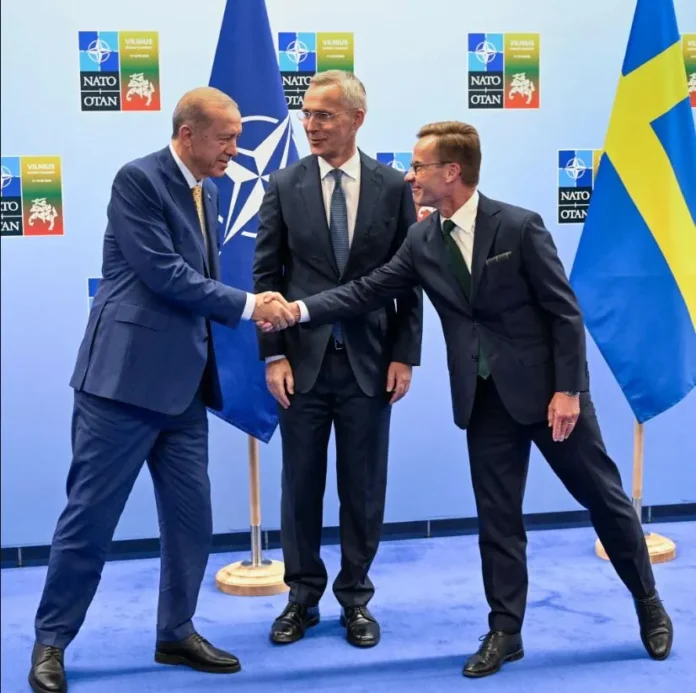
The turnaround came following a meeting between Erdogan, Stoltenberg and Prime Minister Ulf Kristersson of Sweden on the edges of the Vilnius Summit, which will see the leaders of the NATO nations gather in Lithuania. It comes just hours after Erdogan stated that he was now linking Sweden’s alliance membership with Turkey’s ability to join the European Union, in a move that appeared to start the summit off on a sour note.
Instead, Stoltenberg, US President Joe Biden and other world leaders who have been pressuring Erdogan, get a big win to start the meeting. In a statement, Biden said he “welcomed” the move, adding, “I stand ready to work with President Erdoğan and Türkiye on enhancing defense and deterrence in the Euro-Atlantic area. I look forward to welcoming Prime Minister Kristersson and Sweden as our 32nd NATO Ally. And I thank Secretary General Stoltenberg for his steadfast leadership.”
For his part, Erdogan gets to repair some of the relationships with the West that had frayed during his nationalistic presidential campaign, while extracting concessions from Sweden on dealing with Kurdish groups Turkey considers terrorists.
In addition, Sweden “has agreed to support actively the efforts to reinvigorate Turkey’s EU accession process, and also to help to modernize the EU Turkey customs unions and visa liberalization,” Stoltenberg said.
Sweden and Finland announced in Spring 2022 that they would end their decades-long non-aligned stance, as a direct result of Russia’s invasion of Ukraine. While the majority of the NATO nations moved quickly to ratify their membership, Turkey and Hungary both delayed the process — but said early on that the issue was mostly with Stockholm. In March, Sweden gave Finland tacit approval to move ahead with a solo bid, which was rapidly approved.
There are still several hurdles remaining before Sweden can join.
The first is logistical: While Erdogan is no longer holding up the articles of ratification at the executive level, the Turkish Grand Assembly must still vote. While that is likely a formality in terms of the outcome — Erdogan pledged to “work closely with the Assembly to ensure ratification,” a NATO readout of the meeting states — the timeline is vague.
Stoltenberg noted it is “not for me” to speculate about the timeline of the Grand Assembly, noting that as a former lawmaker in Norway, he’s very aware that “parliament has their own integrity, their own timelines.”
But he tacitly acknowledged the political reality, noting that Erdogan “has made it clear that will happen as soon as possible. … I will not give you the exact dates but there is a clear commitment, and the president has made it clear that it will happen as soon as possible.”
Meanwhile, there is still another holdout on the Sweden issue, Hungary. While there is widespread agreement among NATO watchers that Hungary is largely following Turkey’s lead and will approve Sweden’s membership once Turkey does — as happened with Finland earlier this year — the details of that remain up in the air.
“Hungary has made it clear that they will not be the last to ratify. And now Turkey has made it clear that they will ratify and there are only two countries that have not ratified it. So I think that the problem is solved,” Stoltenberg said.
FILE PHOTO: A soldier takes a photograph of his comrade as he poses beside a destroyed Russian tank and armoured vehicles, amid Russia's invasion on Ukraine in Bucha, in Kyiv region, Ukraine April 2, 2022. REUTERS/Zohra Bensemra/File Photo
In the months preceding the Russian invasion of Ukraine, the topic of the increase in the number of European members of NATO received renewed attention among scholars of international relations. While a number of political realists have criticized the West for not taking sufficient measures to placate Russia due to supposedly adopting tone-deaf policies and failing to heed a purported warning pertaining to the military alliance’s continued eastward enlargement, which was issued by Putin in his 2007 speech at the Munich Security Conference, the actions undertaken and statements made by Russian officials since the start of the war have actually given further credence to the arguments of those experts on Russia, such as American historians Alexander Motyl and Timothy Snyder, who contend that the issue of NATO expansion is hardly tied to any legitimate Russian security concerns and largely constitutes a convenient “red herring” intended to justify other aims (quite likely inherently imperial in nature) that are to be achieved as a result of the war.
If we are to, as a starting point, briefly delve into the background when it comes to internal Ukrainian political dynamics in the late 2010s, it would be difficult to speak of a paradigm shift regarding Ukrainian approach to NATO membership after the inauguration of Volodymyr Zelenskyy in May 2019, which would have altered the international security landscape from the Russian perspective. Zelenskyy very much continued in his predecessor Petro Poroshenko’s footsteps, reiterating the latter’s commitment to put the issue to a referendum, so that Ukrainian citizens could make their own decision. One of the more decisive steps on the domestic scene that paved the way for Ukraine’s potential accession had in fact been taken in February 2019, three years prior to the invasion, at a time when Poroshenko (perceived to be more hardline than Zelenskyy in his attitude toward Russia) was still president – the Verkhovna Rada (the Ukrainian parliament) approved an amendment to the constitution that established membership in NATO and the European Union as strategic goals for Ukraine.
When examining the events after February 2022, one of the first major contradictions that emerges (if we are to accept Putin’s claim that preventing NATO expansion serves as the end-goal of the Russian policy aims) concerns the Russian leadership’s stark insistence to maintain control of the illegally occupied territories despite initial Ukrainian willingness to indulge Putin by abandoning the country’s quest for NATO membership.
Even though the following version of the events is contested by Putin’s press secretary Dmitry Peskov, there are strong indications that just prior to or in the early stages of the invasion, Kremlin’s own Deputy Chief of Staff Dmitry Kozak had ironed out a deal, which included guarantees that Ukraine would not become a member of NATO, thus providing an opportunity for the prevention of or the quick end to the armed hostilities. Over the course of the first month after the invasion, Ukrainian president Volodymyr Zelenskyy himself demonstrated receptiveness to his country adopting a neutral status if this could lead to a settlement of the conflict. Assuming Ukraine’s potential NATO membership was genuinely viewed as a “fundamental threat,” as described by the Russian president in his speech announcing the invasion, it does not seem logical that proposals originating from a Kremlin insider and the Ukrainian political elites, which would have largely precluded any such possibility, would face rejection by Putin. While power disparities matter a lot in international negotiations between countries, the stronger states are by no means always in a position to secure favorable outcomes at the expense of the weaker ones, so a Ukrainian commitment to respect a supposedly vital national interest of Russia should have been appraised by the Russian president as a major victory and caused him to relegate the territorial questions to the backstage.
Perhaps the key to Russia’s true intentions is to be found in Russian Foreign Minister Sergey Lavrov’s own statements, which have since at least the summer of 2022 made it evident that permanent annexation of certain Ukrainian territories (including those beyond the Donbas region) is rather high on the list of Russian priorities and the country is not willing to negotiate on the possibility of loosening its grip on the areas of Ukraine it effectively controls.
Furthermore, if we are to entertain the argument that continual NATO enlargement has backed Russia into a corner, forcing it to take desperate measures, it appears hypocritical how the Putin leadership reacted to Finland’s declared intention to seek NATO membership and the country’s subsequent formal accession into the alliance, which occurred on 4 April 2023. Admittedly, while there has been talk of counter-measures, such as bolstering defenses in the Baltic Sea region, Russia’s response as a whole has been described as acquiescent and muted, with Putin even stating in May 2022 that Russia did not identify the Finnish (and Swedish) NATO bids as direct threats for the country.
However, if we are to pay lip service to the contention that Ukraine becoming a member of NATO poses unacceptable security risks for Russia, there is little reason to assume that Finland joining the alliance is objectively less of a problematic scenario from the Russian standpoint.
Similarly to the case between Ukraine and Russia, the international border between Finland and Russia spans a length of more than 1000 km, with Finnish accession notably doubling Russia’s border with NATO. Perhaps even more importantly, from the standpoint of Russian security, Finland has historically been regarded as a geopolitical buffer state, the assumption being that Russia’s possible enemies would not have access to Finnish territory. Also, unlike in the case of Ukraine prior to the invasion, in Finland there was no sizeable proportion of population that was naturally well-disposed towards Russia due to a combination of linguistic, ethnic, and cultural links, which could potentially serve as a fifth column, presumably ready to do its best to oppose any NATO plans that might jeopardize the security of Russia.
Thus, the Russian officials’ insistence that they view Finland membership differently from the one of Ukraine due to a lack of territorial disputes does not have a convincing ring to it. In April 2023, Dmitry Peskov even stated that Finland was never anti-Russia. A quick overview of historical Russo-Finnish relations and the Finnish public’s views on Russia’s global role would immediately offer proof that such an assertion stretches credulity.
If, as the opponents of NATO expansion are inclined to argue, Putin was consistent in his worldview, having always been interested in safeguarding the future interests of Russians against a purported NATO encirclement, the logic dictates that he would have attempted to pursue a similar course of action against Finland as the one he is currently engaged in on Ukrainian soil, even if the time window for implementing a “military solution” against the Nordic country was quite limited.
The excuses offered by the Russian establishment seem to be intended for the Russian public in order to play down this negative geopolitical fallout for Russia as well as the Russian state’s relatively passive acceptance of it, especially given that there are plenty of reasons to assume that using NATO as a boogeyman continues to play well with Putin’s support base.
A much more plausible explanation is that the Russian elites were simply well-aware that any potential scenario involving an invasion of Finland would be guaranteed to end in a massive failure – in addition to having a highly trained military and a large reserve force as well as benefiting from certain geographical advantages in terms of terrain, Finland would have (as a member state of the European Union) had every reason to expect direct military support from the other EU countries, with Josep Borrell, the High Representative of the Union for Foreign Affairs and Security Policy, confirming in May 2022 that Article 42.7 of the EU Treaties would be triggered in such a case. Ukraine was, unlike Finland, presumably identified in early 2022 as a weak target with a divided population (an assumption that turned out to be very far from the realities on the ground), though Putin was unfortunately proven correct in his calculations that any sort of military intervention by other countries on behalf of Ukraine would not be on the table.
Even if the Russian state has valid long-term security concerns due to the possibility of Ukraine acceding to NATO at some point in the future, this potential scenario cannot remotely justify a full scale military attack on a sovereign state, the targeting of civilian infrastructure, and the commission of numerous atrocities, which have resulted in the loss of thousands of lives. It is, however, worth noting that even this tenuous justification for the war has been almost fully discredited by the Russian leadership’s own statements and actions since the start of the invasion of Ukraine. Thus, in the context of the ongoing conflict, while general discussions pertaining to the previous miscalculations of NATO and the wisdom of the military alliance continuing to stick to an overly ambitious “open door policy” are of course still relevant in a theoretical sense, they may actually have limited explanatory value when it comes to shedding light on Russia’s true aims in Ukraine.
The views expressed in this article belong to the authors alone and do not necessarily reflect those of Geopoliticalmonitor.com.
Η Αθήνα έκανε (ή ετοιμάζεται να κάνει) τρεις αδικαιολόγητες υποχωρήσεις μείζονος σημασίας προτού καλά – καλά αρχίσει ο υποτιθέμενος «ελληνοτουρκικός διάλογος».
Λένε ότι η καλή μέρα φαίνεται από το πρωί. Το ίδιο όμως συμβαίνει και με την κακιά και με την πολύ κακιά μέρα. Συνήθως συμβαίνει γιατί, στα κοινωνικά, τα γεωπολιτικά και τα φυσικά ακόμα φαινόμενα, οι αρχικές συνθήκες (στο σκάκι οι αρχικές κινήσεις) προσδιορίζουν σε μεγάλο βαθμό τις δυνατότητες της τροχιάς τους, τις περιοχές δηλαδή και τα αποτελέσματα όπου ενδέχεται (μπορούν) να καταλήξουν.
Η Αθήνα έκανε (ή ετοιμάζεται να κάνει) τρεις αδικαιολόγητες υποχωρήσεις μείζονος σημασίας προτού καλά – καλά αρχίσει ο υποτιθέμενος «ελληνοτουρκικός διάλογος». Αφορούν τη διεθνή αναγνώριση της Κυπριακής Δημοκρατίας, τις τουρκικές κατηγορίες κατά της Ελλάδας ότι υποθάλπει την «κουρδική τρομοκρατία» και την άμυνα των ελληνικών νησιών του ανατολικού Αιγαίου. Όχι με το «καλημέρα», πριν από το «καλημέρα».
Από την πλευρά της, η Άγκυρα επέλεξε τις παραμονές της εκκίνησης του ελληνοτουρκικού διαλόγου (αν όχι διαπραγμάτευσης) να υπενθυμίσει τις εξωφρενικές θέσεις της για «εκλιπούσα» Κυπριακή Δημοκρατία και να ζητήσει τη μετονομασία των Στενών όπως προσδιορίζεται από τη συνθήκη του Μοντρέ.
Αρχή «αποαναγνώρισης» της Κυπριακής Δημοκρατίας
Σύμφωνα με πληροφορίες από καλά πληροφορημένους διπλωματικούς κύκλους η Αθήνα έχει ήδη ή πάντως ετοιμάζεται να αποδεχθεί την εξωφρενική απαίτηση να μην αναφέρεται η Κυπριακή Δημοκρατία σε χάρτες του ΝΑΤΟ, στους οποίους εφεξής, και για να μην αναφερθεί η Κύπρος, οι χώρες θα αναφέρονται ως χώρες, δηλαδή ως εδαφικές περιοχές με τις γεωγραφικές συντεταγμένες τους. Αυτό άλλωστε προκύπτει ως το πιθανότερο συμπέρασμα πίσω από τις αρκετά περίτεχνες εκφράσεις σχετικού ρεπορτάζ της φιλοκυβερνητικής Καθημερινής.
Σύμφωνα με τις πηγές μας η κυβέρνηση προσανατολίζεται να προσθέσει στη σχετική απόφαση έναν αστερίσκο, ή κάτι τέτοιο, με τον οποίο θα υποδηλώνει κάποια διαφωνία. Τέτοιοι αστερίσκοι δεν έχουν καμία πολιτική ή νομική συνέπεια, απλώς χρυσώνουν το χάπι της ελληνικής και κυπριακής κοινής γνώμης. Οι αποφάσεις στο ΝΑΤΟ λαμβάνονται με ομοφωνία. Για να ληφθεί η απόφαση πρέπει να συμφωνήσει η Αθήνα. Η προσθήκη διαφόρων αστερίσκων δεν μεταβάλλει τη συμφωνία της με τη ληφθείσα απόφαση.
Ελπίζουμε ότι αυτά δεν θα συμβούν και ότι η κυβέρνηση θα μπλοκάρει την έκδοση των νέων χαρτών, όλες οι ενδείξεις όμως που έχουμε τη στιγμή που γράφουμε αυτό το άρθρο είναι ότι θα συμβούν και αυτό θα συνιστά, εφόσον γίνει, μια πολύ κακή αρχή και για τον ελληνοτουρκικό διάλογο, πείθοντας – εκτός των άλλων – ακόμα μια φορά την Τουρκία ότι δεν θα καταβάλλει κανένα κόστος, το αντίθετο, αν επιμένει στις πιο μαξιμαλιστικές και εξωφρενικές θέσεις της.
Μικρή παρηγοριά είναι το ότι οι χάρτες δεν θα αναφέρουν καμία άλλη χώρα με το όνομά της. Γιατί όλοι καταλαβαίνουν ότι το ζήτημα αφορά μόνο το κυπριακό κράτος, αφού τη δική του νομιμότητα αμφισβητεί επισήμως η Άγκυρα. Αν μη τι άλλο, η μη αναφορά της Κύπρου συνιστά έμμεση πλην σαφή αναγνώριση της νομιμότητας έγερσης αμφισβητήσεων σε ό,τι αφορά την ύπαρξη και τη νομιμότητα του κυπριακού κράτους. Εξισώνει την άποψη της Τουρκίας περί υπάρξεως δύο κρατών στην Κύπρο με την άποψη που υποστηρίζουν έως τώρα όλα τα άλλα κράτη του κόσμου, ότι δηλαδή υπάρχει ένα κράτος στην Κύπρο, η Κυπριακή Δημοκρατία.
Και είναι ασφαλώς ένα πράγμα το τι λέει η Τουρκία και τελείως διαφορετικό να τα αποδέχεται, έστω και εμμέσως, ως μία από τις δυνατές απόψεις, ένας μεγάλος διεθνής οργανισμός. Ακόμα χειρότερα είναι βέβαια να συγκατατίθεται σε αυτό η ίδια η Ελλάδα!
Η μη αναγνώριση της Κυπριακής Δημοκρατίας είναι κεντρικό στοιχείο της τουρκικής πολιτικής που διατυπώθηκε το 2004 και συμπληρώθηκε πρόσφατα με τη θέση της Άγκυρας για «λύση δύο κρατών», δηλαδή για διαμελισμό της Κύπρου μεταξύ της Τουρκίας και ενός ελληνοκυπριακού κρατιδίου περιορισμένης κυριαρχίας.
Το πόσο εξωφρενική και απαράδεκτη ήταν ήδη και πριν από αυτή την προσθήκη η μη αναγνώριση της Κυπριακής Δημοκρατίας από την Τουρκία, το φανερώνει και η οργισμένη δήλωση του πρωθυπουργού του Ζακ Σιράκ, Ντομινίκ ντε Βιλπέν, που, αντιδρώντας στη δήλωση της Άγκυρας το 2004, τη χαρακτήρισε εντελώς απαράδεκτη και τόνισε ότι δεν μπορεί η Τουρκία να συνεχίσει την ενταξιακή της πορεία στην Ε.Ε., αν δεν αναγνωρίζει ένα από τα μέλη της. Η υπόθεση βέβαια δεν προχώρησε γιατί η Γαλλία δεν βρήκε συμπαράσταση σε αυτή την τόσο προφανή θέση της από κανένα άλλο μέλος της Ένωσης, ούτε καν από τις άμεσα ενδιαφερόμενες Λευκωσία και Αθήνα, που μάλλον τρόμαξαν παρά χάρηκαν με την υπέρ αυτών παρέμβαση της Γαλλίας, προτιμώντας να ακολουθήσουν την αμερικανοβρετανική «πεπατημένη».
Ελπίζουμε ότι δεν έχουμε φτάσει στο σημείο να χρειάζεται να εξηγήσουμε γιατί η διεθνής αναγνώριση της νομιμότητας της ίδιας της ύπαρξης και της κυριαρχίας της Κυπριακής Δημοκρατίας συνιστούν ζωτικής σημασίας ελληνικό εθνικό συμφέρον (και υποχρέωση της Ελλάδας από τις συνθήκες ίδρυσης του κυπριακού κράτους που συνυπέγραψε). Επιπλέον είναι ένα από τα σημεία που είναι εξαιρετικά δύσκολα υπερασπίσιμα διεθνώς από την Τουρκία. Παρά τις προσπάθειές της επί δεκαετίες, κανένα κράτος του κόσμου δεν έχει ακόμα αναγνωρίσει το τουρκοκυπριακό ψευδοκράτος, δηλαδή το αποτέλεσμα της τουρκικής εισβολής στην Κύπρο το 1974. Και από άποψη διπλωματικής στρατηγικής, είναι ανόητο για την Αθήνα να χαλαρώσει την πίεση στην Άγκυρα σε αυτό το σημείο. Και μάλιστα πριν καν αρχίσει η διαπραγμάτευση.
Διπλωματικοί κύκλοι υποστηρίζουν ότι η εξαφάνιση της Κυπριακής Δημοκρατίας θα συμβεί μόνο μία φορά, για μια άσκηση του ΝΑΤΟ στην ανατολική Μεσόγειο και, ως εκ τούτου, δεν πρέπει να της αποδίδουμε μεγάλη σημασία. Δεν χρειάζεται όμως να είναι κανείς διπλωμάτης για να αντιληφθεί ότι, αν συμβεί μία φορά, θα αποτελέσει προηγούμενο και θα επαναληφθεί. Τι θα γίνει δηλαδή την επομένη; Θα ζητήσει η Αθήνα να ξαναγίνουν οι χάρτες του ΝΑΤΟ και να αναφέρουν κανονικά την Κύπρο;
Ίσως βέβαια κάποιος να σκεφτεί ότι όλα αυτά, τελικά, μπορεί να μην είναι και τόσο παράξενα. Μήπως η πλειοψηφία των πολιτικών δυνάμεων στην Ελλάδα, αν όχι και στην ίδια την Κύπρο, δεν υποστήριξαν την αυτοδιάλυση του κυπριακού κράτους με το σχέδιο Ανάν; Μήπως και σήμερα ακόμα δεν υποστηρίζουν μια ακόμα πιο εξαμβλωματική «λύση» στις ίδιες βάσεις, παρά το ότι μια τέτοια λύση, αν γίνει αποδεκτή, θα οδηγήσει σε κατάρρευση όλο τον ελληνισμό και, αντί να κλείσει, θα ξανανοίξει, υπό πολύ χειρότερους όρους την εθνοτική διαμάχη στην ίδια την Κύπρο; Δεν ακούσαμε εξάλλου από τον Πρωθυπουργό, κατά τις προγραμματικές δηλώσεις, καμία αναφορά στην Κύπρο και στο Κυπριακό. Πώς άραγε εξέλαβαν στην Άγκυρα αυτή την τόσο εύγλωττη αφωνία;
Φοβόμαστε, μακάρι να πέφτουμε έξω, ότι όλη αυτή η υπόθεση, μαζί και το ότι η Τουρκία έθεσε αυτό το ζήτημα παραμονές του ελληνοκυπριακού διαλόγου, μπορεί να είναι αποκαλυπτική για την τακτική που ετοιμάζονται να ακολουθήσουν και οι τρεις πλευρές στην επερχόμενη διαπραγμάτευση: Εξαναγκαστική και μαξιμαλιστική διπλωματία η Τουρκία, κατευναστική η Αθήνα, «βρείτε τα στη μέση» οι Αμερικανοί (πόσο μάλλον που η «μέση» εξυπηρετεί και τις αμερικανικές επιδιώξεις: Να πάρει το ΝΑΤΟ από την Ελλάδα τον έλεγχο του ανατολικού Αιγαίου, να «λυθεί» το κυπριακό με μια μορφή σχεδίου Ανάν).
Οι Κούρδοι του Λαυρίου
Εδώ και δεκαετίες, η Άγκυρα υποστηρίζει ότι η Ελλάδα φιλοξενεί και εκπαιδεύει μάλιστα (ή το λιγότερο αφήνει να εκπαιδεύονται) στο στρατόπεδο προσφύγων του Λαυρίου Κούρδοι «τρομοκράτες», δηλαδή μέλη του απαγορευμένου στην Τουρκία Κόμματος Εργατών του Κουρδιστάν (ΡΚΚ).
Ο ισχυρισμός αυτός ήταν ασφαλώς εντελώς εξωφρενικός, κάτι που, μέχρι πρότινος, μπορούσαν άλλωστε να διαπιστώσουν εύκολα όλοι οι επισκέπτες του Λαυρίου, αν έμπαιναν στους χώρους των καταλυμάτων των προσφύγων. Αν άλλωστε ήθελε η Ελλάδα να κάνει τέτοιες «εκπαιδεύσεις», δεν θα τις έκανε βέβαια μέσα σε ένα αστικό κέντρο της ευρύτερης Αττικής και υπό τα όμματα των περαστικών!
Προ ημερών η κυβέρνηση έστειλε τα ΜΑΤ να απομακρύνουν τους εναπομείναντες Κούρδους πρόσφυγες (η πλειοψηφία γυναικόπαιδα) επικαλούμενη ακαταλληλότητα του κτιρίου που τους φιλοξενεί! Φυσικά ουδείς πείστηκε από αυτή την επίσημη εκδοχή και πάντως όχι ο τουρκικός τύπος, που πανηγύρισε για τη διάλυση του «στρατοπέδου τρομοκρατών» του Λαυρίου, παραλληλίζοντάς το με τη βάση του PKK στο όρος Καντίλ του βορείου Ιράκ!
Το πρόβλημα δεν είναι πού θα μείνουν καμιά πενηνταριά πρόσφυγες. Το πρόβλημα είναι ότι οι ελληνικές αρχές, με τον τρόπο που ενήργησαν, φάνηκαν να αποδέχονται, έστω και εμμέσως, τη βασιμότητα των τουρκικών παραλογισμών. Το πρόβλημα είναι επίσης ότι αποδέχτηκαν την επέμβαση της Τουρκίας σε ένα ζήτημα που αφορά την εσωτερική ελληνική έννομη τάξη. Το τρίτο πρόβλημα είναι ότι αυτή η «χειρονομία καλής θέλησης» δεν παροτρύνει την Άγκυρα σε περισσότερη διαλλακτικότητα, αλλά σε περισσότερη αδιαλλαξία. Αν περνάει ένας παραλογισμός, γιατί να μην θέσουμε και άλλους στο τραπέζι; Και το τέταρτο πρόβλημα είναι ότι παραβιάζεται η βασική αρχή κάθε ορθολογικής διαπραγμάτευσης, το quid pro quo, δίνεις κάτι και παίρνεις κάτι.
Υπάρχει και μια ηθική διάσταση, σημαντική για το κύρος και την ακτινοβολία της Ελλάδας που βαρύνεται στη διεθνή συνείδηση για τη συμμετοχή της σε μια διεθνή συνωμοσία για την απαγωγή, εξαπάτηση και παράδοση στην Τουρκία του ηγέτη του κουρδικού επαναστατικού κινήματος, του Αμπντουλά Οτσαλάν. Μπορεί κάποιος να διαφωνεί εντελώς με τις ιδέες και τη δράση του Οτσαλάν, η υπόθεση αυτή όμως υπήρξε αναμφίβολα μια βαριά παραβίαση του ελληνικού, του ευρωπαϊκού και του διεθνούς δικαίου, που συγκλόνισε τότε όλο τον ελληνικό λαό, είχε πολύ μεγάλες και σοβαρές (εις βάρος μας) στρατηγικές συνέπειες και κηλίδωσε τη χώρα. Μιλώντας στη Βουλή για αυτή την υπόθεση, ο πατέρας του σημερινού Πρωθυπουργού, ο Κωνσταντίνος Μητσοτάκης είχε πει ότι η Ελλάδα είναι πολύ μικρή για τέτοιες ανεντιμότητες. Και για αυτό τον λόγο ακόμα η Ελλάδα οφείλει να είναι πολύ προσεκτική και τυπική στον χειρισμό των θεμάτων που σχετίζονται με τους Κούρδους.
Αποστρατιωτικοποίηση του Αιγαίου
Η τρίτη παραχώρηση έχει γίνει νωρίτερα και αφορά την απομάκρυνση, χωρίς μάλιστα ταυτόχρονη αντικατάσταση, οπλικών συστημάτων απαραίτητων στην άμυνα των νησιών του ανατολικού Αιγαίου, προκειμένου να σταλούν στην Ουκρανία. Υπάρχει μάλιστα κίνδυνος τώρα, μετά τις εκλογές, να μεταφερθούν και πολύ περισσότερα και πιο κρίσιμα, χωρίς να αντικατασταθούν. (Αφήνουμε κατά μέρος το ότι τα γαλλικά και τα ρωσικά όπλα προσφέρουν μεγαλύτερη δυνατότητα ελεύθερης χρήσης τους, ενώ τα αμερικανικά τείνουν να λειτουργούν μόνο όταν θέλει η Ουάσινγκτον).
Με τον τρόπο αυτό άρχισε να ικανοποιεί το τουρκικό αίτημα αφοπλισμού των νησιών του ανατολικού Αιγαίου. Την Άγκυρα την ενδιαφέρει να ικανοποιηθεί το αίτημά της, όχι αν αυτό θα γίνει με πρόσχημα την ενίσχυση της Ουκρανίας. Αντίθετα είναι διπλό το όφελος για την Τουρκία αν η αποστρατωτικοποίηση γίνει με αποστολή των όπλων στην Ουκρανία. Γιατί έτσι πλήττονται σοβαρά οι ελληνορωσικές σχέσεις, δηλαδή, στέλνουμε τη Μόσχα στην αγκαλιά της Άγκυρας, αλλάζοντας δραματικά εις βάρος μας τον όλο συσχετισμό με την Τουρκία σε περίπτωση ελληνοτουρκικής κρίσης.
Έχουμε επισημάνει ότι η κυβέρνηση Μητσοτάκη είναι η πρώτη μετά το 1974 που πήρε στην πράξη (και η πράξη, η υλική πραγματικότητα είναι που κυρίως μετράει) μέτρα μερικού αφοπλισμού της πρώτης γραμμής της ελληνικής άμυνας, δηλαδή μετέβαλε επί τα χείρω την πραγματική, υλική δυνατότητα της ελληνικής άμυνας.
Η Αθήνα, επικαλούμενη την (πραγματική) τουρκική απειλή, μπορούσε και έπρεπε, όπως έκανε άλλωστε η Κύπρος, και να αποφύγει να στείλει όπλα στην Ουκρανία και να επαναφέρει στη συζήτηση το ζήτημα της απειλής στο Αιγαίο και της κατοχής της Κύπρου. Αντ’ αυτού προτίμησε μια πολιτική που καταστρέφει τις (στρατηγικής σημασίας για την ελληνική άμυνα) σχέσεις με τη Ρωσία, καθιστά την Ελλάδα ακόμα περισσότερο εξαρτημένη από τις ΗΠΑ και τις δικές τους «ιδέες» για τα ελληνοτουρκικά και το κυπριακό και εξασθενεί πρακτικά, υλικά και πραγματικά, την ελληνική άμυνα.
Η κυβέρνηση θριαμβολογεί βέβαια ότι ενίσχυσε θεαματικά την ελληνική άμυνα και, με δεδομένο τον πρωτοφανή έλεγχο των ΜΜΕ, την αδυναμία εκφοράς συγκροτημένου λόγου από την αντιπολίτευση και τον γενικότερο έλεγχο του πολιτικού, κρατικού και επικοινωνιακού συστήματος, η θέση αυτή επικρατεί μάλλον στη δημόσια σφαίρα. Δυστυχώς και εδώ τα γεγονότα δεν φαίνεται να συμβαδίζουν με την εικόνα. Αγοράζουμε πανάκριβα όπλα, όπως τα αμερικανικά F35, η χρήση των οποίων εξαρτάται πλήρως από τις ΗΠΑ, κατάλληλα για να κάνει το ΝΑΤΟ πυρηνικό πόλεμο κατά της Ρωσίας ή του Ιράν, αν το αποφασίσει, ακατάλληλα όμως για να αντιμετωπίσουμε ένα πλήθος τουρκικών drones. Και κανείς δεν έχει μπει στον κόπο να εξηγήσει πως θα καταφέρουμε να αποπληρώσουμε τα κολοσσιαία ποσά που στοιχίζουν αυτά και τα άλλα εξοπλιστικά προγράμματα, χωρίς η χώρα να οδηγηθεί ξανά σε χρεωκοπία. Ταυτόχρονα, έχει ολοκληρωθεί η παράδοση σε ξένους της ήδη παρακμάζουσας (σε απόλυτη αντίθεση με το τι συμβαίνει στην Τουρκία) ελληνικής πολεμικής βιομηχανίας, που είναι, σε κάθε κράτος το θεμέλιο της εθνικής άμυνας, ενώ δεν προβλέπεται η μεταφορά τεχνολογίας και υπεργολαβικό έργο στην Ελλάδα για τους εξοπλισμούς. Όσο για τη συμφωνία αμυντικών εγγυήσεων με τη Γαλλία δεν περιέλαβε την Κύπρο, δημιουργώντας ένα επικίνδυνο κενό στην ελληνική άμυνα.
Η άμυνα και η εξωτερική πολιτική της χώρας έχει κατ’ ουσίαν «ανατεθεί» στις ΗΠΑ κυρίως και μερικώς στο Ισραήλ. Το τι ακριβώς σημαίνει αυτό μας το είπε ο ίδιος ο «Ανθύπατος», ο πρέσβης των ΗΠΑ κ. Τσούνης, μιλώντας στους Δελφούς για την ανάγκη να τα «βρούμε στη μέση» με την Τουρκία. Μόνο που δεν μας είπε που είναι αυτή η μέση.
Εσφαλμένη διπλωματική στρατηγική;
Όλα τα παραπάνω (για το πρώτο υπάρχει ίσως ακόμα λίγος χρόνος να διορθωθεί και ελπίζουμε να γίνει, όπως και ελπίζουμε να διακοπεί τουλάχιστον η παροχή περαιτέρω όπλων στην Ουκρανία) συνιστούν ισχυρές ενδείξεις για το ότι η Αθήνα, με την αποφασιστική «συνδρομή» των ΗΠΑ, έχει προσανατολιστεί σε μια «στρατηγική» κατευνασμού δια ελληνικών υποχωρήσεων της Άγκυρας. Οριστικά συμπεράσματα βέβαια δεν μπορούν να βγουν προτού προχωρήσει κάπως αυτός ο «διάλογος» και δούμε πού πάει.
Ελπίζουμε ότι δεν θα πάμε εκεί. Γιατί μια στρατηγική «διαπραγμάτευσης» ανάλογη αυτής που ακολούθησε η κυβέρνηση Σημίτη στα ελληνοτουρκικά και το κυπριακό, ή ο Γ. Παπανδρέου για τα Μνημόνια και τις Δανειακές (για να μην αναφερθούμε σε διεθνή παραδείγματα όπως ο Γκορμπατσόφ) ξέρουμε που οδηγεί. «Τρώγοντας», λένε, «έρχεται η όρεξη».
Η Τουρκία θα εισπράξει τις ελληνικές παραχωρήσεις ευχαρίστως και θα θέσει όλο και περισσότερες δικές της. Ταυτόχρονα θα της δημιουργηθούν πολύ μεγάλες προσδοκίες. Κάτι τέτοιο μπορεί να οδηγήσει είτε σε ναυάγιο των διαπραγματεύσεων και νέες κρίσεις, είτε σε ελληνικές παραχωρήσεις κυριαρχίας που κινδυνεύουν να προκαλέσουν μείζονα εθνική κρίση και να αποτελέσουν χαριστική βολή για δύο ήδη απειλούμενης βιωσιμότητας κράτη, το ελλαδικό και το κυπριακό, η τύχη των οποίων είναι αλληλένδετη.
Δεν υφίσταται σήμερα ρεαλιστικά καμιά απολύτως προϋπόθεση για επίλυση, με κάπως δίκαιο και πάντως σταθερό τρόπο, των ελληνοτουρκικών διαφορών ή το, αλληλένδετο με αυτές, κυπριακό. Η εμμονή σε έναν ανέφικτο στόχο μόνο μικρές ή μεγάλες καταστροφές μπορεί να προκαλέσει. Το μέγιστο και το καλύτερο που μπορεί να επιτευχθεί είναι να σταθεροποιηθεί, χωρίς να αναγνωριστεί, το υπάρχον στάτους κβο και να αποφευχθούν περαιτέρω εντάσεις, από τις οποίες το μεγαλύτερο όφελος έχουν συνήθως οι ξένες δυνάμεις. Θα ήταν επίσης ευχής έργο να επιχειρηθεί μια πρώτη συζήτηση για ένα αναγκαίο πλαφόν, ένα «ταβάνι» στους εξοπλισμούς των δύο κρατών, που απειλούν, χωρίς καν να χρησιμοποιηθούν, να τσακίσουν και τις δύο – και πάντως σίγουρα την Ελλάδα.
Η μάχη της ηγεσίας, τα πρόσωπα και τα δομικά ζητήματα που καλείται να λύσει το κόμμα της αξιωματικής αντιπολίτευσης
Περισσεύουν οι μετεκλογικές διεργασίες στο εσωτερικό του ΣΥΡΙΖΑ για την ανάδειξη νέας ηγεσίας μετά τη βαρύτατη διπλή ήττα στις κάλπες της 21ης Μαΐου και της 25ης Ιουνίου και τη σοκαριστή, για πολλούς απρόσμενη, παραίτηση του κ. Τσίπρα. Παρασκηνιακές και εσωτερικές επί παρόντος. Μάχες μηχανισμών κατά βάση μεταξύ ομάδων, συνιστωσών και σχημάτων που παζαρεύουν, μην επιτρέποντας ακόμη στους διεκδικητές και στις διεκδικήτριες της ηγεσίας να παρουσιαστούν, να εμφανιστούν, να εκτεθούν και να εκθέσουν ιδέες, θέσεις και απόψεις.
Εικάζεται ότι την επόμενη Κυριακή, στη συνεδρίαση της Κεντρικής Επιτροπής του ΣΥΡΙΖΑ, θα εμφανιστεί μια τετράδα υποψηφίων, χωρισμένη σε συγγενή δίδυμα. Οι πληροφορίες φέρουν ως επικρατέστερους υποψήφιους διαδόχους του κ. Τσίπρα την κυρία Εφη Αχτσιόγλου και τον κ. Ευκλείδη Τσακαλώτο από τη μια πλευρά και τους κ.κ. Νίκο Παππά και Παύλο Πολάκη από την άλλη.
Το πρώτο δίδυμο θέλει τον ΣΥΡΙΖΑ προσανατολισμένο σε αμιγώς αριστερή κατεύθυνση, στα πρότυπα των σύγχρονων κομμάτων της ευρωπαϊκής Αριστεράς.
Ο κ. Τσακαλώτος έχει εμπειρίες από την αριστερή πτέρυγα των Εργατικών της Μεγάλης Βρετανίας, η επιστημονική του κατάρτιση είναι δεδομένη, ενώ οι επαφές του σε ευρωπαϊκό επίπεδο, διακεκριμένες από την εποχή της διαχείρισης της κρίσης του 2015, και η αστική καταγωγή τού δίνουν πλεονέκτημα παρουσίας στο εγχώριο πολιτικό περιβάλλον. Η αλήθεια είναι ότι διακρίνεται από ιδεολογικές ακαμψίες, αλλά όταν χρειάστηκε έδειξε ευελιξίες και φανέρωσε ικανότητες. Η διαχείριση και η υπεράσπιση της οικονομικής πολιτικής μετά την κρίση του 2015 υπήρξε κατά κοινή ομολογία ξεχωριστή και αποτελεσματική, συγκρουόμενος ευθέως με τον ευρύ κύκλο των λαϊκιστών του κόμματός του.
Η κυρία Αχτσιόγλου είναι δημοφιλέστατη στον κύκλο του ΣΥΡΙΖΑ, διαθέτει και αυτή επιστημονική γνώση και ο λόγος της δεν είναι ατεκμηρίωτος, αν και πολιτικά φαντάζει σκληρός και εν πολλοίς αμετακίνητος. Στη διάρκεια της θητείας της στο υπουργείο Εργασίας διακρίθηκε για την εργατικότητά της και στα τελευταία χρόνια της αντιπολίτευσης ως τομεάρχης Οικονομίας απέκτησε καλύτερη γνώση του οικονομικού περιβάλλοντος, αν και πολλοί της επιχειρηματικής κοινότητας τη θεωρούν απρόσιτη, σχεδόν «αγοραφοβική». Κοινή είναι η πεποίθηση ότι η σεμνή κυρία Αχτσιόγλου αυτοπροστατεύεται, αλλά τώρα φτάνει η στιγμή να εκθέσει τις απόψεις της σε πλήθουσα αγορά.
Το άλλο δίδυμο των κ.κ. Παππά και Πολάκη αντιπροσωπεύει τη λαϊκιστική εκδοχή της Αριστεράς. Ο πρώτος θυμίζει τα παλαιά πρόσωπα της πρώτης πασοκικής περιόδου, σαν να είναι βγαλμένος από τις κομματικές και πολιτικές σχολές της δεκαετίας του ’80. Ολα τα σφάζει και όλα τα μαχαιρώνει, είναι διατεθειμένος να συνομιλήσει και να διαπραγματευτεί με τους πάντες, θεωρεί τις συμμαχίες εύκολες και είναι έτοιμος να συμμαχήσει ακόμη και με τον διάβολο προκειμένου να επιτύχει σκοπούς και στόχους.
Και ο δεύτερος, αν και διαφορετικός, με πεποιθήσεις αμιγώς αριστερές και ήθος επαγγελματικό, όπως λένε όσοι τον γνωρίζουν ως γιατρό, μοιάζει βγαλμένος από τη σχολή του αυριανισμού. Ολη του η στάση, ο λόγος και η επιχειρηματολογία του παραπέμπουν στις μέρες των μεγάλων εντάσεων και των ανυπόφορων συγκρούσεων, σε εποχή που έχει οριστικά παρέλθει. Ολο το προηγούμενο διάστημα πολιτεύθηκε με εχθροπάθεια και υπηρέτησε την τοξικότητα, που ηττήθηκαν κατά κράτος.
Αυτά είναι κατά βάση τα πρόσωπα που θα διεκδικήσουν την ηγεσία του ΣΥΡΙΖΑ. Ωστόσο πολλοί είναι εκείνοι που προβληματίζονται για τη μορφή και τον χαρακτήρα της διεκδίκησης. Αμφισβητούν τη μέθοδο προσέγγισης της ανάδειξης νέας ηγεσίας. Εντυπωσιάζει, είναι αλήθεια, το γεγονός ότι το κόμμα, που κυβέρνησε επί πέντε χρόνια τη χώρα στην πιο κρίσιμη υπαρξιακών διαστάσεων περίοδό της, εξαντλείται σε μάχη μηχανισμών και εσωτερικών συγκρούσεων, δεν προβαίνει σε διεξοδική αναζήτηση των λόγων που οδήγησαν στην εκλογική κατάρρευση, δεν αξιολογεί τη μεταβολή των συνθηκών, διεθνών και εγχώριων, ούτε συνομιλεί με την κοινωνία, παρά επιμένει σχεδόν μαζοχιστικά στην αποτυχημένη προεκλογική επιχειρηματολογία.
Η πρώτη εμφάνιση και ομιλία του προεδρεύοντος κ. Σ. Φάμελλου στη Βουλή επί των προγραμματικών δηλώσεων της κυβέρνησης υπήρξε δηλωτική του ελλείμματος επεξεργασίας και κατανόησης των συνθηκών. Αυτό είναι και το μεγάλο πρόβλημα του ΣΥΡΙΖΑ. Οσο δεν το αντιμετωπίζει τόσο θα χάνει και θα βυθίζεται διαρκώς.
Το δυστύχημα επιπλέον είναι ότι ο κ. Τσίπρας πενθεί… Την ώρα που όλοι μιλούν για αυτόν, είτε επικρίνοντας είτε εκθειάζοντάς τον, εκείνος σιωπά, συνομιλώντας μόνο με τον εαυτό του.
Ο πρωθυπουργός της Ολλανδίας, Μαρκ Ρούτε ανακοίνωσε ότι εγκαταλείπει την πολιτική μετά την κατάρρευση της κυβέρνησής του την περασμένη Παρασκευή λόγω διαφωνιών μεταξύ των εταίρων του συνασπισμού αναφορικά με τη μεταναστευτική πολιτική.
Ο Ρούτε, που βρίσκεται αντιμέτωπος με πρόταση μομφής στη Βουλή μετά την παραίτηση της κυβέρνησής του, ανακοίνωσε ότι δεν πρόκειται να διεκδικήσει την επανεκλογή του για πέμπτη θητεία απευθυνόμενος στους Ολλανδούς βουλευτές στη Χάγη.«Χθες το πρωί έλαβα την απόφαση ότι δεν θα είμαι πλέον ηγέτης του VVD [του μεγαλύτερου κόμματος στον κυβερνητικό συνασπισμό που κατέρρευσε]. Όταν θα αναλάβει νέα κυβέρνηση μετά τις εκλογές, θα εγκαταλείψω την πολιτική», δήλωσε.
Ο 56χρονος Ρούτε, έγινε πρωθυπουργός το 2010 και είναι μέχρι στιγμής ο μακροβιότερος ηγέτης κυβέρνησης στην ΕΕ μετά τον Ούγγρο Βίκτορ Όρμπαν. Θα παραμείνει ως επικεφαλής υπηρεσιακής κυβέρνησης έως ότου σχηματιστεί νέο κυβερνητικό σχήμα μετά τις επόμενες εκλογές, μια διαδικασία που στο κατακερματισμένο πολιτικό τοπίο της Ολλανδίας ενδέχεται να κρατήσει μήνες.
Μέχρι στιγμής δεν έχει οριστεί ημερομηνία εκλογών στην Ολλανδία.
https://www.iefimerida.gr/kosmos/ollandia-royte-apohorei-apo-tin-politiki-katarreysi-kybernisis”>Ολλανδία: Ο Ρούτε αποχωρεί από την πολιτική μετά την κατάρρευση της κυβέρνησής του – iefimerida.gr</a></p>
Jens Stoltenberg, NATO secretary general, said after a meeting today that “unsolved issues” remain, all but ending the prospect of NATO expanding to 32 members at the alliance’s Heads of State Summit in Vilnius, Lithuania, next week.
BELFAST — New talks between Sweden and Turkey, mediated by NATO, have not led to a crucial breakthrough required for the Scandinavian nation to join the alliance.
As part of trilateral discussions held with Finland today, hopes were high that a long-running dispute over Kurdish militant protests and Swedish counterterrorism laws could be finally resolved, triggering Turkey to call a parliamentary vote to ratify Sweden’s entry — the last significant barrier to Stockholm’s ascension.
Jens Stoltenberg, NATO secretary general, said after the meeting that “unsolved issues” remain, all but ending the prospect of NATO expanding to 32 members at the alliance’s Heads of State Summit in Vilnius, Lithuania, next week. Stoltenberg will host a new meeting with Turkish President Recep Tayyip Erdoğan and Swedish Prime Minister Ulf Kristersson on Monday in another attempt to settle the dispute.
“The difference between Sweden and Turkey is that Sweden says that they have followed up sufficiently [on a trilateral memorandum] to be fully ratified and I agree with that position,” said Stoltenberg. “The time has come to finalize Swedish succession and to ratify the Swedish accession protocols.”
He refused to specifically outline why Turkey continues to disagree with Sweden’s position, but Erdoğan has been critical of protests in Sweden held by Kurdish militant supporters. Stoltenberg condemned the protests, noting they have been designed to stop Sweden joining NATO and threaten to weaken the alliance.
“I understand what the President [Erdoğan] is asking for and we have met many, many times and we have discussed them [the outstanding issues] in detail and that’s exactly why we have been able to make progress,” he added. He also warned that additional delay to Sweden’s membership would be “welcomed by” Erdoğan’s enemies in the Kurdish PKK as well as Russian President Valdimir Putin.
Sweden has already made a number of concessions, including making constitutional changes to tighten counterterrorism laws and ending an embargo on arms exports to Turkey. Under a “permanent mechanism” framework Sweden and Turkey have opened up bilateral communications to discuss security issues and share intelligence.
Noting new progress made so far, Stoltenberg also referred to the case of Sweden sentencing a Kurdish man on Thursday for attempting to extort money in support of the PKK. The individual was also found guilty of a firearms offence, according to France 24.
Sweden’s entry to NATO brings with it huge strategic value and will allow the alliance to plan operations across the Arctic-Nordic-Baltic region “as one,” added Stoltenberg. Hungary, which is also holding out its official approval of the move, has said that it will support Sweden’s membership bid once Turkey has done so.
‘Given the present environment of censorship and the ongoing attempts to silence remaining independent media in Turkey, it was not all surprising, to see the response of the head of the Directorate for Communications, Fahrettin Altun, who was quick to label the Reuters report as “disinformation” and “perception operation.”’
On June 26, Reuters, published a report, implicating Bilal Erdoğan, 42, the son of Turkey’s President Recep Tayyip Erdoğan, in a corruption scandal. The following day, 47 tweets, 45 news links, and one YouTube video which shared or re-published the story were blocked for access on grounds of violating personal rights.
The Directorate of Communications, slammed the report as baseless, calling it disinformation. Bilal Erdoğan, through a lawyer, called the investigation, “a web of lies.”
The practice of blocking content about corruption or irregularities in due process in Turkey is common. By some estimates, close to half of the blocked news is directly related to the Turkish President and Justice and Development Party (AKP) leader Recep Tayyip Erdoğan, his family, or AKP mayors and officials.
In 2016, Wikileaks came under digital attack after the site published over 300,000 emails between AKP officials. In June 2020, access to entries about First Lady Emine Erdoğan’s Hermes handbag on the popular website Ekşi Sözlük (Sour Dictionary), a user-contribution-based collaborative hypertext dictionary, were blocked by a court order.
In 2021, articles about the former finance minister and the son-in-law of President Recep Tayyip Erdoğan, Berat Albayrak, and two other Albayrak family members, were blocked because they were a “violation of personal rights.”
In 2022, access to some 130 news reports were blocked for access upon request of President Erdoğan’s former lawyer. In August 2022, a story titled “Economist Erdoğan” was blocked for access on the grounds the story was an “attack on personal rights.”
Also in 2022, news items that featured the drawings by Brazilian cartoonist Latuff of President Erdoğan were blocked for access because they were a “violation of personal rights.” These are just a handful of examples of cases in which content mentioning the family, the president, or party members was censored.
Turkey has also blocked access to popular platforms like YouTube, Wikipedia, and Twitter over the years. As recently as February 2023, the practice of blocking platforms continues.
Bilal Erdoğan’s name previously appeared in a graft scandal in 2016. At the time, his name was associated with a money-laundering probe in Italy. The accusations leveled against Bilal were eventually dropped due to a lack of evidence. In 2014, a series of leaked audio recordings between Bilal and his father, discussing how to dispose of tens of millions of foreign currency cash, were also dismissed as fake. The foundations where Bilal Erdoğan is a board member have also been in the spotlight of investigative journalists.
Reuters’ recent investigation revolves around a Swedish affiliate of an American company — Dignita Systems AB — that sells “dashboard breathalyzers that lock a vehicle’s ignition when the driver is inebriated.” Bilal Erdoğan was to lobby his father’s administration to boost the sales of the product in Turkey. In return, the company “would pay tens of millions of dollars in lobbying fees, via a shell company, to two institutions — the Ibn Haldun University and the TÜGVA youth foundation — for which Bilal Erdoğan is a board member.” The deal never materialized according to the investigation.
In 2021, TÜGVA found itself in the midst of a corruption and abuse of power scandal. The journalist who broke the story, Metin Cihan, and the informant, Ramazan Aydoğdu, who leaked the documents, were put on trial over charges of leaking internal documents.
According to reporting, “the documents revealed widespread corruption within the organization, including the streamlining of Foundation members into high-ranking, highly-paid government roles, as well as the extensive aid and property granted to the organization from the government.” Cihan, who lives abroad, is facing up to six years while Aydoğdu is facing up to ten and a half years behind bars in the ongoing trial.
TÜGVA is among other government-linked foundations, which have reportedly benefited from generous government subsidies. TÜGVA was set up in 2013 and was granted tax-exempt status in October 2016.
Another foundation where Bilal Erdoğan is a board member is the Service for Youth and Education Foundation of Turkey (TÜRGEV). The foundation’s name has been in and out of the mediaspotlight over the years.
Most recently, in May 2022, the foundations affiliated with the President were accused of aiding the President in siphoning money overseas. In 2019, Istanbul municipality released a report documenting how TÜGVA, and TÜRGEV received generous sums — EUR 11.3 million and EUR 8 million — respectively from the Istanbul city administration’s budget. When the newly elected Istanbul Mayor Ekrem İmamoğlu tried addressing this waste on CNN Turk, a television channel closely affiliated with the ruling government, he was cut off air.
In the aftermath of the devastating earthquake that hit Turkey’s provinces in February 2023, the ruling government in an attempt to control the criticism of the state following its inadequate response to the earthquake-affected areas, went on an arrest spree and turned to internet restrictions.
There was also the “the Disinformation Reporting Service” app launched by the directorate of communications encouraging the public to download the app and report “manipulative” news reports and social media posts.
In October 2022, Turkish lawmakers approved a bill on disinformation which the local civil society organizations described as underhanded censorship used to squash dissent and criticism.
There were a number of concerning new restrictions in the bill — mandatory content removal, violations of user privacy, further platform regulation measures, and more — though one of the most worrying articles was Article 29, according to which “anyone publicly distributing false information on Turkey’s domestic and external security, public order and welfare could face between one and three years in jail for instigating concern, fear and panic in society, faces imprisonment from one and up to three years.”
Given the present environment of censorship and the ongoing attempts to silence remaining independent media in Turkey, it was not all surprising, to see the response of the head of the Directorate for Communications, Fahrettin Altun, who was quick to label the Reuters report as “disinformation” and “perception operation.”
In a long Tweet, Altun described Reuters and its report as, a “pitiful example of a 171-year-old media organisation publicly humiliating itself.” He also questioned “the journalistic standards” of Reuters and the network’s “journalism ethics.”
This article was originally published by GlobalVoices.
The views and opinions expressed above are the author’s and do not reflect those of the Free Turkish Press.
Russian President Vladimir Putin meets with Turkey's President Recep Tayyip Erdogan on the sidelines of the Sixth Summit of the Conference on Interaction and Confidence Building Measures in Asia (CICA) in Astana on October 13, 2022. (Photo by Vyacheslav PROKOFYEV / SPUTNIK / AFP)
Turkey’s exports decreased by 10.5 percent to $20.9 billion in June compared to the same month last year, according to official data released by the Turkish Ministry of Trade on Monday. Imports also reached their lowest level in the past 20 months in June.
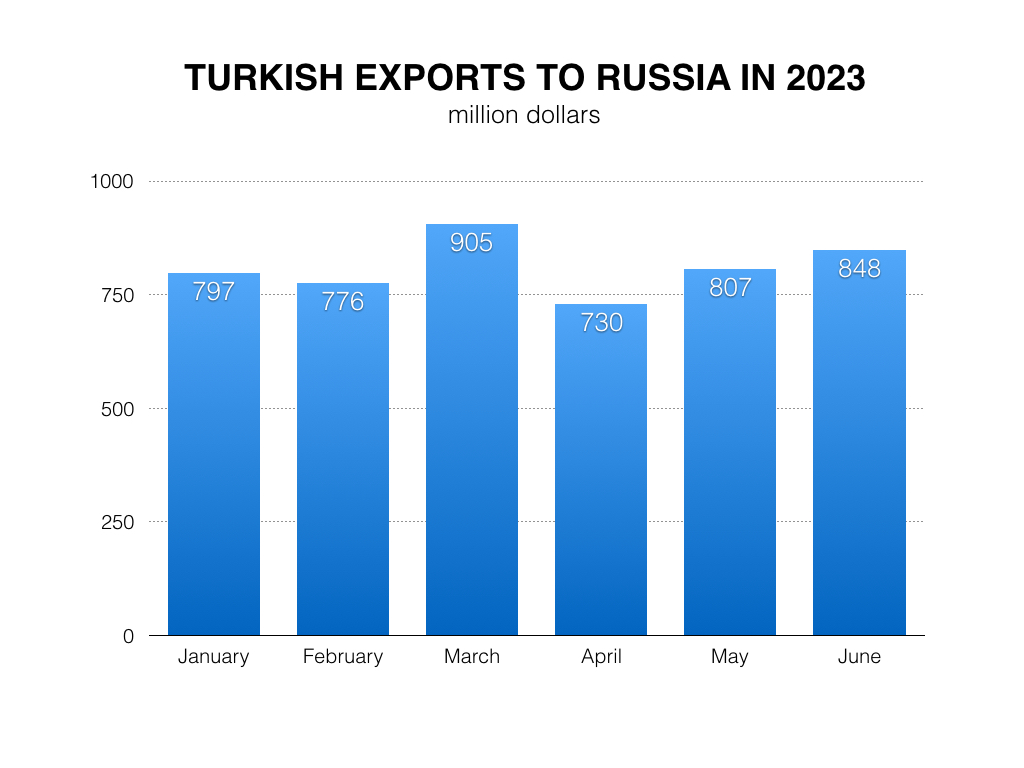
However, trade with Russia followed a different trajectory compared to other countries. Turkey’s exports to Russia in June increased by 23.9 percent and have shown an 88.6 percent increase since the beginning of the year, compared to last year’s data.
In June of the previous year, Turkey’s exports to Russia amounted to $684.9 million. However, in June 2023, this figure surged to $848.4 million, reflecting a significant increase.
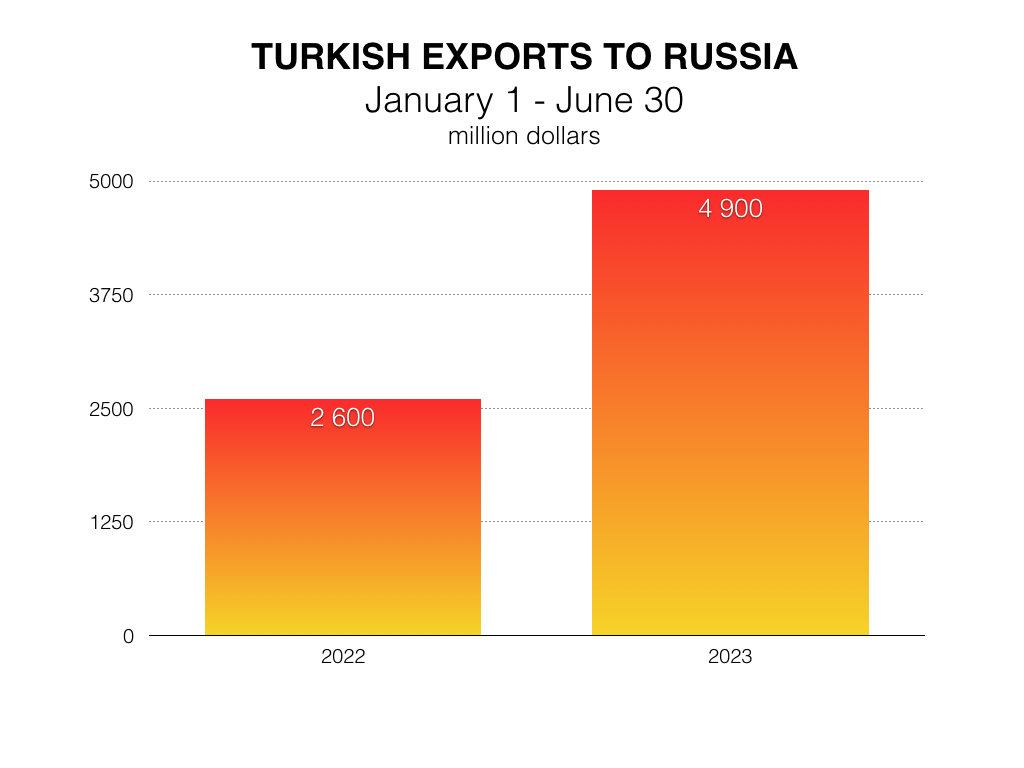
During the January 1 to June 30 period, Turkey’s exports to Russia witnessed remarkable growth. Last year’s exports, valued at $2.6 billion, more than doubled this year, reaching $4.9 billion.
Despite a decline in imports, Russia has maintained its position as Turkey’s largest trading partner in terms of goods purchased. Between January and June, Turkey imported a total of $27.7 billion in goods from Russia. Russia accounts for a significant share of Turkey’s total imports, representing 13.4 percent. Following Russia closely is China, with $20.84 billion and a 12.1 percent share.
In June imports from Russia decreased from $5.09 billion to $2.98 billion compared to the previous year. This decline can be attributed to a reduction in Turkey’s import of cheap oil from Russia.
Since Turkey is not a part of the Western bloc against Russia in terms of imposing sanctions, it was rewarded by Moscow. Turkey saved on oil expenditures and earned some money from cheap Russian oil during a currency crisis due to a deteriorating economy, as the Turkish lira depreciated rapidly against the dollar.
Russian leader Vladimir Putin’s favor to his Turkish counterpart, Recep Tayyip Erdogan, for refusing to participate in Western sanctions was not limited to oil. Russia postponed an approximately $20 billion natural gas debt incurred by Turkish public company BOTAŞ until after 2023.
Putin told Erdogan that Turkey had become the most reliable route for gas shipments to Europe and offered to create a European gas hub in Turkey during a meeting in October on the sidelines of the sixth summit of the Conference on Interaction and Confidence-building Measures in Asia (CICA) in the Kazakh capital of Astana. Erdogan suggested moving forward on Turkey’s second nuclear power plant, the construction of which is planned for Sinop on the southern coast of the Black Sea.
Turkey acquiesced to pressure from the G7 and agreed to halt the transit of sanctioned Western goods to Russia. James O’Brien, the head of the US State Department’s Office of Sanctions Coordination, stated on April 7 that Turkish officials made clear that they had implemented a ban on re-exporting sanctioned goods to Russia, communicating this decision to various governments and agencies.
However, the impact of this change has yet to be observed by Washington. O’Brien mentioned that it would take some time to assess the situation but expressed expectations of a significant drop in trade, as reflected in the trade data from March and April. However, it appears that Turkey’s exports to Russia are not showing a declining trend, given official trade data for May and June.
In March the Turkish government provided companies with a list of prohibited foreign goods and instructed them not to transship these items to Russia. The adoption of such measures follows efforts by the United States and other G7 member nations to persuade third countries to restrict the sale of items that Russia could potentially employ in military operations.
Nordic Monitor previously reported that in March 2022, President Erdogan made a controversial statement concerning Russian oligarchs to pro-government journalists on the way back from the NATO summit in Brussels, saying: “… if there are certain capital groups that want to come to our country and ‘park’ their facilities with us, of course, we won’t keep our doors closed to them. Our door is open to them as well.”
Erdogan’s call must have been heeded by Russian businesspeople since Russians ranked first by country in the number of foreign joint ventures established in Turkey in 2022, with 1,363 companies set up with Russian partners. Of these, 140 were joint-stock companies and 1,223 were limited liability companies. In 2021, only 177 companies were founded with Russian capital. Russians invested primarily in real estate and investment advisory companies.
The number of Russian trucks that transported goods to Russia had increased to 10,956 as of November 30, 2022, as opposed to an average of 2-3,000 in previous years. Between January 1 and November 30, 2022, 18,804 Turkish trucks made trips to Russia, carrying various exported goods.
Similarly, 13,648 Turkish trucks carried imported goods to Turkey from Russia, while the number of Russian trucks on that route was 7,445 in the same period.
The spike in the number of both Russian and Turkish trucks that transported goods to and from Russia came after a protocol signed between Turkish and Russian delegations on May 16, 2022, less than two months after Russia invaded Ukrainian territories.
The meeting, held under the Joint Commission on Land Transportation, saw a sharp change in the Russian position on maximum transit quotas awarded to Turkish truckers. Russian representatives agreed to increase the annual truck quota for the Turkish side from 8,000 to 20,000 for transportation that is destined to end in Russia and from 6,000 to 35,000 for transit transportation to third countries via Russia.
Erdogan has repeatedly stated that Russian grain and fertilizer can be delivered to third countries via Turkey and that they are open to all kinds of cooperation, including exporting Russian grain to poor countries.
Meanwhile, during the armed insurrection by the Wagner mercenary group in Russia at the end of June, Erdogan called Russian leader Vladimir Putin to express his support. A statement from Erdogan’s office emphasized that he highlighted the importance of not exploiting the events in Russia and conveyed Turkey’s readiness to contribute.
Erdogan, after a cabinet meeting on Monday, claimed that Turkey’s balanced policy towards Russia has made the war lobby uncomfortable, and he alleged that local opposition parties are being used as a tool of pressure against them. He also accused main opposition leader Kemal Kılıçdaroğlu, who was his rival in the presidential election in May, of being part of a scenario aimed at creating a crisis between Russia and Turkey.
A new book clarifies the reasons for the decision of the George W. Bush Administration to go to war in Iraq while raising ultimately unanswerable but unavoidable questions about foreign policy.
Twenty years ago this past March the United States attacked Iraq, then led by the murderous despot Saddam Hussein. American armed forces routed the Iraqi army, occupied the country, and deposed Saddam’s regime quickly with relatively modest loss of life. Then things began to go wrong. Baghdad, Iraq’s capital, was overtaken by an orgy of lawlessness. An insurrection against the American forces erupted, as did a civil war between two of the country’s three principal constituent groups–Sunni and Shi’a Muslims (the third being the Kurds).
Having occupied Iraq, the administration of President George W. Bush established the Coalition Provisional Authority (CPA) with the related missions of governing the country and establishing functioning, modern, political institutions for it. The CPA made little headway in achieving either goal. The administration gave as its main reason for launching the attack the need to eliminate Saddam’s stocks of weapons of mass destruction–chemical and biological armaments he was believed to possess in violation of United Nations resolutions prohibiting them. A search of the country turned up no such weapons.
By the time Bush’s successor as president, Barack Obama, withdrew American troops from Iraq in 2011, 4,586 Americans had died and 32,455 had been wounded. Ultimately the monetary cost of the war to the United States, which includes long-term health care for veterans, is projected to reach $2 trillion or more. As many as 300,000 Iraqi civilians died and an estimated nine million became refugees, both inside and outside the country. Although the war had enjoyed robust public support in the United States when it began, by 2023 two-thirds of Americans had come to consider it to have been a mistake.
Because it turned out badly from the American point of view, the war’s origins generated a variety of opinions, explanations, and accusations, few of which reflected favorably on the architects of the war. President Bush, it was said, had been maneuvered into the conflict by a group of advisers known collectively as “neonconservatives.” He, or they, or both, had wanted to attack Iraq from the outset of the administration in January, 2001, or at least since the terrorist attacks on New York City and Washington, D.C. on September 11 of that year. Moreover, it was charged, the administration had known full well that Iraq had no weapons of mass destruction and had used the pretense that it did as a cover for the pursuit of other goals such as seizing control of Iraq’s oil reserves, spreading democracy to the Middle East, taking revenge on Saddam for having attempted to assassinate the president’s father, former president George H.W. Bush, or some combination of these.
These ideas, widely circulated both in the United States and abroad, are incorrect, as Melvyn P. Leffler’s Confronting Saddam Hussein: George W. Bush and the Invasion of Iraq, an invaluable study of the lead-up to the war and the American occupation that followed, persuasively demonstrates. The author, an emeritus professor of history at the University of Virginia who has written a number of respected books on twentieth-century American foreign policy, has conducted interviews with most of the American officials responsible for Iraq policy. He has also extensively mined the voluminous public record to produce the most authoritative account of the decision to go to war that has yet been written.
Leffler shows that President Bush himself was in full control of Iraq policy: he was nobody’s puppet. While Bush certainly wanted Saddam out of power, he was not determined from the beginning of his time as president to go to war to bring about that result. To the contrary, his chief aim was to deprive Saddam of weapons of mass destruction, not to take Iraq’s oil or promote democracy there; and Bush hoped, until the last moment, to accomplish this goal without war. Moreover, the president and his senior officials did genuinely believe in the existence of such weapons, as did the leaders and the intelligence services of other Western countries.
Why, then, did the administration embark on a course that has come to be regarded by most Americans, and most observers in other countries, as a colossal failure? The answer to that question that Leffler’s careful study makes it possible to piece together is that the war came about through a confluence of three potent factors.
The first of them was the terrible events of September 11. The terrorist attacks of that day– unexpected, unprecedented, and massively lethal–administered a powerful shock to the American public and especially to the Bush administration. The president and his senior colleagues felt a sense of failure at not having prevented the attacks, which made all the stronger their collective sense of responsibility to ensure that no further, comparable assaults took place. Most alarmingly, September 11 raised the specter of a new and deadly threat. During the Cold War, the United States and its allies had managed to deter the Soviet Union from attacking Western Europe and North America, but the attacks on New York and Washington were the work of men who, because they were all too willing to die, could not be deterred. If such people managed to obtain weapons of mass destruction, they would surely attempt to use them against American and Western targets. Terrorists possessing such armaments could do horrifying damage.
The Bush administration had been aware of the terrorist threat to the United States, and specifically the threat posed by Osama bin Laden and his al Qaeda organization but had failed to act decisively to counteract it. They had not, senior officials realized too late, taken that threat seriously enough. Of what other dangers, they were bound to ask themselves in the wake of September 11, might that also be true?
Because of who he was and what he had already done, their collective attention came to rest on Saddam Hussein. It is no accident that his name is in the book’s title. His personality, his history, and his conduct in the months before the American attack count as the second cause of the 2003 war. He had once had a significant store of chemical and biological weapons. He had also had a burgeoning program for making nuclear explosives, which Israel had destroyed in 1981. He had a track record of aggression, having attacked Iran in 1979 and Kuwait in 1990. He had employed chemical munitions against Iran and against the Kurdish population of Iraq itself.
The sanctions imposed on him after an American-led coalition had driven his army out of Kuwait in 1991 had degraded his military forces and armaments programs; but by the time the Bush administration took office the sanctions were weakening. Administration officials feared–not without reason–that the post-1991 restraints would eventually disappear altogether. Saddam would then be free to build up his military forces and resume his aggressive foreign policies. A longtime sponsor of terrorism himself, he would surely be tempted to give to terrorists the weapons of mass destruction he would undoubtedly build or rebuild. In that case, terrible consequences might ensue.
Saddam caused the Iraq war, as well, by his response to the American demand that he disarm or prove that he had already done so. Having evicted United Nations weapons inspectors, he readmitted them before the war but then interfered with their work. He apparently believed that the United States would not attack despite its threats to do so, and worried that if his regime were known not to have weapons of mass destruction this would embolden his many adversaries both within Iraq and elsewhere. Leffler’s research strongly suggests that had Saddam come clean on this issue the United States would not have invaded Iraq.
The Bush administration went to war on the basis of a particular combination of attitudes: deep pessimism about the likely consequences of leaving Saddam and his presumed weapons in place combined with what came to seem in retrospect to be wildly excessive optimism about the ease of removing him and setting Iraq on a path to a decent, peaceful, and even democratic future. That combination stemmed from recent history, which was the third reason for the war.
The presumption about the high costs of inaction arose from the experience of September 11. Bush officials had seen the all too painful results of their relative inattention to terrorism. The confidence in the success of a military initiative in Iraq stemmed in no small part from the ease with which the United States had ousted the Taliban regime in Afghanistan in the weeks following September 11; and the related optimism about the political and economic prospects for an Iraq without Saddam came from the powerful global trend of the previous two decades in which dictatorships had fallen and democracies begun to bloom in their stead, culminating in the collapse of communism in Europe in 1989 and 1991. With the tide of history flowing so strongly in favor of freedom, it was, in 2003, hard to imagine that the Middle East would resist that tide. That, however, is in fact what happened in Iraq as well as elsewhere in the region in the wake of uprisings against autocratic Middle Eastern governments in 2011 and 2012 that came to be known as the Arab Spring.
Leffler’s reconstruction of the American decision for war in 2003 brings out with particular clarity one of the unavoidable features of such decisions. The decision-makers must operate in conditions of uncertainty. They cannot be sure what will happen as a result of what they decide to do. Moreover, they must choose among different possible courses of action and while they are fated to see the results of the course they select, they will never know what the outcome of the alternative paths they might have taken would have been.
In dealing with Iraq, the obvious alternative to war was the status quo–continuing to try to contain Saddam’s regime. Given the costs of the war, continued containment seems, in hindsight, the wiser course. It is entirely within the realm of possibility, however, that had it been taken the Bush administration’s fears about leaving Saddam in place would have been realized. The Iraqi dictator might have escaped the sanctions, rebuilt his military forces, and conducted aggressive policies that would have imposed costs on the Middle East and the world just as great as–indeed, conceivably even greater than–those exacted by the war the United States began in 2003.
It is also difficult to resist asking–although impossible to answer–whether different policies would have made the period of Amerian occupation less violent, thereby enabling the Coalition Provisional Authority to do better than it did in achieving its goals. In the wake of the war the United States clearly had far too few troops in the country to maintain order. Would the Congress and the American public have been willing to send many more if asked to do so? If so, would the Americans and the Iraqis have had a significantly more positive experience there? Or, to the contrary, were the conditions in Iraq–the damage done by Saddam’s brutal rule and the bitter divisions among the Sunni and Shi’a Arabs and the Muslim but non-Arab Kurds who all inhabited the country that Great Britain had arbitrarily created out of the ruins of the Ottoman Empire after World War I–such that the American goals were impossible to achieve?
The kind of “counterfactual” questions that history raises and that the American encounter with Iraq makes particularly poignant has, finally, a relevance to the present. For the United States now faces a threat in the Persian Gulf region comparable to the one that Saddam Hussein was seen to pose 20 years ago. The Islamic Republic of Iran conducts an aggressive foreign policy, sponsors terrorism on a large scale, and has come closer to obtaining nuclear weapons than Saddam ever did. The three administrations that have come after the events that Leffler chronicles, while different from one another in their respective approaches to Iran, have all been guided by attitudes different from those that animated American policy toward Iraq in 2003.
That is, Barack Obama, Donald Trump, and Joe Biden have all indicated, by word and deed, that they will not use force to stop the mullahs in Tehran from equipping themselves with nuclear armaments. Their common pessimism about the consequences of a war against Iran, despite the fact that it would entail air strikes against the Iranian nuclear infrastructure and not American troops on the ground, stems from the American experience in Iraq. That experience remains powerfully and vividly negative enough to have persuaded three presidents that alternatives to military action– in Obama’s and Biden’s cases the attempt to conciliate the Islamic Republic, in Trump’s denouncing that regime but not attacking its nuclear program–will serve American interests better than using the U.S. Air Force to deprive Iran of nuclear weapons. Perhaps history will bear them out. It is also possible, however, that Iran will acquire a nuclear arsenal and wield it in such a way that, twenty years from now, the Obama, Trump, and Biden policies will be regarded as unfavorably as the Bush Iraq policy of 2003 is today.
Image: Combined graphic of President George W. Bush delivering an address regarding the September 11 terrorist attacks on the United States to a joint session of Congress at the U.S. Capitol (National Archives) and Saddam Hussein speaking at his trial. (U.S. Department of Defense)
1.-Αν ξύσει κάποιος την επιφάνεια της ελληνικής διοίκησης θα διαπιστώσει πως και στα καθημερινά πράγματα την χώρα διοικούν πρωτίστως οι ΗΠΑ και δευτερευόντως η Ε.Ε. Οτιδήποτε θελήσει να κάνει οποιαδήποτε ελληνική κυβέρνηση θα πρέπει να πάρει την άδεια τους. Ακόμη και τις κρίσιμες καταστάσεις οι δύο πρωτεύουσες τις διαχειρίζονται. Δεν το λέω, απαραιτήτως, ως κακό. Οι δικοί μας μπορεί να τα έκαναν χειρότερα. Σε μια χώρα όπου αν δεν πέσει μίζα δεν γίνεται τίποτε δεν μπορείς να περιμένεις θετικές εξελίξεις.
2.-Όπως είπε ο ίδιος ο Μπελέρης στην “Καθημερινή” τον κρατούν στη φυλακή για να περάσει το τρίμηνο που θα έπρεπε να αναλάβει τα καθήκοντά του ως δημάρχου Χειμάρας και να ακυρωθεί η εκλογή του. Ο λόγος είναι πασιφανής. Μια ομάδα διεφθαρμένων Αλβανών με επικεφαλής` τον ίδιο τον Ράμα θέλει να καταχρασθεί τις εκτάσεις της Χειμάρας και ο Μπελέρης και οι χειμαριώτες αποτελούν εμπόδιό τους.
Έχουμε να κάνουμε με σαφή καταπάτηση ανθρωπίνων και ατομικών δικαιωμάτων με μια στημένη υπόθεση
Με ένα νεύμα της Πρεσβείες των ΗΠΑ και της Ε.Ε. το πρόβλημα θα λυνόταν. Αλλά το νεύμα δεν γίνεται. Οι ΗΠΑ και η Ε.Ε. έχουν ακέραιες ευθύνες στην ενθάρρυνση μαφιόζικης συμπεριφοράς εκ μέρους του αλβανικού κράτους. Σε βάρος της ελληνικής μειονότητας.
Σε ευθύνες της Αθήνας δεν αναφέρομαι. Η Αθήνα δεν υφίσταται παρά ως ανέκδοτο στα Βαλκάνια.
3.-Για να πιέσουν την Τουρκία να δεχθεί την Σουηδία στο ΝΑΤΟ οι Αμερικανοί είναι διατεθειμένοι να της δώσουν πολλά. Ίσως και όλα όσα ζητά. Τα οπλικά συστήματα και, κυρίως, τα F-16 θα της τα δώσουν. Το λέμε εδώ και καιρό. Ας τα δώσουν χωρίς να νομίζουν ότι μας δουλεύουν με την δήλωση Μπάϊντεν ότι οι ΗΠΑ θα ενισχύσουν ταυτόχρονα Ελλάδα και Τουρκία. Ταυτόχρονη ενίσχυση Ελλάδας Τουρκίας δεν βοηθά την Ελλάδα αλλά δεν βοηθά τις ΗΠΑ. Όταν θα το αντιληφθούν οι σπουδαίοι εγκέφαλοι της Οάσιγκτον θα είναι αργά.
Αν υπήρχε σοβαρό ελληνικό κράτος θα διαπραγματευόταν με τις ΗΠΑ στη λογική του οφέλους, Σου δίνω βάσεις και ζητώ αυτά. Δεν επαιτώ. Απο αυτής της πλευράς η Τουρκία είναι σοβαρό κράτος. Η Ελλάδα (η Αθήνα, δηλαδή, γιατί Ελλάδα δεν υφίσταται) δεν είναι.