Αρχική Blog Σελίδα 1581

We asked the Marines if China caused the missing F-35 crash

0

The Department of Defense can’t account for spare parts worth millions of dollars that use its costliest weapon, the F-35 jet, auditors say. (Master Sgt. Darnell T. Cannady/U.S. Air Force/TNS)
SEPTEMBER 19, 2023 

Rumors swirled online this week over the U.S. military’s missing F-35 jet that disappeared after its pilot safely ejected over the weekend. Some speculated China was behind the “mishap” even after U.S. officials located parts of the aircraft at a crash site in South Carolina.

American Military News asked the Marine Corps on Tuesday if China or any unknown foreign actor was involved in the unusual incident.

“The mishap is currently under investigation. The Department of the Navy has a well-defined process for investigating aircraft mishaps. We are unable to provide additional details to preserve the integrity of the investigatory process,” a 2nd Marine Aircraft Wing spokesperson told American Military News in an email.

According to the Daily Mail, a watchdog organization called POGO issued a report in 2019 warning that every software-enabled weapon system on the F-35 tested between 2012 and 2017 could be hacked.

“Despite years of patches and upgrades, the F-35’s most combat-crucial computer systems continue to malfunction, including the Autonomic Logistics Information System (ALIS) maintenance and parts ordering network; and the data links that display, combine, and exchange target and threat information among fighters and intelligence sources,” the agency wrote.

“As in previous years, cybersecurity testing shows that many previously confirmed F-35 vulnerabilities have not been fixed, meaning that enemy hackers could potentially shut down the ALIS network, steal secret data from the network and onboard computers, and perhaps prevent the F-35 from flying or from accomplishing its missions,” it added.

United States military officials announced on Monday that a debris field connected to the F-35 was discovered in South Carolina.

“Personnel from Joint Base Charleston and @MCASBeaufortSC, in close coordination with local authorities, have located a debris field in Williamsburg County. The debris was discovered two hours northeast of JB Charleston,” Joint Base Charleston wrote in a post on X, formerly Twitter.

“We would like to thank all of our mission partners, as well as local, county, and state authorities, for their dedication and support throughout the search and as we transition to the recovery phase,” the base added in a follow-up post.

The jet’s discovery came after military officials asked the public to help locate the missing F-35.

“We’re working with @MCASBeaufortSC to locate an F-35 that was involved in a mishap this afternoon. The pilot ejected safely. If you have any information that may help our recovery teams locate the F-35, please call the Base Defense Operations Center at 843-963-3600,” the base posted.

“Based on the jet’s last-known position and in coordination with the FAA, we are focusing our attention north of JB Charleston, around Lake Moultrie and Lake Marion,” it added.

americanmilitarynews.com

Humanitarian Imperialism Created the Libyan Nightmare

0

NATO’s military intervention in Libya in 2011, which overthrew the regime of Muammar Gaddafi, resulted in a chaotic and murderous failed state. Libyans pay a horrific price for this catastrophe.

By Chris Hedges

Business is Booming – by Mr. Fish

“We came, we saw, he died,” Hillary Clinton famously quipped when Muammar Gaddafi, after seven months of U.S. and NATO bombing, was overthrown in 2011 and killed by a mob who sodomized him with a bayonet. But Gaddafi would not be the only one to die.  Libya, once the most prosperous and one of the most stable countries in Africa, a country with free healthcare and education, the right for all citizens to a home, subsidized electricity, water and gasoline, along with the lowest infant mortality rate and highest life expectancy on the continent, along with one of the highest literacy rates, swiftly fragmented into warring factions. There are currently two rival regimes battling for control in Libya, along with an array of rogue militias.

The chaos that followed Western intervention saw weapons from the country’s arsenals flood the black market, with many snatched up by groups such as the Islamic State. Civil society ceased to function. Journalists captured images of migrants from Nigeria, Senegal and Eritrea being beaten and sold as slaves to work in fields or on construction sites. Libya’s infrastructure, including its electrical grids, aquifers, oil fields and dams, fell into disrepair. And when the torrential rains from Storm Daniel —  the climate crisis being another gift to Africa from the industrialized world — overwhelmed two decrepit dams, walls of water 20 feet high raced down to flood the port of Derna and Benghazi, leaving up to 20,000 dead according to Abdulmenam Al-Gaiti, Mayor of Derna, and some 10,000 missing.

“The fragmentation of the country’s disaster management and disaster response mechanisms, as well as deteriorating infrastructure, exacerbated the enormity of the challenges. The political situation is a driver of risk,” said Professor Petteri Taalas, Secretary General of the World Meteorological Organization.

Taalas told reporters last Thursday that “most of the human casualties” would have been avoided if there had been a “normally operating meteorological service” which “would have issued the [necessary] warnings and also the emergency management of this would have been able to carry out evacuations of the people.”

Western regime-change, carried out in the name of human rights under the doctrine of R2P (Responsibility to Protect), destroyed Libya – as it did Iraq – as a unified and stable nation. The flood victims are part of the tens of thousands of Libyan dead resulting from our “humanitarian intervention,” which rendered disaster relief non-existent. We bear responsibility for Libya’s prolonged suffering. But once we wreak havoc on a country in the name of saving its persecuted — regardless of whether they are being persecuted or not — we forget they exist.

Karl Popper in “The Open Society and Its Enemies” warned against utopian engineering, massive social transformations, almost always implanted by force, and led by those who believe they are endowed with a revealed truth. These utopian engineers carry out the wholesale destruction of systems, institutions and social and cultural structures in a vain effort to achieve their vision. In the process, they dismantle the self-correcting mechanisms of incremental and piecemeal reform that are impediments to that grand vision. History is replete with murderous utopian social engineering — the Jacobins, the communists, the fascists and now, in our own age, the globalists, or neoliberal imperialists.

Libya, like Iraq and Afghanistan, fell victim to the self-delusions peddled by humanitarian interventionists — Barack Obama, Hillary Clinton, Ben Rhodes, Samantha Power and Susan Rice. The Obama administration armed and backed an insurgent force that they believed would do the bidding of the U.S.  Obama in a recent post urged people to support aid agencies to alleviate the suffering of the people of Libya, a plea that ignited an understandable backlash on social media.

There is no official tally of the casualties in Libya that have resulted directly and indirectly from the violence in Libya over the last 12 years. This is exacerbated by the fact that NATO failed to investigate casualties resulting from its seven month bombardment of the country in 2011. But the total figure of those killed and injured is likely in the tens of thousands. Action on Armed Violence recorded “8,518 deaths and injuries from explosive violence in Libya” from 2011 to 2020,  6,027 of which were civilian casualties.

In 2020, a statement published by seven U.N. agencies reported that “Close to 400,000 Libyans have been displaced since the start of the conflict nine years ago — around half of them within the past year, since the attack on the capital, Tripoli, [by Field Marshal Khalifa Belqasim Haftar’s forces] started.”

“The Libyan economy has been battered by the [civil war], the COVID-19 pandemic, and Russia’s invasion of Ukraine,” the World Bank reported in April of this year. “The country’s fragility is having far-reaching economic and social impact. GDP per capita declined by 50 percent between 2011 and 2020 while it could have increased by 68 percent if the economy had followed its pre-conflict trend,” the report says. “This suggests that Libya’s income per capita could have been 118 percent higher without the conflict. Economic growth in 2022 remained low and volatile due to conflict-related disruptions in oil production.”

Amnesty International’s 2022 Libya report also makes for grim reading. “Militias, armed groups and security forces continued to arbitrarily detain thousands of people,” it says. “Scores of protesters, lawyers, journalists, critics and activists were rounded up and subjected to torture and other ill-treatment, enforced disappearances and forced ‘confessions’ on camera.” Amnesty describes a country where militias operate with impunity, human rights abuses, including kidnappings and sexual violence, are widespread. It adds that “EU-backed Libyan coastguards and the Stability Support Authority militia intercepted thousands of refugees and migrants at sea and forcibly returned them to detention in Libya. Detained migrants and refugees were subjected to torture, unlawful killings, sexual violence and forced labour.”

Reports by the U.N. Support Mission to Libya (UNSMIL) are no less dire.

Stockpiles of weapons and ammunition — estimated to be between 150,000 and 200,000 tons — were looted from Libya with many being trafficked to neighboring states. In Mali, weapons from Libya fuelled a dormant insurgency by the Tuareg, destabilizing the country. It ultimately led to a military coup and a jihadist insurgency which supplanted the Tuareg, as well as a protracted war between the Malian government and jihadists.  This triggered another French military intervention and led to 400,000 people being displaced. Weapons and ammunition from Libya also made their way into other parts of the Sahel including Chad, Niger, Nigeria and Burkina Faso.

The misery and carnage, which rippled out from a dismembered Libya, was unleashed in the name of democratization, nation-building, promoting the rule of law and human rights.

The pretext for the assault was that Gaddafi was about to launch a military operation to massacre civilians in Benghazi where rebellious forces had seized power. It had as much substance as the charge that Saddam Hussein had weapons of mass destruction, another example of utopian social engineering that left over a million Iraqi dead and millions more driven from their homes.

Gaddafi — who I interviewed for two hours in April 1995 near the gutted remains of his home that was bombed by U.S. warplanes in 1986 — and Hussein were targeted not because of what they did to their own people, although both could be brutal. They were targeted because their nations had large oil reserves and were independent of Western control. They renegotiated more favorable contracts for their nations with Western oil producers and awarded oil contracts to China and Russia. Gaddafi also gave the Russian fleet access to the port of Benghazi.

Hillary Clinton’s emails, obtained via a freedom of information request and published by WikiLeaks, also expose France’s concerns about Gaddafi’s efforts to “provide Francophone African Countries with an alternative to the French Fran (CFA).” Sidney Blumenthal, a longtime adviser to Clinton, reported on his conversations with French intelligence officers about the motivations of French President Nicholas Sarkozy, the chief architect of the attack on Libya. Blumenthal writes that the French president seeks “a greater share of Libyan oil”, increased French influence in the region, an improvement in his domestic political standing, a reassertion of French military power and an end to Gaddafi’s attempts to supplant French influence in “Francophone Africa.”

Sarkozy, who has been convicted on two separate cases of corruption and breach of campaign finance laws, faces a historic trial in 2025 for allegedly receiving millions of euros in secret illegal campaign contributions from Gadaffi, to assist with his successful 2007 presidential bid.

These were the real “crimes” in Libya. But the real crimes always remain hidden, papered over by florid rhetoric about democracy and human rights.

The American experiment, built on slavery, began with a genocidal campaign against Native Americans that was exported to the Philippines and, later, nations such as Vietnam. The narratives we tell ourselves about World War II, largely to justify our right to intervene around the globe, are a lie. It was the Soviet Union that destroyed the German army long before we landed at Normandy. We firebombed cities in Germany and Japan killing hundreds of thousands of civilians.  The war in the South Pacific, where one of my uncles fought, was bestial, characterized by rabid racism, mutilation, torture and the routine execution of prisoners. The atomic bombings of Hiroshima and Nagasaki were egregious war crimes. The U.S. routinely destroys democracies that nationalize U.S. and European corporations as in Chile, Iran and Guatemala, replacing them with repressive military regimes. Washington supported the genocides in Guatemala and East Timor. It embraces the crime of preemptive war. There is little in our history to justify the claim of unique American virtues.

The nightmares we orchestrated in Iraq, Afghanistan and Libya are minimized or ignored by the press while the benefits are exaggerated or fabricated. And since the U.S. does not recognize the International Criminal Court, there is no chance of any American leader being held accountable for their crimes.

Human rights advocates have become a vital cog in the imperial project. The extension of U.S. power, they argue, is a force for good. This is the thesis of Samantha Power’s book “A Problem from Hell: America and the Age of Genocide.” They champion the R2P doctrine, unanimously adopted in 2005 at the U.N. World Summit. Under this doctrine, states are required to respect the human rights of their citizens. When these rights are violated, then sovereignty is nullified. Outside forces are permitted to intervene. Miguel d’Escoto Brockmann, the former president of the U.N. General Assembly, warned in 2009 that R2P could be misused “to justify arbitrary and selective interventions against the weakest states.”

“Since the end of the Cold War, the idea of human rights has been made into a justification for intervention by the world’s leading economic and military powers, above all, the United States, in countries that are vulnerable to their attacks,” writes Jean Bricmont in “Humanitarian Imperialism: Using Human Rights to Sell War.”  “Until the U.S. invasion of Iraq, [a] large part of the left was often complicit in this ideology of intervention, discovering new ‘Hitlers’ as the need arose, and denouncing antiwar arguments as appeasement on the model of Munich in 1938.”

The creed of humanitarian intervention is selective. Compassion is extended to “worthy” victims while “unworthy” victims are ignored. Military intervention is good for Iraqis, Afghans or Libyans, but not for Palestinians or Yeminis. Human rights are supposedly sacrosanct when discussing Cuba, Venezuela and Iran, but irrelevant in our offshore penal colonies, the world’s largest open air prison in Gaza or our drone-infested war zones. The persecution of dissidents and journalists is a crime in China or Russia, but not when the targets are  Julian Assange and Edward Snowden.

Utopian social engineering is always catastrophic. It creates power vacuums that augment the suffering of those the utopianists claim to protect. The moral bankruptcy of the liberal class, which I chronicle in “Death of the Liberal Class,” is complete. Liberals have prostituted their supposed values to the Empire. Incapable of taking responsibility for the carnage they inflict, they clamor for more destruction and death to save the world.

Christopher Hedges is an American journalist, author, commentator and Presbyterian minister.

Best Greek food: 24 of the tastiest dishes

0

CNN — 

Renowned for its nourishing simplicity, the cuisine of Greece is considered among the finest and healthiest in the world. With an emphasis on baked rather than fried food, most traditional dishes avoid elaborate sauces, preferring the perfume of herb seasonings.

Nutritionists have long trumpeted the Greeks’ use of unsaturated fats such as olive oil and unprocessed sugars such as honey, as well as pulses and vegetables, with good reason – the Mediterranean country lies at the top of longevity lists thanks to its food.

Indeed, one Greek island, Ikaria, has been under the microscope in recent years, as one in three of its 8,500-odd residents are over 90 years old. While there may be other lifestyle components involved, a typical Greek diet appears to be a major factor here.

From moussaka to souvlaki, here are 24 of the best dishes everyone in Greece knows and loves:

Taramasalata (Ταραμοσαλάτα)

Taramasalata is made from cured fish roe.

The worst tongue twister on a list of starters, this pungent dip consists of a starchy base of soaked breadcrumbs or potatoes with added lemon juice and olive oil.

One of its crucial ingredients is a peculiarly Greek delicacy – cured fish roe. As the authentic color is a rather off-putting gray-yellow, some cooks, and supermarkets, add pink coloring to make it appear more appetizing.

Gigantes (Φασόλια γίγαντες)

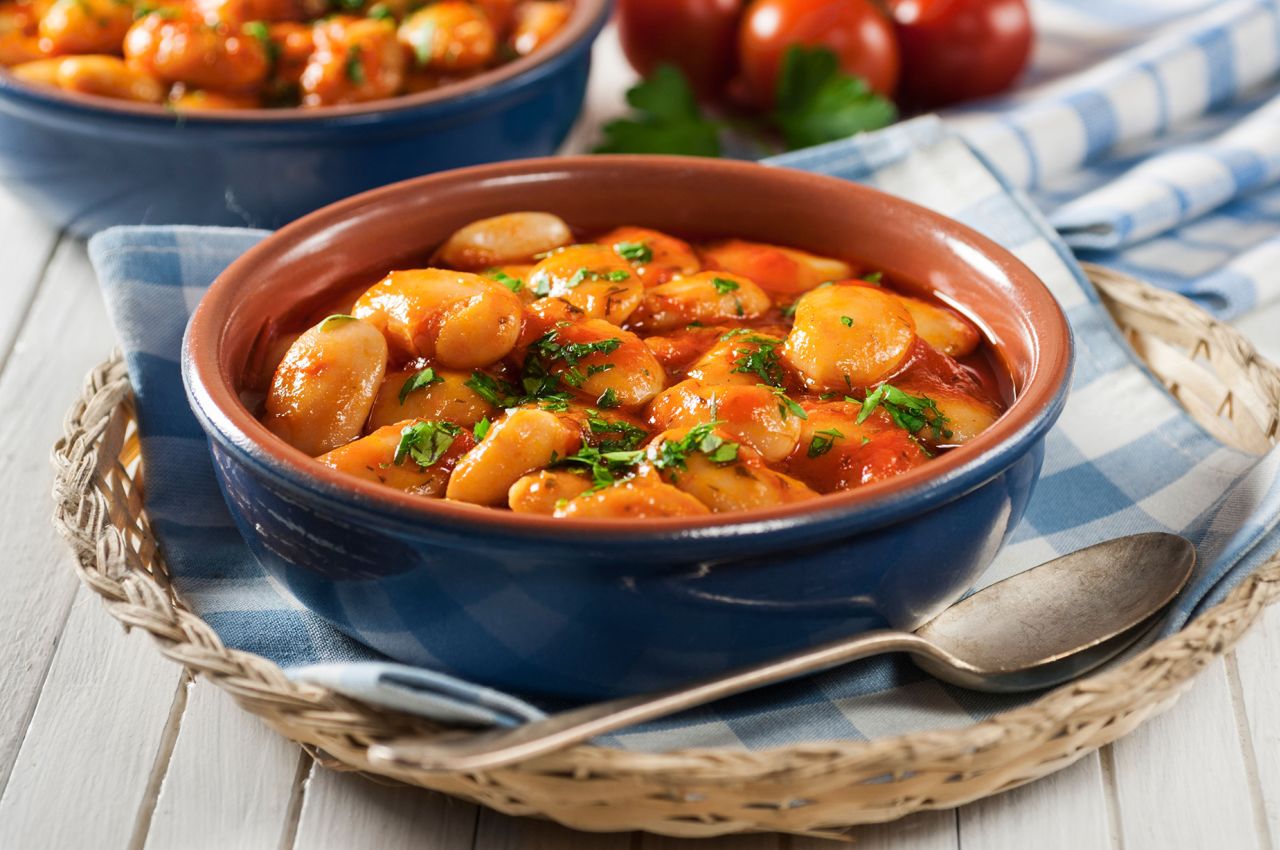
D59X7F Gigantes plaki Large white beans in tomato sauce Greece Food

While dried haricot bean soup (fasolada) fed hungry Greeks during the German occupation in World War II, the dish is now somewhat looked down on.

Surprisingly though, its sister dish, a hearty plate of giant baked beans seasoned with cilantro, has made it to the typical mezze spread. You might also hear the “gigantes” further described as “plaki,” which denotes a dish that’s oven-baked in tomato sauce.

Choriatiki (Χωριάτικη)

Every Greek menu offers its version of this classic salad.

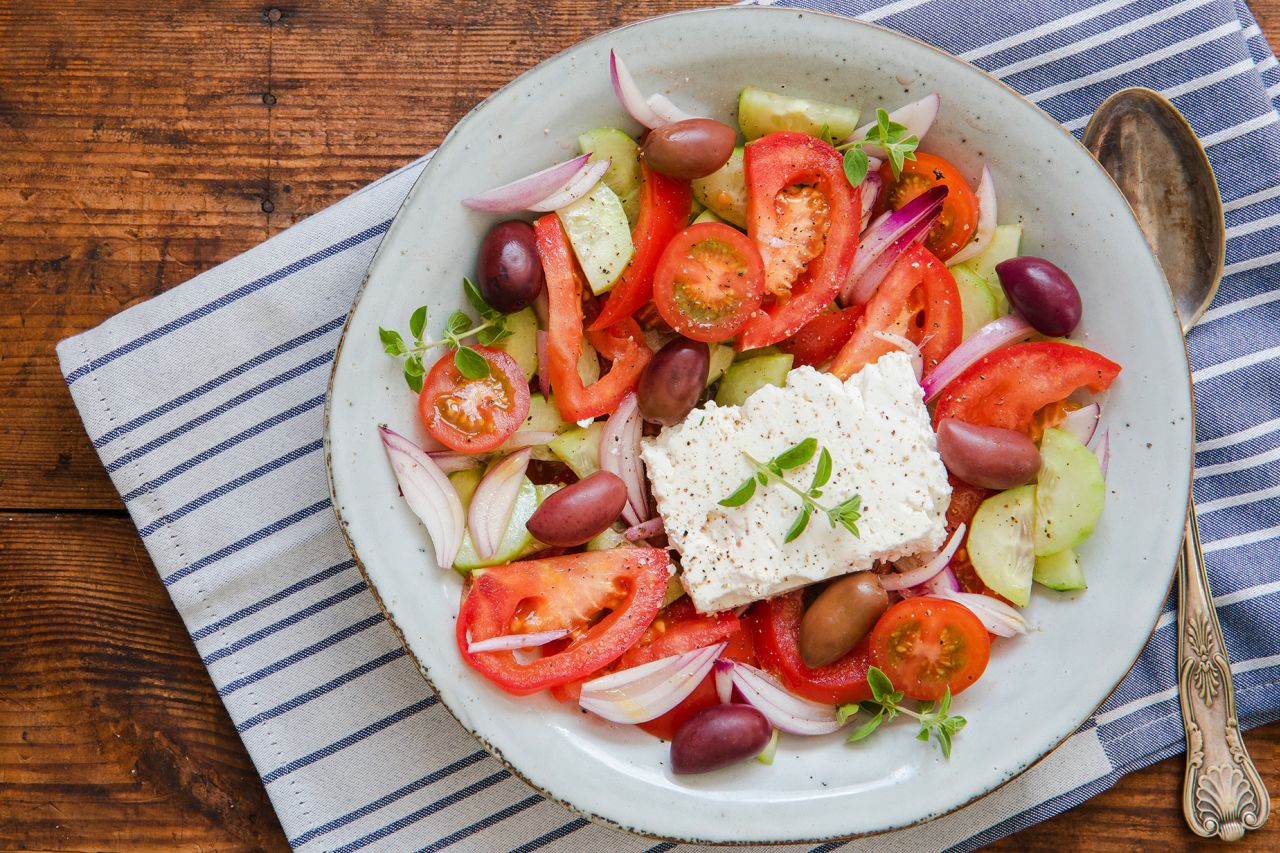
From the humblest taverna to the most sophisticated restaurant, every menu in Greece will offer a choice of “choriatiki” salad, or paesienne – known the world over as a “greek salad.”

There may be regional or chef-specific variations on this classic, but the foundations are the same – sliced tomatoes, onions and cucumber, olives, feta cheese plus a dressing of olive oil and oregano. Order a bush-sized one at dinner time for a complete healthy meal.

Kotosoupa (Κοτόσουπα)

Chicken Soup with Eggs and Lemon Kotosoupa Avgolemono close up in the plate on the table. Horizontal top view from above

This nutritious soup is renowned for its curative properties and looks deceptively easy to make.

The cooking process actually involves slowly boiling a whole chicken in a pot with vegetables and bonnet rice and then picking the meat off, discarding the skin and bones. But the fun really begins with the egg and lemon sauce, “avgolemono.”

At this point, you break a couple of yolks into a bowl and slowly pour some of the broth while whisking. Squeeze in some lemon juice and stir the bowl’s liquid carefully back into the pot – it won’t curdle if just simmering.

The result is a rich, silky smooth soup that marries fat, carbs and protein with vitamin C.

Pies (Πίτες)

Pastry treats for eating on the hoof, these are sold in every Greek bakery.

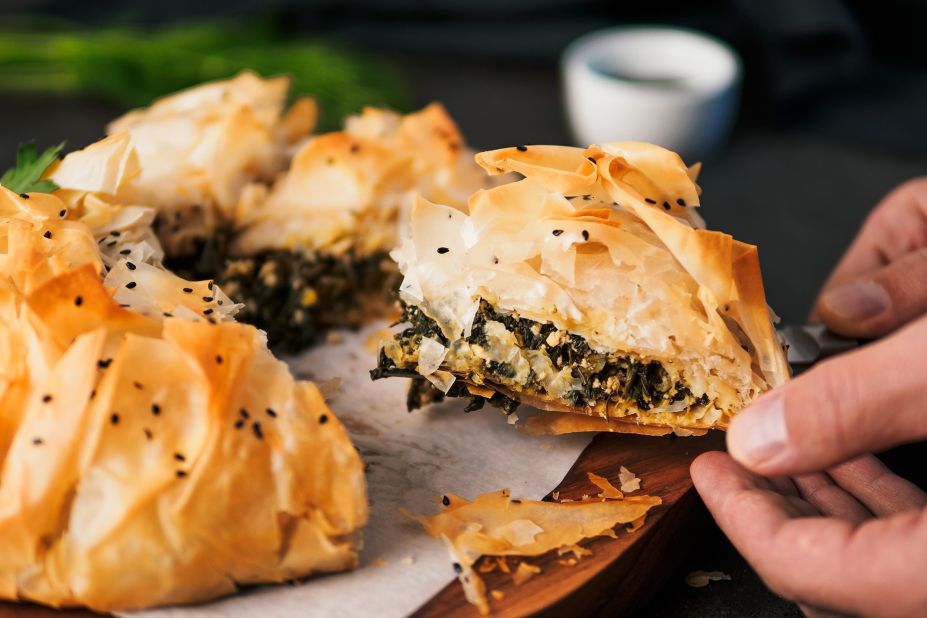
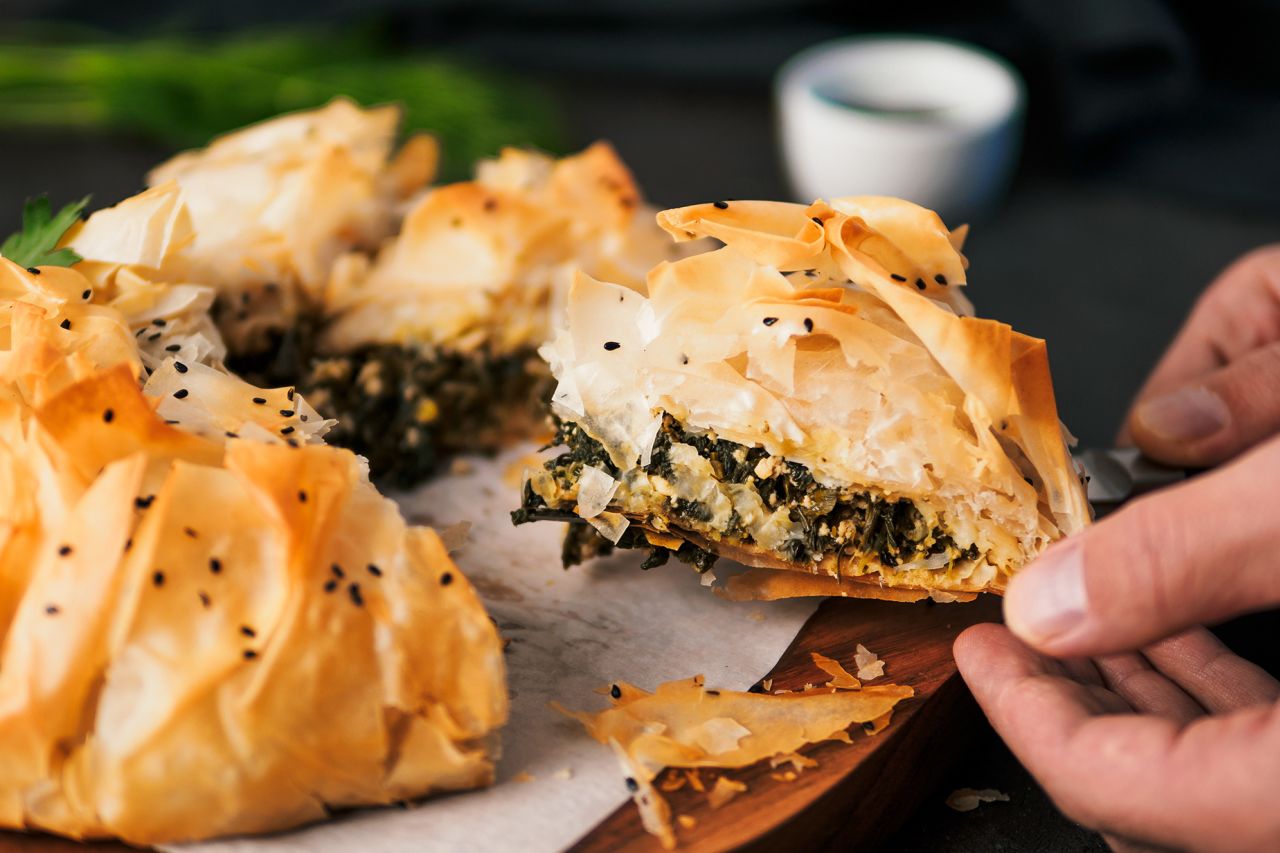
Pies (or pitta) are a big deal in Greece. In fact, every bakery in Athens sells an assortment, both sweet and savory, for those pangs of hunger while on the trot. There’s tyropita (cheese pie), spanakopita (spinach pie), zambonopita (ham pie), kotopita (chicken pie), chortopita (pie with mountain greens) and combinations thereof.

Each is encased in puff pastry with two exceptions, tyropita kourou (made with flaky short crust) and, from the Sporades islands, strifti, a fried, spiral-shaped filo cheese pie.

Fava (Φάβα)

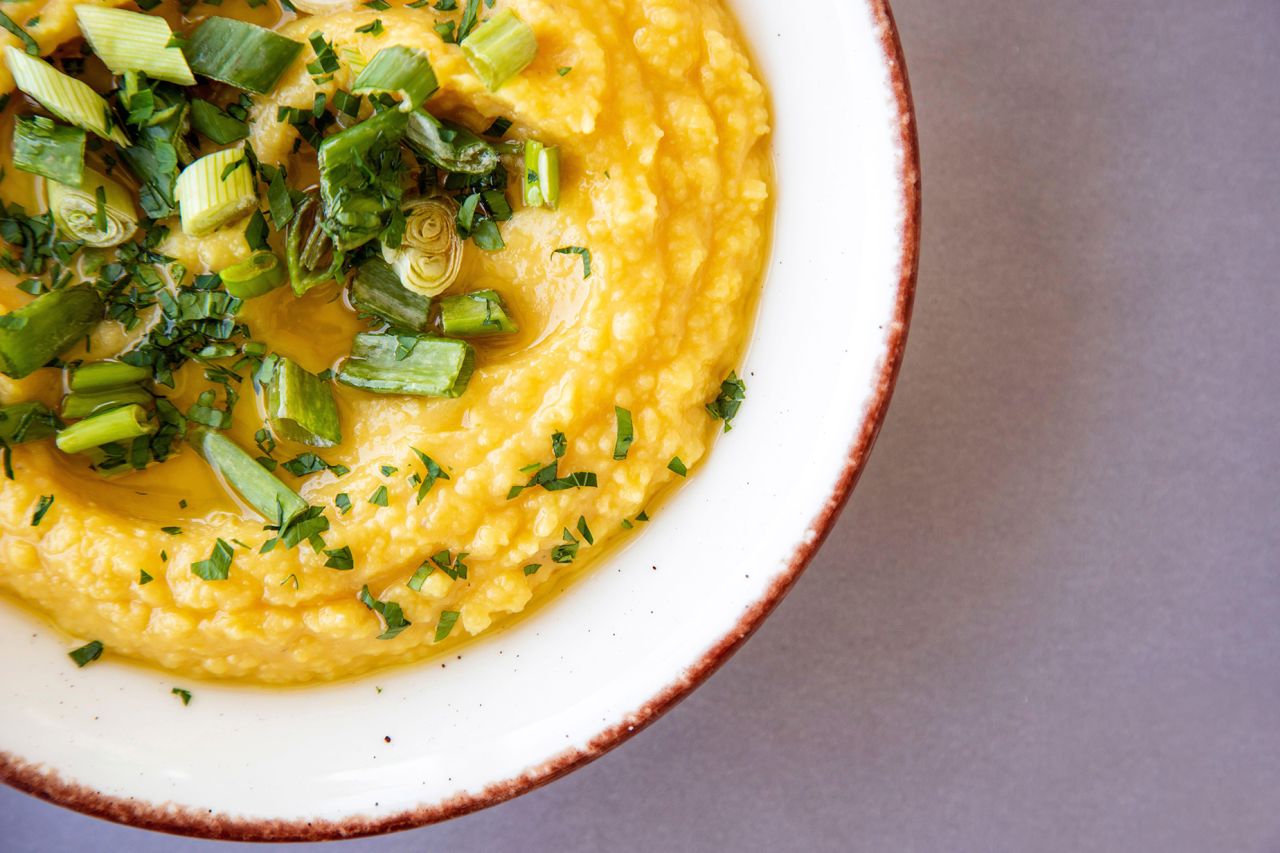
2DABMFB Fava, a traditional greek appetizer in a restaurant (Searocco) in Ierapetra town, Lassithi, Crete, Greece.

Hailed as a superfood by dieticians because of its high protein and negligible fat content, the unpretentious fava, a puree of yellow dried split beans, lies not a million tastebuds away from the English pease pudding. In Greece, it’s more closely associated with the island of Santorini, where it’s prepared with onions, olive oil and lemon juice.

Keftedes (Κεφτέδες)

Kids' favorite: Keftedes meatballs.

These bite-sized meatballs are a children’s perennial party favorite. Keftedes are prepared by mixing pork, veal or lamb mince and finely grated onion with dampened stale bread, scented with fresh mint and bound with egg yolk.

The mixture is left in the fridge to cool and firm up, before being rolled into balls, dusted with flour and fried in olive oil.

Soutzoukakia (Σουτζουκάκια)

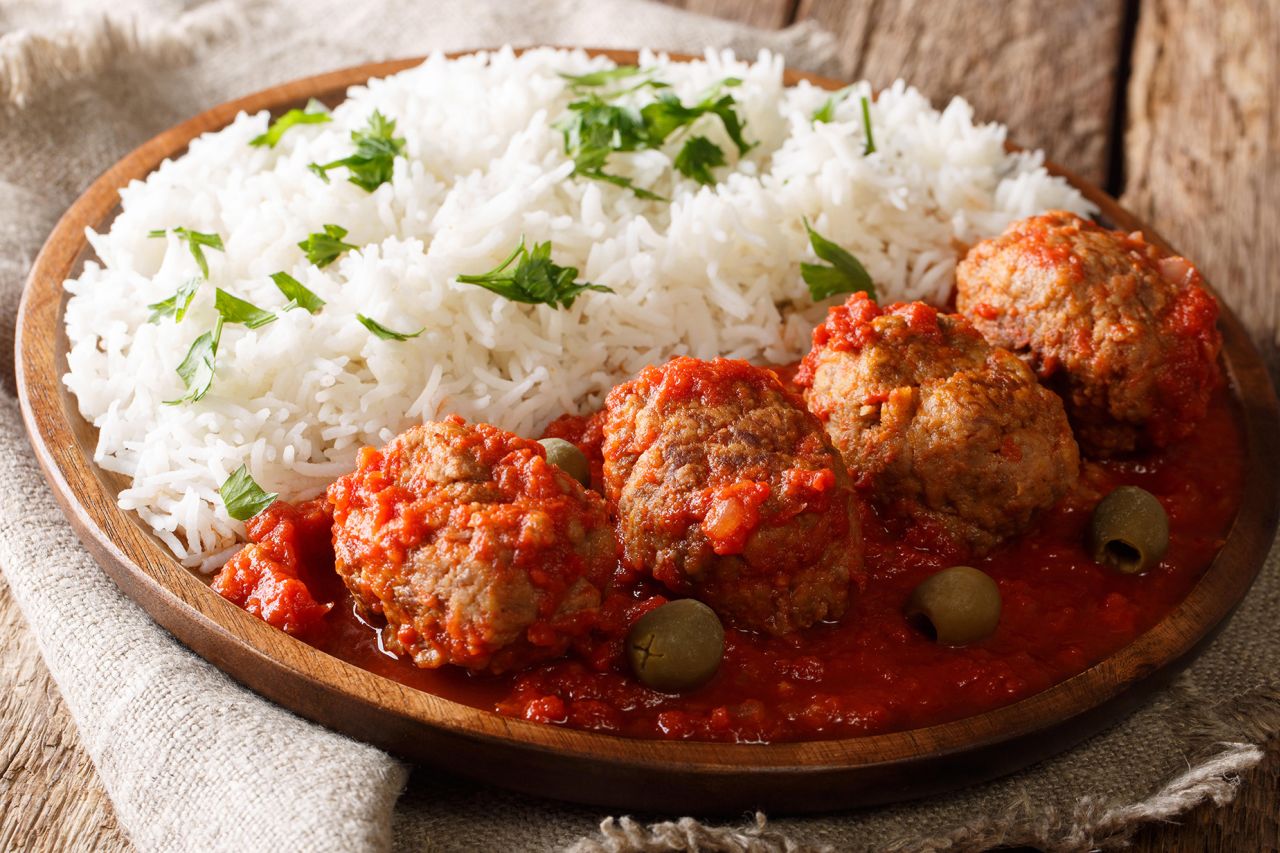
PJB0YJ Greek food: Soutzoukakia baked meat balls in spicy tomato sauce served with rice close-up on a plate on the table. horizontal

When Greeks from Turkey’s Aegean coast returned to the country after the Greco-Turkish War, they brought many of their own recipes with them. The ever-popular soutzoukakia, is one of the most noted. Indeed, you may often see the extra description “Smyrneika,” which is from Smyrna, in taverna menus.

Like keftedes, they’re meatballs. However, soutzoukakia are baked in a cumin-scented sauce rather than floured and fried. They’re almost always served with pilau rice, a reminder of their oriental provenance.

Moussaka (Μουσακάς)

By far the best known Greek dish internationally, typifying the country’s cuisine, moussaka is also one of the most elaborate.

Here minced meat, slices of potatoes and eggplant are separately fried before being layered in a baking pan and topped with a béchamel sauce. Next comes a long, slow cooking in the oven. One of moussaka’s plus points, which makes up for its long preparation, is that it tastes as good lukewarm or reheated – perhaps a reason for its popularity.

Moschari kokkinisto (Μοσχάρι κοκκινιστό)

Moschari kokkinisto, or veal casserole in tomato sauce, is the most common stew across Greece. Veal, rather than beef, has traditionally been the country’s meat of choice. This is because of the lack of space for raising large animals in the confines of a walled town or castle.

Pep up the stew with pickling onions, rosemary sprigs plus red wine and you end up with stifado (Στιφάδο). Brought to Greece by the Venetians, it’s an unusually calorific course in a country of light meals.

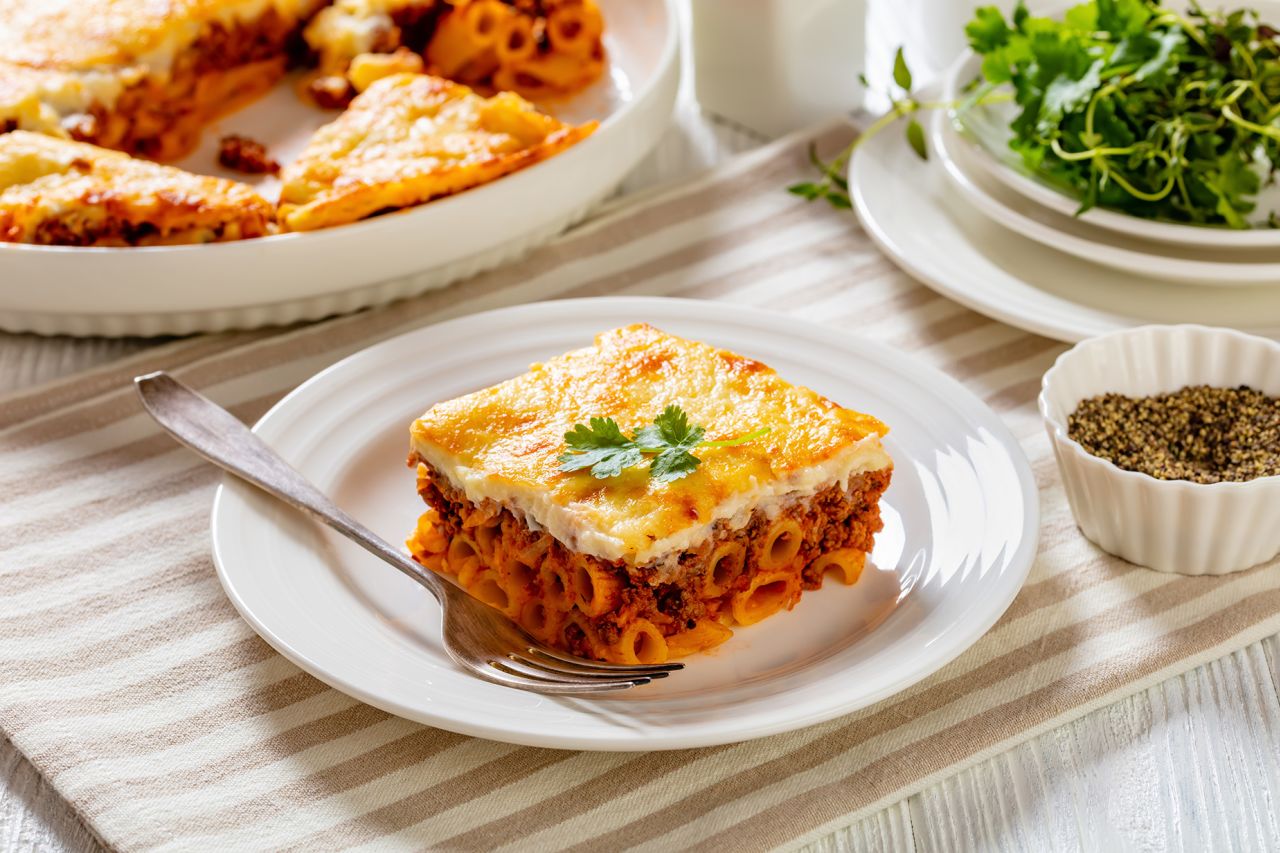
Pastitsio (Παστίτσιο)

Greek Pastitsio of pasta, ground lamb, grated cheese, and tomatoes topped with bechamel sauce and melted cheese on white plate

The only types of pasta that have been fully integrated in Greek cuisine are spaghetti, long macaroni (bucatini) and orzo (risoni).

Orzo is cooked together with meat in oven dishes, while spaghetti is almost exclusively eaten as a bolognese, flavor-enhanced by cinnamon and all spice. Pastitsio is a Greek invention, however. Here a base of boiled long macaroni with cooked minced meat is topped by a cheese sauce and given a quick final bake in the oven.

It may look like moussaka, but the air trapped along the macaroni renders it a fluffier, lighter meal.

Ladera (Λαδερά)

All vegetable dishes, of which there are plenty in Greek cuisine, come under the ladera heading, usually as stews: green beans, ladies fingers, eggplants, zucchini, artichokes, the lot.

Exemplary vegan pleasers, ladera used to be the staple food during Lent or on the day before major religious festivals, when the Orthodox faithful are supposed to abstain from meat.

Koulouria (Κουλούρια)

Koulouria originate from Greece's Jewish community.

You can pick up these rings of baked bread dough covered in sesame seeds from street vendor stands in every Greek city. Originating from Thessaloniki’s Jewish community, it’s essentially a southern version of the Central European pretzel.

While koulouria has served as the comfort food of Greek school children throughout the ages, they face competition from a multitude of manufactured munchies today.

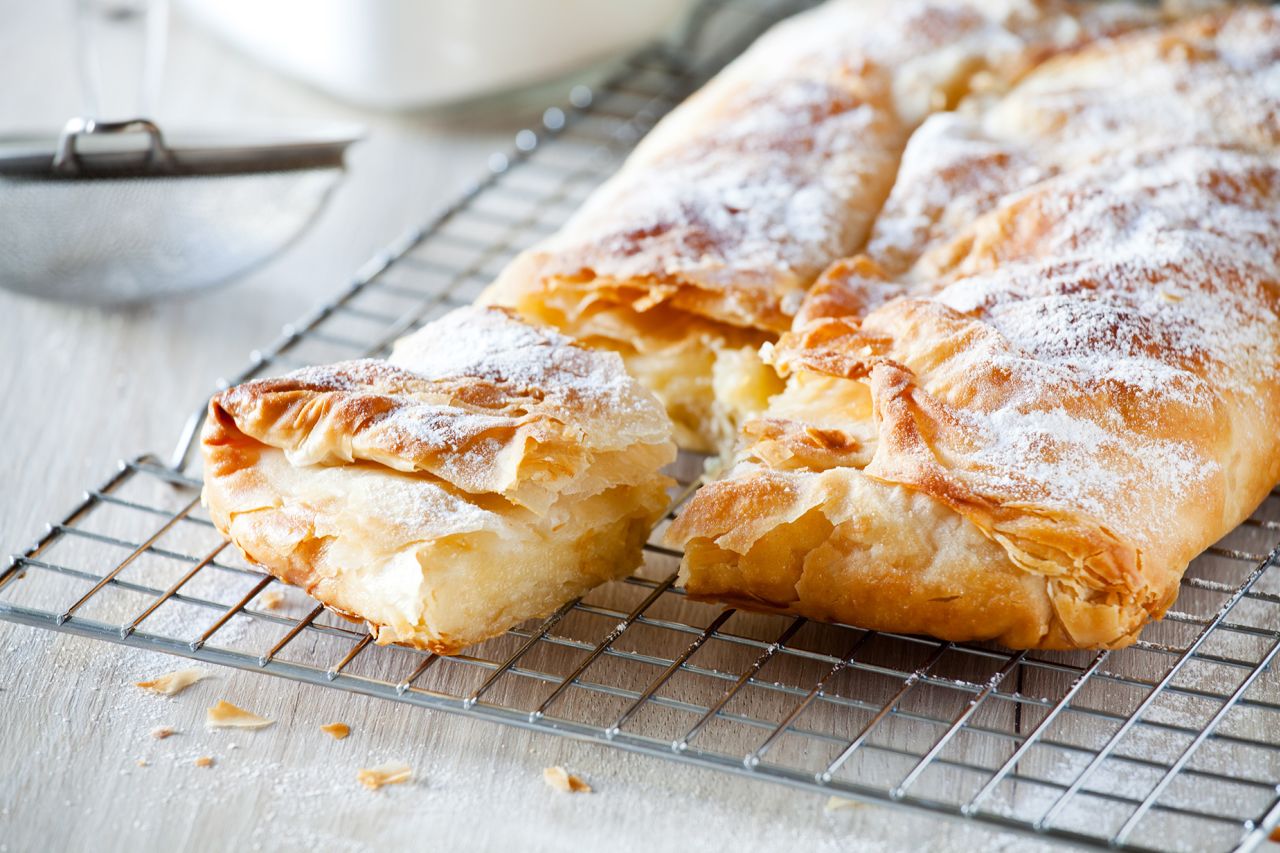
Bougatsa (Μπουγάτσα)

This sweet treat hails from the city of Thessaloniki.

Thessaloniki’s other great culinary contribution to Greek cuisine, bougatsa consists of filo pastry wrapped around a sweet semolina-based custard. Usually baked as a large pie and then freshly cut in smaller pieces, it’s served with icing sugar and cinnamon powder, zen perfect alongside a cup of coffee.

Spetzofai (Σπετζοφάϊ)

Greek sausages aren’t mass produced. In fact, each butcher’s shop manufactures its own, following the regional style.

Spetzofai, a local recipe from the Pelion peninsula in Thessaly, calls for a wintry stew of mountain sausage and sliced green peppers. But unlike most sausages in Greece, these are chorizo-style spicy, with the peppers adding an extra kick.

Galeos skordalia (Γαλέος σκορδαλιά)

Galeos, the school shark, is a common fish in Greek waters. With a similar taste to cod, it’s traditionally served on March 25, the Feast of the Annunciation. Although the date always falls during the fast of Lent, the Annunciation is a joyous occasion, so the Orthodox church allows the consumption of fish.

This custom continues today, and you’ll notice an odor in the air if you happen to be in the country on that day. The fish fillets are boldly accompanied by “skordalia”, a strong smelling aioli made with olive oil and lots of crushed garlic on a base of potato, bran or breadcrumbs.

Souvlaki (Σουβλακι)

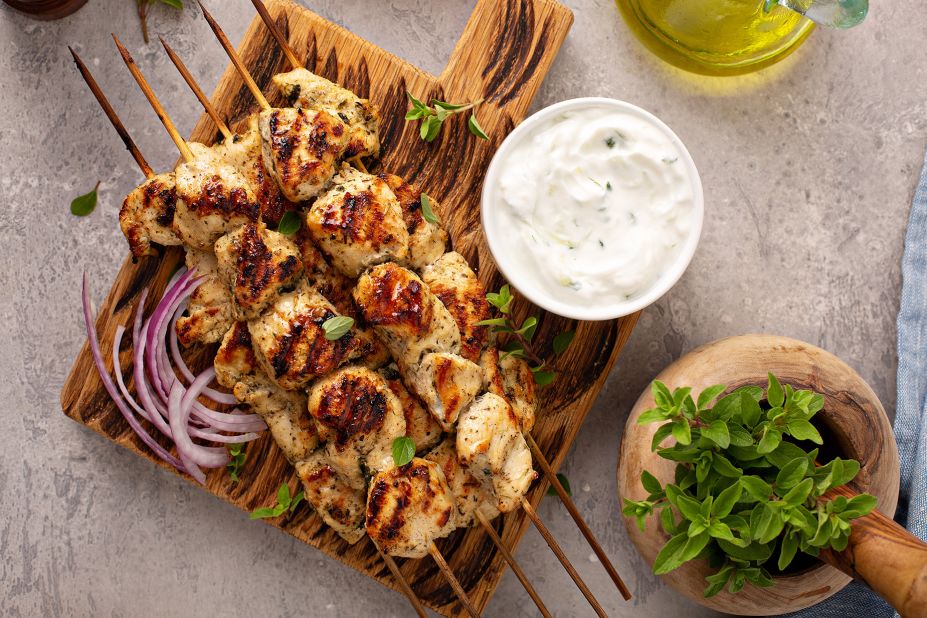
Greek chicken souvlaki with tzatziki sauce and fresh vegetables, grilled kebabs

Often confused with gyros, a type of kebab, Souvlaki is made up of skewered, grilled pieces of meat, typically chicken, lamb or pork and can be found throughout the Balkans and the Middle East.

The fast food of previous generations and the sustenance of travelers, they’re sold as skewers straight from the grill or wrapped in pitta bread with salad and a sauce, usually tzatziki.

Tzatziki (Τζατζίκι)

Another Greek appetizer classic, tzatziki is a refreshing mixture of cool yoghurt, crunchy cucumber, garlic, olive oil and fresh, aromatic mint.

For traditionalists this is the only proper accompaniment to souvlaki – and they have a compelling case. The grilled meat cuts can be heavy on the stomach, and the ingredients in tzatziki aid digestion.

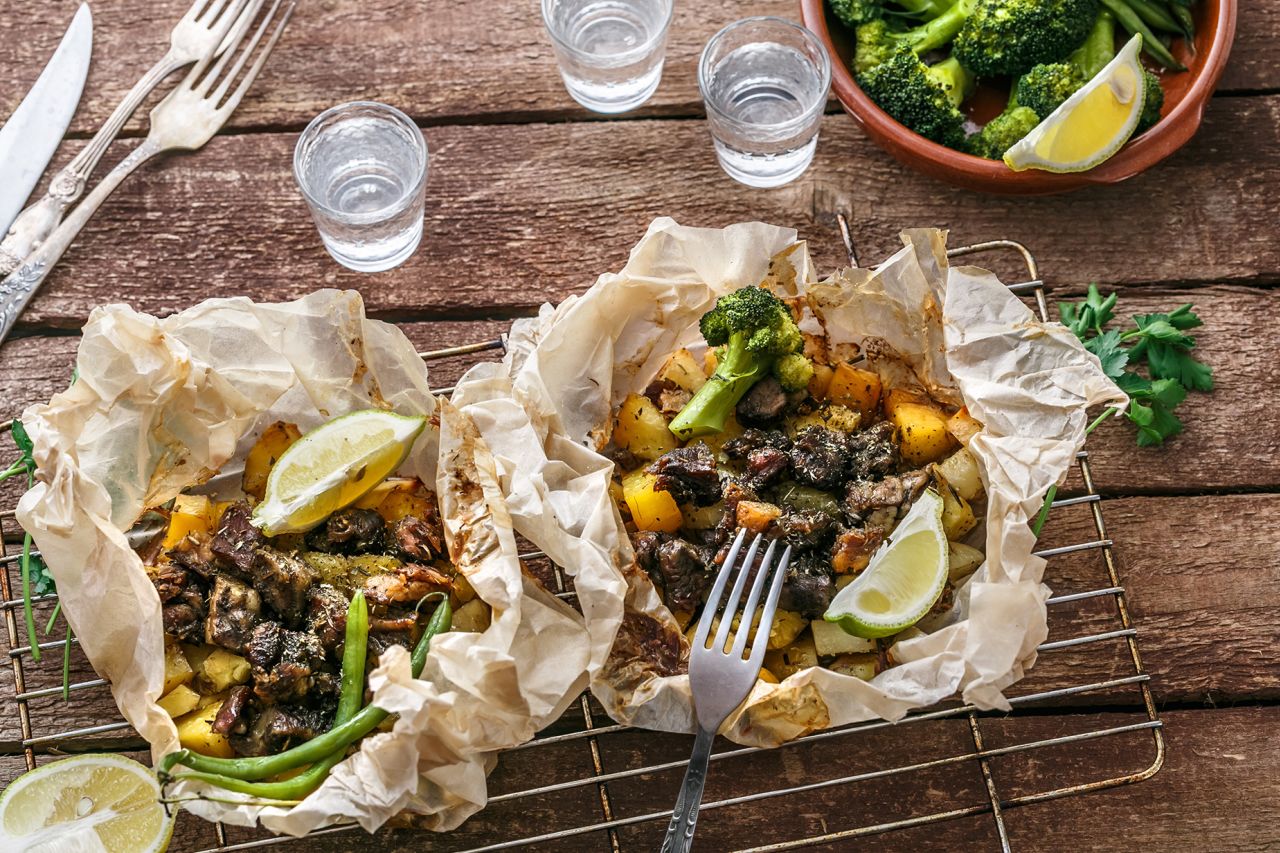
Kleftiko (Κλέφτικο)

Traditional Greek kleftiko, an oven-baked lamb stew with potato, olive oil, onion, carrot, garlic and herbs, served with lemon and ouzo

This dish of slowly cooked roast lamb with herbs wrapped in baking parchment paper stems from an era when the village bakery was also in charge of the communal oven.

Households would bring in their own parceled joint on Sunday mornings for baking and pick it up at lunch time.

Although the advent of fitted kitchens has made this scenario obsolete, the recipe is still popular. The parchment paper allows the meat to be steamed in its own juices, perfumed by the added herbs.

Melomakarona (Μελομακάρονα)

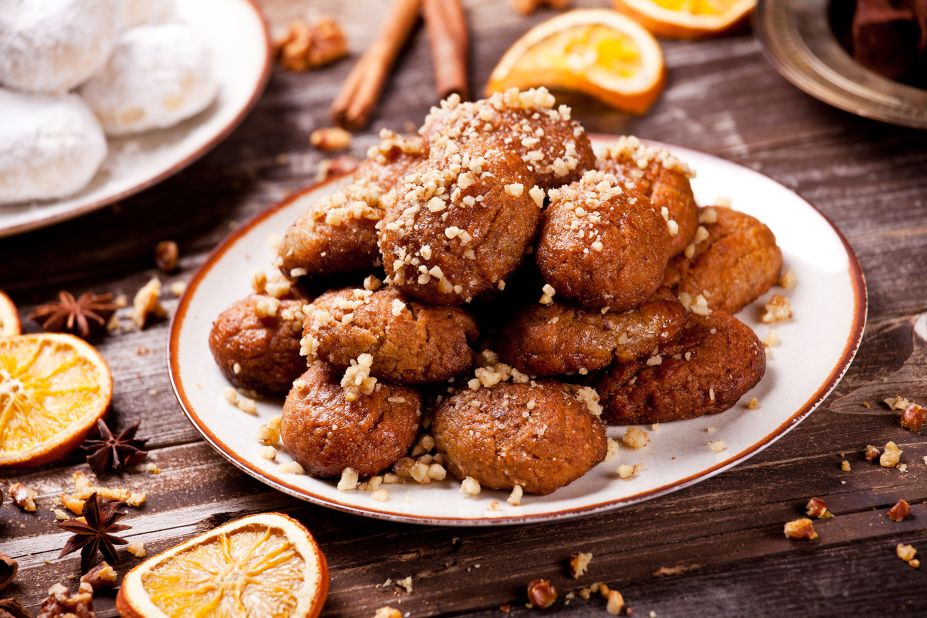
Nothing says Christmas in Greece quite like juicy, sweet melomakarona.

For Greeks, the sight of melomakarona – egg-shaped, honey-soaked cookies specked by chopped walnuts – screams “Christmas” as loudly as a decorated tree. Indeed, it’s considered bad luck if a household doesn’t bake a few dozen during the weeks leading to the Nativity.

Visit any friends in Greece during this period and you’ll be offered the house melomakarona. Try one, praise the cook for their crumbliness and you’ll for sure be invited next year, as well.

Gemista (Γεμιστά)

Gemista are delicious served hot or cold.

The thick skin of beef tomatoes, zucchini and bell peppers makes them easy to hollow out, so Greeks stuff them and bake them in the oven. This stuffing is normally a mixture of cooked rice, onions, aromatic herbs and the excised vegetable flesh itself.

They’re delicious served hot or cold, a bonus in a warm weather country, where leftover food must go straight to the fridge.

Dolmadakia (Ντολμαδάκια)

Dolmadakia are typically fille with minced meat and served with a hot sauce.

Stuffed vine leaves are a common sight from Syria to Sarajevo – indeed the word “dolma” is Turkish, meaning “stuffed” – but it’s mostly Greek restaurants that have introduced them to the rest of the world.

Unlike gemista though, the usual filling here is minced meat and they’re served hot with avgolemono sauce.

Dolmadakia can, occasionally, be served cold as “yalantzi” – a Turkish word for a liar and a conman – when filled with rice instead. This is the only option during meat-abstaining Lent.

Loukoumades (Λουκουμάδες)

Loukomades are best eaten hot from the pan.

You can smell the caramel-style aroma of these so-called “Greek donuts” – fried dough balls richly bathed in honey and seasoned with cinnamon powder – whenever you pass any large bakery.

Connoisseurs eat them hot from the pan, so settle for nothing less and buy from places where they are cooked on the spot.

Spoon sweets (Γλυκά κουταλιού)

Spoon sweets are best enjoyed in small doses.

The vast quantity of fruit produced in Greece proved overwhelming in olden times, when trade was slow or nonexistent. As a result, spoon sweets, such as Western European jams, became the Greek way of preserving fruit.

This is one of the occasions when pure sugar rather than honey is used in traditional Greek recipes. It’s added in such large quantities, that most people can only bear a gloopy spoonful. Try them with yoghurt to temper the sugar rush.

John Malathronas is a London-based travel writer and photographer. He’s written or co-written more than 15 books, including the “Rough Guide to Greece.”

This story was first published in July 2019 and republished in April 2021.

 CNN

The Chinese Mystery

0

Chinese Defense Minister Li Shangfu has disappeared. Some reports say he was meeting with Vietnamese officials when he was escorted away, but according to other reliable reports, he was detained before the meeting and thus had to cancel it. Chinese sources report that he is under investigation for corruption. In addition to leading the Ministry of Defense, Li is one of China’s five state councilors, which makes him an extremely important figure outranking other ministers.

This follows the disappearance in June of Foreign Minister Qin Gang, who was later replaced by Wang Yi. His removal is still unexplained, but his strong anti-American rhetoric did not sit well with China’s need to mend relations with the U.S. and secure foreign capital. In addition, several senior economic and banking figures have been dismissed recently, although not with the calculated drama obviously intended to raise questions.

These incidents call to mind the removal of former Chinese President Hu Jintao from the closing ceremony of the 20th National Congress of the Chinese Communist Party last October. Hu’s removal was aired on television, while Li’s came at the last minute before a planned meeting with dignitaries from a country that China is trying to woo. China knew the impact these removals would have. Li and Qin were the two figures most responsible for Chinese foreign affairs – the former for national defense and the latter for politics. The world was startled. The Vietnamese are going to wonder whether a nation that treats its defense minister this way is stable enough to rely on. There are subtler ways to retire or arrest someone, but Beijing did not choose them. Clearly, China wanted both incidents to be noticed.

In a sense, a massive shakeup of the Chinese government is overdue, particularly if President Xi Jinping plans to keep his job. Xi took office in 2013, when the Chinese economy was surging and China’s strategic position was strengthening. There was in some circles a sense that China would surpass the United States in economic and military power. In the decade since, the Chinese economy has weakened dramatically, to the point that economic well-being at all levels of society has declined, without Xi taking effective steps to reverse the dip.

Related to this problem was the idea that China could surge its international and strategic power. Xi was obsessed with the United States, as many countries are for various reasons. He sought to create linkages to block the United States with programs like the Belt and Road Initiative, an economic plan in which economics was subordinate to national security. Xi positioned Belt and Road as the foundation of a fundamental shift in the balance of power, which failed. Simultaneously, China was challenging American naval power in the South China Sea, particularly around Taiwan.

Xi did not understand the degree to which China depended on the United States for its economic system. The United States was China’s number one source of exports, while U.S. investments and technology transfers anchored and drove China’s economic growth. Xi had positioned the United States as China’s main adversary for domestic and foreign reasons. Given past performance and ignoring the dynamic that was critical to China’s growth, China achieved its goal of being seen as the likely successor to the United States.

The problem that Xi had was that the United States took him seriously as well. Xi did not understand that the U.S. was built around economic cycles. As down cycles occurred, China would be affected, and as U.S. fear of China surged, a range of measures were implemented against China. Though the U.S. actions were not China’s primary problem, they were a significant complication. At the same time, China overestimated its naval development and technical capacity while seeming to underestimate U.S. capacities. The recent deepening of U.S. alliances with the Philippines and Papua New Guinea completed a line blocking China from the Aleutians to Australia, weakening Beijing’s strategic position significantly.

China is and will continue to be a significant country, but it is far from being able to challenge the United States. Xi miscalculated the importance of U.S. markets and capital and the willingness of the U.S. to deploy major force against China.

All this happened on Xi’s watch. He was superb at claiming premature victories in the domestic economy and global relations. He convinced the Chinese people of what he wanted them to believe. In such circumstances, a change of government would be inevitable and routine. But Xi is unable or unwilling to step aside. There may be conspiracies against him, and there are far more haunting his mind. He is hard-pressed to show that he knows their secrets and wields vast power, demonstrated by the arrest of high-ranking officials as publicly as possible. He is repeating the mistake that he made with the United States, convincing the Americans of China’s might and triggering a response that left China off balance to say the least. Xi’s enemies may well believe that he sees all and has the power to stop them, but that simply motivates them to be more effective. Xi can’t resign or admit failure. So ministers must disappear, and former presidents must be removed from meetings in sight of the world.

geopoliticalfutures.com

«Αναγνώριση» του κατοχικού μορφώματος ζήτησε θρασύτατα ο Ερντογάν στον ΟΗΕ: Πυρά και κατά της ειρηνευτικής δύναμης στην Κύπρο

0

Την «αναγνώριση» του κατοχικού μορφώματος ζήτησε από την διεθνή κοινότητα μιλώντας στη Γενική Συνέλευση του ΟΗΕ ο ισλαμιστής Πρόεδρος της Τουρκίας Ρετζέπ Ερντογάν, ο οποίος στην ομιλία του δεν έκανε καμία αναφορά στην Ελλάδα.

Βάζοντας στο στόχαστρό του την Κύπρο και αφού υποστήριξε ψευδώς ότι «η τουρκοκυπριακή πλευρά έχει κάνει έντιμες προσπάθειες για μια δίκαιη και βιώσιμη
λύση στο Κυπριακό» πρόσθεσε:

«Είναι ευρέως αποδεκτό το γεγονός ότι η λύση αυτή δεν μπορεί πλέον να υλοποιηθεί στο μοντέλο της Ομοσπονδίας. Γι’ αυτό καλούμε τη διεθνή κοινότητα να αναγνωρίσει την ανεξαρτησία της «τδβκ» -όπως την αποκάλεσε- και να θεσπίσει οικονομικές, διπλωματικές και πολιτικές σχέσεις με την ‘χώρα’».

Η ομιλία Ερντογάν μετά το -1:15

Μάλιστα ο προκλητικός Ερντογάν εξαπέλυσε πυρά και κατά της ειρηνευτικής δύναμης του ΟΗΕ που πρόσφατα υπέστη τους κατοχικούς τραμπουκισμούς στην Πύλα, λέγοντας: «Αναμένουμε επίσης από την ειρηνευτική δύναμη του ΟΗΕ στο νησί να τηρεί σχολαστικά την αμεροληψία που είναι υποχρεωμένη να επιδεικνύει. Δεν θέλουμε αυτή η ήδη απαξιωμένη δύναμη να υποστεί και άλλη απώλεια αξιοπιστίας στην Κύπρο».

Και… ειρηνοποιός

Ο πρόεδρος της Τουρκίας Ρετζέπ Ταγίπ Ερντογάν «δεσμεύτηκε» επίσης σήμερα, ενώπιον της Γενικής Συνέλευσης του ΟΗΕ, ότι θα «εντείνει τις διπλωματικές προσπάθειές του» ώστε «να μπει ένα τέλος στον πόλεμο» στην Ουκρανία.

«Από την αρχή του ρωσοουκρανικού πολέμου προσπαθούμε να κρατήσουμε τους Ρώσους και τους Ουκρανούς φίλους μας γύρω από το τραπέζι (σ.σ. των διαπραγματεύσεων), πιστεύοντας στην ιδέα ότι ο πόλεμος δεν θα έχει κανέναν νικητή και η ειρήνη κανέναν ηττημένο», είπε ο Ερντογάν από το βήμα της Γενικής Συνέλευσης

Αναφερόμενος στο θέμα του Ναγκόρνο Καραμπάχ, ο Τούρκος πρόεδρος είπε ότι η χώρα του στηρίζει τα βήματα που κάνει το Αζερμπαϊτζάν για να διαφυλάξει την εδαφική ακεραιότητά του. Τόνισε ότι το Ναγκόρνο Καραμπάχ αποτελεί μέρος τους αζέρικου εδάφους και η επιβολή ενός διαφορετικού καθεστώτος στον θύλακα αυτόν είναι «απαράδεκτη».

Το τουρκικό υπουργείο Εξωτερικών εξάλλου χαρακτήρισε «εύλογες» τις «ανησυχίες» που οδήγησαν στη στρατιωτική επιχείρηση των Αζέρων στο Ναγκόρνο Καραμπάχ, αν και κάλεσε το Αζερμπαϊτζάν και την Αρμενία να επιστρέψουν στον διάλογο. «Το Αζερμπαϊτζάν αναγκάστηκε να λάβει τα μέτρα που κρίνει αναγκαία στο δικό του έδαφος» τονίζεται στην ανακοίνωση του τουρκικού ΥΠΕΞ.

https://hellasjournal.com/2023/09/anagnorisi-tou-katochikou-morfomatos-zitise-thrasitata-o-erntogan-ston-oie-pira-ke-kata-tis-irineftikis-dinamis-stin-kipro-video/

Ο Καύκασος στις φλόγες: Προελαύνουν οι Αζέροι στο Ναγκόρνο Καραμπάχ, κατέλαβαν εξήντα θέσεις των Αρμενίων, τουλάχιστον 25 νεκροί και εκατοντάδες τραυματίες

0

Ο στρατός του Αζερμπαϊτζάν ανακοίνωσε απόψε ότι κατέλαβε περισσότερες από 60 θέσεις των αυτονομιστών Αρμενίων κατά τις επιχειρήσεις του στο Ναγκόρνο Καραμπάχ.

«Περισσότερες από 60 θέσεις μάχης των (σ.σ. αυτονομιστικών) αρμενικών δυνάμεων είναι πλέον υπό τον έλεγχο των ενόπλων δυνάμεών μας» ανέφερε ένας εκπρόσωπος του υπουργείου Άμυνας, ο Ανάρ Εϊβάζοφ, σε συνέντευξη Τύπου που παραχώρησε.

Ένας Αρμένιος αυτονομιστής αξιωματούχος των ανθρωπίνων δικαιωμάτων, ο Γκεγάμ Στεπανιάν, ανέφερε σε ανάρτησή του στην πλατφόρμα Χ ότι κατά τις επιχειρήσεις αυτές σκοτώθηκαν 25 άνθρωποι και λίγο αργότερα πρόσθεσε ότι τραυματίστηκαν άλλοι 138, εκ των οποίων οι 29 είναι άμαχοι.

Η Γαλλία, όπως είχε προαναγγείλει νωρίτερα, ζήτησε από το Συμβούλιο Ασφαλείας του ΟΗΕ να συνεδριάσει εκτάκτως την Πέμπτη με θέμα την κατάσταση στο Ναγκόρνο Καραμπάχ, ανέφεραν διπλωματικές πηγές.

 Εκκληση Μπλίνκεν για κατάπαυση του πυρός

Οι Ηνωμένες Πολιτείες ανησυχούν βαθιά για τις στρατιωτικές ενέργειες του Αζερμπαϊτζάν στο Ναγκόρνο Καραμπάχ και καλούν το Μπακού να τις σταματήσει αμέσως, δήλωσε σήμερα ο επικεφαλής της αμερικανικής διπλωματίας Άντονι Μπλίνκεν.

«Αυτές οι ενέργειες επιδεινώνουν μια ήδη φρικτή ανθρωπιστική κατάσταση στο Ναγκόρνο Καραμπάχ και υπονομεύουν τις προοπτικές ειρήνευσης» ανέφερε στην ανακοίνωσή του ο Αμερικανός ΥΠΕΞ.

«Κάνουμε έκκληση για τον άμεσο τερματισμό των εχθροπραξιών και για την έναρξη διαλόγου μεταξύ του Μπακού και των εκπροσώπων του πληθυσμού του Ναγκόρνο Καραμπάχ», πρόσθεσε, χαρακτηρίζοντας «απαράδεκτη» την προσφυγή στη βία.

Καταγγελίες για εθνοκάθαρση

Το υπουργείο Εξωτερικών της Αρμενίας κατήγγειλε «ευρείας κλίμακας επίθεση» εκτιμώντας ότι στόχος του Μπακού είναι να πραγματοποιήσει την «εθνοκάθαρση» στον διαφιλονικούμενο θύλακα στο νότιο Καύκασο, ο οποίος κατοικείται κυρίως από Αρμενίους.

«Το Αζερμπαϊτζάν εξαπέλυσε μια νέα ευρείας κλίμακας επίθεση εναντίον του λαού του Ναγκόρνο-Καραμπάχ, επιδιώκοντας να ολοκληρώσει την πολιτική της εθνοκάθαρσης που ακολουθεί», ανέφερε σε ανακοίνωσή του το αρμενικό υπουργείο Εξωτερικών.

Παράλληλα η αρμενική διπλωματία τόνισε πως ρωσικές ειρηνευτικές δυνάμεις που βρίσκονται στην περιοχή οφείλουν να «σταματήσουν την επιθετικότητα» του Αζερμπαϊτζάν.

Η πρωτεύουσα του Ναγκόρνο Καραμπάχ, το Στεπανακέρτ, και άλλες πόλεις της περιοχής, δέχονται «σφοδρά πυρά», πρόσθεσαν οι αρμενικές αρχές στο θύλακα, λίγο μετά την έναρξη των επιχειρήσεων που χαρακτηρίζονται από το Αζερμπαϊτζάν «αντιτρομοκρατικές».

«Το Αζερμπαϊτζάν έχει εξαπολύσει μια μεγάλης έκτασης στρατιωτική επιχείρηση εναντίον της Δημοκρατίας του Αρτσάχ (σ.σ.: η ονομασία που δίνουν οι Αρμένιοι στο Ναγκόρνο-Καραμπάχ)», έγραψε στο Facebook η αντιπροσωπεία που διατηρούν οι αυτονομιστές στην Αρμενία.

Το Μπακού υποστήριξε πως είχε ενημερώσει τη Ρωσία και την Τουρκία για τη στρατιωτική επιχείρηση που άρχισε στο Ναγκόρνο-Καραμπάχ.

«Η διοίκηση του αποσπάσματος διατήρησης της ειρήνης της Ρωσικής Ομοσπονδίας και η διεύθυνση του Τουρκο-Ρωσικού Παρατηρητηρίου (της κατάπαυσης του πυρός) είχαν ενημερωθεί για τις δραστηριότητες που διεξάγονται», ανέφερε σε ανακοίνωσή του το αζερινό υπουργείο Άμυνας.

Το αζέρικο υπουργείο ανακοίνωσε επίσης πως οι άμαχοι μπορούν να εγκαταλείψουν την περιφέρεια του Καραμπάχ μέσω ανθρωπιστικών διαδρόμων προς την Αρμενία και άλλες κατευθύνσεις.
Το υπουργείο κάλεσε τους αμάχους να μείνουν μακριά απ’ αυτούς που χαρακτήρισε θεμιτούς στρατιωτικούς στόχους που δέχονται επιθέσεις από τις αζερινές δυνάμεις στο πλαίσιο της «αντιτρομοκρατικής» επιχείρησης του Μπακού.

Δεν ξέραμε, λέει η Μόσχα

Μπροστά στις εξελίξεις, η Μόσχα τόνισε ότι ειδοποιήθηκε μόλις «λίγα λεπτά» πριν από την έναρξη των «αντιτρομοκρατικών επιχειρήσεων» του Μπακού στην περιοχή.

«Σε μέσα ενημέρωσης κυκλοφορούν πληροφορίες, σύμφωνα με τις οποίες η πλευρά του Αζερμπαϊτζάν, ειδοποίησε “εκ των προτέρων” τις ρωσικές ειρηνευτικές δυνάμεις (…) Αυτό δεν αληθεύει. Οι πληροφορίες κοινοποιήθηκαν στη ρωσική αποστολή λίγα λεπτά πριν από την έναρξη των εχθροπραξιών», δήλωσε η εκπρόσωπος της ρωσικής διπλωματίας Μαρία Ζαχάροβα στο Telegram.

«Αντιτρομοκρατικές επιχειρήσεις»

Νωρίτερα, το υπουργείο Άμυνας του Αζερμπαϊτζάν είχε ανακοινώσει ότι ξεκίνησε «τοπικές αντιτρομοκρατικές επιχειρήσεις» στην αποσχισθείσα περιοχή η πλειονότητα των κατοίκων της οποίας είναι Αρμένιοι.

«Στο πλαίσιο των μέτρων αυτών εξουδετερώθηκαν, με τη βοήθεια όπλων υψηλής ακρίβειας, θέσεις των ενόπλων δυνάμεων της Αρμενίας, καθώς και στρατιωτικές εγκαταστάσεις στη γραμμή του μετώπου και βαθιά» στο έδαφος του θύλακα, διευκρίνισε το υπουργείο Άμυνας του Αζερμπαϊτζάν.

Το υπουργείο τόνισε ότι σκοπεύει «να αφοπλίσει τις ένοπλες δυνάμεις της Αρμενίας, να διασφαλίσει και την αποχώρησή τους από τα εδάφη μας και να εξουδετερώσει τις στρατιωτικές τους υποδομές».

Παράλληλα επεσήμανε ότι βάλλει εναντίον νόμιμων στρατιωτικών στόχων και όχι εναντίον πολιτών ή μη στρατιωτικών υποδομών στο πλαίσιο της προσπάθειάς του να «αποκαταστήσει τη συνταγματική τάξη της Δημοκρατίας του Αζερμπαϊτζάν».


Η Αρμενία από την πλευρά της επισημαίνει ότι δεν διαθέτει στρατιωτικό προσωπικό στο Ναγκόρνο Καραμπάχ και ότι προτεραιότητές της παραμένουν ανθρωπιστικές.

Ο Ρούμπεν Βαρντανιάν, δισεκατομμυριούχος τραπεζίτης που ήταν επικεφαλής της αρμενικής διοίκησης του Ναγκόρνο Καραμπάχ ως τον Φεβρουάριο, έγραψε στο Χ:

«Το Αζερμπαϊτζάν ξεκίνησε μαζική επίθεση του πυροβολικού εναντίον του Ναγκόρνο Καραμπάχ, στοχοθετώντας πόλεις και αμάχους σε μεγάλη κλίμακα».


«Τρομοκρατικές» ενέργειες

Νωρίτερα το Μπακού είχε ανακοινώσει ότι τέσσερις Αζέροι αστυνομικοί και δύο πολίτες σκοτώθηκαν από την έκρηξη ναρκών στο Ναγκόρνο Καραμπάχ και είχε κατηγορήσει τους αυτονομιστές του θύλακα ότι ευθύνονται για αυτές τις «τρομοκρατικές» ενέργειες.

Οι έξι αυτοί άνθρωποι σκοτώθηκαν όταν τα οχήματα στα οποία επέβαιναν έπεσαν σε νάρκες στον δρόμο μεταξύ της Σούσα και της Φιζούλι, δύο πόλεις του Ναγκόρνο Καραμπάχ που ελέγχονται από το Αζερμπαϊτζάν, επεσήμαναν οι αζερικές υπηρεσίες ασφαλείας.

Σύμφωνα με την ίδια πηγή, οι αστυνομικοί σκοτώθηκαν γύρω στις 04:30 τοπική ώρα (03:30 ώρα Ελλάδας) όταν το φορτηγάκι στο οποίο βρίσκονταν έπεσε σε νάρκη κοντά σε σημείο κατασκευής σήραγγας. Οι πολίτες σκοτώθηκαν από άλλη νάρκη στην ίδια περιοχή.

Οι υπηρεσίες ασφαλείας του Αζερμπαϊτζάν κατήγγειλαν ότι ομάδα «δολιοφθορέων» Αρμένιων αυτονομιστών τοποθέτησε τις νάρκες αυτές και έκαναν λόγο για «τρομοκρατική ενέργεια».

Αρμενία και Αζερμπαϊτζάν έχουν εμπλακεί σε δύο πολέμους τη δεκαετία του 1990 και του 2020 για τον έλεγχο του Ναγκόρνο Καραμπάχ, που διεθνώς αναγνωρίζεται ως τμήμα της αζερικής επικράτειας αλλά κατοικείται κυρίως από Αρμένιους.

Τα σημερινά περιστατικά σημειώνονται μία ημέρα αφού κατάφερε να φτάσει στον θύλακα ανθρωπιστική βοήθεια.

Το Ερεβάν κατηγορεί το Μπακού ότι προκάλεσε ανθρωπιστική κρίση στο Ναγκόρνο Καραμπάχ κλείνοντας στα τέλη του 2022 τον διάδρομο Λατσίν, τη μοναδική χερσαία οδό που συνδέει τον ορεινό θύλακα με την Αρμενία.


Ο Αρμένιος πρωθυπουργός Νικόλ Πασινιάν δήλωσε σε τηλεοπτικό του διάγγελμα ότι το Αζερμπαϊτζάν ξεκίνησε μια ένοπλη χερσαία επιχείρηση στον θύλακα του Ναγκόρνο-Καραμπάχ και θέλει να «σύρει την Αρμενία σε εχθροπραξίες», ωστόσο ο Αρμένιος πρωθυπουργός τόνισε ότι ο αρμενικός στρατός δεν συμμετέχει στις μάχες που ξεκίνησαν.

«Μερικές δυνάμεις, τόσο εσωτερικές όσο και εξωτερικές προσπαθούν να σύρουν την Αρμενία σε πόλεμο. Για μια ακόμη φορά επιβεβαιώνω: Ένοπλες Δυνάμεις της Αρμενίας στο Ναγκόρνο Καραμππάχ, δεν υπάρχουν».

«Το Αζερμπαϊτζάν ξεκίνησε μια χερσαία επιχείρηση με στόχο την εθνοκάθαρση των Αρμενίων του Καραμπάχ», ανέφερε ο Πασινιάν.

Συμπλήρωσε ότι η κατάσταση στα σύνορα Αρμενίας-Αζερμπαϊτζάν παραμένει «σταθερή» και ότι η Αρμενία «δεν εμπλέκεται σε ένοπλες ενέργειες».

Παράλληλα τόνισε ότι γίνονται εκκλήσεις «από διάφορα μέρη» για ένα πραξικόπημα στην Αρμενία με φόντο την αζέρικη επίθεση.


photo: Βομβαρδισμένα κτίρα και κατεστραμένα οχήματα από τους αζέρικους βομβαρδισμούς στην πρωτεύουσα του Ναγκόρνο Καραμπαχ, Στεπανακέρτ. EPA/SARGSYAN/OC MEDIA HANDOUT

Με πληροφορίες από AFP-Reuters μέσω ΑΠΕ-ΜΠΕ

Μπακού, Αζερμπαϊτζάν

https://hellasjournal.com/2023/09/o-kafkasos-stis-floges-proelavnoun-i-azeri-sto-nagkorno-karampach-katelavan-exinta-thesis-ton-armenion-toulachiston-25-nekri-ke-ekatontades-travmaties-vinteo/

Nouvelle donne pour le processus d’intégration des Balkans occidentaux à l’Union européenne

0
A mural of President Vladimir Putin of Russia alongside the Serbian word for "brother," in Belgrade, Serbia, March 26, 2022. A sense of victimhood runs deep in Serbia, viewing crimes committed by ethnic kin during the Balkan wars of the 1990s as a defensive response, just as Putin presents his invasion of Ukraine as a righteous effort to protect persecuted ethnic Russians. (Sergey Ponomarev/The New York Times)


Chaque année, fin août, la petite Slovénie, qui fait figure de modèle parmi les anciens membres de l’ex-Yougoslavie avec sa santé économique insolente et son adhésion à l’Union européenne (UE) obtenue dès 2004, a pris l’habitude de réunir les dirigeants et les experts de la région pour le Forum stratégique de Bled. Bordée d’un magnifique lac, cette ville au pied des Alpes est devenue le réceptacle des complaintes sans lendemain sur l’impasse du processus d’élargissement de l’Union aux pays des Balkans occidentaux.

Mais, en cet été 2023, Charles Michel, le président du Conseil européen, est venu avec une bonne nouvelle. Constatant que la guerre en Ukraine « a de lourdes conséquences pour l’avenir de notre continent », il a affirmé que l’UE « doit renforcer ses liens et devenir plus puissante ». « C’est pourquoi le temps est venu de relever le défi de l’élargissement », a-t-il ajouté, en précisant : « Je pense que nous devons être prêts, de part et d’autre, à un élargissement d’ici à 2030. »

Une date. Beaucoup n’osaient plus y croire. Satisfaits, mais prudents, les chefs de gouvernement des six pays candidats des Balkans n’ont pas caché en retour leur crainte que cette échéance soit surtout destinée à satisfaire le dernier arrivé des candidats à l’UE, déjà propulsé en tête de la liste : l’Ukraine. Depuis l’invasion russe, en février 2022, Kiev brûle les étapes. Reconnue « candidate » dix mois plus tard, elle pourrait commencer les négociations dès la fin 2023 en bénéficiant d’un soutien politique inédit au sein de l’UE.

Cet entrain, les Balkans l’ont, eux, perdu depuis bien longtemps, au fil de l’étirement de leur interminable processus d’adhésion : la Macédoine du Nord est officiellement « candidate » depuis 2005, le Monténégro depuis 2010, la Serbie depuis 2012 et l’Albanie depuis 2014. La Bosnie a péniblement décroché ce statut fin 2022, après une demande déposée en 2016. Quant au Kosovo, il ne sait même pas s’il parviendra à l’obtenir un jour, en raison du refus persistant de la Serbie et de cinq pays membres de l’UE (l’Espagne, la Grèce, la Roumanie, la Slovaquie et Chypre) de reconnaître son indépendance.

Des discussions sans fin

Avec le sens de l’humour et de la formule qui le caractérise, le premier ministre albanais, Edi Rama, s’est demandé à la tribune, à Bled : « Qui devrait attaquer qui, entre nous, pour obtenir l’adhésion plus vite que l’Ukraine ? » En référence aux nombreux conflits identitaires qui minent la région, il a avancé que « la Bulgarie pourrait facilement attaquer la Macédoine du Nord ; la Croatie pourrait facilement attaquer la Serbie ; la Serbie pourrait attaquer le Kosovo ; la Bosnie pourrait s’attaquer elle-même sans problème. Je suis sûr que si l’on demande aux Grecs de nous attaquer [les Albanais], ils le feraient avec plaisir. Et le Monténégro pourrait jouer le mort sur la plage. Et, ainsi, nous serions tous prêts à monter dans le train avec l’Ukraine. »

La blague a déclenché les rires de l’assemblée, mais elle n’était qu’une demi-plaisanterie, tant les pays des Balkans se sont persuadés, année après année, que seul un retour de la violence pourrait enfin réveiller l’intérêt de l’Union européenne pour une région certes déshéritée et dépeuplée, mais qui reste géographiquement en son cœur. Dénonçant le « processus sans fin » des discussions d’adhésion, la première ministre serbe, Ana Brnabic, a ainsi rappelé que pour les Balkans l’adhésion serait moins un « élargissement » qu’un « englobement ». « Nous sommes déjà entourés de tous les côtés par les pays de l’UE », a-t-elle constaté, marquant en creux une différence notable avec l’Ukraine.

Vingt ans plus tôt, pourtant, l’atmosphère était à l’optimisme. En juin 2003, à Thessalonique, en Grèce, se réunissaient tous les dirigeants du Vieux Continent, à quelques mois du premier élargissement à l’Est, avec l’entrée de dix nouveaux membres (Chypre, Malte et huit pays d’Europe centrale et orientale : République tchèque, Estonie, Hongrie, Lettonie, Lituanie, Pologne, Slovaquie et Slovénie). A l’époque, la question ne semblait pas être de savoir si les pays balkaniques rejoindraient l’UE, mais quand.

« L’Ukraine, un monstre à absorber »

Lors de ce sommet, censé entériner les nouvelles frontières européennes héritées de la fin de la guerre froide, l’UE avait ainsi réaffirmé, dans une déclaration solennelle, « son soutien sans équivoque à la perspective européenne » de cinq pays des Balkans occidentaux, qui n’avaient pas encore, à cette date, amorcé leurs discussions d’adhésion. A peine sorties de dictatures communistes et, pour certains, des sanglantes guerres ethniques qui ont mené à l’effondrement de la Yougoslavie, l’Albanie, la Bosnie-Herzégovine, la Croatie, la Macédoine et la Serbie affirment, en retour, avoir « hâte » de « relever ce grand défi ».

Aujourd’hui, la région compte deux pays de plus – le Monténégro et le Kosovo, qui ont déclaré leur indépendance respectivement en 2006 et 2008 –, mais un seul a réussi à « relever le défi » de l’adhésion : la Croatie. Membre de l’UE depuis 2013, elle s’est aussi glissée dans la zone euro et dans l’espace de libre circulation Schengen, en janvier. Mais, excepté ce succès croate, de l’aveu général, les négociations patinent

Ensemble, les six pays restants comptent moins de 20 millions d’habitants, contre plus de 40 millions pour l’Ukraine. Ils occupent une superficie totale représentant à peine plus d’un tiers de celle du territoire ukrainien. Et, Kosovo mis à part, leur PIB par habitant est largement supérieur à celui de l’Ukraine, même si celui du Monténégro, pays le plus riche des « six des Balkans », atteint à peine 50 % de la moyenne de l’UE. Le coût de leur adhésion représenterait un budget annuel supplémentaire pour l’UE de 3,76 milliards d’euros, selon le Centre d’étude des politiques européennes (CEPS). Un montant que ce cercle de réflexion installé à Bruxelles qualifie de « négligeable ». En comparaison, « l’Ukraine est un monstre à absorber », estime Pierre Mirel, ancien diplomate, qui a travaillé, de 1997 à fin 2013, sur les questions d’élargissement au sein de la Commission européenne.

Une longue liste de reproches mutuels

Comment, alors, expliquer cet échec balkanique ? De la longue liste de reproches mutuels que s’adressent Bruxelles et les capitales de la région, il ressort un constat commun : le processus a déraillé au début des années 2010, lorsque des reculs démocratiques sont apparus dans l’UE – en Hongrie et en Pologne – et dans les Balkans, et ce, après une crise financière historique qui a profondément divisé l’Europe. « Notre système était bâti sur la croyance que la démocratie et l’économie de marché avaient gagné et qu’il suffisait d’utiliser pour les Balkans le même modèle d’élargissement qu’on avait utilisé en Europe centrale, se remémore Pierre Mirel. Mais on s’est plantés, car ces pays sortaient d’une guerre et d’une histoire très compliquée entre eux. »

Après avoir concédé de véritables efforts au début des années 2000, les dirigeants de la région ont progressivement stoppé les réformes requises. En Serbie, principal pays des « six » avec ses 6,6 millions d’habitants, le nouvel homme fort, Aleksandar Vucic, arrivé au pouvoir en 2014 en promettant de mener son pays vers l’adhésion, cesse de se rapprocher des standards européens. Il développe notamment un empire médiatique à sa botte et entretient une politique étrangère ambiguë à l’égard de Moscou. Sous les différents mandats de l’actuel président serbe, « il y a eu un affaiblissement organisé des compétences administratives », critique Milena Mihajlovic, qui s’est longtemps consacrée aux questions d’adhésion dans les ministères serbes. En Albanie, Edi Rama, premier ministre depuis 2013, applique à peu de chose près les méthodes d’Aleksandar Vucic.

Pour Mme Mihajlovic, devenue experte au sein du Centre de politique européenne, installé à Belgrade, cette dérive « s’est produite plus ou moins au moment où l’Union européenne a montré qu’elle ne suivait pas sérieusement et activement la politique d’élargissement. Qui était l’œuf, qui était la poule ? Je ne peux pas le dire, mais il y a eu une interaction entre ces facteurs domestiques et européens ». « L’UE a manqué de vision », blâme Jovana Marovic, une activiste monténégrine pro-UE qui fut brièvement ministre des affaires européennes en 2022, avant de jeter l’éponge : « Par ailleurs, j’ai été trop naïve face aux partis politiques de mon pays, qui n’ont fait que défendre leurs propres intérêts. »

UN ESPACE FRAGMENTÉ DEVENU TERRAIN D’INFLUENCE POUR PLUSIEURS ACTEURS

Comme elles, de nombreuses personnalités volontaristes et pro-européennes de la région se sont cassé les dents sur ce processus qui n’avance plus. Bien que toujours majoritairement favorables à l’UE, les opinions publiques locales se sont lassées. Le cas de la Macédoine a laminé la crédibilité de Bruxelles. Après avoir fait des efforts considérables, allant jusqu’à changer son nom en « Macédoine du Nord » à la demande de la Grèce, Skopje s’est retrouvé bloqué sur la voie de l’adhésion par la Bulgarie, au nom d’obscurs conflits historiques. Ce dossier a servi de symbole pour tous ceux qui entendaient démontrer que l’UE n’était plus sincère dans sa volonté d’élargissement, y compris avec les « bons élèves ». Le processus de négociation est devenu un jeu de dupes, notamment autour de la très sensible question de l’Etat de droit.

A la différence des élargissements précédents, ce sujet a été élevé, pour les Balkans, au premier rang des critères d’adhésion – dits « de Copenhague » –, avec pour objectif de rassurer les pays membres les plus réticents, comme les Pays-Bas ou la France, qui estimaient que la Bulgarie et la Roumanie avaient été intégrées bien trop tôt à l’UE, en 2007, en dépit de leurs systèmes judiciaires notoirement déficients. Ainsi, alors que le Monténégro paraissait comme le plus avancé dans le processus d’adhésion, seuls trois chapitres de négociation sur trente-cinq ont été clôturés à titre provisoire, en treize ans de négociations. L’indépendance du système judiciaire monténégrin demeure un obstacle quasi insurmontable, dans ce pays où la mafia est infiltrée au plus haut niveau de la magistrature et de la police. Seules les récentes victoires électorales d’un nouveau parti pro-européen, Europe maintenant, laissent espérer que Podgorica puisse répondre aux exigences de Bruxelles.

La dilution de toute perspective européenne a progressivement laissé la place à d’autres acteurs géopolitiques. La Russie, d’abord, qui a pu entretenir à peu de frais sa capacité d’influence en soutenant un nationalisme serbe toujours aussi déstabilisant pour ses voisins. La Chine, elle, a employé sa méthode habituelle. Les investissements de Pékin, financés par des prêts sans condition politique, et l’arrivée de milliers de travailleurs chinois bon marché ont permis de construire rapidement des autoroutes et des lignes de chemins de fer, concurrençant Bruxelles sur son propre terrain, celui des infrastructures. Mais c’est la guerre en Ukraine qui a ouvert les yeux des dirigeants européens.

Basculement de Macron

A la suite de l’invasion russe, « il nous faut donc un très grand moment de clarification théorique et géopolitique de notre Union européenne », a déclaré Emmanuel Macron, lors d’un discours à Bratislava, le 31 mai, ajoutant que « c’est le seul moyen de répondre à l’attente légitime des Balkans occidentaux, de la Moldavie et de l’Ukraine, qui doivent entrer dans l’Union européenne ». Le basculement est majeur pour une France historiquement hostile à tous les élargissements. En 2019, M. Macron avait même mis son veto à l’ouverture de négociations avec l’Albanie et la Macédoine du Nord. « Le glissement vers l’est du centre de gravité européen imposait à Paris de faire ce geste pour garder la main, estime Florent Marciacq, chercheur au Centre franco-autrichien pour le rapprochement en Europe, installé à Vienne. Rater le coche, après s’être déjà marginalisée lors de l’élargissement de 2004, aurait été dramatique pour la France. »

Les défenseurs de cette politique d’élargissement plus tolérante sur les critères d’Etat de droit au nom des intérêts géopolitiques s’appuient, par ailleurs, sur l’exemple de la Bulgarie : son intégration à l’UE, en 2007, lui a permis de conserver une remarquable stabilité, alors même que persiste un fort sentiment prorusse au sein de sa population, propice aux opérations de déstabilisation de Moscou. « Vouloir un élargissement en 2030 [comme l’a proposé Charles Michel] en appliquant à la lettre les critères d’élargissement paraît assez improbable, affirme M. Marciacq. La question est donc de savoir ce que l’UE va sacrifier. »Le président serbe, Aleksandar Vucic, au palais présidentiel, à Belgrade, le 4  août  2022.

Cette perspective effraie Engjellushe Morina, chercheuse kosovare au sein du Conseil européen pour les affaires étrangères, un cercle de réflexion paneuropéen. « Fermer les yeux sur certaines valeurs, n’est-ce pas dangereux ? Qui a envie d’une autre Hongrie à la table européenne ? », demande-t-elle crûment, alors que Viktor Orban constitue déjà un casse-tête permanent pour l’UE, avec ses dérives antidémocratiques et ses veto réguliers qui dissimulent mal ses positions prorusses. Ce n’est d’ailleurs pas un hasard si le premier ministre nationaliste hongrois est un fervent adepte de l’élargissement aux Balkans. Avoir à ses côtés, à Bruxelles, le président serbe, Aleksandar Vucic, lui permettrait de rompre son isolement au sein du Conseil européen né de sa rupture avec la Pologne en raison de son refus de soutenir l’Ukraine face à l’agression russe.

Pour éviter de rendre l’UE ingouvernable, une idée fait son chemin : intégrer les pays des Balkans occidentaux par étapes. A Bled, cet été, Charles Michel a parlé d’« une intégration graduelle et progressive (…), afin que les avantages puissent être ressentis plus rapidement – avant même l’adhésion ». Elle serait associée à ce qu’il a appelé une « clause de confiance » qui limiterait le droit de veto des nouveaux membres dans les domaines où il existe encore, notamment les affaires étrangères et la fiscalité. En coulisses, l’ancien diplomate de la Commission européenne Pierre Mirel est un des artisans de ce concept. « L’idée est d’inverser le système actuel – négocier sans horizon pour obtenir, à la fin, le jackpot de l’adhésion – pour donner de l’argent dès maintenant, et au fur et à mesure des réformes », plaide-t-il, en estimant que cela « va ainsi susciter un appétit » pour le processus d’intégration.

La crainte d’une adhésion au rabais

En parallèle, les populations locales pourraient progressivement bénéficier des différents avantages concrets de l’UE comme l’accès au marché unique ou la liberté de circulation, un point crucial pour tous ceux qui rêvent de travailler à l’Ouest. Il existe de nombreuses réflexions sur la manière de « saucissonner » l’adhésion et ses multiples politiques qui s’entremêlent. Au Centre de politique européenne, à Belgrade, Milena Mihajlovic propose depuis 2018 l’un des modèles les plus aboutis. Une version actualisée et détaillée de son plan, publiée en août, circule dans les cercles européens alors que le sujet de l’élargissement sera au menu du prochain sommet de la Communauté politique européenne, le 5 octobre, à Grenade (Espagne).

Elle liste trois jalons par lesquels chaque pays devrait passer avant d’obtenir le statut ultime de « membre conventionnel », c’est-à-dire doté du droit de veto dans les politiques où les décisions ne se prennent pas à la majorité qualifiée. Celui-ci pourrait n’être accordé qu’après dix ans d’adhésion. Chaque passage d’étape se traduirait par davantage de participation aux instances européennes et le versement de davantage de fonds européens, mais il serait aussi « réversible » en cas de retour en arrière sur les réformes. « C’est un concept-clé », défend l’experte serbe. « Jusqu’ici, il a toujours été politiquement difficile de revenir en arrière sur les négociations d’adhésion, alors que cela aurait pu freiner les régressions démocratiques telles que celles qu’on observe en Serbie », est-elle persuadée.

Ce modèle pourrait-il permettre de sortir, enfin, du blocage ? Pour l’heure, il est plutôt bien accueilli dans les capitales des Balkans, même si certains s’inquiètent qu’il puisse se transformer en une adhésion au rabais. « Des dirigeants de la région pourraient se contenter d’un accès au marché unique sans être membre de plein droit et sans devoir se conformer complètement à l’Etat de droit », estime Mme Morina, la chercheuse kosovare. Florent Marciacq, du Centre franco-autrichien pour le rapprochement en Europe, s’inquiète, lui, « d’un prisme d’intégration qui fasse passer l’économique avant le politique », au risque de laisser en suspens le manque d’alignement de la politique étrangère serbe sur celle du reste de l’UE. Depuis le début de la guerre en Ukraine, Belgrade refuse, en effet, de mettre en œuvre les sanctions européennes contre Moscou, arguant qu’il n’est légalement pas forcé de le faire avant la dernière phase des négociations d’adhésion.

La question des innombrables conflits bilatéraux qui déchirent la région reste aussi mise de côté, à commencer par le conflit gelé entre le Kosovo et la Serbie, qui menace régulièrement de se rallumer en raison du refus de Belgrade de reconnaître l’indépendance de son ancien territoire. Personne ne sait non plus comment la Bosnie-Herzégovine pourrait sortir du blocage généré par ses institutions dysfonctionnelles issues des accords de Dayton (1995). Mais, après des années de léthargie, l’Union européenne s’est enfin remise à réfléchir à la façon d’intégrer les Balkans occidentaux et le processus s’est remis en marche. Finalement, la candidature ukrainienne pourrait être source d’une saine émulation pour la région.

Par  (Vienne, correspondant régional)

Publié le 17 septembre 2023 à 04h30, modifié le 17 septembre 2023 à 06h05
Photo d’ouverture : A Belgrade, capitale de la Serbie, une fresque murale qualifie Vladimir Poutine de « frère », le 26 mars 2022.
https://www.lemonde.fr/international/article/2023/09/17/nouvelle-donne-pour-le-processus-d-integration-des-balkans-occidentaux-a-l-union-europeenne_6189735_3210.html

Οι ερωτήσεις της Αμερικανίδας δημοσιογράφου εκνεύρισαν τον Τούρκο πρόεδρο στη Νέα Υόρκη

0


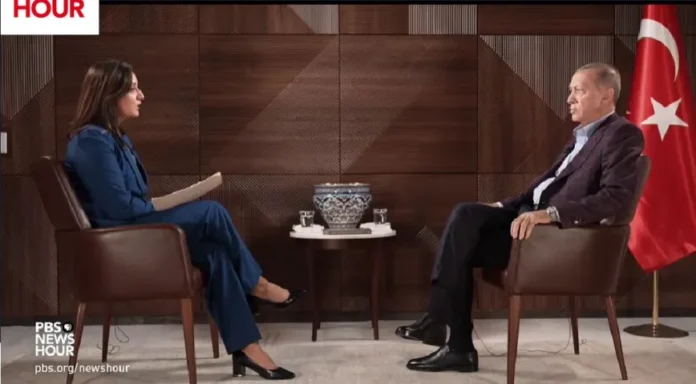
Ο Πρόεδρος του AKP και Πρόεδρος της Τουρκίας, Ρετζέπ Ταγίπ Ερντογάν, απάντησε σε ερωτήσεις της Amna Navaz από το κανάλι PBS στο κτίριο Türkevi στη Νέα Υόρκη στις Ηνωμένες Πολιτείες Αμερικής (ΗΠΑ), όπου ήταν παρών για την 78η Γενική Συνέλευση των Ηνωμένων Εθνών (ΟΗΕ).

Ο Ερντογάν έκανε σημαντικές δηλώσεις για τις σχέσεις Τουρκίας-Ευρωπαϊκής Ένωσης (ΕΕ), την εισβολή της Ρωσίας στην Ουκρανία, την ένταξη της Σουηδίας στο ΝΑΤΟ, τις συνεχιζόμενες διαπραγματεύσεις για τα F-16 με τις Ηνωμένες Πολιτείες (ΗΠΑ) και την εσωτερική πολιτική.

«Δεν χρειαζόμαστε τις συνεισφορές της ΕΕ»

Αναφερόμενος στην έκθεση που ετοίμασε ο εισηγητής του Ευρωπαϊκού Κοινοβουλίου για την Τουρκία Nacho Sanchez Amor πριν πάει στις ΗΠΑ και έγινε αποδεκτή από το Κοινοβούλιο, ο Ερντογάν είπε:

«Η ΕΕ προσπαθεί να απομακρυνθεί από την Τουρκία. «Κατά τη διάρκεια αυτής της περιόδου θα κάνουμε τις αξιολογήσεις μας απέναντι σε αυτές τις εξελίξεις και μετά από αυτή την αξιολόγηση, εάν χρειαστεί, μπορούμε να χωρίσουμε τους δρόμους μας με την ΕΕ», είπε.

Όταν του θύμισαν αυτά τα λόγια, ο Ερντογάν υπογράμμισε ότι η Τουρκία έχει κολλήσει στην πόρτα της Ευρώπης εδώ και 50 χρόνια και είπε:

«Ήμασταν πάντα μια αυτάρκης χώρα. «Δεν χρειαστήκαμε ποτέ τις συνεισφορές ή τη στήριξη της ΕΕ, δεν τη χρειαζόμαστε».

«Οι τρομοκρατικές οργανώσεις εξακολουθούν να βρίσκονται στους δρόμους της Στοκχόλμης»

Υπενθυμίζοντας ότι το εμπάργκο που είχε επιβληθεί στη Σουηδία άρθηκε πριν από τη Σύνοδο των Ηγετών του ΝΑΤΟ που πραγματοποιήθηκε στη Λιθουανία τον Ιούλιο, αλλά η προσπάθεια ένταξης της Σουηδίας στο ΝΑΤΟ ήταν στη Μεγάλη Τουρκική Εθνοσυνέλευση (TBMM), ο Ερντογάν ισχυρίστηκε ότι η Στοκχόλμη δεν τήρησε τις υποσχέσεις της προς την Άγκυρα:

«Οι τρομοκρατικές οργανώσεις πρέπει να σταματήσουν αμέσως τις διαδηλώσεις και τις δραστηριότητές τους στους δρόμους της Στοκχόλμης. Γιατί θα είναι πολύ σημαντικό για τον τουρκικό λαό να το δει αυτό να συμβαίνει πραγματικά. «Η Σουηδία φαίνεται να έχει κάνει αλλαγές στη νομοθεσία, αλλά αυτό δεν είναι αρκετό».

Υπάρχει σχέση μεταξύ των πωλήσεων F-16 και της ένταξης της Σουηδίας στο ΝΑΤΟ;

Ο Ερντογάν ρώτησε τον παρουσιαστή: «Βλέπετε σχέση μεταξύ της πώλησης F-16 από τις ΗΠΑ στην Τουρκία και της συμμετοχής της Σουηδίας στο ΝΑΤΟ;».

Απάντησε στην ερώτηση ως εξής:

«Κατά τη γνώμη μου, δεν πρέπει να υπάρχει καμία σχέση. Ο Τζο Μπάιντεν είπε ότι το Κογκρέσο θα αποφασίσει για αυτό το θέμα. Λέμε πάντα ότι έχουμε και Μεγάλη Τουρκική Εθνοσυνέλευση. Με άλλα λόγια, η βουλή αποφασίζει αυτά τα θέματα. «Εάν το κοινοβούλιο δεν λάβει θετική απόφαση για αυτό το θέμα, τότε δεν υπάρχει τίποτα να το κάνουμε».

«Ο Μενέντεζ δεν γνωρίζει τον Ερντογάν»

Σε ερώτηση της παρουσιάστριας,η οποία δήλωσε ότι στο αμερικανικό Κογκρέσο υπήρχαν άτομα που ήταν κατά της πώλησης F-16 στην Τουρκία, ιδιαίτερα ο Μπομπ Μενέντεζ, Πρόεδρος της Επιτροπής Εξωτερικών Σχέσεων της Γερουσίας, και απαρίθμησε τους λόγους αυτών των ανθρώπων, ο Ερντογάν. ισχυρίστηκε ότι ο Μενέντεζ δεν γνώριζε την Τουρκία και τον εαυτό του και είπε:

«Η Ελλάδα και η Τουρκία έχουν μια παλαιά φιλία που κρατά για δεκαετίες. Ο Μενέντεζ φαίνεται να έχει εχθρική προσέγγιση απέναντι στην Τουρκία και προσπαθεί να μας παρασύρει στον συγκεκριμένο τομέα συζήτησης που έχει επιλέξει. Αλλά δεν θα είμαστε μέρος του. «Η φιλία μας με την Ελλάδα δεν είναι αυτή που νομίζουν».

«Εμπιστεύομαι τη Ρωσία όσο εμπιστεύομαι τη Δύση»

Ο Ερντογάν, ο οποίος έκανε επίσης εκτιμήσεις για την εισβολή της Ρωσίας στην Ουκρανία, τη «φιλία» του με τον Ρώσο ηγέτη Βλαντιμίρ Πούτιν και την πορεία του πολέμου, τον ρώτησε η παρουσιάστρια: «Εμπιστεύεστε τις υποσχέσεις του Πούτιν για τις εξαγωγές σιτηρών;».

Απάντησε στην ερώτηση ως εξής:

«Δεν έχω κανένα λόγο να μην τον εμπιστευτώ. Η Ρωσία είναι τουλάχιστον εξίσου αξιόπιστη με τη Δύση. Είναι η ΕΕ που μας κράτησε να περιμένουμε στην πόρτα της για 50 χρόνια. «Αυτή τη στιγμή, εμπιστεύομαι τη Ρωσία όσο εμπιστεύομαι τη Δύση».

Από την άλλη, ο Ερντογάν είπε επίσης ότι ο Πούτιν είναι υπέρ του τερματισμού του πολέμου το συντομότερο δυνατό.

Ερντογάν και Πούτιν – Τι είναι πιο ωφέλιμο: Ρωσία ή ΗΠΑ;

Ο Ερντογάν απάντησε στην ερώτηση της παρουσιάστριας  για το αν η Τουρκία ωφελείται περισσότερο από τη Ρωσία ή τις ΗΠΑ:

«Η κατανόησή μου για την πολιτική βασίζεται στη δημιουργία ενός πλαισίου που βασίζεται σε ένα σενάριο «win-win» με κάθε χώρα σε όλο τον κόσμο. Θα έχω καλές σχέσεις με τη Ρωσία με τον ίδιο τρόπο που έχω καλές σχέσεις με τις ΗΠΑ. «Θα συνεχίσω τις σχέσεις μου με τα κράτη μέλη της ΕΕ με την ίδια προσέγγιση, με μια προσέγγιση win-win».

«Ο Καβάλα είναι ο χρηματοδότης των διαδηλώσεων, ο Ντεμιρτάς ο τρομοκράτης»

Υπενθυμίζοντας την κράτηση του δημοσιογράφου Σεντέφ Καμπάς, του επιχειρηματία Οσμάν Καβαλά και του πρώην Συμπροέδρου του HDP Σελαχατίν Ντεμιρτάς,  ρώτησε: «Απειλείστε  από αυτούς τους ανθρώπους;»

Στην ερώτηση, ο Ερντογάν είπε στην παρουσιάστρια: «Γιατί σας απασχολεί τόσο πολύ αυτό;» «Η Τουρκία είναι κράτος δικαίου»,   είπε και συνέχισε:

«Στο κράτος δικαίου, τέτοιες αποφάσεις λαμβάνονται από το δικαστικό σώμα. Αν το δικαστικό σώμα έχει πάρει μια απόφαση προς αυτή την κατεύθυνση, τότε ας σεβαστούμε την απόφαση που πήρε το δικαστικό σώμα. Δεν είμαι σε θέση να μιλήσω εξ ονόματος της δικαστικής εξουσίας. Ο Καβάλα ήταν ο χρηματοδότης των διαδηλώσεων».

Ο Ερντογάν, ο οποίος ισχυρίστηκε ότι ο Ντεμιρτάς ήταν «τρομοκράτης» που προκάλεσε το θάνατο περισσότερων από 200 ανθρώπων και είπε ότι το δικαστικό σώμα αποφάσισε την κράτησή του, διακόπηκε όταν η παρουσιάστρια  του υπενθύμισε την απόφαση του ΕΔΑΔ για τον Ντεμιρτάς.

Όταν τον διέκοψαν, ο Ερντογάν είπε: «Δεν έχετε δικαίωμα να με διακόπτετε», «Θα σεβαστείτε, θα σεβαστείτε την απόφαση που έλαβε η δικαστική εξουσία», είπε.

«Γιατί γέμισαν οι τουρκικές φυλακές με δημοσιογράφους»

Η παρουσιάστρια υπενθύμισε στους κρατούμενους δημοσιογράφους στην Τουρκία, αναφερόμενη στην έκθεση της Επιτροπής Προστασίας των Δημοσιογράφων (CPJ) και ρώτησε : «Γιατί είναι τόσοι πολλοί δημοσιογράφοι στη φυλακή στη χώρα σας;».

Ο Ερντογάν απάντησε:

«Αν υποστηρίζουν την τρομοκρατία, πού στον κόσμο μπορούν να ζήσουν ή να κυκλοφορούν ελεύθερα; «Αυτοί οι άνθρωποι υποστηρίζουν την τρομοκρατία και λαμβάνονται δικαστικές αποφάσεις για αυτούς τους ανθρώπους».

Κάντε κλικ για να παρακολουθήσετε ολόκληρη τη συνέντευξη .

—https://echedoros.blog/2023/09/19/%ce%bf%ce%b9-%ce%b5%cf%81%cf%89%cf%84%ce%ae%cf%83%ce%b5%ce%b9%cf%82-%cf%84%ce%b7%cf%82-%ce%b1%ce%bc%ce%b5%cf%81%ce%b9%ce%ba%ce%b1%ce%bd%ce%af%ce%b4%ce%b1%cf%82-%ce%b4%ce%b7%ce%bc%ce%bf%cf%83%ce%b9/

Οι τουρκικές μυστικές υπηρεσίες δολοφόνησαν Κούρδισσα αξιωματούχο στη Συρία

0

Ο ένοπλος τομέας των τουρκικών μυστικών υπηρεσιών- MİT, δολοφόνησε εξέχουσα προσωπικότητα των Κούρδων της Συρίας, την Ουμάν Ντερβίς, στην πόλη Μανμπίτζ, που ήταν υπεύθυνη για τις Δυνάμεις Λαϊκής Προστασίας- YPG/YPJ σε προσχεδιασμένη επιχείρηση, όπως αναφέρουν τα τουρκικά μέσα ενημέρωσης.

«Καλά νέα έρχονται από τις επιχειρήσεις που συνεχίζονται με το σύνθημα του Προέδρου Ρετζέπ Ταγίπ Ερντογάν, «Μέχρι να μην μείνει ούτε ένας τρομοκράτης», γράφει χαρακτηριστικά η Ensonhaber.

Το δημοσίευμα τονίζει ότι ενώ οι τουρκικές δυνάμεις ασφαλείας συνεχίζουν τις εσωτερικές, συνοριακές και διασυνοριακές επιχειρήσεις τους, ο ένοπλος κλάδος της MİT στοχεύει το λεγόμενο εκτελεστικό επιτελείο της τρομοκρατικής οργάνωσης των Κούρδων της Συρίας.

Όπως σημειώνεται η Ουμάν Ντερβίς  που είχε το ψευδώνυμο «Şervin Derik» διοικούσε Κούρδους που εκπαιδεύτηκαν να διεξάγουν ενέργειες κατά των τουρκικών δυνάμεων ασφαλείας σε βάσεις στη βόρεια Συρία και στην Τουρκία.

Δολοφονήθηκε μαζί με τους φρουρούς της

Μετά από ηλεκτρονική και φυσική παρακολούθηση, η MİT έδωσε οδηγίες στους επιτόπιους πράκτορες της.

Τότε ήρθε το αναμενόμενο τέλος για την τρομοκράτισσα  αφού προσδιορίστηκε η τοποθεσία της στη Μανμπίτζ.

Στη συνέχεια, εξουδετερώθηκε μαζί με τους φρουρούς του σε μια επιτυχημένη επιχείρηση, σημειώνεται χαρακτηριστικά.

https://echedoros.blog/2023/09/19/%ce%bf%ce%b9-%cf%84%ce%bf%cf%85%cf%81%ce%ba%ce%b9%ce%ba%ce%ad%cf%82-%ce%bc%cf%85%cf%83%cf%84%ce%b9%ce%ba%ce%ad%cf%82-%cf%85%cf%80%ce%b7%cf%81%ce%b5%cf%83%ce%af%ce%b5%cf%82-%ce%b4%ce%bf%ce%bb%ce%bf/

Ξεκινούν στη Χάγη οι ακροάσεις για τη μήνυση της Ουκρανίας για γενοκτονία κατά της Ρωσίας

0

Το Διεθνές Δικαστήριο Δικαιοσύνης στη Χάγη ξεκινά τη Δευτέρα τις ακροάσεις για την αξίωση της Ουκρανίας τον Φεβρουάριο του 2022 κατά της Ρωσίας για παραβίαση της σύμβασης για γενοκτονία κατά την εισβολή στην Ουκρανία.

Οι ακροάσεις του δικαστηρίου για την αξίωση της Ουκρανίας κατά της Ρωσικής Ομοσπονδίας θα διεξαχθούν στο Διεθνές Δικαστήριο της Χάγης στις 18-27 Σεπτεμβρίου. Αυτό το τμήμα συνεδριάσεων είναι αφιερωμένο στις προκαταρκτικές ενστάσεις που διατυπώθηκαν από τη Ρωσική Ομοσπονδία.

Η Ρωσία ζήτησε από το ανώτατο δικαστήριο του ΟΗΕ στη Χάγη να απορρίψει την υπόθεση της Ουκρανίας ως «κατάχρηση διαδικασίας».

Τη Δευτέρα θα μιλήσει η ρωσική πλευρά, την Τρίτη θα μιλήσει η Ουκρανία και την Τετάρτη θα εκδικαστούν άλλες δηλώσεις ότι το δικαστήριο επέτρεψε προηγουμένως να συμμετάσχει στη δίκη, όπως η Γερμανία , η Αυστραλία , η Αυστρία , η Σλοβακία , η Τσεχία , το Βέλγιο , η Κροατία , Δανία , Εσθονία , Φινλανδία , Ιρλανδία , Λουξεμβούργο , Σουηδία , Βουλγαρία , Καναδάς και Ολλανδία , σύμφωνα με δικαστικά έγγραφα.

Το ιστορικό της διαδικασίας

«Στις 26 Φεβρουαρίου 2022, μετά την έναρξη της ρωσικής στρατιωτικής ειδικής επιχείρησης, η Ουκρανία υπέβαλε αγωγή κατά της Ρωσίας στο Διεθνές Δικαστήριο Δικαιοσύνης. Οι διαδικασίες αφορούν τη Σύμβαση του 1948 για την Πρόληψη και Τιμωρία του Εγκλήματος της Γενοκτονίας. Ο Ρώσος υπουργός Εξωτερικών Σεργκέι Λαβρόφ χαρακτήρισε τη μήνυση βασισμένη σε «διαστραμμένη λογική» και τόνισε ότι η συλλογική Δύση καταχράται τους κανόνες της διεθνούς δικαιοσύνης», όπως σημειώνει το Ria Novosti.

Στην ανακοίνωσή της, η ουκρανική πλευρά ζήτησε από το δικαστήριο να διατάξει προσωρινά μέτρα.

Με απόφαση της 16ης Μαρτίου 2022, το δικαστήριο κάλεσε τη Ρωσία να αναστείλει αμέσως τη στρατιωτική της επιχείρηση στο έδαφος της Ουκρανίας, να διασφαλίσει ότι όλοι οι ένοπλοι σχηματισμοί, οι οργανώσεις και τα πρόσωπα υπό ρωσικό έλεγχο δεν θα προβούν σε ενέργειες για τη διευκόλυνση της στρατιωτικής επιχείρησης και κάλεσε επίσης και τις δύο πλευρές να απόσχουν από οποιεσδήποτε ενέργειες που ενδέχεται να επιδεινώσουν τη διαφορά ή να καταστήσουν πιο δύσκολη την επίλυσή της.

Στις 3 Οκτωβρίου 2022, η Ρωσία υπέβαλε προκαταρκτικές ενστάσεις σχετικά με τη δικαιοδοσία του δικαστηρίου και το παραδεκτό της αξίωσης, και ως εκ τούτου η διαδικασία επί της ουσίας ανεστάλη.

Τον Ιούνιο του 2023, το Διεθνές Δικαστήριο της Δικαιοσύνης επέτρεψε σε περισσότερα από 30 κράτη να συμμετάσχουν στην αγωγή της Ουκρανίας κατά της Ρωσίας.

Το Δικαστήριο όρισε την 5η Ιουλίου 2023 ως την προθεσμία για την υποβολή γραπτών παρατηρήσεων από αυτές τις πολιτείες. Τριάντα ένα κράτη που εντάχθηκαν στην υπόθεση είχαν υποβάλει γραπτές δηλώσεις μέχρι αυτή την προθεσμία.

Η Ρωσία ξεκίνησε την στρατιωτική εισβολή στην Ουκρανία στις 24 Φεβρουαρίου 2022.

Σύμφωνα με το ρωσικό πρακτορείο:

«Ο πρόεδρος της χώρας Βλαντίμιρ Πούτιν χαρακτήρισε στόχο της «την προστασία των ανθρώπων που έχουν υποστεί κακοποίηση και γενοκτονία από το καθεστώς του Κιέβου για οκτώ χρόνια». Σημείωσε ότι η ειδική επιχείρηση ήταν ένα αναγκαστικό μέτρο· η Ρωσία «δεν είχε καμία ευκαιρία να κάνει διαφορετικά· δημιουργήθηκαν κίνδυνοι για την ασφάλεια που ήταν αδύνατο να απαντηθεί με άλλα μέσα».

Σύμφωνα με τον ίδιο, η Ρωσία προσπαθεί εδώ και 30 χρόνια να καταλήξει σε συμφωνία με το ΝΑΤΟ για τις αρχές της ασφάλειας στην Ευρώπη , αλλά ως απάντηση βρέθηκε αντιμέτωπη είτε με κυνική εξαπάτηση και ψέματα, είτε με προσπάθειες πίεσης και εκβιασμού, ενώ η συμμαχία , εν τω μεταξύ, παρά τις διαμαρτυρίες από τη Μόσχα , επεκτείνεται σταθερά και πλησιάζει τα σύνορα της Ρωσίας».

https://echedoros.blog/2023/09/18/%ce%be%ce%b5%ce%ba%ce%b9%ce%bd%ce%bf%cf%8d%ce%bd-%cf%83%cf%84%ce%b7-%cf%87%ce%ac%ce%b3%ce%b7-%ce%bf%ce%b9-%ce%b1%ce%ba%cf%81%ce%bf%ce%ac%cf%83%ce%b5%ce%b9%cf%82-%ce%b3%ce%b9%ce%b1-%cf%84%ce%b7-%ce%bc/#more-8562

Δ. Σκαρπαλέζος: η “διακομματική” αρπαγή της Ελλάδας

0

Του Δημήτρη Σκαρπαλέζου*

Με την ουκρανική κρίση, οι ΗΠΑ μπήκαν σε μια φάση ακραίας κλιμάκωσης της επιθετικής πολιτικής που ακολουθούν για περικύκλωση της Ρωσίας και αποφασιστική σύγκρουση με την Ρωσία εδώ και πολλά χρόνια (τουλάχιστον από την εποχή – το 2008 –  που έσπρωξαν τη Γεωργία να επιτεθεί στους Ρώσους στην Οσσετία).

Αυτή η πολιτική προϋποθέτει στενότερο έλεγχο των “συμμάχων” και, ει δυνατόν έλεγχο όλου του πολιτικού φάσματος, όσον αφορά τα βασικά  στοιχεία της πολιτικής των ΗΠΑ .

Αυτός ο στόχος προϋποθέτει έναν, όσο πιο άμεσο γίνεται,  έλεγχο τόσο των κυβερνήσεων όσο και των  “αντιπολιτευτικών ” δυνάμεων, οδηγώντας τες ακόμα και σε πολιτικές πασιφανώς επιζήμιες για τους λαούς τους.

Προϋποθέτει επίσης είναι να μπει χέρι και στο βαθύ κράτος.

Η δημιουργία στρατειάς νέων φερέλπιδων πολιτικών “young leaders”; φορμαρισμένων στα αμερικανικά ελιτίστικα πανεπιστήμια και αμερικανικές πολυεθνικές ή διάφορα “think tank” η ακόμα και στημένες ΜΚΟ, είναι από τα βασικά όπλα αυτής της επέλασης.

Βέβαια αυτή η αποστολή νέου “ανανεωτικού υλικού” γίνεται και με την συνεργασία κομματιών της ντόπιας ολιγαρχίας.

Το παράδειγμα της Γαλλίας

Στη δυτική Ευρώπη, η περίπτωση της Γαλλίας είναι μια κλασική εφαρμογή με επιτυχία αυτών των στόχων. Ένας “φέρελπις νέος “, ο Μακρόν ,στέλεχος της τράπεζας Ρότσιλντ , στάλθηκε σαν “νέο αίμα ” και “ικανός τεχνοκράτης” στην  Γαλλική “σοσιαλιστική” κυβέρνηση, από όπου μετά μεταπήδησε για να κάνει ένα “μοντέρνο νεωτεριστικό” κίνημα που πήρε την κυβέρνηση και που επέβαλε την υποταγή του “βαθέος κράτους” σε Αμερικανικές πολυεθνικές “συμβούλων” και την εξωτερική πολιτική της χώρας σε κατεύθυνση ευνοϊκή προς τους στόχους της Αμερικανικής κυβέρνησης, που αντικαθιστούσαν τον κρατικό μηχανισμό στον στρατηγικό σχεδιασμό σε πολλά ζητήματα.

Αυτό έγινε με την αντιμετώπιση του Κοβιντ και την “μεταρρύθμιση” των συντάξεων, όπου  ιδιωτικές εταιρείες συμβούλων και πολυεθνικές  (συχνά Αμερικανικές τύπου  Black Rock η Mc Κinsey κλπ) υποκαθιστούσαν τις κρατικές υπηρεσίες στον στρατηγικό σχεδιασμό η ακόμα και σε απλά τεχνικά θέματα όπως ο ηλεκτρονικός εκμοντερνισμός των υπηρεσιών.

Για να αποδυναμώσει την αντίδραση τηε αριστεράς προσέφευγε σε ανέξοδες “δικαιωματικές” μεταρυθμίσεις όπως η αποδοχή όλων των συμβολικών αιτημάτων του “φεμινιστικού” κινήματος ή της   ΛΟΑΤΚΙ κοινότητας και παράλληλα εξασκώντας μια πρωτόγνωρη για την Γαλλία βία εναντίον των λαϊκών κινητοποιήσεων όπως τα Κίτρινα Γιλέκα . Τέλος επέβαλε κάτι τελείως αντίθετο απο την παράδοση του Ντε γκολ στην Γαλλία δηλαδή την συστράτευση με τις ΗΠΑ εναντίον της Ρωσίας, ακόμα και όταν αυτη έθιγε βασικα γαλλικά συμφέροντα!.

Από τον Μητσοτάκη στον Κασσελάκη

Τέτοιοι “φερέλπιδες” νέοι άρχισαν να επιβάλλονται και στην  Ελλάδα.

Ένας Γόνος φορμαρισμένος στην Αμερική, ο Μητσοτάκης, ήρθε να καταλάβει την ηγεσία της παραδοσιακής δεξιάς εφαρμόζοντας αντίστοιχη πολιτική στο εσωτερικό και μια πιο ανοιχτά φιλοαμερικανική πολιτική από οποιαδήποτε προηγούμενη κυβέρνηση μετά την πτώση της χούντας.

Η απόλυτη συστράτευση της Ελλάδας στον Ουκρανικό πόλεμο σε πρωτόγνωρο βαθμό ήταν ενα απο τα επιτεύγματα αυτής της “ανανέωσης” του πολιτικου προσωπικού.

Σήμερα με μια αριστουργηματική  στρατηγική χειραγώγησης όπου η αριστερά οδηγήθηκε να γίνει πρωταθλητής στα αυτογκόλ, το ίδιο κινδυνεύει να συμβεί με τον Σύριζα με την επέλαση ενός νέου και ωραίου  “young leader” που μας κατέφθασε απο το πουθενά. Η μάλλον από την τράπεζα Γκόλντμαν Ζακς και από το φιλοπόλεμο συντηρητικό αμερικανικό “think tank” CSIS. Τόν Κασσελάκη. (Να θυμίσουμε στο σημείο αυτό ότι και η κόρη του ίδιου του Μητσοτάκη δουλεύει στη διαβόητη Goldman Sachs (https://pellasimera.gr/sti-goldman-sachs-i-proti-doulia-tis-koris-tou-prothypourgou-kyriakou-mitsotaki/ μια τράπεζα που έχει παίξει κρίσιμο ρόλο στον οικονομικό πόλεμο κατά της Ελλάδας και την καταστροφή της χώρας μας. (H Goldman Sachs και ο ρόλος της στην ελληνική κρίση)

Αν εκλέγει πρόεδρος του Σύριζα θα έχει επιτευχθεί ένας βασικός στόχος των επικυρίαρχων (δηλαδή της ανώτατης χρηματιστικής και πολυεθνικής “τάξης” της δύσης με ηγετικό πυρήνα το αμερικανικό κομμάτι της) όσον αφορά την Ελλάδα, δηλαδή η επίτευξη ενός “διπλού μονοκομματικού συστήματος” κοντά στο αμερικανικό μοντέλο και ένας έλεγχος της Ελλάδας  με παράλληλο έλεγχο και της κυβέρνησης και  της αντιπολίτευσης, μια στημένη πολιτική σκηνή όπου θα παίζουν έναν στημένο παιχνίδι “αντιπαράθεσης” σε ότι δεν θίγει τα ισχυρότερα συμφέρονταμ ντόπια η ξένα, .και τις “ειλημένες υποχρεώσεις”.και θα υπακούουν σε όλες της βασικές απαιτήσεις των ΗΠΑ ακομα και μέχρι την αποδυνάμωση της άμυνας των νησιών μας για να στέλνουμε αδιαμαρτύρητα τα αναγκαία για μας όπλα στην αδιέξοδη Ουκρανική  αιματηρή σύγκρουση .και γενικότερα, τον ευθυγραμμισμό μαςσε όλες τις απαιτήσεις τους.

Ό,τι και να πιστεύουμε για τα αδιέξοδα μέχρι σήμερα του σύριζα,  η αποφυγή αυτής της επέλασηs για διπλη “πλουραλιστικη” κατοχη στην χώρα μας ειναι τοσο καθηκον για την υπεράσπιση βασικών λαικών συμφερόντων όσο και πατριωτικο καθηκον για να αποφύγουμε την απολυτη “πλουραλιστικη” υποταγη της πατριδας μας.

* Μέλος του ΣΥΡΙΖΑ, Καθηγητής Μαθηματικών, Πανεπιστήμιο Παρίσι – 7   

konstantakopoulos.gr

Ο ΚΑΣΣΕΛΑΚΗΣ, Ο ΣΥΡΙΖΑ ΚΑΙ ΤΟ ΥΠΟ ΔΙΑΜΟΡΦΩΣΙΝ ΠΟΛΙΤΙΚΟ ΣΚΗΝΙΚΟ

5
του Παντελή Σαββίδη
Όπως έχω γράψει επανειλημμένως η Ελλάδα είναι, στην καλύτερη περίπτωση, προτεκτοράτο. Και ο προστάτης του προτεκτοράτου μεριμνά για την επιβίωση και την λειτουργία του.
Η πρώτη φορά που οι Αμερικανοί ανησύχησαν για την πολιτική σταθερότητα της Ελλάδος ήταν με τις τηλεφωνικές υποκλοπές. Έκαναν παρασκηνιακές κινήσεις αναζητώντας εναλλακτική λύση σε περίπτωση που έπεφτε ο Μητσοτάκης. Ο κίνδυνος παρήλθε αλλά η ανησυχία της πολιτικής αποσταθεροποίησης σε μια ευαίσθητη περιοχή και σε μια κρισιμη στιγμή, έμεινε.
Έπρεπε να διαμορφώσουν έναν άλλο πόλο. Έναν πόλο εναλλακτικό της δεξιάς Νέας Δημοκρατίας. ¨Εναν πόλο με κεντρώα χαρακτηριστικά.
Καλούν τον Τσίπρα στις ΗΠΑ (όλοι το καλοκαίρι πηγαίνουν στην θάλασσα για διακοπές, ο Τσίπρας πήγε στις ΗΠΑ. Ξέρετε πώς είναι στην Ουάσιγκτον τον Ιούλιο και Αύγουστο;) και την περίοδο που ο Τσίπρας βρίσκεται εκεί εμφανίζεται η επιλογή Κασσελάκη.
Όλως παραδόξως ο Τσίπρας όταν επιστρέφει υποστηρίζει την υποψηφιότητα Κασσελάκη.
Το ότι πίσω απο αυτήν την εξέλιξη βρίσκεται η Ομοσπονδία της οποίας είμαστε προτεκτοράτο δεν πρέπει να υπάρχει αμφιβολία. Το ερώτημα είναι τι γίνεται απο δω και πέρα;
Είτε με τον Κασσελάκη είτε με την Αγτσιόγλου οι μέρες του Συριζα είναι μετρημένες. Ανάλογες εξελίξεις πρέπει να αναμένονται και στο ΠΑΣΟΚ.
Απο τις δυνάμεις που θα απελευθερωθούν και απο τα δύο κόμματα θα διαμορφωθεί ένα νέο κέντρο, το οποίο θα αποτελεί την εναλλακτική κυβερνητική λύση της ΝΔ. Αλλά το σχήμα αυτό δεν αρκεί. Πρέπει να διαμορφωθεί και μια αριστερά η οποία θα εκτονώνει τις λαϊκές αντιδράσεις και θα συμμετέχει σε κυβερνητικούς συνασπισμούς όταν δεν σχηματίζονται αυτοδύναμες κυβερνήσεις. Όπως στη Γερμανία.
Απο τα υπολείμματα του Συριζα και του ΠΑΣΟΚ θα διαμορφωθεί αυτή η νέα αριστερά. Ξεχάστε τα κόμματα του παρελθόντος. Οι εξελίξεις στον Συριζα και στο ΠΑΣΟΚ θα πυροδοτήσουν αλλαγές και στη ΝΔ της οποίας η ηγεσία έχει, ήδη, αμφισβητηθεί. Προς το παρόν εμφανίζει μια εικόνα ενότητας λόγω νομής της εξουσίας.
Άρα με την βοήθεια των ΗΠΑ διαμορφώνεται ένα νέο πολιτικό σκηνικό.
ΥΓ: αυτό δείχνουν οι εξελίξεις με λογικούς συνειρμούς. Αν δεν είναι όλα αυτά στις σκέψεις των ΗΠΑ κάποιος πρέπει να τα σκεφθεί ώστε να υπάρχουν εναλλακτικές πολιτικές λύσεις στην χώρα.