


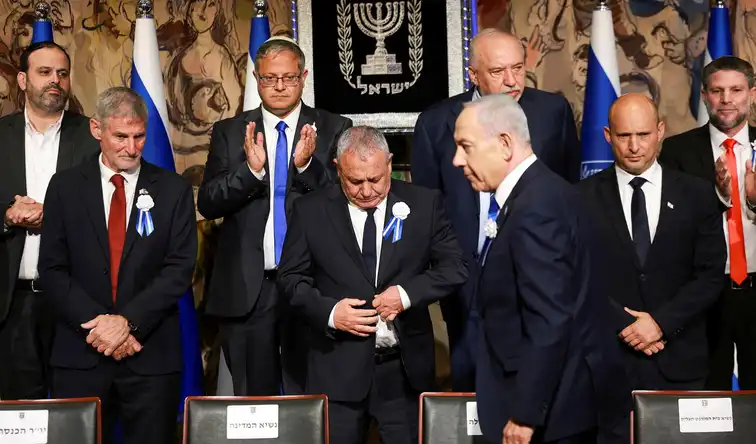
Israel’s 26th Knesset was sworn in on Tuesday amid festivities and fanfare that ultimately erupted in heckling and clashes over the possible inclusion of Arab parties in the next government.
As Joint List leader Yousef Jabareen took the oath of office, declaring “I swear,” Itamar Ben-Gvir interrupted, shouting, “swears allegiance to Hamas!” Later, when members of the Arab-led alliance left the Knesset chamber before the playing of Israel’s national anthem, Likud lawmakers heckled them, shouting, “Why did the Arabs leave?” They also taunted members of the Eisenkot bloc, asking, “Where are your partners?”
Ahead of the ceremony, Jabareen said his party would “play on the offense” in the incoming Knesset to “block racism and persecution,” vowing to protect his constituents. United Arab List leader Mansour Abbas, meanwhile, expressed his ambition to join the next government. “This is our basic right,” he said. “We have condemned every act of terror.”
Tensions escalated further when PM Netanyahu addressed lawmakers following the swearing-in ceremony, delivering a lengthy tirade against Arab lawmakers and the prospect of their inclusion in a government led by the Eisenkot bloc. “To those who are thinking of forming a government that includes terror supporters who hate Israel … are you willing to be dependent on those whose goal is the destruction of the Jewish state? In their hands, you entrust the fate of our country?” he asked, before reiterating his call for a unity government.
Netanyahu also called for an investigation into allegations that Qatar had spent “big money” to boost Arab voter turnout in the election, prompting opposition leader Naftali Bennett to interject: “What about the Qatari advisors in your office?” Bennett was referring to allegations that two of Netanyahu’s advisers had been paid to promote Qatari interests while working in the Prime Minister’s Office.
The exchange sparked shouting matches among lawmakers, with Ben-Gvir calling Bennett a “nudnik,” while Sara Netanyahu also engaged in an argument with the opposition party leader.
Eisenkot later condemned Netanyahu’s speech as “delusional” and “shameful,” saying it left him “even more convinced that he is unfit to continue in office for even one more minute.” He renewed his call for the urgent formation of an emergency government. Abbas, meanwhile, reiterated that his party “supports peace and an end to the conflict based on a two-state solution” and does “not want to establish an Islamist state or an Arab state or anything else here.”

Eisenkot bloc seeks to replace Netanyahu ally as Knesset speaker after securing majority
Eisenkot’s Yashar party said Tuesday that it had submitted a series of key bills following the swearing-in of the new Knesset, including legislation to establish a state commission of inquiry into October 7, limit the prime minister’s term in office and repeal judicial overhaul laws passed by the outgoing government.
The party also announced that it had secured enough lawmakers’ signatures to hold a vote on replacing Likud Knesset Speaker Amir Ohana, who said last week that a majority of lawmakers would need to sign a request to initiate such a vote.
Earlier Tuesday, Yashar announced that the party leaders in Eisenkot’s bloc had agreed to nominate lawmaker Matan Kahana for the position. Ohana later scheduled the vote for November 17.
According to Yashar’s Knesset faction leader, 61 of the Knesset’s 120 members have signed the request to hold a vote on a new speaker. Ahmad Tibi, who heads a faction within the Arab-led Joint List alliance, said his party would support Kahana’s appointment as a “first critical step that will signal change.”
Finance Minister Bezalel Smotrich, meanwhile, called on Kahana to reject the position if his appointment depended on the support of Arab lawmakers. “Getting appointed as Knesset Speaker with the votes of Israel’s enemies is not legitimate,” Smotrich said, describing Israel’s two Arab-led parties as “parties that view the establishment of the State of Israel as a disaster and undermine its right to exist.
Members of the so-called bloc of change, seeking to unseat Netanyahu, are aware of the tight timetable… The 26th Knesset will have a majority of lawmakers opposed to Netanyahu, but they will face pressure to advance their agenda, as there is no guarantee that another election will not be held in the spring if a new government is not sworn in
writes Noa Shpigel

