Αρχική Blog Σελίδα 2979

The Slam Poets of Istanbul

0

Mar 13, 2017

Video by Tara Milutis theatlantic.com

Every week, a group of young people meet in Taksim Square to perform spoken-word poems. They are led by a woman named Merve Pehlivan, who is profiled in this short film. “As a Turkish person myself, I feel the extent to which we have been divided as a society and we have stopped talking with each other,” she says. “I’m a very strong supporter of freedom of expression and of diversity of opinion.” This documentary was filmed by Tara Milutis three days after the Reina nightclub attack, which killed 39 people.

Author: Nadine Ajaka

https://www.theatlantic.com/video/index/516765/the-slam-poets-of-istanbul/

Δεν υπάρχει εναλλακτική

0

Γιατί οι Γερμανοί δεξιοί λαϊκιστές χάνουν ορμή

Περίληψη:

Παρότι οι θρίαμβοι της δεξιάς στο εξωτερικό θα χαλυβδώσουν τον πυρήνα των υποστηρικτών του γερμανικού δεξιού λαϊκιστικού κόμματος AfD, θα ενθαρρύνουν επίσης μια ακόμη πιο ισχυρή δημοκρατική αντίδραση.

Ο MICHAEL BRÖNING είναι επικεφαλής του Τμήματος Διεθνούς Πολιτικής στο Friedrich-Ebert-Stiftung.

Στα τέλη Ιανουαρίου, το μέλλον φαινόταν λαμπρό για το κόμμα «Εναλλακτική για την Γερμανία» (Alternative für Deutschland, AFD) [1]. Η Frauke Petry, επικεφαλής του κόμματος, είχε συγκεντρώσει τους δεξιούς λαϊκιστές της Ευρώπης για μια σύνοδο κορυφής στην γερμανική πόλη Koblenz, όπου εμφανίστηκε στην σκηνή με τους άλλους ηγέτες της λαϊκιστικής εξέγερσης της ηπείρου [2]. Υπό τις επευφημίες του πλήθους, η Γαλλίδα προεδρική υποψήφια και επικεφαλής του «Εθνικού Μετώπου», Marine Le Pen [3], δήλωσε ότι, το 2017, «οι άνθρωποι της ηπειρωτικής Ευρώπης θα ξυπνήσουν».

Στην Γερμανία, οι ψηφοφόροι φαίνεται να ξυπνούν -αλλά όχι με τον τρόπο που οραματίστηκε η Le Pen. Το AfD έχει χάσει περίπου το ένα τρίτο της λαϊκής υποστήριξης του από τον Ιανουάριο, σύμφωνα με πρόσφατες δημοσκοπήσεις [4]. Αν οι εκλογές διεξάγονταν σήμερα, το κόμμα θα κέρδιζε μεταξύ 8% και 11% των ψήφων [5] -μια απότομη πτώση από το 15% που ενέγραψε τον περασμένο Δεκέμβριο, μετά από μια σειρά επιτυχιών στις περιφερειακές εκλογές το 2016. Αυτή η ραγδαία πτώση έρχεται σε πλήρη αντίθεση με την αύξηση της δημόσιας στήριξης την οποία απολαμβάνουν δεξιοί λαϊκιστές αλλού στην Ευρώπη, κυρίως στην Γαλλία και την Ολλανδία. Στη μέση ενός λαϊκιστικού κύματος μεγάλης εμβέλειας [6], η Γερμανία έχει αναδειχθεί ως εξαίρεση -τουλάχιστον για την ώρα.

13032017-1.jpg

Εργαζόμενοι κατά την διάρκεια μιας προειδοποιητικής απεργίας σε ένα εργοστάσιο της Audi στο Ingolstadt, στην Γερμανία, τον Νοέμβριο του 2008. MICHAELA REHLE / REUTERS
————————————————————

ΠΕΤΡΩΜΕΝΗ

Τρεις δομικές δυναμικές τροφοδότησαν την κρίση του AfD, και κάθε μια υπόσχεται να έχει επιδράσεις πέρα από το άμεσο μέλλον. Η πρώτη είναι η υπόθεση των αυστηρότερων μεταναστευτικών πολιτικών της γερμανικής κυβέρνησης. Τα πολιτικά βήματα που έχει κάνει το Βερολίνο από τον Ιούλιο του 2015 ήταν αμφιλεγόμενα, αλλά έχουν επίσης μειώσει σημαντικά τον αριθμό των προσφύγων που φθάνουν στην Γερμανία. Η προσφυγική συμφωνία με την Τουρκία και οι προσπάθειες του Βερολίνου για την σύναψη παρόμοιων συμφωνιών με χώρες της Βόρειας Αφρικής όπως η Αίγυπτος, η Λιβύη και η Τυνησία έχουν στερήσει αποτελεσματικά το AfD από αυτό που κάποτε ήταν ένα από τα μοναδικά σημεία προώθησης του κόμματος: Την υπόσχεσή του να μειώσει τις εισροές μεταναστών και προσφύγων [ 7]. Τουλάχιστον για την ώρα, τα μέτρα του Βερολίνου έχουν εκτονώσει αυτό που σε μεγάλο βαθμό προβλεπόταν εδώ και καιρό ότι θα είναι ο καθοριστικός παράγοντας για τις ομοσπονδιακές εκλογές του Σεπτεμβρίου.

Στην συνέχεια, η άνοδος του Martin Schulz ως υποψήφιου του Σοσιαλδημοκρατικού Κόμματος για την καγκελαρία επανέφερε την δυνατότητα αλλαγής στο εν υπνώσει πολιτικό κέντρο της Γερμανίας, υποσκάπτοντας κάποια από την υποστήριξη προς το AfD. Ο πρώην πρόεδρος του Ευρωπαϊκού Κοινοβουλίου, Schulz, έχει ενεργοποιήσει την βάση του SPD με το να αναγορεύσει τον εαυτό του ως την πεμπτουσία του φιλοευρωπαϊστή και ως ένα αντίβαρο προς τον πρόεδρο των ΗΠΑ, Ντόναλντ Τραμπ [8]. Ο Schulz έχει χρησιμοποιήσει την καταγωγή του ως πολιτικό αουτσάιντερ -δεν είχε ποτέ αιρετό αξίωμα στη Γερμανία σε εθνικό επίπεδο- για να προσελκύσει δυσαρεστημένους και στερούμενους πολιτικών δικαιωμάτων ψηφοφόρους, συμπεριλαμβανομένων αριστερών και δεξιών λαϊκιστών που τον θεωρούν ως μια εναλλακτική λύση ως προς το AfD, τους Πράσινους, και το ακροαριστερό Die Linke. Με αυτόν τον τρόπο, κατάφερε να εξασφαλίσει ισότιμους όρους ανταγωνισμού με την Γερμανίδα καγκελάριο, Άνγκελα Μέρκελ, και μάλιστα έχει περάσει μπροστά της σε διάφορες εθνικές δημοσκοπήσεις, με μια εξαιρετικά ταχεία ορμή [9].

Τέλος, το AfD έχει υπονομεύσει την δική του εκλογιμότητα εκθέτοντας μερικές από τις εσωτερικές αντιφάσεις του στο κοινό. Από την ίδρυση του κόμματος το 2013, προσπάθησε να ισορροπήσει προσεκτικά τις σκηνοθετημένες πολιτικές προκλήσεις με τις προσπάθειες να διατηρήσει μια εμφάνιση συντηρητικής αξιοπρέπειας. Αυτή η προσέγγιση έχει κεντρική σημασία στην απήχηση του κόμματος, προσελκύοντας κεντροδεξιούς ψηφοφόρους δυσαρεστημένους με το status quo, που όμως διστάζουν να αγκαλιάσουν εξτρεμιστικές θέσεις. Αλλά, τους τελευταίους μήνες αυτή η στρατηγική αμφισημία έχει θρυμματιστεί. Σε μια συνάντηση του AfD στα μέσα Ιανουαρίου, ο Björn Hocke [10], ένας πρώην δάσκαλος Ιστορίας και ένας από τους περιφερειακούς ηγέτες του κόμματος, προκάλεσε σάλο αμφισβητώντας αυτό που περιέγραψε ως «ντροπιαστική» προσέγγιση της Γερμανίας στο ναζιστικής εποχής παρελθόν της. «Δεν χρειαζόμαστε τίποτα λιγότερο από μια αλλαγή πορείας 180 μοιρών στην πολιτική μας προσέγγιση της ιστορίας», δήλωσε ο Hocke. Τα σχόλιά του έβαλαν τέλος σε μια θεμελιώδη συναίνεση στην γερμανική πολιτική, θέτοντας υπό αμφισβήτηση την συμβατότητα του κόμματος με τον ακρογωνιαίο λίθο της μεταπολεμικής ταυτότητας της Γερμανίας [11], και αποξενώνοντας μερικούς από τους πιο κεντρώους υποστηρικτές του AfD. Ακόμα και η Petry αισθάνθηκε υποχρεωμένη να επιτιμήσει έντονα τις παρατηρήσεις του Hocke˙ τώρα αγωνίζεται να τον ωθήσει έξω από το κόμμα.

Αλλά η σχέση της Γερμανίας με το παρελθόν της δύσκολα είναι το μόνο θέμα που χωρίζει το AfD από την πλειοψηφία των ψηφοφόρων. Εξίσου διχαστικές είναι οι οικονομικές θέσεις του κόμματος. Άλλα ευρωπαϊκά δεξιά λαϊκιστικά κόμματα έχουν κερδίσει την εργατική ψήφο με το να υιοθετούν αναδιανεμητικές πολιτικές. Αυτό δεν έχει συμβεί στην Γερμανία: Το AfD ακόμα φορά τα νεοφιλελεύθερα ράσα που φόρεσε στην ίδρυσή του την εποχή της κορύφωσης της κρίσης της ευρωζώνης. Εκεί που το γαλλικό Εθνικό Μέτωπο έχει προσελκύσει την εργατική τάξη με υποσχέσεις για τη μείωση της ηλικίας συνταξιοδότησης ή την αύξηση του κατώτατου μισθού, το AfD έχει ζητήσει την κατάργηση των φόρων κληρονομιάς και καθαρής περιουσίας και για την επαναφορά του τραπεζικού απορρήτου [12], ή κανόνες που επιτρέπουν στις τράπεζες να προστατέψουν πληροφορίες σχετικά με τους πελάτες τους από την κυβέρνηση. Αυτές είναι θέσεις που δύσκολα κερδίζουν τους μέσους Γερμανούς.

13032017-2.jpg

Ο Martin Schulz στο Στρασβούργο, στην Γαλλία, τον Ιανουάριο του 2017. CHRISTIAN HARTMANN / REUTERS
——————————————————

Ο ΚΥΡΙΑΡΧΟΣ ΟΡΙΖΕΤΑΙ ΑΠΟ ΤΗΝ ΕΞΑΙΡΕΣΗ;

Η πρόσφατη πτώση του AfD θα πρέπει να υπενθυμίσει στο πολιτικό κατεστημένο της Ευρώπης ότι η αντιμετώπιση των βαθύτερων αιτίων της ανησυχίας των ψηφοφόρων είναι το μοναδικό καλύτερο αντίδοτο στην λαϊκιστική οργή. Οι προσπάθειες της Γερμανίας να ανακτήσει τον έλεγχο των μεταναστευτικών ροών, χωρίς να παραιτείται από τις ανθρωπιστικές αρχές -όπως αποδεικνύεται από την δέσμευση του Βερολίνου να χρησιμοποιήσει την προεδρία του στο G-20 για να προωθήσει την οικονομική ανάπτυξη στην Αφρική [13]- είναι μια τέτοια περίπτωση. Η πτώση του κόμματος κατέδειξε, επίσης, την σημασία της δημιουργίας πραγματικών επιλογών στην πολιτική κυρίαρχη τάση. Το να προσφερθεί μια βιώσιμη πολιτική εναλλακτική λύση έναντι του status quo, όπως έκανε ο Schulz, μπορεί να εκτονώσει την αντι-κατεστημένη απήχηση των λαϊκιστών. Οι πολιτικοί αλλού στην Ευρώπη πρέπει να το λάβουν υπόψη τους.

Το αν θα συνεχιστεί η φαινομενική κατάρρευση του AfD είναι ασαφές. Η προσφυγική συμφωνία με την Τουρκία θα μπορούσε να διαλυθεί αν οι εντάσεις μεταξύ Άγκυρας και Βερολίνου συνεχίσουν να αυξάνονται˙ η απήχηση του Schulz στους δυσαρεστημένους ψηφοφόρους θα μπορούσε να χτυπήσει ένα ανώτατο όριο˙ ή η ελληνική οικονομική κρίση θα μπορούσε να επανεμφανιστεί, διχάζοντας τους ψηφοφόρους σχετικά με το ποια θα πρέπει να είναι η αντίδραση του Βερολίνου. Τέτοια γεγονότα θα ρίξουν σίγουρα μια σανίδα σωτηρίας στο κόμμα. Από την άλλη πλευρά, η πολιτική αναταραχή της προεδρίας Trump ή οι περαιτέρω επιτυχίες της δεξιάς στην Ευρώπη θα μπορούσαν να υπονομεύσουν το AfD: Παρότι οι θρίαμβοι της δεξιάς στο εξωτερικό θα χαλυβδώσουν τον πυρήνα των υποστηρικτών του κόμματος, θα ενθαρρύνουν επίσης μια ακόμη πιο ισχυρή δημοκρατική αντίδραση. Με φόντο το λαϊκιστικό κύμα της Ευρώπης, θα ήταν εντυπωσιακό αν η πιο κηλιδωμένη από εξτρεμιστική μανία χώρα στον εικοστό αιώνα [14] πρόκειται να αποδειχθεί πιο ανθεκτική στους πειρασμούς της στον εικοστό πρώτο.

Copyright © 2017 by the Council on Foreign Relations, Inc.
All rights reserved.

Στα αγγλικά: https://www.foreignaffairs.com/articles/germany/2017-03-10/there-no-alte…

Σύνδεσμοι:
[1] https://www.foreignaffairs.com/articles/2016-09-26/germanys-right-wing-c…
[2] https://www.foreignaffairs.com/articles/europe/2016-10-17/europe-s-popul…
[3] https://www.foreignaffairs.com/interviews/2016-10-17/france-s-next-revol…
[4] http://pollytix.eu/pollytix-german-election-trend/
[5] http://www.wahlrecht.de/umfragen/
[6] https://www.foreignaffairs.com/articles/united-states/2016-10-17/populis…
[7] https://www.foreignaffairs.com/articles/western-europe/failure-multicult…
[8] https://www.foreignaffairs.com/articles/united-states/2017-01-20/jackson…
[9] http://www.tagesspiegel.de/politik/sonntagstrend-spd-gelingt-dank-schulz…
[10] https://www.nytimes.com/2017/01/18/world/europe/germany-afd-alternative-…
[11] https://www.foreignaffairs.com/articles/europe/2005-05-01/reflection-les…
[12] https://www.alternativefuer.de/wp-content/uploads/sites/7/2016/05/2016-0…
[13] https://www.foreignaffairs.com/reviews/review-essay/2011-10-17/africa-un…
[14] https://www.foreignaffairs.com/anthologies/fascism-and-world-war-ii

Μπορείτε να ακολουθείτε το «Foreign Affairs, The Hellenic Edition» στο TWITTER στην διεύθυνση www.twitter.com/foreigngr αλλά και στο FACEBOOK, στην διεύθυνση www.facebook.com/ForeignAffairs.gr και στο linkedin στην διεύθυνση https://www.linkedin.com/company/foreign-affairs-the-hellenic-edition

I Went To Turkey To Interview The President And (Almost) All I Got Was A Meeting With A Conspiracy Theorist

0

Turkey wants the U.S. to take its concerns seriously. The mayor of Ankara isn’t helping.

ANADOLU AGENCY VIA GETTY IMAGES
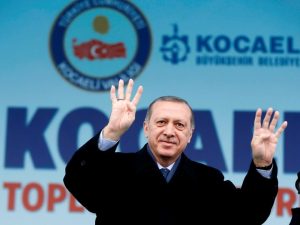
Turkish President Recep Tayyip Erdogan greets a crowd in Kocaeli, Turkey, on March 12, 2017.

ANKARA, Turkey – Last week, the mayor of Ankara escorted me and about a dozen other journalists into a windowless room with rows of green velvet armchairs facing a flat-screen television and told us his theory about ISIS.

Reporters from a bevy of major outlets, including the New York Times, Washington Post, Wall Street Journal and Associated Press, had traveled to Ankara to interview Turkish President Recep Tayyip Erdogan and other high-ranking government officials. But the mayor, an energetic, mustachioed man named Melih Gokcek, had a different idea.

ISIS “is an artificial organization, a fake organization, just like President Trump says,” Gokcek told journalists from 11 major Western news outlets through an interpreter. ISIS is actually the successor organization of al Qaeda in Iraq. But Trump “didn’t say it just once, he repeated it three times,” Gokcek said. “So three times — I believe it has some truth in it.”

It was around this time that I realized we definitely weren’t going to meet Erdogan.

The other reporters and I had traveled to Ankara to hear the Turkish government’s side of a complicated story. Turkey, a NATO member, is one of America’s most important Muslim allies in the Middle East. But relations have soured recently — in part because Turkish government officials are angry that the U.S. hasn’t extradited Fethullah Gulen, the cleric they accuse of plotting a failed coup in July.

SELAHATTIN SEVI/ZAMAN DAILY/REUTERS
Fethullah Gulen, a cleric living in self-imposed exile in Pennsylvania who is accused by Ankara of plotting the failed coup in Turkey last year.

Turkish officials are adamant that Gulen, now living in self-imposed exile in Pennsylvania, is to blame for the coup. But they have failed to offer hard evidence.

Erdogan rarely makes himself available to the media — especially for foreign reporters who are freer than Turkish journalists to criticize his government. So when Adam Sharon, a Washington-based public relations executive, contacted me and several other reporters last month and offered interviews with Erdogan and other top Turkish officials, it held out a chance, however remote, for American reporters to assess face-to-face whether top Turkish officials had any evidence for their claims about Gulen.

If the goal of the trip was to convince reporters that the Turkish government’s case against Gulen was based on facts, rather than innuendo and conspiracy theories, it backfired spectacularly.

Gokcek, who has been the mayor of Ankara for nearly 23 years, offered to arrange the meetings, and his team did everything they could to entice reporters to make the trip. They provided an invitation letter proposing to arrange meetings with Erdogan, the prime minister, the foreign affairs minister, the chief of general staff to the military, and the chief of national intelligence. They later followed up with a detailed itinerary. They offered to cover the cost of airfare, room and board, and meals. (The Huffington Post paid my expenses.)

Onur Erim, the mayor’s chief adviser, enlisted in the help of Arda Sayiner, an Istanbul-based public relations expert. Sayiner brought on Sharon, who was paid $20,000 for his work setting up the trip. Sayiner received “very very very little,” he said, declining to say how much.

Gokcek met us at a compound he uses to entertain guests on the first evening of our two-day trip in the capital city. He had a single red rose for each of the female reporters in honor of International Women’s Day. The mayor said he was excited to show us “never-before-seen footage” of the failed July 15 coup. The video was so gory that women might not be able to watch, his chief adviser warned during lunch.

The reporters were growing restless. Our hosts had dropped Turkey’s intel chief from the itinerary and replaced him with the justice minister. Our appointment with the justice minister kept getting pushed back so he could assemble better evidence against Gulen, Sayiner told us — a claim that seemed questionable, at best. And sources in the offices of the president’s and prime minister told our Turkey-based colleagues that we weren’t on those officials’ schedules.

The day was nearly over, and with the exception of a morning interview with Deputy Prime Minister Mehmet Simsek, we had spent much of it touring Mustafa Kemal Ataturk’s mausoleum and a revitalized former slum in Ankara. We also saw Parliament buildings that had been damaged during the coup. The destruction was being preserved for future generations to see, our parliamentary guide, Sami Akgun, said. He showed us a bombed-out portion of the Grand National Assembly — and a hole in the ground in front of it. The depression used to be deeper, Akgun said, but the rain and snow during the eight months since the attack had partially filled it in.

JESSICA SCHULBERG
A hole in the ground in front of Turkey’s Parliament building that was created during the July 2016 coup attempt.

When we asked for updates about our interviews, Sayiner assured us they would still happen, but he didn’t say when.

Gocek led us downstairs to the room with the green velvet armchairs and the TV. There was a dessert platter set out next to every chair. The 24-minute video was as bloody as promised. The mayor, seated next to the screen, provided running commentary. At one point, he told us that he had appeared on television 18 times on the night of the failed coup. After the video, he told us his theory about former President Barack Obama and 2016 Democratic nominee Hillary Clinton creating ISIS. Mehul Srivastava, a Financial Times reporter based in Istanbul who is familiar with Gokcek’s style, wanted to make sure the other journalists fully understood what they were dealing with.

“Could you perhaps explain to us your theory on earthquakes?” Srivastava asked the mayor.

“Surely, I would be happy to answer that,” Gokcek said. “There are two types of earthquakes in Turkey. The ordinary ones that happen spontaneously, the other ones that are triggered.” According to Gokcek, the U.S. and Israel had collaborated to “trigger” a 7.4-magnitude earthquake in the Gulf by sailing up to a coastal fault line and attempting to extract energy. “They couldn’t manage it, just like an atom bomb, the energy inside the ground exploded and it turned into an earthquake,” he said. There’s no evidence of such an occurrence. The mayor has also suggested that Gulen and his followers created an earthquake with the goal of destabilizing Turkey.

Gokcek said he gets his information from the Internet. “I have the largest intelligence service in the world: Google,” the mayor said. “You can find anything in Google. In Turkey, I am the person who uses Google the best way … I would like to thank Google.”

Sharon, the Washington-based PR hand, started breathing heavily.

ADEM ALTAN/GETTY IMAGES
Mayor of Ankara Melih Gokcek told reporters he believes former President Barack Obama created ISIS, the U.S. and Israel are responsible for earthquakes, and Google is a suitable substitute for intelligence briefings. 

We interviewed Yildirim, the prime minister, the next day.

At the end of the hourlong meeting, The New York Times’ Gardiner Harris thanked Yildirim for his time and asked if he was aware that we also had been promised interviews with Erdogan and other top government officials.

The prime minister looked surprised. He had only been asked to meet with us two days ago, he said.

Ultimately, we heard from Simsek, Justice Minister Bekir Bozdag, and Erdogan’s spokesman, Ibrahim Kalin. The meeting with the justice minister, Sayiner told us, was the hastily arranged result of a request from Prime Minister Yildirim’s office.

The Turkish officials said what we’d expected them to say. They defended Turkey’s post-coup crackdown and said they had been unfairly judged and abandoned by the U.S. in the wake of the violent attempt to overthrow their democratically elected government.

Many of their grievances were understandable: The Syrian Kurds that are armed and trained by the U.S. to fight against ISIS have ties to the PKK — a group accused of several attacks against Turkish troops, including a suicide bombing last year that killed 11 police officers. They argued that Washington should take them at their word when it comes to Gulen. When former President George W. Bush said Osama bin Laden was behind the Sept. 11, 2001, attacks, “We didn’t say show us smoking guns,” Simsek said. “We sent our Turkish army to Afghanistan to fight.”

All of those arguments would have seemed more compelling coming from Erdogan himself in a setting where reporters could question him directly. Instead, we heard from the president’s subordinates — and a conspiracy theorist who claims Obama literally created ISIS.

It felt just like home.

ALSO ON HUFFPOST

Address to the Kurdish Nation

0

And in spirit I am a member of a very old people, the Jewish people – like the Kurds, one of the oldest on the planet, a people that founded one of the youngest states, Israel. That is an experience that the Kurds are now preparing to replicate.

As a people, the Kurds have existed for a very long time. They have lived through countless trials, endured innumerable twists of fate, suffered domination again and again.

But empires have crumbled; tyrants have passed away; and their executioners have fallen into the dustbins of history. All the while, the Kurds have held fast, resisting the forces that wanted them to disappear.

And today, they are approaching a milestone: a declaration of self-determination in the form of a free state in which all citizens will be able to live in liberty, their heads held high.

The Kurdish nation was forged over centuries of pain and pride. It was strengthened in the course of the war against Islamist terrorism, in which the Kurds have been the civilized world’s staunchest – and sometimes solitary – spearhead.

I know not one Peshmerga fighter who, while waging our common battle, did not have in mind the achievement of that ancestral dream of Kurdish independence. Mosul will be liberated; the Islamic State (ISIS) will be defeated; and, when the moment comes for the referendum that Massoud Barzani, President of Iraq’s Kurdistan Regional Government, has described as the inalienable right of the Kurds, the will of each citizen will be shared by all.

Even the Kurds’ closest allies worry that recognition of a Kurdish state might upset the regional balance and pose a threat to peace. I believe that the contrary is true: the Kurds will be a pole of stability in a region increasingly susceptible to fanaticism and terror.

To their eternal credit, the Kurds have defended against all odds the standards – respect for borders, for the rule of law, and for the fundamental human rights of all – that underpin stability, and that tyrants from Saddam Hussein to Bashar al-Assad have flouted. In a region where others create refugees, the Kurds provide a safe haven.

Indeed, the Kurds have forged one of the region’s few examples of a vibrant democracy that upholds tolerance, cultural coexistence, and the rule of law. In what other part of the Muslim Middle East does one find such a strong belief in a geopolitical order that tends toward peace, not war; favors reconciliation over ancient hatreds; and prefers respect for the other to a war of civilizations?

For these reasons, I believe very deeply that, in this stormy region, swept by so many ill winds, threatened by the worst of ideologies and by the violence that accompanies them, the rebirth of an independent Kurdish nation and state will mark an advance. It will be an advance that helps to dispel from the region the terrible genies of disintegration, chaos, and bloody convulsion.

What kind of nation-state will the ancient Kurdish people make? It will be small – a nation of only several million – but that will not make it fragile or weak. History offers many examples of what the writer Milan Kundera has called “small nations” that are solid and strong, because their people are united in the face of their powerful neighbors. When it came time to defend the nation, the sword has always been close to the plow. They are nations of citizens united by their history and spirit, rather than ethnicity, a sense of superiority, or an arrogant identity.

The Kurds are such a nation: a people of volunteers who know why they fight, a people who, from the humblest to the greatest, from the Peshmerga regular to the loftiest of Kurdish commanders, does not hesitate to take up arms to discourage or to dismantle despotism – and not only on their behalf. They have been soldiers of freedom who kept Christians from being purged from the last place in the world where the language of Christ is still spoken, while defending the principle of equality of the sexes, even in combat – a principle that is the hallmark of great civilizations.

For all these reasons, I believe that a Kurdish nation-state will be a force for peace, not disorder, in the Middle East, a stormy region that is threatened by the worst of ideologies and by the violence that they beget. I believe that the Kurds will build a strong and solid state that helps to return the awful genies of violent extremism, tyranny, and disintegration to their bottles.

Furthermore, this new Kurdish nation-state will be a safe haven and a shared home for a people that has been scattered by the cruelties of history. It will help to unite a people long divided not just by scheming enemies, but also by deep disagreement over what it means to be a Kurd.

Like one of the world’s greatest nations – though one currently debased by those who purport to lead it – the Kurdish nation-state will be a “shining city on a hill,” a luminous lodestar for the lost sons and daughters of Kurdistan, and a source of hope for all of the world’s dispossessed and displaced. As such, the Kurds should never be afraid to proclaim their vocation – a vocation which is both universal and, if the words have any meaning at all, truly internationalist.

The very voices of the Kurds embody this. One thing that has struck me in the course of my frequent visits to Kurdistan is that the Kurds are a multilingual people. In addition to Kurdish – their mother tongue, rich with ancient culture – they speak the languages acquired in exile. Like the French nation, which was enriched over the centuries by immigrants and oppressed peoples, the Kurds are diverse in origin and cosmopolitan in outlook. Their provision of refuge for persecuted Yezidi and Christian communities is further proof of this.

Today’s populist wreckers across the West deny it, but “internationalism” is a beautiful idea. For two centuries, it has been the animating spirit of so many battles for freedom, and has inspired so much courage, resistance, sacrifice, and nobility, and so many beautiful writings. Despite the traps into which it has sometimes fallen and become entangled, internationalism has nourished the best of what “the West” has represented.

One of Kurdistan’s merits is to have kept alive the flame of internationalism in a benighted region. Reflect for a moment on the Kurds’ battle against ISIS, which they have waged not only for themselves and their safety, but also on behalf of the rest of the world. The Kurds have acted as internationalists, while also being internationalists in heart and soul.

So the Kurds will soon – very soon, I hope – be free, with their own independent nation-state. But, after that, they will be surrounded by powerful neighbors that will, one expects, be hostile toward them – not least because of the precedent Kurdish independence sets. Free Kurdistan will be a living reproach to the many false nations, anti-nations, and prison nations across the Middle East, in which Kurds, among others, remain confined.

Confronted with the new tests and challenges that are bound to stem from that reproach – challenges that independence alone will not suffice to surmount – the Kurdish people must recognize that they are likely to find themselves as alone as they have ever been in their long history. Charles de Gaulle once said that a people has no friends, and, alas, the Kurds will find out soon enough that today’s friends will not always be their friends. It may happen that they prefer their supposed world order to friendship, justice, and the cause of true stability and peace.

The Kurds are preparing for this. And, fortunately, there are also millions of men and women abroad, in France and throughout the world, who believed in Kurdistan when governments wanted nothing to do with it. That sort of friendship – the support offered by so many of the world’s citizens – is much more constant. Friends like that will never fail.

https://www.project-syndicate.org/commentary/address-to-the-kurdish-nation-by-bernard-henri-levy-2017-03

Russia -Turkey Diplomatic Rapprochement, A Headache for the EU and US?

0

By Michael Werbowski Global Research, March 12, 2017

Ankara and Moscow are doing a diplomatic two step together. Conspicuously left out in the cold in this dancing duo, are two major power blocks which traditionally Turkey considers vital to its security needs: The United States and the European Union. The meetings between the Russian President Putin and his Turkish counterpart indicates a willingness on both sides to further consolidate economic, diplomatic and most importantly, and no doubt, also military ties . The downing of a Russian jet in 2015 by Turkish missile fire, and the assassination last December of the Russian ambassador in Ankara, brought the bi-lateral relations to a nadir, or an abysmal state of affairs. 

Despite these setback, issues of mutual regional interest gave brought the two reluctant partners together again. Unresolved questions such as  the final outcome of the war in Syria ( perhaps based on partition) , or the fate of President Assad in the post-Syrian civil war period, and the on-going talks in Astana for a permanent peace arrangement, are likely to be high on the bi-lateral agenda. Economic  issues related to energy deals are also set to be part of the discussions ( i.e. the lifting of trade restrictions on Turkey) . Putin’s spokesman, Dmitry Peskov, told reporters a day ahead of the planned March 10th  meetings at the Kremlin, that the bi-lateral agenda would be “as extensive as possible.”

Such a face to face encounter, is a sure sign that both countries have more to gain in pursuing better relations with one another , than allowing them to drift aimlessly, or still, worsen to another dangerous low point as they have in in the recent past.”This is a process of further normalization of our relations after certain crisis moments,” Peskov said. On Friday, at the opening of the summit level meeting President Putin said:

“We are very much pleased that our interstate ties are being restored at a very fast pace… Trade and economic relations are also being restored. Yesterday, Russian Prime Minister Dmitry Medvedev informed his Turkish counterpart about additional measures and steps aimed at restoration of our economic relations in the full-format mode,”(1).

Russian diplomacy: Towards a masterful position in the Middle East?

The Russia Turkey meetings come precisely at a time when Israel (2) itself, seeks to improve ties with Russia in an attempt, to offset Iran’s influence or military clout in the region. The courtship of President Putin by regional Mid East powers doesn’t escape the attention of policy makers in western capitals. It must certainly rile them. The Russian president for his part, maintains according to international affairs analysts  “flexible relationships” with all three old and would be allies: Iran, Israel and Turkey. In other words, Russia is deftly positioning itself  as the leading mediator or power broker in the region. Thus it seems, Russia is on the verge of attaining a potentially dominant (to US and EU discomfiture for sure)  position in the Middle east. Hence Turkey’s willingness or eagerness to play the “primus inter pares”  role in this on-going process.

But perhaps even more crucially, President Tayyip Recep  Erdogan’s  trip to Moscow signifies a perhaps definitive strategic shift away from the Atlantic alliance. Turkey is going beyond its geo-strategic dependency on the US within the context of the NATO alliance, in search of assuring its own security needs elsewhere. Seeking out a new strategic partnership like Russia, is apparently key to this policy. An excellent example of this strategy is the potential arms deals between the two regional powers. Turkey a linchpin in East –West relations  has shown  rather overtly its interest in purchasing latest S-400 air-defense system from Russia. This deal will be on the table at the summit (3). Moscow for its part , while deepening military co-operation with Ankara wishes to stabilize or strengthen its hand in the middle eastern region (in which for better or worse, Ankara it undoubtedly also a major power broker) and at the same time side-line American strategic influence ( perhaps hegemonic in nature) interests in this war torn region. This would be a positive step in the creation of a multi-polar world order, not dependent on one sole superpower for its peace and stability.

Michael Werbowski is a Canadian journalist currently based in Moscow, who specialises in geopolitics and international affairs.

Notes

(1) https://sputniknews.com/politics/201703101051446714-putin-erdogan-russia-tuyrkey-relations/

(2) http://tass.com/politics/934814

(3) https://www.alaraby.co.uk/english/news/2017/3/9/nato-member-turkey-looks-to-moscow-to-buy-air-defence-system

Moscow ‘Can’t Satisfy’ Erdogan’s Ambitions on Kurdish Issue

0

© Sputnik/ Sergey Guneev

On March 10, Turkish President Recep Tayyip Erdogan visited Moscow. This was Erdogan’s second visit after the normalization of relations between the two countries.

During the Friday meeting, the leaders discussed bilateral cooperation and the situation in Syria, in particular the ceasefire regime and the interaction of the two countries on the global stage.

Now Turkey plans to increase products supplies to Russia and restore the flow of Russian tourists to the country.

“It was the most productive visit of the Turkish President. A large number of agreements were signed and these are designed to boost bilateral ties between the two countries. The agreements cover a whole range of subjects: economy, investments, tourism, cultural cooperation. So, in bilateral terms I think it was a highly productive and beneficial visit,” Turkish diplomat and former Turkish ambassador to the US Faruk Logoglu said in an interview with Radio Sputnik.

For his turn, Sergei Zheleznyak, member of the Duma Committee on International Affairs, called Russian-Turkish relations an example of political wisdom, readiness to a comprehensive dialogue and cooperation.In an interview with Sputnik he stressed that the two countries have wide cooperation opportunities in the fields of energy, trade, investment banking, scientific and cultural exchanges.

“At the same time, the most important directions of Russia and Turkey’s joint efforts are security issues and countering the terrorist threat. In this regard, the most important decisions are the agreements on cooperation between Russian and Turkish law enforcement agencies on establishing mutual ties and fostering the exchange of operational information,” the official said.

At the same time, senior research fellow at the Center for Arab and Islamic Studies of the Institute of Oriental Studies at the Russian Academy of Sciences Boris Dolgov noted that Russian-Turkish relations as a whole have always been positive. According to him, as result of Erdogan’s visit, “there are good prospects for cooperation in various fields.”

However, Director of the Center for Middle Eastern and Central Asian Studies Semyon Bagdasarov admitted that he always cautiously assesses the so called “historic visits.” In particular, Bagdasarov stressed that the Kurdish issue still remains the highest priority for Erdogan what might lead to certain difficulties in Russian-Turkish relations.

“For Erdogan, the key issue is the liquidation of the so called Federation of Northern Syria. This territory in the northeast of Syria is under control of the Kurdish “Democratic Union” party and their self-defense units,” Bagdasarov told Russian Vzglyad newspaper.

The expert is convinced that Russian authorities won’t close the Kurdish office that opened in Moscow in early 2016 under the pressure of Erdogan.”We have already been very passive on the Kurdish issue, what gave the Americans an opportunity to gain a foothold there, create several military structures in the northeast of Syria, including a fairly serious base 35 kilometers south of Kobani capable of hosting heavy transport planes,” he pointed out.

According to the expert, Russia understands that it can’t satisfy Erdogan’s ambitions on the Kurdish issue.

“Russia can’t be under Turkey’s thumb. We shouldn’t hurry with the Kurdish question. On the contrary, we need to strengthen our position on this aspect, “Bagdasarov concluded.

https://sputniknews.com/politics/201703121051502821-moscow-erdogan-ambitions-politics/

Chancellor Merkel Comes to Washington as Germany Navigates its Relationship with the Trump Administration

0

March 13, 2017

Jeffrey Rathke Senior Fellow and Deputy Director, Europe Program

Chancellor Angela Merkel of Germany will meet with President Donald Trump on March 14 in Washington. This will be the first in a series—their bilateral meeting will be followed in the coming months by gatherings at NATO, the G7, and the G20 (which Merkel will host in Hamburg, Germany, in July). Germany looks toward Washington with a mixture of vulnerability and confidence as its relationship with the Trump administration begins to take shape. Germany is Europe’s largest economy, but its successful trade- and export-oriented economy depends heavily on the free movement of goods and capital, which appears newly tenuous as Britain prepares to leave the European Union and the United States contemplates fundamentally reorienting its trade policy. Germany is the de facto leader of the European Union, but the Union is undergoing internal and external trials that make its future uncertain. And Germany has placed all of its security eggs in multilateral baskets, and thus it is one of the countries most affected by the United States’ foreign policy moves, especially with regard to NATO.

Early public statements by the Trump administration have evoked equal portions of puzzlement and concern in Berlin. There have been suggestions from Washington that Germany uses the European Union and the euro to its economic advantage and to the detriment of the United States’ economic well-being. That view ignores the postwar history of Europe, when Germany deliberately sought and accepted constraints on its national power, with U.S. support. This approach sublimated German interests within international institutions in order to promote European interdependency and avoid the national competition that produced three major wars in Europe between 1870 and 1945. The president has criticized repeatedly the chancellor’s handling of the 2015 migration crisis, a politically sensitive issue for her. And the enthusiasm of some of President Trump’s closest advisers for European populist and nationalist movements, with President Trump predicting that there will be future “Brexits,” raises concern in Germany that the United States could stoke fringe parties that seek Europe’s unraveling, diminishing its prosperity and security at a time of acute challenges. The apparent common cause of media organizations such as Breitbart and Russia Today makes the possibility all the more troubling for Berlin, as national elections loom in six months.

Thus far Chancellor Merkel’s approach to the Trump administration has been cautious, emphasizing a readiness to work with Washington but laying down clear markers that Germany’s relationship with the United States depends on shared values and principles and that U.S.-German cooperation will take place only in that framework. Germany’s relationship with the United States, which has seen its share of ups and downs over the decades, has always been held together by an understanding that Germany depended on U.S. power and that, whatever its policy on a particular issue, Washington acted within a framework of values that sustained the partnership and made it acceptable to the German public. Berlin is now apprehensive that a fundamental shift may be underway in the U.S. administration. Germany therefore must hedge against a possible U.S. policy based on power dissociated from shared values.

Merkel in this case is caught between her characteristic pragmatism and public opinion in Germany, which will elect a new Bundestag on September 24. President Trump is extremely unpopular in Germany—a recent German poll showed that only 13 percent of Germans support Trump, with 78 percent opposed. This antipathy is and will be a hallmark of opposition parties’ election strategies, which Merkel must navigate. The absence of predictable and clear policies, as well as the frequency of conflicting and deleterious statements from Washington about Europe, complicates her predicament. She will therefore come to Washington seeking to establish some form of modus vivendi with President Trump that reinforces economic cooperation and transatlantic security. If that effort fails, Merkel will have to determine how much political distance she will need to put between herself and President Trump to protect her political future.

The security partnership with Washington is equally pressing. President Trump’s remarks about NATO’s supposed obsolescence shook German officials’ previously unquestioned faith in U.S. reliability as an ally and Germany’s security guarantor. Speeches by Vice President Mike Pence and Secretary of Defense James Mattis at the February Munich Security Conference were somewhat reassuring, but also formulaic, and Germany’s security elite took note. The president’s State of the Union address on February 28 moderated concerns that the United States would hollow out its commitment in the short term, but the first weeks of the Trump administration have created serious doubts about the depth of the U.S. commitment and how quickly Washington could reverse it. Those uncertainties cannot be dispelled quickly.

Germany understands President Trump’s focus on the need for NATO allies to increase defense spending and has been moving in that direction in recent years. Germany’s defense budget has increased by 8 percent this year, and the government is pledged to meet the NATO target of spending 2 percent of its gross domestic product on defense by 2024—with an economy of Germany’s size, that would be an enormous expansion of European military resources. Although Merkel’s coalition partner, the Social Democratic Party, has cast some doubt on the ability of Berlin to continue increasing defense spending, Germany’s healthy government budget surplus should enable further increases in the coming years. It will fall to the next German government to develop plans for long-term spending increases that achieve the 2 percent goal and with it a focus on the critical military capabilities needed to contribute to Germany and NATO’s collective defense.

Whenever Europe or the United States has faced a serious international challenge, they have turned to each other—that has been a foundational principle since the end of World War II and the creation of NATO. It has evolved into an extraordinarily high degree of trust over seven decades, and the transatlantic economic link is the largest and densest in the world. The relationship with Germany is among Washington’s most crucial partnerships, connecting the United States with the center of economic and political power in Europe. Germany’s importance for achieving U.S. objectives will only grow as the United Kingdom prepares to leave the European Union and Berlin’s weight within Europe increases. For its part, Germany’s foreign and security policy depends, for obvious historical reasons, on acting in partnership with other democracies to validate its actions and to dispel fears that German power could be misused. Sustaining and strengthening this partnership—and acknowledging the security and economic inseparability of the United States and Europe—will be among the most consequential actions of the new U.S. administration.

Jeffrey Rathke is a senior fellow and deputy director of the Europe Program at the Center for Strategic and International Studies (CSIS) in Washington, D.C.

Commentary is produced by the Center for Strategic and International Studies (CSIS), a private, tax-exempt institution focusing on international public policy issues. Its research is nonpartisan and nonproprietary. CSIS does not take specific policy positions. Accordingly, all views, positions, and conclusions expressed in this publication should be understood to be solely those of the author(s).

© 2017 by the Center for Strategic and International Studies. All rights reserved.

Photo credit: JOHN MACDOUGALL/AFP/Getty Images

Greece’s FM Nikos Kotzias Met With US Counterpart Rex Tillerson (Video)

0

March 13, 2017

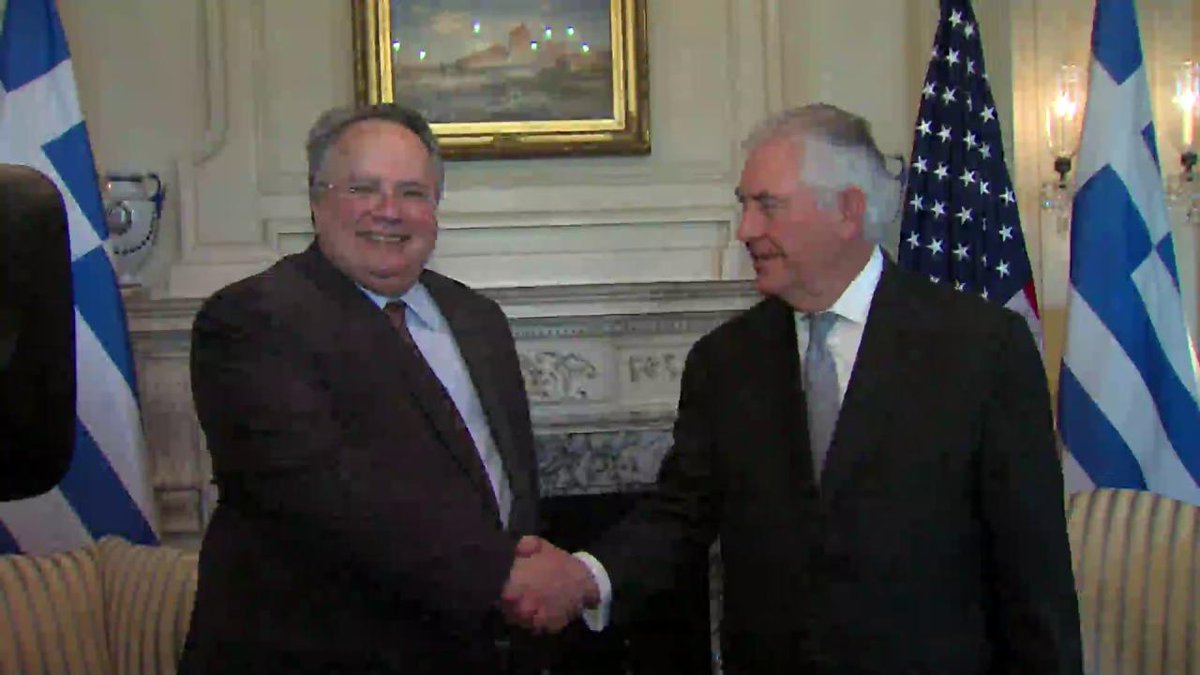
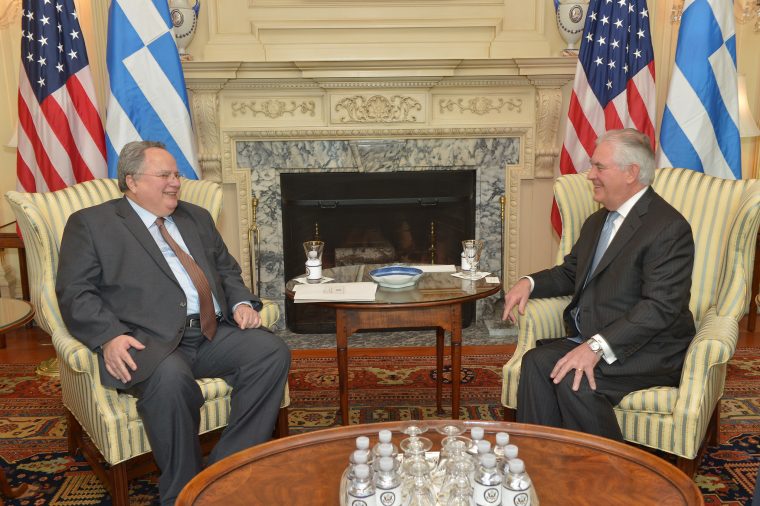
U.S. Secretary of State Rex Tillerson meets with Greece’s Foreign Minister Nikos Kotzias at the State Department on Monday, March 13, 2017 in Washington. (AP Photo/Molly Riley)

WASHINGTON – U.S. Secretary of State Rex Tillerson meets with Greece’s Foreign Minister Nikos Kotzias at the State Department on Monday. Kotzias will be in Washington, D.C. on Monday and Tuesday (March 13-14), for a series of meetings with National Security Advisor Lieutenant General H. R. McMaster, representatives of the U.S. administration, members of Congress, representatives of the academic community and Greek-American organizations.

“This meeting will further advance the longstanding and vigorous U.S.-Greece strategic partnership,” Greek Foreign Minister said after his meeting with his American counterpart, according to the Greek Foreign Ministry.

Earlier today, Secretary Tillerson hosted ‘s Minister of Foreign Affairs Nikos Kotzias at @StateDept.

“We will discuss the problems of the region and we will examine where our views and our plans coincide” Foreign Minister Nikos Kotzias stated earlier to Athens Macedonian News Agency ahead of his departure for Washington where he will pay a two-day visit on Monday and Tuesday.

Kotzias expressed his hope that this visit will contribute in the further enhancement of the Greek-American relations. Foreign Minister Nikos Kotzias will begin his series of meetings in Washington on Monday at 17:00 (Athens time), when he is to meet with US Secretary of State Rex Tillerson.

Kotzias’ message will be that Greece is a beacon of stability in the region, something that he will reiterate during his meeting with the new National Security Advisor and United States Army Lieutenant General Herbert Raymond McMaster that will take place on Tuesday at 16:00.

U.S. Secretary of State Rex Tillerson meets with Greece’s Foreign Minister Nikos Kotzias at the State Department on Monday, March 13, 2017 in Washington. (AP Photo/Molly Riley)

As TNH has reported, Kotzias is expected to meet his US counterpart in order to discuss relations between the two countries, Greco-Turkish relations, and other regional issues.

Greece is also expected to discuss the Cyprus problem. Cyprus’ government has denied the chance of a heated incident caused by Turkey in the island’s waters in June, when French energy company TOTAL will start natural gas exploration, Radio Proto reported on Friday.

U.S. Secretary of State Rex Tillerson meets with Greece’s Foreign Minister Nikos Kotzias at the State Department on Monday, March 13, 2017 in Washington. (AP Photo/Molly Riley)
https://www.thenationalherald.com/154255/kotzias-visit-us-chance-enhancement-us-greek-relations/

Ρεαλπολιτίκ

0
 ΑΛΕΞΗΣ ΠΑΠΑΧΕΛΑΣ
Σ​​τα εθνικά ζητήματα έχει πάντοτε σημασία το πώς και πότε τα θέτει κάποιος, ειδικά αν βρίσκεται σε θέση ευθύνης. Ασφαλώς και «πουλάνε» και αναπαράγονται με αστραπιαία ταχύτητα. Διανθίζονται συνήθως και με «σέξι» τίτλους-κλισέ του τύπου «Ηχηρό χαστούκι από τον τάδε στην Τουρκία». Δεν λύνουν, όμως, κανένα πρόβλημα.

Η χώρα πλήρωσε πολλές φορές στην ιστορία της την πατριδοκαπηλία. Οι Τούρκοι έφτασαν κάποτε στον Δομοκό επειδή μία ελίτ της εποχής προκάλεσε παράκρουση στην κοινή γνώμη, χωρίς να συνυπολογίσει τη συγκυρία και τις δυνατότητες της χώρας. Εχουμε και μια μεγάλη, όσο και άθλια, παράδοση, να χωριζόμαστε –σαν πρόβατα– σε προδότες και μειοδότες, γιουσουφάκια και λεβέντες. Από τη μια έχουμε όσους θέλουν να ξαναπάρουμε την Πόλη και απλώς ντρέπονται να το πουν. Από την άλλη, εκείνους που μπερδεύουν τη ρεαλπολιτίκ με το «λύση να ’ναι και ό,τι να ’ναι» σε όλα τα ζητήματα.

Θέλει σύνεση, ψυχραιμία και πολύ υπολογισμένες κινήσεις η διπλωματία. Ευτυχώς για εμάς, έχουμε ανθρώπους σε θέσεις ευθύνης που συνδυάζουν τον επαγγελματισμό με τσαγανό αλλά και σύνεση.

Θα μου πείτε, και τι πρέπει να κάνουμε όταν μας προκαλούν οι Τούρκοι; Ας ρίξουμε μια πιο ψύχραιμη ματιά και θα δούμε ότι συχνά μπαίνουμε σε έναν φαύλο κύκλο που είναι δύσκολο να εντοπίσεις πώς ξεκίνησε. Και κάτι ακόμη. Οταν η άλλη πλευρά επαναλαμβάνει τυπικά διάφορες αιτιάσεις, το ελληνικό κράτος, ανεξαρτήτως κυβέρνησης, απαντά θεσμικά εκεί όπου πρέπει: στον ΟΗΕ, το ΝΑΤΟ, την Ε.Ε. και όπου αλλού μετράει. Οταν χρειάζεται, απαντά και πιο δυναμικά στο παρασκήνιο, προειδοποιώντας φίλους και εχθρούς για τις «κόκκινες γραμμές» μας. Ο βερμπαλισμός εσωτερικής κατανάλωσης όμως δεν ωφελεί, ούτε εξυπηρετεί εθνικούς σκοπούς.

Ορισμένες μάλιστα φορές βάζουμε θέματα στο τραπέζι που ουδείς άλλος, πλην μιας τουρκικής γραφειοκρατίας, τα παίρνει στα σοβαρά. Κάνουμε, έτσι, «θέμα» κάτι που από μόνο του δεν ήταν θέμα για κανέναν. Και αυτό είναι λάθος. Αν συμμετείχαμε σε κάποιον διεθνή διαγωνισμό ντιμπέιτ ή αν εκδικαζόταν μια υπόθεση στο Διεθνές Δικαστήριο, θα είχε νόημα να ανοίξουμε συζήτηση.

Το πράγμα μπορεί να καταστεί επικίνδυνο. Στην Αγκυρα μοιάζει να λειτουργεί μια παιδική χαρά που θεωρεί θεμιτό να επιτίθεται επώνυμα στον Πρόεδρο της Δημοκρατίας, μεταξύ άλλων. Ευτυχώς οι ενήλικοι, και εκεί και στην Αθήνα, κρατούν (ακόμη) τα μπόσικα.

Πριν από αμέτρητα χρόνια συμμετείχα με άλλους φίλους Ελληνες ανταποκριτές σε ένα μπρίφινγκ στο Στέιτ Ντιπάρτμεντ. Κάποιος ρώτησε τον εκπρόσωπο, που συμπαθούσε την Ελλάδα, «αν οι ΗΠΑ αναγνωρίζουν τα 6 ή τα 10 μίλια ως το όριο του ελληνικού εναέριου χώρου». Ο εκπρόσωπος απάντησε ότι θα μελετήσει το θέμα και θα επανέλθει. Διεμήνυσε όμως σε όλους τους Ελληνες δημοσιογράφους ότι «ίσως καλύτερα να μην επιμείνετε στην ερώτηση γιατί δεν ξέρω τι απάντηση θα δώσει το νομικό τμήμα». Ο καλός, και ειλικρινά αγνός πατριώτης, συνάδελφος ρώτησε παρ’ όλα αυτά 4 – 5 φορές ακόμη. Επειτα από δύο μήνες ήλθε η απάντηση, που ουσιαστικά έλεγε ότι υπάρχει διαφωνία επί τους θέματος και πρέπει να επιλυθεί. Και τότε ρώτησε ο καλός και αγαπημένος συνάδελφος: «Μα γιατί δώσατε αυτή την απάντηση, ειδικά τώρα μάλιστα που υπάρχει τόση ένταση στο Αιγαίο;». «Μα γιατί με ρωτήσατε πέντε φορές», απάντησε ο εκπρόσωπος.

“Καθημερινή”

The crisis of the ideology of neoliberal globalization *

0

TAKIS FOTOPOULOS (12.03.2017)

Abstract

In this article it is argued that it is not only globalization itself, which is generally recognized to be in a state of serious crisis but that the ideology used to ‘justify’ (supposedly objectively) neoliberal globalization seems also to be going through a parallel terminal crisis. It is shown that the cause of this crisis is that this ideology never passed the ‘reality test’, despite the strenuous efforts of the globalist ideologues. It was this recognition and the parallel success of neo-nationalist movements in attracting the masses of the working class victims of globalization from the globalist ‘Left’, which has led the latter to invent the myth of racism in order to smear the Brexit revolutions in UK, USA and beyond.

It is generally recognized today that globalization goes through its most serious crisis since it developed into the present New World Order (NWO) of neoliberal globalization at the end of the 20th century, as even the flagship of globalist ‘Left’ admitted very recently reflecting the views of multinational corporations’ chief executives.[1] I am talking of course about neoliberal globalization because a capitalist globalization can only be neoliberal, as it implies  open and ‘liberalized’ markets for capital, labor, goods and services—the infamous ‘four freedoms’ of the EU Maastricht Treaty. No wonder the globalist academics and politicians, i.e. all those taking globalization for granted, have been trying hard lately to counter the widespread and growing discontent against it, which has already taken the form of pure anger. This anger became plain as day in the Brexit revolution, as well as in the results of the US Presidential election, which established a pattern expected to be repeated shortly in the forthcoming elections in France, Italy and so on.

This pattern, as I described it in my latest book,[2] involves, in the first stage, the launching of a frontal attack by the transnational elites and the local elites associated with them against those questioning in any way the NWO and its institutions, such as the EU, using frequently the ‘fear weapon’ (aiming at the feeling of insecurity that any radical change inevitably generates to most people) but, also, pure lies and slanders about the supposed racist, if not ‘fascist’, nature of the anti-EU forces and so on. Then, a barrage of polls follows which, invariably, predict the defeat of the political forces questioning globalization. These predictions are not simply the result of data manipulation by the pollsters (who are usually funded by the economic and political elites with a clear interest in influencing voters) but may also express their inability to establish the voters’ true intentions —some of whom, clearly terrorized by the mass establishment campaign, hide their real intentions of voting. Finally, at the last stage, catharsis follows with the reversal of all expectations and the victory of the anti-establishment (i.e. the anti-NWO) forces.

The ideology of globalization vs. reality

The ideology of globalization, which is of course the dominant ideology today, is simply the set of ideas and beliefs which are used to ‘justify’ (supposedly objectively) neoliberal globalization in all its aspects, i.e. economic, political, cultural and so on.  This is the ideology which one can easily find in the publications of the IMF, the World Bank etc., which is repeated ad nauseam by the establishment economists, politicians, academics (who brainwash accordingly their own students) and of course the mass media of the transnational and local elites that express the interests of the minority of the world population benefiting from neoliberal globalization. Inevitably, this ideology is increasingly resented today, either directly or indirectly, by the victims of globalization, i.e. the vast majority of the world population.

This ideology is usually presented under a pseudo-scientific cover, reflecting the dubious scientific nature of economics as such. This nature of economics became particularly evident in the latest two economic crises (in the late 1990s and, particularly, in 2008-9) which no economist has successfully predicted. This is of course something that reflects the fact that economics (and I am talking about both orthodox and Marxian economics) was never a science in the strict sense of the word as I have shown elsewhere[3] and most philosophers of science agree on this.

The basis of the ideology of globalization is that the opening and liberalization of markets, (or the removal, in IMF parlance, of ‘structural deficiencies’ or barriers), which are due to inflexibilities of the market mechanism and barriers to free competition, would boost competitiveness and therefore growth and employment. Such barriers that were mentioned in the Cecchini Report,[4] on which the official ideology of the single market for the EU rested, were the various physical, technical and fiscal barriers that were assumed to obstruct the flow of commodities, capital and labor. As regards to the capital market in particular, freeing this market from any controls, that is, the creation of conditions for the easy and unrestricted flow of capital between countries, was considered to be a basic requirement in this process. This is why the abolition of all foreign exchange controls has always been considered an essential condition for the `Single European Market’ of 1993.

However, the most important barriers were not the ones explicitly mentioned in the Report, but those implied by it and, in particular, the emphasis it placed on competition. These implied barriers were the ‘institutional’ barriers to free competition, which had been introduced by the social-democratic consensus (1945-1975) and which the agreement for the Single Market undertook to eliminate — a task brought to completion by the Maastricht treaty. Such institutional barriers were the Keynesian type of state interventionism to secure full employment and the large welfare state that created fiscal and therefore competitiveness problems, the labor unions’ restrictive practices’ and the nationalized industries, which did not always act on the basis of micro-economic criteria to raise economic efficiency.

Yet, the systematic removal of these ‘barriers’, that the opening and liberalization of markets entailed, far from boosting income and employment, it led to massive inequalities and chronic underemployment through the vast expansion of part time work, zero contract hours and so on. Furthermore, the opening and liberalization of markets has led to a tremendous concentration of economic power, which in the last two decades has taken the dimensions of hyper-globalization. A significant recent study[5] on globalization, among others, confirms the above trends. The main feature of this hyper-globalization has been the rise of Transnational Corporations (TNCs) that, by 2009, numbered more than 80,000, accounting for about two-thirds of world trade. However, hyper-globalization is beneficial only to small sections of the world population, whereas the vast majority of people are victims. This was the inevitable outcome of the opening and liberalization of markets that has led to a huge concentration of power in the hands of TNCs, as scientific studies, such as a 2011 study by the New Scientist, have established.[6] This study, using a database listing 37 million companies and investors worldwide, identified 43,060 TNCs and the share ownerships linking them. It revealed that, of these TNCs, just 1,318 core companies, through interlocking ownerships, own 80% of global revenues. Furthermore, they found that just 147 companies (i.e. less than 1 per cent of the network) form a ‘super entity’, controlling 40 per cent of the wealth of the entire network!

Furthermore, the supposed benefits of globalization to non-advanced capitalist countries such as China, India, Brazil etc. is in reality a myth.  What happens is that TNCs are involved in a huge pursuit of the places all over the globe which secure the minimization of the cost of production in terms of labor cost in particular but also taxes and similar company costs. Multinationals are, rightly (from their own point of view), responding as quickly as possible to those new demands and, as a result, we are witnessing a level of international outsourcing that we could never have imagined. As it was observed by an expert on the field:

“‘Made in’ labels mean little nowadays: companies based in the west often have their production plants elsewhere and use components sourced from third countries; and are financed by investors in yet other countries. If that were not complex enough, when countries impose trade barriers and erect controls, companies simply move overnight. Regulators and governments often do not stand a chance.”[7]

So, in the NWO, it is no longer nation-states that rule the world, fighting among themselves for the division of world markets, but rather the transnational corporations. It is these huge oligopolies that are always the victors, irrespective of where they base their activities. Therefore, the fact that today China or India look like economic superpowers (or rising superpowers) is not, in effect, an economic miracle but rather an economic mirage. If any of these countries stopped offering the ‘comparative advantages’ they presently do, particularly in terms of cheap production cost they offer to the TNCs, then the economic miracle would end overnight  — i.e. as soon as the TNCs move to one of the other countries begging them to invest in their own area.

The mechanism through which the real incomes of the victims of globalization have declined works through the lifting of any significant social controls on markets imposed in the past to protect society and environment from markets. The effective lifting of social controls aiming at the protection of society from the markets means that transnational corporations are today free to move capital and commodities all over the world, while having to face regulatory controls only. Furthermore, the ‘liberalization’ of labor markets, which is part of the same process, implies effectively the lifting of social controls to protect labor, for the sake of attracting foreign capital, (i.e. the transnational corporations), and making the economy more ‘competitive’. ‘Flexible’ labor is the norm in this process, i.e. a vast expansion of part-time or occasional labor, zero hours’ contracts etc. – all of which have the effect of artificially reducing the level of unemployment at the expense of real incomes, i.e. incomes which are essentially frozen in real terms.[8]

Furthermore, liberalization of labor markets meant also the opening of borders that facilitated the movement of labor, particularly among the EU countries, through the Lisbon and Schengen Treaties. The result of this was the present migration crisis in the EU that threatens its very foundations. The EU elites are of course in favor of labor market liberalization, so that real wages are suppressed in the EU area but the precondition for such a policy to be effective is that they would be in control of the labor flows. It is exactly the violation of this precondition that has created the present crisis.

Therefore, coming back to the economic ‘miracles’ of countries such as China and India, in fact,  they are both characterized by hundreds of millions of starving people and just a few hundred billionaires, as well as a  small (proportionately to their population), but utterly greedy, middle class. India, for instance is a country where Mercedes saw a 47% surge in sales recently and where its super-rich have long raised eyebrows around the world with their spectacular spending,[9] whereas at the same time nearly half of India’s 1.2 billion people have no toilets at home[10]and nearly 2 million children under the age of five die every year from preventable illness as common as diarrhea, and of those who survive, half are stunted owing to a lack of nutrients.[11] Yet, the Indian elite recently decided that the country could afford to have its own space program and even launched the first satellites![12]

The myth, in particular, of the emerging new economic superpower in China is based on crude statistical indicators, such as GDP and the concentration of industrial and trade power within that country. But such indicators ignore the huge size of its population, and the fact that it is basically the TNCs which created the alleged economic miracle, including the post-Mao industrial and trade power. Thus, taking into account relative population sizes, the per capita GNP of China and India is still 11% and 3.5% respectively of that of the USA,[13] despite the fact that the celebrated growth rates achieved by both countries in the last decade were over six times higher in China and more than four times higher in India, than in the USA.[14] In other words, the so-called economic ‘miracles’ of globalization (China, India etc.) are, in fact, the myths of globalization, as their rapid growth and industrialization, in the last 35 years or so, simply mirrors the de-growth and de-industrialization of the West. It was from the West that many TNCs moved to China and India to maximize their profits, exploiting the huge comparative advantage of these countries in terms of cheap production cost (mainly cheap —and usually skilled —labor), as well as in terms of markets free of significant social controls, low taxes, and other facilities offered to investors, particularly in the ‘special economic zones’ of slave labor emerging lately in countries like China. Similarly, the allegation repeated by Obama and all globalist ideologues of the supposed drastic reduction of world poverty as a result of globalization can also be shown to be a statistical myth. The presumed “elimination” of poverty is almost exclusively due to the fact that the Chinese “communist” leadership removed from the list of the poor more than 400 million Chinese in the period 1981-2001, simply because they became proud earners of US$ 1 dollar a day, thus decreasing with one stroke of the pen the percentage of absolutely poor in China by two-thirds and reducing accordingly world poverty —something that every self-respecting ideologue of globalization celebrates![15]

As for the supposedly huge trade power of China, although this is prima facie true, many, if not most, of its high technology exports and imports are due to the activities of foreign TNCs. This means that the moment the country decides to impose drastic social controls on markets to reduce their ‘freedom’ to move capital and commodities in and out of their country, (e.g. in order to protect local labor or the environment from the wild exploitation of TNCs), the Chinese ‘miracle’ could end overnight.

Also, one can draw similar conclusions with regards to the other dimensions of transnational economic power, e.g. China’s technological power. As Wolf & Pilling pointed out in their study, a clear indication that China is still well behind is that “economy wide average productivity remains a fifth of US levels.”[16]  Even more important is the absence of world-leading Chinese technology companies, as the same study shows, with the principal exception of Huawei, whereas the US by comparison, hosts a significant number of world-leading companies.

The consequences of globalization and the propaganda of the Transnational Elite

But let us see briefly how the globalization process has already led to an unprecedented concentration of income and wealth, which several studies have confirmed.

As regards to the concentration of income, according to Nobel laureate in economics Joseph Stiglitz:

“Large segments of the population in advanced countries have not been doing well: in the US, the bottom 90% has endured income stagnation for a third of a century. Median income for full-time male workers is actually lower in real (inflation-adjusted) terms than it was 42 years ago. At the bottom, real wages are comparable to their level 60 years ago.”[17]

Also, as regards the concentration of wealth, according to a Credit Suisse report, the richest 1 percent on the planet owned 48.2 percent of the world’s wealth in 2014, (up from 46 percent the year before), whereas the bottom half of the global population owned less than 1 percent of the total wealth![18] Furthermore, more recent data suggests there has been an acceleration in the concentration of wealth. Thus, according to a very recent OXFAM report, the net worth of the 62 richest people is equal to the combined wealth of half the world (3.5 billion poorest people). Furthermore, as the same study showed, this trend has accelerated sharply, in the last five years or so, as the wealth of a circle of billionaires consisting of 388 people has risen by 44 per cent, (or half a trillion dollars) since 2010, while the wealth of the poorest fell by 41 per cent (more than a trillion)! [19]

The social consequences of the huge inequality created by globalization, even in the USA, the country that played a leading role in promoting the opening and liberalization of markets throughout the post-war period, are well known. Thus, a very recent study published in the Journal of the American Medical Association implicitly showed that the more a country is integrated into the NWO the greater the negative impact on health and life expectancy. The result is that, as average life expectancy in developing nations continues to rise, lifespans in parts of America are getting shorter. This has reached the point where the poorest American men, at the age of 40, have a life expectancy comparable to the average 40-year-old man in Pakistan and Sudan! Rightly, therefore, Dr Deaton, a professor of economics at Stanford University, noted that the “infamous 1 per cent is not only richer” they have “ten to 15 more years to enjoy their richly funded lives,” with their life expectancy being better than the average for any nation on earth.[20]

Even the Financial Times, the systemic financial organ of the Transnational Elite par excellence recently had to admit the catastrophic consequences of globalization. As one of its main commentators pointed out: “We are close to the point where globalization and membership of the Eurozone in particular have damaged not only certain groups in society but entire nations,” describing in some detail the economic shocks that ‘inevitably’ result from globalization.[21] The economic shocks concerned are: the stagnation of real average incomes for two decades but also the global financial crisis — a consequence of globalization — and its permanent impact on long-term economic growth. The overall effect, according to the same report (written just before Brexit!) was:

“In large parts of Europe, the combination of globalization and technical advance destroyed the old working class and is now challenging the skilled jobs of the lower middle class. So, voters’ insurrection is neither shocking nor irrational. Why should French voters cheer labor market reforms if it could result in the loss of their jobs, with no hope of a new one?… In 2014, almost 90 per cent of Germans were in favor of free trade, according to a YouGov poll. That has fallen to 56 per cent. The number of people who reject TTIP outright has risen from 25 per cent to 33 per cent over the same period of time.”[22]

No wonder that, following in particular the victory of Brexit and the fact that President Trump, during the election campaign, adopted many of the demands of the victims of globalization, the Transnational elites have been terrified by this rapid rise of the anti-globalization movement. Particularly so as it is not anymore just the neo-nationalist movements in East Europe (such as those in Hungary and Poland) which challenge globalization. Following Brexit, the Eurosceptic Alternative for Germany party (AFD) came second, ahead of Chancellor Angela Merkel’s CDU, in regional elections held in September, while similar parties and movements in Italy, France, Austria and the Netherlands have also seen a significant rise in their popularity.

This could explain the concerted attack against the rising new anti-globalization movement by some of the prominent members of the Transnational elite, such as the head of the IMF, the president of the European Central Bank and the president of the European Council.[23] All of them suddenly discovered the gross inequality in the distribution of income and wealth as a result of globalization (followed belatedly by the globalists all over the world) — and blamed (not globalization itself, of course!) but just the political elites for not taking enough measures to boost  support for low income workers and reducing inequality. Yet, all of them are fully aware of the fact that any such measures are impossible, in an environment of open and liberalized markets. This is because any such measures, if they are designed to be effective (as present circumstances demand), they are bound to affect negatively competitiveness —the foundation of globalization itself.

Not surprisingly, the arch-gatekeeper of globalization, the EU Commission President, immediately came out to ‘restore order’ and declare that the recipe for combating growing discontent in Europe was “more union” including a military headquarters “to co-ordinate efforts towards creating a common military force”. This  rightly prompted Le Pen, the leader of the French FN, to ask “What is the EU protecting us from — are you protecting us against prosperity?”[24]

The myth of an implicit racism behind the Brexit revolutions of UK and USA

Finally, a particularly odious myth promoted by ideologists of globalization (and explicitly or implicitly by the globalist “Left”) is that both Brexit and Donald Trump were victorious mainly because of an implicit racism in both societies. The obvious intention of this kind of slander was to discard any idea that the Trump vote in the USA (or, similarly the Brexit vote in the UK) had anything to do with class and anti-globalization, and everything to do with racism and anti-immigration! Yet, even orthodox academics could not escape some indirect hints to the class nature of the vote, as when they mention the fact that “Donald Trump was remarkably successful in such mid-West Rust Belt states as Michigan, Ohio and Wisconsin, where the decline of manufacturing industry has seemingly created a part of America that can also be said to have been ‘left behind.’[25]

On the other hand, two British academics with admitted connections to EU funding (although — as they stated in advance — not for this particular work!) attempted to do exactly this: to use high powered statistical analysis to draw conclusions consistent with the Bremain propaganda. That is, the black propaganda that those who voted Brexit did so mainly because of their anti-immigrant or racist feelings rather than because they were angry with the phasing out of their country’s economic and national sovereignty within the EU and the fact that their economic position had significantly deteriorated since the opening and liberalization of markets for capital, commodities and labor imposed by Thatcherism first and then by the Maastricht Treaty and the other EU treaties that followed.

Thus, according to this supposedly ‘objective’ scientific research, those who voted for Brexit did so simply because they were ignorant anti-immigrant (the implicitly insinuation is that they were racists) who in fact live in areas where immigration is low and therefore were hardly in a position to judge whether immigration is good or bad! The two academics, starting with the clearly biased premise that “the EU referendum was, for many people, a referendum on immigration”, made a major ‘discovery’ based on supposedly “hard evidence”. Their ‘discovery’ was that “in most cases, high proportions of Leave voters were not concentrated in areas of high immigration. Apart from a few outliers, the districts with the highest vote for Leave were those with the lowest levels of immigration.”[26] However, you do not need any sort of statistical analysis but just common sense to realize that immigrants do not have any economic or other incentive to move to deprived areas populated mostly by the victims of globalization and, instead, they tend to concentrate in areas where the beneficiaries of globalization also live, such as London, although, inevitably, many of the victims of globalization also live in such big urban areas and inner London areas.  But, at this point, this ‘objective’ analysis makes another heroic jump to ‘justify’ the biased premise it started with. Relying on the conclusions of the well-known systemic think-tank Demos (presumably based on a similar kind of ‘research’) according to which “contact with migrants and members of ethnic minority communities ‘takes the edge off negative perceptions’, something reinforced by assimilation,” they drew, hey presto, the pre-conceived conclusion they wanted to ‘prove’:

“So, where migrants were not present, it appears they were held partly to blame for the all-too-real, but much deeper-seated, economic difficulties experienced by locals.” [27]

Clearly, this is just another distortion of the voting behavior of the victims of globalization. The “economic difficulties experienced by locals” that the research mentions refer, mainly, to the squeezing of wages as a result of immigration. Τhe obvious inference is that the absence of such a serious squeeze in an area should be taken to mean that, if Brexit was victorious in it, the locals should have been motivated by anti-immigration feelings.

However, the victims of globalization voted for Brexit not just because they suffered a squeezing in their wages during the globalization era but, even more important, because of the general deprivation in their areas, as a result of the closing down of entire industries following the move of the TNCs to the ‘labor paradises’ of the Far East. Furthermore, they voted for Brexit because of the decaying of the social welfare system, which of course has been directly due to the drastic cut in social spending in the globalization era, as a result of the adoption of tax cutting neoliberal policies. Obviously, the mass influx of immigrants, on top of the cuts in social spending, had surely made the situation worse.

In other words, the real motives of those who voted for Brexit cannot be found on the basis of empirical research, as this sort of analysis idiotically implies, but only on the basis of historical analysis. Thus, the fact that before globalization there were no serious anti-immigrant or Islamophobic trends in Europe is far from accidental. Common sense makes crystal clear that the effects of globalization I mentioned above, as well as those of the mass Islamophobic campaign  —supposedly aimed against terrorism but, in fact, aimed to cover up the crimes of the Transnational and Zionist elites in the Middle East during the globalization era — are highly related to the present outburst of anti-immigrant and Islamophobic trends.

Similarly, the Trump victory in the USA simply confirmed the fact, recognized also even by systemic writers, that the movement for Brexit in Britain, as well as the movement for Trump in the United States and similar movements all over Europe, are in fact all parts of a rising new anti-globalization movement which began in Europe and has spread all over the world. As I tried to show in my latest book with respect to Brexit, globalization is a class issue, and Brexit reflected the popular reaction to the class nature of globalization. Furthermore, it was exactly the abysmal failure of the ‘Left’ in the UK and US to grasp this fact (either for dogmatic reasons or because it has already been fully integrated in the NWO) which has led to its theoretical and consequently political bankruptcy. Therefore, the Trump victory in the USA simply confirmed the fact, recognized also even by systemic writers, that the movement for Brexit in Britain, as well as the movement for Trump in the United States and similar movements all over Europe, are all parts of a rising new anti-globalization movement which began in Europe and has spread all over the world.

Yet both the globalists in the US (i.e. the Democrats as well as the globalist ‘Left’) and those in the UK did not have any qualms about playing the racist card, in their desperate effort to root out ‘Trumpism’ and Brexit respectively. The pretext in the US was Trump’s senseless promise to build a wall around America and particularly on the border with Mexico to stop mass illegal immigration from that country. On this, he was conveniently ‘forgetting’ in the process that it was the US elites in the first instance, which, in collaboration with the Mexican elites, created the present dependent development of Mexico, whose growth depends on foreign (i.e. US) investment and trade, as these elites destroyed any possibility of economic self-reliance in that country. Of course, Mexico’s dependent development goes back to the history of its relation to the USA in the last century and NAFTA, (the agreement between the local and US elites) simply institutionalized this dependence relationship (exactly as the EU agreement institutionalized Greek dependence on Northern Europe).

Towards a Democratic world Community of Sovereign Nations

As Prof. John McMurtryaptly described the causes underlying the rise of the present anti-globalization movement:

“An underlying revolution in thinking has occurred. Trump has tapped the deep chords of worker rage at dispossession by forced corporate globalization, criminally disastrous Middle East wars, and trillions of dollars of bailouts to Wall Street. He never connects the dots on stage. But by Clinton’s advocacy of all of them, she has made them her own and will go down because of it… But this is not a Republican-Democrat division. It is as deep as all the lost jobs and lives since 2001, and it is ultimately grounded in the tens of millions of dispossessed people which the life-blind global market system and its wars have imposed on America too.”[28]

In fact, It is this realization of dispossession by the victims of globalization in Europe and the USA, as a result of the loss of their economic sovereignty (and for many peoples in Europe of their national sovereignty as well), which has led them to move en masse to the neo-nationalist movements:

  • from the globalist ‘Left’, which has been fully integrated into the NWO (Socialists, social democrats as well as political crooks of the SYRIZA and Podemos kind) and also
  • from a myopic anti-systemic Left which, like the millenarians, waits for the socialist revolution, instead of fighting for national and economic sovereignty by breaking the ties with the NWO and its institutions (EU, IMF, WTO and the likes).


No wonder the huge political gap created by the historical Left was quickly filled by neonalist parties and movements (most of which, however, have nothing to do with old nationalist and racist parties).

In conclusion, only an economic and political union of peoples resisting today’s uni-polar NWO would be in a position to create the pre-conditions for transcending the present homogenization and put, instead, the foundations for a different, really self-managed society  —something obviously impossible today when the vast majority of the world population, the victims of globalization, live under conditions of effective occupation fighting for their own survival. This requires a new transition strategy aiming to create the conditions for the development of a democratic world community of sovereign and self-reliant nations to replace the present New World Order of neoliberal globalization. It is also hoped that such a strategy would allow a genuine new form of internationalism to be built ‘from below’, which will be inspired by the principles of solidarity and mutual aid, rather than the catastrophic principles of competitiveness and profit-making, as at present.-


* This article draws heavily on the author’s new book under the title The New World Order in Action: Globalization, The Brexit Revolution and the “Left”, (Progressive Press, November 2016) which has been published in a second edition (December 2016) with a new chapter on the Brexit Revolution in the USA.


[1] Larry Elliott, “Executives more upbeat but share doubts over globalisation”, The Guardian, 17/1/2017

[2] The New World Order in Action, Globalization, the Brexit Revolution and the ‘Left’, (Progressive Press: San Diego, December 2016) ch.8

[3]  see Towards an Inclusive Democracy, (London & N.Y., Cassell, 1997, ch 8)

[4] P. Ceccini, The European Challenge (London, Wildwood House, 1988)

[5] Arvind Subramanian and Martin Kessler, “The Hyper globalization of Trade and Its Future”, Global Citizen Foundation,WORKING PAPER 3, JUNE 2013

[6] Andy Coghlan and Debora MacKenzie, “Revealed – the capitalist network that runs the world”, New Scientist Magazine, issue 2835 (24/10/2011)

[7] Miriam González, “Free trade has won: adapt or die is the only option left to us”, The Observer, 17/4/2016

[8] See e.g. Ed Conway, “The UK is paying the price of its jobs miracle,” The Times 14/10/2014

[9] Jason Burke, “As India’s super-rich list explodes, the shopping has only just begun”, The Guardian, 25/7/2014

[10]“India unveils cheap new village toilets”, BBC News, 1/9/2014 http://www.bbc.co.uk/news/world-asia-india-29008713

[11] John Pilger, “In India’s land of extremes, resistance is on the rise”, The Guardian, 3/1/2014

[12] Josh Hrala, “India just launched 20 satellites in 26 minutes and made history”, Science Alert, 22/6/2016 http://www.sciencealert.com/india-just-broke-a-record-by-launching-20-satellites-in-one-mission

[13] World Bank, World Development Indicators 2014, Table 1

[14] ibid. Table 4

[15] World Bank, World development indicators 2005, Table 2.5a. See Takis Fotopoulos, The “elimination of poverty”, The International Journal of INCLUSIVE DEMOCRACY, vol.4, no.1, (January 2008) http://www.inclusivedemocracy.org/journal/vol4/vol4_no1_takis_poverty.htm

[16] Martin Wolf and David Pilling, “China: On top of the world”, Financial Times, 2/5/2014

[17] Joseph E. Stiglitz, “Globalization and its New Discontents”,Project Syndicate, 5/8/2016 https://www.project-syndicate.org/commentary/globalization-new-discontents-by-joseph-e —stiglitz-2016-08

[18] “Richest 1% own 50% of world wealth- Credit Suisse report”, RT, 16/10/2014 http://rt.com/business/195816-richest-1-percent-credit-suisse/

[19] Sam Joiner, “Richest 62 in world worth the same as poorest 3.5 billion”, The Times, 18/1/2016

[20] Will Pavia , “Poor Americans have same life expectancy as Sudanese”, The Times, 13/4/2016

[21] Wolfgang Münchau, “The revenge of globalization’s losers”, Financial Times, 23/4/2016

[22] ibid.

[23] Claire Jones & Alec Barker, “Do more to help globalization’s losers, say champions of liberalism”, Financial Times, 13/9/2016

[24] David Charter, Juncker calls for more union to beat ‘galloping populism’, The Times, 14/9/2016

[25] John Curtice, Professor of politics at Strathclyde University, “The Trump-Brexit voter revolt”, BBC News, 11/9/2016 http://www.bbc.co.uk/news/election-us-2016-37943072

[26] Chris Lawton and Robert Ackrill, “Hard Evidence: how areas with low immigration voted mainly for Brexit”, Conversation, 8/7/2016 https://theconversation.com/hard-evidence-how-areas-with-low-immigration-voted-mainly-for-brexit-62138

[27] ibid.

[28] Prof. John McMurtry, “President Trump: Big Liar Going to Washington or Tribune of the People?,” op.cit.

source: http://www.inclusivedemocracy.org/journal/vol13/vol13_no1_The_Crisis_Of_The_Ideology_Of_Globalization.html

The International Journal of Inclusive Democracy : http://www.inclusivedemocracy.org/journal/

 

NATO: The Secretary General’s Annual Report 2016

0

13 Mar. 2017

 On 13 March 2017, Jens Stoltenberg released his third annual report as NATO Secretary General.
 The annual report provides an overview of how NATO protected its citizens and projected stability in 2016. It includes details on how NATO is enhancing deterrence and defence, engaging in dialogue, investing in security, improving capabilities, supporting the fight against terrorism, building relationships, sharing expertise, advancing the role of women in peace and security, and adapting as an institution.

Below you will find short descriptions of – as well as direct links to – the elements of the annual report.

You can also download the full annual report.

At no time since the end of the Cold War has the NATO Alliance faced greater challenges to our security than it does today.
But NATO is the most successful alliance in history because it has been able to change as the world has changed. For the first 40 years of its life, the Alliance’s focus was collective defence. When the Berlin Wall came down, our focus shifted to crisis management beyond our borders – intervening to stop large-scale bloodshed and keep the peace in the Western Balkans, fighting terrorism in Afghanistan, and tackling piracy off the Horn of Africa.

Read the Foreword in the Annual Report (PDF)

TOP

For All Who Serve

NATO’s commitment to safeguarding the freedom and security of all its members is made possible by the service of men and women from across its member and partner countries.

In 2016, tens of thousands of Allied service members were deployed on land, in the air, and at sea to provide for NATO’s defence and to project stability beyond NATO’s borders. Whether engaged in security operations, military exercises, or training missions, the security and stability of the Alliance would not be possible without their contributions.

NATO recognises the dedication of all who serve. The Alliance owes a debt of gratitude to every man and woman in service for the risks they take and the sacrifices they and their families make while serving NATO’s common purposes and values.

TOP

Preventing conflict means being able to deter and defend against any potential security threat. In recent years, NATO has responded to a series of new challenges with the largest reinforcement of its collective defence in a generation. At the same time, as part of an overall approach to its collective security, the Alliance seeks to improve transparency and reduce the risk of escalation by engaging in meaningful dialogue with Russia.
Read the chapter “Deterrence, Deterrence & Dialogue” in the Annual Report (PDF)

TOP

NATO is committed to defending its nearly one billion citizens in Europe and North America. Fulfilling this commitment requires that Allies understand the changing security environment, agree on policies for how to address the challenges and threats, develop and invest in the capabilities required to implement those policies, and resolve to use their capabilities when required. Each of these elements is essential for NATO to fulfil its purpose of safeguarding the freedom and security of all its members.
Read the chapter “Investing in Security” in the Annual Report (PDF)

TOP

NATO’s modern defence posture is based on an effective combination of cutting-edge weapons systems and platforms and forces trained to work together seamlessly. As important as it is that Allies invest in defence, it is also critical that those funds are invested in the right capabilities. NATO plays an important role in assessing what capabilities the Alliance needs, setting targets for national or collective development of capabilities, and facilitating national, multinational and collective capability development and innovation.
Read the chapter “Improving Capabilities” in the Annual Report (PDF)

TOP

Providing for the security of the Alliance requires not only a strong deterrence and defence posture but also the ability to project stability and strengthen security beyond NATO’s borders. For NATO, this involves a range of activities including providing training and support to countries such as Iraq and Afghanistan, conducting or contributing to missions on land, at sea and in the air, and cultivating relationships with partners around the world.
Read the chapter “Projecting Stability” in the Annual Report (PDF)

TOP

NATO maintains a broad and diverse network of partnerships with countries in the Euro-Atlantic region and beyond. In 2016, partners continued to be involved in many of the core activities that take place at NATO.
Partners have been integrated across NATO’s activities and agenda, often contributing sideby- side with Allies. Through its partnerships, NATO helps countries to strengthen their ability to safeguard their own security, both at home and as part of international missions.

Read the chapter “Projecting Stability: Cultivating Partnerships” in the Annual Report (PDF)

TOP

At the Warsaw Summit in July 2016, NATO leaders reiterated their belief that the empowerment of women at NATO and in the military make the Alliance stronger. If peace is to be sustainable, it must be inclusive. To that end, NATO and its partners are working together to promote the role of women in peace and security as part of their commitment to the implementation of UN Security Council Resolution (UNSCR) 1325 and related Resolutions.
Read the chapter “Promoting the Role of Women” in the Annual Report (PDF)

TOP

NATO is a political-military alliance of 28 countries. The Organization itself includes a number of structures that support the everyday work of the Alliance. Throughout 2016, NATO continued to implement innovative ways of working in order to improve its overall flexibility, effectiveness, efficiency and accountability despite a challenging resource environment. NATO also continues to adapt its processes and structures to ensure that it is adaptable by design and inherently flexible, resilient, and responsive to any threat. To this end, NATO continued to rigorously pursue improvements to better integrate resources and work strands, including by adopting modern and innovative approaches and ways of working. These efforts will help improve prioritisation and better align resources so that the workforce, both civilian and military, is well placed to support the achievement of NATO’s top priorities.
Read the chapter “Organisation” in the Annual Report (PDF)

Defence Expenditure of NATO Countries (2009-2016)


NATO collects defence expenditure data from Allies on a regular basis and presents aggregates and subsets of this information. Each Allied country’s Ministry of Defence reports current and estimated future defence expenditure according to an agreed definition of defence expenditure. The amounts represent payments by a national government actually made, or to be made, during the course of the fiscal year to meet the needs of its
armed forces or those of Allies. NATO also makes use of up-to-date economic and demographic information available from the Directorate-General for Economic and Financial Affairs of the European Commission, and the Organisation for Economic Cooperation and Development.

In view of differences between the definition of NATO defence expenditure and national definitions, the figures shown in this report may diverge considerably from those which are quoted by media, published by national authorities or given in national budgets. Equipment expenditure includes both spending on major equipment and on Research & Development expenditure devoted to major equipment. Personnel expenditure includes pensions paid to retirees.

The cut-off date for information used in this report is 15 February 2017. Figures for 2016 are estimates.

The figures presented are the same as those published in the Secretary General’s Annual Report 2016.

The graphs, tables and definitions of the defence expenditures of NATO Countries are available online (.PDF/465Kb)

Ευρώπη πολλών ταχυτήτων: Φυγή προς τα εμπρός ή αρχή αποδόμησης;

0

του Σταύρου Λυγερού

Η συζήτηση για μία Ευρώπη πολλών ταχυτήτων είναι παλιά. Πολλές ταχύτητες, άλλωστε, ήδη υπάρχουν. Χαρακτηριστικά παραδείγματα είναι η Ευρωζώνη και η ζώνη Σένγκεν. Στα δύο αυτά υποσύνολα συμμετέχουν μερικές από τις χώρες-μέλη και μάλιστα όχι οι ίδιες. Θα μπορούσε, λοιπόν, κάποιος να συμπεράνει πως αυτό που δρομολογήθηκε στη σύνοδο των τεσσάρων μεγάλων της ΕΕ στις Βερσαλλίες (6 Μαρτίου) δεν είναι τίποτα περισσότερο από την αναγνώριση αυτού που ήδη συμβαίνει. Το συμπέρασμα αυτό, ωστόσο, είναι άκρως παραπλανητικό. Η χρήση των ίδιων λεκτικών όρων κρύβει πολύ διαφορετικές προθέσεις και πραγματικότητες.

Ας πάρουμε, όμως, τα πράγματα από την αρχή. Μετά την ένταξη της Βρετανίας στην τότε ΕΟΚ το 1973, φάνηκε ότι ο παραδοσιακός ευρωσκεπτικισμός του Λονδίνου λειτουργούσε κατά κάποιον τρόπο σαν φρένο στην πρόθεση των άλλων κρατών-μελών να προχωρήσουν την ενοποιητική διαδικασία. Από τότε άρχισε η συζήτηση για διαφορετικές ταχύτητες. Ο τότε Γερμανός καγκελάριος Βίλι Μπραντ, μάλιστα, είχε το 1974 καταθέσει σχετική πρόταση. Με αυτό το πνεύμα θεσμοθετήθηκε αργότερα και η δυνατότητα των “ενισχυμένων συνεργασιών”. Η συνθήκη της Λισαβόνας προβλέπει ότι τουλάχιστον εννέα κράτη-μέλη μπορούν να προχωρούν σε βήματα περαιτέρω ενοποίησης.

Έτσι φθάσαμε στην Ευρωζώνη και στη ζώνη Σένγκεν για την ελεύθερη διακίνηση. Η λογική των “ενισχυμένων συνεργασιών”, ωστόσο, ήταν να ανοίξουν τον δρόμο για εμβάθυνση, με σκοπό να ακολουθήσουν και τα κράτη-μέλη που για διάφορους λόγους δεν συμμετείχαν αρχικά. Με άλλα λόγια, ο δεδηλωμένος στόχος ήταν, έστω και σε διαφορετικές φάσεις, να συμμετάσχουν στο υψηλότερο επίπεδο ενοποίησης όλα τα κράτη-μέλη, χωρίς να αλλοιώνονται οι αρχές της ισοτιμίας και της κοινοτικής αλληλεγγύης.

Η δρομολόγηση της Ευρώπης των πολλών ταχυτήτων που αποφάσισαν οι ηγέτες της Γερμανίας, της Γαλλίας, της Ιταλίας και της Ισπανίας πριν λίγες ημέρες στις Βερσαλλίες ρητορικά δεν διαφέρει από τα παραπάνω. Στην πραγματικότητα, όμως, δρομολογείται ο θεσμοθετημένος διαχωρισμός της ΕΕ σε ευρωπαϊκό πυρήνα και σε ευρωπαϊκή περιφέρεια. Με άλλα λόγια, δρομολογείται η θεσμοθέτηση κρατών-μελών πρώτης και κρατών-μελών δεύτερης κατηγορίας, γεγονός που παραβιάζει κατάφωρα την ιδρυτική συνθήκη. Η ειρωνεία είναι ότι αυτό θα θεσμοθετηθεί στην 60η επέτειό της, την οποία θα εορτάσουν στις 25 Μαρτίου οι “27” στη Ρώμη.

Παλαιότερα, το ερώτημα που βρισκόταν στο κέντρο των συζητήσεων ήταν “περισσότερη ή λιγότερη Ευρώπη;”. Τυπικώς, το ερώτημα αυτό παραμένει στο τραπέζι. Το πραγματικό ερώτημα, όμως, είναι εάν η σημερινή μεταλλαγμένη Ευρώπη είναι η όχι βιώσιμη. Αν και στο θεσμικό επίπεδο λίγα έχουν αλλάξει, είναι κοινός τόπος πως η ΕΕ της ισοτιμίας των κρατών-μελών και της κοινοτικής αλληλεγγύης αποτελεί παρελθόν. Δια της διολισθήσεως, η ΕΕ έχει αποκτήσει αφεντικό (Γερμανία), ιεραρχία και μεταμοντέρνες αποικίες, όπως η Ελλάδα.

Η οικονομική κρίση διευκόλυνε και επιτάχυνε αυτή τη διολίσθηση, αλλά ταυτοχρόνως έβγαλε στην επιφάνεια τις αντιφάσεις και όξυνε τις αντιθέσεις. Στο υπόστρωμα της μείωσης των εισοδημάτων και της περιστολής των εργασιακών δικαιωμάτων, ήλθαν να προστεθούν οι κοινωνικές παρενέργειες από το προσφυγικό-μεταναστευτικό κύμα και την ισλαμική τρομοκρατία. Το αποτέλεσμα ήταν να εκδηλωθεί μία μεγαλύτερη ή μικρότερη εκλογική εξέγερση των Ευρωπαίων.

Τα κόμματα του ευρύτερου (νεο)φιλελεύθερου χώρου χάνουν έδαφος, το οποίο κερδίζει η αντισυστημική ψήφος. Στον ευρωπαϊκό Νότο, η αντισυστημική ψήφος τροφοδότησε περισσότερο αριστερά κόμματα, καθώς και ιδιότυπα κόμματα, όπως το κίνημα του Γκρίλο στην Ιταλία. Στον ευρωπαϊκό Βορρά, όμως, τροφοδότησε κατά κανόνα εθνικιστικά-ξενοφοβικά κόμματα. Η εκλογική αυτή εξέγερση, που επιβεβαιώθηκε και ευνοήθηκε και από την εκλογή του Τραμπ, έχει τρεις συνέπειες:

  • Πρώτον, συρρικνώνει και σ’ ορισμένες χώρες απειλεί με κατάρρευση τη “φιλελεύθερη συναίνεση”, η οποία μεταπολεμικά κυριαρχούσε στη Γηραιά Ήπειρο.
  • Δεύτερον, αναπτύσσεται όχι ο παραδοσιακός ευρωσκεπτικισμός, αλλά ένα είδος ευρωάρνησης. Είναι ενδεικτικό ότι –σύμφωνα με δημοσκόπηση– το 65% των Γάλλων αντιμετωπίζει αρνητικά την ενοποίηση. Η τάση αυτή σ’ όλη σχεδόν την Ευρώπη κεφαλαιοποιείται πολιτικά κυρίως από τα ακροδεξιά-εθνικιστικά κόμματα, τα οποία περισσότερο ή λιγότερο έντονα θέτουν ζήτημα αποχώρησης τουλάχιστον από την Ευρωζώνη.
  • Τρίτον, η μετάλλαξη της ΕΕ των εθνών σε “γερμανική Ευρώπη” έχει ως αποτέλεσμα την όξυνση των εθνικών αντιθέσεων και τη διάβρωση της αμοιβαίας εμπιστοσύνης. Αυτά με τη σειρά τους προκαλούν την ανάπτυξη όχι μόνο της ευρωάρνησης, αλλά ταυτοχρόνως και αντιγερμανικού κλίματος. Ήταν αναπόφευκτο. Τα στοιχεία αποδεικνύουν πως ο μεγάλος κερδισμένος από την καθιέρωση του ευρώ είναι η Γερμανία. Το Βερολίνο συμπεριφέρεται όλα αυτά τα χρόνια με έκδηλο οικονομικό εθνικισμό. Αναλόγως, μάλιστα, με το τι κάθε φορά την συμφέρει, άλλοτε κρύβεται πίσω από την ΕΕ και άλλοτε δρα μονομερώς ή με επιλεκτικές συμμαχίες.

Το Brexit ήταν το πρώτο πλήγμα στην αλαζονική μακαριότητα του ευρωιερατείου. Η εκλογή του Τραμπ ήταν το δεύτερο όχι μόνο επειδή επιβεβαίωσε το ρεύμα, αλλά και επειδή απειλεί να ανατρέψει το παραδοσιακό πλαίσιο των ευρωαμερικανικών σχέσεων. Ο νέος Αμερικανός πρόεδρος αμφισβητεί τη βιωσιμότητα του ευρωπαϊκού οικοδομήματος. Στρέφεται, μάλιστα, ευθέως εναντίον της Γερμανίας, κατηγορώντας την όχι αδίκως ότι εκμεταλλεύεται τους εταίρους της και χρησιμοποιεί το ευρώ για να συσσωρεύει τεράστια εμπορικά πλεονάσματα. Το τρίτο πλήγμα ήταν η επικράτηση του “όχι” στο ιταλικό δημοψήφισμα που κατέστησε εύθραυστη την πολιτική σταθερότητα στη γειτονική χώρα.

Αντιμέτωπη με το κλίμα ευρωάρνησης, με τις αντιθέσεις των κρατών-μελών, με την αμερικανική πίεση και με το μειοψηφικό αλλά όχι απίθανο ενδεχόμενο νίκης της Λεπέν, η ΕΕ-Ευρωζώνη έχει περιέλθει σε υπαρξιακή κρίση. Είναι ορατά δια γυμνού οφθαλμού τα εσωτερικά ρήγματα.

Η ομάδα του Βίζεγκραντ (Πολωνία, Ουγγαρία, Τσεχία και Σλοβακία) δίνει σε σημαντικό βαθμό τον τόνο στην Ανατολική Ευρώπη. Οι λαοί αυτοί έχουν λιγότερα από 30 χρόνια που απέκτησαν την πραγματική ανεξαρτησία τους και είναι κατά κανόνα απρόθυμοι να παραδώσουν εθνική κυριαρχία στο ευρωιερατείο. Αλλά και ο ευρωπαϊκός Νότος, όπως φάνηκε στις συνόδους της Αθήνας και της Λισαβόνας, εκδήλωσε μία τάση αυτονόμησης από τη γερμανική ηγεμονία.

Η απόφαση των Βερσαλλιών είναι η απάντηση του Βερολίνου στην υπαρξιακή κρίση της ΕΕ. Είναι ενδεικτικό ότι το 52% των Γερμανών οικονομολόγων έχει ταχθεί υπέρ της Ευρώπης των δύο ταχυτήτων. Η Μέρκελ είναι η μόνη που διαθέτει ένα σχέδιο για το αύριο της Ευρώπης. Γι’ αυτό και δεν δυσκολεύθηκε να συμπαρασύρει τους υπόλοιπους τρεις. Ο μόνος που δυνητικά θα μπορούσε να προβάλει αντίσταση είναι ο Ολάντ. Εάν ηγείτο του ευρωπαϊκού Νότου, η Γαλλία θα μπορούσε να εξισορροπήσει τη Γερμανία. Από την εποχή του Σαρκοζί, όμως, το Παρίσι έχει επιλέξει να λειτουργεί σαν συμπλήρωμα του Βερολίνου. Με ελάχιστες εξαιρέσεις, σ’ αυτή τη γραμμή κινήθηκε ο Ολάντ.

Στην περίπτωση της Ευρώπης των πολλών ταχυτήτων, ο Γάλλος πρόεδρος όχι μόνο δεν αντιστάθηκε, αλλά ανέλαβε και τον ρόλο του διεκπεραιωτή. Αν πιστέψουμε, μάλιστα, τις πληροφορίες που κυκλοφορούν, ο Ολάντ θα ανταμειφθεί για τις υπηρεσίες του με κάποιο υψηλό ευρωπαϊκό αξίωμα. Από τη στιγμή που το Παρίσι συνέπραξε, ο Ιταλός Τζεντιλόνι και ο Ισπανός Ραχόι έσπευσαν να ακολουθήσουν για να μην μείνουν εκτός νυμφώνος.

Είναι προφανές πως τα κριτήρια, με τα οποία θα συγκροτηθεί ο πυρήνας είναι πρωτίστως πολιτικά και δευτερευόντως οικονομικά. Η Ιταλία και η Ισπανία είναι ασθενείς, αλλά είναι απαραίτητες στη Γερμανία. Προσεταιριζόμενη τα άλλα τρία μεγάλα κράτη-μέλη, η Μέρκελ διέσπασε τον ευρωπαϊκό Νότο, ακυρώνοντας στην πράξη την πρωτοβουλία για μία συνεννόηση των Νοτίων με σκοπό κοινές παρεμβάσεις στην ευρωπαϊκή σκηνή. Ταυτοχρόνως, απομονώνει την ομάδα του Βίζεγκραντ και εδραιώνει την υποστήριξη των παραδοσιακών συμμάχων της (Ολλανδία, Αυστρία, και Φινλανδία). Κατ’ αυτό τον τρόπο ανακτά στην κορυφή τον πλήρη έλεγχο της ΕΕ.

Το Βερολίνο είχε ερωτοτροπήσει και στο παρελθόν με την καθιέρωση της Ευρώπης των δύο ταχυτήτων. Το 1994, οι Σόιμπλε και Λάμερς είχαν καταθέσει πρόταση για διαχωρισμό της ΕΕ σε πυρήνα και περιφέρεια, αλλά είχαν προσκρούσει σε αντιδράσεις. Τότε, άλλωστε, η ΕΕ δεν ήταν αυτή που είναι σήμερα.

Η υπαρξιακή κρίση της ΕΕ μετέτρεψε ένα μάλλον ακραίο σενάριο σε κυρίαρχη επιλογή. Δεν ήταν μόνο το Βερολίνο που έβλεπε την καθιέρωση ουσιαστικά δύο ταχυτήτων σαν διέξοδο. Το 2015 ο Ολάντ είχε μιλήσει για «εμπροσθοφυλακή». Στο ίδιο μήκος κύματος και ο τότε υπουργός του Μακρόν, που σήμερα διεκδικεί την προεδρία, υποστηρίζοντας την προσκόλληση της Γαλλίας στη Γερμανία.

Πατώντας σ’ αυτό το έδαφος, η Μέρκελ ενορχήστρωσε την απόφαση των Βερσαλλιών. Απέσπασε τη συμφωνία και του Ντράγκι και του φεντεραλιστή Γιούνκερ, στις συναντήσεις που είχε μαζί τους το προηγούμενο διάστημα. Ο πρόεδρος της Κομισιόν, μάλιστα, υποχρεώθηκε να παίξει το γερμανικό παιχνίδι με τη Λευκή Βίβλο και τα πέντε σενάρια για το μέλλον της ΕΕ. Μπορεί ο ίδιος να εξέφρασε την προτίμησή του στην επιλογή να βαδίσουν όλα τα κράτη-μέλη μαζί προς την εμβάθυνση της ενοποίησης (5ο σενάριο), αλλά συμπεριέλαβε και το σενάριο των πολλών ταχυτήτων (3ο). Με τον τρόπο αυτό το νομιμοποίησε.

Η προαναγγελία έγινε από την ίδια την Μέρκελ πριν λίγο καιρό στη σύνοδο της Μάλτας, χωρίς να προκαλέσει έντονες αντιδράσεις. Στην προχθεσινή σύνοδο κορυφής έγινε ένα ακόμα αποφασιστικό βήμα και όλα δείχνουν πως σε μερικές ημέρες, στη σύνοδο της Ρώμης, η ΕΕ θα αλλάξει οριστικά. Η εξαίρεση των διαφορετικών ταχυτήτων θα καταστεί κανόνας.

Μέχρι πρότινος, το κυρίαρχο δόγμα ήταν ότι το ευρωπαϊκό ενοποιητικό εγχείρημα βαδίζει μόνο προς τα εμπρός και στο επίπεδο της διεύρυνσης και στο επίπεδο της εμβάθυνσης. Το Brexit διέψευσε το πρώτο και οι πολλές ταχύτητες το δεύτερο. Τυπικά, όποιο κράτος-μέλος θέλει και μπορεί θα συμμετέχει σε περαιτέρω βήματα ενοποίησης. Οι πρώτοι τομείς στους οποίους αναμένεται να γίνουν τέτοια βήματα είναι η άμυνα και η ασφάλεια, τα δημόσια οικονομικά και ίσως το μεταναστευτικό. Στην πραγματικότητα, όμως, στο όνομα της ευελιξίας-χαλαρότητας θεσμοθετείται η ανισότητα:

  • Πρώτον, ο υπό την ηγεσία της Γερμανίας ευρωπαϊκός πυρήνας θα δημιουργεί τετελεσμένα σύμφωνα με τα συμφέροντά του. Τα μικρότερα κράτη-μέλη της περιφέρειας θα πρέπει ή να τα αποδέχονται ή να περιθωριοποιούνται. Με άλλα λόγια, στο όνομα της αρχής “άμα θέλεις και μπορείς ακολούθησε”, οι “μικροί” θα χάσουν το θεσμικό όπλο του βέτο και κατ’ επέκτασιν την όποια δυνατότητα παρέμβασης και επιρροής τους έχει απομείνει.
  • Δεύτερον, ο υπό την ηγεσία της Γερμανίας ευρωπαϊκός πυρήνας θα αποδεσμευθεί με μικρά πηδηματάκια από τις όποιες θεσμικές υποχρεώσεις στήριξης των μικρότερων και των πιο αδύναμων κρατών-μελών. Αυτό πρακτικά σημαίνει ότι θα χαθεί και ό,τι έχει απομείνει από την περιβόητη κοινοτική αλληλεγγύη.

Από την περαιτέρω μετάλλαξη της ΕΕ, η Ελλάδα έχει να χάσει περισσότερα από τα υπόλοιπα μικρομεσαία κράτη-μέλη. Όχι μόνο λόγω του εγκλωβισμού της στη μνημονιακή παγίδα αργού θανάτου. Επίσης λόγω και του προβλήματος εθνικής ασφαλείας που αντιμετωπίζει λόγω της όξυνσης του τουρκικού επεκτατισμού. Ο Τσίπρας, όμως, βρήκε ενδιαφέρουσα υπό όρους την απόφαση των Βερσαλλιών! Επέλεξε μάλλον να πάει με τα νερά των ισχυρών μήπως και τον διευκολύνουν στο μέτωπο της αξιολόγησης.

Γενικότερα, η υποχώρηση σε βαθμό εξαφάνισης του κοινοτικού πνεύματος, η επικράτηση της αλακάρτ συμμετοχής στο ευρωπαϊκό οικοδόμημα και ο εκφυλισμός της κοινοτικής αλληλεγγύης σε κέλυφος δεν πρόκειται να αμβλύνουν την υπαρξιακή κρίση της ΕΕ. Αντιθέτως, αναμένεται να οξύνουν τις εσωτερικές αντιθέσεις και να τροφοδοτήσουν την ήδη ισχυρή τάση παλινδρόμησης και περιχαράκωσης των ευρωπαϊκών λαών στα εθνικά κράτη.

Εάν δεν προκύψει κάποιο γεγονός-τομή, όπως π.χ. η εκλογή της Λεπέν, το πιθανότερο είναι ότι το ευρωπαϊκό οικοδόμημα θα εισέλθει για τα καλά σε μία περίοδο αργόσυρτης αποδόμησης. Το ενδεχόμενο άμεσης διάλυσης δεν αποκλείεται, αλλά τα επενδεδυμένα συμφέροντα είναι πολύ μεγάλα για να επιτρέψει το ευρωιερατείο μία τέτοια εξέλιξη.

“Πρώτο Θέμα”