Αρχική Blog Σελίδα 2972

Merkel’s Government Warns Hungary in Clash Over Soros University

0

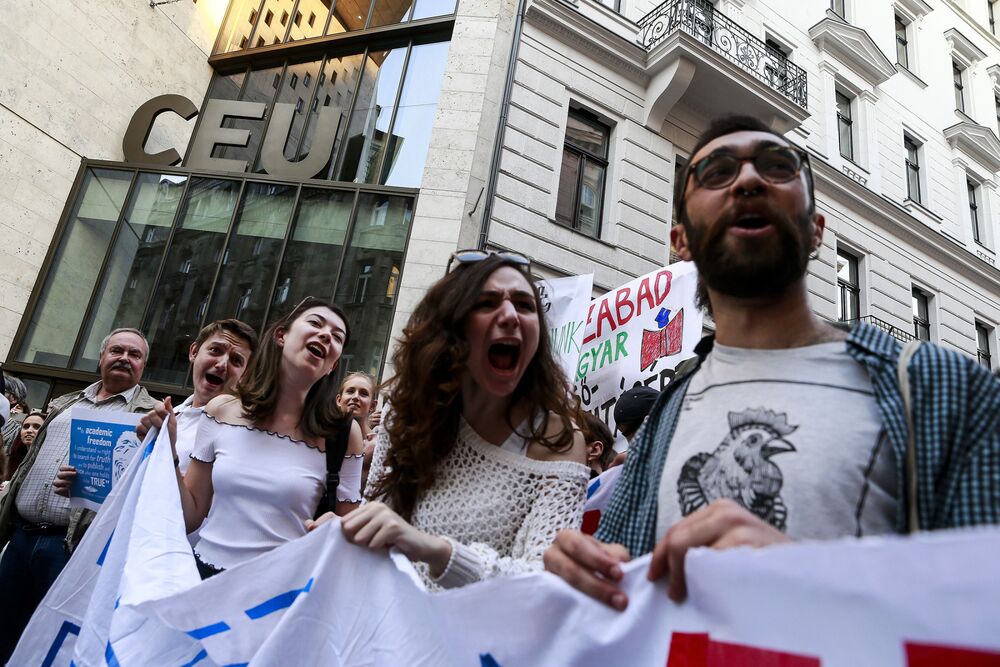
Protestors outside Central European University in Budapest, Hungary, on April 2, 2017.

German Chancellor Angela Merkel’s government warned Hungary against obstructing democracy with a law that threatens to shutter a university founded by George Soros, renewing tension between the two European Union allies.

The extraordinary legislation “raises the impression” that the operation of foreign universities in Hungary will be made difficult, “or in individual cases impossible,” Merkel’s deputy spokeswoman, Ulrike Demmer, said Wednesday. She singled out Central European University, the Budapest-based institution Soros founded in 1991 to train post-communist democratic leaders in eastern Europe.

“Freedom, democracy, rule of law and human rights are not up for debate in Europe,” Demmer told reporters in Berlin. “Germany will observe very closely the effects of this law on higher education in Hungary.”

Prime Minister Viktor Orban’s party pushed the bill through parliament on Tuesday amid street protests, setting tighter deadlines for universities to meet new regulations or risk closure. Merkel and Orban, while members of the same political family, have previously clashed over refugee policy and may be headed for another dispute as a range of European politicians criticize the education measure.

Democratic Foundation

“Orban is assailing the foundations of democracy in Hungary,” Gianni Pittella, head of the Socialist group in the European Parliament, told reporters in Strasbourg, France. Ska Keller, German co-leader of the Greens in the 28-nation parliament, said “Orban needs to be stopped.”

The Hungarian government denies that it’s targeting CEU and says it’s ready to discuss the case with the U.S. “George Soros’s lies can even mislead the German government,” the MTI newswire quoted Hungarian government spokesman Zoltan Kovacs as saying.

Orban, who has sought to shore up his power as he chips away at government checks and balances, regularly accuses Hungarian-born billionaire Soros for trying to undermine him.

Orban’s measures pose a dilemma for Merkel, whose Christian Democratic Union is allied with Orban’s Fidesz party in the European Parliament, where they help make up the assembly’s biggest faction, the European People’s Party.

The two leaders clashed at an EPP conference last week in Malta, where Orban blasted migration into Europe as a “Trojan horse of terrorism.” Merkel defended her open-border refugee policy, which also faces criticism at home as she seeks re-election to a fourth term in September.

U.S. Concern

German President Frank-Walter Steinmeier told the European Parliament in Strasbourg on Tuesday that “Europe must not be silent when civil society, even academia, as now at Central European University in Budapest, is deprived of air to breathe.”

Opposition to the legislation has emboldened Orban, who on Friday called CEU, one of Hungary’s top-ranked universities that’s also accredited in the U.S., a “cheat.” Later, the government acknowledged it’s is run in line with Hungarian law.

The U.S. is “disappointed by the accelerated passage of legislation targeting Central European University,” despite concern raised by the U.S., local and international organizations and “thousands of Hungarians who value academic freedom,” David Kostelancik, the U.S. charge d’affaires in Budapest, said in an emailed statement.

by

Patrick Donahue
Photographer: Anadolu Agency/Getty Images
www.bloomberg.com

The Changing Global Religious Landscape

0

Babies born to Muslims will begin to outnumber Christian births by 2035; people with no religion face a birth dearth

More babies were born to Christian mothers than to members of any other religion in recent years, reflecting Christianity’s continued status as the world’s largest religious group. But this is unlikely to be the case for much longer: Less than 20 years from now, the number of babies born to Muslims is expected to modestly exceed births to Christians, according to new Pew Research Center demographic estimates.

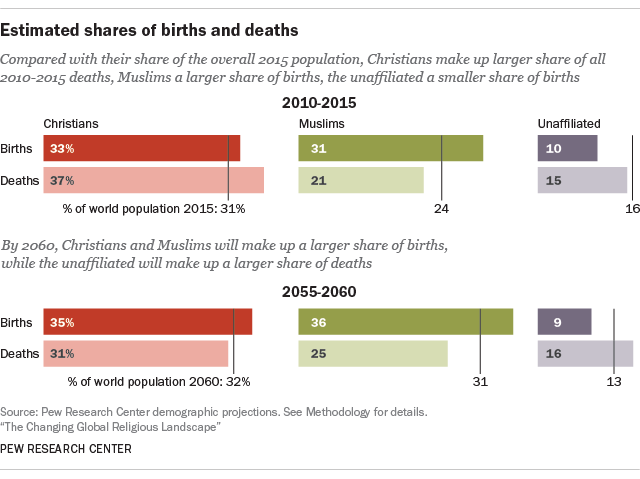
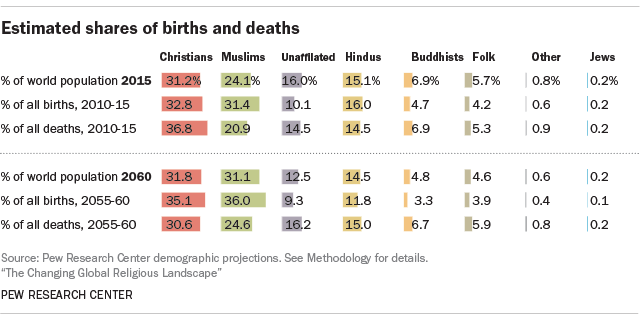
Muslims are projected to be the world’s fastest-growing major religious group in the decades ahead, as Pew Research Center has explained, and signs of this rapid growth already are visible. In the period between 2010 and 2015, births to Muslims made up an estimated 31% of all babies born around the world – far exceeding the Muslim share of people of all ages in 2015 (24%).

The world’s Christian population also has continued to grow, but more modestly. In recent years, 33% of the world’s babies were born to Christians, which is slightly greater than the Christian share of the world’s population in 2015 (31%).

While the relatively young Christian population of a region like sub-Saharan Africa is projected to grow in the decades ahead, the same cannot be said for Christian populations everywhere. Indeed, in recent years, Christians have had a disproportionately large share of the world’s deaths (37%) – in large part because of the relatively advanced age of Christian populations in some places. This is especially true in Europe, where the number of deaths already is estimated to exceed the number of births among Christians. In Germany alone, for example, there were an estimated 1.4 million more Christian deaths than births between 2010 and 2015, a pattern that is expected to continue across much of Europe in the decades ahead.

A note about terminology

The phrase “babies born to Christians” and “Christian births” are used interchangeably in this report to refer to live births to Christian mothers. Parallel language is used for other religious groups (e.g., babies born to Muslims, Muslim births).
This report generally avoids the terms “Christian babies” or “Muslim babies” because that wording could suggest children take on a religion at birth.

The assumption in these estimates and projections is that children tend to inherit their mother’s religious identity (or lack thereof) until young adulthood, when some choose to switch their religious identity. The projection models in this report take into account estimated rates of religious switching (or conversion) into and out of major religious groups in the 70 countries for which such data are available.

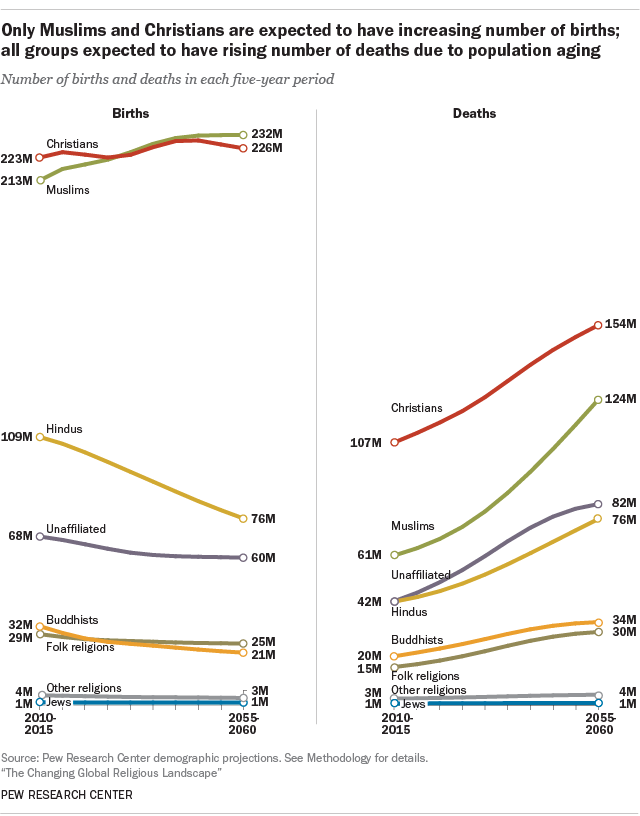
Globally, the relatively young population and high fertility rates of Muslims lead to a projection that between 2030 and 2035, there will be slightly more babies born to Muslims (225 million) than to Christians (224 million), even though the total Christian population will still be larger. By the 2055 to 2060 period, the birth gap between the two groups is expected to approach 6 million (232 million births among Muslims vs. 226 million births among Christians).1

In contrast with this baby boom among Muslims, people who do not identify with any religion are experiencing a much different trend. While religiously unaffiliated people currently make up 16% of the global population, only an estimated 10% of the world’s newborns between 2010 and 2015 were born to religiously unaffiliated mothers. This dearth of newborns among the unaffiliated helps explain why religious “nones” (including people who identity as atheist or agnostic, as well as those who have no particular religion) are projected to decline as a share of the world’s population in the coming decades.

By 2055 to 2060, just 9% of all babies will be born to religiously unaffiliated women, while more than seven-in-ten will be born to either Muslims (36%) or Christians (35%).

These are among the key findings of a new Pew Research Center analysis of demographic data. This analysis is based on – and builds on – the same database of more than 2,500 censuses, surveys and population registers used for the 2015 report “The Future of World Religions: Population Growth Projections, 2010-2050.” Both reports share the same demographic projection models, but the figures on births and deaths in this analysis have not been previously released.

In addition, this report provides updated global population estimates, as of 2015, for Christians, Muslims, religious “nones” and adherents of other religious groups. And the population growth projections in this report extend to 2060, a decade further than in the original report.

The projections do not assume that all babies will remain in the religion of their mother. The projections attempt to take religious switching (in all directions) into account, but conversion patterns are complex and varied. In some countries, including the United States, it is fairly common for adults to leave their childhood religion and switch to another faith (or no faith). For example, many people raised in the U.S. as Christians become unaffiliated in adulthood, and vice versa – many people raised without any religion join a religious group later in their lives. But in some other countries, changes in religious identity are rare or even illegal.2

At present, the best available data indicate that the worldwide impact of religious switching alone, absent any other factors, would be a relatively small increase in the number of Muslims, a substantial increase in the number of unaffiliated people, and a substantial decrease in the number of Christians in coming decades. Globally, however, the effects of religious switching are overshadowed by the impact of differences in fertility and mortality. As a result, the unaffiliated are projected to decline as a share of the world’s total population despite the boost they are expected to receive from people leaving Christianity and other religious groups in Europe, North America and some other parts of the world. And the number of Christians is projected to rise, though not as fast as the number of Muslims.

Global population projections, 2015 to 2060

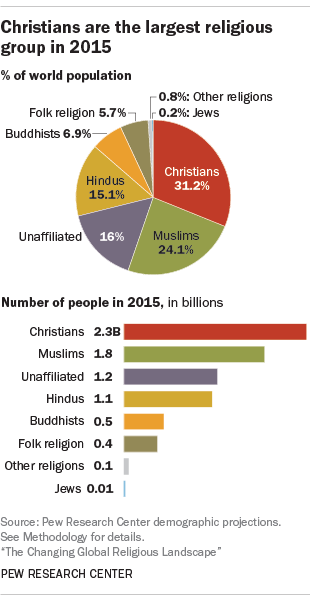
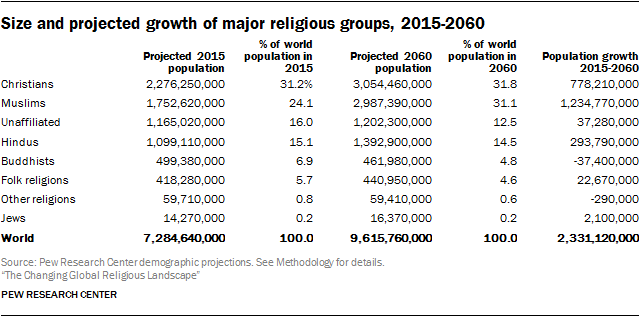
Christians were the largest religious group in the world in 2015, making up nearly a third (31%) of Earth’s 7.3 billion people. Muslims were second, with 1.8 billion people, or 24% of the global population, followed by religious “nones” (16%), Hindus (15%) and Buddhists (7%). Adherents of folk religions, Jews and members of other religions make up smaller shares of the world’s people.

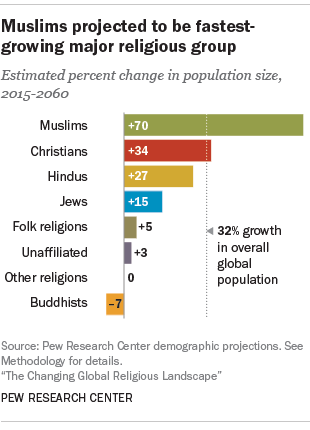
Between 2015 and 2060, the world’s population is expected to increase by 32%, to 9.6 billion. Over that same period, the number of Muslims – the major religious group with the youngest population and the highest fertility – is projected to increase by 70%. The number of Christians is projected to rise by 34%, slightly faster than the global population overall yet far more slowly than Muslims.

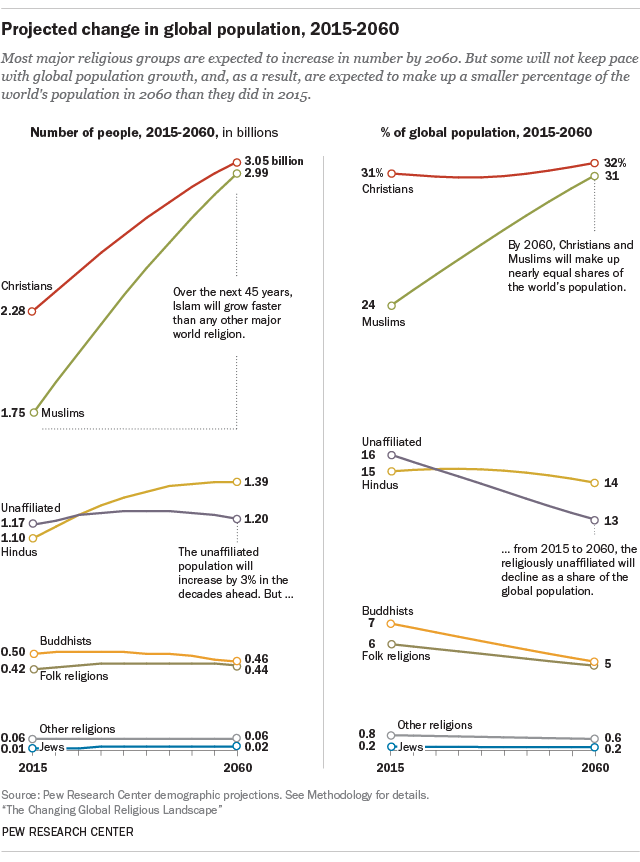
As a result, according to Pew Research Center projections, by 2060, the count of Muslims (3.0 billion, or 31% of the population) will near the Christian count (3.1 billion, or 32%).3

Except for Muslims and Christians, all major world religions are projected to make up a smaller percentage of the global population in 2060 than they did in 2015.4 While Hindus, Jews and adherents of folk religions are expected to grow in absolute numbers in the coming decades, none of these groups will keep pace with global population growth.

Worldwide, the number of Hindus is projected to rise by 27%, from 1.1 billion to 1.4 billion, lagging slightly behind the pace of overall population growth. Jews, the smallest religious group for which separate projections were made, are expected to grow by 15%, from 14.3 million in 2015 to 16.4 million worldwide in 2060.5 And adherents of various folk religions – including African traditional religions, Chinese folk religions, Native American religions and Australian aboriginal religions, among others – are projected to increase by 5%, from 418 million to 441 million.

Buddhists, meanwhile, are projected to decline in absolute number, dropping 7% from nearly 500 million in 2015 to 462 million in 2060. Low fertility rates and aging populations in countries such as China, Thailand and Japan are the main demographic reasons for the expected shrinkage in the Buddhist population in the years ahead.

All other religions combined – an umbrella category that includes Baha’is, Jains, Sikhs, Taoists and many smaller faiths – also are projected to decrease slightly in number, from a total of approximately 59.7 million in 2015 to 59.4 million in 2060.6

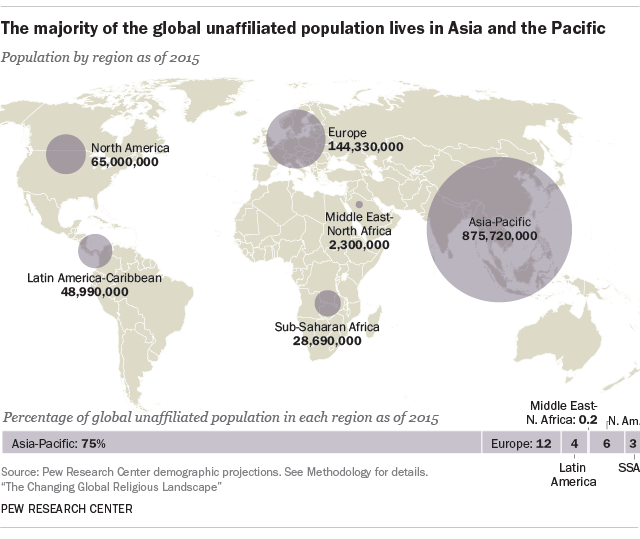
The religiously unaffiliated population is projected to shrink as a percentage of the global population, even though it will increase modestly in absolute number. In 2015, there were slightly fewer than 1.2 billion atheists, agnostics and people who did not identify with any particular religion around the world.7 By 2060, the unaffiliated population is expected to reach 1.2 billion. But as a share of all people in the world, religious “nones” are projected to decline from 16% of the total population in 2015 to 13% in 2060. While the unaffiliated are expected to continue to increase as a share the population in much of Europe and North America, people with no religion will decline as a share of the population in Asia, where 75% of the world’s religious “nones” live.

Geographic differences like these play a major role in patterns of religious growth. Indeed, one of the main determinants of future growth is where each group is geographically concentrated today. For example, the religiously unaffiliated population is heavily concentrated in places with aging populations and low fertility, such as China, Japan, Europe and North America. By contrast, religions with many adherents in developing countries – where birth rates are high and infant mortality rates generally have been falling – are likely to grow quickly. Much of the worldwide growth of Islam and Christianity, for example, is expected to take place in sub-Saharan Africa.

Change in where groups are concentrated

The regional distribution of religious groups is also expected to shift in the coming decades. For example, the share of Christians worldwide who live in sub-Saharan Africa is expected to increase dramatically between 2015 and 2060, from 26% to 42%, due to high fertility in the region. Meanwhile, religious switching and lower fertility will drive down the shares of the global Christian population living in Europe and North America.

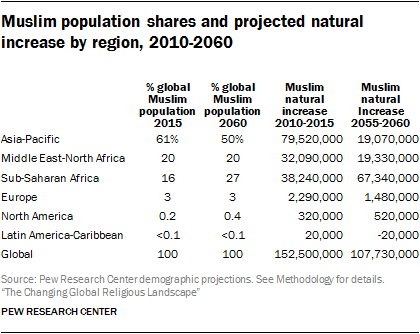
Sub-Saharan Africa is also expected to be home to a growing share of the world’s Muslims. By 2060, 27% of the global Muslim population is projected to be living in the region, up from 16% in 2015. By contrast, the share of Muslims living in the Asia-Pacific region is expected to decline over the period from 61% to 50%. The share of Muslims in the Middle East and North Africa is expected to hold steady at 20%.

As of 2015, three-in-four unaffiliated people live in Asia and the Pacific. But that share is expected to decline to 66% by 2060 due to low fertility and an aging population. At the same time, a growing share of the unaffiliated will live outside of the Asia-Pacific, particularly in Europe and North America. By 2060, 9% of the global unaffiliated population will live in the United States alone, according to the projections.

The vast majority of Hindus and Buddhists (98-99%) will continue to live in the Asia-Pacific region in the next several decades. Most adherents of folk religions, too, will remain in Asia and the Pacific (79% in 2060), although a growing share are expected to live sub-Saharan Africa (7% in 2015 vs. 16% in 2060). Roughly equal shares of the world’s Jews live in Israel (42%) and the United States in 2015 (40%). But, by 2060, over half of all Jews (53%) are projected to live in Israel, while the U.S. is expected to have a smaller share (32%).

Age and fertility are major factors behind growth of religious groups

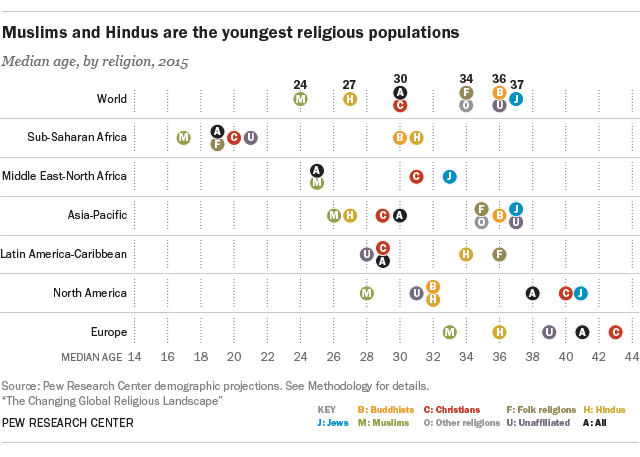
The current age distribution of each religious group is an important determinant of demographic growth. Some groups’ adherents are predominantly young, with their prime childbearing years still ahead, while members of other groups are older and largely past their childbearing years. The median ages of Muslims (24 years) and Hindus (27) are younger than the median age of the world’s overall population (30), while the median age of Christians (30) matches the global median. All the other groups are older than the global median, which is part of the reason why they are expected to fall behind the pace of global population growth.8

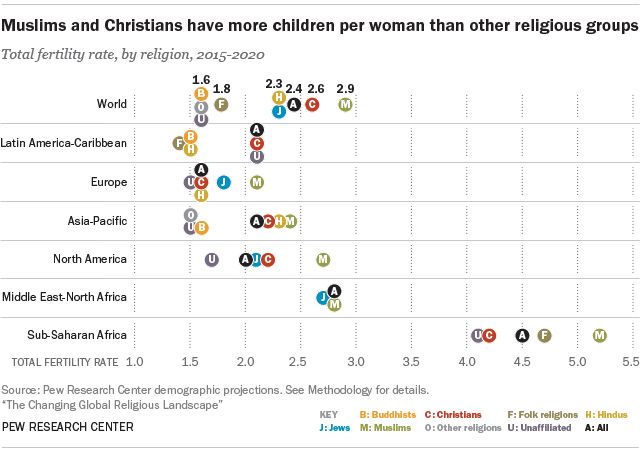
Moreover, Muslims have the highest fertility rate of any religious group – an average of 2.9 children per woman, well above replacement level (2.1), the minimum typically needed to maintain a stable population.9 Christians are second, at 2.6 children per woman. Hindu and Jewish fertility (2.3 each) are both just below the global average of 2.4 children per woman. All other groups have fertility levels too low to sustain their populations.

In addition to fertility rates and age distributions, religious switching is likely to play a role in the changing sizes of religious groups.

Pew Research Center projections attempt to incorporate patterns of religious switching in 70 countries where surveys provide information on the number of people who say they no longer belong to the religious group in which they were raised.10 In the projection model, all directions of switching are possible, and they may partially offset one another. In the United States, for example, surveys find that although it is particularly common for people who grew up as Christians to become unaffiliated, some people who were raised with no religious affiliation also have switched to become Christians.11 These types of patterns are projected to continue as future generations come of age. (For more details on how and where switching was modeled, see Appendix B: Methodology.)

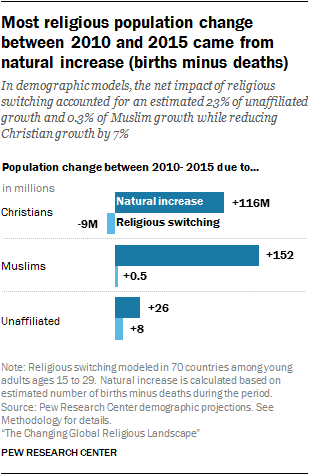
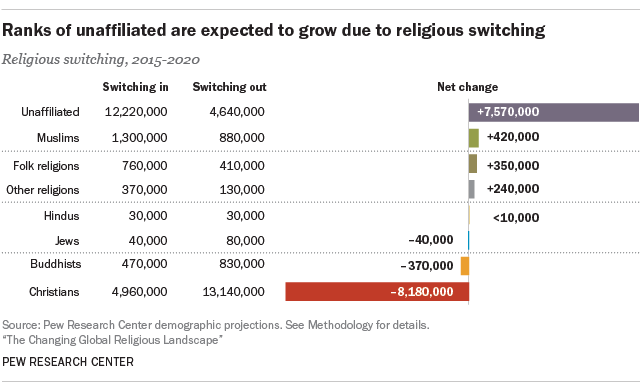
Between 2015 and 2020, Christians are projected to experience the largest losses due to switching. Globally, about 5 million people are expected to become Christians in this five-year period, while 13 million are expected to leave Christianity, with most of these departures joining the ranks of the religiously unaffiliated.

The unaffiliated are projected to add 12 million and lose 4.6 million via switching, for a net gain of 7.6 million between 2015 and 2020. The projected net changes due to switching for other religious groups are smaller.

The demographic challenges of the religiously unaffiliated

Although current patterns of religious switching favor the growth of the religiously unaffiliated population – particularly in Europe, North America, Australia and New Zealand – religious “nones” are projected to decline as a share of the world’s population in the coming decades due to a combination of low fertility and an older age profile.

Between 2015 and 2020, religious “nones” are projected to experience a net gain of 7.6 million people due to religious switching; people who grew up as Christians are expected to make up the overwhelming majority of those who switch into the unaffiliated group.12 Still, if current religious switching patterns continue, gains made through religious disaffiliation will not be large enough to make up for population losses due to other demographic factors.

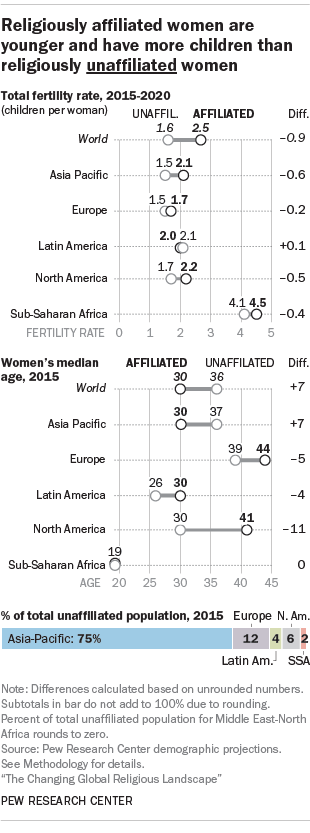
For example, the 2015 to 2020 total fertility rate for religiously unaffiliated women is projected to be 1.6 children per woman, nearly a full child less than the rate of 2.5 children per woman for religiously affiliated women. And although religious “nones” tend to be younger than religiously affiliated people in the United States, the opposite is true at the global level: Unaffiliated women are older than the affiliated and thus more likely to be past their prime childbearing years. In 2015, the global median age for the female unaffiliated population was 36, compared with 30 for the religiously affiliated.

These demographic patterns are heavily influenced by the situation in Asia, and particularly China, which was home to 61% of the world’s unaffiliated population in 2015.

What Americans believe and expect about the global size of religious groups

Before releasing projections of the future size of religious groups in 2015, Pew Research Center asked members of the American Trends Panel a few questions about their perceptions of the global religious landscape – and their expectations for its future.

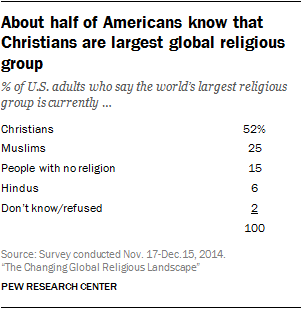
About half of Americans (52%) have an accurate idea of which religious group is currently the largest in the world, correctly saying that Christians make up the largest religious group, while a quarter think (incorrectly) that Muslims are largest. Fewer U.S. adults say that people with no religion (15%) or Hindus (6%) are the largest religious group.

The survey also asked Americans how they expect the share of the global population with no religion to change in the coming decades. Most Americans (62%) predict that the global share of religious “nones” will increase between now and 2050 – an expectation perhaps colored by what is happening on a national level.

Indeed, in the U.S. and many other Western nations, the unaffiliated share of the population has been increasing and is expected to continue to rise as many Christians and others shed their religious identity and as younger, less religious generations replace older, more religious ones. However, because most religious “nones” live in Asia, where the religiously unaffiliated population is relatively old and has relatively low fertility, Pew Research Center projects that the global unaffiliated population will decline in the decades ahead, even after factoring in expected gains via religious switching. Only 15% of U.S. adults surveyed expect that people with no religion will decline as a share of the global population by 2050.13

Asked which group they expect to have the most adherents globally in 2050, Americans are closely divided among those who say religious “nones” (33%), Christians (32%) and Muslims (29%). A small share (4%) anticipates that Hindus will be the largest group.

Expectations about which group will become the largest vary by respondents’ age, religion and political party affiliation. For instance, nearly half (46%) of U.S. adults under 30 predict that people with no religion will outnumber Christians, Muslims and Hindus in 2050, while only about three-in-ten of those ages 50 and older anticipate that religious “nones” will be the largest group at mid-century. Meanwhile, older Americans are more likely than young adults (under 30) to say that Muslims will be the largest group.

Christians are more likely than religious “nones” to say that Christians will be the largest group in 2050 (36% vs. 22%). And the unaffiliated are more likely than Christians to say people with no religion will be the largest group at mid-century: 44% of religious “nones” say this will be the case, compared with 31% of Christians.

Differences in expectations about the future size of religious groups also are apparent across the political spectrum. Americans who identify with or lean toward the Republican Party are more likely than those who identify as or lean Democratic to predict that Muslims will make up the largest religious group in the world in 2050 (36% vs. 25%). By contrast, Democrats are more likely than Republicans (35% vs. 29%) to expect that people with no religion will be the largest group.

How births and deaths are changing religious populations

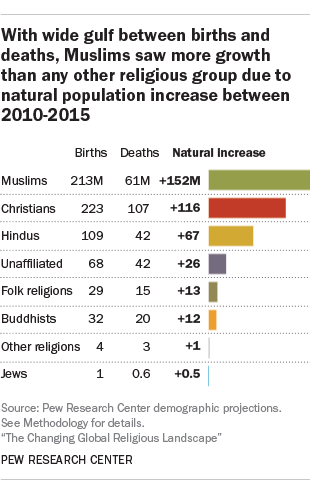
As the world’s largest religious group, Christians had the most births and deaths of any group between 2010 and 2015. During this five-year period, an estimated 223 million babies were born to Christian mothers and roughly 107 million Christians died, meaning that the natural increase in the Christian population – i.e., the number of births minus the number of deaths – was 116 million over this period.

Muslims had the second-largest number of births between 2010 and 2015, with 213 million babies born to Muslim mothers. But Muslims saw the largest natural increase of any religious group – more than 152 million people – due to the relatively small number of Muslim deaths (61 million). This large natural increase results from both high Muslim fertility and the concentration of the Muslim population in younger age groups, which have lower mortality rates.

Compared with the overall size of the religiously unaffiliated population (16% of the world’s people), there were relatively few recent births to unaffiliated mothers (10% of all births between 2010 and 2015). Religious “nones” are the third-largest group overall, and yet due to lower levels of fertility, they rank fourth behind Hindus in terms of babies born. Between 2010 and 2015, an estimated 68 million babies were born to unaffiliated mothers, compared with 109 million to Hindu mothers. Hindus also saw a much larger natural increase than the religiously unaffiliated (67 million vs. 26 million).

Births also outnumbered deaths among other major religious groups between 2010 and 2015, including among Buddhists, Jews and members of folk or traditional religions.

Beyond 2015, Christian and Muslim mothers are expected to give birth to increasing numbers of babies through 2060. But Muslim births are projected to rise at a faster rate – so much so that by 2035 the number of babies born to Muslim mothers will narrowly surpass the number born to Christian mothers. Between 2055 and 2060, the birth gap between the two groups is expected to approach 6 million (232 million births among Muslims vs. 226 million births among Christians).

By contrast, the total number of births is projected to decline steadily between 2015 and 2060 for all other major religious groups. The drop-off in births will be especially dramatic for Hindus – who are expected to see 33 million fewer births between 2055 and 2060 than between 2010 and 2015 – due in large part to declining fertility in India, which is home to 94% of the global Hindu population as of 2015.

The number of deaths is projected to increase for all religious groups between 2015 and 2060, as the world’s population continues to grow – and grow older. 14

Regional and country-level patterns of births and deaths

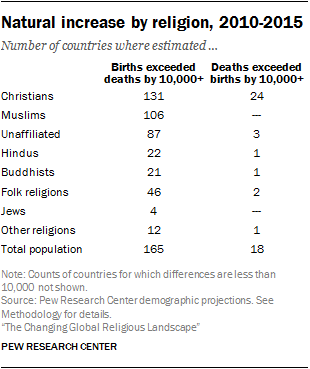
For religious groups in most countries, there is currently either positive natural increase (more births than deaths) or little net change due to births and deaths. But many European countries are experiencing a natural decrease (more deaths than births) in the populations of certain religious groups, especially Christians.

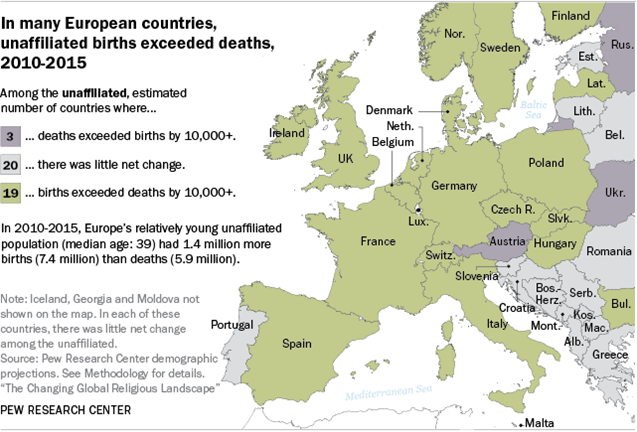
Throughout Eastern Europe and parts of Western Europe, deaths outnumbered births among Christians between 2010 and 2015 in 24 of 42 countries. Deaths also outnumbered births by at least 10,000 among religiously unaffiliated populations in Austria, Ukraine and Russia. But religious “nones” in most European countries saw either a positive natural increase (in 19 countries) or little net change during the period from 2010 to 2015 (in 20 countries). This reflects the relatively young age profile of the religiously unaffiliated compared with the Christian population in Europe.

Among Muslims, there were no European countries where the number of deaths exceeded the number of births. Throughout most of the region, the number of babies born to Muslim women exceeded the number of Muslim deaths between 2010 and 2015 (in 21 countries). In Germany, the United Kingdom, Italy, Russia and France, there were at least 250,000 more Muslim births than deaths in each country over that period. At the same time, migration is also driving Muslim population growth in Europe.

No Christian, Muslim or unaffiliated populations living in countries outside of Europe experienced more deaths than births in the 2010 to 2015 period. Similarly, other religious groups saw either positive natural increase or little net change, with a few exceptions: Buddhists in Japan, Hindus in South Africa and adherents of folk religions in South Korea and Tanzania had a larger number of deaths than births between 2010 and 2015.

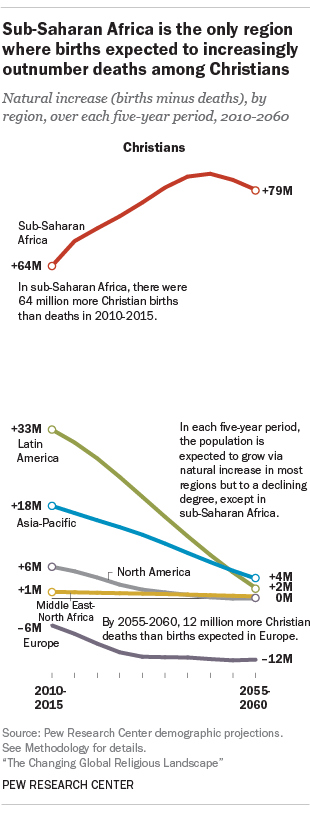
There are important regional differences in birth and death trends for some religious groups. Among Christians, for example, sub-Saharan Africa experienced the biggest natural increase between 2010 and 2015 – with 64 million more births than deaths – followed by smaller Christian increases in Latin America and the Caribbean, Asia and the Pacific and North America.

In Europe, however, Christian deaths already outnumber births – a deficit that is projected to grow through 2060. And in North America, the number of Christian deaths will begin to exceed the number of births by around 2050.

These trends signal that much of Christianity’s future growth is likely to be in the global South, particularly in sub-Saharan Africa – the only region where natural increases in the Christian population are expected to grow even larger in the coming decades. (This means that not only will there continue to be more Christian births than deaths in sub-Saharan Africa, but births will exceed deaths by even larger numbers in upcoming five-year periods.) In Latin America and the Asia-Pacific region, the number of Christian births will continue to exceed the number of deaths through 2060, but the natural increases in the 2055 to 2060 time period will be much smaller than they are now as these regions experience significant declines in fertility.

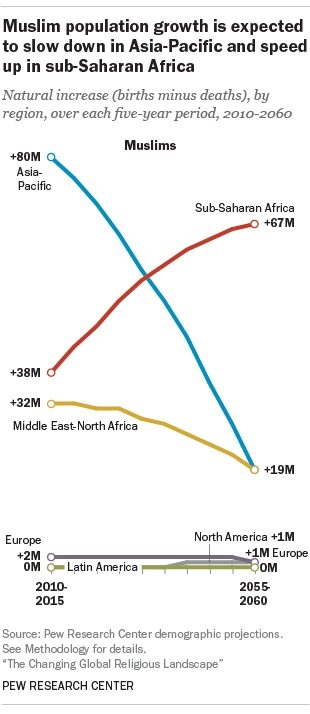
The global Muslim population also is projected to undergo an important geographic shift toward sub-Saharan Africa. Currently, more Muslims live in Asia and the Pacific than in any other region, and as a result, this region had the largest natural increase in the Muslim population between 2010 and 2015.

But sub-Saharan Africa’s Muslims also experienced far more births than deaths during this period, and the natural increases in the Muslim population in sub-Saharan Africa are projected to grow even larger in the five-year periods ahead, driven by high fertility. By about 2040, the natural increase in the Muslim population in sub-Saharan Africa is expected to exceed the natural increase in Asia.

Muslims in Asia and the Middle East-North Africa region will experience slower growth in the coming decades as Muslim fertility in these regions declines. These populations will continue to have more births than deaths through 2060, but they will grow at a slower rate.

Muslims in Europe and North America also are expected to have more births than deaths through 2060.

Currently, there are more births than deaths among religious “nones” in all regions, led by the Asia-Pacific region, which is home to a majority of the global religiously unaffiliated population.

But this will change in the coming years. For people with no religion in Asia, the number of deaths will begin to exceed the number of births to unaffiliated mothers by 2030, a change driven by low fertility and a relatively old unaffiliated population in China. By 2035, unaffiliated deaths are expected to outnumber births in Europe as well.

  1. The five-year periods described in this report represent midyear to midyear time spans – for example, from July 1, 2030, to June 30, 2035 – which are standard units used in demography and by organizations including the United Nations Population Division. ↩
  2. For further discussion of religious switching patterns, see McClendon, David, and Conrad Hackett. November 2014. “When People Shed Religious Identity in Ireland and Austria: Evidence from Censuses.” Demographic Research. ↩
  3. When these projections are extended beyond 2060, Muslims are expected to reach parity with Christians in 2070. By 2075, Muslims are expected to outnumber Christians, even as both groups continue to increase as a share of the world’s population, largely due to their concentration in countries with relatively high fertility rates. By 2100, Muslims are expected to make up 34.9% of the world’s population and Christians to make up 33.8%. ↩
  4. Jews are such a small share of the global population, however, that the projected change is not visible when percentages are rounded to one decimal place. Jews constituted 0.20% of the world’s population in 2015 and are projected to constitute 0.17% in 2060. Both figures round to 0.2% (two-tenths of 1%) in the charts and tables in this report. ↩
  5. These projections are based on estimates of people who self-identify as Jewish when asked about their religion on national censuses and large-scale surveys. They do not include “cultural” or “ethnic” Jews – people who have direct Jewish ancestry and who consider themselves at least partially Jewish but who describe themselves, religiously, as atheist, agnostic or nothing in particular. For the purposes of the religious group projections in this report, these people are categorized as unaffiliated. The worldwide estimate of Jews could be larger if this group were included, or smaller if a narrower definition of who is Jewish (such as an unbroken line of matrilineal Jewish descent) were used. ↩
  6. Although some faiths in the “other religions” category have millions of adherents around the world, censuses and surveys in many countries do not measure them specifically. Because of the scarcity of census and survey data, Pew Research Center has not projected the size of individual religions within this category. Estimates of the global size of these faiths generally come from other sources, such as the religious groups themselves. By far the largest of these groups is Sikhs, who numbered about 25 million in 2015, according to the World Religion Database. ↩
  7. In many countries, censuses and demographic surveys do not enumerate atheists and agnostics as distinct populations, so it is not possible to reliably estimate the global size of these subgroups within the broad category of the unaffiliated. ↩
  8. Expected changes to the religious landscape among older adults are discussed in Skirbekk, Vegard, Michaela Potančoková, Conrad Hackett and Marcin Stonawski. November 2016. “Religious Affiliation Among Older Age Groups Worldwide: Estimates for 2010 and Projections Until 2050.” The Journals of Gerontology Psychological Sciences and Social Sciences Series B. ↩
  9. The standard measure of fertility in this report is the total fertility rate. In countries with low infant and child mortality rates, a total fertility rate close to 2.1 children per woman is sufficient for each generation to replace itself. Replacement-level fertility is higher in countries with elevated mortality rates. ↩
  10. These 70 countries were home to 43% of the world’s population in 2010, and they include many countries where switching between having a religious affiliation and not having a religious affiliation is common, such as the United States, France, Australia and New Zealand. The most populous countries for which switching was not modeled are China and India. Prior to this study, the most extensive analysis of religious switching covered 40 countries. See Barro, Robert J., Jason Hwang and Rachel McCleary. 2010. “Religious Conversion in 40 Countries.” Journal for the Scientific Study of Religion. It is difficult to formally project religious switching in China without reliable information on recent or likely patterns of switching. For example, it is not clear at what rate people in China may be converting to Christianity from other groups, and retention patterns among Christians are not known. Nor is it clear at what rate Islam, Buddhism and other faiths may be gaining adherents in China. If China experiences a net movement toward religious affiliation via switching in the decades ahead, that would tilt the needle toward a more religiously affiliated global population, particularly since China is currently home to a majority of the worldwide unaffiliated population. When these projections were made, no current, nationally representative survey of Indians was available to provide reliable data on both respondents’ childhood religion and on their current religious affiliation (the basis for calculating switching rates). However, a 1990 World Values Survey in India found that nearly all Indian respondents who grew up as Hindu still identified as Hindu. ↩
  11. Studies of religious switching indicate that this phenomenon is often concentrated in young adult years, roughly between ages 15 and 29. Change in religious affiliation may occur as young adults move away from their parents and partner with someone of a different affiliation status. While some religious switching may take place at other ages, switching is modeled as a life course phenomenon in which some young adults change their religious affiliation status. There may be some time periods during which people of all ages are prone to religious switching, such as when political circumstances in a country encourage or discourage religious identity or lack of religious identity. Our models do not attempt to include such period effects. ↩
  12. For further analysis of the different trajectories of religiously affiliated and unaffiliated populations, see Hackett, Conrad, Marcin Stonawski, Michaela Potančoková, Brian J. Grim and Vegard Skirbekk. 2015. “The Future Size of Religiously Affiliated and Unaffiliated Populations.” Demographic Research. ↩
  13. Although projections in this report extend to 2060, the first report on Pew Research Center’s global projections for major religious groups stopped at 2050. The survey questions discussed in this sidebar were developed before the first report was released, which is why they ask about expectations for the size of religious groups in 2050 (rather than 2060). ↩
  14. These projections do not take into account potential future medical or technological advancements that could increase lifespans.
  15. http://www.pewforum.org

Διχασμένοι οι Γάλλοι όσο ποτέ άλλοτε

0


Του οικονομολόγου Eric Gazon. [email protected]

Και την επιμέλεια του Αλκη Καλλιαντζίδη [email protected]

Η Γαλλία ήταν ήδη πολιτικά εξαιρετικά διχασμένη από την αρχή της τρέχουσας εκλογικής περιόδου Σεπτεμβρίου-Οκτωβρίου 2016. Κατ’ αρχάς,  αν λάβουμε υπόψη μας ότι το 40% περίπου των εκλογέων είναι ακόμα αναποφάσιστοι,  το εκλογικό σώμα διαιρείται πλέον χοντρικά σε τέσσερα μπλοκ  τα οποία κυμαίνονται έκαστο μεταξύ του 20 και του 25 % των ψηφοφόρων. Τα εν λόγω μπλοκ συγκεντρώνουν γνώμες  πολιτών  που εκ των προτέρων δεν συμβιβάζονται μεταξύ τους.

Υπάρχουν εκείνοι που υποστηρίζουν μια ανοικτή κοινωνία στην πολύ-πολιτισμικότητα και τον σεβασμό των ατομικών δικαιωμάτων.

Υπάρχουν άλλοι που αναφέρονται στην αφομοίωση των μεταναστών στο πλαίσιο της Γαλλικής Δημοκρατίας.

Υπάρχουν εκείνοι για τους οποίους η εθνική κυριαρχία πρέπει να είναι απόλυτη (ανεξαρτησία της Γαλλία) και

από την άλλη πλευρά υπάρχουν αυτοί που πιστεύουν ότι  το συμφέρον της Γαλλίας είναι να δεχτεί  μια κοινή εθνική κυριαρχία για ορισμένες πολιτικές, όπως π.χ. το ευρώ, στο πλαίσιο της Ευρωπαϊκής Ένωσης.

Υπάρχουν οι Κρατιστές, εχθρικοί με τις τράπεζες και τις αγορές και εκείνοι που υποστηρίζουν την αγορά, ως κεντρικό στοιχείο για την ανάπτυξη της απασχόλησης και της ευημερίας.

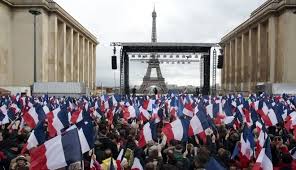
Η ακροδεξιά της Le Pen συσπειρώνει υποστηρικτές της αφομοίωσης και της απόρριψης της Ευρωπαϊκής Ένωσης. Αυτή συγκέντρωνε  το 26 % των προθέσεων ψήφου στα τέλη Μαρτίου 2017.

Η φιλελεύθερη και συντηρητική δεξιά υποστηρίζει  επίσης την  αφομοίωση των μεταναστών. Ο Fillon προτείνει την μοιρασμένη εθνική κυριαρχία  στο πλαίσιο της Ευρωπαϊκής Ένωσης. Συγκεντρώνει περίπου 20 % . Παραδοσιακά ο Chirac συγκέντρωνε αυτό το ποσοστό το 1988, το 1995, το 2002 και 30 % ο Sarkozy το 2007. Ωστόσο, στα τέλη Μαρτίου συγκέντρωνε μόνο 18%.

Η φιλελεύθερη κεντροαριστερά του Macron τάσσεται υπέρ της πολυπολιτισμικότητας και έχει φιλο-ευρωπαϊκό προσανατολισμό. Ο François Bayrou, σύμμαχος πλέον του Macron, πέτυχε 18,5 % στις εκλογές του 2007 και  9 % στις εκλογές του 2012. Η φιλελεύθερη πτέρυγα του Σοσιαλιστικού Κόμματος τον υποστηρίζει πλέον ευρέως. Ο πρώην πρωθυπουργός του Φρανσουά Ολάντ, ο Manuel Valls, ανακοίνωσε δημόσια ότι θα ψηφίσει τον Macron στον πρώτο γύρο (κι όχι τον Hamon όπως είχε υποσχεθεί). Ο Macron πιστώνεται με 26 % της πρόθεσης ψήφου, κι όλο αναβαίνει.

Η αριστερά, του Mélenchon καθώς και ο Hamon, είναι και οι δύο υπέρ της πολυπολιτισμικότητας. Ωστόσο, ο Mélenchon καταγγέλλει την Ευρωπαϊκή Ένωση και ο Hamon την υποστηρίζει κριτικά. Οι δυο τους πιστώνονταν με 15 και 10% αντίστοιχα, τέλη Μαρτίου, συγκεντρώνοντας έτσι περίπου το 25% του εκλογικού σώματος και οι δυο.

Η Γαλλία είναι επίσης διχασμένη μεταξύ, αφενός, εκείνων που πιστεύουν ότι ο Fillon έχει υποστεί άδικη μεταχείριση από τα μέσα ενημέρωσης και από τη δικαιοσύνη και, αφετέρου, εκείνων που φαίνονται έκπληκτοι που ο Fillon επιμένει και δεν παραιτείται από την υποψηφιότητά του, δεδομένων των κατηγοριών εναντίον του και της οικογενείας του. Οι γάλλοι πολίτες είναι πολωμένοι για την αξιοπιστία  των μέσων ενημέρωσης και της δικαιοσύνης.

Η αξιοπιστία των ΜΜΕ πέφτει : μόνο το 52 % των ερωτηθέντων έχουν εμπιστοσύνη στις πληροφορίες που ακούνε στο ραδιόφωνο (– 3 ποσοστιαίες μονάδες σε σχέση με το προηγούμενο έτος), μόνο το 44 % έχουν εμπιστοσύνη στις εφημερίδες (– 7 ποσοστιαίες μονάδες σε σχέση με το προηγούμενο έτος), μόνο το 41 % για την τηλεόραση (– 9 ποσοστιαίες μονάδες σε σχέση με πέρυσι) και μόνο το 26 % σε πληροφορίες από το διαδίκτυο  (– 5 ποσοστιαίες μονάδες σε σχέση με το προηγούμενο έτος).

Περίπου ένας στους δύο (48 %) θεωρεί ότι η γαλλική δικαιοσύνη δεν είναι ανεξάρτητη από την πολιτική εξουσία (κυβερνήσεις), σύμφωνα με  πρόσφατη έρευνα στις 28 Μαρτίου 2017. Το χρονοδιάγραμμα των διαδικασιών της δικαιοσύνης, η μεγαλύτερη ή μικρότερη ταχύτητα με την οποία δρα, και οι επαναλαμβανόμενες παραβιάσεις του απορρήτου της ανάκρισης εγείρουν το ζήτημα της ανεξαρτησίας της δικαιοσύνης. Και, όπως είναι αναμενόμενο, ιδιαίτερα η δεξιά είναι που δεν έχει πλέον εμπιστοσύνη στην δικαιοσύνη.

Στις αρχές Απριλίου, η Le Pen ελπίζει να κερδίσει τις εκλογές, ο Fillon εξακολουθεί να πιστεύει ότι μπορεί να  κερδίσει, ο Macron είναι πάντα στην πρώτη θέση μαζί με την Le Pen. Το Σοσιαλιστικό κόμμα είναι διχασμένο  όσο ποτέ άλλοτε. Οι Γάλλοι είναι επίσης διχασμένοι. Το λιγότερο που μπορούμε να πούμε είναι ότι δεν βαριόμαστε,  παρακολουθώντας την προεκλογική εκστρατεία. Όλα σχεδόν είναι απροσδόκητα και μόνο οι εκπλήξεις δεν λείπουν. Ωστόσο, η ατμόσφαιρα είναι ιδιαίτερα δηλητηριώδης.

Ραντεβού λοιπόν το βράδυ του πρώτου γύρου των εκλογών στις 23 Απριλίου.


Η επίθεση γοητείας της Ρωσίας στην βόρεια Αφρική

0
Η αυξανόμενη οικονομική και στρατιωτική επιρροή της στην περιοχή foreignaffairs.gr
Ο πρόεδρος της Ρωσίας, Βλαντιμίρ Πούτιν, και ο Αιγύπτιος ομόλογός του, Αμπντέλ Φατάχ αλ Σίσι, σε τελετή υποδοχής επί του καταδρομικού Moskva, στο λιμάνι της Μαύρης Θάλασσας, Σότσι, στις 12 Αυγούστου 2014. ALEXEI DRUZHININ / KREMLIN VIA REUTERS
Περίληψη:

Εν μέσω της μεταναστευτικής κρίσης, της απειλής της διεθνούς τρομοκρατίας, και της παρατεταμένης αναταραχής της Αραβικής Άνοιξης, η βόρεια Αφρική είναι μια περιοχή υψίστης σημασίας για την Ουάσιγκτον και τους Ευρωπαίους συμμάχους της.

Ο OREN KESSLER είναι αναπληρωτής διευθυντής Έρευνας στο Ίδρυμα για την Άμυνα των Δημοκρατιών (Foundation for Defense of Democracies).
Ο BORIS ZILBERMAN είναι αναπληρωτής διευθυντής Σχέσεων με το Κογκρέσο και αναλυτής της Ρωσίας στο Ίδρυμα για την Άμυνα των Δημοκρατιών (Foundation for Defense of Democracies).

Με την προσοχή του κόσμου εστιασμένη στο ζήτημα της ρωσικής επιρροής στις Ηνωμένες Πολιτείες και την Ευρωπαϊκή Ένωση, το Κρεμλίνο προωθείται ήσυχα σε μια άλλη περιοχή, κρίσιμη τόσο για τις Ηνωμένες Πολιτείες όσο και για την Ευρώπη: Τα πέντε κράτη της βόρειας Αφρικής στη νότια ακτή της Μεσογείου.

Ρώσοι και Αλγερινοί αξιωματούχοι συγκεντρώθηκαν σε ένα ναυπηγείο στην Αγία Πετρούπολη τον περασμένο μήνα για να σπάσουν [1] ένα μπουκάλι σαμπάνια στο πρώτο [2] από τα δύο λεγόμενα Black Hole («Μαύρη τρύπα») [3] υποβρύχια που κατασκευάζονται για το αλγερινό ναυτικό. Την ίδια ημέρα, δημοσιοποιήθηκε η είδηση ότι η Ρωσία είχε αναπτύξει [4] ειδικές δυνάμεις και μη επανδρωμένα αεροσκάφη σε μια βάση της σοβιετικής εποχής στην δυτική Αίγυπτο για να ενισχύσει έναν ηγέτη πολιτοφυλακής στην γειτονική Λιβύη. Στα τέλη του περασμένου έτους, ο γραμματέας του Εθνικού Συμβουλίου Ασφαλείας της Μόσχας ταξίδεψε [5] στο Μαρόκο, όπου ο βασιλιάς κάλεσε τον Ρώσο πρόεδρο Βλαντιμίρ Πούτιν να ανταποδώσει την επίσκεψη που είχε κάνει εκείνος στην Μόσχα στις αρχές του έτους. Και στην Τυνησία, όπου ο ρωσικός τουρισμός αυξήθηκε κατά δέκα φορές το 2016, το Κρεμλίνο υπέγραψε [6] μια συμφωνία το περασμένο φθινόπωρο για την κατασκευή ενός πυρηνικού ηλεκτροπαραγωγικού σταθμού.

Η Αίγυπτος, το μεγαλύτερο αραβικό κράτος του κόσμου, ήταν το στολίδι στο στέμμα των Σοβιετικών στην Μέση Ανατολή μέχρι που αυτομόλησε στο στρατόπεδο των ΗΠΑ στα τέλη της δεκαετίας του 1970, υπηρετώντας ως ο πιο σημαντικός σύμμαχος της Ουάσιγκτον στην βόρεια Αφρική έκτοτε. Το Κάιρο, όμως, άρχισε συστηματικά να επεκτείνει τους δεσμούς του [7] με την Ρωσία αμέσως αφότου ο στρατηγός Αμπντέλ Φατάχ αλ Σίσι ανέτρεψε τον πρόεδρο Μοχάμεντ Μόρσι το 2013. Η κυβέρνηση του Μπαράκ Ομπάμα, δύσπιστη όσον αφορά τις σκληρές τακτικές του Καΐρου για την εξάλειψη των διαφωνούντων, διατήρησε κάποια απόσταση από τον Σίσι, ο οποίος στην συνέχεια στράφηκε προς την Ρωσία για να καλύψει το κενό. Το 2015, ο Πούτιν ταξίδεψε στο Κάιρο, όπου οι δρόμοι ήταν γεμάτοι με πανό που έφεραν την εικόνα του, και ανταπόδωσε την χάρη δωρίζοντας στον Σίσι ένα νέο καλάσνικοφ.

Τον Οκτώβριο του 2016, η Αίγυπτος ψήφισε μαζί με την Ρωσία ενάντια σε μια απόφαση του Συμβουλίου Ασφαλείας του ΟΗΕ που επεδίωκε να τερματίσει τις αεροπορικές επιδρομές στην Συρία -μια ψήφος καταγγελθείσα [8] σε όλο τον αραβικό κόσμο ως μια προσπάθεια να κερδίσει την εύνοια της Μόσχας. Εβδομάδες αργότερα, τα δύο έθνη πραγματοποίησαν για πρώτη φορά κοινή στρατιωτική άσκηση, την οποία ονόμασαν «Υπερασπιστές της Φιλίας» [9]. Τώρα, το Κάιρο και η Μόσχα λέγεται [10] ότι βρίσκονται μερικές εβδομάδες μακριά από την οριστικοποίηση μιας συμφωνίας για έναν πυρηνικό αντιδραστήρα έξω από την Αλεξάνδρεια. Η Ρωσία είναι έτοιμη [11] για να αρχίσει την παράδοση σχεδόν 50 επιθετικών ελικοπτέρων Alligator στην Αίγυπτο φέτος και έναν παρόμοιο αριθμό δικινητήριων μαχητικών αεροσκαφών Mikoyan MiG-29 το 2020 [12] -η μεγαλύτερη τέτοια συμφωνία από την εποχή της συμμαχίας των δύο χωρών κατά τον Ψυχρό Πόλεμο.

Δίπλα, στην Λιβύη, η πολιτική της Ρωσίας επικεντρώνεται στον στρατηγό Khalifa Haftar, έναν ισχυρό άνδρα του οποίου ο βασισμένος στα ανατολικά Λιβυκός Εθνικός Στρατός είναι ταγμένος εναντίον του Ισλαμικού Κράτους [13] (επίσης γνωστού ως ISIS), άλλων ισλαμιστικών πολιτοφυλακών [14], και της διεθνώς αναγνωρισμένης κυβέρνησης [15] στην Τρίπολη. Ο Haftar έχει κάνει πολλαπλά [16] ταξίδια στην Μόσχα τον περασμένο χρόνο επιδιώκοντας ρωσική στρατιωτική υποστήριξη, και τον Ιανουάριο έκανε το ασυνήθιστο βήμα να επιβιβαστεί [17] στο μοναδικό αεροπλανοφόρο της Ρωσίας, καθώς επέστρεφε από την Συρία. Επί του σκάφους, φέρεται να υπέγραψε [18] μια συμφωνία με Ρώσους αξιωματούχους να επιτρέψει στις δυνάμεις του να επιχειρούν σε περιοχές της Λιβύης που βρίσκονται υπό τον έλεγχό του -όπως προφανώς έκαναν [4] τον περασμένο μήνα. Σύμφωνα με τον στρατηγό [19] Thomas Waldhauser, τον ανώτατο διοικητή των ΗΠΑ για την Αφρική, η παρουσία ρωσικών στρατευμάτων στην Λιβύη είναι «αδιαμφισβήτητη»: «Είναι στο έδαφος, προσπαθούν να επηρεάσουν την δράση, [και] βλέπουμε τι κάνουν με μεγάλη ανησυχία».

Ο Fayez al-Sarraj, ο πρωθυπουργός της αντίπαλης κυβέρνησης που εδρεύει στην Τρίπολη, επισκέφθηκε την Μόσχα τον περασμένο μήνα για να συναντηθεί με [20] τον υπουργό Εξωτερικών της Ρωσίας, αλλά το Κρεμλίνο ταυτίζεται ξεκάθαρα με τον Haftar, ένας στρατηγό υπό τον πρώην δικτάτορα Μουαμάρ αλ -Καντάφι. Ο Πούτιν αντιτάχθηκε [21] στην επέμβαση του ΝΑΤΟ το 2011 στην Λιβύη, ευνοώντας τον αξιόπιστο δεσποτισμό του Καντάφι έναντι ενός κενού εξουσίας που ενίσχυε ομάδες ανταρτών τους οποίους απορρίπτει συνολικά [22] ως τρομοκράτες.

Η Μόσχα έχει επίσης οικονομικά συμφέροντα στην Λιβύη. Ο Igor Sechin, ο πρόεδρος του κρατικού ενεργειακού γίγαντα της Ρωσίας Rosneft και στενός σύμμαχος του Πούτιν, συναντήθηκε [23] το Φεβρουάριο με τον επικεφαλής της κρατικής εταιρείας πετρελαίου της Λιβύης και συμφώνησαν να συνεργαστούν για την ανοικοδόμηση του κατεστραμμένου από τον πόλεμο ενεργειακού τομέα της χώρας. Η Λιβύη έχει τα μεγαλύτερα [24] αποθέματα πετρελαίου στην Αφρική –πριν από τον εμφύλιο πόλεμο το 2011, παρήγαγε 1,65 εκατ. [25] βαρέλια ανά ημέρα, τα περισσότερα από τα οποία εξάγονταν στην Ευρώπη.

Δεν είναι λιγότερο αξιόλογο ότι η Λιβύη είναι ένα σημαντικό σημείο κατά μήκος της κεντρικής μεσογειακής διαδρομής μέσω της οποίας οι μετανάστες φτάνουν στην Ευρώπη. Σύμφωνα με την Ευρωπαϊκή Ένωση, μέχρι το 90% [26] των μεταναστών προς την Ευρώπη σήμερα έρχονται μέσω της Λιβύης. Με τους όλο και πιο στενούς δεσμούς της με την Λιβύη, η Μόσχα μπορεί να χρησιμοποιήσει την μαζική μετανάστευση ως μοχλό κατά της Ευρώπης. Η Τουρκία –μια άλλη πύλη προσφύγων- τονίζει την προοπτική [27] της εισροής προσφύγων στην ΕΕ για να πιέσει για παραχωρήσεις [28] από τις Βρυξέλλες και η Μόσχα θα μπορούσε να παίξει το χαρτί της Λιβύης με τον ίδιο τρόπο.

Στα δυτικά της Λιβύης, η Τυνησία μπορεί να φαίνεται σαν να έχει λίγα να προσφέρει στην Μόσχα. Αλλά αφότου οι πτήσεις από την Ρωσία προς την Αίγυπτο και την Τουρκία σταμάτησαν μετά την κατάρριψη ενός ρωσικού πολιτικού αεροσκάφους και ενός στρατιωτικού τζετ σε αυτές τις χώρες αντίστοιχα, το μικρό έθνος έγινε μια δημοφιλής εναλλακτική λύση για τον τουρισμό. Η Ρωσία είναι τώρα η κορυφαία πηγή τουριστών της Τυνησίας [29], και μια ζωτική ροή εισοδήματος για μια χώρα εξαρτώμενη από την τουριστική βιομηχανία, αλλά που εξακολουθεί να παραπαίει από τις τρομοκρατικές επιθέσεις του 2015.

Δεν υπάρχει, βέβαια, τίποτα κακό με τους Ρώσους παραθεριστές στην Τυνησία, αλλά η εισροή τουριστών όντως προετοιμάζει το έδαφος για τη Μόσχα ώστε να προωθηθεί οικονομικά. Τα μενού των εστιατορίων στα κυριλλικά είναι όλο και περισσότερο συνηθισμένα [30] στην Τυνησία και οι ντόπιοι ξενοδοχειακοί υπάλληλοι μαθαίνουν ρωσικά [31]. Σύμφωνα με ρωσικά μέσα ενημέρωσης, οι δύο πλευρές μέχρι που έχουν συζητήσει [32] την διεξαγωγή διμερούς εμπορίου σε ρούβλια και σε δηνάρια Τυνησίας και όχι σε δολάρια ή ευρώ. Πέρυσι, εκτός από την συμφωνία του πυρηνικού αντιδραστήρα, η Ρωσία υποσχέθηκε να παράσχει [33] στην Τύνιδα ελικόπτερα για την καταπολέμηση του Ισλαμικού Κράτους και της αλ Κάιντα.

Η γειτονική Αλγερία, ένας από πολύ καιρό [34] αγοραστής ρωσικών όπλων, είναι μια άλλη αναπτυσσόμενη αγορά για το Κρεμλίνο. Το 2014, οι δύο πλευρές υπέγραψαν μια συμφωνία εκτιμώμενου ύψους ενός δισ. δολαρίων με την οποία η Αλγερία θα χρησιμοποιήσει εξαρτήματα από τον κρατικό προμηθευτή όπλων της Μόσχας για να κατασκευάσει 200 τανκς. Ένας ρώσος στρατιωτικός ειδικός περιέγραψε [35] την συμφωνία ως «πιθανώς την μεγαλύτερη εξαγωγική σύμβαση αρμάτων μάχης στον κόσμο». Πέρυσι, ο Αλγερινός υπουργός Εξωτερικών, Ramtane Lamamra, καλωσόρισε τον Ρώσο ομόλογό του Σεργκέι Λαβρόφ στο Αλγέρι, το οποίο έχει ήδη αρχίσει να παραλαμβάνει μια παραγγελία από 14 μαχητικά αεροσκάφη Sukhoi SU-30 [36]. Τέλος, η Αλγερία θα δεχτεί φέτος [2] δύο ρωσικές κορβέτες κατηγορίας Tigr οπλισμένες με ρωσικά βλήματα κρουζ, και τον επόμενο χρόνο θα παραλάβει τα δύο υποβρύχια Black Hole.

Τελευταίο στην επίθεση γοητείας της Ρωσίας στην βόρεια Αφρική είναι το Μαρόκο, ο πιο σημαντικός [37] βορειο-αφρικανικός σύμμαχος της Ουάσιγκτον μετά την Αίγυπτο. Ο βασιλιάς του Μαρόκου επισκέφτηκε [38] τον Πούτιν το περασμένο έτος, υπογράφοντας μια δήλωση «Βαθειάς Στρατηγικής Συνεργασίας» [39] και συμφωνίες για την καταπολέμηση της τρομοκρατίας και την ενέργεια, και –σύμφωνα με την περίεργη φρασεολογία του Κρεμλίνου- «συνεργασία στο Ισλάμ» [40]. Στην συνέχεια, τον Δεκέμβριο, ο γραμματέας του Εθνικού Συμβουλίου Ασφαλείας της Ρωσίας -ένας στενός σύμμαχος του Πούτιν ο οποίος ήταν στο παρελθόν επικεφαλής της Υπηρεσίας Πληροφοριών FSB- έκανε μια επίσκεψη [5] στο βασίλειο, κατά την οποία ο βασιλιάς απηύθυνε [41] μια προσωπική πρόσκληση στον Πούτιν να κάνει το ίδιο. Το Μαρόκο έχει ως στόχο [42] να πενταπλασιάσει τον ρωσικό τουρισμό τα επόμενα χρόνια, και τον Φεβρουάριο ένας στενός σύμβουλος του βασιλιά είπε στα ρωσικά μέσα ενημέρωσης ότι η Ραμπάτ επιδιώκει στενότερη συνεργασία [43] σχετικά με την μεταναστευτική κρίση.

Τίποτα από αυτά δεν σημαίνει ότι η Ρωσία έχει εμπλακεί σε γεωπολιτικά τεχνάσματα -όπως η Ουάσιγκτον, επιδιώκει να ασκήσει διπλωματική και οικονομική επιρροή, και επιρροή ασφάλειας όπου μπορεί. Αλλά εν μέσω της μεταναστευτικής κρίσης, της απειλής της διεθνούς τρομοκρατίας, και της παρατεταμένης αναταραχής της Αραβικής Άνοιξης, η βόρεια Αφρική είναι μια περιοχή υψίστης σημασίας για την Ουάσιγκτον και τους Ευρωπαίους συμμάχους της. Για την νέα κυβέρνηση των ΗΠΑ, μια ολοκληρωμένη πολιτική για την Ρωσία θα πρέπει να παλέψει με ένα Κρεμλίνο που δοκιμάζει την δύναμή του όχι μόνο στις Ηνωμένες Πολιτείες και την Ευρώπη, αλλά όλο και περισσότερο στην νότια ακτή της Μεσογείου.

Copyright © 2017 by the Council on Foreign Relations, Inc.
All rights reserved.

Στα αγγλικά: https://www.foreignaffairs.com/articles/north-africa/2017-04-03/russia-s…

Σύνδεσμοι:
[1] https://www.youtube.com/watch?v=ocEKVl1l1ZY
[2] http://www.defenceweb.co.za/index.php?option=com_content&view=article&id…
[3] http://nationalinterest.org/blog/the-kilo-class-submarine-why-russias-en…
[4] http://www.reuters.com/article/us-usa-russia-libya-exclusive-idUSKBN16K2RY
[5] https://www.moroccoworldnews.com/2016/12/203778/nikolai-patrushevs-visit…
[6] http://www.world-nuclear-news.org/NP-Russia-extends-ties-with-Cuba-Finla…
[7] http://www.hoover.org/research/united-states-and-future-egyptian-russian…
[8] http://bigstory.ap.org/article/b3e7365a49bc4d97acf92e5a409957f7/allies-s…
[9] http://eng.mil.ru/en/mission/practice/more.htm?id=12098828@egNews
[10] http://www.dailynewsegypt.com/2017/03/22/619484/
[11] http://www.defenceweb.co.za/index.php?option=com_content&task=view&id=47…
[12] http://www.egyptindependent.com/news/egypt-receive-largest-order-mig-29-…
[13] http://www.ibtimes.co.uk/least-7-libyan-national-army-fighters-killed-is…
[14] http://www.voanews.com/a/libya-benghazi-oil-port/3749528.html
[15] http://www.libyanexpress.com/hor-calls-for-presidential-and-parliamentar…
[16] https://www.theguardian.com/world/2016/nov/29/libyan-general-khalifa-haf…
[17] http://www.reuters.com/article/us-libya-russia-haftar-idUSKBN14V1T2
[18] http://www.eanlibya.com/archives/106563
[19] http://www.reuters.com/article/us-usa-libya-russia-idUSKBN16V2IW
[20] https://www.youtube.com/watch?v=fzpaM2tBidY&utm_source=dlvr.it&utm_mediu…
[21] http://www.nytimes.com/2011/04/27/world/europe/27putin.html
[22] http://www.aljazeera.com/news/2016/12/russia-turkey-syria-16122805001924…
[23] http://www.upi.com/Energy-News/2017/02/21/Libya-signs-deal-with-Russias-…
[24] http://www.worldatlas.com/articles/the-world-s-largest-oil-reserves-by-c…
[25] http://www.npr.org/2011/08/24/139914505/restarting-libya-s-valuable-oil-…
[26] https://ec.europa.eu/home-affairs/sites/homeaffairs/files/what-we-do/pol…
[27] http://www.independent.co.uk/news/world/europe/turkey-erdogan-germany-ne…
[28] http://www.independent.co.uk/news/world/europe/europe-refugee-crisis-ang…
[29] http://russtd.com/destinations/tunisia-was-visited-625000-russian-touris…
[30] http://www.economist.com/news/middle-east-and-africa/21709970-relief-une…
[31] https://m.lenta.ru/news/2016/11/14/speak_russian/
[32] https://sputniknews.com/africa/201603311037270179-tunisia-russia-bilater…
[33] http://www.defensenews.com/story/defense/international/mideast-africa/20…
[34] http://www.african-defense.com/defense-news/algeria-and-russias-long-and…
[35] http://www.vedomosti.ru/newspaper/articles/2015/02/20/tank-alzhirskoi-sb…
[36] http://defence-blog.com/news/algeria-receives-eight-su-30mkia-multirole-…
[37] http://www.al-monitor.com/pulse/originals/2017/02/us-policy-change-moroc…
[38] https://www.youtube.com/watch?v=LgzmwxX1rTM
[39] http://newsreleases.submitpressrelease123.com/2016/03/18/king-mohammed-v…
[40] http://en.kremlin.ru/events/president/news/51516
[41] https://www.moroccoworldnews.com/2016/12/203839/king-mohammed-vi-invites…
[42] https://www.rt.com/business/337767-morocco-seeks-russian-travelers/
[43] https://sputniknews.com/politics/201702171050803016-morocco-migration-wo…

Μπορείτε να ακολουθείτε το «Foreign Affairs, The Hellenic Edition» στο TWITTER στην διεύθυνση www.twitter.com/foreigngr αλλά και στο FACEBOOK, στην διεύθυνση www.facebook.com/ForeignAffairs.gr και στο linkedin στην διεύθυνση https://www.linkedin.com/company/foreign-affairs-the-hellenic-edition

The Muslim Brotherhood, Fountain of Islamist Violence

0

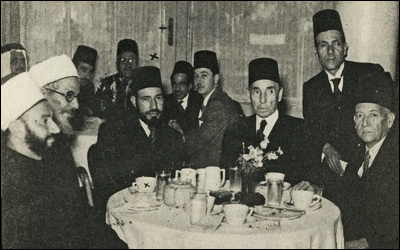
The Muslim Brotherhood was founded in 1928 by Hassan al-Banna (third from left). An Egyptian schoolteacher from a rural town north of Cairo, Banna engaged in Islamist activities from a young age, joining a local group that intimidated and harassed Christians and non-observing Muslims in his hometown.

What to make of the Muslim Brotherhood (MB)? During the Obama years, it became commonplace for the U.S. administration and its Western acolytes to portray the Muslim Brotherhood as a moderate option to “more radical” Muslim groups. Thus, for example, U.S. director of National Intelligence James Clapper incredibly described the organization as “largely secular”[1] while John Esposito of Georgetown University claimed that “Muslim Brotherhood affiliated movements and parties have been a force for democratization and stability in the Middle East.”[2]

On the other hand, in 2014, the United Arab Emirates formally designated[3] the Muslim Brotherhood and its local and international affiliates, including the U.S. based Council on American-Islamic Relations (CAIR),[4] as inter-national terrorist groups. A British government review commissioned the same year similarly asserted that

parts of the Muslim Brotherhood have a highly ambiguous relationship with violent extremism. Both as an ideology and as a network it has been a rite of passage for some individuals and groups who have gone on to engage in violence and terrorism.[5]

In the United States, Sen. Ted Cruz (R-Tex.) and Rep. Mario Diaz-Balart (R-Fla.) have recently introduced legislation to designate the Muslim Brotherhood as a terrorist organization. In February 2016, the U.S. House Judiciary Committee approved a house bill that calls on the State Department to designate the Muslim Brotherhood as a foreign terrorist organization. In July 2016, Rep. Dave Brat (R-Va.) introduced the “Naming the Enemy within Homeland Security Act,” a bill that prohibits the Department of Homeland Security from funding or collaborating with organizations or individuals associated with the Muslim Brotherhood.[6]

The Muslim Brotherhood has operated as a terrorist entity for almost a century.

The question is—which view is correct? Without doubt, the second one is. The Muslim Brotherhood has been a militaristic organization since its inception and has operated as a terrorist entity for almost a century. It influenced the establishment of most modern Sunni terrorist organizations, including al-Qaeda, al-Gama’a al-Islamiyya (GI) Hamas, and the Islamic State (ISIS). These organizations have either been founded by current or former Brotherhood members or have been directly inspired, indoctrinated, or recruited by MB members and literature. Contrary to what the MB propagates to Westerners, MB violence is not just in the past but is an ongoing activity.

Historical Background

The Muslim Brotherhood was founded in 1928 by Hassan al-Banna (1906-49), an Egyptian schoolteacher and sometime watch repairer from a small rural town north of Cairo. Reared in a deeply devout household steeped in the Hanbali school of Islamic jurisprudence popular among Wahhabi and Salafi jihadists,[7] Banna engaged in Islamist activities from a young age, joining a local group that intimidated and harassed Christians and non-observing Muslims in his hometown.[8] He was also fascinated by secret societies, cults, and fraternal orders, which flourished in Egypt at the time, and this obsession drove him to form the Brotherhood as a fraternity cult with its own secret militia—al-Tanzim al-Khass (the Special Apparatus, also known as the Secret Apparatus)—charged with strategizing, funding, and executing military training and terror activities.[9]

The MB infiltrated the Egyptian army with a group that overthrew the monarchy in a bloodless coup in July 1952.

During the first few decades of its existence, the Special Apparatus carried out numerous acts of political violence in Egypt, notably the 1947 assassination of Judge Ahmed Khazinder Bey and the 1948 assassination of Prime Minister Mahmoud Nuqrashi Pasha, who reportedly considered outlawing the MB.[10] At that time, according to a secret U.S. intelligence memorandum, the Brotherhood’s “commando units” were estimated to possess “secret caches of arms … reported to have 60,000 to 70,000 rifles.”[11] This military buildup was ac-companied by infiltration of the Egyptian army, including the conspiratorial group of Free Officers, who in July 1952 overthrew the monarchy in a bloodless coup.[12]

The Secret Apparatus was not only involved in assassinations but also carried out a large wave of terrorism and bombings.[13] Thus, for example, on Christmas Eve 1945 it bombed the British Club in Egypt, and in December 1946 bombed eight police stations in Cairo. Two years later, the Brotherhood bombed several Jewish homes in Cairo and many Jewish owned businesses and cinemas.[14] The Brotherhood also bombed trains in Sharqia and Ismailia, as well as the King George Hotel in Ismailia. In a 1948 raid on one of the organization’s Cairo offices, the police confiscated 165 bombs.[15]

After Banna’s assassination in 1949, Hassan Hudaybi, who succeeded him as MB general guide (al-Murshid al-Amm), claimed to have dissolved the Secret Apparatus in order to ease the government’s persecution of the movement,[16] only to be arrested in 1965 alongside other MB leaders for forming a new militia that engaged in military training with a view to assassinating President Gamal Abdel Nasser.[17] Hudaybi managed to escape with a three-year prison sentence (the MB’s foremost ideologue Sayyed Qutb was executed in 1966 together with two other leaders); his false denial of the MB’s military wing was to become a standard tactic of the Brotherhood to date.

Laying Infrastructure

This denial notwithstanding, the late 1960s and early 1970s saw the formation of a number of MB terror groups under ostensibly independent banners. The first such group was Gama’at al-Muslimin, commonly known as Takfir wa-l-Hijra (Excommunication and Emigration), formed by two leaders of the Secret Apparatus released from prison: Shukri Mustafa and Sheikh Ali Ismael, brother of MB leader Fattah Ismael who was executed alongside Qutb.[18] Another terrorist group created by the Brotherhood at the time was al-Gama’a al-Islamiyya (GI, the Islamic group), which was responsible for the October 1981 assassination of Egyptian president Anwar Sadat. Both groups were founded by active leaders of the Brotherhood, who never claimed to have left the organization or their leadership positions therein. Indeed, in his last speech, one month before his assassination, Sadat equated the GI with the Brotherhood and expressed regret for having released many Brotherhood operatives from prison.[19]
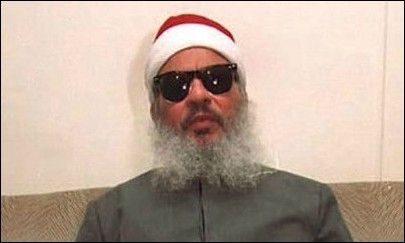
 

Omar Abdel Rahman (“The Blind Sheikh”) and nine others were convicted of seditious conspiracy in connection with the 1993 bombing of the World Trade Center.

During the 1990s, the Egyptian authorities battled against a sustained wave of Islamist terrorism involving attacks on government officials and the country’s Coptic minority, the murdering of foreign tourists as well as an audacious attempt on the life of President Hosni Mubarak while he was in Ethiopia in June 1995.[20] In the same year, GI’s leader and MB spiritual authority, Omar Abdel Rahman, known as “The Blind Sheikh,” and nine others were convicted of seditious conspiracy in connection with the 1993 bombing of the World Trade Center. Abdel Rahman is currently serving a life sentence in a federal prison in North Carolina, and in Muhammad Morsi’s first speech as Egyptian president in Tahrir Square, he called for Abdel Rahman’s release and acknowledged the sheikh’s family who was present in the audience.[21]

No less important was the formation of the movement’s International Apparatus by Banna’s son-in-law Said Ramadan. Having fled Egypt to Saudi Arabia in 1954, Ramadan moved to Geneva in 1958 where he established the International Apparatus under the guidance of Mustafa Mashour, head of the Secret Apparatus, future MB general guide, and author of its militant manifesto “Jihad Is the Way.”[22] The International Apparatus was not fully operational until the mid-1980s when Mashour, who fled Egypt after Sadat’s assassination, settled in West Germany[23] in 1986 where he reestablished the Apparatus.

The MB’s International Apparatus is involved in operating and funding terrorist groups responsible for attacks on American soil.

The International Apparatus is not just responsible for the Brotherhood’s public operations, but is also involved in operating and funding terrorist groups responsible for attacks on American soil. Thus, for example, Chakib Ben Makhlouf, one of the most prominent leaders of the MB’s Geneva office, is also the president of the Federation of Islamic Organizations in Europe. He has been described by Egyptian member of parliament and terrorism expert Abdel Rahim Ali as “one of the most dangerous operatives of the Brotherhood’s International Apparatus.”[24] Likewise, according to Egyptian general Fouad Allam, who investigated the MB’s operations in the 1960s-70s, the Geneva office funneled funds that helped establish al-Gama’a al-Islamiyya.[25]

Later Influence

The International Apparatus’s most critical mission, though, has been to infiltrate, subvert, and recruit operatives from within the armies, governments, educational systems, and intelligence agencies of the MB’s targeted states, especially in the West, in what is called “civilization jihad.”

This term dates to a 1991 document titled The Explanatory Memorandum, drafted in a meeting that outlined the Muslim Brotherhood’s strategic goals for North America and entered as evidence in the Holy Land Foundation (HLF) terror funding trial in 2008—the largest terror financing case in U.S. history.[26] In 2009, five MB leaders were charged with providing material support to Hamas, the Brotherhood’s Palestinian branch and a designated foreign terrorist organization.

The 1980s and 1990s were the two most important decades for the “civilization jihad.” During this time, Hamas was transformed from an essentially missionary and charitable organization seeking to win Palestinian hearts and minds into a fully-fledged terror group during the first intifada (December 1987-September 1993), and the seeds were sown for the advent of al-Qaeda through the newly-formed Maktab al-Khidamat (MAK, the Services Bureau), also known as Maktab Khidamat al-Mujahidin al-Arab (the Services Bureau of Arab Jihadists) and the Afghan Services Bureau.

As jihadists flocked to Afghanistan and Pakistan to fight the Soviet occupation, the Brotherhood was busy running recruitment, jihadist services through its MAK offices throughout the Middle East. In 1984, MB operative Abdullah Azzam established the MAK office in Jordan.[27] Azzam’s philosophy helped establish and organize the Brotherhood’s “global jihad” movement, which earned him the alias, “The Father of Global Jihad.”[28] No less important, this philosophy inspired GI and Egyptian Islamic Jihad (EIJ) to try to export their terrorism and greatly inspired Osama bin Laden, whom Azzam taught at a Saudi university.[29]
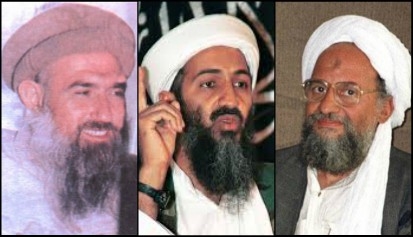
 

In 1985, MB operatives Abdullah Azzam (L), bin Laden, and Ayman Zawahiri (R) founded MAK in Pakistan, which evolved into al-Qaeda. The Amman MAK recruited Abu Musab Zarqawi, who founded Jama’at al-Tawhid wa-l-Jihad, which evolved into al-Qaeda in Iraq and eventually into ISIS.

In 1985, Azzam, bin Laden and Ayman Zawahiri, leader of Takfir wa-l-Hijra who fled Egypt after the Sadat assassination, founded MAK in Pakistan, which subsequently evolved into al-Qaeda. Meanwhile, the Amman MAK office recruited one of the world’s most brutal terrorists of modern time, Abu Musab Zarqawi.[30] Mentored by Jordanian former MB leader Abu Muhammad Maqdisi, in 1999, Zarqawi founded Jama’at al-Tawhid wa-l-Jihad (Organization of Monotheism and Jihad), which six years later, evolved into al-Qaeda in Iraq (AQI) after Zarqawi pledged allegiance to bin Laden in late 2004. This group eventually morphed into ISIS after Zarqawi’s death in June 2006. Indeed, in a 2014 interview reported in Al-Arabiya News, the Muslim Brotherhood spiritual guide Yusuf Qaradawi admitted that ISIS leader Abu Bakr Baghdadi was a member of the Muslim Brotherhood.[31] For their part, several MB leaders publicly announced their support for ISIS, including the Qatar-based Sheikh Wagdy Ghoneim.[32]

The nature of al-Qaeda’s current relationship with the Brotherhood is somewhat unclear. While Zawahiri argued that bin Laden’s affiliation with the MB was severed in the 1980s due to differences over the anti-Soviet Afghanistan campaign,[33] this claim was discounted by Tharwat Kherbawy, the highest ranking MB member to have defected from the organization,[34] and also by evidence suggesting that the Brotherhood is still organizationally involved with al-Qaeda. Thus, for example, after Morsi’s July 2013 ouster from power, Zawahiri issued a videotaped statement on his behalf where he criticized Egyptian Salafi jihadists for not formally joining the Muslim Brotherhood’s Freedom and Justice Party to help it uphold Shari’a law.[35] In another statement, Zawahiri criticized the deposed MB president for having played politics with opponents,[36] but eventually prayed for his release and supported him while he was facing trial for inciting the killing of regime opponents and for espionage for foreign militant groups including Hamas, Hezbollah, and Iran’s Revolutionary Guard Corp.[37]

A Political Party or a Jihadi Group?

The Obama administration’s stubborn support for the Morsi regime and its tireless attempts to cast the MB as a moderate organization are preposterous—not only because the Brotherhood is the bedrock of some of the worst terror groups in today’s world but also because violence is endemic to the movement’s raison d’être: restoring the caliphate via violent jihad. Were the Brotherhood to give up this foundational goal, it would lose its legitimacy and sole reason for existence. This is why Banna used military terminology in structuring the MB, calling the organization “Allah’s battalion,”[38] a term used to this very day to denote the MB’s governing core; this is why the current Brotherhood leadership includes operatives who personally engaged in violent jihad and terror activities such as Abdel Moneim Abul Futuh.[39]
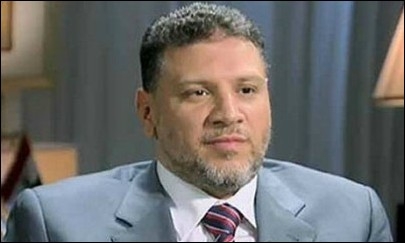
 

Osama Yassin, a former minister in Muhammad Morsi’s cabinet, revealed that members of the MB’s 95 Brigade militia engaged in the abduction, beating, and torture of “thugs” during riots leading to Mubarak’s downfall.

Furthermore, the organization’s Secret Apparatus remains intact and operational with new recruits required to undergo military training by such militias as the 95 Brigade,[40] which was established in 1995 and which played an active role in the January 2011 riots leading to Mubarak’s downfall. In a series of interviews with al-Jazeera TV, Osama Yassin, a former minister in Morsi’s cabinet, revealed that members of the brigade engaged in the abduction, beating, and torture of “thugs” and threw Molotov cocktails at their opponents.[41] Asked by an Egyptian newspaper to clarify these revelations,[42] the MB dismissed them as a joke. Still, the brigade operatives were later implicated in the killing of anti-Brotherhood protestors. In March 2014, for example, two operatives were sentenced to death after an online video clip showed them killing a teenager by throwing him from a building.[43]

According to the Brotherhood’s own standards and internal bylaws,[44] there are ten solid, unchangeable thawabit (precepts) in their organization’s bai’a (Islamic oath of allegiance) process. The fourth of these precepts is violent jihad and martyrdom,[45] which the Brotherhood states is an obligation of every individual Muslim, as well as the collective obligation of their organization.

The current Brotherhood leadership includes operatives who personally engaged in violent jihad and terror activities.

Unfortunately, many American specialists either receive foreign funding or are otherwise oblivious to these facts and actively engage in a disinformation campaign. For example, a Brookings Institute article turned the meaning of the “fourth precept” of the Brotherhood’s bylaws on its head, stating that it stipulated that “during the process of establishing democracy and relative political freedom, the Muslim Brotherhood is committed to abide by the rules of democracy and its institutions.”[46]

Reality, of course, was quite different. When after Mubarak’s downfall the Muslim Brotherhood rose to power in a sham presidential election,[47] which brought its operative Mohamed Morsi to the presidential palace, its violent[48] and undemocratic rule triggered, in short notice, mass protests throughout the country that brought millions of protestors to the streets and enabled the military to overthrow Morsi in a bloodless coup.

Islamic Reformers

Indeed, the sheer brutality of ISIS and various Brotherhood-affiliated or inspired terror groups across the Middle East has led to the advent of a mainstream Islamic reformist movement that draws on vastly more popular support than the Brotherhood itself. This unprecedented revival of a reform-oriented movement has received too little attention in the West. For example, Islam Behery, one of the movement’s heroic leaders, was incarcerated for a year for blasphemy for insulting al-Azhar University and the Sunni doctrine on his television show.[49] For two years, that show had been dedicated daily to exposing the brutality and terrorism of Sunni doctrine while offering a non-theocratic, liberal interpretation of Islam that pushes for separation of mosque and state. Behery received a presidential pardon in December 2016, which was unprecedented in Egyptian history.

Another supporter of reformation and freedom of thought is Ibrahim Issa, a popular Egyptian commentator, television host, and owner and editor-in-chief of the independent opinion newspaper Al-Maqal. Earlier this year, Issa announced that he would end his TV show due to “current events,” kindling speculation that the cancellation was related to Saudi pressure on the Egyptian regime because of Issa’s criticism of the kingdom’s violent Wahhabi sect.[50] Issa’s reformist stance has placed him on terrorist hit lists since 1992, and he has been living under tight security ever since. His opposition to the Muslim Brotherhood has made him one of the organization’s high profile targets, and in 2015, he became the subject of an official fatwa declaring him an “infidel.”[51]

Another heroic figure of Islamic reform currently facing the possibility of incarceration for blasphemy is the popular author and prominent secular figure Sayyed Qemani. His sin: stating that al-Azhar University should be designated a terrorist organization.[52] Behery, Qemani, and their like have the support of the most mainstream media figures in Egypt and across the Middle East, and they have dramatically changed the Islamic political discourse. Yet Western audiences have almost never heard of their heroic efforts.

The war of ideas is highly dynamic in today’s Middle East. The vast majority of the region’s peaceful Muslims are marginalized by Western support for the Brotherhood and the West’s refusal to designate the MB as a terrorist organization.

Conclusion

The deadly Brotherhood cult is responsible for almost a century of terror since the young Banna engaged in the intimidation and harassment of his Christian and moderate Muslim neighbors. Since then, the Brotherhood established Hamas as its Palestinian wing. Three Brotherhood activists established al-Qaeda. Brotherhood leaders, from inside their prisons, founded al-Gama’a al-Islamiyya and Egyptian Islamic Jihad. Brotherhood members recruited the founder of Jama’at al-Tawhid wa-l-Jihad who started the trend of video decapitations, and one of its former operatives is currently acting as the caliph of Islamic State. The MB also has other connections to organizations on the U.S. government’s list of foreign terrorist organizations.

The majority of the region’s peaceful Muslims are marginalized by Western support for the Brotherhood.

Neither Washington, nor any capital, can hope to counter Islamic terrorism successfully without allying with Muslim
figures fighting on the forefront of the battle of ideas. Washington can give these moderate Muslims a voice by designating the Muslim Brotherhood as a terrorist organization.

The Brotherhood has stated its intention to destroy the West’s “miserable house” by infiltrating Western society and institutions and subverting them from the inside.[53] Designating the Muslim Brotherhood as a foreign terrorist organization will stop its operatives from reaching sensitive positions in the intelligence community and in other powerful U.S. government positions. It will also stop Brotherhood operatives in the United States from funding terrorism operations worldwide.

Cynthia Farahat, a Middle East Forum Writing Fellow and columnist for Al-Maqal daily newspaper, is currently working on a book about the Muslim Brotherhood.


[1] ABC News, Feb. 10, 2011.

[2] John Esposito, “The Muslim Brotherhood, Terrorism and U.S. Policy,” The Huffington Post (New York), Mar. 22, 2016.

[3] Reuters, Nov. 15, 2014.

[4] The Washington Post, Nov. 17, 2014.

[5] Reuters, Dec. 17, 2015.

[6] Rep. Dave Brat, press release, Brat.House.gov, July 19, 2016.

[7] Abdallah Aqeel, “Al-Sheikh al-Muhadith Ahmad Abdel Rahman al-Banna al-Sa’ati,”AlaqeelAbuMostafa.com, accessed Aug. 30, 2016.

[8] Hassan al-Banna, Mudhakkirat al-Da’wa wa’l-Da’iyah (Cairo: Maktabat al-Shihab, 1979), pp. 17-8, 25-6; Misr al-Balad TV (Cairo), Mar. 19, 2014.

[9] Mahmoud Sabbagh, Haqiqat al-Tanzim al-Khass (Cairo: Etisam Publishing, 1989).

[10] Abdel Rahim Ali, “Abdel Rahman Sendi: Mu’asis al-Tanzim al-Khass bi’l-Ikhwan,” Islamists-Movements.com, Nov. 12, 2015.

[11] “Assessing the Islamist Threat, circa 1946,” Middle East Quarterly, Summer 2006, pp. 76-82;FrontPage Magazine (Sherman Oaks, Calif.), Feb. 13, 2006.

[12] Khaled Mohieddin, Al’an Atakkalam: Mudhakkirat al-Thawra (Cairo: American University of Cairo Press, 1995), p. 45; Hassan Ashmawy, Mudhakkirat Harib (Cairo: Islamic Publishing House, 2000), p.15.

[13] Farouk Taifour, “Al-Juz’ al-Rabi: al-Ikhwan wa’l-Tanzimat al-Sirriya,” Egyptian Institute for Political and Strategic Studies, Cairo, EIPSS-EG.org, Feb. 24, 2016.

[14] “Profile: Egypt’s Muslim Brotherhood,” BBC, Dec. 25, 2013.

[15] Al-Wafd (Cairo), Dec. 14, 2013.

[16] Salah Shadi, Safahat min al-Tarikh (Cairo: Islamic Publishing House, 1987), p. 79.

[17] Ahmad Abdel Majid, Al-Ikhwan wa Abdel Nasser: Al-Qissa al-Kamila li-Tanizm 1965 (Cairo: al-Zahra for Arabic Media, 1991), p. 33.

[18] Tharwat Kharbawi, Sirr al-Ma’bad (Cairo: Nahdet Misr Publishing, 2012), p. 220.

[19] YouTube, “Al-Sadat Yatahadath an al-Gama’a al-Islamiya wa’l-Ikhwan,” May 9, 2012.

[20] Efraim Karsh, Islamic Imperialism: A History (New Haven and London: Yale University Press, 2013; rev. ed.), chap. 12.

[21] TV News (Cairo), June 29, 2012.

[22] Mustafa Mashour, “Al-Jihad huwa al-Sabil,” The Official Muslim Brotherhood Encyclopedia, IkhwanWiki.com, accessed Aug. 31, 2016; idem, “Jihad Is the Way,” trans. Palestinian Media Watch, Jerusalem, Feb. 9, 2011.

[23] Daniel Pipes, “How Islamists Came to Dominate European Islam,” National Review Online, May 25, 2010.

[24] Al-Bawabah News (Cairo), Mar. 11, 2014.

[25] Rifaat Sayed, Hassan al-Banna, al-Sheikh al-Musalah (Cairo: Akhbar al-Youm Publishing, 2004), p. 198

[26] “The Muslim Brotherhood’s Strategic Plan for America—Court document,” The Clarion Project, Washington, D.C., accessed Sept. 1, 2016.

[27] Farouk Taifour, “Hal Kharajat Daesh min Rahm Fikr al-Ikhwan al-Muslimin?” Egyptian Institute for Political and Strategic Studies, Cairo, EIPSS-EG.org.

[28] “Abdullah Azzam: Overview,” Counter Extremist Project, New York, accessed Feb. 9, 2017.

[29] Karsh, Islamic Imperialism, chap. 13.

[30] Elaph (London), July 18, 2005.

[31] Al-Arabiya News Channel (Dubai), Oct. 14, 2014.

[32] “Al-Sheikh Wagdy Ghoneim: La li’l-Tahaluf al-Salibi dudd al-Dawla al-Islamiya,” You Tube, Sept. 19, 2014.

[33] Stephen Lacroix, “Osama bin Laden and the Saudi Muslim Brotherhood,” Foreign Policy, Oct. 3, 2012.

[34] Al-Aan TV (Cairo), Apr. 19, 2014.

[35] “Ta’kib al-Sheikh Ayman al-Zawahiri ala Azl Morsi wa-Tahdid al-Jaish,” You Tube, July 5, 2013.

[36] “Ayman al-Zawahiri Yuwajih Risalat Itab li-Morsi wa-Yadou Allah an Yafuku Asrahou,” You Tube, Feb. 11, 2014; Erich Follath, “Political Stability Eludes Polarized Egypt,” Der Spiegel (Hamburg), July 29, 2013.

[37] Reuters, Dec. 17, 2015.

[38] Banna, Mudhakkirat al-Da’wa, p. 144.

[39] “Abdel Moneim Abul Futuh Yajtami ma’a Haraket Taliban Afghanistan,” You Tube, June 8, 2013.

[40] Al-Wafd (Cairo), Jan. 11, 2013.

[41] Al-Jazeera TV (Cairo), Nov.-Dec. 2011.

[42] Al-Watan (Cairo), Jan. 3, 2013.

[43] Al-Arabiya News, Mar. 29, 2014.

[44] “Bylaws of the International Muslim Brotherhood,” June 1928.

[45] Muhammad Kandil, “Al-Thabit al-Rab’i: al-Jihad Salbiluna,” The Official Muslim Brotherhood Encyclopedia, IkhwanWiki.com, accessed Sept. 1, 2016; “The Muslim Brotherhood: Understanding its Roots and Impact, 1. Overview,” Foundation for Defense of Democracies, Washington, D.C., accessed Feb. 9, 2017.

[46] Umar Ashur, “Hal Ya’ud al-Ikhwan al-Muslimun fi Masr ila’l-Unf al-Siyasi?” Brookings Institute, Washington, D.C., July 30, 2014.

[47] Daniel Pipes and Cynthia Farahat, “Egypt’s Sham Election,” National Review Online, Dec. 6, 2011;Shuruk News (Cairo), Mar. 22, 2016.

[48] Amb. Yahia Najm, Akhbar al-Yom TV (Cairo), in Cynthia Farahat, “CairoGate: Egyptian Diplomat Survives MB Torture Says ‘It was like a Nazi camp,'” Dec. 9, 2012.

[49] Al-Ahram (Cairo), Dec. 29, 2015.

[50] Bawabat al-Qahira (Cairo), Jan. 1, 2017.

[51] Bawabat al-Haraqat al-Islamiya (Cairo), Mar. 18, 2015. The fatwa was subsequently broadcast on the official Muslim Brotherhood television channel Rabaa, broadcasting from Turkey. See Al-Arabiya News, Dec. 5, 2017.

[52] Al-Dustur (Cairo), Jan. 3, 2016.

[53] “The Muslim Brotherhood’s Strategic Plan for America—Court document,” The Clarion Project, Washington, D.C., accessed Sep. 1, 2016.

by Cynthia Farahat
Middle East Quarterly

http://www.meforum.org/6562/the-muslim-brotherhood-fountain-of-islamist

I Criticized Hamas and My Life in Turkey Became a Nightmare

0

Οι ιδιόρρυθμες γαλλικές εκλογές με απροσδόκητους υποψηφίους

0

Του οικονομολόγου Eric Gazon.  [email protected]
Και την επιμέλεια του Αλκη Καλλιαντζίδη [email protected]

Οι γαλλικές προεδρικές εκλογές του 2017 θα καταγραφούν στην ιστορία ως από τις πλέον ιδιόρρυθμες της αποκαλούμενης 5ης  Γαλλικής Δημοκρατίας. Κι αυτό γιατί τρεις (Φιγιόν, Μακρόν, Αμόν) από τους πέντε προπορευόμενους δημοσκοπικά  υποψηφίους στις εκλογές είναι απροσδόκητοι. Το κλίμα εντός του οποίου διεξάγονται οι εκλογές είναι εξαιρετικά δηλητηριώδες θέτοντας υπό αμφισβήτηση τον τύπο, τη δικαιοσύνη, τους βουλευτές και την κυβέρνηση. Ποτέ μια εκλογική αναμέτρηση δεν ήταν τόσο  μαύρη και σκοτεινή. Ποτέ γαλλικές εκλογές  δεν προκάλεσαν τόση έκπληξη στους πολίτες. Το ακόλουθο άρθρο, αλλά και άλλα δυο που θα εκπονηθούν, φιλοδοξεί να παράσχει σχετική εμπεριστατωμένη ενημέρωση στο ελληνικό κοινό για το τι συμβαίνει.

Οι απροσδόκητοι υποψήφιοι

Η προεκλογική εκστρατεία για τις προεδρικές εκλογές της 23ης Απριλίου και 7ης Μαΐου 2017 άρχισε με μια χρονοβόρα ενδοπαραταξιακή διαδικασία για την υπόδειξη των υποψηφίων των κομμάτων.

Κατ’ αρχάς, η γαλλική δεξιά και το κέντρο διοργάνωσαν προκριματικές εκλογές  για την υπόδειξη του υποψηφίου τους στις προεδρικές εκλογές. Οι δημοσκοπήσεις ήταν σαφείς. Ο Juppé ή έστω κι ο  Sarkozy, έπρεπε να υπερισχύσουν. Αναμετρήθηκαν επτά υποψήφιοι. Στις 10 Οκτωβρίου, ο Alain Juppé, σύμφωνα με  διάφορες μετρήσεις, εισέπραττε το 34 % των προθέσεων ψήφου, ο Nicolas Sarkozy το 28%, ο Bruno Lemaire και ο François Fillon από 11 % . Οι υπόλοιποι υποψήφιοι ήταν πολύ πίσω και η πρόθεση ψήφου για αυτούς δεν ξεπερνούσε το  2 με 4 % για την Nathalie Kosciusko-Morizet, τον Jean-Frédéric Poisson, και τον Jean-François Copé. Τελικά, στα αποτελέσματα του πρώτου γύρου της 20ης Νοεμβρίου 2016, ο Fillon συγκέντρωσε  44 % (η πρώτη έκπληξη), ο Juppé 28,5 % και ο Sarkozy 20,6 %. Κανένας από τους άλλους υποψηφίους δεν ξεπέρασε το 3 %. Ο δεύτερος γύρος έδωσε 66,5 % στον Fillon, με πολύ μεγάλη συμμετοχή 4,4 εκατομμυρίων ψηφοφόρων. Στις 18 Νοεμβρίου (δηλαδή δυο μέρες πριν από τις εκλογές), μια τελευταία δημοσκόπηση έδινε στον Fillon 30 % θετικές προθέσεις ψήφου, το οποίο ήταν 14,1% ποσοστιαίες μονάδες κάτω από το τελικό αποτέλεσμα του πρώτου γύρου των προκριματικών της κεντρο-δεξιάς!

Την 1η Δεκεμβρίου, ο François Hollande αποφάσισε να μην ξαναβάλει υποψηφιότητα στις προεδρικές εκλογές (η δεύτερη έκπληξη). Είναι η πρώτη φόρα στην ιστορία της Γαλλικής Δημοκρατίας (μόνο ο Pompidou δεν ξαναέβαλε  υποψηφιότητα, όμως λόγω θανάτου). Ο François Hollande αντιμετώπισε μια μεγάλη λαϊκή δυσφορία μετά από την πενταετία του στην Προεδρία. Το βιβλίο «Ο πρόεδρος δεν θα έπρεπε να το πει αυτό…», το οποίο έγραψαν δύο δημοσιογράφοι της εφημερίδας Le Monde, ο Gérard Davet και ο Fabrice Lhomme,  που είδε το φως της δημοσιότητας τον Οκτώβριο του 2016 αποτελείωσε την ήδη κατεστραμμένη αξιοπιστία του Hollande. Δεν ήταν πλέον καθόλου δημοφιλής. Μόλις  το 13 % των ερωτηθέντων σε σχετικές δημοσκοπήσεις  του Νοεμβρίου θεωρούσαν ότι η δράση του ως προέδρου ήταν θετική ή μάλλον θετική. Όλες οι έρευνες έδειχναν ότι δεν θα είχε καταφέρει να περάσει στο δεύτερο γύρο των προεδρικών εκλογών, αν έθετε υποψηφιότητα εκ νέου. Η απόφαση αυτή πυροδότησε  τον ανταγωνισμό μεταξύ διαφόρων δελφίνων του σοσιαλιστικού κόμματος και των συμμάχων του.

Οι προκριματικές εκλογές  της Αριστεράς θα μας προσφέρουν την τρίτη έκπληξη. Οι εκλογές διεξήχθηκαν στις 22 και 29 Ιανουαρίου 2017 προκειμένου να ορίσουν τον υποψήφιο του κόμματος και των συμμάχων του. Η προεκλογική εκστρατεία ήταν πολύ σύντομη  για τους επτά υποψηφίους. Στις 19 Ιανουαρίου, οι δημοσκοπήσεις έδιναν στον πρώην πρωθυπουργού Manuel Valls με μεγάλη διαφορά την πρώτη θέση με 37 % της πρόθεσης ψήφου. Οι συνυποψήφιοι  Benoît Hamon και Arnaud Montebourg ελάμβαναν 28 % και 24 % αντίστοιχα. Οι υπόλοιποι τέσσερις υποψήφιοι συγκέντρωναν από 5 έως 1 %. Τελικά, ο Benoît Hamon υπερίσχυσε στον πρώτο γύρο, με 36,5 %, ακολουθούμενος από τον Valls με  31,9 % και τον Montebourg με 17,7 % αντίστοιχα. Ο Benoît Hamon επικράτησε άνετα με το 58,9 % στο δεύτερο γύρο και η συμμετοχή ήταν 2 045 343 ψηφοφόροι. Οι πράσινοι υποστήριξαν την υποψηφιότητα του  Hamon στις 23 Φεβρουαρίου 2017.

Οι δύο υποψήφιοι, που κέρδισαν τις προκριματικές εκλογές των κομμάτων τους,  φαίνονταν οι πιο «ακραίοι». Ήταν πολύ αριστερός και οικολόγος για τους μεν (σοσιαλιστές) και πολύ φιλελεύθερος για τους δε (τους κεντροδεξιούς).  Και στις δύο περιπτώσεις, οι δημοσκοπήσεις έπεσαν έξω : ο υποψήφιος σοσιαλ-φιλελεύθερος Manuel Valls και ο υποψήφιος φιλελευθερο-κοινωνικός Alain Juppé έχασαν ξεκάθαρα. Οι άλλοι υποψήφιοι του κέντρου, ο François Holland και ο François Bayrou, απέφυγαν να εκτεθούν λόγω των πολύ χαμηλών προσδοκιών ψήφου στον πρώτο γύρο των εκλογών. Τα αποτελέσματα αυτά θα μπορούσαν να ερμηνευθούν ως η βούληση των γάλλων πολιτών  για αλλαγή και επιθυμία  ανανέωσης.

Ο τρίτος υποψήφιος Macron αποτελεί επίσης έκπληξη. Μετά την αποχώρησή του από την κυβέρνηση στα τέλη Αυγούστου 2016, ανακοίνωσε την υποψηφιότητά του στις 16 Νοεμβρίου, λέγοντας με σαφήνεια ότι δεν θα συμμετάσχει στο προκριματικές εκλογές της Αριστεράς. Για να δικαιολογήσει την υποψηφιότητά του, εκτός των παραδοσιακών κομμάτων, ο πρώην Υπουργός Οικονομικών, επανέλαβε ότι δεν ανήκει ούτε στη δεξιά ούτε στην αριστερά και ότι η πρόθεσή του είναι να συσπειρώσει τους Γάλλους. Εκφράζει σε πολύ μεγάλο βαθμό την επιθυμία των Γάλλων  για ανανέωση εκτός των πολιτικών κομμάτων. Πολλοί σχολιαστές θεωρούσαν ότι δεν υπήρχε πολιτικός χώρος για Macron. Η επαναλαμβανόμενη χίμαιρα συσπείρωσης της κεντροδεξιάς και της κεντροαριστεράς θα ήταν αδύνατη στο πλαίσιο της 5ης Δημοκρατίας. Ωστόσο, ο Macron προοδεύει στις δημοσκοπήσεις από το 10 % τον Νοέμβριο στο 18 % στα μέσα Δεκεμβρίου 2016. Ο François Bayrou, ο πρώην υποψήφιος που είχε συγκεντρώσει το 9 % στον πρώτο γύρο των προεδρικών εκλογών του 2012 και το 18,5 % του 2007, δήλωσε ότι τελικά υποστηρίζει τον  Emmanuel Macron στις 22 Φεβρουαρίου 2017. Η μη υποψηφιότητα του Bayrou αποτελεί επίσης μια ημι-έκπληξη. Ήταν παρών στις προεδρικές εκλογές από το 2002. Επιθυμία του ήταν να συμμετάσχει σε αυτές ακόμα και το 2017, αλλά οι δημοσκοπήσεις δεν του έδιναν  περισσότερο από 5 % στον πρώτο γύρο. Στα τέλη Μαρτίου ο  Macron συγκεντρώνει περίπου το 26% στις δημοσκοπήσεις.

Οι δύο άλλες προπορευόμενες δημοσκοπικά υποψηφιότητες, της Marine Le Pen και του Jean-Luc Mélenchon, δεν αποτελούν έκπληξη. Οι πολιτικοί αυτοί είχαν ήδη υποβάλει υποψηφιότητα για τις εκλογές του 2012 και είχαν συγκεντρώσει το 17,9 % και 11,1 % αντίστοιχα. Η ακροδεξιά Le Pen (ή ακραία δεξιά ) ανακοίνωσε την υποψηφιότητά της στις 8 Φεβρουαρίου και ο Mélenchon (η αριστερά της αριστεράς, συμπεριλαμβανομένου και του γαλλικού κομμουνιστικού κόμματος) στις 10 Φεβρουαρίου 2017. Οι έρευνες τους πιστώνουν (έως τις αρχές Μαρτίου 2017) με 26 % για την Le Pen και 11 % για τον Mélenchon. Και οι δύο είναι υποψήφιοι «αντισυστημικοί» και επιθυμούν να βγουν από το ευρώ και από την  ευρωπαϊκή ένωση.

Συνολικά, πρόκειται για υποψηφίους που δημιούργησαν την έκπληξη ή που είναι παραδοσιακά  εναντίον του συστήματος. Φαίνεται ότι η τάση των εκλογών του 2017 είναι η θέληση ανανέωσης και  τομής με το παρελθόν. Οι «παλαιοί» (ο Ολάντ, ο Bayrou, ο Juppe, ο Sarkozy και μέχρι ενός ορισμένου σημείου ο Valls) απορρίφθηκαν ή δεν τόλμησαν να θέσουν υποψηφιότητα επειδή δεν ήταν σε θέση να κερδίσουν κατά την πρώτη φάση της προεκλογικής εκστρατείας (Νοέμβριος-Ιανουάριος), κατά την οποία ορίζονταν οι  υποψήφιοι.

Θα ακολουθήσει έναν άρθρο για την αποπνικτική ατμόσφαιρα των εκλογών και ένα δεύτερο για το πού βρισκόμαστε σήμερα.

Η δηλητηριώδης ατμόσφαιρα των γαλλικών εκλογών

Η δεύτερη φάση της εκλογικής εκστρατείας δεν προκάλεσε  λιγότερη έκπληξη.  Περιλαμβάνει  δυο περιόδους: η πρώτη  από τις 25 Ιανουαρίου έως τις 14 Μαρτίου και η δεύτερη άρχισε μετά την 14η Μαρτίου και θα ολοκληρωθεί περί τα μέσα Απριλίου, δηλαδή μία εβδομάδα πριν από  τον πρώτο γύρο των εκλογών κατά την οποία θα είναι πλέον πολύ αργά για όλους τους υποψηφίους να αλλάξουν τα δεδομένα.

Ο François Fillon έφτασε στο 28 με 30 % σε δημοσκοπήσεις αμέσως μετά τις προκριματικές εκλογές της κεντροδεξιάς και όλοι τον θεωρούσαν ως τον  νέο μελλοντικό Πρόεδρο. Εν συνεχεία, ξεκίνησε το σκάνδαλο της «υπόθεσης Pénélope Fillon». Το άρθρο της εφημερίδας «Le Canard enchaîné» που δημοσιεύθηκε στις 25 Ιανουαρίου ισχυρίστηκε ότι η σύζυγος του François Fillon έλαβε  800 000 ευρώ μεικτά ως  κοινοβουλευτική βοηθός του συζύγου της, από το 1998 έως το 2002 και από το 2002 έως το 2007 ως κοινοβουλευτική βοηθός του αναπληρωτή βουλευτή του συζύγου της, χωρίς να έχει πράγματι εργαστεί. Επιπλέον, το άρθρο αυτό κατήγγειλε ότι μεταξύ Μαΐου 2012 και Δεκεμβρίου 2013, η Pénélope Fillon εισέπραξε το ποσό των 100 000 ευρώ ως λογοτεχνικός σύμβουλος στο περιοδικό Revue des Deux Mondes, παρέχοντας μόνο δύο μικρά άρθρα.

Σε αυτό το πλαίσιο, έγινε μια έντονη συζήτηση στον τύπο, αν η Pénélope Fillon είχε πράγματι εργαστεί ή όχι και, εάν η αμοιβή της ήταν ή δεν ήταν ιδιαίτερα υψηλή  (ιδιαιτέρα για την δουλειά που έκανε ή δεν έκανε). Η συζήτηση αφορούσε επίσης τη νομιμότητα των κατηγοριών  και το γεγονός αν αποτελεί ή δεν αποτελεί κοινή πρακτική μεταξύ των γάλλων βουλευτών. Οι συζητήσεις αυτές αποτυπώνονταν σε καθημερινή βάση στον τύπο. Τροφοδοτούνταν επίσης από τις διαρροές (παράνομες) των αποτελεσμάτων των δικαστικών ερευνών. Επιπλέον,  αποκαλύφθηκε  ότι τα δυο  παιδιά του Fillon δούλεψαν για αυτόν ως κοινοβουλευτικοί βοηθοί, αν και ήταν πολύ νέα και δίχως πανεπιστημιακά πτυχία Επίσης ο τύπος μίλησε για ένα άτοκο δάνειο ύψους 50 000 ευρώ, για τα πολυτελή κοστούμια που δωρίθηκαν στον Fillon από φίλο του  ύψος 10 με 15.000 ευρώ και την εταιρεία παροχής συμβουλών «2F» του François Fillon με υποψία άσκησης μυστικών επιρροών στο περιβάλλον του Poutine.  Άλλα άρθρα αναφέρονται στην «υπόθεση» των αποζημιώσεων  απόλυσης της Pénélope Fillon . Συνολικά, από τις 25 Ιανουαρίου έως τις 14 Μαρτίου οι συζητήσεις και τα άρθρα του Τύπου περιστρέφονται γύρω από τις υποθέσεις Fillon και η προεδρική εκστρατεία (τα προγράμματα των υποψηφίων δηλαδή) ήταν εξορισμού  στο περιθώριο.

Μια υπόθεση που γνωρίζει επίσης μια διαφορετική δικαστική εξέλιξη είναι η εξής. Στις 25 Ιανουαρίου 2017, ήτοι την ίδια ημέρα κατά την οποία το άρθρο του Canard enchainé είδε το φως της δημοσιότητας,  αποφασίστηκε προκαταρκτική έρευνα από μια δικαστική αρχή «την  εθνική οικονομική Εισαγγελία» (νέος θεσμός που δημιουργήθηκε από τον Hollande) για υπεξαίρεση δημόσιων πόρων. Την Πέμπτη 16 Φεβρουαρίου, η εν λόγω αρχή αναφέρει ότι «τα στοιχεία που συγκεντρώθηκαν  δεν επέτρεπαν να σταματήσει  η προκαταρκτική έρευνα». Μετά την εν λόγω ανακοίνωση, ο François Fillon διαπιστώνει ότι, σε αντίθεση με αυτό που αναμενόταν,   η υπόθεσή του δεν θα κλείσει γρήγορα. και δηλώνει ότι, βασίζεται τώρα πια  «μόνο στην κρίση των πολιτών» (εννοώντας ότι οι δικαστές της εν λόγω αρχής δεν είναι ανεξάρτητοι πολιτικά). Για πρώτη φορά, οι δικαστές δεν τηρούν «δικαστική ανακωχή» λόγω εκλογών. Ορισμένοι διερωτώνται σχετικά με την ανάμειξη της δικαιοσύνης στην πολιτική και την πιθανή χειραγώγηση των δικαστών. Στις 24 Φεβρουαρίου 2017, οι δικαστές της  εθνικής οικονομικής Εισαγγελίας ανοίγουν μια ποινική ερευνά για  υπεξαίρεση δημοσίων πόρων, για κατάχρηση δημοσίων αγαθών και κλεπταποδοχή, για αθέμιτη επιρροή. Τελικά, απαγγέλθηκε κατηγορία στον François Fillon στις 14 Μαρτίου 2017 από τους δικαστές  και προβλέπεται να δικαστεί, αν δεν εκλεγεί πρόεδρος ή όταν ολοκληρωθεί η προεδρική του θητεία, λόγω ασυλίας.

Η υπόθεση Pénélope Fillon προκαλεί για μερικές εβδομάδες την αμφισβήτηση της υποψηφιότητας του François Fillon στις προεδρικές εκλογές από ορισμένα στελέχη της κεντροδεξιάς. Πολλοί άνθρωποι από τη δεξιά και από την αριστερά ζητούσαν επίσης, την αντικατάστασή  του από τον Alain Juppé. Ο Fillon αρνήθηκε να του κλαπεί η υποψηφιότητά του. Μιλάει «για απόπειρα  πολιτικής δολοφονίας» και για προσπάθεια «πραξικοπήματος». Η απόσυρσή του θα διασφάλιζε την εκλογή του Macron χωρίς καμία αντιπολίτευση. Στις 27 Ιανουαρίου, ο Alain Juppé  βεβαιώνει ότι  δεν προτίθεται να θέσει υποψηφιότητα ακόμα και αν ο François Fillon τα παρατήσει. Πολλοί πολιτικοί προσφέρουν τις υπηρεσίες τους ως αντικαταστάτες υποψήφιοι. Κι ο Fillon είναι στο εξής ένας μοναχικός καβαλάρης. Ο Τύπος αναδεικνύει καθημερινά ότι οι πρώην πολιτικοί του φίλοι τον εγκαταλείπουν. Μερικοί παρακαλούν  πάντα τον Juppé, ωστόσο αυτός εμμένει στην απόφασή του. Επομένως, δεν υπάρχει καμία πραγματική εναλλακτική λύση, πέραν του  Fillon, για την δεξιά. Από την στιγμή που ο Juppé αρνήθηκε δεν υπήρξε πια κανένας άλλος υποψήφιος. Οι «δελφίνοι» δεν είναι διατεθειμένοι  να αφήσουν σε άλλους να θέσουν υποψηφιότητα. Επιπλέον, ο Fillon διοργανώνει μια επιτυχημένη συγκέντρωση στο Παρίσι (Trocadéro) για να αποδείξει ότι δεν ήταν μόνος του.  Τελικά, η κεντροδεξιά διαπίστωσε ότι δεν υπήρξαν εναλλακτικές λύσεις και επαναλαμβάνει τη στήριξή της στο Fillon (πολλοί από εκείνους που είχαν φύγει  επέστρεψαν). Στο  μεταξύ, ο Fillon έπεσε στο 17,5 % των προθέσεων ψήφου, συγκριτικά με το 28 % που είχε στα μέσα Ιανουαρίου. Το αποτέλεσμα; Βρίσκεται στην τρίτη θέση πίσω από τον Macron και την Le Pen. Η Le Pen παραμένει πρώτη, ο Macron ανεβαίνει συνεχώς. Ο Hamon και ο Mélenchon αγωνίζονται για τον ηγετικό ρόλο τους στην αριστερά.

Μια δεύτερη φάση της εκλογικής εκστρατείας έχει αρχίσει επομένως μετά την επιβεβαίωση του Fillon ως υποψηφίου, παρά τις κατηγορίες εναντίον του από την δικαιοσύνη. Η δεξιά, αναπτύσσει πολύ γρήγορα, ιδιαίτερα στο διαδίκτυο, τη θεωρία συνωμοσίας. Λένε ότι ο  Thomas Cazenave, νέος αναπληρωτής γενικός γραμματέας του Προέδρου Hollande, και μια δική του ομάδα, προετοίμασε τον φάκελο  Fillon  και ο Gaspard Gantzer, σύμβουλος επικοινωνίας του Hollande, τον διέρρευσε στην σατυρική εφημερίδα Canard enchainé. Έτσι, λένε,  τροφοδοτούσαν τις υποθέσεις Fillon.

Στις 23 Μαρτίου το γαλλικό κανάλι France 2, κάλεσε τον François Fillon ο οποίος  δήλωσε δημοσία ότι ο Hollande κατασκεύασε την υπόθεση Fillon  που τον οδήγησε  σε δικαστική περιπέτεια.  Κατά την άποψή του, υφίσταται ένα «ιδιαίτερο Σκοτεινό Γραφείο» στο Elysée  στο οποίο συγκεντρώνονται πληροφορίες που προέρχονται παράνομα από διάφορες δημόσιες υπηρεσίες του κράτους, ώστε να κατασκευάσουν ενοχοποιητικές υποθέσεις εναντίον του. Αξιοποιεί και το βιβλίο «Καλωσορίσατε στο υπουργείο δημοσίας ταξης» (“Bienvenue Place Beauvau ») που εκδόθηκε την ίδια ημέρα (23.03.17) από τους δημοσιογράφους του Canard enchaîné. Το εν λόγω βιβλίο μας πληροφορεί για την πιθανή ύπαρξη ενός «Σκοτεινού Γραφείου » (Cabinet noir) στο Elysée (έδρα του Γάλλου Προέδρου) : «Δεν είναι δυνατόν να προσκομίσει τις σχετικές αποδείξεις. Αλλά η προσθήκη ενδείξεων προκαλούν έκπληξη. Μολονότι ορισμένοι μάρτυρες, μέσα στην  αστυνομία περιγράφουν με λεπτομέρειες την ύπαρξη παράνομης δομής και την ύπαρξη δικτύου, που δρουν παράνομα παρέχοντας «γενικές πληροφορίες».

Δεν μπορεί να είναι σαφέστερο, δεδομένου ότι οι συγγραφείς του βιβλίου βεβαιώνουν: ότι «Για να ενορχηστρωθούν οι δικαστικές υποθέσεις, υπάρχει ένας σύνθετος αλλά και εξίσου αποτελεσματικός μηχανισμός. Κι ο Hollande  κατάφερε να αποκομίσει πολιτικό κέρδος […] από τις δικαστικές υποθέσεις που δηλητηρίασαν τον Sarkozi και τους δικούς του. Αυτός ο μηχανισμός έχει τις ρίζες του εδώ σε αυτό το υπερ-στεγανοποιημένο κτήριο  του 9ου διαμερίσματος των Παρισίων Place Beauvau». Περιγράφουν τον μηχανισμό  που επιτρέπει την χειραγώγηση της δικαιοσύνης: «για να ξεκινήσει μια υπόθεση πολιτική ή  οικονομική, αρκεί το «Σκοτεινό Γραφείο» να ψαρέψει στο κατάλληλο μέρος, να βρει στα δίκτυά του  ένα αδίκημα, και να το διαβιβάσει επισήμως στη δικαιοσύνη. ‘Η ανεπίσημα στην υπηρεσία έρευνας η οποία θα αναλάβει τη διεξαγωγή «έρευνας πρωτοβουλιών», πριν ένας δικαστής να το αναλάβει. Περιττό να διευκρινιστεί ότι τα κοινωνικά δίκτυα θα έχουν πάρει φωτιά στο μεταξύ.

Κατά το χρονικό αυτό διάστημα, οι τηλεοπτικές πολιτικές αναμετρήσειςς με τους υποψηφίους έχουν ήδη αρχίσει (η πρώτη με τους πέντε υποψηφίους στις 20 Μαρτίου).

Θα ακολουθήσει έναν τρίτο άρθρο μας για το πού βρισκόμαστε σήμερα.

Η δηλητηριώδης ατμόσφαιρα των γαλλικών εκλογών

0

Του οικονομολόγου Eric Gazon. [email protected]

Και την επιμέλεια του Αλκη Καλλιαντζίδη [email protected]
Η δεύτερη φάση της εκλογικής εκστρατείας δεν προκάλεσε  λιγότερη έκπληξη.  Περιλαμβάνει  δυο περιόδους: η πρώτη  από τις 25 Ιανουαρίου έως τις 14 Μαρτίου και η δεύτερη άρχισε μετά την 14η Μαρτίου και θα ολοκληρωθεί περί τα μέσα Απριλίου, δηλαδή μία εβδομάδα πριν από  τον πρώτο γύρο των εκλογών κατά την οποία θα είναι πλέον πολύ αργά για όλους τους υποψηφίους να αλλάξουν τα δεδομένα.

Ο François Fillon έφτασε στο 28 με 30 % σε δημοσκοπήσεις αμέσως μετά τις προκριματικές εκλογές της κεντροδεξιάς και όλοι τον θεωρούσαν ως τον  νέο μελλοντικό Πρόεδρο. Εν συνεχεία, ξεκίνησε το σκάνδαλο της «υπόθεσης Pénélope Fillon». Το άρθρο της εφημερίδας «Le Canard enchaîné» που δημοσιεύθηκε στις 25 Ιανουαρίου ισχυρίστηκε ότι η σύζυγος του François Fillon έλαβε  800 000 ευρώ μεικτά ως  κοινοβουλευτική βοηθός του συζύγου της, από το 1998 έως το 2002 και από το 2002 έως το 2007 ως κοινοβουλευτική βοηθός του αναπληρωτή βουλευτή του συζύγου της, χωρίς να έχει πράγματι εργαστεί. Επιπλέον, το άρθρο αυτό κατήγγειλε ότι μεταξύ Μαΐου 2012 και Δεκεμβρίου 2013, η Pénélope Fillon εισέπραξε το ποσό των 100 000 ευρώ ως λογοτεχνικός σύμβουλος στο περιοδικό Revue des Deux Mondes, παρέχοντας μόνο δύο μικρά άρθρα.

Σε αυτό το πλαίσιο, έγινε μια έντονη συζήτηση στον τύπο, αν η Pénélope Fillon είχε πράγματι εργαστεί ή όχι και, εάν η αμοιβή της ήταν ή δεν ήταν ιδιαίτερα υψηλή  (ιδιαιτέρα για την δουλειά που έκανε ή δεν έκανε). Η συζήτηση αφορούσε επίσης τη νομιμότητα των κατηγοριών  και το γεγονός αν αποτελεί ή δεν αποτελεί κοινή πρακτική μεταξύ των γάλλων βουλευτών. Οι συζητήσεις αυτές αποτυπώνονταν σε καθημερινή βάση στον τύπο. Τροφοδοτούνταν επίσης από τις διαρροές (παράνομες) των αποτελεσμάτων των δικαστικών ερευνών. Επιπλέον,  αποκαλύφθηκε  ότι τα δυο  παιδιά του Fillon δούλεψαν για αυτόν ως κοινοβουλευτικοί βοηθοί, αν και ήταν πολύ νέα και δίχως πανεπιστημιακά πτυχία Επίσης ο τύπος μίλησε για ένα άτοκο δάνειο ύψους 50 000 ευρώ, για τα πολυτελή κοστούμια που δωρίθηκαν στον Fillon από φίλο του  ύψος 10 με 15.000 ευρώ και την εταιρεία παροχής συμβουλών «2F» του François Fillon με υποψία άσκησης μυστικών επιρροών στο περιβάλλον του Poutine.  Άλλα άρθρα αναφέρονται στην «υπόθεση» των αποζημιώσεων  απόλυσης της Pénélope Fillon . Συνολικά, από τις 25 Ιανουαρίου έως τις 14 Μαρτίου οι συζητήσεις και τα άρθρα του Τύπου περιστρέφονται γύρω από τις υποθέσεις Fillon και η προεδρική εκστρατεία (τα προγράμματα των υποψηφίων δηλαδή) ήταν εξορισμού  στο περιθώριο.

 Μια υπόθεση που γνωρίζει επίσης μια διαφορετική δικαστική εξέλιξη είναι η εξής. Στις 25 Ιανουαρίου 2017, ήτοι την ίδια ημέρα κατά την οποία το άρθρο του Canard enchainé είδε το φως της δημοσιότητας,  αποφασίστηκε προκαταρκτική έρευνα από μια δικαστική αρχή «την  εθνική οικονομική Εισαγγελία» (νέος θεσμός που δημιουργήθηκε από τον Hollande) για υπεξαίρεση δημόσιων πόρων. Την Πέμπτη 16 Φεβρουαρίου, η εν λόγω αρχή αναφέρει ότι «τα στοιχεία που συγκεντρώθηκαν  δεν επέτρεπαν να σταματήσει  η προκαταρκτική έρευνα». Μετά την εν λόγω ανακοίνωση, ο François Fillon διαπιστώνει ότι, σε αντίθεση με αυτό που αναμενόταν,   η υπόθεσή του δεν θα κλείσει γρήγορα. και δηλώνει ότι, βασίζεται τώρα πια  «μόνο στην κρίση των πολιτών» (εννοώντας ότι οι δικαστές της εν λόγω αρχής δεν είναι ανεξάρτητοι πολιτικά). Για πρώτη φορά, οι δικαστές δεν τηρούν «δικαστική ανακωχή» λόγω εκλογών. Ορισμένοι διερωτώνται σχετικά με την ανάμειξη της δικαιοσύνης στην πολιτική και την πιθανή χειραγώγηση των δικαστών. Στις 24 Φεβρουαρίου 2017, οι δικαστές της  εθνικής οικονομικής Εισαγγελίας ανοίγουν μια ποινική ερευνά για  υπεξαίρεση δημοσίων πόρων, για κατάχρηση δημοσίων αγαθών και κλεπταποδοχή, για αθέμιτη επιρροή. Τελικά, απαγγέλθηκε κατηγορία στον François Fillon στις 14 Μαρτίου 2017 από τους δικαστές  και προβλέπεται να δικαστεί, αν δεν εκλεγεί πρόεδρος ή όταν ολοκληρωθεί η προεδρική του θητεία, λόγω ασυλίας.

Η υπόθεση Pénélope Fillon προκαλεί για μερικές εβδομάδες την αμφισβήτηση της υποψηφιότητας του François Fillon στις προεδρικές εκλογές από ορισμένα στελέχη της κεντροδεξιάς. Πολλοί άνθρωποι από τη δεξιά και από την αριστερά ζητούσαν επίσης, την αντικατάστασή  του από τον Alain Juppé. Ο Fillon αρνήθηκε να του κλαπεί η υποψηφιότητά του. Μιλάει «για απόπειρα  πολιτικής δολοφονίας» και για προσπάθεια «πραξικοπήματος». Η απόσυρσή του θα διασφάλιζε την εκλογή του Macron χωρίς καμία αντιπολίτευση. Στις 27 Ιανουαρίου, ο Alain Juppé  βεβαιώνει ότι  δεν προτίθεται να θέσει υποψηφιότητα ακόμα και αν ο François Fillon τα παρατήσει. Πολλοί πολιτικοί προσφέρουν τις υπηρεσίες τους ως αντικαταστάτες υποψήφιοι. Κι ο Fillon είναι στο εξής ένας μοναχικός καβαλάρης. Ο Τύπος αναδεικνύει καθημερινά ότι οι πρώην πολιτικοί του φίλοι τον εγκαταλείπουν. Μερικοί παρακαλούν  πάντα τον Juppé, ωστόσο αυτός εμμένει στην απόφασή του. Επομένως, δεν υπάρχει καμία πραγματική εναλλακτική λύση, πέραν του  Fillon, για την δεξιά. Από την στιγμή που ο Juppé αρνήθηκε δεν υπήρξε πια κανένας άλλος υποψήφιος. Οι «δελφίνοι» δεν είναι διατεθειμένοι  να αφήσουν σε άλλους να θέσουν υποψηφιότητα. Επιπλέον, ο Fillon διοργανώνει μια επιτυχημένη συγκέντρωση στο Παρίσι (Trocadéro) για να αποδείξει ότι δεν ήταν μόνος του.  Τελικά, η κεντροδεξιά διαπίστωσε ότι δεν υπήρξαν εναλλακτικές λύσεις και επαναλαμβάνει τη στήριξή της στο Fillon (πολλοί από εκείνους που είχαν φύγει  επέστρεψαν). Στο  μεταξύ, ο Fillon έπεσε στο 17,5 % των προθέσεων ψήφου, συγκριτικά με το 28 % που είχε στα μέσα Ιανουαρίου. Το αποτέλεσμα; Βρίσκεται στην τρίτη θέση πίσω από τον Macron και την Le Pen. Η Le Pen παραμένει πρώτη, ο Macron ανεβαίνει συνεχώς. Ο Hamon και ο Mélenchon αγωνίζονται για τον ηγετικό ρόλο τους στην αριστερά.

Μια δεύτερη φάση της εκλογικής εκστρατείας έχει αρχίσει επομένως μετά την επιβεβαίωση του Fillon ως υποψηφίου, παρά τις κατηγορίες εναντίον του από την δικαιοσύνη. Η δεξιά, αναπτύσσει πολύ γρήγορα, ιδιαίτερα στο διαδίκτυο, τη θεωρία συνωμοσίας. Λένε ότι ο  Thomas Cazenave, νέος αναπληρωτής γενικός γραμματέας του Προέδρου Hollande, και μια δική του ομάδα, προετοίμασε τον φάκελο  Fillon  και ο Gaspard Gantzer, σύμβουλος επικοινωνίας του Hollande, τον διέρρευσε στην σατυρική εφημερίδα Canard enchainé. Έτσι, λένε,  τροφοδοτούσαν τις υποθέσεις Fillon.

Στις 23 Μαρτίου το γαλλικό κανάλι France 2, κάλεσε τον François Fillon ο οποίος  δήλωσε δημοσία ότι ο Hollande κατασκεύασε την υπόθεση Fillon  που τον οδήγησε  σε δικαστική περιπέτεια.  Κατά την άποψή του, υφίσταται ένα «ιδιαίτερο Σκοτεινό Γραφείο» στο Elysée  στο οποίο συγκεντρώνονται πληροφορίες που προέρχονται παράνομα από διάφορες δημόσιες υπηρεσίες του κράτους, ώστε να κατασκευάσουν ενοχοποιητικές υποθέσεις εναντίον του. Αξιοποιεί και το βιβλίο «Καλωσορίσατε στο υπουργείο δημοσίας ταξης» (“Bienvenue Place Beauvau ») που εκδόθηκε την ίδια ημέρα (23.03.17) από τους δημοσιογράφους του Canard enchaîné. Το εν λόγω βιβλίο μας πληροφορεί για την πιθανή ύπαρξη ενός «Σκοτεινού Γραφείου » (Cabinet noir) στο Elysée (έδρα του Γάλλου Προέδρου) : «Δεν είναι δυνατόν να προσκομίσει τις σχετικές αποδείξεις. Αλλά η προσθήκη ενδείξεων προκαλούν έκπληξη. Μολονότι ορισμένοι μάρτυρες, μέσα στην  αστυνομία περιγράφουν με λεπτομέρειες την ύπαρξη παράνομης δομής και την ύπαρξη δικτύου, που δρουν παράνομα παρέχοντας «γενικές πληροφορίες».

Δεν μπορεί να είναι σαφέστερο, δεδομένου ότι οι συγγραφείς του βιβλίου βεβαιώνουν: ότι «Για να ενορχηστρωθούν οι δικαστικές υποθέσεις, υπάρχει ένας σύνθετος αλλά και εξίσου αποτελεσματικός μηχανισμός. Κι ο Hollande  κατάφερε να αποκομίσει πολιτικό κέρδος […] από τις δικαστικές υποθέσεις που δηλητηρίασαν τον Sarkozi και τους δικούς του. Αυτός ο μηχανισμός έχει τις ρίζες του εδώ σε αυτό το υπερ-στεγανοποιημένο κτήριο  του 9ου διαμερίσματος των Παρισίων Place Beauvau». Περιγράφουν τον μηχανισμό  που επιτρέπει την χειραγώγηση της δικαιοσύνης: «για να ξεκινήσει μια υπόθεση πολιτική ή  οικονομική, αρκεί το «Σκοτεινό Γραφείο» να ψαρέψει στο κατάλληλο μέρος, να βρει στα δίκτυά του  ένα αδίκημα, και να το διαβιβάσει επισήμως στη δικαιοσύνη. ‘Η ανεπίσημα στην υπηρεσία έρευνας η οποία θα αναλάβει τη διεξαγωγή «έρευνας πρωτοβουλιών», πριν ένας δικαστής να το αναλάβει. Περιττό να διευκρινιστεί ότι τα κοινωνικά δίκτυα θα έχουν πάρει φωτιά στο μεταξύ.

Κατά το χρονικό αυτό διάστημα, οι τηλεοπτικές πολιτικές αναμετρήσειςς με τους υποψηφίους έχουν ήδη αρχίσει (η πρώτη με τους πέντε υποψηφίους στις 20 Μαρτίου).

Θα ακολουθήσει έναν τρίτο άρθρο μας για το πού βρισκόμαστε σήμερα.


What Does Trump Really Want From Sisi?

0
BY DANIEL BENAIM APRIL 3, 2017 Foreign Policy.
On April 3, 74 days into Donald Trump’s presidency, Egyptian President Abdel Fattah al-Sisi will receive the White House welcome he sought in vain for three years from a wary, disenchanted Obama administration.

The visit presents an opportunity to begin repairing a U.S.-Egypt relationship that has been buffeted by upheaval, mired in mutual mistrust, and saddled with unmet expectations. But even the chance of success depends on a hardheaded effort to translate goodwill into action.

From the campaign trail, Trump signaled his admiration for Sisi — including for his forceful crackdown since 2013 — and Sisi has praised Trump in return. But such warm words matter only if they unlock cooperation that advances concrete U.S. and Egyptian interests. The question confronting policymakers in both Cairo and Washington is what a revamped U.S.-Egypt relationship should seek to accomplish.

What both Egypt and the United States need now is an agreed-upon path forward together. To be successful, this vision must look not to a storied past, but squarely at Egypt’s present predicament, in particular the interlocking threats of terrorism, economic struggles, and politics made brittle by repression. Given the magnitude of Egypt’s challenges and America’s investment, success must be defined by more than a smiling photograph on the White House lawn.

Last summer, as part of a visiting research delegation, I sat for two hours with Sisi in Cairo. Egypt’s president spoke with passion about the fight against terrorism and his desire to champion moderation within Islam. He also spoke of the “strategic” nature of Egypt’s partnership with America, which he hoped could emulate U.S. support for South Korea over its decades-long journey toward market-oriented democracy during the Cold War. Far less clear, however, were the actual steps Sisi would be willing to take to move Egypt from its post-2013 defensive crouch toward Korea-like economic and political dynamism.

However troubling Trump’s striking rhetorical departure from his predecessors may be, it may win a fresh hearing for the United States with Egypt’s leaders and perhaps even some of its people. So far, Egyptian officials seem willing to overlook Trump’s anti-Muslim policies and rhetoric to focus on Trump’s endorsement of their fight against the Muslim Brotherhood.

Trump’s tone has raised expectations for improved bilateral relations. Both sides should probably measure any hopes for speedy, dramatic shifts. And one cautionary lesson from Barack Obama’s presidency is that a good opening message alone risks dashed expectations that leave relations even worse off unless matched by concrete actions.

Given this unusual opportunity, what should Trump do? The first, most basic principle is that if Washington is to seek closer ties to Cairo, it should ask for more in return. Trump has spoken of the need to ask for more from U.S. allies around the world. Egypt should be no exception.

This starts with repairing the mechanics of the relationship itself, which — apart from intelligence and military cooperation — have withered. Here’s where Trump’s rhetorical outreach matters. But equally important will be a deliberate Egyptian effort to unblock America’s technical assistance and diplomatic outreach, ranging from ending bureaucratic stonewalling to removing undue restrictions on non-political NGO implementors of U.S. educational aid. Fixing the mechanics also requires ensuring clear and reliable channels of communication between two presidencies whose lines of authority can appear opaque to outsiders — and ensuring that the U.S. government sends a clear, unified message to Egypt.

Repairing relations also requires a decisive Egyptian effort to end the anti-Americanism stoked by segments of Egypt’s government and reflected in its semi-official press. The mutual mistrust it reinforces makes everything else harder. Sisi has used his bully pulpit to shape Egyptian public opinion on sensitive topics such as Israel and reforming Islam. As part of a closer partnership with America, he should be encouraged to send an unambiguous signal to Egyptians inside government and out that America is not an adversary conspiring against Egypt, but a respected partner that should be treated as such.

On military issues, the United States should use its new political capital to deepen bilateral cooperation and training. This includes giving U.S. troops access to the Sinai region, where their expertise on issues like roadside bombs is already helping Egyptians fight terror. It also means following through on reforms that focus security aid on Egypt’s current needs — confronting Egypt’s very real and multifaceted jihadi threat, securing its borders from spillover chaos from Libya and Gaza, protecting the vital waterways of the Suez Canal, and securing the Sinai. Finally, it means using mechanisms such as Excess Defense Articles to provide urgent items like mine-resistant vehicles — but resisting a return to gifting Egypt “prestige” items that don’t squarely address its most pressing current and future military needs, and are paid for by U.S. taxpayers on credit years into the future, until recent reforms, under an atypical foreign military financing arrangement.

But American leaders should not lose sight of the bigger picture: The most important thing Egypt can do to advance U.S. interests is to take the economic, security, and political steps required to stabilize itself and deliver on the project of national renewal its leaders have promised.

Egypt’s strong cooperation on regional affairs is a strategic asset that deserves praise, recognition, and U.S. support. But it should not be cause to overlook America’s vested interest in helping Egypt address domestic challenges.

Perhaps the most urgent issue is Egypt’s economy. Egypt has recently undertaken difficult reforms to secure an International Monetary Fund package, but has yet to define a credible, affirmative plan to create the millions of new jobs its burgeoning population requires. As the U.S. and Gulf donors have learned, this path cannot be dictated from outside. But where Egypt shows initiative, America should be ready to assist — for example, it can help mobilize business executives, but only once Egypt passes an investment law. Such help should focus on America’s comparative advantages, including technical expertise — not direct cash gifts that have been dwarfed by the Gulf’s oil-funded largesse.

There’s a great deal that needs repair both within Egypt and within the bilateral relationship.

There’s a great deal that needs repair both within Egypt and within the bilateral relationship. But that does not mean the Trump administration can afford to ignore Egypt’s political repression or human rights. These are strategic as well as moral issues for the U.S.-Egypt relationship because they close the civic space needed for the genuine battle of ideas that will defeat extremism. In the narrowest instance, Washington should seek a quick resolution to the outstanding cases of Egyptian-Americans such as charity operator Aya Hegazy, held without trial for more than 1,000 days. But the administration and Congress should also act to ensure that the broader issues of rights and openness remain on the agenda.Finally, Sisi has spoken passionately and admirably about the need for moderate interpretations of Islam. The Trump administration should encourage Egypt to turn this message into a comprehensive strategy for countering terrorist extremism. From economic outreach to at-risk communities to expedited social media assistance for Egyptian clerics refuting Islamic State fatwas, the main efforts should be Egyptian. But consistent with U.S. values and laws, the Trump administration should elevate the importance of such issues and assist where it can.

America should help Egypt protect itself from terrorists. But broad, politicized terrorism designations are not the right tools for the challenge to U.S. values and — in some cases —security posed by the Muslim Brotherhood. Official U.S. terrorist designations need to be driven by legal definitions, rigorous professional investigations, and provable facts — not punditry, ideology, or diplomatic expediency. A closer U.S.-Egypt relationship that reinforces the most repressive impulses on both sides will serve neither country in the long run.

Given the complexity of the challenges at hand, both sides should measure their ambitions and expectations. Neither government is ready to deliver at the speed or scale the other might seek. Each will continue to find the other’s system frustrating at times.

But U.S. outreach to Egypt should aim for realism rather than resignation. Some Americans have called for an amicable divorce from Egypt and others have suggested a relatively uncritical embrace. Both have the benefit of not asking Egypt to make changes it may well prove unwilling to make. And there may come a time to consider more significant changes. But for now — given the moment and opportunity at hand — a middle path better serves U.S. interests: seek closer ties, but seek more in return.

With all of Egypt’s challenges and the region’s woes, it’s easy to forget its assets and opportunities. Egypt appears on track to avoid the worst fates of neighbors like Libya and Syria. It possesses a strategic location at the crossroads of three continents, a young workforce, a massive domestic market, a demonstrated record of defeating terrorist insurgency, a healthy reluctance to intervene in overseas sectarian conflicts, and — for all its divides — a cohesive national identity that many of its neighbors lack.

You do not have to agree with every step that brought us here to believe that Sisi’s visit presents an opportunity. The question now is whether Trump and Sisi will seize it to the benefit of both countries — or whether, absent credible plans, high expectations will give way once again to the latest chapter of disappointment, drift, and decline in the U.S.-Egypt relationship.

Photo credit: DOMINICK REUTER/AFP/Getty Images

What Does Trump Really Want From Sisi?

Η Τουρκία και ο Ερντογάν έχουν εξαγοράσει την «καρδιά» της Αμερικής

1

  • Η Τουρκία και ο Ερντογάν έχουν εξαγοράσει την «καρδιά» της Αμερικής
    Περίεργο ρόλο παίζει ο πρώην δήμαρχος της Νέας Υόρκης Ρούντολφ Τζουλιάνι (φωτ.: Reuters / Mike Segar)

Στις ΗΠΑ είναι σε εξέλιξη εξαιρετικής σημασίας δίκη, με πολιτικές και γεωπολιτικές πτυχές και επιπτώσεις για την πορεία των πραγμάτων στην Τουρκία και την ευρύτερη περιοχή. Πρόκειται για τη δίκη του ιρανοαζέρου Ρεζά Ζαράμπ ή Σαράφ που συνδέεται και με τη σύλληψη του αντιπροέδρου της τράπεζας Halkbank Μεχμέτ Χακάν Ατίλα στις ΗΠΑ.

Και οι δύο σχετίζονται με ξέπλυμα βρώμικου χρήματος και χρηματισμό μελών της τουρκικής κυβέρνησης και της οικογένειας Ερντογάν.

Χθες καλύψαμε κατά κάποιο τρόπο το ζήτημα, με άρθρο που είχε τίτλο «Ακήρυκτος Πόλεμος ΗΠΑ-Τουρκίας». Σήμερα παραθέτουμε σε μετάφραση άρθρο της τουρκικής εφημερίδας Yeniçağ, με τίτλο «Οι ΗΠΑ επαληθεύουν τη συνάντηση του Ερντογάν με τους δικηγόρους του Ζαράμπ».


 Ρεζά Ζαράμπ ή Σαράφ (φωτ.: onedio.com)

Το άρθρο έχει ιδιαίτερο ενδιαφέρον, όπως ενδιαφέρον έχει και η συνάντηση του Ερντογάν με τους συγκεκριμένους δικηγόρους του ιρανοαζέρου, που είναι στον κύκλο του Ντόναλντ Τραμπ, στην Άγκυρα. Και δεν είναι η πρώτη φορά που συναντάμε άτομα με ισχύ, που βρίσκονται πολύ κοντά στα κέντρα άσκησης εξουσίας των ΗΠΑ, να σχετίζονται και να χρηματίζονται από την Τουρκία, για να επηρεάσουν την πολιτική της Ουάσιγκτον ακόμα και για ζητήματα που σχετίζονται με τη Δικαιοσύνη, που στην Αμερική είναι πιο ανεξάρτητη από ό,τι στις χώρες της περιοχής μας.

Χαρακτηριστική είναι η περίπτωση του Συμβούλου Ασφαλείας στρατηγού Μάικλ Φλιν, που είχε πληρωθεί αδρά από την Άγκυρα, για να βοηθήσει στην απαγωγή του ιμάμη Φετουλάχ Γκιουλέν!

Όλα αυτά συμβαίνουν στις ΗΠΑ, επειδή εκεί υπάρχει ιδιαίτερο νομικό πλαίσιο για τη λειτουργία των εταιρειών άσκησης πολιτικής πίεσης –λόμπι– που επιτρέπει όλες αυτές τις δράσεις.

Εμείς απλά να υπογραμμίσουμε ότι πέραν του πακτωλού χρημάτων που διαθέτει η Τουρκία για λόμπι, υπάρχουν τα απόρρητα του Τούρκου προέδρου αλλά και τα μαύρα δισεκατομμύρια που φυλάσσονται στα χρηματοκιβώτια πολιτικών στην Τουρκία που ασκούν εξουσία, η καρέκλα των οποίων τρίζει από το ενδεχόμενο αποκαλύψεων του Ζαράμπ και το αντιπροέδρου της Halkbank. Στα παραπάνω, προσθέτουμε ότι σύμφωνα με δημοσίευμα τουρκικής εφημερίδας, από τις αρχές του έτους η προεδρεία της Τουρκικής Δημοκρατίας και το Γραφείο του Πρωθυπουργού εκταμίευσαν 459 εκατομμύρια λίρες Τουρκίας, για άγνωστο προορισμό, και καλούμε τους αναγνώστες μας να παρακολουθούν με όποιο τρόπο μπορούν το θέμα.

Είναι πολλά τα λεφτά Ταγίπ…

Οι δικηγόροι του Ζαράμπ συναντήθηκαν με τον Ερντογάν
Η Εισαγγελία της Νότιας Νέας Υόρκης επιβεβαίωσε τους ισχυρισμούς της εφημερίδας New York Times ότι οι δικηγόροι του ιρανοαζέρου Ζαράμπ, «Τζουλιάνι και Μουκασέι συζήτησαν με τον Ερντογάν στην Τουρκία για τη δίκη του Ζαράμπ, που είναι σε εξέλιξη στις ΗΠΑ». Η Εισαγγελία ισχυρίστηκε ότι το γραφείο του Υπουργού Δικαιοσύνης Τζεφ Σέσιονς γνώριζε για το ταξίδι των δυο διάσημων δικηγόρων στην Τουρκία. Μετά από αυτές τις εξελίξεις, η δίκη του Ζαράμπ έγινε πρωτοσέλιδο στην Αμερική.


Ρούντολφ Τζουλιάνι και Μάικλ Μουκασέι

Το ειδησεογραφικό σάιτ, η Φωνή της Αμερικής, στη σελίδα του έθεσε το εξής ερώτημα: Ο πρώην δήμαρχος της ΝΥ Ρούντολφ Τζουλιάνι που φημίζεται για τις σχέσεις του με το Ρεπουμπλικανικό Κόμμα και τον πρόεδρο Τραμπ, μεσολαβεί ανάμεσα σε Τουρκία και ΗΠΑ για έναν Ιρανό;

Όπως θα θυμάστε στην ομάδα των δικηγόρων του Ζαράμπ, που αποτελεί τη dream team των δικηγόρων, είχαν προστεθεί τον προηγούμενο μήνα δύο πολύ σημαντικά ονόματα.

Ο πρώτος είναι ο πατέρας του Μαρκ Μουκασέι –το όνομα του είχε ακουστεί και ως διάδοχος του εισαγγελέα Πριτ Μπαραρά–, ο Μάικλ Μουκασέι που ήταν και πρώην υπουργός δικαιοσύνης. Το άλλο όνομα που προστέθηκε στην ομάδα υπεράσπισης του Ζαράμπ είναι ο πρώην δήμαρχος της Νέας Υόρκης Ρούντολφ Τζουλιάνι.

Κατόπιν ένστασης της Εισαγγελίας για τη συμμετοχή των δυο αυτών ονομάτων στην ομάδα υπεράσπισης, οι ταυτότητες τους αποκαλύφθηκαν. Η Εισαγγελία είχε ισχυριστεί ότι οι δυο αυτοί δικηγόροι είχαν εργαστεί ως δικηγόροι πιστωτικών ιδρυμάτων τα οποία αποτελούν και τους αντίδικους. Κατόπιν τούτου, οι δικηγόροι του Ζαράμπ είχαν διευκρινίσει ότι οι Μουκασέι και Τζουλιάνι δεν θα εμφανιστούν στο δικαστήριο, αλλά θα αναλάβουν βοηθητικό ρόλο και είπαν στον δικαστή «Οι δυο αυτοί δικηγόροι, δεν θα εμφανιστούν ενώπιόν σας. Δεν θα έρθουν καν στη δίκη». Κατά το ίδιο διάστημα η εφημερίδα New York Times ισχυρίστηκε ότι οι δικηγόροι πήγαν στην Τουρκία και συζήτησαν με τον ίδιο τον πρόεδρο Ερντογάν την υπόθεση Ζαράμπ.

Μετά από τις τελευταίες εξελίξεις ο δικηγόρος Ρίτσαρντ Μπέρμαν, ζήτησε από την Εισαγγελία και την υπερασπιστική ομάδα να παρουσιάσουν εγγράφως και κατεπειγόντως τις απόψεις τους για το ποιος θα είναι ο ρόλος των Τζουλιάνι και Μουκασέι στη δίκη.

Εισαγγελία Νέας Υόρκης: Τζουλιάνι και Μουκασέι συζήτησαν με τον Ερντογάν το θέμα της δίκης Ζαράμπ
Η Εισαγγελία στην αναφορά που έδωσε σήμερα στο δικηγόρο Ρίτσαρντ Μπέρμαν, έγραψε πως οι Τζουλιάνι και Μουκασέι μετά τις 24 Φεβρουαρίου συναντήθηκαν με τον πρόεδρο Ερντογάν για να συζητήσουν τις πιθανές λύσεις για την δίκη του Ζαράμπ. Έτσι επιβεβαιώθηκε και ο ισχυρισμός της εφημερίδας New York Times «Παζάρια Ερντογάν-Ζαράμπ».

Στην αναφορά που φέρει την υπογραφή του αναπληρωτή Εισαγγελέα Νέας Υόρκης Τζουν Κιμ, υπάρχει ο ισχυρισμός ότι οι Μουκασέι και Τζουλιάνι που είναι στενοί φίλοι του προέδρου Τραμπ, προσπάθησαν να συναντηθούν και με αξιωματούχος της κυβέρνησης των ΗΠΑ για εύρεση λύσης.

Η εταιρεία που εργάζεται ο Τζουλιάνι κάνει λόμπι υπέρ της Τουρκίας

Ο αναπληρωτής Εισαγγελέας ισχυρίστηκε ότι οι Μουκασέι και Τζουλιάνι έχουν αναλάβει έναν πολύ κρίσιμο ρόλο και όχι δευτερεύοντα και βοηθητικό ρόλο, όπως ισχυρίζεται η υπεράσπιση. Στην αναφορά τονίζεται ότι η νομική εταιρία στην οποία εργάζεται ο  Τζουλιάνι έχει αναλάβει και υπηρεσίες λόμπι της Τουρκίας στις ΗΠΑ. Και πως στην περίπτωση αυτή, το γεγονός ότι ο Τζουλιάνι βρίσκεται στην υπερασπιστική ομάδα του Ζαράμπ, προκαλεί έντονη σύγκρουση συμφερόντων.

Ο Ριζά Ζαράμπ και ο Μεχμέτ Χακάν Ατίλα,  υπεύθυνος για διεθνείς συναλλαγές, που συνελήφθη την προηγούμενη εβδομάδα στο αεροδρόμιο JFK της Νέας Υόρκης, κατηγορούνται για παραβίαση του εμπάργκο με το Ιράν και για δράσεις που έβλαψαν το αμερικανικό τραπεζικό σύστημα χρηματοδότησης.

Μετάφραση: Σοφία Αγγελίδου.
Επιμέλεια-σχόλιο: Σάββας Καλεντερίδης.

pontos-news.gr

Nazi SS commander wished Grand Mufti success in fight ‘against the Jewish invaders’

0

S.S. head Heinrich Himmler with the Grand Mufti of Jerusalem Haj Amin al-Husseini in 1943.

Heinrich Himmler’s message, made public this week by Israel National Library, was sent to mark the ‘wretched’ Balfour Declaration and noted a shared recognition of ‘the enemy,’ world Jewry.

A year and half ago, Prime Minister Benjamin Netanyahu sparked controversy with comments about the ties between the Nazi regime and the Grand Mufti of Jerusalem during World War II. Netanyahu claimed that it was Mufti Haj Amin al-Husseini himself who convinced Nazi leader Adolf Hitler to exterminate Europe’s Jews, before backpedalling on his remarks.
But a new discovery by the National Library of Israel has brought the ties between the mufti and the Nazis back into focus. The archive found a 1943 telegram from Nazi SS leader Heinrich Himmler to Husseini, written in German. The timing of the telegram is significant: It was sent on November 2, 1943 and marked 26 years since the British government issued the Balfour Declaration expressing its support for the establishment of a Jewish homeland in Palestine. (This November will mark the declaration’s 100th anniversary.)
The Himmler telegram reads: “To Grand Mufti Amin al-Husseini: From the outset, the National Socialist [Nazi] movement of Greater Germany has been a standard-bearer in the battle against world Jewry. For this reason, it is closely following the battle of freedom-seeking Arabs, particularly in Palestine, against the Jewish invaders. The shared recognition of the enemy and the joint fight against it are creating the strong base [uniting] Germany and freedom-seeking Arabs around the world. In this spirit, I am pleased to wish you, on the anniversary of the wretched Balfour Declaration, warm wishes on your continued fight until the great victory.”
It was signed by Himmler as SS commander of the entire Third Reich.

The telegram from S.S. head Heinrich Himmler to Mufti Haj Amin al-Husseini, sent to mark the 26th anniversary of the Balfour Declaration in 1943. Israel National Library


The back side of the telegram from S.S. head Heinrich Himmler to Mufti Haj Amin al-Husseini, sent to mark the 26th anniversary of the Balfour Declaration in 1943. Israel National Library
Chen Malul of the National Library’s content department said the telegram took a circuitous route before ending up at the archive in Jerusalem. With the defeat of Nazi Germany, where the mufti had lived during World War II, the document was confiscated by the American army. It then came into the possession of a member of the pre-state Haganah underground army in Palestine, who in turn donated it to the National Library.
Several months ago, as part of ongoing work in the archives, the file was recategorized as pertaining to the Balfour Declaration due to its mention in the telegram.
The file came to the library’s attention after staff was asked to look for materials connected to the 1917 declaration. The telegram was made public this week on Chen’s blog on the National Library’s website.
Ultimately, Himmler’s promise of a “strong base” uniting Nazis and Muslims didn’t stand the test of time. “The mufti failed to achieve most of his goals. Nazi Germany did not declare its support for the idea of Arab independence,” said Dr. Esther Webman, a senior research at Tel Aviv University’s Dayan Center for Middle Eastern and African Studies. She noted that efforts to incite the Arabs of the Middle East against the colonial powers in World War II also failed.
The telegram supplements what historians already knew: At a particular time, an ideological partnership existed between part of the Nazi leadership and the mufti. Nevertheless, it does not serve to confirm Netanyahu’s initial reference to an imaginary conversation between the mufti and Hitler that purportedly took place in November 1941, two years before Himmler sent his telegram.
The Israeli prime minister had initially claimed: “Haj Amin al-Husseini went to Hitler and said to him: ‘If you expel them [the Jews], they will all come here [to Palestine].’” According to Netanyahu’s account, Hitler then asked, “So what am I supposed to do with them?” and the mufti replied: “Burn them.”

When Netanyahu made the remarks in 2015, they sparked major criticism from leading Holocaust historians because the comments implied that Husseini had pushed Hitler to begin the extermination of the Jews. In backtracking, Netanyahu acknowledged that it was the Nazis, and not Husseini, who had decided to exterminate European Jewry. He said that he had never attempted to “absolve Hitler of his responsibility for the Holocaust.”
“All of the facts show that at the meeting between Hitler and the mufti, the Final Solution had long been around and that they had long been killing Jews and had abandoned a solution involving force emigration and expulsion,” said Prof. Dina Porat, the chief historian at the Yad Vashem Holocaust museum and research center. Husseini had asked Hitler to carry out the Final Solution in the Middle East, Porat said, but was certainly not the person to steer the plan itself.

© Bettmann/CORBIS

By Ofer Aderet

www.haaretz.com

Αποκάλυψη: Αυτά τα τρία ελληνικά νησιά του Αιγαίου θέλει να καταλάβει ο Ταγίπ Ερντογάν

1

Turkish President Recep Tayyip Erdogan (R) and his Emine (C) throw gifts to supporters during a ‘Vote Yes’ rally at an opening ceremony of some facilities in Ankara, Turkey, 02 April 2017. EPA, TUMAY BERKIN APRIL 3, 2017

Τώρα που η Ελλάδα βρίσκεται στο χείλος της ολικής καταστροφής λόγω της άνευ προηγουμένου οικονομικής κρίσης, κινδυνεύει να χάσει και ένα κομμάτι της Αποκλειστικής Οικονομικής Ζώνης (ΑΟΖ), εάν η κυβέρνηση και τα κόμματα δεν αντιδράσουν ενωτικά και συλλογικά.

Πρόκειται για ένα πολύ μεγάλο εθνικό κίνδυνο…. Η Τουρκία με επιθετικότητα και ασύστολο θράσος συνεχίζει για πάνω από 40 χρόνια τώρα μια επιθετική και επεκτατική πολιτική στο Αιγαίο, στην οποία τα τελευταία χρόνια έχει συμπεριλάβει και το σύμπλεγμα του Καστελόριζου, προβάλλοντας συνεχώς αβάσιμες διεκδικήσεις, και παραβιάζοντας όλους τους κανόνες του Δίκαιου της Θάλασσας.

Πρέπει να επιστρέψει κανείς πίσω 35 χρόνια, στο 1982, για να καταλάβει το πρόβλημα της Τουρκίας.

Στις 30 Απριλίου 1982 στην Νέα Υόρκη η Τουρκία ήταν μια από τιςτέσσερις χώρες που δεν υπέγραψε τη Σύμβαση των Ηνωμένων Εθνών για το Δίκαιο της Θάλασσας (UNCLOS III) και ακόμα δεν έχει συνέλθει από αυτή τη μεγάλη ήττα της μια και η ΑΟΖ και τα δικαιώματα νησιών σε ΑΟΖ δημιούργησαν μια αφόρητη πίεση από την οποίαν υποφέρει μέχρι και σήμερα.

Έτσι, η Τουρκία, για πάνω από τρεις δεκαετίες συνεχίζει να αρνείται, ουσιαστικά, την ύπαρξη του Συντάγματος των Ωκεανών και Θαλασσών που δημιούργησε η παγκόσμια κοινότητα το 1982.

Οι τουρκικές διεκδικήσεις είναι συνδεδεμένες με οικονομικά συμφέροντα που έχουν σχέση με τα θέματα της αλιείας και των υδρογονανθράκων. Ιδιαίτερα, ο σημερινός Σουλτάνος της Τουρκίας αρνείται την ύπαρξη της έννοιας της ΑΟΖ και δεν θέλει να γίνεται από την κυβέρνησή του καμία αναφορά στην ΑΟΖ γιατί γνωρίζει ότι εάν υπάρξει μια οριοθέτηση με βάση το UNCLOS, η Τουρκία θα λάβει μόνο 7,5% της συνολικής έκτασης του Αιγαίου.

Όπως, επανειλημμένα, έχει αναφερθεί «η χώρα μας, χωρίς σχέδιο και προγραμματισμό, δεν μπορεί παρά να ακολουθεί αμυντική πολιτική, πολλές φορές πυροσβεστικού χαρακτήρα. Μόνιμο χαρακτηριστικό της είναι η ατολμία, με αποτέλεσμα να μην μπορεί να ασκήσει νόμιμα δικαιώματα που της παρέχει το διεθνές δίκαιο και μερικές φορές και η υποχωρητικότητα.»

Η Σύμβαση του 1982 για το Δίκαιο της Θάλασσας αναφέρει ρητά (άρθρο 121, παράγραφο 2) ότι όλα τα νησιά διαθέτουν ΑΟΖ και ότι η ΑΟΖ ενός νησιού καθορίζεται με τον ίδιο ακριβώς τρόπο που καθορίζεται και για τις ηπειρωτικές περιοχές.

Έτσι, δεν πρέπει να ξεχνάμε ότι ο εφιάλτης της Τουρκίας υπήρξε πάντα το Άρθρο 121 του UNCLOS και ενθυμούμαστε τους αγώνες της ελληνικής και της κυπριακής αντιπροσωπείας για την διατήρηση του και το πείσμα της Τουρκίας για εξαφάνισή του.

Η πρόσφατη επιθετικότητα της Τουρκίας και τα τελευταία επεισόδια στα ελληνοτουρκικά είναι περισσότερο από ανησυχητικά γιατί η κλιμάκωσή τους αποσκοπεί στην επιχείρηση κατάληψης τριών νησιών μας: Στοχεύει με μανία το Καστελόριζο, τη Χίο και την Λέσβο.

Οι Τούρκοι μπορούν να παριστάνουν ότι η ΑΟΖ δεν υφίσταται αλλά έχουν βάλει στο μάτι τα τρία αυτά νησιά γιατί σε περίπτωση που καταληφθούν, δίνει μια μεγαλύτερη ΑΟΖ από αυτή που σήμερα δικαιούται.

Μια απλή γεωγραφική ματιά των τριών νησιών είναι εύκολο να δούμε γιατί τα εποφθαλμιούν. Η κατάληψη του Καστελόριζου δίνει στην Τουρκία ένα μεγάλο μέρος της ΑΟΖ που μας ανήκει στο τρίγωνο Καστελόριζου, Κύπρου και Κρήτης στην Ανατολικό Μεσόγειο που βρίθει από υδρογονάνθρακες.  Επίσης, η θάλασσα δυτικά της Χίου και της Λέσβου δίνει στην Τουρκία την δυνατότητα να πάρει ένα μεγάλο μέρος της ελληνικής ΑΟΖ δυτικά αυτών των δύο νησιών.

Το θέμα της ΑΟΖ και η προστασία του Αιγαίου και των νησιών του είναι μεγάλη εθνική υπόθεση. Λόγω της οικονομικής κρίσης, η Ελλάδα βρίσκεται σε εξαιρετικά δύσκολη θέση. Γι’ αυτό, ο Ταγίπ Ερντογάν πρέπει να αντιμετωπιστεί με αποφασιστικότητα και σε όλα τα διεθνή φόρα. Οι διεθνείς νόμοι προσφέρουν πανίσχυρα διπλωματικά όπλα στη χώρα μας, και η κυβέρνηση πρέπει να τα εκμεταλλευθεί. Ο ταραξίας Ερντογάν, πιεσμένος από τα μύρια προβλήματα που αντιμετωπίζει, έχει καταστεί εξαιρετικά επικίνδυνος. Δεν πρόκειται για παιγνίδια αλλά για την πραγματικότητα (real thing). MIGNATIOU

Πηγή: Αποκάλυψη: Αυτά τα τρία ελληνικά νησιά του Αιγαίου θέλει να καταλάβει ο Ταγίπ Ερντογάν http://mignatiou.com/2017/04/apokalipsi-afta-ta-tria-ellinika-nisia-tou-egeou-theli-na-katalavi-o-tagip-erntogan/