Αρχική Blog Σελίδα 2929

The Best and Worst Countries to Live and Work In, According to Expats

0
The U.S. and U.K. are tumbling in a ranking by 13,000 expatriates of 166 nationalities.

The reputations of the U.S. and U.K. as good places to live and work are in free fall among some of the world’s most mobile and cosmopolitan people.

Since last year’s presidential and Brexit votes, both the U.S. and Britain are perceived as less friendly to foreigners and less politically stable, according to a survey of almost 13,000 expatriates of 166 nationalities. Expats also say the two countries’ quality of life is declining by other measures, especially the affordability of child care and health care in the U.S. and housing in the U.K.

The Expat Insider survey is conducted each year by InterNations, a network of 2.8 million expats based in Munich. It aims to capture the views of millions of executives, skilled workers, students and retirees who live outside the country where they grew up. There are about 50 million expats worldwide, according to market researchby Finaccord, and the number is expected to hit 60 million over the next five years. They often have a choice of where they want to live, and their opinions matter to countries that want to attract talented and affluent people.

The top-ranked country in 2017 is Bahrain, given high marks by its expats as a place to work and raise a family and for making foreigners feel welcome. It vastly outranks Persian Gulf neighbors such as Kuwait, Saudi Arabia and Qatar, which ranked in the bottom 10 of the 65 countries in the survey.

Greece was at the very bottom of the list, weighed down by the country’s economic problems. Australia, which ranked in the top 10 last year, dropped more than any other country, to 34th place. Expats’ ratings of jobs, career prospects, work hours and work-life balance all dropped.

One of the expats’ favorite places to work is China, where two-thirds of respondents are happy with their careers. But China ranks 55 out of 65 overall because of quality of life. Expats, especially those with children, are concerned about the severe pollution and the quality and cost of health care and education.

Elsewhere in Asia, Taiwan, which topped last year’s list, slipped to fourth place, while Singapore edged into the top 10. Hong Kong, Singapore’s long-time rival, languished at 39th, up five places on last year.

(Here’s how to actually live and work abroad.)

The U.K. ranks 54, down 21 places from last year’s survey, after its June 2016 vote to leave the European Union. Before the referendum, 77 percent of expats in the U.K. had a favorable opinion of the nation’s political stability—down to 47 percent this year.  (The survey was conducted in February and March, before the most recent British election.) Just half of expats say the U.K. has a good attitude toward foreign residents, compared to 67 percent worldwide.

Expats in Britain have also soured on its economy. The weak pound and higher inflation put the U.K. 59th for personal finance. Almost two-thirds of its expats have an unfavorable opinion of its cost of living, with 69 percent unhappy with the affordability of housing.

Oh, and the weather. Three in five expats don’t like it.

The U.S. seems to have lost some luster after a year of political volatility, said Malte Zeeck, a founder and co-chief executive officer of InterNations. Just 36 percent of expats have a positive opinion of America’s political stability, down from 68 percent in last year’s survey.

Overall, the U.S. is ranked 43rd of 65 contenders, 17 places lower than last year. But its reputation was already falling before the election results came in. As recently as 2014’s survey, the U.S. was No. 5. One bright spot is that 69 percent of expats have a favorable view of the American economy.

Current political issues are evident in the results: Some 72 percent of expats in the U.S. say health care is unaffordable, and the U.S. ranks 50 by measures of health and well-being. Its transportation infrastructure was rated “very good” by just 15 percent of the expats, less than half of the global average. The U.S. ranks last for affordability of child care and 39 out of 45 countries ranked for education affordability.

Americans still have a reputation as welcoming, but that perception is shifting. Three years ago, 84 percent of expats rated the U.S. positively on “friendly attitude to foreign residents,” and just 5 percent negatively. By 2017, the negative ratings had tripled, and the positive ratings had dropped 16 points.

https://www.bloomberg.com/news/articles/2017-09-06/the-u-s-and-u-k-are-getting-worse-and-worse-expats-say

As World Watches Kim, China Quietly Builds South China Sea Clout

0
 
  • U.S. under Trump shows greater focus on North Korea threat
  • Tensions rising over oil exploration blocks with Vietnam

As Kim Jong Un’s antics in North Korea capture global attention, China is quietly moving to bolster its grip on disputed territory in the South China Sea.

Last month, a Philippine lawmaker released photos he said showed Chinese fishing, coast guard and navy vessels surrounding a Philippine-occupied isle in the Spratly island chain, preventing planned repairs to a runway. Vietnam in July halted drilling in an area leased to Spain’s Repsol S.A, amid reports it did so under Chinese duress.

The incidents suggest China is taking advantage of a perceived U.S. vacuum on Southeast Asia under President Donald Trump, whose administration has focused on Chinese trade tensions and North Korea’s missile and nuclear tests.

While the U.S. is still doing what it calls “freedom of navigation” naval operations in the South China Sea, testing China’s claims to exclusive access — it plans to conduct two to three such maneuvers in the next few months, according to the Wall Street Journal — and a rear admiral publicly chiding Beijing for its behavior, the intensity of its actions and statements on the waters has faded since Trump took office.

Doubts over the future of U.S. commitment could leave some Southeast Asian states reluctant to publicly challenge China on their own. The risk is that while the U.S. is occupied further north, China expands its presence in the South China Sea in a way that becomes impossible to unwind, giving it the strategic advantage over time.

“China knows that Trump is very focused on North Korea, and not too worried about Southeast Asia,” said Jay L. Batongbacal, director of the Institute for Maritime Affairs and Law of the Sea at the University of the Philippines. “There is a willingness on their part to push things as far as they can.”

 How U.S.-North Korea Tension Could Lead to War
 This Bloomberg QuickTake Q&A video how tensions between the U.S. and North Korea could lead to a war.

(Source: Bloomberg)

The recent actions are a far cry from the clashes at sea that occurred in mid-2014 when China dragged an oil rig into waters also claimed by Vietnam. After an international outcry, Beijing withdrew the rig several months later.

When a 2005 agreement to share the area’s resources expired in 2008, the Philippines and Vietnam opposed China’s so-called nine-dash line — marks on a map covering more than 80 percent of the South China Sea — as a basis for joint exploration.

Now, under Philippine President Rodrigo Duterte, Beijing and Manila are negotiating a deal for the Sampaguita gas field at Reed Bank as a starting point. Without strong support from the U.S. or Southeast Asian nations, Vietnam could find itself less able to push back against China’s efforts to drill in other areas.

Vietnam is concerned about the potential of a U.S. pullback in the region. “We are watching them with worry,” said Tran Viet Thai, a deputy director general at the Diplomatic Academy of Vietnam in Hanoi, where the country’s diplomats are trained. “We want to see the positive contribution of the U.S. to regional stability and international security.”

China’s focus is on pushing joint exploration that ties economic fortunes together and takes the focus off strategic ambitions. Standing alongside Philippine Foreign Secretary Alan Peter Cayetano in Manila in July, China’s Foreign Minister Wang Yi said joint exploration was an idea “full of political wisdom.”

According to a 2013 estimate by the U.S. Energy Information Administration, the South China Sea has in total about 11 billion barrels of oil and 190 trillion cubic feet of natural gas rated as proved or probable reserves.

Block 136-03

The latest tensions are over exploration block 136-03, which is located around 350 miles (560 kilometers) southeast of Ho Chi Minh City and which China calls Wanan Bei-21.

It’s not the first time the area has been an issue. In 1994, Chinese warships blocked a Vietnamese oil drilling rig from working in the area, and in 2011, Vietnam said a Chinese fishing boat rammed a PetroVietnam ship doing a seismic survey. The BBC reported in July that Vietnam had terminated drilling by Repsol “following strong threats from China.”

Repsol confirmed the suspension in an earnings call in July but said it would not comment further. Asked about the matter on July 25, Foreign Ministry spokesman Lu Kang said China urged the relevant party to stop its “unilateral actions that infringe upon China’s rights.”

Foreign Ministry spokeswoman Le Thi Thu Hang said in a statement on the ministry’s website in July that Vietnam asked parties to respect its rights in the waterway. China’s live-firing drills in the Paracel archipelago violate Vietnam’s sovereignty and threaten peace in the region, she said in a statement on Sept. 5.

“It will be critical to watch how China responds to other drilling activities,” said M. Taylor Fravel, associate professor of political science at MIT and a member of the board of directors for the National Committee on U.S.-China Relations. Other Vietnamese blocks overlapping China’s claims involve Exxon Mobil Corp., Murphy Oil Corp. and KrisEnergy Ltd., according to Jean-Baptiste Berchoteau, an Asian upstream research analyst for Wood Mackenzie.

KrisEnergy spokeswoman Tanya Pang said the company has no current drilling activity in the area. Murphy Oil did not respond to a request for comment.

“We are not conducting drilling operations and have not received any similar such request,” Exxon spokesman Aaron M Stryk said in an emailed statement. “At this time, we are working very constructively with our partners and the government of Vietnam to develop the Ca Voi Xanh field.”

The foreign ministers of the Association of Southeast Asian Nations and China have now endorsed a framework for a code of conduct in the South China Sea.

Exploration done in accordance with Philippine law “would be a constructive development for future foreign relations within Southeast Asia,” said Albert del Rosario, a former Philippine foreign secretary. “Respect for the rule of law by China would be welcomed not only by Asean but by the responsible community of nations.”

For now, the lack of public comment from Vietnam on Block 136-03 is probably recognition that “it’s not a good time to rock the boat,” said Collin Koh, a research fellow at the S. Rajaratnam School of International Studies in Singapore.

“There is a growing uneasiness about China and the way it has been behaving in the region,” said Koh. Still, for now, “Vietnam sees that it has to give the code of conduct a chance to work.”

— With assistance by Keith Zhai, John Boudreau, and Luu Van Dat

https://www.bloomberg.com/news/articles/2017-09-05/as-world-watches-kim-china-quietly-builds-south-china-sea-clout

The Kurds Are Not Children

0
They have earned their independence, and the West must get out of the way.
Iraqi Kurdish demonstrators wave the Kurdish flag during a protest demanding for the independence of Kurdistan outside the United Nations offices in Arbil, the capital of the autonomous Kurdish region, on August 23, 2014. About 700,000 Iraqis have gathered in the Kurdish north after being driven from their homes by jihadist Islamic State (IS) fighters, the UN said as it stepped up a massive aid operation to the region. AFP PHOTO / SAFIN HAMED (Photo credit should read SAFIN HAMED/AFP/Getty Images)

The timidity of the international community in the face of the Sept. 25 referendum on an independent Kurdistan is a trifecta of shame, absurdity, and historic miscalculation.

We are talking about a people who have been deported, Arabized by force, gassed, and pushed into the mountains where, for a century, they have mounted an exemplary resistance to the tyranny their Baghdad masters successively imposed on them in defiance of geography and of the Kurds’ thousand years of history.

Theirs is a region that finally gained autonomy with the fall of Saddam Hussein — a region that, when the tsunami of the Islamic State crashed over Mesopotamia in 2014 and the Iraqi Army took flight, was the first to organize a counteroffensive. Since then, over a front 600 miles long, the Iraqi Kurds held off the barbarians and thus saved Kurdistan, Iraq, and our shared civilization.

And it is the Kurds again who, in the run-up to the battle of Mosul, went on the offensive on the Plains of Nineveh, opened the gates to the city, and, through their courage, enabled the coalition to strike at the heart of the Islamic State.

But now that the time has come to settle up, the United States remains stubbornly opposed to the referendum, urging the Kurds to put off their aspirations for independence to an indeterminate date in the future. Instead of thanking the Kurds, the world is telling them, with thinly veiled cynicism, “Sorry, Kurdish friends, you were so useful in confronting Islamic terror, but, uh, your timing is not so good. We don’t need you anymore, so why don’t you just go on home? Thanks, again — see you next time.”

* * *It is said the referendum will distract attention from the common fight against the Islamic State and interfere with the Iraqi elections scheduled for next year. But everyone knows, except when they choose not to admit it, that the military part of the battle ended with the fall of Mosul, thanks largely to the Kurds themselves. Moreover, who can guarantee that the Iraqi national elections will take place as scheduled rather than being adjourned, just as we are asking the Kurds to adjourn theirs?

An independent Kurdistan, the commentators continue, would imperil regional stability. As if Syria, mired in war; Iran, with its revived imperial ambitions; and decomposing Iraq, that artificial creation of the British, are not dangers far greater than little Kurdistan, a secular and democratic friend of the West with an elected parliament and free press!

Independence, the talking heads insist, would threaten the territorial integrity of the four nations — Iraq, Iran, Syria, Turkey — across which the Kurdish nation is spread. It is as if these voices are unaware that the present referendum concerns only the Kurds of Iraq, who have no ambition to form a greater Kurdistan with their “brothers” and “sisters” in Turkey and Syria, whose crypto-Marxist leadership is ideologically incompatible with that of the Iraqi Kurds.

But what about the reaction of Iran’s Revolutionary Guards, one asks? What about Turkish President Recep Tayyip Erdogan’s reported threat to cut the pipelines that connect Iraqi Kurdistan to the rest of the world? I do not believe that it is the role of the West to act as a press agent for two dictatorships that detest us, nor do I see why the blackmailing of one’s neighbors should be condemned when practiced by Pyongyang but facilitated when it comes to Tehran or Ankara.

Sadly, however, no argument is too feeble to be used to justify our request to “delay.”

Sadly, however, no argument is too feeble to be used to justify our request to “delay.” It feels like an Orwellian nightmare, or a festival of bad faith, in which all arguments are turned into their opposites.What of the Kurds’ organizing themselves into an autonomous island of democracy and peace, even after the Peshmerga had not been paid by Baghdad for three years? That should be enough for them, claim U.S. State Department experts who cannot seem to grasp why the Kurds should want to take the last step from autonomy to independence. What of the Kurds’ controlling oil in the Kirkuk region? Instead of seeing this as a boon, which should provide immediate assurance of their ability to finance the development of their new country, observers seem to think only of the covetousness that these riches might stimulate.

And when the two major parties scramble for votes — which anywhere else would be seen as a sign of healthy republican civic culture — this is suddenly viewed as the seeds of divisions and disputes to come!

* * *

We are dealing with the old colonialist drivel that holds some people are never quite ready to govern themselves, not yet grown up, not adult enough.

It is the familiar tragedy that befalls nations that, as Charles de Gaulle used to say (and he knew whereof he spoke), have no friends. Yes, yes, services were rendered, vague promises were made when we needed you and when you alone stood between us and the barbarians, but now that the time has come to keep our word, the evasion begins. “Bad timing,” “not part of the plan,” “the world has an agenda, and we regret to inform you that you are not on that agenda,” and so on.

I witnessed a similar situation at the end of the Bosnian War some 20 years ago. The 7th Corps of the Army of Sarajevo was on the verge not only of liberating the besieged Bosnian towns but of reunifying the country, forcing the surrender of the Serbian goons loyal to Radovan Karadzic and Slobodan Milosevic, and bringing peace and justice. But the United States applied the brakes. Under the leadership of Ambassador Richard Holbrooke at Wright-Patterson Air Force Base near Dayton, Ohio, the United States convened the aggressor (Serbia), the arbiter (Croatia), and the victim (Bosnia). The victim was threatened that if it did not comply, it would be left to its fate — and thus the West’s Bosnian friend was partitioned, sacrificed on the altar of a convenient but poorly crafted peace that remains shaky to this day.

May similar sorry machinations not produce, in the case of the Kurds, the same sad effects. May the descendants of the survivors of Saddam’s chemical attack on Halabja find the strength to resist the intimidation of all their well-wishers. May they remember Gen. de Gaulle, who in the summer of 1944 overrode the plans of his American and British allies and, rather than pushing directly into Germany, insisted on liberating his capital first, thereby claiming his share of the Allied victory.

* * *

The Kurdish referendum is not an act of force. It is a right.

The Kurdish referendum is not an act of force. It is a right. It is a debt. It is a major landmark for a great people who have given immeasurably to the world. Yesterday, they were among those who saved Jews; in our day, they have given us the Peshmerga, who liberated and now protect the last Christian populations of the Middle East. And, for centuries, they have been one of the wellsprings of the enlightened Islam that, in the secret recesses of the soul no less than in the fury of battle, remains the best response to the curse of radical Islam. It is time for the world to honor the Kurdish people as they have honored us.

Translated from French by Steven B. Kennedy. 

Photo credit:SAFIN HAMED/AFP/Getty Images

When the Rich Said No to Getting Richer

0

George Romney, president of American Motors, talking with car designers in 1962.CreditFrancis Miller/The Life Picture Collection, via Getty Images

A half-century ago, a top automobile executive named George Romney — yes, Mitt’s father — turned down several big annual bonuses. He did so, he told his company’s board, because he believed that no executive should make more than $225,000 a year (which translates into almost $2 million today).

He worried that “the temptations of success” could distract people from more important matters, as he said to a biographer, T. George Harris. This belief seems to have stemmed from both Romney’s Mormon faith and a culture of financial restraint that was once commonplace in this country.

Romney didn’t try to make every dollar he could, or anywhere close to it. The same was true among many of his corporate peers. In the early 1960s, the typical chief executive at a large American company made only 20 times as much as the average worker, rather than the current 271-to-1 ratio. Today, some C.E.O.s make $2 million in a single month.

The old culture of restraint had multiple causes, but one of them was the tax code. When Romney was saying no to bonuses, the top marginal tax rate was 91 percent. Even if he had accepted the bonuses, he would have kept only a sliver of them.

The high tax rates, in other words, didn’t affect only the post-tax incomes of the wealthy. The tax code also affected pretax incomes. As the economist Gabriel Zucman says, “It’s not worth it to try to earn $50 million in income when 90 cents out of an extra dollar goes to the I.R.S.”

 The tax rates helped create a culture in which Americans found gargantuan incomes to be bizarre.

A few years after Romney turned down his bonuses from the American Motors Corporation, Lyndon B. Johnson signed legislation that lowered the top marginal tax rate to 70 percent. Under Ronald Reagan, it dropped to 50 percent and kept falling. Since 1987, the top rate has hovered between 30 percent and 40 percent.

For more than 30 years now, the United States has lived with a top tax rate less than half as high as in George Romney’s day. And during those same three-plus decades, the pay of affluent Americans has soared. That’s not a coincidence. Corporate executives and others now have much more reason to fight for every last dollar.

The theory behind all those high-end tax cuts — a theory that I once found persuasive, I admit — was that it would unleash entrepreneurial energy: The lure of great wealth would inspire business leaders to work harder and smarter, and the economy would flourish.

The first half of that theory may well have come true. Many of the world’s most successful companies are American — not only Amazon, Apple, Facebook and Google, but also Exxon Mobil, Walmart, Johnson & Johnson and JPMorgan Chase. The second half of the theory, however, has been a bust. Most Americans have not flourished in the era of a reduced top-end tax rate.

Incomes for the middle class and poor have grown sluggishly since 1980, while the upper middle class has done modestly better. Only the wealthy have enjoyed the sort of healthy pay increases that had been the norm in the 1950s and ’60s. (Last month, I published a chart that showed these trends better than any paragraph can, and I encourage you to take a look if you haven’t already.)

The decline in high-end tax rates has helped change the culture of money. George Romney, a highly successful and personally decent man who thought that making even a couple million dollars a year was unseemly, begot Mitt Romney, a highly successful and personally decent man who has made a couple hundred million dollars.

Across society, the most powerful members of organizations have fought to keep more money for themselves. They have usually won that fight, which has left less money for everyone else.

What would be the right top tax rate today? I don’t know the precise answer. A top rate of 90 percent clearly has the potential to drive away entrepreneurs. But I am convinced that the current top tax rate, 39.6 percent, is too low.

It has contributed to soaring inequality, with the affluent having received both the biggest pretax raises and the biggest tax cuts. Plus, there is no evidence that a modestly higher rate would hurt the economy. The recent president with the strongest economic record, Bill Clinton, increased the rate, while the one with the weakest economic record, George W. Bush, cut it.

This week, President Trump and Congress will turn their attention to tax policy. After the failure of their health care bill, they are desperate for a legislative win and hope to pass a bill by year’s end. Of course, they are not considering a higher top tax rate.

The question is whether their plan will further cut taxes on the wealthy. The early evidence is that it will — enormously — while Trump pretends otherwise. If so, the tax bill will deserve the same fate as the health care plan: energetic and organized opposition, followed by defeat.

Where’s Rex?

0

U.N. Ambassador Nikki Haley steps in as America’s de facto diplomat-in-chief.

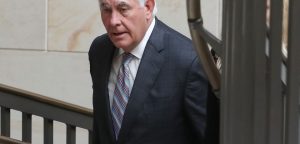
WASHINGTON, DC – AUGUST 02: Secretary of State Rex Tillerson leaves a closed briefing at the U.S. Capitol with the Senate Foreign Relations Committee August 2, 2017 in Washington, DC. The committee was briefed on ‘The Authorizations for the Use of Military Force: Administration Perspective.
(Photo by Mark Wilson/Getty Images)

President Donald Trump’s administration came out swinging at North Korea after its latest nuclear test. Trump threatened to cut off all trade with any country that traded with Pyongyang; Nikki Haley, the U.S. ambassador to the U.N., accused North Korea of “begging for war”; and Defense Secretary James Mattis appeared to up the ante, warning Kim Jong Un that his country risked “total annihilation.”

But there was one voice noticeably absent from this clamor: America’s top diplomat.

The State Department said Secretary of State Rex Tillerson traveled to Texas over the weekend in the wake of Hurricane Harvey. He called his counterparts in the region and participated remotely in a National Security Council meeting, as State Department spokeswoman Heather Nauert confirmed, but didn’t give any remarks or even put out a statement on North Korea testing a nuclear weapon.

Instead, it was Haley, Trump’s envoy to the United Nations, who was out in front on North Korea, saying it was time to “exhaust all of our diplomatic means before it’s too late.”

And it’s not just on North Korean issues.

Haley is also making news on U.S. policy toward Iran. In a speech before the conservative American Enterprise Institute in Washington on Tuesday, she gave the most detailed account yet of how the administration views the Iran nuclear agreement, arguing that there were grounds for the president to declare the deal was not in America’s interests.

By contrast, Tillerson had reportedly clashed with Trump this summer because the president was unhappy that his secretary of state couldn’t provide a viable option for declaring Iran was failing to comply with the agreement, which must be certified every 90 days under U.S. law.

Haley’s high profile on pressing international issues, including Iran and North Korea, raised fresh questions about the influence and political future of the secretary of state. Tillerson has been strangely absent from the public spotlight, even amid mounting tensions with North Korea, and Haley has stepped in to fill the void.

“It is oddly conspicuous that the secretary of state has not been saying anything publicly about the latest events,” said Michael Fuchs, the former deputy assistant secretary of state for East Asian and Pacific affairs in the Barack Obama administration.

With the world watching for Washington’s response to North Korea’s nuclear test, Defense Secretary James Mattis and Gen. Joseph Dunford, the chairman of the Joint Chiefs of Staff, spoke to reporters in front of the White House on Sunday after taking part in a meeting of Trump’s national security team. But Tillerson was not in sight of the cameras.

Tillerson’s absence on the public front reinforces a perception among foreign partners and Trump’s critics that the administration places a higher priority on military force than diplomacy and is more inclined to heed the advice of current and retired generals, experts said. The administration’s failure to fill an array of senior diplomatic posts, including the ambassadorship to South Korea, has only underscored that perception.

Tillerson’s silence also risks rattling allies who remain confused by the administration’s often chaotic policymaking process and the president’s contradictory statements, experts said.

“The actual role of diplomacy in the North Korea situation thus far has been scant,” said Mira Rapp-Hooper of the Center for a New American Security. And Tillerson’s public silence sends a “signal that diplomacy is less important.”

A State Department spokesman, however, insisted that Tillerson was hard at work behind the scenes.

“Since Sunday morning, the secretary has spoken with Japanese Foreign Minister [Taro] Kono, South Korean Foreign Minister Kang [Kyung-wha], Chinese State Councilor Yang [Jiechi], and Russian Foreign Minister Sergei Lavrov,” the spokesman said. “He remains active and engaged on all matters pertaining to North Korea’s destabilizing activities.”

Tillerson’s public reticence is also rekindling the simmering rumors of a “Rexit,” according to several current and former State Department officials. One U.S. government official told Foreign Policy that talk is circulating of Haley stepping in to replace Tillerson.

“There are very strong rumors — started last week — that he is out and she will take over,” the official said.

Whispers about Tillerson’s possible exit started at the State Department over the summer amid reports of friction with the White House. Tillerson and his team rejected the rumors as false but haven’t managed to stamp out persistent speculation in Washington and among foreign diplomats about the secretary of state’s status.

The State Department spokesman declined to comment on the rumors that Tillerson could be leaving his post.

Unlike many of his predecessors, Tillerson shies away from the spotlight. Interviews and public statements are few and far between, which has frustrated some diplomats who view the secretary’s public visibility and comments as a way of conveying U.S. foreign policy in the digital era.

His defenders at the State Department insist that his quiet, behind-the-scenes approach is a perfect and calculated complement to Trump, whose approach is anything but.

But even out of the public spotlight, Tillerson’s sway in the White House has come under question. He has lost a number of internal debates, arguing unsuccessfully for the United States to remain in the Paris climate accord, and has clashed with Trump’s aides about who should be nominated to serve in key State Department posts.

Yet even given those conflicts, Tillerson’s public absence in recent days is striking.

“In a normal administration, it would be standard protocol for the State Department or secretary of state to put out a statement, [and] then for administration to deploy a very senior administration official to do interviews and expand out [the policy],” Fuchs, the former State Department official, said. “That being said, this administration is anything but normal.”

FP senior diplomatic reporter Colum Lynch contributed to this article.

This article was updated with comments from the State Department.

Photo credit: MARK WILSON/Getty Images

Like this article? Read an unlimited amount of articles, plus access to our entire 46-year printed archive, the FP App, and the FP Insights Tool when you subscribe to FP Premium for 20% off!

Where’s Rex?

Αθήνα και Σκόπια: Επίμετρο μιάς επίσκεψης που μπορεί να οδηγήσει σε επίλυση του θέματος της ονομασίας

1

Του Πρεσβη ε.τ. Αλέξανδρου Π.Μαλλιά*

File Photo: Ο υπουργός Εξωτερικών Νίκος Κοτζιάς (Α) ανταλλάσει χειραψία με τον ειδικό διαμεσολαβητή του ΓΓ του ΟΗΕ για το Σκοπιανό, Μάθιου Νίμιτς (Δ), κατά τη διάρκεια της συνάντησής τους. ΦΩΤΟΓΡΑΦΙΑ ΑΡΧΕΙΟΥ. ΑΠΕ-ΜΠΕ/ΔΗΜΗΤΡΗΣ ΠΑΝΑΓΟΣ SEPTEMBER 6, 2017

Ο αμύητος παρατηρητής θα μπορούσε να απορήσει με την ποιότητα των δηλώσεων που έγιναν στα Σκόπια κατά την επίσκεψη του Υπουργού Εξωτερικών Νίκου Κοτζιά. Φιλοφρονήσεις , διαβεβαιώσεις καλών προθέσεων σε όλα τα επίπεδα.

Η υπογραφή Μνημονίου Κατανόησης για ενίσχυση της διμερούς συνεργασίας ήταν το επιστέγασμα μίας διαδικασίας που ξεκίνησε πριν δύο χρόνια. Οι δύο πλευρές προσπάθησαν να δώσουν το στίγμα ότι κάτι αλλάζει η μάλλον ότι πρέπει να αλλάξει μετά την κυβερνητική αλλαγή στην πρώην Γιουγκοσλαβική Δημοκρατία της Μακεδονίας .

Η ελληνικη επέμεινε στο πρόβλημα του αλυτρωτισμού και στην ουσία της Απόφασης του ΝΑΤΟ στο Βουκουρέστι.Η κυβέρνηση Ζόραν Ζάεφ και ειδικά ο Υπουργός Εξωτερικών Νίκολα Ντιμιτρώφ θεωρούν ότι η υπογράμμιση της αλλαγής αυτής συνιστά ικανή συνθήκη για να πεισθεί και η Ελλάδα για τις αγαθές τους προθέσεις. Διαβεβαίωσε εκ του ασφαλούς την προσήλωσή στην Ενδιάμεση Συμφωνίας Νέας Υόρκης. Γνωρίζοντας ότι χάρις στην προσωπική του διπλωματική δεινότητα ,γνώση και επιχειρήματα στην Χάγη ,η Ενδιάμεση Συμφωνία τού Σεπτεμβρίου 1995 έχει καταστεί ετεροβαρής μετά την Απόφαση-κόλαφο του Διεθνούς Δικαστηρίου Δικαιοσύνης της 5ης Δεκεμβρίου 2011.

Οσο και αν ορισμένοι στην Αθήνα θα ήθελαν να την λησμονήσουν.Κυρίως όμως πώς οδηγηθήκαμε στην διπλωματική αυτή ήττα. Η αλήθεια είναι ότι η Απόφαση του Δ.Δ.Χ., εκτός των άλλων, ερμήνευσε κατά τρόπο ασύμφορο και ασύμβατο με τα συμφέροντα και τις θέσεις της Ελλάδος το σύνολο των θεμελιωδών διατάξεων της Ενδιάμεσης Συμφωνίας συμπεριλαμβανομένων των άρθρων που αφορούν στην εχθρική προπαγάνδα, έγερση μειονοτικού, πολιτιστική κληρονομιά.

Η Ελλάδα εξακολουθεί να δεσμεύεται από μια διμερή συμφωνία πού λειτουργεί εις βάρος της. Είναι θετικό ότι η γειτονική μας χώρα επιδιώκει να αναδείξει ότι αντιλαμβάνεται τα σφάλματα της εθνικιστικής πολιτικής του Νίκολα Γκρουέφσκι. Επιβεβαιώνοντας τις ελληνικές αιτιάσεις για την στάση της γείτονος την παρελθούσα δεκαετία.

Αλυτρωτισμός και εχθρική προπαγάνδα κατά της Ελλάδος.

Στην πραγματικότητα όμως έβλαψε την διεθνή εικόνα και την πορεία της πΓΔΜ στην Ε.Ε. και στο ΝΑΤΟ. Η αποκατάσταση θετικού κλίματος είναι και προς το δικό μας συμφέρον. Η Αθήνα ανταποκρίνεται και παίρνει πρωτοβουλίες. Δεν είναι η πρώτη φορά που οι δύο χώρες επιλέγουν την φιλία και την συνεργασία μετά την σύγκρουση. Ξεχωρίζω την περίοδο Σεπτεμβρίου 1995 –Νοεμβρίου 2004, μία δεκαετία άνευ προηγουμένου ανάπτυξης των σχέσεων σε όλους τους τομείς, στρατιωτικής συνεργασίας και υπηρεσιών ασφαλείας συμπεριλαμβανομένων. Υπογραφή εικοσάδας Συμφωνιών υψηλής πολιτικής σημασίας και οικονομικής εμβέλειας. Δεν οδήγησε εν τούτοις σε λύση του ζητήματος της ονομασίας λόγω εμμονής των Σκοπίων στην θέση τους. Επίσης ,δεν επιβεβαιώθηκαν οι δικές μας προσδοκίες. Αυτή είναι η αλήθεια.

Σήμερα συνεπώς δεν πρόκειται για εκκίνηση, αλλά για επανεκκίνηση. Σταθερή βάση στην ανάλυσή μας είναι η επιμονή της νέας κυβέρνησης για ένταξη στο ΝΑΤΟ,έστω με την ονομασία ‘’πρώην Γιουγκοσλαβική Δημοκρατία της Μακεδονίας’’.Ονομασία όμως που γραπτώς απέρριψε η πΓΔΜ τον Απρίλιο του 2001 κατά την υπογραφή Συμφωνίας Σύνδεσης και Σταθεροποίησης με την Ευρωπαϊκή Ένωση. Τα αποτελέσματα των δημοτικών εκλογών τον Οκτώβριο θα μας επιτρέψει να διαπιστώσουμε κατά πόσον η σημερινή κυβέρνηση θα κάνει το απαραίτητο μεν αμφίβολο δε βήμα εμπρός για την προηγούμενη λύση του ζητήματος του ονόματος που είναι ο όρος ένταξης στο ΝΑΤΟ.

Πρώτος διπλωματικός Αντιπρόσωπος της Ελλάδας στα Σκόπια ( 2005-2009) – Αρθρογράφος στην εφημερίδα ΕΣΤΙΑ Share this:

Πηγή: Αθήνα και Σκόπια: Επίμετρο μιάς επίσκεψης που μπορεί να οδηγήσει σε επίλυση του θέματος της ονομασίας http://mignatiou.com/2017/09/athina-ke-skopia-epimetro-mias-episkepsis-pou-bori-na-odigisi-se-epilisi-tou-thematos-tis-onomasias/

Κάτι δεν πάει καλά στο μουσουλμανικό κομμάτι της Ρωσίας: Ο Τσετσένος Καντίροφ επικίνδυνος για Πούτιν

0

Του ΜΙΧΑΗΛ ΒΑΣΙΛΕΙΟΥ

Ρώσοι στρατιώτες. FILE PHOTO. EPA, MAXIM SHIPENKOV SEPTEMBER 6, 2017

Μια εξόχως σοβαρή κατάσταση δείχνει να κλιμακώνεται σταδιακά στην Τσετσενία, αλλά και σε άλλες μουσουλμανικές Δημοκρατίες του Καυκάσου που ανήκουν στη Ρωσική Ομοσπονδία, καθώς πίσω από την ισχυρή αντίδραση των μουσουλμάνων της Ρωσίας απέναντι στην πολιτική του Κρεμλίνου στο ζήτημα της Μιανμάρ, όπου περιοχή με μουσουλμάνους εκκαθαρίζεται με μεθόδους που θυμίζουν τη γενοκτονία της Ρουάντα, μάλλον κρύβεται το σχίσμα ανάμεσα στο Κρεμλίνο και τον ηγέτη που στήριζε τόσα χρόνια, τον αδίστακτο και κατά περιπτώσεις ακόμα και αιμοσταγή, Ραμζάν Καντίροφ.

Η κατάσταση είναι σοβαρή, καθότι θα πρέπει να θεωρείται βέβαιο ότι όσο θρήσκος και να δηλώνει ο Καντίροφ, εκμεταλλεύεται την κατάσταση για να συσπειρώσει γύρω του τους Τσετσένους, προβλέποντας ότι οι διαφωνίες που έχουν ανακύψει εδώ και πολύ καιρό με το Κρεμλίνο, θα προκαλέσουν σοβαρές τριβές οι οποίες με βάση την ιστορία της περιοχής, θα μπορούσαν να κλιμακωθούν πολύ επικίνδυνα.

Η διαφωνία ξεκίνησε μετά τη μείωση των κονδυλίων που διατίθενται στη Δημοκρατία της Τσετσενίας από τον ομοσπονδιακό προϋπολογισμό εξαιτίας της οικονομικής κρίσης και ίσως όχι μόνο, καθώς έχουν προκύψει πολλά, νομοτελειακά θα στρέψει τις ρωσικές υπηρεσίες ασφαλείας εναντίον του με το Κρεμλίνο να αναζητά τρόπο να τον αντικαταστήσει, ή ακόμα και να τον ανατρέψει, οπότε εμμέσως απειλεί με μουσουλμανική εξέγερση…

Η κατάσταση κλιμακώθηκε ακόμα περισσότερο στη Ρωσία, γιατί ο Καντίροφ εξέφρασε ανοιχτά την αντίρρησή του για την επίσημη ρωσική πολιτική απέναντι στην Μιανμάρ, το οποίο συνιστά παραβίαση των αρμοδιοτήτων του και ευθεία αμφισβήτηση της κεντρικής εξουσίας, δηλαδή του Κρεμλίνου και του Βλαντιμίρ Πούτιν προσωπικά.

Τι έγινε όμως με τις διαμαρτυρίες για την Μιανμάρ; Όπως αναφέρει το ίδιο το «Russia Today», η αστυνομία αναφέρει ότι ένα εκατομμύριο άνθρωποι συμμετείχαν στη διαμαρτυρία στο Γκρόζνι, πρωτεύουσα της Δημοκρατίας της Τσετσενίας στη Ρωσία, για να διαμαρτυρηθούν για την απίστευτη βία στη Μιανμάρ, όπου τα κυβερνητικά στρατεύματα ασφαλείας επιχειρούν με στόχο τη μαζική καταστολή της μουσουλμανικής μειονότητας Ροχίνγια.

Η διαδήλωση υποστήριξης των Ροχίνγια πραγματοποιήθηκε τη Δευτέρα στο κατά πλειοψηφία μουσουλμανικό τμήμα της Ρωσίας. Πλάνα από τη συγκέντρωση έδειξαν δεκάδες χιλιάδες διαδηλωτές να «πλημμυρίζουν» μια πλατεία μπροστά στο κύριο τζαμί της πόλης, καθώς οι Τσετσένοι αξιωματούχοι και οι ηγέτες τους μίλησαν στο πλήθος από πλατφόρμα που είχε στηθεί, ενδεικτικό του βαθμού κεντρικής οργάνωσης της πρωτοβουλίας.

Μεταξύ των ομιλητών ήταν ο πρόεδρος της Τσετσενίας, Ραμζάν Καντίροφ, ο οποίος μέσω της σελίδας του στο Instagram είχε ζητήσει νωρίτερα από τους υποστηρικτές του να υποστηρίξουν τη μουσουλμανική μειονότητα στη Μιανμάρ που αντιμετωπίζει το φάσμα της εξάλειψης, ενώ ξιφούλκησε εναντίον των ηγετών του κόσμου για τη μη καταδίκη των φρικαλεοτήτων που καταγράφονται στην ασιατική χώρα.

«Όταν κάποια γεγονότα συνέβησαν στο γραφείο ενός περιοδικού του Παρισιού, οι βασιλιάδες και οι πρόεδροι, οι πρωθυπουργοί και οι υπουργοί πήγαν να συμμετάσχουν σε μια διαδήλωση διαμαρτυρίας», γράφει αναφερόμενος στην τρομοκρατική επίθεση στο περιοδικό Charlie Hebdo τον Ιανουάριο του 2015. «Στη Μιανμάρ, ο στρατός και οι ληστές βιάζουν, βασανίζουν και σκοτώνουν χιλιάδες και χιλιάδες ανθρώπους επειδή είναι Μουσουλμάνοι Ροχίνγια, αλλά οι επώνυμοι που συμμετείχαν στην πορεία στο Παρίσι δεν βλέπουν τίποτα».

Νωρίτερα την Κυριακή, η μουσουλμανική κοινότητα της Μόσχας πραγματοποίησε παρόμοια διαδήλωση μπροστά στην πρεσβεία της Μιανμάρ. Τουλάχιστον 800 άτομα συμμετείχαν στην εκδήλωση, σύμφωνα με τις εκτιμήσεις των μέσων μαζικής ενημέρωσης. Πληροφορίες αναφέρουν, ότι ανάμεσα στους συγκεντρωμένους εθεάθησαν μέλη μη κυβερνητικών οργανώσεων (ΜΚΟ / NGO), με δεσμούς με τη Δύση…

Η βία στη Μιανμάρ εκδηλώθηκε στα τέλη Αυγούστου. Οι επιδρομές των ανταρτών Ροχίνγια σε στρατιωτική βάση και η αντίδραση των στρατευμάτων ασφαλείας είχαν ως αποτέλεσμα τουλάχιστον 400 θανάτους. Η κυβέρνηση της Μιανμάρ κατηγόρησε τους αντιπάλους της ότι καταστρέφουν σπίτια και σκοτώνουν πολίτες, αλλά ακτιβιστές των ανθρωπίνων δικαιωμάτων κατηγορούν τις κυβερνητικές δυνάμεις για τα περιστατικά αυτά, ως μέρος εκστρατείας που αποσκοπούσε στην εξαναγκασμό των Ροχίνγια να αποχωρήσουν από την περιοχή Ρακχίν. Εκτιμάται, ότι 90 χιλιάδες Ροχίνγια έχουν ξεφύγει από τη βία περνώντας τα σύνορα στην πλευρά του Μπαγκλαντές, με αποτέλεσμα η φτωχή χώρα να δυσκολεύεται να τους βοηθήσει, με αποτέλεσμα τον κίνδυνο ανθρωπιστικής καταστροφής κι εκεί. Υπολογίζεται ότι οι Ροχίνγια αριθμούν περίπου 1,1 εκατομμύρια πληθυσμό, μουσουλμανική μειονότητα σε μια βουδιστική χώρα.

Πηγή: Κάτι δεν πάει καλά στο μουσουλμανικό κομμάτι της Ρωσίας: Ο Τσετσένος Καντίροφ επικίνδυνος για Πούτιν http://mignatiou.com/2017/09/kati-den-pai-kala-sto-mousoulmaniko-kommati-tis-rosias-o-tsetsenos-kantirof-epikindinos-gia-poutin/

Εκτίμηση καταστάσεως της κορεατικής κρίσης.

0


ΓΕΩΓΡΑΦΙΚΗ ΑΠΟΤΥΠΩΣΗ ΤΗΣ ΚΡΙΣΗΣ.

Η απόσταση μεταξύ του κέντρου της πρωτεύουσας της Νότιας Κορέας, Σεούλ, με την αποστρατικοποιημένη ζώνη (DMZ), στα σύνορα με τη Βόρεια Κορέα είναι 57 χιλιόμετρα. Η απόσταση μεταξύ Σεούλ και Πιονγκγιάνγκ είναι περίπου 200 χιλιόμετρα και η απόσταση μεταξύ της Σεούλ με την ιστορική πόλη της Καεσόνγκ στη Βόρεια Κορέα είναι 80 χιλιόμετρα. Μια πυρηνική επίθεση εναντίον της Βόρειας Κορέας θα καταπιεί αναπόφευκτα τη Βόρεια και τη Νότια Κορέα, δηλαδή ολόκληρη η Κορεατική χερσόνησος, ανάλογα βέβαια με το μέγεθος και εκρηκτική απόδοση των πυρηνικών βομβών.

Επίσης η Πιονγιάνγκ βρίσκεται κοντά στα κινεζικά σύνορα και η Β. Κορέα έχει επίσης σύνορα με τη Ρωσική Ομοσπονδία. Η πόλη του Βλαδιβοστόκ είναι περίπου 100 χιλιόμετρα από τα σύνορα της Β. Κορέας. Οπότε ολόκληρη η περιοχή της Ασίας βορειοανατολικά της δυνητικής επίθεσης, αποτελείται σε μεγάλο βαθμό από πέντε χώρες (Κίνα, Ρωσία, Βόρεια Κορέα, Νότια Κορέα, και Ιαπωνία) θα επηρεαστεί από την όποια πυρηνική έκρηξη. Και η πικρή ειρωνεία είναι ότι, δύο από αυτές τις χώρες, δηλαδή η Ιαπωνία και η Νότια Κορέα είναι πιστοί σύμμαχοι και στρατιωτικοί εταίροι των ΗΠΑ. Αναπόφευκτα η απόφαση για τη χρήση πυρηνικών όπλων εναντίον της Λαϊκής Δημοκρατίας της Κορέας θα ήταν ένα προοίμιο για Γ΄Παγκόσμιο Πόλεμο.

ΔΥΝΑΤΟΤΗΤΕΣ ΕΝΕΡΓΟΥΜΕΝΕΣ ΑΠΟ ΜΕΡΟΥΣ ΒΟΡΕΙΟΥ ΚΟΡΕΑΣ

Ο Kim έχει δύο επιλογές, να πιστεύει ότι οι Ηνωμένες Πολιτείες μπλοφάρουν ή να νομίζει ότι οι ΗΠΑ θα χτυπήσουν τη Βόρεια Κορέα για να τον αποτρέψουν από την ολοκλήρωση του προγράμματος πυρηνικών όπλων. Αν ο Kim πιστεύει ότι οι ΗΠΑ δεν θα παρέμβουν, ή αν νομίζει ότι μπορεί να επιβιώσει από μια επίθεση των ΗΠΑ, τότε θα συνεχίσει να ακολουθεί το πρόγραμμα των πυρηνικών όπλων, αναπόσπαστος καθώς τελικός σκοπός του είναι να ενώσει τη χερσόνησο. Αν, επίσης, ο Kim πιστεύει ότι η ΗΠΑ είναι πρόθυμοι να πάνε σε πόλεμο, και ότι θα μπορέσει να τον κερδίσει, τότε πιθανότατα θα υποτάξει τις μακροπρόθεσμες φιλοδοξίες του στα πιο πιεστικά ζητήματα της επιβίωσης του ιδίου και του έθνους του.

Για το λόγο αυτό η αντίληψη έχει μεγίστη σημασία, στο πρόσωπο της πραγματικότητας. Μπορούμε να συγκρίνουμε τους σκοπούς των ΗΠΑ και της Βόρειας Κορέας και να προβλέψουμε τη συμπεριφορά τους. Αλλά αυτό προϋποθέτει ότι ο καθένας καταλαβαίνει ακριβώς τι θέλει ο άλλος, και αντιλαμβάνεται τους φόβους του. Αν η αντίληψη της Βόρειας Κορέας και οι επιδιώξεις των ΗΠΑ δεν ευθυγραμμίζονται με την πραγματικότητα, η εξίσωση αλλάζει, καθιστώντας την αντίληψη εξίσου σημαντική με την ίδια την επιτακτική ανάγκη. Κρίνοντας από τις ενέργειες της Πιονγιάνγκ και των δοκιμών των βαλλιστικών πυραύλων με πυρηνικές κεφαλές, η Βόρεια Κορέα επιδιώκει τρομοκρατώντας το διεθνές σύστημα να τροποποιήσει τη συμπεριφορά της έτσι ώστε να μπορεί να επιβιώσει μέσα από τις συνομιλίες και όχι μέσω της δράσης.

ΑΝΑΛΥΣΗ ΤΗΣ ΚΟΡΕΑΤΙΚΗΣ ΚΡΙΣΗΣ ΒΑΣΙΖΟΜΕΝΗ ΣΤΗΝ ΤΕΧΝΗ ΤΟΥ ΠΟΛΕΜΟΥ.

Η διάσημη πλέον Σουντζούνια προτροπή να γνωρίζουμε τον εχθρό και να γνωρίζουμε τις ικανότητές μας, στη σύγχρονη αντίληψη μπορεί να τη θεωρήσουμε ως μια καθαρή παραίνεση στην εξεταζόμενη περίπτωση. Εδώ φαίνεται ότι ο Kim, υστερεί έναντι των ΗΠΑ.

Η Κλαουζεβιτσιανή προτροπή να συγκεντρώνουμε τις προσπάθειες μας στο “κέντρο βάρους του εχθρού” εξακολουθεί να είναι στο επίκεντρο των δογμάτων και στις διαδικασίες σχεδιασμού των πολεμικών επιχειρήσεων. Οπότε οι ΗΠΑ θα προσπαθήσουν κατά την εκτίμησή μου να κτυπήσουν τον ίδιο τον Kim ο οποίος θεωρείται το Κέντρο βάρους της διενέξεως. Η ιδέα του Clausewitz για την κορυφαία στιγμή, επίσης παραμένει ενσωματωμένη στα σύγχρονα δόγματα και την επιχειρησιακή σχεδίαση των ΗΠΑ. Ο SunTzu, με την έμφαση που δίνει στην πλεονεκτική θέση έναντι του αντιπάλου, στην ταχύτητα αντίδρασης των ημετέρων δυνάμεων, και τον αιφνιδιασμό του εχθρού, είναι πτυχές που προαναγγέλλουν αυτό που σήμερα ονομάζουμε “ελιγμό πολέμου”, ένα σημαντικό στοιχείο των σύγχρονων προσεγγίσεων για πόλεμο, αν μη τι άλλο, στις ειδικές δυνάμεις ή την προσβολή με πυραύλους από Υποβρύχιο.

Το αρχαίο Κινέζικο κείμενο “περί πολέμου” είναι επίσης προπομπός των σύγχρονων ενεργειών πληροφόρησης και αντιπληροφόρησης, ιδίως στη χρήση της παραπλάνησης. Πράγματι, η Τέχνη του Πολέμου αντιμετωπίζει την υπεροχή στην απόκτηση πληροφοριών ως καθοριστικό παράγοντα επιτυχίας της στρατηγικής. Οπότε εκτιμάται ότι ο πόλεμος των ανακοινώσεων θα συνεχιστεί καθώς είναι ισχυρός παράγοντας ψυχολογικών επιχειρήσεων. Ένας πόλεμος μπορεί να διεξαχθεί εντελώς διαφορετικά από τις θεωρήσεις του Clausewitz και του SunTzu. Εκτιμώντας ότι αυτοί μας εισήγαγαν στα απαραίτητα στοιχεία της στρατηγικής θεωρίας, ένας πραγματικός πόλεμος μας παρέχει την προοπτική σκληρών εφαρμογών, δίδει μαθήματα εμπειρίας, τα οποία μας προκαλούν την κατανόηση σήμερα πώς το διακύβευμα  είναι υψηλό όχι μόνο για όσους εμπλέκονται αλλά για όλο τον πλανήτη, εάν δεν μπορέσουνε να καταλάβουνε τις στρατηγικές δυνατότητες του αντιπάλου.

*Ο Δημήτρης Τσαϊλάς είναι Υποναύαρχος ΠΝ ε.α.

https://www.thinknews.gr/politiki/ektimisi-katastaseos-tis-koreatikis-krisis/

What the Media isn’t Telling You About North Korea’s Missile Tests

0


Photo by Stefan Krasowski | CC BY 2.0

Here’s what the media isn’t telling you about North Korea’s recent missile tests.

Last Monday, the DPRK fired a Hwasong-12 intermediate-range ballistic missile over Japan’s Hokkaido Island. The missile landed in the waters beyond the island harming neither people nor property.

The media immediately condemned the test as a “bold and provocative act”  that showed the North’s defiance of UN resolutions and “contempt for its neighbors.” President Trump sharply criticized the missile test saying:

“Threatening and destabilizing actions only increase the North Korean regime’s isolation in the region and among all nations of the world. All options are on the table.”

What the media failed to mention was that,  for the last three weeks, Japan, South Korea and the US have been engaged in large-scale joint-military drills on Hokkaido Island and in South Korea. These needlessly provocative war games are designed to simulate an invasion of North Korea and a “decapitation” operation to remove (Re: Kill)  the regime. North Korea’s supreme leader, Kim Jong-un has asked the US repeatedly to end these military exercises, but the US has stubbornly refused. The US reserves the right to threaten anyone, anytime and anywhere even right on their doorstep. It’s part of what makes the US exceptional. Check out this excerpt from an article at Fox News:

“More than 3,500 American and Japanese troops kicked off a weeks-long joint military exercise Thursday against the backdrop of an increasingly belligerent North Korean regime. The exercise, known as Northern Viper 17, will take place on Hokkaido — Japan’s northern-most main island — and will last until Aug. 28….

“We are improving our readiness not only in the air, but as a logistical support team,” Col. R. Scott Jobe, the 35th Fighter Wing commander, said in a statement. “We are in a prime location for contingency purposes and this exercise will only build upon our readiness in the case a real-world scenario occurs.” (US, Japanese troops begin joint military exercise amid North Korea threat”, Fox News)

Monday’s missile test (which flew over Hokkaido Island) was conducted just hours after the war games ended. The message was clear: The North is not going to be publicly humiliated and slapped around without responding. Rather than show weakness, the North demonstrated that it was prepared to defend itself against foreign aggression. In other words, the test was NOT a  “bold and provocative act” (as the media stated) but a modest and well thought-out  response by a country that has experienced 64 years of relentless hectoring, sanctions, demonization and saber rattling by Washington. The North responded because the Washington’s incitements required a response. End of story.

And the same is true of the three short-range ballistic missiles  the North tested last week. (two of which apparently fizzled out shortly after launching.)  These tests were a response to the 3 week-long joint-military drills in South Korea which involved  75,000 combat troops  accompanied by hundreds of tanks, armored vehicles, landing craft, heavy artillery, a full naval flotilla and flyovers by squadrons of state of the art fighters and strategic bombers.  Was the North supposed to sit on its hands while this menacing display of brute military force took place right under its nose???

Of course not. Imagine if Russia engaged in a similar operation over the border in Mexico while the Russian fleet conducted “live fire” drills three miles outside of San Francisco Bay. What do you think Trump’s reaction would be?

He’d blow those boats out of the water faster than you could say “Jackie Robinson”, right?

So why the double standard when it comes to North Korea? Sauce for the goose is sauce for the gander.

North Korea should be applauded for showing that it won’t be intimidated by the schoolyard bully. Kim knows that any confrontation with the US will end badly for the North, even so, he hasn’t caved in or allowed himself to be pushed around by the blustering, browbeating thugs in the White House. Booyah, Kim.

By the way, Trump’s response to Monday’s missile test was barely covered in the mainstream media, and for good reason. Here’s what happened two days later:

On Wednesday,  a US-led flight-group of  F-35B fighters, F-15 fighters and B-1B bombers conducted military operations over a training range east of Seoul. The B-1B’s, which are low-altitude nuclear bombers, dropped their dummy-bombs on the site and then returned to their home base. The show of force was intended to send a message to Pyongyang that Washington is unhappy with the North’s ballistic missile testing project and is prepared to use nuclear weapons against the North if it fails to heed Washington’s diktats.

So Washington is prepared to nuke the North if they don’t straighten up and do as they are told?

It sure looks that way, but who really knows?  In any event, Kim has no choice but to stand firm. If he shows any sign of weakness, he knows he’s going to end up like Saddam and Gaddafi. And that, of course, is what’s driving the hyperbolic rhetoric; the North wants to avoid the Gaddafi scenario at all cost. (BTW, the reason Kim has threatened to fire missiles at the waters surrounding Guam is because Guam is the home of Anderson Airforce Base which is the point-of-origin for the B-1B nuclear-capable bombers that have been making threatening flyovers on the Korean Peninsula for some time now. The North feels like it has to respond to that existential threat.

Wouldn’t it help if the media mentioned that fact or does it better serve their agenda to make it look like Kim is barking mad by lashing out against the ‘totally innocent’ United States, a country that only seeks to preserve the peace wherever it goes?

Give me a break!

It is so hard to find anything in the media that doesn’t reflect Washington’s bias and hostility. Surprisingly, there was  pretty decent article at CBS News last week written by a former Western intelligence officer with decades of experience in Asia. It’s the only article I’ve found that accurately explains what’s  really going on beyond the propaganda. Check it out:

“Prior to President Trump’s inauguration, North Korea made it clear it was prepared to give the new U.S. administration time to review the policy and come up with something better than President Obama’s.  The only wrinkle was that if the U.S. went full-steam ahead with its annual joint exercises with South Korea (especially if that were accompanied by more talk of “decapitation” and more flights of strategic bombers over the Korean peninsula), the North would react strongly.

In short, the U.S. did, and the North reacted.

Behind-the-scenes contacts went up and down, but couldn’t get traction.  In April, North Korean leader Kim Jong Un paraded new missiles as a warning, to no effect.  The regime launched the new systems, one after another.  Still, Washington’s approach didn’t change.” (Analysis: Pyongyang’s view of the North Korea-U.S. crisis”, CBS News)

Okay, so now we know the truth: The North gave it their best shot and came up snakeeyes, mainly because Washington doesn’t want to negotiate, they’d rather twist arms (Russia and China), tighten the embargo and threaten war. That’s Trump’s solution. Here’s more from the same piece:

“On July 4, after North Korea’s first successful intercontinental ballistic missile (ICBM) launch, Kim sent a public signal that the North could put the nuclear and missile programs “on the table” if the U.S. changed its approach.

The U.S. did not, so the North launched another ICBM, very deliberately deeming it a warning to the U.S. that they were to be taken seriously. Still, more B-1 bombers flew over the Peninsula, and the U.N. Security Council passed new sanctions.” (CBS News)

So, the North was ready to do some serious horse-trading, but the US balked. Kim probably heard what a wheeler dealer Trump was and figured they could work something out. But it hasn’t happen.  Trump has turned out to be a bigger bust than Obama, which is pretty bad.  He not only refuses to negotiate but he also delivers bellicose threats almost every day. This isn’t what the North was expecting. They were expecting a   “non interventionist” leader who might be receptive to a trade-off.

The current situation has left Kim with no good options. He can either cave in and terminate his missile program altogether or increase the frequency of the tests and hope that they pave the way for negotiations.   Kim chose the latter.

Did he make a bad choice?

Maybe.

Is it a rational choice?

Yes.

The North is betting that its nuclear weapons programs will be valuable bargaining chits in future negotiations with the United States. The North has no plan to nuke the west coast of the United States.  That’s ridiculous! That doesn’t accomplish anything. What they want is to preserve their regime,  procure security guarantees from Washington,  lift the embargo,  normalize relations with the South,  extricate the US from the political affairs of the peninsula, and (hopefully) end the irritating and endlessly provocative 64 year US occupation. Yankee go home. Please.

Bottom line: The North is ready to deal. They want negotiations. They want to end the war. They want to put this whole nightmare behind them and get on with their lives. But Washington won’t let them because Washington likes the status quo. Washington wants to be a permanent feature in South Korea so it can encircle Russia and China with lethal missile systems and expand its geopolitical grip bringing the world closer to nuclear Armageddon.

That’s what Washington wants, and that’s why the crisis on the peninsula will continue to boil.

Join the debate on Facebook

More articles by:

MIKE WHITNEY lives in Washington state. He is a contributor to Hopeless: Barack Obama and the Politics of Illusion (AK Press). Hopeless is also available in a Kindle edition. He can be reached at [email protected].

What the Media isn’t Telling You About North Korea’s Missile Tests

US-China clash of civilisations is being played out in the South China Sea

0

Mark Valencia says the hard and soft power confrontation between the two has all the makings of an existential contest because both see it as their right and destiny to dominate and shape the international order. A clash may be inevitable

 The struggle between the US and China for control of the South China Sea is symptomatic of a much deeper “clash of civilisations”. According to Samuel Huntington, the originator of this theory, human conflict has transitioned to a new phase in which formerly dominated, abused and exploited cultures and nations of the non-Western world have increasingly become significant players in shaping the international order. The Sinic culture led by China is prominent among them. This possibly existential contest between it and the West – led by the US – is being played out in the South China Sea.

Indeed, their face-off is a stark contrast of political and economic systems and their underpinning raison d’etre. The outcome of this clash of cultures and self-images is important. It is why the competition between the two in general, and in the South China Sea in particular, is being so carefully watched by those likely to be directly and immediately affected.

As such, they boldly interpret international norms and rules, like the law of the sea, in a way that furthers their national interest. As prominent American strategic thinker Graham Allison puts it, to China, the rules-based international order is an “order in which America makes the rules and others obey the orders”. For both, the existing international norms and rules do not apply if their observance would thwart the pursuit of their national interest.

President Xi Jinping recognises this fundamental divergence of cultural identities and world views. In an attempt to avoid a human catastrophe, he proposed to president Barack Obama the negotiation of a new relationship among great powers. But as prominent Australian strategic thinker Hugh White has written, “the US policy community has, with few exceptions, failed so far to understand the nature or the scale of the challenge it faces in negotiating [a new] relationship with China”.

The US has no history or precedent of sharing power and it is not likely to start now

Allison notes that some US policymakers cling to the “fundamentally flawed” strategy of “engage but hedge”, and the forlorn hope “that China will become a liberal democracy, or at least accept a subordinate place in the American-led international order”. However, this is unlikely to happen. As Lee Kuan Yew once put it, China wants to be “accepted as China, not as an honorary member of the West”.

For the US, the alternatives to negotiating a new relationship are bleak. As White argues, Washington has shown no appetite for engaging in a confrontation with China in its own backyard, where it might take heavy losses and not win quickly. It seems to have concluded that support for its “friends and allies” or for nebulous concepts like the international order or the freedom of navigation are not sufficient reasons to do so.

Under China’s burgeoning soft and hard power, the Western-built and US-led international order – including the UN Convention on the Law of the Sea – continues to haemorrhage and there is really little Asean or the US can do about it. In its frustration, the US has bluffed and blustered. According to Defence Secretary James Mattis, the US opposes “countries militarising artificial islands and enforcing excessive claims unsupported by international law. We cannot and will not accept unilateral coercive changes to the status quo.” But that is precisely what China has done and continues to do – for all the world to see.

The US was hoping that the Association of Southeast Asian Nations would unite and side with it against China. But Asean is split in its response to China’s actions in the South China Sea. The US-China struggle has already pushed some Asian countries to hedge or even choose between the two, and by implication their different values. Washington had hoped that China’s aggressive behaviour would push its Southeast Asian neighbours into the arms of the US. But the Southeast Asian South China Sea claimants – and the rest of Asean – increasingly perceive that, with the administration of US President Donald Trump, they are more or less on their own.

Of course, the US withdrawal from the Trans-Pacific Partnership – an economic pact proposed and pushed by America – has also contributed significantly to the erosion of confidence in US staying power in Asia. The US is belatedly beginning to realise that its “allies and friends” do not want to see a confrontation between the US and China.

Indeed, US soft-power influence in Asia is turning out to be shallower and more frail than it thought. This has been demonstrated by the Philippine about-face under new president Rodrigo Duterte, deterioration of relations with Thailand since its military coup, refusal of allies to join its freedom of navigation exercises in the South China Sea and – despite US encouragement – Asean’s wishy-washy stance vis-á-vis China’s actions there.

So what can the US do?

According to Allison, there is a “spectrum of strategies” that the US could embrace – “from accommodation at one end to actively undermining the Chinese regime at the other”. At this stage, as White points out, the American leadership seems to see the Sino-US struggle as a win-lose game, that is, “a question of whether America will dominate the region or retreat”.

Nevertheless, some in the influential US analytic policy community are beginning to accept the new reality. In an article in Foreign Affairs, veteran policy analysts Robert Manning and James Przystup conclude that “the reality is that US core interests are not really at stake [in the South China Sea] and China knows it … The United States needs to come to terms with the great strategic questions of our time: What Chinese role in the Asia-Pacific can it live with?”

It is always possible that the clash of these two systems could produce a hybrid which works well for both – and others. Indeed, White argues that it is possible and highly desirable for the US to continue to play a major strategic role in Asia on a basis that China is willing to accept, and which therefore avoids escalating strategic rivalry and reduces the risk of war.

But this is highly unlikely. The US has no history or precedent of sharing power and it is not likely to start now. Such acceptance just does not seem to be in its ideological DNA, given its self-image as the perpetual No 1.

As Manning and Przystup argue, “both the US and China need to distinguish between what their respective interests dictate they must have and what they merely prefer. This is the key to finding a balance of interests and a modus vivendi for US-China relations in the 21st century”.

But as long as both China and the US believe they have an inherent right and even heaven’s mandate to dominate Asia and the South China Sea, they may well be destined to clash.

Mark J. Valencia is an adjunct senior scholar at the National Institute for South China Sea Studies, Haikou, China

 This article appeared in the South China Morning Post print edition as:
http://www.scmp.com/comment/insight-opinion/article/2109792/us-china-clash-civilisations-being-played-out-south-china

Οι νέες συμμαχίες της Τουρκίας

0
Γιατί συνεργάζεται με τους πρώην αντιπάλους της
Ο Ρώσος πρόεδρος, Βλαντιμίρ Πούτιν, και ο Τούρκος ομόλογός του, Ρετζέπ Ταγίπ Ερντογάν, σε συνέντευξη Τύπου μετά τις συνομιλίες τους στο Σότσι της Ρωσίας, στις 3 Μαΐου 2017. ALEXANDER ZEMLIANICHENKO / REUTERS
Περίληψη:

Οι προηγούμενες προσπάθειες της Άγκυρας και της Τεχεράνης να χτίσουν πάνω στις κοινές τους βάσεις, έχουν αποτύχει εξαιτίας της βαθιά ριζωμένης δυσπιστίας του ενός έναντι του άλλου και της απόκλισης των οραμάτων τους για την περιοχή. Αυτοί οι ίδιοι παράγοντες θα μπορούσαν ενδεχομένως να τους αποτρέψουν από την επίτευξη βαθύτερης προσέγγισης.

Η GONUL TOL είναι διευθύντρια του προγράμματος για την Τουρκία στο Middle East Institute.
Ο ALEX VATANKA είναι ανώτερος συνεργάτης στο Middle East Institute.

Όταν η Τουρκία καλωσόρισε τον αρχηγό του Γενικού Επιτελείου του Ιράν, Mohammad Bagheri, στην Άγκυρα στα μέσα Αυγούστου, ήταν η πρώτη φορά από την ιρανική επανάσταση του 1979 [1] που ένας Ιρανός αξιωματικός του επιπέδου του είχε ταξιδέψει στο εξωτερικό. Σε μια εξίσου εκπληκτική κίνηση, η Άγκυρα ανακοίνωσε τον Αύγουστο ότι ετοιμάζεται να φιλοξενήσει τον Ρώσο αρχηγό του στρατού, τον Valery Gerasimov, για να συζητήσουν την περιφερειακή ασφάλεια. Η ένταση της προσέγγισης της Τουρκίας στο Ιράν και την Ρωσία, δύο ιστορικούς αντιπάλους της, θα έπρεπε να σηκώσει κάποια φρύδια στον Λευκό Οίκο του προέδρου Donald Trump. Δεν σηματοδοτεί μόνο μια σημαντική αλλαγή εξωτερικής πολιτικής, αλλά αποτελεί κι έναν δείκτη ότι η Άγκυρα παράτησε την Ουάσινγκτον.

05092017-1.jpg

Ο Ρώσος πρόεδρος, Βλαντιμίρ Πούτιν, και ο Τούρκος ομόλογός του, Ρετζέπ Ταγίπ Ερντογάν, σε συνέντευξη Τύπου μετά τις συνομιλίες τους στο Σότσι της Ρωσίας, στις 3 Μαΐου 2017. ALEXANDER ZEMLIANICHENKO / REUTERS
——————————————-

Τον Νοέμβριο του 2016, υπήρχαν πολλές ελπίδες στην Άγκυρα ότι οι Ηνωμένες Πολιτείες υπό τον Τραμπ θα ήταν καλές για την Τουρκία. Ο πρόεδρος Ρετζέπ Ταγίπ Ερντογάν συνεχάρη τον Τραμπ για την προεδρική του νίκη, λέγοντας ότι η εκλογή του θα σηματοδοτήσει μια νέα εποχή στις σχέσεις των ΗΠΑ με την Τουρκία. Εκείνη την εποχή, ο Ερντογάν είχε μια σκληρή στάση εναντίον του Ιράν σε μια προσπάθεια να προσελκύσει τον νέο πρόεδρο των ΗΠΑ και να επιδείξει την προθυμία της Άγκυρας να συμβάλει στην ανάσχεση της ιρανικής ισχύος στην ευρύτερη Μέση Ανατολή, αλλά πιο συγκεκριμένα στην Συρία.

Σε αντάλλαγμα, η Τουρκία ήλπιζε ότι οι Ηνωμένες Πολιτείες θα μειώσουν την υποστήριξή τους προς την συριακή κουρδική πολιτοφυλακή, τις Λαϊκές Μονάδες Προστασίας (YPG). Για την Άγκυρα, οι YPG αποτελούν μια υπαρξιακή απειλή για το μέλλον της Τουρκικής Δημοκρατίας, δεδομένου ότι θεωρούνται παρακλάδι του Κουρδικού Εργατικού Κόμματος (PKK), μιας μαχητικής οργάνωσης Τούρκων Κούρδων που πολεμούν την Άγκυρα εδώ και δεκαετίες.

Οι ελπίδες της Άγκυρας κατέρρευσαν, ωστόσο, όταν η διοίκηση Trump αποφάσισε να διπλασιάσει την στρατιωτική υποστήριξη προς τις YPG. Στα μάτια της Ουάσινγκτον, οι YPG είναι η μόνη ικανή δύναμη μάχης μεταξύ των ετερόκλητων ενόπλων ομάδων της Συρίας. Επίσης θεωρούνται η καλύτερη επιλογή για την παροχή της πολύ απαραίτητης τοπικής δύναμης ξηράς για την εξάλειψη του Ισλαμικού Κράτους (ISIS) στην Συρία, της κορυφαίας προτεραιότητας του Trump στην Μέση Ανατολή. Το σχίσμα μεταξύ της Άγκυρας και της Ουάσινγκτον σχετικά με το ποιά ομάδα αποτελεί την μεγαλύτερη απειλή στην Συρία δημιουργεί πρόβλημα στην συμμαχία τους και αμφότερες φαίνονται σταθερές στις θέσεις τους, τουλάχιστον για την ώρα.

ΜΙΑ ΕΠΙΚΑΛΥΨΗ ΜΕ ΤΟ ΙΡΑΝ ΚΑΙ ΤΗΝ ΡΩΣΙΑ

Αντιμετωπίζοντας αυτό που θεωρεί ως μια υπαρξιακή απειλή που έχει επιδεινωθεί από τον σύμμαχό της στο ΝΑΤΟ, τις Ηνωμένες Πολιτείες, η Άγκυρα τώρα στρέφεται προς το Ιράν και την Ρωσία, παρά την επιφυλακτικότητά της έναντί τους. Η Τουρκία βρίσκεται σε συνομιλίες με την Ρωσία για να αγοράσει το πιο προηγμένο σύστημα πυραυλικής άμυνας παρά τις αντιρρήσεις του ΝΑΤΟ και συνεργάζεται στενά με το Κρεμλίνο στην Συρία.

Εν τω μεταξύ, η Τουρκία και το Ιράν συμφώνησαν να ενισχύσουν την στρατιωτική συνεργασία στο Ιράκ και την Συρία, παρ’ όλο που οι δύο πρώην αντίπαλοι υποστήριξαν διαφορετικές πλευρές στις συγκρούσεις σε αμφότερες τις χώρες τα τελευταία χρόνια. Το Ιράν, η Ρωσία και η Τουρκία συνεργάζονται επίσης τριμερώς σε μια σειρά θεμάτων: Από την υποστήριξη της ειρηνευτικής συμφωνίας της Αστάνα για την Συρία μέχρι την δέσμευση να συνεργαστούν για να κάνουν γεωτρήσεις για πετρέλαιο στην Κασπία Θάλασσα και μέχρι να στηρίξουν το Κατάρ στην σύγκρουσή του με τους Άραβες ξαδέλφους του στον Περσικό Κόλπο.

Αλλά ο κύριος μοχλός της προσέγγισης της Τουρκίας προς την Ρωσία και το Ιράν είναι ο φόβος της για περαιτέρω προόδους των Κούρδων στην Συρία. Η Τουρκία και το Ιράν έχουν τις δύο μεγάλες κοινότητες κουρδικών μειονοτήτων -την μεγαλύτερη και την δεύτερη μεγαλύτερη της περιφέρειας αντίστοιχα- και φοβούνται ότι η πρόοδος των Κούρδων στην περιοχή μπορεί να προκαλέσει παρόμοια αιτήματα από τους δικούς τους Κούρδους.

Έτσι, η Άγκυρα θέλει να δημιουργήσει μια κοινή αντι-κουρδική στρατηγική στο Ιράκ και την Συρία. Από την πλευρά της, η Τεχεράνη ξεκίνησε ξαφνικά να μιλάει εναντίον των YPG, σε αντίθεση με οποιαδήποτε άλλη φορά στο παρελθόν. Και, χωρίς να αποτελεί έκπληξη, τόσο η Άγκυρα όσο και η Τεχεράνη έχουν επικρίνει το δημοψήφισμα για την ανεξαρτησία των Ιρακινών Κούρδων στις 25 Σεπτεμβρίου, προειδοποιώντας ότι η ελευθερία των Ιρακινών Κούρδων θα προκαλέσει ένα αποσταθεροποιητικό κύμα αποσχίσεων σε όλη την Μέση Ανατολή.

ΕΣΤΙΑΣΗ ΣΤΗΝ ΣΥΡΙΑ

Στην Συρία, η Άγκυρα ανησυχεί ιδιαίτερα για την προοπτική μιας υπό την ηγεσία των ΗΠΑ επιχείρησης κατά του Ισλαμικού Κράτους, επιτρέποντας στις δυνάμεις των YPG να καταλάβουν την επικράτεια του ISIS στην ανατολική Συρία και την Idlib, μια βορειοδυτική πόλη στα σύνορα της Τουρκίας που πρόσφατα κατέλαβαν ομάδες συνδεδεμένες με την αλ Κάιντα. Δεδομένων των συγκρούσεων μεταξύ των Σύρων Κούρδων και των δυνάμεων του προέδρου Bashar al-Assad, η Άγκυρα ελπίζει ότι θα μπορέσει να συνεργαστεί με το καθεστώς στην Δαμασκό και τους συμμάχους του για να ανατρέψει τις εδαφικές προόδους των Κούρδων. Και δεν υπάρχουν άλλες δύο χώρες που να επηρεάζουν περισσότερο τον Assad από το Ιράν και την Ρωσία, γεγονός που εξηγεί τα τελευταία ανοίγματα της Άγκυρας απέναντί τους.

Ειδικότερα, η Τουρκία παρακολουθεί το Αφρίν, ένα από τα κουρδικά καντόνια στα σύνορα της Τουρκίας. Η Άγκυρα φοβάται ότι οι YPG θα μπορούσαν να συνδέσουν το κουρδικό έδαφος στην βόρεια Συρία με το Afrin και να δημιουργήσουν έτσι μια συνεχή κουρδική οντότητα που εκτείνεται από τα ιρακινά σύνορα μέχρι την Μεσόγειο. Η Άγκυρα κατηγόρησε τις YPG για τις αυξανόμενες επιθέσεις εναντίον των τουρκικών δυνάμεων και απείλησε για στρατιωτική δράση κατά του Αφρίν. Ωστόσο, μέχρι στιγμής, οποιαδήποτε επιχείρηση έχει σταματήσει, επειδή το καντόνι φιλοξενεί ρωσικές στρατιωτικές δυνάμεις. Οι Τούρκοι αξιωματούχοι υποστηρίζουν ότι εάν μπορέσουν να πιέσουν την συριακή αντιπολίτευση, την οποία υποστηρίζουν σήμερα, να αποσυρθεί από κάποιες από τις περιοχές που κρατά, η Ρωσία και το Ιράν θα κλείσουν τα μάτια για μια τουρκική εισβολή στο Αφρίν. Αλλά οι ελπίδες της Άγκυρας μπορεί να είναι άστοχες. Πολλές προκλήσεις βρίσκονται μπροστά στην νεοσυσταθείσα συμμαχία της με το Ιράν και την Ρωσία.

Πρώτα απ’ όλα, υπάρχει βαθιά ριζωμένη δυσπιστία μεταξύ των μερών. Για αιώνες, η Τουρκία είχε εμπλακεί σε ανταγωνισμό με το Ιράν και την Ρωσία και επεδίωκε μια πολιτική εξισορρόπησης της επιρροής τους στην περιοχή. Ο φόβος της Τουρκίας από την πρόοδο των Κούρδων έχει αναγκάσει το άνοιγμα με το Ιράν και την Ρωσία στην Συρία, αλλά η εμβάθυνση της προσέγγισης αυτής απαιτεί πλήρη αλλαγή της περιφερειακής πολιτικής της Άγκυρας. Αυτό σημαίνει ότι θα εκτεθεί σε περαιτέρω τριβές με την Σαουδική Αραβία και άλλες χώρες του Κόλπου που αντιτίθενται στο Ιράν, και ότι θα εγκαταλείψει την πολιτική της για περιορισμό της επιρροής του Ιράν στο Ιράκ. Η προσέγγιση της Τουρκίας με το καθεστώς Assad εντείνει επίσης την κρίση εμπιστοσύνης μεταξύ της Τουρκίας και των συμμάχων της στην αντιπολίτευση της Συρίας, μειώνοντας την μόχλευση της Άγκυρας πάνω τους. Χωρίς αυτή την επιρροή, είναι δύσκολο για την Τουρκία να κρατήσει την δική της πλευρά της συμφωνίας και να πιέσει την αντιπολίτευση να αποχωρήσει από τα εδάφη που έχει υπό τον έλεγχό της.

Ένα άλλο πιθανό πρόβλημα είναι η στάση της Ρωσίας απέναντι στους Σύρους Κούρδους. Η Μόσχα θεωρεί ότι οι Κούρδοι είναι πολύ σημαντικό χαρτί για να παίξουν εναντίον της Άγκυρας και της Ουάσινγκτον και έτσι το Κρεμλίνο είναι απίθανο να επιτρέψει μια τουρκική στρατιωτική εισβολή στο Αφρίν. Χωρίς την συγκατάθεση της Ρωσίας, η Τουρκία δεν θα ξεκινήσει την στρατιωτική επιχείρηση εναντίον του κουρδικού καντονιού που υπονοεί ο Ερντογάν.

Για το Ιράν, η μετατόπιση της στάσης της Τουρκίας είναι ένα όφελος. Η σύναψη μιας συμφωνίας με την Άγκυρα για την αντιμετώπιση του κουρδικού σεπαρατισμού, η οποία θα συμβάλει στην χαλύβδωση της επιρροής του Ιράν στην Συρία και το Ιράκ, είναι μια ξεκάθαρη νίκη για την Τεχεράνη. Αλλά το Ιράν επίσης βλέπει καθαρά τους παράγοντες που έχουν ωθήσει την Άγκυρα προς αυτήν και την Ρωσία: Την πρόθεση του Trump να συνεχίσει να δουλεύει με τους Σύρους Κούρδους και το γεγονός ότι η στρατιωτική δυναμική στον συριακό πόλεμο βρίσκεται τώρα με τον Assad. Το Ιράν γνωρίζει πολύ καλά ότι οποιαδήποτε αλλαγή στις δυναμικές αυτές θα αντιστρέψει την πολιτική της Τουρκίας. Οι προηγούμενες προσπάθειες της Άγκυρας και της Τεχεράνης να χτίσουν πάνω στις κοινές τους βάσεις έχουν αποτύχει εξαιτίας της βαθιά ριζωμένης δυσπιστίας του ενός έναντι του άλλου και της απόκλισης των οραμάτων τους για την περιοχή. Αυτοί οι ίδιοι παράγοντες θα μπορούσαν ενδεχομένως να τους αποτρέψουν από την επίτευξη βαθύτερης προσέγγισης.

Η θερμή στάση της Τουρκίας προς το Ιράν πιθανόν να ενισχύσει περαιτέρω την επιρροή της Τεχεράνης στην Συρία και το Ιράκ. Μπορεί επίσης να υποβαθμίσει την πολιτική των ΗΠΑ στις χώρες αυτές, δεδομένης της εχθρότητας μεταξύ των Ηνωμένων Πολιτειών και του Ιράν. Αυτό σηματοδοτεί τις σχέσεις μεταξύ των ΗΠΑ και της Τουρκίας, οι οποίες είναι ήδη τεταμένες. Ωστόσο, δεδομένης της ευθραυστότητας της προσέγγισης της Τουρκίας με τους δύο πρώην αντιπάλους της, καθώς και των πιθανών προβλημάτων που βρίσκονται ενόψει, η συνέχεια αυτής της συμφιλίωσης δεν έχει ακόμη παγιωθεί. Αντί να δει την Τουρκία ως χαμένη υπόθεση, η Ουάσιγκτον πρέπει να συνεχίσει να δεσμεύει την Άγκυρα διπλωματικά και στρατιωτικά.

Copyright © 2017 by the Council on Foreign Relations, Inc.
All rights reserved.

Στα αγγλικά: https://www.foreignaffairs.com/articles/turkey/2017-09-04/turkeys-new-al…

Σύνδεσμοι:
[1] https://www.foreignaffairs.com/articles/iran/2003-01-01/irans-crumbling-…

Μπορείτε να ακολουθείτε το «Foreign Affairs, The Hellenic Edition» στο TWITTER στην διεύθυνση www.twitter.com/foreigngr αλλά και στο FACEBOOK, στην διεύθυνση www.facebook.com/ForeignAffairs.gr και στο linkedin στην διεύθυνση https://www.linkedin.com/company/foreign-affairs-the-hellenic-edition

«Γαλλικό κοινωνικό μοντέλο, ξάδελφο των σκανδιναβικών, η φιλοδοξία του Μακρόν»

1

Του Αλκη Καλλιαντζίδη Οικονομολόγου [email protected] www.kalkis.eu

Ο κουρνιαχτός, γύρω από τα 5 Διατάγματα και τα 36 ανακοινωθέντα μέτρα μεταρρύθμισης του γαλλικού Κώδικα Εργασίας, άρχισε να κατακάθεται, τουλάχιστον μέχρι τις προαναγγελθείσες ξεχωριστές συγκεντρώσεις της 12ης  και 23ης Σεπτεμβρίου 2017. Η μαζική συμμετοχή ή μη σε αυτές θα μας βοηθήσει να δούμε τον βαθμό που «οι Γάλλοι απεχθάνονται τις μεταρρυθμίσεις», όπως δήλωσε, εμφανώς ενοχλημένος, ο Emmanuel Macron κατά την πρόσφατη επίσκεψή του στη Βουλγαρία.

Η κυβερνητική πλευρά μας ενημερώνει ότι οι μέχρι τώρα ανακοινώσεις της δεν είναι παρά μόνο η αρχή μιας βαθιάς μεταρρύθμισης. Όχι  για να γίνει η Γαλλία «μια χώρα χαμηλού κόστους», αλλά για να δημιουργήσει ένα Γαλλικό κοινωνικό μοντέλο, «ξάδελφο των σκανδιναβικών μοντέλων». Αυτή είναι η φιλοδοξία του Μακρόν. Η υπουργός εργασίας, Muriel Pénicaud, σε συνέντευξή της δήλωσε στις 3 Σεπτεμβρίου 2017 στους δημοσιογράφους Jannick Alimi, Catherine Gasté, Bérengère Lepetit και Sébastien Lernould, στην ηλεκτρονική έκδοση της εφημερίδας Le Parisien : «Πιστεύουμε ότι ένας μεγάλος αριθμός επιχειρηματιών και εκπροσώπων των συνδικαλιστικών οργανώσεων είναι έτοιμοι να συμμετάσχουν σε έναν εποικοδομητικό  διάλογο. Πρέπει  να τολμήσουμε τον κοινωνικό  διάλογο. Αυτό θα ενισχύσει την ανταγωνιστικότητα, την καινοτομία και την κοινωνική πρόοδο».

Διέλαθε της προσοχής των ελληνικών ΜΜΕ η υποδοχή του σοσιαλδημοκράτη Σουηδού πρωθυπουργό Στέφαν Λεβέν στο Παρίσι από τον Γάλλο πρόεδρο ο οποίος θεωρεί το σκανδιναβικό μοντέλο ως «μια πραγματική πηγή έμπνευσης» για τη χώρα του. Φυσικά η κάθε χώρα έχει τις θετικές ή αρνητικές ιδιαιτερότητές της, για αυτό και τα διάφορα μοντέλα δεν μπορούν να είναι αυτούσια μεταφέρσιμα. Σε μια χώρα σαν τη Γαλλία όπου οι κοινωνικές δαπάνες είναι από τις υψηλότερες στην Ε.Ε., όπως δείχνουν τα στοιχεία του παρακάτω πίνακα, τι είναι αυτό που έλκει τον Μακρόν προς το σουηδικό μοντέλο ;

Κοινωνικές δαπάνες σε ποσοστό ΑΕΠ στη Γερμανία, Γαλλία και ΕΕ

2008  2009  2010  2011  2012  2013  2014

EU-28         25,9   28,7   28,6   28,3   28,7   28,9   28,7

Γερμανία     27,1   30,5   29,8   28,6   28,7   29,0   29,1

Γαλλία        30,4   32,9   32,9   32,7   33,5   33,9   34,3

«Η Σουηδία κατάφερε να εξελίξει το κοινωνικό της μοντέλο χωρίς ποτέ να το προδώσει και να συμφιλιώσει ένα μοντέλο ανταγωνιστικότητας με μια πραγματική απαίτηση για κοινωνική δικαιοσύνη», δήλωσε ο Μακρόν υποδεχόμενος  τον πρωθυπουργό της Σουηδίας στις 31 Ιουλίου 2017 στο μέγαρο Elysée. Η διαφορά είναι η εξής : στη Σουηδία και τις γειτονικές χώρες, αυτή η προσέγγιση συνεπάγεται προστασία για κάθε πολίτη που εγγυάται το κράτος πρόνοιας, συμπεριλαμβανομένης της πρόσβασης στην εκπαίδευση, την υγεία, τη βασική σύνταξη, την ασφάλεια αλλά και τους βρεφονηπιακούς σταθμούς. Όλο αυτό το κοινωνικό οπλοστάσιο χρηματοδοτείται από τους φόρους και όχι από εισφορές, όπως στη Γαλλία.

Η μακρονιστική  προσέγγιση φαίνεται  να ευνοεί την επαγγελματική κατάρτιση, την ευελιξία με ασφάλεια και τη μετατροπή της συνταξιοδότησης σε ένα ενιαίο σύστημα (37 είναι τα ασφαλιστικά ταμεία στη Γαλλία σήμερα!). Η Muriel Pénicaud είχε 48 συναντήσεις διαβούλευσης με τους κοινωνικούς εταίρους,  δίνοντας στη μεταρρύθμιση ένα  σκανδιναβικό αέρα. Όμως τα Διατάγματα είναι κάτι το αδιανόητο στη Σκανδιναβία. Εκεί δεν συμβαίνει τίποτα χωρίς κοινοβουλευτική συζήτηση, όπου, προκειμένου να εξασφαλιστεί ένα διαρκές αποτέλεσμα, πρέπει να υπερβαίνονται οι όποιες πολιτικές διαιρέσεις για να καταλήξουν σε ένα σχέδιο αποδεκτό από όλους.

Όταν μιλάμε για το σκανδιναβικό μοντέλο, σκεφτόμαστε πρώτα τη Σουηδία. Το σουηδικό πρότυπο βασίστηκε στη συνεχή ανάπτυξη του κράτους πρόνοιας που υποστηρίζεται από δημόσιες παρεμβάσεις στην αγορά εργασίας. Στις αρχές της δεκαετίας του 1990, τα μακροοικονομικά μεγέθη έγιναν σταδιακά κόκκινα. Η παραγωγή κατέρρευσε και το δημόσιο χρέος εξερράγη. Η κυβέρνηση ανταποκρίθηκε  στο ύψος  της πρόκλησης. Μέσω του κοινωνικού διαλόγου, ξεκίνησε την επανα-θεμελίωση  του κράτους πρόνοιας  μαζί με τα συνδικάτα και έσφιξε τη ζώνη του για να μειώσει το έλλειμμα. Η Σουηδία πάει καλύτερα τώρα, όπως έγραψαν στις 02-08-2017, στην ηλεκτρονική έκδοση της εφημερίδας Libération ο Vibeke Knoop Rachline νορβηγός δημοσιογράφος στο Παρίσι, και ο πανεπιστημιακός στο Όσλο   Franck Orban. Η χώρα επέστρεψε στην ανάπτυξη, η ανεργία μειώνεται και το δημόσιο χρέος μειώθηκε στο 40% του ΑΕΠ. Αλλά με τίμημα το τέλος της «σκανδιναβικής εξαίρεσής» του. Αυτά τα μέτρα είχαν βαθιές επιπτώσεις στη σουηδική κοινωνία. Ορδές  νέων έχουν διασχίσει τα σύνορα του νέου σκανδιναβικού Eldorado: τη Νορβηγία. Λιγότερο γνωστό στο γαλλικό κοινό, είναι αυτό που έχει επιτύχει καλύτερα για αρκετές δεκαετίες, παρά τη μείωση των εσόδων της από το πετρέλαιο. Η Νορβηγία κατέχει την 3η θέση στον κόσμο όσον αφορά το κατά κεφαλή ακαθάριστο εγχώριο προϊόν.  Έχει  μόλις εδραιωθεί στην κορυφή των χωρών «των πιο ευτυχισμένων στον κόσμο», σύμφωνα με την έκθεση World Happiness.Έχει τον υψηλότερο μέσο όρο σε διάφορους τομείς, όπως η διακυβέρνηση, η υγεία και η ηθική. Οι Νορβηγοί εξηγούν αυτή την επιτυχία με το αίσθημα  του ανήκειν σε μια κοινότητα που μοιράζεται την ιδέα του κοινού καλού. Από την άλλη, η πολιτική συζήτηση τους φαίνεται μονότονη.

Αυτή η κουλτούρα συναίνεσης βασίζεται σε ένα κοινωνικό συμβόλαιο που συνδυάζει την εμπιστοσύνη με την  διαφάνεια. Αυτό προϋποθέτει την ύπαρξη κοινωνικών εταίρων με τους οποίους το κράτος, σε εθνικό επίπεδο, και οι  επιχειρηματίες, σε τοπικό επίπεδο,  διατηρούν έναν μόνιμο διάλογο για την επίτευξη του συμβιβασμού. Ένα υψηλό ποσοστό συνδικαλιστικής συνείδησης (52 με 70% συνδικαλισμένοι εργαζόμενοι) συμβάλλει στην ανάδυση και τη βιωσιμότητά του. Σε εθνικό επίπεδο, ο διάλογος αυτός καθιστά δυνατή τη γενική νομιμοποίηση των διαρθρωτικών μεταρρυθμίσεων (ηλικία συνταξιοδότησης, διάρκεια και προϋποθέσεις παροχών ανεργίας, μισθολογικά κλιμάκια) που εμποδίζουν τον κίνδυνο αδιεξόδου. Στη Σκανδιναβία, οι κατώτατοι μισθοί είναι διαπραγματεύσιμοι  με συλλογικές συμβάσεις (συνδικάτα και εργοδότες) και δεν επιβάλλονται κάθετα από τους πολιτικούς. Το υψηλό επίπεδο συνδικαλιστικής οργάνωσης περιορίζει τον κίνδυνο της αποστράτευσης των εργαζομένων και της αυταρχικής απόκλισης της επιχείρησης. Στη Γαλλία, μόνο το 11% των εργαζομένων είναι συνδικαλισμένοι.

Ένα τέτοιο μοντέλο δεν θα μπορούσε να υπάρξει χωρίς μια προτεσταντική ηθική, που απουσιάζει από τους Γάλλους Καθολικούς. Στις έννοιες της καθολικότητας και της ισότητας, η σκανδιναβική κουλτούρα  προσθέτει και την έννοια  της υπευθυνότητας του ατόμου (εκεί δηλαδή δεν ισχύει ότι ο Λαός είναι αλάνθαστος). Η αύξηση των ατομικών εισφορών, η αυστηροποίηση  των όρων χορήγησης δικαιωμάτων και η μείωση του ύψους του επιδόματος ανεργίας ακολουθούν μια διπλή λογική: οικονομική, διότι οι κυβερνήσεις πρέπει να ελέγχουν τις δημόσιες δαπάνες και ηθική, επειδή η εθνική κοινότητα δεν μπορεί να ανταμείβει την αδράνεια, όπως ακριβώς δεν μπορεί να δεχτεί ότι μια μειονότητα (οι ασφαλισμένοι των ευγενών ταμείων π.χ. στα καθ’ημάς) επιβαρύνει την πλειοψηφία με ένα πρόσθετο φορτίο. Το άτομο μπορεί να υπολογίζει στο κράτος, αλλά ξέρει ότι πολλά αναμένονται και από αυτό το ίδιο.

Το ερώτημα είναι ο Macron θα καταφέρει να συμβιβάσει το κεφάλαιο με την εργασία, σε με μια γαλλική κοινωνία καθολική που το θεωρεί ασυμβίβαστο; Αφού κυριαρχεί ακόμα «η ταξική πάλη» σε μεγάλη μερίδα της ; Τα στελέχη της κυβέρνησής του απαντούν καταφατικά, ισχυριζόμενα ότι με τις μεταρρυθμίσεις τους θα μεταφέρουν το κέντρο βάρους του κοινωνικού διαλόγου μέσα στην επιχείρηση, και ιδιαίτερα την μικρομεσαία, κι έτσι το κεφάλαιο και η εργασία θα συνυπάρξουν εποικοδομητικά κατά το σκανδιναβικό μοντέλο.

Θα περιμένουμε να δούμε με πολύ μεγάλο ενδιαφέρον …