Αρχική Blog Σελίδα 2922

Trump may have to sanction his Turkish president best buddy  

0
  September 22  The Washington Post

Turkey’s President Recep Tayyip Erdogan, left, and President Trump shake hands prior to a meeting in New York on Thursday. (Pool Photo via Associated Press)

Before their meeting Thursday, President Trump praised Turkish President Recep Tayyip Erdogan, bragged about their friendship and claimed that U.S.-Turkey relations are at an all time high. Trump may not be aware he might soon have to sanction Erdogan for striking a major arms deal with Vladimir Putin’s Russia.

“I think right now we are as close as we’ve ever been. And a lot of that has to do with the personal relationship,” said Trump, on the sideline of the U.N. General Assembly. “He’s getting high marks.”

Set aside that U.S.-Turkey relations are extremely strained right now and Erdogan is getting very low marks from human rights groups, Congress and others because of his domestic crackdown. It’s Erdogan’s stated plan to spend billions purchasing the S-400 missile defense system from Russia that threatens to spoil his chummy relationship with Trump.

subscribe
The story must be told.
Your subscription supports journalism that matters.

According to the Countering America’s Adversaries Through Sanctions Act, which Trump signed into law last month, the administration is required to sanction any foreign entities that engage in significant transactions with the Russian Federation’s defense and intelligence sectors, according to lawmakers and experts.

Erdogan announced last week he signed the $2.5 billion contract with Russia and put down a deposit, ignoring public and private U.S. warnings. He defended the move Tuesday in an interview with PBS News Hour, promising to see it through.

“We have asked for those weapons from many NATO allies and primarily the United States, but we were turned down. That’s why we have to resort to other means,” he said. “Russia is willing to support us all the way to a possible joint manufacturing of these missiles.”

Erdogan also claimed that NATO Secretary General Jens Stoltenberg had endorsed the move, but Stoltenberg said later he urged Erdogan to focus on systems that are interoperable with NATO systems, which the Russian system is not.

Inside the Trump administration, an internal debate is emerging over what to do. Some officials in the Pentagon seek to interpret the law as to not require sanctions on Turkey, out of concern that could complicate military-to-military cooperation, according to sources familiar with the discussion.

In other parts of the military, there is much less sympathy for Turkey, especially because U.S. Central Command has relied much more heavily on working with Kurdish forces in Syria. The State Department’s office in control of coordinating the fight against the Islamic State is also heavily involved with Kurdish forces, which is a major irritant in the U.S.-Turkey relationship.

The Trump administration has made no decisions on how it plans to implement the sanctions. Many parts of the legislation are under review because it covers not just Russia but also Iran and North Korea. Trump signed the bill but also signed a statement complaining about the constitutional implications of compelling the executive to use sanctions in such a directed manner.

Congress is watching the internal administration debate closely and preparing to enforce its intentions if the Trump administration balks.

“The clear congressional intent is that a lot of these sanctions are mandatory,” Senate Foreign Relations Committee ranking Democrat Ben Cardin (Md.) told me. Cardin said he intends “to follow up on making sure that congressional intent and authority is properly respected.”

In a Sept. 6 committee hearing, he and Chairman Bob Corker (R-Tenn.) raised the prospect of sanctioning Turkey over the Russia deal. They both also heavily criticized Erdogan for his crackdown on civil society, his political opposition and the free press in Turkey since the failed coup attempt last year.

“Erdogan has not only domestically acted against journalists, opposition leaders and innocent Americans, he has rebuffed allies internationally,” said Corker. “We need Turkey working with us, not against us.”

Steven Cook, senior fellow at the Council on Foreign Relations, testified at the hearing that the United States hasn’t made it clear to Ankara that moving forward on the Russia deal could complicate things such as U.S. arms sales to Turkey due to the new sanctions legislation.

“Congress is going to have to sanction a NATO ally,” Cook told me. “If Turkey is subject to sanctions, you are really going to have a deterioration of the relationship beyond what we have ever seen before.”

State Department Spokesperson Heather Nauert told reporters in a Sept. 12 briefing that the administration has “concern” about Erdogan’s arms deal with Russia and that the move was “inconsistent” with commitments made by NATO members at the Warsaw summit to work to reduce dependency on Russian-sourced military equipment.

Trump’s foreign policy doctrine of “principled realism” is presented as a means of separating values-based concerns with foreign governments with those issues that actually pose a threat to the security of America and its allies. Erdogan’s deal with Russia clearly falls into the latter category.

A NATO ally shouldn’t rely on missile defense built by the country it’s supposed to be pointed at. If Turkey isn’t fully part of NATO’s missile defense, that weakens that system’s effectiveness to protect all alliance members. Moreover, cooperation with Putin’s military could pull Turkey closer to Russia’s strategic position, which includes undermining NATO.

The best way to avoid sanctions is for Erdogan to end his country’s military cooperation with Russia. It’s an issue that Congress won’t let slide and that Trump can’t ignore, even for a close friend.

Turkish missile deal with Russia reflects stormy relationship with NATO

0

Αλεβίτες: δυνάμει πολιτισμικό έρεισμα στην Τουρκία.

0

του Νίκου Μιχαηλίδη  – 

Οι Αλεβίτες είναι μια πολυπληθής θρησκευτική ομάδα της Τουρκίας και της Μέσης Ανατολής γενικότερα. Ο αριθμός τους στην Τουρκία ξεπερνά τα 20 εκατομμύρια πιστούς (σχεδόν το 1/3 του πληθυσμού). Εθνοτικά η κοινότητα αυτή συγκροτείται κυρίως από Τουρκμένιους, Κούρδους και Άραβες που είναι διάσπαρτοι σε διάφορες περιφέρειες της Ανατολίας. Μεγάλος αριθμός Αλεβιτών εδώ και δεκαετίες έχει μεταναστεύσει από την ύπαιθρο σε διάφορα αστικά κέντρα της Τουρκίας, δημιουργώντας έτσι ένα είδος μεσαίας τάξης. Σημαντικός αριθμός Αλεβιτών ζει και σε χώρες της βόρειας Ευρώπης ως αποτέλεσμα πολυετών πολιτικών διώξεων και μετανάστευσης από την Τουρκία.

Οι Αλεβίτες δεν πηγαίνουν στο σουνιτικό τζαμί γιατί έχουν τους δικούς τους χώρους λατρείας, τα λεγόμενα Τζέμ Εβί (σπίτια προσευχής). Στους χώρους λατρείας τους η απεικόνιση ιερών προσώπων είναι μια συνηθισμένη πρακτική, σε αντίθεση με τους σουνίτες, όπου αυτό απαγορεύεται αυστηρά. Οι λατρευτικές τους πρακτικές συνοδεύονται από μουσική, κρασί και τραγούδι και είναι εντελώς διαφορετικές από αυτές των σουνιτών.

Μια διαφορετική θρησκεία

Ενώ οι σουνίτες στις προσευχές τους καθοδηγούνται από τον ιμάμη, οι Αλεβίτες έχουν τον ντεντέ (η λέξη αυτή στα τουρκικά σημαίνει παππούς). Αν και πιστεύουν στο Κοράνι, ακολουθούν μια πολύ πιο ελαστική ερμηνεία του. Ο αλεβιτισμός συνδυάζει στοιχεία από το σιιτικό Ισλάμ, τον σουφισμό, αλλά και την Ορθοδοξία. Οι Αλεβίτες πιστεύουν στον Μωάμεθ και στον γαμπρό του Αλί και αυτό τους διαφοροποιεί σημαντικά από τους σουνίτες, οι οποίοι τους θεωρούν αιρετικούς. Επιπλέον δεν προσκυνούν στη Μέκκα.

Οι γυναίκες δεν φορούν μαντήλα και η θέση τους στην κοινωνία είναι κεντρική. Οι Αλεβίτες είναι αυστηρά μονογαμικοί.  Η κατανάλωση χοιρινού κρέατος και αλκοόλ δεν απαγορεύεται. Αυτό που απαγορεύεται από τη θρησκεία τους είναι η κατανάλωση κρέατος κουνελιού, το οποίο θεωρείται ιερό ζώο. Η περίοδος και η πρακτική των νηστειών τους είναι διαφορετική από αυτή των σουνιτών και έτσι δεν γιορτάζουν το γνωστό Ραμαζάνι.

Επίσης οι Αλεβίτες αποφεύγουν να παντρεύονται με σουνίτες. Αντίθετα είναι περισσότερο ανοικτοί στο να παντρεύονται με χριστιανούς. Επιπλέον αγαπούν να επισκέπτονται την Ελλάδα και να κάνουν διακοπές στη χώρα μας, γιατί αισθάνονται ελεύθεροι και πολιτισμικά οικείοι με εμάς.

Λόγω των διώξεων που έχουν υποστεί για αιώνες από το οθωμανικό και το τουρκικό κράτος, δίσταζαν να δηλώσουν δημόσια την θρησκεία τους. Λόγω αυτής της κατάστασης δεν κατάφεραν μέχρι σήμερα να δημιουργήσουν ενιαίο τελετουργικό και κωδικοποιημένη και επεξεργασμένη θεολογία. Έτσι η θρησκεία τους μεταδίδεται στις νεότερες γενιές μόνο προφορικά, γεγονός που δημιουργεί κρίση θρησκευτικής και πολιτισμικής ταυτότητας.

Διώξεις και αφομοιωτικές πολιτικές

Για αιώνες, από τα χρόνια της Οθωμανικής Αυτοκρατορίας μέχρι και σήμερα, η θρησκευτική κοινότητα των Αλεβιτών υφίσταται διώξεις, στιγματισμό και περιθωριοποίηση από τις κυρίαρχες τουρκοσουνιτικές ομάδες. Οι τουρκικές κρατικές πολιτικές διακρίσεων και αφομοίωσης συνεχίζονται ακάθεκτες μέχρι και σήμερα.

Ακόμα και οι κεμαλιστές, που υποτίθεται ότι θα διασφάλιζαν την ισότητα σουνιτών και Αλεβιτών στη μικρασιατική επικράτεια, δεν έκαναν τίποτα για να προστατεύσουν και να αναγνωρίσουν τα δικαιώματα αυτής της ογκώδους θρησκευτικής ομάδας. Αντιθέτως, την καταπίεσαν και την οδήγησαν σε περαιτέρω αφομοίωση από τον κυρίαρχο σουνιτισμό. Το προπαγανδιστικό ψευδοεπιχείρημα όλων των κυβερνήσεων και της κρατικής γραφειοκρατίας ήταν ότι οι Αλεβίτες είναι κομμάτι του Ισλάμ και επομένως δεν χρειάζονται κάποιου είδους ξεχωριστή αναγνώριση. Έτσι διαιωνιζόταν η σουνιτική κυριαρχία.

Πολλά από τα ιερά μνημεία τους στην Ανατολία τα έχουν καταπατήσει, καταστρέψει ή οικειοποιηθεί οι σουνίτες. Ανάλογα έχουν συμβεί και με τις ορθόδοξες εκκλησίες της Μικράς Ασίας που μετατράπηκαν σε σουνιτικά τζαμιά, σε στάβλους, αποθήκες ή απλώς ερείπια. Επίσης, πολλά είναι τα περιστατικά άσκησης ωμής και μαζικής βίας έναντι των Αλεβιτών από σουνιτικές και ακροδεξιές ομάδες με την ανοχή και ενίοτε την παρότρυνση των κρατικών αρχών, τις οποίες βεβαίως ελέγχουν οι σουνίτες.

Δεν είναι υπερβολικό να υποστηρίξουμε ότι μετά τις γενοκτονίες των χριστιανών Αρμενίων, Ελλήνων και Ασσυρίων, οι Αλεβίτες, λόγω της ετεροδοξίας τους, αποτέλεσαν τα επόμενα θύματα της τουρκοσουνιτικής μανίας. Αυτές οι πρακτικές διευκόλυναν την κρατική πολιτική σουνιτοποίησης και αφομοίωσης τμήματος των Αλεβιτών.

Εποικιστική πολιτική

Σε επίσκεψή μου σε αμιγώς αλεβιτικά χωριά στην επαρχία της Αλεξανδρέτας (στα σύνορα με την Συρία) διαπίστωσα ότι υπήρχαν εκεί σουνιτικά τζαμιά, στα οποία βεβαίως υπήρχε ο ιμάμης που προσευχόταν μόνος του. Οι Αλεβίτες κάτοικοι δεν πηγαίνουν ποτέ!

Είναι επίσης χαρακτηριστικό ότι οι οργανώσεις των Αλεβιτών διαμαρτύρονται το τελευταίο διάστημα για την εποικιστική πολιτική του σουνιτικού καθεστώτος Ερντογάν. Για την ακρίβεια, το καθεστώς επιδιώκει να εγκαταστήσει σουνίτες πρόσφυγες από τη Συρία και από άλλες χώρες σε περιοχές όπου ζουν αποκλειστικά Αλεβίτες. Πολλοί εξ αυτών των σουνιτών είναι υποστηρικτές του Ισλαμικού Κράτους και άλλων ισλαμικών τρομοκρατικών οργανώσεων, γεγονός που αυξάνει τον φόβο και την αγωνία των Αλεβιτών.

Οι Αλεβίτες γενικότερα εμφορούνται από φιλελεύθερες κοινωνικές και πολιτικές απόψεις, δίνουν μεγάλη αξία στην επιστήμη και παρουσιάζουν υψηλά ποσοστά μόρφωσης. Σημαντικά τμήματα του πληθυσμού τους, ειδικά στη νεολαία, έχουν επηρεαστεί από διάφορες μορφές μαρξισμού. Γι’ αυτό, άλλωστε, έχουν αποτελέσει τη ραχοκοκαλιά διαφόρων μη κεμαλικών αριστερών οργανώσεων και κινημάτων στην Τουρκία εδώ και τουλάχιστον τρεις δεκαετίες. Παρότι στο παρελθόν συντάχθηκαν με τα κεμαλικά κόμματα από φόβο έναντι των σουνιτών, σήμερα τα πράγματα σταδιακά αλλάζουν, ιδιαίτερα στους κόλπους της νεολαίας η οποία ριζοσπαστικοποιείται.

Έτσι, οι Αλεβίτες υποστηρίζουν τη δημιουργία ενός αληθινά εκκοσμικευμένου, δημοκρατικού και πλουραλιστικού κράτους. Διεκδικούν την κατάργηση της υποχρεωτικότητας του μαθήματος των θρησκευτικών στα σχολεία, στο οποίο οι μαθητές διδάσκονται μόνο το σουνιτικό Ισλάμ. Διεκδικούν, επίσης, την επιστροφή και αναστήλωση των ιερών τους μνημείων, την κατάργηση της σουνιτοκρατούμενης διεύθυνσης θρησκευτικών υποθέσεων, τον τερματισμό των πολιτικών αφομοίωσης και την επίσημη κρατική αναγνώριση των ναών και των θρησκευτικών τους πεποιθήσεων και πρακτικών.

Αντιμέτωποι με τη σουνιτική βία

Ως φορολογούμενοι πολίτες, οι Αλεβίτες επιθυμούν μέρος των κρατικών εσόδων να δαπανάται για τη δημιουργία, αναστήλωση και συντήρηση των θρησκευτικών τους μνημείων και ναών. Μέχρι τώρα, οι κρατικοί πόροι χρηματοδοτούν μόνο τις σουνιτικές δραστηριότητες. Επίσης επιδιώκουν να γίνει δημόσια σεβαστή και να αναγνωριστεί η μνήμη των Αλεβιτών θυμάτων της σουνιτικής βίας και να μετατραπεί σε μουσείο το ξενοδοχείο Μαντιμάκ στην πόλη Σεβάστεια.

Εκεί, πριν από περίπου 23 χρόνια, κάηκαν ζωντανοί Aλεβίτες διανοούμενοι και καλλιτέχνες από ορδές φανατικών σουνιτών υπό το ατάραχο βλέμμα των κρατικών αρχών. Επίσης διαμαρτύρονται για τον περιορισμένο αριθμό Αλεβιτών βουλευτών στην τουρκική Εθνοσυνέλευση, καθώς και για τις διώξεις και τον αποκλεισμό τους από τα υψηλά κλιμάκια των ενόπλων δυνάμεων.

Γενικότερα το αλεβιτικό κίνημα καταγγέλλει την μονοπώληση της κρατικής εξουσίας από τους σουνίτες και θέτει σε σοβαρή αμφισβήτηση τις ιδεολογικές αφετηρίες και τις πρακτικές του τουρκικού κράτους, έτσι όπως διαμορφώθηκαν από το 1923 και εντεύθεν.

Η ΕΕ και οι Aλεβίτες

Τα τελευταία τρία περίπου χρόνια στον ευρωπαϊκό χώρο αναλαμβάνονται ενδιαφέρουσες πρωτοβουλίες που έχουν, όπως φαίνεται, διαφύγει της ελληνικής προσοχής. Διάφορα ευρωπαϊκά κράτη, εντός των οποίων διαβιούν αλεβιτικοί πληθυσμοί προερχόμενοι από την Τουρκία (π.χ Γερμανία, Ολλανδία, Βέλγιο, Ελβετία), επικαλούμενα ορθώς την αρχή της ισότητας, της θρησκευτικης ελευθερίας, του πλουραλισμού και των ανθρωπίνων δικαιωμάτων των πολιτών και των μεταναστών τους, υποστηρίζουν τις ευρωπαϊκές αλεβιτικές οργανώσεις με χρηματοδότηση και αναγνώριση.

Για παράδειγμα, η Ελβετία προέβη σε κίνηση αναγνώρισης αλεβιτικού σωματείου ως θρησκευτικού ιδρύματος. Η κίνηση αυτή συνιστά ένα πρώτο βήμα αναγνώρισης του αλεβιτισμού ως επίσημης θρησκείας από ευρωπαϊκό κράτος. Η Τουρκία το αρνείται για τους λόγους που περιέγραψα παραπάνω. Κάτι ανάλογο έλαβε χώρα και στη Βρετανία. Στη Γερμανία, το πανεπιστήμιο της Χαϊλδεμβέργης διοργάνωσε επιστημονικό συνέδριο με θέμα την καταγραφή, κωδικοποίηση και διδασκαλία της αλεβιτικής θεολογίας και των σχετικών θρησκευτικών αξιών και τελετουργικών πρακτικών.

Οι ευρωπαϊκές κυβερνήσεις και η ΕΕ ως ενιαίο σώμα θα πρέπει να προχωρήσουν σε πολιτικές προστασίας και ενίσχυσης αυτής της διωκόμενης θρησκευτικής ομάδας. Οι γενικόλογες αναφορές ρουτίνας περί προστασίας των θρησκευτικών ελευθεριών στην Τουρκία δεν φέρουν ουσιαστικά αποτελέσματα. Η ΕΕ οφείλει να αναγνωρίσει επίσημα τον αλεβιτισμό ως θρησκεία και να προχωρήσει στην εφαρμογή σχετικών πολιτικών που πηγάζουν από μια τέτοια αναγνώριση.

Οι Έλληνες Αλεβίτες 

Πατήστε εδώ για τη συνέχεια

https://slpress.gr/diethni/alevites-dynamei-politismiko-ereisma-stin-tourkia/

Ο κ. Νίκος Μιχαηλίδης είναι διδάκτωρ ανθρωπολογίας του Πανεπιστημίου του Πρίνστον


Weekly Graphic: Turkey and a Dangerous Power Vacuum in Northwestern Syria

0

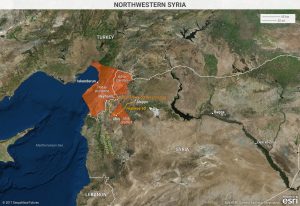
Turkish forces recently began massing on the southwestern border with Syria. As many as 80 military vehicles, including an unknown number of tanks and medical aid trucks, were dispatched to a part of Hatay province that’s approximately 30 miles (50 kilometers) from the border. Another convoy of an unspecified number of military vehicles was reportedly sent to another area of Hatay, just 2 miles from Syria’s border, and a third collection of 20 army vehicles was seen close to the border near Bab al-Hawa in Syria, about 7 miles from Reyhanli.

By themselves, these movements might seem innocuous – it is, after all, normal for Turkey to move soldiers and materiel around its borders depending on where it believes threats could arise. But context is everything, and the context of these deployments is not routine. On Sept. 15, Turkey, Iran and Russia agreed in Astana to set up a safe zone in Syria’s Idlib province, just west of Aleppo. They reportedly agreed to divide the province into three zones, each controlled by a different country. That same day, a pro-government Turkish newspaper reported that 25,000 Turkish soldiers were preparing for deployment into Idlib province, with the goal of taking control of a roughly 2,000-square-mile (5,000-square-kilometer) area with over 2 million inhabitants.

Until now, Turkey has chosen to stay out of the fray in Syria as much as it can. The main exception was Operation Euphrates Shield from August 2016 to March 2017. The scope of that incursion, however, has been exaggerated by both Turkey and the mainstream media. Euphrates Shield was a limited, seven-month operation involving about 8,000 Turkish soldiers. Their main goal was to support the activities of the Free Syrian Army as it pushed Islamic State fighters back from the Turkish border. (Nominally, the objective was to weaken the Kurdish People’s Protection Units, or YPG, but the operation didn’t take any territory from the YPG.) The FSA bore the brunt of the casualties.

The situation in northwest Syria is more convoluted. Syrian Kurds control Afrin canton, much to Turkey’s chagrin. Hayat Tahrir al-Sham (formerly al-Qaida or al-Nusra Front) holds the city of Idlib, which it recently took from the Turkish-backed proxy Ahrar al-Sham, as well as territory on the Turkish border. Anti-Assad rebel forces fell back to Idlib’s towns and countrysides after losing the battle for Aleppo. And the Bashar Assad regime has not given up its ambitions to reconquer the territory.

The presence of so many different groups means there are almost as many outside powers with an interest in what happens in northwest Syria. Turkey backs anti-Assad rebels, who are holed up in Idlib province, but its supply lines to them are tenuous at best. Both Russia and Iran back the Assad regime, and though Turkey has come to an understanding with both on this matter, over the long term the interests of these three countries in Syria diverge considerably. Turkey isn’t interested in seeing a pro-Russia or pro-Iran force pacifying the area and potentially threatening southern Turkey. The Syrian Kurds pose obvious problems for Turkey, and Hayat Tahrir al-Sham ­– though it has deliberately slipped under the radar while the world focuses on IS – has long-term designs of its own in the Muslim world that are not in line with Turkey’s.

This is an unstable situation that is trending toward a power vacuum. If Turkey doesn’t fill the void, someone else will, and none of the potential options are good for Turkey.


Κυπριακό, σκοπιανό και ελληνοτουρκικές σχέσεις στο επίκεντρο της ομιλίας Κοτζιά στον ΟΗΕ

0

Την αμετακίνητη θέση της Ελλάδας για κοινή λύση στην ονομασία της ΠΓΔΜ και την ανάγκη σεβασμού από την πλευρά της Τουρκίας του Διεθνούς Δικαίου εξέφρασε ο υπουργός Εξωτερικών Ν. Κοτζιάς, σε ομιλία που απηύθυνε στη Γενική Συνέλευση του ΟΗΕ την Παρασκευή. Δεν παρέλειψε μάλιστα να κατονομάσει για άλλη μια φορά την τουρκική και τουρκοκυπριακή πλευρά ως τον μοναδικό υπαίτιο για την κατάρρευση των συνομιλιών για το Κυπριακό στο Κραν Μοντανά.

Ο κ. Κοτζιάς αφού συνεχάρη τον Γενικό Γραμματέα, κ. Γκουτέρες για την εκλογή του στην προεδρία της 72ης Γενικής Συνέλευσης του ΟΗΕ αναφέρθηκε στις προκλήσεις σε παγκόσμιο επίπεδο που καλούνται τα κράτη να διαχειριστούν και στην ανάγκη να παραμείνει ο ΟΗΕ «επίκαιρος σε ένα διαρκώς μεταβαλλόμενο κόσμο».

Ο υπ. Εξωτερικών καταδίκασε ακόμη την τελευταία δοκιμή και το παράνομο πρόγραμμα της Βορείου Κορέας για ανάπτυξη πυρηνικών όπλων και βαλλιστικών πυραύλων,  το οποίο όπως ανέφερε «υπονομεύει σοβαρά την περιφερειακή και διεθνή ειρήνη και ασφάλεια» ενώ υπογράμμισε ως απαραίτητη τη δημιουργία διαύλων διαλόγου με τα κράτη που διαθέτουν πυρηνικά όπλα.

Την ανησυχία του «για την άνοδο της εθνικιστικής ρητορικής στην περιοχή» εξέφρασε ακόμη ο κ. Κοτζιάς τονίζοντας ότι θα πρέπει, με κάθε τρόπο, να αποφεύγονται πράξεις  και δηλώσεις που υπονομεύουν τις σχέσεις καλής γειτονίας.

Σχετικά με το θέμα του ονόματος της ΠΓΔΜ, η Ελλάδα όπως υπογράμμισε «θα συνεχίσει να εργάζεται συστηματικά για την επίτευξη μίας  αμοιβαία αποδεκτής λύσης στο ονοματολογικό ζήτημα. Η θέση μας είναι σαφής: ένα αμοιβαία αποδεκτό όνομα, erga omnes.»

Αναφέρθηκε ακόμη στις σχέσεις με την Τουρκία επαναλαμβάνοντας την ανάγκη για πλήρη σεβασμό του Διεθνούς Δικαίου, συμπεριλαμβανομένου του διεθνούς Δικαίου της Θάλασσας, χωρίς αμφισβητήσεις της κυριαρχίας και των κυριαρχικών δικαιωμάτων της Ελλάδας.

Οσον αφορά στο Κυπριακό, «ο στόχος μας» ανέφερε ο κ. Κοτζιάς, «συνοψίζεται σε μία έννοια (concept), την οποία υιοθέτησε ο Γενικός Γραμματέας του ΟΗΕ κατά τη διάρκεια της Διεθνούς Διάσκεψης για την Κύπρο: να καταστεί η Κύπρος ένα “κανονικό κράτος”. Ένα κυρίαρχο και ανεξάρτητο κράτος, απαλλαγμένο από ξένα στρατεύματα κατοχής, εξωτερικές εγγυήσεις και παρεμβατικά “δικαιώματα”.»

Ο Ελληνας υπουργός εξωτερικών επέρριψε για άλλη μια φορά ευθύνες στην τουρκική και τουρκοκυπριακή πλευρά για τον τερματισμό των συνομιλιών στον Κραν Μοντανα,που  όπως χαρακτηριστικά είπε «ήταν οι μόνοι συμμετέχοντες στη Διάσκεψη που δεν συμμερίζονταν τον στόχο του “κανονικού κράτους”.

«Είμαστε διατεθειμένοι να συνεχίσουμε τη συζήτηση επί του βασικού διεθνούς ζητήματος της ασφάλειας και των εγγυήσεων, μόλις η Τουρκία επιδείξει σαφή βούληση να συνεχίσει τις διαπραγματεύσεις, επί τη βάσει των Αποφάσεων του Συμβουλίου Ασφαλείας των Ηνωμένων Εθνών, καθώς και στο πλαίσιο των παραμέτρων που όρισε ο Γενικός Γραμματέας των Ηνωμένων Εθνών στο Κραν Μοντανά», υπογράμμισε.

Ακόμη ο κ. Κοτζίας επισήμανε πως βασικός στόχος της κυβέρνησης είναι η ανάπτυξη μίας θετικής, πολύπλευρης «ατζέντας συνεργασίας, με έμφαση σε συνέργειες και κοινές δράσεις, ιδίως μέσω του πολιτισμού, που αποτελεί έναν από τους βασικούς μοχλούς ήπιας ισχύος στις διεθνείς σχέσεις, αλλά και άλλων τομέων όπως το εμπόριο, η εκπαίδευση και η έρευνα» καθώς και η ενίσχυση της περιφερειακής συνεργασίας στα Βαλκάνια.

Σχετικά με τον πόλεμο στη Συρία, απευθυνόμενος στον κ. Γκουτέρες είπε: «Για την  Ελλάδα, δεν υφίσταται άλλη εναλλακτική εκτός της πολιτικής επίλυσης της κρίσης.   Υποστηρίζουμε απόλυτα τον πολιτικό διάλογο με τη συμμετοχή όλων των πλευρών στη Γενεύη υπό την αιγίδα του ΟΗΕ.»

Τη δημιουργία ενός ανεξάρτητου και κυρίαρχου Παλαιστινιακού Κράτους, το οποίο θα συμβιώνει ειρηνικά και με ασφάλεια με το Κράτος του Ισραήλ, υποστήριξε ακόμη ο υπ. Εξωτερικών ενώ αναφορικά με την κατάσταση στη Λιβύη τόνισε πως δεν υφίσταται στρατιωτική λύση στην κρίση της χώρας.

Για τον κοινό αγώνα των κρατών κατά της τρομοκρατίας, ανέφερε πως η ενίσχυση της διεθνούς συνεργασίας μεταξύ όλων των παικτών και η βελτίωση στον τομέα  ανταλλαγής πληροφοριών αποτελούν κεντρικό στοιχείο για την αποτελεσματική αντιμετώπιση του φαινομένου.

Ακόμη, ο κ. Κοτζιάς υπενθύμισε την προσήλωση της Ελλάδας στην προστασία των ανθρωπίνων δικαιωμάτων , αποδίδοντας ιδιαίτερη σημασία στις ανάγκες των μεταναστών, και ιδιαίτερα των παιδιών, που βρίσκονται σε ευάλωτη κατάσταση.

Τέλος, διαβεβαίωσε τον κ. Γκουτέρες ότι η Ελλάδα ως ιδρυτικό μέλος αυτού του ΟΗΕ θα παράσχει την αμέριστη συμπαράστασή της στην προσπάθεια του να εκπληρώσει το καθήκον του για δημιουργία ενός πιο ειρηνικού και ευημερούς μέλλοντος

kathimerini.gr

EU’s ‘failed’ army will be resurrected THIS year, insists Brussels foreign affairs chief

0

EU FOREIGN affairs chief Federica Mogherini insisted Brussels’ “failure” to have a European Union army will be put right as she launches a major overhaul this year.

Brussels chief outlines plans for EU defence overhaul

The High Representative of the European Union for Foreign Affairs and Security Policy said the global security environment had “changed” and member states needed to “invest together”.

Her comments come as Emmanuel Macron’s former defence advisor predicted Germany and France will quickly take great strides towards the militarisation of the EU after Brexit.

Speaking to Bloomberg, Ms Mogherini said EU countries had been “inefficient” with defence spending compared to the United States and now was the time to address that.

She said: “The European Union started in the fifties with the idea of a European Union based on common defence and it failed.

Federica Mogherini said she would overhaul plans for an EU army by December

We know we have to rely more on our own means and we are putting in place as the European Union, instruments to invest together

Federica Mogherini

“Today we’re doing that because the security environment has changed and because we know we have to rely more on our own means and we are putting in place as the European Union, instruments to invest together.

“I often make one example in the United States. You invest double what the European Union countries invest in defence, so we invest 50% of what you [the US] do.

“But the output of our investment is 15% because we invest in a fragmented manner.

“We are now addressing this. I’m ready now to launch, from now to December, a permanent structure cooperation among European Union member states, to invest together in industrial programmes on defence, that would maximise the result of our investment

“What we can do as the European Union, and we’re doing it, is to make sure that all European countries can invest in a more effective way. Making the most out of the money we’re spending.”

She added the NATO target for members to spend 2% of their gross domestic product on defence was not a debate for the European Union.

Meanwhile, Fancois Heisbourg, who advised new French president Mr Macron before his election victory, said the UK had been the main block on member states pouring more cash into EU military projects.

Tory MEP blasts Brussels over EU army it has already formed

And he said he expected “surprising” developments in the drive to establish greater EU military forces after Angela Merkel’s expected victory in the German general election next month.

France, under Mr Macron, is pushing for a significant ratcheting up of European defence integration, including the creation of a multi-billion euro EU defence fund and new military headquarters.Such plans have previously been thwarted by Britain, which used its influence to derail the most federalist initiatives, but now look set to go ahead at pace after Brexit.

Senior military experts have warned any attempts to create an EU army could seriously destabilise NATO by sucking away political attention and resources at a time when it needs reinvigorating.

But eurocrats have dismissed these criticisms, saying their newly integrated forces will operate in tandem with NATO and will strengthen the alliance by modernising European defence.

BLOOMBERG•GETTY

http://www.express.co.uk

Η χώρα των αεριτζήδων: Από τη σημαία ευκαιρίας στην ιθαγένεια ευκαιρίας, όλα σε “ξεπούλημα”

1

Του Κώστα Βενιζέλου

Το Προεδρικό Μέγαρο της Λευκωσίας. Φωτογραφία ΚΥΠΕ SEPTEMBER 23, 2017

Κάποτε είχαμε τη σημαία μας, σημαία ευκαιρίας στις θάλασσες, αργότερα ανακαλύφθηκε ως κερδοσκοπικό πεδίο η παραχώρηση διαβατηρίου, υπηκοότητας της Κυπριακής Δημοκρατίας.

Η χώρα πρόσφερε την πλέον φθηνή εγγραφή σε εθνικό νηολόγιο γι’ αυτό και είχαν γεμίσει οι θάλασσες με την κυπριακή σημαία.

Όπως είναι γνωστό, η κυπριακή σημαία, λόγω εκείνης της πρακτικής, δεχόταν για χρόνια μια πολεμική και ως αποτέλεσμα τούτου αντιμετώπιζε πολλά προβλήματα στα διάφορα λιμάνια που προσέγγιζαν τα πλοία του νηολογίου «μας». Τα τελευταία χρόνια, μετά από πολλές προσπάθειες, διαγράφηκε η χώρα από τη μαύρη λίστα του Παρισιού, γνωστή ως Paris Memorandum.

Ωστόσο, μετά τη σημαία ευκαιρίας, ήλθε η σειρά της υπηκοότητας ευκαιρίας, που έχει ανταγωνιστές να αντιμετωπίσει μεταξύ των εταίρων μας στην Ευρωπαϊκή Ένωση.

Είναι πολλοί εκείνοι που υποστηρίζουν πως η διαδικασία παραχώρησης υπηκοότητας έχει αποφέρει σημαντικά κέρδη στην Κυπριακή Δημοκρατία και οι πιο ειδικοί με τους ψυχρούς τους υπολογισμούς της απλής αριθμητικής υποστηρίζουν πως το μέτρο τούτο είναι ένεση ζωής για την οικονομία, σε μια δύσκολη περίοδο.

Ενδεικτικό μιας νοοτροπίας που τείνει να είναι κυρίαρχη, σύμφωνα με την οποία τα πάντα έχουν χρηματική αξία, πωλούνται. Όλα αυτά μπορεί να αντιμετωπίζονται ως μια ρομαντική, ιδεολογοκεντρική θεώρηση του θέματος. Αν και στην πραγματικότητα είναι η ψυχρή ανάλυση μιας σοβαρής πτυχής, που αφορά την υπεράσπιση του κράτους και της χώρας. Είναι θέμα επιβίωσης της χώρας και της αξιοπρέπειας ημών των γηγενών. Όχι προσωρινής, πρόσκαιρης που προσφέρει τα εκατομμύρια από εν δυνάμει «συμπολίτες μας», αλλά εκείνης που διασφαλίζει την έντιμη συνέχεια του κράτους.

Το παζλ με την παραχώρηση των διαβατηρίων δεν είναι απλό. Είναι σύνθετο και σε αυτό εμπλέκονται πολλά συμφέροντα. Είναι δικηγορικά γραφεία, που για μια ακόμη φορά έχουν πρωταγωνιστικό ρόλο. Γνωστή η ρήση, «ο πελάτης έχει πάντα δίκαιο», η οποία μεταφράζεται στην πιο απλοϊκή προσέγγιση: Πωλούμε και αγοράζουν. Είναι, επίσης, οι μεσίτες, οι ντιβέλοπερ και διάφοροι άλλοι, που έχουν μεσολαβητικό ρόλο σε αυτές τις ιστορίες.

Είναι γνωστό και δεν αφορά αυτό το ζήτημα πως οι προσεγγίσεις της αρπαχτής οικοδομούν στην ουσία ένα κλίμα αβεβαιότητας, που δεν πρέπει να προκαλείται καθώς αποβαίνει σε βάρος της Κύπρου. Η κακή φήμη δεν είναι δύσκολο να διαμορφωθεί, όταν τα αντανακλαστικά είναι αργά μέχρι και ανύπαρκτα. Η κακή φήμη δεν είναι δύσκολο να κυριαρχήσει όταν η χώρα δεν έχει μηχανισμούς άμυνας. Θα μπορούσε να υποστηρίξει κανείς πως η Κύπρος δεν είναι το μόνο κράτος-μέλος της Ευρωπαϊκής Ένωσης που έχει υιοθετήσει το μέτρο αυτό της παραχώρησης υπηκοότητας έναντι χρημάτων/ επενδύσεων/ αγορών/ καταθέσεων. Η Κύπρος, όμως, που πολλές φορές στο παρελθόν βρέθηκε στο στόχαστρο, οφείλει να υπολογίζει το κόστος της όποιας απόφασής της. Κυρίως, όταν το κράτος υπονομεύεται, είναι στόχος διάλυσης, εποικίζεται, πρέπει να αποφεύγονται κινήσεις και ενέργειες που δείχνουν διάθεση του τύπου «όλα στο σφυρί». Σε ένα κράτος σοβαρό τα πάντα δεν πρέπει να περνούν από οικονομικούς υπολογισμούς, ούτε μέσα από το πελατολόγιο λογιστών, δικηγόρων κ.λπ.

Πηγή: Η χώρα των αεριτζήδων: Από τη σημαία ευκαιρίας στην ιθαγένεια ευκαιρίας, όλα σε “ξεπούλημα” http://mignatiou.com/2017/09/i-chora-ton-aeritzidon-apo-ti-simea-efkerias-stin-ithagenia-efkerias-ola-se-xepoulima/

Greece Could Leave The EU: Why The Grexit Option Deserves Consideration

0

Protesters hold a banner during a rally in Athens, Thursday, Dec. 8, 2016. A nationwide 24-hour general strike called by unions against austerity measures disrupted public services across Greece on Thursday, while thousands marched in protest in central Athens. (AP Photo/Yorgos Karahalis)

With the Greek psyche itself the victim of a relentless shaming campaign, the idea of Greece “going it alone” begins to seem outlandish and quixotic. It is not. But it is as much tied to a revival of spirit and self-esteem as to the nuts and bolts of economic transformation.

Eight years into the deepest economic depression that an industrialized country has ever experienced, we are now being told that Greece is a “success story.” Having accepted the “bitter medicine” prescribed by the “troika”—the European Commission, the European Central Bank, and the International Monetary Fund—the storyline today is that Greece is on the road to recovery, firmly within the European Union and the eurozone.

This narrative was recently echoed by Greek Prime Minister Alexis Tsipras in his annual speech at the Thessaloniki Trade Fair, Greece’s equivalent to the State of the Union address. In this speech, Tsipras triumphantly declared that talk of “Grexit”—or a Greek departure from the eurozone and the EU—has been replaced by that of “Grinvest.”

Within such a context, there is seemingly no room for discussions about whether it is in Greece’s best interest, even after so many years of implementing the troika’s austerity diktats, to consider a departure from the eurozone and the EU. Indeed, the narrative is that the people of Greece overwhelmingly have never supported the prospect of “Grexit.”


All throughout the economic crisis in Greece, it has been reported that polls have consistently shown clear majorities favoring the country’s “European trajectory” and rejecting the possibility of a departure from the eurozone and EU.

So the Greeks want the euro at all costs, even if it means more harsh austerity measures and cuts to wages, pensions and social services. Or so we are told. These claims would be believable if they were the product of robust public debate and deliberation on the respective pros and cons of remaining within the “European family” or departing. But in Greece, and in most of the global mainstream media, there is no such debate and never has been.

Instead, what has taken place in Greece during the economic crisis has been the complete elimination from public debate of opponents of the prevalent economic and political doctrines. Those who oppose the eurozone, the EU, or simply the austerity measures, are stamped with the “scarlet letter” of being “nationalists,” “xenophobes,” or “fascists.” Such rhetoric became even more polarized following the Brexit referendum result. The Brexit result and the rise of “populism” have themselves been demonized, while poll results that contradict the mainstream narrative are habitually buried by the supposedly “objective” major media outlets.

Following the first installment of this series –in which the less-than-democratic roots of the EU, the zeal with which the EU is lionized by the global media today, the EU’s present-day democratic deficit and hypocrisy, and the attempts to discredit opponents of the EU and neoliberalism were analyzed–this piece will focus on what has long been the “elephant in the room” in Europe: the possibility of departure from the eurozone and from the EU, and why it must, at the very least, be debated on equal terms in economically suffering countries such as Greece.

Fostering fear and lies

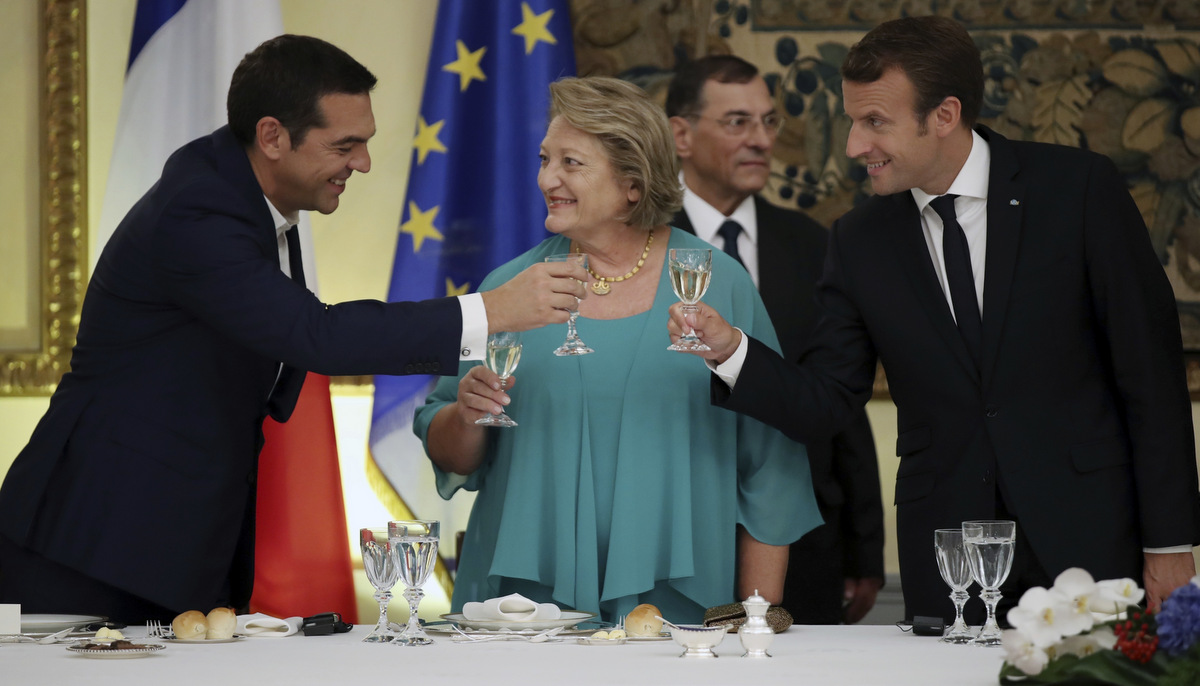
French president Emmanuel Macron, right, Greek Prime Minister Alexis Tsipras, left, and Vlasia Pavlopoulou wife of the Greek President toast their drinks at the Presidential Palace in Athens, Thursday, Sept. 7, 2017. Standing at a Greek site where democracy was conceived, French President Emmanuel Macron called on members of the European Union to reboot the 60-year-old bloc with sweeping political reforms or risk a "slow disintegration. (AP/Charalambos Gikas)

French president Emmanuel Macron, right, Greek Prime Minister Alexis Tsipras, left, and Vlasia Pavlopoulou wife of the Greek President toast their drinks at the Presidential Palace in Athens, Thursday, Sept. 7, 2017. Standing at a Greek site where democracy was conceived, French President Emmanuel Macron called on members of the European Union to reboot the 60-year-old bloc with sweeping political reforms or risk a “slow disintegration. (AP/Charalambos Gikas)

Throughout the crisis, the austerity measures that have been imposed on Greece, the arguments in favor of the necessity of remaining “in Europe,” the mythos surrounding the “European dream,” and the horror that would result from “Grexit” have been propped up by a series of lies and scare tactics that have been repeatedly propagated by politicians and media outlets alike.

This has fostered a form of learned helplessness in Greece, a belief that the country is incapable of surviving outside the eurozone and EU and therefore must remain, even if the preconditions for doing so are harsh.

One such myth pertains to the idea that Greece “doesn’t produce anything” and is therefore reliant on imports. These imports must, of course, be paid for with hard currency; therefore, the conventional line of thinking suggests that Greece would be unable to import vital necessities with its own “soft” currency.

Case in point: a 2012 Eurobarometer survey found that 94 percent of Greeks were concerned about national food security, the highest level in the EU. In addition, Greece was the only EU member-state where a majority (61 percent) expressed concern with national food production. Moreover, 79 percent of Greeks expressed the belief that Greece does not produce enough food to meet domestic needs. Again, this was the highest percentage recorded in the EU.

The claim that Greece doesn’t produce anything and is not nutritionally self-sufficient is constantly repeated by the media and used to justify remaining in the common market, but is it true? As of 2010, the most recent year for which complete statistics seem to be available, Greece met, exceeded, or came close to meeting domestic demand for staples such as eggs, meat and milk derived from sheep and goats, olive oil, several crops (including oranges, peaches, tomatoes, cucumbers, apricots, potatoes, and grapes), honey, whole grains, and poultry.

Furthermore, according to data from 2012, Greece is second worldwide in the production of sheep’s milk, third in olive and olive oil production, fourth in the production of pears, fifth in the production of peaches and nectarines, sixth in pistachio production, and in the top ten in goat’s milk, chestnuts, cantaloupes, cherries, and cotton. It is also just outside the top ten in the production of almonds, cottonseed, asparagus, figs, and other legumes. Greece is third in the world in the production of saffron and sixteenth in the world in the production of cheese products.

Outside of food production, Greece is a strong producer of such resources as aluminum and bauxite (first in Europe), magnesium (meeting 46 percent of Western Europe’s production), second in the world behind the United States in the production of smectite clay, and is the only European country with significant nickel deposits. Greece is also a significant producer of laterite and marble, as well as steel and cement.

Outside of production, Greece possesses one of the world’s largest shipping fleets, ranking second worldwide in total tonnage, while the Greek flag fleet and merchant fleet rank second in the EU and seventh globally. In addition, Greece is fourteenth in the world in tourist arrivals (but twenty-third in tourist revenue).

It is these three sectors — agriculture, shipping, and tourism — that have traditionally sustained the Greek economy, alongside domestic small businesses, which themselves have suffered during the crisis under the weight of decreased spending and increased taxation. Prior to the euro, the agricultural, shipping, and tourism sectors provided Greece with the hard currency with which it financed imports.


Related | Greece: A (Basket) Case Study In Savage Globalization


Indeed, it is membership in the EU that has led to a sharp decline in the domestic production of numerous staples in Greece. In 1961, twenty years before joining the EU, “impoverished” Greece produced 169,200 tons of figs, 6,374 tons of sesame, 52,000 tons of dry beans, 13,365 tons of chickpeas, and 19,246 tons of quince. In 2011, the respective figures were 9,400 tons of figs, 33 tons of sesame, 22,744 tons of dry beans, 2,200 tons of chickpeas, and 3,432 tons of quince.

In 1981, the year Greece joined the EU, production of fresh vegetables was at 123,298 tons, lemon production was at 216,874 tons, apple production was at 337,091 tons, almond production at 73,181 tons, tobacco production at 130,900 tons, tomato production at 1,884,600 tons, and potato production at 1,056,000 tons.

Thirty years later, the figures for each of these crops had sharply declined: 74,393 tons of fresh vegetables, 70,314 tons of lemons, 255,800 tons of apples, 29,800 tons of almonds, 20,287 tons of tobacco, 1,169,900 tons of tomatoes, and 757,820 tons of potatoes.

A major factor in this decline is the EU’s common agricultural policy, which sets production quotas for each country and each sector of production, and dictates to each country what to produce and which crop varieties to cultivate, what not to produce, where to export, where not to export, how much to export and at what price.

For example, until 2005 Greece’s sugar production sector was profitable and met a large part of domestic demand. In a 2006 deal with the EU, however, Greece agreed to reduce its domestic sugar production and increase imports. In 1980, the year before Greece ascended to the EU, pork meat production met 84 percent of domestic needs, while beef production met 66 percent of domestic demand. Those figures have declined to 38 and 13 percent, respectively.

The decline in beef production has also impacted the dairy sector. The EU’s influence is evident here as well: in 2000, Greece was fined 2.5 billion drachmas (over 7.3 million euros) for exceeding EU-imposed quotas for the production of cow’s milk.

And yet the myth persists: Greece “cannot survive” outside of the eurozone and EU. And while the lack of production—whether imagined or real—is one of the main arguments used by proponents of remaining in the EU, the lies do not stop there.

 Greece wants to stay in the eurozone and EU — or does it?

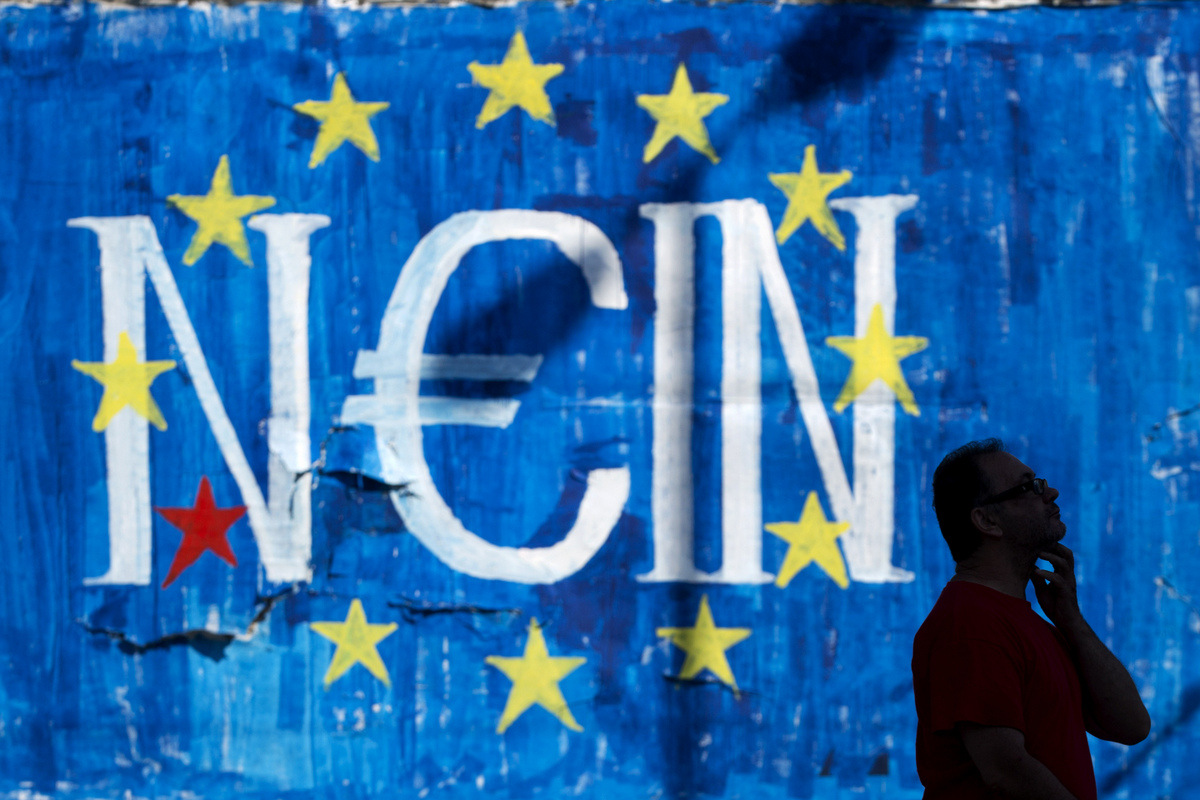
A man walks past a graffiti made by street artist N_Grams that read ''NO'' in German but also ''YES, IN'' in Greek language in Athens, June 28, 2015. (AP/Petros Giannakouris)

A man walks past a graffiti made by street artist N_Grams that read ”NO” in German but also ”YES, IN” in Greek language in Athens, June 28, 2015. (AP/Petros Giannakouris)

One of the most prevalent and recurring myths to come out of crisis-stricken Greece is that despite the austerity measures and cuts that the Greek people have been faced with, the overwhelming majority wishes to remain in the EU “at all costs.”

This exact wording has been used in numerous public opinion polls, such as one published on July 5, 2015, the day of the Greek referendum on whether to accept or reject a new troika-backed austerity proposal. According to this poll, conducted by polling firm GPO on behalf of one of Greece’s most notoriously pro-austerity TV stations, Mega Channel, 74.1 percent of respondents wished to remain in the EU at all costs.

Is this really the case? It is worth considering that in Greece, there are no polling firms which conduct public opinion polls independently. Surveys are conducted on behalf of large media outlets which are, without exception, favorable to the policies of austerity and continued membership in the eurozone and the EU. The polling firms themselves also belong to similarly entrenched interests. The aforementioned GPO, for instance, was co-founded by construction and publishing magnate Christos Kalogritsas, who is said to still maintain a close friendship with GPO’s main shareholder, Takis Theodorikakos.


Related | How Greece Became A Guinea Pig For A Cashless, Controlled Society


Further limiting their independence, Greece’s major public opinion polling firms are all recipients of state funding. Between 2010-2013, Kapa Research received 3,126,900 euros, MRB received 877,423 euros, GPO received 395,003 euros, Metron Analysis received 273,574 euros, Marc received 82,650 euros, VPRC received 55,500 euros, and ALCO received 50,677 euros.

Despite this though, the question remains: are the polling results accurate? What has been evident throughout the crisis is that poll results have often been woefully inaccurate. For example, prior to the 2015 referendum, major public opinion polls showed “yes” and “no” in a statistical dead heat. In reality, over 61 percent of voters rejected the EU’s austerity proposal, even if this result was itself overturned by Greece’s subservient SYRIZA-led government, which itself seemingly wishes to keep Greece inside the eurozone and EU “at all costs.”

More evidence can be found from the results of the few relatively independent public opinion polls which have taken place in Greece in recent years. For example, in a pan-European survey conducted by the Gallup International polling firm in December 2014, 52 percent of Greeks favored a return to a domestic currency, while only 32 percent favored remaining in the eurozone. Notably, Gallup International’s respective 2016 end-of-year poll found less than overwhelming support in Greece for remaining in the EU: while 54 percent of respondents stated that in a hypothetical referendum they’d vote to remain, 46 percent would vote to leave.

Furthermore, a March 2015 poll by Bridging Europe—an upstart polling firm which has since openly and unabashedly supported SYRIZA—found that 53 percent of respondents favored a return to a domestic currency. Together, these results contradict polling results which claim that overwhelming majorities of Greeks wish to remain, and at all costs to boot. However, these poll results have never been reported by either the Greek or the international media.

What the mainstream public opinion survey results in Greece aim to accomplish is threefold. First, they seek to impact public opinion in Greece by making it seem like there is such an overwhelming majority in favor of continued EU and eurozone membership that resistance is futile—and the product of “fringe” elements of society. Secondly, it impacts the international media in their reporting on Greece and the crisis, as they regurgitate these poll results without question.

Third, it reinforces the pro-EU, pro-euro, pro-austerity politics enforced by Greece’s current and previous governments, and the respective pro-EU and pro-euro positions of the entirety of the political spectrum that is represented in parliament.

Varoufakis: more blatant lies and pro-EU propaganda

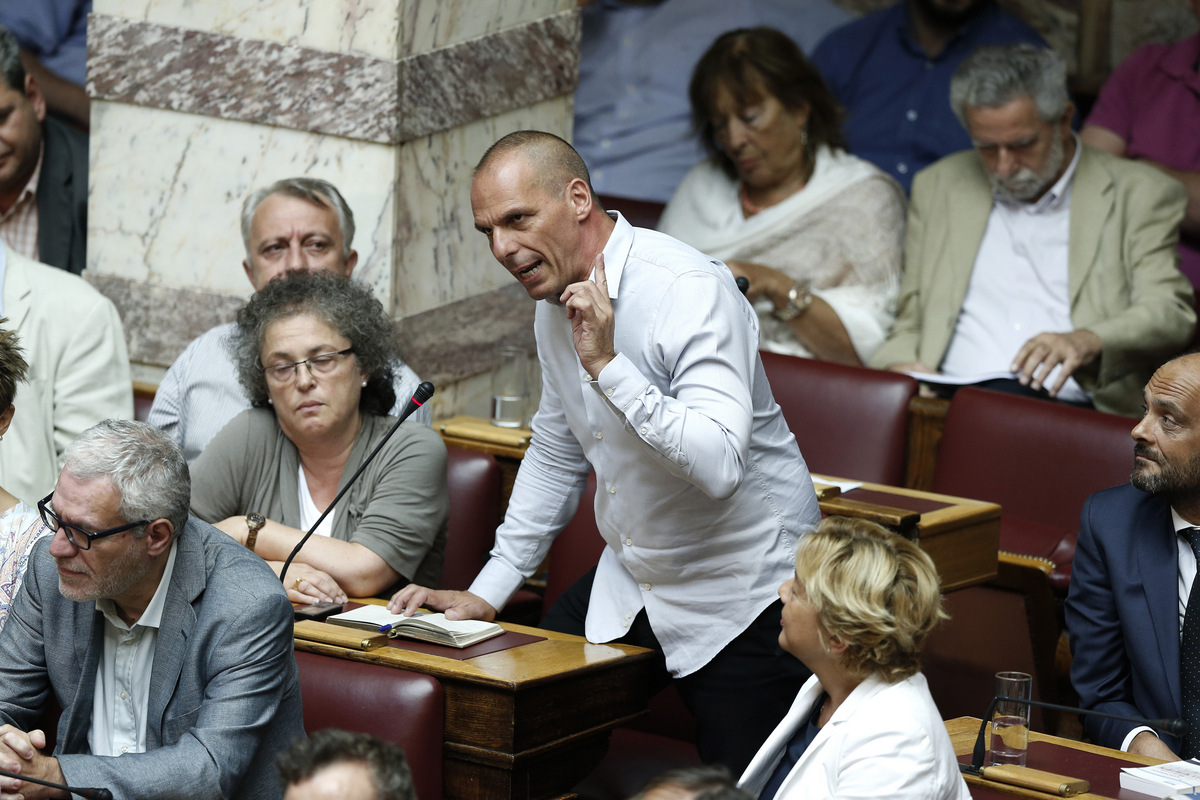
Former Greek Finance Minister Yanis Varoufakis speaks during a parliamentary session in Athens, Friday, Aug. 14, 2015. (AP/Yannis Liakos)

Former Greek Finance Minister Yanis Varoufakis speaks during a parliamentary session in Athens, Friday, Aug. 14, 2015. (AP/Yannis Liakos)

When concealing inconvenient public opinion survey results isn’t enough, more blatant lies are employed. A characteristic example comes from the statements made by former finance minister and “heroic” celebrity economist Yanis Varoufakis, who in an interview with ABC Radio in Australia in 2015 stated that even if Greece wanted to return to a domestic currency, its printing presses were destroyed in 2000 prior to joining the eurozone. In reality, Greece’s mint is still in operation in the Athens suburb of Holargos and prints euro banknotestoday.

In the minds of many Greeks, the old drachma is also associated with crippling inflation and economic instability, a perspective which the major media outlets have done nothing to dispel. Listening to certain Greeks discussing the pre-2002 era, one would think that prior to the euro Greeks must have lived in caves, without electricity, automobiles, or running water—and that such days will swiftly return if Greece dares to depart from the common currency.

Particular fears are expressed about inflation. However, this ignores the fact that from the 1950s through the early 1970s, inflation in “impoverished” Greece hovered at or below 5 percent. In the late 1990s, as Greece prepared to meet Maastricht criteria to join the eurozone, inflation once again fell into the single digits. Throughout the 1970s, 1980s, and 1990s, other southern European countries, such as Italy and Spain, also frequently attained double-digit inflation levels similar to those seen in Greece.

When all else fails, stereotypes and collective guilt are employed to great effect. Greece lied in order to enter the eurozone, we are told, and therefore is reaping its just rewards. But as was pointed out in the first installment of this series, other countries such as Spainand Italy performed similar accounting tricks, but no similar calls to “punish” these countries have been heard.


Related | Neoliberal Echoes Of A Darker, Mid-Century Plan For Continental Unity


What is heard though, by both the Greek and international media, is that the Greek people “lived beyond their means.” This viewpoint is consistent, whether you consult with the “leftist” Guardian, the right-wing Daily Telegraph, German finance minister-for-life Wolfgang Schäuble, or former EU economy commissioner Ollie Rehn. The head of the Eurogroup—the committee of eurozone finance ministers—and member of Holland’s Labour Party Jeroen Dijsselbloem stated earlier this year that Greeks spent their money on “drinks and women.” In turn, Dutch “eurosceptic” politician Geert Wilders claimed that Greeks spent their money “on souvlaki and ouzo.”

Never mind that Greece’s private sector debt has consistently ranked at the lowest levels among OECD countries and still does today. This has not stopped the Greek media and Greece’s politicians from repeating such claims, ascribing collective blame to the entire populace when it was a small cohort of politicians and crony capitalists who largely benefited from the public spending bonanza and augmentation of Greece’s public debt.

"Swindlers in the euro family:" A controversial cover has come back to haunt Germany's Focus magazine.

“Swindlers in the euro family:” The controversial cover of Germany’s Focus magazine.

Nevertheless, such statements are coupled with heavy doses of racism from Greece’s “European partners.” In 2010, the “reputable” German magazine Der Spiegel published, on its front cover, an image of the goddess Aphrodite, cloaked in a Greek flag, giving the finger to Europe, accompanied by the headline “Swindlers in the euro family.” Two studies, commissioned by the Hans Böckler Foundation and by the German newspaper Suddeutsche Zeitung, have found that German media coverage of Greece’s crisis has been rife with stereotypes, bias, and superficial reporting.

The Feb. 13, 2010 edition of the Wall Street Journal featured a parody of ancient Greek art—now well-concealed on the Internet—displaying an ancient god begging for change. The Telegraph has referred to the crisis in Greece as the “ouzo crisis” while referring to the suffering economies of southern Europe as “Club Med.”

One of the many end results of this constant barrage of disparagement and insults towards the Greek people is that they have become ingrained in the national psyche. A common refrain heard in Greece in reference to anything negative occurring within the country is that “this is who we are.” Greece lied and therefore it must be punished. Greeks lived beyond their means and are now getting their just dues. Greeks were corrupt and “ate it all together,” in the words of ex-politician Theodoros Pangalos, and therefore collectively must share the blame.

Herein lies a paradox: on the one hand, Greeks are consistently ranked as among the unhappiest people in the world. Greece ranked fourth in this year’s Bloomberg misery index, and has been found to be the unhappiest country in Europe by both the Eurobarometer survey and by Gallup International. In such a toxic environment, the prevailing policies of economic austerity, cuts, and privatization are therefore met with tacit acceptance.

Collective guilt has set in for Greece’s supposed sins, and these painful austerity measures—and the misery they bring—are considered an inevitable result of these “sins.” On the other hand, the actors in large part responsible for the austerity that has delivered such misery, such as the EU, continue to receive support from a significant percentage of the population.

As for those who dare to openly speak out against austerity and in opposition to the EU and the eurozone? They are swiftly labeled. A favorite retort in Greece concerns the supposed existence of a “conspiracy of the drachma” in which diaspora Greeks and wealthy Greeks who have moved their money offshore favor a return to the drachma. As this line of thinking goes, these individuals would then move their money back to Greece and take advantage of a sharply devalued local currency, getting wealthier in the process.

Other attacks are simpler, often branding opponents of the prevailing European order as “fascists,” “xenophobes,” “nationalists” and “populists”—the latter two, of course, being rather dirty words in the present-day context.


Related | Economist Mark Blyth On Rising Inequality & Populism


When insults and labels don’t do the job, fear is effective. According to a European Commission adviser and as reported by Newsweek in 2015, Greece would promptly find itself out of oil and medical supplies once it leaves the eurozone and EU. In the lead-up to the 2015 referendum, both Greek and international media outlets, including the Washington Post—which later replaced the image on this article—circulated untrue and undated photos of supermarket shelves devoid of food. Greece’s Mega Channel broadcast images of senior citizens using ATMs in fear—images which actually were from South Africa.

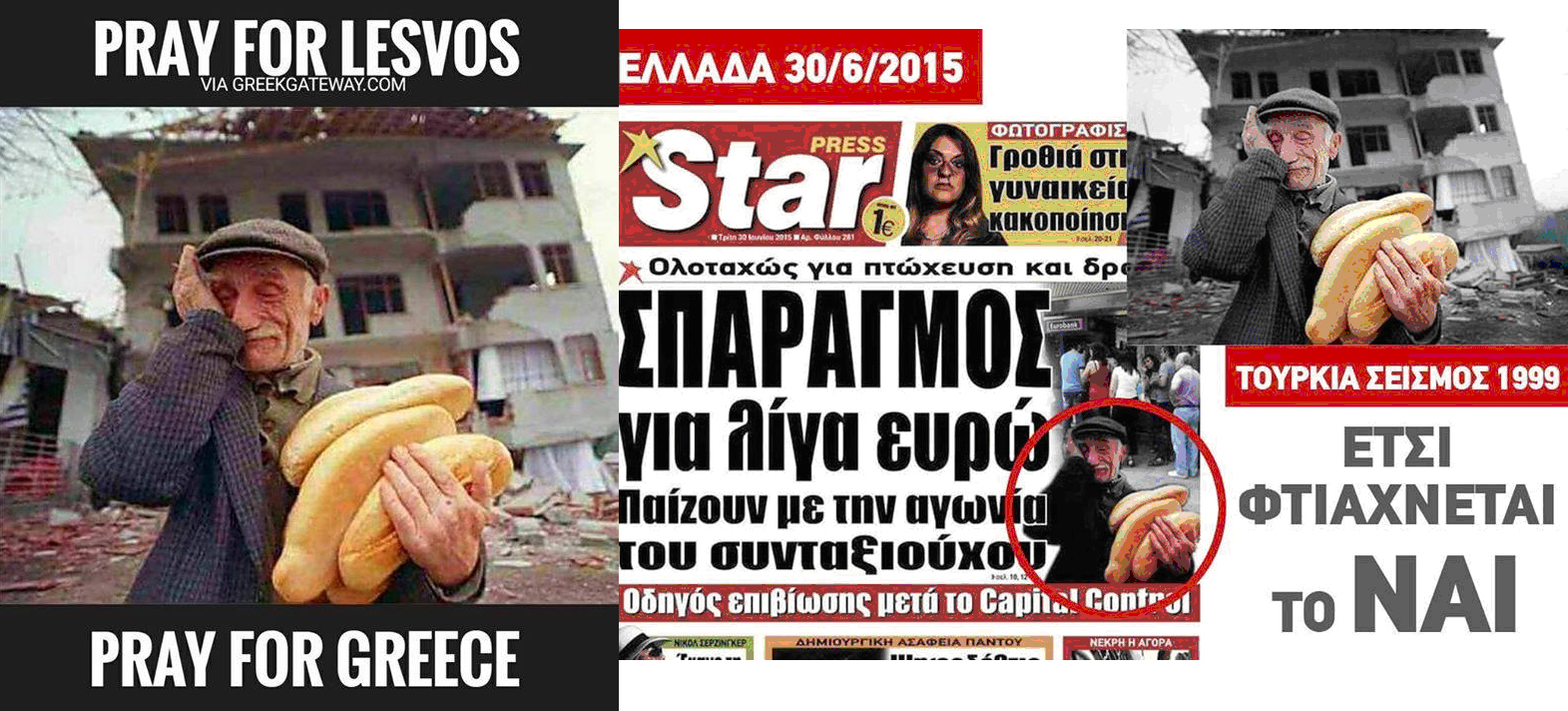
Greek tabloid newspaper Press Star published a “heartbreaking” photo of an elderly man in tears while holding a solitary loaf of bread—even though the photo was actually from the aftermath of the Istanbul earthquake of 1999. The photo was shamelessly recycled one more time earlier this year, in the aftermath of an earthquake on the Greek island of Lesvos.

Another national TV broadcaster, Antenna TV, reported that in the 2015 referendum, Greeks were choosing between a future “as Europe” or “as Zimbabwe.” The same station, prior to the June 2012 parliamentary elections, circumvented a pre-election freeze on political broadcasts by airing, on the eve of the polls, a “documentary” on the (obviously adverse) impacts of “Grexit,” laughably insinuating that a SYRIZA victory would result in “Grexit.”

Never mind that Greek domestic production and industry have been decimated during the years of EU and eurozone membership. Never mind that the EU allowed for the debt of Greece’s national railway to be waived in order to facilitate its privatization—but refuses to allow the same for Greece’s national debt. Never mind that 92 percent of the “bailouts” (loans) Greece has received during the crisis have gone right back to its lenders. Never mind that even EU monies for major infrastructure projects often went right back to European contractors or consultants, in a process of crony capitalism described by former “economic hitman” John Perkins. Never mind that the austerity regime itself has been found to violate the fundamental human rights of the people of Greece. As the title of part one of this series suggested, for the Greek and international media and a substantial portion of the Greek populace, it is “EU über alles”—Europe or bust—even if Greece is the one that goes bust in the process.

The argument for leaving the eurozone and the EU

Pedestrians pass a poster depicting a map of Greece with the letter E being replaced by Euro symbols in Athens, Tuesday, May 2, 2017. (AP/Thanassis Stavrakis)

Pedestrians pass a poster depicting a map of Greece with the letter E being replaced by Euro symbols in Athens, Tuesday, May 2, 2017. (AP/Thanassis Stavrakis)

If we truly support and believe in open and robust public debate, then the discussion as to whether Greece (or any other EU member-state) will be better served by departing from the EU or eurozone must be a part of that dialogue. So far, however, it has largely been excluded from the public sphere and from anything resembling equal footing in public discourse—whether that discussion is occurring in the media, in academia, or in the political arena.

Even if one is not a proponent of leaving the eurozone or the EU, the fiscally and politically prudent thing to do would be to have a plan in place for such a possibility. If, for instance, there is a collapse of the Italian banking system—which is presently teetering on the edge—or some other large-scale economic disaster in the eurozone, it’s not outside the realm of possibility for a domino effect to impact the entirety of Europe, forcing out some eurozone member states or resulting in the collapse of the eurozone system itself.

If this sounds far-fetched, consider the following: there are several examples of currency unions breaking apart, such as that of the Austro-Hungarian empire, or more recently the cases of the breakup of the Czech-Slovak union or Latvia leaving what was essentially a currency union with Russia in 1992.

While not exactly like the eurozone today, in the 19th and early 20th century, the Latin Monetary Union and the Scandinavian Monetary Union attempted to create a currency peg across multiple countries—which also occurred more recently in the lead-up to the launch of the eurozone via the creation of the European Monetary Union. For different reasons, both monetary unions ended up dissolving, with member-states eliminating currency pegs between them.

More recently, the United Kingdom departed the EMU in 1992 amidst doom-and-gloom scenarios highly similar to those heard today about departing the eurozone. Instead, what followed was one of the strongest periods of economic growth in the UK’s history.

Further precedent exists in the well-known examples of Argentina, which repudiated the IMF’s austerity diktats and declared a stoppage of payments on its public debt in 1999. What followed was over a decade of economic growth which exceeded the global average, and indeed even the eventual repayment of much of its previous debt at new terms that it negotiated with most of its creditors.

Iceland, following its banking collapse in 2008 which was, proportionally, the largest collapse sustained by the banking sector in a developed country in history, enacted policies which were in direct opposition to those being recommended by the IMF. Banks were allowed to collapse, foreign creditors were initially not repaid, bankers were jailed. The economy soon boomed, with GDP growthexceeding EU and eurozone averages and Iceland’s GDP eventually eclipsing pre-collapse levels. Meanwhile, a devalued currency led to a tourism and export boom. Eventually, creditors were repaid as well.


Related | Ancient Greece Could Hold The Key To Solving Today’s Debt Crisis


While Iceland and Argentina were not a part of a common currency bloc, their examples highlight how a nation can reject the austerity demands of institutions such as the IMF, can declare a stoppage of payments on its debt, roll back austerity, devalue its currency, and swiftly return to economic growth. Moreover, Argentina broke its 1:1 currency peg to the U.S. dollar — which, while not the equivalent to departing a currency union, had the result of restoring the Argentine government’s ability to enact monetary policy instead of being reliant on U.S. policy.

Therefore, even the most vociferous supporter of “remain” would be well advised to support the development of an exit plan in preparation for a worst-case scenario which may well emerge from outside the country’s borders. Unlike the “heroic” Yanis Varoufakis, who negotiated so fiercely as finance minister in 2015 that he openly stated he had no “plan B” and would not place “Grexit” on the table even as a negotiating tool, such a plan would be the most prudent option even for the most enthusiastically pro-EU regime.

The paragraphs which follow will outline why a country like Greece must consider leaving the eurozone and the EU, the various proposals which have been put forth as to how this could be accomplished, and how a departure could occur.

Why leave?

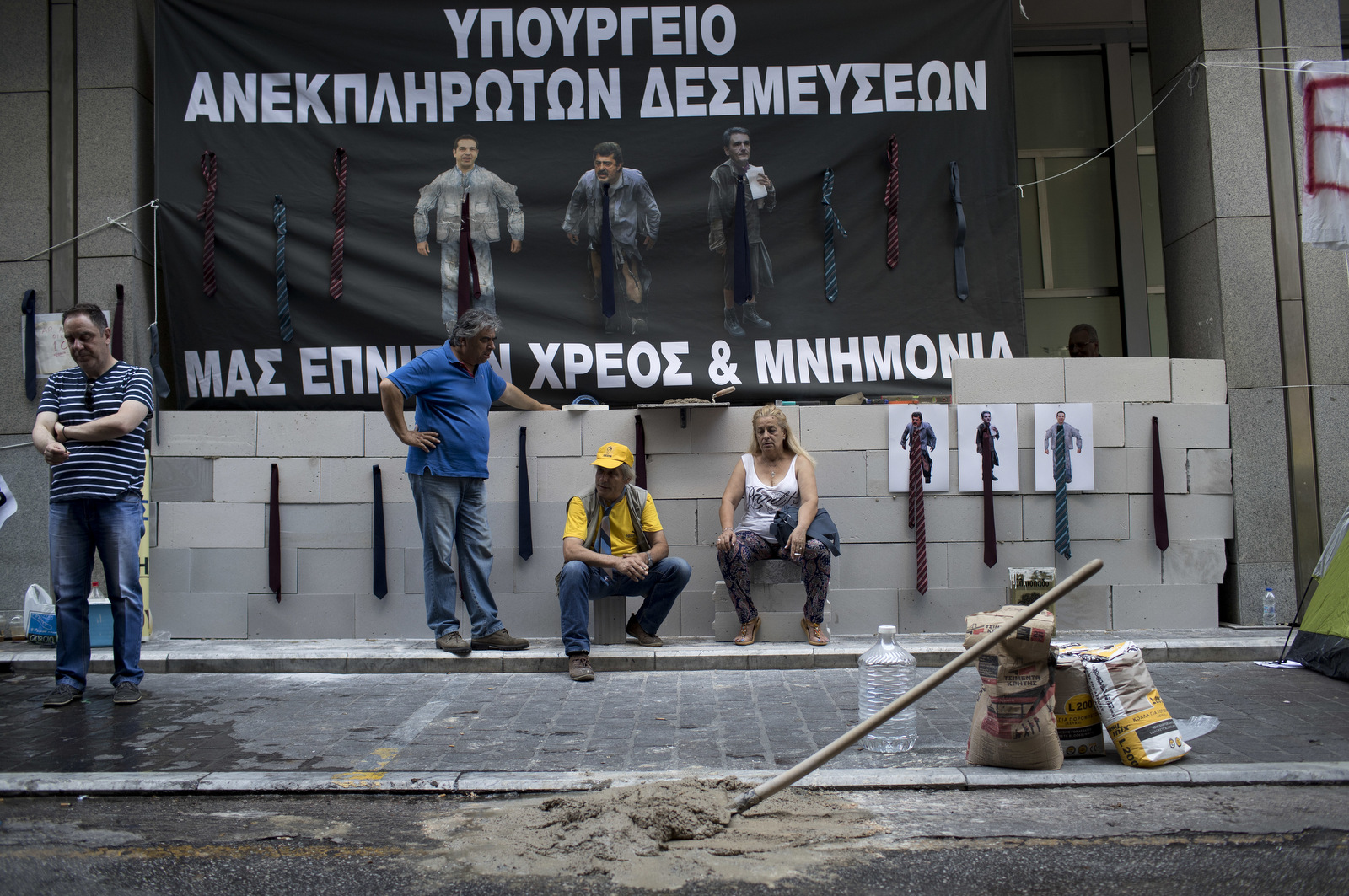
Protesting hospital staff sit in front of a wall that they built at the entrance of the Greek Finance Ministry with a banner depicting Greek Prime Minister Alexis Thipras , Deputy Health Minister Pavlos Polakis and Greek Finance Minister Euclid Tsakalotos wearing ties reading in Greek ''Ministry of broken promises" and " We drown in debt and bailouts" in central Athens. (AP/Petros Giannakouris)

Protesting hospital staff sit in front of a wall that they built at the entrance of the Greek Finance Ministry with a banner depicting Greek Prime Minister Alexis Thipras , Deputy Health Minister Pavlos Polakis and Greek Finance Minister Euclid Tsakalotos wearing ties reading in Greek ”Ministry of broken promises” and ” We drown in debt and bailouts” in central Athens, June 16, 2017. (AP/Petros Giannakouris)

The euro is essentially a debt instrument: According to economist and former central banker Spiros Lavdiotis, the European Central Bank does not lend directly to its members—i.e. the member states of the eurozone. It instead lends to the private sector, at interest. In turn, the private sector lends to states who seek to borrow money, at higher interest. This perpetuates the debt cycle, while the higher interest is often financed in the form of budget cuts or higher taxes.

Restoring monetary sovereignty – external devaluation instead of internal devaluation: What has taken place during the years of the economic crisis in Greece is essentially a process of “internal devaluation.” This means that the cost of labor in Greece—that is, wages, insurance contributions and the like—have been slashed, purportedly in an attempt to boost the country’s competitiveness.

Traditionally, however, many countries have employed a different remedy for responding to an economic downturn: external devaluation. Instead of cutting wages and pensions at home, the value of the national currency would be devalued, immediately making the country’s exports, services, and labor cheaper and more competitive on a global level, compared to other stronger currencies.

External devaluation also helped foster much-vaunted foreign investment (as the cost of investment would decrease) in economic sectors such as tourism, as the country proceeding with an external devaluation would automatically become cheaper for foreign visitors. With domestic wages, pensions, and social services unaffected, quality of life was largely not impacted by an external devaluation.

The main disadvantage with external devaluation is that the cost of imports rises. This, however, was traditionally offset in two ways: paying for imports with foreign hard currency reserves (which can indeed increase if foreign tourism and investment in the economy increases), and by increasing domestic production, where possible, to alleviate the need for imports. This promoted domestic industry and a policy of full employment.

But today, countries such as Greece are saddled with a hard currency that is overvalued for the needs of the domestic economy, and where there is no level of control on monetary policy. If this seems like a mere unfortunate consequence of the euro, think again: Roger Mundell, the Nobel Prize-winning economist and architect of the euro, foresaw precisely this eventuality.

In Mundell’s vision, as eurozone economies were squeezed with the first sign of an economic downturn, all of the traditional monetary policy tools would be unavailable in their policy-making toolkit. Unable to devalue the currency or to increase deficit spending due to EU rules, governments would be left with one choice: austerity. Cut wages, cut pensions, slash social services to the bone. It’s a neoliberal wet dream—and it is the European “dream” today.

Escaping stifling EU fiscal rules: Currently, EU member-states must abide to strict EU fiscal rules as part of its Stability and Growth Pact. The main rules are that total government debt must not be more than 60 percent of GDP, and government deficits must not exceed 3 percent of GDP.

At face value, this sounds reasonable and prudent. However, the problem with these rules is that they eliminate many of the traditional tools that were available in the fiscal policy toolkit during times of economic recession. Deficit spending, for instance, has enabled many sputtering economies to get back on track, as cash re-enters the economy, encouraging consumer and business spending and private lending. Limiting this ability handicaps countries which are stuck in a recession.

Indeed, one of the primary ideas behind such rules is, quite cynically, to reduce the political cost of what would otherwise be unpopular policies: cuts to social services and pensions and the like.

A man stands in front of a banner during an anti-austerity rally by workers in the health sector outside the Labour ministry in Athens, March 2, 2017. Monitors from Greece's European Union creditors and the International Monetary Fund re-launched talks in Athens on Tuesday on the country's stumbling bailout program. The banner reads : "Medical Association of Athens, We demand the immediate withdraw of the pension bill". (AP/Yorgos Karahalis)

A man stands in front of a banner during an anti-austerity rally by workers in the health sector outside the Labour ministry in Athens, March 2, 2017. The banner reads : “Medical Association of Athens, We demand the immediate withdraw of the pension bill”. (AP/Yorgos Karahalis)

It should be noted here that leaving the eurozone or even the EU does not mean an automatic green light to act recklessly. But it will afford a country like Greece the freedom to take control of its fiscal and economic policy. Notably, for Greece, the EU has determined that the aforementioned strict rules do not go far enough. Greece’s current “leftist” SYRIZA-led government, entirely subservient to Brussels and Berlin, agreed earlier this year to achieve a primary budget surplus of 3.5 percent annually each year through 2023, and primary budget surpluses of 2 percent annually through 2060.

This certainly contradicts Prime Minister Alexis Tsipras’ current rhetoric regarding the official end of the crisis coming sometime in 2018. A primary budget surplus means that the state spends less than it takes in. For a country with a stagnant or shrinking GDP such as Greece, this means spending an ever-shrinking amount of money. And as government revenues dry up, the surplus target is met by further cutting spending, creating a perpetual austerity death spiral. As of now, this is the economic future Greece faces, no matter what Tsipras, the EU, or the media claim.

Increased competitiveness on the global markets: Free of EU fiscal and monetary shackles, Greece will be free to enact its own policy, including future devaluations of its newly-restored domestic currency (more on devaluation in part three of this series).

When a country such as Greece is ready to take this step and devalue its domestic currency, it will be able to better compete globally in its three cornerstone economic sectors: tourism, agriculture, and shipping. Greece will be a less expensive destination for foreign tourists, while Greek agricultural products and Greek services will be comparatively less expensive. And this will take place via a process of external devaluation, rather than cutting domestic wages and reducing the quality of life.

Greece has an educated and multilingual workforce, as well as lots of untapped or deprecated (due to EU) agricultural potential. Tourism, while increasing in raw numbers, has a lot of potential for growth, especially since average spending per visitor is far less than other countries.

An increase in foreign trade, exports, and tourism will, in turn, ensure that Greece will maintain the necessary foreign hard currency reserves with which it will import vital goods that it cannot produce domestically. This is how the Greek economy operated prior to entering the eurozone in 2002, and it is how even the poorest of states are able to import oil, automobiles, medicine, or other necessities.

Rolling back austerity: Every sector of the Greek economy has been impacted by the austerity measures that have been imposed by Greece’s lenders in the troika since 2010.

Free of a requirement to sustain a primary budget surplus, Greece would have the ability to increase spending in vital social sectors such as healthcare and education, to at least partially restore pensions and salaries that have been repeatedly slashed, and to cut taxes, such as the heating oil tax which has resulted in most Greek households not being able to afford to heat their homes in the winter. Other cuts could be applied to the value-added tax (VAT), which even for many staple items is a hefty 24 percent, as well as high business taxes that are choking the life out of Greece’s traditional economic base of small businesses.

Even without funding coming from the EU, the ability to increase spending could also allow the state to jump-start infrastructure projects or to continue existing public works. Measures could also be financed to reverse the country’s “brain drain” and to attract some of the 600,000 Greeks who have emigrated, back to Greece.

Protecting and promoting industry: Free of the requirements of participating in the European common market, a country like Greece will be less exposed to unequal or unfair competition from industrial powerhouses such as Germany, which has flooded domestic markets with cheap imports, while domestic industries have been shuttered or bought out.

Furthermore, liberated from the requirement of enforcing production quotas under such policy frameworks as the EU’s common agricultural policy, Greece will be able to enact measures to return agricultural production to its much higher pre-EU levels, thereby alleviating many of the concerns regarding the country’s self-sufficiency and “dependence” on Europe for its survival.

Think people don’t want it? Think again: As was shown earlier, public opinion poll results which claim that overwhelming majorities of Greeks wish to remain in the eurozone and EU at all costs are likely “fake news”—meant to influence public opinion and marginalize opposition. What independent polls have indicated is that, at the very least, a departure from the EU and, in particular, the eurozone will not be nearly as unpopular as claimed—and may perhaps even enjoy the support of a small majority.

Leaving the “Hotel California”?

Yanis Varoufakis has famously uttered that the EU (and by extension, the eurozone) are like the Hotel California: you can check out any time you like, but you can never leave. It’s one thing, of course, to understand why a country like Greece—and its economy—may be at a disadvantage within the eurozone and the EU. It’s another thing, however, to actually leave these institutions.

In the next and final installment of this piece, it is the very process of leaving that will be analyzed. Contrary to a commonly-expressed sentiment that no coherent plan for a country to depart from the eurozone has ever been presented, the third and final part of this series will present some of the proposals that have been developed by economists and scholars for an orderly departure from the eurozone–and how some of the challenges and obstacles, which will inevitably be faced, may be overcome.

Top photo | Protesters hold a banner during a rally in Athens, Thursday, Dec. 8, 2016. A nationwide 24-hour general strike called by unions against austerity measures disrupted public services across Greece, while thousands marched in protest in central Athens. (AP/Yorgos Karahalis) 

Greece Could Leave The EU: Why The Grexit Option Deserves Consideration

Europe Must Take Action against the Venezuelan Dictatorship

0
By Antonio Tajani
President of the European ParliamentThe world cannot keep its eyes closed to what is happening in Venezuela. We need the courage to take decisions that

NACEN LAS FIRMAS DE EFE CON ARTICULISTAS Y PERSONALIDADES DE RELIEVE MUNDIAL

spearhead a change to democracy. Censuring the dictatorship is all very well but taking action to change it is so much better.

Last August, the United States applied economic sanctions, froze assets and banned transactions with President Nicolas Maduro and top Venezuelan officials. Europe, however, is dragging its feet when it should follow that example, imposing individual and selective measures against those responsible for the current repression. Even the NGO Human Rights Watch has publicly asked that sanctions be imposed, because there can be no impunity for those with no respect for democracy or human rights.

Venezuela is going through an unprecedented crisis that has already lasted several years: a combination of political, institutional, social, economic and humanitarian crises. Instead of listening to his people, President Maduro violates the sacred principle of the separation of powers and is making his authoritarian regime ironclad – we shouldn’t be afraid to say it – in order to enforce a dictatorship. Yes, establishing a National Constituent Assembly and usurping the authority of the National Assembly, the only legitimate representative of the will of the people after winning the December 2015 elections, is precisely what a dictatorial regime does.

All this represents a step backwards in history as Venezuela dumps the progress to democracy and the rule of law that all Latin America and the Caribbean achieved in recent decades.

Today’s Venezuelans face shortages of medicines and a diversity of healthcare resources, a severe lack of food and other products needed for adequate nutrition and to cover basic necessities, and even to halt a new outbreak of diseases like diphtheria that have not been seen for the last 20 years.

The economic situation is also desperate with a hyperinflation (720 percent this year and estimated to be as much as 2,000 percent in 2018), along with the contraction of GDP (down 18 percent in 2016, with a drop of 7 percent projected for this year). This can’t happen in a country with the largest oil reserves in the world!

The truth is that the Venezuelan dictatorship is bad for the country, bad for its neighbors, bad for the continent and bad for the whole world. That’s why we have to do something.

Recently in Lima, two countries issued a statement about the crisis in Venezuela and took the courageous decision not to take part in the CELAC-EU Summit scheduled for late October in El Salvador, asking that it be postponed. The European Union should do the same and publicly halt that meeting. After receiving the ambassadors of the 12 countries last week, I officially announced that I would not take part in the CELAC-EU Summit nor in the parliamentary Eurolat Summit meeting in El Salvador next week.

The repercussions of what is happening in Venezuela are regional. Colombia faces an enormous flood of refugees crossing the border every day looking for food, medicine and peace. During the month of July alone, 125,000 visas were granted to Venezuelan nationals. But Colombia is not the only country affected. With its 2,000-kilometer (1,240-mile) border with Venezuela, Brazil is going through the same situation. Chile, at almost 5,000 kilometers away, awarded 9,000 visas to Venezuelans last July. Europe also feels the pressure. In June 2017, the requests for international protection by those fleeing Venezuela were more than all that were registered in 2016.

Since Chavismo took power in 1999, more than 2 million people have left Venezuela. The Venezuelan diaspora in Europe, which numbers almost 600,000 exiles, needs protection from the dictatorship, which neither pays their pensions not renews their passports, but arrests them arbitrarily if they ever set foot in their native land.

On a continental and global level, there is also a geopolitical risk. Venezuela, under the US sanctions, is economically suffocated since it can no longer obtain funds on American financial markets. So it is that countries that never had any particular role in the region are taking advantage of the situation in order to establish and increase their influence. China and Russia, for example, keep lending money to Venezuela’s government and state-run companies.

For its part, the European Parliament will continue to follow the situation very closely. We have already passed several resolutions over the past few years requesting the freeing of political prisoners, respect for the powers of the National Assembly, an electoral calendar, and the entry of humanitarian aid.

Before the end of the year, we will organize a conference on democracy in Venezuela, giving voice to all those persecuted by the regime. This is not just for the opposition, but also for those who follow Chavismo ideologically but have denounced the dictatorial ways of President Maduro.

I particularly think about Attorney General Luisa Ortega, dismissed from her position by the National Constituent Assembly, and who had to leave the country to avoid being tried and imprisoned.

At the same time, next month the European Parliament will elect the winner of the Sakharov Prize for Freedom of Thought. The Venezuelan opposition, represented by the National Assembly and its president, Julio Borges, and political prisoners like Leopoldo Lopez, are candidates for the prize, which honors people and organizations dedicated to human rights and freedom.

Disclaimer: This article is part of Agencia EFE’s opinion service, which relies on the contributions of diverse figures, and solely reflects the opinions and points of view of its author.

http://www.laht.com/article.asp?ArticleId=2443569&CategoryId=10717
NACEN LAS FIRMAS DE EFE CON ARTICULISTAS Y PERSONALIDADES DE RELIEVE MUNDIAL

ΥΠΕΞ Αλβανίας: Δεν συμφέρει την Ελλάδα να ορίσει προϋποθέσεις για την ευρωπαϊκή προοπτική της Αλβανίας

2

To ακούσαμε και αυτό….

Ο υπουργός Εξωτερικών της Αλβανίας, Ντιτμίρ Μπουσάτι, αναφέρει ότι οι σχέσεις μεταξύ Αλβανίας και Ελλάδας βρίσκονται σε αποφασιστική στιγμή.

Σε συνέντευξή του στη Νέα Υόρκη στη ‘Φωνή της Αμερικής’, όπου βρίσκεται για τη Γενική Συνέλευση των Ηνωμένων Εθνών, ο κ. Μπουσάτι εξήγησε ότι η ελληνική πλευρά συμφώνησε σε ένα σαφές χρονοδιάγραμμα των δραστηριοτήτων για την επιτάχυνση της λύσης ενός μέρους από τα βασικότερα προβλήματα μεταξύ των δύο χωρών.

Στη συνέντευξη του ο Αλβανός υπουργός Εξωτερικών μιλά για την ανάγκη ανοίγματος των συνομιλιών ένταξης στην ΕΕ το πρώτο εξάμηνο του επόμενου έτους, καθώς και για τις εξελίξεις στα Βαλκάνια.

(Μεταφέρουμε το μέρος που αναφέρεται στις αλβανο-ελληνικές σχέσεις)

Φωνή της Αμερικής: κ. Μπουσάτι, η Ελλάδα θεωρείται ως στρατηγικός εταίρος της Αλβανίας, ωστόσο, οι σχέσεις συχνά συνοδεύονται με ένταση, όπως συνέβη πρόσφατα, όταν ο πρόεδρος της Ελληνικής Δημοκρατίας, καθώς και ο υπουργός Εξωτερικών μίλησαν με έντονη κριτική μετά από τις συζητήσεις για το σχέδιο της Χιμάρας.

Κατά τη διάρκεια συναντήσεων με τον ομόλογό σας, έχει δηλώσει ότι έχετε συμφωνήσει να αντιμετωπίσετε τα προβλήματα που έχετε κληρονομήσει, αλλά δεν έχει σημειωθεί καμία σημαντική πρόοδος. Ποια είναι τα εμπόδια;

Μπουσάτι: Στην πραγματικότητα, κατά τη διάρκεια των τεσσάρων τελευταίων ετών έχουν γίνει κάποια βήματα, τα χαρακτηρίζουμε πολιτικά ως ‘μικρά βήματα’ που θα αυξήσουν την εμπιστοσύνη μεταξύ των πλευρών, λαμβάνοντας υπόψη την κρίσιμη φάση στην οποία βρίσκονται οι σχέσεις μεταξύ της Αλβανίας και της Ελλάδας, ιδίως μετά την κατάργηση της λεγόμενης Σύμβασης για τη Θάλασσα από το Συνταγματικό Δικαστήριο και τη δέσμευση των επαφών στο πολιτικό και διπλωματικό σχεδιασμό.

Έχουν γίνει συγκεκριμένα βήματα, όσον αφορά τη συμφωνία για τα τοπωνύμια ή άλλα θέματα που υπάρχει ευαισθησία στους πολίτες μας. Ανταλλάξαμε απόψεις, δημιουργήσαμε έναν μηχανισμό επικοινωνίας αναπληρωτών του υπουργείου, όπου όλα τα θέματα τίθενται στο τραπέζι. Τώρα βρισκόμαστε σε μια καθοριστική στιγμή, όπου μαζί με τον ομόλογό μου, Νίκο Κοτζιά, θα καθίσει μια ομάδα εμπειρογνωμόνων για να αντιμετωπίσει μια πολιτική διεκδίκηση, ώστε να δοθεί λύση και στη συνέχεια θα παρουσιάσουμε τα ζητήματα που αφορούν τη χώρα μας και αξίζουν μια λύση πάντα βασισμένη στο διεθνές δίκαιο και το ευρωπαϊκό πνεύμα που θα ενισχύσει τη σχέση μεταξύ Αλβανίας και Ελλάδας.

Δεν είναι εύκολη διαδικασία, αλλά μπορώ να σας πω από το χθεσινό γεύμα με τον υπουργό Κοτζιά, καταλήξαμε στο συμπέρασμα ότι υπάρχει βούληση από την πλευρά της Ελλάδας να συμμετέχει σε αυτή τη διαδικασία.

Φωνή της Αμερικής: Θεωρείτε την Ελλάδα ως χώρα που θα μπορούσε να καθορίσει την πρόοδο της χώρας σας στις σχέσεις με την ΕΕ, μετά και από τις πρόσφατες δηλώσεις κορυφαίων ηγετών της Ελλάδας;

Μπουσάτι: Δεν πιστεύω ότι είναι προς το συμφέρον της Ελλάδας να ορίσει προϋποθέσεις για την ευρωπαϊκή προοπτική της Αλβανίας, αλλά από την άλλη πλευρά, κατέστη σαφές, κατά την παρουσίαση του προγράμματος της κυβέρνησης από τον πρωθυπουργό Ράμα, όπου αντανακλάται το πρόγραμμα της εξωτερικής μας πολιτικής.

Μας ενδιαφέρει να κλειδώσουν οι πραγματικά στρατηγικές σχέσεις με την Ελλάδα σε μια σχέση που θα σέβεται το διεθνές δίκαιο και το ευρωπαϊκό πνεύμα, ώστε να φέρει την κατάλληλη λύση στα δύο μέρη.

Έτσι, στις συζητήσεις μας συμφωνήσαμε σε ένα σαφές χρονοδιάγραμμα των δραστηριοτήτων που θα περιλαμβάνουν όχι μόνο τους γραφειοκράτες και το τεχνικό μέρος των δύο χωρών, αλλά και την πολιτική ενότητα για να επιταχύνουμε τις λύσεις σε ένα μεγάλο όγκο των προβλημάτων που εξακολουθούν να βρίσκονται μακριά από τις προσδοκίες των αλβανο-ελληνικών σχέσεων.

πηγη:echedoros-a.gr
Πηγή: Himara.gr 

Έτσι απλά καταστρέφεται μια χώρα

0

του Σάββα Καλεντερίδη.

Το θέμα της μετακίνησης πληθυσμών είναι ένα φαινόμενο που εμφανίστηκε σε διάφορες φάσεις της ιστορίας. Όμως μπορούμε να πούμε ότι περιορίστηκε σε πολύ μεγάλο βαθμό από τότε που ιδρύθηκαν τα κράτη και οροθετήθηκαν τα μεταξύ τους σύνορα. Έκτοτε, και ιδιαίτερα στη διάρκεια του 20ού αιώνα, το μόνο φαινόμενο σχετικό με το θέμα που μπορούμε να πούμε ότι συνεχίστηκε, ήταν αυτό της μετανάστευσης – νόμιμης και παράνομης.

Σε έκτακτες δε περιπτώσεις, είχαμε και κύματα προσφύγων από περιοχές που τις έπληξε ο πόλεμος ή από χώρες με ανελεύθερα καθεστώτα.

Το καθεστώς των προσφύγων καθορίζεται από τη Σύμβαση του 1951 για τους Πρόσφυγες, του ΟΗΕ, που βασίζεται στο άρθρο 14 της Οικουμενικής Διακήρυξης των Δικαιωμάτων του Ανθρώπου του 1948. Σύμφωνα με τη Σύμβαση του 1951, ως πρόσφυγας ορίζεται «Ένα άτομο που λόγω βάσιμου φόβου δίωξης για λόγους φυλής, θρησκείας, εθνικότητας, συμμετοχής σε ιδιαίτερη κοινωνική ομάδα ή πολιτικών πεποιθήσεων ευρίσκεται εκτός της χώρας της ιθαγένειάς του και δεν είναι σε θέση ή –λόγω του φόβου– δεν επιθυμεί να θέσει εαυτόν υπό την προστασία της εν λόγω χώρας, ή που δεν έχει υπηκοότητα και είναι εκτός της χώρας της προηγούμενης συνήθους διαμονής του, ως αποτέλεσμα των γεγονότων αυτών, δεν είναι σε θέση ή –λόγω του φόβου αυτού– δεν επιθυμεί να επιστρέψει σε αυτήν».

Όσον αφορά το θέμα της επαναπροώθησης, στο άρθρο 33 αναφέρεται ότι «Κανένα συμβαλλόμενο κράτος θα απελάσει ή επιστρέψει (επαναπροωθήσει) πρόσφυγα με οποιονδήποτε τρόπο στα σύνορα εδαφών όπου η ζωή ή η ελευθερία του θα απειλούνταν λόγω της φυλής του, της θρησκείας, εθνικότητας, συμμετοχής σε ιδιαίτερη κοινωνική ή πολιτική άποψη».

Στα τέλη του 20ού αιώνα η Ευρωπαϊκή Ένωση, λόγω των κοινωνικών παροχών, του κράτους δικαίου και των ευκαιριών στην εργασία και την εκπαίδευση που δίνει στους πολίτες της, άρχισε να γίνεται σταδιακά πόλος έλξης για λαούς με χαμηλό βιοτικό επίπεδο αλλά και για λαούς στις χώρες των οποίων υπήρχαν πολεμικές συγκρούσεις. Μετά δε την υπογραφή της Συνθήκης Σέγκεν (1985), με την οποία καταργήθηκαν οι έλεγχοι στα σύνορα των συμβεβλημένων χωρών, ασχέτως αν οι μεταναστευτικές ή προσφυγικές ροές έλυναν σε ένα βαθμό το δημογραφικό πρόβλημα που αντιμετωπίζουν ορισμένες αναπτυγμένες βιομηχανικά χώρες της Ευρώπης λόγω γήρανσης του πληθυσμού τους, η ΕΕ φρόντισε να αποκτήσει μηχανισμούς ελέγχου του φαινομένου, μέσω του Κανονισμού Δουβλίνου.

Συνέχεια στο Pontos- News

Οι πολιτικές περί το δημοψήφισμα για την κουρδική ανεξαρτησία

0

Πώς η ψηφοφορία θα μπορούσε να προκαλέσει κρίσεις και να φιμώσει τις διαφωνίες

Περίληψη:

Παρόλο που ορισμένοι, ιδιαίτερα μεταξύ της παλαιότερης γενιάς, πιστεύουν πραγματικά ότι η ψηφοφορία θα ανταμείψει τους Κούρδους για την δεκαετή προσπάθεια αυτονομίας τους, άλλοι, κυρίως μεταξύ της νεότερης γενιάς, την θεωρούν κυνικό παίγνιο των Κούρδων ηγετών για να παραμείνουν στην εξουσία.

Η MARIA FANTAPPIE είναι ανώτερη αναλυτής στο Πρόγραμμα Μέσης Ανατολής και Βόρειας Αφρικής του International Crisis Group.
Η CALE SALIH είναι ερευνητής στο Κέντρο Πολιτικών Ερευνών του Πανεπιστημίου των Ηνωμένων Εθνών. Οι απόψεις που εκφράζονται εδώ είναι προσωπικές.

Στις 25 Σεπτεμβρίου, ο Ιρακινός Κούρδος ηγέτης Massoud Barzani σχεδιάζει να διεξαγάγει δημοψήφισμα για την ανεξαρτησία των Κούρδων [1]. Τα αποτελέσματα δεν θα είναι νομικά δεσμευτικά, αλλά με το να καλεί σε ψηφοφορία, η κουρδική ηγεσία έχει θέσει δεσμεύσεις στην δική της κοινωνία και τους ξένους εταίρους της. Παρόλο που η ψηφοφορία μπορεί να παρατείνει την διάρκεια ζωής μιας κουρδικής ηγεσίας που κατά τα άλλα βρίσκεται σε παρακμή, καλεί για ενότητα που σβήνει τις εγχώριες διαφωνίες και κινδυνεύει να προκαλέσει κρίσεις που θα αφήσουν το Κουρδιστάν [2] εκτεθειμένο στο εξωτερικό.

20092017-1.jpg

Κούρδοι ηγέτες, κληρικοί και πρεσβύτεροι στην Erbil, στο Ιράκ, τον Αύγουστο του 2017. AZAD LASHKARI / REUTERS
—————————————————————

ΚΟΜΜΑΤΑ ΥΠΕΡΑΝΩ ΘΕΣΜΩΝ

Η συμμετοχή των ιρακινών κουρδικών δυνάμεων στην εκστρατεία εναντίον του Ισλαμικού Κράτους (ISIS) [3] κατά τα τελευταία χρόνια προσέδωσε στους ηγέτες της περιοχής πρωτοφανή εξωτερική στρατιωτική βοήθεια και επέκτεινε τον έλεγχο επί των εθνικά μικτών αμφισβητούμενων εδαφών κατά μήκος των εσωτερικών συνόρων του [ISIS] με το υπόλοιπο Ιράκ. Με την κορύφωση της εκστρατείας στην ανακατάληψη της Μοσούλης φέτος το καλοκαίρι, ωστόσο, η εξωτερική στρατιωτική υποστήριξη και η διεθνής προσοχή μπορεί να μειωθούν. Για παράδειγμα, το Πεντάγωνο αναγνώρισε πρόσφατα [4] ότι παρότι τα συμμαχικά στρατεύματα αναμένεται να παραμείνουν στο Ιράκ μετά την ήττα του ISIS [5], το αμερικανικό αποτύπωμα θα είναι μικρότερο και θα περιλαμβάνει λιγότερες βάσεις. Μερικοί Κούρδοι ηγέτες πιστεύουν ότι έχουν μια περιορισμένης χρονικής διάρκειας ευκαιρία να διοργανώσουν ένα δημοψήφισμα, την δεύτερη τέτοια απόπειρα από το 2005.

Το προτεινόμενο δημοψήφισμα προκάλεσε εντόνως μικτές αντιδράσεις μεταξύ των Ιρακινών Κούρδων. Παρόλο που ορισμένοι, ιδιαίτερα μεταξύ της παλαιότερης γενιάς, πιστεύουν πραγματικά ότι η ψηφοφορία θα ανταμείψει τους Κούρδους για την δεκαετή προσπάθεια αυτονομίας τους, άλλοι, κυρίως μεταξύ της νεότερης γενιάς, την θεωρούν κυνικό παίγνιο των Κούρδων ηγετών για να παραμείνουν στην εξουσία. Πολλοί -ίσως η πλειοψηφία- αισθάνονται ανήσυχοι, διχασμένοι μεταξύ της επιθυμίας να εκμεταλλευτούν την ευκαιρία που το δημοψήφισμα ισχυρίζεται ότι προσφέρει, και την δυσπιστία απέναντι στην ηγεσία που το προώθησε. Εξέχοντες ηγέτες της κοινωνίας των πολιτών, συμπεριλαμβανομένων ορισμένων δημοσιογράφων και ακτιβιστών, έχουν αντιταχθεί δημόσια στο δημοψήφισμα, και ορισμένες πολιτικές δυνάμεις έχουν παραμείνει σιωπηλές ή έχουν προσφέρει στήριξη μόνο υπό όρους.

Φαίνεται προφανές ότι η παλιά φρουρά -η γενιά των ηγετών που ήταν η αιχμή του δόρατος στην ένοπλη πάλη για την κουρδική αυτονομία [6] εδώ και πολλές δεκαετίες- έχει παραμείνει υπερβολικά πολύ στην εξουσία και αποτελεί σήμερα το κύριο εμπόδιο στην εμφάνιση ενός ισχυρού και ανεξάρτητου Κουρδιστάν.

20092017-2.jpg

Ο Massoud Barzani στην Ερμπίλ, στο Ιράκ, τον Ιούλιο του 2017. AZAD LASHKARI / REUTERS
————————————————

Αυτοί οι ηγέτες αποκόμισαν τα οφέλη από τον αγώνα τους αφότου ο Σαντάμ Χουσεΐν [7] απέσυρε τις δυνάμεις του από το βόρειο Ιράκ το 1991. Στο σημείο εκείνο, τα κουρδικά πολιτικά κόμματα άρχισαν να εγκαθιστούν τα θεμέλια της αυτοδιαχείρισης. Διεξήγαγαν εκλογές, δημιούργησαν την Περιφερειακή Κυβέρνηση του Κουρδιστάν και άρχισαν να επαγγελματικοποιούν τις αντίστοιχες στρατιωτικές δυνάμεις, τους Peshmerga. Ωστόσο, το γεγονός ότι τα κόμματα είχαν γεννήσει τα θεσμικά όργανα της περιοχής αποδείχτηκε ότι είναι μια Αχίλλειος πτέρνα, δημιουργώντας μια ανθυγιεινή εξάρτηση μεταξύ των δύο. Οι εσωτερικές συγκρούσεις ανάμεσα στα δύο βασικά κόμματα -το Δημοκρατικό Κόμμα του Κουρδιστάν (KDP) και την Πατριωτική Ένωση του Κουρδιστάν (PUK)- σύντομα οδήγησαν στην εμφάνιση αντιμαχόμενων διοικήσεων στο Κουρδιστάν που έσκισαν το ιστορικό επίτευγμα στα δύο.

Μετά την πτώση του Σαντάμ το 2003, το ιρακινό Κουρδιστάν κέρδισε πολλά, κάτι που ενθάρρυνε την συνεργασία μεταξύ των κομμάτων και έναν βαθμό σεβασμού των δημοκρατικών ελευθεριών. Ωστόσο, ορισμένοι κομματικοί ηγέτες αντιστάθηκαν στην άρση του ελέγχου από τα θεσμικά όργανα, τα οποία παρέμειναν όμηροι στις συνεχώς μεταβαλλόμενες σχέσεις τους. Για παράδειγμα, το Υπουργείο Υποθέσεων Peshmerga, το οποίο ασχολείται με τα ζητήματα άμυνας, υποσκάπτεται από μυριάδες δυνάμεις ασφαλείας που λειτουργούν ανεξάρτητα από αυτό και αναφέρονται αντί σε αυτό, σε αντίπαλες κομματικές προσωπικότητες. Οι μονάδες αυτές, έχουν γίνει πιο ισχυρές από τις κοινές μονάδες KDP-PUK Peshmerga που αναφέρονται στο Υπουργείο. Εμφανίστηκαν νέες πολιτικές δυνάμεις, αλλά δεν κατόρθωσαν να εκτοπίσουν το μονοπώλιο KDP-PUK ή να προσφέρουν μια βιώσιμη πορεία προς την θεσμική μεταρρύθμιση.

Το 2012, οι περιφερειακές αναταραχές ανέτρεψαν την όποια πρόοδο είχε σημειωθεί μεταξύ του KDP και του PUK. Η άνοδος του ISIS άφησε τα κόμματα εσωτερικά διαιρεμένα και πιο εξαρτημένα από τους ανταγωνιζόμενους περιφερειακούς προστάτες τους, την Τουρκία (KDP) και το Ιράν (PUK). Αυτή η ξένη στρατιωτική υποστήριξη έχει ωφελήσει δυσανάλογα πολύ τα κόμματα σε σύγκριση με τα θεσμικά όργανα, επιδεινώνοντας το βασικό πρόβλημα της περιοχής. Το κοινοβούλιο, το οποίο είχε παραλύσει λόγω διαφωνιών σχετικά με τα όρια της προεδρικής περιόδου, μόλις πρόσφατα συγκλήθηκε για πρώτη φορά μετά από σχεδόν δύο χρόνια.

Παράλληλα, η οικονομία του ιρακινού Κουρδιστάν έχει εξαντληθεί: Από την εποχή της απότομης πτώσης των τιμών του πετρελαίου [8] το 2014, η Περιφερειακή Κυβέρνηση του Κουρδιστάν, που κυριαρχείται από το KDP, έχει επανειλημμένα αποτύχει στις πληρωμές μισθών προς τον υπερμεγέθη δημόσιο τομέα της περιοχής. Εν τω μεταξύ, η ιδιωτική και η ανεπίσημη οικονομία έχουν αμφότερες συρρικνωθεί. Χιλιάδες [9] νέοι Κούρδοι εντάχθηκαν στα κύματα της μετανάστευσης προς την Ευρώπη, αναζητώντας καλύτερη ζωή, ρίχνοντας μια ψήφο μη εμπιστοσύνης στο σύστημα που έχτισαν οι πρεσβύτεροι.

ΚΑΚΕΣ ΕΠΙΛΟΓΕΣ

Αντί να αντιμετωπίσουν την κρίση της νομιμοποίησης, οι ηγέτες πίσω από το δημοψήφισμα προωθούν τον διπλασιασμό ενός στοιχήματος ενώ κρατούν αδύναμα τραπουλόχαρτα. Το δημοψήφισμα υποστηρίζει ότι προσφέρει μια επιλογή, αλλά στην πραγματικότητα κάνει το αντίθετο. Επικαλούμενοι την αδιαμφισβήτητη αιτία της κουρδικής ανεξαρτησίας, οι υποστηρικτές της ψηφοφορίας θέτουν τους αντιπάλους τους -πολιτικούς, νεολαία, κοινωνία των πολιτών ή αναλυτές- σε δεσμά: Στηρίξτε το δημοψήφισμα και, προφανώς, την ηγεσία που το πρότεινε, ή αποκηρύξτε το εκθέτοντας τον εαυτό σας σε κατηγορίες για προδοσία του κουρδικού εθνικισμού. Ορισμένοι που τόλμησαν να αντιταχθούν στο δημοψήφισμα ήδη αισθάνονται ότι απειλούνται. Ένας τέτοιος ακτιβιστής μάς είπε πρόσφατα ότι αισθάνεται ότι θα πρέπει να εγκαταλείψει την χώρα υπό τον φόβο αντιποίνων από ψηφοφόρους υπέρ του «ναι», αν το δημοψήφισμα επιτύχει.

Το δημοψήφισμα κινδυνεύει επίσης να εντείνει τις εξωτερικές απειλές, οι οποίες, με την σειρά τους, θα συρρικνώσουν ακόμη περισσότερο τον χώρο για εγχώριες διαφωνίες. Αν και οι Κούρδοι ηγέτες έχουν αναφέρει [10] ότι το δημοψήφισμα δεν θα οδηγήσει αυτομάτως στην ανεξαρτησία, εξαπλώνεται η αντίληψη ότι η κουρδική περιφερειακή κυβέρνηση προσπαθεί να αποσχισθεί -ένα προηγούμενο που τα γειτονικά κράτη, όπου κατοικούν μεγάλοι κουρδικοί πληθυσμοί, θα είναι αποφασισμένα να ανατρέψουν. Η Τουρκία και το Ιράν [11] μπορούν να εκμεταλλευτούν την εύθραυστη ασφάλεια και [την εξίσου εύθραυστη] οικονομία του Ιρακινού Κουρδιστάν για να βάλουν τους αντιστοίχους Κούρδους συμμάχους τους τον έναν εναντίον του άλλου. Για παράδειγμα, η Τεχεράνη θα μπορούσε να ενισχύσει τους ηγέτες [που τάσσονται] κατά του KDP στην Σουλεϊμανίγια και την Βαγδάτη, βάζοντάς τους εναντίον προσωπικοτήτων του KDP και υπέρ του KDP στην Dohuk και την Erbil, οι οποίοι έχουν ισχυρούς δεσμούς με την Άγκυρα. Μια τέτοια παρέμβαση θα μπορούσε επίσης να επιδεινώσει τις αποσχιστικές πιέσεις εντός των κομμάτων, καθιστώντας πιο πιθανούς τους εσωτερικούς διχασμούς.

20092017-3.jpg

Ένας Κούρδος μαχητής εκτοξεύει βολίδες όλμου προς εδάφη που έχει καταλάβει το ISIS κοντά στην Μοσούλη, στο Ιράκ, τον Σεπτέμβριο του 2014. AHMED JADALLAH / REUTERS
—————————————————–

Αυτά είναι ρίσκα που, μετά από έναν μακρύ αγώνα για κρατική υπόσταση, ορισμένοι Κούρδοι ηγέτες ίσως να είναι πρόθυμοι να αναλάβουν. Όμως, εκείνοι που προώθησαν αυτό το δημοψήφισμα δεν είναι αυτοί που θα ζήσουν με τα αποτελέσματά του. Το δημοψήφισμα ενδέχεται να μεγεθύνει την εξωτερική πίεση και, μαζί με αυτήν, τα εσωτερικά δεινά του ιρακινού Κουρδιστάν, τα οποία όλα θα επηρεάσουν κυρίως τη νεότερη γενιά. Στο χειρότερο σενάριο, κάποιοι Κούρδοι ηγέτες θα μπορούσαν να επικαλεστούν αυξημένες εξωτερικές απειλές για να δικαιολογήσουν μια πιο κατασταλτική κυριαρχία εγχωρίως, και πάλι πρωτίστως εις βάρος των νέων που θα αισθάνονται ανίκανοι να αμφισβητήσουν ένα status quo που δεν τους εξυπηρετεί.

Το δημοψήφισμα θα μπορούσε επίσης να δεσμεύσει τους εταίρους του Κουρδιστάν, ιδιαίτερα τις Ηνωμένες Πολιτείες. Εάν οι ηγέτες των Κούρδων χρησιμοποιήσουν ένα αποτέλεσμα υπέρ του «ναι» για να ενισχύσουν τις διεκδικήσεις τους σε αμφισβητούμενες περιοχές, ο Ιρακινός πρωθυπουργός Χαϊντάρ αλ-Αμπαντί μπορεί να έχει λίγες επιλογές εκτός από το να στηριχθεί στις σιιτικές παρατάξεις που υποστηρίζονται από την Τεχεράνη και έχουν ισχυρή στρατιωτική παρουσία στις περιοχές αυτές, για να αμφισβητήσει το «πάνω χέρι» του Erbil. Σε αυτό το σενάριο, οι αμφισβητούμενες περιοχές θα γίνουν εύφορο έδαφος για ένα νέο κεφάλαιο συγκρούσεων μετά το ISIS. Οι σιιτικές παρατάξεις θα μπορούσαν να καταστρέψουν την αξιοπιστία τους ως υπερασπιστές της ενότητας του Ιράκ σε αυτήν την μάχη, υπονομεύοντας περαιτέρω την εξουσία της Βαγδάτης. Μια μετατόπιση της ενδο-σιιτικής ισορροπίας δυνάμεων στο Ιράκ υπέρ της Τεχεράνης, βολικά για την κουρδική ηγεσία, θα αφήσει τις Ηνωμένες Πολιτείες με λίγους εταίρους εκτός από τους Κούρδους.

Ένα ισχυρό και ανεξάρτητο ιρακινό Κουρδιστάν είναι αυτό που μπορεί να σταθεί στα πόδια του ανεξάρτητα από το τι κάνουν οι γείτονές του. Για να το επιτύχουν αυτό, οι ηγέτες των Κούρδων, με την υποστήριξη των Ηνωμένων Πολιτειών [12] και άλλων διεθνών εταίρων, θα πρέπει να ακολουθήσουν την πορεία που ξεκίνησαν μετά το 2003, ενισχύοντας τους θεσμούς και όχι τα κομματικά τους γραφεία. Θα πρέπει να διασφαλίσουν ότι το κοινοβούλιο και η Περιφερειακή Κυβέρνηση του Κουρδιστάν, συμπεριλαμβανομένου του Υπουργείου των Peshmerga, θα αποτελέσουν μια πλατφόρμα για την ενδο-κουρδική συνεργασία και έναν έλεγχο επί της εξουσίας των δύο κυρίαρχων πολιτικών κομμάτων. Ταυτόχρονα, θα είναι σημαντικό για την περιοχή να διαφοροποιήσει την οικονομία της -για παράδειγμα, επανεπενδύοντας στην γεωργία και ενθαρρύνοντας την νεανική επιχειρηματικότητα- για να απελευθερωθεί από την δυσλειτουργική δυναμική του πελατειακού κράτους που ενθαρρύνει τις εσωτερικές διαιρέσεις και δημιουργεί εξάρτηση από εξωτερικές δυνάμεις.

Πιο επιτακτικά, οι Κούρδοι ηγέτες πρέπει να είναι πρόθυμοι να μεταβιβάσουν την εξουσία σε μια νεότερη γενιά. Ο κουρδικός εθνικισμός δεν ήταν ποτέ απλώς ο σχεδιασμός των συνόρων ενός κράτους, αλλά, όπως οι σημερινοί ηγέτες του κατανοούν καλά και όπως έχουν από καιρό υποστηρίξει, οι θεμελιώδεις πολιτικές αξίες αυτού του κράτους. Μια κοινή αίσθηση εθνότητας σε όλες τις τοποθεσίες και γενιές αποτελεί προϋπόθεση για την εμφάνιση ενός ιρακινού Κουρδιστάν ικανού να προσφέρει διακυβέρνηση και ασφάλεια στους ανθρώπους του, είτε αυτή η περιοχή μαρκάρεται από σκληρά σύνορα είτε όχι.

Copyright © 2017 by the Council on Foreign Relations, Inc.
All rights reserved.

Στα αγγλικά: https://www.foreignaffairs.com/articles/2017-09-19/politics-kurdish-inde…

Σύνδεσμοι:
[1] https://www.foreignaffairs.com/articles/middle-east/2015-01-12/kurds-big…
[2] https://www.foreignaffairs.com/articles/middle-east/2017-08-25/what-iraq…
[3] https://www.foreignaffairs.com/tags/isis
[4] https://www.defense.gov/News/Transcripts/Transcript-View/Article/1244058…
[5] https://www.foreignaffairs.com/articles/iraq/2017-05-22/future-iraqs-shi…
[6] https://www.foreignaffairs.com/articles/2017-04-12/iraqi-kurds-trump-bri…
[7] https://www.foreignaffairs.com/articles/iraq/2016-01-12/saddams-isis
[8] https://www.foreignaffairs.com/articles/saudi-arabia/2015-12-03/beyond-b…
[9] http://www.al-monitor.com/pulse/fr/contents/articles/originals/2015/10/i…
[10] http://www.reuters.com/article/us-mideast-crisis-iraq-kurds-idUSKBN17817Q
[11] https://www.foreignaffairs.com/articles/turkey/2012-03-21/turkey-vs-iran
[12] https://www.foreignaffairs.com/regions/united-states

Μπορείτε να ακολουθείτε το «Foreign Affairs, The Hellenic Edition» στο TWITTER στην διεύθυνση www.twitter.com/foreigngr αλλά και στο FACEBOOK, στην διεύθυνση www.facebook.com/ForeignAffairs.gr και στο linkedin στην διεύθυνση https://www.linkedin.com/company/foreign-affairs-the-hellenic-edition