Αρχική Blog Σελίδα 2912

Europe’s New Official History Erases Christianity, Promotes Islam

0
  • “The patrons of the false Europe are bewitched by superstitions of inevitable progress. They believe that History is on their side, and this faith makes them haughty and disdainful, unable to acknowledge the defects in the post-national, post-cultural world they are constructing.” — The Paris Statement, signed by ten respected European scholars.
  • German Interior Minister Thomas de Maizière’s proposal to introduce Muslim public holidays shows that when it comes to Islam, Europe’s official “post-Christian” secularism is simply missing in action.

A few days ago, some of Europe’s most important intellectuals — including British philosopher Roger Scruton, former Polish Education Minister Ryszard Legutko, German scholar Robert Spaemann and Professor Rémi Brague from the Sorbonne in France — issued “The Paris Statement“. In their ambitious statement, they rejected the “false Christendom of universal human rights” and the “utopian, pseudo-religious crusade for a borderless world”. Instead, they called for a Europe based on “Christian roots”, drawing inspiration from the “Classical tradition” and rejecting multiculturalism:

“The patrons of the false Europe are bewitched by superstitions of inevitable progress. They believe that History is on their side, and this faith makes them haughty and disdainful, unable to acknowledge the defects in the post-national, post-cultural world they are constructing. Moreover, they are ignorant of the true sources of the humane decencies they themselves hold dear — as do we. They ignore, even repudiate the Christian roots of Europe. At the same time they take great care not to offend Muslims, who they imagine will cheerfully adopt their secular, multicultural outlook”.

In 2007, reflecting on the cultural crisis of the continent, Pope Benedict said that Europe is now “doubting its very identity“. In 2017, Europe took a further step: creating a post-Christian pro-Islam identity. Europe’s official buildings and exhibitions have indeed been erasing Christianity and welcoming Islam.

One kind of official museum recently opened by the European Parliament, the “House of the European History“, costing 56 million euros. The idea was to create a historical narrative of the postwar period around the pro-EU message of unification. The building is a beautiful example of Art Deco in Brussels. As the Dutch scholar Arnold Huijgen wrote, however, the house is culturally “empty”:

“The French Revolution seems to be the birthplace of Europe; there is little room for anything that may have preceded it. The Napoleonic Code and the philosophy of Karl Marx receive a prominent place, while slavery and colonialism are highlighted as the darker sides of European culture (…) But the most remarkable thing about the House is that.as far as its account is concerned, it is as if religion does not exist. In fact, it never existed and never impacted the history of the continent (…) No longer is European secularism fighting the Christian religion; it simply ignores every religious aspect in life altogether”.

The Brussels bureaucracy even deleted the Catholic roots of its official flag, the twelve stars symbolizing the ideal of unity, solidarity and harmony among the peoples of Europe. It was drawn by the French Catholic designer Arséne Heitz, who apparently took his inspiration from the Christian iconography of Virgin Mary. But the European Union’s official explanation of the flag makes no mention of these Christian roots.

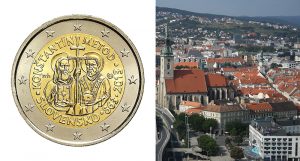
The European Monetary and Economic Department of the European Commission then ordered Slovakia to redesign its commemorative coins by eliminating the Christian Saints Cyril and Methonius. There is no mention of Christianity in the 75,000 words of the aborted draft of the European Constitution.
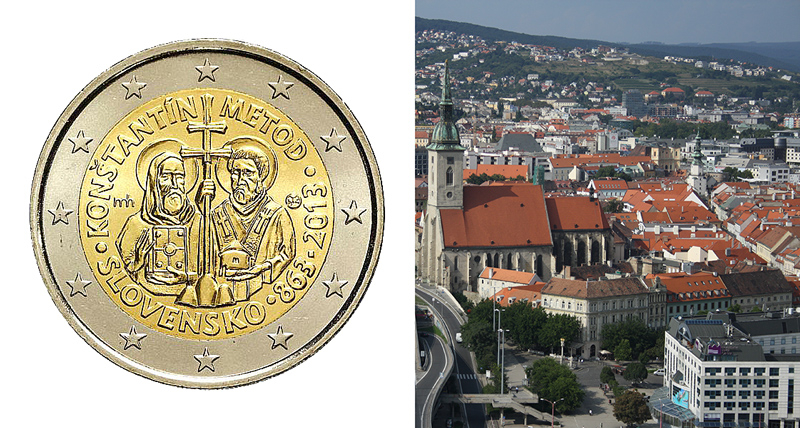
The European Commission ordered Slovakia to redesign its commemorative coins by eliminating the Christian Saints Cyril and Methonius. (Image sources: Coin – European Commission; Bratislava, Slovakia – Frettie/Wikimedia Commons)

German Interior Minister Thomas de Maizière, of Angela Merkel’s ruling Christian Democratic Party, recently suggested introducing Muslim public holidays. “In places where there are many Muslims, why can’t we think about introducing a Muslim public holiday?”, he said.

“The submission is moving ahead,” replied Erika Steinbach, the influential former chair of the Federation of Expellees — Germans expelled from various Eastern European countries during and after World War II.

Beatrix von Storch, a leading politician from Alternative for Germany Party (AfD), just tweeted: “NO! NO! NO!”.

De Maizière’s proposal shows that when it comes to Islam, Europe’s official “post-Christian” secularism is simply missing in action.

A few weeks ago, a European Union-funded exhibition, “Islam, It’s also our history!”, was hosted in Brussels. The exhibition tracks the impact of Islam in Europe. An official statement claims:

“The historical evidence displayed by the exhibition – the reality of an old-age Muslim presence in Europe and the complex interplay of two civilisations that fought against each other but also interpenetrated each other – underpins an educational and political endeavour: helping European Muslims and non Muslims alike to better grasp their common cultural roots and cultivate their shared citizenship”.

Isabelle Benoit, a historian who helped design the exhibition, told AP: “We want to make clear to Europeans that Islam is part of European civilisation and that it isn’t a recent import but has roots going back 13 centuries”.

The official European establishment has turned its back on Christianity. The establishment appear unaware of the extent to which the continent and its people still depend on the moral guidance of its humanitarian values, especially at a time when radical Islam has launched a civilization challenge to the West. “It is simply a problem of a packing that tends to fill a ‘void'”, just wrote Ernesto Galli della Loggia in the Italian daily newspaper Il Corriere della Sera.

“It is impossible to ignore that behind the packing are two great theological and political traditions — that of the Russian Orthodoxy and Islam — while behind the ‘void’ there is only the fading of the Christian consciousness of the European West”.

That is why it is hard to understand the “logic” behind the official European animosity toward Christianity and its attraction to a basically totalitarian Islam. Europe could easily be secular without being militantly anti-Christian. It is easier to understand why thousands of Poles just took part in a mass protest along Poland’s borders to voice their opposition to “secularization and Islam’s influence“, which is exactly the same as the official crazy EU credo.

During the Second World War, the Allies avoided bombing Brussels, because it was to be the site of European rebirth. If the European elite continue with this cultural repudiation of their Judeo-Christian-Humanistic culture, the city could be its grave.

Giulio Meotti, Cultural Editor for Il Foglio, is an Italian journalist and author.

7 things you need to know about Xi Jinping’s vision of a ‘new era’ for China

0

 Wednesday, 18 October, 2017   

During a 3½-hour long speech, Xi said the internal and external situations facing China were undergoing complicated changes which the party needed to address.

He vowed to step up ideological guidance within the party, strengthen its anti-corruption campaign, retain the government’s grip on Hong Kong and Macau, and oppose any moves towards independence in Taiwan.

Here are the major takeaways of his report:

1. A new name for Xi’s political philosophy

Xi said China has formed “socialism with Chinese characteristics for a new era”. The idea will be the guiding principle for the country’s development in the coming years.

The slogan was released amid speculation about how Xi’s political thought would be enshrined into the party’s constitution. There are 14 elements behind the concept, with one key idea being that the party should lead in every aspect of life in China.

Xi said the dream of national rejuvenation would only be a fantasy without the leadership of China’s Communist Party. The party should lead in all areas and the authority of the party central leadership should be respected, he said. Cadres should keep in line with the party leadership, while the party should tighten its lead on ideological work.

“The party resolutely opposes all attempts that will weaken, distort or reject the leadership of the party and the implementation of socialism,” he said.

He said a “principal contradiction” had emerged in Chinese society because of uneven development and the public’s demand for a better life.

2. Becoming a nation with leading, global influence by 2050

Xi laid out some ambitious targets for the next 30 years and more. The first batch should be achieved from 2020 to 2035, Xi said. China will be a top ranked innovative nation by 2035 with a large middle-income population and narrower wealth gap. China’s soft power should be boosted, Xi said. From 2035 to 2050, China should become a nation with pioneering global influence.

3. Keeping up with the “irreversible” momentum of anti-corruption campaign and maintaining the rule by law

China will set up a leading group for comprehensive rule by law. Xi repeatedly talked about the concept during his speech and vowed the party and the government would rule the country under the law and through public oversight. No one would be able to put themselves above the law, he said.

He added that China must watch out for any attempt to copy Western-style democracy.

Xi also issued a warning to delegates at the Great Hall of the People on corruption, saying China insists on “zero tolerance” of graft. He said the government has been unswerving in “fighting tigers, destroying flies and hunting down foxes”, referring to the government’s sweeping anti-corruption campaign.

He said a national supervision law would be formulated and shuanggui – a party disciplinary practice – would be replaced.

4. Protecting national sovereignty

China’s capability to deal with national security should be boosted as the nation will resolutely protect its sovereignty and interests.

Xi said China has made a “historical breakthrough” in national defence and military reform. The navy has protected the nation’s maritime interest and its army rapidly upgraded its weaponry.

For the coming years, China will continue pushing for integration between the civilian and the military sector. The People’s Liberation Army should be a “world class” force by 2050.

China also opposes separatism under the guise of religion or extremist thought, Xi said.

5. Upholding central government authority over Hong Kong and Macau and opposing Taiwan independence

Xi said the “one country, two systems” principle will not be changed nor distorted in Hong Kong. The central government’s jurisdiction over the two Special Administrative Regions, which also includes Macau, should not be shaken, he said.

On Taiwan, Xi said Beijing has properly handled the changing situation facing the island and will continue to resolutely oppose any move to seek independence for Taiwan.

6. Creating a level playing field for foreign businesses

Countering foreign diplomats and business concerns that the government was blocking overseas investment, Xi said China would give equal treatment to all businesses. “The China which has opened up will not close, but will open wider and wider,” he said.

China’s GDP has increased from 54 trillion yuan (US$8.2 trillion) five years ago to 80 trillion yuan and the government would aim for growth that is of higher quality and sustainable, he said.

7. Protecting the public interest

Fighting poverty was crucial for China to become a moderately prosperous society, Xi said. All provinces which are under the poverty line should climb above that threshold by 2020.

He also pledged to create more jobs for college graduates and migrant workers.

Addressing concerns over rising property prices, Xi said houses were for people to live in, not for speculation.

http://www.scmp.com/news/china/policies-politics/article/2115858/key-points-xis-speech-chinas-communist-party-congress?utm_source=edm&utm_medium=edm&utm_content=20171018&utm_campaign=scmp_china&emarsys=1&sc_src=email_2048202&sc_llid=1488&sc_lid=146468991&sc_uid=SkpGPjvNwp

Γιατί η επίσκεψη Τσίπρα στις ΗΠΑ ήταν μια παταγώδης αποτυχία

16

του ΠΑΝΤΕΛΗ ΣΑΒΒΙΔΗ

  • (Φωτ.: Γραφείο Τύπου Πρωθυπουργού)

Όταν από τις αιτήσεις δεκάδων ηγετών ξένων χωρών να επισκεφθούν τον Λευκό Οίκο επιλέγεται ο Έλληνας πρωθυπουργός και το αποτέλεσμα είναι αυτό που ανακοινώθηκε, τότε η επίσκεψη είναι παντελώς αποτυχημένη. Τέτοια θετική συγκυρία δεν πρέπει να είχε κανένας Έλληνας πρωθυπουργός, από όσους επισκέφτηκαν την Ουάσινγκτον.

Παρ’ όλα αυτά, ο κ. Τσίπρας και η ομάδα που τον περιβάλλει δεν πέτυχαν τίποτα.

Δύο είναι τα τεράστια ζητήματα που αντιμετωπίζει σήμερα η ελληνική κοινωνία: Η οικονομία και η ασφάλεια. Στο θέμα της οικονομίας ο Ντόναλντ Τραμπ έκανε ορισμένες ανέξοδες δηλώσεις για τις ελληνικές προσπάθειες να εξέλθει η χώρα από την κρίση και για το ευνοϊκό επενδυτικό κλίμα, αλλά οι διεθνείς επενδυτές ελάχιστα επηρεάζονται από τέτοιου είδους παροτρύνσεις. Στη Μέκκα του καπιταλισμού οι δηλώσεις του προέδρου των ΗΠΑ έχουν κάποια σημασία αλλά συνεκτιμώνται με άλλα στοιχεία. Αν κάποιος θέλει να επενδύσει παίρνει υπόψη του και τις δηλώσεις αυτές. Τίποτε περισσότερο.

Αντίθετα, το ελάχιστο, απτό, οικονομικό όφελος που προκύπτει είναι προς το συμφέρον των ΗΠΑ και όχι της Ελλάδας. Ο Αμερικανός πρόεδρος δήλωσε περιχαρής καθώς με τα 2,5 δισ. ευρώ που θα διαθέσει η Ελλάδα για την αναβάθμιση των F-16 θα δημιουργηθούν θέσεις εργασίας για τους Αμερικανούς! Πράγματι, η αναβάθμιση θα γίνει στις εγκαταστάσεις της Lockheed, που σημαίνει ότι κανένα όφελος δεν θα υπάρξει για την ΕΑΒ και τις ελληνικές επιχειρήσεις που συνεργάζονται μαζί της.


(Φωτ.: Γραφείο Τύπου Πρωθυπουργού)

Ο Αλέξης Τσίπρας επενδύει πολύ στο νέο αφήγημά του, το Greek comeback. Με αυτό θέλει να πάει στις εκλογές, δημιουργώντας μια φαντασιακή κατάσταση ευημερίας σε έναν λαό που στην πλειονότητά του αντιμετωπίζει πρόβλημα επιβίωσης. Αυτό το αφήγημα θέλησε να ενισχύσει. Δεν είναι σίγουρο ότι το πέτυχε, παρά τις επίμονες προσπάθειες των αγιογράφων του και των συντεταγμένων στην πολιτική του ΜΜΕ.

Στο θέμα της ασφάλειας τα πράγματα είναι πολύ χειρότερα.

Σε μια ευνοϊκότατη συγκυρία κατά την οποία οι ΗΠΑ αντιμετωπίζουν σοβαρά προβλήματα με την Τουρκία, και επενδύουν στην ελληνική παρουσία και βοήθεια για τη σταθεροποίηση, ή ακόμη και την αναδόμηση της περιοχής της Μέσης Ανατολής και της βόρειας Αφρικής, ο Αλέξης Τσίπρας πέτυχε την… αναβάθμιση των F-16!

Δεν θα πρέπει να υποβαθμίσουμε το γεγονός αλλά είναι ελάχιστο για τη διατήρηση της ισορροπίας δυνάμεων την ώρα που η Τουρκία έχει ζητήσει να αγοράσει 120 F-35. Η διαφορά στις δυνατότητες των δύο μαχητικών είναι τεράστια. Τα F-16 είναι τρίτης γενιάς, τα F-35 πέμπτης. Με απλά λόγια, τα F-35 έχουν τη δυνατότητα να εντοπίζουν στόχους και να τους χτυπούν πολύ νωρίτερα από τη στιγμή που θα γίνουν αντιληπτά. Αν τα πράγματα εξελιχθούν όπως φαίνονται δεν θα έχουμε, απλώς, ανατροπή της ισορροπίας στην περιοχή, αλλά σαρωτική, δυναμική τουρκική υπεροχή.

Από την άποψη αυτή προκαλεί εντύπωση η ανακοίνωση του Οργανισμού Συνεργασίας για την Αμυντική Ασφάλεια του αμερικανικού υπουργείου Άμυνας στην οποία επισημαίνεται ότι «η πώληση του εξοπλισμού (σ.σ. για την αναβάθμιση των F-16) δεν θα μεταβάλει τις αμυντικές ισορροπίες στην περιοχή». Ποιες αμυντικές ισορροπίες δεν θα μεταβάλει; Αυτές που έχουν ήδη ανατραπεί, ή αυτές που θα αλλάξουν ριζικά το τοπίο αν η Τουρκία αποκτήσει τα F-35;


(Φωτ.: Γραφείο Τύπου Πρωθυπουργού)

Ήταν ευκαιρία για τον Αλέξη Τσίπρα και το απαράτ των υπουργείων Άμυνας και Εξωτερικών πριν γίνει η επίσκεψη να προσπαθήσουν –αξιοποιώντας και τη βοήθεια άλλων δυνάμεων–, να προβληματίσουν τις ΗΠΑ για τις προτεραιότητές τους στην περιοχή. Αμερικανικά μέσα ενημέρωσης έχουν γράψει επανειλημμένως πως η γραφειοκρατία του Στέιτ Ντιπάρτμεντ λειτουργεί ακόμη με τους παραμορφωτικούς φακούς του Ψυχρού Πολέμου επιδεικνύοντας μια εντυπωσιακή δύναμη αδράνειας και προσαρμογής στα νέα δεδομένα σε σχέση με την Τουρκία. Και ενώ εφημερίδες, όπως η συντηρητική Washington Times έγραψαν χθες «Να σώσουμε το ΝΑΤΟ από την Τουρκία», αμερικανική αντιπροσωπεία βρίσκεται στη γειτονική χώρα για την αναζήτηση τρόπων μείωσης της έντασης μεταξύ των δύο χωρών. Στις σχέσεις Ουάσινγκτον-Άγκυρας εναλλάσσονται τα συναισθήματα αγάπης και μίσους.

Από την περιπέτεια στην οποία έχει εισέλθει η Τουρκία τα τελευταία χρόνια στη Μέση Ανατολή δεν θα βγει όπως τη γνωρίζαμε. Ή θα χάσει, ή θα κερδίσει. Και στις δύο περιπτώσεις οι αλλαγές στις ισορροπίες της περιοχής θα είναι δραματικές. Την Αθήνα είτε δεν φαίνεται να την απασχολεί, είτε δεν μπορεί να κάνει κάτι γι’ αυτό που έρχεται στο πολύ κοντινό μέλλον. Οι δυνατότητές της να γίνει σημαντικός παίκτης στην περιοχή δείχνουν μικρές. Δεν είναι θέμα βούλησης το αν θα μπει στο γεωπολιτικό παιχνίδι, αλλά αναγκαστικών εξελίξεων.

Οι εξελίξεις θα αναγκάσουν την Ελλάδα να πάρει θέσεις.

Εκείνο, πάντως, που διαπιστώνουμε είναι πως η σημερινή κυβέρνηση προτιμά να κάνει διάφορα τουρ και σόου στις ΗΠΑ αντί για την επίμονη προσπάθεια αξιοποίησης όλων των μέσων για τη διαμόρφωση μιας πολιτικής που θα διασφαλίσει, έστω και στοιχειωδώς, τη χώρα από τις επερχόμενες αλλαγές. Το αποτέλεσμα αυτό δείχνει. Η επίσκεψη του πρωθυπουργού στις ΗΠΑ έμοιαζε περισσότερο με προεκλογική εκδήλωση του παρά με κρίσιμη συνάντηση με τον Αμερικανό πρόεδρο.

Τέλος, η επίσκεψη εξέπεμψε και ένα άλλο μήνυμα. Επιπολαιότητες δεν συγχωρούνται στην πολιτική. Οι Αμερικανοί δημοσιογράφοι υπενθύμισαν στον Έλληνα πρωθυπουργό τη δήλωσή του ενάντια στον Ντόναλντ Τραμπ, κατά την προεκλογική περίοδο στις ΗΠΑ. Αλλά, σ’ αυτό δεν φταίει μόνο ο Αλέξης Τσίπρας και οι όμοιοί του. Κάποιοι τους εκλέγουμε.

pontos-news.gr

China Is Quietly Reshaping the World

0

The staggering scope of the country’s infrastructure initiative—and what it means for the international order

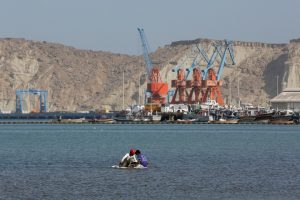
Boys sit on a piece of styrofoam sheet as they search for crabs in front of the Gwadar port in Pakistan.Akhtar Soomro / Reuters
China is quickly growing into the world’s most extensive commercial empire. By way of comparison, after World War II, the Marshall Plan provided the equivalent of $800 billion in reconstruction funds to Europe (if calculated as a percentage of today’s GDP). In the decades after the war the United States was also the world’s largest trading nation, and its largest bilateral lender to others.

Now it’s China’s turn. The scale and scope of the Belt and Road initiative is staggering. Estimates vary, but over $300 billion have already been spent, and China plans to spend $1 trillion more in the next decade or so. According to the CIA, 92 countries counted China as their largest exports or imports partner in 2015, far more than the United States at 57. What’s most astounding is the speed with which China achieved this. While the country was the world’s largest recipient of World Bank and Asian Development Bank loans in the 1980s and 90s, in recent years, China alone loaned more to developing countries than did the World Bank.

Unlike the United States and Europe, China uses aid, trade, and foreign direct investment strategically to build goodwill, expand its political sway, and secure the natural resources it needs to grow. Belt and Road is the most impressive example of this. It is an umbrella initiative of current and future infrastructure projects. In the next decades, China plans to build a thick web of infrastructure around Asia and, through similar initiatives, around the world.

Most of its funding will come in the form of loans, not grants, and Chinese state-owned enterprises will also be encouraged to invest. This means, for example, that if Pakistan can’t pay back its loans, China could own many of its coal mines, oil pipelines, and power plants, and thus have enormous leverage over the Pakistani government. In the meantime, China has the rights to operate the Gwadar port for 40 years.

Belt and Road is China’s biggest foreign policy initiative to date, but it’s no Marshall Plan. Beijing is not doing this out of altruism, or out of a desire to stabilize the countries it loans to. So why spend such enormous sums on its neighbors? For one thing, China is too dependent on its eastern seaboard and the narrow Malacca Strait near Singapore to get goods in and out of its vast territory; for example, over 80 percent of its oil goes through the Strait. So building trade routes through Pakistan and Central Asia makes sense. Belt and Road also helps China invest its huge currency reserves and put its many idling state-owned enterprises to work.

The initiative also has a positive side effect for Beijing: Some Chinese government officials say specifically that it’s about competing with the United States. At a minimum, it creates leverage to make many smaller countries feel economically beholden to China.

So what does all this mean for the “liberal international order” that the U.S. did so much to create and uphold over the past seven decades? The effect is not all bad.

If the point of that order was to secure peace and prosperity, there are ways in which China’s largesse actually complements it. Countries that trade moregenerally fight less, not just with their trading partners, but with the world in general. In its own way, China is thus helping to uphold international peace. Yet even if there is less interstate war under a “Pax Sinica,” an era when many small “donee” states are beholden to China means that on a slew of other issues—from counterterrorism to sanctioning countries at odds with the West—the U.S. will find it harder to impose its will.

On the prosperity question, China’s economic impact on the countries it lends to so far seems mixed at best. While the 20 percent or so that China gives in traditional aid does help local economies, most of its largesse comes as loans, which have not been as helpful. Scholars who looked at Chinese investment in Africa 1991 to 2010 found that Chinese assistance does not appear to help economic growth, and that inexpensive Chinese imports often displace African local firms, and thus hurt employment in small enterprises. China usually requires donee countries to use Chinese firms to build roads and ports, and so doesn’t employ local firms or train local workers. In Pakistan, for example, 7,000 Chinese nationals are working on the economic corridor—they bring their own cooks, have separate housing, and don’t interact much with the locals. Relatively few Pakistanis are working on the actual road and rail-building (and thus developing skills)—but Pakistan has deployed nearly 15,000 security personnelto guard the Chinese. Soldiering is not a skill Pakistan needs more of.

Also, while Chinese loans used to have low interest rates around 2.5 percent, they are now creeping up to near 5 percent or more. This will make them harder to repay. While those who receive Chinese funds are happy to fix their power shortages and improve their roads, they may be mortgaging their futures.

Perhaps the biggest challenge China’s efforts pose to the “liberal international order” is that, in contrast to most Western aid and loans, Belt and Road projects often encourage terrible governance, environmental, and human rights standards, although China’s record on this has improved somewhat over the past few years.

China is often the largest investor in countries that others ostracize—because they are run by dictators, don’t respect human rights, and are corrupt—such as Zimbabwe, North Korea, Niger, Angola, and Burma. Ugandan President Yoweri Museveni—no guardian of human rights—explained that he likes Chinese investment because they “don’t ask too many questions,” and “come with … big money, not small money.” Of course, while the U.S. and Europe insist on high standards for their aid projects today, both their companies and governments also had terrible records on human rights and the environment when they ventured to India, Africa, Latin America in the 19th and early 20th centuries.

On worker safety and the environment, when China first ventured abroad, its standards were often abysmal. In some areas, Chinese firms still leave behind a mess of underpaid miners, devastated forests, and ruined rivers. Yet China is learning quickly. In 2017, the Chinese government published new, more stringent guidelines for outbound investors. China’s new infrastructure investment bank, the AIIB, wants to apply world-class standards, and many Chinese companies—including the national oil behemoth CNOOC—are improving rapidly.

If China’s geoeconomic push continues, it will be its largest legacy and have a profound impact on the world—not necessarily all negative. Since the West doesn’t have $1 trillion to lavish on developing country infrastructure in a new great game, its best choice may be to coopt and shape this juggernaut. If the Belt and Road initiative is a success, asphalt will be smoother, logistics will run faster, and countries that were cut off from world markets will be able to trade more. If the research cited above holds true, that will lead to fewer interstate wars, although it will make many small countries beholden to China. President Xi emphasized in both his 2015 and 2017 visits to the United States, and at Davos, that China wants a more equitable international system, but it does not want to unravel the international order. By encouraging China to raise the labor, human rights and environmental standards of their projects, the world should hold him to it.


This article has been adapted from a chapter of a forthcoming Aspen Strategy Group publication.

https://www.theatlantic.com/international/archive/2017/10/china-belt-and-road/542667/

The Trump Doctrine

0
President Trump at the White House on Tuesday. CreditDoug Mills/The New York Times

Well, it took almost a year, but we now have the “Trump Doctrine.” It’s very simple. And, as you’d expect, it fits neatly into a tweet. On nearly every major issue, President Trump’s position is: “Obama built it. I broke it. You fix it.”

And that cuts right to the core of what is the most frightening thing about the Trump presidency. It’s not the president’s juvenile tweeting or all the aides who’ve been pushed out of his clown car at high speed or his industrial-strength lying.

It’s Trump’s willingness to unravel so many longstanding policies and institutions at once — from Nafta to Obamacare to the global climate accord to the domestic clean power initiative to the Pacific trade deal to the Iran nuclear deal — without any real preparation either on the day before or for the morning after.

Indeed, Trump has made most of his climate, health, energy and economic decisions without consulting any scientists, without inviting into the White House a broad range of experts, without putting forth his own clear-cut alternatives to the systems he’s unraveling, without having at the ready a team of aides or a political coalition able to implement any alternatives and without a strategic framework that connects all of his dots.

In short, we’re simply supposed to take the president’s word that this or that deal “is the worst deal ever” — backed up by no serious argument or plan about how he will produce a better one.

I’m open to improving any of these accords or institutions. I’m even open to the possibility that by just tipping over all these accords at once, and throwing away his steering wheel, Trump will get people to improve the Iran deal or Obamacare out of sheer panic at the chaos that might ensue if they don’t.

But I am equally open to the possibility that unraveling all of these big systems at once — health, energy, geopolitics — without a clear plan or a capable team will set in motion chain reactions, some of them long term, that Trump has not thought through in the least. Moreover, when you break big systems, which, albeit imperfectly, have stabilized regions, environments or industries for decades, it can be very difficult to restore them.

Question: We’re told by our secretary of state that he’s been engaged in some secret contacts with North Korea, exploring the possibility of a diplomatic solution that might dramatically reduce North Korea’s nuclear arsenal in return for U.S. promises of regime security. If, at the same time, Trump unilaterally pulls out of the deal we’ve already signed with Iran to prevent it from developing nukes — and Trump moves to reimpose sanctions — how does that not send only one message to the North Koreans: No deal with the U.S. is worth the paper it’s written on, so you’d be wise to hold on to all your nukes?

Question: Iran controls tens of thousands of Shiite militiamen in Iraq and Syria who were our tacit allies in defeating ISIS. Tehran also has huge influence over Iraq’s government and over certain regions of Afghanistan as well. Can we stabilize Iraq, Syria and Afghanistan — post-ISIS — and keep our troop presence low and safe, without Iran’s help — and will that help be coming after Trump rips up the nuclear deal? If you think so, please raise your hand.

And since our European allies as well as Russia and China have indicated that they will not follow us in backing out of the Iran deal or reimposing sanctions, Iran would have all the moral high ground and money it needs, and the U.S. would be isolated. Are we going to sanction E.U. banks if they deal with Iran?

Trump came into office vowing to end the trade imbalance with China — a worthy goal. And what was his first move? To tear up the Trans-Pacific Partnership, the trade deal that would have put the U.S. at the helm of a 12-nation trading bloc built around U.S. interests and values, potentially eliminating some 18,000 tariffs on U.S. goods and controlling 40 percent of global G.D.P. And China was not in the group. That’s called leverage.

Trump just ripped up the TPP to “satisfy the base” and is now left begging China for trade crumbs, with little leverage. And because he needs China’s help in dealing with North Korea, he has even less leverage on trade.

Trump pulled the U.S. out of the Paris climate accord and, at the same time, restricted U.S. government funding for birth control both at home and abroad. Question: What is driving so many immigrants and refugees in Africa, the Middle East and Central America to try to get out of their world of disorder and into America and Europe and the world order?

Answer: It is a cocktail of climate change, environmental degradation, population explosions and misgovernance in these countries. So Trump’s policy is to throw away every tool we have to mitigate climate change and population growth and try to build a wall instead, while also trying to bully Mexico’s unpopular president into trade concessions, which could help elect a radical populist in next year’s Mexican election — a successor who would be anti-American — and destabilize its economy as well.

At a time when China has decided to go full-bore into clean tech and electric cars, at a time when all of the tech giants are building data centers that they want powered by clean energy, at a time when solar and wind power are growing increasingly competitive with fossil fuels (and America still has a technological lead in many of these areas), at a time when climate change may be stimulating bigger hurricanes and forest fires that are costing us hundreds of billions of dollars, Trump’s central energy initiative is to reverse Obama’s and bring back coal-fired power.

None of these dots connect. And we will pay for that. “Whiplash” was a great movie. But it’s a terrible organizing principle for our foreign or domestic policy.

Turkey claims ‘no need’ for US, EU as Western ties deteriorate

0

ARTICLE SUMMARY
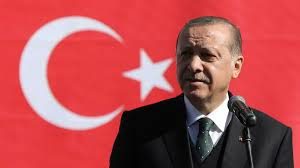
After a week of sparring with the United States, Turkish President Recep Tayyip Erdogan has accused European allies of undermining Turkey and dared them to walk away from EU membership talks.
 Even as tensions with the United States continue to churn, Turkey has turned its ire on European partners, with President Recep Tayyip Erdogan accusing Brussels of double-dealing and daring it to unilaterally end Turkey’s decadeslong membership bid ahead of a summit this week.

Relations with the United States hit a nadir after Washington suspended non-immigration visas in Turkey on Oct. 8 following the arrest of a second consular employee. Turkey responded in kind, and Erdogan spent much of last week blasting Washington. “We are not beholden to you,” he thundered.

Then Erdogan lashed out at the European Union, which Turkey has long hoped to join, angry that he is hit with “a new assault every day.” Erdogan accused both the EU and the United States of speculative attacks on Turkey’s economy and using Kurdish militants to undermine the country in an address of provincial leaders of the ruling Justice and Development Party (AKP) on Oct. 13.

“Those who are unable to bring Turkey to its knees politically, socially and diplomatically appear before us with a new game,” he said. “Europe continues to stall, but we remain patient. You will be the ones to leave the table, not us. If you are honest, make your statement and let’s finish this. We have no need for you,” he said, going on to add that the need must be mutual.

Indeed, Europe is Turkey’s biggest source of direct investment and its main trading partner. US and European aircraft use Turkish air bases to fight the Islamic State, and Turkey’s army, the second-largest in NATO, was long a bulwark against Iranian and Russian influence.

But Western capitals have questioned Turkey’s loyalty as its foreign policy, especially on Syria, appears to align more closely with Moscow and Tehran’s, as well as its commitment to human rights amid a clampdown on civil society in the wake of a failed coup last year. For its part, Turkey is fuming over US support for Kurdish rebels in Syria, widely seen as linked to militants who have waged war against Turkey.

“From a cultural and political standpoint, Erdogan thinks the EU and the US are detrimental to his long-term ambitions,” Aaron Stein, a senior fellow at the Atlantic Council, told Al-Monitor. “He’s also in a rhetorical cul-de-sac [in which] it is easier to deflect attention from his own faults if it appears the international community is against him.”

Erdogan’s taunting comes ahead of this week’s EU summit, at which European leaders are expected to discuss the strained relationship. Germany, the EU’s biggest member with the most clout, is outraged over the detentions of at least 11 of its citizens for “political reasons,” including two journalists and a human rights activist, in Turkey’s post-coup crackdown, and Chancellor Angela Merkel said last month membership talks with Turkey should end.

The Turkish leader may also be trying to sway party members uneasy with an overhaul of the AKP ahead of the 2019 elections or the post-coup crackdown that has persisted for 15 months to close ranks.

“Turkey’s foreign policy is viewed as a resource to address the needs of domestic policy,” Ilter Turan, professor emeritus of international relations at Bilgi University in Istanbul, told Al-Monitor. Pointing out grievances abroad, he said, “puts the strife he is leading inside on the back burner. It can be assessed as an uncomplicated political tactic.”

In a sign of conciliation, a US State Department delegation is due to hold talks in Ankara Oct. 17. Deputy Prime Minister Bekir Bozdag said Oct. 15, “Turkey has no intention of withdrawing from the [EU] process,” which Ankara formally began in 2005 but has concluded only one of 31 negotiating chapters.

But in his speech, Erdogan revived criticism of the EU for failing to honor its pledge to scrap visas for Turks and deliver a full 6 billion euros ($7 billion) of financial aid in exchange for Turkey stemming irregular migration flows to Europe.

Erdogan also said that Europe and the United States were seeking to divert Turkey’s focus and energy away from regional matters, perhaps a reference to his military’s latest incursioninto northern Syria, agreed upon with Iran and Russia, Turkish adversaries for centuries.

Despite a half-dozen high-profile meetings, Erdogan and his Russian counterpart Vladimir Putin remain at odds over agricultural exports and a missile defense system Ankara wants from Moscow. Confusion persists about whether Turkey, an outspoken critic of the Syrian government, could switch sides.

“If the EU is a goal for Turkey, that entire policy has collapsed. If managing relations with the United States is a goal, that too has collapsed,” said Stein. “If you peel back the facade with Putin, you have disputes. Erdogan has run Turkish foreign policy into the ground. I have never seen Turkey this isolated.”

Ayla Jean Yackley is a freelance journalist who has covered Turkey for nearly two decades. She previously worked as a correspondent for Reuters and Bloomberg News and writes mainly about politics and the economy, with a focus on minority and human rights. Her reporting has also taken her to Iraq, Iran, Syria, Afghanistan, Russia, Germany and Cyprus. You can follow her on Twitter: @aylajean

Read more: http://www.al-monitor.com/pulse/originals/2017/10/erdogan-turkey-does-not-need-united-states.html#ixzz4vpAbW9kL

Once-critical Greek PM praises Trump over ‘common values’

0

Kevin Liptak-Profile-Image

  • Tsipras is a socialist leader whose country has faced crippling debt
  • In him, Trump finds a willing security partner at a moment of regional instability

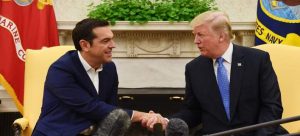
Washington (CNN)When President Donald Trump sat for talks Tuesday with his left-wing Greek counterpart Alexis Tsipras, he faced a man who last year warned his own citizens that Trump represented an “evil” raft of ideas with no place in western democracy.

Now that Trump is President, Tsipras finds himself among the club of world leaders hoping to paper over their election-year criticisms of the billionaire businessman, who is known to carry a grudge and remember even the smallest slight.
Speaking in the Rose Garden after their meeting, Tsipras downplayed his election-year remarks, insisting he’s ready now to partner with Trump.
“We have common values,” Tsipras said through a translator during a Rose Garden news conference. “Don’t forget that the value of democracy and freedom was born in Greece. It’s one of the values that traverses American culture and American tradition. The President now continues that tradition.”
“I think our collaboration will be very substantial,” he said. “And I’m very optimistic after the meeting we had today.”
Trump — who seemed unaware of the “evil” comments before they were raised by a reporter — appeared unsurprised, noting many world leaders were apprehensive after his victory.
“A lot of countries were very nervous at the beginning, and I have very good relationships with the leaders of virtually every country I have dealt with,” he said. “The reason they were concerned is because I will not allow our country, the United States of America, to be taken advantage of by so many other countries all over the world.”
During a speech in March 2016, the prime minister expressed disbelief that Trump could even be elevated as the status-bearer of the Republican party.
“Tell me who of you would believe a few months ago that in the US today, the front-runner on behalf of the Republicans for the nomination of the candidate President would be Mr. Trump?” Tsipras asked. “And, of course, what this nomination marks, the ideas it represents, the appeal it reaches and the threat to become even President — I hope we will not face this evil.”
In Tsipras, Trump found a socialist leader whose country has relied on international financial support for years in the face of a crippling debt crisis — a scenario that squares poorly with Trump’s stated views that countries should bear responsibility for their own affairs.
But with the US embroiled in an increasingly bitter standoff with Turkey, Trump has identified a willing security partner in Athens at a moment of deep regional instability. And despite its financial woes, Greece is one of the few NATO members that meets the alliance’s defense spending threshold — an issue Trump has litigated vociferously.
Trump offered praise for the country’s NATO commitments on Monday, and said he supported a “responsible debt relief plan.”
“I think it has a great role in stability in the area,” Trump said. “We have a feeling that it will get stronger and stronger … once it gets over this tremendous financial hurdle that it’s in the process of working out, we think that there will be great stability in Greece. And militarily, and in every way we look at it, as very important and very important to the United States.”
The White House said ahead of the visit that Trump and Tsipras would discuss defense and economic issues, as well as energy security and the cultural ties between Americans and Greeks.
Tsipras was first elected in 2015 on a wave of anti-austerity sentiment after years of harsh reforms enforced by Greece’s bankrollers in Europe. At 40, he came into office as one of the world’s youngest leaders and — as a former communist — one of its most left-leaning.
Since he took office, Greece’s financial situation has stabilized somewhat, and the violent protests that erupted periodically during the long periods of enforced hardships subsided.
The return to relative financial stability coincided with increasing instability in Turkey, Greece’s neighbor across the Aegean Sea, where President Recep Tayyip Erdoğan has taken controversial steps to consolidate power while deepening rifts with Washington. Last week, a US consular staff member was arrested in Istanbul, which prompted the US to freeze non-immigrant visa services.
Tsipras has viewed the diplomatic crisis as an opening to further warm ties with the US, even if his partner is a political opposite. He said Tuesday that despite his country’s conflicts with Turkey, he believes that the country should “remain within NATO and (on) its European course.”
“My answer to your question is yes, we do believe Turkey must remain within NATO and its European course,” Tsipras said, adding that “the road to Europe … and collaborations with the West carries with it certain conditions, certain responsibilities.”
Those conditions, Tsipras said, include respecting international law, collaborating with other NATO countries and not promoting tension in the region.
During his trip to the US, Tsipras was also due to talk with Christine Lagarde, head of the International Monetary Fund, to discuss the body’s protracted involvement in Greece’s finances. Tsipras is also set to gauge Trump’s stance on the matter, which has plagued the country for years.
During remarks in March, Trump praised the Greek-American community during a celebration of Greece’s independence day.
“I love the Greeks. Oh, do I love the Greeks,” he said in the White House East Room. “Don’t forget, I come from New York. That’s all I see, is Greeks. They are all over the place.”
He also praised his then-chief of staff Reince Priebus, a Greek-American, who he’d once joked he would name his ambassador to Athens. Priebus was replaced as chief of staff in July, and Trump has so far kept his predecessor Obama’s pick in the ambassador post.
http://edition.cnn.com/2017/10/17/politics/president-donald-trump-alexis-tsipras-greece-evil/index.html

Why There Is No Peace in the Middle East

0

Saving NATO from Turkey

0

Member states must break with Erdogan’s Islamic extremism

Illustration on NATO’ difficult situation with member nation Turkey by Greg Groesch/The Washington Times more >
– – Monday, October 16, 2017

ANALYSIS/OPINION:

The North Atlantic Treaty Organization, known as NATO, faces an existential problem.

No, it’s not about getting member states to fulfill agreed-upon spending levels on defense. Or finding a role after the Soviet collapse. Or standing up to Russia’s Vladimir Putin. Rather, it’s about Recep Tayyip Erdogan, the Islamist, dictatorial ruler of Turkey whose policies threaten to undermine this unique alliance of 29 states that has lasted nearly 70 years.

Created in 1949, NATO’s founding principles ambitiously set out the alliance goal “to safeguard the freedom, common heritage and civilization of [member states’] peoples, founded on the principles of democracy, individual liberty and the rule of law.” In other words, the alliance exists to defend Western civilization.

 For its first 42 years, until the USSR collapsed in 1991, this meant containing and defeating the Warsaw Pact. Today, it means containing and defeating Russia and Islamism. Of these latter two, Islamism is the deeper and longer-lasting threat, being based not on a single leader’s personality but on a highly potent ideology, one that effectively succeeded fascism and communism as the great radical utopian challenge to the West.

Some major figures in NATO appreciated this shift soon after the Soviet collapse. Already in 1995, Secretary-General Willy Claes noted with prescience that “Fundamentalism is at least as dangerous as communism was.” With the Cold War over, he said, “Islamic militancy has emerged as perhaps the single gravest threat to the NATO alliance and to Western security.”

In 2004, Jose Maria Aznar, Spain’s former prime minister, warned that “Islamist terrorism is a new shared threat of a global nature that places the very existence of NATO’s members at risk.” He advocated that NATO focus on combating “Islamic jihadism and the proliferation of weapons of mass destruction” and called for “placing the war against Islamic jihadism at the center of the allied strategy.”

But, instead of a robust NATO on the Claes-Aznar model leading the battle against Islamism, it was internally hobbled by Mr. Erdogan’s opposition. Rather than assert the fight against Islamism, the other 28 members dismayingly deferred to the Islamist within their ranks.

The 28 stay mum about the near-civil war the Turkish regime wages in southeastern Anatolia against its own Kurdish citizens. The emergence of a private army (called SADAT) under Mr. Erdogan’s exclusive control seems not to bother them.

Likewise, they appear oblivious to Ankara’s unpredictably limiting access to the NATO base at Incirlik, the obstructed relations with friendly states such as Austria, Cyprus and Israel, and the vicious anti-Americanism symbolized by the mayor of Ankara hoping for more storm damage to be inflicted on the United States

Maltreatment of NATO-member state nationals hardly bothers the NATO worthies: Not the arrest of 12 Germans (such as Deniz Yucel and Peter Steudtner) nor the attempted assassination of Turks in Germany (such as Yuksel Koc), not the seizure of Americans in Turkey as hostages (such as Andrew Brunson and Serkan Golge), nor repeated physical violence against Americans in the United States (such as at the Brookings Institute and at Sheridan Circle).

NATO seems unfazed that Ankara helps Iran’s nuclear program, develops an Iranian oil field, and transfers Iranian arms to Hezbollah. Mr. Erdogan’s talk of joining the Moscow-Beijing dominated Shanghai Cooperation Organization ruffles few feathers, as do joint exercises with the Russian and Chinese militaries. A Turkish purchase of a Russian missile defense system, the S-400, appears to be more an irritant than a deal-breaker. A mutual U.S.-Turkish ban on visas fazed no one.

NATO faces a choice. It can, hoping that Mr. Erdogan is no more than a colicky episode and Turkey will return to the West, continue with the present policy. Or it can deem NATO’s utility too important to sacrifice to this speculative possibility, and take assertive steps to freeze the Republic of Turkey out of NATO activities until it again behaves like an ally. Those steps might include:

• Removing nuclear weapons from Incirlik.

• Closing NATO’s operations at Incirlik.

• Canceling arms sales, such as the F-35 aircraft.

• Exclude Turkish participation from weapons development.

• Refuse to share intelligence.

• Refuse to train Turkish soldiers or sailors.

• Reject Turkish personnel for NATO positions.

A unified stance against Mr. Erdogan’s hostile dictatorship permits the grand NATO alliance to rediscover its noble purpose “to safeguard the freedom, common heritage and civilization” of its peoples. By confronting Islamism, NATOwill again take up the mantle it has of late let down, nothing less than defending Western civilization.

• Daniel Pipes is president of the Middle East Forum.

http://www.washingtontimes.com/news/2017/oct/16/nato-must-be-saved-from-turkey/

The Turkish Love-Hate Relationship with America

0

Trump’s Speech Decertifying Iran Nuclear Deal

0


Trump says he hopes ‘new measures directed at the Iranian dictatorship’ will compel Tehran to ‘reevaluate its pursuit of terror’
President Donald Trump speaks about Iran from the Diplomatic Reception Room at the White House in Washington,  nuclear deal?

Below is a full transcript of U.S. President Donald Trump’s Friday October 13, 2017 speech in which he said he would decertify Barack Obama’s landmark nuclear deal and impose new sanctions on Iran’s Revolutionary Guard:

My fellow Americans, as president of the United States, my highest obligation is to ensure the safety and security of the American people.

History has shown that the longer we ignore a threat the more dangerous that threat becomes. For this reason, upon taking office, I’ve ordered a complete strategic review of our policy toward the rogue regime in Iran.
That review is now complete.

Today I am announcing our strategy along with several major steps we are taking to confront the Iranian regime’s hostile actions, and to ensure that Iran never, and I mean, never, acquires a nuclear weapon.
Our policy is based on a clear-eyed assessment of the Iranian dictatorship, its sponsorship of terrorism and its continuing aggression in the Middle East and all around the world.
Iran is under the control of a fanatical regime that seized power in 1979 and forced a proud people to submit to its extremist rule. This radical regime has raided the wealth of one of the world’s oldest and most vibrant nations, and spread death destruction and chaos all around the globe.
Beginning in 1979 agents of the Iranian regime illegally seized the US embassy in Tehran and held more than 60 during the 44 days of the crises
The Iranian backed terrorist group Hezbollah twice bombed out embassy in Lebanon once in 1983 and again in 1984
Another Iranian supported bombing killed 241 Americans, service members they were, in their barracks, in Beirut in 1983
In 1996 the regime directed another bombing of American military housing in Saudi Arabia, murdering 19 Americans in cold blood.
Iranian proxies provided training to operatives who were later involved in al –Qaeda’s’ bombing of the American embassies in Kenya, Tanzania, and two years later killing 224 people and wounded more than 4,000 others.
The regime harbored high level terrorists in the wake of the 9/11 attacks including Osama bin Laden’s son. In Iraq and Afghanistan groups supported by Iran have killed hundreds of American military personnel. The Iranian dictatorship’s aggression continues to this day. The regime remains the world’s leading state sponsor of terrorism, and provides assistance to al-Qaida, the Taliban, Hezbollah, Hamas and other terrorist networks. it develops, deploys and proliferates missiles that threaten American troops and our allies. It harasses American ships and threatens freedom of navigation in the Arabian Gulf and in the Red Sea. It imprisons Americans on false charges, and it launches cyber-attacks against our critical infrastructure, financial system and military.
The U.S is far from the only target of the Iranian dictatorship’s long campaign of bloodshed. The regime violently suppresses its own citizens it shot unarmed student protestors in the street during the green revolution. This regime has fueled sectarian violence in Iraq and vicious civil wars in Yemen and Syria. In Syria, the Iranian regime has supported the atrocities of Bashar al-Assad’s regime. And condone Assad’s use of chemical weapons against helpless civilians including many, many children.
Given the regimes murderous past and present, we should not take lightly its sinister vision for the future. The regimes two favorite chants are “death to American” and “death to Israel.”
Realizing the gravity of the situation, the U.S and the UN Security Council sought, over many years, to stop Iran’s pursuit of nuclear weapons with a wide array of strong economic sanctions. But the previous administration lifted these sanctions just before what would have been the total collapse of the Iranian regime. Through the deep controversial 2015 nuclear deal with Iran. This deal is known as the Joint Comprehensive Plan of Action or, JCPoA. As I have said many times, the Iran deal was one of the worst and most one-sided transactions the U.S. has ever entered into. The same mindset that produced this deal is responsible for years of terrible trade deals that have sacrificed so many millions of jobs in our country to the benefit of other countries.
We need negotiators who will much more strongly represent America’s interests, the nuclear deal through Iran’s dictatorship a political and economic lifeline, providing urgently needed relief from the intense domestic pressure the sanctions had created. It also gave the regime an immediate financial boost. An over $100 billion its government could use to fund terrorism. The regime also received a massive cash settlement of $1.7 billion from the U.S., a large portion of which was physically loaded onto an airplane and flown into Iran. Just imagine the site of those huge piles of money being hauled off by the Iranians waiting at the airport for the cash. I wonder where all that money went.
Worst of all, the deal allows Iran to continue developing certain elements of its nuclear program, and more importantly, in just a few years, as key restrictions disappear, Iran can sprint towards a rapid nuclear weapons breakout.
In other words, we got weak inspections in exchange for no more than a purely short term, and temporary delay in Iran’s path to nuclear weapons. What is the purpose of a deal that at best only delays Iran’s nuclear capability for a short period of time?
This, as president of the U.S. is unacceptable. In other countries, they think in terms of 100 year intervals, not just a few years at a time. The saddest part of the deal for the U.S. is that all of the money was paid up front, which is unheard of, rather than at the end of the deal, when they have shown they’ve played by the rules. But what’s done is done, and that’s why we are where we are.
The Iranian regime has committed multiple violations of the agreement, for example on two speared occasions they have exceeded the limit of 130 metric tons of heavy water, until recently, the Iranian regime has also failed to meet our expectation in its operation of advanced centrifuges. The Iranian regime has also intimidated international inspectors into not using the full inspection authorities that the agreement calls for. Iranian officials and military leaders have repeatedly claimed they will not allow inspectors onto military sites, even though the international community suspects some of those sites were part of Iran’s clandestine nuclear weapons program; there are also many people who believe that Iran is dealing with North Korea. I am going to instruct our intelligence agencies to do thorough analyses and report back their findings beyond what they have already reviewed. By its own terms the Iran deal was supposed to contribute to regional and international peace and security. And yet, while the U.S adheres to our commitment under the deal the Iranian regime continues to fuel conflict, terror and turmoil throughout the Middle East and beyond.
Importantly Iran is not living up to the spirit of the deal, so today, in recognition of the increasing menace posed by Iran, and after extensive consultations with our allies, I am announcing a new strategy to address the full range of Iran’s destructive actions,
First we will work with our allies to counter the regimes destabilizing activity and support for terrorist proxies in the region.
Second, we will place additional sanctions on the regime to block their financing of terror.
Third we will address the regimes proliferation of missiles and weapons that threaten its neighbor’s global trade and freedom of navigation.
And finally we will deny the regime all paths to a nuclear weapon.
Today I’m also announcing several major steps my administration is taking in pursuit of this strategy. The execution of our strategy begins with the long overdue step of imposing tough sanctions on Iran’s Islamic Revolutionary Guard core. The Revolutionary Guard is the Iranian supreme leader’s corrupt personal terror force and militia. It has hijacked large portions of Iran’s economy and resized massive religious endowments to fund war and terror abroad. This includes arming the Syrian dictator, supplying proxies and partners with missiles and weapons to attack civilians in the region and even plotting to bomb a popular restaurant, right here, in Washington D.C.
I am authorizing the treasury department to further sanction the entire Islamic Revolutionary Guard core for support for terrorism and to apply sanctions to its officials, agents and affiliates.
I urge our allies to join us in taking strong actions to curb Iran’s continued dangerous and destabilizing behavior, including thorough sanctions outside the rain deal that target the regimes ballistic missile program in support for terrorism and all of its destructive activities of which there are many.
Finally, on the grave matter of Iran’s nuclear program, since the signing of the nuclear agreement, the regime’s dangerous aggression has only escalated. At the same time it has received massive sanctions relief while continuing to develop its missiles program, Iran has also entered into lucrative business contracts with other parties to the agreement, when the agreement was finalized in 2015, Congress passed the Iran nuclear agreement review act to ensure that Congress’s voice would be heard on the deal. Among other conditions the law requires the president of his designee to certify that the suspension of sanction under the deal is appropriate and proportionate to measure and other measures taken by Iran to terminate its illicit nuclear program.
Based on the factual record I have put forward I am announcing today that we cannot and will not make this certification we will not continue down a path whose predictable conclusion is more violence, more terror, and the very real threat of Iran’s nuclear breakout. That is why I am directing my administration to work closely with Congress and our allies to address the deals many serious flaws so that the Iranian regime can never threaten the world with nuclear weapons. These include the deal’s sunset clauses that in just a few years will eliminate key restrictions on Iran’s nuclear program.
The flaws in the deal also include insufficient enforcement and near total silence on Iran’s missile programs. Congress has already begun the work to address these problems. Key house and senate leaders are drafting legislation that would amend the Iran nuclear agreement review act to strengthen enforcement, prevent Iran from developing an intern… this is so totally important…. intercontiental ballistic missile and make all restrictions on Iran’s nuclear activity permanent under U.S. law. So important.
I support these initiatives. However, in the event we are not able to reach a solution, working with Congress and our allies, then the agreement will be terminated. It is under continuous review and our participation can be cancelled by me as president at any time.
As we have seen in North Korea, the longer we ignore a threat, the worst that threat becomes. It is why we are determined that the world’s leading sponsor of terrorism will never obtain nuclear weapons. In this effort we stand in total solidarity with the Iranian regimes longest suffering victims: Its own people.
The citizens of Iran have paid a heavy price for the violence and extremism of their leaders. The Iranian people long to, and they just are longing, to reclaim their country’s proud history, its culture, its civilization, its cooperation with its neighbors. We hope that these new measures directed at the Iranian dictatorship will compel the government to reevaluate its pursuit of terror at the expense of its people.
We hope that our actions today will help bring about a future of peace, stability and prosperity in the Middle East. A future where sovereign nations respect each other and their own citizens. We pray for a future where young children, American and Iranian, Muslim, Christian and Jewish, can grow up in a world free of violence hatred and terror. And until that blessed day comes we will do what we must to keep America safe.
Thank you. God bless you and God bless America.

https://www.haaretz.com

Iraqi-Kurdish Clash in Kirkuk Opens Door to More Iranian Influence

0

Iraqi Kurdistan’s referendum sparked a showdown with Baghdad, leaving Washington fighting the Islamic State and Tehran taking advantage.

Smoke billows as Iraqi forces advance towards the centre of Kirkuk during an operation against Kurdish fighters on October 16, 2017.
BY , 

The United States is scrambling to defuse tensions between two allies in the fight against the Islamic State that have turned on each other, leaving its Iraq policy in disarray and opening the door for greater Iranian influence in the country.

On Sunday night, U.S.-armed and -trained Iraqi government forces clashed with U.S.-armed and -trained Kurdish forces in the disputed city of Kirkuk. By Monday, Iraqi forces had reclaimed the city, a military base, the airport, and major oil fields nearby while thousands of Kirkuk residents fled north.

U.S. Defense Department officials quickly tried to downplay the severity of the overnight clashes, saying they were simply caused by a “misunderstanding” between the two sides. One military officer told Foreign Policy that reports of fighting have been overblown by “extreme” elements on both sides, and aside from the weekend firefight, “things have been relatively coordinated.” (The Pentagon later tried to characterize the movement as a fight against the Islamic State.)

While the fighting stopped, the war of words continued. The Iraqi government in a statement Monday blamed some Kurds for carrying out a “concerted misinformation campaign” to “cover up their sinister actions” to disrupt Iraqi security forces sent in to take possession of the installations in Kirkuk.

Meanwhile, a senior official in the Kurdistan Regional Government (KRG) tweeted Monday that the government of Iraqi Prime Minister Haider al-Abadi “will pay a heavy price” for the move.

Top U.S. administration officials think the Islamic State and Iran will be the biggest beneficiaries if the showdown continues. “All sides need to stand down and refrain from any further provocative or escalatory actions. The biggest winners from further tensions would be ISIS and [Iran’s] Islamic Revolutionary Guard Corps — an outcome we should all want to avoid,” a National Security Council spokesperson told FP, using an acronym for the Islamic State.

Iran has used the confrontation to deepen its involvement in Iraqi politics. Iranian-backed militias joined the troops Baghdad sent to Kirkuk, and reports emerged that the head of Iran’s Quds Force, Qassem Suleimani, was entering Kirkuk to hold talks with Iraqi Kurdish officials.

Some experts expect that the Iranian support for Baghdad in the fight over Kirkuk will rebound to Tehran’s benefit. The Institute for the Study of War, a Washington-based think tank, forecast greater Iranian influence within the Iraqi government and greater popular support for Iran-backed candidates for Iraq’s elections, slated for next spring.

The clashes and the heated rhetoric underscore the depth of ill will between Baghdad and Erbil, the seat of the KRG, since Iraqi Kurdistan carried out an independence referendum on Sept. 25 despite a chorus of protests from Baghdad, Washington, and European allies.

The United States, which took a hands-off approach to the brewing crisis in the wake of the referendum, seems inclined to keep aloof from what many see as an internal Iraqi political fight.

The United States is “not taking sides” in the conflict, President Donald Trump said Monday, while the U.S. Embassy in Baghdad echoed the Pentagon’s focus on the counterterrorism fight.

But that’s a tall order, too. Kurdish leaders seethe about some top U.S. diplomats — especially Brett McGurk, the administration’s point man for the fight against the Islamic State — feeling they are too ready to side with the government in Baghdad. And some Kurds, who were instrumental in halting the Islamic State’s 2014 offensive and in the fights ever since to reclaim territory, feel Washington is tossing them aside now that the danger is past. Kurdish officials are still waiting for a $300 million military aid package the Trump administration promisedin April but which has yet to arrive.

View image on Twitter

No friend except the mountains. Terrorism is over, so U.S. does not need the Kurds now. For this Shiite attack on the Kurds in 

Some top lawmakers had harsher words for Baghdad, especially given the amount of U.S. military aid that had been earmarked for the campaign against the Islamic State.

“Make no mistake, there will be severe consequences if we continue to see American equipment misused in this way,” Sen. John McCain (R-Ariz.), the chairman of the Senate Armed Services Committee, said in a statement released Monday.

The showdown between Iraq’s central government and the restive northern region represents a diplomatic failure for Washington, said Michael Knights of the Washington Institute for Near East Policy.

After Kurdish officials announced this summer that they would hold the controversial referendum — bucking U.S. policy in support of a unified Iraq — Washington was slow to respond, only attempting an 11th-hour mediation when it was already too late. Now, a key U.S. military partner is at loggerheads with another, all while rival Iran is taking advantage of the disarray to make further inroads into Iraq.

“U.S. policymakers need to focus on these kind of issues before they become a crisis, not during a crisis,” Knights said. “Prevention is better than the cure.”

FP‘s Dan De Luce contributed to this report.

Robbie Gramer is a diplomacy and national security reporter at Foreign Policy. @robbiegramer

Paul McLeary is Foreign Policy’s senior reporter covering the U.S. Defense Department and national security issues. @paulmcleary

http://foreignpolicy.com