

Αρχική Blog Σελίδα 2828

Οι δύσκολες επιλογές των ΗΠΑ για το χτύπημα στη Συρία

0

euro2day.gr

Ποια είναι τα νέα δεδομένα και οι περιορισμοί που καλείται να αντιμετωπίσει η Ουάσιγκτον. Το προηγούμενο της επίθεσης του 2017 και ο ρωσικός παράγοντας. Η λύση του τιμωρητικού χτυπήματος, η στόχευση στα χημικά και τα υποψήφια «πακέτα στόχων».

Οι ΗΠΑ ετοιμάζουν μια συμμαχία για να αντιδράσουν στη φερόμενη επίθεση με χημικά όπλα στις 7 Απριλίου κατά αμάχων και ανταρτών μαχητών στην Ντούμα, κοντά στη Δαμασκό. Ο βασικός αντικειμενικός σκοπός μιας επιχείρησης κατά της Συρίας θα είναι να περιοριστεί η περαιτέρω χρήση χημικών όπλων, κάτι που επετεύχθη μόνο προσωρινά, μετά την προηγούμενη πυραυλική επίθεση των ΗΠΑ τον περασμένο Απρίλιο.

Αυτή τη φορά, όμως, μια επίθεση από την καθοδηγούμενη από τις ΗΠΑ συμμαχία πιθανότατα θα έχει ευρύτερους επιχειρησιακούς σκοπούς, στοχεύοντας όχι μόνο στο να περιορίσει τη Δαμασκό αλλά και να καταστρέψει την ικανότητα της κυβέρνησης να προχωρά σε επιθέσεις με χημικά. Ακόμα, όμως, και με τη στήριξη της συμμαχίας και έχοντας ευρύτερη στόχευση, οι ίδιοι παράγοντες που περιόρισαν τη δράση των ΗΠΑ τον Απρίλιο του 2017 μπορούν και σήμερα να περιορίσουν τη στρατιωτική δράση.

Υπάρχουν, ωστόσο, κάποιες διαφορές μεταξύ του τότε και του σήμερα. Τον περασμένο Απρίλιο οι ΗΠΑ έδρασαν μόνες όταν χτύπησαν με πυραύλους Cruise την αεροπορική βάση Shayrat, η οποία φερόταν να είναι το σημείο απ’ όπου ξεκίνησαν επιθέσεις με αέριο Σαρίν κατά της πόλης Khan Shaykhun. Αυτή τη φορά, μια ευρύτερη επιχείρηση θα μπορούσε να περιλαμβάνει πολλαπλές επιθέσεις για αρκετές ημέρες και θα μπορούσε να απαιτήσει σημαντικά περισσότερες δυνάμεις, περιλαμβανομένων πιθανότατα κάποιων από χώρες της συμμαχίας, όπως η Γαλλία και η Μεγάλη Βρετανία. Είναι πιθανό να εμπλακούν Σαουδική Αραβία, Κατάρ και/ή τα Ηνωμένα Αραβικά Εμιράτα, φιλοξενώντας δυνάμεις ή διευκολύνοντας τις επιχειρήσεις.

Κάποια από αυτές τις χώρες θα μπορούσε να εμπλακεί και στρατιωτικά. Ο εμίρης του Κατάρ Sheikh Tamim bin Hamad al-Thani επισκέφτηκε τον Λευκό Οίκο στις 10 Απριλίου. Η περίληψη εντός της Συμμαχίας του Κατάρ αλλά και μελών του Συμβουλίου Συνεργασίας του Κόλπου δίνει μια πιθανότητα να υπάρξει περιορισμένη στρατιωτική συνεργασία μεταξύ των αντιμαχόμενων χωρών του Συμβουλίου.

Η επιχείρηση θα μπορούσε να επεκταθεί σε σχέση με το χτύπημα στη Shayrat και να εστιάσει στο να υποβαθμίσει την ικανότητα της συριακής κυβέρνησης να χτυπά με χημικά. Ο Γάλλος πρόεδρος Εμ. Μακρόν έδωσε μεγαλύτερο βάρος στην πιθανότητα ευρύτερης επιχείρησης, όταν είπε στις 10 Απριλίου πως η Γαλλία θα μπορούσε να στοχεύσει χημικές εγκαταστάσεις της Συρίας.

Ο νέος γύρος επιθέσεων θα μπορούσε να περιλαμβάνει τις αεροπορικές βάσεις Dumeir, Marj Ruhayyil και Mezzeh γύρω από τη Δαμασκό, οι οποίες είναι κρίσιμες για την επίθεση της Δαμασκού στην ανατολική Γούτα. Θα μπορούσε να επεκταθεί και σε ένα μεγαλύτερο εύρος περιοχών που σχετίζονται με το πρόγραμμα παραγωγής χημικών όπλων.

Επειδή το χτύπημα της συμμαχίας θα περιλαμβάνει ευρύτερο σετ στόχων, το Stratfor παρακολουθεί στενά την ανάπτυξη επιπλέον δυνάμεων στη Μέση Ανατολή από τις ΗΠΑ ή τις συμμαχικές δυνάμεις. Τοπικά οι μεγαλύτερες βάσεις για πιθανή χρήση σε μια επιχείρηση κατά της Συρίας είναι η αμερικανική al-Udeid στο Κατάρ και οι βρετανικές στην Κύπρο. Αυξημένη στρατιωτική δραστηριότητα σε αυτές ίσως υποδηλώσει το πεδίο μιας επικείμενης επίθεσης.

Μια ευρύτερη δέσμη στόχων θα μπορούσε να απαιτήσει τη στήριξη ή την εξασφάλιση πρόσβασης σε διαδρομές επίθεσης από την Τουρκία, την Ιορδανία και το Ιράκ, κάτι που θα απαιτήσει διαπραγματεύσεις για να δώσουν τη συγκατάθεσή τους. Ενώ οι ΗΠΑ είναι ήδη σε συζητήσεις με το Ιράκ για το θέμα ενός ενδεχόμενου χτυπήματος, οι στενοί δεσμοί της Βαγδάτης με το Ιράν ίσως την αναγκάσουν να αρνηθεί στις ΗΠΑ και στους εταίρους της αεροπορικό διάδρομο μέσω της χώρας. Η ανάγκη του Ιράκ να ισορροπήσει τα συμφέροντά του μεταξύ των δεσμών με το Ιράν και τις ΗΠΑ έγινε ξεκάθαρη μετά το χτύπημα στη βάση Khan Shaykhun, όταν καταδίκασε τη χρήση χημικών όπλων κατά Σύρων πολιτών αλλά αναρωτήθηκε αν η Δαμασκός ήταν ο ένοχος.

Ένα ευρύτερο χτύπημα πιθανότατα θα απαιτούσε την εμπλοκή περισσότερων μέσων, όπως αεροπλανοφόρα από τις ΗΠΑ. Το USS Harry S. Truman και υποστηρικτικά σκάφη αναχωρούν από το Norfolk της Βιρτζίνια στις 11 Απριλίου για τη Μεσόγειο και τη Μέση Ανατολή, ενώ το USS Theodore Roosevelt και ο στόλος του μπορούν να μετακινηθούν από τον Ειρηνικό. Θα απαιτηθεί μία εβδομάδα ώστε να φτάσει το USS Harry S. Truman στη Μεσόγειο.

Οσο ευρύτερη είναι η εκστρατεία κατά της Συρίας τόσο μεγαλύτερο είναι το ρίσκο για τις ρωσικές δυνάμεις στη χώρα. Ο πολιτικός αντίκτυπος από τον θάνατο Ρώσων μετά από επιθέσεις στις οποίες θα ηγηθούν οι ΗΠΑ εξαρτάται από το αν αυτοί που θα σκοτωθούν είναι στρατιωτικοί ή ανήκουν σε ιδιώτες στρατιωτικούς εργολάβους. Μέλη των τελευταίων έχουν σκοτωθεί από απευθείας αμερικανική δράση με ελάχιστα επακόλουθα, κάτι που αφήνει ανοικτό το ερώτημα πώς θα αντιδράσει η Ρωσία αν σκοτωθούν στρατιωτικοί από τις επιθέσεις. Οι ΗΠΑ ίσως επιχειρήσουν να μετριάσουν το ρίσκο, όπως έκαναν και τον Απρίλιο του 2017, προειδοποιώντας τη Ρωσία για τις επερχόμενες επιθέσεις.

Η ρωσική παρουσία στη Συρία, η οποία ως επί το πλείστων επικεντρώνεται σε Ταρτούς, Λαττάκεια και Δαμασκό, περιορίζει επίσης τις επιλογές στον ορισμό των πιθανών στόχων. Μια πιο ολιστική καμπάνια θα αυξήσει τον κίνδυνο σύγκρουσης με τις ρωσικές δυνάμεις. Αντίθετα, το χτύπημα ιρανικών δυνάμεων στην περιοχή έχει λιγότερες επιπλοκές για την Ουάσιγκτον. Αυτό έγινε πρόσφατα εμφανές, όταν οι Ισραηλινοί χτύπησαν στις 8 Απριλίου την αεροπορική βάση Τ4 στη Συρία, σκοτώνοντας αρκετούς Ιρανούς χωρίς άμεσα αντίποινα από το Ιράν.

Εν τω μεταξύ στον χώρο της διπλωματίας, οι ΗΠΑ κάλεσαν τον Οργανισμό κατά της χρήσης χημικών όπλων να ερευνήσει την επίθεση της προηγούμενης εβδομάδας. Ο Οργανισμός έχει ήδη δηλώσει ότι θα στείλει ερευνητές στην Ντούμα (Ρωσία και Συρία συνεργάζονται), αλλά όπως έγινε ξεκάθαρο το 2017, η έναρξη των ερευνών δεν είναι απαραίτητο ότι θα καθυστερήσει τη στρατιωτική δράση. Ταυτόχρονα όσο μεγαλύτερη χρονικά είναι μια πιθανή επιχείρηση, τόσο πιθανότερο είναι να μπουν στο παιχνίδι πολιτικοί περιορισμοί, όπως το αμερικανικό War Powers Act (σ.σ. ομοσπονδιακός νόμος του 1973, που έχει στόχο να ελέγχει την εξουσία του προέδρου στη δέσμευση των ΗΠΑ σε ένοπλες συγκρούσεις, χωρίς την έγκριση του Κογκρέσου).
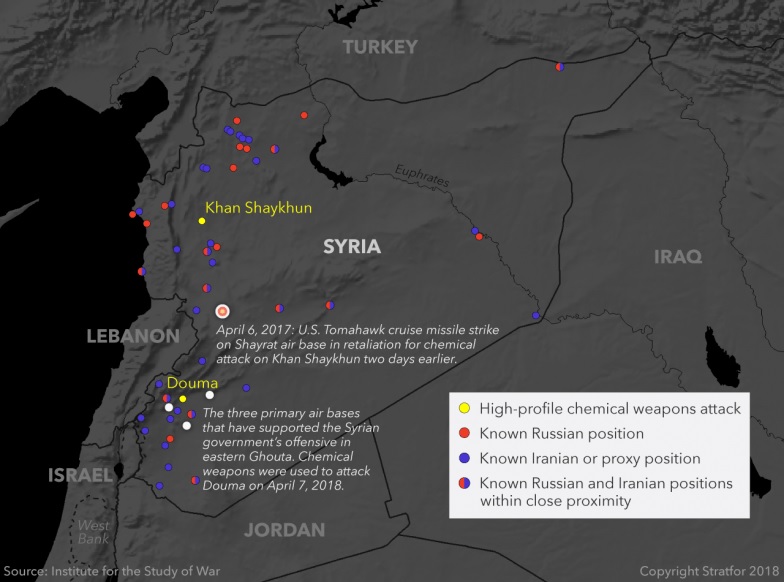
Αυτά έγγραφε το Stratfor τον Απρίλιο του 2017, πριν την τότε επίθεση των ΗΠΑ με πυραύλους Cruise στην αεροπορική βάση Shayrat. Ισχύουν και σήμερα.

Περιορισμένα τιμωρητικά χτυπήματα

Είναι η λιγότερο επικίνδυνη επιλογή και απαιτεί λίγες δυνάμεις. Θα έχει στόχο να επιδείξει την αξιοπιστία των ΗΠΑ και να περιορίσει περαιτέρω χρήση χημικών όπλων, με το χτύπημα επιλεγμένου αριθμού στόχων της συριακής κυβέρνησης, περιλαμβανομένων κέντρων διοίκησης και ελέγχου και άλλους υψηλής αξίας και συμβολικούς στόχους. Μπορούν να ποικίλουν σε ένταση, διάρκεια και σκοπό, αλλά ουσιαστικά είναι σχεδιασμένα να στείλουν ένα μήνυμα παρά να καταστρέψουν τη δυνατότητα της Συρίας να χρησιμοποιεί χημικά.

Ομάδα στόχων

Σε αυτό το σενάριο υπάρχουν περισσότεροι δυνητικοί στόχοι που οι ΗΠΑ θα ενδιαφέρονταν να χτυπήσουν. Εγκαταστάσεις διοίκησης και ελέγχου θα είναι πιθανότατα προτεραιότητα, στέλνοντας το μήνυμα ότι η ηγεσία της Συρίας, ειδικά η στρατιωτική, θα πληρώσει για την απόφαση να χρησιμοποιηθούν χημικά όπλα. Ωστόσο ο Ασαντ πιθανότατα δεν θα είναι στόχος, καθώς ένα χτύπημα στα ανώτατα κλιμάκια γρήγορα θα σύρουν τις ΗΠΑ σε πλήρη σύγκρουση, την οποία θα θέλει να αποφύγει σε αυτό το σενάριο. Ειδικές εγκαταστάσεις που θα μπορούσαν να μπουν στο στόχαστρο είναι αεροδρόμια και συγκεκριμένα κέντρα διοίκησης που ήταν υπεύθυνα για την επίθεση με χημικά.

Υποβάθμιση της ικανότητας χρήσης χημικών όπλων

Αν οι ΗΠΑ αποφασίσουν να πάνε την επιχείρηση ένα βήμα παρακάτω, θα μπορούσαν επίσης να επιχειρήσουν να απομειώσουν τη δυνατότητα της Δαμασκού να χρησιμοποιήσει χημικά όπλα, όχι μόνο να την αποθαρρύνουν. Τα κέντρα διοίκησης και ελέγχου θα μπορούσαν να στοχοποιηθούν αλλά η επιχείρηση θα πρέπει να χτυπήσει ένα πολύ ευρύτερο δίκτυο στόχων και πιθανά τις σχετιζόμενες με αυτά άμυνες.

Ομάδα στόχων

Η αποστολή θα μπορούσε να εστιάσει στους τρεις κύριους τρόπους με τους οποίους η Δαμασκός μπορεί να χτυπήσει με χημικά όπλα: την αεροπορία, τη δύναμη βαλλιστικών πυραύλων και το πυροβολικό.

Αν και πολλά αεροδρόμια έχουν καταστραφεί ή καταληφθεί από αντάρτες, αρκετά άλλα είναι λειτουργικά. Υπάρχουν τουλάχιστον έξι που σχετίζονται με το χημικό οπλοστάσιο της Συρίας. Για να αδρανοποιηθεί ένα αεροδρόμιο, οι ΗΠΑ μπορούν να καταστρέψουν τον αεροδιάδρομο, να χτυπήσουν τα σταθμευμένα αεροσκάφη, να καταστρέψουν τις αποθήκες καυσίμων και πυρομαχικών και να εξουδετερώσουν τον έλεγχο εδάφους, τα ραντάρ και τις εγκαταστάσεις συντήρησης.

Πέραν της συριακής αεροπορίας, άλλες πιστές δυνάμεις κατέχουν επίσης αριθμό πυροβόλων και βαλλιστικών πυραύλων μέσω των οποίων μπορούν να εξαπολύσουν επιθέσεις με χημικά. Οι ΗΠΑ, ωστόσο, είναι εξαιρετικά απίθανο να περιλάβουν στόχους που είναι τόσο πολύ πέρα από τις αεροπορικές δυνάμεις καθώς αυτό ουσιαστικά θα δέσμευε τη χώρα σε άμεσο και κανονικό πόλεμο κατά του Ασαντ, μια επιλογή που δεν είναι στο τραπέζι σε αυτό το σημείο.

Ο παράγοντας «κίνδυνος»

Ενώ το εύρος των επιλογών για τις ΗΠΑ ποικίλλει σε κινδύνους, κανένα δεν είναι άνευ ρίσκου. Οι κίνδυνοι είναι πολλοί και μακροπρόθεσμοι, καλύπτοντας ένα εύρος από την απώλεια προσωπικού και μέσων έως την πυροδότηση μιας αντιπαράθεσης με τη Ρωσία. Ακόμα και αν υποθέσουμε ότι ένα χτύπημα διεξαχθεί με απρόσκοπτο τρόπο και με ελάχιστες έως καθόλου παράλληλες απώλειες, χωρίς αμφιβολίες θα έχει συνέπειες για τις επιχειρήσεις των ΗΠΑ στη Συρία.

Κατ’ αρχάς η πιθανότητα οι πιστοί του Ασαντ να επιχειρήσουν να παρέμβουν στις αεροπορικές επιχειρήσεις των ΗΠΑ ή οι χερσαίες δραστηριότητες στη χώρα να αυξηθούν κατακόρυφα. Ακόμα και η διαδικασία αποκατάστασης με τη Ρωσία δεν θα μείνει ανεπηρέαστη.

Το συμπέρασμα είναι ότι δεν υπάρχει εύκολη στρατιωτική επιλογή στη Συρία και ακόμα και η επιχείρηση που θα γίνει με τον καλύτερο τρόπο, εντέλει θα οδηγήσει σε κλιμάκωση και πολλαπλασιασμό των παραγόντων που οδηγούν σε λάθος υπολογισμούς και οι οποίοι είναι ήδη παρόντες σε μια τόσο περίπλοκη σύγκρουση.

euro2day.gr

Ο Ερντογάν θα μπορούσε να είναι ο μεγάλος χαμένος της νέας κρίσης με τα χημικά της Συρίας

0

Του ΜΙΧΑΛΗ ΙΓΝΑΤΙΟΥ APRIL 12, 2018 Hellas Journal

Ο Πρόεδρος της Τουρκίας Ταγίπ Ερντογάν. Φωτογραφία Τουρκική Προεδρία

Η νέα κρίση στη Συρία, που προκλήθηκε από τη χημική επίθεση στη Ντούμα, πρωτίστως ανακατεύει τις συμμαχίες, παραδοσιακές και ευκαιριακές στην περιοχή της Μέσης Ανατολής.

Στο μέσο αυτής της άνευ προηγουμένου ανακατωσούρας, που θα μπορούσε να οδηγήσει σε ένα γενικευμένο πόλεμο γύρω από το «πτώμα» της διαλυμένης Συρίας, βρίσκεται η Τουρκία, η οποία ενώ παραμένει μέλος του ΝΑΤΟ, την ίδια στιγμή προδίδει τις αρχές του, υπογράφοντας στρατηγικές συμμαχίες με τους δύο μεγαλύτερους εχθρούς της Αμερικής και των Δυτικών: Τη Ρωσία και το Ιράν.

Παρά το γεγονός ότι οι Αμερικανοί δείχνουν πρωτόγνωρη ψυχραιμία και ιώβεια υπομονή, θα τους πάρει χρόνο για να ξεπεράσουν το σοκ και να χωνέψουν την τουρκική προδοσία.

Την ίδια στιγμή αποδεικνύεται και πόσο, μα πόσο, μπουντουλάδες είναι οι Αμερικανοί γραφειοκράτες, που συνεχίζουν να ζουν σε ένα φανταστικό κόσμο: Πιστεύουν ότι ο Ταγίπ Ερντογάν θα …καταλάβει το λάθος του. Και μέχρι αυτοί, δηλαδή οι γραφειοκράτες, να το αντιληφθούν, η Τουρκία θα τους έχει εγκαταλείψει εντελώς και θα βρίσκεται σε ένα πολύ επικίνδυνο εχθρικό και αυταρχικό στρατόπεδο.

Αλλά αυτή είναι συζήτηση για μία άλλη στιγμή. Εάν, λοιπόν, οι Αμερικανοί κτυπήσουν στη Συρία και εάν κατά …λάθος βομβαρδίσουν στόχους όπου βρίσκονται οι Ρώσοι στρατιωτικοί και σύμβουλοι, η Τουρκία θα βρεθεί στη μέση του …ωκεανού και δεν θα γνωρίζει ποιόν θα υποστηρίξει. Τους Αμερικανούς που ο κ. Ερντογάν καθυβρίζει, αλλά και με τους οποίους παραμένει σύμμαχος ή τους Ρώσους, οι οποίοι εκβιάζουν τον πρόεδρο της Τουρκίας με πολλούς και διάφορους τρόπους.

Ο κ. Ερντογάν λέει ότι προσπαθεί για την αποχώρηση του κ. Άσαντ από την εξουσία. Οι σύμμαχοι του, Ρώσοι και Ιρανοί, παλεύουν για να τον κρατήσουν στην εξουσία. Παράξενα πράγματα, και δύσκολα να τα καταλάβουμε οι απλοί άνθρωποι. Πως είναι δυνατόν, να αποδέχονται η Μόσχα και η Τεχεράνη ως φίλο και εταίρο τον Ερντογάν, όταν παλεύει να εξαφανίσει τον δικό τους σύμμαχο στην περιοχή, τον Μπασάρ αλ Άσαντ. Αλλά και πως ο κ. Ερντογάν αποδέχεται να διασώζουν τον πρόεδρο της Συρίας οι Ρώσοι και οι Ιρανοί, οι νέοι του σύμμαχοι.

Σας μπέρδεψα… Μα το γνωρίζω. Διότι αυτή η κατάσταση που βιώνουμε, στην κυριολεξία δεν …υπάρχει!

Στο άλλο στρατόπεδο τώρα, το Δυτικό: Η Τουρκία, ο σύμμαχος τους στο ΝΑΤΟ που υποτίθεται ότι συμφωνεί με την αποχώρηση του Άσαντ, την ίδια στιγμή εξυπηρετεί τους συμμάχους του Σύρου ηγέτη, τους Ρώσους και τους Ιρανούς Τι σκέφθηκε χθες ο κ. Ερντογάν, για να ξεπεράσει το αδιέξοδο στο οποίο έχει βρεθεί. Ανέλαβε μεσολάβηση μεταξύ του προέδρου Τραμπ και του προέδρου της Ρωσίας.

Τηλεφώνησε, λοιπόν, στον πρόεδρο της Αμερικής και σύμφωνα με τουρκική πηγή, μετέφερε μήνυμα από τη Μόσχα στην Ουάσιγκτον, που αφορά την τύχη του Άσαντ. Πρέπει να είναι αφελής κανείς να πιστεύει ότι ο Πούτιν θα πουλήσει τον πρόεδρο της Συρίας. Ο κ. Άσαντ εξασφαλίζει με την παρουσία του και μόνο τα ρωσικά και τα ιρανικά συμφέροντα. Χωρίς τον Άσαντ στην εξουσία, η επιρροή των Ρώσων και των Ιρανών στη χώρα θα μειωθεί, για να μην πω, ότι θα εξαφανιστεί.

Εδώ στην Ουάσιγκτον, κάποιος που βλέπει τα πράγματα διά γυμνού οφθαλμού, μπορεί να διαβεβαιώσει ότι επικρατεί ηρεμία… Ηρεμία πριν τη μεγάλη θύελλα ίσως… Μπορεί και να γίνονται δεύτερες σκέψεις, αν και προσωπικά πιστεύω, ότι ο κ. Τραμπ πιέζεται και από τα εσωτερικά του προβλήματα για να κτυπήσει στη Συρία. Έτσι για τα μάτια του κόσμου, αν και μια από τις εισηγήσεις που έχει στο τραπέζι είναι να επεκτείνει τα κτυπήματα και στο Ιράν, το οποίο θεωρείται συνένοχος του Άσαντ. Όμως αυτό, θα είναι αιτία γενικότερης σύρραξης.

Ένας αναλυτής, ο Μάικλ Ρούμπιν, πρώην φανατικός φίλος των Τούρκων και τώρα εχθρός του κ. Ερντογάν, έγραψε ότι η Αμερική και η Τουρκία θα μπορούσαν να οδηγηθούν σε πόλεμο. Περισσότερο ως πρόβλεψη το εξέλαβα, για να πω την αλήθεια… Αυτό που βασικά τονίζει είναι ότι δεν είναι η Αμερική που θα κηρύξει τον πόλεμο στην Τουρκία. Αλλά η Τουρκία στην Αμερική. Ενδιαφέρον…

Συνέχεια στο Hellas Journal

Πηγή: Ο Ερντογάν θα μπορούσε να είναι ο μεγάλος χαμένος της νέας κρίσης με τα χημικά της Συρίας http://hellasjournal.com/2018/04/o-erntogan-tha-borouse-na-ine-o-megalos-chamenos-tis-neas-krisis-me-ta-chimika-tis-syrias/

Γιατί ο Τραμπ ωθείται να επιτεθεί στη Συρία

0

Γράφει ο Γιώργος Λυκοκάπης  – 

 Ο Ντόναλντ Τραμπ αιφνιδίασε ακόμα και το επιτελείο του όταν ανακοίνωσε στις 29 Μαρτίου την πρόθεση του να αποσύρει τα αμερικανικά στρατεύματα από την Συρία. Λίγες μέρες μετά απέστειλε δυνάμεις της Εθνοφρουράς στα σύνορα ΗΠΑ-Μεξικού για τον έλεγχο της παράνομης μετανάστευσης. Ξεκίνησε αμέσως μία ρητορική αντιπαράθεση με την δεξιά κυβέρνηση του Ενρίκε Πιέτο, που θύμισε τις σκληρές προεκλογικές επιθέσεις του μεγιστάνα εναντίον του Μεξικού.

Ηταν φανερό πως ο Τραμπ ήθελε να εστιάσει στο εσωτερικό των ΗΠΑ, όπως έδειξε η απόφαση του για επιβολή δασμών στα κινεζικά προϊόντα. Η Συρία δεν ήταν στις προτεραιότητές του, μιας και το Ισλαμικό Κράτος έχει ουσιαστικά συντριβεί. Δεν τον απασχολούσε πλέον η ανατροπή του μπααθικού καθεστώτος, το οποίο εμφανίζεται εμφανώς ενισχυμένο. Ήταν θέμα χρόνου να επικρατήσουν οι δυνάμεις του Άσαντ στο τελευταίο προπύργιο των αντικαθεστωτικών ανταρτών, στην πόλη Γούτα, πάντα με την πολύτιμη βοήθεια της Μόσχας.

Κερδισμένο από μία αποχώρηση των ΗΠΑ θα ήταν σίγουρα και το σιιτικό Ιράν. Δυνάμεις του ιρανικού στρατού και σιίτες μαχητές της Χεζμπολάχ πολεμούν στο πλευρό των συριακών ενόπλων δυνάμεων από τις πρώτες μέρες του πολέμου. Η αυξανόμενη επιρροή του Ιράν στην Συρία προκαλεί αντιδράσεις στο Ισραήλ και την Σαουδική Αραβία. Για τον πρωθυπουργό Νετανιάχου και τον βασιλιά Σαλμάν, το καθεστώς της Τεχεράνης είναι εχθρός.

Οι πιο στενοί σύμμαχοι των ΗΠΑ στην Μέση Ανατολή σίγουρα δεν ενθουσιάστηκαν με την προοπτική αποχώρησης των Αμερικανών από την Συρία. Ο Γάλλος πρόεδρος Μακρόν φάνηκε πρόθυμος να καλύψει το κενό. Όμως για το Τελ Αβίβ και το Ριάντ, το Παρίσι δεν μπορεί να υποκαταστήσει την αμερικανική παρουσία στην Συρία. Ο Εμμανουέλ Μακρόν είναι πολύ πιο διαλλακτικός στην αντιμετώπιση της Τεχεράνης από τον Αμερικανό ομόλογο του.

Η επίθεση με τα χημικά αλλάζει τα δεδομένα

Ανώτατοι αξιωματικοί του αμερικανικού στρατού πάσχιζαν προηγουμένως να μεταπείσουν τον Τραμπ. Η απόφαση του προέδρου για αποχώρηση έμοιαζε οριστική, μέχρι την επίθεση με χημικά όπλα που σημειώθηκε στην πόλη Ντούμα το Μεγάλο Σάββατο. Ο Τραμπ κατηγόρησε αμέσως για την επίθεση το καθεστώς Άσαντ, εξαπολύοντας ταυτόχρονα σκληρές ρητορικές επιθέσεις εναντίον της Μόσχας και της Τεχεράνης, των κυριότερων συμμάχων της Δαμασκού.

Οι εξελίξεις είναι πλέον ραγδαίες. Ουάσιγκτον και Μόσχα αντάλλαξαν βαριές κατηγορίες στον ΟΗΕ. Η Ρωσία μίλησε για προβοκάτσιες, ενώ οι ΗΠΑ κατηγόρησαν την Μόσχα για την αμέριστη στήριξη που προσφέρει στο αιμοσταγές καθεστώς του Άσαντ. Στο ίδιο μήκος κύματος με τις ΗΠΑ κινήθηκαν η Γαλλία και η Μεγάλη Βρετανία. Ο Τραμπ ανέφερε πως θα λάβει μείζονες αποφάσεις για στρατιωτικά πλήγματα εναντίον της Συρίας τις επόμενες ώρες, παρά τις αντιδράσεις της Ρωσίας.

Ο Τούρκος πρόεδρος δεν εμπλέκεται προς το παρόν στην διαμάχη, αν και οι σχέσεις του με τον Άσαντ είναι πολεμικές. Ενδεικτική η συγκρατημένη ανακοίνωση της τουρκικής κυβέρνησης που μίλησε για επίθεση «που φέρεται» να πραγματοποιήθηκε από το συριακό καθεστώς. Ξεκάθαρα ο Ερντογάν έχει ως προτεραιότητα τη διαφύλαξη της συμμαχίας του με την Μόσχα και αποφεύγει περαιτέρω τυχοδιωκτισμούς στο μέτωπο της Συρίας. Οι Κούρδοι του YPG είναι ο πρωταρχικός του στόχος και όχι ο Άσαντ.

Με τα μάτια στραμμένα στο εσωτερικό

Πως όμως εξηγείται η μεταστροφή του Αμερικανού Προέδρου; Γιατί εμφανίζεται πρόθυμος για στρατιωτική εμπλοκή στην Συρία, όταν λίγες μέρες πριν ήταν έτοιμος να διατάξει την αποχώρηση των αμερικανικών στρατευμάτων; Ο Τραμπ δεν έχει τις φιλοδοξίες των νεοσυντηρητικών για «βίαιη εξαγωγή της δημοκρατίας» στην Μέση Ανατολή. Πασχίζει όμως να αποδείξει στο εσωτερικό των ΗΠΑ ότι δεν θυμίζει σε τίποτα τον Μπαράκ Ομπάμα.

Ο Ομπάμα απέφυγε το καλοκαίρι του 2013 να αναλάβει στρατιωτική δράση εναντίον του Άσαντ για παρόμοια επίθεση με χημικά που σημειώθηκε στο μέτωπο της Συρίας. Παρόλο που ο πρώην Αμερικανός πρόεδρος είχε δηλώσει προηγουμένως εμφατικά πως η χρήση χημικών όπλων από την Δαμασκό θα παραβίαζε την «κόκκινη γραμμή» της Ουάσιγκτον. Ο Τραμπ χαρακτηρίζει την στάση του προκατόχου του δειλή και ντροπιαστική για την εικόνα των ΗΠΑ παγκοσμίως.

Φυσικά ο Ομπάμα απέφυγε να αναλάβει στρατιωτική δράση στην Συρία, όχι επειδή ήταν «δειλός», αλλά γιατί υπήρχαν βάσιμες υποψίες πως η χρήση των χημικών όπλων ήταν προβοκάτσια. Προβοκάτσια των αντικαθεστωτικών ανταρτών ή των μυστικών υπηρεσιών της Σαουδικής Αραβίας με σκοπό να προκαλέσουν την στρατιωτική εισβολή των ΗΠΑ. Γι’ αυτό ο Ομπάμα προτίμησε την διπλωματική οδό στο ζήτημα των χημικών όπλων της Συρίας, ερχόμενος σε συμφωνία με την Μόσχα.

Όμως, ο σημερινός Πρόεδρος δεν έχει περιθώρια για διαπραγματεύσεις με την Μόσχα όσο διαρκούν οι έρευνες του FBI για το σκάνδαλο του Russiagate. Πριν μερικές ώρες το FBI πραγματοποίησε έφοδο στο σπίτι και στο γραφείο του δικηγόρου του Τραμπ, ο οποίος αντέδρασε οργισμένα, μιλώντας για «κυνήγι μαγισσών». Κοινό μυστικό είναι πως σκέφτεται να αποπέμψει τον ειδικό ανακριτή Ρόμπερτ Μάλερ, τον οποίο θεωρεί «προκατειλημμένο» απέναντι του.

«Αλλαγής ατζέντας» ή «φωτιά και οργή»;

Δεν είναι η πρώτη φορά που ο Τραμπ αναλαμβάνει στρατιωτική δράση στην Συρία. Τον Απρίλιο του 2017 είχε εκτοξεύσει 60 πυραύλους τόμαχοκ εναντίον συριακής στρατιωτικής βάσης. Αφορμή υπήρξε και τότε μία επίθεση με χημικά όπλα που είχε προηγηθεί. Τελικώς οι τόμαχοκ δεν άλλαξαν τους στρατιωτικούς συσχετισμούς στην Συρία, όπως είχαν τότε διαμορφωθεί. Παρέμειναν δυσμενείς για τους αντικαθεστωτικούς αντάρτες και ευνοϊκοί για το καθεστώς Άσαντ.

Ήταν όμως το ιδανικό επικοινωνιακό «προπέτασμα καπνού» που αναζητούσε ο Τραμπ για να απομακρύνει τον τότε διευθυντή τoυ FBI Τζέϊμς Κόμι. Ο Κόμι ερευνούσε το Russiagate και απομακρύνθηκε στις αρχές Μαίου, αφού όμως ο Πρόεδρος είχε ευφυώς αλλάξει την ατζέντα στο εσωτερικό των ΗΠΑ. Ο Τραμπ έχει πιθανών σκοπό να ξεκινήσει έναν νέο γύρο αντιπαράθεσης με το FBI, απομακρύνοντας και τον ανακριτή Μάλερ. Θα το πράξει αφού έχει ολοκληρωθεί η στρατιωτική επιδρομή στην Συρία.

Υπάρχουν όμως ορισμένες διαφορές με το 2017 που πρέπει να επισημανθούν. Έχουμε πολεμική εμπλοκή του Ισραήλ, το οποίο βομβάρδισε στρατιωτικό αεροδρόμιο της Συρίας την Δευτέρα. Βλέπουμε μία οξεία αντιπαράθεση Ουάσιγκτον-Μόσχας που δεν υπήρχε αντιστοίχως το 2017. Η Μόσχα έχει προειδοποιήσει ότι θα υπάρξουν «σοβαρές συνέπειες» από μια νέα πυραυλική επίθεση των ΗΠΑ στην Συρία.

για την συνέχεια slpress.gr/diethni/giati-o-tramp-otheitai-na-epitethei-sti-syria

Paul Ryan Will Not Seek Reelection

0
 Speaker of the House Paul Ryan / Getty Images

BY: 

House Speaker Paul Ryan (R., Wis.) will not run for reelection this year and retire from Congress after finishing his current term, his office announced Wednesday morning.

“This morning Speaker Ryan shared with his colleagues that this will be his last year as a member of the House,” Ryan’s counselor, Brendan Buck, said in a statement. “He will serve out his full term, run through the tape, and then retire in January. After nearly twenty years in the House, the speaker is proud of all that has been accomplished and is ready to devote more of his time to being a husband and a father.”

“While he did not seek the position, he told his colleagues that serving as speaker has been the professional honor of his life, and he thanked them for the trust they placed in him,” Buck added. “He will discuss his decision at a press conference immediately following the member meeting.”

View image on Twitter

Gio Benitez

✔@GioBenitez

Statement from @SpeakerRyan’s office confirming he won’t run for re-election:

Axios first reported that Ryan’s confidants said the lawmaker will not run for reelection and tell his staff and the House Republican Conference about his decision later in the morning.

President Donald Trump responded to Ryan’s announcement on Twitter, praising the House speaker as a “truly good man.”

“Speaker Paul Ryan is a truly good man, and while he will not be seeking re-election, he will leave a legacy of achievement that nobody can question. We are with you Paul!” Trump tweeted.

Donald J. Trump

✔@realDonaldTrump

Speaker Paul Ryan is a truly good man, and while he will not be seeking re-election, he will leave a legacy of achievement that nobody can question. We are with you Paul!

Ryan, who was the vice presidential nominee on the Republican ticket with Mitt Romney in 2012, has served in the House of Representatives since 1999. During his tenure in Congress, he has chaired both the House Budget Committee and the House Ways and Means Committee.

House Majority Leader Kevin McCarthy (R., Calif.) and House Majority Whip Steve Scalise (R., La.) have been floated as two potential successors for the House speaker position if Republicans keep control of the chamber in November.

Cameron Cawthorne

Cameron Cawthorne   Email Cameron | Full Bio | RSS
Cameron Cawthorne is a Media Analyst for the Washington Free Beacon. He graduated from the University of Virginia in 2013. Prior to joining Free Beacon, Cameron was a Legislative Assistant in the Virginia General Assembly and a War Room Analyst at America Rising.

Paul Ryan Will Not Seek Reelection

Why the world needs more aquaculture

0

by SeaWestNews

  • April 10, 2018
Significant increase in demand predicted for farmed salmon and other aquaculture products by leading European experts and a new report
By Fabian Dawson

SeaWestNews

The sustainable fish of the future will come from fish farms say leading European scientists and a new analysis on the global aquaculture market.

All of them conclude that fish production via aquaculture is increasing worldwide because of growing seafood consumption paired with rising economic importance associated with fisheries.

“The hundreds of millions of tonnes of extra fish we will need will have to come from fish farms,” said Dr. Johan Verreth professor of Aquaculture and Fisheries at his farewell lecture at Netherlands-based Wageningen University & Research.

Fish production via aquaculture is increasing worldwide. In 2015, the 70 million tonne yield was comparable to that of wild fisheries, but higher than that of beef production.

“It wouldn’t surprise me if aquaculture exceeds chicken farming (90 million tonnes) and pig farming (100 million tonnes) in the near future. Half of all fish we consume on an annual basis comes from aquaculture. That makes fish our primary source of animal protein,” said Professor Verreth.

He called for heavy investment in aquaculture innovation in order to achieve 100 million tonnes of extra fish for the world.

“Will we have enough fish to feed the growing global population in twenty years? Not if that fish comes from wild fisheries,” he concluded.

Similarly, a new report on the global aquaculture market predicts farmed fisheries will surpass the capture fisheries market as the primary source for seafood consumption in the coming years.

The global aquaculture market is expected to be valued at USD 202.96 billion by 2020, said Million Insights, according to a press release.

“The depleting volume of captured fish in the global reserves due to extensive fishing in the past two to three decades is considered as one of the major driving factors for industry growth,” the report’s authors said.

“Growing consumer concerns associated with the consumption of fish and other fish products followed by a surge in consumption of fish is expected to spur product demand over the next few years.”

The industry is anticipated to witness significant demand for farmed salmon, given its rich content of omega-3 fatty acids, vitamin D and protein and considered globally as a healthy food, the report said.

In Europe, scientists studying the impact of climate change on the oceans are working towards sustainable growth in future seafood production.

“It is critical to understand how Europe’s aquaculture industry and EU policy will need to adapt to foster Blue Growth in light of climate change,” said Professor Myron Peck from Universität Hamburg in Germany, referring to the European Union‘s long term economic strategy for a sustainable marine sector.

Europe is the fourth largest producer of fish in the world, according to Eurostat, with about 6.4 million tonnes of fish and shellfish caught or harvested by the European fisheries and aquaculture industry in 2015. Approximately 80% of European aquatic food production comes from wild fisheries, while around 20% comes from aquaculture, or fish farms.

Professor Michaela Aschan from  University of Tromsø – The Arctic University of Norway, who is also project coordinator of ClimeFish, explains the need for projects focusing on sustainable food production.

“The demand for healthy, protein-rich food is growing along with the world’s population,’ she said.

“Wild fish stocks are declining, climate change will severely reduce the outcome from agriculture, and aquaculture is predicted to become the main supplier for food in the future. However, climate adaptation plans in this sector is lacking and there are still large knowledge gaps.”

She and her colleagues are forecasting the future growth for 16 different case studies, including the most productive and the least resilient species used for seafood in Europe.

Another European Union project called CERES, is looking at the most high-value fish and shellfish populations across European waters, and how climate change will impact them, their habitats and economic activities in the future.

The project, named after the Roman goddess of agriculture and fertility, also works closely with both wild and farmed sectors to examine how they can adapt to these adverse changes, as well as potentially benefit from them.

CERES offers the opportunity to build strong relationships between scientists studying climate change and the leaders of Europe’s aquaculture industry. It employs business-proven methods, such as risk assessment, to create actionable science — science that is fit for purpose and can be used by policymakers and the aquaculture industry.

Why the world needs more aquaculture

Lose Newspapers and You Lose Your Democracy

0

Ihad a different column when I woke up on deadline day, but I wrote this one, not because any major news had broken—yes, the FBI raided the office of President Trump’s personal lawyer—but because our country and our democracy are in the midst of an ongoing emergency, and our embattled media is unable or unwilling to explain it.

What inspired my switch was Politico’s publicationof the results of a study that demonstrated “a clear correlation between low [newspaper] subscription rates and Trump’s success in the 2016 election, both against Hillary Clinton and when compared to Romney in 2012. Those links were statistically significant even when accounting for other factors that likely influenced voter choices, such as college education and employment, suggesting that the decline of local media sources by itself may have played a role in the election results.” It’s an enormously detailed study, and the data confirm what newspaper reporters and editors have been trying to tell a complacent public for years: “Lose us and you lose your democracy.” Walter Lippmann explained the problem in The Atlantic Monthly back in 1919: “The quack, the charlatan, the jingo, and the terrorist, can flourish only where the audience is deprived of independent access to information.”

However flawed our most important media institutions may be, this deprivation is something your columnist has been shouting about as long as he has been a columnist. Today, according to the Bureau of Labor Statistics, we have lost more than half of the newspaper jobs we had just 15 years ago. What is less well known is how much worse the problem is in the middle of the country, where Trump has been so successful in suckering voters into voting against their own interests. According to a 2017 Politico report, 73 percent of all Internet-publishing jobs are concentrated in coastal cities like New York City; Washington, DC; and Los Angeles.

These numbers, together with the Politico study, bring the extraordinary battle currently being waged by the remaining staff numbers at The Denver Post into sharper (and more alarming) focus. The newspaper, which serves a city of 700,000, has been systematically decimated by its greedy owner, the hedge fund Alden Global Capital, which is in the process of laying off roughly two-thirds of its newsroom. The remaining staff have embarked on a campaign to find a savior. They have made a public demand for Alden to cease its raid on the public’s right (and need) to know what is going on inside its community and country. As one of its reporters tweeted, “The @denverpost is being murdered by its owners.… We need a new owner, or we are going to get shut down (and soon).”

What will replace it? Well, there’s Sinclair, whose Pravda-style of robotic reporting is specially designed to mislead its viewers and turn them into willing victims of Trump-friendly disinformation. Thanks to Deadspin, we can all see its purposeful attempt to undermine Americans’ ability to get the truth about their country from the media. Then there are the naked plays by right-wing billionaires like the Koch brothers, Sheldon and Miriam Adelson, and Robert and Rebekah Mercer to publish hateful propaganda under the guise of “news.” These oligarchs feed bile and bullshit to the people they oppress, and convince them to blame immigrants, African Americans, Arabs, (some) Jews, and uppity women for their plight. Robert Mercer, we learned recently from the Center for Responsive Politics, funds not only the hate site Breitbart News and the secret spy company Cambridge Analytica but also something called Secure America Now, which is dedicated to ginning up fear of imminent “Muslim takeovers of France, Germany and the United States,” as The Washington Post put it.

We don’t know how much money these people invested in these potentially proto-fascist enterprises, because so-called dark-money organizations are not required to release the names of their funders. And to be honest, I don’t think the source of the these apparently endless funds are what is most important here when you consider the fact that Rupert Murdoch’s empire, particularly Fox News, does the same thing openly and with virtually no public sanction or personal embarrassment for its owners or executives. It’s hard to imagine a scarier nightmare than allowing this country to be guided by a person who takes his cues from nefarious know-nothings like Laura Ingraham, Tucker Carlson, and Sean Hannity. But, lo and behold, we’re living that terrifying waking dream. The lunatic imaginings of the jerks on Fox & Friends now guide the most powerful person on earth. As The Guardianreports, “The show manages to serve as a court sycophant, whispering in the ear of the king, criticizing his perceived enemies and fluffing his feathers.” Close examinations of Trump’s tweets demonstrate a near perfect relationship between the show’s hosts’ malevolent musings and the nonsense that emanates from Trump’s Twitter feed. On average, according to PunditFact, commentators on Fox, Fox News, and Fox Business tell at least most of the truth 22 percent of the time, and lie 60 percent of the time; much of it racist and sexist, and 100 percent of it stupid. (That last statistic was my own calculation.)

Our political system has clearly fallen victim to “the quack, the charlatan, the jingo, and the terrorist,” and too many of our most powerful and influential individuals are letting it happen with a barely audible whimper of protest. It’s not just Trump’s buildings (or his “pants” as PunditFact would have it) that are on fire; it’s the Constitution and potentially, the country itself. I’d say we are long past the moment for shouting.

Να ξέρουμε ακριβώς τι κάνουμε

0
ΑΛΕΞΗΣ ΠΑΠΑΧΕΛΑΣ  11.04.2018 

Οι Τούρκοι παίζουν με τα νεύρα μας. Δεν έχουμε κανένα λόγο να παρασυρθούμε, εκτός εάν θέλουμε να εμπλακούμε σε κάποια περιπέτεια. Αυτό που συμβαίνει αυτή την περίοδο είναι πάρα πολύ επικίνδυνο. Οι ελληνικές Ενοπλες Δυνάμεις έχουν μπει σε μια περίοδο πρωτοφανούς και συνεχούς εγρήγορσης, η οποία έχει ήδη διαρκέσει πολύ. Πέρα από το όποιο κόστος, η αδιάκοπη ένταση και η περιρρέουσα ατμόσφαιρα μπορούν εύκολα να οδηγήσουν είτε σε ατύχημα είτε στο να «τσιμπήσουμε» σε κάποιο τουρκικό δόλωμα.

Το πιο σημαντικό, όπως έδειξε η εμπειρία των Ιμίων, είναι να ξέρουμε ακριβώς τι κάνουμε. Με άλλα λόγια:

– Να δίνονται σαφή και μη αντικρουόμενα μηνύματα στην απέναντι πλευρά. Η διεθνής εμπειρία έχει δείξει πως μερικές από τις μεγαλύτερες τραγωδίες προκλήθηκαν από κακή ή θολή επικοινωνία.

– Να βρίσκονται όλοι οι βασικοί χειριστές, από τον πρωθυπουργό έως τον κάθε αρχηγό, στο ίδιο ακριβώς μήκος κύματος. Η υπόθεση των Ιμίων απέδειξε ότι όταν ένας ή περισσότεροι βασικοί χειριστές έχουν δική τους ατζέντα, η «στραβή» δεν θα αργήσει να γίνει. Οταν ο έχων την τελική ευθύνη διαπιστώνει δυσλειτουργίες, η κακοφωνία ασφαλώς και δεν μπορεί να ξεπεράσει το πρόβλημα με ένα κλασικό «βρείτε τα». Στον ευαίσθητο τομέα της ασφάλειας υπάρχουν καθαρές, ξεκάθαρες εντολές και συνεννοήσεις. Το «βρείτε τα» είναι για κομματικές συνάξεις.

– Να είναι σαφές ποιος θα δώσει την εντολή για κλιμάκωση ή αποκλιμάκωση, σε πραγματικό χρόνο, όταν συμβεί κάτι σοβαρό. Εδώ δεν υπάρχει περιθώριο για παρεξηγήσεις ή ασάφειες. Ενα λεπτό, μία απόφαση που μοιάζει εντελώς ασήμαντη μπορεί να αποβεί μοιραία. Και αυτό το μάθαμε (υποτίθεται) από τα Ιμια.

– Να ενημερώνεται ειλικρινά αλλά χωρίς υπερβολές η κοινή γνώμη για τα πραγματικά περιστατικά, στον βαθμό που είναι εφικτό. Κρίσιμος είναι εδώ ο –υπεύθυνος– ρόλος των μέσων ενημέρωσης.

– Να καθίστανται πλήρως ενήμεροι ο Πρόεδρος της Δημοκρατίας και οι ηγέτες της αντιπολίτευσης, έτσι ώστε να έχουν την όλη εικόνα.

Εχουμε εισέλθει σε μια πολύ δύσκολη και επικίνδυνη περίοδο. Παραδοσιακά πάσχουμε στη συστηματοποίηση και τη θεσμική αντιμετώπιση κρίσεων. Σε μια κανονική χώρα θα κάθονταν σχεδόν καθημερινά γύρω από ένα τραπέζι ο πρωθυπουργός, οι αρμόδιοι υπουργοί, οι αρχηγοί και ο διοικητής της ΕΥΠ για να μελετούν τις εξελίξεις και να χαράζουν γραμμή. Εχει, νομίζω, έλθει η ώρα να αντιληφθούμε τη σοβαρότητα των περιστάσεων και να αφήσουμε τη χαλαρότητα για τα πολιτικά και τα δευτερεύοντα.

“Καθημερινή”

Don’t wait for the Western Balkans to blow up again. The U.S. and the E.U. must act.

0
Wesley K. Clark April 11 at 11:11 AM The Washington Post.

Kosovo police block a street last month in the northern, Serb-dominated part of Mitrovica, Kosovo. (Bojan Slavkovic/AP)

This post was updated at 1:35 p.m. 

Retired Gen. Wesley K. Clark is a former NATO supreme allied commander. He is a senior fellow at the UCLA Burkle Center for International Relations and CEO of Wesley K. Clark & Associates.

It has been more than two decades since I worked with Richard Holbrooke and our team to negotiate an end to the war in Bosnia. NATO deployed and then acted to halt Serb ethnic cleansing in Kosovo.

Today, three Western Balkan states (Croatia, Albania and Slovenia) have become members of NATO. Croatia and Slovenia have joined the European Union. Kosovo is now an independent nation. Most Americans and Europeans have mentally filed away that brutal conflict as a problem solved.

Sadly, this is far from true. Lingering political conflicts over the ethno-religious character of these nations consistently threaten to metastasize into national and regional crises, making the region a prime target for meddling by foreign powers. A combustible mix of poor governance, economic stagnation and weak democratic institutions has left a small yet significant minority vulnerable to recruitment by violent jihadists. All of this leaves the region ripe for exploitation by terrorist organizations and meddling by outsiders, including Russia, China and Turkey.

To make matters worse, the region is suffering from neglect by democracies that were instrumental in bringing the Yugoslav wars to an end. Believing that the Balkans’ democratic future lay in E.U. membership, the United States largely handed over responsibility for the region’s political, institutional and economic development to Brussels. Yet political inertia within the E.U. has kept Bosnia, Serbia, Montenegro, Kosovo, Albania and Macedonia waiting in the wings. And while the United States and Europe sleep, other powers are taking notice.

The Kremlin is steadily increasing its influence. The Russians are working to foment anti-E.U. and anti-NATO sentiment. They are supporting extremist groups (one of which is under investigation in Bosnia for suspected paramilitary activities) and dispensing targeted military aid. The Kremlin has also fanned the flames of ethnic division through disinformation campaigns that pit Orthodox Christian populations against Muslims, intentionally stoking the tensions that fueled the Yugoslav wars of the 1990s.

Meanwhile, Turkey and the Gulf states are also investing heavily in the Western Balkans. Turkey is the third-largest investor in Bosnia, and the leader of Bosnia’s main Muslim political party travels to Istanbul regularly for photo ops with the increasingly authoritarian Turkish President Recep Tayyip Erdogan.

Saudi Arabia and its neighbors in the Gulf have focused their contributions on supporting religious organizations, building new mosques and offering religious instruction to local imams. The strict Wahhabi interpretation of Islam that is often the basis of such training bears little relation to the moderate tradition that has been practiced in the Balkans for centuries, and has been tied to rising fundamentalism in the region.

An estimated 1,000 foreign fighters (primarily from Kosovo and Bosnia) have fought with the Islamic State in Syria and Iraq. Although the number of foreign fighters from the Balkans is trending downward, the environments in which these individuals became radicalized, and the vulnerabilities to recruitment among disaffected segments of the population, continue to be a concern. The problem of reintegrating returned foreign fighters poses an even more vexing challenge.

Finally, China is also seeking to augment its influence in the region. Under its “One Belt, One Road” initiative, Beijing is poised to provide the massive capital investment needed to undertake badly needed infrastructure projects in the Balkans. But as we’ve seen in Africa, such investment almost always comes with strings attached.

Clearly, the United States and Europe must remain committed to the Western Balkans — with a particular emphasis on strengthening democratic institutions so that governments can address the needs of their citizens.

A Western Balkans free-trade zone recently proposed by the region’s leaders could be a step in the right direction. But such an initiative should not be viewed as a substitute for the potential guarantees to be provided by NATO and the E.U. A serious road map for E.U. accession would provide countries in the region with the incentives to make necessary political and economic reforms, increase their cooperation and address rising inter-ethnic tensions.

Of course, such efforts would need to secure popular support in order to go forward — a challenge in a region where the population remains sharply divided in attitudes toward institutions like NATO.

Yet according to one recent poll, although Bosnians of Serb, Croat and Muslim backgrounds are divided on many issues, they are united in their opposition to the Islamic State and their desire to tackle economic problems. NATO membership would be easier to sell to the region’s ethnic Serbs (who tend to be pro-Russian and anti-NATO) if membership were pitched as helping to foster greater regional stability.

We can ensure that the billions in taxpayer dollars invested in this region were not wasted by supporting the work of democracy development implementers such as the National Democratic Institute and the International Republican Institute. We’ve seen the continued importance of this kind of work with initiatives such as the newly established Task Force on Counter-Extremism, which is helping lawmakers in Bosnia adapt to the ever-shifting challenge of violent extremism.

We have many tools at our disposal to avert the creeping destabilization in the Western Balkans. Let us ensure that we do not squander the tremendous investment we have made in this troubled region, and renew our commitment to helping these fledgling democracies to achieve their full potential.

https://www.washingtonpost.com/news/global-opinions/wp/2018/04/11/dont-wait-for-the-western-balkans-to-blow-up-again-the-u-s-and-the-e-u-must-act/?utm_term=.6039e1d1fab6

Τι γίνεται στο Ακούγιου;

0

Αρθρο Π. Οικονόμου στην «Κ»:

ΠΑΝΤΕΛΗΣ ΟΙΚΟΝΟΜΟΥ*

Τη Δευτέρα 2 Απριλίου 2018 χορηγήθηκε από την τουρκική αρχή ατομικής ενέργειας (ΤΑΕΚ) στη ρωσική κρατική εταιρεία Rosatom η άδεια κατασκευής του πρώτου πυρηνικού αντιδραστήρα παραγωγής ηλεκτρικής ενέργειας της Τουρκία στο Ακούγιου. Την επομένη ημέρα έγινε με μεγαλοπρέπεια η θεμελίωση του έργου. Συμμετείχαν με απευθείας τηλεοπτική σύνδεση από το προεδρικό μέγαρο της Αγκυρας ο πρόεδρος Ταγίπ Ερντογάν και ο επίσημος προσκεκλημένος του Ρώσος ηγέτης Βλαντιμίρ Πούτιν.

Σύμφωνα με τη διακρατική συμφωνία Τουρκίας – Ρωσίας του 2010, η Rosatom είναι κατασκευαστής, διαχειριστής και ιδιοκτήτης του πυρηνικού συγκροτήματος. Δικαιολογημένη η μεγαλοπρέπεια των εγκαινίων, αφού η στιγμή αυτή ήρθε έπειτα από οκτώ χρόνια μετά την υπογραφή της σχετικής συμφωνίας. Ενα χρονικό διάστημα ασυνήθιστα μεγάλο για τις απαραίτητες διαδικασίες αδειοδότησης. Είναι γεγονός ότι οι διαδικασίες για την αδειοδότηση, κατασκευή και λειτουργία των πυρηνικών αντιδραστήρων έγιναν περισσότερο χρονοβόρες μετά τα πυρηνικά ατυχήματα του Τσερνομπίλ (1986) και της Φουκουσίμα (2011). Οι αποκτηθείσες τραγικές εμπειρίες οδήγησαν στη δημιουργία αυστηρότερων οδηγιών, συστάσεων και σχετικών ελέγχων εκ μέρους της Ευρωπαϊκής Ενωσης και του ΙΑΕΑ. Παράγοντες, όπως η σεισμογένεια και τα ακραία φυσικά φαινόμενα (safety) και ο ανθρώπινος δόλος (security) απέκτησαν μεγαλύτερο ειδικό βάρος.

Θα πρέπει, επίσης, να ληφθεί υπόψη ότι το έργο αυτό αποτελεί την πέμπτη προσπάθεια της Τουρκίας για απόκτηση αντιδραστήρων πυρηνικής ενέργειας σε μια περίοδο σχεδόν 60 χρόνων.

Οταν το 2007 ψηφίστηκε ο σχετικός νόμος για το Ακούγιου, η γνώμη ανώτερων στελεχών προμηθευτών πυρηνικής τεχνολογίας, με βάση την εμπειρία τους στις τέσσερις προηγούμενες αποτυχημένες προσπάθειες της τουρκικής κυβέρνησης (1960, 1968, 1974 και 1998), ήταν ότι και αυτή η προσπάθεια της Τουρκίας ήταν καταδικασμένη σε αποτυχία («Nucleonics Week», 29 November 2007).

Η σπουδαιότητα του έργου έγκειται στο ότι οι τέσσερις αντιδραστήρες στο Ακούγιου θα καλύπτουν το 10% των ενεργειακών αναγκών της χώρας, που αντιστοιχούν στις σημερινές ανάγκες της Κωνσταντινούπολης. Σημειωτέον, το Ακούγιου αποτελεί το πρώτο μέρος ενός φιλόδοξου πυρηνικού σχεδίου που περιλαμβάνει την κατασκευή τουλάχιστον οκτώ ακόμη πυρηνικών αντιδραστήρων στα παράλια της Μαύρης Θάλασσας. Εξ αυτών, οι τέσσερις στη Σινώπη και άλλοι τέσσερις ενδεχομένως στην Ιγνεάδα της Ανατολικής Θράκης. Τελικός στόχος είναι η στρατηγική κάλυψη μεγάλου μέρους των αυξανόμενων ενεργειακών αναγκών της χώρας και η απεξάρτησή της από τις εισαγωγές φυσικού αερίου και πετρελαίου από Ρωσία και Ιράν αντιστοίχως.

Με αυτή την προοπτική, η Τουρκία έχει συνάψει μία σειρά διεθνών πυρηνικών συμφωνιών, με περισσότερο σημαντικές αυτές με Ρωσία, Ιαπωνία, Γαλλία, Κίνα, ΗΠΑ. Ν. Κορέα, Αυστραλία και Νίγηρα που καλύπτουν την απόκτηση τεχνολογίας και τεχνογνωσίας του ευρύτερου κύκλου πυρηνικού καυσίμου (nuclear fuel cycle). Δεν εξαιρούνται οι «ευαίσθητες» δραστηριότητες του εμπλουτισμού ουρανίου και της επεξεργασίας αναλωμένων πυρηνικών καυσίμων. Θα πρέπει, βεβαίως, να αναφερθεί ότι η Τουρκία είναι μέλος της διεθνούς Συνθήκης Μη-Διασποράς των πυρηνικών όπλων, ΝΡΤ και υπόκειται στους αυστηρούς ελέγχους των πυρηνικών επιθεωρητών του Διεθνούς Οργανισμού Ατομικής Ενέργειας, ΙΑΕΑ.

Διακινδυνεύοντας να θεωρηθώ μάντης κακών για τη γείτονα, θα πρέπει να αναφερθώ και σε έναν επιπλέον παράγοντα ανησυχίας των άμεσα ή έμμεσα εμπλεκομένων. Ισως τον βασικότερο και ανατρεπτικότερο όλων, πέραν της ασφάλειας από ενδεχόμενα φυσικά ατυχήματα (safety) ή από ανθρώπινο δόλο (security): Τον γεωπολιτικό.

Οπως οι γεωπολιτικοί σχεδιασμοί συχνά υπαγορεύουν ασύμφορες και για πολλούς ανεξήγητες συμπεριφορές και «επενδύσεις» των ισχυρών, έτσι και κάποιοι όχι οφθαλμοφανείς γεωστρατηγικοί στόχοι, επιδιωκόμενες ισορροπίες ή αποτρεπτικές ανισορροπίες, μπορούν να δράσουν καταλυτικά στην εγκατάλειψη ακόμα και προχωρημένων σχεδίων. Για να γίνω ίσως περισσότερο καταληπτός, επιτρέψτε μου να αναφερθώ σε δύο παραδείγματα.

Το σχετικά προχωρημένο έργο κατασκευής του ρωσικού πυρηνικού αντιδραστήρα Μπελένε στη Βουλγαρία τελικά εγκαταλείφθηκε το 2012, αφού προηγήθηκε η αλλαγή στρατοπέδου της Βουλγαρίας από τη διαλυμένη πλέον Σοβιετική Ενωση στην Ευρωπαϊκή Ενωση. Ούτε οικονομικές δεσμεύσεις ούτε άλλοι σχεδιασμοί ενεργειακών αγωγών στάθηκαν τελικά εμπόδιο στην εγκατάλειψη του προχωρημένου σημαντικού πυρηνικού έργου. Ολα και όλοι τελικά βρήκαν τη νέα τους στρατηγική ισορροπία.

Τον Δεκέμβριο του 2000, ο Ρώσος πρόεδρος Βλαντιμίρ Πούτιν επισκέφθηκε την Κούβα του Φιντέλ Κάστρο για, μεταξύ των άλλων, να δώσει λύση σε μία χρονίζουσα εκκρεμότητα. Το ημιτελές συγκρότημα των δύο σοβιετικών πυρηνικών αντιδραστήρων στο Σιέν Φουέγκος της νότιας Κούβας. Ημουν κατά σύμπτωση εκεί, σε προγραμματισμένη επιθεώρηση του πυρηνικού συγκροτήματος και ενθυμούμαι έντονα την αγωνία των Κουβανών συνεργατών μου για την έκβαση της συνάντησης κορυφής και το μέλλον του τόσο ζωτικού έργου για την ενεργειακή επιβίωση της Κούβας. Η Σοβιετική Ενωση είχε καταρρεύσει, χρήματα δεν υπήρχαν για τη συνέχιση του έργου και η Κούβα είχε χρεωθεί αρκετά για να κατασκευαστεί ένα ιαπωνικό πετρελαϊκό έργο που της επέτρεπε να φωτίζει εκ περιτροπής την Αβάνα.

Δεν θα ξεχάσω την ικανοποίηση των Κουβανών φίλων όταν το βράδυ πληροφορηθήκαμε ότι στην απαίτηση του Πούτιν για 3 δισ. δολάρια αποζημίωση για τις σοβιετικές δαπάνες του έργου, ο Κομαντάντε ανταπάντησε ότι τόση ακριβώς υπολογίστηκε και η ζημιά που προκάλεσε στην κουβανική οικονομία η διακοπή του έργου τα τελευταία χρόνια. Οι απαιτήσεις τελικά εξισώθηκαν, μία νέα στρατηγική ισορροπία επιτεύχθηκε και όλες οι πλευρές ικανοποιήθηκαν αποδεχόμενες τις μη αναστρέψιμες πλέον γεωπολιτικές αλλαγές.

Οι γεωπολιτικές αλλαγές και στην ευρύτερη περιοχή μας, άρα και της Τουρκίας, είναι απρόβλεπτες και ίσως επίσης μη αναστρέψιμες.

Αρα, ικανές για οποιεσδήποτε εξελίξεις.

* Ο δρ Παντελής Οικονόμου είναι πρώην επιθεωρητής του Διεθνούς Οργανισμού Ατομικής Ενέργειας (ΙΑΕΑ) για τη Μη-Διασπορά των Πυρηνικών Οπλων.

“Καθημερινή”

In a New Cold War With Russia, Balkans Become a Testing Ground

0

MEMO FROM SARAJEVO

The New York Times

A view of Sarajevo, the capital of Bosnia and Herzegovina. After years of neglect, the European Union is again turning its attention again to the Western Balkans.CreditAndrew Testa for The New York Times

SARAJEVO, Bosnia and Herzegovina — Cradle of the First World War, the Balkans have been a flashpoint, a place where empires, ethnicities and religions abut and contest. Now, analysts warn, the region is becoming a battleground in what feels like a new Cold War.

Russia, they say, is expanding its influence and magnifying ethnic tensions in countries that hope to join the European Union. Its involvement has already spurred Brussels to revive dormant aims for enlargement. It is also prompting fresh attention from Washington about security risks to NATO members.

After the concerted Western response to the poisoning in Britain of a former Russian spy and his daughter, which expelled around 150 Russian diplomats and intelligence officers, “the Balkans become even more important,” said Mark Galeotti, a senior researcher at the Institute of International Relations in Prague.

“Russia is looking for ways to retaliate that are asymmetric and provide Moscow opportunities,” he said.

In a new paper for the European Council on Foreign Relations, Mr. Galeotti says that “Russia looks to the Balkans as a battlefield in its ‘political war,’” seeking “to create distractions and potential bargaining chips with the European Union.”

Charles A. Kupchan, who was Europe director of the National Security Council under President Barack Obama, said that “the Russians are taking advantage of the last part of Western Europe that remains politically dysfunctional.”

The situation bears distant echoes of Ukraine, where Russia originally agreed that Kiev could join the European Union — though not NATO — and then changed its mind, leading to the revolution that prompted Moscow to annex Crimea and foment secession in eastern Ukraine.

In the Balkans, the competition with Russia has the potential to sow fresh instability in a region still emerging from the vicious war of 1992-95 that broke apart the former Yugoslavia.

In Sarajevo, many of the scars of the war have been erased. The former Holiday Inn, once a nearly windowless shelter for reporters near Snipers’ Alley during the Bosnia war, is restored and busy. The neo-Moorish City Hall, a monument to multiculturalism that was shelled and burned, has been burnished to a high standard.

Yet Bosnia and Herzegovina, the broken country patched together in 1995 at the end of the war, remains a fragile construct, riven by corruption, weak leadership, and ethnic and nationalist strains among communities — a metaphor for the Balkans.

Greeks demonstrating in Athens in February over neighboring Macedonia’s use of that name.CreditValerie Gache/Agence France-Presse — Getty Images

It is one of several key entry points that Russia is seeking to exploit, Mr. Kupchan said, as the leader of the Serb semiautonomous region known as Republika Srpska, Milorad Dodik, continues to press for an independence referendum. The others include Macedonia, where relations between ethnic Albanians and ethnic Slavs remain tense, and between Kosovo and Serbia.

Wary of Russian meddling, the European Union is holding out a renewed prospect of membership to Bosnia and to the other five nations of the Western Balkans — Serbia, Montenegro, Macedonia, Albania and Kosovo — in return for fundamental structural reform.

The skepticism among these countries about Brussels is deep. Many doubt the sincerity of a European Union that is turning more populist, more wary about migration and more cautious, after Romania and Bulgaria, about taking in nations before they are ready for membership.

No one believes any of these countries is yet ready to join. But the urgency for reform fell away as the goal receded.

Four years ago, the head of the European Commission, Jean-Claude Juncker, said there would be no more quick enlargement of the bloc, sending the process into somnolence.

It has been, as the Macedonian foreign minister, Nikola Dimitrov, often says, like “being locked in a waiting room with no exit.”

“Juncker made a mistake to say that he was not interested in enlargement,” said Carl Bildt, a former Swedish foreign minister and United Nations special envoy to the Balkans. “The E.U. took its eye off the ball for several years, with detrimental effects.”

But with Britain leaving the bloc and Russia playing on the fissures of the region, the European Union has now laid out a relatively detailed plan for the Balkans.

It has even gone on record to say that if all goes well, Serbia and Montenegro, the only two countries now engaged in an accession process and hence the front-runners, could join by 2025.

The bloc’s strategy for the Western Balkans, published in February, laid out six initiatives: rule of law; security and migration; socio-economic development; transport and energy connectivity; digital agenda; and “reconciliation and good neighborly relations.”

Image

In Bosnia, the leader of the Serb autonomous region known as Republika Srpska, Milorad Dodik, continues to press for an independence referendum.CreditLaura Boushnak for The New York Times

Bulgaria, the current president of the bloc, will hold a special Balkans summit meeting in May. T he Balkans are on the agenda for the European Council in June, and the British will be hosts of a Western Balkans summit meeting in July, just before NATO has its own meeting in Brussels.

“It is time to finish the work of 1989,” said Johannes Hahn, the European Union commissioner in charge of enlargement. “We have set 2025 as an indicative date for Serbia and Montenegro, which is realistic but also very ambitious.”

Mr. Bildt said tartly: “Whether this is realistic or not remains to be seen.”

Many think it is too ambitious, given that the bloc insists that all these countries settle their numerous, passionate border disputes. There are also serious internal problems, the bloc’s report acknowledged.

“Today the countries show clear elements of state capture, including links with organized crime and corruption at all levels of government and administration, as well as a strong entanglement of public and private interests,” it said.

There is strong evidence of “extensive political interference in and control of the media” and lack of independence in the judiciary, it noted.

Add to that uncompetitive economies and the flight of young people looking for better jobs, and prospects seem dim.

But now the Americans are suddenly more interested, too. Renewed Washington concern “stems in part from concerns about expanded Russian influence,” said A. Ross Johnson, noting that Congress now demands that the Defense Department provide “an assessment of security cooperation between each Western Balkan country and the Russian Federation.”

Russia has made it clear that it considers new NATO expansion to the Western Balkans as unacceptable, and Moscow was implicated in a strange coup attempt in Montenegro in 2016 before that country joined NATO.

Russia is trying to establish itself in the region, both with government and business, so when these countries do enter the European Union, “they will bring Russian influence with them,” Mr. Galeotti said.

The strategy is similar to what China and Russia are doing with Greece and Cyprus, widely considered places where Russian money can be laundered into euros.

The river Ibar divides the Albanian and Serbian areas in Mitrovica, Kosovo.CreditAndrew Testa for The New York Times

Russia is also deeply engaged in local language media, both with Kremlin-owned websites like Sputnik and with bots that harp on local grievances.

Mr. Bildt points in particular to Russian investment in critical Serbian infrastructure, like energy. Though Russian investment pales compared with that of the European Union countries, Serbia has a natural affinity to its Russian Orthodox brethren and remembers Russian support during the Kosovo war.

“Is the E.U. sensitive enough to what is happening in Serbia?” Mr. Galeotti asked.

He thinks not. “E.U. policy has generally been to support whatever keeps the Western Balkans quiet,” Mr. Galeotti said. “It’s deeply dangerous and creates the perfect environment for Moscow to play its games.”

Brussels, he and others say, should put more weight behind both the carrots and the sticks — offering genuine incentives for institutional reform, and genuine sanctions for falling short.

A former senior United States official called the region a new Cold War battlefield, and said that Brussels was too rigid with the ways it tried to keep people on the good behavior track, while the money is not as connected as it should be to reform goals.

The official, who asked for anonymity to preserve influence in the region, said that the countries reformed only when Brussels and Washington worked together to push leaders hard to break old habits of corruption, state capture, a politicized judiciary and Russian shell companies trying to take over key infrastructure and media.

But Europe is not eager to import more problems. “The argument is that only by taking in the Balkan states are we assured to strengthen stability,” said Norbert Rottgen, the chairman of the German Bundestag’s foreign affairs committee. “But is that true?”

“If we import fragile states into the E.U., we import fragility,” he added. “If we compromise on conditions, we let in fragile countries open to foreign influences, so we have to be tough on the entry requirements.”

The irony of history, Mr. Bildt mused, is that had Yugoslavia remained together, it almost surely would have been in the European Union by now, having been well ahead in 1990 of current members Romania and Bulgaria.

“If the wars of dissolution hadn’t happened, all of this area would have been an E.U. member,” he said. “The Balkans have always lived best when integrated into a wider framework, as necessary today as in the past, and the one available today is the European Union.”

Mr. Kupchan remains an optimist. “We know where this story will ultimately end, with all the former Yugoslav states integrated into the European Union,” he said. “But when?”

A version of this article appears in print on , on Page A10 of the New York edition with the headline: Balkans Become a Testing Ground in a New Cold War.
https://www.nytimes.com/2018/04/10/world/europe/european-union-balkans.html

The decline of the West, 1918-2018

0
Global Spectator, by Andrés Ortega

Esta entrada también está disponible en: Spanish

The decline of the West, 1918-2018. “Dawn after Darkness!”, lithography by Alexander Oscar Levy made toward the end of World War I. Image via Library Company of Philadelphia (No known copyright restrictions). Elcano Blog

The decline of the West, 1918-2018. “Dawn after Darkness!”, lithography by Alexander Oscar Levy made toward the end of World War I. Image via Library Company of Philadelphia (No known copyright restrictions)

This summer will mark the centenary of the appearance of the first volume of Oswald Spengler’s influential The Decline of the West (Der Untergang des Abendlandes), first published in 1918, when the First World War was in its death throes prior to the November armistice. One hundred years later there is again a widespread sense that we are witnessing the decline of the West –and even more so the relatively liberal world order that it erected– albeit in relative terms and in a way that is little connected to the causes that Spengler identified. The German thinker, who rejected the Eurocentric division of history into ancient, mediaeval and modern, viewed as inexorable, and almost mechanical, the transition of what he called the ‘high cultures’ (he saw ‘civilisation’ as the start of the decline) through four essential phases: youth, growth, flowering and decline. And in 1918 it was the latter phase that had overtaken the West, one of the eight high cultures he identified. These were the Babylonian, Egyptian, Chinese, Indian, Mesoamerican (Aztec/Mayan), Classical (Greek/Roman), Arabian and Western, or European-American.

It is a view of ‘civilisation’ not too far removed from the one put forward by Samuel Huntington with his ‘clash’, but very different from that of the Iranian-Canadian philosopher Ramin Jahanbegloo. The latter, in his recent The Decline of Civilization, 100 years after Splenger, goes further. He believes that we are witnessing a process of the ‘de-civilisation’ of society, which does not mean the absence of civilisation, but rather ‘a senseless and unreflecting state of civilisation’, with an ‘empathy deficit’, not only in the West but in the world in general.

Spengler was wrong, clearly, but in an interesting way. World War One (1914-18) led to the rise of the US to global pre-eminence and later to its superpower status after World War Two (1939-45), a period of internecine European war and conflict on a worldwide scale that ended with the European powers losing their empires. Meanwhile the world saw the emergence and disappearance (1917-91) of the Soviet Revolution, the USSR and the Cold War, the latter won by the West, although perhaps not as definitely as was thought. And while the West was winning against the USSR, China resurfaced from 1982 onwards thanks to Deng Xiaoping’s Four Modernisations. And since the watershed of 1989 –marked by the fall of the Berlin Wall and the Tiananmen Square massacre– a nationalist version of Russia has been resurrectedthat the West was incapable of drawing in and incorporating when it had the chance. Above all, China, with its Communist party regime and mixed economy, is carving out a place in the modern world that is even more important than it had prior to 1870, in part because it has been able to take advantage of the liberal order and Western-led globalisation.

Some, such as Francis Fukuyama, thought they had divined the end of history in the West’s triumph over the Soviet system, with the universal victory of the liberal-democratic model, although prior to him the same idea had been proposed by Hegel and his follower Alexandre Kojève. Indeed, during the post-war and Cold War period, the West succeeded, thanks to the economic and military might of the US, in erecting this liberal world order for large swathes of the planet, which continued in the phase of unipolarity. Diagnoses of its decline are now starting to proliferate in the West itself, vide Richard Haas, for whom the decision of the US under Trump to abandon the role that it has played for more than seven decades ‘marks a turning point’. Does the decline of the liberal world order entail the decline of the West? Or is it the other way round?

At the same time, as pointed out previously in this blog, there are instances in the West where democracy and the rule of law are in jeopardy (Turkey and Poland being cases in point) and disruptive populist movements are on the rise. Further afield, authoritarian regimes such as China and Russia are strengthening themselves, with their own political and economic models, whereas Western countries shy away from the task of defending their values and principles, even casting the latter in doubt. Various recently published books (by William Galston and Timothy Snyder, for example) raise the question of whether it is not so much the liberal world order that is under threat, as the very existence of democracy as it is understood in the West.

The liberal or Western world order is not now simply being questioned by ‘the others’, but by those who constructed it, led by the Trump Administration in Washington, in reaction to what they see as the excesses of globalisation. However, there remain many elements of this order from NATO to the EU, via the Bretton Woods institutions (the International Monetary Fund, the World Bank and the former GATT, now the World Trade Organisation), in which China participates. But Beijing, and other actors, are trying to change this order while simultaneously constructing another one alongside.

The WTO is in the spotlight, with the Trump Administration assailing it (and China has exploited it). The trade war being triggered by the US and China could, if it takes hold, descend into a self-perpetuating spiral from which no-one will be immune, because these days the world is interdependent. Years ago, well before globalisation and global value chains were discussed, in their famous book Power and Interdependence (1977) Robert Keohane and Joseph Nye analysed what they term a ‘complex interdependence’. And this complexity is rendered even more dangerous by being disrupted.

The West has currently outlived Spengler’s book by 100 years. But it is forfeiting, or is going to forfeit, its dominance, particularly in the context of the rise of China. Even within the West there are tensions between the great protector and largely stabilising US –which was also the main instigator of the globalisation it now seeks to hinder– and some of its partners and allies, which are reluctant to recognise that the US has changed and hope that Trump will prove a passing phenomenon. But clearly if it shoots itself in the foot the West will accelerate its decline, even if it is not for the reasons divined by Spengler, convinced as he was that it was possible to foresee what would come to pass. As the saying goes: making predictions is always tough, especially about the future (a quip attributed to various fathers). It is even difficult to predict the past, because as Antonio Machado wrote, ‘neither the past nor the morrow have died, and yesterday has not been written’.

Ποιός κρύβεται πίσω απο τη ρίψη χημικών στη Ντούμα της Συρίας, και πού μας οδηγεί;

1

Του Δημητρίου Τσαϊλά.

Υπάρχουν πάρα πολλά αδιευκρίνιστα σημεία για την επίθεση με χημικά όπλα στη Συρία που με κάνουν να μη πιστεύω στην επίσημη εκδοχή των γεγονότων που αποδίδεται η ενοχή με ιδιαίτερη σπουδή στην κυβέρνηση Άσαντ.
Από την άλλη πλευρά, υποδηλώνεται σαφώς ότι το περιστατικό ήταν μια προβοκάτσια που διαπράχθηκε από τους τρομοκράτες με σκοπό την καταστροφή της όποιας ειρηνευτικής διαδικασίας και την παράταση του πολέμου.
Κομβικό κριτήριο για την μελέτη της απάντησης θα είναι να βρούμε ποιος ωφελείται.
Μήπως η κυβέρνηση του Άσαντ έχει κάποιο όφελος από μια επίθεση με χημικά όπλα εναντίον αθώων ανθρώπων, όταν κερδίζει τον πόλεμο και μια ειρήνη αραχνοφαίνεται να είναι στον ορίζοντα; Όχι, ο Άσαντ σε καμία περίπτωση δεν έχει οφέλη.


Οι αντίπαλοι του Άσαντ έχουν όφελος από τη δαιμονοποίηση του και βιαστικά τον κατηγορούν ότι «σκοτώνει τον ίδιο το λαό του»; Ναι το κάνουν.
Υπήρχε πρόγνωση της επιθέσεως εκεί; Είναι προφανές ότι υπήρχε. Όσοι παρακολουθούν τα τεκταινόμενα στη Συρία γνωρίζουμε ότι επανειλημμένα υφίστανται ανακοινώσεις πριν από την εκδήλωση επιθέσεως, για αυτό που επρόκειτο να συμβεί και μάλιστα έκανε ιδιαίτερη αίσθηση.
Τουλάχιστον, το σύνολο αυτών των αδιευκρίνιστων σημείων απαιτεί μια ανεξάρτητη έρευνα, η οποία πιθανόν να διαρκέσει αρκετό χρόνο, όχι ώρες. Σε αντίθετη περίπτωση, το λογικό συμπέρασμα θα ήταν ότι το περιστατικό ήταν μια εκδήλωση προβοκάτσιας.
Προσωπικά πιστεύω ότι σε θέματα πολέμου και ειρήνης, οι ενδελεχείς έρευνες θα πρέπει να είναι ένα θέμα υψίστης σημασίας και προτεραιότητας, καθώς οι κατηγορίες ήδη μολύνουν την αφήγηση στα μέσα μαζικής ενημέρωσης, έτσι ώστε το πιο πιθανό αποτέλεσμα είναι ότι το συμβάν θα χρησιμοποιηθεί για να κατηγορήσουν την κυβέρνηση Άσαντ, με σκοπό την παράταση του πολέμου και την καταστροφή της Συρίας και του λαού της.
Το σίγουρο είναι ότι κάποιοι πολεμοκάπηλοι δεν θέλουν την ειρήνη.

(O Ναύαρχος Δ.Τσαϊλάς δίδαξε, μεταξύ άλλων, επι σειρά ετων στις έδρες Επιχειρησιακής Σχεδιάσεως και της Στρατηγικής και Ασφάλειας σε ανώτερους Αξιωματικούς στην Ανώτατη Διακλαδική Σχολή Πολέμου

Αυθεντικός τίτλος: Γιατί έγινε ρίψη χημικών στη Ντούμα της Συρίας;)

Ποιός κρύβεται πίσω απο τη ρίψη χημικών στη Ντούμα της Συρίας, και πού μας οδηγεί;