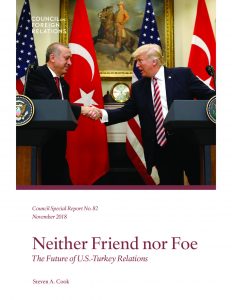
 Council Special Report No. 82 November 2018
Steven A. Cook
The Council on Foreign Relations (CFR) is an independent, nonpartisan membership organization, think tank, and publisher dedicated to being a resource for its members, government officials, business executives, journalists, educators and students, civic and religious leaders, and other interested citizens in order to help them better understand the world and the foreign policy choices facing the United States and other countries. Founded in 1921, CFR carries out its mission by maintaining a diverse membership, with special programs to promote interest and develop expertise in the next generation of foreign policy leaders; convening meetings at its headquarters in New York and in Washington, DC, and other cities where senior government officials, members of Congress, global leaders, and prominent thinkers come together with Council members to discuss and debate major international issues; supporting a Studies Program that fosters independent research, enabling CFR scholars to produce articles, reports, and books and hold roundtables that analyze foreign policy issues and make concrete policy recommendations; publishing Foreign Affairs, the preeminent journal on international affairs and U.S. foreign policy; sponsoring Independent Task Forces that produce reports with both findings and policy prescriptions on the most important foreign policy topics; and providing up-to-date information and analysis about world events and American foreign policy on its website, CFR.org.
The Council on Foreign Relations takes no institutional positions on policy issues and has no affiliation with the U.S. government. All views expressed in its publications and on its website are the sole responsibility of the author or authors.
Council Special Reports (CSRs) are concise policy briefs, produced to provide a rapid response to a developing crisis or contribute to the public’s understanding of current policy dilemmas. CSRs are written by individual authors—who may be CFR fellows or acknowledged experts from outside the institution—in consultation with an advisory committee, and are intended to take sixty days from inception to publication. The committee serves as a sounding board and provides feedback on a draft report. It usually meets twice—once before a draft is written and once again when there is a draft for review; however, advisory committee members, unlike Task Force members, are not asked to sign off on the report or to otherwise endorse it. Once published, CSRs are posted on CFR.org.
For further information about CFR or this Special Report, please write to the Council on Foreign
Relations, 58 East 68th Street, New York, NY 10065, or call the Communications office at
212.434.9888. Visit our website, CFR.org.
Copyright © 2018 by the Council on Foreign Relations ®, Inc. All rights reserved.
Printed in the United States of America.
This report may not be reproduced in whole or in part, in any form beyond the reproduction permitted by Sections 107 and 108 of the U.S. Copyright Law Act (17 U.S.C. Sections 107 and 108) and excerpts by reviewers for the public press, without express written permission from the Council on Foreign Relations.
To submit a letter in response to a Council Special Report for publication on our website, CFR.org, you may send an email to [email protected]. Alternatively, letters may be mailed to us at: Publications Department, Council on Foreign Relations, 58 East 68th Street, New York, NY 10065. Letters should include the writer’s name, postal address, and daytime phone number. Letters may be edited for length and clarity, and may be published online. Please do not send attachments. All letters become the property of the Council on Foreign Relations and will not be returned. We regret that, owing to the volume of correspondence, we cannot respond to every letter.
This report is printed on paper that is FSC ® Chain-of-Custody Certified by a printer who is certified by BM TRADA North America Inc.
CONTENTS
iv Foreword
vi Acknowledgments
1 INTRODUCTION
3 A TROUBLED PARTNERSHIP
7 TURKEY’S WANING IMPORTANCE
10 THE CURRENT APPROACH TO TURKEY
16 RECOMMENDATIONS
21 CONCLUSION
22 Endnotes
26 About the Author
27 Advisory Committee
FOREWORD
The time has come for the United States to rethink its approach toward Turkey. What we are witnessing is the gradual but steady demise of a relationship; Turkey may be an ally in the formal sense, but it is no partner. Nor is it much of a democracy. As Eni Enrico Mattei Senior Fellow for Middle East and Africa Studies Steven Cook argues in this new Council Special Report, the United States and Turkey do not share interests or values, and their ties are marked by ambivalence and mistrust. Although the bilateral relationship has always had its share of irritants, the overarching threat posed by the Soviet Union allowed both countries to look past these disagreements. Now, almost thirty years after the Cold War, the United States and Turkey often find themselves on different sides of a variety of important issues.
Turkey does not fit neatly into a box. It is not a true ally, nor is it a strategic competitor or enemy. Rather, as Cook describes, Turkey is “an antagonist whose leaders resent U.S. hegemony . . . and want to alter the regional political order that helps make U.S. predominance possible.” Cook chronicles the many differences between the United States and Turkey: The United States objects to Turkey’s intention to purchase an advanced air defense system from Russia, Ankara’s targeting of Wash- ington’s Syrian Kurdish allies, Turkish efforts to help Iran evade sanc- tions, and Turkey’s increasingly repressive policies at home, among others. Turkish officials, for their part, object to U.S. coordination with and aid to a Syrian Kurdish fighting force that Turkey fears will even- tually seek an independent Kurdish state that could include parts of present-day Turkey. Ankara also protests the presence of a cleric in the United States who it believes was behind a recent coup attempt, sanc- tions the United States has levied against it, and U.S. tariffs on Turkish steel and aluminum.
In the absence of a common threat or a larger shared strategic objective, this laundry list of disagreements is likely to dominate the relationship. Cook argues for a new approach to Turkey, one in which the United States opposes Turkey directly when Ankara works against U.S. policy or interests. In practice, this would mean reducing depen- dence on access to Turkish military facilities, denying Turkey access to advanced military hardware like the F-35, standing by the Kurds in Syria in the fight against the so-called Islamic State, and publicly criti- cizing Turkey when it is warranted.
While President Donald J. Trump has written that the recent release of an American pastor who had been detained by Turkey “will lead to good, perhaps great, relations between the United States & Turkey,” such hopes are misplaced. Rather, as Cook explains, “cooperation between the countries will be limited and contingent on specific circum- stances.” The strategic U.S.-Turkey partnership is a thing of the past, at least so long as Recep Tayyip Erdogan governs the country. Recogni- tion of that fact in Washington is necessary in order to pursue a more limited, transactional relationship that better serves U.S. interests.
Richard N. Haass
President
Council on Foreign Relations
November 2018
ACKNOWLEDGMENTS
I would like to thank Ambassador Eric Edelman and the members of the Advisory Committee for their time and input. I, alone, am responsible for the content of this Council Special Report. I would also like to thank the Council’s president, Richard Haass; James Lindsay, the director of studies; Julie Hersh, production editor; and Katharine Poppe, research associate, for the time and attention they devoted to this report.
Steven A. Cook
INTRODUCTION
Since the 1950s, U.S. presidents have recognized Turkey as a critical ally. Throughout the Cold War, close U.S.-Turkish security coopera- tion played an important role in containing the Soviet Union. Despite difficulties throughout the decades of partnership, the overarching threat that the Soviets posed to both countries ensured that these crises, problems, and irritants never broke the bilateral relationship or Turkey’s North Atlantic Treaty Organization (NATO) membership. The legacy of this Cold War partnership continues to frame U.S. policy discussions about Turkey in which the country is routinely referred to as a strategic ally.
Yet the United States and Turkey’s past alliance does not mean they will be partners in the future. The world has changed consider- ably since the Cold War ended. The transformations in global, U.S., and Turkish politics over the last three decades require a reevaluation of the U.S.-Turkey relationship. As difficult as bilateral relations have become under President Recep Tayyip Erdogan and his Justice and Development Party (AKP), many of the problems in U.S.-Turkey ties are structural. Had Erdogan never come to power, there would still be a strain between Washington and Ankara. Turkish opposition politi- cians have been supportive of the Bashar al-Assad regime, are hostile to expressions of Kurdish nationalism, joined the AKP in demand- ing Fethullah Gulen’s extradition from the United States, and stoke anti-Americanism.
Although some present and former U.S. policymakers continue to make the case that Turkey is a strategic partner and an anchor for stability, the evidence for these declarations is thin.1 The two countries do not share interests or values. Officials in Ankara have made it clear through their rhetoric and actions that the goals of American foreign
policy conflict with Turkey’s interests. Turkish leaders are also suspi- cious of the United States, casting blame for the Gezi Park protests in
2013 and the failed July 15, 2016, coup d’état in part on the United States. As a result, Ankara has sought to diversify its foreign policy, forging stronger ties with Moscow and Tehran as well as attempting to repair its relations with the EU.
Analysts and officials looking for a new and positive framework for bilateral ties are unlikely to find one. Instead, the basic assumption that should guide Washington in its approach to Ankara is that while Turkey remains formally a NATO ally, it is not a partner of the United States. The two countries are linked to each other by the Cold War, but with few common interests three decades after that conflict came to an end, the bilateral relationship is marked by ambivalence and mistrust.
The strategic relationship is over, and going forward, cooperation between the countries will be limited and contingent on specific cir- cumstances. Policymakers should regard Turkey as neither a friend of the United States nor as an enemy. In many areas, Turkey is a competi- tor and antagonist of the United States. As a result, American officials should abandon the intensive and often fruitless diplomatic efforts to convince Turkish policymakers to support the United States. Instead, the United States should not be reluctant—as it has been in the past— to oppose Turkey directly when Ankara undermines U.S. policy. In practical terms this means the United States should develop alterna- tives to Incirlik Air Base, suspend Turkey’s participation in the F-35 jet program, and continue to work with the People’s Protection Units (YPG) to achieve its goals in Syria.
A TROUBLED
PARTNERSHIP
The partnership between the United States and Turkey was never as warm as it is often remembered. The John F. Kennedy administration’s withdrawal of Jupiter missiles from Turkey beginning in April 1963, the
1964 letter from President Lyndon B. Johnson to Prime Minister Ismet Inonu warning Turkey not to “intervene and occupy” Cyprus, Turkey’s occupation of that country in 1974, the U.S. arms embargo in response, U.S. military aid to Greece that helped to check Ankara’s ambitions in the Aegean Sea, and regular diplomatic skirmishes over recognition of the 1915 Armenian genocide buffeted the relationship. However, the overarching threat of the Soviet Union ensured that these crises, prob- lems, and irritants never disrupted the bilateral relationship. In recent years, tensions have increased as both countries have pursued poli- cies that are perceived to be harmful to the other. The grievances that Americans and Turks harbor are not causes of the troubled U.S.-Turkey relationship, but rather symptoms of this problem.
U.S. COMPLAINTS
The list of differences between the United States and Turkey is long and highlights their diverging interests, policies, and perspectives. First, and most important, is Ankara’s intention to purchase an advanced air defense system, the S-400, from Russia. Because Turkey will both operate the F-35, the newest high-tech jet in the American military inventory, and depend on Russia for maintenance and spare parts for the S-400, Moscow will be in a position to glean valuable intelligence on how to detect the plane. In July 2018, Congress prohibited delivery of the F-35 until the Department of Defense provides “an assessment of the impacts of a significant change in participation by the Republic of
Turkey in the F-35 program and the steps that would be required to mit- igate negative impacts of such a change on the United States and other international program partners.”2 In a press release, Senators Jeanne Shaheen (D-NH) and Thom Tillis (R-NC) made clear that “significant change” meant possible Turkish elimination from the project.
Second in terms of importance is the Turkish effort to complicate the fight against the self-declared Islamic State, notably through Anka- ra’s incursion into northern Syria, where it has targeted Washington’s Syrian Kurdish allies. This includes Turkey’s invasion and occupa- tion of Afrin and the surrounding area in Syria’s Aleppo Governor- ate, drawing U.S.-allied Kurdish fighters away from the fight against the Islamic State. At the same time, the Turkish government and the government-friendly press intensified their anti-American messag- ing, including by making threats to U.S. soldiers and officers in Syria. Third, throughout his tenure Erdogan has demonstrated a willingness to undermine U.S. policy on Iran, by attempting (with Brazil) to negoti- ate a separate nuclear agreement with Tehran, opposing UN sanctions on that country, and then helping Iran evade those sanctions.3
Another point of conflict was the arrest and trial of Andrew Brunson—a pastor who led a small evangelical church in Izmir for twenty-four years—on terrorism charges. In response to Brunson’s detention and after failed efforts to win his release, the Senate For- eign Relations Committee in July 2018 unanimously approved a bill to “restrict loans from international financial institutions to Turkey until the Turkish government stops the arbitrary detention of U.S. citizens and embassy employees.”4 The Senate’s legislation was also aimed at pressuring Ankara to release between fifteen and twenty Turkish U.S. citizens—including a NASA scientist—as well as three Turkish employ- ees of the U.S. Embassy who were arrested on terrorism charges. A few days after the committee’s vote, the Trump administration imposed sanctions on the Turkish ministers of justice and the interior over their roles in the Brunson affair. The Turkish government responded in kind, with sanctions on the U.S. attorney general and secretary of the inte- rior. By President Erdogan’s own admission, Brunson was, at least ini- tially, being held as a bargaining chip to secure the extradition of the Pennsylvania-based cleric Fethullah Gulen, whom the Turkish govern- ment blames for the failed July 2016 coup.5
A series of lesser-known but still serious irritants complicate U.S. interests. Turkey is establishing a military presence in the Red Sea, heightening tensions between Egypt and Turkey as well as Egypt and Sudan. Ankara has also contributed to confrontations between
Palestinians and Israeli police in Jerusalem.6 Turkey has routinely vio- lated Greek airspace, threatening the stability of the Aegean Sea. An attack on U.S. citizens by Erdogan’s security team outside the Turkish ambassador’s Washington, DC, residence on May 17, 2017, continues to outrage members of Congress.7
Finally, even if the Donald J. Trump and Barack Obama administra- tions overlooked Erdogan’s consolidation of power and correspond- ing suppression of journalists, academics, civil society organizations, and minorities, this crackdown contradicts the values, principles, and norms of American society and is inconsistent with the underlying principles of Turkey’s NATO membership.
TURK ISH COMPLAINTS
Turkish officials have their own list of grievances against the United States. Turks across the political spectrum are angry that the United States imposed sanctions on two government ministers over the deten- tion of Pastor Brunson. The Trump administration imposed additional tariffs on Turkish steel and aluminum in August 2018 after the Turkish government reneged on a deal to release Brunson. The tariffs hastened an already falling lira, leading President Erdogan to declare that the United States was engaged in “economic warfare” against Turkey.8
Turkish anger at U.S. policy goes back much further than the summer of 2018, however. Turks charge that the U.S. invasion of Iraq in
2003 undermined Turkey’s security because the subsequent occupation coincided with the expiration of the cease-fire declared by the Kurdi- stan Workers’ Party (PKK), which has been waging war against Turkey since the mid-1980s. More important, Turkey faults the Obama admin- istration’s refusal to undertake regime change in Syria, where civil con- flict since 2011 has not only produced a massive refugee flow into Turkey but also raised Turkish fears about the emergence of a terrorist state on the country’s southern border.
Since late 2014 the United States has been coordinating militarily with the YPG, a Syrian Kurdish fighting force, and later began supply- ing it with weapons. The Turkish government argues credibly that the YPG is part of the PKK, which the United States has long designated a terrorist group. The YPG controls territory in and around major Kurdish population centers in northern Syria, and the YPG-affiliated Democratic Union Party (PYD) has a declared goal of establishing a Kurdish state. Turkey fears that terrorists would use such an autono- mous entity to launch attacks on Turkey, presaging the partition of Turkish territory—a nightmare scenario for which, from the perspec- tive of the Turkish government and millions of Turks, the United States is responsible.9
Also of great importance to Ankara is the fate of Fethullah Gulen. Ankara blames him and his followers for the failed July 2016 coup d’état that killed 249 people. The attempted coup and its aftermath shook Turkish society to the core. Many Turks believe Gulen’s followers are a fanatical cult that infiltrated the Turkish state in order to overthrow it. In response to the failed coup, Turkish authorities requested Gulen’s extradition from the United States. Thus far, U.S. officials have deter- mined that the evidence presented for Gulen’s culpability is inconclu- sive and so have not ordered his return to Turkey.10 For many Turks, Gulen’s presence in the United States is an affront, the way it would be to Americans if Osama bin Laden lived in Turkey’s countryside and Turkish officials did not hand him over to U.S. authorities. It is for these reasons that 72 percent of Turks polled in 2017 believe that the exercise of U.S. power and influence in Turkey’s neighborhood places the secu- rity of their country in jeopardy.11
Another significant source of tension is the sentencing of Mehmet Hakan Atilla to thirty-two months in federal prison after a 2017 trial in New York. Atilla was the deputy general manager of Halkbank, a Turk- ish bank of which the government owns the majority shares. The trial revealed Ankara’s extensive efforts to help Tehran evade sanctions and thus uncovered corruption at the highest levels of the Turkish govern- ment.12 For Turkey’s leaders, Atilla’s arrest and conviction were politi- cally motivated.
Finally, the Turkish government counters criticism of its plan to purchase the S-400 with the charge that the United States has been dragging its feet in response to Ankara’s request to purchase a U.S.-manufactured system.
U.S. and Turkish complaints mirror one another in important areas and undermine the idea that the United States and Turkey share inter- ests and goals. U.S. and Turkish officials believe their counterparts support terrorists, abet the exercise of Russian power, and pursue poli- cies that destabilize the Middle East. These problems can no longer be glossed over or explained away easily because, unlike in previous eras, Washington and Ankara no longer share overarching threats or inter- ests that bind them together.
TURKEY’S WANING
IMPORTANCE
After the Cold War, the common threat to Washington and Ankara diminished, but the importance U.S. policymakers attributed to Turkey did not.
In the 1990s, U.S. officials and analysts believed that Turkey was uniquely placed to guide the economic development and democratiza- tion of the newly independent states of Central Asia. Also during that time, rapidly developing security ties with Israel gave rise to the idea that Americans, Israelis, and Turks would be partners in the security and stability of the eastern Mediterranean and the Levant. During the early part of the AKP era, Turkey’s good offices with Arabs and Israelis led American officials to believe that it could be a facilitator of regional peace.
Not long after Condoleezza Rice became secretary of state in early 2005, she visited Turkey, where she declared that Washington and Ankara enjoyed a “very important strategic relationship” based on shared interests, a “common view of the future,” and “common values.”13 During this time, the height of President George W. Bush’s Freedom Agenda, the notion that Turkey could be a “model” of a liber- alizing and developing Muslim society began to appear more often in policy discussions and analyses.14 The Obama White House picked up on this idea, especially after the uprisings in the Arab world.
Despite the U.S. policy community’s enthusiasm, Turkey proved unable to influence Central Asian countries, could not provide leader- ship in the Middle East, would not facilitate peace, and was not a model for the Middle East. Policymakers in Washington and beyond over- estimated Turkey’s capacities; underestimated the historical legacies of Ottoman domination of Arab societies, where Ankara’s favorabil- ity ratings among publics plummeted after 2012; and misread Turkish domestic politics and the worldview of the country’s leadership. In Central Asia, the legacies of Soviet colonization and Moscow’s endur- ing political influence proved an obstacle to the revivification of an alleged shared Turkic identity.15
From one perspective, the fact that Turkey sits at the geographic center of many of the United States’ most pressing foreign policy con- cerns still makes Turkey a valuable partner. Advocates of this view rec- ognize that Ankara is a fractious ally, but nevertheless maintain that Ankara is crucial to Washington’s strategic goals in the Middle East.16
These analysts discount Turkey’s growing commercial ties with Iran and periodic high-level visits of Iranian and Turkish officials to one another’s capitals, arguing that historical, cultural, and geostrate- gic factors will always render Turkey an important counterweight to Tehran. Turkey has partially proved this by continuing to host a U.S. radar installation in southeastern Turkey, which is part of a broad West- ern effort to counter Iran’s missile and nuclear threats. Gaining Turkish agreement required an extraordinary intervention by President Obama, however, and the radar installation should not obscure Ankara’s consis- tent willingness to weaken international pressure on Iran. While Turkey has decreased the amount of Iranian oil it imports, Ankara has signaled that it will continue to purchase gas from Iran after November 4, 2018, defying U.S. efforts to isolate Tehran after the Trump administration withdrew from the Joint Comprehensive Plan of Action.
Some members of the policy community believe that Turkey’s large military structures and NATO membership are assets in the great power competition, as they were during the Cold War.17 The argu- ment does not hold up under scrutiny. Turkey has been a longstanding NATO partner in the Afghanistan mission, but elsewhere Ankara’s commitment to NATO is ambiguous. Turkey is purchasing a Russian- manufactured S-400 air defense system, which, as noted, could expose the Russian government to important intelligence about the F-35 jet. The Turkish government apparently does not believe it needs to heed NATO’s concerns about its purchase of Russian-manufactured mili- tary equipment or its developing relations with Moscow. For Turkish leaders, establishing closer ties with Moscow is entirely reasonable given the way they perceive their ties with the West: Turks have long questioned whether NATO would come to its defense, U.S. coordina- tion with the YPG is viewed as an existential threat, and the widely held perception that Ankara’s allies were slow to denounce the attempted coup in July 2016 has reinforced the idea in Turkey that the United States seeks regime change there. In addition, although the United States and
Turkey harbor grave concerns about a potential Syrian-regime and Russian assault on Syria’s Idlib Governorate, the demilitarization agreement that Ankara and Moscow struck in September 2018 reflects Turkey’s dependence on Russia to help secure Ankara’s interests. It is also part of a broader Russian strategy to pull the Turks away from the West and thereby weaken the transatlantic alliance. Thus, from the U.S. perspective, the agreement avoided an attack and possible humanitar- ian disaster for the three million civilians in Idlib—at least temporarily. At the same time, Turkish-Russian cooperation also demonstrates that Ankara is far outside the NATO consensus concerning the threat that Moscow poses to the alliance and its interests. This is quite obviously a problem for American officials. Under these circumstances, it does not make sense for U.S. policymakers to declare Turkey a strategic partner in the competition between the United States and Russia.18
Rather than a strategic alliance, Turkish leaders seek a regional status that allows Ankara to shape the immediate geopolitical envi- ronment and maximize Turkish economic, political, diplomatic, and military influence. Toward that end, it has over time resisted an inter- national order that has facilitated the exercise of American power. This is Turkey’s right, but it places the country on the opposite end of the United States on a variety of important issues.
Before the war of words began between the two countries in the summer of 2018, policymakers and analysts in Washington had never considered the possibility that the Turkish government and the Turkish people might no longer want to be strategic partners with the United States. Turks resent what they believe to be Washington’s unfair treat- ment of their country and its relegation as an asset in the service of U.S. goals rather than a peer with its own interests and views. Western observers want to place Turkey in either the West or the East, but Turks do not see the world that way. They regard Turkey as a strong, indepen- dent power in its own right whose own interests, not the wishes of the United States, dictate its foreign policy.
THE CURRENT
APPROACH TO TURKEY
U.S. policymakers have generally worked to try to preserve the stra- tegic relationship, but it is reasonable to infer from the actions and rhetoric of the Turkish leadership that Ankara has determined that partnership with the United States is no longer in Turkey’s interests. These circumstances raise questions about the best U.S. approach to Turkey in the future.
Ankara is not Washington’s strategic competitor, since it has little positive influence in the Middle East, Europe, the Caucasus, or Central Asia. Neither is Turkey an enemy, though at times it is hard to distinguish its actions from those of one. It is rather an antagonist whose leaders resent U.S. hegemony, especially in the Middle East, and want to alter the regional political order that helps make U.S. predominance possible.
Turkey remains formally tied to the United States and the West through NATO, from which it cannot be expelled; Ankara’s contin- ued European Union membership candidacy, even though accession negotiations are frozen; the country’s economic ties to Europe; and its often overstated security and intelligence cooperation with the United States. This encourages analysts and officials to think a change in the U.S.-Turkey relationship would be disastrous for Washington.
In response to deteriorating ties, advocates who want to save the strategic partnership propose intensive diplomacy with Ankara and advise U.S. policymakers to look the other way when it comes to Tur- key’s bad behavior because of the country’s importance.19 Yet this importance is increasingly difficult to define in positive terms. Those officials and observers believe that the U.S.-Turkey relationship could be “saved” and returned to “normal” if policymakers found just the right combination of incentives. But normal is an idealized version of what was sometimes a difficult and frustrating relationship even during the Cold War. Saving the relationship also presupposes that Turkey and the United States share a broad range of common interests. It is not clear that even with enough diplomatic tenacity, Washington can rebuild trust and strategic ties with Ankara.
A LOT OF HONEY AND SOME VINEGAR
U.S. policymakers have often pursued a “more honey than vinegar” policy toward Turkey, emphasizing incentives, which has not yielded results. The underlying rationale for this approach is the idea that intensive American diplomacy could encourage Ankara to support the United States and that Turkey is too important a “strategic partner” to risk creating a rift. Presidents Bush, Obama, and Trump have been will- ing to countenance the Turkish government’s efforts to undermine U.S. policy in large part because of the utility of Turkey’s Incirlik Air Base.
Yet officials in Washington tend to underestimate the hidden costs associated with their willingness to strike agreements with Turkey over the use of the base. The problem was brought into sharp relief on July
22, 2015, when, after a year of negotiations, the Turkish government gave permission for the anti-ISIS coalition to undertake combat oper- ations from Incirlik. As part of the deal, the Turks were supposed to increase their operations against the Islamic State, while U.S. policy- makers provided assurances that the United States would increase its help to Turkey in the fight against the PKK. The Turks, by their own admission, prioritized the latter at the expense of the former.20 The Obama administration chose to overlook the Turkish government’s ambivalence about the counter-ISIS campaign so long as the United States continued to have access to Incirlik.
The agreement over the base had broader implications, however. It sent the message to Ankara that Turkey is indispensable to the United States, which leaves Washington vulnerable to Turkish threats to rescind permission to use Incirlik. This, in turn, led Turkey’s leaders to believe that they could act without regard for U.S. interests.
Until recently, the White House had been publicly passive in response to a range of Turkish policies that were unhelpful, even damaging, to American interests. For example, after Ankara arrested a number of Turkish employees of the U.S. Embassy and harassed their families in October 2017, the Trump administration suspended visa processing for Turks traveling to the United States. In an effort to forestall continued decomposition of bilateral ties, the administra- tion rescinded the order soon after. In response, Turkish leaders have simply pocketed American goodwill without any reciprocal effort, as they have routinely done in the past, and continued to target Foreign Service nationals.
Then there was the Trump administration’s effort to manage Turk- ish policies that complicate U.S. efforts in Syria, notably Turkey’s Jan- uary 2018 Operation Olive Branch. Though Turkey’s incursion into Syria and occupation of predominantly Kurdish areas drew YPG fight- ers away from the continuing battle with the Islamic State, the Turk- ish leadership announced its intention to carry out military operations through areas under control of the U.S. military and its Kurdish allies, threatening to harm U.S. military officers in the process. After setting up a forum to negotiate the future of the U.S. presence in northeast- ern Syria, President Trump agreed to a deal on Manbij that forced the YPG out of the strategic town and east of the Euphrates River, meeting Ankara’s demands without getting anything tangible in return. Even as Ankara highlights “joint” U.S.-Turkey patrols along the line dividing Turkish- from Kurdish-controlled areas near Manbij—the patrols are actually independent, but coordinated—Ankara has complained that the United States has not held up its part of the deal.
U.S. officials argue that despite Turkey’s heated rhetoric about the YPG, the Turks did not actually disrupt U.S. efforts against the Islamic State. This is accurate, but it downplays Turkey’s repeated efforts to drive a wedge between the United States and the YPG—a goal Ankara advanced with Operation Olive Branch. Turkey’s push into Syria carved out an area of Turkish influence in the Afrin district that consid- erably slowed U.S. operations against the Islamic State. This allowed the Islamic State to regroup and consolidate its defense in the areas that remain under Abu Bakr al-Baghdadi’s control. The U.S. acquiescence to Turkey’s invasion also raised questions among Syrian Kurdish sup- porters of the YPG about Washington’s commitment to them.
In July 2018, the White House objected when the Turkish govern- ment tried to change the terms of a deal that would have traded Andrew Brunson for Mehmet Hakan Atilla at the last minute. Although the Trump administration’s tough stand on Pastor Brunson was a welcome change in the approach to Turkey, efforts to free him may be the excep- tion that proves the rule, given how important the issue has become to Trump’s evangelical supporters. The dramatic deterioration of bilat- eral relations has been framed around Brunson and the imposition of American sanctions and additional tariffs in response. It is possible that after his release in October 2018, the administration will default to its previous policy, which overlooked Turkish policies that undermine U.S. goals and contradict American values.
A POISONED RELATIONSHIP
Successive U.S. administrations have also discounted the reservoir of anti-Americanism that Turkish politicians have used to their political advantage because the alleged benefits of strategic ties with Turkey outweighed the costs of unfortunate rhetoric. Hostility to U.S. policy has long been a problem in Turkey. In the past, the Cyprus issue, the Armenian genocide, and the asymmetric power relationship between Washington and Ankara were the main sources of anti-Americanism.
More recently, Turkey was quick to express support and dispatched forces to Afghanistan after the September 11 attacks on New York City and Washington, DC, but in time many Turks came to believe that what Americans referred to as the “global war on terrorism” was actually a war on Islam, and thus a war on their identity.21 Then the warm American reception to the 2002 electoral success of the Justice and Development Party (AKP) raised suspicions among some Turks that the United States was not committed to Turkey’s officially secular political order.
Anti-Americanism intensified during the AKP era, particularly after the United States forged a military relationship with the YPG and the failed July 15, 2016, coup d’état. As noted, the ties with the Syrian Kurdish fighting force have stoked fear that Washington is midwifing a terrorist state on Turkey’s southern border. And when it came to the aborted putsch, Turkey’s leaders, their supporters, the press, and the opposition blamed the attempted power grab on Fethullah Gulen with the assistance of American officials and even private American citi- zens. Erdogan himself publicly encouraged conspiracy theories about U.S. culpability and subsequently denigrated the U.S. justice system when the extradition of Gulen was not forthcoming.22 U.S. policymak- ers allowed these erroneous and dangerous allegations to go publicly unchallenged. Instead, after the attempted coup, U.S. officials were reduced to making tours of Ankara, reaffirming the importance of U.S.-Turkish ties, and implicitly apologizing for what the Turks per- ceived to be insufficient support from the Obama White House.
Regardless of whether the Turkish leadership actually believes its own rhetoric about the United States, the effort to delegitimize and debase the U.S.-Turkish relationship is harmful. The sixteen-year tenure of the AKP and Erdogan means that younger Turks know noth- ing other than the caricatures of the United States that Turkish officials and the media offer. This is not just an AKP issue, however. Across the political spectrum, Turkey’s politicians have been vicious in their rheto- ric about the United States, a phenomenon that predates Washington’s relationship with the YPG or the failed 2016 coup.
A REPRESSIVE STATE
Turkey was never a fully functioning democracy, but members of the U.S. government and policy community always believed that the Turkish political system was democratic enough. Elections were held regularly, they were free and fair, the military handed the reins of gov- ernment back to civilians after coups, and Turks wanted to join the EU. As a result of the AKP’s wide-ranging reforms in 2003 and 2004, many in Turkey and the West believed the party would be a steward of the country’s democratic transition.23 This was incorrect: although the AKP has provided political stability, economic opportunity, infrastruc- ture development, improved access to health care, and greater social mobility in the sixteen years it has been in power, it has also effected considerable democratic regression.
Erdogan is not a tin-pot dictator and maintains a large constituency, but the deepening authoritarianism in Turkey has had grave conse- quences for ideals that Americans hold dear. Since the failed coup in July 2016, a purge that was already underway accelerated; as many as two hundred thousand people have been detained, arrested, or fired. Turkey holds the dubious distinction of being the world’s worst jailer of journalists, outstripping even China and Egypt.24
Senior U.S. officials have rarely spoken out about these issues, rea- soning that there was little they could do and there are no alternatives to the AKP. Yet American silence in response to the Turkish government’s repression reinforces the notion that there are no consequences for Ankara’s egregious violations of democratic norms, leaving democrats in Turkey vulnerable to a predatory state.
RECOMMENDATIONS
A new U.S. approach to Turkey is needed. Officials and analysts in both countries have offered ideas for fixing the relationship, though these ostensible solutions often reflect the underlying tensions that caused the deterioration of ties. For example, Turks suggest that Washing- ton end its relationship with the YPG as a condition of better bilateral relations. From the U.S. perspective, this suggestion betrays Turk- ish ambivalence about fighting the Islamic State. Likewise, the U.S. demand that Turkey abandon its plan to purchase the S-400 air defense system from Russia underestimates Ankara’s concern that NATO is reluctant to help defend Turkish borders and that Washington secretly desires regime change in Turkey.
The level of mistrust between the two governments is so high that continued diplomatic dialogue is unlikely to arrest the decline in rela- tions. Even if there were clear steps that Washington could take, there is little reason to believe that the U.S.-Turkey relationship will return to a more constructive pattern.
Rather than expending diplomatic resources in what would likely be an unsuccessful effort to “save” the relationship or simply punishing Turkey, U.S. officials, including members of Congress, need to manage the change in U.S.-Turkey relations. To do so, Washington should take the following steps.
First, U.S. policymakers should recognize that the United States and Turkey have gone from ambivalent allies to antagonists. This devel- opment has long been in the making. The bitterness is made worse by the particular personalities of the American and Turkish presidents, but the fallout the two countries experienced in the summer of 2018 is, in large part, structural. Americans and Turks define their national interests and priorities differently. Going forward, the United States needs to adjust its expectations, ask for less, and develop other options.
Second, the United States should develop alternatives to Incirlik Air Base. While Incirlik was important to the fight against the Islamic State and may be important in future crises, the base has also become useful to Turkey’s leaders in domestic politics. Turkish officials have threatened to rescind permission for the anti-ISIS coalition’s use of the facility over the U.S. relationship with the YPG—a warning that plays well with nationalists.25 To Ankara’s credit, it never carried through on these threats. But because Erdogan’s domestic political needs can dictate Turkey’s foreign policy, and Turks are hostile toward the United States, the use of the base to advance U.S. interests is no longer assured. American officials should never again be forced into a position that leaves U.S. security interests vulnerable to the changing interests of Turkish politicians.
In 2003, when the Turks denied the United States access to the base, and again in 2014, when they would not permit the anti-ISIS coalition to use the base to conduct combat operations, the U.S. military proved that it can be effective without Incirlik. Consequently, U.S. officials should hedge against continuing changes in the U.S-Turkey relationship and negotiate agreements to establish or improve American access to bases in Cyprus, Greece, Jordan, Romania, and potentially Iraq. The Greeks and Romanians have already hosted American forces and would likely welcome the expansion of military-to-military ties with the United States. Cyprus hosts a detachment of the U.S. Air Force’s Ninth Recon- naissance Wing on the island and is looking for ways to improve its geo- strategic usefulness to the United States. American bases in the Middle
East are more sensitive, but the cooperation between the United States and Jordan in the fight against the Islamic State should be continued and expanded. When it comes to Iraq, the issue of American basing of course depends on the country’s stability and difficult politics. It is unclear whether the Turkish government would fight or welcome the expansion of American options, which is why it is important that the United States develop alternatives to Incirlik.
Third, the United States should not accept Turkey’s demands that it end its military ties with the YPG. The group, in coordination with U.S. Special Forces, has been an effective force fighting the Islamic State and stabilizing northeastern Syria. It would have been preferable for the United States to work with Turkey, but in 2014, when the United States sought allies in the fight against the terrorist group, Ankara declared that its priority was fighting Kurdish nationalism.26 For the United States to turn its back (again) on the Kurds would further tarnish Wash- ington’s claim to be a reliable ally and risk the gains from its ties with the YPG—notably, destroying much of the Islamic State’s capabilities in Syria, stabilizing the area following the group’s defeat, and establishing a credible U.S. presence in Syria, giving the United States some lever- age with Iran and Russia.
The YPG and its affiliated political party, the PYD, do not repre- sent all Syrian Kurds, and the YPG is an affiliate of the PKK, which has been waging a violent campaign against Turkey for three decades. However, the United States has no other option. Turkish ambivalence about fighting the Islamic State made it an unreliable partner. Washing- ton could not accept the Turkish proposal to fight the terrorist group using Turkish-backed elements of the Free Syrian Army because these groups were poorly trained, deemed militarily ineffective, and/or sus- pected of links to extremists. There is no indication that if the United States gave up its ties to the YPG, the Turkish government would align with Washington in other areas—including the emerging great power competition with Russia.
The Trump administration has already acceded to Ankara’s demands that the YPG leave Manbij without any appreciable change in Turkish policy. This is because Turkey’s leaders do not believe American assur- ances that Washington does not seek the establishment of a Kurdish state in Syria and elsewhere. From the U.S. perspective, Turkish efforts against the Islamic State have been sporadic and Ankara’s coordination with other extremists groups damaging. Under these circumstances, the risks associated with ending U.S. ties with the YPG, and the uncertain benefits, make it prudent to continue working with the YPG.
And last, U.S. officials should take a stronger public stand on Turkish policies that undermine U.S. policy. Private diplomacy and persuasion behind closed doors over a long period of time is often a successful diplomatic method. Yet playing the long game does not always work. Records from the Bush, Obama, and Trump adminis- trations indicate that remonstrating with Turkish officials in private and publicly praising them has little, if any, effect on the policies that Ankara pursues at home and abroad. Toward that end, the United States should end its cooperation with Turkey on the F-35 program. The Turkish government simply cannot purchase advanced weapons from Russia, undermine American efforts and threaten U.S. forces in Syria, aid Iran, arrest American citizens, detain Turkish employees of the U.S. embassy, and commit repressions that violate the principles of Ankara’s NATO membership and expect to enjoy the benefits of America’s most advanced military aircraft.
There is, of course, no guarantee that applying public pressure on Turkey will alter its behavior for the better. It is also true that public pressure could contribute to the further deterioration of relations, though given how tense ties have become, this should be a secondary concern. Still, a policy that relies on more vinegar than honey is supe- rior to essentially consenting to Turkish actions through silence.
The political, economic, and diplomatic pressure that Russia brought to bear on Turkey after Turkish warplanes shot down a Russian bomber in November 2015 is instructive: in time, Erdogan was compelled to issue an apology and pursue a conciliatory approach to Moscow. The United States should not follow President Vladimir Putin’s thuggish approach to Turkey, but the episode demonstrates how Turkey’s leader responded positively to public censure. Similarly, Germany’s leaders made it clear to their Turkish counterparts that economic and finan- cial ties between the two countries would suffer if Ankara continued to target German journalists covering Turkish politics. Deniz Yucel, a dual German and Turkish citizen and a correspondent for Die Welt, was subsequently released from a Turkish prison.
American officials should not be reluctant to apply pressure on Ankara because Turks hold dismal approval ratings of the United States. Angela Merkel was able to compel the Turkish government to release Yucel despite the fact that only 18 percent of Turks have a favorable opinion of Germany and only 14 percent of Turks express confidence in her.27 It is possible that the demonization of the United States in Turkish politics might help Erdogan withstand pressure from Washington, but the Turkish government has much to lose, including everything from the F-35 and access to U.S. markets for its products to protection from a congressional resolution recognizing the Armenian genocide. The Trump administration’s own experience indicates that public pressure on Ankara is effective. After President Trump sanctioned Turkish min- isters and applied additional tariffs to Turkish aluminum and steel in the summer of 2018, the Turkish government released Andrew Brunson.
The Trump administration has demonstrated little interest in human rights abuses and assaults on the rule of law in Turkey, but that does not mean that Congress should follow suit. Legislators on both sides of the aisle have an opportunity to make Turks aware of Washing- ton’s anger at Ankara’s mistreatment of Americans, its displeasure over a foreign policy at variance with U.S. interests and goals, and its dismay over Turkey’s transformation into an elected autocracy.
These four recommendations represent a realistic basis for U.S.-Turkey ties that accept those relations as they are, rather than how policymakers would like them to be or how they imagine the partner- ship was in the past. They are intended neither to save the relationship nor punish Turkey, but rather to manage change and set proper expecta- tions. Turkey is an important country with which the United States can work in some areas, but the strategic relationship is a relic of the past.
CONCLUSION
Turkey is and will continue to be a member of NATO, but it is not a partner in the alliance. Ankara is linked to Europe through trade flows, investment, and financial institutions, but it does not desire to be part of the West, as defined by liberal norms, principles, and ideals. The bonds of the Cold War have long since weakened, and Turkey seeks to play the role of regional power in its own right with little regard for U.S. goals or interests. That is Turkey’s right and precisely why U.S. policymak- ers need to put aside the mythology of the past and reevaluate Wash- ington’s relationship with Ankara. In the future, U.S. policy should be based on the fact that Turkey is not a friend of the United States but is also not an enemy. Washington can work with Ankara where it remains possible, work around the Turks where it is necessary, and work against them where it has to.
ENDNOTES
- Michael Singh and James F. Jeffrey, “The U.S. Alliance With Turkey Is Worth
Preserving,” Foreign Policy, March 19, 2018, http://foreignpolicy.com/2018/03/19
/the-u-s-alliance-with-turkey-is-worth-preserving; Priorities and Challenges in the U.S. Turkey Relationship: Testimony Before the Senate Foreign Relations Committee, 115th Cong. (2017) (testimony by Amanda Sloat, fellow, Harvard Kennedy School’s Ash Center for Democratic Governance and Innovation), http://foreign.senate.gov
/imo/media/doc/090617_Sloat_Testimony1.pdf; U.S. Department of State,
“Joint Statement on Turkey-U.S. Strategic Partnership,” media note, February 16,
2018, http://state.gov/r/pa/prs/ps/2018/02/278388.htm; White House Office of the Press Secretary, “Fact Sheet: U.S.-Turkey Partnership,” May 16, 2013, http:// obamawhitehouse.archives.gov/the-press-office/2013/05/16/fact-sheet-us-turkey
-partnership.
- John S. McCain National Defense Authorization Act for Fiscal Year 2019, Pub. L.
No. 115-232, Title XII, Subtitle F, Sec. 1282.
- Benjamin Weiser, “Erdogan Helped Turks Evade Iran Sanctions, Zarrab Says,” New
York Times, November 30, 2017.
- Turkey International Financial Institutions Act, S. 3248, 115th Cong. (2018).
For the text of the bill, see http://foreign.senate.gov/imo/media/doc/Turkey%20
International%20Financial%20Institutions%20Act.pdf.
- Aykan Erdemir and Eric Edelman, “Erdogan’s Hostage Diplomacy: Western Nationals in Turkish Prisons,” Foundation for Defense of Democracies, June 2018.
- Michael Koplow, “Turkey’s Erdogan Playing High Stakes Election Game With Israel and United States,” Ahval, May 23, 2018, http://ahvalnews2.com/israel-turkey/turkeys
-erdogan-playing-high-stakes-election-game-israel-and-united-states; Dan Arbell, “Tensions Over Jerusalem Expose Vulnerability of Turkey-Israel Ties, One Year After Normalization,” Markaz (blog), July 31, 2017, http://brookings.edu/blog/markaz
/2017/07/31/tensions-over-jerusalem-expose-vulnerability-of-turkey-israel-relations
-one-year-after-normalizing-ties.
- The attack was part of a pattern of altercations on the part of Erdogan’s security guards, including a fight with UN police at UN headquarters, a melee in front of the Brookings Institution, and the assault of a member of the Ecuadorian parliament.
- President Recep Tayyip Erdogan at the Justice and Development Party Symposium hosted by the Foundation for Political, Economic, and Social Research (SETA), August
14, 2018, http://youtube.com/watch?v=r1l9hIPN6Go.
- Steven A. Cook, “The Entirely Rational Basis for Turkey’s Move Into Syria,” Atlantic, January 22, 2018, http://theatlantic.com/international/archive/2018/01/syria-turkey
-kurds-ottoman-isis/551099; Patrick Wintour, “Erdogan Accuses US of Planning to
Form ‘Terror Army’ in Syria,” Guardian, January 15, 2018, http://theguardian.com
/world/2018/jan/15/turkey-condemns-us-plan-for-syrian-border-security-force.
- Oya Artmutcu, “Turkey Sends New Files to US as Evidence for Gulen’s Extradition,”
Hurriyet Daily News, January 30, 2017, http://hurriyetdailynews.com/turkey-sends
-new-files-to-us-as-evidence-for-gulens-extradition–109121; Karen DeYoung, “Turkish Evidence for Gulen Extradition Pre-Dates Coup Attempt,” Washington Post, August 19, 2016.
- Dorothy Manevich and Hanyu Chwe, “Globally, More People See U.S. Power and
Influence as a Major Threat,” Pew Research Center, http://www.pewresearch.org
/fact-tank/2017/08/01/u-s-power-and-influence-increasingly-seen-as-threat-in-other
-countries.
- 12. Dorian Jones, “Erdogan Accuses US of ‘Political Coup Attempt,’” VOA News, January 9,
2018, http://voanews.com/a/turkish-president-accuses-us-coup-attempt/4199728.html.
- Condoleezza Rice, “Remarks With Foreign Minister Abdullah Gul After Meeting,” U.S. Department of State, February 6, 2005, http://2001-2009.state.gov/secretary/rm
/2005/41862.htm.
- The idea of a “model” was first popularized by David Remnick in November 2002, though the idea of a “Turkish model” in which the military plays a tutelary role in the political system had existed in policy discussions since the 1980s. David Remnick, “The Experiment: Will Turkey Be the Model for Islamic Democracy?,” New Yorker, November 18, 2002.
- “Middle East 2016: Current Conditions and the Road Ahead,” Zogby Research
Services, November 2016, http://zogbyresearchservices.com/new-gallery-5.
- Singh and Jeffrey, “The U.S. Alliance With Turkey Is Worth Preserving”; Tracy Wilkinson and W. J. Hennigan, “Straddling East and West, Turkey Is a Critical Ally in the Fight Against the Islamic State,” Los Angeles Times, July 15, 2016, http://latimes
.com/world/europe/la-fg-turkey-us-importance-20160715-snap-story.html.
- “Turkey: An Inconstant but Important U.S. Ally,” Stratfor Worldview, November 9,
2017, http://worldview.stratfor.com/article/turkey-inconstant-important-us-ally; James Stavridis, “Here’s How to Pull Turkey Back From the Brink,” Bloomberg View, October 20, 2017, http://bloomberg.com/view/articles/2017-10-20/here-s-how-to
-pull-turkey-back-from-the-brink; Kemal Kirisci, “How to Fix U.S.-Turkey Relations,”
New York Times, October 19, 2017, http://nytimes.com/2017/10/19/opinion/how-to
-fix-us-turkey-relations.html.
- U.S. Department of Defense, “Mattis, Turkish Defense Minister Discuss Complex
Syria Environment,” news release, February 16, 2018, http://defense.gov/News
/Article/Article/1443750/mattis-turkish-defense-minister-discuss-complex-syria
-environment.
- Stavridis, “Here’s How to Pull Turkey Back From the Brink”; Sloat, Priorities and
Challenges in the U.S.-Turkey Relationship.
- Piotr Zalewski, “Turkey Decides to Hit Kurdish Rebels Instead of ISIS,” Time, October
14, 2014, http://time.com/3507187/turkey-kurdish-rebels-pkk-isis-kobrani.
- Brian J. Grim and Richard Wike provide a concise review of polling done in Turkey in the mid-2000s in “Turkey and Its (Many) Discontents,” Pew Research Center, October
25, 2007, http://pewforum.org/2007/10/25/turkey-and-its-many-discontents. For historical perspectives on anti-Americanism in Turkey, see Aylin Guney, “Anti- Americanism in Turkey: Past and Present,” Middle Eastern Studies 44, no. 3 (May
2008): 471–87, and Omer Taspinar, “The Anatomy of Anti-Americanism in Turkey,” Brookings Institution, November 16, 2005, http://brookings.edu/articles/the-anatomy
-of-anti-americanism-in-turkey.
- 22. President Erdogan came closest to directly assigning blame for the failed July 2016 coup d’état during a January 2018 speech to the AKP’s parliamentary faction, reported in the pro-Erdogan daily Vatan. See “Erdoğan’dan Bahçeli’nin ‘ittifak’ açıklamalarına ilk yanıt geldi” (“Erdogan’s response to Bahceli’s declaration of alliance”), Vatan, January 9, 2018, http://gazetevatan.com/erdogan-dan-bahceli-nin-ittifak-aciklamalarina-ilk-yanit-geldi
-1133125-siyaset.
- Madeleine K. Albright, Stephen J. Hadley, and Steven A. Cook, U.S.-Turkey Relations: A New Partnership (New York: Council on Foreign Relations, 2012).
- Elana Beiser, “Record Number of Journalists Jailed as Turkey, China, and Egypt Pay Scant Price for Repression,” Committee to Protect Journalists, December 13, 2017, http://cpj.org/reports/2017/12/journalists-prison-jail-record-number-turkey-china
-egypt.php.
- 25. Kasim Cindemir, “Analysts: Turkey Unlikely to Follow Through on Threat to Close
Coalition Airbase,” VOA News, February 23, 2016, http://voanews.com/a/analysts-turkey
-unlikely-to-follow-through-on-threat-to-close-coalition-airbase/3203689.html.
- At the time of the Islamic State’s assault on the Syrian town Kobani, President Erdogan declared, “For Turkey, the PKK and ISIS are the same.” Turkish Prime Minister Ahmet Davutoglu then revealed Turkey’s ambivalence about the fight against ISIS when he stated, “Turkey will not embark on an adventure at the insistence of some countries unless the international community does what is necessary and introduces
an integrated strategy.” That “integrated strategy” was first and foremost an American intervention in Syria to bring down the Assad regime. See Piotr Zalewski, “Turkey Decides to Hit Kurdish Rebels Instead of ISIS,” Time, October 14, 2014, http://time
.com/3507187/turkey-kurdish-rebels-pkk-isis-kobrani.
- Max Hoffman, Michael Werz, and John Halpin, “Turkey’s ‘New Nationalism’ Amid Shifting Politics,” Center for American Progress, February 11, 2018, http:// americanprogress.org/issues/security/reports/2018/02/11/446164/turkeys-new
-nationalism-amid-shifting-politics; Global Indicators Database, Pew Research
Center, http://pewglobal.org/database/indicator/29/country/224.
ABOUT THE AUTHOR
Steven A. Cook is Eni Enrico Mattei senior fellow for Middle East and Africa studies at the Council on Foreign Relations (CFR). He is an expert on Arab and Turkish politics as well as U.S.-Middle East policy. Cook is the author of False Dawn: Protest, Democracy, and Violence in the New Middle East; The Struggle for Egypt: From Nasser to Tahrir Square, which won the Washington Institute for Near East Policy’s gold medal in 2012; and Ruling But Not Governing: The Military and Political Devel- opment in Egypt, Algeria, and Turkey. Cook is a columnist at Foreign Policy magazine. He has also published widely in international affairs journals, opinion magazines, and newspapers, and he is a frequent commentator on radio and television. His work can be found on his blog, From the Potomac to the Euphrates. Prior to joining CFR, Cook was a research fellow at the Brookings Institution (2001–2002) and a Soref research fellow at the Washington Institute for Near East Policy (1995–96). He holds a BA in international studies from Vassar Col- lege, an MA in international relations from Johns Hopkins University’s School of Advanced International Studies, and an MA and a PhD in political science from the University of Pennsylvania.
ADVISORY COMMITTEE
Neither Friend nor Foe
Henri Barkey, ex officio
Council on Foreign Relations
Elmira Bayrasli
Foreign Policy Interrupted
Spencer Boyer
Brookings Institution
Soner Cagaptay Washington Institute for Near East Policy
Joyce Chang
JPMorgan Chase & Co.
Daniel William Christman
U.S. Chamber of Commerce
Sinan Ciddi
Georgetown University
Nicholas Danforth
Bipartisan Policy Center
Karen Donfried German Marshall Fund of the United States
Eric Edelman
Center for Strategic
and Budgetary Assessments
Howard Eissenstat
St. Lawrence University
Aykan Erdemir Foundation for Defense of Democracies
Evelyn Farkas
Atlantic Council
Marc Grossman
The Cohen Group
John P. Hannah Foundation for Defense of Democracies
This report reflects the judgments and recommendations of the author. It does not nec- essarily represent the views of members of the advisory committee, whose involvement should in no way be interpreted as an endorsement of the report by either themselves or the organizations with which they are affiliated.
Lisel Hintz
Johns Hopkins University’s School of Advanced International Studies
Max Hoffman
Center for American Progress
Mark R. Kennedy
University of North Dakota
Bruce Robellet Kuniholm Duke University’s Sanford School of Public Policy
Charles Kupchan, ex officio
Council on Foreign Relations
Ian O. Lesser
German Marshall Fund of the United States
Aliza Marcus
Jennifer Miel
U.S. Chamber of Commerce
Blaise Misztal
Bipartisan Policy Center
Kimberly G. Olson
Oregon State University
Michael Reynolds
Princeton University
Robert M. Scher
BP p.l.c.
Elizabeth Sherwood-Randall
Harvard Kennedy School’s Belfer Center for Science and International Affairs
Ömer Taspinar
Brookings Institution
Patrick Theros
Theros & Theros, LLP
Nathalie Tocci
Italian International Affairs
Institute
Gonul Tol
Middle East Institute
Michael Werz
Center for American Progress
Birol Yesilada
Portland State University
 Του Θεόδωρου Καρυώτη
 της Karine Bechet-Golovko ΕΠΙΜΕΛΕΙΑ: ΕΥΑΓΓΕΛΟΣ Δ. ΝΙΑΝΟΣ


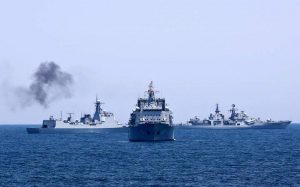
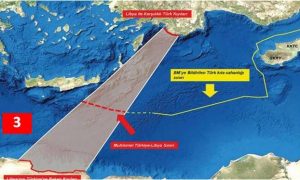
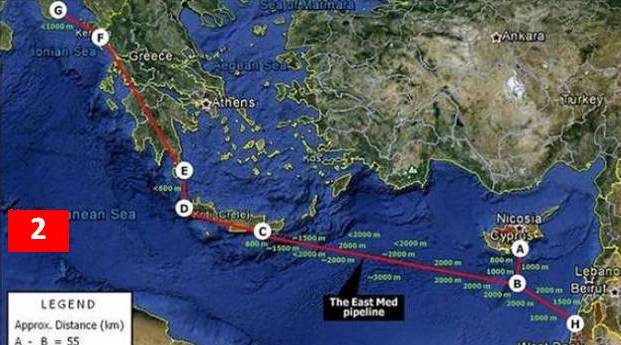
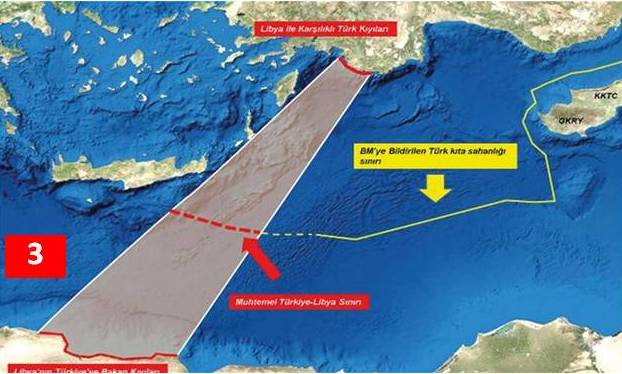
 Η Τουρκία δεν θα ενοχλήσει τη γεώτρηση της Exxon Mobil. Το τεμάχιο 10 στο οποίο θα γίνουν οι έρευνες βρίσκεται τυπικά εκτός των τουρκικών διεκδικήσεων. Επομένως, ο Ερντογάν είναι δικαιολογημένος στα μάτια της κοινής του γνώμης να μην προχωρήσει σε άλλες κινήσεις εκτός των έντονων λεκτικών διαμαρτυρίων. Επιπλέον στην περιοχή βρίσκονται εδώ και ημέρες πολεμικά πλοία των ΗΠΑ. Η Τουρκία δεν έχει κανέναν λόγο να φέρει τα δικά της πολεμικά απέναντι στα αμερικανικά. Η παρουσία της κρατικής εταιρείας του Κατάρ είναι κυρίως τυπική σε αυτή τη φάση.