Αρχική Blog Σελίδα 2729

Trump rips Mattis, McGurk after resignations

0

Facing a near-universal backlash over his decisions to pull U.S. troops from Syria and cut in half the number of forces in Afghanistan, President Trump late Saturday night unloaded on two outgoing officials who resigned over those decisions, saying he gave Defense Secretary James Mattis “a second chance” after the retired Marine Corps general was fired by former President Obama.

In a series of tweets, Mr. Trump also took aim at Brett McGurk, the administration’s special envoy to the global anti-Islamic State coalition.

Last Wednesday, the president abruptly announced that the U.S. had defeated the Islamic State in Syria and that the roughly 2,000 American troops stationed there would be coming home. The surprise declaration sparked the resignation of Mr. Mattis. Mr. McGurk had been scheduled to leave in February but sped up his departure over the policy decision.

Just days before the president announced the Syria withdrawal, Mr. McGurk had stated flatly that the U.S. had a long-term interest in keeping troops in Syria, and that the administration knew it could not just defeat the Islamic State’s “physical space” and then leave.

“Brett McGurk, who I do not know, was appointed by President Obama in 2015,” the president said. “Was supposed to leave in February but he just resigned prior to leaving. Grandstander? The Fake News is making such a big deal about this nothing event!”

The president has clearly been irked by the negative reaction to his troop withdrawal announcements. Leading Republicans on Capitol Hill and many conservative pundits have panned the moves, especially after Mr. Mattisresigned in protest last Thursday.

Mr. Trump argued Sunday that he should be considered a “hero” for having the courage to bring U.S. forces home.

“If anybody but your favorite President, Donald J. Trump, announced that, after decimating ISIS in Syria, we were going to bring our troops back home (happy & healthy), that person would be the most popular hero in America,” he tweeted. “With me, hit hard instead by the Fake News Media. Crazy!”

Regarding Mr. Mattis, the president said he essentially resurrected the Defense secretary’s career by nominating him to lead the Pentagon. Formerly the commander of U.S. Central Command, Mr. Mattis was fired from that post by Mr. Obama in 2013. He reportedly clashed with Obama administration officials over Iran policy and was seen as too much of a foreign policy hawk

“When President Obama ingloriously fired Jim Mattis, I gave him a second chance. Some thought I shouldn’t, I thought I should,” Mr. Trump said. “Interesting relationship-but I also gave all of the resources that he never really had. Allies are very important — but not when they take advantage of U.S.”

In his resignation letter, Mr. Mattis made clear that he disagrees sharply with Mr. Trump’s foreign policy views. Particularly on Syria, Mr. Mattis believes the president is now abandoning key U.S. allies at a critical time in the fight against the Islamic State and is sending the wrong signal to the rest of the world.

“While the U.S. remains the indispensable nation in the free world, we cannot protect our interests or serve that role effectively without maintaining strong alliances and showing respect to those allies,” he said in the letter. “Because you have the right to have a secretary of defense whose views are better aligned with yours on these and other subjects, I believe it is right for me to step down from my position.”


Ben Wolfgang – The Washington Times

Η στρατηγική του “MAGA” και οι απατημένοι σύζυγοι της Γεωπολιτικής ανάλυσης

0

του Κ. ΚΥΡΙΑΚΟΠΟΥΛΟΥ

μέλους της ΠΓ του «Μετώπου ΕΛΕΥΘΕΡΗ ΕΛΛΑΔΑ»

Επειδή το δάκρυ είναι μαύρο και το μάγουλο έχει γίνει κορόμηλο… Και επειδή αυτοί που πολιτογραφούνται πραγματικά “ανισόρροποι”, δεν κυκλοφορούν ελεύθεροι στα σαλόνια της προεδρείας των ΗΠΑ αφού… 

Ή τους μαζεύουν οι αρμόδιοι επιστήμονες… ή τους τουφεκάνε στο κεφάλι οι διάφοροι Όσβαλντ,προκειμένου να εμφανιστούν αμέσως μετά οι γνωστοί Ρούμπι και να θολώσουν τα νερά… Καλό θα είναι να ξεκαθαρίσουμε τα εξής, αντί να επιδοθούμε και πάλι στο αδιέξοδο κυνήγι των μαγισσών, ροκανίζοντας την αλήθεια και το χρόνο:

Με την απόφαση Τραμπ, το κυρίαρχο (αυτή τη στιγμή) κέντρο εξουσίας των ΗΠΑ πετυχαίνει με ένα σμπάρο τέσσερα τρυγόνια:

  • Πρώτον: Οριοθετεί τη φυσιογνωμία της «μητέρας των συγκρούσεων» φωτογραφίζοντας τον στοχοποιημένο του αντίπαλο, και αυτός σε αυτή την ιστορική συγκυρία είναι η Κίνα…
  • Δεύτερον: Οδηγεί το κομμάτι της Ευρασίας το οποίο επηρεάζεται από τις αποφάσεις του σε γενικευμένη αποσταθεροποίηση, ενεργοποιώντας ένα επικίνδυνο ντόμινο, τις συνέπειες της οποίας θα υποστεί οσονούπω ΚΑΙ η Τουρκία…
  • Τρίτον: Εγκλωβίζει τους «ευαίσθητους» της Σοροκρατούμενης Ευρώπης, στην παγίδα του εκτρώματος που οι ίδιοι στήριξαν στον ΟΗΕ με το νέο “σύμφωνο για την Μετανάστευση”, και το κάνει επιτρέποντας να στηθεί μια εκτεταμένη«βιομηχανία» παραγωγής προσφυγιάς σε ολόκληρη την Μέση Ανατολή. Και…
  • Τέταρτον: Εγκαινιάζει το επιχειρησιακό μέρος του πραγματικού του σχεδίου με το βλέμμα στραμμένο προς Ανατολάς, και έχοντας ελαχιστοποιήσει τις διαδικασίες παραγωγής Αμερικανικών φερέτρων…

Κατά τα λοιπά… Να θυμίσουμε στους “απατημένους συζύγους” που ξέμειναν με τα ορφανά και ανεκπλήρωτα σχέδια και «τελεσίγραφα» στο χέρι ότι οι ΗΠΑ, ΔΕΝ έχουν παραιτηθεί από την υπεράσπιση των αμερικανικών συμφερόντων στην ευρύτερη περιοχή αφού…

  • Συμμετέχουν και διευρύνουν έτι περαιτέρω τη συμμετοχή τους στα γνωστάσχήματα πολυμερούς στρατηγικής συνεργασίας με πρόθυμο ατζέντη – μεταξύ άλλων – και τον Έλληνα πρωθυπουργό…
  • Ενισχύουν την στρατιωτική τους παρουσία διευρύνοντας ένα δίκτυο εγκαταστάσεων ΚΑΙ στην Ελλάδα… ΚΑΙ στα Βαλκάνια… ΚΑΙ στην Κύπρο…
  • Στρατιωτικοποιούν το σύνολο του εμπορευματικού τους δικτύου πρωτίστως στην Βαλκανική και υφαρπάζοντας κανονικά και με το νόμο κυριότητα κυρίως στην Ελληνική επικράτεια…
  • Διευρύνουν (χρησιμοποιώντας τους πρόθυμους) τις «αμυντικές στρατηγικές τους συνεργασίες» σε ολόκληρη την ΝΑ Μεσόγειο με εργαλεία την Ελλάδα, την Αίγυπτο, την Κύπρο και το Ισραήλ…
  • Υλοποιούν με όχημα τις εταιρείες – κολοσσούς, ένα ενεργειακό πρόγραμμα μαμούθ που τροποποιεί δραματικά τον κυριαρχικό χάρτη σε ολόκληρη την περιφέρεια…
  • Ισχυροποιούν τους δεσμούς τους με κορυφαίους στρατηγικούς «εμπορικούς» εταίρους τους, όπως για παράδειγμα η Σαουδική Αραβία κοκ…

Στο πλαίσιο λοιπόν ενός τέτοιου σχεδιασμού που αποσκοπεί σε έναν ενισχυμένο γεωπολιτικά ρόλο, μέσα σε έναν κόσμο του οποίου η φυσιογνωμία τροποποιείται δραματικά…

  • Ο Τράμπ είναι ένα πολύτιμο χρηστικό εργαλείο για την κυρίαρχη ενότητα στρατηγικών συμφερόντων, που σχεδιάζει τους βηματισμούς της υπερδύναμης. Και…
  • Ο Μάτις (όπως και οι κάθε Μάτις), δεν είναι παρά ένα ακόμη αναλώσιμο, που τροφοδοτεί τις «αναλύσεις» των αφελών.

Η Γεωπολιτική δεν έχει συναισθήματα… Κι αυτή την παραδοχή κανείς δεν δικαιούται να την λησμονεί. Σε διαφορετική περίπτωση, η ιστορία ξέρει καλά να βγάζει τη γλώσσα στους αφελείς…

Περισσότερα ΕΔΩ>>> https://www.youtube.com/watch?time_continue=792&v=wqBEDwTGL_Y

Και προφανώς θα επανέλθουμε πολύ πιο εκτεταμένα… ΟΧΙ βεβαίως για να δικαιολογήσουμε τις επιλογές Τράμπ… ΑΛΛΑ για να προσπαθήσουμε να ανιχνεύσουμε με ρεαλισμό τις συνέπειές τους…


Trump call with Turkish leader led to US pullout from Syria

0
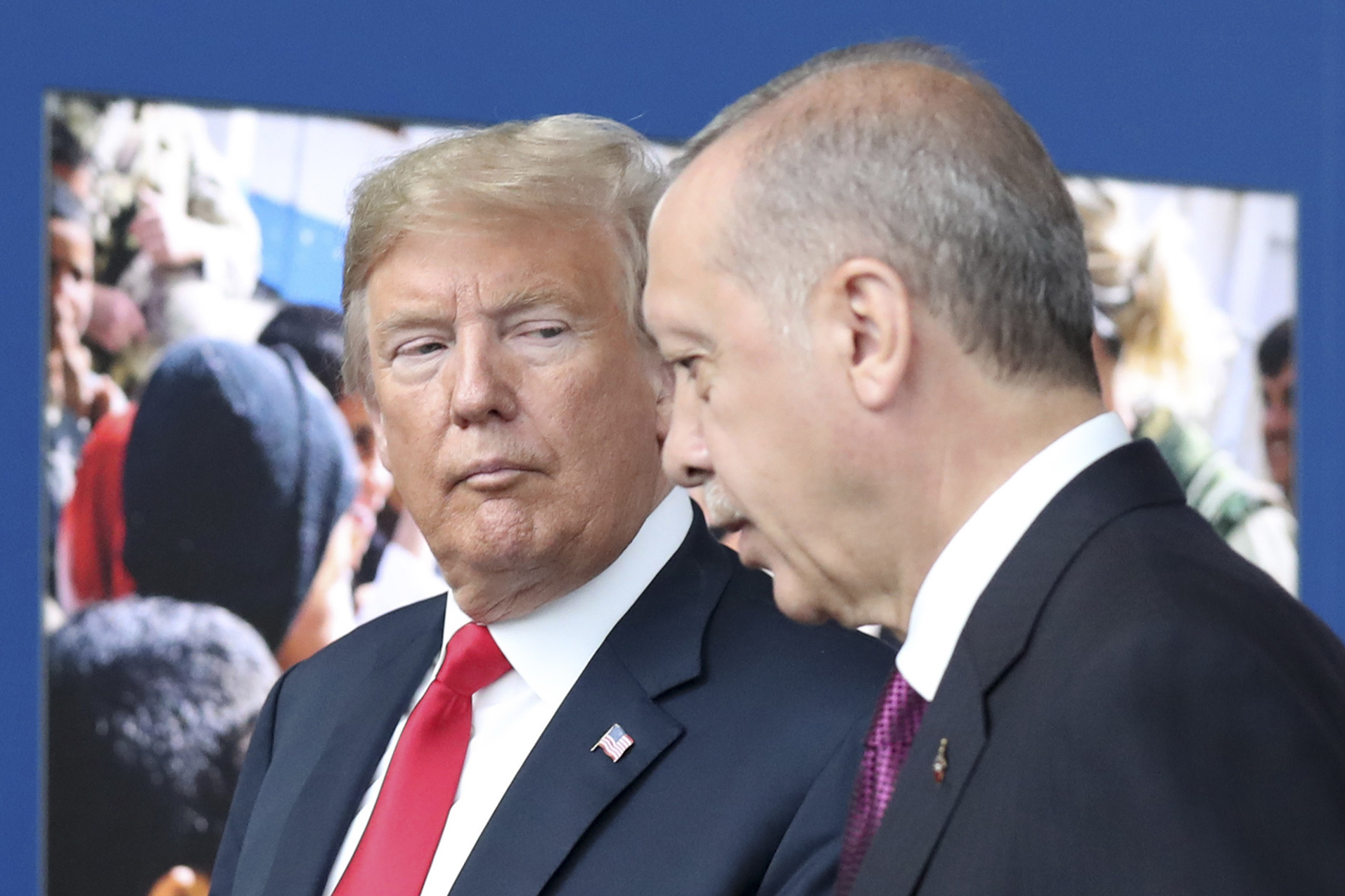
FILE – In this July 11, 2018 file photo, President Donald Trump, left, talks to Turkish President Recep Tayyip Erdogan as they tour the new NATO headquarters in Brussels, Belgium. Trump’s decision to withdraw American troops from Syria was made hastily, without consulting his national security team or allies, and over the strong objections of virtually everyone involved in the fight against the Islamic State, according to U.S. officials. Trump stunned his Cabinet, lawmakers and much of the world with the move that triggered Defense Secretary Jim Mattis’ resignation by rejecting the advice of his top aides and agreeing to the pull-out in a phone call with Turkish President Recep Tayyip Erdogan last week, two officials briefed on the matter said. (Tatyana Zenkovich/pool photo via AP)
Trump pulls U.S. out from Syria after call with Turkish leader
WASHINGTON (AP) — President Donald Trump’s decision to withdraw American troops from Syria was made hastily, without consulting his national security team or allies, and over strong objections from virtually everyone involved in the fight against the Islamic State group, according to U.S. and Turkish officials.

Trump stunned his Cabinet, lawmakers and much of the world with the move by rejecting the advice of his top aides and agreeing to a withdrawal in a phone call with Turkish President Recep Tayyip Erdogan last week, two U.S. officials and a Turkish official briefed on the matter told The Associated Press.

The Dec. 14 call, described by officials who were not authorized to discuss the decision-making process publicly and spoke on condition of anonymity, provides insight into a consequential Trump decision that prompted the resignation of widely respected Defense Secretary Jim Mattis. It also set off a frantic, four-day scramble to convince the president either to reverse or delay the decision.

The White House rejected the description of the call from the officials but was not specific.

“In no uncertain terms, reporting throughout this story is not true,” National Security Council spokesman Garrett Marquis said. “It is clear from the context that this false version of events is from sources who lack authority on the subject, possibly from unnamed sources in Turkey.”

The State Department and Pentagon declined to comment on the account of the decision to withdraw the troops, which have been in Syria to fight the Islamic State since 2015.

Despite losing the physical caliphate, thousands of IS fighters remain in Iraq and Syria, and the group continues to carry out insurgent attacks and could easily move back into territory it once held if American forces withdraw.

The Dec. 14 call came a day after Secretary of State Mike Pompeo and his Turkish counterpart Mevlut Cavusoglu agreed to have the two presidents discuss Erdogan’s threats to launch a military operation against U.S.-backed Kurdish rebels in northeast Syria, where American forces are based. The NSC then set up the call.

Pompeo, Mattis and other members of the national security team prepared a list of talking points for Trump to tell Erdogan to back off, the officials said.

But the officials said Trump, who had previously accepted such advice and convinced the Turkish leader not to attack the Kurds and put U.S. troops at risk, ignored the script. Instead, the president sided with Erdogan.

In the following days, Trump remained unmoved by those scrambling to convince him to reverse or at least delay the decision to give the military and Kurdish forces time to prepare for an orderly withdrawal.

“The talking points were very firm,” said one of the officials, explaining that Trump was advised to clearly oppose a Turkish incursion into northern Syria and suggest the U.S. and Turkey work together to address security concerns. “Everybody said push back and try to offer (Turkey) something that’s a small win, possibly holding territory on the border, something like that.”

Erdogan, though, quickly put Trump on the defensive, reminding him that he had repeatedly said the only reason for U.S. troops to be in Syria was to defeat the Islamic State and that the group had been 99 percent defeated. “Why are you still there?” the second official said Erdogan asked Trump, telling him that the Turks could deal with the remaining IS militants.

With Erdogan on the line, Trump asked national security adviser John Bolton, who was listening in, why American troops remained in Syria if what the Turkish president was saying was true, according to the officials. Erdogan’s point, Bolton was forced to admit, had been backed up by Mattis, Pompeo, U.S. special envoy for Syria Jim Jeffrey and special envoy for the anti-ISIS coalition Brett McGurk, who have said that IS retains only 1 percent of its territory, the officials said.

Bolton stressed, however, that the entire national security team agreed that victory over IS had to be enduring, which means more than taking away its territory.

Trump was not dissuaded, according to the officials, who said the president quickly capitulated by pledging to withdraw, shocking both Bolton and Erdogan.

Caught off guard, Erdogan cautioned Trump against a hasty withdrawal, according to one official. While Turkey has made incursions into Syria in the past, it does not have the necessary forces mobilized on the border to move in and hold the large swaths of northeastern Syria where U.S. troops are positioned, the official said.

The call ended with Trump repeating to Erdogan that the U.S. would pull out, but offering no specifics on how it would be done, the officials said.

Over the weekend, the national security team raced to come up with a plan that would reverse, delay or somehow limit effects of the withdrawal, the officials said.

On Monday, Bolton, Mattis and Pompeo met at the White House to try to plot a middle course. But they were told by outgoing chief of staff John Kelly and his soon-to-be successor Mick Mulvaney that Trump was determined to pull out and was not to be delayed or denied, according to the officials. The trio met again on Tuesday morning to try to salvage things, but were again rebuffed, the officials said.

The White House had wanted to announce the decision on Tuesday — and press secretary Sarah Sanders scheduled a rare briefing specifically to announce it. But the Pentagon convinced Trump to hold off because the withdrawal plans weren’t complete and allies and Congress had not yet been notified, according to the officials. The first country aside from Turkey to be told of the impending pull-out was Israel, the officials said.

Word of the imminent withdrawal began to seep out early Wednesday after U.S. Central Command chief Gen. Joseph Votel started to inform his commanders on the ground and the Kurds of the decision.

Following the official announcement the White House emphasized that the U.S. will continue to support the fight against IS and remains ready to “re-engage” when needed. But in a tweet, the president said U.S. troops would no longer be fighting IS on behalf of others.

“Time to focus on our Country & bring our youth back home where they belong!”

____

MATTHEW LEE and SUSANNAH GEORG

Associated Press writer Suzan Fraser contributed from Ankara, Turkey.

Γιατί ο Trump αποφάσισε να αποσύρει τα αμερικάνικα στρατεύματα από τη Συρία

0

Moon of Alabama

Ήταν η πρώτη φορά που ο Τραμπ πήρε μια αποφασιστική στάση εναντίον των Μποργκ , του μόνιμου νεοσυντηρητικού και παρεμβατικού ιδρύματος στη κυβέρνηση του, των στρατιωτικών και του Κογκρέσου, που συνήθως υπαγορεύουν την αμερικανική εξωτερική πολιτική.Την περασμένη Παρασκευή ο πρόεδρος Τραμπ είχε μια ακόμη μεγάλη τηλεφωνική κλήση με τον Τούρκο πρόεδρο Ερντογάν. Μετά απ’ αυτή ανέτρεψε όλους τους συμβούλους του και αποφάσισε να  αποσύρει τις αμερικάνικες μπότες από τη Συρία  και επίσης να τερματίσει  τον αεροπορικό πόλεμο .

Ήταν αυτή η απόφαση, και ότι επέμενε σε αυτή, η οποία τελικά τον έκανε πραγματικό Πρόεδρο των ΗΠΑ.

Ο σύμβουλος της Εθνικής Ασφάλειας του Τραμπ, Τζον Μπόλτον, ο «τρελός σκύλος» υπουργός  Άμυνας του, Μάττις, και ο υπουργός Εξωτερικών του, Πομπέο, ήταν όλοι εναντίον αυτής της απόφασης. Ο ειδικός που εργάζεται για τη Συρία, ο  μουρλός  (vid) ειδικός εκπρόσωπος για την εμπλοκή στη Συρία James Jeffrey , και ο Brett McGurk, ο ειδικός προεδρικός απεσταλμένος για τον παγκόσμιο συνασπισμό για να νικήσει την ISIS, εξεπλάγησαν. Είχαν δουλέψει επιμελώς για να εγκαταστήσουν μόνιμη αμερικανική παρουσία σε ένα κουρδικό κράτος δια αντιπροσωπείας (proxy state) στη βορειοανατολική Συρία.

Ενώ οι άνθρωποι αυτοί προσπαθούσαν να αλλάξουν την απόφαση του Τραμπ, η αντίστασή τους  έχει πλέον σταματήσει :

Ο υπουργός Άμυνας Τζέιμς Μάττις, ο υπουργός Εξωτερικών Μάικ Πομπέο και ο σύμβουλος Εθνικής Ασφάλειας Τζον Μπόλτον συναντήθηκαν τη Δευτέρα, όταν ο Τράμπ λέγεται ότι αποφάσισε επίσημα την απόσυρση των ΗΠΑ από τη Συρία. Πολλοί Αμερικανοί αξιωματούχοι διαμαρτύρονταν για μια απότομη απόσυρση των ΗΠΑ, αλλά λέγεται ότι παραιτήθηκαν  από την προσπάθεια τους να αλλάξει γνώμη ο Τραμπ το βράδυ της Τρίτης . Αμερικανοί αξιωματούχοι άρχισαν να κοινοποιούν στους συμμάχους την απόφαση την Τρίτη.

“Η πίεση από το ΥΠΕΞ, το ΥΠΑΜ και το ΣΕΑ σταμάτησε τη [Τρίτη] νύχτα”, δήλωσε ένας περιφερειακός εμπειρογνώμονας ο οποίος διαβουλεύεται με τη κυβέρνηση των ΗΠΑ σχετικά με το Υπουργείο Άμυνας, το Υπουργείο Εξωτερικών και το Συμβούλιο Εθνικής Ασφάλειας.

Τον Ιανουάριο εξηγήσαμε ήδη γιατί το νεοσυντηρητικό σχέδιο ενός κουρδικού κράτους δια αντιπροσωπείας στη βορειοανατολική Συρία  ήταν καταδικασμένο  από την αρχή:

Ilhan tanir @ WashingtonPoint –  7:50 μμ – 24 Ιαν 2018
Αυτός ο χάρτης συζητείται όλη την ημέρα στις τουρκικές τηλεοράσεις ως προγραμματισμένη ζώνη ασφαλείας / ασφαλής ζώνη της Τουρκίας στα σύνορα της Συρίας.
Αναφέρεται OK’ed από Sec.Tillerson αν και κανείς στην αμερικανική πλευρά δεν το επιβεβαιώνει.

Οι Ηνωμένες Πολιτείες υποστηρίζουν την ίδρυση ενός κουρδικού κράτους, το οποίο αποτελεί τη σοβαρότερη ανησυχία ασφάλειας της Άγκυρας στη βορειοανατολική Συρία. Καμία [τουρκική] “ασφαλής ζώνη” θα βοηθήσει αν ο στρατός των ΗΠΑ συνεχίσει να κατασκευάζει και να προμηθεύει μια κουρδική “συνοριακή δύναμη” που μπορεί να διεισδύσει στο νοτιοανατολικό υπογάστριο της Τουρκίας – τώρα, αύριο ή σε δέκα χρόνια. Εκτός αν οι ΗΠΑ σταματήσουν αυτό το σχέδιο και υποχωρήσουν από την περιοχή, η Τουρκία θα συνεχίσει να πιέζει εναντίον του – εάν χρειαστεί  με βία .

Ο τουρκικός λαός  υποστηρίζει  τον αγώνα ενάντια στους Κούρδους που υποστηρίζονται από τις ΗΠΑ και είναι διατεθειμένος να πληρώσει το τίμημα για αυτό. Οι ηγέτες του Κουρδικού YPG είναι  απατηλοί στις απαιτήσεις τους και υπερεκτιμούν τη πολιτική θέση τους. Οι ΗΠΑ δεν μπορούν να έχουν και τα δύο, την Τουρκία ως σύμμαχο και ένα Κουρδικό κρατίδιο δια αντιπροσώπων. Πρέπει να αποφασίσουν.

Ο Τραμπ δεν ήθελε ποτέ να προχωρήσει αυτό το σχέδιο. Πάντα ήθελε να δηλώσει νίκη εναντίον του ISIS και να φύγει. Ήταν οι Μποργκ  που προσπαθούσαν να τον αποτρέψουν και που προωθούσαν το σχέδιο.

Αλλά υπάρχουν μεγαλύτερα γεωπολιτικά ψάρια για τηγάνισμα από αυτή την ανάμιξη στη Μέση Ανατολή. Ο Τράμπ γνωρίζει ότι η «μονομερής στιγμή» των Ηνωμένων Πολιτειών μετά τη διάλυση της Σοβιετικής Ένωσης, η οποία άφησε τις ΗΠΑ ως μοναδική υπερδύναμη, έχει λήξει. Η Ρωσία είναι πίσω και η Κίνα ανεβαίνει. Η πολιτική του Τραμπ στη φθίνουσα αμερικανική εξουσία είναι να τερματίσει την «παγκοσμιοποίηση» που επέτρεψε την ταχεία άνοδο της Κίνας. Θέλει να χωρίσει γεωπολιτικά αυτόν τον κόσμο  σε δύο σφαίρες επιρροής . Θα είναι χωριστές  μεταξύ τους στα πολιτικό, οικονομικό, τεχνολογικό και στρατιωτικό πεδία.

Σε αυτό το νέο μεγάλο παιχνίδι, η βορειοανατολική Συρία είναι μόνο ένα sideshow και δεν αξίζει σημαντική εμπλοκή. Η πολύ μεγαλύτερη Τουρκία, σύμμαχος του ΝΑΤΟ για 70 χρόνια, είναι πολύ πιο σημαντική. Αν ο Τραμπ δεν είχε λάβει την απόφαση να τερματίσει το σχέδιο των neocon στη Συρία και να αποσύρει τις ΗΠΑ από τη Συρία, οι ΗΠΑ  θα το είχαν χάσει :

Βάζοντας τον εαυτό μου στα παπούτσια του Ερντογάν, θα σκεφτόμουνα κ’ εγώ να φύγω από το ΝΑΤΟ και να ενωθώ με μια συμμαχία με τη Ρωσία, την Κίνα και το Ιράν. Εκτός αν οι ΗΠΑ αλλάξουν πορεία και σταματήσουν να ξεγελάσουν την Τουρκία με τους Κούρδους, η Τουρκία θα συνεχίσει να απομακρύνεται από την παλιά συμμαχία. Ο τουρκικός στρατός έχει αποτρέψει μέχρι στιγμής μια διακοπή με το ΝΑΤΟ, αλλά ακόμη και ισχυροί αξιωματικοί αντίπαλοι του Ερντογάν είναι  τώρα στο πλευρό του.

Αν οι ΗΠΑ κάνουν μια πραγματική προσφορά στην Τουρκία και υιοθετήσουν νέα θέση, θα μπορέσουν να στρέψουν την Τουρκία και να την επαναφέρουν στο ΝΑΤΟ. Είναι ο Λευκός Οίκος του Τραμπ ικανός να αψηφεί τις φιλοισραηλινές / φιλοκουρδικές φωνές και να επιστρέψει σε αυτή την ρεαλιστική άποψη;

Εάν δεν μπορεί να το κάνει, η πραγματική απάντηση στην ερώτηση “Ποιος έχασε την Τουρκία;” θα είναι προφανής.

Ο Τραμπ αποφάσισε ότι το να προλάβει την Τουρκία να αποχωρήσει από το ΝΑΤΟ και να ενταχθεί σε μια βαθύτερη συμμαχία με τη Ρωσία, την Κίνα και το Ιράν, ήταν πιο σημαντικό από το να κόβει τρελές βόλτες στα περιθώρια της Μέσης Ανατολής. Είναι η σωστή απόφαση.

Η ιδέα του κουρδικού κρατιδίου οδήγησε επίσης σε σύγκρουση μεταξύ της Ευρωπαϊκής Διοίκησης των ΗΠΑ (EUCOM) και της Κεντρικής Διοίκησης των ΗΠΑ (CentCom). Η Τουρκία (και το Ισραήλ) υπάγονται στην EUCOM, ενώ η Μέση Ανατολή και η Δυτική Ασία αποτελούν το βασίλειο της CentCom. Κατά τη διάρκεια του περασμένου έτους, ηEUCOM είχε όλο και  πιο θορυβώδη  σχέδια του CentCom στη Συρία:

Μεταξύ των επικριτών είναι ο στρατηγός Curtis Scaparrotti, ο επικεφαλής της ευρωπαϊκής διοίκησης και ο ανώτατος συμμαχικός διοικητής στην Ευρώπη. […] Κατά τη διάρκεια ενός ταξιδιού στην Ουάσινγκτον τον Μάρτιο, ο Scaparrotti στρίμωξε τον Μάττις και εξέφρασε τις ανησυχίες του για τις αυξανόμενες εντάσεις στις αμερικανοτουρκικές σχέσεις, ανησυχίες που εξέφρασε ο ευρωπαίος διοικητής σε άλλες συναντήσεις με τον στρατηγό Joseph Votel, τον ομόλογό επικεφαλής του τηςCentcom.

Η ανησυχία στο πλαίσιο της EUCOM και του ΝΑΤΟ ήταν ότι η Τουρκία θα προχωρήσει περισσότερο προς τη Ρωσία και τελικά θα αποσυρθεί από το ΝΑΤΟ. Αυτό είναι πλέον απίθανο να συμβεί. (Από το 1991 ήταν το CentCom που διαδραμάτισε υπερμεγέθη ρόλο στην αμερικανική εξωτερική πολιτική. Ο Sec Def Μάττις  είναι ένα ζώο του CentCom και καλό είναι να βλέπουμε τη CentCom και τον ίδιον να περιορίζονται).

Αλλά αν η ελπίδα είναι ότι η Τουρκία θα τερματίσει τις σχέσεις της με τη Ρωσία και το Ιράν, το αποτέλεσμα θα είναι απογοητευτικό. Η Τουρκία εξαρτάται από το ρωσικό και το ιρανικό φυσικό αέριο και ως εξαγωγικές αγορές. Μετά την απόπειρα πραξικοπήματος εναντίον του, ο Ερντογάν δεν εμπιστεύεται την αμερικανική πλευρά. Περαιτέρω, η θέση που του δίνει την μεγαλύτερη ευελιξία και μόχλευση είναι μεταξύ των δύο «μπλοκ», και τα δύο θα συνεχίσουν να τον προσεγγίζουν. Θα συνεχίσει να αμφιταλαντεύεται μεταξύ τους για να πάρει τα μέγιστα και από τις δύο πλευρές.

Τα νεοσυντηρητικά στοιχεία στη κυβέρνηση, και οι Σιωνιστές υποστηρικτές τους, έχουν χάσει. Όπως ο Craig Murray  περιγράφει τους στόχους τους :

Το χάος αυτής της ασυνάρτητης και αντιπαραγωγικής στρατηγικής είναι, αρκετά ιδιαιτέρως, αυτό που πραγματικά θέλουν οι νεοσυντηρητικοί. Ο διαρκής πόλεμος και η αποσταθεροποίηση στη Μέση Ανατολή είναι ο στόχος τους. … Σήμερα, κρατώντας τους αραβικούς πληθυσμούς φτωχούς και πολιτικά διχασμένους, οι νεοσυντηρητικοί πιστεύουν ότι ενισχύουν την ασφάλεια του Ισραήλ, και σίγουρα διευκολύνουν τη πρόσβαση των δυτικών εταιρειών στο πετρελαίου και φυσικό αερίο της περιοχής, όπως βλέπουμε στα αποσταθεροποιημένα Ιράκ και Λιβύη.

Οι νεοσυντηρητικοί και παρεμβατικοί Μποργκ  την πάτησαν όταν προσπάθησαν  να χρησιμοποιήσουν την προσωρινή αμερικανική θέση στη Συρία εναντίον του ISIS, για να παρασύρουν τον Τραμπ σε μια σύγκρουση με το Ιράν:

Ορισμένοι σημερινοί και πρώην Αμερικανοί αξιωματούχοι κατηγόρησαν αυτό που είδαν ως υπέρβαση από τα γεράκια της κυβέρνησης κατά του Ιράν, ιδίως ο απεσταλμένος των ΗΠΑ στη Συρία, JimJeffrey, και ο υπολοχαγός του Joel Rayburn, αναπληρωτής βοηθός του υπουργού Εξωτερικών για το Λεβάντε, οι οποίοι ισχυρίστηκαν δημοσίως ότι οι αμερικανικές δυνάμεις δεν θα εγκαταλείπουν τη Συρία μέχρι να αποχωρήσουν όλες οι ιρανικές δυνάμεις.

“Οι άνθρωποι που εργάζονται για το Τραμπ – Bolton, Rayburn, τώρα Jeffrey –  το επιδεινώσαν προσθέτοντας αδύνατους στόχους στη Συρία [σχετικά με το Ιράν] που υποδηλώνουν μια αόριστη παραμονή “, δήλωσε ο αμερικανός αξιωματούχος που χαρακτήρισε καταστροφική την απόφαση του Τραμπ. Ο αξιωματούχος είπε ότι αυτά τα επιχειρήματα δεν έχουν « καμία σχέση με ρεαλιστικούς στόχους για τους στρατιωτικούς μας » και πηγαίνουν «πέρα από τον στόχο» της νίκης επί του ΙΚ και της αποτροπής της επανεμφάνισής του.

Αλλά η ιρανική παρουσία στη Συρία είναι τόσο μικρή και η θέση των ΗΠΑ τόσο αδύναμη, έτσι ώστε αυτή ήταν  πάντα μια ηλίθια ιδέα :

Ο John Allen Gay, εμπειρογνώμονας του Ιράν και εκτελεστικός διευθυντής της John Quincy AdamsSociety, [..] υποστηρίζει ότι η απόφαση του Τραμπ επιβεβαιώνει αυτό που όλοι έχουν παραδεχτεί ήσυχα τουλάχιστον για το παρελθόν έτος: ότι η  διατήρηση δυνάμεων των ΗΠΑ στη Συρία για να πολεμήσουν το ΙΚ άρχισε να μοιάζει με έναν τρόπο για τους οπαδούς της κυβέρνησης για επέμβαση να υποστηρίζουν ότι πρέπει να αναλάβουμε το Ιράν .

“Η διατήρηση των στρατευμάτων εκεί μετά το ISIS ήταν μια εν μέρει φυσική αποστολή, αλλά ήταν επίσης ένα άλογο για τα γεράκια στη κυβέρνηση που θέλουν επέμβαση στο Ιράν”, δήλωσε στο TAC.

“Ωστόσο, μερικές χιλιάδες άνδρες μεταξύ των τουρκικών δυνάμεων από τη μία πλευρά και των Ιρανών, Ρώσων και Σύρων από την άλλη,  δεν θα ήταν ποτέ αποφασιστικό για τον περιφερειακό ρόλο του Ιράν και συνοδευόταν με πραγματικούς κινδύνους και χωρίς τέλος”, πρόσθεσε ο Gay. “Απλά δεν νομίζω ότι υπάρχει κάποια όρεξη στο αμερικανικό κοινό για μια μεγάλη μάχη με το Ιράν οπουδήποτε, πόσο μάλλον στην Ανατολική Συρία”.

Το αμερικανικό υπουργείο Εξωτερικών αποσύρει ήδη τους ανθρώπους του από τη Συρία. Οι 4.000 έως 5.000 Αμερικανοί στρατιωτικοί και εργολάβοι έλαβαν προθεσμία 60 έως 100 ημερών (άλλες πηγές λένε 30 μέρες αλλά είναι λίγο βιαστικό) για να κάνουν τις βαλίτσες τους και να φύγουν.

Θα συντονιστούν με τη Ρωσία την παράδοση. Θα υπάρχουν ρώσοι σύμβουλοι που θα αντικαταστήσουν τους Αμερικανούς πράσινους μπερέδες που διοικούν τις κουρδικές και αραβικές φυλετικές δυνάμεις εναντίον της ISIS. Η Ρωσία θα προσπαθήσει επίσης να πείσει την Τουρκία ότι δεν υπάρχει περαιτέρω ανάγκη να εισβάλει στην ανατολική Συρία. Θα υπόσχεται να αφοπλίσει τις κουρδικές δυνάμεις ή να τις εντάξει στο στρατό της Συρίας. Η αεροπορία της θα αντικαταστήσει τις ΗΠΑ και άλλους που βομβαρδίζουν σήμερα τους 2.000 περίπου ισλαμιστές μαχητές που έχουν απομείνει σε θέσεις τους κατά μήκος του Ευφράτη.

Οι Κούρδοι στη Συρία θα πρέπει να τα βρουν με τη Δαμασκό. Δεν έχουν πουθενά αλλού να πάνε. Το όνειρό τους για μια αυτόνομη Rojava θα αποδειχθεί να είναι ακριβώς αυτό. Η Συρία μπορεί να επιβιώσει μόνο ως κεντρικά ελεγχόμενο κράτος. Ποτέ δεν πρόκειται να ομοσπονδιοποιηθεί. Οι τοπικές αραβικές φυλές στα βορειοανατολικά πιθανότατα θα επιδιώξουν κάποια εκδίκηση ενάντια στην κουρδική ηγεσία που χρησιμοποίησε την αμερικανική υποστήριξη για να στρατολογίσει τους γιους τους στον αγώνα κατά της ISIS. Η ηγεσία του YPG πιθανότατα θα διαφύγει στο βόρειο Ιράκ για να κρυφτεί με τους διδύμους αδελφούς του PKK στα όρη Κανδήλι.

Ο συριακός στρατός, ο οποίος σκοπεύει να απομακρύνει την Αλ Κάιντα από το κυβερνείο της Ιντλίμπ την επόμενη άνοιξη, θα πρέπει τώρα να μεταφέρει αρκετές δυνάμεις προς τα βορειοανατολικά. Η απομόνωση του Ισλαμικού Κράτους  στον Ευφράτη κοντά στα ιρακινά σύνορα και τελικά η εξάλειψή του θα είναι η νέα προτεραιότητα. Οι ιρακινές πολιτοφυλακές πιθανότατα θα τον βοηθήσουν για αυτό. Η ανάκτηση των κοιτασμάτων πετρελαίου και φυσικού αερίου και άλλων οικονομικών πόρων θα αποτελέσει άλλο ένα σημαντικό ζήτημα.

Πολλά θα εξαρτηθούν από το πώς η Ρωσία και το Ιράν θα μπορέσουν να χειριστούν την Τουρκία. Με τις ΗΠΑ έξω και ο κίνδυνος μιας κουρδικής οντότητας στη Συρία να μειωθεί, ίσως να είναι σε θέση να πείσουν τον Ερντογάν να σταματήσει τα σχέδια εισβολής του.

Είναι πολύ αναζωογονητικό να βλέπεις ότι ο Τράμπ ήταν τελικά σε θέση να απελευθερωθεί από την υπαγόρευση των Μποργκ. Απομακρύνοντας τις ΗΠΑ από τη Συρία εκπλήρωσε μία από τις εκλογικές του υποσχέσεις.

Donald J. Trump @ realDonaldTrump –  11:42 utc – 20 Δεκέμβριος 2018
Η έξοδος από τη Συρία δεν ήταν έκπληξη. Έχω κάνει εκστρατεία για αυτό για χρόνια και πριν από έξι μήνες, όταν δήλωσα δημόσια ότι πολύ θέλω να το κάνω, συμφώνησα τότε να μείνουν περισσότερο. Η Ρωσία, το Ιράν, η Συρία και άλλοι είναι ο τοπικός εχθρός του ISIS. Κάναμε εκεί δουλειά. Ώρα να επιστρέψουμε στο σπίτι και να ξαναχτίσουμε. #MAGA (Make America Great Again).

Οι άνθρωποι που ψήφισαν για τον Τραμπ θα χαιρετίσουν την κίνηση. Εκφράζεται η ελπίδα ότι θα μπορέσει να επεκτείνει αυτή τηn κίνηση μειώνοντας περαιτέρω την επιρροή της Σαουδικής Αραβίας και του Ισραήλ στις πολιτικές του.

Κατά τη διάρκεια της εκστρατείας του, ο Τραμπ υποστήριζε επίσης καλύτερες σχέσεις με τη Ρωσία. Αλλά οι Μποργκ έσπρωξαν τις πολιτικές του προς την αντίθετη στάση. Η απόσυρση των ΗΠΑ από τη Συρία εξαλείφει ένα ζήτημα όπου η Ρωσία και οι ΗΠΑ βρίσκονταν σε αντίθετες πλευρές. Μπορεί ο Τραμπ να χρησιμοποιήσει τη νεοσυσταθείσα ραχοκοκαλιά του για να νικήσει ξανά τους Μποργκ και να εργαστεί τελικά για καλύτερες σχέσεις με τη Ρωσία;

Αυτό μοιάζει σήμερα απίθανο. Αλλά η απόφαση της Παρασκευής ήταν μια μεγάλη έκπληξη.

Μείνετε στα ακουστικά σας για άλλες.

Καταχωρήθηκε από b στις 20 Δεκεμβρίου 2018 στις 08:51 πμ

infognomon.gr

Ο Ερντογάν ως σύμβουλος του Τραμπ

2

του ΠΑΝΤΕΛΗ ΣΑΒΒΙΔΗ.

Στις Ηνωμένες Πολιτείες είναι κοινό μυστικό πως ο Ερντογάν ήταν που επηρέασε τον Ντόναλντ Τραμπ να πάρει την απόφαση αποχώρησης των αμερικανικών δυνάμεων από τη Συρία. Δεν μπορεί να ερμηνευθεί πώς ένας Αμερικανός πρόεδρος, που δεν γνωρίζει τα θέματα εξωτερικής πολιτικής, παίρνει μια απόφαση μείζονος σημασίας για τα συμφέροντα και την αξιοπιστία της υπερδύναμης χωρίς να συμβουλευθεί τον Σύμβουλο Εθνικής Ασφαλείας, που γι’ αυτό υπάρχει, τον υπουργό Άμυνας και τον υπουργό Εξωτερικών.

Και όμως, ο Τραμπ το έκανε, οδηγώντας αναγκαστικά τον υπουργό άμυνας Τζέιμς Μάτις σε παραίτηση.

Ο γερουσιαστής της Νότιας Καρολίνας ρεπουμπλικανός Λίντσεϊ Γκράχαμ χαρακτήρισε ανέντιμη την Αμερική μετά την επίμαχη απόφαση του Ντόναλντ Τραμπ. Μια απόφαση που προκάλεσε την αντίδραση, εκτός των υπουργών Εξωτερικών και Άμυνας, και του Συμβούλου Εθνικής Ασφαλείας, ακόμη και του Ισραηλινού πρωθυπουργού Βενιαμίν Νετανιάχου.

Γίνεται προσπάθεια –και στις ΗΠΑ– να ερμηνευθεί η απόφαση Τραμπ, και υπάρχουν δημοσιεύματα που την αποδίδουν σε ρωσικό εκβιασμό. Φαίνεται πως ο Αμερικανός πρόεδρος είναι ευάλωτος στους εκβιασμούς της Μόσχας και βάζει το προσωπικό του συμφέρον πάνω από το συμφέρον της χώρας του. Πρώτα ο Τραμπ. Η Αμερική έπεται όταν διακυβεύεται το συμφέρον του προέδρου της. Προφανώς, τα μηνύματα τα μετέφερε στον Τραμπ ο Τούρκος πρόεδρος.

Η απόφαση έχει πολλές παρενέργειες.

  • Πρώτον, καθιστά τις ΗΠΑ αναξιόπιστη δύναμη. Γιατί να εμπιστευτεί κανείς τις ΗΠΑ στις συμμαχίες που προσφέρονται σε διάφορες περιοχές του κόσμου όταν δεν αποκλείεται να τον εγκαταλείψουν με την παραμικρή ευκαιρία; Οι συμμαχίες υποτίθεται ότι συνάπτονται μετά από πολλή σκέψη και έχουν μια διαχρονικότητα που ξεπερνά την παρουσία, στην κυβέρνηση, ενός κόμματος ή ενός προέδρου.
  • Δεύτερον, στην περίπτωση της Συρίας, η αποχώρηση των ΗΠΑ αφήνει έκθετους τους συμμάχους τους Κούρδους στη βούληση της Τουρκίας. Οι ΗΠΑ αναμίχθηκαν στη συριακή κρίση (στην ουσία την δημιούργησαν) για να νικηθεί το Ισλαμικό Κράτος – η επιβίωση του οποίου απειλούσε, πρωτίστως, τις ίδιες. Η μάχη κατά του Ισλαμικού Κράτους δεν τελείωσε. Το Ισλαμικό Κράτος υπάρχει στη Συρία, ελέγχει κάποιες περιοχές και σε άλλες επιτίθεται για να τις ανακτήσει. Οι ΗΠΑ συνεργάστηκαν με τους Κούρδους στην καταπολέμηση των τζιχαντιστών. Από αυτήν τη σύγκρουση οι Κούρδοι είχαν 10.000 νεκρούς. Αφού, υποτίθεται, πέτυχαν το στόχο τους, οι ΗΠΑ εγκαταλείπουν τους συμμάχους τους στη βουλιμία των Τούρκων οι οποίοι απειλούν να τους εξαφανίσουν. Μετά από αυτό, ποιος θα εμπιστευτεί τις ΗΠΑ για συνεργασία μαζί τους;
  • Τρίτον, η απόφαση είναι ακατανόητη από την άποψη των αμερικανικών συμφερόντων στην περιοχή. Η αμερικανική κυβέρνηση παραδίδει ως δώρο τη Συρία στους Ρώσους, τους Ιρανούς και τους Τούρκους, με σημαντικά επακόλουθα στην ισορροπία δυνάμεων. Αν μπορεί ένας Αμερικανός πρόεδρος να παίρνει αποφάσεις που ευνοούν αποκλειστικά τον ίδιο, ποια είναι η ασφάλεια που μπορεί να νιώθει η διεθνής κοινωνία από τις συμφωνίες που συνάπτει με τις ΗΠΑ;
  • Τέταρτον, σε ό,τι μας αφορά, ποια εμπιστοσύνη μπορεί να έχει η Ελλάδα στις διαβεβαιώσεις των ΗΠΑ είτε σε ό,τι αφορά τον στρατηγικό διάλογο είτε τη συμμετοχή της στις τριμερείς συνεργασίες στην Ανατολική Μεσόγειο; Γιατί να μην εγκαταλείψει τις δεσμεύσεις της η Ουάσινγκτον στην πρώτη ευκαιρία που η Τουρκία της κλείσει το μάτι;
  • Πέμπτο και τελευταίο. Φαίνεται ότι για να πετύχεις κάτι δεν πρέπει να είσαι πιστός σύμμαχος, αλλά εκβιαστής. Η Τουρκία δείχνει το δρόμο. Εκβίασε και πέτυχε. Αυτό είναι το συμπέρασμα της αμερικανικής συμπεριφοράς.

Με βάση όλα αυτά, η Αθήνα δεν μπορεί να εμπιστεύεται τις αμερικανικές διαβεβαιώσεις. Είναι καλοδεχούμενες όσο εξυπηρετούν τα ελληνικά εθνικά συμφέροντα, αλλά δεν μπορεί να λαμβάνονται απολύτως υπόψη. Ανά πάσα στιγμή, όπως βεβαιώνει το ρευστό αυτήν τη στιγμή περιβάλλον, ο Αμερικανός πρόεδρος μπορεί να αλλάξει πολιτική «για μια χούφτα δολάρια». Και τότε;

Ο αρχηγός ΓΕΕΘΑ Ευάγγελος Αποστολάκης προέβη, προχθές, σε μια βαρυσήμαντη δήλωση. Είπε πως η Ελλάδα αγωνίζεται να μη φθάσουν τα πράγματα σε επικίνδυνο σημείο, αλλά αν οι Τούρκοι καταλάβουν μια βραχονησίδα «θα την ισοπεδώσουμε».

Ο ναύαρχος Αποστολάκης είναι προσεκτικός στις δηλώσεις του, και γι’ αυτό τα όσα σχετικά δήλωσε, αποκτούν ιδιαίτερη βαρύτητα. Γιατί προέβη στη δήλωση αυτήν; Προφανώς κάτι θα έχει υπόψη του. Αν οι Τούρκοι παγιώσουν τις θέσεις τους στη Συρία, και ιδιαιτέρως αν καθήσουν στο τραπέζι της διανομής των ιματίων της, τότε θα έχουν καταπατήσει τη Συνθήκη της Λοζάνης όσον αφορά τις προβλέψεις της στη Μέση Ανατολή. Ο Ερντογάν ήταν πολλές φορές σαφής σε ό,τι αφορά τη συνθήκη αυτή και στην αναθεώρηση των άρθρων της που αναφέρονται στις ελληνοτουρκικές σχέσεις.

Προφανώς, κάτι συμβαίνει.

Είπε και κάτι άλλο ο Αρχηγός. Πως αν χρειαστεί να πολεμήσουμε, θα το κάνουμε μόνοι μας. Κανείς δεν πρόκειται να συμπολεμήσει μαζί μας.

Για να μην έχουμε αυταπάτες, είναι μια οδυνηρή αλήθεια. Αλλά την ύστατη αυτή στιγμή οι συμμαχίες και συνεργασίες είναι απαραίτητες. Μπορεί να λειτουργήσουν αποτρεπτικά.

Οι τριμερείς συνεργασίες στην Ανατολική Μεσόγειο εξυπηρετούν τα αμερικανικά συμφέροντα και θα μπορούσαν να λειτουργήσουν ως εναλλακτική λύση στην περίπτωση που η Τουρκία συνεχίσει να απομακρύνεται από τη Δύση. Αλλά με τον Τραμπ στην αμερικανική ηγεσία, τίποτε δεν είναι σίγουρο.

Η Τουρκία έχει διαβρώσει –σε επικίνδυνο βαθμό για την αμερικανική ασφάλεια– τα αμερικανικά κέντρα στην Ουάσινγκτον.

pontos-news.gr

Επειδή η παράνοια κυριαρχεί: Ο Τραμπ, όπως τα βρήκε με τον Ερντογάν, θα τα …ξαναχάσει!

3

Του ΜΙΧΑΛΗ ΙΓΝΑΤΙΟΥ

The White House at night with Christmas lighting Tuesday, Dec. 18, 2018. Official White House Photo by Keegan Barber

DECEMBER 22, 2018

Δεν υπάρχει η παραμικρή αμφιβολία ότι αρκετοί εξ αυτών που λαμβάνουν κρίσιμες αποφάσεις στην Ουάσιγκτον, έχουν ένα κοινό: Ο εγκέφαλος τους είναι σε κατάσταση τρικυμίας. Και η παρατήρηση δεν αφορά μόνο τον Αμερικανό Πλανητάρχη και τους λίγους πιστούς συνεργάτες του. Αλλά το φαινόμενο κυριαρχεί και στο άλλο στρατόπεδο, των Δημοκρατικών, οι οποίοι δύο χρόνια πριν από τις εκλογές δεν έχουν μία σοβαρή πρόταση, που θα μπορούσε να σταματήσει τη λαίλαπα που σαρώνει και την Αμερική, αλλά και τον κόσμο όλο. Προσπαθούν, λοιπόν, οι άνθρωποι στις ΗΠΑ να συνέλθουν από τα συνεχή κτυπήματα που δέχονται από τα τραγικά και αψυχολόγητα λάθη του προέδρου Ντόναλντ Τραμπ, ο οποίος αλλάζει τη γνώμη του για κρίσιμα θέματα, όπως αλλάζει τα …πουκάμισά του. Και πέφτουν από έκπληξη σε έκπληξη διότι δεν έχουν καν αντιληφθεί ότι πρέπει να ζουν με τη τρέλα και την παράνοια, που εισέβαλε στην Ουάσιγκτον από τις 20 Ιανουαρίου 2017.

Χθες το θέμα συζήτησης ήταν εάν ο ισλαμιστής Πρόεδρος της Τουρκίας επηρέασε τον Ντόναλντ Τραμπ για να λάβει την απόφαση απόσυρσης από τη Συρία. Το έγραψαν σοβαροί δημοσιογράφοι εδώ στην Ουάσιγκτον, που εμπιστεύομαι. Όμως, δεν χρειάστηκε να τον επηρεάσει ο Ερντογάν… Τα έδωσε όλα μόνος του ο Πλανητάρχης… Και έγραψε στα παλιά του τα παπούτσια τους συνεργάτες του και τα συμφέροντα της Αμερικής.

Αλλά το τελικό συμπέρασμα, το οποίο  βγαίνει μέσα από διάφορες ενημερώσεις, είναι ότι εδώ και πολλούς μήνες απαιτεί ο Αμερικανός πρόεδρος να γίνει η απόσυρση των Αμερικανών πεζοναυτών. Τον σταμάτησαν οι υπουργοί του και οι σύμβουλοί του πολλές φορές. Ειδικά τον Σεπτέμβριο έγινε ο καυγάς της χρονιάς για να αναβληθεί η ανακοίνωση της απόσυρσης.

Ήθελε να το ανακοινώσει στη γενική συνέλευση των Ηνωμένων Εθνών. Όταν τις προάλλες έλαβε το μήνυμα από τους δημοσκόπους του, ότι το σκληρό «κομμάτι» των οπαδών του είναι απογοητευμένοι επειδή δεν υλοποιεί τις υποσχέσεις του -αναφέρθηκαν ειδικά στο τείχος με το Μεξικό και στην αποχώρηση των στρατευμάτων από τη Συρία και το Αφγανιστάν- έπραξε ακριβώς αυτό. Και κτύπησε τρεις φορές.

Ανακοίνωσε την απόσυρση των στρατιωτών και κατεβάζει τα ρολά του κράτους, για το τείχος.

Στην Ελλάδα έχουμε μία συνήθεια να υπερβάλουμε επειδή νομίζουμε ότι η Αθήνα είναι ο ομφαλός της γης! Δεν είναι… Ή μας αρέσει να είμαστε τα θύματα. Οπότε ανακαλύψαμε ότι ο Τραμπ με τον Ερντογάν συνωμοτούν και αυτή η συνωμοσία θα στραφεί και εναντίον μας. Δεν είναι τόσο απλά τα πράγματα. Πρώτα απ’ όλα είναι άλλη η όποια σχέση της Αμερικής με την Τουρκία και άλλη με την Ελλάδα, την Κύπρο, το Ισραήλ και την Αίγυπτο.

Η δεύτερη εξελίσσεται σε πολύ σημαντική στρατηγική συμμαχία. Η πρώτη, δοκιμάζεται καθημερινά και παρά το γεγονός ότι οι Αμερικανοί προσπαθούν απεγνωσμένα να σώσουν την σχέση με την Τουρκία, αυτό δεν εξαρτάται πλέον από αυτούς. Για να χορέψουν τανγκό, πρέπει να το θέλουν και οι Τούρκοι. Και αυτή τη στιγμή το μόνο που τους ενδιαφέρει είναι να απομυζούν την Αμερική.

Το καλοκαίρι, λοιπόν, ο κ. Τραμπ έβριζε τον κ. Ερντογάν με πεζοδρομιακούς χαρακτηρισμούς και του έκανε ένα σκληρό μάθημα για το ποιος είναι το αφεντικό, ξεκινώντας μία διαδικασία καταστροφής της τουρκικής οικονομίας. Το ζήσαμε και πολλοί πανηγύρισαν. Από την πλευρά του, ο πρόεδρος της Τουρκίας και τι δεν είπε για τον Αμερικανό ομόλογό του. Οχετός… Τα γραπτά, ως γνωστόν, μένουν.

Το περασμένο καλοκαίρι ούτε θέλει να το θυμάται ο κ. Ερντογάν… Τώρα υποτίθεται ότι «τα έχουν βρει» οι δύο πρόεδροι, αν και είναι κάτι που πρέπει να αποδειχθεί. Διότι μέχρι προχθες, η Ουάσιγκτον έστελνε απειλητικά μηνύματα στην Άγκυρα και ο κ. Ερντογάν κατηγορούσε την Αμερική για τα μύρια προβλήματά του.

Το συμπέρασμα είναι ότι θα «τα βρίσκουν» και «θα τα …χάνουν» μέχρι να έρθει η ώρα της κατάρρευσης των σχέσεων ή της μεγάλης επιστροφής της Τουρκίας στο δυτικό μαντρί. Ένα από τα δύο σίγουρα θα γίνει και ο καθένας έχει τις απόψεις του και είναι σεβαστές.

Εγώ π.χ. πιστεύω ότι ο Τραμπ θα τα σπάσει πάλι με την Τουρκία, διότι δεν είναι δυνατόν αυτός ο εκρηκτικός χαρακτήρας να ανεχθεί άλλο τον Ερντογάν. Και γι’ αυτό θα παίξουν ρόλο πολλοί παράγοντες. Από τους φίλους του γερουσιαστές, όπως ο Γκράχαμ, μέχρι και το …Ισραήλ.

Αυτό που έχει σημασία είναι ότι τα τελευταία δύο χρόνια, έγινε κάτι σημαντικό, που οφείλεται σε τούτον τον Πρόεδρο, είτε μας αρέσει, είτε όχι. Επέτρεψε να ξεκινήσει ένας διάλογος με την Ελλάδα και την Κύπρο που εξελίσσεται ομαλά, χωρίς προβλήματα και ο οποίος θα οδηγήσει με το νέο χρόνο σε σημαντική αναβάθμιση των σχέσεων με την Αθήνα και τη Λευκωσία.

Οι προηγούμενες αμερικανικές κυβερνήσεις δεν το έπραξαν διότι γι’ αυτούς η σχέση με την Τουρκία ήταν πάνω απ’ όλους τους γείτονες. Είναι και αυτό ένα από τα πολλά λάθη της Αμερικής, που πληρώνει. Οι αναλύσεις πρέπει να γίνονται επί πραγματικού. Και υπάρχει μία σημαντική διαφορά: Υπάρχουμε εμείς που παρακολουθούμε όλες τις ενημερώσεις και υπάρχουν και αυτοί που τις διαβάζουν στα αμερικανικά μέσα ενημέρωσης.

Η διαφορά είναι ότι οι «αυτοί» χάνονται στη …μετάφραση. Εμείς γράφουμε για το τώρα, για το σήμερα, αυτοί γίνονται μετά Χριστό «προφήτες», που έχουν πέσει έξω στις αναλύσεις και στις προβλέψεις τους.

Ούτε ο ίδιος ο Τραμπ γνωρίζει τι θα κάνει αύριο. Δεν υπάρχει ούτε στρατηγική, ούτε σχεδιασμός. Εξαρτάται πως θα κοιμηθεί το βράδυ και πως θα ξυπνήσει το πρωί. Δεν περιαυτολογώ, αυτή είναι η αλήθεια. Υπάρχει κανείς που μπορεί να βάλει το χέρι του στη φωτιά και να μας πει με βεβαιότητα ότι δεν θα αλλάξει γνώμη ο Πλανητάρχης για τη Συρία;

Όσο αυταρχικός και αν είναι, όσο κολλημένος νάναι στις εμμονές του, δεν μπορεί να μην καταλαβαίνει ότι φεύγοντας από τη Συρία παραδίδει τη μισή Μέση Ανατολή στη Ρωσία και το Ιράν… Δεν μπορεί να μην κατανοεί τα αυτονόητα που του εξηγεί ο Μπέντζαμιν Νετανιάχου: ότι το Ιράν θα σαρώσει και το Λίβανο και θα φτάσει στα σύνορα του Ισραήλ. Δεν μπορεί να μην καταλαβαίνει ότι χωρίς το Ισραήλ στη Μέση Ανατολή η Αμερική χάνει το ένα της το χέρι… Δεν είναι ανόητος να μην ξέρει ότι για να είναι πρώτη και πάνω απ’ όλους η Αμερική, απαιτούνται γνήσιες συμμαχίες και όχι λυκοφιλίες, όπως αυτές με τον Πούτιν και τον Ερντογάν…

Πηγή: Επειδή η παράνοια κυριαρχεί: Ο Τραμπ, όπως τα βρήκε με τον Ερντογάν, θα τα …ξαναχάσει! https://hellasjournal.com/2018/12/epeidi-i-paranoia-kyriarchei-o-tramp-opos-ta-vrike-me-ton-erntogan-tha-ta-xanachasei/

Is It an Island or a Rock? Ruling Could Cost U.S. a Huge Swath of Ocean

0
Bloomperg.com
A Chinese dispute has a ripple effect on exclusive economic zones around the world.

Okinotorishima is an island in Japan’s economic zone.

THE ASAHI SHIMBUN/GETTY IMAGES

The U.S. and other coastal nations could lose millions of square nautical miles of ocean that are now in their exclusive economic zones. The loss would be an indirect result of an arbitration panel’s ruling on China’s dispute with the Philippines in the South China Sea.

Largely overlooked in the tribunal’s July 12 decision was a strict interpretation of which dry land is entitled to a 200-nautical-mile exclusive economic zone—the surrounding ocean where a nation has sole rights to fish, drill for oil, and search for minerals. While not a legal precedent, the 479-page ruling could influence other judges and arbitrators because of its rigorous argument. “These arbitrators knew that this case was being watched around the world,” says Paul Reichler, a partner in law firm Foley Hoag and lead counsel for the Philippines. “They wanted it to be as close to perfect as possible.”

econ_islandchart32_970

The United Nations Convention on the Law of the Sea doesn’t allow nations to declare exclusive economic zones around “rocks which cannot sustain human habitation or economic life of their own.” What that’s meant has never been clear. Many countries, including the U.S. and Japan, have claimed exclusive economic zones around tiny atolls and outcroppings of rock. The U.S. hasn’t ratified the treaty because of opposition from congressional Republicans, who fear it would open the U.S. to lawsuits. But the U.S. “scrupulously” follows the treaty’s provisions anyway, says James Kraska, a law professor at the U.S. Naval War College. Push could come to shove if another nation seeks to fish or drill or mine in waters surrounding some dinky U.S. rock.

The tribunal concluded that having people live on an island doesn’t prove habitability if food and water comes from elsewhere. Countries will “now have a greatly reduced incentive” to fight over ownership of rocks if they no longer have exclusive zones, Kraska says. On the minus side, fisheries might be depleted quickly if countries lose the ability to curb fishing in these zones.

The bottom line: An arbitration panel’s definition of what an island is could undermine nations’ claims of economic zones around rock outcroppings.

https://www.bloomberg.com/news/features/2016-07-28/u-s-japan-and-other-nations-could-lose-exclusive-economic-zones

The Looming Vacuum in Syria

0

Friday, December 21, 2018 By the ISW Research Team

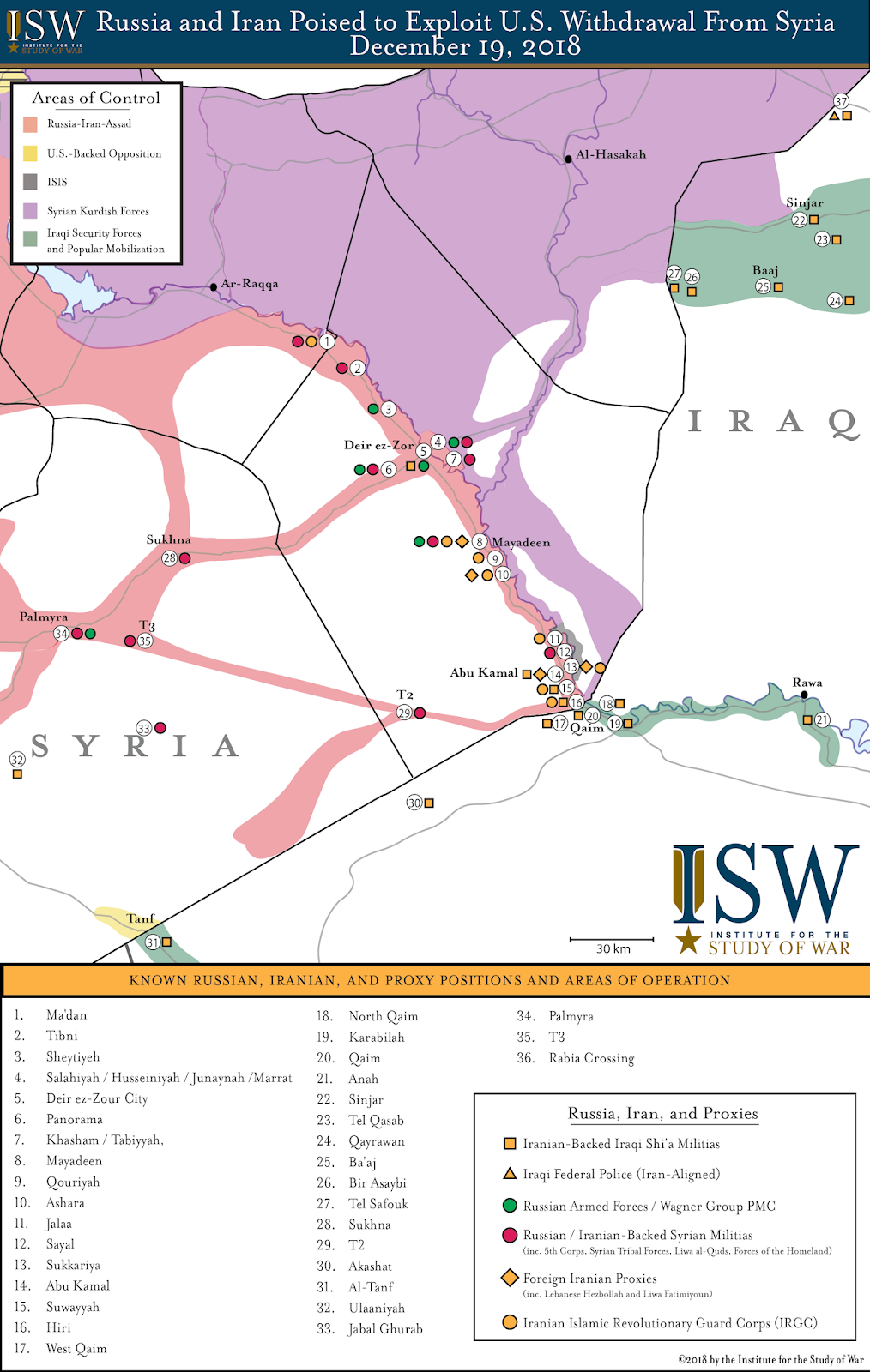
Key Takeaway: Russia and Iran are poised to exploit the U.S. withdrawal from Syria announced by U.S. President Donald Trump on December 19. They and their proxies hold positions along the Syrian-Iraqi Border surrounding areas that the U.S. Anti-ISIS Coalition and allied Syrian Democratic Forces (SDF) currently hold. Russia and Iran will undoubtedly attempt to fill the security vacuum left behind by the U.S. in Eastern Syria. The Russo-Iranian Coalition is nonetheless stretched thin and likely cannot secure this new terrain without opening exploitable vulnerabilities for ISIS and Al-Qaeda in Syria and Iraq. Turkey and other regional actors will also likely attempt to exploit this opening to compete for terrain and influence in Syria.

This map depicts the Russo-Iranian Coalition’s known positions in Eastern Syria and Western Iraq as of December 21. Position locations are based on information available in open sources reviewed by the Institute for the Study of War. The map does not depict positions held by the SDF and Iraqi Security Forces (ISF). It also does not include locations held solely by the Syrian Arab Army (SAA).

Map Credit: Matti Suomenaro, Samantha Leathley, and Aaron Hesse


Turks Fleeing a Crackdown Find Haven in Albania

0
Balkan Insight
21 DEC 18

Turkish President Recep Tayyip Erdogan. Photo: EPA-EFE/TURKISH PRESIDENTIAL PRESS OFFICE / MURAT CETINMUDURDAR / HANDOU HANDOUT EDITORIAL USE ONLY/NO SALES

Dozens of Turks at risk at home from their affiliation with the man accused of mounting a failed coup against President Recep Tayyip Erdogan have found haven in Albania. But ‘brotherly’ ties between Ankara and Tirana keep them on their toes.
Vladimir Karaj BIRN TiranaEarly one August morning in 2016, Esin and Huseyin Sakinmaz filled their car with canned food and left their home in Istanbul. They headed south, but had little idea where they would end up.

Fearing highway cameras would record their licence plates, they took country roads for hundreds of kilometres. For three days and three nights, they ate, slept and lived in their car. They did not ask anyone for directions so as not to attract attention.

“As my husband drove I felt paralysed, unable to murmur a word; my mind was numb, I couldn’t feel anything,” Esin recalled two years later, seated on a park bench on Tirana’s central Skenderbej square, named after the medieval Albanian warrior prince who rebelled against the Ottoman Turks.

A mother of three young children, Esin worked as a communications specialist at an Istanbul office of the Gulen Movement, created by the US-based Muslim cleric Fethullah Gulen and operating a vast network of schools around the world.

On July 15, 2016, after crushing a coup, Turkey’s president, Recep Tayyip Erdogan, pinned the blame on Gulen and unleashed a withering crackdown.

When 56 friends and colleagues in her office were arrested in mid-August, Esin feared she would be next.

Leaving their children with her parents, Esin and her husband hit the road, eventually reaching Adana in southern Turkey, from where Esin took a flight to the United States on August 30, 2016. More than two years later, in October, the family was reunited in the Albanian capital.

Gulen has denied any involvement in the failed putsch, in which 251 people died.

But Erdogan, in power for 15 years, moved quickly to take revenge. According to Amnesty International, more than 50,000 people accused of links to the Gulen Movement have been jailed, with as many more facing prosecution. More than 130,000 people have been fired from the military, police, civil service and academia.

Many more are believed to have fled fearing persecution, with nearly 14,000 seeking asylum in the European Union last year alone, according to the bloc’s statistics office, Eurostat.

An estimated 60 families have sought refuge in Albania, a predominantly Muslim country once ruled by the Ottoman Turks but now a member of NATO and a candidate for accession to the EU. They have joined a community of Turkish teachers and administrators working in Gulen schools in Tirana since the early 1990s after communism fell.

Esin and her peers are considered ‘terrorists’ by the Turkish government, which has put pressure on the government of Albania and others in the Balkans for their extradition. Tirana has so far resisted, but its Turkish community still lives in fear.

Over a period of several months, BIRN interviewed a number of Gulen followers who escaped Turkey for Albania. Wanted in their homeland, often shunned by their own families, they have not yet sought asylum and fear for their security given the considerable political and economic clout Turkey wields in the Balkans.

In countries like Albania, which have weak economies and are desperate for foreign investment, “Erdogan can do many things with money,” said a 43-year-old journalist who fled Turkey for Tirana. He gave his name as Ismail.

“Albanians love Erdogan”

Turkish President Recep Tayyip Erdogan and Albanian Prime Minister Edi Rama prior to their talks in Tirana, Albania, 2015. Photo: EPA/STR

Part of the Ottoman Empire until the early twentieth century, Albania is today pushing for membership of the EU, which has grown increasingly critical of Erdogan’s authoritarian bent.

Tirana, however, has historically had strong ties with Ankara and benefits from Turkish investment. Prime Minister Edi Rama has referred to Erdogan as “our brother and inseparable friend” and his government is working with Ankara on construction of an airport in the southern coastal city of Vlora and creation of a national airline.

Erdogan and his allies have called on Tirana and other Balkan states to shut down any Gulen schools on their territory; Albania has so far resisted, insisting local legislation must be respected, but Rama has referred to the Gulen Movement as “dangerous”.

“When it comes to Albania, we keep under observation people who are supposedly linked to that network,” he said in a television interview in May this year.

Turkey stepped up the pressure in October with a visit by Foreign Minister Mevlut Cavusoglu.

“We don’t harbour terrorists from Albania,” Cavusoglu told a Tirana press conference with his Albanian counterpart, Ditmir Bushati. “We expect the same of our Albanian friends.”

In response, Bushati said Albania would adhere to “all international charters for extraditions.”

Public statements aside, Albania is torn between the need to maintain good ties with Ankara and the expectations of the EU that it support the human rights of those who have fled Erdogan’s rule.

A senior Albanian government official, who spoke on condition of anonymity, told BIRN that concern within the cabinet deepened after Cavusoglu’s visit.

“The Sultan asks of us things we cannot deliver,” the source quoted Bushati as telling Rama during a cabinet meeting after the visit. Rama responded with a nod of his head, the source said.

According to Albania’s Ministry of Interior, 35 Turkish citizens have applied for asylum in Albania since 2016. Several times that number are actually believed to have fled for Albania.

The Gulen followers in Albania who spoke to BIRN said they had not sought official asylum for fear of exposure. They say Rama’s close relationship with Erdogan puts them at risk.

One of them, the journalist called Ismail, made his way to Tirana after the failed coup having been dismissed by text message from the TV station where he worked. Speaking in his rented apartment in a Tirana suburb, Ismail said he had no plans to seek asylum in Albania.

“In the worst case scenario, if circumstances will not be in our favor, I will seek asylum from another European country,” he said.

Esin and Huseyin Sakinmaz. Photo: BIRN

A Turkish businessman who relocated to Tirana with his family after authorities seized several million of euros of his money said he too feared the warm ties between Rama and Erdogan.

“Erdogan and Rama are close friends,” he said, sipping Turkish tea in a bar on the outskirts of the capital. “Albanians love Erdogan.”

Nevertheless, Mustafa Ustuner, administrator of the Gulen-led Turkish high schools in Albania, said that they had not faced any problems from the authorities. He described his life in Albania as “calm, happy and safe”, but that pressure from the Turkish government had made work more difficult.

“Some of the previous shareholders were Turkish citizens that lived in Turkey,” he told BIRN. “Affected by the pressure and fear present in Turkey, they decided to withdraw from the company, passing their shares to shareholders who live outside Turkey,” he said.

Turkey unrecognisable

Esin expected to be reunited with her family soon after she flew to the US. With the help of her father, she started a company in Texas, but the money quickly dried up after his Turkish bank accounts were frozen.

Her husband, Huseyin, who had served as a headmaster for a Gulen High School in Istanbul, was refused a US visa. Left alone with their children, he returned to Istanbul, but did not feel safe.

In November 2016, Huseyin moved to Bosnia and later applied for a resident permit in Kosovo, a neighbour of Albania.

Then in January 2017, he returned to Turkey, took the children and relocated to Tirana with the help of an Albanian friend. Esin, meanwhile, travelled to Canada, where she was granted asylum.

In October she flew to Albania to be reunited with her family. Huseyin also applied for asylum in Canada and was awaiting a response from Canadian authorities when they were interviewed for this story.

Tirana has become a popular destination among Gulen followers due to the low cost of living. But its weak economy means many do not set down roots. Rather, most see it as a transit point to the West. None expect to return to Turkey.

“People became wicked. I don’t understand how it happened,” Esin told BIRN, describing a Turkey where people informed on their neighbours for 5,000 lira.

Ismail’s family. Photo: BIRN

“There was a feeling of fear, entire families were divided,” she said through tears.

Ismail, too, recalled harrowing days in Turkey before he fled. His neighbours drafted a plan to expel him and his family from their apartment, he said, and would not let their children play together.

Others, he said, were branded, their front doors sprayed with the letter ‘F’, denoting FETO, or the Gulenist Terrorist Organisation, as the authorities refer to the Gulen Movement.

Two years on, Ismail says he is still in touch with his mother but that his brother and neighbours have urged her to cut all ties with him.

“They all see her as the mother of a ‘terrorist’, but I have never touched a gun in my life,” he said.

All those interviewed by BIRN dismissed the accusations made against them and the Gulen Movement. But the pressure is unrelenting, they say.

“You know you are innocent, but the people and society continuously put pressure on you,” said Huseyin Sakinmaz said. “There comes a point when you ask yourself did I maybe make a mistake that I should face such difficulties.”

The long arm of Turkish law

In 2016, the Turkish government instigated a campaign to bring back the so-called ‘escaped enemies’ after the failed coup, but also those who had left years earlier.

Around 100 people have been extradited to Turkey since, including six teachers hastily deported from Kosovo in March 2018 in an operation involving Turkish intelligence and condemned by the country’s own prime minister, Ramush Haradinaj. Bosnia and Macedonia have also come under pressure.

The campaign has worsened already strained relations between Turkey and its Western NATO allies, including Washington, which has refused to interfere in Gulen’s self-imposed exile in Pennsylvania.

Ankara says it has handed Tirana a list of names, but no one has been extradited yet.

“The Turkish government is using every method and tactic,” said Abdullah Bozkurt, the former head of the English service of the Turkish daily Zaman, who was seized and closed by the state in March 2016. Bozkurt left Turkey in July 2016 after 47 colleagues were arrested following the coup. He received asylum in Sweden, where he runs an organisation created by Turkish exiles and called the Stockholm Center for Freedom, which promotes the rule of law, democracy and democratic rights with a focus on Turkey.

“They are offering contracts, money, favours and intergovernmental agreement in order to make this happen,” he said via Skype.

Bozkurt said Turkish embassies were heading up a campaign of intimidation, targeting Turkish exiles but with an eye on scaring those still in Turkey.

“It’s part of the intimidation campaign to maintain a climate of fear inside Turkey,” he said.

“You could be outside the country but are never secure because we will follow you, will punish you, throw you in jail and you will never see the light of day.”

The Gulen followers BIRN interviewed said they were sure they were under surveillance and never ventured into the city unaccompanied.

Ismail said that though he had not told his Tirana address to anyone, the Turkish police had shown it to his brother in Istanbul, along with other details, during an interrogation.

He said he noticed three Turkish-speaking people close to the apartment where he lived, watching anyone coming and going.

“Every time we read an article about Erdogan we get scared,” said Ismail. “Barely a week goes by without an adviser or spokesperson of the president declaring that no one should feel secure… ‘We will find a way,’ they say, to pack us up and bring us back.”

For the same reason, Esin and Huseyin initially asked that the not be identified in this article should they still be in Albania when it was published. At the end of October, they sent a short email hinting that they had left the country.

“You can now publish the interview in full,” they wrote. “It’s not a problem for us anymore.”

http://www.balkaninsight.com/en/article/turks-fleeing-a-crackdown-find-haven-in-albania-12-19-2018


The Geopolitics of Greece: A Sea at its Heart

0

STRATFOR

(ARIS MESSINIS/AFP/Getty Images)
Editor’s Note

This is the 12th in a series of Stratfor monographs on the geopolitics of countries influential in world affairs.

Throughout the history of Greece, its geography has been both a blessing and a curse, a blessing because it allowed Greece to dominate the “known Western world” for a good portion of Europe’s ancient history due to a combination of sea access and rugged topography. In the ancient era, these were perfect conditions for a maritime city-state culture oriented toward commerce and one that was difficult to dislodge by more powerful land-based opponents. This geography incubated the West’s first advanced civilization (Athens) and produced its first empire (ancient Macedon).

However, Greek geography is also a curse because it is isolated on the very tip of the rugged and practically impassable Balkan Peninsula, forcing it to rely on the Mediterranean Sea for trade and communication. None of the Greek cities had much of a hinterland. These small coastal enclaves were easily defendable, but they were not easily unified, nor could they become large or rich due to a dearth of local resources. This has been a key disadvantage for Greece, which has had to vie with more powerful civilizations throughout its history, particularly those based on the Sea of Marmara in the east and the Po, Tiber and Arno valleys of the Apennine Peninsula to the west.

Peninsula at the Edge of Europe

Greece is located in southeastern Europe on the southernmost portion of the Balkan Peninsula, an extremely mountainous peninsula extending south from the fertile Pannonian plain. The Greek mainland culminates in what was once the Peloponnesian Peninsula and is now a similarly rugged island separated by the man-made Corinth Canal. Greek mountains are characterized by steep cliffs, deep gorges and jagged peaks. The average terrain altitude of Greece is twice that of Germany and comparable to the Alpine country of Slovenia. The Greek coastline is also very mountainous with many cliffs rising right out of the sea.

Greece is easily recognizable on a map by its multitude of islands, about 6,000 in total. Hence, Greece consists of not only the peninsular mainland but almost all of the Aegean Sea, which is bounded by the Dodecanese Islands (of which Rhodes is the largest) in the east, off the coast of Anatolia, and Crete in the south. Greece also includes the Ionian Islands (of which Corfu is the largest) in the west and thousands of islands in the middle of the Aegean. The combination of islands and rugged peninsular coastline gives Greece the 10th longest coastline in the world, longer than those of Italy, the United Kingdom and Mexico.

Mountainous barriers in the north and the northeast mean that the Greek peninsula is largely insulated from mainland Europe. Throughout its history, Greece has parlayed its natural borders and jagged terrain into a defensive advantage. Invasion forces that managed to make a landing on one of the few Greek plains were immediately met by high-rising cliffs hugging the coastline and well-entrenched Greek defenders blocking the path forward. The famous battle of Thermopylae is the best example, when a force of 300 Spartans and another 1,000 or so Greeks challenged a Persian force numbering in the hundreds of thousands. The Ottomans fared better than the Persians in that they actually managed to conquer Greece, but they ruled little of Greece’s vast mountainous interior, where roving bands of Greek brigands — called khlepts — blocked key mountain passes and ravines and entered Greek lore as heroes. To this day, its rugged topography gives Greece a regionalized character that makes effective, centralized control practically impossible. Everything from delivering mail to collecting taxes — the latter being a key factor in Greece’s ongoing debt crisis — becomes a challenge.

With rugged terrain come defensive benefits, but also two geographic handicaps. First, Greece is largely devoid of any land-based transport routes to mainland Europe. The only two links between Greece and Europe are the Axios and Strimonas rivers, both which drain into the Aegean in Greek Macedonia. The Axios (also called the Vardar River) is key because it connects to the Morava River in Central Serbia and thus forms an Axios-Morava-Danube transportation corridor. While no part of the river is actually navigable, one can travel up the Balkan Peninsula on valley roads. The Strimonas takes one from Greek Macedonia to Sofia, Bulgaria’s capital, and from there via the Iskar River through the Balkan Mountains to the Danubian plain of present-day Romania. Neither of these valleys is an ideal transportation route, however, since each forces the Greeks to depend on their Balkan neighbors to the north for links to Europe, historically an unenviable position for Greece.

The second handicap for Greece is that its high mountains and jagged coastline leave very little room for fertile valleys and plains, which are necessary for supporting large population centers. Greece has many rivers and streams that are formed in its mountains, but because of the extreme slope of most hills, most of these waterways create narrow valleys, gorges or ravines in the interior of the peninsula. This terrain is conducive to sheep- and goat-herding but not to large-scale agriculture.

This does not mean that there is no room for crops to grow. Indeed, rivers meeting the Aegean and Ionian seas carve short valleys that open to the coast where the sea breeze creates excellent conditions for agriculture. The problem is that, other than in Thessaly and Greek Macedonia, most of these valleys are limited in area. This explains to an extent why Greece, throughout its history, has retained a regionalized character, with each river estuary providing sufficient food production for literally one city-state and with jagged mountain peaks greatly complicating overland communication among these population centers. The only place where this is not the case is in Greek Macedonia — the location of present-day Thessaloniki — where a relatively large agricultural area provided for the West’s first true empire, led by Alexander the Great.

Lack of large areas of arable land combined with poor overland transportation also complicate capital formation. Each river valley can supply its one regional center with food and sufficient capital for one trading port, but this only reinforces Greece’s regionalized mentality. From the perspective of each region, there is no reason why it should supply the little capital it generates to a central government when it could just as well use that capital to develop a naval capability of its own, crucial for bringing in food via the Aegean. This creates a situation where the whole suffers from a lack of coordination and capital generation while substantial resources are spent on dozens of independent maritime regions, a situation best illustrated by ancient Greek city-states, most of which had independent navies. Considering that developing a competent navy is one of the costliest of state endeavors, one can imagine how such a regionalized approach to naval development constrained an already capital-poor Greece.

The lack of capital generation is therefore the most serious implication of Greek geography. Situated as far from global flows of capital as any European country that considers itself part of the West, Greece finds itself surrounded by sheltered ports, most of which are protected by mountains and cliffs that drop off into the sea. This affords Greece little room for population growth, and contributes to its inability to produce much domestic capital. This, combined with the regionalized approach to political authority encouraged by mountainous geography, has made Greece a country that has been inefficiently distributing what little capital it has had for millennia.

Countries that have low capital growth and considerable infrastructural costs usually tend to develop a very uneven distribution of wealth. The reason is simple: Those who have access to capital get to build and control vital infrastructure and thereby make the decisions both in public and working life. In countries that have to import capital, this becomes even more pronounced, since those who control industries and businesses that bring in foreign cash have more control than those who control fixed infrastructure, which can always be nationalized (industries and businesses can move elsewhere if threatened with nationalization). When such uneven distribution of wealth is entrenched in a society, a serious labor-capital (or, in the European context, a left-right) split emerges. This is why Greece is politically similar to Latin American countries, which face the same infrastructural and capital problems, right down to periods of military rule and an ongoing and vicious labor-capital split.

Greek Core: The Aegean

Despite the limitations on its capital generation, Greece has no alternative but to create an expensive defensive capability that allows it to control the Aegean Sea. Put simply, the core of Greece is neither the breadbaskets of Thessaly and Greek Macedonia, nor the Athens-Piraeus metropolitan area, where around half of the population lives. The core of Greece is the Aegean Sea — the actual water, not the coastland — which allows these three critical areas of Greece to be connected for trade, defense and communication. Control of the Aegean also gives Greece the additional benefit of influencing trade between the Black Sea and the Mediterranean. Without control of the Aegean, there simply is no Greece.

To control the Aegean and Cretan seas, Greece has to control two key islands in its archipelago, Rhodes and Crete, as well as the Dodecanese archipelago. With those islands under its control, the Aegean and Cretan seas truly become Greek “lakes.” The other island of importance to Athens is Corfu, which gives Greece an anchor in the Otranto Strait and thus an awareness of threats emerging from the Adriatic.

Anything beyond the main Aegean islands and Corfu is not within the scope of Greece’s basic national security interests and can only be gained by the projection of power. In this strategic context, Cyprus becomes important as a way to distract and flank Turkey and break its communications with the Levant and Egypt, traditional spheres of Istanbul’s (and later Ankara’s) influence. Sicily is also within the range of Greek power projection, and at the height of Greece’s power in ancient times, Sicily was frequently colonized by Greek powers. Controlling Sicily gives Greece the key gateway into the western Mediterranean and brackets off the entire eastern half of the Mediterranean for itself. But neither is essential, and projecting Greek power toward either Sicily or Cyprus in the modern day is extremely taxing, although Greece has attempted it with Cyprus, an attempt that led to a near disastrous military confrontation with neighboring Turkey.

The cost of controlling just the Aegean Sea and its multitude of islands cannot be overstated. Aside from the monumental expense of maintaining a navy, Greece has the additional problem of having to compete with Turkey, which is still considered an existential threat for Greece.

In the modern context, this has also underscored the importance of air superiority over the Aegean. The Greek air force prides itself on maintaining a large and advanced fleet of front-line combat aircraft well in excess of the country’s economic means, and many observers believe that their fighter pilots are among the best and most experienced in Europe — and beyond (they regularly tangle with Turkish pilots over the Aegean).

But maintaining, owning and training a superior air force means that Greece was spending more than 6 percent of its gross domestic product (GDP) on defense, twice what other European countries were spending, just prior to the onset of the current financial crisis (it has since pledged to reduce it significantly, to below 3 percent). With no indigenous capital generation of its own, Greece has been forced to import capital from abroad to maintain such an advanced military. This is in addition to a generous social welfare system and considerable infrastructural needs created by its rugged geography. The result is the ongoing debt crisis that is threatening not only to collapse Greece but also to take the rest of the eurozone with it. The Greek budget deficit reached 13.6 percent of GDP in 2009, and government debt is approaching 150 percent of GDP.

Greece has not always been a fiscal mess. It has, in fact, been everything from a global superpower to a moderately wealthy European state to a political and economic backwater. To understand how this isolated, capital-poor country has devolved, we need to look beyond physical geography and contemplate the political geography of the region in which Greece has found itself throughout history.

From Ancient Superpower…

Ancient Greece gave the Western world its first culture and philosophy. It also gave birth to the study of geopolitics with Thucydides’ History of the Peloponnesian War, which is considered to be a seminal work on international relations. It is an injustice to give the ancient Greek period a quick overview, since it deserves a geopolitical monograph of its own, but a brief look provides a relevant glimpse at how geography played a role in turning Greek city-states into a superpower. The political geography of the period was vastly different from that of the present day. The Mediterranean Sea was the center of the world, one in which a handful of Greek city-states clutching the coast of the Aegean Sea could launch “colonial” expeditions across the Mediterranean. The rugged geography also afforded these city-states a terrain that favored defense and allowed them to defeat more powerful opponents.

Nonetheless, the ancient Greek period is the last time that Greece had some semblance of political independence. It therefore offers insights into how Greek geography has crafted Greek strategy.

From this ancient period, we note that control of the Aegean was of paramount importance, as it still is today. The Greeks — faced with nearly impassible terrain on the Peloponnesian Peninsula — were forced to become excellent mariners. Securing the Aegean was also crucial in repelling two major Persian invasions in antiquity, and each major land battle had its contemporary naval battle to sever Persian supply lines. Once the existential Persian threat was eliminated, Athens, the most powerful of the Greek city-states, launched an attempt to expand itself into an empire. This included establishing control of key Aegean islands. That imperial extension essentially ended with a long, drawn-out campaign to occupy and hold Sicily, which would have formed the basis of control of the entire eastern Mediterranean, and to wrestle Cyprus from Persian control.

While the Athenians may have understood the geopolitics of the Mediterranean well, they did not have advanced bureaucratic and communications technology that makes running a country much easier in the modern age or the population with which to prosecute their plans. Athenian expeditions to Cyprus and Egypt were repulsed while Sicily became Athens’ endgame, causing dissent in the coalition of city-states that eventually brought about the end of Athenian power. This example only serves to illustrate how difficult it was to maintain control of mainland Greece. Athens settled for a loose confederation of city-states, which was not a sufficient basis of control on which to establish an empire.

Bitter rivalries among the various Peloponnesian city-states created a power vacuum in the 4th century B.C. that was quickly filled by the Kingdom of Macedon. Despite its reputation as the most “backward” of the Greek regions — in terms of culture, system of government, philosophy and arts — Macedon had something that the city-states did not: the ample agricultural land of the Axios and Strimonas river valleys — ample, at least, compared to the Peloponnesian Peninsula. Whereas Athens and other city-states depended on seaborne trade to obtain grain from regions beyond the Turkish straits and the Black Sea, Macedon had domestic agriculture. It also had an absolute authoritarian system of government that allowed it to launch the first truly Greek-dominant foray into global power projection under Alexander the Great.

This effort, however, could not be sustained. Ultimately, the estuary of Axios did not provide the necessary agricultural base to counter the rise of Rome, which was able to draw not only on the Tiber and Arno river valleys but also, in time, the large Po river valley. Rome first extended itself into the Greek domain by capturing the island of Corfu — illustrating the island’s importance as a point of invasion from the west — which had already fallen out of Greek hands in the 3rd century B.C. With Corfu secured, Rome had nothing standing between it and the Greek mainland, and through military campaigns ultimately secured control over all of Greece by 86 B.C.

The fall of Greece to Rome essentially wiped Greece out of the annals of history as an independent entity for the next 2,000 years and destined mainland Greece and the Peloponnesian Peninsula to the backwater status it had under Byzantine and Ottoman rule (save for Thessaloniki, which remained a key port and trading city in the Ottoman Empire). While it may be tempting to include Byzantium in the discussion of Greek geopolitics, since its culture and language were essentially Greek, the Byzantine geography was much more approximate to that of the Ottoman Empire and later Turkey than that of Greece proper. The core of Byzantium was the Sea of Marmara, which Byzantium held onto against the encroaching Ottoman Turks until the mid-15th century.

In the story of the Ottoman conquest of the Balkans, the territory of modern Greece is essentially an afterthought. It was the Ottoman advance through the Maritsa River valley that destroyed Bulgarian and Serbian kingdoms in the 14th century, allowing the Ottomans to then concentrate on consolidating the remaining Byzantine territories and conquering Constantinople in the mid-15th century after a brief interregnum caused by Mongol invasions of Anatolia. Greece proper was not conquered as much as it was abruptly severed from the rest of the Balkans — and therefore Christian Europe — by the Ottoman power that thoroughly dominated all the land and sea surrounding it.

…To Vassal State

The ascent of the Ottoman Empire created a new political geography around Greece that made an independent and powerful Greece impossible. The Ottoman Empire was an impressive political entity that plugged up the Balkans by controlling the southern flanks of the Carpathians in present-day Romania and the central Balkan Mountains of present-day Serbia and Bulgaria. Greece, as part of the Ottoman Empire, was not vital for Ottoman defense or purse, although Greeks as people were valued as administrators and were assigned as such to various parts of the empire. Greece itself, however, had become an afterthought.

If we had to pinpoint the exact time and place where political geography in southeastern Europe changed, we could look at Sept. 11, 1683, at around 5 p.m. on the battlefields near Vienna. It was here that Polish King Jan Sobieski III led what was, at the time, the largest cavalry charge in history against the Ottoman forces besieging Vienna. The result was not just a symbolic defeat for Istanbul but also a failure to plug the Vienna gap that the Danube and Morava (the Slovak, not Serbian Morava) rivers create between the Alps and the Carpathians.

Holding the Vienna gap would have allowed the Ottomans to focus their military resources in defense of the empire at a geographical bottleneck — Vienna — freeing up resources to concentrate on developing the Balkan hinterland. The Pannonian plain, fertile and capital rich because of the Danube, would have added additional resources. The Ottoman Empire did not crumble immediately after its failure in Vienna, but its stranglehold on the Balkans slowly began to erode as two new powers — the Russian and Austro-Hungarian empires — rose to challenge it.

Without the Vienna gap secured, the Ottoman Empire was left without natural boundaries to the northwest. From Vienna down to the confluence of the Danube and Sava, where present-day Belgrade is located, the Pannonian plain is borderless save for rivers. The mountainous Balkans provide some protection but are equally difficult for the Ottomans to control without the time and resources to concentrate on assimilating the region. The loss of Vienna, therefore, exposed portions of the Balkan Peninsula to Western (and, crucially, Russian) influence and interests as well as Western notions of nationalism, which began circulating throughout the Continent with great force following the French Revolution.

First to turn against the Ottomans was Serbia in the early 19th century. The Greek struggle followed closely afterward. While initial Greek gains against the Ottomans in the 1820s were impressive, the Ottomans unleashed their Egyptian forces on Greece in 1826. The Europeans were at first resistant to help Christian Greece because the precedent set by the nationalist rebellion was equally unwelcome in multiethnic Russia and Austro-Hungary or the imperial United Kingdom. Ultimately, the Europeans had a greater fear that one of the three would move in and profit from the dissolution of the Ottoman Empire and gain access to the eastern Mediterranean.

While Austro-Hungary and Russia had designs on the Balkans, more established European powers like the United Kingdom, France and (later in the 19th century) Germany wanted to limit any territorial gains by Vienna and St. Petersburg. This was vital for the United Kingdom, which did not want to allow the Russian Empire access to the Mediterranean.

Since the end of its war against the Ottomans in 1832, Greece has been geopolitically vital for the West. First it was vital for the British, as a bulwark against great-power encroachment on the crumbling Ottoman hold in the Balkans. The United Kingdom retained a presence — at various periods and in various capacities — in Corfu, Crete and Cyprus. To this day, the United Kingdom still has military installations in Cyprus that are considered sovereign territory under direct British rule.

Greece also became vital for the United States as part of the U.S. Soviet-containment strategy. To maintain influence in Greece, the United States intervened in the Greek Civil War (1946-1949), furnished the Greek merchant marine with ships after World War II, rushed Greece and Turkey into NATO in 1952 and continued to underwrite Greek defense outlays throughout the 20th century. Even a brief military junta in Greece, referred to as the “Rule of the Colonels” (1967-1974), did not affect Greek membership in NATO. Neither did Greece’s near-wars with fellow NATO member Turkey in 1964 (over Cyprus), in 1974 (over Cyprus again), in 1987 (over the Aegean Sea) and in 1996 (over an uninhabited island in the Aegean).

The United Kingdom and later the United States were willing to underwrite Greek defense expenditures and provide Greece with sufficient capital to be a viable independent state and enjoy a near-Western standard of living. In exchange, Greece offered the West a key location from which to plug Russian and later Soviet penetration into the Mediterranean basin.

Geopolitical Imperatives

Before we go into a discussion of the contemporary Greek predicament, we can summarize the story of Greek geography as told by history in a few strategic imperatives:


Geopolitical Imperatives
  • Secure control of the Aegean to maintain defensive and communication lines with key mainland population centers.
  • Establish control of Corfu, Crete and Rhodes to prevent invasions from the sea.
  • Hold the Axios River valley and as far up the valley as possible for agricultural land and access to mainland Europe.
  • Consolidate the hold on inland Greece by eliminating regional power centers and brigands, then collect taxes and concentrate capital in accordance with the needs of the state.
  • Extend control to outer islands such as Cyprus and Sicily to dominate the eastern Mediterranean (this is an imperative that Greece has not accomplished since ancient times).

Greece Today

With the collapse of the Soviet threat at the end of the Cold War and the subsequent end of the Balkan wars with the 1999 NATO bombing of Serbia, the political geography of the region changed once again. This time the change was unfavorable for Athens. With the West largely uninterested in the affairs of the region, Greece lost its status as a strategic ally. And along with that status, Athens lost the political and economic support that allowed it to overcome its capital deficiencies.

This was evident to everyone but the Greeks. Countries rarely accept their geopolitical irrelevance lightly. Athens absolutely refused to. Instead it did everything it could to retain its membership in the first-world club, borrowing enormous sums of money to spend on the most sophisticated military equipment available and producing erroneous financial records to get into the eurozone. This is often lost amid the ongoing debt crisis, which is commonly described — mainly by the Western European press — as a result of Greek laziness, profligate spending habits and irresponsibility. But faced with a geography that engenders a capital- poor environment and an existential threat from Turkey that challenges its Aegean core, Greece had no alternative but to indebt itself after its Western patrons lost interest, and now even that option is in doubt. (Trying to keep up with its fellow EU states in terms of quality of life obviously played a role in Greece’s financial overextension, but this can also be placed in the context of keeping up with a modernizing Turkey next door.)

Today, Greece cannot even dream of achieving its fifth geopolitical imperative, dominating the eastern Mediterranean. Even its fourth imperative, the consolidation of inland Greece, is in question, as illustrated by Greece’s inability to collect taxes. Nearly 25 percent of the Greek economy is in the so-called “shadow” sector, by far the highest rate among the world’s developed countries.

Succeeding in maintaining control of the Aegean, Greece’s most important imperative, in the face of regional opposition is simply impossible without an outside patron. Going forward, the question for Greece is whether it will be able to accept its much-reduced geopolitical role. This, too, is out of its hands, depending as it does on the strategies that Turkey adopts. Turkey is a rising geopolitical power intent on spreading its influence in the Balkans, the Middle East and the Caucasus. The question is now whether Turkey will focus its intentions on the Aegean, or instead will be willing to make a deal with Greece in order to concentrate on other interests.

Ultimately, Greece needs to find a way to become useful again to one or more great powers — unlikely, unless a great-power conflict returns to the Balkans — or to sue for lasting peace with Turkey and begin learning how to live within its geopolitical means. Either way, the next three years will be defining ones in Greek history. The joint 110 billion-euro bailout package from the International Monetary Fund and European Union comes with severe austerity strings attached, which are likely to destabilize the country to a significant degree. Grafted onto Greece’s regionalized social geography, vicious left-right split and history of political and social violence, the IMF-EU measures will further weaken the central government and undermine its control. An eventual default is almost assured by the level of government debt, which will soon be above 150 percent of GDP.

It is only a question of when, not if, the Europeans pull the plug on Athens — which most likely will be at the first opportunity, when Greece does not present a systemic risk to the rest of Europe. At that point, without access to international capital or more bailout money, Greece could face a total collapse of political control and social violence not seen since the military junta of the 1970s. Greece, therefore, finds itself in a very unfamiliar situation. For the first time since the 1820s, it is truly alone.

https://worldview.stratfor.com/article/geopolitics-greece-sea-its-heart

The Year in Trump Freakouts

0

Jim Mattis is out, the President is leaving Syria without consulting anyone, and that’s just this week in crises of the President’s own making.

President Trump is ending the year as he began it: outraging Washington with a Twitter diktat, one that was cheered in Moscow and jeered on Capitol Hill. On Wednesday morning, the city awoke to an unexpected Presidential announcement that Trump was unilaterally pulling American forces out of Syria, despite having agreed this fall that U.S. troops would remain on the ground there indefinitely. Trump portrayed the decision as both a final victory over the Islamic State, which had overtaken much of the country from the Russia-supported regime of the Syrian dictator, Bashar al-Assad, and the fulfillment of a campaign promise to exit the Middle East. A full-scale bipartisan freakout ensued, culminating late Thursday with the long-awaited, long-feared news that Defense Secretary Jim Mattis would join the procession of Trump officials calling it quits. Was it a direct result of the abrupt about-face on Syria? “I believe it is right for me to step down from my position,” Mattis wrote in his resignation letter to the President, “because you have the right to have a Secretary of Defense whose views are better aligned with yours.” What we do know is that all the chaos at year’s end is a powerful reminder that the manner in which the President operates is so outside of any normal parameters for governing, so disdainful of process, and so heedless of consequences that his decisions don’t resolve crises so much as create them.

It is, of course, possible to have a reasonable policy debate over whether U.S. forces belong in Syria, given the military’s small footprint (about two thousand troops), the haziness of American objectives, and the fact that there is no political appetite for an expanded intervention in the country’s long-running civil war. But it is not possible with Trump. The retired Admiral James Stavridis, the former commander of nato forces, called the President’s decision “geopolitically the worst move I have seen from this Administration.” Others disagreed, seeing in Trump’s move a disaster in process that otherwise resembled President Barack Obama’s desire to withdraw from the endless conflicts of the Middle East. “Trump is very capable of doing intelligent things in very stupid ways,” Ian Bremmer, the head of the geopolitical-analysis firm the Eurasia Group, said in an interview with CBS on Thursday morning.

It is hard to get past the stupid, though. Trump’s announcement by tweet apparently caught the rest of the U.S. government—and its allies—unaware. The President of Turkey spoke with Trump about Syria last Friday, but, according to the Washington Post, the chairman of the Joint Chiefs of Staff was kept “in the dark.” The vainglorious, untruthful, and bombastic manner in which Trump proclaimed victory over isis was at odds with the U.N.’s recent assessment that there are still up to thirty thousand isis fighters who remain a threat in the region. And, of course, it may have proved the final straw for Mattis, the highly respected former Marine Corps general who was the last serving member of the “axis of adults” once thought to serve as a constraint on the impulsive, untested President.

This debacle has all the elements we have come to associate with Trump’s Presidency: the imperious Twitter decree; the reckless and untrue claims; the snubbing of advice from experts, allies, and his own staff; the transparent effort to distract from one set of scandals by creating another. (Just this week, the Trump Foundation agreed to shut down under pressure from New York state authorities, and Trump’s first national-security adviser was excoriated by a judge for near “treasonous” behavior.) Even if this latest Syria crisis does not prove to be the most consequential one of his tenure, it provides a fitting end to another year of Trump. He is, as we now know definitively, a President who is more willing to flout process and partners, and the norms of politics, than any other modern American leader.

The signature problem with the Trump era is that there are so many Syrias, so many mornings when the President distracts us from the previous day’s controversy with yet another outrage of his own making. But consequences, as with Mattis’s exit and the investigations that appear to be rapidly closing in on Trump himself, are also accumulating. This week, I asked a few dozen of the smartest Washington hands I could think of—including political strategists of both parties, former senior White House advisers, biographers of the President, and seasoned diplomats—which events risked being forgotten amid the churn of this frenetic, Trumpian year-end. The wide array of answers I received served as a reminder of how much dysfunction we’ve already experienced—and practically forgotten about—just in 2018.

Some of my informants are bitter public critics of Trump; some are not. Some emphasized the disruptions of the Trump era in the world; others looked to political upheaval inside the United States. Each of them, however, agreed in some fashion with one correspondent, who wrote that the issue is not so much that there are “overlooked” Trump incidents “but that the outrageousness” has gradually transformed into “our current acceptance of what is normal.” When it comes to foreign relations, the correspondent wrote, “expectations of how the U.S. operates on the world stage have shifted dramatically.” Two years ago, a President exercising his powers as Commander-in-Chief of the most powerful military in the history of the world by tweet, undercutting in the most embarrassing fashion possible his own advisers, contradicting the policy he himself approved, and perhaps forcing the exit of his Pentagon chief would have been shocking. Today it stirs outrage, but little real surprise.

Remember when Trump dismissed vast swaths of the planet as “shithole countries”? That was less than a year ago, in January of 2018. Or when he fired his Secretary of State, Rex Tillerson, by Twitter? It seems like forever ago, but it was only this March. When Trump was touting himself to win the Nobel Peace Prize for his nuclear diplomacy with the North Korean dictator, Kim Jong Un? That, too, was only this spring. Kim, of course, ends the year with his nuclear arsenal intact, and his ego boosted by lavish praise from the President of the United States; needless to say, the prize went elsewhere.

The common theme for me among so many of the Trump controversies this year is that Trump’s words are tied to his actions in ways that his defenders still have a hard time acknowledging. We have all been lectured repeatedly over the last two years to pay no attention to the pronouncements on the President’s Twitter feed, and assured that the policy, if not the rhetoric, looks pretty much like that of any Republican Administration, aside from the free-trade skepticism. Trump’s Syria move once again proves how ridiculous that argument is; he has said, publicly and repeatedly, that he wants to leave Syria as soon as possible, and those statements proved to be a better guide to his policy choice than the actual policy he personally signed off on. This is a guy who tweeted over and over again his outrage at his own Attorney General, Jeff Sessions, until he finally pushed him out, too. On trade, Trump publicly proclaimed himself “Tariff Man,” so why would anyone be surprised that he has launched trade wars this year on allies and adversaries alike? The President’s words are increasingly predictive of, or reflected in, his decisions, in large part because he recognizes no authority other than his own. He is America’s most autocratic leader, at least in terms of his mind-set—a tendency that is most clear in foreign policy, where Trump is essentially unconstrained by even the most loudmouthed members of Congress, and he no longer has any Cabinet officers or White House advisers who will stand up to him. When it comes to the world, he can act like an Erdoğan, a Putin, a Xi.

Many of the responses I received made similar points about Trump’s “embarrassments on the international stage,” as a Republican strategist put it. Whether with Kim at their Singapore summit, or standing alongside Vladimir Putin at their press conference in Helsinki, or castigating Theresa May in a newspaper interview on the same day she was hosting him in Great Britain, Trump, through his words, changed U.S. policy. This is likely to happen even more in the coming months, because of another one of the key events of the past year: Trump’s firing of his top officials, including Tillerson, the White House chief of staff John Kelly, and the national-security adviser H. R. McMaster, and replacing them with hard-liners more willing to accept Trump’s positions. All those moves, as the foreign-policy analyst Thomas Wright put it to me, are “part of a deliberate strategy to maximize his freedom to operate.” And that was before the news of Mattis’s departure hit.

Inevitably, some significant developments do get overlooked in the daily crush of the Trump news cycle. Among those my Washington correspondents cited was the initiation of peace talks, led by Trump’s special representative, Zalmay Khalilzad, with the Taliban in Afghanistan. “We’ve basically acknowledged we lost a war, and no one noticed,” Ben Domenech, the publisher of the conservative Web site the Federalist, told me. Given Trump’s open skepticism about the remaining U.S. military presence in Afghanistan, if those talks don’t produce results soon, I’d expect an abrupt Syria-style announcement from Trump.

Of course, in the tenure of any President, even one as unconventional as Trump’s, far more is forgotten than recorded in the history books. Doug Sosnik, who served as a senior adviser to President Bill Clinton, told me, “At the end of the day, there are usually only five or so seminal events that define a Presidency.” His list of what stood out this year included the raid on the office of Michael Cohen, Trump’s Helsinki summit with Putin, Trump’s policy of separating migrant children from their parents at the U.S. border, and the divisive Supreme Court nomination of Brett Kavanaugh.

I might quibble here and there: add in the Democrats’ midterms win in the House, the Party’s biggest since Watergate; or the sharp negative turn in attitude toward China from both parties. But Sosnik’s list seems about right to me. And yet I also want to remember the things I am afraid we will forget twenty years from now about our disruptive, vanilla-ice-cream-and-cheeseburger-loving President. Like when his chief Republican critic, the Vietnam War hero and senator John McCain, died, in August, and Trump initially refused to lower the flag over the White House. Or when he visited the devastation of a California wildfire and blamed local authorities for poor forest management, saying it all could have been avoided if only they’d raked the floor of the forest, a measure that he said was recommended by the President of Finland. (The Finnish President later told the media that he said no such thing.) Or when he tried to nominate his personal White House physician to head the massive Department of Veterans Affairs, only to have his Cabinet nomination sunk when staffers came forward to complain that the nominee, Ronny Jackson, was a doctor who drank on duty and loosely dispensed prescription drugs.

Years from now, people will ask us what it was like when Trump was President. We will want to tell them how the President called the Prime Minister of Canada “very dishonest and weak” while saying he “fell in love” with the Supreme Leader of North Korea. We will want to recall the time an anonymous White House official published an Op-Ed in the Times claiming to be part of a secret internal “resistance” to the President and “vowed to thwart parts of his agenda and his worst inclinations.” But, of course, we may not remember any of this. There will be so many more controversies. When I started writing this column, the freakout was over Syria. By the time I finished it, Mattis was resigning. The government may have partially shut down by the time you read this, or maybe not. The House of Representatives, when it reconvenes in January, under a Democratic majority, may impeach him. When we look back on 2018, it may not be to recall all the crazy things that happened when Donald Trump was President. A year from now, it may appear as the quiet before the storm.

  • Susan B. Glasser is a staff writer at The New Yorker, where she writes a weekly column on life in Trump’s Washington.

    Read more »

https://www.newyorker.com/news/letter-from-trumps-washington/the-year-in-trump-freakouts?mbid=nl_Daily%20122118&CNDID=51540738&utm_source=nl&utm_medium=email&utm_campaign=Daily%20122118&utm_content=&utm_brand=tny&utm_mailing=Daily%20122118&hasha=8e15f739cfe946c809369f7c95f587a1&hashb=47bd7ccca0606a80478f56ba6097e680a2021b0d&spMailingID=14842459&spUserID=MjYyMTE3MTkxMzQzS0&spJobID=1541793471&spReportId=MTU0MTc5MzQ3MQS2

«Οι Μακρονιστές φαίνονται να μπερδεύουν την ασθένεια της Γαλλίας με τα συμπτώματά της, εξ ου και επιτίθενται στους τεχνοκράτες»

0

Του Αλκη Καλλιαντζίδη, Οικονομολόγου [email protected]  www.kalkis.eu
Οι «Μακρονοφρουροί» βρίσκονται υπό αφόρητη πίεση για αυτό και η τωρινή σύγχυσή τους. Παρά την γνωσιολογική και μεθοδολογική τους υπερεπάρκεια, που ήταν ευδιάκριτες μέσα από την καταιγίδα μεταρρυθμιστικών νομοθετημάτων που εκπόνησαν και προώθησαν στην γαλλική Εθνοσυνέλευση και Γερουσία από την αρχή της κυβερνητικής θητείας μέχρι και τον Ιούνιο του 2018, δεν πρόβλεψαν την σε εξέλιξη κοινωνική αναταραχή και τις βιαιότητες (σκοτώθηκαν μέχρι χθες 9 άτομα, τραυματίστηκαν περίπου 1.860, προκλήθηκαν ζημίες εκατομμυρίων και ύφεση 0,1% του ΑΕΠ ή 2 δις ευρώ σύμφωνα με την Γαλλική Στατιστική Υπηρεσία) των «κίτρινων γιλέκων» τα οποία αναδύθηκαν μέσα από τα κοινωνικά δίκτυα της παγκοσμιοποίησης!

Νόμισαν ίσως ότι αυτή η καταιγιστική τους νομοθετική υπερπαραγωγή, που ανταποκρινόταν πλήρως στις προεκλογικές υποσχέσεις του Μακρόν, θα αρκούσε για να διαλύσει τον αμήχανο «παλιό πολιτικό και συνδικαλιστικό κόσμο» από τη μια και να θέσει τις βάσεις για τις αναγκαίες διαρθρωτικές αλλαγές (η πραγματική ασθένεια) της χώρας τους από την άλλη.

Υπολόγισαν λανθασμένα οι «Μακρονιστές» ότι αυτοί που ψήφισαν κατά 65% τον Μακρόν στο 2ο γύρο των εκλογών, ήθελαν απλά να εκδιώξουν τους «παλιούς-σάπιους» από την εξουσία και να ανοίξουν έτσι διάπλατα τον φιλελεύθερο μεταρρυθμιστικό δρόμο του νέου προέδρου, ανεξάρτητα αν οι ψηφίσαντες ή απέχοντες τα έβγαζαν δύσκολα πέρα στα νοικοκυριά τους ή στις επαρχίες τους.

Δεν κατάλαβαν δηλαδή οι «Μακρονιστές» ότι, όταν ο μέσος Γάλλος ισχυρίζεται σήμερα ότι θέλει αλλαγές και «Δημοψηφίσματα Λαϊκής Πρωτοβουλίας» (RIC), δεν εννοεί ότι οι αλλαγές αυτές θα αφορούν και αυτόν τον ίδιο. Εννοεί τους άλλους συμπατριώτες του, όπως και στην Ελλάδα βέβαια (ας θυμηθούμε το «άλλαξέ τα όλα» προς τον Γ.Α.Π. που ζητούσαν κάποιοι Έλληνες το 2004). Εννοεί να του αυξηθεί αισθητά το διαθέσιμο εισόδημά του, να του μειωθούν οι καταβαλλόμενοι άμεσοι και έμμεσοι φόροι, να «πληρώνουν οι έχοντες και κατέχοντες» (εξ ου και η εμμονή του στην επαναφορά του «Φόρου Μεγάλης Περιουσίας») και να αυξάνονται ταυτόχρονα (!) οι δωρεάν κοινωνικές παροχές που του προσφέρει σήμερα η Γαλλία στην παιδεία, την υγεία, την κοινωνική πρόνοια.

Οι «Μακρονοφρουροί» αποφεύγουν να παραδεχτούν (γιατί είναι μειωτικό για τον αρχηγό τους) ότι, αν κέρδισε ο Μακρόν τις εκλογές του 2017, τούτο προέκυψε εξαιτίας του σκανδάλου Penelope gate κυρίως http://www.anixneuseis.gr/?p=199397, και λιγότερο εξαιτίας της νεανικότητας και καπατσοσύνης του. Όπως και αν δεν είχε συμβεί πρωτύτερα το σκάνδαλο του Ντομινίκ Στροσκάν (το μεγάλο φαβορί των σοσιαλιστών), δεν θα είχε εκλεγεί πρόεδρος ο François Hollande. Παραβλέπουν οι Μακρονιστές να δουν ότι η μεγάλη δημοσκοπική κατρακύλα του ηγέτη τους άρχισε το περασμένο καλοκαίρι, όταν αποκαλύφθηκε το σκάνδαλο του  26χρονου σωματοφύλακά του, Alexendre Benella, που παραβίασε την διακηρυγμένη βασική αρχή  του Μακρονισμού, της υποδειγματικότητας (exemplarité) της εξουσίας (http://www.anixneuseis.gr/?p=193313). Μπροστά στο απρόβλεπτο λοιπόν και χρονίζον φαινόμενο των «κίτρινων γιλέκων» (σύμπτωμα της βαρύτατης γαλλικής ασθένειας), οι «Μακρονοφρουροί» το έριξαν στο μίσος  των «τεχνοκρατών-λογιστών» (les technos όπως τους αποκαλούν, όταν και οι ίδιοι κι ο αρχηγός τους είναι τεχνοκράτες, αποφοιτήσαντες από τις Μεγάλες Σχολές της Γαλλίας !) γιατί  τους υπενθυμίζουν την σκληρή γαλλική οικονομική πραγματικότητα των διαχρονικά αναβαλλόμενων αναγκαίων διαρθρωτικών αλλαγών (η πραγματική ασθένεια). Εξ ου και τους βάζουν στο στόχαστρο, ως αποκομμένους από το πεδίο των Γάλλων που πλαισίωσαν εδώ και έξι βδομάδες τα μπλόκα στα κυκλικά οδικά σημεία, στα διόδια και στα σύνορα Γαλλίας–Ισπανίας.  Πολλοί βουλευτές του κόμματος «Γαλλία Εμπρός» (LRM) του Μακρόν θεωρούν υπεύθυνη για όλα τα δεινά της κυβέρνησής του την ανώτατη γαλλική διοίκηση! Αυτό αναφέρουν στο σχετικό άρθρο τους, στις 19-12-2018 στον ηλεκτρονικό Le Monde οι δημοσιογράφοι Alexandre Lemarié και Virginie Malingre, με τίτλο : Οι «τεχνοκράτες» στο στόχαστρο της Μακρονίας-«Les « technos » dans le viseur de la Macronie. Ανάθεμα λοιπόν στους «τεχνοκράτες», ενώ η κινητοποίηση γύρω από το κίνημα των «κίτρινων γιλέκων» δείχνει σιγά-σιγά να ατονεί και φθάνει ο χρόνος απολογισμού της λεγόμενης Μακρονίας. Πράγματι, μετά από περισσότερο από ένα μήνα κρίσης, οι σύμβουλοι του προεδρικού μεγάρου Elysée  και αρκετοί βουλευτές της κυβερνητικής πλειοψηφίας πυροβολούν τους ανώτερους υπαλλήλους, τους φύλακες της ορθοδοξίας τήρησης του προϋπολογισμού, τους οποίους αποκαλούν «ξεροκέφαλους» ή γαλλιστί «αυγο-κέφαλους» (Crânes d’œuf).  Τους κατηγορούν ότι εμποδίζουν οποιαδήποτε μέτρο αναδιανομής εισοδήματος από την αρχή της πενταετούς θητείας του Μακρόν. Ακούγοντας τους υποστηρικτές του Μακρόν, αυτοί θεωρούνται οι υπεύθυνοι για όλα τα δεινά της κυβέρνησης. Αυτοί που περιόρισαν τα μέτρα για την αύξηση της αγοραστικής δύναμης, τα οποία παρουσίασε ο Πρόεδρος της Δημοκρατίας στις 10 Δεκεμβρίου 2018.
«Η συγκράτηση της τεχνοκρατίας μας εμπόδισε να κινηθούμε αρκετά γρήγορα. Λοιπόν, αυτό τελείωσε», δήλωσε σχετικά ο νέος κομματικός επικεφαλής της «Γαλλίας Εμπρός» (LRM), Stanislas Guerini, στις 14 Δεκεμβρίου στο κανάλι LCI, ζητώντας  «μια επιστροφή της πολιτικής». «Αυτό που λέει ο Πρόεδρος της Δημοκρατίας, πρέπει να εφαρμοστεί και να μην χαθούμε σε  τεχνοκρατικά μέτρα». «Έχουμε ένα τεράστιο πρόβλημα να λύσουμε με την ανώτερη δημόσια διοίκηση, η οποία έχει μια εσωτερική λογική και δεν εφαρμόζει κατ ‘ανάγκη τις πολιτικές αποφάσεις, ακόμη και όταν προέρχονται από το προεδρικό μέγαρο Elysée», λέει στους παραπάνω δημοσιογράφους ένας κοντινός του Macron, επιτιθέμενος στους «τεχνοκράτες» (“technos”), που έχουν στείλει συμβουλευτικά σημειώματα στο Elysée  τις τελευταίες ημέρες για να εξηγήσουν ότι είναι «αδύνατο» να εφαρμόσουν το σχέδιο που ανακοινώθηκε από τον αρχηγό του κράτους. Είτε πρόκειται για την αύξηση 100 ευρώ για τους εργαζόμενους που παίρνουν βασικό μισθό 1.560 ευρώ (smic), κι όχι μόνο, είτε για την ακύρωση της αύξησης της Γενικευμένης Κοινωνικής Εισφοράς (la contribution sociale généralisée CSG) για τους συνταξιούχους που έχουν σύνταξη κατώτερη από 2.000 ευρώ το μήνα. «Οι πολιτικοί έχουν την επιμονή της εφαρμογής των μέτρων, η διοικητική εξουσία όμως σκέφτεται μόνο ένα πράγμα : πώς θα χρηματοδοτηθούν και πώς θα αναβληθούν τα μέτρα, δηλώνει, ενοχλημένος, ένας άλλος σύμβουλος του Γάλλου προέδρου. Ωστόσο, «η προτεραιότητα» του Προέδρου της Δημοκρατίας, σύμφωνα με τους κοντινούς του, είναι η εφαρμογή των υποσχέσεών του προς τα «κίτρινα γιλέκα». Αφήστε τα ελλείμματα να τρέχουν προσωρινά. Εξ ου και χθες το βράδυ (20-12-2018) ο ίδιος ο Μακρόν «έριξε τη μύτη του» και απάντησε απευθείας στην Priscillia Ludosky, μια φιγούρα του κινήματος των «κίτρινων γιλέκων», στον ιστότοπο https://www.change.org/petitions με τη φράση : «Έχετε δίκιο» στην αναφορά σας ενάντια στις αυξανόμενες τιμές των καυσίμων, η οποία αναφορά, που αναρτήθηκε τον Μάιο του 2018, συγκέντρωσε περισσότερες από 1,15 εκατομμύρια υπογραφές, σύμφωνα με τον Le Monde και το Γαλλικό Πρακτορείο Ειδήσεων (AFP), στις 20-12-2018. Τι σημαίνει αυτό ; Καθαρή πολιτική αναγνώριση, κι όχι σνομπάρισμα πια, των «κίτρινων γιλέκων» με άτυπους εκπροσώπους των οποίων πήγε σήμερα να κάνει διάλογο ο πρωθυπουργός Edouard Philippe στο Δημαρχείο της πόλης της Λιμόζ. Γράφω δε για «άτυπους εκπροσώπους», αφού μέχρι τη στιγμή που γράφονται αυτές οι γραμμές, τα «κίτρινα γιλέκα» δεν καθόρισαν ακόμα τις διαδικασίες βάσει των οποίων θα εκλέγονται οι κανονικοί τους εκπρόσωποι και δεν θα απειλούνται με θάνατο από ορισμένους, αν τολμήσουν να συζητήσουν με την κυβέρνηση. Απλά άκουσα σήμερα στο ειδησεογραφικό κανάλι BFM TV ότι τα «κίτρινα γιλέκα» συντάσσουν μια «Χάρτα Λειτουργίας» τους, δεδομένων των δημοσκοπήσεων που λένε ότι το 55% των Γάλλων θα επιθυμούσε να τα δουν να συμμετέχουν στις επόμενες ευρωεκλογές του Μαΐου 2019 με δική τους πολιτική παράταξη η οποία θα ελάμβανε 12%, αν γίνονταν οι εκλογές την Κυριακή 23-12-2018.



Αν πράγματι όμως ισχύουν τα ευρήματα αυτών των δημοσκοπήσεων και διατηρηθούν, που δείχνουν ότι τα «κίτρινα γιλέκα» αποσπούν ψηφοφόρους κυρίως από το κόμμα της Μαρίν Λεπέν και του Ζαν Λιουκ Μελανσόν, αυτό θα αποτελούσε τελικά «ένα θείο δώρο» υπέρ του Μακρόν, αν κατάφερνε βέβαια να περάσει, έστω και δύσκολα, τα μέτρα του (10 με 12 δις ευρώ) που ψηφίστηκαν μέσα σε μόνο 10 μέρες (στοιχείο του επείγοντος), συνοδευόμενα παράλληλα από έναν υπεσχημένο «μεγάλο εθνικό διάλογο» σε περιφερειακό επίπεδο, υπό την αιγίδα των Γάλλων αυτοδιοικητικών αρχόντων και με κλήρωση των συμμετεχόντων υποστηρικτών των «κίτρινων γιλέκων». Όπως δηλαδή επιθυμεί η κυβέρνηση να διεξαχθεί αυτή η διαβούλευση, για να αντικρούσει στην πράξη την βαριά κατηγορία ότι υπάρχει και λειτουργεί αντιδημοκρατικά μόνο για τους «έχοντες και κατέχοντες».

Αλλά βρισκόμαστε ακόμα μακριά από αυτόν τον ευσεβή πόθο του Μακρόν, αφού αύριο έχουν εξαγγελθεί νέες συγκεντρώσεις στις ιστορικές Βερσαλλίες ή όπου αλλού ήθελε προκύψει…