Αρχική Blog Σελίδα 2604

ΠΟΛΥΠΟΛΙΤΙΣΜΙΚΟΤΗΤΑ ΚΑΙ ΤΡΟΜΟΚΡΑΤΙΑ

6

Η Ιστορία είναι τόσο πεισματάρα που μπορεί να σείσει το έδαφος εκεί που εσύ ρεμβάζεις. Ταυτόχρονα σχεδόν με τις δηλώσεις του Ελληνα πρωθυπουργού ότι χαίρεται που η ελληνική κοινωνία μετατρέπεται σε πολυπολιτισμική – καταχειροκροτούμενος από τους βουλευτές της ΝΔ – στην πολυπολιτισμική ήδη Γαλλία, στην καρδιά του Παρισιού και μάλιστα στο αρχηγείο της Αστυνομίας,  έγινε μια τρομοκρατική ενέργεια με πέντε νεκρούς.

Αλλά αυτή η τρομοκρατική ενέργεια είχε μια ποιοτική διαφορά από όλες τις πολύνεκρες άλλες, που όσο και αν προσπάθησε η κυβέρνηση Μακρόν να αποκρύψει δεν τα κατάφερε, ενισχύοντας το αίσθημα ανασφάλειας των Γάλλων πολιτών. Για πρώτη φορά ο τρομοκράτης  ήταν Γάλλος κρατικός υπάλληλος, ο οποίος είχε ασπαστεί το Ισλάμ το 2008. Και η ανησυχία των επικεφαλής των κρατικών υπηρεσιών κορυφώνεται: πόσες εμπιστευτικές πληροφορίες είχαν έλθει σε γνώση του δράστη; Τη διάβρωση του κρατικού μηχανισμού σε ανησυχητικό βαθμό από ισλαμιστές είχε ήδη επισημάνει Εκθεση επιτροπής του γαλλικού Κοινοβουλίου.

Λοιπόν, για να καταλήξουμε, υπάρχει κανείς εχέφρων που να υποστηρίζει ότι δεν επιβάλλεται η αναγραφή του θρησκεύματος στους τίτλους σπουδών και η επαναφορά του στις αστυνομικές ταυτότητες;

Αυτά είναι τα αγαθά της πολυπολιτισμικότητας και όσοι την προωθούν μπορεί να κυβερνήσουν την Ελλάδα αλλά δεν θα την υπηρετήσουν. «Τα τείχη και οι φράχτες» ορίζουν ΣΥΝΟΡΑ τα οποία οι κυβερνώντες ορκίζονται να υπερασπιστούν ή μήπως όχι;

Ευάγγελος Δ. Νιάνιος

Secretario General de Política Exterior condecora al Embajador de Grecia en Chile

0
Lunes, 7 de octubre de 2019

Imagen foto_00000002

El Secretario General de Política Exterior, Embajador Raúl Fernández, condecoró al Embajador de la República Helénica en Chile, Ioannis Tzovas-Mourouzis, por el término de su misión en nuestro país, imponiéndole la Gran Cruz de la “Orden al Mérito de Chile”.

En seguida, se ofreció un almuerzo en su honor, evento al que asistieron personalidades del mundo de la cultura, representantes del empresariado, así como de la comunidad helénica en nuestro país y del Cuerpo Diplomático acreditado en Chile. Dicha ocasión permitió destacar la gran convergencia que existe entre Chile y Grecia en diversos temas.

Durante la gestión del Embajador Tzovas-Mourouzis, quedó de manifiesto la fluidez y el dinamismo de nuestras relaciones, especialmente en la profundización de nuestros vínculos políticos, comerciales y económicos, así como en el ámbito académico y cultural.

https://minrel.gob.cl/secretario-general-de-politica-exterior-condecora-al-embajador-de-grecia/minrel/2019-10-07/204431.html

Iraq is in Revolt

0


Photograph Source: Technical Sergeant Adrian Cadiz – Public Domain

Iraq is poised at a turning point in its modern history as its people wait to see if the government curfew and close down of the internet will end the ongoing demonstrations.

I am staying in the Baghdad Hotel, off Sadoon Street in central Baghdad, not far from Tahrir Square, the focus of most protest movements in Iraq. On Tuesday I was expecting to visit Iraqi army bases north of Baghdad to find out if Isis was still a threat and what the chances were of it making a comeback.

I never went: on Tuesday afternoon at about 4pm I began to hear the “put put” of rifle fire in the distance which at first I disregarded, thinking there might be a wedding or some other celebration. But the sound got louder and soon there was the sharp crack of weapons being fired close by. In the lobby of my hotel, a man stopped me and said, “There are 10 dead already and the fighting is going to get worse.”

It turned out that the government had managed to turn a small demonstration of 3,000 people in Tahrir Square, who had been protesting for three months against official corruption, a lack of jobs and poor services, into a major incident. The protesters had tried to cross the Jumhuriya Bridge which leads in the direction of the green zone, the site of the parliament, the prime minister’s office and other official buildings. The riot police, who have a bad reputation in Iraq, opened fire with rubber bullets, stun grenades, and, eventually, live rounds. Soon a video was flashing around social media of the protesters, mostly under 20, being attacked by the police and hosed with hot water.

It was this incident which turned a small scale protest into mass demonstrations which may bring down the government of prime minister Adil Abdul-Mahdi. The riot police inadvertently detonated the explosive resentment felt by almost all Iraqis towards the kleptocratic state which has stolen as much as $450bn since the overthrow of Saddam Hussein in 2003.

All Iraqis know that the country possesses vast oil wealth, bringing in $6.5bn a month, but they live with widescale unemployment, lack of electricity, pervasive corruption and a poor quality health and education system. They know that vast fortunes have been made by government officials siphoning off money for projects that are never completed and, frequently, are never even begun. For many years, even the state’s bomb detecting equipment, which was entirely ineffective in detecting bombs, was being bought for tens of thousands of dollars apiece though it cost only a few dollars to make.

It is this sense of grievance which is now beginning to explode: unless the government can rein it in over the next few days it is unlikely to last very long. One of the strengths of the protest movement is that it has no leaders but is almost entirely spontaneous, with a wide variety of slogans, but this means the government has nobody to talk to, not that it is trying very hard to negotiate its way out of trouble. Many Iraqis say that it is a mistake to get rid of the government without knowing what will replace it but others argue that things could not be much worse for them and are prepared to take a leap in the dark.

Intense rage against government mass theft of Iraq’s resources has been there since 2003, but the Shia majority have usually been persuaded by their political leaders that they must stick together to stop al-Qaeda or Isis making a comeback. Up to the recapture of Mosul, the de facto Isis capital in 2017 after a nine-month siege, this argument often worked. But since then Isis has controlled no territory in Iraq and there have been no big bombings in Baghdad for three years. People are no longer so frightened by the fear of their families being murdered that they are prepared to ignore the mass corruption and lack of basic services.

The explosion over social grievances would have happened at some point and it was government overreaction which insured that this happened last Tuesday. Quite why it behaved liked this is something of a mystery: speculation in Baghdad is that the prime minister is advised by military hawks with little idea of the mechanics of Iraqi politics.

But it is noticeable that the government has failed to make any concessions since it’s made its first mistakes. “The prime minister should have done something like announcing that he would arrest the hundred most corrupt members of his government,” said one friend. Instead ministers have been saying that they will inquire into the reasons for the protests, but these are glaringly obvious and known to the whole country: corruption, joblessness and lack of services.

What will happen next? The government cannot maintain a total lockdown on Baghdad, a city of seven million people, for very long. Already people are beginning to move on the streets around my hotel and many of them heading for Tahrir Square. Closing down the internet may have disrupted communications between protesters, making it more difficult for them to stage demonstrations in the centre of the city.

But it has only displaced the protests to districts all over Baghdad, including the Shia stronghold of Sadr City which is reputed to have a population of 3 million. Reports yesterday spoke of crowds there setting fire to municipal offices and the headquarters of political parties associated with the government. The uprising has also spread across all of southern Iraq, though not yet to the Sunni provinces. The government may find it difficult to suppress the Shia, their own base support, using armed forces that are themselves mostly Shia.

The government’s legitimacy was low to begin with and is sinking by the day. Ali Sistani, the revered religious leader of the Shia, may come out against the government actions. Muqtada al-Sadr, the populist nationalist leader whose movement came first in the parliamentary elections in 2018, has said he supports the protests, though he does not want his supporters to play a leading role in them on the grounds that this would “politicise” the protest movement and discredit it in the eyes of some Iraqis. Even government spokespeople are refusing to talk to Iraqi journalists, probably because they do not want to be seen approving the government’s tactics. In other words, unless the prime minister can bring the crisis under control in the next couple of days his own administration may begin to implode.

Iraq is in Revolt

Ενεργειακό µποϊκοτάζ κατά Κύπρου – Διορία έως αύριο για Ελλάδα

0
Ενεργειακό µποϊκοτάζ κατά Κύπρου - Διορία έως αύριο για Ελλάδα
Τελευταία Ενημέρωση: 08 Οκτωβρίου 2019, 4:13 μμ

Στην Αθήνα βρίσκονται σε μια απέλπιδα προσπάθεια να διασώσουν την ηλεκτρική διασύνδεση Ισραήλ – Κύπρου – Κρήτης – Αττικής και την εξαιρετικά σημαντική άρση της ενεργειακής απομόνωσης της Κύπρου, βρίσκονται ο γενικός διευθυντής του υπουργείου Ενέργειας, η ηγεσία της Ρυθμιστικής Αρχής Ενέργειας Κύπρου και η ηγεσία του φορέα Euroasia Interconnector.

Για την Κύπρο, η στάση της Ελλάδας -που ακυρώνει το υποθαλάσσιο καλώδιο- είναι καταδικαστική σε σχέση με την άρση της ηλεκτρικής απομόνωσης του νησιού, αφού η μη στήριξη του από μια από τις εμπλεκόμενες χώρες (στην περίπτωση της Ελλάδας), σημαίνει ότι δεν θα συνεχίσει να θεωρείται ως έργο κοινού ενδιαφέροντος από τις Βρυξέλλες και εκπίπτει των όρων για σημαντική οικονομική, τεχνική και πολιτική υποστήριξη του καλωδίου.

Η τελευταία μέρα για τη δήλωση στήριξης από τις εμπλεκόμενες χώρες ήταν η Παρασκευή και η απόφαση της Ελλάδας, που λαμβάνεται σε επίπεδο Πρωθυπουργού Κυριάκου Μητσοτάκη και υπουργού Ενέργειας Κωστή Χατζηδάκη, ήταν αρνητική, παρά την έντονη παραίνεση και των Βρυξελλών. Σε μια προσπάθεια να μην καταρρεύσει το σχέδιο για τον Euroasia Interconnector που μεταξύ άλλων, θα συνδέσει ηλεκτρικά την τελευταία απομονωμένη χώρα της ΕΕ, δηλαδή την Κύπρο, Ελλάδα και Βρυξέλλες συμφώνησαν σε παράταση μερικών ημερών και τελικά η οριστική απόφαση της Ελλάδας θα δοθεί σήμερα.

Γι’ αυτό το λόγο η κυπριακή κυβέρνηση έχει αποστείλει στην Αθήνα τον γενικό διευθυντή του υπουργείου (προηγουμένως ήταν εκεί για το λόγο αυτό και ο υπουργός Ενέργειας), εκπρόσωπους της ΡΑΕΚ και άλλους παράγοντες.

Η άρνηση της Ελλάδας να υποστηρίξει τον διευρωπαϊκό αγωγό Euroasia Interconnector και επιμονή στην κατασκευή «εθνικού» αγωγού που θα συνδέσει την Κρήτη με την Αττική ως ξεχωριστό έργο, είναι βέβαιο ότι θα οδηγήσει και σε επιτάχυνση του ηλεκτρικού αγωγού Άκκουγιου (Τουρκία) με την Κλεπίνη στην κατεχόμενη Κερύνεια, με καταλυτική αύξηση της τουρκικής επιρροής στα ενεργειακά όλου του νησιού, αφού τα δίκτυα ελεύθερων και κατεχόμενων περιοχών είναι πλήρως και συνεχώς συνδεδεμένα ως ένα σύστημα.

Ωστόσο, την πιο έντονη δυσαρέσκεια για τη μέχρι και τώρα στάση της Ελλάδας -ενώ συνεχίζονται τα τελευταία 24ωρα πολύωρες και σε κάποιο στάδιο και ολονύχτιες διαπραγματεύσεις με εκπροσώπους Κύπρου και ΕΕ- εκφράζουν οι Βρυξέλλες τόσο μέσω του επιτρόπου Ενέργειας, Μιγκέλ Αριάς Κανιέτε, όσο και μέσω της γενικής διεύθυνσης Ενέργειας (DG Energy) της Ευρωπαϊκής Επιτροπής.

Να σημειωθεί ότι η Ελλάδα απέρριψε κατηγορηματικά την εισήγηση της ΕΕ και της Κύπρου όπως οι συναντήσεις αυτές γίνουν στις Βρυξέλλες, γι’ αυτό και γίνονται στην Αθήνα.

Οι Βρυξέλλες έχουν τονίσει κατηγορηματικά προς την κυβέρνηση της Ελλάδας, ότι δεν πρέπει να περιμένουν καμία βοήθεια από την ΕΕ αν η σύνδεση Κρήτης – Αττικής γίνει ως εθνικό έργο και όχι ως τμήμα του EuroAsia Interconnector, κάτι που σημαίνει ότι οι καταναλωτές στην Ελλάδα θα επωμιστούν μέσω των λογαριασμών ηλεκτρισμού, πολύ πιο ψηλό κόστος. Η συγχρηματοδότηση από ΕΕ για το εν λόγω τμήμα του αγωγού υπολογίζεται σε €350 έως €375 εκατ.

Επίσης, οι Βρυξέλλες, έχουν τονίσει έντονα προς την ελληνική πλευρά ότι δεν έχει ξανασυμβεί στο θεσμό των έργων κοινού ενδιαφέροντος (PCI) μια χώρα, δηλαδή η Ελλάδα, να αρνείται την ενεργειακή διασύνδεση σε μια άλλη χώρα, την Κύπρο, ενώ το ζήτημα είναι ακόμα πιο έντονο επειδή είναι η τελευταία μη συνδεδεμένη ηλεκτρικά με το ευρωπαϊκό δίκτυο χώρα της ΕΕ.

Η Ελλάδα αρχικά στήριξε έντονα τον EuroAsia Interconnector και έγιναν και οι συμφωνίες διαμοιρασμού. Αργότερα, ωστόσο, ιδιαίτερα μετά την προκήρυξη των διαγωνισμών, που προκρίνουν τον ηλεκτρικό αγωγό ως ευρωπαϊκών προδιαγραφών και τεχνολογίας, η Ελλάδα άλλαξε θέση, προωθώντας ως αυτόνομο έργο το τμήμα Κρήτης – Αττικής, με τους σχετικούς διαγωνισμούς να προκρίνουν κυρίως Κινέζους κατασκευαστές.

Επίσης, συμφέροντα που συνδέονται με νέες μεγάλες μονάδες παραγωγής ηλεκτρισμού στην Ελλάδα αντέδρασαν στο παρασκήνιο, αφού η ηλεκτρική διασύνδεση δημιουργούσε συνθήκες για πιο χαμηλές τιμές ηλεκτρισμού και πιο έντονο ανταγωνισμό.

Άρνηση συνεργασίας παρά τις υποχωρήσεις

Στη χειρότερη δυνατή στιγμή για την ασφάλεια της Κύπρου, λόγω των ενεργειών της Τουρκίας

Τόσο η Κομισιόν, όσο και η κυπριακή πλευρά, δυσφορούν ιδιαίτερα και από το γεγονός ότι, ενώ στις διαπραγματεύσεις των τελευταίων ημερών ο φορέας υλοποίησης του EuroAsia Interconector σε μια προσπάθεια να μη χαθεί η ευκαιρία άρσης της ενεργειακής απομόνωσης της Κύπρου, είχε αποδεχτεί υπό όρους να προχωρήσει το τμήμα Κρήτη – Αττική όπως σχεδιάστηκε από την εταιρεία του ΑΔΜΗΕ (στην Ελλάδα ονομάζεται καλώδιο «Αριάδνη»).

Αυτή η πρόταση θα διατηρήσει και την πορεία των δύο έργων και δεν θα φέρει καθυστερήσεις με νέους διαγωνισμούς κ.λπ. ούτε σε σχέση με τα τμήματα Ισραήλ – Κύπρου και Κύπρου – Κρήτης, ούτε στο τμήμα Κρήτης – Αττικής. Σε αυτή την περίπτωση θα απαιτηθεί ενδιάμεσος επιπλέον εξοπλισμός που θα κάνει συμβατά τα δύο συστήματα.

Το ζήτημα αναμένεται να ξεκαθαρίσει σήμερα, ωστόσο οι εκπρόσωποι της κυπριακής πλευράς με τους οποίους επικοινώνησε ο «Φ» δεν φαίνονται αισιόδοξοι, αλλά εκφράζουν την αγωνία τους για τις επιπτώσεις στην Κύπρο, σε περίπτωση αποτυχίας των τελευταίων διαπραγματεύσεων με την Ελλάδα.

Επίσης, η αγωνία της κυπριακής κυβέρνησης αυξάνεται και από το γεγονός ότι το μποϊκοτάζ του EuroAsia Interconnector, έρχεται κυριολεκτικά στη χειρότερη δυνατή στιγμή για την ασφάλεια της Κύπρου, λόγω των άμεσων απειλών και ενεργειών της Τουρκίας στην κυπριακή ΑΟΖ. Επίσης, στερεί και τις γεωπολιτικές συνέργειες που θα προέκυπταν από την ηλεκτρική σύνδεση Ισραήλ – Κύπρου – Ελλάδας. Να σημειωθεί ότι δυσφορία επικρατεί και στο Ισραήλ, του οποίου το ενεργειακό σύστημα είναι επίσης ουσιαστικά απομονωμένο λόγω των σχέσεων με τις γειτονικές χώρες. Μεταξύ άλλων, ισραηλινή εταιρεία, προώθησε ήδη επενδύσεις (π.χ. αιολικό πάρκο με επένδυση €40 εκατ. στα υψώματα Γκολάν) με σκοπό τη διοχέτευση του ηλεκτρισμού που δεν θα χρειάζεται στο Ισραήλ στην Ευρώπη, μέσω Κύπρου και Ελλάδας.

  Πέτρος Θεοχαρίδης   
http://www.philenews.com/oikonomia/kypros/article/795334/energiako-%C2%B5poikotaz-kata-kyproy

Γιατί οι ΗΠΑ (Τραμπ) πούλησαν τους Κούρδους – Όλο το σκηνικό

2

Του Σάββα Καλεντερίδη

Το 2011 ξεκίνησε ο πόλεμος στη Συρία, ένας πόλεμος καθαρά ξενοκίνητος, με τις ΗΠΑ να παίζουν το ρόλο του συντονιστή, τη Σαουδική Αραβία και το Κατάρ το ρόλο του χρηματοδότη και την Τουρκία τον υποδοχέα των όπλων και τον εκπαιδευτή των ένοπλων ομάδων (Ελεύθερος Συριακός Στρατός και Αλ Κάιντα) που στρέφονταν εναντίον του Άσαντ.

Ο Ερντογάν τότε σκόπευε σε μερικούς μήνες να πάρει την εξουσία με τη Μουσουλμανική Αδελφότητα και να καταστήσει τη Συρία προτεκτοράτο της Τουρκίας.

Όμως ο Άσαντ και η πολιτική στήριξη που είχε από τη Ρωσία και την Κίνα, κυρίως στο Σ.Α. των ΗΕ, χάλασαν τα σχέδια του Ερντογάν και τα πράγματα άρχισαν να δυσκολεύουν.

Τότε, το 2013, εμφανίστηκε στο προσκήνιο μια ακραία ισλαμιστική οργάνωση, το Ισλαμικό Κράτος του Ιράκ και του Λεβάντε, το οποίο αποκόπηκε από την Αλ Κάιντα και σε δύο χρόνια κατάφερε να ελέγξει σχεδόν τη μισή επικράτεια της Συρίας.

Ο κίνδυνος το Ι.Κ. να κυριαρχήσει στη Συρία και να αποτελέσει ένα σοβαρότατο κίνδυνο για την ανθρωπότητα, υποχρέωσε τις ΗΠΑ να έρθουν κοντά με τους Κούρδους της Συρίας (PYD-YPG), οι οποίοι ήταν οι μόνοι που μπορούσαν να νικήσουν τους τζιχαντιστές.

Ταυτόχρονα η Ρωσία, όταν είδε το Ι.Κ. να καταλαμβάνει την Παλμύρα και να προελαύνουν προς τη Δαμασκό, αναγκάστηκαν κι αυτοί να εμπλακούν στρατιωτικά στα μέτωπα της Συρίας, για να στηρίξουν τον Άσαντ (30 Σεπτεμβρίου 2015).

Η κατάσταση αυτή, με τις ΗΠΑ να συμμαχούν με τους Κούρδους και τη Ρωσία με τον Άσαντ, έφερε την Τουρκία σε πλήρες αδιέξοδο, η οποία στράφηκε προς το Ι.Κ., με το οποίο συνήψε στρατηγική συμμαχία, ενώ ο οικογενειακός κύκλος του Ερντογάν έκανε και χρυσές δουλειές με τους τζιχανστιστές, αγοράζοντας τον «μαύρο χρυσό» που έβγαζαν από τις πετρελαιοπηγές της «επικράτειάς» τους.

Η συνεργασία των ΗΠΑ με τους Κούρδους, παρότι ολοκληρώθηκε με την απελευθέρωση της «πρωτεύουσας» του Ι.Κ. και της περιφέρειας Ντερ εζ Ζορ, όπου το 65% των πετρελαιοπηγών της Συρίας, συνεχίστηκε, αφού οι ΗΠΑ ήθελαν να δημιουργήσουν, εκπαιδεύσουν και εξοπλίσουν έναν στρατό 60 χιλιάδων ανδρών και γυναικών, για την ασφάλεια της περιοχής πέραν του Ευφράτη και των συνόρων με Τουρκία, Ιράκ και την ένθεν του Ευφράτη Συρία.

Όμως η κατάσταση αυτή, η δημιουργία στρατού, σήμαινε τη δημιουργία κράτους, με τους Κούρδους να αποτελούν τη ραχοκοκκαλιά του.

Στην προοπτική αυτή αντέδρασαν οι Τούρκοι και ζήτησαν από τις ΗΠΑ να αλλάξουν πολιτική και να εγκαταλείψουν τους Κούρδους, γιατί πίστευαν και συνεχίζουν να πιστεύουν ότι η ίδρυση ενός δεύτερου αυτόνομου κουρδικού κράτους στη Συρία, μετά αυτό του Β. Ιράκ, θα οδηγούσε στην ίδρυση του τρίτου, στο έδαφος της Τουρκίας.

Έτσι, όταν οι ΗΠΑ δεν λύγισαν στον εκβιασμό της Άγκυρας, ο Ερντογάν στράφηκε στη Μόσχα και στον Πούτιν, απειλώντας να αλλάξει τον γεωπολιτικό προσανατολισμό της Τουρκίας προς Ρωσία, Ευρασία, Ιράν, Κίνα, πράγμα που σε ένα βαθμό έκανε. Οι S-400, ο αγωγός φυσικού αερίου Turkish Stream, τα εργοστάσια παραγωγής πυρηνικής ενέργειας με την Rosatom, η ανάπτυξη του εμπορίου και των οικονομικών σχέσεων, είναι αποτέλεσμα αυτής της στροφής.

Όμως, παρόλα αυτά, η Τουρκία συνέχισε τη φορά αυτή όχι να παρακαλά αλλά να απειλεί τις ΗΠΑ ότι θα εισβάλει μονομερώς στη Β. Συρία για να εξουδετερώσει την απειλή που συνιστούν οι «τρομοκράτες», όπως αποκαλεί τους Κούρδους της Συρίας.

Τελικώς, παρά τις αντιρρήσεις της γραφειοκρατίας του ΥΠΕΞ και κυρίως του ΥΠΑΜ, ο Τραμπ δέχτηκε τη δημιουργία ενός Κοινού Μηχανισμού Ασφαλείας, στο έδαφος της Β. Συρίας, κοντά στα σύνορα με την Τουρκία, από μια ζώνη από την οποία θα αποσύρονταν οι δυνάμεις του PYD-YPG.

Πράγματι, ο μηχανισμός αυτός εδώ και ένα μήνα λειτουργεί και έχουν γίνει ήδη κοινές περιπολίες ΗΠΑ-Τουρκίας σε μια ζώνη εύρους 5-10 χλμ, ΕΝΏ οι Κούρδοι απέσυραν τις δυνάμεις τους και κατ’ απαίτηση των Τούρκων κατέστρεψαν τα οχυρωματικά έργα που έκτιζαν για χρόνια, λαμβάνοντας εγγυήσεις από τους στρατηγούς των ΗΠΑ ότι ο στρατός θα είναι εκεί, μεταξύ Τούρκων και Κούρδων, για να αποτρέψει μια επίθεση.

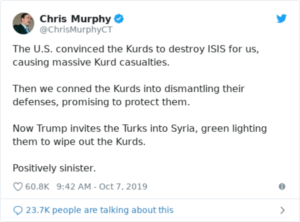
Χθες ο πρόεδρος των ΗΠΑ άναψε το πράσινο φώς στους Τούρκους να επιτεθούν στους Κούρδους συμμάχους τους, οι οποίοι, στις κοινές μάχες με τους Αμερικανούς στρατιώτες αυτά τα χρόνια εναντίον των πραγματικών τρομοκρατών του Ι.Κ., έχασαν 11 χιλιάδες άνδρες και γυναίκες, ενώ μετρούν πολλές χιλιάδες τραυματίες, το άνθος της νεολαίας του κουρδικού λαού.

Δηλαδή, οι ΗΠΑ υποστηρίζουν την Τουρκία, που βοηθούσε τους τρομοκράτες του Ι.Κ., να επιτεθούν εναντίον των μέχρι χθες συμμάχων τους, οι οποίο εξάλειψαν με τεράστιο κόστος τους τρομοκράτες του Ι.Κ. που αποτελούσαν τεράστια απειλή για την Ευρώπη, τις ΗΠΑ και την παγκόσμια ασφάλεια.

Όσο για τη Ρωσία, υπέπεσε σε τεράστιο πολιτικό σφάλμα, ανάβοντας αυτή πρώτη πράσινο φώς στους Τούρκους να εισβάλουν στη Β. Συρία, προσδοκώντας ακόμα μεγαλύτερη ένταση στις σχέσεις της Τουρκίας με τις ΗΠΑ.

Τώρα που άναψε το πράσινο φως και ο Τραμπ, κοιτάζουν αμήχανοι τους χάρτες της περιοχής και ετοιμάζονται να τιμωρήσουν την Τουρκία στο Ιντλίμπ.

Όμορφος κόσμος έντιμος, αγγελικά πλασμένος.

Σημείωση: Όλα αυτά πρέπει να αποτελέσουν μάθημα για την Ελλάδα, να κανονίσει να ισχυροποιηθεί και να σταθεί στα πόδια της, για να μη βρεθεί για άλλη μια φορά στη θέση των Κούρδων.

Κούρδοι αδέλφια μας, μείνετε όρθιοι και θα νικήσετε, είμαι σίγουρος.

Δημοσιεύθηκε στην εφημερίδα δημοκρατία

Μετά την “κόλαση” στη Συρία η Τουρκία τι ετοιμάζει στη Μεσόγειο; Ο Πομπέο ξέρει τι λέει…

1

Του ΜΙΧΑΛΗ ΙΓΝΑΤΙΟΥ

Ο πρωθυπουργός Κυριάκος Μητσοτάκης με τον Αμερικανό υπουργό Εξωτερικών Μάικ Πομπέο. State Department photo by Ron Przysucha

OCTOBER 8, 2019

Τα νέα από το μέτωπο της βουλιμικής Τουρκίας, σε ότι αφορά την Κύπρο -και κατά συνέπεια την Ελλάδα- είναι εξαιρετικά άσχημα. Την ίδια στιγμή η κατάσταση στη Συρία περιγράφεται ως κόλαση, αφού η κατοχική δύναμη ετοιμάζεται να αιματοκυλίσει την περιοχή με στόχο να εξολοθρεύσει τους Κούρδους μαχητές των YPG. Ο πρόεδρος Ντόναλντ Τραμπ αποδείχθηκε -όπως πολλοί γνώριζαν άλλωστε- επικίνδυνος σε βαθμό …κακουργήματος.

Χωρίς να ενημερώσει τους υπουργούς Εξωτερικών και Άμυνας -άσχετα τι ισχυρίστηκε χθες το βράδυ- έλαβε μία καταστροφική απόφαση για την ίδια την Αμερική. Και έδωσε την εντύπωση στον Ταγίπ Ερντογάν ότι μπορεί να σκοτώνει με την έγκριση της αμερικανικής υπερδύναμης.

Όλες οι πληροφορίες συγκλίνουν στο ότι ο Μαικ Πομπέο και ο Μαρκ Έσπερ, οι επικεφαλής του Στέιτ Ντιπάρτμεντ και του Πενταγώνου δεν ήταν ενήμεροι για τη συνομιλία του κ. Τραμπ με τον Σουλτάνο της Τουρκίας.

Ήταν η σφοδρή αντίδραση των δύο υπουργών και των ηγετικών στελεχών του Κογκρέσου, που ανάγκασε τον Αμερικανό πρόεδρο να καταφύγει στο αγαπημένο του Twitter και να απειλήσει τον Ερντογάν με την ολοκληρωτική καταστροφή της τουρκικής οικονομίας.

Στην Ουάσιγκτον ξεσηκώθηκε θύελλα αντιδράσεων και ο κ. Τραμπ απομονώθηκε. Θα δούμε και χειρότερα καθώς η Γερουσία και η Βουλή ετοιμάζονται για ένα πόλεμο μαζί του. Μπροστάρηδες σ’ αυτό τον πόλεμο είναι οι πιο στενοί πολιτικοί του φίλοι και νομοθέτες του Ρεπουμπλικανικού Κόμματος.

Επιεικώς, ο Αμερικανός πρόεδρος φέρθηκε εγκληματικά απαράδεκτα απέναντι στους πιο γνήσιους συμμάχους της Αμερικής: Τους Κούρδους, οι οποίοι πρόσφεραν 11 χιλιάδες ζωές μαχητών τους στον πόλεμο εναντίον των τζιχαντιστών.

Αποδείχθηκε ένας πολύ μικρός ηγέτης, ο οποίος είναι πλέον επικίνδυνος για τα αμερικανικά στρατηγικά συμφέροντα.

Η κατάσταση χθες το βράδυ έγινε αφόρητη για τον κ. Τραμπ. Και οι συνεργάτες του έσπευσαν -ενημερώνοντας τους δημοσιογράφους- να διαβεβαιώσουν ότι δεν ένέκρινε την τουρκική εισβολή στη συνομιλία του με τον κ. Ερντογάν.

Βέβαια, επειδή αφήνει πάντα τη γλώσσα του να πηγαίνει …περίπατο, δεν πρέπει να αποκλείσουμε τίποτα. Μπορεί και να του είπε να προχωρήσει. Όλα είναι πιθανά.

Επανερχόμενοι στα δικά μας, είναι, λοιπόν, χειρότερα απ’ ότι πιστεύαμε τα πράγματα στην ανατολική Μεσόγειο, καθώς αυξάνεται η επιθετικότητά της Τουρκίας σε μία εποχή κατά την οποία οι Ηνωμένες Πολιτείες συγκλονίζονται από τις εσωτερικές εξελίξεις και την απόφαση των Δημοκρατικών να ξεκινήσουν τη διαδικασία για την καθαίρεση του Ντόναλντ Τραμπ.

Οι απειλές της κατοχικής δύναμης, που εκφράζονται δια του Ταγίπ Ερντογάν -διότι μόνο αυτός μετρά στην Τουρκία- είναι πραγματικές. Όποιοι συνεχίζουν να πιστεύουν ότι όλα γίνονται για τόνωση του εσωτερικού εθνικιστικού μετώπου, πρέπει επειγόντως να αλλάξουν γνώμη. Πρόκειται για εντελώς λάθος και ανόητη ανάλυση, που έχει ξεπεραστεί από τα γεγονότα.

Ο πρόεδρος της Τουρκίας, γνωρίζει πως στην περίπτωση που κινηθεί στρατιωτικά εναντίον της Κύπρου, δεν θα υπάρξει πραγματική αντίδραση, ούτε διεθνής δύναμη που θα την αποτρέψει. Και στη δυσχερή οικονομική κατάσταση που βρίσκεται ακόμα η Ελλάδα, αδυνατεί να βοηθήσει αποτελεσματικά το νησί.

Οι δηλώσεις του Αμερικανού υπουργού Εξωτερικών Μάικ Πομπέο στην Αθήνα είναι πολύ καλές, αλλά απαιτούμε και έργα. Πρέπει να τερματιστεί η ομηρία της Κύπρου. Και οι Αμερικανοί είναι οι μόνοι που μπορούν να το πετύχουν. Έχουν τον τρόπο και δεν χρειάζονται στρατιωτικά μέσα. Οι κυρώσεις θα γονατίσουν τον Ερντογάν και την Τουρκία. Αυτό αποδείχθηκε πέρυσι τον Αύγουστο με μία δήλωση του κ. Τραμπ στο Twitter. Η επιθετικότητα της κατοχικής δύναμης πρέπει να τερματιστεί πάραυτα. Οι Αμερικανοί έχουν την ευθύνη.

Ας μην τρέφουμε όμως αυταπάτες. Διότι και οι ηγεσίες στη Λευκωσία και την Αθήνα έχουν μεγάλες ευθύνες. Τις έχει κυριαρχήσει ένα απίστευτο φοβικό σύνδρομο. Άλλωστε, ο πρωθυπουργός Κυριάκος Μητσοτάκης, μετά από τη συνάντηση του με τον Ταγίπ Ερντογάν στη Νέα Υόρκη, έχει δείξει ότι έγνοια του είναι να αποτραπεί οποιαδήποτε αντιπαράθεση με την Τουρκία και αν είναι δυνατόν, να εισέλθει σε ένα διάλογο στον οποίο θα συζητήσει τα πάντα.

Και συνεργασίες στο Αιγαίο; Πιθανότατα. Όμως, δεν είναι η ώρα κύριε Πρωθυπουργέ για τέτοιες κουβέντες. Μόνο, που δεν σκέφτεται με τον ίδιο τρόπο ο Τούρκος συνομιλητής του, και είμαι βέβαιος ότι το αντιλήφθηκε στη διάρκεια της συζήτησης, όταν επιχείρησε να του μιλήσει για την Κύπρο και ο Ερντογάν του απάντησε με επιθετικό τρόπο για τη Θράκη.

Η τουρκική πολιτική ηγεσία, γνωρίζει ότι: Η Ευρώπη, εκτός του Εμανουέλ Μακρόν, δεν ασχολείται με το γεγονός ότι ένα κράτος-μέλος της, η Κύπρος είναι υπό συνεχή εκβιασμό. Η Ε.Ε. δεν έχει κανένα μηχανισμό, πέραν του διπλωματικού (και άχρηστου) για να υποστηρίξει το νησί και να σταματήσει μία τουρκική επίθεση. Επίσης, είναι γνωστό πως η Αμερική δεν έχει αυτή τη στιγμή καμία επιρροή, πόσο μάλλον ισχύ, για να αλλάξει την όποια απόφαση του κ. Ερντογάν. Οι σχέσεις τους παραμένουν στο ναδίρ, και στο σημείο που βρίσκονται τα πράγματα στις ΗΠΑ, με τον πρόεδρο Τραμπ να είναι όμηρος των διαδικασιών που ανακοίνωσε το Κογκρέσο, ολίγο ενδιαφέρει την αμερικανική ηγεσία αν η Κύπρος και η Ελλάδα θα υποστούν επίθεση.

Ένα σοβαρό στοιχείο για την αναποτελεσματικότητα της Ουάσιγκτον να επιβληθεί στην Άγκυρα, είναι το γεγονός ότι η Τουρκία αποφάσισε να επιτεθεί στους Κούρδους του YPG, που αποτελούν τους μόνους γνήσιους συμμάχους των ΗΠΑ στην περιοχή. Οι Αμερικανοί δεν είχαν καταφέρει να πείσουν τους Τούρκους να αλλάξουν τα σχέδια τους. Εάν η Τουρκία επιτεθεί, όπως δήλωσε επίσημα και δημόσια ο κ. Ερντογάν, θα ακολουθήσει αιματοχυσία. Ας μην έχει αμφιβολία περί αυτού κανείς.

Οι στιγμές για την Κύπρο και την Ελλάδα είναι εξαιρετικά δύσκολες. Και τα διλήμματα βασανιστικά. Τι κάνει ένας ηγέτης σε αυτή την περίπτωση όταν το δικό του εσωτερικό μέτωπο είναι σμπαράλια και η βασική συζήτηση αφορά αν πρέπει να γίνονται ή όχι απεργίες; Αναγκάζεται να συνομιλήσει υπό εκβιασμό βεβαίως… Όμως, ο κ. Μητσοτάκης έχει και άλλες επιλογές. Από τον κ. Πομπέο, στην ιδιαίτερη κουβέντα τους, ο Ελληνας πρωθυπουργός άκουσε πολλά που τον ικανοποίησαν. Ούτε το Αίγαιο, ούτε η Κύπρος είναι προς πώληση λοιπόν…

Πηγή: Μετά την “κόλαση” στη Συρία η Τουρκία τι ετοιμάζει στη Μεσόγειο; Ο Πομπέο ξέρει τι λέει… https://hellasjournal.com/2019/10/meta-tin-quot-kolasi-quot-sti-syria-i-toyrkia-ti-etoimazei-sti-mesogeio-o-pompeo-xerei-ti-leei/

Nixon and Trump: The Politics of Impeachment

0

By George Friedman – Oct. 8, 2019

The evolution of the American political system inevitably has an impact on the global system. If the United States shifts direction in even minor matters, there are regional consequences. Political events are difficult to predict, but the key variables of the process can be identified by comparing the current evolution to a roughly similar prior event. My intent is to benchmark the current impeachment inquiry into President Donald Trump to the one that forced Richard Nixon to resign. It is an attempt to define what matters and what doesn’t within the impeachment process, rather than the potential global outcome triggered by hypothetical events.

The Watergate Scandal

Nixon resigned as president in August 1974. Tapes of him discussing the break-ins at Democratic Party headquarters at the Watergate building were released on Aug. 5, and he resigned four days later. Until that point, a substantial segment of the electorate continued to support him. He had won reelection in 1972 by defeating George McGovern, who ran on an anti-war platform. That platform was perceived by many as supporting what was then called the “counterculture,” which was seen as a systematic attack by a marginal group on American middle-class values. Nixon positioned himself as the spokesman for the “silent majority,” which was seen as the politically subdued core of American society and values.

Nixon did not simply run against McGovern or the counterculture. He ran against the media, which he saw as having been hostile to him well before his first election, hostile to the war in Vietnam from the beginning, and unwilling to praise him for his foreign policy initiatives (including the opening to China and detente with the Soviets) and his championing of middle American values. Looking back at Nixon’s press conferences, the hostility and contempt of the reporters was palpable, as was Nixon’s defensive anger.

The Watergate scandal began in August 1972 and developed with increasing intensity for two years. There was much discussion of impeachment or criminal indictment of the president, but this was impossible. A substantial part of the electorate supported him, seeing the scandal as something manufactured by his political enemies and the media. Interestingly, despite Nixon’s landslide victory, both houses of Congress were controlled by the Democrats, who held hearings on the Watergate affair in the summer of 1974.

The Democrats understood that while they might be able to impeach the president in the House of Representatives, they did not have anywhere close to the two-thirds majority needed to convict in the Senate. Given the passions on both sides, the Democrats were loath to bring an impeachment vote up in the House knowing that conviction was impossible. It would be seen as useless political melodrama. In addition, they could not try him on the same offense later. Likewise, senators did not want the House to put them in a position of holding a vote that might fail. Since both houses were controlled by the same party, they were equally solicitous of each other.

The problem for the Democrats, then, was the deep division in the country. According to polls, a majority of voters were hostile to Nixon, but he retained enough support – in the 40 percent range – to deter Democrats running in districts that were close (and many were close in 1974). Since impeachment is a political rather than a judicial process, a powerful minority of voters saw it as a desire to reverse McGovern’s defeat. Indeed, the number of voters who opposed Nixon politically was larger than the number of voters who wanted him impeached. The political risk of alienating those voters was too great.

The debate might have gone on indefinitely but for the emergence of a “smoking gun,” a bit of evidence so conclusive that even Nixon’s Republican supporters could not ascribe it to Democratic or media manipulation. The smoking gun was the revelation that Nixon had taped many of his office conversations and that some included conversations on Watergate. The House and Senate demanded the tapes, but Nixon refused to release them. That alone started to erode his political support on the theory that he would only hide the tapes if they were harmful to him.

After the courts ordered the release of the tapes, it was discovered that one of them had been erased while others clearly implied Nixon either had knowledge of the cover-up or ordered the break-in himself. The mood among his Republican supporters and in the Senate then shifted. A group of senior senators told Nixon that he would be convicted by the Senate if it came to a vote and convinced him to resign.

The key to this event had little to do with members of Congress. It had everything to do with Republican voters, who were persuaded that, while the attacks on Nixon had been carried out for political reasons, he was guilty and had to be removed. The smoking gun had brought them there (and Republican anger at the media and the Democrats was no less then than it is today). So despite the loathing for Nixon’s enemies, there was a sea change among his supporters, such as never took place during the Clinton impeachment. During the Clinton impeachment, Democratic voters did not agree that there had been a smoking gun requiring conviction, and therefore the Senate found Bill Clinton not guilty.

Neither the House nor the Senate held the power to remove Nixon from office. Nor did those who despised him. That power was held by Nixon’s supporters, who represented a substantial minority by 1974 that could sway state and local elections. Their standard for removal was far higher than others’, and without a smoking gun, the scandal would likely have lurched on indefinitely. But there was a smoking gun, one that tore away illusions about Nixon. But Nixon’s supporters never forgave the Democrats for trying to destroy him before they had a smoking gun, and for 12 years after Jimmy Carter, Republicans dominated the presidency.

The Ukraine Affair

The United States today is at a point similar to where it stood in 1974. The country is divided into two camps, as alienated from each other as were middle America and the counterculture. The Democrats are becoming the political party of the current culture, and the Republicans are the party seeking to hold on to past values. Trump has the support of a minority of voters, which still represents a significant segment of the electorate. He and his backers hold the media responsible for the political crisis, and the media is strongly arrayed against Trump. The passion on both sides is extreme. The president’s opponents and supporters not only are extraordinarily convinced of their positions but, more important, have little contact with each other. Both groups represent hostile tribes, much as it was during the Nixon crisis.

But the important thing to keep in mind is that opposition to impeachment is larger than Trump’s own support base. This is the single most important fact that will determine the future course of this debate. Just as the Republicans in 1974 required a smoking gun to support impeachment, so too does the system today.

The question is whether the Ukraine affair is that smoking gun. There have been many allegations leveled against Trump that were supposed to be smoking guns – but that turned out not to be. Ultimately, the public, not politicians, will decide what really is a smoking gun. And if one were found, the public mood would shift in support of impeachment. It would slash support for Trump into the 20s or less. That would change the decision-making process of politicians in both parties. What happened with Nixon had many predecessors, but it wasn’t until the tapes were released that his presidency collapsed. There are many precursors with Trump as well, but none were sufficiently convincing to cause the voters to shift dramatically. And as in 1974, it is not the Democratic voters that are decisive but the Republican ones. It was their shift that freed Republican senators to change their position and guarantee Nixon’s removal from office. Today, the Democrats have fixed positions, and they can’t remove Trump from office. Only the Republicans can, and their voters aren’t convinced.

There are two things that the Nixon and Trump impeachment processes have in common. The first is that the social divide during both events was profound. The second is that for a couple of years before Nixon’s end, and before this moment for Trump, there were endless assertions of impeachable offenses that alienated the Nixon faction and energized his enemies. That process raised the bar for conviction, because it made the smoking gun essential. So many accusations arose, all of which ultimately went nowhere, that incontrovertible evidence – the tapes – became necessary.

On the current claim against Trump – that he tried to persuade the Ukrainian government to investigate Joe Biden – my opinion or any one of yours really doesn’t matter. The key is whether this charge breaks the back of his support, leaving him with only a handful of supporters. In the Nixon era, evidence exhaustion was overcome by the tapes. The issue now is whether anything will come out that can overcome evidence exhaustion in this case. If Trump’s political support remains as is, he will not be convicted. Most understand that impeachment and conviction are a political, not judicial, process, but many fail to see that this doesn’t mean politicians get to decide what happens. Politicians want to be reelected, so in the end, as is appropriate in a republic, the people will decide this issue. They will decide if Ukraine is a smoking gun.

Trump sells out the Kurds in his own unique way

0

The Washington Post

(Ahmad Baderkhan/AP)

BY ISHAAN THAROOR

Edited by Ruby Mellen

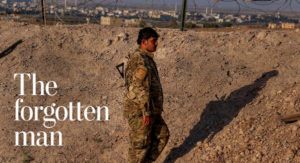
Already locked in a heated impeachment battle, President Trump found a new way to rile Washington this week. Late Sunday, the White House announced that it would not impede an imminent Turkish invasion into northeastern Syria. By Monday morning, my colleagues confirmed that the United States had begun withdrawing troops from the Syrian-Turkish border, where they had been stationed alongside U.S.-allied Syrian Kurdish fighters. It seemed the first phase of a possibly new and destabilizing military conflagration in war-ravaged Syria. By Monday evening, there were already reports of Turkish artillery shelling and airstrikes on Syrian Kurdish positions.

The moves followed a Sunday phone call between Trump and Turkish President Recep Tayyip Erdogan, whose government considers the main Syrian Kurdish faction that fought the Islamic State to be as much of a danger as the Islamist militants themselves. That’s because of their direct ties to the Kurdistan Workers’ Party, or PKK, an outlawed separatist group in Turkey that’s designated as a terrorist organization by Washington and Ankara.

Erdogan and his government long resented the outsize influence of the Syrian Democratic Forces, the name of the coalition of Syrian Kurdish-led militias that was instrumental in rolling back the Islamic State, as well as the outside support they received from the United States and other European partners. No matter the thousands of lives lost by the SDF, Trump now appears to have given Erdogan what he’s wanted — an open invitation to weaken if not break Rojava (what Syrian Kurds call an enclave in northeastern Syria largely administered by the SDF) and potentially repopulate a belt of territory with Syrian refugees currently living in Turkey.

A definitive U.S. withdrawal from northern Syria — or whatever it is that Trump championed in tweets Monday morning calling for an end to America’s “endless wars” — could have serious ramifications. If Turkey pursues a significant ground invasion, it would overrun SDF defenses, fracture their fighting forces, compel a possible exodus of Syrian Kurdish refugees toward Iraq (a country that’s hardly stable itself), and, as many security analysts fear, create enough of a security vacuum to pave the way for the Islamic State’s resurgence.

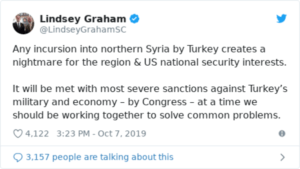
For that reason, many Trump allies expressed outrage with his decision-making. Nikki Haley, Trump’s former ambassador to the United Nations, tweeted that leaving the Syrian Kurds “to die is a big mistake.” Sen. Lindsey O. Graham (R-S.C.), who has carried water for Trump on almost all other fronts, warned that a Turkish foray into Syria would provoke sanctions from Congress and a move to suspend Ankara’s participation in NATO. Senate Majority Leader Mitch McConnell (R-Ky.) told reporters that “a precipitous withdrawal of U.S. forces from Syria would only benefit Russia, Iran” and the Syrian regime.

Trump predictably justified his actions not with a strategic vision for a troubled region, but campaign talking points. He told reporters on Monday afternoon that he was following through on what he “got elected on” — in this instance, disentangling the United States from the Middle East’s intractable conflicts. He said it was the responsibility of other countries, including Turkey, to deal with what’s left behind. For good measure, he threatened Ankara with crippling economic sanctions if the Turks did anything “outside of what we think is humane.”

Whatever Trump thinks “inhumane” may mean, it was a far cry from the somewhat rambling remarks Trump made at a news conference a year ago hailing the United States’ Kurdish partners.

“We do get along great with the Kurds. We’re trying to help them a lot,” the president said then in response to a Kurdish journalist’s question about U.S. interests in Syria and Iraq after the defeat of the Islamic State. “Don’t forget, that’s their territory. We have to help them. … They fought with us. They died with us. They died. We lost tens of thousands of Kurds, died fighting ISIS. They died for us and with us. And for themselves. They died for themselves. They’re great people. And we have not forgotten. We don’t forget.”

The Middle East’s largest stateless ethnic group, close to 40 million Kurds are scattered throughout Turkey and parts of Iran, Iraq and Syria. They are hardly a monolith; numerous political and factional divisions exist within Kurdish communities. There’s little love lost, for example, between the party that controls the semiautonomous regional government in Iraqi Kurdistan and the PKK-linked elements across the border in Syria. But they all share a long history of frustrated national ambitions, punitive state violence and abandonment on the world stage.

Betraying the Kurds is, at this point, an American tradition. In the early 1970s, as a favor to the shah of Iran, the administration of President Richard M. Nixon helped foment a Kurdish uprising in Iraq. But once Baghdad and Tehran mended fences in 1975, the United States turned its back on the insurrection, many of whose combatants were slaughtered or driven into exile. Henry Kissinger, Nixon’s secretary of state, is said to have quipped about Kurdish disappointment then that “covert action should not be confused with missionary work.” In 1991, President George H.W. Bush called on Iraqis to rise up against the dictatorship of Saddam Hussein. But the United States then stood by as Iraqi forces brutally crushed separate Kurdish and Iraqi Shiite rebellions.

We’ll see what script from history gets reread in the coming weeks. In early August, the United States and Turkey agreed to a “security mechanism” that led to Syrian Kurdish forces pulling back from near the Turkish border and dismantling some of their critical fortifications. The SDF cooperated in good faith but now is even more vulnerable to a Turkish advance. A statement from the SDF on Monday expressed disappointment that U.S. forces “did not carry out responsibilities” and a grim resolve “to defend our land at all costs.”

What distinguishes the current moment of Kurdish betrayal from earlier eras is perhaps its seeming strategic incoherence. On Monday morning, officials in the Pentagon and State Department voiced bewilderment over the president’s tweeted announcements; reports suggested that neither the SDF nor other U.S. coalition partners on the ground were given warning of Trump’s decision.

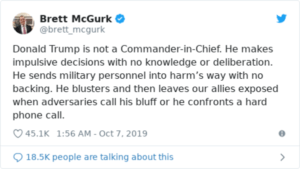
Brett McGurk, Trump’s former top diplomat in the war against the Islamic State, savaged his ex-boss on Twitter. “The value of an American handshake is depreciating,” he said. “Trump today said we could ‘crush ISIS again’ if it regenerated. With who? What allies would sign up? Who would fight on his assurances?”

The front-page leading piece from my colleagues digs deeper into Turkey’s thinking and options, looks at earlier Turkish incursions over the course of the Syrian conflict and the extreme complexity of resettling Syrian refugees in places they don’t come from.

“Kurdish leaders have accused Turkey of trying to settle Arabs in historically Kurdish lands,” my colleagues reported. “Arab residents, in turn, have accused the Kurds of carrying out ethnic cleansing in areas they control.”

• European officials lamented what they saw as an abrupt and unfortunate decision that would raise tensions in an unstable region, reported my colleagues across the pond. The Post’s Ruby Mellen also compiled this handy brief history of the Syrian Democratic Forces.

• Washington Post columnist David Ignatius spoke to a top SDF commander, who warned of an imminent Turkish land invasion. Gen. Mazloum Abdi urged Trump “to keep his promise” to preserve safety and security for Kurdish allies. He asked U.S. policymakers “to stop this decision and stop the Turkish attack.” He said that abandoning the Kurds “is hurting U.S. interests and reputation. It’s not acting according to American principles.”

• Iraq’s military acknowledged Monday that security forces have used “excessive force” to quash anti-government demonstrations while journalists described growing efforts to suppress reporting on the deadly violence. Security forces have killed more than 100 people since protests erupted in Baghdad and southern cities last week. Hospitals have overflowed with more than 6,000 wounded. By Monday, the most serious clashes had been confined to Baghdad’s sprawling and impoverished district of Sadr City, where 15 deaths were reported the night before.

• An anodyne tweet from Houston Rockets General Manager Daryl Morey in support of Hong Kong’s pro-democracy protests triggered a huge backlash in mainland China, a scandal engulfing the National Basketball Association, and yet another reminder of the depth of the growing rift between the United States and China.

• The Post’s Will Englund looks at how Russia may be trying to exploit the swirling turmoil of Trump’s impeachment inquiry, which centers on incidents and dealings in next-door Ukraine.

“I have no doubt [the Russians] will try to take advantage of this situation,” said Bohdan Yaremenko, the former Ukrainian ambassador to Turkey who now has a seat in parliament in Kiev. “They’re masters of the under-carpet game.”


Russian-Chinese Cooperation Is Not As Temporary As You Think

0

By October 8, 2019

BESA Center Perspectives Paper No. 1,308, October 10, 2019

EXECUTIVE SUMMARY: Many believe the Russian-Chinese partnership, which functions across a variety of economic and political spheres, is only temporary. But Moscow’s disenchantment with the West, and the redirection of its foreign policy toward Beijing and beyond, is rooted in Russian historical thinking. The disagreement between Russia and the West is a full-scale geopolitical separation.

The most popular topic in modern geopolitics these days is probably the budding relationship between Russia and China. Articles on the subject are produced regularly, almost all of them concluding that Russia is only temporarily siding with China. It is just a matter of time, these articles claim, until disagreements between the two powers become inevitable.

These articles miss the fact that Moscow’s move away from Europe is rooted deeply in Russian history. It goes back much further than the Ukrainian crisis, which triggered Moscow’s recent troubles with the West.

The Russian-Chinese partnership is built around their common animosity toward the US. Both have been confronted by the US and have taken actions that go against Washington’s worldview, which favors a division of the Eurasian landmass among multiple powers and the maintenance of control over the world’s oceans.

These issues drove Moscow and Beijing to work together, but it should also be noted that each stealthily tries to use the other to gain political leverage in economic, military, and other spheres. Indeed, Russian tactics since the deterioration of relations with the West in 2014 have been to move closer to China and other Asian states, such as Iran and Turkey, to show how far Moscow is willing to distance itself from the West against the background of growing US-China competition.

Putin’s strategy seems to have worked to a degree, as various statements and policy moves over the past year or so indicate that the West is anxious not to lose Russia to Asia (especially to China). As troubles with China grow and the West is forced to contemplate the possibility of a China-led world, the loss of Russia would be tantamount to a geopolitical catastrophe.

That is because in that scenario, Chinese influence would spread to most of Eurasia and even to the Arctic, which is a rising geopolitical hotbed. Recall the first decades of the Cold War, when the Moscow-influenced communist movement controlled territory from Berlin to Vietnam.

But for the West, the loss of Russia to China would mean more than just a geopolitical catastrophe. Despite eternal discussions within Russia over who the country really belongs to, Asia or Europe, the West has always considered the Russian world to be a part of it. True, the West considered Russians to be barbarians during wartime, and tsarist ruthlessness, as well as Soviet methods of state-building and policy-making, were appalling. But from a grand strategic or even philosophical perspective, for the West to lose Russia would mean the reversal of almost a millennium of western European economic and cultural export eastward. In a sense, the Romanovs and the Soviets copied the West, which made them geographic and cultural extensions of European civilization.

This would represent a reversal in which the influence of China’s culture and worldview – for the first time in many centuries – would extend beyond its borders, right up to the edges of Eastern Europe.

There are worrying signs that many in the Russian political class no longer want the same level of psychological attachment to the West, but prefer to be more evenly directed (in terms of foreign policy and economic relations) toward both Europe and China. Moreover, Moscow is building closer relations with Turkey and Iran. The Middle East can thus be a third theater of active Russian diplomacy.

There is a great deal of logic to this strand of Russian thinking. In a way, Moscow wants to free itself from “singularity” in its geopolitical approach to the outside world. We like to believe this change in perception began under Putin, but it has been at work since the 1990s, when Russia was weak and disillusioned. The only way to uphold its position was to stress global multipolarity, meaning the US would no longer be the sole dominant power but one of the many.

In fact, one can go even further back to trace attempts to “de-Europeanize” Russian foreign policy. When Peter the Great reformed Russia and heavily Europeanized the ruling elite, he was widely praised, but there were some who were deeply disenchanted. They believed Peter broke the bridge between the common folk and the Russian political elite and distanced one from the other. Moreover, many in Russia believed the country’s Europe-centrism limited Russia’s ability to position itself as a true global power.

In retrospect, it can be argued that the Bolsheviks came to power to bridge the gap with the ordinary population. In foreign policy they wanted to be internationalist, not Europe-centered, and this worked for a time. But Western technological progress eventually attracted the Russian elites of both the Romanovs and the Soviets, leaving no room for Russia’s Asian roots.

Putin’s “de-Europeanization” of foreign policy should thus be seen as a recurrence of this grand historical cycle. His foreign policy might be viewed as reflecting the Eurasianism created in the 1920s, which held that Russia’s Asian roots should be respected at least to the same degree as its European heritage.

But Putin can also be seen as a shrewd follower of yet another radical strand of Russian political thought: Slavophilism, which was created well before Eurasianism. Putin and the rest of the Russian political elite often make semi-nationalistic statements the Soviet leaders would not have uttered – statements that reflect Slavophile reasoning.

All Russian philosophical ideas have been deeply Europeanized. Not even those who severely criticize Russia’s Europeanness can deny those roots.

And this is a fundamental problem for the Russians. The country spans almost the entire north Eurasian landmass. It is culturally close to the West, but ever since the loss of Ukraine and the Baltic states, it has grown increasingly Asian because of the rise of China and the fact that most of Russia borders Asia. (This is speculation, but it is possible that if the ruling elite goes all the way with the nascent alliance with China, Russia could split violently into at least two large segments: the western part, populated with a more or less Europeanized population, and the rest of the country bordering on the Chinese giant.)

Russia’s distancing from Europe is likely not a temporary affair. Even if Brussels suddenly decides to take part in a grand geopolitical bargain in which Moscow reclaims Ukraine and other former Soviet states, Russia’s “de-Europeanization” of foreign policy is likely to continue. The political class within Russia is doing what Russian leaders have been trying to do for centuries: make Russia more independent in its foreign policy focus and diversify it toward other regions.

Russia’s split with Europe is not about China’s rise. It reflects Russian history and marks a continuation from previous centuries. What it will bring to Russia in the end is difficult to say, but the trend is likely to continue at least for the next decade.

Much will depend on what western Europe and the US offer Moscow in exchange for a near alliance to contain China. While this might sound unrealistic, recent discussions among western political elites show a shift on Russia. Serious concessions to Moscow might forthcoming.

View PDF

Emil Avdaliani teaches history and international relations at Tbilisi State University and Ilia State University. He has worked for various international consulting companies and currently publishes articles on military and political developments across the former Soviet space.

https://besacenter.org/perspectives-papers/russia-china-cooperation/

Ούτε ο Μάο να ήταν.

3

Όταν ένας Πρόεδρος- και, μάλιστα, υπερδύναμης- μιλά ο ίδιος για την απαράμιλλη σοφία του, είναι καλά;
Μπορεί αυτός ο άνθρωπος να αποφασίζει, μόνος, για την τύχη της ανθρωπότητας; Άντε να το δεις και να το ακούσεις σε καμιά χώρα με αυταρχικό καθεστώς. Αλλά και στην ηγεσία των ΗΠΑ;

Ακόμη και στην περίπτωση του Μάο, το κόκκινο βιβλίο του κινέζου ηγέτη και τη “απαράμιλλη σοφία” του τα διακινούσαν άλλοι.

Η αιώνια «ανανεωτική αριστερά» ψάχνει τον νέο της ξενιστή…

0

Του Μανούσου Μαραγκουδάκη Τρίτη 08 Οκτωβρίου 2019, 00:02 liberal.gr

Η εκκωφαντικά αποτυχημένη γενική απεργία της προηγούμενης εβδομάδας κλείνει και τυπικά τον κύκλο της πάλης των τάξεων στην χώρα μας. Μία πάλη που ποτέ δεν είχε ταξική υπόσταση, όμως που συμβολικά διαπερνούσε τις κοινωνικές αντιπαλότητες τύπου «το δίκιο του εργάτη» και διεμβόλιζε την κομματική αντιπαράθεση καθ’ όλη τη διάρκεια της Μεταπολίτευσης. Η κατάρρευση του ιδανικού του κρατισμού στα χρόνια της Μεγάλης Κρίσης, ο τεράστιος αριθμός ανέργων του ιδιωτικού τομέα, η δίψα για εκσυγχρονισμό, οι ευκαιρίες της καπιταλιστικής ανάπτυξης, αλλά και η προσεκτική σημερινή διακυβέρνηση σε θέματα εργατικών δικαιωμάτων και εργατικής προστασίας, απονεύρωσαν πλήρως τον παρελθόντα συμβολισμό της «εργατιάς» ως το κυρίαρχο λογοπλαίσιο συγκρότησης της δημόσιας σφαίρας.

Στην θέση του μία άλλη σύνθετη συμβολική αντιπαράθεση ξεπροβάλλει: Αυτή της πολιτικής ορθότητας εναντίον της ελευθερίας της έκφρασης, μαζί με αυτήν της πιο πρόσφατης αντιπαράθεσης των ανοικτών συνόρων εναντίον του εθνικισμού. Στην υπόλοιπη Δύση αυτή η μετακίνηση δημόσιων συμβόλων και ηθικών διατάξεων έχει ξεκινήσει εδώ και μία γενιά σε διαφορετικούς συνδυασμούς, εντάσεις, και επιχειρηματολογίες. Μία, κατά τα άλλα, «κανονική» διαδικασία ανάπτυξης της κοινωνικής διαφοροποίησης στο Δυτικό κόσμο, οικειοποιήθηκε από τη Νέα Αριστερά, και μετατράπηκε σε όπλα κατά του φιλελευθερισμού. Έτσι, πρώτα στην Αμερική και τον Καναδά, και μετά στην Ευρώπη, η Νέα Αριστερά οπλισμένη με τα θέματα αυτά ενσταλάζει συναισθήματα εχθροπάθειας σε όλες τις πολιτικές κοινωνίες, με τρόπο πρωτόγνωρο για τον Μεταπολεμικό Δυτικό κόσμο.

Τώρα είναι η σειρά της Ελλάδας. Όπως και η προηγηθείσα Μεταπολιτευτική αντιπαράθεση, έτσι και αυτή είναι δημιούργημα της αριστεράς∙ και όπως και η προηγούμενη, έτσι και αυτή είναι κούφια. Η ελληνική αριστερά, και εν προκειμένω, ο ΣΥΡΙΖΑ, ουδεμία ουσιαστική σχέση έχει με τα νέα κοινωνικά κινήματα, που σε άλλες χώρες τα μέλη τους πρώτα βίωσαν προσωπικά την οικολογία, τον αναρχισμό, τις νέες μικρο-κοινωνικές συλλογικότητες και τις εναλλακτικές σεξουαλικές ταυτότητες, πριν περάσουν σε δημόσια αιτήματα και πολιτικά προγράμματα. Στην Ελλάδα, συμβαίνει το αντίθετο: υπάρχει ένας πολιτικός φορέας, αυτός της αιώνιας «ανανεωτικής αριστεράς» που από την γέννησή της συχνά αλλάζει ξενιστή και σύμβολα αναζητώντας οικοθέσεις που της επιτρέπουν να παραμένει προστατευμένη από τις αντιξοότητες της αεικίνητης νεωτερικότητας.

Μετά από τον Τσαουσέσκου, την ευρωαριστερά, το ΚΚΕ και το ΕΑΜ, τον Βελουχιώτη, τον Μαδούρο, τον Κάστρο, και πιο πρόσφατα τον Ανδρέα Παπανδρέου και τον Ελευθέριο Βενιζέλο(!), τώρα ήρθε η σειρά της οικολογίας, των ταυτοτήτων και των ανοιχτών συνόρων – και των μεταναστών από τον πάλαι ποτέ Τρίτο Κόσμο. Γνωρίζουμε, από τα τεσσεράμισι χρόνια διακυβέρνησής του, ότι ο ΣΥΡΙΖΑ πολύ λίγη βιωματική ή πολιτική σχέση έχει, ως κοινωνικο-πολιτική ομάδα, ή, καλύτερα, ως σέκτα, με τα παραπάνω. Όμως αυτό διόλου δεν τον εμποδίζει να υιοθετήσει την πλήρη σκευή των απανταχού νέων κινημάτων και λογοπλαισίων τους, αλλά και τους «πρόσφυγες-μετανάστες» ως το νέο επαναστατικό υποκείμενο (χωρίς αυτούς, αλλά για αυτούς), για να επιβεβαιώσει την ύπαρξη, και γιατί όχι, την ηγεμονία του.

Αυτό σημαίνει το εξής: Ο νέος μετακυβερνητικός ΣΥΡΙΖΑ, χωρίς να έχει την δυνατότητα να αντιπαλέψει τη Νέα Δημοκρατία σε θέματα «υλιστικά» (οικονομική ανάπτυξη, κοινωνική πολιτική, κοινωνική διαφοροποίηση, κλπ), θα επικεντρωθεί στην «μετα-υλιστική» αντιπολίτευση καταγγέλλοντας τους αντιπάλους του για ρατσισμό, φασισμό, αυταρχισμό και «Ορμπανισμό», δημιουργώντας έτσι ένα νέο πεδίο συμβολικής αντιπαράθεσης, παρόμοιο με αυτό της Μεταπολίτευσης. Το δίδυμο πολιτική ορθότητα-ανοικτά σύνορα θα είναι το όργανο και το μέσο για την επαναφορά της αριστερής συμβολικής ηγεμονίας στη δημόσια σφαίρα. Μία τέτοια ηγεμονία όμως δεν θα έχει μόνον ηθικές και οικονομικές επιπτώσεις, όπως στην Μεταπολίτευση, αλλά και εθνικές.
Δύο είναι οι πιθανές εξελίξεις: Είτε ο φιλελεύθερος κεντροδεξιός χώρος θα μείνει βουβός όπως στα χρόνια της Μεταπολίτευσης στις αριστερές επιθέσεις, είτε θα αντιδράσει ενεργητικά για να προφυλάξει την χώρα από μία τέτοια προοπτική, αλλά και τους πολίτες της από δικαστικές επιθέσεις όπως αυτές εναντίον της Σώτης Τριανταφύλλου και του Κωνσταντίνου Κυρανάκη). Αν δεν ενεργήσει, τότε η Νέα Αριστερά θα ηγεμονεύσει στη δημόσια σφαίρα και θα ανανεώσει το «ηθικό πλεονέκτημα» που απέκτησε στην Μεταπολίτευση οικειοποιούμενη άκοπα νέους «αγώνες» και νέους «μάρτυρες» κατά του νεοφιλελευθερισμού κλπ.

Όσο για τη Νέα Δημοκρατία, το ερώτημα είναι αν θα σηκώσει το γάντι, ή θα παραμείνει προσηλωμένη στον πατροπαράδοτο πραγματισμό της. Αν συμβεί το δεύτερο, τότε η ιστορία θα επαναληφθεί: αργά ή γρήγορα θα μετατραπεί σε ένα δειλό δευτεραγωνιστή των πολιτικών εξελίξεων, και σε ανερμάτιστο εξυπηρετητή διαφόρων ομάδων πίεσης – όπως συνέβη επί Μεταπολίτευσης. Η νομοθετική κατοχύρωση της προστασίας του λόγου, και η ένσκοπη συγκρότηση ενός φιλελεύθερου εθνικισμού που θα βασίζεται στην εθνική συνείδηση παλαιών και νέων πολιτών της χώρας, πρέπει να υψωθούν ως ανάχωμα σε αυτή την προοπτική.

* O κ. Μανούσος Μαραγκουδάκης είναι Καθηγητής Κοινωνιολογίας, Πανεπιστήμιο Αιγαίου.

https://www.liberal.gr/apopsi/to-telos-tis-palis-ton-taxeon-stin-ellada/269453

Το άδειασμα των Κούρδων, οι αντιδράσεις στις ΗΠΑ και οι «απειλές» Τράμπ

0

Του Γιώργου Παυλόπουλου  Τρίτη 08 Οκτωβρίου 2019, 00:02

Ηθική και διπλωματία δεν είχαν ποτέ τις καλύτερες σχέσεις. Η εγκατάλειψη των Κούρδων της Συρίας από τον πρόεδρο των Ηνωμένων Πολιτειών και μάλιστα την πιο κρίσιμη γι’ αυτούς στιγμή, την ώρα που τα τουρκικά τανκς και αεροπλάνα ζεσταίνουν τις μηχανές τους για την εισβολή, μπορεί να μην προκαλεί έκπληξη εν τούτοις προκάλεσε έντονες αντιδράσεις στην Ουάσιγκτον.

Η ιστορία διδάσκει ότι είναι αμέτρητες οι φορές στις οποίες κάποιοι από τους πρωταγωνιστές της «πούλησαν» τους συμμάχους τους και έκαναν στροφή 180 μοιρών, όταν έκριναν ότι αυτό εξυπηρετούσε καλύτερα τα συμφέροντά τους. Ο Τραμπ βρέθηκε όμως μπροστά σε ένα μέτωπο που ενδεχομένως δεν ανέμενε όταν ανακοίνωνε τις αποφάσεις του για τη Συρία και την απομάκρυνση των αμερικανικών δυνάμεων.

Και  έσπευσε, εκ των υστέρων, να προειδοποιήσει την Άγκυρα και τον Ταγίπ Ερντογάν ότι εάν ξεπεράσουν τα όρια, τότε θα καταστρέψει ολοκληρωτικά την τουρκική οικονομία. Και ναι μεν  μπορεί οι Αμερικανοί, με το δολάριο και τα funds τους, να έχουν τη δυνατότητα να προκαλέσουν μεγάλη ζημιά στην Τουρκία και τη λίρα της, όμως δεν πρόκειται να το κάνουν σε αυτή τη φάση και κυρίως για τα μάτια των Κούρδων.

Η εξήγηση είναι σχετικά απλή: Οι Κούρδοι αριθμούν πολλά εκατομμύρια και είναι μοιρασμένοι σε τέσσερις χώρες της Μέσης Ανατολής: Στην Τουρκία και το Ιράκ βρίσκονται οι περισσότεροι, ενώ σημαντική είναι η παρουσία που έχουν στη Συρία και το Ιράν. Δυστυχώς γι’ αυτούς, όμως, δεν διαθέτουν το δικό τους κράτος, κάτι που σημαίνει πως για τους ισχυρούς αντιπροσωπεύουν μια σχετικά αδύναμη οντότητα και δεν έχουν προτεραιότητα στις επιλογές τους.

Στο πλαίσιο αυτό ο Τράμπ κινήθηκε με γνώμονα το παζάρι που έκανε με τον Ερντογάν.

Διαπιστώνοντας τις έντονες αντιδράσεις που έφτασαν σε σημείο να θέτουν θέμα «προδοσίας» επιχείρησε να «χρυσώσει το χάπι». Κυρίως διότι,  έναν χρόνο πριν τις εκλογές δεν θέλει  να έχει απέναντί του τον επικεφαλής των Ρεπουμπλικάνων στη Γερουσία, Μιτς Μακ Κόνελ, ο οποίος δήλωσε ότι η παραπάνω απόφαση «θα ωφελήσει μόνο τη Ρωσία, το Ιράν και το καθεστώς Άσαντ».

Και προφανώς, θα επιδιώξει να αποφύγει την πρόταση νόμου που προανήγγειλε ότι θα καταθέσει ο γερουσιαστής Λίντσεϊ Γκρέιαμ, ο οποίος πνέει μένεα εναντίον του προσωπικού του φίλου και δήλωσε ότι θα κάνει οτιδήποτε για να ακυρώσει την απόφασή του.

Πολύ περισσότερο, δεν θα διακινδυνεύσει τη δημιουργία ενός μετώπου ανάμεσα σε Δημοκρατικούς και Ρεπουμπλικάνους στο συγκεκριμένο θέμα. Εάν τα καταφέρουν, άλλωστε, όχι απλώς θα τον ταπεινώσουν και θα τον ακυρώσουν, αλλά αυτό μπορεί να αποτελέσει ένα πρόπλασμα για να τα βρουν και στην υπόθεση που τον καίει και απειλεί τη θέση του στον Οβάλ Γραφείο.

Έτσι, έκανε μια δήλωση που ουσιαστικά είναι ανέξοδη και δεν έχει αντίκρυσμα. Γιατί ποιος είναι αυτός που θα κρίνει εάν και πότε η Τουρκία έχει περάσει τα όρια στην εισβολή της και, κατά συνέπεια, πρέπει να το πληρώσει ακριβά; Ο Τραμπ ξεκαθάρισε ότι αυτός θα είναι μόνο ο… Τραμπ.

Ο Ερντογάν μπορεί να κάνει τα σχέδιά του για τη Συρία. Και το κάνει – έστω κι αν, για καλό και για κακό, φροντίζει να γεμίζει τα υπόγεια της κεντρικής τράπεζας με χρυσό, καθώς ως έμπειρος που είναι γνωρίζει ότι ο καιρός έχει γυρίσματα…

Το μοιραίο λάθος των Κούρδων

Το ενδεχόμενο να βρεθούν χωρίς υποστήριξη όφειλαν να το γνωρίζουν πρωτίστως οι ίδιοι οι Κούρδοι. Και έτσι, να μην υποπέσουν στο μοιραίο λάθος να ποντάρουν τα ρέστα τους στη στήριξη της Ουάσινγκτον και του Τραμπ για να δουν καλύτερες μέρες στο βόρειο τμήμα της Συρίας, όπου αποτελούν την πλειοψηφία – χωρίς τζιχαντιστές και Άσαντ, χωρίς Τούρκους και Ρώσους.

Θα έπρεπε, με άλλα λόγια, να γνωρίζουν ότι οι ΗΠΑ και ο πρόεδρός τους θα αξιοποιήσουν την παρουσία τους και θα τους στηρίξουν όσο τους χρειάζονται, για να κάνουν τις κινήσεις τους στη γεωπολιτική σκακιέρα της περιοχής, στη συνέχεια όμως δεν θα διστάσουν να τους πετάξουν κυριολεκτικά σαν… στημένες λεμονόκουπες. Ότι σε καμία περίπτωση δεν πρόκειται να θυσιάσουν έναν πολύτιμο πύργο όπως η Τουρκία για να σωθεί ένα πιόνι όπως είναι σήμερα οι Κούρδοι. Πολύ περισσότερο όταν στον Λευκό Οίκο και το Στέιτ Ντιπάρτμεντ γνωρίζουν πως μια ολική ρήξη και μια κατά μέτωπο σύγκρουση με τον Ερντογάν θα τον άφηνε έρμαιο στα νύχια της ρωσικής αρκούδας.

Γιατί, τότε, έκανε την παραπάνω απειλητική δήλωση ο Τραμπ χθες το βράδυ; Κι εδώ τα πράγματα είναι μάλλον σαφή, μιας και η απόφασή του να αποσύρει τα αμερικανικά στρατεύματα από τη «καυτή» ζώνη της βόρειας Συρίας προκάλεσε σφοδρές αντιδράσεις εντός των ΗΠΑ, ακόμη και στο εσωτερικό του κόμματός του. Καθώς δε αυτές έρχονται σε μια περίοδο που έχει μπροστά του μια πολύ κρίσιμη αναμέτρηση, με αφορμή την πρόταση μομφής που προωθούν οι Δημοκρατικοί, ήταν υποχρεωμένος να κάνει ένα αντιπερισπασμό.

AP Photo/Alex Brandon

https://www.liberal.gr/world/mparaz-antidraseon-gia-to-isonadeiasmasin-ton-kourdon-apo-ton-tramp/269470