Αρχική Blog Σελίδα 2019

Αντέχει η Γερμανία χωρίς ρωσικό φυσικό αέριο;

0

Ο πόλεμος του Πούτιν συνεχίζεται, αλλά η Ευρώπη εξακολουθεί να αγοράζει φυσικό αέριο από τη Ρωσία. Τι θα σήμαινε ένα ενεργειακό εμπάργκο για τη Γερμανία;

Κάθε μέρα η Γερμανία καταβάλλει στη Ρωσία τριψήφιο ποσό εκατομμυρίων ευρώ για φυσικό αέριο και άλλες πηγές ενέργειας. Η γερμανική κυβέρνηση υποστηρίζει ότι η άμεση επιβολή ενεργειακού εμπάργκο θα είχε σοβαρές συνέπειες για τη βιομηχανική παραγωγή της χώρας. Την εκτίμηση αυτή επανέλαβε την Κυριακή, σε τηλεοπτική συνέντευξή του, ο σοσιαλδημοκράτης καγκελάριος Όλαφ Σολτς, ο οποίος έκανε λόγο για επαπειλούμενη «οικονομική κρίση». Αλλά πόσο πιθανό είναι κάτι τέτοιο; Οι απόψεις διίστανται.

«Διαχειρίσιμο ένα ενεργειακό εμπάργκο»

Ενεργειακός σταθμός στα γερμανοπολωνικά σύνοραΣτιγμιότυπο από τον ενεργειακό σταθμό Μάλνο στα γερμανοπολωνικά σύνορα

Ήδη στις αρχές Μαρτίου ομάδα εμπειρογνωμώνων της Εθνικής Ακαδημίας Επιστημών Leopoldina είχε δημοσιεύσει μελέτη, σύμφωνα με την οποία ένα ενεργειακό εμπάργκο στη Ρωσία θα ήταν «διαχειρίσιμο» για τη γερμανική οικονομία. Ο οικονομολόγος Ρίντιγκερ Μπάχμαν από το πανεπιστήμιο Νοτρ Νταμ στις ΗΠΑ επιχείρησε να υπολογίσει τις οικονομικές απώλειες του εμπάργκο με βάση ένα οικονομετρικό μοντέλο για 40 χώρες και δηλώνει στην εφημερίδα Tagesspiegel ότι ένα ενεργειακό εμπάργο θα ήταν «εφικτό». Σύμφωνα με την αποτίμησή του θα προκαλούσε συρρίκνωση του ΑΕΠ έως και 3%, ενώ για παράδειγμα το 2020 οι οικονομικές συνέπειες της πανδημίας είχαν προκαλέσει μείωση κατά 5%. «Πρόκειται για σημαντικό ποσοστό, αλλά όχι για κάτι που δεν μπορεί να αντισταθμισθεί με στοχευμένα μέτρα οικονομικής πολιτικής», τονίζει.

Φόβους για μαζική απώλεια θέσεων εργασίας εκφράζουν τα συνδικάτα της χημικής βιομηχανίας. Στο ίδιο μήκος κύματος ο κλάδος τη χαλυβουργίας επισημαίνει ότι «αυτή τη στιγμή θα έπρεπε να διακόψουμε την παραγωγή, εάν εκλείψει το ρωσικό φυσικό αέριο». Αλλά και οι εργοδότες της μεταλλουργίας και της ηλεκτρικής βιομηχανίας προειδοποιούν για άμεσες συνέπειες. Όπως δηλώνει ο επικεφαλής του συνδέσμου Gesamtmetall, Όλιβερ Τσάντερ, «θα μπορούσαν να προκληθούν διαταραχές στην αλυσίδα παραγωγής σε πολλούς κλάδους», κυρίως στη βιομηχανία τροφίμων, στην παραγωγή κρέατος και στη χημική βιομηχανία.

Θεμελιώδης κίνδυνος για τη βιομηχανική παραγωγή;

Εξοικονόμηση ενέργειας στο σπίτι;Σημαντικά περιθώρια εξοικονόμησης βλέπουν σήμερα οι πάροχοι ενέργειας

Από την πλευρά του ο οικονομολόγος Ρίντιγκερ Μπάχμαν λέει ότι είναι αντιμετωπίσιμες οι συνέπειες για τη χημική βιομηχανία, καθώς πολλά από τα παραγόμενα προϊόντα μπορούν να «υποκατασταθούν». «Πρόκειται για κοντόφθαλμο υπολογισμό», αντιτείνει ο Μίχαελ Χίτερ, πρόεδρος του Ινστιτούτου της Γερμανικής Οικονομίας στο Βερολίνο, λέγοντας ότι «αν βάζαμε λουκέτο στη χημική βιομηχανία για ενάμιση χρόνο, όπως θα συνέβαινε σε περίπτωση εμπάργκο στο φυσικό αέριο, αυτό θα ήταν το τέλος για την παραγωγή πρώτων υλών στη Γερμανία». Επιπλέον, ο Μίχαελ Χίτερ απορρίπτει τη σύγκριση με την περίοδο της πανδημίας, επισημαίνοντας ότι «σε εκείνη την περίοδο οι συνέπειες αφορούσαν συγκεκριμένους κλάδους της κατανάλωσης, όπως η εστίαση, η φιλοξενία και η διοργάνωση εκδηλώσεων, ενώ αυτή τη φορά μιλάμε για περισσότερους κλάδους, οι οποίοι μάλιστα είναι πολύ πιο διασυνδεδεμένοι μεταξύ τους, λόγω του τρόπου με τον οποίο έχει οργανωθεί η διαδικασία παραγωγής».

Την πρόβλεψη ότι ένα εμπάργκο στο ρωσικό φυσικό αέριο μπορεί να αντιμετωπίστεί εκφράζει ο Μόριτς Σχούλαρικ, καθηγητής Οικονομικών στο πανεπιστήμιο της Βόννης. Όπως εξηγεί στην εφημερίδα Freitag «η Γερμανία καλύπτει σήμερα από τη ρωσική αγορά το 50% των αναγκών της σε φυσικό αέριο μέσω αγωγών, οι οποίοι δεν υποκαθίστανται εύκολα, ενώ ποσοστό 5% αυτής της ποσότητας διοχετεύεται στη χημική βιομηχανία για την παραγωγή πρώτων υλών και επίσης δεν υποκαθίσταται». Από την άλλη πλευρά, τονίζει ο Σχούλαρικ, υπάρχουν συγκεκριμένα μέτρα, όπως η οικιακή θέρμανση σε ελαφρώς χαμηλότερες θερμοκρασίες και η βελτίωση της ενεργειακής αποδοτικότητας των κτιρίων, τα οποία μπορούν να συμβάλουν στην περαιτέρω εξοικονόμηση ενέργειας. Σύμφωνα με τον σύνδεσμο παρόχων της ενεργειακής βιομηχανίας (BDEW) οι ιδιωτικές κατοικίες έχουν ένα περιθώριο για εξοικονόμηση ενέργειας κατά 15%, ενώ στη βιομηχανία το περιθώριο μειώνεται στο 8%.

Τα …παράπονα των οικονομολόγων προς τους πολιτικούς

Ορυχεία λιγνίτη στη ΡωσίαΟρυχεία λιγνίτη στο Κρασνοκαμένσκ της Ρωσίας

Μιλώντας στην οικονομική επιθεώρηση Handelsblatt ο Σχούλαρικ επικρίνει τις αντιδράσεις ορισμένων πολιτικών. Όπως υποστηρίζει «εδώ και δεκαετίες οι οικονομολόγοι συμβουλεύουν τους πολιτικούς με βάση τα γεγονότα, αλλά εκείνοι συχνά αποφασίζουν με βάση το θυμικό». Στο συγκεκριμένο ζήτημα, λέει ο καθηγητής Οικονομικών στο πανεπιστήμιο της Βόννης, οι πολιτικοί ρωτούν τους ίδιους που τα προηγούμενα δέκα χρόνια διαβεβαίωναν ότι «δεν τίθεται ζήτημα ενεργειακής εξάρτησης από τη Ρωσία», οι οποίοι τώρα ισχυρίζονται πως «δεν μπορούμε να τερματίσουμε εν μία νυκτί τις προμήθειες ρωσικού αερίου».

Σε κάθε περίπτωση η Γερμανία προσαρμόζει τον μακροχρόνιο σχεδιασμό της στη λογική της απεξάρτησης από τη ρωσική αγορά. Σύμφωνα με το υπουργείο Οικονομίας μέχρι το καλοκαίρι οι εισαγωγές πετρελαίου από τη Ρωσία θα έχουν μειωθεί κατά 50%, ενώ το αργότερο στις αρχές του φθινοπώρου θα τερματιστούν και οι εισαγωγές λιγνίτη. Ήδη σήμερα το ποσοστό του ρωσικού φυσικού αερίου στις συνολικές εισαγωγές έχει μειωθεί από το 55% στο 40%. Μέχρι τα τέλη του 2024 θα μπορούσε να επιτευχθεί η πλήρης απεξάρτηση, με προϋπόθεση την περαιτέρω διάδοση των ανανεώσιμων πηγών ενέργειας και τον περιορισμό της κατανάλωσης.

Ίνσα Βρέντε

Επιμέλεια: Γιάννης Παπαδημητρίου

Μια πρώην ανταποκρίτρια στο Παρίσι εξηγεί τους λόγους της παραίτησής της

0

Όταν η Ρωσία ανακοίνωσε την επίθεσή της κατά της Ουκρανίας, στις 24 Φεβρουαρίου, η Ζάνα Αγκαλάκοβα βρισκόταν στο Μιλάνο, μαζί με τον φωτογράφο σύζυγό της, για να καλύψει την εβδομάδα μόδας. «Τηλεφώνησα αμέσως στη Μόσχα και ρώτησα: “Σταματάω;”», είπε προχθές σε μια εκδήλωση που οργάνωσαν οι Δημοσιογράφοι Χωρίς Σύνορα στο Παρίσι. Η απάντηση ήταν αρνητική. Αλλά δεν την κράτησε για πολύ στη δουλειά της.

Ενώπιον των πενήντα ως εξήντα δημοσιογράφων που ήταν παρόντες στην εκδήλωση, η πρώην σταρ του πιο δημοφιλούς ρωσικού καναλιού (Perviy Kanal, δηλαδή Πρώτο Κανάλι) είπε ότι δεν προτίθεται να αποφύγει τη λέξη για την οποία απειλείται με κάθειρξη ως 15 ετών όποιος Ρώσος την προφέρει. «Το λέω καθαρά, πρόκειται για πόλεμο», είπε, με τα χέρια βαθιά στις τσέπες του μπλουτζίν της.

Οι φίλοι της λένε πως πρέπει να είναι τρελή για να αποφασίσει να διηγηθεί την ιστορία της κι εκείνη παραδέχεται ότι φοβάται πολύ. «Δεν έχω όμως άλλη επιλογή. Στη Ρωσία θα με κατηγορήσουν ότι είμαι κατάσκοπος, θα πουν ότι πληρώθηκα αδρά γι’ αυτή την παρέμβαση. Κανείς δεν με πλήρωσε. Δουλεύω μόνο για τη χώρα μου».

Για πολύ καιρό, η 56χρονη Αγκαλάκοβα θεωρούσε ότι μπορεί να τα βγάλει πέρα με τις απαιτήσεις του καναλιού στο οποίο εντάχθηκε το 1999. Όταν, το 2005, ζήτησε να γίνει ανταποκρίτρια στο Παρίσι, είχε την ελπίδα ότι θα μπορούσε έτσι να αποφύγει την προπαγάνδα για την οποία δεν ήθελε να είναι συνένοχη. Αυτή η «στρουθοκαμηλική» πολιτική λειτούργησε για ένα διάστημα. Η Αγκαλάκοβα κάλυψε τις ταραχές στα banlieues το 2005, έκανε ρεπορτάζ για το φουαγκρά, έγραψε για τις προεδρικές εκλογές του 2007.

Τα πράγματα άρχισαν να χαλάνε όταν ξέσπασε ο πόλεμος στο Ντονμπάς, το 2014. Ανταποκρίτρια τότε στη Νέα Υόρκη, κλήθηκε να γράφει μόνο για τα αρνητικά της Αμερικής. «Δεν έγραψα ψέματα, κάλυψα όμως μία μόνο πλευρά, αυτό σημαίνει προπαγάνδα», λέει. Όπως σε αυτή την ιστορία που τυφλοί πρέπει να περιγράψουν έναν ελέφαντα. Αυτός που αγγίζει την προβοσκίδα βρίσκει ότι «είναι υγρή σαν την επιδερμίδα του φιδιού». Αυτός που πιάνει την ουρά λέει ότι του θυμίζει ένα «μαλακό σχοινί». Εκείνος που ακουμπάει ένα πόδι μιλάει για έναν «τραχύ κορμό δέντρου». Κανείς δεν έχει άδικο ούτε όμως περιγράφει την πραγματικότητα. Μετά το 2014, στη Ρωσία, το παχύδερμο είναι ο πόλεμος.

Όταν επιστρέφει στη Γαλλία, το 2019, η δημοσιογράφος δεν αντέχει άλλο το γεγονός ότι το Perviy Kanal, όπως και τα άλλα μη ανεξάρτητα μέσα της Ρωσίας, εκφράζει αποκλειστικά την πλευρά του Κρεμλίνου. «Ο ελεύθερος Τύπος είναι αναγκαίος σε κάθε κοινωνία», τονίζει. «Πολλοί σκέφτονται σαν και μένα. Είναι εύκολο να τους πεις “και γιατί δεν διαμαρτύρεστε;” Με αυτή την έννοια, είμαι προνομιούχα. Είμαι στη Γαλλία, αισθάνομαι προστατευμένη, πιο ελεύθερη. Και νιώθω να μπορώ να το κάνω.»

Στη Ρωσία, συνεχίζει, οι συνάδελφοί της είναι υποχρεωμένοι να συνεχίσουν να εργάζονται για να πληρώσουν δάνεια, να βοηθούν τους άρρωστους γονείς τους. Είναι «όμηροι της κατάστασης», όπως και τα πρώτα θύματα των οικονομικών κυρώσεων, «τα μεσαία στρώματα», που είναι καταδικασμένα στη φτώχεια και σύντομα δεν θα είναι πλέον «σύμμαχοί μας».

«Ξέρουμε ποιος είναι υπεύθυνος γι’ αυτή την κατάσταση, αλλά οι Δυτικοί έχουν κι αυτοί ευθύνη», τονίζει, εκφράζοντας τη λύπη της για το κλείσιμο ορισμένων πολιτιστικών κέντρων, για την απαγόρευση ορισμένων καλλιτεχνών και για τη διακοπή ορισμένων συνεργασιών μεταξύ πανεπιστημίων.

Όταν μια δημοσιογράφος τη ρωτάει γιατί εκφράζεται τώρα, ύστερα από τόσα χρόνια συμβιβασμών, δεν διστάζει να απαντήσει: «Επειδή ο πόλεμος είναι στην πόρτα σας. Μην πάρετε την κατάσταση αψήφιστα».

(*) H Οντ Ντασονβίλ είναι αρθρογράφος της Monde

(Πηγή: Le Monde)/

Russian Offensive Campaign Assessment

0
Frederick W. Kagan, George Barros, and Kateryna Stepanenko
March 29, 5:00 pm ET
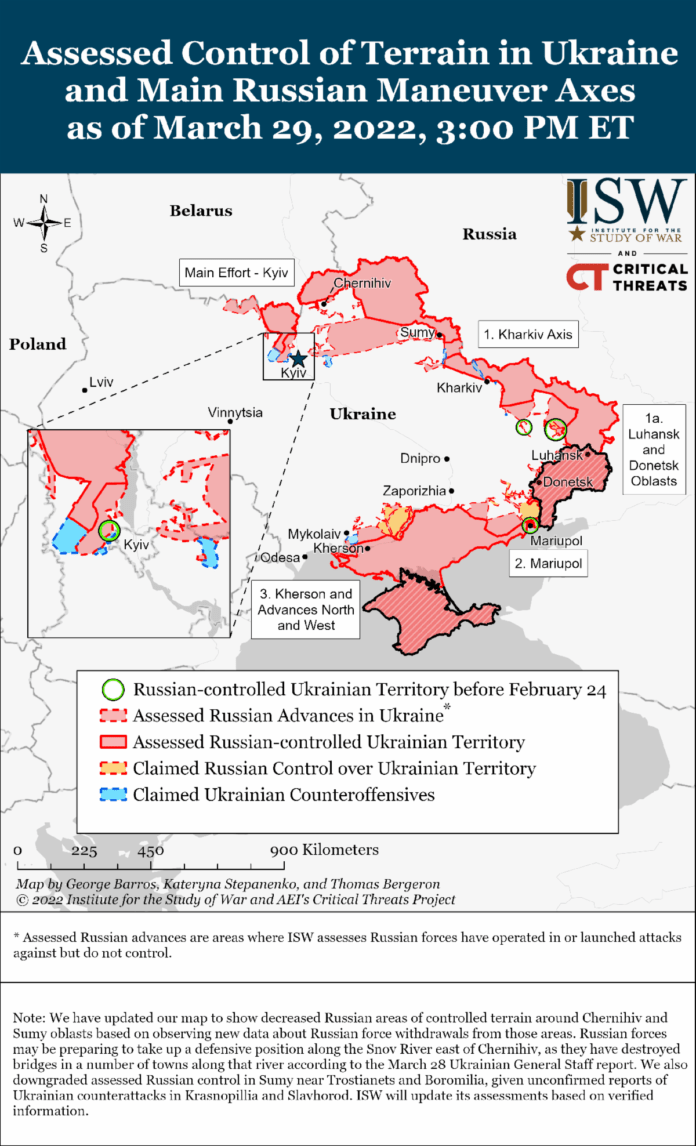
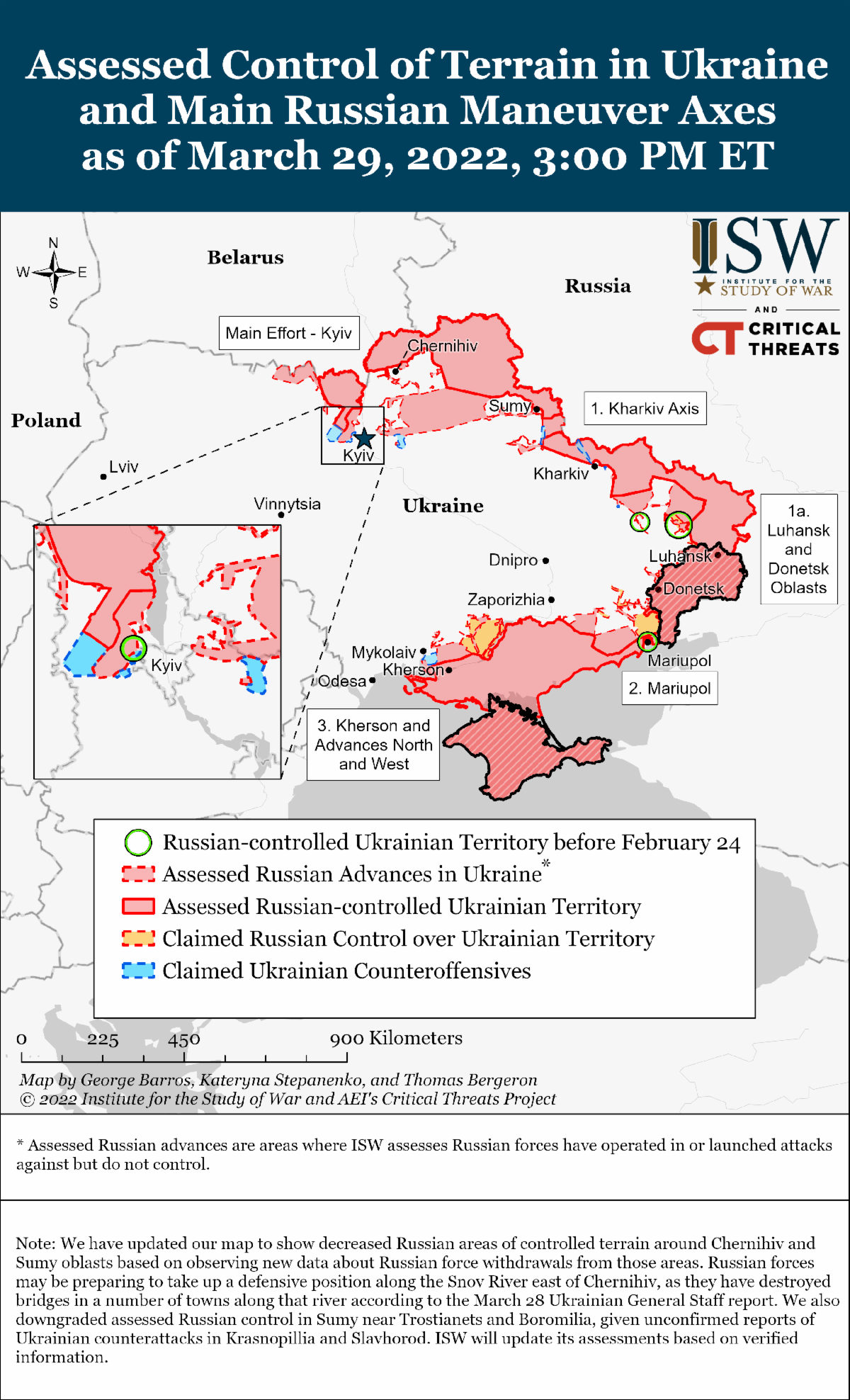
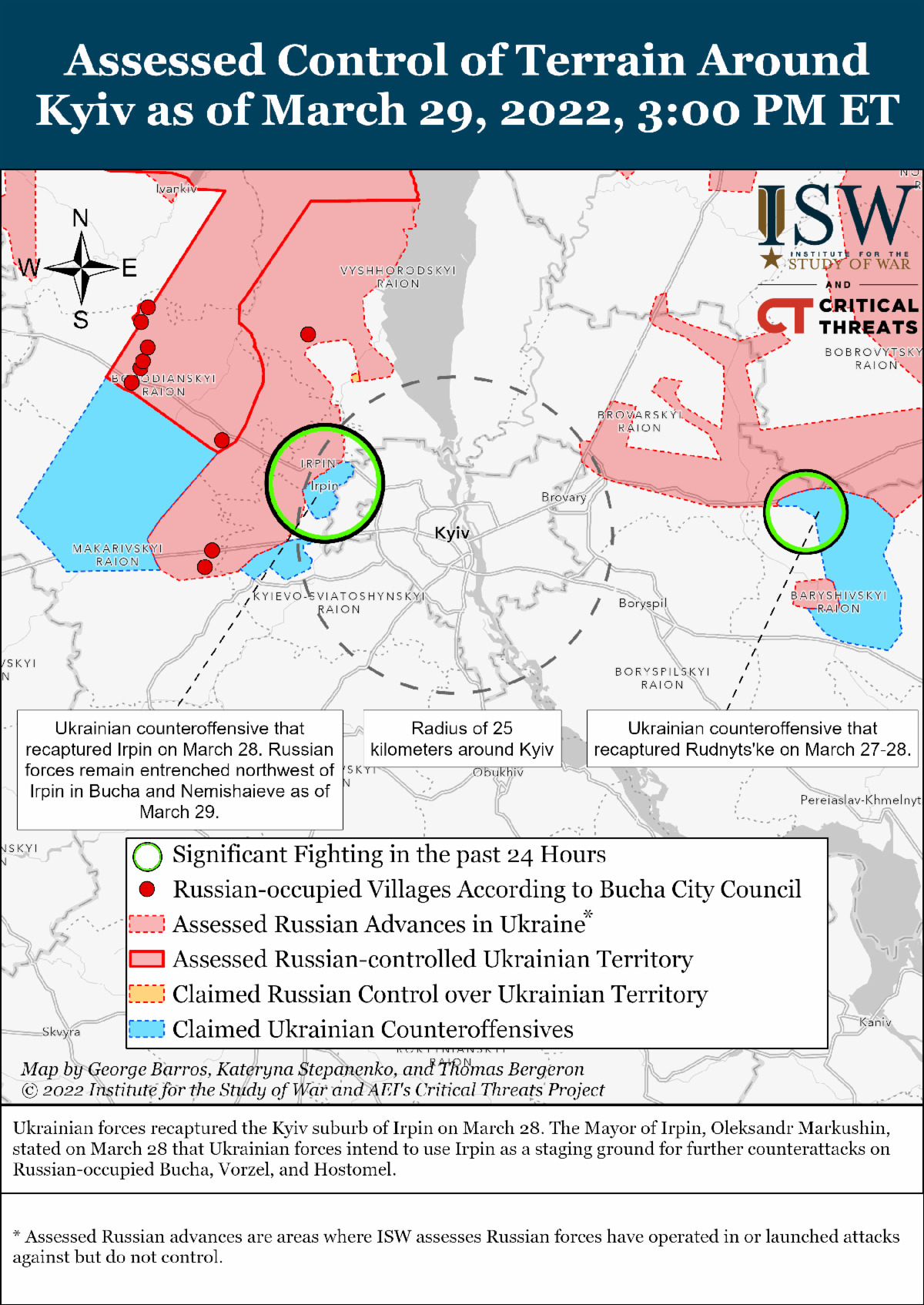
The Russians have not yet abandoned their attacks on Kyiv, claims by Russian Defense Ministry officials notwithstanding. Russian forces continued fighting to hold their forwardmost positions on the eastern and western Kyiv outskirts even as badly damaged units withdrew to Russia from elsewhere on the Kyiv and Chernihiv axes. The Russian high command has likely concluded that it cannot seize Kyiv and may not be able to move artillery closer to the center of the city. It may have decided to stop its previous practices of forcing units that have already taken devastating losses to continue hopeless offensive operations and of feeding individual battalion tactical groups into the battle as they become available rather than concentrating them to achieve decisive effects. Russian officials are likely casting these decisions driven by military realities as overtures demonstrating Russia’s willingness to engage in serious ceasefire or peace negotiations, possibly to conceal the fact that they have accepted the failure of their efforts on the Kyiv axis.
Russia continues to reinforce its efforts in Ukraine’s northeast likely attempting to link its positions southeast of Kharkiv and Izyum with its forces in Luhansk Oblast. The Russians have reportedly redirected forces from the Chernihiv-Kharkiv axis to the Izyum-Slovyansk axis, most likely reassigning reinforcements rather than redeploying units already committed to fighting. Russian forces in the Izyum-Slovyansk area continue fighting to hold and expand their penetration to the southeast.
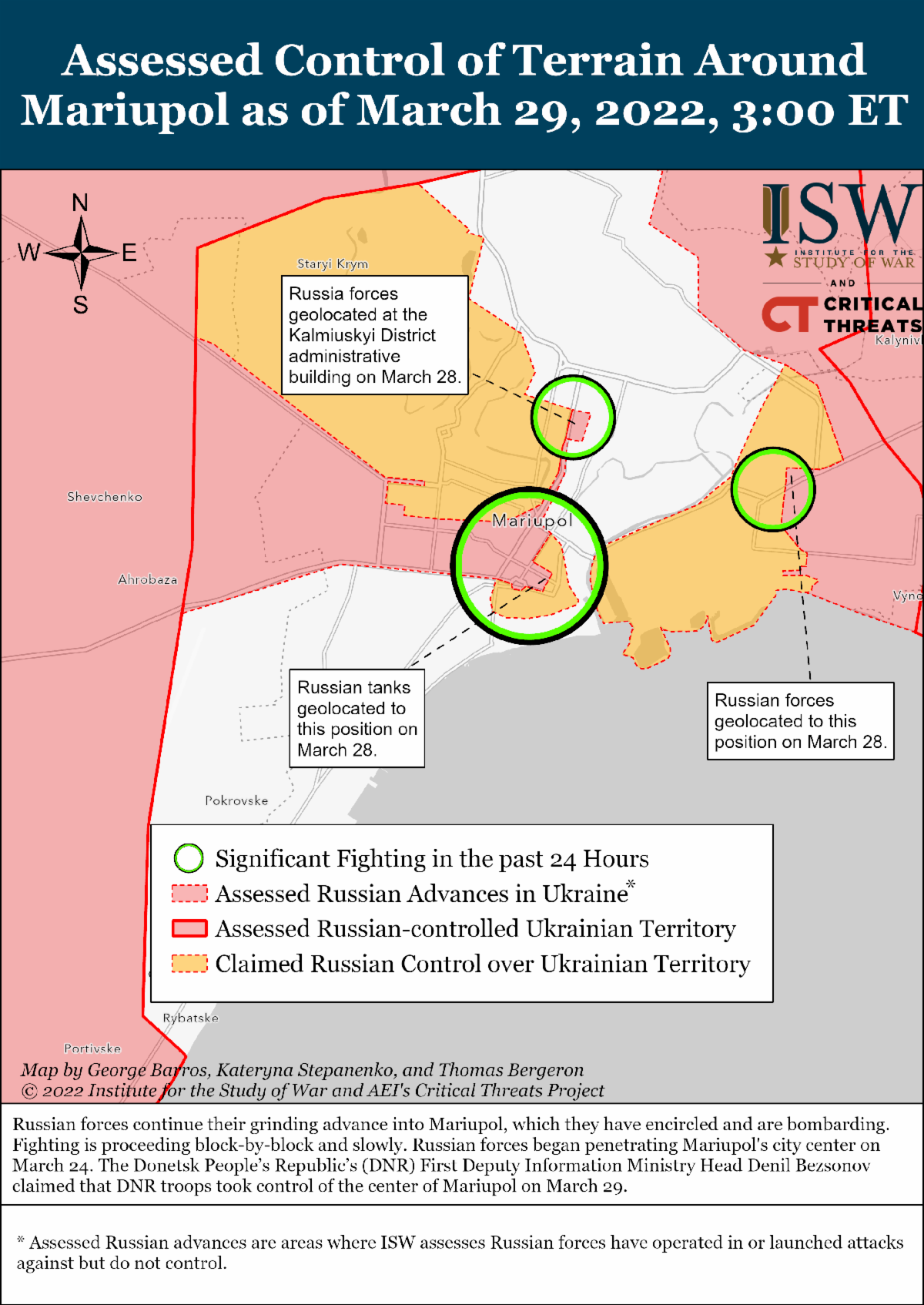
The Russian advance in Mariupol continues to gain ground, and Russian forces have likely bisected or even trisected the city. Pockets of Ukrainian defenders continue to hold out in Mariupol, likely in several areas, but the Russians will likely complete the conquest of the city within days. Russian forces have likely taken significant casualties in the tough urban fighting in Mariupol, making it difficult to evaluate how much combat power the Russians will be able to harvest from Mariupol to use for further advances north and west.
Russian operations in southeastern Ukraine have left large portions of Donetsk Oblast under Ukrainian control. Securing the boundaries of Donetsk Oblast along with the entirety of Luhansk Oblast will likely require a major offensive operation. Much of the area of Donetsk Oblast outside Russian control is flat and sparsely populated—terrain similar to that on which Russian forces elsewhere have been able to advance rapidly, at least earlier in the war. Russian offensive operations in similar terrain more recently have struggled, however. It is too soon to tell how feasible the Russian conquest of all of Donetsk and Luhansk will be for the Russian military in its current state.
Key Takeaways
  • We now assess that Russian forces have given up on encircling or seizing Kyiv at this time. Russian forces continue to fight to hold their current front-line trace near the city, however, remaining dug into positions to the east, northwest, and west. Russian forces withdrawing from the area around Kyiv appear to be moving north from behind the front line to positions in Belarus.
  • Russia is directing some reserves to the effort to connect gains southeast of Kharkiv and Izyum with its front line in Luhansk.
  • Ukrainian forces continue to defend in likely isolated pockets in Mariupol. The city will likely fall to the Russians within days.
  • A Russian offensive operation to take the rest of unoccupied Donetsk Oblast would be a significant undertaking. It remains unclear if Russia can harvest enough combat power from Mariupol after securing the city or divert reinforcements from elsewhere on a large enough scale to complete it.
The Institute for the Study of War (ISW) is a non-partisan, non-profit, public policy research organization. ISW advances an informed understanding of military affairs through reliable research, trusted analysis, and innovative education. We are committed to improving the nation’s ability to execute military operations and respond to emerging threats in order to achieve US strategic objectives.

Vladimir Putin’s Plan B—Russia Changes Strategy to Avoid Losing Ukraine War

0

Russian President Vladimir Putin is changing his military strategy in the Kremlin’s war on Ukraine, experts say, ramping up the brutality to avoid losing a weeks-long conflict it was supposed to have won within days of its invasion.

John Herbst, former U.S. ambassador to Ukraine, told Newsweek that nearly five weeks since the February 24 invasion, Putin is shifting to new tactics—including establishing sieges and attacks on civilian locations—amid stiff Ukrainian resistance and low morale among Russian troops.

“We’ve seen massive bombardment of clearly civilian locations, and so that’s the tactic that has become more prominent as Russian forces have bogged down across the country,” said Herbst, senior director of the Atlantic Council’s Eurasia Center, and U.S. Ambassador to Ukraine from 2003 to 2006.

Russian forces have been besieging and shelling the port city of Mariupol for weeks. The mayor of Mariupol Vadym Boychenko warned on Monday of an imminent “humanitarian catastrophe” if more evacuations are not possible.

As talks began, Kremlin spokesman Dmitry Peskov said, per Russian state news agency Tass: “As for the fate of the negotiations, this is a really interesting question. Today or tomorrow you and I will understand whether there is something promising or not.”

Peskov said Russia’s “special military operation,” the official language for its war on Ukraine, would continue if talks fell flat.

Ukraine-Russia conflict
Russian President Vladimir Putin attends a meeting to discuss the Ukrainian peace process at the German federal Chancellery on October 19, 2016 in Berlin, Germany. Putin is changing his military strategy in order to avoid losing the Ukraine war, experts told Newsweek.ADAM BERRY/GETTY IMAGES

Shortly after Putin launched a full-scale invasion of Ukraine, U.S. intelligence officials expressed concerns that the capital city of Kyiv could fall to Russian forces within days.

Three U.S. officials told Newsweek previously on the condition of anonymity that they expected the city to fall to incoming Russian forces within 96 hours, and that Ukraine’s resistance would be effectively neutralized soon thereafter.

Ukrainian defense minister Oleksii Reznikov said in a statement on March 21 that Russia “no longer dreams of capturing Kyiv” amid signs of weakened and slowed Russian advance toward the capital.

Herbst suggested that Putin hasn’t necessarily given up on seizing the capital, but lacks the resources to do so.

“I would hesitate to say he has completely given up on taking Kyiv, I just don’t think he has forces there to achieve that in the near term,” said Herbst. “The Russians are not in a position right now to take Kyiv.”

The Pentagon on March 17 said that as Ukraine’s forces continue to put up determined resistance, Moscow appears to be suffering from shortages, and commanders are struggling to sustain their troops in combat.

Nikolai Petrov, senior research fellow at Chatham House’s Russia and Eurasia Programme, expressed similar sentiment.

“Putin’s initial plan failed to large extent due to Ukrainians’ heroic resistance,” Petrov told Newsweek. “I think that the Russian army is unable to take Kyiv and most probably will not try to do this.”

Petrov acknowledged a switch to a “much more brutal” military strategy, with the establishment of sieges, such as in the hard hit city of Mariupol. Former CIA director David Petraeus said Sunday that the city appears poised to fall to Russian forces.

Herbst said that Russian forces began to try to establish a siege around Kyiv too, although they had far fewer forces in place in terms of comparison to the size of the city, and the size of the defense.

Speaking to Newsweek, Mathieu Boulègue, a research fellow at Chatham House’s Russia and Eurasia Programme, said he believes Kyiv is “still in the balance.”

“I don’t think there’s ultimately a decision made to take over Kyiv or not, because it would take months of siege,” he said.

Kremlin Unlikely to Advance

Boulègue said in military terms, the Kremlin is at a stage where there is very little chance to achieve anything more than they already have.

“They can’t commit many more troops that would represent a game changer, or more military equipment and hardware than they already have,” said Boulègue. “They don’t want have a surge of sort of willingness to fight from soldiers, because there is very little morale and very little will to fight.”

Russia has also diluted its forces by spreading out throughout the Ukrainian territory, instead of concentrating their attacks of specific axes of advance, he said.

What Will Putin Do Next?

Russia now needs to calculate where it wants to go, and Putin needs to figure out what he wants to do next, because the country lacks the troops and materiel “to achieve all of the tactical operational goals,” Boulègue said.

He noted that as Russia is unable to take over many more urban centers, Mariupol is an “easy target” for Russia to “show a victory.”

“It’s a smaller city. It’s been pounded to the floor for the past few days, and this is where a lot of troops are concentrated in Ukraine,” he said.

“I think, what we are seeing for this next 2-4 weeks of the conflict, we will have the simultaneous fall of Mariupol, more push inside administrative borders of Donbas, and then once this is achieved, probably a form of freezing of the conflict in terms of positions.”

Man flees artillery fire in Kharkiv Ukraine
Russia has escalated its attacks on civilian targets as it struggles to dominate in its war on Ukraine. In the image, a man flees with his belongings as fire engulfs a vehicle and building following artillery fire on the 30th day on the invasion of the Ukraine by Russian forces in the northeastern city of Kharkiv on March 25, 2022.ARIS MESSINIS/AFP VIA GETTY IMAGES

Russia is likely to then subsequently declare that operations have achieved what they wanted in the first place, he said.

“Of course, this is a lie, but they need to save face, and moving on then to a potential diplomatic settlement, whatever that would look like. But it’s easier for the Kremlin to turn a form of defeat and actual defeat into a military victory, because it would still hold Ukrainian territory, they would still have invaded parts of Ukraine,” Boulègue added.

The former ambassador highlighted that while Putin has permitted negotiations at a low level, the Russian president’s own statements imply he is not willing to compromise.

“That suggests that those negotiators are not speaking for the head of the country, and therefore there’s nothing to it,” he said.

Follow our live blog for updates on the Russia-Ukraine conflict.

Updated, 3/29/22 5:37am ET, with comments from the Kremlin spokesman.

newsweek.com

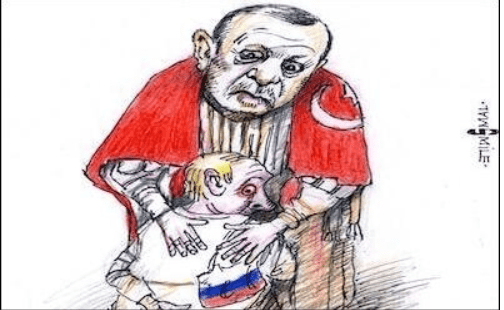
Turkey Seeks to Undermine Russia Sanctions, Profit from Ukraine Crisis

0

Originally published under the title “Turkey Seeks to Undermine Sanctions on Russia, Hopes to Make a Profit on Ukraine Crisis.”

Bank records show Hunter Biden received $100,000 in 2017 from Chinese firm

0
– The Washington Times – Tuesday, March 29, 2022

Sens. Chuck Grassley and Ron Johnson have revealed financial records showing how an arm of the Chinese government transferred $100,000 to President Biden’s son Hunter Biden.

Speaking on the floor of the Senate on Monday night, Mr. Grassley, Iowa Republican, cited an Aug. 4, 2017, Wells Fargo wire transaction from CEFC, a Chinese energy conglomerate, that sent $100,000 to an account controlled by Hunter Biden.

“Now there is no middleman in this transaction. This is $100,000 from what is effectively an arm of the communist Chinese government direct to Hunter Biden,” the top Republican on the Senate Judiciary Committee said. “To the liberal media and my Democratic colleagues: Is this official bank document Russian disinformation?”

Mr. Grassley and Mr. Johnson have been investigating Hunter Biden’s financial dealings since before the presidential election. They previously reported that Hunter Biden was enmeshed in business dealings with Chinese Communist Party oligarchs, including Gongwen Dong and Mervyn Yan.

The information on Hunter Biden’s finances, the lawmakers say, comes from government records dating back to the Obama administration and from transcribed interviews of government officials.

The two Republicans said more disclosures will detail further ties between the Biden family and China’s communist rulers.

“Our report exposed extensive financial relationships between Hunter … and Chinese nationals connected to the communist regime. These were Chinese nationals connected to the Chinese government’s military and intelligence service,” said Mr. Grassley, highlighting Chinese spy chief Patrick Ho.

Hunter Biden reportedly claimed he at one point represented Ho, “who started the company that my partner, who is worth $323 billion, founded and is now missing.”

Mr. Johnson, a Wisconsin Republican and member of the Homeland Security and Governmental Affairs Committee, said during his remarks that previous reports on Hunter Biden’s business deals have been “full of irrefutable evidence like this” but Democrats dismissed the reports as “Russian disinformation.”

“That money from CEFC, which is effectively an arm of the Chinese government, went directly to Hunter Biden. Bank records like this piece of evidence are pretty hard to deny and sweep under the rug,” Mr. Johnson said.

Mr. Grassley and Mr. Johnson said they plan to disclose more evidence of bank transfers between and among companies such as CEFC, Northern International Capital, Hudson West III, Awasco and James Biden’s Lion Hall Group, a firm owned by President Biden’s brother.

The Washington Times reached out to the White House for comment but did not immediately hear back.

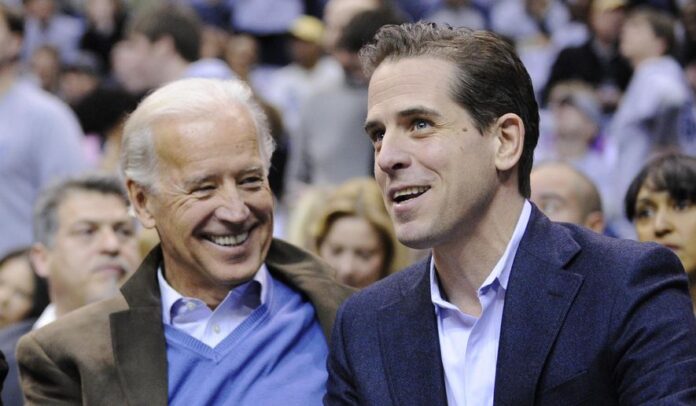
Then-Vice President Joe Biden (left) and his son Hunter Biden appear at the Duke Georgetown NCAA college basketball game in Washington on Jan. 30, 2010. (AP Photo/Nick Wass) **FILE** more >

• Kerry Picket can be reached at [email protected].

www.washingtontimes.com/news/2022/mar/29/bank-records-show-hunter-biden-received-100000-201/?utm_source=Boomtrain&utm_medium=manual&utm_campaign=newsalert&utm_content=newsalert&utm_term=newsalert&bt_ee=863jOlEMNcrT7bT%2BU3eRPfCXRq1deDDbLLXGCZ5tTsBpKz99X32YRYq%2FEFqR8Yun&bt_ts=1648574120809

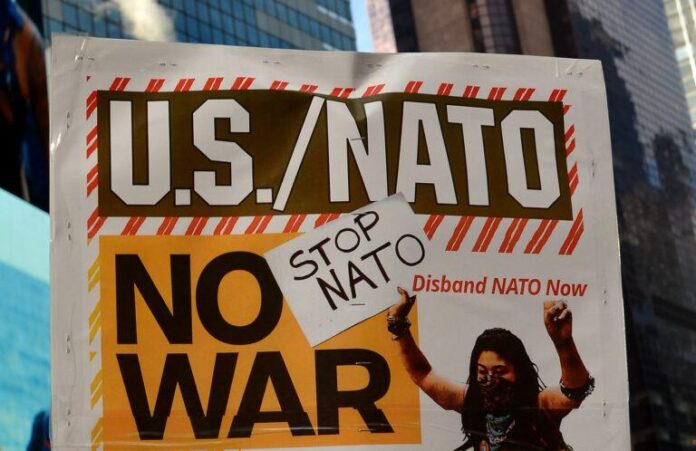
NATO Notes

0


Photograph Source: /RealityScanner/ – CC BY 2.0

I see two necessities in today’s world. Most urgently; oppose war, a source of immeasurable misery. Condemn the use of deadly weapons, all those hitting civilians – indeed, any human beings. And prevent in every way possible the worst menace to life – all life – since that asteroid hit the earth 66 million years ago; the total eradication by nuclear explosions, ignited on purpose or by accident. Thus we need negotiations, agreements – and not ever more new threats, armaments, soldiers, refugees…

But while I sharply and emotionally oppose the waging of war by Vladimir Putin, or by anyone else, I believe that hypocrisy must also be opposed, above all when it creates an atmosphere further increasing those very dangers I have mentioned.

Both mass media and social media are flooding us with heart-breaking depictions of death, sorrow and destruction in Ukraine. When they are truthful I cannot object. But nor can I overcome my inherent leaning toward occasional skepticism and suspicion; last week a video on Germany’s public TV channel ZDF showed a Russian tank lumbering through Ukraine – and carrying a big red Soviet flag with hammer and sickle – so obviously outdated. It’s hard to believe this was a mistake.

And despite the universal wave of condemnation of Putin, Putinism, Putin-Stalinism or terms like Putler, and despite my horror at the war, my overly active memory revives recollections from the past, even such which rarely made the front pages, were often ignored and have been almost totally expunged from memory. In recalling them now I may be risking possible losses of readers or even friends; after my last Berlin Bulletin two readers canceled further mailings. But it also won me fifteen new readers. I do not wish to outnumber current death and destruction, but only to urge that insistent official calls to protect freedom, democracy and humanitarianism tied to demands for war crime trials are too often based on hypocrisy, distortion, greed – one-way streets covering up bitter evidence of earlier bloodshed and tears. So here is a random – but lengthy, painful selection from the past, with help from Google. It does not remove any of the guilt for devastation and death in Ukraine – but seeks to find some balance in its reporting and evaluation.

+++++

“NATO is the only way to end the war in the Donbas“ according to Volodymyr Zelenskyy in March 2021, for whom a quick membership for Ukraine in the light of the unrest in eastern Ukraine would be “a genuine signal to Russia“.

IRAQ 1991

On February 13, 1991, two US special bombs from American stealth aircraft hit a civilian bunker in Baghdad. Both goals were perfectly on target … the laser-guided bombs penetrated the meter-thick reinforced concrete ceiling of the bunker … But the goal around 4.30 a.m. was full of women, children and old men. Probably 408 of them died in the explosion of almost half a ton of highly explosive explosives – shredded by splinters, slain by debris or crushed by the enormous shock wave.

The US government spokesman said: “It makes us all sad to suspect that innocent people may have died in the course of a military conflict.” – And the Pentagon: “It looks like civilians have been injured here. We will investigate the incident very closely and determine what we can do differently in the future to rule out a recurrence.”

+++++

SERBIA 1999

Belgrade, August 16, 2016, AP — US Vice President Joe Biden offered condolences to the families of those who lost their lives during the Balkan wars, including the victims of the NATO air war against Serbia.  As a senator, Biden was a strong advocate of the NATO bombing of Serbia … The US-led bombardment in 1999 stopped Serbia’s crackdown against ethnic Albanian separatists, ending Belgrade’s rule over its former province of Kosovo… “I would like to add my condolences to the families of those whose lives were lost during the wars in the 1990s, including those whose lives were lost as the result of the NATO campaign,” he said. The bloody breakup of former Yugoslavia claimed tens of thousands of lives and left millions homeless in Bosnia, Croatia and Kosovo.

+++++

“We knew that it would start in a few hours – the war against NATO. Or rather, NATO against Serbia. I was in a state of expectant disbelief. How will it look if NATO, and once again Germany, bomb Serbia? …

“In the evening, for the first time, I heard the howling of the air raid alarm. Today I recall how varied the sounds of air warfare are: the deep hum of invisible bombers, the hissing of the cruise missiles seeking their target, the rattling of Serbian anti-aircraft guns, the dull or glaring explosions that followed. And the nocturnal scenery: bright traces of Serbian anti-aircraft missiles on a black sky, orange-reddish flames after the impact of the bombs.

“We learned terms like: ‘graphite bombs’, ‘guided missiles’, ‘stealth aircraft’, ‘uranium ammunition’, ‘cluster bombs’. … And ‘collateral damage’. That was my favorite term. It was used when NATO hit a line of Albanian refugees in Kosovo, a civilian train, the farmers’ market in Niš, the neurological clinic or the Chinese embassy in Belgrade.“ Andrej Ivanji, TAZ

AGAIN IRAQ 2003-

Before the 2003 invasion of Iraq, United States armed forces officials described their plan as employing Shock and Awe…Continuous bombing began on March 19, 2003 …Attacks continued against a small number of targets until March 21, when the main bombing campaign of the US and their allies began. Its forces launched approximately 1,700 air sorties (504 using cruise missiles)….

According to The Guardian correspondent Brian Whitaker, “To some in the Arab and Muslim countries, Shock and Awe is terrorism by another name; to others, a crime that compares unfavourably with September 11…A dossier released by Iraq Body Count, a project of the UK non-governmental Oxford Research Group, attributed approximately 6,616 civilian deaths to the actions of US-led forces during the ‘invasion phase’, including the Shock and Awe bombing of Baghdad.

Lt-Col Steve Boylan, spokesman for the US military, stated, “I …can’t talk to how they calculate their numbers…we do everything we can to avoid civilian casualties in all of our operations.”

+++++

Population-based studies produce estimates of the number of Iraq War casualties ranging from 151,000 violent deaths as of June 2006 to 1,033,000 excess deaths …Roughly 40 percent of Iraq’s middle class is believed to have fled… An estimated 331 school teachers were slain in the first four months of 2006, according to Human Rights Watch, and at least 2,000 Iraqi doctors have been killed and 250 kidnapped since the 2003 U.S. invasion.

AFGHANISTAN 2002-2021

On July 6, 2008, a large number of Afghan civilians were walking in an area called Kamala …When the group stopped for a rest it was hit in succession by three bombs from United States military aircraft. The first bomb hit a group of children who were ahead of the main procession, killing them instantly. A few minutes later the aircraft returned and dropped a second bomb in the center of the group, killing a large number of women. The bride and two girls survived the second bomb but were killed by a third bomb while trying to escape from the area. Hajj Khan, one of four elderly men escorting the party, stated that his grandson was killed and that there were body parts everywhere.

+++++

The Granai Massacre refers to the airstrike by a US Air Force B-1 Bomber on May 4, 2009. The United States admitted significant errors were made in carrying out the airstrike, stating “the inability to discern the presence of civilians and avoid and/or minimize accompanying collateral damage resulted in the unintended consequence of civilian casualties”. The Afghan government said that around 140 civilians were killed, 22 were adult males and 93 children.

+++++

The raid on Narang was in the early morning hours of December 27, 2009. According to an Afghan investigation, at around 1 am American troops with helicopters landed around 2 km away. The raiding party allegedly dragged the victims out of their beds and shot them in the head or chest. Most of the victims were aged between 12 and 18 years and were enrolled in local schools. A local elder, Jan Mohammed, said that three boys were killed in one room and five were handcuffed before they were shot. “I saw their school books covered in blood,” he said. NATO reiterated that the forces conducting the attack were not under NATO command and were of a “non-military” nature. Colonel Gross said US forces were present but did not lead the operation. NATO did, though, concede it authorized the operation and apologized for doing so, admitting the dead were likely civilians and that the intelligence on which the authorization was based was faulty…It became known in 2015 that, as part of the US covert Omega Program, SEAL Team Six members carried out the assault in conjunction with CIA paramilitary officers and Afghan troops trained by the CIA.

+++++

On February 21 2010 the victims were traveling in three buses in broad daylight on a main road in the village of Zerma when they came under attack from US Special Forces piloting Little Bird helicopters using “airborne weapons”. NATO later stated that they believed at the time that the minibuses were carrying insurgents. 27 civilians including four women and one child were killed in the attack while another 12 were wounded.  Gen. Stanley McChrystal said he was “extremely saddened…I have made it clear to our forces that we are here to protect the Afghan people, and inadvertently killing or injuring civilians undermines their trust and confidence in our mission. We will re-double our efforts to regain that trust.”

Amanullah Hotak, head of Uruzgan’s provincial council said: “We don’t want their apologies or the money they always give after every attack. We want them to kill all of us together instead of doing it to us one by one.” Haji Ghullam Rasoul, whose cousins died in the attack, said, “They came here to bring security but they kill our children, they kill our brothers and they kill our people.”

+++++

In August 2011 we, Médecins Sans Frontières, opened a trauma hospital in the northern Afghan city of Kunduz. The hospital provided high-quality, free surgical care to victims of all types of trauma.

Starting with converting shipping containers, our hospital soon moved into a building in the city centre. By the time of the airstrikes in October 2015, the hospital was equipped with 92 beds, an emergency room, two operating theatres, an intensive care unit, an outpatient department, mental health and physiotherapy wards, as well as X-ray and laboratory facilities.

Our hospital was the only facility of its kind in northeastern Afghanistan; beforehand, severely injured people were forced to make long and dangerous journeys to the capital Kabul or Pakistan to receive the care they needed. Since opening the hospital in 2011, more than 15,000 surgeries were conducted and more than 68,000 emergency patients were treated…

On the night of the attack, there were 105 patients in the hospital and 140 of our international and national staff were present, of whom 80 were on duty.

Starting at 2:08am on 3 October, a United States AC-130 gunship fired 211 shells on the main hospital building where patients were sleeping in their beds or being operated on…

At least 42 people were killed, including 24 patients, 14 staff and 4 caretakers. Thirty-seven were injured. Our patients burned in their beds, our medical staff were decapitated or lost limbs. Others were shot from the air while they fled the burning building. The attack lasted for around one hour… Throughout the airstrikes our teams desperately called military authorities to stop them. They took place despite the fact that we had provided the GPS coordinates of the hospital to the US Department of Defense, Afghan Ministry of Interior and Defense and US Army in Kabul as recently as 29 September.

In the days after the attack, the United States military eventually claimed responsibility for the airstrikes, saying that it had been an accident. The US military claimed they had received reports that the hospital building was holding active Taliban militia. Our staff reported no armed combatants or fighting in the compound prior to the airstrike.

+++++

December 10, 2014: The US Senate report summary on CIA torture does more than expose serious human rights violations in the US “War on Terror.” … Of the sites identified in the report, four are in Afghanistan, where detainees in US custody were subjected to “sleep deprivation, auditory overload, total darkness, isolation, beatings and shackling.” Feeding tubes inserted anally in detainees, resulting in rectal prolapse in at least one case, represented sexual assaults analogous to rape with an object. Many of these abuses occurred as early as 2002, when Afghan detainee Gul Rahman died from hypothermia after being shackled to a freezing concrete floor at the infamous “Salt Pit” detention center. Ultimately, the prison housed nearly half of the 119 detainees identified by the Senate Intelligence Committee report on CIA torture…

The prison was dark at all times, with curtains and painted exterior windows. Loud music was played constantly. The prisoners were kept in total darkness and isolation, with only a bucket for human waste and without sufficient heat in winter months. Nude prisoners were kept in a central area, and walked around as a form of humiliation. The detainees were hosed down with water while shackled naked, and placed in cold cells. They were subject to sleep deprivation, shackled to bars with their hands above their heads…One senior interrogator said that his team found a detainee who had been chained in a standing position for 17 days, “as far as we could determine.” A senior CIA debriefer told the CIA Inspector General that she heard stories of detainees hung for days on end with their toes barely touching the ground, choked, deprived of food, and made the subject of a mock execution.

+++++

SYRIA

The Battle of Raqqa lasted from 6 June through 17 October 2017, launched by the Syrian Democratic Forces and supported by massive air strikes and ground troops of a US-led coalition. A relentless bombing campaign resulted not only in the collapse of Islamic State (IS) but also in the total destruction of the city, with up to 6,000 civilian casualties, according to human rights organisations.

“Raqqa is the most destroyed city in modern times,” says Donatella Rovera, a veteran researcher with Amnesty International…Certainly much more destroyed than Aleppo, in percentage terms, “…American soldiers were interviewed, and they said, ‘for us, everybody who was within Raqqa was regarded to be a fighter of Isis.’ The result: whole families who tried to flee the violence were massacred indiscriminately…On top of that, artillery shells used by the US-led coalition were “basically unguided with a margin of error of over 100 metres…”

+++++

YEMEN 2014-

At about noon on March 15 2016 two aerial bombs hit the market in Mastaba, approximately 45 kilometers from the Saudi border. The first bomb landed directly in front of a complex of shops and a restaurant. The second struck beside a covered area near the entrance to the market, killing and wounding people escaping, as well as others trying to help the wounded. Human Rights Watch interviewed 23 witnesses to the airstrikes, as well as medical workers at two area hospitals that received the wounded. At least 50 people were killed, most of them children and teenagers, according to the International Committee of the Red Cross (ICRC). Another 77 people were injured, said the spokesman for the Ministry of Health, Yussef al-Hadri. The ministry blames the airstrike on the Saudi-led military alliance…

Human Rights Watch conducted on-site investigations on March 28 and found remnants at the market of a GBU-31 satellite-guided bomb, which consists of a US-supplied MK-84 2,000-pound bomb mated with a JDAM satellite guidance kit, also US-supplied. Human Rights Watch has called on the United States, United Kingdom, France, and other countries to suspend all weapon sales to Saudi Arabia until it curtails its unlawful airstrikes in Yemen, credibly investigates alleged violations, and holds those responsible to account. Selling weapons to Saudi Arabia may make these countries complicit in violations, Human Rights Watch said.

++++

Before dawn on September 10, 2016 coalition aircraft struck the site of a water drilling rig near Beit Saadan village 30 km north of Sanaa. The drill rig was in an unpopulated area reachable only by dirt road. The first strike hit near a workers’ shelter, killing six and wounding five others. At about 9 a.m., after several dozen villagers came to remove the bodies of those killed, three planes returned and bombed the vicinity at least 12 more times, about 15 minutes apart. Human Rights Watch confirmed the names and ages of 21 people who died, including three boys ages 12, 14, and 15.

Yehia Abdullah, a 34-year-old teacher, was on his way back when he heard the bombing: “I saw scattered and charred bodies… I saw five bodies including my brother Muhamad. First I found my brother’s severed leg outside the workers’ shelter, his arm on the door … and half his body buried in the ruins… About 300 people were there to remove the bodies. … I saw two warplanes arriving from the south. Between 8 and 9 am, I saw the missile coming down to the ground as I was next to my uncle’s body.”

Several witnesses said that three coalition planes circled overhead, striking the area in widening circles as those gathered attempted to escape. People ran in all directions to escape the bombing,

Human Rights Watch examined and photographed remnants of a US-made GBU-12 Paveway II laser guided 500-pound bomb. A part of the guidance system (wing assembly) was produced by Raytheon in the US in October 2015, according to markings on the remnants.

Residents of Beit Saadan said that they had pooled together 22 million Yemeni Rials (US$88,000) of their personal funds to pay to drill the well to supply drinking water to their village. The bombing occurred on the last day of planned drilling, after the villagers had struck water, a local farmer said.

+++++

Immediately following the October 8 funeral hall attack, the US National Security Council announced the US had “initiated an immediate review of our already significantly reduced support” to the coalition and was “prepared to adjust our support.” The US has made no further announcements regarding how it planned to alter support for the war in Yemen nor released any findings from the review. President Obama should ensure that the review examines whether US forces participated in any unlawful coalition attacks in Yemen, and release the review findings before leaving office, Human Rights Watch said.

The United Kingdom also sells arms to Saudi Arabia, despite growing parliamentary pressure over its support for Saudi Arabia’s military campaign in Yemen and evidence of the use of British-made weapons. Human Rights Watch has documented the use of UK-made weapons in three apparently unlawful coalition attacks in Yemen. Since March 2015, the UK has approved £3.3 billion in military sales to Saudi Arabia, according to the London-based Campaign Against Arms Trade.

+++++

SOMALIA

Sep 22  2015: Somali Drone Victim Seeks Justice for U.S. Strike in German Courts

A legal challenge alleges that German officials may be liable for murder, in part for allowing the U.S. to relay drone data from an airbase in Ramstein. A man whose father was killed in a U.S. drone strike in Somalia is seeking to hold Germany accountable for allowing the United States to use its territory for military bases that play a key role in overseas airstrikes.

The Somali man, whose name was given only as “C.D.,” described his father, “A.B.,” as a herdsman who raised goats and camels in southern Somalia, not far from the coast of the Indian Ocean. According to his son’s testimony, A.B. left home on the morning of February 24, 2012, to graze his livestock. But that night several of his camels came home without him. The next day C.D. found his father’s body severed in two, near a burnt-out car and several dead camels.

The strike that killed A.B. was apparently aimed at Mohamed Sakr, a London-born alleged member of the Somali jihadist group al Shabaab… By some accounts several other unidentified people also died.

C.D.’s lawyers …ask for an investigation by the public prosecutor in the district that hosts Ramstein, the enormous U.S. airbase that serves as a satellite relay station connecting drone pilots in the United States with their aircraft flying over Yemen, Somalia, Pakistan, and Afghanistan.

The complaint … detailing Ramstein’s critical logistical role in the U.S. drone war also points to the fact that U.S. Africa Command, or Africom, headquartered in Stuttgart, oversees operations in Somalia like the one that killed A.B.

In April Obama had admitted the death of innocent civilians in drone strikes. Some criticism of these missions was “legitimate,” he said at the time. There is “no doubt that civilians were killed who should not be killed.” However, the rules of use for the combat drones are “as strict as never before,” said the US President. July 1, 2006 Die Zeit

+++++

LIBYA 2011-

On 19 March 2011, a multi-state NATO-led coalition began a military intervention in Libya … imposing a ban on all flights in the country’s airspace — a no-fly zone…

US President Barack Obama said the US was taking “limited military action” as part of a “broad coalition”. “We cannot stand idly by when a tyrant tells his people there will be no mercy,” he said.

The total number of sorties flown by NATO numbered more than 26,000, an average of 120 sorties per day. 42% of the sorties were strike sorties, which damaged or destroyed approximately 6,000 military targets. At its peak, the operation involved 21 NATO ships and more than 250 aircraft… Of these Denmark, Canada, and Norway together were responsible for 31%, the United States was responsible for 16%, Italy 10%, France 33%, Britain 21%, and Belgium, Qatar, and the UAE the remainder…

+++++

August 3, 2011: BRUSSELS – An international journalists’ group sharply criticized NATO air strikes against Libyan television, which killed three people and injured 15, saying Wednesday they violated international law and U.N. resolutions.

+++++

May 20, 2011 marked the 60th day of US combat in Libya. President Obama notified Congress that no congressional authorization was needed since the US leadership had been transferred to NATO and since US involvement was somewhat “limited”. In fact, as of April 28, 2011, the US had conducted 75 percent of all aerial refueling sorties, supplied 70 percent of the operation’s intelligence, surveillance and reconnaissance and contributed 24 percent of the total aircraft used, more resources than any other NATO country. The US deployed a naval force of 11 ships, A-10 ground-attack aircraft, two B-1B bombers, three Northrop Grumman B-2 Spirit stealth bombers, AV-8B Harrier II jump-jets, EA-18G Growler electronic warfare aircraft, P-3 Orions, and both McDonnell Douglas F-15E Strike Eagle and F-16 fighters. The Libyan government response to the campaign was totally ineffectual, with Gaddafi’s forces not managing to shoot down a single NATO plane.

+++++

BRUSSELS – An international journalists’ group sharply criticized NATO air strikes against Libyan television, which killed three people and injured 15, saying Wednesday they violated international law and U.N. resolutions.

+++++

The National Transitional Council (NTC) forces initially claimed Gaddafi died from injuries sustained in a firefight … although a graphic video of his last moments shows rebel fighters beating him and one of them sodomizing him with a bayonet before he was shot several times.

Secretary of State Hillary Clinton shared a laugh with a TV news reporter moments after hearing deposed Libyan leader Muammar Qaddafi had been killed. “We came, we saw, he died,” she joked.

+++++

An in depth investigation into the Libyan intervention was started in July 2015 by the U.K. Parliament’s House of Commons’ Foreign Affairs Committee, the final conclusions of which on 14 September 2016 were strongly critical of the British government’s role in the intervention. The report concluded that …Gaddafi was not planning to massacre civilians, and that reports to the contrary were propagated by rebels and Western governments. The feared threat of the massacre of civilians was not supported by the available evidence… For example, on 17 March 2011 Gaddafi had given Benghazi rebels the offer of peaceful surrender and when Gaddafi had earlier retaken Ajdabiya from rebel forces … they did not attack civilians, and this had taken place in February 2011, shortly before the NATO intervention. Gaddafi’s approach towards the rebels had been one of “appeasement”, with the release of Islamist prisoners and promises of significant development assistance for Benghazi.

+++++

One final note. On June 26, 1997 a group of fifty prominent U.S. Americans, none leftists, had written Pres. William Clinton a message including the following words:

Dear Mr. President,

We, the undersigned, believe that the current U.S. led effort to expand NATO, the focus of the recent Helsinki and Paris Summits, is a policy error of historic proportions. We believe that NATO expansion will decrease allied security and unsettle European stability… for the following reasons:

In Russia, NATO expansion, which continues to be opposed across the entire political spectrum, will strengthen the nondemocratic opposition, undercut those who favor reform and cooperation with the West, bring the Russians to question the entire post-Cold War settlement, and galvanize resistance in the Duma to the START II and III treaties…

Russia does not now pose a threat to its western neighbors and the nations of Central and Eastern Europe are not in danger. For this reason, and the others cited above, we believe that NATO expansion is neither necessary nor desirable and that this ill-conceived policy can and should be put on hold.

“Sincerely…

The list was signed by former Senators Sam Nunn, Bill Bradley, Mark Hatfield, Gary Hart, former CIA Director Adm. Stansfield Turner, former Secretary of Defense Robert McNamara and Navy Secretary Paul H. Nitze, ex-ambassadors, entertainers, business leaders, Prof. Richard Pipes, author Susan Eisenhower…

Perhaps, if Clinton and even one of the presidents who followed him had listened to their advice, Vladimir Putin would not have feared a tightening NATO military noose encircling and threatening Russia – and the current bloody warfare would never have been risked and waged. Who knows?


Victor Grossman writes the Berlin Bulletin, which you can subscribe to for free by sending an email to: [email protected].

counterpunch.org

Σοκ στις ευρωπαϊκές οικονομίες από τον πόλεμο στην Ουκρανία

0

Η καταναλωτική εμπιστοσύνη και οι προσδοκίες των επιχειρήσεων έχουν βυθιστεί σε πρωτόγνωρα επίπεδα.

Στις αρχές της χρονιάς η Ευρώπη φαινόταν πως είχε τις προδιαγραφές για μια πολυετή περίοδο στέρεης οικονομικής ανάπτυξης. Οι ισολογισμοί ήταν υγιείς, οι αποταμιεύσεις αυξημένες, οπότε οι επιχειρήσεις και οι καταναλωτές φαινόταν πως είχαν τη δυνατότητα να αντεπεξέλθουν σε έναν πρόσκαιρα υψηλό πληθωρισμό, ο οποίος είχε προκληθεί από τις εκτεταμένες, αλλά μετριαζόμενες επιπτώσεις της συμφόρησης στην εφοδιαστική αλυσίδα. Σε τουλάχιστον βραχυπρόθεσμο ορίζοντα, όμως, η εισβολή της Ρωσίας στην Ουκρανία στις 24 Φεβρουαρίου αμφισβητεί το συγκεκριμένο αφήγημα. Οι αρχικές ενδείξεις της επιχειρηματικής δραστηριότητας του Μαρτίου, όπως, λόγου χάριν, οι Δείκτες Διευθυντών Προμηθειών, είναι καλύτεροι από όσο αναμενόταν, γεγονός που φανερώνει σταθερό βηματισμό και χαλάρωση των περιορισμών του κορωνοϊού. Εντούτοις, οι δείκτες μελλοντικών τάσεων με γνώμονα την εμπιστοσύνη φανερώνουν προβλήματα. Εξαιτίας του σοκ ενός μείζονος ευρωπαϊκού πολέμου και μιας ανόδου στον πληθωρισμό, η καταναλωτική εμπιστοσύνη και οι προσδοκίες των επιχειρήσεων προκαλούν ανησυχία, καθώς έχουν βυθιστεί σε πρωτόγνωρα επίπεδα, στα οποία τελευταία φορά είχαν φθάσει την περίοδο της διεθνούς χρηματοπιστωτικής κρίσης, της κρίσης χρέους του ευρώ και των απαρχών της πανδημίας.

Εν μέσω μιας ασυνήθιστα έντονης αβεβαιότητας, τώρα πλέον αναμένουμε πως το πραγματικό AEΠ της Βρετανίας θα παραμείνει στάσιμο το δεύτερο τρίμηνο έναντι προηγούμενης εκτίμησης για αύξηση 0,1% σε τριμηνιαία βάση, ενώ το ΑΕΠ της Ευρωζώνης θα ενισχυθεί μόλις 0,2% σε τριμηνιαία βάση έναντι του 0,6%. Από τον Μάιο και μετά προβλέπουμε πως θα αμβλυνθεί ο κραδασμός της εμπιστοσύνης, διότι θα υπάρξει μεγαλύτερη σαφήνεια σχετικά με τον δυνητικό αντίκτυπο του πολέμου του Βλαντιμίρ Πούτιν και τις πιθανές περαιτέρω κυρώσεις εις βάρος της Ρωσίας. Ο πληθωρισμός θα διατηρηθεί σε πολύ υψηλά επίπεδα έως τα τέλη του 2022. Υπολογίζουμε πως οι πλεονάζουσες αποταμιεύσεις θα συμβάλουν σε κάποια ενίσχυση της κατανάλωσης και οι ελλείψεις θα μετριαστούν.

Η καταναλωτική εμπιστοσύνη και οι προσδοκίες των επιχειρήσεων έχουν βυθιστεί σε πρωτόγνωρα επίπεδα.

Ουσιαστικά, στη Γηραιά Ηπειρο θα επανέλθει σε σημαντικό ρυθμό η ανάπτυξη χάρη στην αθροιστική ζήτηση και την επαναφορά σε μια κανονικότερη τουριστική περίοδο στη Νότια Ευρώπη. Οι κυβερνήσεις και οι επιχειρήσεις θα επενδύσουν περισσότερα. Αναφορικά με το τρίτο τρίμηνο, αναμένουμε ότι σε τριμηνιαία βάση ο ρυθμός ανάπτυξης θα επιταχυνθεί στο 1,2% στις χώρες της Ευρωζώνης και στο 0,5% στο Ηνωμένο Βασίλειο, ενώ αντιστοίχως θα υπάρξει περαιτέρω αύξηση του ΑΕΠ κατά 1% και 0,8% το τελευταίο τρίμηνο του τρέχοντος έτους. Τέλος, αξίζει να επισημανθεί πως το βασικό μας σενάριο λαμβάνει υπόψη δύο καίριες υποθέσεις, ότι δεν θα στραφεί η Ρωσία κατά μέλους του ΝΑΤΟ και πως οι τιμές πετρελαίου και φυσικού αερίου δεν θα αυξηθούν σημαντικά επί μακρόν.

* Οικονομολόγοι της επενδυτικής τράπεζας Berenberg Bank.

“Καθημερινή”

Ο ΔΕΝΔΙΑΣ ΩΣ ΙΕΡΩΝΥΜΟΣ

5
Δένδιας από Αίγυπτο: Η ελληνική εξωτερική πολιτική είναι μια πολιτική αρχών.
Μήπως διεκδικεί την θέση του Ιερώνυμου;
Η πολιτική αρχών τελείωσε στις πεδιάδες της Ουκρανίας.
Η θεωρία του ζωτικού χώρου και της γεωπολιτικής επιρροής είναι παρούσα. Σε αντίθεση με την επίκληση του διεθνούς δικαίου και των οικονομικών σχέσεων που προβλήθηκαν από τη δύση την εικοσαετία που πέρασε μετά την κατάρρευση των ανατολικών καθεστώτων.
Αλλά η αμερικανικής πρόνοιας νέα θεωρία δεν ευδοκίμησε. Διότι και άφησε κενά και δεν εφαρμόσθηκε ως αξία που θα καθόριζε τις διεθνείς σχέσεις. Εφαρμόζεται εκεί που θέλουν, κυρίως, οι ΗΠΑ.
Η ρωσική εισβολή στην Ουκρανία είναι, απολύτως, καταδικαστέα διότι παραβιάζει κάθε έννοια δικαίου. Αλλά και η τουρκική εισβολή στην Κύπρο είναι πανομοιότυπη. Για την ρωσική εισβολή διεξάγεται πόλεμος με άγνωστη κατάληξη. Για την τουρκική, σιωπή ιχθύος. Γιατί να πιστέψει η ανθρωπότητα πως οι ΗΠΑ ενδιαφέρονται, πράγματι, για την επικράτηση του διεθνούς δικαίου και δεν το επικαλούνται όποτε τις συμφέρει;
Ο κ. Δένδιας είναι αυτός που μας είπε πως η Ελλάδα δεν θα κάνει εξορύξεις υδρογονανθράκων διότι είναι οικολογικό κράτος.
Το ενοχλητικό με τον κ. Δένδια είναι ότι επιχειρεί να μας “δουλέψει”.
Δεν θέλει να μας πει πως η κυβέρνηση στην οποία ειναι διακεκριμένο στέλεχος, φοβάται τις αντιδράσεις της Τουρκίας.
Απο το κυβερνητικό “αφήγημα”, κάποτε θα το λέγαμε παραμύθι, κάποια στιγμή άρχισα να πείθομαι και εγώ. Μέχρι που είδα τον Μητσοτάκη να είναι τόσο περιχαρής που συναντήθηκε με τον Ερντογάν που με έπιασε κατάθλιψη. Απλώς, δεν υπάρχουμε. Δεν μας υπολογίζει κανείς.
Αν έπιασα καλά και τον διάλογο με τον Ερντογάν μπροστά στις κάμερες:
Ερντογάν: Θέλετε καφέ, τσάι;
Μητσοτάκης: Όχι, είμαι καλά με το νερό.
Ερντογάν: Να πάρουμε ένα τσάι
Μητσοτάκης: Αν πάρετε εσείς ένα τσάι θα πάρω και εγώ.
Ούτε καφέ δεν τόλμησε να ζητήσει απο τον Ερντογάν. Θα θέσει τα δικαιώματα της χώρας; Αλλά έχουν πολιτική αρχών.
Σταματώ εδώ.

Ο ΡΟΛΟΣ ΜΑΣ ΣΤΑ ΒΑΛΚΑΝΙΑ

0


                           Του Δημήτρη Γαρούφα*

Από αυτή τη στήλη πολλές φορές  έχουμε αναφερθεί στις μετά το 1989 γεωπολιτικές εξελίξεις που δημιούργησαν για την Ελλάδα μια ιστορική ευκαιρία να διαδραματίσει πρωταγωνιστικό ρόλο στην ευρύτερη περιοχή των Βαλκανίων και αντανακλαστικά να έχει αναβαθμισμένο ρόλο στην Ε.Ε. ΄Επρεπε ο ρόλος μας να είναι σταθεροποιητικός με προβολή των αρχών της δημοκρατίας, ελευθερίας, φιλίας και συνεργασίας, με δράσεις που θα συμβάλλουν στην άμβλυνση των διαφορών με προβολή της κοινής Ευρωπαϊκής προοπτικής και ενός καλύτερου αύριο για τους λαούς της περιοχής.

Είχα την τύχη  να επισκεφθώ κατ  έπανάληψη όλες τις βαλκανικές χώρες  με θεσμική ιδιότητα ως μέλος της Ελληνικής αντιπροσωπείας   στην  «ένωση βαλκανικών δικηγορικών συλλόγων» από το 1995 μέχρι το 2008,ως πρόεδρος του Δικηγορικού Συλλόγου Θεσσαλονίκης  και  του ΚΘΒΕ μετέπειτα.΄Εχω συμμετάσχει  ως ομιλητής σε συνέδρια επιστημονικών φορέων στην περιοχή αλλά και σε εκδηλώσεις των Ελληνικής καταγωγής πληθυσμών που υπάρχουν ακόμα  με  συνείδηση καταγωγής  σχεδόν σε όλες τις βαλκανικές χώρες. Σε όλες τις βαλκανικές χώρες οι λαοί βλέπουν με συμπάθεια την Ελλάδα  ,τους ελκύει ο Ελληνικός πολιτισμός  και προσπαθούν να αντιγράψουν θεσμούς από την Ελλάδα, ενώ υπάρχει σε όλες τις χώρες ενδιαφέρον για εκμάθηση της Ελληνικής γλώσσας και γιατί ελκύει ο πολιτισμός μας, αλλά και γιατί με την εκμάθηση της Ελληνικής γλώσσας αυξάνονταν οι πιθανότητες πρόσληψης σε κάποια από τις χιλιάδες Ελληνικές επιχειρήσεις που ιδρύθηκαν και  δραστηριοποιούνταν στα Βαλκάνια. Ακόμη και σε χώρες που οι ηγεσίες δημιουργούν προβλήματα  η έδειχναν εικόνα εξαρτήσεων από την Τουρκία οι λαοί συμπαθούν την Ελλάδα.

Δυστυχώς δεν αξιοποιήσαμε τις δυνατότητες  που δημιουργήθηκαν για προσφορά μας στην περιοχή με προβολή των αρχών της φιλίας και συνεργασίας και δεν αξιοποιήσαμε την ευκαιρία να παίζουμε πρωταγωνιστικό-σταθεροποιητικό ρόλο με αναβάθμιση και της θέσης μας στην Ε.Ε.

Επανερχόμενος στο θέμα πρόχειρα και ενδεικτικά θα αναφέρω κάποια πράγματα που θα μπορούσαν ακόμα και τώρα να γίνουν και να συμβάλλουν στην καλλιέργεια κλίματος φιλίας και συνεργασίας στην περιοχή. Ενδεικτικά αναφέρω ότι από το 1990 μέχρι το 2000 είχαν ιδρυθεί διαβαλκανικές ενώσεις από επιστημονικούς φορείς της Θεσσαλονίκης με μόνιμη έδρα την Θεσσαλονίκη που με τη δράση τους στις βαλκανικές χώρες  συνέβαλλαν σε κάποιο βαθμό στη γνωριμία των λαών και την καλλιέργεια κλίματος συνεργασίας.΄Ολες έχουν ατονήσει από το 2010 λόγω της οικονομικής κρίσης .Η Ελληνική κυβέρνηση πρέπει να στηρίξει τις ενώσεις αυτές για ένα νέο ξεκίνημα που θα απευθύνεται  στους βαλκανικούς λαούς με εκδηλώσεις που θα συμβάλλουν σε άμβλυνση των διαφορών και θα προωθούν την ιδέα και αναγκαιότητα φιλίας και συνεργασίας .Θυμίζω ενδεικτικά  ότι στο παρελθόν ο Δικηγορικός Σύλλογος Θεσσαλονίκης παρείχε τεχνογνωσία για οργάνωση των δικηγορικών συλλόγων σε γειτονικές χώρες  σε όλα τα επίπεδα, από την νομοθετική  κατοχύρωση  της δικηγορίας ως λειτουργήματος  μέχρι τον τρόπο  λειτουργίας  των δικηγορικών συλλόγων στις βαλκανικές χώρες   και δραστηριοποίησής των σε θέματα ανθρωπίνων δικαιωμάτων, καλής λειτουργίας των δημοκρατικών θεσμών κλπ.

Πρέπει να γίνει κατανοητό ότι δεν φτάνει μόνο η επαφή και συνεργασία σε επίπεδα ηγεσιών κρατών αλλά χρειάζεται το οικοδόμημα να έχει γερά θεμέλια, να στηρίζεται στην επαφή, γνωριμία και συνεργασία των λαών. Στο πλαίσιο προγράμματος εξωστρέφειας  να υπάρχει  και η διπλωματία των επιστημονικών φορέων, του επιχειρηματικού κόσμου, των ΑΕΙ , της τοπικής αυτοδιοίκησης αλλά και του πολιτισμού.. Δεν μιλώ μόνο για υλοποίηση από κοινού Ευρωπαϊκών προγραμμάτων αλλά και για υλοποίηση αδελφοποιήσεων μεταξύ πόλεων  αλλά και ισχυρή πολιτιστική παρουσία και συνεργασία. Το ΚΘΒΕ π.χ.που εχει υπογράψει στο παρελθόν πρωτόκολλα συνεργασίας σχεδόν με όλα τα κρατικά θέατρα των βαλκανικών χωρών να υλοποιεί προγράμματα ανταλλαγής παραστάσεων και προβολή του αρχαίου δράματος στις γειτονικές χώρες  για το οποίο υπάρχει έντονο ενδιαφέρον. Με διαβατήριο τον πολιτισμό μας,  ανοίγουν όλες οι πόρτες και με υλοποίηση ενός προγράμματος  σταθερής πολιτιστικής παρουσίας στην περιοχή είναι βέβαιο ότι οι τοπικές κοινωνίες θα λειτουργούν τουλάχιστον φιλελληνικά.

Βεβαίως υπάρχουν ακόμη προβλήματα στην περιοχή και διαφορές μεταξύ χωρών, κληρονομιά από το παρελθόν, που δημιουργούν μια ρευστότητα στην περιοχή που προσπαθεί διαχρονικά να εκμεταλλευθεί η Τουρκία η οποία μοιράζει, σχεδόν  δωρεάν,  σήριαλ σε τηλεοπτικά κανάλια στα Βαλκάνια και ιδρύει σχολεία και εκεί που δεν υπάρχουν Τουρκικής καταγωγής πληθυσμοί η μουσουλμάνοι θέλοντας να κερδίσει τις τοπικές κοινωνίας  για να υλοποιήσει στο μέλλον το όνειρο δημιουργίας μιας κοινοπολιτείας στην οποία θα μετέχουν οι χώρες που προήλθαν από την διάλυση της Οθωμανικής αυτοκρατορίας.

Η Ελλάδα πρέπει να λειτουργεί στα Βαλκάνια με  εξωστρέφεια και   με οδηγό τις αρχές του οικουμενικού Ελληνισμού, και οφείλει με διαβατήριο τον Ελληνικό πολιτισμό να έχει σταθεροποιητική παρουσία στην περιοχή παίζοντας πρωταγωνιστικό ρόλο με  προβολή της κοινής  Ευρωπαϊκής προοπτικής                             και των αρχών της  δημοκρατίας και ελευθερίας για να διασφαλίζεται  κλίμα ειρήνης, φιλίας και συνεργασίας   ενώ αντανακλαστικά με αυτό τον τρόπο  θα αναβαθμιστεί και ο ρόλος μας στην Ε.Ε  και  έμμεσα θα ενισχυθεί και η αποτρεπτική ισχύς μας   έναντι πάντων.

  • Δικηγόρος-πρώην πρόεδρος του Δικηγορικού Συλλόγου Θεσσαλονίκης.
  • “Δημοκρατία”

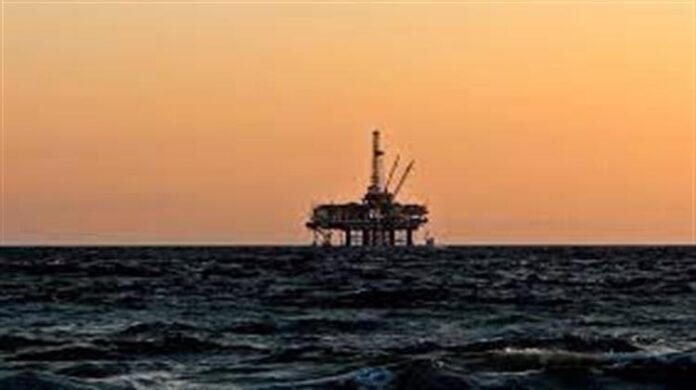
Εξορύξεις: Στο Επίκεντρο Κρήτη, Ιόνιο και Κυπαρισσιακός Κόλπος

2

 του Γιώργου Ατσαλάκη

 Τρι, 29 Μαρτίου 2022 – 08:35

Σε τρία συν ένα σημεία εστιάζεται το σχέδιο για τα επόμενα βήματα στο μέτωπο των εξορύξεων, που αναθερμάνθηκε μετά και τις ανακοινώσεις του Πρωθυπουργου για την επανεκκίνηση του όλου προγράμματος, που εδώ και τρία χρόνια περίπου «καρκινοβατεί». Συμφώνως προς στελέχη της αγοράς, ενδιαφέρουσες εξελίξεις μπορεί να προκύψουν στις παραχωρήσεις

των Ιωαννίνων στον Κυπαρισσιακό Κόλπο και στο Ιόνιο, ενώ, βεβαίως, σημαντική είναι και ἡ θαλάσσια περιοχή δυτικά καί νοτιοδυτικά της Κρήτης, ζώνη υψηλού γεωπολιτικού συμβολισμού και σημασίας. Για τις περιοχές αυτές ή μέρος των περιοχών αυτών αναμένεται να γίνουν σχετικές ανακοινώσεις το προσεχές διάστημα.

«Διεκδικοῦμε τήν ἐνεργειακή μας αὐτάρκεια. Αὐτό σημαίνει ἐπενδύσεις σέ Ἀνανεώσιμες Πηγές, ξεπερνῶντας κάθε γραφειοκρατικό ἐμπόδιο. Ἀνάπτυξη ἠλεκτρικῶν διασυνδέσεων μέ κράτη, ὅπως ἡ Αἴγυπτος. Μετατροπή τῆς πατρίδος μας σέ πύλη εἰσόδου ὑγροποιημένου φυσικοῦ ἀερίου. Προγράμματα ἐξοικονόμησης ἐνέργειας καί ἀντικατάστασης τῶν παλαιῶν συσκευῶν. Καί, ἀσφαλῶς, ἀξιοποίηση τῶν ἐθνικῶν κοιτασμάτων φυσικοῦ ἀερίου μέ οἰκονομικό ἐνδιαφέρον. Γιά τό θέμα αὐτό θά ὑπάρξουν σύντομα καί νέες ἀνακοινώσεις», ἀνέφερε σέ μήνυμά του ὁ Πρωθυπουργός, πού γιά πρώτη φορά κατά τή διάρκεια τῆς θητείας του, οὐσιαστικά ἀναφέρθηκε στό πρόγραμμα upstream. Πηγές τῆς ἀγορᾶς ἀναφέρουν ὅτι στόχοι φυσικοῦ ἀερίου ἔχουν ἐντοπιστεῖ στίς παραχωρήσεις δυτικά καί νοτιοδυτικά τῆς Κρήτης, καθώς καί στά Ἰωάννινα (Energean, ὅπου ἤδη ἔχει πραγματοποιηθεῖ σεισμική ἔρευνα). Ἐπίσης, ἀναμένεται μέ ἐνδιαφέρον ἡ ἑρμηνεία τῶν δεδομένων πού ἀντλήθηκαν ἀπό τίς σεισμικές ἔρευνες στόν Κυπαρισσιακό Κόλπο καί στό Ἰόνιο (ΕΛΠΕ). Ἄλλως τε, τονίζεται ὅτι διαπιστωμένο κοίτασμα φυσικοῦ ἀερίου τῆς τάξεως τοῦ 1 BCM ὑπάρχει στό Κατάκολο Ἠλείας (Energean) καί ἐκτιμᾶται ὅτι θά ἦταν δυνατό νά καλύψει τοπικές ἀνάγκες.

Ἁπτές ἀποδείξεις 

Πάντως, παράγοντες τῆς ἀγορᾶς τονίζουν ὅτι, πέρα ἀπό τό θετικό τῶν προθέσεων τοῦ Πρωθυπουργοῦ νά δώσει ὤθηση στήν ἀξιοποίηση τῶν ἐνεργειακῶν ἀποθεμάτων, ἀναμένονται καί κινήσεις μέ πρακτικό ἀντίκρισμα. Οὐσιαστικά, ὑπογραμμίζουν ὅτι δέν θά πρέπει τά ἐρευνητικά καί ἀναπτυξιακά προγράμματα νά ἀντιμετωπίσουν τίς γνωστές γραφειοκρατικές ἀγκυλώσεις σέ ἐπίπεδο δημόσιας διοίκησης καί τήν ἀναποφασιστικότητα σέ περιφερειακό καί τοπικό ἐπίπεδο. Ὑπενθυμίζεται ὅτι στά δυτικά καί νοτιοδυτικά τῆς Κρήτης τό σχῆμα Total – ExxonMobil – ΕΛΠΕ ἀναμένουν νά ἀπεμπλακεῖ ἀπό τή δικαστική περιπέτεια ἡ προοπτική διενέργειας σεισμικῆς ἔρευνας, ἐνῷ σημαντικές καθυστερήσεις, λόγῳ γραφειοκρατικῶν διαδικασιῶν τῆς διοικήσεως, τοπικῆς καί κεντρικῆς, καταγράφονται καί στίς ἄλλες περιοχές (πχ. μεγάλες καθυστερήσεις στίς ἐγκρίσεις τῶν μελετῶν περιβαλλοντικῶν ἐπιπτώσεων).

Πρίν λίγες ἡμέρες μέ ἀνακοίνωσή της ἡ Ἑλληνική Διαχειριστική Ἑταιρεία Ὑδρογονανθράκων ΑΕ (ΕΔΕΥ ΑΕ) ἀνέφερε ὅτι ἡ διεθνής ἑταιρεία προσκτήσεως καί ἐπεξεργασίας θαλάσσιων γεωφυσικῶν δεδομένων Shearwater ὁλοκλήρωσε γιά λογαριασμό τῶν ΕΛΠΕ, τήν δεύτερη θαλάσσια γεωφυσική (σεισμική) ἔρευνα στό βόρειο Ἰόνιο Πέλαγος. Τό ἐρευνητικό αὐτό πρόγραμμα ἀποτελεῖ συνέχεια τῶν ἐρευνῶν, πού ὁλοκληρώθησαν στίς ἀρχές Φεβρουαρίου 2022 στό νότιο Ἰόνιο. Ὁ στόχος τῶν ἐρευνῶν, πού ἦταν νά ἀξιολογηθοῦν τό μέγεθος τῶν δυνητικῶν ἀποθεμάτων φυσικοῦ ἀερίου τῆς χώρας, ἔρχεται σέ μία κρίσιμη στιγμή, ὅπου τό ἐνεργειακό κόστος αὐξάνεται σέ παγκόσμιο ἐπίπεδο καί ἐπικεντρωνόμαστε σέ θέματα στρατηγικῆς ἀσφάλειας τοῦ ἐφοδιασμοῦ. Τό ἑπόμενο βῆμα στήν διαδικασία εἶναι ἡ ἐπεξεργασία τῶν συλλεγμένων δεδομένων, προκειμένου νά ἀναλυθοῦν καί νά ἀξιολογηθοῦν. Ἡ ποιότης καί ἡ ταχύτης ὑλοποιήσεως τῶν ἑπόμενων ἐργασιῶν ἀποτελοῦν προτεραιότητα, προκειμένου νά ὡριμάσουν οἱ σχετικές ἐπενδυτικές ἀποφάσεις γιά τίς συγκεκριμένες περιοχές.

Μάλιστα, ὁ κ. Ἀριστοφάνης Στεφᾶτος, Διευθύνων Σύμβουλος τῆς ΕΔΕΥ, τῆς ἑταιρείας πού ἔχει τήν εὐθύνη ἐπίβλεψης γιά τήν ἀνάπτυξη τοῦ κλάδου Ἔρευνας καί Παραγωγῆς ὑδρογονανθράκων στήν Ἑλλάδα, καλωσόρισε τήν ὁλοκλήρωση τῶν σεισμικῶν ἐρευνῶν, δηλώνοντας: «Χαίρομαι ἰδιαίτερα μέ τήν ἐπιτυχῆ ὁλοκλήρωση καί τοῦ δεύτερου γύρου θαλάσσιων γεωφυσικῶν ἐρευνῶν. Ἐφαρμόσθηκαν αὐστηρά μέτρα γιά τήν προστασία τοῦ περιβάλλοντος καί τῆς θαλάσσιας ζωῆς, πού ὄχι μόνο πληροῦν, ἀλλά ξεπερνοῦν τά καθιερωμένα διεθνῆ πρότυπα γιά τήν ἐλαχιστοποίηση τῆς ἐπίδρασης καί μεγιστοποίηση τῆς παρακολούθησης καί προστασίας τῆς θαλάσσιας ζωῆς. Θά ἤθελα νά ἀναγνωρίσω τήν πολύ καλή συνεργασία μας μέ τά ΕΛΠΕ καί τήν Shearwater, πού ἀποτελεῖ παράδειγμα γιά τό πῶς μποροῦμε νά δημιουργήσουμε ἐπιτυχημένες συνεργασίες μέ ἐπενδυτές καί τεχνικούς ἐμπειρογνώμονες, προκειμένου νά ἱκανοποιήσουμε δύο ἐξ ἴσου σημαντικές προτεραιότητες: τήν ἐνίσχυση τῆς ἀσφάλειας τοῦ ἐνεργειακοῦ μας ἐφοδιασμοῦ μέ ταυτόχρονη προστασία τοῦ περιβάλλοντος καί τῆς φυσικῆς ὀμορφιᾶς τῆς χώρας μας».

Ἀπό τήν πλευρά του, ὁ κ. Rikard Scoufias, πρόεδρος τῆς ΕΔΕΥ ΑΕ, σχολίασε ὅτι «ἡ πρόοδος αὐτή ἀντιπροσωπεύει σημαντικά βήματα πρός τήν ἀξιοποίηση τῶν πόρων φυσικοῦ ἀερίου τῆς Ἑλλάδας καί σηματοδοτεῖ ἕνα σημαντικό βῆμα γιά περαιτέρω ἐνίσχυση τῆς ἀσφάλειας ἐφοδιασμοῦ καί ἀξιοποίηση τῶν ἐνεργειακῶν στρατηγικῶν ἐξελίξεων, πού τά τελευταῖα χρόνια ἔχουν κάνει τήν Ἑλλάδα σημαντικό ἐνεργειακό πρωταγωνιστή στήν περιοχή καί στήν Εὐρώπη».

Περισσότερη ἔρευνα 

Ὑπενθυμίζεται ὅτι μέ δηλώσεις της ἡ Γενική Γραμματέας Ἐνέργειας καί Ὀρυκτῶν Πρώτων Ὑλῶν τοῦ ΥΠΕΝ Ἀλεξάνδρα Σδούκου εἶχε «ζεστάνει» καί πάλι τό κλῖμα γιά τίς ἐξορύξεις. Ἀναφερόμενη, εἰδικά, στίς κινήσεις ἐνεργειακῆς θωράκισης τῆς χώρας μέσῳ τῆς ανάδειξής της σέ κόμβο διαμετακόμισης ἀλλά καί παραγωγό, ἡ κ. Σδούκου, κατά τήν τοποθέτησή της στό ἐνεργειακό συνέδριο EGYPS 2022, πού διεξήχθη στά τέλη τοῦ προηγούμενου μήνα στό Κάιρο, σημείωσε ὅτι «ἀπαιτεῖται περισσότερη ἔρευνα καί περισσότερη παραγωγή φυσικοῦ ἀερίου, ὡς ἐργαλείου μείωσης τῆς ἐνεργειακῆς ἐξάρτησής μας ἀπό χῶρες ἐκτός Ε.Ε.», λέγοντας μάλιστα ὅτι ἡ Ἑλλάδα παραμένει σέ μεγάλο βαθμό ἀνεξερεύνητη, εἰδικά στά βαθειά καί ἐξαιρετικά βαθειά νερά της. «Πρέπει, ἐπίσης, νά ἀναγνωρίσουμε τό γεγονός ὅτι ἡ διαρθρωτική ἀλλαγή τοῦ παγκόσμιου ἐνεργειακοῦ μείγματος, ἡ τρίτη πού θά συμβεῖ ἀπό τήν ἀρχή τῆς βιομηχανικῆς ἐπανάστασης, θά προκύψει μέ τήν πάροδο τῶν γενεῶν καί οἱ συνέπειές της δέν μποροῦν νά προβλεφθοῦν πλήρως». Συνεπῶς, ὅπως εἶπε, χρειάζεται νά ἐπιδιωχθεῖ σταδιακά καί μέ τόν ρυθμό πού μπορεῖ νά προσφέρει ἡ τεχνολογική καινοτομία, ὥστε νά διασφαλιστεῖ ὅτι ἡ μετάβασις αὐτή δέν θά ὑπονομεύσει τήν ἐνεργειακή ἀσφάλεια.

Πάντως, μέ βάση τίς ἀνακοινώσεις τῆς ΕΔΕΥ, μέ ἀφορμή τίς γεωφυσικές ἔρευνες, στίς ἀρχές Φεβρουαρίου, σέ θαλάσσιο οἰκόπεδο στό νότιο Ἰόνιο Πέλαγος, ὁ κ. Ἀριστοφάνης Στεφᾶτος δήλωσε ὅτι «πρόκειται γιά τό πρῶτο ἁπτό βῆμα μετά ἀπό περισσότερο ἀπό μισή δεκαετία προκειμένου νά ἀποκτήσουμε σαφήνεια ἀναφορικά μέ τή δυνατότητα τῆς Ἑλλάδας νά ἀξιοποιήσει τά θαλάσσια ἀποθέματα φυσικοῦ ἀερίου της». Ὁ ἴδιος πρόσθεσε ὅτι «ὅλα τά ἐμπλεκόμενα μέρη ἐκτέλεσαν τίς ἔρευνες ἀκολουθῶντας τά ὑψηλότερα περιβαλλοντικά πρότυπα, ξεπερνῶντας ἀκόμα καί τίς βέλτιστες διεθνεῖς πρακτικές».

energia.gr

Το άκρως προφητικό «Έκτακτο Υπηρεσιακό Υπόμνημα» για την Ουκρανία με ελληνική υπογραφή από το 2004!

0

To «ουκρανικό ζήτημα» δεν δημιουργήθηκε «σε ένα 24ωρο», ούτε μπορεί να αποδοθεί στην «παραφροσύνη» οποιουδήποτε. Αυτό δεν αφορά μόνο στις «μεγάλες δυνάμεις», αλλά και στην Ελλάδα που διαθέτει επιστημονικό προσωπικό και αναλυτές που σε πολλές περιπτώσεις έχουν υψηλότερο επίπεδο γνώσεων. Σίγουρα σ ΄ ότι αφορά στην περιοχή μας και σε πολλές περιπτώσεις και σε άλλες «καυτές» περιοχές του πλανήτη.

Στην Αθήνα οι κυβερνήσεις δεν μπορούν να ισχυριστούν ότι δεν γνώριζαν. Μπορεί απλά να μη…διάβαζαν, όπως δεν είχαν διαβάσει και τα μνημόνια…

Από τον Δεκέμβριο του 2004 το Ινστιτούτο Αμυντικών Αναλύσεων είχε καταθέσει  ένα «Έκτακτο Υπηρεσιακό Υπόμνημα»! Κάτω από τον «αθώο» τίτλο υπήρχε μια εκπληκτική ανάλυση του ουκρανικού ζητήματος. Συντάκτης ο Δρ Ηλίας Ηλιόπουλος, ερευνητής τότε του Ινστιτούτου Αμυντικών Αναλύσεων και Συντονιστής του Τομέα Γεωστρατηγικών και Αμυντικοπολιτικών Αναλύσεων ΗΠΑ-Ευρώπης-Ρωσίας-Ευρασίας

Επιστημονικός υπεύθυνος ήταν ο Δρ Ιωάννης Μάζης, Πρόεδρος του Επιστημονικού Συμβουλίου του Ι.Α.Α. [Επιστημονικός Υπεύθυνος].

Τι αναφερόταν σε εκείνο το «Έκτακτο Υπηρεσιακό Υπόμνημα»:

• «Οφείλει εξ αρχής και με απόλυτη σαφήνεια να υπογραμμισθεί η βαρύτατη σημασία την οποία έχει η σοβούσα κρίσις των σχέσεων Δύσεως – Ρωσσίας για την Ευρωπαϊκή και Διεθνή Ασφάλεια. Η κρίση λόγω του Ζητήματος της Ουκρανίας είναι, δυνητικώς, πολύ σοβαρότερη από την κρίση της δεκαετίας του ’90 περί το Γιουγκοσλαβικό Ζήτημα, και θα ήταν ασύγγνωστον σφάλμα ιστορικών διαστάσεων εάν οι ιθύνοντες ένθεν και ένθεν του Ατλαντικού υποτιμήσουν το εύρος και το ποιόν των επιπτώσεών της».     

• – Από γεωπολιτικής/ γεωστρατηγικής/ γεωοικονομικής και γεωπολιτισμικής απόψεως, τα διαδραματιζόμενα στην μείζονα Μεσευρώπη (Πολωνία – Ουκρανία – Λευκορωσσία – Βαλτική) συναρτώνται άμεσα τόσο προς τις εξελίξεις που ήδη επισυνέβησαν, αλλά και προς εκείνες που πρόκειται να επισυμβούν, στην ΝΑ. Ευρώπη (περιοχή της πρώην Γιουγκοσλαβίας) όσο και προς τις εξελίξεις στην ευρύτερη περιοχή  Καυκάσου και Κεντρικής Ασίας.

  • Το γεωπολιτικό τρίγωνο που ορίζεται με τις κορυφές i) ΝΑ. Ευρώπη (Αλβανία, Σερβία – Μαυροβούνιο, Βοσνία, Κοσσυφοπέδιο, Σκόπια, Ελλάς, Βουλγαρία, Ρουμανία), ii) Καύκασο / Υπερκαυκασία και iii) (ως κορυφή) Μεσευρώπη (Ουκρανία) προσδιορίζει και το θέατρο εντός του οποίου διεξάγεται αδυσώπητος, από της επομένης της καταρρεύσεως της πάλαι ποτέ ΕΣΣΔ: 

α) ο ανταγωνισμός ισχύος και επιρροής των Δυνάμεων για την κάλυψη του κενού ισχύος που προέκυψε μετά την εξαφάνιση του ενός εκ των δύο Πόλων Διεθνούς Ισχύος του προηγουμένου (διπολικού) διεθνούς συστήματος (όρα ΥΥ/I.A.A., υπ’ αριθμ. 19)

β)  ο «Πόλεμος των Αγωγών», για τον έλεγχο των Ενεργειακών Οδών του 21ου αι.

• – Ως ιδιαιτέρως κρίσιμο για το μέλλον των σχέσεων ΕΕ-Ρωσσίας, ΗΠΑ- Ρωσσίας, αλλά και για την ίδια την Διεθνή Ασφάλεια, οφείλει να διερευνηθεί και αξιολογηθεί το ενδεχόμενο να έχουν υιοθετήσει και να εφαρμόζουν οι ιθύνοντες της πολιτικής της Παγκοσμίου Ναυτικής Δυνάμεως (ΗΠΑ) την γεωστρατηγική σχεδίαση του τ. Συμβούλου Εθνικής Ασφαλείας Zbigniew Brzezinski (ο οποίος σημειωτέον φέρεται να κατευθύνει, ως Μέντωρ, την υπό εξέλιξιν ψυχολογική επιχείρηση, από κοινού με τους Henry Kissinger, Dan Fried, George Soros και το εν γένει κατεστημένο των λεγομένων «ρωσοφοβικών» προσωπικοτήτων, κυρίως του Δημοκρατικού Κόμματος) . 

  • Η τελευταία αποτελεί, εν πολλοίς, μία «επικαιροποιημένη»  επανέκδοση της κλασσικής Γερμανικής Γεωστρατηγικής περί Μεσευρώπης,  όπως είχε εκτεθεί ήδη το 1914, ενώπιον της Γερμανικής Βουλής, από τον τότε Καγκελλάριο κατά την ανάγνωση των Πολεμικών Αντικειμενικών Σκοπών έναντι της Ρωσσίας και η οποία προέβλεπε τον διαμελισμό της (Τσαρικής τότε) Ρωσσίας σε τέσσερα τουλάχιστον τμήματα:

α) Ουκρανία, η απόσπαση της οποίας εθεωρείτο conditio sine qua non.

β) Μουσουλμανικές Περιοχές του Καυκάσου.

γ) Σιβηρία.

δ) Εναπομείνασα Ρωσσία.

(Στα ανωτέρω θα μπορούσαν να προστεθούν και οι Βαλτικές Χώρες, οι οποίες, ούτως ή άλλως, εθεωρούντο ως ανήκουσες στην γεωπολιτική και γεωπολιτισμική ζώνη επιρροής της φραγκονοτευτονικής Δύσεως και όχι της ρωσοβυζαντινής Ανατολής).

• – Για την Ρωσσία, η ενδεχόμενη απώλεια της ειδικής σχέσεώς της με την Ουκρανία (δια της αλώσεως της τελευταίας, κατά το προηγούμενο της Σερβίας, και της εν συνεχεία εντάξεώς της στο ΝΑΤΟ) θα αποτελέσει δεινή ήττα, απείρως βαρύτερη από την απώλεια των χωρών της Δυτικής Μεσευρώπης (Τσεχία, Ουγγαρία) ή της ΝΑ. Ευρώπης (Βουλγαρία, Σερβία). 

  • Ενδεχόμενη επέκταση του ΝΑΤΟ προς την Ουκρανία θα σημάνει πλέον την οριστική (και ασφυκτική) περικύκλωση της Ρωσσίας από ένα στρατιωτικό συνασπισμό κρατών που καθηγεμονεύεται από την Παγκόσμιο Δύναμη, δρα αναθεωρητικώς στο διεθνές σύστημα και επανειλημμένως έχει δώσει απτά δείγματα αθετήσεως συγκεκριμένου τύπου υποσχέσεων και διακηρύξεών του.

Ο Δρ Ηλίας Ηλιόπουλος με λίγα λόγια έγραφε το 2004 όσα γίνονται σήμερα!  Το  «Έκτακτο Υπηρεσιακό Υπόμνημα» του κατατέθηκε όπου έπρεπε να κατατεθεί…