Αρχική Blog Σελίδα 1887

ΟΙ ΩΡΑΙΕΣ ΚΟΙΜΩΜΕΝΕΣ ΜΑΣ ΤΕΛΕΙΩΣΑΝ

0
της Μαρίας Παπαδοπούλου, Δικηγόρου
1.- Άρση απορρήτου τηλεφωνικών συνομιλιών διατάσσεται με απόφαση του Συμβουλίου Πλημμελειοδικών , ύστερα από πρόταση του αρμόδιου Εισαγγελέα κι αυτό γίνεται όταν υπάρχουν έστω υπόνοιες ή  αποχρώσες ενδείξεις τέλεσης ποινικού αδικήματος από τον φερόμενο ως δράστη του και προς διερεύνηση κι εξακρίβωση της τέλεσης πράγματι από  αυτόν συγκεκριμένων  ποινικών αδικημάτων.
Θα είχε μεγάλο ενδιαφέρον – αν έχει πράγματι εκδοθεί τέτοια-  να  γνωρίζαμε το περιεχόμενο της εν λόγω απόφασης και πως στοιχειοθετήθηκε στο σκεπτικό της η άδεια άρσης απορρήτου τηλεφωνικών συνομιλιών Ανδρουλάκη.
Ο ίδιος ο κύριος Ανδρουλάκης που τον αφορά κι αφορά προσωπικά του δεδομένα θα έπρεπε -εάν είχε εκδοθεί τέτοια απόφαση άρσης του απορρήτου των τηλεφωνικών του συνομιλιών – να ζητήσει αντίγραφο της εν λόγω απόφασης και να το δώσει στην δημοσιότητα.
Ποιο ποινικό αδίκημα η αδικήματα διερευνούνταν και φέρονταν ότι ενδεχόμενα τέλεσε ο κύριος Ανδρουλάκης, με την περί ης ο λόγος εκδοθείσα δικαστική απόφαση ???
2.-  Το πρώτο που μαθαίνει ένας πρωτοετής φοιτητής της Νομικής είναι η συνταγματικά κατοχυρωμένη Αρχή της Διάκρισης των Εξουσιών, η οποία αποτελεί τον θεμέλιο λίθο λειτουργίας ενός  κράτους που το διέπουν οι αρχές του δημοκρατικού πολιτεύματος.
Οι τρεις θεσμοί Εξουσίας , δηλαδή η Νομοθετική (ως επί τω πλείστον η Βουλή) , η Εκτελεστική (Κυβέρνηση – Διοίκηση) και η Δικαστική (Δικαιοσύνη) δεν οφείλουν απλώς, αλλά υποχρεούται να τηρούν ως κόρη οφθαλμού την Ανεξαρτησία τους και να μην εμπλέκεται η μία στις αρμοδιότητες της άλλης .
Αυτός είναι και ο μόνος τρόπος για να διασφαλιστεί έμπρακτα  ο δημοκρατικός χαρακτήρας των αρχών και των αξιών που διέπουν ένα κράτος δικαίου.
Όταν αυτή η Αρχή καταλύεται , τότε έχουμε σοβαρό έλλειμμα Δημοκρατίας.
Χωρίς να εξασφαλίζεται η δυνατότητα ελέγχου της μιας εξουσίας από την άλλη, το αποτέλεσμα είναι ένα κράτος ασυδοσίας.
Δεν αρκούν παραιτήσεις.
Δεν αρκούν δηλώσεις τύπου ” δεν ήξερα, δεν γνώριζα”.
Δεν αρκούν συγνώμες.
Ούτε αρκούν ασφαλώς αποδόσεις ευθυνών σε πρόσωπα, τελευταίους τροχούς της αμάξης , που δέχτηκαν κι εκτέλεσαν άνωθεν εντολές , τις οποίες εφόσον δεν εκτελούσαν θα επικρέμονταν πάνω από τα κεφάλια τους η παραπομπή τους   για απείθεια και στην καλύτερη περίπτωση θα είχαν εξασφαλισμένες τις δυσμενείς μεταθέσεις.
 Οι υπαίτιοι , αυτοί δηλαδή που φέρεται ότι συνήργησαν και συμμετείχαν στην διαπλοκή των εξουσιών κι έδωσαν συγκεκριμένες εντολές στους υφιστάμενους τους, όσο ψηλά αξιώματα κι αν κατείχαν οι ίδιοι στις κλίμακες των τριών αυτών θεσμών-εξουσιών , πρέπει να οδηγηθούν, αυθωρεί και παραχρήμα ενώπιον της δικαιοσύνης και να αντιμετωπίσουν τις βαρύτατες συνέπειες των πράξεών  και των επιλογών τους. .
Οι πράξεις τους αυτές στρέφονται κατά του ίδιου του πολιτεύματος της Χώρας . Κατά συνέπεια στρέφονται εναντίον των πολιτών της και προσβάλλουν βάναυσα όλους μας.
Όχι μόνον τον κάθε κύριο Ανδρουλάκη.
Η ύβρις κι η προσβολή που  διέπραξαν εν γνώσει τους συγκεκριμένα πρόσωπα , ανάγεται στον υπέρτατο βαθμό και δεν χωρούν λόγοι συγνώμης ή επικλήσεις άγνοιας των τυχόν  ανώτερων από αυτούς .
Οι τελευταίοι ευθύνονται για την επιλογή των συγκεκριμένων προσώπων. Η ευθύνη αυτή τους ανήκει αποκλειστικά. Οι υφιστάμενοι τους ενήργησαν με την αποδοχή των ανωτέρων τους. Στην χώρα αυτή πρέπει να πάψουμε να μηρυκάζουμε και να αναμασούμε την τσίχλα της “πολιτικής ευθύνης”. Δεν πείθει πλέον κανέναν και μόνον ως τραγελαφος ηχεί στα αυτιά των υπολοίπων.  Πίσω από την πολιτική ευθύνη βρίσκουν άλλοθι κι εξαγνιίζονται  οι ποινικές ευθύνες .
Είναι καιρός αυτη η πολυθρύλητη Επιτάχυνση της Δικαιοσύνης να γίνει , αδιακρίτως, πράξη!
Ακόμα κι αν για το σκοπό αυτό απαιτείται αυτοκάθαρση..
Η Δικαιοσύνη είναι τυφλή, από το ζύγι της περνούν οι πάντες κι όχι μόνον οι φτωχοδιάβολοι.
Προσωπικά δεν ανέχομαι καμία βρωμερή κηλίδα στον θεσμό της Δικαιοσύνης . Καμία αμφισβήτηση στο κύρος του Έλληνα Εισαγγελέα και  Δικαστή στους οποίους αποθέτει τις ελπίδες του ο αδικημένος  πολίτης αυτής της Χώρας.
3 – Είναι αήθες σε καιρούς που η χώρα δέχεται έξωθεν απειλές, αμφισβητήσεις της κυριαρχίας της και των κυριαρχικών δικαιωμάτων της, ευρισκόμενη αντιμέτωπη με  κινδύνους  ενόπλων συγκρούσεων, κάποιοι εντός  να εκμεταλλεύονται αυτές ακριβώς τις περιστάσεις για να πλήξουν την δημοκρατική λειτουργία του πολιτεύματος της, ποντάροντας ότι η πολιτειακή ανωμαλία που διακινδυνεύεται να προκληθεί εξαιτίας των πράξεων τους  , θα υποβοηθήσει τους ίδιους, σε ανάλογης κρισιμότητας στιγμές ,  ,αν ποτέ πιαστούν με την γίδα στην  πλάτη , να διαφύγουν των ευθυνών τους, οδηγώντας άρον άρον σε κουκούλωμα τους.
Αντίθετα, η συγκυρία κάτω από την οποία συνέβησαν αυτά που συνέβησαν, πολλαπλασιάζει τον βαθμό της βαρύτητας των ευθυνών τους, προσδίδοντας ιδιώνυμο χαρακτήρα στην παρανομία  των πράξεών και παραλείψεων τους.
4.- Θα προτιμούσα η δημοσιότητα που απολαμβάνει σήμερα ο κύριος Ανδρουλάκης να προκαλούνταν εξαιτίας των σοβαρών πολιτικών του παρεμβασεων και του αντιπολιτευτικού του έργου κι όχι επειδή έπεσε θύμα μιας, κατά τα φαινόμενα,  εξ’ αντικειμένου  αήθους εις βάρος του επίθεσης.
Τέτοια όμως δημοσιότητα που συνδέονταν με το κύρος των πολιτικών ενεργειών, των αντιπολιτευτικών προτάσεων και των παρεμβάσεων ενός πολιτικού ανδρός, προσωπικά  δεν εντόπισα όλο το προηγούμενο διάστημα όσον αφορά το συγκεκριμένο πρόσωπο .
Είναι εξαιρετικά λυπηρό που ο κύριος Ανδρουλάκης ήρθε στο προσκήνιο της δημοσιότητας και το μονοπώλησε, μέσω της θυματοποίησης του.
Ο κανόνας μπορεί να  υπαγορεύει μεν  ότι κι η “Αρνητική Διαφήμιση” , διαφήμιση είναι, αλλά εν προκειμένω προσωπικά δεν θεωρώ ότι η θυματοποίηση ενός πολιτικού προσώπου και συνάμα αρχηγού πολιτικού κόμματος  που τον συνδέει  ευθέως με μια εικόνα αδυναμίας ενός θύματος  στο υποσυνείδητο των πολιτών θα ωφελήσει μακροπρόθεσμα τον κύριο Ανδρουλάκη.
Βλέπετε διανύουμε μια εποχή που οι πράξεις, οι παραλήψεις, οι αποφάσεις κι οι ανημπόριες των πολιτικών ηγεσιών, σημαδεύουν ανεξίτηλα πλέον το ίδιο το πετσί του Έλληνα κι αυτή η συνθήκη καθ’αυτή ωθεί τον Έλληνα να μην ξεχνά, ούτε να προσπερνά αβρόχοις ποσίν τα τεκταινόμενα που είναι ικανά να  καθορίσουν με δραματικό τρόπο το μέλλον του .
 Αντί να καθόμαστε  να προβληματιζόμαστε και να ασχολούμαστε με τους κινδύνους και τις σοβαρές έξωθεν προκλήσεις κι απειλές ,που αντιμετωπίζει η Πατρίδα μας, φτάσαμε να ομφαλοσκοπούμε με το ποιος πολιτικός παρακολουθεί τον άλλο !!!
Κάποιος θα μπορούσε να πει ότι η όλη περιδίνηση στην οποία διολισθαίνουμε αποτελεί έναν πολύ καλό αντιπερισπασμό ο οποίος αποπροσανατολίζει την προσοχή της κοινής γνώμης από τα κρίσιμα, τα σημαντικά, τα σπουδαία και τα μεγάλα ζητήματα της εθνικής μας επιβίωσης κι ίσως να μην διαφωνούσα μαζί του.
5.- Τα πρόσφατα γεγονότα μου έχουν αφήσει μια πικρή και στυφή επίγευση , δημιουργώντας μου  την  εντύπωση πως  απέδειξαν ότι στην σύγχρονη Ελλάδα έχουμε ευρύτερο έλλειμμα πολιτικής ηγεσίας και σερνόμαστε σαν το καρυδότσουφλο όπου μας πάει ο άνεμος κι οι πρόσκαιρες εντυπώσεις. Πως χαρακτηριζόμαστε  από συλλήβδην πολιτικές υπομετριότητες ανίκανες κι αδύναμες να διαχειριστούν με την δέουσα σοβαρότητα τον κρίσιμο και καίριας σπουδαιότητας ρόλο που τους εμπιστεύτηκαν, τον οποίο αρκούνται απλώς και μόνον να τον  ευτελίζουν, δίχως να ανταποκρίνονται ως όφειλαν επάξια σε αυτόν .
Τα δύσκολα λόγια που κρύβουν πικρές αλήθειες συνήθως πονάνε. Όποιος δυσανασχέτησε  μέσα του  για αυτά που είπα, καλύτερα ας προβληματιστεί.
Κανείς δεν είναι καλύτερος από τον άλλο. Βρισκόμαστε στο στάδιο του “μη χείρον βέλτιστον”, διασκεδάζοντας τις ελλείψεις μας μέσα από οπαδοποιήσεις, κομματικών κατασκευών που προπαρασκευάζουν το κλίμα των μελλοντικών εκλογών.
Κανείς , ούτε το θύμα, ούτε ο θύτης, είναι άμοιροι ευθυνών.
Όλα τα προηγούμενα χρόνια, όλοι έβαλαν το λιθαράκι τους για να οδηγηθούμε στην σημερινή κατάντια.
Ηρωποίηση δεν αρμόζει σε κανέναν, ούτε και έπαινος
Ούτε μεταθέσεις ευθυνών σε ξένους παράγοντες χωρούν. Αυτοί – ακόμα κι αν δεχτούμε πως είναι έτσι – την δουλειά τους κάνουν και την κάνουν προς όφελος της δικής τους πατρίδας.
 Εμείς είμαστε αυτοί που πρέπει να αντιστεκόμαστε στις τυχόν πιέσεις τους όταν αυτές είναι επιβλαβείς για την εύρυθμη λειτουργία των θεσμών και των αξιών της δικής μας Πατρίδας .
Αξιοκατάκριτοι είμαστε μόνον εμείς!
Ελάχιστα με αφορά εάν γίναμε περίγελος κι αντικείμενο σχολιασμού στον ξένο τύπο.
Οι μόνοι αρμόδιοι  που πρέπει να ορίζουμε τις καταστάσεις που συνδέονται ακραιφνώς με την Πατρίδα μας , είμαστε μόνον εμείς.
Καιρός να ασχοληθούμε, όχι για να κριτικάρουμε απλώς, αλλά για να διορθώσουμε τα στρεβλά.
Λυπάμαι που το λέω, αλλά δεν αρκεί ο εξωραϊσμός του “μη χείρον” , που επιχειρείται συστηματικά από κάποιους.
Το απόστημα επουδενί γίνεται να θεραπευτεί μέσω ωραιοποιήσεων του !!  Αν δεν το αντιμετωπίσεις έγκαιρα κακοφορμεί και στο τέλος κυριολεκτικά έρχεται και σκουλικιαζει, οδηγώντας σε γάγγραινα.
Τα ίδια τα γεγονότα ωθούν τον Έλληνα πολίτη σε εσωτερικές διεργασίες κι αναμοχλεύσεις, που με την σειρά τους, μέρα με την μέρα  τον εξωθούν βίαια να αναμετρηθεί με αυτά.
Μην βαυκαλιζόμαστε ότι επειδή οι διεργασίες αυτές δεν εξωτερικεύθηκαν ακόμα, δεν συντελούνται υποδόρια κι ο Έλληνας είναι καθυποταγμενος, συμβιβασμένος στην μοίρα του ή  ότι, δεν έχει επίγνωση της κατάστασης , των συνεπειών και των κινδύνων που αυτή υποκρύπτει , όντας ξεδοντιασμένος κι ανήμπορος να αντιδράσει κι έτοιμος να τον κατευθύνουν σαν το ζώο στο μαντρί.
Οι εποχές αυτές πέρασαν ανεπιστρεπτί!
Απλά δεν ήρθε  ακόμα η ώρα του Έλληνα .
Το ότι δεν ήρθε ακόμα η ώρα του,  δεν συνεπάγεται ότι δεν μέλλεται να έρθει ή ότι η ώρα αυτή θα εκδηλωθεί συμπίπτοντας με μια εκλογική διαδικασία.
Αρκεί μια σπίθα, ένα τυχαίο  γεγονός, μια σταγόνα -η τελευταία- που θα ξεχυλισει το ποτήρι,  για να βρεθούμε αντιμέτωποι με αδιανόητες σήμερα  καταστάσεις.
Και το ηφαίστειο πριν εκραγεί κι αρχίσει να ρέει από τα σωθικά του η λάβα του και να καίει τα πάντα στο διάβα της,δείχνει απόλυτα ήρεμο  και κυλά ήσυχα ήσυχα το ποταμάκι…
Κανείς δεν μπορεί να ελέγξει τον χρόνο της έκρηξης του.
Στο μάτι του τυφώνα επικρατεί πάντα ηλιοφάνεια και νηνεμία…
Μην παριστάνουμε πως αγνοούμε αυτές τις φυσικές εκδηλώσεις, είναι οι ίδιες ακριβώς που διέπουν και τις δικές μας, τις ανθρώπινες,  λειτουργίες κι αντιδράσεις.
Ας τα έχουν υπόψιν τους αυτά, όσοι συνεχίζουν να επικαλούνται ότι “δεν γνώριζαν, δεν ήξεραν”.
Ασυγχώρητη άγνοια, δεν δικαιολογείται!!
Οι Ωραίες Κοιμωμένες, μας τελείωσαν !!!

E.Wolff: «Αυτά φέρνει ο μετανθρωπισμός των Σβαμπ-Χαράρι – Με τσιπ θα ελέγχουν τις κινήσεις των ανθρώπων»

0

Τι υποστηρίζει ο Γερμανός οικονομολόγος Ernst Wolff

Τις απόψεις του Κλάους Σβαμπ, του Γιουβάλ Νόα Χαράρι και των λοιπών «θιασώτων» της «Μεγάλης Επανεκκίνησης» σχολιάζει ο Γερμανός οικονομολόγος Ernst Wolff. 

Τι λέει ο Wolff:

«Ο Σβαμπ γράφει ανοικτά ότι στο μέλλον οι άνθρωποι θα συνδεθούν με τον ψηφιακό κόσμο και έτσι θα ανέλθουν σε υψηλότερο επίπεδο.

Πρώτα είναι σχεδιασμένο να εμφυτεύσουν ένα τσιπ στα ρούχα για να παρακολουθούν τις κινήσεις των ανθρώπων και έπειτα να εμφυτεύσουν ένα ακόμα τσιπ κάτω από το δέρμα ή ακόμα και στον εγκέφαλο.

Αυτό ήδη μοιάζει με ανθρωποειδές ρομπότ. Ένα μεγάλο πρόβλημα είναι πως η τεχνητή νοημοσύνη που θα καταλάβει την ανθρωπότητα βρίσκεται στα χέρια ελάχιστων ανθρώπων. Οι τεχνολογικές καινοτομίες δεν χρησιμοποιούνται προς όφελος της πλειοψηφίας, αλλά προς όφελος της μειοψηφίας».

https://www.pronews.gr/kosmos/e-wolff-ayta-fernei-o-metanthropismos-ton-svamp-xarari-me-tsip-tha-elegxoun-tis-kiniseis-ton-anthropon/

Inside the War Between Trump and His Generals

0

How Mark Milley and others in the Pentagon handled the national-security threat posed by their own Commander-in-Chief.

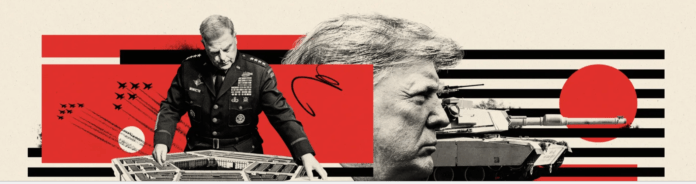
A collage of Trump's profile intertined with various military symbols.
As the President’s behavior grew increasingly erratic, General Mark Milley told his staff, “I will fight from the inside.”Photo illustration by Klawe Rzeczy; Source photographs from Getty; National Archives / Newsmakers 

Sure enough, Trump returned to Washington determined to have his generals throw him the biggest, grandest military parade ever for the Fourth of July. The generals, to his bewilderment, reacted with disgust. “I’d rather swallow acid,” his Defense Secretary, James Mattis, said. Struggling to dissuade Trump, officials pointed out that the parade would cost millions of dollars and tear up the streets of the capital.

But the gulf between Trump and the generals was not really about money or practicalities, just as their endless policy battles were not only about clashing views on whether to withdraw from Afghanistan or how to combat the nuclear threat posed by North Korea and Iran. The divide was also a matter of values, of how they viewed the United States itself. That was never clearer than when Trump told his new chief of staff, John Kelly—like Mattis, a retired Marine Corps general—about his vision for Independence Day. “Look, I don’t want any wounded guys in the parade,” Trump said. “This doesn’t look good for me.” He explained with distaste that at the Bastille Day parade there had been several formations of injured veterans, including wheelchair-bound soldiers who had lost limbs in battle.

Kelly could not believe what he was hearing. “Those are the heroes,” he told Trump. “In our society, there’s only one group of people who are more heroic than they are—and they are buried over in Arlington.” Kelly did not mention that his own son Robert, a lieutenant killed in action in Afghanistan, was among the dead interred there.

“I don’t want them,” Trump repeated. “It doesn’t look good for me.”

The subject came up again during an Oval Office briefing that included Trump, Kelly, and Paul Selva, an Air Force general and the vice-chairman of the Joint Chiefs of Staff. Kelly joked in his deadpan way about the parade. “Well, you know, General Selva is going to be in charge of organizing the Fourth of July parade,” he told the President. Trump did not understand that Kelly was being sarcastic. “So, what do you think of the parade?” Trump asked Selva. Instead of telling Trump what he wanted to hear, Selva was forthright.

“I didn’t grow up in the United States, I actually grew up in Portugal,” Selva said. “Portugal was a dictatorship—and parades were about showing the people who had the guns. And in this country, we don’t do that.” He added, “It’s not who we are.”

“No,” Selva said. “It’s what dictators do.”

The four years of the Trump Presidency were characterized by a fantastical degree of instability: fits of rage, late-night Twitter storms, abrupt dismissals. At first, Trump, who had dodged the draft by claiming to have bone spurs, seemed enamored with being Commander-in-Chief and with the national-security officials he’d either appointed or inherited. But Trump’s love affair with “my generals” was brief, and in a statement for this article the former President confirmed how much he had soured on them over time. “These were very untalented people and once I realized it, I did not rely on them, I relied on the real generals and admirals within the system,” he said.

It turned out that the generals had rules, standards, and expertise, not blind loyalty. The President’s loud complaint to John Kelly one day was typical: “You fucking generals, why can’t you be like the German generals?”

“Which generals?” Kelly asked.

“The German generals in World War II,” Trump responded.

“You do know that they tried to kill Hitler three times and almost pulled it off?” Kelly said.

But, of course, Trump did not know that. “No, no, no, they were totally loyal to him,” the President replied. In his version of history, the generals of the Third Reich had been completely subservient to Hitler; this was the model he wanted for his military. Kelly told Trump that there were no such American generals, but the President was determined to test the proposition.

By late 2018, Trump wanted his own handpicked chairman of the Joint Chiefs of Staff. He had tired of Joseph Dunford, a Marine general who had been appointed chairman by Barack Obama, and who worked closely with Mattis as they resisted some of Trump’s more outlandish ideas. Never mind that Dunford still had most of a year to go in his term. For months, David Urban, a lobbyist who ran the winning 2016 Trump campaign in Pennsylvania, had been urging the President and his inner circle to replace Dunford with a more like-minded chairman, someone less aligned with Mattis, who had commanded both Dunford and Kelly in the Marines.

Two parents talking to their son playing guitar in bed

“Michael, your father and I are worried that you’re awfully young to be singing the blues.” 
Cartoon by David Sipress

Mattis’s candidate to succeed Dunford was David Goldfein, an Air Force general and a former F-16 fighter pilot who had been shot down in the Balkans and successfully evaded capture. No one could remember a President selecting a chairman over the objections of his Defense Secretary, but word came back to the Pentagon that there was no way Trump would accept just one recommendation. Two obvious contenders from the Army, however, declined to be considered: General Curtis Scaparrotti, the nato Supreme Allied Commander in Europe, told fellow-officers that there was “no gas left in my tank” to deal with being Trump’s chairman. General Joseph Votel, the Central Command chief, also begged off, telling a colleague he was not a good fit to work so closely with Mattis.

Urban, who had attended West Point with Trump’s Secretary of State, Mike Pompeo, and remained an Army man at heart, backed Mark Milley, the chief of staff of the Army. Milley, who was then sixty, was the son of a Navy corpsman who had served with the 4th Marine Division, in Iwo Jima. He grew up outside Boston and played hockey at Princeton. As an Army officer, Milley commanded troops in Afghanistan and Iraq, led the 10th Mountain Division, and oversaw the Army Forces Command. A student of history who often carried a pile of the latest books on the Second World War with him, Milley was decidedly not a member of the close-knit Marine fraternity that had dominated national-security policy for Trump’s first two years. Urban told the President that he would connect better with Milley, who was loquacious and blunt to the point of being rude, and who had the Ivy League pedigree that always impressed Trump.

Milley had already demonstrated those qualities in meetings with Trump as the Army chief of staff. “Milley would go right at why it’s important for the President to know this about the Army and why the Army is the service that wins all the nation’s wars. He had all those sort of elevator-speech punch lines,” a senior defense official recalled. “He would have that big bellowing voice and be right in his face with all the one-liners, and then he would take a breath and he would say, ‘Mr. President, our Army is here to serve you. Because you’re the Commander-in-Chief.’ It was a very different approach, and Trump liked that.” And, like Trump, Milley was not a subscriber to the legend of Mad Dog Mattis, whom he considered a “complete control freak.”

Mattis, for his part, seemed to believe that Milley was inappropriately campaigning for the job, and Milley recalled to others that Mattis confronted him at a reception that fall, saying, “Hey, you shouldn’t run for office. You shouldn’t run to be the chairman.” Milley later told people that he had replied sharply to Mattis, “I’m not lobbying for any fucking thing. I don’t do that.” Milley eventually raised the issue with Dunford. “Hey, Mattis has got this in his head,” Milley told him. “I’m telling you it ain’t me.” Milley even claimed that he had begged Urban to cease promoting his candidacy.

In November, 2018, the day before Milley was scheduled for an interview with Trump, he and Mattis had another barbed encounter at the Pentagon. In Milley’s recounting of the episode later to others, Mattis urged him to tell Trump that he wanted to be the next Supreme Allied Commander in Europe, rather than the chairman of the Joint Chiefs. Milley said he would not do that but would instead wait to hear what the President wanted him to do. This would end whatever relationship the two generals had.

When Milley arrived at the White House the next day, he was received by Kelly, who seemed to him unusually distraught. Before they headed into the Oval Office to meet with Trump, Milley asked Kelly what he thought.

“You should go to Europe and just get the fuck out of D.C.,” Kelly said. The White House was a cesspool: “Just get as far away as you can.”

For the next hour, they talked about the state of the world. Immediately, there were points of profound disagreement. On Afghanistan, Milley said he believed that a complete withdrawal of American troops, as Trump wanted, would cause a serious new set of problems. And Milley had already spoken out publicly against the banning of transgender troops, which Trump was insisting on.

“Mattis tells me you are weak on transgender,” Trump said.

“No, I am not weak on transgender,” Milley replied. “I just don’t care who sleeps with who.”

There were other differences as well, but in the end Milley assured him, “Mr. President, you’re going to be making the decisions. All I can guarantee from me is I’m going to give you an honest answer, and I’m not going to talk about it on the front page of the Washington Post. I’ll give you an honest answer on everything I can. And you’re going to make the decisions, and as long as they’re legal I’ll support it.”

As long as they’re legal. It was not clear how much that caveat even registered with Trump. The decision to name Milley was a rare chance, as Trump saw it, to get back at Mattis. Trump would confirm this years later, after falling out with both men, saying that he had picked Milley only because Mattis “could not stand him, had no respect for him, and would not recommend him.”

Late on the evening of December 7th, Trump announced that he would reveal a big personnel decision having to do with the Joint Chiefs the next day, in Philadelphia, at the hundred-and-nineteenth annual Army-Navy football game. This was all the notice Dunford had that he was about to be publicly humiliated. The next morning, Dunford was standing with Milley at the game waiting for the President to arrive when Urban, the lobbyist, showed up. Urban hugged Milley. “We did it!” Urban said. “We did it!”

But Milley’s appointment was not even the day’s biggest news. As Trump walked to his helicopter to fly to the game, he dropped another surprise. “John Kelly will be leaving toward the end of the year,” he told reporters. Kelly had lasted seventeen months in what he called “the worst fucking job in the world.”

For Trump, the decision was a turning point. Instead of installing another strong-willed White House chief of staff who might have told him no, the President gravitated toward one who would basically go along with whatever he wanted. A week later, Kelly made an unsuccessful last-ditch effort to persuade Trump not to replace him with Mick Mulvaney, a former congressman from South Carolina who was serving as Trump’s budget director. “You don’t want to hire someone who’s going to be a yes-man,” Kelly told the President. “I don’t give a shit anymore,” Trump replied. “I want a yes-man!”

A little more than a week after that, Mattis was out, too, having quit in protest over Trump’s order that the U.S. abruptly withdraw its forces from Syria right after Mattis had met with American allies fighting alongside the U.S. It was the first time in nearly four decades that a major Cabinet secretary had resigned over a national-security dispute with the President.

The so-called “axis of adults” was over. None of them had done nearly as much to restrain Trump as the President’s critics thought they should have. But all of them—Kelly, Mattis, Dunford, plus H. R. McMaster, the national-security adviser, and Rex Tillerson, Trump’s first Secretary of State—had served as guardrails in one way or another. Trump hoped to replace them with more malleable figures. As Mattis would put it, Trump was so out of his depth that he had decided to drain the pool.

On January 2, 2019, Kelly sent a farewell e-mail to the White House staff. He said that these were the people he would miss: “The selfless ones, who work for the American people so hard and never lowered themselves to wrestle in the mud with the pigs. The ones who stayed above the drama, put personal ambition and politics aside, and simply worked for our great country. The ones who were ethical, moral and always told their boss what he or she NEEDED to hear, as opposed to what they might have wanted to hear.”

That same morning, Mulvaney showed up at the White House for his first official day as acting chief of staff. He called an all-hands meeting and made an announcement: O.K., we’re going to do things differently. John Kelly’s gone, and we’re going to let the President be the President.

In the fall of 2019, nearly a year after Trump named him the next chairman of the Joint Chiefs, Milley finally took over the position from Dunford. Two weeks into the job, Milley sat at Trump’s side in a meeting at the White House with congressional leaders to discuss a brewing crisis in the Middle East. Trump had again ordered the withdrawal of U.S. forces from Syria, imperilling America’s Kurdish allies and effectively handing control of the territory over to the Syrian government and Russian military forces. The House—amid impeachment proceedings against the President for holding up nearly four hundred million dollars in security assistance to Ukraine as leverage to demand an investigation of his Democratic opponent—passed a nonbinding resolution rebuking Trump for the pullout. Even two-thirds of the House Republicans voted for it.

At the meeting, the Speaker of the House, Nancy Pelosi, pointed out the vote against the President. “Congratulations,” Trump snapped sarcastically. He grew even angrier when the Senate Democratic leader, Chuck Schumer, read out a warning from Mattis that leaving Syria could result in the resurgence of the Islamic State. In response, Trump derided his former Defense Secretary as “the world’s most overrated general. You know why I fired him? I fired him because he wasn’t tough enough.”

Eventually, Pelosi, in her frustration, stood and pointed at the President. “All roads with you lead to Putin,” she said. “You gave Russia Ukraine and Syria.”

“You’re just a politician, a third-rate politician!” Trump shot back.

Finally, Steny Hoyer, the House Majority Leader and Pelosi’s No. 2, had had enough. “This is not useful,” he said, and stood up to leave with the Speaker.

“We’ll see you at the polls,” Trump shouted as they walked out.

When she exited the White House, Pelosi told reporters that she left because Trump was having a “meltdown.” A few hours later, Trump tweeted a White House photograph of Pelosi standing over him, apparently thinking it would prove that she was the one having a meltdown. Instead, the image went viral as an example of Pelosi confronting Trump.

Milley could also be seen in the photograph, his hands clenched together, his head bowed low, looking as though he wanted to sink into the floor. To Pelosi, this was a sign of inexplicable weakness, and she would later say that she never understood why Milley had not been willing to stand up to Trump at that meeting. After all, she would point out, he was the nonpartisan leader of the military, not one of Trump’s toadies. “Milley, you would have thought, would have had more independence,” she told us, “but he just had his head down.”

In fact, Milley was already quite wary of Trump. That night, he called Representative Adam Smith, a Washington Democrat and the chairman of the House Armed Services Committee, who had also been present. “Is that the way these things normally go?” Milley asked. As Smith later put it, “That was the moment when Milley realized that the boss might have a screw or two loose.” There had been no honeymoon. “From pretty much his first day on the job as chairman of the Joint Chiefs,” Smith said, “he was very much aware of the fact that there was a challenge here that was not your normal challenge with a Commander-in-Chief.”

Early on the evening of June 1, 2020, Milley failed what he came to realize was the biggest test of his career: a short walk from the White House across Lafayette Square, minutes after it had been violently cleared of Black Lives Matter protesters. Dressed in combat fatigues, Milley marched behind Trump with a phalanx of the President’s advisers in a photo op, the most infamous of the Trump Presidency, that was meant to project a forceful response to the protests that had raged outside the White House and across the country since the killing, the week before, of George Floyd. Most of the demonstrations had been peaceful, but there were also eruptions of looting, street violence, and arson, including a small fire in St. John’s Church, across from the White House.

Pepper walks in to find Salt in bed with Turmeric

Cartoon by Roz Chast

In the morning before the Lafayette Square photo op, Trump had clashed with Milley, Attorney General William Barr, and the Defense Secretary, Mark Esper, over his demands for a militarized show of force. “We look weak,” Trump told them. The President wanted to invoke the Insurrection Act of 1807 and use active-duty military to quell the protests. He wanted ten thousand troops in the streets and the 82nd Airborne called up. He demanded that Milley take personal charge. When Milley and the others resisted and said that the National Guard would be sufficient, Trump shouted, “You are all losers! You are all fucking losers!” Turning to Milley, Trump said, “Can’t you just shoot them? Just shoot them in the legs or something?”

Eventually, Trump was persuaded not to send in the military against American citizens. Barr, as the civilian head of law enforcement, was given the lead role in the protest response, and the National Guard was deployed to assist police. Hours later, Milley, Esper, and other officials were abruptly summoned back to the White House and sent marching across Lafayette Square. As they walked, with the scent of tear gas still in the air, Milley realized that he should not be there and made his exit, quietly peeling off to his waiting black Chevy Suburban. But the damage was done. No one would care or even remember that he was not present when Trump held up a Bible in front of the damaged church; people had already seen him striding with the President on live television in his battle dress, an image that seemed to signal that the United States under Trump was, finally, a nation at war with itself. Milley knew this was a misjudgment that would haunt him forever, a “road-to-Damascus moment,” as he would later put it. What would he do about it?

In the days after the Lafayette Square incident, Milley sat in his office at the Pentagon, writing and rewriting drafts of a letter of resignation. There were short versions of the letter; there were long versions. His preferred version was the one that read in its entirety:

I regret to inform you that I intend to resign as your Chairman of the Joint Chiefs of Staff. Thank you for the honor of appointing me as senior ranking officer. The events of the last couple weeks have caused me to do deep soul-searching, and I can no longer faithfully support and execute your orders as Chairman of the Joint Chiefs of Staff. It is my belief that you were doing great and irreparable harm to my country. I believe that you have made a concerted effort over time to politicize the United States military. I thought that I could change that. I’ve come to the realization that I cannot, and I need to step aside and let someone else try to do that.

Second, you are using the military to create fear in the minds of the people—and we are trying to protect the American people. I cannot stand idly by and participate in that attack, verbally or otherwise, on the American people. The American people trust their military and they trust us to protect them against all enemies, foreign and domestic, and our military will do just that. We will not turn our back on the American people.

Third, I swore an oath to the Constitution of the United States and embodied within that Constitution is the idea that says that all men and women are created equal. All men and women are created equal, no matter who you are, whether you are white or Black, Asian, Indian, no matter the color of your skin, no matter if you’re gay, straight or something in between. It doesn’t matter if you’re Catholic, Protestant, Muslim, Jew, or choose not to believe. None of that matters. It doesn’t matter what country you came from, what your last name is—what matters is we’re Americans. We’re all Americans. That under these colors of red, white, and blue—the colors that my parents fought for in World War II—means something around the world. It’s obvious to me that you don’t think of those colors the same way I do. It’s obvious to me that you don’t hold those values dear and the cause that I serve.

And lastly it is my deeply held belief that you’re ruining the international order, and causing significant damage to our country overseas, that was fought for so hard by the Greatest Generation that they instituted in 1945. Between 1914 and 1945, 150 million people were slaughtered in the conduct of war. They were slaughtered because of tyrannies and dictatorships. That generation, like every generation, has fought against that, has fought against fascism, has fought against Nazism, has fought against extremism. It’s now obvious to me that you don’t understand that world order. You don’t understand what the war was all about. In fact, you subscribe to many of the principles that we fought against. And I cannot be a party to that. It is with deep regret that I hereby submit my letter of resignation.

The letter was dated June 8th, a full week after Lafayette Square, but Milley still was not sure if he should give it to Trump. He was sending up flares, seeking advice from a wide circle. He reached out to Dunford, and to mentors such as the retired Army general James Dubik, an expert on military ethics. He called political contacts as well, including members of Congress and former officials from the Bush and Obama Administrations. Most told him what Robert Gates, a former Secretary of Defense and C.I.A. chief, did: “Make them fire you. Don’t resign.”

“My sense is Mark had a pretty accurate measure of the man pretty quickly,” Gates recalled later. “He would tell me over time, well before June 1st, some of the absolutely crazy notions that were put forward in the Oval Office, crazy ideas from the President, things about using or not using military force, the immediate withdrawal from Afghanistan, pulling out of South Korea. It just went on and on.”

Milley was not the only senior official to seek Gates’s counsel. Several members of Trump’s national-security team had made the pilgrimage out to his home in Washington State during the previous two years. Gates would pour them a drink, grill them some salmon, and help them wrestle with the latest Trump conundrum. “The problem with resignation is you can only fire that gun once,” he told them. All the conversations were variations on a theme: “ ‘How do I walk us back from the ledge?’ ‘How do I keep this from happening, because it would be a terrible thing for the country?’ ”

After Lafayette Square, Gates told both Milley and Esper that, given Trump’s increasingly erratic and dangerous behavior, they needed to stay in the Pentagon as long as they could. “If you resign, it’s a one-day story,” Gates told them. “If you’re fired, it makes it clear you were standing up for the right thing.” Gates advised Milley that he had another important card and urged him to play it: “Keep the chiefs on board with you and make it clear to the White House that if you go they all go, so that the White House knows this isn’t just about firing Mark Milley. This is about the entire Joint Chiefs of Staff quitting in response.”

Publicly, Lafayette Square looked like a debacle for Milley. Several retired generals had condemned his participation, pointing out that the leader of a racially diverse military, with more than two hundred thousand active-duty Black troops, could not be seen opposing a movement for racial justice. Even Mattis, who had refrained from openly criticizing Trump, issued a statement about the “bizarre photo op.” The Washington Post reported that Mattis had been motivated to do so by his anger at the image of Milley parading through the square in his fatigues.

Whatever their personal differences, Mattis and Milley both knew that there was a tragic inevitability to the moment. Throughout his Presidency, Trump had sought to redefine the role of the military in American public life. In his 2016 campaign, he had spoken out in support of the use of torture and other practices that the military considered war crimes. Just before the 2018 midterms, he ordered thousands of troops to the southern border to combat a fake “invasion” by a caravan of migrants. In 2019, in a move that undermined military justice and the chain of command, he gave clemency to a Navy seal found guilty of posing with the dead body of a captive in Iraq.

Many considered Trump’s 2018 decision to use the military in his preëlection border stunt to be “the predicate—or the harbinger—of 2020,” in the words of Peter Feaver, a Duke University expert on civil-military relations, who taught the subject to generals at command school. When Milley, who had been among Feaver’s students, called for advice after Lafayette Square, Feaver agreed that Milley should apologize but encouraged him not to resign. “It would have been a mistake,” Feaver said. “We have no tradition of resignation in protest amongst the military.”

Milley decided to apologize in a commencement address at the National Defense University that he was scheduled to deliver the week after the photo op. Feaver’s counsel was to own up to the error and make it clear that the mistake was his and not Trump’s. Presidents, after all, “are allowed to do political stunts,” Feaver said. “That’s part of being President.”

Milley’s apology was unequivocal. “I should not have been there,” he said in the address. He did not mention Trump. “My presence in that moment, and in that environment, created a perception of the military involved in domestic politics.” It was, he added, “a mistake that I have learned from.”

At the same time, Milley had finally come to a decision. He would not quit. “Fuck that shit,” he told his staff. “I’ll just fight him.” The challenge, as he saw it, was to stop Trump from doing any more damage, while also acting in a way that was consistent with his obligation to carry out the orders of his Commander-in-Chief. Yet the Constitution offered no practical guide for a general faced with a rogue President. Never before since the position had been created, in 1949—or at least since Richard Nixon’s final days, in 1974—had a chairman of the Joint Chiefs encountered such a situation. “If they want to court-martial me, or put me in prison, have at it,” Milley told his staff. “But I will fight from the inside.”

Milley’s apology tour was private as well as public. With the upcoming election fuelling Trump’s sense of frenetic urgency, the chairman sought to get the message to Democrats that he would not go along with any further efforts by the President to deploy the machinery of war for domestic political ends. He called both Pelosi and Schumer. “After the Lafayette Square episode, Milley was extremely contrite and communicated to any number of people that he had no intention of playing Trump’s game any longer,” Bob Bauer, the former Obama White House counsel, who was then advising Joe Biden’s campaign and heard about the calls, said. “He was really burned by that experience. He was appalled. He apologized for it, and it was pretty clear he was digging his heels in.”

On Capitol Hill, however, some Democrats, including Pelosi, remained skeptical. To them, Lafayette Square proved that Milley had been a Trumpist all along. “There was a huge misunderstanding about Milley,” Adam Smith, the House Armed Services Committee chairman, recalled. “A lot of my Democratic colleagues after June 1st in particular were concerned about him.” Smith tried to assure other Democrats that “there was never a single solitary moment where it was possible that Milley was going to help Trump do anything that shouldn’t be done.”

And yet Pelosi, among others, also distrusted Milley because of an incident earlier that year in which Trump ordered the killing of the Iranian commander Qassem Suleimani without briefing congressional leaders in advance. Smith said Pelosi believed that the chairman had been “evasive” and disrespectful to Congress. Milley, for his part, felt he could not disregard Trump’s insistence that lawmakers not be notified—a breach that was due to the President’s pique over the impeachment proceedings against him. “The navigation of Trumpworld was more difficult for Milley than Nancy gives him credit for,” Smith said. He vouched for the chairman but never managed to convince Pelosi.

How long could this standoff between the Pentagon and the President go on? For the next few months, Milley woke up each morning not knowing whether he would be fired before the day was over. His wife told him she was shocked that he had not been cashiered outright when he made his apology.

Esper was also on notice. Two days after Lafayette Square, the Defense Secretary had gone to the Pentagon pressroom and offered his own apology, even revealing his opposition to Trump’s demands to invoke the Insurrection Act and use the active-duty military. Such a step, Esper said, should be reserved only for “the most urgent and dire of situations.” Trump later exploded at Esper in the Oval Office about the criticism, delivering what Milley would recall as “the worst reaming out” he had ever heard.

The next day, Trump’s latest chief of staff, Mark Meadows, called the Defense Secretary at home—three times—to get him to recant his opposition to invoking the Insurrection Act. When he refused, Meadows took “the Tony Soprano approach,” as Esper later put it, and began threatening him, before eventually backing off. (A spokesperson for Meadows disputed Esper’s account.) Esper resolved to stay in office as long as he could, “to endure all the shit and run the clock out,” as he put it. He felt that he had a particular responsibility to hold on. By law, the only person authorized to deploy troops other than the President is the Secretary of Defense. Esper was determined not to hand that power off to satraps such as Robert O’Brien, who had become Trump’s fourth and final national-security adviser, or Ric Grenell, a former public-relations man who had been serving as acting director of National Intelligence.

Both Esper and Milley found new purpose in waiting out the President. They resisted him throughout the summer, as Trump repeatedly demanded that active-duty troops quash ongoing protests, threatened to invoke the Insurrection Act, and tried to stop the military from renaming bases honoring Confederate generals. “They both expected, literally on a daily basis, to be fired,” Gates recalled. Milley “would call me and essentially say, ‘I may not last until tomorrow night.’ And he was comfortable with that. He felt like he knew he was going to support the Constitution, and there were no two ways about it.”

Milley put away the resignation letter in his desk and drew up a plan, a guide for how to get through the next few months. He settled on four goals: First, make sure Trump did not start an unnecessary war overseas. Second, make sure the military was not used in the streets against the American people for the purpose of keeping Trump in power. Third, maintain the military’s integrity. And, fourth, maintain his own integrity. In the months to come, Milley would refer back to the plan more times than he could count.

Even in June, Milley understood that it was not just a matter of holding off Trump until after the Presidential election, on November 3rd. He knew that Election Day might well mark merely the beginning, not the end, of the challenges Trump would pose. The portents were worrisome. Barely one week before Lafayette Square, Trump had posted a tweet that would soon become a refrain. The 2020 Presidential race, he warned for the first time, would end up as “the greatest Rigged Election in history.”

By the evening of Monday, November 9th, Milley’s fears about a volatile post-election period unlike anything America had seen before seemed to be coming true. News organizations had called the election for Biden, but Trump refused to acknowledge that he had lost by millions of votes. The peaceful transition of power—a cornerstone of liberal democracy—was now in doubt. Sitting at home that night at around nine, the chairman received an urgent phone call from the Secretary of State, Mike Pompeo. With the possible exception of Vice-President Mike Pence, no one had been more slavishly loyal in public, or more privately obsequious, to Trump than Pompeo. But even he could not take it anymore.

“We’ve got to talk,” Pompeo told Milley, who was at home in Quarters Six, the red brick house that has been the official residence of chairmen of the Joint Chiefs since the early nineteen-sixties. “Can I come over?”

Milley invited Pompeo to visit immediately.

“The crazies have taken over,” Pompeo told him when they sat down at Milley’s kitchen table. Not only was Trump surrounded by the crazies; they were, in fact, ascendant in the White House and, as of that afternoon, inside the Pentagon itself. Just a few hours earlier, on the first workday after the election was called for Biden, Trump had finally fired Esper. Milley and Pompeo were alarmed that the Defense Secretary was being replaced by Christopher Miller, until recently an obscure mid-level counterterrorism official at Trump’s National Security Council, who had arrived at the Pentagon flanked by a team of what appeared to be Trump’s political minders.

For Milley, this was an ominous development. From the beginning, he understood that “if the idea was to seize power,” as he told his staff, “you are not going to do this without the military.” Milley had studied the history of coups. They invariably required the takeover of what he referred to as the “power ministries”—the military, the national police, and the interior forces.

As soon as he’d heard about Esper’s ouster, Milley had rushed upstairs to the Secretary’s office. “This is complete bullshit,” he told Esper. Milley said that he would resign in protest. “You can’t,” Esper insisted. “You’re the only one left.” Once he cooled off, Milley agreed.

In the coming weeks, Milley would repeatedly convene the Joint Chiefs, to bolster their resolve to resist any dangerous political schemes from the White House now that Esper was out. He quoted Benjamin Franklin to them on the virtues of hanging together rather than hanging separately. He told his staff that, if need be, he and all the chiefs were prepared to “put on their uniforms and go across the river together”—to threaten to quit en masse—to prevent Trump from trying to use the military to stay in power illegally.

Soon after Miller arrived at the Pentagon, Milley met with him. “First things first here,” he told the new acting Defense Secretary, who had spent the previous few months running the National Counterterrorism Center. “You are one of two people in the United States now with the capability to launch nuclear weapons.”

A Pentagon official who had worked closely with Miller had heard a rumor about him potentially replacing Esper more than a week before the election. “My first instinct was this is the most preposterous thing I’ve ever heard,” the official recalled. But then he remembered how Miller had changed in the Trump White House. “He’s inclined to be a bit of a sail, and as the wind blows he will flap in that direction,” the official said. “He’s not an ideologue. He’s just a guy willing to do their bidding.” By coincidence, the official happened to be walking into the Pentagon just as Miller was entering—a video of Miller tripping on the stairs soon made the rounds. Accompanying him were three men who would, for a few weeks, at least, have immense influence over the most powerful military in the world: Kash Patel, Miller’s new chief of staff; Ezra Cohen, who would ascend to acting Under-Secretary of Defense for Intelligence and Security; and Anthony Tata, a retired general and a talking head on Fox News, who would become the Pentagon’s acting head of policy.

Woman talking to man with a sunburn on his forehead

“Something tells me you’re the kind of guy who always wears his baseball cap backward.” 
Cartoon by William Haefeli

It was an extraordinary trio. Tata’s claims to fame were calling Obama a “terrorist leader”—an assertion he later retracted—and alleging that a former C.I.A. director had threatened to assassinate Trump. Patel, a former aide to Devin Nunes, the top Republican on the House Intelligence Committee, had been accused of spreading conspiracy theories claiming that Ukraine, not Russia, had interfered in the 2016 election. Both Trump’s third national-security adviser, John Bolton, and Bolton’s deputy, Charles Kupperman, had vociferously objected to putting Patel on the National Security Council staff, backing down only when told that it was a personal, “must-hire” order from the President. Still, Patel found his way around them to deal with Trump directly, feeding him packets of information on Ukraine, which was outside his portfolio, according to testimony during Trump’s first impeachment. (In a statement for this article, Patel called the allegations a “total fabrication.”) Eventually, Patel was sent to help Ric Grenell carry out a White House-ordered purge of the intelligence community.

Cohen, who had worked earlier in his career at the Defense Intelligence Agency under Michael Flynn, had initially been hired at the Trump National Security Council in 2017 but was pushed out after Flynn’s swift implosion as Trump’s first national-security adviser. When efforts were later made to rehire Cohen in the White House, Bolton’s deputy vowed to “put my badge on the table” and quit. “I am not going to hire somebody that is going to be another cancer in the organization, and Ezra is cancer,” Kupperman bluntly told Trump. In the spring of 2020, Cohen landed at the Pentagon, and following Trump’s post-election shakeup he assumed the top intelligence post at the Pentagon.

After Esper’s firing, Milley summoned Patel and Cohen separately to his office to deliver stern lectures. Whatever machinations they were up to, he told each of them, “life looks really shitty from behind bars. And, whether you want to realize it or not, there’s going to be a President at exactly 1200 hours on the twentieth and his name is Joe Biden. And, if you guys do anything that’s illegal, I don’t mind having you in prison.” Cohen denied that Milley said this to him, insisting it was a “very friendly, positive conversation.” Patel also denied it, asserting, “He worked for me, not the other way around.” But Milley told his staff that he warned both Cohen and Patel that they were being watched: “Don’t do it, don’t even try to do it. I can smell it. I can see it. And so can a lot of other people. And, by the way, the military will have no part of this shit.”

Part of the new team’s agenda soon became clear: making sure Trump fulfilled his 2016 campaign promise to withdraw American troops from the “endless wars” overseas. Two days after Esper was fired, Patel slid a piece of paper across the desk to Milley during a meeting with him and Miller. It was an order, with Trump’s trademark signature in black Sharpie, decreeing that all four thousand five hundred remaining troops in Afghanistan be withdrawn by January 15th, and that a contingent of fewer than a thousand troops on a counterterrorism mission in Somalia be pulled out by December 31st.

Milley was stunned. “Where’d you get this?” he said.

Patel said that it had just come from the White House.

“Did you advise the President to do this?” he asked Patel, who said no.

“Did you advise the President to do this?” he asked Miller, who said no.

“Well, then, who advised the President to do it?” Milley asked. “By law, I’m the President’s adviser on military action. How does this happen without me rendering my military opinion and advice?”

With that, he announced that he was putting on his dress uniform and going to the White House, where Milley and the others ended up in the office of the national-security adviser, Robert O’Brien.

“Where did this come from?” Milley demanded, putting the withdrawal order on O’Brien’s desk.

“I don’t know. I’ve never seen that before,” O’Brien said. “It doesn’t look like a White House memo.”

Keith Kellogg, a retired general serving as Pence’s national-security adviser, asked to see the document. “This is not the President,” he said. “The format’s not right. This is not done right.”

“Keith, you’ve got to be kidding me,” Milley said. “You’re telling me that someone’s forging the President of the United States’ signature?”

The order, it turned out, was not fake. It was the work of a rogue operation inside Trump’s White House overseen by Johnny McEntee, Trump’s thirty-year-old personnel chief, and supported by the President himself. The order had been drafted by Douglas Macgregor, a retired colonel and a Trump favorite from his television appearances, working with a junior McEntee aide. The order was then brought to the President, bypassing the national-security apparatus and Trump’s own senior officials, to get him to sign it.

Macgregor often appeared on Fox News demanding an exit from Afghanistan and accused Trump’s advisers of blocking the President from doing what he wanted. “He needs to send everyone out of the Oval Office who keeps telling him, ‘If you do that and something bad happens, it’s going to be blamed on you, Mr. President,’ ” Macgregor had told Tucker Carlson in January. “He needs to say, ‘I don’t give a damn.’ ”

On the day that Esper was fired, McEntee had invited Macgregor to his office, offered him a job as the new acting Defense Secretary’s senior adviser, and handed him a handwritten list of four priorities that, as Axios reported, McEntee claimed had come directly from Trump:

1. Get us out of Afghanistan.
2. Get us out of Iraq and Syria.
3. Complete the withdrawal from Germany.
4. Get us out of Africa.

Once the Afghanistan order was discovered, Trump’s advisers persuaded the President to back off, reminding him that he had already approved a plan for leaving over the following few months. “Why do we need a new plan?” Pompeo asked. Trump relented, and O’Brien then told the rest of the rattled national-security leadership that the order was “null and void.”

The compromise, however, was a new order that codified the drawdown to twenty-five hundred troops in Afghanistan by mid-January, which Milley and Esper had been resisting, and a reduction in the remaining three thousand troops in Iraq as well. The State Department was given one hour to notify leaders of those countries before the order was released.

Two nightmare scenarios kept running through Milley’s mind. One was that Trump might spark an external crisis, such as a war with Iran, to divert attention or to create a pretext for a power grab at home. The other was that Trump would manufacture a domestic crisis to justify ordering the military into the streets to prevent the transfer of power. Milley feared that Trump’s “Hitler-like” embrace of his own lies about the election would lead him to seek a “Reichstag moment.” In 1933, Hitler had seized on a fire in the German parliament to take control of the country. Milley now envisioned a declaration of martial law or a Presidential invocation of the Insurrection Act, with Trumpian Brown Shirts fomenting violence.

By late November, amid Trump’s escalating attacks on the election, Milley and Pompeo’s coöperation had deepened—a fact that the Secretary of State revealed to Attorney General Bill Barr over dinner on the night of December 1st. Barr had just publicly broken with Trump, telling the Associated Press in an interview that there was no evidence of election fraud sufficient to overturn the results. As they ate at an Italian restaurant in a Virginia strip mall, Barr recounted for Pompeo what he called “an eventful day.” And Pompeo told Barr about the extraordinary arrangement he had proposed to Milley to make sure that the country was in steady hands until the Inauguration: they would hold daily morning phone calls with Mark Meadows. Pompeo and Milley soon took to calling them the “land the plane” phone calls.

“Our job is to land this plane safely and to do a peaceful transfer of power the twentieth of January,” Milley told his staff. “This is our obligation to this nation.” There was a problem, however. “Both engines are out, the landing gear are stuck. We’re in an emergency situation.”

In public, Pompeo remained his staunchly pro-Trump self. The day after his secret visit to Milley’s house to commiserate about “the crazies” taking over, in fact, he refused to acknowledge Trump’s defeat, snidely telling reporters, “There will be a smooth transition—to a second Trump Administration.” Behind the scenes, however, Pompeo accepted that the election was over and made it clear that he would not help overturn the result. “He was totally against it,” a senior State Department official recalled. Pompeo cynically justified this jarring contrast between what he said in public and in private. “It was important for him to not get fired at the end, too, to be there to the bitter end,” the senior official said.

Both Milley and Pompeo were angered by the bumbling team of ideologues that Trump had sent to the Pentagon after the firing of Esper, a West Point classmate of Pompeo’s. The two, who were “already converging as fellow-travellers,” as one of the State officials put it, worked even more closely together as their alarm about Trump’s post-election conduct grew, although Milley was under no illusions about the Secretary of State. He believed that Pompeo, a longtime enabler of Trump who aspired to run for President himself, wanted “a second political life,” but that Trump’s final descent into denialism was the line that, at last, he would not cross. “At the end, he wouldn’t be a party to that craziness,” Milley told his staff. By early December, as they were holding their 8 a.m. land-the-plane calls, Milley was confident that Pompeo was genuinely trying to achieve a peaceful handover of power to Biden. But he was never sure what to make of Meadows. Was the chief of staff trying to land the plane or to hijack it?

Milley continued to reach out to Democrats close to Biden to assure them that he would not allow the military to be misused to keep Trump in power. One regular contact was Susan Rice, the former Obama national-security adviser, dubbed by Democrats the Rice Channel. He also spoke several times with Senator Angus King, an Independent from Maine. “My conversations with him were about the danger of some attempt to use the military to declare martial law,” King said. He took it upon himself to reassure fellow-senators. “I can’t tell you why I know this,” but the military will absolutely do the right thing, he would tell them, citing Milley’s “character and honesty.”

Milley had increasing reason to fear that such a choice might actually be forced upon him. In late November, Trump pardoned Michael Flynn, who had pleaded guilty to charges of lying to the F.B.I. about his contacts with Russia. Soon afterward, Flynn publicly suggested several extreme options for Trump: he could invoke martial law, appoint a special counsel, and authorize the military to “rerun” an election in the swing states. On December 18th, Trump hosted Flynn and a group of other election deniers in the Oval Office, where, for the first time in American history, a President would seriously entertain using the military to overturn an election. They brought with them a draft of a proposed Presidential order requiring the acting Defense Secretary—Christopher Miller—to “seize, collect, retain and analyze” voting machines and provide a final assessment of any findings in sixty days, well after the Inauguration was to take place. Later that night, Trump sent out a tweet beckoning his followers to descend on the capital to help him hold on to office. “Big protest in D.C. on January 6th,” he wrote at 1:42 a.m. “Be there, will be wild!”

Milley’s fears of a coup no longer seemed far-fetched.

While Trump was being lobbied by “the crazies” to order troops to intervene at home, Milley and his fellow-generals were concerned that he would authorize a strike against Iran. For much of his Presidency, Trump’s foreign-policy hawks had agitated for a showdown with Iran; they accelerated their efforts when they realized that Trump might lose the election. In early 2020, when Mike Pence advocated taking tough measures, Milley asked why. “Because they are evil,” Pence said. Milley recalled replying, “Mr. Vice-President, there’s a lot of evil in the world, but we don’t go to war against all of it.” Milley grew even more nervous before the election, when he heard a senior official tell Trump that if he lost he should strike Iran’s nuclear program. At the time, Milley told his staff that it was a “What the fuck are these guys talking about?” moment. Now it seemed frighteningly possible.

Two birders spot office worker wearing a grey suit

“Yep, a rare gray-suited office worker.” 
Cartoon by Julia Suits

Robert O’Brien, the national-security adviser, had been another frequent cheerleader for tough measures: “Mr. President, we should hit ’em hard, hit ’em hard with everything we have.” Esper, in his memoir, called “hit them hard” O’Brien’s “tedious signature phrase.” (O’Brien disputed this, saying, “The quote attributed to me is not accurate.”)

In the week of Esper’s firing, Milley was called to the White House to present various military options for attacking Iran and encountered a disturbing performance by Miller, the new acting Defense Secretary. Miller later told Jonathan Karl, of ABC, that he had intentionally acted like a “fucking madman” at the meeting, just three days into his tenure, pushing various escalatory scenarios for responding to Iran’s breakout nuclear capacities.

Miller’s behavior did not look intentional so much as unhelpful to Milley, as Trump kept asking for alternatives, including an attack inside Iran on its ballistic-weapons sites. Milley explained that this would be an illegal preëmptive act: “If you attack the mainland of Iran, you will be starting a war.” During another clash with Trump’s more militant advisers, when Trump was not present, Milley was even more explicit. “If we do what you’re saying,” he said, “we are all going to be tried as war criminals in The Hague.”

Trump often seemed more bluster than bite, and the Pentagon brass still believed that he did not want an all-out war, yet he continued pushing for a missile strike on Iran even after that November meeting. If Trump said it once, Milley told his staff, he said it a thousand times. “The thing he was most worried about was Iran,” a senior Biden adviser who spoke with Milley recalled. “Milley had had the experience more than once of having to walk the President off the ledge when it came to retaliating.”

The biggest fear was that Iran would provoke Trump, and, using an array of diplomatic and military channels, American officials warned the Iranians not to exploit the volatile domestic situation in the U.S. “There was a distinct concern that Iran would take advantage of this to strike at us in some way,” Adam Smith, the House Armed Services chairman, recalled.

Among those pushing the President to hit Iran before Biden’s Inauguration, Milley believed, was the Israeli Prime Minister, Benjamin Netanyahu. On December 18th, the same day that Trump met with Flynn to discuss instituting martial law, Milley met with Netanyahu at his home in Jerusalem to personally urge him to back off with Trump. “If you do this, you’re gonna have a fucking war,” Milley told him.

Two days later, on December 20th, Iranian-backed militias in Iraq fired nearly two dozen rockets at the American Embassy in Baghdad. Trump responded by publicly blaming Iran and threatening major retaliation if so much as a single American was killed. It was the largest attack on the Green Zone in more than a decade, and exactly the sort of provocation Milley had been dreading.

During the holidays, tensions with Iran escalated even more as the first anniversary of the American killing of Suleimani approached. Ayatollah Ali Khamenei warned that “those who ordered the murder of General Soleimani” would “be punished.” Late on the afternoon of Sunday, January 3rd, Trump met with Milley, Miller, and his other national-security advisers on Iran. Pompeo and Milley discussed a worrisome new report from the International Atomic Energy Agency. But, by the end, even Pompeo and O’Brien, the Iran hawks, opposed a military strike at this late hour in Trump’s Presidency. “He realized the clock ran out,” Milley told his staff. Trump, consumed with his election fight, backed off.

At the end of the meeting with his security chiefs, the President pulled Miller aside and asked him if he was ready for the upcoming January 6th protest. “It’s going to be a big deal,” Milley heard Trump tell Miller. “You’ve got enough people to make sure it’s safe for my people, right?” Miller assured him he did. This was the last time that Milley would ever see Trump.

On January 6th, Milley was in his office at the Pentagon meeting with Christine Wormuth, the lead Biden transition official for the Defense Department. In the weeks since the election, Milley had started displaying four networks at once on a large monitor across from the round table where he and Wormuth sat: CNN and Fox News, as well as the small pro-Trump outlets Newsmax and One America News Network, which had been airing election disinformation that even Fox would not broadcast. “You’ve got to know what the enemy is up to,” Milley had joked when Wormuth noticed his viewing habits at one of their meetings.

Milley and Wormuth that day were supposed to discuss the Pentagon’s plans to draw down U.S. troops in Afghanistan, as well as the Biden team’s hopes to mobilize large-scale covid vaccination sites around the country. But, as they realized in horror what was transpiring on the screen in front of them, Milley was summoned to an urgent meeting with Miller and Ryan McCarthy, the Secretary of the Army. They had not landed the plane, after all. The plane was crashing.

Milley entered the Defense Secretary’s office at 2:30 p.m., and they discussed deploying the D.C. National Guard and mobilizing National Guard units from nearby states and federal agents under the umbrella of the Justice Department. Miller issued an order at 3:04 p.m. to send in the D.C. Guard.

But it was too late to prevent the humiliation: Congress had been overwhelmed by a mob of election deniers, white-supremacist militia members, conspiracy theorists, and Trump loyalists. Milley worried that this truly was Trump’s “Reichstag moment,” the crisis that would allow the President to invoke martial law and maintain his grip on power.

From the secure facility at Fort McNair, where they had been brought by their protective details, congressional leaders called on the Pentagon to send forces to the Capitol immediately. Nancy Pelosi and Chuck Schumer were suspicious of Miller: Whose side was this unknown Trump appointee on? Milley tried to reassure the Democratic leadership that the uniformed military was on the case, and not there to do Trump’s bidding. The Guard, he told them, was coming.

It was already after three-thirty by then, however, and the congressional leaders were furious that it was taking so long. They also spoke with Mike Pence, who offered to call the Pentagon as well. He reached Miller around 4 p.m., with Milley still in his office listening in. “Clear the Capitol,” Pence ordered.

Although it was the Vice-President who was seeking to defend the Capitol, Meadows wanted to pretend that Trump was the one taking action. He called Milley, telling him, “We have to kill the narrative that the Vice-President is making all the decisions. We need to establish the narrative that the President is still in charge.” Milley later dismissed Meadows, whose spokesperson denied Milley’s account, as playing “politics, politics, politics.”

That night, waiting for Congress to return and formally ratify Trump’s electoral defeat, Milley called one of his contacts on the Biden team. He explained that he had spoken with Meadows and Pat Cipollone at the White House, and that he had been on the phone with Pence and the congressional leaders as well. But Milley never heard from the Commander-in-Chief, on a day when the Capitol was overrun by a hostile force for the first time since the War of 1812. Trump, he said, was both “shameful” and “complicit.”

Later, Milley would often think back to that awful day. “It was a very close-run thing,” the historically minded chairman would say, invoking the famous line of the Duke of Wellington after he had only narrowly defeated Napoleon at Waterloo. Trump and his men had failed in their execution of the plot, failed in part by failing to understand that Milley and the others had never been Trump’s generals and never would be. But their attack on the election had exposed a system with glaring weaknesses. “They shook the very Republic to the core,” Milley would eventually reflect. “Can you imagine what a group of people who are much more capable could have done?” ♦

This is drawn from “The Divider: Trump in the White House, 2017-2021.”

An earlier version of this article mistakenly attributed a quote to Mark Esper’s book.

The Awakening of Geopolitical Europe?

0

Source: Getty
Summary:  Contrary to widespread assertions, the Russian invasion of Ukraine has not given birth to a fundamental geopolitical shift in EU external action.

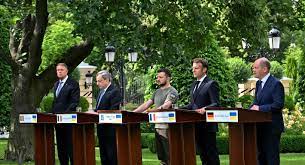
There is almost unanimous agreement that Russia’s invasion of Ukraine has catapulted the European Union toward greater geopolitical assertiveness and unity. The war seems to have unlocked more progress on EU foreign and security policy in a few months than was achieved in previous decades. High Representative Josep Borrell has boldly declared “the awakening of geopolitical Europe.”

However, the EU’s steps are only geopolitical if an extremely loose notion of that concept is used, and while unity has tightened between member states on some issues it has splintered on others. Despite the step-change in the EU’s external action, there is limited evidence so far it will project a stronger or different form of power internationally—that is, as an emergent geopolitical actor—than it did before the war. For now, there is no dramatic birth of any radically new European geostrategy.

UNPACKING THE RESPONSE

The tone of internal EU debates has been positive. EU member states have pulled together in a united front against Russian actions. They have moved beyond hesitancy and provided weapons to Ukraine. They have agreed on severe sanctions against Russia. They have welcomed Ukrainian refugees and invoked a long-dormant protection mechanism to do so. Most member states have promised to increase defense spending up to the NATO target of 2 percent of GDP.

But there are clear limitations to the EU’s response. Member states have declined to engage militarily to save a sovereign, broadly democratic European country from being occupied. They have refused to supply certain types of weapons like jet fighters. They are moving only very slowly and partially toward phasing out Russian energy imports. Several European companies have pulled out of Russia, of their own accord rather than due to official sanctions, but many remain there. And European leaders and commentators’ somewhat self-satisfied celebration of the new unity and determination jars with events in Ukraine, where tens of thousands have perished. With the situation on the ground fluctuating in uneasy balance, there is growing frustration among Ukrainians with the limits of what their country has received from EU states in terms of weapons and other support.

Geopolitics is an endlessly disputed term, but if its core meaning is competition over the geographical configuration of power—or “territoriality”—then it hasn’t factored much into the EU’s responses. And, if the projection of hard power is part of geopolitical leverage, this has been evidently lacking from EU reactions to the invasion. In itself, the EU increasing its defense spending is not an act of geopolitical power—even if the EU had spent more on defense prior to the invasion, it is unlikely that this would have led member states to intervene in Ukraine. Neither is stating a long-term aim to reduce dependency on Russian gas necessarily an act of geopolitical power. In this regard, whether the EU acts geopolitically will depend on how it uses the maneuverability it gains from energy autonomy.

The EU’s offer of candidate status to Ukraine is a crucial geopolitical move, and yet many leaders continue to put their emphasis on the fact that Ukrainian membership is not guaranteed and even unlikely still. The EU has imposed severe sanctions on Russia, but elsewhere it remains cautious in using sanctions as a tool of statecraft. The abrupt change of policy toward Russia may not spill over into major shifts in strategy toward other countries. The Ukraine war may prove to be more an exception than an emergent rule.

The crisis has galvanized European coordination in defense capability, but it has also reinforced the United States’ military lead in European security matters. If strategic autonomy is partly about the EU needing to act when the United States refuses to do so, it is difficult to see how this concept fits the context of the invasion or its aftermath. The EU’s restraint comes from strategic calculation and absence of political will, more than a lack of autonomy.

For many years, the EU’s geopolitical discourse has run ahead of its actions in its eastern neighborhood. Rather than the war provoking a radical shift in EU geostrategy, there is much continuity on display. There are echoes of how the EU responded to Russia’s annexation of Crimea and actions in eastern Ukraine from 2014. The larger member states remain reluctant to provide direct security guarantees to Ukraine and would prefer some kind of negotiated deal with Russia.

A NEW FRAMING

There is today not so much a geopolitical turn by the EU as another step in the evolution of its preexisting strategic frameworks. Beyond the individual measures adopted since the invasion of Ukraine, there are only modest indications that the EU is embarking on a new direction in the way it approaches international challenges.

A curious dissonance has been growing for some years within debates about EU foreign and security policy. Almost every official policy document, ministerial speech, op-ed, think tank publication, or journal article repeats the line that the EU must raise its level of ambition in foreign policy. A remarkably uniform position predominates that the EU must commit itself to exerting more power and influence in the world. For some, the EU needs to harness the geopolitical opening that comes with the war in Ukraine to advance a long-standing menu of options to boost its institutional capacities and processes. EU and member states’ formal policy aspirations all point toward the same aim of heightened international presence and voice. In all this, though, the debates are mostly about how far the EU falls short of that broadly agreed goal, not the goal itself.

At the same time, many elements of the EU’s external action have been on an opposite trajectory toward downgraded ambition and truncated commitment. Notwithstanding the ubiquitous rhetoric to the contrary, most EU external action for some time has been not about external power-projection but about repelling or mitigating other powers’ influences. The EU has increasingly understood liberal foreign policy as retrenchment and prudence, and while France’s President Emmanuel Macron promised to reverse this trend he soon backed away from a more “offensive” liberalism. The trend is driven by multiple factors including constraints on domestic politics, a squeeze on financial resources, and a focus on strategic caution.

Events in Afghanistan, Mali, Syria, and elsewhere all speak to a move away from ambitious forms of EU conflict intervention. While talking up its response to the war in Ukraine, the EU has been completing the drawing down of its security mission in Mali. The EU has for several years been beefing up defense capacities through the Permanent Structured Cooperation and the European Defence Fund, but these efforts are oriented more toward protecting European territory than the outward projection of hard power. Germany’s recent Zeitenwende (the supposed turning point in its foreign policy) has so far been framed in the relatively narrow sense of improving the country’s defensive military capacities.

EU development aid is relatively stable but is a low and declining share of recipient states’ GDPs, while non-Western donors ratchet up their external funding more decisively. The EU has now clearly been displaced by China in Africa and Latin America, and it does not have especially ambitious strategies in either region to reverse this. In parts of the Middle East, Russia has pushed European states aside, despite its limited economic strength.

Foreign investment flows from the EU peaked some years ago, and the union’s trade policy is now morphing into internal industrial policy. The pace of signing new trade agreements has slowed, and many years-long free-trade talks have effectively been abandoned. While the “Brussels effect” is commonly celebrated, its most institutionalized forms have been receding for a decade: the EU has moved away from external action centered on the wholesale export of its rules toward lighter forms of diplomatic dialogue. (Detail on all these trends can be found here.)

The EU response to Russia’s invasion of Ukraine not only fits this trend—it magnifies the dissonance between its rhetoric and actions. The rhetoric centered on the EU now moving up several gears in its foreign policy ambition and projection of power has verged on the ebullient despite the tragic events in Ukraine. Yet, as indicated above, the EU’s main policy decisions have been guided by a desire not to get directly involved, not to have the responsibility of quickly integrating Ukraine, and not to have to manage deeply entwined international interdependencies.

The debates about EU external action would benefit from being more grounded in assessing and explaining these defensive trends. Such a shift in analytical focus would help move beyond ritualistic calls for more of everything in the EU’s foreign policy—more power, more autonomy, more sovereignty, more unity, more leadership, more presence, more voice—that belie its usual pursuit of less.

It would also be useful to ask more searching questions about the relationship between all the habitually listed strands of heightened EU ambition. Is pushing for more European sovereignty synonymous with more power? When leaders stress the risks of interdependence, are they serious when they then promise new EU partnerships and trade accords around the world? Does a genuinely green transition require a diminution in some aspects of the EU’s global footprint, despite sweeping assertions to the contrary? Does the EU’s focus on geo-economics risk overshadowing its geopolitical claim? Would a greater use of power and European sovereignty sometimes clash with building genuinely co-shaped, mutually beneficial partnerships with other societies?

The answers to such questions may reveal that the EU needs to be more selective in where and how it raises its international ambition. Delving into this prospect might be more conceptually appropriate than defaulting to one-dimensional refrains about the need for a more global Europe. The risk that needs analyzing may be of the EU getting stuck in a strategic no-man’s land: losing its conviction in liberal concepts of security without replacing these with a full mobilization of geopolitical power.

EU diplomats would likely question this critique and reply by listing all the new policies that are in the pipeline to enhance the union’s power since the invasion of Ukraine and to ensure it has a heavier global footprint. But this would confirm that the debate tends to move in just one direction, crowding out more varied reflections. There seems to be almost too much easy agreement among those involved in examining EU foreign policies on ideas that recede over the horizon year after year. This generates a tone of unreality with endless calls for more engagement or power coexisting with member states’ priorities that are more about finding protective cushions against the world. Even as leaders ritually insist the aim is or should be to strengthen and widen the EU’s global influence and power, they move toward strategies of eschewing heavy involvement in risky and costly external initiatives.

A paradigm shift is needed in the terms of debate about the EU’s international presence. Rather than simply proclaiming and celebrating its new unity and purpose, a more helpful debate would focus on the intricate balances between different kinds of self-interests and priorities. It would recognize that the EU will struggle to be simultaneously an agenda-setter and risk-avoider. It would investigate more rigorously how far—or even if—the EU can have more global power and at the same time less exposure to the risks this entails. And it would more carefully compare the costs of getting involved or not in crisis situations.

The ultimate point is that, even though the EU is upgrading its external action in some areas, its aspiration also needs to be rooted within what is politically realistic. A more variegated set of strategic ideas would help generate more grounded debate about Europe’s role in global affairs. The war in Ukraine calls for this more than for celebrations of illusory geopolitical awakenings.

Richard Youngs
Richard Youngs is a senior fellow in the Democracy, Conflict, and Governance Program, based at Carnegie Europe. He works on EU foreign policy and on issues of international democracy.

What the “Woke” Left and the Alt-Right Share

0

Russia’s war in Ukraine has shown the defining political fault lines of our age to be fundamentally bogus. While the Kremlin represents the alt-right, and Europe stands for the politically correct liberal establishment, both sides ultimately are fighting over the spoils of a global capitalist system that they control.

LJUBLJANA – The Canadian psychologist and alt-right media fixture Jordan Peterson recently stumbled onto an important insight. In a podcast episode titled “Russia vs. Ukraine or Civil War in the West?,” he recognized a link between the war in Europe and the conflict between the liberal mainstream and the new populist right in North America and Europe.

This language will be familiar to anyone familiar with Hungarian Prime Minister Viktor Orbán’s regime, or with the January 6, 2021, insurrection at the US Capitol. As CNN’s John Blake put it, that day “marked the first time many Americans realized the US is facing a burgeoning White Christian nationalist movement,” which “uses Christian language to cloak sexism and hostility to Black people and non-White immigrants in its quest to create a White Christian America.” This worldview has now “infiltrated the religious mainstream so thoroughly that virtually any conservative Christian pastor who tries to challenge its ideology risks their career.”

The fact that Peterson has assumed a pro-Russian, anti-communist position is indicative of a broader trend. In the United States, many Republican Party lawmakers have refused to support Ukraine. J.D. Vance, a Donald Trump-backed Republican Senate candidate from Ohio, finds it “insulting and strategically stupid to devote billions of resources to Ukraine while ignoring the problems in our own country.” And Matt Gaetz, a Republican member of the House of Representatives from Florida, is committed to ending US support for Ukraine if his party wins control of the chamber this November.

But does accepting Peterson’s premise that Russia’s war and the alt-right in the US are platoons of the same global movement mean that leftists should simply take the opposite side? Here, the situation gets more complicated. Although Peterson claims to oppose communism, he is attacking a major consequence of global capitalism. As Marx and Engels wrote more than 150 years ago in the first chapter of The Communist Manifesto:

“The bourgeoisie, wherever it has got the upper hand, has put an end to all feudal, patriarchal, idyllic relations. … All fixed, fast-frozen relations, with their train of ancient and venerable prejudices and opinions, are swept away, all new-formed ones become antiquated before they can ossify. All that is solid melts into air, all that is holy is profaned, and man is at last compelled to face with sober senses his real conditions of life, and his relations with his kind.”

This observation is studiously ignored by leftist cultural theorists who still focus their critique on patriarchal ideology and practice. Yet surely the critique of patriarchy has reached its apotheosis at precisely the historical moment when patriarchy has lost its hegemonic role – that is, when market individualism has swept it away. After all, what becomes of patriarchal family values when a child can sue her parents for neglect and abuse (implying that parenthood is just another temporary and dissolvable contract between utility-maximizing individuals)?

Of course, such “leftists” are sheep in wolves’ clothing, telling themselves that they are radical revolutionaries as they defend the reigning establishment. Today, the melting away of pre-modern social relations and forms has already gone much further than Marx could have imagined. All facets of human identity are now becoming a matter of choice; nature is becoming more and more an object of technological manipulation.

The “civil war” that Peterson sees in the developed West is thus a chimera, a conflict between two versions of the same global capitalist system: unrestrained liberal individualism versus neo-fascist conservativism, which seeks to unite capitalist dynamism with traditional values and hierarchies.

There is a double paradox here. Western political correctness (“wokeness”) has displaced class struggle, producing a liberal elite that claims to protect threatened racial and sexual minorities in order to divert attention from its members’ own economic and political power. At the same time, this lie allows alt-right populists to present themselves as defenders of “real” people against corporate and “deep state” elites, even though they, too, occupy positions at the commanding heights of economic and political power.

Ultimately, both sides are fighting over the spoils of a system in which they are wholly complicit. Neither side really stands up for the exploited or has any interest in working-class solidarity. The implication is not that “left” and “right” are outdated notions – as one often hears – but rather that culture wars have displaced class struggle as the engine of politics.

Where does that leave Europe? The Guardian’s Simon Tisdall paints a bleak but accurate picture:

“Putin’s aim is the immiseration of Europe. By weaponising energy, food, refugees and information, Russia’s leader spreads the economic and political pain, creating wartime conditions for all. A long, cold, calamity-filled European winter of power shortages and turmoil looms. … Freezing pensioners, hungry children, empty supermarket shelves, unaffordable cost of living increases, devalued wages, strikes and street protests point to Sri Lanka-style meltdowns. An exaggeration? Not really.”

To prevent a total collapse into disorder, the state apparatus, in close coordination with other states and relying on local mobilizations of people, will have to regulate the distribution of energy and food, perhaps resorting to administration by the armed forces. Europe thus has a unique chance to leave behind its charmed life of isolated welfare, a bubble in which gas and electricity prices were the biggest worries. As Ukrainian President Volodymyr Zelensky recently told Vogue, “Just try to imagine what I’m talking about happening to your home, to your country. Would you still be thinking about gas prices or electricity prices?”

He’s right. Europe is under attack, and it needs to mobilize, not just militarily but socially and economically as well. We should use the crisis to change our way of life, adopting values that will spare us from an ecological catastrophe in the coming decades. This may be our only chance.

Project Syndicate

Why Germany won’t get tough on Beijing — even if it invades Taiwan

0
Olaf Scholz (while Mayor of Hamburg) meets China’s Xi Jinping | Patrik Stollarz/AFP via Getty Images

PRESS PLAY TO LISTEN TO THIS ARTICLE

BERLIN — Germany’s Wagnerian foreign policy spectacle is moving east.

Spoiler alert: It’s even worse than the original.

For months, Berlin has frustrated (read enraged) many allies with its one step forward, two steps back approach to confronting Russia over Ukraine. Yet that tortured episode is looking like little more than an overture to what’s brewing in Asia, as tensions over Taiwan force Berlin to weigh how it would respond if Beijing tries to seize the island nation, which China considers a breakaway region.

If that happens, the U.S. and other Western allies would push for tough sanctions against China. Germany is unlikely to be among them, a course that could protect its export-driven economy, but damage both its own and Europe’s international credibility.

Asked Thursday whether Germany could afford to support sanctions in the event of a Chinese invasion, Chancellor Olaf Scholz dodged the question, while reprimanding German industry for ignoring the maxim “to not put all your eggs in one basket.”

“The question of our country’s dependence in crucial areas concerning supply chains, raw materials and other things is a necessary element of our national security strategy, which we’re working on at the moment,” he added, without mentioning China by name.

Could Germany back sanctions against China?

“At the moment, not really,” said Röttgen, a former minister and longtime chairman of the German parliament’s foreign policy committee.

While the debate is in many respects a redux of Germany’s manic handwringing over whether and how to confront Russia over Ukraine, this time even more is at stake.

Germany’s big concern over antagonizing Moscow was losing access to cheap energy. With Beijing, it’s about losing the foundation of its economic prosperity. In recent years, China has overtaken the U.S. to become Germany’s biggest trading partner, accounting for nearly 10 percent of the country’s €2.6 trillion in foreign trade last year. What’s more, China, which has propelled the German economy for decades, remains a key growth driver.

That’s why reducing German industry’s reliance on the country is easier said than done.

A Chinese military jet flies over Pingtan island, one of mainland China’s closest point from Taiwan | Hector Retamal/AFP via Getty Images)

“The degree to which our prosperity is funded by China is extremely underestimated in this country,” Volkswagen Chief Executive Herbert Diess said in a recent interview. “Germany would look a lot different if we were to decouple.”

Indeed, no German industry is more dependent on China than Diess’ own. Every third car produced by German carmakers is sold in China. German carmakers also operate a substantial network of factories in China itself, producing 4.3 million cars there in 2021 alone.

“The German car industry, like the rest of the world, is watching the tensions between China and Taiwan with concern,” said a spokeswoman for the industry’s lobbying arm, known as the VDA.

“Panic” might be a better word.

VW’s Diess, who is due to step down as head of Europe’s largest automaker later this month, says that China is “indispensable” for the company’s future.

The picture is similar across other key German export sectors, from chemicals to machinery. About 1.1 million German jobs, or 2.4 percent of the total, directly rely on Chinese consumption, according to a June study by the Cologne-based German Economic Institute.

Though Germany and the rest of the EU are crucial markets for China as well, the study notes that the Chinese are reducing their dependence on the region, while European exposure to China is increasing.

In an urgent plea, study author Jürgen Matthes said it was “high time” for Europe and Germany to reverse course and reduce their economic reliance on China.

“It’s not about decoupling, but rather limiting dependencies, especially through more diversification,” he wrote.

Yet just as it took decades for German industry to establish itself in China, pulling back won’t happen overnight — especially considering that few regions around the world offer the kind of reliable growth that China does.

Hence Germany’s quandary.

“In the event of a Chinese invasion of Taiwan followed by massive Western sanctions, export and revenue declines as well the suspension of deliveries out of China would lead to considerable economic losses in the EU and especially in Germany,” Matthes concluded.

Every third car produced by German carmakers is sold in China | Stringer/Getty Images via AsiaPac

Given that outlook, German support for substantial Western sanctions is doubtful. Though Berlin backed tough measures on Moscow after the full-scale invasion of Ukraine in February, the potential economic fallout for Germany was limited and largely for show.

Even as Scholz suspended the controversial Nord Stream 2 gas pipeline project with Russia, for example, he also tried to ringfence Germany’s core energy interests by rejecting calls for an all-out gas embargo.

That strategy didn’t pan out as he’d hoped, but only because the Russians themselves reduced the flow of natural gas to Europe. The ongoing gas shortage in Germany, which threatens to hobble key industrial sectors, will inevitably influence how the government responds to a potential Chinese invasion of Taiwan. With inflation high and energy prices showing no signs of falling, Germany can ill afford another hit to its flagging economy.

Officials in Berlin acknowledge in private that Germany would not be able to endorse anything beyond token sanctions against China. That doesn’t mean there won’t be dramatic debates in Berlin over Germany’s latest moral quandary. Political talkshows will devote hours to the question and newspaper columnists will spill barrels of ink dissecting every angle. But in terms of substance, the Germans will offer the usual: nichts (nothing).

As they will be the first attest, any other course would harken the country’s economic Götterdämmerung.

Laurenz Gehrke contributed reporting.

Politico

Is there really a generational conflict in Europe?

0
Jean-Luc Lemercier, corporate vice president EMEA, Canada and Latin America, Edwards Lifesciences

The European population is aging. By 2040, 155 million people are expected to be over the age of 65 [1]. This demographic change is often referred to as a challenge, but we believe that this description ignores the considerable benefits that society can gain from an experienced, active and engaged third generation. Above all, this group can play a pivotal role in building greater intergenerational cohesion. This was affirmed in the results of our Unifying Generations Survey, recently launched in Brussels, which measured the contribution of the senior population in society and explored the experience of intergenerational interactions among 12,850 European citizens.

The value of the third generation

From this survey, conducted across six European countries (France, Germany, Ireland, Italy, Spain, and the U.K.), we learned that the third generation play a key role in society: 25 percent provide support to family members, for example shopping or driving); 24 percent  provide care to a family member such as a child, grandchildren or other relatives; and 19 percent  volunteer in sports clubs or associations.

Not only do they provide social support, but 71 percent  provide financial support to the younger generations within their family. The financial support they provide goes towards holidays and leisure (32 percent ), education (30 percent ), and household goods (26 percent ).

Moreover, the younger generation value the contribution that senior people make in their lives, and they appreciate their friendship and support. Eighty-three percent of younger generation respondents say the support provided by the older generation in their daily life is very important or somewhat important.

83% of younger generation respondents say the support provided by the older generation in their daily life is very important or somewhat important.

A strong desire for more intergenerational interactions

Interestingly, results showed that intergenerational interactions were viewed as positive with respondents 11 times more likely to think closer interactions between different generations are a good thing (77 percent) versus a bad thing (7 percent).

The survey also demonstrates that the younger generation has a clear desire to learn from the third generation via mentoring and knowledge sharing. While older people seem to underestimate the value they can bring through mentoring, with only 12 percent believing that it would be valuable to younger, 23 percent of younger respondents believe that mentoring or educational schemes provided by national or local government would help them to do more with older generations. This was followed by business advice or mentoring schemes offered by businesses (14 percent).

Across the countries, the survey shows that learning new technology and digital media skills is the key thing older respondents would most want to learn from younger people, with 40 percent of the older generation stating they would most like to learn new technology and digital media skills from younger people.

The impact of COVID-19

Over the past few years, the COVID-19 pandemic prevented families and friends from spending time together. This undoubtedly had an impact on unity between generations. In fact, the survey demonstrated that the pandemic was the main barrier preventing interactions between generations. Across all countries surveyed, generations were found to have spent less time together since the pandemic — 40 percent of respondents say the amount of time they spend with people of a different generation to them has decreased since the pandemic. The impact was felt even more heavily by the younger generation; 49 percent of younger respondents believed that younger and older people are further apart since the COVID-19 pandemic, in contrast to 40 percent of older respondents.

In fact, the survey demonstrated that the pandemic was the main barrier preventing interactions between generations.

The prospect of recovering from the pandemic and rebuilding relations may feel like a difficult task, but the enthusiasm for improving intergenerational solidarity that emanated through the survey results suggests that now is the right time for action.

Building the pathway to intergenerational solidarity

The Unifying Generations Survey results are in stark contrast to the prevailing narrative of intergenerational conflict and an older generation posing a challenge to society. Instead, the survey gives a clear picture of the pivotal social and economic contribution brought by the senior population, a contribution that is greatly valued by the younger generation. Far from there being conflict between generations, there is compelling evidence of intergenerational cohesion and a wish for greater interactions in the future.

The survey gives a clear picture of the pivotal social and economic contribution brought by the senior population, a contribution that is greatly valued by the younger generation.

The results of the survey can be found in the newly launched Unifying Generations report. This is the first step of what we call our Unifying Generations Initiative. It creates the foundation for future actions to enhance intergenerational solidarity, underlines the mutual respect and value of younger and older generations, and demonstrates the start of a path towards an age-friendly society.

The report makes three recommendations:

  1. Transform perceptions —  there is a need to build multistakeholder campaigns to communicate a more realistic narrative of the positive, unifying role of senior people and the overwhelming desire for greater intergenerational solidarity.
  2. Mentoring and knowledge sharing  — business, academics, senior organizations and policymakers should work together to create more opportunities for older people to mentor and pass on their knowledge, experience and skills to younger people through educational initiatives.
  3. Digital interaction —  the wish for learning is not one-way. The older generation recognizes that younger people can support them in becoming better-connected digitally. The introduction of schemes allowing senior people to build their digital skills and connectivity will reduce their isolation and ensure even greater intergenerational cohesion.

This is a long-term commitment for Edwards Lifesciences, and one which we know we cannot achieve alone. We welcome any stakeholder in joining our efforts and partnering with us on this exciting journey.

Learn more about the Unifying Generations initiative and download the report: https://www.edwards.com/ch-en/aboutus/unifying-generations/


References:

[1] Eurostat (2017) People in the EU — population projections, https://ec.europa.eu/eurostat/statistics-explained/index.php?- title=People_in_the_EU_-_population_projections

Η τριμερής Ιράν- Ρωσίας- Τουρκίας απέναντι στη Δύση

1


Της Πωλίνας Άνιφτου, Αναλύτριας Εξωτερικής πολιτικής και Επενδύσεων

Η γεωπολιτική αυτογνωσία ενός αδιέξοδου οικονομικού μοντέλου

Στις 19 Ιουλίου 2022 οι πρόεδροι της Ρωσίας Β. Πούτιν και της Τουρκίας Ρ. Τ. Ερντογάν επισκέφθηκαν την Τεχεράνη στα πλαίσια της διερεύνησης μιας συνεργασίας μεταξύ των τριών χωρών απέναντι στην Δύση. Η συνάντηση στην Τεχεράνη κατέδειξε την προσπάθεια συνεργασίας για αντιμετώπιση των κυρώσεων από τις ΗΠΑ απέναντι στο Ιράν με την μονομερή αποχώρηση των ΗΠΑ από την συμφωνία για τα πυρηνικά (JCPOA) to 2018, και έναντι της Ρωσίας από τον Φεβρουάριο 2022 εξαιτίας της εισβολής στην Ουκρανία. Η συνάντηση αυτή έγινε στα ίδια χρονικά πλαίσια της επίσκεψης του Αμερικανού Προέδρου Τζο Μπάιντεν στο Ισραήλ στις 13 Ιουλίου 2022 και μετέπειτα στην Σαουδική Αραβία για να τονίσει διαμέσου της «Διακήρυξης της Ιερουσαλήμ», πως ΗΠΑ και Ισραήλ θα κινηθούν κατά του Ιράν σε περίπτωση που προχωρήσει και ενεργοποιήσει το πυρηνικό του πρόγραμμα.

Οι αλλαγές στις οποίες και περιήλθε η υφήλιος με την ανάπτυξη του πολυπολικού συστήματος σε θέματα ισχύς, οικονομίας, πολιτικής και εξοπλισμών έφεραν νέους συσχετισμούς δυνάμεων στην Ευρασία. Η Τριμερής της Τεχεράνης προσπαθεί να δεσμεύσει τους πόρους που παράγουν οι χώρες αυτές σε πλούτο και ενέργεια με αποτέλεσμα η Δύση, και κυρίως οι ΗΠΑ, να πιεστούν ώστε να άρει τις κυρώσεις εναντίον τους αλλά και να αλλάξει το κεφαλαιουχικό παγκόσμιο σύστημα που δεσμεύει τις οικονομίες. Στο παρόν άρθρο αναλύεται η οικονομική και γεωπολιτική συμμαχία της Τριμερούς, αποχαρακτηρίζοντας τις οποιεσδήποτε ελπίδες για μια νέα συνεργασία που θα αλλάξει τα δρώμενα αφού οι τρεις αυτές χώρες διέπονται από ένα δύσκολο ιστορικό παρελθόν που ακόμη τους δημιουργεί θέματα κυριαρχίας και ένα έντονο πολιτικό και οικονομικό ανταγωνισμό στην ίδια γεωγραφική περιφέρεια, την Ευρασία.

Η Συμφωνία Κίνας- Ιράν για τον Δρόμο του Μεταξιού στη βάση των συνόρων της Περσικής Αυτοκρατορίας

Το Ιράν είναι η δεύτερη χώρα στον κόσμο με τους πιο πολλούς συνοριακούς γείτονες ειδικά μετά την διάλυση της ΕΣΣΔ το 1991, οπότε συνορεύει με 13 χώρες χερσαία και θαλάσσια, περιβρέχεται από την Κασπία Θάλασσα και τον Περσικό Κόλπο, από τον Ινδικό Ωκεανό και ελέγχει το Στενά του Περσικού Κόλπου. Οι πλείστες χώρες δε της Μέσης Ανατολής και της Κεντρικής Ασίας ήταν μέρος της Περσικής Αυτοκρατορίας μέχρι το 651 μ.Χ.. Το τέλος της ΕΣΣΔ έφερε το Ιράν σε απόλυτη κυριαρχία στην κεντρική Ευρασία με έλεγχο επί του Αφγανιστάν παρόλη την πάλη με τους Ταλιμπάν, την ανασύσταση των περσικών δεσμών με το αδελφό έθνος του Τατζικιστάν που από το 1992 με τον πρόεδρο Ραχμόν εγκατέλειψε τα Ρωσικά ακρώνυμα στα ονόματα των κατοίκων του και τα μετέτρεψε σε περσικά, έτσι ο πρόεδρος Εμομάλι Ραχμόνοφ ονομάστηκε Εμομάλι Ραχμόν. Το Ιράν υπήρξε παραδοσιακός σύμμαχος με την Αρμενία αλλά και σε διαμάχη με το Αζερμπαϊτζάν, μιας και τα δύο αυτά κράτη αποτελούν πρώην επαρχίες του Ιράν που κατακτήθηκαν από τον τελευταίο Τσάρο.  Έκτοτε το Ιράν αποτελεί τον κύριο επενδυτή στο Τατζικιστάν, χρησιμοποιεί τα 10 εκατ. Τατζίκους στο Αφγανιστάν για να επιτύχει τους στόχους του μέσω του Προξενείου του στην Χεράτ εναντίον των ΗΠΑ και των Ταλιμπάν, ενώ οι 80 χιλιάδες Ουιγούροι αποτελούν την προέκταση του εντός της Κίνας σε θέματα πανισλαμισμού και διπλωματίας.

Οι Ιρανικές επενδύσεις (FDI) στις χώρες της EAEU (Αρμενία, Λευκορωσία, Καζακστάν, Κιργιστάν και Ρωσία), την Ουκρανία και το Τατζικιστάν επικεντρώνονται κατά 42% στον κατασκευαστικό τομέα (κυρίως στη Λευκορωσία) και σε υπηρεσίες του χρηματοοικονομικού τομέα κατά 20% αντίστοιχα. Ακολουθούν τα Δίκτυα Υποδομής (19% των συνολικών FDI) και οι τομείς των μεταφορών αγαθών κατά 15%. Το δε Ιράν εξάγει γεωργικά προϊόντα, τρόφιμα, μέταλλα και σε ορισμένες περιστάσεις πετρέλαιο καίτοι εν μέσω κυρώσεων.

Το Ιράν ένεκα του Σιισμού και της Περσικής Αυτοκρατορίας ελέγχει πολιτικά, πολιτιστικά και μέσω της οικονομικής διπλωματίας μια περιοχή από το σημερινό Τατζικιστάν και Αφγανιστάν ως τον Λίβανο. Στόχος ανέκαθεν ήταν η ένωση του οικονομικού χώρου της πρώην Περσικής Αυτοκρατορίας με τις ισχυρές δυνάμεις της Ευρασίας (Ρωσία, Κίνα) μιας και το ίδιο το Ιράν ένεκα των κυρώσεων δεν μπορούσε να παίξει καθοριστικό ρόλο στις διεθνείς εξελίξεις. Έτσι η προετοιμασία μεταξύ της Κίνας και του Ιράν κινητοποιήθηκε από τις απαρχές του 2010 και μετέπειτα ώστε να δημιουργηθούν εμπορικοί δρόμοι για την μεταφορά προϊόντων από την Κίνα και τις χώρες της Κεντρικής Ασίας στην Μεσόγειο μέσω του λιμανιού της Βηρυτού προς εξαγωγή στην Ε.Ε. Αυτό μπορούσε να γίνει εφικτό μόνο με την διαμεσολάβηση του Ιράν και τον έλεγχο που ασκεί στην κεντρική Ευρασία, στο Ιράκ, Συρία και Λίβανο μέσω των πολιτικών και μιλιταριστικών ομάδων και εγκάθετων του.

Έτσι, η κατασκευή της σήραγγας Anzob στο δρόμο μεταξύ Dushanbe και Khujand στο Τατζικιστάν έγιναν δυνατά χάρη σε επενδύσεις και δάνεια από το Ιράν ($10 εκατ. και $21,2 εκατ. αντίστοιχα). Επιπλέον, το Sangtuda HPP-2 ανεγέρθηκε χρησιμοποιώντας κρατικά κονδύλια από την Ισλαμική Δημοκρατία του Ιράν μιας και οι όποιες επενδύσεις του Ιράν στο εξωτερικό πρέπει να λαμβάνουν έγκριση από το ίδιο το κράτος εξαιτίας της φιλοσοφίας της Ισλαμικής Δημοκρατίας και οι επενδύσεις να διέπονται από τον Ισλαμικό νόμο και να εξυπηρετούν τα συμφέροντα της εξωτερικής πολιτικής του Ιράν βάσει της Σαρίας και του Συντάγματος (άρθρα 30, 44). Περαιτέρω για την δημιουργία ανοικτών διόδων επικοινωνίας Κίνας- Ιράν το Ιράν επένδυσε $5.3 δις σε κατασκευαστικά πρότζεκτ στο Αφγανιστάν και στην κατασκευή δρόμων και σιδηροδρόμων ώστε να καταλήγουν στο Ιρανικό λιμάνι του Chabahar στον Ινδικό Ωκεανό και τα προϊόντα από τον Ευρασιατικό και Κινέζικο χώρο να μην μεταφέρονται στο λιμάνι της Βομβάης στην Ινδία, ούτε στα λιμάνια του Πακιστάν αλλά να μετακινούνται από το Ιράν αποφεύγοντας τα Στενά του Χορμούζ απευθείας στη Δύση και στην Αφρική. Μια ανάλογη κίνηση όπου η Κίνα έχει ήδη επενδύσεις $735 δις στην Αφρική θα μετέβαλε το Ιράν και τα λιμάνια του σε κύριο σταθμό αλλά και αποθηκευτικό χώρο αποδίδοντας του νέα γεωπολιτική ισχύ στο παγκόσμιο εμπόριο. Επίσης το Ιράν επένδυσε στην συντήρηση των οδικών και σιδηροδρομικών δικτύων που ενώνουν το Ιράν με το Ιράκ και το τελευταίο με την Μεσόγειο, με δάνεια από την Κίνα.

Προς επίρρωση των ως άνω, το Ιράν και η Κίνα υπέγραψαν τον Μάρτιο 2021 την εικοσιπενταετή συμφωνία των $400 δις για οικονομική, τεχνολογική, πολιτική και στρατιωτική συνεργασία. Αναμένεται να διατεθούν $280 δις για τους τομείς πετρελαίου, φυσικού αερίου και πετροχημικών και $120 δις θα διατεθούν για την αναβάθμιση των οδικών και σιδηροδρομικών δικτύων. Έτσι η Συμφωνία Ιράν- Κίνας θα διαπερνά και θα περιλαμβάνει και τον CPEC (China–Pakistan Economic Corridor) ώστε να ενσωματώσουν στην όλη Συμφωνία τις χώρες της Κεντρικής Ασίας που προσέλκυσαν $378,2 δις άμεσων ξένων επενδύσεων (FDI) μεταξύ 2007 και 2019.

Επιπλέον, η Κίνα υπήρξε ένας από τους σημαντικότερους ξένους επενδυτές στο Ιράν την τελευταία δεκαετία. Έχει επενδύσει σε διάφορα ενεργειακά έργα στο Ιράν, συμπεριλαμβανομένου του πεδίου φυσικού αερίου στο South Pars και του Διυλιστηρίου του Abadan. Το Ιράν δε θα χρειαστεί τεράστιες επενδύσεις στον ενεργειακό του τομέα αξίας $200 δις στο μέλλον και θεωρεί την Κίνα μια σημαντική πηγή επενδύσεων.

Η Κίνα επενδύσει στο εύθραυστο πολιτικά Ιράν  

Για την εφαρμογή του Δρόμου του Μεταξιού (BRI) η Κίνα έσπευσε πολλάκις να ενισχύσει την οικονομική σταθερότητα του Ιράν μετά τις κυρώσεις του 2018. Ο δρόμος του Μεταξιού η μεγαλύτερη επένδυση του βορείου Ημισφαιρίου που ενώνει μια περιοχή από την Σανγκάη στην Βηρυτό απόστασης 7,799 km επιζητεί οι δύο εκφραστές αυτής της νέας γεωπολιτικής κίνησης να είναι σε θέση μακροοικονομικά να ανταπεξέλθουν.  Η σημαντικότερη υποστήριξη στο Ιράν μετά την εφαρμογή της JCPOA ήρθε τον Ιούλιο του 2017. Η σύμβαση αξίας $4,879 δις που υπογράφηκε για την ανάπτυξη της φάσης 11 στον South Pars μεταξύ της Εθνικής Ιρανικής Εταιρείας Πετρελαίου και μιας κοινοπραξίας αποτελούμενης από την Total, την Κινέζικη CNPC και την Petropars του Ιράν αντιμετώπισε την δυσχέρεια των κυρώσεων του 2018.

Η σύμβαση προέβλεπε μερίδιο 51% και 30% για την Total και την CNPC αντίστοιχα και 19% για την Petropars. Λίγο μετά την αποχώρηση των ΗΠΑ από την JCPOA στις 8 Μαΐου 2018, η Total υπό τον φόβο των κυρώσεων ανακοίνωσε την αποχώρηση της από το πρότζεκτ. Για να μην καταρρεύσει η όλη συμφωνία αλλά και η Ιρανική κυβέρνηση να μην εκτεθεί στο εσωτερικό η κινέζικη CNPC αγόρασε το μερίδιο της Total και συνέχισε το όλο έργο. Επιπλέον, η Κίνα είναι ο κορυφαίος επενδυτής σε έργα μεταφορών στο Ιράν. Το έργο Τεχεράνη-Κομ -Ισφαχάν και η ηλεκτροκίνηση του σιδηροδρόμου Tehran- Mashhad, με εκτιμώμενο κόστος περίπου $4,2 δις, είναι τα πιο σημαντικά έργα ανάπτυξης των σιδηροδρόμων στο Ιράν, στα οποία οι κινεζικές εταιρείες χρηματοδοτούν και κατασκευάζουν το 40% στο πρώτο έργο, και το δεύτερο έργο χρηματοδοτείται από μια κοινοπραξία που έχουν σχηματίσει κινεζικές και ιρανικές εταιρίες.

Επίσης με βάση τα επίσημα στατιστικά στοιχεία που δημοσίευσε η ιρανική κυβέρνηση, το Ιράν θα χρειαστεί περίπου $500 δις επενδύσεων για την επόμενη δεκαετία, μεγάλο μέρος των οποίων πρέπει να παρασχεθεί από συμμάχους ώστε η οικονομία να ανταπεξέλθει στις κυρώσεις και στην πολιτική απομόνωση. Η Κίνα είναι μια από τις πιο σημαντικές χώρες που το Ιράν ελπίζει σε επενδύσεις, και το BRI μπορεί να προσφέρει ένα πλαίσιο για αυξημένες κινεζικές επενδύσεις στο Ιράν. Έτσι βάσει της συμφωνίας μεταξύ της Κεντρικής Τράπεζας του Ιράν και της Κινέζικης CITIC Trust Group, ο κινέζικος όμιλος παρείχε στο Ιράν πίστωση $10 δις σε χρηματοδότηση μεσοπρόθεσμων και μακροπρόθεσμων δανείων και αποτελεί την μεγαλύτερη πιστωτική στήριξη που έχει δοθεί στο Ιράν κατά τις τελευταίες δεκαετίες.

Τα μακροοικονομικά μοντέλα διαψεύδουν την Τριμερή της Τεχεράνης

Παρόλο που η Κίνα βρίσκεται σε τροχιά σύστασης του Δρόμου του Μεταξιού στην Κεντρική Ευρασία με κινητήριο δύναμη το Ιράν, κατά δεύτερο δια της Ουκρανίας και κατά τρίτο δια της Φιλανδίας διαμέσου της Ρωσίας και οι τρεις αυτές χερσαίες πορείες έχουν αναχαιτιστεί. Οι Συμφωνίες του Αβραάμ το 2020 δεν αφήνουν περιθώρια στο Ιράν και στην Κίνα να επεκταθούν στην Μεσόγειο, ο πόλεμος στην Ουκρανία δημιούργησε χάσμα και αναβολή στις κινέζικες επενδύσεις στην χώρα αξίας πέραν των $10 δις, και η Φιλανδία με την προσέγγιση του ΝΑΤΟ έχει αδρανοποιήσει τα λιμάνια και τα αεροδρόμια της σε όποια επένδυση θεωρείται ως μη φιλική προς τη Δύση.

Το 2020 η Κίνα ήταν η νούμερο 2 οικονομία στον κόσμο ως προς το ΑΕΠ, το νούμερο 1 στις συνολικές εξαγωγές, το νούμερο 2 στις συνολικές εισαγωγές, το νούμερο 68 οικονομία ως προς το κατά κεφαλήν ΑΕΠ και η 28η πιο σύνθετη οικονομία σύμφωνα με το Economic Complexity Index (ECI). Παρόλα τα επιτεύγματα της και ότι δημογραφικά αποτελεί το 20% του παγκόσμιου πληθυσμού, το ΑΕΠ της δεν ξεπερνά το 4% του παγκόσμιου ΑΕΠ με ανεργία, διαφθορά, πλήγματα στην εργατική νομοθεσία και εκμετάλλευση ξένων γαιών όπως στην περίπτωση του Καζακστάν που έφερε την αντίδραση των κατοίκων του Αλμάτυ τον Ιανουάριο 2022 εναντίον Κινέζικων εταιριών στο λιμάνι της πόλης.

Τον Μάιο του 2022, η Κίνα εξήγαγε κυρίως στις Ηνωμένες Πολιτείες ($52 δις), στο Χονγκ Κονγκ ($24 δις), στη Νότια Κορέα ($15,5 δις), στο Βιετνάμ ($14,5 δις) και στην Ιαπωνία ($14,4 δις) και εισήγαγε κυρίως από την Ταϊβάν ($19,6 δις). ), Νότια Κορέα ($16,6 δισ.), Ηνωμένες Πολιτείες ($15,9 δις), Ιαπωνία ($14,4 δις) και Αυστραλία ($12,9 δις) δείχνοντας πλήρη εξάρτηση από τις δυτικές χώρες στις εξαγωγές αλλά και στις εισαγωγές της. Τον Μάιο του 2022, η αύξηση στις ετήσιες εισαγωγές της Κίνας εξηγήθηκε κυρίως από την αύξηση των εισαγωγών από τις Ηνωμένες Πολιτείες ($7,42 δις ή 86,4%), την Ταϊβάν ($7,06 δις ή 59,9%) και την Ιαπωνία ($5,12 δις ή 50% ), και οι εισαγωγές προϊόντων αυξάνονται σε ολοκληρωμένα κυκλώματα ($9,99 δις ή 46,7%), μεταλλεύματα σιδήρου ($4,76 δις ή 60,8%) και τηλέφωνα ($2,43 δις ή 99,8%).

Το 2020 η Ρωσία ήταν η νούμερο 11 οικονομία στον κόσμο ως προς το ΑΕΠ, το νούμερο 13 στις συνολικές εξαγωγές, το νούμερο 21 στις συνολικές εισαγωγές, το νούμερο 70 οικονομία ως προς το κατά κεφαλήν ΑΕΠ και η 43η πιο σύνθετη οικονομία σύμφωνα με το Economic Complexity Index (ECI). Τον Ιανουάριο του 2022 ένα μήνα πριν την εισβολή στην Ουκρανία, η Ρωσία εξήγαγε κυρίως στην Κίνα ($5,8 δις ) λόγω των κυρώσεων που ήδη δρομολογούνταν, την Ολλανδία ($4,8 δις), την Τουρκία ($4,26 δις), τη Γερμανία ($3,54 δις) και την Ιταλία ($2,22 δις) και εισήγαγε κυρίως από την Κίνα ($7,2 δις), τη Γερμανία ($1,58 δις), Νότια Κορέα ($1,42 δις), Ηνωμένες Πολιτείες ($ 1,31 δις) και Λευκορωσία ($885 εκατ.).

Από την άλλη το απομονωμένο οικονομικά και πολιτικά Ιράν, το 2020 ήταν η 49η οικονομία στον κόσμο ως προς το ΑΕΠ, το νούμερο 86 στις συνολικές εξαγωγές, το νούμερο 71 στις συνολικές εισαγωγές, και η 142 οικονομία ως προς το κατά κεφαλήν ΑΕΠ και η 65η πιο σύνθετη οικονομία σύμφωνα με το Economic Complexity Index (ECI). Το Ιράν εισάγει κυρίως από την Κίνα ($8,51 δις), τα ΗΑΕ ($4,53 δις), την Ινδία ($2,24 δις), την Τουρκία ($2,14 δις) και τη Γερμανία ($1,68 δις).

Η πολυπλοκότητα των σχέσεων Ρωσίας, Κίνας και Ιράν καταγράφεται από την πολιτική στάθμη των αντιπαραθέσεων τους τελευταίους δύο αιώνες. Η Περσία συρρικνώθηκε στον βορρά από την αποκοπή και ενσωμάτωση της Αρμενίας και του Αζερμπαϊτζάν (συνθήκες του Gulistan το 1813 και του Turkmenchay το 1828) από τον Τσάρο. Οι σχέσεις μεταξύ των δύο χωρών δεν ήταν ποτέ ιδιαίτερα θετικές και αυτό διεφάνη και το 2018 στην Συμφωνία της Κασπίας Θάλασσας, όπου και κατά ένα τρόπο η Ρωσία αναθεωρώντας το διεθνές δίκαιο πρότεινε ένα νέο σύστημα ΑΟΖ σε κλειστή θάλασσα που όμως κατέρριπτε τις Ιρανικές αξιώσεις περί λίμνης και την απώλεια σημαντικών ναυτικών μιλίων και ελέγχου της Κασπίας από το Ιράν. Επίσης κατά τον πόλεμο στην Ουκρανία και την εδαφική επεκτατικότητα της Ρωσίας, χιλιάδες Κινέζοι πολίτες στα μέσα κοινωνικής δικτύωσης ζητούσαν την επιστροφή του Βλαδιβοστόκ στην Κίνα, κακίζοντας τον «αιώνιο εχθρό» της χώρας του Κομφούκιου. Η δε Κίνα παρόλο που έχει επενδύσει στο Ιράν δεν φαίνεται να το εμπιστεύεται, έτσι στο καθεστώς της συμμαχίας μεταξύ των δύο χωρών η Κίνα δεν άφησε την ασφάλεια των δομών της στις Ιρανικές αρχές, αλλά απεναντίας προσέλαβε και ετοιμάζεται να μεταφέρει 5000 προσωπικό ασφαλείας από Κινέζους υπηκόους στο Ιράν ώστε να αποφύγει περιστατικά κατασκοπίας και ενόχλησής από τις Ιρανικές αρχές.

Τουρκία: Ο γίγαντας με τα δολαριοπόδαρα που τρέχει σε λάθος γεωπολιτική πίστα

Οι ξένες επενδύσεις (FDI) στην Τουρκία ήταν κατά μέσο όρο $848,57 εκατ. από το 2003 έως το 2022, φτάνοντας στο ιστορικό υψηλό των $6571 εκατ. τον Μάιο του 2006 και στο χαμηλότερο ρεκόρ των $46 εκατ. τον Οκτώβριο του 2005. Περίπου το 60% των FDI το 2021 προήλθε από την Ευρώπη, το 24% από την Ασία και το 16% από την Αμερική. Το Ηνωμένο Βασίλειο ήταν ο κύριος επενδυτής της Τουρκίας το 2021, και ακολουθούν οι Ηνωμένες Πολιτείες, η Ολλανδία, η Ελβετία, τα Ηνωμένα Αραβικά Εμιράτα (ΗΑΕ), η Γερμανία, το Λουξεμβούργο, η Νότια Κορέα, η Ιαπωνία και η Ιρλανδία. Οι συγχωνεύσεις και οι εξαγορές (M&A) στην Τουρκία ανήλθαν συνολικά σε 42,6 δισεκατομμύρια TL το 2021, επιπλέον των επτά ιδιωτικοποιήσεων που ανήλθαν συνολικά σε 95 δισεκατομμύρια TL, με το τουρκικό οικοσύστημά να λαμβάνει κάπου $1,6 δις σε 294 νέους επενδυτικούς διαγωνισμούς.

Τον Δεκέμβριο του 2021, η Τουρκία εξήγαγε ως επί το πλείστον στη Γερμανία ($1,67 δισ.), στις Ηνωμένες Πολιτείες ($1,41 δισ.), στο Ηνωμένο Βασίλειο ($1,3 δισ.), στην Ιταλία ($1,08 δισ.) και στο Ιράκ ($1,04 δισ. $) και εισήγαγε κυρίως από την Ρωσία ($3,17 δισ.), Κίνα ($2,95 δισ.), Γερμανία ($1,84 δισ.) και Ηνωμένες Πολιτείες ($1,34 δισ.), αποδεικνύοντας την ζωτικότητά των σχέσεων της με την Δύση στο εμπόριο αλλά και στις επενδύσεις.

Η παρουσία του Τούρκου Προέδρου στην Τριμερή της Τεχεράνης παρόλο που κατά τον ίδιο δρομολόγησε το άνοιγμα της Τουρκίας προς την Ευρασία, δημοσιοποίησε και την ολιγωρία στις σχέσεις μεταξύ Ιράν και Τουρκίας στην εφαρμογή του Δρόμου του Μεταξιού. Μέχρι σήμερα η συνεργασία δεν ξεπέρασε σε εμπορικές συναλλαγές τα $30 δις με το Ιράν να παραμένει καχύποπτο για τις σχέσεις της Τουρκίας με τα τουρκογενή κράτη της περιοχής και δη με το Τουρκμενιστάν και το Αζερμπαϊτζάν όπου το Ιράν δυσκολεύεται να κτίσει γέφυρες επικοινωνίας λόγω της Τουρκικής παρεμβατικότητας.

Σύμφωνα με το US Department of State η διαφθορά παραμένει μια δύσκολη πραγματικότητα για την Τουρκία που αντικατοπτρίζεται στο ετήσιο Transparency International’s annual Corruption Perceptions Index, όπου η Τουρκία βρίσκεται στην 86η θέση από τις συνολικά 180 χώρες το 2020. Ως εκ τούτου η πορεία της χώρας προς την Ευρασία και η σύγκλιση με τα «απολυταρχικά καθεστώτα» της Ρωσίας και του Ιράν, όπως τα χαρακτηρίζει η Δύση στην συγκεκριμένη χρονική περίοδο δημιουργεί προστριβές σε μετέπειτα επενδυτικές δυνατότητες στην Τουρκία.

Η στροφή προς την Ευρασία σχετίζεται και με την άνοδο των Ισλαμικών Οικονομικών στην Τουρκία μετά την προσέγγιση του κόμματος του ΑΚΡ προς τον Ισλαμικό κόσμο. Τα ισλαμικά τραπεζικά περιουσιακά στοιχεία στην Τουρκία θα διπλασιαστούν τα επόμενα πέντε χρόνια από τα περίπου 7,2% του συνόλου των τραπεζικών στοιχείων του Δεκεμβρίου 2020, σύμφωνα με έκθεση του οίκου αξιολόγησης Moody’s τον Φεβρουάριο 2021. Η Moody’s ανέφερε ότι το σύνολο του ενεργητικού των τουρκικών τραπεζών αυξήθηκε κατά 54% το 2020, ξεπερνώντας τη συνολική αύξηση του ενεργητικού του τραπεζικού τομέα κατά περίπου 36%. Η έκθεση σημείωσε ότι παρά την πιθανότητα ο τουρκικός τραπεζικός τομέας να αναπτυχθεί γρήγορα, εξακολουθεί να είναι πολύ πιο ισχνός από αυτό των μελών του Gulf Cooperation Council, όπου τα περιουσιακά στοιχεία των ισλαμικών τραπεζών ανέρχονται κατά μέσο όρο περίπου στο 40% του συνόλου των περιουσιακών στοιχείων του τραπεζικού συστήματος.

Τον Φεβρουάριο του 2019 ένεκα της ανάγκης αποθήκευσης Ισλαμικών τραπεζικών μέσων από το Κατάρ και το Ιράν, το Banking Regulation and Supervision Agency (BDDK) χορήγησε τραπεζική άδεια στην Türkiye Emlak Katılım Bankası (EmlakBank), ανεβάζοντας τον αριθμό των ισλαμικών τραπεζών σε έξι στη χώρα. Οι άλλες πέντε ισλαμικές τράπεζες είναι η Ziraat Bank και η VakıfBank που ελέγχονται από το κράτος, οι οποίες έλαβαν άδειες για τη διεξαγωγή ισλαμικών τραπεζικών εργασιών το 2015 και το 2016, αντίστοιχα, καθώς και οι Albaraka Türk, Kuveyt Türk, ιδιοκτησίας της Kuwait Finance House και της Türkiye Finans.

Αν και οι ισλαμικές επενδύσεις αποτελούν κερδοφόρες επιχειρήσεις στην Τουρκία, η χώρα παραμένει η καλύτερη δυτική διέξοδος των Ισλαμικών επενδύσεων. Η εξάρτηση της χώρας από την Δύση σε εισαγωγές και εξαγωγές αποδεικνύουν πως η όποια κρίση ταυτότητας δεν θα την αφήσει να οδηγηθεί εύκολα ούτε στην Ευρασία, αλλά ούτε σε μια είσοδο της στα BRICS μαζί με το Ιράν και την Βενεζουέλα και να εξαρτώνται από την Ρωσία σε πολιτικό επίπεδο.


«Να τα βρουν Ελλάδα-Κύπρος και Τουρκία για να αντιμετωπίσουμε τη Ρωσία» το «αμερικανικό σχέδιο»!

0

Η ελληνική κυβέρνηση έχει ποντάρει τα πάντα στον «αμερικανικό παράγοντα» στο ζήτημα της τουρκικής επιθετικότητας. Ετοιμάζεται να πληρώσει κι άλλα δις για να εξασφαλίσει την «αμερικανική παρέμβαση». Μόνο που όπως αυτή περιγράφεται δε φαίνεται να είναι και τόσο

 Nicholas Saidel:

«Για να βοηθήσει στη σταθεροποίηση της ανατολικής Μεσογείου και να αντιμετωπίσει τη Ρωσία, ο Πρόεδρος Μπάιντεν θα πρέπει να μεσολαβήσει στη θαλάσσια διαμάχη μεταξύ Τουρκίας και Ελλάδας-Κύπρου. Οι άμεσες διαπραγματεύσεις μεταξύ Ελλάδας και Τουρκίας έχουν σταματήσει επ’ αόριστον, αποδυναμώνοντας το ΝΑΤΟ και τη Δύση, καθώς  στρατεύματα και πόροι χρησιμοποιούνται  για να αντιμετωπίσουν το ένα το άλλο, αντί να αποτρέψουν αντιπάλους όπως η Ρωσία.

Τον Μάιο, η Ελλάδα έφτασε στο σημείο να αποκλείσει την Τουρκία από μια άσκηση του ΝΑΤΟ αφού παραβίασε τον εναέριο χώρο της Ελλάδας 125 φορές μέσα σε 24 ώρες. Στα τέλη Ιουλίου, ο υπουργός Άμυνας Lloyd Austin συναντήθηκε με τον Έλληνα ομόλογό του, Νικόλαο Παναγιωτόπουλο, για να επιβεβαιώσει την αμερικανική υποστήριξη για την ασφάλεια της Ελλάδας ενόψει των αυξανόμενων τουρκικών απειλών και μιας κούρσας εξοπλισμών που ενδεχομένως θα μπορούσε να οδηγήσει σε ανοιχτή σύγκρουση.

Ο Μπάιντεν έχει την εξουσιοδότηση του Κογκρέσου για τη μεσολάβηση αυτής της διαμάχης. Ο Νόμος για την Ασφάλεια και την Ενεργειακή Συνεργασία της Ανατολικής Μεσογείου του 2019 αναφέρει: «Ο Πρόεδρος εξουσιοδοτείται να διορίσει έναν ειδικό απεσταλμένο σε επίπεδο πρεσβευτών ο οποίος θα είναι υπεύθυνος για την εκπροσώπηση των Ηνωμένων Πολιτειών στις άμεσες διαπραγματεύσεις με τα μέρη της Κυπριακής διαφοράς. Όπως συμφωνήθηκε από την Ελλάδα και την Τουρκία, ο ειδικός απεσταλμένος θα εκπροσωπήσει επίσης τις Ηνωμένες Πολιτείες στην προώθηση των αμοιβαίων συζητήσεων μεταξύ αυτών των χωρών σχετικά με τις διαφορές τους στα ζητήματα του Αιγαίου».

Το μόνο που πρέπει να κάνει ο Μπάιντεν είναι να δράσει και η ώρα είναι ώριμη για την αμερικανική ηγεσία.

Η ανατολική Μεσόγειος είναι μια γεωστρατηγική τοποθεσία που φιλοξενεί μια σειρά από παράκτια κράτη που εργάζονται για να εξασφαλίσουν τα συμφέροντά τους στο πλούσιο σε πόρους περιβάλλον κάτω από τη θάλασσα. Στην αναζήτησή της για φυσικό αέριο, η Τουρκία έχει χαράξει μια τεράστια αποκλειστική οικονομική ζώνη (ΑΟΖ) για την εξερεύνηση φυσικού αερίου που παραβιάζει τα θαλάσσια δικαιώματα της Ελλάδας —μέλος του ΝΑΤΟ— και της Κύπρου, κράτους της Ευρωπαϊκής Ένωσης. Η θαλάσσια συμφωνία της Τουρκίας με τη λιβυκή κυβέρνηση, η οποία σε μεγάλο βαθμό αγνοεί τις νόμιμες ελληνικές και κυπριακές αξιώσεις, αποσταθεροποιεί την ανατολική Μεσόγειο, όπως και οι ελληνικές ενέργειες όπως η στρατιωτικοποίηση νησιών του Αιγαίου κοντά στις τουρκικές ακτές. Οι επιθετικοί ελιγμοί του τουρκικού ναυτικού έχουν οδηγήσει σε πολυάριθμα ναυτικά επεισόδια με την Ελλάδα, την Κύπρο και το Ισραήλ.

Η Ρωσία και η Κίνα αντιλαμβάνονται την ανατολική Μεσόγειο ως κόμβο ανταγωνισμού μεγάλων δυνάμεων. Η Πρωτοβουλία Belt and Road της Κίνας επεκτείνεται στην περιοχή, ενώ η Ρωσία επιδιώκει να υπονομεύσει τους στόχους των ΗΠΑ, της ΕΕ και του ΝΑΤΟ σε αυτό το θέατρο. Οι πρωτοβουλίες ήπιας δύναμης της Ρωσίας στοχεύουν στην απομάκρυνση των συμμάχων των ΗΠΑ όπως η Ελλάδα, η Κύπρος και η Τουρκία – χώρες που είναι επιρρεπείς σε ρωσικές προσφορές για επενδύσεις, ενέργεια και τουριστικά δολάρια. Αυτές οι ρωσικές προσπάθειες εξαρτώνται από την εκμετάλλευση των ρωγμών μεταξύ των κρατών της ανατολικής Μεσογείου και μεταξύ αυτών και των ΗΠΑ, ειδικά των ρωγμών που θα μπορούσαν να υποστηριχθούν από τη ρωσική ενέργεια ή πολιτικό κεφάλαιο.

Η στιβαρή διπλωματία των ΗΠΑ με τη μορφή της διαμεσολάβησης για τις θαλάσσιες διαφορές θα βοηθούσε στην επιβολή τάξης και συνοχής στους συμμάχους του ΝΑΤΟ και θα είχε ως αποτέλεσμα τον αποκλεισμό περιοχών ευκαιριών για τη Ρωσία — και την Κίνα. Επιπλέον, οι συνομιλίες υπό την αιγίδα των Ηνωμένων Πολιτειών θα ενίσχυαν τους αμερικανικούς δεσμούς με την περιοχή και θα βοηθούσαν στον περιορισμό του απείθαρχου Τούρκου προέδρου Ρετζέπ Ταγίπ Ερντογάν.

Η εμπλοκή του Ερντογάν θα απαιτήσει επαγρύπνηση. Ορισμένοι αναλυτές δικαιολογημένα επισημαίνουν ότι η Τουρκία είναι αναξιόπιστη, παραπλανητική και συνεργάζεται με τους αντιπάλους μας, συμπεριλαμβανομένης της Ρωσίας. Οι ΗΠΑ θα πρέπει να αξιοποιήσουν τη πτώση της τουρκικής λίρας, τις επερχόμενες τουρκικές εκλογές και την επιδίωξη του Ερντογάν για μια συμφωνία για τα F-16, για να επισυνάψουν παραχωρήσεις σε κάθε συμφωνία που αποβαίνει προς όφελος της Τουρκίας. Τουρκικοί συμβιβασμοί θα πρέπει να αναμένονται στο ελληνοκυπριακό πλαίσιο, αλλά και σε σχέση με άλλους στόχους των ΗΠΑ, όπως η δέσμευση της Τουρκίας ότι δεν θα αγοράσει ποτέ ξανά ρωσικά οπλικά συστήματα, τα οποία θέτουν κινδύνους ασφάλειας και διαλειτουργικότητας για το ΝΑΤΟ. Έχοντας πει όλα αυτά, η πρόσφατη στροφή του Ερντογάν στον Κόλπο και το Ισραήλ – και φαινομενικά η απομάκρυνση από τους Αδελφούς Μουσουλμάνους και το Ιράν – δίνει λόγο για επιφυλακτική αισιοδοξία.

Συγκεκριμένα, η κυβέρνηση Μπάιντεν μεσολαβεί τώρα σε μια διαμάχη για τα θαλάσσια σύνορα μεταξύ Ισραήλ και Λιβάνου – χώρες που, όπως η Τουρκία και η Κύπρος, δεν έχουν διπλωματικές σχέσεις και χρειάζονται εξωτερική διαιτησία. Η τρέχουσα προσπάθεια των ΗΠΑ στον Λίβανο, η οποία φαίνεται να αποδίδει,  θα πρέπει να χρησιμεύσει ως προηγούμενο για μια ευρύτερα σχεδιασμένη στρατηγική διαμεσολάβησης που στοχεύει στη σταθεροποίηση του συνόλου της ανατολικής Μεσογείου, παρά τους κακόβουλους τοπικούς παράγοντες όπως ο Μπασάρ αλ Άσαντ της Συρίας και η τρομοκρατική πολιτοφυλακή του Λιβάνου. Χεζμπολάχ.

Δεδομένης της ισχυρής εντολής του Κογκρέσου για τη διοργάνωση συνομιλιών και της κλιμακούμενης έντασης στην ανατολική Μεσόγειο, οι ΗΠΑ θα πρέπει να μεσολαβήσουν στη διαμάχη μεταξύ Τουρκίας και Ελλάδας-Κύπρου. Η στεγανοποίηση και η επίλυση του ζητήματος της ΑΟΖ θα μπορούσε να οδηγήσει στην επίλυση άλλων ελληνοτουρκικών-κυπριακών διαφωνιών και σε μια πιο ολοκληρωμένη περιφερειακή αρχιτεκτονική με δυτική κλίση. Η διαπραγμάτευση μιας θαλάσσιας συμφωνίας θα βοηθούσε να υπάρχει εμπιστοσύνη μεταξύ των θιγόμενων μερών και θα μπορούσε να οδηγήσει σε συνεργασία σε σημαντικά θέματα όπως οι ανανεώσιμες πηγές ενέργειας, η λειψυδρία, η κλιματική αλλαγή και η περιφερειακή ασφάλεια.

Επιπλέον, αυτή η στρατηγική χαμηλού κόστους και υψηλών επιπτώσεων θα συνέβαλε στη δημιουργία ενός πιο ενωμένου μετώπου ενάντια σε εχθρούς και αντιπάλους στην περιοχή.

*Ο Nicholas Saidel είναι αναπληρωτής διευθυντής του Ινστιτούτου Στρατηγικής Ανάλυσης και Αντίδρασης Απειλών στο Πανεπιστήμιο της Πενσυλβάνια. Προηγουμένως ήταν συνεργάτης στο Κέντρο Ηθικής και Κράτους Δικαίου της Νομικής Σχολής Penn. συνεργάτης στο δικηγορικό γραφείο Wolf, Block LLP.  νομοθετικός βοηθός του εκπροσώπου Robert A. Brady (D-Pa.)· και υπότροφος στο Ινστιτούτο Ερευνών Εξωτερικής Πολιτικής.

Δ. Γαρούφας: Το όραμα της Βαλκανικής συνεργασίας

0


                   Του Δημήτρη Γαρούφα*

΄ Εχουμε τονίσει κατ΄ επανάληψη από αυτή την στήλη ότι οι  μετά το 1989 γεωπολιτικές εξελίξεις με την κατάρρευση των κομμουνιστικών καθεστώτων στις γειτονικές χώρες  και το άνοιγμα των συνόρων   δημιούργησαν μια ιστορική ευκαιρία για την Ελλάδα να έχει πρωταγωνιστικό και σταθεροποιητικό ρόλο στην περιοχή βοηθώντας τις γειτονικές χώρες να αποκτήσουν σταθερούς δημοκρατικούς θεσμούς  και με προβολή της Ευρωπαϊκής προοπτικής να βοηθήσει στην ΄άμβλυνση των αντιθέσεων και την προβολή των στοιχείων που ενώνουν τους λαούς.  Αν είχε ασκήσει αυτό τον ρόλο θα είχε πολύ φιλικά απέναντί της  τα Βαλκάνια και αντανακλαστικά πιο ενισχυμένη τη θέση της στην Ε.Ε.

Για την ιστορία πρέπει να αναφέρουμε ότι ο πρώτος που μίλησε για την αναγκαιότητα συνεργασίας των Βαλκανικών   λαών ήταν ο  Ρήγας Φεραίος  και δικαιώθηκε  έναν αιώνα μετά τον θάνατό του από την συνεργασία των βαλκανικών χωρών το 1912 που πέτυχαν να διαλύσουν την Οθωμανική αυτοκρατορία. Αμέσως μετά ο Ελ.Βενιζέλος μιλώντας στο Ελληνικό κοινοβούλιο  στις 13-8-1917 αναφέρθηκε στο οραμά του  για δημιουργία ομοσπονδίας Βαλκανικών χωρών  η οποία θα μπορούσε να  εξελιχθεί  σε μεγάλη δύναμη .Στην διάρκεια του μεσοπολέμου  ο Ελ.Βενιζέλος ενστερνίζεται το όραμα του Αλ.Παπαναστασίου και διοργανώνουν τον θεσμό των Βαλκανικών διασκέψεων επιδιώκοντας  να  γνωριστούν  οι λαοί των βαλκανικών χωρών, να αμβλυνθούν οι αντιθέσεις και να εμπεδωθεί κλίμα φιλίας και συνεργασίας που θα βοηθούσε και την ανάπτυξη της περιοχής.. .Η Βαλκανική διάσκεψη ήταν ένας  διαρκής οργανισμός και είχε σκοπό όπως αναφερόταν στο πρώτο άρθρο του καταστατικού της  «να συντελέσει εις την προσέγγισιν και την συνεργασίαν των βαλκανικών λαών εις τας οικονομικάς, πνευματικάς και  πολιτικάς σχέσεις με τελική κατεύθυνση την ένωση των βαλκανικών κρατών».. Η πρώτη διάσκεψη έγινε το 1930 στην Αθήνα,, ακολούθησε η δεύτερη  το 1931 στην Κων/πολη, η τρίτη  το 1932 στο Βουκουρέστι και η τέταρτη  τον Νοέμβριο του 1933 στην Θεσσαλονίκη. Οι αποτελούντες την αντιπροσωπεία κάθε χώρας δεν ήταν άτομα με επίσημη κρατική ιδιότητα αλλά  εκπρόσωποι επιστημονικών οργανώσεων, Πανεπιστημίων, παραγωγικών τάξεων κλπ. Λειτουργούσαν σε 6 επιτροπές : οργανωτική, πολιτιστικών σχέσεων, πνευματικής συνεργασίας ,οικονομικών σχέσεων, επικοινωνιών και κοινωνικής πολιτικής. Και υπέβαλλαν προτάσεις για δημιουργία θεσμών που προωθούσαν την βαλκανική συνεργασία. Ενδεικτικά αναφέρω ότι η επιτροπή πνευματικής συνεργασίας είχε ζητήσει μεταξύ άλλων :1) την σύσταση στα πανεπιστήμια βαλκανικών χωρών εδρών συγκριτικού δικαίου,2)  την ίδρυση βαλκανικών φοιτητικών γραφείων για ανάπτυξη πνευματικών σχέσεων με ανταλλαγές καθηγητών και φοιτητών,3) την μετάφραση σε όλες τις βαλκανικές γλώσσες των δημοτικών τραγουδιών κάθε χώρας,4) την ίδρυση  βαλκανικής εταιρίας τύπου,5) την διδασκαλία σε κάθε πανεπιστήμιο και μιας γλώσσας άλλης βαλκανικής χώρας και 6) τη χρήση του κινηματογράφου και ραδιοφώνου για εμπέδωση της βαλκανικής φιλίας.

Η αλήθεια είναι βέβαια ότι δεν υπήρξε το επιδιωκόμενο  αποτέλεσμα γιατί υπήρχαν διαφορές σε θέματα μειονοτήτων και το διεθνές περιβάλλον με την άνοδο του Χίτλερ στην εξουσία  στην Γερμανία  δημιούργησε αξεπέραστα προβλήματα.

Τα ανέφερα όλα αυτά όχι μόνο  για να ξαναθυμηθούμε  το όραμα των  Αλ.Παπαναστασίου και Ελ.Βενιζέλου για την αναγκαιότητα και τον τρόπο   συνεργασίας  των βαλκανικών χωρών  αλλά  κυρίως  για να αντλήσουμε  διδάγματα από το παρελθόν που θα μας βοηθήσουν μέσω της επαφής και  γνωριμίας των λαών και πολιτισμών    στην  εμπέδωση τώρα  κλίματος ειρήνης και συνεργασίας στην περιοχή που θα συμβάλλει στην ανάπτυξή  όλων των βαλκανικών χωρών.

Οι διαχρονικά ασκούντες εξουσία στη χώρα μας έπρεπε μάλλον να ενστερνισθούν το όραμα των  Αλ.Παπαναστασίου και Ελ.Βενιζέλου και να δημιουργήσουν θεσμούς που θα προωθούσαν την βαλκανική φιλία και συνεργασία με την Ελλάδα σε πρωταγωνιστικό ρόλο. Φορείς της Θεσσαλονίκης που έβλεπαν την αδράνεια του Ελληνικού κράτους δημιούργησαν διαβαλκανικούς φορείς  μετά το 1990  και αναφέρω ενδεικτικά την Ομοσπονδία δημοσιογραφικών οργανώσεων   βαλκανικών χωρών (με πρωτοβουλία της ΕΣΗΕΜΘ),την ένωση ειδησεογραφικών πρακτορείων ,την ένωση βαλκανικών δικηγορικών συλλόγων(με πρωτοβουλία του Δικηγορικού Συλλόγου Θεσσαλονίκης)  ,την ένωση οικονομικών πανεπιστημίων βαλκανικών χωρών(με πρωτοβουλία του Πανεπιστημίου Μακεδονίας)   κ.α. Οι διαβαλκανικοί αυτοί φορείς δραστηριοποιήθηκαν περίπου μέχρι το  2010  και με την δράση τους συνέβαλλαν σε κάποιο βαθμό στην επαφή λαών και πολιτισμών. Η μετά το 2010 οικονομική   κρίση και η μη στήριξη από την Ελληνική κυβέρνηση  τους οδήγησε σε αδρανοποίηση.

Νομίζω ότι  και τώρα ακόμη  θα ήταν χρήσιμη η  δημιουργία θεσμών και φορέων  που  πέρα από τις επίσημες ηγεσίες θα φέρνουν σε επαφή τους λαούς των  Βαλκανικών χωρών και με την δράση τους  θα συμβάλλουν    στην άμβλυνση των αντιθέσεων(ειδικά στα δυτικά Βαλκάνια)  ,στην εμπέδωση κλίματος φιλίας και συνεργασίας  στην περιοχή και στην ανάπτυξη της περιοχής μέσα στην ενωμένη Ευρώπη. Το κλίμα που θα διαμορφωθεί  με προβολή των αρχών Δημοκρατίας και ελευθερίας σε συνδυασμό  με το όραμα της κοινής Ευρωπαϊκής προοπτικής  δεν θα επιτρέπει εργαλειοποίηση μειονοτήτων , ενώ για την Ελλάδα τα φιλικά προς αυτήν  Βαλκάνια θα ενισχύουν αντανακλαστικά την θέση της στην Ε.Ε  αλλά και στην ευρύτερη περιοχή των Βαλκανίων και της Ν.Α Ευρώπης.

  • Δικηγόρος-πρώην πρόεδρος του Δικηγορικού Συλλόγου Θεσσαλονίκης. Το άρθρο δημοσιεύθηκε στην εφημερίδα «Δημοκρατία» στις 30-7-2022.

Γιάννης Μαγκριώτης: Σε αποδρομή η κυβέρνηση.

0

του Γιάννη Μαγκριώτη*

Η αποκάλυψη του Νίκου Ανδρουλάκη, προέδρου του ΠΑΣΟΚ-Κίνημα Αλλαγής και Ευρωβουλευτή, της απόπειρας να παγιδευτεί το κινητό του τηλέφωνο, πέρσι τον Σεπτέμβρη, με το λογισμικό που παράγει μια εταιρεία, υψηλόβαθμο στέλεχος της οποίας είναι Ισραηλινός υπήκοος, που δραστηριοποιείται και στην Ελλάδα, δεν είναι απλώς σημαντική.

Οι αρμόδιοι της κυβέρνησης διαβεβαιώνουν ότι, καμία κρατική αρχή δεν το διαθέτει, συνεπώς δεν έχουν εμπλοκή.

Όμως, εκτός από την ΕΥΠ, με το ίδιο κακόβουλου λογισμικό, όπως έχει αποκαλυφθεί, παρακολουθούσαν κάποιοι τον δημοσιογράφο της αποκαλυπτικής δημοσιογραφίας Θανάση Κουκάκη, ο οποίος απαιτεί να μάθει γιατί τον παρακολουθούσαν και ποιοι, και δεν του λένε, επικαλούμενοι το απόρρητο του νόμου, που η ίδια η κυβέρνηση ψήφισε το 2021, δυστυχώς και το Κίνημα Αλλαγής.

Το σίγουρο είναι ότι, πρέπει άμεσα, και με τον πιο σαφή τρόπο, τόσο η κυβέρνηση, όσο και η δικαιοσύνη να δώσουν απαντήσεις.

Γιατί, αυτό που καταλαβαίνουμε, ακόμη μια φορά, είναι, ότι, τόσο η δημοκρατία μας, όσο και εμείς οι πολίτες, δεν είμαστε θωρακισμένοι στην υπονόμευση, από ξένους ή εγχώριους παράγοντες.

Οι επίσημες όμως αποκαλύψεις ότι, υπήρξε παρακολούθηση και από την ΕΥΠ, του Νίκου Ανδρουλάκη, που οδήγησαν σε παραιτήσεις τον Γραμματέα του Πολιτικού Γραφείου του Πρωθυπουργού και του διοικητή της ΕΥΠ, του πυρήνα του επιτελικού κράτους επισήμως, ανεπισήμως με πολύ πιο υψηλούς ρόλους, τεκμηριώνουν ότι, η κυβέρνηση, δεν μπορεί να υπερασπίζεται τίτλους διαφάνειας, ήθους και δημοκρατικότητας, πλέον.

Τώρα, όλοι μπορούν να καταλάβουν, γιατί η κυβέρνηση τροποποίησε τον νόμο για να διορίσει τον κύριο Κοντολέοντα διοικητή της ΕΥΠ και, γιατί με άλλη τροπολογία, επέβαλε το απόρρητο των παρακολουθήσεων από την ΕΥΠ και μετά το τέλος τους.

Τώρα, με τα οκτώ δις ευρώ απευθείας αναθέσεις μέχρι τώρα, όλοι μπορούν να αντιληφθούν, γιατί η κυβέρνηση διατηρεί, με συνεχείς παρατάσεις, σε καθεστώς έκτακτης ανάγκης την χώρα, λόγω πανδημίας, κάτι που μόνο για λίγους μήνες στην αρχή της πανδημίας έκαναν μερικές χώρες της ΕΕ.

Αλήθεια, θα μάθουμε πόσες επιχειρήσεις και ποιες πήραν αυτές τις συμβάσεις και πόσες νέες επιχειρήσεις έγιναν για τις απευθείας αναθέσεις;

Ο Πρωθυπουργός, πριν λίγους μήνες, όταν μιλούσε για τους λόγους που μπορούν να οδηγήσουν την χώρα σε εκλογές, ανέφερε ένα: την τοξικότητα της αντιπολίτευσης.

Τώρα, που προσπαθεί να δικαιολογήσει τις παραιτήσεις των πιο στενών συνεργατών του, με το επιχείρημα, ότι: αποδέχτηκε τις παραιτήσεις τους, για να μην προκληθεί τοξικό πολιτικό κλίμα, τι θα κάνει;

Είναι βέβαιο ότι, για τον Πρωθυπουργό οι εκλογές γίνονται εφιάλτης.

Για την χώρα όμως, μονόδρομος.

Δικαιοσύνη και βουλή, πρέπει να πράξουν αυτό που επιβάλλει το Σύνταγμα και ο κανονισμός της βουλής.

Ο αυτοπαγιδευμένος Πρωθυπουργός, έστω και τώρα, πρέπει να αναλάβει τις προσωπικές του ευθύνες.

Οι διευκρινίσεις του, για τις παραιτήσεις των πιο στενών και πιο έμπιστων συνεργατών του, είναι χειρότερες από τις πράξεις τους.

Η μέχρι τώρα στάση, του: “Δεν άκουσα, δεν ήξερα, δεν είδα”, του κυρίου Μητσοτάκη, είναι ανάξιο απάντησης.

Θυμίζει τον Κινέζικο μύθο με τους τρεις πιθήκους, αλλά σε πλήρη αντιστροφή.

Ο Πρωθυπουργός στην δήλωσή του, δεν είπε όλη την αλήθεια, η μισή αλήθεια είναι πάντα ένα μεγάλο ψέμα. Η μια δήλωση αναιρεί την άλλη:

  1. Δεν ήξερε τίποτα για την παρακολούθηση του Νίκου Ανδρουλάκη, μόλις το έμαθε, ζήτησε την παραίτηση του διοικητή της ΕΥΠ.
  2. Η παρακολούθηση ήταν νόμιμη, αλλά, αν είχε ενημερωθεί ο Πρωθυπουργός, δεν θα το επέτρεπε, δηλαδή θα παρανομούσε;
  3. Ο Πρωθυπουργός είναι υπέρ της εξεταστικής, αρκεί να μην διαρρεύσουν εθνικά μυστικά, δηλαδή η παρακολούθηση αποκάλυψε ότι κινδυνεύουν εθνικά μυστικά; Τότε γιατί δεν θα επέτρεπε την παρακολούθηση;

Όμως ο Πρωθυπουργός, έκανε ακόμη ένα ατόπημα, αυτό που συμβουλεύουν πάντα οι επαγγελματίες της επικοινωνίας, σε τέτοιες περιπτώσεις: την φυγή προς τα μπρος.

Έτσι, στο τέλος της τετραετίας, πρότεινε και ένα  νομοθετικό φτιασίδωμα της αδιαφανούς λειτουργίας του λεγόμενου επιτελικού κράτους, στις σχέσεις του με τις μυστικές υπηρεσίες, που έφτιαξε ο ίδιος.

Φτιασίδωμα, που δεν καταργεί, ούτε το αδιαφανές θεσμικό πλαίσιο, ούτε σπάει τον ομφάλιο λώρο, που συνδέει την ΕΥΠ, με τον ίδιο.

Γιατί, τι φοβάται;

Η χώρα, οι δημοκρατικοί θεσμοί, δοκιμάζονται, οι κίνδυνοι μεγάλοι.

Την διέξοδο στην πρωτοφανή κρίση την έχει ο Πρωθυπουργός, πρέπει να αναλάβει τις προσωπικές του ευθύνες, χωρίς να προτάξει το στενό προσωπικό και κομματικό συμφέρον.

Μόνο έτσι θα επιβεβαιώσει, έστω και αργά, το ελάχιστο της θεσμικής αξιοπιστίας του.

*Πρώην Υφυπουργός

Οι ΗΠΑ θα πρέπει να μεσολαβήσουν στη θαλάσσια διαμάχη μεταξύ Τουρκίας και Ελλάδας-Κύπρου

0
NICHOLAS SAIDEL

thehill.com

AP Photo/Burhan Ozbilici

Ο Τούρκος Πρόεδρος Ρετζέπ Ταγίπ Ερντογάν απεικονίζεται στην Άγκυρα, στην Τουρκία, στις 16 Μαΐου 2022.
Για να βοηθήσει στη σταθεροποίηση της ανατολικής Μεσογείου και να αμφισβητήσει τη Ρωσία, ο Πρόεδρος Μπάιντεν θα πρέπει να μεσολαβήσει στη θαλάσσια διαμάχη μεταξύ Τουρκίας και Ελλάδας-Κύπρου. Οι άμεσες διαπραγματεύσεις μεταξύ Ελλάδας και Τουρκίας έχουν σταματήσει επ’ αόριστον, αποδυναμώνοντας το ΝΑΤΟ και τη Δύση, καθώς τα στρατεύματα και οι πόροι εκτρέπονται για να αποκρούσουν η μια χώρα την άλλη, αντί να αποτρέψουν αντιπάλους όπως η Ρωσία.

Τον Μάιο, η Ελλάδα έφτασε στο σημείο να αποκλείσει την Τουρκία από μια άσκηση του ΝΑΤΟ αφού η Τουρκία παραβίασε τον εναέριο χώρο της Ελλάδας 125 φορές μέσα σε 24 ώρες. Στα τέλη Ιουλίου, ο υπουργός Άμυνας Lloyd Austin συναντήθηκε με τον Έλληνα ομόλογό του, Νικόλαο Παναγιωτόπουλο, για να επιβεβαιώσει την αμερικανική υποστήριξη για την ασφάλεια της Ελλάδας ενόψει των αυξανόμενων τουρκικών απειλών και μιας κούρσας εξοπλισμών που ενδεχομένως θα μπορούσε να οδηγήσει σε ανοιχτή σύγκρουση.

Ο Μπάιντεν έχει την εξουσιοδότηση του Κογκρέσου για μεσολάβηση σ αυτήν τη διαμάχη. Ο Νόμος για την Ασφάλεια και την Ενεργειακή Συνεργασία της Ανατολικής Μεσογείου του 2019 αναφέρει: «Ο Πρόεδρος εξουσιοδοτείται να διορίσει έναν ειδικό απεσταλμένο σε επίπεδο πρεσβευτών ο οποίος θα είναι υπεύθυνος για την εκπροσώπηση των Ηνωμένων Πολιτειών στις άμεσες διαπραγματεύσεις με τα μέρη της Κυπριακής διαφοράς. Όπως συμφωνήθηκε με την Ελλάδα και την Τουρκία, ο ειδικός απεσταλμένος θα εκπροσωπήσει επίσης τις Ηνωμένες Πολιτείες στην προώθηση των αμοιβαίων συζητήσεων μεταξύ αυτών των χωρών σχετικά με τις διαφορές τους στα ζητήματα του Αιγαίου».

Το μόνο που πρέπει να κάνει ο Μπάιντεν είναι να δράσει και η ώρα είναι κατάλληλη για την αμερικανική ηγεσία και την πολιτεία.

Η ανατολική Μεσόγειος είναι μια γεωστρατηγική τοποθεσία που φιλοξενεί μια σειρά από παράκτια κράτη που εργάζονται για να εξασφαλίσουν τα συμφέροντά τους στο πλούσιο σε πόρους περιβάλλον κάτω από τη θάλασσα. Στην αναζήτησή της για φυσικό αέριο, η Τουρκία έχει χαράξει μια τεράστια αποκλειστική οικονομική ζώνη (ΑΟΖ) για την εξερεύνηση φυσικού αερίου που παραβιάζει τα θαλάσσια δικαιώματα της Ελλάδας —συμμετέχουσας στο ΝΑΤΟ— και της Κύπρου, κράτους της Ευρωπαϊκής Ένωσης. Η θαλάσσια συμφωνία της Τουρκίας με τη λιβυκή κυβέρνηση που αγνοεί σε μεγάλο βαθμό τους νόμιμους ελληνικούς και κυπριακούς ισχυρισμούς αποσταθεροποιεί την ανατολική Μεσόγειο, όπως και οι ελληνικές ενέργειες όπως η στρατιωτικοποίηση νησιών του Αιγαίου κοντά στις τουρκικές ακτές. Οι επιθετικοί ελιγμοί του τουρκικού ναυτικού έχουν οδηγήσει σε πολυάριθμα ναυτικά επεισόδια με την Ελλάδα, την Κύπρο και το Ισραήλ.

Η Ρωσία και η Κίνα αντιλαμβάνονται την ανατολική Μεσόγειο ως κόμβο ανταγωνισμού μεγάλων δυνάμεων. Η Πρωτοβουλία Belt and Road της Κίνας επεκτείνεται στην περιοχή, ενώ η Ρωσία επιδιώκει να υπονομεύσει τους στόχους των ΗΠΑ, της ΕΕ και του ΝΑΤΟ σε αυτό το θέατρο. Οι πρωτοβουλίες ήπιας δύναμης της Ρωσίας στοχεύουν στην απομάκρυνση των συμμάχων των ΗΠΑ όπως η Ελλάδα, η Κύπρος και η Τουρκία – χώρες που είναι επιρρεπείς στις ρωσικές προσφορές για επενδύσεις, ενέργεια και τουριστικά δολάρια. Αυτές οι ρωσικές προσπάθειες εξαρτώνται από την εκμετάλλευση των ρωγμών μεταξύ των κρατών της ανατολικής Μεσογείου και μεταξύ αυτών και των ΗΠΑ, ειδικά των ρωγμών που θα μπορούσαν να διορθωθούν από τη ρωσική ενέργεια ή το πολιτικό κεφάλαιο.

Η ισχυρή διπλωματία των ΗΠΑ με τη μορφή διαμεσολάβησης θαλάσσιων διαφορών θα βοηθούσε στην επιβολή τάξης και συνοχής στους συμμάχους του ΝΑΤΟ και θα είχε ως αποτέλεσμα τον αποκλεισμό περιοχών ευκαιριών για τη Ρωσία — και την Κίνα, να εκκινήσουν. Επιπλέον, οι συνομιλίες υπό την αιγίδα των Ηνωμένων Πολιτειών θα ενίσχυαν τους αμερικανικούς δεσμούς με την περιοχή και θα βοηθούσαν στον περιορισμό του απείθαρχου Τούρκου προέδρου Ρετζέπ Ταγίπ Ερντογάν.

Η εμπλοκή του Ερντογάν θα απαιτήσει επαγρύπνηση. Ορισμένοι αναλυτές δικαιολογημένα επισημαίνουν ότι η Τουρκία είναι αναξιόπιστη, παραπλανητική και συνεργάζεται με τους αντιπάλους μας, συμπεριλαμβανομένης της Ρωσίας. Οι ΗΠΑ θα πρέπει να αξιοποιήσουν την τουρκική λίρα, τις επερχόμενες τουρκικές εκλογές και την επιδίωξη του Ερντογάν για μια συμφωνία για τα F-16, για να παραχωρήσουν οποιαδήποτε συμφωνία αποβαίνει προς όφελος της Τουρκίας. Τουρκικοί συμβιβασμοί θα πρέπει να αναμένονται στο ελληνοκυπριακό πλαίσιο, αλλά και σε σχέση με άλλους στόχους των ΗΠΑ, όπως η δέσμευση της Τουρκίας ότι δεν θα αγοράσει ποτέ ξανά ρωσικά οπλικά συστήματα, τα οποία θέτουν κινδύνους ασφάλειας στη διαλειτουργικότητα του ΝΑΤΟ. Έχοντας πει όλα αυτά, η πρόσφατη στροφή του Ερντογάν στον Κόλπο και το Ισραήλ – και φαινομενικά μακριά από τους Αδελφούς Μουσουλμάνους και το Ιράν – δίνει αφορμή για επιφυλακτική αισιοδοξία.

Συγκεκριμένα, η κυβέρνηση Μπάιντεν μεσολαβεί τώρα σε μια διαμάχη για τα θαλάσσια σύνορα μεταξύ Ισραήλ και Λιβάνου – χώρες που, όπως η Τουρκία και η Κύπρος, δεν έχουν διπλωματικές σχέσεις και χρειάζονται εξωτερική διαιτησία. Η τρέχουσα προσπάθεια των ΗΠΑ στον Λίβανο, η οποία φαίνεται να αποδίδει, θα πρέπει να χρησιμεύσει ως προηγούμενο για μια ευρύτερα σχεδιασμένη στρατηγική διαμεσολάβησης που στοχεύει στη σταθεροποίηση του συνόλου της ανατολικής Μεσογείου, παρά τους κακόβουλους τοπικούς παράγοντες όπως ο Μπασάρ αλ Άσαντ της Συρίας και η τρομοκρατική πολιτοφυλακή του Λιβάνου. Χεζμπολάχ.

Δεδομένης της ισχυρής εντολής του Κογκρέσου για τη διοργάνωση συνομιλιών και της κλιμάκωσης της έντασης στην ανατολική Μεσόγειο, οι ΗΠΑ θα πρέπει να μεσολαβήσουν στη διαμάχη μεταξύ Τουρκίας και Ελλάδας-Κύπρου. Η στεγανοποίηση και η επίλυση του ζητήματος της ΑΟΖ θα μπορούσε να οδηγήσει στην επίλυση άλλων ελληνοτουρκικών-κυπριακών διαφωνιών και σε μια πιο ολοκληρωμένη περιφερειακή αρχιτεκτονική με δυτική κλίση. Η διαπραγμάτευση μιας θαλάσσιας συμφωνίας θα βοηθούσε στην ενστάλαξη εμπιστοσύνης μεταξύ των θιγόμενων μερών και θα μπορούσε να οδηγήσει σε συνεργασία σε σημαντικά θέματα όπως οι ανανεώσιμες πηγές ενέργειας, η λειψυδρία, η κλιματική αλλαγή και η περιφερειακή ασφάλεια.

Επιπλέον, αυτή η στρατηγική χαμηλού κόστους και υψηλών επιπτώσεων θα συνέβαλε στη δημιουργία ενός πιο ενωμένου μετώπου ενάντια σε εχθρούς και αντιπάλους στην περιοχή.

Ο Nicholas Saidel είναι αναπληρωτής διευθυντής του Ινστιτούτου Στρατηγικής Ανάλυσης και Αντίδρασης Απειλών στο Πανεπιστήμιο της Πενσυλβάνια. Προηγουμένως ήταν συνεργάτης στο Κέντρο Ηθικής και Κράτους Δικαίου της Νομικής Σχολής Penn. συνεργάτης στο δικηγορικό γραφείο Wolf, Block LLP. ένας νομοθετικός βοηθός του εκπροσώπου Robert A. Brady (D-Pa.)· και υπότροφος στο Ινστιτούτο Ερευνών Εξωτερικής Πολιτικής.

ΟΙ ΑΠΟΨΕΙΣ ΠΟΥ ΕΚΦΡΑΖΟΥΝ ΟΙ ΣΥΝΤΕΛΕΣΤΕΣ ΕΙΝΑΙ ΔΙΚΕΣ ΤΟΥΣ ΚΑΙ ΟΧΙ ΤΟΥ THE HILL

thehill.com