


 May 24, 2025 – Interview with Kati Marton, author of The Polk Conspiracy
Originally published on December 12, 2014
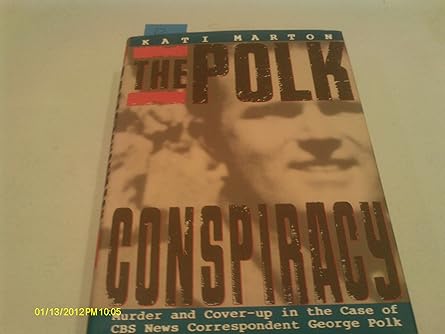
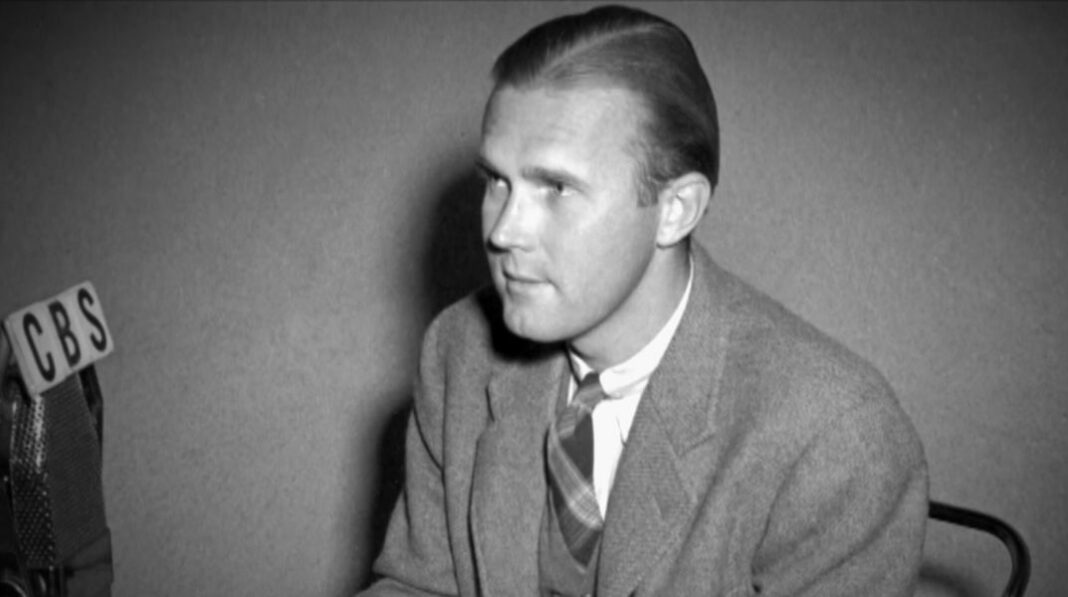
A full transcript of the Dialogos Radio interview with bestselling author Kati Marton, author of The Polk Conspiracy: Murder and Cover-Up In the Case of CBS News Correspondent George Polk. This interview aired on our broadcasts during the week of December 4–11, 2014. You can find the podcast of this interview [here].
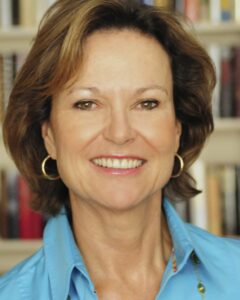
MN: Today on Dialogos Radio and the Dialogos Interview Series, we are joined by acclaimed journalist and author Kati Marton. Kati, a longtime correspondent for ABC News and National Public Radio in the United States, has received numerous awards for her journalistic work and is the author of several books, including The Polk Conspiracy: Murder and Cover-Up In the Case of CBS News Correspondent George Polk. Kati, welcome to our program.
KM: Thank you. I’m happy to be here.
MN: We’ll be discussing George Polk and his story in detail today, but to begin, could you share a bit about yourself and your career in journalism and writing?
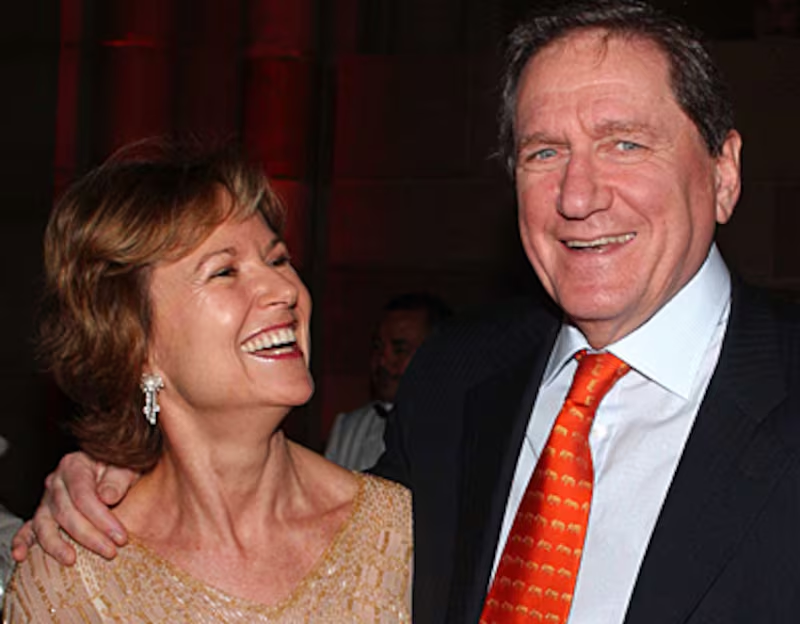
KM: Gladly. I’ve written eight books, and I’m a former ABC News correspondent, foreign correspondent, and diplomatic correspondent for National Public Radio. I specialize in nonfiction. My most recent book, which became a New York Times bestseller, is called Paris: A Love Story. It’s a memoir focused on my marriage to the late Richard Holbrooke and the extraordinary life we shared together.
MN: Let’s set the scene for a moment. George Polk was related to two former U.S. presidents, had a distinguished military record, and led a somewhat nomadic life that took him all over the world. How did he end up choosing journalism as a profession?
KM: George Polk’s family lost everything—their wealth, livelihood, and their beautiful home in Texas—as a result of the Great Depression. They were a prominent family from Fort Worth, Texas, with presidential ties, and like many victims of the Depression, he left to seek a future elsewhere, since there was no future left in Texas. He eventually became a war hero, serving as a pilot in the Pacific, and was later recruited by CBS News, then the most prestigious news organization in the world, under the legendary Edward R. Murrow. He became one of the “Murrow Boys,” a group of outstanding, courageous journalists who covered WWII and its aftermath. George quickly emerged as a rising star. And Greece, of course, was one of the major stories of the late 1940s, as it was where the United States drew a red line against Soviet expansion. The famous Truman Doctrine was launched to funnel millions into supporting Greece’s right-wing monarchy-backed government—a deeply corrupt and unpopular regime. This was the first time the U.S. became entangled with such a regime in the name of national interest. I believe the path from Athens led directly to Saigon and the Vietnam War, where once again we backed a regime without popular support. The Polk Conspiracy, my book about the murder of this brave CBS reporter, reveals the tragic cost of prioritizing “national security interests” over fundamental American values. George Polk was, in many ways, the first casualty of the Cold War.

MN: In that context, Polk went to Greece as a correspondent for CBS News. What was the nature of his reporting from Greece, and how did the authorities in Greece and the U.S. respond?
KM: George Polk is considered one of the great American journalists. There’s a prestigious journalism award named after him—the George Polk Award. My own parents both received that award for their reporting. Polk was a fearless journalist who didn’t let anything stop him. And that’s ultimately what got him killed. He believed people deserved the truth—even if that truth made the U.S. government look bad. His reporting was so uncompromising that he became a target not only in Athens but also in London and Washington. He was that rare breed—an incorruptible truth-teller. The world owes a great debt to people like him, because if there was any honest journalism about what was happening in Athens in 1948—with a corrupt regime in power—it came from George Polk. And for that, he had to be silenced.
MN: And as you mentioned in your book, it didn’t take long for George Polk to be labeled a communist by the Greek press of the time…
KM: Well, yes, that was always the quick and easy way to destroy someone’s reputation—slander them with the “communist” label. George Polk was no more a communist than he was an astronaut. He was simply an objective journalist who saw—very clearly—that there were good and bad actors on both sides, but the ones in power were the bad ones, and the United States was pouring millions of dollars into propping up this corrupt government. Polk saw firsthand that the government was essentially holding onto power without doing right by its people, and that the United States had no business supporting such a regime. In fact, as I argue in The Polk Conspiracy, it wasn’t only the Greeks who bore responsibility for George Polk’s death—my own country, the United States, also played a disgraceful role. Not in his murder, but in the cover-up that followed. And our most loyal ally, Great Britain, was actually complicit in his assassination.
MN: We’re speaking with journalist and author Kati Marton here on Dialogos Radio and the Dialogos Interview Series. Kati, without giving too much of the story away, what seems to have been the final straw regarding George Polk’s presence in Greece was a meeting he had with then-Prime Minister Konstantinos Tsaldaris just days before his murder. What was the nature of that meeting?
KM: George Polk had received a tip—one of those anonymous leads that good journalists often get. This particular source was from Chase Manhattan Bank, and it claimed that the Greek Prime Minister, Mr. Tsaldaris, had just deposited a very large sum of money into a personal account at the Chase Bank in New York. Because Polk was such a meticulous and fair reporter, he went directly to the Prime Minister to get his response before publishing the story—and by doing so, he signed his own death warrant. He lived only a few more days after that.
When I was researching The Polk Conspiracy, I had the chance to interview President Truman’s closest advisor, Clark Clifford, and I asked him: “What would have happened if George Polk had lived long enough to report this story—about a Prime Minister being propped up with U.S. aid dollars while holding a massive bank account in New York?” And Clifford said it would have been impossible for Truman to return to Congress and secure additional funding for Greece. So, in a twisted way, Tsaldaris and those who orchestrated the murder were right to do it—horrible as that may sound—in order to protect themselves. I absolutely do not condone murder, but by upholding the highest standards of his profession, George Polk sealed his fate. He should have fled Greece once he had that information and reported it from a safe location. But as I said before, he was a meticulous and very brave journalist, and he paid with his life. That story remained untold until I revealed it in my book.
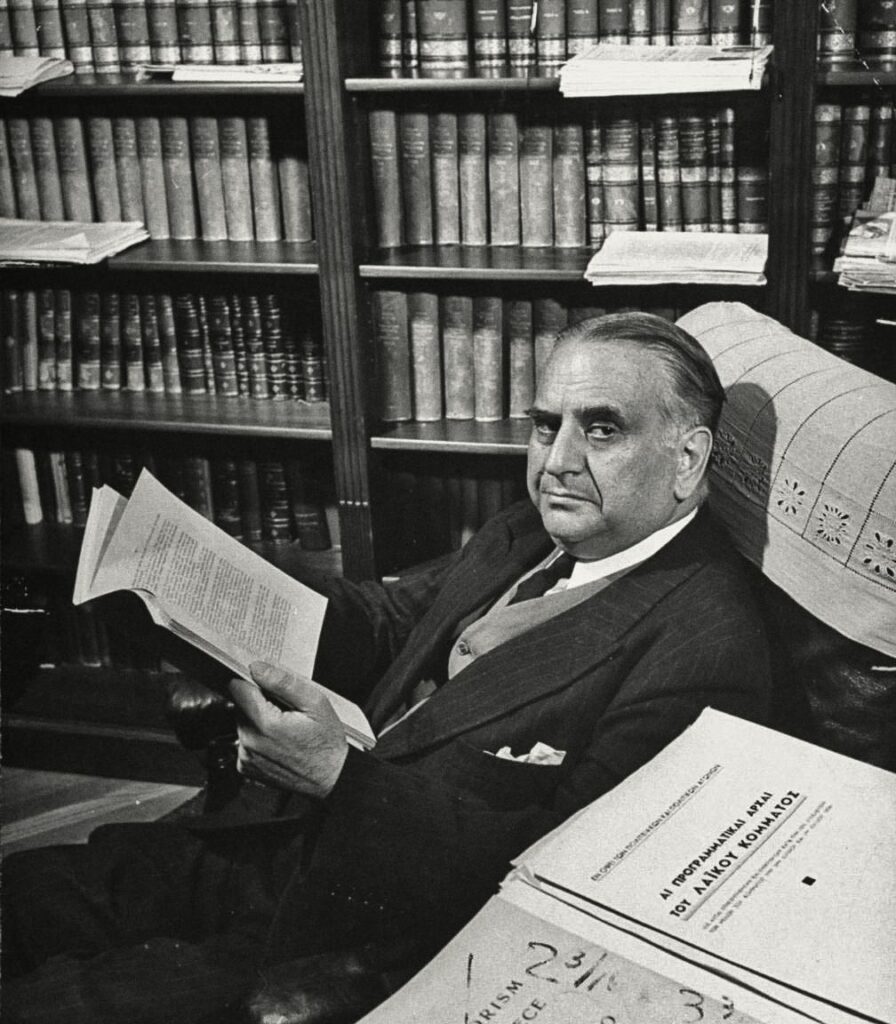
MN: Now, it should be noted that at the time, in addition to the corrupt Greek government, there was also a rather powerful and dangerous far-right paramilitary underworld operating in Greece, with close ties to the government and other forces. It appears that this network was able to reach Polk in the days leading up to his murder.
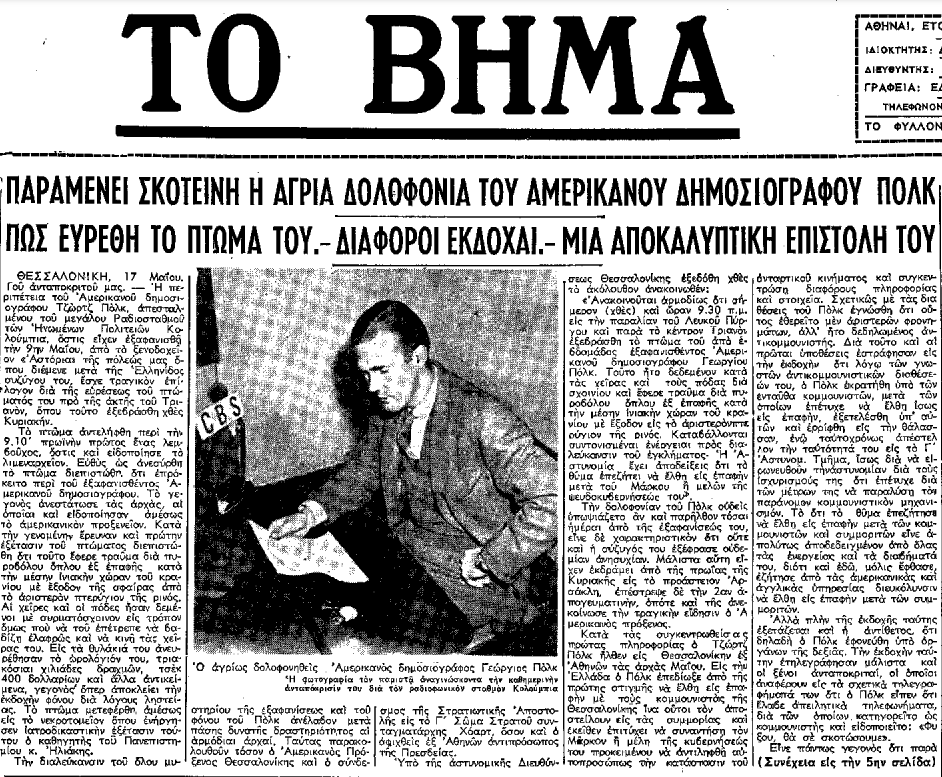
KM: Yes, of course—the Prime Minister himself didn’t pull the trigger, but his allies in the Piraeus underground—a secretive and very dangerous organization—were the ones responsible for the murder. I actually discovered who the killer was, as well as the organizers, and for the first time, I tell the full story of exactly how it happened, how Polk was lured into a trap. George Polk was determined, before leaving Greece, to interview the head of the communist rebels, General Markos, who was in hiding in the mountains. He traveled to Thessaloniki in hopes of securing that interview, which had been promised to him. But it was a trap—and he walked right into it.
Naturally, the right-wing government then constructed a massive, fabricated plot claiming that Markos and his rebels had killed Polk, which made absolutely no sense. Markos had every reason to speak to the world and to get his side of the civil war story out—he had no reason to kill George Polk. What’s horrific about The Polk Conspiracy is that there wasn’t just one victim. Alongside Polk, there was a second: a Greek journalist named Grigoris Staktopoulos, who was arrested and tortured until he falsely confessed to having been involved in Polk’s murder. So we have two victims here: George Polk, who was killed, and Staktopoulos, whose life was ruined, having spent much of it in miserable conditions in a Greek prison.
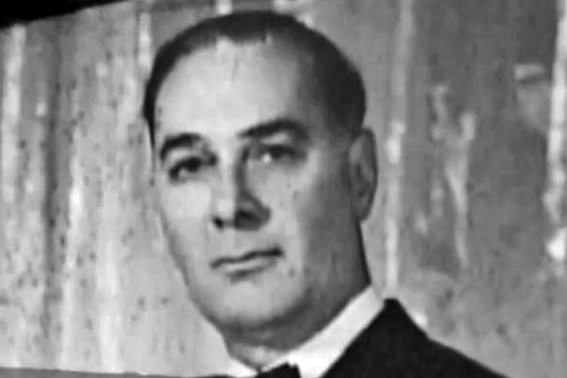
MN: And what we’re talking about here is not just an investigation, but essentially a cover-up—and, of course, a false confession in which American and British officials were also deeply involved…
KM: Absolutely. The British, who were the number one global power, so to speak, before the United States took over that role in Greece, were deeply involved in Greek affairs and in supporting the Greek monarchy. They played a sinister role in the Polk affair. The British secret service, MI6, was deeply implicated. I recount the story of a Greek woman, married to a British journalist, who was accused of working in the Polk household and smuggling out any incriminating documents from his apartment—most notably, the letter Polk had received from Chase Bank concerning Prime Minister Tsaldaris’ bank account.
When I was writing the book, most of the people involved were still alive—including that woman, whom I interviewed, and also a British intelligence officer named Randolph Coate, who had long been suspected of playing a role in the murder. All these people were still alive at the time, including members of the Polk family, who cooperated with me and, for the first time, opened up all their archives and correspondence. But my greatest stroke of luck was discovering that the third victim of the Polk murder was another American hero named Jim Kellis. He had been brought in by a group of American journalists—who were, of course, outraged by what had happened to their colleague—and they formed a committee led by General “Wild Bill” Donovan, the founder of what would become the CIA. Donovan was tasked with investigating Polk’s murder. His deputy, Jim Kellis, uncovered the true conspiracy—the one we’ve just discussed—that led directly to the right-wing network and the Piraeus underworld.
Kellis himself was treated very poorly by both the Greek right and Washington, because the truth he uncovered was not the story they wanted told. They preferred the fiction that Polk had been murdered by communists and that an innocent Greek man, Grigoris Staktopoulos, had confessed under torture. Jim Kellis was no longer alive when I began to dig into the official story—but essentially, the official story collapsed under the weight of my investigation. Kellis had a colleague who had preserved much of his documentation, and I became the beneficiary of that archive, which became the backbone of The Polk Conspiracy. It was one of those rare journalistic strokes of fortune.
But unfortunately, I was unable to publish the book in Greece—where it most needed to be published—because Mr. Tsaldaris’ son sued me for defamation. I had to hire a very prominent Greek defense attorney because I did not want to spend a year in a Greek prison. In the end, we reached an out-of-court settlement. But to this day, I have not been able to bring my book to the very people who most deserve to know what really happened to George Polk.
I believe the George Polk case has cast a long shadow over U.S.–Greek relations, because Washington behaved so shamefully in those early days, and because the Greek people were so profoundly manipulated by their own government—with Washington’s collusion. I think it’s time the true story was told to the Greek people.
And I wasn’t just sued by the Greek right. I was also sued by the British, who were deeply upset with my findings. The woman who played that devious role—her name was Mary Barber—later married a prominent British diplomat named Nico Henderson. So Lady Henderson also sued me and blocked the book’s publication in Britain. She even blocked an article that Vanity Fair wanted to publish. Because British libel laws are such that, even if you’re telling the truth, it’s nearly impossible to be heard.
So yes, this was probably the most dramatic episode of my life as a journalist and historian. But now, I’m very glad the book has been reissued—and finally has the chance to be heard in Greece, by the Greek people.
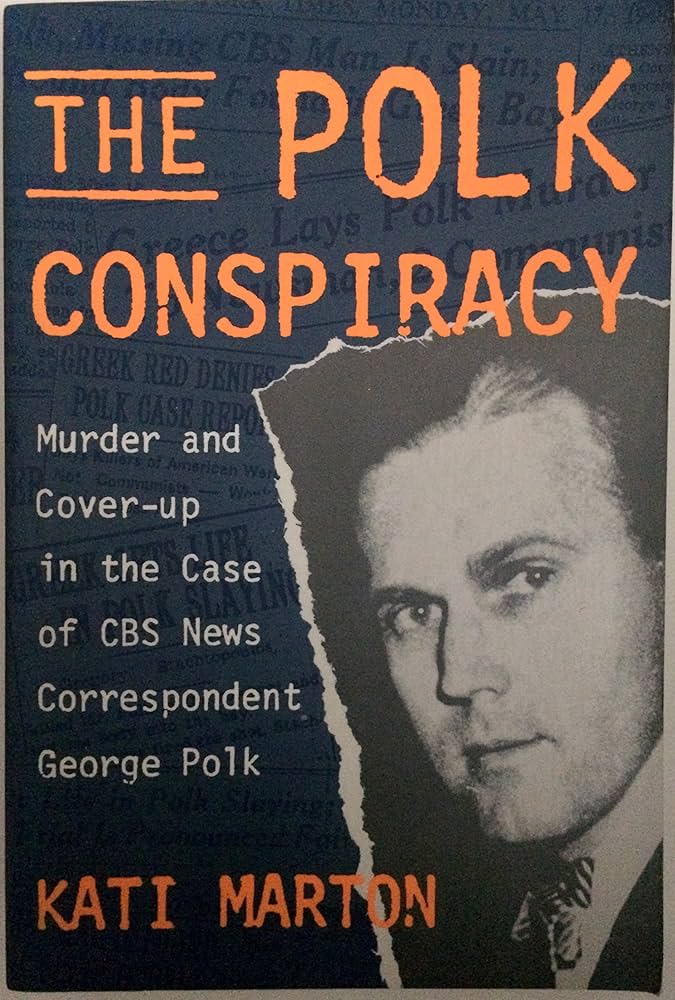
MN: We’re back on the air with journalist and author Kati Marton here on Dialogos Radio and the Dialogos Interview Series. Kati, returning to the story of George Polk and his murder case—you mentioned his widow earlier, and one of the episodes you recount in your book involves efforts to implicate her in his murder. You wrote about an incident in which the son of the Greek Prime Minister Tsaldaris traveled to New York essentially to intimidate her.
KM: Exactly. She was now a young widow, studying at Columbia University, and the younger Mr. Tsaldaris—who would later go on to lead the conservative party—actually threatened her. He told her that she too would end up a victim like her husband if she continued to tell her version of the story. He essentially told her to keep her mouth shut or something terrible would happen.
What’s fascinating is that, years later, my husband—Ambassador Richard Holbrooke, who was responsible for Greek and Cypriot affairs at the U.S. State Department—was seated next to Mr. Tsaldaris at a dinner. Tsaldaris said, “Oh, I’d love to entertain you and your wife. Please come visit me at my home.” Of course, he had no idea that the ambassador’s wife was Kati Marton—the very person he had sued for libel. My husband didn’t tell him at the time that I had an active defamation suit against me from him and that I couldn’t possibly accept his invitation. But it was, in a way, amusing to see how this story still hadn’t been resolved. And I do believe the time has come.

MN: Now, looking at the innocent man who was essentially blamed for this murder—Grigoris Staktopoulos—as I understand it, he was eventually released, but was there ever any real effort to reopen the case in Greece?
KM: There were—several efforts, including some quite recent ones—but none of them were successful. I think the case remains a very sensitive issue, because it involved so much abuse of power and so much corruption that it has taken on a huge symbolic weight. But I do think now is the time for an official pardon, at the very least—his family is gone now, but he paid an enormous price. His life was destroyed.
And you know, what shocked me most about all of this was the realization that, at the very time Moscow was conducting its infamous show trials—where innocent people were being sentenced under Stalin—the West was capable of a betrayal just as profound, one that violated the very principles we claim to stand for: due process, fair trials, and the presumption of innocence. All of that was betrayed in The Polk Conspiracy.
MN: We’re here on Dialogos Radio with journalist and author Kati Marton in the Dialogos Interview Series. Kati, this book was first published in the early 1990s. What inspired you to write it, to pursue this investigation, and to bring this story to light?
KM: First of all, I was a great admirer of George Polk as a journalist. I’m someone who seeks the truth, and I like to investigate stories that seem resolved but somehow don’t hold up to serious scrutiny. I didn’t have any particular political bias either way. I’m a Cold War kid—I grew up in communist Hungary. My parents were journalists who were imprisoned by the communists. I didn’t see them for several years as a child. So if anything, I was biased against the communists. I myself was a refugee, with my parents, fleeing communism. That was my personal perspective.
And yet, this story just didn’t add up. The official version simply didn’t hold. I had some of those rare strokes of luck that journalists sometimes get, and I’ve never worked harder on anything than I did on this investigation. I can tell you—when I was in Thessaloniki, and already knew who the conspirators were, what the organization was that planned the murder, and even the name of the killer—I was genuinely scared. Because if they had killed one journalist, why not another?
But I’m glad I lived to tell the story. And it’s deeply satisfying to know that George Polk’s story is getting a second chance to be heard.
MN: In your book, you wrote that by supporting this particular right-wing regime in Greece, the United States created a monster that would eventually grow beyond its control—and this was at the very dawn of the Cold War. How did U.S. involvement in Greece set the tone for its foreign policy in the decades that followed? And how did it shape America’s continued engagement with Greece in the years ahead?
KM: Well, we compromised our core values in Greece by participating in a cover-up—we, the United States. And it was the first time we aligned ourselves with such a deeply corrupt government, but it wouldn’t be the last. I argued that the path from Greece led directly to our involvement in Vietnam. It was the beginning of what we now call “national security interests”—and I think, in the long run, it was a Faustian bargain. Of course, the United States must have national security interests—but above all, it must remain faithful to its fundamental values.
MN: Looking at the current situation in Greece—with a severe economic crisis, a rather unpopular government that nevertheless enjoys the backing of the European Union and some foreign powers, the rapid rise of the far right, and the re-emergence of old left-right divisions in Greek society—would you say that much has really changed in Greece since George Polk’s time?
KM: I think the story of George Polk is, in fact, a moral tale—one that Greeks today should read carefully to understand what happens when a society sells out its values for short-term political gain. I think it’s a powerful lesson about the danger of striking those kinds of bargains. Neither Washington nor Athens should ever make those kinds of deals just for a quick fix—because in the end, the price we pay is far too high.
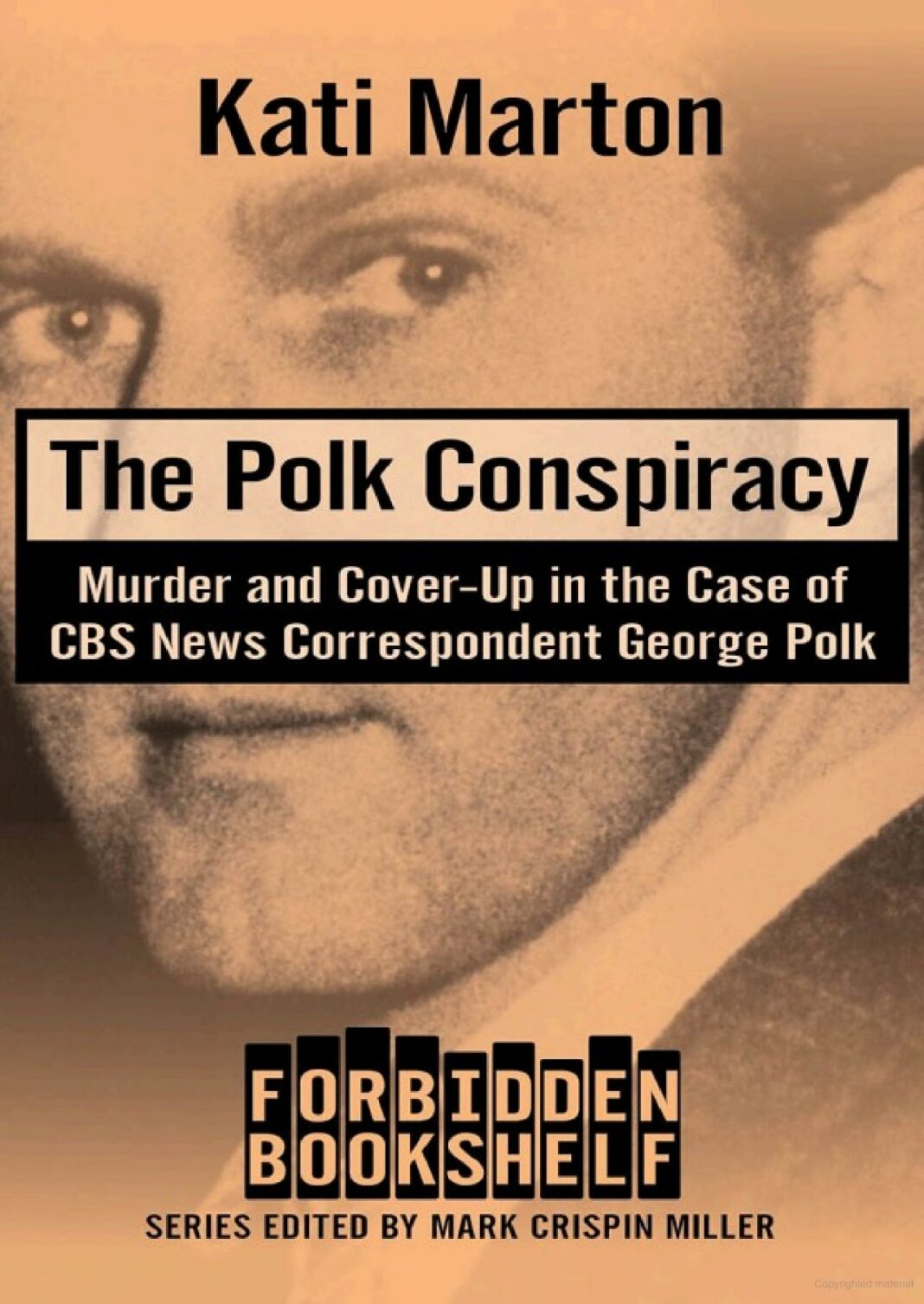
MN: Before we wrap up, The Polk Conspiracy: Murder and Cover-Up in the Case of CBS News Correspondent George Polk was recently re-released as an e-book as part of the Forbidden Bookshelf series, and I believe it includes a new introduction. Tell us about this new edition and the series.
KM: I’m truly, truly excited that The Polk Conspiracy is getting a second life under the Forbidden Bookshelf series. My book wasn’t really “forbidden”—in fact, it was a bestseller in the United States. Mel Gibson actually bought the film rights and still owns them, so I hope we’ll eventually see the film made. So I can’t really say my book was banned—except in your country, Greece. And that, I think, is a shame. It was banned only because of a defamation lawsuit brought against me by a member of the Greek right in the 1990s.
That’s why I’m very grateful to the Forbidden Bookshelf for now campaigning to bring my book to the one place where it is still essentially banned—and that is Greece, the country where the murder of this very brave American journalist actually took place.

MN: Well, Kati, thank you so much for taking the time to speak with us today here on Dialogos Radio and the Dialogos Interview Series, and thank you for sharing this incredible story with us.
KM: Well, Michael, it was truly my pleasure, and thank you for speaking with me and for bringing The Polk Conspiracy to a new audience. I hope they read it.
Kati Marton
Honorary Board Member, New America (1999–2016)
Author and Journalist

