


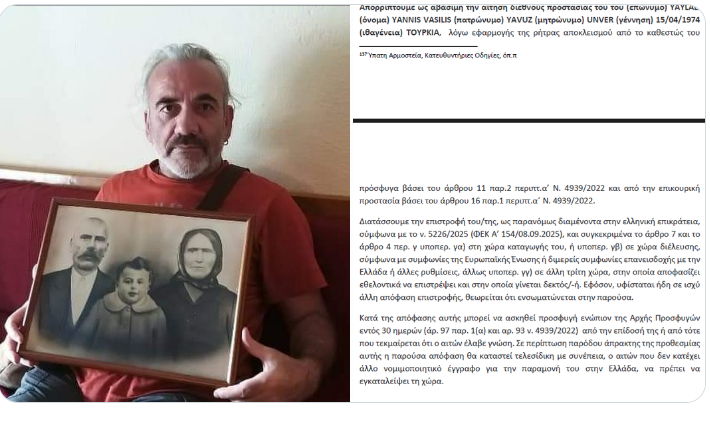
The case of Yannis Vasilis Yaylali is not a technical asylum dispute. It is a moral and political scandal, and it bears a clear signature: that of the government of Kyriakos Mitsotakis.
A man who has been persecuted for decades by the Turkish state—imprisoned, tortured, prosecuted for commemorating genocides, and facing multiple active arrest warrants—is treated by the Greek authorities not as a political refugee, but as a supposed “war criminal.” Not because there is evidence—there is none—but because he spoke out. Because he testified. Because he exposed crimes.
Through the Ministry of Migration, the Greek government has effectively adopted Ankara’s narrative wholesale. Where the Turkish regime labels memory, truth, and human rights as “terrorism,” the Greek state responds with bureaucratic compliance. This is not neutrality. It is complicity.
If Greece claims that a man is “not persecuted” while he has been relentlessly hunted for decades;
if it portrays a witness to atrocities as “dangerous” while shielding the perpetrators;
if it is willing to return political refugees to regimes that imprison people for speech and remembrance,
then this is no longer a state governed by the rule of law. It is a state governed by fear.
The Mitsotakis government has made its choice:
to appear “reliable” abroad while being utterly unreliable toward its own proclaimed values.
To invoke international law rhetorically, while violating it in practice.
But Greece is more than borders and ministerial decisions. It is a country shaped by memory, exile, and refuge. It is a country whose people once survived because others opened their doors. If those doors now close, Greece loses far more than an asylum case—it loses its moral standing.
The deportation of Yannis Yaylali would not be a mere administrative act.
It would be a political decision.
And the responsibility will rest squarely with those who sign it.
ΑΝΙΧΝΕΥΣΕΙΣ

