


 By
By Want smart analysis of the most important news in your inbox every weekday along with other global reads, interesting ideas and opinions to know? Sign up for the Today’s WorldView newsletter.

In his first week in power, President Trump has ruled by fiat and tweet, following through on many campaign promises most people had assumed were too absurd or extreme to ever fulfill. A temporary Muslim ban of some sort is set to come into effect, and the White House is seeking funding to actually build a wall on the Mexican border, still insisting Mexico will somehow pay for it. Meanwhile, his spokespeople engaged in a running war over the truth with the American media, doubling down on talking points and statistical claims already proven to be false.
If it weren’t clear before the inauguration, it certainly is now: Trump’s presidency represents a radical departure from the norms of American politics.
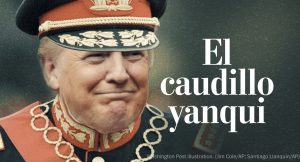
Yet to observers elsewhere, Trumpism feels deeply familiar. Trump may want to stop the flow of migrants and goods from south of the border, but he has imported a political style ingrained in Latin American politics: that of the nationalist demagogue.
A number of Latin American analysts have suggested over the past year that it’s useful to view Trump through the lens of the “caudillo,” or strongman. It’s a tradition that extends from the last days of Simón Bolivar, South America’s great liberator, to the current bluster of leaders like Venezuela’s Nicolás Maduro or Ecuador’s Rafael Correa.
Sure, Trump is no military despot like Chile’s late Augusto Pinochet, who came to power in a 1973 coup, nor is he a defiant autocrat like the late Hugo Chávez, the leftist populist who reshaped Venezuela in his image.
But to those who have lived under such leaders, it feels like Trump has been taking notes.
When Trump and his spokespeople started throwing out huge (and incorrect) numbers for the size of the crowd attending his inauguration, Venezuelan journalist Lisseth Boon immediately heard the echoes of her own experience reporting under a regime that constantly fed the public its scripted version of reality.
Yes, that is so Venezuela. Dèjá vu https://twitter.com/WSJForero/status/822962021456957440 …

Before the election, Enrique Krauze, a Mexican essayist and publisher, outlined with venom the parallels he saw between Trump and Latin American populists: It’s in “his extreme self-inflation, his call for unthinking acceptance of the supposed power of his personality; his ability to keep America safe from the dangers of terrorism, Mexicans, the Chinese, whatever straw man area he can use to generate hatred and support for thoughtless economic proposals that in reality can only benefit the very rich; his promises that under his guidance, America will ‘win so much, you may even get tired of winning.'”
Trump says he stands for the “forgotten man,” a gesture to the American white working class languishing in the nation’s farming villages and mining towns. Argentina’s Juan Perón, a populist nationalist who transformed his country in the mid-20th century, said he represented his society’s “descamisados,” or “shirtless ones.” Populists emerge, after all, in conditions of great social and economic inequity, and win votes with the promise to shake up an unfair system rigged against the common man.
Trump’s belief in tough talk; his posturing as the champion of the working class; his stated contempt for urban elites and the machinery of politics; and his projection of a robust machismo that is undimmed by political correctness — are all traits associated with caudillismo.
“Populism, authoritarianism, personalism, machismo, racialism, and caudillismo — or strongman rule — have been historically seen as ills almost inherent to Latin American political culture,” wrote Texas A&M political scientist Diego von Vacano. “With the election of Donald Trump, we can now see that the U.S. is indeed part of the Americas as a whole and shares in those pathologies.”

Donald Trump, Caudillo del Norte

But, as is the experience in Latin America, such politics can slide into trouble and dysfunction.
“Latin America has a mostly unhappy history of dealing with outsiders-turned-presidents,” wrote Javier Corrales, a professor of political science at Amherst College. “More often than not, they have ended up either hurting democracy or ruining the government’s ability to act.”
Krauze deployed another scathing analogy for Trump: “The Latin American populist leader harangues his people against those who are ‘not our people.’ He proclaims the dawn of a new history and promises the advent of heaven on earth. Once in power, microphone in hand, he installs a pattern of systematic lying, decrees that his official truth is the only truth, invents external enemies to blame for his own failures.”
Not everyone in Latin America sees Trump in such negative light. Guillermo Moreno, a former Argentinian trade secretary, favorably described Trump’s “America First” politics as “Peronist” in a radio interview last week. Venezuela’s Maduro, who constantly inveighs against the evils of yanqui imperialism, told reporters on Sunday that Trump was subject to a “brutal hate campaign” by American media.
Jair Bolsonaro, a right-wing, anti-establishment Brazilian firebrand and recent failed presidential candidate, also celebrated Trump’s success: “At the end of the day, Trump stood up to the politically correct, stood up to the polling firms, stood up to the big rotten media,” he said in a video cited by Americas Quarterly.
The irony, of course, is that Latin America has largely moved on from its days of demagoguery and dictatorship, with populism in retreat and mature democracies taking root across almost the whole region.
“The roles have been reversed,” wrote Vacano, “and it is perhaps up to Latino immigrants to teach the U.S. about deepening democratization.”
Want smart analysis of the most important news in your inbox every weekday along with other global reads, interesting ideas and opinions to know? Sign up for the Today’s WorldView newsletter.

