

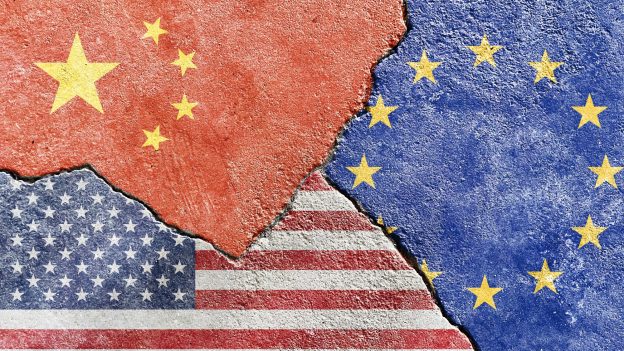
The EU is badly squeezed between the United States and China – but it still has cards to play, including at the upcoming China-EU summit.
Low Expectations
This will certainly be a contentious summit, which could well evolve into a shouting match. The EU has long raised the issues of a stubborn trade deficit, persistent obstacles to market access in China, discrimination against European companies, and a lack of reciprocity in bilateral relations. At the G-7 summit in Canada last month, von der Leyen issued one of her strongest rebukes of China to date, accusing Beijing of export restrictions and state-subsidized overproduction that choked international competition.
The European Parliament, too, has condemned Beijing’s rare-earth export restrictions as “unjustified and coercive” and criticized China’s “quasi-monopolistic position.” And while licensing for European firms has been loosened somewhat, the procedures remain suspiciously slow and arduous.
In addition, China is fuming over the European Commission’s announcement on June 19, a month before the Beijing summit, about restrictions imposed on Chinese medical device producers under the bloc’s International Procurement Instrument (IPI). Beijing wasted no time to proceed immediately to a tit-for-tat move by barring European companies from major Chinese government medical device contracts.
Beijing is unlikely to stop supporting Russia, a strategic partner of China’s. In early July, Foreign Minister Wang Yi stunned his interlocutors in Brussels by telling them unceremoniously that China did not want to see Russia defeated in Ukraine, quite a departure from Beijing’s standard song sheet about not being a party to the conflict. Notably, this is the same Chinese official who offered an olive branch to Europeans at the Munich Security Conference in February, in stark contrast to U.S. Vice President J. D. Vance’s inflammatory speech. Beijing’s charm offense, however, turned out to be short-lived and purely performative, and European officials are now convinced that China is not really interested in patching things up.
A Three-Sided Poker Game
To a certain degree, a trade agreement between Washington and Brussels by August 1 may affect a possible deal between the U.S. and China by August 12 – if these deadlines are not pushed back again. For instance, if Washington and Brussels were to seal an agreement similar to the U.K.-U.S. deal with tariffs generally as low as 10 percent, other trading partners would be put at a disadvantage, and Chinese officials have already made it clear that Beijing will retaliate.
Being in charge of the EU’s common trade policy, the European Commission has to stick to its guns, as its mandate is to defend the interests of the entire bloc. It has already deployed a growing list of legal instruments vis-à-vis China. As for the U.S., a first round of retaliatory tariffs targeting 21 billion euros worth of American exports has already been approved, but suspended until August 6 to allow time for talks with Washington. Moreover, the Commission has reportedly proposed a second package that covers U.S. aircraft, cars, machinery, and farm produce worth 72 billion euros, though it awaits a green light and looks more like a bargaining chip at this stage.
Apart from the United States being the largest trading partner of the EU, geopolitics is another major factor to be reckoned with. It is clear that Europe doesn’t have the capacity to ensure its own security outside the U.S. nuclear umbrella and without American weaponry. Hence the recent agreement, albeit a shaky one, on a hike of Europeans’ defense expenditure to 5 percent of GDP over time, including the purchase of arms for Ukraine.
The Rules of the Game
The EU is badly squeezed between the United States and China – there’s no hiding it. It is between a rock and a hard place, and in the most disadvantageous position in the triangle. At present, Europe may not have the cards, as Trump would say, and most probably Xi is of the same view. Hence the U.S. president’s brass-knuckles attitude toward Europeans and Beijing’s snubbing of the EU that will be on full display at the July 24 summit. However, being a huge market and a key trading partner of both the U.S. and China, the EU does have its cards, as long as it plays its hand smartly, which requires a clear-cut strategy.
Things are equally complicated when it comes to the transatlantic bond, brutally shattered by Trump. The U.S. president, as well as his predecessors, has a point in calling for increased defense spending in Europe and this is already being done, albeit grudgingly, by NATO members. But Trump’s conviction that the EU was formed to “screw” the U.S. leaves little room for negotiations on the basis of a well-structured and mutually agreed-upon agenda. Add to that his obsession with viewing international politics as a poker game, whereby unpredictability, bluffing, and threats will do the trick.
When the trade war broke out a few months ago, Beijing stood its ground and cornered Washington, despite Trump’s lofty statements early into his second term. Following Trump’s “Liberation Day” show on April 2, the Chinese and U.S. tariffs skyrocketed to 125 percent and 145 percent, respectively. Then Wall Street freaked out, Chinese rare earths exports to the United States slowed to a trickle, and in late June the two sides reached a temporary agreement for Beijing to speed up exports of critical minerals to the U.S. and for Washington to lift recent export controls on China.
Gradual diversification away from dependence on both the U.S. and China, part of the notion of “strategic autonomy,” is another possible way out of Europe’s predicament. The EU is actively looking for new trading partners and sources of critical raw materials, with von der Leyen recently hosting Indonesia’s president in Brussels for talks on a bilateral free trade agreement (FTA). On July 23, a day before the Beijing summit, both von der Leyen and Costa are to attend a get-together with Japan, a significant economic and political partner of the EU.
But even opening up to other corners of the world may not be enough. The biggest challenge for the EU will be to clean up its own act at home. Having 26 policies too many on every single issue in the 27-member bloc is an inherent European weakness that needs to be addressed as a matter of urgency. Speaking with one voice and not hesitating to play one’s strong cards is an imperative, if the EU is to be taken seriously in the complex poker game in the China-Europe-U.S. triangle.

