


This is an important development, showing that Syria is trying to rally support.
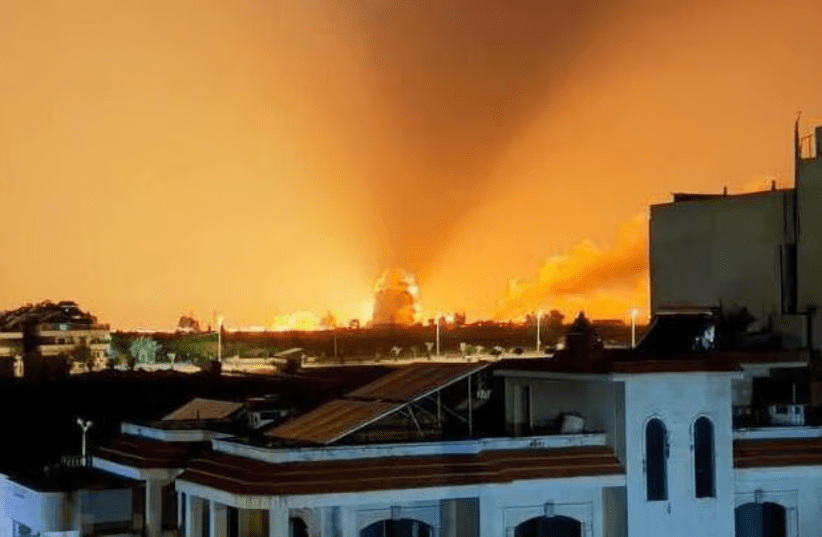
People in Damascus reported a strike on the Barzeh Scientific Research Center, while locals in Hama said strikes hit Hama military airport. A strike also was reported near the T-4 base near Palmyra.
The Syrian media Levant24 noted that “Israeli forces struck five areas in 30 minutes, destroying Hama military airport and injuring civilians and military personnel.” The Syrian foreign ministry says the attacks aim to destabilize Syria and prolong its suffering. It noted that Syria is trying to recover after 14 years of civil war. Damascus is now calling on the international community to pressure Israel to stop the strikes and adhere to international law.
The statement by the ministry comes just days after Syria inaugurated a new transition government with around 22 ministers appointed to handle the affairs of various ministries. The Ministry of Foreign Affairs and Expatriates said on April 3 that it “has strongly condemned the latest wave of Israeli aggression against Syria, urging the international community to take a firm stance and pressure Israel to stop its aggression and adhere to international law,” Syrian state media SANA noted.
In a statement published on its Telegram channel, the ministry added, “In a blatant violation of international law and Syrian sovereignty, Israeli forces launched airstrikes on five locations across the country within 30 minutes, resulting in the near-total destruction of Hama Military Airport and injuring dozens of civilians and military personnel. This unjustified escalation is a deliberate attempt to destabilise Syria and exacerbate the suffering of its people.”
Syria believes the Israeli attacks “form part of a clear Israeli strategy to normalise violence once again within the country, undermining recovery efforts and entrenching a culture of impunity,” SANA noted.
“The Syrian Arab Republic calls on the international community to take a firm stance and exert pressure on Israel to cease its aggression, respect international law, and uphold its commitments under the 1974 Disengagement of Forces Agreement. We also urge the United Nations and all relevant international bodies to take immediate action to halt this escalation and prevent further violations,” the Ministry of Foreign Affairs asserted.
This is an important development. It shows that Syria is trying to rally support. Most countries in the region oppose Israel’s strikes on Syria. Jordan, Turkey, and other countries have condemned the strikes in the past. Israel has carried out dozens of airstrikes in Syria since the Assad regime fell on December 8.
Initially, these were viewed as strikes aimed at removing threats left behind as the Assad regime fell, such as naval vessels or warplanes or even chemical weapons facilities. However, the strikes have continued for four months. It is not clear what Israel might have missed in the first large waves of strikes on December 8.
Some of the strikes have targeted military airports that reports suggest countries such as Turkey would like to use. Turkey is a partner of the new government in Damascus. However, Syria’s president, Ahmad Shara’a, has tried to show that he is doing outreach beyond Turkey and Qatar, two countries that are close allies. Shara’a visited Saudi Arabia first after coming to power. He has also travelled to Cairo. He is trying to balance the interests of many countries in Syria. In addition, the US plays a role in Syria.
The airstrikes overnight between April 2 and 3 also came as there were reported clashes in Tasil in southern Syria. This is the second major clash with the IDF in southern Syria in an area near Dara’a and the Jordanian border. Another clash took place on March 25, when several Syrians were killed in clashes with the IDF. They were killed in Koya (Kuwaya), which is on the Jordanian border, around a mile from the Golan buffer zone that the IDF controls. This is a triangle of land in what is known as the Yarmouk River basin. Above the basin is Tasil.
The importance of Tasil
Tasil is an important town. During the Syrian civil war, it changed hands several times. An ISIS affiliate ran it from 2016 to 2017. This affiliate, called Jaysh Khalid, was pushed out by Syrian rebels in 2017. The affiliate continued to control areas near the Golan border. Tasil had a strategic site near it called Tel al-Jamu. This was apparently a Syrian regime site. Rebels had tried to take it early in the rebellion in 2011-2012. The Syrian regime had brutally killed Syrians in the town. In 2018, the whole area in Dara’a and near the Golan fell to the Syrian regime as the rebels were defeated near the Israeli border. On December 8, things changed again as the rebels seized power.
Israel once had positive ties with the Syrian rebels near the Golan. Israel even facilitated the evacuation of the White Helmets from Syria in 2018 when the regime took over areas near the Golan. Now, things have changed. Israel has pushed into the buffer zone along the Golan, and clashes have resulted in areas near the border. The IDF said overnight that “in the past hours, the IDF struck military capabilities that remained at the Syrian bases of Hama and T4, along with additional remaining military infrastructure sites in the area of Damascus.” Syria wants the strikes to stop.
https://www.jpost.com/middle-east/article-

