

Founded in 1972. Formerly Defense & Foreign Affairs Daily
Volume XXXVI, No. 36 Monday, July 2, 2018
© 2018 Global Information System/ISSA.
 |
|
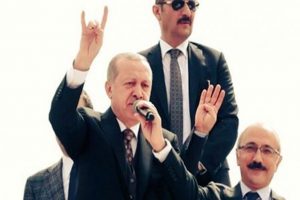
| Turkish Pres. Erdoğan, on the campaign trail in June 2018, uses the ultra-nationalist “Wolf” salute, while Deputy Prime Minister Litfi Elvan uses the Muslim Brotherhood salute. |
Analysis, By Yossef Bodansky, Senior Editor, GIS/Defense & Foreign Affairs. “Democracy,” Turkish Pres. Reçep Tayyip Erdoğan has repeatedly told his acolytes, “is like a tram. You get off once you have reached your destination.”
On June 24, 2018, Erdoğan and his AKP (Adalet ve Kalkinma Partisi: Justice and Development Party) won the crucial presidential and parliamentary elections in Turkey. Most important, Erdoğan received a mandate to implement the transformation of Turkey into a Presidential Republic which would give him — Erdoğan — unprecedented powers until 2023, and, in all likelihood if he remained alive, even until 2028.
The coming transformation of Erdoğan’s new-old Turkey should be expected to have a major impact on the greater Middle East, greater Central Asia, and Europe. The outcome of the elections reflects accurately the popular trends in Turkey, given that the voter turnout was extremely high even for the politically active Turks. Voter turnout in the presidential election was 86.82 percent and the turnout in the parliamentary election was 87 percent.
The outcome of the presidential election was predictable. It accurately reflected the polarization of the population within Turkey. Erdoğan won 52.6 percent of the votes in most of Turkey: the areas inhabited by what Erdoğan calls “the Black Turks”. Chief rival Muharrem İnce, the Kemalist social-democrat candidate, won 30.6 percent of the votes mostly from “the White Turks” in the country’s western-most urban areas and from the urban-economic élite of Tunceli (the economic capital of Turkish Kurdistan).
The currently-imprisoned Kurdish leader, Selahattin Demirtaş, won 8.4 percent of the votes, all in Turkish Kurdistan. The rest of the votes went to minor, fringe candidates, none of whom carried even a single voting district.
Five parties crossed the 10 percent threshold and entered parliament. They compose three distinct alliances which were cemented and signed before the parliamentary election. Because of Turkey’s complex districting procedures, the numbers of seats each party is allocated in Turkey’s 600-member Grand National Assembly (Türkiye Büyük Millet Meclisi) does not reflect accurately the number of popular votes received.
The parties and their showings are:
* AKP — 42.6 percent and 295 MPs. The Justice and Development Party, Erdoğan’s party, is an Islamist-chauvinist conservative party whose ideology is based on the teachings of the Muslim Brothers.
* CHP — 22.6 percent and 146 MPs. The Republican People’s Party, İnce’s party, is a Kemalist social-democratic party but with a strong nationalist-chauvinist streak.
* HDP — 11.7 percent and 67 MPs. The Democratic Party of the Peoples, Demirtas’ party, is the Kurdish party which has recently won support from other oppressed minorities, mainly the Alavis and Armenians.
* MHP — 11.1 percent and 49 MPs. The Nationalist Movement Party is a conservative party which supports Westernized-secularist domestic policy and economy, pan-Turkic ultra-nationalist foreign policy, and outright hostility toward the EU.
* IYI — 10 percent and 43 MPs. The IYI is a new (established in October 2017) party which focuses on nationalist, liberal, and secularist political policies for Turkey. The party is an amalgam of the survivors of Turkey’s Westernized-liberal social and political movements which were suppressed by Erdoğan.
The three political blocs are:
* The People’s Alliance that is comprised of the AKP and the MHP for a total of 344 MPs.
* The Nation’s Alliance that is comprised of the CHP and the IYI for a total of 189 MPs.
* The Kurdish HDP with 67 MPs.
Thus, while Erdoğan’s AKP does not have the absolute majority of 301 MPs it sought (they have 295), the People’s Alliance has a comfortable majority to push their policies. Moreover, the Kurdish MPs threatened to boycott Parliament until Demirtaş and several other Kurdish leaders (including elected MPs) were released from jail. AKP leaders have already proposed to leaders of other parties a new law according to which all parliamentary seats which are vacant due to boycott be seized by the parliamentary leadership and be distributed among the other parties in accordance with their relative strength in parliament. The AKP is most interested in such an arrangement because it would give them about 30 additional seats and propel them over the magic 300 seats to absolute majority.
*
For Erdoğan, winning the elections amounted to a mandate to single-handedly lead Turkey into implementing his vision for regaining the long-lost Glory of the Caliphate-Empire. The elections are the beginning of a global-historical ascent of Turkey under his leadership. “The people have given us a mandate to govern,” he declared once the initial results were announced, and the new process would be implemented “rapidly”. “I will make Turkey a superpower,” Erdoğan declared. His initial goal was to make Turkey a “top 10” world power.
Regionally, Erdoğan specified, Turkey would “act more decisively” against “terrorist organizations”, would continue to “liberate Syrian lands”, and commit to actively helping the Palestinian cause. On election day, June 24, 2018, the editorial of the pro-Erdoğan Yeni Şafak elaborated on Erdoğan’s view of the region. “As Turkey heads to the polls … the Middle East holds it breath in anticipation of the results that promise to shape the future of the region. The oppressed people of Palestine, Syria, Iraq, and Libya, who look to Turkey as a beacon of hope in a region rocked by turmoil and instability, hope that the … elections will tip the balance in favor of the disenfranchised people of the Middle East.”
Erdoğan’s soul-mate, Ibrahim Karagül, the editor of Yeni Şafak, analyzed the long-term meaning of the elections. Erdoğan’s victory, he wrote on June 25, 2018, “paved the way for the giant steps to be taken from now on and revealed once more that there is no other option for this country but to advance and grow”. Erdoğan would now lead Turkey’s “great transformation, the first power buildup after the Ottoman Empire”, Karagül stressed. “This is Turkey’s victory. This is the victory of a millennium-old history.”
The outcome of Erdoğan’s electoral victory is a global event with widespread ramifications.
“This joy [of Erdoğan’s victory] was felt not only in Turkey, in this country’s cities, villages and streets, but in the depths of Skopje, Sarajevo, Baku, Crimea, Africa, and in the cities and hearts of the people of Far East Asia. It was felt in Arab streets, in the hopes of those who are stateless. Because if Anatolia rises, the region will rise — they knew this, and we knew this. … There is now going to be a geography-building Turkey that expands out to the region, the world.”
On June 27, 2018, Karagül elaborated on the historic significance of Erdoğan’s new powers. Under Erdoğan, Turkey “positioned itself in the center-most part of the global domain and activated great changes and big steps.”
Turkey no longer considers itself a part of any alliance or agreement.
Turkey “took the decision to exist on its own without being under the patronage of any power, any country, any alliance’s protection, without taking refuge in any protection shield, to lift the history-maker will that has prevailed on these lands for a millennium back up on its feet, and to give prominence to the future-oriented local resistance and mind. From now on Turkey itself is a protection shield. It is an axis in itself. It is a power chain in itself. It is a claim, a plan, the future in itself. It is a huge umbrella for Anatolia, as well the entire region. It is going to build such a political mind, such a political identity, such a resistance center will build the geography and unite the entire region.” This assertive ascent to global prominence, Karagül stressed, “is one that carries the continuity of the Seljuks, the Ottomans, and the Turkish Republic to the future”.
Karagül emphasized that granting Erdoğan unprecedented powers through the elections was the key to the future of Turkey as a leading great power. “The era of ‘strong leaders’ has started [and] countries like Turkey, the US, Russia, and China are producing strong leaders and history-maker personalities,” Karagül explained. “In this aspect, President Reçep Tayyip Erdoğan is one of the leaders of our millennium-old political history; he is the ‘Great Traveler,’ the ‘Great Leader.’ Under his leadership, Turkey is again a history-maker country, the country of the new rising era after the 20th Century. This country is now one that produces claims, power and discourse from the depths of Africa to the middle of Asia, from the Balkans to the Far East.” Erdoğan’s Turkey “can no longer be slowed down, prevented or stopped. This is what will be deemed as the third great rising period of our political history. … Get ready, we are now going to march with bigger steps!”
*
The victory of Erdoğan is essentially the affirmation of his popular mandate for charting a new and assertive course for an Islamist-chauvinist Turkey. This is the primary outcome of the profound transformation of Turkish society which has been going on sİnce Erdoğan and the AKP came to power back in 2002. By Summer 2018, Turkish historian Dr Can Erimtan points out, Erdoğan represented a popular base which “is large and fully convİnced of the fact that the current systemic change is on the right track and that the return of Islam to Turkish public life was long overdue”.
Indeed, Erdoğan increasingly emphasizes the rôle of Turkey as the spearhead of Islam. When, in early June 2018, Austrian Chancellor Sebastian Kurz announced the expulsion of mainly Turkish Islamist imams and the closing down of their mosques, Erdoğan reacted with fury in the name of Islam. “These measures taken by the Austrian Prime Minister are, I fear, leading the world towards a war between the cross and the crescent,” Erdoğan declared in Istanbul on June 10, 2018. “They say they’re going to kick our religious men out of Austria. Do you think we will not react if you do such a thing? That means we’re going to have to do something.”
As he had done beforehand, Ibrahim Karagül articulated Erdoğan’s goals most succinctly and accurately.
On June 20, 2018, Karagül explained that since Turkey was “one of the central countries of the global power domain,” she no longer needed affiliation with alliances or acceptance of conventional policies. Erdoğan’s Turkey was going to chart its own assertive course. “We are going to see a Turkey that destroys terrorism at its source, not one that tries to defeat it internally. We are going to see a country that directs its operation capability abroad, not a country that is subjected to operations; we are going to have a country that defends itself abroad, at the source of the threat, not inside the country or at its borders,” Karagül argued. With the elections there would begin a new era of greatness for Turkey.
“June 24 is going to be the date that this country, that the will in this country which has made history since the Seljuks, the political gene that rebuilt the Seljuk-Ottoman-Republic durability retakes action and the date that the final stage of the change targeting this this is completed. … Therefore, support this new great rise. Join Anatolia’s ‘Third’ great history-maker will and march. Do not forget, when we march, the Balkans are going to march, the Caucasus is going to march, Mesopotamia is going to march, the entire region is going to march. When we march, history is going to change once more, the region is going to be built once more, the Seljuks, the Ottoman, the Turkish Republic is going to march once more. This is the way it has been for a millennium — it is going to be the same once more.”
It was impossible to understate the significance of the unfolding changes in Turkey, Karagül emphasized. “This is a[n] historical reckoning, it is a civilization reckoning, a power reckoning. It is one of the greatest tests of our millennia-old history; it is a straight path that separates the right from the wrong.” Erdoğan’s Turkey is about to impose a new global order in which “there is no longer the East or West for us. There is no North or South. There is no Europe or Asia. They all exist, but we are at the center, and so are our region, our plans, our claims, our memory, our ideals, our ebullience and struggle.”
The essence of the new ascent of Turkey is the revival of its glorious heritage. “Pres. Reçep Tayyip Erdoğan’s march is a Seljuk march, an Ottoman march, a march of the Republic and the march of the future Turkey. Its foes know that this is the way it is as much as its allies do,” Karagül wrote on June 20, 2018. In a follow-up article on June 23, he stressed the centrality of the elections to the awakening of Turkey’s new power and glory. The elections are “the call of the country, the century!” The elections “are going to decide about how we are going to continue the tradition of the Seljuks, Ottomans and Turkish Republic, the continuity of states for another century and the centuries to come, how we are going to reflect that political gene onto the entire region, and how we are going to confront the threats heaped up on our border like in Canakkale [Gallipoli]. … We are in the last stage of the march of the century that we have been sustaining for 15 years. We are tasked with moving this country forward, preparing the pledges that were left for us for the next step. This historical debt is on our shoulders. We are in the final stage of realizing the promise we shouldered like the oaths of our martyrs and future generations.”
After the elections, Karagül asserted, the world would have to cope with a new and powerful “Turkey Axis” of global significance. “Turkey is going to be discussed globally, not locally. The world is going to witness a surprising rise of power.” In this new era, Turkey was going to challenge the prominence of the current great powers. “We are not going to spend the 21st Century seeking their approval. We carried that strong political gene to this century, we are now going to march with that. We are now the Seljuks, the Ottomans, the Turkish Republic, we are all of these. This is how the world will know us, this is how it has to accept us. We are the continuation of these three states, these three legacies; we are the founding generation of that future.”
In his June 20 article, Karagül stressed that the implementation of Turkey’s assent to a global rôle was already manifested in the Turkey’s posture and operations in the Middle East. Turkey’s military operations were the foundations upon which the forthcoming surge of Turkey would be built. As such, these operations were “no different than the defense of Jerusalem, the defense of Medina, the defense of Canakkale [Gallipoli], and the War of Independence. It might seem exaggerated to some, but when we take into consideration the region, the world and Turkey’s future, it is exactly like this. Because, unless we lay these foundations today, unless we decide for that powerful Turkey, if we turn into the playground of certain groups, those regions will not be able to be defended again. The decision we make today will lay the foundations of this defense.”
On June 23, 2018, Karagül explained that Turkey had already escalated its cross-border military operations, and that there would be a marked escalation after the elections. “We struck with the Euphrates Shield Operation, we hit with the Afrin operation, and recently, we are striking again with the multinational intervention front with the Qandil operation. We are going to continue after the June 24 elections. The entire anti-Turkey front between Iran and the Mediterranean is going to be collapsed; the multinational scenario positioned in those areas is going to blow up in their faces.”
Simply put, the war against, and the suppression of, the Kurds would escalate. Indeed, on June 20, 2018, Karagül put Turkey’s anti-Kurdish regional operations in a wider context. Emboldened by the outcome of the elections, Turkey was going to unilaterally remake the entire region adjacent to its borders. “Now, regardless of which country or organization is in that zone spanning the Iranian border and the Mediterranean, it is clear that we have no other choice than to be in that zone. That entire zone above the Mosul-Aleppo line is a security area for Turkey. It cannot be left unstable in any way. If it is going to remain unstable, Turkey must take control over it. The regional and global conjuncture will give this void to Turkey.”
Karagül was confident, and so must be Erdoğan, that the great powers would not be able to prevent Turkey’s regional and global ascent.
Indeed, these are not idle boasts.
The alliance between the AKP and the MHP is based on their joint commitment to expanding the assertive ascent of Turkey and the spread of pan-Turkism worldwide. The entire nationalist-chauvinist camp — both Islamists and secularists — was motivated by the urgent imperative to restore Turkey’s historic glory and might. This means surging way beyond the recent escalation of Turkish military operations from the Idlib enclave, through Manbij, to eastern Syria and northern Iraq all the way to the gates of Qandil near the Iranian border. Ultimately, Erdoğan sees himself restoring the Sunni-Ottoman hegemony over the entire greater Middle East including the Holy Shrines in Mecca, Medina and Jerusalem.
Most important to comprehending Ankara’s convictions and intent was the essence of Erdoğan’s recent dealing with King Abdullah II of Jordan. Since the Istanbul Islamic Summit in December 2017, Erdoğan had been cajoling the Jordanian monarch, ostensibly in order to help him withstand the spreading Islamist riots throughout Jordan.
The Islamist-driven socio-economic challenge to King Abdullah II is not new. Widespread demonstrations started already in 2013-14 as Jordanian economy began to sink, unemployment surged, and the huge numbers of Syrian refugees radicalized the susceptible population of northern Jordan.
Amman sought to redress the Islamist challenge by highlighting the historic rôle, and Islamic legitimacy, of the Hashemites as the true Sharifs of Mecca. (This move constitutes a profound challenge to the legitimacy of the House of al-Saud as the Custodians of the Holy Shrines.) Back in June 2015, the King presented the Hashemite Flag, which is redolent with strong Islamic symbolism and religious meaning, to the Jordan Armed Forces-Arab Army. “The Hashemite Flag’s colors and motifs combine elements of history, legitimacy, religion, and Arabism found in the Hashemite family and the Great Arab Revolt,” explained the Decree issued by the Royal Court. Indeed, the Banner was first hoisted by Al-Sharif Abu Nami in 1515 during the liberation of Mecca and Medina that established the Hashemites as the historic Sharifs of Mecca. The Banner was also hoisted by Prince Abdullah in 1920, as he led the Arab Forces to Maan during the Great Arab Revolt.
In June 2017, King Abdullah II ordered that the Hashemite flag be raised at the main entrance of the Royal Court instead of the Jordanian Flag.
However, starting in Spring 2018, popular discontent has been rising in Jordan and Islamist-inspired calls for the establishment of an Islamic State (which means the toppling of the Hashemite monarchy) multiplied. Throughout, Erdoğan reached out to King Abdullah II in several telephone conversations, the last being in June 2018. Erdoğan calls for the Hashemites to reassert their religious heritage and demand their historic rights as the Sharifs of Mecca and the rulers of the Hijaz, then ask for Turkish protection and accept ruling under Turkish suzerainty.
Erdoğan in effect argues for restoration of the relationship which existed between 1517, when the Ottomans captured the Mamluk territories, and the Great Arab Revolt of 1920 and the formal collapse of the Ottoman Caliphate in 1923. Erdoğan emphasized to King Abdullah II that such a demand would state in no uncertain terms the Islamic legitimacy of the Hashemites and make it difficult for any Islamist movement affiliated with the Muslim Brothers to challenge them. In reality, Erdoğan wants to use the Hashemites as the instrument to destabilize and undermine the House of al-Saud as part of Turkey’s ascent as the regional and all-Islamic leader.
For his part, King Abdullah II prefers to accept the lavish financial support offered by Saudi Arabia and the Gulf States. But Erdoğan would not stop or be dissuaded.
Throughout the entire election campaign, Erdoğan attended several hundred rallies where he addressed huge crowds. In all of them, he repeatedly gestured to the crowds with his right hand. His hand-message proves far more important than anything he said.
As he was waving, Erdoğan shifted between the Rabia/Rabaa and the Wolf salutes. The Rabia/Rabaa is the salute gesture of the Muslim Brothers, particularly since their demonstrations in Egypt starting 2013.
In May 2017, the AKP adopted the gesture as a new article in its bylaws as part of the AKP’s undeclared affiliation with the Muslim Brothers. The Wolf salute is a reference to the Bozkurt — the grey wolf of the steppes — which is the symbol of pan-Turkism. The gesture was originally introduced by the Grey Wolves (the underground paramilitary wing of the MHP) in the mid-1960s as a defiant hand signal identifying their members.
Thus, by publicly and frequently shifting between the Rabia/Rabaa and the Wolf salutes, Erdoğan left no doubt as to the core character and objectives of his new Turkey.
Erdoğan’s Turkey will strive to dominate the “Hub of Islam” coveted by the Muslim Brothers, and the vast Turkic lands of the greater Central Asia, Xinjiang, and eastern Siberia. Erdoğan is convinced the electoral victory of June 24, 2018, gave him the mandate to surge.
Incoming Mexican Pres. Andrés Manuel López
Obrador Strikes Immediate Conciliatory Note With US
Analysis. From GIS/Defense & Foreign Affairs, Mexico. Mexico’s new President, former Mexico City Mayor Andrés Manuel López Obrador (Movimiento Regeneración Nacional: MORENA), 64, struck an immediately conciliatory tone with US Pres. Donald Trump, when he claimed victory in the July 1, 2018, election on July 2, 2018, and Pres. Trump immediately congratulated President-elect López Obrador on his win. The mutual gestures relieved concerns that an unmanageable confrontation would immediately result from the election of the populist left-wing politician. President-elect López Obrador was due to be sworn into office on December 1, 2018.
Sr López Obrador’s anticipated victory was a profound upset to traditional Mexican politics, and MORENA was set to take office in coalition with the left-wing Partido del Trabajo (PT) and conservative Partido Encuentro Social (PES). With 66 percent of the votes counted by 14.00 hrs on July 2, 2018, the MORENA-led coalition candidate had taken 53.3 percent of the vote, compared with his nearest rival, Ricardo Anaya (Partido Acción Nacional: PAN, PRD, MC) on 22.5 percent, José Antonio Meade (Partido Revolucionario Institucional: PRI, PVEM, NA) with 16 percent, Jaime Rodríguez Calderón (independent) with 5.3 percent, and Margarita Zavala (independent; wife of former Pres. Felipe Calderón) with 0.1 percent. The extent of Sr López Obrador’s win highlighted the extent to which Sr Meade’s once all-powerful PRI — the party of outgoing Pres. Enrique Peña Nieto, who was ineligible to run for a second term — had fallen in public prestige.
Despite public focus on Sr López Obrador’s differences with US Pres. Trump, the reality was that the new President’s preoccupation would have to be on delivering on promises to contain public sector corruption, ending narco-trafficking and other large-scale criminal enterprises, constraining illegal — largely transit — immigration from Central America, and in reinvigorating investment. All of these, however, have some relationship to Mexico’s participation in the North American Free Trade Agreement (NAFTA) which both Sr López Obrador and Pres. Trump wish to modify. What has been significant has been the reality that Sr López Obrador has sensed that the Trump rhetoric on NAFTA has been to create a negotiating position for the Treaty’s re-drafting — perceived in both Mexico and the US as long overdue — whereas the approach of the Canadian Government, the third party to NAFTA, has been to regard Pres. Trump’s rhetoric as the end of negotiation.
Polling late on July 2, 2018, indicated that MORENA allies would take between 56 and 70 seats in the 128-member Senate and between 256 and 291 spots in the 500-seat lower house, the Cámara de Diputados. Forecasts at the same time indicated gubernatorial wins for allies of MORENA in at least four of eight state races on the ballot plus for the head of government in Mexico City. The central state of Guanajuato was expected to go to a candidate of the conservative Partido Acción Nacional (PAN). Overall, Sr López Obrador’s election platform was vague but conciliatory, indicating a program favoring the commercial sector, and with few specifics on immigration, foreign policy, or national security.
