


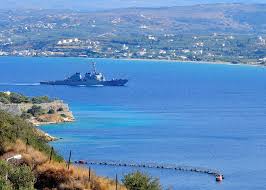
This paper examines the strategic significance of Souda Bay within the evolving U.S.-Greece defense partnership, the context of regional instability in the Middle East, and the transcontinental vision of the India-Middle East-Europe Corridor (IMEC).
Demetrios Tsailas
The October 7 Hamas attack and the subsequent U.S. military deployments in the eastern Mediterranean signal a sharpened reliance on forward-operating bases like Souda Bay, a U.S.-Greek naval facility on the island of Crete. As the Levant, Red Sea, and Eastern Mediterranean face converging security challenges, Souda Bay exemplifies how maritime geography underpins strategic options — a concept long central to maritime theorists from Alfred Thayer Mahan to Geoffrey Till.
Souda Bay in Classical Maritime Theory
Maritime strategy, as Mahan argued, is predicated on control of strategic chokepoints and naval bases that enable sustained sea presence and commerce protection. Souda Bay’s location at the intersection of three strategic theaters — Europe, the Middle East, and North Africa — embodies what Julian Corbett described as “positions of vantage” in securing maritime lines of communication.
Modern theorists echo this foundational logic. Geoffrey Till asserts that contemporary naval bases like Souda Bay now serve broader purposes: projecting soft power, supporting multi-domain operations, and reinforcing international norms through presence. Likewise, James Holmes emphasizes the “strategic elasticity” offered by forward positions, which allow democracies to shift from peacetime engagement to wartime readiness with minimal lag.
Operational Reach and Maritime Chokepoints
From Souda Bay, the U.S. can project maritime and aerial power across key maritime chokepoints: The Suez Canal, the Strait of Gibraltar, and the Bab el-Mandeb. This is consistent with Mahan’s principle that bases near major trade routes amplify strategic sea power. The October 2023 intercept by the USS Carney of drones and missiles from Yemen underscores how maritime posture rooted in such bases facilitates real-time deterrence.
Flexible Force Projection
The U.S. military’s increased deployment of C-130s, C-17s, and Marines to Greece reflects the importance of rapid scalability, a capability Holmes highlights as essential for responding to fluid threat environments in maritime regions.
The 2021 revision of the U.S.-Greece Mutual Defense Cooperation Agreement (MDCA) enabled expanded access beyond Souda Bay, including to Alexandroupoli, a key node for logistical flows into Eastern Europe. Greece’s stability, geographic centrality, and EU-NATO membership enhance its utility as a “security pivot state” in the Eastern Mediterranean.
NATO’s Southern Flank
Corbett emphasized the “combination of fleet and fortress” as critical in maritime strategy. Greece embodies this logic today: its territorial assets host NATO and U.S. power, while enabling non-provocative forward deployment. As tensions in the Eastern Mediterranean intersect with the Ukraine conflict and Russian naval assertiveness, Greece’s partnership is indispensable.
For decades, Souda Bay has been a Launchpad for U.S. and NATO operations in Europe, North Africa, and the Middle East. But in the current climate of heightened regional instability, its importance has entered a new phase. With Hezbollah threatening from the north, Iranian proxies entrenching in Syria, and the Red Sea becoming a corridor of risk, the Eastern Mediterranean has become the frontline of deterrence without direct war.
Souda Bay’s significance lies in its flexible, multi-domain capabilities, from supporting carrier strike groups to hosting U.S. Air Force mobility operations. In October, the U.S. expanded its presence there by deploying additional C-130s, C-17s, and Marines, reinforcing a strategy of forward presence. When the USS Carney intercepted drones and missiles launched from Yemen, its effectiveness was rooted in this regional posture.
Yet Souda Bay’s role transcends military logistics. It is a platform for projection, partnership, and stability.
Deterrence Without Escalation
In this era of contested deterrence—where proxy groups, cyberattacks, and grey-zone tactics define conflict—Souda Bay’s value lies in its dual utility: it enables the U.S. to maintain high readiness and response without escalating direct conflict. This aligns with the US administration’s broader objective of nonviolent deterrence, a posture that reassures allies while keeping adversaries guessing.
At the heart of Souda Bay’s effectiveness is Greece’s unique position as a trusted U.S. ally and NATO member in an increasingly fractured geopolitical landscape. In recent years, U.S.-Greek defense ties have deepened significantly under the U.S.-Greece Mutual Defense Cooperation Agreement (MDCA), which was expanded in 2021 to provide broader U.S. access to bases across Greek territory, including the critical port of Alexandroupoli in northern Greece.
Greece’s geographical position—at the intersection of the Balkans, Eastern Europe, the Middle East, and North Africa—gives the U.S. strategic reach without entanglement. Athens has consistently demonstrated its alignment with Western security frameworks, from supporting Ukraine to cooperating on Mediterranean maritime security.
Moreover, Greece has increasingly become a gateway for energy security and infrastructure, offering alternatives to Russian pipelines and becoming a transit hub for liquefied natural gas (LNG) into southeastern Europe. As energy and security increasingly converge, Greece’s value as a U.S. partner will only grow.
As Congressional support grows for accelerating aid to Israel and bolstering U.S. regional posture, the importance of pre-positioned strength becomes even clearer. It is not enough to react; America must already be there. In that light, Souda Bay is not just a naval installation—it is a message.
IMEC and Maritime Security
Souda Bay also sits at the crossroads of a far broader vision: The India-Middle East-Europe Corridor (IMEC), unveiled at the 2023 G20 summit. This U.S.-backed initiative aims to build a vast transport and economic corridor stretching from India to the Arabian Peninsula and up through Europe—an answer to China’s Belt and Road Initiative.
If realized, IMEC will redefine global trade routes and strategic alignments. And in that context, Souda Bay offers more than just military value—it becomes a linchpin in securing sea lanes, supporting maritime trade, and providing security assurance to a corridor that could transform commerce across three continents.
Greece, already an energy and logistics hub, is positioned to become the northern gateway of IMEC into Europe, and Souda Bay will serve as the security bedrock underpinning that role. This convergence of economic strategy and military posture reflects a shift in U.S. foreign policy: projecting power not just to fight wars, but to shape environments, deter rivals, and enable development.
Economic Security as Strategic Leverage
In Till’s “four tasks” of modern navies, safeguarding the global economic system is as important as combat readiness. With LNG flows, undersea cables, and IMEC trade routes vulnerable to hybrid threats, Souda Bay becomes a maritime security enabler for economic resilience — particularly as Europe diversifies away from Russian energy dependence.
Deterrence Without Escalation
The ability to deploy forces from Souda Bay without destabilizing the region aligns with Corbett’s emphasis on the use of naval power for “command of communications,” not necessarily decisive battles2. Presence in Souda Bay provides persistent deterrence without breaching escalation thresholds.
Signal to Allies and Adversaries
Deploying carrier strike groups in tandem with Souda-based air mobility signals strategic commitment, a critical form of reassurance to allies like Israel and Greece, and a warning to adversaries like Iran and Hezbollah. Holmes notes this as essential in maintaining “strategic messaging through posture”.
Policy Recommendations
- Institutionalize U.S.-Greek Maritime Security Cooperation
Expand joint exercises and intelligence-sharing mechanisms to secure IMEC-related trade corridors. - Modernize Souda Bay Infrastructure for Dual-Use Operations
Enhance the base’s capacity to support both high-intensity conflict and HADR (Humanitarian Assistance and Disaster Relief). - Embed Souda Bay in NATO’s Maritime Strategic Concept
Align the base’s mission set with NATO’s southern strategy, particularly in the Mediterranean and Red Sea. - Link Economic and Security Policy through IMEC Integration
Use Souda Bay as a bridge between military protection and commercial infrastructure investments along IMEC.
Conclusion
Souda Bay represents the convergence of traditional maritime theory and modern strategic necessity. As Mahan argued, sea power resides not only in fleets but in the forward bases that support them. As the United States faces an era of strategic simultaneity — from the Levant to the Indo-Pacific — platforms like Souda Bay will remain vital not only for projecting strength but for preserving peace through maritime presence.
Its significance lies in its ability to enable deterrence, secure economic corridors, and reinforce alliance dynamics — all without firing a shot. In that sense, Souda Bay is a model for strategic prudence in an age of uncertainty.
As Washington confronts an era defined by strategic simultaneity—tensions with China, Russia’s war in Ukraine, instability in the Middle East—it must rely on a network of secure, allied platforms that can support its global posture. Souda Bay is a model for such a strategy: secure, allied-hosted, multilateral, and adaptable.
In the years to come, U.S. policymakers must continue to invest in the infrastructure, diplomatic relationships, and strategic vision that make Souda Bay so vital. Whether it’s deterring Iranian proxies, securing trade corridors like IMEC, or supporting NATO’s southern flank, Souda Bay represents the kind of smart power projection America needs in the 21st century.
It’s time to recognize it as such.
- REFERENCES.
- Mahan, A. T. The Influence of Sea Power Upon History, 1660–1783. Little, Brown and Company, 1890.
- Corbett, Julian. Some Principles of Maritime Strategy. Longmans, Green and Co., 1911.
- Till, Geoffrey. Seapower: A Guide for the Twenty-First Century. Routledge, 4th edition, 2018.
- Holmes, James R. Red Star over the Pacific: China’s Rise and the Challenge to U.S. Maritime Strategy. Naval Institute Press, 2018.

