


Date: June 2, 2025Author: International Law Blog1 Comment
by Konstantinos D. Magliveras, Professor of Public International Law, University of the Aegean, Greece
Ι. Introduction
In March 2018, Guyana instituted proceedings against Venezuela before the International Court of Justice (ICJ). The dispute concerned the legal validity and binding effect of the ‘Award regarding the Boundary between the Colony of British Guiana and the United States of Venezuela, of 3 October 1899’. In a nutshell, the dispute centered on the Agreement to Resolve the Controversy between Venezuela and the United Kingdom over the Frontier between Venezuela and British Guiana (signed and entered into force on 17 February 1966, 561 UNTS 323) (‘Geneva Agreement’). Guyana acceded to the Geneva Agreement following its independence on 26 May 1966 by virtue of the Guyana Independence Act 1966 (it made British Guiana an independent sovereign state, with Elizabeth II as Queen until it became the Co-operative Republic of Guyana in February 1970). According to the application, not only Guyana and Venezuela had failed to resolve the dispute but the respondent state had jeopardized Guyana’s sovereignty, security and development by claiming more than two- thirds of its land territory, home to more than one-quarter of its population. The purpose of this note is, after giving an overview of proceedings, to comment on
the provisional measures that the ICJ ordered against Venezuela in May 2025, on Venezuela’s reaction and the apparent consequences for the ‘principal judicial organ’ of the UN.
ΙΙ. An overview of proceedings
In June 2018, Venezuela asserted by a letter addressed to the ICJ that it manifestly lacked jurisdiction stating that, therefore, it will not participate in the proceedings, a statement that has not actually been followed through. The ICJ rejected the assertion (Venezuela repeated it in July 2020) confirming that it has jurisdiction (Judgment of 18 December 2020, I.C.J. Reports 2020, p. 455, at p. 493). Later on, it also rejected Venezuela’s preliminary objection that the United Kingdom is ‘indispensable third party’ without the consent of which the ICJ may not adjudicate the dispute (Judgment of 6 April 2023, I.C.J. Reports 2023, p. 262).
On 27 October 2023, Guyana requested that the ICJ order provisional measures against Venezuela because, four days earlier, it had announced that on 3
December 2023 a ‘Consultative Referendum’ regarding the dispute was to take place. According to Guyana, the referendum’s real purpose was for Venezuela to
resort to (forceful) unilateral measures by formally annexing and integrating part of its territory, the Guayana Esequiba. Following public hearings on 14 November 2023 and on 15 November 2023 (in which Venezuela participated), Guyana principally asked that Venezuela be barred from going ahead with the referendum. Having found that the measures to be indicated need not be identical to those requested, the ICJ ordered Venezuela to refrain from modifying the prevailing situation in the disputed territory and ordered both litigant parties to refrain from actions aggravating the dispute or making it more difficult to be resolved (Order of 1 December 2023, I.C.J. Reports 2023, p. 655).
Effectively, the Order merely reminded parties of their obligations under the pertinent rules of international law. Arguably, Guyana came out almost empty handed because it did not get what it had bargained for, since the Order did not expressly prevent the referendum from being held. According to the Venezuelan government, the population approved the proposals overwhelmingly (96 per cent). Promptly, President Maduro proposed the annexation of the disputed territory, but Guyana neither turned to the ICJ for support nor lodged any complaint. On the contrary, it was countries of the wider region (principally Brazil) that brought Guyana and Venezuela to the negotiation table and to an agreement to refrain from using force. Moreover, Guyana invoking Article 35(1) UN Charter requested a UN Security Council meeting to discuss the dispute (S/2023/961); closed consultations were held on 8 December 2023.
But also Guyana did not seek the ICJ’s support when in March 2024 Venezuela’s National Assembly adopted an Organic Law establishing the ‘State of Guayana Esequiba’, incorporating it as an integral part of the State and providing for its
transitional governance. The Law was promulgated on 3 April 2024. Clearly, this constituted a direct and willful violation of the Order of 1 December 2023.
However, for reasons unknown to this author, Guyana did not inform the ICJ accordingly and, therefore, it was not recorded as alleged violation at the time. Guyana filed a new request with the UNSC (S/2024/295), which discussed the dispute in a private meeting on 9 April 2024.
However, a year later, when Venezuela announced that the election of the country’s governors and legislative councils will take place on 25 May 2025 (it would have included the first election of governor and legislative council for the ‘state of Guayana Esequiba’), Guyana filed a request for provisional measures on 6 March 2025. Invoking urgency, irremediable harm and the ‘paradigmatic situation’ where provisional measures are required (Article 41 ICJ Statute) to preserve its rights, Guyana requested that Venezuela be ordered not to conduct any election in its territory, and refrain from taking actions purporting to annex de jure or de facto its territory or otherwise modify the prevailing situation in the disputed territory. On 10 March 2025, Venezuela stated that it did not recognize ICJ’s jurisdiction but nevertheless made some observations on Guyana’s request. The Court granted Venezuela the possibility to present arguments in writing but it refused reiterating its 10 March 2025 position on lack of jurisdiction.
ΙΙΙ. The Order of 1 May 2025 and Venezuela’s reaction
While Guyana’s request was arguably a self-standing application for interim measures and was not framed as requesting the modification of the Order of December 2023, the ICJ treated it as such: it ruled that ‘the situation justifies modifying’ the previous Order ‘by further specifying its scope in light of the situation underlying the present Request.’ In reality, the ‘further specifying’ was the decision that Venezuela must, in conformity with its obligations under the December 2023 Order, refrain from preparing or conducting elections in the disputed territory administered by Guyana. Having emphasized that orders under Article 41 ICJ Statute have binding effect and create international legal obligations, the Court underlined that the Order was without prejudice ‘to any findings concerning the Respondent’s compliance with the Order of 1 December 2023’. However, as explained above, Guyana had never before complained to the ICJ for the December 2023 referendum, even though it could and should. On the other hand, that the referendum took place was an event that was covered worldwide. Therefore, the conclusion appears to be that the ICJ would not proprio motu address and/or deal with any prima facie breach of its interim measures orders.
Immediately after the May 2025 Order, Venezuela issued a statement, which cannot but raise serious questions about the pronouncements made by an UN member. Among others, the statement ‘categorically rejects the [Order of 1 May 2025] regarding the abusive and interventionist provisional measures requested by … Guyana … reaffirms that, faithful to its historical position, [Venezuela] does not and will never recognize the jurisdiction of [the ICJ], nor will it comply with any decision settling the territorial dispute … in a process rigged … and manipulated by anti-Venezuelan corporate interests nothing to do with justice … no judicial blackmail or foreign tribunal will make us back down … nothing in international law allows [the ICJ] to interfere in matters exclusively within the domestic jurisdiction of Venezuela nor to attempt to prohibit a sovereign act … based on [Venezuela’s] Constitution’.
Even though this was a political statement drafted after another (so to speak) judicial defeat, and presumably it was primarily for domestic consumption, it was a public proclamation containing language incompatible with UN membership. It is true that presently Venezuela could be described as a recalcitrant UN member because it is under Article 19 UN Charter sanctions for being in arrears towards the UN budget. But for as long as Venezuela wishes to remain in the UN and enjoy the rights and benefits of membership it should follow the basic rules, which evidently it expects that will be obeyed by all other members and UN organs as far as it is concerned. Therefore, such public proclamations should be considered State practice if ever the procedure of Article 6 UN Charter (expulsion) were to be initiated against Venezuela. Of course, even if the final judgment is against Venezuela, it will not be the first time that a respondent state will refuse to comply with it: the US declined to implement the judgment in Nicaragua as is well known.
IV. Conclusion
It is also well known that nowhere it is expressly written that ICJ orders indicating provisional measures are legally binding and create legal obligations upon litigant parties. This is judge-made law, first articulated in the 2001 Judgment in LaGrand (Germany v. United States of America). Arguably, recent State practice has been to ignore them completely, e.g. Application of the Convention on the Prevention and Punishment of the Crime of Genocide (The Gambia v. Myanmar), Application of the Convention on the Prevention and Punishment of the Crime of Genocide in the Gaza Strip (South Africa v. Israel), etc. Venezuela’s stance should be added to this State practice. But completely refusing to abide by ICJ judgments (as opposed to orders) is a rather different matter, no doubt raising the question of effectiveness but also of relevance in today’s international community. It should worry, first and foremost, the ICJ bench. It remains to be seen if, when and how they will deal with it. –
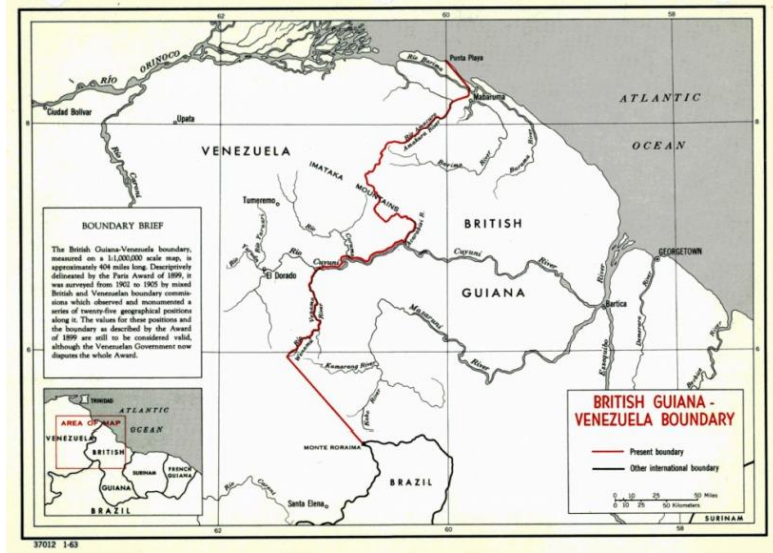
Image: Guyana-Venezuela border map (US Department of State) @Wikimedia Commons
Source: stravon.gr

