


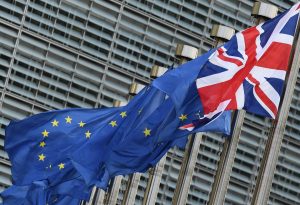
A Union Jack flag flies next to European Union flags in front of the European Commission building as British Prime Minister May is due to meet European Commission President Juncker for a dinner in a bid to unblock Brexit talks ahead of a decisive EU summit this week, in Brussels on October 16, 2017. EMMANUEL DUNAND/AFP/Getty Images
This article was originally published at Stratfor.com.
By Adriano Bosoni
From its very inception, the European Union has depended on the alliance between France and Germany. The bloc’s predecessor, the European Economic Community, formed with the principal goal of binding the two countries together so closely that another war on the Continent would be impossible. And from the 1950s on, a tacit agreement underlay their partnership: France was the main political and military power in the bloc, and Germany was the main financial supporter (paying for, among other things, onerous subsidies for French farmers). After German reunification in 1990, France even pushed for the creation of the euro as another way to strengthen Paris’ links with Berlin.
Over the past decade, however, that relationship has shifted. Germany emerged in the wake of the 2008-09 financial crisis as the European Union’s most important political and economic power, while France struggled with a weakening economy and a string of ineffective, unpopular leaders. Berlin didn’t want to be seen as Europe’s hegemon, in light of its history, and made sure to keep Paris involved in decisions over how to deal with the problems in the eurozone. Even so, Germany pressured its peers in Southern Europe into introducing painful economic and institutional reforms that may not have happened had France been in charge.
Unequal Footing
France traditionally has been worried about an ascending Germany. In the 19th and 20th centuries, its concerns stemmed mainly from the military implications of Germany’s rise. In the 21st century, by contrast, they are mostly related to economic and political issues. Since the creation of the eurozone, France’s trade balance has turned from surplus to deficit, while Germany’s trade surplus has broken one record after another. France’s gross domestic product grew by an average 0.8 percent each year from 2007-2016, fully half a percent lower than Germany’s average annual growth rate for that period. Unemployment in France, meanwhile, is twice as high as it is in Germany, and French voters are more dissatisfied with the political and economic status quo and less content with the European Union than their German neighbors are. (Their discontent explains why Euroskeptic and anti-globalization parties on the left and right alike performed so well in the French presidential election.)
An Opportunity Arises
Now, for the first time in a decade, Paris may be in the position to pursue a more balanced relationship with Berlin. France’s economy is growing again, and French President Emmanuel Macron, whose party has a solid majority in the National Assembly, has demonstrated his willingness to introduce the measures necessary to make that growth more sustainable. His vision for reforming the European Union has won the support not only of the French electorate but also of Southern European countries. On top of Macron’s plans to increase public spending by introducing a separate budget for the eurozone with a finance minister to manage it, Italy and Spain added their own proposals, including common unemployment insurance and deposit insurance systems across the bloc. As the United Kingdom, a country whose views on the economy are close to those of Northern European states, prepares to leave the European Union, these southern countries will have a chance to increase their influence in the bloc.
Germany’s current political upheaval could also be an opportunity for France. If talks to form a coalition government fail and Germany holds an early election, the process of eurozone reform would be delayed by several months since the bloc can’t make any big decisions without Berlin. At the same time, though, Germany’s focus on domestic issues has created a temporary power vacuum in Europe that France is trying to fill. Macron has been on a diplomatic offensive in recent months pitching his ideas for the European Union’s future to leaders across the Continent. With Germany temporarily out of the picture, Paris will be able to intensify this strategy.
Compared with its recent predecessors, the current French government is more willing and ready to push its proposals for the European Union. Paris can argue that, unless the bloc implements significant reforms in the next few years, anti-EU forces could win the French presidency in 2022 and threaten the bloc’s continuity. From Germany’s perspective, moreover, a more balanced relationship between Berlin and Paris would placate Southern Europe after a decade of austerity policies.
Enduring Challenges
Nevertheless, France faces several obstacles to its agenda. To begin with, Paris’ allies in Southern Europe are in no position to reshape the European Union. Italy will hold a general election in early 2018, and the vote could bring to power parties more willing to clash than to negotiate with the bloc. Though Spain has one of the fastest-growing economies on the Continent, the minority government in Madrid is too focused on preserving the country’s territorial integrity to have a strong voice at the EU level. Portugal is too small to influence the bloc’s affairs, despite its decent economic growth rate, while Greece is still under a bailout program.
https://www.forbes.com/sites/stratfor/2017/11/28/negotiating-the-eus-future-on-even-ground/#166520857346
