


 Balkan Insight
After a change in government in 2017, the Social Democrats came to power with many promises, not least a break from the practices of the previous VMRO-DPMNE administration.
All those unhappy with what former Prime Minister Nikola Gruevski and his allies had done to this beautiful country were full of hope that things were about to change, relatively quickly.
At the beginning of January, I was in Sofia as Bulgaria took on the presidency of the Council of the European Union. Bulgaria’s foreign minister, Ekaterina Zakharieva, told reporters that although Sofia had been the first to recognise Macedonia under its chosen name, the relationship between them had soured over the past 15 years due to the previous government.
Zakharieva said Sofia was delighted that things were changing and that they would seal a friendship treaty designed to set aside years of disagreement. The Macedonian parliament later approved the treaty, marking the first major step in ending the foreign policy of the previous government that had isolated Macedonia.
Then the government of Prime Minister Zoran Zaev concluded a deal with Greece that meant a change of name for Macedonia in exchange for Athens lifting its veto on Skopje’s Western integration with the EU and NATO.
The deal was seen as a breakthrough, and an example to the rest of the Western Balkans on how neighbours can overcome strong disagreement. But it turns out that Macedonia’s new foreign policy (which supports reconciliation) may not prove a precedent for the region.
The so-called Prespa Agreement hasn’t collapsed yet, but Macedonia’s ruling coalition made a mistake, in a Machiavellian sense; it let the people decide on the name change, but turnout in the referendum was low and so the government moved ahead without proper legitimacy.
As I wrote previously on Balkan Insight, after the failed referendum the West was trying to push through the change to satisfy its own political interests in the Balkans.
When I first heard about the idea that Zoran Zaev and his Greek counterpart, Alexis Tsipras, should be nominated for the Nobel Peace Prize, I was in favour.
But later I saw the hurdles to this process. The prize should not go to a project that has yet to be implemented, before we know whether it will be a success or not (the Swedish Academy has done this before, when it gave the prize to US President Barack Obama in 2009).
Moreover, if the Prespa Agreement is implemented, it is unclear “whether Macedonia will receive a reward from the EU for its efforts”, as Florian Bieber wrote.
So it was a risky political move which probably won’t be rewarded, but many of the voters could be forgiven for thinking the government is pushing through the change against the will of the people.
Fugitive
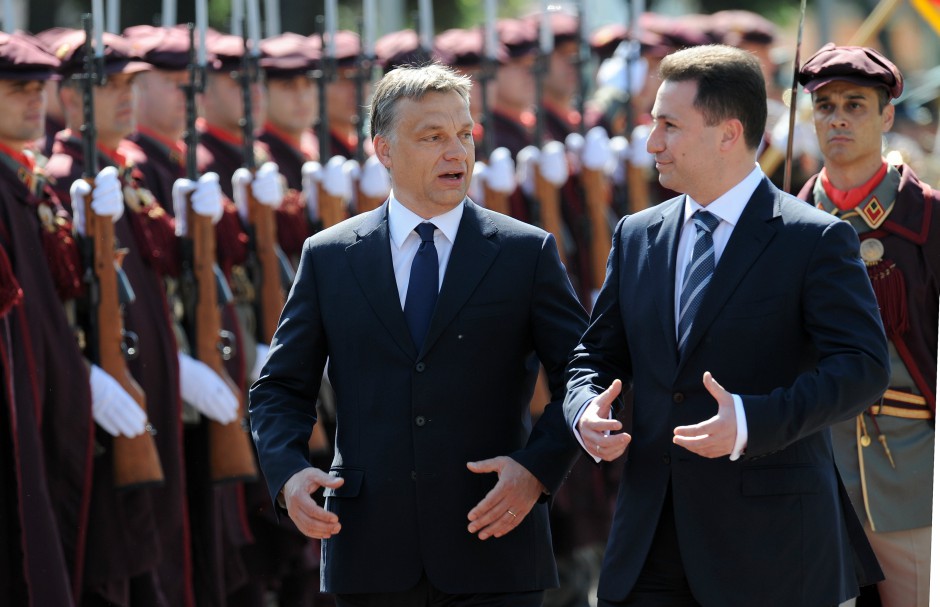 |
| Hungarian Prime Minister Viktor Orban accompanied by his Macedonian counterpart Nikola Gruevski review a military guard of honor in Skopje, The Former Yugoslav Republic of Macedonia, 2011. Photo: EPA-EFE/GEORGI LICOVSKI |
Gruevski’s subsequent escape suggested that perhaps this government isn’t much better than the last.
There are many signs that the Zaev government probably made a deal with VMRO–DPMNE to get the required votes in parliament for the constitutional amendments necessary to change the country’s name.
“It is it unthinkable that the government would not have known that Gruevski wanted to flee abroad,” Alajdin Demiri, Macedonia’s former ambassador to Switzerland, told the Hungarian weekly Magyar Hang.
And the head of Macedonia’s Helsinki Committee, Uranija Pirovska, told Balkan Insight last month: “This cannot be attributed to clumsiness or lack of expertise. I think this [escape] is a deal,”
The government has not been particularly vocal in asking for Gruevski’s extradition. Its supporters are not impressed by the whole story; many believe Zaev let Gruevski escape.
What is good for Zaev is that the former prime minister can no longer lead his party in person, clearing the way for the Social Democrats to tackle his legacy. At the same time, the debacle diverts attention away from the procedure to change the country’s name. But on the other hand, the government appears incompetent in handling the issue.
The Social Democrats are pushing the name change through parliament in order to distract attention from the government’s own failings, a tactic the previous government used.
Moreover, the parliament has approved a much-criticised partial amnesty for some of those involved in last year’s mob attack on the chamber. I wouldn’t want to be in the shoes of an MP who was beaten during the attack and was later expected to vote in favour of an amnesty for the perpetrators, as if spitting in my own face.
There are also some symbolic promises that current government has not kept.
Harald Schenker had an interesting piece on this on Balkan Insight. He wrote that the new government seems lost in details and has not broken from the practices of the previous government.
The people are waiting “for the one symbolic gesture that will convince them that the government means it,” Schenker writes. I must add: people are waiting for reforms regarding corruption, justice, etc. They won’t wait long. They will move on or turn against the current government, since people with high expectations are capable of anything if these expectations are not fulfilled.
Action in the field of foreign affairs, it seems, is not enough; you must govern your country as well. You need reforms. You have to make a clear break from from the acts of the previous government.
A sound foreign policy is not enough. You must act at home to have a stable background on which to make significant moves in diplomacy. The longer it takes for the Zaev government to learn this, the longer the Western Balkans will wait to move forward.
Bence Földi is a political scientist and a freelance journalist covering the Balkans and other topics in various Hungarian media outlets.
The opinions expressed in the Comment section are those of the authors only and do not necessarily reflect the views of BIRN.
http://www.balkaninsight.com/en/article/macedonia-in-2018-hope-betrayed-12-24-2018
