

Date: March 17, 2025
by Konstantinos D. Magliveras, Professor of Public International Law, University of the Aegean, Greece
I. Introduction
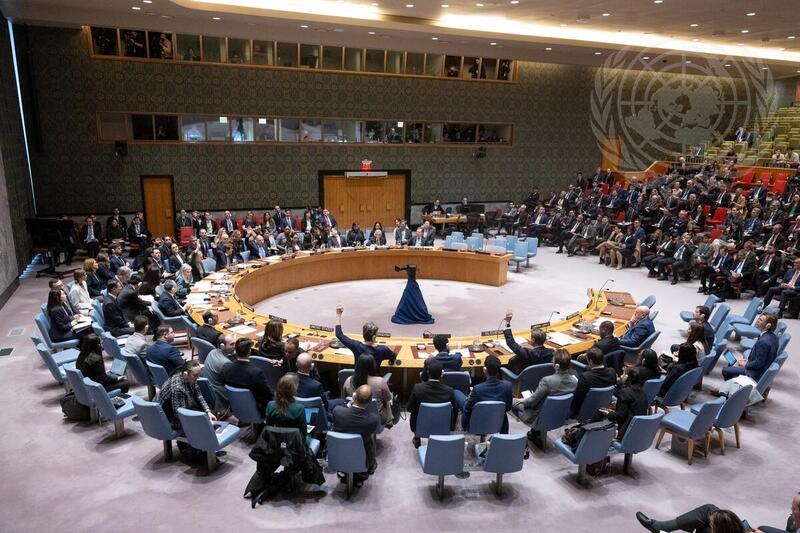
On 24 February 2025, the UN Security Council (UNSC) adopted Res. 2774(2025) on ‘Maintenance of peace and security of Ukraine’ with ten votes in favour and five abstentions. For the first time since the Russian Federation’s (RF) ‘special military opinion’ against Ukraine began in February 2022. It was introduced by the USA as UN Doc. S/2025/112. In less than 65 words, the UNSC exercised, in theory, its ‘primary responsibility for the maintenance of international peace and security’ (Art. 24 UN Charter). When on 27 February 2022 the UNSC adopted Res. 2623 (2022), which had resolved to call an emergency General Assembly (UNGA) special session to examine the situation in Ukraine, it was not implementing its primary responsibility. And this because, as stated in Res. 2623 (2022), the lack of unanimity of its permanent members prevented it from doing so.
This short article seeks to analyze critically the content of Res. 2774(2025), which was adopted at a period of time when the situation in Ukraine became the subject of intense diplomatic maneuvering in the UNSC and in the UN General Assembly (UNGA). On the whole, the UNSC has acted rather imprudently vis-à-vis the RF-Ukraine conflict, which has cost the life of hundreds of thousands and has caused desolation, misery and fear to millions. As affairs have been conducted in the UNSC since the beginning of the conflict, it took three years for the permanent members to find the equilibrium which ensured the adoption of a (toothless) resolution proclaiming the need for lasting peace.
II. The diplomatic maneuvering in the UNSC and in the UNGA
The text of Res. 2774(2025) is as if it had been written by a first year student, who ignores the UN Charter and the differences between Chapters VI and VII thereof and who wishes the world to be full of love and eternal peace. In particular, after ‘[m]ourning the tragic loss of life’ during the RF-Ukraine conflict, Res. 2774(2025) reiterated the principal UN purpose to maintain international peace and security and to peacefully settle disputes, ‘implored’ a swift end to the conflict, and urged a lasting peace between the two countries.
On the same day that Res. 2774(2025) was adopted, the UNGA, meeting as the Eleventh Emergency Session, approved a resolution, which also intended to bring peace and security in Ukraine. It was Res. ES-11/7 titled ‘Advancing a comprehensive, just and lasting peace in Ukraine’. The draft resolution (UN Doc. ES-11/L.10) had been tabled on 18 February 2025 by the EU Member States, states associated with the EU, Ukraine, as well as other non-European states ranging from Costa Rica to New Zealand. Invoking, inter alia, the March 2022 ICJ Order of Provisional Measures in Allegations of Genocide under the Convention on the Prevention and Punishment of The Crime of Genocide (Ukraine v. Russian Federation), Res. ES-11/7 not only reiterates ‘the urgent need to end the war this year’ but also touches on practical issues arising out of inter-state wars, namely the exchange of PoW, returning civilians forcibly transferred and deported, etc. But the question of Ukraine’s reconstruction and its financing was not mentioned, even though the EU has began implementing the G7-led initiative for Extraordinary Revenue Acceleration loans, which are destined for mainly restoring Ukraine’s critical infrastructure destroyed during the conflict.
In the meantime, on 21 February 2025, the USA had tabled its own draft resolution before the Eleventh Emergency Session. It was also approved on 24 February 2025 as Res. ES-11/8, ‘The path to peace’. Its text was almost identical with the aforementioned UN Doc. S/2025/112 adopted by the UNSC as Res. 2274 (2025). The only textual difference between them is that Res. 2774(2025) makes no reference to the principles of sovereign equality and territorial integrity of States, two of the UN cornerstones. And there was a most extraordinary development: the US abstained during the vote from its own proposal! The reason was that the EU states had successfully added (UN Doc. A/ES-11/L.14) these two cornerstones as a preambular paragraph into the text of US draft resolution, which now read “… Reaffirming its commitment to the sovereignty, independence, unity and territorial integrity of Ukraine within its internationally recognized borders, extending to its territorial waters …”. Thus, when the US draft resolution with the EU amendment came to vote, the USA chose to abstain rather than vote in favour. The reader can find the details in the Meeting record, UN Doc. A/ES-11/PV.20, which was available at the time of writing.
III. A rather worthless decision issued for face saving and to satisfy ephemeral political objectives
The RF applauded the US initiative to introduce UN Doc. S/2025/112. Calling it ‘common-sense’, it introduced a substantive amendment (S/2025/118), which would have added to the draft decision’s text the need to address the conflict’s root causes. However this amendment was not passed because it was voted down by seven states (including the five European members (Denmark, France, Greece, Slovenia, UK); USA abstained). And when the amendments introduced by the European members (S/2025/114, S/2025/115 and S/2025/116) came to the vote, the RF rejected them all (the USA and other members abstained). Arguably, vetoing in particular S/2025/115 is particularly problematic because the proposed amendment merely reaffirmed the UN’s commitment to Ukraine’s sovereignty, independence, unity and territorial integrity within its internationally recognized borders (including territorial waters). And the UN has made this commitment as recently as February 2023 in operating para. 4 of UNGA Res. ES-11/6 ‘Principles of the Charter of the United Nations underlying a comprehensive, just and lasting peace in Ukraine’, which was approved by 141 votes in favour to seven votes against.
While, as noted about, the UNSC fails to take cognizance of UNGA decisions, its members may not refuse to at least repeat what the latter, effectively most Member States, has already determined. And while the UNSC is a political, not a legal, organ, this does not mean that it can behave as it wishes and choose to forget that it is part of the Organisation’s institutional architecture as laid down in the UN Charter. Therefore, one should attempt to determine the legal basis of Res. 2774(2025). The UNSC did not find it pertinent to declare that, on account of the three year armed conflict in Ukraine, there exists a threat to the peace, most probably a breach of the peace, not to mention that for a majority of UN Member States it constituted an act of aggression as well. It follows that the UNSC implorations to a swift end and lasting peace were not recommendations under Article 39 UN Charter but action pursuant to Chapter VI, presumably under Article 36 UN Charter.
However, the latter provision expects the UNSC to recommend to the parties in conflict ‘appropriate procedures or methods of adjustment’. These are clearly lacking in Res. 2774(2025), which in reality expresses nothing more than wishful thinking. In rather pompous language, the US representative told the other UNSC members that they should join her country in its effort to ‘vanquish the scourge’ of this armed conflict ‘under the bold leadership of President Trump’, the latter reference rather reminiscent of proclamations made for leaders of totalitarian states. To clarify: if the US President or any other head or heads of state wanted to act as e.g. mediator/s or conciliator/s or to offer his / their good services for the conflict’s termination (Art. 33(1) UN Charter), a declaration to that effect ought to have been to the UNSC, which could have then proceeded under Art. 33(2) UN Charter and call upon the RF and Ukraine to settle their dispute by such means. The UN is a rules-based international organisation, whose norms and procedures must be applied equally and without distinctions.
What was issued as Res. 2774(2025) could very well have been issued as a presidential statement sometime this year, or last year or at any time since the RF’s ‘special military operation’. Presidential statements, a creation of practice, are made by the UNSC President on behalf of its members invariably following consultations among them. Even though there is no vote on them, presidential statements are included in the annual record of UNSC resolutions and are uploaded on the UN website. Often their content is not that different from resolutions; see e.g. S/PRST/2025/2 ‘on maintenance of international peace and security’. Given the unofficial nature of presidential statements, arguably UNSC members are willing to have them issued even though they would have probably blocked resolutions with the same content or language.
IV. Conclusions
During the RF-Ukraine conflict (and of course on many other occasions as well), the UNSC has revealed its inherent limitations and how precarious its operation can be to the point of questioning its purpose and continued relevance for the international community. Perhaps the real purpose behind Res. 2774(2025), and the similar decision which was tabled before the UNGA by the US delegation, was to offer a (legal) justification for a solution to the conflict to be pursued outside the UN’s formal structures and processes. But, whatever the purpose, those Member States sitting on the UNSC, either permanently or because they were elected by other Member States, have a duty to prevent the Organisation’s course towards oblivion and unworthiness. Arguably, this means voting against such decisions like Res. 2774(2025) and using all available ways and means consciously to materialise the UN’s goals and principles. –
Photo: UNSC votes on Resolution 2774(2025)

