


J. Karkazis, Strategic Reports, April 2025
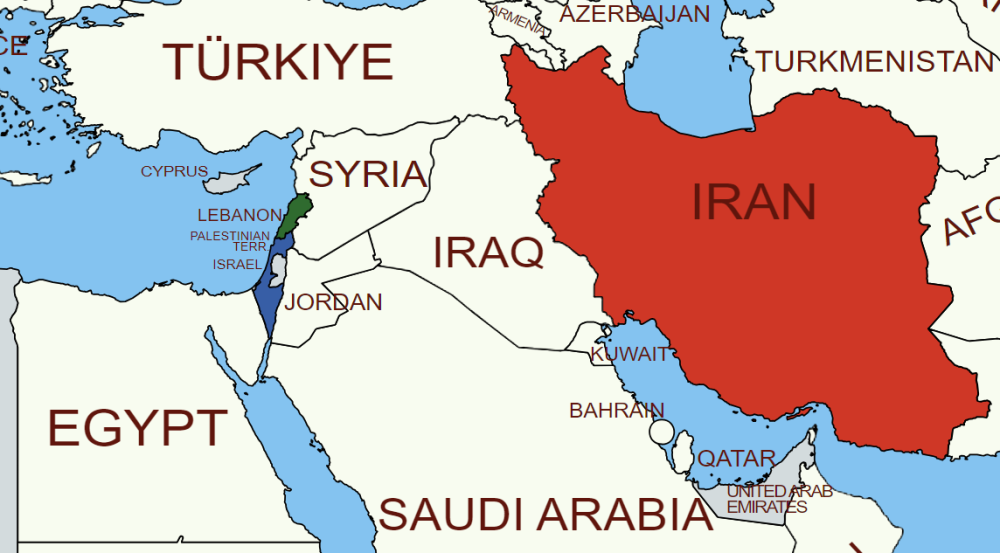
The massive multi-dimentional and highly sophisticated offensive operations of IDF (assisted by Mossad and Aman) against Hezbollah in Lebanon during the period October 2023 – November 2024 and the recent ones in southern Lebanon are most possibly related to the grand plan of Israel to attack Iran (with the use of nuclear weapons by both sides not excluded with certainty), an issue that has attracted the intense interest of analysts worldwide.
Attacking Iran runs for Israel the existential risk (although highly unprobable) of an Iranian nuclear unswer. This issue has attracted the strong interest of analysts, especially in US and Israel. See pages 8-12 in:https://www.researchgate.net/publication/367328134_ISRAEL’S_DIPLOMATIC_AND_MILITARY_OPTIONS_AGA INST_IRAN_AND_THEIR_INTERNATIONAL_IMPACT).
The preparatory stages of a massive Israeli attack against Iran are extended in five fronts: Lebanon, Syria, Iraq, Gaza and Huthi of Yemen. Israel has already eliminated the threats in Gaza. To assist Israel, US have recently undertaken the task of attacking military facilities in Yemen using for the moment low to medium. In Syria, Israel’s aims are:
(1) weakening or even eliminating the military presence of Turkey there by coming into an understanding with the Russians (regarding their military presence in northwestern Syria) and of course with the Kurds,
(2) drastically weakening the military capabilities of the Syrian regime,
(3) establishing a barrier between Syria and Lebanon regarding the capabilities of Hezbollah to interfere in Syria and
(4) creating an axis of geopolitical understanding and of military preparedness among Alewites in NW Syria, Kurds in northeastern Syria and Peshmerga forces in northern Iraq in order to check Turkish and Syrian regime interference capabilities and for military intervention in western Iran in the case a war between Israel and Iran erupts.
Regarding Lebanon, the main aim of Israel is to eliminate to an acceptable degree the Hezbollah’s missiles (especially the ballistic ones) threat imposed on IDF, on Arrow anti-ballistic missiles systems (especially Arrow 3) and on the population of northern Israel.
In this context, the main threat comes from the Iranian Fateh and the Scud missile systems established in Lebanon by Hezbollah, especially the supersonic Fateh 110 variance having a range of 250 and possibly 300 km.
This variance is capable of (theoretically) disrupting Arrow systems capabilities against Iranian ballistic missiles directed towards central and southern Israel only in the case that these ballistic missile systems are located in southern Lebanon.
This explains to a large degree the massive Israeli missile and airforce attacks there. Regarding the numbers of the above ballistic missiles operated by Hezbollah there is an uncertainty, with estimations for the Fateh system varying from tens to a few hundreds and only a few ones for the Scud system.
In any case, the outstanding intelligence capabilities of IDF and Aman lead to the assumption that Israel has already located most of the secret depots accommodating the above systems and destroyed a large percentage of them. For the complete elimination of the above threat Israel should have undertaken extremely costing massive ground military operations in southern and central Lebanon that would provoke very strong international reactions, especially from US and France.
The disruption of Arrow systems capabilities in case of massive ballistic missiles attack (mainly related to saturation effects at a software level) became apparent in the Iranian attack against Israel in 1 December 2024. This issue is examined in pages 7 an 8 (Patriot systems malfunctions) in: https://www.researchgate.net/publication/383859951_THE_UKRAINIAN_POLITICAL_AND_MILITARY_ENIGMA Tackling in an effective way the above Arrow shield problems requires highly complex and time consuming interventions probably extending to several months. On the other hand, developing “high energy systems” (that offer far more advanced capabilities) to replace existing anti-ballistic 2 systems requires several years.
Never the less, Israel is proceeding with full speed towards this direction. Related Bibliography Iranian satellite’s program advances and geo-strategicimplications (J. Karkazis) https://www.researchgate.net/publication/339460077_Iranian_satellite’s_program_advances_and_geostrategic_implications?_sg%5B0%5D=fZCkxai4ZuY7zUixkwmE31kdx1qvJQulRMhDiatBYUqz0XG8e09rFxYM0MB 3wykaWLYRAFcyBj_5KaKQrrGIwqjMG5Rzz0kOfBZHryvx.TUq1KBogzzE2mvVjTgkCAnvW_X3jTGkLbI77yVGnqNGWKKK7- _4L5jpzLxjjIWiOjqy4A3ARKPlEytYFG9drA&_tp=eyJjb250ZXh0Ijp7ImZpcnN0UGFnZSI6ImhvbWUiLCJwYWdlIj oicHJvZmlsZSIsInBvc2l0aW9uIjoicGFnZUNvbnRlbnQifX0 Iranian satellite’s program advances and geo-strategic implications (J. Karkazis) https://www.researchgate.net/publication/339460077_Iranian_satellite’s_program_advances_and_geostrategic_implications Defense analysis aspects regarding the possibility of deployment of Shahab-3 and Shahab-4 class of ballistic missiles against Israel, Turkey and Eastern Europe (J. Karkazis & G. Isen) https://www.researchgate.net/publication/339460452_Defense_analysis_aspects_regarding_the_possibility_of_deploym ent_of_Shahab-3_and_Shahab4_class_of_ballistic_missiles_against_Israel_Turkey_and_Eastern_Europe?_sg%5B0%5D=HMUw7NQYr6OY792Jyc Up7ZwfzrX2VsE8bYr7nKvofVbsOO5y367185Q236cnrEzd0OvivqHM_- NlIGkpR7JHywKXqdeLFTZEsPKLB7nu.mnrRM8x4fooTWIXxIbIYAUegjCOxsbo_fTBxFs_- 0sjvkrwQ6Mr1iOFJ5SFHc1gZlSz_lu2OfCCo3YRuB_lmPA&_tp=eyJjb250ZXh0Ijp7ImZpcnN0UGFnZSI6ImhvbWUi LCJwYWdlIjoicHJvZmlsZSIsInBvc2l0aW9uIjoicGFnZUNvbnRlbnQifX0 Geographic Information System “Ptolemeos – Ballistic” (J. Karkazis) https://www.researchgate.net/publication/339460383_Geographic_Information_System_Ptolemeos_-_Ballistic A simulation-based analysis of Iranian ballistic missiles and Israeli interceptors (J. Karkazis) https://www.researchgate.net/publication/339447269_A_simulationbased_analysis_of_Iranian_ballistic_missiles_and_Israeli_interceptors

