


The extremists get louder, the center struggles, and all of Europe will feel the effects.
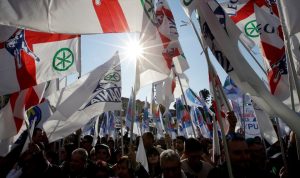
The anti-fascist demonstration was a rare moment of unity of the left in the face of a consolidating right. The center-left Democratic Party of former prime minister Matteo Renzi, which has governed Italy—and not badly—for the past five years, is expected to draw only around 22 percent of the vote, not enough to form a government, a phenomenon that stems from the party’s internal weaknesses but has far greater implications. At Salvini’s rally in Milan, people held signs that said “Italians First,” the League’s motto, and waved separatist flags—from the wealthy Northern Italian regions of Lombardy and the Veneto, from Catalonia and Sardinia. The rise of the right is a pattern that’s played out in elections in several European countries, as establishment parties have failed to harness popular sentiments and more extreme groups have stepped in to offer their own strident visions of the future. The League, which has made a play for Italy’s neglected working class, is a sovereignist party that wants to send back immigrants and re-write European treaties. The lesson for Italy is that its messy politics are no longer local. They could wind up irrevocably destabilizing the European Union, of which it was a founding member.
The aftermath of the Arab Spring and Syrian Civil War has reshaped politics across Europe, and no party in Italy has played on immigration more than the League. Since 2014, more than 500,000 migrants have arrived in Italy, a country of 60 million people, most of them on boats from North Africa. The system for processing asylum applications is slow and imperfect. The migrants, not all of whom are asylum-seekers, are stuck in Italy, many unable to work legally, often living in squalid encampments. For years now, Italian television has shown an endless loop of migrants disembarking from boats.
Enter Salvini, who is 44 and took over the League five years ago. Now the oldest existing political party in Italy, the Northern League was founded in 1989, advocating the independence of the wealthy Italian north. It used to consider Rome the enemy, although it was a junior partner in several Berlusconi governments. Salvini has been transforming it into a national party, with foreigners, and to a certain extent Europe, as the enemy.
In his Milan speech, Salvini incongruously quoted Pier Paolo Pasolini, the great intellectual of the left, about anti-fascist demonstrations of the past—Pasolini had speculated in 1973 that such demonstrations “may ultimately be a weapon of distraction aimed at capturing dissent by fighting a non-existent enemy, while modern consumerism is eroding an already moribund society.” But Salvini has mostly borrowed a lot of his rhetoric from France’s far-right National Front, led by Marine Le Pen, with some exceptions, including the brazen use of religion, which is absent from political discourse in secular France. At the rally in Milan, Salvini also quoted the Gospel of Matthew—“the last shall be first”— several times, in his appeal to the working class, the disabled, people who feel neglected. Then he pulled out a rosary—a rosary!—which he said a woman had given him on the campaign trail. It was an obvious play for votes in the South, where the right has always had strong results, although the formerly Northern League hasn’t. And sure enough, Italian television and newspapers all carried images of Salvini, secular separatist, holding up the rosary, as if he were the second coming. His campaign posters say “Salvini Prime Minsiter” with an image of a knight wielding a sword and shield.
The Macerata incidents have defined the campaign, giving momentum to the right in its fight against illegal immigration, and underscoring the weaknesses of the left in countering it with a clear response. No ministers from the current center-left government went to visit the six people wounded by the right-wing shooter, for instance.
The League also definitely has fascist sympathizers, and Salvini has never disowned them, although he has repeatedly said that the League is non-violent and stands with law enforcement. The neo-fascist Casa Pound group, which is fronting some candidates but is not expected to reach the 3 percent threshold necessary to enter Parliament, recently said it would support a Salvini government. Pressed on this in a television interview, Salvini said only that he didn’t think he’d need their support, not that he didn’t want it.
Salvini talks often about the idea of the “good immigrant,” someone who “respects the law,” and says that he just wants a more coherent immigration policy. But he can often be more extreme. He once mocked Laura Boldrini, the speaker of Parliament and a former official at the United Nations refugee agency, comparing her to a sex doll that a supporter held up behind him on stage at a campaign rally. This week, Salvini said on prime-time Italian television that maybe George Soros would be sending waves of immigrants to Italy, in an echo of the anti-Semitic trope that Hungarian Prime Minister Viktor Orban has been using in his country.
In the face of such brazen right-wing fear-mongering, you would think that the Italian left might present a clear democratic vision, one that reflects the current government’s respectable efforts. But you would be wrong. “In the electoral debate, the political agenda has been dictated by the right,” said the author Marta Fana, who has written on Italian labor reforms. “So where the parties to the left of the Democratic Party centered their programs on questions of work, all this got very little attention in the big national debate. It’s easier and more reductive to play on immigration.”
In the years when Berlusconi was in power, opposing him united the left. Now that he’s not running the country, they’re even more divided. Renzi took over the Democratic Party in 2014, but was seriously compromised and stepped down as prime minister after losing a referendum in 2016. Last year, some of the party’s old guard, mainly former communists, broke away and founded a splinter movement. The divisions aren’t so much ideological as personality-driven. “The right has a field,” Ezio Mauro, a columnist and former editor of La Repubblica, the center-left daily, told me, while the left, he said, is divided into “private gardens.”
All this means that Salvini is on the rise and Renzi on the decline—a dangerous development, since the League, despite having been part of multiple Berlusconi governments, is effectively an extremist party. Salvini has made clear that his sympathies lie with the current governments of Hungary and Poland, which are inward-looking, nationalistic and spit on Europe even as they take European Union funding.
“Italy’s a laboratory,” said Roberto Saviano, the author of Gomorrah and a public intellectual in Italy, told me. “What happens in Italy can happen in the rest of the world. Don’t forget Mussolini-Hitler,” he said, referring to the Axis sympathies between the leader of Fascist Italy and Nazi Germany. “The Red Brigades prefigured terrorism across Europe,” he added, about the dark years of the 1970s when leftist terrorists waged war against the state in Italy and Germany and elsewhere, murdering judges and other public figures. “Don’t forget Berlusconi-Trump,” Saviano said, referring to the media mogul, who, as I wrote recently, provided the template for turning an audience into an electorate. “We’re a laboratory that the world should pay attention to see the avant-garde of what will happen in other democracies.”
https://www.theatlantic.com/international/archive/2018/03/italy-elections-lega-nord/554753/
