


July 31, 2025
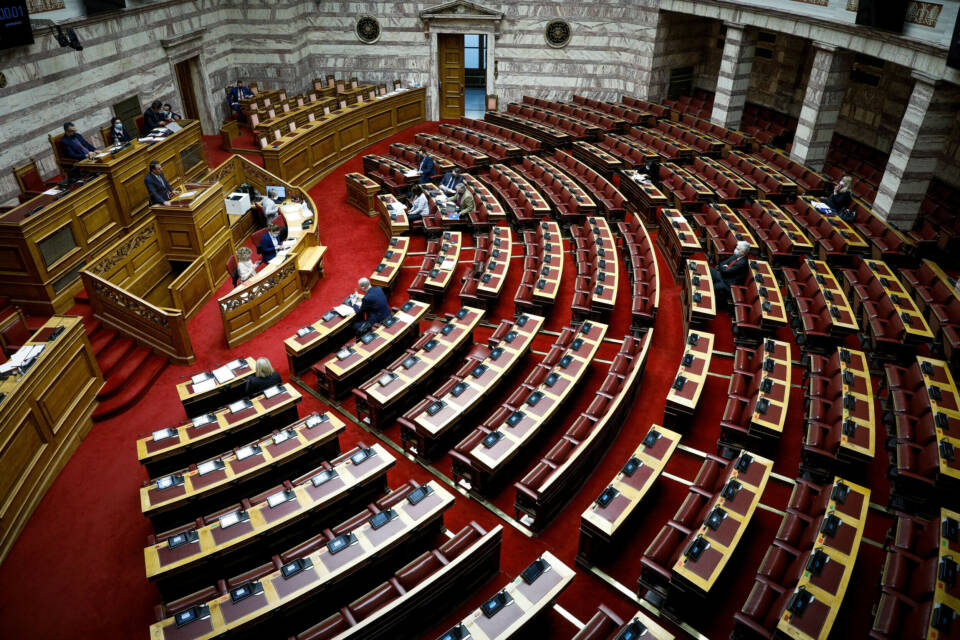
The parliamentary majority of New Democracy during the 2008–2009 period withdrew three times (twice for the Vatopedi case and once for the Pavlidis case) from parliamentary sessions that concerned proposals for the establishment of a special parliamentary committee to conduct a preliminary investigation under Article 86 para. 3 subpara. b of the Constitution. On all three occasions, control of the procedure passed to the opposition MPs who were present, and no secret ballot was held because at least 151 MPs—the constitutionally required majority—were not present. The proposals for the formation of a preliminary investigation committee were not rejected but remained pending. The then Speaker of the Hellenic Parliament, the late Dimitris Sioufas, who was himself presiding, accepted the position of the opposition, respecting Article 67 of the Rules of Procedure of the Parliament.
The current parliamentary majority of New Democracy, that is to say, its leadership, in the case of OPEKEPE, did not want to follow what it termed the “Triantopoulos/Karamanlis model,” namely the formation of a preliminary investigation committee which, through an expedited process, referred the accused ministers in the Tempi case to the investigating magistrate and the judicial council of the Special Court, even for the misdemeanor of breach of duty.
Nor did it want to withdraw, following the precedent of the 2008–2009 period, leaving the proposals for the formation of a preliminary committee pending, fearing their possible revival in this or the next parliamentary term.
Nor did it want to allow its MPs to personally and conscientiously participate in the secret ballot, fearing the number of defections that could undermine its cohesion.
Faced with this impasse, the leadership of the ruling party chose not only a blatant violation of the Constitution and the Rules of Procedure of the Parliament but a multiple degradation of institutions:
First, it forbade its MPs from participating personally and conscientiously in the secret ballot and placed them under suffocating control, degrading the institutional role of the government-side MP.
Second, it blatantly violated the provision of Article 70A of the Rules of Procedure of the Parliament, which permits postal voting only when the MP is on an official mission abroad for the government or the Parliament, or in cases of pregnancy or maternity, or when pandemic-related restrictions apply. In doing so, it degraded the provision for postal voting.
Third, it attempted to artificially fabricate the conditions required for a valid parliamentary decision, by asserting that these consisted of a quorum of at least 75 MPs under Article 67 of the Constitution. However, Article 67 of the Constitution does not stipulate a quorum for the Parliament’s session but rather the minimum number of votes required to make a decision, unless a more specific constitutional provision requires a larger number, that is, an increased majority of the total number of MPs. Such a provision, more specific than Article 67, is Article 86 para. 3, which requires an absolute majority of the total number of MPs (151 out of 300). Despite the effort, in the end only 83 MPs participated in the vote, and thus the requirements for a valid decision—which require at least 151 and not merely 75 MPs—were not met. The vote was therefore invalid, and the conclusion that the proposals for the formation of a preliminary investigation committee were supposedly rejected was inaccurate. The proposals remain pending until they are put to a vote in accordance with the Constitution and the Rules of Procedure of the Parliament.
Fourth, it placed the Speaker of Parliament in an extremely difficult position and led him to a conspicuous absence from the entire process, for which he is institutionally responsible. Consequently, it drove the presiding Vice-President and former Minister of Rural Development to a blatant violation of Article 67 para. 7 of the Rules of Procedure of Parliament, as he refused to put to a vote the objection raised by PASOK and supported unanimously by the opposition, regarding his rejection of the motion to postpone the vote. This, with the childish justification that there were 90 MPs in the chamber who, in the very next minute, were no longer there because the opposition walked out in protest! Furthermore, the Minutes of Parliament and the audiovisual material of the session recorded numerous violations of the provisions of Article 73 of the Rules of Procedure of Parliament, which govern the conduct of secret ballots. The blow to the dignity of the Parliamentary Presidency is unfortunately significant.
I wonder, what was the reason for this extreme disgrace of Parliament? The government majority could have participated normally in the vote, and the proposals might not have gathered 151 affirmative votes and thus be rejected, even with some defections among ruling party MPs. The institutional and political cost for the government would have been much smaller than the cost of the image of institutional degradation that was recorded yesterday. The government majority could also—an extreme and borderline scenario—have declared its abstention from the vote, with its MPs refusing to participate in the secret ballot but remaining present in the session so as to retain the ability to make procedural decisions without violating this whole set of provisions of the Constitution and the Rules of Procedure. Of course, this would still violate the fundamental guarantee of the MP’s right to vote according to conscience, particularly in such a judicial-type procedure, in which MPs must not be subjected to ironclad party discipline.
If all this is a demonstration of complete disregard for the constitutional framework of parliamentary functioning, the situation is institutionally precarious. If all this is the result of political fear for the cohesion of the majority, the underlying problem is not addressed through such high political-cost maneuvers. If the shift from the “Triantopoulos/Karamanlis model” to yesterday’s model means that there is now no longer even the minimal comfort to express trust in the “natural judge” of the Special Court, then things may have a depth not yet visible to the naked eye.
The common denominator seems to be a crisis of internal trust and self-confidence despite appearances. Such a crisis, however, almost automatically becomes a crisis of legitimacy.-
*Evangelos Venizelos served as Deputy Prime Minister and Minister of Finance and Foreign Affairs during the economic crisis. He also served as President of PASOK. He is Professor Emeritus of Constitutional Law at the Aristotle University of Thessaloniki.
**The translation from Greek to English was carried out by Anichnefseis.

