

Expert findings indicate that there is a natural gas deposit in the eastern Mediterranean with a total value of $3 trillion
Editor / InternetYeni Şafak
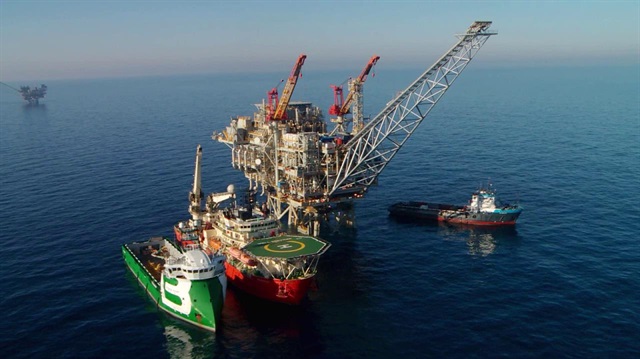
Considering the size of the total hydrocarbon deposits in the eastern Mediterranean, experts claim that it would be sufficient to meet 572 years’ worth of Turkey’s natural gas needs.
Turkey’s maritime jurisdiction has resurfaced on the agenda as a power struggle regarding energy reserves in the eastern Mediterranean continue. It is claimed that there are natural gas reserves in Turkey’s maritime jurisdiction that could meet 572 years’ worth of the country’s energy needs.
Greece, which seeks control of energy deposits of the eastern Mediterranean, is trying to draw sea borders via Libya and Crete. Meanwhile, the Greek Cypriot administration is negotiating with Egypt and Israel.
According to Dr. Cihat Yaycı’s “The Issue of Sharing Marine Jurisdiction in the eastern Mediterranean and Turkey,” this region boasts rich energy resources.
Considering the size of the total hydrocarbon deposits in the eastern Mediterranean, Dr. Yaycı emphasized that it would be sufficient to meet 572 years’ worth of Turkey’s natural gas needs. According to Turkish Petroleum Corporation (TPAO) estimates, the eastern Mediterranean is also rich in gas hydrate deposits, which have been dubbed as the energy of the future.

TurkStream’s nearshore works start in Kıyıköy, Turkey
Nearshore trench works for the TurkStream natural gas pipeline project started on Sunday, July 22 near Turkey’s northwestern town of Kiyikoy, the South Stream Transport B.V Company that is conducting the offshore pipeline said Monday.According to the official announcement, Turkey’s nearshore component involves constructing seabed trenches of around 2.4 kilometers in length from the shoreline to the sea in order to embed the pipes as a protection against sea waves and to avoid interference with fishing in the area.The offshore trenching process is expected to last four to eight weeks.The company noted that independent third party experts prepared an environmental impact assessment (EIA) to determine the best route for the pipeline, taking into account potential environmental impacts and other risks.”These studies demonstrate that the nearshore work will have small, temporary and localized effects for the local fishing industry. After a thorough consultation process with various Turkish stakeholders, including local community representatives and fishing groups, the Turkish Ministry of Environment and Urbanization approved the EIA in September 2017,” the company said.”We are pleased to be in line with our construction schedule to ensure that gas deliveries start by the end of 2019. We will try and make sure to minimize and mitigate the disturbance to the local residents during the nearshore works,” Sander van Rootselaar, the TurkStream spokesperson added in a written statement. According to the announcement, the TurkStream project company is engaging with local fishermen over a voluntary compensation scheme for potential loss of income during the period of nearshore works within the framework of its commitment to remedy any local impacts.”The compensation scheme is part of TurkStream’s corporate responsibility and good neighborhood policy, in combination with a series of other measures intended to support the wellbeing of the local economy and people of Kiyikoy,” the company explained.In addition, the company said that in parallel, the Pioneering Spirit, the largest construction vessel in the world undertaking pipelaying for the project, is progressing at a fast pace since the offshore construction of the second line resumed on June 26.Furthermore, the landfall facilities on the Russian side of the Black Sea near the city of Anapa is in the final stages of construction and will be completed in 2018, the company said.TurkStream is a gas pipeline project stretching across the Black Sea from Russia to Turkey and further to Turkey’s border with neighboring countries.The first line of the pipeline intends to supply gas to Turkish consumers, while the second line is designated for consumers in southern and southeastern Europe.Each line will have the throughput capacity of 15.75 billion cubic meters of gas per year.South Stream Transport B.V. is responsible for the construction of the gas pipeline’s offshore section.
Turkey boosts efforts to protect eastern Mediterranean
Greece is trying strike a deal with the Greek Cypriot administration. In some maps published by Israel, the Greek Exclusive Economic Zone is shown as the continuation of South Cyprus.
However, Turkey has increased its efforts in the face of this cooperation. It recently halted Italian ships who sought to conduct drilling in the Turkish Republic of Cyprus with warships.
South Cyprus is attempting to sign an agreement with Egypt and Libya over oil exploration sites it has set up in the main land state of Egypt and Israel, which accepted the deal despite incurring losses in order to spite Turkey.

Turkey’s place in Euro-Caspian energy development
Two extremely important events for Turkey’s energy policy took place within days of each other at the end of May and in early June. The first was the formal opening of the Southern Gas Corridor (SGC). The second was the order, by Dutch courts, that Gazprom’s assets in the Netherlands be frozen.That court order was rendered in forfeiture for Gazprom’s failure to honor the ruling in March by the Arbitration Institute of the Stockholm Chamber of Commerce that it owes $2.6 billion to Ukraine’s Naftogaz, for failing to fulfill supply contracts and underpayment of transited gas.The combination of these two outstanding events decreases the chances of the Turk Stream 2 project being successfully implemented, and increases the chances of the further expansion of the SGC to the eastern shore of the Caspian Sea.The significance of the SGC for Turkey, the South Caucasus, and Europe is well known. It allows Azerbaijani natural gas to reach Turkey through the Trans-Anatolian Natural Gas Pipeline (TANAP), and later Europe through the Trans-Adriatic Pipeline (TAP).Opening with 6 billion cubic meters per year (bcm/y) of natural gas for Turkey, the pipeline’s volume will increase to 16 bcm/y when the TAP is opened next year. The other 10 bcm/y will land in Italy. Capacity is planned to ramp up to 24 bcm/y by 2023, but since both TANAP and TAP are opening ahead of schedule, it is not impossible that that date be moved up. Then in 2026, the capacity is planned to increase yet again, this time to 31 bcm/y.It is already understood that these additional volumes cannot come from Azerbaijan. The best candidate to supply them is Turkmenistan. Last August, Azerbaijan and Turkmenistan issued a joint public statement (the first between them of its kind) declaring the intention to work together to bring gas from Turkmenistan to Europe.Since then, the Trans-Caspian Pipeline has been confirmed as one of the EU’s Projects of Common Interest, qualifying it for financial support.State Oil Company of Azerbaijan Republic (SOCAR) executives at the SGC opening ceremony in Baku clearly stated their belief in this possibility and their readiness to realize it. Remarks made by U.S. Deputy Assistant Secretary of State Sandra Oudkirk also indicated American support for this.The second event mentioned above is the legal move by the Ukrainian company Naftogaz in the Netherlands, that caused to be frozen, in early June, Gazprom’s assets in there, including the project companies for Nord Stream 2 and Turk Stream 2.Naftogaz has also succeeded in freezing Gazprom’s assets in Switzerland, specifically the Nord Stream and Nord Stream 2 project companies. Similar moves are expected to follow quickly in the United Kingdom. These assets were frozen by the courts as a result of Gazprom’s refusal to pay the Stockholm arbitration awards.Gazprom alleges the presence of “linguistic evidence” that the legal decision was written by some party or parties external to the court.However, an appeal does not cancel Gazprom’s obligation to settle the debt immediately. As the court decisions show, the appeal does not affect the enforcement process either.The Stockholm award to Naftogaz was for Gazprom’s unilateral increase of gas prices to Ukraine by 80 percent following the Russian occupation of Crimea, and its unilateral imposition of a “take-or-pay” regime, by which Ukraine would have been obliged to pay for the gas whether it actually imported the gas for consumption or not.As a result, Gazprom has injured the credibility of any assurances that Russia might have given the EU about maintaining gas flows through Ukraine in the event that Nord Stream 2 is ever built.That credibility had already been injured by Russia’s unilateral cut of contracted exports to Ukraine and Europe in the winter of 2006 and 2009, something the Soviet Union has never done, even at the height of Cold War tensions.The freezing of Turk Stream 2 assets in the Netherlands holds clear implications for Turkey and the Black Sea region. In all likelihood, it puts an end to the possibility (extremely unlikely in any case) that Turk Stream 2 makes landfall in Bulgaria.That possibility had been discussed by Bulgarian Prime Minister Boris Borissov and Russian President Vladimir Putin in Moscow in May. It is no longer clear whether Turk Stream 2 will even be built, even though the pipes for it are stockpiled in Bulgaria from the old South Stream project.Nor is it clear who would be the final consumers of any gas it might carry, since conditions for the original Turk Stream to make landfall in Turkey have finally been negotiated between the two sides, and Turkey will not need any further gas from Russia.These two events–the SGC’s opening and the Gazprom court decisions in the Netherlands–confirm trends already present for some time in Turkey’s geo-economic energy environment. They confirm Turkey’s central place in the Euro-Caspian meta-region and establish the basis for its further prominence there. Also, together these two events strongly indicate that every effort should be made to implement the extension of the SGC to Central Asia, and Turkmenistan in the first instance.
Turkey defends rights
The Greek Cypriot administration and Greece are trying forge legitimacy in the eastern Mediterranean with these agreements, contrary to international law and legitimacy. The sole purpose is to prevent Turkey from benefitting from energy resources.
In response, Turkey is declaring its rights as per the Exclusive Economic Zone and affirms its determination to defend its rights. Turkey’s previous maritime jurisdiction areas were redrawn by Dr. Yaycı.
Greek ploys to not be allowed
Turkey is seeking to determine jurisdiction areas through agreements with Libya, Egypt, Lebanon, Israel and Syria. If necessary, Turkey will notify the United Nations of the detrimental efforts of Greece and the Greek Cypriot administration.
In the eastern Mediterranean, the Greek Cypriot administration, Libya, Syria, Lebanon and Israel have been declared exclusively in the Economic Zone.

Turkey’s Tüpraş reduces Iranian crude purchases as US sanctions loom
Turkey’s biggest oil importer Tüpraş has cut back purchases of Iranian crude since May, when the United States said it would re-impose sanctions on Tehran, and analysts say Tüpraş is likely to stick to lower volumes in coming months.In the first four months of 2018, Tüpraş, Turkey’s largest refiner, bought an average of 187,196 barrels per day of Iranian oil, data from Turkey’s energy watchdog EPDK showed.In April alone, Tüpraş imported eight cargoes – equivalent to just over 240,000 bpd – from the OPEC member.But since May, when President Donald Trump announced the re-imposition of U.S. sanctions on Tehran after pulling out of a 2015 nuclear deal, Tüpraş’s purchases of Iranian oil have gone down.Iran slams Pompeo’s ‘mafia’ remark as ‘hypocritical, absurd’Tehran shipped four cargoes of crude oil per month to Tüpraş, equivalent to around 130,000 bpd, in May and June, tanker tracking and shipping data showed, down from six to eight earlier in the year.So far in July, Tupras has bought three more cargoes.The United States is due to re-instate sanctions on Iran’s energy sector after a wind-down period ends on Nov. 4.An industry source said the U.S. decision was the main reason for the decline in Tüpraş’s purchases of Iranian oil since May, but said the company was likely to continue importing some Iranian crude, as it did when U.S. sanctions were previously in force.Iran will resist Trump’s ‘psychological warfare,’ says senior Guards commander”During the sanctions scheme of 2011 by the U.S., Tüpraş was able to purchase 3 to 4 cargoes of Iranian crude a month,” the industry source said.”I believe they would want to be able to stick to that this time as well instead of completely stopping. This crude needs to be bought by someone as otherwise it will send the price shooting up, which nobody wants,” he said.Refiners in other countries are affected by the sanctions because they want to maintain their access to the U.S. financial system. Indian refiners also cut imports of Iranian oil last month to avoid looming U.S. sanctions.SANCTIONS WAIVERSTrump initially planned to totally shut Iran out of global oil markets, demanding all other countries stop buying its crude by November.Trump warns Iran to ‘never, ever threaten’ US or suffer consequencesThe United States later said it may grant sanction waivers to some allies that are particularly reliant on Iranian supplies.Most analysts still think the sanctions will significantly reduce Iran’s crude oil exports, with some forecasting as much as a two-thirds drop to 700,000 barrels per day (bpd).Turkey has criticised the U.S. decision, saying Ankara will not cut trade ties with Iran at the behest of other countries.After meeting a U.S. delegation in Ankara on Friday, the Turkish foreign ministry said authorities were working to avoid the U.S. sanctions from harming Turkey.In the past, whenever Turkey has needed to cut back on Iranian oil, Iraqi crude emerged as the alternative. Analysts say that is again likely to be the case in the coming months.”Iran and Iraq have traditionally been Turkey’s two biggest crude oil suppliers,” Cuneyt Kazokoglu, head of oil demand at consulting firm FGE, said. “It won’t be a surprise to see more Basra barrels flowing to Turkey,” he said.In the first four months of the year, Turkey imported an average of 39,768 bpd of Iraqi oil.In the whole of 2017, Iraq was Turkey’s third biggest supplier of crude after Iran and Russia, with 7 million tonnes of oil, equivalent to around 141,000 bpd.
Those who sign deals with Turkey have more to gain
Dr. Yaycı stated that the maritime jurisdiction deals that the Greek Cypriot administration signed with Israel, Lebanon and Egypt would do them more harm than good. Israel was afforded 4,600 square kilometers, Lebanon was afforded 3,957 square kilometers and Egypt was afforded 21,500 square kilometers of maritime jurisdiction in the deal.
According to his studies, Dr. Yaycı claims that had Israel signed a deal with Turkey instead of the Greek Cypriot administration, it would have attained a far greater area of maritime jurisdiction. The same is applicable for Egypt, and now both countries are attempting to abort the deals they struck.
Eastern Mediterranean gas deposits worth $3 trillion
Expert findings indicate that there is a natural gas deposit in the eastern Mediterranean with a total value of $3 trillion. The U.S. Geological Survey Center estimates that there are 3.45 trillion cubic meters of natural gas and 1.7 billion barrels of oil in the Levant Basin, which lies between Cyprus, Lebanon, Syria and Israel.
It is estimated that about 1.8 billion barrels of oil, 6.3 trillion cubic meters of natural gas and 6 billion barrels of liquid natural gas are located in the Nile Delta Basin. Apart from the 8 billion barrels of oil that is thought to be found around Cyprus Island, the south of Crete, called Heredot, is estimated to have 3.5 trillion cubic meters of natural gas.
https://www.yenisafak.com/en/news/east-med-natural-gas-reserves-could-meet-turkeys-energy-needs-for-572-years-3437159
