



 By Dimitris Tsailas
This article examines the strategic and legal significance of Kastellorizo, a small Greek island in the Eastern Mediterranean, within the broader context of maritime geopolitics and international law.
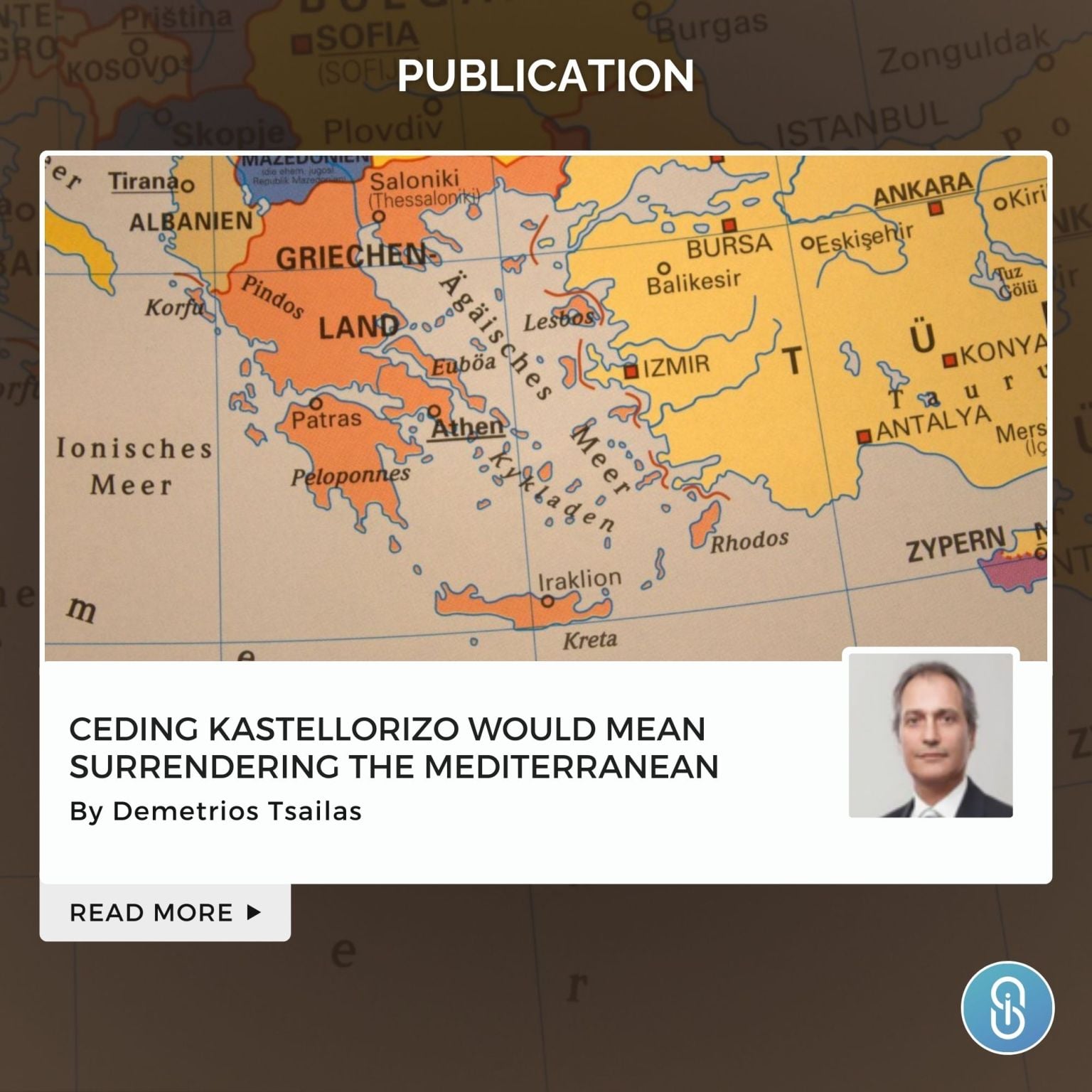
In geopolitics, size is often a distraction. Nowhere is that truer than in the Aegean and Eastern Mediterranean, where a tiny island—Kastellorizo—may hold the key to the balance of maritime power in Europe’s southern flank. Located just two kilometers off the Turkish coast, but politically and culturally Greek, Kastellorizo is more than a dot on the map. It’s a linchpin in a fragile but essential chain that connects Greece and Cyprus through their maritime Exclusive Economic Zones (EEZs).
These legal maritime boundaries, recognized under the United Nations Convention on the Law of the Sea (UNCLOS), define control over natural resources and shipping lanes—provided they are respected. This island forms a critical maritime link in the chain that connects mainland Greece with Cyprus through their respective Exclusive Economic Zones (EEZs).
Under the United Nations Convention on the Law of the Sea (UNCLOS), these zones confer rights to undersea resources and sea-lane governance. [1] Yet, Turkey’s rejection of Kastellorizo’s entitlement to a full EEZ has evolved from a legal disagreement into a geopolitical flashpoint—one with ramifications far beyond the Aegean.
But Turkey, notably not a signatory to UNCLOS, rejects these boundaries. And its longstanding claims over maritime zones around Kastellorizo are more than symbolic. [2] If Turkey were to gain control—whether through diplomatic pressure, regional destabilization, or conflict—it could sever Greece’s maritime link to Cyprus. That would fracture the Eastern Mediterranean corridor that underpins European energy security and isolate Cyprus from its EU allies.
This isn’t just a territorial spat. It’s a geopolitical lever with continental consequences. “The fate of small islands often determines the fate of large empires,” noted historian Paul Kennedy, and in the Eastern Mediterranean, that statement remains more relevant than ever.
Legal Geography Versus Strategic Reality
Turkey is not a party to UNCLOS and consequently disputes Greece’s interpretation of EEZ delimitation, especially where islands like Kastellorizo are concerned. ² Ankara views these interpretations as mechanisms to constrain Turkey’s maritime reach. Turkish officials have repeatedly framed Kastellorizo as a cartographic anomaly, wielded by Athens to “imprison” Turkey to its own coastlines. As Foreign Minister Mevlüt Çavuşoğlu stated in 2020: «You cannot imprison Turkey to its shores with an island barely the size of a village» [3]
This sentiment underpins Mavi Vatan (Blue Homeland)—a maritime strategic doctrine developed by retired Admiral Cem Gürdeniz. [4] More than a policy posture, Mavi Vatan reframes Turkey’s national identity through maritime expansionism, asserting sovereignty over vast portions of the Eastern Mediterranean, the Aegean, and the Black Sea.
To Turkish strategists, Mavi Vatan represents both a defense against perceived Western encirclement and a vision of regional self-assertion. To its critics, it is a blueprint for maritime revisionism, enforced not by consensus or law but by power projection.
From Island Dispute to Maritime Precedent
The geopolitical stakes of Kastellorizo are not limited to resource control. At issue is the integrity of the legal regime governing maritime boundaries and the broader normative architecture of international order. If small islands can be stripped of their EEZ rights on the grounds of proximity or relative size, then UNCLOS itself becomes negotiable—inviting precedent-setting behavior in other contested maritime theaters, such as the South China Sea or the Arctic. [5]
The implications extend to Europe’s internal cohesion and external credibility. Greece and Cyprus are not merely sovereign states but members of the European Union. A maritime disconnection between the two would fracture the EU’s Eastern Mediterranean footprint, isolate Cyprus strategically, and embolden external actors who seek to erode the West’s normative influence.
As one former Greek foreign minister N. Kotzias aptly observed: «The sea is the new borderland. Lose the sea, and you lose the future» [6]
The Authoritarian Undercurrent
This is not merely a dispute over maritime cartography; it is symptomatic of a larger ideological drift. The erosion of Kastellorizo’s legal status would strengthen the authoritarian axis in the region—anchored by Ankara’s increasingly assertive posture and reinforced by alignments with Russia, Iran, and other non-Western powers. In this context, the Eastern Mediterranean emerges not just as an energy corridor but as a contested zone between rule-based governance and power-based assertion. [7]
A Turkish foothold on Kastellorizo would thus signal more than a geopolitical gain, it would mark a regression in the liberal international order.
Strategic Inaction Is Strategic Decline
The European Union and NATO face a critical inflection point. Failure to reaffirm Kastellorizo’s EEZ status and Greek sovereignty would not merely embolden Ankara; it would undermine international maritime law and signal Western ambivalence to allies and adversaries alike. The passive tolerance of maritime revisionism risks echoing earlier failures—from the slow erosion of norms in Crimea to the contested waters of the South China Sea. [8]
What is required is not escalation, but strategic clarity: legal reaffirmation through international fora, operational presence via EU and NATO naval patrols, and diplomatic coherence that leaves no ambiguity about Kastellorizo’s legal and strategic status.
Europe’s credibility in the Mediterranean—and, by extension, its role as a guardian of the rules-based order—will be judged not by rhetoric, but by resolve.
REFERENCES.
- United Nations Convention on the Law of the Sea (UNCLOS), Montego Bay, 1982.
- Strate, Shane. “Maritime Disputes and UNCLOS: A Turkish Perspective.” Turkish Policy Quarterly, Vol. 18, No. 3 (2020): pp. 34–45.
- “Çavuşoğlu: Greece is trying to imprison Turkey with a small island,” Anadolu Agency, August 2020.
- Gürdeniz, Cem. Mavi Vatan: Maritime Strategy of Turkey. Istanbul: Piri Reis Maritime Institute Press, 2019.
- Bateman, Sam. “The Implications of UNCLOS Interpretation for Maritime Disputes.” Contemporary Southeast Asia, Vol. 32, No. 1 (2010): pp. 85–104.
- Quoted in: Kotzias, Nikos. The Aegean and the Future of the Eastern Mediterranean. Athens: Polis Editions, 2017.
- Tocci, Nathalie. “The Geopolitics of the Eastern Mediterranean.” Istituto Affari Internazionali, 2021.
- Kaplan, Robert D. The Revenge of Geography: What the Map Tells Us About Coming Conflicts. New York: Random House, 2012.

