

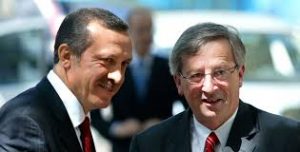
In an effort to “normalize” relations, Turkish president Recep Tayyip Erdoğan (along with members of his cabinet) will meet European Council President Donald Tusk and European Commission President Jean-Claude Juncker in the Black Sea resort town of Varna on March 26. The EU summit, hosted by Bulgaria, comes nearly two decades after Turkey first became a candidate for EU membership in December 1999. Turkey’s snail-pace accession process has been on pause since Turkey introduced emergency rule following the July 2016 coup attempt, but the Turkey-EU strain goes back further: Creeping authoritarianism in Ankara, the rollback of democratic gains that Turkey achieved as part of EU-required reforms, and growing European public opposition to Turkish membership have all helped stall the process.
Author

Kemal Kirişci
TÜSİAD Senior Fellow – Foreign Policy,Center on the United States and Europe
Director – The Turkey Project
kemalkirisci
Nevertheless, both in the EU and Turkey, there is a recognition of mutual dependence and the need for cooperation to manage a range of challenges, ranging from fighting terrorism to managing migration, upgrading of economic partnerships, confronting rising security threats from Russia, and dealing with the situation in Syria. Revitalizing Turkey’s stalled EU accession process would significantly help address these challenges. However, it would be unrealistic to expect a major breakthrough at the approaching Varna summit, for a number of reasons.
MUTUAL RESENTMENT
Turkish democracy is in an appalling state. It is no surprise to see Turkey listed as “not free” in Freedom House’s 2017 report assessing the state of democracy around the world. Policies adopted since the introduction of emergency rule have led to wide spread detentions; large-scale dismissals from the military, police, and bureaucracy; property confiscation with little regard to due process of law; and the imprisonment of elected officials, mainly from predominantly Kurdish regions in southeastern Turkey. Needless to say, it is no longer possible to talk about freedom of expression in Turkey.
Related Books

Following a contentious referendum in April 2017, Ankara adopted constitutional amendments that led the way to the centralization of power in Erdoğan’s hands, which is already weakening traditional checks and balances associated with parliamentary systems. In the run-up to the referendum, Erdoğan’s accused the Netherlands and Germany of “Nazism” after they rejected Turkish requests to hold pro-government rallies in those countries. This was central to a growing public resentment in Europe towards him and opposition to Turkey’s EU membership aspirations. It is not surprising that all this culminated in the European Parliament’s decision recommending the end of accession negotiations with Turkey. However, the EU Council, the body representing member states, remained cautious. It stopped short of calling for ending talks, and instead froze the opening of new chapters until the emergency rule in Turkey would be lifted.
Many in Turkey were deeply disappointment with European leaders’ failure to express prompt condemnation of the coup attempt perpetrators. Europe’s reluctance to recognize how large segments of Turkish society stood up in defense of their elected government caused much bitterness, a sense that was aggravated when European governments did not respond favorably to the extradition requests of the alleged perpetrators who fled to Europe. This spiraled into a bigger crisis as the Turkish government resorted to the radical practice of arresting European—especially German—citizens on frivolous charges as a way to compel the extraditions. Many in Europe called this “hostage diplomacy.” EU-Turkish relations have since hit rock-bottom, giving the Turkish government a good opportunity to whip up anti-Western rhetoric (including a narrative that the EU and United States were implicated in the coup attempt). When accompanied with a multitude of other grievances against the EU, this contributed to calls by Erdoğan and pro-government media to abandon Turkey’s EU membership aspirations in favor of closer relations with Russia, China, and Iran.
CAN’T GO IT ALONE
But the truth is that both sides need each other.
Economically, Turkey is very dependent on the EU: Half of Turkish exportsgo to EU countries. In contrast, China, Iran, and Russia absorbed less than 6 percent of Turkey’s overall exports. Close to two-thirds of foreign direct investment in Turkey also originates from EU member countries, and brings direly needed industrial technology. With regard to Syrian refugees, the deal with the EU is the only agreement that provides Turkey with substantive financial support, despite Erdoğan’s frequent outbursts claiming otherwise. The deal also includes a resettlement program—however modest it may be—for the Syrian refugees from Turkey.
Conversely, the EU is also dependent on Turkey, which is an important market for EU exports (it absorbed close to 4.5 percent of the EU’s massive suite of exports in 2016). Turkey is also the EU’s 5th-largest trading partner after the United States, China, Switzerland, and Russia, and ahead of Norway, Japan, and South Korea. Turkey is an important link in the production chains of many European manufacturing companies, as well as a base for such companies to launch and run their operations in Turkey’s neighborhood. The migration deal helped significantly diminish the flow of migration into Europe through Turkey, and the deal—in spite of criticisms about its transactional nature—is considered to be working. Turkey’s cooperation is also critical in the area of counterterrorism, and European officials recognize the strategic importance of having Turkey on the EU’s side at a time of such geopolitical volatility in Europe and beyond.
Ahead of an EU-Turkey summit, don’t expect big breakthroughs
