


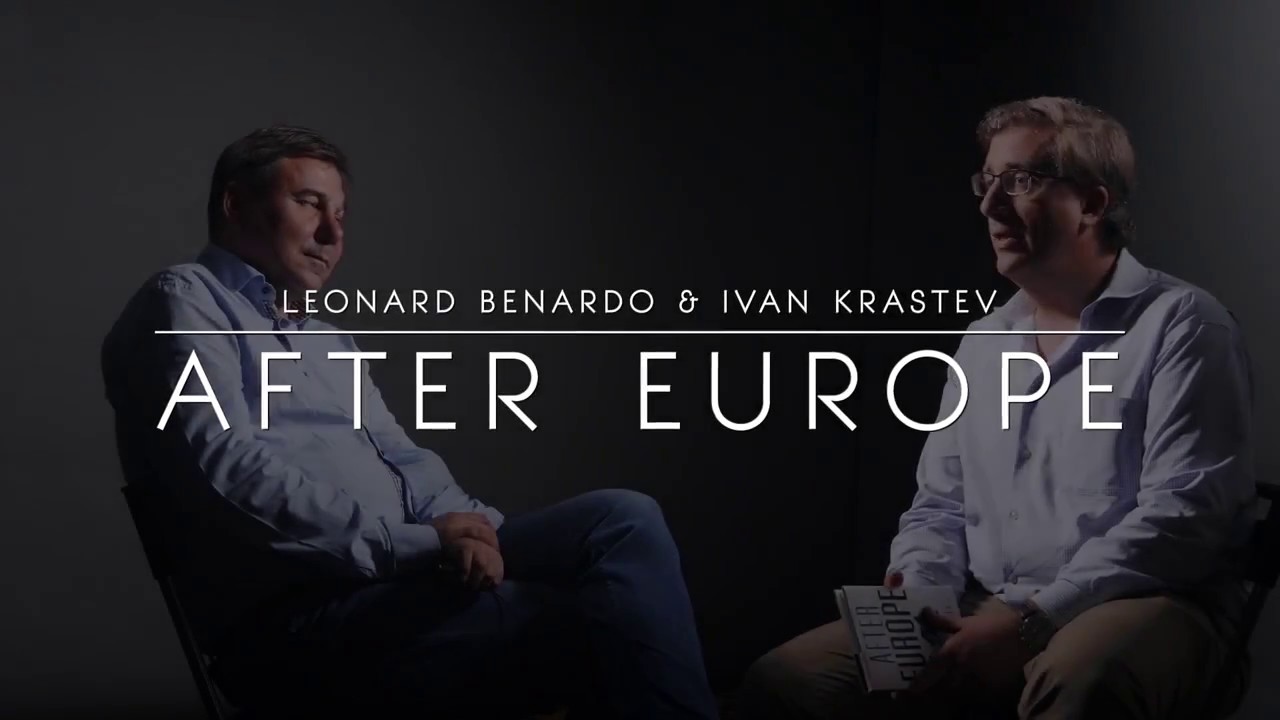
Can democratic institutions be turned to exclusionary ends? ~ Why has the ongoing refugee crisis transformed the politics of Central and Eastern European states—despite the fact that these countries host virtually no migrants? ~ And what do demographic and generational changes mean for the liberal consensus that emerged in the wake of communism’s fall?
After Europe is also available in German under the title Europadämmerung: Ein Essay (Suhrkamp, 2017, 143 pp.), with additional translations forthcoming.
 Leonard Benardo is regional director for the Open Society Foundations’ Eurasia Program and director of the Open Society Fellowship. His writing has appeared in the New York Times, the New York Review of Books,the International Herald Tribune, and Bookforum. He is also the coauthor of Brooklyn by Name: How the Neighborhoods, Streets, Parks, Bridges, and More Got Their Names (2006), and Citizen-in-Chief: The Second Lives of the American Presidents (2009).
For more of Krastev’s incisive analysis on these and other themes, turn to his October 2016 Journal article “The Specter Haunting Europe: The Unraveling of the Post-1989 Order,” watch his 2010 Seymour Martin Lipset Lecture on “Paradoxes of the New Authoritarianism,” and peruse his many past contributions:
- “What’s Wrong with East-Central Europe? Liberalism’s Failure to Deliver” (January 2016)
- “From Politics to Protest” (October 2014)
- “European Disintegration? A Fraying Union” (October 2012)
- “Putinism Under Siege: An Autopsy of Managed Democracy” (with Stephen Holmes, July 2012)
- “Paradoxes of the New Authoritarianism” (April 2011)
- “Twenty Years of Postcommunism: Deepening Dissatisfaction” (January 2010)
- “Reading Russia: The Rules of Survival” (April 2009)
- “Is East-Central Europe Backsliding? The Strange Death of the Liberal Consensus” (October 2007)
- “New Threats to Freedom: Democracy’s ‘Doubles’” (April 2006)
- “The Anti-American Century” (April 2004)
- “The Balkans: Democracy Without Choices” (July 2002)
Linked articles are freely available on this site. For full access to all of our current and past content, subscribe to the Journal.
Praise for After Europe
Gideon Rachman, Financial Times: “Krastev is one of Europe’s most interesting public intellectuals. In what is essentially a long essay he argues that the refugee crisis threatens to widen the gap between elites and voters in ways that threaten the future of the entire European project.”
David Goodhart, Times: “In this slim volume, which is a treasure chest of striking observations and colourful vignettes, the Bulgarian commentator brings a distinctly East European sense of tragedy to Europe’s multiple crises.”
Paschal Donohoe, Irish Times: “Most arresting book of the year. . . . A short work, it attributes our severest European challenges to the refugee crisis. Despite this I finished it with a sense of hope that we are rediscovering the EU as a source of freedoms.”
Robert Fox, London Evening Standard: “The best essay today on history and the world of Trump, Brexit, migrants and climate change.”
Pankaj Mishra, Guardian: “After Europe (Pennsylvania), a sober reckoning with the challenges to Europe, defines the dangers that will outlast, and may even be aggravated by, Emmanuel Macron’s triumph.”
Yascha Mounk, New Republic: “[The intensity of anti-immigrant sentiment in Central and Eastern European countries] is one of many riddles that Ivan Krastev—a Bulgarian political scientist who casually wields the dialectical wit to which Slavoj Zizek so desperately pretends—solves in After Europe.”
http://journalofdemocracy.org/after-europe-interview-ivan-krastev

