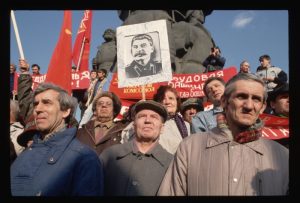
| This week marks 65 years since the death of Joseph Stalin and I find myself going over the footage for a documentary that we are working on at Coda. I listen to a man weeping on my screen as he talks about “the great leader.” In the next frame a young girl, just out of her teens, talks passionately about the importance of Stalin’s legacy. Then another man, this one in his late thirties, from Kazakhstan who has come to pay homage to Stalin’s hometown in Gori, argues that it is time to “look at the bright side of the Gulags.”
It’s 2018 and across the former Soviet Union the old Soviet dictator seems to have been given a new lease on life. It may be tempting to dismiss fans of Stalin as outliers, but they are part of an increasingly mainstream debate that’s taking place across the region. They are also the reason why we launched our Rewriting History current as part of our coverage. We realized it was important to examine the painful debate surrounding the search for a common past and the battle over control of historic narratives. To be honest, what we hadn’t realized is how often our coverage would have to circle back to Joseph Stalin
Take one of the stories we recently covered: the Kremlin’s ban on Albert Ianucci’s brilliant “Death of Stalin” satire. Many in the West took the ban of the film as a sign of how little has changed in Russia. But to me, the ban — just like the young people defending Stalin to Coda’s film crew — is a sign of the opposite. It’s a sign of change.
Across the post-Soviet space a historic figure that was largely irrelevant in my youth, is suddenly back in vogue. It’s just as fashionable to loath Stalin, as it is to mourn him. No other figure is suddenly more era-defining, more relevant than Joseph Stalin. Assisted by the Kremlin, fed by nostalgia, powered by the fact that over the last decades so many of the narratives had been left unexamined in a rush to move on from the Soviet past, Stalin is suddenly, somehow at the very center of the region’s struggle to find its identity. The debate over whether he was a villain or a hero is real and taking place in the present tense. The region’s future will be shaped by its outcome.
Watch Ianucci’s film if you haven’t done so yet. In the West many reviews called the film a departure for Ianucci, who is known for making satire on current, era-defining topics. But try watching it while imagining that you live in a country where new monuments to Stalin are being erected and where young people are suddenly romanticizing him. Try watching it, while remembering that your government doesn’t want you to see it.
It’s this profound relevance of Ianucci’s film to the region that makes it so sharply poignant. In his dark, deeply funny and disturbing way Ianucci tells a fictionalized story of an inner circle battle over who gets to bury Stalin and interpret his legacy. In real life, this battle is back: 65 years on, in the post-Soviet space they are fighting over who will get to write the definitive obituary of Joseph Stalin.
Stay on the story with us,
Natalia Antelava
Editor-in-chief
|